Pressures cut Portugal pace
Slowdown expected to continue into 2026, writes Paul Stephen
The pace of solar installation is decelerating in Portugal as developers grapple with grid and permitting bottlenecks, together with increased off-take risk.
Around 500MW was connected in the first half of this year to bring the country’s total installed capacity to 6.18GW, according to data from Lisbon’s Department of Energy, Planning and Statistics.
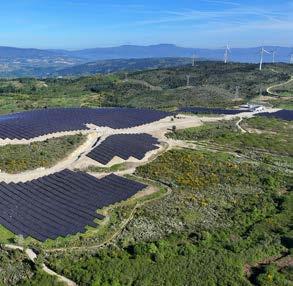
Completed large-scale groundmounted developments exceeding 10MW include Sonnedix’s 150MW Douro and Neoen’s 204MW Rio Maior and 68MW Torre Bela solar farms, all inaugurated in June.
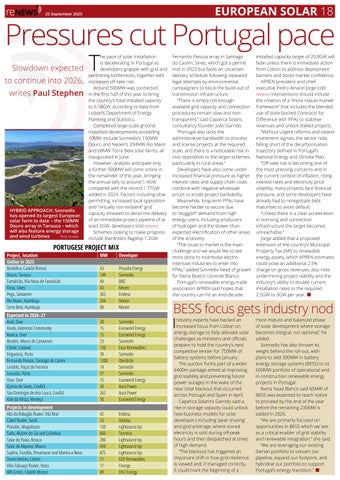
However, analysts anticipate only a further 900MW will come online in the remainder of this year, bringing the annual tally to around 1.4GW compared with the record 1.77GW added in 2024. Factors including slow permitting, increased local opposition and “virtually non-existent” grid capacity threaten to derail the delivery of an immediate project pipeline of at least 2GW, developers told renews Schemes looking to make progress include Iberdrola’s flagship 1.2GW
PROJECT MIX
Santarem
Maior, Azambuja
Torre Bela, Azambuja
Expected in 2026–27
Acail, Ovar
Arada, Valencian Community
Avanca, Ovar
Bustelo, Marco de Canaveses
Cibele, Cadaval
Felgueiras, Porto
Fernando Pessoa, Santiago do Cacém
Eurowind Energy
Sonnedix
Exus Renewables
Sonnedix
Iberdrola
Lordelo, Paços de Ferreira 14 Sonnedix
Lousada, Porto 37 Sonnedix
Ovar, Ovar 15 Eurowind Energy
Quinta de Seves, Covilhã 30 Aura Power
Sao Domingos de Ana Loura, Covilhã 262 Aura Power
Vale da Missa, Alentejo
Projects in development
Alto do Rabagão floater, Vila Real
Cabril floater, Sertã
Planalto, Mogadouro
Sado, Alcácer do Sal and Grândola
Solar do Paiva, Arouca
do Alqueva, Moura
Fundão, Penamacor and Idanha-a-Nova
Vedras,
Eurowind Energy
Lightsource bp
bp
bp
Fernando Pessoa array in Santiago do Cacém, Sines, which got a permit nod in 2023 but faces an uncertain delivery schedule following repeated legal attempts by environmental campaigners to block the build-out of transmission infrastructure.
“There is simply not enough available grid capacity and connection procedures remain slow and nontransparent,” said Caparica Solaris consultancy founder João Garrido.
“Portugal also lacks the administrative bandwidth to process and license projects at the required scale, and there is a noticeable rise in civic opposition to the larger schemes, particularly in rural areas.”
Developers have also come under increased financial pressure as higher interest rates and supply chain costs combine with negative wholesale prices to erode project bankability.
Meanwhile, long-term PPAs have become harder to secure due to “sluggish” demand from high energy users, including producers of hydrogen and the slower-thanexpected electrification of other areas of the economy.
“The route to market is the main challenge and we would like to see more done to incentivise electrointensive industries to enter into PPAs,” added Sonnedix head of growth for Iberia Beatriz Llorente Blanco.
Portugal’s renewable energy trade association APREN said hopes that the country can hit an end-decade
installed capacity target of 20.8GW will fade unless there is immediate action from Lisbon to address deployment barriers and boost market confidence.
APREN president and chief executive Pedro Amarel Jorge told renews interventions should include the creation of a “more robust market framework” that includes the blended use of state-backed Contracts for Difference with PPAs to stabilise revenues and unlock stalled projects.
“Without urgent reforms and clearer investment signals, the sector risks falling short of the decarbonisation trajectory defined in Portugal’s National Energy and Climate Plan.
“Off-take risk is becoming one of the most pressing concerns and in the current context of inflation, rising interest rates and electricity price volatility, many projects face financial pressure, and some developers have already had to renegotiate debt maturities to avoid default.
“Unless there is a clear acceleration in licensing and connection infrastructure the target becomes unreachable.”
Jorge added that a proposed extension of the country’s Municipal Property Tax (IMI) to renewable energy assets, which APREN estimates could pose an additional 2.5% charge on gross revenues, also risks undermining project viability and the industry’s ability to double current installation rates to the required 2.5GW to 3GW per year. n
BESS focus gets industry nod
Industry experts have backed an increased focus from Lisbon on energy storage to help alleviate solar challenges as ministers and officials prepare to hold the country’s next competitive tender for 750MW of battery systems before January.
The auction forms part of a wider €400m package aimed at improving grid stability and preventing future power outages in the wake of the near total blackout that occurred across Portugal and Spain in April.
Caparica Solaris’s Garrido said a rise in storage capacity could unlock new business models for solar developers including ‘peak shaving’ and grid arbitrage, where stored electricity is sold during off-peak hours and then despatched at times of high demand.
“The blackout has triggered an important shift in how grid resilience is viewed and, if managed correctly, it could mark the beginning of a
more mature and balanced phase of solar development where storage becomes integral, not optional,” he added.
Sonnedix has also thrown its weight behind the roll-out, with plans to add 300MW in battery energy storage systems (BESS) to its 600MW portfolio of operational and in-construction renewable energy projects in Portugal.
Iberia head Blanco said 65MW of BESS was expected to reach notice to proceed by the end of the year before the remaining 235MW is added in 2026.
“We are primarily focused on opportunities in BESS which we see as a critical enabler of grid stability and renewable integration,” she said.
“We are leveraging our existing Iberian portfolio to convert our pipeline, expand our footprint, and hybridise our portfolio to support Portugal’s energy transition.”