SOILTECH DELIVERS STRONG RESULTS AND CONSIDERS UPLISTING TO EURONEXT OSLO BØRS
Soiltech reports strong Q4 performance, concluding a year marked by solid growth and strong profitability. Fourth-quarter revenue amounted to NOK 102 million, an increase of 26% year-over-year, EBITDA adj. was NOK 27 million, while profit before tax was NOK 13 million.
“Soiltech delivered a solid fourth quarter. Revenues were in line with the third quarter, while profitability improved significantly, resulting in the highest margins of 2025, with an adjusted EBITDA margin of 27% and a net profit margin of 13%. These results reflect strong performance across our operations, the dedication and collaboration shown by our employees, and tight cost control”, says Soiltech CEO Jan Erik Tveteraas.
Fourth quarter financial highlights
• Revenue NOK 102 million, +26% year-overyear (YoY)
• EBITDA adj. NOK 27 million, +6% YoY
• EBITDA adj. margin 27% vs. 32% in Q4/24
• Profit before tax NOK 13 million vs. NOK 15m in Q4/24
• Profit before tax margin 13% vs 19% in Q4 2024
FULL-YEAR 2025
For the full-year 2025, Soiltech achieved an excellent year-on year revenue growth of 46%, reaching NOK 401 million, compared to NOK 274 million in 2024. EBITDA adj. was NOK 96 million compared to NOK 63 million, an increase of 51% year-over-year, while profit before tax was NOK 41 million compared to NOK 11 million in 2024, an increase of 276% year-over-year.
Revenue growth in 2025 was driven by positive development across both business segments compared to 2024. Solid waste management recorded the highest revenue growth, increasing by 132%.
• Fluid treatment NOK 215 million + 11% YoY, 54% of total revenue
• Solid waste management NOK 186 million +132% YoY, 46% of total revenue
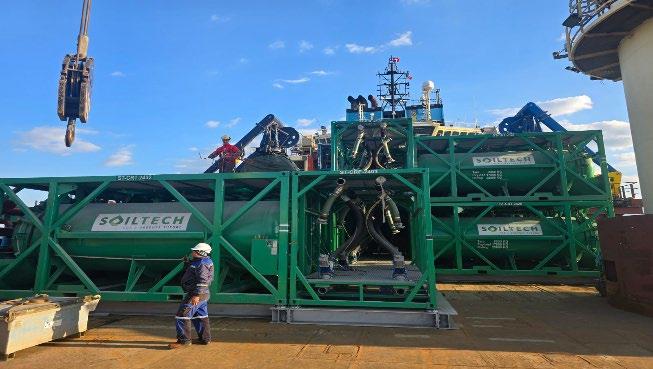
Norway accounted for 77% of revenue, while international contributed 23%. Commercial uptime was 100% across all projects.
Full-year 2025 financial highlights
• Revenue NOK 401 million, up +46% YoY
• EBITDA adj. NOK 96 million, up +51% YoY
• EBITDA adj. margin 24%, up from 23% YoY
• Profit before tax NOK 41 million, up from NOK 11 million YoY
• Profit before tax margin 10%, up from 4% YoY
“In 2025, we demonstrated profitable growth through strong operational performance delivered in close collaboration with our clients. With 25 active operations across Norway and international markets, we maintain a well-diversified contract portfolio supported by strong counterparties. Several key contract awards, along with expanded scope in existing operations, contributed to increased market shares Notably, strong revenue growth was achieved while maintaining key margins and reducing SG&A costs relative to revenue, caused by scale effects in the onshore support organization”, says Jan Erik Tveteraas
NEW CONTRACTS
• Fluid treatment (STT) contract with Estedama Environmental Solutions Co in Saudi Arabia. Est. startup second quarter of 2026. Expected to be a substantial contract Announced post-quarter
• Multi-year fluid treatment (swarf) contract for Wellbore Integrity Solutions in Dubai. Duration three years + extension options. Est. startup in Q2/Q3 2026, Expected to be a substantial contract. Announced postquarter
• Fluid treatment, onshore waste handling and associated services on Deepsea Yantai for DNO, Wellesley and Well Expertise in Norway Est. startup in Q1 2026 with duration until year-end 2026. Estimated to be a large contract. Announced post-quarter
• Fluid treatment services (STT) on a floater on the NCS. Est. startup Q1 2026 with duration 6 months. Expected to be a sizable contract
• Fluid treatment and solid waste management on Noble Resolute for Noble Corporation in the Netherlands. Started end Q4 2025, with an estimated duration of 109 days with extension options up to 12 months
• Fluid treatment, onshore waste handling and associated services on West Elara for TotalEnergies EP Norge AS in Norway. Est. startup end Q1 2026 with duration of 4-5 months. Estimated to be a sizable contract
Estimated contract values: Sizable contract
NOK 5-10 million; Substantial contract NOK 1020 million; Large contract above NOK 20 million
CASH FLOW, FINANCING AND LIQUIDITY
We generated a strong operating cash flow of NOK 112 million in the full year of 2025.
Investments in new equipment amounted to NOK 98 million. Net cash flow from financing activities was NOK 9 million, driven by new borrowings of NOK 47 million, repayment of borrowings and lease liabilities of NOK 30 million, NOK 17 million in interest payments, and NOK 9 million in proceeds from capital increase. Net cash flow for the period was NOK 23 million.
The cash balance was NOK 58 million at the end of the year, compared to NOK 35 million at year-end 2024. The available unused bank facility at the end of the year was NOK 142 million, resulting in total available liquidity of NOK 200 million as of 31 December 2025.
OUTLOOK
With a solid order backlog and a strong financial position, we are well positioned for continued profitable growth. Market visibility in our core markets in Europe and Middle East remains good, supported by clients’ ambition to maintain or increase activity levels. Demand for our services is increasing, driven by ongoing technological improvements that enhance efficiency, and environmental performance.
We expect activity in Q1 2026 to be in line with Q4 2025, followed by higher activity levels from Q2 and onwards.
Listing on Euronext Oslo Børs Soiltech ASA is exploring the potential for an uplisting of its shares from Euronext Expand to Euronext Oslo Børs, the main list of the Oslo Stock Exchange. The Company believes that an uplisting would strengthen investor visibility and improve liquidity in the Company’s shares.
The Board emphasizes that any forwardlooking statements contained in this report could depend on factors beyond its control and are subject to risks and uncertainties. Accordingly, actual results may differ materially.
Sandnes, 19 February 2026
The Board of directors
Soiltech ASA
INCOME STATEMENT
*Adjustments are non-cash cost related to share incentive scheme. BALANCE SHEET
Condensed consolidated financial statements
STATEMENT OF COMPREHENSIVE INCOME (UNAUDITED)
in NOK 1000)
STATEMENT OF CASH FLOW (UNAUDITED)
Notes to the Consolidated interim financial statements
Note 1 – General information
Soiltech ASA (the 'Company') is a limited company domiciled in Norway. The registered office of the Company is Koppholen 25, 4313, Sandnes, Norway.
The Company is an innovative technology company specializing in the treatment, recycling and sustainable handling of contaminated water and solid industrial waste streams on site.
The Company was listed on Euronext Expand on 11.09.2024 with the ticker code 'STECH’ and as part of the listing converted into a public limited company (Nw.: "Allmennaksjeselskap"). The consolidated financial statements comprise the financial statements of the Company and its subsidiaries (together referred to as the 'Group' or 'Soiltech').
The interim consolidated financial statements have not been subject to external audit.
Note 2 – Summary of general accounting policies
The Group has applied the same accounting policies and methods of computation in its interim consolidated financial statements as in its 2024 annual financial statements. Specific accounting policies related to the individual areas in the interim consolidated financial statements are described in the relevant notes.
Basis for preparation
These interim consolidated financial statements are presented in accordance with IAS 34 Interim Financial Reporting. They were authorised for issue by the board of directors on 27 August 2025 They do not include all disclosures that would otherwise be required in a complete set of financial statements and should be read in conjunction with the 2024 IFRS financial statement issued by the Company on the 2nd of April 2025
The interim consolidated financial statements are presented in Norwegian Kroner (NOK) and have been rounded to the nearest thousand unless otherwise stated. As a result of rounding adjustments, amounts and percentages may not add up to the total.
Accounting estimates and judgements
Items in the financial statements are to a varying degree affected by estimates and assumptions made by management; reference is made to the relevant notes for the affected items.
Estimates with a material impact on the interim financial statements, combined with a significant estimation uncertainty, consists of recognition of deferred tax asset (note 4)
Segment information
Given the uniform nature of the Group's services and the centralized management from its head office in Norway, the entire Group is considered as a single operating segment for internal reporting purposes.
New and amended IFRS standards
Of new standards and interpretations that are not mandatory for the current reporting period, none are expected to have a material impact on the entity in the current or future reporting periods and on foreseeable future transactions.
Of new standards and interpretations that are not mandatory for the current reporting period, none are expected to have a material impact on the entity in the current or future reporting periods and on foreseeable future transactions. IFRS 18 ‘Presentation and Disclosure in Financial Statements’, issued in April 2024 and effective from 1 January 2027, introduces new requirements for the presentation and aggregation of information in the primary financial statements and related disclosures. The Group is currently assessing the potential impact of this standard.
Share-based payment
During YTD 2025, a total of 75,000 new share options were granted to employees and board members. In the same period, 318,840 share options were exercised.
Per 31.12.2025, there were 1 021 150 share options outstanding.
Note 3 – Revenues
Accounting policies
The contracts are considered to consist of only one performance obligation, which is satisfied over time. Progress is measured based on the time the equipment and personnel is available to service the customer. In practice, revenue based on daily rates is thus recognized by the amount that the Company has a right to invoice. As a practical simplification based on materiality, any consideration associated with mobilization and demobilization are recognized over the period of the underlying contract.
Mobilization cost is considered to be cost to fulfil a contract and are recognized as an asset when incurred. These costs are presented under the accounting line item “Contract assets” in the balance sheet. The asset is subsequently amortized over the contract period, as cost of materials and personnel expenses. Correspondingly, mobilization revenue is presented under the accounting line item Contract liabilities in the balance sheet and is recognized as income systematically over the contract period, in line with the amortization of mobilization costs.
Revenues by product category
Revenues by geography
Revenues from major customers
Note 4 – Income tax Accounting policies
The Group consists of companies subject to ordinary corporate taxation in Norway, and within the same tax group with respect to offsetting of deferred tax. Income tax is therefore recognized on the basis of a general application of IAS 12 without the need for further judgments or policies of significance.
Basis for recognition of deferred tax assets
Deferred tax assets are recognized when it is probable that the company will have a sufficient profit for tax purposes in subsequent periods to utilize the tax asset. The Group recognize previously unrecognized deferred tax assets to the extent it has become probable that the Group can utilize the deferred tax asset. Similarly, the Group will reduce a deferred tax asset to the extent that the Group no longer regards it as probable that it can utilize the deferred tax asset. Deferred tax and deferred tax assets are measured on the basis of the expected future tax rates applicable to the companies in the Group where temporary differences have arisen based on tax rates (and tax laws) that have been enacted or substantively enacted by the end of the reporting period. Deferred tax and deferred
assets are recognized at their nominal value and classified as non-current asset (non-current liabilities) in the consolidated statement of financial position.
Basis for tax expense in interim periods
The tax expense in interim periods is measured by multiplying profit before tax by estimated average annual effective income tax rate.
Note
5
– Cash and cash equivalents
Cash and cash equivalents comprise mostly ordinary bank deposits. The statement of cash flows is prepared using the indirect method. Interest income and expenses are presented as investing and financing activities, respectively.
Reconciliation of cash flows from financing activities
Carrying amount 31.12.2024
Proceeds from new borrowings
of principal portion of lease liability
Additions lease
Carrying amount 31.12.2025
Current
Note 6 – Borrowings
Accounting policies
Borrowings are initially recognized at fair value, including transaction costs directly attributable to the transaction, and are subsequently measured at amortized cost. There has not been any material transaction cost during the year.
In July 2025, Soiltech signed new financing agreements with SpareBank 1 Sør-Norge, replacing existing credit facilities totalling NOK 229 million (borrowings and leasing). Effective from Q3 2025, the agreements include an additional NOK 150 million investment loan and a NOK 30 million overdraft facility, increasing total available financing to NOK 409 million.
Covenants
The loan facilities with Sparebank 1 Sør-Norge have the following covenants:
-Net-interest bearing debt (NIBD)/Earnings before interest taxes, depreciation and amortization (EBITDA) 12 month rolling < 3.75
-Book equity > 30%
- Bank approval required for dividends or group contributions
The covenants are tested quarterly, and the Company is not in breach with any of the covenants above.
Specification of borrowings – 31.12.2025
Sparebank 1 Sør Norge
Non-current borrowings
Specification of borrowings – 31.12.2024
Rogaland Sparebank
Contractual payments on borrowings – 31.12.2025
in NOK 1000)
Sparebank 1 Sør Norge
Contractual payments on borrowings – 31.12.2024
For loans with floating interest rates, the amounts above are calculated using the current interest rate per the relevant year end.
Carrying amount of assets pledged as security
Note 7 – Financial assets and liabilities
Financial liabilities per category
Financial liabilities at amortised cost
Lease liabilities
Financial liabilities at fair value through profit or loss Carrying amount as at 31.12
Fair value
For items measured at amortized cost, carrying amount is considered to be a reasonable approximation to fair value.
Note 8 – Financial risk and capital management
The Group’s policies for management of capital and financial risk aim to support the current strategy and target of maintaining a high rate of growth and developing prospective business opportunities. The Group’s capital structure shall be robust enough to maintain the desired freedom of action and utilize growth opportunities, based on strict assessments relating to the allocation of capital. The Group debt financing consist of bank and leasing financing. The loan covenants to which the Group is subject play a key role in how capital is managed and allocated, to maintain a low financing risk and financial flexibility. See note 6 borrowings for further details on the Group’s financing
Market risk
The Group's exposure to financial market risk is mainly related to interest rates on external financing and various forms of currency risks. The Group has a diversified client list and evaluates changes in pricing structure contract by contract, as part of its mitigation process to cover for increased interest cost. The Group has not entered into any interest swap agreements.
Currency risk
The Group has Norwegian kroner (NOK) as its base currency. However, through its operations outside Norway, the Group is exposed to fluctuations in certain exchange rates, mainly Euro (EUR), British Pound (GBP), American dollar (USD) and Romanian leu (RON) The Group also has currency risks linked to both balance sheet monetary items and investments in foreign countries.
Interest rate risk
The Company loan and leasing agreements have floating interest rates based on NIBOR according to the financial strategy, see Note 6 borrowings, and is thereby influenced by changes in the
interest market. A change of increase of 1 percentage point in 3M NIBOR means a change in yearly net interest expenses of approximately MNOK 2.7.
Credit risk
Assets that may give rise to credit risk comprise mainly trade receivables and bank deposits. For the latter, the counterparties are mainly banks established in the Nordic countries, which indicates that the credit risk should be regarded as negligible. Trade receivables are characterized by a concentration in the customer base, in terms of country and industry. The customers, however, are primarily large companies with high credit ratings, and the agreed payment terms in the contracts typically ensure that any overdue amounts are kept at low level. Thus, credit losses have historically been insignificant.
Liquidity risk
As at year-end, the Group's portfolio of loans and loan facilities is well diversified both with regards to maturity profile and lenders. Total loan facilities with Sparebank 1 Sør Norge is NOK 258 million. The unused portion of the credit facilities was NOK 112 million as at 31.12.2025. In July 2025, Soiltech signed new financing agreements with SpareBank 1 Sør-Norge, effective from Q3 2025. These agreements further strengthen the Group’s liquidity position by increasing total available financing and extending maturity profiles.
Summary of contractual maturities 31.12.2025
Note 9 – Earnings per share
Note 10 – Share capital and shareholder information
Share capital and ownership structure
As of 31 December 2025, the share capital of the parent company, Soiltech ASA, amounts to NOK 1,076,650.51 and consists of 8,281,927 ordinary shares, each with a nominal value of NOK 0.13. The increase in share capital during the period results from the exercise of 318,840 share options. Consequently, share capital increased from NOK 1,035,201 at 31 December 2024 to NOK 1,076,150.51 at 31 December 2025.
Shareholders as of 31.12.2025
w/ Mona H.S. Freuchen
Note 11 – Merger with Oceanteam ASA in 2024
Soiltech ASA completed a merger with Oceanteam ASA on September 11, 2024. The merger plan was signed 30 May 2024 and approved by the general meetings of the respective companies on 4 July 2024. The main purpose of the merger was to achieve a listing of Soiltech ASA on the Euronext Expand marketplace.
As part of the merger, Soiltech ASA issued 527 947 new shares as consideration to the shareholders of Oceanteam ASA. This consideration was based on Oceanteam ASA having a market value of NOK 31.67 million at the date of entering into the merger agreement.
At the time of the merger, Oceanteam ASA was essentially an empty shell company without any operational activities. The only significant asset in the company was a cash balance of NOK 19.1 million. Therefore, the merger has been accounted for as a share-based payment transaction in accordance with IFRS 2. The measurement of the transaction is based on the value of the shares in Oceanteam ASA at the transaction date, which was September 11, 2024.
At this time, the shares were traded at NOK 0.93, corresponding to a market value for the company of NOK 30.8 million.
The difference between the cash balance in Oceanteam ASA (NOK 19.1 million) and the fair value of the company is considered to reflect the value of the stock exchange listing, including access to new capital and recognized investors This difference, amounting to NOK 12,8 million, has been recognized as an expense in the financial statements of Soiltech ASA 2024 in the line item “Expenses related to Merger & IPO”, as it does not meet the criteria to be recognized as an asset on the balance sheet.
In addition to the expenses above, Soiltech ASA has incurred various transaction costs in connection with the process of completing the merger and subsequent listing on Euronext Expand, amounting to NOK 10.1 million in total. Of these, NOK 5.3 million is considered to be incremental costs directly attributable to the equity transaction and has therefore been recognized as a deduction of equity, reducing the capital increase from the merger. The remaining NOK 5.0 million has been recognized as an expense and is included in the line item «Expenses related to Merger & IPO» in the income statement for 2024
Note 12 – Events after the reporting period
After the balance sheet date there are only events in the ordinary course of business and no events of an adjusting or non-adjusting nature.
Appendix: Alternative Performance Measures
Alternative Performance Measures
The Group presents certain alternative measures of financial performance, financial position and cash flows that are not defined or specified in IFRS Accounting Standards. The Group considers these measures to provide valuable supplementary information for Management, Board of Directors and investors, as they provide additional useful information regarding the Group's financial performance and position. As not all companies define and calculate these measures in the same way, they are not always directly comparable with those used by other companies. These measures should not be regarded as replacing measures that are defined or specified in IFRS Accounting Standards but should be considered as supplemental financial information. In this report, the Alternative Performance Measures used by the Group are defined, explained and reconciled to the most directly reconcilable line item, subtotal or total presented in the financial statements of the corresponding period.
In previous reports, Gross Profit Margin, EBITDA adj. Margin, Operating profit margin and Profit before tax margin were presented as separate text items. From Q2 2025 onwards, we have replaced these textual references with a dedicated “%” column placed directly next to the absolute figures for each metric. The calculation methods for each margin remain unchanged from prior periods.
The APMs used by the Group are set out below:
Operating cost
Operating cost is defined as the total of cost of materials, personnel expenses and other operating expenses less expenses related to onshore personnel and other onshore operating expenses, share incentive program, severance payment, legal cost related to Merger & IPO and other items defined by the Management to not relate to offshore operations. Management defines that Operating cost illustrates the expenses directly related to offshore activities. This measure provides additional information for the Management, Board of Directors and investors in order to evaluate underlying profitability of offshore operating activities and their ability to generate cash.
SG&A
Selling, general and administrative expenses (“SG&A”) is defined as the sum of Cost of materials, Personnel expenses and other operating expenses less operating costs (as defined above), share incentive program, severance payment, legal cost related to Merger & IPO and other items defined by management that impact comparability between periods. Management defines that SG&A illustrates the expenses directly related to onshore support activities. This measure provides additional information for management, the board and investors, in order to evaluate underlying profitability and their ability to generate cash.
Gross Profit and Gross profit margin (%)
Gross Profit is defined as total operating income less Operating cost (as defined above). Gross profit margin is defined as gross profit divided by total operating income. Gross profit and Gross profit margin provide additional information for Management, Board of Directors and investors to evaluate the underlying profitability generated from offshore operating activities.
EBITDA and EBITDA margin
EBITDA is defined as Operating profit before other gains, impairment, depreciation and amortization. EBITDA is defined as EBITDA divided by total operating income.
These measures provide additional information for Management, Board of Directors and investors to evaluate the underlying profitability of operating activities and their ability to generate cash before investments in fixed assets and service of debt.
EBITDA adj. and EBITDA adj. margin
EBITDA adj. is defined as EBITDA (as defined above) adjusted for items affecting comparability such as expenses related to share incentive programs, severance payment, legal cost related to Merger & IPO and other items defined by Management that impact comparability. EBITDA adj. margin is defined as EBITDA adj. divided by total operating income. These measures provide additional information for Management, the Board of Directors and investors to evaluate underlying profitability of operating activities and their ability to generate cash before investments in fixed assets and service of debt.
Net interest-bearing debt
Net interest-bearing debt is defined as the total of non-current borrowings, non-current lease liabilities, current borrowings and current lease liabilities less cash and cash equivalents. This measure provides additional information for Management, Board of Directors and investors to assess the Group's financial indebtedness and as an input to assess its capacity to meet its financial commitments.
Equity ratio
Equity ratio is defined as total equity divided by total assets. This measure provides additional information for Management, Board of Directors and investors to assess the Group's financial position and capital structure.
All margins are shown under % column in the table.