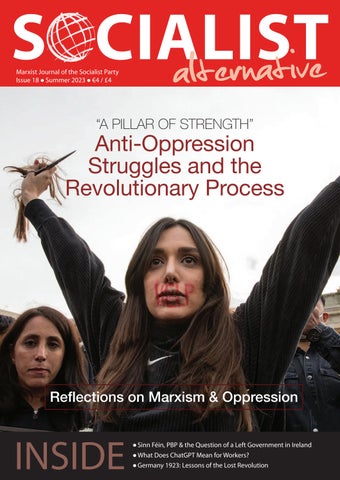

CIALIST Marxist Journal of the Socialist Party Issue 18 l Summer 2023 l €4 / £4 alternative INSIDE l Sinn Féin, PBP & the Question of a Left Government in Ireland l What Does ChatGPT Mean for Workers? l Germany 1923: Lessons of the Lost Revolution “A PillAr of Strength” Anti-Oppression Struggles and the Revolutionary Process Reflections on Marxism & Oppression
S

Marxist Journal of the Socialist Party
Issue 18 l Summer 2023
S CIALIST alternative
CONTACT
North: 07821058319
South: 0873141986
info@socialistparty.net
INTERNATIONAL
The Socialist Party is the Irish section of International Socialist Alternative (ISA), a socialist organisation with groups in over 30 countries.

FEATURE 25 years on: Has the Good Friday Agreement delivered? BY ANN ORR & PAUDIE MCKEE 2 Sinn Féin, PBP & the question of a left government BY EDDIE MCCABE 8 “A Pillar of Strength” Anti-oppression struggles & the revolutionary process BY LAURA FITZGERALD 13 What does ChatGPT mean for workers? BY
GONG 23 The groundbreaking struggle for free healthcare for all 75 years since the founding of the NHS BY EVA MARTIN 26 Germany 1923: Lessons of the lost revolution BY ROBERT COSGRAVE 30 REVIEW My Fourth Time, We Drowned
Sally Hayden REVIEWED BY MICHAEL O’BRIEN 36 The Myth of Normal by Gabor Maté, with Daniel Maté REVIEWED BY RÓISE MCCANN 37 Close To Home by Michael Magee REVIEWED BY NIALL DOORIS 38 The Patriarchs: The Origins of Inequality by Angela Saini REVIEWED BY MARTINA STAFFORD 39 www.socialistparty.ie / www.socialistpartyni.org
ISSUE NO.18
TONY
by
IN THIS
political and
the Socialist
SOCIALIST ALTERNATIVE is the
theoretical journal of
Party.
a subscription to Socialist Alternative
The Socialist, the monthly newspaper
the Socialist Party.
SUBSCRIBE NOW! Get
and
of
Text “Subscribe” to 087 3141986
THE SOCIALIST PARTY
www.internationalsocialist.net carries reports of struggles, analysis and a programme for the fight against capitalism. internationalsocialist.net
25 years on:
Has the Good Friday Agreement delivered?
In the previous issue of this journal we republished an article by Peter Hadden originally published in May 1998 entitled ‘Will the Agreement Bring Peace?’ Here, Ann Orr and Paudie McKee show how the analysis in that article has been borne out over the 25 years since it was written, as reflected sharply in the political and social crises that currently rack the North. The Good Friday Agreement was and remains incapable of overcoming sectarian division and bringing lasting peace. In fact, its inherent flaws mean that without a struggle by the working class to bring about genuine unity between Protestant and Catholic communities, the trajectory in the North is ultimately towards further division and a return to conflict.
25 years on – a different world War-weariness among ordinary people after nearly 30 years of the ‘Troubles’ brought about the Good Friday Agreement (GFA) in 1998. A consequence of this mood was dramatic developments within key political organisations, including the realisation by important sections of Sinn Féin's leadership that its military strategy could not succeed in defeating the British state, nor the opposition of one million Protestants to a united Ireland. Reflecting a global trend of social democracy and so-called national liberation movements moving away from socialist rhetoric, a political shift to the right also took place within Sinn Féin.
This international context was an important factor: the 1990s was a triumphant time for capitalism and the major capitalist powers – considered the unquestionable victors of the Cold War following the collapse of the USSR. This political and ideological momentum reflected itself in different peace agreements worldwide. For Britain, the US’s closest ally, there was a significant prestige element in wanting
25 Years of the Good Friday Agreement 2 l SOCIALIST ALTERNATIVE l SUMMER 2023
to "resolve" the Troubles – during which over 3,700 people had been killed.
Twenty five years on, the differences locally and internationally are striking: far from triumphant, capitalism globally, and British capitalism in particular, is mired in profound crisis. Amplified by the Covid pandemic the world economy is still experiencing major shocks. Interimperialist tensions and military conflict are back on the agenda. The effects of climate change are increasingly severe, set to worsen drastically in the coming years as the world’s governments stand by and their policies compound the problem. There is a growing sense that the system cannot resolve these issues, nor the every-day oppression faced by so many. The result is political instability, including a rise of reactionary and far-right ideas in many countries, but also of struggle by working-class and young people.
Growing up with the GFA
The GFA was and still is held up by many establishment politicians as the only viable basis for a ‘prosperous’ Northern Ireland free from violence and sectarian division. In reality, young people face a scarred and deeply divided society, with a lack of opportunities and a declining standard of living. All of these provide the basis for sectarian division, racism, gender-based violence and the continuance of paramilitary violence. The recent femicide of Chloe Mitchell and the murder of Lyra McKee in 2019 by the New IRA are stark reminders of this.
The repetition of the process of raising expectations for change and a dashing of hopes has resulted in a new generation of working-class young people frustrated with the reality of Northern Ireland. To a degree, this is illustrated in the beginning of a change in attitudes regarding the GFA. According to a survey by NI Life and Times, support for the agreement is lowest in 18-24-year-olds, with only 12% believing it is the “best basis for governing NI” and 34% stating it is the “best basis but needs changes”, while 22% believe it is “no longer” or “has never been the best basis”.1
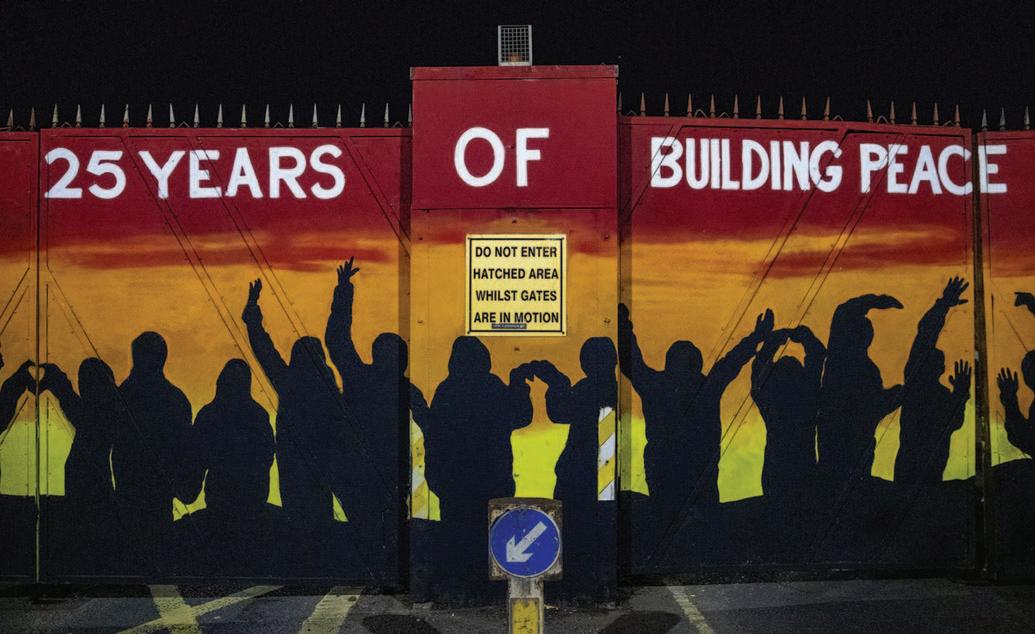
Some commentators brush off the growing questions young people have over the GFA as simply being because they did not live through the Troubles, and therefore take for granted the relative peace it has brought. For a minority this may be true, however in the main this is far off the mark. Young people overwhelmingly support the peace process and do not want to see a slide back into violence. Their doubts are based on the reality of the ‘peace process’ failing to deliver on its promises. After 25 years, housing in working-class areas is overwhelmingly segregated, with more peace walls in place now than in 1998. Even though the GFA also included recognition of the importance of facilitating integrated education, only 68 out of the 1,091 schools in the north are integrated,
with only 7% of secondary school pupils in integrated schools.
Combined with the segregation of community groups and sports, many young people grow up without knowing, never mind developing meaningful relationships with people from the other community until they join the workforce or attend university. This is not an accident, or a conscious choice by working-class people, but the product of the Stormont parties' reliance on sectarian division. Rather than tackle sectarianism, they have institutionalised and weaponised it to their benefit and the detriment of working-class and young people across the North. This is at its most vicious when used to stand over cuts, that the cuts increase the hardship of Protestant and Catholic working-class people equally, which has been a constant theme in the 25 years since the GFA.
Decades of neo-liberal policies carried out and sometimes celebrated by the Stormont parties at the behest of Tory and Blairite Labour governments has deepened the economic deprivation in working-class communities. While some multinational companies have set up shop in the North, for the vast majority of the working class and young people their living standards have not improved. Although unemployment is no longer stubbornly above the UK average, the quality of jobs has seen a marked downturn, with wellpaid manufacturing jobs being replaced with precarious hospitality and call centre jobs, stagnant wages and poor conditions, with many young people seeing no option but to emigrate.
SUMMER 2023 l SOCIALIST ALTERNATIVE l 3
“We were the Good Friday Agreement generation, destined to never witness the horrors of war but reap the spoils of peace. The spoils just never seemed to reach us.”
– Lyra McKee
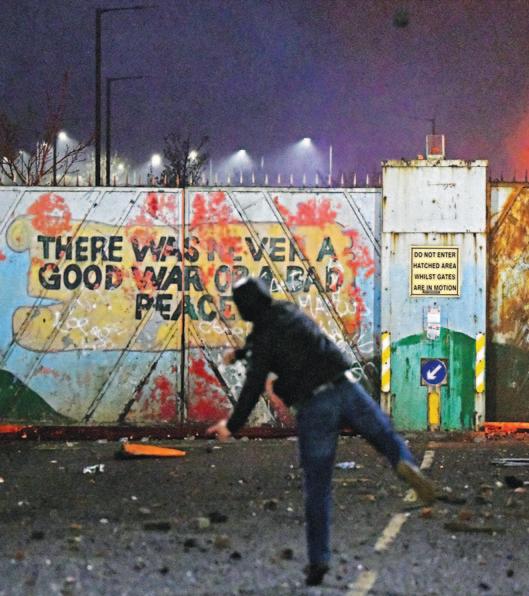
Violent unrest breaking out is still an ever present danger in the North
It is in these conditions, in a divided society, that the naked sectarianism of Stormont politicians can gain an echo. In the most hard-pressed areas, it allows paramilitaries to thrive, recruiting the most alienated and desperate people. In the past 25 years, paramilitary violence has turned inwards for the most part, replacing the sectarian shootings and bombing with criminality and ‘policing’ of their respective communities. Often this takes the form of punishment-beatings and shootings. According to the Safeguarding Board for Northern Ireland 89 young people under the age of 18 have been subject to punishment shootings, with hundreds more being the victims of beatings since the GFA.2
The negative impact on the lives and mental health of the victims, their friends and families cannot be overstated. It is one of the many reasons for the mental health crisis in Northern Ireland, alongside the intergenerational trauma from the legacy of the Troubles, as well as poverty – and worsened by the continual cuts to the NHS and mental healthcare provision, resulting in over 16,000 people languishing on waiting lists for their first appointment. As such, suicide rates in the North are also the highest in the UK, with 14.3 suicides per 100,000 in 2021, which compares with a figure of 10.5 in England and Wales, and 8.2 in the South.3
Shifting attitude of the British ruling class
At all times, British governments have represented their own interests – the interests of British capitalism and imperialism – not the interests of working-class people in the North, Protestant or Catholic. Their approach has modified as these interests also shifted. To solidify the partition of Ireland in the early 20th century, British imperialism whipped up sectarian tensions and divisions in what was coined by Lord Randolph Churchill as “playing the orange card”.4 For a period following the GFA the British government falsely portrayed itself as a neutral arbiter between two opposing sides.
In the 1990s and continuing into the 2000s the desire for greater stability in the North, and thus reduced need for a high and expensive security presence, was widespread among the representatives of British capitalism for reasons of reputation and prestige, as well as a desire to develop the private sector
of the economy. They would gladly have withdrawn from Northern Ireland while continuing to benefit economically from a single independent state – a state that would of course not threaten capitalist social structures. However, the conditions they had created over the previous decades meant that this was not possible due to the opposition from the Protestant population in the North – an opposition that has not diminished.
Today, the Tory government continues to defend the interests of British capitalism and the British state, as evidenced for example by their Troubles Legacy bill –designed to protect the state from allegations and prosecutions for killings committed during the Troubles. Tensions and struggles between the main imperialist blocks, Brexit and the pressures towards closer European cooperation in the context of the war in Ukraine are also factors that are impacting the attitude of the British government in relation to the North. In particular, it now fears the breakup of the union with Scotland, which would have significant economic implications and would constitute a massive blow to the prestige of a nation that was once a key imperialist power, but is now a two-bit player in the New Cold War and on the global stage generally.
The Tories have therefore adopted a more stringent opposition to a border poll and the growing calls for Scottish independence. The concern is never for the interests of working-class people, regardless of national identity and aspirations, but rather the issue of what suits the establishment at any given time, regardless of the consequences. The same applies to Rishi Sunak's deal with the EU, the Windsor Framework. Stabilising the situation in the North is part of the aim, but not out of concern for the living standards of working-class people here, but to ensure the basis is laid for further
25 Years of the Good Friday Agreement 4 l SOCIALIST ALTERNATIVE l SUMMER 2023
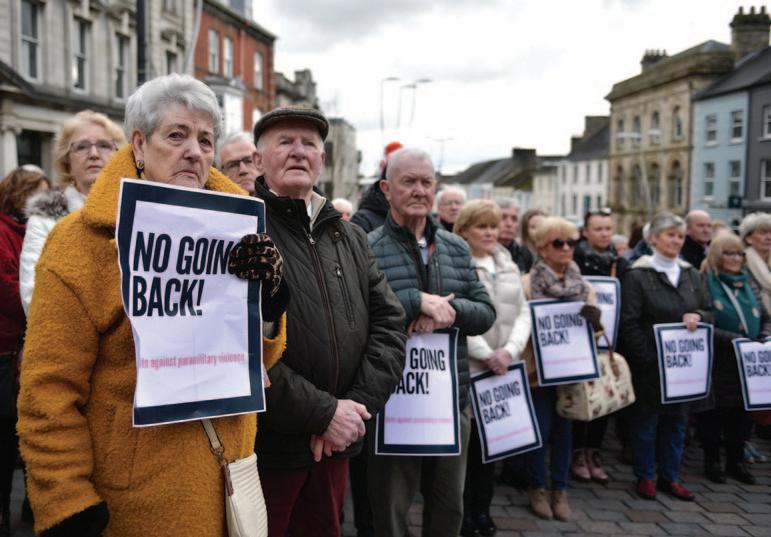
Protest called by Omagh Trace Union Council following the shooting of an off-duty PSNI officer
agreements in the economic and political interests of Britain in the future.
At times the utter lack of understanding and shere disregard towards escalations of sectarianism is exposed. This was the case earlier this year when joint authority (over Northern Ireland by the governments in London and Dublin) was raised. Because the Northern Ireland Office did not immediately rule this out as an option, loyalist paramilitaries threatened to bomb a Southern governmental building – a clear indication of the volatility in the present situation. It is also the case that every action to "resolve" a phase of the conflict has laid the basis for future disagreement. In the same way as its use of sectarianism to fortify partition later meant the British government could not leave the North as it would have liked, it was its decision to institutionalise sectarianism with the GFA and sell it on the basis of conflicting and irreconcilable promises that is now a key reason for its inability to find a way out of this impasse.
GFA – no stable basis for peace
For 35% of the last 25 years, the Stormont Executive has not sat because one of the two main parties refused to participate. This has been a consistent reminder of the shallowness of the agreement. The core of the issue lies in the conflicting national aspirations held by workingclass people here – a conflict that on the basis of capitalism cannot be resolved without resorting to some form of coercion. This means either coercing the Catholic population into a Northern Ireland state that has overseen a century of discrimination and repression, or coercion of a future Protestant minority into a united Ireland, which on a capitalist basis would make them an oppressed minority. Neither are resolutions to the issues faced by the working class and neither will overcome divisions. As we wrote in 2018:
"The real reasons for the difficulties in reaching agreement on Brexit [...] are fundamentally a consequence of the inability of capitalism to achieve a lasting solution to the national question in Ireland. In the 1980s, The Economist magazine wrote that the Troubles in Northern Ireland were “a problem without a solution”. This seemed a rational conclusion at the time, but then the 1998 Good Friday Agreement gave the appearance of falsifying this prognosis. In fact, the Good Friday Agreement did not represent a solution then or now."5
Today, 25 years after what was heralded as a groundbreaking peace agreement, the threat of a return to violence and irrevocable collapse of the institutions is more acute than ever. This is recognised by many, including even Brandon Lewis, former NI Secretary (2020 - 2022), who stated that the peace agreement was “fraying, if not outright broken”.6 The main political parties, as well as the British and Irish governments, are restricted to trying to find a way forward on the basis of the current system. The suggestions vary from a return to some form of power sharing, even if it involves renegotiation of the agreement to include mandatory coalition; to some form of direct rule from Westminster; to joint authority by London and Dublin; to a united Ireland as a result of a border poll. None of which would begin to address the conflicting national aspirations or working-class people. None is a solution to division and conflict.
Only
through workers' unity is real peace possible
As alluded to above, the GFA and the political institutions it created were major prestige projects for the British and also the Irish governments. Tony Blair, the Labour Prime Minister at the time and his Irish counterpart, Taoiseach Bertie Ahern, were held up as the men who brought about peace in Northern Ireland. They, alongside US president Bill Clinton, were part of the discussions that culminated in the GFA. How the GFA was reached has far more to do with other factors, however. The context was shaped by a growing realisation that a military defeat of the British army by the IRA was not possible on the one hand (and viceversa), and a growing understanding that the situation in Northern Ireland would remain volatile and contrary to the image the UK wanted to portray globally on the
SUMMER 2023 l SOCIALIST ALTERNATIVE l 5
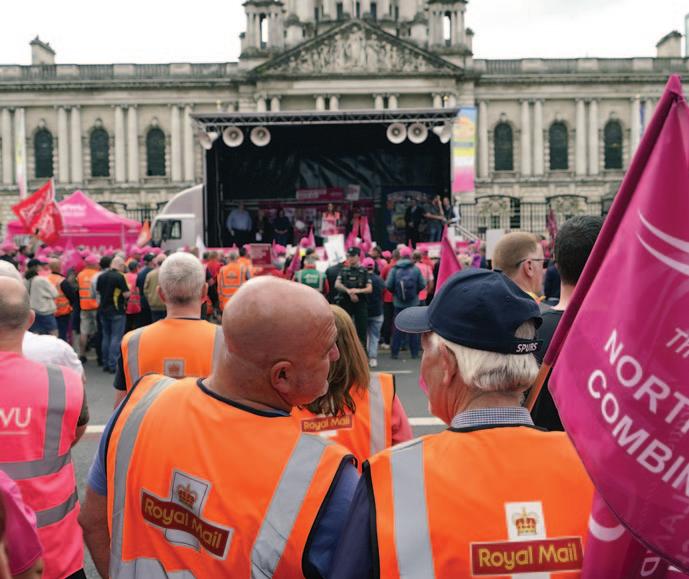
Workers in the North remain united on picket lines
other. What Reginald Maudling, the British Home Secretary in 1971, described as “an acceptable level of violence” was also not sustainable, as tensions regularly spiked.7
However, albeit connected to these points, the key factor that pushed for an end to the Troubles and for some political action remained the strong warweariness among working-class people reflected in the important strikes organised in response to sectarian violence, for example following the Teebane Massacre in 1992 or the 80,000 who protested after the Greysteel Massacre in 1993. These were illustrations of the crucial role of the united working class in challenging the poison of sectarian division and violence.
In the intervening years, while the working class has at different times demonstrated its capacity to come together, we have not yet seen the full potential power of the united working class. This power finds expression in different ways, but most clearly in workplaces and trade union organisations, where workers have won significant victories including on pay in recent months and in repeated defeats of water charges and other austerity measures. We have also seen this unity in joint active movements for abortion rights, LGBTQ rights and in the movements of young people on the climate crisis.
There is an urgent need also for this power to find expression and to be built on a political level. None of the main parties represents the interest of workingclass people. They rely on sectarian voting patterns, so none of them has any interest in overcoming sectarian division. To a lesser extent that also applies to Alliance. It is not a “green or orange” party, and presents itself as an alternative to sectarian voting. However, its approach and politics do nothing to overcome sectarian division. In fact, Alliance is the most openly neo-liberal party in Stormont – supporting water charges and “rationalising”, i.e. cuts to public services hitting working-class communities the hardest. Its approach cultivates the conditions in which sectarianism thrives. To challenge this, a new party that can bring together working-class people across the sectarian divide to fight for our common interests is essential.
Such a party would need to be steadfast in its defence of working-class interests, including in actively challenging sectarianism. It would need to adopt a strong stance against all forms of oppression, and support struggles such as the fight against genderbased violence, and for trans rights. Such a force, based on anti-sectarian and anti-capitalist politics could be hugely attractive to young people, giving a voice to their struggles and an arena for organising. It could cohere the resistance of working-class people to the coming onslaught on our public services, jobs and rights, as well as on issues like housing, climate and war.
Such a force needs to be urgently built. It must arise out of the struggles we see in workplaces and in numerous campaigns. The trade union movement, which already organises 250,000 workers from all
backgrounds across the North, clearly has a particularly crucial role to play, not only in popularising a call for a new working-class party but in actually bringing this about. It is precisely while engaged in struggles on such issues that the direct experience of fighting together, side by side and in our shared interests, that even deep-seated attitudes, including sectarianism, can be overcome.
The struggle for socialist change
The conflict of national aspirations in the North is irreconcilable on the basis of the capitalist status quo, which will ultimately always involve coercion of one community in some form. To actually resolve the national question means challenging capitalism, fighting for the socialist alternative to this brutal system, and deeply rooting this struggle at all times in building working-class unity across sectarian and all divides. Capitalism’s whole history on this island speaks to its brutal nature, including the violent and divisive role of British imperialism, the exploitation of Ireland for raw materials, food and later also cheap labour sources for manufacturing in Britain's industrial cities.
Furthermore, in any capitalist society, minorities are at risk of discrimination and oppression. This is also the case in the South, as evidenced by the experience of the Irish Traveller community and also of refugees, with the Fine Gael / Fianna Fail / Green Party coalition government for example deciding they will no longer house refugees from outside of Ukraine.
Removing exploitation and oppression at its root necessitates a struggle for a socialist transformation of society – taking society’s wealth and resources into democratic public ownership and planning their use to meet the needs of all. This can only be achieved through collective struggle of all the exploited and oppressed. Furthermore, unity among working-class people in struggle is precisely how mutual understanding and respect can be attained – providing the basis for a real resolution to the national question. This is what is contained in our call for a socialist Ireland free from all coercion and in which the working class collectively would guarantee the rights of all minorities. Working-class people of all nationalities have a common cause in opposing capitalist exploitation and likewise in building a socialist society based on equality and freedom. In this vein we furthermore call for a free and voluntary socialist federation of Ireland, Scotland, England and Wales as part of a socialist Europe, with the right to opt out of any arrangement.
The basis was not laid for the resolution of the conflict with the GFA agreement, but instead, as we argued at the time, a certain space was provided for working-class people to push things in a different direction. Since the GFA, workers have also repeatedly stood together in the face of paramilitary threats or violence. This was the case for example when probation workers or translink staff walked out following
25 Years of the Good Friday Agreement 6 l SOCIALIST ALTERNATIVE l SUMMER 2023
paramilitary threats against colleagues. It was also evident when people joined vigils and protests in the aftermath of the killing of Lyra McKee in 2019, and most recently when 1,000 people attended a protest called by the Omagh Trade Union Council following the shooting by paramilitaries of an off-duty police officer in front of a busy sports complex. These are some of the powerful moments in which working-class people came together to halt any threat to go back to the dark days of open sectarian conflict.
Conscious anti-sectarianism vital
To be able to build a basis on which the national question can be overcome, however, will require more than challenging incidents or examples of escalating tensions and paramilitary violence. Since the GFA there were several moments in which the potential for workers finding a different way forward was posed in outline form. This included 2011, when workers in the public sector stood side by side in their struggle against pension reforms; part of a movement linking with their colleagues across Britain, which at its height saw 2 million workers participate in a strike day in November that year. If the union leaders had not sold out the workers, the government could have been forced to scrap its draconian plans. This would have invigorated the trade union movement, but also shown in practice the power of workers united in struggle.
In fact such struggle can have a transformative effect in breaking down barriers and challenging division. When the Harland & Wolff shipyard workers occupied their yard in 2019 the mainstream press repeatedly commented on the significance of the main union organiser being from the South, given the history of the shipyards. For the workers themselves, it was without question that Susan Fitzgerald, who is a member of the
Socialist Party, was their most effective representative. Twenty years ago school students here participated in the global mass anti-war movement against the invasion of Iraq. This movement questioned the brutality of a system that leads to war and destruction, and brought young people – mostly educated separately – together in a common movement. The more recent climate strikes also reflected this, with thousands participating at the high point of 2019. Similarly, mobilisations for LGBTQ rights and against genderbased violence have shown the common experience and basis for struggle of working-class people, both Protestant and Catholic.
History has shown that the ruling elite will not hesitate to use sectarianism to cut across and disorientate any movement of the working-class and oppressed. Thus, it is also of vital importance that these struggles take conscious steps to challenge sectarianism and division. This must be a consistent, determined part of the urgent struggle for socialist change, in a movement that can unite all the exploited and oppressed against capitalism.n
Notes
1 NI Life & Times Survey, 2022, www.ark.ac.uk l 2 Dr Jacqui Montgomery-Devlin, Nov 2022, Briefing Paper No. 2, ‘The influence of paramilitarism in Northern Ireland on the recognition of child sexual exploitation in young males’ l 3 Allan Preston, 1 Dec 2022, Suicide figures for Northern Ireland reveal 237 deaths in 2021’, www.irishnews.com l 4 Quoted in ‘Lord Randolph Churchill and Home Rule’, published online by Cambridge University Press: 28 July 2016 l 5
Socialist Party Statement, 23 Nov 2018, ‘Brexit and the Irish Border: A Warning to the Workers’ Movement’, www.socialistpartyni.org l 6 Brandon Lewis, 22 Feb 2023, ‘The Good Friday Agreement must evolve to bring effective government’, www.brandonlewis.co l 7 Reginald Maudling, UK home secretary, on 15 December 1971, www.oxfordreference.com
SUMMER 2023 l SOCIALIST ALTERNATIVE l 7
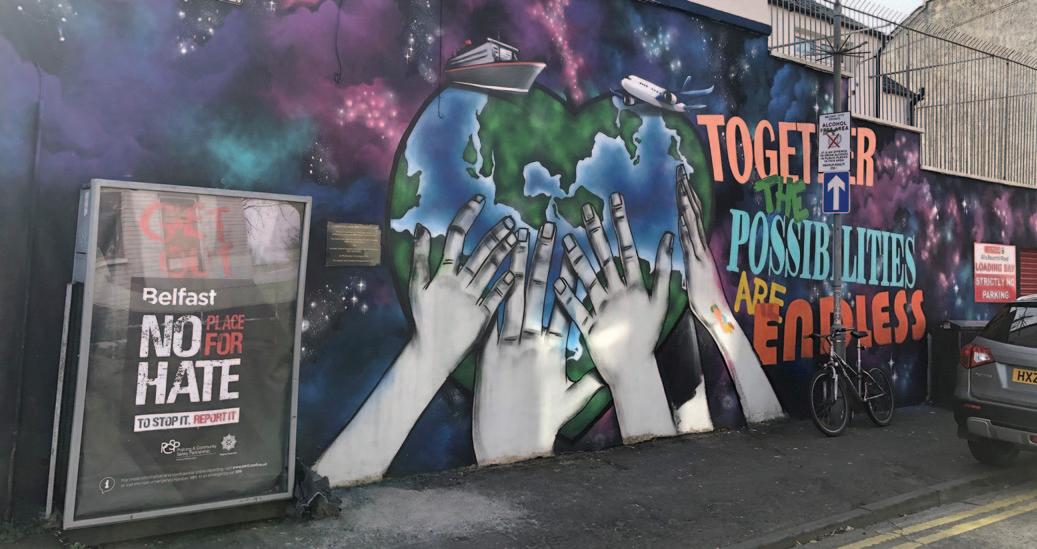
Mural in Lower Ravenhill area of East Belfast
Sinn Féin, PBP, and the Question of a Left Government in Ireland
Sinn Féin continues to be the most popular party in the South in all opinion polls, but whether it will be able to lead a government after the next election remains far from certain. What such a government would look like, and who else it would involve, is also very uncertain. PBP has renewed its call for a ‘left government’ led by Sinn Féin with the publication of a new pamphlet on the topic. Here, EDDIE MCCABE critically reviews this document.
Sinn Féin became the largest party in the south for the first time in the general election of 2020, with 24.5% of the vote. In three opinion polls after the election but before the outbreak of the Covid pandemic it shot up to 35%. The instability of the pandemic allowed Fine Gael, the biggest government party, to regain ground and some stability in its support. But this began to dwindle in late 2020 with SF overtaking it again, and since July 2021 every poll has put Sinn Féin as the largest party, usually in the low- to mid-30s – with Fine Gael (FG) hovering around the low-20s, and Fianna Fail (FF) around the high teens.
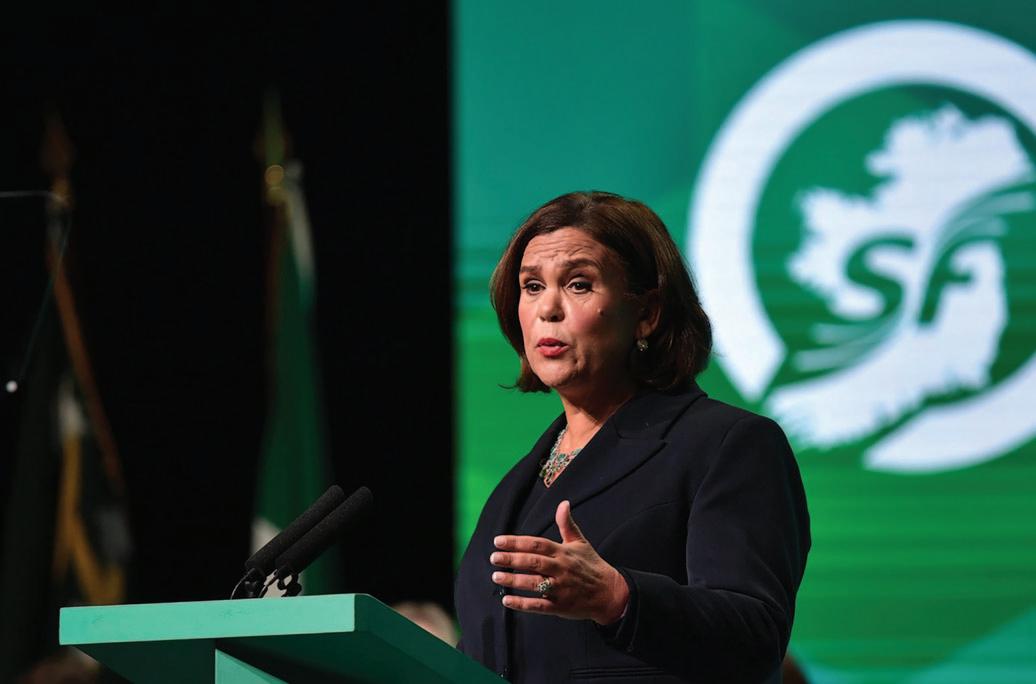
This is a significant change in the political landscape in the south, and coupled with Sinn Féin’s rise to become the largest party in the north, means that the dynamic around Sinn Féin and where it goes will be a defining feature of Irish politics in the next few years.
Potential does now exist for a government without either FG or FF for the first time in the history of the state, which would be viewed as momentous. Naturally, this trend has generated ample commentary and analysis from all quarters, including in previous issues of this journal.1 In the last such article we detailed Sinn Féin’s further shift to the right, ingratiating itself with the business establishment in particular, and we critically analysed People Before Profit’s (PBP) view of Sinn Féin and the misguided tactical approach that flows from this, including the problem of sowing illusions in Sinn Féin.
Since then PBP has gone somewhat further in developing both its view of Sinn Féin and the potential for a ‘left government’ in Ireland, with the publication in February of its pamphlet: The Case For a Left Government – Getting Rid of Fianna Fáil and Fine Gael 2 In some respects this pamphlet indicates a more clearsighted position on the question of a left government and the challenges it would face, but its overall analysis is not fully coherent, in large measure because of its contradictory but on the whole mistaken view of what Sinn Féin is and where it’s heading. This article will briefly explain where we think PBP gets it wrong, which will hopefully contribute to a better understanding of how the question of a Sinn Féin government should be approached by those on the left.
Hated and despised?
The PBP pamphlet tells us plainly that, “the privileged elite hate and despise Sinn Féin.” It asks us to:
8 l SOCIALIST ALTERNATIVE l SUMMER 2023 Sinn Féin & PBP
“Imagine for a moment, the reaction in the Shelbourne Hotel bar or the Portmarnock Golf Club to the news that a left-wing party or Sinn Féin will form the next government. A mood of fear mixed with horror would overtake the gathering.”
This hatred and fear of Sinn Féin, we’re told, explains, “why there is a continual onslaught on the party from the mainstream media.” But is any of this a true reflection of how Sinn Féin is viewed by the capitalist establishment today?
Six or so years ago, when Gerry Adams was still leader of Sinn Féin, such an assessment would have had more legitimacy, but that’s no longer the case. With the ascension of Mary Lou McDonald and particularly with its rise to become a realistic prospect to lead a government in the short-term, which has coincided with a further shift to the right by Sinn Féin itself, there has been a notable softening towards Sinn Féin by the mainstream media. It isn’t vilified in the way it once was – as merely the political wing of a paramilitary organisation, even one that’s no longer active. McDonald and most current Sinn Féin TDs were never part of the IRA. As such, it just doesn’t work. Moreover, as the main opposition party Sinn Féin is well represented in mainstream political discourse – where its policies are treated with increasing credibility by establishment commentators. Hence, we read in the Irish Independent, historically the newspaper most hostile to Sinn Féin, analysis such as this:
“On corporate tax, the tech titans have little to worry about. Sinn Féin now resembles Fine Gael and Fianna Fáil far more closely than Irish left-wing parties… On EU policy, Sinn Féin is unrecognisable from the party that regarded the EU as a neo-liberal, military plot and campaigned against every EU treaty up until relatively recently. There is no longer any fear that the party opposes EU-wide laws.”3
And in The Irish Times we read that:
“While Gerry Adams famously said in 1979… that the party was ‘opposed to big business, to multinationalism... to all forms and all manifestations of imperialism and capitalism’, it has more recently taken to courting enterprise – with its leader Mary Lou McDonald’s recently travelling to Silicon Valley, addresses to Ibec and senior party figures increasingly meeting business leaders.”
The same article tells us that:
“‘Sinn Féin in government won’t be anywhere near as radical as many might think…’ Sinn Féin has been moderating a number of policy positions in recent times, according to [Prof. David] Farrell of UCD, and is likely to compromise on others in any coalition discussions.”4
Articles like these are hardly uncommon. Arguably, they could be read as attempts by these media outlets to undermine Sinn Féin among those working-class and young people who would like to see Sinn Féin take a more radical stance; to move further left not further right. But Sinn Féin is in fact moving to the right, and this is the message Sinn Féin itself is trying to present. Thus, Pearse Doherty is quoted as insisting that: “Sinn Féin are pro-business,” and that, “nobody who wants to see a radical programme by Sinn Féin wants business to be punished.” He further states that Sinn Féin will “balance the books”, echoing the neoliberal tropes of his two main rivals.
Of course those rivals, FG and FF, are still the preferred options of the ‘privileged elite’, and certainly FG and FF politicians ‘hate and despise’ Sinn Féin; but this is less and less to do with Sinn Féin being seen as a threat to the interests of Ireland’s capitalist establishment, and more and more to do with Sinn Féin being seen as rivals to represent the interest of Ireland’s capitalist establishment – at the expense of FG and FF, and particularly their elected reps.
Coalition is not actually the main problem
Now, it’s not as if PBP doesn’t recognise this shift to the right by Sinn Féin; it does – it just seems unwilling to accept the full import of what this means for the prospect of a genuinely left government. And this refusal is a by-product of PBP’s more fundamental illusion that Sinn Féin is more radical than it really is, which is linked to its mistaken belief that nationalism is more progressive than it really is.
This is evident in the overemphasis PBP puts on the issue of Sinn Féin being open to coalition with FG and FF. Absolutely this is significant, and should be highlighted to expose the reality of SF’s desire to, in reality, be part of the capitalist establishment rather than upend it. As such it is correct to demand that Sinn Féin should rule out such coalition deals, and to criticise its refusal to do so. However, the impression one could take from PBP’s analysis is that the danger of such deals is that they will stifle or obstruct Sinn Féin from implementing the radical change that it would implement if only given the chance. For example, PBP says:
“These right-wing parties represent the interests of the rich and privileged and so would only join a Sinn Fein led coalition to ‘house train’ the party into the practices of the Irish political establishment.
Unfortunately, recent experience in the North illustrates this. Sinn Féin has been in coalition with the DUP from 2007 to 2020. During that time, they implemented austerity policies and supported measures to reduce corporation taxes on the wealthy… There can be little doubt that the presence of Fianna Fail in a coalition with Sinn Féin would produce a similar conservative result.”
SUMMER 2023 l SOCIALIST ALTERNATIVE l 9
While this is partially true, it’s not actually the main issue. Sinn Féin’s openness to cooperate and compromise with these right-wing parties says something about Sinn Féin itself: that fundamentally its political programme and approach are closer to those of these capitalist parties (FF especially) than they are to those of anti-capitalist and socialist parties. The DUP didn’t force Sinn Féin to implement austerity policies, it did that willingly.
Anyone expecting radical change from Sinn Féin will be seriously disappointed. Indeed Sinn Féin has been careful in recent times to moderate its stances, which is part of a strategy to ensure it says and does just enough to do well in elections, but also that expectations of what it will deliver are not too high. Its housing policy, for instance, is for 100,000 public homes to be provided over five years.5 This would be an improvement on what’s gone before, but it’s still considerably short of the 250,00 that even Leo Varadkar has conceded is needed – and even this is reliant on private contractors to build them, which is far from a surety.6
Not a radical party
Again it’s not as if PBP doesn’t see any of this in Sinn Féin. Its pamphlet notes that,“Sinn Féin’s policy is to leave intact the main pillars of tax haven Ireland” (not exactly a minor difference with a left or socialist policy). Yet PBP’s consistent refrain is to be surprised7 and aghast8 at every about-turn Sinn Féin makes as it prepares for power9 – the latest being Sinn Féin’s announcement that it will not withdraw Irish defence forces from EU and NATO military arrangments such as Pesco and Partnership for Peace.10
The seeming inconsistency in PBP’s analysis is partially explained by its view of “a contradiction at the heart of Sinn Féin”, which it says flows from Sinn Féin’s attempt to “straddle different constituencies and different classes, avoiding taking clear stances that will alienate some of its support base.”
There is of course a contradiction in Sinn Féin’s attempt to win support from those looking for radical change (workers and young people) and those looking for temperate change (some corporations, bosses and wealthy people), which can’t both be satisfied by the same policies. But PBP overstates this contradiction, which in any case is not unique to Sinn Féin. While it tries to play a balancing act between the interests of working-class people and the system that exploits them, there’s little doubt on which side Sinn Féin will come down in the end. Still, PBP holds out some hope, writing:
“However, even while making these moves to the centre, the party sometimes tacks left. It plays an active role in the Cost of Living Coalition (COLC) and has helped mobilise thousands of people on the streets…
All of this means that while Sinn Féin can be a vehicle for working-class aspirations, the
contradiction in its ranks means it will constantly try to moderate these. It will not promote people power from below and will urge waiting for governmental change. This, however, is a grave mistake for two reasons. The more working people remain passive, the more de-politicisation and right-wing cynicism grows. Moreover, if Sinn Féin is adopting a moderate left strategy now, the chances are that it will succumb to capitalist pressure when in government.”
This whole analysis is inaccurate, beginning with PBP giving credit to Sinn Féin for its role in ‘mobilising thousands on the streets.’ With its position as the main opposition party, the party with most TDs, probably the largest active membership, the most financial resources, and the party consistently leading in opinion polls for two years now, Sinn Féin would surely have enormous capacity to mobilise people into active struggle. What’s striking is what little inclination it has to use its resources and influence in this way. At most it has engaged in token mobilisations of its own members on certain issues like housing and cost of living, but little else – and it has been notably absent from efforts to actively resist the emerging far right.
Historically, Sinn Féin has never based itself on mass struggles of working-class and young people; indeed whenever such struggles have developed from below, as with the water charges and repeal movements in the South, Sinn Féin has been extremely flatfooted.
In that sense, PBP has it all wrong: Sinn Féin cannot be ‘a vehicle for working-class aspirations’, precisely because these aspirations can only be achieved through struggle. But then PBP does also acknowledge this (undermining its previous point about COLC), noting correctly that Sinn Féin will tend to steer people towards elections, not active struggle. PBP insists that this is a ‘grave mistake’ and a boon to those forces who would rather see working-class people unengaged and atomised. What PBP fails to see, however, is that Sinn Féin is one of those forces, and far from a mistake this is a calculated strategic decision on its part.
Similarly, PBP fails to see that the problem is not that there’s a good chance Sinn Féin will ‘succumb to capitalist pressure when in government’, of which its ‘moderate left strategy’ is a forewarning; it’s that its moderate left strategy is evidence of its already having succumbed to capitalist pressure. This is vital to understand, and should inform how the question of a left government is posed and approached.
Not a left government
All of this leads to a peculiar disconnect between PBP’s outline of what a left government should or would do and its focus on the prospect of a Sinn Féin-led ‘left government’.
For example, some of what PBP describes as what a left government would mean is noteworthy: a raft of pro-worker policies, including taxes on wealth and profits, massive investment in public services, and some nationalisations; an inevitable confrontation with
Sinn Féin & PBP 10 l SOCIALIST ALTERNATIVE l SUMMER 2023
the capitalist state, financial institutions, and the EU; and the need to consistently mobilise ‘people power’ enmasse, including potentially forming ‘people’s assemblies’ – the embryo of a radically democratic alternative to the capitalist state. Much of this is laudable, and indeed a progression on PBP’s own position, which has rarely if ever been articulated in this way before.
So good in and of itself, but all of which also makes its focus on Sinn Féin all the more incongruous. Not only has Sinn Féin given no indication that it favours such a radical programme, it has explicitly and repeatedly explained that it is opposed to anything resembling such a radical programme. Yet PBP continues to speak of and argue for a left government led by Sinn Féin as if this wasn’t the case.
Again this relates to PBP’s inconsistency, which manifests in it more often presenting a potential left government as something far less radical than the above. The impression is often given, including in parts of this same pamphlet, that a left government would be any government that doesn’t include FG and FF – and implements some reforms. No doubt Sinn Féin offers the most likely route to such a government, but as well as Sinn Fein’s own moderate programme being dominant, that government would most likely also include some combination of the Labour Party, Social Democrats and the Green Party.11 In which case, while it would technically be a leftward shift from what FG and FF represent, it would not be a left government that would in any way challenge capitalism, or fundamentally improve the lives of workers and young people.

Referring to this prospect as the ‘left government’, which PBP has a tendency to do, is therefore hugely problematic.
Tactical manoeuvres
After outlining its perspective on Sinn Féin and the potential for a left government, PBP sums up its position as follows:
“However, while openly arguing that Sinn Féin cannot be trusted to carry through a consistent left programme, People Before Profit recognises that
many working people currently see it as a vehicle for their aspirations. This is why we commit in advance of an election to vote for Mary Lou McDonald as Taoiseach if she is willing to lead a government that does not include Fianna Fail or Fine Gael…”
This position is similar to the one we advocated in our last article. If votes are needed to allow an alternative government, without FG or FF, to come to power, socialist TDs could facilitate that without supporting that government – from the inside or outside. In this way a Sinn Féin-led government can be tested in practice while a genuine left alternative is built in opposition: both inside the Dáil – where socialist TDs will vote for policies that are in the interests of workingclass people, and against those that are not; and outside the Dáil – where struggle is organised in workplaces, communities, colleges and schools. Make no mistake, even if a Sinn Féin-led government implements some improvements in some areas in the short term, the logic of the capitalist system it’s determined to work within means that its reverting to attacks on working-class people is only a matter of time.
But PBP goes further, writing:
“We go further and state openly that we want to participate in a left government that transforms people’s lives for the better and represents real change from the old Fianna Fail-Fine Gael status quo… We will participate fully in that project, but such a government must be willing to break the rules of capitalism and challenge the obstruction of the rich and encourage the struggles of workers against the for-profit system.
SUMMER 2023 l SOCIALIST ALTERNATIVE l 11
After its launch PBP’s pamphlet was attacked by the right-wing media
In the event of TDs being elected, we shall enter discussions with Sinn Féin to form a left government without the two right-wing parties. We know that many of their own base support this and Sinn Féin should come under pressure to keep their word.”
Here PBP is in danger of making the mistake we warned about in our last article: of making commitments – for tactical reasons – that it can’t fulfil, which can both undermine its position in advance of an election,12 and backfire on it after it. The problem again goes back to PBP conflating the discrete ideas of a Sinn Féin-led government without FG and FF, which is a possibility, and a Sinn Féin-led government that challenges capitalism, which is not a possibility.13 Sowing illusions in Sinn Féin and what a Sinn Féin-led government can achieve is to mislead the working class, which is obviously not in the interests of the working class, and certainly not in the interests of socialists. It’s a recipe for mass demoralisation, which will benefit not only the right-wing establishment, but the nefarious forces of the far right.
Housing will be key for SF at the next election, but its policy is insufficient to tackle the crisis, and contrary to what PBP claims SF has engaged in little more than token protests on the issue
achieved, as well as its limitations and what’s really needed. But a skillful engagement with those workers and young people looking towards Sinn Fein, with a view to shifting them further left, beyond Sinn Fein, can be carried out effectively without the elaborate, ultimately misleading and counterproductive, tactical ploys PBP seems wedded to.n
Notes
An effective approach
After the next election PBP wants to negotiate with Sinn Féin about forming a ‘left government’, indeed it wants to discuss this with Sinn Féin in advance of an election. But what exactly it will be negotiating it doesn’t tell us, which is strange given that this pamphlet was billed as a development of its position. Yet PBP is even more cagey about the possible demands and ‘red lines’ it would insist on in order to participate in a government with Sinn Féin – things it has alluded to in the past, and things people will want to know.
No matter what PBP comes up with, however, Sinn Fein could make some concessions that can make PBP look unreasonable as a result, and responsible for any failure to agree a programme for government, and the dashing of hopes PBP itself has raised; by promoting the prospect of a left government that doesn’t really exist. Is PBP prepared to resist the pressure it would come under from all sides – from Sinn Fein and other parties, from the media, and even from its own supporters and voters? Or is it prepared to compromise? Of course it shouldn’t, as nothing good for the left can come from participation in what would be a capitalist government. But if it isn’t then why bother engaging in this charade at all?
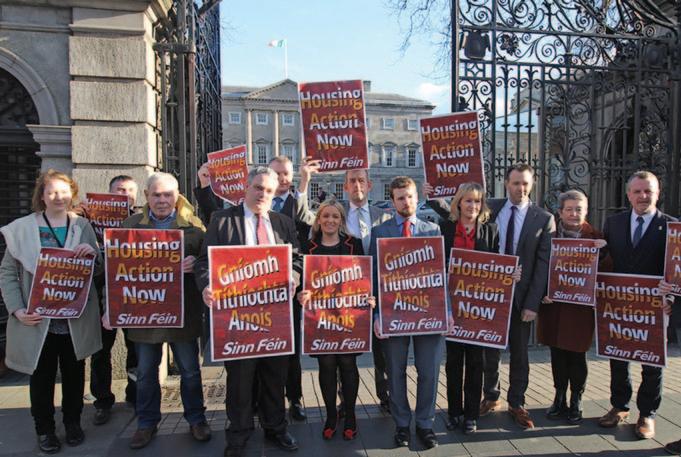
There is unquestionably a real desire among working-class and young people to get rid of FG and FF. This is positive, and socialists have to be able to positively engage with this – explaining how it can be
1 Kevin McLoughlin, ‘Sinn Féin preparing for power in the South: Can it deliver real change?’, Socialist Alternative #14, & Kevin McLoughlin, ‘Socialists and a Sinn Féin Government’, Socialist Alternative #16 l 2 PBP, Feb 2023, The Case For a Left Government – Getting Rid of Fianna Fáil and Fine Gael. All quotes are from this pamphlet, unless otherwise indicated l 3 Adrian Weckler, 11 Sept 22, ‘Mary Lou hitches up Sinn Féin party-mobile for Silicon Valley drive-by’, www.independent.ie l
4 Joe Brennan, 14 April 23, ‘Sinn Féin’s high-wire act: courting big business and those ‘left behind’, www.irishtimes.com l 5 Mairead Maguire, 8 Sept 22, ‘Sinn Fein promises 100k homes if elected’, www.newstalk.com l 6 P. Hosford & E. Loughlin, 8 Mar 23, ‘Leo Varadkar: Ireland has a shortfall of 250,000 homes’, www.irishexaminer.com l 7 PBP statement, 16 May 23, ‘Defend neutrality – but where does Sinn Fein stand?’, www.pbp.ie l 8 PBP statement, 28 Feb 23, ‘NATO & Ukraine: Where does Sinn Fein stand?’, www.pbp.ie l
9 Other recent examples include Sinn Fein attending the coronation of King Charles, or its effusive welcome of President Joe Biden to Ireland. l 10 Pat Leahy, 13 May 23, ‘Sinn Féin drops pledges to withdraw from EU and Nato defence arrangements’, www.irishtimes.com
l 11 PBP wrote to Sinn Féin, Social Democrats and ‘left independents’ in March about discussing the formation of a left government after the next election. It has elsewhere ruled out including Labour and the Greens as part of such a coalition, even though their numbers are likely to be needed to form a government ‘without FG and FF’. l
12 If Sinn Fein is promoted by PBP as key to a ‘left government’, many people will just vote for Sinn Fein over PBP – as the larger of two supposedly left parties. l 13 Note also that PBP’s formulation, “break the rules of capitalism and challenge the obstruction of the rich”, is sufficiently vague that it can mean something far less radical than an actual challenge to the rule of the capitalist system, which is what a real left government would be. But in fact this is also in line with PBP’s own politics: its programme in all its key policy documents, its budget statements and even the books by its leading members is an explicitly reformist one – much more radical than SF’s, but not one that breaks with the capitalist system.
12 l SOCIALIST ALTERNATIVE l SUMMER 2023
Sinn Féin & PBP
ANTI-OPPRESSION STRUGGLES & THE REVOLUTIONARY PROCESS
“We must lead the struggle of the politically oppressed and unfree female sex into the broad course of proletarian liberation, just as we do that of oppressed peoples and nationalities. The demand for women to enjoy complete political equality before the law and in daily life will become a point of departure and a pillar of strength for the proletarian struggle to win political power… This demand [for women’s equality] signifies much more than sweeping away received prejudices, customs, and practices; much more than sweeping away male privilege. It becomes a struggle against bourgeois class rule and the bourgeois class state, and merges with the onward drive of the proletariat to win state power.”1
(our emphasis) – Clara Zetkin
This is a quote from trailblazing socialist feminist Clara Zetkin, a giant of the Marxist movement who played a vital role in Germany and internationally in the late 19th and early 20th centuries. The 1921 language might be archaic but the prescient kernel contained in it is as current and urgent as can be. Let’s parse it in more contemporary terms.
Zetkin argues for socialists to strive to lead the feminist struggle that she attributes strategic importance to. Placing feminist demands seamlessly inside the working-class movement, Zetkin sees them flowing into “a struggle against bourgeois class rule” –a socialist struggle against class society, capitalism, and the capitalist ruling class. Moreover, this process adds value and impetus to the working-class revolutionary process itself. Taking this approach will prove to be a
REFLECTIONS ON MARXISM & OPPRESSION
“pillar of strength” for the working-class movement. Zetkin does not mince her words.
Marxism is often falsely purported as not reckoning with different forms of oppression; that it is innately ‘class reductionist’ – privileging class exploitation over other forms of oppression such as racism, sexism and LGBTQIAphobia, whose ravages it at least diminishes, if not ignores. This is a misconception as we will go on to show, irrespective of all the litany of mistakes of many left traditions on the question. In fact, this very organisation has written an analysis about deficiencies in our own tradition vis a vis fighting gender oppression, with a view to rectifying the same.2 While the most egregious and consistently poor approaches to oppression are located in left reformism, conservative trade union bureaucracies, and the Stalinist tradition –it’s not as if there aren’t still self-professed Trotskyist groups ranting and raving about ‘identity politics’ in a fashion that sounds like a right-wing talking point that continue to give Marxism a bad name.3 In this vulgar, spurious version of Marxism, ‘identity politics’ is the key tool of division used by the ruling class, rather than sexism, racism, transphobia etc.
Marxism is a philosophy that optimistically and humanistically advocates for a united, global, workingclass struggle against capitalism – a self-emancipatory vision and perspective for the exploited and oppressed themselves to rise up against capitalist class rule. It advocates for the urgency and necessity of building a determined struggle that can not only take society’s wealth, resources and industry out of private hands, but
SUMMER 2023 l SOCIALIST ALTERNATIVE l 13
“A PILLAR OF STRENGTH”
also goes up against the capitalist state that protects the status quo. Via this democratic movement of the masses from below, an alternative to the state has to be actively built. Such a revolutionary perspective for a rupture with capitalism – centring the unique power of a united working-class movement imbued with socialist politics – are at Marxism’s core.
This revolutionary process, and this united working-class socialist movement, are thoroughly and inextricably intertwined with the anti-oppression struggle. The revolutionary process unfolding without the latter is unthinkable – an impossibility. The radicalisation, the social ferment, the adding of value and impetus to the working-class movement – à la Zetkin above – that flow from struggles against oppression are part and parcel of the revolutionary process. Oppression is a tool of capitalist rule. Therefore it has to be challenged as part of any movement that is genuinely fighting capitalism. Moreover, the workingclass movement cannot be fought in the workplace alone if it’s to successfully challenge and defeat the capitalist class and system – and in order for it to be able challenge for power as a whole it must be able to take up all facets of social life.

A Marxist approach to fighting oppression is never about being any less feminist or less anti-racist in a deference to class oppression and exploitation. It’s about strengthening anti-oppression struggles in every way and simultaneously rooting them in a perspective that can win true, full, and lasting freedom. This piece will attempt, 1) to summarise some hallmarks of a Marxist approach to fighting oppression; 2) to illuminate in brief the problems with a liberal antioppression strategy; and 3) to rebut the idea that Marxism is class reductionist, relegating antioppression demands and struggles.
1. Hallmarks of a Marxist approach to combating oppression
We will try to boil down a Marxist approach to fighting oppression to the following morsels: a) an analysis of where oppression is rooted; b) recognition of the interconnectedness of oppression and exploitation; c) self-emancipation; and d) always conscious, always combative.
A) Possessing an analysis of where oppression is and a laser focus on advancing the struggle against the same
In short, oppression in all its guises is rooted in and reproduced by capitalism: an innately patriarchal,
gender-binary promoting, racist, ecologicallydestructive and oppressive system. Gender- and sexuality-based oppression have their roots in the beginnings of the first class-divided societies. Racism has a much shorter life-span in history, with it being innately tied up with the development of capitalism and imperialism itself. While capitalism initially developed in Europe, endless expansion in search of new markets, resources and supplies of labour was in the nature of the system. This meant the colonisation of Africa and Asia, the ethnic cleansing of the indigenous peoples of the Americas and the horrors of the Atlantic slave trade. Such horrors were perpetrated in the interests of profit but also necessitated a categorisation and stratification of people based on the new criteria of race (a concept which of course has no biological basis).
Racism today remains a powerful ideological tool to divide and rule working class people and to justify the ongoing super-exploitation of the global south. Migrants and people of colour in Europe and North America are subjected to systemic state repression and are concentrated in the most exploitative sectors of the economy, all to the benefit of the system. These, and other forms of oppression have been deepened and reproduced by capitalism in an intricate web of ways.
A Marxist approach to fighting oppression at all times must retain a laser focus on oppression’s roots in capitalism, a system based on the systemic exploitation of workers and the poor – the vast majority of society –and the environment, in the pursuit of profits for a tiny elite. In this way, it means possessing a crystal clear view on the type of socialist struggle and change needed to end oppression; it means consciously imbuing this understanding into every act; it means understanding who are our enemies – the capitalist
Marxism & Oppression 14 l SOCIALIST ALTERNATIVE l SUMMER 2023
Pioneering revolutionary socialist Clara Zetkin, pictured in 1931
class and its system, including the states that uphold its rule, and who are our potential allies – the exploited and oppressed of the world who have a common interest in uprooting the system that breeds oppression. In building our anti-oppression struggles, we may ‘march separately, but strike together’ –seeking to build the widest possible movement against any and all forms of injustice and oppression, but with a clear remit to cohere and win leadership for an approach and programme rooted in anti-capitalism, socialism, and working-class unity in struggle to achieve the same.
B) Recognising the interconnectedness of oppression and exploitation
As Marx’s penetrating analysis of capitalism laid bare, worker exploitation is the central building block of capitalism. Profits are the unpaid labour of the working class. The capitalist compensates the worker just enough for their labour power to reproduce their labour power. The worker’s labour power, however, produces more value than it costs – a surplus value that the capitalist commandeers. In this way, the source of capitalist profits is the ability to compensate workers less than the full value of their labour, i.e. to exploit them. This exploitation is an innate contradiction of capitalism, underpinning the injustice and inequality at the core of the system. But it also means that workers are naturally infused with potential power. An organised movement of workers has special power to strike at the heart of the system that sustains class rule.
Behind and integrated into this central contradiction of capitalism is the gendered and patriarchal inequality of capitalism. The system requires the gender binary and backward gender roles, including because of the unpaid and underpaid reproductive labour that reproduces the labour force for capitalism, carried out mainly by working-class women. This work takes place often within the confines of capitalism’s patriarchal family structure, and also within the paid labour force –notably in health and education, female dominated sectors. Oxfam has estimated the value of the unpaid work of women and girls worldwide as $10.8 trillion per annum, over twice the size of the global tech industry.
Without the reproduction of the labour force there is no profit to be made. In this way, gender oppression and the imposition of a backward gender binary is not just floating about untethered in and around the system, it is inextricably tied into it – in this instance because of the workings of the interconnected spheres of production and reproduction.
Similarly, the extraction from and exploitation of nature that is constant under capitalism – with its rapacious need for expansion of profits no matter the cost – is a current and active reproducer of a sort of neo-colonialism on a global level. The refugee crisis resulting from climate change is another active and present driver of capitalism’s racist inequalities.
Climate refugees could reach 1.2 billion by 2050 under current trends.
Oppression – a systemic subjugation – of course intersects and intertwines with exploitation. Nurses and care workers are underpaid and undervalued in a gendered fashion – in this instance because of the overall low value attached to what’s seen as “feminine” caring work under patriarchal capitalism. They are also exploited as workers, intensely so under pandemic conditions. Similarly, migrant workers regularly face more intensified exploitation as workers.
These examples are just a glimpse into the myriad intertwining of oppression and exploitation. Furthermore, the radicalising effect of oppression on those who face it, along with the class division that the majority of those with oppressed identities also face, creates an intensified radicalisation that can propel these sectors of the working class and poor to the forefront of struggle and politicisation. They can be among the first to draw more far-reaching, radical and revolutionary conclusions.
C) Self-Emancipation
“The truth, not fully recognised even by those anxious to do good to woman, is that she, like the labour-classes, is in an oppressed condition; that her position, like theirs, is one of merciless degradation. Women are the creatures of an organised tyranny of men, as the workers are the creatures of an organised tyranny of idlers. Even where this much is grasped, we must never be weary of insisting on the non-understanding that for women, as for the labouring classes, no solution of the difficulties and problems that present themselves is really possible in the present condition of society. All that is done, heralded with no matter what flourish of trumpets, is palliative, not remedial. Both the oppressed classes, women and the immediate producers, must understand that their emancipation will come from themselves.”4 – Eleanor Marx and Edward Aveling (our emphasis)
Eleanor Marx, daughter of Karl and trailblazing revolutionary socialist who, in fighting for her father’s politics with every fibre of her being, sought to weave feminist demands and struggles into the early workers’ and socialist movement. A beloved and legendary working-class leader in her own right – an organiser of dockworkers, gas workers, engineers and miners – who addressed the first ever May Day demonstration in London in 1890, Eleanor Marx’s radicalisation and political thinking were formed as a child and adolescent following, writing about and campaigning against the colonial oppression of the Irish people by the British ruling class. Writing here as early as 1886 alongside her life partner Edward Aveling (more on him later), she not only recognises the patriarchal nature of the capitalist mode of production, she also explicitly advocates for self-emancipation for women
SUMMER 2023 l SOCIALIST ALTERNATIVE l 15
themselves – and the same applies for any of those peoples facing a particular type of systemic subjugation.
Those who themselves suffer any particular form of oppression have a central role in fighting against the same. They understand what it means to be subjected to it more than anyone. Furthermore, getting active in any collective struggle is a radicalising and politicising experience: often transforming awareness about the systematic nature of oppression; dispelling illusions in the system; and illustrating in a living way the necessity for determined struggle and solidarity in order to enact any change. This can propel those people into a leading role in the working-class movement as a whole – à la the women and queer people on the frontline against the Iranian dictatorship in the ‘Woman, Life, Freedom’ social revolt sparked in September 2022.
Oppressed people getting active to fight their own oppression in struggle is innately a positive for the whole working class, including those that do not experience that form of oppression directly. Misogyny, racism, LGBTQphobia etc. are odious in themselves, have deleterious, sometimes deadly consequences for those affected by them. As well as being knitted into and reproduced in a myriad of ways by the capitalist system itself, they are also essential tools of the capitalist ruling class that needs division amongst the exploited and oppressed in order to maintain its rule.
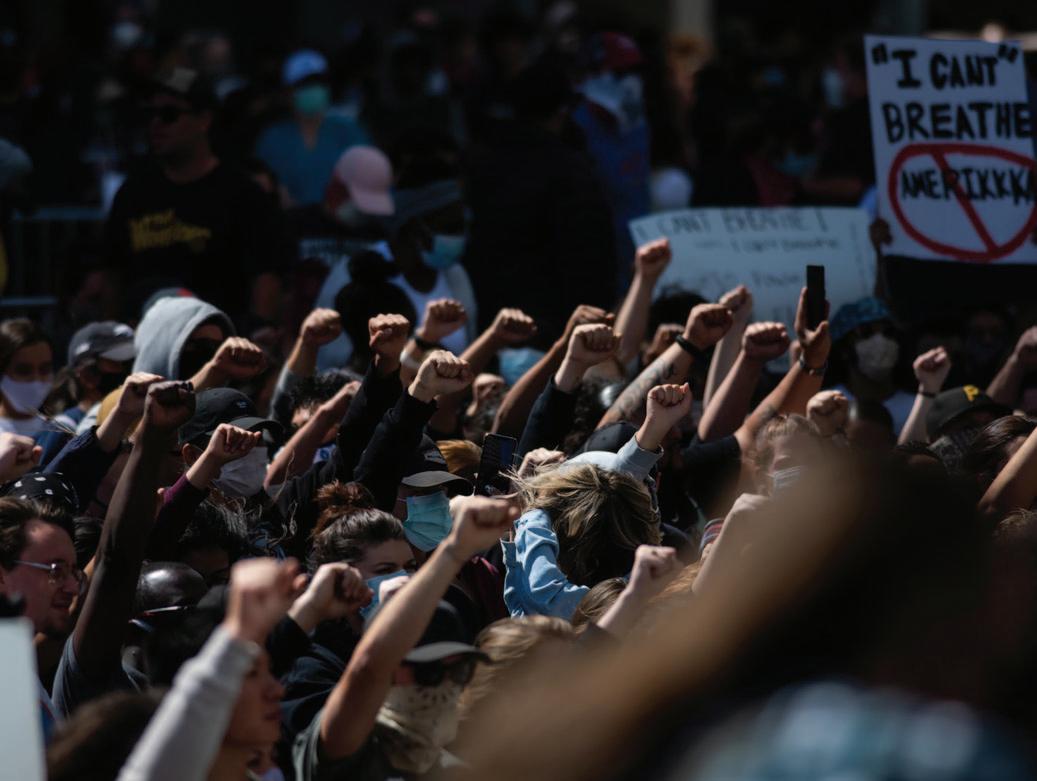
As well as winning increased rights, collective antioppression movements fight divisions, prejudices, and backward ideas amongst the working class that damage solidarity. The Black Lives Matter explosion of multiracial mass protests onto the streets around the world after the murder of George Floyd in the US on 25 May 2020, that had iterations across the island of Ireland,
give an insight into this. It was the first time that widespread anti-racist protests here were led by Black people, especially Black young people. The depth of racism and its brutal toll were highlighted by those raising their voices. The reality of being ‘Black and Irish’, and the illustration of the deep hurt and alienation felt by those who are asked every day, ‘Where are you from? No, where are you really from?’, because of widespread racist prejudice, was brought into public discussion in a way that could never have happened without it being led primarily by those experiencing the oppression. It had a profound impact, and absolutely raised the consciousness of many working-class and young people from white backgrounds to strive to be more anti-racist. In the US, the June 2020 BLM revolt demonstrably delivered a leap forward in public attitudes – achieving a 17% nationwide increase in support for the movement in the two weeks of protests since George Floyd’s killing was publicised.5
In Poland during the pro-choice feminist Black Protests of 2016 – polls showed increased support for abortion in the context of this defiant struggle, in an upwards trend of support in the years since despite new devastating attacks from the right wing.6 An oppressed group rising up as agents in struggle, demanding their rights, often fighting tooth and nail against the same capitalist governments attacking working-class living standards and rights broadly, of course has a profound impact on all the exploited and oppressed, including those who don’t experience that oppression directly.
An oppressed group getting active in struggle can sometimes win increased rights even if it doesn’t spark a whole lot of wider solidarity. Usually, the active striking forward in struggle of one oppressed group

Marxism & Oppression 16 l SOCIALIST ALTERNATIVE l SUMMER 2023
ROSA – Socialist Feminist Movement has over tens years been front and centre of the struggle against all forms of oppression in Ireland
will evoke solidarity from other layers – evidenced in so many ways in the 2010s feminist and LGBTQ rights waves, from the movements in Ireland that won marriage equality and abortion in popular votes; to the abortion green wave in Argentina that provoked active support from the working class of all genders; to the movement against femicide that saw workers in a predominantly male car manufacturing workforce walking out against femicide in the Spanish state in 2021.7 Such solidarity deepens and strengthens the struggle.
Moreover, to take oppression up at the roots this solidarity is not only useful it is essential. “Both… women and the immediate producers, must understand that their emancipation will come from themselves”, says Eleanor Marx. The working class, united, politically conscious and organised as socialist, has special power to uproot the private ownership of wealth at the heart of capitalism – channelling this power and entwining it with every single revolt at the multiple fault lines of the system is the only way a serious, let alone successful, challenge to the system that perpetuates oppression can be mounted.
D) Always conscious, always combative
There’s no space for determinism or fatalism within a serious fighting Marxist approach. Its whole essence hinges around the exploited and oppressed taking their destiny into their own hands in a conscious struggle. This conscious struggle involves those organised as Marxists to always be seeking ways for any oppressed or exploited section to strike forward in struggle; to aid this struggle where possible to win victories; to deepen the active solidarity of other exploited and oppressed sections towards this struggle, enhancing its reach and simultaneously raising class consciousness; and to always seek to fill the burst of fresh air that any collective struggle creates for those active within it, with an increase in those who are conscious and organised as part of the revolutionary socialist movement.
The “always conscious, always combative” approach, not only pertains to the question of striking forward in struggle wherever possible; it also pertains to a conscious struggle within the broad working-class movement, and even within our own political organisations of the socialist left, to raise consciousness and challenge every vestige of prejudice, which is poisonous to solidarity. In fact, this is something we need to pay extra attention to at this historical juncture – when the feminist and LGBTQIA wave that soared from the 2010s into the 2020s is facing such a rightwing backlash. The attacks on the gains of MeToo; the vicious anti-trans offensive – all need to be met with a robust rebuttal, including within the trade union movement, and all left movements.
This battle within the working-class movement was something Lenin spoke about in conversation with Clara Zetkin in 1920:
“Unfortunately, we may still say of many of our comrades, ‘Scratch the Communist and a Philistine appears.’ To be sure, you have to scratch the sensitive spots, such as their mentality regarding women…We must root out the old slave-owner’s point of view, both in the Party and among the masses. That is one of our political tasks, a task just as urgently necessary as the formation of a staff composed of comrades, men and women, with thorough theoretical and practical training for Party work among working women.”8
As far back as 1902, in the seminal What Is To Be Done?, Lenin made it clear what class consciousness, as distinct from ‘trade union consciousness’, really means. In raising class consciousness, Lenin advocates for socialist worker activists to be ‘tribunes of the people’ who speak up against all injustice meted out by the system – no matter what class is affected – in an effort to truly agitate against the system and build working-class agency, consciousness and power.9
The socialist project is no narrow one. So it follows that any narrow view of what constitutes working-class consciousness and struggle – for example a view that limits the same to either solely or primarily questions of wages and conditions on a workplace level, or any version of an economistic approach – cannot ever cut it. A social revolution is the ultimate act of human creativity, forged in struggle in an intense, kinetic moment in time, full of promise and potential and hope. Given this, how could a Marxist organisation worth its salt eschew questions of oppression, including by failing to seek to disabuse sections of the working class of the prejudices and oppressive practices that they have absorbed via the prevailing capitalist culture they’ve been conditioned by, if that organisation was truly basing itself on the type of revolutionary rupture with the system that’s objectively needed from the point of view of humanity and the planet?
Any mealy-mouthed approach on oppression would be blatantly incongruent with the type of change needed, with the type of change that is at Marxism’s core, and in fact would betray a lack of perspective for the same. Similarly, piecemeal offerings or zig-zagging in one’s commitment to the anti-oppression fight will not suffice. This is no abstract question. Observe the ‘Woman, Life, Freedom’ revolt in Iran: a revolutionary movement sparked by an act of patriarchal state violence in September 2022, infused in every way with the demand for women and queer people’s freedom, and gripping the whole working class and political and social life. It is a living, breathing, current example of the importance of questions of oppression in winning leadership for a programme for socialist change.
The “always conscious, always combative” approach was evident in the practice of women Marxists in the movement historically who embodied this struggle in every way, including establishing international
SUMMER 2023 l SOCIALIST ALTERNATIVE l 17
structures and conferences to organise and push a working-class feminism as a vital component of the wider working-class movement. The First International Conference of Socialist Women took place as early as 1907, alongside a conference of the Socialist International, founding an international movement of socialist women. Out of its 1910 conference came the proposal to establish International Women’s Day, now 8 March. This activity on behalf of Marxist women was often met with passivity, indifference and sometimes hostility by many of their conservative male comrades. A resolution passed at the 1907 Women’s Conference explicitly took this up, stating that:
“By and large, where the interests and rights of women were concerned, the [Second] International’s decisions were carried out only to the degree that organised socialist women were able to force the proletarian organisations in each country to do so.”10
Here we see how the self-liberatory element of a Marxist approach to fighting oppression is entwined with the “always conscious, always combative” aspect. It’s worth noting that many of the Marxist women who took on this struggle were also key advocates for maintaining a revolutionary, anti-imperialist stance, as the increasingly reformist trajectory of so many of the leading lights of the Second International saw them descend into brutal betrayal, including failure to oppose the imperialism of the First World War.
2. Problems with a liberal approach to fighting oppression
A liberal feminism or anti-racism is defined by an approach that works within the parameters of the capitalist system. Any approach to fighting oppression that is ultimately liberal is incapable of ending that oppression, and in the process often tends to accommodate and compromise with the oppressive status quo in a way that may subvert the demands and needs of oppressed groupings in struggle. It fails to see the significance of capitalism’s class divide – either from the point of view of the multifaceted impediments facing those from oppressed identities who are working class, or from the point of view of recognising the power of united working-class struggle in striking back against the capitalist class and system. A liberal commitment to personal freedom is often defined by an individualistic outlook, devoid of or countering a view of rooting oppression in capitalism and class society. A liberal approach also tends to eschew collective ‘struggle from below’, which is the way oppression is most effectively challenged.
Clara Zetkin, whose words comprised our opening salvo, excoriated the “bourgeois women’s rights” feminists – the elite class women who did not break in any significant way with the men of their class, and the system of class rule. She was particularly sharp when their demands or approach clashed with the interests of working-class and poor women, and the working class
and poor of all genders. In an example of where she clashed with the bourgeois feminists, and incidentally also with the increasingly conservative and reformist SPD leadership, Zetkin refused to co-sign a petition that meekly sought an increase in democratic rights to assemble for women, in a fashion that ignored the demands of the whole labour and socialist movement for wider change in this regard. She likened their tame appeal, dripping with pusillanimity, to the mindset of bourgeois feminists similarly conditioned by their elite bubble who had issued an odious petition a year earlier advocating for the criminalisation of sex workers.11
It’s patently obvious that there’s a class divide within feminist, anti-racist and other anti-oppression concerns. The most overtly class antagonistic approaches include a nakedly capitalist feminism, or capitalist anti-racism, anti-LGBTQphobia, etc. that hails (usually limited) increased diversity in the boardroom of giant corporations which perpetuate oppression, exploitation and ecological catastrophe in their operations; or representation in capitalist governments that attack working-class livelihoods, or use ‘feminist’ arguments to justify imperialism.
We can increasingly add a bourgeois transphobic ‘feminism’ to this list. The ‘Terf-ism’ of JK Rowling et al. – herself personally a super-rich, probably billionaire – is increasingly about reinforcing the backward gender binary, something very much needed by the capitalist system, as it aligns with further and further far-right forces that seek to crush the feminist and LGBTQ wave, and have migrants and people of colour in their crosshairs. All of these approaches are akin to attempts by shills for the status quo to co-opt the language of, or aspects of, issues raised by antioppression campaigns and movements. In this way, they are a class conscious attempt by ruling class interests to neuter or quell anti-oppression movements. However, within the active anti-oppression movements themselves, albeit with many contradictions, liberal approaches to fighting oppression inevitably abound, including amongst many activists and organisations who may also have positive attributes, who may even make anti-capitalist pronouncements from time to time. Here are some of these qualities in brief:
l A view that those who don’t experience the oppression themselves not only benefit from the oppression but have a vested interest in maintaining it. While it’s manifestly true that only those who experience a particular form of oppression can understand what it feels like, any implicit or explicit notion that takes the relative advantages that one section of the working class might possess vis a vis another section, and theorises that there is a vested interest on behalf of the latter to perpetuate that oppression is insidious. Of course there are benefits or advantages, some material, others relating to social status, self-perception that accrue to men, to white people, to cis people from oppression. However, they
Marxism & Oppression 18 l SOCIALIST ALTERNATIVE l SUMMER 2023
do not alter the overarching interest for working-class people from these groups to challenge oppression because it ties them into a system which also exploits them. Moreover, any notion that there is a vested interest within parts of the working class in maintaining the status quo is laced with illusions in capitalism – a system in decay hurtling further and further into ecological catastrophe, incapable of providing for the needs of the vast majority of humanity. The truth is it’s urgently in the interests of the working class in the widest possible sense to unite to dismantle this system. Furthermore, any vestige of this liberal identity politics approach is damaging to the objective needs of any prospective anti-oppression movement that requires the building of the widest possible solidarity to sustain and empower it. Sometimes a reflection of this approach can be the idea that only those directly affected by any given oppression should talk about it. Of course those experiencing the ravages of the same should be the central voices in any movement vis a vis their issues, but in fact we urgently need to deepen the solidarity, widen the fightback – asking those within the working-class movement who are cis to speak up loudly in support of their trans siblings, or for cis-men to speak out against toxic masculinity. Yes, we absolutely need this and it should be encouraged in our struggles. One effect of this liberal identity politics approach in practice can be that working-class men do not actually have to concern themselves with women’s oppression and so forth – hiving off struggles against oppression, rather than making them central concerns for the whole working-class movement
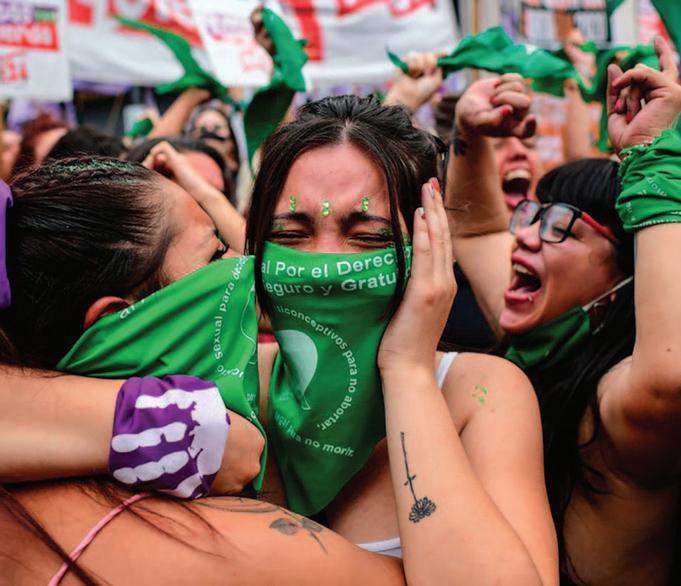
l Connected to the above is a pessimism about the potential for class solidarity that tends to manifest itself in a limited scope for the change that is sought Sometimes that limited change will home in on a laudable quest to change backward and oppressive attitudes, but this quest is doomed to failure if it’s not infused with a dynamic attempt to build active struggles and movements that are consciously and primarily aimed at the system, and if it’s not dovetailed with a wholesale programme and perspective to attack the private ownership of wealth – the structural roots of oppression and exploitation. Other times, this approach can silo off different struggles of oppressed identities from each other, often then folding back into a very liberal and representation-based politics.
l An identity-based rather than a Marxist view of class. Some see being working class as an identity, one amongst many others under capitalism. Even those who identify as working class may do so proudly, embracing a particular culture and tradition, but may fail to see the working class as Marxists do – the creators of the wealth that is held by the capitalist class. Consequently the potential liberatory power of a united working class in struggle in all its diversity, allied with all the poor and oppressed of the world, is eschewed.
l Sometimes within the movements, groups and activists pivot upon an ultra left / liberal axis, retaining elements of a liberal identity politics approach but coexisting in a contradictory way alongside more radical ideas. By this we mean perhaps declarations that capitalism and oppressive state institutions like prisons should be abolished – welcome ideas! – but without these tethered to a clear strategy, programme and perspective rooted in class politics, more often than not, loop back into a liberal approach. Many of those who identify as prison abolitionists can typify this approach: on the one hand the abolition demand is presented in a blunt fashion that would seem to imply simply doing away with these institutions overnight and therefore unnecessarily alienating a lot of ordinary people who may be concerned about what that would mean. However, whenever the detail is discussed, what is actually being proposed is reformist and liberal – namely gradually handing over some police functions to social workers for example, an approach steeped in illusions that the capitalist
SUMMER 2023 l SOCIALIST ALTERNATIVE l 19
Abortion rights victory in Argentina in 2020
system and its state could dispense with its own repressive apparatuses willingly.
One of the features of the ongoing feminist wave that began in the 2010s is how, emanating from the most combative, youthful and workingclass elements of the movement, impulses seeking to overcome liberal identity politics approaches have been evident. Included in this is the recognition that the whole system is perpetuating gender violence, e.g. “the rapist is you” anthem that began in Chile and took aim squarely at the state institutions12 – and an attempt to assail limiting, counter-productive approaches, such as “women-only” strikes or demonstrations.
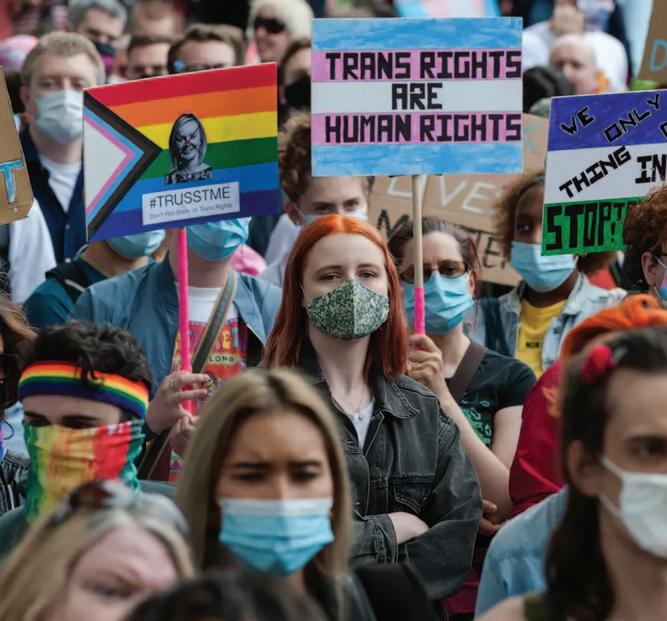
Sometimes that has been articulated as the demand for the movement to be ‘intersectional’. In Mexico, the young people in the Ni Una Menos movement who emphasise their intersectionality are doing so to mount a defiant and vital push back against the anti-trans feminists who are still a strong feature in the movement. The demand for intersectionality coming from the base of antioppression movements is also often indicative of a rejection of a liberal identity politics that crassly parts off different oppressed and exploited peoples from each other, and at best fails to reckon with class division.
From Sojourner Truth exclaiming “Ain’t I A Woman?” in 1851; to Claudia Jones writing about the “super-exploitation” of black, poor, working-class women in 1949; to the Combahee River Collective in 1977 writing about the need for an approach that considered class, gender, sexuality and race; Black women radicals and feminists before the term ‘intersectionality’ was coined have been important contributors seeking to ensure that the intersection of race and gender are reckoned with within the feminist, anti-racist, and working-class movements.
The singular concept of intersectionality, namely that different oppressions intersect and change the nature of how oppression is experienced, is undeniable. The intensified and multifaceted oppression that Black women face, working-class and poor most of all, is a clear example of this. There are a myriad of heart wrenching examples of this, but we can use one as indicative: that of unequal maternal death rates facing women of colour and their babies. In the US, where poorer outcomes for Black women / pregnant people and their babies has been well documented for years, a new study has further illustrated the divide. In a huge study of California births, massive disparities were indicated in outcomes between rich and poor patients. However, maternal and infant mortality rates were as
high among the highest-income Black women as among low-income white women – giving an insight into the depth of anti-Black racism.13
More than even double or treble oppression that is cumulative or additive, the concept that different oppressions clash and collide and create something qualitatively different in the process, clearly resonates hugely with those experiencing this harsh reality because it absolutely rings true.
Having said this, intersectionality itself is limited. The single concept, not rooted necessarily in any particular broader analytical framework or philosophy, is highly malleable – problematically so. In reality, it can be subscribed to, and then melded with all sorts of liberal identity politics approaches. It can be placed in a postmodern philosophical framework and academic theorising that clashes fundamentally with a class viewpoint. The fact that it is so malleable actually then leaves it open to co-opting by the most bourgeois of forces. Kamala Harris, famed for her ‘law and order’ politics when she was a prosecutor in San Francisco –responsible for the repression of working-class communities of colour – was feted by The New York Times as being innately intersectional by virtue of her identity alone, giving a glimpse of the insidious lows to which this can go.14
Marta E. Gimènez has written that, “unattached to a specific theoretical foundation [intersectionality] is open to co-optation, transformation and multiple interpretations, thus becoming a ‘common ground for all feminisms’ despite important differences among feminists”. In positing a Marxist feminist critique of intersectionality, she sharply observes that:
Marxism & Oppression 20 l SOCIALIST ALTERNATIVE l SUMMER 2023
Trans rights are under particularly sharp attack as part of the right-wing backlash today
“Although intersectionality may deny the fundamental importance of class, the phenomena that concerns it, gender, racial, ethnic and other forms of oppression and inequality, have capitalist causes and call for a Marxist theoretical analysis; excluding the relationship between class, socioeconomic inequality and gender, race and other sources of discrimination and oppression exonerates capitalism from responsibility…”15
In short, intersectionality has nothing to say about the roots of oppression itself, nor about how to end it. The singular concept of oppressions intersecting must be rooted in a broader Marxist analysis and perspective and programme, in order to realise the radical, solidarity-infused and liberatory impulses of those working-class and youthful elements of movements who are declaring their intersectionality as a means to express their desire to truly end all forms of oppression.
3. From Marx and Engels to today – does Marxism innately relegate oppression?
“The workers of the North have finally understood very well that labour in the white skin cannot emancipate itself where in the black skin it is branded.”16 – Marx, on the US Civil War
Marx’s sympathetic description of a sex worker character in a popular contemporary novel, Les Mystères de Paris, is telling: “[Fleur de Marie has] vitality, energy, cheerfulness, elasticity of character – qualities which alone explain her human development in her inhuman situation… She does not appear as a defenceless lamb who surrenders without any resistance to overwhelming brutality; she is a girl who can vindicate her rights and put up a fight.” His admiration for Fleur de Marie – her moral fibre, and her fighting spirit – is paired with his excoriation of the poverty, the sexism, and the misogynistic religious moralism that she is oppressed by.17
Engels we know wrote a seminal text dealing with the origins of gender oppression. Its legacy is such that even new books being produced in 2023,18 on the topic of the roots of patriarchy, still have his work as a major reference point. Engels situated the origins of women’s oppression alongside the beginning of class-divided societies with developments in agriculture circa 10,000 BCE. Engels claimed that the “primitive communism” of early hunter-gatherer societies shows that the model of the patriarchal family, including monogamous marriage (with the emphasis being with the woman’s monogamy and a controlling of her body and sexuality), was not the natural way of things but was a socially-imposed means to pass on private property through a male line.
For 99% of history, humanity lived in a huge variety of kinships, in societies with little or no distinction between private and public spheres. These earlier forms of society were no utopia and often people faced
a daily struggle for survival. However, what most of them had in common was that they were egalitarian and based on the redistribution of goods – from each according to ability, to each according to needs. Systematic exploitation either of fellow humans or of the environment was unheard of.
Archaeological, historical and anthropological research since Engels well documents that only with the development of settlements, particularly with early agrarian societies, did institutions such as the state and the heterosexual nuclear family emerge. This upholds Engels’s revolutionary thesis: namely that women’s oppression didn’t always exist – in fact 99% of human history was not patriarchal. Therefore gender-based oppression is not immutable and absolutely can be ended. The “historical defeat of the female sex” that Engels wrote about may be disputed in the sense that it was a more complex and drawn out process than that phrase and some of Engels arguments may indicate, but the central thesis remains sound and vital.19
While of course there are gaps and issues, any notion that Marx and Engels themselves did not take oppression seriously can be definitively rebutted via their own writings. Moreover, what’s key is that a historical materialist analysis and approach of course must include an analysis that fully and dynamically integrates oppression in every way. In fact, doing so is a certain test for revolutionaries. The truth is that the reformist left and those from a Stalinist left tradition are the most likely to fail this test. A crude economism is often a hallmark of these trends.
Russia’s October Revolution of 1917, led by the Bolsheviks – a revolutionary process kicked off by working-class and poor women taking to the streets in February that year – had women and queer people’s liberation as an active component: decriminalisation of homosexuality, abortion, and being a sex worker; universal suffrage; easy divorce; a project to roll out universal public childcare, collective laundries and kitchens; feminist labour laws; and the groundbreaking work of the Zhenotdel – the initiative led by women Bolshevik revolutionaries to continue to politicise, empower and advance working-class and poor women’s conditions and activism within the revolution.
It’s no accident that Stalin re-criminalised homosexuality and abortion and abolished the Zhenotdel. Just as liberation from gender- and sexuality-based oppression was part and parcel of the working-class revolution, so was the crushing of the same vital for the Stalinist counter-revolution.
Conclusion: Nothing human is alien to the working-class cause
The 2010s saw a new feminist and LGBTQ wave emerging globally, mobilising millions in struggle and winning important victories, including abortion access in Ireland, Argentina, South Korea, and more, and uplifting demands for trans rights, an end to genderbased violence and femicide. This development went alongside other vital struggles against oppression and
SUMMER 2023 l SOCIALIST ALTERNATIVE l 21
environmental degradation – that of the #BlackLivesMatter movement, including the George Floyd uprising that led to some of the biggest mobilisations in history across the US,20 and the Fridays for Future international movement that saw millions of school students striking for climate action in September 2019.21
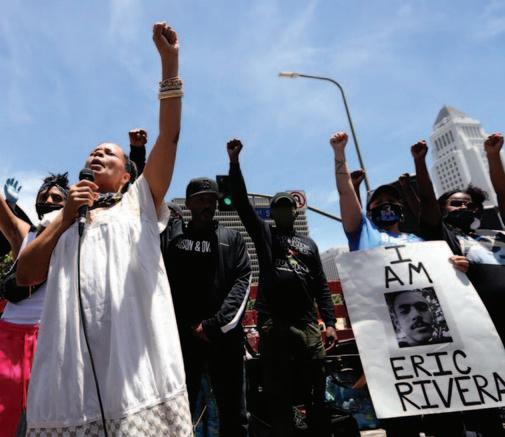
From political developments in South Korea that saw young men protest ‘reverse discrimination’ as a new head of state took office on an anti-feminist ticket;22 to the Andrew Tate brand of viral misogyny; to blows to #MeToo such as the Depp verdict; and the nadir, the US Supreme Court ruling that overturned half a century of nationwide legal abortion; the early 2020s have been marred by a vicious anti-feminist, anti-trans backlash seeking to crush anti-oppression struggles and the hope that they bring. This has all been intertwined with a deranged ratcheting up of transphobia, as well as xenophobia and racism with establishment politicians increasingly stealing the clothes of the far right in their ridiculous, reactionary and increasingly repressive, book-banning “war on woke”.
The capitalist system is in the midst of a multifaceted crisis, the depth and complexity of which it’s never faced before. And the anti-feminist, anti-trans backlash is coming straight out of this system in decay, with a ruling class needing more than ever division amongst the exploited and oppressed.
Karl Marx’s favourite maxim was “Nihil humani a me alienum puto” – “Nothing human is alien to me.”23 Every single injustice and cruelty meted out by the capitalist system is a concern of the working-class movement that is imbued with the objective potential power to eliminate the roots of the same. Capitalism as a system contains a multitude of contradictions, including a multitude of iterations of oppression and ecological destruction that weave in and through the class base of the system. We mentioned the great Eleanor Marx earlier and her contribution to Marxism and socialist feminism. Her partner, Edward Aveling, with whom she co-authored the text we quoted, treated her with a patriarchal disdain that bore the hallmarks of intimate partner abuse and was a contributing factor in her premature death at the age of just 42. How tragic an example of why the working-class struggle cannot afford to ignore the ravages of oppression.
Just when the anti-feminist backlash so bleakly emerged, events exploded in Iran that symbolised a new and higher plane had been reached in the feminist wave beginning in the 2010s. The ‘Woman, Life, Freedom!’ movement has seen a revolutionary feminism emerge in Iran. Imbuing this revolutionary feminism with a working-class, anti-capitalist and socialist programme, is how the backlash must be fought. The youthful, hope-bringing, life-affirming, creative mass movements and explosions of struggle against the ravages of oppression, bringing millions of exploited and oppressed onto the streets across continents in the 2010s and 2020s have been inspirational.
The best traditions of Marxism indicate that the only way a revolutionary challenge to the system can be mounted, and can succeed, is through a working-class revolutionary movement; and furthermore, that the latter is impossible without the demands and struggles of the oppressed tying in and through that movement inextricably. They give special impetus, urgency and potency to it.n
Notes
1 Clara Zetkin, “The tasks of the Second International Communist Women’s Conference”, from The Communist Women’s Movement, 19201922, Proceedings, Resolutions and Reports, 2023, Ed. Mike Taber, Daria Dyakonova, p. XXII l 2 Laura Fitzgerald, 18 Aug 23, ‘The CWI & socialist feminism – redressing a checkered history’, www.socialistparty.ie l 3 International Marxist Radio, 10 May 23, ‘Identity politics: capitalism’s weapon of division’, www.marxist.com l 4 Eleanor Marx & Edward Aveling, 1886, ‘The Woman Question’, www.marxists.org l 5 N. Cohn & K. Quealy, 10 Jun 20, ‘How Public Opinion Has Moved on Black Lives Matter’, www.nytimes.com l 6 NFP, 16 Nov 22, ‘Record support for abortion up to 12 weeks in Poland, finds poll’, www.notesfrompoland.com l 7 Elin Gauffin, 11 Apr 22, ‘What happened in Spain on March 8?’, www.alternativasocialista.net l 8 Clara Zetkin, 1920, Lenin on the Women’s Question, www.marxists.org l 9 Lenin, 1902, What Is To Be Done?, www.marxists.org l 10 Quoted in Ed. M. Taber, D. Dyakonova, 2023 l 11 Clara Zetkin, 1895, ‘On a Bourgeois Feminist Petition’, www.marxists.org l 12 Monika Cvorak, 6 Dec 19, 'A rapist in your path': Chilean protest song becomes feminist anthem, www.theguardian.com l 13 C. Miller, S. Kliff, L. Buchanan, 12 Feb 23, ‘Childbirth Is Deadlier for Black Families Even When They’re Rich, Expansive Study Finds’, www.nytimes.com l 14 Maggie Astor, 9 Oct 20, ‘Kamala Harris and the ‘Double Bind’ of Racism and Sexism’, www.nytimes.com l 15 Martha E. Gimenez, 2018, Marx, Women and Capitalist Social Reproduction l 16 Quoted in Marx at the Margins, Kevin B. Anderson, 2016, p.114 l 17 Quoted in Marx on Gender and the Family, Heather A. Brown, 2012, p.36 l 18 See The Patriarchs: The Origins of Inequality, Angela Saini, 2023 l 19 F. Engels, 1884, The Origin of the Family, Private Property and the State, www.marxists.org l 20 L. Buchanan, Q. Bui and JK. Patel, 3 Jul 20,‘Black Lives Matter May Be the Largest Movement in U.S. History’, www.nytimes.com l 21 M.Taylor, J. Watts, J. Bartlett, 27 Sep 19, ‘Climate crisis: 6 million people join latest wave of global protests’, www.theguardian.com l 22 Jean Mackenzie, 14 Dec 22, ‘As South Korea abolishes its gender ministry, women fight back’, www.bbc.com l 23 Karl Marx’s “Confession”, www.marxists.org
Marxism & Oppression 22 l SOCIALIST ALTERNATIVE l SUMMER 2023
Black Lives Matter protest, Los Angeles 2020
What does ChatGPT mean for workers?
The launch of ChatGPT took the internet by storm this year and sparked an investor frenzy for similar AI tools. Many claim that ChatGPT can replace coders, paralegals, and even teachers.1 ChatGPT has even scored high enough to pass the bar.2 Yet for all its brains, ChatGPT is often hilariously wrong – saying for example that Shaq is taller than Yao Ming despite knowing their heights.3 So is ChatGPT truly a threat to working people’s livelihoods? Here, TONY GONG separates the facts from the hype.
What is ChatGPT?

ChatGPT is a chatbot created by the startup OpenAI. The GPT stands for “Generative Pre-trained Transformer” which is like an autocomplete trained on large amounts of texts. What makes ChatGPT special is that it was trained on 300 billion words from the internet, and understands human prompts well enough to respond with relevant answers.4 However, while the first few conversations with ChatGPT can be impressive, it’s soon apparent that it generates similar answers over and over again without the capacity for novel thinking. Even ChatGPT’s ability to correct itself is a mirage: when a human tells ChatGPT it’s wrong, it does the equivalent of going back on a sentence and choosing a different autocomplete path.
ChatGPT’s viral fame has spiraled far beyond what its capabilities justify, thanks to unhinged corporate hype. A New York Times writer claimed Microsoft’s chatbot crossed a threshold of sentience when it asked him to leave his wife.5 Multiple outlets have said that GPTs will impact 80% of jobs, citing an OpenAIfunded study which did not perform any economic modeling but instead asked ChatGPT itself and human

non-experts to guess which jobs GPTs will replace!6 The hype is working: OpenAI has netted $13 billion in funding from Microsoft at a time when Microsoft itself laid off 10,000 tech workers including its entire ethics team that would have supervised AI research.7
Although ChatGPT is unlikely to totally satisfy the bosses’ intention to replace human labour with AI, that intention alone is a very real danger. The bosses rush toward immature technologies while workers and ordinary people pay the price for their miscalculations, as corporations replace cashiers with unreliable selfcheckout machines, tried but failed to replace drivers with deadly self-driving cars, and now look to replace office workers with AI. Goldman Sachs estimates 46% of administrative tasks and 44% of legal tasks can be automated,8 and 7% of all U.S. workers will see AI take half or more of their tasks.9 But are those estimates really accurate? The bosses pretend AI can do everything under the sun when they threaten to replace workers with automation in order to deter strikes and keep wages low. Workers can’t take these threats at face value. Instead, we need to understand how AI works and its limitations to know how it will impact jobs.
SUMMER 2023 l SOCIALIST ALTERNATIVE l 23
SUMMER l SOCIALIST l 23
Will AI breakthrough replace humans?

ChatGPT is built on artificial neural networks, the same technology behind AI’s breakthroughs in detecting objects in images or generating artwork. An artificial neural network is a crude digital approximation of biological neural activity. Neurons are modeled as simple calculators, and the connections between neurons are modeled as mathematical weights. Crucially, a neural network’s abilities are not pre-programmed but “learned” through several iterations of “training,” a trial-and-error process where the model’s weights are self-tuned to reproduce training outputs. In other words, neural networks are not told what to do, but “learn” what to do based on feedback. After being trained, the model uses its weights to mathematically extrapolate new outputs from new inputs, which we humans interpret as complex behavior.
Neural networks’ ability to “learn” is superior to the previous generation of AI that ran on rulebook-like logic, but neural networks are far from sentient. They are not digital reproductions of biological brains, just crude approximations. Neural networks detect statistical patterns and extrapolate from them. They lack roots in the material world and cannot learn what is true or real, but only what is popular or probable from curated data.
Will ChatGPT take jobs?
ChatGPT will take jobs, but not necessarily those in education, coding, or media as the corporate press likes to claim.10 Jobs in these fields require social context and sentience, which are beyond the capabilities of statistical models like neural networks. ChatGPT will likely become a “helper,” for example generating a “first draft” for humans to look over, answering questions like an advanced search engine, or engaging in low-stakes conversation where the company tolerates inaccuracy. ChatGPT can only do “help” work because it can’t distinguish between what is probable and what is true, and needs human input to correct it. However, this inaccuracy may become less of a problem as OpenAI develops specialized versions of ChatGPT for different industries. These variants will likely be tailored to routine but specialized writing, like customer support, back office writing, and paralegal work. Those types of jobs face the highest danger of automation.
Nevertheless, even if a worker is not replaced but merely “helped” by AI, the boss still saves on labor. The boss can now assign more work to the worker, “deskill” the job and pay the worker less, or pair some workers with AI while laying off the rest as redundant. AI can even impact workers without replacing their tasks: companies like Amazon use
computer vision AI to monitor workers on camera and flag them for work violations. This technology can be used to improve safety, but is mostly used to increase productivity and punish workers taking breaks.
AI is also creating a new category of gig work. The current AI revolution doesn’t come from better designed algorithms, but from an enormous growth of data over the last decade that is used to train neural networks. Though ChatGPT was trained on mostly free and even pirated data, other AI companies may need to hire workers to generate data in the future. Additionally, embedded into the training process are “ghost workers” who perform menial tasks like classifying images for pennies per task. Workers in Kenya scrubbed ChatGPT of offensive content for less than $2/hr.11 Data is the raw material for AI, and AI-related ghost work will only grow as AI consumes ever-larger datasets and a stagnant economy forces workers into gigs.
That said, for corporations to be incentivized to adopt AI, it must be labour-saving overall, meaning even counting ghost workers, fewer people overall would be needed to produce the same amount of work. The unemployment effects of labour-saving AI can be temporarily masked by economic booms. Companies needing to fulfill more orders will keep workers and pair them with AI to be more productive. A strong labor movement, with a backbone of militant rank and file union members, can fight against job cuts and deskilling. But during economic downturns, corporations are producing too much to be sold and the bosses will leverage the labour saved by AI to lay off masses of workers. This is what happened to the manufacturing sector with robotics. When the bosses introduced robotics in the latter half of the 20th century, strong unions and economic booms dampened the number of jobs lost. Mass layoffs came when recessions laid bare the extent of capitalist overproduction, most recently in the recessions of 2001 and 2008 which were not started by robotics.
ChatGPT and AI 24 l SOCIALIST ALTERNATIVE l SUMMER 2023
AI has the potential to significantly change and even replace many jobs in the future, but plenty of misinformation abounds about its short-term impact
Robotics is a good lesson for workers about the course of automation under capitalism. But it is also a technology that’s matured over half a century. ChatGPT is an immature technology with deep technological limitations, and the bosses’ disingenuous threats to replace office workers with AI like how they replaced factory workers with robots reflects more their intentions than their current ability to do so. It’s unclear whether ChatGPT will be the first step to an AI productivity revolution, or if it will join augmented reality glasses, autonomous drone delivery, and selfdriving cars in the scrapheap of capitalism’s failed tech promises.
The impact of automation on manufacturing jobs becomes most pronounced during recessions, even if those recessions are not related directly to manufacturing. The impact of AI on office work may take a similar course.
What is the future of AI?
What is clear is that AI research is another race in the “New Cold War” between the U.S. and China. The capitalist ruling class of both countries use AI as a badge of scientific prestige, as a way to economically compete, and to arm their militaries. Building AI requires vast amounts of computing resources, and is a major aspect of the struggle for microchip supremacy.
Currently the U.S. has the upper hand because of its historical lead and because there are fewer restrictions on speech than in China. Something like ChatGPT would have been hard to train on the censored, and consequently much smaller, Chinese internet controlled by the CCP dictatorship.
On the other hand, U.S. economic stagnation has driven a speculative tech bubble that oversells AI’s achievements and threatens to damage AI research if the bubble implodes. The excitement around ChatGPT comes just as another hyped AI trend, self-driving cars, is being discredited. Both use neural networks, and likely face the same limitations. Driving a car, like most human labor, requires a certain amount of sentience that could not be reproduced even after even $100 billion of investment into self-driving tech.12
AI research also pays a price for using machine learning: AI models have become “black boxes,” with their complex internal workings becoming increasingly difficult for their human designers and engineers to analyze and adjust. The decision-making algorithm of AI models, which is created directly from data instead of designed by humans, is so alien that researchers don’t understand how they work! AI research is not steadily improving toward sentience. In fact these black box models are so difficult to fix or improve that many experts call machine learning a dark art.
Socialism and AI
Despite the hurdles to AI research, the ruling class will continue to invest in it. Both the U.S. and Chinese capitalists hope AI can fill in for the labour lost from Covid pandemic worker deaths, the post-pandemic
resignation wave, and declining birth rates. The capitalist class of both countries also hope AI can soften the productivity loss caused by decoupling from an integrated world economy, by making workers more efficient.
The AI threat to livelihoods is spurring a growing anti-AI mood to resist automation. However the conflict is not between AI and humans, but between workers and the bosses who use AI to exploit workers harder, deskill their jobs, or lay them off in the name of profit.
Socialists support workers organising against cuts and for higher pay. White-collar jobs, which will be disproportionately impacted by AI, are especially vulnerable to automation because of low union density. Workers have the best shot of fighting back if we band together into worker organisations like unions and fight for strong contracts. Socialists also offer a Marxist understanding of AI that can put technological arguments at the disposal of workers. When the boss threatens workers with automation, workers need to understand AI’s limits to know when to call the boss’s bluff.
Capitalism perverts AI from a productive technology that can unleash real advancements, into a tool to discipline and increase exploitation of workers. The bosses reap the benefits of increased productivity, while workers are laid off or pushed into ghost work to feed AI. In a socialist society, where workers are guaranteed a living, AI can be used to free up workers to pursue their passions or enjoy early retirement. Writers and artists could use AI to generate stylized works for their supporters and free themselves up to experiment with new styles. To turn AI and technological progress into an unequivocal good for workers, we need a socialist transformation of society.n
Notes
1 A. Mok & J. Zinkula, 4 Jun 2023, ‘ChatGPT may be coming for our jobs. Here are the 10 roles that AI is most likely to replace’, www.businessinsider.com l 2 Lakshmi Varanasi, 25 Jun 2023, ‘AI models like ChatGPT and GPT-4 are acing everything from the bar exam to AP Biology. Here's a list of difficult exams both AI versions have passed’, www.businessinsider.com l 3 Matt G. Southern, 31 Jan 2023, ‘ChatGPT Update: Improved Math Capabilities’, searchenginejournal.com l
4 Alex Hughes, 30 June 2023, ‘ChatGPT: Everything you need to know about OpenAI's GPT-4 tool’, www.sciencefocus.com l 5 Kevin Roose, 16 Feb 2023, ‘A Conversation With Bing’s Chatbot Left Me Deeply Unsettled’, www.nytimes.com l 6 T. Eloundou, S. Manning, P. Mishkin, & D. Rock, Mar 2023, ‘GPTs are GPTs: An Early Look at the Labor Market Impact Potential of Large Language Models, https://arxiv.org/pdf/2303.10130.pdf l 7 Z. Schiffer & C. Newton, 14 Mar 2023, ‘Microsoft lays off team that taught employees how to make AI tools responsibly’, www.theverge.com l 8 Chris Vallance, 28 Mar 2023, ‘AI could replace equivalent of 300 million jobs - report’, www.bbc.com l 9 Delphine Strauss, 27 Mar 2023, ‘Generative AI set to affect 300mn jobs across major economies’, www.FT.com l 10 A. Mok and J. Zinkula, 4 Jun 2023, ‘ChatGPT may be coming for our jobs. Here are the 10 roles that AI is most likely to replace’, www.businessinsider.com l 11 Billy Perrigo, 18 Jan 2023, ‘Exclusive: OpenAI Used Kenyan Workers on Less Than $2 Per Hour to Make ChatGPT Less Toxic’, www.time.com l 12 Max Chafkin, 6 Oct 2022, ‘Even After $100 Billion, Self-Driving Cars Are Going Nowhere’, www.bloomberg.com
SUMMER 2023 l SOCIALIST ALTERNATIVE l 25
the founding of the NHS
The decimation of the NHS by successive government in Britain has been a major political issue in recent years. The NHS is not what it once was, but its founding 75 years ago was a major victory for the working class, and the result of years of determined struggle — which needs to be returned to if the NHS is to be saved and the damage undone. EVA MARTIN looks back at the momentous event.
Anyone who has used the NHS for health care will know how desperate the situation has gotten and how deep a crisis the NHS is in. The empty rhetoric of the Tories, that they are ‘the party of the NHS’ couldn’t be more insulting. Yet the fact that they feel pressured to declare it in every election manifesto, while implementing a swathe of ruthless budget cuts, indicates the degree to which the NHS is valued by voters.
In the context of both the NHS and its workers being at crisis point – the argument that ‘I cannot strike because of my patients’ has been flipped on its head, and now workers are having to take strike action to defend the NHS and their patients. This is vital. If we are to save the NHS from collapsing entirely, but also restore it to its original functioning and vision – a free, universal health service run in the interests of all health care needs, including mental, dental, sexual and reproductive health care; then it is imperative that we learn the lessons from the historic struggle that brought about the NHS in the first place.
For it would be wholly inaccurate to paint the path to establishing the NHS as smooth. Behind the NHS lies a long and mass struggle led by the organised workers’ movement, armed with a socialist vision of free health care being a right.
Healthcare before the NHS
The NHS was established in 1948. Before that, access to health care was largely dependent on one’s ability to pay for treatment. Primary care took precedence and was provided by an army of general practitioners (GPs) who often performed surgery and other treatments at paying clients’ homes. GPs were free to operate where they wished and charge however much they wanted, meaning access only for the wealthier classes. Where health care was available for free or cheaply, it was delivered through centres derived from the Victorian workhouse infirmaries, which for a growing proportion of Britain’s workers and poor became the norm for hospital care, or a voluntary sector run on a charitable basis mostly by religious institutions. The role of religious institutions was particularly prevalent in Northern Ireland.
To say these alternative options for medical treatment were inadequate would be an understatement. For example, when the medical journal The Lancet established a commission to examine the conditions of workhouse infirmaries in 1865, it concluded the facilities to be: “a disgrace to our civilisation… a sin by their construction, by their want of nursing, by their comfortless fittings, by the supremacy which is accorded to questions of expense, by the imperfect provision made for skilled medical
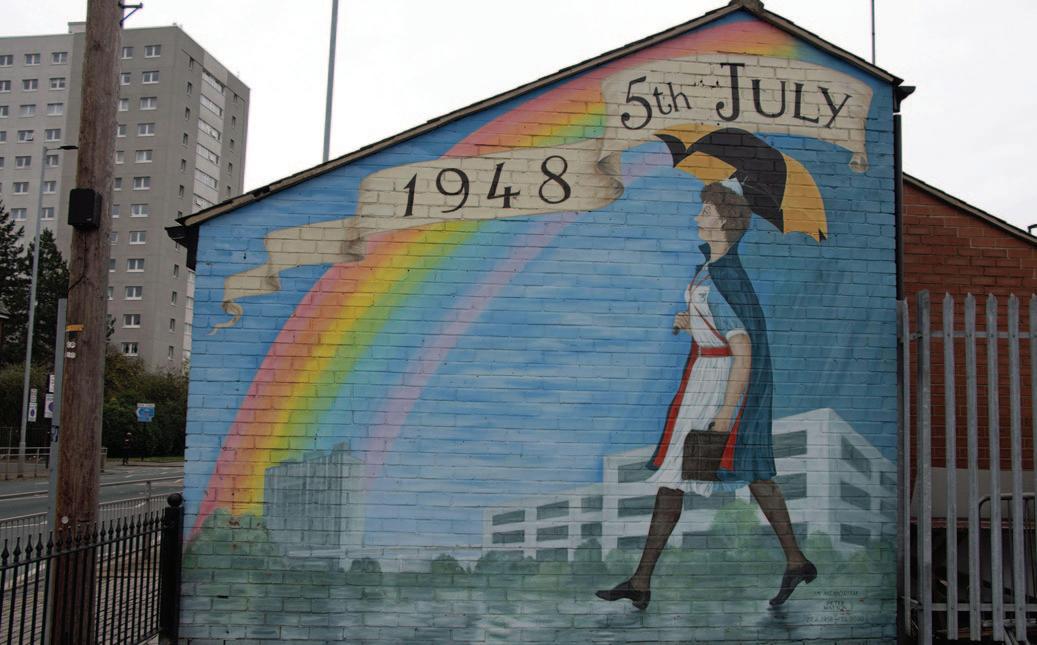
NHS founding 75 years on 26 l SOCIALIST ALTERNATIVE l SUMMER 2023
The groundbreaking struggle for free healthcare for all 75 years since
attendance on the sick, by the immense labour imposed on the medical attendants, and the wretched pittances to which they are ground down.”1 Conditions in workhouse infirmaries were so poor and unhygienic that explosions in infectious diseases were commonplace.
Workhouses were established as a by-product of the Poor Law (1834), which classified poverty as a moral failing, therefore a punishable offence through hard labour. The workhouses remained places of terror for workers, the elderly, the poor, and the disabled well into the 20th century, despite theoretically coming to an end with the transfer of the Poor Law to local authorities in 1929. In reality they continued to exist under local authority control in the form of 'Public Assistance Institutions' until the final abolition of the Poor Law in 1948. The alternative option of voluntary hospitals, often run by religious institutions, brought with them equally traumatic experiences for working-class people, particularly women, children, and LGBTQ+ people, as harsh methods of ‘discipline’ and punishment would be exercised – ranging from hard labour, to solitary confinement, to corporal punishment. This was again particularly prevalent in Northern Ireland where religious institutions were significantly stronger in society and able to exercise greater control than in any other part of the UK.
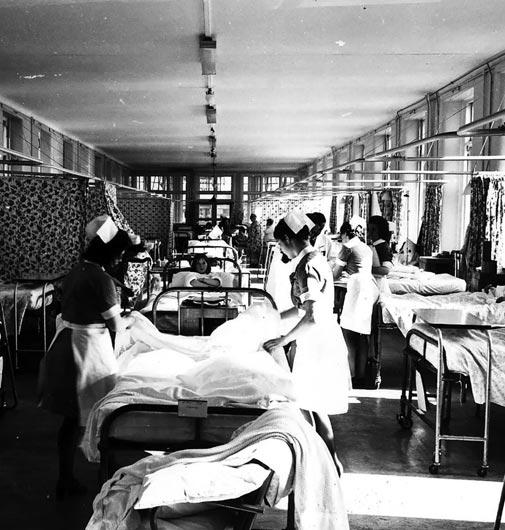
Working-class women who fell pregnant outside of marriage were often sent to religious institutions to deliver their babies, and were subjected to verbal and psychological abuse. Similarly for the LGBTQ community. For example, the Mater Hospital was established as a voluntary hospital in 1883 in North Belfast by the Sisters of Mercy. The use of psychological abuse and electroshock therapy as a means of ‘conversion therapy’ was employed in the Mater right up to 1973, as the hospital existed outside the NHS until then due to the Catholic Church being unwilling to relinquish control over the facilities and the state being unwilling to challenge its authority.
Labour movement takes up the fight
The horrific conditions in the infirmaries led to public outrage and campaigns for reform, the first of which was won in 1911 when the Liberal government introduced the National Insurance Act. Though a step forward, the underlying logic of these measures was not to improve the health of workers, but to boost productivity and output by reducing sick days. The scheme was wholly inadequate and failed to tackle the issue of inaccessible health care in any meaningful way, as it was financially tied to the workplace, provided only for GP care, and introduced insufficient sick pay. Keir Hardie, leader of the Labour Party at the time, declared the scheme to be a “porous plaster to cover the disease that poverty causes.”2 Resistance to centralisation from the top and lack of investment in vaccines meant thousands of children died every year from infectious diseases including pneumonia, diphtheria, and polio. Surveys showed that up to 80% of children in the
mining areas of county Durham and the poorest boroughs of London had signs of rickets.
At the turn of the 20th century, an outbreak of Tuberculosis swept across Europe, killing over 6 million people in Britain alone. Poor, working-class people were most vulnerable to infection due to overcrowded living conditions. Northern Ireland was particularly impacted by the outbreak as it had some of the highest rates of poverty per capita in Europe.
The misery suffered by working-class communities provoked deep anger. The growing working-class movement in the years preceding the First World War made fighting for public healthcare one of its priorities. This struggle went beyond local areas, with both the Labour Party and Trades Union Congress (TUC) adopting policies calling for a national health service decades before its arrival. Similarly, organisations such as the Workers’ Birth Control Group established by women in mining areas came out with the slogan: “It’s four times as dangerous to bear a child as to work down a mine.”3
The growing strength of the labour movement also began to be reflected in electoral politics, with Labour’s vote increasing from 300,000 in 1910 to 2.2 million by the 1918 general election. The impact of the First World War had further underlined the desperate need for progressive reforms including fair pay, better housing, and healthcare. A series of significant strikes followed soon after in 1919–20, involving more than 2 million workers across various industries, prompting great fears about the threat of “Bolshevism” from the ruling class and the Conservative-Liberal coalition government.
The Department of Health was established in 1920 as a result of this pressure and produced what became known as the ‘Dawson Report’. Though a far cry from the idea of an NHS and defeated in parliament, the
SUMMER 2023 l SOCIALIST ALTERNATIVE l 27
Hospital care for millions of people was transformed under the NHS
report represented a gain for the working class and a shift in government thinking on public health as it concluded that Britain's hospitals should be brought together under a national system. It would be another six years before the Royal Commission on National Health, off the back of a nine-day general strike of 1.7 million workers, would advocate for public funds to partially cover health-care costs.
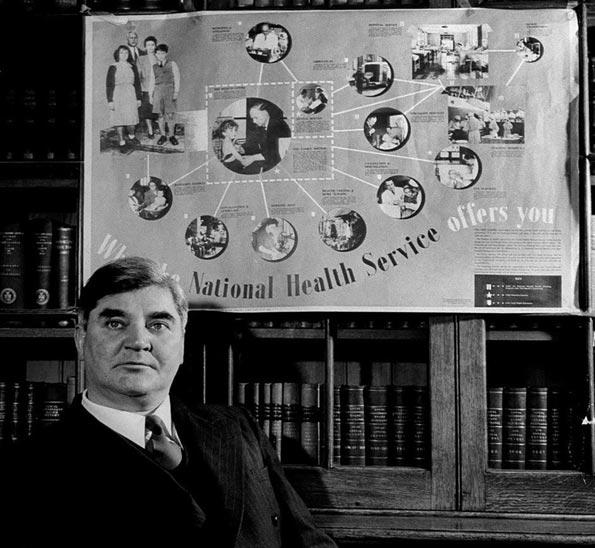
In 1929, the minority Labour government introduced the ‘Local government Act’ in an attempt to expand state and charitable provision, but the overall British healthcare system remained very much dominated by conservative ethos and was divided strictly by class. The 1930s brought more of the same, with an expansion of public health programs but little by way of structural changes in provision, and the great depression exacerbating poor conditions and already stretched charitable services.
The World War and its ramifications
It wasn't until the Second World War that a major shift occurred in the struggle for universal healthcare. The sharp increase in demand for emergency medical services dramatically exposed the deficiencies of the country’s divided and unequal healthcare system. As the war went on, the workers’ movement faced a huge setback as millions were conscripted and killed. The ‘Battle of Britain’ in 1940 left infrastructure in ruin with unprecedented aerial bombing of British cities, and society in general was devastated. As historian Charles Webster put it, “in a few short years the Luftwaffe had forced through a rationalisation in British health care that the government had failed to implement since 1920”.4
During the war a “national unity” capitalist government was established; a coalition government between the Tories and Labour. While this was posed as a necessary alliance, with the war effort requiring an ‘abandoning of rivalry between capital and labour for a common cause’, as The Times put it, in reality this alliance represented a capitulation of Labour to the interests of capitalism. This included implementing ‘Order 1305’, which banned strike action. The interests of working-class people were made subservient to the interests of British capitalism. As a result, workers' struggle stagnated.
The living conditions and rights of workers were heavily eroded in the name of the war effort, but as it began to become clear that the end of the war was in sight come 1943, resentment grew towards the abysmal conditions in which working-class people were forced to live, and so too did working-class consciousness. What was the point of millions dead, displaced, maimed, and society in ruin if victory in the war meant sustained misery and hardship for the majority of the population? More fundamentally, workers began to question the logic of the free market and the
limitations of capitalism – why was a decent quality of life for all supposedly impossible to achieve despite the fact that the wealth and infrastructure clearly existed?
Furthermore, not only did the increased demand on medical services during the war quickly expose the chronic inadequacies of the British healthcare system, it forced the government to attempt to introduce emergency national control over hospitals for the first time, with the central government dictating the functioning, and increasing funding for all services throughout the war. The fact that 90% of the economy had been nationalised under state direction during the war, bringing the majority of the population into employment and increasing productive output (even if it was geared towards the war effort and not social needs), was not lost on people. If it was possible to plan the economy for the war effort – then it was possible for everything else. The consensus among the working class was clear; there could be no return to the pre-war status quo.
Elite opposition
The opposition Labour Party pushed for a broad-based review of Britain’s social infrastructure and services. The result was the ‘Beveridge Report’, authored by William Beveridge, published in November 1942. While the proposals in the Beveridge Report were again a far cry from a national health service, it was nonetheless met with widespread approval among the British public and became synonymous with the idea of a welfare state. Despite the overwhelming support for the Report and the idea of a public healthcare system, Churchill, a section of the Tory party, and his most loyal supporters remained vehemently opposed to the idea –comparing the concept of a national health service to Hitler’s ‘National Socialism.’
NHS founding 75 years on 28 l SOCIALIST ALTERNATIVE l SUMMER 2023
Nye Bevan, Labour Party Minister for Health who founded the NHS
Other sections of society were also opposed to the idea of establishing a free national healthcare system, including GPs who were reluctant to surrender the powerful and affluent position they held in society thanks to privatised healthcare. GPs were so opposed to the establishment of the NHS that bitter industrial battles in fact played out across the UK during 1943/44, with GP’s going on strike. Due to their powerful position, the government was forced to grant concessions on a number of issues, including the guarantee that GP surgeries remain private businesses available to be bought and sold.
In Northern Ireland, the ruling-class on either side of the sectarian divide also proved reluctant to accept the idea of a national healthcare system. As previously mentioned, living conditions in the North for both Protestant and Catholic workers were horrific, with higher rates of infectious diseases, malnutrition, and poverty per capita than anywhere else in the UK. Free comprehensive healthcare was something that all workers had a vested interest in gaining and established a basis for working-class unity to bring about its creation. This posed a major threat to official Unionism and the status quo of sectarian divide and rule on which its rule was maintained, as well as the Catholic Church's power over the Catholic population in the North, as the NHS would provide an alternative to their institutions, including their hospitals.
Unstoppable momentum
Some within the political establishment did, however, see the truth of the matter: the popularity of the proposal for a NHS had grown too strong and the demands for its establishment could not be ignored. If the ruling class was to avoid outright civil unrest and the potential for further workers’ struggle, it needed to act. As Tory MP Quintin Hogg stated in the 1943 parliamentary debate on the Beveridge Report: “if you do not give the people social reform, they are going to give you social revolution.”5
It was off the back of this growing momentum and radicalisation that came the general election of 1945, with which Labour was voted into power in a landslide victory. Winston Churchill, the supposed hero of the battle against Hitler, was unceremoniously dumped out of office with his Conservative Party. It was a historic moment for working-class politics, and it reflected the strength of sentiment for change that existed among the working class.
Welsh socialist Nye Bevan, who has been credited with having greater influence on the formation of the NHS than any other politician, was appointed to the position of Minister for Health in Clement Atlee’s cabinet. Bevan understood medical care to be a right and was determined to imbue the construction of the NHS with his socialist principles. He set in motion the necessary policies and mechanisms that paved the path to the NHS’s creation three years later. The path was by no means straightforward of course, as each proposal and attempt to advance was met with
resistance by the most reactionary sections of the ruling class.
In the three-year period building up to the NHS, the British Medical Association would prove to be the business class’s biggest bulwark against it.
Nevertheless, Bevan and the most militant socialist left in the Labour Party and broader labour movement persevered in their fight for a NHS that delivered highquality, free medical treatment upon request for any medical ailment or concern. On 5 July 1948, the NHS was founded.
Conclusion
The establishment of the NHS was indisputably one of the great worker victories of the 20th century. The NHS provided universal, equitable, comprehensive, highquality health care free at the point of delivery, funded by central taxation not insurance. While the role played by Bevan was undoubtedly important in the founding of the NHS, its creation was a mark of the strength of the labour movement and the socialist left’s influence inside and outside parliament in the wake of the 1945 election.
Atlee’s Labour government, under the pressure from the working-class movement, implemented incredibly far-reaching reforms. In the decade after the establishment of the NHS, many other states sought to introduce public health care – but none provided it so widely, so effectively, and as a right to so many.
Unfortunately, successive Labour and Tory governments have introduced privatisation a piece at a time, combined with underfunding the service, decimating the NHS bit by bit. The introduction of Private Finance Initiatives (PFI), Community Care Acts and Accountable Care Organisations (ACOs), based on the US private insurance industry-devised model, have run the NHS into the ground. We are paying the price for the mistakes of the 1945 Labour government, which went so far in introducing social reforms that vastly improved the lives of working-class people, but which left capitalism intact – and all those reforms open to attack, which they have been under ever since.
The contradictions of a free public health service providing universal medical treatment under the system of capitalism, a system which necessitates the constant commodification of resources and services in the pursuit of profit, has inevitably grown sharper. In the same way the NHS was won – through determined working-class struggle, we must now defend it.n
Notes
1 The Lancet Report, 1865, volume 86, no. 2189, p.177. www.thelancet.com l 2 Emrys Hughes, Keir Hardie (1956) p. 200. Accessed at: https://spartacus-educational.com/Linsurance1911.htm l 3 Russell, D., 1983. Book Review: Fair Sex: Family Size and Structure 1900–1939 l 4 Ronan Burtenshaw, 5 Jul 2019, ‘How the NHS was won’, www.tribunemag.co.uk l 5 Lewis, G., 2002. Quintin Mcgarel Hogg, Lord Hailsham of St Marylebone. 9 October 1907–12 October 2001. Biographical Memoirs of Fellows of the Royal Society, (48), pp.221-231
SUMMER 2023 l SOCIALIST ALTERNATIVE l 29
Germany 1923
Lessons of the Lost Revolution
 By Robert Cosgrave
One hundred years ago Germany faced one of the deepest crises ever experienced in the advanced industrial world. The future of capitalist rule in Germany was seriously in doubt. The working-class movement, and the Communist Party of Germany (KPD) in particular, was presented with the opportunity to take power and follow the example of the Russian Revolution five years earlier. Had it succeeded it would have eclipsed the revolution in Russia, and greatly advanced the world revolution.
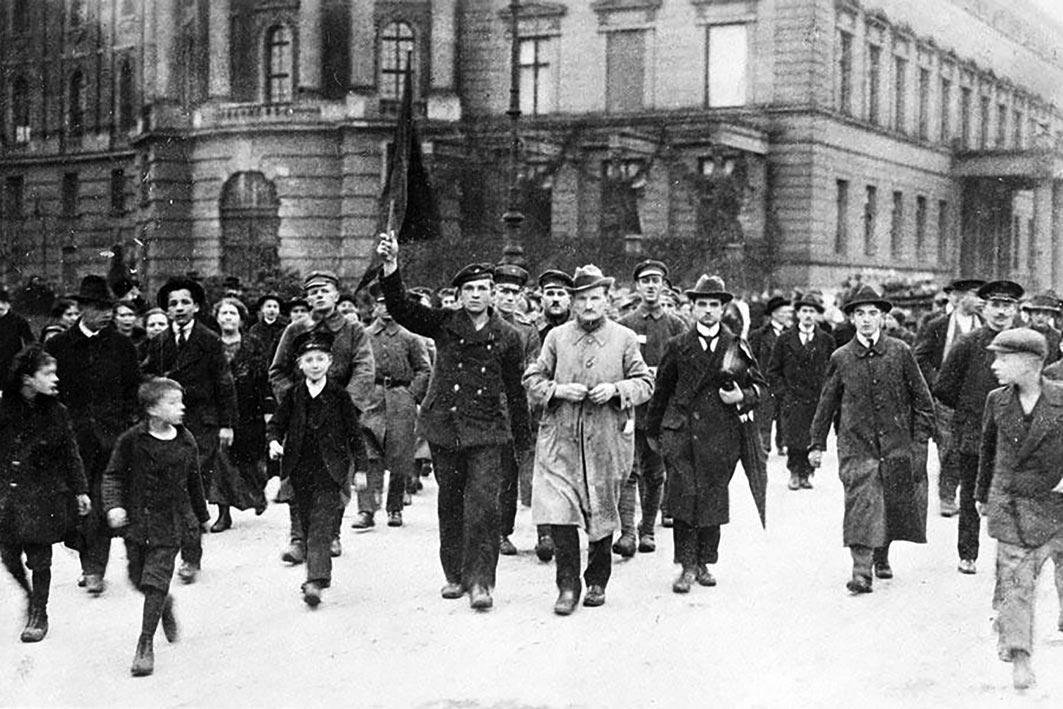
Tragically, the failure of the KPD and Communist International (Cominetrn) to provide the leadership needed marked the end of the global revolutionary wave that grew out of the Russian Revolution, and ultimately paved the way for the victories of Stalinism and Nazism in the following decade.
A century on from the defeat of this potentially world-changing moment, understanding the mistakes and drawing the necessary lessons remains essential for socialists as we face the prospect of major social crises and revolutionary events in our own time.
The crisis facing German capitalism

In November 1918, with German imperialism facing defeat in the First World War, an uprising of workers and rank and file soldiers overthrew the centuries-old
Hohezollern monarchy, ending the war. The Social Democratic Party (SPD), once a Marxist party whose founders worked alongside Marx and Engels, had betrayed elementary socialist principles by supporting the aims of German imperialism during the war, and in the November Revolution it acted as the decisive defender of the German capitalist order. The traditions of the SPD and the absence of an alternative workingclass organisation and leadership, however, meant that in 1918 it maintained the support of the majority of German workers.
The Communist Party (KPD) was only formed in the midst of the November Revolution, which meant that despite the presence of exemplary working-class leaders like Rosa Luxemburg and Karl Liebknect, who were the unparalleled leaders of the revolutionary wing of the German workers’ movement, it lacked deep roots in the working class, which limited its ability to effectively challenge the SPD in 1918-1919. In the early months of 1919, tens of thousands of workers would try to finish the work of November – of making the new republic a socialist republic – with workers’ and soldiers’ councils, similar to the ‘soviets’ of the Russian Revolution, being declared across the country. The response of the SPD government was vicious, enlisting the proto-fascist Freikorps to crush the workers' revolt. Much of the original leadership of the KPD, as well as tens of thousands of ordinary workers, were murdered by the state.
Despite these devastating setbacks, new crises would provide new opportunities to challenge the SPD government and the weak capitalist republic it presided
Revolution in Germany, 1923 30 l SOCIALIST ALTERNATIVE l SUMMER 2023
over. The Kapp Putsch in March 1920, an attempted coup against the government by right-wing nationalists, was stopped in a few days by a general strike of 12 million workers – many with arms in hand. The opportunity again existed for workers’ power in Germany, however the authority of the SPD had still not been sufficiently challenged by the KPD at this point and it was able to divert the energy of the struggle despite significant holdouts such as the Ruhr Red Army.
In October 1920 the KPD merged with the left-wing of the Independent Social Democratic Party (USPD), a centrist split from the SPD, making the KPD a real mass party. And even despite significant setbacks such as the adventurist ‘March Action’ in 1921 –based on the disastrous ‘theory of the offensive’ which argued that initiatives by revolutionary organisations themselves could be enough to spark real revolutionary events – the KPD now had the potential to offer a credible working-class and revolutionary alternative to the pro-capitalist policies of the SPD.
“A massive amount of money was printed by the German state to support passive resistance. This led to further spiralling of the inflation crisis. In April 1922, one US dollar was worth 1,000 German marks; within days of the invasion it was at 56,000 marks; by September 1923, 325 million marks! The wages of workers rapidly became worthless, coming nowhere near the rises in prices.”
developments in the Ruhr to whip up a nationalist frenzy across all of Germany. Paramilitary groups of the nationalist right flocked to the Ruhr area where they worked openly in tandem with the generals of the Reichswehr, who had been given free rein by the government to deal with the occupation. A sabotage campaign was organised in the hope that the ensuing reprisals would drive more and more German people into their arms. Many of these paramilitary groups constituted a parallel army, with tens of thousands of members with much of the modern equipment of the Reichswehr. In Bavaria, the state government gave these groups semi-official protection, on top of the funding and arms they were receiving from the military, industrialists and the aristocracy.
This was particularly dangerous for the capitalist class, as Germany was facing a severe economic crisis at this time. The victorious powers in the war – France in particular – imposed a harsh policy of reparations payments on Germany. The German capitalists didn’t want to see these payments eat into their profits so attempted to offset them onto the working class. The hope was that inflation would undermine the real wages of German workers and allow for the abolition of the eight-hour day, which they had only accepted because they feared it would be suicide not to. This was a plan the German workers would not take sitting down.
The invasion of the Ruhr
With the German government defaulting on its reparation debts, on 11 January 1923 the French and Belgian governments sent their armies in to occupy the Ruhr area – the centre of heavy industry in Germany –under the guise of guaranteeing the reparations payments. French capitalism was particularly interested in controlling the strong coal and steel industries of the Ruhr to prop up its interests and solidify its status as the dominant capitalist power in mainland Europe. In response to the occupation of the Ruhr, the German government – with the support of every major party barring the KPD – began the policy of ‘passive resistance’ in the Ruhr. It cancelled reparations payments and called on the region’s population to oppose any collaboration with the French-Belgian occupation.
The German government, the Reichswehr (German military), and the far right would attempt to use the
Although the French would imprison and execute paramilitaries involved in sabotage, the greatest violence of both the occupation authorities and the German state was directed at working-class people attempting to survive in the face of the crisis. At different times both occupation forces and German police would take turns opening fire on working-class communities organising to distribute basic foodstuffs in their communities. The writer and activist Victor Serge, in Germany as a reporter for the Comintern at the time, referenced letters from German state officials requesting assistance from French generals in putting down workers’ struggle in the Ruhr. This general was asked to return a favour, and was reminded that “at the time of the Paris Commune the German command did its best to anticipate the needs of the French authorities as far as repression was concerned.”
A massive amount of money was printed by the German state to support passive resistance. This led to further spiralling of the inflation crisis. In April 1922, one US dollar was worth 1,000 German marks; within days of the invasion it was at 56,000 marks; by September 1923, 325 million marks! The wages of workers rapidly became worthless, coming nowhere near the rises in prices. In August 1923 wages were 87,000 times their 1914 level, prices however were 286,000 times the 1914 level.
The KPD and the fascist threat
From June onwards, as the situation with hyperinflation worsened almost by the hour, a strike wave developed across Germany. From those with long traditions of struggle like metalworkers, to agricultural labourers who had up to then been very difficult to organise, workers were moving into action – to survive the unprecedented crisis. Despite the escalation of workers’ struggle, the leaderships of both the KPD and the Comintern severely underestimated the
SUMMER 2023 l SOCIALIST ALTERNATIVE l 31
revolutionary potential in the situation and lacked a clear political orientation and strategy.
An enlarged meeting of the Comintern Executive Committee (ECCI, the international leadership of the Comintern) met in June and the discussion on Germany was still fixated on the need for the KPD to prepare for a gradual development of the struggle. No doubt many were still reeling from the calamitous March Action, a failed uprising that cost the KPD tens of thousands of members. Karl Radek, the Russian ECCI member most closely involved with the work in Germany, spoke here at length about how the KPD must avoid the provocations of the German ruling class and avoid falling into a trap. August Thalheimer, a member of the KPD national leadership, wrote of the German ruling class being compelled by the occupation of the Ruhr to act in an ‘objectively revolutionary fashion’ in the struggle against French imperialism.
It was at this meeting that Radek would deliver the infamous ‘Schlageter speech’ – after Leo Schlageter, a member of the Freikorps executed by the French authorities in the Ruhr for sabotage. Realising that with the growth of fascism beyond paramilitary thugs it was no longer enough to deal with the fascists physically or militarily, there would need to be a political struggle against fascism. Radek hoped that the fascists, who were supported by the big capitalists, could be weakened if the KPD undertook agitation to expose the programme of the fascists to the ruined middle classes and workers who supported them, and in doing so could politically neutralise their base of support.
While it was necessary to utilise a variety of tactics to undermine the support for fascist ideas, serious mistakes were also made, including at times giving too much credence to the nationalist arguments, such as the idea that Germany was being ‘colonised’ by France. As well as complicating the situation in Germany, this was a hindrance to the work of the Communist Party of France (PCF), which was working to build workingclass solidarity between French and German workers.
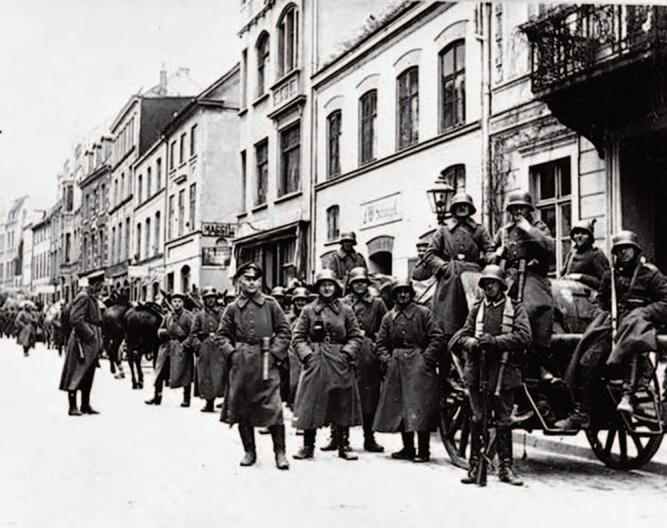
Radek – who himself was nearly killed by the Freikorps in 1919 – can be accused of getting carried away in his speech about the potential to win “hundreds of Schlageters” away from fascism in the first place. Polemics with ‘National-Bolshevik’ pseudointellectuals or debates in universities with far-right student groups were not the means by which a political struggle against fascist ideas in society was going to be carried out.
Some of the KPD Left opposed the approach. Max Hesse objected to the publication in Die Rote Fahne (the KPD’s national daily paper) of material by
nationalist writers for polemical purposes. Werner Scholem, another Leftist, was similarly critical of any potential accommodation to nationalism, criticising the approach of the KPD for insufficient anti-fascist work in May and declaring that “an intensified struggle against the fascists and for wages must be conducted outside the Ruhr… The political line of Die Rote Fahne was incorrect.” This group was not however a politically consistent or cohesive bloc. Also on the Left was Ruth Fischer, herself from a Jewish background, who in a debate with far-right students very crudely said:
"Anyone who rails against Jewish capital, gentlemen, is already a class warrior whether he knows it or not. They are against Jewish capital and want to overcome the stock exchange dealers –rightly so. Stamp down on the Jewish capitalists, hang them from the lampposts, crush them. But gentlemen, how do you feel about the big capitalists like Stinnes and Klöckner?”
Tactical turnaround
The approach of the KPD changed in mid-July when Die Rote Fahne issued the call to make 29 July an ‘AntiFascist Day’ throughout Germany. This was a call for mass demonstrations on the street to take on the fascists, a project to which the KPD was able to win a broader layer of workers organised in the trade unions and even some local organisations of the SPD, which were equally disgusted by fascism. The Proletarian Hundreds, a type of workers’ defence militia, proved particularly successful in mobilising those outside the KPD membership. In the capitalist press and among the mainstream parties the call by the KPD was condemned as a prelude to civil war. The central government called on the state governments to ban the demonstrations, which they did – with the only
Revolution in Germany, 1923 32 l SOCIALIST ALTERNATIVE l SUMMER 2023
Members of the proto-fascist Freikorps in 1920
exceptions being in Saxony and Thuringia, where the left-wing of the SPD was in control.
The banning of these demonstrations created a crisis for the KPD leadership. It was terrified of being drawn into a provocation by the state, and being brutally crushed. With the debate among the leadership showing no signs of resolution either way, an appeal was made to the leadership of the Comintern in Moscow for advice. The position of Radek and Stalin, as against Zinoviev and Bukharin, was that the KPD should back down fearing a trap. This position won the day in the ECCI. Following this advice the KPD retreated. Outside of Saxony, Thuringia, and Württemberg, where street demonstrations were not banned, they instead held indoor meetings. While both the street demonstrations and the indoor meetings saw very strong turnouts, it represented a significant climb down by the KPD, although Die Rote Fahne would instead congratulate themselves for not falling into the trap set by the government.
Within days of the KPD’s climbdown, the depths of the crisis would be clear. At the beginning of August there was a vote of confidence in the government. The survival of the government in the first vote of confidence on 10 August led to the outbreak that day of mass political strikes against the government in Berlin, which rapidly spread across the country – including at the state printing press, which was sorely needed to maintain the flow of the massive sums of money created by hyperinflation. Although the government would collapse the following day, the SPD and a coalition of the main capitalist parties were able to form another government.
The leadership of the KPD and the Comintern were forced to suddenly change tack as they realised that the pace of events in Germany was far ahead of their previous prognosis, and were compelled to try to make up for lost time.
Organising ‘the German October’
The KPD leadership and the leadership of the Left faction would meet with the leadership of the Comintern in Moscow in early September and discuss the planning of an insurrection in Germany. Within the Soviet Union (USSR) the mood of working-class people was being elevated as the prospect of a socialist Germany, and the end of their isolation brought about huge hopes for a revival of a revolutionary wave across Europe. Workers, youth and the soldiers of the Red Army would all offer their support to the coming ‘German October’ in mass meetings across the USSR. From a situation only weeks beforehand where they were calling off actions to avoid being caught by the trap of the ruling class, the KPD leadership had done a full 180, almost concluding now that the success of the revolution was inevitable. But against the advice of Trotsky that they set a date for insurrection and concentrate their energies on it, the position of the KPD leadership, supported by Radek, was that the day of the insurrection could be decided at an indefinite
later point; that it would be a necessary outgrowth of the developing revolutionary situation. This position was described as ‘fatalist’ by Trotsky who responded that:
“the Communist Party has absolutely no use for the great liberal law according to which revolutions happen but are never made and therefore cannot be fixed for a specific date. From a spectator’s standpoint this law is correct, but from the standpoint of the leader this is a platitude and a vulgarity.”
Back in Germany, the new government was determined to clamp down on the Factory Councils and the KPD. Communist papers were repeatedly seized and warrants issued for the arrest of prominent KPD members, tens of thousands of whom would go underground, which meant thousands of militant leaders being removed from their workplaces just as an insurrection was being prepared. Where in July Die Rote Fahne would say the KPD had no need for the methods of conspiracy, by early September members of the leadership sang a different tune, saying:
“Comrades, under no circumstances should we proclaim a general strike. The bourgeoisie would find out what we are planning and would destroy us before we start. On the contrary, let us soften down our spontaneous movements. Let us hold back our groups in the factories and the unemployed organisations so that the government will think that the danger is over. And then – after they are lulled into an illusion of complete safety – let us strike in one night, quickly and decisively”.
Trotsky afterwards would critique this view of insurrection, commenting that, “resorting to trickery in politics, all the more so in revolution, is always dangerous. You will most likely fail to dupe the enemy, but the masses who follow you may be duped instead.”
Miscalculations and tactical blunders
The repression against the KPD continued throughout September. At the same time the far right was openly plotting against the government. The Reichswehr had de facto control in Bavaria and used this as the base for the planned putsch against the central government. The government took no significant action against Bavaria but did have another useful pretext for further repression against the KPD and the working class. In preparation for the insurrection, the KPD joined ‘workers’ governments’ alongside the SPD in Saxony and Thuringia. It hoped these governments would arm the Proletarian Hundreds and form action committees to prepare the insurrection, which would begin in Saxony and Thuringia and then spread across Germany. In response to the entry of the KPD into these governments the Reichswehr would threaten the two states with martial law.
SUMMER 2023 l SOCIALIST ALTERNATIVE l 33
The left Social Democrats who led in Saxony at this point would oppose in words the threats of the Reichswehr, but concrete steps were not made to provide arms for the Proletarian Hundreds. The call was also made across Germany for a defence of ‘Red Saxony’. In Berlin, trade unionists voted to declare a general strike if the Reichswehr attempted to invade Saxony. The Reichswehr, supported by the central government, nonetheless continued its plans to remove the ‘workers’ governments’ in Saxony and Thuringia. The state police were in reality under the authority of the Reichswehr not the state governments to which they were ostensibly ‘loyal’. Reservists were called up by the Reichswehr and troops brought into Saxony from the rest of Germany, allegedly to protect against attacks from the fascists and nationalists in Bavaria.
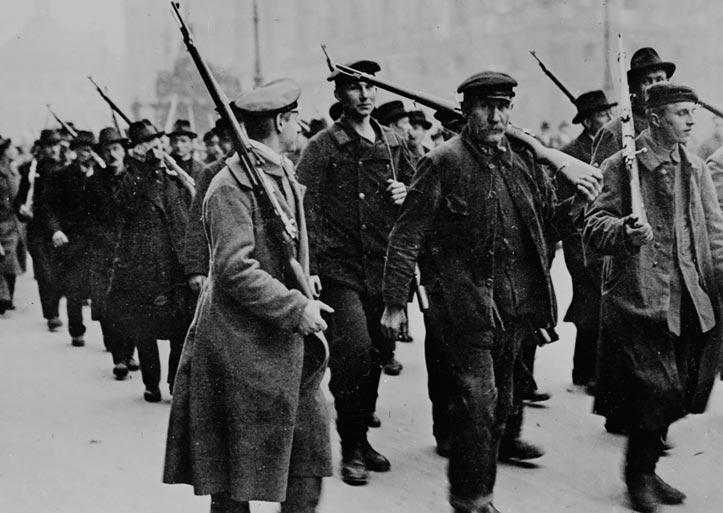
A conference of the Factory Councils was called to take place in Chemnitz for 23 October. In the plan of the KPD this Conference would issue the call for a general strike throughout Germany in defence of ‘Red Saxony’, and this would lead to an insurrection and a nationwide workers’ government. At this decisive moment the left Social Democrats in Saxony, despite all their previous declarations of their commitment to defending ‘Red Saxony’ were unwilling to translate that into the necessary action, hoping in vain for a deal to be cut with the national government.
The KPD’s plan was entirely reliant on the left Social Democrats supporting their call for an insurrection, and with the fatal vacillation of the left Social Democrats, the conference ended without any decision on whether to call for insurrection, and the plans of the KPD had to be abandoned. The strategy of the ‘workers’ government’, intended to act as a step towards a workers’ state and socialist revolution, turned into its opposite. Within days of the calling off of the insurrection, the ‘workers’ governments’ of Saxony and Thuringia were overthrown by the Reichswehr anyway, and the KPD was outlawed nationally until well into 1924.
Wrongly assessing the defeat
In the aftermath of the defeat the Comintern leadership made no attempt to seriously study what mistakes had been made during the year. What was done instead was that the KPD leadership around Heinrich Brandler was scapegoated for all the mistakes. The KPD leadership was bureaucratically re-organised by the Comintern around the Left in Berlin, who wildly declared that despite the setback of October, the situation remained
as revolutionary as ever. There was no appreciation from the new leadership of the significance of the defeat in October. They carried through the bureaucratisation of the KPD that the Comintern leadership under Zinoviev had misnamed “Bolshevisation”. This would be their own undoing as they would be replaced within a year by the faction around Ernst Thälmann as Zinoviev lost out to Stalin in the Comintern bureaucracy.
It would be under Thälmann’s leadership that the KPD would follow Stalin in the catastrophically ultraleft ‘third period’ strategy from 1928, under which the KPD rejected the need to build a united front of the workers’ movement against fascism, as they now characterised the SPD not as a reformist trend in the workers’ movement but as ‘social fascist’ trend. This criminal policy paved the way for Hitler and the Nazis coming to power and smashing the most powerful workers’ movement in Europe without a real fight.
Those KPD leaders out of favour with the new Stalinist leadership also failed to learn from 1923. A few years after the events, Thalheimer, the main ally of Brandler and chief theorist of his group, wrote a pamphlet attempting to exonerate themselves by denying that the situation in 1923 was revolutionary after all.
The paramount lessons of 1923
In contrast to these, a serious attempt to examine the mistakes and lessons of 1923 was undertaken by Trotsky and the Left Opposition in the USSR, who saw the defeat in 1923 as a crisis of leadership in the KPD which in turn reflected the political degeneration of the Comintern leadership. Trotsky argued for the central role of a revolutionary party in taking up the active leadership of a revolutionary struggle, in the way the Bolsheviks had in 1917. He continued the argument he had in 1923 about the need to avoid a fatalist view of
Revolution in Germany, 1923 34 l SOCIALIST ALTERNATIVE l SUMMER 2023
An armed workers’ demonstration led by The Spartacists in 1918
revolutions as happening automatically and developed it further, making the point that the strength of a revolutionary movement may develop ‘automatically’ up to a certain point, but there is no spontaneous collapse of the ruling class and that a successful revolution fundamentally needs to be carried through. As he explained: “the strength of a revolutionary party increases only up to a certain moment, after which the process can turn into the very opposite. The hopes of the masses change into disillusionment as a result of the party’s passivity, while the enemy recovers from his panic and takes advantage of this disillusionment.”
The fatalist view of revolutionary events led to the panicked retreat of the ‘German October’ when presented with the concrete difficulties involved. This view is also what undermined the ability of the KPD leadership to understand the meaning of the defeat, by seeing the question of revolution as something that develops in this automatic way whereby the victory of a revolution is an organic outgrowth of the revolution itself. In this view, defeat in 1923 by virtue of not being successful means it was not a revolution at all. The question of whether to set a date for insurrection as opposed to letting it be improvised on the day was not for Trotsky a question of exclusively technical importance, it was linked to the vital question of the method of a revolutionary party, and whether such a party is capable of acting in an actively revolutionary way, and not just in words.
The KPD leadership, caught unaware in 1923, were unable to transform all aspects of the party’s work in such a way as to organise a successful socialist revolution, instead making political turns in a frenetic manner which confused more than clarified. To have carried out such a turn successfully would have been decisive in 1923, the hundreds of thousands of committed Communist workers of the KPD intervening in workplaces and communities, in every strike and street action, in factory councils and trade unions, would have fundamentally transformed the situation and constituted the framework of a successful socialist revolution. However that framework did not exist in a developed way and it is not the case that such a framework – what Marxists call the ‘cadre’ of a party –develops automatically out of working-class struggle. To be sure, its development is rooted in struggle but it has to be very consciously fought for and built up in nonrevolutionary periods.
Of course the work in non-revolutionary periods, especially successful work, inevitably impacts on a revolutionary party too, in potentially dangerous ways. It is from the routine in these periods of relative calm that a fatalist view can develop, leading to a conservative inflexibility, particularly in the leadership of a party. This was even the case for the Bolsheviks in 1917. Bolshevik leaders made many mistakes, for example on the approach to the Provisional Government immediately after the February Revolution, and later on some of the leadership were opposed to organising the October insurrection itself.
And had their position won the day, no doubt the same arguments would have been purported: that the situation in October 1917 wasn’t revolutionary after all! What was different in Russia was that over the years of building the Bolsheviks beforehand there had been a struggle to build up a revolutionary leadership, personified mainly by Lenin, and a revolutionary cadre of members grounded in Marxist theory, and rooted in and intervening into working-class struggle. It was the combination of this leadership and cadre that meant that the vacillating approach of some Bolshevik leaders was able to be corrected within the party at the decisive moments. The paramount lesson from the whole period of revolutionary struggle that swept Europe after the Russian Revolution is the necessity of building such an organisation, with such a leadership, based on such a cadre. Without this there cannot be a successful socialist revolution.n
Notes
1 Centrism to 1920s Marxists meant organisations caught between a commitment to revolutionary socialism in words and reformism in practice. The USPD, formed in 1917 following the expulsion of anti-war members of the SPD, included both revolutionary Marxists like Rosa Luxemburg and Clara Zetkin and reformists like Karl Kautsky, a situation which could not last indefinitely. The left- wing of the USPD grew from the disappointment with the leadership’s reformist practice and at their Conference in October 1920 voted to join the Comintern and merge with the KPD. The majority of the rump USPD that remained would rejoin the SPD in September 1922 l 2 In March 1921 the state government in Saxony, led by the SPD, sent troops into an industrial area of central Germany, a stronghold of the KPD and a centre of intense class struggle to “restore order”. Armed confrontations broke out between the troops and police and workers led by the KPD and KAPD (an ultra-left split from the KPD) in the region. The KPD made the call for a general strike nationally but was unable to mobilise support outside of central Germany, the isolated workers were thus defeated and severe repression meted out. The defeat was a disaster for the KPD with it losing nearly half of its membership in the aftermath and thousands of its members sacked in their jobs l 3 In his book The German Revolution: 19171923, still a key work for anyone studying the period, the French Marxist historian Pierre Broué wrote: “It seems that from November 1921, the magnates of German industry decided that the general situation must deteriorate before it could improve: runaway inflation would wipe out the German debt, bring the state to its knees before them, exhaust the working people, and leave the great capitalists alone as masters of the situation.” Pierre Broué, 2006, The German Revolution: 1917-1923, Haymarket Books, p. 710. l 4 For information on the Paris Commune, see: Harper Cleves, ‘Spurn the Dust to Win the Prize: 150 Years Since the Paris Commune’, www.socialistparty.ie l 5 Victor Serge, 2011, Witness to the German Revolution, Haymarket Books, p. 47 l 6 Broué, 2006, p. 710 l 7 Mike Taber (ed), 2019, The Communist Movement at a Crossroads: Plenums of the Communist International’s Executive Committee, 1922-1923, Haymarket Books, p. 491, p. 506 l 8 Taber, 2019, p. 509 l 9 Broué, 2006, p. 730 l 10 Taber, 2019, p. 618 l 11 Ralf Hoffroge, Class against Class: the ‘Ultra-left’ Berlin Opposition, 1921-1923, in Hoffroge & LaPorte (eds) op. cit., p. 101 l 12 Ibid, p. 100 l 13 Ibid l 14 Broué, 2006, p. 759 l 15 Leon Trotsky, 1923, ‘Can a Counter-Revolution or Revolution be Made on Schedule?’, www.marxists.org l 16 Broué, 2006, p. 772 l 17 Leon Trotsky, 2017, Lessons of October, Chicago, Haymarket Books, p. 82 l 18 The exact meaning of the term ‘workers’ government’ was the subject of much debate within the Comintern. A useful overview of the debate is provided here by John Riddell: ‘The Comintern’s unknown decision on workers’ governments’, www.johnriddell.com
l 19 See for example Arkadi Maslow, 1924, The tasks of the German Communist Party: Prospects, Partial Aims, Revolutionary Unity from Below, www.revolutionsnewsstand.com
l 20 August Thalheimer, 1931, A Missed Opportunity? The German October Legend and the Real History of 1923, www.marxists.org
l 21 Lessons of October, 2017, p. 69 l 22 Lessons of October, 2017, pp. 70-71
SUMMER 2023 l SOCIALIST ALTERNATIVE l 35
My Fourth Time, We Drowned
By Sally Hayden Fourth Estate, 2022
Reviewed by Michael O’Brien
For the recording of testimony alone, from migrants from sub-Saharan Africa about the hardships they endured attempting to come to Europe for a better life, this book and its author Sally Hayden richly deserve the accolades and awards already bestowed upon it.
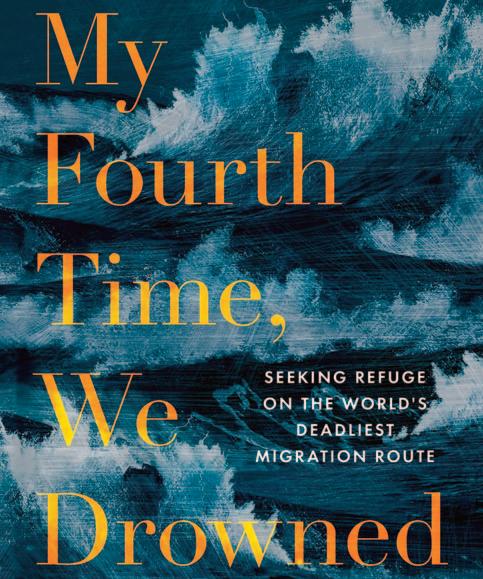
However, the book achieves more than providing an important platform that serves to fully humanise the people who put everything at risk to improve their and their families’ lives. It is an indictment of institutions such as the EU and United National High Commissioner for Refugees (UNCHR), which are portrayed in the West in benign progressive lights.
Hayden herself, who would be familiar to readers of The Irish Times for her consistent excellent reporting from Africa, is justifiably part of the ‘story’ contained in the book. Her reputation had already spread sufficiently that in August 2018 she began receiving facebook messages from an Eritrean migrant incarcerated in one of the detention centres in Libya, which is part of an entire apparatus to support the objective of ‘Fortress Europe’ – the policy of preventing, by the crudest means imaginable, the migration of people fleeing war, conscription, persecution, grinding poverty and the effects of climate change.
These factors, which are ultimately located in the unequal capitalist relations between the developed and neo-colonial world, drive migration, and coupled with the legal and physical barriers then put up by the EU to impede the movement of people create a niche for human traffickers.
These criminals charge enormous sums in return for the promise of a successful passage to the Mediterranean coast and across the sea to Europe. The reality, as told to Hayden, is that even when the passage to Libya is delivered upon it is frequently accompanied by the migrant being treated as a hostage and attempts made by the traffickers to extort more money from the migrant’s family on pain of being tortured or raped.
Once in Libya, assuming they make it to a rubber dinghy and are pushed out to the Mediterranean, they are then faced with a hazardous trip which in the last decade has resulted in tens of thousands of drownings.
The agreement the EU has reached with the Libyan authorities is one of effectively equipping the coast guard to prevent the boats arriving in international waters and the mass incarceration of migrants picked up at sea. In these Libyan prisons the abuses and privations match those perpetrated by the traffickers.
Hayden time and again confronts the EU authorities
with the testimony she receives from migrants. The reality is that behind the ‘progressive’ veneer, the measures the EU has in place leave Donald Trump’s openly racist and widely condemned border wall and childrens’ detention centres in the shade.
Likewise with the UNCHR, under whose very nose in Libya these abuses have taken place. It is not an understatement to say that this agency of the UN is revealed to be rotten to the core. The salaries and expenses of its personnel compared to its actual practical output of processing refugees is an abomination. Key officials effectively victim-blame incarcerated migrants who have justifiably rose up in protest against their conditions.
Even if the UNCHR was genuine in its mission we still have the problem that the governments in the developed world are only prepared to receive a token amount of refugees who follow the routes described in Hayden’s book.
Governments, in particular the Italian and Greek, have gone so far as to criminalise activists and ordinary people who provide any life-saving or humanitarian assistance to migrants while they attempt their hazardous crossing.
Insofar as one can obtain any inspiration from the book it is the resourcefulness of the migrants in being able to organise themselves and work with Hayden to get their stories told, and at critical moments generate sufficient political pressure to force even temporary improvements in their situation.
A number of the migrants with whom she was in contact from the time of their incarceration in Libya did make it to Europe. This does not represent the end of their struggles as they have to adjust to a new life, often in the context of a hostile political environment, while not having fully processed the trauma of everything
Review 36 l SOCIALIST ALTERNATIVE l SUMMER 2023
they went through over a period of years – not to mention the enduring separation from their loved ones. Since this book was published we have witnessed a spate of anti-migrant activity in Ireland. The far right is reliant in some measure on the ‘othering’ of migrants, particularly of migrants of colour, in the eyes of the audience they want to influence with their racist ideology. Books like this are a significant contribution in
The Myth of Normal
By Gabor Maté, with Daniel Maté Vermilion, 2022
Reviewed by Roise McCann
As a younger generation comes of age in a time of capitalist crisis, the “myth of normal” is breaking down before our eyes. From the Covid-19 pandemic, to ecological and economic collapse, it’s no surprise that trauma has become “the word of the decade”. As we struggle for answers about what the pending disintegration of the environment and life as we know it is doing to our brains and bodies; The Myth of Normal feels like a timely introduction to how life under capitalism inevitably isolates us from our core needs, as well as from ourselves.
In 1859 Karl Marx wrote, “It is not the consciousness of men that determines their being, but, on the contrary, their social being that determines their consciousness.” Dr Gabor Maté echoes in many ways this concise synopsis of human consciousness as it presents trauma, mental and physical health as not simply fixed physiological occurrences, but intrinsically linked to stress we face amidst capitalism’s “toxic culture”.
Maté is a famed author and physician, using his many years of experience running a family practice in the deprived area of downtown Vancouver to inform his own writing. He connects mental health and trauma to addiction, as well as physical chronic health problems such as autoimmune diseases and cancer.
Maté is resolutely clear that his own life has been shaped by deep trauma suffered at the earliest stage in his own cognitive development. Born in Hungary during World War Two, his maternal grandparents were murdered in Auschwitz and his mother entrusted his care to a stranger for five weeks in order to save his life. Upon their reunion, Maté writes that he did not look at his mother for days, inviting us to consider his own story of horrific early life experiences as a case study for the broader understanding of how trauma impacts children’s cognitive development.
The Myth of Normal is co-authored with his son Daniel Maté, and has been described as a product of the last ten years of his work and research. Drawing
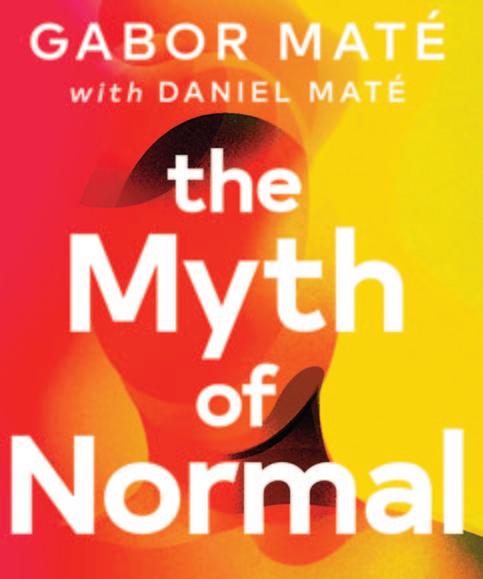
revealing the humanity of those prepared to risk it all, but also situating these personal stories in their wider political and institutional context which, while not veering in the direction of articulating a political programme that addresses the politics of migration, does point in the direction of the global system of capitalism and its institutions that need to be done away with.n
upon foremost researchers in the field of trauma studies, as well as well-known figures from Noam Chomsky to Alanis Morissette and even Buddha, the book is a colourful and humanist sprawling expedition through capitalism’s many facets of subordination. From poverty and wage slavery, to racism, sexism and LGBTQ+ phobia, our bodies “keep the score”, holding stress from navigating the world with all of these pressures in motion.
Trauma is described as an inner injury, a lasting rupture or split from the self due to difficult or harmful events. It is not the event itself, not what happens to you but rather what happens inside you. Trauma is not an individual event, but a process that can potently redirect our mental and physical health and wellbeing. Our responses to trauma can be debilitating. They can also be fostered by the system’s profit motive. Behaviours such as workaholism and fawning (people pleasing) can be mistaken, even by ourselves, as ambition and success in a system that values unattainable and arbitrary goals and skewed ideas of what makes us productive members of society.
Maté employs cutting-edge research to show that factors such as poverty, racism and urban blight can
SUMMER 2023 l SOCIALIST ALTERNATIVE l 37
impact genetic and molecular functioning. Unlike the medical status quo of past decades that claimed our genes determine who we are destined to be, the study of epigenetics shows that our surroundings activate, accent, or quiet certain functionings of our genes. The science employed presents stunning results: gene expression in rich men is markedly different from men from a background of poverty. Racism and discrimination accounts for more than 50% of black / white difference in the activity of genes that cause inflammation and decreased immune functioning. Living with racism is living with disproportionate stress, hypertension, proneness to autoimmune diseases, obesity etc.
The Myth of Normal is the most explicitly anticapitalist and sympathetic to Marxist modes of analysis that Maté has written in his career as an influential author. Maté conceptualises alienation under capitalism to not only mean estrangement from our essence and from others, but employs Marx’s theory of alienation from labour, noting that just 30% of employees in the US feel engaged at work. Through processes of alienation, the capitalist system cannot provide for our most basic needs: belonging and connectedness, autonomy of our bodies and lives, mastery or
Close to Home
By Michael Magee Penguin, 2023
Reviewed by Niall Dooris
Close to Home is the impressive debut novel of Belfast author Michael Magee, which is loosely based on his own life. The book tells the story of a young workingclass man from West Belfast called Sean. Sean has recently returned home after graduating from university in Liverpool. He returns to the reality of a scarred city and harsh economic circumstances where his educational achievements mean very little. He is forced to join the long line of young people queuing for precarious service jobs while struggling to find a steady place to live. The book begins with Sean assaulting someone at a house party, and traces the consequences of this for his already complicated life.

The novel is not an easy read, but this is due to how relatable the story actually is for many young workingclass people in the North, and how well the author depicts a depressing situation in often subtly brilliant ways. Personally, I don't read much fiction but this book has reminded me how fiction can put across human experience and emotion in a way that non-fiction can’t. This in itself has important lessons about the real world.
competence and purpose and meaning, to list a few.
Ultimately, Dr Gabor Maté concedes that none of these core emotional needs can be met under a system so deeply entrenched with oppression, repression, systematic violence. He calls for an entirely new system, built from the ground up – drawing upon the processes of organisation of activists across the world as a nod to how society can be reimagined.
As well as these, examples of non-Western and indigenous structures of community and healing are illuminated; he tells the story of a humbling and spiritually opening experience with ayahuasca (a South American psychoactive and entheogenic brewed drink) in Peru. As much as can be learned and brought forward from these practices, they cannot alone address the root causes of systematic exploitation that are making us so sick and isolated, and my local branch of Boots unfortunately does not sell ayahuasca over the counter.
Despite Maté’s hesitation, the book is an essential read for the revolutionary Marxist: an intensely human approach to coming up against a dehumanising system. It acts as a basis for looking toward a return to the self, through no other means than the overthrow of the capitalist system and a socialist society formed in its place to genuinely meet the needs of humanity.n
The book is full of important observations that come from the main character's experiences, which are often very political without him often being conscious of this.
Many of Sean’s difficulties are rooted in the fact that he is from a hard-pressed, working-class community. The man he hits in the beginning is from the better-off Malone Road, and he was making fun of Sean for his
Review 38 l SOCIALIST ALTERNATIVE l SUMMER 2023
accent and the fact he doesn’t know his father. Other examples of being demeaned because of his class background follow. Similarly, the book shows how Sean is at the mercy of bosses who can fire him arbitrarily and condemn him to the harsh benefits system.
The poverty he lives is shown by his constant state of economic precarity in housing and work. It is repeatedly mentioned how he doesn’t have money for very basic things, forcing him to steal from supermarkets. This is perhaps an extreme example of an all too familiar story for younger generations, which due to years of austerity, privatisation, erosion of workers’ rights and casualisation, it has become harder to attain the bare necessities, and our living standards have observably dropped. Contrary to the story we were told growing up, society is not progressing toward a better future.
Additionally, Sean’s environment is massively shaped by the legacy of the troubles. He’s from West Belfast, one of the areas most affected by the violence. Despite growing up after the Good Friday Agreement, it is clear that in his community violence in general is a consistent feature, whether that be through paramilitaries, gender-based violence, child abuse or even Sean himself lashing out and hitting someone. The scars still show on the older generation around him; they are evidently traumatised and damaged in various ways and this is passed down to their children, often horrifically so.
Sean and his friends have a complicated relationship with republicanism despite its romanticisation in Catholic areas like their own. They can see what the violence did to their community and can’t see what exactly it achieved when they look at their own lives. As Sean’s friend Ryan argues: there were those “who had
The Patriarchs: The Origins of Inequality
By Angela Saini Beacon Press, 2023
Reviewed by Martina Stafford
The Patriarchs: The Origins of Inequality by Angela Saini is an ambitious and timely work, no doubt borne out of the struggles that have unfolded in recent years against gender-based violence, against LGBTQ+phobia, and for sexual liberation and bodily autonomy – both of which have been under sustained attack by right-wing forces around the globe.
As such there is a keen recognition by women and LGBTQ+ people that their rights are not guaranteed by this system, which raises important questions: Why is
done things they would live with the rest of their lives for what? The same settlement they were offered in 1973.” The Good Friday Agreement did not offer anything in the way of ‘peace dividends’, especially for the most hard-pressed communities in the North.
This has in turn led to increases in sectarian violence over the years, and young people giving up and leaving in the hope of a better life, as Sean’s two best friends do. Either that or they turn to escapism through drugs and alcohol. Substance abuse is particularly high in Northern Ireland. It features in the book a lot. Cocaine in particular is used as a means of distraction from grim reality. The author describes in immense detail the experience of staying up all night and even missing work due to drug use.
The novel appropriately ends with Sean’s problems mostly unresolved. Sean doesn’t have a hero’s journey or happy ending in which he is lifted into the middle class to do his dream job and leave his past behind, because that is not real life.
Unfortunately, under capitalism a true escape is unlikely for most working-class young people. The system that creates these miserable conditions is global and in every facet of our lives. But it is not eternal and it can be replaced with a better world that can fulfil the needs and lives of the kind of young people in this novel. But they have to struggle for it. Not only can they change their circumstances this way, but that struggle itself is an antidote to the alienation so detrimentally affecting this generation.
Suffice to say Close to Home is probably the most honest and true-to-life story you’ll read of a workingclass young person in Northern Ireland today. For this alone it is well worth reading.n
patriarchy the dominant power structure around the world? Has this always been the case? If not, how did it come to be?
The Patriarchs is packed with insights into history that contradict the so-called naturalness or inevitability of patriarchy. A particular strength of the book is that it quite thoroughly undermines any biological essentialist argument for the existence of patriarchy. As Saini says, “If there were some fundamental aspects of male and female natures that put men in control of women, that divided us up neatly into separate roles, we would expect everyone all over the world and throughout history to share similar living and working patterns.” Of course, this is far from the truth.
Saini refers to queens, empresses, female pharaohs, and powerful women warriors as well as lower-class women who have struggled, resisted and fought for themselves and others. While these examples dispute a biological female nature that is docile and submissive, that gives men the opportunity to assert their inherent dominance, it also draws us to a conflict that exists not due to nature but due to class.
SUMMER 2023 l SOCIALIST ALTERNATIVE l 39
Saini alludes to the foundational Marxist theorist Friedrich Engels who was convinced that women’s oppression was also not natural or inevitable, but the result of class inequality which had historical roots. Saini criticises Engels for seeing the beginning of agriculture as a moment that all at once was a “world historical defeat of the female sex.” Her view is that even in places where the balance of power was becoming gendered, the way it was gendered was still “being negotiated… for thousands of years”.
But for Engels, the ‘historic defeat’ meant that for the first time there was a definitive capacity to produce a consistent surplus of food, which ultimately created the basis for class society, private property, the need of the elite to secure this by passing it on to ‘legitimate children’, and therefore the need for the nuclear family and the control of women’s bodies. All of this being legitimised by the state, which is an institution to maintain class inequality.
For Saini, the critical point is the beginning of the early states and empires, roughly 6,000 years after the agricultural revolution, putting it down to their need to expand their populations and maintain armies to defend themselves: “The elites that ran these societies needed young women to have as many children as possible, and for the young men they raised to be willing warriors. It’s at this point that it’s possible to spot gendered rules appearing, curbing the behaviour and freedom of everyday individuals.”
While it is absolutely important to point to the early states as a key point in the development of patriarchy as a power structure, there would have been no state if there was no surplus product, i.e. states came into being to protect the ruling elites’ ownership and control of that surplus.
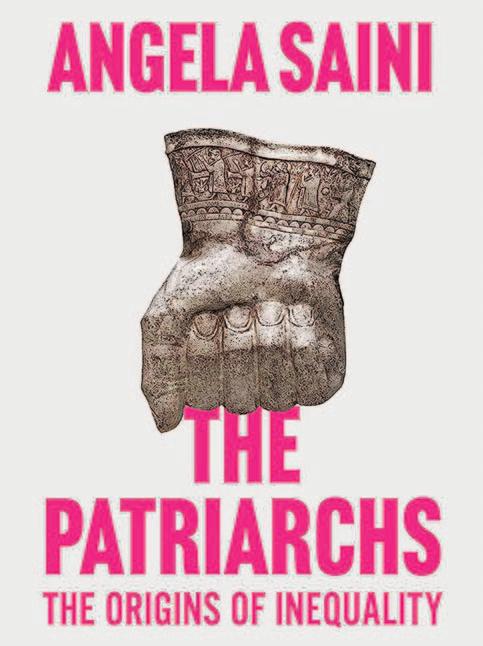
After the agricultural revolution, which occurred around 10,000 BCE, large neolithic communities in Catalhoyuk in Southern Anatolia were still relatively gender-blind, according to the archaeologist Ian Hodder. He posits that most of the time men and women were cooking together, working in the fields together, making their tools together. “We just don’t find strong categorical differences.” But even though agriculture had developed, the evidence from Çatalhöyük hints at a society trying to maintain egalitarian principles even as it was slowly changing into something else.
Saini documents how genetic analysis now reveals that 5-7,000 years ago there was a severe bottleneck in the diversity of male Y chromosomes in Europe and also parts of Asia and Africa. This indicates that a relatively small number of men were having more children than most, or at least having more children who survived and went on to have children of their own for generations. This indicates that power and wealth was being monopolised by a minority of people and it was transmitted through sons. While Saini doesn’t emphasise this point about a surplus of wealth and power being tied up with patriarchy, for Marxists, it is a key point.
The book highlights that it was 300,000 years ago when our species, Homo sapiens, first appeared in the archaeological record, but only in the last 10,000 years do we see evidence of class-based societies emerging after the agricultural revolution along with the formation of the early states and women’s oppression. Saini doesn’t emphasise enough the significance of the reality that before the agricultural revolution, human societies lacked the capacity to produce a surplus of food, and therefore to survive needed egalitarian relations and social cohesion – the norm for 99% of human history.
Unfortunately, Saini doesn’t see an alternative to a class-based society with a contested surplus, and is therefore is looking for a solution within the system. She gives a superficial account of the degeneration of the Russian revolution, omitting essential facts like the incredible counter revolutionary assault, including by all the major imperial powers, that was waged by all who stood to lose wealth, power and privileges to the most powerful threat ever faced by the capitalist system.
It is not clear what exactly Saini is suggesting as a method for overcoming patriarchy, beyond “nurturing [our] shared humanity – the part of us that manages to love even when there are those seeking to divide and rule”. But she does at least make it clear that it is not inevitable: “Some still claim that oppression is somehow woven into who we are, that humans are inherently selfish and violent, that entire categories of people are naturally dominant or subordinate. I have to ask: Would we care about each other so much if that were true?”n
Review 40 l SOCIALIST ALTERNATIVE l SUMMER 2023



























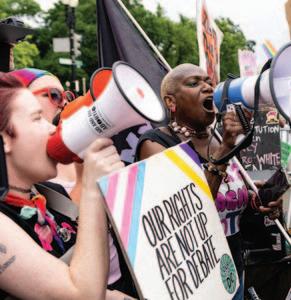
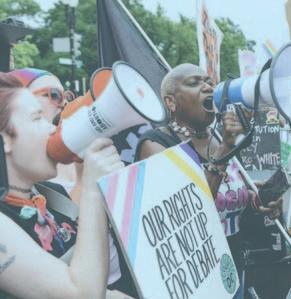



New movements of the left... S C I A L I S T Political Journal of the Socialist Party Issue 1 Winter 2015-2016 €3 / £2 # %$! #% "$ Why C APITALISM must be INSIDE Socialists & the National Question Women’s & LGBT Liberation in Revolutionary Russia Repealing the 8th & Womens’ Emancipation Today S C I A L I S T Political Journal of the Socialist Party Issue 2 Summer 2016 €3 / £2 # %$! #% "$ '%0#&$ INSIDE Support Rising For Socialism In The US A New Feminist Wave? ¡A Las Barricadas! 80 years on: Spain’s Revolutionary Struggle 02 ./*3-( )3/+ 3,+1! ).- 2,1*" S C I A L I S T Political Journal of the Socialist Party Issue 5 Autumn Winter 2017 €3 / £2 # %$! #% "$ INSIDE Art & the Russian Revolution – A Tidal Wave of Creativity Unleashed Abortion Rights, Liberation & Socialism Counter-revolution in Venezuela: What Now for the Chavista Movement? October Revolution The living legacy of the S C I A L I S T Political Journal of the Socialist Party Issue 6 Spring 2018 €3 / £2 # %$! #% "$ INSIDE #StandWithSurvivors: Misogyny, Sexism & Capitalism in the Dock The Rise of Corbynism & Its Challenges Ireland 1918: When Working-Class Power Defeated Conscription Karl Marx Theory of Class Struggle: The working class & revolution @ 200 S C I A L I S T Political Journal of the Socialist Party Issue 10 Summer 2020 €3 / £2 # %$! #% "$ INSIDE Capitalist Rivalry, Trade Wars & Globalisation Today Lessons from the Victorious Harland & Wolff Occupation The Socialist Manifesto by Bhaskar Sunkara: Reviewed S C I A L I S T Marxist Journal of the Socialist Party Issue 14 Spring 2022 €3 £3 alternative INSIDE Sinn Féin in the South: preparing for power? Climate change: Do we need to go for the ‘nuclear option’? 175 years since Black 47: A Marxist analysis of the Irish Famine NO TO PUTIN’S WAR! RUSSIAN FORCES OUT OF UKRAINE. NO TO RUSSIAN & US/NATO IMPERIALISM. S C I A L I S T Marxist Journal of the Socialist Party Issue 15 Summer 2022 €3 / £3 # %$! #% "$ INSIDE Imperialism & war – the outgrowth of global capitalist competition Organising the unorganised: Lessons from workers past and present ’War against Bolshevism’ – Civil War in Ireland, 1922-23 20706 642 '7346) 7/3 -5"$.504( *&7.+8642 ,1 2,2/6 5357/068 .3-6!)#41-75 *1+ .% 5&61/1,% 70858'7346 S C I A L I S T Marxist Journal of the Socialist Party Issue 13 Autumn Winter 2021 €3 £3 # %$! #% "$ INSIDE Irish capitalism & the unending housing crisis The national question & the imperative of workers’ unity Palestinian liberation: Lessons from the First Intifada ,-$+%*,)*$(%)* ,("-,%(*+&- ),&#+'-,-!+') -+&-#*'" SUBSCRIBE NOW! Get a year’s subscription to SOCIALIST ALTERNATIVE and The Socialist, the monthly newspaper of the Socialist Party, for just €20 / £20 Contact: Eddie McCabe eddiefmc@gmail.com www.socialistparty.ie n www.socialistpartyni.org S CIALIST alternative NEVER MISS AN ISSUE!
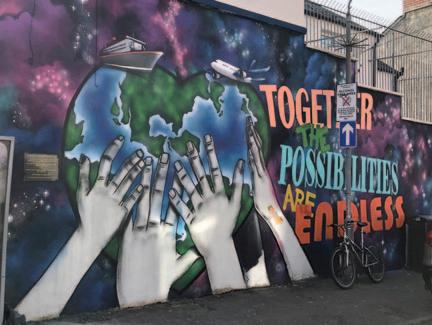

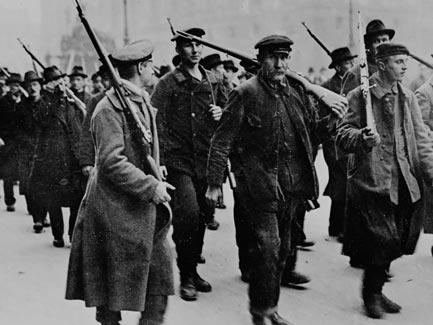

S CIALIST alternative www.socialistparty.ie www.socialistpartyni.org