Inclusion and Human Dignity
COVER DESCRIPTION
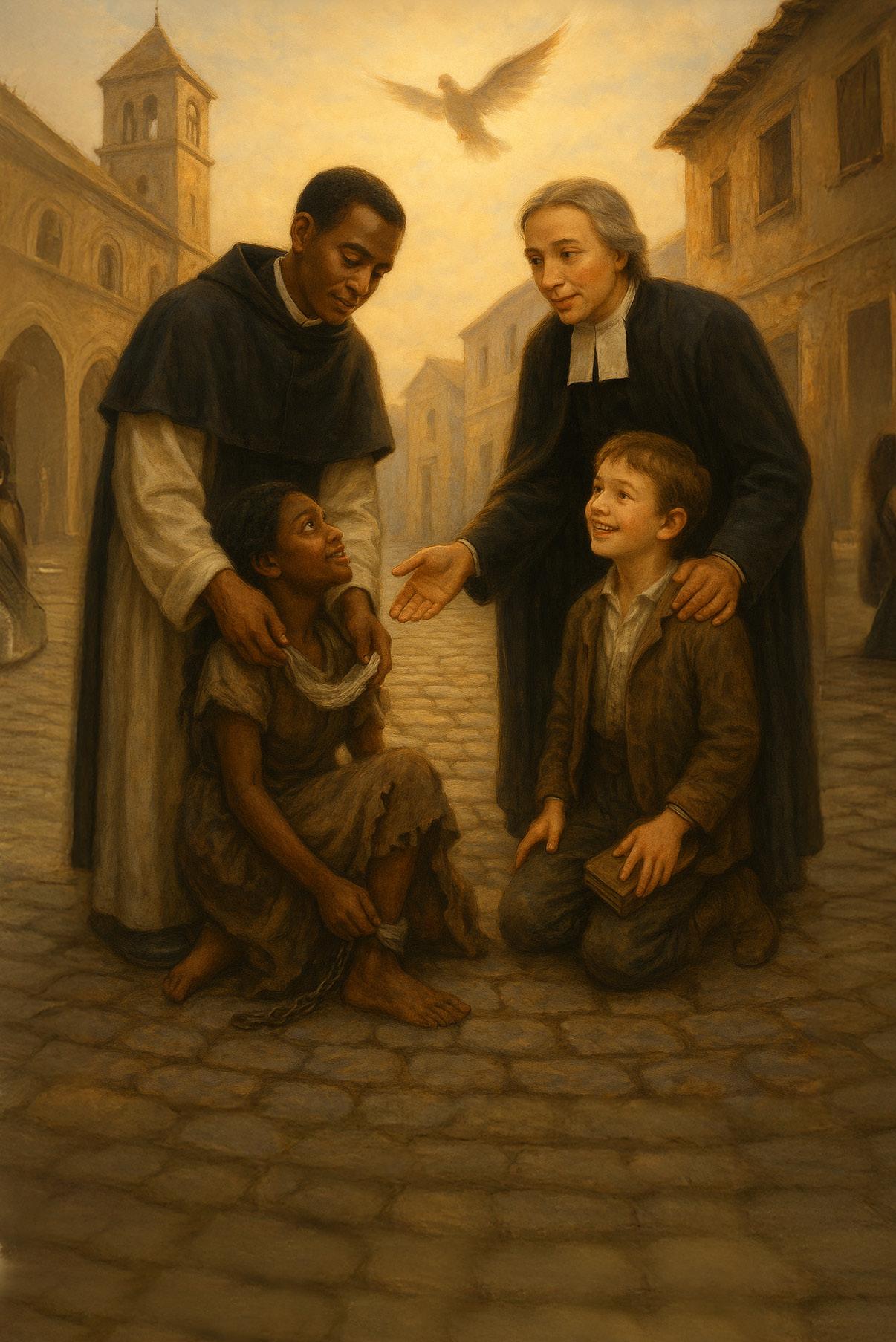
This image brings together two saints whose lives embodied mercy, education, and advocacy for the most vulnerable, uniting their missions across continents and centuries.
On the cover, Saint Martin de Porres (1579–1639), the first Black saint of the Americas and patron of social justice, mixed-race people, and the poor, is shown tending to a young enslaved Black girl. Born of humble origins in colonial Peru, Martin suffered discrimination for his race and illegitimacy, yet responded with extraordinary charity. Through healing, feeding, and caring for the marginalized, he bore witness to a Gospel of radical dignity and compassion.
The other central figure on the cover, Saint John Baptist de La Salle (1651–1719), patron saint of teachers, is depicted guiding and comforting an indigent French boy. In 17th-century Reims, De La Salle encountered resistance as he reformed education for the poor, creating schools where every child, regardless of status, could learn with dignity. His tireless advocacy, often at personal cost, opened the doors of knowledge and hope to countless forgotten children.
The scene unfolds on a cobbled street that blends the architectural spirit of both Reims and Lima, symbolizing a shared mission beyond borders. Bathed in warm, late-afternoon light, the composition emphasizes dignity, compassion, and the universality of human worth. A dove and subtle glow above them serve as a reminder of the divine presence that unites their works of love and service.
Together, these saints remind us that Inclusion and Human Dignity are not abstract ideals but lived realities, discovered in the faces of “the lowly and the poor” to whom Mary herself proclaimed God’s favor.
Position Statement
INCLUSION AND HUMAN DIGNITY
© 2025 Saint Mary’s University of Minnesota. This document reflects the Lasallian Catholic mission of Saint Mary’s University and is protected under U.S. and international copyright law.
Permission for use in classrooms, study groups, or parish settings is granted, provided proper attribution is given. All other rights reserved.
A Message from the University President
Dear Friends and Readers,
It is with profound gratitude and hope that I share with you this Position Statement on Inclusion and Human Dignity . What you hold in your hands represents more than careful writing; it is the fruit of countless hours — over two years — of prayer, study, and collaboration by our advisory council, staff, and working group members. Their dedication and wisdom have produced a statement that speaks to the heart of who we are and what we believe as a Lasallian Catholic institution.
Saint John Baptist de La Salle once reminded his community: “ You can perform miracles by touching hearts.” This statement seeks to do just that touch hearts by affirming the inviolable dignity of every person and by calling us to build communities of faith, hope, love, and reconciliation. In a world fractured by division, we are reminded that inclusion and human dignity are not optional ideals but essential truths flowing from the Gospel and at the very core of our mission.
This work is not confined to Saint Mary’s University. Its vision and call belong to the Church and to all institutions of good will. That is why the questions for study and discussion included with this statement are so important. We pray they will be a profound help in classrooms, parishes, communities, and institutions everywhere sparking honest conversation, guiding discernment, and inspiring
concrete action all according to the mind of Jesus, Prince of Peace.
At its heart, this statement is a call for renewal of mission. It challenges us to see Christ in every person, to uphold the dignity of each person as it has been given by God, and to live as witnesses to unity. It proclaims that only when we ground ourselves in what is good and true and beautiful directed at justice, authentic freedom, and especially charity can we foster the flourishing of every human person and the authentic building of the Kingdom of God.
May this statement serve as a light for our community, a source of courage for those who seek truth, and a wellspring of hope for all who long for justice and peace. May it inspire each of us to embody the Gospel with humility and love, so that together, we may help bring about the miracle of touching hearts and transforming lives.
With gratitude, hope, and prayer for the good of people everywhere,
The Very Reverend James P. Burns, IVD, Ph.D. President, Saint Mary’s University of Minnesota
Introduction
“Let the way you live be that of the Gospel.”
Saint John Baptist de La Salle, Meditation 84.3 feast of Saint Thomas, apostle
We are called to live the Gospel values in radical and authentic ways. The call of a Christian is to lead a life that reflects the love of God in a broken world. This often requires a person to be countercultural, leaning into the Gospel to witness to the truth. “Of all visible creatures only man1 is ‘able to know and love his creator.’ He is ‘the only creature on earth that God has willed for its own sake,’ and he alone is called to share, by knowledge and love, in God’s own life. It was for this end that he was created, and this is the fundamental reason for his dignity.”2 “Being in the image of God the human individual possesses the dignity of a person, who is not just something, but someone.”3 This recognition speaks to the heart, moving the Christian to interact with other persons in meaningful ways.
Pope Saint John Paul II in his Letter to Families reminds us:
There is no true love without an awareness that God “is Love” and that man is the only creature on earth which God has called into existence “for its own sake.” Created in the image and likeness of God, man cannot fully “find himself ” except through the sincere gift of self. Without such a concept of man, of the person and the “communion of persons ” in the family, there can be no civilization of love; similarly, without the civilization of love it is impossible to
have such a concept of person and of the communion of persons.4
In this way, then, the call to love God and neighbor is written on the heart of each person. It requires the upholding of the inherent dignity of every human being and thus to accept and promote his inclusion in the human family.
Saint Mary’s approach to inclusion and human dignity is grounded in Scripture and rooted in a robust Christian anthropology. By examining both faith-based and non-faith-based perspectives on human dignity considering where they converge and where they diverge we see more clearly the necessity and freedom of our distinctly Lasallian Catholic approach.
Caritas: The Heart of the Matter
Our approach clarifies why caritas or love5 is the foundational principle we adhere to in speaking about the dignity and inherent worth of each human being because we believe that God is love (1 John 4:16; Matthew 22:37-39).
God created humanity, in His image and likeness out of sheer love, to love as He loves.6 Beginning with love is not merely an ideological or political move, rather genuine love is mysterious and primordial it is essential. The existence of humanity begins with the love God has for His creation. Indeed, human beings in their relationships and ultimate direction testifies to the absolute nature of and attraction toward this Love.
In its truest and simplest sense, Christian love is found in the Trinity: Father, Son, and Holy Spirit. As Love Himself, God is
constantly working for and willing the good of His creation.7 Thus, the most authentic love, for humans, takes its cue from the Creator. Borrowing the words of Saint Thomas Aquinas: Love is to will the good of the other;8 This is made possible with the aid of God’s grace,9 where an individual habitually desires the good for his fellow, not because it benefits him in any particular way, but because in doing so, he acts for the Love of God.10 This divine Love is the source and end of all things and the binding force of the greater human family. “The cause that mostly pushes our hearts to love of God is considering deeply the love that He had for us.... This, beyond any benefit, pushes the heart to love; because he who gives something of benefit to another, gives him something he possesses; but he who loves, gives himself with everything he has, until he has nothing left to give.”11 This is the love with which God loves each human being and His love, unlike ours, is inexhaustible.
From this understanding of love flows the mission and vision of Saint Mary’s University of Minnesota, where we are dedicated to the formation of ethical persons.12 This mission will not reach fulfillment if caritas (love) is not at the heart of the matter. Therefore, we see that the relationship between ethics and love is inseparable. Ethical principles, values, and decisions are based on the use of reason, but love elevates them by aligning human actions with the love of God. Love transforms ethical actions from something that is mere duty into expressions of a deeper union with God and others. As a result, the affinity of ethics and love shines forth: Love provides the motivation and purpose for ethical behavior, while ethical living is the practical expression of love in pursuit of the highest good, which is union with God. Love of God and love of neighbor are mutually related and
inseparable. Jesus did not invent one or the other but revealed that they are essentially a single commandment. “Through love, we learn to look at each other not only with our eyes, but with the eyes of God, which is the gaze of Jesus Christ.”13 “If the love of God has planted deep roots in a person, then he is able to love even those who do not deserve it, as God does us.”14 To truly love one ’ s neighbor means you will always do good for him and always avoid evil with regard to him in all circumstances.
Authentic Freedom
The kind of love described above requires sincere freedom. That is why the first sense of freedom, authentic freedom, denotes the person ’ s capacity to fulfill their ultimate telos or end in accord with the person ’ s nature: everything that exists, i.e., created by God, possesses a nature, and those things that reach the end consistent with that nature15 are most perfect. Secondarily, freedom is also the ability to choose between goods. This second sense of freedom serves the higher, authentic freedom, to fulfill one ’ s nature. When a person freely chooses what they ought, namely those things of Truth, Love, and Goodness16 — the things God designed their nature to choose,17 they then become who they were meant to be. Freedom of choice allows for love, and love gives rise to freedom in its most complete sense: the whole person is ordered to be in relationship with God mind, body, and spirit. “[O]nly the freedom which submits to the Truth leads the human person to his true good. The good of the person is to be the Truth and to do the Truth.”18 This transcends any sort of temporal barrier which separates human persons. Additionally, we must consider authentic justice and its relationship with authentic freedom. Through
justice, the person who is ordered to be in relationship with God can live in right relationship with both God and neighbor.19 Subjectively, justice “is a behavior that is based on the will to recognize the other as a person.”20 Authentic justice, therefore, presupposes a relationship with one ’ s neighbor for it is only within this relationship that each individual can recognize one ’ s rights under any and all circumstances.21 By treating each person with love and recognizing each person as beloved, the believer orders his life through authentic freedom, granting space for authentic justice to support the dictum: we are created in the image and likeness of God.22
DEI: A Believer's Approach to Diversity, Equity, and Inclusion
From authentic freedom comes authentic love, and from authentic love comes the believer’s approach to inclusion. The secular or non-faith-based framework (more fully described later) uses the acronym DEI, standing for diversity, equity, and inclusion. Ironically, and in contrast, the word Dei in Latin literally means “of God.” While contemporary DEI initiatives largely find their origins in Critical Theory,23 they should not be conflated either with Critical Theory itself or with Critical Race Theory. Their grounding, however, tends to emphasize subjective truth and the assertion of personal liberty,24 often detached from an objective account of human dignity rooted in authentic love and the Gospel.
For believers, however, inclusion flows from freedom and love ordered to the truth. As Christ teaches, we must will the good of the other and become neighbor to all: “Go and
do likewise” (Luke 10:25-37), and “invite the poor, the crippled, the lame, and the blind” (Luke 14:12-14). A believer’s approach to diversity, equity, and inclusion is therefore not merely a matter of policy or social principle, but an act of discipleship radical hospitality that recognizes each person as a child of God and welcomes especially those at the margins.25
The Remaining Theological Virtues — Faith and Hope
If love is the wellspring of Christian inclusion, it does not stand alone. Together with faith and hope, it forms the three theological virtues upon which the Christian life rests. Faith enables us to believe what God has revealed as Truth not because it suits us, but because God, who neither deceives nor is deceived, is trustworthy.26 Faith becomes transformative when it is alive, “working through love” (Gal. 5:6). It enables us to see reality through God’s eyes: every human person created in His image and likeness (Gen. 1:27), created to glorify Him. By faith, “Christ dwells in your hearts” (Eph. 3:17), shaping the believer into His likeness.
Hope, meanwhile, directs the freedom of the believer toward its ultimate fulfillment: eternal life with God.27 Hope stirs our hearts to long for heaven and strengthens us with the grace to persevere. It anchors our daily lives in the words of the Lord’s Prayer “ on earth as it is in heaven”28 so that even our temporal choices are infused with eternal purpose. In this way, freedom ordered to faith and hope keeps us oriented to our final goal: communion with God. The Brothers of the Christian Schools capture this vision simply: “To be a sign to the world, we have to be a community of faith, hope, and love.”29
Human Dignity in a Polarized World
When authentic freedom, faith, hope, and love converge, they yield a profound respect for the dignity of every human person. This conviction becomes all the more urgent in a time marked by division and polarization. For us at Saint Mary’s, as a Lasallian Catholic institution, human dignity is not an abstract concept but the heart of our mission.30 Every person is loved by God, created for beatitude, and must be reverenced from conception to natural death.
Rooted in freedom, faith, hope, and love, we affirm: each human being is created in the image and likeness of God, destined for eternal communion with Him, and therefore worthy of honor, respect, and radical hospitality.
Chapter One: Non-Faith-Based Approaches to Diversity, Equity, and Inclusion
Diversity, Equity, Inclusion (DEI) and Critical Theory: Benefits and Challenges
Diversity, equity, and inclusion (DEI) is a philosophical framework rooted in the civil rights movement and critical theory. The purpose of diversity, equity, and inclusion is to promote these ideals within an organization, educational program, and/or culture. Civil rights refers to legal guarantees and protections that safeguard individuals from discrimination based on race, color, national origin, disability status, sex, etc.31 For example, the right to vote is a civil right. Whereas, critical theory “is a political philosophy geared towards the subversion of societal frameworks that are thought to dominate and oppress specific groups of people.”32 DEI is the attempt to fuse civil rights with critical theory into one framework. DEI seeks to advance civil rights beyond the legal prohibition of discriminatory practices, reframing them within an ideological project. In doing so, it diverges significantly from the civil rights movement’s original pursuit of equal protection under the law.
This ideological turn finds its roots in critical theory, a postmodern philosophy aimed not merely at describing society but at critiquing and transforming it.33 The phrase critical theory was coined in 1937 by Max Horkheimer in his essay entitled “Traditional and Critical Theory.”34 In its original conception, Horkheimer stated that critical theory “has no specific influence on its side, except concern for the abolition of social injustice.”35 Thus the premise of DEI,
grounded in critical theory, operates by critiquing organizations, educational programs, and cultures. Too often this approach fosters negativity and deconstruction rather than renewal and growth. By contrast, our commitment to inclusion and human dignity is ordered toward uplifting and building up the person and community in truth and love. Further, critical theory is often rooted in power,36 rejects objective truth, and is focused on equality, universality, and individual rights. In doing so, DEI and Critical Theory fall short in celebrating the uniqueness of every person and unifying people through their differences. The current conflation of DEI with critical theory only deepens this problem, straying from their original intentions.
As William A. Donohue notes in his post “Diversity or Inclusion?” , these very terms expose the tension: “diversity means one size does not fill all; [whereas] inclusion means one size fits all.”37 Diversity can be defined as the presence of differences.38 Whereas, inclusion is the deliberate and active effort to ensure the participation, representation, and belonging of all individuals within a community or society, regardless of their differences. Loyd-Paige and Williams describe inclusion as “ a process of bringing together people and things that are different… [it] is more than just welcoming. Welcoming is smiling and opening the door for someone to enter. Inclusion builds upon welcoming to incorporate a sense of belonging.”39 More succinctly put, “diversity is based on exclusion… [and] inclusion means there are no exceptions.”40 Both concepts carry merit and can serve important purposes; however, they stand in tension with one another, making it illogical to uphold them simultaneously.41 Likewise, there is confusion on equality (sameness) and equity (fairness/justice). 42 Equity is not the
same as equality. Equality gives the same to all, while equity seeks to give each person what is justly due, which may look different depending on individual circumstances. Each of the terms diversity, equity, and inclusion carries value when considered on its own. Yet when grouped together as a framework, they often work at cross-purposes, creating internal contradictions and can add to confusion about which principle should take precedence.
For this reason, at Saint Mary’s University of Minnesota we intentionally use the language of inclusion and human dignity. These terms reflect the heart of the Church’s teaching: to see Christ in every person, to uphold the dignity of each as a child of God, and to extend the radical welcome of Christ, who invites all to the banquet table of grace and mercy, while simultaneously calling each to radical conversion.
What is critical race theory?
To bring a finer point of clarity to our discussion of DEI, we now turn to critical race theory. Critical race theory is a subset of critical theory that began as a specialized field of academic and legal scholarship, but has since expanded into a broader interdisciplinary framework.43 This connection matters because many of the assumptions and language embedded in DEI initiatives are drawn, directly or indirectly, from critical race theory’s intellectual foundations. Critical race theory functions as a method of analyzing institutions and cultures primarily through the category of race, often presuming racism as a defining or pervasive feature. “It centers on the idea that racism is systemic in the nation’s institutions and that they function to maintain the
dominance of white people in society.”44 Rather than focus on traditional bodies of knowledge, critical race theory focuses on personal narratives of minorities and sees these as evidence of white oppression.45 In addition, critical race theory “tolerates value positions only insofar as they align with its own ideology.”46
Such an approach substitutes subjective truth for objective truth, often confusing emotion with reality. Yet, as Saint Thomas Aquinas teaches, truth is adaequatio intellectus et rei the conformity of the intellect to reality. When this conformity is aligned with the divine intellect, it becomes ontological truth, which is the ultimate and unchanging standard of all truth.
Subjective truth, by contrast, rests on what an individual thinks, believes, or feels what our culture often calls “ your truth” rather than what is. As Pope Saint John Paul II reminds us in Veritatis Splendor, authentic freedom and human flourishing can never be rooted in relativism, but only in truth: “Only the freedom which submits to the truth leads the human person to his true good.”47
For Catholics, therefore, it is essential to remain anchored in objective truth, which illumines our path toward building a society that reflects the Kingdom of God and reverences every person as created in His image and likeness. When CRT departs from this grounding, “it leads Catholics away from a faith rooted in Christ and centered in the Eucharist, and toward theories based on sociopolitical solipsism.”48
Focus on Autonomy, Self-Determination, and Individual Freedom
Having seen how CRT privileges subjective truth and ideology over objective reality, it is important to recognize how this same framework informs non-faith-based approaches to DEI. At its core, DEI emphasizes autonomy, self-determination, and individual freedom. This emphasis stems from Critical Theory, shaped by the Frankfurt School49 and the German-Jewish philosophers who, fleeing Nazi Germany in the 1940s,50 developed a Neo-Marxist philosophy centered on the individual and his or her autonomy. It is worthwhile to note, too, that the ideology of American Exceptionalism51 shares similar characteristics and a unique focus on the individual.
It is therefore appropriate to define our terms carefully, examining how the values of autonomy, self-determination, and individual freedom are understood in relation to the common good, and then to contrast these with our traditional American values as illuminated by natural law and the Gospel. While the Kantian definition of autonomy states that “[it is] the capacity of an agent to act in accordance with objective morality rather than under the influence of desires,”52 it appears that the non-faith-based approach does focus firstly on the “capacity of the agent” but does not necessarily follow actions that are “in accordance with objective morality.” Self-determination, a significant American value, states that “internal self-determination is the right to representative government with full suffrage.”53 Thus, when we consider self-determination as a secondary tenet of DEI, it becomes evident that the focus is less on political participation or the
exercise of full suffrage, and more on the individual’s personal desires and self-expression. Thirdly, we turn to the concept of individual freedom, which, as Kant describes, is the “right of individuals to be independent of the choices of others.”54 Let us then consider how these three tenets, autonomy, self-determination, and individual freedom interact with the common good.
In contrast to this view, D. Q. McInerny explains that “the common good is the final end of a state in that it explains the very purpose for which the state was organized.”55 He further emphasizes that the common good and the individual good are not opposed but “should work harmoniously together.”56 From within this framework, we are able to evaluate the three tenets of DEI autonomy, self-determination, and individual freedom — and consider the ways they may support, conflict with, or even undermine the common good.
It appears that with a focus on the common good there is also a focus on “what binds a society together”57 or, as McInerny would say, a “unifying factor, making a political community a coherent, integral whole.”58 This creates an inherent tension between the common good and the three tenets of DEI. Autonomy, self-determination, and individual freedom can only serve true unity and the common good when they are rightly ordered to God and grounded in truth.
What is intersectionality?
Intersectionality, a term coined by Kimberlé Crenshaw, was originally used to describe how overlapping forms of discrimination, power, and privilege converge in the lived
experience of Black women.59 Since then, however, the concept has expanded far beyond its initial scope, becoming a broader analytical tool applied across identities and social categories often in ways that shift focus from shared human dignity to competing claims of victimhood and power. Thus it now refers to “the complex, cumulative way in which the effects of multiple forms of discrimination (such as racism, sexism, and classism) combine, overlap, or intersect especially in the experiences of marginalized individuals or groups.”60 Burke-Sivers describes “the concept intersectionality or 'antiessentialism' states that no individual can be sufficiently identified by membership in a single group, including race, gender, sexual identity, nationality, etc."61 In this way, intersectionality plays a crucial role in understanding the non-faith-based approach to DEI.
To approach intersectionality through a Catholic lens, it is essential to recognize that the various aspects of human experience must not remain fragmented but work together in communion, ordered toward truth, beauty, and goodness. These are what the tradition calls the transcendentals properties of being that reveal our deepest desires and ultimate purpose.62 As Father Robert Spitzer, S.J., Ph.D., explains, the transcendentals point us beyond ourselves toward the Divine.63 He further broadens their scope to include truth, love, justice/goodness, beauty, and home/being all of which converge in God, who is their source and fulfillment.
The Second Vatican Council’s pastoral constitution Gaudium et Spes summarizes the Church’s understanding of human
dignity which can be applied to our discussion of intersectionality:
Since all men possess a rational soul and are created in God’s likeness, since they have the same nature and origin, have been redeemed by Christ and enjoy the same divine calling and destiny, the basic equality of all must receive increasingly greater recognition. True, all men are not alike from the point of view of varying physical power and the diversity of intellectual and moral resources. Nevertheless, with respect to the fundamental rights of the person, every type of discrimination, whether social or cultural, whether based on sex, race, color, social condition, language, or religion, is to be overcome and eradicated as contrary to God’s intent.64
The Church teaches us to focus first on what unites us rather than on what divides us. Our equality is not a human construct but a divine gift, for God Himself has endowed every person with inherent dignity. As Gaudium et Spes reminds us, all people “enjoy a basic equality in dignity” and share the same divine calling and destiny.65
Social Justice versus The Virtue of Justice
Grounded in this truth of our shared dignity and divine calling referenced above, it is now imperative to distinguish between social justice and the virtue of justice, which are often mistakenly treated as interchangeable. Social justice is commonly defined in modern terms as “ a state or doctrine of egalitarianism,”66 advocating for the removal of inequalities among people. By contrast, the classical virtue of justice
following Saint Thomas Aquinas is “to render to each what is his due.”67 Justice is relational by its very nature: it orders us rightly with our neighbor by recognizing the distinction between persons while ensuring what is proper and fitting is given to each.68
As William Donohue has noted, true justice provides each person what is due,69 thereby respecting difference rather than erasing it. The modern framing of social justice, however, narrows justice to a sociological context, modifying it in ways that risk misconstruing the virtue itself seeking to eradicate differences rather than to acknowledge and serve the unique gifts, talents, and needs of each person.
Aquinas further clarifies that while justice governs what we owe to others, charity goes beyond obligation: it is friendship with God that overflows into love of neighbor. This is why Pope Benedict XVI, in Caritas in Veritate, reminds us that “justice is the primary way of charity,” but also that “charity transcends and completes it.”70 Justice and charity, therefore, cannot be separated. Out of love for our neighbor (charity), we seek what is rightfully due to them (justice), and in doing so, we build a community that reflects both truth and mercy.
Chapter Two: Faith-Based Approach
“‘ You shall love the Lord your God with all your heart, and with all your soul, and with all your mind.’ This is the greatest and the first commandment. And the second is like it: ‘ You shall love your neighbor as yourself.’” — Matthew 22:36-40
A faith-based approach to diversity, equity, and inclusion (DEI) must be understood within the broader context of one ’ s worldview. How we perceive the human person, the world, and reality itself is shaped by faith or by the absence of faith and this in turn directs our judgments and behaviors. Different faith traditions will approach the principles of DEI in varying ways: some may attempt to adopt and adapt them, while others will discern their incompatibility with revealed truth.
A worldview that embraces a non-faith-based approach risks treating DEI principles as self-sufficient, even when they lack a foundation in ultimate Truth, thereby promoting disorder rather than authentic unity. By contrast, a worldview rooted in faith recognizes that without Truth, diversity, equity, and inclusion cannot cohere or foster genuine communion. As Scripture reminds us, our true dignity rests not in human constructs but in the unchanging reality that we are all created by God, who shows no partiality (cf. Acts 10:34).71 “This is the ultimate foundation of the radical equality and brotherhood among all people, regardless of their race, nation, sex, origin, culture, or class.”72 As a Lasallian Catholic university, Saint Mary’s seeks to foster true solidarity. To do so, we are intentionally reshaping the narrative by grounding our approach in the principles of Catholic Social Teaching.
Inadequate Language
Many faith traditions, however, choose to frame their efforts in the language of contemporary culture, adopting terms like diversity, equity, and inclusion to describe what are, at their core, commitments to inclusion and human dignity. This vocabulary can seem more accessible to a general audience and is often paired with scriptural references or faith practices that attempt to give it religious meaning. For example, Michelle L . Loyd-Page and Michelle D. Williams, in their book Diversity Playbook: Recommendations and Guidance for Christian Organizations (2021), argue that the Christian case for DEI “is grounded in the biblical command to love our neighbors as ourselves, found in both the Old and New Testaments.”73
Yet this raises important questions: what does it truly mean to love our neighbor, and how are we called to live that love? While DEI terminology gestures toward inclusion, its framework remains inadequate and incomplete. It risks reducing love to tolerance or social acceptance rather than grounding it in truth and the fullness of human dignity.
By contrast, Catholic Social Teaching offers a more coherent and enduring vision. Rooted in Scripture and Tradition, it frames inclusion not in cultural catchphrases but in the transcendent principles of human dignity, solidarity, subsidiarity, and the common good. These provide not only a richer understanding of what it means to love our neighbor but also a reliable guide for shaping communities that reflect the Kingdom of God.
The difficulty is that societal language cannot capture the full depth of the concept; it inevitably falls short, leading individuals to default to contemporary meanings rather than reframe it within the horizon of faith. Only faith provides a language adequate to express the fullness of human dignity, for it reveals each person as created in the image of God and destined for communion with Him. For instance, the challenge in trying to bridge this divide is expressed in the work of Loyd-Page and Williams, who root their understanding in the following terms:
Morally, as members of the human race, we are obligated to ensure that everyone has the ability to satisfy their basic human needs. No one should be deprived of sustenance, safety, health, love, freedom, purpose, belonging. Doing diversity work is advancing the cause of social justice. … it is simply the right thing to do within a civilized society. The case is made for diversity because people matter.74
It is evident that they view diversity work and social justice as inseparably linked. What remains unclear, however, is how they are defining social justice, and whether their Christian framework distinguishes it from the classical virtue of justice rooted in Scripture and Tradition.
In light of this, Saint Mary’s University adopts a different language — one that flows from Catholic Social Teaching and the vision articulated in Caritas in Veritate. Rather than relying on the shifting terminology of contemporary culture, we intentionally speak of inclusion and human dignity as the principles that guide our life together. These terms are rooted in the Catholic understanding of the human person
and the conviction that we are all part of the one human family, created in the image and likeness of God.
Our mission is not to advance a cause or political agenda, but to foster a community ordered to the common good one that respects, values, and supports each member. We uphold human dignity not because of faith, creed, sex, identity, nationality, or any other category, but because every person shares the same divine calling and destiny. From this recognition flows true inclusion: an inclusion that does not erase differences but unites us in solidarity, echoing Benedict XVI’s reminder that “charity transcends and completes justice” (Caritas in Veritate, 6).
Objective and Rational Understanding
For any vision to be effective and endure, it must be anchored in objectivity and reason, not swayed by shifting emotions, personal opinions, or political leanings. Our foundation is biblical justice, which reflects the very character of God. It calls us to treat others as sons and daughters of God, to uphold what is good and denounce what is evil, and to recognize that all goodness flows “from God’s infinite goodness.”75 Such justice transcends the limits of time and circumstance, for it is rooted in eternal truth.
By contrast, social justice as it is commonly understood today functions primarily as a political ideology. It focuses on justice only as it relates to societal structures, often defined as the pursuit of fairness, equal rights, and equitable opportunities. Unlike biblical justice, however, social justice is contingent upon cultural trends and therefore shifts as society itself changes.
Catholic Social Teaching bridges this divide. It draws from biblical justice while applying it concretely to the social order, ensuring that the eternal truths of faith shape our response to temporal challenges. As the Compendium of the Social Doctrine of the Church affirms, “the common good does not consist in the simple sum of the particular goods of each subject of a social entity. Belonging to everyone and to each person, it is and remains ‘ common, ’ because it is indivisible and because only together is it possible to attain it” (CSDC, 164). Likewise, Gaudium et Spes teaches that “respect and love ought to be extended also to those who think or act differently than we do in social, political, and religious matters” (GS, 28).
In this way, CST provides a vision that transcends ideology, safeguards the dignity of the human person, and directs all social structures toward solidarity, subsidiarity, and the common good. It is biblical justice, lived out in history.
Therefore, our approach, inclusion and human dignity, is rooted in the fundamental premise that humanity is created by God and each person has inherent worth. Pope Benedict XVI reminds us that “being a Christian is not the result of an ethical choice or a lofty idea, but the encounter with an event, a person, which gives life a new horizon and a decisive direction.”76 Again, in the Compendium of the Social Doctrine of the Church, it states:
In fact, the roots of human rights are to be found in the dignity that belongs to each human being. This dignity, inherent in human life and equal in every person, is perceived and understood first of all by reason. The
natural foundation of rights appears all the more solid when, in light of the supernatural, it is considered that human dignity, after having been given by God and having been profoundly wounded by sin, was taken on and redeemed by Jesus Christ in his incarnation, death and resurrection.77
Further, in Fratelli Tutti, Pope Francis reminds us that:
The dignity of others is to be respected in all circumstances, not because that dignity is something we have invented or imagined, but because human beings possess an intrinsic worth superior to that of material objects and contingent situations. This requires that they be treated differently. That every human being possesses an inalienable dignity is a truth that corresponds to human nature apart from all cultural change. For this reason, human beings have the same inviolable dignity in every age of history and no one can consider himself or herself authorized by particular situations to deny this conviction or to act against it.78
Truth is not subjective but absolute, grounded in reality and revealed in Scripture. Our Catholic faith calls us to perceive and encounter one another through this lens, showing reverence for each person because we recognize the image of God within them. Authentic freedom enables us to live in this truth, choosing love over indifference and communion over division. As Saint John reminds us, “Those who say, ‘I love God,’ and hate their brothers and sisters, are liars; for those who do not love a brother or sister whom they have seen, cannot love God whom they have not seen ” (1 Jn 4:20).
Holistic Approach: Recognition that a person is comprised of mind, body, and spirit
Because truth is absolute and freedom is ordered toward love, any framework for understanding the human person must embrace the whole of who we are. DEI, however, is contemporaneous, focusing on fragmented aspects of a person ’ s experience, attributes, or abilities, but not the person in his entirety. Catholic anthropology, by contrast, is timeless: it recognizes the human person as a unique creation of God mind, body, and spirit in inseparable unity. To isolate one dimension from the others is to diminish the person, marginalizing him or her and rendering life incomplete. When we fail to see the whole person, there is the tendency towards objectification, segregation, and the dehumanizing of the person as now he is only seen through a particular, narrow lens and not in his fullness.
Having a holistic approach allows us to celebrate each person in his entirety, recognizing the depths of the totality of personhood. When we see the whole person, we are able to form deeper relationships in which the other feels truly seen and valued. This appreciation is expressed in an ethic of care treating each person as we ourselves would wish to be treated.79
Importance of Spirituality and Community
Yet to truly see the whole person is also to recognize more than the physical or psychological dimensions of life. Each person has a soul and a deep desire for relationship not only with others, but ultimately with God. At the core of our
humanity lies a longing for the Divine, a search for meaning and purpose that transcends time and circumstance. For those of faith, this purpose is found in relationship with the Creator, who directs all things and draws every person toward Himself.80 “A relationship of life-giving communion with God is what we were created for and what our hearts seek.”81 It begins when a person discovers he is loved by God. When this is discovered, “people come to understand their own transcendent dignity, they learn not to be satisfied with only themselves but to encounter their neighbour in a network of relationships that are ever more authentically human. ”82 Those made new by God’s love are able to become true agents of change: they cultivate authentic fraternal relationships, transform social structures, bring peace, and seek justice whenever others are exploited.83 “Only love is capable of radically transforming the relationships that men maintain among themselves.”84
This love reveals our deepest truth that we were created to be in communion with one another. In Genesis, we read that God created Eve to be a companion for Adam (Gen. 2:18-23). God recognized that Adam needed someone like himself with whom he could relate and form a relationship, while at the same time remaining in relationship with Him spiritually. As the Catechism affirms, “The relationship between God and man is reflected in the relational and social dimension of human nature. Man, in fact, is not a solitary being, but ‘ a social being, and unless he relates himself to others he can neither live nor develop his potential’.”85 God created human beings as man and woman (Gen. 1:27). This is significant because it is only through a being “in whom the spirit of God the Creator is also alive, [that] can satisfy the need for interpersonal dialogue, [which is] so vital for human
existence. In one's neighbour, whether man or woman, there is a reflection of God himself, the definitive goal and fulfilment of every person.”86
Seen in this light, authentic human relationships flow directly into the call to love our neighbor. Recognizing God’s image in the other compels us to a love that goes beyond preference or familiarity. As Pope Benedict XVI teaches in Deus Caritas Est, “Love of neighbor is thus shown to be possible in the way proclaimed by the Bible, by Jesus. It consists in the very fact that, in God and with God, I love even the person whom I do not like or even know. This can only take place on the basis of an intimate encounter with God, an encounter which has become a communion of will, even affecting my feelings.”87
Humility and Repentance
If love of neighbor is possible only in God and with God, then as people of faith we must approach the topics of inclusion and human dignity with profound humility. We recognize that some have been wounded by past interactions and that true reconciliation requires both healing and repentance. Repentance is more than policy or reparation; it is a deep transformation of the intellect and will a turning away from sin and a turning toward God. Motivated by contrition and a love for Him, repentance acknowledges past wrongs and commits to ensuring that history does not repeat itself. It does not take the form of affirmative action or material recompense, but of sincere acknowledgment, conversion of heart, and a resolve to build anew. And at its core, authentic repentance begins with seeking and offering forgiveness.88
Pope Saint John Paul II in Dives in misericordia reminds that “True mercy is, so to speak, the most profound source of justice. If justice is in itself suitable for "arbitration" between people concerning the reciprocal distribution of objective goods in an equitable manner, love and only love (including that kindly love that we call "mercy") is capable of restoring man to Himself.”89 We are reminded that only love — the pure love that flows from the Father has the power to heal the divisions, inequities, and brokenness of our world. In response, we are called to extend mercy in all that we do, bearing witness through our words and actions to the inherent dignity and worth of every person.90 In order to provide healing, “ mercy becomes an indispensable element for shaping mutual relationships between people, in a spirit of deepest respect for what is human, and in a spirit of mutual brotherhood.”91 This kind of healing, with its call to mercy in fraternal relationships, requires humility a willingness to acknowledge where we have failed and to seek repentance and reconciliation. True strength is revealed in such humility, in knowing one ’ s proper place before God and within the world. “An act of merciful love is only really such when we are deeply convinced at the moment that we perform it that we are at the same time receiving mercy from the people who are accepting it from us.”92 It is only healing founded in truth that sets us free.93
Such an example is found in the preface to the book Zero Victim by Pastor James E. Ward, Jr. In it he shares his experience as the pastor of Julia Jackson, mother of Jacob Blake, Jr., who was shot seven times in the back during an incident with the police in Kenosha, Wis.94 In every interview, he was pressed to choose a side; instead he spoke to the need for changing hearts to bring healing.95 Ward
explains that today’s society is “looking to both victimize and play the victim[,]” but that the true healing needed can only occur with “ a transformation of the heart.”96 His story calls for repentance, reconciliation and humility in order to restore humanity, to treat each other as brothers and sisters in Christ, bringing healing into our lives.
The same call to repentance and forgiveness that Pastor Ward's work highlights extends to the Church itself. As the Bride of Christ, the Church herself is holy, and in her official magisterial teaching she has never endorsed these wrongs. Yet members of the Body of Christ whether individuals, groups, or even leaders at various levels have at times fallen gravely short of the Gospel.
In recent decades, the Church has publicly acknowledged these failures and expressed sorrow for the harm caused: from the involvement of Christians in the African slave trade97, to the sack of Constantinople by Crusaders in 120498; from the silence of many Catholics during the Holocaust99, to the failure to uphold the dignity of women100; from the Church’s role in the religious wars that followed the Protestant Reformation101, to the “stolen generation” of Aboriginal children in Australia; from the errors of missionaries in China during colonial times, to the grave and widespread sexual abuse of minors and its coverup.102
Yet these sins of members do not invalidate the Gospel message of Jesus Christ, nor do they stain the holiness of the Church as His Bride. Rather, they remind us of the ever-present need for repentance and conversion. The Catholic Church and her members recognize both the gravity of suffering caused by these sins and the constant
call to live out the teachings of Christ more faithfully, with reverence for the great dignity of every human person.
Conclusion
“A just society can become a reality only when it is based on the respect of the transcendent dignity of the human person.”103 Building such a society is inseparable from the principle of the common good. As the Pontifical Council for Justice and Peace explains:
“The principle of the common good, to which every aspect of social life must be related if it is to attain its fullest meaning, stems from the dignity, unity, and equality of all people. According to its primary and broadly accepted sense, the common good indicates ‘the sum total of social conditions which allow people, either as groups or as individuals, to reach their fulfillment more fully and more easily.’”104
At Saint Mary’s University, our mission as a Lasallian Catholic institution is to form students for human flourishing, which can only be achieved when the inherent dignity of every person is honored. This demands humility, mercy, repentance, reconciliation and especially divine love for only God’s love has the power to heal the divisions and inequities that fracture society.
When the dignity of the human person is ignored, whether through racism, exploitation, or indifference, society is torn apart. But when rooted in the Gospel grounded in freedom, guided by justice, and perfected by charity we become agents of healing and transformation.
The call is clear: to ground all we do in the truth that every person is created in the image and likeness of God and destined for communion with Him. In this way, we help to build a just society ordered to the common good, where the dignity of all is safeguarded and celebrated.
Chapter Three: Saint Mary’s Approach: Lasallian Catholic
“But Mary treasured all these words and pondered them in her heart. ” — Luke 2:19
Having established that a just society must be rooted in the transcendent dignity of the human person and ordered to the common good, we now turn to how this vision informs a Catholic approach to diversity, equity, and inclusion. Such an approach cannot remain at the level of shifting cultural terms or political ideologies; it must be grounded in a deeper understanding of the human person and reality itself. As such it involves a study and understanding of the human person and a view of reality with respect to its deepest principles and ultimate causes.105 It is not content with superficial realities or opinions, but seeks to understand the truth of the human person and reality itself at its core or foundation, relying on what is revealed through both reason and faith. This has led the Catholic intellectual tradition to a profound understanding of the great dignity of every human person.
This dignity is found par excellence at Saint Mary’s in our patroness Mary, the Mother of Jesus Christ, who was greeted by the angel with the words “full of grace. ” The profound degree of grace with which she was bestowed filled her with wisdom, understanding, charity, and every supernatural virtue. Her intellect was enlightened with the splendor of God’s wisdom and her will was strengthened to a heroic degree of love for God and others:
Mary experiences, in perfect docility to the Spirit, the richness and the universality of God’s love, which opens her heart and enables it to embrace the entire human race. Thus Mary becomes the Mother of each and every one of us. … Mary is the radiant sign and inviting model of the moral life. … Mary lived and exercised her freedom precisely by giving herself to God and accepting God’s gift within herself. … By accepting and pondering in her heart events which she did not always understand (Luke 2:19), she became the model of all those who hear the word of God and keep it. … Mary shares our human condition, but in complete openness to the grace of God.106
As a result, Mary provides us with a model of openness to God’s grace and will in one ’ s life. She realized perfectly that faith and reason do not contradict, but as she “pondered them in her heart,” came to know God's goodness and love in a profound way. In this same openness, Mary also becomes the model of how we are to be open to the other: welcoming, receptive, and aligned with God’s will. Her life shows us that true holiness is never unjust or intolerant of persons, but only of sin and the actions that separate us from God’s love. Mary’s obedience to God is then expressed in her words to the angel, “Here am I, the servant of the Lord; let it be with me according to your word” (Luke 1:38).
Throughout this section, following in the example of Mary, this idea of the profound dignity of each human person in the Catholic intellectual tradition will be explored in greater depth. Our approach to DEI is founded on the fact that every human being is a child of God and a member of the human family. As a result, the topic of diversity, equity, and
inclusion, we believe, is better framed as Inclusion and Human Dignity. As Mary did God’s will in her life, so too can we do God’s will. In doing so, we recognize that we are all adopted sons and daughters of God and brothers and sisters in His family, and children of Mary.
Faith and Reason at the Service of Truth
To better illustrate this point we turn to Catholic teaching which proclaims that both reason and faith are essential to coming to the knowledge of truth.107 The Catholic approach sees God as the author of both faith and reason, through which the human spirit rises to the contemplation of the truth. In this way, faith and reason are absolutely non-contradictory, since they have the same source in God, who desires to reveal the truth.108 Within this reality, the Catholic approach has a wonderful appreciation for science as a whole and for what each of the sciences can contribute to the knowledge of the truth about reality and the human person.109 At the same time, it also serves as a reminder to the sciences when they make claims outside the bounds of their respective disciplines or without reference to the deepest principles of truth, that their conclusions risk distortion and lose their capacity to serve the fullness of the human person.110 Therefore, in order to aid humanity in its search for truth, Catholics accept on faith those things that God has revealed through divine revelation, acknowledging that God Himself has revealed these truths to humanity and God cannot contradict Himself.111 As the Catechism relates, “Trusting in God and cleaving to the truths He has revealed is contrary neither to human freedom nor to human reason.”112 The Catholic approach, then, to inclusion and human dignity uses both the conclusions reached correctly
by reason and what has been revealed by God to understand the human person and reality at its deepest level. When reason is rightly exercised and divine revelation faithfully interpreted, the deepest truth about the human person and indeed all of reality is made known.
Philosophical and Theological Anthropology
Flowing from this harmony of faith and reason, the Catholic understanding of the human person (anthropology) draws deeply on the insights of classical philosophy, particularly Aristotle and Plato. Saint Thomas Aquinas, integrating their diverse perspectives with the light of revelation, offered a synthesis that most fully corresponds to the observed reality and lived experience of the human person.113 As Saint John Paul II affirmed in Fides et Ratio, “faith and reason are like two wings on which the human spirit rises to the contemplation of truth.”114 This synthesis of revelation and philosophy remains indispensable, forming the foundation for Catholic moral philosophy, psychology, and theology.115 Throughout the last 800 years, the Catholic Church has acknowledged the philosophy and theology of Saint Thomas Aquinas as particularly capable of describing the human person in a way that perfectly unites what is known from reason and science with what is known from God’s revelation.116 Teachers in Catholic schools are called to model Christian virtues, as their “lifestyle and character are as important as their professional credentials.”117 In a Catholic school, teachers are called to infuse a "Christian faith vision" into their subjects, ensuring instruction aligns with Church teachings while at the same time respecting academic disciplines.118
From this it becomes evident that every area of study then opens up as a pathway to truth, drawing students toward a deeper integration of faith, reason, and life. This vision finds strong support in the Catholic intellectual tradition, where Saint Thomas Aquinas, particularly in the Summa Theologiae, develops a robust philosophical account of the human person — borrowing from Aristotle’s bipartite distinction of body and soul as matter and form.119 Aquinas further makes distinctions between the different faculties or “ powers of the soul.” These faculties are the intellect,120 the will,121 and the sensitive appetite or passions.122 In the original innocence in which the human person was created, the faculties of the human person were ordered in themselves. These same faculties were also properly ordered outside of the human person: to God, to one ’ s fellow man and to creation itself. This is known in Catholic theology as the integral nature or primitive innocence of mankind. The human person is created in goodness by God Himself and willed by God to exist.
Accordingly, for Aquinas and Catholic theologians, the human person is ordered toward a purpose, which is written in the very fabric of the human person. This purpose or end is two-fold: both natural and supernatural. The natural end of the human person has its foundations in the intrinsic capacity of the human person to know the truth and to desire what is good. This includes seeking the truth, forming social bonds, and pursuing moral virtue, and is manifested in a natural flourishing of the human person. However, this natural end of the human person is limited to finite goods within human nature, such as earthly happiness and justice. Above this natural end, the human person also has a supernatural end, which transcends human nature. The
supernatural end requires divine grace to elevate the human person beyond what is possible through nature alone. This supernatural end is governed by sacramental grace and the theological virtues of faith, hope, charity. It entails a direct participation in God’s inner life and results in a supernatural flourishing of the human person. This is manifest in the lives of the saints, who in many different ways, demonstrated heroic charity to God and to others. In its fullness, this supernatural end culminates in seeing God face-to-face through the beatific vision. This gift of union with God is not possible through natural means, nor is it possible to attain in this life. “For now we see in a mirror, dimly, but then we will see face to face. Now I know only in part; then I w ill know fully, even as I have been fully known” (1 Cor 13:12). The supernatural end fulfills the deepest yearnings of the human soul, which natural and created goods cannot fully satisfy. While the natural end is achievable through human effort alone, the supernatural end depends on God’s assistance through sanctifying grace.
The Essence of Human Dignity
The unique dignity of the human person comes about through the creation of the soul by God at the moment of conception. The formation of the human body comes about in many ways, both natural and artificial, through the exercise of human freedom. However, the soul of the human person is directly willed by God and created from nothing at the moment of conception.123 The soul, being spiritual, is made in the image and likeness of God, and destined for eternity.124 “Then God said, ‘Let us make humankind in our image, according to our likeness;’ […] So God created humankind in his image, in the image of God he created
them; male and female he created them” (Gen 1:26-27). As a consequence, there is an infinite dignity transcendent in each human being: “Every human person possesses an infinite dignity, inalienably grounded in his or her very being, which prevails in and beyond every circumstance, state, or situation the person may ever encounter.”125 This dignity is directly tied to his soul being in the image and likeness of God: “Our dignity is bestowed upon us by God; it is neither claimed nor deserved. Every human being is loved and willed by God and, thus, has an inviolable dignity.”126 The inviolable dignity of the human person also transcends any other human concerns: “To be created in the image of God means to possess a sacred value that transcends every distinction of a sexual, social, political, cultural, and religious nature.”127 Gaudium et Spes gives an important declaration on human dignity:
All men are endowed with a rational soul and are created in God’s image; they have the same nature and origin and, being redeemed by Christ, they enjoy the same divine calling and destiny; there is here a basic equality between men and it must be given ever greater recognition. Undoubtedly not all men are alike as regards physical capacity and intellectual and moral powers. But forms of social or cultural discrimination in basic personal rights on the grounds of sex, race, color, social conditions, language or religion, must be curbed and eradicated as incompatible with God’s design.128
The inviolable dignity of the human person is also described in Dignitas Infinita, which also clarifies the difference between ontological dignity and moral dignity:
Ontological dignity … belongs to the person as such simply because he or she exists and is willed, created, and loved by God. Ontological dignity is indelible and remains valid beyond any circumstances in which the person may find themselves. When we speak of moral dignity, we refer to how people exercise their freedom. While people are endowed with conscience, they can always act against it. However, were they to do so, they would behave in a way that is “not dignified” with respect to their nature as creatures who are loved by God and called to love others. Yet, this possibility always exists for human freedom, and history illustrates how individuals — when exercising their freedom against the law of love revealed by the Gospel — can commit inestimably profound acts of evil against others. Those who act this way seem to have lost any trace of humanity and dignity. This is where the present distinction can help us discern between the moral dignity that de facto can be “lost” and the ontological dignity that can never be annulled. And it is precisely because of this latter point that we must work with all our might so that all those who have done evil may repent and convert.129
This passage highlights an important distinction between ontological dignity and moral dignity. While the ontological dignity of the person can never be lost and is intrinsic to the human person,130 the moral dignity of a person is dependent on the exercise of human freedom.131 Autonomy and free choice allows the human person to develop in either virtue or vice and can lead to sin when human actions fail to align
with reason and God’s eternal law. Sin is not a creation of God, but a deviation from His order. When this deviation occurs, moral dignity is lost. The original innocence of the human person was lost through original sin. This profoundly affected the individual faculties of the human person: the body became subject to death and decay; the concupiscible appetite was no longer perfectly ordered; the irascible appetite became fragile; the intellect became dull and ignorant of many things; the will became prone to malice and a lack of energy; the soul itself became destitute from the supernatural gifts that God had given.132 There was also a three-fold rupture of the human person in relationship with God, with other human beings, and with the rest of creation.133 Rather than being in complete harmony, the present state of humanity is that of a fallen nature. As a result of original sin, human beings no longer act in harmony, but have the capacity and even the tendency to act in ways that go against this intended goodness.134 Actual sin occurs when one actively does something forbidden by God or fails to do what is required to uphold the dignity and honor of self, neighbor, or God. Original sin explains humanity’s inherited moral weakness, while actual sins reflect individual failures to align one ’ s actions with reason and God’s law. Both original sin and actual sin result in a loss of moral dignity. This is important to understand here because any authentic account of the human person and thus any framework for justice, dignity, and inclusion must recognize both the inherited effects of original sin and the personal responsibility for actual sin.
The reality of the innate ontological dignity of the human person, the fall of mankind through original sin, and the possibility of losing moral dignity through personal sin shape
the activity of the human person in the world. “Ignorance [or denial] of the fact that man has a wounded nature inclined to evil gives rise to serious errors in the areas of education, politics, social action, and morals.”135 As sin is a reality in the world, there is a need to acknowledge its existence and to work in a diligent way to restore order to the human person and society, which is done through moral and ethical systems.
“Deep within his conscience man discovers a law which he has not laid upon himself but which he must obey. Its voice, ever calling him to love and to do what is good and to avoid evil, sounds in his heart at the right moment. ... For man has in his heart a law inscribed by God. ... His conscience is man's most secret core and his sanctuary. There he is alone with God whose voice echoes in his depths.”136 The natural law is a moral framework that dictates what is right and wrong based on human nature itself and reason, not on any arbitrary rules. It is based on the fact that certain moral principles are inherently understood and accessible to all human beings, regardless of their culture or beliefs. The Catechism uses the analogy of a law being “written” in the heart to emphasize that this law isn’t something merely external, but a deep, internal sense of what is true, good, and just.
From this foundation, ethical systems in society should be grounded in logic, reasoning, and the natural law, guiding our understanding of right and wrong in a coherent and structured way. Unfortunately, not all systems follow this order; certain practices such as the promotion of abortion are embedded in society even though they stand in direct contradiction to natural law, logic, and reason. When
systems in society fail to take account of natural law, the foundations which professional codes of conduct are constructed upon begin to crack and human dignity is threatened.
Catholic morality is a framework rooted in divine revelation, natural law, and virtue ethics that guides the human person away from sin and towards holiness and union with God. Within this framework, the Ten Commandments and Beatitudes provide moral absolutes, such as prohibitions against murder and adultery. The Two Great Commandments of love of God and love of neighbor unify ethical actions under the virtue of charity. Catholic morality works in conjunction with ethics systems within society that govern acceptable behavior.
Yet no system of ethics or morality, on its own, can fully overcome the disorder introduced by sin. Recognizing the reality of sin and its rupture in our relationship with God, humanity was not abandoned by Him, but redeemed in a way beyond all expectation through the sending of His own “beloved Son.”137
We believe and confess that Jesus of Nazareth, born a Jew of a daughter of Israel at Bethlehem at the time of King Herod the Great and the emperor Caesar Augustus, a carpenter by trade, who died crucified in Jerusalem under the procurator Pontius Pilate during the reign of the emperor Tiberius, is the eternal Son of God made man.138
This fact that God took on human nature in the Incarnation transforms our idea of human nature. It elevates the dignity
of the human person by virtue of the fact that the Son of God, who is divine, took on human nature in the person of Jesus, the Christ.139 This event manifests the immense value and worth of human nature, even in its physical form. “The name ‘Jesus’ signifies that the very name of God is present in the person of his Son, made man for the universal and definitive redemption from sins.”140 It is through Jesus that the moral dignity of the human person is both healed and elevated through grace, and the original moral dignity of mankind is restored. God’s grace restores human nature’s capacities wounded by sin and restores moral dignity. Grace does not destroy nature, but rather perfects it by healing disordered desires and strengthening the soul to pursue virtue. The victory that Christ won over sin through his passion, death, and resurrection, has brought about even greater blessings than those which sin had taken from us,141 because “where sin increased, grace abounded all the more ” (Rom. 5:20). Jesus Christ through his Incarnation, life, passion, death, and Resurrection transforms human nature and reveals the great dignity to which the human person is called. In order to promote inclusion and human dignity, it is Christ who must be taught.142
The Role of Psychology
An Integrated Understanding of the Human Person: Through Christ’s redeeming love, the human person is restored and elevated, making possible a renewed life in communion with God and others. This redemption provides the foundation for understanding the human person not merely in fragments biological, psychological, or social but in an integrated way. In seeking to promote human dignity and inclusion, a deep knowledge and understanding
of the human person and relationships are necessary. Philosophy and theology provide an initial framework toward this understanding of the human person. The psychological sciences143 add in a practical perspective concerning human behavior, mental processes, communication, and human interaction. Taken together, each of these three disciplines144 contributes to an intellectual understanding of the human person in all its complexities. Catholic psychology emphasizes the harmony between faith, reason, and the teachings of the Church on human dignity, sin, and redemption in Jesus Christ. Rather than just seeing one aspect of the human person, Catholic psychology acknowledges both the natural and supernatural dimensions of the human person. This comprehensive view of the human person in the philosophical, theological, and psychological perspectives is known as the FF (CCMMP):145
The Catholic Christian Meta-Model of the Person (CCMMP) presents a systematic, integrative, nonreductionist understanding of the person, marriage and family, and society, an understanding that is developed from the psychological sciences, philosophy, and the Catholic theological tradition and worldview. The Meta-Model integrates the methods and findings of these three disciplines to understand eleven essential dimensions of the person. These include the narrative of the person as:
1. Existing and fundamentally good (created)
2. Affected by disorders (fallen)
3. Capable of healing and flourishing (redeemed)
The person is:
4. A unified whole
5. Fulfilled through three types of vocational callings:
○ Individual goodness and relationship with the transcendent
○ Vocational states
○ Life work
6. Fulfilled in virtue strengths and character development
7. Fulfilled in interpersonal relationships The person is:
8. Sensory-perceptual-cognitive
9. Emotional
10. Rational and intelligent
11. Volitional and free
Usefulness of the Catholic Christian Meta-Model of the Human Person
An integrated understanding of the human person requires more than abstract principles; it needs a framework that can be applied to real life in ways that foster wholeness. This is where the Catholic Christian Meta-Model of the human person proves especially valuable. Its usefulness lies in providing a comprehensive vision that not only explains who the human person is but also offers a model for the authentic “healing, growth, and flourishing”146 of the human person. Each of the disciplines of philosophy, theology, and psychology is a source of truth about the human person. When they are combined, they provide a deep knowledge of the human person and what will lead to one ’ s “healing, growth, and flourishing.” The major feature of the CCMMP is that it combines the disciplines in a way that explains the experience of the human person that is consistent with all
three disciplines, what is ascertained through reason (philosophy), what has been revealed (theology), and what is experienced (psychology). The nature of human nature as created, fallen, and redeemed matches what is known through philosophy and theology, and yet also fits the lived experience of the human person prone to negative states (vices and other suffering) and at the same time called to authentic relationships and to flourishing.
Lasallian
While the Catholic Christian Meta-Model provides a universal framework for understanding the human person, each Catholic institution embodies this vision in its own charism and mission. At Saint Mary’s, our approach to the human person is rooted not only in our Catholic faith but also deepened by the Lasallian tradition. Throughout their history, the Brothers of the Christian Schools have been “ a community of faith, hope, love, and reconciliation.”147 In the second chapter of the Rule of the Brothers, it states: “The Institute’s primary concern is the educational needs of those whose dignity and basic rights are not recognized. By its mission, it seeks to make it possible for them to live with dignity as sons and daughters of God.”148 Saint John Baptist de La Salle saw education as a way to transform the lives of the students entrusted to the Brothers’ care, which started with the encounter of each student as a unique individual. The Lasallian charism is to provide a human and Christian education, which in other words is the formation of the whole person — mind, body, and spirit. De La Salle reminds us that “ young people need the light of watchful guides to lead them on the path of salvation.”149 He saw education as a
transformative experience, providing opportunities for the students to better themselves and the world around them.
In the 45th General Chapter of the Brothers, it explains that the anthropological view of human nature motivates Lasallians to recognize “ every human being as being unique, unrepeatable, and educable[,]” capable of “establishing meaningful relationships.”150 Furthermore, “ as spiritual beings, they are open to transcendent reality and the search for life’s meaning. This holistic view of human nature includes intellectual, emotional, social, cultural, ethical, and spiritual dimensions.”151 This leads Lasallians to regard education as integral to human formation and development, which is directly inspired by the Founder, who recognized the human dignity in everyone he encountered.152
Building on this vision, authentic human formation goes beyond intellectual training alone; it seeks to ensure that both mind and soul are incorporated. It is about living an integrated life, understood as a threefold process of self-knowledge, self-possession, and self-gift rooted in faith.153 It is through knowing oneself, having self-mastering154, and being a gift to others through fraternal relationships that leads to human flourishing. Thus, we accompany our students, and one another, walking with them as they wrestle with the questions of life, vocation, existence, etc. This is done by knowing our students individually and understanding them, which allows us to bring them deeper into a relationship with God, one another, and their studies.155 In doing so, we are living out our calling to cultivate students' gifts by building up the kingdom of God and assisting them in Christian maturation (Ephesians 4:10-13).
Saint John Baptist de La Salle was committed to solidarity, “where all can find a place, with their most fundamental rights respected, for all are sons and daughters of the same Father.”156 Therefore, Lasallian educational institutions are to be communities “characterized by the acceptance of each human person.”157 They are to be places where differences enrich the community life, incarnating what “together” in “together and by association” truly means.158 To uphold the dignity of the human person because he or she is created by God and for God, informed by the Catholic Church’s magisterial teaching, is a decidedly Lasallian endeavor. This is a way to follow the wisdom of our patroness, the Blessed Virgin Mary, who told us, “do whatever he tells you ” (John 2:5). Thus, inclusion and human dignity is part of our Lasallian and Catholic heritage.
Conclusion
For I have set you an example, that you should do as I have done to you.
John 13:15
The call to inclusion and the recognition of human dignity cannot be reduced to a single issue or limited to a particular group of people. Rather, these principles touch every dimension of human life from the individual to entire communities and extend across concerns such as technology, migration, labor, human trafficking, the environment, the family, and the very nature of the human person. The Church has the right and the duty to carry out the task of promoting the “development of the whole man and of all men.”159 The Kingdom Jesus wishes to bring is “ an eternal and universal kingdom; a kingdom of truth and life, a kingdom of holiness and grace, a kingdom of justice, love and peace.”160 It is through imitation of Jesus’s life and teaching and through God’s grace that this kingdom can be brought about in society, allowing the flourishing of the human person and one ’ s authentic development in truth.
Imitation of Christ
From the very witness of the life and teaching of Jesus, disciples of Christ follow His example. Indeed, Jesus commands His disciples to imitate Him, “For I have set you an example, that you should do as I have done to you. ” (John 13:15) The apostles of Jesus understood well that the faith must be lived in imitation of Christ, who is “the way, the truth, and the life. ”161 Saint James wrote, “faith without works is dead” (2:26). This example of the lived faith is not only realized in the life
and teaching of Jesus, but also in the lives of his disciples through the centuries. This lived faith in daily life has been summarized in the Seven Corporal and Seven Spiritual Works of Mercy.162 The works of mercy are charitable actions by which we come to the aid of our neighbor in his spiritual and bodily necessities.163 The corporal works of mercy are oriented toward the care of the body, while the spiritual works of mercy are oriented toward the care of the soul. These works of mercy are rooted in both Scripture and Catholic Tradition and serve as concrete expressions of charity and justice.
The Gospel Witness Throughout History
This witness in imitation of Christ is not confined to individual acts alone, but extends into the social and public realm. Throughout the centuries, the testimony to the Gospel has taken many different forms. Pope Leo the Great worked to promote peace and order in the midst of barbarian invasions.164 In the dark ages, missionaries and monks preserved the classical tradition of the past in private libraries and advanced agricultural and medical techniques. In medieval times, the beginnings of the university system were implemented in Cathedral and palatine schools and the Church established Europe’s first universities. The Church provided theological and financial support for scientific inquiry. Early healthcare systems were established in the building of hospitals, dispensaries, nursing homes, and orphanages run by religious men and women. Spanish theologians of the sixteenth century laid down the foundations for human rights and principles for international law.165 Cathedrals, Renaissance art, and sacred music emerged from the patronage of the Church. The
teachings of the Church on the sanctity of life, justice, and forgiveness countered ancient practices like infanticide and gladiatorial combat. By integrating faith and reason, the Catholic Church fostered a civilization that balanced material progress with spiritual ideals. The legacy of this contribution continues in universities, legal systems, hospitals, orphanages, humanitarian organizations, and foundational principles for fostering human dignity.
As the human family developed through the centuries, new issues arose regarding the social and communal aspect of human beings. In various time periods, the Catholic Church recognized the shortcomings of the social order in society for the realization of the common good. As a result, the Church and the popes have proclaimed both the right and duty of the Church to speak out for the realization of the common good of society and of the human person. At the same time, it also recognizes that the kingdom of God cannot be equated with any temporal kingdom.166 Throughout the last two centuries, the Catholic Church has sought to relate the teachings of Jesus to modern times and the complexity of society and the human community.
Numerous popes throughout the 19th, 20th, and 21st centuries have taken up the issue of the human person in the social dimension.167 It is a recognition that the Church as a whole and each member of humanity has a role to play in the ongoing work to promote human dignity and flourishing.
Catholic Social Teaching (CST)
This shared responsibility has been carried forward across the centuries, giving rise to a rich Catholic tradition of social teaching that has been both lived in practice and proclaimed
through the Church’s intellectual heritage. It gives witness to the difficulty of building a just society amidst the complexity of human life and relationships. There are seven main pillars or themes that emerge in this teaching: 168
1. Life and Dignity of the Human Person: Each human life is sacred, having been created in the image and likeness of God. Humanity is the foundation for society. This is the founding principle of CST.
2. Call to Family, Community, and Participation: Human beings are social. How we organize our society, economically and politically, affects human dignity and the ability for individuals to grow in community. Marriage and family are central to this. We have a right and a duty to participate in society, seeking the common good.
3. Rights and Responsibilities: Human dignity and a healthy community can be achieved only if human rights are protected and responsibilities are met. Each person has a fundamental right to life and to those things that are required for human decency.
4. Option for the Poor and the Vulnerable: A basic moral test is how our most vulnerable members are faring. This is based on Matthew 25:31-46.
5. The Dignity of Work and the Rights of the Workers: The economy must serve people. Work is not just to make a living, but to participate in building up the Kingdom of God. The basic rights of workers are to be respected the rights to productive work, decent and fair wages, organize and join unions, private property, and economic initiative.
6. Solidarity: We are one human family whatever our national, racial, ethnic, economic, and ideological
differences. We are our brothers’ and sisters’ keepers, wherever they may be. Loving our neighbor demands us to promote peace in our world.
7. Care for God’s Creation: We show respect to God, the Creator, through our stewardship of creation. We are called to protect people and the planet, living faith in relationship with all of God’s creation.
Conclusion
These themes provide us the framework for inclusion and human dignity at Saint Mary’s University. It is where we draw our understanding, direction, and call to action to serve our brothers and sisters. Let us unite ourselves to follow the call of the Apostle Paul, “Now I appeal to you, brothers and sisters, by the name of our Lord Jesus Christ, that all of you be in agreement and that there be no divisions among you, but that you be united in the same mind and the same purpose" (1 Corinthians 1:10). Jesus Himself gives us a call to imitate Him in this work of witnessing to the innate dignity of the human person, “I give you a new commandment, that you love one another. Just as I have loved you, you also should love one another." (John 13:34). “As the Church grew, this radical form of material communion could not in fact be preserved. But its essential core remained: within the community of believers there can never be room for a poverty that denies anyone what is needed for a dignified life.”169
When Pope Saint John XXIII issued his landmark encyclical Pacem in Terris (Peace on Earth) in 1963, he addressed it not only to Catholics but explicitly to “all men of good will.” In doing so, he proclaimed that peace cannot be secured within
narrow boundaries of religion, politics, or culture it must be a responsibility shared across them all. By transcending traditional audiences, Pope John reminded the world that universal peace and human dignity are collective responsibilities.
In an era marked by deep ideological and cultural divisions, he insisted that true peace must be rooted in truth, justice, charity, and liberty. So urgent was his message that the New York Times170 published the encyclical in its entirety, making clear that this was not a word for the Church alone, but a summons to every member of the human family. It was a call to action for “all men of good will.”
Inclusion and human dignity, then, require nothing less than looking beyond ourselves — seeing and responding to the needs of others with charity and in truth. This is the task of every Christian, and it is the mission embraced by Saint Mary’s University. In fidelity to the Gospel, and in the spirit of our Lasallian Catholic tradition, we take up this call to unity and peace, to be witnesses of reconciliation in a divided world.
As Jesus Himself declared: “By this everyone will know that you are my disciples, if you have love for one another” (Jn 13:35). This is the measure of authentic inclusion, the test of human dignity, and the enduring mission of the Church and her institutions to love without distinction, to serve without hesitation, and to build a world where every person is recognized as a child of God.
Glossary
Anthropology: the science which deals with the study of the human person body and soul. It considers the soul as the life principle of the body, the relationship between the soul and body and their origins, and the various faculties of the human person, including the internal and external senses and the intellectual faculties of the intellect and will. It also studies the forms of knowledge (sense and intellectual) and appetite (sense appetite and will).
Authentic Freedom: the person ’ s ability to fulfill their ultimate telos or end in accord with the person ’ s nature: everything that exists, i.e., created by God, possesses a nature, and those things that reach the end consonant with that nature are most perfect.
Autonomy: a deficient notion of freedom in which unrestrained choice is emphasized in the selection of goods. Due to the weakness of human nature, unrestrained choice usually leads to habitual vices, dependency, and addictions. As a result, unrestricted choice habitually results in a lack of capacity to escape from one ’ s pattern of action, thereby making one not truly free to choose between various goods.
Beauty: one of the transcendental qualities of being which corresponds with the soul through an interaction of knowledge and appetite. In the things of the world, one finds all things in different degrees of beauty and worth; things close to God are more beautiful as they are filled with a greater perfection of being. It is through knowledge and appetite (desire) that the soul recognizes this quality of a being and appreciates its perfection.
Belonging: an affinity or inclination for a place or situation.
Brothers of the Christian Schools: refers to the religious congregation of men founded by Saint John Baptist de La Salle. In the United States, they are commonly referred to as the De La Salle Christian Brothers or, more simply, the Christian Brothers.171
Catholic: The term "Catholic" refers to the universal Church founded by Jesus Christ and entrusted with the mission of proclaiming the Gospel, administering the sacraments, and serving the needs of all people. The Catholic Church embraces a rich tradition of faith, worship, and moral teachings based on Scripture and Tradition. In general, it can refer to the Catholic faith, a person or group of people who profess the Catholic faith.172
Catholic Intellectual Tradition (CIT): “ a broad category that includes the contribution of theology, philosophy, art and architecture, classical texts, and developments in science and technology all witnessing to the harmony of faith and reason.”173
Catholic Social Teaching (CST): a body of doctrine developed by the Catholic Church through the centuries to address social, economic, and political issues. It is rooted in both Sacred Scripture and the Tradition of the Catholic Church and provides ethical principles to guide societal structures and individual actions. CST integrates both faith and reason to promote a society where human dignity guides all institutions and decisions, fostering truth, life, holiness, grace, justice, love, and peace.
Common Good: “The principle of the common good, to which every aspect of social life must be related if it is to attain its fullest meaning, stems from the dignity, unity and equality of all people. According to its primary and broadly accepted sense, the common good indicates “the sum total of social conditions which allow people, either as groups or as individuals, to reach their fulfillment more fully and more easily.”174
Critical theory: “drawing from the thought of Karl Marx and Sigmund Freud, is a political philosophy geared toward the subversion of societal frameworks that are thought to dominate and oppress specific groups of people … [It] is the offspring of a Marxist-inspired hybrid philosophy called dialectical materialism."175
Diversity: “the presence of difference.”176
Equality: Equality refers to the principle of treating all individuals or groups impartially and without discrimination. It involves ensuring that everyone has the same rights, opportunities, and treatment under the law, regardless of their background or circumstances.
Equity: Equity refers to the fair and just distribution of resources, opportunities, and privileges to address historical and systemic inequalities. It involves recognizing and addressing the unique needs and circumstances of individuals or groups to ensure that everyone has access to the same opportunities and outcomes. The Church cautions against approaches to equity that prioritize equality of outcome over equality of opportunity or that promote
ideologies inconsistent with Catholic teaching. It is important to balance the principles of justice and solidarity with respect for individual freedom and responsibility.
Faith: “The acceptance of the word of another, trusting that one knows what the other is saying and is honest in telling the truth. The basic motive of all faith is the authority (or right to be believed) of someone who is speaking. This authority is an adequate knowledge of what he or she is talking about, and integrity in not wanting to deceive. It is called divine faith when the one believed is God, and human faith when the persons believed are human beings.”177
Freedom: the capacity to act in accordance with reason and will, guided by the natural inclination toward the good. It is identified by an alignment with objective moral principles derived from the eternal law and linked to one ’ s ultimate purpose. True freedom is not unrestrained choice, but rather the capacity to act in accordance with one ’ s nature and end.
Gender: Gender refers to the social, cultural, and psychological aspects of being male, female, or some other constructed reality. It encompasses roles, behaviors, identities, and expectations that societies assign to individuals based on their perceived sex. The Catholic Church teaches that each human being regardless of their gender deserves respect and promotes the understanding of the inherent dignity of every human person. Pope Francis has called for pastoral care for individuals experiencing gender dysphoria, emphasizing the importance of accompanying them with compassion and love. Nonetheless, while affirming the dignity of individuals experiencing gender dysphoria, Pope Francis has also underscored the
importance of recognizing and respecting the complementarity of male and female. He has emphasized that gender is not a social construct but is instead rooted in the biological reality of being male or female, as created by God.
Gender Theory: Gender theory is a method for analyzing how societies construct and interpret masculinity, femininity, and other gender identities, emphasizing the distinction between biological sex and socially constructed roles. Pope Francis has expressed concerns about certain aspects of gender theory, which posits that gender is a purely social construct disconnected from biological sex. He has cautioned against ideologies that seek to undermine the family and blur the distinction between male and female, affirming the importance of safeguarding the traditional understanding of marriage and family.178
General Chapter: A formal assembly within a religious order in which representatives gather to discuss and govern the religious congregation. They are typically held in regular intervals every 5-10 years, but can be convened in extraordinary circumstances. General chapters are typically attended by major superiors of the order, as well as elected representatives.
Goodness: one of the transcendental qualities of being which corresponds with the soul through the appetitive power. It refers to the intrinsic value of a thing or its capacity to arouse love. It is not the desire awakened in a person but rather the perfection which gives rise to it and therefore depends on its very being. Goodness is something objective; it does not depend on the opinion or desire of the majority.
The noblest realities (God and spiritual beings) provoke a more intense love when they are known as they are more lovable. God does not want things simply because they are good (as though he were subject to some superior thing), but endows being and goodness on them because he loves them. Goodness is very different when comparing God and creatures. God’s love is the source of the goodness of creatures (it is creative of goodness), whereas creatures love things to the extent that they are good.
Grace: a supernatural gift freely bestowed by God upon a soul that elevates its human nature to participate in divine life and act in accordance with this reality. There are two types of grace: sanctifying grace and actual grace. Sanctifying grace is permanent disposition of the soul in which a participated likeness of the divine nature elevates the soul to share in the divine life. Sanctifying grace is a habit that precedes virtues as their principle and root that transforms the very essence of the soul. Actual grace is a transient divine assistance that God gives to the soul to enable certain acts such as repentance, acts of charity, and perseverance. God gives actual grace to every soul inviting them to union with Him and supernatural happiness.
Hope: a theological virtue that directs the human will toward eternal union with God, which is perceived as a future good that is both arduous to attain and possible through divine assistance. The goal of union with God is not something fully realized in this life, but is seen as a future good, requiring sustained trust in its eventual fulfillment. Salvation and sanctification is seen as something difficult to achieve, but not impossible, especially combined with God’s aid and mercy.
Hope can also be used in a secular way as a desire for a certain thing to happen.
Human Dignity: Human dignity is the inherent and inviolable worth of every human person, regardless of their background, circumstances, or abilities. It is rooted in the belief that every individual is created in the image and likeness of God and possesses inherent dignity, value, and rights that must be respected and upheld.
Human Flourishing: the ultimate fulfillment of the human person is achieved through union with God, which transcends our natural end. This effort involves both natural flourishing (through the realization of human potential through virtues, reason, and participation in knowledge, friendship, and other goods) as well as supernatural flourishing (through sanctifying grace). Human flourishing involves free choice, not mere chance events, to prioritize higher, supernatural ends over transient pleasures or goods. While natural virtues and goods contribute to natural well-being, authentic human flourishing corresponds with the soul’s supernatural transformation through grace.
Human Person/Human Being (Catholic Anthropology): In Catholic anthropology, the human person is understood as a unique and unrepeatable being created by God in his image and likeness. The human person possesses both material (body) and spiritual (soul) dimensions and is called to live in communion with God and others in love and solidarity.
Humility: Humility is the virtue by which, through true self-knowledge, one considers oneself lowly and willingly submits oneself to God and to others. It is founded on a
genuine and true knowledge of oneself, in the natural order as well as the supernatural. Humility recognizes that it has received all good things from God: God gives us our being, God preserves us, and God gives us all the talents and qualities that adorn our being. Thus all things body and soul, health, talents, beauty, intelligence come from God. As a consequence of this self-appraisal and recognition of one ’ s lowliness, humility willingly submits to God and to others.
Inclusion: Inclusion refers to the deliberate and active effort to ensure the participation, representation, and belonging of all individuals within a community or society, regardless of their differences. From a Catholic perspective it involves being welcomed and invited into our community based on Gospel values: “On the one hand, the Church is meant to reach out to everyone as is suggested symbolically by the Bernini colonnade outside of Saint Peter’s Basilica. Yet, at the same time, the Church is a very definite society, with strict rules, expectations, and internal structures. By its nature, therefore, it excludes certain forms of thought and behavior. Cardinal Francis George was once asked whether all are welcome in the Church. He responded, “ Yes, but on Christ’s terms, not their own. ” In a word, there is a healthy and necessary tension between inclusion and exclusion in any rightly ordered community.”
Intersectionality: Intersectionality is a term coined by Kimberle Crenshaw to describe the intersection of discrimination, power, and privilege in black women ’ s lives.179 It has since expanded to “the complex, cumulative way in which the effects of multiple forms of discrimination (such as racism, sexism, and classism) combine, overlap, or
intersect especially in the experiences of marginalized individuals or groups.”180
Justice: "As a virtue, it is the constant and permanent determination to give everyone his or her rightful due. It is a habitual inclination of the will and therefore always recognizes each one's rights, under any and all circumstances. The rights in question are whatever belongs to a person as an individual who is distinct from the one who practices justice. The essence of justice, then, as compared with charity, consists in the distinction between a person and his or her neighbor; whereas charity is based on the union existing between the one who loves and the person loved so that the practice of charity regards the neighbor as another self."181
Lasallian Virtues: Lasallian Virtues are the core values and principles inspired by the life and teachings of Saint John Baptist de La Salle, the founder of the De La Salle Brothers and the Lasallian educational movement. These virtues are gravity, silence, humility, prudence, wisdom, patience, reserve, gentleness, zeal, vigilance, piety, and generosity.182 These virtues serve as the foundation for Lasallian education and spirituality.
Lasallian Identity: Lasallian Identity refers to the distinctive character and ethos of educational institutions and communities inspired by the Lasallian tradition. It encompasses a commitment to academic excellence, social justice, faith formation, faith in the presence of God and the holistic development of students based on Lasallian values and principles.
Moral dignity: refers to how people exercise their freedom in alignment with objective moral principles. It is distinct from the inherent worth (ontological dignity) that all human beings possess. Moral dignity can be strengthened or eroded based on personal conduct. It is strengthened by choices (to speak, think, act, or will) that respect the objective moral law and diminished by choices which are contrary to those standards.
Nature: “The essence of being considered as the principle of activity. Also the substance of a thing as distinguished from its properties, considered as the source of its operations. Nature is also defined in contrast to its opposites from a variety of viewpoints. In contrast with God, it is the created universe. In contrast with human activity, it is the world considered prior to or independent of the changes produced by human free will. In contrast to life and operations of divine grace, it is that to which a human person has claim, as creature, as distinct from a share in God’s own life, which is the supernatural.”183
Objective: reality as it exists independently of human perception or thought. All beings possess a determinate nature that defines their purpose and goodness, which exists independently of human awareness. Objective also applies to concepts such as goodness or truth, which can either be in conformity with reality or not. The measure for objective truth and goodness is the divine nature, which is the source of all truth and goodness.
Ontological dignity: such dignity belongs to the person as such simply because he or she exists and is willed, created, and loved by God. Ontological dignity is indelible and
remains valid beyond any circumstances in which the person may find themselves.
Principle of Non-Contradiction: a foundational principle in logic stating that something cannot both be and not be at the same time and in the same respect. It means that a statement and its negation cannot both be true at the same time.
Race: In Catholic understanding, race refers to socially constructed categories based on physical characteristics such as skin color, hair texture, and facial features. The Catholic Church teaches that all human beings belong to one human family and that racial distinctions should not be used to discriminate against or marginalize individuals.
Rational: the defining characteristic of human nature, which separates human beings from other beings which have sense faculties. Reason allows a person to elaborate a universal concept from a particular image through the process of abstraction, affirm and deny judgments, and reason from certain truths to new ones.
Repentance: a transformation through the intellect and will which involves a turning away from sin and a turning toward God. Repentance is motivated by contrition and sorrow for past sins and a love for God. A key part of repentance is the sacrament of Penance or Reconciliation, in which a person confesses one ’ s sins to a priest, who absolves the penitent in persona Christi (in the person of Christ).
Self-Determination: the capacity of the human person to select among alternative means to an end. It arises from the
relationship between the intellect (which discerns between different goods) and the will (which chooses among them). The will, by its very nature, desires the universal good (God), but it cannot choose God directly. However, it can freely choose among particular goods, each of which partially reflects the divine goodness. The intellect’s role is to present to the will certain particular goods, and it is up to the will to choose among them. There is no necessary choice, and so the human person is free to determine for oneself what one seeks.
Sex: In Catholic understanding, sex refers to the biological characteristics that distinguish individuals as male or female. It is determined by genetic and physiological factors and is an inherent (substantial) aspect of human identity.
Social Justice: Social justice is defined as “ a state or doctrine of egalitarianism,” which is “ a social philosophy advocating the removal of inequalities among people.”184
Solidarity: a unified commitment among individuals or groups to support shared interests, goals or values. It is both a moral principle (a deliberate choice to work for the common good) and a practical framework for fostering unity.
Together and By Association: the foundational commitment to communal life and shared mission in education made by Saint John Baptist de La Salle and the first Christian Brothers. This term originates from the 1694 vow formula, in which De La Salle and twelve Brothers pledge to remain “together and by association” to provide free education for the poor. It reflected their desire to serve “together” in schools (sharing the same life, values, and work) and to
maintain connection with other schools worldwide “by association.” It reflects a balance between local presence (“together”) and global belonging (“by association”), reflected in nearly 100,000 Lasallian partners working in more than 70 countries around the world.
Truth: a transcendental property of being, which signifies the conformity of intellect and reality. Ontological truth refers to the intelligibility of beings as created by God, reflecting their conformity to the divine intellect, which is the ultimate standard of truth. Human truth depends on the conformity of one ’ s intellect with reality. When the intellect misjudges, it breaks the conformity, and there is error.
Unity: a transcendental property of being, which signifies the absence of division within a being. The unity of God is most perfect and the source of all created unity. The Catholic Church is also one, sharing the same faith through the centuries, the same goal of eternal life, and the same love which binds its members together. There is also a profound unity between the material (body) and immaterial (soul) dimensions of the human person, as the soul is the form of the body. Unity is seen in social structures (families, nations, organizations) to the extent that they share a coherence, and thereby reflect the divine unity.
Endnotes
All Scripture quotes are from the New Revised Standard Version Catholic Edition.
1. Note: Catholic Church documents are often written using the masculine language and are considered to be inclusive of all peoples For consistency this document follows the same approach.
2. Catechism of the Catholic Church (CCC) (1993), para. 356.
3. CCC (1993), para. 357.
4. John Paul II (1994), Letter to Families, no. 13; emphasis in original
5. Lewis, C.S. (1960), The Four Loves. London, England: Geoffrey Bles.
6. Cf. Deus Caritas Est and The Catechism of the Catholic Church, Prologue cf Hans Boersma: “Saving for the use of “ man ” instead of “human/humankind”
7. Timothy, Isaiah, Romans, Psalm
8. Summa Theologiae (ST) I, q. 20, a.1, ad. 3.
9. Grace: a supernatural gift freely bestowed by God upon a soul that elevates its human nature to participate in divine life and act in accordance with this reality. There are two types of grace: sanctifying grace and actual grace. Sanctifying grace is permanent disposition of the soul in which a participated likeness of the divine nature elevates the soul to share in the divine life. Sanctifying grace is a habit that precedes virtues as their principle and root that transforms the very essence of the soul. Actual grace is a transient divine assistance that God gives to the soul to enable certain acts such as repentance, acts of charity, and perseverance. God gives actual grace to every soul inviting them to union with Him and supernatural happiness.
10. ST IIa IIae, q. 25, a. 1. co.
11. Saint John of Avila, Treatise on the Love of God, 1.
12. Saint Mary’s University of Minnesota, Mission, Vision, and Identity Statement
13. Pope Benedict XVI, Angelus, 11/4/2012. https://www.vatican.va/content/benedict-xvi/en/angelus/2012/document s/hf ben-xvi ang 20121104.html
14. Pope Benedict XVI, Angelus, 11/4/2012. https://www.vatican.va/content/benedict-xvi/en/angelus/2012/document s/hf ben-xvi ang 20121104.html
15. Nature: “The essence of being considered as the principle of activity. Also the substance of a thing as distinguished from its properties, considered as the source of its operations. Nature is also defined in contrast to its opposites from a variety of viewpoints. In contrast with God, it is the created universe. In contrast with human activity, it is the world
considered prior to or independent of the changes produced by human free will. In contrast to life and operations of divine grace, it is that to which a human person has claim, as creature, as distinct from a share in God’s own life, which is the supernatural.” Hardon, J. A. (1985). The Catholic Pocket Dictionary, p 280
16. John Paul II (1993). Veritas Splendor, n. 9 and 20
17. 41. Man's genuine moral autonomy in no way means the rejection but rather the acceptance of the moral law, of God's command: "The Lord God gave this command to the man..." (Gen 2:16). Human freedom and God's law meet and are called to intersect, in the sense of man's free obedience to God and of God's completely gratuitous benevolence towards man. Hence obedience to God is not, as some would believe, a heteronomy, as if the moral life were subject to the will of something all-powerful, absolute, extraneous to man and intolerant of his freedom. If in fact a heteronomy of morality were to mean a denial of man's self-determination or the imposition of norms unrelated to his good, this would be in contradiction to the Revelation of the Covenant and of the redemptive Incarnation. Such a heteronomy would be nothing but a form of alienation, contrary to divine wisdom and to the dignity of the human person Others speak, and rightly so, of theonomy, or participated theonomy, since man's free obedience to God's law effectively implies that human reason and human will participate in God's wisdom and providence. By forbidding man to "eat of the tree of the knowledge of good and evil", God makes it clear that man does not originally possess such "knowledge" as something properly his own, but only participates in it by the light of natural reason and of Divine Revelation, which manifest to him the requirements and the promptings of eternal wisdom. Law must therefore be considered an expression of divine wisdom: by submitting to the law, freedom submits to the truth of creation. Consequently one must acknowledge in the freedom of the human person the image and the nearness of God, who is present in all (cf. Eph 4:6). But one must likewise acknowledge the majesty of the God of the universe and revere the holiness of the law of God, who is infinitely transcendent: Deus semper maior. John Paul II (1993). Veritatis Splendor, n. 41.
18. John Paul II (1993). Veritas Splendor, n. 84 note states: Address to those taking part in the International Congress of Moral Theology (April 10,1986), 1; Insegnamenti IX, 1 (1986), 970.
19. CCC
20. Pontifical Council for Justice and Peace (2004). Compendium of the Social Doctrine of the Catholic Church. Vatican City.
21. Hardon, J. A. (1985), p. 182
22. Genesis 1:27
23. Celikates, R. and Flynn, J. “Critical Theory (Frankfurt School)”, in The Stanford Encyclopedia of Philosophy (Winter 2023 Edition), ed. Edward N.
Zalta and Uri Nodelman (The Stanford Encyclopedia of Philosophy), https://plato.stanford.edu/archives/win2023/entries/critical-theory
24. Kellner, D. (n.d.). “Critical Theory”, Essay, University of California Los Angeles
25 “This aligns with our Lasallian charism of meeting individuals where they are through accompaniment and our emphasis on the education of the poor, which can have many faces in today’s world.”
26. First Vatican Council, Denzinger 3008 as quoted in Hardon, 1985, p. 143
27 Hardon, p 182
28. Matthew 6:9-13, “Our Father” prayer
29. Brothers of the Christian Schools (2007). Circular 455, 44th General Chapter, 2.1.2
30. Saint Mary’s University Mission, Vision, and Identity Statement
31 Hamlin, R (2025) Civil Rights
https://www.britannica.com/topic/civil-rights
32. Burke-Sivers, H., 2023. Building a civilization of love: A Catholic response to racism. San Francisco: Ignatius, p. 74
33. Hardin, N. (2021). What is critical race theory?: What is ‘critical race theory,’ where did the term come from, and what does it mean?
https://adflegal.org/article/what-critical-race-theory
34. Hardin, N. (2021). What is critical race theory?: What is ‘critical race theory,’ where did the term come from, and what does it mean?
https://adflegal.org/article/what-critical-race-theory
35. Horkheimer, M. (1972). Traditional and Critical Theory, 1975. Link
36. Keller, T. (n.d.). A biblical critique of secular justice and critical theory. https://quarterly.gospelinlife.com/a-biblical-critique-of-secular-justice-an d-critical-theory/
37. Donohue, W. A. (2013). Diversity or inclusion. https://www.catholicleague.org/diversity-or-inclusion/
38 Loyd-Page, M R and Williams, M D (2021) Diversity Playbook: Recommendations and Guidance for Christian Organizations. Abilene Christian University Press, p. 123.
39. Loyd-Page, M. R. and Williams, M. D. (2021). Diversity Playbook: Recommendations and Guidance for Christian Organizations. Abilene Christian University Press, p 123
40. Donohue, W. A. (May 2013). Diversity or inclusion. https://www.catholicleague.org/diversity-or-inclusion/
41. Donohue, W. A. (May 2013). Diversity or inclusion. https://www.catholicleague.org/diversity-or-inclusion/
42 Donohue, W A (May 2013) Diversity or inclusion https://www.catholicleague.org/diversity-or-inclusion/
43. Merriaim-Webster online dictionary
44. Anderson, Bryan. (2024). EXPLAINER:So much buzz, but what is Critical Race Theory?
https://apnews.com/article/what-is-critical-race-theory-08f5d0a0489c7 d6eab7d9a238365d2c1
45. Swain, Carol. (January 2021). Critical race theory’s toxic, destructive impact on America.
https://1776unites org/essays/critical-race-theorys-toxic-destructive-im pact-on-america/
46. Burke-Sivers, H., 2023. Building a civilization of love: A Catholic response to racism. San Francisco: Ignatius, p. 105
47. Veritatis Splendor, n. 84.
48 Burke-Sivers, H , 2023 Building a civilization of love: A Catholic response to racism. San Francisco: Ignatius, p. 91
49. Kellner, D. (n.d). “Critical Theory”, Essay, University of California Los Angeles
50. Dawsey, J. (December 2020). Critical theory, the Institute for Social Research, and American Exile: An interview with Martin Jay, Ph D https://www.nationalww2museum.org/war/articles/social-research-amer ican-exile-martin-jay-phd#:~:text=The%20Frankfurt%20School%20grew %20out,Adorno
51. Lipset, S. M. (1996). American exceptionalism: A double edged sword. https://www.washingtonpost.com/wp-srv/style/longterm/books/chap1/a mericanexceptionalism.htm
52. Oxford Language Dictionary
53. Cornell Law School Legal Information Institute (n.d.). Self determination (international law).
https://www.law.cornell.edu/wex/self determination (international law)
54. Kant, I. (1996). Kant: The Metaphysics of Morals. Cambridge: Cambridge University Press. https://doi.org/10.1017/CBO9780511809644
55. McInerny, D.Q. (November 2011). The Common Good: State Identity and the Cultivation of Virtue
https://fssp com/the-common-good-state-identity-and-the-cultivation-of -virtue/
56. McInerny, D.Q. (November 2011). The Common Good: State Identity and the Cultivation of Virtue
https://fssp.com/the-common-good-state-identity-and-the-cultivation-of -virtue/
57. McInerny, D.Q. (November 2011). The Common Good: State Identity and the Cultivation of Virtue
https://fssp.com/the-common-good-state-identity-and-the-cultivation-of -virtue/
58 McInerny, D Q (November 2011) The Common Good: State Identity and the Cultivation of Virtue
https://fssp.com/the-common-good-state-identity-and-the-cultivation-of -virtue/
59. Stanford University Gendered Innovations (n.d.). Intersectionality. https://genderedinnovations.stanford.edu/terms/intersectionality.html
60. Merriam-Webster Dictionary Online (n.d.). Intersectionality. https://www.merriam-webster.com/dictionary/intersectionality
61. Burke-Sivers, H., 2023. Building a civilization of love: A Catholic response to racism. San Francisco: Ignatius, p. 95.
62 Magis Center (August 2020) The 5 transcendetals (and how they provide evidence for the soul).
https://www.magiscenter.com/blog/evidence-of-the-soul-from-our-trans cendental-desires-i-the-basic-argument-from-plato-to-lonergan
63. Magis Center (August 2020). The 5 transcendetals (and how they provide evidence for the soul)
https://www.magiscenter.com/blog/evidence-of-the-soul-from-our-trans cendental-desires-i-the-basic-argument-from-plato-to-lonergan
64. Pope Paul VI (1965). Gaudium et Spes, n. 29
65. Pope Paul VI (1965). Gaudium et Spes, n. 29
66 Merriam-Webster Dictionary online
67. CCC, para. 1936
68. Hardon, J. A. (1985).Pocket Catholic Dictionary, p. 214
69. Donohue, W. A. (May 2013). Diversity or inclusion. https://www.catholicleague.org/diversity-or-inclusion/
70. Benedict XVI (2009). Caritas in veritate, n. 6. https://www.vatican.va/content/benedict-xvi/en/encyclicals/documents/h f ben-xvi enc 20090629 caritas-in-veritate.html
71. Pontifical Council for Justice and Peace (2004), Compendium of the Social Doctrine of the Church, no. 144 https://www.vatican.va/roman curia/pontifical councils/justpeace/docum ents/rc pc justpeace doc 20060526 compendio-dott-soc en.html; (Acts 10:34; cf. Rom 2:11; Gal 2:6; Eph 6:9)
72. Pontifical Council for Justice and Peace (2004), Compendium of the Social Doctrine of the Church, no. 144 https://www.vatican.va/roman curia/pontifical councils/justpeace/docum ents/rc pc justpeace doc 20060526 compendio-dott-soc en html
73. Loyd-Page, M. R. and Williams, M. D. (2021). Diversity Playbook: Recommendations and Guidance for Christian Organizations. Abilene Christian University Press, p. 128.
74. Loyd-Page, M. R. and Williams, M. D. (2021). Diversity Playbook: Recommendations and Guidance for Christian Organizations Abilene Christian University Press, pg. 129
75. Wolfe W. (2021) Social justice vs. biblical justice: An incompatible difference.
https://www.standingforfreedom.com/2021/07/social-justice-vs-biblicaljustice-an-incompatible-difference/
76. Pope Benedict XVI (December 2005). Deus Caritas Est, para. 1 https://www.vatican.va/content/benedict-xvi/en/encyclicals/documents/h f ben-xvi enc 20051225 deus-caritas-est.html
77. Pontifical Council for Justice and Peace, Compendium of the Social Doctrine of the Church, no. 153
https://www.vatican.va/roman curia/pontifical councils/justpeace/docum ents/rc pc justpeace doc 20060526 compendio-dott-soc en.html
78. Pope Francis (October 2020). Fratelli Tutti. https://www.vatican.va/content/francesco/en/encyclicals/documents/pap a-francesco 20201003 enciclica-fratelli-tutti html
79. Matthew 7:12; 22:39
80. CCC, para. 27
81. Burke-Sivers, H. (2023). Building a civilization of love: A Catholic response to racism. San Francisco: Ignatius, p. 135
82 Pontifical Council for Justice and Peace (2004) Compendium of the Social Doctrine of the Church, no. 4
https://www.vatican.va/roman curia/pontifical councils/justpeace/docum ents/rc pc justpeace doc 20060526 compendio-dott-soc en.html
83. Pontifical Council for Justice and Peace (2004). Compendium of the Social Doctrine of the Church, no 4
https://www.vatican.va/roman curia/pontifical councils/justpeace/docum ents/rc pc justpeace doc 20060526 compendio-dott-soc en.html
84. Pontifical Council for Justice and Peace (2004). Compendium of the Social Doctrine of the Church, no. 110
https://www.vatican.va/roman curia/pontifical councils/justpeace/docum ents/rc pc justpeace doc 20060526 compendio-dott-soc en.html
85. Pontifical Council for Justice and Peace (2004). Compendium of the Social Doctrine of the Church, no. 110
https://www.vatican.va/roman curia/pontifical councils/justpeace/docum ents/rc pc justpeace doc 20060526 compendio-dott-soc en.html
86. Pontifical Council for Justice and Peace (2004). Compendium of the Social Doctrine of the Church, no. 110 https://www.vatican.va/roman curia/pontifical councils/justpeace/docum ents/rc pc justpeace doc 20060526 compendio-dott-soc en.html
87. Pope Benedict XVI (December 2005). Deus Caritas Est, no. 15. https://www vatican va/content/benedict-xvi/en/encyclicals/documents/h f ben-xvi enc 20051225 deus-caritas-est.html
88. Directive for forgiveness Matthew 6:14-15, John 8:3-11; Stories of forgiveness Genesis 37, Luke 10:25-37
89. John Paul II (1980). Dives in misericordia. Sect. 14, n. 4. https://www vatican va/content/john-paul-ii/en/encyclicals/documents/hf jp-ii enc 30111980 dives-in-misericordia.html
90. Luke 6:35
91. John Paul II (1980). Dives in Misericordia, n. 14. https://www.vatican.va/content/john-paul-ii/en/encyclicals/documents/hf jp-ii enc 30111980 dives-in-misericordia html
92. John Paul II(1980). Dives in Misericordia, n. 14. https://www.vatican.va/content/john-paul-ii/en/encyclicals/documents/hf jp-ii enc 30111980 dives-in-misericordia.html
93. Burke-Sivers, H. (2023). Building a civilization of love: A Catholic response to racism. San Francisco: Ignatius, p. 105
94. Ward, J. E. (2021). Zero victim:Overcoming injustice with a new attitude. Warrenton, VA: Freiling Publishing, p.xiv
95. Ward, J. E. (2021). Zero victim:Overcoming injustice with a new attitude. Warrenton, VA: Freiling Publishing, p.xiv-xv
96 Ward, J E. (2021) Zero victim:Overcoming injustice with a new attitude. Warrenton, VA: Freiling Publishing, p.xiv-xv
97. Dionne Jr., E. J., "Pope Apologizes To Africans For Slavery", The New York Times, 14 August 1985. https://www.nytimes.com/1985/08/14/world/pope-apologizes-to-africa ns-for-slavery html
98. BBC News (updated April 2011). John Paul II. https://www.bbc.co.uk/religion/religions/christianity/pope/johnpaulii 1.s html
99. " Vatican Gives Formal Apology for Inaction During Holocaust - The Tech" tech mit edu Archived from the original on 2023-01-19 https://web.archive.org/web/20230119221313/http://tech.mit.edu/V11 8/N13/bvatican.13w.html Retrieved 2019-11-12.
100. John Paul II (1995). Letter to Women. http://www.vatican.va/content/john-paul-ii/en/letters/1995/documents/ hf jp-ii let 29061995 women.html
101. BBC News (2000). Pope apologises for Church sins. http://news.bbc.co.uk/1/hi/world/europe/674246.stm
102. BBC News Europe (November 2001). BBC News Europe - Pope Sends His First E-Mail - An Apology. http://news.bbc.co.uk/1/hi/world/europe/1671540.stm
103. Pontifical Council for Justice and Peace (2004). Compendium of the Social Doctrine of the Church, n. 132 https://www.vatican.va/roman curia/pontifical councils/justpeace/docum ents/rc pc justpeace doc 20060526 compendio-dott-soc en.html
104. Pontifical Council for Justice and Peace (2004). Compendium of the Social Doctrine of the Church, n 164 https://www.vatican.va/roman curia/pontifical councils/justpeace/docum ents/rc pc justpeace doc 20060526 compendio-dott-soc en.html
105. Every science has a material object (what is studied) and a formal object (how it is studied). The Catholic tradition seeks to understand reality (material and spiritual) at its deepest level - seeking the ultimate causes and principles using the philosophical and theological tradition. As such, the material object includes all of reality and the formal object seeks to understand it at its ultimate causes.
106. Veritatis Splendor, n. 120.
107 John Paul II (1998) Fides et Ratio, n 34: This truth, which God reveals to us in Jesus Christ, is not opposed to the truths which philosophy perceives. On the contrary, the two modes of knowledge lead to truth in all its fullness. The unity of truth is a fundamental premise of human reasoning, as the Principle of Non-Contradiction makes clear. Revelation renders this unity certain, showing that the God of creation is
also the God of salvation history. It is the one and the same God who establishes and guarantees the intelligibility and reasonableness of the natural order of things upon which scientists confidently depend,29 and who reveals himself as the Father of our Lord Jesus Christ. This unity of truth, natural and revealed, is embodied in a living and personal way in Christ, as the Apostle reminds us: “Truth is in Jesus” (cf. Eph 4:21; Col 1:15-20).
108. John Paul II (1998). Fides et Ratio, n. 43: “Both the light of reason and the light of faith come from God, he argued; hence there can be no contradiction between them ” (cf Aquinas, Summa Contra Gentiles, I, 7)
109. Paul VI (1965). Gaudium et Spes, n. 36: “Therefore if methodical investigation within every branch of learning is carried out in a genuinely scientific manner and in accord with moral norms, it never truly conflicts with faith, for earthly matters and the concerns of faith derive from the same God (6) Indeed whoever labors to penetrate the secrets of reality with a humble and steady mind, even though he is unaware of the fact, is nevertheless being led by the hand of God, who holds all things in existence, and gives them their identity. Consequently, we cannot but deplore certain habits of mind, which are sometimes found too among Christians, which do not sufficiently attend to the rightful independence of science and which, from the arguments and controversies they spark, lead many minds to conclude that faith and science are mutually opposed.”
110. John Paul II (1998). Fides et Ratio, n. 5: Anthropology, logic, the natural sciences, history, linguistics and so forth the whole universe of knowledge has been involved in one way or another. Yet the positive results achieved must not obscure the fact that reason, in its one-sided concern to investigate human subjectivity, seems to have forgotten that men and women are always called to direct their steps towards a truth which transcends them.
111. Although human reason can arrive at certain truths of faith, such as “God exists,” there are certain truths that are knowable only by faith, such as that “God is one in Three Persons.”
112. CCC, para. 154. “Even in human relations it is not contrary to our dignity to believe what other persons tell us about themselves and their intentions, or to trust their promises (for example, when a man and a woman marry) to share a communion of life with one another ”
113. Leo XIII (1879). Aeterni Patris, n. 17: “Among the Scholastic Doctors, the chief and master of all towers Thomas Aquinas, who, as Cajetan observes, because ‘he most venerated the ancient doctors of the Church, in a certain way seems to have inherited the intellect of all.’ The doctrines of those illustrious men, like the scattered members of a body, Thomas collected together and cemented, distributed in wonderful order, and so increased with important additions that he is rightly and deservedly esteemed the special bulwark and glory of the Catholic faith.” (Cf. ibid,18-23)
https://www.vatican.va/content/leo-xiii/en/encyclicals/documents/hf l-xii i enc 04081879 aeterni-patris.html
114. John Paul II (1998). Fides et Ratio, Introduction. 115. Leo XIII (1879). Aeterni Patris, n. 18. https://www vatican va/content/leo-xiii/en/encyclicals/documents/hf l-xii i enc 04081879 aeterni-patris.html
116. Leo XIII (1879). Aeterni Patris, n. 31: “Let carefully selected teachers endeavor to implant the doctrine of Thomas Aquinas in the minds of students, and set forth clearly his solidity and excellence over others. Let the universities already founded or to be founded by you illustrate and defend this doctrine, and use it for the refutation of prevailing errors. ” (Cf. 28: “Domestic and civil society even, which, as all see, is exposed to great danger from this plague of perverse opinions, would certainly enjoy a far more peaceful and secure existence if a more wholesome doctrine were taught in the universities and high schools-one more in conformity with the teaching of the Church, such as is contained in the works of Thomas Aquinas.”)
https://www.vatican.va/content/leo-xiii/en/encyclicals/documents/hf l-xii i enc 04081879 aeterni-patris.html
117. National Conference of Catholic Bishops. (1976). Teach them. Washington, DC: United States Catholic Conference.
118. Sacred Congregation for Catholic Education. (1982). Lay Catholics in schools: Witnesses to faith. Retrieved from http://www.vatican.va/roman curia/congregations/ccatheduc/documents /rc con ccatheduc doc 19821015 lay-catholics en.html
119. Aquinas, Summa Theologiae, I, q. 75, a. 1: “the soul is defined as the first principle of life of those things which live: for we call living things "animate," [i.e. having a soul], and those things which have no life, inanimate.’”; (cf. a. 4: “Man is not a soul only, but something composed of soul and body.”)
120 Cf ST, I, q 79, a 1
121. Cf. ST, I, q. 80 and q. 82.
122. Cf. ST, I, q. 81, a. 2: Divided into the concupiscible and irascible appetite.
123. Cf. ST, I, q. 90.
124 Cf ST, I, q 93: “Now it is manifest that in man there is some likeness to God, copied from God as from an exemplar; yet this likeness is not one of equality, for such an exemplar infinitely excels its copy. Therefore there is in man a likeness to God; not, indeed, a perfect likeness, but imperfect.”
125. Dicastery for the Doctrine of the Faith (2024). Dignitas Infinita, n 1. https://press vatican va/content/salastampa/en/bollettino/pubblico/2024 /04/08/240408c.html
126. Dicastery for the Doctrine of the Faith (2024). Dignitas Infinita, n. 11. https://press.vatican.va/content/salastampa/en/bollettino/pubblico/2024 /04/08/240408c.html
127. Dicastery for the Doctrine of the Faith (2024). Dignitas Infinita, n. 11. https://press.vatican.va/content/salastampa/en/bollettino/pubblico/2024 /04/08/240408c.html
128. Paul VI (1965). Gaudium et Spes, n. #29.
129 Dicastery for the Doctrine of the Faith (2024) Dignitas Infinita, n 7 https://press.vatican.va/content/salastampa/en/bollettino/pubblico/2024 /04/08/240408c.html
130. Dicastery for the Doctrine of the Faith (2024). Dignitas Infinita, n. 15: “Dignity is intrinsic to the person: it is not conferred subsequently (a posteriori), it is prior to any recognition, and it cannot be lost All human beings possess this same intrinsic dignity, regardless of whether or not they can express it in a suitable manner. ” https://press.vatican.va/content/salastampa/en/bollettino/pubblico/2024 /04/08/240408c.html
131 Cf Catechism of the Catholic Church, para 387: “Only in the knowledge of God’s plan for man can we grasp that sin is an abuse of the freedom that God gives to created persons so that they are capable of loving him and loving one another.
132. Cf. Aquinas, Summa Theologiae (ST), II-I, q. 85, a. 3.
133. Cf. CCC, para. 400: “The harmony in which they had found themselves, thanks to original justice, is now destroyed.”
134. Cf. CCC, para 397-398.
135. CCC. para. 407.
136. CCC, para. 1776.
137. Cf. CCC, para. 422.
138. CCC. para. 423.
139. Cf. ST, III, q. 1.
140. CCC, n. 432.
141. Cf. CCC, n. 420.
142. Cf. CCC. n. 427.
143 Psychology is the scientific study of mind, behavior, and mental processes in humans and other animals. It bridges natural and social sciences, employing empirical methods to understand how biological, environmental, and social factors influence thoughts, emotions, and actions.
144 Vitz, P C , Nordling, W J , and Titus, C T (2020) A Catholic Christian Meta-Model of the Person, n. 5:
● From a theological perspective, (Scripture, tradition, and the Magisterium), the human person is created in the image of God and made by and for divine and human love, and although suffering the effects of original, personal, and social sin is invited to the divine redemption of Christ Jesus, sanctification through the Holy Spirit, and beatitude with God the Father.
● From a philosophical perspective, the human person is an individual substance of a rational (intellectual), volitional (free), relational (interpersonal), sensory-perceptual-cognitive
(pre-rational knowledge), emotional, and unified (body-soul) nature; the person is called to flourishing, moral responsibility, and virtue through his or her vowed or non-vowed vocational state, as well as through life work, service, and meaningful leisure
● From a psychological perspective, the human person is an embodied individual who is intelligent, uses language, and exercises limited free-will. The person is fundamentally interpersonal, experiences and expresses emotions, and has sensory-perceptual-cognitive capacities to be in contact with reality. All of these characteristics are possible because of the unity of the body and unique self-consciousness, and are expressed in behavior and mental life. Furthermore the person is called by human nature to flourishing through virtuous behavior and transcendent growth, through interpersonal commitments to family, friends, and others; and through work, service, and meaningful leisure. From their origins (natural and transcendent), all persons have intrinsic goodness, dignity, and worth. In the course of life, through suffering from many natural, personal, and social disorders and conditions, persons hope for healing, meaning, and flourishing.
145. Vitz, P .C., Nordling, W. J., and Titus, C. T. (2020). A Catholic Christian Meta-Model of the Person, n. 17; Cf. Vitz, Nordling, and Titus. A Catholic Christian Meta-Model of the Person, n. 7.
1. The person has an essential core of goodness, dignity, and value and seeks flourishing of self and others. This dignity and value is independent of age or any ability. Such a core of goodness is foundational for a person to value life, develop morally ,and to flourish. (Created)
2. The person commonly experiences types of pain, suffering, anxiety, depression, or other disorders in his or her human capacities and interpersonal relationships. The person is also distressed or injured by natural causes and by others’ harmful behavior. People have varying levels of conscious and nonconscious distorted experience, which express that they do not respect and love themselves or others as they should Moreover, they often do not live according to many of their basic values. (Fallen)
3. The person, with the help of others, can find support and healing, correct harmful behaviors, and find meaning through reason and transcendence, all of which ring about personal and interpersonal flourishing. In short, there is a basis for hoping for positive change in a person ’ s life. (Redeemed)
4. Each human being is a body-soul unified whole with a unique personal identity that develops over time in a sociocultural context. This unity pertains to the person's whole experience.
For instance, physical abuse affects the person ’ s bodily, psychological, and spiritual life. (A Personal Unity).
5. The person flourishes by discerning, responding to, and balancing three callings: (a) called as a person to live a value-guided life while focusing on love and transcendent goals; (b) called to live out vocational commitments to others, such as being single, married, or having a distinct religious calling; and (c) called to participate in socially meaningful work, service, and leisure. (Fulfilled Through Vocation).
6 The person is fulfilled and serves others through the ongoing development of virtue strengths, moral character, and spiritual maturity, including growth in cognitive, volitional, emotional, and relational capacities. Through effort and practice, the person achieves virtues that allow the attainment of goals and flourishing For example, a father or a mother who develops patience, justice, forgiveness, and hopefulness is better able to flourish as a parent. (Fulfilled in Virtue).
7. The person is intrinsically interpersonal and formed throughout life by relationships, such as those experienced with family members, romantic partners, friends, co-workers and colleagues, communities, and society. (Interpersonally Relational)
8. The person is in sensory-perceptual-cognitive interaction with external reality and has the use of related capacities, such as imagination and memory. Such capacities underlie many of our skills, allowing us to recognize other people, communicate with them, set goals, heal memories, and appreciate beauty.
(Sensory-Perceptual-Cognitive)
9. The person has the capacity for emotion. Emotions, which involve feelings, sensory and physiological responses, and tendencies to respond (conscious or not), provide the person with knowledge of external reality, others, and self. The excess and deficit of certain emotions are important indicators of pathology, while emotional balance is commonly a sign of health. For example, when balanced, the human capacity for empathy can bring about healing for self and others, while a deficit or excess produces indifference or burnout. (Emotional)
10. The person has a rational capacity. This capacity involves reason, self-consciousness, language, and sophisticated cognitive capacities, expressing multiple types of intelligence. These rational capacities can be used to facilitate psychological healing and flourishing by seeking truth about self, others, the external world, and transcendent meaning. (Rational)
11. The person has a will that is free, in important ways, and is an agent with moral responsibility when free will is exercised. For instance, the human being has the capacity to freely give or
withhold forgiveness and to be altruistic or selfish. Increases in freedom from pathology and in freedom to pursue positive life goals and honor commitments are significant for healing and flourishing. (Volitional and Free)
146 Vitz, P C , Nordling, W J , and Titus, C T (2020) A Catholic Christian Meta-Model of the Person, n. 14.
147. Brothers of the Christian Schools (2007). Circular 455, 44th General Chapter, 2.1.2
148. Brothers of the Christian Schools (2015). The Rule of the Brothers of the Christian Schools, 2 3
149. John Baptist de La Salle (n.d.). Méditation 197.3
150. Brothers of the Christian Schools (2010). Circular 461, 45th General Chapter, 3.3, p. 31.
151. Brothers of the Christian Schools (2010). Circular 461, 45th General Chapter, 3 3, p 31
152. Brothers of the Christian Schools (2010). Circular 461, 45th General Chapter, 3.4, p. 31-32.
153. United States Catholic Conference of Bishops (2022). Program of Priestly Formation, 6th Ed. n. 188 https://usccb.cld.bz/Program-of-Priestly-Formation-6th-edition
154. For example, De La Salle wrote The Rules of Christian Decorum and Civility to assist the students in being men of character.
155. John Baptist de La Salle (n.d.). Meditation 33.1 “Know your students individually and be able to understand them.”
156. Brothers of the Christian Schools (2007). Circular 455, 44th General Chapter, p. 58.
157. Brothers of the Christian Schools (2010). Circular 461, 45th General Chapter, 2.3.2, p. 26.
158. Brothers of the Christian Schools (2010). Circular 461, 45th General Chapter, 2.3.2, p. 26.
159 Paul VI (1967) Populorum Progressio, n 42 https://www.vatican.va/content/paul-vi/en/encyclicals/documents/hf p-vi enc 26031967 populorum.html
160. Preface to the Eucharistic Prayer of the Solemnity of Christ the King. 161. Jn 14:6
162 7 corporal works of mercy: To feed the hungry; To give drink to the thirsty; To clothe the naked; To shelter the homeless; To visit the sick; To visit the imprisoned; To bury the dead. 7 spiritual works of mercy: To admonish the sinner; To instruct the ignorant; To counsel the doubtful; To bear wrongs patiently; To forgive offences willingly; To comfort the afflicted; To pray for the living and the dead
163. CCC, n. 2447.
164. Moczar, D. (2006). Ten dates every Catholic should know: The divine surprises and chastisements that shaped the church and changed the world, ch. 2: 452 AD Saint Leo Repulses the Huns.
165. Stanford Encyclopedia of Philosophy (2019). School of Salamanca. https://plato.stanford.edu/entries/school-salamanca/
166. John Paul II (1991). Centesimus annus, n. 25.
167. Principal social doctrine documents of the Catholic Church:
● Pope Leo XIII (Rerum Novarum 05/15/1891): Asserts the rights of workers to just wages, safe conditions, and unions while rejecting socialism and unrestrained capitalism, affirms the social responsibility for private property, and emphasizes the Church’s role in advocating for human dignity and the common good
● Pope Pius XI (Quadragesimo anno 05/15/1931): Condemns unrestrained capitalism and socialism, advocates for worker solidarity, and introduces the principles of subsidiarity and social justice to reconstruct a moral economic order rooted in the common good
● Pope Pius XI (Non abbiamo bisogno 06/29/1931 and Mit brennender sorge - 03/14/1937): Denounced Nazi German’s racial ideology and attacks on religious freedom, rejected totalitarianism, and affirmed the Church’s rights against state interference.
● Pope Saint John XXIII (Mater et magistra 05/15/1961): Advocates for balanced economic development, state intervention in healthcare and education, solidarity with rural communities, and global cooperation to address inequality, emphasizing human dignity and the common good through subsidiarity and socialization.
● Pope Saint John XXIII (Pacem in terris 04/11/1963): Advocates for global peace through respect for human rights, nuclear disarmament, and international cooperation, grounding its vision in truth, justice, charity, and freedom while affirming the inherent dignity of all people as the foundation of a just social order.
● Vatican II (Gaudium et spes 12/07/1965): Affirms the Church’s mission to engage with modern challenges by upholding human dignity, promoting peace and justice, and addressing issues like poverty, technology, and secularization, while grounding all efforts in Christ’s redemptive love and the call to solidarity.
● Vatican II (Dignitatis Humanae 12/07/1965): Affirms the Catholic Church's claim to religious truth and affirms the right to religious freedom for all persons and communities, grounded in human dignity and immune from coercion by the state
● Pope Saint Paul VI (Populorum progressio 03/26/1967): Advocates for integral human development encompassing economic, social, and spiritual dimensions and urges global solidarity, equitable resource distribution, and international
cooperation to address poverty and inequality as prerequisites for lasting peace.
● Pope Saint Paul VI (Octogesima adveniens 05/14/1971): Addresses urbanization, inequality, and ideological challenges and urges local Christian communities to apply Gospel principles through social action and political participation while affirming diverse responses to justice issues.
● Pope Saint John Paul II (Laborem exercens 09/14/1981): Affirms the intrinsic dignity of human work, prioritizing labor over capital while critiquing exploitative economic systems and advocating for workers' rights, unions, and a spirituality of work rooted in humanity's creative participation in God’s plan.
● Pope Saint John Paul II (Solicitudo rei socialis 12/30/1987): Critiques global economic ideologies and structural injustices while redefining authentic human development as moral and spiritual growth beyond material progress, emphasizing solidarity, preferential care for the poor, and the dismantling of exploitative systems perpetuating global inequality.
● Pope Saint John Paul II (Centesimus Annus 05/01/1991): Diagnoses the evils in the social order and promotes the dignity and rights of the worker, the right to freedom of religion, and defends and promotes the dignity and rights of human persons “whatever his or her personal convictions.”
● Pope Benedict XVI (Caritas in Veritate 06/29/2009): Reorients Catholic social teaching by centering integral human development on charity rooted in truth, emphasizing spiritual growth alongside material progress, ethical economics, global solidarity, and the unity of justice with love in addressing poverty, inequality, and environmental issues.
● Pope Francis (Evangelii gaudium 11/24/2013): Calls for a joyful, missionary Church that prioritizes evangelization, social justice, and solidarity with the poor while challenging economic inequality and encouraging pastoral renewal at all levels.
● Pope Francis (Laudato si’ 05/24/2015): Calls for urgent ecological conversion by addressing climate change, environmental degradation, and global inequality through an integral ecology framework that links care for creation with social justice, emphasizing humanity’s interconnectedness with nature and responsibility to future generations.
● Pope Francis (Fratelli tutti 10/03/2020): Calls for global solidarity and social friendship to address systemic injustices, inequality, and environmental crises by fostering a culture of encounter, rejecting war and indifference, and prioritizing human dignity through collective action rooted in Gospel-inspired love.
168. United States Catholic Conference of Bishops (USCCB, 2005). Seven Themes of Catholic Social Teaching. https://www.usccb.org/beliefs-and-teachings/what-we-believe/catholic-s ocial-teaching/seven-themes-of-catholic-social-teaching
169 Benedict XVI (2005) Deus Caritas Est, para 20 https://www.vatican.va/content/benedict-xvi/en/encyclicals/documents/h f ben-xvi enc 20051225 deus-caritas-est.html
170. Published in the New York Times, April 11, 1963, page 17.
171. Quinn, M. J. (2020). The impact of mission formation programs on senior administrators at Lasallian Catholic institutions in the midwest district ProQuest., p. 7-8
172. Quinn, M. J. (2020). The impact of mission formation programs on senior administrators at Lasallian Catholic institutions in the midwest district. ProQuest., p. 7-8
173 Saint Mary’s University of Minnesota’s Position Statement on Character Education and Virtue Formation), endnote n. 6
174. Pontifical Council for Justice and Peace (2004). Compendium of the Social Doctrine of the Church, n. 164 https://www.vatican.va/roman curia/pontifical councils/justpeace/docum ents/rc pc justpeace doc 20060526 compendio-dott-soc en.html
175. Burke-Sivers, H., 2023. Building a civilization of love: A Catholic response to racism. San Francisco: Ignatius, p. 73-74
176. Loyd-Page, M. R. and Williams, M. D. (2021). Diversity Playbook: Recommendations and Guidance for Christian Organizations. Abilene Christian University Press, pg. 29
177. Hardon, J. A. (1985). The Catholic Pocket Dictionary, p. 142
178. Pope Francis. Address of His Holiness Pope Francis to Participants in the International Conference “Man-Woman: Image of God. Towards an Anthropology of Vocations.” March 1, 2024. https://www.vatican.va/content/francesco/en/speeches/2024/march/doc uments/20240301-convegno-uomo-donna html
179. Stanford University Gendered Innovations (n.d.). Intersectionality. https://genderedinnovations.stanford.edu/terms/intersectionality.html
180. Merriam-Webster Dictionary Online (n.d.). Intersectionality. https://www.merriam-webster.com/dictionary/intersectionality
181 Hardon, J A (1985) The Catholic Pocket Dictionary, p 214
182. The Twelve Virtues of a Good Teacher. Saint Mary’s Press. https://pages.smp.org/post/resources/the-twelve-virtues-of-a-good-teac her.
183. Hardon, J. A. (1985). The Catholic Pocket Dictionary, p. 280
184 Merriam-Webster Dictionary Online (n d ) Social Justice https://www.merriam-webster.com/dictionary/social%20justice
185. Cardinal Newman Society Staff. (2021). 10 Ways Catholic Education and Critical Race Theory Are Incompatible. https://cardinalnewmansociety.org/10-ways-catholic-education-and-criti cal-race-theory-are-incompatible/
186. Catholic Relief Services. Catholic Social Teaching 101. https://www.crs.org/sites/default/files/2025-06/17us495 cst handout-a dult en-digital.pdf
Appendix: Discussion Questions
Introduction
1. What does it mean for God to “be love”?
1 John 4:16 16 So we have known and believe the love that God has for us. God is love, and those who abide in love abide in God, and God abides in them.
2. What is the importance of the relationship between ethics and love?
3. Discuss the Marks of a True Christian — Romans 12:9-19
9 Let love be genuine; hate what is evil, hold fast to what is good; 10 love one another with mutual affection; outdo one another in showing honor. 11 Do not lag in zeal, be ardent in spirit, serve the Lord. 12 Rejoice in hope, be patient in suffering, persevere in prayer. 13 Contribute to the needs of the saints; extend hospitality to strangers. 14 Bless those who persecute you; bless and do not curse them. 15 Rejoice with those who rejoice, weep with those who weep. 16 Live in harmony with one another; do not be haughty, but associate with the lowly; do not claim to be wiser than you are. 17 Do not repay anyone evil for evil, but take thought for what is noble in the sight of all. 18 If it is possible, so far as it depends on you, live peaceably with all. 19 Beloved, never avenge yourselves, but leave room for the wrath
of God; for it is written, “ Vengeance is mine, I will repay, says the Lord.”
4. Discuss the Greatest Commandment - Matthew 22:37-39 - and how it relates to this topic?
37 He said to him, “‘ You shall love the Lord your God with all your heart, and with all your soul, and with all your mind.’ 38 This is the greatest and first commandment. 39 And a second is like it: ‘ You shall love your neighbor as yourself.’
5. What is the importance of the relationship between Love of God and Love of Neighbor? What concrete forms can this take?
Non-Faith-Based Approaches to Diversity, Equity, and Inclusion (DEI)
1. Why is the concept of social justice alone incompatible with the virtue of justice?
2. Discuss why Critical Race Theory is incompatible with Catholic Education.185
3. Why is it important to distinguish between subjective truth and objective truth as it relates to ideologies?
4. How does the common good relate to the individual good? How can this foster a more holistic and healthier approach to inclusion?
5. How may autonomy, self-determination, and individual freedom support the common good?
6. How may autonomy, self-determination, and individual freedom detract from or cause friction with the common good?
7. Why does making a distinction with a non-faith based approach to DEI matter for a Catholic institution?
Faith-Based Approach
1. Why does societal language often fail to articulate or describe the depth of diversity, equity, and inclusion within the context of faith?
2. Why is it imperative to be objective and rational about human dignity, not swayed by emotions, opinions, or political leanings?
3. In what ways are the societal notions of DEI compatible and incompatible with the Christian (Catholic) understanding of Inclusion and Human Dignity?
4. In what ways might it be difficult to be objective and rational about human dignity, and to be instead swayed by emotions, opinions, or political leanings?
5. Discuss the relationship between love of God and love of neighbor in 1 John 4:20 and its impact on this area
20 Those who say, “I love God,” and hate their brothers or sisters, are liars; for those who do not love a brother or sister whom they have seen, cannot love God whom they have not seen.
6. How are mercy and justice related? Why is it difficult at times to show mercy?
7. In reflecting on history, how can we distinguish between the sins and failures of individual members or groups acting in the name of the Church, and the enduring holiness and truth the Church embodies as the Bride of Christ?
8. Why is it important that Catholic leaders have, at times, sought repentance for the past sins committed by members of the Church? What are the moments in history where such acknowledgment was necessary and fruitful for healing?
9. How can such acts of repentance or apology be misunderstood or misapplied — for example, by confusing the Church’s divine mission with human weakness, or by reading the past only through the lens of modern sensibilities?
10. Why is it essential to approach Church history with a close and careful reading — neither redacted nor distorted — in order to form a fair and faithful understanding of the past?
11. How does such a balanced reading of history allow us to hold together both accountability for wrongdoing and confidence in the Church’s unchanging mission and teaching?
12. How should this understanding guide the Church’s witness to inclusion and human dignity today?
13. How have you experienced repentance in your own life?
14. What can you do to seek repentance and reconciliation and not revenge?
Saint Mary’s Approach
1. Saint Mary, the Mother of God, is the patroness of Saint Mary’s University. Why is she uniquely important in God’s plan and why is she a model of love of God and love of neighbor?
2. Why is it important that the Catholic approach to understanding reality utilizes both faith and reason?
3. What is the distinction between the natural end and supernatural end of the human person?
4. What does flourishing look like according to one’s natural end? What does flourishing look like according to one’s supernatural end?
5. What does it mean for human dignity to be understood as something innate versus something earned? How does this relate to ontological and moral dignity?
6. What does it mean for human dignity to be lost through sin? Can it be restored?
7. What is the importance of the Incarnation of Christ in recognizing the dignity of the human person?
8. Discuss the importance of the Catholic Christian Meta-Model of the human person? What is its relevance today?
9. How do we embrace a Catholic worldview?
10. What is the importance of recognizing that each person is unique and unrepeatable?
11. Discuss how we are children of God in 2 Corinthians 6:18.
18 “I will be your father, and you shall be my sons and daughters, says the Lord Almighty.”
12. Discuss how the human person is made in the image and likeness of God in Genesis 1:26-27.
26 Then God said, “Let us make humankind in our image, according to our likeness; and let them have dominion over the fish of the sea, and over the birds of the air, and over the cattle, and over all the wild animals of the earth, and over every creeping thing that creeps upon the earth.” 27 So God created humankind in his image, in the image of God he created them; male and female he created them.
13. Discuss the importance of authentic human formation and how to attend to this with our students/employees and all people of good will.
1. What type of Kingdom does Jesus wish to bring about? What are the characteristics of this kingdom? See also John 18:36. How is it important for this discussion?
Jesus answered, “My kingdom is not from this world. If my kingdom were from this world, my followers would be fighting to keep me from being handed over to the Jews. But as it is, my kingdom is not from here.”
2. Discuss the imitation of Christ in John 13:15. For I have set you an example, that you should do as I have done to you.
3. The saints are concrete examples of the imitation of Christ. Is there a particular saint that you admire? In what ways do you try to imitate that saint in your own life especially as it relates to seeing all people as children of God and possessing inherent dignity?
4. Throughout the centuries, the Catholic Church has sought to promote the common good in the social and public realm. Why is it necessary for the Church to speak in the public sphere?
5. How has Catholic Social Teaching had an impact on society through the centuries?
6. Of the 7 main pillars or themes in Catholic Social Teachings, choose one and discuss how it is particularly relevant to you.
7. Discuss the Beatitudes in Matthew 5:1-12 as they relate to human dignity.
1 When Jesus saw the crowds, he went up the mountain; and after he sat down, his disciples came to him. 2 Then he began to speak, and taught them, saying:
3 “Blessed are the poor in spirit, for theirs is the kingdom of heaven.
4 “Blessed are those who mourn, for they will be comforted.
5 “Blessed are the meek, for they will inherit the earth.
6 “Blessed are those who hunger and thirst for righteousness, for they will be filled.
7 “Blessed are the merciful, for they will receive mercy.
8 “Blessed are the pure in heart, for they will see God.
9 “Blessed are the peacemakers, for they will be called children of God.
10 “Blessed are those who are persecuted for righteousness’ sake, for theirs is the kingdom of heaven.
11 “Blessed are you when people revile you and persecute you and utter all kinds of evil against you falsely on my account. 12 Rejoice and be glad, for your reward is great in heaven, for in the same way they persecuted the prophets who were before you.
8. Why is it important to cross religious, political, and cultural boundaries in pursuit of peace?
9. Discuss the importance of unity in 1 Corinthians 1:10 in light of the social teachings of the Church. Now I appeal to you, brothers and sisters, by the name of our Lord Jesus Christ, that all of you be in agreement and that there be no divisions among you, but that you be united in the same mind and the same purpose.
10. Discuss the handout on Catholic Social Teaching. This handout can be accessed on Catholic Relief Services’ website by searching ‘CST 101: Life and Dignity of the Human Person.’186
Special Thanks To
The President’s Council on Race and Diversity who advised the President on and endorsed the position statement:
Lealani Mae Y. Acosta, MD
Deacon Gerard-Marie Anthony
Danielle Brown, Esq.
Leon Dixon, MBA
Father Leo Patalinghug, IVD
Father Maurice Henry Sands
Rashad Turner
Pastor James E. Ward
The members of the Saint Mary’s University of Minnesota Inclusion and Human Dignity Working Group who were consulted on this and provided invaluable insights and amendments for the statement.
For those individuals who directly contributed to the development and writing of the position statement:
Marisa Naryka, Ed.D., former Vice President for Mission and Ministry
Michael Reilly, former program assistant, Office of the President
Isaac Rillo, former program assistant, Office of the President
Father Kevin Stolt, IVE, M.Eng., Ph.L ., University
Chaplain Winona
BACK COVER DESCRIPTION
This image portrays Mary, the Mother of the Church, standing before the wide-open doors of God’s house. With tender strength, she pulls the doors open, revealing a light-filled welcome for all people of good will. Her mantle extends outward, enveloping children, workers, the elderly, and families of every race and nation — a living sign of the Church’s embrace.
In her gesture, Mary fulfills the words of her Magnificat: “He has lifted up the lowly.” She gathers the marginalized and forgotten into her care, drawing them not only to herself but into the very heart of the Church, the Bride of Christ.
Here, the mantle of Mary becomes the mantle of the Church — a place of dignity, belonging, and protection. Under her care, all are called by name and welcomed as children of God.