




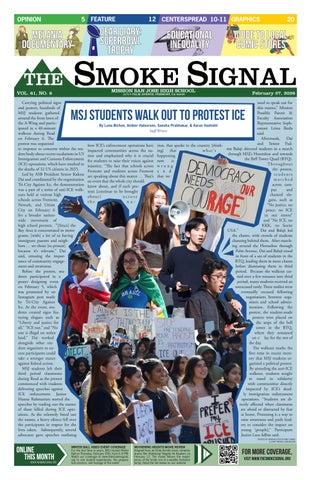
Carrying political signs and posters, hundreds of MSJ students gathered around the front lawn of the A-Wing and participated in a 40-minute walkout during Read on February 6. e protest was organized in response to concerns within the student body about recent escalations in US Immigration and Customs Enforcement (ICE) operations, which have resulted in the deaths of 32 US citizens in 2025.
By Luna Bichon, Amber Halvorsen, Saesha Prabhakar, & Aarav Vashisht Sta Writers
how ICE’s enforcement operations have impacted communities across the na
tion, that speaks to the country [thinking] that what’s
Led by ASB President Senior Kalena Dai and coordinated by the organization Tri-City Against Ice, the demonstration was a part of a series of anti-ICE walk outs held at various high schools across Fremont, Newark, and Union City on February 6 for a broader nation wide movement of high school protests. “[Since] the Bay Area is concentrated in immi grants, [with] a lot of us having immigrant parents and neigh bors … we chose [to protest] because it’s relevant,” Dai said, stressing the impor tance of community engage ment and awareness.
Before the protest, stu dents participated in a poster designing event on February 5, which was promoted by an Instagram post made by Tri-City Against Ice. At the event, stu dents created signs fea turing slogans such as “Liberty and justice for all,” “ICE out,” and “No one is illegal on stolen land.” Dai worked alongside other stu dent organizers to en sure participants could take a stronger stance against federal action.
MSJ students left their third period classrooms during Read as the protest commenced with students delivering speeches against ICE enforcement. Junior Hanna Rahmanian started the speeches by reading out the names of those killed during ICE oper ations. As she solemnly listed out the names, a heavy silence fell over the participants in respect for the lives taken. Subsequently, several advocates gave speeches outlining
need to speak out for this matter,” Mission Possible Parent & Faculty Association
Representative Sophomore Leina Ikeda said.


Afterwards, Dai and Senior Padma Balaji directed students in a march through MSJ’s Horseshoe and towards the Bell Tower Quad (BTQ). Throughout the protest, students marched across campus and chanted slogans, such as “No justice, no peace, no ICE in our streets” and “No ICE, no KKK, no fascist Dai and Balaji led the chants, with crowds of students chanting behind them. After marching around the Horseshoe through Palm Avenue, Dai and Balaji stood in front of a sea of students in the BTQ, leading them in more chants before dismissing them to third period. Because the walkout carried over a few minutes into third period, many students received an ese tardies were eventually excused following negotiations between organizers and school administration. Following the protest, the student-made posters were placed on the steps of the bell tower in the BTQ, where they remained on display for the rest of e walkout marks the rst time in recent memory that MSJ students organized a political protest. By attending the anti-ICE walkout, students sought to stand in solidarity with communities directly impacted by ICE’s deadly immigration enforcement operations. “Students are directly a ected when classmates are afraid or distracted by fear at home. Protesting is a way to raise awareness and push leaders to consider the impact on young [people],” Participant Junior Lara Adbin said.


Compiled by Finn McCarthy, Saesha Prabhakar & Andy Sta Writers
By Amy Han, Mansi Mundada, Megha Vashisht & Lucas Zhang Sta Writers

Police Department arrests three after pursuit and shooting
On February 14, the Fremont Police Department (FPD) successfully aided in the apprehension of four suspects who were reportedly responsible for vehicle and residential burglaries across the Bay Area. After a chase that ended with the impairment of the suspects’ vehicle, the suspects began to ee on foot with detectives in pursuit. At around 9:45 p.m., an o&cer-involved shooting occured near Blacow Road and Mattos Court, a residential area near a church and a preschool. One of the four suspects was shot and hospitalized. e FPD operation was made in conjunction with other local law enforcement, and the shooting remains under investigation. Authorities have stated that there is no ongoing threat to public safety.
For as long as MSJ students can remember, the cafeteria has served the same food: a combination of daily staples, alternating specials, and a salad bar that comply with the Federal US Department of Agriculture (USDA)’s nutritional guidelines under the National School Lunch Program. Aside from one or two rotating daily specials, the menu o ers few options beyond the required items. Although the meals met minimum federal standards, many
school lunch in January, the difference between those meals and the ones o ered at MSJ was immediately clear. Compared to MSJ’s repeated daily o erings of items, such as grilled cheese sandwiches and veggie nuggets, other high schools in the district o er more variety. For instance, Irvington serves chicken sliders with macaroni and cheese, chicken and wa$es, and American High School o ers cheesy pesto pasta with chicken, Korean bi-
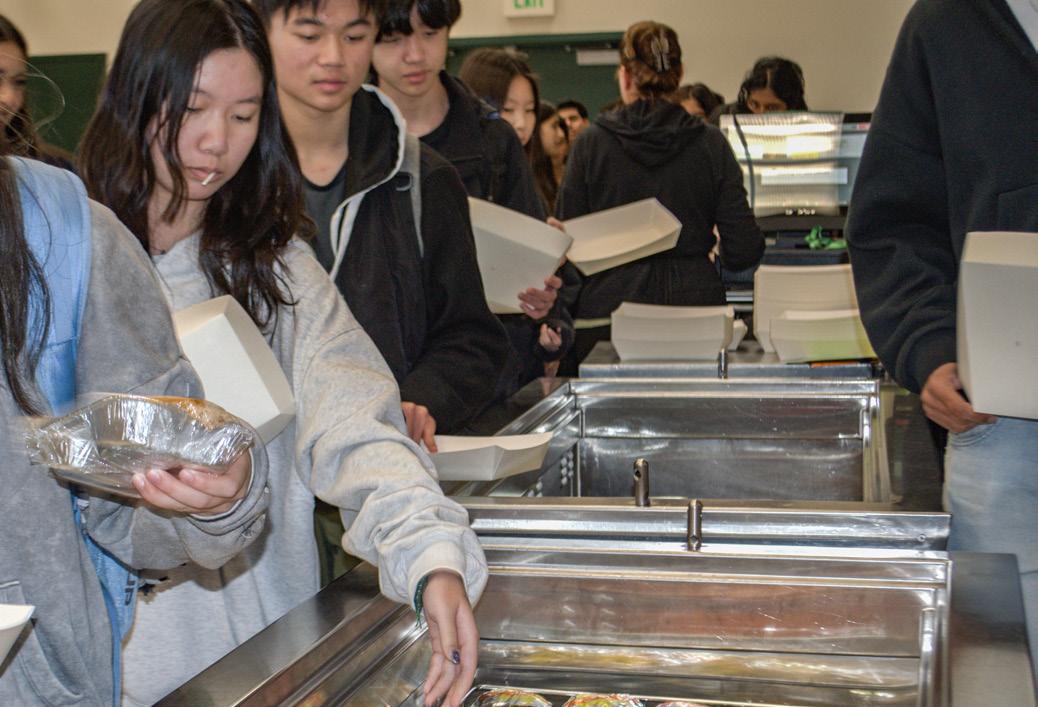
that include daily o erings and salad bar items can theoretically provide %lling meals, students often ignore the additional items when getting food. “Some people do take stu from the sidebar, but a lot of people don’t. ey just take the meal [without grabbing any milk or salad bar o erings],” Freshman Audrey Dsa said.

US Food and Drug Administration (FDA) guidelines made on Feburary 5 aim to phase out synthetic food dyes.
US Department of Health and Human Services signals shift toward natural food coloring
On February 5, the US Food and Drug Administration (FDA) announced new steps to help food companies replace petroleum-based artifcial colors with naturally derived alternatives, part of a series of food regulation changes made by the Trump administration. Manufacturers can now label products as having “no artifcial colors” if they avoid petroleum-based dyes, even if natural colorings are used. Te agency also approved new and expanded natural color options and said these moves support a broader efort, led by the FDA, to phase out synthetic food dyes while maintaining safety standards. Ofcials, including Robert F. Kennedy Jr. and Marty Makary, said the changes aim to make food labeling clearer and encourage healthier ingredients.
students felt that their lunches lack freshness, variety, and avor. e food quality is an absolute disaster. It sucks so atrociously, the quality is like that of a prison,” Junior Ava Zimowske said. Acting on their persistent dissatisfaction, some students took action to petition administrators to improve MSJ’s free lunches.
Origins of the Petition
When Junior Joseph Miao’s friends from Irvington High School sent him photos of their
bimbap bowls, and a mushroom Swiss burger. “ e photos of the food my friends from other schools sent looked a lot more appealing than MSJ’s,” Miao said. Cafeteria lunches on campus include a weekly average of at least %ve cups each of fruits and vegetables, 10-12 ounces each of grains and protein, and a serving of milk every day. However, at MSJ, students must combine multiple options to meet USDA guidelines for adequate servings of each food group. While meals
Motivated by this discrepancy, Miao started a digital petition on the platform Change.org on January 28. e post argued that other FUSD high schools receive higher-quality meals than students at MSJ, pushing for more delicious meals on campus, claiming that “MSJ students are expected to accept the bare minimum.” After receiving 100 signatures within two weeks, FUSD administrators directed their attention to the appeal. To address these student concerns, Principal Amy Perez contacted FUSD Director of Child Nutrition Services Johannes van der Pool and gathered a few students to create a Lunch Feedback Student Panel to share ideas and feedback about the MSJ menu.
According to a survey of 110 MSJ students conducted by the Smoke Signal on Instagram, 73% of students support the menu update, while 5% oppose it.
After discussing the issue with van der Pool, “[Miao] explained that MSJ students were
not getting the same selection as the other [FUSD] high schools because [MSJ] has been short a chef at [their] school site, and so they couldn’t prepare the foods in a timely manner,” Perez said. Van der Pool is currently working to hire a new on-site chef, a process that includes completing background checks and required training, which is expected to be completed in the near future. Because of this lengthy process, the full implementation of any updated lunch menus will take time once sta&ng is in place. In the meantime, students will continue receiving the current lunch menu. However, once sta&ng is stabilized, FUSD will be able to standardize school lunch menus to ensure MSJ students have access to the same meal options o ered at other high school campuses. In anticipation of these updates, the Smoke Signal conducted a poll to assess the student body’s thoughts on the issue. According to the survey results, 73% of MSJ students supported the upcoming changes to the school lunch, and only 5% of students opposed it. ese results indicate broad student approval for the upcoming updated menu. e recent changes to MSJ’s school lunch options re ect the importance of student advocacy on campus. ese e orts have helped produce food options that are more satisfying and nutritious for students. ▪
By Jessica Cao & Michael Qin Sta Writers
Lila Bringhurst Elementary School’s spacious Multi-Use Room (MUR) echoed with the distinctive chatter of a miniature marketplace as elementary students prepared for a busy afternoon of selling products to parent and student customers of the Blazers Entrepreneurship Fair. ough many began with shy glances, the encouragement from parents and potential buyers soon created an excited bustle of con %dently articulated pitches. At 5-7 p.m. on February 6, MSJ DECA and MSJ LEO Club partnered with the Lila Bringhurst Elementary School Parent Teacher Association (PTA) to inaugurate a learning and fundraising opportunity for the school and its students. Across the 74 student booths, students sold a wide variety of items, including handmade art,
paper crafts, pottery, accessories, keychains, toys, 3D-printed items, books, stationery, slime, soaps, candy, baked goods, and ticket slots for prize activities. e entrepreneurship fair was not only a critical growth opportunity for the young students to improve their speaking and business skills, but also a fundraising event for the school. Each student booth was charged $25 for a selling permit, and both money from sponsors and permit fees contributed to the funds for a fourth-grade class %eld trip to Sacramento.
MSJ DECA members dedicated months of preparation time to assist elementary student entrepreneurs in actualizing their innovative business ideas. Meanwhile, MSJ LEO o&cers de% ned roles, streamlined work ow, and coordinated volunteering. “We’ve been [very] impressed. [Our mentor] gave us three tips that were spot on, [and recommended to] sell things in a bundle. She greeted my kid [at the fair] and walked around [to help sell t-shirts],” Bringhurst parent volunteer Karen Chiu said.
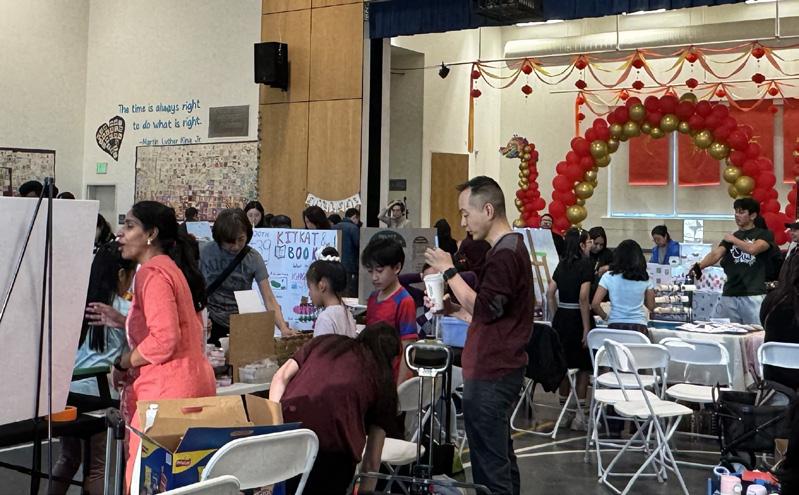
Around 40 MSJ students attended the
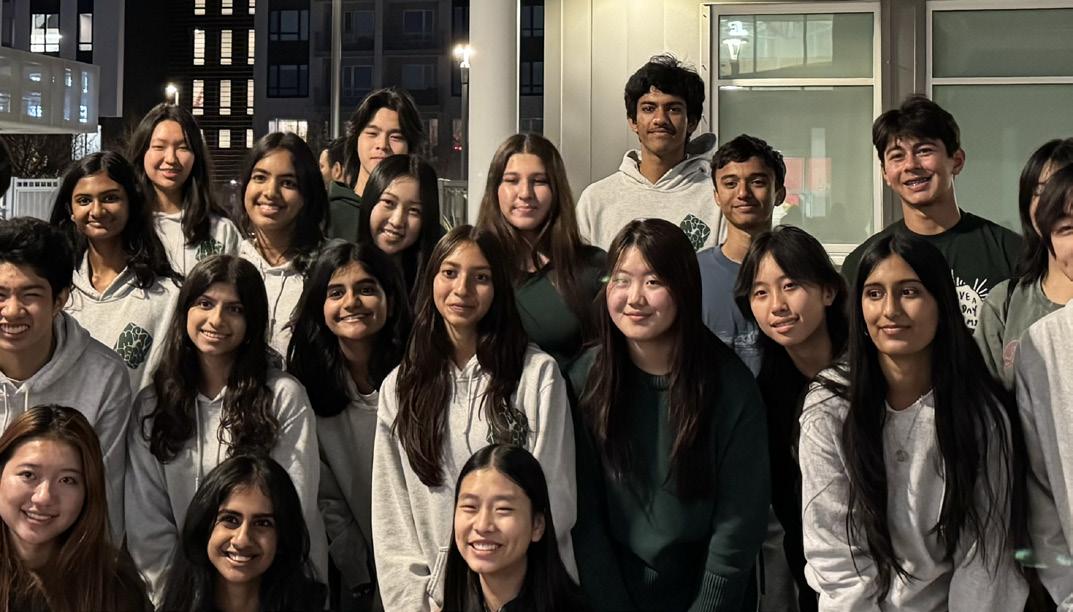
fair as volunteers and mentors to elementary entrepreneurs.
MSJ DECA members set up tables and chairs, directed foot tra &c, managed check-in, and handed out interactive activities to students. Mentors found the experience especially rewarding.
“I’ve been … giving them ideas on how they can promote their products, how they can present it, and di erent bundles they can o er,” MSJ DECA Vice President of Leadership Senior Riya Agarwal said. “It’s been quite rewarding to see after four years of DECA, I’m actually able to help other people sell their own things. Seeing young kids start entrepreneurship is quite inspiring, and I’m glad that I’m able to pass on the skills I’ve learned.”
MSJ LEO and MSJ DECA have collaborated to host similar community-based events in
the past, such as the Towel Bears service event in the % rst semester of the 2025-26 school year. “ e most ful % lling part was de% nitely seeing the kids happy and making their purchases, because this is probably most of their % rst time selling. Every time we collaborate with DECA, we always get very high engagement. We would love to host [or participate in] another event like this, because our members can gain a lot of new skills and meet new people,” MSJ LEO Secretary Junior Ashley Kang said. Both clubs look forward to collaborating with Lila Bringhurst’s PTA and are interested in turning the Blazers Entrepreneurship Fair into an annual event, making entrepreneurship and service opportunities more easily accessible to students. ▪
Sunday, March 1, 2026
Compiled by Cecilia Cheng, Kanupriya Goyal, Erika Liu, Veer Mahajan, Finn McCarthy, Saesha Prabhakar, Aarav Vashisht & Andy Zhang Sta Writers
East Bay Mineral and Lapidary Club 2026

Founded in 2024, the East Bay Mineral & Lapidary Club returns for its Annual Mineral and Gem Show. Spanning two days through February 28-March 1, the event hosts more than 40 dealers selling everything from fossils and crystals to lapidary supplies and gemstones. Besides the heaps of geology-related items and mining equipment, the non-pro t’s show and sale also boasts multiple exhibits, demonstrations, geode splitting, and a live auction. Family-friendly activities are o ered as well, such as a spin-the-wheel game for kids. Hosted at Newark Pavilion at 6430 ornton Ave., tickets are $8 at the door, with kids under 12 and under having free admission.
Saturday, March 7, 2026
Holi Fest 2026

See, hear, and speak no evil
By Eleanor Chen Sta Writer
“See no evil. Hear no evil. Speak no evil.” Growing up, I would hear this mantra repeated countless times in Sunday temple class, accompanied with the associated image of the three wise monkeys plastered on a XS summer camp t-shirt. It was meant to encourage core values of Buddhism: understanding, respect, and kindness. In my family, it came to mean an unspoken rule: keep to the bright side; ignore the bad. Generally, it was taboo to discuss topics like politics, sickness, and death. Talking about them was considered to be “impure,” rendering the household available to bad spirits or negative energy. My father likes to give me this advice: “Don’t talk about bad things. Chinese people do not like to talk about that.”
Now, as masked ICE agents are patrolling the streets and terrorizing neighborhoods, I’m seeing this saying in a whole new light. On social media, I’ve encountered perspectives ranging from avid MAGA supporters to distraught socialists, but one stood out to me: those who choose to remain neutral on the issue. Initially, I was confused when I saw people my own age react to real-world issues in this way. I had always associated such passivity on issues like ICE with my family’s old traditions. I was shocked when a friend from Valley Christian High School in San Jose where the school had issued a statement urging students to remain neutral. Despite this issue of neutrality, exits to the school were blocked o to prevent students from protesting January 30-31, the national day of action against ICE. at’s the moment when neutrality stopped feeling like harmless passivity and more of a deliberate choice.
Objectivity is often framed as maturity and, in theory, being the bigger person.
7 at 11 a.m.-6 p.m. Acclaimed as the Bay Area’s largest Holi Festival, the event promises more than 20,000 attendees to enjoy a night lled with vibrant South Asian cultural tradition. e festival promotes inclusivity, inviting Holi enthusiasts and those who are unfamiliar with Hindu traditions to immerse themselves in an exhilarating festival. Featuring authentic South Asian cuisines, festive colored powders, and popular DJs, the event encourages the Bay Area community to indulge in traditional gulal throwing as families and friends gather together in an unforgettable experience. Multiple street food trucks will be on-site, o ering a wide selection of delicious foods to complement the festivities.
Saturday, March 7, 2026


San Francisco Chinese New Year Parade Flickr / David Yu
On Saturday, March 7, San Francisco will be holding their 2026 Chinese New Year Parade, starting at 5:15 p.m. As one of the largest Chinese New Year parades in the world, the parade serves as a gathering for thousands of Bay Area Chinese Americans. e event is scheduled to include many traditional Chinese dances and performances, such as the lion dance, recrackers, and cultural $oats. e parade will run all the way from 2nd Street to Market Street, a route approximately 1.3 miles long. e event will also be free to attend.
Schools and institutions have always prioritized orderliness and calmness over authentic expression of one’s feelings to better contain students. Art, the most human form of self-expression, is encouraged only within neat, black lines on a coloring book. Scribbling on walls, disagreeing with a teacher, and being upset —- all of this so-called destructive behavior sends children straight to the time-out corner where emotions can be regulated. Protocols are speci cally designed to formulate stoic responses to emergencies: from standing single- le in a burning school to remaining underneath a desk during an earthquake.
is mindset extends beyond school as online spaces encourage this passivity. Some claim that this situation is too complicated to pick a side, that neutrality means peace for everyone, and that politics isn’t their thing. e problem is exacerbated online, whether it’s especially easy to scroll past disturbing footage of Renee Good and Alexi Pretti shot dead by ICE rather than to face the emotional toll of properly digesting it. “See no evil” and “hear no evil” become the default.
is isn’t new; it’s history. People always have an excuse for neutrality, either without or fully realizing this impartiality does bene t a side, the oppressors. People like to think they could have spoken out during the Holocaust, tucked Anne Frank safely away in their basement, but in reality, they turn a blind eye to what’s happening right in front of them.

On March 8, at 12:00-3:30 p.m., the Festival of Colors, also known as Holi, also known as the Festival of Colors, will be celebrated at Bay Area Chowpatti. is lively and vibrant event will feature an array of activities designed for fun community engagement, and cultural celebration. Attendees can enjoy throwing colorful gulal, dancing to a live DJ, participating in interactive games, and taking part in hands-on activities throughout the afternoon. In addition, multiple street food trucks will be on site, o ering a wide selection of cultural dishes to complement the festivities.

is March, the second annual Pallium India Bay Area Walkathon will bring Fremont residents and neighboring communities to-

Warmth. A gentleness earned after long seasons of cold, a glow familiar yet startling in its clarity. We meet it as a tender ease of being alive, and without thinking, we are drawn to call it warmth. To each person comes their own season. Some bloom easily, carrying spring wherever they go. Others stand at the edge of another’s sunlight, believing that proximity is the same as belonging. For a long time, I mistook that light for my own.
I did not arrive at that belief alone. I grew up in stories and friendships where harmony was praised, where devotion meant giving everything and asking for nothing. When I was three, I watched the Little Mermaid leave behind the bright, foaming warmth of her sea and stepped onto a colder shore, surrendering her voice as though silence were simply another season to endure. And so I learned, before I understood it, that love meant leaving one’s own climate behind, that to walk toward another’s sun sometimes required abandoning the waters that once held you. It became easy to believe that another person’s happiness could sustain me better than anything I found within myself. Love, as I understood it then, required diminishing: shrinking so others might expand, yielding space so their brightness could stretch unhindered. If they were warm, I believed I would not feel the cold.
Over time, this hardened into habit. Caring meant making myself smaller. I became the one who o ered comfort without asking where my own reserves would come from, the one who mirrored delight and absorbed disappointment. I had absorbed a par-
gether. Hosted by Pallium India and local partner VANITHA on Sunday, March 15, at 40000 Paseo Padre Parkway in Fremont, the event invites walkers of all ages and abilities to participate in a mission-driven walkathon supporting palliative care services for patients and families facing serious illness. After a successful inaugural event in 2025, organizers expect an even larger turnout this year, including volunteers, families, community groups, and nonpro t sponsors dedicated to compassionate care and dignity at life’s end. Participants can choose from multiple walk distances, promoting tness and raising awareness and funds for the Pallium India mission.

In a vibrant celebration of diversity and community, Union City is hosting its annual Culture Fest 2026 at 12-4 p.m. on March 21. Featuring local vendors selling unique cuisines and crafts, as well as elaborate cultural exhibits, the event is an opportunity to experience traditions from around the world. e festival also includes live performances throughout the entire duration of the festival, with traditional dances, musical concerts, and creative writing all spotlighted in previous years. Located at Kennedy Community Park, 1333 Decoto Road, the event is free to enter, and attendees of all ages are welcome.
By Kayla Li Sta Writer
ticular kind of wisdom, one that felt unquestionable: the important thing was to love rather than to be loved.
And so, I lived through borrowed seasons. I admired spring from just behind another’s shoulder, mistook usefulness for belonging in autumn, called steadfastness warmth in winter.
Every season I experienced was contingent, secondhand, self-sacri cial. ey passed through me without taking root.
Borrowed warmth fades.
I began noticing it in small ways. I would celebrate a friend’s success and feel only the echo of applause inside my own chest. I would o er comfort and walk away strangely emptied, as though something essential had been drawn out and not returned.
en winter came. Not theirs, but mine. I stepped back, just slightly, and the air changed. I did not answer their calls immediately, nor did I say yes to every request. In that small refusal to overextend, the re$ected light thinned. Without the steady exchange of comfort and validation, I stood beneath a sky that no longer borrowed warmth from elsewhere. For the rst time, I felt the cold of having no happiness that belonged to me.
Winter, in its severity, is honest. In that unadorned light, I saw what I avoided: I had no spring cultivated by my own longing, no summer ripened by my own joy.

t& the edit&r:
I think that the article “ e Bay Area protests against involvement in Venezuela” in the January edition of the Smoke Signal does a solid job of bridging the gap between local Bay Area activism and the reality of the US’s international relations. I appreciate how the authors didn’t just stick to the more well-known chanting crowds in Redwood City, but connected the story to other events, like the Chevron re nery in Richmond. It makes the global perspective feel local in a way that can connect to the reader.
Including the perspective of Venezuelan expats like Sanchez is also a great addition. It prevents the article from having a one-sided view by acknowledging how complex the situation truly is for a ected parties. However, the article could be sharpened by leaning harder into the economic contradictions mentioned near the end. You have this fascinating point about the US still re ning Venezuelan oil while also enforcing sanctions that harm the country. However, I would love to see more data or a direct confrontation of that hypocrisy. while having a small connection. I feel that tightening this focus would help the readers truly understand why this is an important issue and why they should care.
▪ SENIOR SOURODEEP DEB Submit a letter to opinion@ thesmokesignal. org or with the QR code.

Mission San Jose High School
Est. 1964
Vol. 61, No.6 February 27, 2026
www.thesmokesignal.org
41717 Palm Ave. Fremont, CA 94539
510-657-3600, ext. 37074
MISSION STATEMENT The Smoke Signal’s mission is to represent the voices of the MSJ community and serve the public by providing accurate, meaningful, and engaging information presented through print and digital media.
SCHOOL POPULATION 1878 students
EDITORS-IN-CHIEF Padma Balaji, Alice Zhao
NEWS Jennifer Li, Cham Yu
OPINION Janet Guan, Vikram Mahajan
FEATURE Ariel Duong, Trisha Parikh
CENTERSPREAD Naisha Koppurapu, Ariana Yi
A&E Navya Chitlur, Brittany Lu
SPORTS Michael Qu, Ethan Yan
GRAPHICS Hannah Bi, Emily Zhang
WEB Scarlett Huang, Ekasha Sikka
PUBLICITY/TECH Aaqib Zishan
BUSINESS Gaurasundara Amarnani
CIRCULATION Alex Duan, Abigaile Lei
ADVERTISING Fiona Yang
EVENTS Dhaeshna Booma, Felicity He
WRITERS & PHOTOGRAPHERS
Hamnah Akhtar, Luna Bichon, Jessica Cao, Eleanor Chen, Cecilia Cheng, Kanupriya Goyal, Amber Halvorsen, Amy Han, Kayla Li, Erika Liu, Varun Madhavan, Veer Mahajan, Finnegan McCarthy, Joseph Miao, Mansi Mundada, Saesha Prabhakar, Michael Qin, Kelly Shi, Warren Su, Aarav Vashisht, Megha Vashisht, Prisha Virmani, Leland Yu, Andy Zhang, Lucas Zhang, Matthew Zhang
ADVISER YC Low
The Smoke Signal‘s name originated from traditional forms of long-distance communication and honors cultures around the world, including China, Greece, and Rome.
To advertise in the Smoke Signal, email ads@thesmokesignal.org. Advertising that is included on the pages of, or carried within, the Smoke Signal, is paid advertising, and as such is independent of the news and feature content.
The Smoke Signal’s right to freedom of speech and press is protected by the First Amendment of the US Constitution and California Education Code Section 48907.
To stay updated with our online content, see our Facebook page at www.facebook.com/msjsmokesignal.
All policies on distribution, corrections, and bylines can be found at www.thesmokesignal.org/about. Send letters to the editor at opinion@thesmokesignal.org.

By Janet Guan Opinion Editor
On the wall beside my bedroom desk, I keep a careful mosaic of memories. Crowded with old birthday cards, certi cates, and lanyards from events I attended, the wall is a window into the happiest moments of my past.
For the longest time, I was obsessed with nostalgia. More than reminiscing about old memories, I was paranoid about losing the present. I thought that, if I didn’t cling on hard enough and take something with me into the future, it would fade out forever in signi cance. Determined to make every moment count, I maintained a rigorous routine of documentation. I preserved every friend group outing, family vacation, and heartstopping view with photos and carefully tended albums. I tracked my day-to-day in journal entries throughout elementary and middle school, sure that even the mundane would soon become foreign. I spent hours meticulously curating my Spotify playlists, hoping that each song I added would one day take me back to a familiar place.
Yet, as time went on, it became more and more di cult to keep up with every new experience in my life. I lost track of all my albums and found myself taking fewer and fewer photos every month. I quit daily journaling after entering high school, nding it easier to write spontaneously than with a xed routine. I gave up on creating detailed playlists, opting to reuse old ones or rely on convenient mixes instead.
As I stopped constantly trying to manufacture a perfect past, I found myself, unexpectedly, more attuned to the present. I could enjoy every laugh
with friends, meal with my family, and breathtaking sunset without rushing to take out my phone. I could pour my heart into the journal entries I truly felt like writing, rather than forcing myself to for the sake of consistency. And I could listen to new music and create new playlists out of joy for what was, instead of worry for what would be.
Looking back, my xation with nostalgia was less about appreciation for the present but a paralyzing fear of change and the uncertain future. Nostalgia and the warm, golden images of my past were a coping mechanism, my anchor in a sea of inevitable unfamiliarity; I held on to the present because I didn’t know if anything to come would ever be as safe.
By allowing myself to let go as the present slips into the past, I’ve accepted that not every moment will be as beautiful as the last, but that only by embracing what’s next will there exist the possibility of something even greater.
I know that part of me will still hold onto old nostalgia. I still revisit my old photos, journal entries, and playlists. I still add new memorabilia to my wall of memories. Yet, I no longer let fear dictate how I treat the present or regard the future. Happiness sticks — not just in pretty pictures or words or songs — but in the rush of feeling alive. What we experienced yesterday lives on in the people we are today and the possibilities of tomorrow. By trusting in this permanence, we can savor the past and present while striding nonstop towards the future. ▪
“Together, we are America,” marked the football triumphantly hoisted up by Puerto Rican artist Bad Bunny as dozens of ags soared through the air. To the record-breaking 128 million 2026 Super Bowl viewers, this multicultural display was a powerful reminder of the enduring ght for unity and a step towards reclaiming the true de nition of patriotism.
Meanwhile, a competing vision of nationalism emerged on the right, as 5.2 million viewers switched to Turning Point USA’s alternative “All-American Halftime Show” performed by American country rock musician Kid Rock and marketed as a “patriotic event proudly celebrating American culture, freedom, and faith.” Beneath their glittery surface, these words carry the venom of a deep ideological divide — one that has fractured the American identity itself.
Today, American patriotism has become a grotesque caricature of its true meaning. What once signied the pride of a nation founded on liberty, equality, and natural rights has been perverted into an excuse for bigotry, intolerance, and violence against our neighbors. As of last month, 70,766 people, over 70% of whom having no criminal convictions, have been detained by ICE: an organization whose brutality is cloaked in nationalistic rhetoric equating American identity with exclusion. Meanwhile, in political discourse, hatred and polarization are ampli ed for partisan loyalty and
our leaders attack anyone divergent from their all-American ideal — all in the name of honoring and protecting our country.
e bastardization of patriotism has manifested in an overwhelming loss of pride, faith, and shared national identity. According to a 2025 Gallup poll, the percentage of US adults who consider themselves “very” or “extremely” proud to be American is at a record low 58%, 9% lower than the previous year, with almost 70% of US adults no longer believing in the American Dream. e result is a generation hesitant to embrace modern American patriotism in fear of what it has come to signify: a corrupted force that sparks more hate than unity.
Despite drastic division across the country, the fractured American identity has slowly begun to piece itself together again. In the past year, thousands of American citizens have gathered in peaceful protest against immigration enforcement and the Trump administration, emanating hope in times of nationwide fear. Across the Bay Area, high school students have held dozens of walkouts against injustice, immigrants and children of immigrants, the majority of our population for generations, rallying their peers in hopes to reclaim “the land of the free” together, a fundamentally patriotic gesture.
As people of all backgrounds join hands to protect their communities, our country’s lost purpose comes to light: a more perfect union upholding security and freedom. Yet, ex-
In the past month, Democrats have ipped red territory blue across the country, overperforming in a string of special elections. In Fort Worth, Texas, they ipped a Trump+17 state Senate district by a 14-point margin; in Minnesota’s Twin Cities, host of the infamous Operation Metro Surge, they won a seat with more than 95% of the vote. For liberal political junkies like me, it’s an exciting harbinger for November. e enthusiasm isn’t shared by all on the left, however.
Left-wing discourse has instead seen disappointment with the Democratic Party. Both last year and again in January, Senate Minority Leader Chuck Schumer and other leading Democrats capitulated to Republican policy, funding ICE’s aggression. Why give your vote, some ask, to a party that stands idly by? It’s true that not nearly enough is being done enough to oppose ICE, and part of the blame rests on the opposition party. Yet it is crucial to recognize a few details.
First, leaders and lawmakers at the state level may choose not to cooperate with federal agents — this was indeed the case in Fremont last year — but they cannot prevent them from conducting operations. Civil disobedience is necessary; government o cials and bureaucrats can’t ful ll the necessity.
Democrats are also presently conned to the minority in both chambers of Congress. ey are institutionally limited in their capacity to block funding for ICE. Some swing or red district Democrats vote in favor of ICE knowing that it makes no practical difference, but believing that their votes may help secure crossover support
By Vikram Mahajan Opinion Editor
against more conservative alternatives. It’s cynical, and hardly an inspiring slogan, but in such cases the choice becomes between the lesser of two nonideals, where one actively enables evil and the other fails to provide adequate resistance.
And therein is the crux of the matter. Democrats are far from perfect. It’s essential to push for stronger leadership and stronger resistance, but even such change must come from working within the system by supporting the right primary challengers.
Although acting on well-intended instincts, liberals who castigate centrist Democrats (often fending o% far more extreme alternatives on conservative turf), or swear o% the party altogether by refusing to vote, are enabling the enablers of the very policies they abhor. After all, it was these very attitudes that helped push swing states, and ultimately the election itself, in Trump’s direction. And for all Biden’s faults on several political issues, Trump has proven far worse on each.
Perhaps not so much when the party is in the minority, but it’s understandable to have expectations from the Democrats, to expect them to deliver on promises. And the higher the stakes, the higher those expectations must become. But at the same time, those higher stakes mean that there is no choice but to choose the lesser of two non-ideals: those who put up at times insu cient resistance to ICE rather than those who o%er active aid and comfort. at, too, is a form of resistance — if less glamorous, then still as crucial as any other, and choosing to abstain is no option at all. ▪

clusion and hostility stands where a welcoming sense of belonging should be. If being patriotic signi es withstanding the narrowed mindset of supremacy and disregarding rightful security, America loses its intention in granting everyone the pursuit of happiness.
Without humanism at its core, the leading variation of patriotism that has engulfed America is empty, devoid of love that is instead replaced by hatred towards another. Blinded by di %erences in political a liation and race, many Americans forgo their responsibility to reason and prioritize morality. Patriotism should encompass these ideals and lead Americans through today’s disillusioning news and political turmoil. If anything, it has always been rooted in some sort of optimistic faith, one that was never intended to be the blind, obstinate faith we see in loyal American homes across the country today.
By welcoming others and practicing sociocultural tolerance, we don’t weaken our national identity but rather strengthen it as the country that was founded and is forevermore sustained by those who come looking for better opportunities.
Bad Bunny’s words, “the only thing more powerful than hate is love,” rekindled that intended passion in the hearts of Americans, reminding viewers that devotion to this country means devotion to one another — no matter their background or skin color.
By Cecilia Cheng & Andy Zhang Sta Writers


By Dhaeshna Booma, Jessica Cao, Amy Han & Michael Qin Staf Writers

Marie Antoinette lived 237 years ago, protected by riches and palace walls, and wrapped in comfort as the nation starved. She is remembered as a queen so deeply entrenched in frivolous excess that her ignorance was painted as cruelty.
History recycles symbols when inequality goes unaddressed. Today, the woman on display wears her hair down, and her skirts have been traded for tailored designer suits. As wealth inequality in the US reaches historic highs, the message in the recent documentary Melania feels unsettlingly familiar: while the lm portrays the First Lady’s luxurious lifestyle and immigrant success, it unfolds against a backdrop of public hardship.
Like the staged portraits that once strengthened a queen’s image, Melania presents a glimpse into modern power. Released on January 30, the documentary follows Melania Trump across a carefully curated 20-day window before President Donald Trump’s January 2025 inauguration. Viewers are shown extended sequences of her wardrobe choices, private jets, preparations for elite fundraising events, and discussions about “optics” and “legacy.” What is largely absent are substantive conversations about politics, policies, and the current economic crisis. Despite the record-breaking $40 million for distribution rights and $35 million for marketing spent by Amazon MGM Studios, the struggled to attract audiences, reported ly grossing just $7.2
Index, which measures prices for a set basket of goods, for food especially in 2026. While President Trump has repeatedly dismissed affordability concerns as a hoax, he promoted them as a campaign promise to working-class Americans. In practice, affordability has functioned more as a political talking point than a governing priority. The federal government slashed SNAP benets by 35%, reduced the federal workforce and department funding, and cut support for housing, education, and public health programs. The administration’s tariffs on foreign imports fail to curb in ation, further increasing costs of essentials for families.
A recent Pew Research Center study recorded how public trust is approaching historic lows of 17%.

These broader department cuts draw public concern, as recent national surveys indicate Americans are increasingly noticing disruptions to government services. In a nation grappling with in ation and stagnant incomes, the administration’s blatant display of wealth functions as reminders of the growing discon nect between those in power and the people they are meant to serve. Current government action merely abides by Trump’s demands, without fully considering the implications for the American public.

million in US box of ce sales in its opening week. Critics labeled Melania as a polished public relations campaign. “The super cial blandness of ‘Melania’ isn’t boring; it’s calculated, infuriating and horrifying,” the Los Angeles Times wrote. Most importantly, the lm begs the question of where the US government is placing its priorities on confronting economic hardship at home, or cultivating images of power and luxury that echo history’s most out-of-touch elites.
$40 million in distribution rights $35 million for marketing by Amazon MGM Studios
Melania’s central theme hinges on President Trump’s administrative power, transforming the president from a public servant to the one being served. The millions spent on exclusive gatherings sharply contrast with the realities many Americans face. The 2025 government shutdown delayed 3 million federal paychecks, furloughed 670,000 workers, and 730,000 continued to work unpaid. Meanwhile, 42 million Americans temporarily lost access to SNAP bene ts, exacerbating food insecurity nationwide. For households already stretched thin, a missed paycheck or reduced grocery assistance determines whether rent is paid or food is on the table. On average, American households carry approximately $100,000 in debt from credit cards, mortgages, and student loans. Furthermore, in ation continues to strain household budgets, with the US Department of Agriculture estimating a 3% rise in the All-Food Consumer Price
Echoing the opulence presented Melania, the Trump administra tion has heavily invested in extrava gant, taxpayer-funded projects.

Melania emphasizes opulence and high-fashion, but offers little acknowledgment of the current hardships many Americans face. While it is framed as a showcase of creative vision, the focus on Melania’s status highlights a gap between presentation and public reality. Democratic systems rely on governments responding to the needs of ordinary people, and when families are dealing with nancial uncertainty, visible displays of wealth from leaders feel disconnected. Public trust depends on the sense that those in power understand the conditions

In September 2025, President Trump oversaw the demolition of the White House East Wing with a 90,000-square-foot ballroom, costing roughly $400 million. Two centuries ago, King Louis XVI’s father constructed the Palace of Versailles, spending an equivalent sum of $2 billion to transform the hunting lodge to a grand royal residence.
The administration also frequently hosts lavish events, including a $30 million military parade celebrating the US Army’s birthday, coinciding with President Trump’s own, a display viewed as political self-promotion.

During the 43-day government shutdown, President Trump invited family, friends, and political associates to attend his “Gatsby-themed” Halloween party, inspired by the 1925 novel
The Great Gatsby, which ironically critiques upper-class overconsumption. Flapper costumes mirrored the notorious extravagance of the Roaring ‘20s, drawing immense criticism when his administration cut SNAP bene for millions of Americans just hours later.
On the other hand, these expenditures could be seen as national strength and unity. Large-scale cer emonies and renovations project con dence both do mestically and abroad. Military parades can symbol ize patriotism, and White House renovations preserve historical prestige. However, a strong national image doesn’t feed or house millions, and pouring hundreds of millions into revamping the White House sidelines regular Americans. Disparate wealth distributions and public exhibitions of upper-class extravagancy fracture unity and separate the governing class from the governed.
ing a lot of environmental actions to stop climate change,” Sophomore Ananya Rawlani said.
Melania is not simply a documentary about a rst lady. It presents luxury largely untouched by the economic dif culties many Americans navigate. When wealth and spectacle outweigh public trust, democracy strays from the very people it is meant to serve. When affordability is reduced to a campaign slogan and real economic strain is minimized, the divide between the governing class and everyday citizens deepens.
Audiences should respond practically on the economic policies political leaders enact rather than debate over image and super cial words online. Even small civic habits, like verifying claims and supporting reliable outlets before reposting on social media, help shift attention from spectacle. To avoid repeating the patterns of the past, the US must hold those in power accountable for the collective well-being of



This November, California voters will decide on a ballot initiative titled the “2026 Billionaire Tax Act.” Also known as Initiative No. 25-0024, the ballot initiative, spearheaded by the Service Employees International Union-United Healthcare Workers West (SEIU-UHW), would impose a one-time 5% excise tax on individuals with over $1 billion in net worth and other relevant trusts. This would amount to approximately 200 people with a combined value of $2 trillion. Although the initiative targets the disproportionate accumulation of wealth by billionaires, its main purpose is to address the deep cuts in federal funding from CA’s healthcare, food assistance, and education systems. As the proposition enters its signature-gathering stage, it has gained the eye of the public due to numerous comments from billionaires, a march organized for the billionaires, and a growing debate on how to deal with the growing health inequality in the country. The Smoke Signal has weighed both of these arguments to decide the benefits and negatives of a one-time billionaire tax.
Pros This initiative will act as a one-time billionaire tax, raising funds for a starved CA budget. Especially following President Donald Trump’s One Big Beautiful Bill Act, which cuts $30 billion from CA’s federal Medicaid funding every year, which will only increase CA’s already large budget deficit. SEIU-UHW, the union spearheading the tax, states the one-time tax proposed here will raise the $100 billion needed to cushion the negative impacts of the state’s budget deficit. It also equalizes taxes across all demographics; given that billionaires often pay less than 24% in taxes compared to the national 30%
By Erika Liu, Saesha Prabhakar, & Warren Su Staf Writers
average. It is only fair that they pay their share of taxes, especially when the leveraging of the taxes is in the interest of enhancing healthcare quality and accessibility for all Californians.
The tax’s benefits toward federal funding still fail to dissuade detractors who claim that billionaires will flee CA following its implementation. Precedent, however, demonstrates otherwise. When Massachusetts passed a similar law in 2022, millionaires did not flee; rather, the number of wealthy people actually increased — a product of the high quality of life already well-established. CA finds itself in similarly favorable conditions: many of the largest tech companies, including Nvidia, Google, and Apple, are stationed in the state, creating an incentive for billionaires to stay. As a hub of industry and innovation, CA is inherently desirable. “We work in Silicon Valley because that’s where the talent pool is,” Nvidia CEO and billionaire Jensen Huang said to Bloomberg Television.
Cons
The proposal must overcome a variety of legal hurdles in order to see its approval in the November 2026 ballot — including, among others, protections against retroactivity, as well as discrimination and private property (on the basis that the tax discriminates against billionaires and their property rights). Consequently, opponents have denounced the ballot initiative as badly-drafted.

The wealth disparity in the US is already greater than that of any other developed nation. The top 400 billionaires now control more wealth than the bottom 61%, with the top 1% controlling nearly a third of all of extant wealth and more than the bottom 90%. This lends immense power to the richest people in the US, leaving poorer individuals without a voice. It is unconscionable for a society to have multiple billionaires amassing more than a hundred billion dollars while millions still live under the poverty line. CA’s one-time billionaire tax takes an assertive stance toward curbing this disturbing trend.

More crucially, however, the tax act threatens a mass exodus of some of the most high net worth individuals in the entire nation — a flight which would cripple economic growth in CA. Los Angeles and San Francisco boast some of the highest concentration of the ultra-wealthy across the entire US; capital flight, or the migration of elite individuals from areas with high taxation, could undermine this competitive edge. France once found itself in a similar situation. Upon implementation of its own “solidarity tax on wealth” (ISF), approximately 60,000 millionaires departed from the country between 2000 and 2017. GDP growth was dented by 0.2% annually, and the tax itself failed to generate significant revenue, producing an annual fiscal shortfall of 7 billion euros. The economic strain forced the notoriously progressive nation to backtrack on the tax in 2017. Far from being the only case in point, similar policies in Germany, the Netherlands, and Sweden were also unsuccessful.
These historic failures are a result of the tax’s emphasis on targeting unrealized gains, crucial to developing startups and new CEOs. This tax disincentivizes entrepreneurship and innovation, leading to economic losses
Te “At a very Chinese time in my life” trend has recently caught the Internet by storm. Te trend was popularized with a TikTok by user @sherryxiiruii, in which she says “tomorrow you are turning Chinese” and invites viewers to eat xiaolongbao and drink hot water. Now, celebrities are rushing to post about their “Chinamaxxing.” While some Chinese users have expressed enthusiasm, viewing it as a lighthearted way of giving their culture greater exposure, others have called it out for reinforcing stereotypes and oversimplifying Chinese identity.
“I know the Internet’s perception of Chinese culture is usually pretty negative, so I would say this is probably a good thing for the most part. I do think it does oversimplify [Chinese culture] a little ... but as long as it’s just for fun, it doesn’t bother me … I feel like a lot of the things that they say … aren’t really just Chinese things ... Drinking hot water is not Chinese, and making and drinking tea is not Chinese. A lot of Asian and nonAsian cultures do that. I think it’s kind of weird to say that’s Chinese. As for things they don’t show, I think with Lunar New Year coming along, they could focus more on that ... or even more traditional foods that might be a little less popular in other cultures … Honestly, I think [the trend] leans more towards the oversimpli "ed part because the reality of social media is that nobody’s actually going to dig into Chinese culture. ey’ll choose something that’s convenient and sounds Chinese, and they’ll stick with that ... In social media, a lot of it is just about being a part of this trend, not necessarily properly representing the subject of the trend … If you show more unique things on the Internet, people would probably be more encouraged to look more into that, but honestly ... I think in the end, people will, in general, just go for convenience.”
and an exodus of large technology companies along with their CEOs.
CA is home to the largest concentration of billionaires across the country. “Such a tax could jeopardize the robust economy and public services offered by CA today. "[It] will kill and eat the golden goose of technology startups,” Y Combinator CEO Garry Tan said. CA Gov. Gavin Newsom, another vocal critic of the tax act, expressed similar sentiments. He stated to Bloomberg Businessweek that the proposal would ultimately “reduce investments in education” and other public services.
There is a real, demonstrable pattern in the implementation of the policy — its impracticality and poor drafting make it disastrous to incorporate. The policy’s final and most damning aspect comes in its impact upon actual low-income communities. The Tax Foundation states that wealth taxes, even at the highest level, disincentivize entrepreneurship and lower wages, leaving all income groups worse off. Inherently punitive, the wealth tax operates on a “fixed pie” mindset that does not allow for economic expansion. It is clear that CA needs a better solution.
The debate over the 2026 Billionaire Tax Act highlights the challenge of balancing fairness with economic stability. The decision is not clear-cut, with voters having to consider the intended benefits — increased healthcare funds and reduction of the wealth gap — along with possible legal and economic consequences. Thoughtful engagement with this issue is essential to ensure that policies promote equity without undermining the state’s economy, and these discussions will help move CA forward.
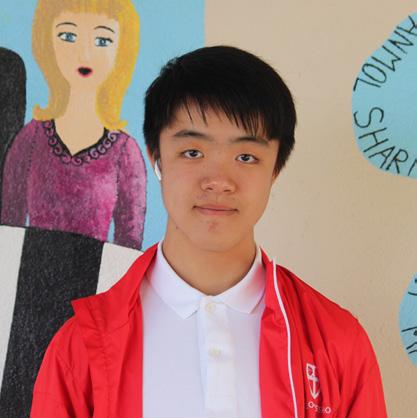
“Yeah, I have de" nitely seen the ‘at a very Chinese time in my life’ trend all over my feed. At " rst, I thought it was kind of funny and relatable, especially the stu about drinking hot water or wearing slippers in my house, because those things are stu I actually see in my own family. But the more I saw it, the more mixed my feelings became. On one hand, it’s cool that Chinese culture is getting attention and not being treated as something weird or unfamiliar. On the other hand, it sometimes feels like people are boiling an entire culture down to a few stereotypes and aesthetics. I think the impact really depends on how people participate. If it’s done with context and respect, it can increase understanding, but if it’s just copying habits for trends, it can reinforce shallow ideas. Navigating that line between appreciation and appropriation means listening to Chinese voices, acknowledging that culture is complex and not treating it like a costume or a punch line.”

“I’m interested in anthropology, so it’s interesting from an anthropology perspective. Hopefully it helps them appreciate [the culture] more and gives them a more accurate idea of what being Chinese and the Chinese experience actually is, though it could just as easily go the other way and either westernize or trivialize various cultural elements and experiences. I think that depends on how it’s handled by each individual person. I think some people are doinng it in such a way that encourages true exploration and respect, but others are just trivializing or stereotyping or simplifying, and that is detrimental to the overall [discourse]. [It’s important for others to approach this topic] by understanding that they are never going to be experts in it. ey are outside observers, and they should respectfully observe, and if they’re invited to participate, participate, but otherwise, do not try and claim it as their own.”
“It could be both a good and bad thing. e good thing is it raises more awareness about Chinese culture, and more people can discover it and respect it, but at the same time, obviously it does perpetuate stereotypes, like Chinese people al- ways do this, or this is a very Chinese thing to do. Obviously, those are stereotypes and assumptions that ... make people believe things that aren’t true [of Chinese people] as a whole ... e best thing to do is just do your own research. While [the] Internet is a great place to discover things, it’s one of the biggest propagators of misinformation as well. So always double check your facts. And if you really are interested in Chinese culture, then do some research for yourself and yeah, just stay aware and stay safe.”







Composed by Aarav Vashisht
BART has long served as a reliable source of transportation for citizens living in the Bay Area. For Senior Michael Liu, a Digital Video Arts Production student at MVROP, the idea of BART hit close to home. Afer recently submiting a photo essay detailing his experiences on BART and the memories he made, Liu’s submission was featured on the Youth Media Challenge Page. Follow along as we ask 21 questions about Liu’s journey as a photographer.
How do you believe your photography skills have evolved over time?
“I never really touched a professional camera until this school year … the digital photography class was really helpful because there’s [a lot of] camera setings to learn. Having that one period to practice ever so ofen is nice too.”


What type of photo projects have you done so far?
“I take pictures of what looks cool to me. I think when I was a kid, I pretended my

Do you have any future plans in photography? If so, elaborate.
“I'm thinking about geting some camera equipment later on afer the school year and continuing my hobby or starting a side hustle once I get to college.”

Want to read the FULL 21 Questions w/ Michael Liu spotlight? Scan to view this story and similar articles!
to try taking photos



Composed by
Finn McCarthy and Amy Han Staf Writers

For Feature’s TQM for this month, students were asked:
“What is a small moment of love from your life that still stays with you, even if the other person doesn’t know it meant anything?


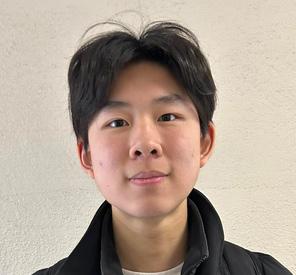
He was 105. He sadly passed away, but he was kind of like my grandpa ... Mr. Forest [introduced] my family and my parents [to others], when they just immigrated from China, they didn't know any English. He helped them with English, and he helped us assimilate, so I like to say I try to emulate him and my parents, too. [I do that] in small acts of kindness and stuf like that. I like to randomly ask my friends, just out of the blue, 'Are you happy?' Because I fnd that's a much more — like that does seem really intense, but you get a much clearer answer instead of just [asking], 'How are you doing today? ' ”



This February marks 100 years since the frst observance of National Black History Month, an annual celebration of African American achievements such as during the Civil Rights Movement. The following month of March honors Women’s History Month and women’s contributions. In this issue, the Smoke Signal highlights Bay Area Black women owned small businesses and their impact on the community.
Black and Brown in San Jose’s West San Carlos Street of and designer pieces to shoppers who crave individuality and style. Owner Monisha Murray built the boutique into a beloved destination where every rack feels like a treasure hunt for retro gems and statement pieces that pop. With nearly two decades in the business, the shop blends classic fashion with contemporary fair while hosting pop-ups, DJ events, and seasonal sales that keep locals coming back. Refecting on that loyalty, Murray describes the support “like a love feeling,” sharing in an interview with ABC7 News that customers she met years ago still return, “super supportive and excited about it.” From one-of-a-kind jackets to bold accessories, Black and Brown continues to celebrate style that stands out.




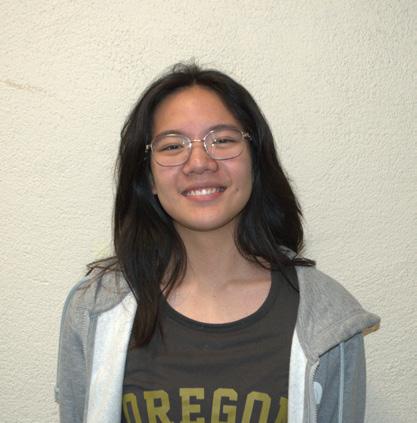
"A while ago, my parents took me to the mall. We tried a matcha ice cream that I really liked, and ever since then, my dad has goten it for me every time we go to the mall. He usually hates waiting in lines, but every single time we go [to the mall], whenever I go of into a store and tell him to wait outside, when I come out, he's just waiting with the ice cream. Once, when we went on vacation, I was feeling kind of sad because I sprained my ankle and couldn't go swimming, so my mom bought matcha ice cream from the same place and got it for me. That made me feel really happy, because she remembered, and that was really nice."


Situated in a complex on 569 W Alma Ave in San Jose, The Giving Pies ofers French-inspired pies with items including lemon and ube favors. For owner Voahangy Rasetarinera, her French upbringing inspired her to incorporate less sugar, more buter, and assorted fruits in her culinary style. Meanwhile, her Madagascan heritage contributed to her focus on community eforts similar to the unity found in African villages. As a Black woman, Rasetarinera expresses that her identity makes her business even more special. In the Bay Area, many customers support her during Black History Month, Women’s History Month, and Juneteenth.
Tucked into Oakland’s West neighbourhood, Blk Girls Green House opened in 2020 as a plant and lifestyle shop founded by Kalkidan “Kalu” Gebreyohannes and J’Maica Roxanne. Built from their shared love of greenery and design the space features curated houseplants, handmade ceramics, candles, and other goods from Black creators. They also host pop-ups and gatherings to make it a vibrant hub for local culture and connection. Since opening, it has become a place where customers can “access our joy with the Earth… that brings peace and love to [their] community” and appreciate how “plants are a way of life for [them],” the founders said in a Forbes interview. For many, it remains a go-to



unique scents. Throughout Shaw’s life and business, she makes decisions confdently, believing in her own capabilities and passion. In the future, she hopes to keep this mentality to expand her business across the US with blending kits so that people across the country can enjoy making beautiful perfumes.

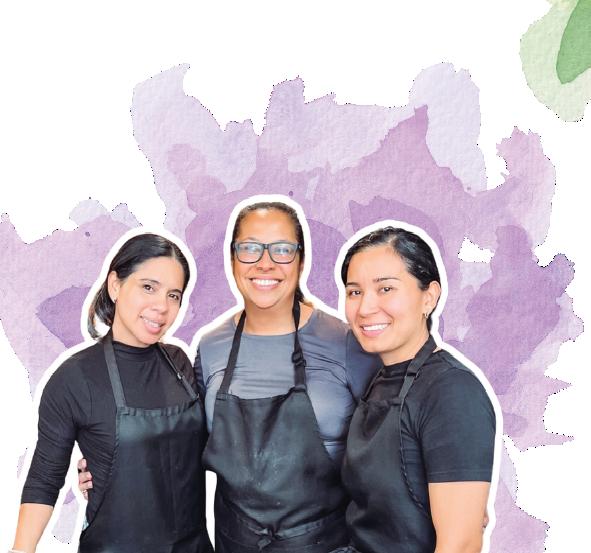
By Amber Halvorsen, Erika Liu & Veer Mahajan Staff Writers


For some students, their biggest worry is only their grades. Yet, not everyone can enjoy this level of fnancial or emotional security. For Avalon Wood, a current sophomore at Oakland’s Latitude High School, educational inequality is a constant presence at their school. Standardized exams at their high school, such as the Measures of Academic Progress exam (MAP), are not offered in languages such as Spanish, putting English learners at an inherent disadvantage. Strict policies against tardiness disproportionately punish students with diffcult family situations, which are “often out of their control,” according to Wood. Moreover, many of her Hispanic classmates, of whom constitute more than 66% of the school population, had “recently immigrated” with “very, very little money.” They emphasized how the school system was unaccommodating and extremely diffcult to navigate under such circumstances.
These modern disparities in education can be traced back to socioeconomic inequity and historic policies, such as redlining. Starting in the 1930s, redlining began segregating communities into “red” and “green” sectors to denote favorability. A signifcant factor in deciding whether a neighborhood was “good” or “bad” was race. Majority Black and Latino neighborhoods were fagged as “hazardous” for investment, leaving them intentionally deprived of resources, nice housing, and job opportunities. Even nearly sixty years following the 1968 Fair Housing Act, which banned redlining, these practices have still left nonwhite communities segregated and struggling with more reproductive health disorders, air pollution, and fewer urban amenities than their privileged counterparts
Today, East and West Oakland remain the most segregated regions in the Bay Area as a result of redlining practices. Residents in these neighborhoods are more than twice as likely to go to the emergency room for asthma, according to NBC Bay Area. They are also more likely to experience higher rates of poverty, crime, and infant mortality. Harmful pollutants are also overrepresented in poorly graded neighborhoods (neighborhoods denoted with a C or a D), according to a 2022 study from the UC Berkeley School of Public Health. With 60% of D-graded neighborhoods being nonwhite, these structural disadvantages systemically target people of color.
“I take a few honors and some regular classes, and noticed the demographics are very different in those classes,” Foothill High School Sophomore Avery Du said, highlighting racial disparities he had observed. “I think there’s also sometimes teachers that may also judge students based on their ethnicity.”
Educational inequity is not confned to Oakland. Right across the bay from MSJ is the town of East Palo Alto. The town borders Palo Alto, one of the most affuent cities within the entire nation, where the average home value is around $3.5 million, and the cost of living is 92% higher than the national average. East Palo Alto, by contrast, has had low incomes paired with high crime rates since the 1990s.
Considered a less affuent area encircled by regions of extreme wealth, its residents have long felt the pressures of poverty.
“East Palo Alto is one of the poorest towns in the Bay Area, traditionally, one of the towns with the least money,” Hopkins History Teacher Brian Miller said. For many years, East Palo Alto did not have a high school of its own. Instead, Miller stated, children in East Palo Alto, already struggling with poverty, had to be bused to Redwood City to attend school approximately half an hour away. “They could have gone to Palo Alto High School, which is literally fve minutes away from where they live,” Miller said. “But that very wealthy community blocks those kids from a poor community from going to high school in their town. And think that that … is a really striking example of inequality in education. I think it's happening around us. It's happening now.”
The wealth difference between East Palo Alto and Palo Alto is striking, highlighting another issue in educational inequality — wealth disparity. Wealth disparity has become an especially relevant issue within the Bay Area, where skyrocketing costs of living have driven disparity both in class and education. A ffth of the Bay Area is now dependent on aid for basic necessities, all while the median income in other areas such as Palo Alto and Menlo Park often exceeds $200k. Variation in a school district’s per-student spending is nearly $6,000 – the wealthiest schools spend up to $6,000 more per student as compared to lower-income ones. One study published by fnancial technology company SmartAsset revealed that Fremont was among the top 20 cities with the greatest increase in wealth inequality in 2025. Currently, 63.6% of CA’s population is “socioeconomically disadvantaged,” according to the CA School Dashboard.
SAT data results, according to Inside Higher Ed, consistently correlate poverty (between $0-20,000 in income) with low standardized test scores (approximately 400 per category). The median household income for Black and Hispanic students also stands at roughly $70,000 to $80,000 as of 2025 — substantially lower than both the statewide median and the average of more than $200,000 for Asian households. Evidently, according to the Educational Opportunity Project at Stanford University,
student achievement gaps are driven primarily by poverty, not race. When deprived of support or fnancial stability, students will inevitably struggle more in school. “I see that there are students within our system that have real struggles, because they are also providing childcare to younger siblings or cousins and whatnot … balancing someone's academic rigor with all of those things in life can be quite challenging,” current FUSD Superintendent Zack Larsen said. Wood observed among their own peers many who have had to “drop off a sibling, or [take] public transportation that's unreliable,” another side effect of living in a disinvested community.
“I have a friend at my school, Juana,” Wood said. “She’s still learning English, but she never comes to school because she has a really hard home life … She would rather be anywhere else but school.” Wood says Juana’s willingness to learn isn’t the issue — but rather circumstances that are out of her control.
Principal Sheila Jemo of Robertson High School, an alternative high school institution offering a smaller, more fexible environment for students who have struggled in traditional schools, shared her own experiences. “I work with students who are just as capable as their peers but have experienced housing instability, family responsibilities, or the need to work,” Jemo said. “Students don’t leave their lives at the door when they go to school … We see patterns across [the educational system] that refect broader societal inequities.”

Sarah, who is only using her frst name to be able to speak confdently about her experience, began attending BASIS Independent Silicon Valley Upper School in sixth grade. Having moved over from a modest neighborhood adjacent to American High, she’d just emerged from pandemic-era distance learning. Sarah did not think much of the school’s annual $40,000 tuition, nor its status as one of the most competitive academic institutions offered in an already high-value area. She was solely glad to be able to go to in-person school again.
Entrance at BASIS is selective — however, Sarah was able to skip the lengthy waitlist for her frst year at the program. Once accepted, the sheer rigor of curriculum Sarah witnessed at BASIS was unparalleled. APs are integrated into even normal pathways — in fact, AP Government is mandated in the average BASIS student’s freshman year. Seniors, guided by teachers, are expected to complete a professional research paper or other relevant initiative before graduation.
“Everyone at BASIS gets into good schools,” Sarah observed. She estimated 3 out of the 40 seniors in her older brother’s graduating class made it into Stanford. The least competitive college anyone at BASIS has ever attended, according to Sarah, was UC Irvine, with an acceptance rate of 28.6%.
However, Sarah felt that BASIS students were not inherently smarter than their public school counterparts. “Grade infation [at BASIS] is actually really heavy,” Sarah said. “I remember … my physics teacher was really nice,” Sarah said. “If the class did [badly] on one test, she would just scrap the grades … and tell us all the answers.”
Grade infation has seen a much steeper rise within suburban private schools as compared to low-income ones. While grade infation in the latter has been consistent across decades, a product of inherently lower expectations, the same trend has overtaken wealthy institutions out of virulent competitiveness.
The average GPA of SAT-takers in suburban private schools increased by 8% over 18 years, whereas urban public schools only saw a 0.6% increase during the same time period. Simultaneously, SAT scores fell. Post-pandemic era averages have consistently ticked downward, with the 2024 average falling to a 1024 from a 1028 in 2023. uent students also beneft from enrollment in elite tutoring programs. One comprehensive review by MIT-based research center Abdul Latif Jameel Poverty Action Lab (J-PAL) found that tutoring put students approximately three to 15 months of education ahead of their peers.
This same tutoring, Sarah stated, was a widespread and competitive industry within BASIS, and one that, even at the uent private school, maintained an air of exclusivity. “People would gatekeep [tutoring programs] from others,” Sarah said. uent students have systematically been able to excel at standardized tests such as the SAT and ACT. SAT exams are often prohibitively expensive; one Harvard University paper showed that only around 25% of the poorest 20% of students even take an ACT or SAT exam. By contrast, over 80% of the highest earning families take these tests. Free waivers only offer fnancial aid students two attempts on these tests. Wealthy students can and often do exceed this number. One research paper from Harvard revealed that 17% of children from the top 20% of earners scored above 1300 on the SAT, whereas only 2.5% of students in the bottom 20% were able to do the same.
This privilege extends beyond BASIS, though.
“I feel like a lot of us [at MSJ] … don’t really see it … but feel like we’re very privileged in the way that we take a lot of things for granted,” Sophomore Maya Sarkar said.
“There’s a lot of other kids who really want an education and are struggling for an education, rather than complaining that they have too much education.” She went on to highlight the amenities those within the “MSJ bubble” enjoy — including outside extracurriculars, academic competition, and a student parking lot full of Teslas and Cybertrucks.

“[MSJ] is the only school in Fremont Unifed that’s platinum status,” FUSD Director of Assessment and Accountability Elie Wasser said. “It’s a top performing school. [MSJ]… stands out.” He cited the school’s competitive culture, commended by College Board, and diverse selection of APs — 25 total, the most of any institution in the school district. Ranked twelfth highest of any other school in the entire state, MSJ offers an atmosphere of privilege and opportunity that many other students cannot experience. It’s an advantage that, for much of the student body, still goes unacknowledged.
Increasing access to education remains a prevalent issue amongst policymakers. However, the education system as it stands currently is still a long way away from full equality. Miller cited a series of historical court cases on education — of them, the 1973 Supreme Court case San Antonio Independent School District v. Rodriguez. “[In this court case,] the Supreme Court ruled that education is not a fundamental constitutional right, that [no student] actually [has] the fundamental right to education by the constitution,” Miller said. That’s why some districts have access to so much more resources than others, he explained. “In the end, all this inequality compounds,” he said. Despite these challenges, Wood believes there is hope. “I just think that a good teacher is the most important thing that you can have,” Wood said. Sharing a story from a “remarkable” teacher she had over the past couple of years, Wood emphasized funding into school lunches, which some of her classmates rely on wholly, and employee pay. “I think that a good teacher can make even a terrible school better,” they said. They just needed more funding, more resources. “Talent is evenly distributed,” Burmeister said. “Opportunity isn’t. That’s where the work is.” To this day, administrations are still working to close that gap — extending quality education, one of the most fundamentally ignored rights, to everyone.
By Leland Yu Staf Writer
As anticipation quietly builds, one symbol of victory comes to life long before it reaches the feld. Crafted in silence and shaped by human hands, the Vince Lombardi Trophy begins its life inside a Tifany & Co. warehouse, unaware of the chaos, pressure, and glory it represents.
“...I’m taking the Seahawks this year.” Te words echo around me before I even realize I exist, voices drifting over me as light spills across my silver sheets. I lie fat beneath bright workshop lights, as the hum of metal tools fll the room. I am not formed yet, but I can hear them. All day, they talk about games, rivals, and some sort of record that a seahawk has that I don’t understand. Hands hover all over my surface as eyes follow every inch. I don’t know what I’m here for yet, but the weight of their words tell me that this moment marks the beginning of something important.
Heat engulfs me, swallowing everything. Te silver that shapes me glows, softens, and yields under the intense temperature. Around me, the artisans speak casually, as more information about myself drifts into existence with their voices. Tey talk

about symmetry, and how the football shape at the top of my design must tilt forward at the right angle. Tey start debating about the winner, the word “champion” repeating over and over again. I then realize that I must be made for a champion. Te idea of embodying perfection slowly seeps into me, urging me to exist without any faws — to be a champion myself.
I am packed into a custom, foam-lined case, snug, confned, and cut of from light and air. I feel a sudden lurch as the truck starts moving. Hours stretch, as every bump and vibration makes me twist and slide. An unexpected jolt throws me sideways and the case shifts just enough for me to slide out of the cargo bed. Cold air hits me like frozen knives. I shiver as my metal scrapes against the asphalt. Pain strikes along my exterior as I look down; a dent that’s deep and jagged, marring my perfect silver curves. I feel broken, betrayed by my own surface. How am I supposed to be a champion if my perfect silver is damaged? Before I can think any further, a hand grips me tightly, lifting me of the ground. I cannot see where I’m going. All I know is that the world I am supposed to enter is as far as it’s ever been.
How did it come to this? I sit in a dim,

unfamiliar room, far from the roar of champions that I’m meant for. Dust coats everything and the air is heavy and still. Behind me, I hear a crackle as a television screen fickers on. Te refection of moving images of faces, uniforms, running, and helmets clashing fash across my face. I don’t understand it, but I feel the intensity of every moment. I see fgures sprint down the felds, fall, rise again, and keep fghting. Something inside me clicks. I feel the fre in me stir, remembering that it isn’t over.
I see a window, a slice of light in the dark, cramped room. I slowly squirm toward it. I catch onto the sill, and let gravity take over. I land in a pile of mud, gagging at the thick, sour odor. My silver gleams no more, the brown gunk clinging onto me. I push onward anyway, sliding across sidewalks, dodging puddles, just like the fgures on the television screen. After hours of sliding, scraping, and shifting, I feel the ground leave me from below, as hands lift me
up. I am cleaned, packed, and secured in a new crate, with a lock this time.


Light foods in as my crate opens. Sounds rush over me, a living roar that vibrates through my frame. Watching the players run back and forth, rise up from every tackle, I can’t help but refect on my own journey. I see efort and endurance in every play, courage in every struggle. Te game ends. I am lifted from my case and brought into a room to record the winning team’s name on the exterior of my base: Te Seattle Seahawks. I then get carried outside where the crowd roars and the winning team cheers. As their hands raise me to the lights, I no longer feel defned by perfection, but by everything I endured to arrive here. I realize that being a champion isn’t about perfection and fawlessness, it’s about resilience and embracing every scrape, dent, and misstep along the way.
By Varun Madhavan & Joseph Miao Staf Writers
Founders Lalit Bachu and Rohan Babbellapati formed Bin to Better on the belief against waste as just trash, rather than opportunity. A statistic that inspired this was how each year, nearly 330 million tennis balls are manufactured, almost all of which end up in landflls across the country where they take over 400 years to decompose. To combat this, the organization focuses on repurposing everyday items, like used tennis balls, that would otherwise remain in landflls for centuries. “We just don’t want [useful items] to end up in trash and landflls only because they don’t serve their original purpose,” president Pradyun Kanuparthi said.
“We just don’t want [useful items] to end up in trash and landfills only because they don’t serve their original purpose.”
Bin to Better focuses on select primary projects aimed at improving their local communities facilities. Teir fagship initiative is the Bounce Back Project, which collects used tennis balls from tennis clubs from across the Bay Area and upcycles them. Student volunteers redistribute these second-hand balls to schools, nearby animal shelters, and assisted living centers, demonstrating the meaningful impact of their eforts. “Te most notable accomplishment we’ve had so far [is when] we’ve collected a total of 25,025 tennis balls,” outreach ofcer Harmonie Lee said. “and [we’ve] collaborated with over 30 dog parks, 42 animal shelters, 28 academies and athletic clubs, 10 colleges, and 30 schools across the
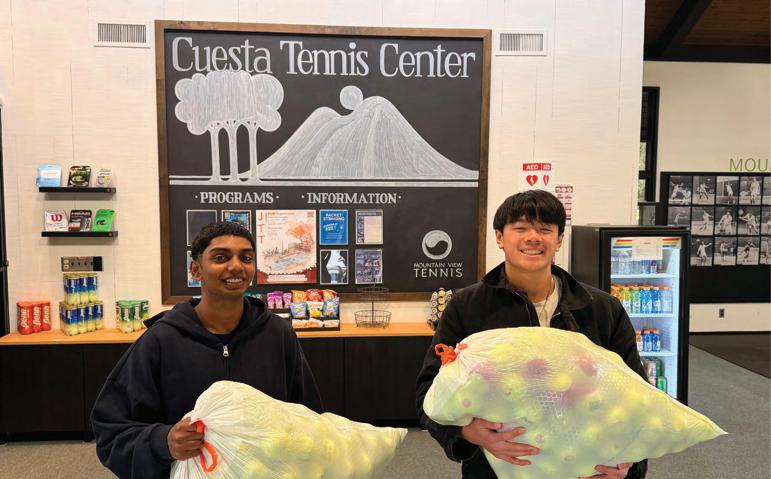
— Bin To Better President Pradyun Kanuparthi Bay Area.” In classrooms, tennis balls are placed on chair legs to reduce noise. Animal shelters have utilized tennis balls as enrichment toys for pets. Bin to Better aimed to illustrate how even a small shift in perspective can produce a measurable impact.
Tis nonproft organization also expands its reach through other collective initiatives, ultimately furthering the initial vision of sustainability in local communities. Its Tech to Treasure program addresses the growing issue of electronic waste by collecting unused devices from drives and transforming them into educational tools. Students who attend receive a valuable opportunity to explore the intricate, inner workings of electronics through interactive workshops held by ofcers before collaboratively responsibly recycling all parts




cer team of Bin to Better with bags of
through several certif e-waste programs. Bin to Better also hopes to soon launch Eco-Blox, a project that will repurpose non-recyclable plastic waste, from bottles to casings, into durable building blocks.
Although Bin to Better stemmed from a simple vision of recycling tennis balls, they’ve evolved into a broader movement centered on sustainability via reusability. “We want to expand our organization through chapters around the country,” marketing ofcer William Lam said. Tey hope to extend their idea of an environmentally-conscious vision nationally, but their mission will always stay rooted in the same belief that even the smallest intentional actions can proliferate into lasting impacts.

By Kayla Li Staff Writer
When fans opened Spotify after nearly three years of inactivity for Joji’s newest album Piss In The Wind, many expected a fully realized reinvention of what a Joji album could be. At the very least, they anticipated the emotional gut punch he perfected on SMITHEREENS, the 2022 studio album that solidifed his place as a mainstream force in alternative R&B. Instead, listeners were met with fragments: 21 tracks, 10 of them under two minutes. Several barely cross the one-minute mark, a sharp contrast to the longer ballads like “Glimpse of Us” and “SLOW DANCING IN THE DARK” that defned Joji’s breakout success. That collective confusion is the best entry point into the record. Joji gives listeners glimpses of brilliance — sometimes seconds long — before yanking them away. If his earlier projects tried to build emotional architecture, this one lives in the rubble. Nothing is resolved, and that lack of resolution becomes the texture itself. Yet, texture alone does not guarantee impact. But an atmosphere built on absence demands precision, and not every track sustains that balance.
The album struggles most in its unrealized potential. Tracks like “PIXELATED KISSES”, “Fade to Black (with 4batz)”, and “Fragments (with Don Toliver)” introduce melodic hooks or production shifts that promise a larger payoff, only to cut off before that momentum fully crests. “Last of a Dying Breed” feels especially restrained in this way, teasing a fuller production shift or
By Ariel Duong Feature Editor

Playing around with FL Studio dials turned mistakes into muscle memory and a propensity for style. Amongst the wave of up-and-coming Asian R&B productions, from pop-leaning artists like NIKI to keshi’s melodic lo-f tracks, hidden gems like rap-cadence R&B artist Nueve Lio are hard to come by. Music was a passion that never faded throughout Lio’s adolescence. Between moving from Riverside to San Bernardino and relocating overseas in Japan, Lio found stability in music production. Where he describes his other passions falling fat, he sought out music as a steadfast outlet for emotional resonance and expression. Living out his early adolescent years in Japan before moving to Riverside, CA, he describes the relocation as the culture shock that inspired the eastern melodic-trap infuence on traditional western R&B. Lio’s sound remained relatively personal — only releasing music recreationally on SoundCloud — until exposure to more like-minded, musically-inclined individuals offered him a helping hand at UC Riverside. His anxiety regarding music production was immediately eased once people on campus fnally began to recognize him, with other students asking for selfes and autographs. Lio recalls his passion for music slowly diminishing as he entered early adulthood. However, as his uploads in his pastime began gaining more traction, leading to his frst million streams with the track “ALL MAJOR” and eventually his frst studio album in 2022, 4EVER BASED, Lio felt this milestone revive his soul-tied passion. Moving forward, he aims to continue his California-based tour to connect back with his Riverside roots. Despite having more than 200,000 monthly listeners on Spotify now, Lio describes his goals as limitless, daring to dream and performing for himself. Intent on reaching his full potential, Lio intends to release more R&B tracks as his releases reach new heights. ▪


climactic release that would typically anchor a track’s fnal moment, then withholding it without clear thematic justifcation. The listener is left suspended in anticipation, waiting for a release that never arrives. What initially feels deliberate begins to feel redundant. Instead of building toward catharsis, many of these tracks plateau midway through, fattening their narrative arcs. Joji gestures toward heartbreak, longing, and resentment, yet the songs withdraw just as those feelings begin to intensify — not because the withdrawal is the emotional statement, but because the songs seem unsure of how to follow through. Still, not every brief track suffers from this hesitation. At times, the album’s concision preserves a single impulse rather than forcing it into a larger arc, allowing certain moments to feel raw and immediate instead of unfnished. However, extension would not automatically improve these songs. At just over three minutes, “LOVE YOU LESS” is one of the album’s more fully developed tracks, yet it
also resists traditional escalation. Joji sings, “If I love you less, will you love me more?” and circles that question rather than resolving it. The chorus loops without rising into a larger climax, trapping the song in the same anxious cycle it describes. Unlike earlier tracks that hint at growth before cutting themselves short, this restraint mirrors the song’s emotional logic. The repetition is not a missing payoff but the point itself. The issue, then, is not duration but intention. Separate from its structural experimentation, Piss In The Wind often feels scattered in its sonic identity. Joji moves between drum and bass, trap soul, distorted club production, and softer R&B without settling into any one sound for long. The range should feel expansive, but it often comes across as unfocused, as if the album is cycling through ideas rather than shaping a clear sonic direction.

Greep— Ethan Kou, 12
BOOK: Life of Pi by Yann Martel — Mysha Saleem, 12 GAME: Stardew Valley — David Sarten, 12
By Mansi Mundada Staff Writer
A loud, energetic, slightly psychedelic beat sets the tone for How Did I Get Here?, marking a departure from singer-songwriter Louis Tomlinson’s earlier work as solo artist and a former member of the boy band One Direction. Released on January 23, Tomlinson’s third studio album builds on the guitar and piano-driven pop of Tomlinson’s previous albums while adding textured instrumentals and subtle psychedelic elements. Throughout the record, Tomlinson experiments with new sounds beyond styles of his previous works — blending multi-layered instrumentals with introspective lyrics — offering a glance into his personal journey.
From the frst few notes, the album’s energy is unmistakable. Bright guitar riffs and upbeat instrumentation establish an optimistic tone, yet beneath this sound, How Did I Get Here? is rooted in vulnerability, focusing on Tomlinson’s journey of self-exploration and navigating grief for people he lost. In “Lemonade,” he uses sweetness as a metaphor for escape from reality, with lines like “She’s so sweet,” and “Is it only human to escape into delusion?” In “Imposter,” he captures self-doubt and identity crises in lines such as “Sweat dripping, terrifed you’ll fnd me out.” Introspective lyrics juxtapose lively background music, portraying enough emotional depth and complexity for a compelling listen. However, not all tracks achieve this. Songs like “Jump The Gun” and “Lazy” rely on lyrical repetition with central phrases, “Got me feeling lazy” and “don’t jump the gun,” respectively. In “Jump The Gun,” repetition dilutes emotional impact, but bold vocal delivery prevents the track from falling fat. “Lazy,” leans into softer tones, complementing dreamy production, but still overall creates relatively underdeveloped tracks. This unevenness extends beyond
lyricism, into production. The album’s production embraces deeper, more diverse sonic arrangements, especially in comparison to Tomlinson’s previous works. On tracks like “Lemonade,” distorted bass and guitar immerses listeners, complementing his vocals by enhancing emotion and adding richer, more layered sounds. However, on “Jump The Gun,” vibrant instrumentals overpower his voice, heavy percussion and guitar competing for attention. During “Last Night” and “Broken Bones,” the production is overly cautious. Despite lyrical prowess, sonic arrangements reminiscent of past works like “Out Of My System” lack dynamic variation and consistency in production, weakening the album’s fow and central themes. With How Did I Get Here?, Tomlinson expands on the familiar pop style of his earlier albums with a more cheerful, psychedelic sound. Yet, as the album progresses, it falls back to sounds of his prior works, particularly Faith In The Future (Deluxe), making the album feel more like a glimpse of his potential rather than a fully polished vision. Even so, How Did I Get Here? marks genuine growth in Tomlinson’s music, leaving listeners eager for future projects. ▪
Grade: B


By Eleanor Chen Staff Writer
Stars have disappeared. Planets, along with the humans once inhabiting them, are gone. No one has no trace or knowledge for why — only the sinking dread that this apocalypse, dubbed the Quiet Rapture, has doomed humanity to a dying universe. Released on January 30, Iron Lung follows Simon (Mark Fischbach), a convict forced into a dangerous solo mission in a failing, outdated submarine, known as the Iron Lung. In exchange for the promise of freedom from prison, Simon must investigate mysterious anomalies of once-barren moons now flled with blood oceans. What begins as a simple bargain quickly becomes a psychological descent as Simon is lost, communication cut from the mission’s captain, and hallucinations warp the line between reality and the impossible. Most of the movie is set in a dark submarine, where the only way to see the outside world is through cryptic, static images taken by the vessel’s camera. The profound shift in Simon’s mental state is shaped by both
the isolation and fearful knowledge that an organism lurks outside. At the start, he’s nihilistic with a bleak outlook for humanity’s future. But as the ship crumbles around him, Simon fnds hope and the will to continue fghting. It’s an immensely diffcult change to convey, especially without professional training or experience, but Fischbach is able to walk this delicate balance effectively: dramatic moments capture intense emotions, teetering on the brink of insanity, while suffocating silences capture emotional depth. The flm is faithfully adapted from the frst-person horror video game Iron Lung. Fischbach, better known as Markiplier on YouTube, is the lead actor, director, co-writer, and editor. Unlike most frst-time directors, Fischbach didn’t rely on traditional studio systems, instead funding much of the project himself and exercising creative control over the fnal product. Despite the minimal marketing consisting mostly of YouTube videos, Iron Lung grossed around $18 million in its opening weekend — six times as much as its original budget of $3 million — largely thanks to fans contacting theaters, turning

what was meant to be a limited release into thousands of screenings.
Iron Lung closely mirrors the game from long silences, slow, monotonous tasks, limited visibility, and confnement in a small, real submarine. Spending two hours staring at a depiction of a gloomy submarine interior could have easily been boring, but the carefully crafted cinematography consistently fnds new angles to keep viewers engaged and the haunting soundtrack immerses them. Tight camera angles showcasing the Iron Lung heighten the claustrophobia and isolation, and light on screen is utilized to its fullest. As the movie took place mostly in the dark, light is played to make the audience fear it. Whenever the camera on board fashes, the screen lights up with a bright, white light, slowly dimming to reveal distorted visuals, terrifying the audience itching to see creatures lurking in the blood ocean.
Despite the excellent immersion, the movie can be incredibly confusing. The pacing starts off slow, but as it builds in both speed and intensity as Simon loses his mind, the plot quickly becomes too much to comprehend with such little information
to go off of. Without prior knowledge of the game, an explanation becomes increasingly diffcult to grasp. The only method of understanding this world is through gleaning information through Simon’s sparse arguments with Captain Ava (Caroline Kaplan) over the radio. However, the flm was constrained to the little explanation given by the original game — which intentionally offers minimal exposition and leaves much of its world ambiguous — overall limiting the information that can be explored in the flm without straying too far from its source material. Overall, Iron Lung was never meant to be a movie to wow people for years to come. Fischbach originally meant the movie itself to be for like-minded fans of the game. However, as an unconventional movie, breaking Hollywood flm production molds, and as Markiplier’s flm debut, it incredibly captures humanity’s will and hope to live despite the odds. Iron Lung isn’t just any movie — it’s proof that indie passion projects still have a place to be appreciated in cinema. ▪
Grade: B


In a school where academics reign supreme, MSJ Film Club is making the case that movies matter too.
By Abigaile Lei & Andy Zhang Sta Writers
e lights dimmed, conversations faded, and the opening scene of Mean Girls playing from a projector.
What was once a lesser-known club was transformed by Film Club President Junior Shin Min into one of the most lively at MSJ, driven by his love for lm and cinematogra phy. As the club transitioned into the 202526 school year, Min took over the club with a new vision.
Eager to contribute to MSJ, Min recruit ed a team of o cers to help him and set out with a mission. “I would say our goal is to make lms and introduce people to short lmmaking and lm production. We also want to host movie nights and have a
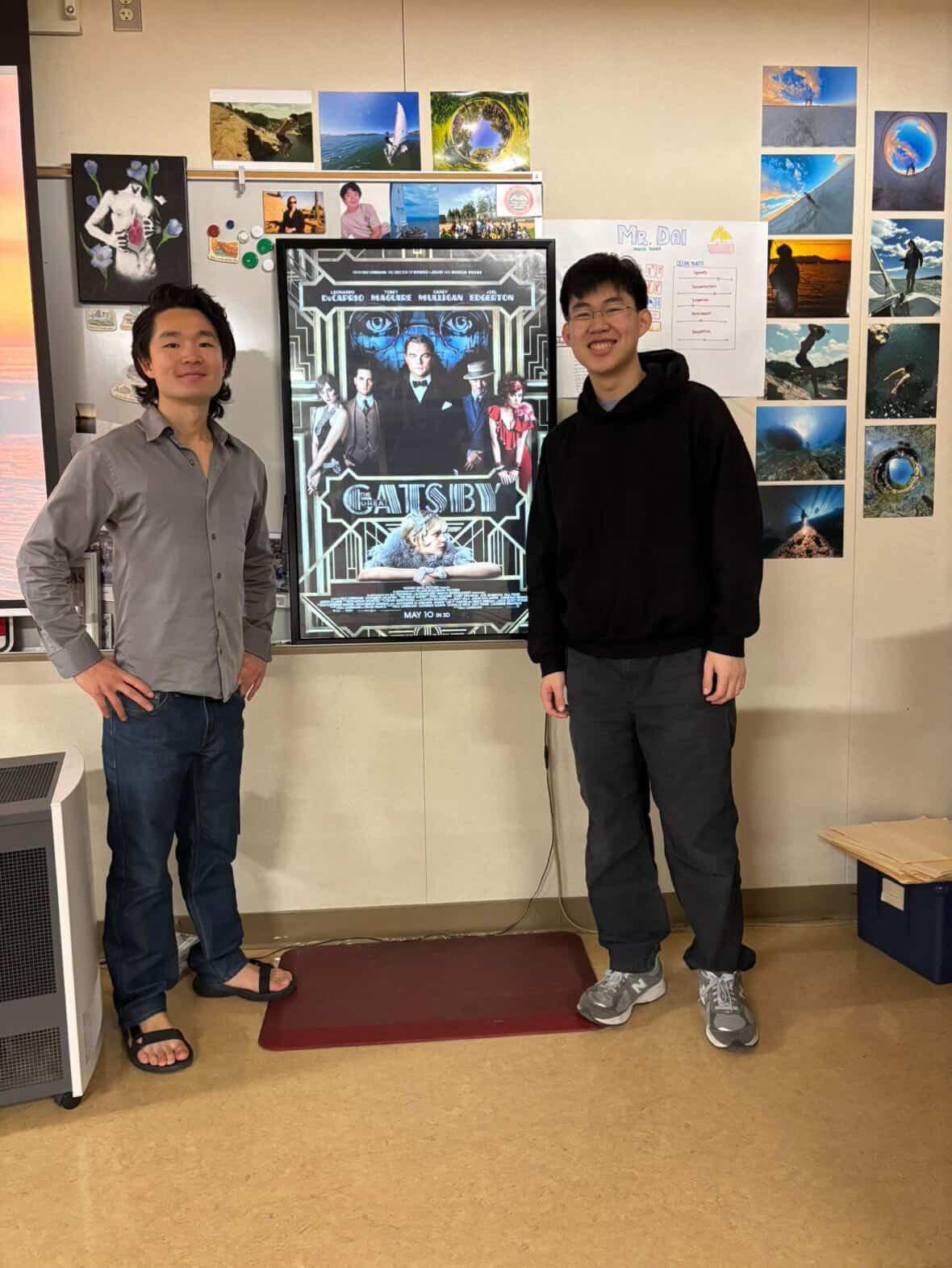
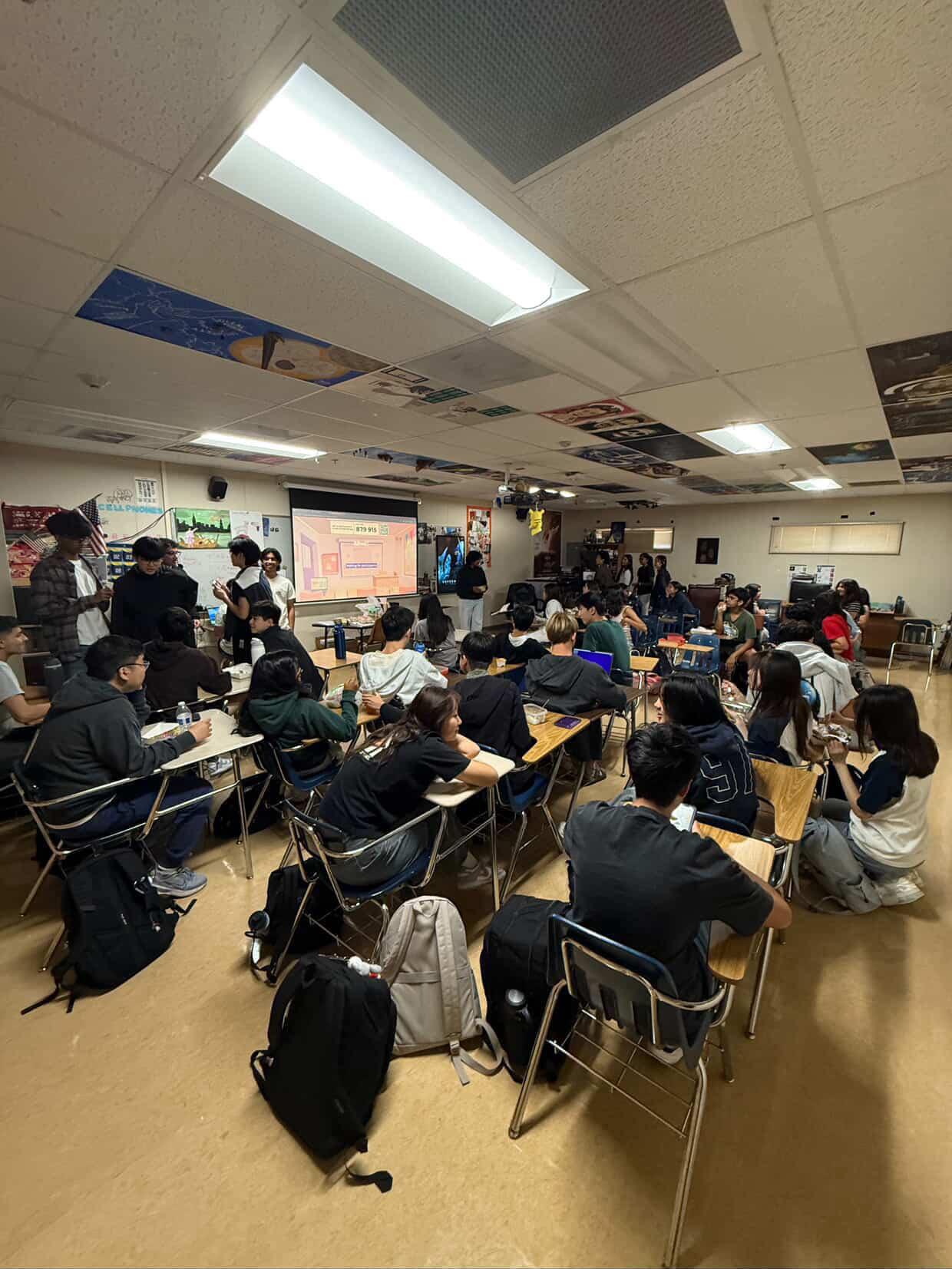


them,” Film Club Outreach Director Junior Tim Nguyen said. eir mission is to make people feel comfortable and secure, allowing students to fully immerse themselves in the world displayed on the

By hosting these regular events, the club aims to expose students to the culture of lm, which Film Club Adviser Chelbert Dai notes is something becoming increasingly rare. “I think for a lot of people, especially this generation, that exposure [to lms] is coming later and later in life,” Dai said. His hopes that the club will teach the next generation how to be more engaged and apprelms in a world that increasingly depends on short form content. By hosting movie screenings in the C120 auditorium, featuring holiday-themed lms, and o ering free popcorn, the club aims to recreate the communal experience of cinema that theaters ese events have helped the club gain visibility and establish itself as a space for students to relax and feel at ease.
lmmaking with accessible events like movie nights and social media polls, the club has expanded its reach beyond a small group of students. As the club continues to grow, they hope to leave a lasting impact on the student body, reminding its members that creativity is just as essential as academics.
From cannibal cults to LA anthologies, SF IndieFest’s 28th year proved indie flm’s heart beats far outside Hollywood.
Sta Writers
A metal girl band stuck in a desert with a cannibal cult, a spliced-together anthology of ordinary lives in Los Angeles, and the last two days of a disgraced corporate mogul’s life in the countryside don’t seem like the average theme for a movie marathon. And yet, over the course of 10 days during the 28th Annual San Fran cisco Independent Film Festival (SF IndieFest), these features came together to celebrate one thing: independent lmmaking.
e festival began in 1998, when promoter Je Ross found that there was no local venue available for his friend, Director Rand Alexan der, to show his independent lm. As any good marketer and friend would, Ross rose to the occasion to put on a four-day event with his money, thus founding SF IndieFest. e rst showing occurred in January of 1999 and attracted more than 3,000 audience mem bers. e SF IndieFest has since established itself as an event where independent ers and audiences alike come together to ap preciate the complexity of cinema. Despite the ebbs and ows of art engagement in the past 28 years since the festival’s inception, SF IndieFest continues to maintain and support its original
diences, viewers settled in with popcorn and snacks from the concession stand, with the warm ambience creating a sense of intimacy. Screenings lasted throughout the day with genres ranging from heartfelt drama-comedies to gritty, Tarantino-esque thrillers. Before and after the showings, directors and lm contributors introduced themselves and discussed their projects. Questions were opened to the audience, allowing lmmakers to discuss their artistic processes further.
e task of making a lm without the support of a large budget and major studios is one that relies entirely on dedication toward achieving a creative vision. e procedure of being able to push an non-studio lm out there for audiences to see isn’t exactly easy, either. However, the e ort put into the creation is entirely worth it. Independent lms are not only important for the allowance of artistic expression that would otherwise be con ned by
quels and reboots. [We should] support originality. Original lms [are] important,” Stephens said. “I think that indie lms are allowed to have fewer restrictions. Ultimately, a more original viewpoint can be shared … and I think that is what we need.”
Independent lms grant more creative control over what happens in the projects, allowing independent lmmakers to challenge the status quo. Director Donnie Hobbie’s Jump Scare revolved around the marriage between horror and comedy, which peaked with a dance montage of the cannibal cult leader, a blender, and a certain type of meat. e feature was bloody, a little macabre, and entirely unconventional given the plotline and the humor used — yet it allowed for Hobbie to explore his newfound obsession with the horror genre. e same went for Director Kevin Luna, whose self-produced project, I’m a Stranger Here Myself, debuted
at SF IndieFest. Based on his rst impressions of Los Angeles, Luna envisioned the movie to be slow-burning, something that people would play in the background whilst doing other tasks. “I didn’t really have to answer to anyone, or think twice about what I was going to do. I didn’t have to consider the commercial viability of it, for better or for worse. Freedom is what you get when you’re making independent lms,” Luna said about his new lm.
Ultimately, the 28th SF IndieFest accomplished what it had always set out to do: create a space for indie lmmakers and lm-lovers alike to express themselves. With the help of Roxie and SF IndieFest serving as a forum for independent lmmakers, more and more creatives can present their work to wider audiences each year. “ is festival has been so kind to us. We’re really grateful to be here,” Stephen said. “ e spirit that [SF IndieFest] is encouraging is a really special, unique one that you don’t see all the time these days.” In movies with unorthodox storytelling — self-described “Texas Chainsaw Massacre rip-o s” — there is always a lm unique and exciting that was created from real passion for the arts. “You make a weird lm, and maybe it’s di cult to watch, or there [are] aspects that are rough, but through that act of creation, through having that freedom, the language of cinema progresses,” Luna said. e 10 days of the SF IndieFest 2026 shared only a fraction of the innovative minds of small lmmakers, yet the festival’s dedication toward supporting the indie arts was paramount. In an ever-changing eld where originality struggles to surface, being able to nd a space to share indie projects allows the con nes of typical lmmaking techniques to expand. SF IndieFest not only created that avenue, but also continuously bolsters any type of cinematography, all in the name of fostering community and upholding the deeply personal works of creatives.

The Aspiring Scholars Directed Research Program (ASDRP) is a 501(c)(3) private research institution in Fremont, CA. ASDRP is the Bay Area's premier precollegiate research & development institution, run by a consortium of highly skilled scientists, engineers, and researchers with years of academic and industry experience who collectively seek to push forward the current frontiers in biology, chemistry, physics, computer science, psychology, medicine, engineering, and more.
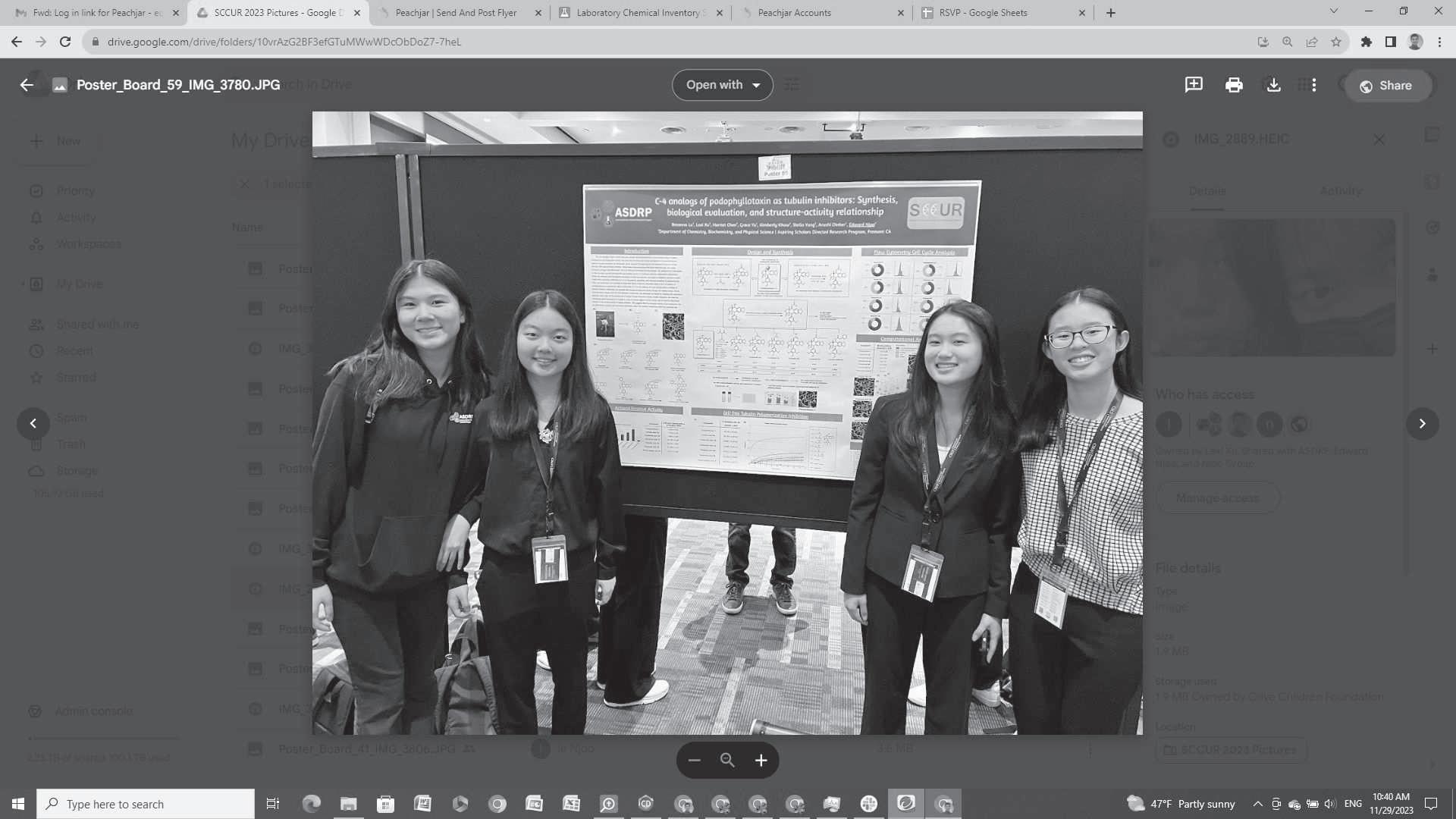
Spring 2026
Early Application Deadline: November, 2025
We mentor high school students - budding scientists in 9th through 12th grade - who come from every corner of the greater Bay Area, California, and across the United States. We seek student researchers who are passionate, who are unafraid of a steep learning curve, and who want to be involved in real science that has real impact on society
[Scan to read past student work]→
Final Applications Due: December 30, 2025
Summer 2026
Applications Open: October 2025

February 1, 2026
Final Applications Dues: April 15, 2026
Applications are competitive, and each term, ASDRP receives far more applicants than there are open research Apply online at



By Alex Duan, Veer Mahajan & Matthew Zhang Staf Writers
In October 2025, Department of Homeland Security (DHS) Secretary Kristi Noem’s statement that Immigration and Customs Enforcement (ICE) “will be all over” Santa Clara, the host for Super Bowl LX, sparked outrage in the sports community.
The threat of ICE presence created public backlash that included protests around Levi’s Stadium, social media campaigns, and even statements from members of Congress. “I want every person in Santa Clara, residents, workers, business owners, and visitors, to feel safe celebrating with us,” Santa Clara Mayor Lisa M. Gillmor said during a press conference about ICE’s presence at the Super Bowl.
Trump’s immigration crackdown comes at a time when the US is poised to host large sporting events, including the FIFA World Cup and the 2028 Olympics. Not only do these events bring together sports fans from across the world, but they also foster tourism, cultural exchange, and economic growth, making them signifcant indicators of national success. Introducing ICE creates a tense atmosphere full of fear and apprehension regarding raids and deportations, for immigrants both living in and visiting the US, heavily damaging the typical enjoyment and economic gain. The presence or potential presence of ICE can threaten these events in multiple ways: economically, psychologically, and diplomatically. It discourages immigrant and international participation, generates anxiety about documentation checks or raids, and creates a perception of hostility among host countries.
get increase from $10 billion to $29 billion under the One Big Beautiful Bill Act, however, ICE has now expanded from searching border zones to community areas and the general public, and even at a raid on a child’s birthday party. With the perception that no setting is

This fear of raids is not unfounded. Throughout the 21st century, ICE has carried out millions of deportations. Following a bud-
off-limits, the mere suggestion of ICE presence at a sporting event carries signifcant weight. ICE refects a pattern of applying political pressure to non-political organizations like the National Football League (NFL). The NFL’s decision to have Bad Bunny, a vocally anti-Trump artist, headline the half- time show directly opposes the president’s political messaging. In response to this, the Trump admin-
By Gaura Amarnani & Aaqib Zishan Staf Writers
As the confetti fell, the 2025-26 NFL season came to an end with the Super Bowl. While their opinions varied, each Smokie’s personal snapshot came together to form a complete Super Bowl experience that was much bigger than football.
“I didn’t [think the game lived up to the hype] because, honestly, it was super defense sided, and that kind of just made the game kind of boring for the entire thing, and also added with the fact that it wasn’t really a close game” — ALEX DUAN, 12
“I thought it was pretty interesting how [the half-time performance] was done entirely in Spanish, and I think that really kind of sets the tone for the representing Hispanic people in the US.” — WARREN SU, 10
“I really liked [the halftime show.] I was a big fan of the bushes and everything for the setup. I also think it was very cute at the end when [Bad Bunny] handed his Grammy to the kid. A lot of people online said it was the same kid that was taken by ICE, so I thought that was very thoughtful of him to do.” — BRITTANY LU, 12
“ e narrative of togetherness, America, diversity and culture, Latino culture and all the other cultures make America what it is, I thought that was so beautiful ... It was really profound, all of us together, and that American identity is so much more than a natural example.” — PADMA BAL AJI, 12

istration suggested sending in ICE, likely to assert federal authority and remind the organizers that large events do not prevent immigration enforcement priorities. ICE has a history of increasing raids in cities like Chicago and New York after local off- cials limited cooperation with federal immigration authorities; in Chicago, a judge signed an order in Oc-

tober 2025 barring ICE from arresting people at courthouses, resulting in an immigration crackdown, according to the Chicago Associated Press. This demonstrates how the tensions between ICE and local offcials are increasing. Rather than following ICE’s mission statement of “protecting America from cross-border crime and illegal immigration,” the Trump administration uses ICE as a private militia to exert government infuence on sporting events at home and abroad. Because of ICE’s controversial actions, there has been strong backlash from protesters across nations. During the Super Bowl, more
than 15,000 participants marched around the perimeter of Levi’s Stadium to protest Secretary Noem’s claim of ICE activity at the event. In Milan, Italy, at the Winter Olympics, reports of ICE agents sparked similar opposition, with local residents taking to the streets to protest their presence. The Olympics are a “moment of celebration, unity and economic opportunity, not fear, polarization and violence,” Rep. Ro Khanna said in a press release with 21 other members of Congress. Although the DHS presence was later revealed to be a standard diplomatic security package, Trump’s consistent use of ICE as a private army to enforce his own will on sporting events has shaken the Italians up. “This is a militia that kills,” Milan Mayor Giuseppe Sala said to local media.
Sports have always been a medium for bridging cultures and celebrating differences through the thrill of the games. Maintaining the integrity of sports as spaces of unity requires transparency between organizers, athletes, and the audience, in addition to clear boundaries between immigration enforcement and public events, neither of which has been respected by the Trump administration. When political whims and demands endanger and even dismantle long-held traditions, it is incumbent on every fan to take back the integrity and enjoyment of sports. Change can be realized through peaceful protests and social media advocacy, necessary actions to counter organizational corruption. Rejecting the division and fear perpetuated by Trump’s administration is a vital step towards asserting a clear truth: sports must not be a place for the federal government to forcefully impose a conservative agenda. ▪
Compliled by Kanupriya Goyal, Erika Liu & Lucas Zhang Staf Writers



49ers suffer astounding loss at Seattle
In what’s been described by The San Francisco Standard as a “playofs disaster,” the San Francisco Bay Area 49ers, a professional football team which has long boasted a premier position in the NFL, has sufered signifcant and unexpected losses, killing hopes of the team’s participation in the national Super Bowl. Bereft of key players Nick Bosa, Fred Warner, and George Kittle, the team sufered in its performance in Seattle, where a 6-41 match left the players completely scattered. The team was already balancing a difcult situation — too many of its key players were injured, and the opponents they were facing, the Seattle Seahawks, were formidable. As the season closes, the 49ers will have to replenish their tattered roster and regroup.
NBA All-Star Game Spotlights international talent
On February 15, top NBA players including LeBron James and Anthony Edwards participated in the 75th Annual AllStar games, which introduced a USA vs. World format for this year. The competitive format pitted the veteran USA Stripes team against the USA Stars, a team of young athletes, and the World team consisting of players outside the US, including Nikola Jokic. The win by the Stars team highlights a shift in the dynamics of the league toward newer players, continuing the trend illustrated by the Oklahoma City Thunder and the Indiana Pacers’ battle in the 2025 NBA Finals. The event consisted of three games in a round-robin format followed by a championship match between the top two teams, which lasted 12 minutes each. Following the exhibition matches, NBA teams will begin planning for the second half of the season.
Team USA Women bests Finland in Olympic Opener
On the frst full day of competition at the 2026 Milano Cortina Winter Olympics, Italy’s Francesca Lollobrigida set an Olympic record to win gold in the women’s 3000m speed skating, while Norway’s Anna Odine Strøm claimed the women’s normal hill ski jump title. In ice hockey, Team USA’s women opened strong with a 5–0 victory over Finland as competition intensifed across sliding and snow events worldwide. Despite a minor norovirus disruption earlier in the tournament, Finland and Switzerland returned to play, and Olympic ofcials emphasized health precautions while athletes focused on medal contention. Domestically, US college athletes also marked National Girls and Women in Sports Day with special recognition and games across campuses, highlighting the growth of women’s athletics nationwide.

By Kelly Shi & Andy Zhang Staf Writers
Sitting on the cold iron sideline benches, ve-year-old Alice Wang shift- ed her head left and right as her

to dominate national competitions, winning two more USA Junior National Championship titles in consecutive years as a freshman sophomore. In addition, she also decided to join MSJ Varsity Badminton in her freshman year, immediately making an impact and helping them win the NCS Championships. However, with the increased workload of high school curricula, Wang faced the challenge of balancing badminton with acarst, she avoided training order to study for exams, but further up in high school, she began to use training as a break from studying.
“When I got a little bit older, I started feeling that every time I went to training, it just felt like a brain break from studying and everything. I also got a lot better at utilizing my time at school, so I was able to go to training with a very focused mindset, rather than thinking of all the work I
As a result of her dedication, Wang was eventually appointed as a captain in her junior and senior years, leading the team to three consecutive NCS championship However, age the team always an a team is very you do while in training,
but also behind the scenes work, like managing new team shirts and making the lineups for meets and stu , but I think it’s pretty fullling,” Wang said.
But competing at an international level proved to be a new set of challenges. “ ese bigger tournaments are very di erent from the junior tournaments that we play in the US,” Wang said, “I think there’s actually a lot less pressure on playing on the international level. Because honestly, I’m not expecting much. It’s more of a challenge for myself.” ese tournaments taught her to step outside of her comfort zone and learn from the world’s top players, paving the way for Wang to become a better and more con dent player.
Wang’s academic and athletic career continued at UCLA where she is studying computer science and has joined the collegiate badminton team. At college, Wang observes how badminton bridges people across di erent demographics and identities by connecting them through a mutual interest. “I think since coming to college, I’ve realized that there are people from all di erent places [and] backgrounds,


and we’re all kind of brought together and united [by] badminton, and it really broadens your horizons,” Wang said. Although she doesn’t plan to pursue a professional career, as her journey dominating on the court continues, Wang still feels a trace of the ve-year-old girl inside her — eyes wide, heart racing, captivated by the ight of the shuttlecock.







By Cecilia Cheng & Fiona Yang Staff Writers

Lively pop music welcomed visitors into the Harajuku Lunar New Year Fest at Almaden Lake Park on February 7, located at 15780 Almaden Expressway in San Jose. Nicknamed “ e Bay’s CUTEST Lunar New Year Fest,” this holiday event features more than 60 small businesses to celebrate art, culture, and the coming new year in the Bay Area.


For Brenda Trejo, a frequenter of anime-related events, the Harajuku Lunar New Year Fest is a community focused way to enjoy local art and jewelry. As Trejo drove into the event, a large mural of a with bold black lines, pink ombres, and vibrant blue blocks greeted her. “I see a lot of people already; [this festival] spreads culture and enjoyment for everybody. I see a lot of little kids having fun with all the little stu [here],” Trejo said, recounting rst impression of the event.


ese awe-struck reactions from visitors were what inspired the festival in the rst place. ree years ago, Harajuku Marketplace opened with the focus to create a central hub for anime fans, especially those of Studio Ghibli, Sailor Moon, and Pokémon, and increase exposure to diverse Asian cultures and cuisines in the Bay Area. Since then, their events have grown signi cantly, drawing in more than 2,000 attendees this month and as many as 20,000 for larger celebrations such as Easter. e pungent smell of sizzling barbecue welcomed visitors, fostering an atmosphere of eager anticipation. Vendors and guests alike moved cheerily to upbeat pop tracks such as “Closer” by e Chainsmokers, “3D (feat. Jack Harlow)” by Jung Kook, and “Cupid” by FIFTY FIFTY, enjoying the bustling atmosphere. In the parking lot, two rows of small business stalls dedicated to bringing attendees local art drew in crowds of customers, all excitedly gathered around booths of handcrafted jewelry, blind boxes, and vibrant art prints while happily chatting with vendors about their respective products. At the edge ered treats from multiple Asian cuisines, bringing attendees avored desserts, and Asian baked goods, a taste remi niscent of street vendors in bustling night markets halfway across the world. “I kind of wanted to bring to my community things that I felt were lacking when I was growing up in the city, so it was one of my goals to create a marketplace that embraces my Asian culture.” event founder Samantha Larot said.












“It's a reading hobby. It's a literate reading hobby ... you can have good coversations [with customers] so I appreciate that. “ -- Treasure Island Comics ownerAlex J.
Comic book stores are more than just a place to discover new stories and collectibles; they provide a physical space where readers and collectors alike can connect over shared interests and engage in thoughtful discussions. Through events, unique selections, and fostering connections, these stores help sustain a vibrant and ever-growing community built around creativity.
Sitting inside a converted garage on 37244 Fremont Blvd., Treasure Island Comics prides itself for its large selection of new releases and vintage issues. Despite its modest exterior, the inside is clean, well-lit, and organized. Each series has its own row, complete with labels for every title, allowing customers to navigate the store with ease. Whether it be longtime collectors searching for speci c issues or newcomers exploring comics for the rst time, browsing is simple and ef cient. “What brings me back every time is the selection of comics that they have,” collector Rizalde Dela Cruz said. Treasure Island also prides itself on its reservation service, where customers can place certain issues on hold to pick up in store at their convenience. “I've been in town for 37 years now. I don’t know all, but I know most of the people that walk in. If [they] want to give me a list [of issues they need], I excel in nding them.” store owner Alex J. said.
Rows of warm, wooden shelves stretched in aisles in every direction, lled with books and works anxiously waiting to spin their stories to curious strangers wandering by. An abundance of vintage graphic novels, manga, board games, and gaming consoles over ow the store in a chaotic yet organized manner. At 39152 Fremont Hub, aimlessly wandering through Half Price Books is an essential experience for Fremont locals. Near the front, rows of wooden boxes contain hundreds of vinyl records, with glossy covers featuring old-school artists like Ray Charles and Johnny Cash. Just steps away, a sign reads “Comics are $1.99 unless priced as marked,” offering popular, second-hand graphic novels such as Spider-Man for one of the cheapest prices across Fremont. Most customers are particularly drawn to thrift book stores due to their passion and early reading experiences. “I grew up reading comics, especially classics like Calvin and Hobbes,” a shopper shared. “[It] sparked my longtime in- terest in this genre.” With its wide selection and affordable prices, Half Price Books continues to welcome readers of all ages to rediscover old favorites while exploring new stories.
I care about what my customers, regardless if you're my customer or someone else . . . I'm here to help . . . I want the customers would be super happy. You have to be emotionally invested in not just comic books, but your customers [too]” ---- Chris’s Comics owner Chris McNally
Located on one of the busiest streets in downtown San Jose, comic and collectibles store SpaceCat stands at 1415 W San Carlos St., welcoming fans of all different types of passions. This shop specializes in comics, vintage video games, Pokémon, Magic the Gathering, and other . . . Being both the largest and oldest comic store in San Jose, this unique shop has built a strong reputation within the community for their expansive collections of all comics. However, what truly sets SpaceCat apart from other stores is their emphasis on personal connection and customer service. “I think we do a very good job at knowing what people’s interests are and being able to communicate with people as they come in,” an employee said. Staff members make an effort to learn what their customers are into, whether it be Spider-Man, Batman, manga, or trading cards. “You meet a lot of people who are very passionate [about comics and collectibles], but they’re a little quiet. So when they come to the store, if you can spark that interest in them, you can get people to open up” an employee said.

When customers walk into Chris’s Comics on 5409 Central Ave., they are immediately welcomed with the lively chatter of staff and collectors. Boasting more than 65,000 issues, the store prides itself on having a large selection of comics for customers to browse. Shelves near the entrance are lined with comics and manga, stacked in order of titles and easy to identify. Toward the back, a large game table watched over by gurines and action gures serves as a spot for collectors and staff to trade collectables, negotiate prices, and play role play games like D&D.
Along the walls, rows of Funko Pops from a wide range of franchises create a colorful, densely packed display for customers to enjoy. “[The most rewarding thing is] whenever someone comes in and I know exactly what they’re looking for, I can help them nd [it]. Their faces light up, and everything’s great … I want the customers to be happy about what they see and get.” owner Chris McNally said.