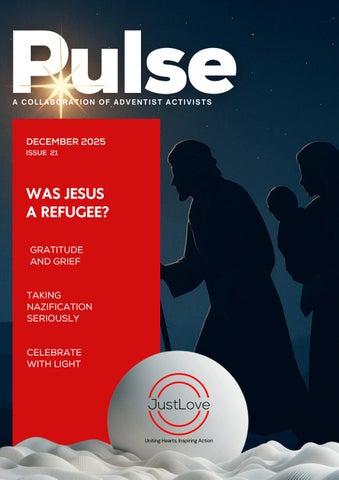
PULSE Issue: 21

Page 1


DECEMBER 2025

ISSUE 21

WAS JESUS A REFUGEE?

GRATITUDE AND GRIEF

TAKING NAZIFICATION SERIOUSLY CELEBRATE WITH LIGHT

WAS JESUS A REFUGEE?

Working in church contexts and with faithbased justice agencies and advocates, it is common to hear those who speak on refugees and asylum seeker issues appeal to the story of Jesus and His family’s escape from the military threats of Herod’s army as a reason for identification with and compassion for the plight of refugees and other immigrants in the world today In its simplest terms, it is urged that “Jesus was a refugee.” But is such a statement accurate in the context of contemporary political debates?

The story is told in Matthew 2 Sometime after the birth of Jesus, a group of “wise men from the east” arrived in Jerusalem, searching for “he who has been born king of the Jews” (verses 1, 2).* This caught the attention of Herod the Great, the Roman-appointed king of Judea from about 34 BC to his death in about 4 BC After consulting with these wise men and Jewish religious leaders, Herod was able to ascertain the place and time of this birth and sent soldiers to kill “all the male children in Bethlehem and in all that region who were two years old or under” (verse 16). However, according to the biblical narrative, Jesus’ father Joseph had been warned in a dream to escape to Egypt, so avoiding this “massacre of the innocents.” Jesus’ family remained in Egypt until the death of King Herod likely a period of a few years before returning to their home in Nazareth.

In terms of Article 1 of the Convention and

were targeted is explicit in the story, even if these identification and claims were made about them, not by them. The violence from which they escaped demonstrated the reality of the threat against them

Is such a question accurate in the context of contemporary political debates?

The challenge of identifying the family of Jesus as refugees under the modern definition hangs on the understanding of the nation state, less recognized and less defined in the ancient world Haddad points out that “jurisdictional boundaries in the medieval world were more porous and overlapping than the rigid, impenetrable borders of the modern world ” Such porous boundaries were even more so in the ancient world and under the broad reach of the Roman Empire in the first century BC Both Judea and Egypt were merely provinces and their rulers appointed by the authority of Augustus Caesar, whose jurisdiction was

acknowledged in the other biblical birth narrative of Jesus (see Luke 2:1).

By this technical definition, the claim “Jesus was a refugee” is inaccurate: “As nation-states are constructed, so the refugee is also constructed and the two concepts in some sense reinforce each other ” The absence of sufficiently border-defined nation states in the ancient world precludes the possibility of this designation [2]

However, that Jesus’ family found protection in Egypt, beyond the reach of Herod, his soldiers, and his threats demonstrated a clear refugeelike experience Daniel Carroll’s summary is more correct: “The migration of this family locates the Jesus story within a movement that spans history, of people desiring a better life or escaping the threat of death.”[3]

While not as pithy, this should illicit no less empathy and compassion from those who claim this story of faith as formative for their lives and public engagement. As Jesus would put it later in His life, identifying with these are so many other human experiences, “I was a stranger and you welcomed me” (Matt 25:35)

Or not (see Matthew 25:43–45).

*Bible quotations from the English Standard Version

Emma Haddad (2003), “The Refugee: The Individual between Sovereigns,” Global Society 17(3), p 302

[3]

[1] Ibid, p 299 [2] Daniel Carroll (2013), Christians at the Border: Immigration, the Church and the Bible (2nd edition), Brazos Press, p 106

WHO DESERVES SNAP? JESUS HAS A PARABLE FOR THAT

Whenever government food assistance programs enter the news cycle, the conversation tends to focus on whether recipients are deserving. For example, Republican members of Congress have accused SNAP recipients of not having jobs and wrongly claimed the program benefits undocumented immigrants. Louisiana Representative Clay Higgins said on X that any SNAP recipients who didn’t “have at least one month of groceries stocked” in advance should be ineligible to continue receiving benefits and “stop smoking crack ”

It’s ugly sentiments like this that underlie the Trump administration’s cruel use of hunger as leverage to pressure Democratic senators into signing the Republicans’ continuing resolution, all while Trump himself drags its feet on a court order to make full SNAP payments despite the shutdown Meanwhile, food pantries are being stretched beyond capacity, with families, children and the elderly going hungry just weeks before Thanksgiving Given this, the question of whether or not these people are truly deserving is not just political negligence. It is deeply immoral.

For one thing, many of these complaints are caricatures about SNAP recipients just aren’t true: In 2024, roughly 1 in 8 Americans were enrolled in SNAP; 39 percent of the beneficiaries are children and about 30 percent are seniors or adults with disabilities. Most SNAP recipients who are working age and non-disabled are either

employed or are actively seeking work.

But more importantly, I don’t think “Who deserves help?” is the right question for Christians to ask. At least, I’m glad that’s not the question Jesus asks

I don’t think “Who deserves help?” is the right question for Christians to ask.

A Question that Deserves an Answer

When a law expert once asked Jesus “And who is my neighbor?” Jesus replied with the parable of the Good Samaritan (Luke 10: 25-37). You probably know the story: A man is left for dead on the side of the road after having been robbed; two different religious leaders see him in his dire condition, but they refuse to help, walking past on the other side of the road Then a Samaritan an ethnoreligious group that was despised and distrusted by many of Jesus’ listeners sees the injured man and not only bandages his wounds, but carries him to an inn, pays for a room, and gives two silver coins while offering to reimburse the innkeeper any other costs associated with the man’s recovery In other words, the Samaritan goes above and

beyond what typical standards of compassion would normally entail both in the first century and today

It is easy to overlook that Jesus uses this parable to challenge questions about who deserves our unreserved compassion Some Jews viewed Samaritans as being religious heretics or ethnically impure because of their intermarriage with non-Israelites after the conquest by Assyria; in other words, some people in Jesus’ day would not have considered Samaritans to deserve generous care. Jesus upends expectations of deservedness even further by making this despised “other” the bestower, not the receiver, of compassion; it’s a dramatic power reversal

For us today, the parable prompts us to ask who we despise, distrust, and don’t see as deserving whether that be people in blue or red states, of another race, political party, religion, or sexual orientation then imagine a world in which our fortunes were reversed and those people extend care to us For Jesus, that is what being a neighbor means: sacrifice, generosity, and abundant compassion flowing in a direction that defies all our norms and biases.

Trump has done the opposite: Over the course of his second term, he has escalated “us versus them” rhetoric that demonizes his opponents, admitting at Charlie Kirk’s funeral he hates his opponents and doesn’t want what’s best for them. After the shutdown began, he specifically stalled funding for projects in blue states and claimed that he will target “democrat” programs in order exact retribution. And while the need for food assistance isn’t a red or blue issue hunger impacts voters of all political parties he’s withholding food assistance to gain political leverage. Applying Trump’s action to the parable of Good Samaritan, he seems to be cheering on the robbers as they hurt those he despises, refusing to offer any kind of aid until it is politically expedient.

If we took Jesus’s words in the parable seriously, people of all political persuasions would be working to provide relief for hunger now without regard for whether those who need SNAP benefits vote like us or what political

benefit we might secure for our preferred party by waiting. Following the extravagant generosity of the Samaritan, we’d recognize that while SNAP benefits are essential to those who receive it, they are often insufficient to meet the fullness of what folks need; we’d look for ways to offer even more access to food support, not less.

And as we went above and beyond to help the millions of people who are hungry, I would hope we’d ask a deeper question: Why are so many people in need of food assistance in the first place?

An Answer that Is Far Too Obvious

It’s both a question wrapped up in both politics and our sense of morality and many of the choices we’ve made collectively as a country.

Politically, we have created systems that allow poverty and extreme inequality to thrive. In recent years, income concentration and wealth inequality in the U S has rivaled or exceeded that of the 1920s (which makes Trump’s decadent “Roaring ’20s” party especially tone deaf amid a protracted government shutdown) In Poverty, by America, sociologist Matthew Desmond shows how people in or near poverty are forced to overpay for housing and access to cash and credit exploitative policies we could choose to change but haven’t. As a result, opportunity is often stratified due “to zones of concentrated riches alongside those of concentrated despair,” writes Desmond.

Amid such growing inequality, it’s not surprising that 5 million more people receive SNAP benefits today than before the COVID pandemic. Many on the political Right have sought to impose more stringent work requirements and onerous paperwork on SNAP benefits, despite the fact that the majority of its recipients are already working, are seeking work, or are disabled or elderly So, in the simplest terms, many adults and families need food assistance because they are being paid poverty or near poverty wages; housing and rental costs keep rising; the cost of life essentials

have increased; and unemployment is creeping upward.

Morally, we’ve shown little appetite as a country for helping those who are most harmed by this inequality. The government programs that make up our social safety net remain some of the weakest in the world compared to other wealthy nations. For example, the U.S. ranks in the bottom third of wealthy nations for child poverty reduction In 2021, Congress allowed a major expansion of the Child Tax Credit to expire, despite the fact that it helped cut child poverty rates in half The Center on Budget and Policy Priorities estimated that due to the recently passed reconciliation bill, “about 4 million people, including children, seniors, veterans, and individuals with disabilities, will see the food assistance they need to afford groceries terminated or cut substantially.”

While we can have healthy disagreements around the best policy prescriptions to care for vulnerable people in our communities, we have to first decide that we see a moral obligation to make bold changes especially when we consider that so many people are on SNAP because of our previous choices.

The pressing question remains: Will we individually and collectively go the way of the religious leaders who passed by, or will we follow Jesus and go the way the way of the Good Samaritan? As individuals, being a good neighbor

right now means more sacrificially offering our time, money, and mutual aid to food banks, churches, and other groups who are offering help to those being hurt by this painful pause in food assistance. We can do this even as we know that these individual efforts cannot fully replace a government program like SNAP: Feeding America, the largest hunger relief organization in the U S , estimates that for every one meal their network of 200 food pantries provides, SNAP provides nine.

Collectively being the Good Samarian involves applying maximum political pressure on Congress to bring greater urgency to address the root causes of growing hunger. We can generate pressure by calling our representatives, or, better yet, visiting them; almost all members of the House of Representatives have been in their home districts since Speaker Mike Johnson has imposed a recess during the shutdown. We can write op-eds, join in vigils and protests, and raise awareness about the urgent need to restore SNAP

The parable of the Good Samaritan prompts us to expand our circle of concern and extend abundant compassion In our current political situation, that means replacing a politics of exclusion and cruelty with a politics of neighborly compassion that prioritizes the common good

THE CHURCH BETTER START TAKING NAZIFICATION SERIOUSLY

After Tucker Carlson platformed neo-Nazi apologist Nick Fuentes on his podcast, the Heritage Foundation’s president, Kevin Roberts, issued a statement defending Carlson. Roberts denounced what he termed a “venomous coalition” of conservatives who called out the interview because they oppose any “no enemies to the right” posture that includes Nazism. In the days since, some Heritage Foundation staffers have told reporters that the controversy revealed for them how many of the youngest staffers and interns actually agree with Fuentes This comes only weeks after text messages from multiple Young Republicans groups were leaked, showing racist, antisemitic, and pro-Hitler messages

No Longer Insignificant

This matter is crucial for the future of the country, but the stakes are even higher for the church It is well past time for the church of Jesus Christ to take this seriously The first step to seeing how to do so is to ask, “Why do so many evangelical pastors and leaders not take it seriously now?” Already some constantly online young men who profess to be evangelicals are winking and nodding with HH references and “noticing things” memes while commending the ideologies of Nazis such as Carl Schmitt Some older leaders don’t take it seriously because they think the numbers of these young men are so few, and some because they think the

numbers are so many.

Those who think the numbers are too few will wave away concerns with phrases like “Online is not real life,” usually pointing out that very few of these social media trolls are preachers or pastors They will note that those who are preachers are typically in front of tiny congregations and spend most of their time podcasting and posting back-and-forth arguments online all day. That is true and is utterly beside the point.

This matter is crucial for the future of the country, but the stakes are even higher for the church.

Those who say such things do not understand how almost every fad good, bad, and neutral that has swept through evangelicalism has taken hold. These trends start out in small groups of people that are not large enough to be taken seriously by “successful” leaders. These small communities then cultivate the fads until a couple people with bigger platforms adopt them Then, seemingly suddenly, they are everywhere. Power evangelism, prayer walking,

seeker-sensitive services, laughing revivals, New Calvinism all of these (and again, some of these things are good, and some are not) happened that way.

Journalist Jonathan V. Last once described how systems fail: “When the bad guys win, it’s always because they are enabled by the weakness and wishful thinking of people in a position to stop them ”

The greater problem is with the evangelicals who say nothing because they think the numbers are too great. They will pivot the discussion and say that “this is what you get” when some objectionable thing happens elsewhere as though we were talking about kindergartners Whatever your theology proposes about the age of accountability, I think we can all agree that a 25-year-old is well past the bar. Others will argue that, though they wouldn’t have done it this way, there’s a vibe shift in this direction that we have to recognize.

Just Going Along

During World War II, American journalist Dorothy Thompson described this type as “Mr. B” in her famous essay “Who Goes Nazi.” She wrote, “He fits easily into whatever pattern is successful. That is his sole measure of value success. Nazism as a minority movement would not attract him As a movement likely to attain power, it would ”

The mentality which suggests that laughing at sexual abuse or using denigrating slurs for those with disabilities or wink-wink-nod-nod sending around Nazi memes is evidence of a “vibe shift” is perhaps understandable for a pagan who believes the zeitgeist is lord But for a Christian who has read any page of the Old or New Testament, that’s incomprehensible.

Jesus said, “For false christs and false prophets will arise and perform great signs and wonders, so as to lead astray, if possible, even the elect” (Matt. 24:24, ESV throughout). The description of the Beast of Revelation is of nearuniversal popularity and success: “Who is like the beast, and who can fight against it?” (Rev. 13:4).

When the popular will becomes the standard of truth, we move from silliness in the best of

times to cruelty in worse times and to the death camps in the worst of times. This is a call, as Jesus put it, for “endurance and faith” (verse 10). Call it a “vibe shift” if you want.

The vibe-shift view is precisely what led the Confessing Church of 1934 to stand up against German Christians, the religious party associated with Adolf Hitler. The Confessing Church’s statement said, “We reject the false doctrine that the Church could and should recognize as a source of its proclamation, beyond and besides this one Word of God, yet other events, powers, historic figures and truths as God’s revelation ” Karl Barth, primary author of the Barmen Declaration, would write later to churches in Nazi-occupied France, who seemed to be wobbling in their commitment to resist publicly or forcefully Nazi ideology:

“I cannot think that your judgment of today about the fundamental situation between Hitler and the rest of us is different from a year ago just because in the meantime Hitler has had so many good days (vividly reminding us of Job [21] and Psalms [10] and [73]) and France, together with all those other countries, so many bad days.”

Barth continued: “If that were your attitude, you would have surrendered, not merely to the German arms, but to that German philosophy which in 1933 broke out like a plague among the German people themselves In that case, Hitler would have conquered not only your country but your souls ”

What Does Resistance Look Like?

During the years of Nazi domination of Germany, writer Thomas Mann, an expatriate, broadcast a series of radio addresses to his fellow Germans, pleading with them to resist what was happening to their country. Among the atrocities, he included what he said had to be “the strongest and most ghastly phenomena of National Socialism [Nazism].” He described it with a word we don’t use much anymore, vitiate, which means “to debase” or “to corrupt ” Mentioning such glorious words as peace and patriotism, Mann wrote that Nazism “has vitiated all ideas which were supported by the best men in the world and has made them something in which no decent person wants to partake anymore.”

Conservatives, alarmed at the steps toward the normalization of Fuentes and a Nazified young right, understand this. They know this

the church does not have nuclear codes and cannot build death camps. It can only empower with its support or its silence those who do

The question is whether the gospel of Jesus Christ is true. If it is, as I firmly believe, then what happens if words like evangelical or church or salvation or (I shudder to write) Jesus are filled up with the meanings of an antichrist alt-gospel? In that case, what’s on the line for generations is a matter of eternity

We have a choice. The Bible will not sit alongside Mein Kampf. The cross will not yield to the swastika We must ask right now: Jesus or Hitler? We cannot have both

TUESDAYS WITH HALEY

My friend Haley and I are making a point this year to meet up every Tuesday afternoon with our Critical Thinking card decks in hand to recall what ridiculousness we have witnessed over the past week and how we can use our critical thinking skills to avoid being duped

One such Tuesday, Haley runs up to my office, rosy cheeks aglow, and says “I used Chat GPT to make a list of how religion uses logical fallacies and biases ”

“Let’s go to our spot. I have to see this. Now.” We race to our booth in the Student Center. I’m a slow adaptor to Artificial Intelligence (I mostly boycott it), but I have to admit, this was a stellar use of the tool.

The examples were hauntingly familiar How many times have I heard these? I gasp at the ones I have said. I think hard about the words I use when I teach Preschool Sabbath School (I have made significant changes since then) The poster we made still hangs in my office.

Haley and I were not the only ones bothered by the shortcuts in modern religion It seems that Jesus was, too And we are not the first to notice, thank God.

A few weeks later, I sent Haley a YouTube clip of John Fugelsang promoting his newest book on The Daily Show and informed her that two copies

had been ordered and were on the way. And oh, boy, our Tuesday afternoons are getting wild. Wildly deep into the true character of Jesus

In the introduction of Separation of Church and Hate: A Sane Person’s Guide to Taking Back the Bible From Fundamentalists, Fascists, and Flock-Fleecing Frauds, John Fugelsang introduces the book as a piece of comedy. As a well-churched son of well-churched parents, he uses his biblical knowledge to poke fun at the hypocrisy of Christian Nationalism and gives readers a banquet of logical ways to respond to bigoted Christian Nationalist hate speech Fugelsang does it with humor, making the book a fun read that makes his points easy to remember and fun to quote

I do not believe that many readers will agree with every single point Fugelsang offers. But readers will be forced to think critically, and that’s the goal, right?

Haley and I think so.

John Fugelsang 304 pages, US$29 99 Avid Reader Press, 2025

FEDERAL AGENTS MAY BREED COMMUNITY MISTRUST

Jaiden Booth has been keeping a close eye on viral videos in cities across the country where National Guard and immigration enforcement agents have been deployed, especially how people of color are being treated during immigration raids and protests Over the past few months, Booth, a St. Louis resident, said he has seen federal agents and unmarked vehicles in various immigrant communities around the city, which pushed him to start preparing to better support vulnerable people.

Booth came to a recent federal enforcement safety town hall in a St Louis gym hosted by local activists and immigration lawyers to learn more about trainings to monitor ICE activity. He is opposed to immigration agents or National Guard members policing communities of color, because he said it does not make them safer.

Booth fears that the presence of troops and federal agents could set the stage for more negative interactions with Black Americans, including harassment or mistreatment This is also a concern for some Black police officials across the country.

Like in most American cities, crime is down in St Louis Over the past year, violent and property crimes decreased, and the city's homicide rate is the lowest it has been in years. There have been 123 murders in 2025 to date, compared to 224 in 2020, according to the St Louis Metropolitan Police Department. Even with crime trending downward, President Trump

suggested in September that St. Louis needs help addressing crime “We've got to save these cities,” Trump said during a recent interview in the Oval Office. “This isn't like, you know, we ' re gonna do something We have to save St Louis ”

The aggressive tactics used by troops and federal agents resembles policing during the Jim Crow era.

On October 1, Missouri's Republican governor activated the state’s National Guard to help ICE agents with clerical duties St Louis Public Radio reported that 15 guardsmen will help ICE with tasks such as data entry, logistical support, and case management Neither the governor ' s office nor the state's National Guard responded to a request for an interview.

Reflections of a Dark Past

The aggressive push to send troops into Democratic-led cities and their communities of color drives a wedge between police and residents, said Donny Walters, president of Ethical Society of Police, St Louis' Black police officers union “This type of heavy-handed

tactic is pushing us backwards instead of bringing us closer together,” Walters said. “What should be done from our federal government is they should be giving us resources to help our Black and brown communities [as] opposed to feeling like, ‘Oh, we got to do more enforcement ’“

Walters is concerned that if federal agents or National Guardsmen mistreat Black St Louisans or other communities of color, it will erode the trust Black police officers worked hard to build. “Let's say they come in for six weeks, and whatever they are doing, however they are doing it, when they leave, we now are left with the fallout,” he said. “We’re now left with dealing with the community after the fact ”

Some Black police officers say there are other ways to drive down crime, and that interventions should be led by city leaders and social service organizations Said Renee Hall, president of the National Organization of Black Law Enforcement Executives, “No city is without its challenges, but what we recognize is across this country, we have seen a decline in violent crime and other crimes throughout the cities. It's due to the work that has been done by mayors, city managers, and police chiefs ”

Hall said the aggressive tactics used by troops and federal agents resembles policing during the Jim Crow era She said Black communities have been historically overpoliced, and described this as a legacy of American slavery “So now we’re deploying those same kinds of tactics that resemble the 1940s and 1950s,” Hall said. “It just sends the wrong message in the United States, when we have done so much work in law enforcement to step away from those stereotypes. . . . It’s performative and it doesn’t get us the results that most Americans are looking for, and that is actual results of reducing crime ”

PUBLIC SAFETY GROUPS FACE AN UNCERTAIN FUTURE

Six months after the Justice Department cancelled more than $800 million in federal grant money, many groups on the receiving end are still reeling. The cuts, focused on community safety initiatives, affected hundreds of organizations around the country and were farreaching in scope: school violence programs, training for rural police officers, resources for domestic violence victims, and hate crime prevention.

At the time, Attorney General Pam Bondi said the department was cutting millions of dollars in “wasteful grants,” highlighting efforts geared toward transgender and LGBTQ communities.

NPR spoke with 10 affected organizations to see how they've fared A few said their grants were reactivated, but most said they have had to lay off employees, dip into reserve funds, or shrink the services they offer

“These cuts are significant and unprecedented,” says Amy Solomon, a senior fellow at the Council on Criminal Justice and former head of the DOJ's Office of Justice Programs, the office responsible for the cuts. “When an administration gives a grant to an organization, that is a promise for the full amount. So organizations plan, they budget, they hire,” she says. Instead, the DOJ cancelled these grants in the middle of their cycle

Real People, Real Programs

At Washington Technology High School in St Paul, Minnesota, Principal Elias Oguz was

shocked when a grant-funded position at his school was suddenly cut last spring “This was named the ‘Stop The Violence’ grant,” he says. “Who would want to cut the ‘Stop The Violence’ grant?”

The money had allowed him to hire Robyn Strowder as a restorative practices coordinator, to resolve conflicts between students and build community at the school “It was very nerve wracking,” Strowder says. “There was definitely a time that I was like, 'Hey, I have a whole family to provide for and I'm not sure if I have a job '“

“When an administration gives a grant to an organization, that is a promise for the full amount.”

Oguz ended up putting $50,000 toward the position using money dedicated to school supplies, as well as other funds from the school district and community donations Even so, he’s not sure where the money will come from in future years.

Oguz and Strowder are not the only ones grappling with that uncertainty

“We have three other federal grants and know they could be terminated at any time without cause If that happens, we will have to lay off staff and end services for participants,”

Nicky Fadley, executive director of the Virginia nonprofit Strength In Peers, told NPR in a statement

The organization, which supports people with substance use and mental health challenges, laid off two employees already It had already spent about $90,000 of the terminated grant and is still waiting to be reimbursed for more than half of that amount

Many of the organizations NPR spoke with were in a similar situation, saying the DOJ has not reimbursed them for money already spent. Those that appealed the cancellations have not heard back Several organizations have sued the administration, saying the cancellations were unlawful and that they are owed thousands of dollars in outstanding expenses In a statement, the Justice Department told NPR the [recent] government shutdown is hindering its ability to consider appeals and reimburse organizations However, the department cancelled the grants five months before the shutdown began.

Outdated Methods Ineffective to Modern Problems

Almost all the cuts were to nonprofits. Solomon, the former DOJ official, says that reveals how the Trump administration is thinking about public safety. “The kind of old school thinking is that it’s only police that can keep communities safe And what we ' re seeing out in the field more and more is that communitybased organizations work as a complement to law enforcement,” she says

In fact, after the grants were canceled, DOJ officials sent a letter to Senate Judiciary Chairman Chuck Grassley emphasizing that the cuts were mostly to nonprofits, and “not to states or local jurisdictions that directly serve our communities ” “That's flawed rationale because these organizations play a really important role in their communities,” Solomon says.

“We got hit pretty hard,” says Everette Penn, co-founder and former director of the Teen and Police Service Academy, a mentoring program in Houston that had to reduce its staff He says federal grant funding has bolstered the nonprofit

world for years. “It's the government sector that funds things that often are not funded in the private sector because they're necessary to keep our society functioning,” he says.

Dwight Robson, executive vice president of operations at the community violence intervention group Roca, said the DOJ told his organization that its work “no longer effectuates” the administration's priorities Yet Robson says combatting violent crime and protecting children were among the DOJ's new listed priorities in its communications to his organization

“Those are things we think we do very, very well. We’re not of the mind that we’re entitled to any funding We’re very happy to undergo any sort of merit-based, individualized review of our performance,” says Robson. “We believe that such an examination would result in one concluding that there’s actually very good alignment between what the Department of Justice’s priorities are and our work.”

Roca had to eliminate about 50 positions, Robson says They’re now looking for other funding streams. He says Roca will get through this challenge, but he worries about the future of other groups dedicated to community safety “I'm sure there are funders that are looking at organizations and saying ‘Gosh, they’re doing good work,’“ he says “But it’s unclear whether they’re going to be there in two or three, four, five years.”

U.S. WWII CEMETERY IN THE NETHERLANDS REMOVES DISPLAYS ABOUT BLACK TROOPS

An American World War II cemetery in the Netherlands removed displays focused on Black American soldiers, sparking outrage and compelling Dutch politicians to appeal to U.S. officials to restore the information

The two displays were added to the Netherlands American Cemetery’s visitor center in September 2024 after some historians and relatives of service members criticized the site for not mentioning the unique experiences of Black troops. One plaque featured the story of George H Pruitt, a Black soldier in the 43rd Signal Construction Battalion, who died trying to save a comrade. The other highlighted how Black American service members were “fighting on two fronts” for freedom overseas and for their civil rights at home.

The displays’ removal, American and Dutch critics of the move say, signifies an erasure of Black Americans’ contributions in the war and their work to liberate the Netherlands from the Nazis It also represents an overstep in the Trump administration’s campaign to curb what it deems diversity, equity and inclusion efforts, the critics said. It’s unclear exactly when the plaques were removed

The American Battle Monuments Commission, a U.S. government agency that oversees the cemetery, did not respond to requests for comment from The Washington Post. The commission told Dutch news outlets that one panel is “off display, though not out of

rotation,” and a second panel was retired. The commission did not elaborate on either decision

Janice Wiggins, widow of Jefferson Wiggins, a Black WWII soldier who was quoted in one of the displays, said she had “a gut-wrenching feeling” when she learned the panels had been removed. “Not only reading about, but actually experiencing, how history and those who shaped it can be so easily and casually erased,” she said. “It was very personal.”

The American Cemetery previously had two displays honoring Black American soldiers’ experiences.

“The removal of the displays is disrespectful to the Black American soldiers who served and to the legacies their families cherish,” Wiggins added

A Proud Heritage

More than 8,000 U S troops who fought in World War II are buried at the Netherlands American Cemetery, a solemn site in the village of Margraten in the southern part of the

country. Just over 170 of these service members are Black Americans, a slice of the more than 1 million Black Americans who fought during World War II in segregated forces.

The cemetery is special to the local community, according to the American Battle Monument Commission’s website Residents have adopted the grave sites, bringing flowers to the cemetery for decades

“Color me concerned, disappointed, but not surprised.”

The 6,450-square-foot visitor center, where the displays about Black service members were, tells the stories of the thousands of Americans commemorated at the cemetery. One of the removed plaques described the “horrors of war” that Black service members faced while serving primarily in labor and support positions In fall 1944, the U.S. Army’s 960th Quartermaster Service Company, a mostly Black unit, arrived in Margraten “to dig graves at the newly created cemetery,” the display read, according to a photo provided to The Post. Jefferson Wiggins, a first lieutenant, recounted seeing service members under his command crying as they dug the graves. “They were just completely traumatized,” the display said

A Misguided Attempt to Rewrite History

Now there is no textual information provided about Black troops at the cemetery, said Kees Ribbens, a senior researcher at the NIOD Institute for War, Holocaust and Genocide Studies in Amsterdam. Although it’s unclear why the displays were removed, Ribbens said it’s notable that it happened during the Trump administration’s crackdown on diversity efforts.

President Donald Trump signed executive orders on his first day in office banning government diversity, equity, and inclusion

efforts. The impact has been widespread: Arlington National Cemetery scrubbed information from its website about prominent Black, Hispanic, and female service members and topics such as the Civil War. Exhibits related to slavery were removed at multiple national parks The White House accused the Smithsonian of promoting “race-centered ideology ”

“Given the emphasis the current administration puts on DEI, it doesn’t make it that difficult to start wondering if the disappearance of Black history [at the cemetery] has to do with the current winds blowing in D.C.,” Ribbens said.

In the Netherlands, the public has been baffled that anyone would see a reason to remove the panels, Ribbens said. Dutch politicians have demanded that the displays be reinstated, appealing to the American Battle Monuments Commission and the U.S. ambassador to the Netherlands.

Alain Krijnen, mayor of Eijsden-Margraten, where the cemetery is, sent a letter to the commission: “We greatly value the story of the Black Liberators in relation to the past, present, and future. In that context, we would greatly appreciate it if the story of the Black Liberators like the 172 Black Liberators buried in Margraten could be given permanent attention in the visitor center, and therefore reconsider the removal of the displays ”

The office of the governor of Limburg, the Dutch province containing the cemetery, said it also has “serious concerns ” “The displayed panels depicted a history we must never forget, and from which we can learn a great deal especially now, as global divisions are being increasingly magnified,” Bas Alberson, a spokesman for the governor’s office, said in a statement to The Post.

Janice Wiggins, the 77-year-old widow of Jefferson Wiggins, said she learned the displays had been removed after her friends visited the cemetery in October and noticed the absence The removal chips away at some of her life’s work, she said.

“Along with [former] US Ambassador to the Netherlands Shefali Razdan Duggal and Dutch author Mieke Kirkels, I lobbied for the inclusion of Black American soldiers in the exhibits at the Netherlands American Cemetery Visitors Center The original exhibits included only White soldiers,” Wiggins, who lives in New Fairfield, Connecticut, wrote in an email.

Those who have family buried at the cemetery also feel the loss Julius Morris is a Black WWII soldier who is buried there. His nephew, Raphael Morris, who lives in St. Louis, felt resigned when he heard the news “Business as usual by this administration,” said Morris, 73 “Color me concerned, disappointed, but not surprised ”

GRATITUDE AND GRIEF

It was a SCOTUS decision I received with both gratitude and grief

We woke this morning to news that the Supreme Court declined to hear a petition by Kim Davis, a former Kentucky county clerk who refused to issue marriage licenses to same-sex couples. By refusing to take up the case, the Court left the Obergefell v. Hodges decision intact for now And though some justices (notably Clarence Thomas) have previously expressed openness to revisiting Obergefell, no justice dissented or issued a public opinion this time

So that’s the good news we woke up to.

The bad news we the estimated 800,000 married couples with spouses of same-sex in this country woke up to is that the validity of our marriage is still subject to both debate and decision in the highest court in our land

The bad news we the American people in general woke up to is that the relentless efforts of Christian Nationalists to use their theology to demolish our democracy continue unabated with same-sex couples the target du jour but everyone else who doesn’t fit within their narrow, misogynist, white supremacist, ableist parameters in line for the chopping block.

As a priest and pastor, I recognize that the bad news is there is also a pastoral dimension in these “political debates” that is easy to overlook

It is what comes up for those who have their internalized homophobia triggered by the “old

tapes” of messages they’re hearing again: messages that they’re not good enough, not worthy enough, not deserving enough, to be treated with the equal protection automatically granted their cisgender siblings and neighbors

Only they’re not hearing those tapes in their heads: they’re hearing them on radio or television seeing them in the breaking news alerts on social media platforms

It is what happens when children see families like theirs being talked about in “the news” with question marks about whether they’re “real” families whether they deserve the same protection as the family next door.

A rant about being sick and

tired of my marriage being used as a sacrificial lamb on the altar of partisan politics.

It is the ongoing indignity of having our deepest, holiest, most precious loves and relationships debated and dissected in the public arena as if it was OK as if it wasn’t dehumanizing as if it’s not profoundly personal.

So if you find yourself hurting, angry, anxious, scared, or snarky reach out and let someone you love remind you that you’re loved and that no matter what we’re going to get through this And if you know someone who may not reach out find them where they are and remind them that they’re loved and that justice WILL roll down like waters and the arc of history WILL bend toward equality and in the end all will be well

and all will be well and all manner of things shall indeed be well.

Here endeth the rant. La lucha continua.

More than 40 years after its founding, Seventh-day Adventist Kinship International (SDAKinship org) remains one of the Adventist Church’s best kept secrets

There are, unfortunately, far too few denominations in the United States that welcome members of the queer community as members and leaders. Perhaps that’s because as an institution the Adventist Church refuses to acknowledge that a person can be both Adventist and homosexual It still maintains that one’s sexual orientation can change if they experience “true” conversion Kinship International exists to demonstrate that members of the LGBTQA+ community are already living their destiny as individuals created in the image of God; that the church needs its LGBTQA+ members as much as they need the church; and that Jesus’ message of grace and inclusion applies to everyone and is now more important than ever

Though not everyone would admit it, in every Adventist congregation are those who have a relative who is gay, trans, or lesbian a parent, sibling, cousin, aunt, uncle Whether or not they agree with homosexuality in principle, they all want their family members and friends to be treated with grace and dignity when they step inside an Adventist church Every Adventist knows that the current vocabulary of hatred, violence, and divisiveness so often heard in today’s public square is antithetical to the message Jesus taught and the values by which He lived.

Seventh-day Adventists Kinship is dedicated to helping those in the Adventist Church both gay and straight to “grow in grace and knowledge of our Lord and Savior Jesus Christ” (2 Peter 3:18)

“THIS IS THE BOOK FOR OUR TIME .

. . ”

“Not merely a theological theory—a practical roadmap for living in faithful solidarity with those around us.”

Dilys Brooks, campus chaplain at Loma Linda University

“Blake continues to sprint in his lifetime marathon to call Adventists to embrace fully the radical way of Jesus.”

Carmen Lau, Adventist Forum Board Chair

“This is THE book for our time, to make tangible how our faith becomes lifegiving in the real world.”

Karah Thompson, Co-Executive Director of Adventist Peace Fellowship

“Chris Blake not only walks the talk, he writes about it in sui generis style.”

Alexander Carpenter, Executive Director and Editor-in-Chief, SPECTRUM

“This book is a movement toward restoring the world God envisions.”

Moe Stiles, pastor/chaplain, Crosswalk Melbourne

Using ten “piercing and profound strands,” Imagine Life presents openings for going beyond the commonplace to live today as New Earth people.

Buckle up for the journey.

All profits from this book go toward JustLove Collective

CELEBRATE WITH LIGHT

It’s a story we hear so often (once a year at Christmas, albeit several times during the season), that all we imagine is a baby in a manger, properly lit, with characters provided by Central Casting: proud parents, generous Wise Men, humble shepherds, and animals procured from a local petting zoo.

And no matter how often we’re reminded of the danger, the unhygienic atmosphere, the putrid aromas of such a setting, we tend to romanticize the scene with fluffy sheep, bright stars, and angel choirs

What Romance?

The reality of that extraordinary moment in earth’s history was anything but romantic After all, when did anyone think of a government mandate as being romantic? “In those days Caesar Augustus issued a decree that a census should be taken of the entire Roman world And everyone went to their own town to register” (Luke 2:1-3)

Let’s be clear: Joseph and Mary weren’t on some romantic, pre-family holiday when Jesus was born. They were on their way to register, along with countless other travelers No wonder there was no room at the inn; Bethlehem was already packed with people doing their civic duty Joseph and Mary were lucky to find shelter in a stable Had they arrived a little later, they might have ended up having their baby in a field, perhaps under a tree.

And just as every good story has a villain, in this story that role is played by Herod the Great He heard that strangers from the east had come searching for a king. “When Herod heard this he was disturbed” (Matt 2:3) Herod was likely “disturbed” before the arrival of the travelers; however, he demonstrated his caprice, violence, and insecurity when he “gave orders to kill all the boys in Bethlehem and its vicinity who were two years old and under” (verse 16).

So now we have the very unromantic notion of a young family mother, father, and baby having to flee for their lives, becoming refugees in the process.

The question is not: should we celebrate? The question is rather: should we limit our observance of Christ’s birth to just a few weeks a year?

With so much in the news about refugees recently, how many of us see anything romantic about a young couple having to take a dangerous journey with only the clothes on their backs and whatever they could carry? What would they do once they got to their

destination? Could they depend on the kindness of strangers? How long would it take for them to get settled?

These and many other questions remain unanswered. But knowing human nature, we can say with certainty that the time Mary, Joseph, and Jesus spent in Egypt was not some carefree cross-cultural experience. If current situations are any indication, they must, at one time or another, have experienced hunger, isolation, insecurity, and discrimination.

As Real as It Gets

With that context, it’s not hard to imagine how similar are the stories we hear today about the plights of immigrants and refugees

Their stories are often told on network and cable radio and television broadcasts: how today’s refugees have to flee repressive and violent dictators; how religious and political persecution forces them to leave everything they’ve known with only what they can wear and carry; how often children are born on their journeys in some field or ruined building; how some refugees arrive at their destination with one, two, or all their family members dead or missing

The Bible is universally appreciated because it accurately reflects the human condition in almost any age in almost every particular

Read this way, we can never read the story about the Baby born in a manger as something sterile and romantic There’s a hard edge to the story of Bethlehem, the reality of which we still live today.

Light and Darkness

The story of Christ’s birth is actually a testament to God’s bravery in providing His only Son as the means by which He brought light to this dark world. Jesus arrived as a defenseless Baby, homeless, and for several months (years?) a refugee

But we celebrate the season with lights, gifts, and feasting, because Jesus brings light, grace, and spiritual nourishment We can’t help celebrating Instead of darkness, we have light; instead of death, life; instead of poverty, riches that are eternal; instead of no place to call home, we have a place prepared for us

The fact remains, however, that for all the holiday pageants, carols, choirs, gifts, and lights, the world is still a dark place Maybe not where we live, but in far too many places in the world more people go to bed hungry than go to bed full In many parts of the world, clean, healthy, drinkable water is rare, and often hard to obtain In far too many parts of the world people fall asleep to the sound of explosions and gunfire (even in the United States)

Celebrate? Yes!

So should we celebrate Jesus’ birth even though countless millions suffer from hunger, sickness, violence, and human disasters? By all means!

As we celebrate Christ’s birth, we’re honoring the One who left glory so He could inhabit this world with all its violence, poverty, disease, and social and economic inequities We’re saying that this world will not always be as it is We’re taking seriously Jesus’ promise: “I will come back and take you to be with me that you also may be where I am” (John 14:3).

The question is not: should we celebrate? The question is rather: should we limit our observance of Christ’s birth to just a few weeks a year?

If Jesus came to fill darkness with light, shouldn’t we also use the blessings we enjoy to make life brighter for those around us? Can we do nothing in the presence of so much suffering?

Implications of Christ’s Birth Today

Let’s imagine some slightly different Christmas stories:

A young couple travels to a city far from home in hopes of finding better living conditions for themselves and their unborn child. On their way to find shelter they are robbed, their cash and credit cards stolen.

Now alone in a strange city, they have to find shelter that costs nothing As the two scrounge alleyways and dumpsters for something they can use to stay warm through the night, a minivan cruises suspiciously nearby The van’s passenger window rolls down and someone shines a flashlight in the couple’s faces.

“Do you have someplace to spend the night?” asks someone in their native language

Clutching their few belongings closer to their bodies, they shake their heads no.

The van’s side door slides open and two people exit Holding coats, blankets, and warm drinks they say, “We know where you can spend the night. We’ll help you get settled tomorrow.”

Or how about this: A public elementary school in an impoverished community serves breakfast and lunch to its students when school is in session But food is available only on school days But on weekends and on the first day of Christmas break, two cars pull into the school’s parking lot The six people who get out unload folding tables and boxes of food, which they begin serving as neighborhood kids show up. This continues every day until Christmas.

On Christmas Day the school’s multipurpose room has been commandeered (with the school district’s permission), decorated with Christmas lights, and tables and chairs set up A few minutes before noon, people start entering the room, carrying plates, bowls, and pots of food

from their native countries: from Africa, Asia, Latin America, and Europe. Notices have been handed out throughout the community before Christmas, so that everyone rich or poor, young or old, native or immigrant could share a warm meal and enjoy some holiday fellowship

When school begins again, families and individuals who formed relationships over Christmas dinner will continue meeting once a month to make sure that no one in their community goes hungry or friendless.

These two scenarios, although fictitious, represent countless individuals and communities where real needs are met by real people who reflect Christian compassion, even when it isn’t Christmas

Light and Light

Celebrating the true spirit of Christmas does not mean forsaking the lights, carols, gifts, and pageants of the season in favor of focusing on the suffering, violence, and poverty that surround us We celebrate the birth of a singular Baby so that we can see the world as He saw it. He said, “I am the light of the world” (John 8:12).

Jesus also told His followers, “You are the light of the world” (Matt 5:14) Who would have known we’d have so much in common with a Baby born in a manger?

MISSION OMISSION

A saint is one who exaggerates what the world neglects

K Chesterton

The apples surest to go bad are those that never get out of the barrel.

Susan Doenim

ALL NATURAL

Nothing in nature lives for itself. Rivers don’t drink their own water. Trees don’t eat their own fruit Sun doesn’t give heat for itself Flowers don’t spread fragrance for themselves Living for others is the rule of nature

Amit Gupta

REJOICE

We can complain because rose bushes have thorns or rejoice because thorn bushes have roses

Alphonse Karr

“NO.”

Wisconsin governor Tony Evers’ response on social media to the USDA order for all states to “immediately undo any steps taken to issue full SNAP benefits for November 2025”

BECAUSE

Why am I a Christian? I sometimes ask myself, and to be perfectly honest the reasons reduce to two: (1) the lack of good alternatives, and (2) Jesus. Brilliant, untamed, tender, creative, slippery, irreducible, paradoxically humble Jesus stands up to scrutiny

INFINITY INTEGRITY

Deep down in me I knowed it was a lie, and He knowed it You can’t pray a lie I found that out

Huckleberry Finn

Go home to your own people and tell them how much the Lord has done for you, and how He has had mercy on you Jesus, in Mark 5:19 TELL THEM

WHO WE ARE

Pulse is the monthly digital magazine of JustLove Collective. The sponsors of this issue of Pulse wish to remain anonymous. (Thank you.)

Designed by Jeffers Media.

Unless indicated otherwise all Bible references are from the New Revised Standard Version

U L S E C O R R E S P O N D E N T S

CHRIS BLAKE

Is professor emeritus at Union Adventist University where he taught English and communication courses, including Conflict and Peacemaking along with Critiquing Film He has also served as editor of Insight magazine, author of many books and articles, and pastor of two small churches

NATHAN BROWN

Is book editor at Signs Publishing, based near Melbourne, Australia He is author of 22 books, including Practising Justice, Thinking Faith and Do Not Be Afraid (the devotional book for 2025, published by Pacific Press in North America

STEPHEN CHAVEZ

Is an ordained Seventh-day Adventist minister, now retired after serving in pastoral and publishing ministries

MARCIA NORDMEYER

Is a circulation/reference associate at Union Adventist University's library in Lincoln, Nebraska She is happily married to Jeremy Their two children are encouraged to read banned books

INSPIRATION

COLLECTIVE

Podcasts we just love

A House on Fire: This Adventist Peace Fellowship podcast series is based on the excellent book on race and racism

Red Letter Christian Podcast: Christian commentary on the way of Jesus in the world today

Adventist Voices: Weekly podcast and companion to Spectrum designed to foster community through conversation

Adventist Pilgrimage: A lively monthly podcast focusing on the academic side of Adventist history

The Social Jesus Podcast talks about the intersection of Jesus, faith, and social justice today

Just Liberty: A fresh, balanced take on religious liberty where justice and liberty meet

Gratitude

We are particularly grateful for every contribution to JustLove Collective. Donations are tax-deductible. Though we are a global movement of volunteers, we do need to pay for expenses related to this magazine and to the Summit For more information, please see our website at justlovecollective org

Turn static files into dynamic content formats.

Create a flipbook
Issuu converts static files into: digital portfolios, online yearbooks, online catalogs, digital photo albums and more. Sign up and create your flipbook.