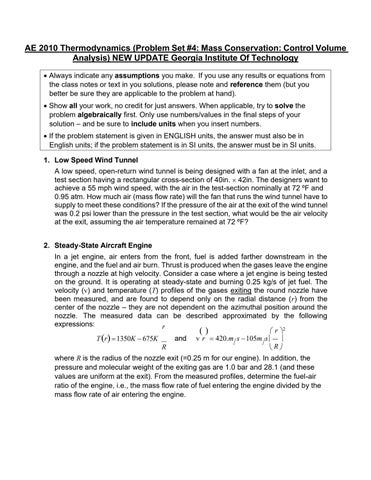
AE 2010 Thermodynamics (Problem Set #4: Mass Conservation: Control Volume Analysis) NEW UPDATE Georgia Institute Of Technology • Always indicate any assumptions you make. If you use any results or equations from the class notes or text in you solutions, please note and reference them (but you better be sure they are applicable to the problem at hand). • Show all your work, no credit for just answers. When applicable, try to solve the problem algebraically first. Only use numbers/values in the final steps of your solution – and be sure to include units when you insert numbers. • If the problem statement is given in ENGLISH units, the answer must also be in English units; if the problem statement is in SI units, the answer must be in SI units. 1. Low Speed Wind Tunnel A low speed, open-return wind tunnel is being designed with a fan at the inlet, and a test section having a rectangular cross-section of 40in. 42in. The designers want to achieve a 55 mph wind speed, with the air in the test-section nominally at 72 ºF and 0.95 atm. How much air (mass flow rate) will the fan that runs the wind tunnel have to supply to meet these conditions? If the pressure of the air at the exit of the wind tunnel was 0.2 psi lower than the pressure in the test section, what would be the air velocity at the exit, assuming the air temperature remained at 72 ºF? 2. Steady-State Aircraft Engine In a jet engine, air enters from the front, fuel is added farther downstream in the engine, and the fuel and air burn. Thrust is produced when the gases leave the engine through a nozzle at high velocity. Consider a case where a jet engine is being tested on the ground. It is operating at steady-state and burning 0.25 kg/s of jet fuel. The velocity (v) and temperature (T) profiles of the gases exiting the round nozzle have been measured, and are found to depend only on the radial distance (r) from the center of the nozzle – they are not dependent on the azimuthal position around the nozzle. The measured data can be described approximated by the following expressions: r () r 2 and v r = 420.m s − 105m s T (r) = 1350K − 675K R R where R is the radius of the nozzle exit (=0.25 m for our engine). In addition, the pressure and molecular weight of the exiting gas are 1.0 bar and 28.1 (and these values are uniform at the exit). From the measured profiles, determine the fuel-air ratio of the engine, i.e., the mass flow rate of fuel entering the engine divided by the mass flow rate of air entering the engine.
AE 2010 Thermodynamics (Problem Set #4 Mass Conservation Control Volume Analysis) NEW UPDATE Georgia
Issuu converts static files into: and more. Sign up and create your flipbook.