AE 2010 Thermodynamics (PROBLEM SET #2: WORK, PATHS, AND IDEAL GAS LAW) WITH SOLUTION Georgia Institute Of Technology
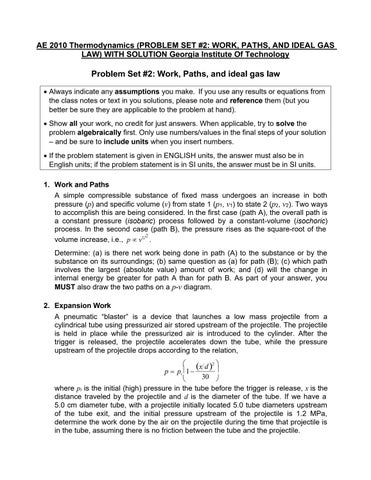
Problem Set #2: Work, Paths, and ideal gas law • Always indicate any assumptions you make. If you use any results or equations from the class notes or text in you solutions, please note and reference them (but you better be sure they are applicable to the problem at hand). • Show all your work, no credit for just answers. When applicable, try to solve the problem algebraically first. Only use numbers/values in the final steps of your solution – and be sure to include units when you insert numbers. • If the problem statement is given in ENGLISH units, the answer must also be in English units; if the problem statement is in SI units, the answer must be in SI units. 1. Work and Paths A simple compressible substance of fixed mass undergoes an increase in both pressure (p) and specific volume (v) from state 1 (p1, v1) to state 2 (p2, v2). Two ways to accomplish this are being considered. In the first case (path A), the overall path is a constant pressure (isobaric) process followed by a constant-volume (isochoric) process. In the second case (path B), the pressure rises as the square-root of the 2 volume increase, i.e., p v1 . Determine: (a) is there net work being done in path (A) to the substance or by the substance on its surroundings; (b) same question as (a) for path (B); (c) which path involves the largest (absolute value) amount of work; and (d) will the change in internal energy be greater for path A than for path B. As part of your answer, you MUST also draw the two paths on a p-v diagram. 2. Expansion Work A pneumatic “blaster” is a device that launches a low mass projectile from a cylindrical tube using pressurized air stored upstream of the projectile. The projectile is held in place while the pressurized air is introduced to the cylinder. After the trigger is released, the projectile accelerates down the tube, while the pressure upstream of the projectile drops according to the relation, (x d )2 p = pi 1 − 30 where pi is the initial (high) pressure in the tube before the trigger is release, x is the distance traveled by the projectile and d is the diameter of the tube. If we have a 5.0 cm diameter tube, with a projectile initially located 5.0 tube diameters upstream of the tube exit, and the initial pressure upstream of the projectile is 1.2 MPa, determine the work done by the air on the projectile during the time that projectile is in the tube, assuming there is no friction between the tube and the projectile.