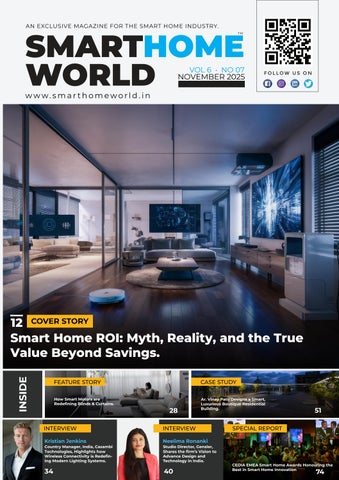
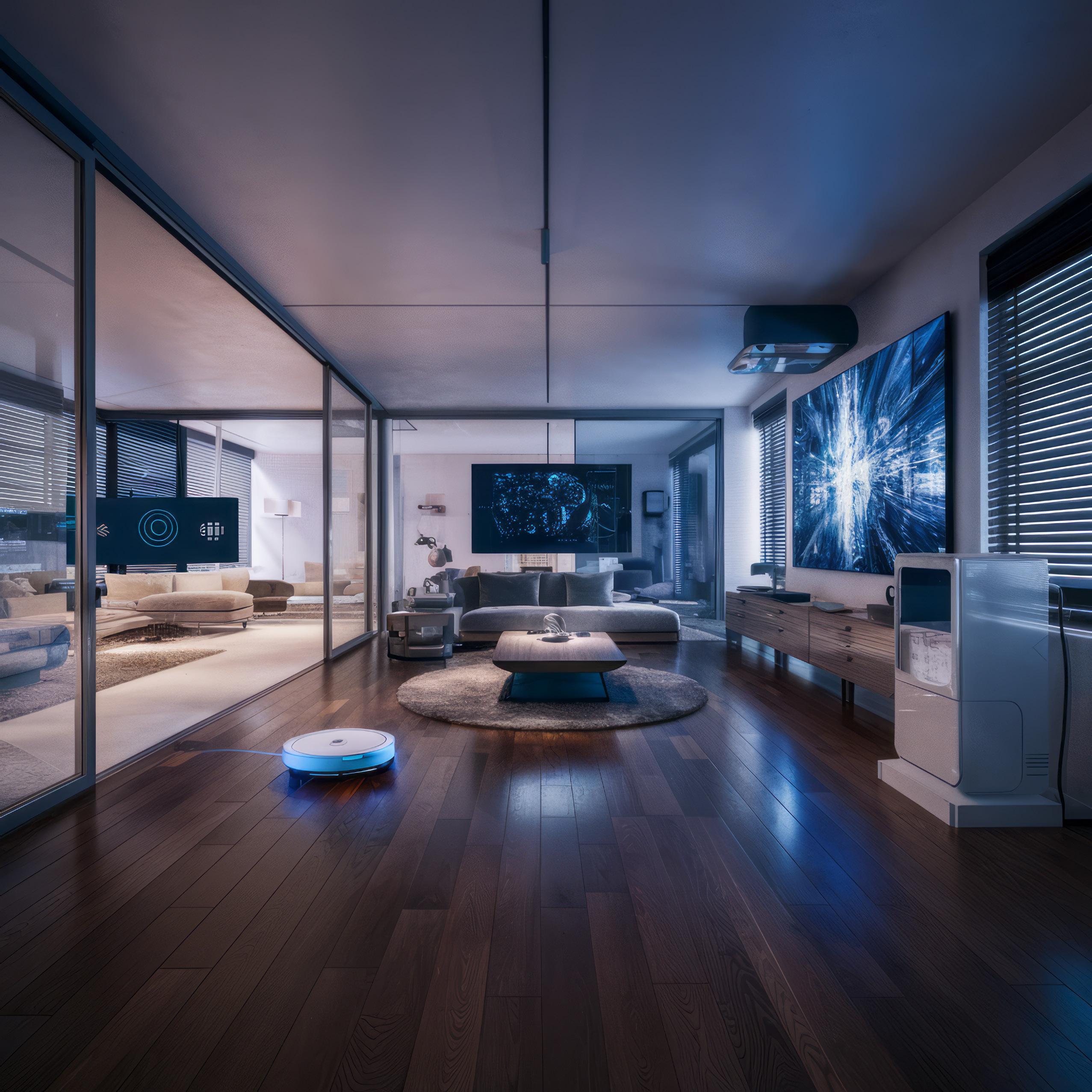
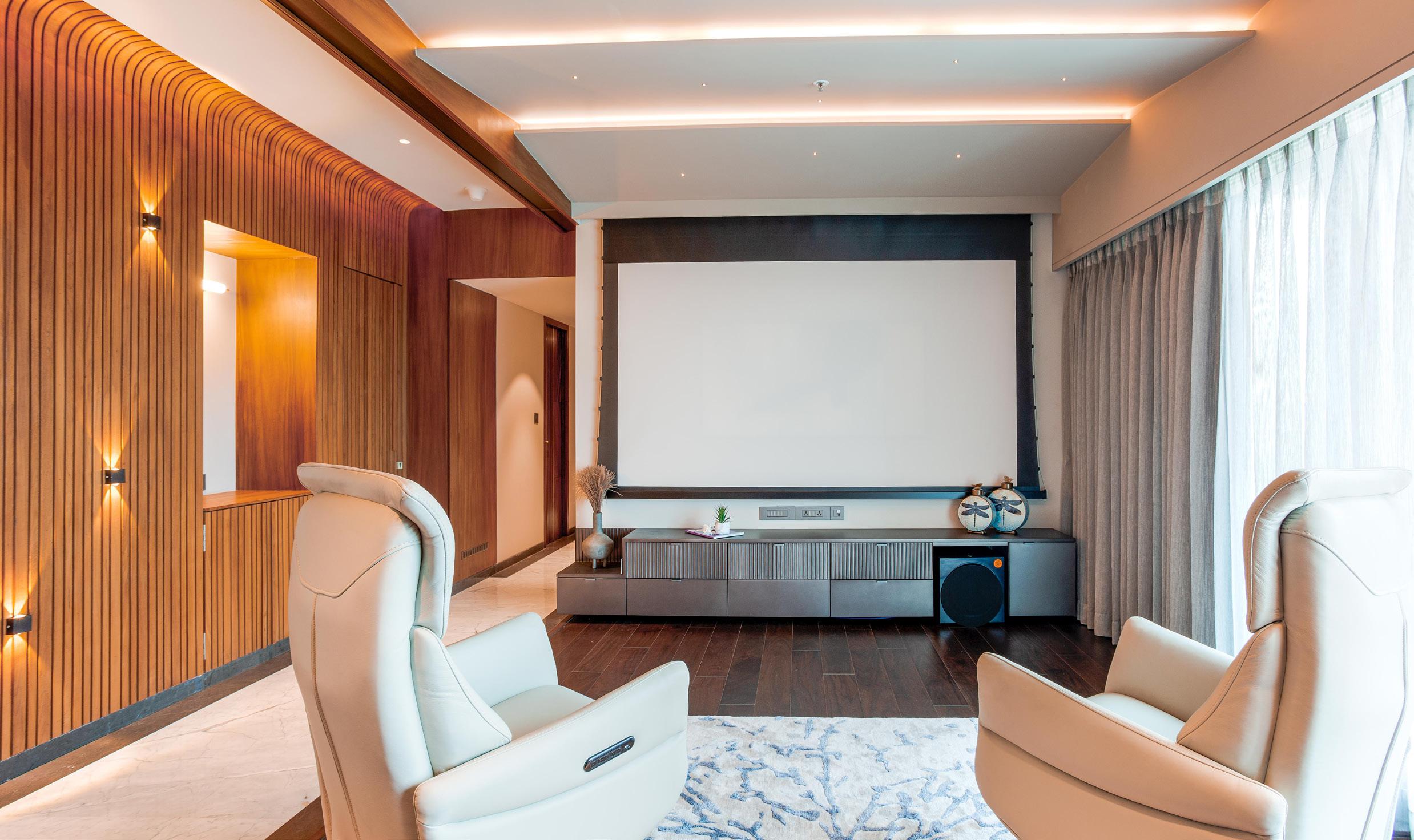
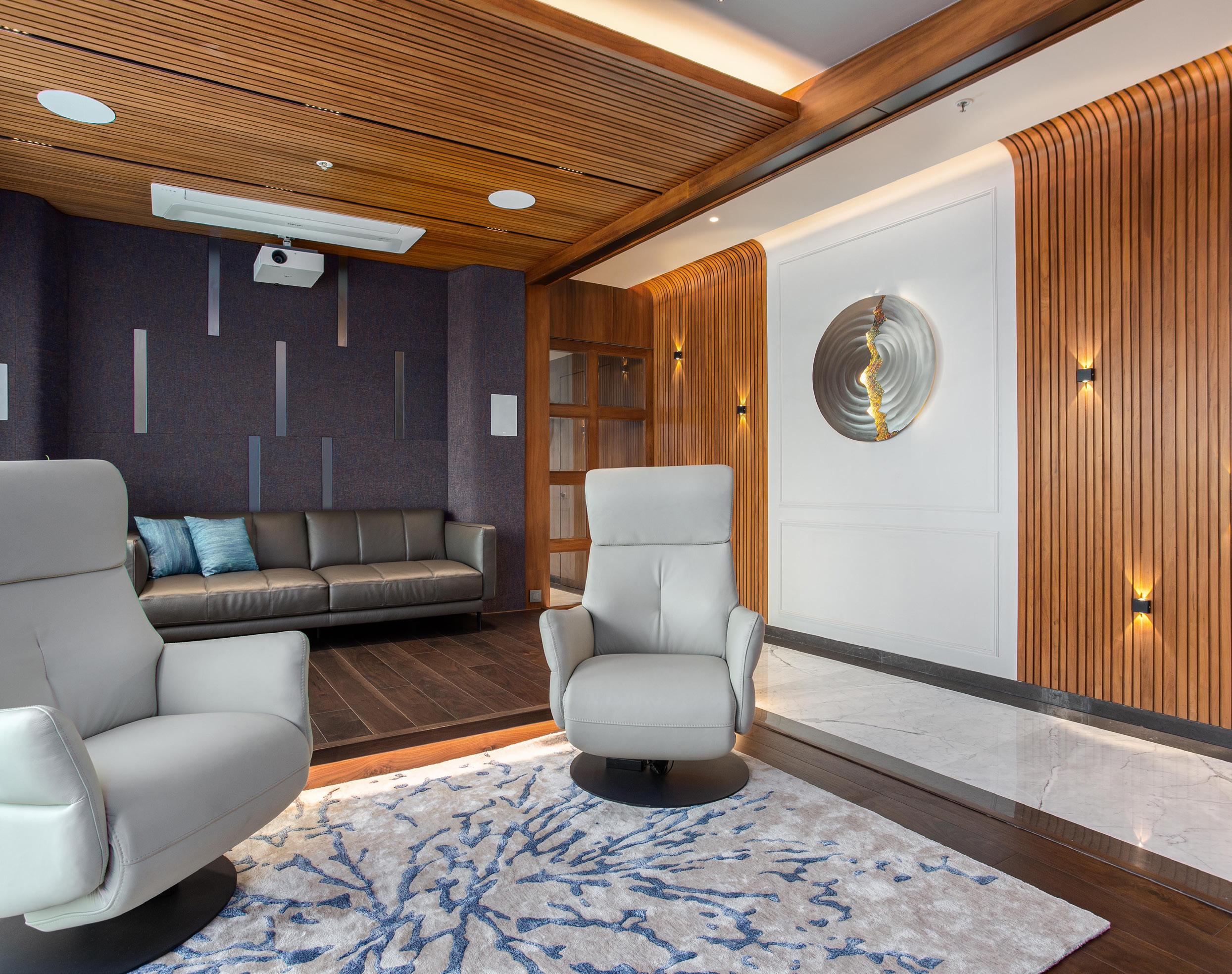
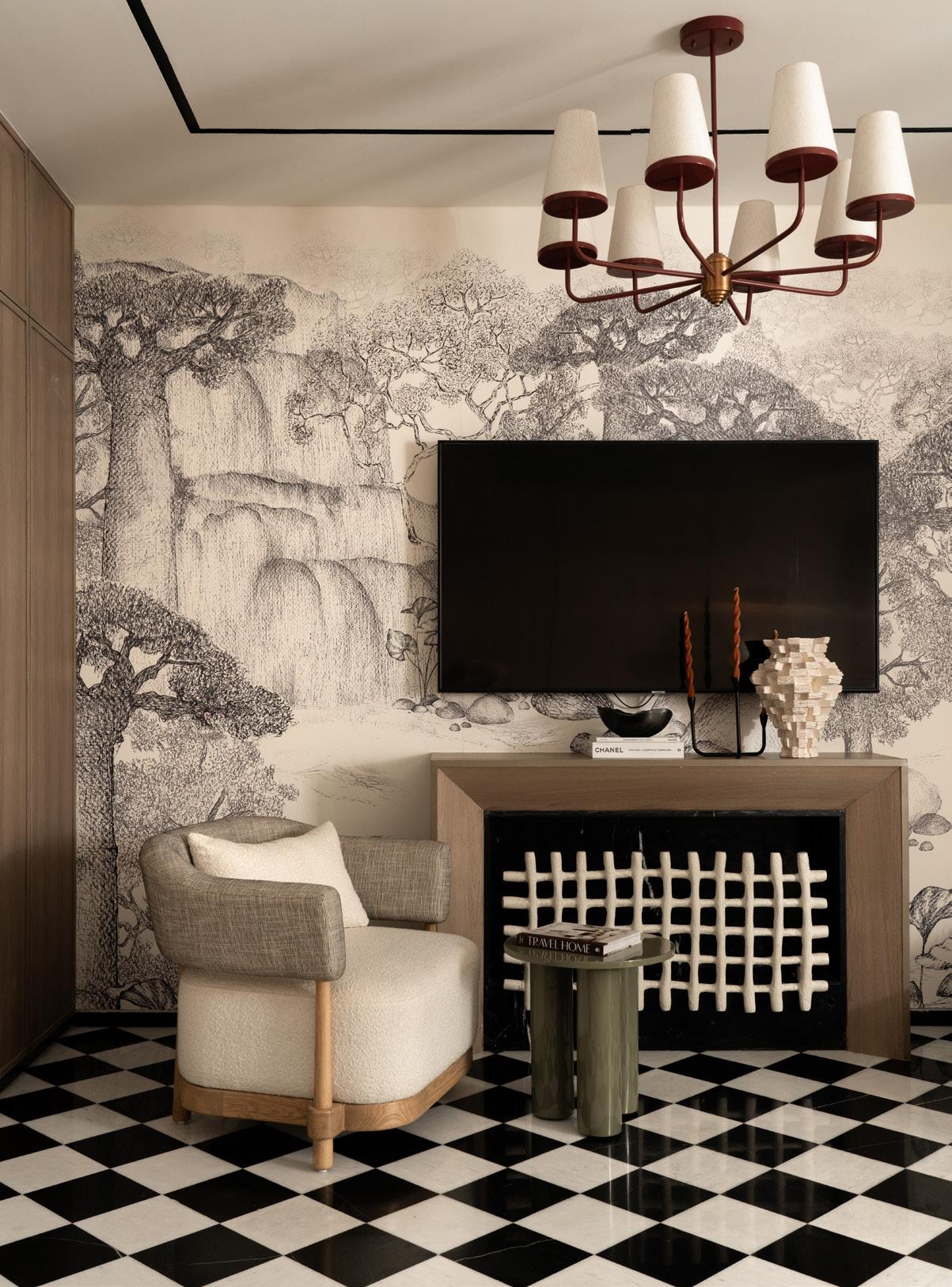
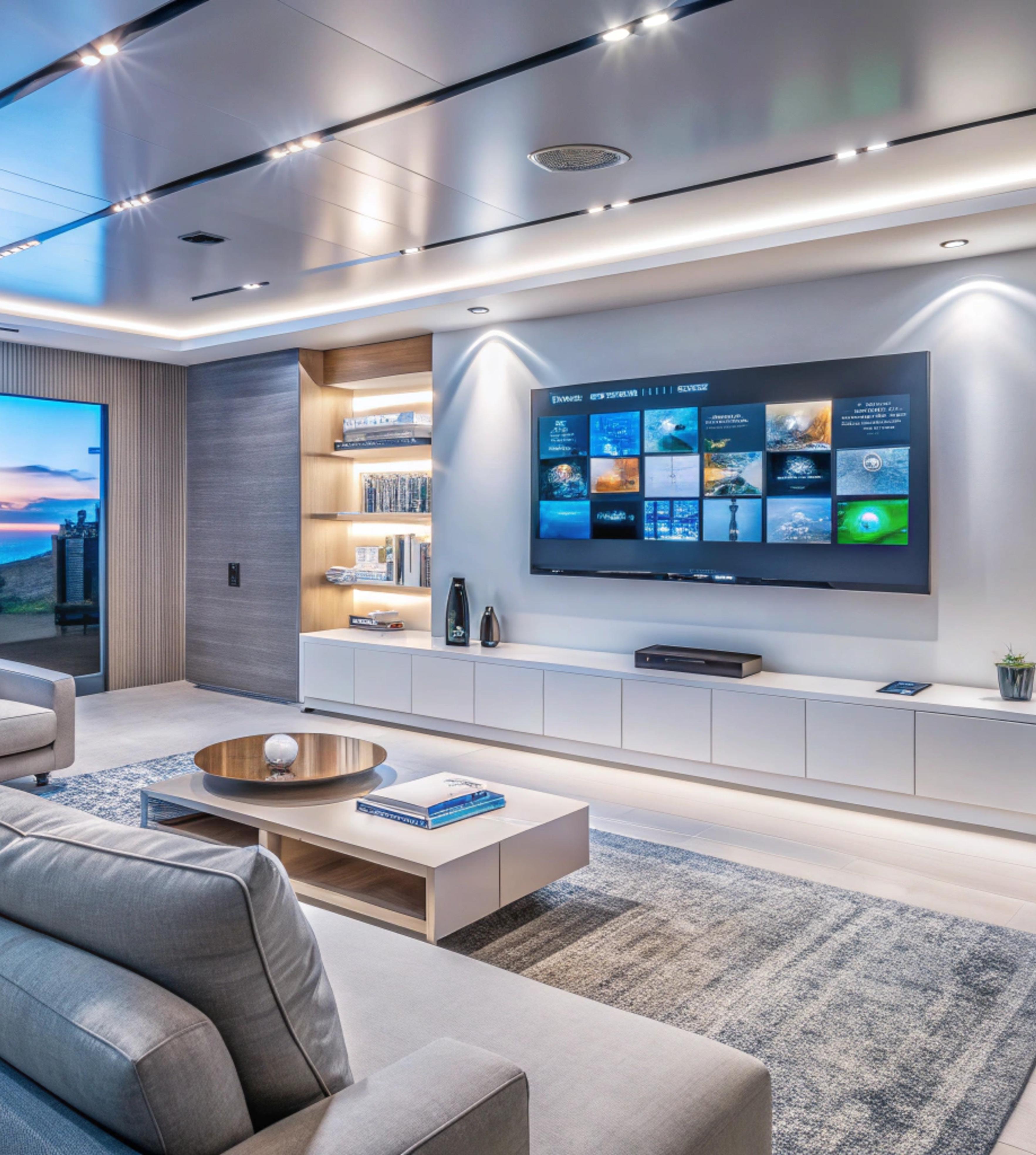
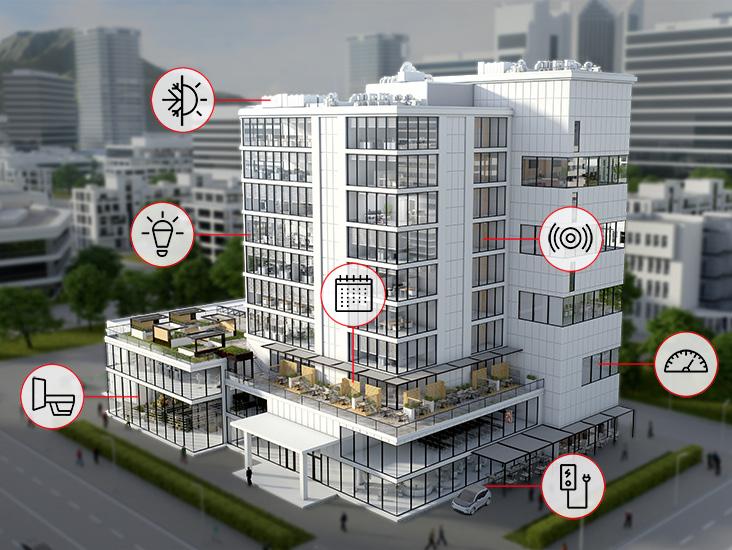
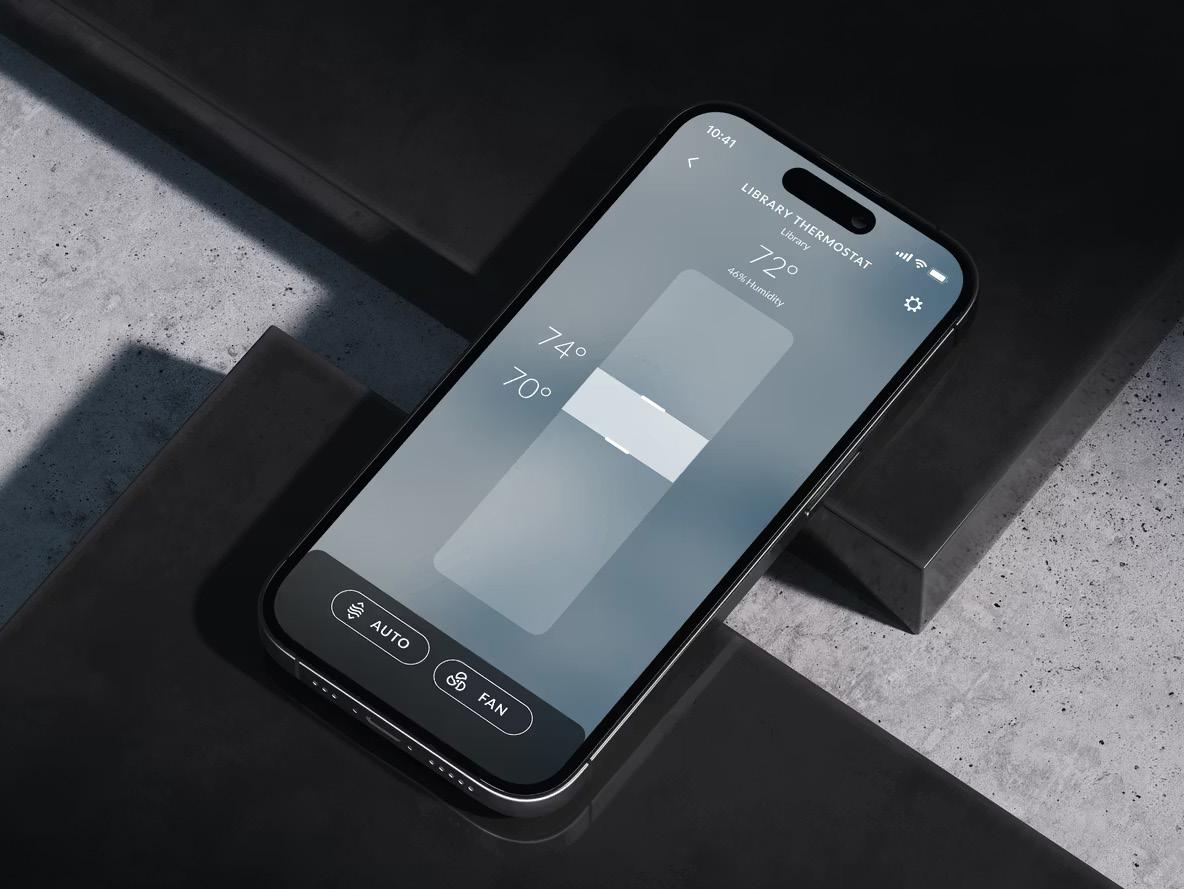
ROI in smart homes extends beyond utility savings. Smart Home World talks to experts who share their insights on real gains in savings, comfort, and long-term value, while also sharing the Pros and Cons homeowners need to know.
Feature Story
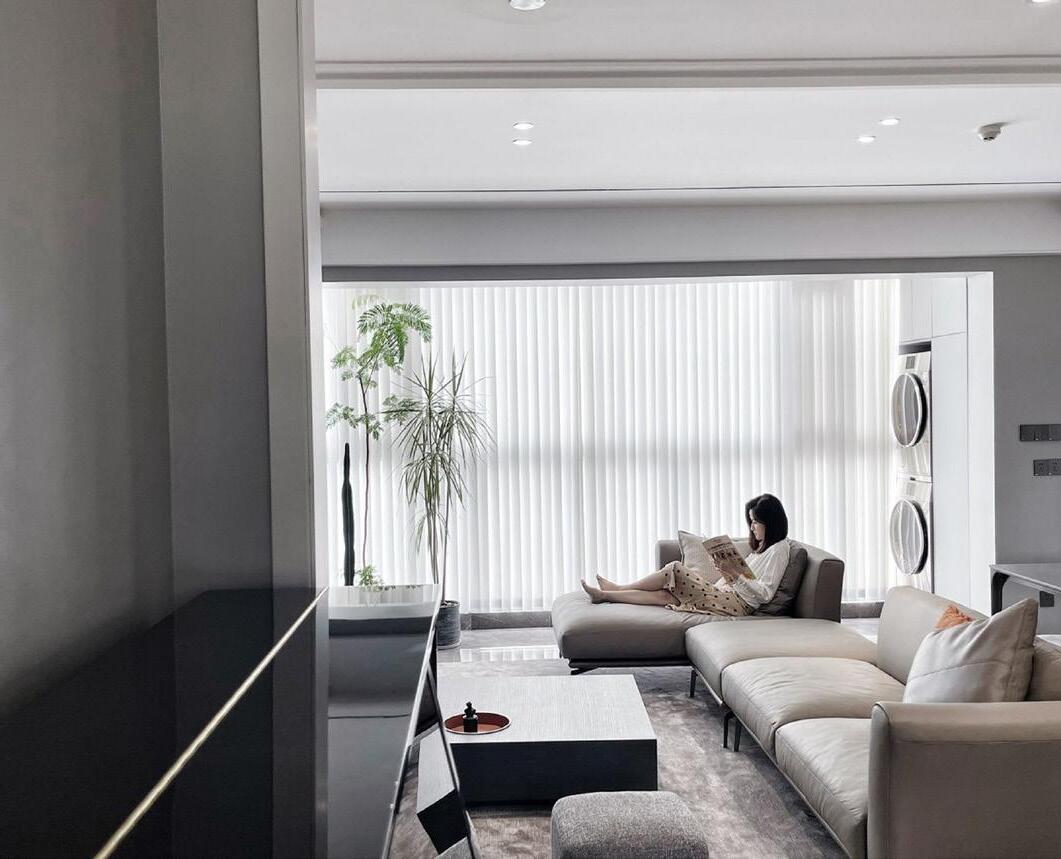
Smart Motors are evolving into intelligent and connected systems. Leading brands share innovative solutions that enhance comfort, control and integration in modern smart homes.
Interviews
Kristian Jenkins, Country Manager, India, Casambi Technologies, shares Casambi’s innovation-driven approach, market trends, and the role of intelligent lighting in energy efficiency and sustainability.
Neelima Ronanki, Studio Director, Senior Associate, Gensler Bengaluru, highlights Gensler’s drive to push the boundaries of design and technology in India, from smart automation to digital-first workflows, powering some of the country’s most ambitious workplace and commercial projects.
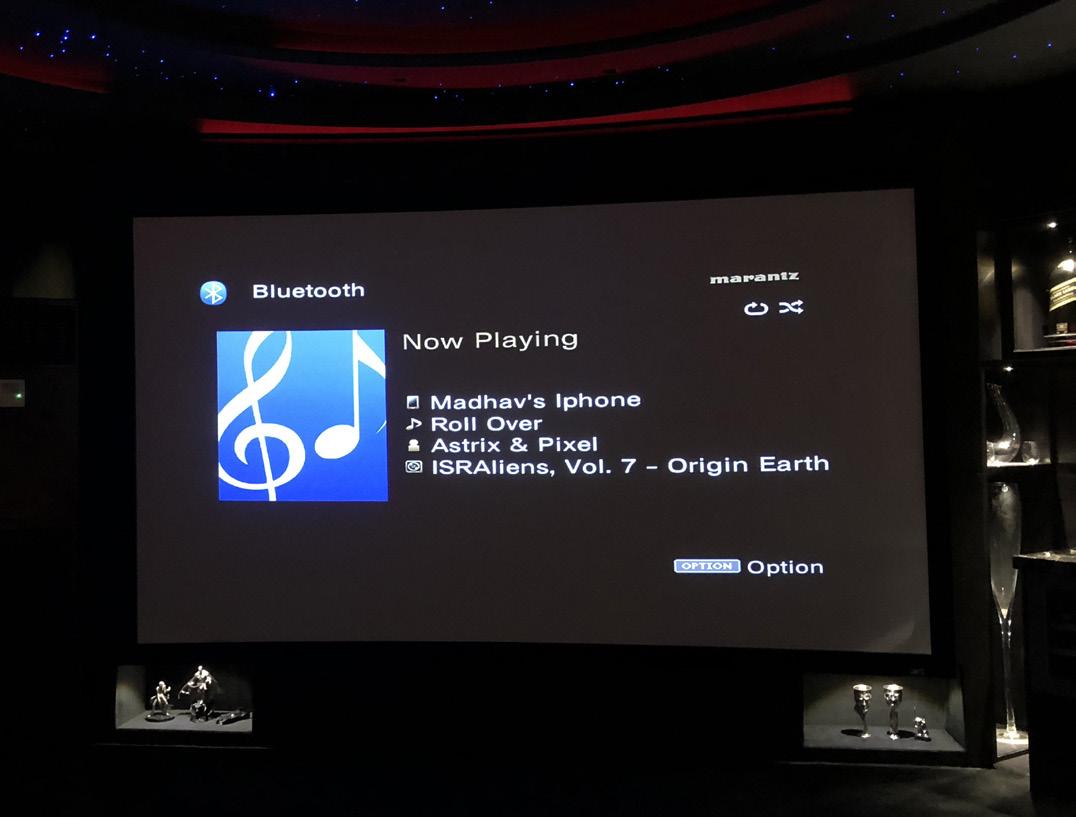
Madhav Kohli, Director, AudioSphere, shares insights on high-end AV design and automation, emphasising integrity, user-centric simplicity, and performancefirst principles in luxury residences and commercial environments.
Case Studies
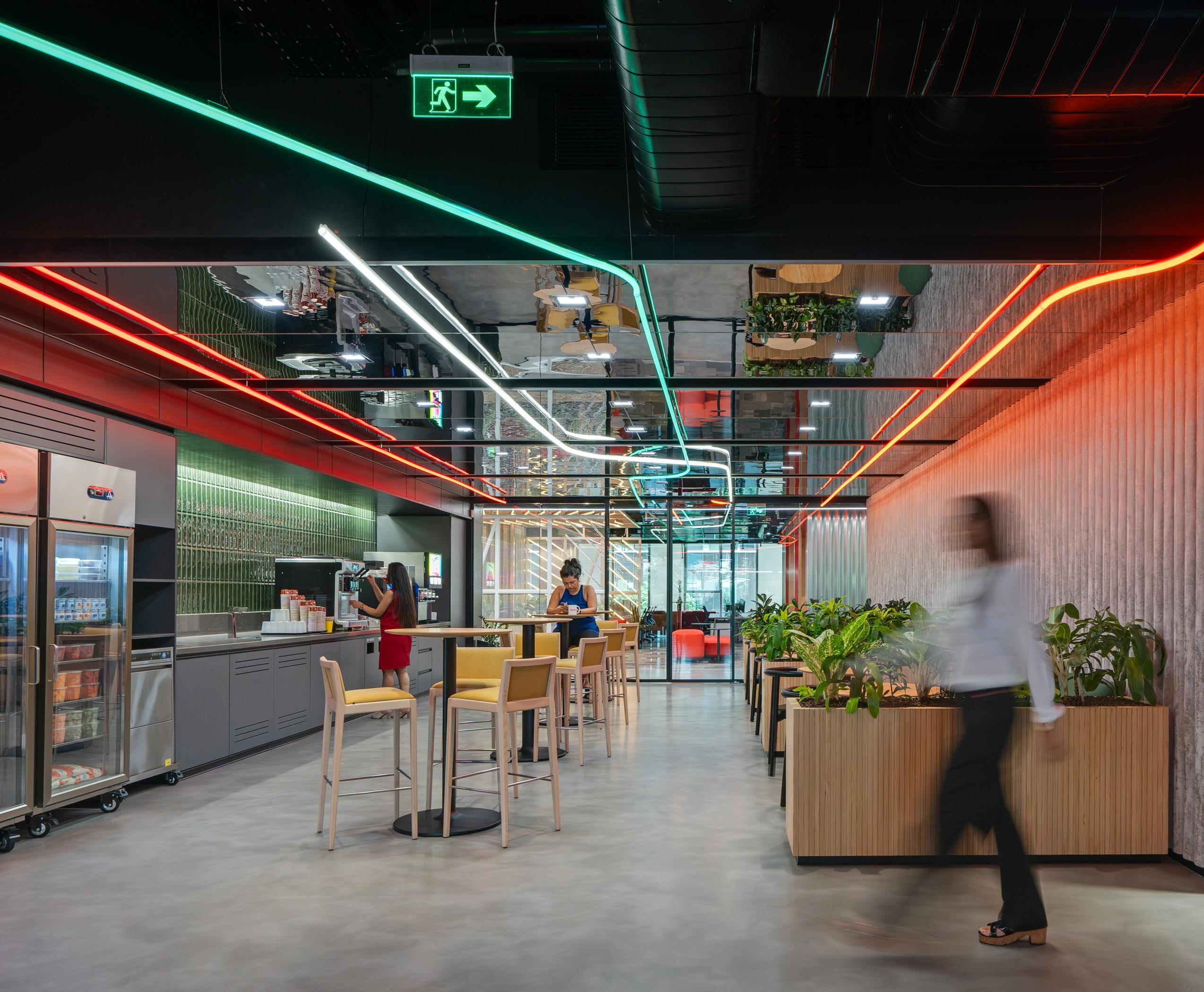
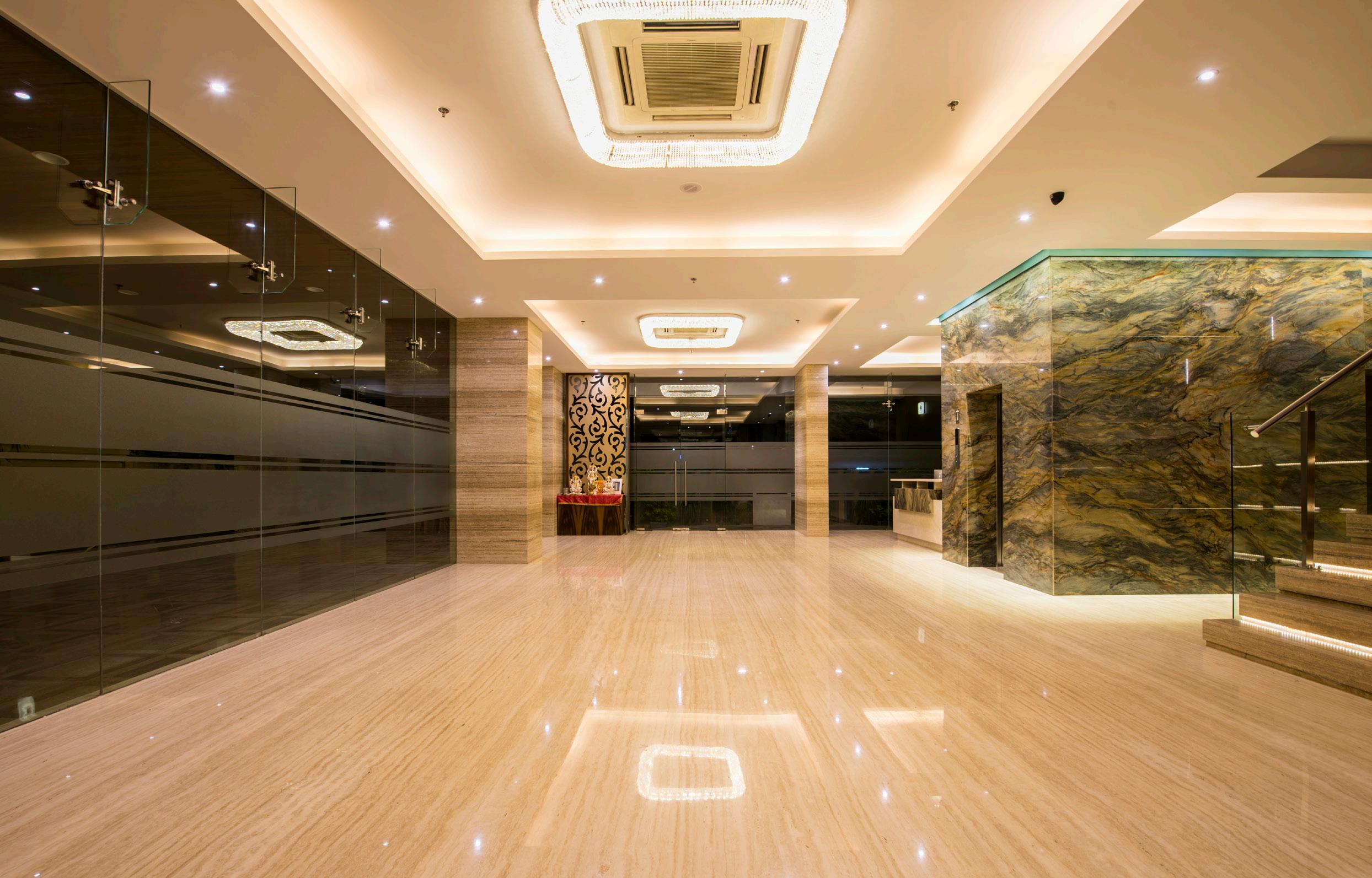
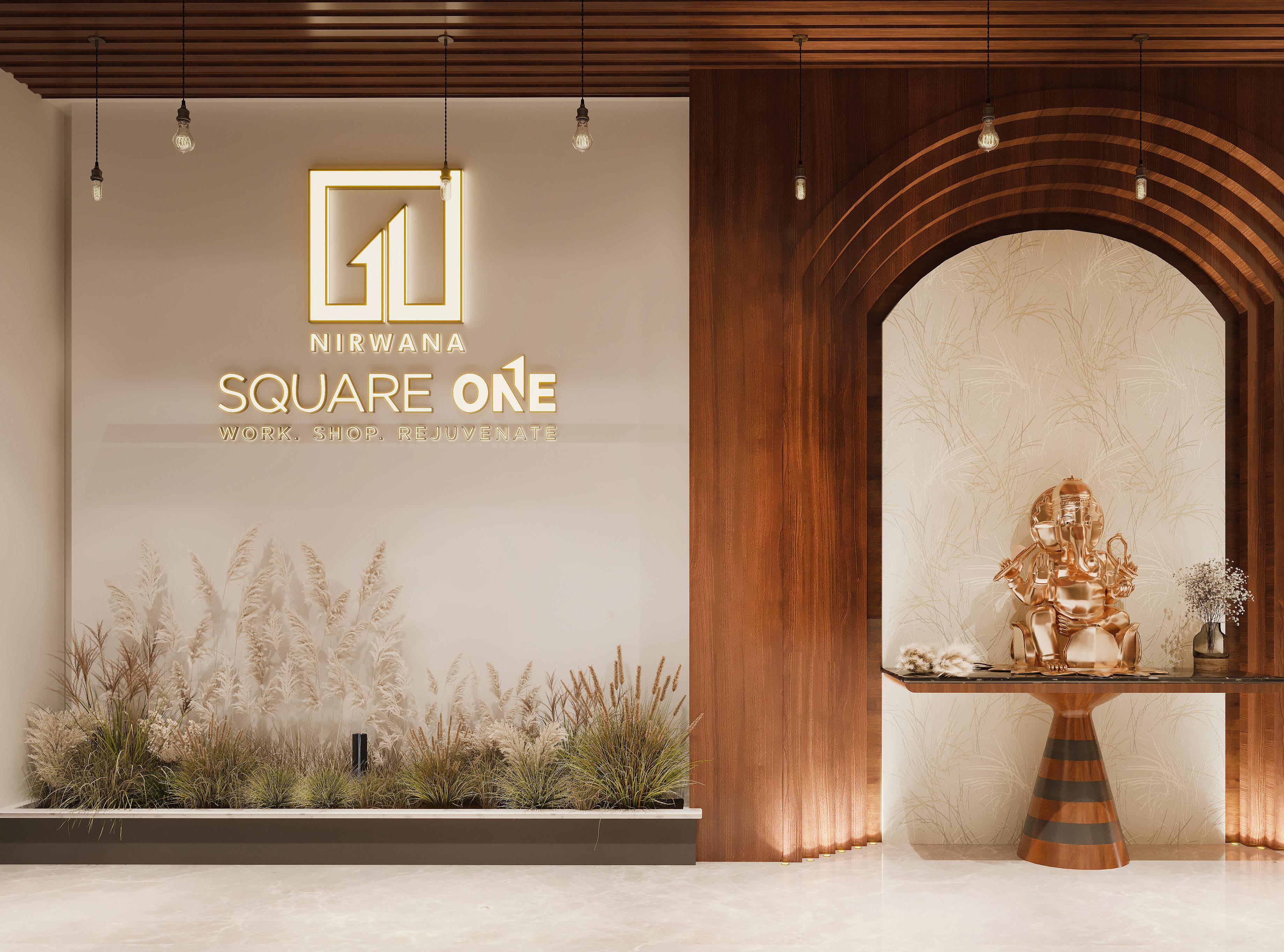
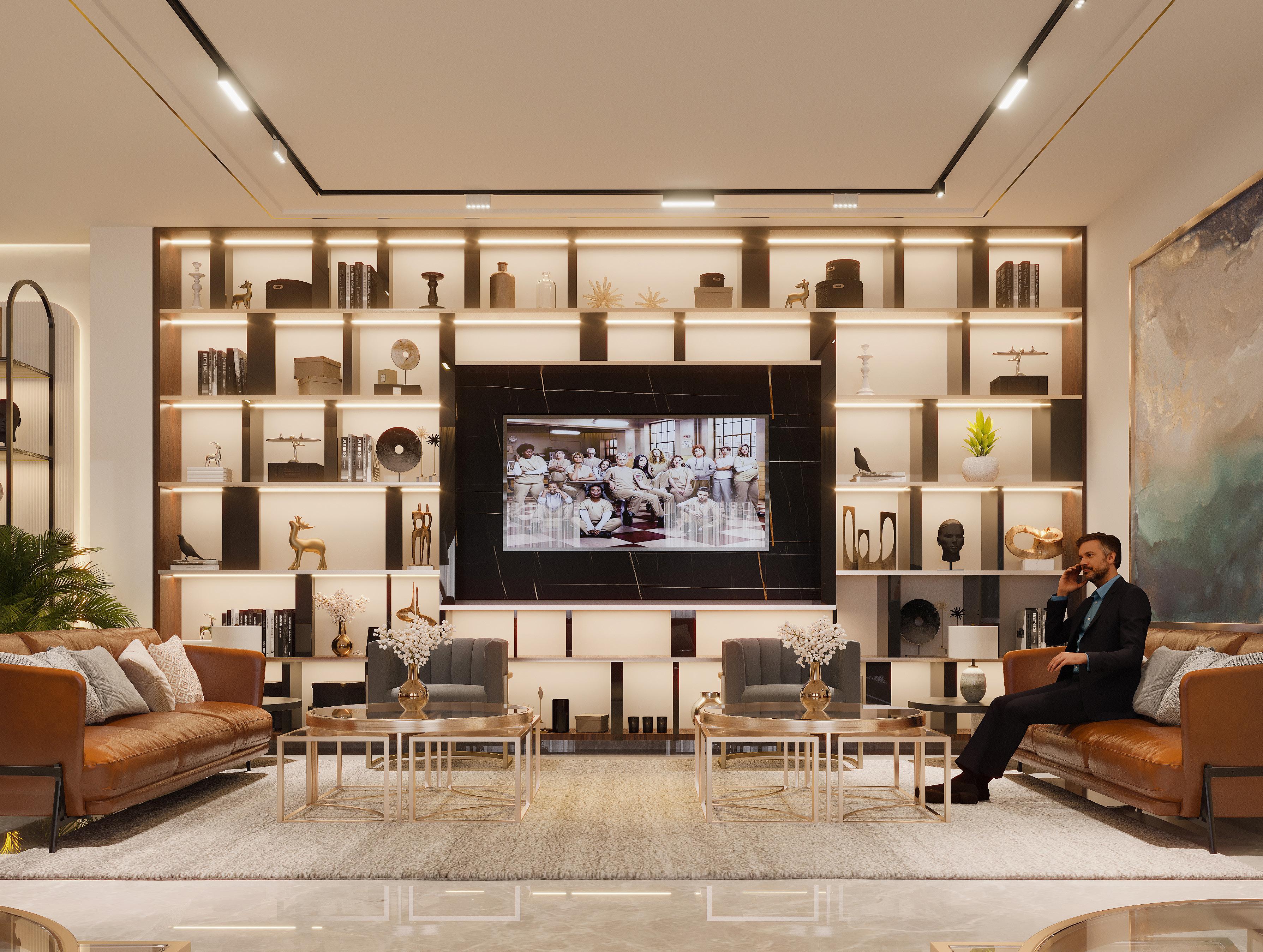
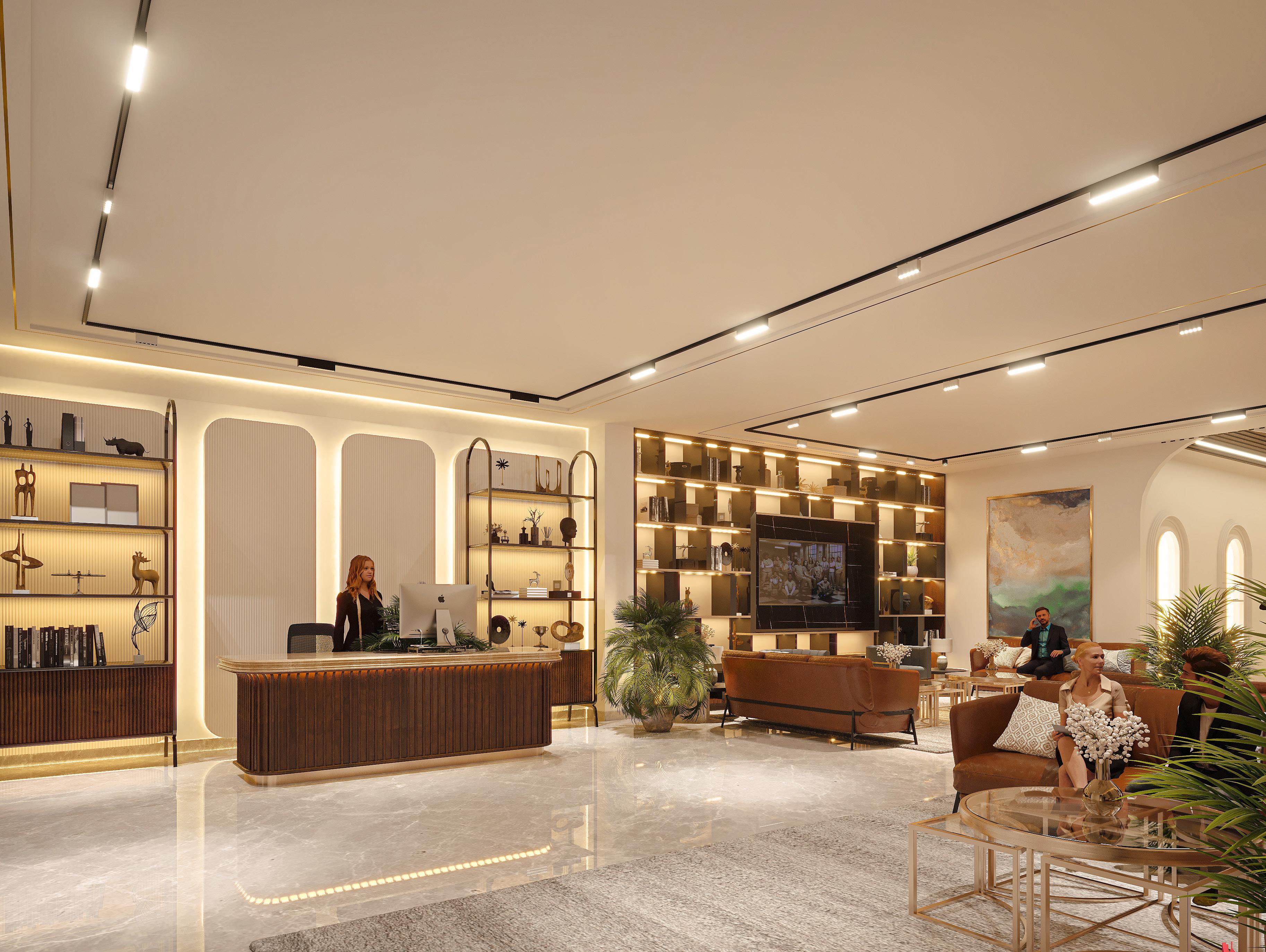
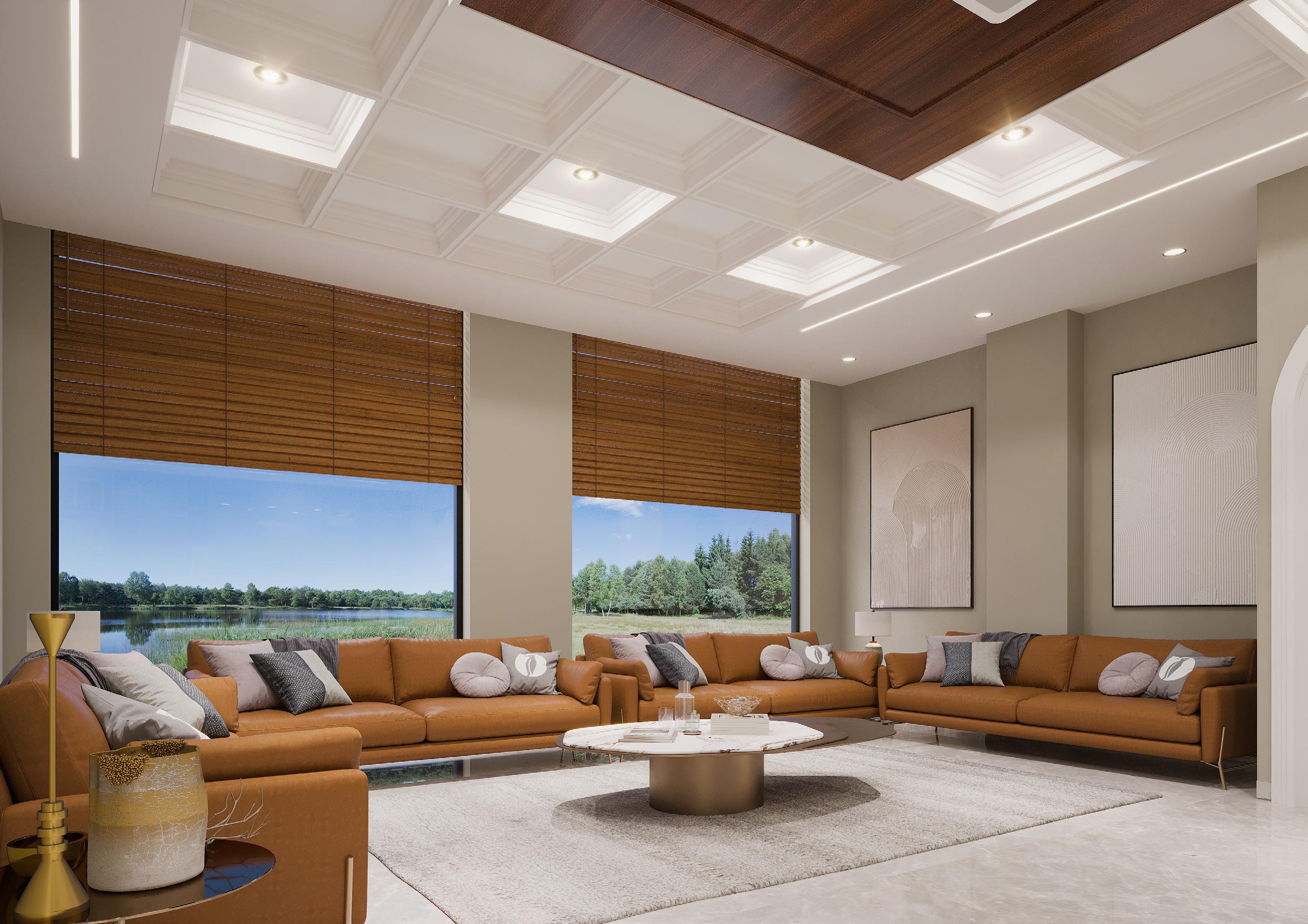
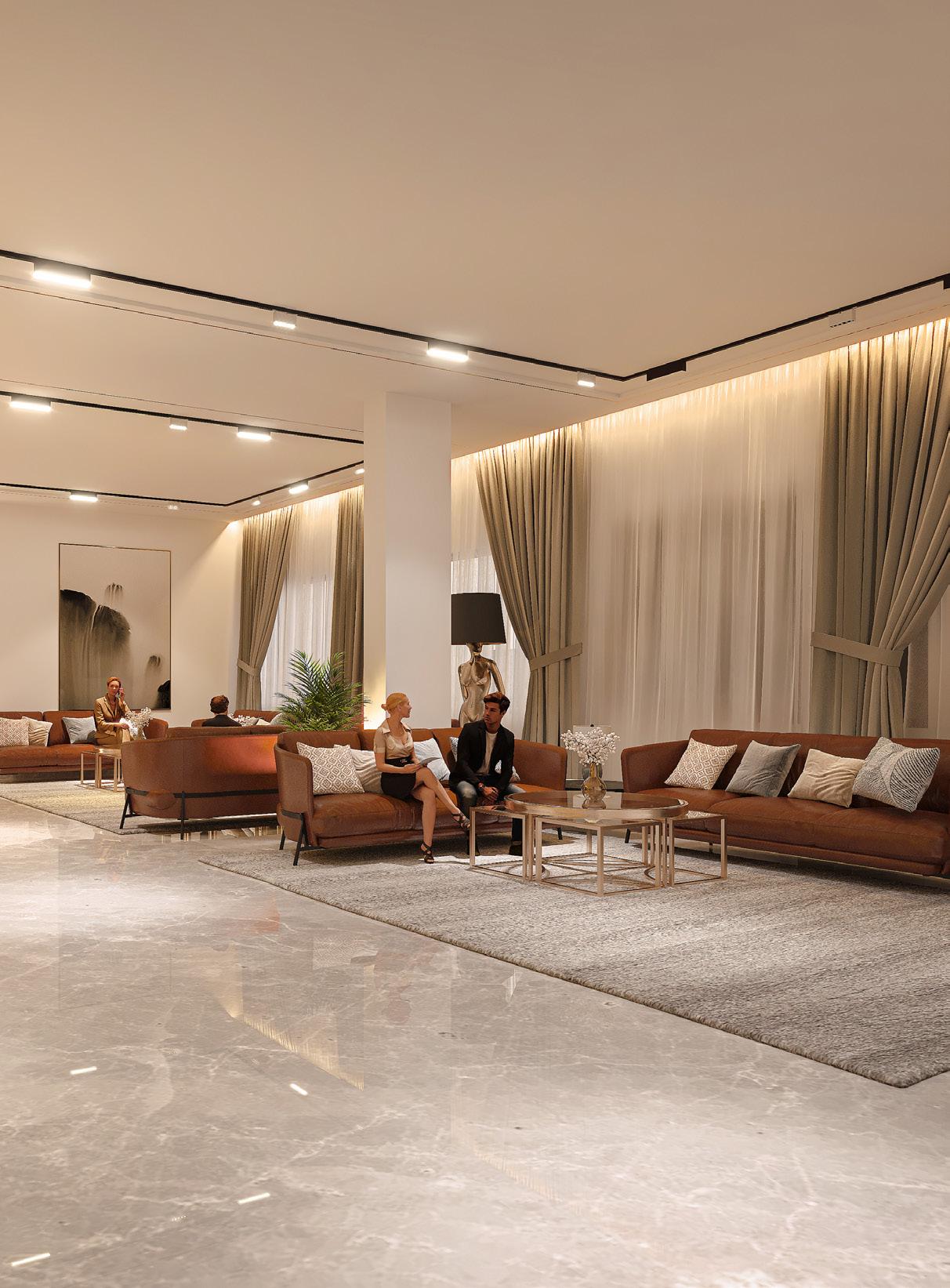
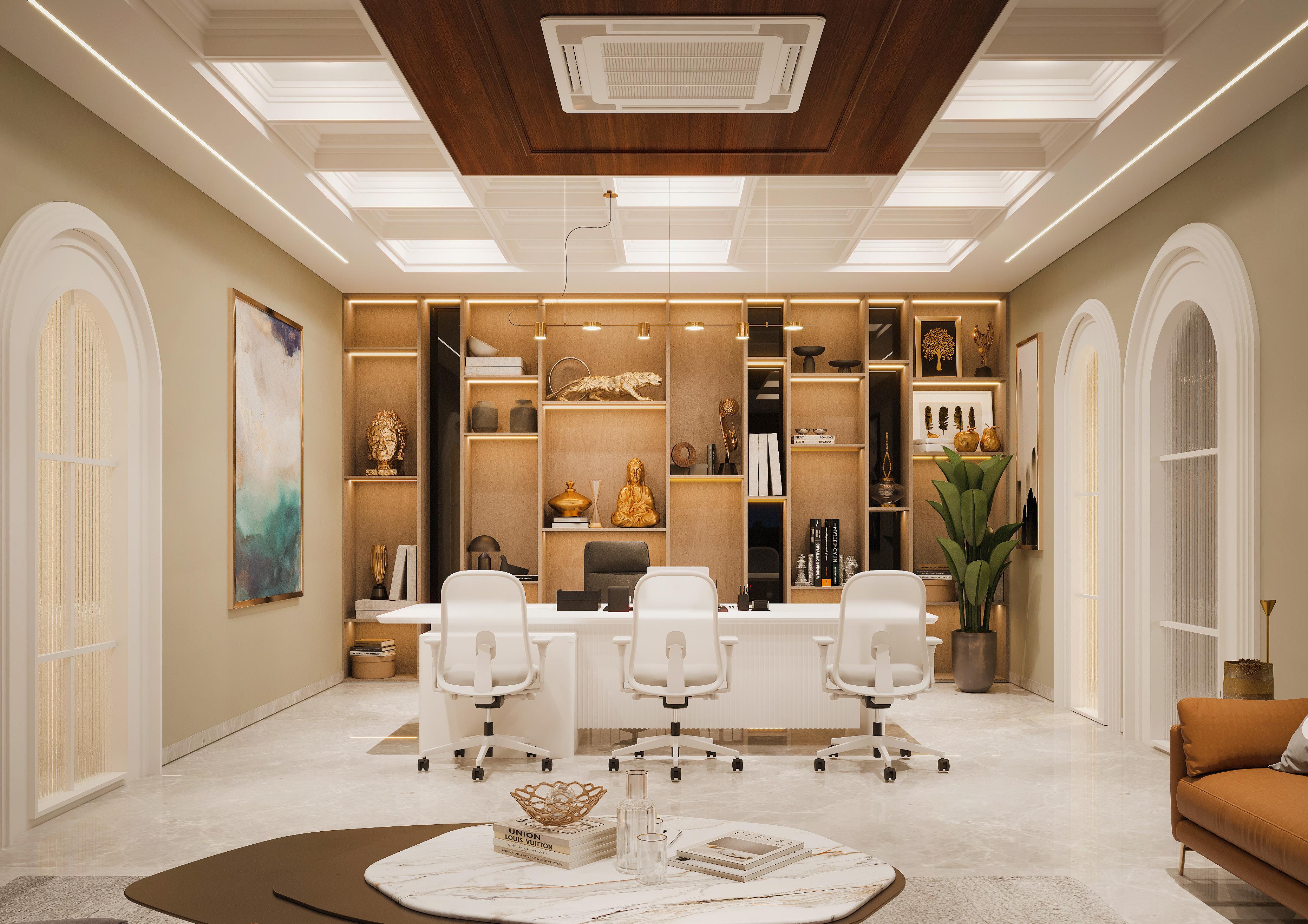
Nirwana Head Office, designed by Ar. Umesh Sharma is a smart, connected workspace blending technology and design for efficiency, intuition, and elegance.
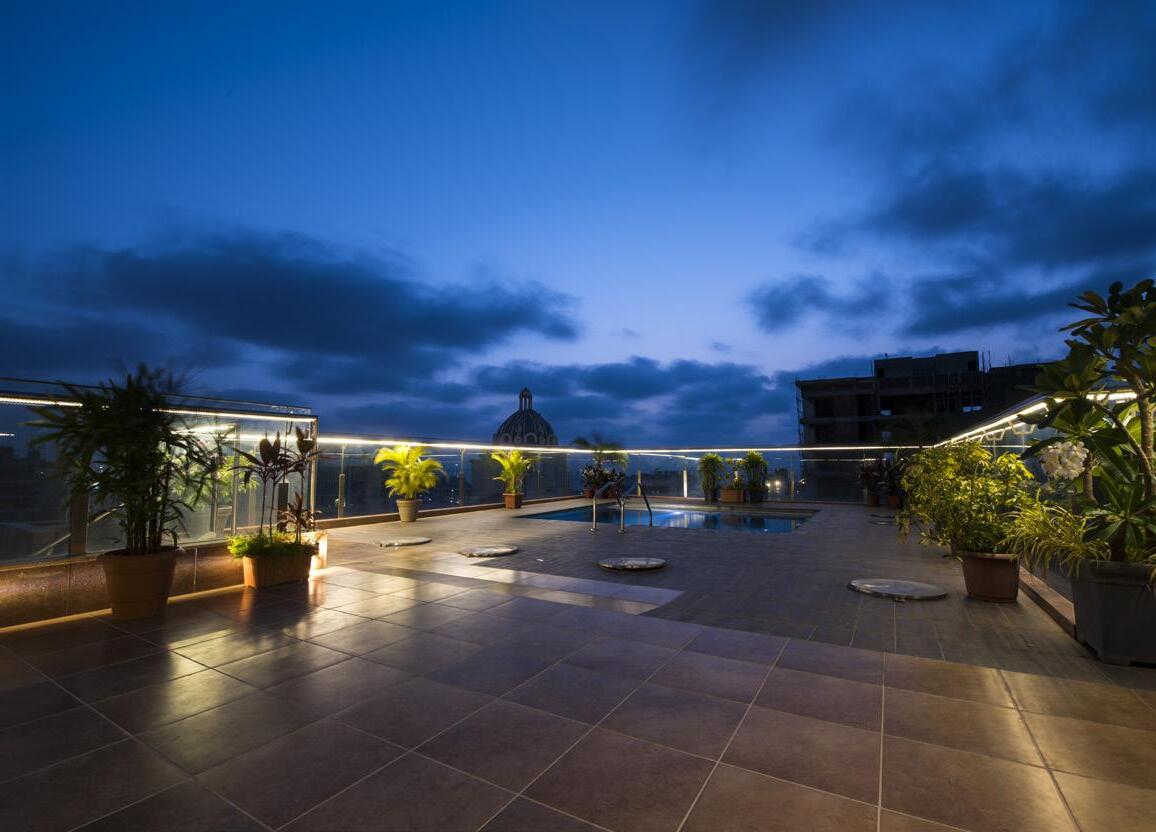
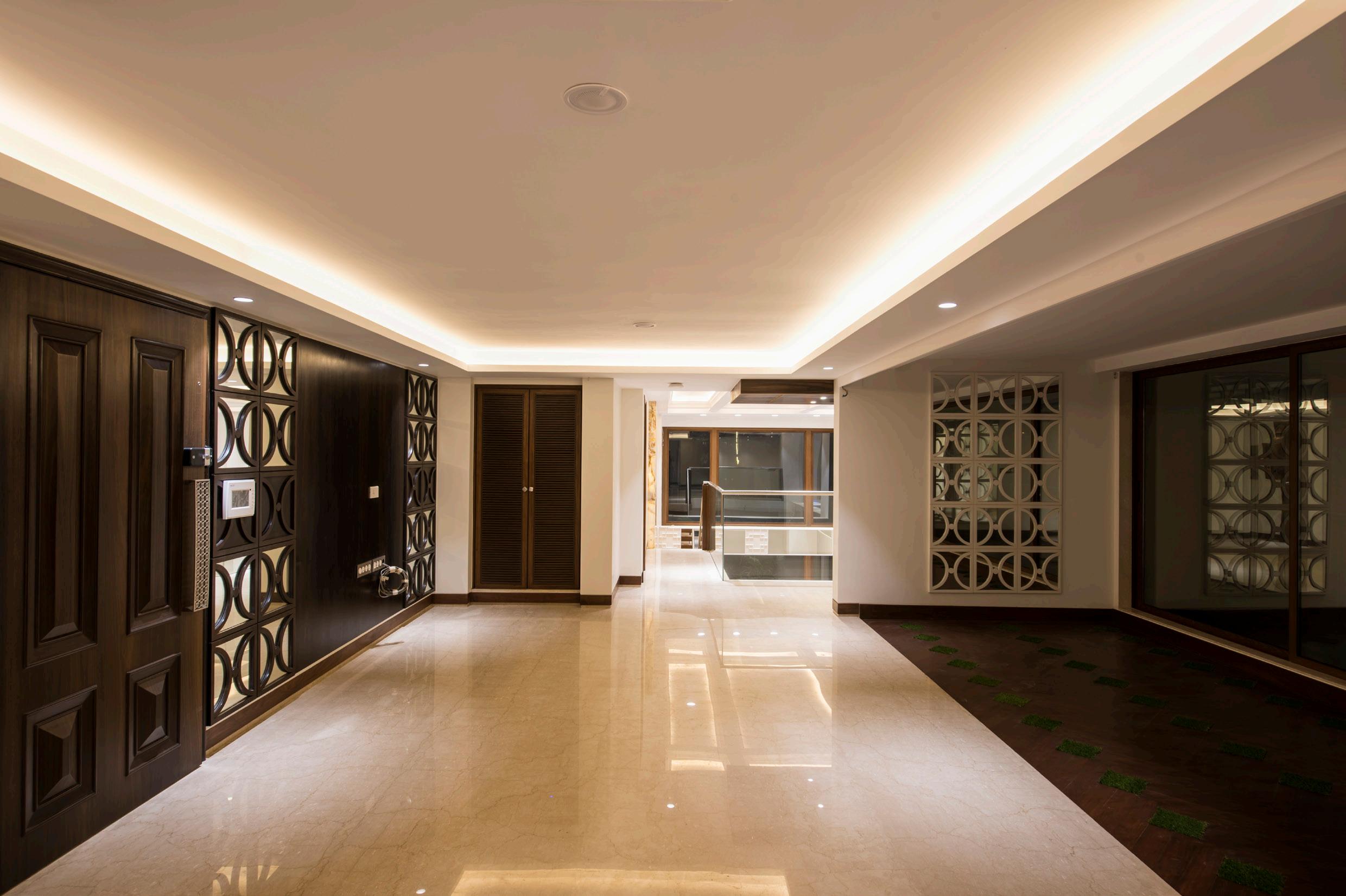
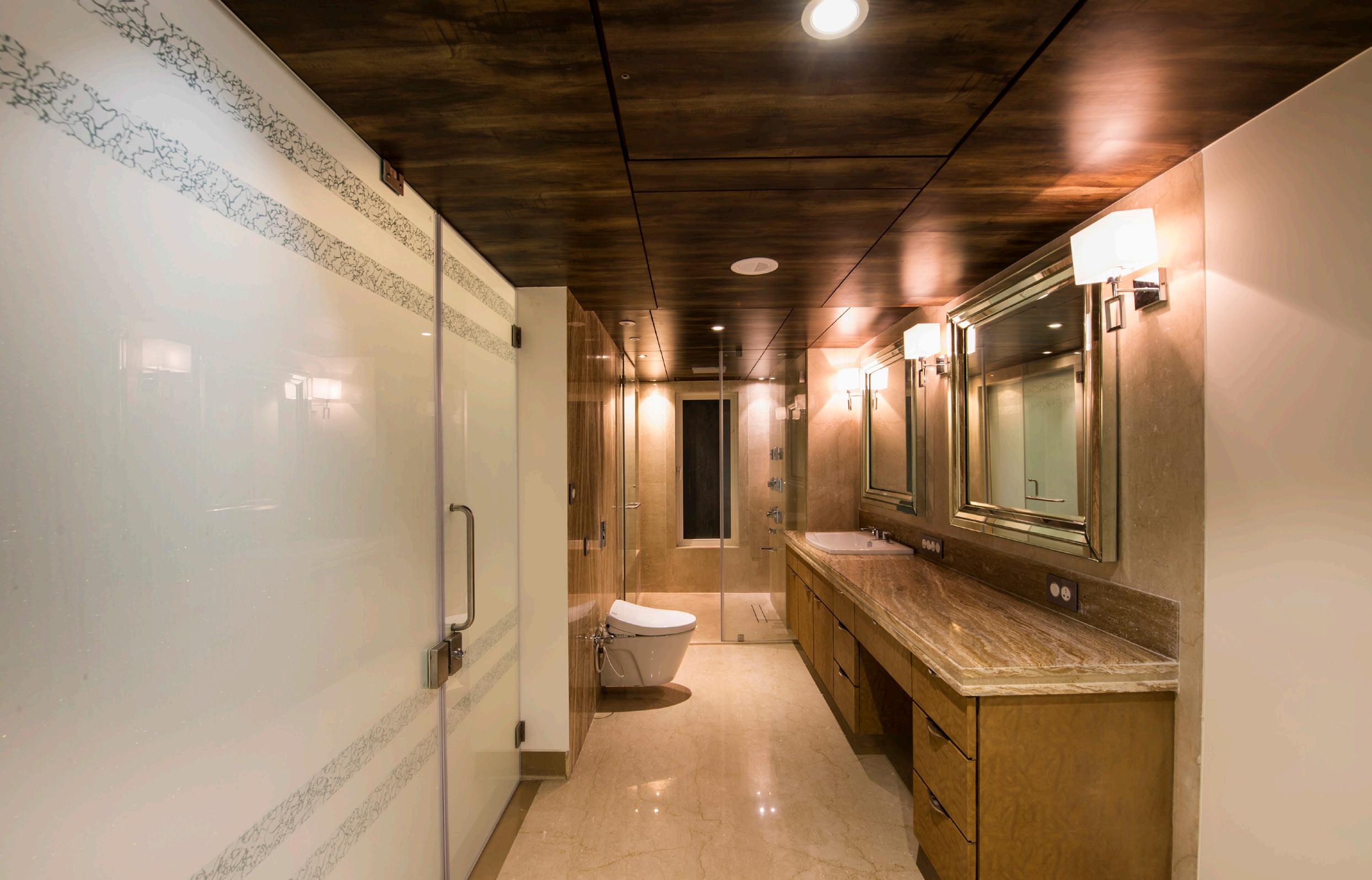
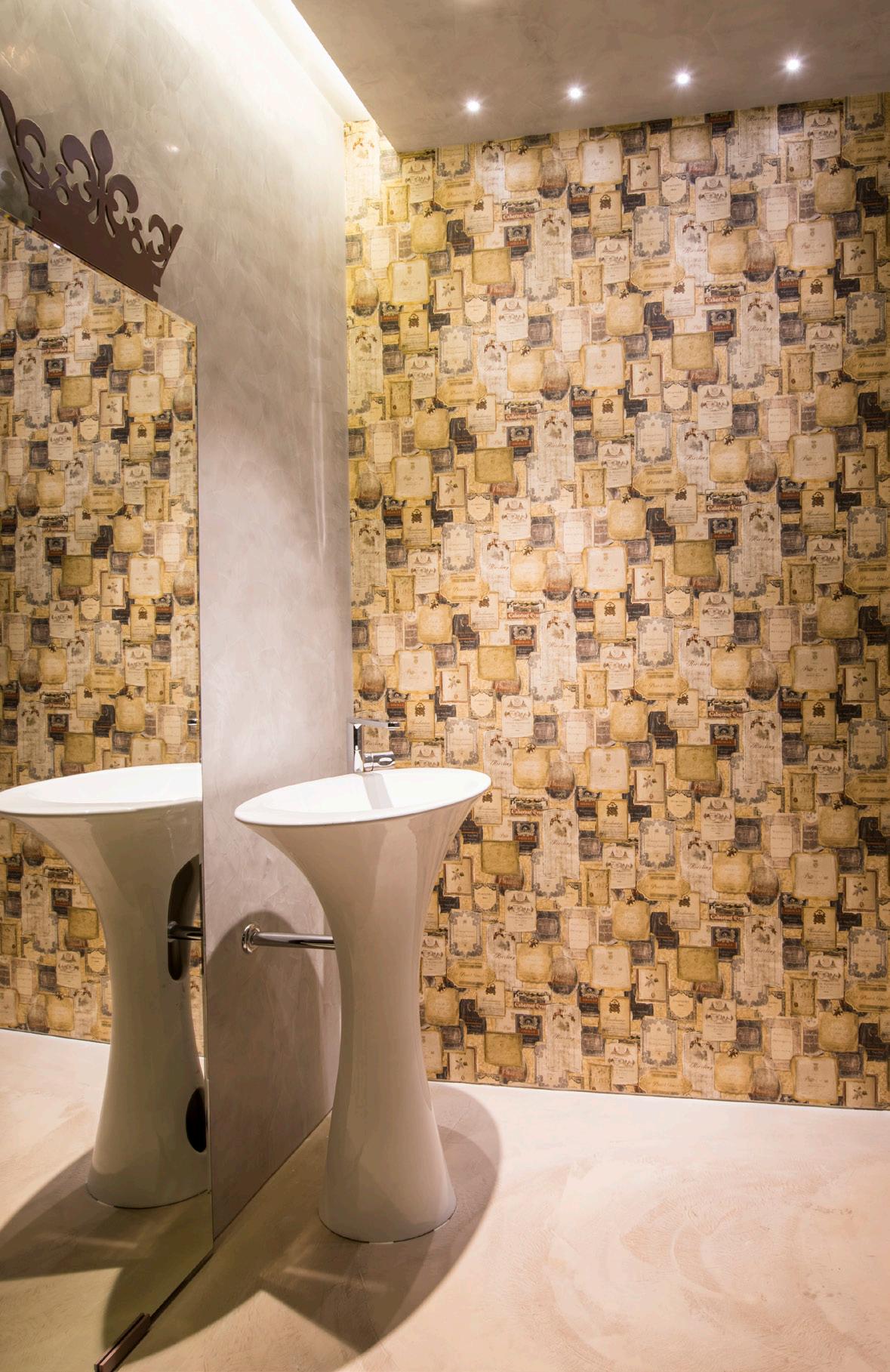
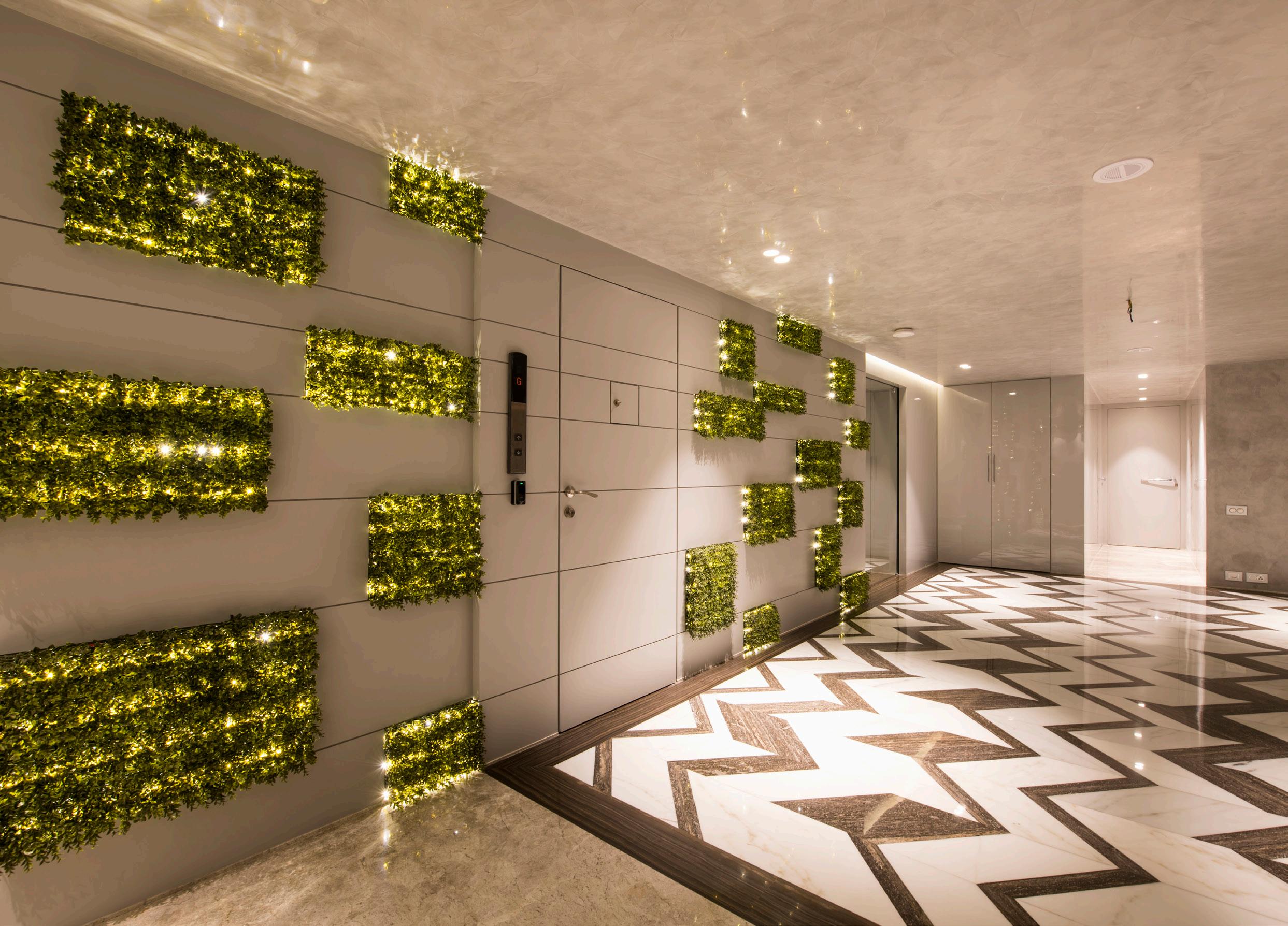
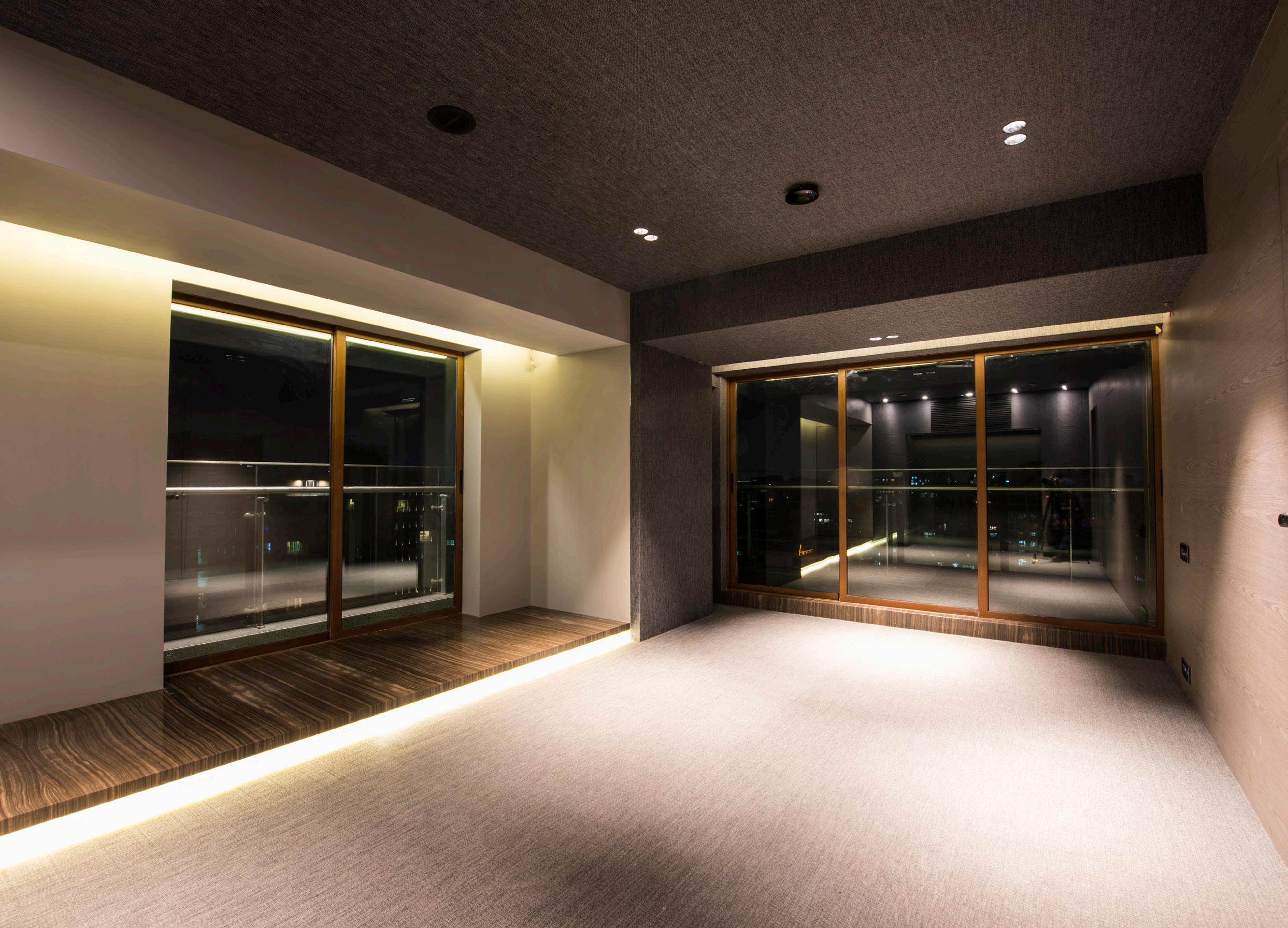
Boutique Residential Project, designed by Ar. Vinay Patil, along with Yoga Automation Pvt. Ltd., is a modern architectural and automation marvel.
Product Previews
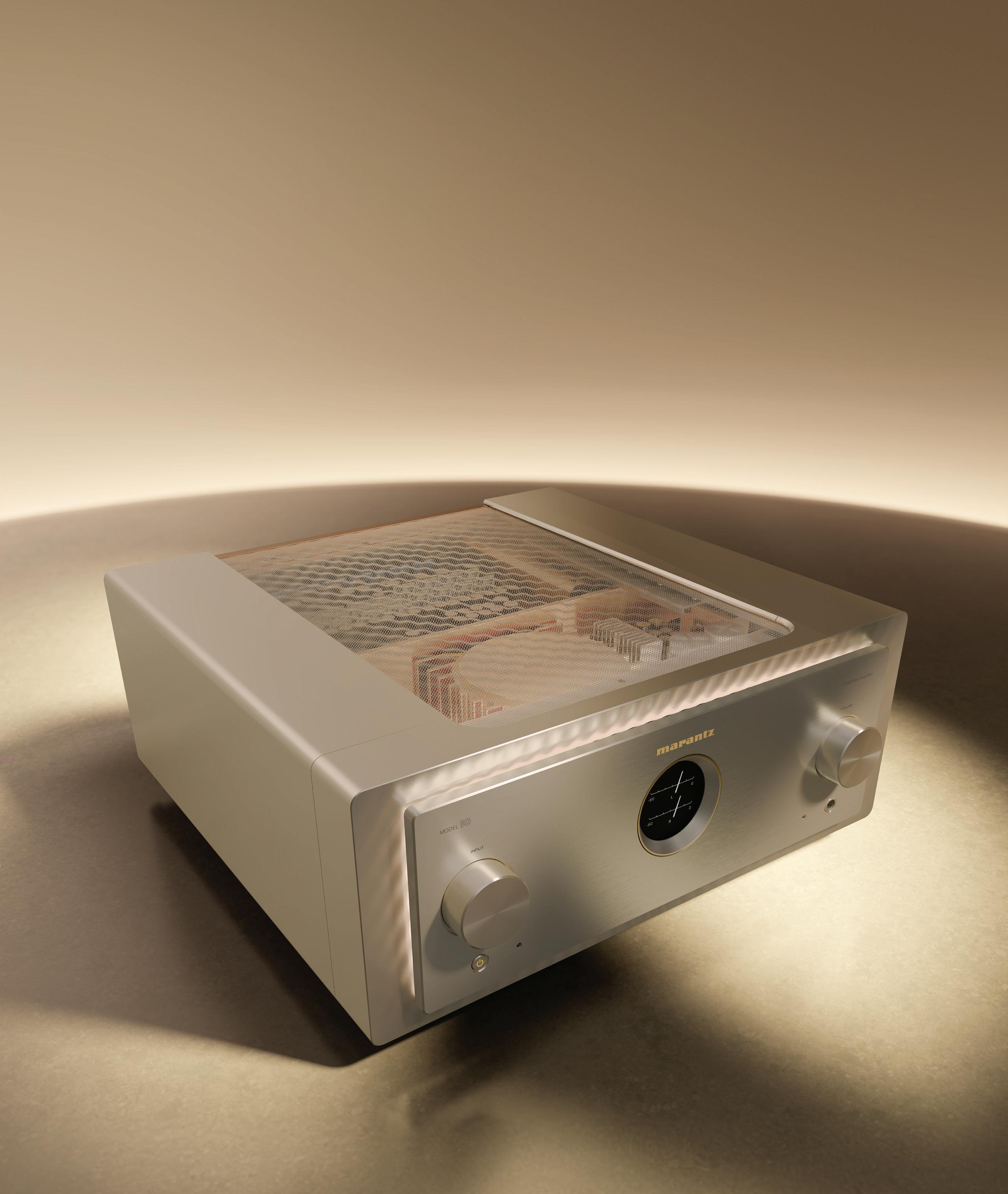
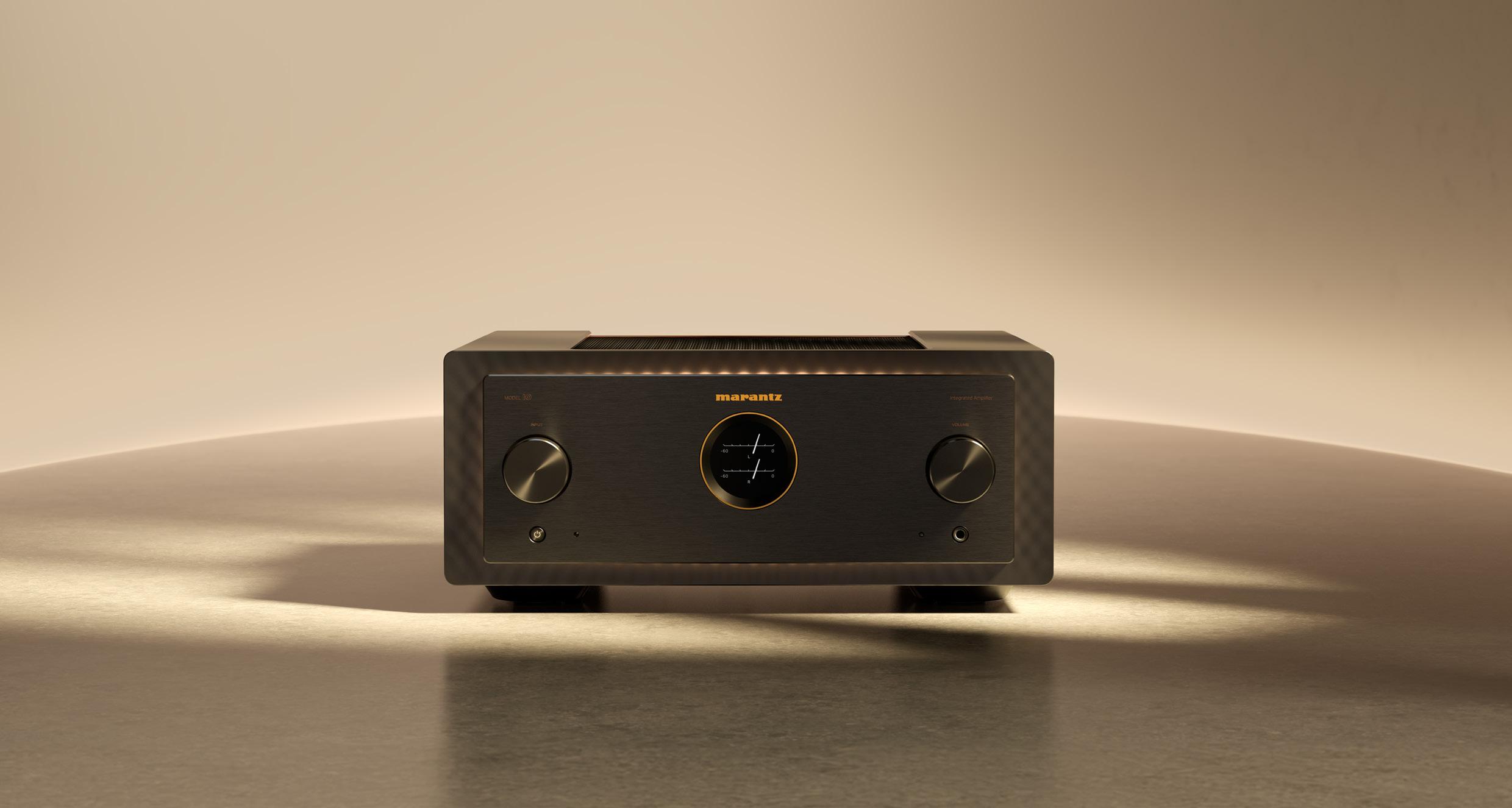
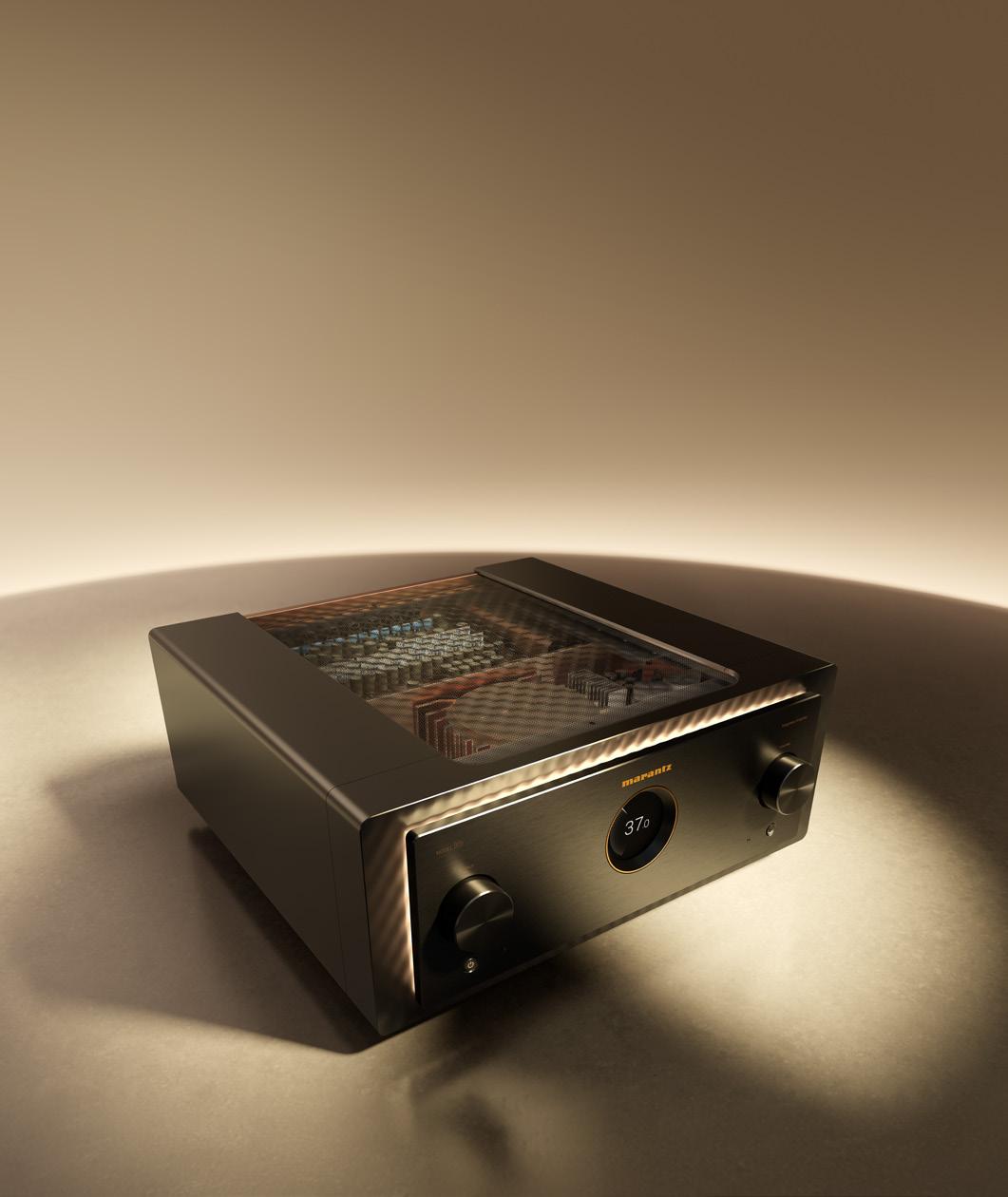
Marantz Model 10 is the Pinnacle of audiophile engineering. This flagship stereo SACD player and DAC is crafted for discerning listeners who demand absolute sonic purity in modern high-resolution systems.
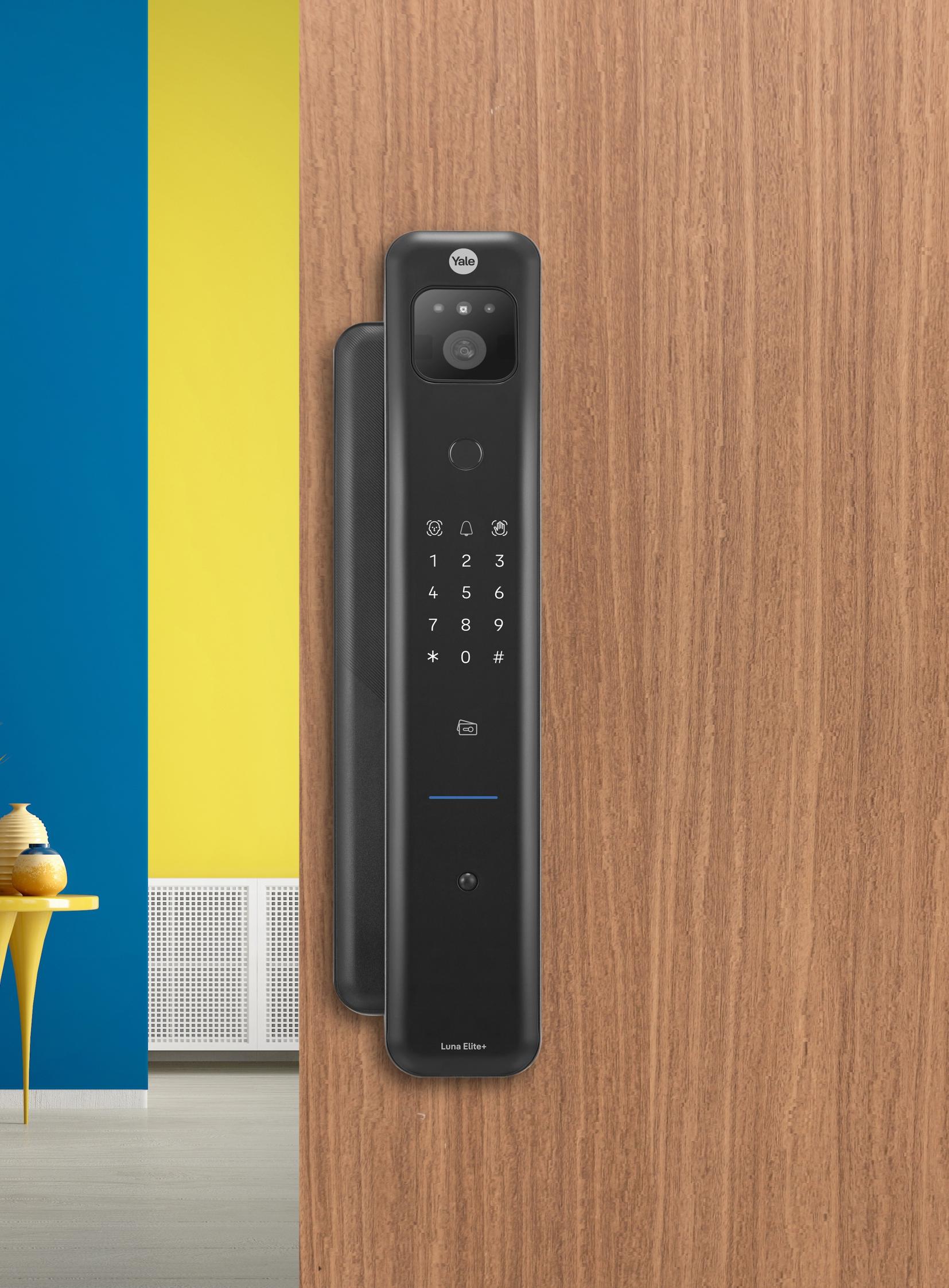
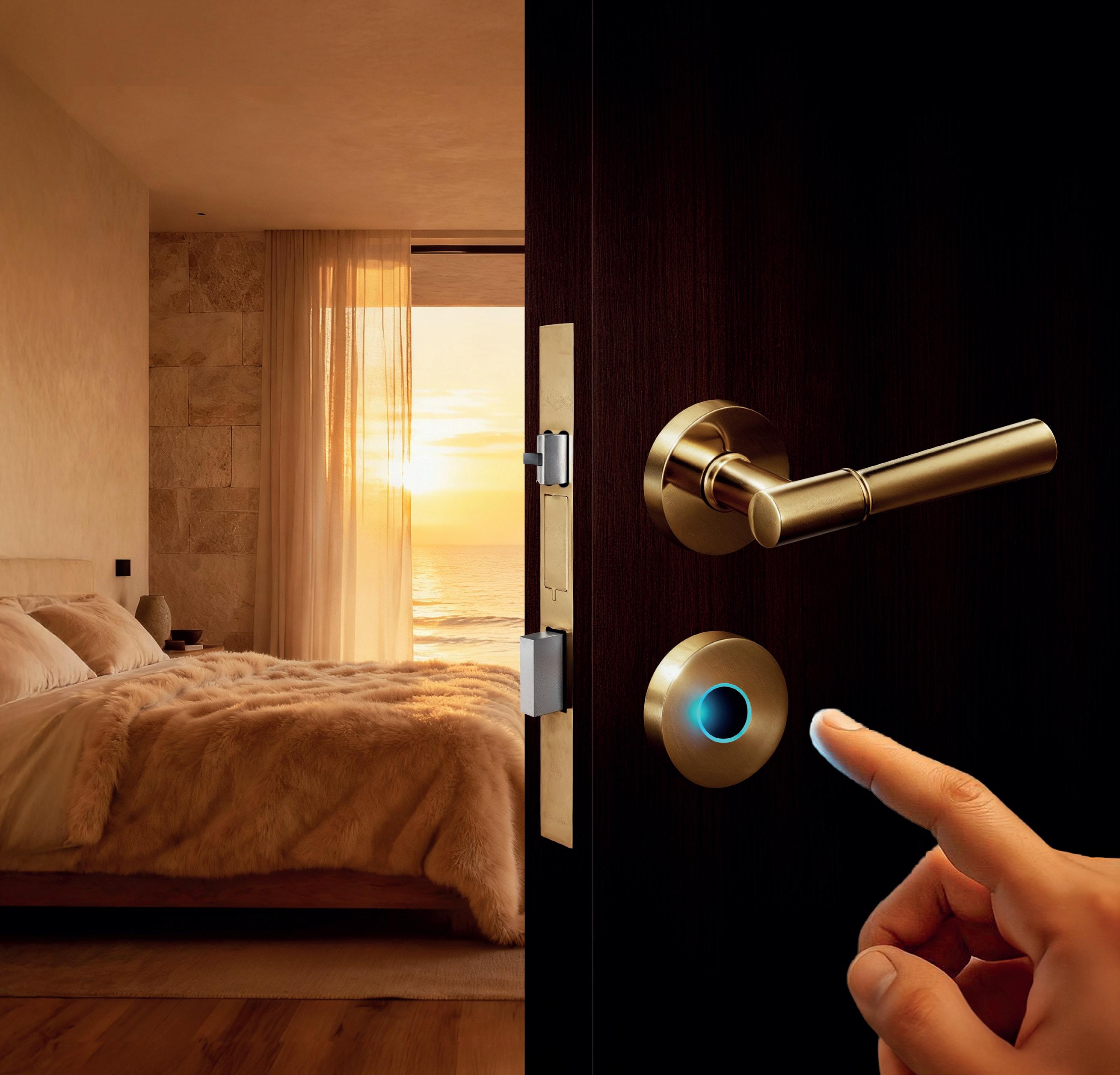
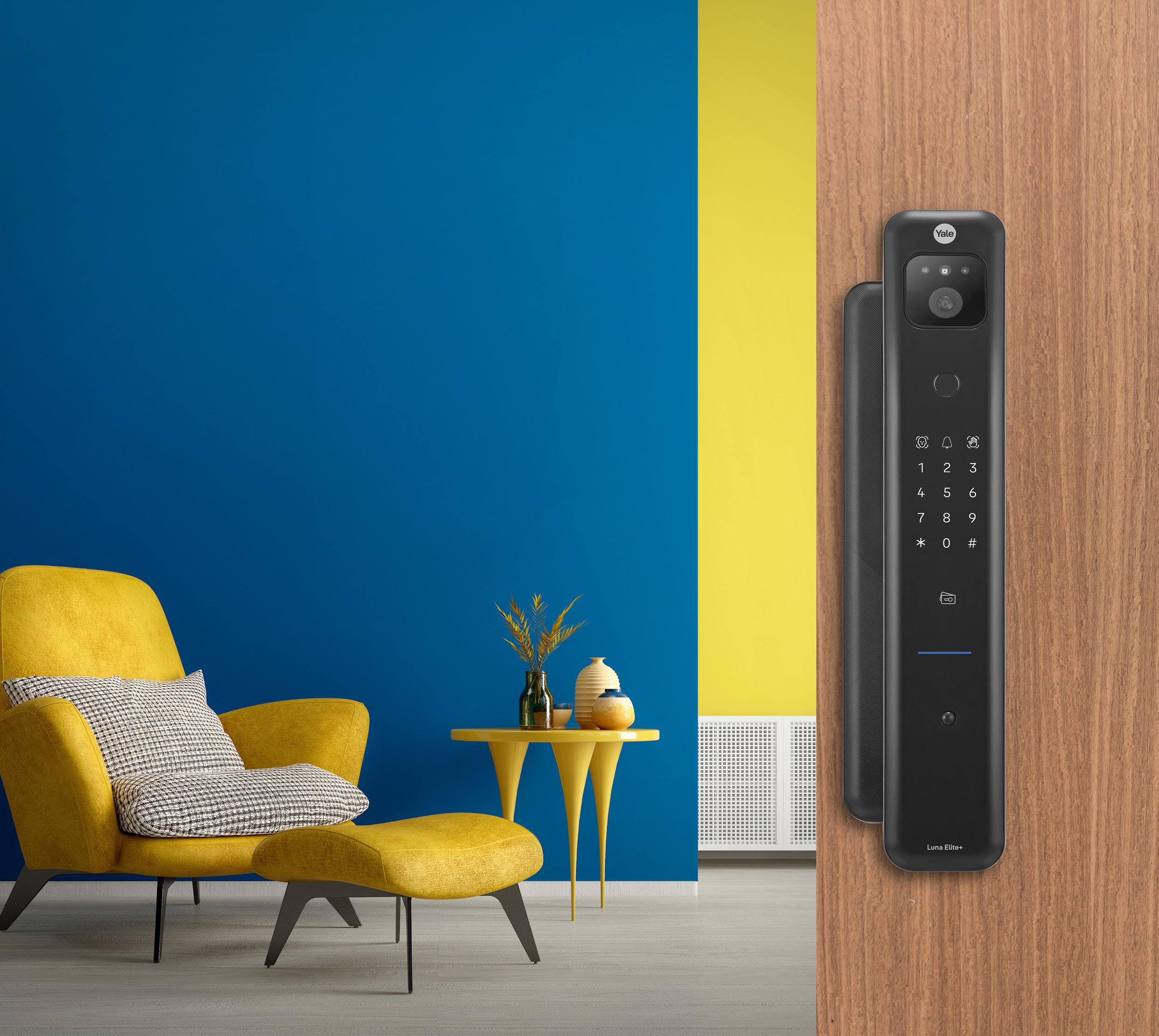
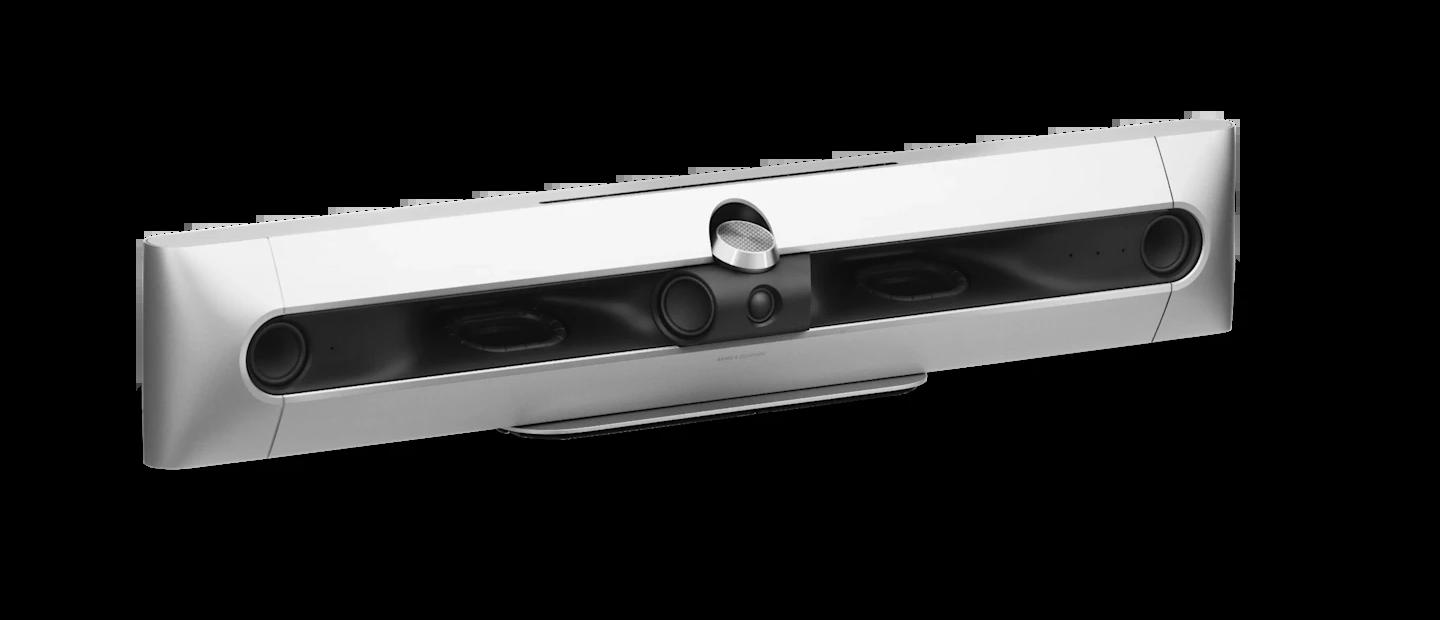
Yale Luna Elite+ sets a new benchmark in smart door security for today’s connected homes.
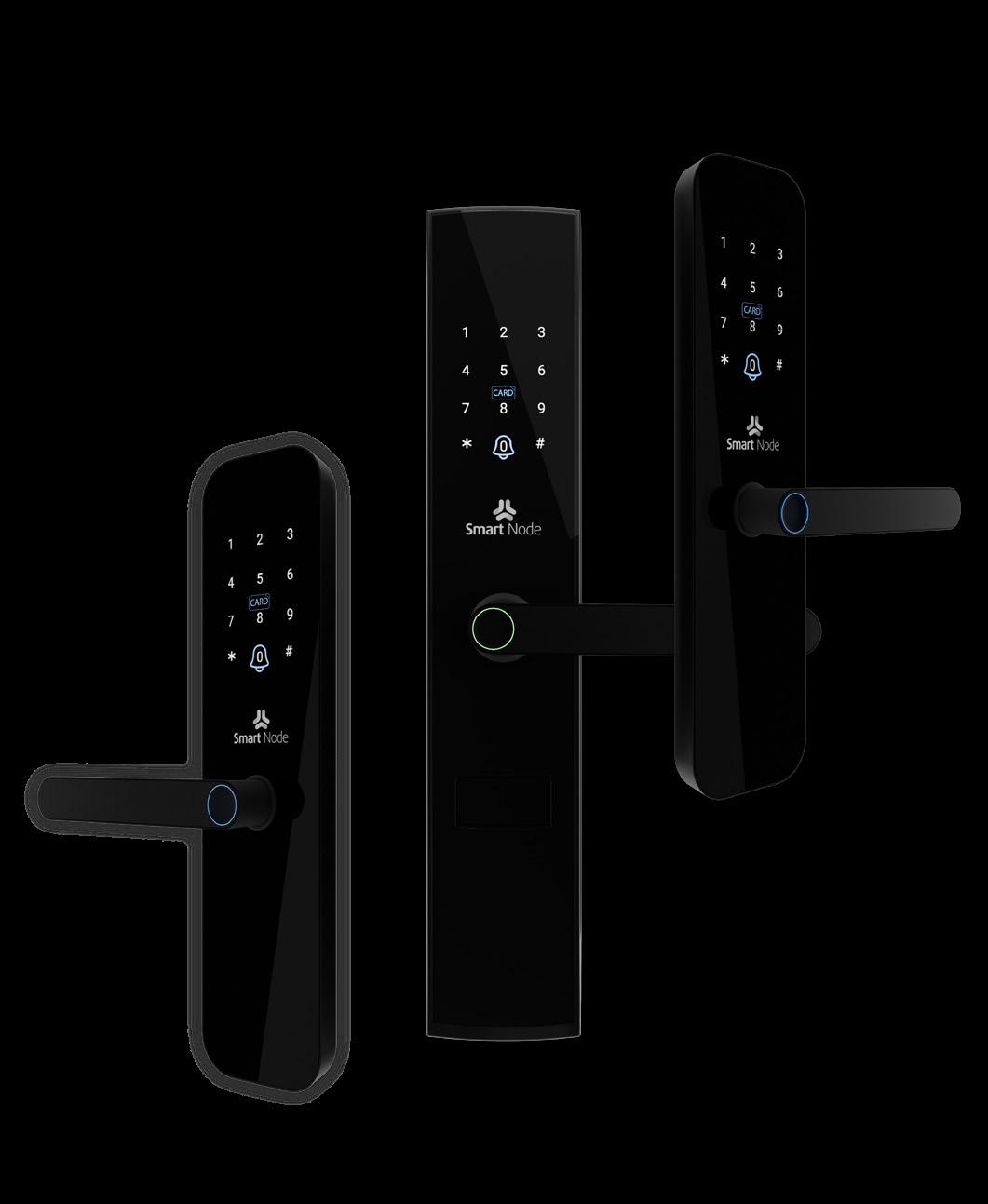
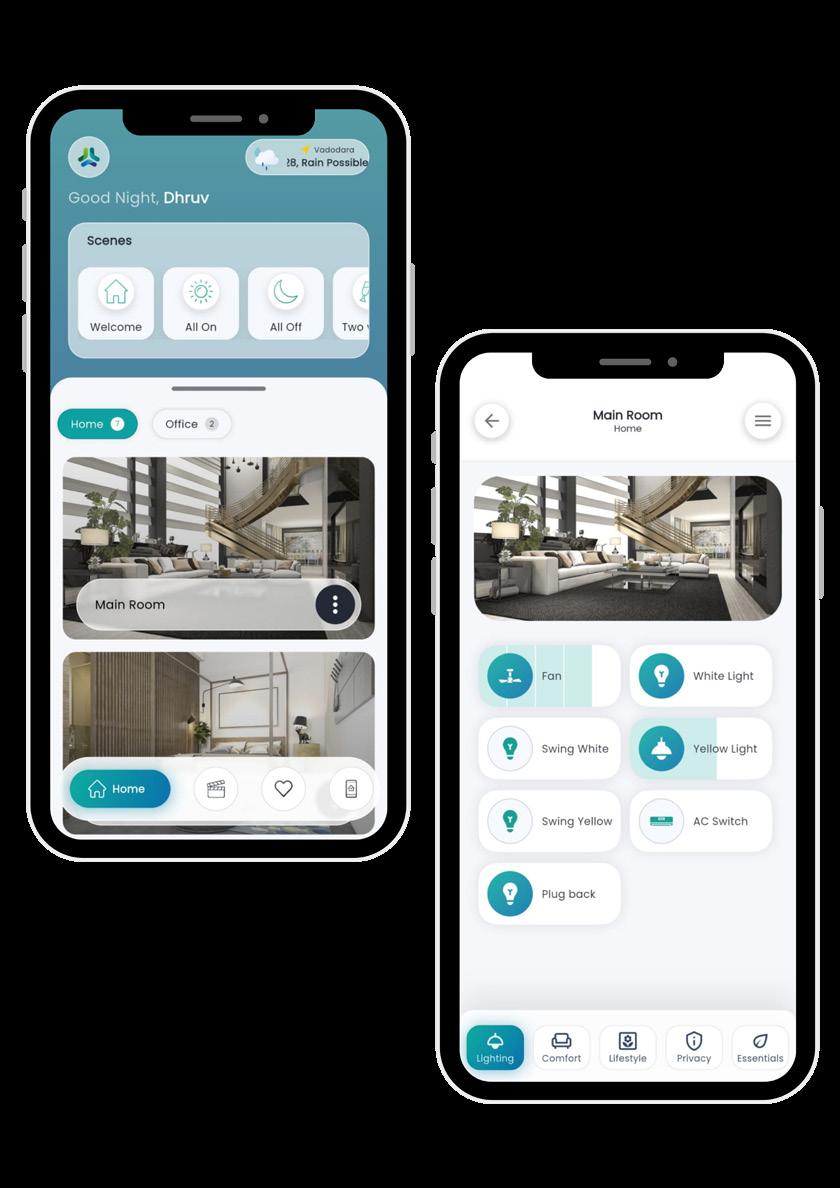
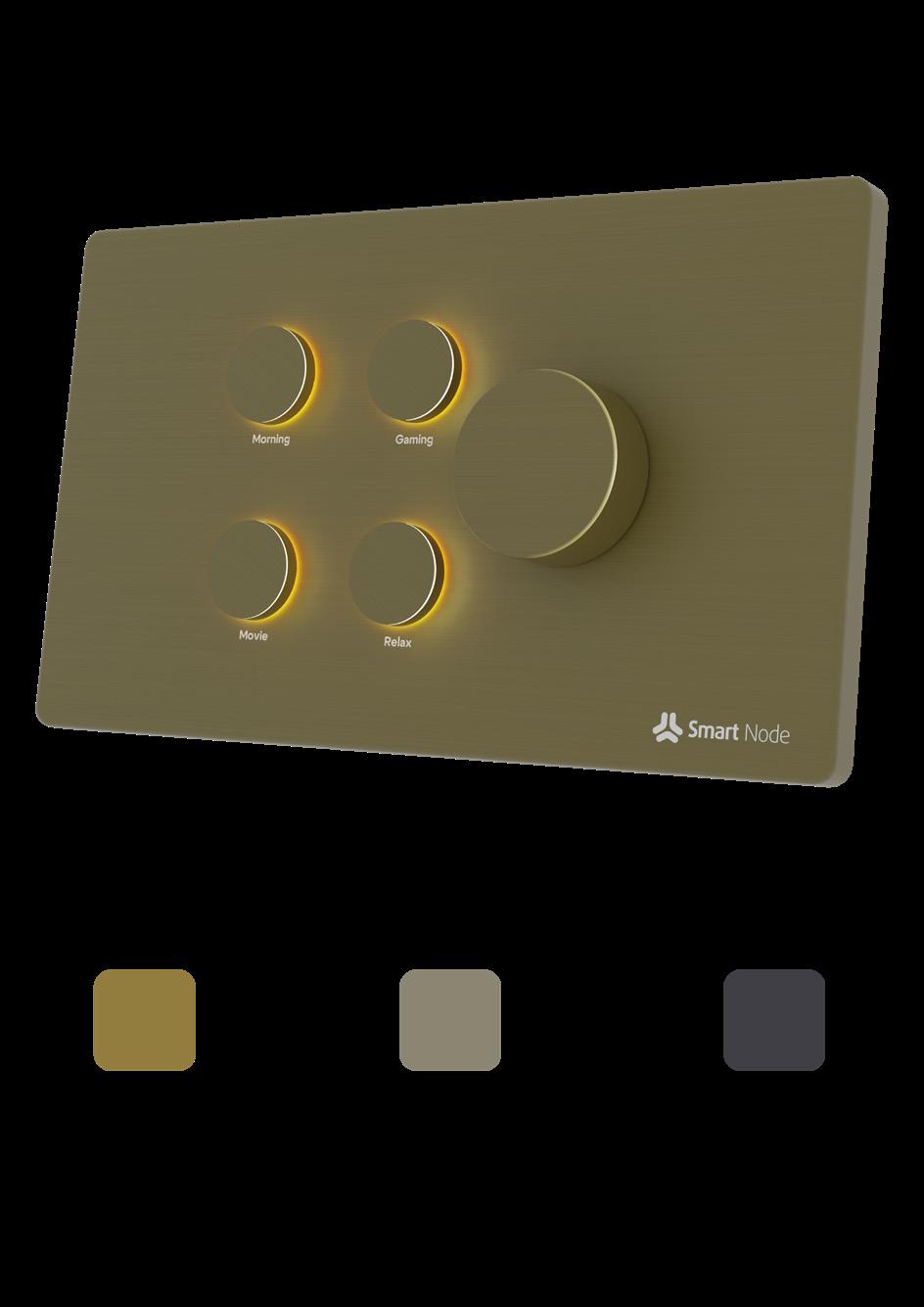
Smart Node will soon launch the 2026 Line-up that includes Bolt digital door locks, COSMOS designer keypads, and an upgraded Smart Node App for seamless and intuitive connected living.
Guest Article
Anup Pande, Founder & CEO, nuumx.ai | portalx. Life writes about AI breakthroughs that will transform homes into adaptive and sentient spaces by 2035.
Special Report
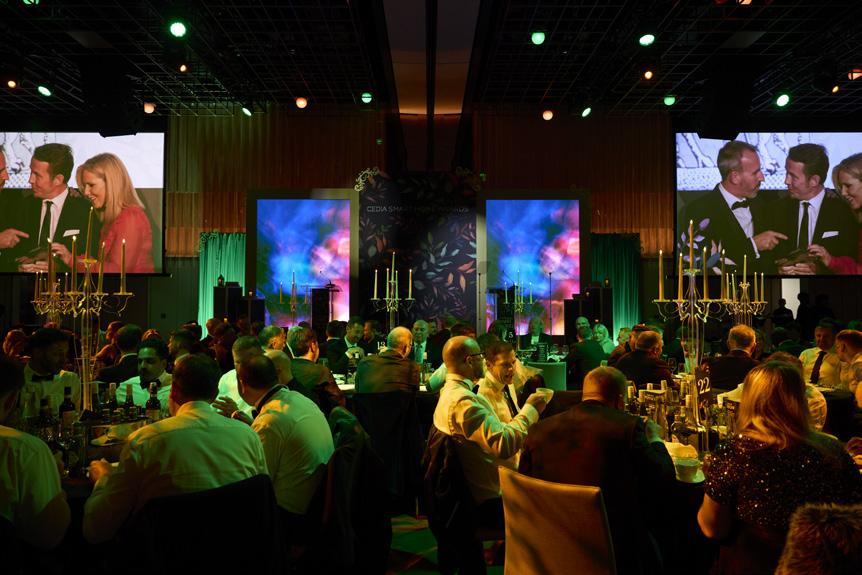
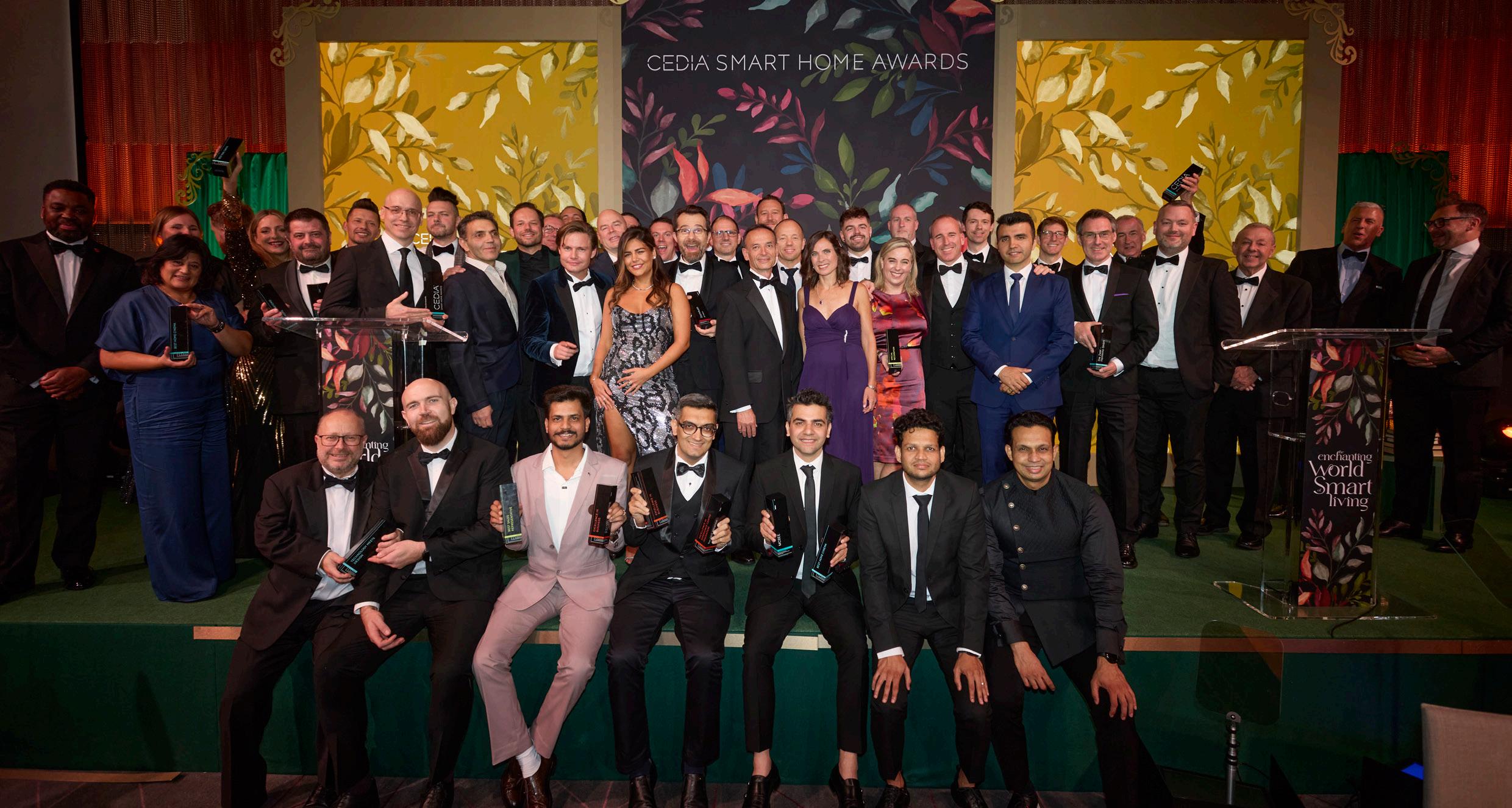
The 2025 CEDIA EMEA Smart Home Awards recognise the year’s most innovative, beautifully integrated smart homes. Meet the winners setting new benchmarks for the industry.
News
Latest launches, innovations, and trends in smart lighting, home automation, and connected living technologies. 12 28 34 51 76 74 68 62
ROI isn’t just a number; it’s the lifestyle your home earns you. For us at Smart Home World, smart homes aren’t only about saving money, they’re about spaces that anticipate your needs, enhance comfort, and quietly work in the background to make every day smoother. In our Cover Story, we speak to experts who open up about real-world ROI: the wins, the challenges, and what homeowners should truly look for beyond just the billing meter.
Our Feature Story on Smart Motors gives you an overview of how integrated blinds and curtains now respond to light, time of day, and your routines. Leading brands walk us through their latest product offerings and standout features.
In our interview section, we have Kristian Jenkins of Casambi Technologies explain how wireless lighting is redefining efficiency and sustainability. Neelima Ronanki from Gensler shares how digital-first workflows and automation are powering some of the country’s boldest commercial projects. And Madhav Kohli of AudioSphere talks about performancefirst AV and automation systems that are future-ready, intuitive, and crafted around the user.
Our Case Studies section showcases into two compelling projects. The Nirwana Head Office, designed by Ar. Umesh Sharma and a boutique residence designed by Ar. Vinay Patil showcases how modern architecture and intelligent automation can come together to deliver a seamless mix of luxury, comfort, and smart living.
In Product Previews, we showcase an innovative range from three brands: the Marantz Model 10, Yale Luna Elite+ and Smart Node’s 2026 line-up of smart home ecosystem.
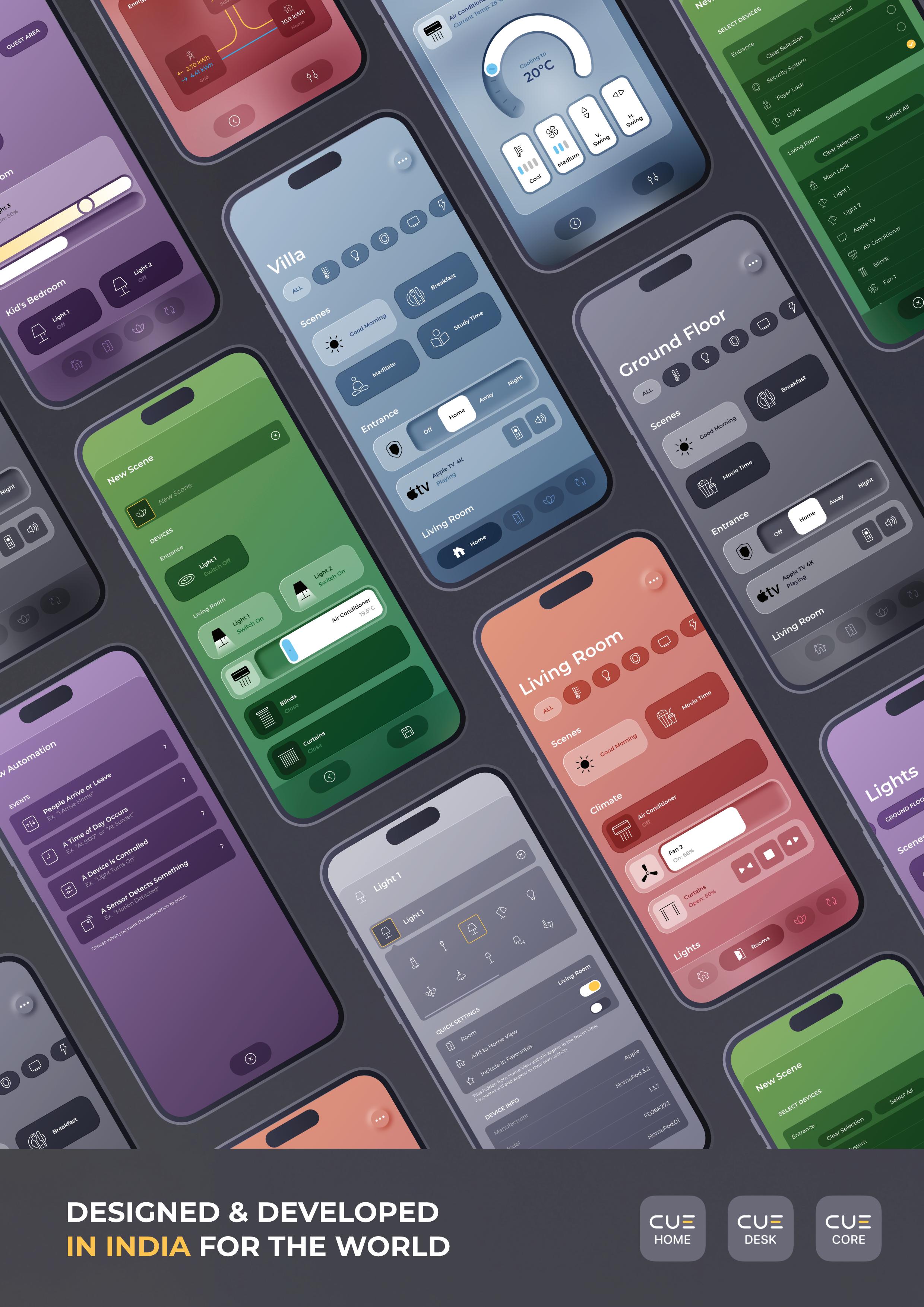
ROBUST, VALUE ENGINEERED, UNCOMPROMISED. THIS IS WHAT DEFINES CUE.
• KNX IP Interface
• Remote ETS Programming
• Matter Controller + Gateway
+1000 Brands
DESIGNED & DEVELOPED IN INDIA FOR THE WORLD
Understanding the ROI of Smart Homes
ROI of Smart home goes far beyond cutting utility costs. Smart Home Technology transforms every square foot into a high-performance asset. Smart Home World speaks to experts who share their insights on real gains in savings, comfort, and long-term value, while also sharing the pros and cons you need to know.
Many homeowners still assume that investing in smart homes is “too expensive” or that the returns are limited to a few cool gadgets and App controls. This article cuts through those misconceptions about ROI in smart homes. It also brings in the perspective of architects, interior designers and system integrators, exploring how they evaluate the value of smart technologies, where they see meaningful returns for clients, and how thoughtful design and selection of right smart technology can result into a smart, future-ready investment.
Industry Overview
For the beginners, it is important to understand what this segment includes and its functioning. Though energy efficiency is regarded as one of the most sought-after segments, which includes smart lighting, climate control, automated blinds and intelligent energy management systems that
work quietly in the background to trim waste and optimise consumption. Smart thermostats and AC controllers adjust cooling based on occupancy and time of day; motion sensors ensure lights are not left `ON’ in empty rooms; energy monitoring solutions help residents understand and correct inefficient habits. Over the years, these small, everyday optimisations add up to substantial savings, allowing many systems to pay for themselves through reduced utility costs, especially in larger homes or high-consumption households.
Another important, though subtle, component of ROI is time. In an urban context where dualincome households and long work hours are the norm, time saved is invaluable. Smart homes automate repetitive, mundane tasks— turning off lights, arming security, adjusting
curtains, scheduling geysers and appliances, freeing residents from constant manual control. Fewer mistakes, such as leaving the AC ON all day, and less mental load in managing the home, allow people to better time management and over months and years, this adds up to a significant saving.
Smart Home World speaks to leading architects, interior designers, and system integrators to share actionable insights with readers on their views and insights on ROI for Smart Homes.
How has the demand for integrated smart home systems changed in the past 2 to 3 years?
We’ve seen demand grow from our clients in India and Dubai as they now measure value in both financial and experiential terms. In India, people want homes that feel easier to run, with fewer daily touchpoints. In Dubai, convenience and reliability are expected in every premium property. My team has seen a significant rise in projects where clients ask for one simple control layer that improves daily living, reduces stress, and makes the home feel organised.
Which smart home solutions provide the quickest ROI for homeowners?
You get ROI from lighting and AC automation that lowers cost, but you also get strong intangible returns from:
• Seamless access control that improves security and gives peace of mind.
• Voice and app control that saves time during daily routines.
• Centralised scenes that reduce effort across lighting, climate, and AV.
• Strong networking and WiFi that removes frustration and downtime.
• Automated shading that improves comfort in heat-heavy markets like Dubai.
• These do not show up on a bill, but they
change how the home feels every day. Homeowners value this as highly as energy savings.
Which emerging technologies or services will boost ROI going forward?
Emerging technologies that will boost ROI going forward are those that quietly reduce friction in daily life while improving health, comfort, and reliability. AI-driven home routines will increasingly take over small decisions throughout the day, like adjusting lights, temperature, and blinds based on habits, making homes feel more intuitive and personalised. Smarter presence and motion sensing will further enhance comfort by managing lighting and climate without the need for constant manual control. We’ll also see stronger integration between wellness features and automation, especially with circadian lighting that supports natural sleep–wake cycles. In polluted Indian metros, realtime health and air-quality monitoring will become a high-value feature, giving residents better control over what they breathe indoors. Finally, predictive maintenance for AC, AV, and networking systems will help keep homes running smoothly in harsh climate conditions, reducing breakdowns, extending equipment life, and protecting the overall investment in smart infrastructure.
Rustom Cooper
Co-Founder & CTO, Empire Living CO
Ganesh Vudutha Founder, EDOMOTICS Smart Systems Pvt. Ltd.
How has the demand for integrated smart home systems changed in the past 2–3 years?
There are many manufacturers or retailers that offer piece-meal solutions such as lighting control, curtain motors, AC control, or multi-room audio systems. And these companies, typically, cannot fulfill the needs of a homeowner if he/she is looking for an integrated solution. We see a lot of inbound leads lately where the homeowner has done research on the various home automation options and wants an integrated smart home system. And, this is where the role of the system integrator becomes crucial.
Which smart home solutions typically provide the quickest ROI for homeowners?
The 3 most significant energy consumption devices are the Air Conditioning, Geysers, Appliances and Lighting. The first step to energy saving is monitoring i.e. the homeowner needs to understand and be aware of where the money is being spent. By implementing sensors, routines, timers and schedules, we can achieve the maximum ROI.
Are there emerging technologies or services that you believe will significantly boost ROI for homeowners?
The consumption of electricity in a home is ever-growing and with the surge of EV cars, the electricity consumption is expected to rise steeply. Another significant factor is India moving towards a Time of the Day (ToD) tariff policy. Once this gets rolled out, smart home automation can significantly impact the energy bills. Scheduling tasks that consume maximum electricity when the tariff is the least becomes the key to energy saving. Another significant impact on the ROI will be achieved by utilizing Solar energy for such tasks. Smart home automation will be at the very centre of this energy-saving journey for the homeowner.
How has the demand for integrated smart home systems changed in the past 2–3 years?
Over the past few years, we’ve seen a strong shift from standalone smart devices to fully integrated ecosystems. Homeowners now prefer solutions that bring lighting, security, HVAC, audio-video, and energy management into a unified platform. The rise in remote work, increasing awareness of energy optimisation, and improved affordability of smart devices have significantly boosted demand. Clients today are more informed and
actively seek long-term value rather than oneoff enhancements.
Which smart home solutions typically provide the quickest ROI for homeowners?
Technologies that deliver immediate energy savings tend to offer the fastest ROI— particularly smart lighting automation, smart thermostats/HVAC control, and energy monitoring systems. Additionally, security and surveillance solutions offer strong nonfinancial ROI by enhancing peace of mind and property protection, which homeowners increasingly value.
Are there emerging technologies or services that will significantly boost ROI for homeowners?
Yes, AI-driven energy optimisation, smart load management, and integration with renewable energy systems are poised to become major ROI drivers. We also expect predictive maintenance and sensor-driven automation to grow rapidly, reducing energy waste and extending the lifespan of appliances and systems. These technologies move beyond convenience and start delivering tangible operational savings.
From a design perspective, which smart home investments add the most value to a property in India?
In India, the smart features that truly add value are the ones that make daily life easier, safer, and more efficient without overwhelming the homeowners. The most impactful investments tend to be smart lighting systems (with scene settings, dimming, and app control), smart door locks and video door phones that strengthen security, and smart AC control systems that help manage cooling more efficiently in our homes.
In premium apartments, motorised blinds and curtains are increasingly seen as a mark of luxury, while a reliable Wi-Fi and networking backbone has become non-negotiable for everything to function smoothly. Across the board, clients prefer technology that visually recedes into the interiors and does not demand heavy or frequent maintenance.
Do clients in India generally perceive smart home features as a worthwhile investment for resale or long-term ROI?
Increasingly, yes. Especially in metro cities, clients view smart features as a clear convenience upgrade, a marker of a modern, premium home, and in some cases a differentiator that can improve resale appeal in competitive markets.
That said, ROI perception is mixed. Many homeowners still prioritise visible elements— like finishes, furniture, and decor over
technology. For most, smart features are still seen as a “good-to-have” value-add rather than a mandatory specification, with one major exception: security. Anything that improves safety—locks, cameras and video door phones is almost universally considered a worthwhile investment.
Are there specific technologies you recommend to clients for long-term value?
Yes. In the Indian context, we find that clients get the best long-term value from simple, scalable systems rather than over-engineered, fully-loaded automation. Our typical recommendations include basic automation packages with smart switch modules and lighting control, along with smart locks and video doorbells, which offer clear, long-term utility.
We strongly advise laying structured wiring during construction, even if the full automation is planned for a later phase,
because this keeps future options open at a much lower incremental cost. A stable Wi-Fi system with strong coverage across the home is essential; it is effectively the backbone of all smart features. Smart thermostats and AC controllers also deliver meaningful energy savings, given India’s climate.
Instead of pushing expensive, whole-home automation from day one, we focus on systems that are easy to maintain, upgrade, and expand over time.
What are the biggest challenges in aligning Indian clients’ expectations with technology capabilities?
The most common challenge is budget: clients are often exposed to high-end global references and want similar experiences at significantly lower costs. Ease of use is another
From a design perspective, which smart home investments add the most value to a property?
From a design perspective, the most valuable smart home investments are those that elevate lifestyle while remaining visually unobtrusive. At Dipttii Khanna Designs, we focus on features that seamlessly blend into the interiors rather than drawing attention to the technology itself. Lutron or KNX-based lighting automation is a key example of fullscene control, cleaner walls and a more refined user experience that make it far superior
key factor where homes with elders, children, and staff prefer simple, intuitive controls over complex apps or multi-step operations.
There are also persistent concerns around maintenance and after-sales support, with many clients worried about breakdowns or systems becoming obsolete. In several locations, inconsistent internet performance is a real limitation, since many smart solutions are only as reliable as the Wi-Fi that supports them.
Finally, there is often a lack of clear understanding about what automation can and cannot do, which leads to either inflated expectations or under-utilisation of installed systems. We’ve found that realistic demos, mock setups, and upfront discussions about limitations and service support go a long way in aligning expectations with reality.
to app-based bulb solutions. Automated climate and blinds systems further enhance comfort and efficiency while maintaining a consistent aesthetic, eliminating the visual and functional clutter of manual controls. Integrated security like smart locks, CCTV and access systems, is always planned as part of the architectural concept rather than treated as an afterthought, and all of this is supported by a strong network backbone with structured cabling and centralised networking, because any smart home is only as reliable as its connectivity. For us, these elements are not add-ons; they are fundamental to creating a modern, functional luxury home.
Do clients see smart home features as worthwhile for resale or long-term ROI?
Most clients do see smart home features as worthwhile for resale and long-term ROI, especially once they understand how seamless integration, rather than scattered gadgets, can enhance a property’s appeal. Homes with robust lighting, climate and security automation typically sell faster because buyers immediately value the convenience and intelligence that’s already built in. Energy efficiency and security consistently contribute to perceived value, while overly trendy or
Dipttii Khanna, Founder
Dipttii Khanna Designs
standalone devices tend not to age well. What truly holds value over time are integrated ecosystems designed to work together, so when smart integration is done right, clients view these features as a genuine long-term asset—and informed buyers do too.
Are there specific technologies you recommend to clients for long-term value?
Yes, we always encourage clients towards systems that are stable, future-ready and easy to upgrade. Lutron HomeWorks or KNX automation platforms are our preferred choices because they are reliable, wellestablished and not dependent on any single brand’s app or product cycle. We also recommend smart climate control integrated with HVAC systems for real, measurable energy savings, as well as motorised blinds with sensor-based automation to intelligently manage heat and light. Centralised AV and networking ensure that future upgrades can be carried out without disrupting the finished space, and high-quality security systems are detailed into the architecture so they enhance, rather than clutter, the visual language of the home. These solutions age gracefully, minimise maintenance issues and support phased expansions over time.
What are the biggest challenges in aligning client expectations with available technology?
The biggest challenges usually stem from the gap between the fantasy of a “smart home” and its practical realities. Many clients imagine complete, effortless automation without fully appreciating the logic, programming and coordination involved behind the scenes. Budgets don’t always match the level of sophistication they envision, especially when it comes to centralised solutions like Lutron or KNX.
There is also a common assumption that every device will be universally compatible, which isn’t true in practice. Some clients hesitate to invest in the invisible backbone—infrastructure like wiring, hubs and networking—even though that is exactly what makes a system robust and future-proof. Added to this is the confusion between consumer gadgets and professional-grade systems, which often requires us to reset expectations. Ultimately, education and clear guidance are crucial: our role is to help clients make informed decisions so their smart home doesn’t feel outdated in a couple of years, but continues to support the way they live well into the future.
Ar. Gaurav Sanghavi Founder, Pentaspace.
From a design perspective, which smart home investments add the most value to a property?
From our experience, the highest-value smart investments are those that balance comfort, efficiency and visual calm. Smart lighting and climate control are key, both for energy savings and for creating different moods through the day. Integrated security systems like CCTV, smart locks and access controls are now almost a baseline expectation in premium homes.
Automated blinds and curtains add a lot of perceived luxury while also helping with glare and heat control. A centralised home automation system that ties lighting, curtains, AC and security into one interface always feels more premium than standalone devices.
We also see strong value in voice assistants and app-based controls, especially when they’re discreetly integrated. In luxury homes, smart kitchen appliances are gaining traction as part of a holistic tech-enabled lifestyle. Across all segments, seamless design integration— clean walls, hidden wiring, minimal visible hardware—and retrofit-friendly solutions that don’t disturb the interiors are crucial to perceived value.
Do clients generally perceive smart home features as a worthwhile investment for resale or long-term ROI?
Yes, particularly in the premium and luxury segments, clients increasingly see smart
features as part of the basic specification of a modern home. Buyers appreciate tangible benefits like lower energy bills and better security, and these become strong talking points during resale.
Smart systems also act as differentiators in a crowded real estate market, especially when the project is competing within the same micro-location or price bracket. That said, clients who are building long-term homes for themselves tend to extract more value from the investment than those thinking purely from a resale perspective.
We also notice a clear generational shift: younger buyers are far more comfortable with integrated systems and expect a certain level of tech as standard. Importantly, ROI perception improves significantly when the systems are intuitive and easy to use; if the tech feels intimidating, it quickly starts to feel like a liability instead of an asset.
Are there specific technologies you recommend to clients for long-term value?
For long-term value, we usually recommend
modular, upgradeable home automation platforms rather than rigid, closed systems. Integrated lighting and curtain control is almost always on our list—it adds convenience, enhances ambience and is relatively futureresilient.
We also prioritise safety and security: sensors, smart video doorbells, intercoms, and reliable surveillance systems. Automatic appliance management—like central control of geysers, ACs and key loads—helps with both convenience and energy optimisation.
Where possible, we lean towards robust wireless systems with strong app control, especially for retrofit projects. They are easier to upgrade or expand over time without major civil work, which is a big plus for long-term adaptability.
What are the biggest challenges in aligning client expectations with technology capabilities?
The first challenge is perception, which many clients either underestimate the complexity of smart systems or expect “magic” without
understanding the infrastructure required. This often leads to a gap between aspirations and budget.
There’s also limited awareness of what the technology can and cannot do. Sometimes clients expect full interoperability between brands or unlimited scalability, which isn’t always realistic. On the other side, some are hesitant to adopt new tech because of fears around maintenance, updates and potential failures.
Aesthetics are another concern; no one wants walls cluttered with too many switches, routers, or devices. Ensuring that tech disappears into the design requires careful planning with the system integrator from an early stage.
Compatibility between different systems and platforms can also be tricky, especially when multiple vendors are involved. Above all, the real design challenge is to deliver a simple, intuitive user experience on top of a very complex backend. If the system isn’t easy for the homeowner and staff to operate, even the best technology won’t feel successful.
From a design perspective, which smart home investments add the most value to a property?
From a design perspective, the smart features that add the most value to a property are those that blend aesthetics with measurable performance gains in security, comfort, and efficiency. Smart security systems can deliver up to a 5% increase in property value, thanks to features like cameras, smart locks, and video doorbell cameras that greatly enhance safety and buyer confidence. Smart thermostats contribute an additional 3–5% increase by offering energy-saving modes and automated temperature control, which improve comfort while reducing utility bills. Smart lighting typically adds around 2–3% by combining energyefficient LED solutions with customisable scenes that elevate the ambience of every space. A well-designed home automation hub can add a further 3–5% by integrating all key smart devices into one seamless, centralised control system, creating a premium, user-friendly experience. Finally, energy management systems can contribute an extra 2–4% by optimising overall energy usage, lowering
running costs, and strengthening the home’s sustainability profile—all of which resonate strongly with modern, informed buyers.
Do clients generally perceive smart home features as a worthwhile investment for resale or long-term ROI?
Yes, more and more clients now see smart home features as a solid investment, both for resale and long-term use. Homes equipped with thoughtfully selected smart systems often command better prices and attract stronger buyer interest, especially in competitive and luxury markets. Tech-savvy buyers appreciate properties that are “move-in modern,” with automation already integrated rather than added later. Features that improve energy efficiency and security are particularly compelling, as they offer ongoing savings and peace of mind. While clients may still prioritise visible finishes and décor, smart features are increasingly seen as part of the core value proposition of a contemporary home rather than just an optional extra.
Which smart technologies do you recommend to clients for long-term value?
For long-term value, the focus is on reliable, integrated systems rather than one-off
gadgets. Smart security solutions—combining cameras, smart locks and video doorbells are always recommended, as they provide clear functional and emotional value. Smart thermostats and climate control systems help reduce energy consumption while keeping the home comfortable, making them a practical investment over the years. Smart lighting with dimming and scene control adds both efficiency and lifestyle benefits. A well-chosen home automation hub that integrates these devices into one ecosystem enhances convenience and makes future upgrades easier. When selecting technologies, it’s important to look at how well devices integrate, whether the system can scale over time, how intuitive the user interface is, and whether professional installation and support are available to ensure everything works as intended.
What are the biggest challenges in aligning client expectations with technology capabilities?
The main challenges arise from the gap
between what clients imagine smart technology can do and what it can realistically deliver. Some clients start with very high or vague expectations—wanting “everything automated” without a clear understanding of the underlying cost, time and coordination required. Budget constraints can become a friction point when sophisticated features and high-quality hardware are balanced against overall project costs. Integration is another challenge: not all devices talk to each other seamlessly, and retrofitting can be more complex than clients expect. There is also the human factor—clients and family members may need time and training to feel comfortable using new systems, and evolving technology can make them worry about obsolescence. These challenges are best managed through clear communication, early education, a phased implementation strategy, and ongoing support. By setting realistic expectations and guiding clients through the options, it becomes much easier to deliver smart homes that feel intuitive, robust and future-ready.
Ketan Chavan Founder, KCL- DESIGN & ARCHITECTURE
From a design perspective, which smart home investments add the most value to a property?
From a design perspective, the smart home investment that adds most value to the property is lighting automation. Lighting changes the mood of a space, making the home feel modern and luxurious. It also makes the lighting more energy efficient.
The second thing that adds value to property is security solutions like cameras, video door phones, locks, etc. Buyers and end users prioritize safety.
The Third thing on this list would be motorised curtains, which are perceived as luxury and add a wow factor. When integrated with the lighting automation and home entertainment systems, motorised Curtains become an integral part of the scene creation, be it synchronization with sunrise/ sunset or leisure, work and entertainment modes.
Do clients generally perceive smart home features as a worthwhile investment for resale or long-term ROI?
In my experience, clients usually perceive smart home features as a worthwhile investment for personal use. The entire experience is customised to the client’s current needs and usually not with a consideration for resale or long-term ROI. Having said that, the prospective buyer may perceive smart home features as a value addition depending upon the age of the infrastructure, adaptability with current technology trends and daily usefulness.
Are there specific technologies that you recommend to clients for long-term value?
The technologies that we recommend to the clients for long-term value are structured
wiring and mesh networking to have a seamless wifi connectivity over the entire house. This future-proofs all other related automation technologies.
What are the biggest challenges in aligning client expectations with technology capabilities?
Smart home technology works best when planned in the early design phase, but many Clients bring it up too late. At that time, we have to rely on retrofit technology, which in many instances is not as reliable.
Budget misalignment is often a challenge. Clients want a high-end automation experience but with a budget for midrange systems. In such a case, the Architect and the Client need to find a balance between cost and reliability Clients expect the home to be
future-proof. It is important for Architects and designers to choose stable ecosystems as products get discontinued, systems get upgraded, new standards evolve and apps get updated.
It is easy to overestimate or underestimate what technology can do. It is important for the Architect to understand and communicate clearly with the client with respect to available systems and technologies, the capabilities and deficiencies of each type of system and then choose the one that is best suited to the requirements and the budget of the Client.
Aesthetic versus Functional conflicts are a challenge. Things like AV equipment requiring Ventilation or smart switches interfering with the design language. Designers must balance both to create seamless aesthetics and tech usability.
From a design perspective, which smart home investments add the most value to a property?
The ones that enhance daily living without overpowering it. Automated lighting, climate control, and security systems consistently add value because they improve comfort and efficiency. Smart curtain systems, integrated sound, and energy-efficient appliances also stand out; they make homes feel intuitive and well thought out. The key is invisibility technology that integrates seamlessly into the design rather than dictating it. Do clients generally perceive smart home features as a worthwhile investment for resale or long-term ROI?
Yes, especially in the last few years. Buyers are far more aware of the convenience and energy savings these systems bring. A home that’s tech-ready with concealed wiring, structured cabling, and provision for automation signals future readiness, which helps resale. However, beyond ROI, clients are beginning to view these upgrades as lifestyle investments, rather than luxury add-ons.
Are there specific technologies that you recommend to clients for long-term value?
We focus on systems that enhance everyday living while staying adaptable as needs evolve. Smart lighting and temperature control remain the most impactful, as they instantly improve comfort and energy efficiency without altering the aesthetics. Motorised blinds, occupancy sensors, and smart locks
are simple, durable additions that elevate convenience and security. What truly adds long-term value is when all these systems integrate seamlessly into universal hubs or platforms that allow upgrades as new devices emerge. This flexibility ensures the home stays relevant, efficient, and aligned with how people actually use their spaces over time.
What are the biggest challenges in aligning client expectations with technology capabilities?
The biggest challenge lies in balancing invisibility with impact. Clients want high performance without visible tech clutter, switches hidden, sensors seamless, and speakers invisible, but that demands thoughtful detailing from the start. Another layer of complexity is ensuring the system feels intuitive. Over-automation can make spaces feel mechanical if not designed around human habits. The key is integration; lighting, shading, and climate systems must respond naturally to how the space is lived in. When done right, technology becomes part of the design language itself, subtle, functional, and quietly elevating the everyday experience.
Neha Jaene Founder & Principal Designer, Studio Jaene
Overall, the true ROI on a smart home is a blend of numbers and experiences. It is reflected not just in reduced bills or higher property valuations, but in the everyday feeling of living in a space that anticipates, responds and adapts. When technology fades into the background and life at home becomes smoother, safer, healthier and more intuitive, the investment begins to feel less like an expense and more like an upgrade to the way we live. In that sense, smart homes, when thoughtfully planned and well executed, are not just about smart devices—they are about making smarter, more future-ready and more human-centric homes.
Smart Motors Powering Next-Gen Shading
Smart Motors are transforming blinds and curtains into intelligent, connected shading systems. Leading brands share their innovative solutions that are reshaping comfort, control and integration in smart homes.
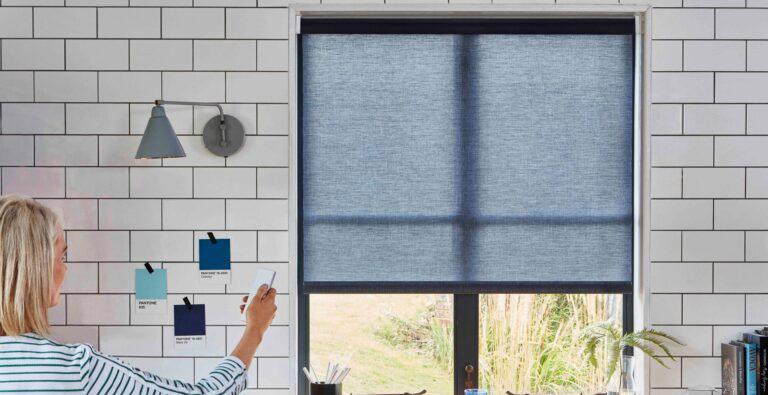
Smart Motors has quietly become one of the most critical components in modern window systems, redefining how blinds and curtains function in connected homes and intelligent buildings. What was once a purely manual gesture, pulling a cord, tugging a chain or drawing a curtain by hand has evolved into a layered ecosystem of motors, sensors, protocols and apps that together deliver precision, comfort and control.
The smart motor is no longer a hidden accessory but the core technology layer that determines performance, integration and user experience. A smart motor is expected to deliver smooth and quiet operation, handle a wide range of loads and fabric sizes, offer precise positional control and communicate
reliably with controllers, sensors and smart home hubs. The quality of the motor directly shapes how occupants experience a space: whether blinds rise silently in a bedroom at sunrise or whether curtains in a luxury living room glide without judder.
To address diverse installation scenarios, the market now offers multiple categories of motors. Wired motors remain the backbone of new construction, large homes and commercial projects where electrical planning can be done upfront. Powered from the mains and often speaking building automation languages such as KNX or other protocols, they are ideal for large loads and high-frequency operation. Wireless and battery-powered motors, on the other hand, have unlocked the retrofit market.
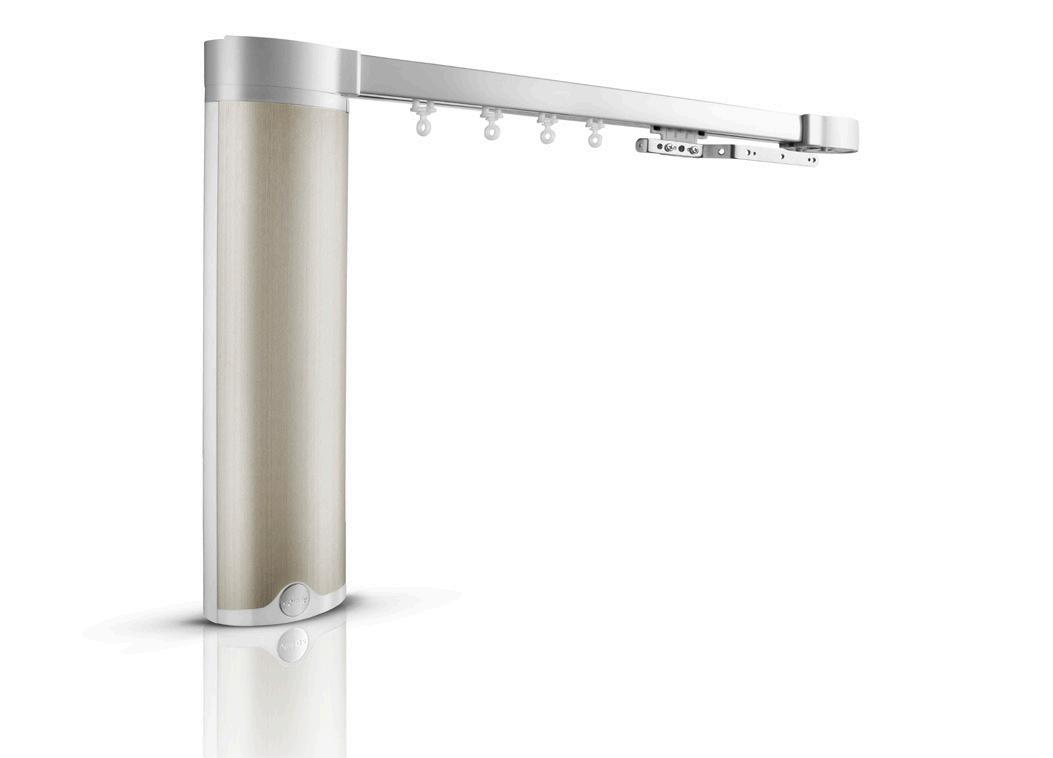
These compact units, with rechargeable or replaceable batteries, communicate via RF, Zigbee, Z-Wave, Wi-Fi or proprietary protocols, allowing existing apartments and finished interiors to adopt automation with minimal civil work. Within these two broad camps are specialised variants: tubular motors that disappear inside the roller tube for blinds and screen shades, and dedicated curtain track motors engineered to move heavy drapes and layered curtains, support curved or extra-long tracks and offer soft start/stop and touchmotion features.
The latest smart motors embody several technological shifts. Ultra-quiet operation has become a design priority, particularly for bedrooms, meeting rooms and hospitality suites where acoustic comfort is as important as visual comfort. Improvements in gearing, motor design and control electronics have significantly reduced noise levels, allowing motion that feels more like a soft architectural gesture than a mechanical action. Integration capabilities have also matured. Motors are
increasingly offered with native support for building protocols such as KNX, DALI or BACnet, as well as direct compatibility with leading home automation platforms. Rather than sitting on a parallel control island, shading can now participate in unified logic for lighting, HVAC and security, contributing to energy efficiency, occupant comfort and façade performance.
Design expectations have not been compromised in this pursuit of intelligence. Motor profiles are getting slimmer, enabling installation in shallow headboxes, pelmets and minimalistic ceiling pockets. Hardware is engineered to disappear into the architecture, allowing only the fabric or curtain statement to be visible. This is particularly important in contemporary interiors with large-format glazing, thin frames and a strong emphasis on clean lines. For architects and interior designers, smart motors are no longer a technical afterthought but a key enabler of façade expression and interior comfort.
Smart Home World speaks to leading brand heads, who share insights on their latest offerings and their advancements.
Taral Trivedi, Managing Director, Somfy
What innovations has your company introduced in smart lighting and automated shading?
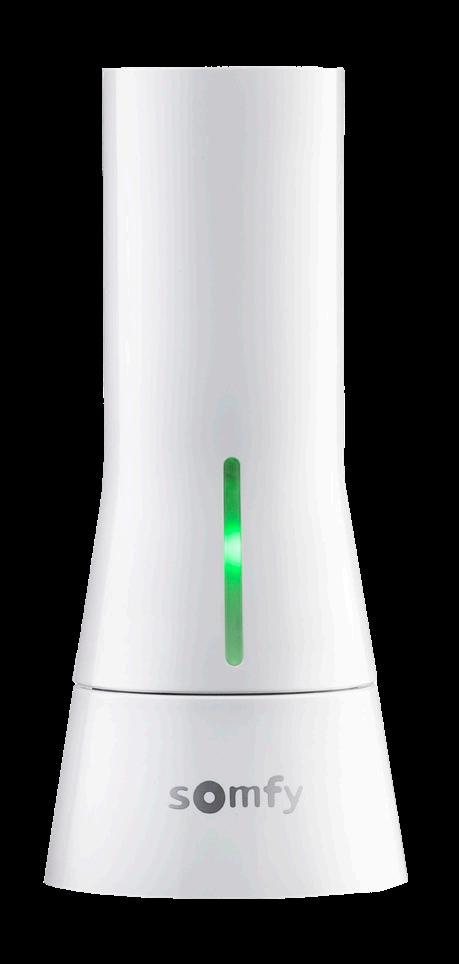
Somfy offers a range of advanced motors that are at the heart of modern smart homes, providing smooth, quiet, and reliable operation for blinds, curtains, shutters, and awnings. These motors simplify daily routines by automating tasks such as opening shades to welcome natural light in the morning, closing curtains in the evening for privacy, or adjusting blinds to reduce glare and manage indoor temperatures. Beyond convenience, Somfy motors offer a high level of precision and durability, ensuring long-lasting performance across residential spaces. Our motors also integrate seamlessly with major smart-home platforms, enabling personalised control through schedules, automated scenes, or voice commands. With these innovations, Somfy motors make homes more intuitive, responsive, and enjoyable to live in.
In what ways do Somfy motors enhance energy efficiency in the home?
Somfy motors contribute to energy efficiency by optimising natural light and regulating indoor temperatures throughout the day.
During hot summer months, shades can close automatically to reduce heat gain and lower air-conditioning use, while in winter, they open to allow sunlight in, helping to reduce heating needs. Integrated with smart-home systems, Somfy motors can coordinate with lighting and climate controls to create customised, energy-saving routines.
By managing the home environment intelligently, these motors not only enhance comfort and convenience but also help homeowners reduce energy consumption and support a more sustainable lifestyle.
Are Somfy motors compatible with smart home platforms such as Alexa, Google Home, or HomeKit?
Somfy motors are compatible with leading smart-home platforms, including Amazon Alexa, Google Home, with Apple HomeKit integration on our innovation roadmap. This allows users to operate blinds, curtains, shutters, and awnings through voice commands, mobile apps, or automated routines. By integrating shading with lighting and climate control systems, Somfy motors enable personalised schedules, smarter automation, and greater
energy efficiency, transforming any home into a more connected, responsive, and energyconscious living environment.
How do you partner with architects and system integrators to deliver integrated smart-home automation?
At Somfy, we collaborate closely with architects and key stakeholders throughout the decision-
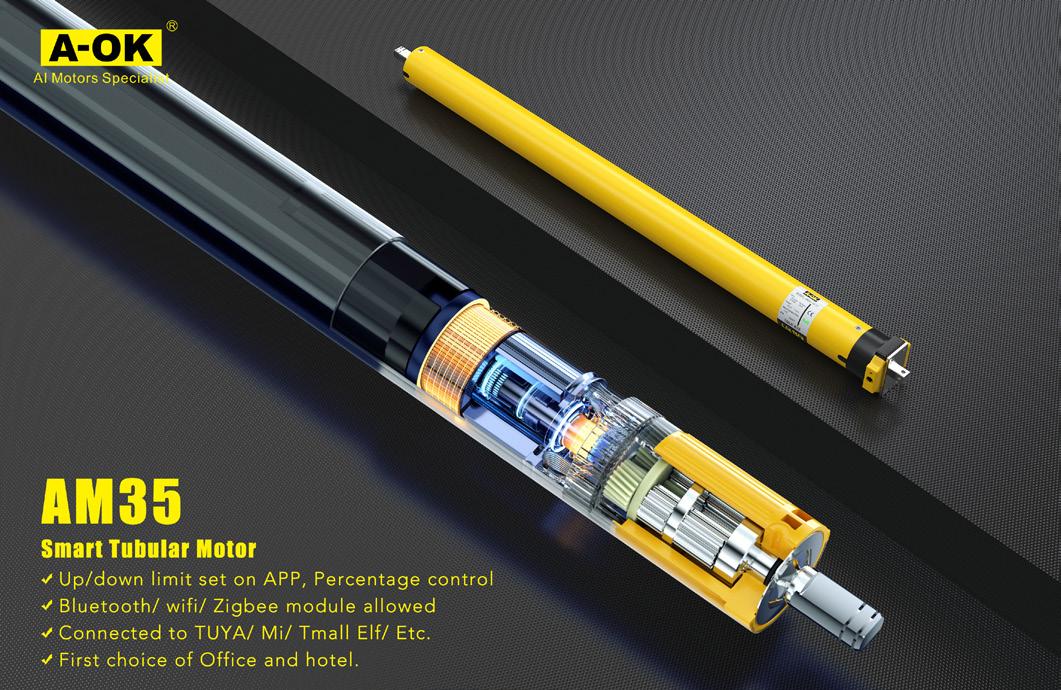
Mayank Agarwal, Director, AOK MOTOR (INDIA) PRIVATE LIMITED.
What advancements have you made in motor technology to improve performance, noise reduction, and reliability?
In the past few years, our whole assembly line has been transformed from using semiautomatic equipment to fully automatic equipment which in turn decreases a lot of reliability on human work force decreasing the chances of error and in turn providing much more stable product in hand, besides our R&D team has continuously been conducting tests to create or reach the industry benchmark point for product features and during this course of time we have always been upgrading our products from time to time basis by improving the raw material quality for more stable performance and lastly we always welcome feedback from our customers to keep on improving the efficiency, reliability and durability of our products.
What installation or retrofit solutions have you developed to make automation more accessible for various projects?
Our motors are ready to install with majorly
making process. We engage with them from early design stages and propose the most suitable solution based on each client’s individual needs. We work with stakeholders across the value chain and support them by making their lives easy in all the stages —from design and technical guidance to commercial support and after-sales service—ensuring comfort, convenience, and peace of mind for every home.
all the major leading solutions available in the market, be it Bluetooth, Wifi, Zigbee, Matter, etc.
Could you let me know if your solution is good for Wired or Wireless systems?
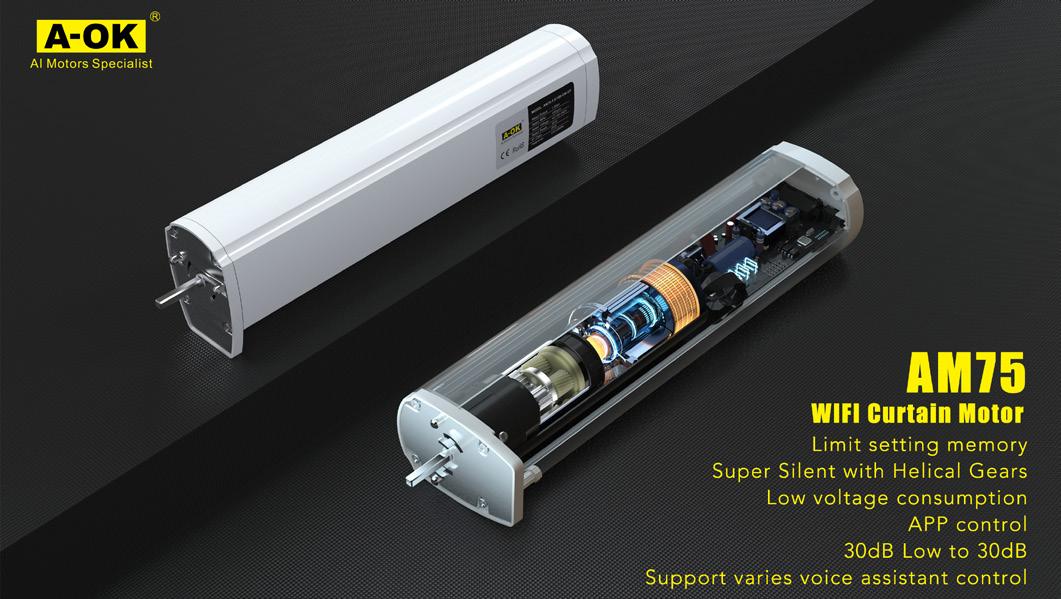
We provide motors for both the solutions be it wired or wireless, as I said earlier we have Bluetooth, Wifi, Zigbee, Matter etc. for the wireless connectivity, same way we have RS485, direct AC current connectivity, Dry Contact option in the wired ecosystem, I would say both the systems have their pros and cons, Wireless system is fast & easy to install, inexpensive when compared to the wired system and can be used for simple automation when a single command needs to trigger maximum 2-3 devices, on the other hand wired system is pretty slow in commissioning and expensive to install, but can handle the automation more efficiently especially where there are multiple devices which needs to be triggered using a single command or I would simply say where there is high usage of a complex system of automation wired solution is more preferable and reliable as well as long lasting.
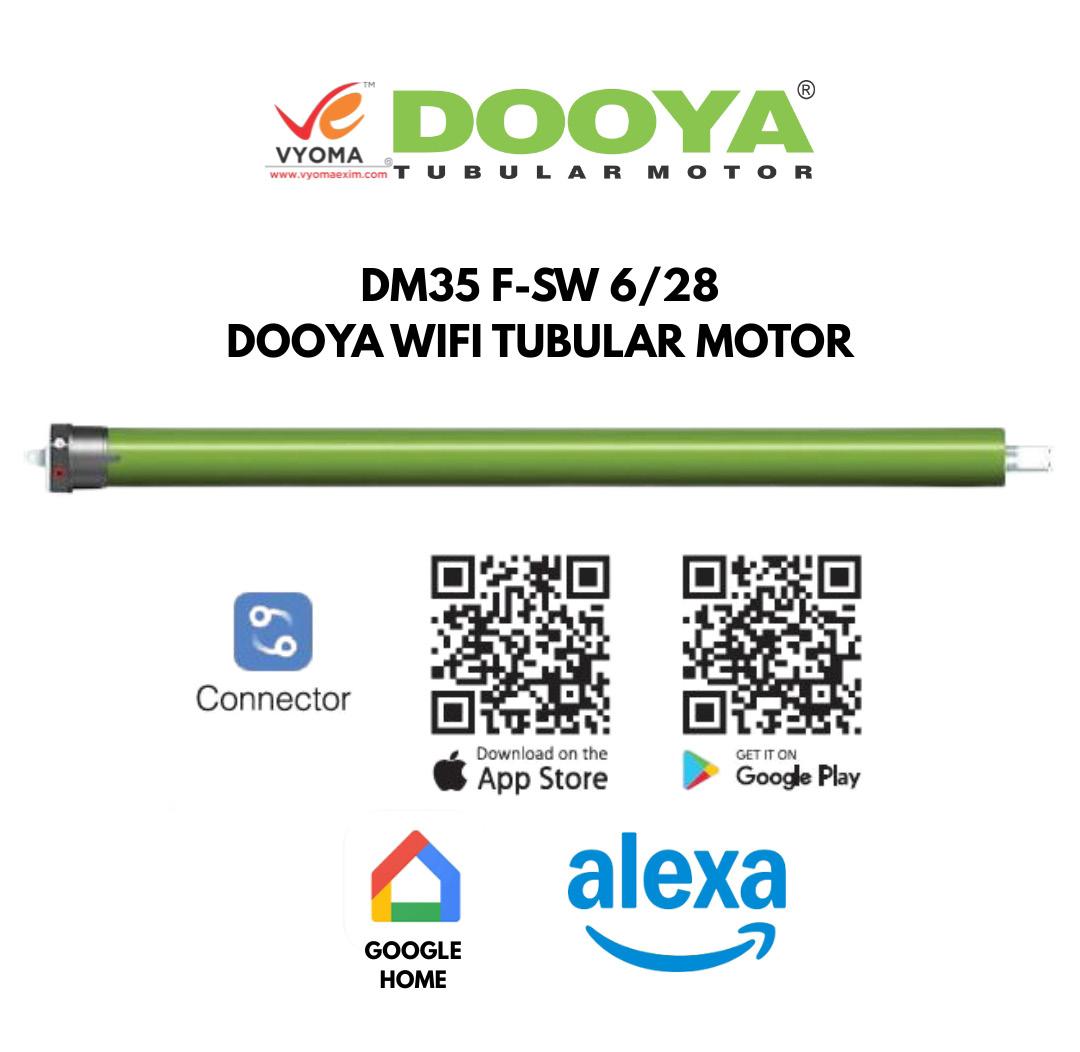
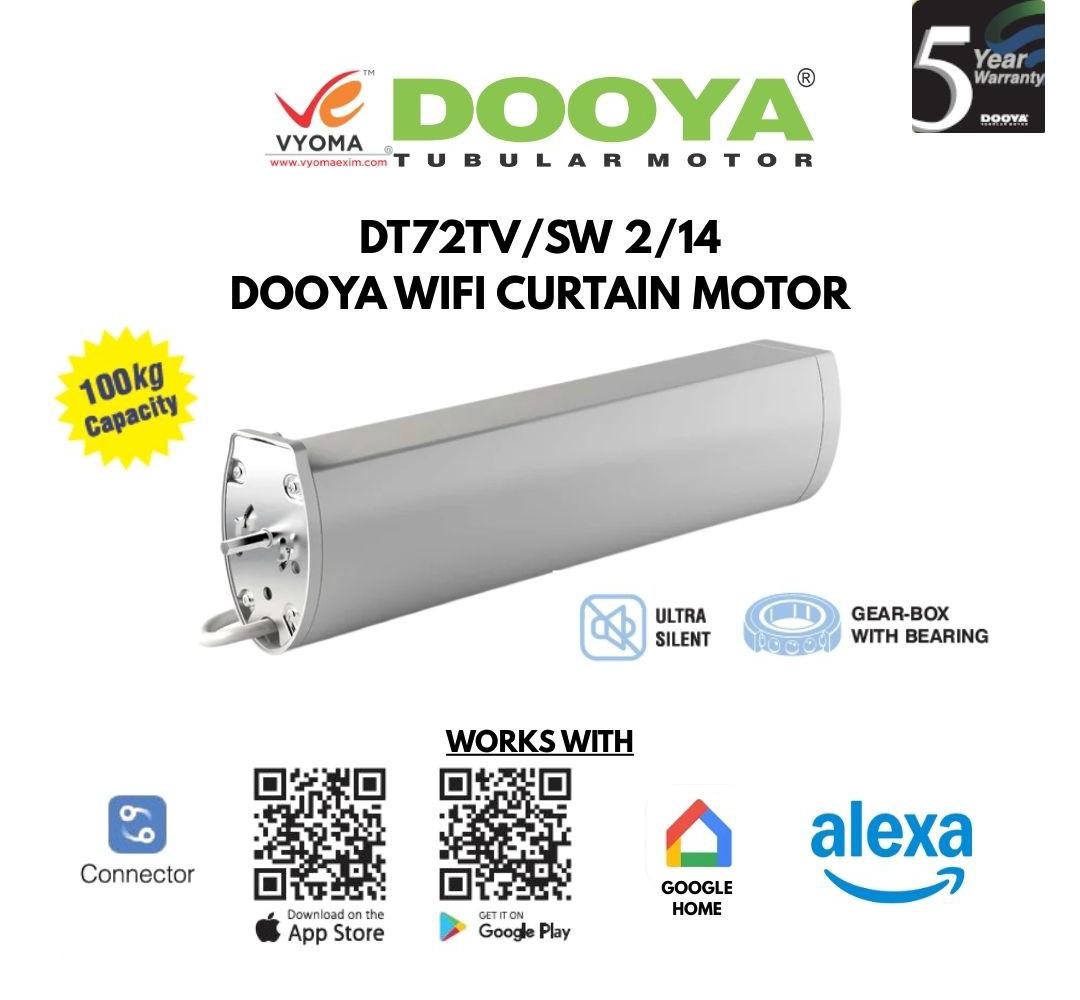
Sumit Garg, Director, Vyoma Exim (P) Ltd.
What are the latest innovations your company has introduced in smart lighting and automated shading?
In the field of automated shading, our brand, Dooya, has introduced Matter-enabled motors, facilitating seamless integration with home automation systems. These motors communicate effortlessly with Apple Home and SmartThings on Android devices, eliminating the need for additional applications on phones.
How are you integrating sensors, automation, or AI to enhance user experience and energy efficiency?
Our Dooya motors incorporate solar, wind, and rain sensors, allowing users to adjust luminosity, wind speed, and humidity to control shade openness. In addition to timers and scene control, shades can be set according to the sunrise and sunset times in specific time zones. Our Suncool brand smart shades feature an aluminium coating on the exterior side, reducing UV penetration and lowering room temperatures by 1-2 degrees Celsius, thus significantly saving energy used by air conditioning systems.
Are your products compatible with smart home ecosystems, such as Matter, Zigbee, or Wi-Fi?
Yes, our Dooya motors are compatible with Zigbee, Matter, and Wi-Fi systems. We have also launched motors that communicate directly with KNX, facilitating integration with building management systems through an open protocol. We are certified partners with KNX systems globally.
How do you work with lighting designers, architects, and system integrators to deliver cohesive automation solutions?
We collaborate with architects, interior designers, and system integrators across India primarily through our network of distributors. We ensure their education is up-to-date, and our support team is available to assist with any installation queries. For more complex situations, our engineers are prepared to visit sites throughout the Indian subcontinent, resolving any challenges. Our commitment to customer service ensures that when you choose us, you become part of our family, receiving exceptional after-sales support.
Brand Offering
Nefcon Systems offers Evolix Smart Curtain Motors
Evolix Smart Curtain Motors are designed to bring convenience, elegance, and advanced automation into modern homes and commercial spaces. Built with nextgeneration engineering and premiumgrade components, Evolix motors deliver a smooth, silent, and reliable curtain movement experience that enhances both aesthetics and functionality in any interior environment.
At the core of Evolix Smart Curtain Motors is an ultra-quiet motor technology, engineered to operate with minimal noise while delivering consistent performance. This makes Evolix ideal for bedrooms, living rooms, hotel suites, conference halls, and premium offices— anywhere where silence and seamless operation matter. The motors support both straight and curved tracks, making them adaptable for a wide range of window designs and interior layouts.
Evolix motors are fully compatible with all major smart home platforms, offering integrated control via mobile apps, voice assistants, and home automation hubs. Users can schedule curtain movements, set timers, or operate them remotely from anywhere. Whether it’s waking up to natural daylight, closing curtains for privacy at sunset, or automating energy efficiency based on room temperature, Evolix delivers a smarter and more personalized lifestyle experience.
No more need for separate KNX curtain actuators! The new Evolix KNX Motor lets you integrate your motors directly into your KNX infrastructure, offering 2 NM torque, a 60 kg load capacity, compatibility with ETS5 and ETS6, and a 5-year manufacturing warranty.
To ensure maximum user convenience, the motors feature *Touch Motion Technology*— allowing users to simply pull the curtain slightly to activate automatic opening or closing. This hybrid manual-plus-motorized control gives added flexibility and ensures smooth operation
even during power outages. The motors also support both wired and wireless installation options, offering complete freedom during new installations as well as retrofit projects.
Evolix tracks are engineered with precisionaligned rollers and durable aluminium profiles that ensure long life, minimal friction, and a soft, glide-like movement. The system supports curtains up to a high load capacity, making it suitable for both light fabrics and heavy drapes. With adjustable speed settings, gentle start-stop function, and advanced obstacle detection, safety and performance go hand-in-hand.
For installers and system integrators, Evolix provides easy configuration, quick calibration, and reliable connectivity, making it one of the most preferred brands in the automation industry. With robust after-sales support and the backing of Nefcon Systems, Evolix stands as a trusted choice for residential, hospitality, and commercial automation.
In essence, Evolix Smart Curtain Motors combine luxury, technology, and convenience to deliver an effortless curtain-movement experience—transforming everyday living into a modern, automated lifestyle. Evolix 3NM Moto heavy-duty motors are available in 5 Wires, WiFi, Zigbee, LOFT BLE and Alliee BLE. Can handle upto 120 Kgs and comes with a 5 Year Warranty.
We conclude saying, Smart motors have quietly become the intelligence layer behind modern shading, bridging architecture, electronics and automation.
“We’re
Shaping the Future of Smart Lighting with One Connected, Scalable, and Sustainable Ecosystem.”
Casambi has been a pioneer in wireless lighting control. How would you describe the company’s current positioning in the smart lighting ecosystem?
Casambi has established itself as a leader and innovator in the wireless lighting control market. Our technology is renowned for its reliability, scalability, and ease of use, making it a preferred choice for a wide range of applications, from residential to commercial and industrial settings. We have successfully integrated our solutions with a vast array of lighting products, creating a versatile and interoperable ecosystem that meets the diverse needs of our customers.
Our commitment to continuous innovation has enabled us to stay ahead of the curve,
Kristian Jenkins
Country Manager, India, Casambi Technologies
Kristian Jenkins, highlights how wireless connectivity is redefining modern lighting systems. As India’s smart building sector matures, he discusses Casambi’s innovation-led approach, market outlook, and the growing role of intelligent lighting in driving energy efficiency and sustainability. Jenkins also emphasizes Casambi’s continuous rollout of cutting-edge products that enhance interoperability and simplify installation for a wide range of applications.
introducing cutting-edge features and functionalities that enhance user experience and energy efficiency. We have also forged strong partnerships with leading lighting manufacturers and industry stakeholders, further solidifying our position as a key player in the smart lighting landscape.
India is a rapidly evolving market. What kind of growth do you anticipate here, and how do residential and commercial segments differ in potential?
India’s market is indeed evolving at a remarkable pace, presenting significant growth opportunities for Casambi. We anticipate robust growth in both the residential and commercial segments, driven by increasing urbanisation, rising disposable incomes, and a growing awareness of energyefficient solutions. Thus, in consideration of the above, we have set up Casambi India with a fully equipped team to serve the market.
In the residential segment, the demand for smart lighting solutions is expected to surge as homeowners seek to enhance their living spaces with advanced technology that offers convenience, energy savings, and improved aesthetics. The potential here lies in the adoption of smart home systems, where lighting plays a crucial role in creating personalised and automated environments.
On the other hand, the commercial segment offers substantial growth potential due to the increasing focus on sustainability and
energy efficiency in office buildings, retail spaces, and industrial facilities. Businesses are increasingly recognising the benefits of smart lighting solutions in reducing operational costs, improving employee productivity, and achieving sustainability goals. The commercial segment also presents opportunities for large-scale projects and retrofitting existing infrastructure with modern, smart lighting control systems.
Overall, while both segments offer significant growth potential, the commercial segment may see faster adoption due to the immediate cost-saving benefits and regulatory incentives for energy-efficient solutions. However, the residential segment is poised for steady growth as smart home technologies become more mainstream and accessible to a broader audience.
Could you introduce Casambi’s newly launched product range and highlight its key features?
Casambi’s latest native product range is our Salvador series DALI controller. The Salvador Series DALI Controller by Casambi enables seamless integration of DALI luminaires into
Casambi’s wireless lighting control system. It allows up to 64 DALI luminaires to be programmed and controlled individually via the Casambi App, eliminating the need for a separate DALI controller.
Salvador supports hybrid networks of DALI and Casambi Ready devices, forming a unified Casambi mesh network with up to 250 nodes in a network. It also facilitates D4i data extraction and cloud integration via the Casambi API, enabling easy connectivity with third-party systems. With Salvador wired DALI luminaires appear in the Casambi app in the same way as Casambi Ready luminaires. They can be individually controlled, grouped, or used in scenes that combine both Casambi Ready and wired DALI luminaires.
Casambi is redefining DALI control by merging DALI, Casambi BLE, and EnOcean into one intelligent system. Could you elaborate on how this solution works and the benefits it brings?
Casambi’s approach to merging DALI, Casambi BLE, and EnOcean into a single intelligent system represents a significant advancement in the smart lighting industry. This integration allows for seamless communication and control across different lighting protocols,
providing users with a unified and versatile lighting control experience.
By combining these technologies, Casambi’s system offers several key benefits:
Enhanced Flexibility: Users can integrate and control a wide range of lighting devices, regardless of the underlying protocol, creating a cohesive and adaptable lighting environment.
Improved Energy Efficiency: The system optimises energy usage by enabling precise control and automation of lighting based on occupancy, daylight levels, and other factors.
Simplified Installation and Maintenance: The wireless capabilities of Casambi BLE and EnOcean reduce the need for extensive wiring, making installation quicker and less disruptive. The maintenance-free nature of EnOcean devices further reduces operational costs.
Scalability: The system can easily scale from small residential setups to large commercial installations, accommodating the growing needs of users.
Enhanced User Experience: The unified control
system provides a seamless and intuitive user experience, allowing customisation and management of lighting settings through a single interface.
Tell us about your partnership with lighting brands and manufacturers.
We have always believed in collaboration and the importance of empowering our partners. Our partnerships with leading lighting brands and manufacturers are a testament to our commitment to creating a robust and versatile smart lighting ecosystem. By working closely with our partners, we ensure that our technology is seamlessly integrated into a wide range of lighting products, providing endusers with reliable and innovative solutions.
One of the key aspects of our partnerships is the emphasis on mutual growth and empowerment. We provide our partners with the tools, resources, and support they need to succeed in the competitive smart lighting market. This includes access to our cuttingedge technology, comprehensive training programs, and dedicated technical support. By empowering our partners, we enable them to deliver exceptional value to their customers and drive the adoption of smart lighting solutions. Casambi technology is integrated into fixtures, drivers, switches, and sensors,
encompassing a diverse array of modules. Collaborating with manufacturers, we have ushered in a collection of 2000+ enabled products.
How do emerging technologies like IoT and AI, along with interoperability, shape the user experience in Casambi’s new range?
At Casambi, our focus on interoperability and integration with emerging technologies significantly enhances the user experience. In our current native portfolio, we have the Casambi Cloud Gateway for IoT integration. The product comes with Ethernet and WiFi connections for internet access. The user interface is the Casambi App.
Currently, Casambi’s native portfolio does not include AI-enabled products, but the company is exploring AI integration in future developments. Casambi encourages adopting AI technologies to improve daily operations and drive innovation.
How does Casambi support its system integrator and partner community in adopting these innovations?
Casambi is dedicated to ensuring that our system integrators and partner community are well-equipped to adopt and implement
our innovations effectively. We provide comprehensive support through various initiatives designed to empower our partners and facilitate their success in the smart lighting market.
We offer extensive training programs that cover the technical aspects of our products, installation procedures, and best practices. These training sessions are designed to ensure that our partners have a deep understanding of our technology and can confidently integrate and deploy our solutions in various projects. In addition to training, we provide our partners with access to a wealth of resources, including detailed documentation, user manuals, and technical support.
Our dedicated support team is always available to assist with any queries or challenges that may arise during the implementation process, ensuring that our partners can deliver seamless and reliable solutions to their customers.
Lighting is often seen as the backbone of home technology. How do you see Casambi enabling experiences that go beyond illumination—like wellness, ambience, or security?
Casambi recognizes that lighting plays a crucial role in creating holistic and enriching experiences within homes. Our technology is designed to go beyond mere illumination, enabling users to enhance their living environments in various meaningful ways.
One of the key areas where Casambi makes a significant impact is in promoting wellness. By allowing users to customise lighting settings, such as adjusting colour temperatures and brightness levels, our solutions can help create environments that support circadian rhythms and improve overall well-being. This feature is provided free of charge in our Casambi APP.
Another unparalleled experience that Casambi possesses is in creating the desired atmosphere for any occasion. Users can easily set up and switch between different lighting scenes to match their mood or activity, whether it’s a cosy dinner, a lively party, or a quiet reading session. The ability to control lighting remotely and integrate it with other
smart home devices further enhances the user experience, making it seamless and intuitive.
With the increasing use of voice assistants and app-based control in homes, how does Casambi ensure seamless compatibility and ease of use?
Casambi is committed to providing a seamless and user-friendly experience for our end
users, especially with the growing popularity of voice assistants and app-based control in smart homes. We achieve this by focusing on interoperability and intuitive design.
Our Casambi App offers a user-friendly interface that allows for easy setup, customisation, and management of lighting systems. The app is designed to be intuitive, ensuring that users of all technical levels can navigate and control their lighting preferences without any hassle.
Features such as scene creation, scheduling, and remote access are readily available, providing users with comprehensive control over their lighting environments.
Some of our ecosystem partners have solutions that are designed to be compatible with popular voice assistants such as Amazon Alexa, Apple Siri and even to be Matter compatible. Please enquire with our sales team in Casambi India to find out more!
Looking ahead, how do you see your brand evolving over the next 3–5 years?
As we look ahead, Casambi is poised for significant growth and evolution. Our vision is to continue leading the smart lighting industry by driving innovation, expanding our ecosystem product portfolio, and strengthening our global presence.
We will focus on enhancing our smart lighting control technology, investing in R&D to introduce new features, and exploring the integration of emerging technologies such as AI and IoT. Additionally, we aim to expand our market reach through strategic partnerships and entering new regions, while maintaining our commitment to sustainability by developing energy-efficient solutions. With Casambi, you get one platform, one global ecosystem, one Casambi.
Casambi is Smart, Clean, Easy and Everywhere!
“We Believe in Transforming Human Experience with Technology.”
Gensler is a internationally acclaimed firm renowned for shaping the future of workplace and commercial design. Could you tell us about some of the prestigious projects your teams are currently working on in India and the scope of design and smart technology integration?
At Gensler, digital tools and methods are fully integrated into our design practices. We are constantly pushing boundaries on technology in both process and project design. We believe that buildings and spaces should be designed such that they behave as multisensory ecosystems with a digital-first mindset. Our in-house NFORM ecosystem, which includes tools such as gBlox™, gFloorz™ help us in every step of the project, right from pre-design and strategy to construction and post-occupancy.
Neelima Ronanki
Studio Director, Senior Associate, Gensler Bengaluru
Neelima Ronanki speaks about Gensler’s mission to push the boundaries of design and technology in India. From smart automation to digital-first workflows, she highlights how the firm’s innovative processes and global design ecosystem are powering some of the country’s most ambitious workplace and commercial projects.
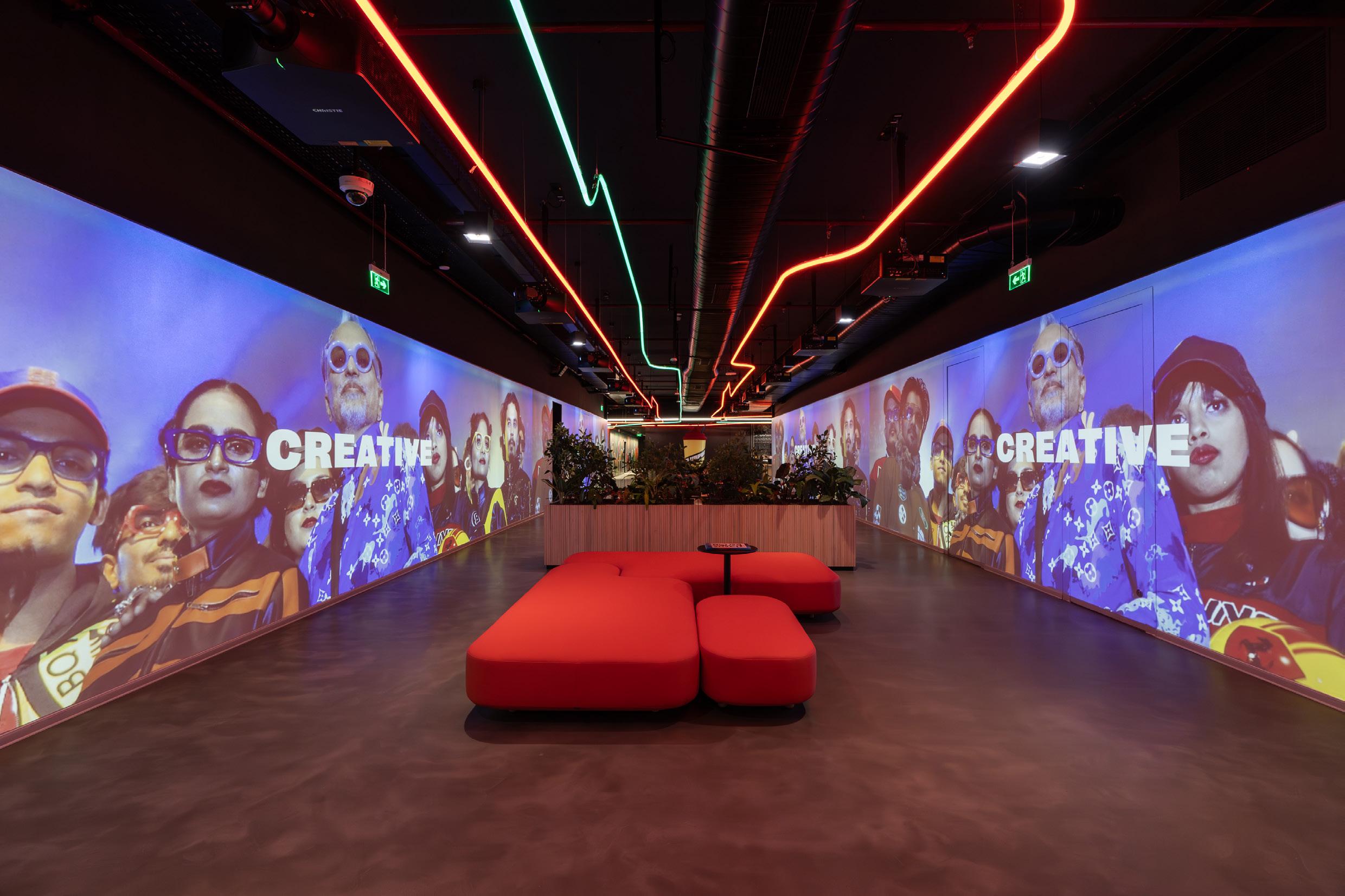
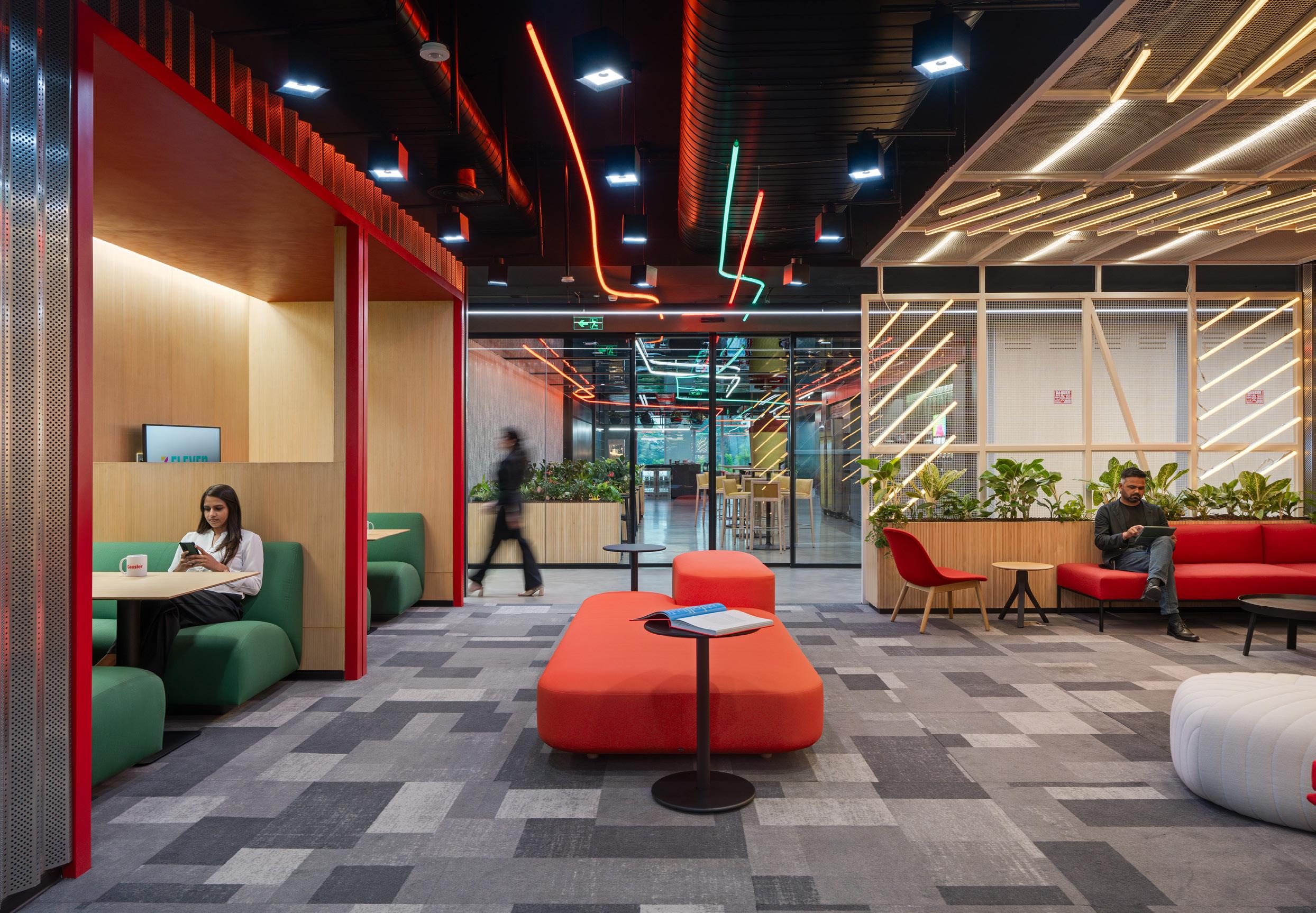
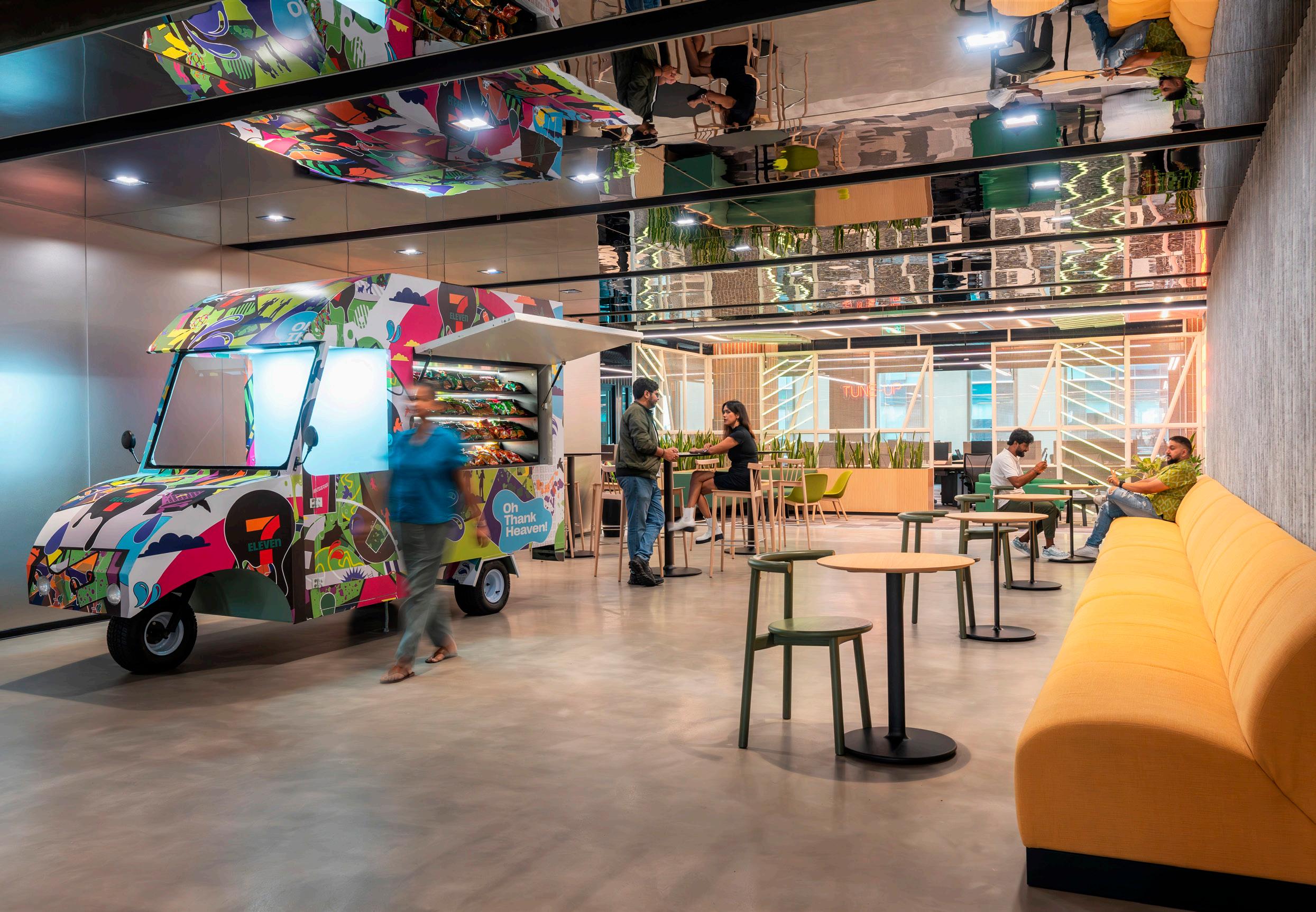
One such visually striking project example would be 7-Eleven’s Global Solution Centre, Bangalore.
With an avant-garde workspace design, the office reinforces the brand recall through innovative digital elements and brand typology.
How would you describe your creative journey in India so far — and how have local culture, technology adoption, and sustainability goals influenced your design philosophy?
I believe that good design speaks through the impact it creates on the community. We at Gensler are driven by our commitment to our people and the communities we serve. With our Global expertise and research insights,
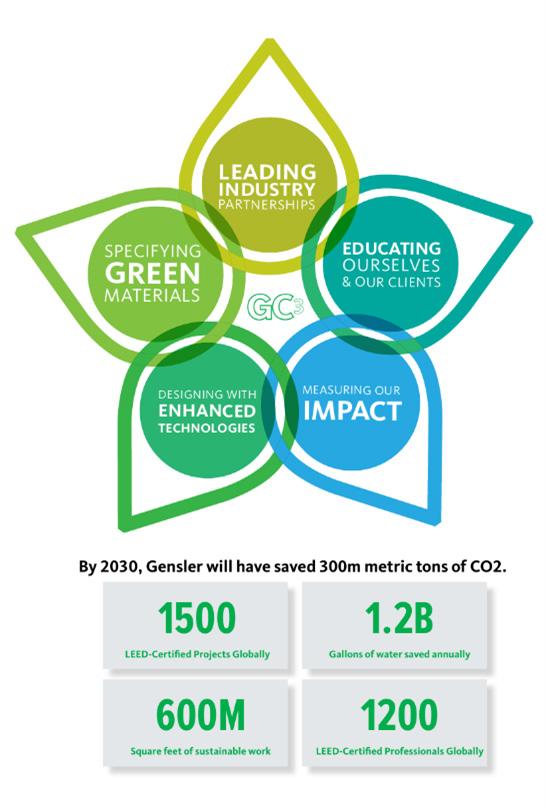
we are able to pair our design directors in India with global specialists to deliver projects that are globally cutting-edge, yet locally contextualised. Another crucial aspect is our expertise in green building rating systems. We have been able to achieve 1560+ LEED certified projects globally, with over 1.09 million square feet of sustainable work.
Gensler specialises in large-scale commercial environments. Could you share examples of projects where smart technology or digital systems have significantly enhanced user experience and building performance?
A recent pitch we developed for a developer in Bengaluru for a high-value site. This gave us an opportunity to create a space that feels connected to the city’s social fabric. The client’s vision was to develop a sustainable mixed-use project with office and retail components. They wanted a firm that could demonstrate strength not only in design innovation but also in technological and AI integration.
The big idea we worked with was to create a porous, active ground plane—a welcoming
space that draws people in, encourages them to stay, and creates opportunities to engage, socialize, and spend. A mix of dynamic retail, F&B, and activated public spaces ensures that the project functions not just as a workplace, but as a 24/7 active destination in its own right,t considering the context the project is sitting in. This vision strongly resonated with the client’s aspirations for the project, and that’s how we were awarded the project despite strong competition from other architects.
We used a hybrid workflow to meet the deadlines, such as human creativity to guide the concept, data-informed optioneering to test the feasibility using gBlox and generative AI to visualize quickly. The value wasn’t in one approach— it was in how all three worked together.
At what stage of a project does your team typically begin considering the integration of Building Automation Systems (BAS)?
In most of our projects, Building Automation Systems (BAS) are typically considered during
the early design and planning stage. This is a crucial time because it allows for seamless integration with architectural layouts, electrical and mechanical systems, and IT infrastructure. It also ensures energy efficiency, occupant comfort, and system interoperability due to early-stage involvement.
For some developers involved in highperformance or green certified buildings, we initiate BAS during concept development or feasibility studies. This helps us optimize system selection, sensor placements, and software compatibility. Additionally, this leads to smoother commissioning and long-term efficiency.
Which categories of automation — such as HVAC optimization, occupancy-based lighting, shading systems, or access control — are most commonly prioritized in your Indian projects?
In our Indian projects, automation priorities are shaped by a mix of parameters, namely, energy efficiency goals, occupancy comfort, 42 | SMART HOME WORLD | NOVEMBER 2025
and security needs. The most implemented would-be HVAC optimization. The developers deploy variable frequency drives, thermostats and predictive maintenance tools to manage these systems. Another crucial system would be Occupancy-based Lighting, especially in residential and commercial setups. To add to the security screening, access controls such as biometric or RFID-based systems, integrated CCTVs and other security systems are also adopted. In some of our luxury premium projects, automated shading systems have seemed to be gaining traction. And finally,
Building Management Systems to unify control over all the above systems with centralized monitoring and data-driven decision-making.
How do you balance aesthetics, functionality, and technology when designing spaces that are both visually inspiring and digitally intelligent?
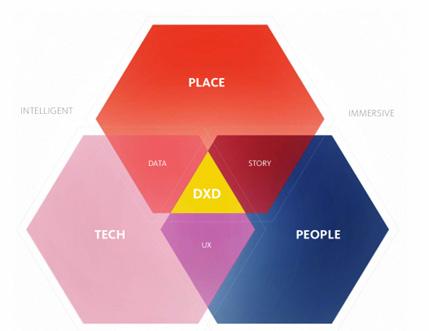
We believe in transforming human experience with technology. Our work connects physical and digital design, creating unique experiences at the intersection of architecture, design, and technology. Through integrated project teams, we bring together a global network of passionate design leaders from the fields of research, strategy, architecture, user experience, brand, content, creative technology, hardware, software, and data science.
How do you ensure that technology integration remains user-friendly and human-centric, enhancing comfort rather than complicating it?
To ensure that, we follow a process with all our projects:
• Make it flexible and easy: Limitless designs and use cases are possible with hypermodularity and flexibility. The ability to easily transform future proofs the utility of the space.
• Show, don’t tell: Words explain a concept. Experiences and compelling visuals bring concepts to life. The most memorable moments are ones leveraging tactile, realtime interactions.
• Make it ownable: Enable the experience to be ownable by anyone but also branded for the owner. Personalized experiences increase engagement and deepen connections.
• Connect the experience: Provide a
welcoming experience that connects to a broader ecosystem of tools and services, to enable convenience, hybrid collaboration, and hospitality-focused experiences.
In your opinion, what role will policy, regulation, and client awareness play in driving the adoption of smart building technologies in India?
The real impact comes when these elements work together:
• Policies create the environment.
• Regulations enforce standards.
• Awareness fuels demand.
India’s smart building future depends on this triad working in harmony to overcome cost barriers, technical gaps, and inertia in the construction sector.
“Simplicity is the Ultimate Form of Sophistication in Automation.”
What sets AudioSphere apart in the highend AV and automation market?
Integrity in everything we do, a deep thirst for knowledge, and a clear vision define our approach. We bring over two decades of experience and a no-compromise philosophy to every project. What truly sets us apart is our unique blend of technological expertise and an understanding of business economics — ensuring exceptional cost-to-performance optimisation for our clients.
What’s your process for achieving accurate audio calibration and video optimisation to meet reference-level performance in residential projects?
A great chef can’t create a masterpiece with
Madhav Kohli Director, AudioSphere
With over two decades of handson experience in high-performance audio, video and automation, Madhav Kohli, champions a no-compromise, performance-first design philosophy. Combining deep technical expertise with a sharp understanding of business economics, AudioSphere has built a reputation for delivering reference-level AV experiences, robust automation ecosystems and futureready infrastructure for luxury residences and commercial environments. In this conversation, Madhav shares how integrity, intelligent system design and user-centric simplicity drive AudioSphere’s work in India’s evolving high-end AV and home automation landscape.
poor ingredients — and the same applies to AV design. We start by creating an equipment configuration tailored to the room’s requirements to achieve reference-level performance. Once loudspeaker placement is perfected, we design the room’s acoustic framework around it.
If these two elements are right, calibration becomes straightforward. The real skill lies not just in taking measurements, but in knowing how to interpret them and apply corrective action. Ultimately, it’s the synergy of design, acoustics, and calibration that delivers a truly immersive listening experience.
With AV increasingly integrated into wholehome automation, what protocols and platforms do you prefer to ensure seamless
integration across AV, lighting, HVAC, and security?
We generally prefer IP-based ecosystems for seamless integration across AV, lighting, HVAC, and security. Product selection always includes legacy integration options like IR or RS-232 as backups.
For larger projects, lighting is typically handled through DALI, while DMX is occasionally used for large home cinemas. HVAC and security are almost always IP-based. We often use KNX or other proprietary bus-based lighting systems, paired with functional and user-friendly frontend interfaces.
A robust, enterprise-grade network infrastructure forms the backbone of every project, allowing flexibility for future expansions and integrations.
How do you handle networking demands — especially with 4K/8K video, high-res audio streaming, and IoT devices competing for bandwidth?
At the project’s inception, we work closely with clients to understand their current needs and future aspirations. Based on that, we design a scalable, high-bandwidth network to support evolving requirements.
For larger projects, we rely on a fiber-based internal infrastructure to ensure seamless communication, minimal latency, and maximum reliability across the system. The goal is always precision, speed, and absolute stability.
What role do control systems and user interface design play in balancing technical complexity with simplicity for the end-user?
A control system is only as good as how simple it feels to the user. Ease of use is paramount — if automation feels complex, it has failed its purpose.
Many clients are initially hesitant about automation because of poor past experiences with complicated systems. We believe that simplicity is the ultimate form of sophistication
— a clean, intuitive interface with reliable response times makes the experience seamless and enjoyable.
With sustainability becoming important, are you seeing demand for energy-efficient amplification, eco-friendly cabling, or lowconsumption control systems?
The shift, though gradual, is unmistakable.
Manufacturers are investing heavily in R&D for greener technologies — from high-efficiency amplifiers to recyclable or halogen-free cabling and intelligent power management systems.
At our end, we focus on implementing smart power management through automation and energy-efficient equipment choices. Today, sustainability and performance go hand in hand rather than being seen as trade-offs.
How do you future-proof projects so clients don’t need complete overhauls as AV formats and standards evolve?
Future-proofing begins at the briefing stage. We encourage clients to spend time at our experience centre, where we walk them through current and emerging integration options.
Once a project begins, we design a comprehensive cabling infrastructure that anticipates future technologies and ensures redundancy. During procurement, we review the Bill of Quantities (BoQ) and update clients
on newer models, standards, or formats so that their decisions remain current and forwardlooking.
Which global AV and automation brands do you most frequently integrate into your projects, and why?
Our approach isn’t brand-agnostic — it’s experience-driven. We choose brands
that align with our design philosophy and consistently deliver results.
Audio: Procella, REL, SVS, Artcoustic, Sonance, Bowers & Wilkins, and Architettura Sonora for residential applications; and Devil Acoustics for high-fidelity commercial spaces and nightclubs.
Processing & Amplification: Anthem, Emotiva, Trinnov, and Integra.
Video: Sim2 and Screen Research for premium projects; Optoma and ViewSonic for costeffective solutions.
Automation: We’ve extensively worked with leading global brands. Over time, we’ve found Nice (Elan) and Rako ideal for most mid to high-end projects due to their balance of reliability, performance, and aesthetics. For our more discerning clientele, Basalte serves as a luxury-tier offering, combining cuttingedge technology with design elegance.
Beyond integration, does AudioSphere also
retail or distribute specific high-end brands? If so, how do you curate your portfolio?
Not at the moment. The distribution channels we work with are exceptionally strong and offer excellent pre- and post-sales support. That reliability is one of the key factors we value when selecting brands for our portfolio.
In a competitive AV integration market, what differentiates AudioSphere in terms of technical capabilities, design approach, and after-sales support?
Our biggest differentiator is a no-compromise design philosophy — performance and reliability always take precedence. This approach naturally minimizes potential issues on-site.
Our expertise is backed by numerous international certifications and the successful execution of hundreds of luxury residences, cafés, nightclubs, auditoriums, and commercial spaces. This diverse experience gives us an edge in designing correct configurations, selecting reliable equipment, and adapting to
different scales and client requirements.
We also take immense pride in our after-sales support — over 90% of our new business comes through client referrals, which speaks volumes about our consistency and commitment over the past 20 years.
Looking ahead, what’s your vision for AudioSphere in shaping the luxury AV and home automation segment in India?
Our vision is to make AudioSphere one of the most trusted names for technically-driven, performance-focused, and visionary AV and automation solutions — whether in luxury residences or commercial spaces.
Equally important is our ongoing effort to educate clients about the importance of choosing the right integration partner — one who designs with foresight, not just installs products. We believe that when clients make informed choices, the entire industry grows stronger, and every project achieves the performance it truly deserves.
SMART SPACES, TIMELESS DESIGN
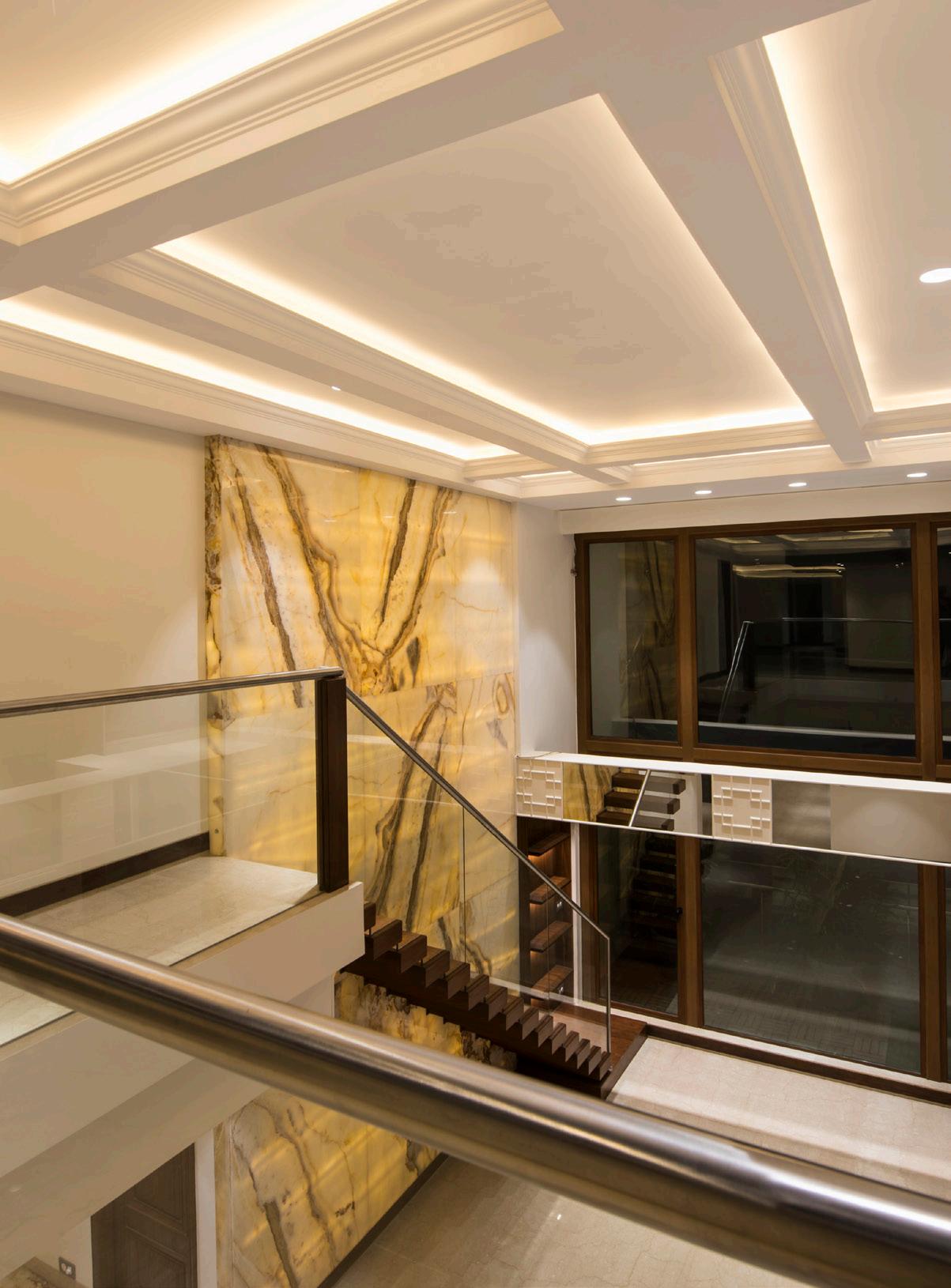
Designed by Ar. Vinay Patil and integration by Yoga Automation Pvt. Ltd, this boutique residential building project seamlessly blends modern architecture with intelligent automation, offering residents a refined balance of luxury, comfort and technology.
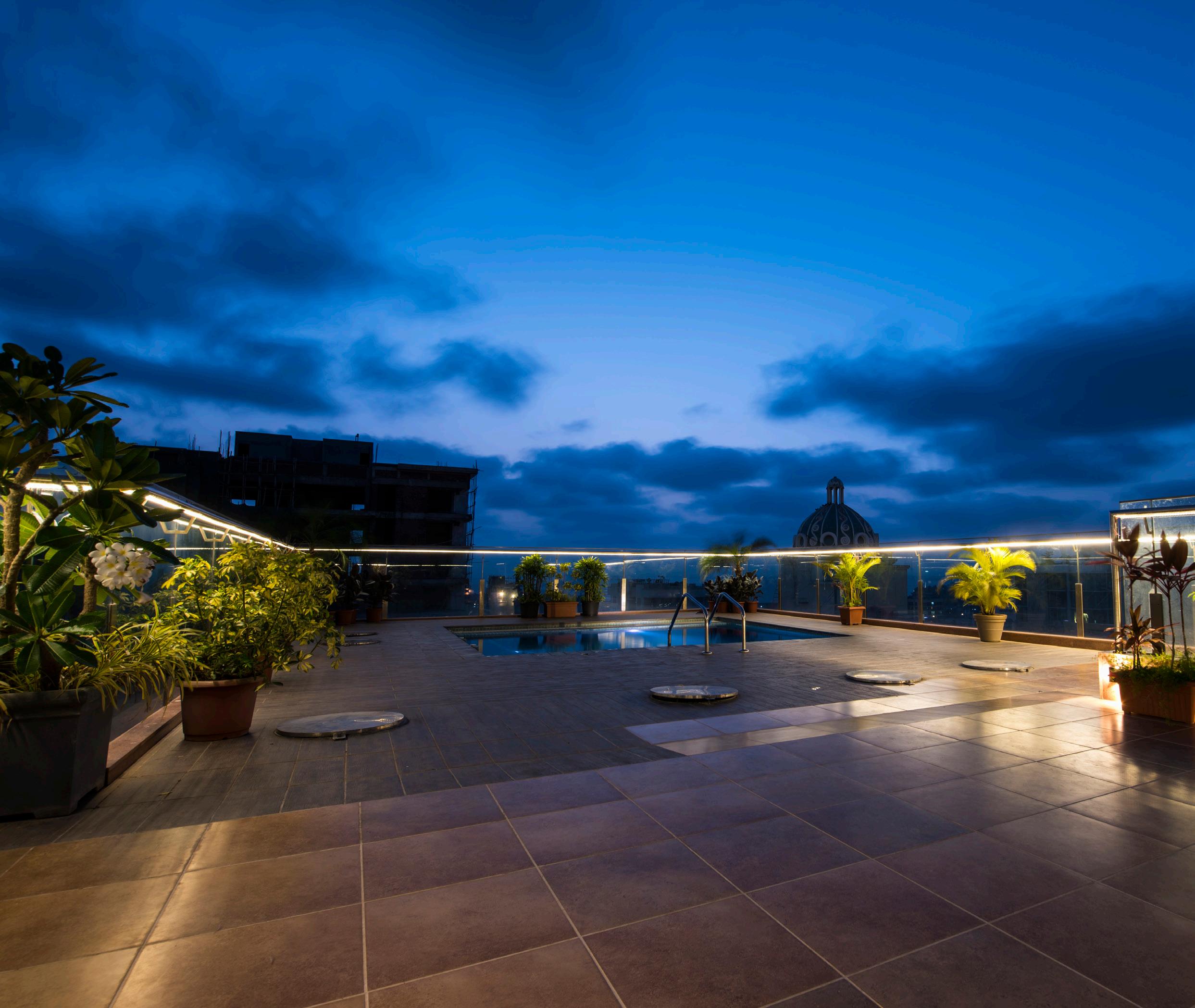
Located in the upscale neighbourhood of Santacruz West, in Mumbai, this boutique residential building designed by Ar. Vinay Patil, Founder, Vinay Patil Architects, stands as a benchmark for refined smart living. Spread across an impressive 65,000 sq. ft. of built-up area, the project integrates architectural grace, spatial intelligence, and modern smart-home technology to create homes that redefine luxury in both design and experience.
Designed as a limited-edition residential experience, the building comprises six singlefloor apartments and three duplex units that cater to families seeking both privacy and connectivity. Each single-floor apartment spans 2,400 sq. ft of carpet area and is designed as a 100% Vaastu-compliant home
that balances functionality, energy flow, and timeless spatial planning. These residences include four bathrooms and a powder room, ensuring comfort and convenience for every member of the household.
The upper three floors are dedicated to sixbedroom duplex apartments, each one carefully designed to bring in natural light and ventilation while maintaining a strong connection between private and social zones. Every detail — from the volume and proportion of spaces to the material palette — has been thoughtfully curated to evoke a sense of calm sophistication.
A defining architectural feature is the private lift with biometric access that opens directly
into each apartment, ensuring exclusivity and security for residents. Homeowners have their own dedicated lift access through biometric and access card systems, while guests and service staff use a separate elevator, maintaining privacy and control over movement within the building.
Seamless Integration of Smart Technology
The project sets a new benchmark in home automation, executed in collaboration with Yoga Automation Pvt. Ltd using a Digital Analogue automation system. Each home operates on an advanced KNS interface, allowing residents to control lighting, temperature, and security with ease. The automation framework is designed for reliability and redundancy — equipped with battery backup and a manual mode override to ensure uninterrupted operation even in the event of power failures.
The entire floor’s lighting and air-conditioning systems are managed through the smart home interface, with cameras integrated in key zones such as common areas, living rooms, and kitchens. For entertainment, the
system supports AV integration and includes a centralised speaker network for multi-room audio, delivering both comfort and an elevated lifestyle experience.
Personalisation and User-Centric Design
Every home in this building has been designed with flexibility in mind. Each room offers six programmable lighting scenes, allowing residents to set the perfect ambience for reading, relaxation, or entertaining. Both sheer and blackout curtains are motorised and synchronised with the automation system, offering convenience and privacy at the touch of a button.
Temperature control is managed via the integrated interface, and the system allows residents to add or modify “scenes” through a dedicated app installed on the iPad provided in each home. The platform is completely expandable, ensuring it evolves with the homeowners’ changing needs over time. In addition, the inclusion of a centralised music system ensures a cohesive experience across all living spaces, blending luxury with lifestyle in a way that feels effortless and natural.
Comprehensive Security Infrastructure
Security has been given paramount importance in this project. The system employs Hikvision surveillance cameras at every floor lobby and critical common area. Each residence features a video door phone system, automationcontrolled digital locks, and a biometric access system integrated into the main controller.
For added peace of mind, a panic alarm has been installed in the master bedroom to alert security in case of emergencies, and motion detectors safeguard the balcony and outdoor zones. These intelligent layers of protection ensure that residents experience a sense of absolute security without compromising the visual aesthetics of their home.
Entertainment and Networking Systems
Technology in this project goes beyond comfort and security — it extends into entertainment. The living room has been configured for a 7.1
home theatre setup, while all bedrooms are 5.1 channel ready, with concealed wiring and structural provisions for a future upgrade.
“High-end Bose speakers, amplifiers, and sound systems have been incorporated to deliver exceptional audio performance, complemented by DIGI Control networking devices that ensure smooth, lag-free connectivity across all systems. This forwardthinking design allows for effortless integration of additional smart devices as technology evolves,” explains Ar. Vinay Patil.
Lighting and Hardware
Lighting across the residences has been supplied by Spectrum Lights, Bandra, chosen for their quality and versatility in complementing modern interiors. The lighting scheme enhances both mood and function, seamlessly syncing with automation settings. The hardware and control systems have been customised specifically for this project,
ensuring a harmonious relationship between aesthetics, performance, and reliability. The result is a responsive environment that adjusts intuitively to the lifestyle of its occupants.
An Intelligent Living Experience
This residence encapsulates the essence of modern luxury — an environment that is both intelligent and inviting. Through careful planning and collaboration between architecture and automation, Ar. Vinay Patil has created a living experience that transcends traditional design boundaries.
From biometric access and security integration to smart lighting, climate control, and entertainment systems, every aspect of these homes reflects a future-ready mindset. The focus is not merely on convenience, but on enhancing the quality of life — where technology and design come together to create homes that think, respond, and evolve.
TECH INSIGHTS
Architect / Interior Designer: Ar. Vinay Patil
Systems Integrator: Yoga
Automation Pvt. Ltd
Automation System Used: KNX Range
Lighting: Spectrum Lights, Bandra
Security Cameras: Hikvision
Home Theatre: Bose
Amplifiers & Speakers: Bose
Networking Devices: DIGI Control
INSIDE THE INTELLIGENT WORKPLACE
Designed by Ar. Umesh Sharma, the Nirwana Head Office blends technology and design in perfect harmony—creating a smart, connected workspace that’s efficient, intuitive, and effortlessly elegant.
In a world where technology defines the rhythm of modern life, workplaces are evolving into living ecosystems that think, adapt, and respond. “The Nirwana Head Office is a perfect example of this evolution—an environment where intelligent automation brings seamless convenience, efficiency, and comfort to every corner. Here, lighting adjusts to your mood, the temperature adapts to your presence, and meetings start with a single touch,” says Ar. Umesh Sharma, Founder of The Design Studio. More than just a smart office, Nirwana represents the future of work—where innovation, design, and human experience coexist in perfect sync.
Centralized Automation at Work
There is a centralised automation platform that unifies every essential system, like lighting, HVAC, security, and AV, into one cohesive, intelligent network. Built on Crestron, Control4 technology, and Legrand, this backbone ensures the building operates as a single, responsive entity.
“Everything talks to everything,” says Umesh. “Whether it’s adjusting the light levels, controlling the air conditioning, or managing access, the system responds instantly through one central brain.”
The integration ensures synchronised functionality across all departments. Employees can manage the environment effortlessly by setting the right temperature, adjusting lighting scenes, or activating conference systems that are unified through interfaces.
Seamless Control
“Technology here doesn’t shout—it whispers. Employees interact with the system through wall-mounted touch panels, mobile Apps, occupancy sensors, and even voice commands, creating an intuitive relationship between people and their workspace,” informs Umesh.
Whether you’re walking into a meeting zone or settling at your desk, the environment adjusts automatically. Lights dim as one enters, the air conditioning activates when occupancy is detected, and AV systems power up with a simple tap.
Human-Centric Design for Productivity and Mood
Lighting plays a starring role in this office. Designed with a layered lighting philosophy, the system blends ambient, task, and accent illumination to create environments that enhance both focus and comfort. From Lafit and Philips Dynalite solutions, each zone features lighting scenes tailored for specific moods—Focus, Collaboration, or Relax.
The concept of human-centric lighting is deeply woven into the design. Tunable white lighting adjusts colour temperature and brightness throughout the day to align with the body’s natural circadian rhythms. Mornings are greeted with crisp, cool light to boost energy and alertness; afternoons ease into balanced neutral tones; and evenings shift toward warm hues that promote relaxation.
This subtle choreography of light supports
mental clarity, reduces fatigue, and creates a sense of well-being—a lighting design not just for visibility, but vitality.
In the modern workplace, meetings are the pulse of productivity—and Nirwana’s conference rooms are designed to make them seamless. Each space is equipped with automated lighting, occupancy-based climate control, and integrated AV systems that synchronize automatically at the start of a meeting.
With Logitech conference solutions and Samsung/LG digital screens, participants enjoy crisp visuals and flawless connectivity. Smart scheduling features and wireless presentation systems minimize setup time, while one-touch controls ensure every meeting starts on cue.
“From the moment you walk in, the system knows you’re there,” the facilities manager notes. “It adjusts the temperature, dims the
lights, activates the display—and you’re ready to go. It’s a meeting that sets itself up.”
Designed for the Hybrid Era
Video conferencing has become a cornerstone of modern collaboration, and the Nirwana team took great care to ensure a premium experience. Acoustic panels line the meeting rooms, absorbing unwanted echoes and external noise, while precisely calibrated lighting eliminates harsh shadows and glare. The result is camera-friendly illumination and crystal-clear sound—so every virtual meeting feels as natural as a face-to-face conversation.
Security with Intelligence and Elegance
Behind the sleek design lies an equally robust layer of security. Yale and Samsung digital locks safeguard every access point, while Hikvision cameras provide high-definition surveillance and real-time monitoring.
These systems integrate directly into the central automation network, allowing authorized personnel to manage entries, monit or live feeds, and receive alerts— all from a single interface. Security here isn’t just about protection; it’s about peace of mind delivered through precision engineering.
The Nirwana Head Office is more than an intelligent workplace—it’s a statement on how technology can serve people seamlessly, rather than the other way around. Every interaction, from the moment an employee steps through the door to the end of the workday, is enhanced by automation that adapts, anticipates, and responds.
Energy efficiency and sustainability are built into its DNA. Automated climate management and sensor-based lighting reduce energy wastage while maintaining optimal comfort and productivity. The integration of advanced systems ensures not only operational efficiency but also an elevated human experience—one that blends intelligence with empathy.
TECH INSIGHTS
Automation Platform : Crestron, Control4 and Legrand
Smart Lighting & Controls : Lafit, Philips and Dynalite
Smart Cameras : Hikvision
Digital Locks : Samsung and Yale
Digital Screens : Samsung and LG
Conference Solution : Logitech
Touch Panels : ABB and Schneider Electric
The AI Intelligence Revolution in Smart Homes
Anup Pande, Founder & CEO, nuumx. ai | portalx.life, writes about how AI breakthroughs are transforming homes into intelligent, adaptive ecosystems. By 2035, AI will turn smart homes into sentient spaces that sense, learn, and evolve with us.
Before you reach the door, Artificial Intelligence has already analysed your elevated cortisol levels using wearable biosensors, crossreferenced your calendar to identify today’s stressors, and prepared an environment scientifically optimised for emotional recovery. Machine learning algorithms adjust lighting to anxiety-reducing wavelengths, deep neural networks optimise temperature based on your circadian rhythm, and natural language processing drafts a personalised meditation script. No commands. No interfaces. Just AI orchestrating your wellbeing.
This is the AI revolution in residential living— where Artificial Intelligence transforms homes from static structures into dynamic, learning entities that understand context, predict needs, and continuously optimise every aspect of human experience. Today’s $174 billion smart home market represents merely the foundation. By 2035, AI-driven intelligent living
ecosystems could reach $1 trillion globally, fundamentally redefining the human-home relationship through machine intelligence.
Five AI Breakthroughs Reshaping Tomorrow’s Homes
Neural AI: Direct Brain-Computer Intelligence Vision 2033: Machine learning algorithms decode your neural patterns in real-time. You think about dimming lights—AI interprets the electrical signals and executes instantly. You visualise tomorrow’s outfit—computer vision AI scans your mental image, matches it against your wardrobe inventory using image recognition, and displays options. The AI even predicts your needs before conscious thought through predictive modelling of subconscious neural activity.
Advanced AI systems are learning to interpret EEG signals with 95 per cent accuracy. Deep learning models trained on millions of neural patterns can distinguish between different mental states, intentions, and even emotions from brain activity alone. This bidirectional neural AI creates closed-loop systems where artificial intelligence both reads and influences neural states through optimized environmental conditions.
Generative AI for Adaptive Physical Spaces
Vision 2035: Generative AI algorithms control programmable matter to reshape your space continuously. At 7 AM, reinforcement learning agents optimise furniture configuration for productive work. Machine learning models analyse your posture and adjust desk height in real-time. By evening, the same AI transforms your space into an entertainment center, using computer vision to optimize seating arrangements based on how many people are present.
AI orchestration is the key breakthrough. While programmable matter provides the physical medium, it’s sophisticated AI—using
genetic algorithms, multi-agent systems, and optimization models—that determines optimal configurations from millions of possibilities in milliseconds. The AI continu ously learns from your preferences, building increasingly accurate models of your spatial needs across different times and contexts.
Autonomous AI for Biointegrated Systems
Vision 2036: AI-controlled biological systems manage your home autonomously. Machine learning algorithms regulate photosynthetic wall panels for optimal oxygen production. Neural networks coordinate bioluminescent bacteria to provide dynamic lighting that adapts to your circadian preferences. Reinforcement learning agents manage engineered organisms that repair structural damage, with computer vision detecting micro-cracks before they’re visible to humans. The convergence of AI and synthetic biology creates self-managing living buildings. AI systems use sensor fusion to monitor thousands of biological parameters simultaneously, employing predictive maintenance algorithms to prevent issues before they occur. These carbon-negative homes learn optimal resource generation strategies through evolutionary algorithms,
continuously improving performance through artificial intelligence-driven adaptation.
Quantum AI for Predictive Intelligence
Vision 2034: Quantum machine learning algorithms simulate thousands of possible futures simultaneously. Should you leave for the airport now? Quantum AI analyzes traffic patterns using quantum neural networks, processes weather data through quantum optimisation, predicts airline delays using quantum-enhanced ensemble models, and factors in your personal stress response through behavioural AI—all executing in parallel quantum superposition states before collapsing to the optimal recommendation.
Quantum AI enables predictions impossible for classical machine learning. Quantum algorithms can predict appliance failures by simulating molecular-level degradation, optimize neighborhood energy trading by solving NP-hard problems in polynomial time, and suggest preventive health interventions by modelling complex biological systems quantum mechanically. This isn’t incremental improvement—it’s exponential enhancement of AI predictive capabilities.
Ambient AI: Invisible Intelligence Everywhere
The ultimate AI revolution: complete disappearance of interfaces. Ambient AI systems use sensor fusion from radar, chemical sensors, thermal imaging, and acoustic monitoring. Machine learning algorithms synthesize these inputs into contextual understanding through multi-modal deep learning.
The AI predicts needs using sequence-tosequence models, executes actions through distributed intelligence across edge devices, and continuously improves through federated learning—all without conscious human interaction. This represents the pinnacle of AI integration: intelligence so seamlessly embedded that technology becomes invisible.
Living: AI-Powered Predictive Healthcare
Computer vision algorithms analyse your complexion for micronutrient deficiencies. Spectroscopic AI in smart toilets detects
disease biomarkers years before symptoms using deep learning models trained on millions of health records. Natural language processing interprets oral microbiome DNA sequences. The master AI uses ensemble learning to integrate genetic profiles, timeseries analysis of lifestyle patterns, and graph neural networks modelling family medical history. When cardiovascular risk emerges, the AI implements multi-objective optimization: adjusting circadian lighting through reinforcement learning, recommending foods via collaborative filtering, timing exercise using chronotype prediction models, and modifying air quality through real-time control systems. AI-driven preventive medicine could reduce chronic disease by 70% and extend healthy lifespan through continuous optimization algorithms.
Working: AI-Enhanced Holographic Collaboration
Generative AI creates photorealistic holographic avatars using 3D reconstruction algorithms. Spatial AI positions each presence
using simultaneous localization and mapping. Neural machine translation provides real-time language conversion while sentiment analysis AI preserves emotional context. Predictive AI anticipates when you’ll speak using prosody analysis, reducing latency. Gesture recognition AI replicates non-verbal communication through pose estimation models. The result: AI eliminating geographic constraints on collaboration while freeing 200+ hours annually from commuting—transforming work through artificial intelligence rather than physical relocation.
Playing: AI-Generated Immersive Experiences
Generative AI creates infinite entertainment variations calibrated to your preferences using recommendation systems. Narrative AI branches plots based on your decisions using decision trees and Markov models. Emotion recognition AI adjusts story arcs by analyzing facial expressions, voice patterns, and biometric responses through multimodal sentiment analysis. For education, AI generates historically accurate environments
using knowledge graphs, creates interactive characters using large language models, and adapts difficulty using item response theory models. Reinforcement learning personalizes pacing based on engagement metrics. AI democratizes world-class education by removing geographic barriers through intelligent content generation and adaptive learning algorithms.
AI in Action Today: Building the Foundation
Current AI systems prove the concept. Google’s Nest uses supervised learning to model behaviour patterns, achieving 40% energy savings through predictive algorithms. In Delhi, AI-powered energy management uses time-series forecasting for solar optimization, achieving 90% grid independence and ₹75,000 annual savings through machine learning-driven resource allocation. California’s SmartHome Innovations employs deep learning for behaviour analysis and computer vision for security monitoring, demonstrating 40% energy reduction through AI-driven automation. These applications showcase fundamental AI capabilities— pattern recognition, predictive modelling, optimization, and autonomous decisionmaking—that will power future innovations.
The Matter protocol provides essential AI interoperability. With 550+ companies ensuring universal device communication, AI systems can orchestrate heterogeneous device ecosystems—the multi-agent architecture required for advanced ambient intelligence.
AI Ethics: Navigating Critical Challenges
Privacy-Preserving AI: Federated learning enables AI model training without centralizing personal data—algorithms improve collectively while data stays local. Differential privacy adds mathematical guarantees preventing individual identification. Homomorphic encryption allows AI computation on encrypted data. Edge AI processes sensitive information locally, with only anonymized insights shared. These techniques ensure AI intelligence without compromising privacy.
Democratizing AI Access: Transfer learning
reduces training costs, enabling powerful AI with minimal data. Model compression techniques like knowledge distillation make sophisticated AI deployable on inexpensive hardware. Open-source frameworks like TensorFlow and PyTorch democratize AI development. AutoML platforms enable non-experts to create custom models. Cloud AI services provide pay-as-you-go access to advanced capabilities. These innovations ensure AI benefits extend across socioeconomic levels.
Explainable AI (XAI): Attention mechanisms reveal what AI focuses on when making decisions. SHAP values quantify each input’s contribution to outputs. Counterfactual explanations show what changes would alter AI decisions. Model interpretability techniques make AI reasoning transparent. This ensures AI augments rather than replaces human decision-making, presenting options and explanations while preserving human agency through transparent, accountable artificial intelligence.
The AI Evolution Timeline
2025-2028 AI Foundation: Transformer models achieving human-level natural language understanding. Computer vision surpassing human accuracy in object detection. Reinforcement learning managing complex home systems autonomously. Federated learning enabling privacy-preserving AI. Edge AI bringing intelligence to local devices.
2028-2032 AI Integration: Generative AI creating personalized content in realtime. Multimodal AI understanding text, images, audio, and video simultaneously. Neuromorphic computing enabling brainlike processing efficiency. AI-powered digital twins simulating home systems. Explainable AI providing transparent decision rationales.
2032-2036 AI Transformation: Quantum machine learning solving previously intractable problems. General AI systems transferring knowledge across domains seamlessly. Braincomputer interfaces enabling direct neural-AI communication. Artificial general intelligence
approaching human cognitive flexibility. AI orchestrating biological systems in living architecture.
The AI revolution in smart homes isn’t about adding intelligence to devices—it’s about creating an entirely new form of environmental intelligence that understands, predicts, and continuously optimizes human experience.
Conclusion: The AI-Powered Future
We stand at the threshold of an AI-driven transformation. From today’s $5.20 billion Indian smart home market expanding to $19.31 billion by 2030, toward a potential $1 trillion global AI-powered living ecosystem by 2035, we’re witnessing artificial intelligence fundamentally reshape residential environments.
This isn’t about making homes smarter— it’s about making them intelligent. AI that understands emotional states through sentiment analysis. AI that predicts health
risks through predictive analytics. AI that optimizes energy through reinforcement learning. AI that personalizes experiences through recommendation algorithms. AI that coordinates biological systems through autonomous control. AI that connects people globally through intelligent telepresence. AI that democratizes creativity through generative models.
The Delhi family achieving 90% energy independence through AI optimization. Students accessing world-class education through AI-generated immersive learning. Workers collaborating globally through AIenhanced holographic presence. These demonstrate AI’s transformative potential when applied thoughtfully to human living spaces.
But realizing this vision requires more than technological advancement. It demands privacy-preserving AI architectures through federated learning and differential privacy. Explainable AI systems that maintain human
agency through transparent decision-making. Democratized AI access through transfer learning and model compression. Ethical AI development that prioritizes human flourishing over technological capability.
The AI revolution in smart homes creates environments that make us smarter about living—more sustainably through optimization algorithms, more securely through predictive intelligence, more healthily through preventive AI, more productively through intelligent environment control, more creatively through generative models, and more humanely through AI that handles complexity while preserving human focus on meaning.
The future of living is AI-powered—not as omnipresent technology, but as invisible intelligence so seamlessly integrated that we experience only enhanced humanity. The AI revolution is here, building the sentient spaces of tomorrow. The question is: are we ready to develop this intelligence wisely?
Marantz Model 10 – The Pinnacle of Audiophile Engineering
For more than seven decades, Marantz has defined reference-grade audio reproduction. With each generation, the brand has pushed the boundaries of acoustic engineering, craftsmanship, and musicality. The Marantz Model 10 represents the culmination of this heritage, a flagship stereo SACD player and DAC crafted for discerning listeners who demand absolute sonic purity in modern high-resolution systems.
Unmatched Digital Precision
At the heart of the Model 10 lies a customdesigned digital architecture that departs from conventional DAC pathways. Instead of relying on off-the-shelf DAC chips, Marantz engineers developed a proprietary solution featuring the Marantz Musical Mastering (MMM) architecture. This advanced processing platform upconverts PCM signals to DSD
before passing them through a unique lowpass filter stage.
The result is audio reproduction that is exceptionally smooth, detailed, and natural — with extraordinary fluidity across the entire frequency range.
The player supports an extensive range of formats, including SACD, CD, DSD 2.8/5.6MHz, WAV, FLAC, ALAC, and AIFF via its highresolution USB-B input. Whether the source is an optical disc or computer-based streaming, the Model 10 maintains complete sonic integrity.
Analog Excellence with Custom HDAM Technology True to Marantz philosophy, the Model 10’s analog stage is meticulously engineered using Marantz HDAM-SA2 and SA3 modules. These discrete components
outperform traditional operational amplifiers, ensuring ultra-wide bandwidth, rapid transient response, and extremely low noise.
The dual-mono layout minimizes interference, while dedicated boards for digital and analog circuits guarantee the purity of the output signal. A robust toroidal transformer powers the analog section independently, contributing to greater dynamic headroom and stable performance. The result is a sound signature characterized by:
• Deep, controlled bass
• Highly resolved midrange
• Silky, airy highs
• A wide, holographic soundstage with pinpoint imaging
This unmistakable “Marantz warmth” is what audiophiles worldwide continue to seek.
Mechanical Construction with Absolute Precision, the Model 10 inherits Marantz’s uncompromising approach to physical design. The entire chassis is built around a copper-plated, double-layered structure that suppresses mechanical vibration and electromagnetic interference. The transport mechanism — the SACDM-3 — is engineered exclusively for high-resolution audio disc playback and ensures silent, accurate disc reading.
Heavy aluminum panels, a reinforced undertray, and resonance-damped feet further enhance stability. From power supply isolation to screw placement, every detail reflects obsessive attention to acoustic performance.
A Statement Piece for the Modern Audiophile Home With its signature Marantz porthole display, premium brushed metal finish, and elegant symmetry, the Model 10 stands as a timeless centerpiece for any luxury listening room or high-end smart home environment. It integrates seamlessly into premium stereo setups and multi-zone configurations, making it ideal for modern integrators working on residential projects where performance and aesthetics matter equally.
Smart home designers will appreciate:
• High-resolution USB input for network players and media servers
• Gold-plated analog and digital outputs
• Audiophile-grade isolation and grounding schemes
• Perfect synergy with the Marantz Model 10 integrated amplifier
Whether paired with a dedicated two-channel system or incorporated into a premium AV distribution setup, the Model 10 elevates the listening experience to reference standards.
Designed for Music Lovers. Built for Perfectionists.
The Marantz Model 10 is more than a source component — it is a masterfully crafted expression of Marantz’s philosophy that true hi-fidelity is achieved through a marriage of advanced engineering and human passion for sound.
For homeowners looking to elevate their music experience and for integrators designing world-class home entertainment environments, the Model 10 stands as the ultimate choice for uncompromised sonic luxury.
Yale Luna Elite+ Redefines Smart Door Security
Yale Luna Elite+ products incorporate the highest standards in smart home solutions in India, combining over 185 years of engineering with smart innovation to create meaningful safety for modern families. As a thought leader in door hardware, the Yale Luna Elite+ smart lock, along with the broader Yale Home Ecosystem, is crafted to deliver an effortless,
connected living experience. From integrated app control and advanced biometric authentication to real-time monitoring and smart connectivity, Yale ensures that every interaction adds to your peace of mind. Each product within the ecosystem is designed to place your convenience, comfort and safety at the heart of every experience, redefining
how people live, secure and interact with their homes in a truly modern way.
What sets Yale Luna Elite+ apart in the industry is the way it delivers next-generation security, blending intelligent design with heritage quality. The Luna Elite+ uses biometric unlocking, Face Scan and Palm Scan, for secure contactless access, providing peace of mind in every circumstance, including when hands are wet, dry or dirty. Built-in Wi-Fi and Bluetooth mean customers enjoy full control through remote monitoring and smart home connectivity, all without the need for extra hubs or accessories. Yale’s intelligent dualbattery management ensures the lock keeps working during power interruptions and Sentry Guard features add video surveillance with instant alerts to keep homes under watchful protection day and night.
The product’s reputation for reliability and design excellence often makes it the preferred choice for architects and luxury homeowners alike, looking for solutions that do more than just lock a door.
Yale Luna Elite+ brings standout features directly to the fingertips of every user: Palm Scan leverages vein-pattern identification for a hygienic, highly secure unlock, Face Scan uses a 3D structured light system for instant, accurate recognition and an intuitive 4.7-inch touchscreen gives a user-friendly entry point for PINs and codes. Connectivity is embedded with both Wi-Fi and BLE, making app control, remote notifications and real-time video streaming standard features, all within the Yale Home connected ecosystem. Yale’s builtin video doorbell and welcome light further enhance both functionality and safety for householders or small businesses seeking allin-one solutions.
• Palm Scan: The Palm Scan feature uses advanced infrared sensors to capture the unique vein pattern beneath your skin. Since these patterns are almost impossible to replicate, the system quickly verifies your identity without any physical contact, offering both hygiene and high security.
• Face Scan: This system employs 3D structured light technology, which projects thousands of invisible infrared dots onto your face to map its contours precisely. It can detect depth and shape, reducing the risk of spoofing with photos or videos and enabling fast recognition even in varying lighting conditions.
• Touchscreen: The 4.7-inch touchscreen acts as the central interface for the lock. It lets users input PINs, manage temporary access codes for guests, and view system notifications, all through a simple and responsive display.
• Connectivity (Wi-Fi and BLE): With dual connectivity built in, the lock connects effortlessly to the Yale Home app via Bluetooth for nearby control and Wi-Fi for remote access. This means you can monitor activity, grant entry, or view live video streams from anywhere in real time.
• Video Doorbell and Welcome Light: The built-in video camera provides a live view of visitors through the app, while the welcome light automatically illuminates the area as someone approaches. Together, they enhance both visibility and security, creating a reassuring experience at your doorstep.
In practical terms, these features work together to ensure that every stakeholder, whether a resident, caretaker, or security professional can access, monitor and manage entry in a way that feels easy, safe and reassuring. You never have to worry about spare keys or lost access; the range of biometric and digital entry methods keeps options open for family, guests, or staff. Real-time alerts, intelligent battery management and video monitoring offer unmatched peace of mind, while seamless integration with smart home platforms ensures that Yale Luna Elite products always anticipate tomorrow’s needs as well as today’s.
The Yale Luna Elite+ and Yale Home Ecosystem lead with customer-first engineering, bridging a proud heritage with future-ready features and making luxury, safety and convenience work together, every single day.
PRODUCT PREVIEW
Smart Node’s Unified Vision for Effortless
Smart Living
Smart Node’s 2026 line-up strengthens its unified smart home ecosystem with three key launches: the Bolt digital door lock series, the COSMOS designer keypads and an upgraded Smart Node App. Together, they simplify security, control and daily interactions to make connected living more seamless and intuitive.
Innovation at Smart Node has never been about creating noise. It has always been about thoughtful evolution, quiet progress and meaningful solutions that make smart living feel effortless. As we step into 2026, the vision remains unchanged. Every new creation has been designed to strengthen the unified home ecosystem that Smart Node has been building from the very beginning.
These upcoming introductions were first shared with our valued channel partners, the people we consider an extension of the Smart Node family. And now, as we prepare for the official launch on the first of January, we open this exciting chapter to every home that seeks simplicity, harmony and intelligent comfort.
The Bolt Series
Smart Node’s new Bolt Digital Door Lock Series marks a pivotal step in completing the ecosystem. As homes become smarter, the entrance must progress with them. The Bolt series, lever based, intuitive and finely engineered, brings together security and convenience without complicating the homeowner’s routine.
While Smart Node has always focused on lighting, automation and ambience, the absence of a door lock in the ecosystem meant one missing link in the seamless experience. With Bolt, that link is now complete. It is created not only to secure a door, but to simplify how families interact with the most important boundary of their home. This launch signifies Smart Node’s commitment to step by step evolution, ensuring every touchpoint in
the home speaks the same language of ease, reliability and quiet sophistication.
Cosmos Keypads
In the vastness of the universe, despite the chaos, every element moves in harmony. Smart Node found inspiration in this effortless order, naming their keypads COSMOS. A metallic sculptor worth the wall, created to bring balance into the home where managing appliances often becomes a source of chaos. The scenes, lights, shades and temperature all come together in a gentle rhythm, making simplicity the new definition of comfort. The premium COSMOS keypads are designed for the Indian market, shaped to feel refined yet universally welcoming. Their finishes are carefully selected to complement contemporary spaces, while their tactile feel and smooth dimming create an experience
that is calming and intentional. As the name suggests, COSMOS brings harmony to environments that seek clarity, warmth and thoughtful control.
The New App Design Experience
The new Smart Node App design upgrade represents a mature approach to innovation. Rather than disrupt the familiar, Smart Node has chosen to elevate the existing journey. Dhruv Patel, Co-Founder of Smart Node, firmly believes, in creating a completely new app is simple, but refining and optimising the one customers already use is where true craftsmanship lies. A new app would create hassle for users, while an intelligently upgraded one brings genuine simplicity.
The upgraded interface includes enhanced
scene creation, advanced scheduling, improved tunable lighting control, a clearer device organisation layout, a refined favourites section, sharper responsiveness, and a calmer visual structure. It is an evolution built around comfort and ease, allowing every home to feel more intuitive with each interaction.
Towards A Seamless Future
The Bolt Digital Door Lock Series, the COSMOS Keypad Collection and the redesigned Smart Node App come together to shape the next phase of smart living. Each introduction strengthens the vision of a unified ecosystem where technology quietly supports life without demanding attention. These products have been scheduled for launch on 1 January 2026 and are ready to be shipped to your space to simplify your smart living in the year ahead.
CEDIA EMEA Smart Home Awards
Honouring the Best in Smart Home Innovation
CEDIA, the Association for Smart Home Professionals™, has announced the winners of the highly anticipated 2025 Smart Home Awards EMEA. The awards ceremony took place on Friday 7th November at The Londoner in Leicester Square, London, where guests from across the region gathered under the theme “The Enchanting World of Smart Living” to celebrate the outstanding achievements in smart home technology.
“The projects honoured tonight showcase the ingenuity, creativity, and forward-thinking spirit that define our industry in the EMEA region,” said Matt Nimmons, Managing Director of CEDIA EMEA. “It’s remarkable to witness how our members continue to push boundaries and deliver transformative solutions that reshape modern living, reinforcing CEDIA’s reputation for quality and excellence. It’s also fantastic to see so many newcomers amongst this year’s winners. Their
success is truly inspiring and is a testament to the growing strength and diversity of our community.”
The evening started with a drinks reception for guests to mingle and reconnect. After attendees took to their seats and the first handful of awards were announced, Daryl Friedman, Global President & CEO at CEDIA was on the stage to reflect on the success of the global Smart Home Day on 3rd November and to thank CEDIA Foundation members for their invaluable support. The evening then moved to the main event: the awards ceremony, recognising the outstanding achievements from across the smart home industry. This year’s accomplishments were made possible through the support of Headline Sponsor, Monitor Audio, Control4 as Drinks Reception Sponsor, NICE as After Party Sponsor, and L-Acoustics, LG Electronics, Lutron, and Perlisten as Associate Sponsors.
ABB announced the launch of ABB Ability™ BuildingPro, a cybersecure integration platform designed to connect, manage, and optimize building operations. Available across more than 40 countries worldwide, the solution supports key sectors including commercial real estate, education, healthcare, hospitality, and government – helping organizations accelerate decarbonization and digital transformation.
Acting as a central intelligence hub, it unifies data from building systems to improve performance, reduce energy use, and enhance occupant experience. Built on openBOS®, the platform’s open, edge-based architecture delivers seamless interoperability, advanced cybersecurity – fully compliant with the latest international cybersecurity standards and regulations – and the flexibility to integrate future AI-driven tools. This makes ABB Ability™ BuildingPro a future-ready foundation for
digital transformation in buildings of all types.
As part of the launch, ABB is introducing ABB Ability™ BuildingPro Vision and ABB Ability™ BuildingPro Edge Series, two integrated solutions that bring the platform’s capabilities to life. Working together, they empower building owners, operators, and system integrators to monitor, control, and optimize performance in real time – across a single building or entire portfolios.
ABB Ability™ BuildingPro Vision gives facility teams an intuitive, live view of building operations. Through a dynamic, web-based interface – complete with animated floor plans, asset views, and dashboards – it enables real-time monitoring and control of key systems and spaces from a single platform. With its accessible design and local or cloud deployment options, Vision empowers operators to make faster, smarter decisions on-site.
Theben Unveils new iONprime Series
With iONprime, Theben unveils a new KNX device series that combines design and function into a harmonious overall concept. High-quality materials, precise haptics, and clear lines make iONprime a stylish interface between architecture and intelligent building control.
The series includes an elegant push-button sensor in versions with 1, 2, and 4 rockers, as well as the iONprime CP 4 KNX room controller with a 4-inch touch display. While the iONprime PB KNX touch sensor impresses with up to eight individually assignable control points, the display offers convenient control and visualization of up to 48 functions on six freely configurable pages. From lighting and shading to room climate control.
Technologically, the iONprime series combines smart functionality with intuitive operation. Integrated sensors for temperature, humidity, brightness, and CO₂, LED displays
with automatic brightness control, and an integrated bus coupler ensure comfort and efficiency.
Aqara Unveils FP300 Wire-Free mmWave Sensor
Aqara has begun the global rollout of its latest presence-sensing device, the Aqara Presence Multi-Sensor FP300. First showcased at CES in January, the FP300 is the brand’s first batterypowered mmWave sensor, offering precise occupancy detection without the need for wiring or a nearby power outlet. Unlike the wired FP1E and FP2 models, the FP300 operates entirely on batteries, delivering up to two years of use depending on configuration. While it lacks some advanced features such as multi-person detection and detailed room mapping, it offers a key advantage: flexible placement, even in humid areas like bathrooms.
Aqara includes sticky pads, screws, and magnets in the box, making installation quick and versatile on any surface. The device is positioned as a 5-in-1 sensor, combining mmWave and PIR for accurate motion and presence detection, alongside sensors for light, temperature, and humidity, allowing
it to function as both an occupancy and environmental monitor.
All metrics appear as individual cards in the Aqara app and are supported by HomeKit, Home Assistant, and other platforms thanks to its Matter-over-Thread compatibility.
Josh.ai Expands Airzone Compatibility to the Aidoo Pro Hub
Airzone Control, a leader in HVAC control and integration solutions, announces expanded compatibility between its Aidoo Pro Hub and Josh.ai, a leading smart home automation platform. The new integration extends the power of Josh.ai’s natural touch, text, and voice control of advanced HVAC automation to multi-zone HVAC automation for residential and commercial projects. Controlling comfort is now as intelligent and effortless as lighting, shading, and entertainment across connected environments.
Following the initial integration between Josh. ai and Airzone’s Aidoo Pro, which brought natural control to individual Inverter HVAC units, and Webserver Hub, which supports integration with Airzone’s full-home zoning solutions; this expanded collaboration now includes the Airzone Aidoo Pro Hub, a commercial-grade integration gateway with dual wireless and Ethernet connectivity. Across hospitality projects, luxury MDUs, corporate environments, and rental properties, guests and residents are empowered to simply ask,
“Hey Josh, set the living area to 70 degrees” or “Hey Josh, turn off the guest suite heat.” The Aidoo Pro Hub will execute climate commands instantly, while enabling BACnet and Modbus integration for further building-wide visibility and through this integration, HVAC systems become a natural part of Josh.ai’s simple and secure AI-powered control platform.
Bang & Olufsen Announced a New Soundbar
Bang & Olufsen has announced the launch of a new soundbar in its Beosound range. Positioned between the Beosound Stage and the Beosound Theater, the Beosound Premiere features 10 custom drivers powered by 10 amplifiers, including a unique centerpiece upward-facing driver.
“At the center of Beosound Premiere is one of its most striking design elements: the upwardfiring driver. It is not just a technical necessity – it symbolizes Bang & Olufsen’s engineering craftsmanship,” explains the company. “The top is perforated with 1925 precision-milled holes, which serve both as an acoustic opening and as an aesthetic signature – a tribute to the year Bang & Olufsen was founded.”
The Beosound Premiere is engineered almost completely from aluminum, with a casing integrated with 90 LEDs that provide “an ethereal glow inside the soundbar.” B&O claims that the Beosound Premiere’s new
Wide Stage Technology’s signal processing boosts the audio’s sound and width, and, in addition to functioning as a standalone soundbar, can be added as part of a Beolink 7.1.4 surround sound system.
The new Dolby Atmos-ready soundbar will roll out in stages, with a Natural Aluminium finish model launching next month. This will be followed by a Gold Tone finish in February of next year, and finally, a Black Anthracite model launching in March.