This book is abrief introduction to ContaminantHydrogeologyand Uncertainty
Quantification using COMSOL Multiphysics6.The book introduces progressively thesubject of quantitative Hydrogeology andUncertainty Quantification.It illustrateshow to developtwo-and three-dimensionalmodels.
Contaminanttransport in porous mediaorfracturerockoccursdue to water flowinthe porous mediaand thefractures.The interplaybetween flow, thermal, mechanical andchemicalphenomena play at differentdegrees,animportant role.
TheMultiphysicscapabilities of thesoftware used in this book offer theuserthe opportunity to modelsuchcomplex andcoupled phenomenaina simple way, allowing onetorapidly progress in thedevelopment of 2D-and 3D hydrogeologicaland transportmodelsusedbyengineers andscientistsinfields such as EnvironmentalEngineering,Hydrology/Hydrogeology, NuclearWaste management,riskassessments, etc.
Risk estimation is often thegoalwheneverone examines howcontaminants migrateinthe environment. Severaltypes of uncertainties arealwayspresent, such as modelorconceptualuncertainties andparameter-and scenario uncertainties.Uncertainty andSensitivity analysis arethe subjectofUncertainty
Quantification whichisalsointroduced in this book.Thisbookisa brief introduction to howtomodel contaminanttransport in geological formations, illustrating howdifferentphenomena of importance forcontaminant transport aresimulated in COMSOL Multiphysics 6 andhow to applyuncertainty quantification techniques relevant to thefield.
Acknowledgments: TheauthorisverygratefultoEng.MarcusInácio, Dr.Isabel Paivaand Dr.Eng.HugodeC.Pereira forthe effortand time they dedicatedto this book projectand fortheir permission to usesomeexamplesincludedinthis textualmaterial.
Theauthor: AntóniodeCamposPereira,PhD in PhysicsfromStockholm University,isanauthorand consultant.
Hydrogeology,a branch of hydrologyapplies theprinciplesoffluidmechanics to studythe occurrence andmovementofgroundwater in theearth’s crust. It allows us to quantify importantaspects of groundwaterflow andtransport, such as volume,pressure, velocity,mass, andresidence time Hydrogeology can also help us solvevarious environmentaland engineeringproblemsrelated to groundwaterresources,pollution,geothermalenergy, andcivil engineering.
An importantconcept is diffusion,which describesthe random movement of moleculesorparticles duetothermal agitation.Diffusioncausesthe spreading andmixingofsolutes or heat in groundwater. Thediffusionequation,also knownasthe heat equation or Fick’s second law,relates thechangein concentration or temperaturetothe diffusioncoefficientand thespatial gradient
Oneofthe fundamentalconceptsin Hydrogeology is thetheoryofDarcy flow, whichassumesthatgroundwater flows underthe influence of gravityand pressure gradients. This theory is validfor idealizedhomogeneous andisotropic aquifers with constant hydraulic properties.The equation describing this flow, knownas Darcy’slaw,relates thevolumetricflow rate to thehydraulic conductivity andthe hydraulic gradient.
However, groundwaterflow andtransport of contaminants in thesubsoil are often affectedbyother factors, such as rock heterogeneity, anisotropy,the presence of rock fracturesand fissures, densityvariations, dispersion,sorption, andchemicalreactions. Thesefactors causedeviationsfromthe Darcyflow and diffusionassumptions. Forexample,heterogeneity andanisotropycan create preferential flowpaths or barriers forgroundwater movement.Density variationscan induce buoyancyforcesthatdrive verticalflow.Dispersionisthe combined effectofdiffusionand mechanical mixing duetovelocityvariations. Sorption is theprocess of solute retention or releasebythe porous medium. Chemical reactionscan alterthe solute concentration during itsmigration throughthe geological media.
To accountfor thesefactors,weneedtomodifyorextendthe Darcy- andthe diffusionequations. Oneway to do that is by introducingadvection or convection terms, whichrepresent thetransport of solutesorheatby
groundwaterflow.The advection term is proportional to thegroundwater velocity andthe concentration or temperaturegradient. The advectiondiffusionequation adds an advective term to thediffusionequation.This equation candescribesoluteorheattransport in homogeneousand isotropic aquifers with constant hydraulic properties
An extensionofthe advection-diffusion is by adding reaction terms, which representthe sourcesorsinks of solutesorheatdue to chemical reactions. The reaction term canbea function of concentration,temperature,pH, redox potential,orother variables. The advection-diffusion-reaction equation combines theadvection-diffusionequation with areaction term.Thisequation candescribesoluteorheattransport in reactive systemswithvariablehydraulic properties.
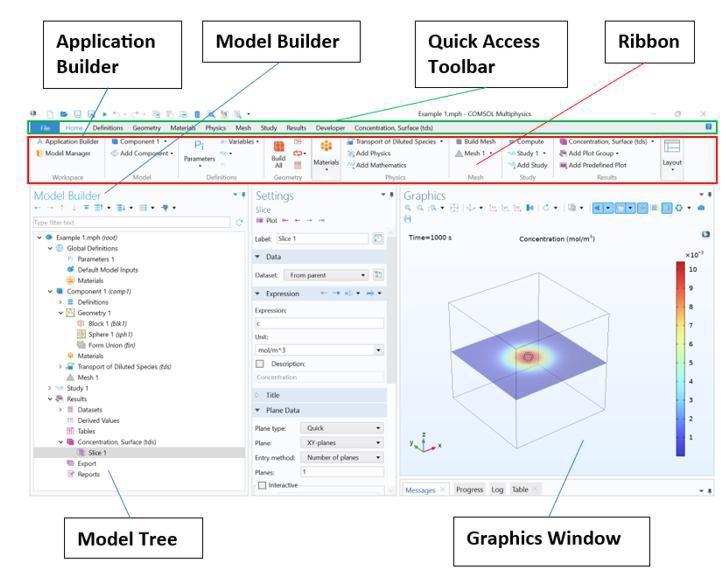
TheCOMSOLdesktop is agraphicsinterface consisting of afew windows. Amongthe most importantare the ModelBuilder with the ModelTree,the QuickAccessToolbar,the Ribbon,the Graphics Window,and the Application Builder (see Fig. 2.1).
Figure 2.1– The COMSOL Multiphysics desktopwithsomeofthe keywindows.
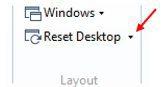
Thedifferentwindows showninFig.2.1 maybedisplayed separately or even presentedondifferentmonitors. If theuserhas lost theexisting window configuration of his/herchoice, it will be possibletorestore it (clickon Reset Desktop in theWindows versionof COMSOL Multiphysics,red arrow)
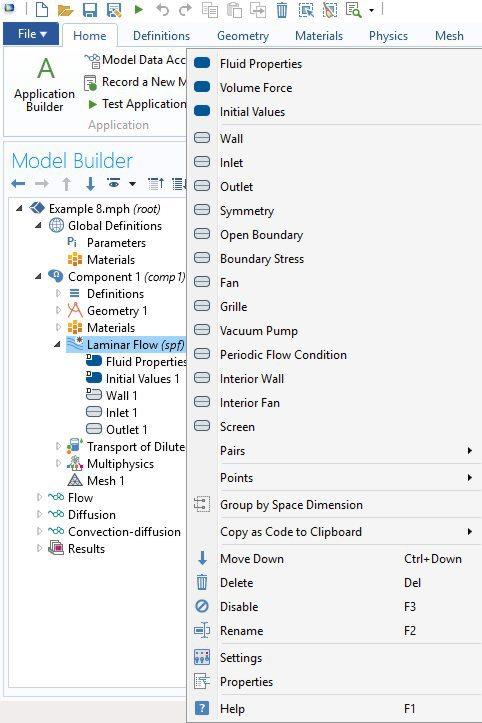
An exampleofthe ModelBuilder tree together with the Contextmenu is showninFig.2.2. If youright-clickwiththe mouseonfor instance Laminar Flow (spf) (red arrow),the associated ContextMenu is displayed.
Figure 2.2 – The ModelBuilder with the ContextMenu of theLaminar Flow module.Right-clickon LaminarFlow (spf) to open that contextmenu.
Themainsteps to make anysimulation are:
• Setting up themodel environment(modeldimension as 1D,2D, 3D or 0D,stationaryor time-dependent).
• Setting up necessary definitionsorparameters.
• Buildingyourgeometric objects.
• Specifying thematerials to be used (copper, water, etc.).
This book is abrief introduction to Contaminant Hydrogeology and Uncertainty Quantification using COMSOL Multiphysics6.The book introduces progressively the subject of quantitativeHydrogeology and Uncertainty Quantification. It illustrates how to develop two- and three-
Contaminanttransport in porous media or fracture rock occurs due to water flow in the porous media and the fractures. The interplaybetween flow,thermal, mechanical and chemical phenomena play, at different degrees, an importantrole. The Multiphysics capabilities of the software used in this book offer the user the opportunity to model such complex and coupled phenomena in asimple way, allowing one to rapidly progress in the development of 2D and 3D hydrogeological and transport models used by engineers and scientistsinfields such as EnvironmentalEngineering, Hydrology/Hydrogeology,Nuclear Waste management, risk
Risk estimationisoften the ultimate goal wheneverone examines how contaminants migrate in the environment. Severaltypes of uncertaintiesare always present, such as modelorconceptual uncertaintiesand parameter- and scenario uncertainties. Uncertainty and Sensitivity analysis are the subject of Uncertainty Quantification. COMSOL Multiphysics 6has an advanced module on Uncertainty
Quantification which is also introduced in this book. This book is abrief introduction to how to model contaminant transport in geological formations, illustrating how different phenomena of importance for contaminant transport are simulated in COMSOL Multiphysics6 and how to apply uncertainty quantification techniquesrelevant to the field. Creating surrogate models and neural networks are also illustrated in the book. dimensional models. assessments,etc.