
TheChildofGoodness
THE CHILD OF GOODNESS
Automatiseradteknikvilkenanvändsför attanalysera text ochdata idigital form isyfteatt generera information, enligt 15a, 15b och 15c§§upphovsrättslagen(text-och datautvinning),ärförbjuden.
©2026AnneliWinter
Illustration ochbokomslag:JemimaSchejbal Korrekturläsning:ClaireCronshaw
Förlag:BoD ·Books on Demand,Östermalmstorg1, 114 42 Stockholm, Sverige, bod@bod.se
Tryck:Libri PlureosGmbH, Friedensallee273, 22763 Hamburg,Tyskland
ISBN: 978-91-8114-390-4
FOREWORD
This book is dedicatedtothe people whomakeupthe real spirit of themedievalweekin Visby. Thepeoplewho show up year after year,inhandmade costumes (some more historically correct thanothers), playing medieval instrumentsand hanging outwith friends they mightonlymeetonceayear. Thepeoplethatdance in thetaverns,singingsongs and living like theweekwillnever end.
Withoutus, therewould be no true spirit of themedievalweek, withoutusthere wouldhavenever been anymonkballorjesters making half improvisedshows that arestill quotableyears later. Withoutus, therewould be no senseinreturning forthe 20th time in arow to hear bagpipes and drumsand spendearly mornings in themoats.
We have made theweekour sanctuary,our haven. This book is forall of us whofeellikewe finallybelong,onceweek32rolls around.
Thankyou
PROLOGUE
APRIL 1450
SweatpoureddownHelvi’s face,and thedrips joined thetears thatfellatthe same time.
“Why?” Helviwhimpered.
Kristina wanted to crytoo.She’d already helpedmanya child into theworld,but no onewas closertoher than Helvi, andto seeher in such pain wasunbearable.
“You have to push again, forthe baby.Yourbaby.”
“I hate it, Ialready hate it!” Helviscreamed.
Kristina hopedFelix couldn’t hearhis wife saysuchthings aboutthe babe she wasbirthing. It wasn’t the firsttimeHelvi hadsaidshe hatedher unborn child, butshe’d neverbeensovocal aboutit.
Whenpeoplecongratulated Helvionher ever-growing belly, she smiled; butKristinaknewshe screamedatthemonthe inside. Kristina hadspent many weekstryingtoconvinceHelvi that shewould lovethe babe once it washere, even though she, too, sometimes wishedthe babe hadnever come to be.OrthatHelvi hadchosendifferentlywhenshe wasput to thetestlastyear. But thebabewas here now, andthere wasnothing to it otherthan promising to loveand nurtureit. Kristinapromisedherselfthat she wouldlovethe babe,evenifHelvi couldnot.
Thecontractions startedagain,and Helviscreamed incoherently. It wastime, and Kristina calmly instructed herclosestfriend on what to do, reminding herthatifshe didn’t,she wouldonly prolongthe pain.
Foronce, Helvilistenedand pushedwhenshe hadto, andout came alittlebabygirl, crying.
Kristina gasped.Never hadshe seen this.
“Whatisit?”Helvi asked.
Kristina held up thebabe, andHelvi sawthe redcaulonher daughter’s head.Acaulwas rare,ared caul even rarer, and many wouldpay afortune to ownone.
“Itcan’t be right!”Helvi said hoarsely.
Kristina laid thebabydown, removed thecaulwitha ragpaper, and handedittoHelvi before she swaddledthe baby.
She wasabout to hand over thelittlegirlwhenshe sawthe horror on Helvi’sface.
“What’swrong?” she askedcarefully.
“Burnit,”Helvi replied.
“But…”
“Burnthe caul and don’ttellanyoneabout it. No onecan know.”
“A caul is valuable.It’sa sign your daughter is marked forgreatness!”Kristinaprotested.
“She,”Helvi said and meantthe baby,“doesn’tdeservegreatness. Burn thecaul, anddon’t youevertellanyone. Nowgiveher to me. ”
Kristina almostunwillingly gave up thebabyand gotthe caul in return.Partofher wonderedifshe couldpretend to burn it andkeepitfor herself, butthere wasnoplace to hide,and Helvi’s eyes were fixedonher.
Kristina dropped thepiece of ragpaper smearedwiththe red caul into the fire,and itdidn’ttakelongbefore it caught.
Once Helvifeltcertain thecaulwas reducedtoash, she turned to hernewborn daughter.She wasugly, screaming, and Helvi’s hatred grew.
Instinctively,Helvi knew to feed herand didsoright away,and to herrelief,the babe quietened down.Ifshe’d been anotherkind of woman, perhapsshe wouldhavetried to causethe baby harm, butshe knew shehad to take care of it thebestshe could. This washer punishment.Her punishment from God. And, by God, she woulddoher duty.
OCTOBER 1456
“Sigrid, we have to go now, ”
Mama’s strained voicereachedmeand brokethe spell. Gerd hadbeenshowing me hercollectionofshells,and theirshimmering gleam always spellbound me. They shimmeredlikea rainbow, like theirfragile,pearlescenthulls were outofthis world. Ididn’t want to leave;there wasastorm outside, and in here we were safe.
Gerd’s hut wassmall,but plenty enough forjusther,asshe used to say. Although ourhouse wasbiggerand even hadstone flooringinstead of thestamped earthen onethatGerdhad,I’d always thoughtthe hut wasmuch more welcoming andnicer.Furniture wassparse with alow bed, atable, threechairsand some shelves on thewall. In themiddleofall this wasacircle of stones, and within them glowed warm embers.
Thewindwhistledand whined,and IfeltevenmoresureI did not want to leave.
“Sigrid!”
Mama knew I’dpretendedI couldn’t hear her, so nowI didn’t have anychoicebut to lift my head andacknowledge her.
“Yes, Mama,” Isaid, hoping my politenesswould gether in a better mood.
Mama didnot like Gerd,but Iwasn’tsurewhy.Gerdwas poor; Iknewthat, butshe wasthe kindestpersonI knew.She wasthe daughter of a fishermanand hadbeenmarried to one, so she knew howto fish.But she wasn’t allowedtosellin themarket, so for nowshe simply gave us fish,and in return,myfamilygaveher a
basket of whatever food and otherprovisionscould be spared. This time, thebasketcontained bread andcandles.Ifithad been up to Mama,wewouldn’thavedoneit, even though we could affordit. It wasonlytallowcandles after all, andthe bread Mama hadmade herself. ButPapainsisted.
Gerd smiledmildly.
“You betterlistentoyourmama. Now, go on,” she said as she hugged me.
IlookedupatMama, then back at Gerd.Gerd’sfacehad stiffened somewhat as shemet Mama’s eyes.I didn’t know what it was, thatexpressionofGerd’s, butitremindedmeofhow Mama sometimes looked at me.
Seeing disappointment mirrored back at herseemedtoput Mama outofsorts foramoment, before shesmiledback and reachedout formyhand. Hersmile wascold, as washer hand.
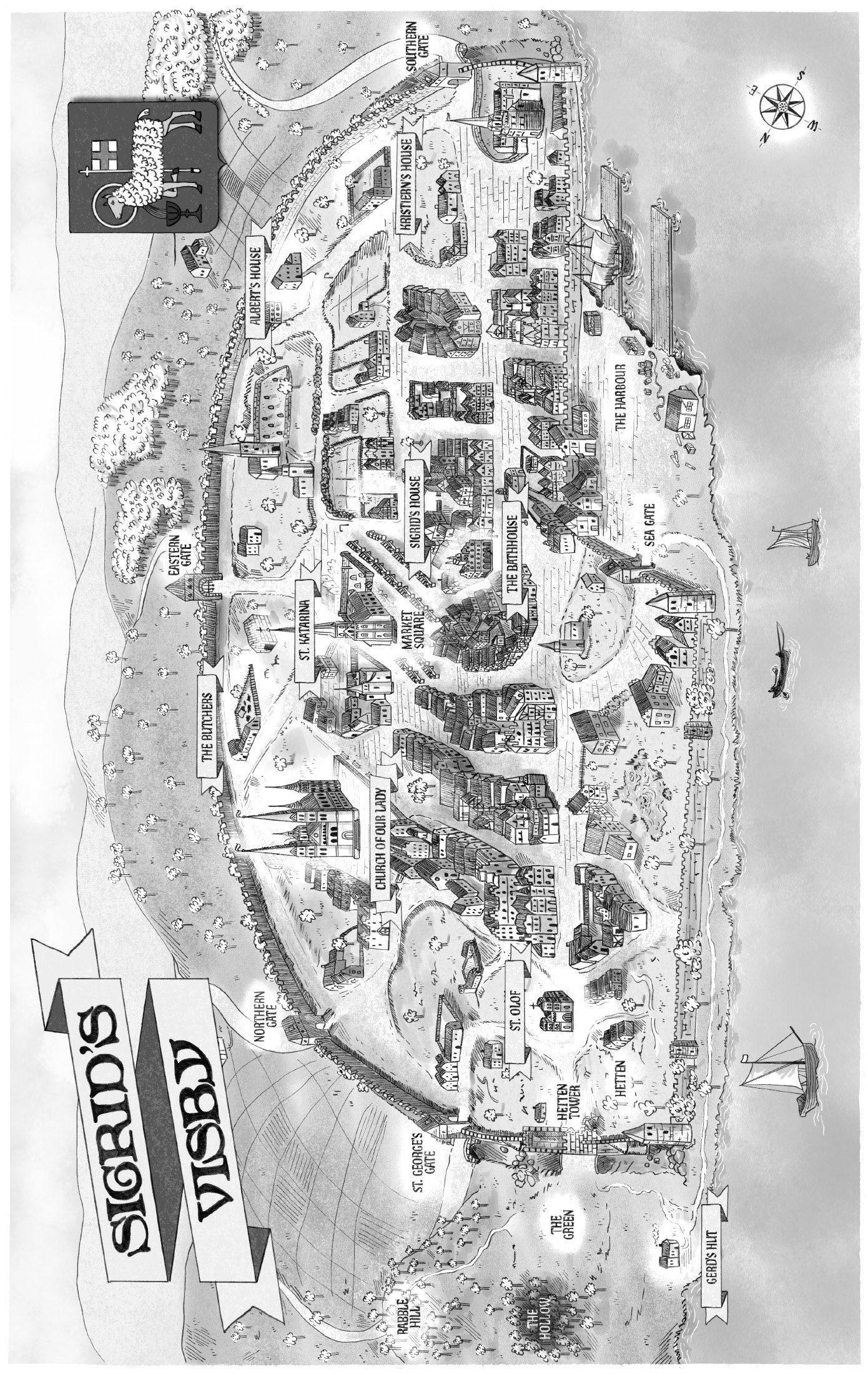
Thedarkswallowed up theroadahead,and even though Iknewit roundedthe citywall, Icouldn’t seethe endofit, andthatscared me alittle. It wouldhavebeenbothquicker andlesswindy to have walked on theinside of thewall, buttodothat, we wouldhave hadtocross Hetten, and Mama hatedHetten.
Hettenwas in thefurthestnorthwest corner of thecitywall, once ameadowofsorts,now astinking cesspool of poorpeople. That waswhere alot of them lived, in huts made of what they couldcomeacross.Itwas like thecityhad made room forthem butkeptthematarm’s length from therestofus.
Ididn’t mind Hetten much,but Mama detestedit. So,wewere left with only onechoice: to walk alongthe wall on theoutside, followingthe path enclosedbetween theman-made stonewallto theleft and theragingsea to theright,until we couldreachthe closestgateand enterthe cityagain.
Mama wasmuttering underher breath.Iknewshe’ddelayed this trip allday,hoping to getout of it,but in theend,she’drealisedPapawould not budge, andall shecould do wasgoout and deliverthe food.Ifwe’dleft during theday,wewouldn’thavehad to fightsomuch againstthe wind to make progress forward, but Iknewbetterthantopoint thatout.Ifwe’dleft during theday, Mama mightevenhaverun into afriendor twoand wouldhave been able to showoff hergenerosity, taking supplies to thepoor. But as it was, it wasjustthe twoofus, aloneinthe dark.
Thecoldcrept undermyscarf,and Iimaginedit reaching the centre of my bones, making them into icicles, like theones that hung from thehouses in winter.Myfeetkeptwarm, however. Mainly duetothe sheer luck of beingbornwitha shoemaker forapapa.
“Hurry up!” Mama draggedme behind her, my armstretching as farasitcould go. Then,toher annoyance, Istopped in my tracks.
“Now what?” she snapped.
“There’ssomeone there,”Isaid, pointing aheadonthe path. It looked almostlikea shadowstanding completely still, before the figure turned to us.Mamaclosed hereyes fora second,and I couldsee herjaw tighten.
She wasjustabout to slap me when adarkvoice greetedus. Mama shrieked before she seemed to gather herself.
“Apologies, sir, you scared me,” she said,her breath stillcatching up.
He didn’t respondwithwords at first, only asly smile that played across hislips. As Mama looked at himmoreclosely,I couldsee thatshe became scared. I’dnever seen Mama scared, butIwas sure that’swhatitwas.
“Thereisnoneed to be alarmed,”hesaidasMamahoisted me up in herarms. Icould almost hear herheartbeatquickening.
My dressslipped up,and againstmyleg Icould feel herkeys thathungfromher belt. They were ice-coldand stungmyskin, butIdid not dare complain to Mama rightnow.
An uneasy silencespread betweenher andthe stranger.Itfelt like alongtime, butitprobablywasn’t.
Imade sure to look at theman properly,and my eyes widened. He wasbeautiful.He wasn’t wearing ahat,which wasextremely unusual, so Icould seehis thickstrawberry-blonde hair (cut short, like anobleman), whichcomplementeda redwoollen doublet stitchedwithgoldembroidery.
He must have been very wealthy; hisblack hose were made perfectly forhim,and hisblack bootslookedalmostbrand new. Never hadIseensomuch finery so close, and thecoloursand glitterdazzled me. Ididn’t know much, butIdid know thatthe deeper the colourofthe clothes, themoreexpensivethe fabric. Mama used to complain that she wanted adress that wasn’t as pale as theone she had. Thefabricgot cheaperwhenthe dye bath gotmorediluted, and she often huffed that she deserved adarkercolour.
Theman’s skin waspale, buthis lips were full andred.His eyes were grey or blue;itwas toodarkfor me to tell.And although it feltlikemy fingerscould fall off my hands fromthe cold,hedidn’t seem to freeze at all. No cloak, no hatand no shiver.
“Apologies fordisturbing you,sir.Wewillbeonour waynow,” Mama said,her voicecracking.
Hisonlyresponsewas asmile.I wanted to hear hisvoice again. Although he spokeour tongue, he hadanaccent, butitwas not theone Iwas used to,thatofthe Germanmerchants,and I wanted to figure outwhatitwas.
“Papaiswaiting,sir.” My voicesoundedinsignificant,mywords disappearing in thewindalmost as soon as Isaidthem. ButI gothis attention, and he turned theeyes Icould notdecide the colouroftowards me.
Mama’s embrace tightened. It wasanunusual feeling; shenormallynever hugged me.
Thestrangerstaredatme, but then he smiled,showing his whiteteeth.His pale fingerscaressedmycheek,and then,inan instant, he wasgone. It waslikethe wind hadcarried himaway.
“It’sthe Devilatwork!”Mamasaid, more to herselfthanme. She wasshaking now, andnot from thecold. Her firststeps were slow, butshe soon sped up as hersenses returned to her.
Iheld hertight,and sheheld me,her raggedbreathonmyneck untilwereachedthe citygate. We’d neverbeensoclose.
She putmedownand took my hand and draggedmethrough thestreets,the closeness I’dfelttoher allbut gone. Icould tell she wasscared, scared forher life, whileIfeltnothing butthe need to calm herdownsoshe wouldnot be scared anymore.
Once she sawour housewiththe hatchonthe front, through which Papa sold shoes, she startedcrying.Icould not see herface; she wasturnedawayfromme, in ahurry to gethome. ButIheardher.
Whenweentered thesmall hallwaynexttothe workshop,she locked thedoorwithboththe keyand thebolts. Then she stood thereinthe dark,tryingtocollect herselfwhile tearsstreamed down herface, herbreathcatching up.
Iwalkedstraightintothe kitchen, passingthe workshoptothe rightand thestairstothe left.Papahad just satdownwithapitcher of ale, and my brotherUlf, nearly twoyears my junior,sat on the floorplaying with some scraps of leather,inhis ownlittleworld.
“Sigrid, what’s thematter?”Papa flew up from thebench when he heardMama’ssobscomecloser.Herushedtoher,forgetting allabout me again, and embracedMama, whowas stillcrying. I joined Ulfonthe floor.
“Dis ahose,”hesaidand showedmeascrap from Papa’s workshop vaguelyresemblinga horse. Ismiledathim andtookanotherscrap from thepile.
“And this is acat,” Isaid, pretending thecat waswalking on Ulf’slegs.
Ulflaughed untilPapashushed us.
“Helvi,please. Tell me what happened!”
Slowly, taking time to find herwords, she told Papa what had happened.
“Hewas no nobleman.Iamsureofit!”she said.“Theway he looked at me, it wasnot human.”
“Calmyourself, my dear.Surely,you must be mistaken,” Papa said.
Icould seethatheimmediately regrettedsaying it. Mama’s eyes shifted.
“You don’tbelieve me!You don’tbelieve your ownwife!I tell you, he wasthe Devilhimself!”Spit flew from hermouth, and Papa fellsilent;hedid notdareopposeher when she was like this.Ikeptmyeyes firmly on theleather-scrap cat. Idid not want to draw attentiontomyself.But it wasnouse. Mama turned to me.
“Sigridsaved us,” shesaid.
Herwords shocked me,and Icould notstopmyselffromlooking up.
Mama continued, “She is stillachild,goodand unspoiled, and hergoodnessscaredhim away.”
“Isthiswhathappened, Sigrid?” Papa asked, hisvoice serious. Icould nothelpbut nodinagreement.MamasaidI’d savedus. Neverhad Iheardher sound so kind when talkingabout me. Idid not care if thestrangerhad been theDevil or aman.All Icared aboutwas making Mama happy, andI couldalready tell thatshe waspleasedwithmyanswer.
“Oh, sweetJesus!” Papa felltohis kneesand prayedtothe Father aboveand hisson in gratitudebefore he scoopedmeupand hugged me. Ifeltloved andsafe.
“She scared theDevil away,” Mama said to confirm thestory, and forthe firsttime, she looked proudofme. I’dsaved Mama from Satan.
“Tellusagain,Helvi,whatdid he look like?”
Thetanner’swife wassitting by ourtable, demandingthe story once more.She wasjoinedbya gaggle of women. Irecognised most of them,but some were newtome. Runa-from-Backawas there, and hertoothlessgrinwidened greedily formoreinformation.I’d neverliked Runa-from-Backa, andpartofmewas convincedshe wasawitch.
Turid, theblacksmith’swife, leantinevenfurther as Mama told them once more of themeeting with theDevil.Turid’s eyes gleamedwithexcitement; shewould have so much to tell once she gotback home.
I, on theother hand,onlyfeltuncomfortable. At first, it was nice to getsomuch attentionfromMama, butIsoonrealisedit wasmoreabout theattentionshe gotand notme. Iwas forced to sit by and listen as thetalegrew.
Suddenly, theDevil hadbeenwearing adoublet made from the finestsilk, when Idistinctlyrememberitbeing made from wool. Iknewbetterthantopoint it out.Mama’skindnesstowards me wouldend,and allIwould getfromitwould be abeating.
Threedayshad passed sinceour meetingwiththe visitor,and people hadbeenpouring in from everyguild to seeme. Thepriest dubbed me TheChild of Goodness,which only made things worse. Iwas nowmade to come with Mama on allthe errands sheused to do herself, just so shecould showmeoff.Peoplewantedto touch me, take my hand,havemesavethemfromthe Deviland hisailments. Ididn’t know what to do, so Istayedsilent, which seemed to make folk believeitevenmore.