Finding Clarity and Calm in a World of Mounting Uncertainty
‘An exquisite call to silence’ KATHERINE MAY
‘A beautifully written, meditative book’ FINANCIAL TIMES
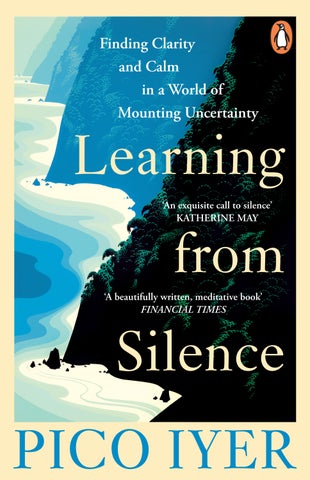
‘An exquisite call to silence’ KATHERINE MAY
‘A beautifully written, meditative book’ FINANCIAL TIMES
‘I urge everyone to read Pico Iyer’s beautifully written, meditative book . . . As I turned to this, I felt my blood pressure reducing, and I began to read in a different, slower, and more concentrated way. ’
Financial Times
‘Learning From Silence is an exquisite book, a jewel, a treasure, and appearing at a time when silence can teach us to see more deeply, to love more surely. ’
Joan
Halifax
‘A powerful work of observation in which deep truths seem to arise almost by accident. ’
New Yorker
‘Essential reading for anyone interested in the monastic tradition and those who follow it. ’
Kirkus
‘Brilliantly illuminates philosophical insights about the nature of the self, the world, and how silence serves as a conduit between the two, often in elegant, evocative prose . . . Stunning. ’
Publisher’s Weekly
The Half Known Life
A Beginner’s Guide to Japan
This Could Be Home
Autumn Light
The Art of Stillness
The Main Within My Head
The Open Road
Sun After Dark
Abandon
Imagining Canada
The Global Soul
Tropical Classical
Cuba and the Night
Falling Off the Map
The Lady and the Monk
Video Night in Kathmandu
UK | USA | Canada | Ireland | Australia
India | New Zealand | South Africa
Penguin Books is part of the Penguin Random House group of companies whose addresses can be found at global.penguinrandomhouse.com
Penguin Random House UK, One Embassy Gardens, 8 Viaduct Gardens, London SW11 7BW
penguin.co.uk
First published in the US as Aflame by Riverhead Books, an imprint of Penguin Random House LLC, 2025
First published in the UK by Cornerstone Press 2025
Published in Penguin Books 2026 001
Copyright © Pico Iyer, 2025
The moral right of the author has been asserted
Penguin Random House values and supports copyright. Copyright fuels creativity, encourages diverse voices, promotes freedom of expression and supports a vibrant culture. Thank you for purchasing an authorised edition of this book and for respecting intellectual property laws by not reproducing, scanning or distributing any part of it by any means without permission. You are supporting authors and enabling Penguin Random House to continue to publish books for everyone. No part of this book may be used or reproduced in any manner for the purpose of training artificial intelligence technologies or systems. In accordance with Article 4(3) of the DSM Directive 2019/790, Penguin Random House expressly reserves this work from the text and data mining exception.
Book design by Amanda Dewey
Printed and bound in Great Britain by Clays Ltd, Elcograf S.p.A.
The authorised representative in the EEA is Penguin Random House Ireland, Morrison Chambers, 32 Nassau Street, Dublin D02 YH68
A CIP catalogue record for this book is available from the British Library
ISBN: 978–1–804–95273–3
Penguin Random House is committed to a sustainable future for our business, our readers and our planet. This book is made from Forest Stewardship Council® certified paper.
For the monks and nuns, in every tradition, who have sustained so many of us, visibly and invisibly, through so many lifetimes— with thanks and deepest admiration.
To die—without the Dying And live—without the Life
This is the hardest Miracle Propounded to Belief.
— EMILY DICKINSON &
TWO MEN IN WHITE ROBES stand at the end of the road, high above the empty highway. “That fire last October,” says one, young and slim, his eyes burning under his shaven head, “it came within three miles of us. At one point our road got blocked and there was no way out. It was radiant.”
His older monastic brother says nothing.
“For three days and nights,” Cyprian goes on, “the sky was black. Like sooty fog all the time. I went down to the last bench and the whole ocean was bloodred. Plumes of smoke were rising from the hills; I heard trees exploding. It was incandescent.”
I don’t know what to say. Fire has already left its mark on me.
“You pay for your blessings,” I venture at last.
“We do,” says the other, burly, with gentle eyes. “A lot of people don’t understand that. They see only the beauty.”
The beauty, of course, is hard to miss. In the distance, headlands that stretch toward the cities to the south, surf scribbling white around their edges. To our right, a wide expanse of ocean with not a thing to interrupt the blue. A deep valley to our left, and dry golden hills from which mountain lions sometimes emerge, or their prey. Nine hundred acres of live oak, madrona, redwood and desert yucca, a quarter of a mile above the sea.
“I wonder if beauty always has to carry a trace of mortality,” I try, and my two friends are wise enough not to say a word, looking out over the charred hills to the promise all around.
IN MY SMALL SUNWASHED ROOM, ten minutes later, I can’t imagine death. The sun pinpricks the water through the long windows behind the desk; in my compact walled garden, a rabbit’s ears twitch pink, almost transparent. A single white chair sits in front of a low wooden fence, and then there’s nothing but brush all the way to the sea.
I set down my carry- on and walk to the desk. For what feels like hours, I can’t stop writing, though I had nothing to communicate when I drove up. I stand at last, to see four long pages covered with my scrawl. A bell is tolling behind me, suggesting that barely twenty minutes have passed.
“YOU SOUND LIKE you’re in love.”
“Exalted, at the very least.”
Steve looks at me shrewdly, after I’ve come down from the mountain; he’s known me long enough to be wary of my enthusiasms.
“A love like that can’t last. You know that.”
“I do. But it can leave you a different person, not always for the worse.” He looks away; my friend grew up under the iron hand of priests. He knows that even the loftiest ideas— even the most beautiful spaces— are in the hands of fallible humans.
“What’s so special about this place?”
“The fact there’s no need of texts or theories. Of anything, really. It’s just silence and emptiness and light. No screens at all.”
“No screens,” he says, registering that I mean something more than television sets. When Steve joined a seminary, his consciousness came so unhinged that he was found walking in his sleep, night after night, and had to be sent home.
“You’re not getting religious?”
I look at him. “If you’re freed of all distinctions, there’s no need of words like ‘God.’ ”
IN TRUTH, I’m as surprised as my friend is. Twelve years of enforced chapel at school, every morning and every
evening, have left me with an aversion to all crosses and hymnals. In any case, I’ve never wanted to be part of any group of believers. The globe is too wide, too various, to assume one knows it all.
So why am I exultant to find myself in the silence of this Catholic monastery? Maybe because there’s no “I” to get in the way of the exultancy. Only the brightness of the blue above and below. That red-tailed hawk circling, the bees busy in the lavender. It’s as if a lens cap has come off and once the self is gone, the world can come flooding in, in all its wild immediacy.
“THE SILENCE OF THIS PLACE is as real and solid as sound. More real, in fact.” The words in front of me feel as close as if I’ve written them. Alone in a shack near the South Pole for five months, the author stepped into a sense of communion with everything around him. Everywhere he looked was a vastness that made his plans and achievements seem very small indeed.
Admiral Byrd was receiving messages by radio from his friend President Roosevelt as he sat in the polar cold and dark; he was the only person ever to have been feted with three ticker-tape parades through New York City. But in his little cell he came to see that success might be another word for peace and peace, at heart, for freedom
from ceaseless striving. Though close at times to death, he “felt more alive,” he confesses, in his solitude, “than at any other time in my life.”
His friends in seclusion were moon haloes, the “bright pebbles” of stars, “ice crystals falling against the face of the sun.” His greatest enemy, he came to see, was a “discordant mind.” He watched a brilliant aurora, he paged through a tale of monastic romance, he sat for long hours in enveloping silence and began to appreciate what T. S. Eliot would call the “life we have lost in living.” No human, he saw, “can hope to be completely free who lives within reach of familiar habits and urgencies.”
IT WAS VISITING MY PARENTS’ friend Kilian, earlier in the week, close to home, that brought the admiral back to me; I’d glimpsed the copy of Byrd’s memoir Alone beside his chair. For a quarter of a century, none of us has ever seen Kil ruffled or without his air of quiet self-possession; usually his small figure is to be found seated at a terminal, chuckling over fractals. Brown corduroy jacket, gold-rim specs, shock of frizzy brown hair.
I don’t think I’ll ever meet a brighter soul; he mastered both physics and philosophy at Harvard. But when I moved to Boston, he volunteered to drive with me all the way across the country so he could show me round his old
hometown. The one time we stopped, for eight hours in a motel, I awoke at first light to find him at the check-in desk, scribbling across a postcard of bright- eyed raccoons to send back to his two young daughters.
Now, as I look in on him, Gregorian chants fill the space. He’s long been drawn toward the wisdoms associated with Asia, but cancer, it seems, has moved him to turn to solace closer to home.
What words can be of any use? I recall my friend has always delighted in Kafka’s nutty riddles.
“I just found this unexpected passage,” I say, pulling out the worn notebook I carry in my pocket. “ ‘You do not need to leave your room. Remain sitting at your table and listen. Do not even listen, simply wait, be quiet, still and solitary. The world will freely offer itself to you to be unmasked; it has no choice. It will roll in ecstasy at your feet.’ ”
Kil smiles; sitting still is his only option now.
“I should let you rest,” I say, trying not to think that forty-nine years are far too few. “But I’ll see you two weeks from now. With the latest news from Europe.”
Kil struggles to his feet. Movement is so difficult these days. He shuffles over to hold me, and I realize we have never touched before. I feel his bones through his shirt, so fragile I worry they’ll crumble in my arms.
“Take care of your mother,” he says quietly, as if knowing that two weeks is much too long to hope for.
IT WAS ANOTHER FRIEND, Dwight, who first sent me toward silence, thirty-three years ago as I write this. He’d seen me sleeping on the floor of someone’s house, my home all ash, and he knew I could do better. Three and a half hours up the coast, he said, and I’d have a room to myself. A bed, a wide desk, ocean views. Lunch to collect from a communal kitchen, two hot showers for anyone to enjoy. No obligations and a suggested donation of just thirty dollars a night.
What could I lose? I got into my dusty white Plymouth Horizon, four days after my thirty-fourth birthday, and followed the interstate freeway to a single-lane highway. Very soon there was nothing to my right but golden hills— a scatter of black cows in the meadows— and nothing to my left but the motionless blue plate of the Pacific. A white lighthouse lonely among the rocks.
Then an even narrower path, barely wider than my car, zigzagging up to the top of a ridge. At every switchback, a heart- stopping view of the ocean far below, the receding coastline. In the bookstore, near the end of the road, a young monk, waiting to guide me down to my room in an unprepossessing line of motel-like doors.
“This is Big Sur,” he said, pointing to the heater against one wall. “It can get cold.”
A single bed on one side, a rocking chair next to the
blond-wood dresser. Through the windows, the ocean a sheet of fire. The sense of homecoming instantaneous.
SMELL OF ANISE as I walk along the silent road in the sharpened light of late afternoon. Sound, now and then, of surf, sidling in and receding among the rocks below. Flowers the color of blueberry ice cream along the way.
Such a simple revolution: Yesterday I thought myself at the center of the world. Now the world seems to sit at the center of me.
THE SIXTY-MILE STRETCH of coastline along Central California has always felt like liberation as I nose around blind turns on Highway 1, a sheer drop beside me falling to the sea. Groves of coastal redwoods that enfold one in a primal darkness; high cliffs that tumble down, when it rains, toward the water; an ocean unmarked by oil rigs or islands or anything at all. “Here was life purged of its ephemeral accretions,” wrote Robinson Jeffers, who left Europe and his classical education to build a stony tower above this coast and hymn the Homeric ruggedness for forty-three craggy years. Here was a “shifting of emphasis and significance from man to not-man.”
Henry Miller had just finished roaming around Greece,
sensing gods on every hilltop, when he arrived here in the middle of World War II, settling into a small convict’s cabin down the road. He had in time to brave a mileand-a-half climb down from his hilltop perch every time he needed to collect his mail; he had to gather firewood whenever he wanted a cup of coffee. He carried barely ten dollars in his pocket when he washed up on the deserted coastline; there was no telephone, no electricity, no sewage system in the entire area. Three of the years he spent here, wrote an early biographer, were the happiest of his life.
We can “make our own Bibles,” he noted as he looked across forty miles of emptiness, “invaded” by stillness. “There being nothing to improve on in the surroundings, the tendency is to set about improving oneself.” The casual reader might have thought the good-natured bum known for scrounging a living among the whores and gutters of Paris an unlikely monastic, but as he gazed across the ocean towards Japan and Tibet, the man with a gift for saying yes acknowledged that “it was here at Big Sur that I first learned to say ‘Amen.’ ”
In 1962 he wrote to the Trappist monk Thomas Merton— they shared a publisher—in response to Merton’s accounts of the early hermits of Christianity; Merton— whose books were banned on very different grounds— eagerly wrote back, seeing that Miller’s Wisdom of the Heart was really little different from his Wisdom of the