‘Full of intellectual descriptions and stylistic diversions.’
London Review of Books
‘[Powers is] a novelist of ideas and a novelist of witness, and in both respects, he has few American peers.’
Los Angeles Times
‘If Powers were an American writer of the nineteenth century he’d probably be the Herman Melville of Moby-Dick. His picture is that big.’
Margaret Atwood
ABOUT THE AUTHOR
Richard Powers has published fourteen novels. He is a MacArthur Fellow and received the National Book Award. He won the Pulitzer Prize for Fiction for The Overstory and his subsequent novel, Bewilderment, was shortlisted for the Booker Prize. He lives in the Great Smoky Mountains.
ALSO BY RICHARD POWERS
Prisoner’s Dilemma
The Gold Bug Variations
Operation Wandering Soul
Galatea 2.2
Gain
Plowing the Dark
The Time of Our Singing
The Echo Maker
Generosity: An Enhancement
Orfeo
The Overstory
Bewilderment
Playground
BOOK S
PENGUIN BOOKS
UK | USA | Canada | Ireland | Australia
India | New Zealand | South Africa
Penguin Books is part of the Penguin Random House group of companies whose addresses can be found at global.penguinrandomhouse.com
Penguin Random House UK, One Embassy Gardens, 8 Viaduct Gardens, London SW11 7BW
penguin.co.uk
First published in the US by William Morrow and Co., Inc. 1985
First published in the UK by Weidenfeld & Nicholson Ltd. 1988
This novel is entirely a work of fiction. The names, characters and incidents portrayed in it are the work of the author’s imagination. Any resemblance to actual persons, living or dead, events or localities is entirely coincidental
Every effort has been made to trace copyright holders and to obtain permission. The publisher apologises for any errors or omissions and, if notified of any corrections, will make suitable acknowledgement in future reprints or editions of this book
No part of this book may be used or reproduced in any manner for the purpose of training artificial intelligence technologies or systems. In accordance with Article 4(3) of the DSM Directive 2019/790, Penguin Random House expressly reserves this work from the text and data mining exception.
Printed and bound in Great Britain by Clays Ltd, Elcograf S.p.A.
The authorised representative in the EEA is Penguin Random House Ireland, Morrison Chambers, 32 Nassau Street, Dublin D02 YH68
A CIP catalogue record for this book is available from the British Library
ISBN: 978–1–804–95217–7
Penguin Random House is committed to a sustainable future for our business, our readers and our planet. This book is made from Forest Stewardship Council® certified paper.
We guess as we read, we create; everything starts from an initial mistake. … A large part of what we believe to be true … with a persistence equalled only by our sincerity, springs from an original misconception.
—Marcel Proust, Remembrance of Things Past
“Everybody,” said Knudsen, explaining the demand for the automobile, “wants to go from A to B sitting down.”
—Anne Jardin, The First Henry Ford: A Study in Personality and Business Leadership
Chapter One
I Outfit Myself for a Trip to Saint Ives
Cats, kits, sacks, wives: how many were going to St. Ives?
for a third of a century, I got by nicely without Detroit. First off, I don’t do well in cars and have never owned one. The smell of anything faintly resembling car seats gives me motion sickness. That alone had always ranked Motor City a solid third from bottom of American Cities I’d Like to See. I always rely on scenery to deaden the inconvenience of travel, and “Detroit scenery” seemed as self-contradictory as “movie actress,” “benign cancer,” “gentlemen of the press,” or “American Diplomacy.” For my entire conscious life I’d successfully ignored the city. But one day two years ago, Detroit ambushed me before I could get out of its way.
The Early Riser out of Chicago dropped me off alongside Grand Trunk Station, a magnificent building baptized in marble but now lying buried in plywood. I lugged my bag-and-a-half into the terminal, a public semidarkness stinking of urine and history. Subpoenaed relatives met their arriving parties under the glow of a loudspeaker that issued familiar, reassuring tunes.
One hundred years ago, the Grand Trunk must have quickened pulses. Pillars of American Municipal balanced a fifty-foot vault on elaborate Corinthian capitals: America copying England copying France copying Rome copying the Greeks. A copper dome with ceramic floral trim bore the obligatory inscriptions from Cicero and Bill Taft. Now the station’s opulence left it a mausoleum, empty except for the Early Riser executives who threaded the rotunda in single file.
I fell automatically into line, sensing the station’s layout. The soaring ceiling seemed out of proportion to the size of the hall. When my eyes adjusted to Detroit’s industrial-grade light, I received a shock, the same
shock I had felt as a child when, at a public swimming pool, I saw an old vet unstrap and remove his leg before taking a dip. The antique terminal had been similarly amputated: the corridor I walked down was not the station’s length but only its width. The Grand Trunk had been sent packing: plywood sheets boarded off palatial wings and multiple gates, leaving only this reduced chicken run between a lone arrival platform and the main exit.
Transferring trains in Detroit was the cheapest if not the most expedient way of getting from Chicago to Boston. Drastically cut fares promoted a new route, the Technoliner, for the first month of its run. The line subsequently folded, the technolinees long ago forsaking Detroit for Houston and northern California, and even longer ago forsaking trains for planes. Another case of our railway being behind schedule. Nevertheless, I sank as low as Toledo to take advantage of the reduced fare.
When I’m in money, I can leave half-eaten meals in restaurants along with the best. I’ve worked hard at overcoming a natural stinginess. But when I’m out of money—a cyclical occurrence paralleling America’s boom/bust economy of the last century—I easily fall back on old habits. This trip found me once again short, having just spent a year in the Illinois backwoods on a small business project that did not pan out. “Pan out” comes, I assume, from the prospectors’ days. Flash in the pan. I spent my early thirties in isolation, chasing flashes in the pan.
With my technical background, I knew that I could find work in Boston providing I could put down a security deposit on an efficiency and still have enough cash left over to dryclean my interview suit. My money margin, marginalia in this case, did not worry me so much as the immediate problem of how to spend the six hours between the Early Riser and the Technoliner in a city I had, until then, celebrated by avoiding. It was me against motion sickness in the city autos built.
But as sometimes happens when killing time, I would come across something in my brief Detroit layover that would kill not just six hours but the next year and more before I came to terms with it. Sifting the downtown for novelties that might deaden ten minutes, I did not imagine that the next
ten months would find me obsessed with everything I could learn about Motor City and the fifth-grade farmer who put it on the map.
When I made my stopover, Detroit had already been undergoing a manufactured and heavily publicized rebirth for some time. The emblem of this new era, the Renaissance Center, may be the single most ambitious building project of recent times. Its five black towers outscale the rest of the city the way Chartres Cathedral dwarfs its surrounding town. Four cylinders flank a central, massive pillar, each hanging black glass over girders in disguised International Style.
But if the city were not already dead, would it need a rebirth? The name “Renaissance Center” resembles an ad campaign declaring Sudso “All the cleaner you’ll ever need,” or a restaurant assuring, “What we serve is really a meal.” And just as when telling an old widower that he looks well we mean he ought not to push his luck, the leading citizens of Detroit, in naming the Renaissance Center, implied that they would be pleased if the city could, at this point, break even.
The size and opulence of the center meant to attract tourists and conventioneers into double-A, self-contained luxury. The palace executed its purpose too well. It drew people (read money) up and away from the surrounding businesses, and because the towers were so self-sufficient a village, the people never came back out. The area surrounding the Renaissance Center showed the signs of a hasty evacuation and rout. Gravitating toward the towers, I passed row on row of brick, triple-decked residences standing vacant, their windows and doors broken open to reveal nothing inside.
I figured that the Renaissance Center (dubbed the Ren Cen by those who make a living truncating all words into monosyllables) would be good for a half hour. The inside was a contemporary version of the Grand Trunk—the multileveled, involuted architecture that had delighted me as a boy of six, when I still believed in Tom Swift and urban renewal. I ordered a meal, reading the menu right to left, in a disk-shaped restaurant floating on a moat
in the central tower, spinning, gradually but perceptibly, driven no doubt by a thousand Asian coolies chained to a mill-track on a hidden lower level.
My training in physics made the huge spinning plate seem an unintentional homage to the last, great empirical experiment of the nineteenth century. In 1887, the physicists Michelson and Morley set out to measure the absolute velocity of the earth through the ether field. The two scientists floated a gigantic slab on a sea of mercury, on the same scale and setup as the slab I now rode. They shone a beam of light through a prism in the center and back to mirrors on the perimeter, reasoning that light flowing in the direction of the ether stream would travel faster than light flowing upriver. But Michelson and Morley found no difference in light speeds, regardless of orientation. An international calamity followed in 1905, when Einstein, a Bern patent clerk with no reputation to lose, suggested preserving the velocity of light at the expense of the concept of absolute measure. The century was off to a quick jump out of the gate. I came across an account of this experiment again much later, after pursuing the Henry Ford hoax through the infant century. But at the time, I drew the comparison casually. I waited until the disk completed one full rotation before disembarking. Since I don’t smoke or drink and swear unconvincingly, symmetry is my only vice. Escaping from the Ren Cen, I walked counterclockwise for a few blocks to reverse my dizziness. I sat down on the nearest set of steps. A bum approached from across the piazza and requested a quarter for some suntan oil. I explained that I needed it to dryclean my interview suit and he left me in peace.
Nearby, a vintage fifties statue depicted a green, cupreous titan hefting a petite, state-of-the-art, Waspish couple in one hand and either a globe or an automobile—I can’t remember which—in the other: Spirit of Detroit. Two lawyers fist-fought over a parking space. A woman sold clods of earth out of a shoe box. A man with a ventriloquist’s dummy explained to an indifferent crowd that the present secretary of state was the Antichrist. A prominent clock harped on the fact that I was doing a rotten job marking time. If I was going to make it to the Technoliner intact, I’d need better diversion.
I bused to the Detroit Institute of Arts. Now the finest of this century’s paintings will never make up for our concurrent botch of everything else. Art can only hope to be an anaesthetic, a placebo. The best artists know that patients always fake their symptoms and must be tricked into diagnosis before treatment can take place. The last thing I expected to find at the Institute was a mystery, a work of art demanding to be tracked down, a trail unfolding indefinitely, approximately, the way memory tries “recoil,” or “recommend,” or “record,” coming as close as “recoup,” but never alighting on its real object, “recover.”
The foyer of the Detroit museum opens onto yet another Grand Hall, a high-vaulted, Euro-sick, stone rectangle entirely unfit for displaying works of art. Rococo satyrs and curlicues alternate with heat-duct grills in a confused architectural legacy. In 1931, in the depths of the Depression, the Institute’s Arts Commission, backed by Edsel Ford, asked the Mexican muralist Diego Rivera to use the room for a fresco commemorating the greatness of Detroit. It was an odd marriage: Edsel Ford, whose father was the first among capitalists, in cahoots with Rivera, the notorious revolutionary who secured Trotsky’s political asylum in Mexico. Rivera, the Third World champion, praising the city whose chief icon is an enormous electric sign tallying new autos as they come off the assembly ramp. Diego, who once incorporated a wall fuse box into a mural, working in a room the gaudy copy of Bourbon splendor. But Detroit and Diego shared something critical: both were in love with machines.
The Institute put up ten thousand dollars of Edsel’s cash, embarrassed to offer “the only man now living who adequately represents the world we live in—wars, tumult, struggling peoples” such a meager sum. They suggested he limit his work to fifty square yards on each of the two larger walls, one hundred dollars per square yard, by some esoteric formula, considered fair for a man of Diego’s stature. Thus the Fords, standing in for Michelangelo’s papal patrons, might have suggested the fellow not do the whole ceiling, but just a little bit above the altar. Rivera grew increasingly ambitious in guilty
compensation for the gringos’ liberality. Edsel, finding out that Diego meant to cover all four walls, upped the ante to twenty-five thousand.
The Institute told Diego that they “would be pleased if [he] could possibly find something out of the history of Detroit, or some motive suggesting the development of industry in this town.” They did not suspect that the huge man would cart his bulk through all the factories of Detroit, holing up for over three months at Ford’s, Chrysler’s, and Edison’s plants, sketching thousands of preliminaries. Rather than appease the room’s rococo anachronisms, he blitzed them with a vision swept up off the factory floor. And in the final work, the curlicues and satyrs go unnoticed, lost in Diego’s mechanical vision.
Rivera worked behind a screen for two years, an hourly laborer painting sometimes sixteen hours a day, in a room whose glass roof created greenhouse temperatures of over 100 degrees. Journalists, glimpsing the work in progress, declared that the murals, far from praising the city, would “knock Detroit’s head off.” The unveiling provided plenty for all those who secretly love a thunderstorm. The crowd stood baffled by the revealed work, seeing no historical allusions or civic allegories, no lineup of leading Detroit power brokers. The public flocked all the way out to the museum to see what they were forced to see every other day of the week: ordinary, characterless people chained to endless, sensual machines.
Diego had committed the principal subversive act: he painted the spirit of Detroit in all its unretouched particulars. Strings of interchangeable human forms stroked the assembly line—a sinuous, almost functional machine—stamping, welding, and finally producing the finished product— an auto engine. Men in asbestos suits and goggled gas masks metamorphosed into green insects. Languorous allegorical nudes mimicked the conveyor. The frescoed room showed the spirit of Detroit from a much closer distance than the comfortable, corporate copper titan I had passed on the street outside. Viewers at the unveiling found themselves inside Detroit, just as the mural-men crawled in, around, and over their creation, striking a mutually parasitic relationship with metal. Diego had painted a chapel to
the ultimate social accomplishment, the assembly line, a self-reproducing work of art, precise, brilliant, and hard as steel.
Bishops and businessmen instantly mobilized to destroy the frescoes. It is not hard to read subversion and heresy into the average work of a person’s hands. The task becomes easier when the work is ambitious, joyful, and revolutionary. Rivera’s was a duck shoot. Even those who had not yet visited the museum found a garden variety of blasphemies in the work. People saw a ridiculous Saint Anthony tempted away from his foreman’s plans by an allegory nude’s legs. Depression-sensitive capitalists saw in the figures communist-inspired proto-humans. A panel showing the inoculation of a child burlesqued the Nativity.
Diego’s compliment—that Detroit reveled in the vitality of the machine age—became, in the mouths of its interpreters, an insult. Edsel, the people declared, had been taken in by a piece of dangerously populist propaganda. An organized outcry of radio broadcasts and written petitions culminated in the Detroit News saying that “the best thing to do would be to whitewash the entire work completely.”
The work stood. Those cooler minds in the opposition knew that whitewashing turns an ambiguous work decidedly subversive, whereas a busy and ambitious mural was its own death kiss. Left alone, it would date itself more and more each year, playing to an increasingly disinterested house until one day, with the roots of civilization still intact, it would pass a magic milestone and become that perfectly harmless, even socializing item, the historical artifact.
I knew nothing of all this as I stood in the mural room between trains, nor did I suspect that I would be caught up in finding out. Viewed from inside the factory, the self-reproducing machine demanded allegiance or resentment, but denied the possibility of indifference. Technology could feed dreams of progress or kill dreams of nostalgia. The old debate came alive in Rivera’s work with a new strangeness. The machine was our child, defective, but with remarkable survival value. Rivera had painted the baptismal portrait
of a mutant offspring, demanding love, resentment, pity, even hope, but refusing to be disowned.
With new eyes, I noticed a minor panel on one of the small walls, off to the side of the conveyor murals. In front of a sculpted dynamo more erotically contoured than any nude, a white-haired man sat at a monolithic desk, face pinched into an amalgam of benevolence and greed—Ford or Edison or De Forest or any of a dozen crabbed industrialists and innovators.
In this face, the face of our times, lay all the evidence I would need to break the hoax, to crack the mystery. Had I recognized the composite face for what it was, I might have saved a year spent tracking down the other leads: Detroit, Rivera, Ford, the auto, mechanical reproduction, portraiture, ether, relativity. When we don’t know what we are after, we risk passing it over in the dark. The Chinese played with fireworks for hundreds of years without inventing the gun. Edison thought his moving pictures were just toys. The physician who first set out to discover appropriate anesthetic dosages discovered, instead, addiction. And I, thinking the clues to my discomfort lay elsewhere, turned my back on this crabbed face and left the hall.
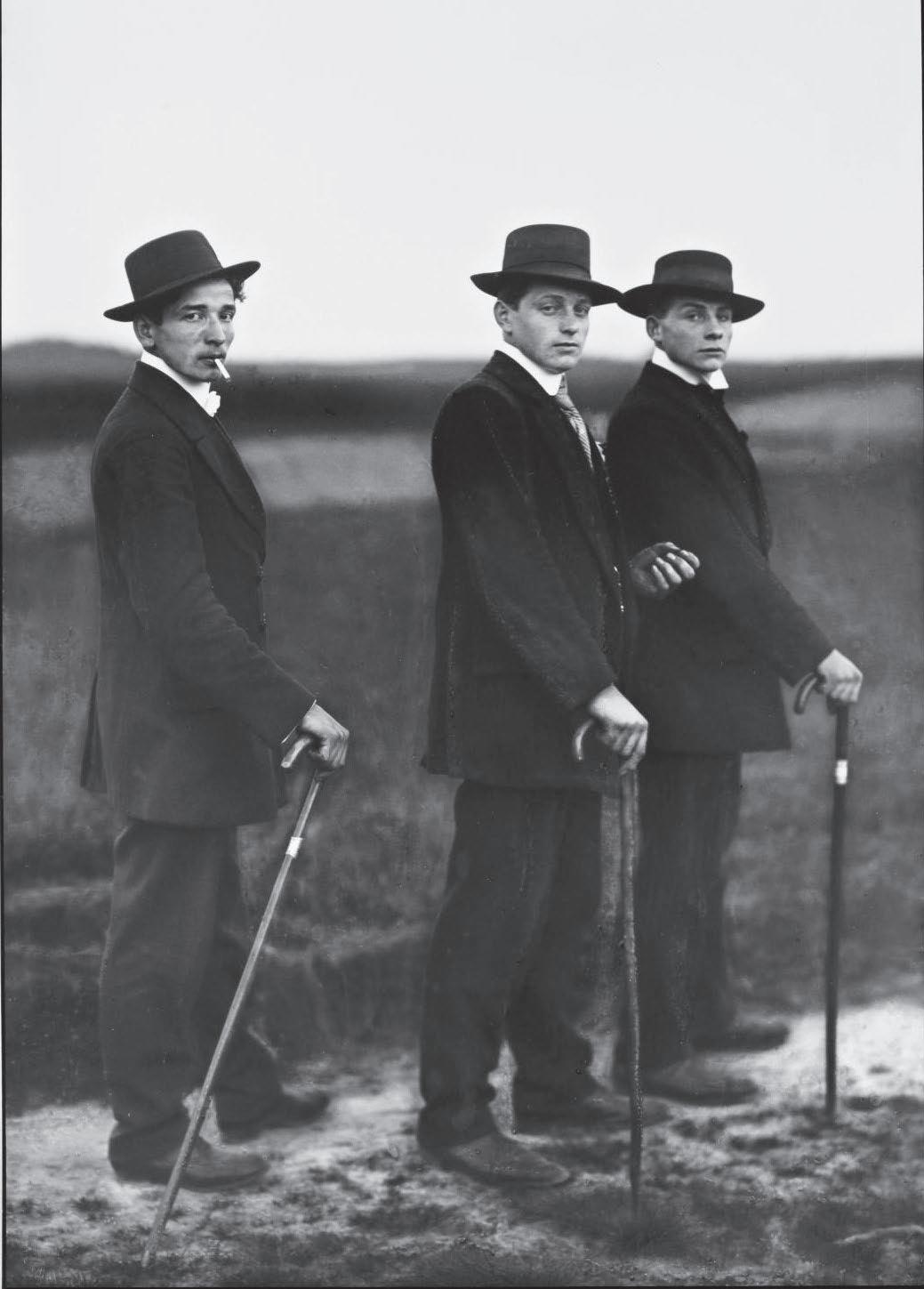
By the time I reached the far end of the adjoining hallway, I was in an extreme state of agitation. I had forgotten all about my connector. To calm myself, I began repeating an old nursery rhyme: While I was going to Saint Ives, I met a man with seven wives. Rivera’s murals had upset me deeply and I thought only of getting away from them. Putting one last corner between myself and the factory, I wheeled smack into a mounted photograph: three young men from the turn of the century stand in a muddy road, looking out over their right shoulders. I knew it at once, though I had never seen it before. How many were going to Saint Ives?
The photo caption touched off a memory: Three farmers on their way to a dance, 1914. The date sufficed to show they were not going to their expected dance. I was not going to my expected dance. We would all be taken blindfolded into a field somewhere in this tortured century and made to dance until we’d had enough. Dance until we dropped.
Chapter Two
Westerwald Farmers on Their Way to a Dance, 1914
And somewhere from the dim ages of history the truth dawned upon Europe that the morrow would obliterate the plans of today. —Jaroslav Hašek, The Good Soldier Švejk
three men walk down a muddy road at late afternoon, two obviously young, one an indeterminate age. They walk leisurely. One sings: —Carrots and onions and celery and potatoes. Such thin fare! If my mother had served up a little meat more often, I might never have left home. He sings in German, but with a Rhenish or even a foreign accent. He is the taller of the two young-looking figures. Both wear matching black suits of a heavy material that scuds up in creases about the elbows, even when the boys straighten their arms. The singer’s hat is taller, more ostentatious, worn more jauntily than the other’s. But this does not destroy the paired impression the two give. The bone running from the eye ridge down into the nose has the identical arch in both faces. They may be brothers. All three carry canes; the singer waves his in a simple, monotonous sweep, conducting his own performance. Carrots and onions. Carrots and onions. It is the first of May in the Rhineland Province of Prussia, 1914. Their way is a pressed-dirt cow-and-cart trail through stark farmland that tapers, at a few hundred meters’ distance, into a gentle roll. Earlier, a spring shower turned the crushed gravel and dirt mixture of the road into a muddy silt, no good for walking. Pools of water stand where horses’ hooves have torn up the center of the road. The three keep to one edge or the other, where the relative safety of high ground above the packed-down wheel ruts protects their shoes. The singer wears long, flattened, gradually pointing shoes that exaggerate his dandyism. This fine, city-crafted style—the height of fashion
this month—will be scorned very shortly and called “dreadnoughts,” after the new battleships. Those of his double are sterner, more sober. The third figure, who wanders absently off the road or into the mud more frequently than the prettier two, wears shoes that, with the largest degree of flattery short of lying, could be called well kept up.
The third loiters behind the others in a fit of abstraction. He runs an experiment on how loosely he can hold a cigarette between his lips. It drops to the ground several times before he can perfect just the proper angle of droop. His shoulders hunch forward in his brown suit, of a lighter material than the others’ but still fit for special occasions. The third one walks a while carrying his arms stiffly at his side. He stops, examines and rearranges his posture, then takes off again, arms flying. He undergoes this stop-and-change every so often, tilting his head each time to observe the effect. His cane serves sometimes as a weapon, sometimes as a prop, sometimes as excess and troublesome baggage. When he looks, for a change, at his friends up in the road ahead, a glance brought on by the sudden halt of song and bickering, he notices that the singer is walking backward in an exaggerated cakewalk, aping him. The lagging figure retaliates with a rude gesture of his own, and the two now obviously young men grin at each other in disarmament.
Faintly over the newly planted fields comes the odor of the last five years’ compost and fresh manure. With this smell, equally faint, comes the sound of an orchestra. Only a stray note or phrase ripped out of context can be heard, the way a letter from a loved one, lying folded for many years, shows only spectral, illegible marks and a dissociated “I hope you are …”
The short one of the matched pair speaks: —Peter, Hubert: listen. Hear that? Brass bands. I knew it would be brass bands again this year. These people, they’re very good people at heart but they have villagers’ imaginations. Never traveled out of the Westerwald, you understand? I’m sorry I’ve made the two of you come so far for a brass band. He uses a surprising number of words for one whose walk and dress are so succinct. Until the speech, he had kept silent except to return the
harpings of his twin. This burst of words carries the demure figure through his bouts of intervening silence.
His match, the singer, Peter, looks for the music but cannot find it. The rear figure, Hubert, still posturing with cigarette, scowls in impatience. But Peter looks curious, amused.
—Oh, Adolphe …
He calls to his circumspect lookalike, giving the name a playful, effeminate sing-song, a long “e” on the final syllable.
—… that’s not a brass band, you scoundrel. That’s a full orchestra with violins. Oh, I’ve got it, Adolphe. You’re not taking us to the charming town of Luden’s May Fair, quaint as such a spectacle must be. You dog-darling. You’re walking your newfound brothers all the way to … Vienna!
Peter explodes on the name of the city and pounces, kissing Adolphe sloppily and repeatedly, grabbing and swaying him about in a waltzer’s grip. The smaller boy pushes off the prankster with Teutonic severity, disbursing, briefly, a thesaurus’s listing for “insane.” He straightens his ruffled clothes, adjusts his tie and starched collar. His eyes dart to the joker, now doubled in laughter, and, straightening his hat after the attack, he attempts to imitate the rakish angle of the other’s.
Hubert, still lagging, gets off a good cackle at the brawl, uncontrolled and childish. He speaks with all the control of a bad tragedian trying to deepen his voice.
—We’re not going to no dance or no Vienna. We’re going to May First Soviet.
He says this as an American child of the same era might say, “We’ve got to go kill Jesse James.” The others work at paying him no attention.
—It’s not So-veet, Hubert. It’s So-veet. And say the So-veet, not just So-veet, or people will think you’re talking about a place.
Hubert only grins feebly, and hangs his cigarette steeper from his lips. Still ruffled by the surprise Viennese attack, Adolphe smoothes his suit again, and checks for his billfold in his inside vest pocket. During this entire journey, he has not let ten minutes go by without checking for this same
billfold. And there is no one in all of Germany clever enough to sneak up unnoticed through these thousand acres of flat absence to filch his billfold. Still he checks the place of value every few minutes, instinctively, to prove its firm reality.
Peter resumes leading the caravan, moving ahead briskly. He sees a lost Westphalian sparrow hopping in the fields just off the road, trying to get at the April seed in the furrows. The dandy bobs his head in a grotesque parody of pecking, resembling for a moment those frightened children who believe that neck exercises can prevent the horrors of double chins and goiters. Bored, he starts to sing again:
—I might never have left home. Leave home. Leave ho-ho-hoo hoho-home.
Then, by association, he starts a new tune:
—How long you have been away from me. Come home, come home, come home.
This second song is livelier than the first, so Peter begins automatically to walk a shade faster. The new tempo soon carries him a few hundred paces ahead of his companions. When he realizes this, he turns on the other fellows and folds his arms. They draw closer, and he shouts:
—Orchestra, Adolphe.
—Brass band, Peter.
They are still more than a mile from their destination, the music’s source. The music carries that far because of the dead stillness in the spring, 1914, air. Sound travels at about 1,089 feet per second at freezing, and increases about 1.11 feet per second for each degree Fahrenheit rise in temperature. This crisp May Day is a perfect 68 degrees, so the speed of sound today is around 1,129 feet per second. In five seconds, the music—whether it is Bavarian Beer Hall or Viennese Woods—travels 5,645 feet, the little over a mile that the three boys are from the site of the May Fair. Five seconds at eighty-five quarter notes a minute means the waltz they hear is already two measures in the past.
The few notes that do make it this far are long over by the time they make themselves known. Modulation replaces modulation; in two measures’ time the song the boys hear is no longer the song being made. The boys have only outdated music with which to create a belated present. The stars on a clear winter’s night have perhaps novaed a thousand years back, but persist as an undeniable current event. The realities of the past become true only when they intersect the present. Then, only, do they become present, known, regardless of what has happened to them since. Only when grief sets in—grief, like sound, that varies with the temperature of the air—does the past in fact die.
Peter loses his lead to the more businesslike Adolphe. He lags, lost in a reverie, pronouncing out loud the name “Franz Joseph.” He says the name again and again, in as many different ways as he can dream up. One permutation draws the “z” sound out to freakish proportions, then slides it into the “yo” beginning the second word. Another variant imitates the clipped sounds of a Prussian accent—“Frans Chosip”—a dialect that rings false in Peter’s mouth. He speaks, chants, and sings the words until they assume a foreign, deranged quality. When Franz Joseph refuses to respond to any of the entreaties, Peter grows bored. After a few minutes, he resumes his animated, teasing voice, giving it the sing-song quality of rhyme that accompanies a game of hide-and-seek.
—Adolphe. A-dol-phee. Maybe, Adolphe, Alicia will … A-lee-sha is going to be at the May Fair, Adolphe. And maybe she will want … you know, Adolphe.
Adolphe stiffens, reddens, and checks his inside vest pocket. —Shut up, you would-be brother of mine, or you’ll get this cane but good. I swear it.
It is a perfect, unwitting imitation of von Moltke, the old FrancoPrussian War general. Peter pays him no attention.
—Oh Hubert. Huu-bee. Huu-uu.
He pronounces the word to pun with the Dutch word for “how.” It now becomes obvious that Peter himself is Dutch.
—Maybe some girly who doesn’t know any better will give you your first little nip-and-tuck at the May Fair, Hubert.
Hubert’s face contains no quality of age. It is a clay mask that conforms to the thought of the moment or any preconception of the observer. He removes his worn-down felt hat and passes his hand over the creases in his forehead, creases that seem deep enough to be the product of sixty years or more of garden pain.
—Women like So-veets the best. So-veets have the biggest stalks.
—Don’t say stalk, Hubert. People will think you’re just a child. Say pole. Then people will know you really have a big one.
The boys push each other and laugh. They tell one another exactly what they will do to which girls if they so much as dare show up at the dance.
While wrestling in sport in this way, the boys call one another “brother” in a way that real brothers, growing up together, never would. A cart appears, heading toward the enclave of woods that harbors the music coming from the fair. The boys break off scuffling and try to make themselves look presentable. Middle-class farmers in the cart greet Adolphe familiarly as they pass, but the cart does not stop. Peter grimaces at an imaginary spot of mud thrown onto his suit by the horse’s hooves.
Verdomme! What do these crazy peasants think they’re doing, hey, Adolphe? Reckless drivers.
Adolphe and Hubert laugh as Peter brandishes a fist and pantomimes a fantasy-revenge on the distant cart.
—People in this valley are still in the last century, Adolphe. Everybody moves so slow they’re all going to be asleep before they get to the May Fair. All sleeping; Frederick Barbarossa, asleep in the Kyffhäuser, his long red beard growing for centuries. But he’ll wake up and lead Chermanee to greatness, hum, ’Dolphe?
Adolphe makes no answer. Recovering from the interruption of the cart, he heads down the road again. He straightens his hat back to its former, sober angle.
—Adolphe? Are you sleeping, Adolphe? What this sleepy valley needs are a few big Dutch automobiles. Speed, hum, ’Dolphe? Buy me an auto, A-dol-phee? We had an auto in Holland.
—You lie, brother.
—No, honest, brother. We did. Tell him, Huub. Hu-ub, tell the kind man how everybody in Holland has an auto.
—Well, being Flemish, and a So-veet, I can’t say.
—Oh pooh. You’re about as Flemish as that cow over there. Yaaa, yourself, you big bovine.
Adolphe returns to the others, and to good spirits. He asks:
—Say, what are you, anyway, Hubert? I mean, what nationality?
—I told you, I’m …
—Don’t listen to him, Adolphe. He’ll tell you stories all day. He’s worse than a Prussian when it comes to lying. Truth is, a girl friend of Mama’s— cute little ham pattie too, but pushing the middle years now—got knocked up and probably got a telegraph from the womb about the trouble this one would make. She was too busy to care for him, so my father—that is, our father, Adolphe—was big enough to make a place for him in our home.
—Shut up, you. Your pants are open and your intelligence is showing.
—Aw, sniffle in your hanky, orphan.
—Quiet, Peter, and take the log out of your own eye. After all, you’re both living on my mother’s generosity now.
Adolphe’s eyes shine with a triumph that had not come into them until now. The three continue fairward in a renewed silence. Westerwald Rhineland consists of deceptive distances that swallow up and separate the intimate, populated enclosures. Not two hours by cart from Cologne, the region the boys travel nevertheless conceals certain roads that threaten to collapse, just beyond the next seductive rill, into total isolation. The landscape varies from violent, wooded ravines to the boredom of unmitigated open spaces. Just outside the warmth and well-lit hilarity of evening villages lie bogs of solitude. Activity on the road and in the air falls to nothing as the boys draw near the hidden May dance.
Something breaks the spell of silence. A man pedals a bicycle along the dirt track from the direction of Adolphe’s mother’s farm, a farm lying on a clean bevel in front of Cologne, as if threaded on the great spires of the cathedral there. He balances a rucksack full of gear on the front bicycle fender. The three watch curiously as the man hollas and stops, with some difficulty, nearby. He is bearded, perhaps thirty, and wears knickers, gaiters, and a wide-brimmed hat. With the nonchalance of one asking for directions, he calls out:
—You’re wearing your Sunday clothes?
To rural reserve, the boys add the guarded manner saved for the very odd.
—Yes … that is … there is a dance.
—Of course there is a dance, my young man. Germany has held May festivals for thousands of years. Goes back to the Romans —wine bashes, the spring goddess, Flora, that sort of noise. Now I’ll wager you young fellows didn’t know you were headed to a heathen ritual, heh?
The boys hang spellbound. They cannot figure out how to respond to this strange-talking older man decked in bohemian hat and gaiters. Hubert is the unlikely ambassador for their faction. He takes a chance:
—Are you So-veet?
The cyclist, beginning to unpack his rucksack, curls his upper lip in a sneer of amusement and distaste.
—Social Democrat.
Hubert looks inquiringly at his stepbrother Peter, who mumbles, uncharacteristically softly, that the two are similar, so he thinks—roughly equivalent. Hubert is ecstatic.
—See! I told you that the rich folk can become So-veet too.
The man unpacks photographic prints and plates, which he begins laying out by the side of the road. Adolphe warns him that the way is muddy, but the man pays no attention. Addressing Hubert, the man adds:
—So we’re political, are we? You wish to point out to me that the left has made May first some sort of workers’ demonstration day, is that it? Well, they’re still relative newcomers compared to the Romans and their Flora.
Still, that’s fine. Make some noise in the world is what I say. Just don’t fall afoul of the laws. But why talk about governments and all on a fine evening like this one? Here. Come here and have a look at these.
Despite their reservations, the boys examine the photographic work he has spread out by the side of the wheel track. Adolphe gives a shout of recognition on seeing the image of two landed farmers who work several hundred acres near his mother’s.
—Ha! Look at Herr Jacob all puffed up in his evening dress. Isn’t he just the important man in his photograph?
Then, embarrassed at his sudden profusion, perhaps thinking that he has just unknowingly wounded the pride of this strange man, he lapses into his customary reserve. But the man slaps his hands together, delighted with Adolphe’s response.
—Exactly! See how he has stopped being the Herr Jacob that you talk planting with and has become, in front of the lens, somebody else, something more serious. He has stopped being just an individual with a certain year of birth, a certain year of death—God preserve him, you understand—and, for the sake of the unseen audience, has joined himself to the stream of the universal, the type of the well-to-do working man. The idea of Herr Jacob, if you will.
Now it is the cyclist’s turn to be embarrassed at his explosion. He shrugs, then turns back to his unpacking. He draws a stand, some unexposed plates, and a wooden box camera out of his sack. Peter, poking about, begins to come back tentatively into his own.
—Oh now I see, Mr. Philosopher. You’d like to sell us some pictures here on the grounds that they show … whatever it is you said. The Ideal.
—Peter! What a suggestion.
—Not exactly, young fellow, but I knew you would be a shrewd one. Your jawline proves it most definitively.
Peter puts his hands to his face, suspiciously. Meanwhile, Hubert’s face, which previously, hanging cigarettes and practicing revolution, might have
passed for sixty, has in his childlike delight over the photos slipped several decades back to its actual mid-teens.
—Look! My buddies, look at this. Maastricht. I’ve been there. I live there. I mean Peter and I used to live there, huh, Peter? The new tool factory. When were you over there, old man?
—Sad to say, Mr. Soviet, but that is a tool factory in the Ruhr. So many of these are springing up these days that it grows increasingly difficult to tell one from the other. Yet it delights me to no end that you should mistake this one for another in—shall I say—your hometown?
—The revolutionary is a citizen of all countries at once.
—What he means, sir, is that he now lives with me in my mother’s house—over that rise there; we’re mostly turnips this year—and that he’s in the process of becoming a naturalized German.
Peter, caught running his finger over the edge of the wooden camera box, responds with all the flippancy of guilt.
—I come with the package. Two-for-one relatives. What does this instrument perform?
—That, friend, is my outdoor portraiture camera.
—Outdoor … ? Now there’s a rich one. I’m good with machines, you know. Not a child. I understand the science of these things. Portraits, if they are to be good ones, need to be done in the studio. Something about strong sunlight blackening or blurring the film. Or like that. Am I right, opa? You are trying to sell us something. Are you French?
—On the contrary, my young jawbone. All the images you see here were made with my outdoor camera.
—You ride a bicycle instead of an auto, and you tell lies for a living. I cannot think of a worse combination.
Adolphe is shocked at his double’s accusation, and apologizes by proxy. The photographer invites Peter to look closely at the images and notice the surroundings: here, the Luden row houses, the ridge of woods across from the Ainsbach fields, or the expanse of Neanderthal valley behind a study of two shepherd children with facial defects. Peter denies the proof.
—I tell you, you magician, I’ve seen all these tricks before. Sure, these were done with cameras. But indoors, in front of backdrops painted to resemble these parts. Very cleverly painted, too, I might add. The illusion of the natural is very convincing.
Portrait photographers at this time always double as oil landscapists. While their backdrops are seldom convincing enough to pass for nature, they can make nature pass for a backdrop.
—The effect would be very artistic, very artificial—almost perfect—if you could keep your subjects from dropping pose at the last minute. Or did you sell the good ones and think you could pass off the remainders on know-no-betters?
The bicyclist continues to look from one younger face to the other, with all the attention and dispassion of a botanist engaged in species identification and nomenclature.
—I can see that the only way I’m going to convince you of the reality of outdoor portraiture is to do one of the three of you. Here, now. The three of you on this road, as I saw you when I rode up.
—See? I knew you were trying to sell us something.
—No, this one will be for science’s sake only, and for the archives: a personal record of the conversation we shared today.
His disclaimer collides with the flattered look that had come across Adolphe’s face. Adolphe liked being selected as good photographic material, and is sorry Peter has spoiled it. He tries to appease the photographer.
—But if … supposing we … ?
—But if any of you wish to meet me at this same spot next Sunday and look at the results, then we can talk terms if you wish.
Peter takes charge of the boys, attempting to marshal them into a pose that will reflect the sheer heroism of being young. He argues with the photographer, who says he does not want a pose but a natural grouping: the same arrangement they were in—walking along toward Luden—when he interrupted them. Peter demands to know where the craft is in that. The photographer threatens to pack up his bicycle and leave unless the
boys behave. Anxiously, Adolphe warns that the sun is going lower and that they had best shoot the picture now or lose the chance forever. And also that they had better hurry on soon to the fair or risk losing the better part of that as well. Peter teases Adolphe that Alicia has no chance as the May Queen because he, Adolphe, by far the prettiest in the Rhineland if not the empire, will sweep the balloting and become the first-ever May King.
The first plate is spoiled because Hubert drops the cigarette out of his mouth and bends down to pick it up just as the photographer opens the lens. The second has got to do because he has no more plates and cannot make his customary backup image.
As the man collects his photos and packs up his gear, Hubert asks him if he belongs to a trade union. The photographer says he scrupulously avoids organizations and advises the boys to do the same. The talk drifts easily from the weather to planting conditions and on to politics, with the photographer deploring the recent Zabern Incident, in which an army officer exploited and humiliated Alsatians. In an unconvincing imitation of someone much older than he, Adolphe warns the photographer not to talk disrespectfully about the Kaiser. The photographer asks Adolphe:
—What do you think the Kaiser had in mind by raising the army to eight hundred thousand men?
Adolphe, again sounding as if he has just recently heard his father say the same thing, replies that he is sick and tired of alarmist talk about war. Such talk shows a selfishness of nature, a weakness of will, and a clamoring for sensationalism. Daily routine is enough, and people shouldn’t go about talking war to liven things up. And besides, military service is an honor.
Three men, only one of them native to the area, are photographed as if they are walking to a not-quite fair. One lags a little behind, cane at a rakish angle, undisciplined hair curling out from under a beaten-up hat. His lip shows the first sign of down. His jaw seems to contain an extra joint just above the chin. Despite ill-behaved ears and a nose that will be too fleshy in old age, he is redeemed from ugliness by eyebrows that recurve into
grace. He hangs a cigarette from full, Flemish lips. His dark eyes carry the accumulation of several decades’ pain.
In front of him, a brighter-looking man turns three-quarters in a more arrogant attitude toward the camera. His too-long nose seems even more equine in that the nostrils can be seen from head on. Eyes and mouth share a concord of irony that cheek fat and a minute chin cleft attempt to undermine. His left hand closes finger to thumb, in a gesture of covert aristocracy.
In the lead, the youngest face, oldest in years, seems in danger of being routed totally by a starched white collar. His pose is a successful imitation of the middle figure, although rigid in a way suggesting autonomy, or attempted autonomy, as if accusing the model of doing the copying. The arch over the eye is pure nineteenth century. The effect is of a young man trying to preserve something not wholly understood.
All three have stopped left foot in front of right, looking out over their right shoulders at an observer present but remarkably unobtrusive. Behind them, empty fields.
Alicia is at the fair. She lost the May crown to the middle Jacob daughter. Nevertheless, the boys fight for a rotation of dances with her. Hubert asks her what she thinks of the Soviet. Peter tries to put his tongue in her ear. Adolphe asks her what she thinks the Kaiser had in mind by raising the army to 800,000 last year.
Chapter Three
Accommodating the Armistice
… Opticians’ shops were crowded with amateurs panting for daguerreotype apparatus, and everywhere cameras were trained on buildings. Everyone wanted to record the view from his window. … —Marc Antoine Gaudin, Traité pratique de la photographie, quoted in Beaumont Newhall, The History of Photography
marching: what five minutes before might have passed for a mid-sized Ford sedan badly in need of a tune-up now unmistakably became marching. Mays listened to the regular stamp of feet hitting the concrete, coming from somewhere in the neighborhood of Clarendon. Ascribing direction to the sound at this point, from eight stories up, was largely speculation, interpolation after the facts. And this noise, definitely marching now, left only the faintest of tracks. That Peter bothered with it at all testified to the less than hypnotic hold of the work in front of him on his desk.
Facing Mays across an impenetrable barrier of potted plants, Moseley, Peter’s colleague, continued to seek the lowest level permitted by his office chair, happily cutting, rearranging, and pasting a manuscript in front of him as if the trampling noise could be nothing more serious than a rattling radiator. Thirty years in the Powell Building—a noisy twelve stories of poured concrete—had conditioned Moseley to ignore all aural phenomena aside from the 5:00 all-clear bell.
But neither editor could cultivate ignorance for long. An affected sergeant’s accent called out drill in the street below:
A concerted shuffling following this epileptic outburst signified a change in squad formation. Snare drums fired off in snappy precision. Mays, perhaps because this was the first parade he’d ever heard without seeing, wondered
that no one had ever pointed out to him that marching feet do not move metronomically but in a lopsided, trapezoidal one- two, one-two. Armies lurch; the listener does the smoothing out.
Mays’s interest in what was going on outside the office window gradually escalated, starting with disinterested head bobs, so as not to alarm his cellmates. He coughed, fussed with papers, turned slowly toward the lone window. Peter’s precautions were lost on Moseley, on the far side of the plant wall. The senior fellow breathed heavier, in raspy sforzando, but continued shuffling sheaves. The army marching in the street below would have to ambush him in his pretended ignorance.
When the marching grew louder, Peter caught the eyes of Caroline Brink and Doug Delaney, the other half of the technical masthead of Micro Monthly News. The eighth floor of the Powell Building allowed this eye contact by means of the advanced concept of Modular Officing. “Modular” was an interior decorator’s euphemism for obscuring the fact that the walls separating the editors went only halfway to the ceiling. Moseley, for his part, had tried to rectify this modularity—a violation of his constitutional guarantee of oblivion—by lugging in potted plants one at a time on the commuter shuttle, to build an organic barrier.
—Sounds like the Germans got the East Coast in the divvy-up, Captain.
Dougo Delaney had gotten his first laugh in Mrs. Rapp’s 2-B, when, being asked by the teacher how he was going to learn math if he kept asking for the washroom pass, he had responded, “Process of elimination.” He addressed and saluted his superior, Caroline. Brink, ignoring the irony, asked:
—Where’s that coming from?
Mays felt an urge to tell her not to end a sentence in a preposition, but could not decide if “from” was one. He had always been a little too slow for the obligatory, sadistic office patter. To identify the marching, he would have to stand and crane. He declined to lower himself to active observation. Instead, he addressed the potted-plant barrier:
—Aren’t you going to have a look, Mr. Moseley?
—No. They’re a couple blocks away. Can’t see them from here. It’s nothing, anyway.
His denial galvanized the other three. With a look of complicity, they moved from their modules to the window: if Moseley says they’re too many blocks away to see, then they’re here, in plain sight below the window. Mays’s suspicion—that there was something remarkable, worth looking at, outside—received a last ratification in the unswerving wrongness of the wheezy fellow across the way.
—Brink, come hold my legs.
Delaney, supine on the window ledge, resembled a tackled halfback trying to sneak the ball ahead over the first-down mark. Snares, bagpipes, and drillmaster had been driven aside by the typical parade brass. The new sounds dissipated into random drunken snippets of “Turkey in the Straw,” the Marines’ Hymn, and an obscure version of “Columbia, the Gem of the Ocean.” Particles of Americana collided against each other on the eight-floor trip up the side of the Powell Building, a Brownian motion of regimented anarchy.
Mays, too, had gravitated to the window, but could see only Delaney’s graceless posterior there, Caro keeping it in place. He thought to offer his help, but knew she had the better build and stamina for the job of anchorperson. Moseley, claustrophobic, pushed his wire rims higher on his papier-mâché nose and said something about the musicians being two blocks away. Delaney blandly came within a few centimeters of killing himself on his way back inside.
—Gentlepeople of the press, God damn that son-of-a-bitching Mr. Powell. Off the record, of course.
Not content merely to verb a noun, Delaney was moved by the extent of boss Powell’s crime into participling one. Worse than not getting Veterans’ Day off, the staff of Micro Monthly News had not even been told they wouldn’t be getting the holiday. Not reminded that this was anything but a routine workday, they’d been deprived of the vicarious bitterness that is
often more gratifying than the holiday itself. Delaney began making up for lost time.
—Veterans’ Day, you lousy proles. Three-quarters of Boston must be out there. Party hats, floats, confetti, buxom young women twirling those white rifles …
He grabbed Brink and began half-waltzing, half-polkaing her around the office. He accompanied himself by singing, “O Caroline, My Caroline” to the tune of “O Maryland, My Maryland,” a song he evidently assumed fit the occasion by being vaguely patriotic. In fact, the song is highly separatist, encouraging acts of violence against the same soldiers of the Union marching in the street below. Brink made her Managing Editor’s face and attempted to free herself. Moseley, without changing the cadence of his cutting and pasting, pronounced his judgment on the proceedings, coming dangerously close to unlawfully impersonating an Old Testament prophet: —Adenoids.
His diagnosis, a malapropism for “adrenals,” implied that Delaney was under the dim influence of sex glands that, if humored, would go away as soon as he gave up the bad taste of being twenty-six.
Mays, roused by the prospect of novelty, decided to have his own look at the parade. He did not yet know that there is no better way of spoiling the exotica of the Thousand and One Nights than to visit contemporary Iran. Nor did he yet know how involving, beyond all reasonable expectation, a simple act of eavesdropping can become.
The ledge made him nervous, and he linked his feet on a runner pipe in the absence of the anchoring Caro. Although this limited him to half of Delaney’s extension, he craned out far enough to see that the commotion eight stories down was not a parade but the breakup of one. Delaney had deliberately and maliciously lied: three-quarters of Boston were not in attendance, nor were three-quarters of Back Bay, Copley Square, or three quarters of those who worked on the immediate block. By the time the remarkably perfunctory parade passed outside the Powell Building, not even three-quarters of the marchers were still present.
Delaney, despite Brink’s protests, was still singing in four and dancing in three, with terrifying effect. Seeing Mays prostrate in the window, he broke off.
—Peter, no! Don’t jump. Powell says he’ll agree to the raise.
Mays came back into the room, registering disgust on the roof of his mouth behind his right front teeth. He had gone to the window in hopes of a spectacle, and had come away instead with a vision of dissolution: wandering battalions, batteries of tubas and euphoniums breaking for the curb in relief, infantry out of sync, jaded clarinetists stopping in mid-note, trumpets draining spit from mouthpieces, clowns tearing off their bibulous noses, small-fry politicians beating hasty retreats, whole regiments pouring into waiting buses.
Delaney resumed the vacated window post with a suicidal leap. Mays, seeing him dangle over the edge, sat down on the office floor, overcome by sympathetic vertigo. Caroline joined him. Her hair fallen and temples swollen from the waltzurka, she did not look like a technical editor specializing in integrated-circuit components and the ostensible big chief of the Micro group.
—Great, isn’t it? Veterans’ Day, and we’re working.
She hit into an unassisted triple play. It was by no means great, they were certainly not working, and it was not even Veterans’ Day. That is, it was not November 11, the anniversary of the armistice of the Fourteen Points, commemorating the end of the First World War. The day on which first one and then the other of two young men of draftable age looked out of a window on what one thought of as a parade and the other as a disappointment was October 29, 1984. An Act of Congress had created the discrepancy. Some well-meaning legislator, presumably concluding that the day on which the belligerents in the world’s then largest cataclysm had chosen to sit down and end hostilities fell too close to Thanksgiving, succeeded in moving Armistice Day, which had become Veterans’ Day in light of subsequent events, to the fourth Monday in October, a movable feast and legal holiday. Powell broke
the law; instead, any employee of Powell Trade Magazine Group could take Good Friday, “as needed.”
Unaware of how history had been rewritten, Mays sat on the floor contemplating Brink’s overbite and considering his professional relation to her. For weeks after signing on with Micro, rather than attack his first assignment (a somewhat dense piece of prose called “New Printed-Circuit Board Adds Reliability to PCM-type Trans Codes”), he had tried to decipher the loose hierarchy of jobs and job titles of the Powell eighth floor.
At the top was Powell himself, an Annapolis grad who made brief appearances to relieve himself of nautical metaphors at the expense of the under-20K set. Each trade magazine in the Powell holdings—such titles as Synthetics World and Modern Brick Journal—had its own sector. Brink headed up the Electronics Sector, being the only one on the masthead with a real knowledge of the material, most other competent people taking the same higher-paying jobs in industry that Mays had fled.
In a class to himself lay Moseley, who had put in a thankless ten years in engineering before being farmed out to the trades as an anachronism. Moseley’s father had told him that the survivors of the century would be the electronic technicians, but had failed to predict their rapid obsolescence. Moseley was what the press called “an analog guy”—he’d learned all his electronics before 1965 and could be of no possible help on a magazine dealing with contemporary digital technology. Delaney, who had to bring his flashlight batteries to the store to ensure his buying the right-size replacements, enjoyed torturing Moseley with lectures on the simplicity of digital—“a mere matter of On or Off”—using obscene finger gestures as visual aids. Doug Delaney had gotten on the magazine as a fluke—“I borrowed a résumé”—and remained there through the magic of inertia. Mays had survived in the vortex of positions at Powell Magazines by using Delaney’s simple advice: “When in doubt, interface.”
While Delaney hung out the window, Brink gathered her breath for a return to micro-normalcy, and Moseley shuffled paragraphs. Mays, trying to recall from grade school the background of Veterans’ Day, conjured up
a hybrid image in his mind of Lord Kitchener and Marshal Foch, the two meaning nothing to him apart from the moustaches.
—Peter, get over here. You’ve got to see this. God. A magazine cover. A bacchante.
Until then, the highest tribute Delaney had ever paid a woman in public had been “amazon.” Mays, the compensatorily diffident superior, joined him at the sill. Without even a finger-point from Delaney, Mays locked onto the figure at once: a woman at once implausible, standing violently apart from the river of jugglers, scouts, vendors, and soldiers that threatened to take her in the undertow. She forced her way upstream, west, while the world all about her insisted on another direction altogether. Even aside from this salmon-perversity, she would have stood out at once from the busy scene as the figure that did not apply: she wore a full-sleeved, gathered, embroidered, bias-cut, hobble-skirt dress from out of the last century. She carried a clarinet. Her hair—a brilliant strawberry red—fell all around her in ringleted profusion. From eight stories up, she seemed to be listening to something, in pain, petrified, in parade-gladness, or simply lost, out of joint in time.
Late in October, the Berkshires having collapsed the week before, the vets began piling back on the subway to make it home before more leaves fell. As Acting Editor, it sat with Brink to order the Electronics Sector back to work. But Caro’d gotten caught up in a story in one of the competing trade journals about a mainframe chip that replaced rooms of computers and sat comfortably on two fingertips. Moseley continued to collate and excise, Delaney to resuscitate vaudeville. Peter Mays alone remained fixed by the temporary and remarkable frame that had opened up in front of him, a shock of red hair—the view from his window.