EX LIBRIS
VINTAGE CLASSICS
ANNA POLITKOVSKAYA
Known to many as ‘Russia’s lost moral conscience’, Anna Politkovskaya was a special correspondent for the Russian newspaper Novaya gazeta and the recipient of many honours for her writing. She is the author of A Dirty War, Putin’s Russia and A Russian Diary, and a collection of works, Nothing But the Truth. Anna Politkovskaya was murdered in Moscow in October 2006.
ALSO BY ANNA POLITKOVSKAYA
A Dirty War Putin’s Russia
A Russian Diary Nothing But the Truth
ANNA POLITKOVSKAYA
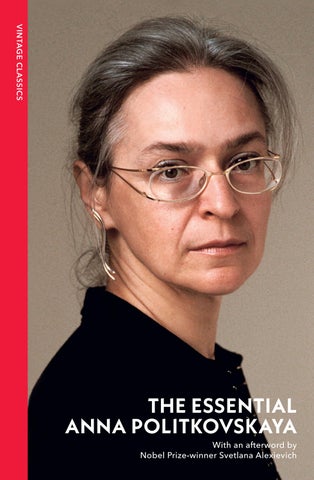
THE ESSENTIAL ANNA POLITKOVSKAYA
TRANSLATED FROM THE RUSSIAN BY John Crowfoot and Arch Tait WITH A FOREWORD BY Helena Kennedy AND
AN AFTERWORD BY Svetlana Alexievich
Vintage Classics is part of the Penguin Random House group of companies
Vintage, Penguin Random House UK , One Embassy Gardens, 8 Viaduct Gardens, London SW 11 7BW
penguin.co.uk/vintage-classics global.penguinrandomhouse.com
Copyright © Anna Politkovskaya 1999, 2004, 2007
Copyright © Novaya gazeta 2007
English translation copyright © John Crowfoot 2001; Arch Tait 2004, 2010
Foreword copyright © Helena Kennedy 2026
Afterword copyright © Svetlana Alexievich 2026
The moral right of the author has been asserted
This collection first published by Vintage Classics in 2026
Penguin Random House values and supports copyright. Copyright fuels creativity, encourages diverse voices, promotes freedom of expression and supports a vibrant culture. Thank you for purchasing an authorised edition of this book and for respecting intellectual property laws by not reproducing, scanning or distributing any part of it by any means without permission. You are supporting authors and enabling Penguin Random House to continue to publish books for everyone. No part of this book may be used or reproduced in any manner for the purpose of training artificial intelligence technologies or systems. In accordance with Article 4(3) of the DSM Directive 2019/790, Penguin Random House expressly reserves this work from the text and data mining exception.
A CIP catalogue record for this book is available from the British Library
ISBN 9781784879730
Typeset in 11/13pt Bembo Book MT Pro by Six Red Marbles UK, Thetford, Norfolk Printed and bound in Great Britain by Clays Ltd, Elcograf S.p.A.
The authorised representative in the EEA is Penguin Random House Ireland, Morrison Chambers, 32 Nassau Street, Dublin D0 2 YH 68
Penguin Random House is committed to a sustainable future for our business, our readers and our planet. This book is made from Forest Stewardship Council® certified paper.
Foreword
‘Go to where the silence is and say something.’
Amy Goodman, Columbia Journalism Review, 1994
In early 2005 I was invited by PEN , the organisation devoted to the promotion of literature and freedom of expression, to present an award to Anna Politkovskaya. I was delighted to have the opportunity of meeting her as I knew her work and greatly admired her courageous opposition both to the Chechen conflict and to President Putin’s authoritarian regime. Her fearlessness in the face of grave danger made her one of the few international journalists whom human rights activists and lawyers held in awe.
My tribute to Anna saluted her uncompromising coverage of the horrors that had befallen the people of Chechnya; it recalled the torture and terrifying mock execution to which she had been subjected by Russian troops for documenting the atrocities perpetrated against the civilian population; likewise, her reports of the 2002 Moscow theatre siege and its bloody denouement, and her resolute defiance of threats from the state authorities and other shady operators within the Russian political firmament.
We owed her a debt of gratitude for helping the West reach a far better understanding of the emerging landscape in postSoviet Russia and for shining a clearer light on the true nature of the occupation of Chechnya, a brutal conflict wilfully misrepresented as Russia’s private front in the war on terror. No democracy is worthy of the name if freedom of the press is curtailed or writers and journalists are crushed; yet here was a writer who – at great personal risk – defied state intimidation to speak truth to power.
Anna received the reward with good humour and humility. As this collection of her writing shows, the reach of her journalism extended far beyond coverage of individual cataclysmic events. She frequently lifted the veil on more systemic inhumanity that did not attract as much international interest. Her tenacious investigations involved dogged correspondence and days sitting in court. Her coverage of the case of ‘The Cadet’, for example, reveals her staying power and commitment to reporting long trials that might have defeated others. Sergey Lapin – The Cadet – was a member of the Russian military in Chechnya believed to be responsible for many of the ‘disappearances’ of Chechens dragged from their homes, never to be seen again. He had a reputation as a torturer and extra-judicial killer but despite efforts to bring him to trial was able to manipulate the legal process by intimidation and covert influence. It was Anna’s belief that the courts’ failures to deliver justice must be documented and that it was the role of the press, on behalf of those who had suffered at his hands, to demand transparency and accountability. She had met the wives and mothers of The Cadet’s victims, heard their stories and knew he bore responsibility. Her fight for them helped lead to his eventual conviction.
After the award ceremony we sat drinking wine and talking politics. Anna painted a haunting portrait of Putin’s Russia, a country governed by an administration that bore many of the hallmarks of Stalin’s; here was a land whose own secret services suppressed civil liberties and where fear stalked universities, newsrooms and every corridor in which democracy might have flourished.
Anna had been on the receiving end of death threats delivered over the telephone and posted on the internet. Articles had been published defaming her, she had been treated with derision and socially ostracised to the extent that some former friends and colleagues avoided contact for fear of becoming tarnished by association. She spoke with sadness about the toll on her private life, the effects on her family and children. Yet her isolation and aloneness, instead of diminishing her, appeared to have become a source of determination and strength, as though she had crossed some
x
Rubicon and was now beyond ordinary conceptions of fear or courage.
Shortly before the prize-giving she had been poisoned as she flew to Rostov-on-Don to cover the Beslan hostage crisis. Armed terrorists were holding over a thousand school children and adults captive, a siege that ended in massive loss of life. But Anna never arrived. As we sat into the night she described the episode with terrifying vividness: how she had made telephone calls to colleagues that must have been intercepted; how she had boarded the plane and accepted a small cup of black tea before take-off only to awaken in a hospital ward. Despite ourselves, we tend to nurture the fragile hope that heaping international honours upon those who make a stand, who defend freedom of expression, justice and liberty, affords them some cloak of immunity from retribution, however powerful, lawless or vengeful their enemies. In Anna’s case such optimism was ill-founded.
She was shot dead on 7 October 2006, news that came like a physical blow. Yet whatever driving force gave her the strength to persist had stayed with her until the end. She was a truly exceptional woman, whose bravery in confronting oppression is her legacy to the world and remains a source of inspiration for us all.
I remember taking leave of her the night of the award and asking whether she might not think of leaving Russia, at least temporarily. She held my hand, smiling, and said, ‘Exile is not for me. That way they win.’
Twenty years on, and Putin’s rule has become synonymous with its brutal and sometimes murderous crackdown on dissent. The lawyers who stood beside Navalny and Vladimir Kara-Murza have been imprisoned. NGO s arguing for human rights have been banned. Large numbers of journalists have had to flee into exile for daring to call his war against Ukraine what it is – a war. And still, Putin’s long arm of oppression reaches beyond Russia, with assassinations and poisonings, cyber wars and interference in institutions and elections worldwide.
xi
Anna’s murder was an augur of all that has followed. She saw it coming. And now Putin’s attacks on independent journalism and media freedom are being emulated by every tinpot authoritarian across the world. The global death toll of journalists has never been higher. More and more, journalists are arbitrarily detained on trumped-up charges.
Speaking truth to power, exposing corruption, lies and disinformation, shining a light on gross violations of human rights – this is the animating spirit of great journalism. It has never been more vital. It is why Anna Politkovskaya is an iconic figure and why her writing remains an enduring testament to the importance of defending our freedoms before it’s too late.
H ELENA K ENNEDY
A Dirty War
Land of the Unknown Soldiers
A New Delivery of ‘Cargo 200’
23 August 1999
Senior Lieutenant (Medical Corps) Sergey Moiseyenko holds a glass laboratory dish between the palms of his hands and carefully raises it to his eyes. With a nod towards the corner of the office he indicates several bones lying on the floor, but keeps his eyes on the dish. Seven human teeth, discoloured as if they have not been brushed for a long time lie scattered there, together with small pieces of someone’s lower jaw.
‘Do you see?’ says 25-year-old Moiseyenko, who, despite his youth, is considered one of the most gifted specialists at the renowned Rostov laboratory of forensic medicine. ‘That’s not a filling in this tooth here, but part of a bullet . . . Together the teeth and those bones are body No. 1007 according to our classification. An unknown soldier. He died in August 1996 in Grozny. My job is to establish who he was. There are already some indications. I think we’ll get a result.’
‘Lord only knows how! You’ve got nothing but scraps of bone and some teeth. And that bullet, of course . . .’
The conversation moves on. We talk about the frustration felt by all at the laboratory, and the reason why they are still swamped with work though the war ended three years ago. Soldiers in Chechnya carried no metal identity discs or documents. Their superior officers cared little what became of them once they were dead. As a result, body No. 1007 today fits into a small plastic bag.
‘If they send back bodies from a new war without ID discs . . .’ It was the evening of 17 August. Moiseyenko did not yet know that two days earlier, on a Sunday morning, the laboratory head
Vladimir Shcherbakov had already received a disturbing call from the Ministry of Defence in Moscow.
‘How many “credo” bags do you have there?’ someone shouted down the line.
‘I’ll find out immediately,’ replied Colonel Shcherbakov.
‘Send them all to Makhachkala.* Quickly! Can you get a hundred?’
Shcherbakov put down the receiver. His shoulders gave an involuntary shudder, as if from a chill, although it was 32°C in Rostov that day. For those who don’t know, the ‘credo’ bag is one of those large black plastic envelopes, closed with a zipper (you’ve all seen US police films) in which they pack up dead bodies. The sort of container the army always needs when its men start getting killed.
Neither did Lieutenant Moiseyenko know that on 18 August, the very next morning after we talked, the bodies of soldiers killed in Daghestan would begin to arrive. They arrived in ‘credo’ bags, under the code name ‘cargo 200’, at the main reception and treatment centre in Rostov (which serves the entire North Caucasus Military District). And once again, they were without ID discs or documents.† Body 1007 would have to squeeze up and make space on the senior lieutenant’s table for bodies 1015, 1020 and 1030. It looked as if the entire laboratory was fated to start from scratch all over again, although it still had 277 bodies to identify from the previous war.
Morgues are never cosy places, but wars are bound to happen
* Capital of Daghestan, one of 21 ethnic republics (including Chechnya) that with Moscow, Petersburg and the 66 predominantly Russian Regions make up the 89 ‘subjects’ of the Russian Federation.
† In the 1990s Russia’s armed forces adopted the Anglo-American ID disc or ‘dog-tag’. Previously Soviet servicemen carried a capsule, resembling a spent rifle shell, in which personal details were sealed. For decades volunteers have searched for these on the battlefields of the 1941–5 war, providing confirmation of death and adding names to monuments.
and you need dissection rooms. There aren’t any decent wars either. But they all leave us with a choice: we can either draw lessons from a war or ignore what it teaches us.
What lessons have been learned over the last three years, from August 1996 when General Lebed helped to negotiate an end to the war in Chechnya, to the present fighting in Daghestan? Why have ordinary soldiers again not left behind even a single drop of their blood to aid their rapid identification? What was Colonel Shcherbakov up to all that time? Why didn’t he persuade the generals that they should never wage another war like that in Chechnya?
Body 549
‘What was I doing?!’ The colonel is indignant. ‘I was telling them just that. It’s the reason I was in such disfavour.’ He explains:
‘The more I pushed, the greater the pressure on me. I was accused of every failing in order to shut me up. Finally, when I could see no other way out, I drafted a law: “On Forensic Registration and Identification in the Armed Forces and Other Paramilitary Formations.” And what do you think? It’s been lying unheeded at the Duma for almost a year. Where was public opinion? And the human rights activists who are today shouting that the Daghestan campaign is a repeat of the Chechen war? They said nothing.’
‘The Ministry of Defence, on the other hand, and the presidential staff, accused me of playing “political games” to the detriment of the job in hand. But I started to push things further, and demonstrate it was essential to have a database for the identification of all who are in the armed forces. Then they began a campaign to discredit me. Supposedly I was not fighting for identification, but only to create a nice cosy job for myself; I was exploiting these remains to push ahead scientific research. I was personally blamed because the laboratory was identifying no more than four or five bodies a month. But that was simply the reality!’
Body 549 reached Laboratory 124 from Grozny on 20 August 1996 with the label ‘unknown’ attached to the stretcher. It had also been set on fire after death (someone had burnt the soldier after he was shot). The tissue was already in a state of total disintegration. The corpse was therefore impossible to identify visually; it had evidently lain under the southern sun for several weeks. There was no ID disc or any information about his unit. Two distinctive features: the top joint of the left thumb was missing and, by some miracle, a tin cross of the Old Believers still hung around his neck.*
In September 1996 when the lab’s officers could see that no one was coming to claim Body 549 – neither those who had served with him nor his relatives – they sent out thousands of letters, requiring military registration offices throughout Russia to track down any of 549’s surviving fellow soldiers. (It was known which units had taken part in the August battles in Grozny, and so they had a good idea which military registration offices had provided their conscripts.) It was 18 months before they received any replies. That’s how things work in our country. Only many months later did the following letter reach the laboratory:
‘From 24 June 1996 I served in Chechnya with unit 21617. On 9 August we were ordered to advance. We went about a kilometre and, after the company in front of us had gone ahead, we came under fire from both sides. I was hit by shrapnel, first in the foot and then in the arm. I fell down and they fired at me again. When the shooting ended I got back to the armoured vehicle. Private Ozhigov was sitting there. Perhaps they would not have noticed him, but he began to make a tourniquet above my elbow to stop the blood. Suddenly he fell across my knees. A sniper had got him. Then our side gathered all the wounded and loaded them onto the armoured vehicle.
‘Again the Chechens started firing at us, this time with mortars.
* The Old Believers, the ‘Dissenters’ of Russian Orthodoxy, broke from the Church in the mid-seventeenth century over its reform of texts and rituals.
I fell down and passed out. When I came to, the platoon leader and our driver-mechanic Khazanov were lying next to me. They said I should keep down because a sniper was watching us. We lay for four hours, pretending to be dead, until the helicopters started bombing the nine-storey building where the sniper was. Then we crawled into some cellar where our commander found us with one of the scouts. We were put in an armoured vehicle . . .’
Private Artur Kamaleyev, from the Volga republic of Bashkortostan, then spent many months in military hospitals: Vladikavkaz, then Rostov and Ufa. Only in spring 1998 did the district military registration office find him, at the laboratory’s request, when he was discharged as unfit for further service. It was then that they discovered he had been saved by Private Ozhigov, who did not have the upper joint of his left thumb.
The laboratory sent a formal request to the military office in the Altai Region, for blood samples, plus thumb and palm prints from the parents of Ivan Ozhigov. His mother and father also sent a photograph of Ivan which Major Boris Shkolnikov, a forensic craniologist, compared to the skull of Body 549 – the same test carried out on the remains of the Romanovs. After five more major scientific investigations the experts could say without doubt: ‘This is no longer an unknown soldier.’
On 3 August 1999, three years after he died, Ivan’s family received his remains, and a short while ago the body of this 19-year-old private, who had died trying to save his wounded comrade, was buried in a village in Siberia.
A shocking story? Yes, but all the more so because it is no exception, but a typical and everyday example. The majority of cases at Shcherbakov’s laboratory are of this type. He cannot help ‘spinning out’ the identification procedure.
Perhaps you imagine that Moscow – i.e. the Ministry of Defence and the presidential staff – drew the same conclusion from the history of Private Ozhigov? Nothing of the kind. ‘For three years you’ve been messing around with one body!’ That was the accusation thrown at Shcherbakov. The colonel’s retort
was just as sharp: ‘Don’t blame me for your mistakes; all those who could have been recognised by simpler methods have long ago been identified. From now on we can only work in this way. We shall be forced to continue doing so, moreover, until you take urgent measures to finally create a database of identification samples for all soldiers and officers who are sent to areas of conflict.’ Keep your voice down, they told Shcherbakov: You’re the one making a good living out of these corpses, it’s your people who are writing dissertations and won’t listen to anyone else. So now we are declaring war on you.
Slander
The campaign against Shcherbakov was headed by Victor Kolkutin, the chief forensic expert at the Ministry of Defence, and Konstantin Golumbovsky, head of the president’s working group on the exhumation and identification of soldiers killed in action. They are highly respected and well-known people. However, it is difficult to describe the weapon they unleashed against Shcherbakov as anything other than public defamation. In Moscow, journalists, Duma deputies, and the Ministries of Health and Defence were supplied with deliberately distorted information about the colonel. It was claimed, for instance, that Shcherbakov was openly disrespectful towards the remains he worked with, separating skulls from bodies simply because that was easier for his research purposes.
How can you check? The only way is to sit there, among the skulls at the laboratory, in the section headed by Major Boris Shkolnikov and read through dozens of files on unidentified soldiers. Here are the bullet wounds in the skull and here is the file. As you read, it turns out that each of these skulls represents a body: at best a few, individual bones are added to the skull and even then it’s not clear to whom they belong. Lengthy molecular-genetic investigation is needed before they can be proved to come from the same
person. Something else of major importance became clear to me then – the soldiers were already in this state when their remains, delivered by Golumbovsky’s team, reached the laboratory.
The other accusation was that, for the convenience of research and the writing of dissertations, the army privates who serve as lab assistants are forced to boil up the bones of the deceased soldiers in the laboratory courtyard in full view of the unfortunate parents. Mothers supposedly had to pass by bubbling cauldrons full of skulls before they could view the remains of their children. It’s a blood-chilling scene and makes one want to demand the immediate arrest of Shcherbakov.
How do you check this story? You must venture yourself into that devil’s kitchen. There it is, exactly as described. Surrounded by filth and an unbelievable stench, soldiers are boiling the bones until the rotting flesh falls off them. It is also quite true that they do this in large vessels more usually employed for boiling clothes. But you must ask why. The reason is that money to purchase autoclaves was not allowed for in the budget estimates. Even the laundry pans were bought only recently. Before that the bones were boiled up in large tins that previously contained jam or herrings. They have no choice. Genetic investigations with contaminated remains are strictly forbidden since they will give no results and damage the equipment. What were they to do? Warn Moscow that all identification work is henceforth halted until autoclaves are provided? They might wait for years. And how then could they look mothers in the eye when they came demanding, if not their sons then at least a coffin?
As a result, the six months before the present fighting began in Daghestan have been spent squabbling, not working. The laboratory got on with its job, but in Moscow they intrigued and spread rumours and Shcherbakov had to fight back. The idea of creating a database for identification of all soldiers sent to areas of conflict has not advanced one iota. The army entered the present war in the same barbaric state as the Chechen war of 1994–6, while Colonel Shcherbakov, a unique specialist whose knowledge is now
desperately needed, is a thoroughly harassed and exhausted individual. He is bound, hand and foot, by numerous investigations that do not cease from one week to the next. He is a workhorse, he says, that Moscow has driven to its limit and will soon finish off.
Graves or Monuments?
Who benefits from this outrageous squabble over bones? The immediate and obvious causes are entirely traditional. People, as always, are fighting for wealth and fame. The Moscow authorities are determined that Shcherbakov must be neutralised so that they can decide who is in charge, throughout the country, of identification research and procedures.
Novaya gazeta has learned that very recently – just as they were preparing for the war in Daghestan, in fact – a decision was taken at the highest level by the government and the presidential staff: the unidentified ‘Chechen’ bodies still in Laboratory 124’s refrigerators must be rapidly laid to rest. The reason? The soldiers’ mothers were making too much of a fuss, and it was proving too expensive for the State to pay its respects by identifying and burying everyone. A site had already been chosen in the Rostov City northern cemetery and the builders were given until 25 August to prepare the monument. When, in future, the mothers complain that they wanted to bury their children themselves the blame will be shifted entirely to Shcherbakov. It was he, they will be told, who dragged out the identification process. Any future court cases should be brought against him.
This conveniently kills two birds with one stone. Our authorities hate to be held responsible by the living, whether they are the families of missing soldiers or that tiresomely demanding Shcherbakov. But they adore all kinds of ceremonies in commemoration of the dead – don’t worry about feeding people, but be sure to place a wreath on their graves. Having proved unworthy of their soldiers and officers, politicians and military officials love annual
visits to the Grave of the Unknown Soldier where they can shed a few restrained masculine tears for the benefit of the television cameras. As the Duma elections approach, the need is urgently growing for some kind of memorial to the unknown dead of the Chechen war. Politicians and the military need somewhere they can demonstrate their penitence in public. Today this is the most important and fundamental point of disagreement between Shcherbakov and the authorities. He will not hear any talk of such a monument and whenever he meets people in authority he does not fail to warn them that the State could not bring greater shame on itself than by this hurried burying of the problem. Each time he repeats the same quotation. It comes from the rules of the US Military Pathology Institute’s medical examination directorate (the American equivalent of Laboratory 124):
The goal that all of our employees strive to attain is simple. We must not permit any American serviceman or woman to be buried beneath the inscription: ‘Here lies an American soldier who covered himself with glory and whose name is known to God alone.’
Shcherbakov follows these words with a demand for money in order to continue the expensive identification research. The more he insists, the more our authorities dream of the peace and quiet of the Grave of the Unknown Soldier.
20 August. Deliveries of ‘cargo 200’ from Daghestan are neverending. Shcherbakov is worn out. The laboratory has no more resources than before. As we leave, Lieutenant Moiseyenko tells us: ‘If they drive such people as Shcherbakov out of the army, I shall also resign.’
ROSTOV - ON - DON
On 7 August 1999 a convoy of vehicles and armed men crossed into Daghestan. It was led by the Chechen commander Shamil Basayev and a veteran opponent of the Soviet forces in Afghanistan, the Saudi-born Khattab. They had come supposedly in support of local Wahhabites. Army and police units were sent to repel them.
Tainted Tins
How the Soldiers are Fed
30 September 1999
If it had not been for the fighting in Daghestan the two of us might never have met: the tinned meat of the Semikarakorsk meat processing plant and my digestive system.
It was getting near suppertime and the men of the Lipetsk Region OMON [riot police] who were off duty invited me into their improvised kitchen. They are currently based in the Kazbekovsk district next to the Chechen border, and are guarding the approaches to Dylym, the main town in the area. I should have been warned by the mysterious winks and smiles they exchanged.
The kitchen turned out to be in a cellar, down two dark flights of stairs. The lower we descended, the greater my reluctance: the foul stench rising to meet us suggested that chemical weapons had been used not far away.
‘May I offer you a gas mask?’ a pleasant young man asked.
‘You’re most kind, but if you can take it, so can I.’ ‘Oh, you mustn’t compare yourself with us, we’re already used to it.’
At that moment we reached our destination and the dishevelled character in charge of the kitchen came into view. With a knife he was opening one after another of the latest rations from the Semikarakorsk plant. They had received them the day before from the OMON quartermaster at the food depot in Kizlyar. Plunging his blade through the pliable aluminium he counted aloud:
‘. . . Tin 23, rotten. Tin 39, likewise. Tin 41, the same . . . That’s enough! Tin 42 is for you. Take it back to Moscow and show them
what they feed us. Perhaps you’d like me to disembowel it here and now, so there’s no mistake?’
‘Better not,’ jokes Alexander Pavlovich Ponomaryov, the lieutenant colonel in charge of these Interior Ministry forces (to them he is simply Pal’ich), ‘everyone on the plane might die before the tin reaches the capital of our great country. Try a sample of what they regularly serve us.’
I sniffed and licked. What else could I do? My organism reacted instantly.
‘We have stomach infections all the time,’ concluded Pal’ich. ‘And that’s the condition we fight in.’
‘But do you have enough to treat it? Did they give you anything?’
‘Medicine, you mean? Not really. We’re chronically short of everything here.’
I pulled out all of the anti-diarrhoea tablets I’d taken with me on the trip and handed them over to Colonel Ponomaryov. Then I decided to investigate local life and its chronic shortages.
Food Fit for Heroes
This unit of the Lipetsk OMON is already famous throughout Daghestan. They are in charge of the Kazbekovsk section of the cordon sanitaire that runs along the Chechen–Daghestani border and they recently performed a feat of heroism. In early September they were guarding the small town of Novolakskoe. With them were the town’s fearless policemen and an army unit under the command of Infantry Major Zhenya (in Daghestan officers do not introduce themselves, even to fellow officers). At one point it became clear that things were going badly and the bandits would soon have the area completely surrounded. No one wanted to die. So while there was still a way out of the town, Major Zhenya grabbed an armoured personnel carrier and drove away from the fighting, leaving his own soldiers and the policemen to their fate, and to almost certain death.
‘Why didn’t you save yourselves and run?’
‘We had wounded men with us.’
When resistance became almost futile and they faced capture or death, the Lipetsk OMON decided to break through enemy lines. Of course, they had almost no chance of getting through alive. It was simply a case of despair, resentment, and a desire to live. Guided by their senses, they crawled out at night, stealthily and silently, tracing a great arc across Chechen territory, beyond the surrounding fighters, where death waited behind each hill.
Discussing their feat of bravery in that stench-ridden kitchen only sharpened everyone’s perceptions. How could people who have shown such bravery in impossible circumstances and, weeks later, continue to face mortal danger every day, now be living like stray dogs that no one cares for? Is this how the Motherland repays their valour?
The next subject proved highly sensitive for these resentful people whose nerves have been stretched to the limit. The Lipetsk OMON escaped from encirclement in worn and tattered clothes. What was left when they reached freedom could have gone straight on the fire. But did anyone hurry to issue them with new uniforms? The military quartermasters now running Daghestan did not even blink. Instead they had to rely on their well-disposed comrades to cover their nakedness.
Their heroism was not reflected in their pay, either. Prime Minister Putin may frequently offer the nation therapeutic TV sessions, but the OMON are still getting a mere 22 roubles a day [about $0.70, Tr.], and there’s no hope of any more. Not for them the $1,000 the Chechen fighters are supposed to get each month! It makes no difference whether you’re a hero, or a Major Zhenya. Pal’ich supposes that somewhere, perhaps in Makhachkala, at staff headquarters, some of the generals may already be doing quite nicely. On the front line, here in Dylym, where they expect the Chechen fighters to break through again at any minute, no one has seen any extra money.
Hence their hungry existence. They live little better than savages and our beloved country blows the smell of tainted meat in
their faces. The Lipetsk OMON men are greeted by this stench in place of supper and can expect nothing else. There are no streetside kiosks here, only ravines and mountains, and even if they could buy something to eat they have no money. If it were not for the tins from Semikarakorsk then the Motherland would be offering its heroes nothing more than gruel. When the local women notice how thin the soldiers defending them are, they bring them food out of the kindness of their hearts.
Alexander Ponomaryov, their commanding officer, is 42, and 27 of those years he has devoted to the army. His shoulders constantly twitch and jerk, from the cold and from a nervous tic. He huddles up in his shapeless old sweater and is sunk in melancholy. His life, for the most part, has been wasted, he believes, fighting difficult military campaigns for which the country has never even offered a grudging ‘Thank you’.
‘Do you know why you’re fighting here?’
‘Because of someone’s political ambitions. And for 22 roubles a day. Otherwise everything would be different. You can see for yourself. The furthest post where our men are on duty is 15 kilometres from this barrack. If anything happens there we don’t even have a car or the money to buy petrol – they don’t supply one, it’s not standard issue. So we run out into the road, flag someone down and ask for a lift. And what if it’s night-time? Who can you ask here in the village? It’s a joke. But when something happens you feel nothing but hatred for the powers that sent us here. As you can see, they have created all the necessary conditions for feats of heroism . . .’
Pal’ich laughs. Our dear Pal’ich who knows from bitter experience that the brisk reports delivered by the generals from morning to night on all the TV channels are very far from the truth here on the front line.
At this point someone will certainly say to himself: What a green creature this Politkovskaya is! Just imagine, the tinned meat was off, and the colonel got emotional like some delicate college girl. Well, if you’re sitting comfortably and safely in Moscow,
then indeed there is little need to become overexcited. But if someone is aiming at you, every hour of every day down the barrel of a gun, and if you take your life in your hands simply by glancing out the window, then your nerves will be in quite a different state. The complaints about living conditions are entirely justified. If the country wants acts of bravery then it should give more practical expression to its rapture at such heroism. As long as the authorities think they can buy off their heroes with awards and decorations – and dozens are being proposed for decorations in Daghestan today – then the heroes will desert them.
Semikarakorsk
My two last phone calls were to Rostov-on-Don and Semikarakorsk. At supply headquarters for the North Caucasus Military District the answer was simple:
‘The meat-processing plant in Semikarakorsk won the public tender. You can’t hold us responsible. It’s impossible to open every tin. When we made spot checks the results were good. All complaints to the producer.’
In Semikarakorsk someone who describes himself as the plant director answers the phone. He is very evasive and lengthily assures me that these rumours are lies, nothing more than the newspapers trying to concoct a sensational story.
‘But how much were you paid for these consignments to Daghestan?’
The moment money is mentioned the director turns nasty: ‘Get lost. I’m not telling you,’ he snaps, ‘it’s a commercial secret. We’re a private company.’
Then our Semikarakorsk butcher gets carried away. Like a real old-style Communist he tells me that the soldiers have become too demanding, they are asking for the impossible and should be more modest. The Motherland ‘is in no fit condition . . . Do you understand?’ And a lot of other nonsense.
Finally I reach the end of my patience:
‘You’re a real bastard, aren’t you? Are you really too thick to understand that your rotten meat may be the last thing one of those young soldiers ever eats?’
There is an unpleasant, disparaging laugh:
‘Fax us your questions and if we see the necessity, we’ll provide answers.’ Without a word of farewell he slams down the receiver. You want to know his name, of course. The businessman I was talking to is called Igor G. Lisakonov. And if you wish to personally express your revulsion at a scoundrel who has been turning a pretty penny from these tainted supplies then you may ring him on the following telephone numbers: Rostov (886356-2) 13-94 or 14-94. Perhaps then he’ll finally get the message.
At all times and under all regimes wars have been profitable business. While others carried the dead off the battlefield, the quartermasters and their kind in supplies were lining their pockets. The longer the war, the fatter their wallets. The more soldiers despatched to the front, the finer the Mercedes some ministry official can obtain.* You tell me that the Chechens are to blame for our troubles. Don’t worry, we’re doing quite well on our own.
A Minefield
Today more than a dozen unexploded bombs, dropped from the air, lie about the churned-up mess that is Novolakskoe. They didn’t go off, unfortunately, because they were rather old; someone says they were made in the 1950s. Naturally people returning to their homes asked the military to remove these dangerous and unpredictable lumps of metal as quickly as possible. The soldiers replied that the bombs could not be safely moved and must be detonated where they are. The explosive force of each bomb, they
* Pavel Grachev, Minister of Defence during the first Chechen war, was famous for his acquisition of several Mercedes for himself and his leading officials.
added, lowering their gaze, is equivalent to that which destroyed the high-rise block in Buinaksk.* Did no one think of that before? Now Novolakskoe will acquire a dozen large craters and suffer extensive new destruction. People are horrified.
That’s how our soldiers are living at the front. No one cares for their safety and they are forced to stroll past unexploded bombs all the time. One bomb waiting to explode is their semi-starved existence; another is the lack of normal warm clothing; a third is their miserable wages; a fourth . . . Do the authorities really not foresee the consequences? Do they expect people who have served in these conditions to return home, calm and confident, convinced they are real heroes?
An armoured personnel carrier races through the maize fields along the road that borders the cordon sanitaire. It is full of soldiers. An officer leaps out and introduces himself: ‘Colonel N.’ All of them here say that: Colonel N., Major N. and so on. Among themselves the officers say that if they give their surnames the Chechens will find their families ‘in Russia’ and wreak vengeance on them. The colonel is in a highly nervous state. Restlessly he struts back and forth, twitching and sometimes breaking into a run; he gives an odd and unbalanced impression. At his command the soldiers point their weapons at everyone who isn’t in uniform or riding in an army vehicle. No one trusts anyone else here and they’re all afraid of each other.
That’s how we now behave, yet the land around is part of our country, it’s not a fascist, gangster-run republic. We created this situation. Only officers who are daily shown how little they count could behave in this way.
MAKHA c HKALA – DYLYM
* On 4 September 1999, 62 soldiers and members of their families were killed when a residential building in their compound in Buinaksk was destroyed by an explosion. Over the next ten days there were two bombings of residential blocks in Moscow (see Chronology, p. 106).
Ingushlag
A New Concentration Camp
4 November 1999
A tragedy is today unfolding in Ingushetia. It has grown to such catastrophic proportions that, believe me, it is now hardly less terrible than the war in Chechnya. What difference does it make, in the end, if you die from hunger or from bombing? During the month that they have spent in the refugee camps – in these poultry and old stock-raising farms, in cellars, tents and out in the open beside campfires – thousands of people have become deeply embittered, with no regular food or place to wash, and without any occupation or work.
Hopes of returning home have finally melted away. Now people in the camps are desperately struggling just to survive. They await the first snows in November almost as though they were death itself. Each night their fear of bombardment is magnified a hundredfold by the roar of weapons being fired nearby. All the food they brought with them has now been eaten and there is a chronic shortage of humanitarian aid: the little there is, is totally inadequate for the number of refugees. Cold, hunger, sickness and everywhere pale children with blue lips. Adults squabble over each crust of bread. People ask only two questions: ‘Why?’ and ‘How many more victims do you need?’
Death from the Skies
We are standing in the middle of the camp and even laughing, although it’s no laughing matter. We’re looking up at the sky
where rockets fly over our heads. Insolently they rip through the air above us as though we are not standing below and, instead, this were some weapons testing site. Why the laughter? It helps us save face in front of each other and conceals the nervous trembling that has seized hold of us all.
27 October 1999. It’s sunny and there is no wind. Soon it will be midday. We are on the outskirts of Karabulak, a town in Ingushetia. The camp – more than 3,000 refugees squeezed into 98 army tents – is in a shallow gully beside the River Sunzha. Most people are now gathered in the centre of the camp. Behind the hills to the right stands the town of Mozdok. To the left are more hills, and beyond them the capital of Ossetia, Vladikavkaz.
At last it’s midday. We feel a shock wave of uncertain origin pass through our bodies, and pick up an inner rumbling of the earth through the soles of our feet. A 25-year-old from Grozny with a degree in Russian Language and Literature and the wonderful name of Mir* explains: ‘They’ve just launched a rocket. Now we shall be able to follow its tail. We saw them yesterday as well.’
He’s quite right. In a second two white trails stretch across the sky from the direction of Mozdok. At 12.10 there is a repeat performance. Only this time the missile has been fired from near Vladikavkaz and again there are two trails.
Mir Khadjimuratov thinks aloud: ‘Doesn’t all this remind you of the famous password: “The Spanish sky is cloudless”?† Are they deliberately provoking us? What feelings can you have, other than a desire for revenge, when you sit watching death fly towards your home town?’
Half an hour later it is as if those vile traces of the rockets had never been there. People are no longer laughing, nor are they trembling. Now their eyes are hard and dull, clenched teeth show through their jaws and their hands in their pockets are bunched
* It means ‘Peace’ in Russian.
† The signal for Franco’s forces to begin their rebellion in 1936 was broadcast as part of the weather forecast on the radio.
into fists. No one even smokes. The men leave the square with the comment: ‘27 October, between 12.00 and 12.10 another 100 people died. None of them fighters.’
Mir Khadjimuratov asks: ‘Why do they continue firing missiles into Grozny after the tragedy in the Central Market?* Each missile immediately hits a great number of people. That many fighters never gather in a single place, even our children know that. So it’s genocide. And those who didn’t want to fight are now ready to.’
Vakha Nurmagomedov is 40 years old and comes from Moscow. He had permanent domicile registration in the capital’s Mitino district, but police harassment forced him to move. He returned first to his native Urus-Martan in Chechnya and then, with his family, left the republic. Vakha is very keen for his point of view to be heard – not by Putin (that would be a waste of breath, he thinks), but by the millions who today are ready to vote for a continuation of this cruel war in the North Caucasus. ‘You don’t win people over to your side by firing rockets. Missiles spell the end of a friendly attitude towards Russia, even among those who used to feel that way. You must understand, we can never allow ourselves to forget all this. Otherwise we are not the fathers of our children or the children of our fathers.’
‘We could not forget and forgive deportation,’† I constantly hear this refrain from the crowd of refugees. ‘We simply had no right to do so. The first Chechen war joined those memories and so will the present war.’
The main focus of their life in Ingushetia in the refugee camps
* On the afternoon of 21 October 1999 the Central Market in Grozny was struck by a rocket attack, leaving many dead and wounded. Despite denials it seems clear that this was authorised by the Russian government. † In February 1944 the Chechens and Ingush, accused of intending to aid the invading German forces, were deported en masse to Kazakhstan. Many died on the journey. The survivors could not return home until 1957. (The Germans captured Mozdok in August 1942, but could never get close enough to take Grozny and Baku, then the Soviet Union’s greatest centres of the oil industry.)
is the accumulation of hatred as they daily study the missiles flying overhead and observe the fighting which can easily be followed from here. By heading for Ingushetia in late September and early October the refugees were leaving the war behind them. Now it has caught up with them again, in their temporary refuge.
Children Fated Not to Survive
Above the Sputnik camp, not far from the village of Ordjonikidzevskaya, it is the Grad [Hail] missiles that swagger across the skies.
Here at Sputnik anyone who wants to can easily guess what the military are planning. The camp is roughly seven kilometres from the small town of Sernovodsk in Chechnya. In late September tents were erected here for the convenience of the refugees. Taken in by the Kremlin spokesmen, local officials believed that the ‘antiterrorist operation’ would not last long nor affect Ingushetia. It would therefore be easier and quicker, the republic’s Ministry for Emergency Situations decided, for the refugees to return home from here.
These good intentions have backfired on everyone. Today the tents sit directly in the zone of bombardment. If the officer aiming the weapon has had a little too much to drink (and the military do take to drink here – it’s also bad for them to go on fighting this long) then a tragedy is inevitable. The refugees are in a shallow gully between mountains. On one hillside are the Russian forces, on the other, the town of Sernovodsk. From one hilltop they are firing at Sernovodsk and a stream of murderous metal flies over the heads of almost 5,000 people living in the camp, half of them children. The volleys produce an unpleasant hissing sound, like snakes, and they make the already hard life of the refugees unbearable.
Take, for instance, one half-hour around midday on 28 October: 12.45, volley; 12.47, another; 12.51 yet another . . . Then,
there is a brief respite until 13.11, when the firing again resumes every two minutes.
‘They’re trying to catch Basayev,’ decide the women in the weeping, worn-out crowd. ‘Those officers up on the hill probably don’t know that Grad missiles can’t pinpoint a target, they’re a weapon of mass destruction. But we know that all too well.’
Meanwhile some boys between five and seven years old are digging a trench beyond the furthest tents. Gradually they disappear below the ground, and pay no attention to what the adults are saying.
‘What are you doing?’ I finally ask them.
But the children look at me as though I’m from another planet. They don’t speak Russian because they were born after the first war in 1994–6. It is their mother Toita Elimkhanova, from the Pervomayskaya village where 157 of their clan are living, who explains:
‘The boys themselves took the decision. No one asked them. They say it’s just in case: we left home under a terrible bombardment.’
It’s interesting that the children a little older than two or three do not react at all to the Grad missiles. They are a very strange sight. ‘Hunger makes them apathetic and lethargic,’ says Hasan Tempieva from Gudermes. She is without her husband and has eight children. ‘There is starvation here. Bread is handed out free, but there isn’t enough for everyone. In my family, for instance, it is three days since any of us ate. We just drink hot water.’
Small children, still entirely dependent on their mothers, react quite differently. Their short lives are threatened by each volley. On the night of 25–26 October, when there was a particularly severe and unrelenting stream of Grad missiles and sparks from the sky burned holes in the tents, many refugees lost control of themselves. The screams of women rose over the Sputnik camp and drowned out the howl of the rockets. Seven months pregnant, Malizha Derbieva from the Ishchorskaya village in Naurskaya district (now she is in Tent 8, Block 6) was so frightened that by
morning she gave birth prematurely. Her little baby girl died immediately. Malizha is still being treated in the Sunzhensk district hospital. The doctors cannot guarantee she will ever have children now, the shock was too great.
Aina Terekmurzayeva, from the small village of Betimokhk in the Nozhai-Yurt district, is 17 years old. Only a short while ago she married someone from Gudermes where she herself was born. When Aina arrived at the camp she already had Ibrahim her newborn son with her. He’s now four months old. The skin on his face is transparent and his bluish but still smiling lips try to find something to eat. Aina herself has wasted away and is barely alive.
Aina’s milk failed as soon as the Grad missile volleys began. A four-month-old cannot eat bread, so for a week now they have been giving him nothing but weak tea. If you’ve ever had children then you’ll know that an infant cannot survive long like that. Aina went to the camp administration and asked if they could get hold of some baby food. So far they have found nothing. The warehouses of the republic’s Ministry for Emergency Situations are empty.
You probably think I’m writing all this to stir your pity. My fellow citizens have indeed proved a hard-hearted lot. You sit enjoying your breakfast, listening to stirring reports about the war in the North Caucasus, in which the most terrible and disturbing facts are sanitised so that the voters don’t choke on their food.
But my notes have a quite different purpose, they are written for the future. They are the testimony of the innocent victims of the new Chechen war, which is why I record all the detail I can.
The Warehouse
The measure of our present kindness is the warehouse for humanitarian aid on the outskirts of Ordjonikidzevskaya village. Officially it’s a local depot of the reserve supplies of the Ministry
for Emergency Situations. We arrive unexpectedly and accompanied by Major Tugan Chapanov. He heads one of the Ministry’s departments, and on 23 October a decree issued by President Aushev made him commandant of the Sputnik camp (replacing the refugee leaders who had held the post).
Being a refugee is demeaning, not only because you are without a home and of no concern to anyone else. But for days on end there is nothing to do in the camps, apart from go out in the morning to collect sticks and twigs for the fire and chat with your fellows in misfortune. In these endless conversations a great many myths are born. For example, people said that the relatives of Shamil Basayev and Alla Dudayev* are living peacefully in the Ingush capital Nazran. The government pays all of their bills, no one is in pursuit of them and they have the best cottages the rich could buy. The conclusion? The war is not against the ‘bandits’, but against ‘us’ and they aim to exterminate ‘us’ completely.
Another persistent myth concerns the aid warehouse. The refugees are certain that it is overflowing with supplies and that those distributing the aid are to blame when it does not reach the right people. They are selling most of it at the market, goes the myth, and pocketing the money.
Alas, on inspection the ‘supply depot’ is almost empty. The local deputy director, Hasan Bogatyrev, shows us several metal beds that could not be issued because there were no mattresses, let alone pillows and sheets (they’re waiting for a delivery). There were also some black olives that were well past their sell-by date, so they did not risk sending them to the camps. (They would certainly be eaten there, no one has any doubt about that, but who can tell with what consequences?)
Also standing idle in the warehouse were the military kitchens and mobile bath units. People are starving in the camps and they
* The Russian widow of Chechnya’s first president, Dzhokhar Dudayev (see Biographies).