Kapka Kassabova
‘The mark of a good book is that it changes you… Kassabova had me under her spell from page one’ GUARDIAN
‘Dark and mysterious and beautiful’ FINANCIAL TIMES

‘The mark of a good book is that it changes you… Kassabova had me under her spell from page one’ GUARDIAN
‘Dark and mysterious and beautiful’ FINANCIAL TIMES
Kapka Kassabova is a writer of narrative nonfiction, poetry and fiction. She grew up in Sofia, Bulgaria, and studied in New Zealand. For the last eighteen years she has lived in Scotland. Elixir is the third in her Balkan quartet, which explores the relationship between humans and their environment, and also includes Border (2017), To the Lake (2020) and Anima (2024). Border won the British Academy Book Prize, the Saltire Society Scottish Book of the Year, the Stanford Dolman Travel Book of the Year and the Highland Book Prize, among others. To the Lake won France’s Best Foreign Book of Non-Fiction and was shortlisted for the Angelus Central European Literature Award. Her books have been translated into twenty languages.
ALSO BY KAPKA KASSABOVAStreet without a Name
Twelve Minutes of Love: A Tango Story
Border: A Journey to the Edge of Europe
To the Lake: A Journey of War and Peace
Vintage is part of the Penguin Random House group of companies whose addresses can be found at global.penguinrandomhouse.com
First published in Vintage in 2024
First published in hardback by Jonathan Cape in 2023
Copyright © Kapka Kassabova 2023
Map and illustrations copyright © Emily Faccini 2023
Kapka Kassabova has asserted her right to be identified as the author of this Work in accordance with the Copyright, Designs and Patents Act 1988
Quotations by David Orr, Thich Nhat Hanh, Rachel Carson and Nan Shepherd are used with permission.
penguin.co.uk/vintage
Printed and bound in Great Britain by Clays Ltd, Elcograf S.p.A.
The authorised representative in the EEA is Penguin Random House Ireland, Morrison Chambers, 32 Nassau Street, Dublin d02 yh68
A CIP catalogue record for this book is available from the British Library isbn 9781529920475
Penguin Random House is committed to a sustainable future for our business, our readers and our planet. This book is made from Forest Stewardship Council® certified paper.
Dedicated to healers, living and dead.
And in memory of my grandmother, the forager, and my greataunt, the gardener, who first showed me the green way.
The planet does not need more successful people. But it does desperately need more peacemakers, healers, restorers, storytellers, and lovers of every kind. It needs people who live well in their places, people of moral courage willing to join the fight to make the world habitable and humane. And this has little to do with success as we have defined it.
David Orr, ecologistWe need a revolution. It begins with falling in love with the Earth again. There is no di erence between healing the Earth and healing ourselves.
Thich Nhat Hanh, Love Letter to the Earth
elixir: from the Arabic ‘al-iksir’, miraculous substance
eco : from the Greek ‘oikos’, dwelling place
Some people appear with pseudonyms. Some circumstantial details have been merged. No mind-altering plants were used in the making of this book, only a sense of wonder.
The sun was setting on the valley, giving everything a gilded edge. The great mountains to the west and east, the scorched fields studded with human-sized thistle where a mare and her foal lifted their heads from grazing as if hearing a distant sound, even the potholed road shimmered with golden heat. The silence was that of humanity gone for a long nap. Crickets tuned their scrapers for the evening concert.
In the river plains a Roman city lay in ruins. Invaders, plagues, recyclers, nature and neglect had left their mark. The interpretative boards in three languages and with the EU flag were so bleached by the sun that no interpretation remained. Cherry trees thrived in the tepidarium, snakes mated in the banquet hall and the girl in the reception kiosk was asleep with her head on the desk where the ceremonial entrance had been, and where the children of grandees had walked their lion-cub pets on chains.
The villages of Thunder and Fire were deserted with heat, as after an exodus. The road was nibbled by high grasses. Then – an unharvested field of sunflowers black with seeds, all heads turned to the sun. I abandoned the car and entered the sunflowers.
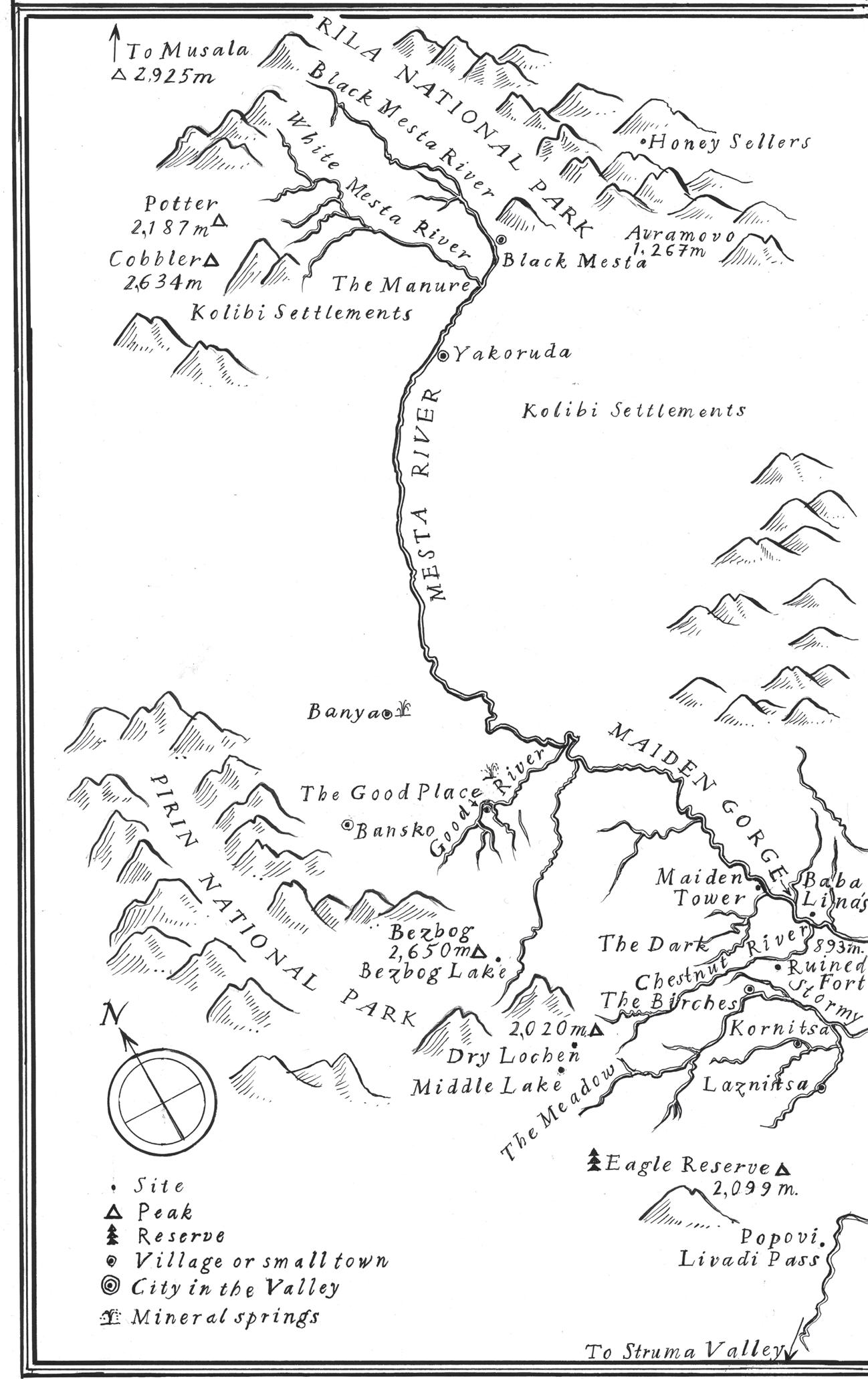
Blue-faced ranges on all sides. And on all sides – out of view and out of earshot – the rivers that made up the big Mesta River. I sensed their smiling gallop downhill. Men had spent their best years waisthigh in these rivers, moving logs downstream. Women had beaten their laundry and anger into the waters, children spent endless summers catching fish with their hands, vast herds of bu alo and horses drank, bird colonies nested. The land is fat and the mountains bathed by Mediterranean currents, an ideal climate that blends seasons like nectar in the cup of the valley. Once, the valley held one of the largest fairs on the continent – merchants and craftsmen, weavers and matchmakers, cattle and horse breeders, fortune-tellers and shepherds,
speaking a Babel of languages and wearing all manner of fur hats and turbans, capes and aprons in linen and wool. Houses were built in stone above the valley, with grey schist-slated roofs, orchards planted. Many seasons passed. Then, in the last century of the last millennium, people began to leave and with them the animals too. The river flats where golden apples ripened were dug up.
It was August. I’d been in the mountains and news reached me that Siberia’s forests were on fire and Arctic peat smouldered. A virus whose biological form already seethed was still in the future, but it was also in the past. I was inside some interregnum of sunflowers. Calendar time released its grip and I was free to roam Earth’s broad valley.
I plucked a seed from a sunflower head and cracked it open with my teeth. It was warm. Drunk on sunset, I pushed through the sunflowers. Beyond the plantation – a scorched pasture. Goats and sheep were scattered on it, and a skinny boy in a white singlet with sunbleached hair and a shepherd’s crook. Shafts of light poured through cloud, making him look like a golden child with his unearthly flock. Inside that funnel of light, the boy rested on his crook.
Until a hundred years ago, travel was slow in the valley – cartslow, chariotslow, horseback and muleslow, bu alo and footslow. At the end of the day, the boy walked the animals past the recent ruins, the older ruins and the ancient ones – though to him unfinished new builds, communist, post-communist, Ottoman, Roman and Thracian ruins meant the same thing. Across the floor of the valley, past the village of Fire so named because of the year-long sunshine and the hot springs where humans have sat throughout the centuries, sat with psoriasis and ulcers, cramps and battle wounds, melancholia and gout. Back to his village of Thunder so named because of the thunderstorms that roll in like an army from the north.
Like the boy, I would rejoin the road. Past the spring vapours. Past the hotels shaped like turreted faux-castles in gangster-baroque style, where the new rich arrive in cars like armoured vehicles, their listless children playing games on tablets. Past the Roma slum where laundry hangs over open dumps and a man leads a horse on a rope with small children bestride, no saddle. Garbage lines the riverbank. Past
the 600-year-old sycamores, past the mansions built with public funds and pretending to be guesthouses, past a drinking fountain with a broken spout, the cement still bearing a hammer and sickle and ‘BUILT BY A STAR BRIGADE OF THE NATIONAL FRONT’.
What is this strange place? This is Europe in the new millennium.
Above the slum I’d follow a steep road that fills you with awe at how people built dwellings so high up, but you got why they did it – to avoid the fate of low-lying districts in the hands of brigands, floods and pandemics. I’d pass a single soul – a handsome man in rags with copper skin and ash hair, with a cloth sack full of something, who for a moment looked like an extra in a film of the ancient world, like Spartacus. I’d o er him a lift and he would smile shyly, revealing an old man’s mouth with rotten teeth, saying he’d been picking mushrooms and preferred to walk. His smile touched a nerve. It was like the valley. I’d reach a village where only one house is inhabited full-time, and in this empty village I’d rent a house. The next year, I’d do it again. I would fall under the spell of the valley.
For the past ten years, I have lived by a river called Beauly in the Highlands of Scotland. Until this move to the rural north of Scotland, I had defi ned myself as an urbanite, yet I never missed city life. Every day, I felt joy for no reason. Before, I’d needed a reason. Daily contact with the river and the woods changed my life, as if a door opened and I stepped into a place where everything was clearer.
That place was not new – it was remembered from my Bulgarian childhood. That place was in the wild strawberry woods of the mountains and in the foraging expeditions with my paternal grandmother in the pre-Danubian countryside. Her family were prominent vintners in that wine-growing region who lost everything during collectivisation. But even if she was dispossessed, grape juice ran in her blood. We would leave the house in the morning with shoulder bags and spend the day foraging for nettles which she rubbed into her fingers for arthritic relief, then made into fritters, eating mulberries and sour cherries o the trees that stained our clothes, collecting lime blossoms and elderflower which made me sneeze, and she would sit
knitting shapeless doilies in a pine forest while I picked last season’s acorns to glue together into shapeless figurines. There was a bed in her house where herbs dried on newspaper and she was always chewing something just-pulled from the ground.
My great-aunt nearby had an edible garden under the grapevine that shaded the courtyard, and chickens and goats in the barn. The morning thrill of finding eggs in hidden places, the smell of barn and roses! There was a room in her house where food was stored and processed. Yogurt jars fermented overnight, wrapped in newspapers, fresh cheese dripped in cloths, crates of apples rested for winter, bottles of elder cordial fizzed and honeycombs dripped into trays. She was always next to a bubbling pot or work bench where she rolled out pastry, beat up mayonnaise with warm eggs and peeled stillmuddy vegetables for an oven roast. We watched transfixed at how she turned the unshapely stu pulled from the ground into something else, like a scientist in her lab. Things had to be constantly sampled, of course. And then there was the Making of the Jars in early autumn, a seasonal rite, when she sat regally on a creaky chair by a cauldron, boiling jars of goodies to seal them. She was an accountant during the week, mistress of the land on weekends. Nourishment was her talent and although she didn’t have children of her own, she was everybody’s favourite mother.
This is how I became enchanted by the edible Earth. Thirty years later, in a northern country, I drove away from my urban life and put on my wellies with glee as if I had seen o the last day of school. I was finally deinstitutionalised. Now, the river textured the days with its soundtrack. Its wooded paths became an extension of my feet. I dreamt of the river rising and falling. When I visited towns heaving with people, I felt in transit. Then I’d stand still with my feet planted on the ground and water would flow through me. I stood in the river. The river was there even when it was out of view. At sad times, I’d sit where the flow is fast and watch the water rush to the sea until I was smoothed, pebble-like. All is change. In happy times, I’d sit by the same bend and relish the rush of water. All is joy. Before the hydroelectric era, there had been a waterfall and I see the ghost of the cascades inside the dam wall.
The river is flanked by a mixed forest but next to the river, a gravel quarry had taken root and next to the quarry, Scotland’s largest power substation, and one day, a column of new mega-pylons appeared, trampling forests and overstepping river and hills. Wires buzzed in the moist air. The quarry and the substation were separately owned but moved in the same direction – expansion. Another day, a large new swathe of forest was cut down. The stumps still bled resin when I went for a walk and discovered that the walk was no more. The quarry men finished o the smaller trees with chainsaws. The sight nearly cut me o at the knees. The quarry had cut so close to the nearest mega-pylon that the pylon stood on the edge of the quarry now. Like a man sawing o his own legs.
Pictish cairns with cysts and carved stones had been dug up. This had been a sacred place for the last two thousand years. Within a week there was a new thundering hole with barbed wire. Within two years, the forest floor was exhausted. Murky water sat at the bottom. Next to the quarry was the logging station. It used to be small, but like the quarry it grew, and its sawing became constant. An angry man operated the logging truck – once a small-scale woodcutter, now his van said ‘Contracting services’. His expansion was bolstered by the quarry for which he used to work. He was riding the wave of earth-flattening. In the first spring of the pandemic, while birds nested and the world was in lockdown, the multi-million pound quarry company felled another large chunk of forest and sold it as pulp. The nightmare was recurring. Gone again were the trees, the paths, the blueberries, the mushrooms, the birds’ nests, the beds of animals. Deer ran across the narrow rural roads and were hit by lorries that had also grown too big for the place. I wandered the battlefield in shock. Metal was replacing wood wholesale.
When you live with it, this mass assault on the land produces a sensation in your own body, a sensation of pain caused by a blow with a metallic object. It is truly psychosomatic: psyche is soul, soma is body. I could not work for the crashing noise of the quarry. In my dreams, I visited a wasteland with furrows like open graves. The ground literally shifted under my feet. The people and animals of the woods were running out of dwelling places but there would
be a lot of gravel to build wider, longer roads, ultimately going nowhere.
The local has become inseparable from the global and our shared condition travels across borders freely, even when people don’t. How does illness begin? I stood on the edge of the quarry abyss. It was a war trench. A pointless health-and-safety sign was stuck next to it. The river glinted through the remaining trees.
How does health begin? For years, I’d received treatment from a medical herbalist in Scotland. I became curious about the plants that went into the potent tinctures that changed my life for the better. At the same time, I discovered the benefits of Traditional Chinese Medicine (TCM) and its companion practice QiGong. It gave me relief and new tools to understand the energy that flows through all living things. I now understood why I felt unstoppable every spring: because energy rises in the human body when it rises in plants.
In the Daoist view, each person’s constitutional personality is a microcosm of the Earth’s ecosystems. Each individual has a blend of five elements: wood, fire, earth, metal and water. So there are wood people, earth people, metal people, though most of us have two to three dominant elements. Spring is the season of wood – the creation season. My trees whispered of other woods even as they were felled by metal and I had to follow the trail. Then summer – the season of generative fire, which adds fuel to the wood. Come May – June, the open road surged through me like a dragon awakening. I couldn’t sit at my desk. I’d roam the forests, pick raspberries and startle the deer. My blood sloshed like a river jumping its banks. The hunter-gatherer in me was awake and yearned to meet new faces and places. I’d leave home with a pack, braced for the unknown, trying not to look back to the one I loved because then I’d stay. He was a gardener, I was a forager. He would see the two sunflowers he planted in spring grow human-sized with heads like lions, then fall to the ground when I came home in autumn, as if shot.
And here I am in this unknown valley. From the north-westernmost to the south- easternmost highlands of Europe, from one river to another, I’ve come to seek connections across borders and seas, human
and vegetal, physical and metaphysical. I lie on the floor of the veranda, cracking sunflower seeds with my teeth and the thunderstorm crashes into the valley like cannon fi ring. Warm rain pounds the slate roofs built without nails in a masonic tradition meant to last forever and bunches of staggering light pierce the cloud like a prophecy. But there’s no telling how this prophecy works – forwards or backwards – and whether this is the key moment or a rehearsal. One afternoon, a lightning bolt struck the elder tree by the veranda where I stood. I staggered back but an aftershock ran through me and in this coup de foudre, I saw why I had come here on nothing but a hunch.
This valley was suspended in an exquisite web of earth, water, fire and air, and inside the web was some trail I had to find. Something was forgotten that I had to remember. It had called me and I had come. Apart from the language, I was a stranger. I didn’t know a soul. And I didn’t bring personal pain this time, I brought the pain of my Scottish river and woods.
People in the Mesta basin knew su ering, but they had something precious – the forest. Everything was still connected – peaks, people, plants. This place still had something of the old, wild kind – medicine, meaning, magic. Bulgaria, I discovered, is a leading exporter of medicinal and culinary plants. Many of them are still gathered in the wild and the Mesta basin is a hub because of its ecological wealth: three mountains, layered climate zones, virtually untouched by industry and, until the 1950s, unspoiled by mechanisation or modernity altogether. The communist state exploited the valley to the full – here were plantations of the world’s most aromatic tobacco, the Basma Oriental leaf and millions of tonnes of fruit were harvested each year in the valley. Those mega crops were gone, but something else survived: a cultural ecosystem.
There are few places in Europe where Christians and Muslims have lived enmeshed for hundreds of years, all of them are in the Balkans, and the Mesta basin is a vital scene in this moving mosaic. Women still wear shalvars and headscarves painted with flowers because this is the ancestral home of the Pomaks – the Muslims of the southern Balkans who are not ethnic Turks. The Pomaks intrigued me. Their culture was like nothing else I knew and they had
weathered calamity for over a hundred years. How was it that these people have been a permanent part of the landscape yet remained invisible, the last unknown Europeans? I wanted to meet the people of the Mesta basin, discover what was left of them and their knowledge of the earth, what I could learn about ailing and healing.
The boy with the herd saw me across the thistles and there was no reaction, as if he had seen me before; me and everybody else. There was nothing to say, there was nothing new. At fi rst glance, he was a boy from the valley and I was a visitor in a rented car, but we both stood neck- deep in ruins and warm milk thistle looking for the way through. Our world was beautiful and broken, this was our inheritance. If we were the last people in the valley, we’d have to join forces. I could hear distant thunder. It was coming. The mare had known it for an hour.
The boy took the potholed road, crook in hand. The woolly sheepdog with human eyes rounded o the herd and together yet separate, we continued across the valley, fragrant with imminent storm.
There was once a town [. . .] where all life seemed to live in harmony with its surroundings.
Rachel Carson, Silent Spring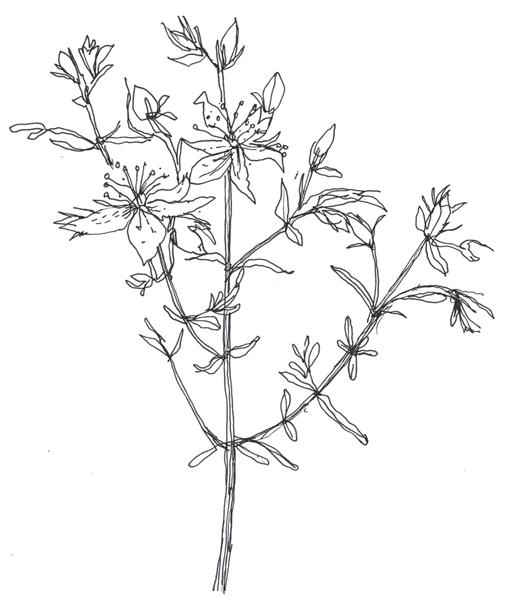
It was dusk when I arrived at my rented house. In the kitchen were dusty bottles of wine and rose cordial. Because nobody lived here, the garden was a jungle of edible weeds. My fi rst supper was a bowl of dandelion leaf, bramble and hazel leaf, chickweed and nettle tips. There was a cherry tree for dessert. It was the taste of a summer’s white night by the Beauly River, but without the venison steaks.
Jars with candles were placed around the house. I lit a few and sat by the cold hearth in the kitchen. I picked up a book from the shelves, opened it at random and read:
When I die I’ll be the dandelion that listens to the world’s pain with its stem. I hear it grow already, the bone of dandelion that I will be.
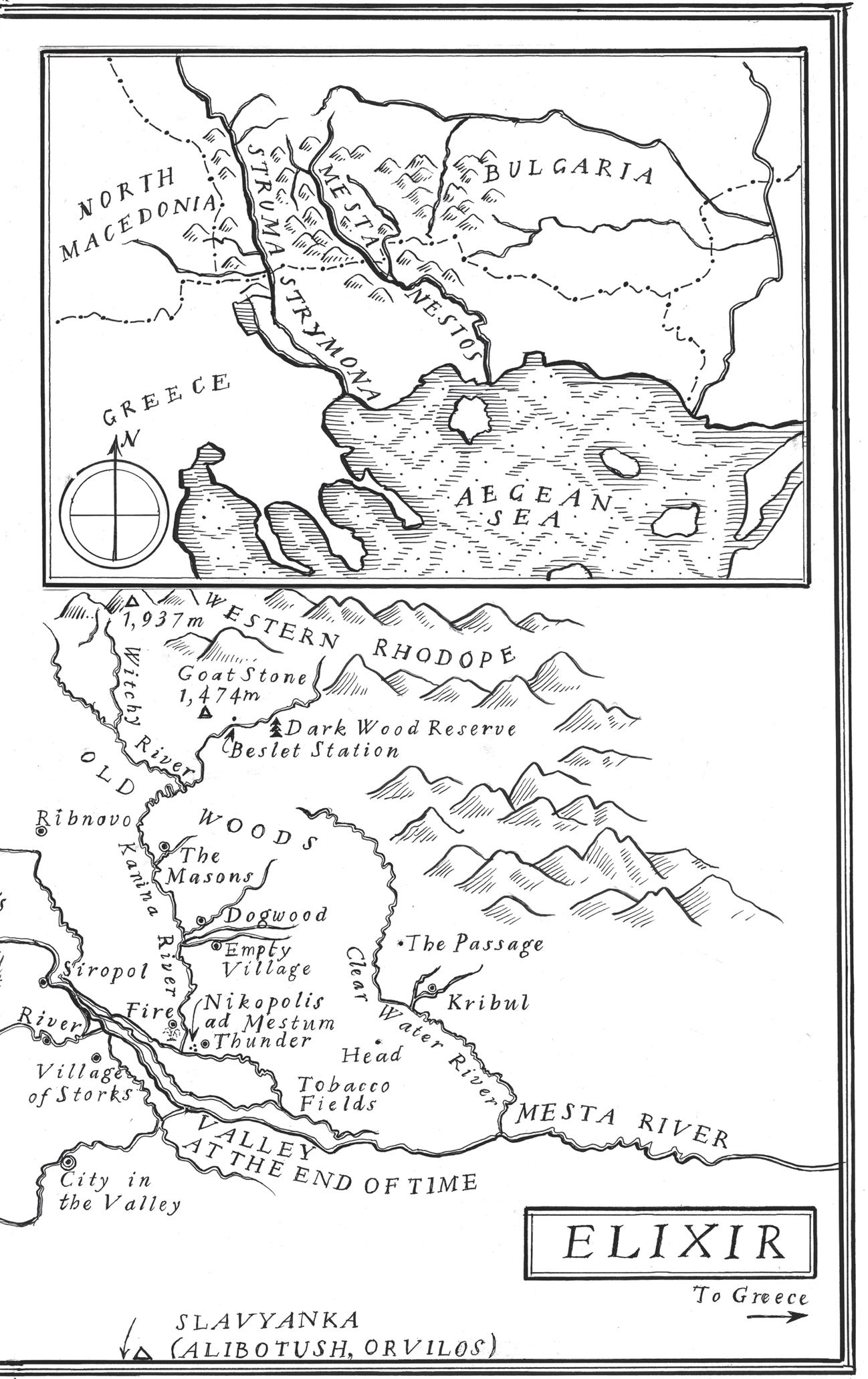
The Mesta River runs north to south. Its journey starts in Musala Peak – one of Europe’s coldest and remotest places, smack in the geographical heart of the southern Balkans, halfway between the Adriatic and Black seas. It travels 230 kilometres to reach the Aegean and its basin is at its widest in the valley. By now, it has gathered myriad rivers in a web so logical a spider could have woven it and it is only halfway through its course.
Two ranges flank it here – Pirin to the west and Rhodope to the east. Their characters are strikingly di erent. Pirin glints with its hundred glacial lakes, Rhodope sprawls with its dark woods. Alpine Pirin is 80 kilometres long, north to south, and 40 kilometres across. Rhodope’s length runs 240 kilometres west to east, the size of a small country. Called Rhodope, Rhodopi, Rhodopa, even the plural Rhodopes, and always invoked in the feminine, she is worlds within worlds. Inside the mountain range are fifteen protected natural reserves, Thracian cult towns and oracular sites, cave labyrinths like cities, the oldest coniferous forests on the continent, Orpheus’s mooted birthplace and even the abysmal waterfall cave whence he was said to enter the underworld. Rhodope can’t be contained in a book or known in a single lifetime, not because of her breadth but because of her depth. Some say there are canyons untrodden by human feet, despite the fact that humans have trodden here for a long time.
The valley was where a western corner of Rhodope touched the floor of the earth and provided an entry point to humans. This corner was called Old Woods, with a surface of 900 square kilometres. From the spine of this range three main ridges ran into the valley and each formed its own domain with its own rivers feeding into the Mesta. Only the lower levels of this stone palace were accessible and
humans attached themselves to whatever floor they managed. I attached myself to the empty village above the valley. From here, I hoped to get my bearings in this place which struck you dumb with its cascading majesty. The valley was the floor of this cauldron and it sat at 600 metres above sea level. Once, this had been the bottom of an ocean.
The ruins on the river plain were Nikopolis ad Mestum. The City of Victory on the Mesta was built by the Roman emperor Trajan at the turn of the second century to mark the end of his war against the Dacians to the north. The city was large, with a forum and amphitheatre, walls 4 metres high and was important enough to be mentioned by the geographer Ptolemy. Later, a writer in the fifth century described its opulence as an episcopalian regional centre. It flourished for a few hundred years. Tra c and trade galloped along this corridor between the western and eastern Roman Empire – because the north–south antique Dervenya (Pass) road met with the Via Egnatia in the Aegean Plains. When Justinian’s plague struck, and killed up to a quarter of the Roman world in a couple of decades, Slav and Avar tribes erupted into the valley. They pillaged Nikopolis to build their own dwellings. In the Middle Ages another city, Nikopol, emerged on top of the ruins and thrived from the ninth to the thirteenth centuries when it was devastated by passing Crusaders. When the Ottoman Turks invaded, the township moved to the other side of the river. Town and Valley became known as Nevrokop. Nikopolis – Nikopol – Nevrokop: a case of Latinity gently Balkanised. The name stuck. The city is still here, still a hotchpotch of dialects and styles of dress. Its market, though a beggar’s shadow of its former exuberance, is alive. There is even a bit of the animal market left, where horse sellers turn up every Monday by the town’s cemetery, Christian graves on one side, Muslim graves on the other. ‘The cemetery was small and now it’s big and the city was big and now it’s small,’ said a Gypsy horse seller with gold teeth. ‘Lots of young people, cos the system kills folks.’
At the level of Nikopolis was a row of villages with mineral waters. The main ones were Fire and Thunder. Fragments of tombstones and antique columns lay discarded in their courtyards. Locals had been
digging up their own heritage for a long time. Fire and Thunder were not as sleepy as they’d first appeared to me. Visitors flocked to hotels with mineral pools all year round.
In the wooded hill above was the ’hood – the Roma settlement set up by the communist state in the 1960s with the aim to settle and control Travellers. It had remained a slum. In the early morning, kids in hoods snuck through the woods and scouted the village streets looking for things to sell, recycle or steal.
My empty village above the ’hood was the first on the next floor up Old Woods. The other two were Dogwood and the Masons, like a ribbon wrapped around the rocky flank, and the ribbon ran out at the Masons. The defining feature was the steep gully of the River Kanina which fought its way through creeks to join the Mesta. Three origin myths competed for the euphonic name Kanina, two of them with tales of bloodshed, but the most musical was the Latin ‘canto’ for sing, chant, thunder – because it was a river that cantoed its way through crazy terrain.
At the entrance of the Empty Village sat a new luxury hotel built in traditional style. Guests of the hotel drove past the ’hood, taking the new road that circumvented it, windows up in case of a beggar child on the road. Once here, they didn’t leave the complex. They sat in the pool and were served by the remaining young people of the valley. Almost every house in the village was for rent. A demand for romantic getaways had driven this fad for posh ethnic-style houses, and some weekends the gully cantoed with loud party music. You felt bullied by the high decibels, and that was the e ect that the big business who lorded it over the empty village, like triumphant colonists in a subjugated province, desired.
My rented place was owned by an architect who had ingeniously rebuilt it and was full of salvaged agricultural tools and hand-woven rugs. She had returned from France to the country of her birth and turned a ruin into her dream home (and mine) – whitewashed and schist-slated in the local masonic tradition, rustic kitchen with a sweeping view and upstairs – cool bedrooms with shuttered windows and the pièce de résistance – the veranda. Made from massive
old beams, the covered veranda jutted above the lush gully. It was the size of a small apartment and had a futon bed. Here, I worked and ate at a big table. When the outlines of Pirin darkened, I lit candles in jars. The city in the valley turned on its lights too. Mornings and evenings on the veranda, the resonance between peaks and valley was so precise, I could hear it like a perfect note.
In summer the village buzzed with visitors but in winter it was just one family. They lived next to me. They were a poet and a painter with their teenaged son. The poet turned out to be a famous recluse whose work featured in school books. The dandelion poem was his.
Between gallery, shop, garden and creative work, their life was still on the surface and active within, a state I recognised. They were private people. They had moved here thirty years ago in the first wave of alternative-leaning urbanites renovating old houses and their only regret was not doing it earlier. Even if the others had since drifted back to their city lives, or abroad, like the owner of my house who, disappointed with the way mass tourism had bulldozed its way in, had moved to the Greek coast and managed her property remotely. Among the weeds I found a flat stone inscribed mason ibrahim zelenkov , meant to be built into the house. This was the man who rebuilt the house, the last of the old masons.
In the main and only street, a rustic taverna that had once been a school served organic food. It was run by a middle-aged couple from Dogwood. He’d been a goatherd before tourism replaced animal husbandry. He wore a leather waistcoat and I never knew what mood I’d catch him in, e usive or sullen, as he scribbled in his pad. When I asked questions, his face twitched, he looked over the valley and walked o , overcome with meaning.
Danera, the voluble cook, made crispy fried potatoes, burgers, finely chopped salads, stu ed peppers, chutneys and pancakes with blueberry jam. My favourite was the sheep’s yogurt in a clay pot, topped with honey and crushed walnuts. Danera had arrived with her parents from the interior of the Rhodope on a bu alo-pulled cart piled high with seven kids, one wardrobe and two iron beds.
‘My mother tipped us from the cart like chicks, sat down by the spring and wept.’
They became the only Muslims in the Empty Village, which was not empty at the time, though the emptying had begun. In less than a century, it would go from five hundred people to three – my neighbours. Its actual name was Leshten, meaning hazel. Once, there had been hazel woods.
Dogwood had grown while the other two villages had emptied. From a bunch of barns and animal sheds it had become a hub where new homes were built into the terraced crags facing the valley. There was a school, a mosque, a library and a hotel. Dogwood was an allMuslim village and women wore the floral shalvars and patterned aprons of the Pomaks. Older married women wore the trademark Pomak mantles in blue or brown. They wore them buttoned up or undone like mountain capes. Girls wore Western clothes, especially if they studied or worked away. Men were indistinguishable from the rest of the population, except for a small woollen skull cap worn by elders.
All the labour in the gully came from Dogwood, whose young men were builders following in the footsteps of their predecessors. In summer, they flew to Western Europe to work on farms or build houses. The older men and women tilled their allotments and tried to make a buck from Empty Village guesthouses by buying, selling and managing. The young women went abroad to do menial jobs in the summer, or worked here at minimum-wage jobs like hotel sta , teachers and seamstresses.
Two kinds of people breezed in and out of the Empty Village taverna – lunching visitors and gossiping locals. Men who worked on building sites, layabouts, couriers. The monthly issue of a Christian magazine came here but the church was often locked, so it was perused by Muslim locals and tourists. The taverna, not the church, was the heart of the Empty Village. You could sit here all day and watch the remaining world go by, with Danera’s running commentary.
‘We might be peasants but we’ve seen all sorts in our time’, she said. ‘One time, these lost Germans came by and saw us making winter jars. Peppers, aubergines, the usual. They looked worried and asked if we expected a war!’
There was laughter. Communities like these, who lived embedded in the woods, who knew privation in their bones and who were marginalised by the mainstream had never stopped being self-reliant. They were prepared for pandemics.
Most of Dogwood’s young people were away picking fruit and later in autumn, ‘pulling asparagus’ in Western Europe. A few hung around, idle, resting from their months of farm work abroad. Battered vans and horse-driven carts lumbered uphill at the pace of centuries. And the faces of the Roma looked centuries old – mahogany brown and stamped with a hardship that wouldn’t go away. These families from the ’hood headed to the highlands of upper Kanina where they gathered plants. Some came back at the end of the day to sell them to a plant dealer called Rocky the Enchanter, others sold them to a dealer from Thunder.
‘We all used to do it,’ Danera said. ‘The villages emptied, only the old folk were left. We’d jump on trucks and bu alo carts with our parents and head up to Beslet for the summer.’
Beslet was a highland area near a Thracian sanctuary. The young guys and girls sitting with co ees nodded in remembrance.
‘And we’d still do it, if the money was half-decent,’ said a young builder. ‘Cos mushrooms and berries are like an itch. Once you do it, you’ve gotta do it.’
‘Not anymore,’ said another one. ‘The system killed my itch.’
But some still went picking blueberries. This year they went all the way across to Pirin because the blueberry bushes in the Rhodope were hit by unseasonal hail storms. Professional foragers used a special metal-and-wood comb which they ran through the plant for large scoops of berries. I bought myself such a tool from the Dogwood general store, but never used it and gave it away.
Outside the taverna, a young woman in folkloric national dress sold local goods – herbal teas, jams, honeys. She was from Dogwood, but deliberately didn’t wear the Pomak shalvars and floral headscarf of her mother and grandmother. Looking at her in these borrowed clothes worn for the benefit of tourists who might be displeased by the sight of Muslim shalvars, I sensed layers of backstory.
‘So many layers,’ the poet said over the low stone wall separating
the two gardens, while pu ng on his pipe under the cherry tree, ‘that it takes decades before you give up trying to reach the bottom.’
He had spent decades roaming the hills, collecting stories, recording songs, collating memories and dialects. Under his garden was a library. He went down a hatch and handed me rare books. I asked if I could use his dandelion poem.
‘Use whatever you need,’ he waved it away. ‘We’re all writing the one book, in the end.’
You will not hear this from many authors.
He had collated a little guide to the Empty Village for visitors. The houses had names: the Captain’s House; the Lawyer’s; the Brothers-in-Law; the Upper one; the Priest’s; the Disputed one and there were houses with people’s names – a united nations of names: Bulgarian; Greek; Armenian; English; French.
After a prolific oeuvre of poetry, prose, music and film, in his seventies he had become a poet of stone. He photographed moss, gazed at its patterns and wrote what he called syntheses. The human world had shrunk and the more-than-human world expanded.
‘The more I sit with this mountain, the more everything else pales into insignificance. Even literature, to which I’ve dedicated my life. Even that.’
The Chinese poet Li Bo would have agreed:
‘We never tire of looking at each other/the mountain and I.’
Once a week his wife, the painter, went down to the city. People who lived in the mountains called it just this – the city. When I asked her whether it was the people or the geography that kept them here, she said:
‘People are ephemeral. And people here know this because they’ve gone through horror.’ She meant the Pomaks. ‘The landscape is the main event. Living here, you can’t deny it. I cling to my son but I know that he too will go and I will be left with the valley.’
She was a stargazer and had an ethereal quality. Her paintings moved steadily towards abstraction. Fingers of light pushed through doorways. The valley was ever-present.
The couple told me why these houses had slated roofs – because the Kanina shores are metamorphic and the layered schist and gneiss make good slates. The village cultures were layered too. Visitors stopped in the Empty Village to admire the slated houses, then drove through Dogwood, not knowing what it was because it was not on tourist itineraries. It was the invisible village with a mosque that fed and serviced the rest. Dogwood was not a place where people came to buy a dream house, it was a place where people were born.
The top village was the feted architectural reserve of The Masons, known for the period dramas filmed here. In the closing scene of a 1970s film called The End of the Song, the lead actor sings a song called ‘Rufinka Lay Dying’ before he rides o into the hills to meet his own death. Before filming, the director made him chop wood for a week without food, to wipe the smugness from his face and give him a highlander look. That look was still on the faces of Dogwooders, even the young ones – a hungry, haunted look. The look of people who did hard physical labour and to whom nothing had come easily.
The Masons was settled in the late Middle Ages by masons from Macedonia. The Macedonians brought a style of construction that was popular and from here they travelled in guilds to the Aegean Coast. The village became wealthy from this and from its herds. In its day, there were 50,000 grazing animals to just 1,500 people. In winter, the cattle were taken down the Mesta corridor to the Aegean Plains and in summer to highlands like Beslet. A supershepherd from the turn of the nineteenth century had for instance looked after tens of thousands of sheep with the help of ninety dogs and nine shepherds on horseback.
The Masons had thirty residents left, no children. It was an openair museum. Visitors came for lunch and a wander down the cobbled memory lanes of how mountain village life had been – until the wrecking ball of forced collectivisation smashed it. The dispossessed Masoners took their craft and even their wood on cattle carts and emigrated to other parts of the country; like their ancestors had done. Incomers who started buying houses in the 1980s and 1990s found exactly ten per cent of the inhabitants left. When Communism
fell, gangster enterprise finished things o . Houses fell down or were sold for a pittance. Mansions were built in the Masons style by the successful gangsters, but in the original village houses had been touching so that if you were on the run from something, you could walk over the entire village from roof to roof and disappear into the woods. In contrast, the new houses had high walls and didn’t talk to each other.
The Masons’ little library had been the best in the valley. The library was still open but hadn’t acquired books since the last century. It was all souvenirs and lunches. The capture of the village by absentee owners and hapless tourists was complete. Dogwooders were poorly educated and practically skilled and their ranks had swelled, while in the Masons and the Empty Village, education had given people a ticket out – and killed the village.
A couple from the ’hood came in a van like an Aladdin’s cave full of the valley’s textile heritage: shagpile rugs; woollen kilims made on looms; long knitted socks; embroidered cotton cloths and thick stripy aprons. Knitted socks here are knee-high and the women snipped the final thread that normally hangs from the top to avoid being followed ‘by snakes and lizards’. Yet they attached long cords to the backs of their tweed waistcoats which swayed ‘like snakes’ as they walked and drew the male gaze. The snake was a trope of secret power here.
These discarded heirlooms and expired dowries came from households either defunct or ashamed of their peasant roots, something I saw a lot in Muslim homes where synthetic rugs were displayed as totems of aspirational urban modernity. But they were late with modernity because the synthetics would disintegrate in a few years and then their children would have to buy back their own heirloom from the Roma, who everyone despised. The Roma were in fact the last custodians of this textile wealth; they bought stu wholesale and flogged it. In this way, they salvaged precious handcrafts from the rubbish tip and kept up the trading tradition between lowlands and highlands.
Until the mid-twentieth century, the people of Thunder and Fire came up in carts to sell vegetables to the cattle-rich Masons. The
Masons and the Empty Village had started as a refuge. Here, you could start afresh, back to back with the mountain. To come here was to opt out of the system because the system in all its guises, from empire to dictatorship, had failed to conquer the mountain. Each house had a stash of weapons and if a house caught fire, you didn’t rush to help in case of an explosion.
I witnessed a house catch fire one day, although it didn’t explode. I’d come to the Masons for lunch. A fire engine made it up the steep road but couldn’t enter the cobbled lane and locals helped take the hose to the house. But the locals were not Masoners because the Masoners were too old. They were Dogwooders who drove up to help their neighbours. Generations before, when the Masons was about to be torched by Turkish irregulars, it was a Dogwooder who galloped to the city like the wind to plead with the Ottoman governor Rifat Bey to spare their Christian neighbours.
‘That’s being a Pomak for you’, a young guy I knew said in passing. ‘You help and get no thanks.’
He was covered in sweat after helping put out the flames while guys from local families sat in the café not lifting a finger.
‘But we’re used to it,’ he added.
It was a play on words and a truth. The word Pomak had started as an informal mark of di erence and ended up as an ethnonym. One etymology traces it to pomachen or tormented one, another to pomagach or helper. Both had negative overtones. Pomaks were either the tormented ones (forced to convert to Islam) or the helpers (of Islam).
They have been both, but in a di erent sense. Helpers needed for their expert knowledge of the land, and yet tormented by cruel policies, mean revisionism, subtle snubs and the ignorance of those in the majority. The majority were fed a malignant historical narrative in which all Muslims, living and dead, were conflated with the crimes of the Ottoman Empire during its tyrannous decay. By this token, if you were a Muslim, you were guilty until proven innocent. This narrative was to reality what the quarry was to the forest: a continuous desecration of truth. Single-minded metal replacing the rich web of wood.
The truth was that the Pomaks were autochthonous people deeply
woven into the land. ‘We are Bulgarians with Turkish-Arabic names who go to mosque instead of church,’ said many younger Pomaks. Most of the young were secular by belief and Muslim by identity. But many in the older generations didn’t identify with this definition. Pomak identity was complicated by compounded trauma. In a typically low-key gesture of self-reclamation, the Pomaks informally referred to themselves simply as ‘Our Folk’. Nashentsi. Such and such married a nashenka, one of ours.
The Pomaks were incredibly hard grafters. It seemed almost constitutional, but it was inherited. Hard work is what it took to survive and thrive in this mountain. Above the Masons, I stopped to chat to an elderly couple from Dogwood who were pottering in their orchard. They’d built a holiday house here, just a mile from where they lived, for something to do.
‘I don’t know why we work, all our lives we’ve done nothing but work,’ said the man.
‘Because,’ said his wife who had thick-lensed glasses and a white head-shawl, ‘if we don’t work, all we have left is death and the telly. And it’s a fine day for weeding.’
‘One moment you’re young and handsome,’ her husband said, ‘and the next moment you’re old and crippled.’
They were not into small talk. His wife cut a red rose and gave it to me. ‘Life is an illusion,’ she said and smiled, not wistfully, but the way you smile when you really know that life is an illusion.
The Masons was an odd place, folded into its past because it didn’t have a present. You couldn’t see anything except the plunge of Kanina and it was easy to forget about the valley. You were pressed hard against Old Woods. The houses were gorgeous but there was a lurking shadow, a malaise I couldn’t explain, and that made me relieved to leave the Masons and head down the road back to Dogwood where people went about their business, and the Empty Village where they didn’t, but where the bigger picture opened up and I could breathe again.
One rainy afternoon in my rented house, I slept and heard the house speak with a voice. The house showed me people inside it. I saw them.
They slept on wide wooden bunks covered with shagpile blankets, sheepskins nailed to the walls, sheep and cows downstairs, chewing, the family on rugs around a low round sofra table, also chewing. I saw how the village had been, houses packed with families, fields down the slopes. Now the slopes have gone wild and the houses have multiplied, but there are no people or animals.
But it’s all still here, the house whispered, this is not the end. They wanted me to know this. What you think is here is only the surface view of something deeper that runs through us like electricity through the air, the house wanted me to know. Beams that in a flash illuminate the valley and its breathing creatures. Then darkness again.
The rain storm travelled south, down the Mesta corridor, I could hear it like a galloping army fading away. I rose from my slumber. A massive rainbow straddled the valley. The mountain across it was the outline of a perfect world. I went to see Danera in the tavern.
Danera had seen the heyday, decline, rise from the ashes and commercial takeover of the Empty Village. My dream was accurate. The houses in the three villages had been the same. The first floor for the animals, the second for storing winter foods like corn, and the third for humans to sleep, cook, keep milk, make cheese and churn butter. A back room was reserved for chests of dowry, extra rugs and dried goods like couscous. Threshing was done with up to three horses. Danera remembered the last of the old people, like the gentle wood carver who was buried with his chisel and transistor radio. It was the custom in the valley to bury Christians with their favourite things, once the dead person had lain at home for a while with a candle burning and a bowl of wheat before them, their hands and feet tied with a handkerchief against vampirism and a coin in their mouth to settle debts in the otherworld. The dead were carried to the graveyard, the procession led by a child who mustn’t turn back – turning back augured more death. The co n was wrapped in white linen, on which the priest wrote with coal ‘Jesus Christ’, and a cross. Before going inside the co n, the dead had their hands and feet untied. Family visited the grave for forty days and smudged it with frankincense. Seven years later, the body was disinterred, the bones washed, placed in a cloth bag and reburied with ceremony.
When new houses were built on old sites, human remains popped up that had to be re-interred in the cemetery above the village, where a path took you into a pine wood so dark, I was afraid to go far inside it even in the daytime. This was bear territory and the occasional gunshot you heard was meant to scare o bears who got too close to Dogwood orchards. My neighbour the painter carried a ‘bear spray’ on walks and we laughed about it because we knew it would be useless in the face of an actual bear.
The Empty Village enjoyed an eccentric revival in the 1990s. Its main protagonist was a man called Marin. He now lived in Greece but still owned houses and the taverna, and his name floated like a rural legend. One day, I heard that Marin was here and staying in one of his houses.
We sat with a bottle of wine on the taverna terrace. He was a heavy man with eyes that watered and the look of someone who had lived fully, too fully. By the time he ended up here, he’d been a successful entrepreneur for a decade. But he was jaded.
‘I came by accident,’ he said. ‘We’d come for a spot of fishing. My friends and I were looking for the Kanina. But we couldn’t find access to it and ended up here.’
They stood by the old sycamore and took in the valley. The village was in decline – no modern sewage or electricity, not even cobbles in the streets. Just crumbling houses and old people and chickens.
‘It was love at first sight. I bought all the houses for sale. Dogwooders were buying them up just for the roof slates! Then I went down to the Nevrokop animal market and fell in love with a cow. She lived for eighteen years and gave the most aromatic milk. In that overgrown building you see, which is where we kept the animals.’
Danera’s brother looked after the cow. Marin moved here with his young family and in the following years invested a fortune in turning the dying village into a self-su cient rural community for the modern age. He created the infrastructure that is here now with labour from Dogwood and the surrounding area. They piped water from the Kanina at a 400 metre gradient and when that proved too dicult, piped it from a spring above the village. They laid down cobble stones, installed indoor toilets and began to renovate the old houses.
Marin and other home owners, like my absentee hostess, introduced organic restoration architecture. She too had fallen in love with the valley on a chance visit. Marin employed shepherds from Dogwood to look after the goats, cows, sheep and pigs that he bought. Workers from further afield rode here on horseback across the Rhodope, like in some western. He paid willow weavers to make baskets and fences, bought sheep’s wool from the women of Dogwood for loom-woven carpets and everybody who moved here got into homemade cheeses, churning butter, making sausages and living what Marin called ‘authentic village life’. He drove a busload of Roma from the ’hood to a region known as the Valley of Roses in another part of the country to pick roses and make syrups and cordials, and give them a livelihood. Those were the dusty bottles of rose syrup in my house, which I opened and sipped; the syrup was strong and thick and made you smile with relish. ‘Rose syrup is good for an upset gut,’ Danera said. ‘Rose syrup is good for heart comfort,’ an Irish friend said. ‘Rose syrup is good for emotional stress,’ my herbalist said. In TCM, the heart and the stomach are paired organ systems. The state of your gut and the state of your heart are inseparable. It is di cult to be in a good mood when you have indigestion. Ulcers make you dyspeptic in temperament. And whenever I meet someone miserable, I wonder if they su er from constipation.
The old taverna had been right beside the church.
‘And everybody there had a glass that sat where they left it,’ Marin said. ‘I got the tail end of the old life and held on to it for as long as I could.’
Then the old taverna was struck by lightning and burned down. Danera’s brother, who looked after the prized cow, was poisoned by his wife and died. Racketeers came looking for Marin and he went into hiding in upper Kanina like an outlaw.
‘I didn’t mind,’ he said. ‘When you lie on a meadow, everything changes. When I first came from the city, I was numb. Here I learned to feel again.’
He’d gone from being a hunter with a rifle, to hunting with a bow and arrows, to photographing, to nothing. Now it was enough to look at an animal.