INTRODUCTION
by Casey Cep
WHEN TO KILL A MOCKINGBIRD was published in the summer of 1960, it seemed to have sprung from nowhere, like an Alabamian Athena: a perfectly formed novel from an unknown Southern writer without any evident precedent or antecedent. The book somehow managed to be both urgently of its time and instantly timeless, addressing the era’s most turbulent issues, from the Civil Rights Movement to the Sexual Revolution, while also speaking in the register of the eternal, from the moral awakening of children and the abiding love of families to the frictions between the self and society.
But no writer is without influences and aspirations: Harper Lee had, of course, come from somewhere and worked tremendously hard to become someone. It was only because she did not like talking about herself that her origins seemed so mysterious, and inevitably, the better To Kill a Mockingbird did— becoming a bestseller and then winning a Pulitzer Prize, selling a million copies and then ten million and then forty million— the more theories and rumors rushed in to fi ll her silence. In the years after the book came out, the public image of Lee swung between two of her beloved characters: She was either the living incarna-
INTRODUCTION
tion of her feisty, tomboyish heroine Jean Louise “Scout” Finch or, in her seeming reclusiveness, a version of that shy shadow fi gure, Arthur “Boo” Radley. Absent answers from the author herself, who she really was and how she became a writer were questions that sidestepped the usual form of biography and moved into the realm of mythology.
How thrilling, then, to encounter this time capsule from the start of Lee’s career: a collection of some of her earliest short stories, appearing here in print for the fi rst time, which help explain how the little girl from South Alabama Avenue turned herself into a bestselling author who enchanted generations of readers around the world. Drafted in the decade before To Kill a Mockingbird, after Lee had fi rst moved to New York City in 1949, these stories, the fi rst eight pieces in this volume, feature some of the characters and settings she would soon make famous and reveal some of the contradictions and confl icts she would spend her life trying to resolve.
Nelle Harper Lee was born on April 28, 1926, the last of Amasa Coleman Lee and Frances Cunningham Finch’s four children. Fifteen years younger than her oldest sibling, she
grew up feeling as if she had her own private childhood in the small town of Monroeville, Alabama, some hundred miles south of Montgomery and a hundred light-years from Manhattan. Because her siblings were so much older, she watched them one by one fulfi ll the dreams of their parents: a respectable legal career alongside their father for her sister Alice; a loving marriage and homemaker’s life for her sister Louise; heroic military service in the Second World War for her brother, Edwin. For a long while, it seemed as if Lee would be the family’s one great disappointment: She dropped out of the University of Alabama a semester shy of graduation, fleeing to the disreputable North and abandoning the law degree that would have allowed her father to add an s to the family fi rm’s shingle. But while A.C. Lee and Daughters was not meant to be and Lee did not become a lawyer, she did eventually create the most admired attorney in America.
Although Lee never formally studied creative writing, she spent her years in Tuscaloosa teaching herself to write. She had a recurring column in the college newspaper, The Crimson White, and contributed sketches to the student humor magazine, the Rammer Jammer, which she eventually edited. Even then, her roving curiosity and intellectual range were evident on the page— in a review of recent British fi lms, a
INTRODUCTION
parody of Shakespeare, a send-up of the registrar, a roast of the rural newspaper her father edited and owned— and her byline always marked the entrance to a briar patch: What followed was prickly and irreverent, like Nelle herself, as she was known back then. A Chi Omega who corrected her sorority sisters whenever they mispronounced words, Lee wore blue jeans and Bermuda shorts at a time when women were discouraged from wearing anything but dresses, cursed more than the crew of the USS Enterprise, and once scandalized the entire campus by smoking a cigar on the hood of a car in the homecoming parade.
Lee knew approximately one person in New York City when she moved there at age twenty-three, but what a person he was: Truman Capote, who had spent some of his childhood living next door to her, and who would later serve as the model for the puny, puckish Charles Baker “Dill” Harris in her novel. The budding authors felt like “apart people,” as Capote later put it, already able to read years before their peers, playing with language the way others did dolls and footballs. The pair conspired with each other to write adventures, tall tales, and verses of the sort they so liked reading, from the Bobbsey Twins to Beowulf and the Rover Boys to Rudyard Kipling, clattering away at the typewriter that A.C. Lee had given his bookish youngest daughter.
INTRODUCTION
In lieu of college, Capote had gone directly to work as a copy boy at The New Yorker. A few years later, Lee landed her own job in publishing, although at nowhere near so storied a publication: While Capote had scandalized editor Harold Ross by wearing a cape and annoyed Robert Frost by disrupting one of his poetry readings, Lee faced the drudgery of proofreading conference calendars and education news for the monthly magazine of the American School Publishing Corporation, a trade rag called The School Executive. Eventually she left that day job for another, this one as an airline reservation clerk, which was less literary but theoretically more glamorous. The same could not be said of the rest of her life back then: Around the edges of her nine-to- five work, she lived off peanut butter sandwiches while drafting stories at a desk she made for herself with two old apple crates and a door she found in the basement of her building.
Writing on that shaky surface, Lee gradually steadied her hand. “I do believe that my greatest talent lies in creative writing,” she wrote to her family, confidingly and confidently, “and I do believe I can make a living at it.” Like so many aspiring authors, she initially turned to that family and her own early life for material, and the fi rst three stories in this collection shuffle through a series of young nar-
rators to explore the social mores, tiny transgressions, and moral confusion of what, in one of her later stories, she so beautifully calls “childhood’s secret society.” The stakes of “The Water Tank,” “The Binoculars,” and “The Pinking Shears,” all written before she turned thirty, are profoundly circumscribed— the approval of one’s parents and the acceptance of one’s peers— and the antagonists aren’t very grand either: teachers, siblings, schoolyard cliques.
The next three stories, by contrast, are all set in New York, with adult narrators, and one senses Lee trying to keep up with the Salingers and Cheevers. Still, that trio—“A Roomful of Kibble,” “The Viewers and the Viewed,” and “This Is Show Business?”— does show her moving beyond incident and toward plot, while simultaneously experimenting with different narrative voices. They take the not- quiteexperimental form of a comic-tragic monologue about a should-have- been-medicated friend, the heckling banter of an Upper East Side movie audience, and the conversations of two near-strangers in the Aristotelian theater of an idling automobile. People are often surprised to learn that Lee spent most of her life in New York City, borrowing books from the Society Library, taking in exhibits at the Frick, and trekking out to Queens to go to Mets games, and there’s something startling and sublime about reading our great
balladeer of small-town culture on the frustrations of fi nding a place to park in Manhattan, sounding for all the world like a Southern Seinfeld.
Characters taken directly from Lee’s own life appear throughout these tales. One sports her own nickname, Dody; others bear the names of her siblings, Edwin, Alice, and Louise; some are thinly disguised or entirely undisguised versions of her friends, including future Monroeville mayor Anne Hines. Even her brother’s eventual wife appears by name: Sara Ann McCall, who, as a little girl, played the ham in the real-life agricultural products parade Lee would later borrow for a pivotal scene at the end of To Kill a Mockingbird. Lee’s oldest sister, Alice, known to the whole family as “Bear,” is here transformed ever so slightly into “Doe,” but remains instantly recognizable despite the name: “She loved only three things in this world,” Lee writes, “the study and practice of law, camellias, and the Methodist Church.”
Like hospitality or lane cakes, names are a Southern specialty, and Lee already had a fi ne ear for them, making them up with great gusto whenever she didn’t poach them. We meet in these stories one Eddie May Ousley, a “failure” who was held back in school; a pair of teachers named Miss Busey and Miss Turnipseed; and the preacher Brother Q W Tatum, no periods after the initials, please, with his near
minyan of nine children, Haniel, Job, Habakkuk, Matrid, Jezebel, Mary, Emmanuel, and a set of twins, Hosea and Hosannah.
The name for which Harper Lee is most well-known first appears in “The Pinking Shears,” when we meet “little Jean Louie,” a third-grade troublemaker who is rather awkwardly missing her s. For the time being, the more familiar “Louise,” which was Lee’s middle sister’s given name, is stuck elsewhere, on a girl with the surname Finley— a disgraced grade-schooler whose pregnancy scandalizes her entire sixthgrade class in “The Water Tank.” In both stories, young women struggle with the expectations of their mothers, fathers, and neighbors, though Lee’s tone is less gloomy than gleeful, as befits these miniature comedies of manners. The narrator of “The Water Tank” spends the whole story worrying that she’s about to have a baby, because shortly after getting her first period, she hugged a boy whose pants were down. In “The Pinking Shears,” Jean Louie Finch, confounded by gendered grooming expectations, is punished for cutting the wild, waist-length hair of a classmate over the objections of that girl’s tyrannical, Old-Testament father.
INTRODUCTION
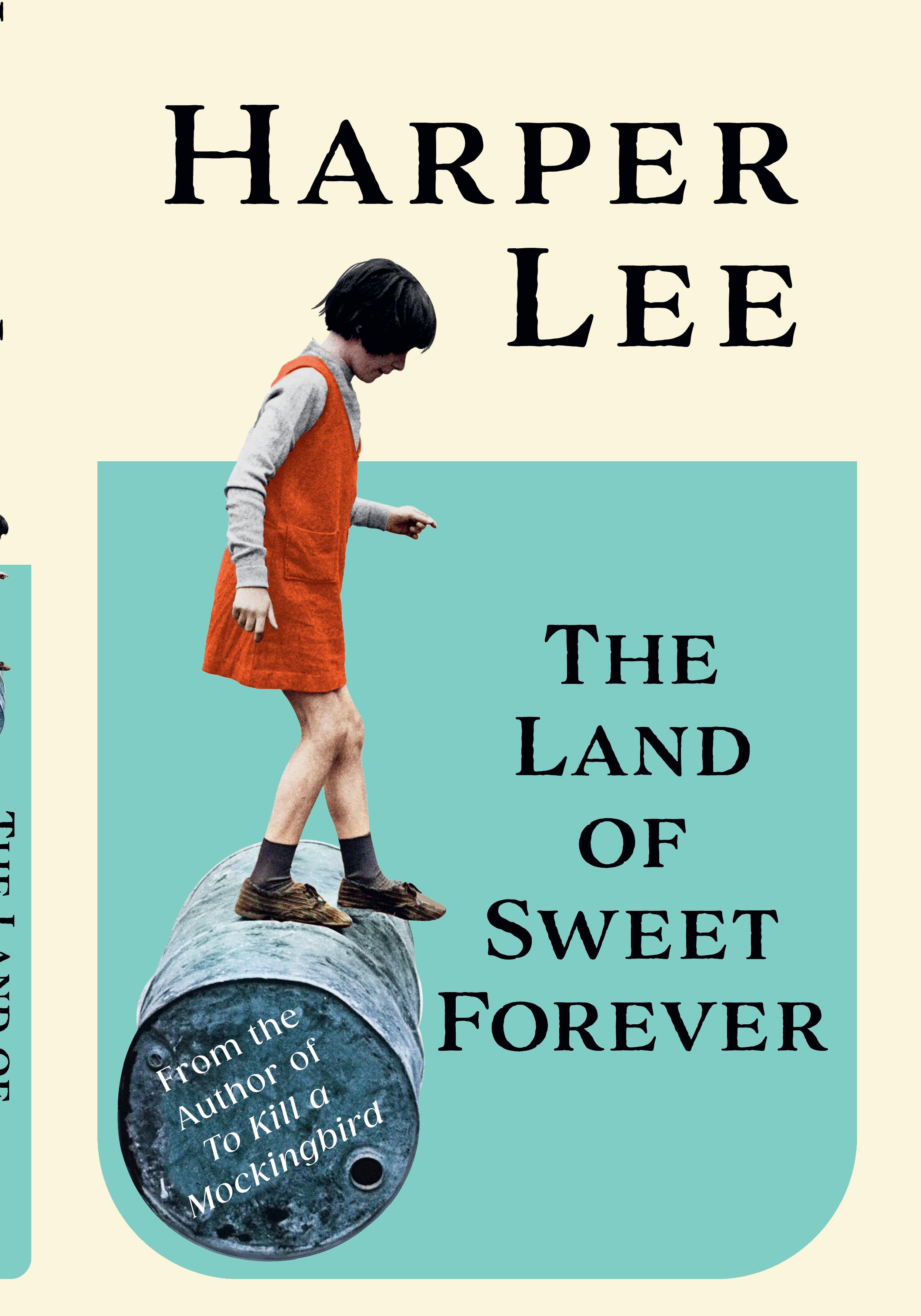
By the last of the stories that appear in this collection, Miss Finch has officially become “Jean Louise,” though she’s not yet Scout. Those who knew Harper Lee best all summon her blistering intellect, and one of the pleasures of this fi nal story is seeing that brilliance unleashed on the page—a story so dense with allusions that readers are not even expected to understand them. The title, “The Land of Sweet Forever,” comes from a hymn, and much of the plot, as if borrowed from Thackeray or Trollope, concerns itself, hilariously, with hymnody. Now a grown adult, Jean Louise is thoroughly conversant in lesser Anglican theologians, preposterously opinionated about the proper pacing of the Doxology, and peevish about alterations to tradition, mockseriously complaining that “our brethren in the northland are not content merely with the Supreme Court’s activities: they are now trying to change our hymns on us.”
Lee is funny and formidably smart on the simultaneous comfort and claustrophobia of returning as an adult to one’s childhood home, or one’s childhood anything, even church. By the time she wrote “The Land of Sweet Forever,” she was well-versed in such returns, having already made a great many of them. Two years after she moved to New York, in the summer of 1951, her father had called from the Vaughan Memorial Hospital in Selma to say that her mother had been
diagnosed with cancer of the liver and lungs. Before Lee could even arrange for travel home, A.C. called again, this time to say that Frances had died of a cardiac episode only a day after being diagnosed; it was only thanks to the airline where Lee still worked that she could even make it back in time for the service.
Six weeks later, that fi rst dreadful phone call was followed by another, this one informing her that her beloved brother, Edwin, the inspiration for Jem, had died of a brain aneurysm at the air force base where he was stationed in Montgomery, leaving behind a wife and two young children. Lee flew home again, her already considerable grief and shock now overflowing. She was just twenty- five years old, but capturing her childhood had never felt more urgent, partly because, as she describes in “The Cat’s Meow,” her father and oldest sister soon sold the family home where she’d been born and raised, moving into a more modern house on the other side of town. While Alice continued to commute the short distance from there to their law office on the courthouse square, A.C. stayed home and convalesced: bereft, riddled with arthritis, and soon troubled by cardiac issues of his own.
The move did not help the pair of homebodies escape the ghosts of South Alabama Avenue, and Lee, too, was
haunted by memories of her mother, her brother, and the world as it had existed before they died. She worried over her father and returned home often to help Alice with his care. She also began writing stories that attempted to reconcile her chosen home with her childhood one, merging the subjectivity of her Manhattan stories with the setting of her Monroeville stories, a kind of integrative work she was attempting both on and off the page.
At the time, Lee’s politics were still taking shape, especially when it came to the era’s most pressing moral concerns. The long struggle for civil rights was unfolding all across the nation but most contentiously in the Deep South, and like so many white Americans, Harper Lee wasn’t quite sure what to make of it. Her hometown was strictly segregated, with schools, churches, and restaurants divided by race; her own father had written newspaper editorials opposing federal antilynching laws, defending the conviction of the so- called Scottsboro Boys, who were falsely accused of raping two white women, and cautioning that a national education department might enforce the desegregation of schools.
Lee’s emerging political sensibility diverged from that of her father, but it remained to be seen by how much. In college, she had written some about the horrors of racial violence and made herself comfortable among the radicals on