


THE ACHILLES TRAP
SADDAM HUSSEIN,
THE UN ITED S TATES

AND THE MIDDLE EAST, 1979–2003
STEVE COLL


THE ACHILLES TRAP
SADDAM HUSSEIN, THE UNITED STATES AND THE MIDDLE EAST, 1979–2003
Steve Coll
ALLEN LANE
an imprint of
UK | USA | Canada | Ireland | Australia
India | New Zealand | South Africa
Penguin Books is part of the Penguin Random House group of companies whose addresses can be found at global.penguinrandomhouse.com.
First published in the United States of America by Penguin Press, an imprint of Penguin Random House LLC 2024 First published in Great Britain by Allen Lane 2024 001
Copyright © Steve Coll, 2024
The moral right of the author has been asserted
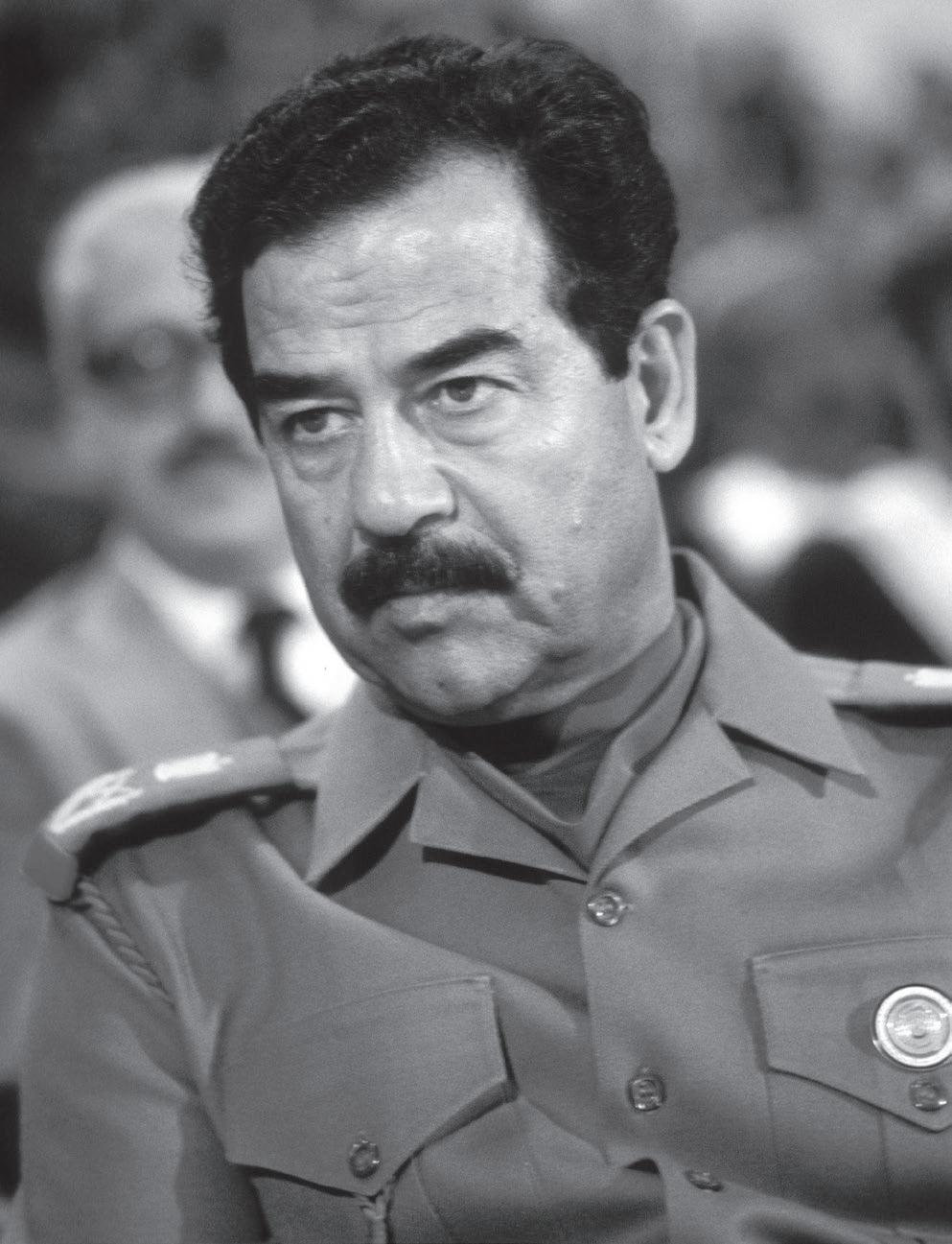
Photo credit: p. ii, Chip HIRES/Gamma-Rapho via Getty Images
Printed and bound in Great Britain by Clays Ltd, Elcograf S.p.A.
The authorized representative in the EEA is Penguin Random House Ireland, Morrison Chambers, 32 Nassau Street, Dublin D02 YH68
A CIP catalogue record for this book is available from the British Library
ISBN: 978–0–241–68665–2
www.greenpenguin.co.uk
Penguin Random Hous e is committed to a sustainable future for our business , our readers and our planet. is book is made from Forest Stewardship Council® certified paper
For Eliza
Sarah Moawad, who earned a master’s degree in Middle Eastern studies from Harvard and another in journalism from Columbia, made vitally important contributions to this book. She tracked down sources, helped conduct interviews, traveled to Jordan, and translated archival Arabic-language material with exceptional clarity. Her passion for the subject matter and her engagement with our sources inspired me throughout, and I owe her an immeasurable debt. Amel Brahmi, an experienced French journalist who is now a doctoral student at Columbia, also made invaluable contributions. She tracked down important Iraqi, French, and photographic sources, adding to the book’s detail and authority. Finally, on this five-year project’s last lap, David Kortava, a writer and fact- checker at The New Yorker, recontacted interviewees and rechecked documentary sources, adding nuance and clarity while also rescuing me from embarrassing errors. I am also indebted to many others, as described in the acknowledgments.
Author’s Note vii
List of Maps xi
Cast of Characters xiii
Introduction 1
6.
August 1990 to September 2001
11. Crash Programs 177
12. “The Situation Is Under Excellent Control” 198
13. Iraqi Spring 216
14. The Liar’s Truths 238
15. Mr. Max and the Mayfair Swindler 257
16. “We Need to Turn This Thing Off, Now!” 275
17. “There Would Be a Bloodbath” 289
18. Honor among Tyrants 304
19. Spy vs. Spy 321
20. Crime and Punishment 339
21. The Logic of Illusion 353
22. The Secret Garden 371
BLIND MAN’S BLUFF
September 2001 to March 2003
23. The Pundit 389
24. Cold Pitch 407
25. Cracked Mirrors 418
26. “Do We Have WMD?” 435
27. The Edge of the Abyss 453
Epilogue 469
Acknowledgments 485
A Note on Sources 489
Notes 493
Bibliography 529
Index 535
Baghdad in the Saddam Hussein Era (page 7)
Iraq’s Secret Nuclear Program, 1981–1991 (page 242)
The C.I.A. and Iraq’s Opposition, 1994–1996 (page 335)
Saddam Hussein and His Closest Family
Saddam Hussein, born on April 28, 1937
Subha Tulfah al- Musallat, his mother, died in 1983
Hussein al- Majid, his natural father, died before Saddam’s birth
Ibrahim al- Hassan, his stepfather
Khairallah Tulfah, his uncle and mentor
Sajida Khairallah Tulfah, Saddam’s wife, married in 1963
Uday, son, born in 1964
Qusay, son, born in 1966
Raghad, daughter, born in 1968
Rana, daughter, born in 1969
Hala, daughter, born in 1972
Hussein Kamel al- Majid, son-in-law married to Raghad, born in 1954
Saddam Kamel al- Majid, son- in-law married to Rana, born in 1960
Sabawi al-Tikriti, half brother, born to his mother and stepfather in 1947
Barzan Ibrahim al-Tikriti, half brother, born in 1951
Watban al-Tikriti, half brother, born in 1952
Samira Shahbandar, Saddam’s paramour and rumored second wife
Tariq Aziz, Saddam’s principal external envoy
Izzat Ibrahim al- Douri, Revolutionary Command Council
Nizar Hamdoon, ambassador in Washington and at the U.N.
Jafar Dhia Jafar, physicist and nuclear program leader
Abid Hamid Mahmud, Saddam’s personal secretary
Ali Hassan al- Majid (“Chemical Ali”), Baath Party commander, minister, and governor
Taha Yassin Ramadan, Revolutionary Command Council
Ayad Allawi, medical doctor and leader of the Iraqi National Accord
Ahmad Chalabi, banker and leader of the Iraqi National Congress
Masoud Barzani, leader of the Kurdistan Democratic Party
Wafiq al- Samarrai, former general in military intelligence and C.I.A. liaison
Hussain Al- Shahristani, physicist and humanitarian activist
Mohammed Abdullah Shawani, former Iraqi special forces commander
Jalal Talabani, leader of the Patriotic Union of Kurdistan
Frank Anderson, head of Middle East operations under George H. W. Bush and Bill Clinton
Robert Baer, operations officer specializing in the Middle East
William Casey, director under Ronald Reagan
John Deutch, director under Bill Clinton
John Maguire, case officer in Amman under Bill Clinton, deputy head of the Iraq Operations Group under George W. Bush
David Manners, Amman station chief
Bruce Riedel, Middle East analyst and White House policy adviser
Luis Rueda, head of the Iraq Operations Group under George W. Bush
Charles “Charlie” Seidel, Baghdad station chief
George Tenet, director under Bill Clinton and George W. Bush
Thomas “Tom” Twetten, Amman station chief, later head of Middle East operations and deputy director of operations
William Eagleton, ambassador to Iraq for Ronald Reagan
April Glaspie, ambassador to Iraq for George H. W. Bush
David Mack, senior diplomat in Iraq and Washington
David George Newton, ambassador to Iraq for Ronald Reagan
Joseph Wilson, deputy chief of mission in Iraq under George H. W. Bush
Colin Powell, chairman of the Joint Chiefs of Staff under George H. W. Bush and Bill Clinton, secretary of state under George W. Bush
Rick Francona, Defense Intelligence Agency liaison to Baghdad
W. Patrick “Pat” Lang, Middle East analyst and Defense Intelligence Agency liaison to Baghdad
Samuel “Sandy” Berger, national security adviser to Bill Clinton
Richard Haass, Middle East adviser to George H. W. Bush
Martin Indyk, Middle East adviser to Bill Clinton
Anthony “Tony” Lake, national security adviser to Bill Clinton
Robert “Bud” McFarlane, national security adviser to Ronald Reagan
Condoleezza Rice, national security adviser to George W. Bush
Rolf Ekéus, director of the U.N. Special Commission to disarm Iraq
Hans Blix, director general of the International Atomic Energy Agency
Charles Duelfer, deputy director of the U.N. Special Commission
Scott Ritter, inspector at the U.N. Special Commission
In October 2003, seven months after the American-led invasion of Iraq, I traveled to Baghdad on assignment for The Washington Post. Saddam Hussein was by then a fugitive in hiding. Occasional car bombs rattled the capital, a prelude of much worse to come. One afternoon, at a fortified compound near the Republican Palace, I met Hamish Killip, a British investigator with the Iraq Survey Group, a C.I.A.- sponsored multinational task force dispatched at the onset of the invasion to find Saddam’s hidden stocks of nuclear, biological, and chemical weapons. By now it was apparent that Iraq possessed no such weapons. The shock of this revelation had already touched off investigations into the profound failures of U.S. intelligence and White House decision- making. In Iraq, the Survey Group’s mission had unexpectedly changed from hunting for weapons to sorting truth from lies in the history of the Saddam Hussein regime.
One set of questions involved Saddam’s motivations. Why had he seemingly sacrificed his long reign in power by giving the impression that he had dangerous weapons when, in fact, he had none? Or as Killip put it that afternoon, addressing Saddam: “What was so damned important that you were willing to go through all of this?”
Across town, I met David Kay, the Survey Group’s leader. He was exploring a theory that Saddam had been bluffing— pretending that he
might have WMD in order to deter the radical ayatollahs of Iran from attacking Iraq. And yet the matter seemed uncertain, Kay told me, since Saddam did not appear to have been particularly afraid of Iran. When one of his ministers had worried aloud that Iran might pursue its own nuclear or chemical arsenal, Saddam had reportedly replied, “Don’t worry about the Iranians. If they ever get WMD, the Americans and the Israelis will destroy them.”
This was vintage Saddam, I now recognize— half joking, capable of striking prescience, reliably fixated on American and Israeli power, and, above all, impossible to reduce to a simple explanation. Successive American presidents misjudged him. They often dismissed him as a cartoon autocrat, akin to the faux Adolf Hitler played for laughs by Charlie Chaplin in The Great Dictator. Certainly, Saddam Hussein was as unsubtle as a shotgun blast. He was a cruel tyrant directly responsible for the deaths of hundreds of thousands of Iraqis, as well as for the torture or imprisonment of many tens of thousands more. Without serious provocation, he invaded two of his neighbors, Iran and Kuwait. During the Iran- Iraq War, he gassed Iranian troops and his own rebellious Kurdish population. During the Gulf War, he lobbed terrifying Scud missiles at Saudi Arabia and Israel. He plastered Iraq with his image to promote his cult of personality. His speeches were often bombastic and alarming. Against such a record, it seems more than a little odd to argue that Saddam’s enemies failed to grasp important nuances of the man and his rule through the Baath Party. Yet as America’s tragic invasion to eliminate a nonexistent WMD arsenal amply demonstrated, there was more to Saddam than Washington’s politicians and spies could grasp— even when the stakes were very high.
The Achilles Trap is an investigation into how this failure of comprehension unfolded. It seeks to enlarge the story of the 2003 invasion’s origins by elevating Saddam’s side of the conflict and by adding substantial new information. Saddam left an extraordinary and still mostly secret trove of about two thousand hours of tape recordings of his leadership meetings— private discussions he recorded as assiduously as Richard Nixon— as well as meeting minutes, intelligence files, and other
materials. They document what the Iraqi leader was saying privately at turning points of his struggle against the United States. The Saddam tapes have a complicated, problematic history. They were captured by invading U.S. forces and repatriated to Iraq in 2013, but most have never been released, and virtually all are currently unavailable to researchers (see “A Note on Sources”). During the more than four years I worked on The Achilles Trap, I obtained several hundred transcripts, audio files, and document sets, including those of Saddam’s internal discussions. With support from Adam Marshall and the Reporters Committee for Freedom of the Press, I sued the Pentagon under the Freedom of Information Act and acquired a cache of 145 transcripts and files, including materials never before published. The scholar Michael Brill generously shared his sizable private archive assembled from previously open sources since closed. By connecting these and additional parts of the captured files with other sources, including interviews with surviving participants, it became possible to see in new ways what drove Saddam in his struggle with Washington, and to understand how and why American thinking about him was often wrong, distorted, or incomplete.
Starting with Saddam’s rise to unchecked power in 1979 and the birth of Iraq’s secret nuclear-weapons program soon afterward, it is a story that encompasses diverse episodes and crises: Saddam’s furtive collaboration with the C.I.A. during the 1980s; the Gulf War of 1991; the struggle over Iraqi disarmament that followed; and the climactic confrontation after 9/11. One recurring theme is the trouble American decision- makers had in assessing Saddam’s resentments and managing his inconsistencies. It is a theme that resonates in our present age of authoritarian rulers, when the world’s stressed democracies seek to grasp the often unpredictable decision- making of cloistered rulers, such as Vladimir Putin, or to influence other closed dictatorships, such as North Korea’s. Saddam believed— not without reason— that he was besieged by would-be assassins and international conspirators. He was very keen to remain in power. About this, he was exceptionally cunning. In discussions with comrades— he usually did most of the talking— he
regularly steered the conversation around to the subject of conspiracies. In his worldview, nothing was ever quite what it seemed. Great Powers like America and regional powers like Iraq were ceaselessly plotting in the shadows against one another. In one memorable meeting, he mused aloud about the relative strengths of the spy services out to get him. (He gave high marks to the Israelis and the British.) And, of course, they were out to get him.
One after another, three American presidents— George H. W. Bush, Bill Clinton, and George W. Bush— signed Top Secret “findings” directing the C.I.A. to overthrow Saddam. This campaign to foster a coup d’état in Baghdad, which lasted from May 1991 until the 2003 invasion, proved to be spectacularly unsuccessful. As recently available records show, Saddam was well aware of the C.I.A.’s not- so- covert actions, which he regarded, in any event, as nothing new or unexpected— just another day at the office. Saddam entered politics as a Baath Party assassin. He and his comrades had grappled as young revolutionaries with the C.I.A.’s prior involvement in Iraqi affairs, dating to 1963, when the C.I.A. supported a Cold War–driven coup that briefly brought the Baath Party to power.
Like many people in the Middle East and elsewhere, Saddam thought of the C.I.A. as all-knowing. This contributed to his own misunderstandings of America, which were at least as profound as America’s misunderstandings of him. For instance, after 1991, Saddam assumed that the C.I.A. knew that he had no WMD, and so he interpreted American and British accusations about his supposed arsenal of nukes and germ bombs as merely propaganda lines in a long-running conspiracy to get rid of him. He resisted the disarmament inspections demanded by Washington and London as a possible alternative to war partly because he saw the camera-wielding, walkie-talkie-toting inspectors as spies with a hidden agenda— again, not without reason. A C.I.A. capable of making a gigantic analytical mistake on the scale of its error about Iraqi WMD was not part of Saddam’s worldview.
For its part, the C.I.A.— assigned a central role in America’s dramas
with Saddam from the early 1980s onward— suffered from White Houses and agency leaders who often halfheartedly deployed their spies as if they were wizards with magic wands, conjurers who might solve the otherwise unsolvable Saddam problem. This was a prescription for failure, history showed, but the C.I.A. has been no better at learning from its own history than the nation it serves. Although marked by episodes of daring, success, and shrewd judgment— and populated by a remarkable cast of committed American operatives— the C.I.A.’s record in Iraq after 1991 was mostly one of operational and analytical calamities. This is not just an outsider’s hindsight verdict. Inside the C.I.A. during the late 1990s, the Iraq Operations Group was known sardonically as “the House of Broken Toys.”
In addition to the stories of Saddam and his flamboyantly brutal ruling family, I have chronicled the sometimes astonishing experiences of other Iraqis who lived on the front lines of the conflict with Washington, such as Jafar Dhia Jafar, the British- educated physicist who was the intellectual leader of Iraq’s atomic-bomb program, and Tariq Aziz, Saddam’s longtime envoy. No dictatorship is a monolith, and I hope the complicated lives of talented Iraqi patriots who accommodated Saddam may add dimension to our understanding of what the regime was and how it so confounded America. Equally, I have tried to humanize some of Saddam’s victims and opponents (also Iraqi patriots), such as Hussain Al- Shahristani, the Canadian- educated physicist who worked with Jafar on the nuclear program but was tortured and then imprisoned after refusing Saddam’s entreaties to help build a bomb.
Much of America’s self- examination since 2003 has concentrated on the post- 9/11 run- up to the invasion— the false claims about Iraqi WMD, the media’s complicity, neoconservative hubris, and George W. Bush’s choices. Investigative journalists have produced a remarkable shelf of book-length work on the C.I.A.’s covert-action campaigns before and after 9/11, the Bush administration’s selling of the war, and the intrigues of specific episodes, such as that involving the infamous intelligence source known as Curveball. In addition, there have been
significant studies of the conflict that go back to its origins. In September 2004, the Survey Group, under its second leader, Charles Duelfer, published a multivolume study of the history of the Saddam Hussein regime’s internal dynamics and weapons programs. In recent years, scholars have dug into the available regime files and offered groundbreaking insights or brought forward other new information. I have relied gratefully on all of this documentary record, journalism, and scholarship.
America’s conflict with Saddam Hussein is saturated in the primary colors of political history— the corruptions of power, the follies of war, the lies of diplomacy, the price of dissent, the absurdity of vanity. It is a story of avoidable errors of statecraft that exacted an immeasurable toll in human life and suffering. Some of these errors resulted from blindness about the enemy, others from “mirroring,” the human habit of assuming that adversaries will analyze a situation as you would and act accordingly. Saddam was right that nothing in this long struggle was quite what it seemed. Much of what mattered lay hidden from public view. It is in these shadows, as Saddam Hussein reaches a fateful decision to inaugurate a secret atomic-bomb program, that The Achilles Trap begins.
TigrisRiver
Iraqi Military Intelligence headquarters
Baghdad College
Ministry of Foreign Affairs
Iraqi Mukhabarat headquarters, 1980s
Al-Mansour Melia hotel
Jafar Dhia Jafar’s home
Al-Rashid Hotel Republican Palace
Swords of Qādisiyyah
Mother of Pigs island
U.S. interest section
TigrisRiver
Radwaniyah
December 1979 to August 1990
Jafar Dhia Jafar downed a last glass of sugared tea and slid into a chauffeured Toyota Crown Saloon for his morning commute to the Tuwaitha Nuclear Research Center, a drive of about twelve miles from his home in Baghdad, where he resided in a neighborhood of former palaces and ministerial residences. It was December 4, 1979, and Jafar, a senior scientific adviser in Iraq’s nuclear program, expected a typical day of meetings and consultations. He was thirty- seven years old, tall and evenly featured, reserved in manner and deliberate in speech. In addition to Arabic, he spoke English fluently, in a refined British accent acquired during years of study at the University of Birmingham, where he had earned a doctorate in nuclear physics and met a British woman, Phyllis, who became his wife. His Iraqi colleagues thought of him as aristocratic. Jafar’s maternal grandfather had served as a provincial governor, and his father had been a minister in Iraq’s last royal government until it was overthrown in a bloody 1958 revolution. Successive coups had overtaken the Jafars’ world of elegant privilege,
yet his family had adapted and persevered. Their Baghdad properties included a traditional riverside home with latticed windows near the British embassy. Jafar had a new house under construction nearby, as well as a flat in London.1
The Nuclear Research Center was an industrial-looking complex of about five dozen buildings surrounded by irrigated wheat fields, set beside a meander in the Tigris River. Jafar passed through its heavily guarded gates. To one side was the pride of Iraq’s program, a fivemegawatt IRT-5000 research reactor purchased from the Soviet Union during the 1960s. Jafar’s office was in a low- slung headquarters building, near a library. 2
That morning, he visited the center’s director general, Humam Abdul Khaliq, a longtime member of President Saddam Hussein’s ruling Baath Party— formally, the Baath Arab Socialist Party. Khaliq was an amiable man with a graduate degree in physics, also earned in Britain. They were discussing administrative matters when Khaliq’s phone rang. Jafar listened as the director spoke curtly, seeming to take orders.
After he hung up, the director said the secret police were coming.
They wanted to speak with Hussain Al- Shahristani, a senior scientist at Tuwaitha and a good friend of Jafar’s. The two mid- career physicists were the same age. They had recently traveled together to France, where they had worked on Iraq’s acquisition of two new French- made nuclear research reactors that were to be installed at the research center, with the goal of greatly expanding Iraq’s work in fields such as power generation and medicine. Shahristani had earned his doctorate at the University of Toronto, where he had met his Canadian wife, Berniece, a convert to Islam. He belonged to a well-known family of Islamic scholars in the Shia tradition of Islam, one of the faith’s two major branches.
Jafar feared he knew why Shahristani might now be in difficulty. Jafar, whose family was also Shia, was not especially religious, but his friend was devout. Shahristani prayed five times every day; at Tuwaitha, in lieu of a prayer rug, he sometimes unfurled computer paper
on the floor and bowed toward Mecca. For many years, his devotion had seemed of little consequence to Jafar and other colleagues, but the climate in Iraq around politics and Islam was shifting. 3
In neighboring Iran, Ayatollah Khomeini had announced a militant revolution in the name of Shia Islam. Khomeini despised Saddam Hussein. (Saddam and many Baath Party leaders were Sunni, the most prevalent branch of Islam worldwide but a minority within Iraq.) Khomeini predicted “that pig” in Baghdad would fall within six months because of a “revolution like ours.” An underground Shiite movement in Iraq, the Islamic Dawa Party, energized by Khomeini, had opened an office in Tehran and was planning assassination attempts against Baath Party leaders. Saddam’s intelligence services were on high alert for spies and terrorists inspired by Khomeini. Shahristani was not a Dawa Party member, but he had met Khomeini years earlier and sympathized with the Iranian Revolution. He had contact with Iraqi Shiite activists. By attending meetings and helping out here and there, Shahristani hadn’t done anything so seditious that it would be illegal in, say, Canada, but he was aware that Iraqi intelligence operated bluntly and that he was at risk. That autumn, he had told his wife to be ready to leave Iraq at any time.4
Jafar found Shahristani in his office. Soon, a captain in charge of security at Tuwaitha joined them. He gave a military salute.
“I have a question for Dr. Hussain,” he said.
“Please ask,” Shahristani replied.
“No, not here. Come with me outside.”
The officer placed Shahristani under arrest. The reality of what had happened hit Jafar “like a thunderbolt.” Iraq’s police state operated through a vast web of overlapping forces. It outraged Jafar that the secret police could just walk into Tuwaitha and grab a scientist who served as a high- ranking adviser to the national nuclear program.
Shahristani turned to Jafar as he departed. “Please tell my family if I am late,” he said.
From a window, Jafar watched the police bundle his friend into the
back seat of an unmarked car with civilian plates. The vehicle sped away from Tuwaitha. 5
The security men brought Shahristani to an interrogation room in the headquarters of a secret police force known informally as the Amn. It quickly became apparent that Jafar had been right— Shahristani had been arrested because of his contacts with the Dawa Party.
Yes, Shahristani explained, he had been involved in various religious activities while studying in Canada and England, but he had no “organizational relationship with any Islamic party.”
His interrogators took him to another room and hung him on a hook attached to the ceiling. They administered electric shocks and beat him with whips and cables, demanding confessions. Shahristani lost all feeling in his arms and legs.
The police seemed fixated on a mysterious incident that had taken place earlier that year in France. On the night of April 6, 1979, in La Seyne- sur- Mer, on the French Mediterranean coast, saboteurs had broken into a warehouse and blown up sections of the new nuclear reactors that were to be installed at Tuwaitha. Shahristani had looked into the case and had concluded (correctly, as it turned out) that Israel’s Mossad intelligence service had mounted the attack to set back Iraq’s nuclear capabilities. His interrogators, however, offered another hypothesis: “We have confirmed information that Dr. Jafar was complicit, because his father was a minister during the royal era and he grew up and studied in England, so he is the party that was in contact with Western intelligence,” they said, suggesting that he had colluded with the West to arrange the sabotage in France.
They offered to release Shahristani if he would name Jafar as a traitor.
“I cannot make such an accusation against Dr. Jafar,” Shahristani said, as he recalled. In fact, neither he nor Jafar had anything to do with the sabotage in France.
The beatings and electric shocks resumed. Shahristani counted twenty-two consecutive days and nights of torture.6
Jafar visited Shahristani’s home in Baghdad a couple of days after his colleague’s arrest to check on Berniece and the family. He felt a duty to his friend. Two civilian security officers answered the door and aimed their pistols at him. Inside, nobody but the officers appeared to be present. The house had been ransacked; books and files lay on the floor. Jafar waited. Berniece soon returned with her children, understandably confused about what was happening. Jafar assured her that her husband “must be acquitted and he will return to his family safely, God willing.”
In the days following, Jafar discussed Shahristani’s detention with Khaliq and other bureaucrats at Tuwaitha, but they answered his concerns with a “terrible silence,” stating only that they were instructed by the Baath Party not to interfere in the affairs of the secret police.
Jafar had once met Saddam, during a brief ceremonial visit. He decided to write to the Iraqi president. He thought he could appeal to Saddam’s passionate support for Iraq’s atomic- energy program. In a short letter, Jafar attested to Shahristani’s reliability and warned that his colleague’s imprisonment would damage Iraq’s nuclear ambitions.7
He heard nothing. Jafar’s relationship with Saddam’s regime was delicate, if not precarious. He had declined to join the Baath Party; he did not wish to affiliate directly with the party’s ideology and rule. His social background and prestigious education abroad cut both ways— it might protect him, since Saddam needed and promoted talented scientists, but it also might endanger him, since the secret police, like their president, were automatically suspicious of Iraqis with Western ties.
That December, Jafar decided to move his family out of harm’s way. His wife, Phyllis, was away in England. Their two sons, Sadiq, fourteen, and Ameen, thirteen, were living with Jafar in Baghdad. He telephoned his old boarding school, Seaford College, in West Sussex, England, and
asked to enroll his boys quickly. The headmaster agreed, and Jafar put his sons on a flight to London before Christmas.8
Late in December, Jafar again wrote to Saddam, repeating his earlier pleadings on Shahristani’s behalf. On January 16, he received a telephone call from an official at the Iraqi Atomic Energy Commission, the political body that oversaw Iraq’s nuclear activities. The caller asked Jafar to stay late after work at Tuwaitha that day for a meeting. When he arrived, he found a man from the General Intelligence Directorate, known as the Mukhabarat, waiting to arrest him.
The officer drove him to a former synagogue now occupied by the secret police. Guards handed Jafar pajamas and bedding and placed him in a windowless room holding four other detainees. One identified himself as Saddam’s barber; he had been jailed after turning up late for a morning shift. Jafar was comforted to hear that none of the men had yet been physically assaulted. That night, however, he could hear prisoners wailing in nearby interrogation rooms.
He remained in this cell for two months, but his interrogators did not beat him or question him. Why had he been arrested? The distorted, ever- shifting suspicions of Iraq’s police state could be difficult to parse, but it seemed very likely that Jafar’s impertinence in writing to Saddam on Shahristani’s behalf was the reason. By speaking up for his colleague, Jafar had violated Iraq’s unwritten rules demanding silence about such matters.
In March 1980, Jafar’s wardens transferred him to a larger cell with thick bars and a window looking out on a corridor. Here he was alone. The room contained a bed, a wardrobe, and a table with paper and pen. There was a note: “You can write to whomever you want, whenever you want.” Soon he was dining on take- out kebabs from nearby restaurants. Yet he had no indication of how his detention might be resolved.
In June, they moved him again, this time to a cell with a window that looked out on a courtyard. After a few days, the prison’s director met Jafar and escorted him to a government car. The director explained that Jafar was to meet the leader of the Mukhabarat— Barzan Ibrahim al-Tikriti, a half brother of Saddam’s. 9
On July 17, 1968, Saddam had ridden with Baath comrades into the Republican Palace on tanks and trucks to seize control of the Iraqi government. It was a landmark day in the “revolution”— in reality, more of a coup d’état— that would catapult Saddam to power. At Saddam’s side was Barzan, a skinny bodyguard with a pistol and a readiness to use it. He had come of age “like a shadow” to Saddam, a constant presence during the 1960s, Iraq’s tumultuous decade of conspiracies and coups. Saddam was fourteen years older than his half brother. They were bound not only by family but by murder. As a teenager, Saddam had shot dead a man over an employment dispute involving their extended families. The matter escalated, and Barzan, by his later account, subsequently killed four other men connected to the feud.10
After the July 17 takeover, Saddam became Iraq’s vice president. He dispatched Barzan to Cairo to be trained in intelligence and security by the hard men of Egypt’s police. When he returned, Saddam placed him in charge of security in his office. Barzan’s receding hairline added years to his appearance— usefully so, given that he was still in his early twenties as he took command of powerful security services. He had dark eyes, kept a neat black mustache, and wore fashionable Western suits, in keeping with the Baath Party’s urban, secular look. He exuded the callow hubris that can accompany the acquisition of vast authority in youth. He was unsubtle and easily offended. He struck some who encountered him as “a nitwit,” as a scientist at Tuwaitha put it. In later years, Saddam came to think of him as “an asshole.” Yet Saddam needed fiercely loyal henchmen.11
In 1977, over breakfast, Saddam asked Barzan to become the second- in- command at the Mukhabarat. “Barzan, you need to know something,” Saddam told him. “We went down the road we did, and reached a point of no return. Therefore, we must continue to the end.” This was typical of Saddam’s aphoristic instructions to subordinates— menacing and vague.12
Barzan soon took full charge of an intelligence service that had
officers and gunmen across Iraq and spies placed under diplomatic cover in embassies around the world. In 1979, Saddam became president and tightened his grip on Iraq. Barzan relished his mission: “Not even an Iraqi sitting in a café in a remote part of Japan would feel safe if he spoke disparagingly of Saddam and our regime,” he recalled.13
On the day in June 1980 when Jafar met Barzan in his spacious office, he found the intelligence chief in a solicitous mood. Jafar’s recollection of the discussion is consistent with other conversations Barzan had around this time, and with Barzan’s later writings to Saddam.
“Have you been abused?” Barzan asked initially.
“I have not been mistreated,” Jafar said, “but I do not know the reason for my arrest.”
Barzan came to the point: “The president wants you to work toward producing a nuclear weapon for Iraq.”
Jafar demurred. “I am a physicist, and I have no experience in this field,” he said.
“We know you can do it,” Barzan replied.
Of course, Jafar understood that the nuclear facilities and scientists at Tuwaitha might theoretically be employed in an attempt to build an atomic bomb. But such an effort would be very difficult, and it had never been seriously explored. After the Baath Party came to power in 1968, Iraq had signed the Nuclear Nonproliferation Treaty, which required the country to forswear nuclear weapons and accept international inspections at Tuwaitha. The French reactors sold to Iraq would be supervised by the International Atomic Energy Agency (I.A.E.A.), a watchdog assigned to prevent the spread of nuclear arms. If they tried to build a bomb, they would have to evade the international inspectors.
Barzan pressed Jafar. Saddam, he insisted, “is confident that you can work on this mission.”
Jafar said little, by his account, but he decided to cooperate. A few days later, security officers transferred him to a spacious house with a
large garden by the Tigris River. It contained a telephone and two televisions. Five guards watched the physicist day and night. He was under house arrest and still had no idea how long he would be detained.
An intelligence officer brought Jafar some clothes from home, as well as books from the library at Tuwaitha. One volume was titled The Theory of Isotope Separation as Applied to the Large-Scale Production of U-235, referring to a uranium isotope that can provide the explosive material in atomic weapons. The book was published in 1951. It summarized theoretical work undertaken at a Columbia University lab with ties to the Manhattan Project, America’s secret World War II– era bomb program, led by the physicist J. Robert Oppenheimer. This was the first book Jafar selected. As summer heat suffocated Baghdad, he began to read.14
Following his three weeks of torture, Shahristani was hauled before a Baath Party court. He was placed in a cage with three other defendants, all of them charged with crimes against the state. “These are agents of imperialism and Zionism, and enemies of the party and the revolution,” the prosecutor declared.
The judge cursed Shahristani. The scientist’s appointed defense lawyer rose to speak. “These are traitors, foreign agents and enemies of the party and the revolution,” he affirmed.15
Shahristani was sentenced to life in prison at hard labor. He was taken to Abu Ghraib, the notorious maximum- security facility about twenty miles west of Baghdad, where many hundreds of political prisoners were held. Torture and executions were commonplace there. Shahristani was placed in a closed section that housed prisoners judged to be threats to national security. The inmates were allowed no visitors and had no information about the outside world. Desperate for meaning, they reported their nightly dreams, Shahristani discovered— stories that were interpreted as factual “news” of Iraq and the world beyond, and that spread quickly from cell to cell. Shahristani relied on prayer to keep his mind and spirit intact.
About seven months after his initial arrest, at around the time Jafar was transferred to comfortable house arrest, Shahristani was also moved to a separate home in Baghdad’s upscale Mansour neighborhood. Neither man knew about the fate of the other. Shahristani was permitted no calls or visitors, but a cook arrived to prepare his meals. He still suffered numbness from his torture and had difficulty walking. He often lay down on the floor to be comfortable.
He was lying prone in his bedroom one day when Barzan arrived.
“Dr. Hussain, we know all about you,” the intelligence chief said. “You are a good scientist.”
Barzan cursed the security services for having arrested and abused Shahristani. “Sayyid Rais Saddam,” he continued, referring to the president with a double honorific, “was very upset when he learned that these people had arrested you.”
Soon he got to the reason for his visit. “We need to develop a nuclear weapon. That will give us a long arm to reshape the map of the Middle East.” He made a sweeping gesture with his hand.
“I know nothing about making atomic bombs,” Shahristani protested. His scientific specializations had little direct relevance.
“We know of your capabilities,” Barzan insisted. He made the choice explicit: “A person who is not willing to serve his country does not deserve to be alive.”
“I agree with you,” Shahristani said, looking up from the floor. “It’s a person’s duty to serve his country. But what you are asking may not be a service to my country.”
Shahristani’s mind was made up. After what he had seen in the torture rooms, he thought to himself, Any weapon in Saddam’s hand would be used against the Iraqi people before it was used on anybody else.16
When Jafar Dhia Jafar was thirteen, in 1956, he met Sir John Douglas Cockcroft, a British physicist who had shared a Nobel Prize for work on atomic particles, and who was visiting Baghdad. Jafar was then a precocious student at Baghdad College, an elite boys’ prep
school founded by Jesuits from Boston. Jafar’s father was the minister for development and construction in the Iraqi government led by King Faisal II. He held a reception for Cockcroft at his home near the Tigris.
“What do you want to be when you grow up, Jafar?” Cockcroft asked playfully when he was introduced to the minister’s son.
“I want to build an atomic bomb,” Jafar replied.
Cockcroft raised his eyebrows and turned to other guests.
The Bomb was in the news, and Jafar had spoken with “childlike innocence,” as he recalled, to please his family’s honored guest. Yet he proved to be attracted to nuclear physics as he came of age. He was a conceptual thinker. After leaving Baghdad College to enroll at an English boarding school, he matriculated at seventeen at Birmingham, a university known for advanced research in nuclear physics. The university housed a particle accelerator— an elaborate device that uses electromagnetic fields to accelerate atomic particles to nearly the speed of light, with the aim of facilitating experiments that can provide insights into the building blocks of the physical universe. After three years of undergraduate work, Jafar gained entry to Birmingham’s doctoral program; while there, he wrote a thesis concerning elementary atomic particles. At twenty- eight, through a research appointment at London’s Imperial College, Jafar found himself in a particle physicist’s dream job—working at the European Organization for Nuclear Research, or CERN, in Geneva, the site of some of the world’s most prodigious particle accelerators.17
Jafar stayed at CERN for four years until, in late 1974, Iraq’s consul general in Geneva paid him a visit. Vice President Saddam Hussein was already seen as Iraq’s man of the future, pouring money into literacy drives, health care, industrialization, weaponry, and technology— including nuclear science.
The Iraqi diplomat told Jafar that he had a message for him from Saddam: it was time for the physicist to come home, to take up a senior position at Tuwaitha and work for the benefit of his country. Jafar understood the request as “an offer I shouldn’t— I cannot— refuse.”18
In the polarizing Cold War, Saddam sought to minimize Iraq’s dependence on both the United States and the Soviet Union. Yet he wanted the world’s most advanced technologies to speed the development of Iraq’s economy and society. During the 1970s, he embraced France, and France embraced him. When Iraq nationalized its oil industry alongside other Arab states, Saddam cut a side deal that allowed France to continue buying almost a quarter of Iraq’s output. He visited Paris in 1972. Charles de Gaulle had recently died, but Gaullism’s independent streak lived on in French policy toward the Arab world. French politicians and diplomats played a long game in Arab capitals and courted leaders of even the most brutal governments. The grandiose, secularleaning Arab nationalism promoted by Saddam’s Baath Party echoed aspects of French nationalism and attracted the open admiration of some Gaullists. Saddam’s envoys shuttled to and from Paris, where Iraq owned four diplomatic properties in the posh Sixteenth Arrondissement. High- ranking Baathists traveled to France for medical treatment or recruited French surgeons to perform difficult surgeries in Baghdad. Iraq’s oil revenues had skyrocketed, soaring on their way from $476 million in 1968 to $26 billion by 1980. During the 1970s, Saddam drew up an extraordinary shopping list in France: dozens of Mirage fighter jets for the Iraqi Air Force, a petrochemical plant, two cement factories, a military hospital, the modernization of Baghdad’s airport, and the two nuclear reactors destined for Tuwaitha.19
On Friday, September 5, 1975, Saddam landed at Orly Airport in Paris, where Jacques Chirac, then forty-two and France’s prime minister, received him. Chirac had cultivated a friendship with Saddam, whom he found “intelligent, not devoid of humor, even rather nice.” Saddam traveled to Les Baux- de-Provence, a picturesque village in the South of France. He lodged at the Baumanière hotel, home to a three- Michelinstar restaurant. At dinner, his taste for house specialties, such as poulet de bresse à l’estragon, proved to be limited; on his third evening, he asked
for comfort food: lentil soup, grilled fish, and stuffed lamb with cinnamon. Saddam was wary; one bodyguard stood vigil inside his hotel room door, and another slept at his feet. Yet he was generous to his hosts. There were about five dozen hotel and restaurant staff working around the clock during his visit. Typically, guests left an envelope with a cash tip to be shared. Saddam’s aides left nothing but asked for a list of each French worker by name. A year later, a representative returned with a suitcase containing one thousand French francs for each staff member, or just over $1,000 in 2021 dollars.20
Saddam attended a festival of games in Les Baux displaying feats on horseback and in a bullring. In one match, young men on foot, dressed in white, tried to grab a red cloth tied to the horns of a wild bull. Saddam warmed to these Mediterranean relics of peasant prowess. Normally only the winners received prize money, but Saddam showered every competing horseman and raseteur with fifteen thousand francs. 21
His hosts arranged for Saddam to visit the nearby French nuclear research center at Cadarache, spread over nearly four thousand acres. Saddam sported a burnt- orange, double-breasted, wide- striped business suit that was loud even by the garish styles of the time. He pulled on a white lab coat for his walking tour and beamed with apparent curiosity. France had tested its first nuclear bomb in 1960 and had been legitimized as a nuclear weapons power by the Nonproliferation Treaty. De Gaulle had exported nuclear reactors to Israel, which enabled that country to secretly build its own, undeclared atomic bombs in defiance of the accord. Even though the French reactors destined for Iraq would be subject to international inspections, it seemed plain that Saddam was keen on the possibility that Iraq might someday develop its own nuclear bomb option. The fuel in the research reactors France planned to install at Tuwaitha would be highly enriched uranium— of such a type that if Saddam decided to misuse the material to make a bomb, Iraqi scientists might be able, eventually, to extract enough plutonium from the reactors’ spent fuel to make at least a single weapon.
After his visit to Cadarache, Saddam declared in public that the Arab world needed nuclear weapons to defend itself against Israel. Iraq’s Baath Party rejected Israel’s right to exist and supported armed Palestinian liberation movements and terrorist splinter groups. Saddam foresaw a conventional war between Iraq and Israel and said that mutual nuclear deterrence would prevent escalation. He also suggested that nuclear war might be survivable. If Israel “said, ‘We will hit you with the atom,’ ” he explained in 1978, “we would say, ‘We will hit you with the atom too.’ The Arab atom will finish them off, but the Israeli atom will not finish the Arabs.” 22
Such talk chilled the Israeli defense establishment. Its leaders were for the most part united in a belief that Saddam must not have access to an atomic bomb, and that the two reactors France planned to export would put him too close. Mossad authorized sabotage, such as the April 1979 attack on the warehouse near Marseille. (This was the strike that had fueled the secret police’s baseless suspicion of Jafar.) The Israelis also carried out assassinations. In June 1980, Mossad operatives tracked Yahya al- Mashad, an Egyptian scientist working for Iraq’s nuclear program, to Paris. Two Israelis bludgeoned him to death with a large ashtray inside his room at the Méridien Etoile hotel. Two other Iraqi nuclear scientists died mysteriously in Europe in the subsequent months. Yet Israeli spy chiefs concluded that their dirty work could at best only delay the installation of France’s reactors at Tuwaitha. A few months after Meshad’s murder, Yitzhak Hofi, the Mossad chief, advised Menachem Begin, Israel’s prime minister, “We will not be able to stop it. The only way still open is bombing from the air.” 23
In the spring and summer of 1980, as Jafar settled into his reading about the Manhattan Project, Saddam, by now Iraq’s president, became preoccupied with Iran. Khomeini’s incitement of uprisings against Baghdad provoked him. That summer, Saddam concluded that revolutionary Iran’s instability— the country was roiling in political and social
conflicts— offered an opportunity to overthrow Khomeini. That is, Saddam would do to Khomeini what Khomeini sought to do to him. Publicly, Saddam called the ayatollah a “mummy” and a “rotten man.” Privately, he reviewed military options. 24
Iran— historically Persia— interacted with Arab nations across a complex landscape of history, language, ethnicity, and religion. Saddam believed he would enhance his prestige in Arab capitals by punishing Khomeini and checking his arrogant revolution. He dismissed Iran’s smaller Sunni Arab neighbors and rivals— the oil- rich and thinly populated kingdoms of Saudi Arabia, Kuwait, and the United Arab Emirates— as “the Arabs of corruption, the Arabs of shame” who could not stand up to the ayatollahs. Iran’s smaller neighbors feared that Khomeini’s revolution might stir their own Shia populations. These were oppressed minorities in nearly all of the emirates, except in Bahrain, where the Shia were also oppressed by Sunni rulers but constituted a majority, as in Iraq. Saddam would knock off the new neighborhood bully in Tehran, and the rich weaklings around him would owe him fealty, his thinking went. He also sought to regain a vital waterway, the Shatt al-Arab, which Iraq had ceded to Iran in a 1975 agreement. On September 16, 1980, he told his defense minister: “We will force their heads into the mud to enforce our political will on them, which can only happen militarily.” 25
Six days later, Iraqi warplanes launched a lightning strike designed to knock out Iranian warplanes on the ground. It was a disaster; Iraq lost almost its entire attacking force because commanders miscalculated how much fuel the planes would need to reach their targets and return. Six Iraqi tank columns rolled across the Iranian border into Khuzestan, an oil- rich province where the population spoke Arabic, leading Saddam to believe they might be ripe for revolt. But the Iraqis were not welcomed, and the invasion soon bogged down. The initial failures forecasted the Iran- Iraq War to come, a fiasco of command incompetence and martyrs’ blood that would claim about one million casualties in Iraq and Iran over the next eight years.
In his home near the Tigris, Jafar listened at night to the pulsing rattle of Iraqi antiaircraft guns as they lit up the Baghdad sky with tracers, in search of Iranian jets. He watched war propaganda on television. The Baath- run channels— there was nothing else to watch— resounded with songs and poems glorifying Saddam.
Barzan dropped by Jafar’s place now and then. Jafar indicated that he was doing the work the secret police chief had requested. Yet Barzan offered no indication about when he might be freed. Autumn turned to winter, and winter to spring, and still Jafar had armed guards as housemates.
He worked out mathematical calculations to deepen his understanding of the science that had led to the creation of the first atomic bomb. Many of the books he consulted had been donated to Iraq by the Eisenhower administration as part of America’s worldwide “Atoms for Peace” initiative during the 1950s.26
In May 1981, Saddam bestowed automobiles as gifts to the top twenty or so scientists at Tuwaitha. Such outbursts of presidential appreciation were a perk of service in Iraq’s nuclear program. (Another was exemption from conscription into the war against Iran.) By now, the final components of the first of two French-made reactors had reached Tuwaitha. A new building, domed and cylindrical, loomed over the complex grounds. The French called the reactor Osirak, and the Iraqis referred to it as Tammuz-1, after the month in the Islamic calendar when the Baath revolution had occurred. One hundred and fifty French specialists worked at Tuwaitha to complete the installation while about two hundred Iraqi technicians trained at a nuclear research center in Saclay, outside Paris.
Prime Minister Begin concluded that he could wait no longer. The French reactor was not yet loaded with fuel, but once it was, bombing it could disperse radiation and create an environmental disaster. On June 7, Rafael Eitan, the Israel Defense Forces’ chief of staff, briefed elite pilots assigned to Operation Opera, a surprise air attack against Tuwaitha. “The alternative is our destruction,” Eitan told them. 27
Fourteen F-15 and F-16 fighter jets sold to Israel by the United
States roared low over the deserts of Jordan and Saudi Arabia and then veered toward Baghdad. Begin did not provide advance warning or seek permission from any foreign government, not even the U.S., Israel’s closest ally. The jets reached Tuwaitha unopposed and dropped a dozen bombs in less than two minutes. One blew a hole in the French reactor’s roof, and a second exploded inside, destroying the control room and causing the dome and an upper floor to collapse into the reactor’s core. The damage was severe. Ten Iraqi soldiers died, as did a twentyfive-year- old French technician.
Saddam had been humiliated. During a long monologue at a closed meeting with top advisers, he spun the attack as evidence of Israel’s fear of Iraq’s revival under his leadership: “What scares Begin is the scientific, cultural, humanitarian, political, economic, sociological, and educational development” in Iraq under the Baath, Saddam said.
The lesson, he continued, was that if world powers wanted peace, they must give nuclear weapons to Arab states such as Iraq so that they could “face the Zionist threat of the atomic bombs.” Perhaps he was half joking, but this, of course, was a complete misreading of international attitudes. Saddam went on to say, less ludicrously, that nuclear parity between Israel and its Arab foes might hold “the same logic that the U.S.S.R. uses to deal with the U.S. and the U.S. uses to deal with the U.S.S.R.” He said he did “not believe that any of the Americans or the Soviets would use the atomic bomb against each other.” Yet they always try “to better develop their weapons, so that they can prevent war.” Such balance was now required between Israel and its Arab rivals. Otherwise, Israel’s aggression would only expand.
He offered a clear statement of Iraq’s strategic purpose in acquiring nukes: “The deterrent capability is not a provocative, hostile action,” but it provides “Iraqi protection as well as Arab protection.” 28
Saddam grasped nuclear science only in broad strokes. He did seem to understand that acquiring fissionable material— plutonium or highly enriched uranium—was the most difficult part of building a
bomb. He certainly knew that he would need expertise of a high order. The most likely candidate to become “the Oppenheimer of Iraq,” as one scientist at the Iraqi Atomic Energy Commission put it, was Jafar. Shahristani’s knowledge of nuclear reactors could also be helpful.
That summer, Barzan met separately with the two scientists, both still under house arrest.
Shahristani followed Iraq’s propaganda about the faltering war with Iran on his television, and he also knew of Israel’s attack. He had not seen Barzan or anyone else high up in the regime for about a year.
“You may be upset that we arrested you,” Barzan acknowledged when he arrived, as Shahristani recalled. “Believe me, this has been for your own safety. If you had been outside, the Israelis would have gotten you.”
They discussed the strike on Tuwaitha. “Is it repairable or not?” Barzan asked. A few days later, the intelligence chief’s deputy returned with photos of the damage. Shahristani looked them over. But the scientist had made clear more than once that he had no interest in working on a bomb program. Eventually, Barzan gave up on him. Guards arrived to transport Shahristani back to Abu Ghraib, to serve out his life sentence in solitary confinement. 29
Jafar was animated and outraged by the Israeli strike, which had “destroyed all my scientific hopes and aspirations,” he recalled. Although he was at ease in Britain and Europe, his sense of self and his pride in his family’s history was rooted in Iraqi nationalism. He promised himself that he would help create a new nuclear program, one that would restore “the glories of Iraq’s history.” 30
Many of his colleagues in the nuclear program felt similarly. One then training at Saclay recalled “a feeling of having a child murdered or taken away from you.” In the days following, as cleanup crews hauled away debris that included unexploded bombs, “our vengeance was way up,” remembered Imad Khadduri, a Tuwaitha scientist who had earned his master’s in physics from the University of Michigan. The attack
created “a strong conviction” among scientists and technicians in the program that Iraq “had to adopt a new policy of pursuing an independent course based on self- reliance,” as an official Iraqi history put it. 31
Jafar believed that it had been a mistake for Iraq to have signed the Nuclear Nonproliferation Treaty. Why should the country have voluntarily given up its nuclear rights and options when Israel held weapons outside international law, as did India, which had successfully tested a “peaceful nuclear device” in 1974? Jafar thought Iraq should follow the examples set by India and Pakistan: those countries had accepted international safeguards for some nuclear reactor imports, akin to the French reactor deal, while running other nuclear programs without oversight. 32
Saddam dropped whatever doubts he may have once harbored about Jafar’s loyalty. Over the summer, Jafar indicated that he would be willing to go back to work.
In September, Barzan escorted the physicist to Saddam’s secondfloor office in the Republican Palace, the seat of Iraq’s government, a turquoise- domed edifice from the royal era. The room Saddam occupied hadn’t been renovated in years; marble floors and chandeliers endowed it with a tired dignity. The president rose from his chair and shook Jafar’s hand. He motioned him and Barzan to chairs facing his desk. Orderlies served fresh orange juice and tea.
Saddam said that he had been concerned about Jafar’s safety, which was all the explanation he would offer about the scientist’s twenty- one months in detention. The president delivered a bitter monologue about Israel’s strike and then said, “We must build with the arms and minds of Iraqis an alternative nuclear program. . . . We must possess a nuclear weapon to be a deterrent to the attacks of Israel and to those who protect the State of Israel and provide continuous support to it.” It was an obvious reference to the United States.
Saddam instructed Barzan, “Give this man all he asks, for Iraq and Iraq’s future.”
“I’ll try my best, sir,” Jafar said. 33
In the early afternoon of July 27, 1982, a private jet belonging to the Kingdom of Jordan touched down in Baghdad. It carried a single American passenger: Thomas “Tom” Twetten, a C.I.A. operations officer. He had spent most of his career under diplomatic cover, for which he was a natural. He had grown up in small-town Iowa and held a master’s degree in international affairs from Columbia University. His interests included antique books, such as travelogues by nineteenth- century voyagers. By the time he reached his forties, his hair and full eyebrows had whitened, but his face was unlined; he looked like a bank officer with abstemious habits. Twetten had served tours posing as a diplomat in Benghazi, Accra, and New Delhi before becoming the C.I.A.’s chief of station in Amman, Jordan. This position brought him into close contact with the country’s ruler, King Hussein, a neighbor and ally of Saddam Hussein, as well as a friend of the Reagan administration and the C.I.A. The Jordanian monarch was a charming adventurer and political survivor— a pilot, motorcyclist, and amateur radio enthusiast who seemed to regard running secret backchannels in the Middle East as a
fun perk of being king. Twetten’s trip to Baghdad was just such an operation, and King Hussein had readily lent the C.I.A. his jet.
Twetten’s mission, conceived at the White House, was to persuade Saddam’s regime to accept C.I.A. assistance in Iraq’s war against Iran. If Saddam was willing, the agency would secretly provide highly classified imagery from U.S. spy satellites that showed recent Iranian battle positions on crucial war fronts, to advantage Iraqi forces. The National Security Council had given Twetten clear instructions: stay in Iraq as long as it takes to set up a channel to share this intelligence, and “do not ask for anything in return; this was an American gift.”1
The generosity reflected panic inside the Reagan administration. America hewed publicly to a policy of neutrality in the Iran- Iraq War. But this no longer seemed viable. “Iraq has essentially lost the war with Iran,” the C.I.A. concluded in a Special National Intelligence Estimate circulated six weeks before Twetten arrived in Baghdad. Satellite imagery showed about a hundred thousand Iranian troops mustered near the Iraqi border for an attack on Basra, Iraq’s second-largest city— a blitzkrieg that Iraq could not fully see coming, agency analysts believed. If it succeeded, Iranian forces might capture Basra and drive on Baghdad to achieve Ayatollah Khomeini’s goal of replacing Saddam’s regime with a “fundamentalist Islamic one,” as a classified paper from the National Intelligence Council warned. President Reagan signed a Top Secret National Security Decision Directive authorizing the United States to do “whatever was necessary and legal,” as one of the drafters put it, to prevent Khomeini from toppling Saddam. A radical Tehranbacked Shiite government in Baghdad would expand the Iranian revolution, threatening America’s oil- pumping allies in the conservative Sunni royal families of Kuwait, Bahrain, Saudi Arabia, and the United Arab Emirates. 2
Saddam had never expected to fight a long war against Iran, never mind a losing one. Initially, Iraqi forces seized almost ten thousand square miles of Iranian territory, but rather than driving on toward Tehran, Saddam’s invading soldiers hunkered down in positions that were difficult to defend. Their commander in chief was a liability:
Saddam traveled frequently to the front lines to provide detailed orders about matters such as how to dig trenches. As the Iranians counterattacked, thousands of battlefield deaths decimated Iraq’s infantry; by the summer of 1982, the size of Iraq’s army had shrunk from 210,000 to 150,000. Iran’s military atrophied, too, from casualties and purges of senior officers carried out during Khomeini’s revolution. But the ayatollahs could draw on a larger population, and they supplemented their professional forces with tens of thousands of Pasdaran conscripts and volunteers, many of them teenagers who heedlessly charged Iraqi lines— sometimes to clear land mines— in a religiously inspired form of suicide-by- combat. These martyrdom seekers who charged forward when other soldiers would not— “insects,” as one Iraqi general dismissed them— influenced Saddam’s embrace of chemical and biological weapons. On his orders, Iraqi forces would increasingly turn to gas attacks, draping the battlefield with clouds of sickly and debilitating poison. Saddam soon stopped speaking about Khomeini’s defeat. He would settle for a peace that “keeps our sovereignty and our dignity intact,” he told advisers privately. But Khomeini vowed to fight on until Saddam was deposed and tried as a war criminal. 3
Reagan’s aides met repeatedly in the White House Situation Room during the spring of 1982 to debate what support for Baghdad might actually work. Weapons supplies did not seem to be the answer. In comparison to Iran, Iraq did not suffer from a lack of quality tanks or planes. Its bigger problem was poor generalship caused by Saddam’s sacking of professional commanders in favor of Baathist political hacks— a problem Washington could not fix. In the end, the National Security Council settled on secret action by the C.I.A. “Baghdad’s most basic need is for accurate and timely intelligence” on Iran’s troop layout and war plans, as a National Security Council options paper put it. The decision would tilt U.S. policy toward Iraq and against Iran, which the administration was not willing to acknowledge openly. There was a risk that the Reagan administration would get caught slipping satellite maps to Iraq, which would further anger Iran, but sharing intelligence with
Baghdad “could have an immediate impact on the war and it maintains at least some degree of deniability.”4
An Iraqi colonel in an army uniform received Twetten at Baghdad’s airport. The colonel worked for the General Military Intelligence Directorate, a spy service that was part of the Ministry of Defense. He escorted Twetten to the Mansour, a new eleven- story hotel on the Tigris boasting swimming pools and casinos. The hotel was designed like a ship, with its prow pointed toward the river. The Iraqis checked Twetten in as “Mr. Hussein.” He explained that he had C.I.A. colleagues standing by in Amman, about a ninety- minute flight away. These officers had intelligence maps of the current war front, and if Iraq agreed to accept the agency’s assistance, he would order the C.I.A. men to fly to Baghdad immediately.
After consultations, the colonel said they were willing. King Hussein’s jet flew back to Baghdad that evening. On board were an operations officer and the C.I.A.’s top analyst following the Iran- Iraq War. 5
That night, the Americans unfurled their maps in a secure room, and their hosts pored over them. By morning, however, it emerged that Barzan Ibrahim al-Tikriti, Saddam’s half brother at the Mukhabarat, objected to cooperating with the C.I.A. He wanted to abort the meetings and send the Americans home.
The Mukhabarat and military intelligence struggled over authority. The main job of military intelligence was to collect information to support warfighting and national defense. Barzan’s secret police and overseas spies collected foreign and “strategic” intelligence, such as information about Saddam’s political opposition. During the war with Iran— a conventional conflict in which the enemy also fomented revolution inside Iraq— the two spy agencies were bound to knock heads.
Barzan demanded to meet Twetten. The army colonel brought Twetten to the Mukhabarat’s headquarters. Barzan’s large, gaudy office was decorated with green wallpaper and portraits of Saddam. (Saddam
made a habit of checking where his portraits were hung when he visited people’s homes. He once told Barzan that you “can know how loyal people are” by eavesdropping on their children’s unfiltered chatter and by “whether or not they have my pictures up in their houses.”) The Iraqi spy chief sat behind an ornate desk. He “looked like hell,” Twetten thought.
Still in his midtwenties, lightly traveled, Barzan’s sense of world affairs was informed by the grievances that filled every Baath Party newspaper: that America was the power behind Zionism; that Zionism was a blight upon the Arab world; that Israel was likely the secret driving force behind Ayatollah Khomeini’s revolution and his war against Iraq; and that the C.I.A. was an enabler of all these conspiracies. Barzan uncorked what Twetten later described as a “loud, seething forty-fiveminute lecture about why I wasn’t welcome” in Baghdad. As for the C.I.A.’s Top Secret battle maps, he was emphatic, as Twetten recalled: “We don’t need it. We don’t want it— and you can leave.”
Twetten pleaded his case. “We’re talking about Iraqi lives, and we’re talking about the president of the United States wanting to help you.” Barzan was unyielding.6
After this dressing-down, Twetten spoke to the military intelligence officers who had received him: “It’s really not a good idea to tell the president of the United States that the information he has authorized me to give you is unwelcome,” he said. There was more battlefield intelligence to share if the Iraqis could bring themselves to accept it.
His appeal worked, or seemed to. His hosts received permission, presumably from Saddam himself, to spend more time with the C.I.A. delegation in order to further examine what the maps showed. Twetten judged that his hosts found the information “very significant.”7
The Iraqis soon moved the C.I.A. team from the Mansour to a guesthouse near military intelligence headquarters, a gated campus on a thumb-shaped peninsula jutting into the Tigris. Wafiq al- Samarrai, a military intelligence officer then in his midthirties, joined the meetings.
The White House was ready to build a longer-term intelligencesharing relationship with Iraq, through the C.I.A., to aid Iraq in the
war, Twetten explained as he prepared to leave. “You’ve got to talk your political side into doing this,” he said.8
Politics in Iraq turned on the outlook of just one man, of course. Barzan’s secret police provided a formidable defense against Khomeini’s incitements of popular revolution within Iraq, yet Saddam looked vulnerable. In July 1982, the same month when Twetten turned up, the president traveled to Dujail, a Shiite- populated town about thirty-five miles north of Baghdad, to speak about recruitment for the war. A would-be assassin fired twelve rounds at him from an AK- 47 assault rifle. It was a glancing threat, but Saddam had at least 1,400 Dujail villagers rounded up. Baathist tribunals ordered the execution of more than one hundred of them.
Across the Arab world, newspapers carried speculation that Saddam might— or should— relinquish power to a Baath Party successor, to make a settlement with Khomeini easier. A story went around that Saddam’s minister for health, Riyadh Ibrahim Hussein, had suggested during a cabinet meeting that Saddam temporarily step down. Supposedly, Saddam had calmly asked Riyadh to step outside for consultations, then shot him dead within earshot of his comrades. The story became a widely circulated anecdote of Saddam’s management style. The truth was more prosaic, if also an example of arbitrary Baath justice. Riyadh was dismissed from his ministry in June 1982 and arrested two months later, accused of being a “traitor” and importing a medicine that killed people. He was tortured and then executed by firing squad that autumn, according to his daughter. 9
In this season of insecurity, the C.I.A.’s “gift” of satellite- derived maps of Iran’s troops triggered Saddam’s deep- seated suspicions about the United States. He feared, among other things, that the U.S. and the Soviet Union wanted Iraq and Iran to debilitate themselves in a long, costly war. He was justified in this anxiety: the year before, former secretary of state Henry Kissinger had remarked that the “ultimate American interest” in the conflict would be met if “both sides lose.”
During the summer of Twetten’s visit, Saddam commented publicly, “If the two superpowers wanted to stop the war, they could have.”10
Saddam did not trust that the C.I.A.’s satellite intelligence was reliable. What if the imagery was being doctored to promote a military stalemate? He feared, too, that the U.S. was already helping Iran in the war— playing both sides. “I mean, America has two faces, one face that it displays in front of us” but another that “does not want the Iranians to be defeated,” he once explained to his advisers.
Prior to Khomeini’s revolution, the shah of Iran, Mohammad Reza Pahlavi, had been among Washington’s closest allies in the Middle East. Iran’s military still flew American warplanes and fired American guns left from the shah’s arsenal. Washington had firmly broken off relations with Iran after the 1979 revolution, and the Reagan administration maintained an official arms embargo against both Iran and Iraq. Yet somehow Iran continued to obtain American- made spare parts. How? There was a commercial black market, but Saddam suspected that Israel might be covertly sending American parts to Khomeini. Iraqi intelligence picked up traces of this apparent Israeli trade and reported the evidence to Saddam. (The reporting was accurate, as the world would learn years later; Israeli leaders had secretly agreed to provide Iran with supplies in exchange for liberating Iranian Jews so that they could migrate to Israel.) Saddam assumed, reasonably, that any covert Israeli arms deals with Iran must be known to the C.I.A.
He also believed— it is not clear why— that Iran was receiving satellite photos of Iraqi battlefield positions from somewhere. He was clearly worried that the C.I.A. might be feeding satellite intelligence to both Iraq and Iran. “You tell me how Iran gets satellite pictures?” Saddam asked visitors in the summer of 1982. He wasn’t prepared to accuse the United States openly, but the matter nagged him. He could also see that American AWACS radar aircraft and intelligence planes based in Saudi Arabia flew close to the Iran- Iraq war zone to monitor the fighting. “We are afraid that the collected information will go to the Iranians in one way or another,” he told his aides.11
Saddam cast himself as the Fidel Castro of the Middle East, the one
Arab leader bold enough to stand up to Washington’s oil- driven neocolonialism in the Persian Gulf. “We talk about the American occupation,” he told his comrades. “The Americans came, the Americans went. . . . They wanted to embarrass the Iraqi position.” Yet he recognized that having hostile relations with a superpower was “unnatural” and that better ties with Washington might strengthen his rule, if he managed things carefully. That July, Saddam told Time magazine, “I have nothing personal against the U.S.”12
Saddam soon accepted regular deliveries of maps and satellite pictures from the C.I.A. The intelligence proved its worth on the battlefield, or so the C.I.A. deduced from Iraq’s willingness to normalize a highly secret intelligence relationship. The agency now had to build a formal “liaison” relationship with Iraqi intelligence in order to analyze and ship over satellite imagery from week to week. The C.I.A. had a playbook for such partnerships. They were typically built on reciprocal exchanges of visits by spy leaders and as many alcohol- soaked get-toknow-you dinners as the partnering foreign service would tolerate. There was an inherent edginess in this relationship-building, since the C.I.A. officers involved were often tasked with identifying foreign spies they might pitch to become agents for the United States— and sometimes, depending on the country, vice versa.
There was but a single C.I.A. officer posted in Baghdad at the time Saddam agreed to work with the agency. Gene “Kim” McGill was a well- regarded Arabist, and during his tour in the Iraqi capital, he was “undeclared,” meaning he was posted in the guise of a U.S. diplomat, and the C.I.A. did not inform Iraq that he was really one of theirs. After Twetten’s breakthrough, the agency needed a “declared” officer in Baghdad— that is, one who would maintain diplomatic cover but whose true employer would be disclosed to the Mukhabarat to facilitate cooperation. After McGill rotated out, the C.I.A. posted a declared officer named Bruce Johnson—whom the Iraqis came to call “Abu Eric,” or Father of Eric (his son)— to run the satellite intelligence exchanges.
The C.I.A. passed its maps to the Mukhabarat, which passed them to military intelligence. The Mukhabarat’s access to the material seemed to resolve the earlier conflict caused by Barzan.13
The C.I.A.’s Baghdad station was situated on the second floor of one of America’s more decrepit outposts in the Middle East: the “United States Interests Section of the Embassy of Belgium.” In 1967, an Iraqi government preceding the Baath Party’s had broken diplomatic relations with Washington over the Six-Day War, a brief conflict between Israel and its Arab enemies. Thereafter, Belgium represented the U.S. For several years, the State Department posted no diplomats to Iraq. In 1972, the Nixon administration sent out some Americans to serve in Baghdad under the Belgian flag, but the Belgians didn’t have enough office space. The U.S. ended up occupying a former embassy of Romania.
This was a three- story beige concrete building in the Masbah district of Baghdad. A Belgian tricolor flew over the chancery door, and portraits of a young, bespectacled King Baudouin adorned the walls. American diplomats were provided stationery in French and Flemish, as well as business cards advertising their affiliation with Belgium. The Masbah compound was “a huge dump,” as Deborah Jones, who worked there, put it. Some rooms had red velvet wallpaper. The staff numbered about a dozen by the early 1980s. They were crammed together amidst a mélange of unsightly furniture. There was but a single phone line that required a switchboard operator to direct calls to extensions. To run the intelligence program with the Mukhabarat, the C.I.A. installed a secure communications system that could transmit satellite imagery. (C.I.A. officers also couriered materials to Baghdad.) In the small classified area, someone mounted a sign: “Remember, this is a former Romanian embassy.” In other words, it was likely riddled with listening devices. State Department diplomats (the real ones) recalled that some classified messages required the use of onetime code pads of midcentury vintage; the messages could then be dispatched by weekly courier to Kuwait. There were no U.S. Marine guards, yet the main building was less than ten feet from the street, an unnerving situation given the voluminous incoming intelligence that described “how the