PENGUIN BOOKS

‘Not since The Day of the Jackal has a thriller captured the imagination of so many readers.’
Sunday Express
‘Gripping in the way John Buchan, Len Deighton and John le Carré are. The writing is superb. This novel lifts its author into a new and superior class.’
The Times
‘A fantastic thriller . . The final solution is an utter surprise. Harris reaches it with speed, conveying a whole culture of grotesquery and kitsch.’
Mail on Sunday
9781787460485_Fatherland.indd i
‘Absorbing, expertly written.’
7/15/17 11:38:03 AM
New York Times
‘I picked it up at an airport bookstall the other day, and couldn’t put it down. Its depth, invention and characterisation lift it well into the realm of literature.’
Independent on Sunday
‘A formidable thriller . . terse, involving and expertly constructed . . . It is five days since I finished Fatherland and it is still rumbling around in my head.’
London Review of Books
‘A singular achievement displaying original and carefully wrought suspense all its own . . . Fatherland easily transcends convention.’
Washington Post
‘A sly and scary page turner.’
Los Angeles Times
‘Fatherland works on all levels. It is a triumph.’
Washington Times
‘Ingenious . . . fast-paced and beautifully written.’
Esquire
‘Robert Harris’s ingenious new thriller is a triumph . . . Suspenseful and elegant . . . a thoughtful, frightening story.’
San Francisco Chronicle
‘Terrifying . . . A wonderful novel.’
Newsday
‘[Harris’s] brooding, brown-and-black setting of a victorious Nazi regime is believable and troubling, the stuff of long nights of little sleep.’
Time
‘Fatherland is based on a brilliant idea . . Not only do the intricacies of the plot make for compelling reading but the accuracy of and detail of what a victorious Germany might have been like are surprising coming from one who was not born when the War began.’
Milton Shulman
‘Fatherland is, thankfully, fiction . . . an intriguing way to look at Germany’s never-buried past.’
Newsweek
About the Author
Robert Harris is the author of fifteen bestselling novels: the Cicero Trilogy – Imperium, Lustrum and Dictator – Fatherland, Enigma, Archangel, Pompeii, The Ghost, The Fear Index, An Officer and a Spy, which won four prizes including the Walter Scott Prize for Historical Fiction, Conclave, Munich, The Second Sleep, V2 and Act of Oblivion. His work has been translated into forty languages and he is a Fellow of the Royal Society of Literature. He lives in West Berkshire with his wife, Gill Hornby.
Also by Robert Harris
FICTION
The Cicero Trilogy
Imperium Lustrum Dictator
Standalone novels
Fatherland
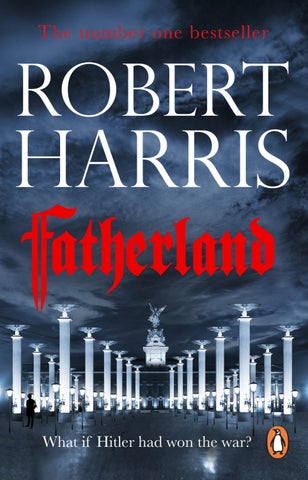
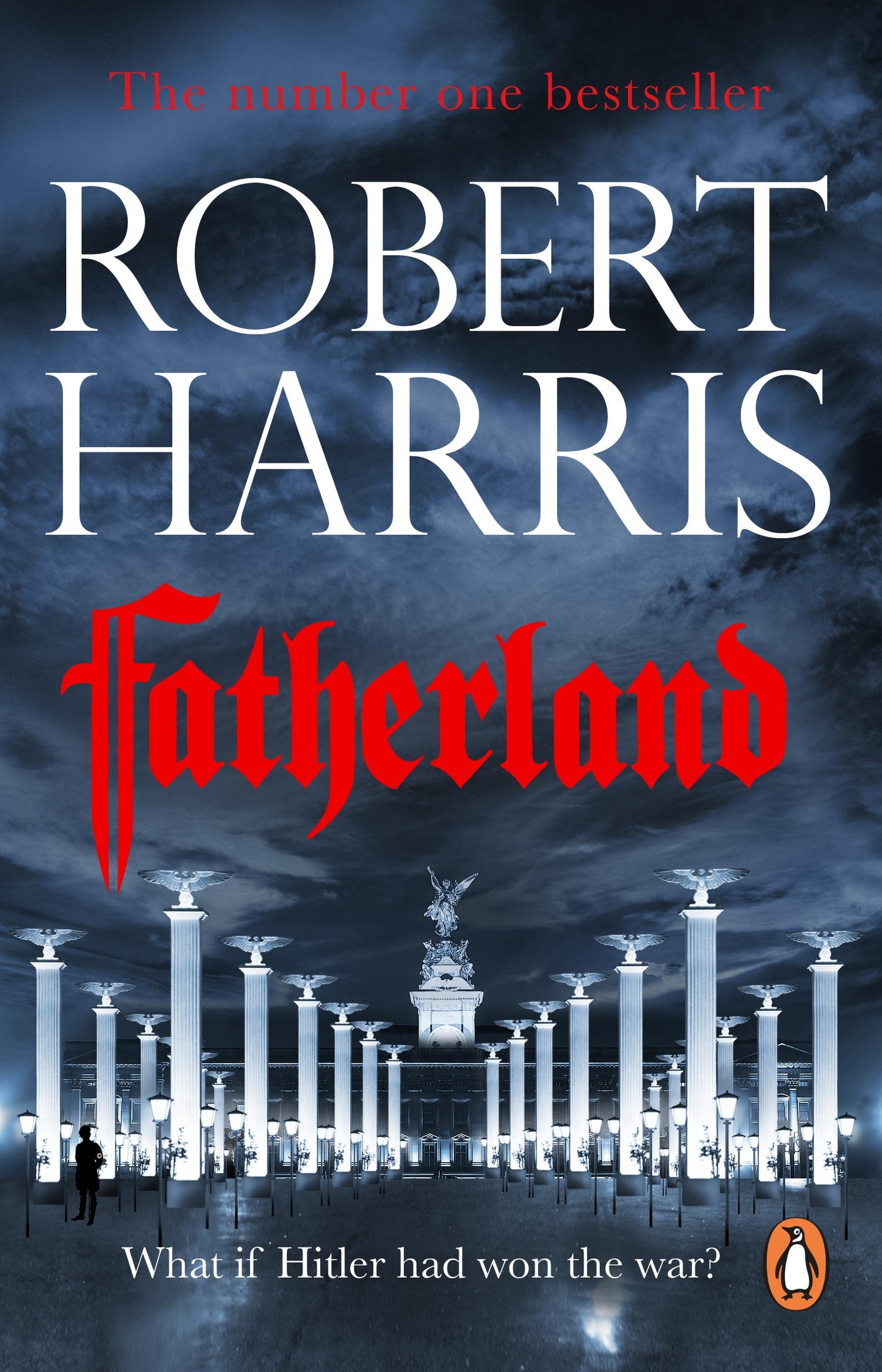
What if Hitler had won the war?
Enigma
Secrets and intrigue in wartime Bletchley Park.
Archangel
Only one man can reveal the buried secrets of Russia’s past.
Pompeii
A corrupt world on the brink of a terrifying disaster.
The Ghost
The world’s greatest conspiracy theory is about to be exposed.
The Fear Index It’s time to make a killing.
An Officer and a Spy
In the hunt for a spy, he exposed a conspiracy.
Conclave
The power of God. The ambition of men.
Munich
Treason. Betrayal. Murder. Is any price too high for peace?
The Second Sleep
What if your future lies buried in the past?
V2
The first rocket will take five minutes to hit London. Kay has six minutes to stop the second.
Act of Oblivion
They killed the King. Now they must run forever.
NON-FICTION
A Higher Form of Killing (with Jeremy Paxman)
Gotcha: Media, the Government and the Falklands Crisis
The Making of Neil Kinnock
Selling Hitler
Good and Faithful Servant: The Unauthorized Biography of Bernard Ingham
ROBERT HARRIS

PENGUIN BOOK S
UK | USA | Canada | Ireland | Australia India | New Zealand | South Africa
Penguin Books is part of the Penguin Random House group of companies whose addresses can be found at global.penguinrandomhouse.com
Penguin Random House UK , One Embassy Gardens, 8 Viaduct Gardens, London SW 11 7BW
penguin.co.uk
First published by Hutchinson 1992
Published by Arrow Books 1993
Published in Penguin Books 2022 001
Copyright © Robert Harris, 1992
Extract from Agrippa copyright © Canal K Ltd, 2026
The moral right of the author has been asserted 16 lines of ‘Love Unspoken’ from Christopher Hassall’s translation of The Merry Widow © Glocken Verlag Limited
Penguin Random House values and supports copyright. Copyright fuels creativity, encourages diverse voices, promotes freedom of expression and supports a vibrant culture. Thank you for purchasing an authorised edition of this book and for respecting intellectual property laws by not reproducing, scanning or distributing any part of it by any means without permission. You are supporting authors and enabling Penguin Random House to continue to publish books for everyone. No part of this book may be used or reproduced in any manner for the purpose of training artificial intelligence technologies or systems. In accordance with Article 4(3) of the DSM Directive 2019/790, Penguin Random House expressly reserves this work from the text and data mining exception.
Set in 12.85/15.2 pt Spectrum MT Pro Typeset by Six Red Marbles UK, Thetford, Norfolk
Printed and bound in Great Britain by Clays Ltd, Elcograf S.p.A.
The authorised representative in the EEA is Penguin Random House Ireland, Morrison Chambers, 32 Nassau Street, Dublin D02 YH 68
A CIP catalogue record for this book is available from the British Library
ISBN : 978–0–099–52789–3
Penguin Random House is committed to a sustainable future for our business, our readers and our planet. This book is made from Forest Stewardship Council® certified paper.
To Gill
ACKNOWLEDGEMENTS
I thank the Librarian and staff of the Wiener Library in London for their help over several years.
I also wish to thank David Rosenthal and – especially – Robyn Sisman, without whom this book would never have been started, let alone finished.
The hundred million self-confident German masters were to be brutally installed in Europe, and secured in power by a monopoly of technical civilisation and the slave- labour of a dwindling native population of neglected, diseased, illiterate cretins, in order that they might have leisure to buzz along infinite Autobahnen, admire the Strength- Through- Joy Hostel, the Party Headquarters, the Military Museum and the Planetarium which their Führer would have built in Linz (his new Hitleropolis), trot round local picture- galleries, and listen over their cream buns to endless recordings of The Merry Widow. This was to be the German Millennium, from which even the imagination was to have no means of escape.
Hugh Trevor -Roper
The Mind of Adolf Hitler
People sometimes say to me: ‘Be careful! You will have twenty years of guerilla warfare on your hands!’ I am delighted at the prospect . . . Germany will remain in a state of perpetual alertness.
Adolf Hitler
29 August 1942
PART ONE
tuesday 14 april 1964
I swear to Thee, Adolf Hitler, As Führer and Chancellor of the German Reich, Loyalty and Bravery. I vow to Thee and to the superiors Whom Thou shalt appoint Obedience unto Death, So help me God.
SS oath
chapter one
Thick cloud had pressed down on Berlin all night, and now it was lingering into what passed for the morning. On the city’s western outskirts, plumes of rain drifted across the surface of Lake Havel, like smoke.
Sky and water merged into a sheet of grey, broken only by the dark line of the opposite bank. Nothing stirred there. No lights showed.
Xavier March, homicide investigator with the Berlin Kriminalpolizei – the Kripo – climbed out of his Volkswagen and tilted his face to the rain. He was a connoisseur of this particular rain. He knew the taste of it, the smell of it. It was Baltic rain, from the north, cold and sea-scented, tangy with salt. For an instant he was back twenty years, in the conning tower of a U-boat, slipping out of Wilhelmshaven, lights doused, into the darkness.
He looked at his watch. It was just after seven in the morning.
Drawn up on the roadside before him were three other cars. The occupants of two were asleep in the drivers’ seats. The third was a patrol car of the Ordnungspolizei – the Orpo, as every German called them. It was empty. Through its open window, sharp in the damp air, came the crackle of static, punctuated by jabbering bursts of speech. The revolving light on its roof lit up the forest beside the road: blue-black, blueblack, blue-black.
March looked around for the Orpo patrolmen, and saw them sheltering by the lake under a dripping birch tree. Something gleamed pale in the mud at their feet. On a nearby log sat a young man in a black tracksuit, SS insignia on his breast pocket. He was hunched forward, elbows resting on his knees, hands pressed against the sides of his head – the image of misery.
March took a last draw on his cigarette and flicked it away. It fizzed and died on the wet road.
As he approached, one of the policemen raised his arm.
‘Heil Hitler!’
March ignored him and slithered down the muddy bank to inspect the corpse.
It was an old man’s body – cold, fat, hairless and shockingly white. From a distance, it could have been an alabaster statue dumped in the mud. Smeared with dirt, the corpse sprawled on its back half out of the water, arms flung wide, head tilted back. One eye was
screwed shut, the other squinted balefully at the filthy sky.
‘Your name, Unterwachtmeister?’ March had a soft voice. Without taking his eyes off the body, he addressed the Orpo man who had saluted.
‘Ratka, Herr Sturmbannführer.’
Sturmbannführer was an SS title, equivalent in Wehrmacht rank to major, and Ratka – dog-tired and skin- soaked though he was – seemed eager to show respect. March knew his type without even looking round: three applications to transfer to the Kripo, all turned down; a dutiful wife who had produced a football team of children for the Führer; an income of 200 Reichsmarks a month. A life lived in hope.
‘Well, Ratka,’ said March, in that soft voice again. ‘What time was he discovered?’
‘Just over an hour ago, sir. We were at the end of our shift, patrolling in Nikolassee. We took the call. Priority One. We were here in five minutes.’
‘Who found him?’
Ratka jerked his thumb over his shoulder.
The young man in the tracksuit rose to his feet. He could not have been more than eighteen. His hair was cropped so close the pink scalp showed through the dusting of light brown hair. March noticed how he avoided looking at the body.
‘Your name?’
‘ SS - Schütze Hermann Jost, sir.’ He spoke with a Saxon accent – nervous, uncertain, anxious to please. ‘From the Sepp Dietrich training academy at
Schlachtensee.’ March knew it: a monstrosity of concrete and asphalt built in the 1950s, just south of the Havel. ‘I run here most mornings. It was still dark. At first, I thought it was a swan,’ he added, helplessly.
Ratka snorted, contempt on his face. An SS cadet scared of one dead old man! No wonder the war in the Urals was dragging on forever.
‘Did you see anyone else, Jost?’ March spoke in a kindly tone, like an uncle.
‘Nobody, sir. There’s a telephone box in the picnic area, half a kilometre back. I called, then came here and waited until the police arrived. There wasn’t a soul on the road.’
March looked again at the body. It was very fat. Maybe 110 kilos.
‘Let’s get him out of the water.’ He turned towards the road. ‘Time to raise our sleeping beauties.’ Ratka, shifting from foot to foot in the downpour, grinned. It was raining harder now, and the Kladow side of the lake had virtually disappeared. Water pattered on the leaves of the trees and drummed on the car roofs. There was a heavy rain-smell of corruption: rich earth and rotting vegetation. March’s hair was plastered to his scalp, water trickled down the back of his neck. He did not notice. For March, every case, however routine, held – at the start, at least – the promise of adventure.
He was forty-two years old – slim, with grey hair and cool grey eyes that matched the sky. During the war, the Propaganda Ministry had invented a nickname for the men of the U-boats – the ‘grey wolves’ – and it
would have been a good name for March, in one sense, for he was a determined detective. But he was not by nature a wolf, did not run with the pack, was more reliant on brain than muscle, so his colleagues called him ‘the fox’ instead.
U-boat weather!
He flung open the door of the white Skoda, and was hit by a gust of hot, stale air from the car heater.
‘Morning, Spiedel!’ He shook the police photographer’s bony shoulder. ‘Time to get wet.’ Spiedel jerked awake. He gave March a glare.
The driver’s window of the other Skoda was already being wound down as March approached it. ‘All right, March. All right.’ It was SS -Surgeon August Eisler, a Kripo pathologist, his voice a squeak of affronted dignity. ‘Save your barrack-room humour for those who appreciate it.’
They gathered at the water’s edge, all except Doctor Eisler, who stood apart, sheltering under an ancient black umbrella he did not offer to share. Spiedel screwed a flash bulb on to his camera and carefully planted his right foot on a lump of clay. He swore as the lake lapped over his shoe.
‘Shit!’
The flash popped, freezing the scene for an instant: the white faces, the silver threads of rain, the darkness of the woods. A swan came scudding out of some nearby reeds to see what was happening, and began circling a few metres away.
‘Protecting her nest,’ said the young SS man.
‘I want another here.’ March pointed. ‘And one here.’
Spiedel cursed again and pulled his dripping foot out of the mud. The camera flashed twice more.
March bent down and grasped the body under the armpits. The flesh was hard, like cold rubber, and slippery.
‘Help me.’
The Orpo men each took an arm and together, grunting with the effort, they heaved, sliding the corpse out of the water, over the muddy bank and on to the sodden grass. As March straightened, he caught the look on Jost’s face.
The old man had been wearing a pair of blue swimming trunks which had worked their way down to his knees. In the freezing water, the genitals had shrivelled to a tiny clutch of white eggs in a nest of black pubic hair.
The left foot was missing.
It had to be, thought March. This was a day when nothing would be simple. An adventure, indeed.
‘Herr Doctor. Your opinion, please.’
With a sigh of irritation, Eisler daintily stepped forward, removing the glove from one hand. The corpse’s leg ended at the bottom of the calf. Still holding the umbrella, Eisler bent stiffly and ran his fingers around the stump.
‘A propeller?’ asked March. He had seen bodies dragged out of busy waterways – from the Tegler See
and the Spree in Berlin, from the Alster in Hamburg – which looked as if butchers had been at them.
‘No.’ Eisler withdrew his hand. ‘An old amputation. Rather well done in fact.’ He pressed hard on the chest with his fist. Muddy water gushed from the mouth and bubbled out of the nostrils. ‘Rigor mortis fairly advanced. Dead twelve hours. Maybe less.’ He pulled his glove back on.
A diesel engine rattled somewhere through the trees behind them.
‘The ambulance,’ said Ratka. ‘They take their time.’
March gestured to Spiedel. ‘Take another picture.’
Looking down at the corpse, March lit a cigarette. Then he squatted on his haunches and stared into the single open eye. He stayed that way a long while. The camera flashed again. The swan reared up, flapped her wings, and turned towards the centre of the lake in search of food.
chapter two
Kripo headquarters lie on the other side of Berlin, a twenty-five- minute drive from the Havel. March needed a statement from Jost, and offered to drop him back at his barracks to change, but Jost said no: he would sooner make his statement quickly. So once the body had been stowed aboard the ambulance and dispatched to the morgue, they set off in March’s little four- door Volkswagen through the rush-hour traffic.
It was one of those dismal Berlin mornings, when the famous Berliner-luft seems not so much bracing as merely raw, the moisture stinging the face and hands like a thousand frozen needles. On the Potsdamer Chaussee, the spray from the wheels of the passing cars forced the few pedestrians close to the sides of the buildings. Watching them through the rain-flecked window, March imagined a city of blind men, feeling their way to work.
It was all so normal. Later, that was what would strike him most. It was like having an accident: before it, nothing out of the ordinary; then, the moment; and after it, a world that was changed forever. For there was nothing more routine than a body fi shed out of the Havel. It happened twice a month – derelicts and failed businessmen, reckless kids and lovelorn teenagers; accidents and suicides and murders; the desperate, the foolish, the sad.
The telephone had rung in his apartment in Ansbacher Strasse shortly after six-fifteen. The call had not woken him. He had been lying in the semi-darkness with his eyes open, listening to the rain. For the past few months he had slept badly.
‘March? We’ve got a report of a body in the Havel.’ It was Krause, the Kripo’s Night Duty Officer. ‘Go and take a look, there’s a good fellow.’
March had said he was not interested.
‘Your interest or lack of it is beside the point.’
‘I am not interested,’ said March, ‘because I am not on duty. I was on duty last week, and the week before.’ And the week before that, he might have added. ‘This is my day off. Look again at your list.’
There had been a pause at the other end, then Krause had come back on the line, grudgingly apologetic. ‘You are in luck, March. I was looking at last week’s rota. You can go back to sleep. Or . . .’ He had sniggered: ‘Or whatever else it was you were doing.’
A gust of wind had slashed rain against the window, rattling the pane.
There was a standard procedure when a body was discovered: a pathologist, a police photographer and an investigator had to attend the scene at once. The investigators worked off a rota kept at Kripo headquarters in Werderscher Markt.
‘Who is on today, as a matter of interest?’
‘Max Jaeger.’
Jaeger. March shared an office with Jaeger. He had looked at his alarm clock and thought of the little house in Pankow where Max lived with his wife and four daughters: during the week, breakfast was just about the only time he saw them. March, on the other hand, was divorced and lived alone. He had set aside the afternoon to spend with his son. But the long hours of the morning stretched ahead, a blank. The way he felt it would be good to have something routine to distract him.
‘Oh, leave him in peace,’ he had said. ‘I’m awake. I’ll take it.’
That had been nearly two hours ago. March glanced at his passenger in the rear-view mirror. Jost had been silent ever since they left the Havel. He sat stiffly in the back seat, staring at the grey buildings slipping by.
At the Brandenburg Gate, a policeman on a motorcycle flagged them to a halt.
In the middle of Pariser Platz, an SA band in sodden brown uniforms wheeled and stamped in the puddles. Through the closed windows of the Volkswagen came the muffled thump of drums and trumpets, pounding out an old Party marching song. Several dozen people
had gathered outside the Academy of Arts to watch them, shoulders hunched against the rain.
It was impossible to drive across Berlin at this time of year without encountering a similar rehearsal. In six days’ time it would be Adolf Hitler’s birthday – the Führertag, a public holiday – and every band in the Reich would be on parade. The windscreen wipers beat time like a metronome.
‘Here we see the final proof,’ murmured March, watching the crowd, ‘that in the face of martial music, the German people are mad.’
He turned to Jost, who gave a thin smile.
A clash of cymbals ended the tune. There was a patter of damp applause. The bandmaster turned and bowed. Behind him, the SA men had already begun half- walking, half- running, back to their bus. The motorcycle cop waited until the Platz was clear, then blew a short blast on his whistle. With a white-gloved hand he waved them through the Gate.
The Unter den Linden gaped ahead of them. It had lost its lime trees in ’ 36 – cut down in an act of official vandalism at the time of the Berlin Olympics. In their place, on either side of the boulevard, the city’s Gauleiter, Josef Goebbels, had erected an avenue of tenmetre-high stone columns, on each of which perched a Party eagle, wings outstretched. Water dripped from their beaks and wingtips. It was like driving through a Native American burial ground.
March slowed for the lights at the Friedrich Strasse intersection and turned right. Two minutes later they
were parking in a space opposite the Kripo building in Werderscher Markt.
It was an ugly place – a heavy, soot-streaked, Wilhelmine monstrosity, six storeys high, on the south side of the Markt. March had been coming here, nearly seven days of the week, for ten years. As his ex-wife had frequently complained, it had become more familiar to him than home. Inside, beyond the SS sentries and the creaky revolving door, a board announced the current state of terrorist alert. There were four codes, in ascending order of seriousness: green, blue, black and red. Today, as always, the alert was red.
A pair of guards in a glass booth scrutinised them as they entered the foyer. March showed his identity card and signed in Jost.
The Markt was busier than usual. The workload always tripled in the week before the Führertag. Secretaries with boxes of files clattered on high heels across the marble floor. The air smelled thickly of wet overcoats and floor polish. Groups of officers in Orpo-green and Kripo-black stood whispering of crime. Above their heads, from opposite ends of the lobby, garlanded busts of the Führer and the Head of the Reich Main Security Office, Reinhard Heydrich, stared at one another with blank eyes.
March pulled back the metal grille of the elevator and ushered Jost inside.
The security forces which Heydrich controlled were divided into three. At the bottom of the pecking order were the Orpo, the ordinary cops. They picked up the
drunks, cruised the Autobahnen, issued the speeding tickets, made the arrests, fought the fires, patrolled the railways and the airports, answered the emergency calls, fished the bodies out of the lakes.
At the top were the Sipo, the Security Police. The Sipo embraced both the Gestapo and the Party’s own security force, the SD . Their headquarters were in a grim complex around Prinz- Albrecht Strasse, a kilometre south-west of the Markt. They dealt with terrorism, subversion, counter-espionage and ‘crimes against the state’. They had their ears in every factory and school, hospital and mess; in every town, in every village, in every street. A body in a lake would concern the Sipo only if it belonged to a terrorist or a traitor.
And somewhere between the other two, and blurring into both, came the Kripo – Department V of the Reich Main Security Office. They investigated straightforward crime, from burglary, through bank robbery, violent assault, rape and mixed marriage, all the way up to murder. Bodies in lakes – who they were and how they got there – they were Kripo business.
The elevator stopped at the second floor. The corridor was lit like an aquarium. Weak neon bounced off green linoleum and green-washed walls. There was the same smell of polish as in the lobby, but here it was spiced with lavatory disinfectant and stale cigarette smoke. Twenty doors of frosted glass lined the passage, some half open. These were the investigators’ offices. From one came the sound of a solitary finger picking at a typewriter; in another, a telephone rang unanswered.
‘ “The nerve centre in the ceaseless war against the criminal enemies of National Socialism”,’ said March, quoting a recent headline in the Party newspaper, the Völkischer Beobachter. He paused, and when Jost continued to look blank he explained: ‘A joke.’
‘Sorry?’
‘Forget it.’
He pushed open a door and switched on the light. His office was little more than a gloomy cupboard, a cell, its solitary window opening on to a courtyard of blackened brick. One wall was shelved: tattered, leather- bound volumes of statutes and decrees, a handbook on forensic science, a dictionary, an atlas, a Berlin street guide, telephone directories, box fi les with labels gummed to them – ‘Braune’, ‘Hundt’, ‘Stark’, ‘Zadek’ – every one a bureaucratic tombstone, memorialising some long-forgotten victim. Another side of the office was taken up by four filing cabinets. On top of one was a spider plant, placed there by a middle-aged secretary two years ago at the height of an unspoken and unrequited passion for Xavier March. It was now dead. That was all the furniture, apart from two wooden desks pushed together beneath the window. One was March’s; the other belonged to Max Jaeger.
March hung his overcoat on a peg by the door. He preferred not to wear uniform when he could avoid it, and this morning he had used the rainstorm on the Havel as an excuse to dress in grey trousers and a thick
blue sweater. He pushed Jaeger’s chair towards Jost. ‘Sit down. Coffee?’
‘Please.’
There was a machine in the corridor. ‘We’ve got fucking photographs. Can you believe it? Look at that.’ Along the passage March could hear the voice of Fiebes of VB 3 – the sexual crimes division – boasting of his latest success. ‘Her maid took them. Look, you can see every hair. The girl should turn professional.’
What would this be? March thumped the side of the coffee machine and it ejected a plastic cup. Some officer’s wife, he guessed, and a Polish labourer shipped in from the General Government to work in the garden. It was usually a Pole; a dreamy, soulful Pole, plucking at the heart of a wife whose husband was away at the front. It sounded as if they had been photographed in flagrante by some jealous girl from the Bund deutscher Mädel, anxious to please the authorities. This was a sexual crime, as defined in the 1935 Race Defilement Act.
He gave the machine another thump.
There would be a hearing in the People’s Court, salaciously recorded in Der Stürmer as a warning to others. Two years in Ravensbrück for the wife. Demotion and disgrace for the husband. Twenty- five years for the Pole, if he was lucky; death if he was not.
‘Fuck!’ A male voice muttered something and Fiebes, a weaselly inspector in his mid- fi fties whose wife had run off with an SS ski instructor ten years before, gave a shout of laughter. March, a cup of
black coffee in either hand, retreated to his office and slammed the door behind him as loudly as he could with his foot.
Reichskriminalpolizei Werderscher Markt 5/6
Berlin
Statement of Witness
My name is Hermann Friedrich Jost. I was born on 23.2.45 in Dresden. I am a cadet at the Sepp Dietrich Academy, Berlin. At 05.30 this morning, I left for my regular training run. I prefer to run alone. My normal route takes me west through the Grunewald Forest to the Havel, north along the lakeshore to the Lindwerder Restaurant, then south to the barracks in Schlachtensee. Three hundred metres north of the Schwanenwerder causeway, I saw an object lying in the water at the edge of the lake. It was the body of a male. I ran to a telephone half a kilometre along the lake- path and informed the police. I returned to the body and waited for the arrival of the authorities. During all this time it was raining hard and I saw nobody.
I am making this statement of my own free will in the presence of Kripo investigator Xavier March.
SS -Schütze H. F. Jost.
08.24/14.4.64
March leaned back in his chair and studied the young man as he signed his statement. There were no hard lines to his face. It was as pink and soft as a baby’s, with a
clamour of acne around the mouth, a whisper of blond hair on the upper lip. March doubted if he shaved.
‘Why do you run alone?’
Jost handed back his statement. ‘It gives me a chance to think. It is good to be alone once in the day. One is not often alone in a barracks.’
‘How long have you been a cadet?’
Three months.’
‘Do you enjoy it?’
‘Enjoy it!’ Jost turned his face to the window. ‘I had just begun studying at the university at Göttingen when my call-up came through. Let us say, it was not the happiest day of my life.’
‘What were you studying?’
‘Literature.’
‘German?’
‘What other sort is there?’ Jost gave one of his watery smiles. ‘I hope to go back to the university when I have served my three years. I want to be a teacher; a writer. Not a soldier.’
March scanned his statement. ‘If you are so antimilitary, what are you doing in the SS ?’ He guessed the answer.
‘My father. He was a founder member of the Leibstandarte Adolf Hitler. You know how it is: I am his only son; it was his dearest wish.’
‘You must hate it.’
Jost shrugged. ‘I survive. And I have been told – unofficially, naturally – that I will not have to go to the front. They need an assistant at the officer school in
Bad Tolz to teach a course on the degeneracy of American literature. That sounds more my kind of thing: degeneracy.’
He risked another smile. ‘Perhaps I shall become an expert in the field.’
March laughed and glanced again at the statement. Something was not right here, and now he saw it. ‘No doubt you will.’ He put the statement to one side and stood up. ‘I wish you luck with your teaching.’
‘Am I free to go?’
‘Of course.’
With a look of relief, Jost got to his feet. March grasped the door handle. ‘One thing.’ He turned and stared into the SS cadet’s eyes. ‘Why are you lying to me?’
Jost jerked his head back. ‘What . . . ?’
‘You say you left the barracks at five-thirty. You call the cops at five past six. Schwanenwerder is three kilometres from the barracks. You are fit: you run every day . You do not dawdle: it is raining hard. Unless you suddenly developed a limp, you must have arrived at the lake quite some time before six. So there are – what? – twenty minutes out of thirty-five unaccounted for in your statement. What were you doing, Jost?’
The young man looked stricken. ‘Maybe I left the barracks later. Or maybe I did a couple of circuits of the running track there first . . .’ ‘ “Maybe, maybe . . .” ’ March shook his head sadly. ‘These are facts that can be checked, and I warn you: it will go hard for you if I have to find out the truth and
bring it to you, rather than the other way round. You are a homosexual, yes?’
‘Herr Sturmbannführer! For God’s sake . . .’
March put his hands on Jost’s shoulders. ‘I don’t care. Perhaps you run alone every morning so you can meet some fellow in the Grunewald for twenty minutes. That’s your business. It’s no crime in my book. All I’m interested in is the body. Did you see something? What did you really do?’
Jost shook his head. ‘Nothing. I swear.’ Tears were welling in his wide, pale eyes.
‘Very well.’ March released him. ‘Wait downstairs. I’ll arrange transport to take you back to Schlachtensee.’ He opened the door. ‘Remember what I said: better you tell me the truth now than I find it out for myself later.’
Jost hesitated, and for a moment March thought he might say something, but then he walked out into the corridor and was gone.
March rang down to the basement garage and ordered a car. He hung up and stared out of the grimy window at the wall opposite. The black brick glistened under the film of rainwater pouring down from the upper storeys. Had he been too hard on the boy? Probably. But sometimes the truth could only be ambushed, taken unguarded in a surprise attack. Was Jost lying? Certainly. But then if he was a homosexual, he could scarcely afford not to lie: anyone found guilty of ‘anticommunity acts’ went straight to a labour camp. SS men arrested for homosexuality were attached to punishment battalions on the Eastern Front; few returned.
March had seen a score of young men like Jost in the past year. There were more of them every day. Rebelling against their parents. Questioning the state. Listening to American radio stations. Circulating their crudely printed copies of proscribed books – Günter Grass and Graham Greene, George Orwell and J. D. Salinger. Chiefly, they protested against the war – the seemingly endless struggle against the Americanbacked Soviet guerillas, which had been grinding on east of the Urals for twenty years.
He felt suddenly ashamed of his treatment of Jost, and considered going down to apologise to him. But then he decided, as he always did, that his duty to the dead came first. His penance for his morning’s bullying would be to put a name to the body in the lake.
The Duty Room of the Berlin Kriminalpolizei occupies most of Werderscher Markt’s third floor. March mounted the stairs two at a time. Outside the entrance, a guard armed with a machine gun demanded his pass. The door opened with a thud of electronic bolts.
An illuminated map of Berlin takes up half the far wall. A galaxy of stars, orange in the semi- darkness, marks the capital’s one hundred and twenty- two police stations. To its left is a second map, even larger, depicting the entire Reich. Red lights pinpoint those towns big enough to warrant their own Kripo divisions. The centre of Europe glows crimson. Further east, the lights gradually thin until, beyond Moscow, there are only a few isolated sparks, winking like
camp fi res in the blackness. It is a planetarium of crime.
Krause, the Duty Officer for the Berlin Gau, sat on a raised platform beneath the display. He was on the telephone as March approached and raised his hand in greeting. Before him, a dozen women in starched white shirts sat in glass partitions, each wearing a headset with a microphone attached. What they must hear! A sergeant from a Panzer division comes home from a tour in the East. After a family supper, he takes out his pistol, shoots his wife and each of his three children in turn. Then he splatters his skull across the ceiling. An hysterical neighbour calls the cops. And the news comes here – is controlled, evaluated, reduced – before being passed downstairs to that corridor with cracked green linoleum, stale with cigarette smoke.
Behind the Duty Officer, a uniformed secretary with a sour face was making entries on the night incident board. There were four columns: crime (serious), crime (violent), incidents, fatalities. Each category was further quartered: time reported, source of information, detail of report, action taken. An average night of mayhem in the world’s largest city, with its population of ten million, was reduced to hieroglyphics on a few square metres of white plastic.
There had been eighteen deaths since ten o’clock the previous night. The worst incident – 1H 2D 4K – was three adults and four children killed in a car smash in Pankow just after eleven. No action taken; that could be left to the Orpo. A family burned to death in
a house-fire in Kreuzberg, a stabbing outside a bar in Wedding, a woman beaten to death in Spandau. The record of March’s own disrupted morning was last on the list: 06:07 [O] (that meant notification had come from the Orpo) 1H Havel/March. The secretary stepped back and recapped her pen with a sharp click.
Krause had finished his telephone call and was looking defensive. ‘I’ve already apologised, March.’
‘Forget it. I want the missing list. Berlin area. Say: the last forty-eight hours.’
‘No problem.’ Krause looked relieved and swivelled round in his chair to the sour- faced woman. ‘You heard the investigator, Helga. Check whether anything’s come in in the last hour.’ He spun back to face March, red-eyed with lack of sleep. ‘I’d have left it an hour. But any trouble around that place – you know how it is.’
March looked up at the Berlin map. Most of it was a grey cobweb of streets. But over to the left were two splashes of colour: the green of the Grunewald Forest and, running alongside it, the blue ribbon of the Havel. Curling into the lake, in the shape of a foetus, was an island, linked to the shore by a thin umbilical causeway. Schwanenwerder.
‘Does Goebbels still have a place there?’ Krause nodded. ‘And the rest.’
It was one of the most fashionable addresses in Berlin, practically a government compound. A few dozen large houses screened from the road. A sentry at the entrance to the causeway. A good place for privacy, for
security, for forest views and private moorings; a bad place to discover a body. The corpse had been washed up fewer than three hundred metres away.
Krause said: ‘The local Orpo call it “the pheasant run”.’
March smiled: ‘golden pheasants’ was street slang for the Party leadership.
‘It’s not good to leave a mess for too long on that doorstep.’
Helga had returned. ‘Persons reported missing since Sunday morning,’ she announced, ‘and still unaccounted for.’ She gave a long roll of printed-out names to Krause, who glanced at it and passed it on to March. ‘Plenty to keep you busy there.’ He seemed to find this amusing. ‘You should give it to that fat friend of yours, Jaeger. He’s the one who should be looking after this business, remember?’
‘Thanks. I’ll make a start at least.’
Krause shook his head. ‘You put in twice the hours of the others. You get no promotions. You’re on shitty pay. Are you crazy or what?’
March had rolled the list of missing persons into a tube. He leaned forward and tapped Krause lightly on the chest with it. ‘You forget yourself, comrade,’ he said. ‘Arbeit macht frei.’ The slogan of the labour camps. Work Makes You Free.
He turned and made his way back through the ranks of telephonists. Behind him he could hear Krause appealing to Helga. ‘See what I mean? What the hell kind of a joke is that?’
March arrived back in his office just as Max Jaeger was hanging up his coat. ‘Zavi!’ Jaeger spread his arms wide. ‘I got a message from the Duty Room. What can I say?’ He wore the uniform of an SS Sturmbannführer. The black tunic still bore traces of his breakfast.
‘Put it down to my soft old heart,’ said March. ‘And don’t get too excited. There was nothing on the corpse to identify it and there are a hundred people missing in Berlin since Sunday. It’ll take hours just to go through the list. And I’ve promised to take my boy out this afternoon, so you’ll be on your own with it.’
He lit a cigarette and explained the details: the location, the missing foot, his suspicions about Jost. Jaeger took it in with a series of grunts. He was a shambling, untidy hulk of a man, two metres tall, with clumsy hands and feet. He was fifty, nearly ten years older than March, but they had shared an office since 1959 and sometimes worked as a team. Colleagues in Werderscher Markt joked about them behind their backs: the Fox and the Bear. And maybe there was something of the old married couple about them, in the way they bickered with and covered for each other.
‘This is the “missing” list.’ March sat down at his desk and unrolled the print-out: names, dates of birth, times of disappearance, addresses of informants. Jaeger leaned over his shoulder. He smoked stubby fat cigars and his uniform reeked of them. ‘According to the good doctor Eisler, our man probably died some time after six last night, so the chances are nobody missed him until seven or eight at the earliest. They may even
be waiting to see if he shows up this morning. So he may not be on the list. But we have to consider two other possibilities, do we not? One: he went missing some time before he died. Two – and we know from hard experience this is not impossible – Eisler has screwed up the time of death.’
‘The guy isn’t fit to be a vet,’ said Jaeger.
March counted swiftly. ‘One hundred and two names. I’d put the age of our man at sixty.’
‘Better say fifty, to be safe. Twelve hours in the drink and nobody looks their best.’
‘True. So we exclude everyone on the list born after 1914. That should bring it down to a dozen names. Identification couldn’t be much easier: was grandpa missing a foot?’ March folded the sheet, tore it in two, and handed one half to Jaeger. ‘What are the Orpo stations around the Havel?’
‘Nikolassee,’ said Max. ‘Wannsee. Kladow. Gatow. Pichelsdorf – but that’s probably too far north.’
Over the next half hour, March called each of them in turn, including Pichelsdorf, to see if any clothing had been handed in, or if some local derelict matched the description of the man in the lake. Nothing. He turned his attention to his half of the list. By eleventhirty he had exhausted every likely name. He stood up and stretched.
‘Mister Nobody.’
Jaeger had finished calling ten minutes earlier and was staring out of the window, smoking. ‘Popular fellow, isn’t he? Makes even you looked loved.’ He
removed his cigar and picked some shreds of loose tobacco from his tongue. ‘I’ll see if the Duty Room have received any more names. Leave it to me. Have a good time with Pili.’
The late morning service had just ended in the ugly church opposite Kripo headquarters. March stood on the other side of the street and watched the priest, a shabby raincoat over his vestments, locking the door. Religion was officially discouraged in Germany. How many worshippers, March wondered, had braved the Gestapo’s spies to attend? Half a dozen? The priest slipped the heavy iron key into his pocket and turned round. He saw March looking at him, and immediately scuttled away, eyes cast down, like a man caught in the middle of an illegal transaction. March buttoned his trench coat and followed him into the filthy Berlin morning.
chapter three
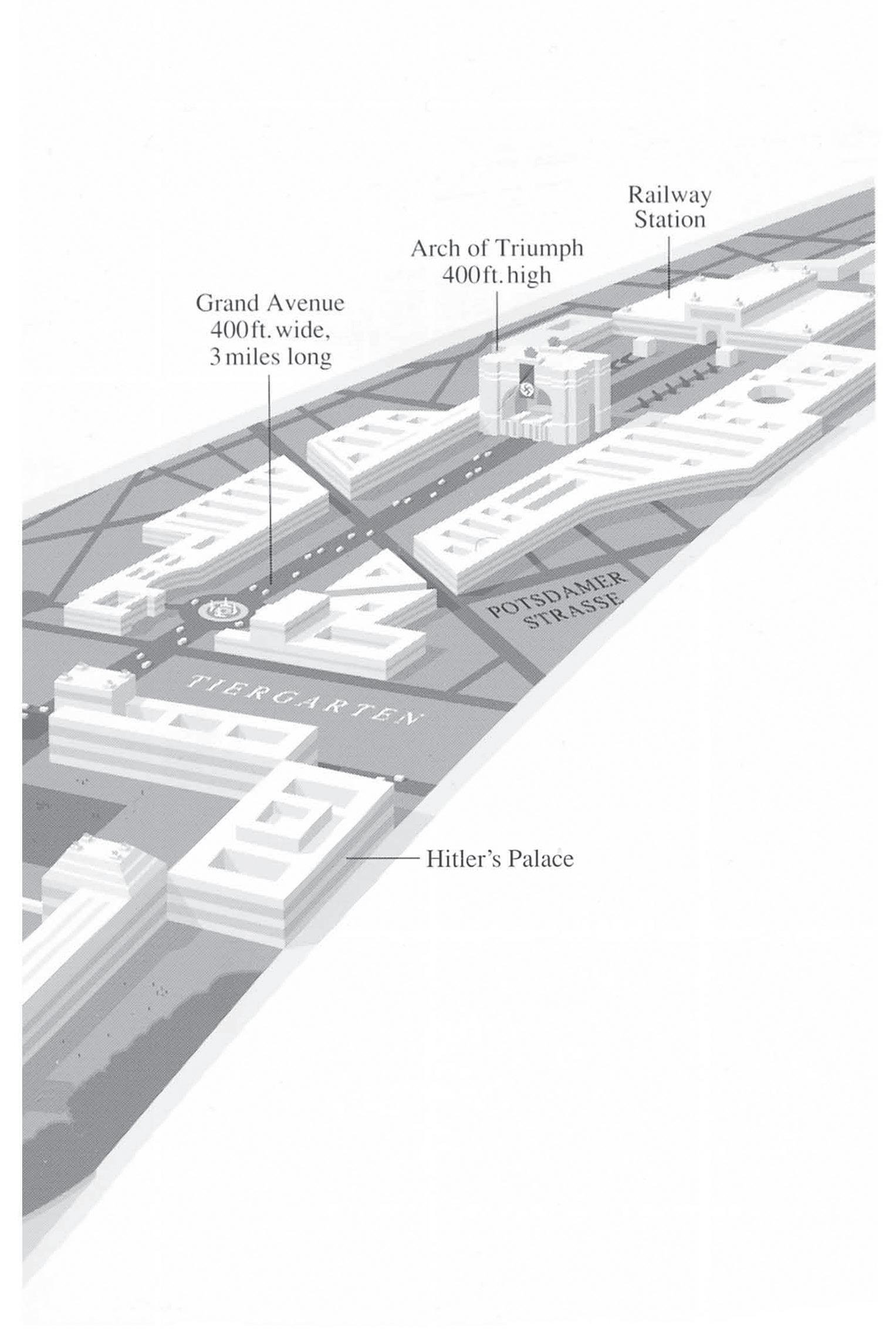
Construction of the Arch of Triumph was commenced in 1946 and work was completed in time for the Day of National Reawakening in 1950. The inspiration for the design came from the Führer and is based upon original drawings made by him during the Years of Struggle.’
The passengers on the tour bus – at least those who could understand – digested this information. They raised themselves out of their seats or leaned into the aisle to get a better view. Xavier March, halfway down the bus, lifted his son on to his lap. Their guide, a middle- aged woman clad in the dark green of the Reich Tourist Ministry, stood at the front, feet planted wide apart, back to the windscreen. Her voice over the address system was thick with cold.
‘The Arch is constructed of granite and has a capacity of two million, three hundred and sixty- fi ve
robert harris thousand, six hundred and eighty-five cubic metres.’ She sneezed. ‘The Arc de Triomphe in Paris will fit into it forty-nine times.’
For a moment, the Arch loomed over them. Then, suddenly, they were passing through it – an immense, stone-ribbed tunnel, longer than a football pitch, higher than a fifteen-storey building, with the vaulted, shadowed roof of a cathedral. The headlights and taillights of eight lanes of traffic danced in the afternoon gloom.
‘The Arch has a height of one hundred and eighteen metres. It is one hundred and sixty-eight metres wide and has a depth of one hundred and nineteen metres. On the inner walls are carved the names of the three million soldiers who fell in defence of the Fatherland in the wars of 1914 to 1918 and 1939 to 1946.’
She sneezed again. The passengers dutifully craned their necks to peer at the Roll of the Fallen. They were a mixed party. A group of Japanese, draped with cameras; an American couple with a little girl Pili’s age; some German settlers, from Ostland or the Ukraine, in Berlin for the Führertag. March looked away as they passed the Roll of the Fallen. Somewhere on it were the names of his father and both his grandfathers. He kept his eyes on the guide. When she thought no one was looking, she turned away and quickly wiped her nose on her sleeve. The coach re-emerged into the drizzle.
‘Leaving the Arch we enter the central section of the Avenue of Victory. The Avenue was designed by Reich Minister Albert Speer and was completed in 1957.
It is one hundred and twenty-three metres wide and five-point-six kilometres in length. It is both wider, and two and a half times longer, than the Champs Elysées in Paris.’
Higher, longer, bigger, wider, more expensive . . . Even in victory, thought March, Germany has a parvenu’s inferiority complex. Nothing stands on its own. Everything has to be compared with what the foreigners have . . .
‘The view from this point northwards along the Avenue of Victory is considered one of the wonders of the world.’
‘One of the wonders of the world,’ repeated Pili in a whisper.
And it was, even on a day like this. Dense with traffic, the Avenue stretched before them, flanked on either side by the glass and granite walls of Speer’s new buildings: ministries, offices, big stores, cinemas, apartment blocks. At the far end of this river of light, rising as grey as a battleship through the spray, was the Great Hall of the Reich, its dome half hidden in the low cloud.
There were appreciative murmurs from the settlers. ‘It’s like a mountain,’ said the woman sitting behind March. She was with her husband and four boys. They had probably been planning this trip all winter. A Tourist Ministry brochure and a dream of April in Berlin: comforts to warm them in the snowbound, moonless nights of Minsk or Kiev, a thousand kilometres from home. How had they got here? A package tour organised by Strength-Through-Joy, perhaps: two hours in a Junkers
robert harris jet with a stop-off in Warsaw. Or a three-day drive in the family Volkswagen on the Berlin–Moscow Autobahn. Pili wriggled out of his father’s grasp and walked unsteadily to the front of the coach. March pinched the bridge of his nose between thumb and forefinger, a nervous habit he had picked up – when? – in the U-boat service, he supposed, when the screws of the British warships sounded so close the hull shook and you never knew if their next depth charge would be your last. He had been invalided out of the navy in 1948 with suspected TB and spent a year convalescing. Then, for want of anything better to do, he had joined the Marine-Küstenpolizei, the Coastal Police, in Wilhelmshaven as a lieutenant. In 1949 he had married Klara Eckart, a nurse he had met at the TB clinic. In 1952, he had joined the Hamburg Kripo. In 1954, with Klara pregnant and the marriage already failing, he had been promoted to Berlin. Paul – Pili – had been born exactly ten years and one month ago. What had gone wrong? He did not blame Klara. She had not changed. She had always been a strong woman who wanted certain simple things from life: home, family, friends, acceptance. But March: he had changed. After ten years in the navy and twelve months in virtual isolation, he had stepped ashore into a world he barely recognised. As he went to work, watched television, ate with friends, even – God help him – slept beside his wife, he sometimes imagined himself aboard a U-boat still: cruising beneath the surface of everyday life; solitary, watchful.
He had picked Pili up at noon from Klara’s place – a bungalow on a dreary post- war housing estate in Lichtenrade, in the southern suburbs. Park in the street, sound the horn twice, watch for the twitch in the parlour curtain. This was the routine which had evolved, unspoken, since their divorce five years ago – a means of avoiding embarrassing encounters; a ritual to be endured one Sunday in four, work permitting, under the strict provisions of the Reich Marriages Act. It was rare for him to see his son on a Tuesday, but this was a school vacation: since 1959, children had been given a week off for the Führer’s birthday, rather than for Easter.
The door had opened and Pili had appeared, like a shy child-actor being pushed out on stage against his will. Wearing his new Pimpf uniform – crisp black shirt and dark blue shorts – he had climbed wordlessly into the car. March had given him an awkward hug.
‘You look smart. How’s school?’
‘All right.’
‘And your mother?’
The boy shrugged.
‘What would you like to do?’
He shrugged again.
They had lunch in Budapester Strasse, opposite the Zoo, in a modern place with vinyl seats and a plastic-topped table: father and son, one with beer and sausages, the other with apple juice and a hamburger. They talked about the Pimpf and Pili brightened. Until you were a Pimpf you were nothing, ‘a non-uniformed creature who has never participated in a group meeting
or a route march’. You were allowed to join when you were ten, and stayed until you were fourteen, when you passed into the full Hitler Youth.
‘I was top in the initiation test.’
‘Good lad.’
‘You have to run sixty metres in twelve seconds,’ said Pili. ‘Do the long jump and the shot-put. There’s a route march – a day and a half. Written stuff. Party philosophy. And you have to recite the Horst Wessel Lied.’
For a moment, March thought he was about to break into song. He cut in hurriedly: ‘And your dagger?’
Pili fumbled in his pocket, a crease of concentration on his forehead. How like his mother he is, thought March. The same wide cheekbones and full mouth, the same serious brown eyes, set far apart. Pili laid the dagger carefully on the table before him. He picked it up. It reminded him of the day he got his own – when was it? ’34? The excitement of a boy who believes he’s been admitted to the company of men. He turned it over and the swastika on the hilt glinted in the light. He felt the weight of it in his hand, then gave it back.
‘I’m proud of you,’ he lied. ‘What do you want to do? We can go to the cinema. Or the zoo.’
‘I want to go on the bus.’
‘But we did that last time. And the time before.’
‘Don’t care. I want to go on the bus.’
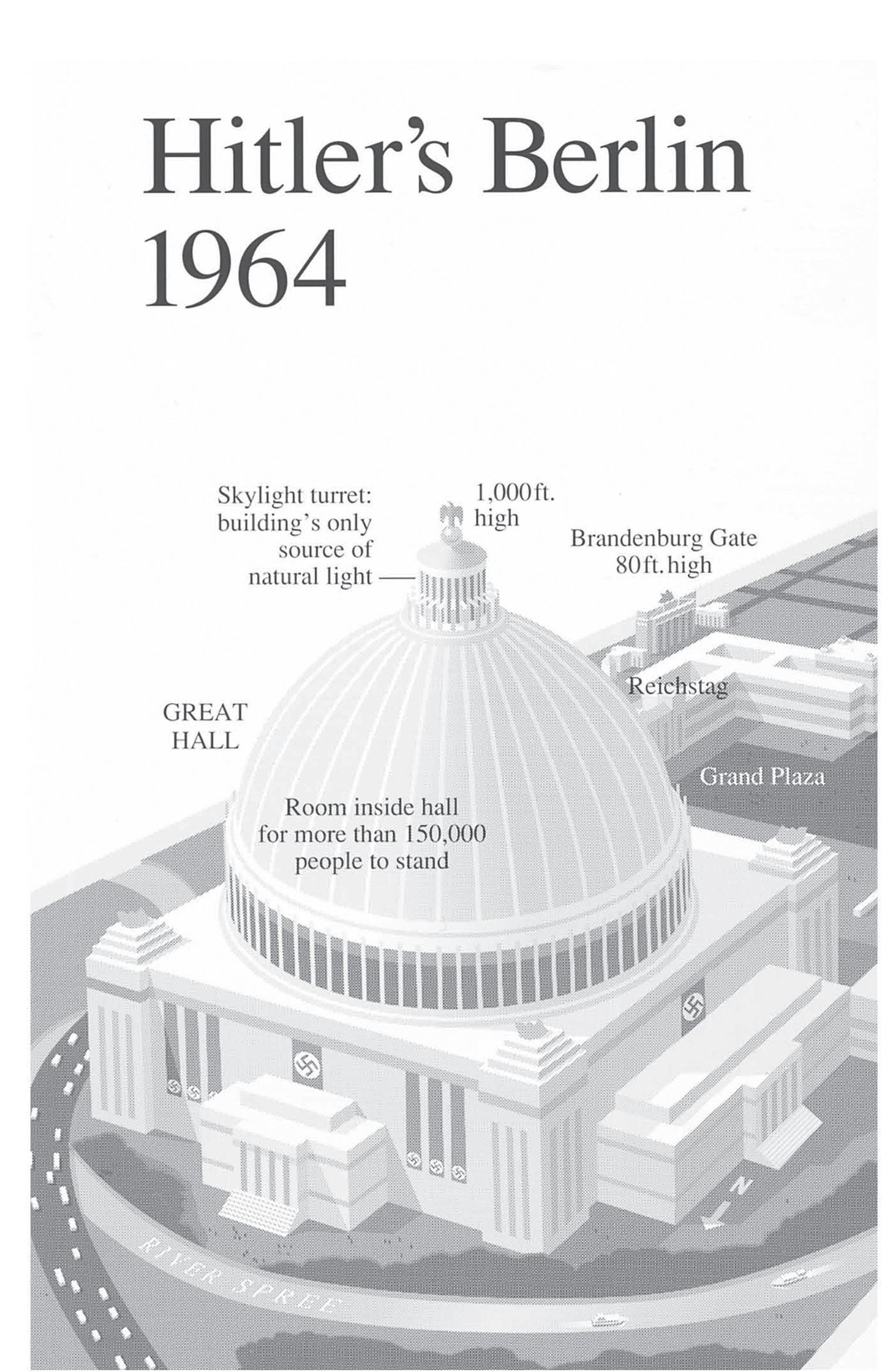
‘The Great Hall of the Reich is the largest building in the world. It rises to a height of more than a quarter of a kilometre, and on certain days – observe today – the
top of its dome is lost from view. The dome itself is one hundred and forty metres in diameter and St Peter’s in Rome will fit into it sixteen times.’
They had reached the top of the Avenue of Victory, and were entering Adolf Hitler Platz. To the left, the square was bounded by the headquarters of the Wehrmacht High Command, to the right by the new Reich Chancellery and Palace of the Führer. Ahead was the hall. Its greyness had dissolved as their distance from it had diminished. Now they could see what the guide was telling them: that the pillars supporting the frontage were of red granite, mined in Sweden, flanked at either end by golden statues of Atlas and Tellus, bearing on their shoulders spheres depicting the heavens and the earth.
The building was as crystal-white as a wedding cake, its dome of beaten copper a dull green. Pili was still at the front of the coach.
‘The Great Hall is used only for the most solemn ceremonies of the German Reich and has a capacity of one hundred and eighty thousand people. One interesting and unforeseen phenomenon: the breath from this number of humans rises into the cupola and forms clouds, which condense and fall as light rain. The Great Hall is the only building in the world which generates its own climate . . .’
March had heard it all before. He looked out of the window and saw the body in the mud. Swimming trunks! What had the old man been thinking of, swimming on Monday night? Berlin had been blanketed by
black clouds from late afternoon. When the storm fi nally broke the rain had descended in steel rods, drilling the streets and roofs, drowning the thunder. Suicide, perhaps? Think of it. Wade into the cold lake, strike out for the centre, tread water in the darkness, watch the lightning over the trees, wait for tiredness to do the rest . . .
Pili had returned to his seat and was bouncing up and down in excitement.
‘Are we going to see the Führer, papa?’
The vision evaporated and March felt guilty. This daydreaming was what Klara used to complain of: ‘Even when you’re here, you’re not really here . . .’
He said: ‘I don’t think so.’
The guide again: ‘On the right is the Reich Chancellery and Residence of the Führer. Its total façade measures exactly seven hundred metres, exceeding by one hundred metres the façade of Louis XIV ’s palace at Versailles.’
The Chancellery slowly uncoiled as the bus drove by: marble pillars and red mosaics, bronze lions, gilded silhouettes, gothic script – a Chinese dragon of a building, asleep at the side of the square. A four-man SS honour guard stood at attention beneath a billowing swastika banner. There were no windows, but set into the wall, five storeys above the ground, was the balcony on which the Führer showed himself on those occasions when a million people gathered in the Platz. There were a few dozen sightseers even now, gazing up at the tightly drawn shutters, faces pale with expectation, hoping . . .