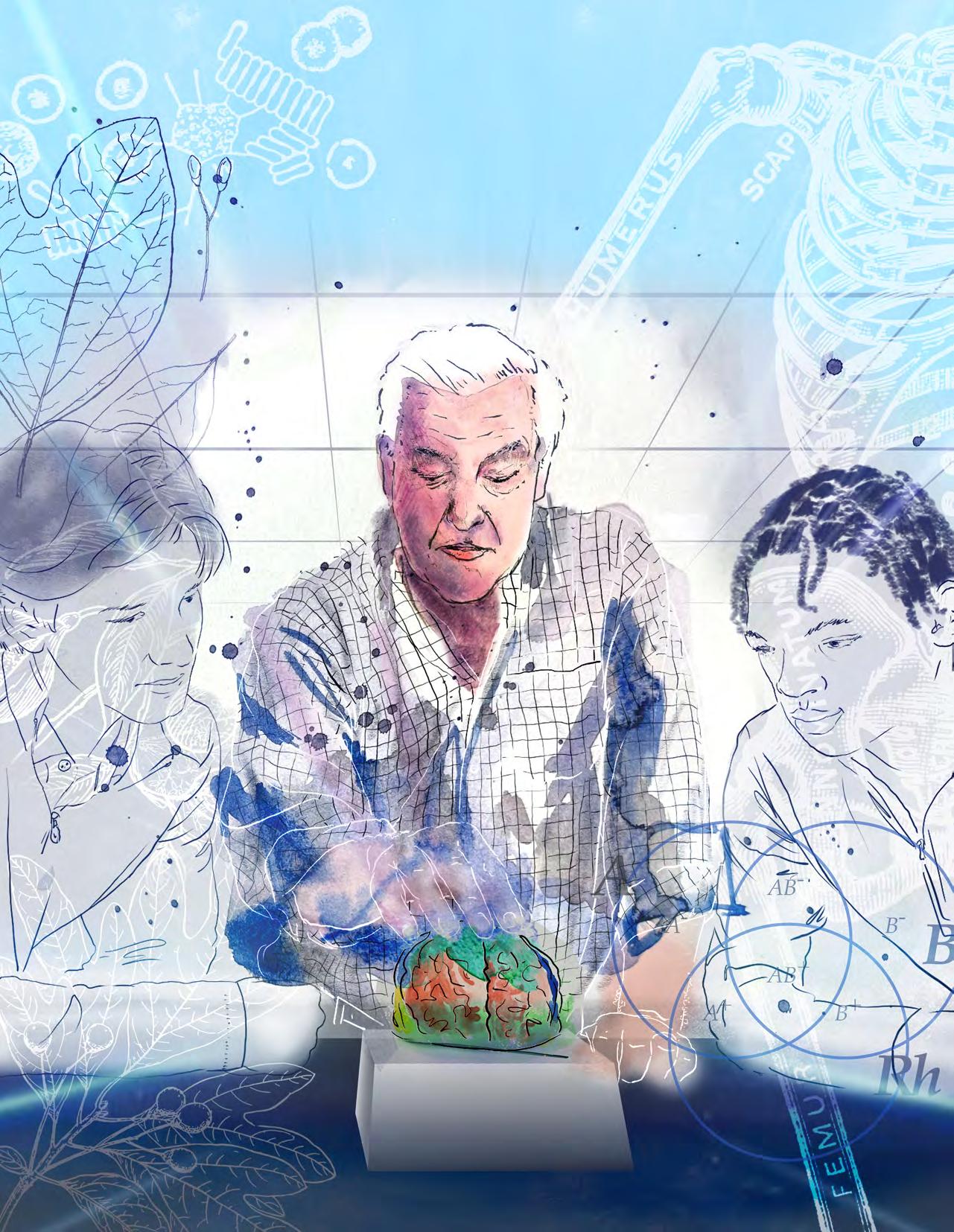
Keith Schwab ‘86
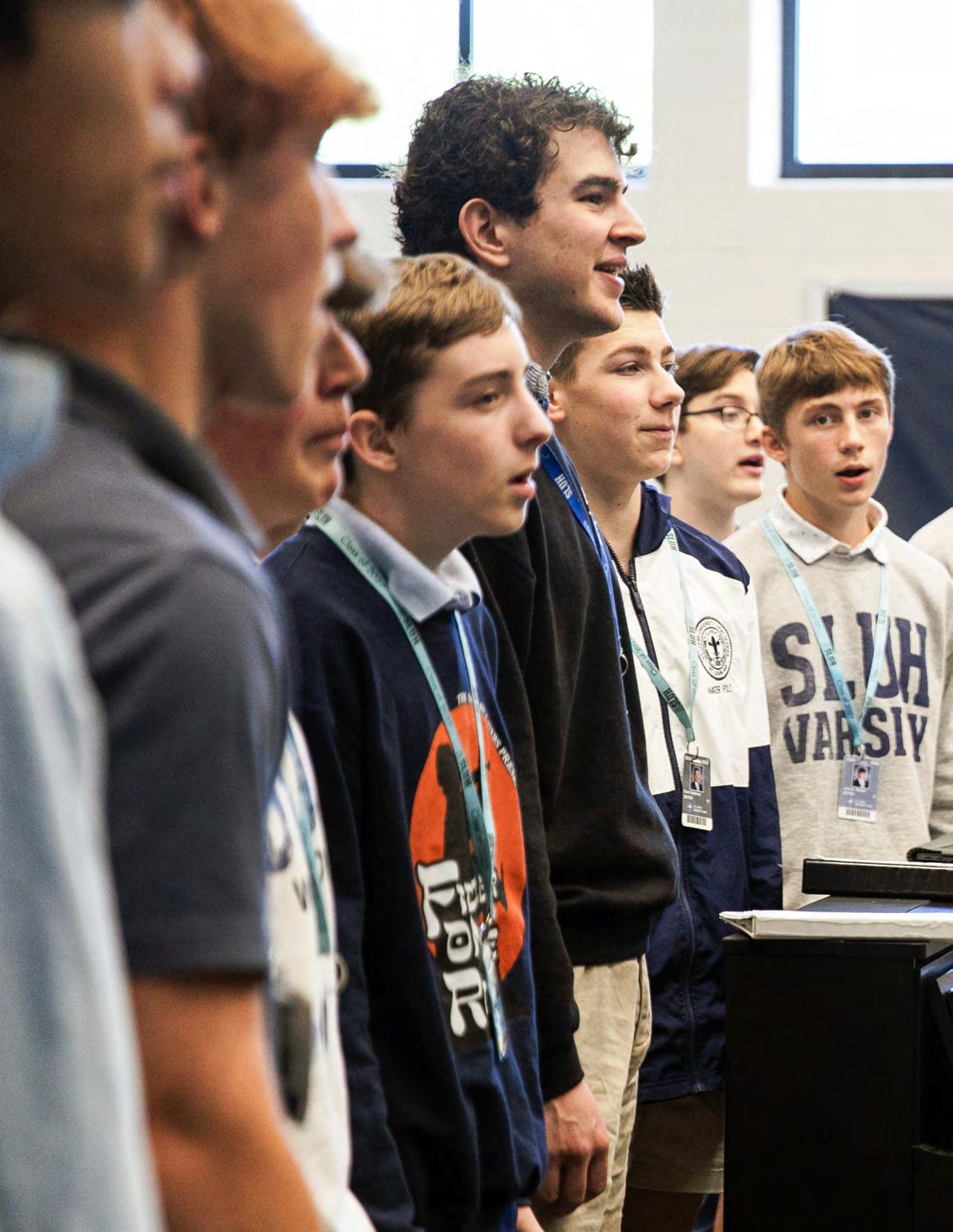
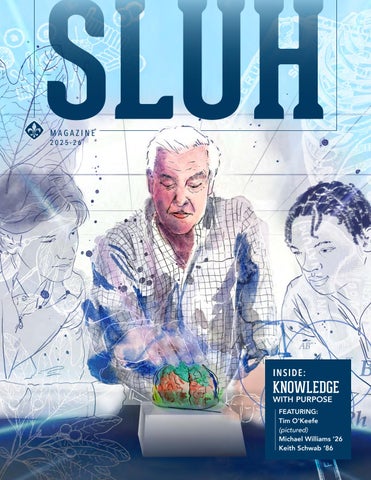
By graduation, the SLUH student exhibits an appropriate mastery of the fundamental tools of learning and will be well on his way to honing his emerging intellectual skills for more advanced levels of learning. The student is also developing habits of intellectual inquiry, as well as a disposition towards life-long learning, and is beginning to see the need for intellectual integrity in other areas of concern, such as the quest for religious truth and for social justice.
SLUH, like other Jesuit schools across the nation, uses the profile of the Graduate at Graduation to outline five important characteristics students strive to embody upon graduation: open to growth, intellectually competent, religious, loving and committed to doing justice.
ABOUT
SLUH Magazine is a publication for alumni, students, parents, faculty, staff, benefactors and friends of St. Louis University High School. If you do not receive correspondence from SLUH but wish to, please send a note to alumni@sluh.org with your name, email and mailing address.
SLUH Magazine
St. Louis University High School
4970 Oakland Avenue St. Louis, MO 63110 magazine@sluh.org
EDITOR
Ben DuMont ‘92 Director of Communications
DESIGN
Stephanie Howe Klink Creative
SUBMISSIONS
Story ideas and submissions are welcome. Send a note to magazine@sluh.org.
IN GRATITUDE
We thank Jr. Bills in the Photography Club for their dedication and commitment to capturing life at SLUH and contributing to this publication – and to Prep News, Sisyphus, Gadfly and On Oakland TV for enriching the SLUH experience through their coverage, perspectives and creativity.
40 Young Grads Setting the World on Fire
1540 List
Alumni Trailblazers: Matt Paradise ‘04 and Stephen Littleton ‘83
The Pursuit of Excellence
Author James Lucas ‘68 Helps Audiences
Growth Mindset
"Perpetually Connected" Loyal Alumni Contribute to Record-Breaking St. Louis U. High Day 57 Legacy Hall: At the Intersection of Oakland Avenue & Memory Lane 58 Megan and Tim Piechowski ’03 Launch the Stephen Missey ‘88 Fund for the Prep News
Dear SLUH Community,
A college preparatory school should provide students the knowledge and tools for success in college and future post secondary work, in addition to preparing them to be productive, meaningful members of society. Although this seems obvious, in a city like St. Louis, where many options exist in both private and public schools, one may ask:
Why attend St. Louis U. High? What makes our school so unique?
The late Fr. David Flemming, SJ ’52, editor of the journal Review for Religious who served as an adjunct professor of Theology at Saint Louis University, provided insight about the added value of a Jesuit education throughout his life’s work. In his small and unassuming 2005 collection of articles entitled Lessons from Ignatius Loyola, Fr. Fleming reminds us what is at the core of “intellectual competence” and “rigorous” education in schools like SLUH by exploring the depth and richness of the Spiritual Exercises
It is the Spiritual Exercises, a transformative work written by St. Ignatius of Loyola, that inspired the foundational elements of Jesuit education. It provides practitioners with the space to live out their own formational journey, restrained not by a set of rigid rules, but rather, guided in a structured framework. Such a process demands ownership, commitment, discipline and a desire that is self-owned. In Jesuit education, the textbook is not the course or the lesson, but rather
a basic tool to help guide a deeper discernment, a testing of hypotheses and an examination of one’s own direction.
As such, Ignatian educators are equipped with content knowledge and pedagogical skill, but more importantly, they provide the guidelines that will evolve over four years into a “helpful strategy for living a life of consistent integrity.” It is through this Ignatian legacy and charism that we at SLUH embody the vision, values and strategies that make for exceptional teaching – an exercise book of sorts that leads students to develop their own vision and articulations of values that they can claim as truly theirs.
A SLUH education is about more than the mastery of content or achievement of personal laurels and success. It is distinguished by leadership formation, courageous conversations and the gifts that come from serving others. Knowledge is critical and learning is central, yet St. Ignatius and the Gospels call us to do more – to instill a purpose centered in vision and values that pursue excellence and further the common good.
Knowledge with purpose: it’s our mission at SLUH and, coupled with a strong tradition and vibrant culture, it’s what sets us apart.
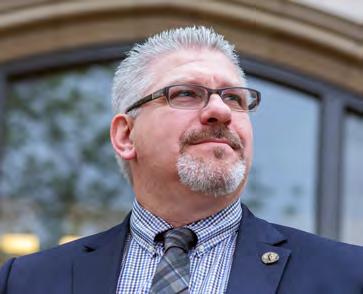
AMDG, Alan Carruthers President
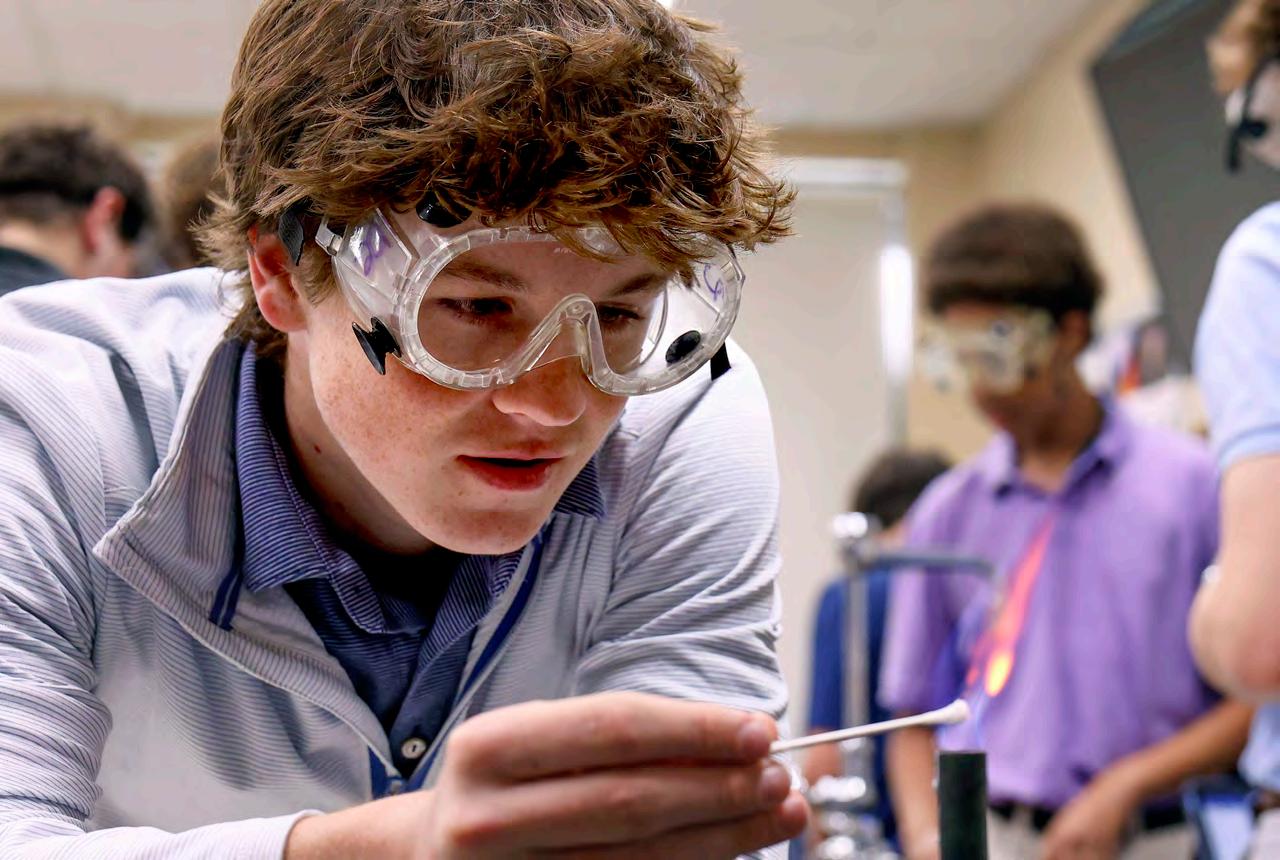
The College Board Advanced Placement Program named SLUH to the 2025 AP School Honor Roll, earning PLATINUM distinction. This is the third such award since the program launched in 2023 and is a testament to the exceptional students and faculty, as well as the robust curriculum, at SLUH.
Read more at sluh.org.

SLUH was recognized as a Cognia School of Distinction for excellence in education and exceptional service to our students. We share this honor with only 24 schools worldwide of the 1,350+ rigorous accreditations undertaken by Cognia, a trusted leader in accreditation, assessment and improvement services.
Students in the STEM Club earned the award for best presentation at the 9th Annual Gateway Arch National Park Engineering Contest for a design that developed a solution to the algae problem in the reflecting pools at the Arch Grounds.
Prep News partnered with SLUH Student Media to develop a series of video news shorts for the school community. Formatted similar to those of major news outlets – each is about one minute in length and presented by a Prep News reporter –they range in subject material
from the Back-to-School Mixer and the Improv Show, to Texas football star Ryan Wingo ‘24 and the Sciuto Institute for Teaching Excellence.
View the Prep News and SLUH Student Media video series.
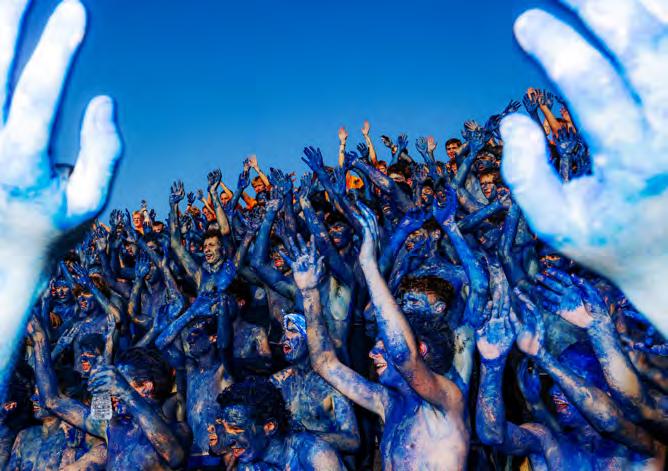
A Running of the Bills photo, taken by Zachary Linhares on August 29, was featured on the CNN World website, in a special section called “The week in 30 photos.” The blue-drenched Jr. Bills were featured among major global leaders, actress Emma Stone, professional athletes and significant happenings around the world.
SLUH hosted Fr. Greg Boyle, SJ and two of his friends from Homeboy Industries for a moving and inspiring all-school presentation on their experiences serving in L.A. Fr. Boyle, author of Tattoos on the Heart, (continued on next page)
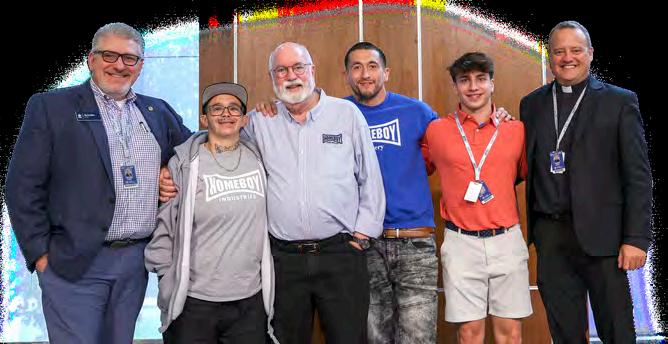
left everybody with a spirited reminder that "Jesus invites us to take four things seriously: inclusion, non-violence, unconditional loving kindness and compassionate acceptance.”
View Fr. Boyle’s inspiring presentation.
Sheridan Stadium, home of SLUH Baseball, received a significant upgrade with new baselines, pitching mound, warning track, subsurface leveling and new grass in the infield and dugout areas.
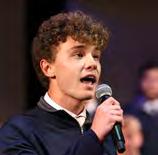
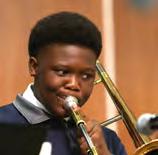
Five vocalists earned recognition on the All-State Choir: Wilson Scher ’26, Sam Kappel ’27, Tucker Hill ’27 (1st alternate), Wesley Balsamo ’26 (2nd alternate) and Patrick Mueller ’27 (honorable mention).
Seven musicians achieved All-State Band & Orchestra honors: Maceo Malkus ’28 (Jazz Guitar, 1st alternate, 2nd place), Edmund Reske ’27 (Trombone, 2nd place), Gideon Taylor ’26 (Jazz Piano, honorable mention, 3rd place), Gabe Altier ’27 (Jazz Drum, honorable mention, 5th place), Mark Meister ’27 (Jazz Drum, top 15), Klaus Jostlein ’26 (Violin, top 16) and Matthew Conte ’27 (Clarinet, Honorable Mention, top 45).
Following the establishment of the Conrads Scholars Program in 2024 – thanks to the incredible generosity and support of Sherry and Bob Conrads ’65 – SLUH continues to strengthen its robust STEM program in several key areas.
CAMPUS: The James Guth Costigan ’62 Innovation Lab has undergone substantial upgrades.
CURRICULUM:
• Fall: Foundations of Engineering, Computer Aided Design (CAD), Data Science, Environmental STEM, Integrated Leadership in Ignatian Equality (ILIE), Programming (Java, C++, Python)
• Spring: Innovative Product Development, AP Computer Science, Python/Game Programming
CLUBS: Ongoing activity and achievement in several clubs, including Robotics Club (RoboBills), STEM Club, Energy Team, Green Ambassadors, Farm to Table Team, Coding Club and Geospatial Club.
COMPASSION: Conrads Scholars partnered with 30 middle schools through the Clavius Project, completing 100+ hours of service and assisting 200+ middle school students with robotics challenges. In addition, SLUH hosted a Robotics Jamboree via the Clavius Project for 300+ middle school students on February 28.
COMMUNITY: The Conrads Scholars Student Organization (CSSO) hosted two successful meetings for Jr. Bills: (1) Dan Wagner ’17 from The Boring Company, Elon Musk’s tunnel-making venture; and (2) Summer STEM “value-added” experiences of current scholars, underscoring their importance for college admissions.
The Conrads Scholars Program helps students grow as makers, innovators and technological leaders who further the common good in one of four curricular strands:
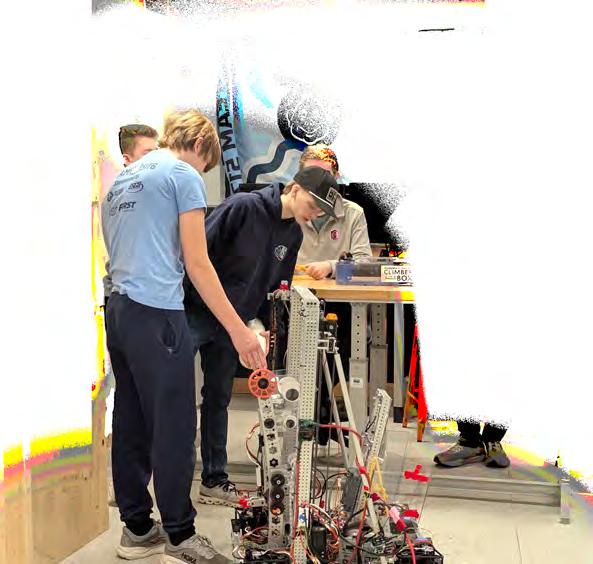
• Engineering Innovation
• Data Science & the AI Revolution
• Computer Science Frontiers
• Environmental Science with Microelectronics
Learn more: sluh.org/conrads
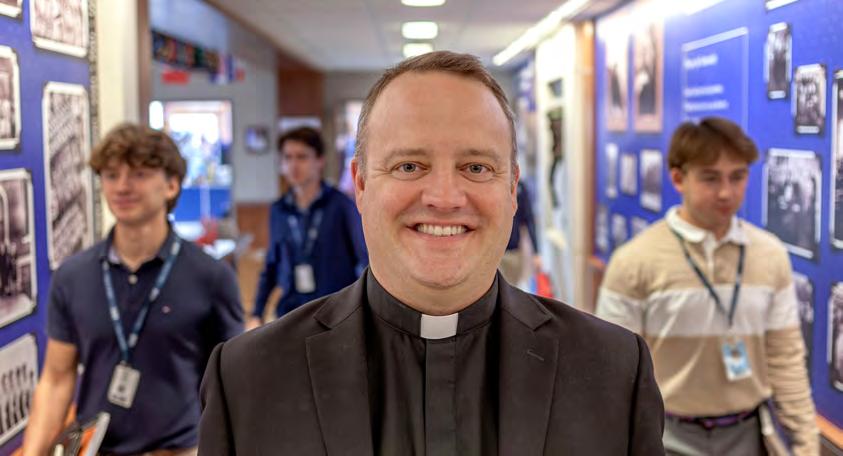
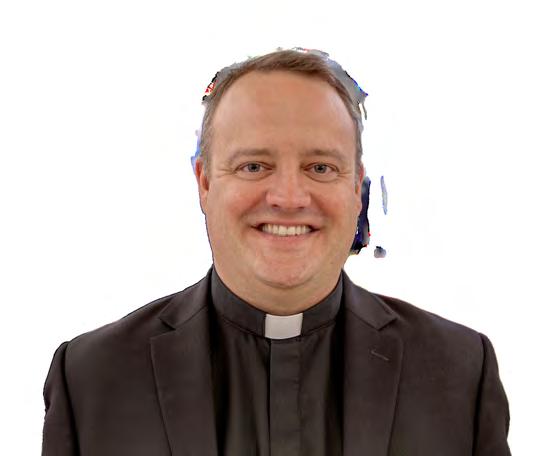
On November 17, 2025, SLUH announced the unanimous Board approval to appoint Fr. Matt Stewart, SJ ‘98 as president of SLUH, effective July 1, 2026. This concluded a comprehensive national search for the successor of Alan R. Carruthers, who has provided strong leadership for the school since his arrival in 2018.
"It is with great pleasure and excitement that I have accepted the offer to serve as the next president of SLUH," says Fr. Stewart. "SLUH has a long and storied tradition of educational excellence in the Catholic, Jesuit tradition, and I am confident that we will continue to further this legacy moving forward."
Fr. Stewart has demonstrated exceptional leadership as principal of SLUH since July 1, 2023. He is the first Jesuit to assume the role of president since Fr. Paul G. Sheridan, SJ (1997-2005) and the first Jesuit alumnus since Fr. Robert T. Costello, SJ ’47 (1992-97).
After entering the Society of Jesus in 2009, Fr. Stewart thrived in a variety of roles in Jesuit schools, including: adjunct professor at Saint Louis University, associate director
of the Alum Service Corps, chaplain and teacher at Loyola Academy, board member of Arrupe Jesuit High, and associate university minister and faculty member at Regis University. He serves on the Board of Trustees at Rockhurst University and on the SLUH Board of Members.
Fr. Stewart holds several degrees, including a Licentiate in Sacred Theology (Liturgy and Sacraments) from Boston College; a Master of Music in Choral Conducting from the University of Denver; a M.A. in Philosophical Resources from Fordham University; and a M.A. in Theology from Saint Louis University with highest distinction.
“Throughout his rich experience in Jesuit education, Fr. Stewart has been well known for his commitment to cura personalis, caring well for students and colleagues, relationship building and collaborative leadership,” says SLUH Board Chair Tom Berra ’85. “A Christ-centered, missiondriven, dynamic and passionate individual, he is a natural leader, a man of great integrity and vision.”
The Provincial of the USA Central and Southern Province of the Society of Jesus, V. Rev. Thomas P. Greene, SJ, enthusiastically endorsed Fr. Stewart’s candidacy and selection as the next president of SLUH.
SLUH embarks on a principal search to select Fr. Stewart’s replacement from a position of tremendous strength. The school continues to be the high school of choice for qualified students in the St. Louis area, providing a premier academic program with exceptional, highly qualified faculty (more than 95% have advanced degrees). A strong internal leadership team, coupled with the continuity of Fr. Stewart’s leadership at SLUH, will ensure the school remains committed to its tradition of excellence in academics, faith formation and all aspects of student life, while conducting need-blind admission and committing to meet the full financial needs of all admitted students.
"Fr. Stewart has been well known for his commitment to cura personalis, caring well for students and colleagues, relationship building and collaborative leadership.”
– BOARD CHAIR TOM BERRA ’85
St. Louis U. High has been blessed with Alan Carruthers as its president for eight years. After SLUH hired him in 2018, he quickly became a strong model of Jesuit spirituality, constantly demonstrating what it means to be a Man for Others. During Carruthers’ tenure, the school has made tremendous academic, spiritual, physical and financial progress.
Following is a partial list of the accomplishments that have occurred during his leadership as president:
• Successfully completed the Go Forth campaign, investing more than $75 million in financial assistance, campus improvements and student programming.
• Constructed the J. Anthony ‘57 and Donna M. Dill Center for Academic Success and the James Guth Costigan ‘62 Innovation Lab.
• Renovated the Chapel of the Beloved Disciple, while installing new, upgraded spaces for Campus Ministry and three academic department offices.
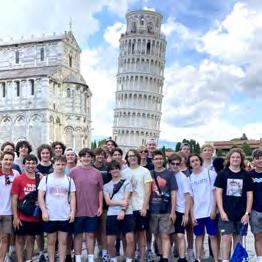
• Established a dedicated College Counseling department and a robust Global Education program.
• Developed new spaces for student media, admissions, student collaboration, global education and sustainability groups.
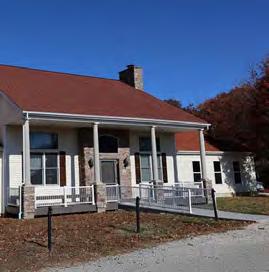
• Renovated the Madonna della Strada Retreat Center in Silex, Mo. with a student recreation space, walking trails, bathrooms, dining area and bunk rooms.
• Expanded workout space for student athletes and fully renovated the rifle range.
• Developed and funded the Francis Scholars Program and the associated Fr. Kellett’s Closet to care for and serve students of greatest need.
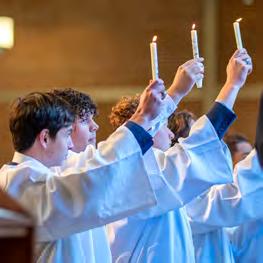
• Expanded academic and faith formation programming.
• Maintained a strong enrollment, now at 1,010 students from 88 zip codes and 157 middle schools.
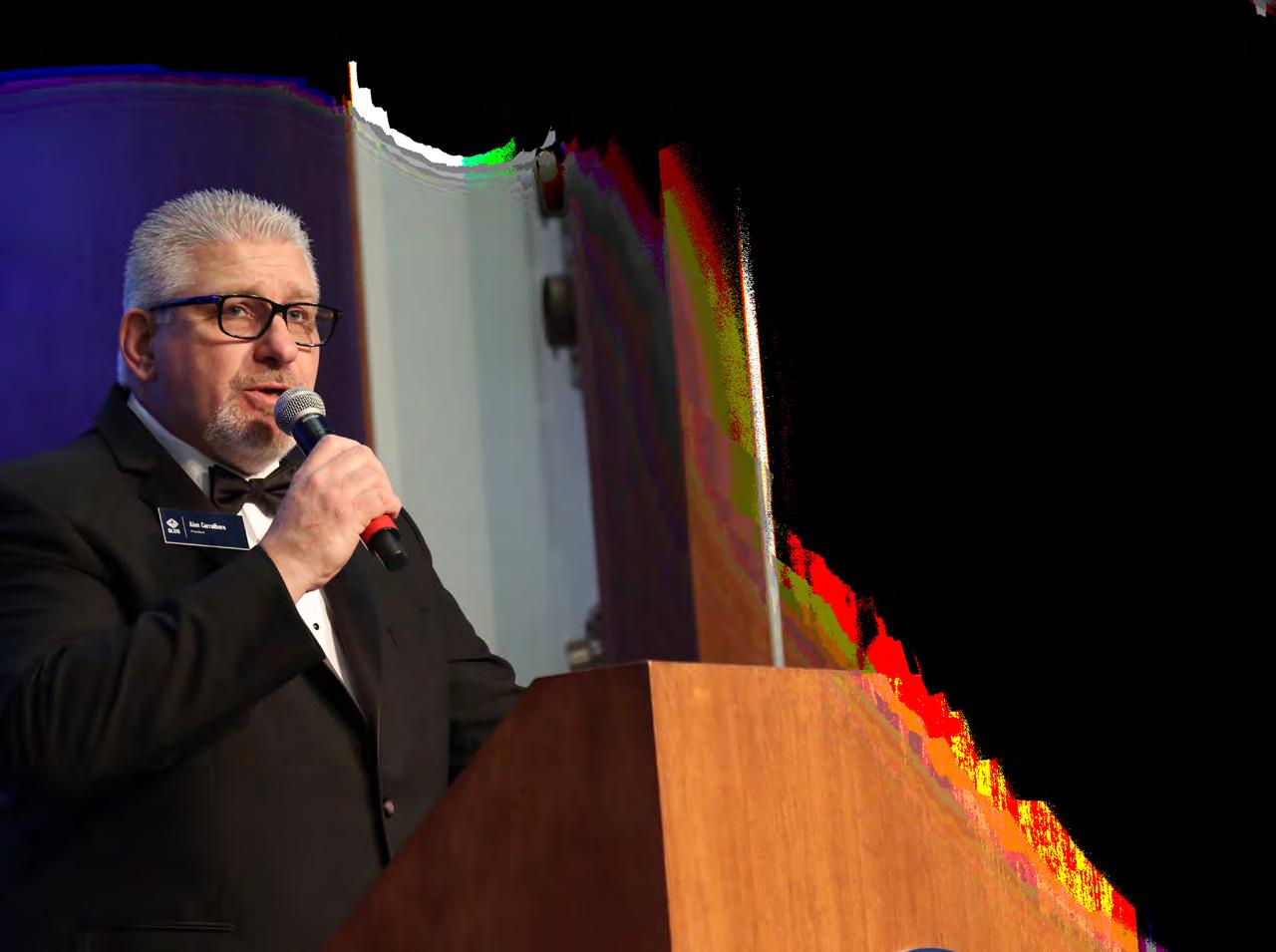
“Clearly, Alan will leave a significant legacy of achievement that will benefit SLUH for many years.”
– BOARD CHAIR TOM BERRA ’85
• Doubled the school endowment, currently estimated at more than $100 million, while developing new ways for philanthropic giving, including endowed programming and an increased focus and options for bequests and long-term giving.
• Boosted need-based financial assistance, which now provides $6.1 million to 49.4% of the student body.
• Maintained a commitment to eliminate the school debt and improve the long-term business model.
• Developed a strategic vision for diversity, equity and inclusion in collaboration with the Board of Trustees; created the Alumni Trailblazers display highlighting achievements of graduates of color.
• Added Athletic Department staffing, as well as two new sports (Bowling and eSports) and oversaw a revitalization of our commitment to excellence in athletic pursuits.
• Enhanced the campus aesthetic to underscore the Jesuit charism as central to the school identity.
• Launched the newly reinvigorated Jr. Bill Store in support of the school mission.
• Developed a strategic partnership with St. Louis Community College to improve its Forest Park pool to better serve our aquatic athletes.
• Worked with SLUH staff and community leaders to improve the safety and aesthetic of our local neighborhood, including the removal of derelict buildings at Oakland and Kingshighway.
Complementing Alan’s many contributions to the SLUH community, his wife, Lucia, has spent countless hours in service to the school. In addition to assisting the Mothers Club, she helped to establish Fr. Kellett’s Closet, ensuring that all students, regardless of financial means, have access to the complete SLUH experience.
“Clearly, Alan will leave a significant legacy of achievement that will benefit SLUH for many years,” says Board Chair Tom Berra ’85. “We are tremendously grateful for Alan and all he has given to SLUH, and we look ahead to our future with great confidence, buoyed by his strong leadership.”


On July 1, Megan Menne will assume the role of Interim Principal for the 2026-27 school year. This will allow SLUH time to undertake a comprehensive search for Fr. Matt Stewart’s replacement.
Throughout Menne’s tenure at SLUH, which began in 2010, she has taught biology and astrophysics, been recognized by the Class of 2019 with the Faculty Appreciation Award, and served as Director of Student Activities. She transitioned to an administrative role in 2025 when she became Assistant Principal for Activities and Formation as the second lead female academic administrator in SLUH history (joining Mary Schenkenberg, Principal from 2002-08). Menne, who holds a Master of Education and Bachelor of Science degrees, is highly regarded as a leader of deep faith, intelligence and vision.
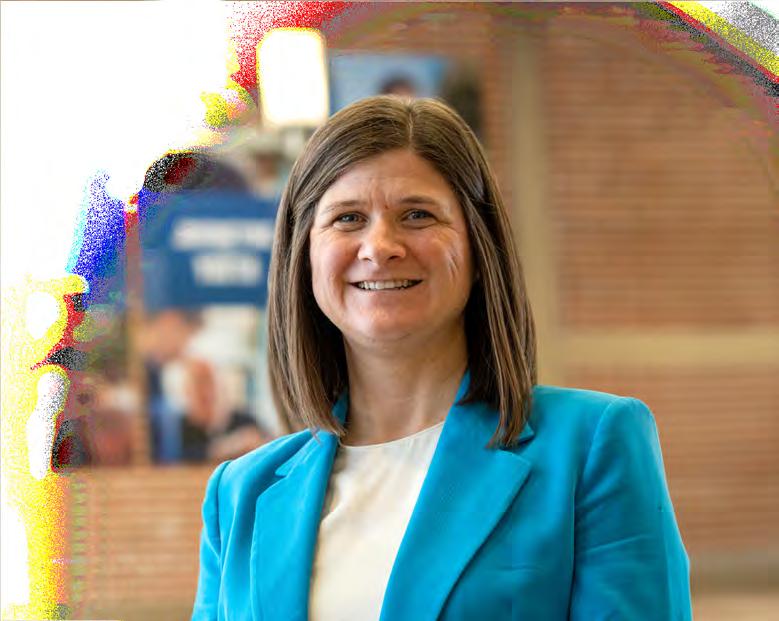
Learn more about this St. Louis native who will help lead SLUH next school year:
GRADE SCHOOL/PARISH: St. Norbert's in North County
HIGH SCHOOL: Rosati-Kain
COLLEGE: Truman State University (B.S. Biology) and University of Missouri (M.Ed.Curriculum and Instruction)
HUSBAND: Mike Menne (software engineer at a start-up company)
CHILDREN: Olivia (4th grade), Nora (kindergarten) and Rosemary (2.5 years)
PRAYER: My two favorite prayers are the Suscipe and Prophets of a Future Not Our Own. There is a sense of comfort in handing things over and trusting in God and I find that both of these prayers remind me of that comforting trust.
BOOK: I love reading – my favorite authors are Michael Crighton, Taylor Jenkins Reid and Jane Austen.
MOVIE: Pride and Prejudice (the BBC mini-series version)
BAND/SINGER: My husband and I love traveling to see live music in cool venues. Two of my favorite shows were The Decemberists in Park City, Utah and The Bleachers in Austin.
SPORTS TEAM: STL City Soccer and St. Louis Cardinals (Mike and I got married the day after they won the 2011 World Series).
HOBBY: Hiking. Some favorites include backpacking through Yosemite, hiking to the bottom of the Grand Canyon, and camping out in the Badlands National Park.
FOOD: Sushi and Ramen. My two favorite restaurants are Menya Rui and Vicia.
HERO: Mary is someone I really look up to – one of my favorite pieces of art is The Annunciation by Henry Ossawa Tanner. I love how it depicts Mary as a young, relatable woman – and her expression shows how she is feeling uncertain and unsure of herself, but that she still puts her trust fully in God at that moment.
CHILDHOOD MEMORY: Every summer we would go to Door County, Wisconsin with my grandparents. I loved spending time in the various small towns shopping, kayaking, picking cherries and watching sunsets on the bay.
“We teach improv like we would teach a team sport. While we don't know what content will come up at any given moment, we run exercises that focus on skills like listening, specificity and emotional range. And crucially, we spend a lot of time getting to know each other as humans so as to build empathy and camaraderie. Improv is always a little scary and vulnerable, and it helps to gain confidence through playing with people you know well, trust and really care about.”
– MELANIE PENN IMPROV SHOW, CO-DIRECTOR
SLUH put on three entertaining performances of a 1990s sitcom-themed improv show in the Joseph Schulte Theater from October 24-26. The studio-audience style show consisted of two halves: one fun, witty shortform half with improv games and another with challenging long-form sketches that lasted about 15 minutes each.
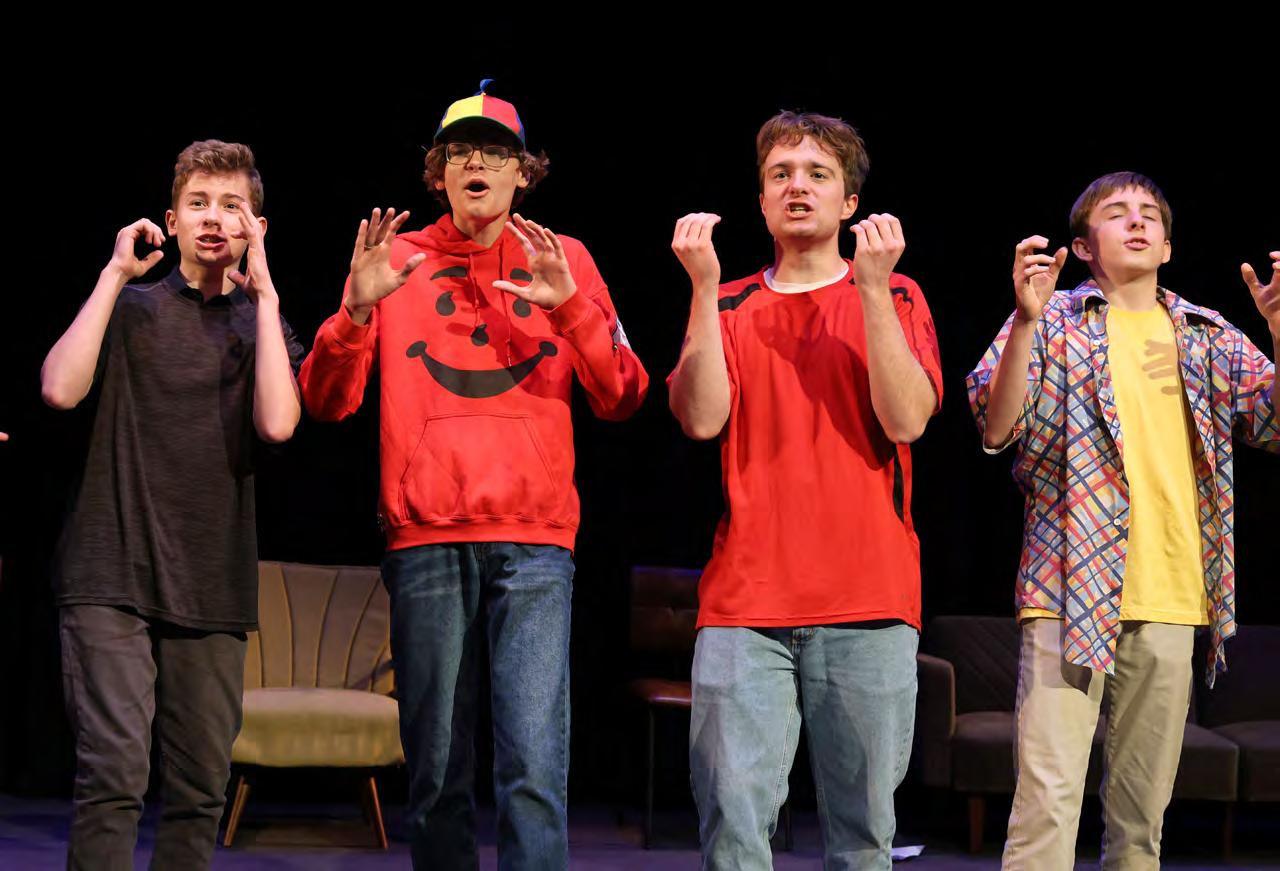
View the Prep News article, “Radical! Improv show wows again”
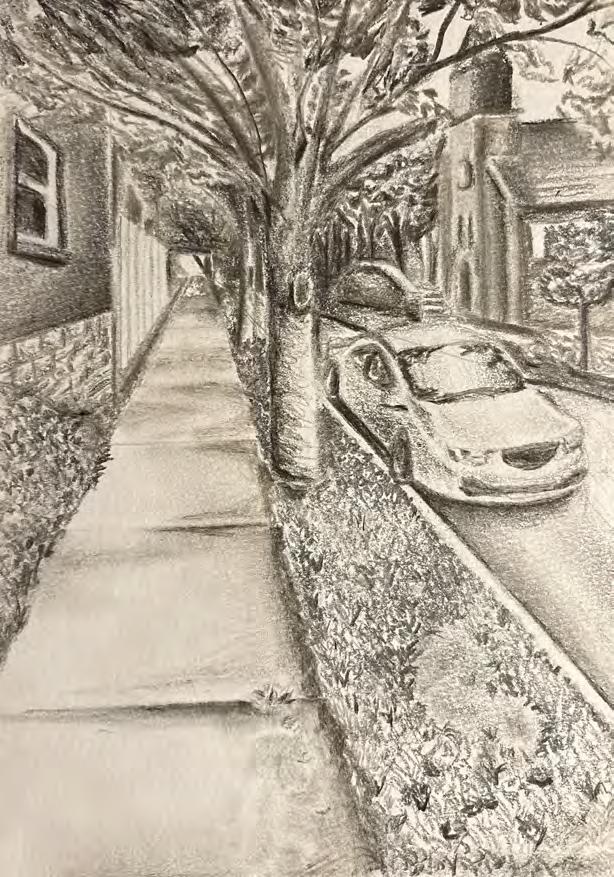
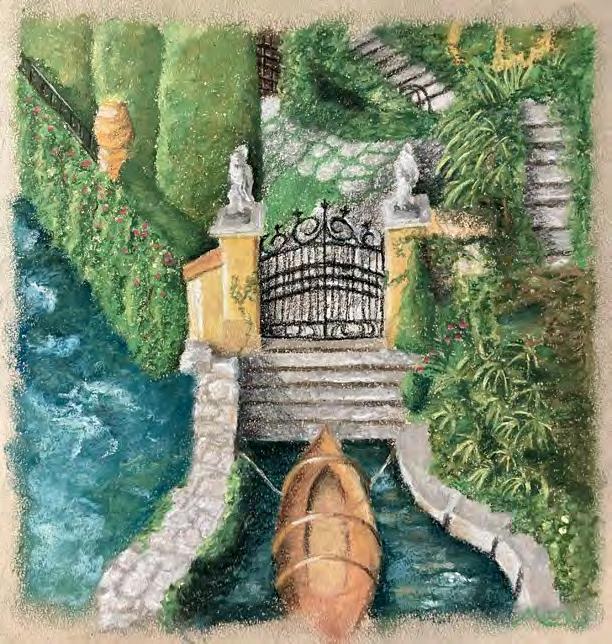
Enjoy the fruits of creative labor from our students in the latest issue of Sisyphus, the SLUH Magazine of Literature and Art, at sluh.org/sisyphus You are bound to find a story, poem, personal essay, drawing, photograph or piece of artwork that amazes or inspires you.
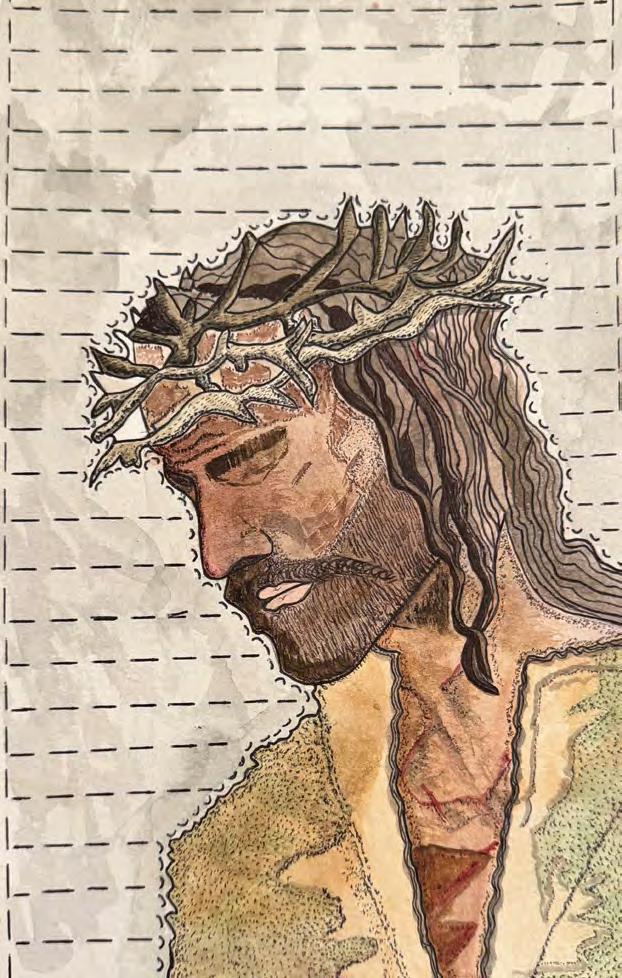
running
RYAN KINDSCHUH ‘28
all my pain continuously conquers my willpower i can’t escape it the pain i feel is slowly destroying the love i have for the sport the love i have for the sport is slowly destroying the pain i feel i can’t escape it my willpower continuously conquers all my pain

Komorebi COLTON EIKERMANN ’26
To those moments when life illuminates:
When leaves of limb dance and bend, Leaking beams of brilliance That dazzle the eyes. When light and shadow wrap themselves in their tangles below Intertwining here and between Then suddenly Air rustles
Leaves shift And light bursts
God’s hand gestures me close
8 p.m. Friday night. The road is still vibrant, wet pavement glows under streetlights, cars skid past with shining headlights, close and loud, then gone. I watch them pass and wonder, just naturally, who’s inside, where they’re headed, what kind of weight they’re carrying.
Someone is driving too fast, maybe racing toward a hospital, hoping they’re not too late to say goodbye to a loved one. Someone else is relaxed, windows down, excited to watch Friday night football with their buddies. Another car holds someone drained from work, who still has to go home, feed their kids dinner, and pretend they aren’t exhausted. Then they’re gone; I never see them again.
I roll the window down. Cold air fills the car. I stick my hand out into the night, let the wind lift it, push it back down, making soft waves through the misty night. Everything feels open – free.
The night is wide and quiet in a comforting way. The wind is steady. I think about my own life – how complicated it is, how I’m still figuring out what to do with it, just like everyone passing by.
There’s something beautiful about that. All of us moving forward, carrying our own horrible, exciting, confusing stories.
This is life – the peace of driving, feeling free and alive, as the road keeps going and so do I.

BY CHRIS MUSKOPF ‘91 Athletic Director

After landing at the top of the MCC allsports rankings for the previous four years, the Jr. Bills sit atop the All-Sports Trophy standings at the conclusion of two of the three MCC winter sports regular seasons.
Claimed the program’s 22nd consecutive MCC Championship and third consecutive District Championship, which earned the program its 33rd consecutive team berth in the MSHSAA State Cross Country Championships.
Landed in 3rd place as a team at the 2025 MSHSAA State Class 5 Championships, claiming the top finish for a St. Louis school for the 8th consecutive Championships and finishing on the podium for the 7th time in the last eight seasons.
Nick Ahlheim ’26 claimed the individual MCC championship and Jackson Miller ’27 earned the individual district championship, the program’s first since 2017.
All-State runners were Jackson Miller ’27 (3rd place), Warnicke Beatty ’28 (16th place), Michael Luna ’27 (24th place) and Hendrix Fyvie ’26 (28th place), marking the first time in program history that four runners earned All-State honors.
Miller's time of 15:06.9 at the MSHSAA State Championships set the school record in a 5K race, eclipsing the record he established at the 2024 MSHSAA State Championships.
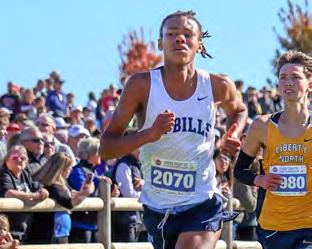
Miller’s 3rd place finish is the program’s 3rd-highest individual finish since Jerry Dirnberger ’62 won the individual state championship in 1961.
SLUH was recognized as the 2025 Big River All-Metro Cross Country Team of the Year.
Two Jr. Bill runners were named to the 2025 STLtoday All-Metro Team: Jackson Miller ’27 - 1st team and Nick Ahlheim ’26 - 3rd team.
Super Smash Bros Solos: Ben Schneider ’26 qualified for the MOSEF SSBS state finals in Sedalia in December and earned a 5th place finish.
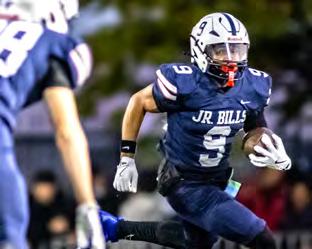
The 2025 team rose as high as #5 in the Missouri Class 6 Poll and #3 in the STLtoday HS Sports large school rankings before falling to CBC (#1-ranked Class 6 school), Rockhurst (#3-ranked Class 5 school) and Lafayette (#4-ranked Class 6 school) to end the season.
The total of 21 wins over the last three seasons equals the highest total in a three season span since the 2014-2016 seasons.
Went 3-1 in the MCC (Metro Catholic Conference) in 2025 with wins over De Smet, Vianney and Chaminade, good for a second
place finish in the MCC – the first such finish since 2011.
Linebacker Keenan Harris ’26 set two school records, becoming the school's alltime leader in career starts (44) and career tackles (390).
Running back Jordan Taylor ’26 rushed for 1,000 yards for the second straight season, becoming the first SLUH running back with back-to-back 1000-yard seasons since Andrew Clair ‘17.
The Jr. Bills earned 26 spots of All-MCC recognition, including 10 players on the 1st Team.
Two Jr. Bills were designated as STLtoday All-Metro: 1st TeamKeenan Harris ’26, DB and 2nd Team - Zach Allen ’26 WR.
Two Jr. Bills were honored as MFCA Class 6 All-State: 1st Team - Keenan Harris ’26 S and 3rd Team - Albert Reinberg ’26 OL.
The 2024 and 2025 seasons are the first ever back-to-back MSHSAA State Championships in the history of SLUH soccer.
The 2024 and 2025 District Championships mark the program’s first back-to-back championships since the 2015 and 2016 seasons.
With a 1-0 victory over Eureka in the MSHSAA State Class 4, District 2 quarterfinal, the 2025 varsity team recorded victory number 1,300 in the history of the soccer program.
The victory in the quarterfinal round earned the first backto-back berths in the MSHSAA State Boys Soccer Final Four
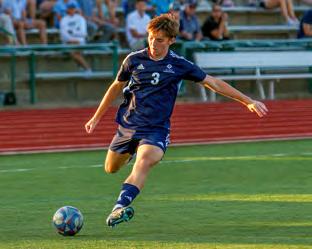
since the 2009 and 2010 seasons and the fifth back-to-back appearances in program history.
Ten varsity soccer players were named to All-MCC teams, including five on the 1st Team.
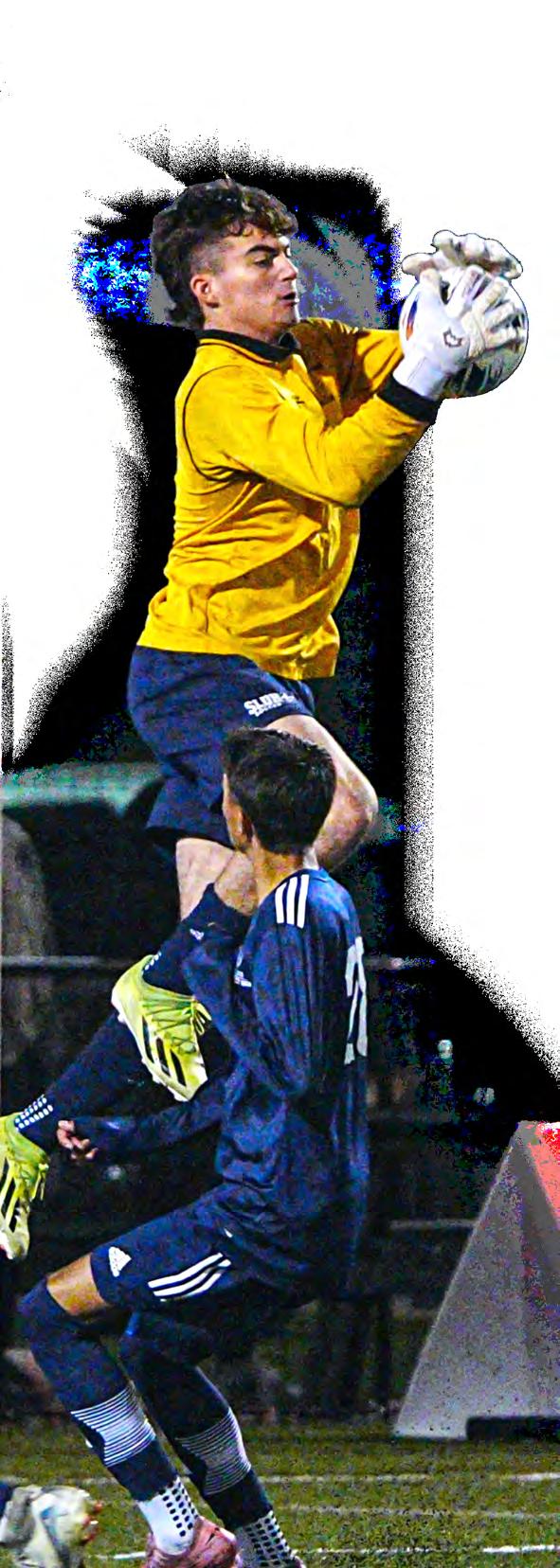
Four Jr. Bills received STLtoday All-Metro recognition: Player of the Year - Henry Sanders ’26 MF; 1st Team - Connor Niles ’26 D and Paddy Byrne ’27 MF / 2nd Team - Cole Chambers ’27 GK.
The Missouri High School Soccer Coaches Association conveyed Class 4 All-State honors to six members of the soccer program: Player of the Year - Henry Sanders ’26 MF / Goalkeeper of the Year - Cole Chambers ’27 / Coach of the Year (Private Schools) - Bob O’Connell / 1st Team - Paddy Byrne ’27 MF; Cole Chambers ’27 GK; Connor Niles ’26 D; Henry Sanders ’26 MF / Honorable Mention - James Barry ’26 MF.
Midfielder Henry Sanders ’26 was designated by the United Soccer Coaches as an All-American and was named to the roster for the High School All-American Game.
The 3rd place finish at the 2025 MSHSAA State Class 2 Swimming and Diving Championships marked the 7th podium finish in the last nine seasons.

(continued on next page)
Twenty Jr. Bills swimmers earned All-MCC honors in individual events, including 14 on the 1st Team.
Nine Jr. Bill swimmers finished in the top eight of at least one event at the MSHSAA State Class 2 Championships, earning the designation of 1st Team All-State, with nine others claiming spots in the second eight of at least one event and earning the designation of 2nd Team All-State.
For the second consecutive MSHSAA State Class 2 Swimming and Diving Championships, Connor Dunker earned AllState recognition in each of the four events in which he competed (200 freestyle, 500 freestyle, 200 freestyle relay and 400 freestyle relay)
Two members of the swimming and diving program were designated as STLtoday AllMetro: Connor Dunker, Sr., 1st Team and Henry Hassenstab, Jr., 3rd Team
USA Swimming honored Connor Dunker ’26 by tabbing him as a Scholastic All-American.
WINTER & SPRING SPORTS
Check @SLUHAthletics on X and sluh.org/athletics for current news, scores and updates.
HONDURAS
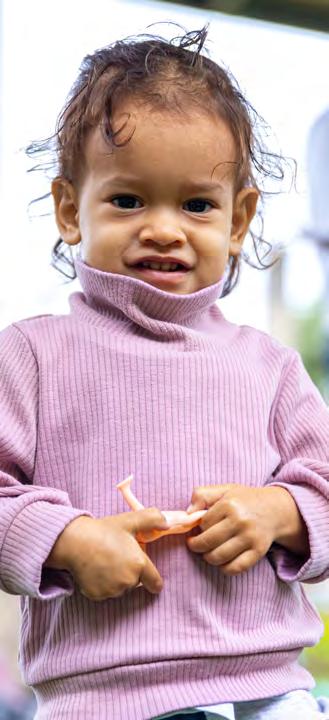
Nearly 500 years ago, Fr. Jerónimo Nadal SJ, one of the earliest companions of St. Ignatius of Loyola, etched the Jesuit spirit in one succinct line of poetry: “The world is our home. The road is our cloister.” In the Ignatian tradition, a SLUH education is not confined to classrooms – rather, it expands to the whole world.
During the month of January, six seniors studying Spanish traveled to Yoro, Honduras to conduct their Senior Project at the San Yves Nutritional Center. San Yves is a private non-profit organization that operates an in-patient recovery center for children suffering from severe malnutrition. Charlie Merriott, retired SLUH Spanish teacher, started the program more than 30 years ago.
The following testimonials demonstrate the impact of the students’ service outreach in Honduras.
Photos by Jack Auer ’26.
"My project experience has taught me that my neighbor is not only the people that live next to me or even in my city, but even people in distant lands like those I interacted with in rural Honduras. When Jesus said, ‘Love thy Neighbor,’ I now understand that he didn't just mean the people close to you but also people unimaginably far away."
– JACK AUER ’26
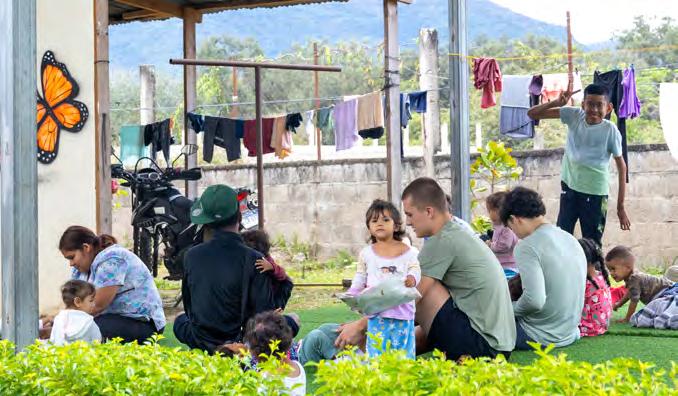
"After spending a month in Honduras, seeing how other people live, I learned that you don't need a lot of money or a fancy job title or a hot shower to be happy in life. Some of the richest and best moments I had in Honduras were with people that didn't have a lot, and I think that's beautiful, that the real goal in life is to have a great community around you."
– LUCAS STEVENS ’26
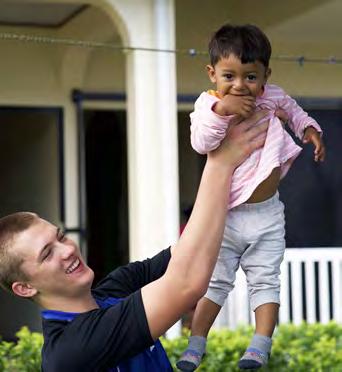
"Through the innocence and happiness of the children, I was reminded that at one time Jesus himself was also a child, just wanting the love and attention of others like his mother, Mary."
– TRISTAN KUJAWA ’26
"I felt God working through these kids, working to help them get better to improve their lives, and working through these kids to give them a happy life."
– MCCOY AMANN ’26

Following are recent highlights from the global education program:
• Last fall, SLUH hosted 21 students from Jesuit partner schools from Chile, Colombia and Poland. The boys were full-time students at SLUH during the first quarter, participating in classes and all student life activities such as Running of the Bills and the Back to School Mixer. Girls from these schools had similar visits with Nerinx Hall and St. Joseph’s Academy at the same time.
• SLUH hosted students from Jesuit partner schools in France and Germany during late October.
• Twenty eight Jr. Bills served in Poland, France, Guatemala, Honduras and Taiwan during January for their Senior Project under the guidance of a Jesuit partner in those countries. At the same time, SLUH hosted student groups from Poland, Taiwan and Mexico for service projects in St. Louis.
During Spring Break, Jr. Bills travel to:
• Argentina and Uruguay to visit Jesuit partner schools and immerse themselves in the soccer culture of both countries;
• Arizona for a service program with the Kino Border Initiative;
• Germany and Ireland for cultural exchanges;
• Italy for an immersive choral program trip; and
• South Africa for a marine biology program.

“We are extremely grateful to John Schaefer and Pamela Zilly for their transformational gift that will establish an endowed effort focused on academic excellence, which is one of the key strategic pillars of SLUH’s future vision. This will allow SLUH to set the standard for excellence in Catholic, college preparatory education. The Sciuto Institute for Teaching Excellence will ensure the best classroom experience for students through a range of resources for faculty to grow in their subject expertise and approach to pedagogy.”
– SLUH PRESIDENT ALAN CARRUTHERS
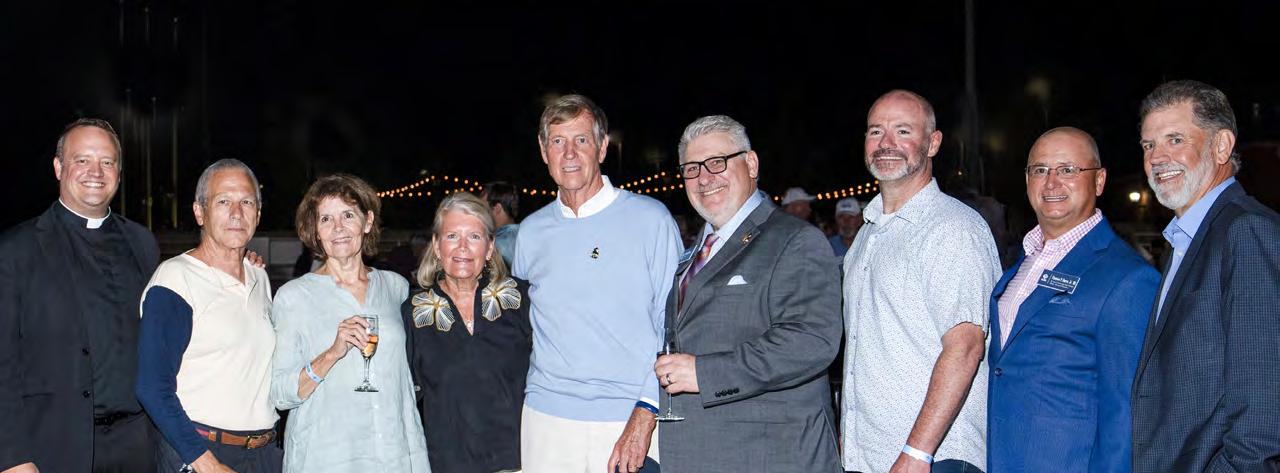
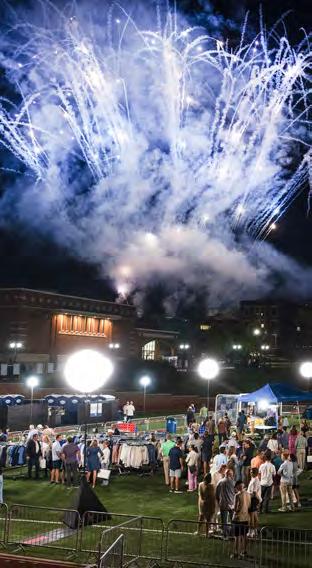
SLUH celebrated the close of its 100th anniversary on Oakland Avenue on Saturday, September 27, 2025, with a community-wide event featuring live music, alumni reunions, a party atmosphere with fireworks and the announcement of the largest gift commitment in the 207-year history of the school. John Schaefer ’70 and his wife Pamela Zilly will fund the Sciuto Institute for Teaching Excellence (SITE) to build on the exceptional academic tradition at SLUH for future generations.
SITE WILL INITIALLY FOCUS ON SEVERAL KEY AREAS OF ACTIVITY:
Commissioning and directly conducting research will allow SLUH to stay ahead of

Pamela Zilly and John Schaefer ‘70
Expanding and deepening partnerships with organizations like the Jesuit Schools Network (JSN) and others will introduce fresh perspectives and promote the pursuit of best practices.
SITE will be funded by the $16 million gift commitment from Schaefer and Zilly, combined with a side-by-side commitment by SLUH to add an additional $5 million to the SITE endowment. In addition to allowing SLUH to continue to attract, hire, develop, support and retain faculty of the highest caliber, SITE will solidify a culture of high standards and professional accomplishment in the Jesuit tradition of excellence in education. It will make SLUH widely known as the school of choice among exceptional faculty throughout the country.
“This gift will on one hand provide perpetual funding yet be structured in such a way as to allow us to be nimble to respond to changing times,” says Carruthers.
(from left): Sean Agniel ‘96, Ray Van de Riet, Jr. ’80, Fr. Matt Stewart, SJ ‘98, Matt Sciuto ‘70, Patti Sciuto, Mary Reedy, John Schaefer ‘70, Alan Carruthers, Kevin Foy, Tom Berra ‘85, John Stephens ‘77
Schaefer earned a bachelor’s degree in accounting from the University of Notre Dame and a master's degree in business administration from the Harvard Graduate School of Business. He had a 30-year career in financial services including senior management positions in investment banking, firm management and wealth management. He began his career at E.F. Hutton in 1976 and retired from Morgan Stanley in 2006. His last position was President and COO of the firm’s Global Wealth (continued on next page)
Broadening the reach of instructional coaches will ensure high standards of excellence in the classroom; faculty will enjoy increased opportunities for interdepartmental collaboration and forward-thinking about curricular enhancements and evolution.
Forward-looking approaches to integrating new and existing technologies will help teachers engage with students more effectively today, and to prepare them for how to reach students with future technological change.
Teachers will be supported at every stage of their career through a range of programs and opportunities, especially through continuing education, peer learning and access to resources that promote pedagogical excellence.
Management business. Since retiring, he has served on several corporate and nonprofit boards, including the SLUH Board of Trustees (2017-2023).
Zilly earned a bachelor’s degree in economics and American history from Connecticut College and a master’s of science degree in industrial management from the Tepper School of Business at Carnegie Mellon University. She had a 32-year career in investment banking and financial restructuring. She began her career at E.F. Hutton in 1977 and retired as a senior managing director of Blackstone in 2009. She currently serves on several nonprofit boards, including Alvin Ailey American Dance Theater and the American Theater Wing.
SITE is named in honor of Matt Sciuto ’70, who retired after a storied 39-year teaching career at SLUH (1980-2019). In addition to teaching theology, Sciuto coached football, baseball and served as the school photographer. As a student, he was the senior class president for the Class of 1970. To this day, he keeps his class connected through ongoing
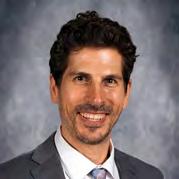
BY DIEGO NAVARRO THEOLOGY FACULTY
communication, class events and initiatives advancing the SLUH mission. He is fondly remembered by former students for his passion for teaching and coaching, as well as his enduring love for SLUH.
“Matt and I became kindred spirits early on at SLUH,” says Schaefer. “We each had recently lost a parent. All I can say is that SLUH was there for us, and we were there for each other during particularly challenging times. For all grads of this wonderful school, the two things most remembered are classmates and teachers. Watching Matt develop into a beloved member of the faculty brought back great memories of all the lay and Jesuit teachers we had. Matt is the embodiment of what teaching excellence is all about.”
The $16 million gift to fund SITE comes just one year after Sherry and Bob Conrads ‘65 announced the creation of the Conrads Program for Integrated Sciences with a $10 million gift commitment. These two historic gifts, totaling $26 million, provide extraordinary promise for an already-robust, nationally recognized academic program at SLUH for generations to come.
Learn more about SITE: sluh.org/SITE
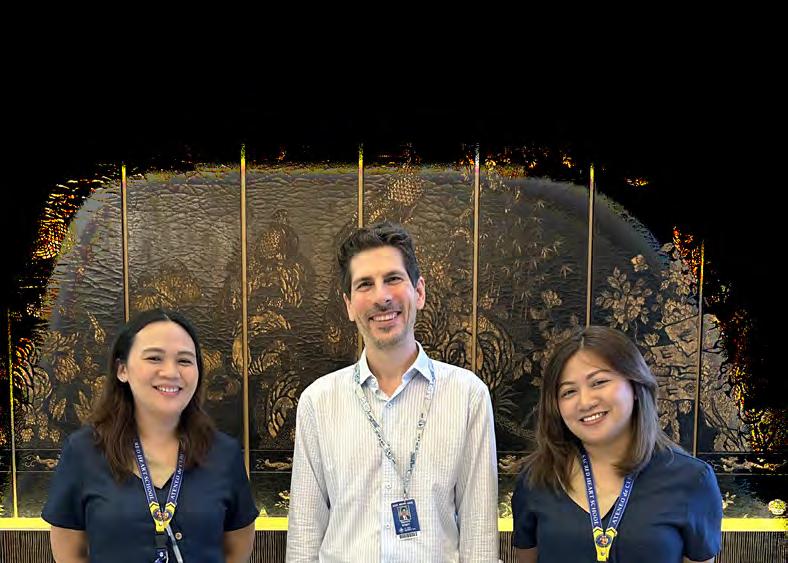
Editor’s note: Navarro is currently on sabbatical for the spring semester, although he wrote the following reflection in December 2025. He is the first faculty member to take a sabbatical funded by the newly established Sciuto Institute for Teaching Excellence.
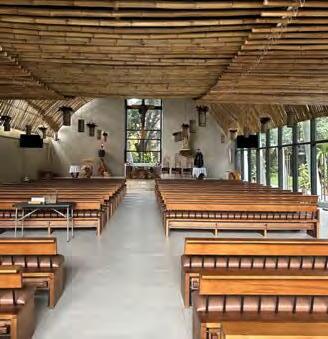
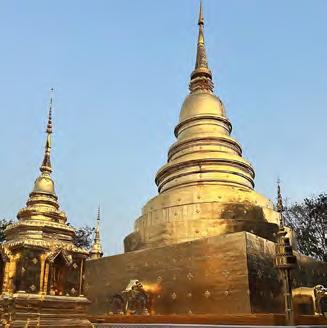
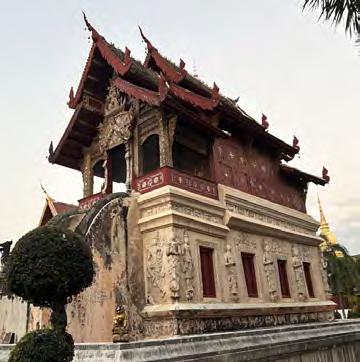
Excited. Nervous. Grateful. These only begin to describe how I’m feeling as my sabbatical approaches. Mostly I still can’t believe it’s happening: that SLUH – thanks to the incredible
generosity of John Schaefer ’70 and his wife, Pamela Zilly – is sending me halfway around the globe to work, learn and, when I return, go on retreat.
I hadn’t seriously considered a sabbatical until I received an email from the UCS Office of Ignatian Spirituality about a November pilgrimage to Japan. Knowing it would be tough to leave during the school year, I spoke to the administration anyway. Subsequent conversations with
Fr. Matt Stewart, SJ turned that impulse into a proposal for a sabbatical – one designed to enhance the curriculum of our World Religions course and deepen my own spiritual life. I felt like the project was unlikely to take flight given that school funding is pretty tight, but I felt it was better to dream big and leave it all on the table.
The request was expansive:
• Immerse myself in communities and sites studied in the World Religions class, such as those of the Dalai Lama in India and the Gaagudju in Australia.
• Refocus the World Religions curriculum into a “Catholic retreat” model. This way, students would still appreciate what is beautiful and true in other traditions while using that work as a vehicle to connect more deeply with themselves and their own Catholic faith.
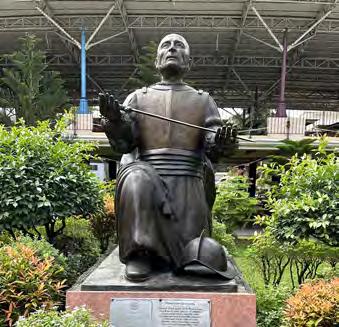
• Develop connections with Jesuit high schools in Nepal, Japan and the Philippines in order to facilitate future exchanges.
• Continue to deepen my own relationship with God by making Ignatius’ 30-day Spiritual Exercises
I wasn’t wrong about the financial realities, though, and so when I was officially told that my proposal didn’t fit in the budget, I understood completely. I made my peace with it quickly: sabbatical or not, I felt deeply grateful to have students that I love, work I find meaningful, and peerless colleagues that are so dedicated and supportive. Some time passed, and then one day Fr. Stewart called me to his office and said that, after a meeting with a donor, everything had changed, that I could go, and that I needed to submit a formal budget. I was truly shocked. And nearly 11 months later I still feel shocked. It seems surreal that I’ll be traveling for nearly four months, surreal that I’ll get to go on retreat after that, surreal that SLUH and its benefactors so deeply believe and care for its faculty and future students that they’re willing to invest in
us – in me – in this kind of way. I hope to make the whole experience a retreat of sorts, and I anticipate being challenged in many ways. We never really know where God is leading us, what love might ask of us, what encounters and people might change us or help us realize what we need to let go of for God’s sake. It’s Advent as I write this, and it’s a helpful reminder to me that all I can really do is remind myself that I’m always in God‘s hands, that wherever I go I need to continue learning to cooperate with God in my daily life, and that ultimately I can’t really predict the cumulative effect of anything, much less this sabbatical.
But I do know one thing for sure: this is truly a gift I couldn’t possibly earn.
SLUH faculty provide the foundation for students to think critically, lead courageously and transform the world as Men for Others. As leaders in education, they are continually seeking excellence by revealing new ways of thinking and pushing the boundaries of possibility.
Their impact extends beyond the classroom, furthering various fields of discipline. Following are examples of a few faculty who, among others, have published work in their respective fields.
More than 95% of SLUH faculty have advanced degrees, and all are committed to professional development in their respective disciplines.
In addition, each year several faculty members serve as AP Readers, evaluating and scoring free-response questions from annual AP Exams. This role provides a valuable opportunity to: gain unparalleled understanding of what the College Board looks for; improve their own teaching and ability to help students succeed on AP exams; and receive excellent training on scoring rubrics and teaching strategies.
Some of our faculty who have served and/or currently serve as AP Readers include:
• Dan Becvar: AP Calculus
• Jennifer Carroll: AP English Literature
• Kathleen Dwyer: AP Chemistry
• Lindsey Ehret: AP World History
• Sean Ferguson: AP U.S. History
• Don Steingruby: AP Calculus
• Tim O'Neil: AP World & European History
• Tom Wilson: AP Psychology

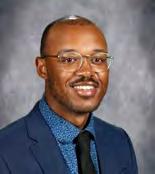
SLUH English Faculty
MFA (Washington University in St. Louis)
An avid writer, Justin Danzy was a Chancellor’s Graduate Fellow at Washington University in St. Louis and the 2019 Gregory Pardlo Fellow at the Frost Place. His poems have appeared in New Ohio Review, West Branch, The Offing, On The Seawall, Guesthouse and elsewhere. In addition, he is the author of the poetry collection Run in such a way, forthcoming from Northwestern University Press in February 2027.
“There's joy in being alive, which is easy for me to forget,” says Danzy. “When I write poems, I feel this most intensely, meaning when I write poems I am most aware of my existence, the absurdity of it, the beauty, the horror, and how fleeting it all is.”
In addition to serving on the English faculty, Danzy is co-moderator for the SLUH Black Student Union and assistant coach for the varsity football team.
Danzy’s following poem was published in Frontier Poetry.
Sprawling, the garden is, and fruitful
We check it each day, many times, walk barefooted through the grass to the corner of the yard that has blossomed to jungle, unkempt, unplanned,
the tomato plants robust and thick as saplings, the cucumber vines and their rough leaves, which I brush with the back of my hand like a cheek.
The firstfruits are coming in, a bouquet of mint, lavender, the peppers growing shyly in the back, cherry tomatoes, one of which we’ve harvested, perhaps too soon, and cut
into six slivers so each of us would have a piece to enjoy. It won’t last long, this life, this moment, my brother here from South Carolina, his daughter from Arizona, me
from the low places I’ve sheltered in since I left years ago. I can’t help but be in awe of it, creation, this life that flows in and through us, the tomato plants
which grow youthful and sturdy, then lean, sagging and groaning with time, their inevitable decay, how it all decays. My mother walks with a limp now
and holds tightly to the rail when scaling the steps up to the front porch. We worry about each other, and my father, and my brother, and sister, who is tired
from working and in need of surgery to replace a leaky valve in her heart. She calls me when I’m not here to talk about K-Pop and other things I care nothing about,
which is her way of saying she loves me, which I find beautiful and sacred, the way all things of love are beautiful and sacred, the way this overgrown garden is, too, beautiful and sacred and surrounding us as we gather in its midst tonight, the final night we will spend together, grateful to be amongst the living and dying and soon to be living again.
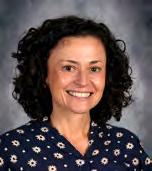
ANDREA SCARPINO SLUH English Faculty
Ph.D. (Bath Spa),
MFA
(Ohio State)
Scarpino has more than 20 years of experience as a published writer, teacher, editor, program coordinator, grant writer, fundraiser, arts activist and disability activist.
She is the author of the poetry collections Once Upon Wing Lake, What the Willow Said as it Fell, and Once, Then, and co-editor of the anthology Undocumented: Great Lakes Poets Laureate on Social Justice. She is also co-editor of Nine Mile Magazine and served as Poet Laureate of Michigan’s Upper Peninsula 2015-2017.
“Poetry helps me make sense of the world and my place in it,” says Scarpino, who, in addition to serving on the English faculty, is the assistant director of global education.
The following poems by Scarpino were published from her collection, Once, Then (credit: Red Hen Press).
And you, who once were bustle, quick step, race, water running for a shave, radio playing basketball games, mowing, cooking, tinkering. Hospital bed, most still I’d seen. I stared at your chest, swore I saw you breathe. Five years you didn’t drive and yet I listen for your car horn beeping up and down the street, red Thunderbird, station wagon, Jeep, short blasts of home, I’m home, a mile away, or early morning light
before the paper came, I’m leaving, going, gone
To say farewell to you—
fare well as you make your way from who you are to who you used to be, fare, a passage for which a price is paid. Bon voyage, good travel, travel safe. To say goodbye, adieu, adios, God be with you wherever your atoms realign. Leave-taking what you leave behind, closets empty of your clothes, furniture sold, given away. Au revoir, auf Wiedersehen, to see you again someday. To sign off, part ways—
to resign, relinquish, consign.
My Father and the Nuns, 1956 Microbiologist, teachers of parochial school, my father in his white lab coat, the nuns
in long white robes, black habits covering their hair. They came to learn the news,
double-helix DNA, evolution’s sway, so science class could meet State rules.
He taught them to pipette, swab Petri dishes with cotton sticks, wipe down the counter tops
with iodine. They studied water drops, grew Staph on slides, counted microbes one by one, signs of God like strings of beads through chalky hands.

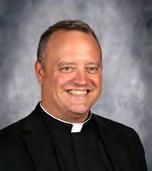
SLUH Principal M.A. (Saint Louis University), M.A. (Fordham), M.M. (Denver), S.T.L. (Boston College)
Principal Fr. Matt Stewart, SJ ’98, who has served as principal at SLUH for three years, will become the next president of the school on July 1, 2026 (learn more on page 7).
Fr. Stewart was invited to write a paper in the Journal of Communication and Religion by philosopher Susan Petrilli, the world’s leading scholar on Victoria Welby. “When I was writing my thesis, I reached out to her as a resource,” he says. “Since then, she has invited me to help on a couple projects. I have a new version of this paper being published as a book chapter because of this collaboration.”
Following is the introduction to Fr. Stewart’s 24-page essay, entitled Significance and Liturgy: Victoria Welby, Semioethics, and a New Method for Liturgical Theology, published in the Journal of Communication and Religion, Vol. 46.
Significance and Liturgy: Victoria Welby, Semioethics, and a New Method for Liturgical Theology
The great Orthodox liturgical theologian Alexander Schmemann remarks that “liturgical theology, as the name itself implies, is the study of the theological meaning of Divine Worship.” This definition is so appealing because it is, at least at first consideration, very clear, very simple (if not tautological), and does not rely on jargon or neologisms to make his point. But appearances can be deceiving. While we take for granted that we know what his sentence means on the surface, it hinges on a very important but very easily overlooked word: meaning. What does Schmemann mean by the word “meaning”?
Schmemann and his contemporaries like Robert Taft and Aidan Kavanagh have historically focused on their investigation of liturgical acts on uncovering the meaning present within these acts and the underlying structure in which they participate. This methodology relies on “decoding” meaning that is buried within the acts themselves and the deep structures of liturgy. This focus risks reducing liturgical meaning to objective insights which the congregation passively receives and risks disenfranchising members of a congregation who find themselves disenchanted at this point in late modernity. As such, liturgical theology will benefit from expanding its horizon to incorporate a method by which the congregation helps construct liturgical meaning rather than simply receiving it.
This essay will turn toward semioethics to develop such a method for doing liturgical theology by applying Victoria Welby’s significs to liturgical signs. After engaging sense and meaning intentionally and rigorously, the liturgical theologian can proceed to significance, where the believer’s life is changed, attitudes are altered, and actions take on flesh in the community. For the Welbian liturgical theologian, the synthesis of these
WALKER YANE SLUH Mathematics Faculty
M.S. (Miami), M.Ed. (Notre Dame)
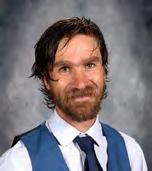
Yane dedicated five years delving into the depths of graph theory and combinatorics to co-author “Saturation of \(K_{4}\) subdivisions in multidimensional grids[J]” in the Journal of Combinatorial Mathematics and Combinatorial Computing (Volume 123).
Graph theory and combinatorics offer practical applications in computer science, transportation, social networks, biology and optimization. They use graphs to model relationships and combinatorics to count and analyze possibilities, leading to solutions for problems like finding the shortest route, designing efficient networks, understanding social structures, modeling disease spread and optimizing resources.
When asked for comment about his work, Yane replied, with a mix of humor and humility, “Please do not feel the need to read any part of this paper.”
In addition to teaching math, Yane is an assistant coach for the cross country teams. A prolific long-distance runner, he won the Black Hills 100 (Miler) last year in about 22 hours.

See Walker Yane's published work.




Tim
O’Keefe
Inspires Students to Live Purposefully
BY SAM TARTER ’21
Before graduating from St. Louis U. High, students are called to embody – among several fundamental aspects of becoming Men for Others – intellectual competence. In the Graduate at Graduation document, intellectual competence is described as “seeing his intelligence as a gift intended to be used for the greater glory of God.” Not only is intellectual competence essential to gaining the skills and foundation for a profession, but it is integral to developing a sense of purpose and mission in their life’s work, and using their knowledge to support and aid others.
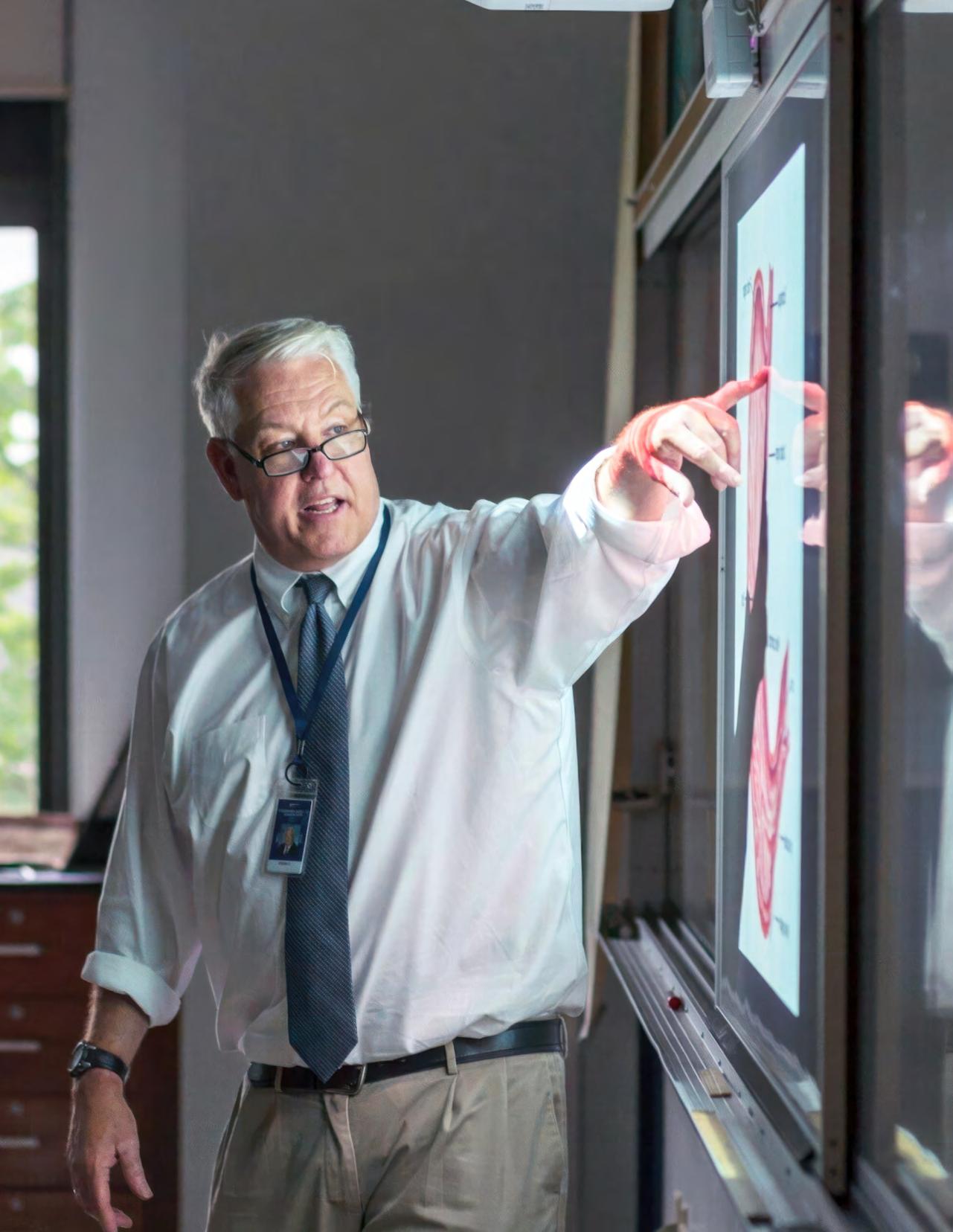
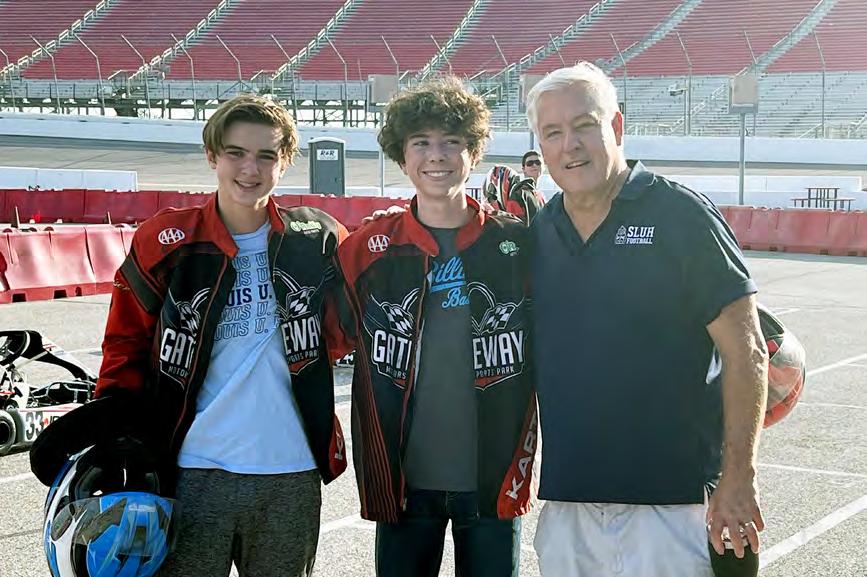
Tim O’Keefe – now approaching his 37th year of serving as a teacher, coach, club moderator and department chair – has supported and inspired both students and faculty as an exemplary model of intellectual competence, encouraging those he mentors to continue learning, growing and living with purpose.
O’Keefe was heavily inspired to teach by his late father, John O’Keefe ‘55, a mathematics teacher and coach at John Burroughs School.
“Watching my dad teach and watching him coach really is what made me want to become a teacher,” says O’Keefe. “I saw the kind of joy that he had from that. I saw the kind of connections that he had with his students and with his players, and he's probably the person I've looked up to most in my life, so I really wanted to kind of be like him as much as possible.”
Those same joys and connections with students are replicated time and again by O’Keefe, who keeps his classes not only engaging, but fun. Whether students are learning about thermoreceptors by sticking their fingers into ice water, or distinguishing between taste and smell by trying Starbursts while pinching their nose, O’Keefe ensures an active classroom environment to help his students get the most out of each lesson and to learn in a more tangible way.
“If somebody were to walk into my classroom, one of the things I would want them to see is that we're having fun, that we’re enjoying ourselves,” O’Keefe adds. “I'm a believer that the best way you can learn, or the way you're going to learn more, is if you're excited to go to that class. One of the great things about teaching science is that you get to be active. You can really do experiential stuff. You can do things that are enjoyable as a good way to learn it.”
“I'm a believer that the best way you can learn, or the way you're going to learn more, is if you're excited to go to that class."
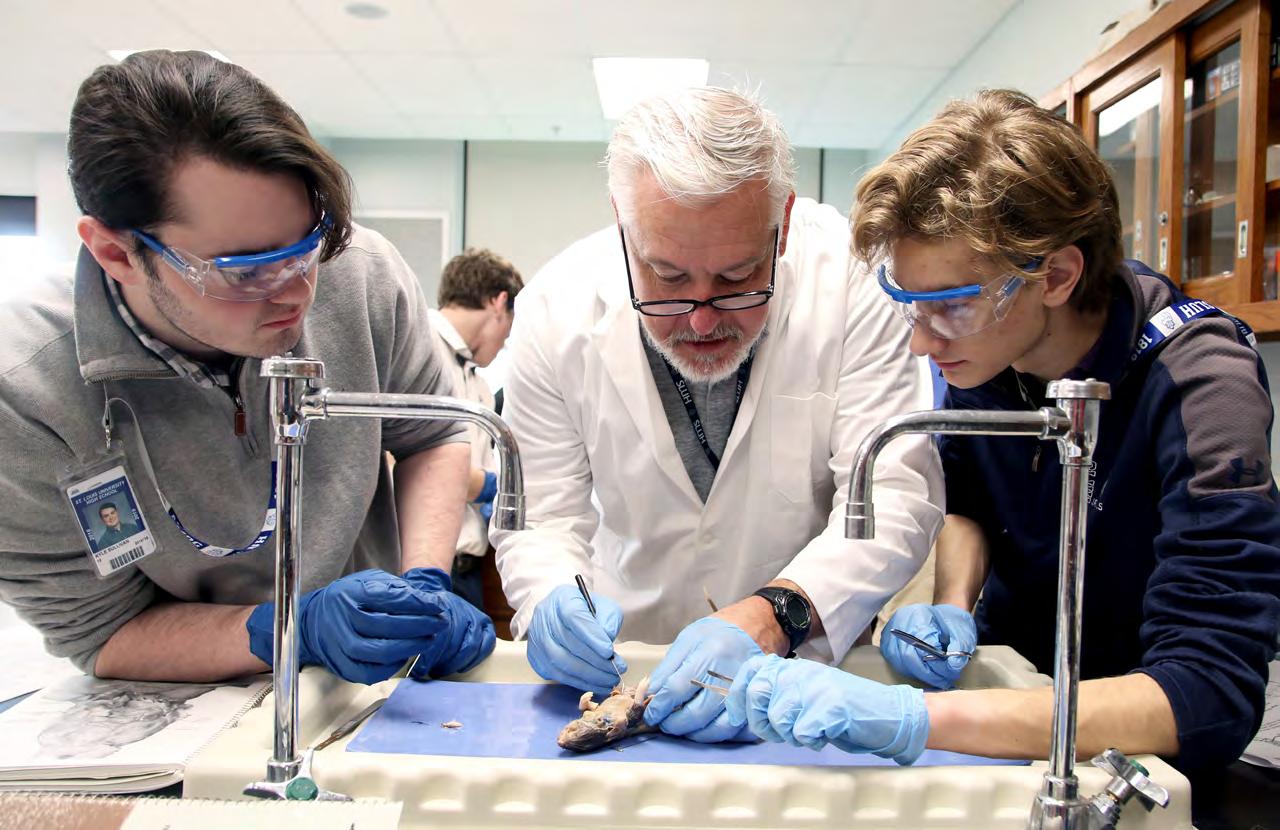

Beyond fostering an engaging classroom environment, O’Keefe also prioritizes growth and rigor in each of his classes. One of the more fulfilling aspects of his job, he mentions, is when he can support a student who is struggling in his class or with science overall. He emphasizes the importance of helping students develop the essential study skills and habits for not only school, but life in general. Recently, O’Keefe has applied this love of supporting students and guiding them through the challenges of science by tutoring in the SciLab, run by the learning center, where he specifically helps with Biology.
“I really feel like it's helping them to see that a lot of times, if they work at it, they can have success,” says O’Keefe.
“I'll fill in the details or explain what we did in the activity, but they're learning by doing things themselves, and then I act as a facilitator to help them with that and encourage them.”
Since starting at SLUH in 1989, O’Keefe has taught the same two classes: freshman Biology and Honors Anatomy and Physiology to seniors. When it comes to reteaching the same lessons and classes, O’Keefe never tires of it, as he’s been in love with psychology, genetics and the functions of the body since before undergrad. He also loves teaching one of the most foundational courses of science, and takes pride in the many avenues and opportunities for continued learning that his department provides.

“(What) really touches my heart and is the most rewarding is when a kid… wants to go out and do good in the world."
“I feel like at SLUH, we do a good job of teaching the fundamentals: biology, chemistry and physics the first three years,” O’Keefe mentions. “And then senior year, students really have that opportunity to learn about multiple different aspects of different sciences. There's so many different areas and aspects of science and so many different avenues, and we’re hoping to connect them with something that really excites them.”
Among the many different scientific pathways that students can pursue, O’Keefe has always valued medicine, which led to him founding and moderating the Medical Careers Club. Originally started in the 1990s as an email chain that connected students with summer programs at local universities, the club has grown and expanded into a way of providing hands-on experience and knowledge about what a job in medicine looks like, and bringing some of those opportunities to SLUH. Between guest speakers on campus, participating in events and programs at Washington University and Saint Louis University, and simply learning beyond the science classes at SLUH, O’Keefe has inspired both current and former students alike in learning more about different kinds of medicine and navigating both their academic and professional futures.

One of the most meaningful experiences that the Medical Careers Club provides is the yearly blood drive (the most recent one receiving 52 donations in 2025). By running the drives themselves and witnessing the direct impact of their efforts, club members can better understand how medicine combines with the service and support of others, something that O’Keefe claims is one of the most impactful aspects of his vocation at SLUH.
“(What) really touches my heart and is the most rewarding is when a kid… wants to go out and do good in the world. That's the coolest thing for me … when those students are going out and they're helping people. And I, on a very small level, get to be part of that,” O’Keefe mentions.
Along with moderating clubs and previously coaching freshman football and wrestling, O’Keefe also served SLUH as the science department chair from 2019 to May of 2025. During his six-year run, O’Keefe updated lab technologies, ensured every teacher was teaching the classes that they wanted, and maintained a bond between the team during the pandemic.
“The Medical Careers Club played a pivotal role in my decision to pursue medicine in college,” says Jack DuMont ’22, a senior at Saint Louis University who plans to attend medical school after graduation. “Mr. O’Keefe brought in medical and research professionals from a range of fields, exposing me to ideas and opportunities I had never before considered.”
According to Robyn Wellen, the current science department chair, “Tim as department chair was a great experience. He worked so hard to build relationships and make our collection of teachers a team. Tim was very thoughtful … and was always there to listen to you and to represent your wishes to the best of his ability. These are things I am trying to continue as the new science department chair.”
Along with captaining the team into great innovation and success, O’Keefe also used his
knowledge and passion for teaching to inspire his colleagues and develop the same excitement for science from his classroom within the office.
“One of the best parts of working with Tim is his enthusiasm and love for teaching,” says Megan Menne, former biology teacher and current assistant principal for activities and formation. “You can go to him with an idea to dissect a shark, and Tim will excitedly jump in and help plan. He goes all in, and his energy that can often be heard down the hallway is contagious to both teachers and students.”

This school year, O’Keefe is back to teaching four sections full-time, giving his full attention to and maintaining what he referred to as his life’s purpose.
“My heart is in the classroom, teaching the kids,” O’Keefe explains. “I really do feel like it's what I'm meant to do. It's like a calling in life.”
Ultimately, O’Keefe emphasizes that he not only wants his students to improve in their knowledge of science, medicine and study habits, but that he wants them to develop a greater sense of selfappreciation and confidence in their own abilities.
“To help students see what they're capable of is a huge thing … for them to believe in themselves. And I think that's a secret in life, is to learn to believe in
yourself. To be persistent and show perseverance,” O’Keefe notes. “And it's amazing what you can accomplish when you come into things with that attitude. A big thing for me is just helping students feel that, to see that. A lot of times, I think when people look at themselves, they tend to look at what they're not doing well, or maybe what's wrong, and they don't see themselves the way I believe God sees them, which is that they're a wonderful person, and that they are capable of great things.”
Sam Tarter ’21 recently graduated from the University of Evansville, where he received a Bachelor of Fine Arts in literature and creative writing. As one of the first members of the SLUH Alumni Service Corps, Sam has been teaching two sections of English II while also supporting the campus ministry and advancement departments. After concluding his time as an ASC, he plans to stay in St. Louis to earn his teacher's certification and continue pursuing a career in both the education and nonprofit fields.



BY LEO HAHN ’26

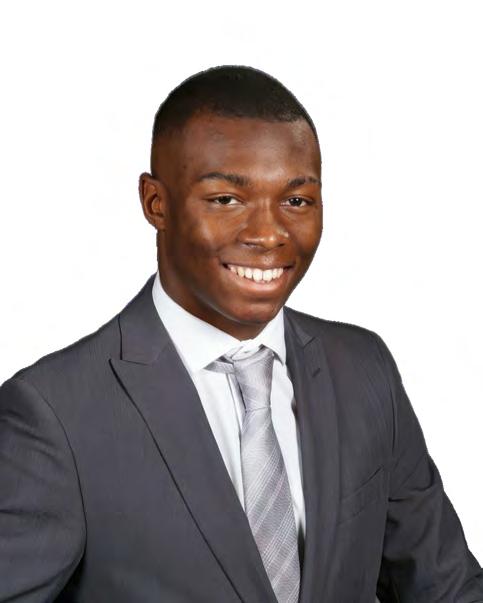
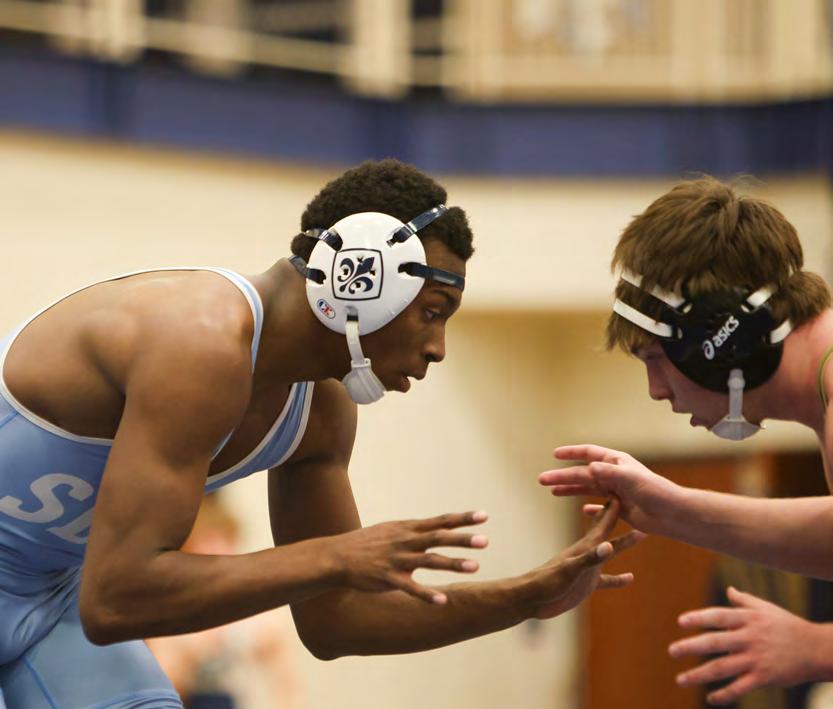
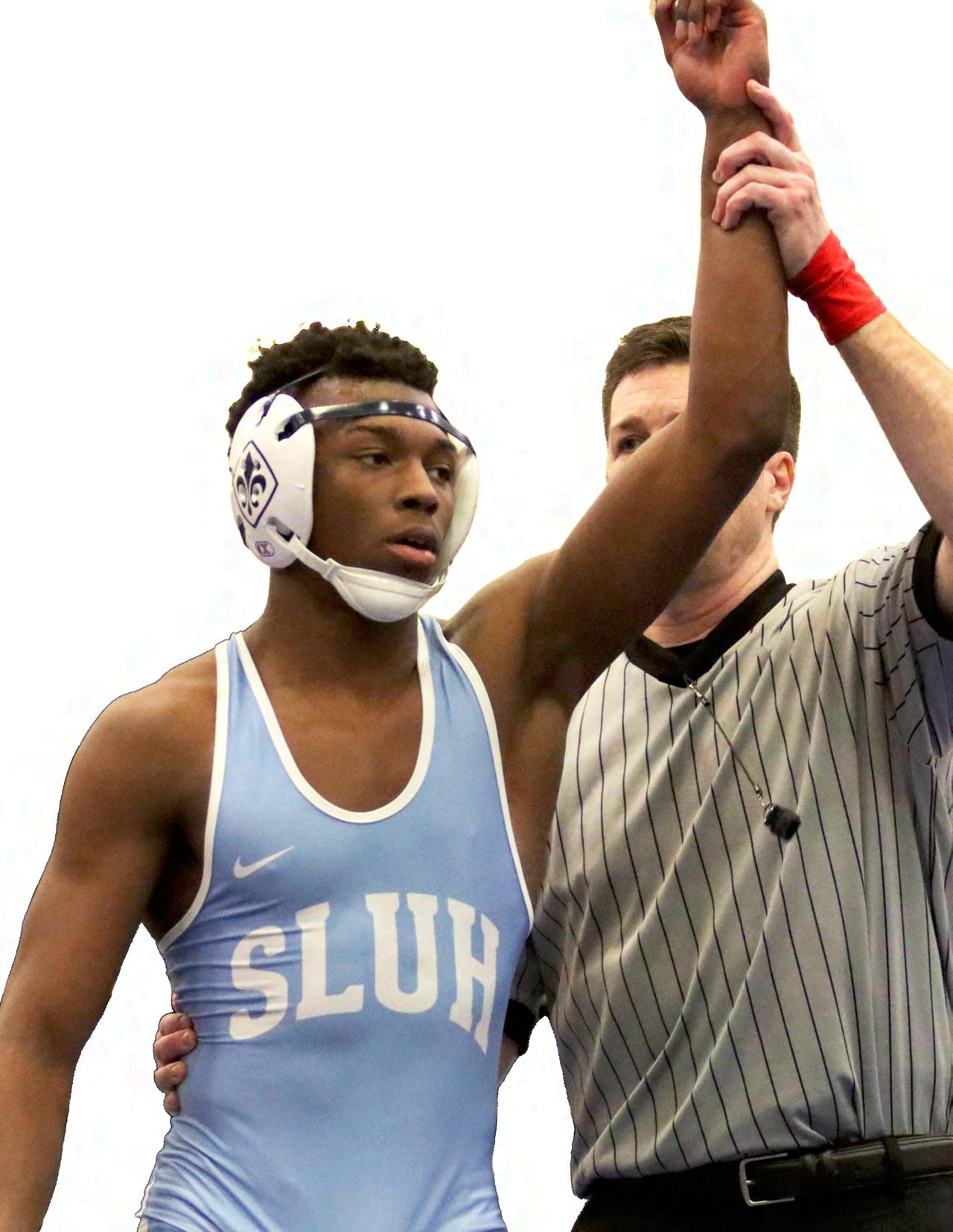
In addition to his successful four-year career in the SLUH wrestling program and his key position on this year’s team, Michael Williams ’26 is active through his faith life and commitment to racial justice. A leading member of the SLUH Black Student Union, he was part of an inaugural delegation of Jr. Bills to attend last year’s Black Student Summit at Jesuit High School in Oregon. He also received the Saint Charles Lwanga Young Parishioner Award his freshman year. The following is the transcript of a conversation between Williams and Leo Hahn ’26 about Williams’ impact on the SLUH community.
Leo Hahn: I’ve talked with a couple of people as a primer for this interview, and the first thing they brought up when I mentioned your name was wrestling. So I thought we’d start with that. Did you always wrestle? Was wrestling something you found at SLUH, or is that something you did before?
Michael Williams: Yeah, wrestling was something I found at SLUH. I never really did any combat sports. Primarily, I did soccer and basketball growing up – elementary and middle school and all that. I didn’t really know much about wrestling until I talked with this guy at a park cleanup. My aunt has a nonprofit. She does food shares and helps around St. Louis when it comes to helping the homeless or helping with the environment. There were representatives at this park cleanup representing their business, and they were talking with people during the cleanup. There was this one guy my grandma was talking to. He was a representative from St. Louis and had gone to
St. Louis University High back in the 80s or maybe the late 70s. We started talking, and he told me about how he wrestled at SLUH and how it was a good experience for him. He said it made him more of a man and gave him better attributes.
LH: So you said it was the attributes wrestling represented that drew you toward it. Say a little more about that.
MW: It’s tough because you don’t always want to do it. I really don’t want to practice for two hours on a Saturday early in the morning. I’ve got to be in a cross position and do the same move over and over again.
You’ve got to use your entire body, especially when it’s 8 a.m. or 10 a.m. It gets hard. You wait, then your match starts, and you might wait 30 or 40 minutes for the next one.
It’s teaching me that discipline isn’t always going to make you happy. You’re not always going to be happy. Even though you put in all the work, it’s going to suck sometimes.

So what keeps you coming back, even with those difficult moments?
That’s just how life is.
So you see a reflection of life in the sport, mirroring your own life, and you keep going. Would you say there’s a specific match or event at SLUH that best represents who you are as a wrestler, or even who you are as a student?
Yeah, there was a match. I was beating him. It was something like 10–2. He was a bigger guy, but I was beating him. Emotionally, I didn’t even realize it, but I started to cry. I didn’t think, “Okay, I’m going to cry.” It just happened. I couldn’t stop it. That taught me that things happen, but you’ve got to look forward at all times. Don’t get stuck. Let the emotion happen, but don’t let it drive what you do. Understand it, acknowledge that it sucks, and keep moving forward.
How does that apply outside of wrestling? That could be school, classes, or your own life.
For me, wrestling is about adversity. That’s not every day. For example, my grandma might need help, and I’m tired because I stayed up too late. I really don’t want to help because I’m tired and want to be on my phone, but I can’t brush it off. Even though I don’t feel like it, it’s the right thing to do. For school, I took some tough classes this year. I took Physics II. I wouldn’t even
say it was a hard class, but I was introduced to a different teaching style. The teacher teaches differently, so I had to adapt my strategy to succeed.
LH: Are there any teachers or mentors at SLUH you’ve really meshed well with who’ve helped project your strengths?
MW: Coach (Espen) Conley, and my counselor, Mr. (Dan) Shields. Those are the two I feel like I can have the most authentic conversations with. They’ve helped me sort through what attributes can help me the most just by talking. Not only the good things, but the bad things too. I can tell them something they might not think is the best idea, and they’ll still hear me out. They’ll say, “Whatever you want to do, I’m with you.” They respect what I think no matter what. With Mr. Shields, we talk about anything – AI, aliens, goofy stuff. We’re like best friends. Our relationship has evolved over time, so I can talk with him for an hour about anything. We might start talking about grades, and the next thing you know, we’re talking about something completely different. It’s helped me stay more relaxed throughout my time at SLUH, knowing there are people I can talk to.
LH: So what’s next for you after SLUH? What are your plans for college?
MW: I intend to use my Godgiven intellectual gifts to just go into engineering, so I’m thinking about studying that. But, you know, I don’t really know my purpose truly. I just try to help people, and I
think engineering could be a good way to create things in order to help people out and help them live better lives.
LH: That’s incredible. What has been the most important thing you’ve learned at SLUH?
MW: Adversity creates strength. Hard times create success at the end of the day. Life was never meant to just be easy. We’re meant to go through challenges, because through challenges we find purpose and find meaning. And I think that absolutely – there’s really not a class that kind of taught this, but that’s just the big idea that I’ve come to. And of course I can change, right? I’m not done yet. I’m still here, at the point of senior project in January. But I think the most important thing that I’ve learned is that adversity and challenge, just having things to do, is one of the most important things. It keeps me having a purpose. I think SLUH, just being such a challenging school, gives me some type of purpose. Even though some days I don’t want to do this essay or whatever, I know when I get it done I’m gonna feel good about myself because I know I’ve learned something, and I’ve found purpose.
Leo Hahn is a senior leader at SLUH and Editorin-Chief of the Prep News . In addition to writing, he has aspirations as an artist and is applying to art schools for college.
BY JUSTIN SEATON ’13

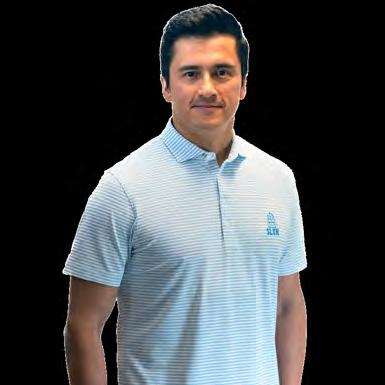
Keith Schwab ‘86 is a professor of applied physics with notable contributions in the realms of nanoscience, ultra-low temperature physics, and quantum effects. He is at least 75-times published in peerreviewed scientific journals like Nature, Science, and the New Journal of Physics . He has lectured at the Museum of Modern Art, participated in a panel discussion on PBS, taught at Cornell and CalTech, and worked for the National Security Agency.
Naturally, as one of the world’s foremost innovators in one of humanity’s most fascinating fields, Keith didn’t really want to talk about all that stuff. At the end of our hour, I admitted I had learned next to nothing about his career in Physics.
“That’s fine!” Keith said. “That stuff is so technical. It’s not all physics. It’d be so boring, so sad, to be so one-dimensional… What you learn going to a place like SLUH is a way of thinking and a way of being, and you can take that into any career. It’s about being excellent at what you’re doing, being curious, and being open-minded. It’s about educating the whole person.”
Keith spent the first six weeks of his life in foster care. The parents who eventually adopted and raised him—as well as his twin sister, Christina— were not affluent. Their family had very little history of education. Commuting from their small home in Crestwood, Keith’s dad balanced blue-collar work with 13 years of night school in pursuit of the Schwab family’s first-ever Bachelor’s degree. Upon graduation, Mr. Schwab was granted his hard-earned moniker: “the smart Schwab.” He was determined to make it easy for his kids to win that title off of him.
“My parents said education was important, and that was not a hard sell for me,” said Keith. “I got into science very early – I was in from the very beginning.”
Keith looked around his office in the California Institute of Technology’s Watson Laboratory for proof of his point. He spotted a children’s book in the corner: Dinosaurs and Other Prehistoric
Animals (1959) by Darlene Geis. “I still have my first science book here in my office,” Keith shared over the phone. “It’s the dinosaur book they used in the Godzilla movie. I got it at the Crestwood Mall, and I’ve had it ever since.”
As a kid, he was interested in the things that many young boys are—dinosaurs and astronauts— but he pursued them to extraordinary degrees, with the support of his parents. He remembers attending youth astro-photography class through the Saint Louis Science Center.
“On a Friday night, at the end of a long week of work, Dad would drive me 90 minutes outside the city and sit in his car for two hours while I was working with telescopes and learning. The stuff I saw through those telescopes was unbelievable,” remembered Keith. He still has the slides of nebulae he created while his dad listened to Cardinals games in the car.
They would drive the hour and a half back to Crestwood and park the car on the street, much of the space in the garage having been usurped by Keith’s tools. His parents gave him that space so he could “drill stuff and break stuff and make stuff and learn about how things really behave,” said Keith. “My parents provided me with this environment where I could learn and teach myself things.”
Years later, while he was a student at SLUH, his parents’ Crestwood garage played host to one of the most formative scientific moments of his life—Keith Schwab built a telescope.
“I worked parking cars at the local church for $10 a night. After ten weeks I could mail order gear from Edmund Scientific. After another ten I sent my dad to get a sewer pipe and the rest of the gear. I read the books, I drew up the plans, and I built a telescope. All by myself. I could see the moons of Jupiter with it.” said Keith. “It was just me and some tools. When you do your PhD in physics, it’s just you and your tools. And it’s the same now – nothing has changed.”
Keith has always been curious and persistent. At SLUH, he found other people like him: his people; wonderers
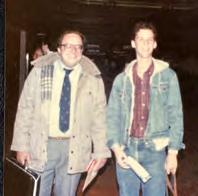
Foremost among them, in Keith’s memory, was Dr. John Milak, the SLUH visual and performing arts chair and head of the instrumental music program for 20 years until his passing in 1999.
“Doc Milak was an incredible person,” remembered Keith. “He was one of my people.”
Milak was a gifted pianist and band director. He was also an amateur electronics engineer, said Keith, who played the tenor sax in Milak’s jazz band. “This was a smart guy. He loved electronics and early computers. We built circuits together in the band room after school. He learned programming assembly, and then he taught us. There was a small group of us [the ‘SLUH Electronics Club,’ Keith recalls] who became interested in this stuff because of him and his interest... I was really lucky to find him.”
Outside the band room, Keith fondly remembers SLUH as being filled with “intellectually honest people.” He was impressed by his teachers and peers, but not because he saw the degrees hanging behind their desks or the marks on their report cards. It was because of their discourse, their openness, their willingness to learn from everybody around them. He was especially struck by the Jesuits on staff.
“My opinion of them now, at 57, is that the Jesuits were great. They were smart, and they were not dogmatic. People who are smart don’t have to push their philosophies onto you. I was free— encouraged—to think critically, and as long as I reasoned well and wrote well, they would listen and respond thoughtfully. I feel really proud to have interacted with the Jesuit tradition. They taught me how to think, and they did it well,” said Keith.
Keith went from SLUH to study physics at the University of Chicago, graduating in 1990. He then entered the PhD program in physics at the University
of California Berkeley, and in 1996, joined Prof. Michael Roukes' research group at the California Institute of Technology as the Sherman Fairchild Distinguished Post-Doctoral Scholar. In 2000, Keith joined the National Security Agency (NSA), as a member of the effort on low temperature quantum devices for application to quantum computing. He joined the faculty of Cornell University Department of Physics in April of 2006, and then Caltech in January 2009, where he remains today.
On the day of our interview, Keith summarized this multi-decade, mid-career span by comparing it to the career of another University of Chicagoaffiliated physicist, Nobel Prize winner Subrahmanyan Chandrasekhar. Chandrasekhar was able to master several areas of study by dividing his life and research into distinct periods. He would exhaustively study a specific area, publish several papers in it and then write a book summarizing the major concepts in the field. Then he would move onto his next area of fascination. In hindsight, Keith Schwab recognizes he has taken a similar path, though he didn’t plan it that way. Like the kid in the garage with his tools and his books, the ideas just kept coming, and Keith kept building.
“Physics has been a source of great fun,” reflected Keith. “It turned out I’m good at it because I’m super stubborn and I never give up on a good idea. That turned out to be a great skill, and it's something I learned in the garage at home. If there’s a good idea in the notebook, I’m going to figure out how to make that happen.”
Keith’s successes in the lab were powered by the same curiosity that, in 2020, carried him to 36,630 feet.
In 2014, Keith became interested in soaring. Soaring (or “gliding”—they seem to be used interchangeably) is a recreational activity in which


pilots fly unpowered aircraft known as “gliders” or “sailplanes” using naturally occurring currents of rising air in the atmosphere to remain airborne. It’s no wonder that an uber-curious physicist living within a two-hour drive of the world-class gliding conditions of the Sierra Nevadas might catch wind of this sport that mixes thrill with intricate machinery, detailed plans and a precise understanding of natural forces. He was scared to fly, but not scared enough to back down from a new challenge.
“Flying in the Sierras, in the mountain wave conditions of winter, is terrifying,” said Keith. “There’s a monster up there. These are very powerful forces that can carry you to very high altitudes, but if you’re in the wrong places, they will destroy you.”
As Keith learned to fly, he gradually touched higher altitudes, each flight assuaging his fears and deepening his knowledge.
“The oxygen system that you need to sustain life at certain heights, I figured, I could build using my laboratory experience. And I do enough plumbing in the lab, I thought, ‘yeah, I can build this, and I believe it will be safe and effective.’”
He bought a WWI-era oxygen regulator, and then he put together the feeder and backup systems himself. He did low-temperature testing in the lab and collaborated with other hobbyists to pursue higher heights. When he finally reached his altitude record of 36.6, it was the highest anyone had soared in 20 years.
“In the end, I wanted to see if I could do it,” said Keith. “That’s how I lead my life. It’s a series of little challenges that keep pushing me forward.”
As we wrapped up our conversation, Keith was excited to share his next challenge, which involves a mountain peak and a HAM radio.
Read more about Keith’s record-setting flight.
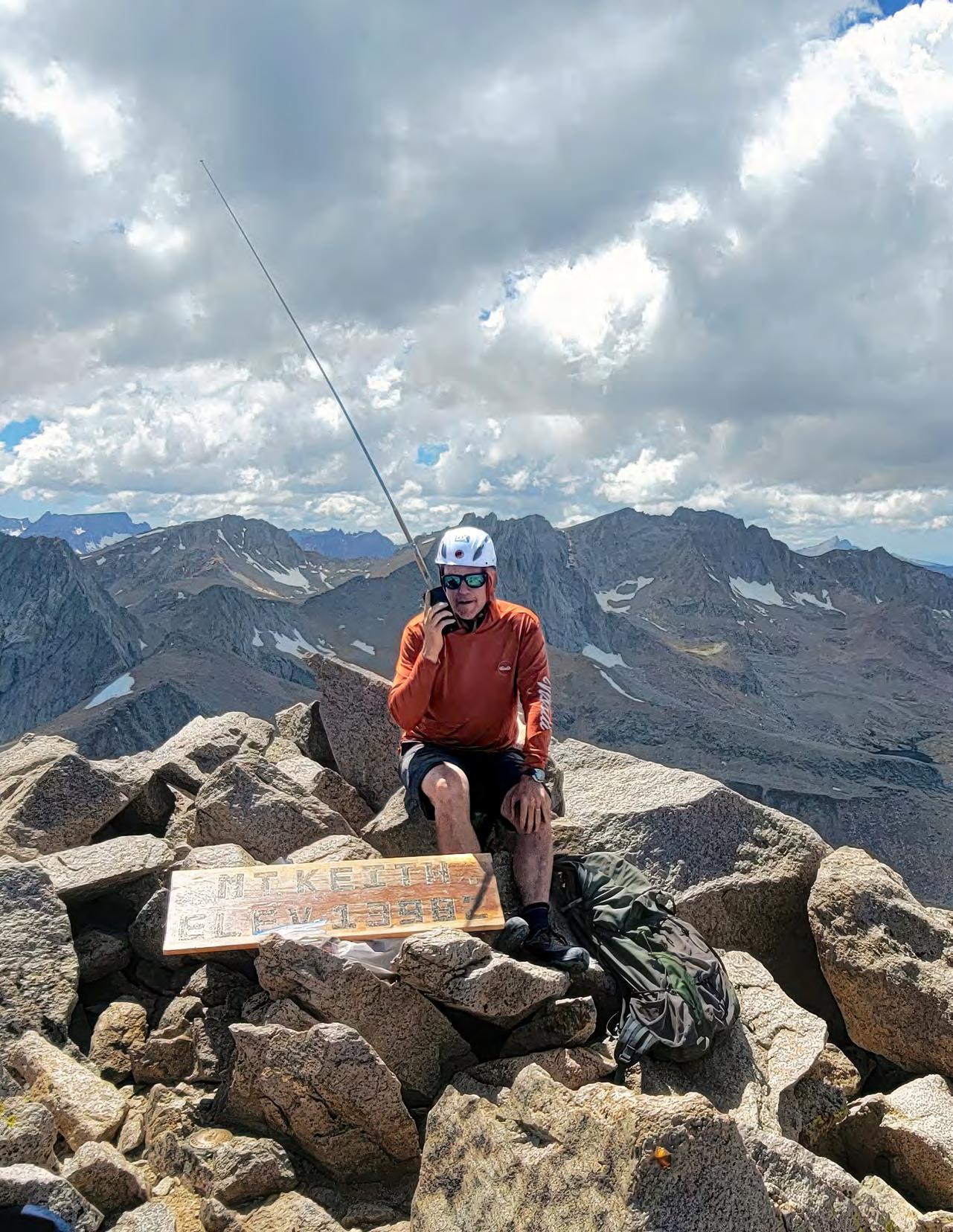
For several years, Keith (alongside some students, colleagues, friends, and occasionally, his son Elon) has been playing “Summits on the air,” an amateur radio operating award program, which encourages folks like Keith to make radio contacts from mountainous locations across the globe.
“Basically, you set up a HAM radio on a mountain top, and see if you can make four, two-way contacts,” explained Keith. “Track the heights of peaks you reach. Exchange call signs. Exchange the signal report. Then you’ve ‘activated’ that peak.”
The points are essentially meaningless, said Keith, but he loves the game. He and a student from CalTech recently activated Mt. Keith, he shared delightedly.
The goal for this summer is CalTech peak, which has never been activated via radio. From its 13,832foot summit, which pokes into the Sierra Nevada airspace he so often flies, Keith Schwab may spot his next challenge—a peak to activate, a ridge lift to ride, or a natural force worth researching—and then, undoubtedly, he will head back to the garage.
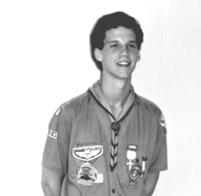
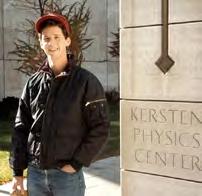
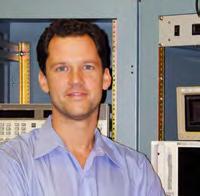
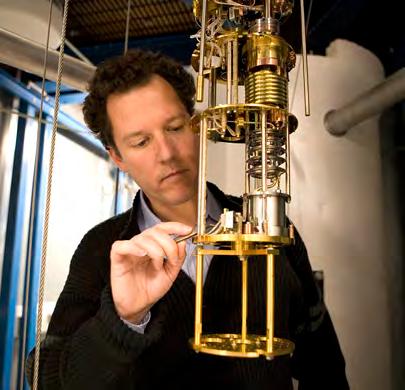
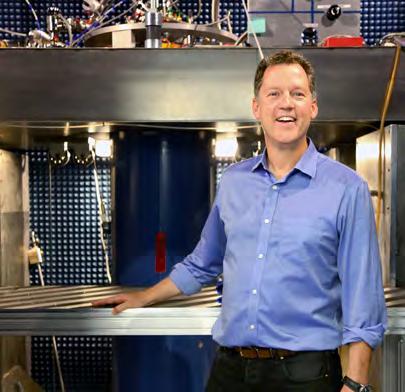
(from left): Dr. John Milak and Keith at SLUH, 1985; Keith at University of Chicago, 1986; Eagle Scout, 1986; NSA, 2002; Cornell, 2007; Caltech lab, 2015; Keith after soaring to 36,630 feet in 2020.
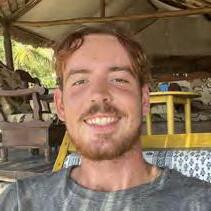
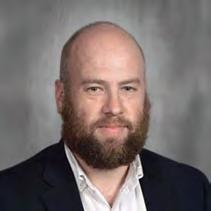
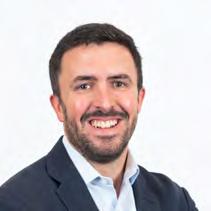
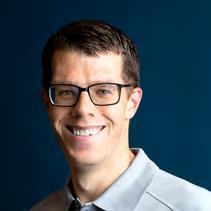
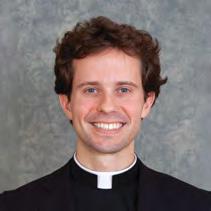
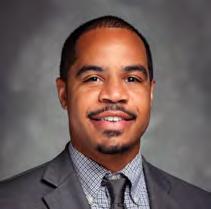
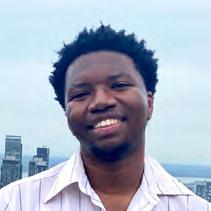
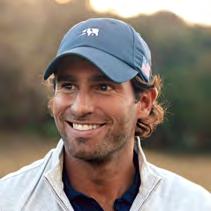
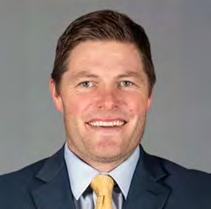
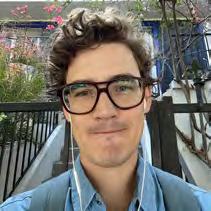
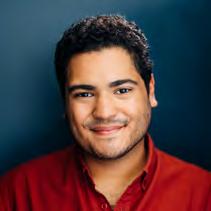
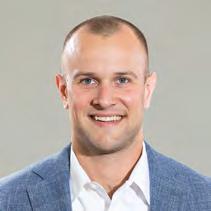
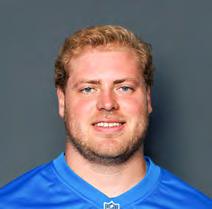
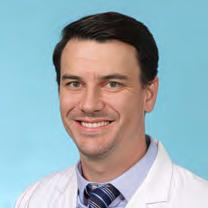
In September 1540, when the Society of Jesus was established, the zeal and soaring ambition of St. Ignatius of Loyola and his companions lit a fire that continues to spread across the world.
Together, these young men explored the intersections of faith and culture. Love and learning. Human nature and all of its many possibilities. Through service, solidarity and prayer, the Jesuits (as they are known today) were welcomed around the globe as men of wisdom and science, education and spiritual depth.
The 1540 List celebrates 15 SLUH alumni under 40 who – like the young, creative and bold leaders who came before them – are challenging our definitions of excellence and setting the world on fire.
Join us in celebrating the most recent alumni recognized on the 1540 List.
1. John Berosky ’04
Department of the Air Force, Attorney National Defense • St. Louis, MO
B.A. - Political Science - University of Missouri
J.D. - Washington University in St. Louis
2. Chad Carson ’10 Risk Officer
International Development • Washington, DC
B.S. - Foreign Service - International Economics - Georgetown University
3. Malcolm DeBaun ’06
Duke University, Chief Orthopedic Trauma Surgeon Medicine • North Carolina
B.S. - Bology - Loyola University Chicago
M.D. - Stanford University
4. Eddie Effinger ’06
St. Olaf College, Head Men's Ice Hockey Coach
NCAA Athletics • North Field, Minnesota
B.A. - Economics - Amherst College
5. Chris Hoffman ’06
Hoffman Brothers, CEO
Residential & Commercial Service • St. Louis, MO
B.S. - Economics - Saint Louis University
MBA - Washington University in St. Louis
MLS - Tax & Real Estate Law - Washington University in St. Louis
6. Joseph L’Hommedieu ’17 Peace Corps, Agriculture Volunteer Development • Ihosy Madagascar
B.S. - Economics - Regis University
7. Tom Martin ’04
E Source, President Data Science Utilities • Seattle, WA
B.S. - Electrical Engineering - University of Notre Dame
MBA - University of Notre Dame
8. Devin McCowan ’17
United States District Court (Connecticut) Law Clerk Law • New York, NY
B.A. - French, Gender Studies & Economics - Marquette University
J.D. - New York University
9. Andrew Mueth ’07
Netflix, Writer
Television • Los Angeles, CA
B.A. - English - Georgetown University
10. Michael Niese ’16
Detroit Lions, NFL Player
National Football League • Novi, MI
B.S. - Mechanical Engineering - University of Dayton
M.S. - Engineering Management - Temple University
11. Jacob Reft ’07
St. Ann Catholic School, Principal Catholic Education • St. Louis, MO
B.S. - Early Childhood/Special Education - Xavier University (Cincinnati)
M.Ed. - University of Missouri-St. Louis
12. Fr. Charles Samson ’05
Archdiocese of St. Louis, Priest
Religious • St. Louis, MO
B.Phil. - Kenrick-Glennon Seminary/ Saint Louis University
S.T.B. - Pontifical Gregorian University - Rome
S.S.L. - Pontifical Biblical Institute - Rome
S.T.D. - Pontifical Gregorian University - Rome
13. James Sansone ’06
The Normal Brand, Brother & Co-Owner Retail • St. Louis, MO
B.S., Business Administration - FinanceWashington University in St. Louis
14. Michael Schimmele ’14
Aladdin on Broadway, Babkak Entertainment • New York, NY
B.F.A. - Music Theater - Elon University
15. Dominic Zanaboni ’07
Washington University School of Medicine, Assistant Professor of Pediatrics
Pediatric Cardiology • St. Louis, MO
B.S. - Biology - Rockhurst University
M.D. - University of Missouri
NOMINATE AN ALUMNUS
Do you know a SLUH graduate under 40 who is “setting the world on fire?” We want to know about him. Make your nomination(s) on our website: sluh.org/1540list
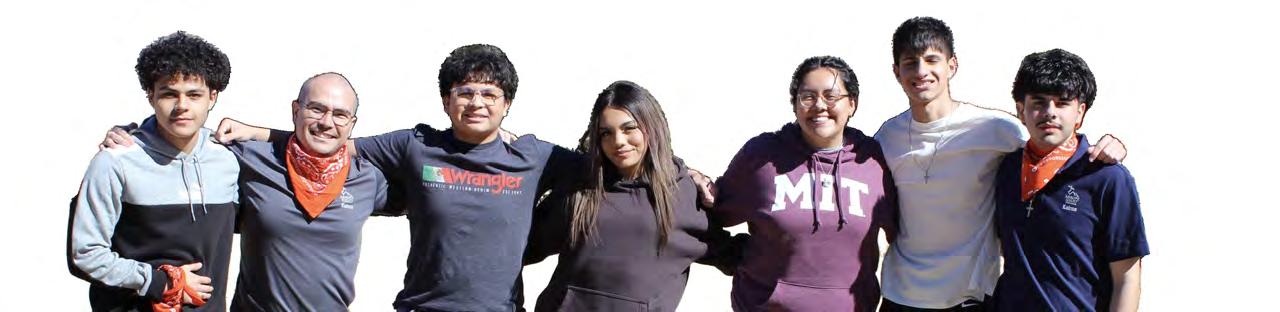
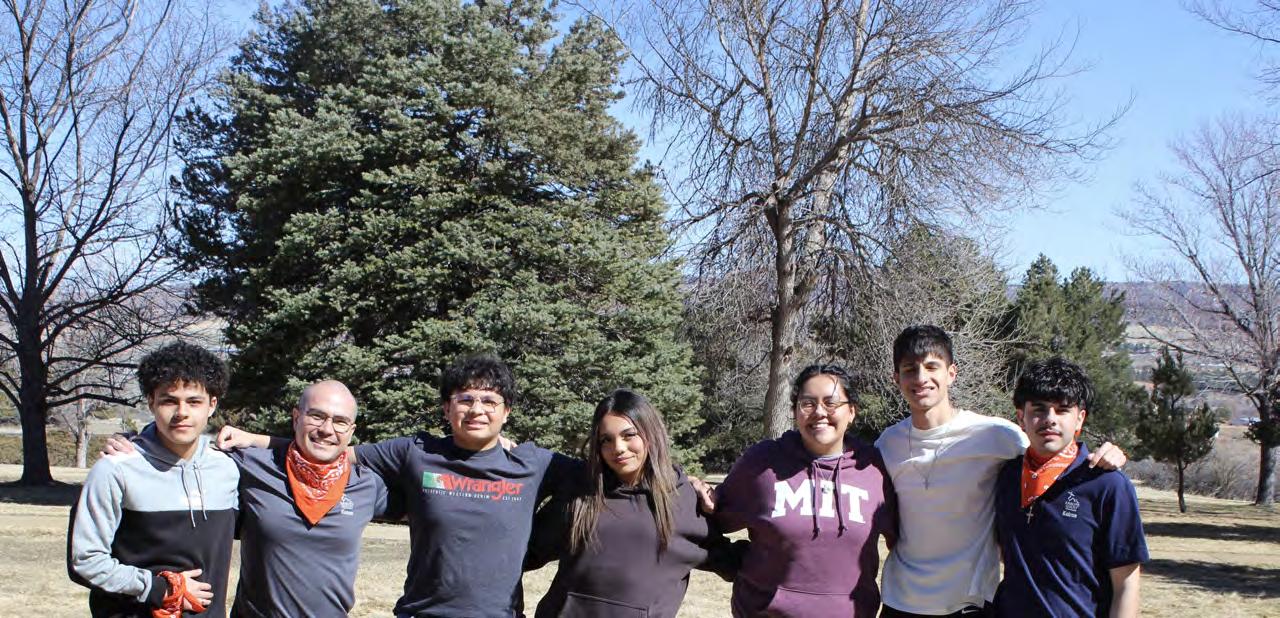
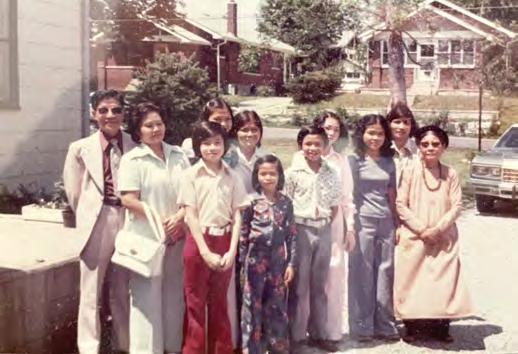
BY BEN DUMONT ’92
In 1975, a young woman named Hanh fled South Vietnam with her parents and seven siblings just before the government collapsed and was overtaken by communist rule. Her father, who worked at the U.S. Embassy, had arranged for a flight to the Philippines. From there the family flew to Guam and eventually landed at Fort Chaffee in Fort Smith, Arkansas, which became a temporary home for more than 50,000 refugees fleeing the fall of Saigon.
The family’s successful escape marked the beginning of a new chapter. A rebirth. A chance to seize the American Dream.
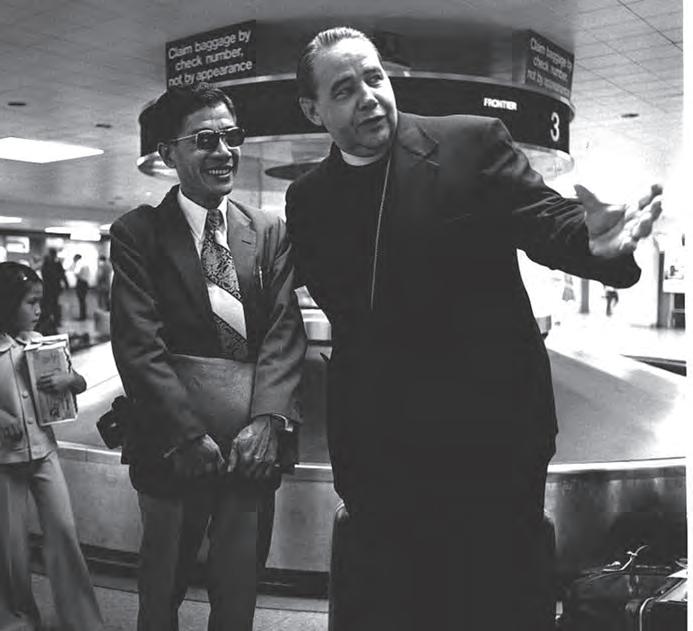
Today, Matt Paradise ’04, son of Hanh and Alan Paradise ’72, recalls his family history with pride and gratitude. “My paternal grandfather was on the parish council at St. Justin the Martyr [located in Sunset Hills]. In 1975, the parish sponsored a Vietnamese refugee family.” The parish helped Hanh and her family integrate into American society and culture with lodging and access to education and employment.
Alan met Hanh soon after her family arrived at St. Justin Parish, and the couple married in 1978.
“SLUH helped me to really find myself. I realized that we are all made by God, loved by God, and called to respond with love by living a life of service in gratitude to God.”
- MATT PARADISE ’04
According to Matt, his parents “strongly believed in Catholic education.” After graduating from St. Justin, he and his brothers (David ’98 and Tim ’02) attended SLUH, and his two sisters went to Cor Jesu.
Matt fondly recalls many SLUH teachers who were formative in his development, including Dr. McConaghy, Mr. Schulte, Mr. Zarrick, Mr. Moran, Mr. Missey, Ms. Whitaker and Dr. Koestner. The volunteers in the Alum Service Corps, a post-college program for alumni/ ae of Jesuit secondary and higher education institutions, also left an indelible impact.
“SLUH was extraordinary and transformative,” says Matt, who participated in theater, choir and dance as a Jr. Bill. “It was there that I became interested in becoming a teacher.”
More importantly, he adds that “SLUH helped me to really find myself. I realized that we are all made by God, loved by God, and called to respond with love by living a life of service in gratitude to God.”
“Matt embodied the SLUH motto of being a Man for
Others,” recalls Dr. McConaghy, his Latin teacher (now retired). “He was an ideal student –bright, attentive, conscientious, responsible, well-mannered and sincere. When he was chosen to be a senior advisor to a freshman homeroom, I thought he was an excellent choice as the seniors were selected on the basis of their leadership ability and dependability. The time he spent in this area reflected not only his sincere concern for the well-being of the freshmen but also spoke well for his selfless attitude on behalf of others.”
After graduating from Saint Louis University with a degree in computer science, Matt joined the ASC. Although he wanted to volunteer at SLUH, he was selected to serve at Arrupe Jesuit High School in Denver. During high school, Matt had participated in the SLUH community service program and worked at the International Institute of St. Louis, which offers programs and services for immigrants, their families and the wider community. His experience of gaining a global mindset by serving the immigrant community
matched with a need at Arrupe. Upon his arrival at Arrupe, Matt says, “I immediately fell in love with the community, the work and the mission.”
Arrupe Jesuit was founded in 2003 by the Jesuits in collaboration with the Cristo Rey Network. The unique model integrates college preparatory academics with professional experience through the Corporate Work Study Program (CWSP). As part of the CWSP, students work one day each week, offsetting tuition and acquiring professional skills, character and career readiness for life-changing outcomes. At Arrupe, 95 percent of the Class of 2025 are firstgeneration college students.
Since Matt started at Arrupe in 2008, he has served as a math teacher, assistant principal for academics, and now as director of information technology. He feels proud to have found his vocation and to intimately understand the heart of the mission of a Jesuit school, and he enjoys serving a primarily Hispanic student body.
Passion and emotion fill his voice when asked what advice he gives to students, simply stating, “Remember that you belong, and you are loved. In return, be kind to others.”
Although Arrupe is relatively young, the school leadership aspires to grow enrollment from 425 to more than 500 students.
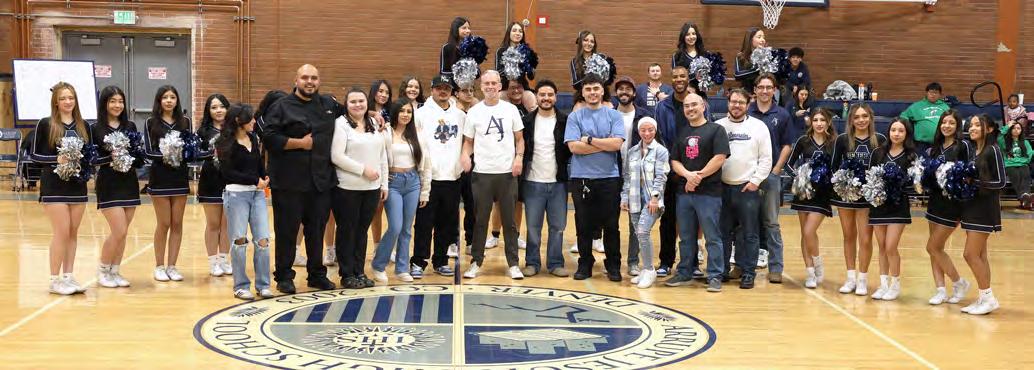
Matt is committed to being part of this long-term effort.
Meanwhile, Matt’s parents and siblings are all thriving, in their own way, in their own lives – no small miracle considering his mother narrowly escaped the grip of communism. Alan, a computer science professor at the University of Colorado in Boulder, and Nanh can be found frequently in St. Louis spending time with their eight grandkids. Grateful to the U.S. – and particularly St. Justin Parish – for serving as a refuge for his mother’s family decades ago, Matt is paying it forward by helping the immigrant community in Denver in a key educational role.
“My hope is to work with our team to establish Arrupe as a school that endures for more than 100 years,” he says. “If I can continue to contribute to this endeavor, my life’s work will be a success.”
We proudly recognize Matt Paradise ’04 and Stephen Littleton ’83 as Alumni Trailblazers, an honorary list that celebrates the achievements of Jr. Bill graduates of color. They are among many SLUH alumni who have done notable work toward creating a community where the wounds of poverty, hatred and discrimination are healed. The Alumni Trailblazers display is situated on the main floor of our main building in the central corridor. To learn more – and to nominate an alumnus – visit sluh.org/trailblazers.
BY BEN DUMONT ’92
Like many St. Louis U. High graduates, Stephen Littleton ‘83 found college to be easy. But instead of becoming complacent, he worked harder – and it paid off.
“At some point, I realized I needed to do more than to simply get by,” he recalls. “I needed to excel.”
While earning his undergraduate business degree from the University of Missouri in St. Louis, and along with support from his parents, Littleton worked multiple jobs to pay for his undergraduate education.
Littleton leveraged his discipline and drive to further his education, earning a master of business administration from the University of Texas at Austin. He worked for an assistant Dean, was a teachers assistant and received multiple scholarships to pay for his MBA. He proudly says, “I graduated with over a 3.7 GPA.” Doors opened up for him, and he landed an internship at ExxonMobil (Exxon at that time).
“I was happy in Houston, so upon completing the University of Texas and receiving an offer from Exxon, I stayed there,” he says.
He remained at ExxonMobil his entire career, marked by more than 15 different assignments spanning the globe from America and Africa, to Europe and traveling across most of the globe. Among his many accomplishments, he was the first African American to become a corporate vice president (Investor Relations Vice President & Corporate Secretary) and officer at ExxonMobil.
During his career, Littleton was motivated by a desire to help others. “Whenever I was on assignment in the United States or another country, my goal was to leave it a better place than when I arrived,” he says. “One project close to my heart was working as a senior financial officer in Angola in West Africa developing a strategy to enhance the capability of local financial staff and preparing them for leadership roles. We focused on delivery of a world class financial services organization for an affiliate that would be a significant profit center for the corporation.”
Reflecting on his distinguished career at a Fortune 10 corporation, Littleton says, “As a young adult, I leaned into my educational foundation at SLUH. It formed a strong understanding of analytical and intellectual curiosity, but it also built resiliency for the future for me. I’ll always be grateful for it.”
He fondly recalls his math teacher, Fr. Ralph Vonderhaar, SJ ’43, who he says helped to “instill the rigor of analytical thinking, a fundamental that influenced and helped with my college and career experiences.” He remembers one class, on the day SLUH played against CBC in football, “Fr. Vonderhaar said a prayer, and at the end of it he prayed that we would kick the Cadets’...well, you know.”
Although the SLUH student body lacked strong cultural diversity at the time, Littleton played on the football team with several other African Americans, which built positive relationships regardless of race or socio-economic differences.
“We found a lot of common ground with our teammates, and our common enemy was our opponent,” says Littleton, who attended St. Francis Xavier School in the Central West End growing up. “Football helped to break down racial barriers. It formed a natural kinship and made the transition to high school easier. Our teammates always had our back, both on and off the field.”
Today, Littleton enjoys traveling, investing and playing golf in retirement. He and his wife, Kimberlye, who owns an interior design business, have an adult daughter and son who are pursuing professional paths in science and medical fields.
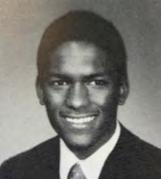
When asked what advice he would give to current Jr. Bills, Littleton – in true corporate officer fashion – encourages fiscal responsibility and sound financial management. He also emphasizes the importance of lifting up others, especially those from underserved backgrounds, and finding an altruistic component to a career or business path.
“It’s essential to find a good company that shares your goals and values,” he says. “Honor your contract. If you’re going to do something, do it. Follow through is important. While you may not know exactly what you want to do professionally, commit to excellence and making society better.”
Littleton did what he set out to do through his life’s work – and followed through.
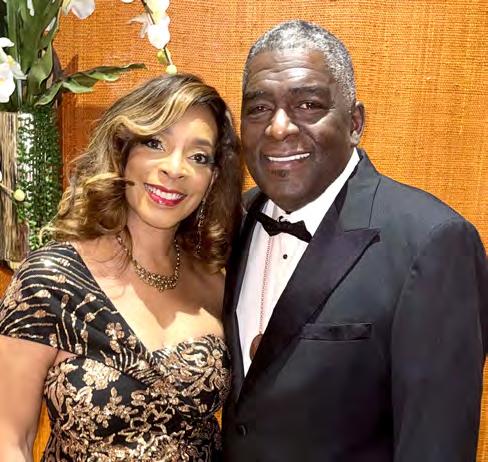
“As a young adult, I leaned into my educational foundation at SLUH. It formed a strong understanding of material, but it also built resiliency for the future for me. I’ll always be grateful for it.”
- STEPHEN LITTLETON ‘83
We apologize for the error publishing an inaccurate high school photo of Littleton in the original article; it has been replaced with his correct photo.
Following a successful career in engineering consulting, James Lucas ’68 started his own consulting firm – one that focuses on leadership development. For the last three decades, he has spoken to or taught more than 200,000 people in person, including CEOs of Fortune 500 companies and leaders of NGOs, the government and military. All the while, he has written 25 books that explore a wide range of topics from leadership and marital advice, to theology and science fiction.
In his books and leadership training, Lucas encourages intellectual curiosity and gaining confidence by becoming humbly attuned to the wisdom of the world. In the following Q&A, he discusses valuable lessons he learned at SLUH and later in the corporate and consulting worlds.
How was your SLUH experience? Any favorite memories or teachers?
I went to SLUH for several reasons. First, I thought that it was the best high school of any kind in the St. Louis area (I was right). Second, I thought the school would prepare me for my life and career (it did). Third, I knew the Jesuits would be demanding and make me do my best (they did!). And fourth, my dad and his two brothers attended SLUH; I had heard a lot about it, and wanted to continue the family tradition.
As an author of 25 books (and counting), I know that the rigorous language training at SLUH (in English, Latin and Russian) helped me immensely. I owe a special debt to Fr. Kane in sophomore English (he was known as “Pop Kane” and “Hurri-Kane”). He was brutal, which was perfect. No mercy for sloppy writing, or anything less than excellent. He would have us diagram sentences on the board, and if there was a mistake, he would say something like, “Class, Mr. Lucas apparently believes that dangling participles are a wonderful idea. What do you think?” Hmm. He was the first “molder” of my professional writing career. Thank you, Fr. Kane.
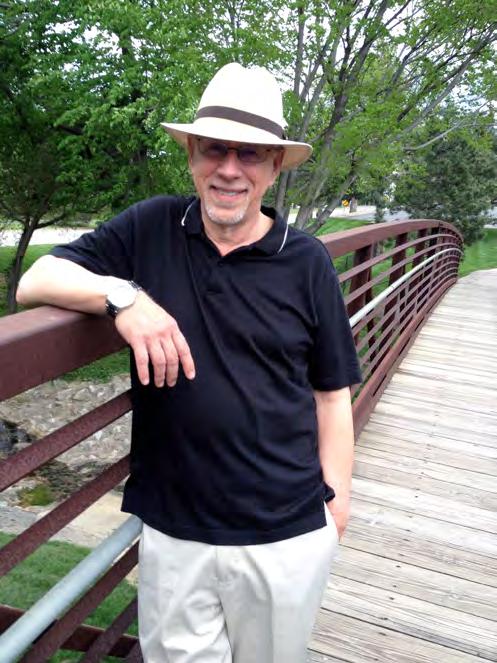
Fr. Peiper, SJ, our Latin teacher, was tall, slender and fearsome. His way of asking questions was designed to strike terror into our hearts. He took a deck of cards and put a Latin number on each one, then assigned each of us a number. He would ask a question, shuffle the deck, and turn up a card. The “winner” had to stand and answer the question. If he couldn’t, he had to stand for the rest of class. If his number was called again and he couldn’t answer (likely with the hovering dread), he was sent to the office. It was a small picture of what it must be like to be on death row. But I sure learned my Latin, which still helps me today in my book writing (and deciphering legal jargon).
My Russian teacher was Mr. Alfred Pasqualucci (his name sounded like an Italian dish – “The lady will have the lasagna, and I’ll have the alfredo pasqualucci”). He was excellent and demanding (and one of the few non-Jesuit teachers at that time). Once when we were a bit out of control, he threatened to take us all outside and fight us, all at the same time! Even with our underdeveloped brains we suspected that this would not be in our best interests, and later we learned that he had been a Golden Gloves champion. Years later, I was talking with several Russians who were having trouble understanding my Russian; I think I was speaking it with an Italian
accent. They apparently didn’t know if I was asking them about their work or ordering a pizza.
My best and worst memory happened on the same day. My junior year we were rated #1 in the state in football. CBC was #2. The teams met in the first-ever high school game played at Busch Stadium. We took a 6-0 lead at half. Then a bad omen: the seniors carrying the paper Mâche Billiken dropped it coming out after halftime. We fumbled the kickoff and ended up losing 17-6. Hero to zero in an hour, but a pretty good lesson for life: When you’re riding high, be aware of turning tides, and have plans for how you’ll survive them.
I wish there were more Jesuits to teach now, as almost all of my teachers were Jesuits. But you’re still in a Jesuit learning environment, and being taught by some of the best teachers around. Appreciate them, and drain them dry of all they know that can help you. If you’re a classy guy, you might also thank them with a word or a note. They don’t have to care about you, but they do. You’re now living in a very ungrateful era. Go against the tide and be the most grateful person you can be. This is very much in line with the SLUH vision for you as men of character and influence.
Were you involved in any activities at SLUH that hinted toward your future success?
Although I was hugely behind our athletics and other extracurriculars, and enjoyed playing sports, I wasn’t able to be involved because of my situation. I lived in the North County area (Bellefontaine Neighbors), and for the first two years I couldn’t drive even if we had another car (which we didn’t). There was no I-170 back then, so it was all through the city.
I had to take three buses: the first from a few blocks away from my house to a deserted area of Broadway; the second from Broadway between the cemeteries to the start of Kingshighway; and the third right down Kingshighway to the school. Total travel time
“Make a Difference. A big one. For God, the world, and yourself.”
about 1 ½ hours each way. I was mugged twice, and nearly kidnapped while standing next to the Calvary Cemetery wall on West Florissant (FYI, I wasn’t killed).
I also learned what it meant to be the only person of one race in the midst of a host of people from another. I learned that they were people just like me, with the same hopes, desires, plans, dreams, concerns and fears. An indescribably valuable lesson that has impacted much of my thinking and writing. I learned that skin color is a worthless criterion for judging anyone. Ever.
There was some sort of school magazine for which I wrote. I probably would have gone straight into writing, but since I was good at math everyone seemed to push me toward science and engineering. It turned out that no experience, if good and moral, is ever wasted. I got multiple degrees in engineering at Missouri S&T, multiple professional engineering licenses, and a corporate career building some amazing projects.
And then I added writing books, at first in my “spare” time. My SLUH experience taught me several important things that led me to success in my future as an author, as a teacher and consultant (Luman International), and as a high-tech entrepreneur (Galileo Somatosensory). Among those lessons learned:
• Perseverance. I had to really want a SLUH education to get up at 5:15 a.m. to catch the first bus at 5:45 a.m. Perseverance is crucial to being an author. A lot of people want to write a book. Without unrelenting perseverance, you have no chance of even finishing the book, much less getting it published. The same is true with creating a new business. There will be a hundred roadblocks, and to be successful you will have to go over, around, or through all of them. Or lose.
(continued on page 50)
Discover what your fellow alumni are up to below, then explore more class notes at sluh.org/alumni.

BY KANE LUCHUN ’26 PUBLISHED IN THE PREP NEWS, SEPTEMBER 19, 2025
Before I saw Superman (2025) this summer, I, like many others, thought of Superman as boring. He seemed awfully one-note. There was no edginess or internal turmoil found in heroes like Batman or Daredevil. Instead of the aura of Iron Man’s red suit of armor, we instead got zero cool factor in Superman’s pair of red underpants. There was no deep, interpersonal drama or relatability that I saw in SpiderMan. Superman seemed to be an all-powerful, all-good, and all-American superhero. I assumed my feelings couldn’t be
reconciled, and that I shouldn’t concern myself with a character as dimensionless as Superman.
With the announcement that James Gunn ’84 would be creatively directing a new wave of DC films, starting with a Superman movie, I was skeptical albeit interested. As a lifelong superhero fan, having grown up on Gunn's Guardians Of the Galaxy, I wondered how the acclaimed director and St. Louis U. High alumnus would tackle a character of this importance. Gunn’s strength as a storyteller is most evident in his ability to take unknown or D-list characters, and write them to become complex, fleshed out people, capable of carrying their own movies and TV shows. How was Gunn going to reinvent one of the most iconic fictional characters of all time? By re-establishing the one trait central to all Supermen, across the almost 50 years of screen history and nearly 100 years of publication. That he’s, if nothing else, a good person with a heart of gold.
It’s in Superman’s genuineness, in his idealism and hope for the world that shows who this character is and what he stands for. In an age of dark and brooding superhero stories, Superman separates itself from the pack through the themes of kindness and hope that it preaches. The film and its titular character embody not only Jesuit ideals but Catholic ideals in emphasising generosity and kindness. Superman is who the grad at grad wants us to be: someone who is actively
loving, and committed to doing justice in spite of others.
Throughout the movie, Superman has to deal with hatred from the public. After villain Lex Luthor reveals that Superman’s Kryptonian parents sent him to Earth for him to conquer it, not to protect it, Superman turns himself in to the government in an attempt to restore some sense of trust in the public. Even in his darkest hour, when the world is against him, he still orients himself toward caring for the people of Earth.
Superman is the only person in the movie who genuinely wants to do good the entire time. His general kindness and care is evident throughout the film, but one scene in particular stands out. When Superman and the Justice Gang, a corporately funded superhero team, have to fight a monster spawned by Luthor, Superman showcases his humanity in the heat of battle. The monster is wreaking havoc across Metropolis, and the other superheroes are shooting to kill. He takes hits from flying rubble, flies through flame breath, and dodges getting crushed by the kaiju, the whole time trying to convince his fellow heroes to instead neutralize the beast so they can spare it.
”There's got to be another way,” he says, before jumping back into the fray, determined to save the creature from the heroes, and from itself.
Superman is constantly trying to find a non-violent solution. His empathy knows no bounds, and his efforts know no limitation.
Additionally, as the other heroes are oblivious to the collateral damage, Superman, the most powerful of the group, uses his incredible speed to save every life in the monster’s path. He saves men, women, children, and even a squirrel, whisking them away with his super-speed. He checks on the office workers trapped in a building aflame, asking if they’re alright. He calms down and consoles a woman struggling to breathe. Superman cares about every individual in the scene, ensuring that everyone has what they need to be safe. While his fellow heroes are oblivious to the lives at risk and the surrounding collateral damage, Superman does what it means to be a true hero in viewing every life as valuable.
Although Superman’s efforts aren’t in vain, his fellow heroes don’t listen to him, and explode the creature from the inside out. Superman is visibly saddened when the creature dies, and his frustration at his teammates is palpable. Mr. Terrific, the stoic leader of the group, tries to tell him that killing it was the only way to stop it. When the scene ends, Superman is still
disappointed at the carelessness of the other heroes, grieving the monster as the scene advances. Despite everyone telling him not to care about the tragedy of the scene, he still can’t help but care deeply, and wants to do good in the face of doom.
Although not the main action sequence of the film, this small scene embodies Superman’s unflinching commitment to justice. He cares for the creature, despite the chaos it's causing, and when the monster unfortunately has to die, his sadness is real. Because the story of course follows Superman and his experience, we feel his sadness too.
Superman saw the creature as the problem it was being, the danger to others it was causing, and he still chose to “love” it in his own way. Even his attacks on the creature evoke compassion. He doesn't beat the creature into submission with hard-light hammers a la Green Lantern. He has no technological advancements like Mr. Terrific, or Hawkgirl’s spiked battle-mace. Superman has laser eyes, super strength, and freeze-breath, some of his most dangerous

powers in his toolbelt, and he almost never uses them. The only time he hits the monster is to disorient it, to prevent it from hurting others or itself. His actions stem most fundamentally from love and care despite any wrongdoing, as all of ours should.
We live in a world where men masquerade as models of masculinity. People who worship the dollar, telling us to put ourselves before others in all of our pursuits. We fall into a trap of viewing people as a collective, a monolith, and not seeing a person as an individual soul. In our efforts to be cool, or popular, or to make the most money, we push others away. Now, more than ever, young men need a role model who isn’t afraid to stand up for what’s right. A man who always puts others before himself, who is kind for the sake of being so, loving towards strangers as much as his family. You don’t need superpowers or money to do good. We are citizens of the world first, before our country. It’s through humanity’s determination and love that, like Superman, we pull through, and we do the greater good despite what others say.
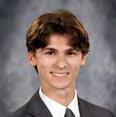
Kane has been writing for the Prep News for four years and is only the paper's second features editor in that time. He also plays electric guitar and has a deep love for rock music and fashion. Kane will be studying Industrial Design at Iowa State University this autumn.
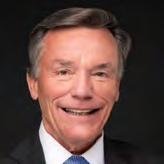
Once a year, Business Insurance chooses an individual in the insurance industry who has made an outstanding contribution to the risk management sector throughout their career. Mark Wilhelm ’72, executive chairman of Safety National, was honored with this prestigious award in 2025. His impact has been nothing short of visionary, as Safety National continues to be defined by its stability, innovation and culture. His leadership is defined by encouraging ingenuity and creativity in the company’s efforts to distinguish itself from competitors while prioritizing relationships, both internally and externally. Wilhelm, a Backer Awardee, serves on the SLUH Board of Trustees.

Joe Palazzolo ’00, a reporter for the Wall Street Journal since 2010, earned a Pulitzer Prize for National Reporting in 2025. This represented
his third such award, adding to a Pulitzer Prize for Investigative Reporting in 2023 and a Pulitzer Prize for National Reporting in 2019. Throughout his career, Palazzolo has investigated corporate misconduct, uncovered conflicts of interest within government, and exposed instances of bribery involving companies pursuing international contracts.
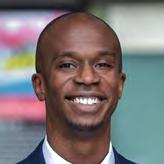
Kwofe Coleman ’01, president and CEO of The Muny, led the historic outdoor musical theatre to receive the prestigious 2025 Regional Theatre Tony Award for its artistic achievement. Coleman, who started at The Muny as an usher, was promoted to his current position in 2021 and oversees the strategic vision, community engagement and overall business of this St. Louis landmark institution. Among other awards, Coleman was recognized on the 1540 List, annually recognizing 15 SLUH alumni under 40 who are challenging our definitions of excellence, and setting the world on fire. He serves on the SLUH Board of Trustees.
(James Lucas ‘68 continued)
They say that engineers can’t write, but that’s nonsense. I’ve had books published from 1985 to 2025, with more to come (God willing), and translated into many languages (e.g. Chinese, Japanese, Korean, Portuguese, Arabic). SLUH developed both the left side of my brain (rational, linear) and the right side of my brain (creative, insightful). If you work hard, the school will do that for you as well.
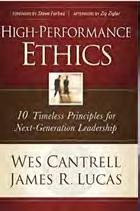
• Resilience. At SLUH, I learned that if you didn’t do as well as you could on a test or paper, you had a choice: Get better, or get lost. My first book manuscript was rejected by 40 publishers. I decided I could live with anticipation, but not with disappointment. When I’d get a rejection, I would immediately send out another proposal. Vince Lombardi said, “The real glory isn’t winning. It’s getting knocked to your knees and then coming back.” Life at times will beat you like a drum. Train yourself now to be ready to come back from those beatings even stronger.
• Smart Use of Time. I imagine homework is still challenging at SLUH. I learned to do much of it while on the three buses. I had to work summers, so to do the required reading and more, I had to skip some fun stuff. Be willing to pass on some fun time to have the time to be great. Not all, just some. You simply can’t be a successful author or entrepreneur or anything else if you don’t value your time and know how to spend it well. When you’re ready to finish a book or project, you have
(continued on page 53)
Saturday, April 11, 2026
Join us for an extraordinary night!
Help raise vital funds in support of needblind admission and the pursuit of excellence For the Greater Glory of God.
Everyone Can Participate
• Buy your table or tickets no later than March 21 – but we expect a quick sell out!
• Take a chance on a CASHBAH Raffle, including the new President’s Raffle, featuring a 2026 Toyota Camry SE
• Make a Fund A Jr. Bill donation to help us reach our goal that directly supports need-based financial assistance
Visit sluh.org/cashbah or scan the QR code.
• Purchase a Grab Bag and other CASHBAH favorites before they’re gone
• Claim your free access to bid on our terrific Silent Auction items even if you cannot attend
Eleven alumni classes celebrated their reunions in conjunction with the close of the SLUH Backer Memorial Centennial on Saturday, September 27, 2025. It was a landmark occasion for the entire school community, featuring live music, a party atmosphere with fireworks and the announcement of the largest gift commitment in the 207-year history of the school (see page 18).
2026 Alumni Reunions SAVE THE DATE
50-Year Reunion: Class of ’76
October 2-3, 2026
Multi-Class Reunion:
Classes of ’21, ’16, ’11, ’06, ’01, ’96, ’91, ’86, ’81, ’71, ’66
September 19, 2026
Jubilee Reunion: All alumni from the Class of 1961 and older October 16, 2026
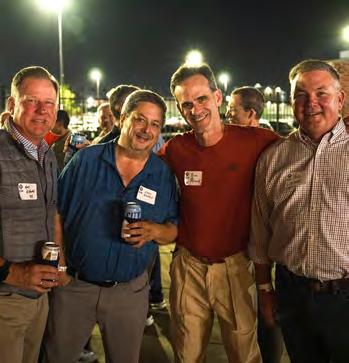
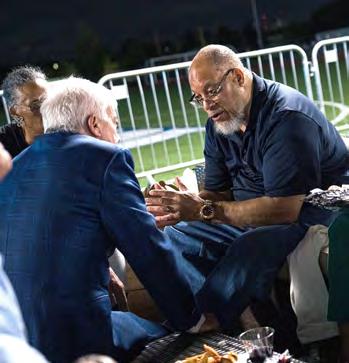
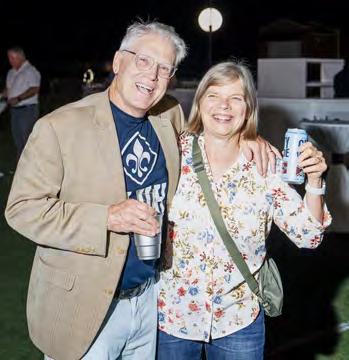
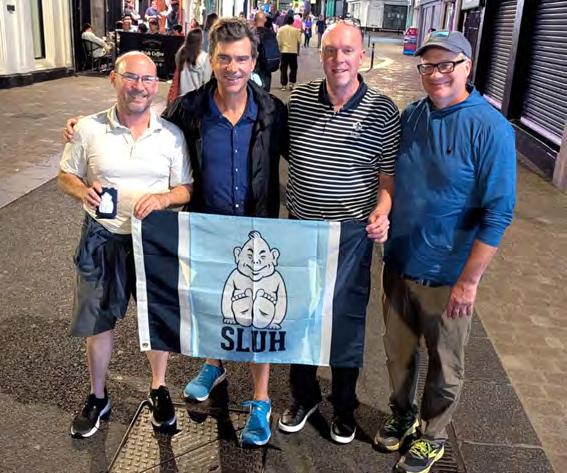
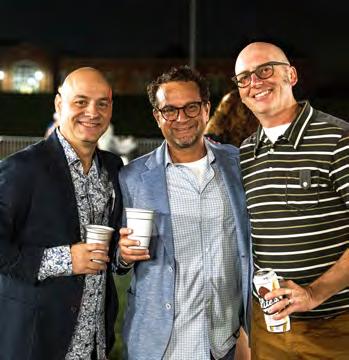
Four classmates from the Class of ’83 recently visited Europe together to celebrate their friendship – and their 60th birthdays. They include (from left): Bob Boggiano, Sean Gannon, Ken Seise and Joe LeGrand.
According to LeGrand, “The idea was that since we all were turning 60, and had been friends since SLUH, we should all do a big trip. We started in Ireland (Galway, Dublin), spent time in Marseille, France, and finally, three of us rented a boat and sailed around Split, Croatia. Along the way there were many nights talking and telling stories. Ken and Bob played golf in Ireland; Bob played guitar and sang in an Irish pub; and we got help mooring from an NBA champion. Tons of amazing experiences. It was a great way to celebrate over 40 years of friendship and the SLUH brotherhood.”
to know how to eliminate all distractions, even good things, to drill down and make it happen, like undefeated Rocky Marciano before a championship fight. There are a lot of books out there that are 90% done, and that’s as far as they will ever get.
• Perfection. Teachers at SLUH will teach you about important things like “the best,” and “don’t settle,” and “you can do better.” Nobody will buy a book that has poor writing, sloppy thinking, okay grammar, or slim vocabulary. Editors won’t save you. The FDA won’t approve “pretty good” medical devices. Learn how to do everything you do as close to perfect as you can. You’ll never get to perfect, but you will train your mind to see even small imperfections that can scuttle both your work and even your best ideas.
What advice would you give current Jr. Bills?
• Tell the Truth. Always. Jesus said, “You will know the truth, and the truth will set you free.” But how can people around us know the truth if we won’t tell it? Besides, nobody has a good enough memory to keep track of a lot of lies.
• Go Outside the “Norm.” You have access to some of the brightest and most experienced teachers on the planet. Don’t just learn from them in class. Seek them out and have questions ready for them (probably one at a time!). Sample:
• “What was the most important factor in your success? Why?”
• “What’s the most important thing you’ve accomplished to date? How did you do it?”
• “What’s the biggest mistake you’ve made in your education or career? What did you learn from it? What can I learn from it?”
• Train Yourself To Always Do Your Best. If you’re a student at SLUH, you’re probably pretty smart. You may have even been able to coast through grade school and get “A's” with little or no effort. If you’re smart enough, you might even be able to do that for a while at SLUH. But don’t do it. At all. Ever. You
have the chance to train yourself, your mind, your heart, your spirit to be outstanding, patterns that will apply to everything you do for the rest of your life. Or not.
• Dare To Be Different. My 8th grade teacher, Sister Regina Marie, for some reason took an interest in me. She would often say to me, sometimes in a whisper, “Dare to be different.” I knew she didn’t mean “be weird” or “be disagreeable” or “be contrarian.” She meant, “Don’t be afraid to do something you know is right, even if you’re the only one who knows it.” You will have a thousand people and forces trying to make you conform to things that range from suboptimal to poor to stupid. Never cooperate with nonsense. America today is full of nonsense. Be someone who is willing to stand alone, knowing that in some odd way that makes you a majority.
• Do Real Spiritual Growth. In your life you’re going to hit walls you can’t go through and problems you can’t solve on your own, not even with a host of really smart people helping you. You need to always be ready to fall back on, rely on, and trust in God. Not in just a traditional or ritualistic way, but in a personal way, because God wants to be with you and in you, and you can be on the side of God and the angels. You won’t know when those low times or moments or events will come, but I promise you they will come. The good news is that you can prepare yourself, starting right now, to be ready for them, and to make it through the valleys with your soul intact.
Last thought: You don’t have time or bandwidth to make all of the mistakes that it’s possible for you to make. There’s just too many ways to mess up. Do a lot of research, from every side of every issue. Learn who the experts and posers really are. Ask wise (not just smart) people about how to do something, even if you’re sure you’ve already nailed the answer or solution.
And make a difference. A big one. For God, the world, and yourself.
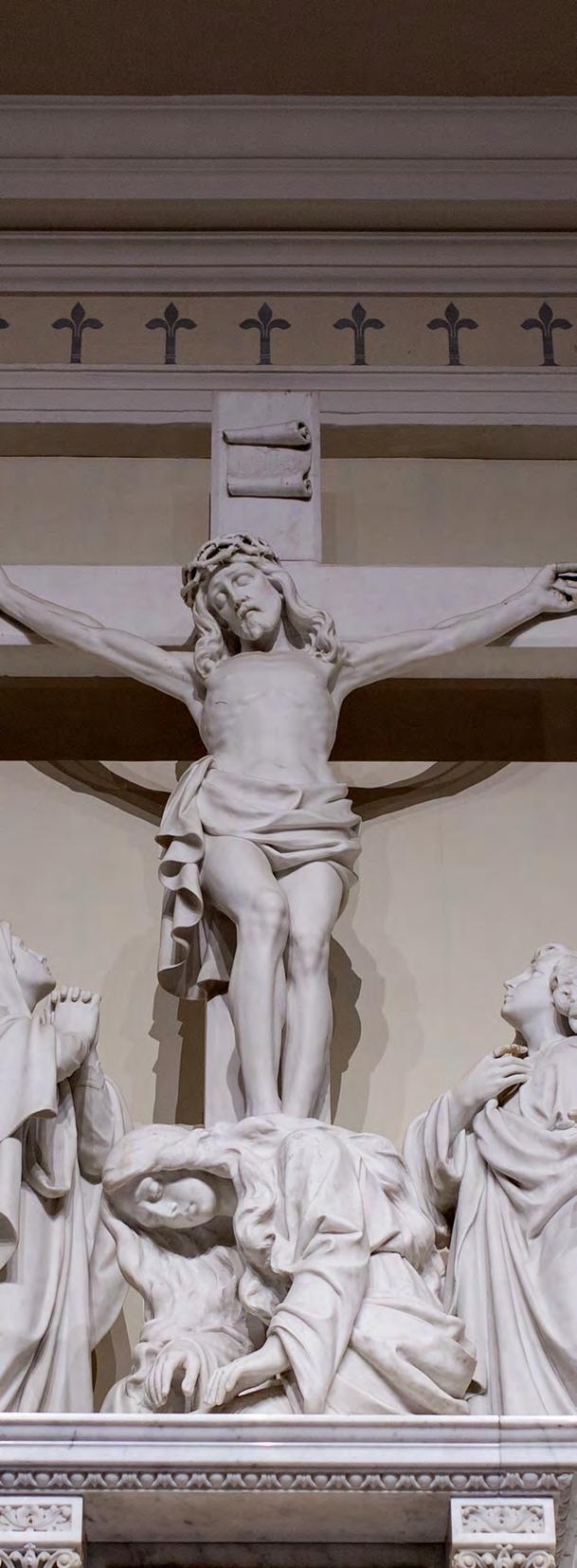
Since July 2025, SLUH has learned of the deaths of the following alumni. Eternal rest grant unto them, oh Lord, and let perpetual light shine upon them.
Find the complete list at sluh.org/remember.
List compiled 7/1/25 - 1/27/26
Dick Cassani ’44
Ken Cassani ’46
Jack Wells ’47
Bill Corrigan ’49
Fr. Lou Oldani, SJ ’51
Duke Pollnow ’51
Jim Stickford ’52
Tom Gleason ’53
Matt Weis Jr. ’53
Fr. Jack Hunthausen, SJ ’54
George Metzger Sr. ’54
Gene Murphy ’54
Jerry Carter ’55
Garrett Gray ’55
Bill O’Brien ’55
Tony Ribaudo ’55
Jim Hitchcock ’56
John Kelemen ’57
Bob Malone ’58
Lee Pelligreen Jr. ’58
Chuck Casey ’59
Fr. Tom Michel, SJ ’59
John Corkery ’60
John Dwyer Jr. ’61
Mike Farrell Jr. ’61
Bill Hickman ’61
Fr. Jack Warner, SJ ’62
Rick Weber ’62
Bob Zink ’62
Frank Pawloski ’63
Pete Smith ’63
Terry Carmack ’64
Tom Donahoe Jr. ’64
Tom Stipanovich ’64
Charlie Kirksey Jr. ’65
Patrick Devereux ’67
Gene Krebs ’67
Steven Nieuwendaal ’67
Jim Schweitzer ’67
John Siegel Jr. ’68
Dave Guelker ’69
Joe Forshaw IV ’70
Bill Hayes V ’73
John Lochner III ’73
Kevin Sigillito Sr. ’73
Jeff Davis ’74
Joe McCormack ’74
Gerry Kettenbach ’75
Brian Coad ’76
Bill McNamara Jr. ’77
Tommy Donnelly ’86
Kevin Holliday ’92
Mark Nelson II ’92
Nick Schneider ’05
Please let us know if you learn of the death of an alumnus or friend of SLUH at alumni@sluh.org.
BY JOHN MEIER ’98 PRESIDENT, SLUH ALUMNI ASSOCIATION
Editor’s note: Alumni contributed 1,583 gifts totaling $612,800 for St. Louis U. High Day, held November 13-15, 2025, in conjunction with the founding day of the school. This represents a substantial increase compared to the 2024 effort, which garnered 1,237 gifts totaling $459,995. All donations benefit the Jr. Bill Fund.
The success of St. Louis U High Day serves as a powerful reminder of the impact SLUH has on its students. It is essential because it ensures that future generations of young men can access this same transformative experience through vital need-based financial assistance.
A significant highlight from the effort was the Class of 1970, which demonstrated incredible loyalty and generosity by raising more than $45,000 (the most of any class).
For the steadfast members of the Class of 1998, the competition for the highest number of donations came down to the final moments against the now formidable and never-to-be-underestimated Class of 2005. Although my own class increased participation by 25% and contributed 122 donations, the Class of 2005 successfully rallied its members to an unprecedented 127 unique contributions. My new friend and commendable leader, Danny Henry ‘05, and I engaged in some friendly wagering and a very spirited, down-to-the-wire finish.
This collective energy – this intangible sense of being perpetually connected to the institution and to one another – is driven by the shared experience, whether one graduated in 1970 or 2005, and fuels the enthusiasm surrounding St. Louis U High Day. We can directly attribute any of our successes to the instruction imparted by so many outstanding Jesuits, faculty, coaches and staff that we are capable of the extraordinary, which makes our joint success seem so attainable.
The following classes collected the most gifts for St. Louis U. High Day.
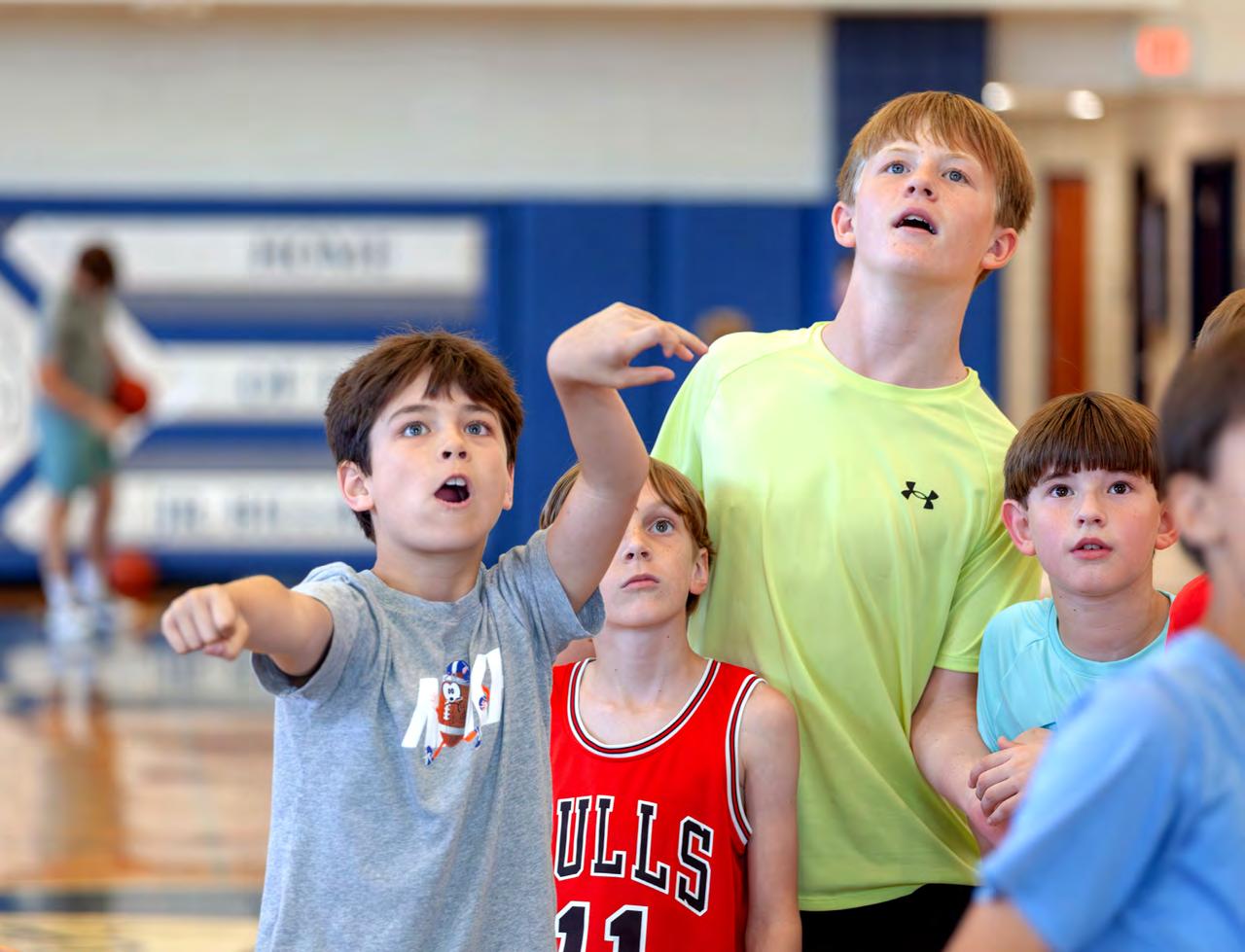
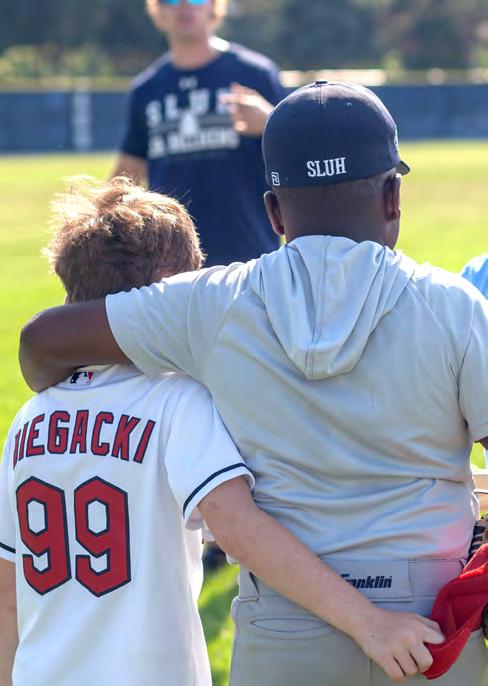

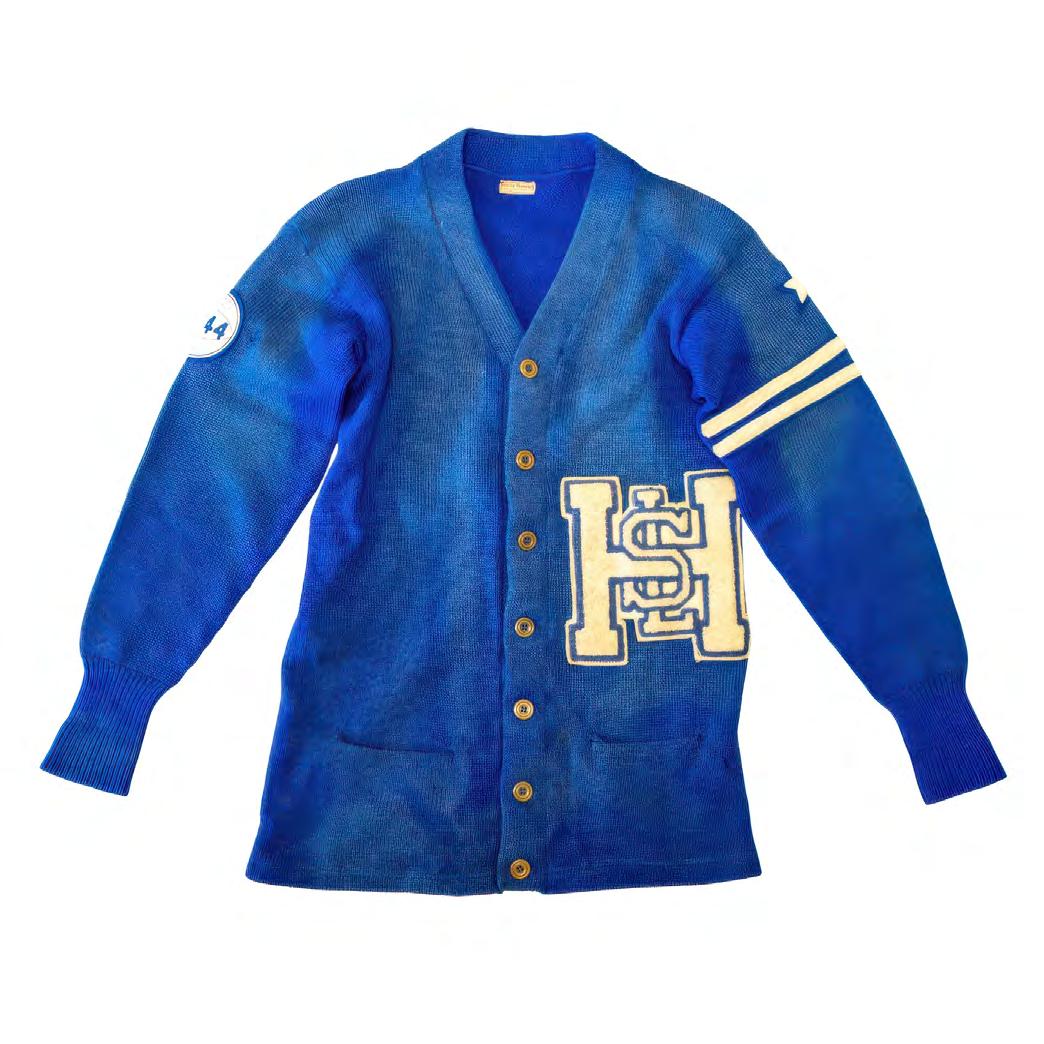
As SLUH looks forward to its next century on Oakland Avenue, the school is preserving its proud past. In the coming months, Legacy Hall – situated on the main floor of Backer Memorial in the old Jesuit wing (current Theology classrooms) – will come alive with a permanent display of unique archival items representing all facets of student life.
If you have items of historical significance – in areas such as academics, arts, athletics, co-curriculars, faith formation, global education, service and STEM – please consider donating them to the SLUH Archive.
Send your items to: SLUH Archive
St. Louis University High 4970 Oakland Ave
St. Louis, MO 63110
Or email ametzler@sluh.org to coordinate drop-off at SLUH.
SLUH INSIGNIS PODCAST
New Episode: “Back to the Future: From Foundations to Frontier at Backer Memorial”
This past year SLUH celebrated "100 Years On Oakland." In the latest, two-part episode of Insignis, host Jim Linhares guides us on a time-traveling trip in a radio version of Doc Brown's Delorean.
In PART ONE, we go back in time to discover a living connection to the very first graduation class of 1924, take a tour of the SLUH Archive building housed just off campus and talk SLUH traditions across three generations with a legacy family: the Lallys.
And in PART TWO, we reset the Flux Capacitor to explore what it might be like for a student to attend St. Louis U. High 20, 50 or even 100 years in the future.
Strap in, buckle up and enjoy the ride.
sluh.org/insignis
Also available on Spotify and Apple Podcasts.
Editor’s note: Tim Piechowski ’03 delivered the following remarks on the evening of Thursday, January 29, surprising Stephen Missey ’88 with a special announcement in the Robinson Library with family, students, faculty and alumni in attendance. Piechowski has worked in finance since his graduation from Georgetown University in 2007.
There is a specific kind of electricity that only exists at 10:17 p.m. on a Thursday night in the Prep News Office. It’s a frantic mix of what I recall to be Wild Cherry Pepsi; the hum of desktop fans; a deep track on Weezer’s Green album playing just a bit too loudly; and that singular, desperate hope that every single article jump line or "throw" actually points to the correct page before the final PDF is sent to the printer. It’s a high-stakes environment where 17-year-olds are given the keys to the school’s narrative – and for over 25 years, the steady hand at the center of that whirlwind has been Mr. Missey.
I’m Tim Piechowski, and I’m here tonight with my wife, Megan. I was part of the crew that put together PN67, which, for those of you who don’t track your life by student newspaper volume numbers, means I graduated in 2003.
Before I go further, I should note that I’ll be referring to our guest of honor as Mr. Missey tonight, and not by his first name, Steve.
This is mostly because we are in the presence of current students, but also because he did not disappoint and is impeccably dressed in his signature button-down Oxford.
With that introduction, I am incredibly excited to announce the creation of the Stephen Missey ‘88 Fund for the Prep News . When Megan and I were looking to make a more significant contribution to SLUH, we wanted to highlight the dedication of its faculty and the significance of SLUH extracurriculars as a cornerstone of this institution. In thinking of a person who embodied the very best of what SLUH stands for, I could not come up with a better example than Mr. Missey, nor a better endeavor than the Prep News
To moderate the Prep News for over a quarter of a century is a staggering feat of endurance. But what is even more impressive is how Mr. Missey has fought to preserve the independence of the paper. He has acted as a firewall, ensuring that the students – not the administration – decide what is fit to print.
Of course, that independence has occasionally been put to the test. I don't envy whatever conversation Mr. Missey had to have when – in an April Fools' edition – we ran a story claiming that a certain administrator was "shocked" to discover an entire school functioning beneath his third-floor office. [In my mind, I like to think he argued that the piece was the personification of the dry wit and sarcasm that is part of the unwritten "Grad at Grad" requirements here at SLUH – though I imagine a more conciliatory deflection won the day.]
But the independence of the Prep News serves a greater purpose – The Truth. I remember a story I wrote about the school’s budget issues and

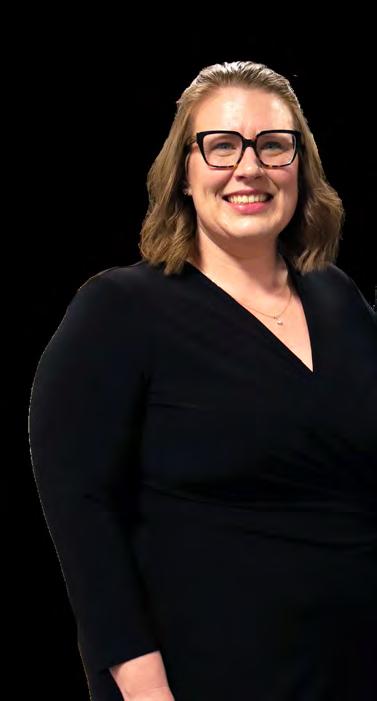
endowment losses following the late-90s tech bubble. It was a sensitive topic, but with Mr. Missey’s backing, I kept digging and interviewed the school's CFO at the time. After the article ran, Mr. Missey came to me with that specific, excited almost boyish grin on his face that is only offered when excellence has been achieved. He told me the faculty were stunned by how much I had managed to get the administration to reveal. He looked at me and said those four words that made every late night worth it: “Pieman, you nailed it!”
One of the most remarkable things about the Prep New s is how approachable it is. Any student – whether confident or still finding their footing here at SLUH – can walk into that office, be assigned a 200-word piece, and find themselves immediately involved. But for those who stay – you quickly realize you’ve stumbled into a
unique intellectual community. It’s a space that differentiates itself from the athletic endeavors that often define the high school experience; it’s a place where the currency isn't a 40-yard dash, but wit, curiosity and the pursuit of a well-turned phrase.
Looking back, those Thursday nights had a profound impact on my life beyond SLUH. In my career in investing, I often interview executives to understand how they are managing their companies – determining the veracity of their growth plans and the quality of their businesses. Just like in the PN office, I have to distill vast information into an intelligent narrative. The skepticism, the precision and the drive to get to the truth were all forged right here.
However, my deepest respect for Mr. Missey is because he isn't just a cheerleader; he holds us to a standard. In the spring of
my senior year, when I started "phoning it in with senioritis," Mr. Missey didn't let it slide. He had a frank, honest conversation with me about our responsibility to the masthead. That conversation stuck with me far longer than any grade ever did.
Finally, we must recognize that 25 years of those late-night Thursday deadlines came with a real cost.
While we were in that office formatting in Adobe Pagemaker and figuring out how to install an ink drum into a copier, Mr. Missey was away from home. Julie, thank you to you and your family for sharing him with us and for supporting the sacrifice of those countless Thursday nights.
[Mr. Missey, you've taught us that excellence isn't a parttime endeavor. Over 25 years, the technology changes and students graduate, all while the world outside is shifting – but the standard of the Prep News, valuing the truth, has been sustained because you are here.]
Now please join me in raising a glass. To the man who has sacrificed a quarter century of Thursday nights, the mentor who has taught so many what it means to truly "nail it," and the heart of the Prep News

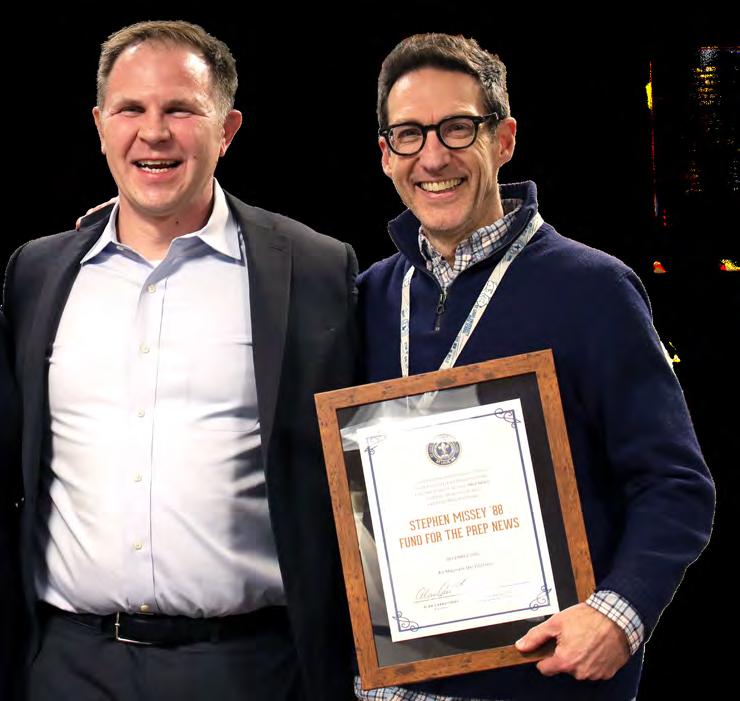
To Mr. Missey!
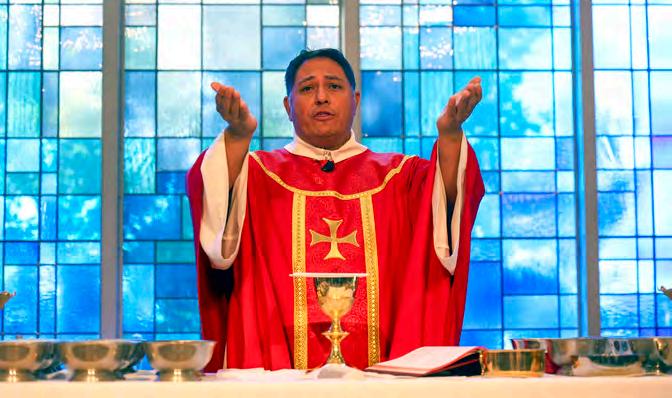
BY FR. ERIC RAMIREZ, SJ
In dramatic fashion best understood through the lens of the Baroque, St. Ignatius invites retreatants to imagine themselves at the highest point of Heaven with the persons of the Trinity looking down at the world. Within the Trinitarian gaze people are dying, being born, getting sick, doing their work, and every other form of human activity. Ultimately, the Trinity sees humanity falling into perdition and is moved by compassion to save us. Jesus responds to the invitation to human salvation by becoming one of us. God sees us and, through divine initiative, acts.
Fr. Eric Ramirez, SJ is in his first year at SLUH, where he teaches junior Theology and serves on the Campus Ministry team. Previously, he served as pastoral director at Regis Jesuit High School in Denver. A native Texan, Fr. Ramirez was ordained a priest in 2014 and brings a deep commitment to Jesuit education, pastoral formation and the integration of faith and life in the classroom and beyond.
Before our Christmas break, I met with our Campus Ministry Pastoral teams from each grade and invited them to share in that same Trinitarian gaze. Whereas the Trinity looks upon the totality of the globe, I asked our students to stand with God and look upon our school community on Oakland Avenue. They were invited to notice and see the various struggles, needs and wants of our students and faculty. I then invited and challenged them to consider
how might God be calling them to act, as God acted.
Among the five pillars of the Grad at Grad, Intellectual Competency seems to be the most obvious. We are, after all, a school. However, there is a tendency to limit the scope of intellectual competency to course content and critical thinking skills, forgetting that each pillar has a mission orientation.
Intellectual competency is more than learning physics formulas, parsing poems, memorizing irregular verbs, or learning how to learn. Intellectual competency is learning how to place myself in service of others. Yes, we are in the business of getting our students into college. Rooted more deeply, we are in the mission of helping our students develop that Trinitarian gaze capable of looking upon their world. Our hope is that our students, touched by this gaze, do not seek to withdraw or retreat within themselves, but rather, choose to engage with compassionate service drawing close to those who struggle as Jesus drew close to us as Emmanuel
Daily Mass
7:45 a.m. in the Chapel of the Beloved Disciple (on regularly scheduled school days)
CASHBAH Dinner Auction
Saturday, April 11
For details, visit sluh.org/cashbah
Spring Play
April 23, 25, 26
For details, visit sluh.org/arts
Fine Arts Concerts
Band & Orchestra:
Tuesday, April 28
Jazz Concert and Studio
Art Show Opening:
Tuesday, May 5
Dance & Choir:
Sunday, May 10
For details, visit sluh.org/arts
Mass of Praise and Gratitude
Tuesday, April 28
Si Commons
Graduation Weekend
Saturday-Sunday, May 23-24
For details, visit sluh.org/seniors
Father-Son Golf Tournament
Saturday, June 20
Norman K. Probstein Golf Course in Forest Park
Fr. Hagan Alumni Cup Golf Tournament
Friday, June 26
Norman K. Probstein Golf Course in Forest Park
For event details, as well as a complete listing of upcoming events, visit sluh.org/calendar.
Download the SLUH App to access important news, announcements, calendars and stories. Parents and alumni, you can download the app on Google Play or the App Store and use it as your primary source of information for announcements, staff directory, calendars and more. Learn more by scanning the QR code below or visiting sluh.org/app






to a second consecutive state championship on November 22, 2025.