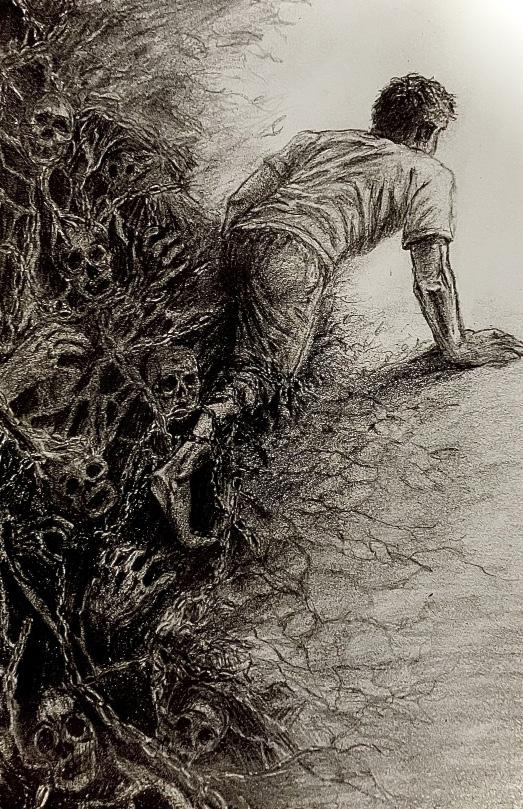
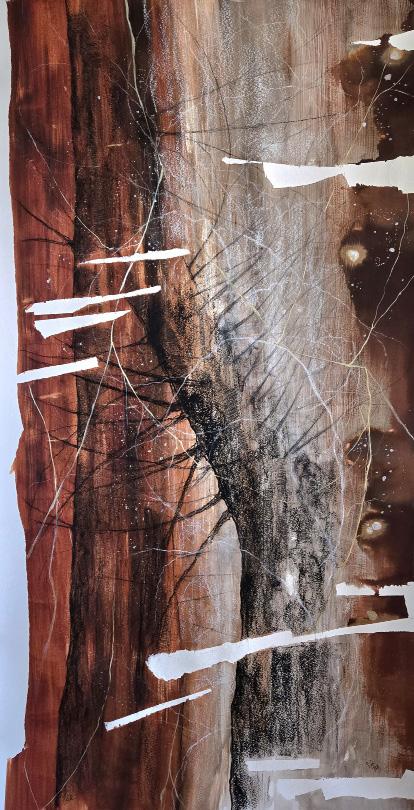
Inside Front Cover: Still Street, pencil, charcoal by Mark Schoemehl
Inside Back Cover: Backyard Turtle, ceramic and photograph by Owen Williams
Back Cover: Fragilidad, acrylic by Leo Hahn
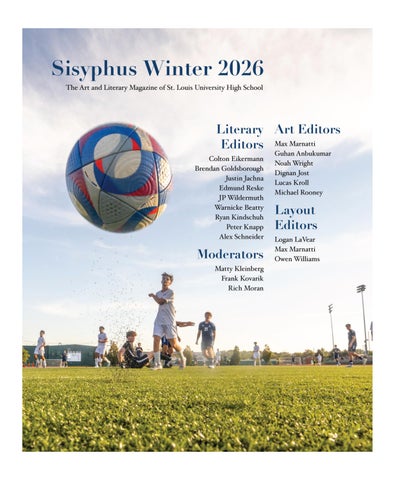
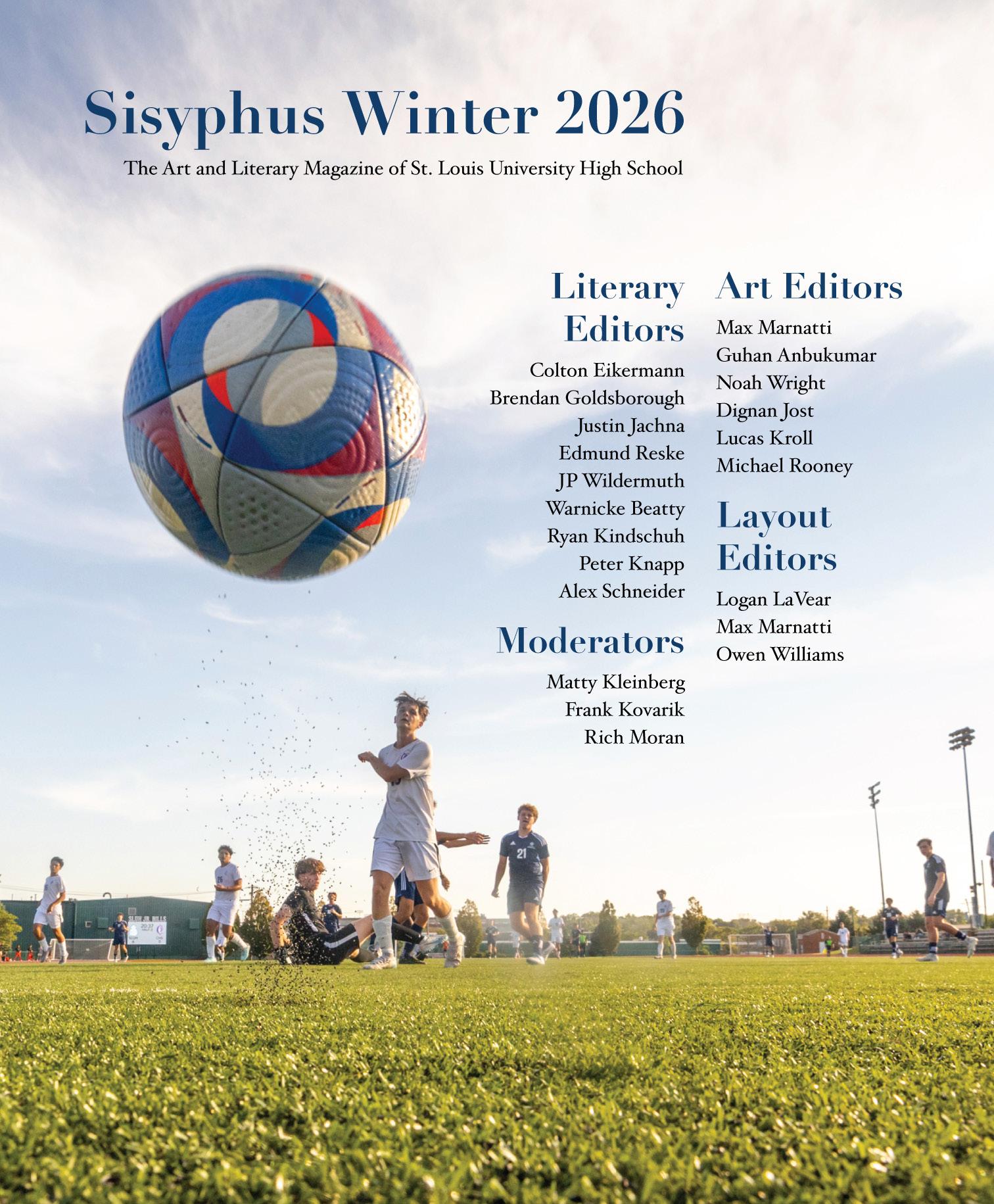
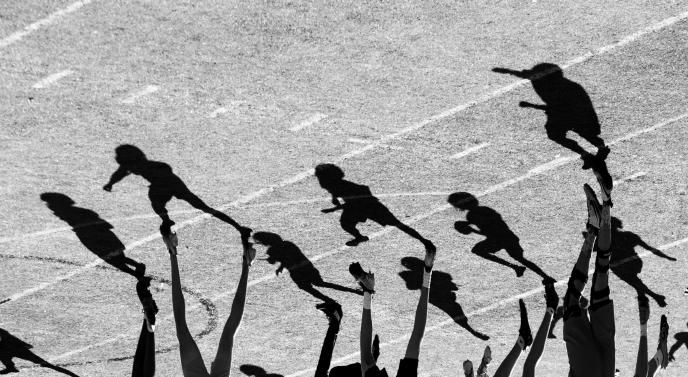
Masthead: Goal, photograph by Jack Auer, design by Dignan Jost
3 Driving, poetry by Owen Yu
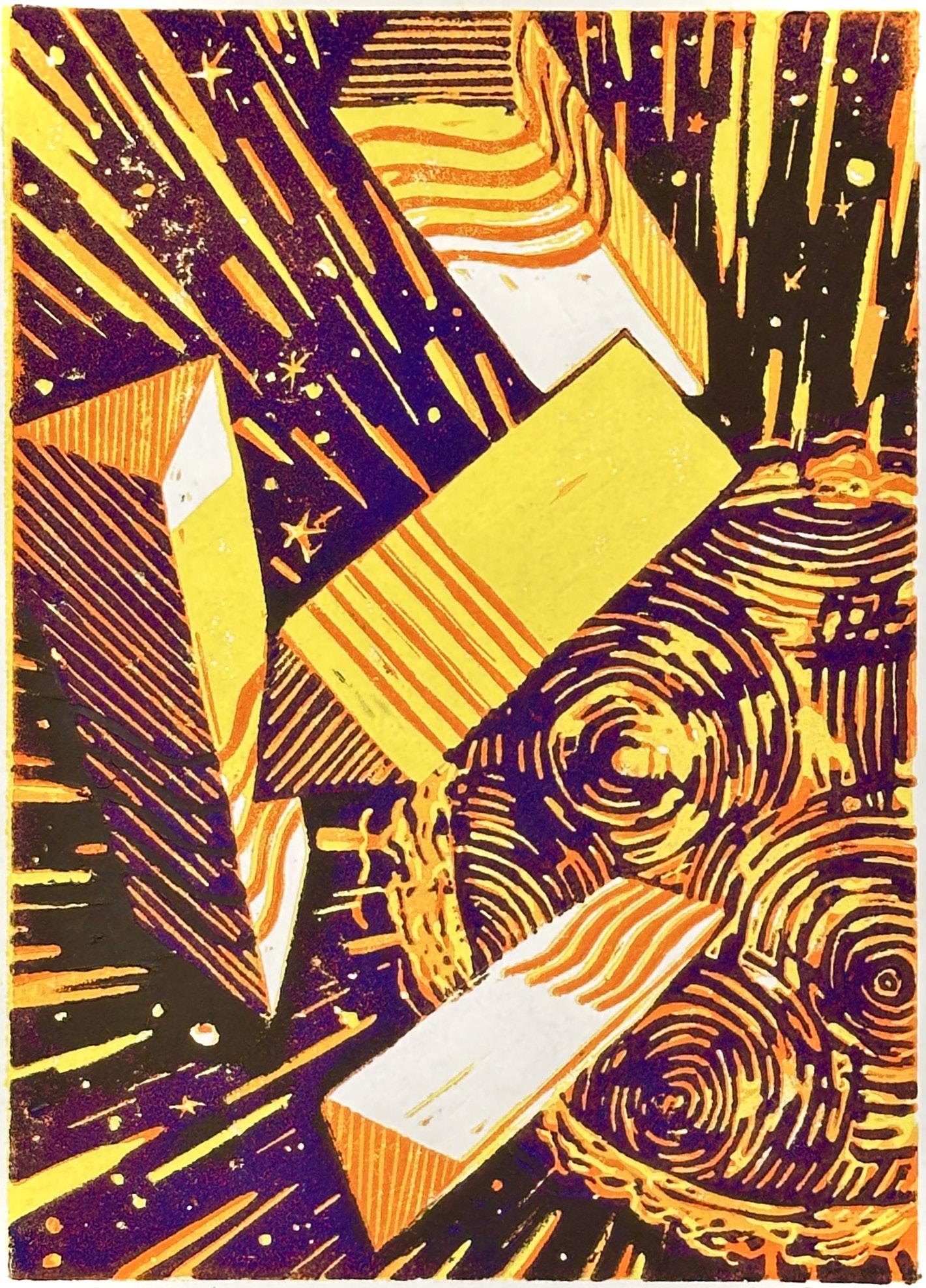
4 5th Element, print, 5-color reductive linocut by Matty Kleinberg
5 The Great Conjunction, prose by Joe Talleur
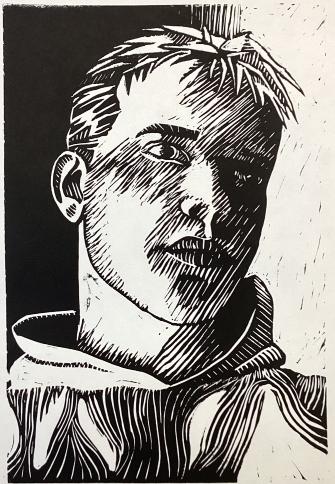
7 Look at Me, print by Max Marnatti
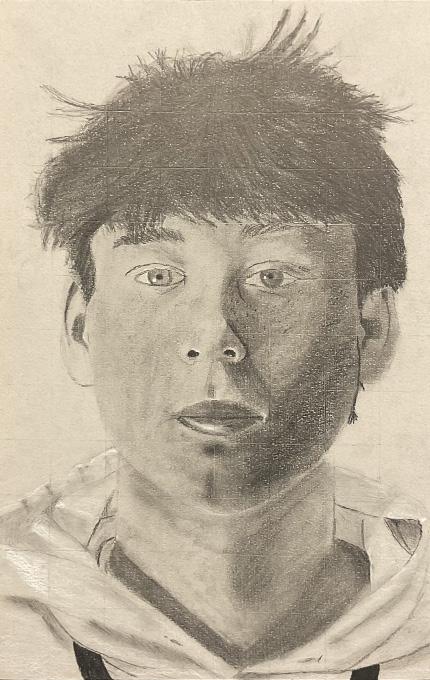
8 Self-Portrait, pencil by Weston Stein
9 the myth of Mary-Rose, poetry by Warnicke Beatty, Jr.
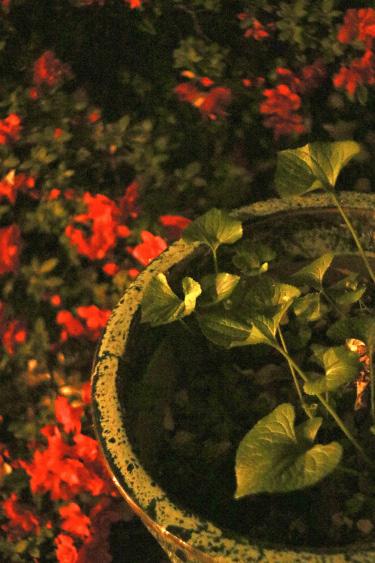
10 Flower and Vines, photograph by Brendan Hunt
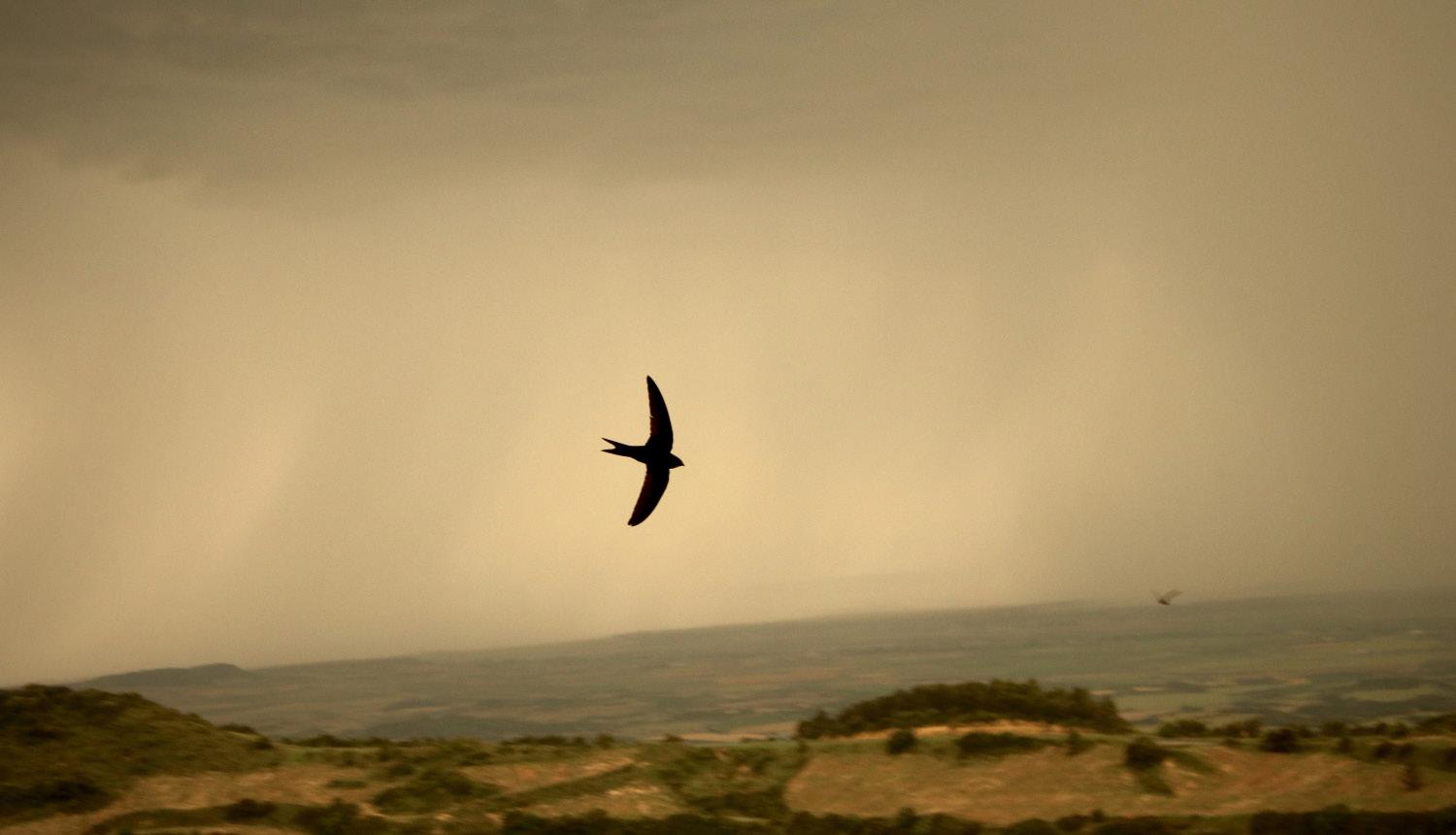
11 Bird, photograph by Brendan Hunt
11 The Swift and the Oak, poetry by Edmund Reske
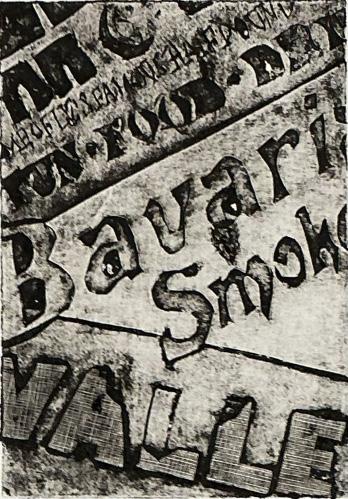
12 Inside the Yard Waste Dumpster, photograph by Rich Moran
13 The Mirror, poetry by Jay Carroll
14 Escape the Chains, pencil by Gabe Khazen
15 The Empty Road, prose by Gideon Taylor
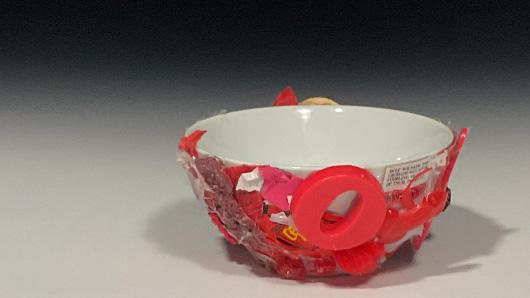
17 Chinese Takeout, sculpture, ceramic, collage by Warnicke Beatty, Jr.
17 on the corner of a chinese restaurant and a strip mall, poetry by Warnicke Beatty, Jr.
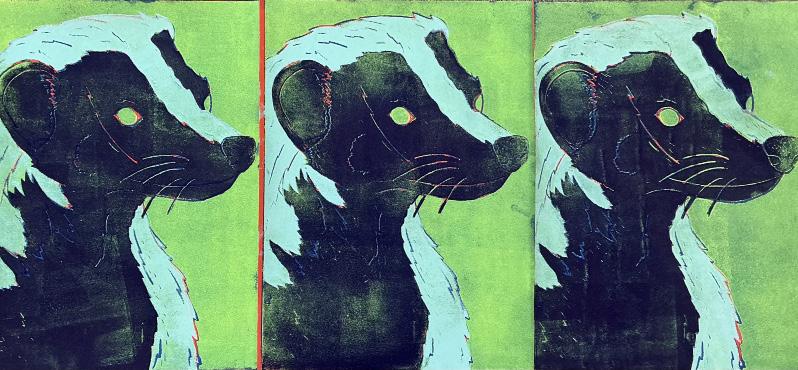
18 Badger, print by Dignan Jost
19 running, poetry by Ryan Kindschuh
19 Shadows, photograph by Jack Auer
20 The Shoe Box, poetry by Joon Bautista
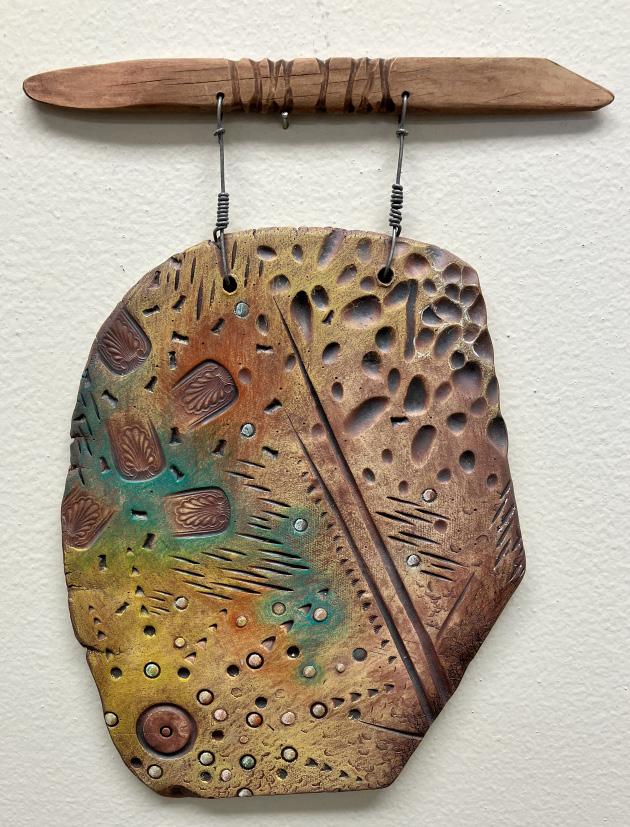
21 Domain, clay, iron oxide wash, wood, wire, pencil by Sarah Rebholz
22 Where I’m From, poetry by Warnicke Beatty, Jr.
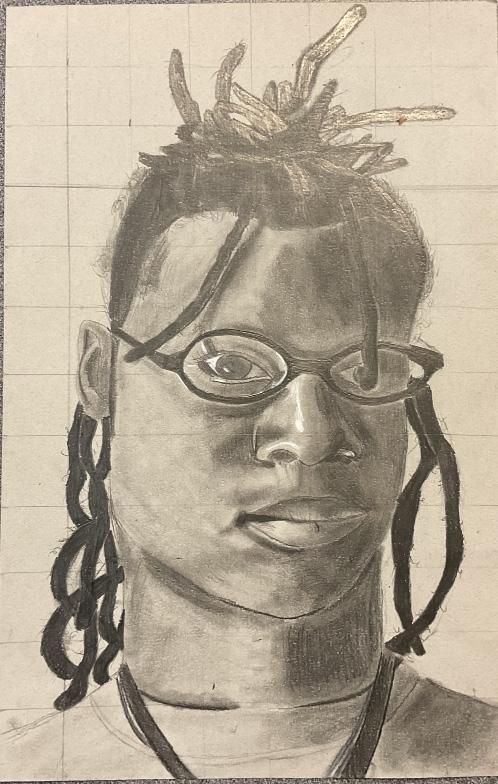
22 Warnicke, pencil by Warnicke Beatty, Jr.
23 That Bit of Dad in Me, poetry by Jack Klein
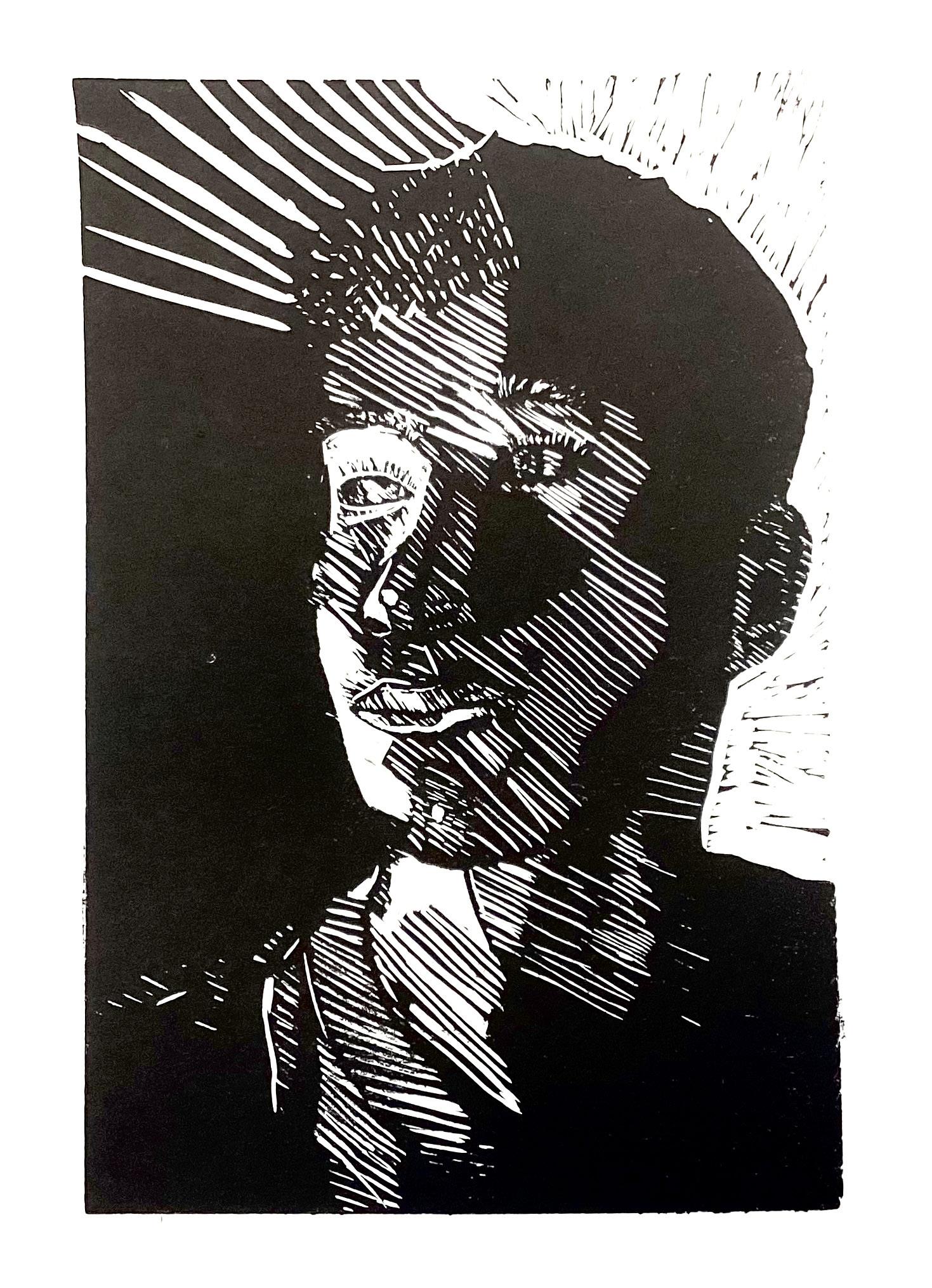
23 Shadow Selfie, print by George Albert
24 The Pale Light, fiction by Ryan Lawlor
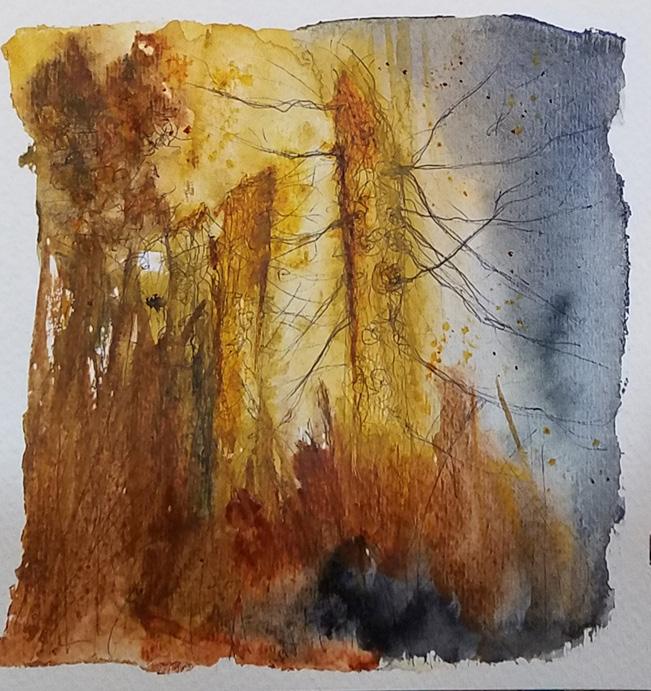
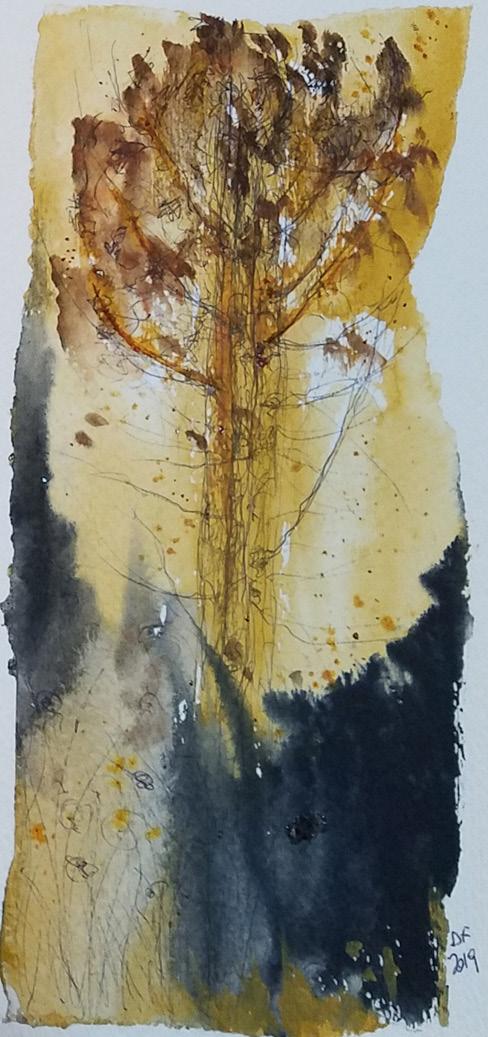
24 Fragments of Storm Vaia, pencil, pen and ink, watercolor by Dina Fachin (continues on pages 25 and 29)
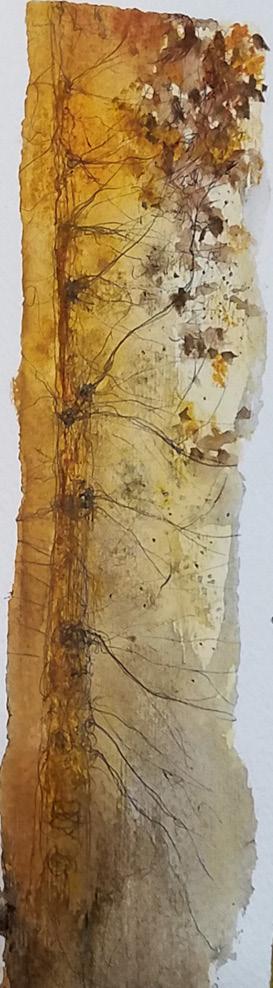
26 Impermanence II, pencil, pen and ink, watercolor, charcoal by Dina Fachin
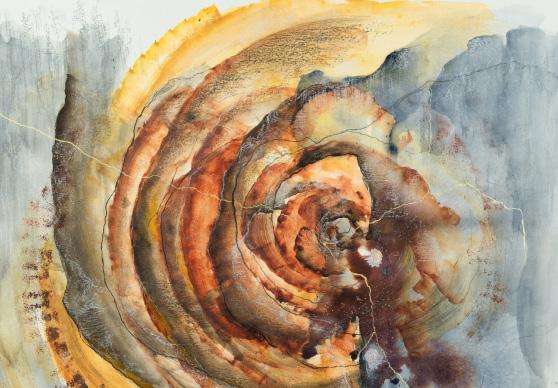
31 We Are Here, pencil, pen and ink, watercolor, charcoal by Dina Fachin
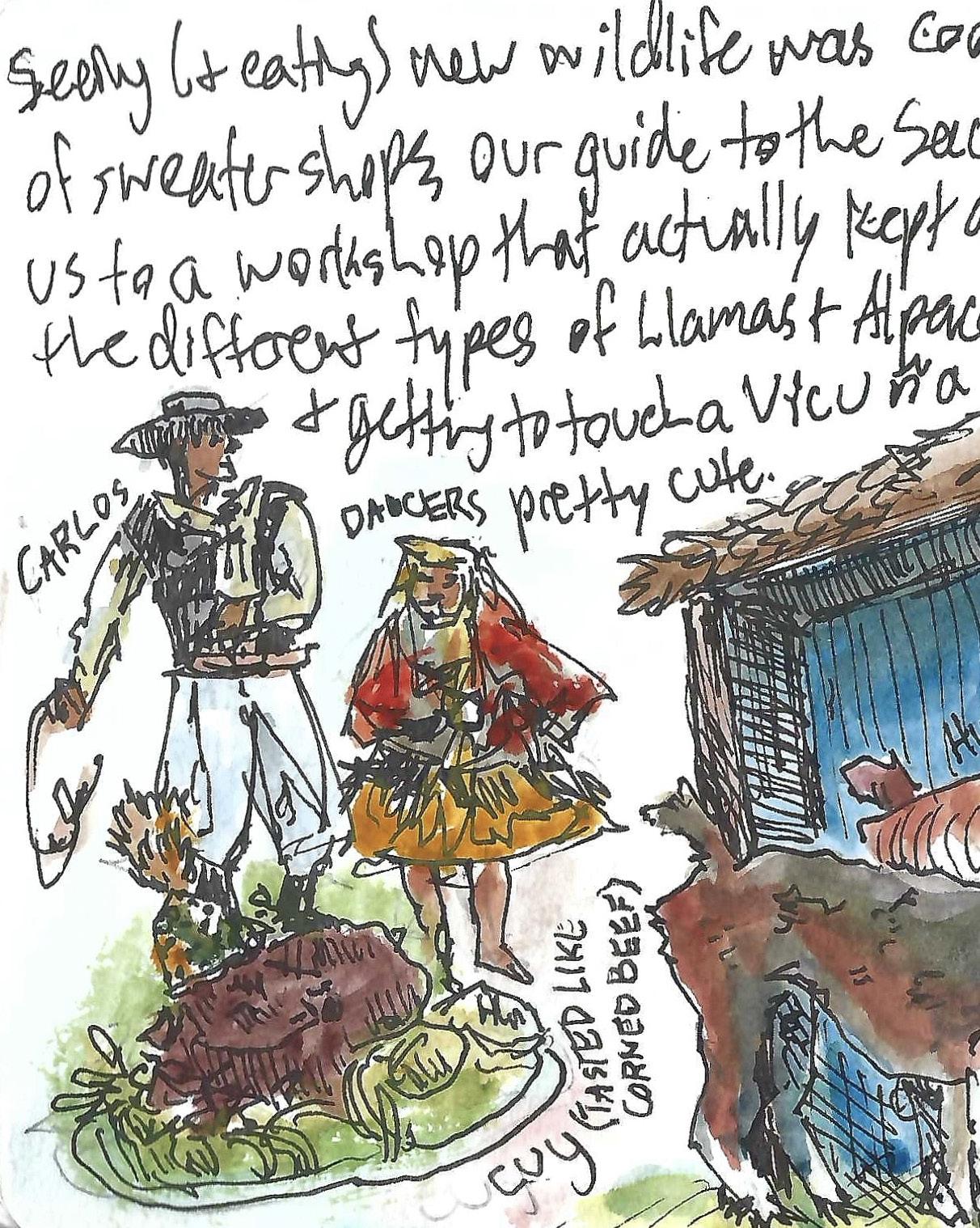
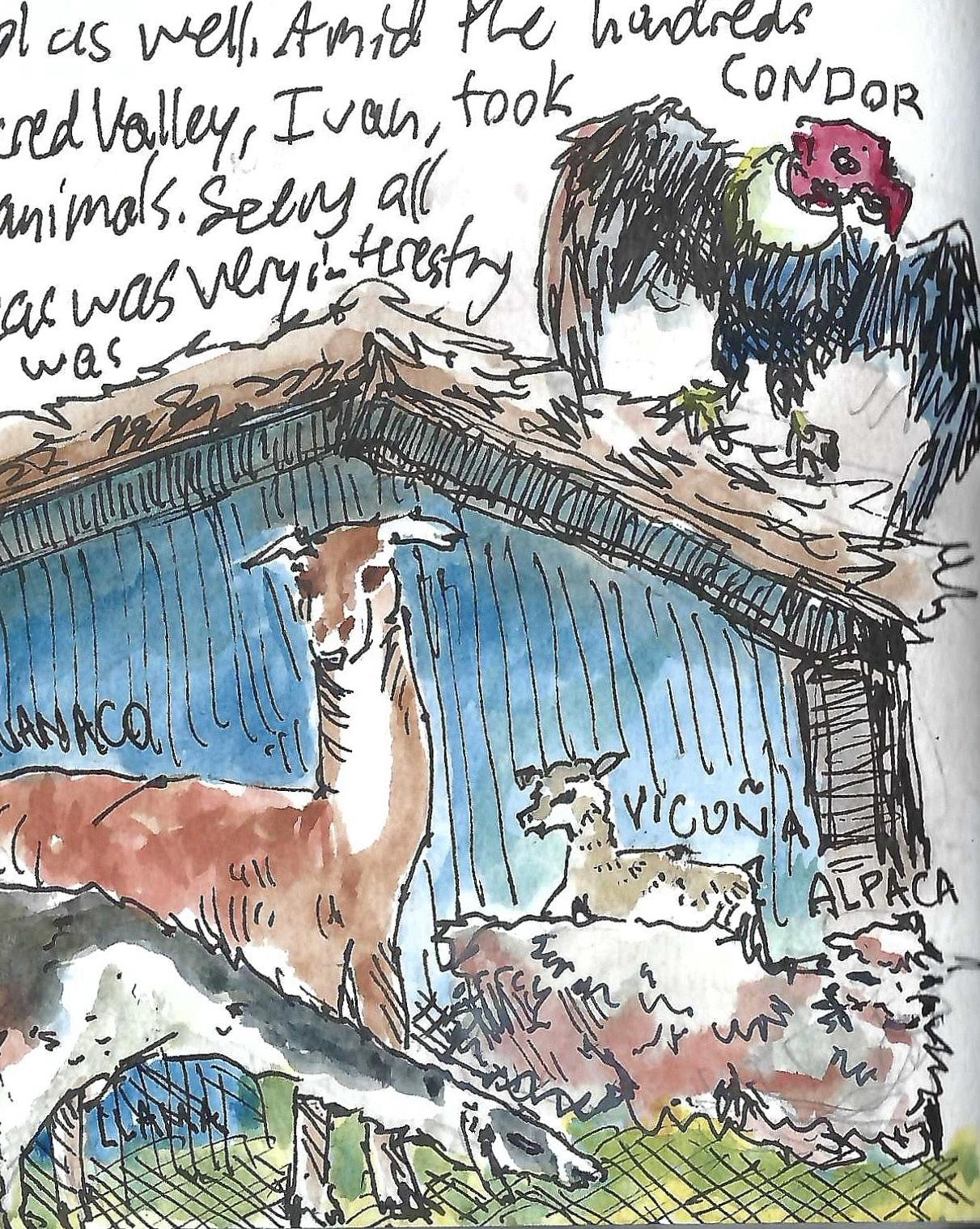
32 Ancient Cultures Trip Journal (Cusco page), by Leo Hahn
34 Dog Person, poetry by Edmund Reske
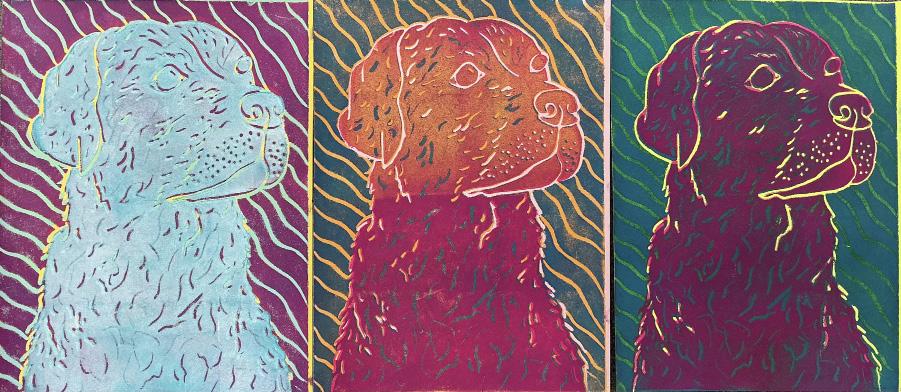
34 print by James Besmer
35 Letting Go, poetry by Colton Eikermann
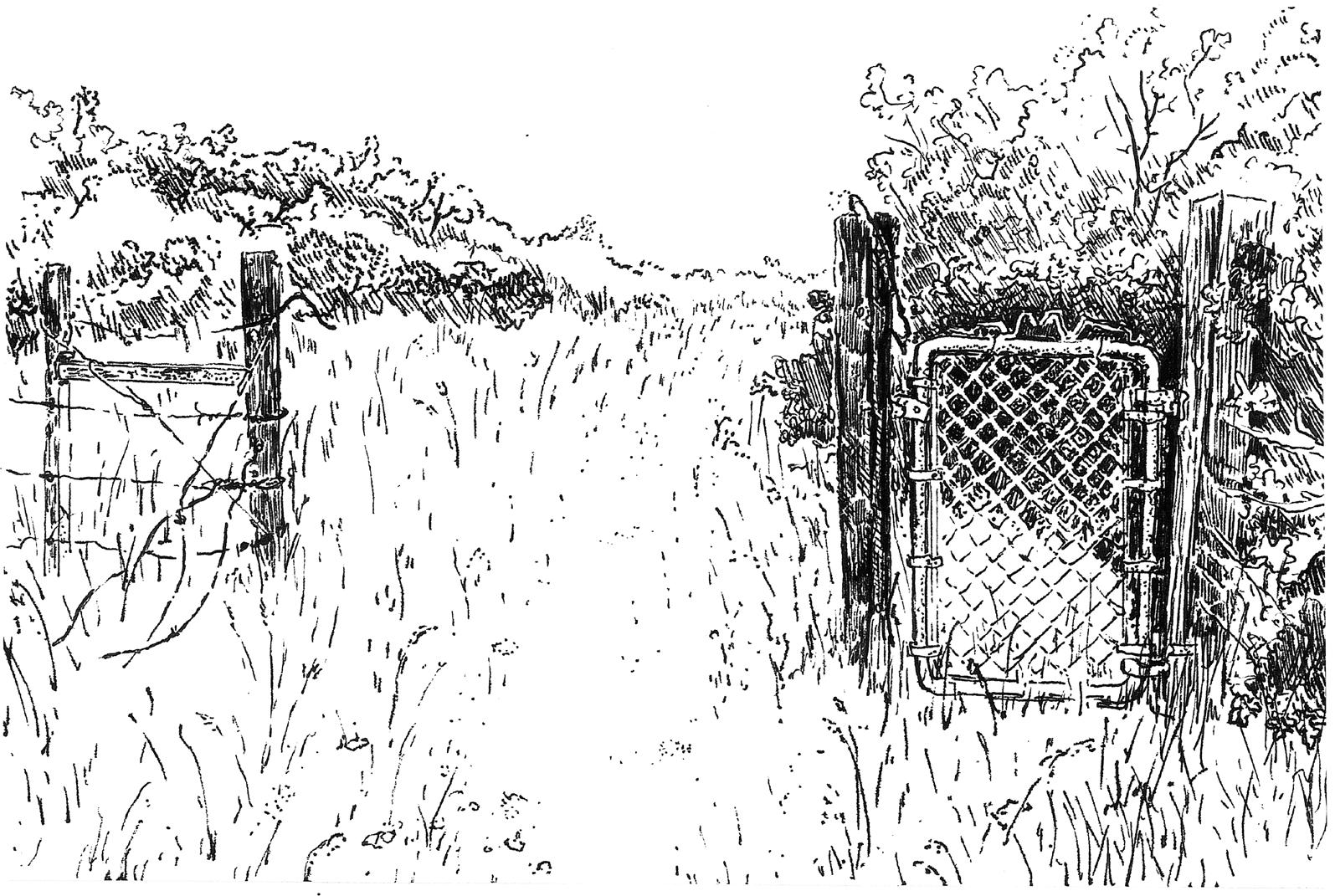
37 Gate(s), pen and ink by Matty Kleinberg
38 Original Sin, prose by Mike Lally
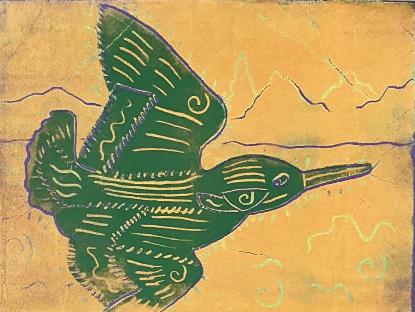
39 Kingfisher, print by Emmett Gaspar
40 The Elephant, poetry by Peter Knapp
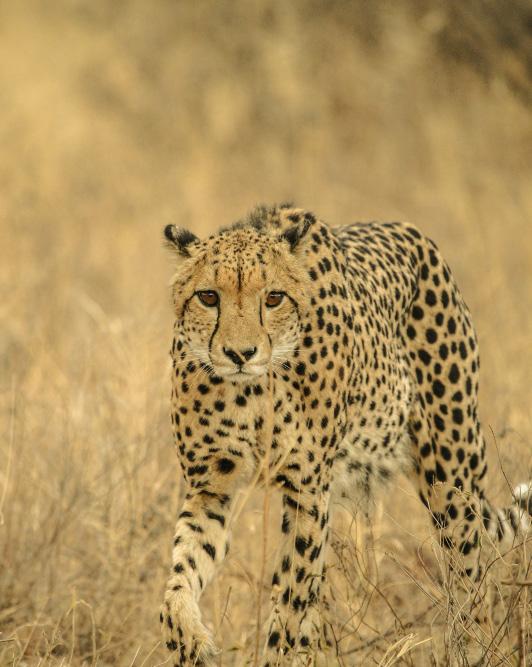
41 The Lurking Cheetah, photograph by Andrew Hammond
42 Dead Tree, poetry by Frank Kovarik
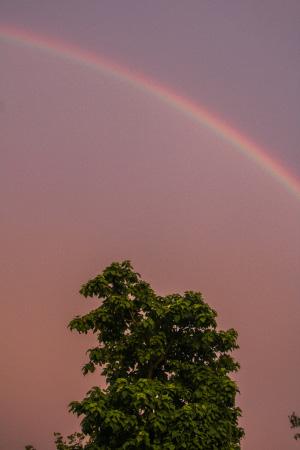
43 Rainbow after the Storm, photograph by Logan LaVear
44 dressed by mommy, poetry by Jay Carroll
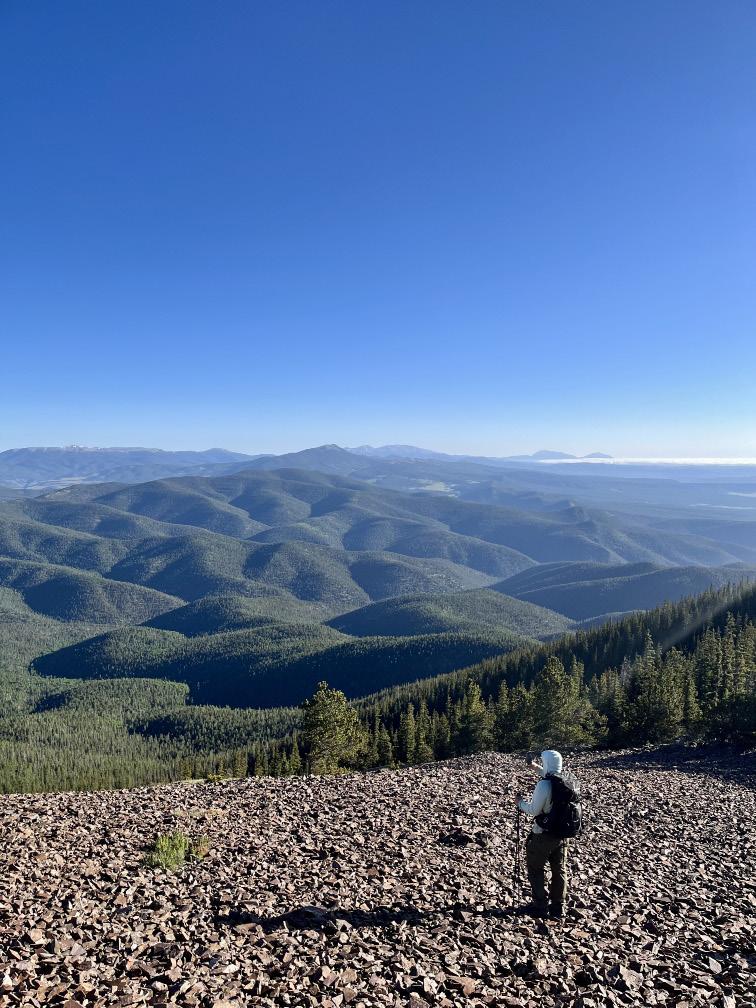
45 Shadows of the Summit, photograph by Ryan Safar
46 Mother to Son, poetry by Colton Eikermann
47 The Snowflake, poetry by Ryan Kindschuh
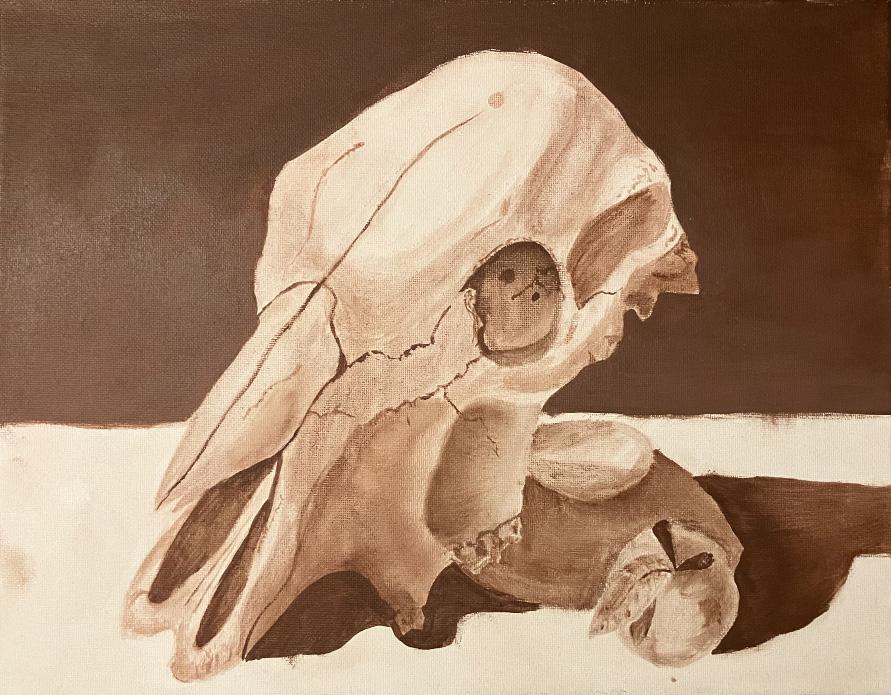
48 Around Town, pencil, print, oil by Gavin Barrett
49 To My Neighbor (and my little brother), Elijah, poetry by Ryan Sextro
50 The Complex and Bewildering Origin Story for the Great Hank, fiction by Finnian Driscoll
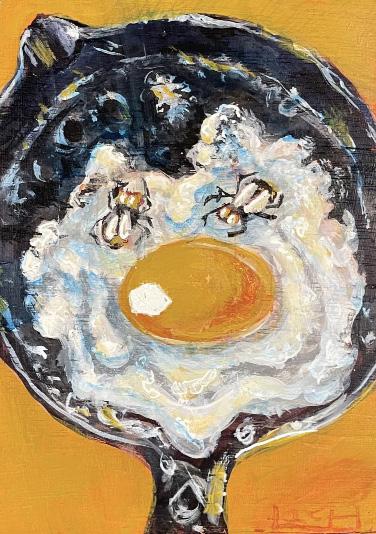
51 Grease Bag, acrylic by Leo Hahn
52 The Day the Hum Stops, poetry by Warnicke Beatty, Jr.
53 acrylic by Ben Yoffie
54 Pedestal, poetry by Frank Kovarik
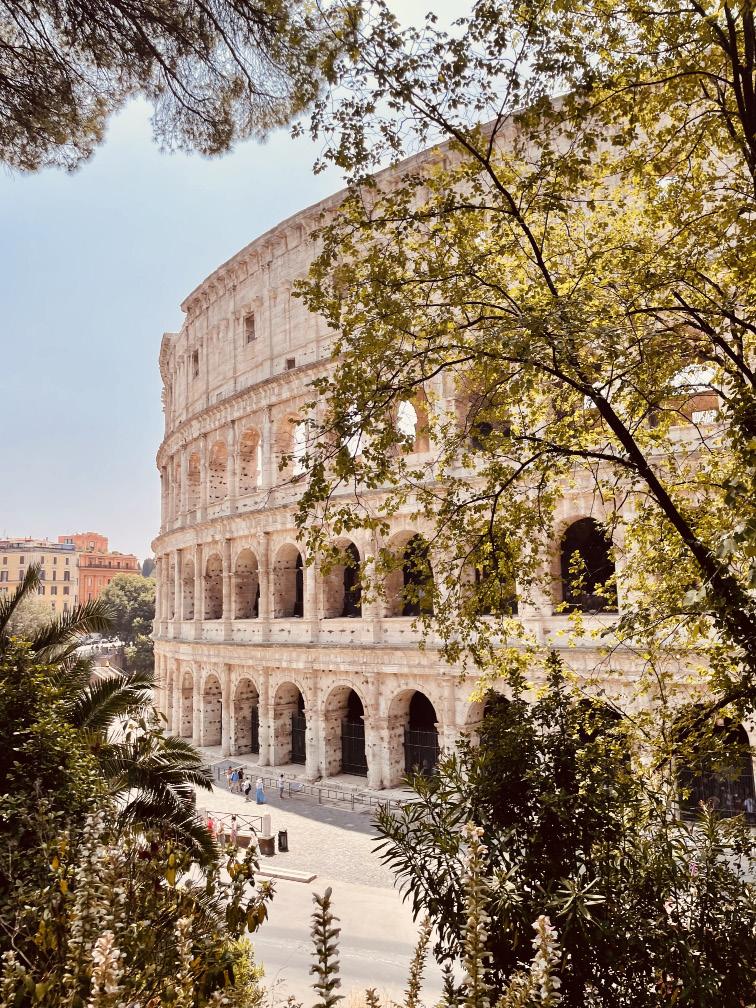
55 Are You Not Entertained?, photograph by Colton Eikermann
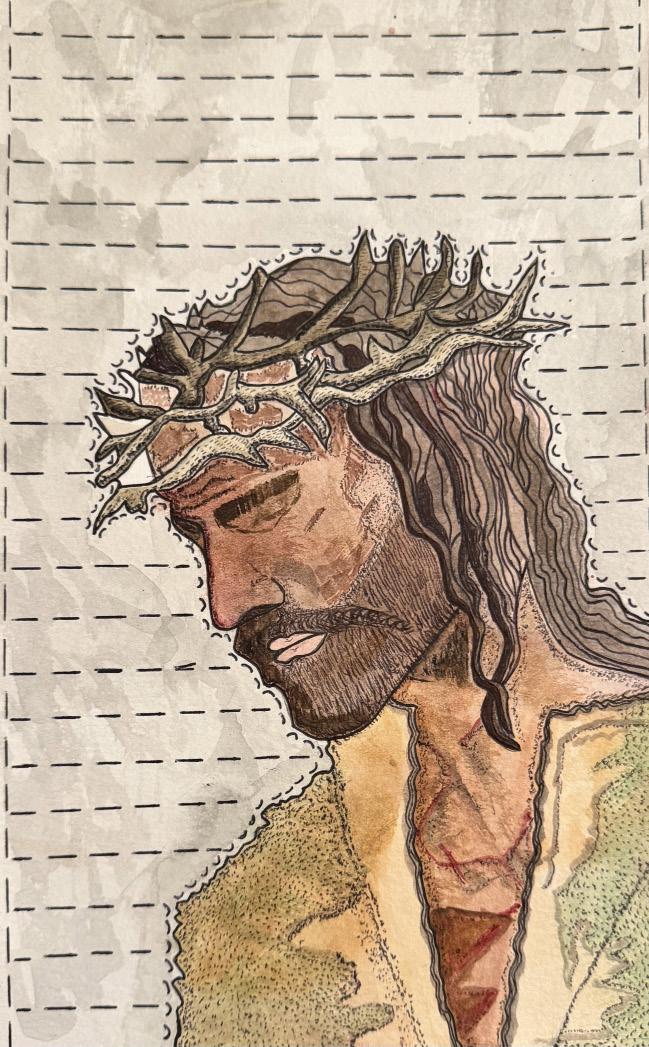
56 Lord of Lords, pen and ink, watercolor by Will Green
57 The Barque of St. Peter, poetry by Sam Herbig
59 Ode to the Freshmen, poetry by Edmund Reske
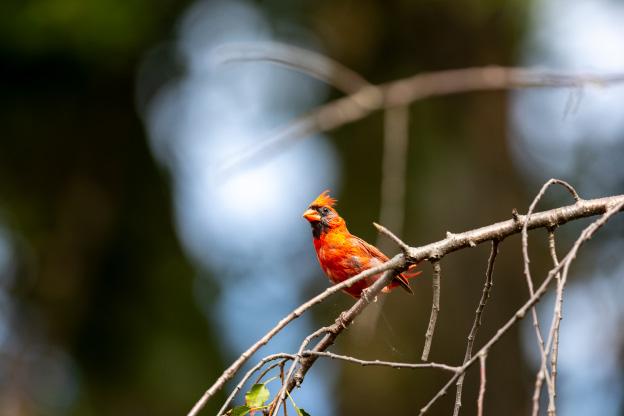
60 Cardinal, photograph by Jack Auer
61 Damselflies, poetry by Edmund Reske
62 Army Dreamers: Mommy’s Boys, poetry by Warnicke Beatty, Jr.
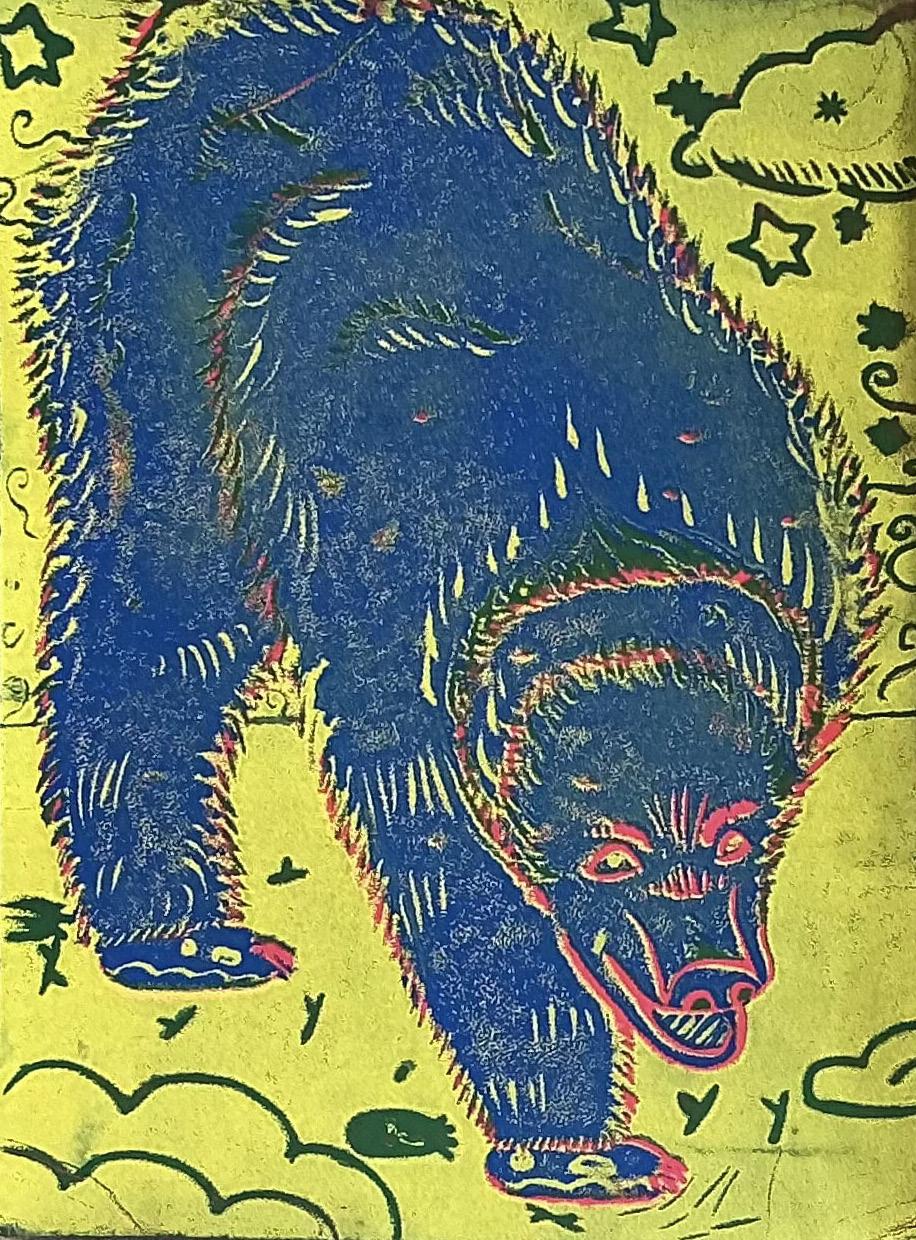
63 Sloth Bear, print by Andrew Yoffie
64 Komorebi, poetry by Colton Eikermann
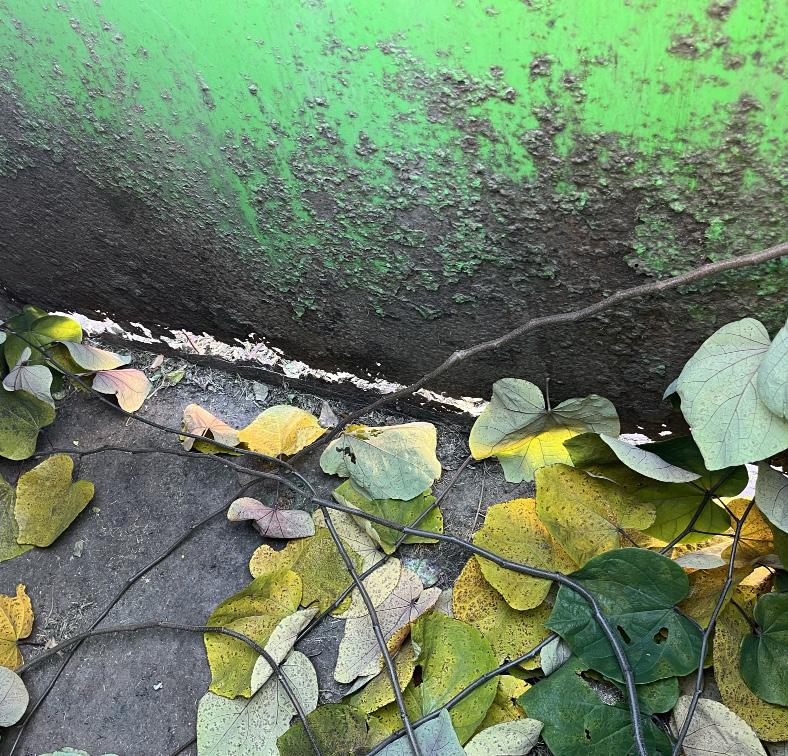
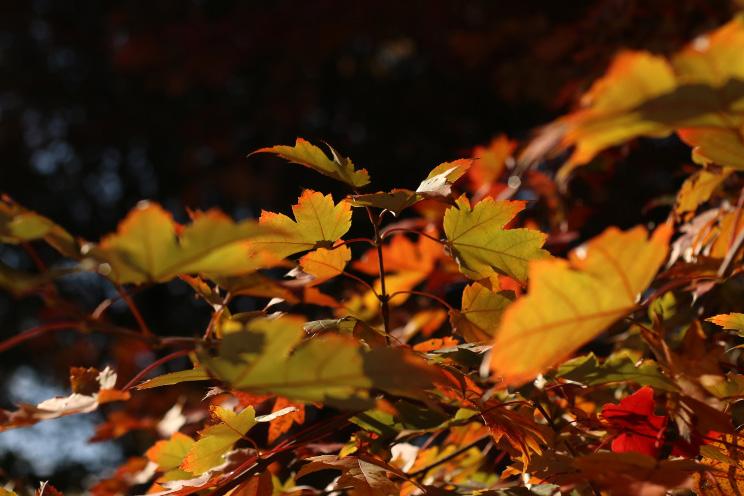
64 Fall Leaves, photograph by Brendan Hunt
Driving Owen
Yu
8 p.m. Friday night. The road is still vibrant, wet pavement glows beneath streetlights, cars skid past with shining headlights, close and loud, then gone. I watch them pass and wonder, just naturally, who’s inside, where they’re headed, what kind of weight they’re carrying.
Someone is driving too fast, maybe racing towards a hospital, praying they’re not too late to say goodbye. Someone else drifts along, a lone finger on the wheel, soft R&B slipping from a cracked window as they head to Friday night football at their friend’s house. Another car carries someone drained from work, who still has to go home, feed their kids, and pretend they aren’t exhausted. Then they’re gone. I will never see them again.
I roll the window down. Cold air fills the car. I stick my hand into the night, let the wind lift it, push it back down, making soft waves through the misty night, cool and heavy with humidity. Everything feels open. Free.
The night is wide and quiet in a comforting way. The wind stays steady. I think about my own life—how complicated it is, how I’m still figuring out what to do with it, just like everyone passing by.
There’s something beautiful about that: All of us moving forward, carrying our own heavy, electric, enigmatic stories.
This is life—the peace of driving, feeling free and alive, as the road keeps going and so do I.
The Great Conjunction
Joe Talleur
When I was growing up on Fox Glen Drive, my neighbor John seemed to dislike me for no good reason. John was older, but not elderly. He had steel-grey hair combed over in a crisp side part. He wore glasses and dressed sensibly, often wearing jeans, dark walking shoes such as Merrells, a simple shirt, and a thick jacket if the weather called for one. In short, John looked and dressed as a standard, middle-aged engineer would—not particularly dorky, but by no means stylish. However, regardless of how he looked or dressed, John’s posture signaled me not to approach him. With his slightly hunched shoulders and downcast gaze, John resembled a man with no intention of ever speaking to or even making eye contact with another living soul unless completely necessary.
Unlike my other neighbors, John never waved at me as he passed by my driveway while I was outside shooting hoops. He never even glanced my way. One hot summer day, I shot a corner three-pointer, bricked it, and watched, groaning, as the ball bounded into the street just as John drove by in his black pickup truck, forcing him to wait for the ball to roll safely into Mr. Parris’ lawn. I jogged down my driveway and into the street to retrieve my basketball, but without so much as a glance in my direction, John’s truck lurched forward, nearly running me over. As I leaped back to the end of my driveway, John disregarded my existence as he sped out of the subdivision.
I would often see John outside mowing the lawn in front of his dark brick house with
pine-green shutters. Every grown man in the neighborhood, including my dad, envied John’s lawn, its uniform edging and perfectly pedicured blades of grass. To me it seemed almost too perfect, its flawlessness radiating an impression of unwelcoming intimidation.
When he wasn’t driving past in his truck or working on his lawn, I most often saw John outside walking his little energetic dog, Bella. Bella was a coffee-colored miniature goldendoodle that was always scurrying around, wagging her tail and looking to be petted. My dog, Cal, a ninety-pound yellow Lab, barked at any dog he encountered except little Bella, for whom he would always lie down, even in the middle of the street. Nonetheless, even with his outgoing dog, John would never wave, talk, or even look at my siblings or me while we were playing outside. In fact, my little sisters were always especially let down when Bella was being walked by John instead of his wife Jane.
Jane could not have been more different than John. She was always smiling, sought out conversation whenever she could, and was a naturally very social person. She always waved kindly at everyone she encountered. Whenever Jane would pass by on a walk, everyone would stop what they were doing to chat with her and scratch Bella behind the ears.
I frequently wondered what life was like in that dark brick house with the green shutters. The couple had no children, just Bella. With four siblings, I couldn’t imagine what a house without children would really feel like. Probably pretty empty, I thought. And quiet.
Also, because he and Jane didn’t have any, I secretly came to the conclusion that John didn’t like kids The theory made perfect sense to me because it likewise explained why someone like John owned a dog like Bella—obviously for the sake of Jane—and explained why John never acknowledged that I even existed. John’s just an unfriendly guy who doesn’t like people, I often thought to myself. Which is fine with me, cuz I don’t like him either.
It was December 21, 2020, a warmer winter night, and I was utterly ecstatic to look up at the night sky. It was the night of the Great Conjunction, a rare event that occurs when Jupiter and Saturn appear close together in the sky. That night, from the perspective of Earth, Jupiter and Saturn were separated by about the thickness of a dime held at arm’s length, the closest the two planets had been since 1623.
At this time, I was obsessed with practically everything about outer space, curious and eager to learn anything I could about NASA, space travel, astronauts, planets, and constellations. My parents had even registered me for Space Camp in Huntsville, Alabama, with my friend Javi. However, in light of the quarantine caused by Covid, my scheduled trip to Space Camp had been cancelled, and, because I was so anxious to see something spectacular, I promptly informed my entire family at least two weeks in advance of the Great Conjunction that was happening on the 21st of December.
When the night arrived and the sun finally set, I rushed downstairs to grab the big plastic telescope our grandparents had given us years earlier and, darting back outside dragging my mom by the hand, I set the thing up in the middle of the street, ready to see up close the phenomenon that was taking place. Unfortunately, the cheap telescope was far better as a stage prop than as a functioning device to view the heavens through. I
couldn’t see a thing. What was more, Saturn and Jupiter were so low in the sky that my family, who had now since joined my mom and me outside, had to trek down the street just to see the planets with our naked eyes. Jupiter and Saturn were so close that they shone together as if they were one star shining abnormally brightly down on the neighborhood, completely stealing the attention usually paid to Orion’s belt.
After a few minutes of neck craning and awestruck standing around, my siblings all got bored, ready to head back inside. Even so, I was not at all satisfied with the experience. I yearned to view the occurrence close up, and found myself let down with what I had pictured as a night of sheer wonder and excitement. My head and shoulders drooped, my eyes lowered, as I blinked furiously to fight back the tears that began to cloud my vision.
My mom, who could always read me so well, tried consoling me, but I wasn’t really listening. I had just glanced up and seen John just a bit down the street, stooping in the middle of his usually vacant front yard, clearly building something or at least setting it up. I pointed this out to my mom, and upon closer observation we realized John was setting up a telescope of his own. His hands worked expertly as he swiftly assembled the instrument. He then peered through the eyepiece intently, crouching low to the level of the telescope’s sturdy tripod.
“Ooh,” my mom gasped. “John’s telescope looks pretty darn cool.”
“Yeah, it does,” I said, fascinated by the telescope but not at all eager to approach John.
“We should go ask him if we can try it out,” my mom whispered as we inched nearer. I crept forward behind her, petrified with fear of how John could react. Would he yell at us? Tell us to get off his lawn? Let my mom but not me peer through the telescope?
Remain silent, ignoring us completely and not even making eye contact? Simply say no? Before I knew it, we were walking up the narrow driveway and my mom was speaking to John.
“Hey, John,” she said in a friendly tone. “We couldn’t help but notice your telescope there cuz we thought it looked pretty awesome.” She looked back at me, winking. “We were wondering just what you can see through there. Are you looking at the Great Conjunction?”
“Oh yes, I’ve got a great visual actually,” John said, looking up. “I can see the planets clearly, some moons, and all sorts of great stuff.”
John’s voice surprised me, quiet and clear, but with a hint of excitement accenting his words. What was more, he looked up when my mother spoke and looked her full
in the eye, leaving my jaw to fall open as I stared, confused, at the man.
“Well, I have a son here who’s very interested in space,” my mom continued, gesturing to me. “Would you mind if we took a peek?”
“Yeah, of course,” John said, his face breaking into a shy sort of grin that added a set of dimples to his normally expressionless profile. “Come on over and take a good look,” he said, turning to me and beckoning me over.
My initial instincts told me to run away., This guy hated me. However, after a second or two, my eyes found his for the first time and my misgivings about him faded. His eyes twinkled invitingly, full of kindness. Without thinking, I found myself slowly making my way over to John and his telescope, my mom following behind.
His professional-grade telescope put our cheap plastic telescope to shame. I could tell it was expensive, possibly worth thousands of dollars, and that John was truly passionate about observing outer space. With an encouraging nod from John, I gazed through the eyepiece and let out an audible gasp. John had positioned the telescope just right so that it missed the blockage of the trees and was trained directly at the planet Saturn.
It was as if I were in the sky myself because, as I squinted through the clear lens of the telescope, I could see the seven individual rings that encircled Saturn. I stood back up and stepped away so that my mom could have a good look. With just my naked eye, I stared intently at the bright speck in the sky which I knew to be Saturn and Jupiter, so unbelievably distant that the two planets couldn’t be told apart.
John fiddled with the telescope a bit, and when I looked again, I saw Jupiter so clearly that it could have been an image found online. I could make out Jupiter’s
iconic Great Red Spot and some objects that John informed me were its moons. John carefully pointed out by name each of the moons that could be seen, telling me things I didn’t know about Jupiter and the Solar System as a whole. We then went back to observing Saturn’s rings and talking about those for a while. Because I had read a lot about space and the planets, I could keep up with what John was telling me and even sprinkle bits of my own knowledge into the conversation. All the while, I would carefully peer through the telescope as John thoughtfully pointed out each star and planet to me.
By the time my mom had called my dad to bring the other kids back up the street to have a look through the telescope, my conversation with John had long since left the topic of planets. We had moved on to the constellations and the fascinating mythological story behind each of them. John would tell me the scientific name of each star he knew, then delve into the story of the image the ancient Greeks saw in the collection of stars. He took time to vividly explain the Greek mythological significance of Leo, Scorpio, Ursa Major, and Orion as we perused the night sky with the telescope.
My siblings’ arrival didn’t bother me, even though they were all clamoring over each other eagerly for a turn to peer into the telescope and catch a glimpse of Saturn’s rings or Jupiter’s moons. On the contrary, I took the time to lie down in the lush grass, and squint up at the constellations and planets I could make out, my head swimming with fresh knowledge.
About fifteen minutes later, my siblings all left again, this time dragging my mom home with them. It was just John, my dad, and I left, and I knew it was time for me to go as well, saying goodbye to the telescope and the Great Conjunction, but most of all saying goodbye to this new, real John.
“What do you say?” my dad said to me pointedly.
“Thank you, John,” I said rather lamely, not at all capturing the gratitude and admiration I felt for the man I had never before made eye contact with.
“Anytime, bud,” John said, his face breaking into that shy grin as his twinkling eyes followed my dad and me on our walk back home. About halfway up the street, at the point where I could last see the Great Conjunction, I halted and turned back once more. I stared up at the shining planets, which like John’s eyes, twinkled back down at me.
Turning my back on the sight, I smiled to myself, thinking about the quiet, kind, intelligent man I could now refer to as my friend.
the myth of Mary-Rose
Warnicke Beatty Jr.
you once were your daddy’s little girl wearing tiaras and a princess dress crowned in plastic glory but from a young age you know you wanted more—
more trophies more crowns all eyes on you the stage was your playground enchanting the judges with every twirl, every leap
but then she stepped onto the scene coming in like the future to your steampunk world stealing your spotlight snatching what was rightfully yours and the judges roll in with their big beehives and caked-on makeup and say:
“and the winner is…” her.
and you think to yourself:
“How could that be!”
“That was supposed to be me!” and your family rolls into the dressing room and says:
“How could you let her win!”
“You were a shoo-in!”
then your mascara starts to run the glitter on your face now feels like sandpaper your big hoops droop your ears
As you stare out the window of your dressing room
adorned with pink lace and ribbon and smelling like banana pudding
then you hear a voice… from out of the cattails and muck soft and sticky…
“mary rose mary rose mary—rose…”
fearful but also curious you come closer climbing out of your window tearing your pageant gown but something helps you down and repairs that lacy ol thang
and as you run away from your ol showgirl starlet life into the bayou… with the moon the same color as a crawdad boil and spanish moss dancing like ballroom skirts the lilies kiss your hand like prince charming and you’re seduced by the bayou’s beauty
the voice gets sweeter, slower, like molasses on a Sunday morning you hear: mary-rose… come with me… be my bayou queen…
and you (the bayou knows your reply you just have to say it)
you say
in a sultry sweet voice
yes…
you let your hair down sequins fall vines rise your tiara melts into lily pads your mascara tears turn green like the bayou a swampwater baptism dawning you’re reborn… as a siren, witch, banshee a queen… a legend…
the kind whispered about on porch swings or by scouts around the campfire the kind so elusive they pay to find you—
a beauty queen through bug eyes a queen more feared than the other girl and more powerful too
and now, when girls cry backstage, and say “that should’ve been me!” they swear they hear your name slip through the cypress leaves—
mary rose mary rose mary—rose…
Brendan Hunt
Photograph
flowEr and VinES
Brendan Hunt Photograph Bird
The Swift and the Oak
O Swift, I see you for a time That is, to you, so brief. A crescent specking azure sky— Such height denies belief.
Why can’t you take me with you? Why must you wing away? Where is my Swift that quickly flew Unhindered by earth’s sway?
I stand here rooted to the earth, My feet on dirt and grass. I mourn that this shall be my berth As long as I shall last.
The hill below me barren stands, Vast sky above me gray.
Edmund Reske
So little grows on this dead land. Just weeds and grass can stay.
But no! There is a little sprout— A puny sapling oak No pest has come to root it out; No thorns around to choke.
This acorn came from so far off; All oaks grow far away. The same wind bearing Swift aloft Brought acorn here today.
O Oak, you’re but a spindly wand, Your life is lowly toil. You will not, cannot leave this land; You’re rooted to its soil.
Cold winter soon will come with snow Brought by Wind’s fickle gusts. It buries, frosts; you cannot grow, But persevere you must.
The spring will come and melt the frost, And turn the dirt to mud. Your bowed, bent pose will soon be lost; Soon Sun will warm your buds.
In years you will grow full and high, Your roots will clutch this hill. Your branches stretch up to the sky, Of Sun you’ll have your fill.
Squirrels and robins here will nest; The ground will fill with loam. With scattered saplings you’ll be blessed— This land, once bare, shall bloom.
O Swift, why do you choose the air? You never touch the ground. While strife may often meet you there, In clouds joy can’t be found.
For me, I choose Oak’s lowly life Who’s rooted to this earth. There’s joy amid the pain and strife— So here shall be my berth.
Rich Moran
The Mirror
Jay Carroll
and who am i in these cold breezy days
a writer who struggles to find urgency in his work yet criticizes those who aren’t as developed stanzas and lines dance in my mind yet transcription is what i have yet to find
a philosopher who asks if all thoughts are equal in value fear overrides my brain because what if my idea is wrong but my hand shoots up anyways
a person who values the social circle more than anything relations break and mend again because reminiscing is something we all do whether we like it or not
a man who smiles day in and day out one that’ll make you wonder what is life about stanzas and lines dance in my mind and joy is only limited movement away
a historian who yearns for all the knowledge in the world because no currency has more value the sad, glad, and mad contained in one not hiding, but showing and correcting
a lover who spreads his love to all who ask gratitude and joy overwhelm us all growing and learning in unimaginable ways and opening my arms, always the mirror has a hold on me i stand and stare until my eyes are an issue to bear the glass seems shinier than ever before as stanzas and lines dance in my mind and tell me identity isn’t so hard to find
Gabe Khazen
Pencil
The Empty Road
Gideon Taylor
The pavement seemed mundane, just a cracked and uneven sheet of concrete, muddy from the rain. My shoes had sunk into the mud, but I didn’t care. It didn’t matter, anyway.
Under the squat, dense tree, with branches full of leaves cascading down around me like a bird’s wings around the nest, Mom stood next to me, holding me by my arm. I stared down the sidewalk, eyes blank. It receded into the distance, a never-ending road blanketed with gray skies and the dreary pitter-patter of the rain. I clutched my bag at my side, like a kid all put together to leave for boarding school, and looked off into the distance as the traffic rushed by on a busy cross street.
“Gideon, please. Let’s just go back to the house. It’s raining, you’re soaked and cold,” Mom said, tugging on my arm, trying to pull me backwards. Back to the house, where it was warm, where it was dry.
Where it was safe.
I continued staring down the sidewalk, not feeling the cold poking at my fingers or the raindrops hitting the shoulders of my coat. Not thinking, not feeling, I just stood there like a statue, a husk of a human. The sidewalk seemed as empty as I felt.
As I slogged through the weeks that fall, the tasks rolled in and out of my Canvas to-do list like flies. Every class, every break, every evening, every project, every damned assignment trudged by. Each teacher shouted out instructions, more work to fill our minds, their dull commands heeded no more than the preacher on the side of the road spouting fire and brimstone from atop his cardboard pedestal. At lunch, a fa-
cade of a smile plastered my face like a kid trying on a Halloween mask. I’d chuckle at a sly comment from across the table, but a blank, emotionless stare would replace the genuine smile as soon as it appeared. I left my blue plastic chair halfway through lunch every day for some other kid trying to laugh. In the halls, my eyes followed my shoes down the tiled floors past each cage of a room, where guys would shove each other around, discussing the new hottest girl or heckling a friend across the hall in the name of fun. I just stared down at my blank notebook while classmates pulled the new petty topic out of the basket to toss into their mindless chatter. For once, “Sophomores” seemed like an accurate name to describe them.
Every day after school, I would putz my way inside from the parking pad, trudge through the hardwood-floored hallway, and whisk the door of my room closed behind me. Every comment or question from Mom about my day would be answered with a sharp “Good” or “Yes.” At my computer, I stared for hours on end at the endless history readings and Edpuzzle videos, clicking answer after answer as the sun sank beneath the city rooftops. The cold fluorescent desk lamp cast shadows across my room as I stared up at the tilted ceiling, idly spinning my swivel chair.
That afternoon, as the car engine puttered out from the ride home, I sat in the van, a beat-up Honda Odyssey, drowning in my own thoughts. I had strolled down the alley, away from home, away from Mom, my flat-soled shoes smacking the asphalt with every step. Raindrops started to hit my head and shoulders as I turned the corner onto
Oak Hill and passed the old one-story hardware store. Tiny dark splotches pocked the rough tan concrete of the sidewalk. Soon enough, Mom ran to catch up with me, tossing questions into the air at my back.
“Gideon, what is this? Come back!”
“Where are you going?”
“Stop!”
Each time she tried to walk alongside me down the sidewalk, I brushed her off of me, turned on my heel, and set off in the other direction. I wished she hadn’t followed me, wished that I could just walk down the road alone—to sort my mind, to become a person again—but here we stood, under the tree. I didn’t know where I was going. Maybe I’d go to Home Depot, buy a rope. Maybe I’d take a walk in the park, maybe climb a tree. Here, under the tree, I was just a boy: cold, wet, and empty. The wind pierced through my coat, and the bag dug into my fingers, growing heavier as I tired.
“Do you see what you’re doing to me?” she sobbed, her voice shifting from confusion and anger to desperation. “You’re being cruel. This…this is cruel. Please stop, please tell me what’s going on.”
I turned to look down at her, her face streaked with tears, her eyes confused, hurt. She gazed through me, searching for an answer. My eyes turned back to the road ahead, my face expressionless. Guilt bounced off of me, my shoulders rigid, knuckles white from clutching the leather strap of my bag. I should’ve felt something.
“I don’t know, I don’t know, I don’t know.” My head sagged and I gazed down at my shoes. “I’m sorry, Mom.”
“We’re going home now,” Mom said. “We don’t have to talk, but you’ll be dry and
warm and…”—her voice cut out behind a tear—“safe.”
This time, I didn’t resist as she tugged me by the arm. I followed her back to the house, watching each concrete slab pass by. A light in the living room of the house twinkled against the dreary gray of the overcast sky, illuminating the warm brown wood of the visible furniture. As we passed through the wrought-iron gate that always froze shut during the winter months and up the walk through the back yard, I relaxed my shoulders, letting them fall to rest.
The back entrance to our house was cold, and the minuscule HVAC unit with which we attempted to heat the separated room didn’t help the freezing tile floors. An antique armoire, rough-hewn rug, and shoe basket lined the entryway. Tennis shoes and old hiking boots lay strewn across the floor in the general vicinity of the basket, some pairs neatly placed next to each other, others hastily stomped out of. The air, just as frigid as the wind outside, bit at my knuckles, but at least the roof shielded me from the rain.
I paused on the rug by the shoe basket, still holding my bag. My gaze came to rest on the floor in front of me. A draft of heated air entered the room from the kitchen, and a ray of light passed through the open door. As I stood, I listened to Mom’s pacing around the kitchen as she picked up knick-knacks that had found their way onto the counter. Through the muted ruckus of dishes in the sink and the running of the faucet, I heard Mom crying, letting out a quiet sob as she washed each plate and bowl. I let my head hang to my chest.
Mud clung to my shoe, matted along the rim of the sole. I’d have to wipe it off later.
chinESE takEout
Sculpture, Ceramic, College
Warnicke Beatty, Jr.
on the corner of a chinese restaurant and a strip mall
Warnicke Beatty, Jr.
on this corner, where cards are shuffled and bets are placed (winner wins some soy sauce packets)
winner winner chow mein dinner men bet on soccer games and snacks (their wives made them the snacks) sitting on plastic chairs peeking their heads into Jade China just for a glance of the game
on this corner aunties of all races mingle and gossip brought together by a shared love of house dresses and sauce (don’t mess with their sauce)
loser loser instant ramen abuser teens smoking something higher than their grades (they definitely have a 0.8 gpa) leaning against boba shop walls with jordans more expensive than their future they dap each other up like roaring thunder Whilst shadow boxing like their life depends on it Currently rapping faster than you can blink
on this corner nothing’s perfect— it’s beautifully ghetto where the air smells like fried rice and gel life where the people never sleep (and Jade China closes at 9 pm) this is the place to be
Running Ryan Kindschuh
all my pain continuously conquers my willpower i can’t escape it the pain i feel is slowly destroying the love i have for the sport
the love i have for the sport is slowly destroying the pain i feel i can’t escape it my willpower continuously conquers all my pain
Jack Auer
Photograph ShadowS
The Shoe Box
Joon Bautista
20
I cleaned a little too hard the other day and there in the corner of my room sits
The Box of my New Balances: size 9 in Men’s–the 574s (08112024)
it sits there collecting memories I, as a hoarder, refuse to throw away. he’llprobablythrowitout, or Ibetyouheforgotaboutit. words I cycle through my head while replaying the moments embedded into every tale
letters to friends that will never be sent sit stacked in the corner of The Box held down by a plastic bottle of water from a Bavarian Gas station 3 hours out of Munich (03182025)
boarding passes dating back to 2022–each with a story attached–“NRT to MNL, Japan Airlines flight JL 6746. Flight LH 0449 from STL to FRA seat 043A”
under them a pair of earphones where I was taught how to pronounce Kopfhörer from the guy who sat next to me for the next 9 hours of our lives (03142025)
beneath, poking out of the uniformity of old metro tickets, my Solar Eclipse Glasses from
April, (4 months before I bought the Box) which I kept though they wanted them back for the kids who might need them for the future
to the left of the purple ₱100 bill and the baby blue lanyard from a camp (11 months after I bought the shoes), a tiny ferry ticket, a yellow rectangle about 1 by 1.5 in. with serrated edges, kept from the 2hour ride to Camotes Island
PrepNews papers that feature me, friends, or a masthead I really like. The pages are now turned yellow–I’m too lazy to frame them–I toss them in there and hope they preserve themselves
letters from friends, met the same year I bought the shoes, who leave (05082025) me to pursue their dreams, their words etched in purple and black ink into an envelope signed with a :)
I lie there on my bed examining every item paying close attention to the wrinkles and patches of yellow as if each would let me relive that moment
I gather all of them, neatly placing them back in The Shoe Box
Sarah Rebholz
clay, iron oxide wash, wood, wire, pencil domain
Where I’m From
Warnicke Beatty, Jr.
I am from hoops of gold dazzling sparkle born from a golden womb I am from the crushed velvet skin of my ancestors struggles passed down like heirlooms I am from boots of steel and imports from near and far I am from the track the rubber molds me like clay and fires my spirit like a kiln I am from the mud into which I have fallen time and time again (wet, squishy, tastes like feet) I am from the Father holy is His name. I am from a camera only pictures will remember my name Wikipedia will hold my legacy I am sculpted from moments and memories glazed in knowledge fired into who I am today
Photograph
Warnicke Beatty, Jr.
That
Bit of Dad in Me
Jack Klein
I think I’m me
As if that’s all I can be But in some things I do A bit of him comes through
George Albert Print Shadow SElfiE
The Pale Light Ryan Lawlor
Trevor didn’t mind killing people. The others didn’t like calling it that, but Trevor knew what it really was. You lead them into the woods. The light takes them. Come morning, the bodies would be neatly lined up at the edge of the trail leading into the forest. Never any blood, just empty skin, pale and tight like a fire had passed through the bodies instead of over them, then politely put itself out before the surface could burn. He’d hated it, once. But in the end, it was simple. As long as he kept feeding the woods, his family was safe. His town was safe. That was all that mattered to him.
He’d been a boy when his family packed up the car and tried to leave. The road to Gilcrest stretched forever, the sun hanging in place like a painting. After seventeen hours, his family turned back. They were home within the hour.
When Old Abe died, Trevor took up the mantle—someone had to protect the town. Now, he made his living posting rumors online of quiet woods untouched by human influence, getting his hands dirty only when the forest was finished with its toys.
Trevor watched the hikers disappear beyond the treeline, their laughter already dimming against the hush of the woods. He waited until they were completely out of sight before locking the door to the visitors’ center and heading back to his truck.
He drove with one hand on the wheel, the other drumming his thigh. The radio emitted a low static; the interference was too loud for a station to cut through this close to the woods.
Back home, his son drew on the drive-
way with chalk: a house, a dog, a figure with a flame for a head. He knelt beside Ben, gently wiping the last drawing away with the sleeve of his embroidered leather jacket.
“Almost dinner time, Ben,” he said. His wife glanced up from the porch, sewing the head of a chew toy back onto its limp body.
“Did they go in?” she asked.
He nodded.
Without another word, she went back inside.
Naomi had found the trail on a forum, buried beneath layers of hiking blogs and travel spam. No crowds. No signs. No noise. The post was barely a paragraph long and ended with a grainy, gray-washed photo of a trailhead swallowed in morning fog. She
Pencil, Pen and ink, Watercolor fragmEntS of Storm Vaia
Dina Fachin (1 of 3)
bookmarked it without showing Mark.
Now, standing at the edge of the woods, she began to regret the silence she’d longed for. The trees were too still, the wind passing around them as if it had somewhere better to be. The branches overhead stretched into dense black canopies, casting long, dark shadows on the ground below. No birds sang into the wind, no insects stirred in the grass. Instead, a thick, waiting silence filled the air.
Mark stood to her left, eyes forward, arms folded like a shield. He hadn’t said much since they left. He’d been like that since Afghanistan. Quiet was preferable to him now. That was fine—better, even. If conversation never began, then it couldn’t turn to screaming. Mark pulled on the straps of his pack, squinting into the tree line. “You sure this is it?”
Naomi checked her phone. No bars. She peered at the trailhead. No sign, just an arrow pointing ahead, and a worn path of packed dirt disappearing into green shadow. “Yeah,” she sighed. “This is it.”
The passenger door of the car slammed behind them. Stew jogged up to the edge of the trail, camera bag slung across one shoulder, hoodie sleeves bunched at the elbows. It was overcast, but Stew still wore the pair of bright red sunglasses his brother used to wear. “This spot feels like the kind of place where people come to cry in the rain, then get murdered,” he said, eyeing the trees. “I love it.”
Naomi cracked a smile. Mark stared blankly.
Stew turned in a slow circle. “No trail signs, no service, no trash on the ground. Not even a goddamn cigarette butt. Either this place is a hidden gem or someone’s clearing the bodies real fast.”
“Don’t joke like that, dude.” Mark said quietly.
Stew lifted his hands. “Kidding, man. Mostly.”
Naomi moved ahead onto the trail. The others followed, boots sinking softly into the damp soil. The deeper they went, the colder it got—a deep, piercing chill that lingered at the back of their minds.
As the afternoon gave way to dusk, the trees seemed to press tighter together while a thin fog settled over their campsite. Stew knelt beside a rotting log, snapping a shot of a cluster of white mushrooms.
“Hey,” he said. Not looking up, “You know my brother would’ve loved this place, right? Total kook for this kind of off-the-grid shit.”
Dina Fachin (2 of 3)
jeans. Stew beamed a wide grin, though his eyes stayed flat. “Anyway, he hated people. So, the fewer, the better.” There was a long pause. Mark cleared his throat. “It’s been a year, right?”
“Last month,” Stew said. “It’s weird. Some days feel like I just got the call. Some days it feels like years ago.”
Neither of them answered. The fog grew thick, trailing over the dirt in thin wisps that seemed just a bit too substantial. Mark broke twigs for kindling, staying silent. Each snap echoed faintly through the clearing, sharp against the quiet air. The cold began seeping into the group faster than before, numbing their limbs and forcing them closer.
Naomi stuffed her hands into her jacket pockets, huffing. “Damn forecast said it wouldn’t get below 60 tonight.”
Mark sighed, then struck a match. It burned faintly, struggling to survive in the frigid air. He lit some dry leaves, then sat back to watch the flame grow. Even with the kindling soaked in lighter fluid, the flame refused to catch the larger sticks that Mark teepeed around it, as if the heat were being siphoned away.
Stew watched the fire sputter, hands shoved deep into his hoodie pockets. His sunglasses hung from the collar of his shirt now, their lenses reflecting the dim light emitted from the campfire. The heat from the fire wasn’t enough to beat out the cold autumn night. “Feels a hell of a lot colder than 60,” Stew muttered.
Naomi glanced at Mark, whose eyes quickly flicked away.
“I didn’t know he was into hiking,” she said softly.
Stew shrugged. “Wasn’t. Not really. But he liked spots like this. Quiet ones, I mean. Places where the noise stops, you know?” He stood, brushing his hands off on his faded
Mark didn’t respond. He sat with Naomi on the opposite side of the pit, his elbows braced on his knees while watching the fire, willing it to live. Naomi huddled closer to Mark, trying to absorb what little warmth she could from his cold skin. Mark’s gaze shifted to Naomi. He opened his mouth as if to speak, then shut it, turning back to the fire.
Dina Fachin
Stew threw more sticks onto the fire. “Remember that trip to the Smokies, like five years ago?” he said. “Whole thing got rained out. We sat in the car for two days, played bullshit card games. This trip couldn’t possibly be worse than that.”
Naomi gave a soft, reluctant laugh. “You kept losing.”
“Only because you two cheated,” Stew said, laughing. “Teamed up against me almost every game. You know, I lost fifty bucks.”
Mark’s mouth tugged into something almost like a smile. He wiped his hands on his jeans and stared into the woods. “We were just better.”
Stew chuckled under his breath. “Debatable.”
Another silence settled between them. The fire crackled dimly, like static hanging in the cold air. Naomi pulled her jacket tighter around her shoulders. Her voice came quieter, like she wasn’t sure if she wanted it heard. “Maybe we should’ve picked somewhere else.”
Stew shrugged. “Too late now. Besides, you booked the trip.”
“I wanted quiet,” she said. “Not…” she gestured toward the fog at her feet, now coalescing into thick tendrils. “Not this.”
Mark looked at her, expression hard to read in the dim light. “You could’ve said something before we drove three hours out here.”
Naomi crossed her arms. “And what? You would’ve cancelled the whole trip?”
Mark gave a short grunt. “Maybe we should have.”
The fire popped sharply, making all three of them flinch. A sudden gust of chill air rushed through the clearing, strong enough to rattle the low branches. Naomi breathed warm air onto her numb fingers.
Stew leaned forward, elbows on his knees. “You two ever gonna talk about it?” he asked.
Mark’s jaw tightened. “Talk about what?”
“Come on, man,” Stew said. “You guys have been on edge all day. It’s exhausting. Can you just try and fix whatever’s going on between you two?”
Naomi shook her head, letting out a bitter sigh. “It’s not that simple, Stew.”
“Sure it is,” Stew said, frustrated. “You’re mad. He’s mad. Just say it. Talk about it.”
Mark stood abruptly. His shadow wavered faintly in the firelight. “I’m going to get some more firewood.” Without waiting for an answer, he turned, wading into the fog.
Stew watched him go, then leaned his head back, eyes closed, and let out a deep sigh. “Well,” he said. “That went great.”
Naomi turned to Stew, glaring at him. “Why do you have to instigate? Can’t you just back off?”
Stew snorted, raising his palms. “Someone has to. How do you think I feel, third wheeling this trip and having to watch your shitty relationship crumble away?”
“You know what’s more sad?” Naomi responded. “Watching your shitty life crumble away. You have no job, no plans for life. Just running around with that stupid camera, trying to pretend your brother killing himself didn’t wreck you.”
Stew’s face froze, like he’d been slapped. He opened his mouth to respond, but said nothing.
Naomi didn’t stop. She felt good, bright in a way she hadn’t for months. “Just shut up, Stew. Just. Stop. Talking,” she said. Stew wiped his face and quickly turned away, shoulders hunched, staring hard into the black trees. Naomi sat back, folding her arms tight across her chest, but the satisfaction was already draining out of her, leaving something hollow in its place.
Somewhere in the dark, a faint shout threaded through the trees, almost too soft to hear.
Mark stomped through the forest, jaw clenched so tight it ached. The cold gnawed at his skin, but he barely noticed. He just needed to get away from Stew’s taunting, from Naomi’s cold eyes, from the oppressive, numbing darkness that permeated his soul.
The branches grabbed at him like skeletal fingers. The ground, soft and loose under his boots, tried to suck him down with each step.
He didn’t care. He shoved forward, deeper into the thick fog.
Something flickered up ahead. Through the mist, a light shimmered–a deep, sick red, pulsing in the dark like a wound. At first, he thought another group had settled in the woods and made a campfire. Then, as he stepped closer, he saw it clearly: a tree, massive and gnarled, engulfed in red flames. But the fire wasn’t consuming it. The bark was black, the same as most of the other trees in the forest. The branches twisted up to the sky like grasping arms.
Heat rolled off the tree in heavy waves. Mark felt it slide over his skin, seeping through his jacket until it reached his core. The cold was gone now, replaced with something heavy, warm, and wrong.
Mark should have moved, but he didn’t. Waiting had kept him alive before. He scanned his surroundings. His gaze slipped past the tree, tracking the darkness behind it: the fog, the gaps between trunks, the places where a threat could lurk unseen.
It was second nature.
Around the tree, dozens of torches were stabbed into the dirt, each lit with a flame–not red, but golden. They flickered with a power that called to him. The flames moved with a purpose, responding to his attention rather than the breeze. They seemed…alive?
Mark drew sharp, heavy breaths, his heart beating fast in his chest. The red flames that enveloped the tree pulsed in time
with his heartbeat, faster and faster, until he thought he might pass out.
The world tilted sideways. His knees buckled, and he barely caught himself against the wet bark of a nearby tree. He recoiled, drawing his hand back to see a red, sticky liquid coating his fingers. His stomach clenched. He recognized this texture. Knew how long it would take to dry. Thick globs of it gushed from the bark, beginning to flow faster. Somewhere inside his head, a voice whispered to him.
Stay. Join your kin.
Mark ripped himself away, stumbling backwards, gasping for breath like a drowning man. He didn’t remember turning around. He didn’t remember the way back. He just ran, his feet knowing the path to take, his mind empty of thought. When he finally crashed through the treeline into their camp, Naomi and Stew sprang to their feet. Mark collapsed to his knees, trembling.
He couldn’t speak.
The warmth was still there, burning quietly inside his chest like something he couldn’t put out. Naomi dropped beside him first, her hands hovering over his shoulders. She wasn’t sure if touching him would make it worse.
“Mark,” she said. “Hey. Hey, look at me.”
Stew hung back a few steps, chewing at his lip anxiously. Mark couldn’t lift his head, couldn’t force the air into his lungs fast enough. Every breath scraped through him, raw and shallow, like his ribcage was getting smaller by the second. His fingers dug into the dirt.
“You’re okay,” Naomi said, her voice shaky. “You’re fine. Just…tell us what happened. Please.”
Mark opened his mouth, but nothing came out at first. He forced out a low, ugly sound, half-cough and half-sob. His throat burned as if he’d swallowed smoke.
He finally managed three words, a hoarse whisper: “I saw it.”
Naomi flinched. Stew peered into the woods, eyes fixed on the clearing from which Mark had stumbled.
Mark pressed his forehead into the mud, cold and wet against his fever-hot skin. The image of the tree was seared into his vision, the way the branches twisted and reached, the red fire that had pulsed inside him. It still pulsed, slow and steady now, as if it had claimed some piece of him and was waiting for the rest to follow.
“I saw it,” he said again, louder this time, voice strained. “And it saw me too. It took a part of me.”
Naomi touched his shoulder gently, recoiling from the heat she felt. “Jesus, Mark, you’re burning up,” she said. “Let’s get this jacket off you.”
Stew moved to help, but Mark jerked away from them like a cornered animal. His eyes darted over the woods, glassy and unfocused.
“It’s okay, it’s okay,” Naomi muttered, hands raised like she was calming a wounded dog. “It’s all right. Let’s just get you out of here, okay?”
Mark’s head twitched up, which Naomi took as a yes. Stew grabbed their half-packed bags, stamping out the dying fire with his boot. They moved fast, Naomi and Stew ducking under each of Mark’s arms to prop him up. Every few steps, he stumbled, muttering broken phrases that neither of them could fully catch.
The trail, if it could still be called that, had changed. The trees leaned in closer now, fog coming up to their knees, obscuring the earth beneath them. “This way,” Naomi said, keeping her voice low. “We’ll get to the car. We’ll—” She hesitated. The mud beneath their boots had given way to something softer, almost spongy. They came to a fork in the trail, which hadn’t been there on the way in.
“This isn’t right,” Stew said. “We’re not going the right way.”
Dina Fachin (3 of 3)
“So what are we supposed to do?” Naomi asked abrasively. “We can’t stop. We just need to keep moving.” She propped up Mark’s left side, waiting for Stew to do the same for his right. He shook his head, staring at the ground. “You can wander off if you want. I’m not dying out here.”
Naomi swore under her breath and dragged Mark forward, nearly losing her balance under his weight. She glared at Stew. “Coward.” He didn’t answer. Stew turned, walking away without a word.
Naomi and Mark stumbled through the mist for what felt like hours. After some time, a light appeared ahead of them. It flickered like fire, but it was too steady. Too deliberate. As she moved closer, shapes grew clearer: a field of crude poles stabbed into the earth, each one crowned with a small, golden flame. They stretched out in rows, disappearing into the thick fog.
Mark lifted his head weakly, eyes drawn to the lights. In their glow, Naomi saw his face clearly—his skin looked thin, almost translucent. His veins seemed to swell, looking like a spiderweb beneath his face. Her chest tightened. Beneath the skin of his neck, something faint and luminous pulsed, as if to a rhythm. It wasn’t just pulsing—it seemed to move slowly, inching its way up toward his throat like it wanted to escape.
Ahead, three poles stood out from the rest. Two of the three were cold and empty, no flame burning atop. But the third—
It burned just like the rest. This flame seemed brighter, pulsing stronger than the ones behind.
Naomi squinted through the fog, and her breath caught. At the base of the burning totem, half-buried in the dirt and tangled roots, lay a pair of red sunglasses. Stew’s. The lenses were cracked, one arm twisted the wrong way.
A deep chill ran down her spine. She
hadn’t heard anything—not a scream, not a rustle of movement. The woods had simply plucked him away without a sound, leaving only his glasses, as if to taunt her.
Her grip loosened, and Mark fell weakly. Free from her grip, he gained a sudden burst of energy, lunging forward.
“Mark!” she cried, but he staggered toward one of the empty totem poles like something was pulling him. He dropped to his knees in front of it, hands clawing weakly at the dirt. His whole body shook, seizing violently. Mark let out a horrible, gasping sound. Then, a thin, golden flame slipped from his open mouth. It rose slowly, drifting tenderly to the waiting totem. The moment it touched the wood, the flame flared, steady and bright, joining the others.
Mark slumped forward, steam rising from his crumpled body. Naomi cupped a hand over her mouth, a broken sob tearing free.
Naomi stayed kneeling for a long moment, staring at Mark’s still body, too numb to cry. Around her, the mist curled closer, greedy and slow. Her legs shook as she forced herself up. She stumbled backward, away from the totems and the neat rows of what she now knew to be people. She couldn’t breathe. Mark was gone. Stew was gone. And soon—
A sound made her freeze.
A low, rhythmic thumping, like the heartbeat of the woods themselves. The mist thinned, just enough to show the thing waiting beyond the totems. A burning tree. Its red flame pulsed hungrily, branches writhing, stretching towards her.
Naomi backed away, her boots dragging deep ruts in the soft, spongy earth. She turned and sprinted, not knowing where to. The forest seemed to shift as she ran. Every direction looked the same—fog and flame and blackened trees.
She wasn’t running toward safety, she
was running in circles. Her foot caught on a root, causing her to crash hard into the dirt, her breath ripped from her lungs. When she lifted her head, she saw the empty totem just ahead, waiting for her. She tried to crawl away, but her arms were weak, trembling from cold and terror. A warmth unfurled inside her chest, slow and smothering. Her vision blurred at the edges.
Naomi screamed, her voice raw and broken, echoing across the field of totems.
A thin golden flame escaped her lips. It floated gently from her mouth, weaving toward the waiting totem, as if pulled along a thread. When it touched the wood, it flared.
Naomi collapsed, her face turned toward the sky, eyes glassy and lifeless.
Trevor rose early, pulling on his boots. He knew before he got to the trailhead what he would find.
The woods were quiet, mist clinging low to the ground at the forest’s edge. There, lined up neatly at the edge of the path, were the bodies. Three of them, pale and empty. He fetched a shovel from his truck bed and began to dig.
When he was done, Trevor stood over the new grave, hat in his hands, head bowed, though he didn’t pray. “For what it’s worth…,” he muttered. “I’m sorry.”
Wiping the sweat from his brow, he began to turn back toward the truck when something caught his eye. His gaze drifted upward to a thin wisp of golden light, lazily drifting across the clearing. He watched as it floated unhurriedly, gliding over the road before it disappeared behind some houses in the distance. More wisps emerged from the forest, too many to count.
his ears. He climbed into his truck, the door creaking loudly in the silent air.
As he pulled onto the narrow road leading into town, he caught glimpses of them again: thin veils of gold threading through the mist that hovered over the ground.
Trevor gripped the wheel as he accelerated, the streets of Hathsin passing him in a blur. Slamming into the driveway, he barely came to a stop before stumbling out of the truck, his voice cracking as he shouted for his son.
“Ben! Benny!”
Trevor charged through the front door, sprinting over the warped floorboards. The back door was open, swaying gently. Beyond it, the yard faded into a wall of mist.
Just past the garden fence, Ben stood barefoot in the wet grass, still in his pajamas. His eyes were wide with wonder, fixed on a thin ribbon of gold that drifted toward him, twisting and curling through the air in a crude dance.
Trevor froze.
Ben smiled, reaching out for it.
Trevor’s mouth went dry. He took a step back, then another, his pulse thundering in
Pencil, Pen and ink, Watercolor, Charcoal wE arE hErE
Dina Fachin
Dog Person
Edmund Reske
A fat car cut me off yesterday when it was raining; Ugly beige Jeep, like an old dirty couch. What the hell.
Dogs all over the car, a bumper sticker explaining That I must tell my dog hi for it. Ouch. Don’t tell me what to do.
Dogs cuddling on the plates, yapping inside as rain fell. An endorsement of: Pet Protection Crew— Then they hit a cat.
James Besmer
Letting Go
Colton Eikermann
To those old withered leaves that cling when spring’s flute once again sounds, I must ask: was it worth it?
Those cruel winter nights
When the wind lashes with crisp flagellations
Your withering skin, snatching away All memory of warmer days
You must be tired
Yet you cling As if ready for another cycle Of that ancient scheme
But who are you fooling?
Your Spring came long ago. Your link to life has since splintered, Leaving you a husk, Weathered, worn, and wintered By your days of service
What are you waiting for?
That old tree, swaying in the wind, Slowly abandons you.
And what of those golden drops of light, Like angel’s tears, you netted for him? He drank those up well and fine, Just as he swallowed away your green youth, Hoarding it somewhere deep
Do you know why you ever were? Why the Light saw fit to awaken you In the honeyglow
Of that nectar spring morning,
Both a moment and a lifetime ago? What Word made it so?
You spent your life seeking the Light, Just like me.
What did you see?
I know that luminous mystery can toss great mountains Of the sea, gathering it up to the clouds. And soon, very soon
That Light will gather up me—a son born of water —And beckon forth my very tears by Heaven’s way. Then, today and its torrents will be as nothing
Yet today drowns me
How do you live for both today and tomorrow? You neither spin nor toil. You don’t let suffering’s hand Shake from you the Brilliance that pieced you together. While my feet are still dipped in life’s small puddle How do I live for the Light Towards which I was born to grow? How do you convince yourself Of something you already know?
When bough brought forth your earthly bloom, Could you see the end of things?
The past crumbles to dust right before you And runs away with the cackling wind. You find yourself slipping. The sound of the song you sung daily With your sage green choir— Of which, you are the last —Now evades you
But I’ll hush…
Look now!
A leaf child yawns
A leaf child of You— Your Substance— Tangled with Light Fearfully and wonderfully Knit together, Before it ever was,
Deep within The wooden womb Of that old tree
Light calls New life stands below And with you let ting go I see It was worth it
Schall
Luke
Matty Kleinberg
Pen and Ink
gatE(S)
Original Sin Mike Lally
A toddler stands up in her crib, covered in vomit, surrounded by omnipresent dark. Something is wrong, she knows, and she waits.
After a moment, she calls out, “Mommy, Daddy?” and yet, still, she waits.
Confusion first, and then the tears: “What is happening to me?” she would ask, if she could.
The arrival of Daddy, and harsh blinding lights reveal the horrible scene-
Half-dissolved blueberries and carrots, matted hair, a ruined bedsheet, the hot, sick stench. The tears now flow in earnest, as Mommy joins the scene.
Amidst the towels, the rush, the tiredness, the alarm adhered on adult faces, the toddler howls in frustration and fear.
Standing naked on the ground, she simply says, through choking tears, “I’m sorry, Daddy.”
The father’s tears pour forth as well, and he holds the tiny child close to himself. “You haven’t done anything wrong, sweet girl.
I’m sorry too.”
A warm, wet washcloth wipes away snot, tears, and drool from her face. Fresh, clean pajamas, white with yellow suns, are donned. The lights go out, one by one, until only a single lamp shines, like a candle.
And the toddler sits on her father’s lap, rests her clean head back on his shoulder, and once more closes her eyes.
Emmett Gaspar
The Elephant
Peter Knapp
the Gentle Giant walks under the sun thousands of years of experience lets him know the Others he’s seen: triumphant, tired, and torn leather-hard layer of sediment that show under all the starving days and arid nights roaming over the heavy trodden ground nothing perturbs him, he doesn’t get into fights not worried about what the Rest are thinking, or what the Younglings have found Some think about what tall tree they will find next, or where the next big lake is, but not this one
the Gentle Giant walks with dignity, under the sun strong ivory, mightier than thunder ears so large, to listen to his Cousins’ cries a strong vine awkwardly stuck in front of his face, yet he’s not bothered he traverses on with big, round feet to carry the weight of The Herd on his strong, mighty shoulders
the Gentle Giant wanders, under the sun with great power and authority over the dominion of the savannah animals, never gets exasperated over the dying wildebeest under the lions’ claws tries not to bother the giraffe bending low by the lakeshore to wash down acacia leaves is not worried about the stake-like legs holding up the flamingos quietly acknowledges the crocodiles, silently sinking the cotton-candy creatures
the Behemoth stops at nothing, trudging on, so sure of his future not a hope once he’s old years of experience dictate that water will come after the dry months, the long years
yet he stops when Another has fallen, to grieve, to find a way to fill the hearts of his Herd with the memory of lost bodies how to keep roaming the earth with direction over the thousands of never forgotten souls
the Gentle Giant stands, collected, looking for a moment beyond his Memory, beyond the azure plain above but in the end, he continues on, watching the flamingos above the dotted clouds
Andrew Hammond Photograph thE lurking
Dead Tree
Frank Kovarik
That old dead tree’s been looking at me, And I don’t like his expression: Licking his lips, kissing his fingertips, Giving the impression
That he’s looking at me because he wants me to be As stark and gray as him Since he died, against the sky, A trunk with barren limbs.
I’ll cut you down, you old dead tree, Chop you up and burn the wood, Do my best to grind the stump, Root you out for good.
I hate to see that old dead tree Every morning when I rise. Looking at him makes me feel grim, And that ain’t no surprise
Because he’s hollow and brittle, more than a little Bit like how I feel, There in my yard, losing his bark, All too real.
I’ll cut you down, you old dead tree, Chop you up and burn the wood, Do my best to grind the stump, Root you out for good.
A living tree has branches That bend with the breeze, And nothing’s quite as peaceful As the rustling of its leaves. That tree grows ever taller, And it blossoms in the spring. You can trust it with a treehouse Or a tire swing.
That old dead tree was planted by me Years ago as a tiny seed.
It’s like I gave birth when I dug in the earth To plant him so he’d get what he’d need: Water and light so he’d grow up right, Tall and straight and strong. Watching him die made me want to cry Like I’d done something wrong.
It’s time to cut you down, my old dead tree. It’s just one of those things. I’ll fight back tears and count the years When I count your rings.
Logan LaVear
Photograph
rainBow aftEr thE Storm
dressed by mommy Jay Carroll
Life was better when i was dressed by mommy. There was no such thing as worrying about what to wear. It all got placed upon me.
And the yearning for adulthood speaks through all youth, But how could we ever be so silly?
To be dressed by mommy was a thing our eyes were closed to.
The importance of crafting a good ’fit meant nothing. Just a polo, rocawear jeans, jordan 4s, and a yankees hat, And now I’m out the door, holding her hand.
Music really meant nothing, just a mixture of production and vocals. Whatever radio station was good enough for her was good enough for me. She cultivated a new fan from a young set of ears.
Poetry meant nothing; vocalizing my thoughts was just speech. My mind lacked clarity, and maybe it was better that way: Wrapped in innocence, completely.
The loss of my innocence also gives me something to gain, new lines of logic and a lesson that transcends time. The echoes of defiance are louder than those of optimism.
What has adolescence given to me and robbed from me in the same breath? A new sense of hope prompts me to reflect on the bliss of the past: would I give it all up to be dressed by mommy one more time?
Ryan Safar
Photograph ShadowS of thE Summit
Mother to Son
Colton Eikermann
The wind hushes
And the stars flicker on The Mother speaks To the son
As they sit under the tree Whose branches burst With the honeyglow of fireflies
“You know, son, It’s all just too short; A few moonbeams ago
This tree we sit under was a trifle, a little sapling, And so was I
The fireflies have few nights Under the moon
And the sun doesn’t have much longer Till it is all but extinguished So go on, Go on, my Dreamchaser!
Restlessly venture That oceans of stars Till you find one that shines bright as you— or brighter!
Cause, you know, it’s just all too short; If you’re scared, know that I’d Defend your dreams with an iron stick And I’d dig a river So they could flow
In any direction you need If you wanna fly, son, Go ahead and take my wings
They’ve always been yours anyways And no matter how far away you soar You can always come back And I’ll hold you close Cause I love you more Then flight itself. Remember Love, son, Above all else.
Dreams die without love Anchor your love in the Light And open yourself to Its embrace. Plant your Love in the good soil, Water it, and watch it grow.
You’ll know you’ve seen Love well-grown when Sprigs of leaves flourish and shine With sparkling beams, Like they’re bursting with fireflies”
The wind then began to rush The son gathered the breeze Under his wings, Dilating his feathers, Before he flew into the night
The Snowflake Ryan Kindschuh
formed by clouds solid from liquid, a combination of dust and water graceful and shy but also beautiful
free to fall down down down
swirling with friends swept along by the gentle breeze spinning like a volleyball, soaring through the air, blocked by a dark-haired girl with finesse.
the pure white surface gleams in the sun shining bright as an angel, bringing light to the world but denying it, as humble as could be, then softly floating down into a child’s hand, lifted up and praised, not melting or breaking or leaving, but finding his heart and becoming the key, awarded to the snowflake with the most kindness, patience, unity, reverence, joy, and compassion, even to others older than it.
for this reason, he chooses to whisper his secrets to it because it is honored with the virtue of understanding, and as the snowflake settles in his hand, he trusts that it will always be there. but then the gusts come, and like a choir conductor’s arms, they cut through the air, fighting the flake, ripping it from the child’s hand. it flies away. and the child lets out a small, unheard gasp, lost to the gust and unheard by the snowflake. tear tracks freeze on his face as quickly as they appear and the crystallized skin tenses up.
he wishes he was lost in his video games and talking with his friends on a voice call, or, as they call it, a v.c.
and then silence follows, broken only by distant streams of wind blowing through the trees. eyebrows tighten, fists close and open, never catching another flake. his eyes track the bright speck amidst the gray sky. full of conviction, boots scuffing concrete, he runs.
he follows the snowflake, although it eludes him, and he tries to catch it again because he wants to know it and save it from the gusts. reaching in the air, snatching the flake, and falling backwards onto the ground, he protects it and holds it close to himself. his grin appears like an emoji, the upside down smiley face, not caring what happens next, only thankful for the snowflake.
Gavin Barrett Pencil, Print, Oil around town
To My Neighbor (and my little brother), Elijah... Ryan Sextro
I made this for you setting aside the fact all you will see when you “read” this is a stressed, lopsided smile.
I am sorry. I am sorry, that your name eternally fills the spot written above the mailbox icon on my phone. I am sorry that I cannot turn off the bright desk lamp and get up when you are standing outside my door knowing, in the dark. I am sorry that as the leaves of the oak out front continue to change and I look down from my room to see you, alone, all I can do is smile and wave, and turn back to the book with infinite pages. And most of all I am sorry that, because your mailbox reads 698 instead of 700, you can see only a stressed, lopsided smile when you “read” this.
The Complex and Bewildering Origin Story for the Great Hank
Finnian Driscoll
Hank is no one special. He’s a thirtytwo-year-old clerk for a department store. He is relatively wealthy from his parents, but he spends most of his trust fund to fuel his addiction to mineral water. Many consider him an iPad useful when his battery is full, but until then, just a black screen. Every day he goes to his job focused on making each day less and less likely to be his last. The only thing keeping him alive is his fear of being dead.
Hank’s immense fear of death began when he first experienced it at age three. Twenty-nine years before the modern day, Hank was happy, like children are happy on the morning of December 25th, turning to find a decorated tree with wrapped gifts underneath it. He always skipped and tripped and laughed at the thrill of getting hurt. That was until one day at the very department store where he currently works, Hank’s childlike indulgences of joy and frolicking were cut short by a tall, ghastly specimen seemingly always on display during the holiday that takes its inspiration from the ancient Celtic celebration of Samhain with various ceremonies such as the mutilation of gourds to form a smile with strange teeth. The specimen that changed Hank’s life forever was the cold dead hands on a human skeleton.
The young Hank was so horrified he couldn’t move and his intense dread only increased when his sadistic older brother, Christopher, whispered into the little boy’s ear, “This is inside you and when you die you become this.” Hank started bawling inside
the department store until his embarrassed mother took his hand and led him outside.
Hank’s life has become focused on one goal…escaping death. He has tried everything, even the occult (thus he still doesn’t step on sidewalk cracks). People think of him as a weirdo or a fool, but most commonly, an apocalypse prepper. Hank doesn’t like this title because he isn’t preparing for everyone’s death, just his own.
Hank’s traumatic experience has been buried so deep inside his subconscious that not even a psychology professor can unlock it.
Hank believes distress is normal and that everyone has similar fears for their ultimate demise. The only difference is that Hank’s convinced he can escape it.
He never drives, fearing at any moment another car could hit him. He never walks, knowing full well that a car could hit him. He never takes an airplane or a helicopter, or even a train because each could lead to his untimely demise. The only mode of transportation he feels comfortable in is driving his own state-of-the-art armored tank. He bought it for five hundred bucks from the largest army surplus store in the country.
How, you ask, can any civilian be allowed to drive a tank in residential areas? Well, the thing is, policemen have an irrational fear of being destroyed by a 125-mm cannon. This, and Hank was able to get a license to drive it through country roads, but the paperwork is so extensive that no one has enough time to read through it and tell that it cannot be driven through the town’s Main Street.
Another area of life Hank has trouble with is food. His fear of expired meat has led him to buy a flock of pigs, cows, and chickens. He has his own pasteurization plant so that everyday he can have a taste of cow milk. This is the only sweet substance he considers safe enough to consume as he has to make sure he can’t have a fatal heart attack. He eats only one meat a day, usually a chicken or, for festive occasions, a roasted piglet.
He drinks water created from his own water filtration system. He also plants his own food without fertilizers to lower the chance of poisoning himself. Hank’s vice is his absolute craving of mineral water. He drinks it to forget his troubles. But since it is not an alcoholic beverage, he still remembers a lot. Hank is a man like yourself and me, but the only one to know how to live life like there needs to be a tomorrow.
Leo Hahn
Acrylic grEaSE Bag
The Day the Hum Stops
Warnicke Beatty, Jr.
On video call I see my aunt hooked up to wires like an extension cord barely hanging on
The doctor says “Should we pull the cord?” The quiet hum stops and the room goes quiet.
As I sit there with my face frozen Like I’m in the freezer eating away my numbness sprinkled with a cherry on top
my dad With his face melted eyebrows slumped lips pointed downward eyes forced to look at his sister One sweet peach Who would call us every day at three-thirty and my sister and I used to hate it because she would call us pet names like “Boo Baby and Peach”
His face wanting to revolt— like freezer-burnt ice cream
We sit in our basement
Mother Brother Father Sister huddled around the couch with my relatives on zoom like a stocked fridge with a spoiled peach that we can’t get rid of doomed to molder in the depths of our hearts
Ben Yoffie
Acrylic
Pedestal
Frank Kovarik
i.
You said history was bunk And everybody before you stunk And what they did was a bunch of junk And I found you credible I heard what you said And it stuck in my head I put you on a pedestal
ii.
You made me feel so good You made me feel understood Like I’d be you if I could I’d be unforgettable I heard what you said And it went to my head Like I’m up on a pedestal
iii.
You wanted to tear it all down For the rest of us here on the ground Bring them down to our level Or send them on to the devil They think they’re so smart With their books and their art And they love to look down On the little God-fearing towns
iv.
I don’t really care what you say All I care is that you make them pay You can make all the bastards obey And I think it’s incredible I don’t care where it’s all led Now you covered the place in red You can stay on the pedestal
Photograph arE You not EntErtainEd?
Colton Eikermann
Will Green Pen and Ink, Watercolor lord of lordS
The Barque of St. Peter
Sam Herbig
Have I merely stayed safe, Cramped below deck,
Not looking to see the 2,000-year-old ocean racing past, The sea monsters lurking in the depths, The promised horizon?
Have I climbed aboard only to tuck deep below deck, dozing, drifting, Taking sleepy passage to all-end, Being fed rations: bland, dry is-this-even-bread, Not seeing therein the Ancient of Days come to preserve us far longer than the cooking wine sugared to last centuries shelved in sacristy.
If I cannot sleep and peer up from my hatch to see the deck, how far from land, how late the night—
Do I see only the sleepy first mate at the wheel, without knowing the sleeping Master in his quarters?
Mate meandering his path, bending rudder yet not breaking, piloting by timshel to follow the dread signs in the stars—the woman or the dragon?
All while wind screams into sails, peregrine pressing on, the very same which moved over the formless water pushing waves white and black.
Tired cries from behind beneath deck, from roost, from wheel, from bow: “Are we there yet?” “Are we moving?” “Does this thing work?” “How long, O Lord, how long?” creaking from cracked lips.
A leak sprung yet not sinking, fountains unsealed (“and we drown!”) so as to never thirst again…spat out.
An anchor thrown overboard—“Dig back 60 years! Mutiny! Mutiny! Wake the Captain!
My God, we’ve killed Him!”
Seasick men all, some taking their jump, others lashing selves to mast.
Nightmare swirl of storm and swill and starve and sick and sticks and cyclone and serpent and stone sinking in steps of faith
stopped only by “Silence! Still.”
Awakened Sleeper, sweet Sunrise on clear horizon, shouts of joy in the tents of the just.
Mother Hen come down from Her crucifix perch and sent for dry land,
came back with olive, wheat, grape, new fire, new water, milk and honey.
“Depart, all: go in twos.
Depart, ye sleepyhead mates and knaves, armless and legless, double-eyeless.
Depart, ye mutineers and robbers, pirates and brigands.
Depart, ye sailors and servants, ye lost and found.
Depart for land and promise and kingdom.
Depart, ye watchers from the roost numbering the stars; Depart, ye sleepers from the orlop who missed the journey.
Depart, ye who rowed knowing not ocean, nor monster, nor star, nor mutiny, living on daily bread alone—and Eternal One’s word, “Row.”
Depart, all who sang, who read, who cleaned;
Depart, poinsettia placers and takers, trivia players.
Depart, Women’s Knitting Sodality of St. Agnes.
Depart, ye dawn laborers, older sons, revolving door repenters, seeing what is believed and believing without sight.
Depart, ye midday toilers, knowing only that it is good to be here.
Depart, ye evening workers, Christmas and Easter for mom.
Depart, ye dusk deathbed stowaways, graced without paying fare.
Depart and receive—all and each—your denarius.
Depart, ye barnacles, clinging on only to grandmother rosaries dangled from hawsepipes.
Depart, ye anchor-dragged, ye dust-kicked, ye calcified.
Depart, ye saints who swam the distance, baptized at once by desire for dry land.
Depart, seasick and lame! Depart, eyepatch and cane;
Depart, mat and sore and withered hand.
Depart, demon, sorrow, sin, and death.
Come now into my promised rest.”
An Ode to the Freshmen
Edmund Reske
We tramp into our rooms, our tools stacked neat. We drudge and scrawl and mine our dreary work. Our leaden muscles, cramping hands—the heat of stress (it’s called) has taught us not to shirk. No work is done in earnest anymore; And, when the hourly work bell sends its knell, The workers, faces stone, trudge out the door. We petrified souls, such silent, screaming shells. The young and bright we yearn to save, To turn their path away. Still, still we try to make them too like us, with sagging visage grave. You never look those like us in the eye. All brilliance has fled our polished marble faces.
But then every year, you bright ones arrive Full of promises, dreams, and new life. Then you listen to us, us half-alive, Because we are the veterans of strife.
Your hands yet unworn and your faces still new Every eye unextinguished of light. Like a plant in the spring—if only it knew Of the cold that will come in the night.
All your squirrelish ways and loud foolish talk Do not hide the apprehension you hold. Your wide eyes shine a light that we elders have lost To the endless encroaches of frost.
In the mines there’s a cold we call monotony; It eventually hardens our souls. It’s not hard work or effort that takes its toll It is the repeated, the over and over, the desire to be free. This ice infects us one by one You’re working, you blink— Maybe a twitch in an eyelid, the drop of a pen— You open your eyes and that light is gone.
You light our rooms, ask us to teach you the trade And we try to make you like us.
But under our confident, calcified facade, We cry out. Hear us you must.
And so, we experienced, laudable miners of grades, We kings of the school, say one thing to you:
When your faces are darkened by coal dust, Hands clawed from your tools Remember one thing from us fools—
“Don’t ever, ever, lose the light in your eyes.”
Jack Auer
Photograph cardinal
Damselflies
Edmund Reske
I. Broken Sonnet
Against the mottled emerald shimmer trees, The leaves that ripple in the gentlest breeze, Above the lake that trembles in the light, Among the fluffs and pollens caught in flight,
There is a damselfly so shiny small, That even rain effects a deadly fall. Its body but a hair that slowly floats— Among the rays of sun a weightless mote.
The wings, an aberration in the air, That vibrate, shine, and yet do not impair The view of all behind, the lake, The aspens, which begin to quake—
Where is that tiny insect that specked the air? The wind has whiffed away our damselfly so rare.
II. Haiku
Damselfly shimmers
Above the lake. Raindrop falls. Goodbye, little one.
Army Dreamers: Mommy’s Boys
Warnicke Beatty, Jr.
men in a line, each the same, only a number tells them apart, boots press the mud like a signet. tears silently stream down, mommy’s little boys, her army dreamers.
thousand-yard stare, a look that has seen it all. mommy’s little hero, her little army dreamer, in the heat of it all, would he come home in a box or on a plane?
mommy’s little lammy boy. scared and alone service will scar. his fate is in the hands of a man in a house, a man who’s safe in a warm bed
mommy’s little boy hiding with other mommy’s boys. scared and alone. bullets leave less trauma gut-wrenching to both mother and son
So go on!
Step on me!
step on me with those army boots death is quick, survival hurts for a lifetime
War is the big wolf’s fight Carried out by the littlest of lambs Unwillingly drawn to slaughter
Go on!
Go…
hug your baby before it’s too late hug your army dreamer
Andrew Yoffie
Komorebi
Colton Eikermann
To those moments when life illuminates:
When leaves of limb dance and bend, Leaking beams of brilliance
That dazzle the eyes.
When light and shadow wrap themselves in their tangles below Intertwining here and between