’ THE LION S ROAR S O U T H E A S T E R N L O U I S IA NA U N I V E R S I T Y
HAMMOND, LA
Everything you need in downtown Hammond
SEPTEMBER 18, 2018
Willis is interim dean of students
Since joining the university as an instructor of Southeastern 101 and after serving as the director of the Office of Student Advocacy and Accountability, Dr. Gabe Willis now takes on the position of interim dean of students. PRAKRITI ADHIKARI/ THE LION’S ROAR
PRAKRITI ADHIKARI STAFF REPORTER
Dr. Gabe Willis has recently been promoted to interim dean of students. Willis joined the university in the fall of 2014 as an instructor of Southeastern 101. Training with, what was then, the Office of Student Conduct, Willis prepared himself to be in the position as director of the Office of Student Advocacy and Accountability. Now, Willis has advanced to the position of interim dean of students. Willis said, “As interim
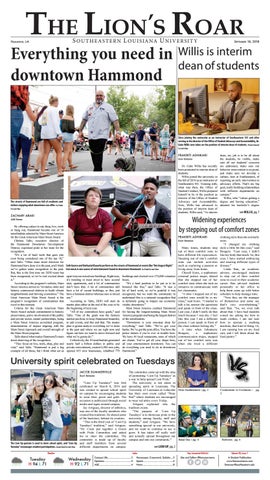
The streets of Hammond are full of residents and visitors enjoying what downtown can offer. FILE PHOTO/ THE LION’S ROAR
ZACHARY ARAKI
see WILLIS, pg. 7
Widening experiences by stepping out of comfort zones
A&E EDITOR
By offering a place to eat, shop, live, work or hang out, Hammond became one of 10 semifinalists selected by Main Street America for the Great American Main Street Award. Chelsea Tallo, executive director of the Hammond Downtown Development District, expressed pride in her team for the recognition. “It’s a lot of hard work that goes into even being considered one of the top 10,” said Tallo. “Other main street directors for Hammond have done it in the past, and I think we’ve gotten some recognition in the past. But, this is the first time my DDD team has been recognized, so we’re real excited about it.” According to the program’s website, Main Street America strives to “revitalize older and historic commercial districts to build vibrant neighborhoods and thriving economies.” The Great American Main Street Award is the program’s recognition of communities that excel in this mission. Criteria for the Great American Main Street Award include commitment to historic preservation, active involvement of the public and private sector, model partnerships, being a Main Street America accredited program, demonstration of impact aligning with the Main Street Approach and overall strength of the Main Street program. Tallo shared what makes Hammond’s main street deserving of the recognition. “They focus on live, work, shop, play and visit,” said Tallo. “Hammond is just a big example of all those, but I think what set us
dean, my job is to be all about the students, be visible, make sure all our students’ concerns are addressed, make sure our behavior intervention is on point, just make sure we develop a culture, here at Southeastern, of reporting an early intervention in advocacy efforts. That’s my big goal, really building relationships with different departments on campus.” Willis, who “values getting a degree and having education,” attained his bachelor’s degree
PRAKRITI ADHIKARI STAFF REPORTER
Seth Guerra and Nathaniel Bauerle perform on the streets of Hammond at events like “Hot August Night.” Live music is one source of entertainment found in downtown Hammond. FILE PHOTO/THE LION’S ROAR apart was our mixed-use buildings. Right now, it’s trending in main street to have second story apartments, and a lot of communities don’t have that. A lot of communities still have a lot of vacant buildings, or they just have a business district whereas ours is mixed use.” According to Tallo, DDD will start its master plan either at the end of the year or by the beginning of next year. “All of my committees have goals,” said Tallo. “One of the goals was the farmers market pavilion, to keep Hammond beautiful, to add events, and this and that. The master plan is gonna analyze everything we’ve done in the past and where we are right now and figure out how we want to move forward and what we’re gonna do.” Collectively, the 10 semifinalists generated nearly half a billion dollars in public and private reinvestment, created 6,984 new jobs, opened 655 new businesses, rehabbed 779
buildings and clocked over 273,000 volunteer hours. “It’s a hard position to be put in to be honored like this,” said Tallo. “It was a lot of hard work, so we’re grateful it was recognized, but we want the community to understand this is a national recognition that is definitely going to impact our economic vitality downtown.” Main Street America credited Hammond for having the longest-running Main Street America program and being the largest district of the semifinalists. “Downtown is your one-stop shop for everything,” said Tallo. “We’ve got your banks. We’ve got the post office. You have the police station if you’re ever in trouble here. We have 44 local restaurants, none of which are chains. You’ve got all your shops here, all your entertainment downtown. You can do everything you need to do in downtown Hammond.”
Many times, students step out of their comfort zone to have different life experiences. Steeping out of one’s comfort zone can include activities such as exploring a passion or living away from home. Chazell Knox, a sophomore criminal justice major, shared that she stepped out of her comfort zone when she took an initiative to communicate with her classmates. “A time I stepped out of my comfort zone would be in my class,” said Knox. “I started to talk a lot, answer the questions and speak in front of the class. Last year, I didn’t really do that much because I was shy. I feel like this year I am a different person. I can speak in front of the class without feeling shy.” A time when Johnmarie Bougere, a sophomore communication major, stepped out of her comfort zone was when she tried a different
clothing style than she normally wore. “I changed my clothing style a little bit this year,” said Bougere. “Last year, I didn’t like my body that much. So, this year, I have started embracing and wearing different types of dresses.” Linda Ban, an academic advisor, encouraged students to step out of their comfort zone to excel in their academic career. Ban advised students personally in her office to help them come up with better schedule to help manage time. “Now they are the manager of themselves and some say that’s very overwhelming,” said Ban. “So, we even talk about that. I have had students e-mail me asking me how to wash clothes, I am not sure how to operate a washing machine, that kind of thing. Or, I am running low on my food cart, and I tell them about the food pantry.”
University spirit celebrated on Tuesdays JACOB SUMMERVILLE STAFF REPORTER
“Lion Up Tuesdays” was first celebrated on March 8, 2016 and was created to spread school spirit on campus by encouraging students to wear their green and gold. The occasion is publicized through social media and signs around campus. Jay Artigues, director of athletics, was one of the faculty members who created this tradition. He shared some of the backstory behind its creation. “This is the third year of ‘Lion Up Tuesdays’ tradition,” said Artigues. “Dr. Crain put together a Green with Pride Committee and asked me to chair the committee. The committee is made up of faculty The Lion Up gesture is used to show school spirit, and “Lion Up and staff members from several Tuesday” encourages student participation. ZACHARY ARAKI/THE LION’S ROAR different departments on campus. Weather
Tuesday H 94 L 71
The committee came up with the idea of promoting ‘Lion Up Tuesdays’ as a way to help spread Lion Pride.” The university is not alone in spreading spirit in Louisiana. The University of Louisiana at Lafayette Miss Southeastern - pg. 2 has their own event called “Wear Red” where students are encouraged to wear red attire every Friday. Artigues explained why the tradition exists. “The purpose of ‘Lion Up Tuesdays’ is to showcase pride in the university among faculty, staff and students,” said Artigues. “We have something special in our university, and we want to continue to see it grow. It has taken off really well and actually spread throughout our campus and into our community.” Band Day - pg. 4
Referees pg. 6
see LION UP, pg. 2 Index
Wednesday H 92 L 71
Creationism vs Evolution 3
Campus Life ................................2 Opinions ....................................3 A&E ...........................................4
Horoscope, Crossword, Sudoku ...5 Sports ........................................6 News .........................................8
Stay Connected With Us!
Volume 90, Issue 7
Like and follow @lionsroarnews.
A Student Publication www.lionsroarnews.com lionsroar@southeastern.edu
pg.
#DITL
Page 2 | September 28, 2018
A day in the life of Alyssa Larose.
Serving as Miss Southeastern 2018, Alyssa Larose, a junior special education major, acts as an ambassador for the university. File Photo/The Lion’s Roar PRAKRITI ADHIKARI Staff Reporter
Alyssa Larose, a junior special education major, started the new year with new responsibilities as Miss Southeastern 2018. With active involvement in various organizations on campus including the Student Government Association, Gamma Beta Phi and Campus Activities Board, Larose spends most of her day on campus. A usual day for Larose comprises of coming to school around 7 a.m., taking classes, meeting with administrators, working at the Office of Student Publications, performing her duties as Miss Southeastern, and going back home around 8 p.m. Currently, she is busy working as the coordinator for the 2018 Homecoming Week and preparing for the upcoming Miss Southeastern competition. Larose shared some of the responsibilities that came with the title. “The biggest responsibilities I had was preparing to go to the Miss Louisiana pageant, and be an ambassador for the university,” said Larose. “After the Miss Louisiana pageant, I continue to attend traditional events like SLU’s birthday.” Besides making appearances in events on campus and promoting her personal platform “Juvenile Diabetes Educate and Find Your Cure,” Larose’s off-campus involvement includes visiting schools and working with students. Recently, Larose read to children at the Courtyard Cafe. Larose is also equally active in social media posting about various events she is active in. She feels at ease being busy. For Larose, being Miss Southeastern was like a dream come true.
“It’s cliche, but it’s like a dream come true” said Larose. “Your year is what you make of it. I knew my year would go quickly, and it did. It was a great experience.” Being Miss Southeastern does not stop Larose from eating the food she loves. Starting the day with a healthy breakfast, she manages time to grab something from Starbucks, making use of the Miss Southeastern meal plan services provided by the Office of Auxiliary Services. For lunch, Larose gets food from Subway, Pizza Hut, or brings her own lunch from home. Larose thinks anything can be eaten in moderation. She also enjoys working out early in the morning but usually goes to the gym late at night after all her other responsibilities. Though Larose spends most of her time on campus, she loves baking “anything sweet” while off campus. She also likes having a movie night with friends, shopping in downtown Hammond, and meeting and talking to new people. Furthermore, she feels representing the university is fun in itself. Larose shared the experience of participating in the Miss Louisiana pageant last June. “Going into it, I had no idea what to expect, but as soon as we moved into the dorm at ULM for that week, I was welcomed with open arms by all the other girls who’ve been competing there,” said Larose. “The Miss America Organization always says that they are sisterhood, and the sisterhood is real. It really is true. I am very good friends with all other 31 contestants to this day. I enjoyed my experience and I loved representing Southeastern on the Miss Louisiana stage.” Larose advises future
see LAROSE, pg. 7
The Lion’s Roar | Campus Life
Crain’s presidential details JACOB SUMMERVILLE Staff Reporter
The highest position someone can hold at the university is the position of president. It seems like a president is mostly in charge of looking over everyone else and having the final say in a decision. So, what does the university president, Dr. John Crain, actually do? All of the president’s duties are listed in the Chapter III, Section IV of the University of Louisiana System Board bylaws and rules. Part A of this document lists the president’s roles at the university, which start out as a list of what they oversee while in office but the sixth point of the document shows that the president is more than a person at the top of a hill. The president is responsible for “being the official medium of communication between the System President and all constituencies at the campus level.” The position requires the president to be a good manager and mediator. Additionally, the president needs to be an ambassador for the university. Crain is known to have said, “It’s all about the students,” and that is what his title reflects. The president is in charge of the “development of an effective public service program for both the campus and the community,” and the “development of an effective community relations program.” The title comes with an undertone of service to others, but the president is offered some aid as well through the university’s benefit programs. The president, as well as all other employees, can participate in a variety of benefits including insurances, annuities, premium sheltering, credit unions and other miscellaneous rewards. One benefit that is unique to the president is his mandatory residence in the president’s house located on campus. As stated in his roles, “the institution president must reside in such housing, where available, as a condition of LION UP
continued from pg. 1 Artigues shared the tradition’s effectiveness. “Each year, we have really seen it grow on campus and spread into our community and into local businesses,” said Artigues. Since its initiation, this celebration of the university has been growing. Artigues said that, “The pride everyone has in our great university has actually been the driving force” behind the tradition’s success. Students can show their Lion Pride every Tuesday by wearing green and gold and
employment.” The purpose is to ensure that the president is “readily available” to serve the university by attending events or meetings. Some students agree with this rule. “I think the president should live on campus because it will encourage other students to stay,” said Cassie Thomas, a senior health systems management major. “Southeastern is a commuter school and if the president doesn’t stay, why should they?” Anna Crawford, a senior psychology major, also agreed. “I think the president should be required to live on campus because I think it’s important for the president to be actively around students on campus,” said Crawford. Not all students feel that it In his position as president, Dr. John Crain’s responsibilities include appearing at events like the university’s birthday and cutting the cake. File Photo/The Lion’s Roar should be mandatory. Kirstyn George, a junior biological sciences major said, “Many might think that he would be disconnected from the university by not being physically on the campus by living standards, but I think that if he is active within the Southeastern community, wherever he lays his head at night shouldn’t matter.” For now, the president is required to live on campus. The president also receives monthly allowances for a car and phone during served terms. For the full list of responsibilities and benefits, visit the online ULS board bylaws and rules. using #LionUpTuesday and #TeamSoutheastern on social media. Advanced Telecom, the local, trusted telecom business that provides superior value to clients is now offering internships. Option to be paid hourly plus commission, residual income, or straight commission. Flexible hours, parttime work or full-time. Advanced Telecom only hires the best, seeking confident, conscientious, and highly motivated individuals. Email resume to mail@advancedtelecomm.net
Opinions | The Lion’s Roar
September 18, 2018| Page 3
Head-to-Head: Creationism v Evolutionism Evidence or faith as model of origin Higher power makes more sense As a quiet kid moving across the country, one of my favorite pastimes was to stand outside or stare absently out the window and imagine the world like I was some detached narrator or an observer scribbling notes rather than an actual participant. In my imaginings, I would frequently come up with alternate universes or make up origins for how Zachary Araki something came to be. However, I A&E Editor could always distinguish between my fantasy and reality. My beliefs about reality have always been grounded in evidence. As imagination-driven as I am, when I look at the origin of us, I see evolution, not myths, as our reality. Because I have had this argument many times, I will clarify: Whether or not you believe in creationism, you should understand that evolution does occur. The basic premise of evolution is simple. Genetic mutations occur randomly. Those harmful to survival will die. Those whose genetic mutations allow for survival advantages thrive and reproduce, passing on their genes. We can see this adaptation around us even without looking back to our origin. Evolution is merely our most logical observation. We can look at the fossil records and the fact that species from different times are buried in different layers of rock. DNA technology shows us how similar various species are. We can see the empirical evidence and replicate the experiments. My constant question to creationists is, “What would break your belief in creationism?” Any valid scientific idea is falsifiable. If you presented me with a species that arose without any ancestor, without a stable genetic connection to any other species to suggest familiarity, basically an isolated species, I would have to reconsider my stance here. If nothing can break this tie, then it is based on faith alone. I would like to believe that dragons and unicorns exist, but without the evidence to support it, I cannot make such a claim. Whether or not you want to base your model of our origin on faith is up to you. So long as you do not try to have schools teach creationism as fact or an idea on par with gravity, I have no issue with your personal belief. Personally, however, I have no interest in faith. By that, I do not mean religion specifically, but any blind, absolute trust without valid evidence. I want to see the empirical evidence. Correction, I need to see it. I spent many years in churches. Frankly, I was taught more about creationism than evolution as I grew up. I have heard many creationist arguments. I could run down the list and wave my hands before the gaping flaws in those arguments, but such a strategy is not viable. First of all, my editor might murder me if I made this that long. More importantly, such a strategy would dissuade no one. I am under no illusion that such an argument would change anyone’s mind. Many who are more prolific, intelligent and versed in evolution have already tried.
Rather, I feel it would be more productive to explain why faith is not enough for me. After all, that is the crux of it, faith and evidence. Creationism, to me, is a safety blanket that supports some idealized greater purpose for existence. It is a quick, easy, incorrect answer. In ancient times, religion proposed various origins for life and being. While they did not have the instruments or experimental data to know of evolution, we do. I could point to traditionalism, the lasting strength of religion and various other factors for creationism still lasting, but in the end, I think it is because we want to believe in a life purpose. Maybe it is easier to think there is a reward for good acts and all of our suffering, a potential haven after death, a reason for why we are here, and all of that stems from this idea of some supreme being that created us all. I, however, believe that we are simply molecules flying through space striving for stable states and entropy, for survival and nothing more. We can try to make our exceptions, to “fight against the system,” but statistically, in the end, that is how the world spins.
I believe that evolutionism is a pretty faulty doctrine with holes like a block of Swiss cheese. Even though this is my belief, I do not find it necessary to parrot that oftrepeated evolutionism vs. creationism debate in its most typical form. You know, the one where the opposer says, “There’s not one single proof Maiah Woodring for creationism,” and the other Staff Reporter says, “You’re standing on it,” or, “There’s not a single proof for evolutionism either.” No, for that old debate has been reiterated so many times and in so many ways, the witness simply yawns to endure it again. That is why, though it is tempting for me to poke holes in the evolutionary theory, I would choose to better direct my time explaining why I am a candidate of creationism. To be frank, one of the reasons that I firmly support creationism is because it makes sense. The thought of some “power,” or “existence,”
My belief in evolution as the model for our origin is simple. That is what the evidence shows. Unlike with faith, if you showed me evidence for creationism, if you even showed me one damning piece of evidence that legitimately dismantles evolution, I would have to immediately rethink my stance. I would not shatter without this belief, though I would be surprised and skeptical at least for a time. I welcome all valid evidence regardless of whether or not it goes against my beliefs. Please, tell me, where does the evidence lead?
that had superior foreknowledge and foresight to diversely create, is far more believable to me than “chance,” trillions of adaptations as the evolutionary theory insists. According to the abstract theory of evolution, it is in a constant state of gradual mutational flux. I am convinced that such thing as a genetically “stable” population, not to mention community and biosphere, would be almost, if not entirely impossible. This can even be viewed in nature: If a black bear has only one cub as opposed to the usual
two or three, then she will simply abandon it. If a bear is willing to abandon her cub just because it did not come in a pack of three, then what does this mean for other species who notice that their offspring is beginning to grow an additional appendage? This leads me to my second, parallel point: evolution does not make sense. Not that the concept is hard to understand, but that it is simply absurd. With the sheer complexity and order of life and biology, even in something so basic as a single molecule of DNA, I cannot for a moment wrap my mind around it all “evolving” based on chance. I cannot, with any trace of sincerity, consider that the only distinction between me and an earwig is a couple of branches on a topheavy, phylogenetic tree. Moreover, the idea that mankind evolved from apes is simply preposterous. I mean, if man really did evolve from apes, wouldn’t we have some sort of transitional stage of ape-man with us today? After all, we have the ape. We have the man. Where then, is the ape-man? But enough small talk because the heart of the matter is not really in how ridiculous sounding the theory is. Many propositions have been posited, and yet, I am convinced none have met as brilliant controversy as the theory of evolution. The heart of the matter, although Darwin himself would have frowned to hear this, is there a higher power or not? God or no God? As a Christian, and therefore creationist, I myself can perceive the theory in no other way. Some might call me narrow-minded because of this. Yet, to me, it seems that it would take a narrow-minded person to claim that the theory of evolution does not directly involve the existence, or nonexistence as some might claim, of God. After all, what aspect of evolution can explain something as deep as man? Evolution can explain man’s genome, certainly, but can it explain man’s pursuit for meaning? What meerkat has ever attempted to build a church, temple, ziggurat or shrine? Not only has man done this, but they have done it countless times all across the world. Interestingly enough, although some scientists seem to look down upon the thought of a higher power, they themselves insist upon the fact that man is the best and brightest of all preceding evolutionary achievements. If man is the best and brightest, the most evolved and logical of all species, then why is religion one of the distinguishing factors of mankind? Does this not imply that awareness of a deity is now a new tier of evolutionary intelligence? I challenge the evolutionist to counter this Catch-22. As for me, my convictions are solid.
SPEAK OUT Describe a time you stepped out of your comfort zone
“I lost 75 lbs. the freshman year of school, and I decided to start a YouTube channel about it, and recently, it blew up.” Kristen Calfee Senior, Marketing
“One of the times when I stepped outside of my comfort zone was running for the chief justice position for SGA.” Alberto Valenzuela Junior, Biological Sciences
“One time I stepped out of my comfort zone was when I worked at Subway because I never thought I would work at fast food.” Jalen Shepard Freshman, Business Administration
“Tenth grade when I started doing some volunteer work with the Slidell Police Department, explorer post 2068.” Nathan Niemand Freshman, Criminal Justice
“I stepped out of my comfort zone by getting a new job at a daycare because watching other people’s children was a big responsibility and a lot of weight on my shoulders.” Aly Politz Freshman, Early Childhood Education
“I run track and field here, and there was a time where I was unsure if I wanted to do it or not, and I had to take a step back where I wasn’t comfortable to see if it was really something I wanted to do. Come to find out, it is.” Logan Thibodeaux
“Moving in was stepping out of my comfort zone for me because I didn’t have a chance to pick my roommate. So, I had to room with a stranger.” Kelsey Wright Sophomore, Sport Management
“I was an introvert before, but after arriving here in the United States, I’ve involved in a new club, NSAS. It’s our Nepalese club at Southeastern, so there I’ve been trying to involve myself.” Puja Sapkota Sophomore, Biological Sciences
“I stepped out of my comfort zone at prom in 2017. It wasn’t my prom, but I went to a friend’s prom. I had worn a dress, which is something that I never did before.” Markesha Lanieux Freshman, Art
Policies and Procedures The Lion’s Roar is the official newspaper of the students of Southeastern Louisiana University. It has been in continuous publication since 1937. Submissions and letters to the editor are welcomed, but the editor of The Lion’s Roar reserves the right to edit all submissions for grammar, libel and available space, or refuse publication without notification. Submissions must include the author’s full name and either phone number, e-mail or other contact information (not to be published). Faculty and staff members should include their title and department. Students should include their classification and major. By submitting an article for publication, the author understands that the submission will be edited. Organizational News space is provided at no charge as a courtesy for university recognized Greek and Student Organizations. The space of such articles is limited to 150 words. Submissions of this Organizational News must adhere to the same polices as other submissions or letters to the editor, but must also include the name of the organization.
All views expressed in The Lion’s Roar are those of the author or, if unsigned, those of the staff of The Lion’s Roar. These views should not be interpreted as the views of the administration, faculty or students of Southeastern Louisiana University. A single issue of The Lion’s Roar is free. Additional copies may be purchased for 50 cents in the Student Union suite 1303. Annual mail subscriptions are $35 within the continental U.S. The Lion’s Roar, in its print form, and associated online or digital versions, are designated public forums. Student editors have the authority to make content decisions without censorship or prior approval. The Lion’s Roar also defends the rights of student journalists relative to freedom of speech and press as stated in Amendment I of the Constitution of the United States of America. The Lion’s Roar is published through the Office of Student Publications, part of the Division for Student Affairs. It is published weekly during regular semesters and monthly during the summer semester.
The Lion’s Roar Staff Editor-in-Chief - Annie Goodman A&E Editor - Zachary Araki Distribution - Lauren Walker, David DiPiazza, Garrison Dighton Office Assistant - Alyssa Larose, Ashlyn Harris Advertising - C. Ian M. Squires, Kyla D’Arensbourg Administrative Assistant - Gemma Carter Coordinator - Lorraine Peppo Director - Dr. Lee E. Lind
General Offices Student Union 1303 Mailing Address The Lion’s Roar SLU 10877 Hammond, LA 70402
Telephone Numbers 985-549-3527 (newsroom) 985-549-3842 (fax) 985-549-3748 (advertising) 985-549-3731 (Student Publications)
Like and follow @lionsroarnews.
www.lionsroarnews.com www.selu.edu/lionsroar lionsroar@southeastern.edu
Page 4 | September 18, 2018
The Lion’s Roar | Arts & Entertainment
Joining the lion pride ZACHARY ARAKI A&E Editor
High schools joined the “Spirit of the Southland” to ramp up the lion spirit at the halftime performance of the Lions’ first home game of the season for “Band Day.” The annual event offers high school students a taste of participating in the halftime performance of college football. The “Spirit of the Southland” Marching Band and Colorguard and the Lionettes welcomed these students as they joined practice earlier in the day. “What makes ‘Band Day’ special is that we have the opportunity to welcome many wonderful high school students to our campus and showcase their talents to the great fans of Southeastern Louisiana University,” said Derek Stoughton, director of the “Spirit of the Southland” Marching Band. “There is some wonderful teaching going on in our state, and this is an event that we look forward to each year.” For the band, the morning starts with the high school students being invited on campus and rehearsing the music. The students will then transition to Strawberry Stadium to go over any drills and final preparation before the halftime performance later that evening. “It is always a treat for me to get to interact with high school students,” said Stoughton. “Before teaching at the collegiate level, I taught high school band for eight years and have always admired their positive energy and kindred spirit. Bringing both of these worlds together at one time is a special event and is something that I look forward to at every opportunity that I get.” This year, the performance showcased video games. Stoughton hoped the high school students would connect to and
feel excited about performing this theme. “Music plays such an important role in the emotional attachments that are developed while playing these games, and hearing them creates a sense of nostalgia for many people from many different generations,” said Stoughton. Brian Williams, a junior communication major, experienced “Band Day” both in high school and in college as part of the marching band. “I loved it in high school,” said Williams. “It’s really one of the biggest reasons I came to Southeastern. I got on the campus, and I fell in love with it, and I fell in love with the band
here. It really was a big pulling factor for me. I love seeing the high schools come experience the campus I love so much.” Stoughton felt satisfied with how this year’s “Band Day” turned out for all involved. “Everyone performed at a very high level, and the response from our fan base was incredibly positive,” said Stoughton. “In addition, every conversation that I had with the high school students indicated that they had a phenomenal time as well, and I believe that we left a positive impact to not only the students and the high schools that they represent, but also the entire community of Hammond as well.”
The university invited high school students to experience the college spirit by practicing with the “Spirit of the Southland” Marching Band, Colorguard and the Lionettes for “Band Day” leading up to the Lions’ Southland Conference opener and first home game of the season. Zachary Araki/The Lion’s Roar
High school students joined the “Spirit of the Southland” Marching Band to go over drills before their performance later in the day. During the game against the University of Central Arkansas, the Lionettes and the marching band amped up the lion spirit during pregame and halftime shows. Zachary Araki/The Lion’s Roar
Arts & Entertainment | The Lion’s Roar
September 18, 2018 | Page 5
More than singing and dancing
Dr. Alissa Rowe, associate professor of voice, teaches choir to students. The Department of Music and Performing Arts offers opportunities for both music and non-music majors to perform. Prakriti Adhikari/The Lion’s Roar PRAKRITI ADHIKARI Staff Reporter
The Department of Music and Performing Arts boasts notable alumni like Bill Evans, a jazz pianist and a composer, and many others who hold positions in Symphony orchestra and respectable teaching positions. Jeffrey Wright, the department head, explained that both music and dance programs are included in the department. He explained that the department offers opportunities for non music majors as well. “I think the big thing I want the campus community to know about our department is that we have lots of opportunities for non-music majors to participate,” said Wright. “Sometimes I know students are worried that they have to be a music major to be in band or orchestra or music major to be in our dance ensemble.” Wright elaborated on some of the opportunities that could
be available to students who are interested in participating in music, but stopped themselves due to the lack of prior experiences. “One of the things we really pride ourselves on is having opportunities for all students,” said Wright. “For some, even those without any musical experience, we have some vocal choral ensembles available to them. Our instrumental ensembles do require some training in an instrument but again are open to non-majors.” Jody Bennett, a junior music major, resonated with Wright that the department is more than just singing. “The department as a whole is really outstanding,” said Bennett. “I feel like it’s the most under estimated departments on campus. Not a lot of people know about the department of music. I always say that it’s more to the department of music than singing. We are actually very unique in that
every thing that we do we do for others. So, when we are singing, we are not singing for us but we are singing to emote something that an artist, a composer has had. A message was written in there, which we interpret and share with that message with the people.” Bennett also feels the department is underfunded, and more funding should be provided as music majors are “the representatives of the university.” The department has various performing arts organizations like the marching band, Southeastern Symphony Orchestra, Concert Choir, jazz ensemble and Chi Tau Epsilon that promote music and dance through different programs. According to the university website, the department has over 200 students from across the country, and over 35 faculty members striving to train students to excel. The department offers minors in music and choreography and contemporary dance performance. The general studies
program offers a concentration in arts and humanities, a minor in dance, and graduate degrees in conducting, performance and theory are also offered. “The Bill Evans Jazz Festival” is one of the biggest events put on by the department. The festival is organized on an annual basis to pay homage to the seven-time Grammy Award winner and 1950 alumnus. Bennett, who has been involved in music since fifth grade, thinks being a music major is challenging. “Music degree is hard,” said Bennett. “Actually, piano playing is the only skill that uses all parts of the brain. So, that just shows you right there how hard it is and how challenging it is to be a music major.” However, Bennett feels that in spite of the hard work, “the experience is worthwhile in the end.” Wright said that the department offers free concerts for the campus community allowing the audience to hear music and the performers to perform. “We strongly encourage students on campus to come out to those,” said Wright. “It is supporting their colleagues on campus. And again, it’s a chance to hear music for free that once outside of the collegiate experience, can oftentimes be kind of expensive. So, I also encourage students to take advantage of the free music while they can.” Students can witness different performances from the department in performing venues like the Pottle Music Building auditorium, the Recital Hall and the Bass Clef Performance Circle on campus, and the Columbia Theatre for the Performing Arts off campus.
Hammond band seeking connections ZACHARY ARAKI A&E Editor
Four musicians build connections with each other and the audience in the band Kevin. The band consists of Nathaniel Bauerle, a senior music major, on guitar and voice, Dominique Roubique, a senior music major, on guitar and voice, Tyler Pertuit, a senior music major, on percussion, and Seth Guerra, a senior music theory major at Louisiana State University, on piano. Two years ago, Bauerle started doing street performances with Guerra at events like “Hot August Night” and “Starry November Night.” When Bauerle got a gig performing at Mariner’s Inn, he invited Guerra and Roubique to join him, forming which was then called Through the Mirror band. After that, the band got other gigs, performing covers of popular songs from the ‘50s to modern. Bauerle said, “When you do solo acts by yourself without anybody else’s input, you get this tunnel vision where you want it your way, and you also kind of have to be a perfectionist because it’s just you up there too, and it can also be a lot scarier when it’s just you up there. It’s a lot healthier mentally to do it with a bunch of other people, at least when you start.” The band changed its name to Kevin as a joke that stuck. Someone named Kevin would hang out in the university band room when the band performed, and the members would joke that he was the leader of their group. Bauerle enjoys connecting with the audience during his
performances. “If they’re digging it, then I’m digging it even more,” said Bauerle. “I’m already digging it being up there, but if they like it, then it just makes the experience fully worth it.” Roubique shared what she enjoyed about being in the band. “The connection between all of us and making the music and just making other people happy is just cool,” said Roubique. For practice, Bauerle will compile a list of songs taken from his and other members’ suggestions for the band to perform. The band will then play them through once or twice before tweaking as needed. “The only thing we have to work on really is structure like when are we going to play this piece, when are we going to play this section, if we want to change anything,” said Bauerle. “We play the song how we hear it with what instruments we have because all the technology we have, there’re 20 instruments in one song. We only have four people. We try to figure out how to recreate with just four people.” Kevin can be found on Facebook and Instagram @ kevinandsound. Though the band is taking a break to focus on school, the band members are working on original pieces in the meantime. “We’re not spending time on practicing for gigs doing restaurants or other venues, but we are working on writing our own songs because that is a smaller scale,” said Bauerle. “We can collab without having to be in the same place at the same time all the time.”
Workshop brings fairy tales to the Columbia stage ZACHARY ARAKI
at the Columbia Theatre for the Performing Arts on Sept. 27-28 at 7:30 p.m. “People are gonna want to come to see how the live version compares With 23 acting roles, 71 musical numbers and 29 actors, the Opera/ to the movie version,” said Charles Effler, director of the Opera/Music Music Theatre Workshop will bring magic and fairy tales to the stage for Theatre Workshop. “People are generally not used to seeing that. Besides the performance of “Into the Woods.” that, if they’re not familiar with it, Stephen Sondheim is a living legend The Opera/Music Theatre Workshop will present this semester’s work on Broadway. He has changed the face of Broadway musicals starting in the ‘60s.” “Into the Woods” brings together fairy tales like “Rapunzel,” LIBRA (September 23 to October 22) A relationship takes “Cinderella,” “Little Red Riding Hood” and “Jack and the Beanstalk.” an unexpected shift that could Effler described the first act as “everybody getting what they wish for” leave you puzzled and hurt. Asking and the second act as “be careful what you wish for.” for an explanation could help “Into the Woods” debuted in the late 1980s, and the Stephen Sondheim ARIES (March 21 to April 19) uncover the reason for this sudden musical has been produced numerous times since, including a 2014 movie You might need to get more facts to turn of events. that won the Satellite Award for Best Ensemble in a Motion Picture. Now, help you work out those problems SCORPIO (October 23 to Effler plans to bring the performance to Hammond. with your new project. As always, November 21) Your busy schedule “It’s a show that I’ve wanted to do for a long time,” said Effler. “Even a friendly approach shows the has drawn down much of your before the movie was made, I’ve wanted to do it, but I have to do shows charming Arian at his or her energy levels. Restore them by that I can cast from students, so for whatever reason, I didn’t feel I could persuasive best. spending a well-earned time out TAURUS (April 20 to May enjoying the arts -- perhaps with 20) Information is what energizes that special someone. ambition, and this is a good time SAGITTARIUS (November for the ambitious Bovine to expand 22 to December 21) Make that his or her range of knowledge and presentation with confidence. to be ready for the challenges that Remember: When you show Sponsored By lie ahead. you believe in yourself, it helps GEMINI (May 21 to June 20) persuade others that you truly This is a good time to consider know what you’re doing. making some long-overdue CAPRICORN (December decorating changes at home or in 22 to January 19) Although you your workplace. A splash of color usually prefer doing things on can help raise spirits, even on the your own, a group effort might be grayest day. advisable at this time. Try to keep CANCER (June 21 to July 22) an open mind about suggestions Learn more. Earn more. That’s from colleagues. the formula for Moon Children AQUARIUS (January 20 to looking to expand their career February 18) This could be a good horizons. Investigate the best time to reassess some of your places to get those training courses recent decisions and see if any you’ll need. adjustments should be made based LEO (July 23 to August 22) Your on facts that you might have just creative side helps gain attention uncovered. for many of your ideas. But don’t PISCES (February 19 to March neglect the practical aspects 20) An emotionally charged involved in implementing their situation creates uncertainty about move from paper to production. the future of your relationship. Good luck. Best advice: Talk things out while VIRGO (August 23 to there’s still time to reach a new September 22) A health problem understanding. BORN THIS WEEK: You should not be ignored. The sooner you check it out, the sooner you tend to act on matters of principle can deal with it and then move on. despite what others might advise. Some job advice comes from an (c) 2018 King Features Synd., Inc. unlikely source. A&E Editor
Sponsored By
cast it adequately before this, but all the stars aligned.” Effler discussed how the workshop’s performances have been received in the past. “We’ve gone from incredibly received, sold-out houses at the Columbia Theatre for ‘Sweeney Todd’ four years ago to a little more normal reception of maybe six or 700 people see the show over two nights,” said Effler. “Sometimes I think it depends on the choice of the show. They may not be familiar with it, or they may not want to see that show. Other times, it depends on what people have on their schedules already.” The workshop allows undergraduate students such as those who have never been on stage to gain experience in the field. “That’s part of going to a smaller school like Southeastern with a smaller music department,” said Effler. “We can let our undergraduates take leads and supporting roles whereas in larger departments, they would get chorus and maybe a bit part, and the master’s and doctoral students would get the big, juicy parts.” University students can gain admission for free with presentation of their student ID.
SPONSORING
Page 6 | September 18, 2018
The Lion’s Roar | Sports
The physical price of playing sports GERARD BORNE Staff Reporter
A common problem in sports is injuries and the physical toll it takes on others. Because of this, many chose not to participate in sports and other recreational activities. Every sport has its own direct impact on injuries and its various types of injuries. From a broad perspective, each sport tends to have a small cluster common injuries but a large number of those injuries. Non-contact sports injuries tend to deal with the muscles and ligaments more than the actual bone. According to George McGovern, a sports medicine teacher at Destrehan High School, basketball is the most injury prone non-contact sport. The top injuries relate to the knee including anterior cruciate ligament, medial collateral ligament, posterior cruciate ligament and lateral collateral ligament injuries. McGovern discussed reasons for such injuries. “These occur because of the nature of always jumping and running up and down the basketball court,” said McGovern. On the contrary, contact sport injuries have the most bone and head injuries. According to GreatSchools, football is the most dangerous contact sport, and traumatic brain injuries, TBI, are the biggest resulting injuries in all of sports. The most common type of TBI is a concussion.
According to McGovern, such injuries can be dangerous even if they do not affect walking or bodily movements. He explained why concussions are such serious injuries. “Broken ribs, dislocated shoulders and fractured fingers can all be treated and healed over a small timeline of several months or less,” said McGovern. “Concussions are so scary because they can impact you years after being diagnosed. Schools and teams simply can’t afford the technology to have the proper equipment to see the long-term effects on concussion.” In “Youth Football Participation on the Decline,” Andrew Cooper, staff writer for The Pioneer, showed that high school football participation has decreased by 3.5 percent over the past 5 years due to concussions. Schools and teams try to prevent injuries that occur during games, performances and matches by working out in weight rooms and practicing the proper nutrition. Another technique is pregame stretching. According to McGovern, injuries spike by 70 percent when teams do not stretch before their games and matches. Stretching gets the muscles, joints and tendons ready for in game performance by “waking them up.” Stretching, proper nutrition and adequate workouts are all important to control injury, but the most important of all is hydration. When athletes play a sport, they sweat and lose water quickly. To prevent
Basketball ranked as the most dangerous sport in terms of injuries with 533,509 injuries per year. Basketball and several other sports can take a physical toll on athletes. File Photo/The Lion’s Roar dehydration, players regularly drink water, Gatorade or Pedialyte, all of which replenish the proper carbohydrates to prevent dehydration. Another technique used to prevent injury is wearing the proper protection equipment. Every sport has a unique type of protection equipment, but they all share similar functions. According to the article “20 Sports that cause the most injuries” by
Shawn Selby, baseball is ranked as the 7th sport with the most injuries with 143,784 injuries per year and those aged 15-24 making up about 26.8 percent of those injured. Soccer makes it in at number five with 229,088 injuries per year and those aged 15-24 making up 37 percent of those injuries. The top three most dangerous sports are football at number three with 420,581 injuries
per year and those aged 15-24 making up 39.5 percent of those injuries, bicycling at number two with 521,578 injuries and those aged 15-24 making up 18.3 percent of those injuries, and basketball at number one with 533,509 injuries per year with those aged 15-24 making up 47.8 percent of those injured.
Referees: Sporting stripes for the game NATHANIEL CALLAWAY Staff Reporter
Beyond winning games and scoring points, sporting events involve officials that maintain order and fairness in competition. Andrew Bechac, senior associate athletic director for Internal Operations, talked about how refereeing can be an excellent way to get one’s foot in the door. Bechac said, “There are plenty of people out there that are looking for additional experiences that revolve around sports, and officiating is one of the crucial components to any successful sporting event.” Bechac suggested interested individuals to look into local referee opportunities. “I would send them to the local associations here or within whatever geographic area they may live,” said Bechac. “There are multiple associations for all different sports at all different levels. So, I would first send them to whatever level they would first be interested starting in, which I would say probably more at the lower levels for more practical experience in working with that particular sport, or multiple sports.” Referees can get started at local recreational districts and local sports programs like church groups, rec districts or youth programs. Despite the university not having options for refereeing the larger sporting events, such as football games, there are opportunities elsewhere. As far as intercollegiate sports go, it starts with professionals who have already been doing this for a while and have moved up through the ranks based upon their individual ratings and past performance as referees.
Referees like the one at the university’s match against the University of Central Arkansas keep an eye on plays to make sure the game is fair and in order. Zachary Araki/The Lion’s Roar Bechac referred to some of the organizations on campus that offer opportunity. “There are plenty of opportunities to meet with rec sports and wellness, and I believe they hire officials to officiate all of their flag, softball, soccer and other such games,” said Bechac. “There are officials that they hire from within that are student driven who are able to work on campus, and participate with all the activities.” Referees are often hired from third party organizations. If one wanted to expand beyond that, there are many national organizations like the Baseball Officials Association or the Football Officials Association. Officiates for the university are found through the conference office sponsored by the National Collegiate Athletic Association. They then partner with the Southland Conference, are contracted with that organization, and are paid for the use of their referees, who are then paid in
return. Interested individuals can head to local groups like the Hammond Football Officials Association. These organizations provide all the training, classes and knowledge needed to be a successful referee on the local, state or national level. Bechac discussed the benefits of becoming a referee. “First of all, knowing that
you are out there being able to be a part of a much larger event and how you as a referee are affecting the lives of the studentathletes by being fair with the rules and policies,” said Bechac. “Without the referee, there would be no direction. It’s like a judge in a court room. There would not be any order to the Referees can get their start at local recreational districts and sports programs event whatsoever.” like church groups or youth programs. Zachary Araki/The Lion’s Roar
What’s your favorite KSLU program?
Sports | The Lion’s Roar
September 18, 2018 | Page 7
Speeches make the game
Last Week in Sports: Volleyball vs. Tulane -L 0-3
Soccer vs. McNeese -W 2-1
Football vs. Central Arkansas -L 25-33
LSU Cross Country Invitational -W: 2/8; M: 3/8
This Week in Sports: Sept. 17/18 -Golf Sam Hall Intercollegiate
Sept. 18
-Volleyball at Southern University
Sept. 21 at 6 p.m.
-Soccer at Abilene Christian University at 7 p.m.
Sept. 21/22
-Tennis at UCA Invitational
Sept. 22 Jay Ladner, head coach of men’s basketball, talks to his players about their game plan. Games include coaches giving their players a pep talk to rally morale and win the match. File Photo/The Lion’s Roar GERARD BORNE Staff Reporter
When people think of sports, they think of players, wins and losses. Fans also think of coaches, the championship game and the “game winning play.” Although all of these are important to the nature of sports, there are many more pillars to sports. One major pillar of sports is the pregame speech. Pregame speeches can make a difference in a game or match. It can make a basketball player score 25 points instead of a mediocre 10. It can make a baseball player go three for four when batting instead of one for four. Players often find motivation through religion, other great athletes of the same sport, or family. A lot of those techniques motivate athletes every day, but athletes also find motivation through pregame speeches. Pregame speeches vary from being heated up speeches to more tactical strategies and on how to approach the opponent. Jay Ladner, head coach of men’s basketball, varies his pregame
speeches from being motivational to aggressive depending on the need. “I would say pregame speeches vary,” said Ladner. “It all depends on the state of the team. If I feel like they’re mentally prepared, it will be more low-key and relaxed. If they’re not there mentally or psychologically, it will be more intense and aggressive.” Not every opponent is the same in sports. Some schools may be more competitive than other schools. Some basketball games are Southland Conference games, and others are against non-conference opponents. “The Southland Conference opponents are very meaningful for us and decide our conference standings,” said Ladner. “Those are the speeches that I get intense and motivate my boys the most.” When the university plays division one schools, the tone of the pregame speeches tends to be more tactical because the university is playing on a national scale. Ladner occasionally lets players give pregame speeches. “I don’t let just anyone give the pregame speeches,” said Ladner.
Coaching opposite genders ZACHARY ARAKI A&E Editor
Coaches work to connect with their athletes to optimize their training, and gender differences can be one of multiple factors that stand in their way. Although minimal women coach male sporting teams, 58.8 percent of head coaches for women’s teams are men according to the University of Minnesota’s “Head Coaches of Women’s Collegiate Teams” study for the 2016-17 year. In the United States, men’s professional sports teams have no female head coaches. Consequently, male coaches and female athletes most often experience this apparent mismatch. For Rick Fremin, head coach of softball, challenges in the career arose during the transition to coaching female athletes when learning to better understand them.
After that point, however, the process became smoother. “Generally, the census is that a lot of male coaches that have never coached females, that coached the males, they always say, ‘We don’t know how you all do it,’ but I think once that transition happens, then they understand,” said Fremin. “Anyone who coaches girls, typically they would always rather do that than the male sports.” A push from an athletic director to start coaching softball hooked Fremin on the sport. He was familiar with the game from his sister playing softball and his own baseball experience. According to Fremin, these attributes smoothed out the transition to coach women. “They’re just as tough both mentally and physically, and my experiences have been very positive,” said Fremin. “I’ve talked to a lot of other male coaches over the years and got very similar
responses that they’d rather coach female athletes over the males.” From his experience coaching high school football and softball, Fremin prefers coaching women. “They don’t feel like they know everything, so they’re wanting to learn,” said Fremin. “Not that the male athlete doesn’t, but the female athlete, I think there’s more trust there. So, it has been a great experience with developing talent at the high school and college level. I think mainly because of the young ladies’ trust and willingness to invest into the program.” Corey Mistretta, head coach of track and field, shared what he enjoys about coaching women. “They enjoy the little successes better than guys do,” said Mistretta. “As a coach, that’s kind of how we get some of our rewards is when we see the excitement and the joy in kids when they achieve something they have been working really hard
higher education from William Carey University in 2015. Born and brought up in Waveland, Mississippi, in exercise science from the University of Southern Willis is a first-generation college student from his Mississippi, his master’s from the University of family. Willis shared his passion for sports since Pennsylvania and his doctorate of philosophy in childhood, which was promoted by his family, WILLIS
continued from pg. 1
Say Hello to Checking That Changes Everything Visa Debit Card
Mobile Access
Remote Deposit
OPEN YOUR ACCOUNT TODAY
at, and girls will outwardly show that emotion more than guys will.” Compared to other sports, Mistretta is in the unique position of coaching women and men simultaneously. Mistretta discussed differences in practice. “You can treat guys a little bit different than you can treat girls,” said Mistretta. “When they’re together in a training session, you have to be a little more sensitive to that. Sometimes you can speak to guys a little more harsh than you can girls, but I don’t think it’s a challenge as far as it makes it difficult. It’s just something that as a coach you have to be aware of.” Mistretta’s background familiarized him with a co-ed team. “Both my mom and dad were coaches,” said Mistretta. “I come from a large family, four boys and four girls. So, I’m used to the guys and the girls being together all the time.”
-Volleyball vs. University of Incarnate Word at 1 p.m. -Cross Country at Texas A&M -Football at Lamar University Sept. 23 -Soccer at University of Incarnate Word
“I only allow the team leaders give speeches. Sometimes it changes the other player’s mindset, and it gives them someone else to hear talking.” Pregame speeches are an essential part of every game and every season, but besides pregame speeches, halftime speeches are also essential. Halftime speeches are different because Ladner takes the time to tell his players how they can improve and fix mistakes for the second half. “These halftime speeches change our players’ approach and change the coaching staff’s approach,” said Ladner. Pregame and halftime speeches can change the outcome of a game. “Many times we’ve been down big,” said Ladner. “I mean big. We’ve come back from a blowout and came back to win the game.”
Rick Fremin, head coach of softball, works daily with female student-athletes, and prefers the work over coaching male athletes. File Photo/The Lion’s Roar Although gender appears to be another obstacle in coaching, both Mistretta and Fremin have adapted to the job and found enjoyment in the process. “With the implement of Title
especially his brothers. “We all grew up playing sports, “ said Willis. “We all played a little college basketball, grew up very close in the family, taught work ethic from my dad and my mom. So, we were really taught to make it despite of situations.” Willis, who was a former student-athlete, loves playing basketball. Besides his passion for basketball, Willis also likes working out, spending time with his family, and listening to classical music, especially piano. He also coaches his children to play youth basketball and soccer. “I don’t play often because I am still a little too competitive,” said Willis. “I don’t like to get in arguments with my students while I am playing. I love going to the gym. I love working out.” Willis described his experience of being a part of the university. “It’s been outstanding,” said Willis.”I came in
1004 North Oak St. • Hammond, LA 70401 • 985-543-4200 • lacapfcu.org Monthly service fee and low balance fee are waived on Simple and Simple Plus accounts owned by members age 24 and under.
as an outsider, but it’s been one heck of a ride. In the four year time spent, I built relationships. I have groomed professionally. I have been challenged professionally. It’s been one heck of a ride. Southeastern is a unique place with unique people, which is a blessing, and I think it’s a place where you can get here and not leave. It’s a place where you can truly see yourself growing.” Willis encouraged students to be active on campus and to speak out. He believes the university can keep doing better when students give feedback. “Don’t hesitate to come up and speak,” said Willis.”Follow me on all my social media. That’s the big thing. I want students to be engaged, be aware of everything that’s going on. I want them to be the driving force that goes behind everything that we do because really everything that we do is for our students. So, we have to have that feedback. We have to know how you all feel.”
This Week’s Puzzle AnsWers
Sponsored By
IX and the more opportunities for women in sports, I think it’s great,” said Mistretta. “I really enjoy coaching women and hope we continue to see more opportunities for women down the road.”
LAROSE
continued from pg. 2 contestants to be confident with their talent. “My advice for anyone who is thinking of doing it is to do it,” said Larose. “You’ve got nothing to lose. This year would not have been the same if I was not Miss Southeastern. If the future contestant needs any help, they can ask me, contact me. I will help them. Just make sure that they are keeping up with current events and watching news all the time. I have a lot of tips for where to get really cute cheap clothes.”
PAGE 8 | SEPTEMBER 18, 2018
The Lion’s Roar | NEWS
SLU makes Forbes top college report
JACOB SUMMERVILLE STAFF REPORTER
The United States has more than 3,000 four-year colleges, and Forbes recognizes the best schools each year with its “America’s Top Colleges 2018” list. This year, the university ranked 641st on the list. Since there are thousands of universities to examine, Forbes broke down the ranking process into six categories that hold different weights. Alumni earnings, net price, net debt and school quality are worth 20 percent each. The remaining 20 percent is divided between the categories of timely graduation and the population of Pell Grant recipients. For alumni earnings, Forbes derived its numbers from two databases as listed in their article “Best Value Colleges 2018 Methodology: What Makes A Top College Worth The Cost.” The Department of Education’s College Scorecard accounted for 15 percent of the category, and PayScale accounted for 85 percent. PayScale was rated based off students’ “early-career salary” and “mid-career salary.” For
university graduates, the early career salary average was $40,100, and the mid-career salary was $61,500. Net price was calculated by adding all costs an average student pays annually minus all financial aid, grants and education tax benefits. Forbes derived its statistics from the National Center for Education Statistics. For the university, the average annual net price for 2016-2017 was $12,135. Forbes did not specify where they received their numbers for the net debt category, but Carter Coudriet, assistant editor at Forbes, explained the calculation process. “We used the average federal debt load per student at each school,” said Coudriet. “To do so, we took the average debt per recipient and multiplied it by the percentage of students with debt. The lower the net debt load, the higher the school ranked in this category.” For school quality, Forbes considered all universities’ ratings from their previous year’s ranking. Additionally, Forbes looked at students’ evaluations of professors’ performance and student life
preferences. For timely graduation, Forbes looked at how many students from four-year universities graduated within six years to consider those who spend more time working on their degree. Taken from the NCES, the graduation rate was 37 percent and 41 percent for students who started in fall 2009 and fall 2011, respectively. Pell Grants were considered to give universities credit for allowing low-income students to complete their degree. According to College Board, about 32 percent of students received Pell Grants for the 2016-2017 year. At the university, 43 percent of students received the same grants for that year. Dr. John Crain, president of the university, congratulated the university’s efforts in a recent press release. “Our faculty and staff are truly invested in our students’ success, and it shows,” said Crain. “This recognition at a national level is a testament to their work and dedication.”
On May 12, 2018, new graduates line up before the start of the “Spring Commencement Ceremony.” Obtaining a college degree has increasingly coincided with ever-higher student debt loads. Since 2004, total student debt has climbed more than 540 percent to $1.4 trillion according to the New York Federal Reserve. FILE PHOTO/THE LION’S ROAR
What happens to the leftover cafeteria food?
The university Dining Services attempts to reduce food waste through the food management process. Globally, a large amount of food from household restaurants and cafeterias goes to waste because of improper food waste management. FILE PHOTO/THE LION’S ROAR PRAKRITI ADHIKARI STAFF REPORTER
The disposal of waste is a large environmental problem. The world produces enough food for the entire human population, but a large amount goes to waste. According to the World Wildlife Fund, “Worldwide, humans waste one of every three food calories produced. These wasted calories are enough to feed three billion people, 10 times the population of the United States.” It is, therefore, important to control and manage food waste efficiently. According to a study done by the University of Minnesota, “Roughly 40 percent of the United States food supply, 1,500 calories per person per day, is never eaten, which is among the highest rates of food loss globally.” This leads to the loss of a large amount of energy used during the process of production. The food waste comes in a large amount from households, restaurants and cafeterias. There are various ways to reduce food waste all over the world. According to the Environmental Protection Agency, nutritious, safe and untouched food can be donated to food banks, and the leftovers can be composted instead of throwing them away. The EPA suggests various ways to sustainably manage food such as reducing the source of surplus food, feeding hungry people and animals, and making compost and landfills. The proper disposal of food
waste is a challenge all over the world, and this applies to the university as well. Robin Parker, director of marketing and strategic initiatives in the auxiliary services, gave insights to the way food waste is disposed at the university. “Starting with what we purchase and continuing through to how we dispose of waste, we work hard every day to reduce our environmental footprint,” said Parker. “Through the food management process, we are
already making a great start to reduce food waste. In addition to our current recycling efforts, we are also evaluating the feasibility of a food donation program as well as the potential effectiveness of a pre-consumer composting program.” Parker explained how the chefs at the Dining Services repurpose the leftovers whenever possible according to the standards by the Food and Drug Administration. “Last year, our team has
implemented a partnership with LeanPath,” said Parker. “LeanPath helps us track and weigh waste pre-consumer to support reducing waste such as trimmings, etc. Post-consumer, we are currently weighing waste from the dish return line. During the semester, we are looking into ways to showcase this information with our food committee and ask their insights on how to promote this to the students. “ While various efforts are
In accordance with the Food and Drug Administration standards, chefs with Dining Services repurpose leftovers whenever possible. PRAKRITI ADHIKARI/THE LION’S ROAR being made by the university, students should also be well aware of sustainable ways to manage food waste and help reduce pollution in the country.
Donating unused food and composting at an individual level could be a great way to avoid problems created by the waste.
Campus Life | The Lion’s Roar
September 18, 2018 | Page 9
Finding your main street vibes downtown
Downtown Hammond offers various options for eating, shopping and hanging out, making it one of 10 semifinalists for the Great American Main Street Award. Top left, Annelise Davies hangs out in front of the Red, White & Brew with a dog, Willow. Second from top left, the Downtown Development District hung a banner advertising Hammond’s semifinalist status for the Great American Main Street Award. Second from top right, Sandy Fleenor with Berry Hill Farm talks with a potential customer. Second from bottom left, Carmene Comeaux, a resident of Tickfaw, visits vendors at the Hammond Farmer’s Market. Second from bottom right, Jacob Cruse, a senior art major, creates some ceramics pieces at the Hammond Farmer’s Market. Zachary Araki/The Lion’s Roar