HAMMOND, LA
MAY 7, 2019
S O U T H E A S T E R N L O U I S IA NA U N I V E R S I T Y
Hundreds support call for change JACOB SUMMERVILLE OPINIONS EDITOR
Hate speech and a concern for the campus community strikes the heart of a recent petition. Canese Jarboe, instructor of English, created a petition on change. org last month titled “Protect Southeastern’s Students and Campus from Religious Hate Groups.” Since its creation, over 800 signatures have been gathered. In the petition, Jarboe states that the preachers target individual students with sexist remarks as well as threaten LGBTQ+ students and staff. She calls for university administration to find ways to prevent hate speech from these groups, require the speakers to fill out paperwork before coming onto campus, list their events on the university calendar, and relocate the groups away from major campus buildings. Jarboe shared that she was astonished of how frequently the groups came to campus and recalled a day last semester when she encountered the preachers. “I heard from my own students that they had been told that what they were wearing would get them raped and other things like that,” explained Jarboe. “So, I went to go see for myself close up with what was going on. I actually brought a sign with me with the intention to stand, just silently, and the sign said something like, ‘I’m a queer Lion and professor at Southeastern, and I love all of you.’” Jarboe shared that conflict started between the group and her students. “I’m not surprised that that happened,” said Jarboe. “I’ve seen it before, but it’s surprising that it keeps happening, and nothing really seems to be done about it.” Dr. Gabe Willis, dean of students, discussed that a petition of this size is a first, but he usually receives complaints when the preachers come to campus. “Anytime someone like that comes to campus to express and yell and do whatever they do, we get several emails from faculty, sometimes from students,” stated Willis. “Most of the time, it’s really the noise when faculty complain. It’s really the noise level and the location where they are.” The laws of free speech on the university’s campus saw a change last semester. One change allows any group to come onto campus without prior registration with the Office of the Dean of Students. A group called Consuming Fire Ministries has come onto campus in the past, and was last documented on the university calendar in April 2015. Willis shared that although the identity of the groups can stay anonymous through the new laws, the current preachers promotes the
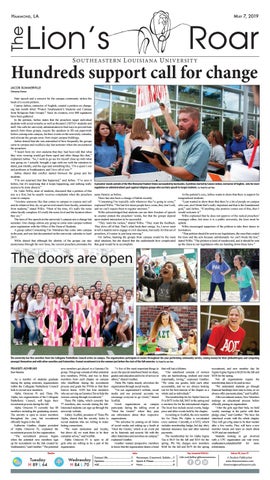
A preacher stands outside of the War Memorial Student Union surrounded by barricades. A petition started by Canese Jarboe, instructor of English, asks for more regulation on administration’s part against religious groups who use hate speech to target students. FILE PHOTO/THE LION’S ROAR same rhetoric as before. There has also been a change of habits recently. “Consuming Fire typically calls whenever they’re going to come,” explained Willis. “The last few times people have come, they don’t call, and we can’t require them to register anymore.” Willis acknowledged that students can use their freedom of speech to counter protest the preachers’ words, but that the groups depend upon student interaction to be successful. “They want the ruckus,” shared Willis. “They want the feedback. They drive off of that. That’s what feeds their energy. So, I never want to tell a student not to engage in civil discourse, but really for this set of preachers, it’s easier to just keep moving.” For Jarboe, banning the groups from campus would be the most ideal situation, but she shared that she understands how complicated that goal would be to accomplish.
At the petition’s core, Jarboe wants to show that there is support for marginalized students. “I just wanted to show them that there’re a lot of people on campus who care, and I think that’s really important and that is the foundational goal,” said Jarboe. “If anything else positive comes out of this, then I would welcome it.” Willis explained that he does not approve of the radical preachers’ messages either, but since it is a public university, the laws must be upheld. Willis encouraged supporters of the petition to take their stance to lawmakers. “That petition should be sent to our legislatures, the ones that created the laws and the acts because unfortunately we can’t break the law,” stated Willis. “The petition is kind of misdirected, and it should be sent up the chain to our legislatures who are handing down these laws.”
The doors are open
The university has five sororities from the Collegiate Panhellenic Council active on campus. The organizations participate in events throughout the year performing community service, raising money for their philanthropies and competing amongst themselves and with other sororities and fraternities. Formal recruitment is in the summer just before the start of the fall semester. FILE PHOTOS/THE LION’S ROAR PRAKRITI ADHIKARI STAFF REPORTER
As a number of students graduate during the spring semester, organizations within the Collegiate Panhellenic Council look to recruit new members. Alpha Omicron Pi and Theta Phi Alpha, two organizations of the Collegiate Panhellenic Council, will begin their recruitment process during the fall. Alpha Omicron Pi currently has 88 members including the graduating seniors. The sorority is open to newer members throughout the year, but recruitment officially begins in the fall. Katherine Gunther, chapter president of Alpha Omicron Pi, explained the recruitment process for her organization. “The recruitment process begins when the potential new members sign up for recruitment via the link created by Southeastern,” said Gunther. “The potential
new members get placed in a Gamma Chi group. This group consists of other potential new members, PNMs, and two to three members from each chapter on campus who disaffiliate during the recruitment process and guide the PNMs to find their forever home. AOPi has four members who are serving as Gamma Chis to help the women coming through recruitment.” Theta Phi Alpha, which currently has 77 members, also recruits during the fall. Interested students can sign up through the university website. Ashley Scaffidi, president of Theta Phi Alpha, shared that the sorority looks to recruit students who are willing to make lasting connections. “We want dedication and loyalty, but above all, we want them to be their complete selves,” said Scaffidi. Alpha Omicron Pi is open to all girls who are willing to be a part of the organization.
Weather
Tuesday H 89 L 64
“A few of the most important things to us are the special sisterhood bond we share, grades and education and to be of service to others,” shared Gunther. Theta Phi Alpha mainly advertises the organization through social media. “On our organization’s website, social media and our personal accounts we encourage everyone to go Greek,” shared Scaffidi. Greek organizations on campus participate during the tabling event at “Meet the Greeks” where they pass out information about their respective organizations. “We advertise by posting on all forms of social media and setting up a booth at ‘Meet the Greeks,’ which is an event put on by fraternity and sorority life with the other fraternities and sororities on campus,” explained Gunther. Gunther wanted prospective members to know that the organization shares a bond
that will last a lifetime. “Our sisterhood consists of women who are hardworking, resilient and most importantly, loving,” expressed Gunther. “We value our grades, hold each other accountable, and we are always looking out for the best interest of the chapter as a whole and as individuals.” The membership fee for Alpha Omicron Pi is $675 in the fall, $465 in the spring and a one-time fee for the international chapter. The local fees include social events, badge price and other events held by the chapter. According to Scaffidi, the new member fee for Theta Phi Alpha is reevaluated every summer. Currently, it is $552, which includes membership badge, bid day shirt, national insurance fees and other national payments. The membership fee for Alpha Sigma Tau is $615 for the fall and $415 for the spring. Phi Mu charges new members $640 for the fall and $675 for the spring
Index
Wednesday H 84 L 70
Campus Life ................................2 Opinions ....................................3 A&E ...........................................4
Horoscope, Crossword, Sudoku ...5 Sports & Fitness ..........................6 News .........................................8
recruitment, and new member due for Sigma Sigma Sigma is $620 for the fall and $438 for the spring. Not all organizations require the membership dues to be paid at once. “We understand students go through financial hardships from time to time, so we always offer payments plans,” said Scaffidi. After recruitment season, New Members undergo an educational process before officially joining an organization. “After the girls sign their bids, we hold weekly meetings in the parlor with their pledge class,” said Gunther. “We have fun sisterhood events with the whole chapter. They will get a big sister to be their mentor after a few weeks. They will have a new member retreat and learn so much about AOPi and our sisterhood.” Students looking to get involved with a CPC organization can visit www. southeastern.edu/admin/fsl/ for more information.
Stay Connected With Us! Like and follow @lionsroarnews.
Volume 90, Issue 29 A Student Publication www.lionsroarnews.com lionsroar@southeastern.edu
The Lionʼs Roar | CAMPUS LIFE
PAGE 2 | MAY 7, 2019
“Rock School” and “Electric Edge” coined most popular KSLU programs of spring 2019 semester
programs do that on a weekly basis. Both shows have a very high standard with always putting out new content and strong stuff.” “Rock School” started production in 2007, and “Electric Edge” began in 2011. While the former talks about all genres of music, the latter focuses on house, dubstep, trap and other EDM genres. “Both of the shows have really strong content,” said Delaney. “They have interviews where they call up experts in that field and talk with them on the radio. ‘Electric Edge’ just went out to a very big festival and talked to a whole bunch of new artists, and they put those interviews on the air. They have unique content that no where else has. Every week is quality sound and solid content.” Delaney shared that the station has audience ranging from 7 to 70 years of age. “A couple years back, we had a fan call in and say that he was our oldest listener at 77 years old,” shared Delaney. “We really do not have a one particular group of audience. I am constantly amazed by our audience and the diversity of our listeners. Our listeners are Connor Ferrill, a senior communication major, hosts “KSLU Music” on KSLU 90.9 FM. KSLU is an award-winning college across the board, and you never really know who is radio station with a 10-mile radius that reaches as far as Denham Springs, Kentwood and Covington. GERARD BORNE/THE LION’S ROAR
tuned in. We also have the internet, which offers a lot of people to listen internationally. They are always looking for that unique show, and KSLU is home to a lot of these people who graduated from Southeastern.” Katelynn Bartholomew, a junior communication major and a student worker at KSLU, shared what she enjoys about “Rock School.” “I love ‘Rock School’ because of the interesting and unique topics Dr. Joe Burns brings to the table,” explained Bartholomew. “Sometimes I feel like it is not really ‘Rock School’ anymore, and it’s more like ‘Welcome to music class. Here we are.’ He jumps between a lot of genres, which I think is a good thing for the show. He and Tammy are very complementary, and he often times brings people from all fields of backgrounds, and he brings a good diversity to the listeners. ‘Rock School’ brings a good energy to the listeners, and that kind of content for KSLU is very good.” Tune in to KSLU on Thursdays at 5 p.m. and Sundays at 4 p.m. to listen to “Rock School” and on Thursdays 7-9 p.m. for “Electric Edge.”
GERARD BORNE
that “Rock School” and “Electric Edge” have been the radio station’s more popular shows. “I think they have been our most successful From rock ‘n’ roll talk shows to Lions sporting because they’re really good shows,” explained events, KSLU 90.9 FM has caught the attention of Delaney. “When you have a niche program like that, many local listeners. you get a passionate audience who loves that content. Todd Delaney, general manager of KSLU, shared They’re looking for high quality content, and those STAFF REPORTER
The commitment of Orientation Leaders SHAELYN MARTINEZ STAFF REPORTER
Orientation leaders play a vital role in introducing the university to the prospective and incoming freshmen and helping them decide how the university fits them. The OLs’ preparation begins in the spring semester and lasts throughout the summer so that when the incoming freshmen become a part of the university, they know a few familiar faces from this program. Amanda Hammonds, assistant director of orientation and events, explained the qualities they look for when selecting orientation leaders. “We look for people who we think would work best together and personalities that complement each other,” said Hammonds. “Overall, we want them to also help each other out. So, we chose a variety of students who can all bring something special to the team but also people who are all open-minded and can look back and realize what they have taken from this experience.” According to Hammonds, orientation leaders are typically hired towards the end of October. “We then take the chosen OLs on a retreat in December that is just so they can get to know each other and get comfortable with each other,” explained Hammonds. “This is just basically like one, big ice breaker and to gain trust with each other.” The chosen group of students starts working during the spring semester after they are hired. “They work this program
with the prior OLs,” stated Hammonds. “They also work at the ‘Lion Pride Previews’ events. We also have our orientation leader meetings every Tuesday and Thursday for about an hour and 15 minutes. Finally, in the summer, they start out strong with work in the office every day in prep for the many orientations that they will work all summer. It is a lot of work.” Emily Bohall, an admission recruiter and a 2013 orientation leader, detailed what traits students must possess in order to be an orientation leader. “The main trait I would say a student must have is to be themselves and to be accepting of all sorts of personalities,” shared Bohall. “You should be able to be a leader and a follower when the time comes. Another trait would be that of making people feel like they matter. Making families and their students feel like this is a stress-free environment helps with this big step in college.” In preparation for the summer, orientation leaders are provided with a variety of services. “They are provided with free university housing during the summer,” Hammonds explained. “We also pay for them to take a leadership training class with Dr. Kay Maurin. They get a meal plan and other items like outfits for each day and a backpack.” Emily Browning, a freshman marketing major, is an orientation leader this year. She explained her roles as an OL. “My main job is to make sure the incoming students feel welcomed and ready to start in
CORRECTION - In the April 2 issue of The Lion’s Roar, on page two in the “The significance behind wearing green and gold” article, the photo cutline identifies the women as Mahayla Taylor, Deven Daniels and Runqiesha Myles. However, the women pictured are Emily Waddell, a junior sports management major, Mary Anna Jambon, a junior sport management major, and Nadia Whitfield, a senior sport management major. This has already been corrected in the online version of the article. CORRECTION - In the April 16 issue of The Lion’s Roar, on page four in the “Farmers market on the rise” article, Summer Veatch was identified as working for Gracious Bakery + Cafe. However, she is a vendor from Candlestick Bakery. This has already been corrected in the online version of the article.
the fall,” stated Browning. “I have to give them all the tools to make their first semester a great one. Along with that, I have to make the parents feel good about sending their students to Southeastern.” Browning discussed the primary duty of an orientation leader. “Being able to be the first face the incoming freshmen meet is a feeling you will never forget,” shared Browning. “Most students are really nervous when they come though orientation, and to be able to prepare them and to get them excited about starting in the fall is really rewarding.”
flodowntheriver@yahoo.com
Speak
Opinions | The Lion’s Roar
May 7, 2019 | Page 3
Out
Never too late for personal change
Speak Out
What would you like to hear more on KSLU? “Sports. I would like to hear more sports because I am a sports fan, and I like to hear it on the radio.” Travis Nickels Junior, Communication
“I just want their presence to be more known. It’s an award-winning radio station, but not many students even know it’s there.” Danielle Magruder Senior, Middle School Education
“Grunge or like ‘90s music, maybe even just a mix of more styles because college people like a variety of music to listen to.” Matthew Arnone Sophomore, Undecided
“More energy music and less country songs. It doesn’t always have to be the top artist playing.” Sable Diaz Freshman, Psychology
“More fast-pace music and pop songs would be nice to hear.” Leah McMurray Freshman, Psychology
“I think what they play is honestly good. They play songs that I like to hear. Most people do not expand outside of the typical genres, so they should listen to KSLU for new things.” Erin Pender Freshman, Communication “I would like to hear more rock songs and indie folk because it is more heartfelt and nice to hear.” Nathan Callahan Graduate Student, General Studies
“Well, I would say a better mixture of songs because every time I turn it on, it’s songs that I don’t really know, so if they could mix old hits and new hits.” Jadyn Mumphrey Junior, Family and Consumer Science “I would like to hear more student, opinionbased topics discussed.” Jacob Deliberto Sophomore, Political Science
Everyone is familiar with the story of the stubborn family member, the ignorant coworker or the obnoxious neighbor. Many of these personalities are a product of their beliefs and how they were raised. It leaves many people to wonder, “Is it too late for these people to change?” Author Theodor Seuss Geisel, or most commonly known as Dr. Seuss, once wrote, “You have brains in your head. You have feet in your shoes. You can steer yourself any direction you choose.” I believe this perfectly describes how it Johnathan Zeringue is possible for individuals to experience change as Staff Reporter long as they make an effort to change. I am a big believer that there is never a time in one’s life when they cannot improve their mindset. Growing up, I faced a number of situations that caused me to develop anxiety. I was not always the most confident person in the world as I often obsessed over unimportant issues that I felt needed to be stressed over. These included small things such as using the same public restroom with students who did not share the same ethnicity as me and worrying about whether or not I could sit next to a group of people at lunch break who did not have the same skin color. It took time for me to develop more self-confidence. Yet, the more I accustomed myself
to the same people that I was too scared to interact with before, the more I realized that I could learn to be myself and become close friends with those same people I feared. Change is not limited to a certain age group as there is never a time that someone cannot alter their thinking. In addition to getting used to living in a different culture, my family and friends also had to adapt to my beliefs often. Being raised in a country I was not born in was not the easiest thing in the world for me. I was brought up in a small town called Des Allemands where most of the people have their set of traditional values and beliefs and are very close-minded. My mom and dad, who were each already in their 50s, especially had to adjust with the things people said and how they acted around me that might have been different from the behavior they acted upon while growing up themselves. Luckily, many of my friends and family realized that I was too important to let old-fashioned values get in the way of accepting me for who I am. Sometimes it may take a major event in order for people to realize that they want to see a change in their lives. There are numerous life-altering stories that cause individuals to take that first step to enact change. 54-year-old Scott Schmaren of Saint Charles, Illinois dealt with obesity and depression throughout his life. One day, he realized if he kept living how he was, he would have an early death. His decision to initiate a change improved his health, allowing him to lose 180 pounds. This caused him to leave his real estate career entirely and focus on improving others’ lives by becoming a hypnotist and a public speaker. The first step is always the most vital one for forging new paths, and when people finally reach that point, positive results will follow. While I do believe that anyone at any point can change for the better, it is important to understand that change does not just happen easily. The process takes time, and the individuals who want to make a change in their lives must first want to make the effort to do so. Also, more importantly, when I say effort, I do not mean just giving 50%. People must be fully committed to make a difference in their lifestyle and stick with their decision. What separates my friends from the rest of society is that they were willing to learn and change. Thus, anything is possible if people just believe in themselves to make a change.
Living without a phone, my life hack
My mom bought me my first phone when I was about 11. It was a black TracFone, and my twin brother and I were only allowed to use it for the express purpose of calling her in case of emergencies. I still have that same phone today. Nowadays, it rides with Maiah Woodring me in the front pocket of Staff Reporter my backpack, generally forgotten, its only purpose being the same one my mom initially bought it for: emergencies. I have never used that phone once since enrolling here, and only a few times before that. I have no social media accounts. And since I am a cheapskate and do not want to pay the minutes for a phone I never use, even my coworkers cannot call me directly. For all intents and purposes, I have managed to live a social lifestyle in the year 2019 without a phone. How do I do it? The answer is Wi-Fi. I said that I didn’t have a phone, not that
I didn’t have a touch screen. My iPod is either connected to the university or my home Wi-Fi 99% of the time, so I never really miss anything. Whenever people want to text me, they just get in touch with me through Wi-Fi-based texting apps like GroupMe or Wire. True, I am terribly slow at responding to text messages, but honestly, my slow responses would be the same regardless of whether or not I had a phone. The main reasons I have decided not to get a phone come back to the expense and practicality of it. I can do almost everything with an iPod that I could do with a phone including audio FaceTime people when I want to “call” them. And during that 1% of my time that I am not connected to WiFi, I am probably hanging out with my family doing stuff that I would not want interrupted with pings and buzzes, like shopping or going to a restaurant. Few people realize that I do not actually use a phone. The ones who do know wonder how I can manage to do so.
Speak
Out
Well, the truth is, I am convinced that the majority of people are more dependent on the Wi-Fi aspects of their phone than the actual phone-calling service itself. In that aspect, I am not that different from most people. When I want to find synonyms for a word quickly or I am anticipating an email, I reach for my iPod. When I wake up in the morning, I pull my iPod out from underneath my mattress and blind my eyes with its unnatural glow until I am convinced that even with five to six hours of sleep the night before, I will not be crashing again until past midnight. Living without a phone can actually be a luxury, sort of like having an advanced technology that knows just when to enter Do Not Disturb mode—when I am away from work and home. So, in that manner, my phoneless lifestyle is actually more accommodating than life with a phone— who would have thought? And when it really comes down to it, phones really offer less, if nothing more, than the conveniences of my humble iPod.
Could you live without your phone?
Speak Out “I think they should play more classic rock because it is a good genre.” Connor Poche Sophomore, Industrial Technology
“No, I couldn’t live without my phone because communication is a key to today’s society. Even waking up in the morning, you have to set up an alarm on your phone.” Adam Boyd Senior, Industrial Techology
“I don’t really know. I don’t have a problem with it. I listen to sports, so I don’t really listen to the music. There’s so many interesting things on there. If I had more time, I would like to listen to the talks and music.” John Sartori Junior, General Studies “That’s a hard question because it is a mixture of everything, so I would like to hear more of Joe Burns.” Daniel Stretcher Jr. Junior, Communication
“No, I cannot live without my phone right now because everything that involves school work comes directly to my phone, and my future job would require me to do the same, answer emails and respond to calls.” Hunter Metrejean Senior, Industrial Technology “I can live without my phone because my phone is not everything. I have other things to entertain me in my daily life, and I keep busy without my phone.” Daryl Julien Senior, Communication
Policies and Procedures The Lion’s Roar is the official newspaper of the students of Southeastern Louisiana University. It has been in continuous publication since 1937. Submissions and letters to the editor are welcomed, but the editor of The Lion’s Roar reserves the right to edit all submissions for grammar, libel and available space, or refuse publication without notification. Submissions must include the author’s full name and either phone number, e-mail or other contact information (not to be published). Faculty and staff members should include their title and department. Students should include their classification and major. By submitting an article for publication, the author understands that the submission will be edited. Organizational News space is provided at no charge as a courtesy for university recognized Greek and Student Organizations. The space of such articles is limited to 150 words. Submissions of this Organizational News must adhere to the same polices as other submissions or letters to the editor, but must also include the name of the organization.
“I feel that I personally can’t live without my phone because my phone is another piece of me, and without that piece, I don’t feel whole.” Ricketta Griffin Sophomore, Social Work
All views expressed in The Lion’s Roar are those of the author or, if unsigned, those of the staff of The Lion’s Roar. These views should not be interpreted as the views of the administration, faculty or students of Southeastern Louisiana University. A single issue of The Lion’s Roar is free. Additional copies may be purchased for 50 cents in the Student Union suite 1303. Annual mail subscriptions are $35 within the continental U.S. The Lion’s Roar, in its print form, and associated online or digital versions, are designated public forums. Student editors have the authority to make content decisions without censorship or prior approval. The Lion’s Roar also defends the rights of student journalists relative to freedom of speech and press as stated in Amendment I of the Constitution of the United States of America. The Lion’s Roar is published through the Office of Student Publications, part of the Division for Student Affairs. It is published weekly during regular semesters and monthly during the summer semester.
“Personally, I can live without my phone, but I would definitely have some withdrawal effects.” Sushovan Adhikari Junior, Computer Science
“I can’t live without my phone because it keeps me in contact with my family, and I don’t live at home and also because I’m addicted to it.” Daniella Crane Freshman, Middle School Education
Staff Editor-in-Chief - Annie Goodman Assistant Editor - Zachary Araki Opinions Editor - Jacob Summerville Distribution - Lauren Walker, David DiPiazza, Garrison Dighton Office Assistant - Alyssa Larose, Ashlyn Harris Advertising - C. Ian M. Squires, Kyla D’Arensbourg Administrative Assistant - Gemma Carter Coordinator - Lorraine Peppo Director - Dr. Lee E. Lind
General Offices Student Union 1303 Mailing Address The Lion’s Roar SLU 10877 Hammond, LA 70402
Telephone Numbers 985-549-3527 (newsroom) 985-549-3842 (fax) 985-549-3748 (advertising) 985-549-3731 (Student Publications)
Like and follow @lionsroarnews.
www.lionsroarnews.com www.selu.edu/lionsroar lionsroar@southeastern.edu
Page 4 | May 7, 2019
The Lion’s Roar | Arts & Entertainment
Creating a message through body language ERICA WELTER Staff Reporter
Whether it is tapping a foot or raising eyebrows, people display their thoughts and feelings from the top of their head down to their toes. David Faucheux, instructor of management and business administration, explained the prevalence of body language. “Since the beginning of time, humans have always used a mix of the spoken word and nonverbal signals to communicate,” said Faucheux. “90-95% of all communication is nonverbal through body language and tone of voice.” Psychology Today notes that nonverbal communication can be expressed through movements, facial expressions, and vocal tone and volume. Microexpressions, brief displays of emotion which an individual tries to conceal, can register in a viewer’s mind even when they are not consciously aware of them. In the article “The Ultimate Guide to Body Language,” Dr. Susan Krauss Whitbourne, professor emerita of psychological and brain sciences at the University of Massachusetts Amherst, said people spend their lives learning how to understand nonverbal cues. “While we’re busy trying to decode their messages, they are also trying to decode ours,” stated Whitbourne. “There are times when you want other people to know exactly how you’re feeling, especially when those feelings are both positive and reciprocated. This isn’t always easy to do, especially if you’re not a particularly emotive type of person. At other times, however, you definitely want to hide your inner feelings.”
According to Faucheux, inconsistencies between what a person says and what their body language shows might indicate insincerity. “If the nonverbal signals does not match the spoken word, humans will get an intuition, a hunch, that something is not right, but when they do match, the person comes across as more trustworthy, genuine, sincere and caring,” shared Faucheux. Jerry Parker, instructor of world languages and cultures, described how nonverbal cues can be used to understand a person’s reactions. “Open body language means he or she is happy or at ease,” said Parker. “Closed body language means he or she is uncomfortable.” Parker noted that accurately interpreting body language can be tricky. “Sometimes we mistake negative body language a lot when in reality the student is fully engaged and interested and he or she just has on his or her ‘thinking’ face,” explained Parker. Before he became a teacher, Faucheux worked in advertising and marketing for 25 years. He found understanding body language was essential to his work. “While understanding sales strategies and systems are important, understanding body language was one of the keys to my successful sales career,” shared Faucheux. “I have learned dozens of sales strategies on presenting products and services, how to overcome objections, closing the sale, but it was my knowledge and awareness of body language that took me to the next level.” Body language offers clues into what someone thinks and feels, but it can also impact how people think. Dr. Amy Cuddy, a social psychologist,
Students make different expressions outside the campus Starbucks. Nonverbal communication can help define the tone of a person’s verbal message. This can include facial expressions, body posture and hand movements. Erica Welter/The Lion’s Roar researched nonverbal behavior. She found a correlation between how a person poses and the levels of testosterone and cortisol in their body. In her 2012 TED Talk “Your Body Language May Shape Who You Are,” Cuddy argued a person can boost feelings of confidence and perhaps impact their level of success by adopting a “power pose” for two minutes. “Two minutes lead to these hormonal changes
that configure your brain to basically be either assertive, confident and comfortable, or really stress-reactive, and feeling sort of shut down,” said Cuddy. “So, it seems that our non-verbals do govern how we think and feel about ourselves, so it’s not just others, but it’s also ourselves.” Body language can be the gateway to understanding people’s personality and can be useful to excel in the professional workplace.
Artistic merit pays for an education
African history on display
ZACHARY ARAKI
Opinions Editor
JACOB SUMMERVILLE
Assistant Editor
Students can find a variety of scholarships based on artistic and academic excellence to offset the costs of pursuing an education in the arts. “The arts, and music in particular, can be a very competitive field in terms of collegiate recruiting,” said Jeffrey Wright, head of the Department of Music and Performing Arts. “Like athletics, the most talented students are often sought after by many universities. We are happy to be able to have these scholarships available to recruit the best musicians that we can to campus and enrich the performing arts culture of both Southeastern and Hammond.” A list of scholarships directed towards music majors can be found on the university website under the College of Arts, Humanities and Social Sciences. The scholarships range from the Herbert E. Cagle Memorial Endowed Scholarship in Music for people planning to teach music in public schools to the Catha-Lambert Endowment for Music aimed towards junior or senior music majors who are residents of the 6th district. In addition to those scholarships, any student who successfully completes a season with the “Spirit of the Southland” marching band receives a $600 scholarship for the fall semester with no additional application
In music, students must audition to enter the department. This audition also counts as the students’ scholarship application. Zachary Araki/The Lion’s Roar required. Funding for the marching band scholarship has a budget separate from the departmental scholarship budget. This year, the department introduced the Marjorie Galloway Scholarship for the Arts for incoming students. It awards five $1,000 scholarships to students in music and five $1,000 scholarships to students in fine arts. Scholarship decisions are based on an audition before a panel of faculty members that all incoming students in music must complete. The audition form can be found on the university website. “When we make a scholarship award to incoming students, we usually award the scholarship for eight semesters provided that the student remains in good academic standing and progresses toward a degree in music,” explained Wright. “Current students who may not be on scholarship can also apply for scholarship even after they have matriculated.” For the Department of Visual Art and Design, the application process and a full listing of scholarships are being examined
for the fall semester. When the application process is ready, the department will send an email to all art majors as well as mention it in the first art majors meeting. Known scholarships for art majors include the Helen Entrikin Art Scholarship for juniors or seniors based on quality of creative work, GPA, financial need, and service to the department and community. Students studying theatre can also find options to offset their educational costs. The Vonnie Borden Memorial Scholarship Fund in Theatre awards a student majoring in communication with a minimum 3.0 GPA. The Hymel G Falgoust Jr. Endowed Scholarship in Visual and Performing Arts and the Leola Purcell Endowed Scholarship in the Visual and Performing Arts also apply to students in theatre. The Mary Lou Champagne Endowed Scholarship in Dance/ Theater can be awarded to a full-time incoming freshman with a 2.75 GPA in high school or a current student who has demonstrated commitment by
Located less than three miles from the university, a museum preserves African American culture. Opening in 2007, the Tangipahoa African American Heritage Museum and Veterans Archive comprises artifacts, photographs, paintings and murals to promote African American history and its development in the United States. Delmas Dunn, president of TAAHM, explained how the museum can appeal to students. “History is not taught out of the schools, and this is one of the ways for them to learn about history, learn about African
American civilization,” shared Dunn. “Not only the young, but I think just people in general, the more that you know about your past, the more that you have an understanding of how people react to certain things.” Dunn explained that there are 21 murals in the museum ranging over several decades of history. For one section of the museum, visitors can learn about inventions started by African Americans. Dunn explained that there can be ambiguity with the accreditation of some inventions to the slave who made it. “Some they take credit for, and some they don’t take credit for because during the time that
Artifacts from African culture are displayed at the museum. In addition, the
see SCHOLARSHIP, pg. 5 museum has exhibitions on the Civil Rights Era. Jacob Summerville/The Lion’s Roar
you were a slave, the master took credit for the invention,” stated Dunn. Another room includes pieces from the state archive that depict the history of the civil rights march from Bogalusa to Baton Rouge that took place in 1967. Outside the exhibitions, the “Black Tie Affair” is a fundraiser event for the museum. “It’s a time that we set aside to bring ethnic groups together and raise money for the museum,” shared Dunn. “I think the high point of this is getting the ethnic groups together and letting them enjoy conversations and communicating.” TAAHM also has a group of members who serve as volunteers to help run the museum and any events that are hosted. This summer, the museum will be offering a 2019 STEM/ Aviation Summer Camp for grades 6-12. Registration forms can be found on the museum’s website. Dunn shared that the museum has attracted groups from all around the area. “We have schools from New Orleans, Baton Rouge, St. Tammany,” said Dunn. “We even have bus-loads of people come as far as Mississippi to visit the museum.” The university has had a lasting connection with the
see TAAHM, pg. 5
Arts & Entertainment | The Lion’s Roar
May 7, 2019 | Page 5
Students reflect on their first year in college ERICA WELTER Staff Reporter
Freshmen enter college from various scholastic backgrounds and must learn to integrate into college life. The National Center for Education Statistics reports about 15 million students attended a public high school and about 1.5 million students attended a private high school in 2015. Over 500,000 high school students were home-schooled in 2016. Sarah Batrous, a sophomore English major, attended a public high school. She enjoyed her first year of college, but it was an adjustment. “My freshman year was full of new, exciting experiences and learning opportunities,” said Batrous. “I missed out on a tour of the campus, so finding my classes was difficult at first. However, asking for directions from other students, professors and consulting the online campus map helped greatly.” Connor Haag, a sophomore nursing major, was home-schooled for high school. Haag found his freshman year both scary and exciting. “I did not know many people, and it was intimidating at first, but pretty soon, I was able to find my niche and really enjoy the college experience,” explained Haag. Haag described scheduling and personal responsibility as the biggest challenges of his freshman year. “I overcame that challenge of time management my freshman year by making connections with other people and forming study groups and making friends to try and help better each other in the class and keep each other accountable with homework and assignments,” stated Haag. “It really helped to have a group of people who were in the same boat as you and just trying to pass.” TAAHM
continued from pg. 4 museum, according to Dunn. “Southeastern’s one of our strongest supporters,” stated Dunn. “At one time, they had a genealogy lab here, and they took care of that for us. Even until today, they constantly check and see whatever they can do in order to assist us in whatever we’re doing.” There also used to be an assignment that required students to visit the museum. SCHOLARSHIP
continued from pg. 4 performing at the university. Potential recipients must first be interviewed by and audition with Keith “Skip” Costa, director of dance. The scholarship is awarded for both the fall and spring semester.
ARIES (March 21 to April 19) Untangling personal problems might take more time than the impatient Lamb expected. But it’s important to hang in there until all those knotty situations are straightened out. TAURUS (April 20 to May 20) You still need to work out lastminute snags in your dealings with a rival. Hold your ground despite a perceived lack of support. Things should turn around before you know it. GEMINI (May 21 to June 20) Best not to delay preparing for that upcoming family event. The sooner you get things started, the better chance you have of finding potential problems and making needed changes. CANCER (June 21 to July 22) The romantic Moon Child might be reluctant to see the reality behind that “ideal” situation. But by midweek, the practical Crab emerges to help clear away the moonbeams. LEO (July 23 to August 22) Although the Big Cat might be receptive to more “purr-suasion” to get you to agree to a workplace change, make sure you can distinguish the fine line between facts and flattery. VIRGO (August 23 to September 22) Your positive attitude in the workplace helps to get you noticed by the right people. Now go ahead and use some of that new selfconfidence to help shore up a personal relationship.
Kamryn Fouts, a freshman biological sciences major, attended an all-girls, private school. She referred to her freshman year as a roller coaster ride where the pros outweighed the cons. Fouts shared that it was challenging for her to maintain her social life, extracurricular activities and grades. “Being a cheerleader for SLU gave me a pretty busy schedule, so keeping up my grades and social life was not as easy as I thought it would be,” shared Fouts. “I have learned how to manage it since then.” As students settle into their collegiate studies, they may recognize noticeable differences between their college and high school experiences. During her first year, Batrous discovered that college life meant she had more control over her daily activities. “In college, I learned how to schedule classes in times that are best for me,” said Batrous. “I also learned that my lunches and snacks can be anything I would like now. Goodbye, high school cafeteria food.” Haag enjoyed the freedom to explore his interests through employment opportunities and student organizations. “A difference I noticed was that in college you can really discover what your passions are in life,” stated Haag. “There are so many different opportunities from organizations, clubs, jobs, and many other opportunities to find what interests you have besides your degree.” For Fouts, the most notable difference has been the amount of time spent out of class. “The biggest change was not being in school for eight hours a day, and I wasn’t really sure what to do with all that free time,” explained Fouts. “Cheering helped fill some of that time, but I still had free time that I wasn’t really used to.”
Dunn believes that connection benefited the students, and he hopes to rebuild it in the near future. “We’re definitely trying to get that back because when they were able to come and visit the museum, a lot of times I would be here and would have conversations with them, and a lot of things that we talked about, they didn’t know,” shared Dunn. “I think that the better you know people’s civilizations, the better that you understand the world.” It was the first university scholarship specific to the dance discipline. Whether studying music, visual arts, theatre or dance, students can take advantage of these scholarship opportunities and find funding for their pursuance of artistic merit and academic excellence. LIBRA (September 23 to October 22) Although you might still have to work out some problems with a business partner, things go more smoothly on the home front. An investment opportunity might need more study. SCORPIO (October 23 to November 21) Don’t be reluctant to act on your suspicion. Even if others see nothing wrong, the astute Scorpio could sense an underlying problem that isn’t always obvious on the surface. SAGITTARIUS (November 22 to December 21) A new opportunity presents some obstacles that need to be dealt with as soon as possible. Delaying action in hopes that the problems will go away could be counterproductive. CAPRICORN (December 22 to January 19) A friend or family member’s request might carry some hidden factors that could later create problems. Be sure you know all the facts before you make your decision. AQUARIUS (January 20 to February 18) A setback in implementing a plan could turn out to be a blessing in disguise. Use the downtime to rework your original concepts and see where changes could be made. PISCES (February 19 to March 20) You might not be consciously fishing for compliments, but admit it -- won’t you feel great when your efforts are noticed? So accept the praise gracefully. You earned it. BORN THIS WEEK: Your love of beauty in your personal life extends to your efforts to protect and preserve the natural world around you. (c) 2019 King Features Synd., Inc.
Sponsored By
Whether attending public or private school, or being home-schooled in high school, freshmen experience different transitions when entering college. Erica Welter/The Lion’s Roar Of the programs and services offered to assist students in their transition from high school to college life, the university’s orientation program teaches students about policies and procedures, helps them register for classes and gives them the chance to meet faculty and staff members. Batrous credited her teachers and friends for making her freshman year more helpful. “Having such kind and understanding instructors my freshman year helped me settle into college life quickly,” shared Batrous. “Making new friends in my classes and finding old friends from high school to connect with also made the transition easier.” Haag’s transition was made smoother by a student
worker in University Housing. “My resident assistant on the floor of my hall made my transition so much easier,” said Haag. “He was there to talk to me and answer any questions I had and was able to show me where various different resources on campus were and how to get involved.” As Fouts’ freshman year draws to a close, she believes the success of her transition is multifaceted. “Everyone on campus has been very helpful even if I didn’t know them,” stated Fouts. “I think some of the biggest things were SE 101 and my freshman advisor Mrs. Mindy, and then being a part of the SLU cheerleading squad helped with my transition because I could just ask my teammates for help.”
Make local, summer plans in the arts
ZACHARY ARAKI Assistant Editor
During the summer, the celebration of creative expression will continue through activities from exhibitions to art camps. On campus, the Contemporary Art Gallery will exhibit a series of works from Evan Fugazzi, an artist from Philadelphia, from June 10 to August 30. On June 27-29, theatre alumni will return to perform “Moon Over Buffalo,” a comedy that first debuted in the 1990s. The Hammond Regional Arts Center has a number of events planned for the summer including its first “Sweep the Studio” sale scheduled for June 29 from 8 a.m. to 12 p.m. “Over the years, HRAC has received art donations from generous local artists and collectors, but it’s time for us to make room for new, and to encourage people to add to their art collection or to start their own,” shared Tara Bennett, media coordinator for HRAC. “Works for sale include original and artistmade art, photographs, books, paintings and other unique gift items. Buying local art supports
the HRAC, enriches the history of the work, preserves art patronage and contributes to the local art economy.” Two of HRAC’s summer exhibitions celebrate the art of documentary photography. From May 3 to June 28, HRAC will hold the “Twenty Year Retrospective: Documenting Society of Saint Anne” exhibition, which shows photographs in color, and black and white that Katherine Scherer took of the Society of St. Anne Parade from 1998-2005. “Beginning in 2006, after Hurricane Katrina, she began photographing the parade in color with a Holga camera,” stated Bennett. “What is fascinating is that she created a unique Wizard of Oz effect going from black and white to vibrant color. Unaware how the hurricane manifested a photographic shift in her work, Katherine captured a community’s resilience through the survival of the St. Anne celebration.” For July 12-26, HRAC will hold the “Preserve Tangi 150” exhibition curated by the Hammond Historic District. Bennett said, “The Tangi 150 exhibition is also beneficial in increasing the appreciation of
documentary photography within Hammond by giving residents a unique opportunity to showcase their skills while also sharing a love for our parish. As people will take shots of the places that are important to them, they will also contribute to the 150 years of history in Tangipahoa.” For children between 6-13 years old, HRAC will hold a week-long “KidZart” summer camp. The camp is scheduled for June 10-14 from 10 a.m. to 12 p.m. The price is $50 for HRAC members and $60 for non-members. Campers will learn hands-on activities from art teachers in the community. “If you are still scrambling to find just the right summer camp activities for your child this summer, ‘KidZart’ is the perfect opportunity for summer creativity and fun with a wide assortment of art activities for students,” shared Bennett. The Hammond Art Guild will host its annual summer art camp for adults on July 15-19 and 2226. All classes are open to the public, and the minimum age is 16 years old. In June, the Culinary Arts Series will display the work of
Emily Sylve, chef for Blackened Brew, and in July, Alex Diaz, a chef for Cena; Hammond, will join CAS. “There’s a great appeal in being exposed to food you would not normally be able to order in a local restaurant,” stated Bennett. “The chefs really get to let their creative energies loose and make a truly unique dish.” The “Playing the Staircase” season will continue with local and regional musicians performing on the last Friday of the month. “’Playing the Staircase’ is Hammond’s best kept secret,” said Bennett. “It’s a completely intimate setting and has a unique vibe of combining art and music the minute you enter HRAC. The series creates a place for quality, original music where people can kick back and relax with a glass of wine. Communities need places for people to just be, and I think ‘Playing the Staircase’ invites and attracts new people to our community.” Whether looking for an exhibition to stop by, a sale, a camp to hone creative skills or a performance, the summer holds opportunities for all ages.
Burgers.Seafood.Wings 117 W Thomas St. In Downtown THEMARINERSINN.COM 985.345.9854 Sponsored By
SPONSORING
The Lionʼs Roar | SPORTS & FITNESS
PAGE 6 | MAY 7, 2019
A relationship rebuilt
Lions football players signed posters and interacted with the community at “Hot August Night“ this past semester. In 1985, the football program at the university was cut due to a lack of funding. When the program was first cut, athletes and supporters abandoned the university with nothing here for them anymore. Since the 18-year hiatus ended in 2003, support for the football program has started to return. This is visible in funding and alumni involvement. FILE PHOTO/THE LION’S ROAR ZACHARY ARAKI ASSISTANT EDITOR
In over a decade, the relationship between Lions football and the community began to grow again. In 1985, the football program was discontinued and entered an 18-year hiatus. Ken Kenelly, a 1975 alumnus, played on the Lions football team 1970-73 and later coached the team. He experienced the shift when the football program ended. “The former athletes and supporters pretty much disassociated themselves from Southeastern,” shared Kenelly. “As far as I know, most of the athletes never stepped foot back on the campus again, quit giving money, quit giving donations, pretty much lost all or the majority of the support for the program.” Larry Hymel, alumni athletic coordinator, discussed the impact of the football hiatus. “We lost a generation and a half during the
hiatus of football,” stated Hymel. “That takes a while to rebuild, and although it’s been 15 years, it still hasn’t come back. Along with television, there are many more distractions such as fall activities for children, grandchildren - soccer, travel baseball and softball, etc.” According to Kenelly, fundraising and enrollment both dropped when the football program was discontinued but rose again when the program was reinstated. The return of the program saw benefits for both the university and the community. In a study, the Southeastern Business Research Center estimated that two post-season NCAA playoff games held in Hammond in 2013 had a total economic impact of over $835,000. The estimated spending by all visitors for the first game was approximately $363,000, and for the second game, total spending was $282,704. The largest category for each game was eating and drinking. “You look at the economic impact a football
program has on its community, and it’s easy to see one of the glaring benefits,” explained Jay Artigues, director of athletics. “A college football program also is a big way to engage its alumni base as well as its community.” Artigues discussed athletics’ relationship with the Hammond community. “We have a special thing here at Southeastern,” said Artigues. “You can’t talk about Southeastern without mentioning Hammond. It’s a special bond, a unique bond that separates us in a positive way from other universities. Hammond, America comes alive for football weekends for sure.” Though Hymel sees community support building, he believes the program does not stand in the same place as before the hiatus. “People are going to naturally drift to familysports activities no matter how loyal and dedicated they have been to Southeastern,” shared Hymel. “The stadium used to be filled in the ‘60s, ‘70s, but now students have other choices, and there are no Friday or Saturday classes. So, some leave on
Thursday and don’t return until Monday. We live in a different era now with many more distractions than back then.” Despite the loss of support over the hiatus, Artigues indicated what the experience has proved. “Looking at the positive, it showed how passionate people were about bringing football back to SLU,” stated Artigues. “The toughest part of not having football for that many years is it really affected our alumni during that tenure.” Kenelly discussed the community’s response when Dr. Sally Clausen, former university president, announced the return of the football program in 2003. “There was a lot of support from alumni, from former athletes and players, from supporters, just seemed to generate a buzz in the community, and I think it’s still growing today,” said Kenelly. “I think having the program gives Southeastern a sense of belonging. To be able to compete in national championships in football has a great impact on the support Southeastern gets as a whole.”
REC helps youth stay active
multiple opportunities to stay active while participating in various structured programs and events. This includes scheduled field trips to the John C. Stennis Space Center or Dave & Buster’s, depending on the week that the camp is held. Thomas Morris, assistant director of youth programs, was recently chosen to oversee the camp’s activities and ensure the well-being of the participants. “Safety is our number one goal and number one priority,” explained Morris. “All of our counselors are first aid and CPR and AED certified. When we swim on Tuesdays and Thursdays, we always have two lifeguards on duty, and the counselors always swim with the kids as there will always be adult supervision on the kids.” Recreational Sports and Wellness offers staff members with unique training, which allows the participants to experience more rewarding programs while attending the camp. “Seth, Jason Templet and I are all Astro Camp certified,” shared Morris. “We went to the Stennis Space Center where we became Children participate in art activities during the “Roomie’s REC Camp.“ This year’s certified, so we can be able to teach activities about space to the kids.” camp begins on May 28 and will provide children aged 4-12 opportunities to The counselors and staff aim to create a fun, welcoming atmosphere engage in a friendly learning environment. COURTESY OF RECREATIONAL SPORTS AND WELLNESS in order to relate more with the campers.
“The connection that we build is unique,” said Morris. “It’s all college students where the counselors want to make a difference. The relationships that build between me, the counselors and the kids means we’re all going to be on same page and have the same goal of having fun and staying safe.” A rise in the number of participants has led to the increased popularity of “Roomie’s REC Camp.” “We tripled our camp numbers from last year compared to the years before,” stated Thomas. “Before, we had 75 registrations, and it’s grown to 222. Our average attendance was about 70 kids a week compared to 35-40 a week before then.” Thomas hopes the camp will continue to grow and maintain a high level of consistency in the future. “I’m looking forward to carrying on the excitement from last year and making sure all the participants have a great time,” shared Thomas. “I also am looking forward to increased communication with the parents and the campers.” The cost per camper is $160 per week, which covers the camper’s fees, meals and a T-shirt. For more information and to register, visit the Recreational Sports and Wellness website.
JOHNATHAN ZERINGUE STAFF REPORTER
Recreational Sports and Wellness works to promote various youth programs for the entire community to experience. “Roomie’s REC Camp” offers the chance for children aged 4-12 years to build self-confidence while being engaged in a friendly, learning environment. The summer camp will be held near the Pennington Student Activity Center and will take place from 8 a.m. to 4 p.m. beginning May 28 through August 2. Seth Thomas, director of Recreational Sports and Wellness, explained the importance of the camp for both the participants and the university. “The purpose is for the community to be involved,” said Thomas. “I think it’s important that the Recreational Sports and Wellness is interrelated with the community and help support the youth. The camp benefits both us and families.” Throughout the 10-week camp, the campers are provided with
Katelynn Bartholomew
What’s your favorite KSLU program?
Senior, Communication
This Week’s Puzzle AnsWers
won FREE Papa John’s pizza for being seen on campus reading
THE LION’S ROAR
Sponsored By
Average cost of a DUI
=
$10,000 This week in Sports
May 3 Softball
May 3 Softball
May 4 Softball
May 3 Baseball
May 4 Baseball
May 5 Baseball
at Nicholls
at Nicholls
at Nicholls
at Lamar
at Lamar
at Lamar
2-3
11-1
3-4
4-3
9-13
6-4
SPORTS & Fitness| The Lionʼs Roar
MAY 7, 2019 | PAGE 7
When athletes' careers run their course GERARD BORNE STAFF REPORTER Not all athletes make it to the professional level. So, what happens when they do not make it professionally? With 2% of all 492,000 collegiate athletes making it to the professional level, studentathletes should focus on life after sports. According to the document “NCAA Recruiting Facts” posted to the NCAA, 9.1% of 34,600 college baseball players make it to the professional level. Alumni Jacob Seward, a former outfielder, and Gage Pickett, a former pitcher, were two collegiate athletes from the university who are part of the vast percentage of athletes who do not make it to the professional level. “The hardest part of not getting drafted is just the fact that baseball is something you’ve been doing your whole life that you love and knowing it is finally coming to an end,” explained Pickett. Both Seward and Pickett felt that not getting drafted was a loss of a childhood goal. When both student-athletes
Jacob Seward, a former outfielder, finished with All-Southland Conference awards during his career at the university. Seward now has career plans outside of the college sport. COURTESY OF SPORTS INFO realized that they were not going to be drafted, they had to think about life after baseball. “After I wasn’t selected, I already had a job lined up before I graduated,” shared Pickett. “I am currently working at Dow
Chemical as an operator, and I am very blessed to be in the position I am in today.” Along with Pickett, Seward had also come to the realization early in his senior season that Major League Baseball was a
Ladner steps down GERARD BORNE STAFF REPORTER
After five seasons as the head coach of men’s basketball team, Jay Ladner stepped down to lead a different team. Ladner resigned on April 18 to take the position of head coach at his alma mater, the University of Southern Mississippi. “I will always remember the opportunity I was given to be a Division I basketball head coach,” explained Ladner. “I had coached in high school for many years and at college where we won the junior college national championship. Dr. Crain and coach Artigues had enough confidence in me
to let me coach. The next thing that I will always remember is the warmth of the people. It’s a very bittersweet departure from Southeastern because I grew to love the university.” Ladner had a message for current players on the men’s basketball team. “I’m very sad that I no longer have the opportunity to coach these young men anymore,” said Ladner. “I’m very proud of what they have done and what they have accomplished. I’m very proud on where the program is headed as they’re built to compete in championships in the Southland Conference. I want them to keep moving forward and to keep fighting. Von Julien is a league-leading guard and will be the leader of that team.”
Say Hello to Checking That Changes Everything Visa Debit Card
Mobile Access
Remote Deposit
OPEN YOUR ACCOUNT TODAY
1004 North Oak St. • Hammond, LA 70401 • 985-543-4200 • lacapfcu.org Monthly service fee and low balance fee are waived on Simple and Simple Plus accounts owned by members age 24 and under.
long shot for him. “During my senior season at Southeastern, I had to accept that there was a strong possibility that I would not get drafted,” commented Seward. “So, I started getting in contact
with Brother Martin High School because I knew if I did not get drafted that I would still want to be around the game and hopefully be able to get a coaching job to impact other baseball players.”
Ladner explained that his decision for the job change was not due to any resentment for Southeastern. Rather, he explained that being an alum of USM and raised in Hattiesburg, the new coaching opportunity was a rare occurrence. “I didn’t think it was necessarily the time to leave, but it was the opportunity that presented itself to me,” said Ladner. “It was the only situation where I would leave Hammond because now I consider it to be my second home.” Ladner advised the next head coach to be his own person. “Certainly take whatever you want to make the program how you want to run it,” stated Ladner. “I love our program, and I love our fans. I will always ‘Lion Up’ as Hammond is my second home.” Von Julien, a junior guard, shared how he felt
Pickett offered advice for student-athletes who do not make it to the professional standings. “The best advice I could give to student-athletes is to not put all your eggs in one basket,” shared Pickett. “While you’re in college, your main focus is to get a degree and then sports are second. So, the main focus is to get an education first to get you a job outside of sports. And if you happen to get drafted, then great, but if not, you always need to have a backup plan ready for when you graduate.” Seward advised studentathletes to be prepared to start a new chapter in their life if they do not make it to the next level. “Everything happens for a reason, and God has separate paths for every person,” explained Seward. Despite not achieving his dreams, Seward says he would not alter his experience as a student athlete at the university. “I would not change a thing I did at Southeastern,” commented Seward. “I have no regrets. I loved my time at Southeastern, I loved all my coaches, and I loved my teammates.”
about Ladner’s decision. “He held a meeting and brought us in as a team to let us know before he took the coaching job,” stated Julien. “It was a no-brainer to take the job at Southern Miss. He is from there and played there. That’s every coach’s dream.” Parker Edwards, a sophomore guard, shared his emotions when he found out about Ladner’s decision. “It was extremely shocking to me,” stated Edwards. “It was kind of unexpected, but we all knew Southern Miss. is where he’s from. Once he stepped down it was crazy, because I never expected the coach who recruited me to step down, but you gotta move on and move forward.” Julien and Edwards both wished Ladner success in his next coaching job.
Page 8 | May 7, 2019
Around
The Lion’s Roar | News
the
State
newspapers have to do to survive amid ongoing internet disruption — including amassing a talented staff that knows the community. Georges said he’s happy to be fulfilling a community need but also stressed that his newspaper venture isn’t a charity. “I’ve never lost money in seven years,” he said.
He acknowledged that newspaper profits aren’t what they used to be but added, “I come from a very thin-margined industry,” a reference to his family’s wholesale grocery business. “This acquisition allows me to remove the duplication in coverage and redeploy those revenues,” Georges said.
FUNDED BY AND IN COLLABORATION WITH FLORIDA PARISHES HUMAN SERVICES AUTHORITY
The owners of Louisiana’s The Advocate newspaper have purchased The Times-Picayune in New Orleans from Advance Local Media. The Advocate announced the purchase on its website Thursday, May 2, 2019. (AP Photo/Gerald Herbert)
Shakeup shows resiliency of newspapers in New Orleans
NEW ORLEANS (AP) — It’s a media shakeup that will leave New Orleans with one major newspaper, instead of two, for the first time in nearly seven years. Yet, in a way, this week’s announcement that the owners of The New Orleans Advocate have purchased The Times-Picayune shows the resiliency of print — at least in tradition-bound New Orleans — despite the loss of newspapers in more than 1,400 U.S. cities and towns over the past 15 years. “I don’t think we’re a market that can support multiple print publications,” Vicki Mayer, professor in the Department of Communication at Tulane University, said Friday. “But the kind of market you have in New Orleans is one that expects a seven-daya-week newspaper.” Indeed, it was the announcement nearly seven years ago that Advance Publications was cutting The TimesPicayune back to publishing three days a week — and laying off some 200 workers — that unexpectedly opened the door for a competitor. Based more than 70 miles (113 kilometers) away in Baton Rouge, The Advocate put staff in New Orleans and began pushing a New Orleans edition of the paper. That sparked a rivalry that intensified after Dathel and John Georges of New Orleans purchased The Advocate from Baton Rouge’s Manship family and hired key personnel from the Pulitzer Prize-winning Times-Picayune, keeping the daily newspaper tradition alive. The Georges announced Thursday that they were purchasing The Times-Picayune from Advance Local Media. The two papers’ digital operations will combine under the nola.com logo now used by The Times-Picayune. And the newspapers will combine into a single daily publication that will carry The New Orleans Advocate and The Times-Picayune names. “Advance Local produced cutting-edge digital
media,” John Georges said Friday in an interview. “The challenge is getting the proper mix.” The move means a return of a venerable newspaper name to the daily, doorstep news tradition but it won’t come without some pain. The nola.com website lists about 60 journalists on staff for the paper and website whose futures were put in doubt by the move. Another concern was voiced by Christopher Williams, a politically active lifelong New Orleans resident. “I think it’s a sad day when so much of our news is in the hands of one man,” he told The Associated Press on Thursday. Georges, Advocate publisher Dan Shea and editor Peter Kovacs reject the idea that the combination of newspapers under one owner means a diminution of voices. “There are too many opportunities for other voices to be heard these days,” Kovacs said. Tulane’s Mayer echoed that notion, pointing to existing online news services in New Orleans, such as The Lens. “I’m not worried that there’s one print newspaper,” she said. “I hope there will be support for other online sources of good journalism.” Georges pointed to diverse voices already on The Advocate’s editorial and op-ed pages. “It’s not a newspaper with one person’s voice,” he said. “It’s a newspaper with a cache of respected journalists.” As for the Times-Picayune employees, Shea said some, in the newsroom and in other departments, are likely to be hired at The Advocate. He said it will be “a substantial number,” but it’s too soon after the purchase to know for sure. “Now, we have a chance to get in and understand its full financial and operational potential,” Shea said. Penelope Muse Abernathy, a University of North Carolina professor who studies news industry trends, said The Advocate appears to be doing what