All contributions are the responsibility of the author, and do not necessarily reflect the views of the society. All contributions are personal, except where attributed to an organisation represented by the author.
COPY DATE FOR LL2 2026 IS 15 JANUARY
PUBLISHED BY
The Society of Light and Lighting 91-94 Saffron Hill London EC1N 8QP www.sll.org.uk ISSN 2632-2838
The Society of Light and Lighting is part of the Chartered Institution of Building Services Engineers, 91-94 Saffron Hill, London EC1N 8QP. Charity registration no 278104
7323
FROM THE EDITOR
Perhaps it’s always been the case but there seems to be an awful lot of binary thinking around at the moment. The desire to be decisive can mean a lack of nuance, or acknowledgement that an approach or policy might not always have the desired outcome. For instance, few people would argue that LEDs are not superior to fluorescent, in terms of lighting quality, colour temperature and efficiency, to say nothing of mercury content. Introducing a blanket ban that dictates whipping out the Bad source to replace it with the Good one therefore seems reasonable.
However, James Martin (p10, A source of concern) gently points out that at the coal face – in his case as a senior building services engineer for East Riding of Yorkshire Council –it’s not always as simple as all that.
It can, for example, involve wastefully ripping out a perfectly serviceable, high-quality, control-system-linked T5 installation to replace
it with a potentially inferior LED one (budgets being more squeezed than when the old one originally went in).
As someone who is ‘passionate about lighting and the impact of light on people, animals and the world’, Martin is concerned that the focus on efficiency should not be at the expense of the lit environment.
‘The “LED revolution” has created a huge emphasis on efficiency, it’s generated numerous lighting upgrades and replacements,’ he says. ‘But it’s worth saying that more efficient doesn’t necessarily mean better.’
CURRENT SLL LIGHTING GUIDES
SLL Lighting Guide 0: Introduction to Light and Lighting (2017)
SLL Lighting Guide 1: The Industrial Environment (2018)
SLL Lighting Guide 2: Lighting for Healthcare Premises (2019)
SLL Lighting Guide 4: Sports Lighting (2023)
SLL Lighting Guide 5: Lighting for Education (2011)
SLL Lighting Guide 6: The Exterior Environment (2016)
SLL Lighting Guide 7: Office Lighting (2023)
SLL Lighting Guide 8: Lighting for Museums and Galleries (2021)
SLL Lighting Guide 9: Lighting for Communal Residential Buildings (2022)
SLL Lighting Guide 10: Daylighting – a guide for designers (2014)
SLL Lighting Guide 11: Surface Reflectance and Colour (2001)
SLL Lighting Guide 12: Emergency Lighting (2022)
SLL Lighting Guide 13: Places of Worship (2018)
SLL Lighting Guide 14: Control of Electric Lighting (2023)
SLL Lighting Guide 15: Transport Buildings (2017)
SLL Lighting Guide 16: Lighting for Stairs (2017)
SLL Lighting Guide 17: Lighting for Retail Premises (2018)
SLL Lighting Guide 18: Lighting for Licensed Premises (2018)
SLL Lighting Guide 19: Lighting for Extreme Conditions (2019)
SLL Lighting Guide 20: Lighting and Facilities Management (2020)
SLL Lighting Guide 21: Protecting the Night-time Environment (2021)
SLL Lighting Guide 22: Lighting for Control Rooms (2022)
Guide to Limiting Obtrusive Light (2012)
Code for Lighting (2022)
Commissioning Code L (2018)
SLL Lighting Handbook (2018)
CIBSE TM66: Creating a Circular Economy in the Lighting Industry (2021)
CIBSE TM65.2: Embodied Carbon in Building Services – Lighting (2023)
FROM THE SECRETARY
I hope everyone enjoyed a good break at Christmas and New Year.
First of all, congratulations to the awardwinning teams from Introba and Rose Bruford College at SLL Ready Steady Light 2025 (for full details see p5).
We enjoyed exhibiting and hosting the SLL talk, Light Inside Out, at LiGHT 25. The talk focused on luminaires and what was needed to create the desired lit effect and a sustainable product. Our thanks to SLL president Kristina Allison for hosting the event, and the seven presenters and six companies for their time and contribution. We hope to share the recording of the presentation in the near future. The presentation topics, speakers and companies are listed below:
● The LED: Xavier Denis, Nichia Europe
● Optics: Linus Fuchs, LEDiL
● Luminaire housing: Karen Cawley and Mohammed Islam, XAL
● Driver: Patrick van der Meulen, eldoLED
● Product testing: Jean-Luc Lambert, Urbis Schréder
● Circularity and embodied carbon: Lisa Sutherland, Stoane Lighting
Also at LiGHT 25, the winner of the SLL Young Lighter 2025 was announced. Our congratulations to Lucie Koháková whose subject was the effect of light on human circadian rhythms (see p4). After receiving her trophy, she delivered her winning presentation to the attendees in the Associations’ Lounge, then joined Forma Lighting and industry professionals, including SLL president elect Carolina Florian, for a stunning dinner. Our thanks to Forma Lighting.
We are in Dubai from 12-14 January to exhibit and take part in the conference at Light + Intelligent Building Middle East. SLL president Kristina Allison is taking part in three panel discussions, while president elect Carolina Florian is a judge in the L+IBME Awards.
The Workspace Design Show returns from 25-26 February at the Business Design Centre where the SLL will again deliver a panel discussion, more information about which is coming soon.
The SLL executive’s notification of the 2026 AGM will also soon be available, along with a request for nominations for individuals to take on SLL roles from May 2026.
Everyone should have had their subscription renewal notifications. Please do renew your subscriptions to continue receiving the benefits of SLL and CIBSE membership. Also, please do check your My CIBSE account and update any details including workplace, email and telephone number. Thank you all for your support.
We have received very positive feedback regarding the new MSLL (Member grade) application process. We hope those of you that are SLL Affiliates, AMSLL or joining SLL for the first time will consider applying for MSLL. If you want to discuss anything about the process or just chat about membership let us know.
The SLL Lighting Factfile LF19: Lighting for Neurodiversity (free to download ) has been launched. Our thanks to Sophie Parry, chair of the SLL technical and communications committee, who authored the document.
Finally, I’d like to thank Alexandra Kalimeri for her excellent work as chair of the SLL events committee. I am delighted to confirm that Lisa Sutherland, MSLL, has agreed to take over the role and I am sure you will join me in welcoming her.
BRENDAN KEELY
BKEELY @CIBSE.ORG
For more information on the winning YL presentation and to view the recording of the competition final: cibse.org/policy-insight/news/sllyoung-lighter-2025/
For further details and to register at L+IBME: cibse.org/events/search-events/ lightplusintelligent-buildingmiddle-east-2026/
For membership details: cibse.org/get-involved/societies/ society-of-light-and-lighting-sll/ join/sll-member-msll-new-criteria/ To download SLL Lighting Factfile LF19: Lighting for Neurodiversity: cibse.org/knowledge-research/ knowledge-portal/lf19-lighting-forneurodiversity-2025-pdf/
DRAMATIC FLARE
The SLL’s Ready Steady Light event marks its 30th milestone
PIGMENTS OF THE IMAGINATION
In the first of a two-part series, Francis Pearce looks at colour vision. Can we really trust our eyes, he asks, or our instruments?
A SOURCE OF CONCERN
The ban on fluorescent lamps in the UK came into force two years ago. But does it always pay to replace them with LEDs? questions James Martin
SOLAR NEXUS
A new cultural centre in China looks to the past and the ancient tradition of alignment with the path of the sun
AFFECTING PERFORMANCE
Perception and memory are the two themes singled out by Iain Carlile from the latest online papers in LR&T
PICTURE PERFECT
Top 5: Emilio Hernandez on the defining role of light in films
EVENTS
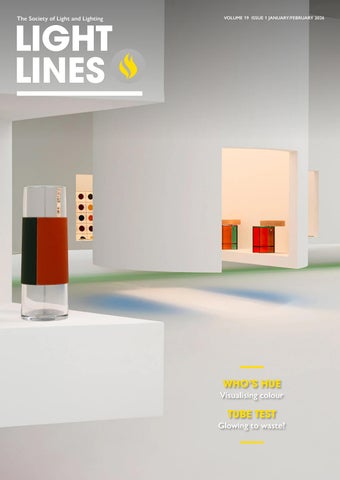
COVER: Hermès’s Collections at Milan Design Week 2025, lighting by L’Observatoire International, winner in the Visitor Experience and Museum Exhibition category of the 2025 LIT Awards, and the architectural lighting category of the Dezeen Awards
SLL YOUNG LIGHTER WINS WITH CHILDHOOD CIRCADIAN STUDY
Lucie Koháková has won SLL Young Lighter 2025 with a project that focused on the impact of light on human circadian rhythms, especially in early childhood. The project also involved an examination of how design can support healthier sleep through biologically appropriate lighting, using a specially created portable sleep aid lamp called Luna.
This year’s final was held in two locations, London, at XAL, and Manchester, at Ridge and Partners, and hosted and facilitated by SLL president elect Carolina Florian and SLL past president Andrew Bissell. All four finalists delivered their presentations to a live audience of their peers, and the event was also broadcast to the other location. The winner was decided by a combination of judges and audience vote with the result announced on 19 November at LiGHT 25 in London.
Koháková is a multidisciplinary designer with a focus on light, wellbeing and human-centred design. She completed her master’s degree in industrial design at the Faculty of Architecture, Czech Technical University, Prague, where her graduation project explored the connection between light and circadian rhythms in infants. This led to the creation of Luna, a lamp designed to support healthier sleep for both parents and children by using light free from disruptive blue and green wavelengths.
‘Luna is a simple idea with broad applicability, grounded in scientific principles of circadian lighting,’ said Andreas Schulz, CEO of lighting consultant Licht Kunst Licht, and one of the judges. ‘Lucie conveyed its potential for real-world impact in a way that was easy for both specialists and non-specialists to understand.’
The other finalists were Katerina Xynogala, WSP (Lighting the Way: Optimising Maintenance Factors for Tunnels); Ruoxi Yin of UCL (PENCIL: Perception of Environments for the Neurodiverse: Colour in Light); Shivani Manhas, IIITDM (Stellaris). For more information about how to enter email sll@cbse.org or go to SLL Young Lighter
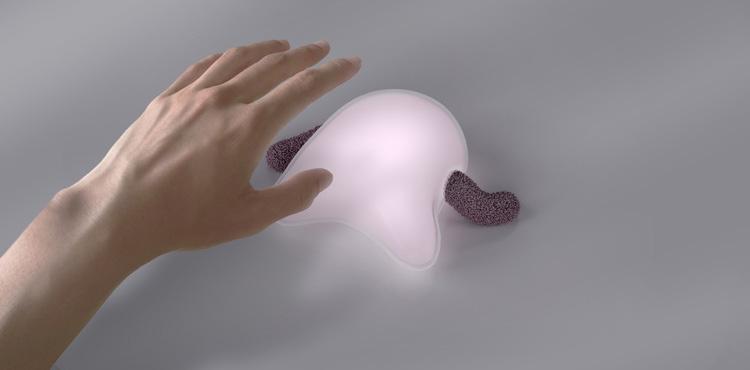
The latest iteration in the search for an interactive ‘companion’ with a semblance of sentience is a small jelly-like gizmo called TruTru. It can change temperature and texture (mimicking wood, sand, stone or fabric), produce pulses and tremors, and, crucially here, emit light to communicate different states, primarily through touch (using haptics).
Created by JUE Design and Research Studio with the Intelligent HumanMachine Mechanical Interface Lab at Hong Kong Polytechnic University, TruTru has three ‘personalities’: companion, meditation and sleep modes.
Soft light pulses show rest mode, steady light indicates active mode. In companion mode its surface emits a faint glow when someone approaches. In meditation mode it reduces light emission and operates with long, lowfrequency pulses imitating calm breathing. Light also signals readiness or reaction to touch.
https://juedesign.com/trutru-1
LIGHTERS SHINE AT PRESIDENT
SLL lighting professionals received a record number of medals at the 2025 CIBSE President Awards at Claridge’s in October.
Kevin Kelly (pictured), former president of both the SLL and CIBSE, was awarded a gold medal. Antony Ownsworth, SLL president in 2007, was presented with a silver medal.
Helen Loomes, Ruth Kelly Waskett, David Mooney and Austin Williamson all received bronze medals.
The medals are presented to recognise exceptional service and commitment.
AWARDS COMIC RELEASE
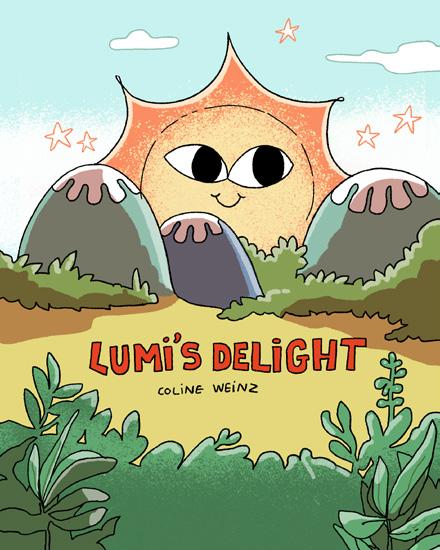
Dr Anna Biller, a postdoctoral researcher in chronobiology and health at the Technical University of Munich, has worked with science-trained cartoonist Coline Weinzaepflen to create an educational comic book for children aged six to 10 explaining the nature of light.
Lumi’s Delight follows a curious ray of sunlight on its journey from the sun to Earth, exploring how daylight interacts with the natural world. ‘The comic introduces both young readers and adults to the science of light and its essential role in biological processes, such as photosynthesis and circadian rhythms,’ says Biller.
‘The aim is to inspire curiosity about natural phenomena, foster scientific literacy, and raise awareness about the importance of daylight in our daily lives.’
The English version of the book can be downloaded here: Lumi’s Delight
DRAMATIC FLARE
The SLL’s Ready Steady Light event marks its 30th milestone – with batteries included
Celebrating three decades, SLL Ready Steady Light has become one of the society’s flagship events. ‘The competition provides a space for creativity and play, a return to the basics of design and engineering,’ says SLL secretary Brendan Keely.
Each year teams of lighting designers, manufacturers and students come together to create exterior lighting installations, using a limited selection of equipment and within just three hours.
The competition takes place in association with Rose Bruford College, specialising in theatre and performance, and the IALD, which has been a supporter from the beginning. The college has a BA Creative Lighting Control Course whose students both
help organise and participate in RSL, allowing them to gain hands-on experience, experiment with lighting techniques and work alongside lighting professionals in a unique environment.
For the first time, the latest event, held last October, required teams to learn how to operate LED battery-powered luminaires, giving them a new challenge in addition to the time constraint and zero budget.
‘I was blown away by the creativity of the teams and their innovative use of equipment’ – Kristina Allison
A total of 15 teams competed for the three traditional awards: technical and artistic, and one given by their peers.
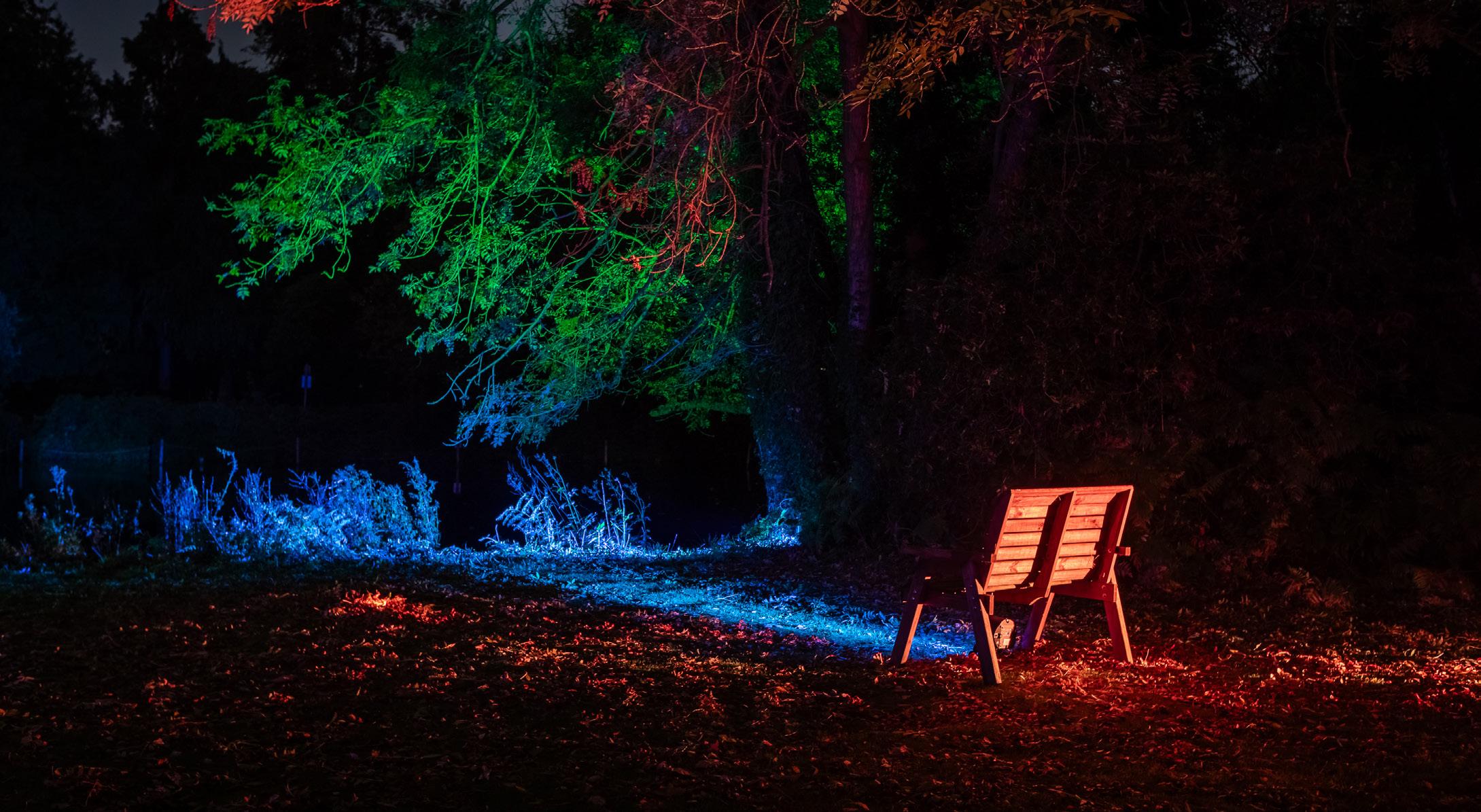
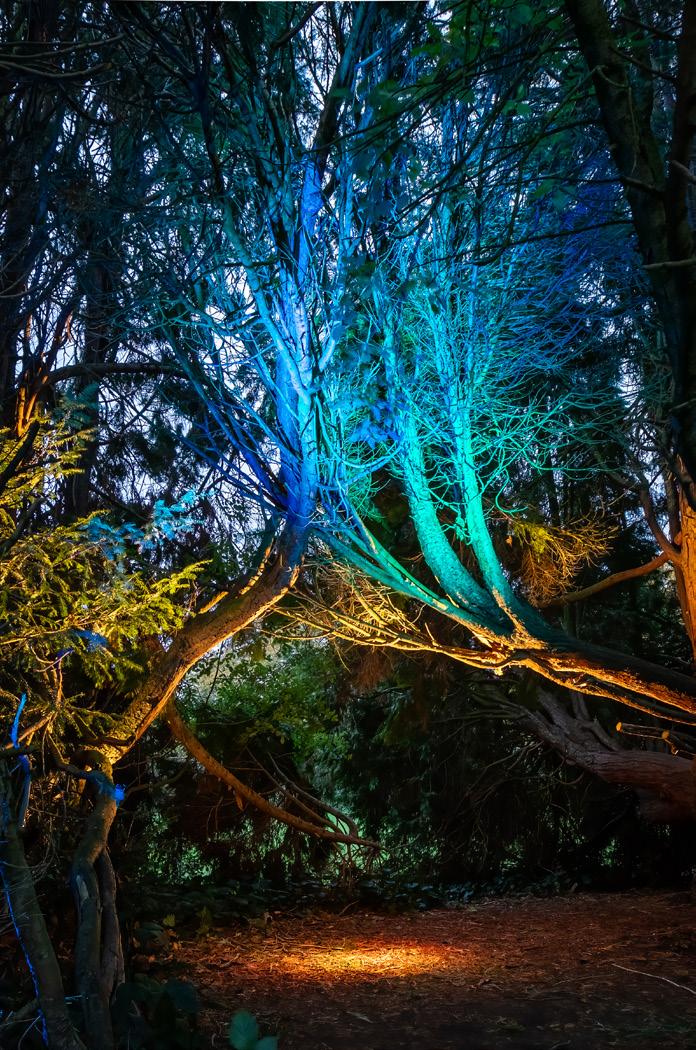
The Technical Award, judged by SLL president Kristina Allison and Dr Jemima Unwin Teji, lecturer and researcher at UCL, went to the Rose Bruford College team for their design called ‘Embers’.
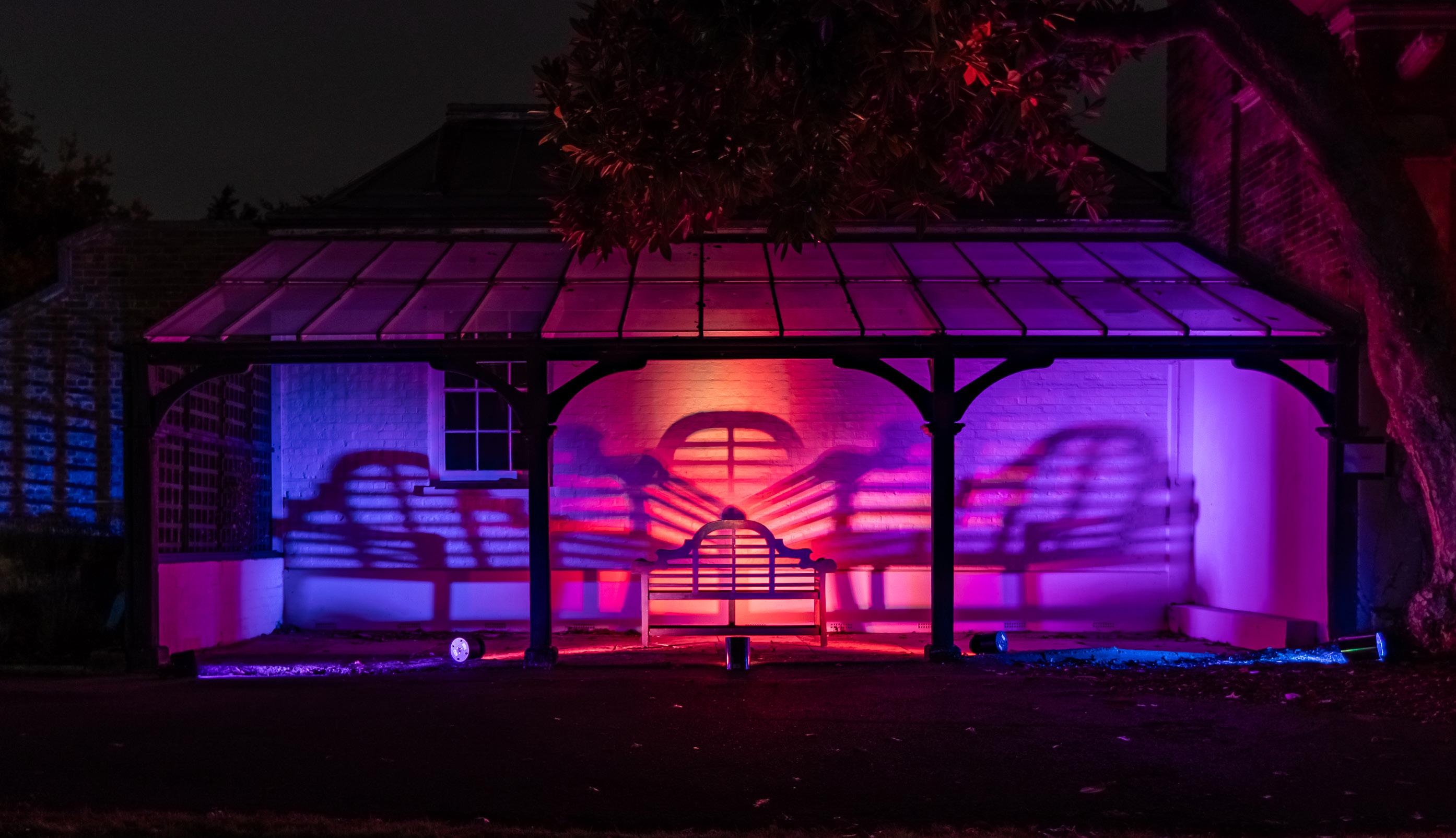
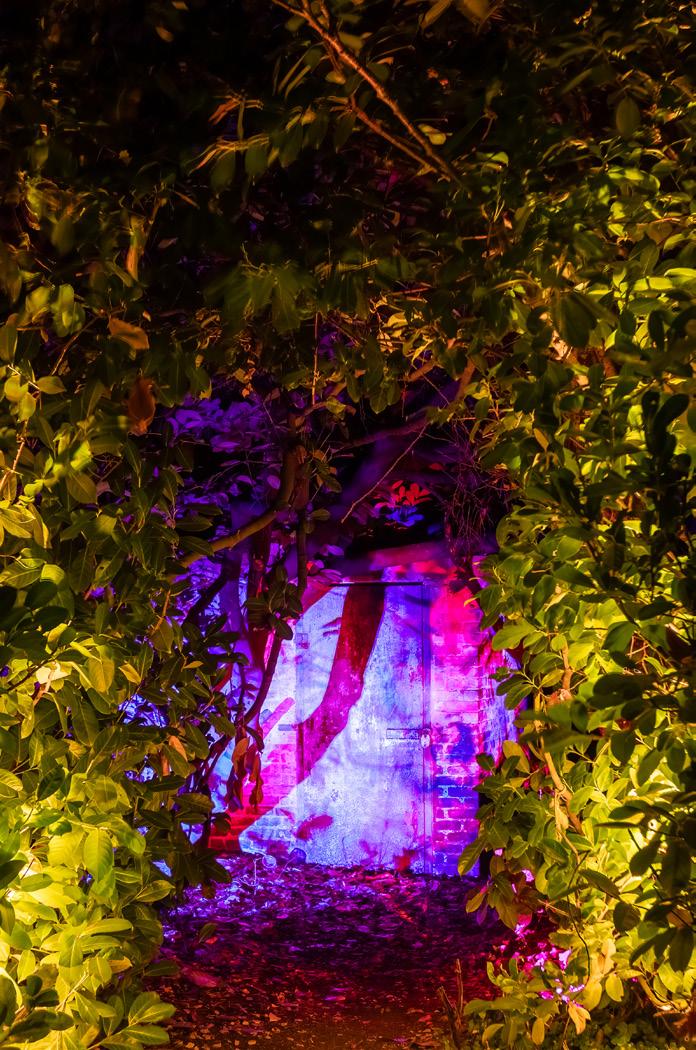
‘Evening in Kyoto’, created by the team representing building engineering and consulting firm Introba, scooped both the Artistic Award and Peer Prize. The former was judged by Christian Wendel, director at Maurice Brill Lighting Design and representing the IALD, and Professor Nick Hunt, digital research and innovation fellow at Rose Bruford College.
‘I was blown away by the
p ‘Evening in Kyoto’, by the Introba team, scooped both the Artistic and Peer Awards
Graham Baker
Photography @grahambakergbp
Ecreativity of the teams and their innovative use of equipment, especially our winners from Rose Bruford College and Introba,’ said Allison.
‘This amazing event has been running and inspiring lighters for 30 years now.
‘The society is committed to providing students and lighting professionals with an opportunity to have fun and work together, with the added element of some friendly competition,’ added Allison.
If any lighting manufacturers would like to donate or loan equipment to Rose Bruford College, supporting their lighting education programme and students, along with future RSL events, please contact the SLL at sll@cibse.org
Participating teams
Arup
AtkinsRealis
CBG Consultants
DPA Lighting Consultants
DPA Lighting Consultants, London
Studio
IALD
iGuzzini
Into Lighting
Introba
Marlow Integrated Designs
Rose Bruford College
Silhouette Awards
UCL 1
UCL 2
WSP
p The team from Rose Bruford College won the Technical Award with ‘Embers’
p Installations by teams from WSP (left) and DPA Lighting Consultants (right)
All images by Graham Baker Photography
p ‘I f not a fear of colour, a suspicion that its use is intrinsically vulgar and polluting has long been evident in architecture’
PIGMENTS OF THE IMAGINATION A
In the first of a two-part series, Francis Pearce looks at colour vision. Can we really trust our eyes, he asks, or our instruments?
little more than a century ago, Matthew Luckiesh, General Electric’s director of applied science wrote that ‘the recent increase in the luminous efficiency of light sources and the
‘Figuratively, colour has always meant the lessthan-true and the not-quite-real’
– David Batchelor, Chromophobia
rapid strides in the development of the art of lighting are largely responsible for the growing interest in colour and quality of light’. He added that ‘much is yet to be learned regarding the physiological and psychological effects of colour, and the laws for its proper use are hazy and not well understood.
However, equipped with a full knowledge of the physics of colour, an aesthetic taste and a comprehensive view of
what is known and unknown regarding the physiological and psychological influence of colour, a person is capable of utilising many of the possibilities of colour in lighting.’
One of Luckiesh’s achievements was to create a daylight lamp with tungsten filaments and blue glass that approximated the colours of natural light and was used widely in department stores and other places where it was important to see the ‘true’ colours of objects. He also designed the Mazda Flametint lamp, an incandescent ‘bulb’ whose rich, warm glow mimicked light from a hearth or candle. An advert for it in Good Housekeeping in 1929 exhorted readers to ‘wake up your home to magic beauty, richness and warmth of colour – colour that is felt rather than seen’. Both lamps performed a trick of the light – or more accurately, the source – playing with the selection of wavelengths to alter the colour temperature of ‘white’ light. It is one of the many manipulations and illusions that contribute to what light artist David Batchelor calls our ‘truly ambivalent’ relationship with colour. ‘Figuratively, colour has always meant the less-than-true and the not-quite-real,’ according to Batchelor. ‘In Middle English “to colour” is to embellish or adorn, to disguise, to render specious or plausible, to misrepresent,’ he writes in his book Chromophobia.
If not a fear of colour, a suspicion that its use is intrinsically vulgar and polluting has long
been evident in architecture. As an article on polychromy in Ancient Greece put it in the Architectural Record in 1922, while ‘in the pictorial arts, colour stimulates imaginative processes...’ colour ‘contributes an extraneous form of beauty to that which is purely architectural; the gratification of the aesthetic sense is visual rather than intellectual.’
In White Walls, Designer Dresses: The Fashioning of Modern Architecture (MIT Press), Mark Wigley suggests that the absence of colour in modernist architecture reflects a belief that ‘civilisation is defined as the elimination of the “superfluous” in favour of the “essential” and the paradigm of inessential surplus is decoration.’
Although he would subsequently create his own palette of interior colours, in 1929 Le Corbusier expressed the view that polychromy on exteriors ‘has the effect of camouflage; it destroys, disrupts, divides and thus works against unity.’ By contrast, he wrote in praise of whitewash, that if a house is pure white, ‘the white of the chalk is absolute; everything becomes apparent, becomes excellently described, black on white; that is unambiguous and honest’.
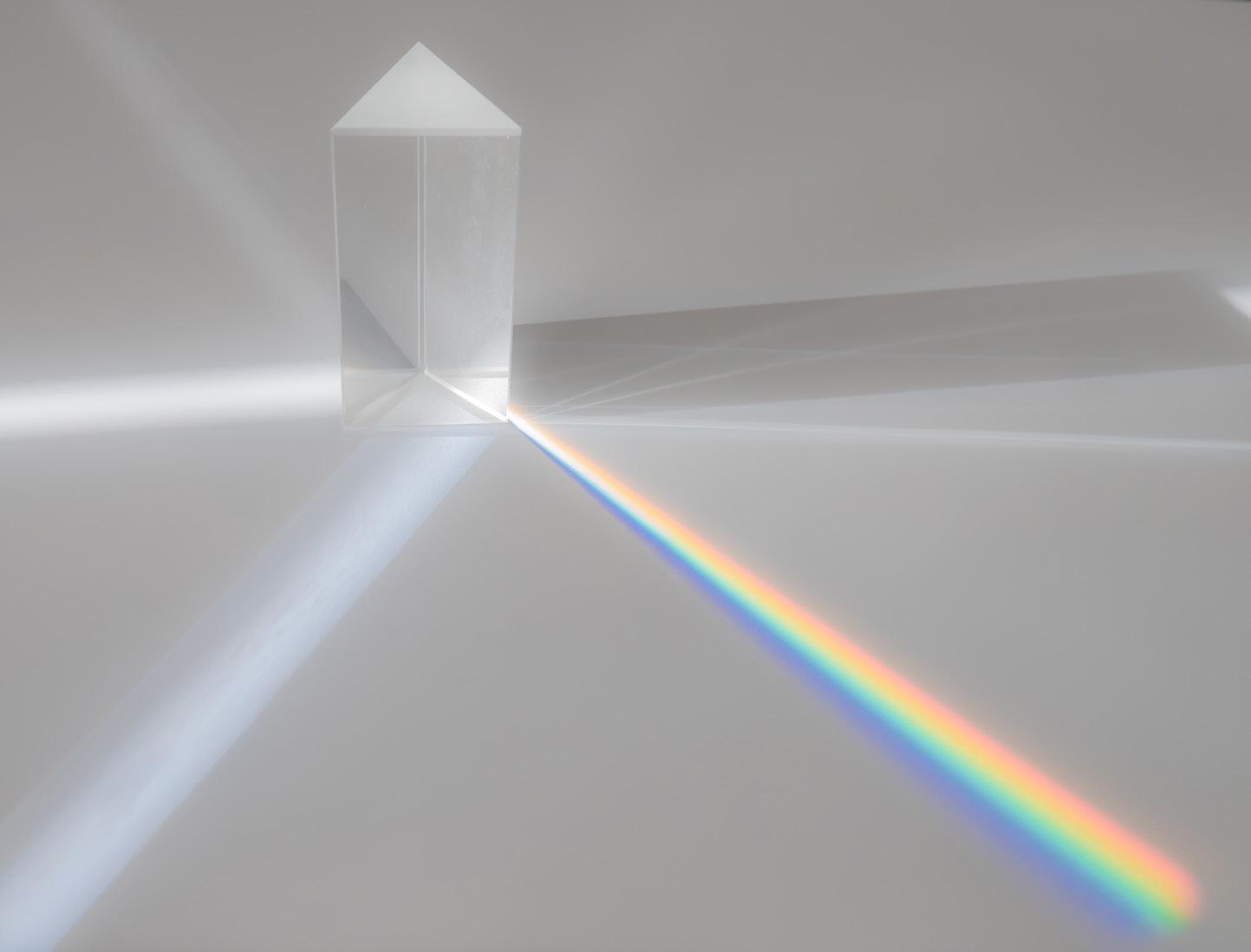
Although we often think of white as the absence of colour, it is almost but not quite the opposite. Isaac Newton famously used a prism to split white light into rainbow colours of differing ‘refrangibility’. He then even more cleverly recombined them, reassembling the ‘full spectrum’. Or did he? Fully sighted humans can detect and process light with wavelengths generally reckoned to be between around 700nm and 390nm, the violet end of the visible spectrum. Other creatures can see beyond this colour horizon, which begs the question, is white light really ‘full spectrum’ light?
The array of tiny light-sensors at the back of the retina includes up to seven million daytime-vision cone cells. There are normally three types of cone (called S-, M- and L-cones), which detect overlapping ranges of light of short, medium and longer wavelengths, broadly interpreted as violet-blue, green-yellow, and red, and register the intensity of light. The three-cone human eye system is called trichromacy.
Most mammals are dichromic, some creatures including pigeons are pentachromatic, while some species of dragonfly have up to 30 types of receptor including ultraviolet sensors. Around one in eight women is tetrachromatic (with a fourth type of cone cell). This is due to
p Newton split white light into rainbow colours, and then even more cleverly recombined them, reassembling the ‘full spectrum’. Or did he?
a mutation of the genes in the X-chromosone for the light-absorbing opsin molecules in the M and L cones. It ought to mean that they can differentiate up to 100 times as many colours as the rest of us within the same 700nm to 390nm range. Sadly, only a fraction actually perceive more than usual, which indicates an issue with the brain, not the eye.
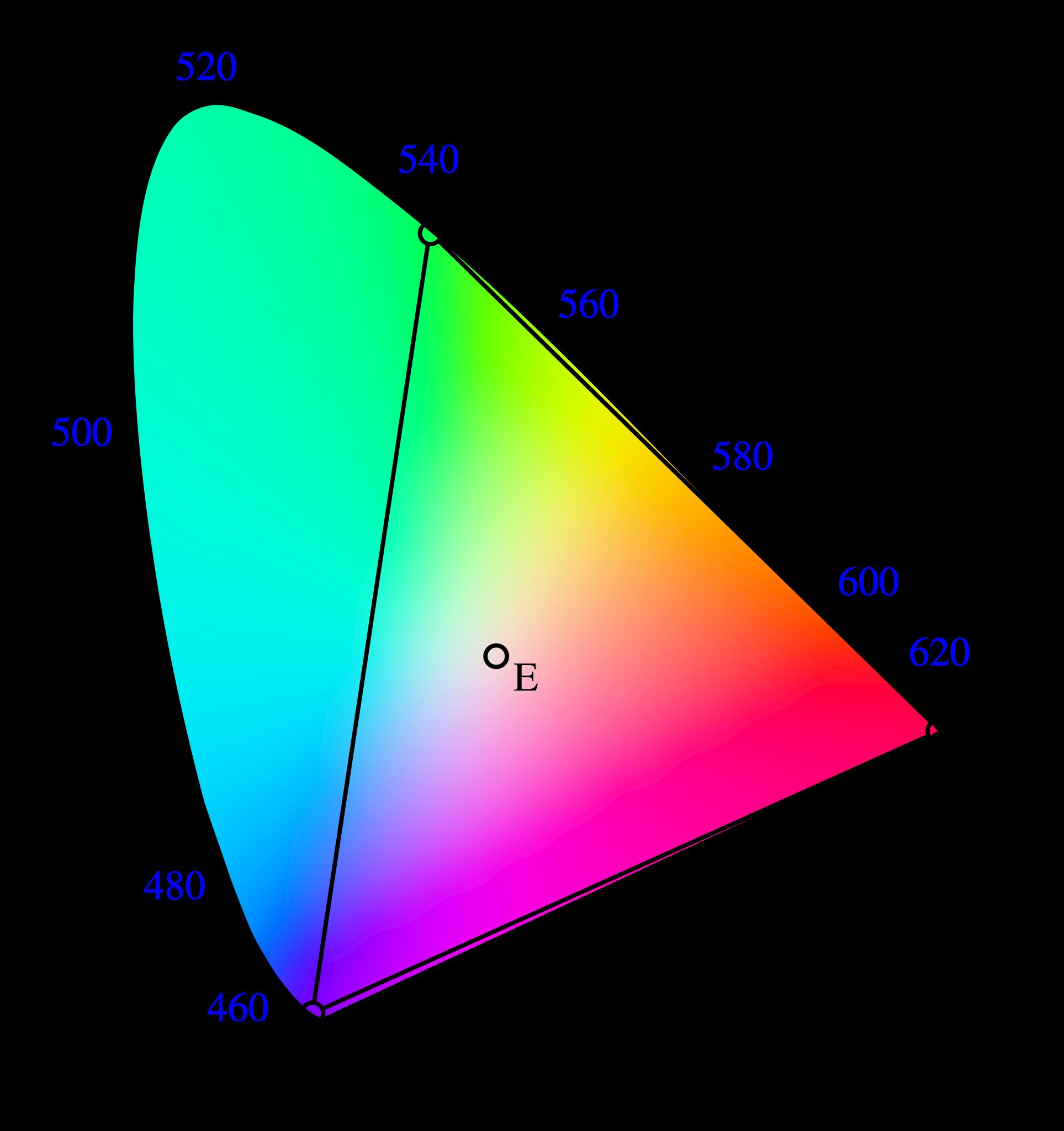
According to a report on hospital lighting for Britain’s National Health Service only four per cent of registered blind people in the UK have no sight at all and most are able to make out shapes and contrast in colour. As the light dims, though, there is a transition between photopic (cone-based) and scotopic (rod cell-based) night vision during which we first perceive a shift in colour contrast, known as the Purkinje effect, and then, in effect, we all become colour blind. Needless to say, objects do not change colour in the dark, only our perception changes. Throughout, a third type of photoreceptor sends the brain non-visual information affecting the body clock. In 1931, the Commission Internationale de l’Eclairage or International Lighting Commission (CIE) agreed a means of quantifying all the colours that an ‘average’ trichromatic person can see. With only minor refinements, the CIE 1931 Colour Space developed by William David Wright and John Guild remains in use today. It uses combinations of all the colours that can be mixed from the three primaries absorbed by the eye – red, green and blue – to map colours on to a sail-like volume called the gamut, a term borrowed from music where it refers to a range of available notes.
The brain has to carry out a kind of statistical analysis of responses across a population of receptors to decipher their various wavelengths and intensities. This ‘triangulation’ enables us to spot the poisonous berries among the nutritious leaves. Neurons called opponent cells simplify the algebra in much the same way that the RGB chromaticity coordinates in the CIE colour space are ‘normalised’ mathematically (made to add up to one) so that only two values are needed to describe the properties of a light source.
The human system works miraculously well on the whole but can be fooled; some sources with different spectral power distributions will appear the same – when, for example, red light with a particular intensity exacts the same response as green light of a different but
specific intensity. This phenomenon, which occurs more often with near neutral or dark colours, is called metamerism and is akin to jamming a radio signal. Sources can be metameric. Two samples of materials that appear to be the same colour under one source may not under another.
The information sent along the optic nerve is processed in a region of the brain known as visual area 4 or V4. In addition to colour, brightness and texture, V4 also processes shape, orientation, curvature, motion and depth, and in doing so extrapolates everything we ‘see’ from tiny amounts of fragmentary information.
‘Around one in eight women is tetrachromatic... due to a mutation of genes in the X-chromosone’
The visual system also filters out a lot of extraneous information. Our eyes constantly judder and are full of floating gunk that gets in the way of the light passing through to the retina. The lens itself fluoresces, especially when exposed to light with a preponderance of blue wavebands, which also affect the dilation and constriction of the iris. And, rather than taking in a whole image like a widescreen movie, our eyes randomly sample small patches of visual data about the apparent size of a full moon roughly five times a second. V4 not only joins the dots but edits and animates them, too.
Part two of the article will follow in the March/April issue. The article was first published in its entirety in Lighting magazine (Vol 48 Issue 6). Francis Pearce is a writer and editor, and co-author with Michael Grubb of the recently published Stories with Light
p With only minor refinements, the CIE 1931 Colour Space, developed by William David Wright and John Guild, remains in use today
A SOURCE OF CONCERN
The ban on fluorescent lamps in the UK came into force two years ago. But does it always pay to replace them with LEDs? James Martin thinks it’s a bit more complicated than that
Since somewhat accidentally falling into the lighting world I’ve always wanted to light a library: subtly illuminating spans of high, oak shelving, making the colours and images of the books’ spines and covers pop, lighting people’s journeys through the pages of literature, research or adventure. Adding a soft glow to the already peaceful ambience characteristic of a library.
As I look down my list of some of our sites that are due lighting surveys there are 15 libraries, together with sites ranging from offices and depots to public toilets and care homes. While the list covers around 80 properties, it’s a drop in the ocean compared to the full list of our sites. We’re slowly relighting our way through our 150 or so schools, and we can say that out of our nine leisure centres, five of them are fully LED.
It’s slow going. There are issues that need
‘The “LED revolution” has created a huge emphasis on efficiency, it’s generated numerous lighting upgrades and replacements. But efficient doesn’t mean better’
resolving and things that need to be learned along the way, as we strive to keep up with the fluorescent lamp ban, improve efficiency and, more importantly, ensure quality lighting throughout our estate.
The first issue, which we knew from the start would be an issue, is budget. As with every public sector organisation at the moment money is hard to come by – it has to be spent wisely and every penny has to count. And while the majority of people reading this article will understand the importance of lighting, to a great many it remains merely a necessity, something that can be cut to save money easily. And to a point, they are right.
When you’ve got buildings that have leaking rooves or heating that doesn’t work lighting will be dropped down the priority list. Similarly, we all know that you can spend £250 on a 1500mm linear fitting, or you can go to a store
and buy one for £30. Again, we know it doesn’t do the same thing, but the purse strings don’t understand that.
Yet we are still replacing lighting, we’re finding the money to do that for schools, which is really important, and it’s really important we get that right, because it involves our children’s developing eyes. But for our corporate estate, we are borrowing the money based on money saved through the more efficient lighting. I’m sure there are more intricacies to it than this, but in effect, if we can save £2000 a year on the electricity bill through the upgraded lighting, and the works in total cost £20,000, then in theory we will pay that money back in 10 years. Incidentally, the cut-off for this to be deemed acceptable is eight years.
Then you have the other issue, which is something of a left-field one, and actually, leaves me bemoaning too much quality…
My colleagues and predecessors have always invested heavily in lighting when given the opportunity, and as a result we have lots of sites that are full of T5 fittings, with integral presence and daylight sensors. They’re very clever and all link together, and as a result are very efficient (across our main council office site, for example, these fittings typically run at about 40 per cent of their overall wattage).
They also work for the users as well, as the output of each fitting can be altered to suit. Anyone who has ever lit large, open-plan offices will know that the 500 lux guidance will suit about a third of the users, while the other two thirds will be split between those who like to work in underground caves and those who prefer a light level tantamount to working on the sun. So being able to adjust an individual fitting gives us the ability to deal as best we can with complaints and issues, but crucially also makes the users feel like they are valued and being considered.
And the thing is, not only are they efficient and fairly cost-effective to run, but they work and last. As I write this the fittings above my head in the office are nearly 20 years old and, barring new tubes, they provide us with very few issues. As a Yorkshireman (whose grandfather was born and raised in Edinburgh) the idea of having to replace something that a) works and b) is efficient, fills me with all sorts of strong emotions. It’s wasteful.
And sadly, the fact of the matter is, that if we were to replace the aforementioned lights, with the budgets available we wouldn’t be replacing with equal quality or efficiency, so not only would the financial benefits not be maximised, but the practical functionality would likely be less than it was before. We would then get complaints, so we’d have to rectify those, costing time and money, so in all honesty, any financial gains would be eaten up even faster.
So to summarise the main issues, we’ve got a lot of decent quality lighting the replacement of which offers little financial benefit. The only way we can get the money is to borrow it based on financial benefit, which we’re not getting. Yet we still, somehow, need to replace the lighting because of the fluorescent lamp ban.
The above is all very practical, and in theory I could probably end the article there and you’d all get the point, but there are human elements to this as well, an impact on people. One thing you learn working in a local authority is that what you do impacts the community. People are quick to complain if something isn’t to their
p The way children are taught is changing... But has the lighting been changed to reflect this?
liking, the sites again are quick to report faults and issues, and you have to own that – the buildings don’t get handed over to the client and that’s your job done, because we are our own client to an extent.
So, back to the libraries. Before last year I hadn’t set foot in a library for years, not because I don’t read, but simply because I don’t have need. I enjoy the peace and tranquillity (and the smell) afforded by bookshops, but also own a Kindle, so I get my books from other places. It’s hard to see beyond your own mindset sometimes so when I visited the first library on the list I fully expected it to be deserted, an empty room with cobwebs and a few outdated moth-eaten books scattered randomly on some shelving that’s seen better days.
But to my surprise this wasn’t the case. This small village library was pretty full, there was a grandparent and her grandchildren borrowing various books, the desks with computers were all in use, people were in and out to pay bills. And this was by no means a one-off. At all of the other libraries similar things were happening: there were tables with board games, gatherings of community groups such as the ever popular ‘knit and natter’ groups, people coming in for advice, assistance and, more importantly, community.
The libraries are to many a community hub, a lifeline for those who may not be able to pay bills online or get to what’s left of any local banks, a place to socialise in a safe environment, meet new people and catch up with friends. Effectively doing the job of the local pub, but for those people who don’t like sticking to carpets.
Similarly with schools, they’re ever changing, the way children are taught is changing – we had
blackboards, then whiteboards, then overhead projectors, smart boards and now we have interactive TV screens. When I started school in the 1990s we had an IT Room, then progressed to a ‘laptop trolley’. Now my daughter’s school uses tablets. More teaching is currently being done in smaller groups, out of the classroom, in any available space. But has the lighting ever been changed to reflect these changes? And these are our children, the future, whose developing eyes need the correct light to work to their full potential.
The ‘LED revolution’ has created a huge emphasis on efficiency, it’s generated numerous lighting upgrades and replacements. But it’s worth saying that more efficient doesn’t necessarily mean better. We’ve somehow sleepwalked into ‘upgrading’ lighting with single-use luminaires. I know that everyone reading this will know the importance of ‘quality’ light. And in my opinion, quality should come before efficiency.
But the sad fact is, that without the budget, and with the focus being on ‘energy saving’ to create that budget, the lighting for these places is going to suffer.
I don’t have the answers to how we deal with these issues, other than simply ‘getting more money’, which isn’t going to happen. But hopefully it shows the carefully intertwined relationships between the issues that the lighting world is facing and its interactions with some of the human beings who ultimately end up in the rooms we light.
James Martin, Ieng AMSLL, is a senior building services engineer with East Riding of Yorkshire Council
SOLAR NEXUS
A recently built cultural centre in China looks to the past and the ancient tradition of alignment with the path of the sun
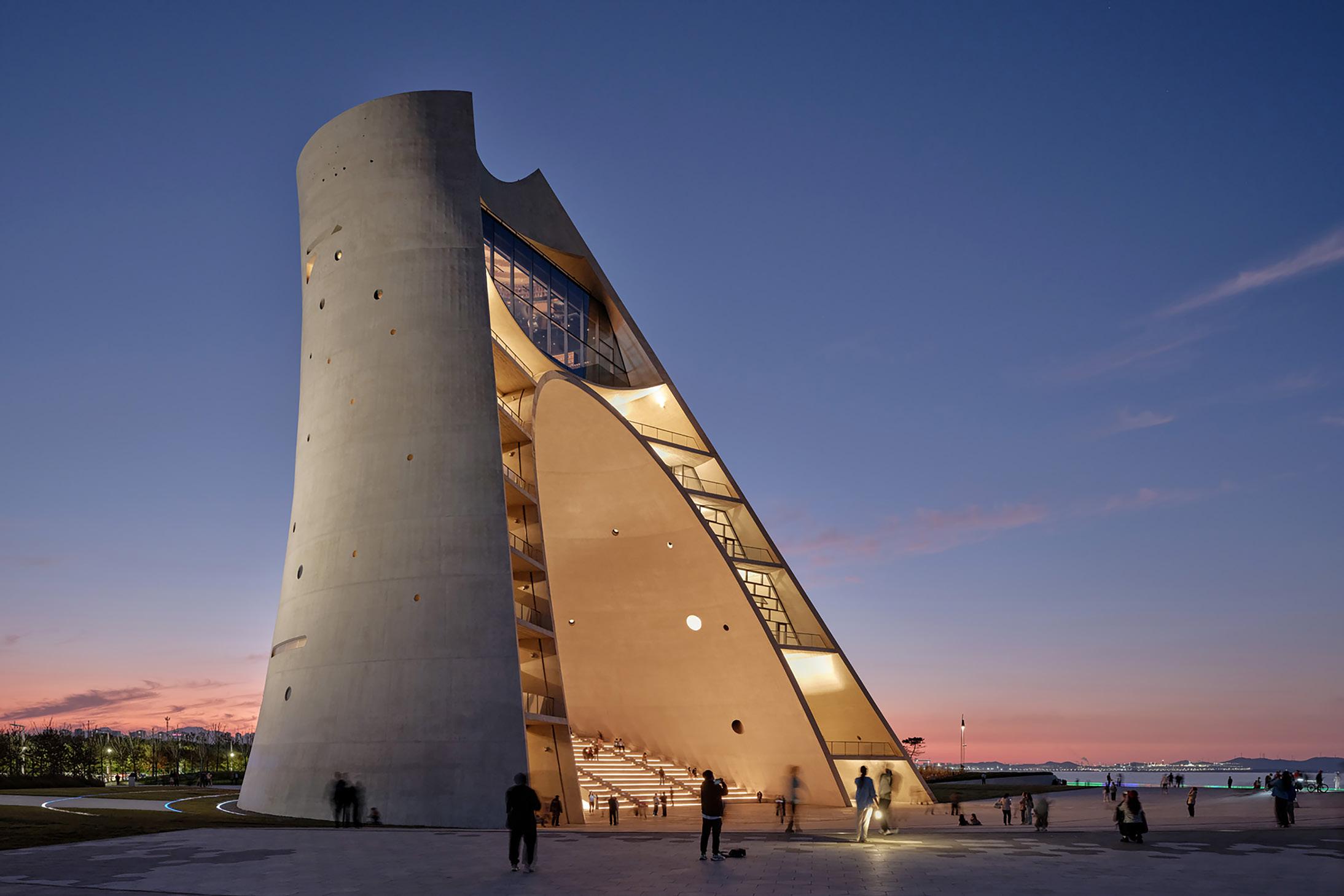
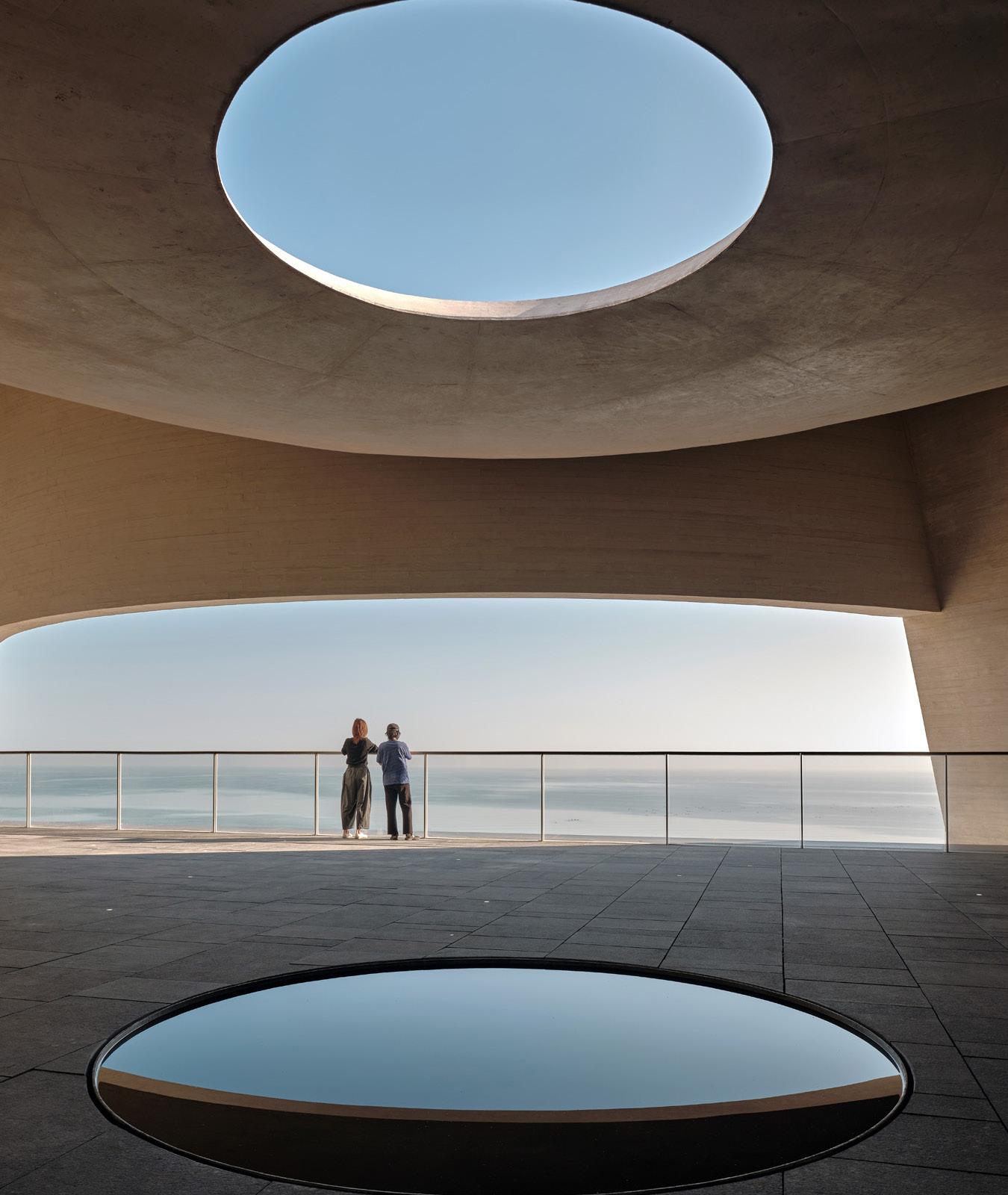
The Sun Tower, designed by Open Architecture, is a new cultural venue in the Yeda Development Zone in Yantai, China, on the coast of the Yellow Sea. The structure was designed to reflect and reference the region’s ancient history as an early site of sun-worshipping, and the later watchtowers constructed in the Ming Dynasty: essentially an amalgam of lighthouse, community focus and sundial.
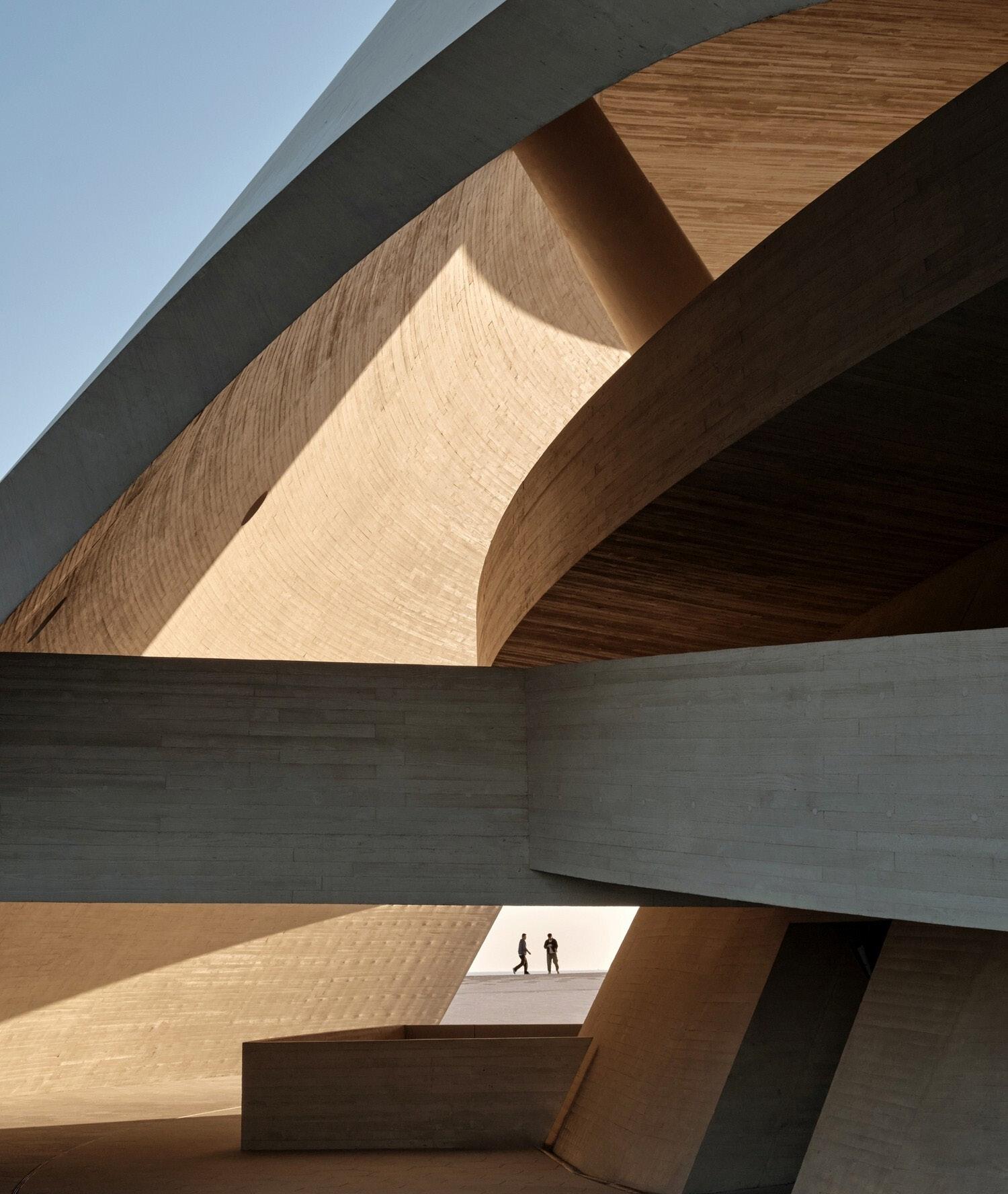
The 50m-high concrete tower combines an observatory, outdoor theatre, exhibition spaces, library, cafe, bar and the so-called Phenomena Space, all housed in a conical form inspired by the path of the sun. Built with two layers of slanted concrete shells, reinforced by horizontal slabs and ramps, the structure was engineered in collaboration with Arup. The curved form, with large openings on the seaward side, provides platforms and viewing areas overlooking the coast.
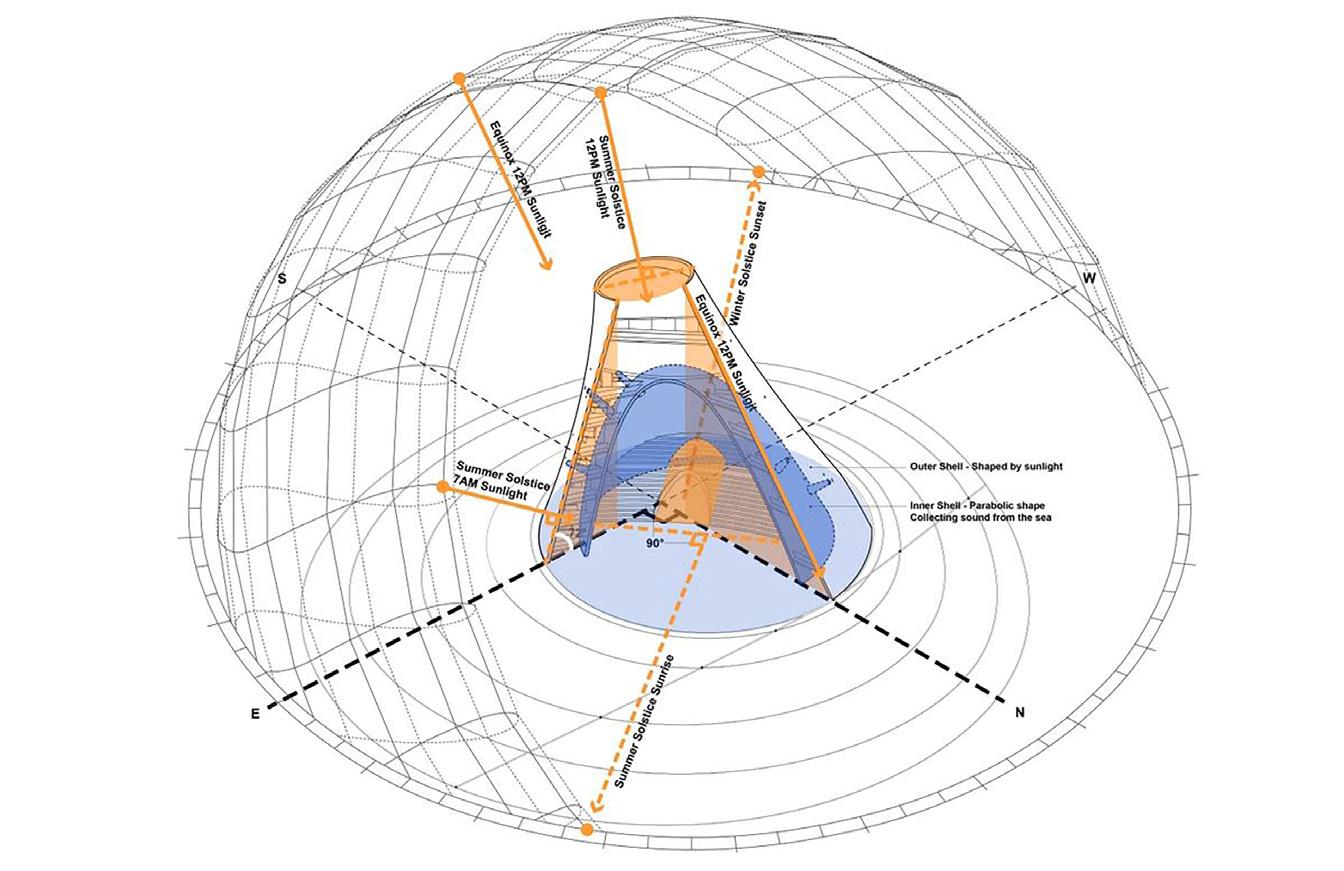
The outer, convex shell facing south and west was ‘shaped’ by the sun, while the inner, concave shell facing north and east is described as ‘collecting sound from the sea’. The edges of the tower and its various openings are determined by cardinal directions and solar markers, the equinoxes and solstices.
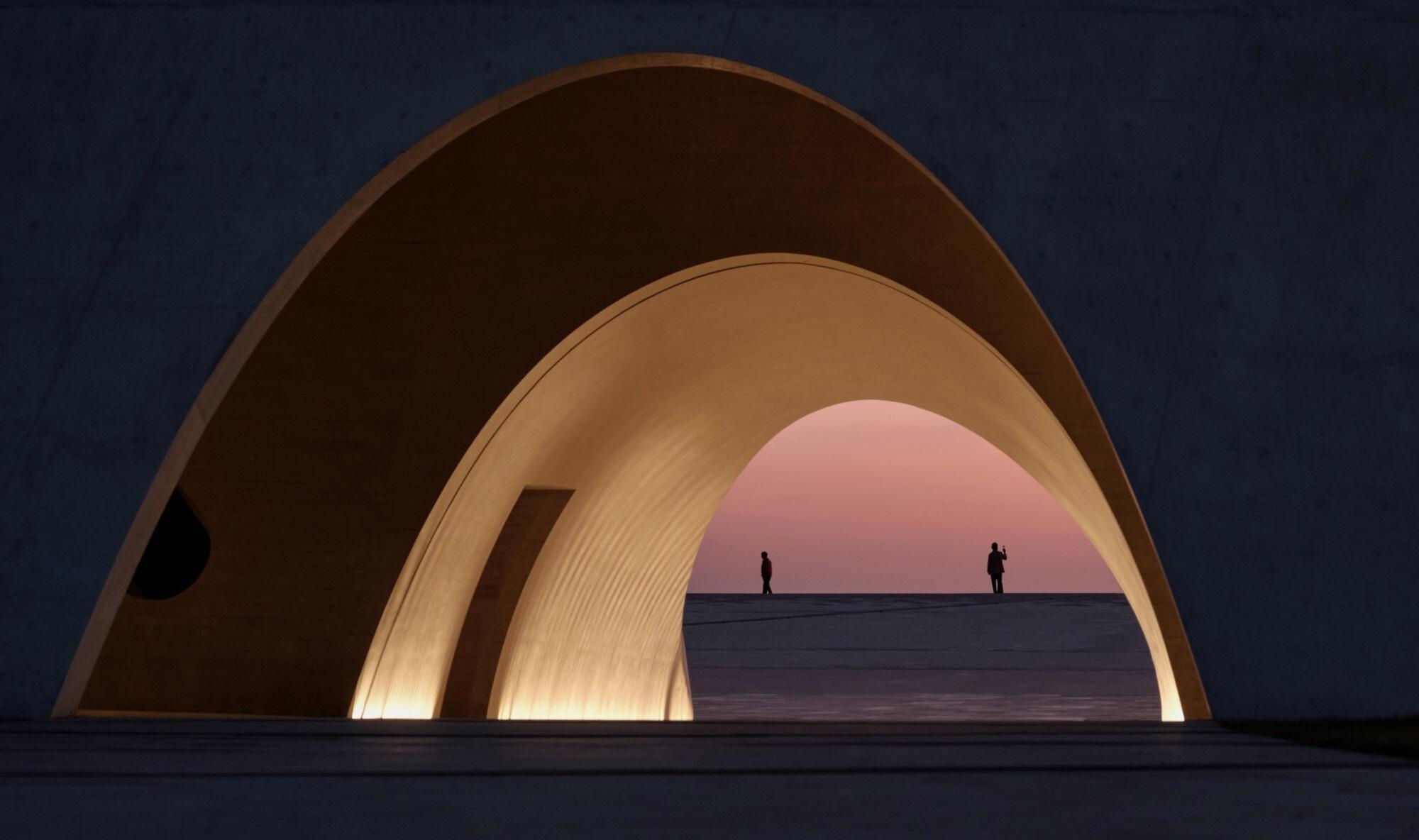
The northern edge aligns with the noon sunlight of the equinoxes, while the entrance tunnel is designed to frame the sunset on the winter solstice. The central semi-outdoor theatre is oriented toward Zhifu Island, aligning with the sunrise on the summer solstice, allowing visitors to experience solar events from within the building.
A series of elliptical rings radiates from the central plaza, signifying planetary orbits. These rings intersect with a water channel carved into the stone pavement, marking the shadows made by the building during the equinoxes, while an
outer ring celebrates the 24 solar terms from the traditional Chinese calendar with a series of fountains.
As visitors ascend the pedestrian ramps that wind through the structure, they come across exhibition spaces with digital screens and projection surfaces, and strategic hanging points for various displays. The top of the tower houses a library and the Phenomena Space, where visitors can appreciate the ocean views. This semi-outdoor observation deck features an oculus beneath which rainwater collects in a contemplative circular pool of water.
The structure features passive design elements, such as tunnel cooling, thermal mass for temperature stabilisation, crossventilation through openings on both shells, and a chimney effect for air circulation, all minimising energy consumption.
Open Architecture hopes the building ‘can help reestablish a tangible connection between people and natural phenomena’. It talks of sculpting the building ‘according to the sunlight, facing the sea with a sliced-open structure, paying tribute to time and nature’.
Client: Yantai YEDA City Development Group
Architectural, interior and landscape design: Open Architecture, Beijing
Lighting consultant: Ning Field Lighting Design
Structural and MEP: Arup
‘The northern edge aligns with the noon sunlight of the equinoxes, while the entrance tunnel frames the sunset on the winter solstice’
AFFECTING PERFORMANCE
Perception and memory are the two themes singled out by Iain Carlile from the latest online papers published in Lighting Research and Technology
Apaper by Noble and Isaacs features a study into autistic people’s perception of interior electric lighting installations. The study used photography (photos taken by the study group) and online questionnaires to record data on the response of autistic participants to electric lighting installations in the built environment. The study was designed by the lead author, themselves autistic, to accommodate the needs of autistic individuals.
Over a two-week period, 13 participants were asked to take photographs of indoor electric lighting and to describe/rate their images when submitted.
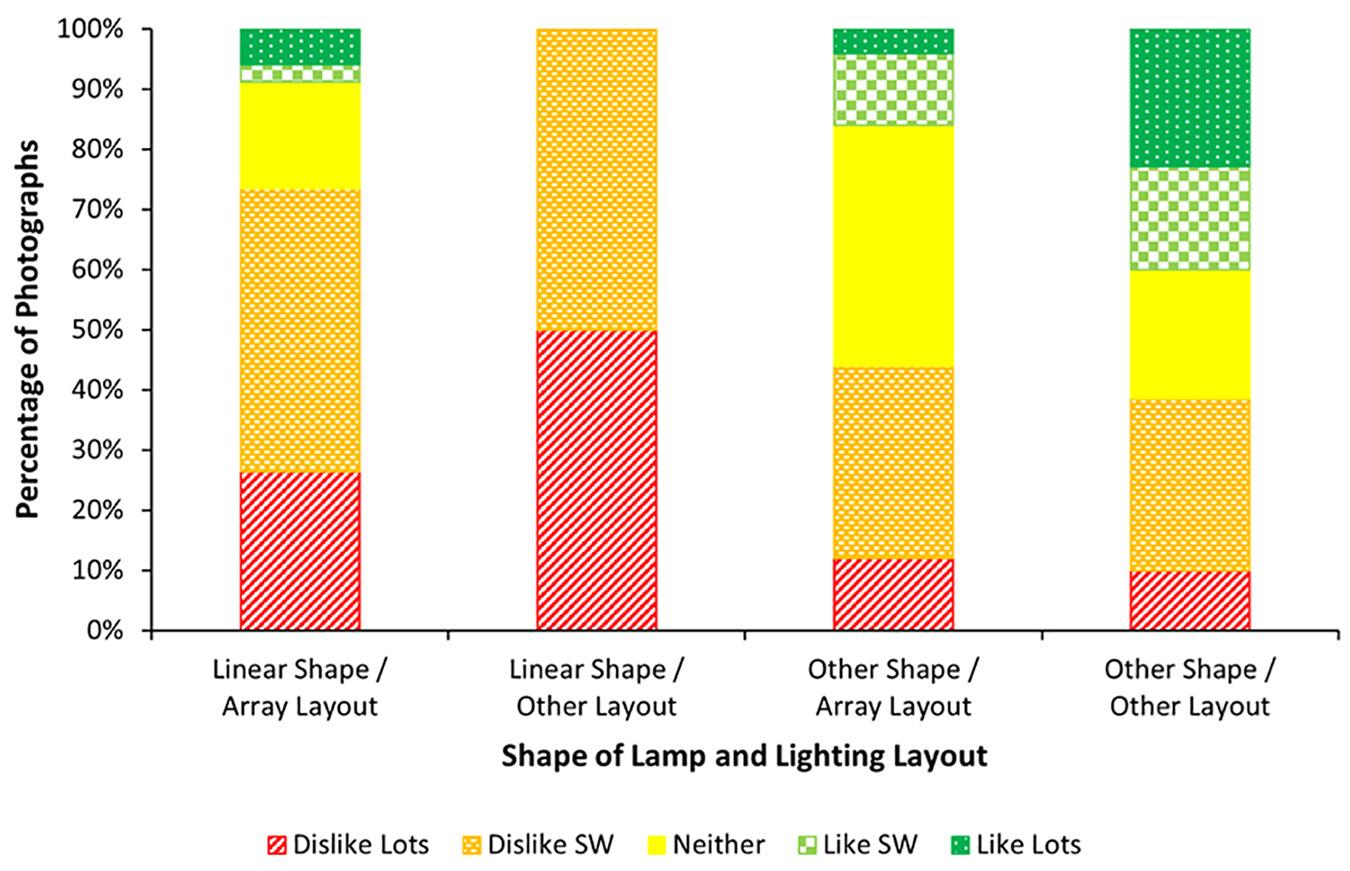
From the information gathered, four main themes were identified: 1 Lighting systems (layout, lamp shapes and types, number of lamps), 2 Technical factors (flicker, noise, brightness, colour temperature), 3 Reactions to lighting (positive and negative), 4 Use of descriptive language.
The authors note that a strong dislike of linear-grid lights was expected. However, the extent of this dislike towards the lighting systems in library/community spaces and medical buildings, particularly waiting rooms, was a concern, as these spaces are likely to be used by autistic people, and should prioritise comfort.
The research method used in this study allowed for autistic individuals to share experiences directly without being required to explain through an intermediary, or in a situation of potential discomfort. The data produced by the study should therefore be helpful in expanding our understanding of autistic people in relation to interior electric lighting.
Hsieh et al have examined human short and long-term memory performance under different indoor lighting environments and times. A total of 42 participants (11 male and 31 female, aged between 18 and 27) took
part in studies of their short and long-term memory capabilities.
The tests included a 2-Back Test and a Concept Map Test. In the first test participants respond to on-screen stimuli by pressing keys on the keyboard, allowing evaluation of shortterm memory through the comparison of correct key presses and reaction time.
The Concept Map Test, which assesses long-term memory, requires participants to undertake a study and prepare a concept map, subsequently returning later to attempt to reproduce the same map.
The studies took place under three different illuminance values (300 lux, 600 lux and 800 lux), with a constant CCT of 5000K and at two different times of day (morning and afternoon).
The results revealed that different illuminance levels significantly affected the short and long-term memories of participants. In the 2-Back Test people performed better under 800 lux, and in the Concept Map Test 600 lux showed a better memory capacity.
The time of day appeared to have an affect too, with participants performing significantly better in the morning tests. The authors note that the 800 lux condition in the morning was optimal for both short and long-term memory performance, and go on to note that the results of the test may have implications for future lighting research and design.
Iain Carlile, FSLL, is a past president of the SLL and a senior associate at dpa lighting consultants
Lighting Research and Technology: OnlineFirst In advance of being published in the print version of Lighting Research and Technology (LR&T), all papers accepted for publishing are available online. SLL members can gain access to these papers via the SLL website (www.sll.org.uk)
Autistic people’s perception of interior electric lighting systems: An initial study B Noble and N Isaacs
Effect of indoor illuminance on human short- and long-term memory performance
M-C Hsieh, H Qu, D Huang, X Gu and Y-C Lee
PICTURE PERFECT
Emilio Hernandez on the defining role of light in films
n my opinion nowhere is lighting a more defining factor than in films and the application of storytelling.
I regularly have to remind myself that almost all built environments shown on TV or film are in fact an impossible construct for an architectural lighting designer. We don’t have the control over camera exposure and positions, nor the ability to add or remove light to quite the same degree that a film director does, but we are able to at least use storytelling when presenting our designs.
I’m aware I’m no film critic and my list here may be a cliche, but I have tried to steer clear of some of the more obvious classics (Bladerunner, Alien, Citizen Kane... ) and I hope it provokes some thought next time you sit down with a bag of popcorn or stream a film without making it too much of a busman’s holiday.
Emilio Hernandez is co-founder of lighting design studio Ström and a member of the SLL Council
Insomnia (Erik Skjoldbjærg 1997 and Christopher Nolan 2002)
Detective Jonas Engstrom travels to northern Norway during the period of the midnight sun (between May and July the sun never sets in the north) which contributes to his insomnia. Scenes are bleached out with light, and daylight is increasingly seen as unrelenting and intrusive as the film progresses. Efforts by Engstrom to block out light in his bedroom using blinds create an unusual and distinctive lighting effect for a film. 2 5 1 4 3
2001: A Space Odyssey (Stanley Kubrick 1968)
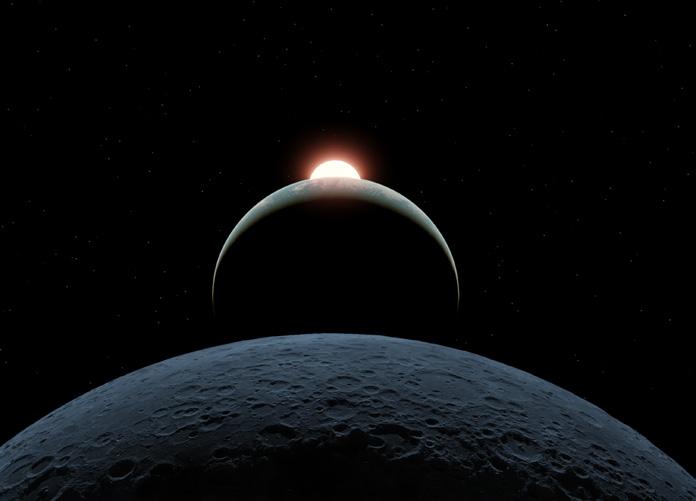
A film defined by its groundbreaking lighting and filming techniques. Bright and diffuse white light from many directions is used to create the sterile day-to-day environment in the Discovery One spaceship. Stanley Kubrick had ‘new’ miniature CDM-T light sources developed to enable the set lighting within the large rotating ‘centrifuge’ to be used as the practical lighting for filming. These would regularly explode during filming (overheating), but created a more realistic environment and contrasted strongly with the switch to saturated red light evoking danger when the ship’s computer HAL began to malfunction.
Ex Machina (Alex Garland 2014)
This sci-fi thriller is set in a subterranean lab without any natural light where a humanoid AI robot (named Ava) is being developed. Architectural lighting is used to define the set and create a domestic feel to avoid the usual ‘sci-fi’ cliche. The lighting establishes a sense of modernity and tranquillity but is then tuned to create drama and danger by altering the direction, colour and contrast. The interior lighting environment was captured digitally and then overlaid on to Ava’s polished metallic surfaces (all CGI’d) for a greater sense of realism.
Tron (Steven Lisberger 1983 and Tron Legacy 2010)
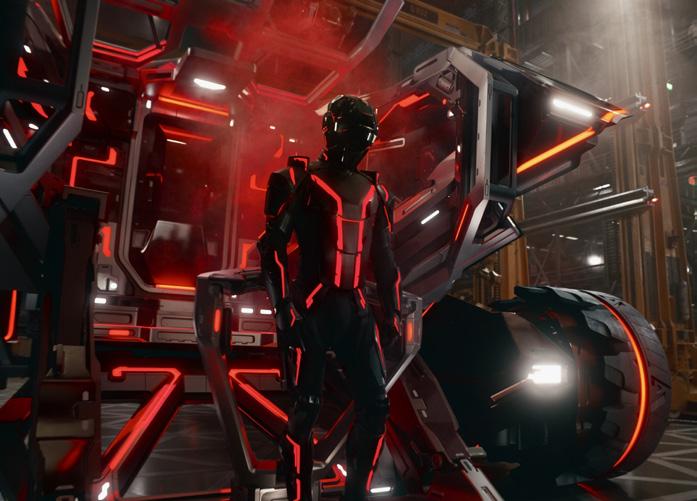
In contrast to Space Odyssey the original Tron film relied heavily on shadows and saturated light to define its digital setting. Lisberger uses darkness and contrast to his advantage, providing a greater sense of drama and realism while facilitating blending of real actors with the limited CGI capabilities of the 1980s. In the original film the actors’ iconic stripes of light embedded within their suits were manually coloured in after filming. In the 2010 film, costumes had integrated LED lighting allowing actors to better ‘inhabit’ their Tron characters.
The Grand Budapest Hotel (Wes Anderson 2014 )
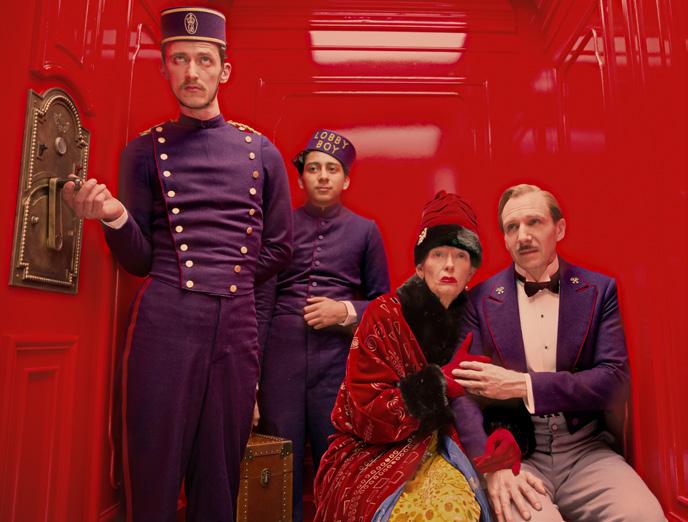
Anderson is expert at using colour in an emotional capacity. Set in a mid-1930s luxury hotel, pinkish hues denote nostalgia for the hotel’s heyday, with colder filters and bluish tones used to contrast with a starker present day. He also uses decorative lamps to capture the period, whereas films such as Asteroid City, set in the 1950s, use less romantic fluorescent lighting. His films typically have a saturated colour palette, and he deliberately uses general diffuse lighting and very few contrasting shadows to achieve his distinct aesthetic.
Events 2026
For details of all upcoming webinars, go to: www.cibse.org/society-oflight-and-lighting-sll/sll-events/upcoming-webinars-and-onlinecontent
For previously recorded CPD webinars (including regional webinars), go to: https://www.cibse.org/get-involved/societies/society-of-light-andlighting-sll/sll-events/on-demand-webinars-past-presentations
EVENTS
LIGHT + INTELLIGENT BUILDING MIDDLE EAST
Date: 12-14 January
Venue: Dubai World Trade Centre https://light-middle-east.ae.messefrankfurt.com/dubai/en.html
WORKSPACE DESIGN SHOW
Date: 25-26 February
Venue: Business Design Centre, Islington, London https://workspaceshow.co.uk
LUCI CITIES AND LIGHTING SUMMIT
Date: 25-27 February
Location: Oulu, Finland luciassociation.org/events/luci-cities-lighting-summit/oulu-2026/