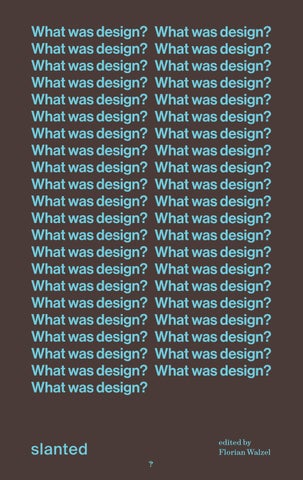
What was design? Declarations and definitions from a century of creative quest

Page 1


What was design?

What was design?

What was design?

What was design?

What was design?

What was design?

What was design?

What was design?

What was design?

What was design?

What was design?

What was design?

What was design?

What was design?

What was design?

What was design?

What was design?

What was design?

What was design?

What was design?

What was design?

What was design?

What was design?

What was design?

What was design?

What was design?

What was design?

What was design?

What was design?

What was design?

What was design?

What was design?

What was design?

What was design?

What was design?

What was design?

What was design?

What was design?

What was design?

What was design?

What was design?

What was design?

What was design?

What was design?

Declarations and definitions from a century of creative quest

Design is extended in space as music is extended in time […]
Stripped of hocus-pocus, the goal of design is sales — at a profit.

A designer […] applies a variety of partially digested and seemingly unrelated pieces of knowledge to a variety of inadequately defined and seemingly incompatible needs, to produce a single unified plan of action, which

he hopes and believes will be eminently satisfactory to all concerned […]
The end of all design is human satisfaction.
[…] designers are concerned, ‘to create beautiful objects for the greatest number’ […]
→ 30

Design means conception, not form!

Design = Function Form

Design is the conception and realization of new things.

What was design?

Three discernments on the undiscernible and seven explorations

The term ‘design’ has always been a subject of interpretation by its (ab)users. Today it means one thing, tomorrow another—to the point of total arbitrariness. Yet this does not render it useless; on the contrary, it is available to anyone who wishes to use it for any purpose.

— Gert Selle

Design cannot be everything. It must be something. — Mikkel B. Rasmussen

Verbalizing design is another act of design. — Kenya Hara

1 see Jones, John C. “What Is Designing?” Design Studies. A Reader, edited by Hazel Clark & David Brody, Bloomsbury, London & New York, 2009, p. 77. First published 1992.

2 “Up to now, there have been few successful attempts to reduce design to a common denominator, or even to find a generally applicable definition for it.” Vannotti, Stefano. “Dimensions of Design. Operating in a New Space of Opportunity.” Not at Your Service. Manifestos for Design, edited by Björn Franke & Hansuli Matter, Birkhäuser, Basel, 2021, p. 56.

3 see Leerberg, Malene. “Design in the Expanded Field. Rethinking Contemporary Design.” Nordes Research Paper, 2009, p. 1. dl.designresearchsociety.org/nordes/ nordes2009researchpapers/15

The attempt to narrow down the meaning of ‘design’ opens up the concept

Design is undoubtedly a key term of the twentieth century and beyond. Also, design is a concept with a symptom—indeterminacy in the broadest sense. Of course, design can be defined, and this is done incessantly, but each attempt at clarification only seems to increase the overall ambiguity. Anyone who reviews half a dozen definitions of design from different sources will be surprised by the inconsistency in perspectives, concepts, and keywords.1

If you look at definitions from the past century, the impression is even more striking: there has been no discernible progress in answering the question, “What is design?”2 It has now been established that hardly any publication concerned with design, whether book or essay, commences without first clarifying what design is.3 This is done either in the grand format of a definition that claims general validity, or in the modest form of a declaration that states only how design should be understood here and now, depending on the context. Alas, in most other disciplines, it would seem unreasonable to continually redefine the fundamentals of the subject. An article about chemistry, for instance, can be written without ever needing to explain what ‘chemistry’ is— unlike in design. Here, the absence of a universally recognized definition compels us to define our terms and, in doing so, to develop a kind of proto-philosophy 4 about what this is all about.

The situation is unique: anyone who wants to comment on design will find not a void, but an oversupply of interpretations. Given the current lack of a general consensus, the risk of misinterpretation is all too obvious.

What do you do to avoid being criticized for all kinds of ambiguity? You define, declare, or reclaim your subject matter once again. The definition thus

created adds one more to the already excessive supply of definitions. The result is an enormous horizontal expansion of possible understandings of design, which seems to demand renewed narrowing.

Defining is exhausting, though it carries comparatively little risk. A definition, by its very nature, is never true or false; it inaugurates the object it names, and thus acquires meaning solely in relation to the operations that follow. The consequences of such a creation become most resonant—mutatis mutandis—when one has authored the definition oneself. Yet, the task is not to sift through purportedly false definitions in hopes of finding a correct one, but rather to inquire what may be accomplished with a definition: what it renders visible or consigns to obscurity

The symptom has a second dimension, namely the special circumstance that the word ‘design’ possesses a triple meaning.5 Design as a verb refers to the process of planning, conceptualizing, and making (process design). Design as a noun has two sub-meanings; on the one hand, it denotes the model, plan, or drawing (plan design); on the other, it names the structure or form of the completed artifact (object design).

Within the term ‘design,’ the creative act, the model, and the result remain inextricably intertwined, rendering any attempt at their disentanglement all the more elusive. John Heskett, with wry humor, encapsulated the resulting perplexity in his oft-quoted aphorism: “Design is to design a design to produce a design.”6

A further complication arises in the persistent failure of so-called ‘designers’ and design theorists to assert authority over the term.7 In contrast to major conceptual questions—“What is the state?” or “What is an author?”—which particular disciplines appear singularly equipped to address, the inquiry “What is design?” remains a matter of lively and popular debate. Sociologists, anthropologists,

4 “Indeed, most designers, to the degree that they have reflected on their discipline, will gladly, if not insistently, explain on a general level what the subject matter o f design is. When developed and well presented, these explanations are philosophies or protophilosophies of design that exist within a plurality of alternative views.” Buchanan, Richard: “Wicked Problems in Design Thinking.” Design Studies. A Reader, edited by Hazel Clark & David Brody, Berg, Oxford & New York, 2009, p. 98.

5 see Forty, Adrian. Words and Buildings. A Vocabulary of Modern Architecture. Thames & Hudson, New York, 2000, p. 136.

6 Heskett, John. Toothpicks and Logos. Design in Everyday Life. Oxford University Press, Oxford, 2003, p. 5.

7 “Design is not the monopoly of those who call themselves ‘designers’.” Rittel, Horst W. J. Die Denkweise von Designern, edited by Jesko Fezer et al. Adocs, Hamburg, 2012, p. 14. First published as The Reasoning of Designers. Paper for the International Congress on Planning and Design Theory, Boston, August 1987.

8 see Acosta Salgado, Linda; Morel, Laure & Vérilhac, Isabelle.

“Towards a Better Understanding of the Concept of Design.” Projectics / Proyéctica / Projectique. De Boeck Supérieur, 2018, 2018/2 (20), pp. 91–114.

economists, philosophers, entrepreneurs, scientists,8 and publicists of every persuasion take an avid interest in design, readily appropriating and redefining it at will.

For a key term charged with unlocking a particular experience or phenomenon, such indeterminacy is a most remarkable symptom.

Second discernment:

Uncertainty is the radical aspect of the topic of ‘design’

9 As early as 1955, Henry Dreyfuss lamented: “The term is one of the little agonies the profession must bear.” Dreyfuss, Henry. Designing for People Simon & Schuster, New York, 1955, p. 57.

It is tempting—perhaps even instinctive—to adopt a dismissive posture toward a term so frayed, so simultaneously over- and underdefined. Indeed, the discourse on design abounds with laments over its ambiguity, misinterpretation, and ostensible uselessness, as much as with fresh attempts at definition.9 Yet such responses fail to illuminate the deeper question: why does consensus remain so elusive?

10 Buchanan, Richard ibid. p. 96.

There is, it seems, something within the term ‘design’ that perpetually gestures beyond itself. No sooner does one believe its essence has been captured than the subject matter shifts, revealing an altogether different aspect. Its definitions mutate in tandem with the tasks at hand → 39, and whatever generality a definition attains is perennially refracted through particular circumstances. Richard Buchanan observes that design coheres not through a rigid definition, but by virtue of a broad, animating theme: “[…] diverse professions and academic disciplines are not drawn together because they share a common definition of design; a common methodology, a common philosophy, or even a common set of objects to which everyone agrees that the term ‘design’ should be applied. They are drawn together because they share a mutual interest in a common theme: the conception and planning of the artificial.”10 This theme is shaped by a species of problem Horst Rittel famously termed ‘wicked

28 Herbert A. Simon 1969

“Everyone designs who devises courses of action aimed at changing existing situations into preferred ones.”

Simon, Herbert A. The Sciences of the Artificial, MIT Press, Cambridge & London, 1996, p. 111. First published 1969.

action • preference operational

29 Roger Tallon 1969

“Design is a behaviour that refuses the unthought, the haphazard or inspired solution—it is‚ ‘the search for information and method in the treatment of the problem’.”

Qu’est ce que le design? Exhibition Catalog, Centre de création industrielle, 24 October–31 December 1969, Paris, 1969, p. 10.

search • information • problem operational

fr Le design est une conduite qui refuse l’impensé, la solution hasardeuse ou inspirée – il est «recherche de l’information et de la méthode dans le traitement du problème».

30 Jean Baudrillard 1970

“Their noble effort to democratize culture or, where the designers are concerned, ‘to create beautiful objects for the greatest number,’ visibly meets with failure—or with such commercial success that it becomes suspect as a result, which amounts to the same thing.”

Baudrillard, Jean. The Consumer Society. Myths and Structures, translated by George Ritzer, SAGE Publications, London, 1998, p. 106. Original French edition La société de consommation, Paris, 1970.

beauty • number polemic

31 Lucius Burckhardt 1970

“Design means conception, not form!”

Burckhardt, Lucius. “Design heisst Entwurf, nicht Gestalt!” Design & Politik. Texte zur gesellschaftlichen Relevanz gestalterischen Schaffens, edited by Hans Höger & Kerstin Stutterheim, Querfeldein, Würzburg, 2005, p. 98. Original edition design? Umwelt wird in Frage gestellt, edited by IDZ Berlin, Berlin, 1970.

concept • form polemic

de Design heisst Entwurf, nicht Gestalt!

32 Charles W. Churchman 1971

“What makes the activity of design so fascinating is that design enables us to create systems which will perform tasks better than a single person does alone.”

Churchman, Charles W. The Design of Inquiring Systems. Basic Concepts of Sytems and Organization, Basic Books, New York & London, 1971, p. 3.

system • single person ontological

33 Thomas A. Markus 1971

“The activity of design is a purposeful, goal-oriented search. The search is for a physical solution to a perceived and, more or less, understood problem.”

Markus, Thomas A. “A Doughnut Model of the Environment and its Design.” Design Participation –Proceedings of the Design Research Society Conference. Manchester, September 1971, edited by Nigel Cross, Academy Editions, London, 1971, p. 88.

search • solution operational

34 Victor Papanek 1971

“Design is the conscious and intuitive effort to impose meaningful order.”

Papanek, Victor. Design for the real World. Human Ecology and Social Change. Thames & Hudson, London, 1985, p. 4. First published 1971.

consciousness • intuition • order operational

35 Donald J. Bush 1975

“The distinction between designing and styling must be made. Designing involves an examination of all parameters of a design problem and the development of a form to satisfy the needed functions. Unique requirements lead, in this situation, to unique forms. Styling on the other hand, is often a superficial alteration of the exterior, meant to give a product market appeal. The stylist imposes a preconceived form upon an existing product, while the designer allows function to dictate form.”

Bush, Donald J. The Streamline Decade, Braziller, New York, 1975, p. 188.

function • dictate • form delimiting

Imprint

What was design?

Declarations and definitions from a century of creative quest

Slanted Publishers UG (haftungsbeschränkt)

Nördliche Uferstraße 4–6 76189 Karlsruhe Germany

T +49 (0) 721 85148268 info@slanted.de slanted.de @slanted_publishers

© Slanted Publishers, Karlsruhe, 2026

© Texts by the authors All rights reserved.

ISBN: 978-3-69202-005-1 1st edition 2026

Editor & Author: Florian Walzel

Design: Paul Jürgens

Editorial Advisor: Jurek Werth

Publishing Direction: Lars Harmsen, Julia Kahl

Production Management: Julia Kahl

Translation & Proofreading: Sonja Pham

Printer: NINO Druck

Fonts: Neue Haas Grotesk, EK Roumald

Paper: PEYDUR RECYCLED neuleinen 135 g/sm (Cover)

SURBALIN glatt ultraviolett 115 g/sm (Endpaper) by Peyer Cover peyer-cover.com

Holmen TRND 2.0, 80 g/sm (Interior)

Disclaimer

The publisher assumes no responsibility for the accuracy of all information. Publisher and editor assume that material that was made available for publishing, is free of third party rights. Reproduction and storage require the permission of the publisher. Photos and texts are welcome, but there is no liability. Signed contributions do not necessarily represent the opinion of the publisher or the editor.

The German National Library lists this publication in the German National Bibliography; detailed bibliographic data is available on the Internet at dnb.de.

About

Slanted Publishers is an independent design, publishing and media house founded in 2014 by Lars Harmsen and Julia Kahl. They publish the award-winning print magazine Slanted biannually featuring global design and culture. Since 2004, the daily blog highlights international design and showcases inspiring video interviews. Slanted Publishers initiates and creates publications, focusing on contemporary design and visual culture, working closely with editors and authors to produce outstanding publications with meaningful content and high quality. Slanted was born from great passion and has made a name for itself across the globe. Its design is vibrant and inspiring—its philosophy open-minded, tolerant, and curious.

Turn static files into dynamic content formats.

Create a flipbook