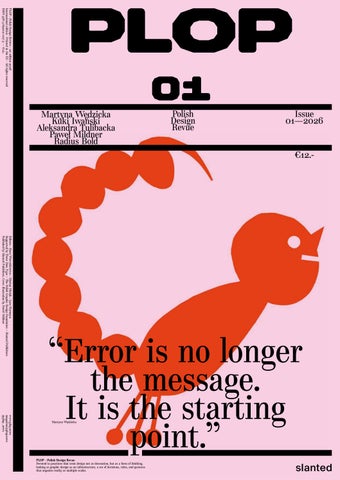
PLOP #01—Polish Design Revue

Page 1


PLOP

Martyna

Aleksandra

“Error is no longer the message. It is the point.”starting
Martyna Wędzicka

3

Editorial: Is design polished?

p. 4 5

Aleksandra Tulibacka

We don’t want to be inspired anymore p. 6—11

Kuki Iwański p. 12—17

New Type from Poland: Radius p. 20—22

Polish Design Embassy p. 23

Upcoming events. Global 2026

Colophon

EDITORIAL TEAM

Concept & Idea: Lars Harmsen, Marian Misiak, Rene Wawrzkiewicz

Editors & Design: Lars Harmsen, Marian Misiak

Illustrations: Paweł Mildner

Typefaces: Tor Grotesk, Heneczek PRO, Radius

Publishing Direction: Lars Harmsen, Julia Kahl

Production Management: Julia Kahl

PUBLISHER

Slanted Publishers UG (haftungsbeschränkt)

Nördliche Uferstraße 4–6 76189 Karlsruhe Germany T +49 721 85148268 info@slanted.de – slanted.de @slanted_publishers

© Slanted Publishers, Three Dots Type Foundry, the Polish Graphic Design Foundation

Slanted Publishers, Karlsruhe, Germany, 2026 ISBN: 978-3-69202-007-5 1st edition 2026 All rights reserved.

THE POLISH GRAPHIC DESIGN FOUNDATION is one of the few institutions in Poland dedicated to education, professional exchange, and the promotion of Polish visual design. The Foundation has initiated and organized numerous festivals, competitions, exhibitions, workshops, and research-oriented activities both in Poland and internationally. Its key projects include the international Festival Eastern European Design, held between 2023 and 2025 in Warsaw, Vilnius, and Kyiv; a series of design-focused events in Asia developed under The Design Network program; the conference cycle Polish Graphic Design Talks; and the Polish Graphic Design Awards competition, alongside many other initiatives.

THREE DOTS TYPE FOUNDRY is an independent type foundry from Wrocław (PL), founded in 2017, creating professional typefaces. Each font grows from a clear idea and story. Beyond type production, the foundry actively contributes to typographic culture through publishing, education, and collaboration with cultural institutions and international partners such as The New York Times Magazine, Slanted Publishers, Zięta Studio and Grid Arthub.

SLANTED PUBLISHERS is a globally recognized and acclaimed design, publishing, and media house. Collaborating closely with authors, artists, and editorial teams, they value the integral relationship between form and content. With their profound understanding of typography, layout, typesetting, and visual language, Slanted Publishers creates distinct visual identities for each medium, resulting in captivating design and compelling content.

DISCLAIMER

The publisher assumes no responsibility for the accuracy of all information. Publisher and editor assume that material that was made available for publishing, is free of third party rights. Reproduction and storage require the per mission of the publisher. Photos and texts are welcome, but there is no liability. Signed contributions do not necessarily represent the opinion of the publisher or the editor. The German National Library lists this publication in the German National Bibliography; detailed bibliographic data is available on the Internet at dnb.de.

Editorial:

Is design polished?

Is design polished? Is Polish design polished? How much can design be polished? Who polishes Polish design? Does polishing design make sense? Where can we find polished Polish design? Is design finished or just polished?

Do Poles polish Polish design? Is polished design still Polish? Does Polish design need more polish? Who decides what is polished design? More polish or more Polish? When does Polish design become polish?

Is unpolished design more Polish? Who asks for more Polish in design? Is polish about quality, or Polish control from Poland? Projects polish. Graphics polish. Money polishes. Can polished design lose its Polishness when polished? When does all this Polish polish become finished design—or almost Finnish?

Is post-polish Polish design made ready for internationalism? Or is anti-Polish design already a new Polish strategy? What

happens when Polish design is post-polished and overpolished? Is beauty in design always polished and stylish? Or should it be something else? When does stylish replace establishing sense? When does polish turn into Polish design that is less Polish and more stylish?

Does hyperpolish and overpolish turn Polish design into simple global internationalism? Can unpolished Polish graphics feel more sympathetic and less seamless? When does overpolish erase Polish contexts? Does global design get punished for staying unpolished? Is punish hidden inside polish? Is Polish visual culture overpolished today? What is the position of polishing in Polish design? Does depolishing bring Polish design back? Can we depolish Polish design at all? Where is design before polish? Where is any design after polish? Is this the finish?

After all this polish: Is Polish polishing itself polished or unfinished? When Polish polishes design, who is finished? Is unpolished Polish design still Polish, or already something else? When Polish polishes polish, who is finished?

These questions—and many more— are explored in a PLOP magazine by Slanted Publishers, Three Dots Type Foundry, and the Polish Graphic Design Foundation. If you have answers, ideas, or opinions, please get in touch with us:

→ magazine@plop.news

an

Ghosts of Tomorrow Kuki Iwański on StyleLeavingBehind

� For years, Kuki Iwański was defined by posters. Hundreds of them. Week after week, image after image, building a visual language that became instantly recognizable. and eventually suffocating. What once felt like discovery slowly turned into repetition. “At some point,” he says, “it was just too easy.”

On the question of when making posters stopped being a project and became a compulsion, Kuki is precise. “When I realized I was repeating myself,” he explains. “The visual language became branding. I was doing the same thing over and over again.” What troubled him was not productivity, but comfort. “Once you’re a designer, you don’t want to do easy things. You want to discover more.” That realization marked a quiet rupture. “I never believed in style,” Kuki admits. “Being a stylish designer just doesn’t really work for me.” And yet, style had found him anyway. Escaping it required a shift not only in form, but in intention.

Typography had always been central to his work, not as decoration, but as emotion. “The message itself is easy,” he says. “You can just write something. But what’s hard is emotional impact.” For Kuki, design exists in the tension between art and communication. “Sometimes I’m a designer, sometimes I’m closer to being an artist,” he reflects. “I don’t like the word, but it’s probably true.” That uncertainty, he believes, is deeply Polish: a constant balancing between function and expression.

The turning point came in Bali. Living there during the pandemic, time slowed. Observation replaced output. “It was the first time I could really see how we, as humanity, destroy our surroundings,” Kuki says. Waves of tourism, unchecked development, and environmental collapse became impossible to ignore. Paradise cracked. What struck him visually was not posters, but flags. “In Bali, you don’t really have posters,” he explains. “Elections were communicated through flags. They were everywhere, on streets, beaches, fields.”

The result was Ghosts of Tomorrow—an ongoing series of flags documenting present-day destruction rather than speculating about the future. “It’s not about predicting anything,” Kuki says. “It’s about documenting the present. How we kill nature. How we destroy societies.” Choosing the flag was a conceptual decision. “Typography doesn’t make sense on a flag,” he explains. “It’s two-sided, so you can not read the backside.” And yet typography

never truly vanished. “The shapes come from letters,” he says. “There’s still a typographic architecture inside.” The symbols themselves are imagined, not borrowed from national or cultural iconography. “They don’t exist anywhere,” he notes. “I wanted to create new symbols.”

The emotional weight of the project exceeds that of posters. “The material itself has a different vibe,” Kuki says. Flags move. They age. They occupy space differently. Some address abstract fears; others confront tangible futures, like climate refugees. “This will happen,” he says quietly. “Maybe we can’t stop it. Maybe we can only prepare.”

Living abroad has sharpened his sense of belonging rather than dissolving it. “Sometimes I feel more Polish now than before,” Kuki admits. Distance produces clarity and longing. “You miss people. Friends. Connections.” At the same time, mobility has become normal. “I can work from anywhere,” he says. “So why not?”

Still, he is conscious of privilege. “As Europeans, we are extremely privileged,” Kuki states. “We can move. Others can’t.” That awareness shapes how he approaches new places. “When you go somewhere, behave well,” he says. “You’re a guest.”

When conversations turn to Poland abroad, references are limited. “They know the Polish Poster School,” he says. “That’s it.” Membership in international networks like AGI opens doors, particularly in Asia. “But you’re shaped by where you come from,” Kuki reflects. “You can’t really escape from it.”

If there is one quality he still recognizes as unmistakably Polish, it is humility. “And improvisation,” he adds. “We deal with things as they come.”

Ghosts of Tomorrow continues to evolve through exhibitions, workshops, and collaborations beyond the design world. Curators are less interested in how the flags look than in what they do. “They care about the story,” Kuki says. “About social impact. About communities.”

For someone who once measured success in volume, this shift is radical. Posters ended with an invoice. Flags open conversations. “This project is not funny anymore,” Kuki admits. “But it’s important.” And that, perhaps, is the point: leaving style behind not to disappear. But to speak more clearly.

Text: Lars Harmsen
Ghosts of Tomorrow, 24-29.06.2025, Gdynia. Phot. Piotr Piantoni
WAW. Miasta i ulice kobiet, Poster Design, 2025
Kinoteka Stockholm, Poster Design, 2026

New type from PL Radius: 123

05. Project “The Social Design 2024” Design Institute, Tbilisi, Georgia, 2024.

Photo 1: Workshop by Tomasz Jurecki, Otwarte Studio.

Photo 2: After the event. Rene Wawrzkiewicz, Nino Egadze, Simone De Iacobis, Gosia Kuciewicz, and Goga Keburia.

06. “The Design Showcase”

Mindspace Koszyki, Warsaw, Poland, 2025. Meeting of design community representatives from Asia.

07. Conference “The Design Talks 01” Elektronik Cinema, Warsaw, Poland, 2024. Marta Kowalska, Jan Diehl-Michałowski, Gosia Stolińska, and Ludovic Balland.

08. Project “The Design Network 2024” Xxpress Gallery, Seoul, South Korea, 2024 Exhibition “Taste Against Taste”, Lars Harmsen (PosterRex), Kuki Iwański, Hezin O, Lee Sanha, Jung Sung-hun, Martyna Wędzicka-Obuchowicz and Lee Yunho.

Upcoming events Global PolishwillDesign be there:

March 6–8 Taipei Art Book Fair (Taipei, Taiwan)

One of the most important events focused on art publishing and independent culture. Every year, it attracts around 15,000 visitors and 400 stands. In 2026, the fair will celebrate its 10th anniversary. The first issue of PLOP Editorial will launch during the 2026 edition.

March 31 Voices in Type Assembly (Breda, the Netherlands)

April 24–29 Fluid Design Forum (Montenegro)

April 24–25 Tbilisi Design Festival (Tbilisi, Georgia)

A festival of lectures, presentations, and masterclasses focused on branding, and visual communication. It brings together several hundred participants from the Caucasus region and other parts of Central Asia.

May 7–10 Pictoplasma Festival (Berlin, Germany)

May 21–24 Busan Design Festival (Busan, South Korea)

June 10–20 The Poster (Warsaw, Poland)

August 6–12 Creative Expo Taiwan (Taipei, Taiwan)

One of the largest creative industry fairs in Asia. It covers design, crafts, lifestyle, IP licensing, and B2B programs. The event welcomes over 600,000 visitors and features hundreds of stands and curated exhibitions.

August 27–28 Forward Festival (Berlin, Germany)

September 10–12 Ad Black Sea Festival (Batumi, Georgia)

September 16–20 POV Festival (Budapest, Hungary)

October 1–November 1 100 Best Plakate Festival (Seoul, South Korea)

October 8–10 The Asia Design (Warsaw, Poland)

October 3–10 Weltformat Festival (Lucerne, Switzerland)

October 15–25 Graphic Days Festival vol. 11 (Turin, Italy)

October 24–25 Dysarium (Lviv, Ukraine)

The largest Ukrainian design conference focused on design practice. The event lasts two days and includes three stages, lectures, workshops, panel discussions, networking, and several thousand participants. It takes place despite the war and ongoing attacks.

November 12–15 International Assembly Festival (Glasgow, UK)

If

PLOP(80 pt) PLOP(60pt)

PLOP(40pt)

PLOP(25pt)

PLOP(16pt)

Where English politely spreads letters out, Polish stacks them into architectural structures. Polish doesn’t waste letters; it compresses sound into dense typographic knots. It’s less spelling and more linguistic origami. chrząszcz—beetle szczęście—happiness, luck bezwzględny—ruthless, absolute źdźbło—blade (of grass) grzęzawisko—swamp, quagmire trzpiotka—scatterbrain (female) zmartwychwstanie—resurrection wykrzyknik—exclamation mark przeziębienie—a cold (illness) skrzyżowanie—intersection ślusarz—locksmith brzęczeć—to buzz wstrząs—shock, tremor wstrzymać—to stop, to hold back szczegół—detail źródło—source pogrzeb—funeral żółw—turtle dżdżysty—rainy, drizzly gżegżółka—cuckoo (bird)

Turn static files into dynamic content formats.

Create a flipbook
PLOP #01—Polish Design Revue by Slanted Publishers - Issuu