
Humanistic Inquiry Online Program 2026

Page 1


A HUMANISTIC INQUIRY SYMPOSIUM /PLACE

This topic continues the work of last year’s theme TIME as we expand to include the spacetime continuum. We all live in space; all places have their stories. How do we come to know a place? Might we think about borders, walls, signs, memories, a mind’s associations, our emotions and our narratives? How do human bodies move through, dwell in built environments? How do we understand and experience “lived space”? Whatever direction this topic takes you in — architecture, landscape, the public sphere, home/shelter, community/ neighborhood, nation/planet, the poetics of space, preservation and destruction, rebuilding and repair of the past and/or for the future — space/place tell us who we are.

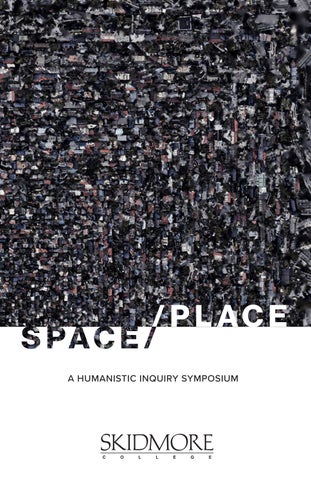
Cover art by Emilio Vavarella, Double Blind, 2020-2022

Friday, March 20, 2026

SOMERS ROOM, TANG

3:30–5 P.M. Welcome Remarks

Keynote Address by Jennifer Roberts — The Pastel from Mars and Other Tales from Outer Space Art History, introduced by Ian Berry, Dayton Director of The Tang Teaching Museum and Art Gallery and Professor of Liberal Arts

5–6:30 P.M. | SESSION I

Lisa Jackson-Schebetta, Theater Relational Movements/Relational Space: Fútbol and Peace-building in Colombia

Violeta Lorenzo, World Languages & Literatures Arkansas as Poetic Space: Race, Memory, and Place in Guillén and Walcott

Emilio Vavarella, Media & Film Studies Physical Places or Mental Spaces? Italian Landscapes in the Age of Technical Reproducibility

Saturday, March 21, 2026

SOMERS ROOM, TANG (unless otherwise noted)

8:30–9 A.M. Continental Breakfast

9–10:30 A.M. | SESSION II

President Marc C. Conner

Making the Past Home Present: Sacramental Memory of Place in Ellison’s Invisible Man

April Bernard, English Crossroads: Poems of Places Real and Imaginary

Mary Crone Odekon, Physics

Our Place in (Outer) Space

Coffee Break

11 A.M.–12:30 P.M. | SESSION III

Brian Lawson, Dance and Ryan Homsey, Director of Academic Advising Partner Sequence

Charlotte D’Evelyn, Music

Sounds Like Home: Listening as Placemaking in Inner Mongolia, China

Natalie Taylor, Dean of the Faculty

America: The Country of the Mädchen

12:30–1:15 P.M. | Lunch | PAYNE ROOM, TANG

1:15–2:20 P.M. | SESSION IV

WACHENHEIM GALLERY, TANG

Kathy Butterly: Assume Yes with Ian Berry

An inside look at the mischievous, seductive and defiant ceramic sculptures of Kathy Butterly. This highly anticipated 30-year survey fills the Tang’s Wachenheim Gallery with experimental and expressive small-scale porcelain and earthenware artworks that contain a wide range of colors, textures and moods.

Performance in atrium, Lawson/Homsey

2:30–4 P.M. | SESSION V

Kaylin O’Dell, English

The Spectacle of Devotion: Navigating Sacred Space in Old English Poetry

Ryan Overbey, Religious Studies & Asian Studies Space and Place in an Early Medieval Buddhist Grimoire

Philip A. Glotzbach, President Emeritus

The Hansel & Gretel Fallacy: On Responsibility and Freedom in An Age of Excuse

Coffee Break

4:30–6 P.M. | SESSION VI

Lena Retamoso Urbano, World Languages & Literatures

When Words Dream

Michael Gaige, Environmental Studies/Sciences Trees as Text: Skidmore’s

Arboreal Palimpsest

Adam Cottle, Metadata Librarian

Figurative Echolocation and the Technologies of Dimensional Simulation Within the Terrain of Popular Music

Dennis Schebetta, Theater Brave Spaces: Building Community in the Rehearsal Room

6–7 P.M. | ATRIUM

Closing Remarks and Champagne Reception

Artist note:

Double Blind, 2020-2022. Photographic elaboration from artificial neural network. Lightjet print on Kodak metallic paper mounted on Dibond and acrylic glass, framed in black oak. 49 photos. Variable dimensions.

Double Blind is a photographic series in which I use an ANN (artificial neural network) to re-produce images extracted from the memories of former Italian immigrants, trying to bridge the gap between mental and algorithmic image production, while investigating the limits and fallibility of both human memory and technical reproducibility. Every time we think about something our brain produces a kind of mental representation. Current research describes this production of mental representations as akin to digital renderings and data elaborations, since all these processes elaborate information and dynamically produce images. Double Blind investigates the complex relationship between imaging and imagination by mirroring as much as possible, from a technical, conceptual and methodological standpoint, the way in which our mental images are produced.

– Emilio Vavarella emiliovavarella.com/doubleblind/

WE WISH TO THANK THE FOLLOWING FOR THEIR SUPPORT AND ASSISTANCE:

Ian Berry

Megan Bove

The Office of Communications and Marketing

President Marc C. Conner

Ellen Grandy

Katherine Gross

Carrie Imbrogno-O'Dell, Chef Michael Hinrichs, & the Dining Services team

Barbara Kahn Moller

Media Services

Elizabeth Stauderman

Natalie Taylor

Tom Yoshikami and Olivia Cammisa-Frost

Turn static files into dynamic content formats.
Create a flipbook