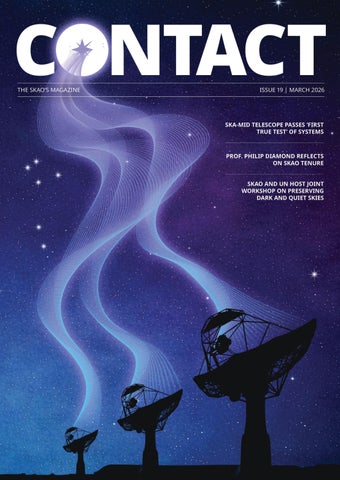
12 SKA-Mid telescope passes ‘first true test’ of systems
14 Japanese students’ groundbreaking observation using homemade telescope
PATHFINDERS
16 MeerKAT finds unusual radio glow in distant swarm of galaxies
17 MeerKAT discovers record-breaking cosmic laser halfway across the Universe
18 Largest ever radio sky survey maps the Universe in unprecedented detail
20 Astronomers see first evidence of inverse Compton scattering in MeerKAT data from star-forming galaxies
21 Determining the masses of the first stars with SKALow and REACH
22 Most distant and powerful odd radio circle found through Indian citizen science project
24 New image reveals our galaxy in unprecedented radio colour
SKAO CORNER
So, it has come to this, my final foreword as DirectorGeneral. My last day will be 31 May and Prof. Jessica Dempsey will take over on Monday 1 June.
I wish her well, she will be taking on a wonderful job and working with a high-performing, professional team and a Council that firmly believes in the SKA Observatory. I will observe, with a hint of wistfulness, as the SKAO goes from strength to strength and starts to deliver science in the near future.
This, the nineteenth edition of Contact, clearly demonstrates the road to that science delivery, with excellent articles from Ant Schinckel and Tracy Cheetham, the Site Construction Directors for SKA-Low and SKA-Mid respectively. I have to say, the progress on the two sites is impressive to see, with the vast majority of the infrastructure nearing completion. The progress on the telescope hardware is also impressive with, at the time I write this, ~18,000 SKA-Low antennas in place and nine SKA-Mid dishes assembled.
When I give updates on the SKAO’s progress at various meetings, I often talk about the birth of an observatory and, as the article on SKA-Mid on page 12 shows, we can now say that is true for both the SKAO’s telescopes. We have the first interference fringes from SKA-Mid dishes to sit alongside the first test image from SKA-Low announced last March. These are both wonderful, morale-boosting milestones demonstrating that the SKAO’s international systems are working together.
I am, at heart, an astronomer and so love to see the new results coming from SKA precursor and pathfinder partners. My eye was drawn, since I was involved in much early work on such objects, to the discovery by MeerKAT of
an OH megamaser, amplified through gravitational lensing. I also read with fascination the two articles on the huge sky survey released by a LOFAR team and the beautiful images of the plane of the Milky Way captured by the Murchison Widefield Array. All these results presage the huge promise of the SKA telescopes in the coming years.
There are many other interesting articles within Contact. The report on the UN/SKAO workshop on preserving dark and quiet skies (page 40) describes an excellent meeting in Vienna in December on the topic. I left it feeling optimistic about the future, primarily because of the clear attention being paid by industry to the solutions required to minimise the impact of these massive new satellite constellations. Let us hope that industry follows through. I particularly enjoyed reading the article on Isaac Magolego’s journey from a rural village in South Africa to becoming a radio astronomer, supported by SARAO’s wonderful Human Capital Development programme. I encourage readers to settle down with a hot drink and read them all.
I’d like to express my thanks to the many hundreds, even thousands of people who have contributed to and supported the SKAO during my tenure as Director-General. It is people who make the Observatory what it is, and it is that interaction that I will miss as I move on to the next challenge.
PROF.
PHILIP DIAMOND, CBE, SKAO DIRECTOR-GENERAL
Prof. Philip Diamond with UNOOSA Director Aarti Holla-Maini at the UN/SKAO Workshop on Dark and Quiet Skies for Science and Society in December 2025.
Main image: The installation of mesh, which serves as the ground plane for SKA-Low antennas, is now complete in the telescope’s core.
Top L-R: The Central Processing Facility which is nearing completion.
Middle L-R: The Central Power Station; and smart boxes installed within a cluster of antenna stations.
Bottom: Wayfaring signs in the SKA-Low core, indicating the distance to SKAO partner countries.
SKA-Low construction highlights
BY ANT SCHINCKEL, SKA-LOW SITE
CONSTRUCTION DIRECTOR
2026 is shaping up to be another big year for our teams, partners and collaborators at Inyarrimanha Ilgari Bundara, the CSIRO Murchison Radio-astronomy Observatory, the site of the SKA-Low telescope. This year we commence the major task of commissioning the infrastructure and transitioning many of our operations.
Infrastructure works across the site are nearing completion, our Central Processing Facility will be commissioned and handed over, and we now have access to continuous, centrally produced power across the site – this last one being a surprisingly big challenge. We continue towards our next major milestone, which will soon see SKA-Low become one of the most sensitive low-frequency radio telescopes on the planet.
SKA-Low ‘brain’ takes shape
The Central Processing Facility (CPF), also considered the brain of the telescope, is nearing completion. Our contractors Ventia and their many subcontractors have finished critical works to shield the telescope from the radio frequency interference generated within the facility.
The SKA-Low telescope requires unparalleled radio quietness and any technology used in proximity to the antennas must meet the most stringent requirements.
We’ve had to think about, and account for, all the different ways RFI generated by the electronics inside could leak out and interfere with observations. The facility has had specialised welding throughout, as well as various filters installed, to ensure it is properly shielded.
Toilets are even located on the outside of the shielded facility, to prevent RFI from leaking through sewerage.
Before this facility is handed over from Ventia to the SKAO, it will undergo a final shielding effectiveness test.
Additionally, all the building services – chillers, ventilation and air-conditioning – are being tested and commissioned. Most exciting is the installation of 140 19-inch racks within the facility’s white space – the large cabinet room. It is here that data collected from the site’s antennas will be processed by on-site digital signal processing systems, before being sent to Perth over fibre-optic cables.
As we begin the transition this year from construction towards operations, one of the key steps will be the commissioning of the CPF, followed by the big task of fitting out these racks with specialised telescope equipment. The process of moving into the building and getting it operating exactly to our requirements will be a rewarding challenge. Installing hydrogen masers – three ultra-stable clocks that will need to time signals over decades to pico-second levels of precision to observe some of the most interesting astronomical phenomena –is a task the entire team is looking forward to.
[continued on page 6.]
CONSTRUCTION
Infrastructure works near completion
The final earthworks along the telescope’s eastern arm are nearing completion. This has included clearing, trenching and ripping, as well as electrical works, to prepare what will become some of the telescope’s furthest stations with the necessary access and infrastructure.
Our colleagues at CSIRO completed work on extending and sealing the runway at the Boolardy Accommodation Facility, the main airstrip at the site. These works allow larger planes to fly into site and in mid-January the first 19-seater aircraft, a Beechraft 1900D, utilised the upgraded airstrip, which along with SKA-Low infrastructure and sites will be given a Wajarri name later this year. The upgraded runway can also be used in a wider range of weather conditions, providing the benefit of emergency access for the local community if roads surrounding the existing Murchison Settlement airstrip are closed.
Meanwhile, the installation of mesh has been completed in the core, with 224 stations, or 56,000 sheets of steel mesh, now in place. These will form the ground plane for the more than 50,000 antennas that will form the core when assembled and installed.
We’ve also erected a viewing platform on the edge of the core to allow visitors to see the scale of the project. When the core is eventually complete, the view from this platform will be truly impressive, showcasing a silver sea of the iconic two-metre-tall SKA-Low antennas.
Continuous power
A significant milestone enabling the next phase of the SKA-Low telescope was achieved in late 2025, with the provision of continuous power to the site via three generators. Continuous power is an essential requirement for achieving the second SKA-Low Array Assembly, an array 16 times the size of that which produced the telescope’s first image, and beyond.
This power enables the commissioning of the clusters of antennas and Remote Processing Facilities along the telescope’s spiral arms, provides improved power quality and delivers 24/7 power to the telescope’s Central Processing Facility.
Meanwhile, installation of the high voltage and low voltage buildings at the Central Power Station began in January. These are the first components of the permanent power station, that initially will supply power to the southern arm of the telescope and a majority of the northern arm, and eventually the entire telescope.
Long term, power on site will be generated by a hybrid
system including solar photovoltaic panels, with the aim of ensuring a high penetration of renewable energy. This year we will continue to engage with companies to implement a renewables-based power system at the site.
Threatened skinks continue to thrive
Following the completion of trenching and network installation nearby, a group of the threatened Western spiny-tailed skink have shown that they are still active at our site.
The small group consisting of at least two adults and one juvenile was found in 2023 during pre-clearance surveys on the eastern spiral arm, not far from where we had proposed an infrastructure corridor. To ensure their home was protected during clearing and construction, the infrastructure corridor was amended to accommodate a 50-metre buffer.
Wildlife cameras were also established to monitor the group before and after clearing and construction.
Between 2023 and 2025, a total of 79 skink surveys and 13 preliminary surveys have been completed, with the preliminary surveys focused on likely habitats to manage the risk to the threatened species.
As of December 2025, the group was recorded looking “fat and healthy”, demonstrating the effectiveness of the mitigation measures.
ABOVE: A wildlife camera on site is monitoring the Western spiny-tailed skinks.
SKA-Mid construction highlights
BY TRACY CHEETHAM, SKA-MID SITE CONSTRUCTION DIRECTOR
The SKA-Mid team has hit the ground running in 2026, with activities ramping up in just about every area in recent weeks, including the “big lift” of our eighth and ninth dishes in February.
Shortly before the southern hemisphere’s summer break, in December the team celebrated the technical milestone known as “first fringes”, where our Assembly, Integration and Verification team successfully connected two dishes together for the first time (see page 12).
The point of working towards milestones like this is not only to demonstrate that key components like the digitiser, correlator and synchronisation and timing systems are working together with the dish system, but also to learn as much as possible about the system at an early stage. Testing inevitably identifies challenges and bugs in the system and we can address them before we proceed through the same process with more dishes.
Finding efficiencies
One area where this is having a big impact is in the vital photogrammetry work which each dish must undergo to align its components, assess its surface accuracy and detect any deformation in the structure at submillimetre accuracy. It’s a big job, involving placing dozens of targets on the dish surface and taking thousands of photographs from different angles, which are analysed in specialised software to create a digital model of the structure surface.
Testing on the first few dishes confirmed to us where the troublesome areas are likely to be and increased our engineers’ confidence. As a result we have been able to drastically decrease the time photogrammetry takes for each dish, from over a month for the first dish, to around a week for more recent ones. That’s
a natural improvement but it will also be essential to complete photogrammetry on 30 dishes per year, as our construction schedule calls for.
Another efficiency has come from a tool developed by our collaboration partner SARAO for their MeerKAT radio telescope, which will ultimately be integrated into SKA-Mid. Their dish verification system enables multiple dishes to be tested at once before being integrated into the array. It works by comparing one verified dish with up to eight new ones through a range of automated processes. We are currently testing three dishes at once using the system, and it’s a great example of how innovations from MeerKAT are benefitting us as we build SKA-Mid.
All these processes have also allowed us to identify design optimisations that can lead to even better performance, so the teams will be upgrading our early dishes on the ground with those changes. This is the benefit of building an array, as early testing builds confidence in the design and team.
Core construction
We now have a total of 19 dishes on site at various stages of assembly and commissioning, and we are also preparing to begin antenna assembly in the telescope’s inner core for the first time, where many of the MeerKAT telescope’s antennas are located. This follows from a significant effort to analyse and mitigate the impact of construction on MeerKAT science.
SKA-Mid is uniquely challenging as we are building this next-generation radio telescope in the heart of an existing facility which is conducting world-class science. Preparing for the inner core work has involved working closely with SARAO and the MeerKAT science community to conduct targeted observations and check the impact on ongoing programmes. Although the analysis is still ongoing, the fact that we’re now in a position to start construction in the inner core without compromising MeerKAT observations is fantastic, and we’re grateful to everyone who has been part of the discussions to get us there.
Our partners CETC54 have been hiring and training more local people from our neighbouring towns to help with the increased rate of dish construction and we’re excited to welcome them to the team! With 10 new starters in March, this brings the number of people appointed by CETC54 from Carnarvon, the nearest town to our site, to 28. These workers receive a wide range of training which will be transferable beyond the site, including on working with cranes and scaffolding, first aid training and basic firefighting. Across the teams on site, a total of 475 local people have been employed to date.
SKAO and SARAO’s base camp nearing completion
It’s been really exciting to see our Engineering Operations Centre (EOC) heading towards completion. The EOC is located just outside Carnarvon, on the way to the telescope site, and it is our support base for all construction and maintenance activities. As well as being our logistics hub, it’s where equipment will be tested and configured before it is taken onto site, and where repairs and maintenance will be carried out; all of this must happen off site because of the strict restrictions on radio frequency interference closer to the telescopes.
This was a host country deliverable from our partners SARAO, delivered by their contractor WBHO, and will be a base for both SARAO and SKAO engineering and maintenance staff. After three years in our temporary
portacabins, our joint teams cannot wait to start moving into this new building in the coming months!
Delivering on our sustainability commitments
The annual external environmental audit was undertaken by the Independent Environmental Control Officer (ECO) for the SKA-Mid site late in 2025. SKA-Mid achieved 94% compliance for the 2025 construction phase and 99% for the pre-construction requirements resulting in a total average score of 97%, which is a 5% increase from 2024.
The ECO stated: “The project is therefore commended for achieving such a high increase in the annual compliance score against the requirements of the Integrated Environmental Management Plan.” The report will now be submitted to the Minister of Forestry, Fisheries and Environment for review.
In addition to the above, the SARAO-appointed contractor has completed the construction of a 196-km 2.4-metre-high game fence around the Meerkat National Park. SANParks is currently removing all the internal fences within the National Park with the intention of commencing with the reintroduction of wildlife during 2026.
The SKA-Mid Engineering Operations Centre just outside Carnarvon is now close to completion.
Representatives from CSG/ Zutari and the SKAO at Hompy Kedompie School where the new patio was completed in February.
There has been great progress at the Early Childhood Development centre in Williston which our teams have been renovating. Last year we worked with our corporate and social investment partners* to assist in the demolition of an unsafe building and to provide a brandnew classroom with all the necessary electrics, plumbing and decoration required.
The work is part of our joint SKAO-SARAO initiative supporting local Early Childhood Development centres in the four towns surrounding the SKA-Mid site, investing in early learning to improve future outcomes for local children. A crafter from Williston is now busy painting the classroom – including a stunning mural on the exterior – and a local contractor has completed construction of a patio which was handed over to the school at the end of February. It is wonderful to see the young learners enjoying this new safe outside space already.
What 2026 has in store
Looking ahead through the year, infrastructure work on site – including roads, dish foundations, power and fibre cabling – is due to be completed by the middle of the year. This is testament to the hard work and resilience of our local contractors, who have worked tirelessly over the past three years to deliver the infrastructure for the full extent of the array – all 133 SKA-Mid dishes.
By the end of the year we’re expecting to have eight dishes integrated into the array, eight more undergoing testing of dish systems such as the receivers and a further 16 in the final stages of structural assembly and testing – so we’ll see an exciting amount of progress in the coming months.
With thanks to SKA-Mid Senior Project Manager Ben Lewis for additional information.
* Karoo Hoogland Municipality, Zutari, CSG, Speedspace, CWP, Bluu, and AJ Transportation
Shortly after the last issue of Contact was published, September’s major G20 event saw hundreds of people including ambassadors and global media visit the SKA-Mid site to see construction in action and hear about the wider impact of the SKA project. Read more about it here. Image credit: SARAO
Explore the stars above an ancient land
BY SEBASTIAN NEUWEILER (SKAO)
This 360-degree panorama, showcasing the Milky Way above the antennas of the SKA-Low radio telescope, is part of a virtual tour that takes you to Wajarri Country in outback Western Australia.
Visit the tour to explore this night sky and our SKA-Low telescope, and learn about the history and culture of the Wajarri Yamaji, Traditional Owners and Native Title Holders of Inyarrimanha Ilgari Bundara, the CSIRO Murchison Radio-astronomy Observatory.
You can also discover two SKA precursor instruments – CSIRO’s ASKAP radio telescope and the Curtin University-led Murchison Widefield Array radio telescope –as well as travel to Perth to see the Pawsey Supercomputing Research Centre.
Credit: CSIRO/DISR/Alex Cherney and Tom Fowler.
Tour the SKA-Low Telescope
SKA-Mid telescope passes ‘first true test’ of systems
BY CASSANDRA CAVALLARO AND MATTHEW TAYLOR (SKAO)
The SKA-Mid telescope in South Africa is on the brink of making its first test images of the Universe, after achieving two technical milestones in quick succession.
In January the SKAO announced that teams had successfully used two dishes together to detect astronomical signals, an achievement known among radio astronomers as “first fringes”.
This signified that the dishes were operating as an interferometer for the first time, prompting SKAO Director-General Prof. Philip Diamond to declare: “SKAMid is alive as a scientific instrument”.
It was “the first true test that all our systems are working together”, he added.
When complete SKA-Mid will have 197 dishes working together, but synchronising these first two was a particularly complicated challenge.
As with SKA-Low in Australia, the telescope’s components are being developed and built on different continents,
then shipped, assembled, tested and integrated as one system. All the hardware and software had to work correctly at the same time in order to accurately track a known radio galaxy around 2.6 billion light years away.
“It includes seeing that the dishes can track across the sky in a coordinated way under the control of the telescope manager software, the receivers are being cooled to the required temperature of minus 250°C, the synchronisation and timing system is accurately timing signals from the different dishes to a billionth of a second, and the correlator is correctly processing and aligning the data,” said Dr Betsey Adams, SKA-Mid Commissioning Scientist.
Only a few weeks later, a third dish joined the action to achieve what is known as “phase closure”.
SKA-Mid will soon be making its first test images of the Universe. Credit: SKAO
ABOVE: This figure shows the phase as a function of frequency, with two colours for the two different polarisations. “Phase is one of the interferometric quantities that we measure with the SKA telescopes,” Dr Betsey Adams explains. “There are some regions that show a large variation in phase, which correspond to known frequencies where we expect radio frequency interference. In the other regions, the phases are zero which is exactly what is expected for a point source at the centre of our observation. The fact that the phases are zero indicates that the full signal chain is working and the data from the telescopes is being properly combined.”
SKA-Mid is alive as a scientific instrument
PROF. PHILIP DIAMOND SKAO DIRECTOR-GENERAL
“Phase” refers to the tiny difference in arrival time of radio waves at different antennas in the telescope array, which tells astronomers where in the sky that signal originated. This measurement is combined with “amplitude” – which indicates how strong a radio signal is – to make astronomical images of the sky.
As part of the commissioning process, the telescope must be calibrated against a known radio source so that instability or variations due to atmospheric and ionospheric effects, and the instrument itself, can be identified and separated from signals coming from space.
“Each component inside our system adds its own amplitude and phase signal to all the measurements we make, so we need to be able to disentangle those,” said Dr Lindsay Magnus, SKA-Mid Telescope Director.
“The calibrator is a very small source of radio energy on the sky. The slight delay between the wave arriving at each antenna tells us where the signal is coming from and we can use that information to infer how the system is behaving. To do this you need at least three antennas –the phase difference should be constant, and that’s what we observed with this result.”
Next the team will work on achieving amplitude closure, which requires four antennas, as the measurement uses them in pairs.
“We’ve got one more step to go but this is a significant milestone and shows we’re well on our way to making radio images,” Dr Magnus said.
Japanese students’ groundbreaking observation using homemade telescope
BY MATTHEW TAYLOR (SKAO)
Students in Japan have used an outreach tool developed by the SKAO to conduct an unprecedented all-sky survey using a simple homemade antenna.
The SKAO’s Table-Top Radio Telescope (TTRT) can provide a real-time radio astronomy observation of the Milky Way in less than one minute, by measuring the emission from hydrogen gas. The build instructions and free driver software are available on the SKAO website
Second-year pupils at Fukushima Prefectural Shirakawa Asahi High School in Japan took on the challenge to build their own TTRT as part of a research project. SKAO System Scientist Dr Shin’ichiro Asayama – who developed the TTRT – assisted students to build their own device using cheap everyday materials, including BBQ grill mesh.
The 80-cm-diameter corner antenna was created by joining the mesh sheets together with tie wraps and fabricating a wooden frame for support. Dr Asayama then helped pupils create an all-sky map of the 21 cm neutral hydrogen emission visible from their school.
Seven separate days of observation were conducted at varying elevations along azimuths of 0° (north) and 180° (south) to compile a complete 24-hour survey, supplemented by an additional observation of the North Pole.
The resulting spectrum closely matched data from the internationally recognised Leiden/Argentine/Bonn (LAB) Survey and even revealed symmetrical features of the Milky Way’s rotational structure. The results were recently published by the Astronomical Herald (Tenmon Geppo), Astronomical Society of Japan.
SKAO Chief Scientist Prof. Naomi McClure-Griffiths, a leading expert on 21 cm hydrogen observations, praised the students’ achievement as “outstanding”.
Dr Asayama said: “It’s truly remarkable that high school students were able to achieve such results using a commercially available system employed in TTRT. Studentled observations of the 21 cm hydrogen line are becoming increasingly feasible.
Students from Fukushima Prefectural Shirakawa Asahi High School with their TTRT antenna. Credit: Yasuhiko Nemoto
ABOVE: The survey shows strong alignment with the LAB survey. The ‘missing’ part of the survey corresponds to the portion of the Southern sky which can’t be seen from the school’s position in the Northern Hemisphere.
“This initiative serves as a compelling example of how the TTRT can be integrated into educational settings and highlights the SKAO’s support for science education – in this case in the city of Fukushima – as a model of international collaboration.”
One student reflected: “At first, we made design mistakes and many things didn’t go smoothly. But by cooperating with everyone, I was able to enjoy taking part in the exciting world of radio astronomy – something I’d never encounter in everyday life. It was a truly valuable experience.”
Another commented: “I was deeply moved by the experience of building our own radio telescope and actually detecting signals from space. It was exciting to create a map of the Universe through creativity and effort.”
TTRT tech aids telescope conversion
Techniques used by the TTRT are also enabling hands-on radio astronomy with other instruments. A 10-metre satellite communications antenna at the Awara Campus of Japan’s Fukui University of Technology (FUT) is currently being refurbished for use as a radio telescope
A palm-sized 21 cm loop feed – previously demonstrated on the TTRT at outreach events by Dr Asayama – has been installed at the antenna’s focal point, enabling the FUT10m to detect neutral hydrogen in the Milky Way.
FUT’s Prof. Yusuke Miyamoto said: “This is a groundbreaking achievement, marking the first time that an astronomical spectrum has been captured using the FUT10m antenna.
MeerKAT finds unusual radio glow in distant swarm of galaxies
SOURCE: SARAO
A team of South African scientists using the South African Radio Observatory’s (SARAO) MeerKAT radio telescope has spotted a rare and extremely faint radio glow coming from a huge cluster of galaxies about 7 billion light years away. This type of glow – called an ultra-steep-spectrum radio halo – is the most distant one ever found.
The discovery, led by Isaac Magolego, a PhD student at the University of the Witwatersrand, has been accepted for publication in Monthly Notices of the Royal Astronomical Society Letters and can be accessed here The student project is supported by SARAO, which has funded Magolego’s studies through its Human Capital Development Programme.
Galaxy clusters are the largest objects in the Universe held together by gravity, containing thousands of galaxies and enormous amounts of hot gas. The newly discovered radio glow sits at the centre of the cluster SPTCLJ2337-5942, which has a mass of roughly a quadrillion times that of the Sun (a million billion).
Radio halos are produced when extremely energetic particles move through magnetic fields in galaxy clusters. This can happen when giant clusters crash into one another, stirring up powerful turbulence – similar to waves in a stormy sea – that re-energises older particles and makes them shine in radio light.
An “ultra steep spectrum” means the brightness of the radio halo drops off very sharply with increasing frequency, like a hill that becomes extremely steep instead of gently sloping.
“At first, I thought this was a normal radio halo,” said Magolego. “But the detailed analysis revealed something far more unusual: the most distant ultra-steep-spectrum radio halo ever detected. It’s incredibly exciting, and I’m so grateful to SARAO for supporting my journey from undergraduate studies all the way to this discovery with MeerKAT in the final year of my PhD.”
The shape of the radio glow also closely matches X-ray images of hot gas in the cluster, confirming the strong link between turbulence, magnetic fields and energetic particles. Because the hotter Big Bang afterglow in the early Universe makes it harder for such halos to shine, finding examples this far away is very important.
This result comes from the MeerKAT-South Pole Telescope (SPT) survey, a major international project combining MeerKAT’s world-leading radio sensitivity with high-frequency observations from the South Pole Telescope, a 10-metre-diameter telescope at the Amundsen-Scott South Pole Station in Antarctica.
Future observations with MeerKAT and the SKAO’s telescopes will help scientists understand how common these unusual radio halos are, and what they reveal about the early universe.
“This discovery highlights MeerKAT’s extraordinary sensitivity and the power of collaboration between SARAO, our universities and global partners,” said Pontsho Maruping, Managing Director of SARAO.
“It also reflects the impact of SARAO’s 20-year investment in human capital development, with Isaac’s achievement demonstrating the strength of our talent pipeline. As we enter the SKA era, MeerKAT continues to affirm South Africa’s leadership in cutting-edge radio astronomy.”
SARAO’s Human Capital Development Programme was established in 2005 as part of its participation in the SKA project. Hear more from Isaac Magolego on the impact of the programme on his career in our Team SKA interview on page 35.
ABOVE: MeerKAT-discovered radio halo (pink) and hot X-ray gas (blue) between the galaxies (orange) that make up the massive galaxy cluster SPT-CLJ2337-5942. Credit: Isaac Magolego, Roger Deane and Kshitij Thorat.
MeerKAT discovers recordbreaking ‘cosmic laser’ halfway across the Universe
SOURCE: INTER-UNIVERSITY INSTITUTE FOR DATA-INTENSIVE ASTRONOMY (IDIA)
Astronomers using the MeerKAT radio telescope in South Africa have discovered the most distant hydroxyl megamaser ever detected. It is located in a violently merging galaxy more than 8 billion light years away, opening a new radio astronomy frontier.
Hydroxyl megamasers are natural “space lasers” – extremely bright radio-wavelength emissions produced when hydroxyl molecules in gas-rich, merging galaxies crash into one another. These cosmic collisions compress gas and stimulate large reservoirs of hydroxyl molecules to amplify radio emission. The physical mechanism is very similar to lasers on Earth, but operates at a much longer wavelength of light of about 18 cm, rather than optical light that our eyes can see. When this special radio light is exceptionally bright, it is termed a megamaser – a “cosmic beacon” that can be seen across vast stretches of the Universe.
This newly discovered system, HATLAS J142935.3–002836, is so distant that we are seeing it as it was when the Universe was less than half its present age. It is both the most distant and luminous known. In fact, it is so luminous that it warrants the classification gigamaser, instead of megamaser. Astronomers observed a surprisingly strong signal thanks to the combined power of MeerKAT and a phenomenon known as strong gravitational lensing, which was theorised by Einstein.
“This system is truly extraordinary,” said Dr Thato Manamela, SARAO-funded postdoctoral researcher at the University of Pretoria and lead author of the new study.
“We are seeing the radio equivalent of a laser halfway across the Universe. Not only that, during its journey to Earth, the radio waves are further amplified by a perfectly aligned, yet unrelated foreground galaxy. This galaxy acts as a lens [...] because its mass curves the local spacetime.”
Collecting the data is only part of the challenge – astronomers must carefully calibrate and analyse terabytes of information
(the size of a few average laptops) using sophisticated algorithms and scalable computing platforms, before any breakthrough discoveries are possible.
“This result is a powerful demonstration of what MeerKAT can do when paired with advanced computational infrastructure, fit-for-purpose data processing pipelines and highly trained and experienced software support personnel,” said Prof. Roger Deane, co-author of the study and Director of the InterUniversity Institute for Data Intensive Astronomy (IDIA).
“This synergistic combination empowers young South African scientists, like Dr Manamela, to lead cutting-edge science and compete with the best in the world.”
Hydroxyl megamasers are a rare phenomenon. Previous studies showed they trace the most vigorous galaxy collisions, where enormous reservoirs of gas fuel intense starbursts and feed central black holes. Systematic searches – such as those conducted by deep MeerKAT surveys – promise to convert these once-rare finds into powerful statistical probes of cosmic evolution.
The paper was accepted for publication in Monthly Notices of the Royal Astronomical Society Letters and the preprint can be accessed at this link
Read the full media release from IDIA here.
ABOVE: Illustration of the distant galaxy 8 billion light years away (red), magnified by an unrelated foreground disk galaxy, resulting in a red ring. Splitting up the radio light into different colours, as a prism does, reveals the hydroxyl gigamaser (top-right rainbow-coloured line). Credit: InterUniversity Institute for Data-Intensive Astronomy (IDIA)
Largest ever radio sky survey maps the Universe in unprecedented detail
SOURCE: NETHERLANDS RESEARCH SCHOOL FOR ASTRONOMY (NOVA) AND NETHERLANDS INSTITUTE FOR RADIO ASTRONOMY (ASTRON)
An international collaboration using the Low Frequency Array (LOFAR)* – an SKA pathfinder telescope – has published an exceptionally detailed map of the radio sky, revealing 13.7 million cosmic sources and delivering the most complete census yet of actively growing supermassive black holes. It showcases an extraordinary variety of systems powered by these black holes, whose radio emission can extend for millions of light years.
The newly released LOFAR Two-metre Sky Survey (LoTSSDR3) marks a major milestone in radio astronomy and international scientific collaboration. The result is published in Astronomy & Astrophysics
By observing the sky at low radio frequencies, the survey reveals a dramatically different view of the Universe from that seen at optical wavelengths. Much of the detected emission arises from relativistic particles moving through magnetic fields, allowing astronomers to trace energetic phenomena such as powerful jets from supermassive black holes and galaxies undergoing extreme star formation across cosmic time.
Thanks to its remarkable detail, the survey has also exposed rare and elusive objects, including merging clusters of galaxies, faint supernova remnants and flaring or interacting stars. The survey is already enabling hundreds of new studies across astronomy, offering fresh insights into the formation and evolution of cosmic structures, how particles are accelerated to reach extreme energies, and cosmic magnetic fields, while also making publicly available the most sensitive wide-area radio maps of the Universe ever produced.
“This data release brings together more than a decade of observations, large-scale data processing and scientific
analysis by an international research team,” says Dr Timothy Shimwell, lead author and astronomer at ASTRON and Leiden University, the Netherlands.
“Because this survey is so vast, it allows us to study objects and phenomena in a wide range of environments,” said Dr Wendy Williams, SKAO Operations Scientist and a co-author of the paper.
“We can then analyse how those environments affect, for example, how black holes evolve, or how star formation rates have varied in millions of galaxies across cosmic time.”
The team has already uncovered several rare astrophysical phenomena, including transient and variable radio sources, previously unknown supernova remnants, some of the largest and oldest known radio galaxies, and radio emission consistent with interactions between exoplanets and their host stars.
Processing the data required the development of new techniques that accurately correct for severe distortions caused by the Earth’s ionosphere, the electrically charged layer of the upper atmosphere. To make the processing of 13,000 hours of observations feasible, these advances had to be combined with robust automation and optimisation. The team handled 18.6 petabytes of data in total.
“LoTSS-DR3 is not an endpoint, but a major milestone,” adds Dr Wiiliams.
“New facilities such as the LOFAR upgrade – LOFAR2.0 –will allow us to map the radio Universe with even greater sensitivity and resolution, extending the legacy of this survey well into the future. Soon we’ll see the SKA-Low telescope complement this effort too, so it’s an extremely exciting time for low-frequency radio astronomy.”
*The LOFAR European Research Infrastructure Consortium (LOFAR ERIC) brings together expertise from the Netherlands, Germany, France, the United Kingdom, Poland, Italy, Sweden, Ireland, Latvia and Bulgaria. LOFAR’s unique design incorporates 38 stations in the Netherlands and 14 international stations across Europe, with the most distant stations separated by nearly 2,000 kilometres, forming one of the world’s largest, highest-resolution and most sensitive radio telescopes.
ABOVE: A selection of radio lobes powered by supermassive black holes. Credit Maya Horton and the LOFAR surveys collaboration.
Astronomers see first evidence of inverse Compton scattering in MeerKAT data from star-forming galaxies
BY DR HILARY KAY (THE UNIVERSITY OF MANCHESTER - UK SKA)
An international team of astronomers led by the University of Oxford has found the most compelling evidence to date of a reduction in the radio continuum emission from distant galaxies due to a process known as inverse Compton scattering, which allows for a better understanding of galaxy star formation rates.
Better understanding the formation and evolution of galaxies is one of the main science goals of the SKA telescopes. With their unprecedented sensitivity and resolution, they will be able to observe the most distant galaxies and trace galaxy evolution over billions of years.
One of the key pieces of information required by astronomers when studying galaxies is the rate at which stars form from their molecular gas reservoirs. The most direct tracer of star formation is the ultraviolet emission from young, massive stars, but this emission can be obscured by dust in the galaxies, leading to underestimates of the star formation rate. Radio continuum emission from galaxies, on the other hand, can provide an alternative tracer which is unaffected by dust.
Radio continuum emission from a galaxy is caused by electrons that are accelerated in supernova explosions; as they spiral in their galaxy’s magnetic field, they emit radio waves. However, these accelerated electrons are predicted to bounce off photons in the Cosmic Microwave Background (CMB) – extremely faint radiation left over from very shortly after the Big Bang – causing them to lose energy and thus reducing the observed radio emission from that galaxy. This process is known as inverse Compton scattering. Although not expected to be a significant effect in nearby galaxies, the increased energy density of the CMB in the environment of distant galaxies means the effect needs to be taken into account when determining accurate star formation rates using radio emission.
MIGHTEE continuum image of the XMMLSS field. Credit: Ian Heywood/MIGHTEE collaboration
Until recently, radio telescopes had been unable to conduct sufficiently sensitive radio observations to detect the effect in these faint, distant galaxies. With the increased sensitivity of the MeerKAT telescope in South Africa, the Oxford-led team were able to use stacked radio observations of a sample of around 200,000 distant (high-redshift) galaxies from the MeerKAT International GHz Tiered Extragalactic Exploration (MIGHTEE) survey.
Their analysis showed that the radio continuum emission from the galaxies decreased as the redshift increased and was consistent with theoretical predictions of the expected effect of inverse Compton scattering, indicating that this may be a possible explanation. After also considering other possible scenarios for the observed decrease in radio emission, the team were able to conclude that inverse Compton scattering was the most compelling explanation.
“This result is really exciting because although this effect has been predicted theoretically for years, this is the first time we’ve been able to make sensitive enough radio images to detect it. With the SKA-Mid telescope we should be able to detect individual galaxies at these distances, rather than relying on stacking the signal from hundreds of thousands of galaxies,” said Dr Imogen Whittam, lead author of the research paper and SKAO Extragalactic Continuum Science Working Group member.
Further observations planned by the team will provide a greater understanding of the effect, allowing them to both refine theoretical models and determine the correction that is needed to ensure accurate calculations of the star formation rate.
The study has been published in the Monthly Notices of the Royal Astronomical Society
Determining the masses of the first stars with SKA-Low and REACH
BY DR HILARY KAY (THE UNIVERSITY OF MANCHESTER - UK SKA)
An international team of researchers in the UK, Belgium, Spain and Israel, led by the University of Cambridge, has become the first to account for the complex interplay between the first stars and X-ray binaries, showing that the signal from hydrogen gas in the early Universe can help determine the masses of the first stars during the Cosmic Dawn.
The formation, properties and evolution of the first stars are believed to be very different from those of the populations of stars we see today. Too distant and too faint to be observed individually, information on the intrinsic properties of these stars has been difficult to obtain, leading to uncertainty in our understanding of their impact on their environment.
The modelling carried out by the team included the impact of heating by not only ultraviolet starlight but also X-ray emission from X-ray binary systems that were produced when the first stars died. It revealed that previous models, which omitted the X-ray binary contribution, had underestimated the significance of the mass distribution of these stars on the hydrogen signal.
The team have created simulated data for both the SKA-Low telescope and the Radio Experiment for the
Analysis
of Cosmic Hydrogen (REACH). Comparison with their new models has shown that the data from these experiments (such as 3,000 hours of foreground avoidance observations with SKA-Low or a 25mK sensitivity measurement with REACH) will make it possible for astronomers to discriminate between models of the mass distribution, shedding light both on these elusive first stars and on the Universe’s Cosmic Dawn.
The team’s work, titled Determination of the mass distribution of the first stars from the 21-cm signal, has been published in Nature Astronomy
ABOVE: The study used simulated data from REACH, located in South Africa. Credit: REACH telescope.
Most distant and powerful odd radio circle found through Indian citizen science project
BY DR ANANDA HOTA, DR PRATIK DABHADE AND ARUNDHATI PUROHIT (RAD@HOME ASTRONOMY COLLABORATORY, INDIA)
When world-class radio telescopes inspire the public and empower them with survey data and scientific training through citizen science initiatives, extraordinary discoveries can emerge. Such a milestone has now been achieved by the RAD@home Astronomy Collaboratory, through which a citizen scientist has discovered the furthest and brightest odd radio circle (ORC) to date.
ABOVE: Radio-optical composite image of the newly discovered Odd Radio Circle RAD J131346.9+500320. Credit: LOFAR LoTSS DR2 and RAD@home(India)
This is the first ORC identified from LOFAR telescope data and the first through a citizen science effort. The result has been published in the Monthly Notices of the Royal Astronomical Society
ORCs are recently discovered cosmic mysteries – rare, ring-like structures that emit radio waves and are therefore visible only to radio telescopes. Almost invariably, a galaxy is found at the centre of these radio rings, suggesting that the rings may originate from the galaxies themselves.
Remarkably, these radio rings are 10 to 100 times larger than their host galaxies as seen in optical and
infrared images. Since the discovery of the first ORCs in 2019, astronomers have been puzzled by why they are not seen around nearby galaxies but typically around faraway galaxies. By comparing radio brightness at low and high frequencies, astronomers have determined that the emission does not arise from thermally hot or cold gas, but from non-thermal plasma (free electrons and protons/positrons). When such electrons move at near-light speeds while spiralling along magnetic field lines, they emit a form of radiation known as synchrotron radiation. This synchrotron emission is what radio telescopes detect from ORCs and also from typical radio galaxies.
A giant ring from the distant past
RAD-ORC, as the newly found object is known, exhibits a twin-ring structure, making it only the second such object known to date. Each ring has a diameter of nearly one million light years. If these structures represent expanding blast waves or shock shells, they may have been launched from the central galaxy nearly a billion years ago. This raises a profound question: what powerful event occurred in the galaxy a billion years in the past that created these vast, magnetised, relativistic plasma rings we observe today? Before reaching us, the radio waves have travelled for 7.5 billion years, or since the Universe was nearly half of its current age.
Citizen science discovery
Launched in 2013, RAD@home is the first citizen science research platform in Indian astronomy – a researchgrade collaboratory [collaborative laboratory] with real student-guide interactions. It has trained thousands of undergraduate students and citizens to understand radio images of the sky obtained by one of the SKA pathfinder telescopes, India’s GMRT, during free workshops. Many
then continue learning radio astronomy through online weekend e-classes, which is where citizen scientist Prasun Machado noticed a faint non-standard radio structure resembling two intersecting circles. Director and Principal Investigator of the Collaboratory Dr Ananda Hota immediately recognised its significance as a rare ORC.
Dr Hota said: “This work shows how professional astronomers and citizen scientists together can push the boundaries of scientific discovery.
“ORCs are among the most bizarre and beautiful cosmic structures we’ve ever seen – and they may hold vital clues about how galaxies and black holes co-evolve, hand-inhand.”
With the SKAO’s telescopes, astronomers will soon be able to detect ORCs that are up to 10 times fainter than those known today. RAD@home is committed to preparing the next generation of SKAO users with a bottom-up approach. This new era will allow both professional astronomers and the public to join hands, unravel the mystery of ORCs and deepen our understanding of their role in the evolution of galaxies in our Universe.
ABOVE: View of a RAD@home citizen science workshop to understand radio images of the sky taken with the GMRT, a SKA pathfinder in India Credit: Dr Ananda Hota
New image reveals our galaxy in unprecedented radio colour
BY CHARLENE D’MONTE (ICRAR)
The largest low-frequency radio colour image of the Milky Way ever assembled has been released, providing astronomers with new ways to explore the birth, evolution and death of stars in our galaxy.
Created by astronomers from the International Centre for Radio Astronomy Research (ICRAR), this new image captures the southern hemisphere view of our Milky Way galaxy, revealing it across a wide range of radio wavelengths.
Over 18 months Silvia Mantovanini, a PhD student at the Curtin University node of ICRAR, constructed the image using supercomputers at the Pawsey Supercomputing Research Centre to process and compile data from two extensive surveys.
The surveys were conducted using the Curtin Universityled Murchison Widefield Array (MWA) telescope located at Inyarrimanha Ilgari Bundara, the CSIRO Murchison Radio-astronomy Observatory, the site where the SKALow telescope is being built.
Between 2013 and 2015, the MWA observed the entire southern hemisphere sky for the Galactic and Extragalactic All-sky MWA (GLEAM) survey. Following an
upgrade of the array in 2018, the sky was observed with higher resolution and sensitivity, resulting in the GLEAMextended survey (GLEAM-X).
Mantovanini said the big difference between the two surveys was that GLEAM could detect the big picture but not the detail, while GLEAM-X saw the detail but not the big picture.
“To capture both, our team used a new imaging technique called image domain gridding,” she said.
“We combined thousands of GLEAM and GLEAM-X observations to form one huge mosaic of the galaxy.”
The new image offers twice the resolution and 10 times the sensitivity, and covers twice the area compared to the previous GLEAM image released in 2019. This significant improvement allows for a more detailed and comprehensive study of the Milky Way, providing astronomers with a wealth of new data and insights.
Mantovanini said the vibrant image delivered an unparalleled perspective on our galaxy at low radio frequencies.
“It provides valuable insights into the evolution of stars, including their formation in various regions of the galaxy, how they interact with other celestial objects and ultimately their demise.”
The image allows astronomers to distinguish between the gas surrounding new stars and that left behind by dead ones and may also help to unravel the mysteries surrounding pulsars within our galaxy.
By measuring the brightness of pulsars at different GLEAM-X frequencies, astronomers hope to gain a deeper understanding of how these enigmatic objects emit radio waves and where they exist within our galaxy.
Associate Prof. Natasha HurleyWalker, the principal investigator of the GLEAM-X survey from the same
BELOW: The GLEAM/GLEAM-X view of the Milky Way galaxy (top). Credit: S. Mantovanini & the GLEAM-X team. Beneath it, the same area of the Milky Way in visible light. Credit: Axel Mellinger, milkywaysky.com
ICRAR team, said this low-frequency image would allow astronomers to unveil large astrophysical structures in our galaxy that are difficult to image at higher frequencies.
“Only the SKA Observatory’s SKA-Low telescope will have the capacity to surpass this image in terms of sensitivity and resolution,” she said.
“This image will enable a plethora of galactic science and stands as an inspiring preview of the wonders the full SKA-Low telescope will one day reveal.”
BELOW: The Murchison Widefield Array. Credit: MWA Collaboration & Curtin University.
Let’s talk about... radio interferometry
BY ANNE DANIELS (SKAO)
The SKA-Mid telescope recently achieved a major milestone – the signals from two dishes were combined for the first time to create a fringe pattern (see page 12). But why were scientists so happy to see that rainbow pattern appear on their screens? Why are those “first fringes” important and how were they created?
It all comes back to the basics of radio interferometry, so let’s take a step back and start to understand this fascinating technique.
SKA telescopes as radio interferometers
In astronomy, bigger is almost always better. The collecting area of a telescope determines how much light it can gather – what astronomers call its sensitivity. For telescope dishes this is determined by the size of the collecting surface. The size of a dish also determines how finely it can distinguish smaller details – what astronomers call angular resolution.
“However, there is a limit to how big we can build a single dish,” explains SKAO Operations Scientist Nichol Cunningham. “If we look at the existing giants in radio astronomy, like Jodrell Bank Observatory’s Lovell telescope, next door to the SKAO Headquarters, you immediately notice the amount of support needed for such a structure, and this quickly becomes very expensive and not engineeringly feasible.”
An infamous example of the engineering limits of a dish structure was the Green Bank 300-foot telescope that collapsed overnight without warning following a failure of its support structure in 1988.
To overcome this structural barrier, many of the recent radio telescopes have chosen to use interferometry. By linking up a number of smaller dishes – or any kind of radio antennas – and combining their signals, interferometers can achieve the collecting and resolving power of a much larger telescope.
Creating the first fringes
Let’s look at the creation of SKA-Mid’s first fringes.
Two SKA-Mid dishes were pointed towards the same radio galaxy at a distance of 2.6 billion light years away from us.
“The two dishes looked at a source very far away from us in the sky. This means that its emitted radio waves when they
Radio sources are distant objects. By the time their signal arrives on Earth it acts like a plane wave – the wave crests travel parallel with each other. Because two radio telescope dishes are separated by a certain distance (the baseline), the wave arrives at one of them earlier than at the other. The telescope system needs to account for this delay before the correlator can combine the signals from the dishes. Credit: SKAO
arrive on Earth can be approximated as a plane wave so that each dish receives the same wavefront, but with a small time delay as the signal had to travel a bit further to one of the dishes,” says Nichol.
At each dish the incoming radio wave was measured and the signal was then sent to SKA-Mid’s correlator, the telescope hardware that combines the signals measured by individual dishes. The correlator is where interferometry really takes place. With the delay correctly accounted for, the characteristic interference pattern (or fringe pattern) is produced – in this case the very first fringes!
“To get the first fringes of SKA-Mid, we chose to target a well-known radio galaxy of which we already knew the precise position in the sky; that meant that we could calculate the expected geometric delay between dishes and correct for it in the system. When we saw the first fringe pattern appear, we knew we had correlated the pattern successfully which means our system works as expected,” says Nichol.
“First fringes are the first step and they show we can correlate the signals between a pair of antennas. Three dishes give you another quantity called the closure phase
ABOVE: The physical distance between telescope dishes and antennas determines the spatial scales that the interferometer can study. The larger the distance between dishes, the more detail can be studied. Credit: ESO/J. C. Muñoz-Mateos. Simulation done with friendlyVRI (C. R. Purcell & R. Truelove).
Timing is everything
Importantly, the radio wave arrives at each dish at a slightly different time (on the order of microseconds) because they are some distance apart.
For interferometry to work, it requires that signals from each pair of antennas are matched so that the wavefronts can be combined correctly in the correlator. That is why timekeeping is essential for the SKA telescopes and this is achieved using extremely precise clocks and delay corrections in the signal, allowing engineers to make sure that signals are combined at the right time.
(further explained on page 12), which is another step to check the signal chain is working, and so it goes on as we add more dishes. There is still a long way to our end goal of groundbreaking science discoveries, but we have now successfully begun our journey there.”
Unlike SKA-Mid dishes that can be physically pointed towards different parts of the sky, SKA-Low antenna stations – each comprising 256 individual antennas – are pointed electronically by introducing time delays in the system. For this reason the SKA-Low telescope is sometimes called a “mathematical telescope”.
Each antenna station is stationary and picks up (cont...)
radio signals from the whole sky. To measure the signals sent out by a specific object, the telescope has to tune in to the right part of the sky by introducing the right delays into the system. This is called beamforming and it is the same technique used in other similar telescopes that have no moving parts, such as LOFAR (see this video by ASTRON).
Filling in the imaginary dish
The SKA telescopes are trying to approximate a gigantic telescope with enormous resolving power by using many individual dishes and stations that give the telescope arrays large enough collecting areas to reach the desired sensitivity. The SKA-Mid telescope will eventually consist of 197 dishes (including 64 MeerKAT dishes) and the SKA-Low telescope will have 512 antenna stations. Why do we need so many telescope elements?
When a single dish antenna observes a target, it can form a complete image of that target, limited by the angular resolution achievable with the size of the dish. An interferometer cannot directly do the same thing because it samples only certain spatial scales of the image. The gaps between the antennas leave gaps in the information and in the final image it can form. To recreate the image, each pair of dishes gives some information on the target. By combining that information from multiple antennas in an array, a pretty good estimate can be obtained of the target.
More technically, how much information can be determined by the number of dishes and stations and the distances between them. Two dishes form a baseline with a certain length. The projection of all the baselines on the sky is called the UV-coverage and tells us how well the target can be probed.
“The spiral shape of the SKA telescopes was chosen because it ensures we get good UV-coverage. Astronomers use another “trick” to increase the UV-coverage: the Earth’s rotation. By extending the observation time, as the Earth rotates, the orientation and projected lengths of the baselines on the sky change, providing additional sampling points in the UV plane,” says Nichol.
“Each pair of dishes or stations allows us to sample different baseline lengths and different spatial scales of the target. Dishes or stations that are close together, forming short baselines, are sensitive to the large-scale, extended emission from an object, such as the diffuse disk of a galaxy. By contrast, dishes or stations that are far apart, forming longer baselines, are more sensitive to smaller scale structures and reveal compact features such as those from bright star-forming regions or active galactic nuclei embedded within the galaxy.
“The scale at which you want to study astronomical objects, depends on the science case. For some cases using a collection of SKA-Mid dishes or SKA-Low stations in the core
might be better suited to the science goal than the whole telescope array. One of the great things about the SKA telescopes is the ability to observe with multiple sub arrays allowing for a lot of flexibility in the science that can be done.”
It is the SKA-Mid dishes and SKA-Low stations that are furthest apart that determine the smallest scales that the SKA telescopes can study and determine its best resolution. The SKA-Mid dishes will be spread over 150 km and the SKALow antenna stations over 74 km, giving them much higher resolution than current state-of-the-art radio telescopes, which will make them capable of ground-breaking discoveries.
Interferometry beyond radio astronomy
Radio astronomy is not the only discipline of astronomy to make use of interferometry. The design has also proven very useful in optical and infrared astronomy.
The European Southern Observatory’s Very Large Telescope (VLT) in Chile has four 8.2-metre telescope mirrors which are complemented by four movable 1.8-metre auxiliary telescopes. Moving these allows the VLT to create more baselines and increase its UV-coverage, enabling some of the most detailed optical images. In 2004 the VLT used its capabilities to become the first telescope to directly image an exoplanet.
The ALMA Observatory in Chile uses 66 movable dishes to observe the Universe in millimetre and submillimetre wavelengths, covering the electromagnetic spectrum between infrared and radio wavelengths. The dishes can be moved from 150 m to 16 km apart to increase its UVcoverage.
Beyond astronomy, interferometry is also used by remote sensing telescopes, for example those observing the Earth. In the technique called Synthetic Aperture Radar, a radar system is installed on a moving aircraft or satellite. The system images the Earth using this radar from different sky positions. By combining the captured images using interferometry, the radar can distinguish much finer details than in a single shot.
The SKA telescopes’ design may seem puzzling at first, but as many astronomical interferometers have shown, they are a fantastic way to allow for better astronomical imaging capabilities while keeping the project technically feasible.
The SKA telescopes have the additional benefit of longterm scalability, as they can be expanded in the future by simply adding more dishes and stations to increase their observation capabilities even further.
From those important first fringes of SKA-Low in September 2024 and now SKA-Mid, the SKA telescopes are well on their way to becoming two of the biggest radio interferometers in the world with unprecedented sensitivity and resolution.
Technology contracts awarded in France and Australia
BY CASSANDRA CAVALLARO AND SEBASTIAN NEUWEILER (SKAO)
As construction and testing of the growing SKA telescopes continue, new contracts have been signed with companies developing crucial technologies.
Science data processor to be made in France
French computing specialist Eviden – part of the global Atos Group – will deliver the Observatory’s science data processor (SDP) hardware, which will process and reduce huge data volumes to produce detailed images of the sky.
The SKA telescopes will eventually need to process data equivalent to more than one million 4K Netflix streams, reducing them “on the fly” down to only a few thousand streams’ worth, and ultimately archiving ~700 PB a year.
Initial deployments of SDP hardware are expected in the SKA telescope host countries Australia and South Africa during 2026.
It is the first contract awarded to France, with a contract signing ceremony held at the Ministry of Higher Education, Research and Space in Paris in November 2025.
“As we start to deliver the first technologies through this contract, it reflects our commitment to supporting frontier science with co-designed, robust, scalable and energy-efficient computing solutions,” said Emmanuel Le Roux, Global head of Advanced Computing and AI at Eviden.
“We are proud to contribute to SKAO’s vision with a solution designed and delivered from Europe and deployed across two continents to help unlock new discoveries about our universe.”
Australia building SKA-Low ‘SMART boxes’
An Australian company has won the biggest contract for the SKA-Low telescope outside of infrastructure and software to build “smart” technology to power the nextgeneration instrument.
ABOVE: SKA-Low Field Technicians will install 24 SMART boxes per station.
Perth-based AVI is ramping up the manufacturing of an innovative technology – called SMART boxes – for the telescope under construction at Inyarrimanha Ilgari Bundara, the CSIRO Murchison Radio-astronomy Observatory, on Wajarri Yamaji Country.
The SMART boxes distribute electrical power to the telescope’s antennas and send signals that are received by the antennas from space to on-site processing systems.
AVI Managing Director Tony Routledge said more than 6,000 of the SMART boxes and associated infrastructure would be produced by AVI.
“We look forward to contributing what we have learnt over 35 years of manufacturing hardened electronic systems to the defence, securing and mining sectors to this unique international collaboration,” he said.
The original design of the SMART boxes was first produced in Australia by the Curtin University node of the International Centre for Radio Astronomy Research (ICRAR).
SKA-Low Field Node Engineer Dr Alan Davis said the SMART boxes used specialised radio quiet components and shielding to minimise “noise” that could impact the telescope.
“AVI engineers worked with us to evolve the original SMART box design to withstand the unique challenges of the Australian outback and meet our strict radio frequency interference requirements,” he said.
“AVI have been able to take a highly sophisticated and technologically advanced design and manufacture and deploy it en masse.”
Prof. Philip Diamond reflects on SKAO tenure
Director-General Prof. Philip Diamond CBE will bid farewell to the SKAO at the end of May, after almost 14 years at the helm of the Observatory and its precursor, the SKA Organisation. Here he looks back on his years in charge, and shares anecdotes from behind the scenes and his hopes for the SKAO’s future.
“As I look at everything that’s happening across the SKAO and all the people who are contributing to this effort today, it’s amazing to recall that on my first day I was one of only six staff, sitting in three offices in the Alan Turing Building at the University of Manchester. Now we number more than 400 people across our three host countries. It has been an immense privilege to lead the SKAO, not only for so long, but through such a transformational period. The changes in my time here have been remarkable and it’s hard to choose highlights from everything we have achieved.
The design phase between 2013 and 2019 stands out as a key period. I’d like in particular to call out two people who played pivotal roles at that time. Peter Dewdney, who was the SKA Architect, oversaw the design of the telescopes; much of what we are now building was defined by him. Second, was Jason Spyromilio, who spent a year with us
on leave from ESO as Head of Project; he put the meat on the bones of our processes, he organised the global consortia and kick-started the design teams. It was Jason who coined the now famous phrase: “Do you want to talk about building the SKA, or do you want to build the SKA?”
It was very special to be part of those discussions with groups of experts from all over the world who had come together to gradually shape and refine what the telescopes should be – the fingerprints of everyone involved are now forever a part of our instruments. The process was complex and the discussions not always easy, but progressing through each critical design review and receiving the endorsement of independent panels made it feel like the telescopes were slowly becoming reality.
In parallel to the technical work was the years-long effort to establish the SKAO as an intergovernmental organisation, which gave us a level of stability through
a rapidly changing world. I often said at that time that we weren’t just designing the telescopes, we were designing the Observatory’s structure (in fact we were also designing the expansion of the headquarters as well!). I was out of my comfort zone as we in the SKA Organisation, as it was then, sat in the back of a room at the Accademia dei Lincei in Rome – a magnificent room but with terrible acoustics – as the diplomats and officials from the future member states of the SKAO pondered every word of what would become the SKAO Convention and its associated protocols. It was fascinating to witness the intricacies of international science diplomacy. We had to get it right since the document must stand for decades. The reward was to finally witness the SKAO Convention being signed in the beautiful Ministry of Foreign Affairs in Rome in 2019. It was a once-in-a-lifetime event for many of us, with senior officials from seven countries standing side by side and committing to this joint scientific endeavour. Since then, we’ve worked hard to expand that membership further – as I write this, we’re close to welcoming our 14th member, with France on the brink of completing the ratification process.
Now SKAO science is within our grasp. The past year has really seen the birth of the telescopes as scientific instruments, with SKA-Low’s first test image released in March 2025, and SKA-Mid achieving its first interferometric fringes in December 2025. As an astronomer, and as someone who has spent much of my professional life involved in the SKA project, these milestones were both quite emotional for me. From next year we’ll start releasing early data from SKA-Low for the community and our staff to work on and to verify the instruments are working, which will be wonderful to see. Who knows, we may see some nice science surprises even at this stage.
There have also been immense challenges which we have faced together.
As with many such endeavours, which are realised over decades not years, securing funding and navigating the shifting sands of the global financial situation have been major challenges. I can’t think of a single science megaproject that has been free of funding pressures, but the timing for us as a nascent organisation was particularly difficult. The impact of the Covid pandemic, the war in Ukraine and the associated rise in costs struck just as we started construction and have been followed by years of global instability. Nonetheless, we established the Observatory as an intergovernmental organisation, began on-site construction and are now steadily approaching early science.
Despite the challenges, I’ve always maintained we must be optimistic. The previous Chair of the SKAO Council, Dr Catherine Cesarsky, always told me – tongue firmly
in cheek – that I was too optimistic for my own good. I always felt that was a requirement for this job. The SKAO is built on the passion, motivation and optimism of hundreds, perhaps thousands, of people working not only at the Observatory but also in all our partner organisations.
I’ve said it before in many speeches and presentations, but it’s really true and worth repeating: our international partners are the core of this effort. Collaborating with them has been one of the most rewarding aspects of the whole experience. It brings complexities, but the benefits are self-evident. We simply would not be where we are today – in fact the SKAO would not even be possible –without them. That includes the relationships we have built with the local communities in both Australia and South Africa, the Wajarri Yamaji in Western Australia and the industrial partners we brought on board.
I’m also extremely proud of the culture we’ve established and continue to foster every day across all our activities: the openness that we bring to our working relationships, the willingness to embrace innovative approaches, the commitment to excellence and sustainability in everything we do and the way we have brought together people from many different cultures and backgrounds – this really enriches our teams.
Approaching the end of my tenure is a little bittersweet; I’ll miss being in the HQ each day, arriving at the site past Jodrell Bank Observatory’s Mark II radio telescope – which actually featured in one of the first astronomy books I was given as a child, called Secrets of the Sky – and of course visiting our teams in Australia and South Africa.
At the same time, I’m looking forward to this next phase: travelling for leisure with my wife Jill, rather than having to dash between meetings, working my way through a substantial stack of history and science fiction books which have been waiting patiently to be read, and of course spending more time with family, especially our sixyear-old grandson, Alexander, who is full of enthusiasm and curiosity for the world.
That said, astronomy isn’t a field you ever really leave. I’ve been a science geek since childhood and am as excited by it today as I was back then.
I was recently asked if I could do my career all over again, would I change anything. I can honestly say I wouldn’t. I only wish I could be 40 years younger to be able to use amazing new facilities like the James Webb Space Telescope, the Vera Rubin Observatory, the European Southern Observatory’s ELT, the Cherenkov Telescope Array Observatory and of course the SKAO.
When I think about the science breakthroughs that we could see with this new generation of facilities it sounds like a wish list for astronomers, but it’s not wishful (cont...)
thinking anymore. We’ll get new insights into the nature of dark matter and dark energy; the resolution of the Hubble tension; the epoch of reionisation; even the small matter of the evolution of the early universe; the unification of General Relativity and quantum mechanics; the mechanisms that form planets; the study of biomolecules; and perhaps even whether there is life, in whatever form, elsewhere in the Universe.
I like to think the SKAO could have a hand in most, if not all. I’d love to see it happen.
After all these years in leadership, I’m excited to have time to get back into the nuts and bolts of doing science, and particularly early science with the SKA telescopes. Two areas particularly spring to mind: extending my work on studying magnetic fields in different objects, and being part of the effort to bring the telescopes into the existing VLBI networks – VLBI being my first scientific love. I’ve seen the two SKA telescopes develop from a concept among a small group of astronomers to an international observatory, so to observe with them will be a moving experience – assuming I’m granted observing time of course! Maybe there’s some telescope time reserved for former directors-general... I’ll need to check with my successor.
I cannot finish this piece without thanking everyone who has contributed their time and talents to the SKA project during these years. Every one of you will own a piece of the Observatory’s groundbreaking discoveries.”
The SKAO and its staff extend their sincere thanks to Prof. Diamond for his service to the Observatory and the wider SKA project. We will miss him!
New post-doctoral researcher to untangle radio astronomy imaging conundrum
BY ANNE DANIELS (SKAO)
The SKA Observatory will soon be recruiting a post-doctoral researcher with expertise in machine learning to address a longstanding challenge encountered by radio telescopes. The new position, jointly funded by the European Southern Observatory (ESO) and the SKAO, will join an international team tasked with reducing the processing time of huge amounts of complex data measured by radio interferometers.
The post-doctoral researcher will work with ALMA telescope data, applying the latest tools and techniques in machine learning to speed up the complex signal processing of astronomical data. The research follows a general trend in radio astronomy, with several SKAO scientists facilitating the successful completion of an earlier iteration with the ALMA BRAIN project
“This is a problem that has been the centre of my research for some time,” said SKAO Data Operations Software
Developer Dr Michele Delli Veneri who will be managing the project at the SKAO.
“I am excited to have this problem now carried forward and build a group of people across science institutes that will work towards the next set of software solutions.”
The new researcher will join the Metadata Aware transformer for Direct Imaging from Visibilities (MADIV) project, in which they will collaborate with researchers from Sweden, Italy, France and Germany, as well as colleagues at ESO.
Whereas the study initially focuses on data from the ALMA Observatory, algorithms and techniques coming from it could guide the future analysis of data from the SKA telescopes.
“What really excites me is the multidisciplinary aspect; taking state-of-the-art techniques from another field (machine learning) and leveraging that to push the boundaries of radio interferometry,” said SKAO Operations Scientist Dr Sarrvesh Sridhar, who will supervise the new post-doctoral researcher.
The vacancy for the three-year position will be advertised on the SKAO recruitment portal in the coming months. The research position is funded in part by an ALMA development studies grant.
The new position fits more broadly in developing the next generation of algorithms that allow the handling of huge data volumes by speeding up the processing and thus increasing the volume of science that can be produced by observatories.
A similar project, called TomoGrav, received a Faraday Discovery Fellowship from the UK Royal Society in December. It will combine the fields of black hole astronomy and artificial intelligence to create 3D dynamic black hole movies. SKAO Head of Science Operations Dr Shari Breen is involved in the project and will oversee any future technology transfer to the SKA project.
ABOVE: The SKAO’s Dr Sarrvesh Sridhar (left) and Dr Michele Delli Veneri (right).
Team SKA: Isaac Magolego, radio astronomer
The SKA project is driving investments in education and skills training in its partner countries, developing new generations of astronomers, engineers and other STEM specialists. The South African Radio Astronomy Observatory (SARAO) - the SKAO’s collaboration partner in South Africa – has made a major impact in this area over the past 20 years. Its Human Capital Development Programme has supported hundreds of school-age students to study maths and science, and awarded more than 1,800 grants to fund faculty positions, postdoctoral fellowships, and postgraduate/ undergraduate students, with a focus on improving ethnic and gender diversity.
Radio astronomer Isaac Magolego, now in the final year of his PhD at the University of the Witwatersrand in Johannesburg, is one of those students. Supported by SARAO funding through university, he is now leading groundbreaking studies with the MeerKAT radio telescope (see page 16). He spoke to us about growing up in rural South Africa, the impact that HCD funding has had on his life and career, and how the SKA telescopes will advance his science.
Tell me about your early life, your family and where you grew up.
I was born and raised in Mmakaunyana, a rural village just outside Mabopane, north of Pretoria in South Africa. I come from a close-knit family where hard work, resilience and community were central to everyday life. Like many families in rural areas, we did not have much, but we had strong values, respect for education, perseverance, and the belief that if you work hard, you must keep moving forward, even when the path is unclear.
Childhood was spent in a small village north of
RIGHT:
Pretoria. Credit: Isaac Magolego
Growing up, life was very practical. Access to resources was limited, and many things that others take for granted – stable electricity, exposure to different careers, or even knowing people who had gone to university – were not always available. But what we did have was curiosity. I was fascinated by how things worked: radios, batteries, electricity and cell phones. At the time, I did not know that this curiosity had a name or that it could become a career.
My family played an important role in shaping who I am. My parents made real sacrifices to support my education, even when it was financially difficult and the outcome was uncertain. Choosing a path like astronomy was not an obvious or safe option, and there were real concerns about employment and sustainability. But they believed in me enough to take that risk, and that belief stayed with me throughout my journey.
Growing up in a rural community also shaped how I see the world. It taught me humility, responsibility and the importance of lifting others as you progress. It made me very aware that talent exists everywhere, but opportunity does not. That understanding is something I carry with me today, especially in my work with large science projects like MeerKAT and the SKA project, which are not only about discovery, but about changing who gets to participate in global science.
In many ways, my early life gave me the foundation I needed, resilience, curiosity and perspective, long before I ever stepped into a university or a research environment.
What kind of things did you enjoy doing and learning about as a youngster?
As a youngster, I was always curious about how things worked. I enjoyed taking an interest in everyday technology around me, things like radios, batteries and anything
related to electricity. If something stopped working, I wanted to understand why. Even when I couldn’t fix it, the process of trying to understand it fascinated me.
I also loved learning through asking questions. I was the kind of child who would ask, “Why does this happen?” or “How does that work?”. Sometimes I didn’t have access to books or the internet to find answers, but that curiosity stayed with me. It taught me to think, to observe and to reason from what I could see around me.
Outside the classroom, I was very active and expressive. I used to dance a lot, especially at school and community events. Dance gave me confidence, discipline and a way to express myself creatively. Looking back, it also taught me things like rhythm, coordination and teamwork, skills that surprisingly connect well with science, where collaboration and structure matter.
Later on, my curiosity extended to the natural world and the sky. Growing up in a rural area, the night sky was dark and full of stars, and it naturally sparked a sense of wonder. I didn’t yet know that people could study the Universe for a living, I just knew that it made me ask big questions.
At school, I found myself enjoying subjects like maths and science because they helped me make sense of the world in a structured way. They gave language to the questions I had always been asking.
When did you become interested in space and astronomy?
My interest in space and astronomy did not begin as a childhood dream of becoming an astronomer. It began as curiosity about how the world works. But the point where that curiosity became astronomy was through SARAO’s Human Capital Development (HCD) programme.
BELOW: Isaac’s class photo from his undergraduate studies at the University of Johannesburg. Credit: Isaac Magolego
Being funded and supported over many years sent a powerful message that I was trusted, that I belonged in this space and that my potential was worth investing in. That belief changed how I saw myself, from a student hoping to survive, to a scientist capable of contributing globally.
When I entered university, I still did not fully understand what astronomy was as a career, especially radio astronomy. Through the HCD programme, I was exposed to astronomy in a very deliberate way, through hands-on, skills-based experiences that allowed me to see myself inside the system. That is when I realised that astronomy was not only exciting, but that I could contribute meaningfully to it. From that point on, my interest turned into commitment, and eventually into a career.
How did your journey through the SARAO funding programme begin?
When I started my undergraduate studies, my family had taken out a loan to help me get to university. That pressure forced me to work extremely hard in my first semester, because failure was not an option. After that first semester, I was awarded the SARAO Human Capital Development bursary. From that point, my journey became one of continuity rather than uncertainty. The programme did not just fund my studies for a year or two, it supported me consistently from my undergraduate degree in 2015, through Honours, my MSc, and now into my PhD.
Alongside financial support came mentorship, internships, workshops and exposure to real research environments. Through the HCD programme, I was able to intern at SARAO, work directly with researchers, and eventually lead data processing and analysis for international MeerKAT collaborations.
So my journey began with financial need, but it grew into something much bigger, a long-term pathway that transformed a rural student into an active contributor to global science. That continuity is what made the difference.
How would you sum up the impact of that support on your career?
The impact of that support has been transformational, not just for my career, but for my entire trajectory in life.
At the most basic level, it removed uncertainty. Before the SARAO support, I was constantly worrying about whether I would be able to continue studying. Once that burden was lifted, I could focus fully on learning, on doing well academically and on exploring what I was capable of.
Professionally, the programme gave me access to opportunities I would not have found on my own, including connecting me to mentors who were active in international science. I was not just observing science from a distance, I was trained to participate in it, to lead parts of it and to contribute original work.
It also gave me something less tangible but equally important: confidence and belonging. Being funded and supported over many years sent a powerful message that I was trusted, that I belonged in this space and that my potential was worth investing in. That belief changed how I saw myself, from a student hoping to survive, to a scientist capable of contributing globally.
Let’s talk about your science interests. What have you been studying with MeerKAT and what do you find most fascinating about it?
My research with MeerKAT focuses on studying galaxy clusters, which are the largest gravitationally bound structures in the Universe. In particular, I study faint, diffuse radio emission in these clusters, things like radio halos and relics which trace energetic processes such as mergers, turbulence, shocks and cosmic magnetic fields.
What makes this work especially fascinating is that these signals are incredibly faint. They are not produced by individual galaxies, but by particles and magnetic fields spread across millions of light-years of space between galaxies. Detecting them requires extremely sensitive instruments and very careful data processing, which is where MeerKAT really excels.
I work extensively on calibrating and imaging MeerKAT data to pull out these weak signals from noise, and then analysing what they tell us about how galaxy clusters evolve over cosmic time.
Through this work, we’ve been able to detect some of the most distant examples of this kind of diffuse radio emission ever observed.
What fascinates me most is that this research connects the very large with the very subtle. By studying faint radio glows in the most massive structures in the Universe, we learn about fundamental processes like
particle acceleration, magnetic fields and how energy is transported on the largest scales.
What are you hoping to discover when the SKA telescopes come online?
When the SKA telescopes come online, I’m hoping to uncover a population of diffuse radio sources in galaxy clusters that we know must exist, but that are currently just below our detection limits. With MeerKAT, we’ve already seen hints of this hidden Universe: ultra-steep spectrum radio halos, very faint relics and large-scale emission that only appears when we stack many clusters together. The SKA will allow us to detect these sources directly, cluster by cluster.
Scientifically, this means being able to trace how magnetic fields and high-energy particles evolve over cosmic time, especially in low-mass and high-redshift systems that are currently under-explored. We’ll be able to test models of turbulence, shocks and particle acceleration with much greater precision, and finally understand why some clusters host diffuse radio emission while others do not.
On a broader level, I’m excited about what the SKA telescopes will do for discovery-driven science. The sensitivity and data volume will almost certainly reveal phenomena we haven’t predicted yet. That’s often where the biggest breakthroughs happen.
South Africa’s radio astronomy community has grown rapidly with your generation – what does it mean for you to be part of this? Are you also interacting with the wider international community in your science?
I grew up at a time when MeerKAT was still an idea on paper, and I am now part of the generation that is using it to make real discoveries. That transformation happened within my own lifetime, and being able to contribute to it feels both humbling and motivating.
What makes this moment special is that South Africa is not just participating in global astronomy, we are shaping it.
MeerKAT has set new standards in sensitivity and imaging quality, and the skills being developed here are directly feeding into the SKAO era. As young scientists, we are growing alongside the infrastructure, learning how to work with big data, advanced computing and large international collaborations from an early stage in our careers.
I hope to be part of a generation of African astronomers who use it not only to answer big scientific questions, but also to train others and build lasting scientific capacity for the future.
Internationally, my work is deeply collaborative. I work closely with colleagues from the South Pole Telescope team and researchers across Europe, Canada and the US. These collaborations are built on mutual respect and shared expertise; South Africa is not just providing data, but leadership in data processing, analysis and scientific interpretation.
In September you were part of a panel at the G20 event at the SKA-Mid site in South Africa, discussing the wider impact of radio astronomy investment in South Africa. Tell me about that experience - what do you think the event achieved?
Being part of the G20 panel at the SKA-Mid site was a deeply meaningful experience for me, both professionally and personally. It was one of those moments where I could clearly see how individual journeys connect to national and global decisions.
The event brought together science ministers, policymakers and scientific leaders at the place where the science is actually happening. That mattered. Standing at the SKA-Mid site and hearing about investment, development and global collaboration while surrounded by the infrastructure itself made the conversation real and grounded, not abstract.
What I think the event achieved was helping decisionmakers see radio astronomy not just as a scientific endeavour, but as long-term strategic infrastructure.
ABOVE: Isaac (front row, third from left) with the SARAO team at the MeerKAT and SKA-Mid site in the Northern Cape. Credit: Isaac Magolego
Through the discussions, it became clear that investments in MeerKAT and the SKA are not only about discoveries in space, but about people, training young scientists, building data and AI skills, and creating opportunities that ripple into communities and the broader economy.
From my perspective, the most powerful outcome was showing what sustained investment can produce. I was there as someone who has been supported by South Africa’s astronomy programmes from undergraduate level through to advanced research, now contributing to international collaborations. That human story helped connect policy decisions to real outcomes.
I believe the event reinforced the idea that when countries invest in science over decades, the returns extend far beyond research papers, they build capability, confidence and global leadership.
What do you like to do outside of work? Are there any hobbies or activities that particularly help you to wind down? Or perhaps a hidden talent that people would be surprised by?!
I enjoy gaming a lot. It’s a way to relax, challenge myself and sometimes even connect with friends online. I also play tennis regularly, which I find both fun and a great way to stay fit while enjoying some friendly competition. I really enjoy the intensity and explosiveness of short-distance running, too. It’s a good way to blow off steam and push myself physically.
My sprinting ability surprises people, because most of my friends and colleagues think of me as more into strategy and focus-based activities, like gaming. I enjoy that mix of mental and physical challenges, which helps me maintain balance and recharge outside of work.
If you could give advice to your younger self about getting into astronomy, or STEM in general, what would it be?
First, be curious and persistent, never be afraid to ask questions or explore something that seems complicated or challenging. STEM is full of problems that can feel overwhelming at first, but with patience and consistent effort, you can make real progress.
Second, seek out opportunities to get hands-on experience as early as possible. Whether it’s joining science clubs, participating in school projects, doing internships, or even just building your own small experiments – practical experience teaches you more than any textbook can.
Third, don’t be afraid of failure. In research and STEM, experiments and projects often don’t work the first time and that’s part of the learning process. Each failure is an opportunity to understand the problem better and improve your approach.
Finally, connect with people, mentors, teachers and peers. Astronomy and STEM thrive on collaboration and having supportive mentors or peers can guide you, inspire you and open doors that you might not find on your own.
What has been the highlight for you so far?
One of the biggest highlights of my journey so far has been seeing my PhD project grow from a single idea into a dataset and set of results that are now shaping how we study diffuse radio emission in galaxy clusters. A particularly memorable moment was a trip to the United States where I met the South Pole Telescope collaborators at the University of Illinois and the University of Chicago. Presenting my results to them and seeing how positively they were received was a huge confidence boost. That experience really motivated me to push hard on writing up my thesis and getting the science out into the community.
Behind all of this, I’ve been incredibly fortunate in my mentorship. Prof. Roger Deane and Prof. Kshitij Thorat taught me how to think independently, to ask hard questions of my own science, and to take ownership of my work. And when it comes to MeerKAT data processing and imaging, Prof. Ian Heywood has been a constant source of guidance and encouragement and, as I like to say, my hype man, often reminding me not to forget him when I am famous!
ABOVE: In September 2025 Isaac spoke about the impact of investing in radio astronomy in a panel discussion during the G20 event at the SKA-Mid telescope site in South Africa. Credit: SARAO
SKAO and UN host joint workshop on preserving dark and quiet skies
BY MATHIEU ISIDRO (SKAO)
A major international meeting co-hosted by the SKAO brought together astronomers, the satellite industry, space agencies and diplomats to discuss the protection of dark and quiet skies.
The UN/SKAO Workshop on Dark and Quiet Skies for Science and Society took place from 9 to 11 December 2025 at the United Nations in Vienna. It provided a unique opportunity to discuss ways to minimise the impact of satellites on astronomy as part of the agenda item of the same name agreed by the UN’s Committee on the Peaceful Uses of Outer Space (COPUOS) in 2024, following coordinated action by the astronomy community.
Eighty-six countries were represented at the workshop among the more than 500 registered participants. The event featured panel discussions and talks from 68 experts covering the latest mitigation measures by both astronomers and satellite operators, the impact on
cultural uses of the night sky, and the legal and regulatory aspects of keeping skies dark and quiet.
More than half of the registered participants and almost half of the speakers came from developing countries, with 27 participants from 19 countries across Africa, Asia, South America, Europe and the Middle East having received support from the SKAO and the UN to attend.
“By convening this workshop under a formal United Nations agenda item, the international community has acknowledged that dark and quiet skies are a shared global concern,” said Isabel Broughton, SKAO Legal Manager.
The multilateral process is key to advancing the interests of astronomers, satellite operators, and member states to find common ground, foster deeper understanding, and encourage collaboration to protect the skies for both scientific discovery and societal progress.
AARTI HOLLA-MAINI UNOOSA DIRECTOR
The workshop brought together experts from academia and industry, government representatives and diplomats for three days of discussions. Credit: UNOOSA
The meeting also served to raise awareness of the issue among government representatives, the diplomatic community, the UN and other international organisations, and NGOs.
“The diversity of backgrounds from participants allowed for a truly global discussion, providing learning opportunities and different perspectives on how to seek mitigation measures,” said Federico Di Vruno, SKAO Spectrum Manager.
“It was a real success. There were concrete proposals on how the UN can further progress this work and many stakeholders asked for a follow-up meeting to continue discussions.”
The meeting was also an opportunity to develop new collaborations. The IAU Centre for the Protection of the Dark and Quiet Sky, which is co-hosted by the SKAO, welcomed the European Southern Observatory (ESO) as a contributing partner, strengthening institutional support for the centre of expertise. ESO is a fellow observer at COPUOS.
“UNOOSA [the UN Office for Outer Space Affairs] is proud to have partnered with the SKAO to co-convene stakeholders across science, policy, and industry from all continents to discuss the critical topic of Dark and Quiet Skies,” said UNOOSA Director Aarti Holla-Maini.
EVENTS
World science journalists visit SKA-Mid site
BY KHOMOTSO MOKORI (SKAO)
In December 2025, fresh off successfully hosting the G20 Presidency, South Africa opened its doors to the World Conference of Science Journalists for the very first time.
“The multilateral process is key to advancing the interests of astronomers, satellite operators, and member states to find common ground, foster deeper understanding, and encourage collaboration to protect the skies for both scientific discovery and societal progress.”
The full UNOOSA report on the meeting is available here.
spotlight: Recap of the UN/SKAO Workshop on Dark and Quiet Skies for Science and Society, Can’t see this video? Access it here.
Addressing the journalists at the CSIR Convention Centre in Pretoria, Minister of Science, Innovation and Technology Dr Blade Nzimande noted that science “has no boundaries”, and that its stories hold immense potential to foster diplomacy and build connections across nations.
During the week, the SKAO and South African Radio Astronomy Observatory (SARAO) co-hosted a booth in the exhibition hall, held a joint press briefing and organised a visit for journalists to the SKA-Mid and MeerKAT telescope site in the Northern Cape, one of several excursions which led participants to some of the country’s most prominent scientific facilities.
A group of 10 journalists from eight countries stood faceto-face with the iconic radio telescopes and heard about the wider impact the SKA project is having locally.
“I now understand [...] that the social and educational impacts in the local community are significant. These are the kinds of experiences from the trenches that allow creative science writers like me to get immersed in real storytelling,” said one journalist reflecting on the trip. Several described the visit as “life-changing”, leaving with a renewed sense of purpose and a hope to one day return to see how the story continues to unfold.
Journalists with representatives from SARAO and the SKAO at the telescope site in the Northern Cape. Credit: SARAO
Video
Cosmic Echoes to be shown under Australian skies for first time
BY SEBASTIAN NEUWEILER (SKAO)
A collaborative exhibition, which brings together under one sky Australian and South African Indigenous artists, has arrived in Australia to be shown on the continent for the first time.
Cosmic Echoes stems from a vision by the SKAO, in partnership with CSIRO, the Wajarri Yamaji and the South African Radio Astronomy Observatory, to showcase art and stories from the cultures of the sites of its two telescopes.
It is the successor of the original Indigenous artastronomy exhibition, Shared Sky, which toured the world over several years and was seen by tens of thousands of people.
The communities that live near the SKA telescopes have been observing the night sky and giving meaning to its patterns through storytelling and creative expression for thousands of years.
In Australia, that community is the Wajarri Yamaji, the Traditional Owners and Native Title Holders of Inyarrimanha Ilgari Bundara, the CSIRO Murchison Radio-astronomy Observatory, the site of the SKA-Low telescope.
Wajarri Yamaji artist Carlleen Dingo said having her art in the exhibition allowed the stories of the Wajarri People to be seen and heard globally.
“My art has been able to travel more than I have. It gives me great pride. I live through my art,” she said.
Her artwork, Little Things Grow, represents the past, present and future.
The larger panel shows a historic meeting, where the first Wajarri Native Title claim was submitted, giving Wajarri People a voice as they came together to share the importance of their Country.
The bottom-right panel represents the present, running barefoot through the wildflowers that Wajarri Country is renowned for, while the top-right panel represents the future, with an antenna standing on Wajarri Country, learning the stories hidden in the glow of the night sky.
She is one of nine artists the SKAO and CSIRO collaborated with from the Wajarri Yamaji People in Australia, while a group of artists worked with local Indigenous youth and Elders in South Africa to produce visual and performance art.
Cosmic Echoes was officially launched at the International Astronomical Union General Assembly in Cape Town in 2024, before beginning a year-long tour of South Africa.
The exhibition will continue its global journey with its Australian debut in Geraldton, about five-hours from the SKA-Low site, later this year, before making its way across Australia.
Wajarri artist Gail Simpson with her artwork Look Out.
Children of the San XI: My Ma Se Taal - Junior Oliphant
Little Things Grow (2024) – Carlleen Dingo
Enthusiastic reception for SKAO on return to AAS meeting
BY CASSANDRA CAVALLARO (SKAO)
The new year began in busy fashion with the SKAO attending to the 247th Meeting of the American Astronomical Society, held in Phoenix, Arizona from 4 to 8 January.
The main annual gathering of north American astronomers attracted 3,000 people, with more than 950 talks and 1,000 posters complemented by a packed exhibition hall where the SKAO had its stand.
The SKAO has many connections with US researchers and institutions, including NSF NOIRLab, a fellow co-host of the IAU Centre for the Protection of the Dark and Quiet Sky.
It has been more than 10 years since the SKAO last had a presence at the AAS Meeting and returning this year was particularly timely as it came only a few weeks after the SKA-Mid team achieved the milestone of “first fringes” (see page 12), news that was announced publicly to astronomers and media at the event.
Many attendees were students, with more than 1,000 delegates taking part for the first time, so it was also an
opportunity to show them the routes their future careers could take, studying and working internationally as so many of members of Team SKA have done.
“This was a huge event and we saw so much enthusiasm for the SKAO in our interactions, especially with students and early career researchers who were keen to know how and when they can be involved as we head towards science verification in the coming months,” said SKA-Low Senior Operations Scientist Dr Jane Kaczmarek.
“Being able to publicly announce SKA-Mid’s first fringes also really underlined to astronomers, the media and our colleagues at other observatories that this 35-year dream is in fact a reality now.”
BELOW: With 3,000 attendees at the AAS meeting, the SKAO stand received constant traffic during five days in the exhibition hall.
In London, the clouds couldn’t hide the Milky Way
BY MATHIEU ISIDRO (SKAO)
The SKAO team was back at European Astrofest in February, a hugely popular conference for amateur astronomers and enthusiasts that has been taking place in London for over 30 years.
Among the invited speakers were the UK’s Astronomer Royal, Prof. Michele Dougherty, and the SKAO’s incoming Director-General Prof. Jessica Dempsey, who gave a standing-room-only talk to a packed hall about the discovery machines that are powering a radio astronomy renaissance.
Every year the event, which attracts some 2,000 participants, welcomes a wide range of UK institutions. For the SKAO, the event is a great opportunity to build awareness among amateur societies across the country who then request virtual talks, to trial outreach activities under development in front of an audience, and to engage with partner organisations like the Royal Astronomical Society and UK universities.
The SKAO stand featured a huge collaborative colour-bynumber of the Milky Way in radio light, with smaller takehome versions available too. This is a fun and engaging way to explain how radio telescopes observe the sky, which proved extremely popular with participants young
and old, and we hope to build on it at future outreach events in Australia and South Africa.
Equally popular was the table-top radio telescope (TTRT), a science outreach activity developed by the Observatory that has grown in leaps and bounds and is now being rolled out in several countries. This year the TTRT had its own observing station outside the venue, where throngs of enthusiastic amateurs gathered around and took notes as the team demonstrated how to easy it is to build and operate, and get a radio signal from the Milky Way overhead, even in the heart of London.
We also showcased a brand-new virtual tour of Inyarrimanha Ilgari Bundara, the CSIRO Murchison Radioastronomy Observatory where our SKA-Low telescope is being built. For international audiences, most of whom have never been to Australia, it uniquely conveys the scale of the enterprise and the remoteness of the site.
All activities mentioned in this article are freely available on our website
All photos credit: Max Alexander
National SKA meetings work towards common goal
The SKA project is a global collaboration spanning five continents that finds its strength in local commitment to its ambitious goals. Across different cultures, time zones and research environments, national meetings are the heartbeat of a large scientific partnership.
This article brings together three such gatherings in India, Sweden and Thailand that took place in early 2026. Each regional meeting assembled its local scientific community working towards a common vision shaped by local priorities and expertise. From science discussions and strategic sessions to emerging partnerships, these events demonstrate how a global collaboration is built from the ground up.
India’s scientific community prepares for the SKA telescopes
BY PROF. TIRTHANKAR ROY CHOUDHURY AND PROF. YASHWANT GUPTA (NATIONAL CENTRE FOR RADIO ASTROPHYSICS, TATA INSTITUTE OF FUNDAMENTAL RESEARCH)
ABOVE: Participants at the SKA-India Science Meeting at the Indian Institute for Science Education and Research in Mohali.
The spirit of collaboration was high at the Indian Institute for Science Education and Research in Mohali from 15 to 18 January 2026, as the SKA-India Consortium (SKAIC) hosted a landmark national meeting: India and the SKA: Preparing for a Transformative Era in Astrophysics. Attended by nearly 100 delegates, the gathering marked a vital pivot for the Indian scientific community, moving from the planning of science cases to active preparation for the telescopes’ early science phase.
The meeting brought together a vibrant mix of veteran professors, early-career researchers and the next generation of PhD students from across the country’s top technology and science research institutes. The scientific sessions were packed with 45 talks and 30 posters, diving into a vast cosmic landscape: from the activity of our own Sun and the pulsars within our galaxy to the mysteries of Fast Radio Bursts and the search for the Universe’s very first stars.
A key highlight was the strategy session focused on hitting the ground running with the upcoming SKA telescopes Science Verification data. Participants discussed establishing new community-wide collaborations and using this early data to put the system’s capabilities to the test, ensuring that India’s scientists are fully ready for the upcoming challenges of the SKAO era.
As Prof. Yashwant Gupta noted, this is a “critical juncture” for the community to unite and ensure this transformative data is used with maximum impact. By bringing together everyone from senior faculty to undergraduate students, the meeting did more than just discuss science, it built the collaborative networks that will lead the next decade of discovery.
Swedish SKA Science Days investigate AI capabilities for the future
BY ROBERT CUMMING (CHALMERS UNIVERSITY)
Excitement around the SKA telescopes is building fast in Sweden. You could feel it at the 3rd National Sweden SKA Science Days, hosted by Stockholm University from 4 to 5 February 2026. Although Sweden has been involved since the beginning, it formally became the SKAO’s 13th member in 2025 and momentum is clearly growing.
Astronomers, engineers and students from across the country, along with colleagues from neighbouring nations, packed the programme with contributed talks, many from early-career researchers. We heard about galaxies with outflows, exoplanets, black holes, planet formation, reionisation and molecular lines, and updates on how industry is helping turn the SKA telescopes into reality – and, of course, there was plenty of coffee and cake to fuel the discussions.
International guests from the SKAO and the astronomical AI and machine-learning community gave the discussions a distinctly 2026 feel. Researchers reported on developing skills and experience with the SKA data challenges, now awaiting the first data from SKA-Low and SKA-Mid with enthusiasm and determination.
“The breadth and number of talks have grown every time we’ve held this meeting,” said organiser Dr Kelley Hess from Onsala Space Observatory and Chalmers University of Technology.
“It’s exciting to see the interdisciplinary discussions that are happening around machine learning and AI, their applications to the SKA telescopes and also some of the ethical questions they raise.”
“As first light approaches and the Sweden SKA Regional Centre expands its capabilities, new opportunities are opening to connect SKAO science with other major telescopes and multi-wavelength surveys, and to draw in even more interest from Swedish and Nordic colleagues,” says Dr Hess.
For many, the next stop will be a dedicated SKA session at the Nordic-Baltic Astronomy Meeting in Turku from 23 to 25 May 2026.
BELOW: The Swedish SKA Science Days took place at the University of Stockholm. Credit: Stockholm University/Arthur Loureiro
Asia-Pacific SKA science meeting fosters new collaborations in the region
BY BENI SASTRANEGARA (SKAO)
Another regional SKA science meeting took place from 9 to 13 February in Chiang Mai, Thailand bringing together researchers from across the Asia-Pacific region.
The SKAO is keen to explore partnerships in Southeast Asia and regards Indonesia and Thailand as strategically important scientific and innovation partners, given their leadership roles in the region. The SKAO International Relations team took the opportunity of the meeting to engage with local officials and discuss opportunities for future collaborations.
Whilst in Bangkok, the team held productive discussions with representatives from Thailand’s Ministry of Higher Education, Science, Research and Innovation, as well as officials from the UK and Australian Embassies. On the margins of the SKA science meeting, they also met with representatives of the National Astronomical Research Institute of Thailand (NARIT), which operates the
40-metre diameter Thai National Radio Telescope – the largest radio telescope in Southeast Asia.
As part of the trip to the region, the team made a stop in Jakarta to meet with Indonesia’s National Research and Innovation Agency (BRIN), the country’s main government agency responsible for coordinating, integrating and advancing national research and innovation. During this visit, they also engaged with members of the Indonesian astronomy community and met officials from the Association of Southeast Asian Nations (ASEAN) Secretariat’s Science and Technology Division to exchange views on potential areas of cooperation.
Overall, the engagements in Indonesia and Thailand support the SKAO’s objective of broadening global participation, fostering inclusive scientific collaboration and exploring possible future membership expansion.
The SKAO international relations team visited researchers at the 40-metre Thai National Radio Telescope, the largest radio telescope in Southeast Asia. Credit: SKAO
SKAO in the news
Create magazine
The machines built to hunt for the dawn of time Australia’s Create magazine features the SKA telescopes amongst other big science facilities and speaks to SKALow Lead AIV Engineer Lucio Tirone.
People’s Daily
Stepping into the South African site of the “World’s Giant Eye” [in Chinese]
Chinese newspaper People’s Daily visits the SKAMid telescope site in September 2025 during a major G20 event when access was provided to a group of international journalists and government officials.
RAI News
Dazzled: astronomy’s struggle to continue observing the sky [in Italian]
Italy’s public broadcaster reports on the issue of protecting dark and quiet skies from harmful interference from satellites, including footage filmed at both SKA telescope sites.
Neue Zürcher Zeitung
There is radio silence in the Karoo in South Africa. That’s why the world’s largest radio telescope is being built here [in German]
Swiss journalist Christian Speicher recounts his time visiting the SKA-Mid and MeerKAT telescopes as part of the G20-related event held at the site in 2025.
Cartoon Corner
Planetary rings
The exponential growth in the number of satellites in orbit (see this handy infographic from the IAU’s Centre for the Protection of the Dark and Quiet Sky) suggests that we may become a planet with more than one (artificial) ring.
Credit: XKCD
Down To Earth
Square Kilometre Array Radio Telescope Project helping build space science capacity in Africa
Indian magazine Down To Earth reports on the development of radio astronomy capabilities in South Africa and the SKAO’s African partner countries.
Deutsche Welle
Nature reviving under the stars of South Africa’s Karoo German broadcaster Deutsche Welle looks at how the SKA project is driving outreach and conservation work around the telescope site in South Africa, including interviews with a locally trained astro-guide and the team from South African National Parks (SANParks).
Xinhua
SKAO telescope in South Africa achieves key commissioning milestone
China’s state news agency reports on the first fringes milestone of the SKA-Mid telescope.
Spacewatch Global
Policy Makes Possibilities: Protecting the Dark and Quiet Sky with Prof Aaron Boley
Spacewatch Global interviews Prof. Aaron Boley, co-lead of the Policy Hub at the IAU Centre for the Protection of the Dark and Quiet Sky at a joint SKAO/UNOOSA meeting on the topic in December 2025.
We’re hiring
JOBS
With construction underway on the SKA telescopes, we continue to recruit staff across a number of areas at our three locations in the UK, Australia and South Africa. Some of the South Africa and Australia-based roles are employed through our partners CSIRO and SARAO. Make sure to register on our recruitment website to receive alerts.
Systems Engineer
We are looking for an experienced Systems Engineer to help deliver two next generation radio telescopes - one being built in South Africa and one in Australia. The primary focus of the role will be computing infrastructure that will be used to monitor and control the telescopes and process and package the science data for the end users.
Celebrating our community
In this section we celebrate success and recognise colleagues, partners and members of the community who have received prestigious grants, awards and honours in recent months.
Prof. Rob Adam, former managing director of SARAO, was honoured with a Special Recognition Award at the annual Science Diplomacy awards in South Africa.
Dr Katie Mulrey, who is the co-chair of the SKAO’s High Energy Cosmic Particles Science Working Group, was awarded a European Research Council Consolidator grant to implement cosmic-ray detection capabilities at the SKA telescopes.
Prof. Richard Battye, Associate Director of the Jodrell Bank Centre for Astrophysics and former co-chair of the SKAO’s Cosmology Science Working Group, was awarded the Gerald Whitrow Lectureship by the UK Royal Astronomical Society
Dr Izaskun Jiménez-Serra, a member of the Cradle of life Science Working Group, was recognised with the Young Female Talent in Physics, Chemistry and Related Sciences award by the Royal Academy of Sciences of Spain Foundation for her high-impact contributions to astrochemistry.
Dr Phil Bull from the University of Manchester, a member of the SKAO’s Cosmology Science Working Group, has been awarded a Consolidator Grant from the European Research Council for his UnifySky project.
Dr Shinyoung Kim, a member of the SKAO’s Our Galaxy and Magnetism Science Working Groups, has been awarded a commendation from the administrator of the Korea AeroSpace Administration (KASA) in recognition of his significant contributions to the preparatory work for establishing the Korean SKA Regional Centre.
Editorial team: Mathieu Isidro and Sebastian Neuweiler
Staff writers: Anne Daniels, Khomotso Mokori, Gina Pearse, Matthew Taylor
Proofreading: Peter Grimley
Design and layout: Joe Diamond
Cover design: Gaz Chadwick
We welcome your contributions to Contact! Get in touch with us at magazine@skao.int
All images in Contact are credited to the SKAO unless otherwise indicated.
ABOUT THE SKAO
The SKAO, formally known as the SKA Observatory, is an intergovernmental organisation composed of member states from five continents and headquartered in the UK. Its mission is to build and operate cutting-edge radio telescopes to transform our understanding of the Universe, and deliver benefits to society through global collaboration and innovation.
The SKAO recognises and acknowledges the Indigenous peoples and cultures that have traditionally lived on the lands on which our facilities are located. In Australia, we acknowledge the Wajarri Yamaji as the Traditional Owners and Native Title Holders of Inyarrimanha Ilgari Bundara, the CSIRO Murchison Radioastronomy Observatory, the site where the SKA-Low telescope is being built.
FRONT COVER
The SKAO’s telescope in South Africa, SKA-Mid, recently achieved two key technical milestones on the road towards making images of the sky. Only weeks after successfully using two dishes together for the first time, demonstrating that SKA-Mid is working as an interferometer, the team used a three-dish array to achieve “phase closure”. Read more about these milestones on page 12 of the magazine.
Contact is produced primarily as a digital magazine. If you are reading a print copy, use the QR code to read this and other issues of Contact online, access the hyperlinks, and subscribe to Contact’s mailing list.