

Inspire 12 & 13

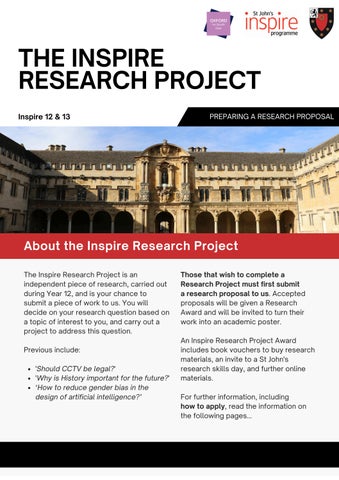
The Inspire Research Project is an independent piece of research, carried out during Year 12, and is your chance to submit a piece of work to us You will decide on your research question based on a topic of interest to you, and carry out a project to address this question.
Previous include:
'Should CCTV be legal?'
'Why is History important for the future?'
‘How to reduce gender bias in the design of artificial intelligence?’
Those that wish to complete a Research Project must first submit a research proposal to us. Accepted proposals will be given a Research Award and will be invited to turn their work into an academic poster
An Inspire Research Project Award includes book vouchers to buy research materials, an invite to a St John's research skills day, and further online materials.
For further information, including how to apply, read the information on the following pages

Completing an independent research project helps you to develop high-level critical thinking skills which

If you are offered an Inspire Research Project Award, you will receive:
Book vouchers for Blackwell's, to purchase resources to support your research
A place on the St John's Research Skills day (Saturday 26th June 2025)
A certificate of your award
Pupils will be expected to conduct their research over the Summer of Year 12 and will be invited to submit a poster showcasing their research in January of Year 13
To celebrate the Inspire Research Project, pupils who submit a poster will be invited to an Inspire Research Awards Day at St John's College, that showcases all of the submissions

Once you have considered what you would like to research, you need to write a research proposal, using the guidance on the next pages Pay close attention to the formatting guidelines, and remember to include references!
Submit your proposal via email to: inspire@sjc ox ac uk Remember to include your full name in the email.
The application deadline is Monday, 28th April 2025. Successful proposals will be informed shortly after this deadline

Yes! We are more than happy for you to use the research you’re doing with us to support your EPQ or other competitions and opportunities
Inspire Research Projects are submitted as posters, and are not assessed Therefore you are able to freely use your research and ideas from this project to support your EPQ essay
Research is a systematic investigation, which allows you to establish facts and find new conclusions.
A research proposal is a summary of research that you intend to carry out to establish these facts/conclusions It should be written to show others why the research that you want to do is useful, and describe how you plan to go about your research
1
Choose your topic - This could be something you enjoyed learning about and want to take further, or a new topic that you come across whilst reading It might be relevant to your A-level subjects, or linked to a university course that interests you.
Choose your research question - The first step of any research project is to find out about what is already known about your topic Look online, read blogs, watch TED talks or listen to blogs in your chosen subject.
Based on this preliminary research, choose a question that your research will focus on This is your research question/title
Has a complex answer - not a 'yes' or 'no' answer, or something you can google
Possible to answer (with your resources) - doesn't require guesswork
Based on fact - you should based your answer on evidence, not opinion
Specific - include details
Focussed - focus on one topic, or closely related ideas
Original - lots of people haven't already addressed this question
Not yet known - there isn't a known or agreed answer to this question
Some examples are shown below:
Should children exercise more?
Is a hyena a cat?
Is there a higher power?
Which type of hot drink is the best?
Which type of exercise helps children stay healthiest?
How is a hyena similar to a cat or a dog?
What factors contribute to belief in a higher power?
Does drinking a hot drink contribute to a person relaxing?
4
Introduction - In your introduction, you outline why your research question is important. What will be learnt from studying this question? Why might people want to know the answer?
Background - In the background, you summarise the research you have done, in order to choose this question What other research have people done in this area? Is there any existing controversy? Why have people not been able to study this before/not tried to study this before?
Method - In the method section, you describe how you plan to carry out your research. It is likely that you will do research using online sources, books and other printed media How will you make sure your information is accurate, and how will you try to answer your research question? Will you need to learn any new skills?
6
References - When you are doing your research, you will need to keep a good record of the sources (books, websites, newspapers ) that you use to find out information You should refer to your sources in the text using numbers, and then list the sources in full at the end of your proposal, using a numbered list Visit the url below for a detailed guide on using the Numbered referencing system
Title
Your proposal should be:
Written in size 12 font, in an easy-to-read typeface
Double spaced
500 - 700 words (1-2 sides of A4)
Saved as a PDF or Microsoft Word document
Include headings for each section (see table)
Include 5 - 10 references, cited in numbered style (see above, or example)
Introduction
Background
Your research question
A brief explaination of what you will research, and why this is important
A literature review - examine current knowledge relating to your research proposal
Explain how you will go about your research This should include:
Method
References
Research question(s)
Methods to collect data/resources
An approximate timeline
A record of the sources you used when doing your literature review
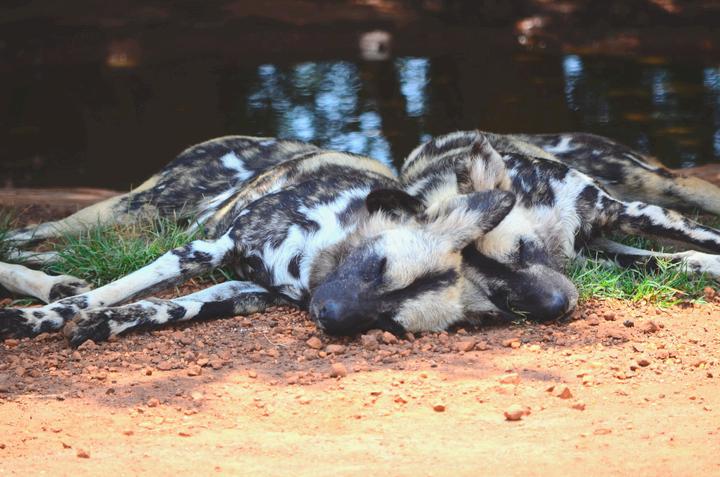
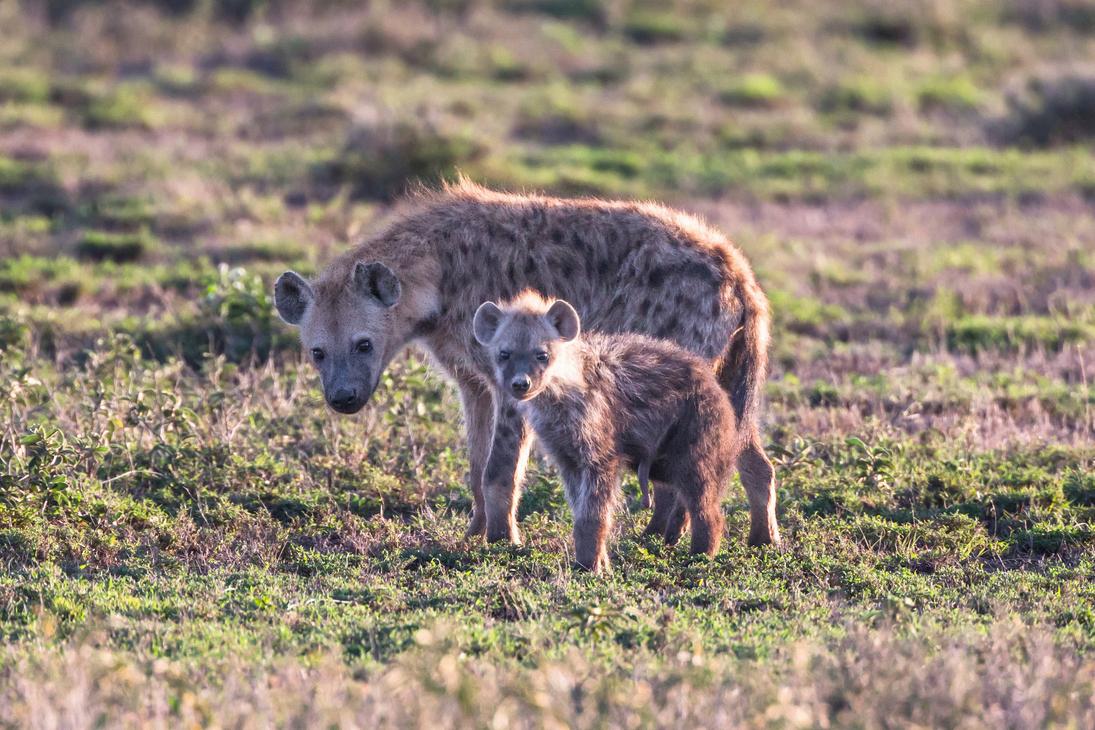
There are four living species classified as hyenas Distinct from both cats and dogs, hyenas belong to a 'family' of their own, known as Hyaenidae However, all four species of hyena share traits in common with both cats and dogs, which has previously raised the question: are hyenas more similar to cats or dogs?
The answer to this question depends on what you infer the word 'similar' to mean. Similarity can refer to how genetically related something is, or other similarities such as appearance
This research will examine various types of similarity, using literary research and personal observations Being able to describe how similar an animal is to other animals is important, as it has implications for understanding the health, behavioural patterns and habitats of that animal This is especially important with hyenas, as hyena populations are declining, and two species of hyena are considered 'near threatened'.
Humans have been classifying animals as far back as the 18th century, when Carlous Linnaeus introduced what we now call the 'taxonomic system' (1) The need to classify animals is driven by a desire to understand them further, and to be able to apply relevant ecological and medical knowledge from a known animal to one that is less well know.
Evolutionarily speaking, hyenas are more closely related to the cat family (Felidae), than the dog family (Canidae) (2). However, hyenas have often been mistaken for being more closely related to dogs, due to their similarities in appearance and lifestyle. When two animals occupy similar roles in an ecosystem (a niche), they can evolve similar traits independantly of one another. This is convergent evolution (3). For example, both sharks and dolphins have streamlined bodies because they live underwater, although sharks are fish and dolphins are mammals.
Physically, hyenas resemble dogs more than cats, which indicates that hyenas and dogs may be an example of convergent evolution For example, hyenas have skulls which are able to withstand the force needed to crack bones in their prey, alike dogs. In order to achieve this, the skulls of hyenas and dogs have both evolved to have a large bite force, and also a skull which can withstand a large strain energy (4). It has been shown by computer simulation that both hyena and dog species have evolved this in a similar fashion, by converging on optimum skull shapes to maximise these parameters (4)
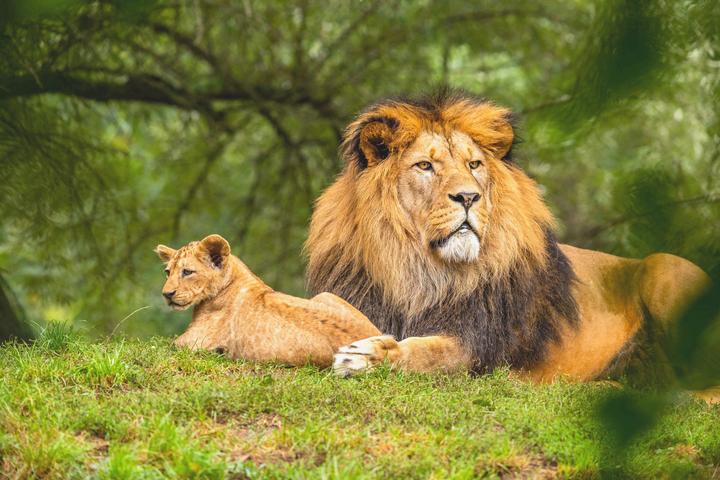
Perhaps unsurprisingly, given the similar skull shapes, the teeth of hyenas are also more similar to the teeth of dogs than the teeth of cats (5). Additionally, hyenas have claws which do not retract, which is similar to dogs but distinct from cats; 'big' cats such as tigers, lion, leopards, jaguars, as well as domestic cats, all have retractable claws (6).
The social organisation of hyenas, however, is unique (7) They exist in matriarchies, led by females, where the highest rank female and all her offspring outrank the second highest rank female and all her offspring, etc (7) Male hyenas typically leave the clan at adulthood, and roam to join another clan - unrelated males rank lower than all females and their offspring
This is distinct from both wild dogs, where typically only the breeding pair produce offspring (8), and lion prides,
where a group of related females, raise young in a creche (9)
Method
Information on the similarities between hyenas and cats and dogs will be carried out in two main ways First, a detailed literature review will be carried out, to research how closely related hyenas and cats are, in evolutionary terms. This will involve online research, as well as the use of textbooks. To ensure that data is accurate, books that have been published in the last 10 years will be used.
Second, the physical and behavioural similarities of hyenas to dogs and cats will be assessed, using a combination of the literature methods described above, and personal observations. Personal observations will include watching documentaries, and visiting the local natural history museum, to see hyena, big cat and dog skulls.
(663 words)*
(1) The Linnean Society of London (2022) Who was Linnaeus? [date accessed: 25/01/2022]
https://www.linnean.org/learning/whowas-linnaeus
(2) Hyena Project Ngorongoro crater (2016) Spotted Hyenas [date accessed: 21/12/2021] https://hyenaproject.com/hyenas/
(3) Live Science (2019) What is Convergent Evolution? [date accessed: 03/02/2022]
https://www livescience com/convergentevolution.html
(4) Tseng (2013) Testing Adaptive Hypotheses of Convergence with Functional Landscapes: A Case Study of Bone-Cracking Hypercarnivores [date accessed: 13/02/2022]
https://www researchgate net/publication /237018346 Testing Adaptive Hypothese s of Convergence with Functional Lands capes A Case Study of BoneCracking Hypercarnivores
(5) AZ Animals Staff (2021) Are Hyenas Dogs (Canines) or Cats (Felines) or Something Else Entirely? [date accessed: 15/01/2022] https://a-zanimals.com/blog/are-hyenas-dogscanines-or-cats-felines-or-somethingelse-entirely/
(6) Corney (2022) Do Big Cats have Retractable Claws? [date accessed: 13/12/2021]
https://www sciencefocus com/nature/do -big-cats-have-retractable-claws/
(7) Lyon (2019) Hyenas Probably Have More Friends Than You: Spotted hyena social hierarchies [date accessed: 17/12/2021]
https://sitn.hms.harvard.edu/flash/2019/h yenas-probably-have-more-friends-thanyou-spotted-hyena-social-hierarchies/
(8) Chen (2019) Social Behavior and Structure in Wild and Captive Groups of the African Wild Dog, Lycaon pictus (Temminck, 1820) (Carnivora: Canidae) [date accessed: 23/01/2022]
https://blaypublishers files wordpress co m/2019/05/chen-leb-64-may30 lebfinalcopy pdf
(9) University of Minnesota, Driven to Discover (2022) Evolution of group living [date accessed: 11/02/2022]
https://cbs.umn.edu/research/labs/packe r/research/evolution-group-living
*your reference list is not included in your word count