![]()


Welcome to The Final Whistle. As someone who has spent much of my life in sport – first as a gymnast and later as a broadcaster – I’ve loved learning about this project and seeing the passion behind it. Being interviewed for this issue was a real pleasure, especially since it was by an enthusiastic journalist who clearly cares about sport and storytelling. Sport has the power to bring people together, spark debate and inspire change – and it’s encouraging to know the next generation is eager to tell those stories with fresh perspectives. The Final Whistle is a brilliant springboard for future projects and ambitions, offering young writers the chance to learn, grow and find their voice. I’m excited to see how this magazine develops and proud to have been part of its journey. Gabby Logan, guest editor
For this second issue we’ve created five different covers celebrating sporting moments of 2025

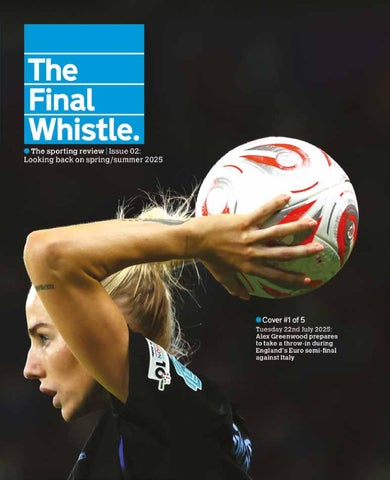
Cover #1
Tuesday 22nd
July 2025: Alex Greenwood takes a throw-in during the Euro semi-final
Photo by Molly Darlington/ UEFA via Getty Images

Cover #2
Saturday 12th
April 2025: Rory McIlroy tees off during the third round of the Masters
Photo by Joel Marklund/ Augusta National/ Getty Images

Cover #3
Tuesday 8th
July 2025: Carlos Alcaraz serves in the Wimbledon men’s singles quarter-final
Photo by Hannah Peters/ Getty Images

Cover #4
Saturday 26th
July 2025: British and Irish Lions’ players celebrate victory against Australia
Photo by Willian West/AFP via Getty Images

Cover #5
Saturday 8th
March 2025: London Pulse against Leeds Rhinos at the Netball Super Cup final
Photo by Morgan Harlow/ Getty Images
The sporting review | Issue 02: looking back on spring and summer 2025
Guest editor:
Gabby Logan
Issue two cohort:
Freya Batkin, Hetvi Bhatt, Alexandra Bousfield, Isobella Carolan Hall, Connie Chen, Rebecca Coulson, Lyra Coulthard, Olivia Duggan, Bella Ford, Keira Godwin, Charlotte Green, Darcy Harris-Norman, Lily Howard, Zulaikha Khan, Beth McCowen, Abby Millan, Inkar Mustafina, Beth Owen, Lilly-May Tingle, Katie Ward, Mia Wilson
Art directors: Christian Tate, James Ladbury Project team: Vicky Burgess, Matthew Lee, James Montague, Jessica Parry, David Phillips, Marcus Webb
hello@thefinalwhistle.co.uk
Published by the Slow Journalism Company, slow-journalism.com, © The Slow Journalism Company, January 2026. Unless otherwise stated, all images are supplied by Getty Images
While every effort has been made to ensure accuracy, The Slow Journalism Company does not accept liability for any errors or omissions. Reprinting of any articles or images from The Final Whistle without permission of The Slow Journalism Company is expressly forbidden.
Printed and bound by Park Communications, parkcom.co.uk
The Final Whistle is printed on paper from well-managed, FSC®-certified forests, on presses powered by 100% offshore wind electricity, using vegetable oil-based inks.
This magazine is part of a project which is tackling the huge gender imbalance in sports journalism. J ust ten percent of sports writers and five percent of sports editors are women: we want to help aspiring women sports journalists to break into the industry. To that end we are providing them with training, contacts, mentoring, access to sporting events and a platform for their work in the shape of this magazine, so they can begin to build up a professional portfolio.
The programme is being run by The Slow Journalism Company (SJC), publishers of Delayed Gratification , the world’s first Slow Journalism magazine ( slow-journalism.com ) and Picklejar Media , a boutique content agency and consultancy. The project is being supported by insurance company Howden with advice from a network of journalists, editors, presenters and industry professionals.
Working with university journalism course tutors certified by the National Council for the Training of Journalists (NCTJ) we identified a cohort of talented women writers in 2024 and again in 2025. They were invited to join a training and mentoring programme, including workshops with sports journalists, editors and photographers including Morgan Harlow, Marva Kreel, Molly McElwee, Aswan Magumbe, Sarah Mockford and Sirayah Shiraz
Members of the cohort were invited to pitch feature ideas for The Final Whistle magazine. Those that were successful were paid at professional rates to produce the magazine you are holding in your hands, working alongside senior editors.
We are looking for members of the next cohort of journalists and photographers, who will enjoy the same opportunities as the first two groups. We are also actively seeking partners who can help grow the distribution network for the magazine and provide financial support in the form of sponsorship and advertising.
If you would like to apply to be a member of a future cohort, become a supporter of the Final Whistle Project or join our distribution network please email hello@thefinalwhistle.co.uk


P04 Gabby Logan’s sporting diary
This issue’s guest editor selects her most memorable sporting moments of the spring and summer of 2025
P12 Women’s Euro 2025
An infographic guide to the Lionesses’ triumph
P22 The big interview
Jamie Roberts reveals his pick of the players at the 2025 Lions tour
P26 Big break
The women trying to succeed in the traditionally male dominated world of snooker
P32 The fast track
The rising stars of motorsport
P42 “At this level every game’s a tough game”
Heaton Stannington and the revival of grassroots football
P48 Hoop dreams
Claire Nelson, managing director of the Netball Super League, on reinventing the sport
P50 A big call
The case for and against Wimbledon’s adoption of automated line calls


The sporting digest 2025
P56 The sporting digest
A look back at all the biggest sporting moments of spring and summer 2025
P64 The last word Gabby Logan on what she is looking forward to in 2026’s sporting calendar

Gabby Logan, this issue’s guest editor, has covered sport for more than 25 years. She shares her top five moments from the spring and summer of 2025
Interview: Zulaikha Khan
Gabby Logan has had a packed year, witnessing sporting history being made while presenting live to the public. Looking back on the spring and summer of 2025, her first sporting highlight is Rory McIlroy winning the Masters and becoming only the sixth person ever to achieve a Grand Slam. Having won three of the four major championships needed for a Grand Slam between 2011 and 2014, the final one proved tricky. “The Masters eluded him,” says Logan. “Everybody felt it was only a matter of time, but he just couldn’t get over the line. He had seconds, he had thirds, he had absolute howlers where he didn’t even make the cut… He’s doing amazing things, but he’s still not getting this one elusive thing.”
Logan, like many golf fans, had been waiting for this moment. When it came it didn’t come easily, with McIlroy needing a sudden death play-off to separate him from Justin Rose. “It was so dramatic to see these two, who are teammates in the Ryder Cup and really good friends [competing in a play-off],” says Logan. With tensions high, McIlroy rolled in a birdie putt to win the play-off and the coveted green jacket. And Rose was quick to congratulate him. “It was a beautiful sporting moment because Justin was so generous when Rory won. I think he knew golf wanted Rory to win,” says Logan. “He finally got there, he got over the line.”
Rory McIlroy celebrates after securing his play-off win during the final round of the 2025 Masters at Augusta National Golf Club on 13th April


England’s Abi Burton dives over the line to score the final try of the Women’s Six Nations match between Wales and England at the Principality Stadium in Cardiff on 29th March 2025

Few teams can say they have held a winning streak for more than 1,000 days. By last summer, the England women’s national rugby union team could proudly say just that after winning a Grand Slam and their seventh successive Six Nations title in April, making the Red Roses unbeaten since 2022. For the first time since the Women’s Six Nations was first contested in 1995, 2025 saw all the matches broadcast on terrestrial television. “It was an important landmark,” says Logan. “It made women’s rugby a lot more visible. It was an important source of knowledge, for people to go, ‘Oh, the World Cup’s coming later in the year. This team looked good and they could win it’.”
England dominated the tournament, winning every match, despite being tested against France in the final game, who pushed them to a one-point margin of victory. “I think that’s why the end of that tournament created a little bit of jeopardy and the feeling that there are teams who could push them come the World Cup,” says Logan.
With such scorelines contributing to the excitement around the World Cup, this Six Nations campaign also highlighted the unique blossoming of a friendship between two of the most successful England teams. “[English football goalkeeper] Mary Earps was at one of the matches, and the Lionesses and the Red Roses started to share experiences with each other,” says Logan. “That was a lovely moment, to see that exchange of support. [Women’s football and rugby] don’t have to be in competition. They can grow together. They’re very different sports, they attract different kinds of people to their matches, but there is also a lot of crossover.”
British & Irish Lions captain Maro Itoje celebrates with fans after their 2-1 series win over Australia at the Accor Stadium, Sydney, 2nd August 2025

After the 2021 British & Irish Lions tour of South Africa took place behind closed doors due to Covid-19 restrictions, fans were back in the stands four years later to watch a novel combination of players battle alongside one another. “The Lions team had so many players who I’ve followed through the Six Nations,” says Logan. “They play for different countries and then they all come together.”
“Whereas in the Six Nations they’re looking to get one over on each other, suddenly they are on the same team,” she continues. “They have to be bonded and find common ground: to create a brotherhood from nothing. The players might [previously] have had an altercation on a pitch; they might have tackled a new Lions teammate really hard and put them out of a game, or even injured them. That part of it I find quite poetic, how they managed to do that.”
The tour saw the Lions defeat Australia 2-1 to win the test series after a nail-biting check by the Television Match Official [TMO] nearly ruled out Hugo Keenan’s winning try in the dying moments of the second victory. “It had a lot of drama and it was great sport as it always is,” says Logan. “For me, a must-watch”.
Recognising the importance to players of being called up to the Lions, Logan says, “When I hear rugby players talk, they still see it as the biggest honour, the highest accolade – it’s a bit like being an Olympian. You could be the best rugby player in the world two years before, but if you’re injured in the year that the Lions tour comes around, or your form dips, you’re not going to make it. You could have a ten-year career where you’re at the top of your game, but you might not be quite where you need to be in those Lions years, and that’s the beauty of it.”

“I’ve always loved tennis, the way that it ebbs and flows. There aren’t many sports in which players are not out until the final moment. That’s why Wimbledon is enduringly attractive for me and why I go back there time and time again,” says Logan, who played tennis in her youth.
Her Wimbledon highlight from 2025 was a spectacular comeback match: the men’s final between Carlos Alcaraz, who had never lost a Grand Slam final, and Italian star Jannik Sinner, who had lost to his Spanish opponent at the French Open in Paris earlier in the year.
“I’m an Alcaraz fan, so I was hoping he’d win,” says Logan. “But I have to take my hat off to Sinner, because it was such a truly stunning match, and he made it possible.”
Jannik Sinner celebrates winning the first game of the second set against Carlos Alcaraz during the men’s final at Wimbledon on 13th July 2025
While Alcaraz kicked off with a dominant first set and started the second well, Sinner caused an upset to win the next three sets and become the first player to beat Alcaraz in a Grand Slam final.
“Alcaraz was so dominant at the start of the match. He just looked like he was cruising. Then suddenly Sinner just came back at him... There was nothing that Alcaraz could do. Sinner was all over the court, and it was so athletic. The pair of them play the most sublime tennis.”
Logan is looking forward to seeing them compete again. “It feels like with these two, we’re going into another golden era of two greats,” she says. “There’ll be other players who try and get in, but these two greats are going to go head-to-head for a long time.”
The most memorable moment of Gabby Logan’s first half of 2025 was the most-watched moment of the summer on UK television: the Women’s Euro 2025 final. More than 12 million watched the Lionesses lift the trophy after yet another iconic tournament run. Having presented live from the match, Logan recalls the moment the game went to penalties. “I was starting to construct things to say on both sides of that really uneven coin. One side and you’re going to Buckingham Palace to meet the king. The other and you’re going home empty-handed. Professionally you’re always hoping it’s the good news story that you can deliver.”
With England having dominated the 2022 Euros with crushing scorelines, 2025 saw a different form of resilience. “They went into the tournament not on the same kind of run that they had in 2022,” says Logan. “Spain had become the world champions in the interim period, and were very much the fancied team for this tournament.” Logan describes England’s quarter-final shootout versus Sweden as “unbelievable”. “You had some of the most incredible and some of the most ridiculous penalties you’ve ever seen,” she says of the 14-penalty shootout, which England won 3-2. “Brilliant saves, some not-so-brilliant shots, but just edge-of-yourseat stuff in terms of sporting entertainment.” Having scored twice in injury time to overcome Italy in the semifinal, England were rewarded with a final against Spain.
“I just felt like England were going to lose it for pretty much the whole game,” says Logan. “I couldn’t believe they were still hanging on in extra time, with Spain throwing everything at them. But the Lionesses were the absolute epitome of resilience, and they have found this way to win that is really to be admired.”


England’s Chloe Kelly scores the team’s winning penalty in the Women’s Euro 2025 final on 27th July


The 2025 Uefa Women’s Championship in Switzerland was a highlight of July, characterised by huge crowds, great goals and nailbiting finishes. Here’s a month’s worth of football action visualised
Research: Alex Bousfield, Lyra Coulthard
Illustrations: Christian Tate 1 2 3
In purely footballing terms, pundits were quick to declare the 2025 tournament a classic – but how does it compare to previous Uefa Women’s Euros?
Sources: Sports Illustrated, Uefa. Prize money figures are
The squads of the 16 countries that competed at the Euros had huge differences in player value. But did the teams with the most money on the pitch do the best?
The rules: We’ve illustrated the total value of every squad at Euro 2025 according to women’s football website Soccerdonna, which assesses the market value of players. We have ordered teams by the round they reached in the tournament. For teams eliminated at the same round, the one with the better performance during the group stage ranks higher


Angharad James-Turner of Wales talks to her teammates before facing England, 13th July 2025. Wales, whose squad is valued at less than ten percent of England’s, lost the game 6-1
Cristiana Girelli of Italy celebrates scoring against Portugal in their match on 7th July. The goal topped our meta-list of the tournament’s best strikes

Switzerland 2025 saw more goals scored than at any other women’s Euros, with 106 across 31 matches. But which was the best? We’ve analysed a global selection of pundits’ goals of the tournament lists to bring you a definitive chart of the top strikes
The rules: Goals are listed in order of number of entries on our jury’s lists of best goals of the tournament; each entry on a jury’s list is marked with a H
The jury: ESPN, Guardian, ITV, Sports Daily, Sportstudio Fußball, Uefa (fan vote), Uefa (technical committee)
Cristiana Girelli
Italy vs Portugal 7th July | HHHHHHH
Veteran striker and Italy captain Girelli’s glorious curling shot from the edge of the box against Portugal was judged goal of the tournament seven times by the pundits on the lists we analysed, more than any other goal.


Clàudia Pina
Spain vs Belgium 7th July | HHHHHH
Spain’s young playmaker bent a stunning right-footed strike into the top corner from outside the area in the 81st minute, sealing a 6-2 rout.

Aitana Bonmatí
Spain vs Germany 23rd July | HHHHH
Two-time Ballon d’Or winner Bonmatí proved her genius in the 113th minute of extra time, whipping this tight-angle shot inside the near post to send Spain into their first Euros final.

Delphine Cascarino
France vs Netherlands 13th July | HHHH
The flying French forward scored twice in a four-minute blitz; her first, a surging solo run capped by a thunderous strike from distance, won the most plaudits.

Vivianne Miedema
Netherlands vs Wales 5th July | HHHHHH
Dutch legend Miedema marked her 100th international goal with a sublime finish in first-half stoppage time, paving the way for a 3-0 win.

Lauren James England vs Netherlands 9th July | HHHHH
With England having lost their opening match to France, James kickstarted the Lionesses’ campaign with this left-foot strike from outside the box, setting up a 4-0 demolition.

Jule Brand
Germany vs Poland 4th July | HHHH
Germany’s dynamic winger cut inside from the right and smashed a left-foot rocket into the far corner in the 52nd minute, breaking the deadlock in style and earning four mentions on the lists we analysed.
Eventual champions England had a rollercoaster Euros. They came in as reigning champions, but lost their opening match to France and ended up finishing second in their group. More drama was to follow in the knockout stages; every one of their games went to extra time and the Lionesses were rarely ahead
The rules: We’ve visualised the times in England’s knockout matches when the team were level, behind or in front. Stoppage/injury time is signified by a dotted line
England came into the quarters as group runners-up, and Group C winner Sweden proved a tough test before England won via a 3-2 penalty shootout
Asllani scores!
Sweden 1-0 up in the second minute
Blackstenius scores!
25 minutes
Bronze scores! With 11 minutes to go England pull one back
Agyemang scores! Two minutes after Bronze’s goal England are level
Italy were minutes from sending the reigning champions home before a stoppage-time equaliser and a last-gasp winner for the Lionesses
Bonansea scores! Italy, eight places below England in the world rankings, take the lead
Agyemang scores! The teenager finds the net in the sixth minute of injury time
Kelly scores! A rebound from her saved spot-kick sends England through
Final vs Spain
The Lionesses retained the title via a dramatic 3-1 penalty win — after leading for just four minutes and 52 seconds across six hours of knockout football
Caldentey scores! After 25 minutes, world champions Spain lead
Russo scores! The Arsenal forward’s 57th-minute header levels it. The Lionesses then dig deep, throwing bodies on the line to take the final to penalties

Michelle Agyemang celebrates with Ella Toone after scoring a dramatic equaliser against Italy in the sixth minute of stoppage time during their semi-final at Stade de Genève
Like so many times before with England, at Euro 2025 it all came down to penalties, with the Lionesses triumphing 3-1 in the final against Spain. Here’s how their record compares to that of their male counterparts at the Euros and World Cup
The rules: We’ve illustrated every penalty shootout involving an England team at a World Cup or European Championship
WC= World Cup, Eu=Euros, F=final, SF=semi-final, QF=quarter-final, R16= round of 16
Surprisingly, the Three Lions’ first penalty shootout came 14 years after the ultimate deadlock breaker debuted at Euro 76. It hasn’t gone brilliantly since.
The Lionesses won two shootouts en route to Euro 2025 glory, boosting their success rate to 60% – double the men’s, despite a lower conversion rate of spot kicks.


Chloe Kelly celebrates after scoring England’s winning penalty against Spain in the final at St. Jakob-Park in Basel, Switzerland

Roberts was selected for two British & Irish Lions tours in 2009 and 2013, winning the 2013 series in Australia
The Welsh rugby icon chooses his top players from the 2025 British and Irish Lions tour of Australia
Words: Lyra Coulthard
Jamie Roberts, former Lion and three-time Six Nations winner with Wales, was down under in summer 2025 to witness the British & Irish Lions’ series victory in his capacity as a pundit for Welsh language channel S4C, and as an ambassador for insurance company Howden.
As a player Roberts was known as ‘Doc’ by his teammates, as he balanced medical studies with his sporting pursuits, going on to earn a master’s degree in medical science from Cambridge and leaving the world to
question whether he had 24 hours in a day like the rest of us. When he speaks to The Final Whistle he has just completed a night shift in his new career as a junior doctor in the NHS, yet he’s full of energy and enthusiasm while picking his top players from the Lions tour of Australia in the summer.
“My first pick is the Lions’ skipper, Maro Itoje , ” he says. “He’s played to such a consistently high standard. Just relentless every game, leading from the front. On the pitch he always acts with a kind of tactical intelligence that warrants his position as captain. I think Maro is brilliant and the standout moment was him lifting the British & Irish Lions trophy because it’s not something you often see; prior to 2025, 2013 was the only time we’d won this century. That’s a moment that will stay with Maro forever and become etched into Lions folklore.”
“Being at the test in Sydney and looking over to where I played 12 years ago was very special”
Watching Itoje lift the trophy in torrential rain in Sydney after the Lions’ 2-1 series victory brought back “fond memories” for Roberts, who fought off a hamstring strain to play in the decisive third test match in 2013. He also scored a famous try in that Lions’ series triumph. “Being at the test in Sydney and looking over to where I played 12 years ago, even through all that biblical weather, was very special,” he says.
Roberts’ second pick is the Lions man voted player of the tour, Irish prop Tadhg Furlong. “His influence on games on that tour was mega,” he says. “He is just a ridiculously good rugby player with incredible abilities. Whether it’s physically or technically, he just operates to a different standard than most other rugby players. I love watching him play. Honestly, I’m glad I didn’t have to face him too much in my Wales days. He was a huge factor in the Lions’ success in Australia.”
Sione Tuipulotu was another Lion that shone in Australia. “I remember doing an event with
Sione during the Six Nations earlier in 2025 up in Edinburgh,” Roberts says. “He was injured just before the championships, so his journey over those six, seven months leading up to the tour was a difficult one, but he earned his place to start as the Lions’ number 12. I was desperately hoping he would be fit to make the series because I didn’t see anyone coming close to his playmaking abilities. Sione was a man on a mission, so huge respect to him considering the mountain he had to climb to reach that Lions jersey.”
Roberts’ final pick is the young Australian fullback, Max Jorgensen. “I’d always heard a lot about Max,” he says. “Playing at the New South Wales Waratahs during my final season [in 2022], I heard a lot of chat around this talented player rising through the ranks. And gee, he took his opportunity, didn’t he? He showed the world. These tours often give comingof-age moments to young players, and Max did exactly that with his top-tier rugby. His standout moment was that loose ball in Brisbane where he collected it up and ran in that try just after half time [in the opening Test of the 2025 tour, a 27–19 Lions win]. That was like a ‘Whoa, this kid’s got it’ moment.”
Roberts savoured the opportunity to become reimmersed in the rugby world during the Lions’ tour. “Us rugby players even start to miss the smell and feel of a pitch after we stop playing, so it was great to rejoin the atmosphere,” he says.
Yet 48 hours after stepping off the plane back onto British soil, he began his new career at a Cardiff hospital. “Every now and then a rugby fan patient in the hospital will look up and go, ‘Wait a minute, aren’t you Jamie Roberts?’ which is a little strange for both of us but they usually have something nice to say, and I really enjoy reminiscing with them about the sport. It can be a lovely way to build a doctorpatient relationship.”
It will be 2027, when the inaugural British & Irish Lions Women’s tour takes place in New Zealand, before Roberts will get to discuss a new Lions tour with patients, with the next men’s tour heading to the same country in 2029. But it’s that temporality – the fact that the team only exists for a few weeks every four years – that makes it so special. “The Lions colours represent excellence and a willingness to uphold a lineage that goes beyond yourself,” he says. “And the latest Lions honoured that tradition, fighting for the trophy with a commitment and unity that earned them a small piece of history.”


Zhao Xintong celebrates after becoming the first Asian player to win the World Snooker Championship, May 2025
On 5th May 2025 Zhao Xintong made history by becoming the first Asian world champion of snooker. But another of the sport’s glass ceilings is still waiting to be broken. Rebecca Coulson speaks to the women trying to succeed in the traditionally maledominated sport
Words: Rebecca Coulson
The longest-running and most prestigious event in snooker, the World Championship has been held since 1927. Nearly a century later, not a single woman has won it, despite the competition being mixedgender and the World Snooker Tour (WST) being open to women.
In fact, the best performance by a female player in the tournament’s history came in 2017 when 12-time Women’s World Champion Reanne Evans reached the second qualifying round. This particular glass ceiling isn’t anywhere close to being broken.
In the 2025 World Snooker Championship, at which China’s Zhao Xintong made history as the first Asian world champion, no female players reached the main, televised stages of the tournament, contested at the Crucible Theatre in Sheffield. Moreover, only four out of 129 players competing in the 2025/26 WST season which began in June 2025 are female: Reanne Evans, Ng On-yee, Bai Yulu and Ellise Scott. It’s a disappointingly small proportion.
The talent
Daisy May Oliver, 16, is a young snooker sensation and a voice for female equality in the sport. Her first experience on the baize was playing pool on holiday with her father Nigel who, having noticed his daughter’s passion, took her to a snooker hall in Kingswinford in the West Midlands, the same venue in which Reanne Evans is known to practice.
“My dad has never stopped me from doing something just because I’m a girl,” Oliver tells me. “I always saw snooker on TV when I was a kid because my dad used to play, and he got that love of snooker from his dad. So it’s passed down the family.”

Having discovered she had a knack for the sport, Oliver decided she should attempt to break into the competitive field. Her father discovered World Women’s Snooker (WWS), an organisation that aims to increase the participation of women in the historically male-dominated sport, and entered Oliver into her first competition at the age of 13. She began to practice more at snooker clubs and play frames against male opponents, while also competing in WWS. “Being that person in the room does take courage,” she says about being one of the few female players each time she competes. “But I will dive headfirst into anything, so I wasn’t fazed by it.”
With encouragement from her family and newfound support from older, more established WWS players, Oliver became a regular in women’s competitions, discovered her own style and flair, and progressed to the final stages of snooker tournaments. In 2024, she contested her first final in Winchester against World Seniors’ Champion Tessa Davidson, and although she came out runner-up, she says that her success gave
her belief that she can one day compete on the WST. “Reaching the final did me justice,” Oliver says. “I told people, and proved to myself, that I can get there, I will get there.”
Oliver is keen to one day sport a pink waistcoat at the baize, saying she wishes to be as feminine as possible to make the point that women in the sport should not be treated any differently. “I am not at a disadvantage from you just because I’m a woman,” she says. “There are other things that cause disadvantages, but it is not my gender that causes that.”
As a member of the English Partnership for Snooker and Billiards, Oliver had the opportunity to join the England Women’s team, which won the Home International Tournament title earlier in 2025. She says that she can hardly believe that she’s “achieved so much in such a short period of time” and is “so grateful for everything that has gone my way” – but taking the next step, and joining the four female players on the WST, isn’t going to be easy.
Many young snooker players dream of reaching the WST, but for women the path is long and difficult, and many end up looking for other career options. Little TV coverage for the WWS matches means players struggle to get the exposure they need to attract sponsors, and therefore funding. The gender pay gap when it comes to prize money between women’s and men’s snooker events is striking. The winner of the 2025 WST World Championship, Zhao Xintong, received £500,000, while the Women’s World Championship only offered £10,000 to its winner, another Chinese player, Bai Yulu.
“As a woman in snooker, I know there’s no money in it and I’m going to have to have another job at some point,” says Oliver. “But I’d love to make it to the main tour to prove that I’m no different from the man playing on the other table.”
At the heart of the quest to break the glass ceiling is former Women’s World Champion and current WWS president, Mandy Fisher. On a rainy afternoon she told me about her career – the highs, lows, and a formidable bid to keep women’s snooker alive.
During a childhood spent frequenting British Rail Staff Association clubs with her father, who worked on the railways, a young Fisher found a way to occupy herself – pool tables. On one occasion a pool team was a member short and invited her to play. She impressed them, and from then on was included in their pool league tournaments. “I ended up winning the local county singles, doubles and triples championships, beating a guy in the final who smashed his cue afterwards because he wasn’t happy!” recalls Fisher with a laugh. As a reward for her victory, her father bought her her first cue.
Sacrifices were made: she gave up work and went to car boot sales to raise money for travel expenses; her parents also bought her a snooker table. However, there were pressures performing in the extremely male-dominated environment of snooker at the turn of the 1980s and challenging the status quo.
“The chairman [of one snooker club] said they had to have a meeting to decide whether to let me play,” says Fisher. “It was voted through that I could, and the chairman resigned because he didn’t think women should play snooker.”

A 1980s poster for women’s snooker featuring Mandy Fisher
But sexism did not put her off practising and playing, and in 1981 she reached her first major final, at the Women’s World Open, where she played the most prominent female snooker star of the time, Vera Selby. Although she lost that match, her career was on an upward trajectory – but the women’s game was on the verge of collapse.
“It looked like it was going to be the end of women’s snooker at that point,” says Fisher. “I was absolutely gutted because I’d given up work to do this full time.” Thankfully with financial backing from events company Grocer Jack Sports, a new organisation was formed. Fisher became a co-founder of the World Ladies Billiards and Snooker Association, now WWS, juggling an administrative role alongside an active playing career.
Grocer Jack Sports backed a five-tournament series, the National Express Grand Prix, and Fisher won the inaugural tournament in 1984. In 2021, with Fisher now president, WWS became an official qualifying pathway for the WST, allowing top female players to enter qualifiers for tournaments including the
Bai Yulu, the winner of the World Women’s Snooker Championship in 2024 and 2025, practices in the Ding Junhui Snooker Academy in the centre of Sheffield

World Championship. The organisation also provides coaching and support for young players like Daisy May Oliver to refine their skills, and practice against more experienced women. “I wish it had all been in place like it is now, and I could have concentrated on playing,” says Fisher. “I’d love to have seen what I could have achieved.”
Yet for all WWS is doing to bring more women onto the professional circuit, there are still calls for ideological and structural changes to be made within the sport. “There’s a barrier and it hasn’t been broken,” says Oliver. “There’s a clear divide [between men’s and women’s snooker] and that’s obvious with the main tour, which we call the ‘men’s tour’. You don’t see the women, but they are there, trying.”
Fisher and Oliver believe that there needs to be greater support for women’s snooker, and that female players need more opportunities to play alongside their male peers so they can raise their game.
Snooker is not a sport like football or boxing in which biological males have a clear physical advantage, although some have suggested that physiological differences such as longer reach might have some impact. Fisher says that she’s “always believed there’s no physical reason why a woman should not be as good as a man. It’s just a matter of time and catching up because the game is about touch and technique, not strength and power.”
In November 2025 we saw perhaps the clearest sign yet that women can compete at the highest level when Bai Yulu made a 145 break at the International Championship in Nanjing, the highest ever by a female player. But both Oliver and Fisher believe it will take a while longer for snooker’s glass ceiling to be completely broken – by a female world champion.
“Unless people start investing more and acknowledging us, I don’t think it’ll happen for a long time,” said Oliver. “We just had our first Chinese world champion, but look how long it’s taken them… It’s going to take the women a lot longer.”
The Final Whistle Project is designed to help open doors for women who are interested in a career in sports journalism across the disciplines – writing, photography, audio and video.
We are currently recruiting our new cohort – we’re looking for women who are:
Studying to be journalists OR studying a different discipline but are keen to become sports journalists OR in the early years of their career in journalism and keen to move into sports coverage

If this is of interest, please send us a brief statement about why you are right for this opportunity and a recent piece of writing, photography or audio/ video content of which you are proud before 31st March 2026.
Successful applicants will have the opportunity to join a training day in London, followed by additional workshop sessions, invitations to sports events and the opportunity to pitch stories for future issues of The Final Whistle magazine.
If you would like to submit an application or support the project in any other way please contact the team at hello@thefinalwhistle.co.uk

Abbi Pulling competing in the debut season of F1 Academy in 2023

The global motorsports market is booming. Figures released in summer 2025 projected its value to hit $6.4 billion by the end of the year, up almost 10 percent from 2024. With the future looking bright, The Final Whistle meets four young drivers from four different motorsports, all vying to be the next big thing
By Beth Owen
For over a decade, GB3 driver Abbi Pulling has not taken her foot off the pedal. In 2024, the then 21-year-old driver secured the F1 Academy Championship, a female-only single-seater racing series built to break women into the famously male-led Formula 1 industry. Her dominant title-winning campaign was documented in the seven-part Netflix show F1: The Academy, produced by Oscar-winning actor Reese Witherspoon. “To have that last year and prove to everyone, as well as myself, that I was capable of that was really important,” she says of her championship win. “I just turned up every weekend and performed to the best of my abilities.”
The Briton first took to the track at the age of eight, following closely in her dad’s footsteps. “Ever since I was a little girl, I went racing with my dad,” says Pulling. “He raced on motorbikes, and I just absolutely loved it. And I kept pestering him to have a go.” Following a successful karting career, Pulling made her single-seater debut in the 2020 British Formula 4 series, a national championship designed to develop young talent. Sadly, a lack of funding meant her second F4 campaign was cut short after six races.
Undeterred, she joined the all-female racing W Series. But for the second time her career was derailed by financial matters: the W Series went into


“I’d love to try and move into the F3 Championship and then show what us women are capable of in that as well”
— Abbi Pulling
administration, underlining an obstacle she had encountered throughout her career. “I think the biggest thing for me [has] always just been track time,” she says of that period. “Because it [the W Series] went under I did about ten hours of driving all year. I could barely call myself a racing driver that year.”
But then came the lifeline. In 2023 the F1 Academy was launched by former professional racing driver Susie Wolfe to develop young female talent. Pulling joined Rodin Motorsport, then Rodin Carlin, to compete in the maiden season. She finished fifth in the final standings. It was a small taste of the glory to come. She won the championship in her second season, as well as a fully funded seat in GB3, a single-seater racing championship seen as an important step towards F1. Lando Norris and George Russell both graduated from GB3 to F1 and it has enabled Pulling to race for another year, which would have otherwise been impossible to fund. And her success was captured in high definition by Netflix cameras. In May 2025, Pulling walked the red carpet for the season premiere of F1: The Academy. “The junior levels are not massively publicised. That’s why F1 Academy is so beneficial, it has got a lot of eyes on it since the Netflix doc that came out,” says Pulling. “It raises the profiles for drivers. It makes it easier to raise funding.”
Pulling is now racing in GB3, but 2025 has seen mixed fortunes. A third-place finish at Brands Hatch meant Pulling became the first woman ever to stand on the podium in the GB3 Championship and she finished seventh at Donington Park after fighting from the back of the grid. But she has also faced setbacks with two retirements. “It’s been really tough. It’s not how I’ve wanted it to be for sure. I know that I could be further up in the Championship,” she says. “The highlight obviously is the podium at Brands Hatch. But I think my more impressive drive [in 2025] was at Donington Park. There’s not been too many highlights to be honest, but [I’m] constantly learning. It’s a big step. The GB3 car is a big jump from what I’ve been racing. This is the first year I’ve ever had with that kind of feeling in a car. And it’s been incredible. I’ve really enjoyed it.”
As for what happens next, Pulling remains optimistic. “I’d love to try and move into the F3 Championship,” she says of the global series that runs alongside Formula 1 weekends, “and then show what us women are capable of in that as well.”

Pulling during qualifying ahead of F1 Academy Round 7 at the Yas Marina Circuit, Abu Dhabi, 6th December 2024


By Freya Batkin
Twenty-four hours. Three drivers. One car. Endurance racing is an enigma to many – a long-distance, longduration motorsport that demands strategy, stamina and patience. But for 24-year-old Rasmus Lindh, the sport’s latest star, it makes perfect sense.
The Swedish driver enjoyed a successful 2025, securing victory – alongside his teammates Daniel Goldberg and Paul di Resta – at two of endurance racing’s biggest meets: the 24 Hours of Daytona and Six Hours of The Glen. With a dramatic hunt for the lead in the closing few hours of Daytona, a nailbitingly close finish put the team in second place. But a post-race ruling against the winning team pushed Lindh and the United Autosports setup to the top step of the podium. “Daytona was certainly the highlight for me,” he says. “It obviously wasn’t how we wanted to win but it was an incredible feeling either way.”
Lindh is currently part of the Wakefield-based United Autosports team, but he’s had a difficult journey to the top of endurance racing. Five years ago he seemed destined to drive in the US having signed for Belardi Autosports ahead of the 2020 season of Indy Lights, a pathway towards the IndyCar series now rebranded Indy NXT. Lindh delivered through pre-season testing, running fastest in all the official tests, but then the Covid-19 pandemic hit. Races were cancelled and sponsors backed out. Unable to fund himself, Lindh was left in the dark. “Funding over the last few years has been the biggest worry for me,” he says. “I don’t come from a wealthy family, just a normal family, so it’s been in the back of my mind since 2020.”
Five years on the sidelines followed, until United Autosports offered Lindh the chance to compete again at the highest level. “It’s been so difficult… so a huge weight lifted off my shoulders,” he says. The wait has only cemented Lindh’s determination and he finds himself in the best spot in his career so far, winning the 24 Hours of Daytona alongside his teammates. Lindh’s ultimate goal is to compete at Hypercar level, the top category in the FIA World Endurance Championship, but the past five years have taught him the value of patience. “I’m still quite young,” he says. “I’ve had so much stress over the last few years that I’m not going to stress about getting to Hypercar, just enjoy the ride with United at the moment and take any opportunity that comes my way.”


“Funding over the last few years has been the biggest worry for me. I don’t come from a wealthy family, just a normal family”
— Rasmus Lindh
By Lilly-May Tingle
It is a wet Friday on the Oulton Park Circuit in Cheshire, and Storm Amy is closing in. But while the country battens down the hatches and prepares for the worst, Casey O’Gorman is getting ready to ride. It is the penultimate round of the British Superbike Championship and the organisers have decided that even the threat of a powerful extratropical cyclone won’t prevent the race from going ahead. “I’m excited,” says O’Gorman, an 18-year-old Irish motorbike racing prodigy earmarked as a star of the future. Conditions that would terrify most mortals don’t faze him. “We are moving forward with the bike, just finishing first and second in the practice sessions,” he says of his successful races in the rain so far. “So I’m hoping it stays wet for the weekend!”
O’Gorman has been racing for Kove Factory Racing in the British Sportsbike series and Team Estrella Galicia 0.0 in Junior GP, a feeder class for the MotoGP World Championship, the pinnacle of the sport. Born in County Laois, Ireland, he grew up between London and Spain and has been sitting on motorbikes since he was old enough to walk. “My dad used to watch MotoGP a lot when I was a kid,” says O’Gorman, when I asked him about how he got into racing. “On my first day of nursery, dad took me on the back of his bike.” His father bought O’Gorman his first motorbike when he was still in primary school, and signed him up to attend a riding session run by former world championship racer Scott Reading. “On our way home, Scott called and told my dad to keep me racing,” he recalls. “He saw something in me.”
And Reading was right. In 2021, when O’Gorman had just turned 15, he won the British Talent Cup. But his career path has not been smooth. In 2022, just as O’Gorman was looking forward to stepping up to race in a new class, a rash of young rider deaths saw the age limit for Moto3 raised to 17, and then to 18 the following year. “I was ready to go at 16,” he says, “but the age limit changed, so I was held back.”
After three years of waiting he can see the positives. “I have developed more now,” he says. Finally, in 2025, he made his debut at the Moto3 World Championship, two steps before MotoGP. This summer, two days after turning 18, he flew to Austria to compete for the Italian SIC58 Squada Course team. “I kind of knew I would get the opportunity, with me turning 18 mid-season, to stand in if someone got injured,” he says. Which


“I was ready to go at 16 but the age limit changed, so I was held back... I have developed more now”
— Casey O’Gorman
is exactly what happened. “One day we were talking about it, the next I was flying out”. On his Austrian GP debut he finished 18th out of 26. A week later, in Hungary, he finished 13th, scoring two points.
Miraculously, on race day back at Oulton Park, Storm Amy passes by and leaves the track dry. At the back of the paddock, Kove Factory Racing and Casey O’Gorman are getting ready to race. With O’Gorman second on the grid, everyone is optimistic, especially after a decent start in which he fought his way into the top five. But then on lap three, O’Gorman’s bike starts smoking. The disappointment of retiring from the race doesn’t last long. A few days after we speak, SIC58 Squada Course announces they have signed the Irish teenager on a two-year contract. It has been a rocky path, but O’Gorman is making up for lost time.

Casey O’Gorman during free practice at the MotoGP of Austria, 15th August 2025

By Lily Howard
For 22-year-old Formula E driver Zane Maloney, racing is more than just speed – to him it reflects family, legacy and a journey that started on the small island of Barbados. Maloney is the first Barbadian to win in Formula 2 and compete in Formula E. He was surrounded by racing from a young age. His grandfather raced until the age of 75, and weekends were spent at the local circuit, Bushy Park, with his father, uncles, cousin and brothers. “I started when I was three just because I was at the racetrack every single weekend,” he recalls. “The passion grew from there. Initially of course it was just for fun, and it only became a bit more serious when I was 14 years old.”
After early experiences karting in the United States, where he started winning titles at the age of 12, he made the decision to compete in Europe. “In karting, Europe is where it’s at,” he explains. “It’s where all the best drivers are, where all the best teams are.”
But Maloney’s rise through the ranks of European karting “was a big learning curve”, especially his first ever race. “I was racing in Italy, with Ricky Flynn Motorsports, and I think out of five sessions, I spun out three times. I was driving in minus five degrees, not enjoying it very much in the wet.”
That steep learning curve paid off. At 15 Maloney graduated to the British Formula 4 Championship, which he won in his first season. At 17 he moved up to Formula 3 and was named Rookie of the Year, establishing himself as one of the most promising young drivers in international racing, before moving up to Formula 2. “You learn so much in every single category that you go up,” he says. “The year I learned the most was probably in F3,” he says. “I learned how to kind of build up a championship… I learned a lot about myself and what I needed to improve on as a driver to be at a very high level.”
And then, in 2024, Maloney was offered the chance to race in Formula E with ABT Yamaha Lola. The popular fast-rising, all-electric Formula E series is a new avenue for many young drivers looking to progress. Maloney is certainly ambitious and, when we talk, is preparing for the first race of the 2025/26 season: the São Paulo ePrix in Brazil. [Maloney would finish 10th, and win his first Championship point]. “With Formula E getting bigger, in ten years time again, we don’t know what will be the pinnacle or where everything will be at,” he says. “I’m enjoying where I am right now. The


“For young drivers you take whatever opportunity you can, so I’m sure we’ll see a lot more talented drivers in Formula E”
— Zane Maloney
goal is to get to the top with Lola Yamaha ABT and then we’ll see what happens in the future.”
The ultimate aim is still to drive in F1, and Maloney believes it is only a matter of time before more drivers make the move from Formula E. “F1 is always the dream for young drivers growing up until now because it’s clearly the pinnacle of motorsports,” he says. “For young drivers now, you take whatever opportunity you can, so I’m sure we’ll see a lot more young talented drivers in Formula E.” But Maloney is in no rush. He is enjoying his time in Formula E just like he did on the tracks of Barbados. “It’s important to keep that fun aspect. Driving to the limit is what I love.”
14th May:
players celebrate winning the

In May 2025, Heaton Stannington of the eighth tier of English football won the Northumberland Senior Cup at Newcastle United’s St James’ Park. The win was by far the greatest achievement in the club’s 116year history and marked an incredible 12 months for The Stan. As supporters flood back to lower leagues seeking community and connection, Katie Ward boards the team bus to experience a grassroots renaissance
Words: Katie Ward
The Heaton Stannington team bus is filled with a cacophony of Geordie voices. Every seat is taken as the passengers discuss their upcoming game, their fantasy football teams, the breaking news of the latest Premier League managerial sacking and whether or not the coach driver is lost (spoiler: he was). Today the team, who play in the eighth tier of English football, are travelling to West Yorkshire to play Pontefract Collieries.
For the hardcore fans of The Stan, a club from the suburbs of Newcastle, a 200-mile round trip awaits. But the fans are not travelling alone. The players and backroom staff travel together to away games on the same bus as supporters; it’s a far cry from what happens in the high-level football that dominates the headlines. The chants start almost as soon as the engine does. “If you want to get a coherent interview with any of them, you should make sure to do it before the beers start flowing,” warns club photographer Joe Street, even though it is only 10am. “I don’t think a sober interview would be any more reasoned than a drunk one,” interjects one fan. The players, mercifully, are staying away from the booze before kick off.
It is a Saturday morning ritual recognised by thousands of fans up and down the country, and in growing numbers too. Non-league football in England is experiencing something of a boom. As cult football magazine When Saturday Comes pointed out in a recent editorial, “Public interest in semi-professional football has never been higher”. Many fans are alienated, the editorial said, and feel priced out of top-level football in England. Non-league football, on the other hand, provides “spectators with a sense of belonging rather than simply feeling like they are the consumers of a product.”
The sense of community is certainly evident at Heaton Stannington. The club doesn’t have a traditional owner that pumps money into it, and all the cash made goes straight back into funding the club. Its staff all started off as volunteers. The divide between players, staff and fans is almost non-existent. But don’t let that fool you into thinking that the club is unambitious. Over the past 12 months it has experienced all the highs and lows of grassroots football. Its journey also highlights something important about the game, its connection to the community and what it means to be a fan today.
“The divide between players, staff and fans is almost non-existent. But don’t let that fool you into thinking the club is unambitious”
On an overcast early May bank holiday in 2024, a record-breaking 2,107 people gathered at Heaton Stannington’s Grounsell Park – built on a former quarry, surrounded by homes, with the pitch sloping down to one end – to watch the team gain promotion to the Northern Premier League East Division. The 2024/25 season would see Heaton Stannington competing at the highest level in the club’s 116-year history. But a few months into the campaign, the reality of success dawned on the club. The most obvious change was the quality of opposition. “[In the previous league] there were three or four teams you would expect to turn up and win [against] every week,” says midfielder Richie Slaughter, the club’s captain who is in his fourth season at Heaton. “At this level every game’s a tough game.”
“We struggled at the start,” adds defender Kane Evans, who was also in his fourth season at the club. “You had lots of [supporters of other] teams saying, ‘Heaton Stan are going straight back down’. And to be fair it looked like that.” At the start of 2025 they were second from bottom in the table and apparently dead certs for relegation. And it wasn’t just on the pitch that the club was struggling to adapt. As co-chairman Scott Lyndon explains, going up a division meant that Heaton moved into Step Four of the English football pyramid, a level which has stricter ground requirements. “We needed another seated stand with 50 covered seats,” he explains. “A covered terrace for another hundred people, a dedicated medical room, more toilet facilities, another turnstile…”
For clubs like Heaton, meeting these requirements is challenging. The club did have some support, though. The Premier League Stadium Fund, which helps lower league teams make improvements to their grounds, covered around 70 percent of the cost. However, according to Lyndon, the club still had to find over £40,000, a huge sum. In terms of income, there are gate receipts and sponsorships with local businesses. There is the club’s shirt sponsorship deal, signed with The Willow Chippy, the chip shop next to the ground. (This season the chippy extended the deal to include the stadium’s name, changing it from Grounsell Park to Willow Park). One of the club’s biggest earners, according to Lyndon, comes from renting out the ground’s car park on weekdays to those who work at the nearby Freeman Hospital. They just about scraped together enough to cover the remaining cost. With their home now passing muster, the next issue was away games. Before their promotion, Heaton played


solely against local teams. After going up there were fixtures more than 100 miles away. The club organised buses for away games, each costing over £1,000. “We sell some seats but it doesn’t go anywhere near covering the costs,” Lyndon explains. Travelling greater distances was also a headache for the players, most of whom have full-time jobs outside of football.
But the long journeys do have one positive effect: building team spirit. Manager Dean Nicholson explains that team morale was really boosted by seeing the dedication of fans who continued following the team home and away despite the additional time and money required. “We won our first away game at Liversedge and when the players went across to clap the fans there were probably 40 to 50 of them with their tops off, clapping,” Nicholson says, recalling one of his favourite memories from last season. “Moments
like that will live with you forever in football, and in life.” The stakes were huge. Relegation, after all the investment the club had to make to play at the higher level, would have placed Heaton Stannington in a precarious financial position. But, incredibly, The Stan pulled off their own great escape, winning four of their last five league games to move to safety. “We went on a mint run and finished 12th!” says Evans, with a smile.
The fans’ support was crucial to the turnaround. When Scott Lyndon first got involved with the club six years ago, the average attendance at home games was around 80. Anything over 100, he says, was a “big deal”. Last season the home average was 450, including many Newcastle United fans disillusioned with modern top-level football. Former Newcastle season ticket holder Dave Allen has been attending Heaton games since 2014. After spending one too 14th May: Heaton Stanington players celebrate victory in the Northumberland Senior Cup final at St James’ Park
many cold winter evenings watching Newcastle play “Wolves or Fulham... all the other also-rans” he decided to give up his seat and make the switch to non-league. “‘Best league in the world?’ It really isn’t,” he says of the Premier League. “It’s drudgery, absolute drudgery.” When asked what he feels the biggest differences between Premier League and non-league football are, Allen says that watching non-league football feels like going back to the style of football he grew up with. “Lads going in for proper tackles and getting up afterwards, wearing it like a badge of honour… You have to accept that there are limitations in terms of skill levels but there are no limitations in terms of commitment.”
Both Heaton and Newcastle play in black and white vertical stripes, but that is where the comparisons end. The cheapest adult ticket for the least popular Premier League fixture at Newcastle’s St. James’ Park is around £50. The lowest category season ticket for the 2025/26 season is £695. A ticket on the door at the Willow Park, meanwhile, is a tenner (two quid for kids under 16). While Newcastle United’s captain Bruno Guimarães earns a reported £160,000 a week, Heaton Stannington’s captain Richie Slaughter earns a fraction of that each year working as an electrician. “It’s proper football,” he says. “Working class lads given their role.” Evans, who is a PE teacher at Ponteland High School, recalls how some of his students come and watch him play, shouting “Mr Evans!” from the sidelines. During games kids run around retrieving lost balls, and locally brewed beers are sold in the bar. After games, players sit with fans in the clubhouse. The doors are opened to the community in winter so fans can enjoy soup and escape the cold. The club runs 29 junior teams with 350 kids enrolled. “There’s a sense that you are part of something rather than it’s just they’re taking money off you,” says club photographer Street.
Surviving in the league was a miracle, but that was just a warm-up for the main event. A few weeks later Heaton Stannington reached the final of the Northumberland Senior Cup and the chance to win major silverware for the first time in their history. Along the way they beat the holders, Newcastle United’s under-21 team, 3-0. And although a trip to Wembley wasn’t on the cards for the final against Morpeth Town, the next best thing was: the game was to be hosted at St. James’ Park. Over 3,800 Heaton Stannington fans turned up to watch them take on Morpeth Town, who play one league higher up the football pyramid than them, and win 5-4 on penalties. It was a special moment for both fans and players,
none more so than for captain Slaughter who was playing his 100th game for the club. Walking out onto the St James’ Park pitch with his son and lifting the trophy, he says, were the highlights “not just of last season but of my career.”
“At Heaton Stannington there’s a sense that you are part of something rather than it’s just they’re taking money off you”
One Heaton fan who did not attend the cup final, however, was former Newcastle United supporter Peter Sagar. Sagar is part of a small but growing cohort who has boycotted St James’ Park and the Magpies in general since 2021 in protest at Newcastle United’s takeover by Saudi Arabia’s Public Investment Fund. Concerns about human rights, Peter says, made it impossible for him to carry on supporting Newcastle United. Although it was the takeover that compelled Peter to start supporting Heaton full-time, he says that he had already been “getting more and more disillusioned” with Premier League football long before any takeover talks had begun. Returning to St. James’ Park for the cup final was a step too far. “I couldn’t bring myself to go there, to a ground owned by people like that,” he says. But he was soon back watching The Stan again.
As our bus finally finds the right road and reaches its destination, I follow the travelling Heaton fans (most of whom are thankfully not as drunk as the photographer had feared) as they set up shop in the stands. There are goals, controversy and an inspired chant – the Heaton fans sing “She’s our physio” to the tune of Ottawan’s ‘D.I.S.C.O.’ whenever the away team’s physio enters the field. Despite leading 3-1 at half time, Heaton has to settle for a 3-3 draw following a determined comeback from Pontefract. But no one is too upset or angry. This season has started much better than last. The Stan are mid-table, a good run away from the play-offs, a bad run away from a relegation battle. One thing is for certain though. The Heaton Stannington faithful will be there for every minute, whatever the result.
Claire Nelson, managing director of the Netball Super League, talks about reinventing the sport with ‘NSL 2.0’
Interview: Darcy Harris-Norman

Manchester Thunder take on Loughborough Lighting in the Netball Super League on 16th March 2025
March 2025 saw the Netball Super League (NSL) relaunch as the socalled ‘NSL 2.0’. It marked a new era for the sport, promising greater professionalism, investment and fan engagement, with major rule changes including the scrapping of draws, tactical timeouts and the introduction of the two-point ‘super shot’ in the final five minutes of each quarter. NSL managing director Claire Nelson reflects on the revamped league’s debut season.
Women’s sport in the UK achieved its most-watched year in 2024. How has netball capitalised on this momentum to further grow the game?
Claire Nelson: Netball is the most played team sport for women in the UK, with 3.2 million people playing it every year. We were delighted that at the start of the season, Sky Sports chose to triple our coverage, which means that [along with the BBC] we have four NSL games live, free to air [per week] – that was incredible. Growth was so critical for us and we got a 61 percent increase in broadcast views across the season, 45 percent increase in average attendances, sold out the inaugural Netball Super Cup, and got a record-breaking grand final at the iconic O2 – those were all highlights for us. We’re predominantly female, with 80 percent of those watching netball female and aged under 35 – that is so powerful for us.
We benchmarked against SSN [Suncorp Super Netball; an Australian professional netball league established in 2016] and looked at what was happening in other women’s sports leagues. We listened and worked with the players’ association and did some bold, brave things. To see them pay off in our first year was amazing.
With the NSL grand final selling out London’s O2, how important is this moment for the sport getting the visibility it deserves?
Our job now is to keep building on that… So, for us now it’s not just going ‘we did it’, it’s asking ‘how do we do it better?’ How do we create even better experiences, more value for money, more excitement? What new venues do our fans want to see? Because we’ve got to keep growing year-on-year. We said that we wanted [the league] to be more competitive, and this season we had our closest ever goal difference and goal margin. I want every game going to the wire. I want every team to challenge for the playoffs. We’re going to lean in to how exciting netball is as a competitive sport, because we aren’t just a female

version of a men’s elite game. We’re the best of the best. I stood there for the grand final with nearly 10,000 people, predominantly women and girls, and the energy was incredible from start to finish. When talking about the future of women’s sport, netball represents it consistently through the Super League.
What are your goals for the league’s future development and standards?
I want us to have the best players. But I also want to develop the best [homegrown] talent. We want to retain the best and recruit the best because this is where they want to play.
It’s so exciting to not just bring back our favourite domestic stars [such as England international Eleanor Cardwell, who has signed for Manchester Thunder after two years in Australia], but also to bring in international superstars like [Australian player] Sophie Fawns as well. I think we’re in for a really competitive second season.
The new season starts in February 2026. What can fans expect?
More of the stuff that they loved in the last year. And we’ve got some things up our sleeves, which we’ll announce as we go into the season.

The 2025 Wimbledon tournament was the first in 18 years not to feature Hawk-Eye line reviews – which, along with line judges, have been replaced by a fully automated electronic line-calling system
In 2025 Wimbledon served up a curve ball by replacing human line judges with modern AI technology. Has tennis’s most traditional tournament smashed an ace or double-faulted on its history?
Words: Isobella Carolan Hall
For the first time in 148 years, Wimbledon had no human line judges at last summer’s tournament. It marked the start of a new era for the most prestigious – and tradition-rich – tournament in tennis. But Electronic Line Calling (ELC) sparked debates when the All England Club confirmed that it would be introduced for 2025’s tournament – not least because it would displace 300 line judges.
Gone are the gasps and applause that used to break out when players challenged line judges’ calls, leading to the deployment of automated line judge Hawk-Eye and generating dramatic moments. Now there are no human line judges left to overrule – instead, an expanded version of HawkEye makes calls throughout the match, within a tenth of a second: “Out!”, “Fault!” or “Foot fault!”.
According to its proponents, the new technology keeps the game fair and fast. The All England Lawn and Tennis Club (AELTC) says that ELC uses 12 cameras around the court to “capture the ball’s movement as a computer interprets the location in real time.” This then provides “an accurate threedimensional representation of the court and the ball’s trajectory within it.” Meanwhile, in Ball Traffic Control, a room at Wimbledon containing no fewer than 144 screens, a team of operators monitors the new technology.
Steady, sharp-eyed, and decked out in standard issue Ralph Lauren, the line judges have gone, although around 80 of the original pool of 300 have been kept as ‘match assistants’. The new cameras may have spared officials from the possibility of being whacked by a 153mph serve by Giovanni Mpetshi Perricard – the 6ft 8in Frenchman who became the fastest server in the tournament’s history last summer – but they have also changed the look and feel of the game in the process.
Can technology ever replace the tension of a John McEnroe-style meltdown over a close line call, and if the drama of irate players challenging umpires has gone for good, what does this mean for tennis as a spectator sport?
Former line judge Pauline Eyre, who fondly recalls her home away from home in south-west London for two weeks every summer, believes that the tournament has lost an intrinsic part of the game. During her 16 Wimbledons as an official on the umpiring team, Eyre collected more Centre Court memories than most players could ever dream of.
Asked what inspired her line judging career, Eyre jokes that it stemmed from “being a bad player, basically.” “I wasn’t doing very well at tennis tournaments but loved being there,” she says, adding that having umpired from the age of ten, judging lines turned out to be the perfect excuse to stay on court without having to hit a tennis ball.
Eyre may not have been destined to play at Wimbledon herself, but she still found her way there, joining what was then called the British Tennis Umpiring Association at 17. When she first stepped onto the famous grass of SW19 at just 21, she was the youngest on her team “by about 32 years”.


“It has taken away one of the real joys of the game for spectators –
Hawk-Eye challenges, the crowd loved those”
— Pauline Eyre, Comedian and former line-judge
Now a stand-up comedian whose show, ‘Anyone for Tennis?’ will be touring the UK throughout 2026, Eyre remembers the advice she was given before walking out on Wimbledon’s Centre Court for the first time – “Don’t look at the crowd.” It’s easier said than done when there are 15,000 pairs of eyes peering at you. Each time the line judging teams went on court, the chair umpire assessed their performance, scoring them for accuracy and composure. Recalling Billie Jean King’s famous words, “Pressure is a privilege”, Eyre got used to the scrutiny and took it in her stride.
Eyre hasn’t line judged at Wimbledon for several years, but she feels sad for her former colleagues who’ve lost work due to the technology. “It’s a huge
A line judge waits for players to come on court at Wimbledon in 2018


People dressed as line judges protest against the introduction of the ELC system at last year’s Wimbledon


Seven-time Wimbledon champion
Novak Djokovic has welcomed the introduction of line - call technology
loss for the people [working as line judges] – and a rejection from [something] they were doing so well.” But doesn’t the new system spare the line-judges stress? “If they wanted to be off the hook, they wouldn’t be doing it,” says Eyre.
As part of a tight-knit group of line judges, Eyre says she created “friendships all over the world”, and that all the current line judges she’s spoken to are “quite devastated” about the AI overhaul. “The most experienced people found being a ‘match assistant’ [at the 2025 Championships] really boring,” she says. “They went from doing something so skilled to being an assistant – opening cans of balls and accompanying players to toilet breaks. They [the officiating team] were an intrinsic part of the game, [it was] a hugely skilled job and they were brilliant at it.”
“What it has done,” Eyre adds, “is take away one of the real joys of the game for spectators: Hawk-Eye challenges, the crowd loved those,” she says with a laugh.
The new system is meant to ensure fairness, that the right decision always gets made. Yet after her third round defeat to world number one Aryna Sabalenka at Wimbledon 2025, Emma Raducanu questioned its accuracy. “No, I don’t,” said the British no.1 when asked if she had confidence in the system’s calls. “I think the other players would say the same thing; there were some pretty dodgy ones, but what can you do?”
As well as uncertainty in the locker rooms, there was discontent among spectators. Eyre, like many people, thought Wimbledon without line judges “looked strange and I found it really sad, as if something was missing.” She argues that “humanity is such a huge part of sport, and to take this element away is morally wrong.” Introducing ELC, she says, was “absolutely the wrong decision.”
“Of all the grand slams,” Eyre concludes, “Wimbledon loved its tradition and doing things the old-fashioned way – and that’s gone.”
Not all players are opposed to ELC, however. While competing at the 2025 French Open, the last of the four Grand Slam tennis tournaments to stick with human line judges, Novak Djokovic said that the new technology is “more accurate, saves time, and... [means] less people on the court.” Djokovic, who has
won 24 Grand Slams, including seven Wimbledons, believes that the technology improves fairness and efficiency, removing uncertainty from line calls and speeding up play by avoiding disputes. Fewer people on court means more room for his amazing sliding shots – and players will find it easier to stay mentally engaged without having to argue or question calls.
Djokovic’s support for ELC is, perhaps unsurprisingly, echoed by Debbie Jevans, chair of the AELTC, who told the BBC that she was “confident in its accuracy and the decision to bring it in.” The AELTC aren’t alone in backing electronic line calling – it’s now being used at all ATP Tour events throughout the world. The decision to lose Wimbledon’s line judges has backing from the sport’s governing body – and these decisions were made after years of testing and evaluation.
For Ryan Storrie, a British professional tennis player and coach, ELC has given him a clearer insight into the decision-making process. At last year’s Wimbledon he coached emerging Scottish player Maia Lumsden, who reached the second round of the mixed doubles with her partner David Stevenson.
Storrie says that having a few years away from playing at the Championships and then coming back as a coach, made him appreciate the grandeur of Wimbledon, saying that he “saw a different side to it, being such an incredible tournament” and it was a “huge honour” to be involved. Storrie said that the absence of line judges “was weird at first, but we kind of got used to it,” adding that Lumsden felt similarly. It quickly became the new normal.
The new system, Storrie says, “works well for replays and reviews – it’s great as there are almost no disruptions, the game flows and gets on.” But he says the officiating team “will be missed for the atmosphere and tradition they bring.” Line judges are part of the “human element that keeps the drama alive, and preserves the feel of the sport,” he says.
Technology may have taken over the lines at Wimbledon as tennis moves with the times, yet some traditions at SW19 survive. Pimm’s is still served (proving that the summer spirit persists, even at £12 a glass) and strawberries and cream is unlikely to ever go out of fashion. There are also still ballboys and ballgirls, selected from local schools. But the line judges have gone – and while the jury may still be out on whether it’s a positive or a negative for the sport as a whole, Wimbledon will never quite be the same.

23rd January 2025: Madison Keys plays a forehand against Iga Świątek in the semi-final of the Australian Open

Seven months of sport, in brief
Written by: Olivia Duggan

1
The sporting year started in spectacular fashion at Alexandra Palace with Luke Littler 1 becoming the youngest ever PDC World Darts champion at just 17. The teenager claimed a convincing 7-3 victory over Michael van Gerwen, who was aged 24 when he became the previous holder of the record. Littler raced into a 4-0 lead and despite his wily Dutch opponent claiming three sets, the outcome always seemed inevitable.
In Melbourne, Jannik Sinner retained tennis’ Australian Open crown. The Italian’s victory over Alexander Zverev was ruthless; he didn’t face a single break point in a straight sets win. In the women’s game, Aryna Sabalenka missed out on a third consecutive title win as Madison Keys of the US secured her first Grand Slam. In Keys’ first major final in more than seven years, she overcame the odds to defeat the Belarusian world No 1.
In cricket, England’s women toured Australia hoping to claim the Ashes but lost the series to a historic 16-0 cleansweep, with the on-fire hosts winning every match across Test, ODI and T20I formats.

2
On 10th February, the Philadelphia Eagles trounced the defending champions Kansas City Chiefs (who were chasing an historic ‘threepeat’) to win their second Super Bowl title. Despite defeat, the Chiefs’ tight end Travis Kelce 2 set an NFL record of 35 Super Bowl receptions during the match.
“We just couldn’t find that spark, couldn’t find that momentum”
— Kansas City Chiefs’ star player Travis Kelce on his side’s disappointing defeat to the Philadelphia Eagles in the Super Bowl
The Formula 1 season was ‘lights out and away we go’ in Australia on 14th March. Lando Norris secured his fifth career victory, withstanding intense pressure from his McLaren teammate Oscar Piastri and Red Bull’s Max Verstappen in wet and wild track conditions. Norris went on to become the first British F1 champion since Lewis Hamilton in 2020.
The 20th World Athletics Indoor Championship, hosted in the Chinese city of Nanjing (which was meant to host in 2023, before Covid ruined those plans) saw the US dominate the medals

table. One of the biggest success stories, however, was Great Britain’s Amber Anning (interviewed in issue 1 of The Final Whistle), who won her first senior international title and became the first British woman to win an individual world indoor sprint title with gold in the 400m.
The men’s Six Nations rugby concluded in March with France beating Scotland at the Stade de France. The title came down to the final day, with Les Bleus victorious in front of a home crowd and claiming their first title since 2022. England came second but pre-tournament favourites Ireland failed to deliver and finished third.
The loss of their coach Andy Farrell, who was absent to prepare for the forthcoming British & Irish Lions tour, seemed to hinder their bid to win three titles in a row.

March 2025:


In early April the 177th Grand National at Aintree was won by Nick Rockett, ridden by amateur jockey Patrick Mullins at a starting price of 33/1.
In golf, Rory McIlroy won the Masters in an extremely tense playoff, completing the much coveted but rarely achieved career Grand Slam. He became only the sixth player in history and first European golfer to have won all four professional majors. It was an almighty relief for
5th April 2025: Patrick Mullins riding Nick Rockett clears the water jump on their way to winning the Grand National
the Irishman, whose last major victory was over a decade ago, and a brilliant yet mercurial talent now sits in golf’s pantheon of greats.

1
After defeating Spurs 5-1 at Anfield, Liverpool 1 won the Premier League for the second time and became 20-time English champions, matching the achievement of their bitter rivals from the red half of Manchester. Arne Slot’s first season in charge of Liverpool proved to be a stunning debut for the Dutchman.
In May 2025 Bologna won the Coppa Italia, 51 years after the football club last won Italy’s biggest cup competition. Here’s how that gap compares to other lengthy waits between trophy lifts
How it works: We’ve illustrated record-setting gaps between victories in specific major tournaments in a selection of sports
Kansas City Chiefs
American Football Super Bowl
50 years, 22 days
Milwaukee Bucks
Basketball NBA Championship
50 years, 2 months, 20 days
New York Rangers
Ice Hockey Stanley Cup
54 years, 2 months, 1 day
Lancashire County Cricket Club
English County Cricket Championship
61 years, 13 days
Sydney Swans
Australian Football League Grand Final
71 years, 11 months, 25 days
Chicago Cubs
Baseball World Series
108 years, 19 days
Hibernian FC
Football Scottish Cup
114 years, 25 days
24th May 2025: Stina Blackstenius of Arsenal celebrates scoring against Barcelona in the final of the Champions League


The World Snooker Championship saw Zhao Xintong 1 emerge victorious against Mark Williams at the Crucible and become the first Asian player to be crowned world champion.
May was a dramatic month at the business end of the football season. Crystal Palace secured their first major trophy in their 164-year history with a shock 1-0 victory over Manchester City in the FA Cup final. Eberechi Eze scored the game’s only goal and Dean Henderson saved a City penalty to seal a famous victory.
It was the season of the bird, with Spurs joining Palace, Liverpool and Newcastle –League Cup winners in March – as clubs
with feathered friends on their club crests winning trophies in 2024/25. The North London club ended their 17-year drought by defeating Manchester United in an allEnglish Europa League final.
Paris Saint-Germain thrashed Inter Milan 5-0 to win their first Champions League title. PSG’s change from their ‘Galáctico’ approach, with coach Luis Enrique trusting in youth rather than ageing superstars, paid dividends. Meanwhile, Chelsea defeated Liverpool to finish the season as invincibles, not losing a single match en route to their sixth consecutive Women’s Super League (WSL) crown.
London City Lionesses were promoted to the WSL after winning the Championship on the final day of the season, while Crystal Palace were relegated from the top tier.
Thanks to Stina Blackstenius’ secondhalf goal, Arsenal Women secured their second Champions League with victory over Barcelona. The win ended an 18-year wait to reclaim the trophy.
“As a country, it’s a chance for us to rejoice in something”
— South African captain
Temba Bavuma after his team beat Australia by five wickets in the final of the World Test Championship
On 8th June, Carlos Alcaraz stunned Jannick Sinner in Paris by recovering from two sets down to win back-toback French Open titles. It was an epic encounter that has been compared to classic matches of the past, and with Borg vs McEnroe in 1980, Federer vs Nadal in 2008 and Federer vs Djokovic in 2019 all having taken place at Wimbledon’s Centre Court, Philippe-Chatrier, the centrepiece arena at Roland Garros, was overdue such a spectacle. The charismatic Coco Gauff triumphed over world No.1 Aryna Sabalenka to claim her first French Open singles title in the women’s championship.
At Lord’s, the South Africa men’s cricket team ended a 27-year wait for an ICC trophy by defeating Australia in the World Test Championship Final.

Saturday 14 June 2025: Temba Bavuma with the trophy after the ICC World Test Championship final at Lord’s
6th July 2025: London Pulse in action against Loughborough Lightning in the Netball Super League final, which they won to cap a season that included lifting the Super Cup in March


Kicking off July, the Netball Super League final was hosted at the O2 Arena for the first time in its history. London Pulse were victorious, defeating Loughborough Lightning 53-45 to claim their first title.

Jannick Sinner 1 avenged his bitter defeat in Paris, outplaying Carlos Alcaraz to become the first Italian to win a Wimbledon singles title. Meanwhile, Iga Świątek became the first Pole to triumph in SW19, defeating American opponent Amanda Anisimova in the final without losing a game.
Over in the US, Chelsea won the revamped Club World Cup, beating European champions PSG in the final. It was their second trophy in quick succession, having
won the UEFA Conference League weeks earlier. An expanded tournament with 32 teams and $1 billion in prize money, the Club World Cup had plenty of funding but generated relatively little interest, as highlighted by rows of empty seats in many stadiums.

In front of a soldout 90,000 Wembley crowd, Oleksander Usyk 2 fought Daniel Dubois, knocking him out in the fifth round to be declared undisputed heavyweight champion of the world for the second time by unifying all four belts.
To conclude the month in style, the remarkable Lionesses beat Spain to retain the Women’s Euros. Chloe Kelly again proved the match-winner, this time by scoring the deciding penalty. It was the first time that any England national football team had won a major trophy abroad.

This issue’s guest editor, Gabby Logan, tells us what she’s looking forward to in 2026


As I close this magazine, I can’t help but be astonished at just how brilliant 2025 was for sport. It was a year packed with moments that stopped us in our tracks and reminded us why sport matters so deeply. The Women’s Euros win 1 was nothing short of exceptional – a tournament full of quality, and connection that once again showed the power of the game. The Red Roses 2 continued to set the standard, delivering another huge victory built on teamwork, resilience and pride. And seeing Rory McIlroy 3 lift a major trophy once more was a special moment, a reminder that perseverance and passion are always worth the wait. Those are just a few highlights in a year overflowing with unforgettable stories, last-minute drama and career-defining performances across so many sports. It’s been a privilege to watch, share and celebrate them. What’s even more exciting is that there’s so much to look forward to. 2026 is already shaping up to be another landmark year. A men’s football World on the horizon, countless championships, tours and tournaments promise fresh heroes and new stories to tell. If 2025 showed us anything, it’s that sport will always surprise us. And with young voices like those behind The Final Whistle ready to capture it all, the future looks incredibly bright – both on the field and on the page.