Abbey Banner Winter 2025–26
“Glory to God in the highest heaven, and on earth peace to those on whom God’s favor rests.” Luke 2:14
Eric Pohlman, O.S.B.
This Issue Abbey Banner
Magazine of Saint John’s Abbey Winter 2025–26
Volume 25, Number 3
Published three times annually (spring, fall, winter) by the monks of Saint John’s Abbey. Editor: Robin Pierzina, O.S.B. Desktop publisher: Jason Ziegler Editorial assistants: Gloria Hardy; Patsy Jones, Obl.S.B.; Aaron Raverty, O.S.B. Abbey archivist: David Klingeman, O.S.B. University archivists: Eric Pohlman, O.S.B.; Elizabeth Knuth Circulation: Ruth Athmann, Tanya Boettcher, Debra Bohlman, Chantel Braegelmann Printed by Palmer Printing Copyright © 2025 by Order of Saint Benedict, Collegeville, Minnesota. ISSN: 2330-6181 (print) ISSN: 2332-2489 (online)
Saint John’s Abbey
2900 Abbey Plaza Box 2015 Collegeville, Minnesota 56321–2015
saintjohnsabbey.org/abbey-banner Change of address: Ruth Athmann P. O. Box 7222 Collegeville, Minnesota 56321–7222 rathmann@csbsju.edu Phone: 800.635.7303 Subscription requests or questions: abbeybanner@csbsju.edu
The Lord is coming, always coming. Be alert to his coming. When you have ears to hear and eyes to see, you will recognize him at any moment of your life. Life is Advent; life is recognizing the coming of the Lord. Henri J. M. Nouwen, Life Is Advent This issue of Abbey Banner celebrates Advent and Christmas—the wonders of the Incarnation and God’s saving love for us (John 3:16–17). Abbot Douglas Mullin shares a reflection on the Word becoming flesh, comparing this “great feast of God’s sacramental imagination” with Saint Benedict’s vision that recognizes “nothing is too small, too plain, or too humble to hold God’s presence.” Benedictine Volunteer Jonathan Hill sees parallels between the commemoration of the Black Christ of Guatemala (El Señor de Esquipulas) and the reality of the Incarnation. Brother Aaron Raverty outlines the life and miracles of Saint Nicholas and traces the transformation of this fourth-century saint and gift-giver into a modern-day Santa Claus. From Advent wreaths to the Easter Vigil, from baptism to Eucharist to funerals, candles are part of every liturgical season and service in the Christian world. Symbolizing hope and love, they represent Jesus, the light of the world. Father John Meoska, “waxing inelegantly,” outlines the sometimes messy craft of candle making. In this issue we also learn about Saint John’s Outdoor University, read about the award-winning titles from Liturgical Press, take a closer look at Saint Benedict’s “rule for beginners,” honor the monk who brought Benedictines to the web, and more. With this winter issue, Abbey Banner completes its first twenty-five years of publication. It is also the last for which I will serve as editor. Beginning with the spring 2026 issue, Abbey Banner will be edited by Father William Skudlarek. For the past fifteen years, I have had the honor and pleasure of telling the story of Benedictine life in general and of Saint John’s Abbey in particular. Building on the firm foundation of the Daniel Durken decade, I have attempted—with the help of many brethren—to shed some light on who we are, what we believe, what we do, what we value, “so that in all things, God may be glorified” (Rule 57.9 [1 Peter 4:11]). I am grateful for, and humbled by, the messages of support and encouragement that readers have shared in the past years. Thank you and God bless you! The staff of Abbey Banner, along with Abbot Douglas and the monastic community, offer prayers and best wishes to all our readers for a joyous Christmas and Epiphany and for an abundance of God’s blessings in the new year. Peace! Brother Robin Pierzina, O.S.B.
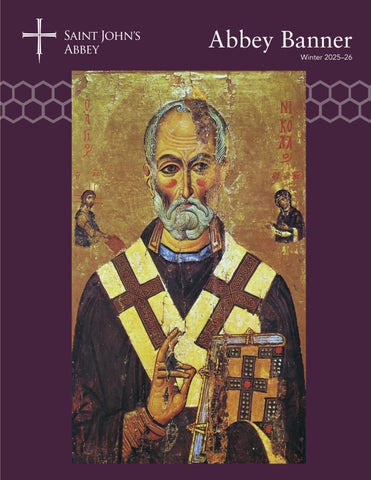
Cover: Saint Nicholas of Myra. Artist unknown. 13th century icon, Saint Catherine’s Monastery, Sinai, Egypt. Photo: Wikimedia Commons
4
Abbey Banner
No matter how far we travel, the memories will follow in the baggage car. August Strindberg, Miss Julie, 1888
Benedictine Imagination Abbot Douglas Mullin, O.S.B.
C
hristmas is the great feast of God’s sacramental imagination. The Word becomes flesh; divinity is wrapped in swaddling clothes; holiness is laid in a manger. Nothing in Bethlehem appeared extraordinary—the child, the straw, the stable. Yet faith teaches us that the ordinary became the place of God’s extraordinary presence.
Saint Benedict invites us to share this same vision—seeing the world in which nothing is too small, too plain, or too humble to hold God’s presence. In his Rule Benedict exhorts us to treat the tools and goods of the monastery as the sacred vessels of the altar (RB 31.10). Think about that. The chalice and the snow shovel, the ciborium and the kitchen spoon, all reveal God’s nearness when handled with reverence! What happened in Bethlehem was not merely a single, long-ago miracle. It was the unveiling of a truth that runs through all creation—God delights to be discovered in the ordinary. Paul Middlestaedt
The shepherds understood this. They were not people of polish or prestige. They kept watch in the cold, tending their flocks at night. Yet it was to them that the angels first sang. Their rough hands and simple work became the very setting where heaven touched earth. That’s the same challenge Benedict gives us—to believe that the glory of God can break in, not only in some distant perfection but also in the familiar rhythms of our kitchens and workshops, our moments of waiting and watching.
God delights to be discovered in the ordinary.
Christmas also brings us face to face with the mystery of hospitality. Benedict insists that every guest be received as Christ (RB 53.1). The Nativity story tells of doors closed to Mary and Joseph. But in Benedict’s imagination, the guest is never an interruption, never just another mouth to feed. The guest is Christ himself. Imagine what our world would look like if we realized that every child, every stranger, every refugee bears the face of Christ. The Benedictine sacramental imagination is simply this: to live as if Bethlehem is always happening. To look at bread and see nourishment for body and soul. To hear the bell and recognize God’s invitation. To see the face of another and glimpse the face of Christ. Christmas dares us to see the world differently. The God who came in the smallness of a child comes now in the smallness of our lives. All is charged with the presence of God—if only we have eyes to see.
Winter 2025–26
5
Saint Nicholas Aaron Raverty, O.S.B.
S
aint Nicholas, especially popular in the Greek and Russian Orthodox Churches, was born in Patara, Asia Minor, part of the Eastern Roman Empire in his day. His birth date is disputed but usually recognized as near the end of the third century. His wealthy parents, both of whom died during an epidemic while Nicholas was very young, set him up for a very comfortable life. But growing up, Nicholas had been imbued with Christian teachings— especially the words of the Gospel—and chose to follow the path to virtue which moved him to aid others with the distribution of this wealth.
revered by Orthodox Christians as “Nikolai the Wonderworker.” Sometime in his youth, Nicholas is said to have made a pilgrimage to the Holy Land. Again, historians have doubts about this detail of his life, claiming that this venture has become conflated with another Saint Nicholas (Nicholas of Zion) who lived a few centuries after Nicholas of Myra. The discovery of subsequent documentation from the eighteenth century clarified the situation, but the legend still swirls around Saint Nicholas of Myra, adding yet another layer to his iconography and folklore.
Saint Nicholas was a beacon of generosity and guardThe life and miracles ian of the innocent and of Saint Nicholas were vulnerable. He is revered recorded and spread as a protector of travelers, widely in the Byzantine sailors, children, and the world. He was ordained poor; and as the patron Bishop of Myra (c. 317). saint of archers, toymakThe Greek Orthodox ers, brewers, pharmacists, Church has long honored repentant thieves, and the him as a model bishop, falsely accused. His liturgiespecially in light of his cal importance in Greek and Aleksa Petrov/Wikimedia Commons defense of orthodoxy at Russian orthodoxy is exemSaint Nicholas. Icon (detail) from Lipnya Church of Saint the Council of Nicaea plified by his icon, com(325), where he reportedly Nicholas, Novgorod, 1294. monly displayed in churches joined others in opposing the Arian heresy. Histoand homes. He is frequently invoked in prayers rians disagree, however, whether Nicholas actually and liturgical hymns, especially for intercession and attended the council—and are even more divided healing. Stories of his life are taught to children and about his alleged altercation there with the heretic commemorated in Orthodox liturgical texts, keepArius (who doubted the divinity of Jesus Christ ing his memory alive across generations. and promulgated this teaching). Since the name of Nicholas is not included on the roster of bishIn Russia, Nicholas has been integrated into the ops at the council, his presence and participation cultural fabric as a figure of mercy and justice. remain moot points. The purported “slap” he gave Occasionally, some have claimed, he was even more to Arius (as depicted in iconography) may well be approachable than Christ or the Theotokos (Virgin just another addition to his legendary larder. He Mary, Mother of God). In Greece, with its maritime became the patron saint of Russia where he is often culture, he is closely associated with the sea and is
6
Abbey Banner
hailed as the patron of sailors. Orthodox iconography typically portrays Saint Nicholas with the trappings of a bishop and with a peaceful demeanor. It is not uncommon to see him in the presence of Christ and the Virgin Mary who hand him the Gospels and omophorion (bishop’s stole). This fourth-century bishop and saint has double claims on his identity: Nicholas of Myra is also known as Nicholas of Bari. When he died, he was buried in Myra, his tomb venerated as a shrine by many pilgrims. His relics were moved from Myra (in modern-day Turkey) to Bari, Italy, in the eleventh century by Italian sailors. While their motivation was to protect the relics from desecration, they also desired to enhance Bari’s status as a pilgrimage center. Thereafter, a basilica was built in Bari to house the relics, and it became a major site of veneration. In Western Europe, he is widely referred to as Saint Nicholas of Bari. Among Eastern Christians, he retains his primary identity as Saint Nicholas of Myra.
December 6, the traditional date of his death circa 343, is recognized as his feast day and widely celebrated with special liturgies and traditions especially among the European nations. Local customs vary, but in Germany, children enjoy candy and other treats while some put carrots or hay into their shoes for Saint Nicholas’ horse! Sinterklaas (Saint Nicholas) comes along riding his horse in the Netherlands, and the children enjoy gifts. Children stash presents under their pillows in Poland, but the naughty may be treated with twigs or coal. Portugal and Bulgaria celebrate this special day too. Because of its seafaring culture, the festivities in Greece center around sailors. All these customs reflect the universal themes of generosity, kindness, and the spirit of giving celebrated on Saint Nicholas Day. The monks of Saint John’s Abbey also remember Nicholas on his special day. When I was a junior monk, for example, a confrere invited the brethren to set their shoes outside their door on the evening vigil of his feast. A miraculous appearance of candy and other treats filled our empty shoes the next morning, proof that Saint Nicholas had indeed visited! There are many stories and legends that have grown up about Nicholas, most of them unverifiable historically. One story involved secret visits to the home of a poor father who couldn’t afford to pay dowries for the marriages of his three unwed daughters and feared that he would have to secure alternate unsavory occupational opportunities for them. From out of nowhere, bags of gold reportedly appeared on the scene in all three marital cases, just in the “nick” of time (pun intended). Saint Nicholas came to the rescue and saved the day!
Jastrow/Wikimedia Commons
Saint Nicholas rescues three children from the butcher. French stained glass, ca. 1510–1530.
Despite all the imaginative reconstruction of Nicholas’ life, is there still a message here about the importance of charity, or compassion, or kindness toward the poor? Indeed, Saint Nicholas remains one of the most beloved saints in the Christian tradition today. The stories of his life and character became connected not only to Santa Claus and to Christmas but more broadly to Jesus and to the lives of all Christians. The parallels with other
Winter 2025–26
7
saints and with Jesus are not uncommon in hagiographical accounts. Nicholas distributed (rather than squandered) his considerable inheritance to needy people and causes, just as Saint Anthony of the Desert (“the Great”; d. 356) had done earlier with his own inheritance. In imitation of Jesus (Matthew 8:23–27; Mark 4:35–41; Luke 8:22–25), Saint Nicholas stilled the storm over the sea to save a ship and its sailors. Our Christmas celebrations relate the story that Saint Nicholas came to be recognized as Santa Claus. How did this happen? Sinterklaas (as mentioned above) marks the December 6 feast day of Saint Nicholas, the gift-giver, in Holland. Dutch settlers immigrating to America in the eighteenth century carried this legend with them, merging this figure with the gift-giving spirit of Christmas in this new land. Further imaginative literary embellishment by such poets as Clement Clarke Moore in “An Account of a Visit from St. Nicholas” (1823)— also known as “The Night Before Christmas”—and artistic enhancement by cartoonist Thomas Nast (1881), among others, resulted in the “jolly old Saint Nick” so familiar to us today as a cultural icon of Santa Claus. One website devoted to the memory of Nicholas summarizes the anthropological impact of the transformation of the person of Saint Nicholas into Santa Claus: “This transformation is not merely a shift in name or appearance; it reflects the evolving human experience and how cultural narratives can shape beloved traditions. Today, Santa Claus stands as a testament to the spirit of giving, encouraging people to spread joy and kindness during the festive season, keeping the essence of Saint Nicholas alive through generations” (https://biographyhost.com/p/saint-nicholas-biography.html). Saint Nicholas, pray for us! Brother Aaron Raverty, O.S.B., a member of the Abbey Banner editorial staff, is the author of Refuge in Crestone: A Sanctuary for Interreligious Dialogue (Lexington Books, 2014).
Wikimedia Commons
“Merry Old Santa Claus,” 1863 drawing by Thomas Nast
A Visit from St. Nicholas ’Twas the night before Christmas, when all through the house Not a creature was stirring, not even a mouse; The stockings were hung by the chimney with care, In hopes that St. Nicholas soon would be there; . . . I heard him exclaim, ere he drove out of sight— “Happy Christmas to all, and to all a good night!” Clement Clark Moore
8
Abbey Banner
ule of Benedict Monks and Books Eric Hollas, O.S.B.
M
onks and books have had a long, close association. Images of Saint Benedict (see page 24) have nurtured this idea, but have they engendered a bit of confusion? Is it an academic or a spiritual tome that Benedict clutches in his hand? Never mind that printed books, as we know them, were nonexistent in Benedict’s day. The fact that he holds a copy of his Rule makes for a critical difference. In the Rule Benedict presumes that most monks will be literate and that books, needed for the recitation of the Liturgy of the Hours, will be a part of their lives. Books were also essential for the spiritual vitality of the community—to provide for this, the libraries grew. Because monks read primarily from collections of sermons, lives of saints, spiritual treatises and commentaries, tastes in reading did more than anything else to shape the character of monastic collections. Monastic bookshelves in the early Middle Ages did not bulge with manuscripts. Many texts were used for reading to the entire community, so there was little need for multiple copies. Books were also expensive, and priority was given to the acquisition of liturgical texts. Thus, few monasteries in tenth-century Europe were fortunate to have collections numbering more than a hundred manuscripts.
Browsing section, Melk Abbey library
Nor should it come as a surprise that these small collections found a home in the sacristy rather than in a purpose-built room. Massive libraries such as the one featured in Umberto Eco’s The Name of the Rose were still centuries away. Tourists today gaze in awe at monastic libraries like that of Melk Abbey in Austria. What caused the modest collections of the early Middle Ages to morph into such grand tabernacles of the book? Among other forces, the growth of universities in the eleventh and twelfth centuries created a new market for books. Professional scribes replaced monastic scribes, and production increased exponentially while costs to produce them moderated. By the end of the fifteenth century higher rates of literacy and the advent of printing led to an explosion of book production. Finally, the Enlightenment caused many monasteries to develop their educational apostolates, with the consequent expansion of their libraries. The convergence of these trends made books more plentiful and cheaper to buy, and monasteries began to acquire books by the cartload. Modern monks have lots of books—so many that some monks find themselves nearly crowded out of their living quarters. Sixth-century monks would be astounded by the size and breadth of these individual collections. But one thing would not surprise them. Books are still vital in the lives of monks. Father Eric Hollas, O.S.B., is the prior of Saint John’s Abbey.
Szilas/Wikimedia Commons CC-BY-SA-4.0
Winter 2025–26
9
Benedictine Volunteer Corps Esquipulas, Guatemala Jonathan Hill
I
n the valley of a small mountain range near the southeastern border of Guatemala sits one of the most popular pilgrimage sites in the Americas. The city of Esquipulas receives more than one million pilgrims every year from many different countries, making it widely known as the “epicenter of faith” in Central America. The destination for these visitors is the Basílica de Esquipulas, which is cared for by the Benedictine monks of Abadía de Jesucristo Crucificado. Here, my Benedictine Volunteer Corps partner, Ethan Engh, and I have been living, teaching, and praying for the past several months. Our service is teaching English at the Colegio San Benito, a primary and secondary school established by the monks in 1964. As I reflect on this time with our students and with this community, one insight I’ve gleaned has been the importance of presence and closeness in the act of service. Ethan and I were introduced to this concept when we experienced our first Sunday in Esquipulas. The monks informed us that there would be six Masses to choose from on Sundays— which seemed a bit excessive. We opted to attend the 7:00 A.M. Mass. When I walked into the church, I quickly understood why so many Mass times were needed. The space was filled with a crowd of hundreds. Every
10
Abbey Banner
pew was taken; people were standing in the aisles and along the walls. We could even see people peering in from outside through the open doors! We immediately recognized that we were praying in a very special place. The following week, I decided to try the 11:00 A.M. Mass to see if there would be any difference in attendance. The same number of people were present and were just as vibrant and engaged as Jonathan Hill/ archives the week before! El Señor de Esquipulas, the Black Christ In the weeks and months since then, little has and originally placed in the local changed. Week after week, Parroquia de Santiago in 1595. Sunday after Sunday, regardless So many miraculous healings of the time, the crowds enthusiwere attributed to the image astically fill the space and celethat the local parish church was brate together. Every weekend, quickly overwhelmed by the visitors from across Guatemala, number of visitors. In response, El Salvador, and Honduras are the crucifix was moved to its brought closely together as one current home after the basílica’s community. completion in 1759. The Benedictine monks were then tasked The reason for these consistently with caring for the space and for sizeable crowds can largely be the faithful who visit. attributed to what sits inside the basílica. Hundreds of people One might expect that such a visit every day to see the image sacred object would be safely of El Señor de Esquipulas (the tucked away behind closed Black Christ)—a life-sized crudoors. Quite the opposite cifix carved out of a dark wood, is true. Though it is usually adorned with gold highlights, encased in glass, the crucifix BVC
stands on full display behind the church sanctuary, where pilgrims are constantly passing by, even as prayers and Masses are in progress. Daily, from sunrise to sunset, there is a queue of people waiting to bring their own prayers, sorrows, hopes, and pains to the foot of the cross. I am humbled at the thought that this image, which millions of people have traveled days or even weeks to see, is only a few hundred feet from my room in the monastery. Every year on January 15, the city and local community celebrate El Día del Señor de Esquipulas, which commemorates when the Black Christ was transferred from the local parish to the basílica. Though pilgrims and locals can draw close to the image throughout
the year, this is a day when the image is brought close to them. The crucifix is placed on a grand parade-like float and escorted through downtown Esquipulas, where crowds line the streets to pray and cheer. I cannot help but see the parallels between the January 15 procession and the reality of the Incarnation that we are celebrating during this time of Advent and Christmas. This season in which we celebrate God brought intimately close to humankind is reflected in this celebratory moment when the image of Christ is brought intimately close to the people of Esquipulas. Our experiences in Guatemala are reminders about the importance of being present to others. In Esquipulas, closeness is not something to be shied away
from. In fact, it is perhaps one of the simplest ways to show love to others, whether they be family members, friends, colleagues, or strangers. In Guatemala, showing you care means showing up. This has significant implications for our work as teachers. Yes, teaching English to our students is important, but I have found that we tend to make the biggest difference when we are simply present for and with them. Cheering them on during a fútbol game, joining in a volleyball game during recess, or simply talking to them about their day shows that we care in a much deeper way than a grammar lesson ever could. Being in Guatemala has shown me what lies at the core of being a Benedictine Volunteer: bringing Christ’s compassionate love just a little closer to the people we serve. Mr. Jonathan Hill, from Dubuque, Iowa, graduated from Saint John’s University with a music major in 2025.
Guatemala has shown me what lies at the core of being a Benedictine Volunteer: bringing Christ’s compassionate love just a little closer to the people we serve.
Sunday Mass, Basílica de Esquipulas
Jonathan Hill/BVC archives
Winter 2025–26
11
Saint John’s Outdoor University John Geissler
I
n 1997, three years before his untimely death, abbey land manager Father Paul Schwietz, O.S.B., shared a vision of utilizing the Saint John’s Abbey Arboretum as an educational tool to increase awareness, understanding, and care of our natural world. Twenty-eight years later, we celebrate the success of his dream and all those who helped make it possible. From humble beginnings, Saint John’s Outdoor University (Outdoor U) continues to engage students of all ages with high quality experiences in the abbey arboretum and other great outdoor spaces. Youth Programs. The three pillars of service of Outdoor U are youth programs, outdoor education programs for College of Saint Benedict and Saint John’s
School day for third graders
12
Abbey Banner
University (CSB+SJU) students, and community programs. In the early days of our youth programming, there was so little traffic that we had to mow the prairie kiosk parking lot! As a student naturalist in the late 1990s, I remember being proud of delivering an elementary program once a month. Today it is difficult to find a day in the fall and spring when there aren’t two busloads of students coming to be inspired by our nature sanctuary while experiencing activities aligned with state academic standards, or a summer nature camp that isn’t full—and with a waiting list! Outdoor Education Programs. Equally important to our mission is the opportunity for brilliant CSB+SJU students to gain experience in all aspects of our programming. This year our professional staff is fortunate
Jenny Kutter
to mentor eight academic-year student naturalists, four summer student naturalists, four summer student land managers, eleven Outdoor Leadership Center students, eight climbingwall student staff, seven Collegebound student leaders, and a recent graduate environmental education fellow. The impact of Saint John’s Outdoor University has grown substantially through the years, now reaching more than twenty percent of the student body through our Outdoor Leadership Center, Collegebound, and climbingwall programming—as well as through academic courses, internships, capstone projects, service learning, and thesis projects. All these ventures rely heavily on student leaders who both give and gain a tremendous amount from these experiences. I am particularly impressed by the teaching, communication, problem-solving, and risk-management skills; resilience, adaptability, and connection to the natural world that these future leaders develop. Witnessing the positive impact of our graduates on the world outside Collegeville is especially rewarding! Community Programs. Community programs are open to all reading this article. Here are a few highlights of upcoming programs that might be of interest to Abbey Banner readers. On 2–6 February 2026 we will offer one of our favorite programs, the Minnesota Master Naturalist Volunteer training, a 40-hour class exploring the Big Woods,
Minnesota Department of Natural Resources, Minnesota Forestry Association, and Minnesota Tree Farm Program. Finally, don’t miss the ever popular Maple Syrup Festival on Saturday, March 28, 12:00–4:00 P.M. There will be sap collecting, syrup cooking, demonstrations, and hot maple syrup sundaes for the whole family! To learn more about these and other events, please visit our newly updated website: csbsju.edu/outdooru.
Preschoolers frolic in Father Paul’s prairie.
Big Rivers (BWBR) in the winter. Don’t let the name scare you away! Participants don’t need to be “master” naturalists to join. All that is needed is an interest in learning more about the natural world and an openness to volunteer. As a direct result of participating in this course, our graduates have contributed thousands of hours of volunteer service in the areas of land stewardship, citizen science, interpretation/ education, and program support
Saint John’s Outdoor University and the Abbey Arboretum celebrate the unique beauty and richness of God’s creation in central Minnesota and foster the Benedictine tradition of land stewardship, education, and environmental respect.
Jenny Kutter
Mr. John Geissler is the land manager of Saint John’s Abbey and director of Saint John’s Outdoor University.
throughout Minnesota. These courses tend to fill up quickly, so if this offering is full, please look for another option—such as in August when we will address the prairies or the following February when our focus will be on the deciduous forest. On February 12–14 we will be lighting a path of more than two hundred candles in frozen luminarias across Lake Sagatagan to the Stella Maris Chapel—where hot chocolate awaits! On March 13–14 we will host the Minnesota Family Woodland Stewards Conference. This conference is for anyone interested in learning how to care for woodlands and will feature a national keynote, concurrent sessions with local experts, field sessions, and an exhibitor hall. The woodland stewards conference is offered in partnership with University of Minnesota Extension,
Lake Sagatagan luminarias
John Geissler
Winter 2025–26
13
Abbey Candle Shop John Meoska, O.S.B. High-tech, state-of-the-art, streamlined, and efficient are not terms that can be used to describe the abbey candle shop and our candle-making operation! “Quirky” better describes the place and the process. The Place. Saint John’s original wax house was a brick structure built about 1878 to process the wax from the abbey’s apiary to make candles. It was razed in the 1970s. The abbey’s current candle shop, located below the old firehouse and current plumbing shop, is smaller than most walk-in closets. For several decades, the candle shop was a dingy place: the ceiling leaked; rainwater seeped in through the walls, most of which are below grade; and it housed a mishmash of pots and pans, old enameled buckets, and cast-off shelving. Today it sports bright LED lights, new steam lines and controls, a fresh coat of paint, and new shelving and worktables. The renovation came about because of a serious meltdown—mechanical, not human. Several years ago, a steam line ruptured in the shop and went undiscovered for several days. The fugitive steam melted hundreds of pounds of beeswax and paraffin over cardboard boxes, tools, and supplies—creating one awful, unholy, moldy mess. It took several days to gut the entire shop and haul away the mess. The Process. We melt all the wax in a cast-off industrial-size
14
Abbey Banner
steam-jacketed soup kettle— typically about fifteen gallons per batch. Melting takes about ninety minutes. The melted wax, which is about 225°F, then passes through a stainless-steel milk strainer to remove carbon residue and old wicks. To do this, I am clad in Tyvek coveralls, shoe covers, safety glasses, and rubber gloves to protect myself from the inevitable spills and splashes of hot wax. The strained wax is poured into stainless-steel buckets and old soup kettles that rest on a grid of steam pipes in a castiron bathtub to await pouring operations. We pour several kinds and sizes of candles: altar candles (2.5" x 12"); Easter candles, also used for funerals (3.5" x 54"); Advent wreath candles (2.5" x 36"); processional candles (1.5" x 30"); and table candles (.75" x 14"). The altar candles are poured using homemade silicone molds; the Easter and Advent candles are poured Candlemas Day
using steel pipe for molds; and the processional and table candles are poured using ancient but reliable cast aluminum molds. Pouring can be a bit of a Goldilocks process: the temperature must be just right—typically 150°F. If the wax is too hot, it shrinks away from the mold and deforms as it cools. If it is too cool, the candles will not have a nice smooth surface. A laser thermometer, the most high-tech item in the shop, is a great help
Félix Mencias Babian, O.S.B.
in this regard. All pours require topping off several times as cavities form in the center of the candles as the wax cools. Table and altar candles can be poured year-round—usually one batch of five altar candles and one batch of twelve table candles per day. The Easter and Advent candles are usually poured during the winter. The size of the steel pipe molds requires freezing temperatures— to expand the steel and to shrink the wax simultaneously, enabling the candle to safely slip from the mold. The Easter and Advent candles also need a full day to cool plus an hour of sub-zero temperatures (either outdoors or in a walk-in freezer). The combination of hard steel and relatively soft wax requires that extreme care be taken so the candle doesn’t get scratched, dinged, chipped, or otherwise damaged. Roughly one of every three suffers some sort of flaw and gets recycled for another
Art at Its Best
[After the death of Brother Charles Kirchner, the abbey’s longtime candle maker, Father Sebastian Schramel assumed the role.] “He left no information about how to make a candle, so it was a mystery,” Father Sebastian said. “The first ones I made were a disaster. They wouldn’t even burn, and the colors were terrible.” Through trial and error, things got better. The craft has become one of his favorite hobbies. “Few things project such elegance as a straight ample Easter candle burning brightly and steadily in the sanctuary during a liturgical function. Its height, its natural wax color, its straightness, its brilliant flame, all give the appearance and performance of a creation doing exactly what one expects it to be and do. Its abundant generosity and genuine authenticity express strong images to support our faith. It is a thing of beauty. And, because it is centered in worship of God, it is art at its best.” Sebastian Schramel, O.S.B., St. Cloud Times, 14 January 1991
try. Personal detachment from results is key at this stage of the process! Once candles have been slipped from their molds, they need several weeks to cure. Then a dedicated miter saw is used to trim the bottom
Félix Mencias Babian, O.S.B.
end. The bottoms of the Easter and altar candles used for abbey liturgies are drilled using a special jig and long bit so they can be seated on a metal spike on their respective candle stands.
Félix Mencias Babian, O.S.B.
Beeswax candle stubs and trimmings (above) await transformation into elegant candles. After melting, the recycled wax is strained to remove carbon and old wicks, then poured into buckets.
Winter 2025–26
15
How much wax do we purchase? None, except for a bucket of white wax pearls once each year. (A few cups of the pearls are added to each batch of wax to achieve a uniform color, especially if some darker wax gets added to the mix.) So, where does all the wax come from? We receive boxes of beeswax candle stubs and trimmings from our abbey sacristans, from local parishes, and even from a Johnnie alumnus in Louisville, Kentucky. We currently have about a threeyear supply of recyclable wax. In past years we had several beehives which garnered some wax for the shop, but our beekeeping has been discontinued.
John Meoska, O.S.B.
While most of our candles are used at the abbey, we do provide Easter candles to several local parishes and chapels. We also sell table candles in the Abbey Gift Shop. Our candle making is not a big revenue generator, but by making our own candles, we save the abbey several thousand dollars annually. In a 1991 St. Cloud Times interview, Father Sebastian Schramel, who was the candle-monk for many years, stated that he was making about seven-hundred candles. Our current production is more modest. We poured two-hundred candles in 2024. Father John Meoska, O.S.B., an iconographer, woodworker, and chandler, is liturgy director at Saint John’s Abbey.
16
Abbey Banner
Félix Mencias Babian, O.S.B.
Félix Mencias Babian, O.S.B.
John Meoska, O.S.B.
A steam-heated cast-iron bathtub (top) holds containers of strained wax. After the wicks are placed in the molds (middle, left), the pouring begins. Five altar candles hardening (above).
Abbey archives
Félix Mencias Babian, O.S.B.
Abbey archives
Abbey Chandler History
Brother Michael Hurth, O.S.B. (1897–1945), appears to have been our first confrere to use molds for candle making as a hobby: Thanksgiving Day 1929 was the date, and the campus science hall was the place. Father Christopher Bayer, O.S.B. (1899–1978), acquired the crafted molds from a nearby parish priest. These molds not only provided the structural form of the candle but were also important for the correct positioning of the wick. With these original molds, smaller candles (six at one time) were created in as little as fifteen minutes. Larger candles took up to an hour to harden. Brothers Conrad Zimmerman, O.S.B. (1872–1960), Charles Kirchner, O.S.B. (1904–1985), and Urban Pieper,
Brothers Conrad Zimmerman (c. 1949 [above, left]) and Michael Hurth (left) at work in the candle shop. Table candles (above).
O.S.B. (1929–2012), and Father Sebastian Schramel, O.S.B. (1917–1999), were also candle makers. The
Benedictine sisters from Crookston, Minnesota, were involved in working with these earliest candle molds, adopting and refining the candle-making method of our monks. The first sanctuary candles, appearing in the spring of 1933, were one hundred percent beeswax. Others incorporated both bleached wax (from the abbey apiary) and commercial unbleached wax. The abbey was not the only place where these candles were used; some were also sent to our confreres in The Bahamas and at Native American missions. Aaron Raverty, O.S.B.
Winter 2025–26
17
Liturgical Press Books Christin Roskos
L
iturgical Press will mark one hundred years of publishing in 2026. In anticipation of a year of centennial celebrations, what better time to recall our most recent year of successes filled with award-winning books! This spring Liturgical Press was honored with thirty awards in total from the Catholic Media Association (CMA) and the Association of Catholic Publishers (ACP), each recognizing the best in Catholic publishing. We highlight a few of the winners, hoping readers will find in them nourishment for their spiritual life and theological endeavors. Prolific liturgical author Paul Turner received four awards and was named the Catholic Media Association’s Author of the Year. For pastoral ministers and those who administer the sacraments, Dr. Turner’s Sacred Times: A Guide to the General Roman Calendar and the Table of Liturgical Days is not only a guide that readers will return to again and again but also an enjoyable and informative primer to the liturgical calendar. It is a practical commentary on what the calendar honors, how it came to be, and why the celebrations matter. This year Sacred Times received the first-place award in reference/ academic studies from CMA and tied for second place in resources for liturgy from ACP.
Our vast academic resources are a key component of the publishing program of Liturgical Press.
18
Abbey Banner
Frank Kacmarcik, Obl.S.B.
Our monastic resources, such as the new and revised edition of Becoming Fire: Through the Year with the Desert Fathers and Mothers edited by Tim Vivian, offers academic expertise and spiritual insight. The desert mothers and fathers seem to be gaining popularity, and this book is the perfect accompaniment for those looking to learn more about the wisdom of the ancient monastics. This beautiful hardcover edition includes sayings and stories for each day
of the year that are well suited for reflection or lectio divina. Becoming Fire would make a great holiday gift to the spiritual folks or enthusiasts of desert monasticism in your life. The Wisdom Commentary series, inaugurated in 2015, won first place for Scripture series from the Catholic Media Association. With more than thirty of the sixty projected volumes of the series now available, this award feels especially timely.
Liturgical Press
We pursue a world transfigured in Jesus Christ through the spirit of Vatican II alive in the Benedictine tradition. Liturgical Press began publishing for the Church in 1926. Since then, our dedicated staff continues to sustain our original mission of proclaiming the Good News of Jesus Christ. We are truly committed to providing religious and spiritual resources of the highest relevance and quality to the Christian community.
Under the guidance of general editor Barabara Reid, O.P., this feminist Scripture commentary series aims to do something truly groundbreaking by being the first scholarly collaboration to offer detailed feminist interpretation of every book in the Bible— with an aim to advance God’s vision of equality and justice for all people. Several Liturgical Press books on Catholic social teaching won awards this year, including Micah Kiel’s Be Transformed: A Biblical Journey toward a More Just World, which received third place in CMA’s Catholic social teaching category as well as first place in ACP’s scholarly Scripture division. Dr. Kiel, an associate professor of theology at Saint John’s, unites Catholic social teaching and its biblical roots and applies them to instances of injustice in our world today. He calls readers to personal transformation and writes that if we care about the poor, the environment, and those in prison, we need to be transformed into agents of justice. Ministers and other religious professionals will be well-served by our resources that offer practical tips but also broach important topics in religious sociological studies. Maureen K. Day’s Cultural Catholics: Who They Are, How to Respond is an indispensable resource in an era of religious disaffiliation and institutional distrust. While Cultural Catholics doesn’t focus on these phenomena specifically,
it tackles the “in-betweeners” or those who may choose not to be engaged with the Catholic Church formally or regularly but still call themselves Catholic. An accessible book, it examines cultural Catholics on a range of topics—political commitments, religious beliefs, parish experiences—allowing readers to come to a better understanding of this group and offering ministerial insights and evidence-based pastoral approaches for connecting with and accompanying them on their spiritual journeys. Finally, Richard Gaillardetz’s reflection on death and dying, While I Breathe, I Hope (published in 2024, just a few months after his death from pancreatic cancer), is a moving memoir. Written from the unique perspective of a talented and prolific theologian facing death head on, the author reflects on his fears and doubts, joys and sufferings, and the graces and blessings he encounters along his final journey. His words offer wisdom and insight as he explores what it means to be a person of faith, ever hopeful for the life to come. While I Breathe, I Hope is just one of countless pieces of Dr. Gaillardetz’s legacy. It was awarded first place in CMA’s category for grief and bereavement and second place in memoirs and would be a meaningful addition to anyone’s library. I join the Liturgical Press staff in wishing you a blessed holiday season and happy reading! Ms. Christin Roskos serves as digital marketing strategist at Liturgical Press.
Liturgical Press Books Sacred Times: A Guide to the General Roman Calendar and the Table of Liturgical Days by Paul Turner. Pages, 282. Liturgical Press 2024. Becoming Fire: Through the Year with the Desert Fathers and Mothers. Cistercian Study Series: Number Three Hundred. New and Revised Edition edited by Tim Vivian. Pages, 516. Liturgical Press 2024. Be Transformed: A Biblical Journey toward a More Just World by Micah D. Kiel. Pages, 156. Liturgical Press 2024. Cultural Catholics: Who They Are, How to Respond by Maureen K. Day. Pages, 168. Liturgical Press 2024. While I Breathe, I Hope: A Mystagogy of Dying by Richard R. Gaillardetz. Edited by Grace Mariette Agolia. Foreword by Michael Downey. Pages, 256. Liturgical Press 2024. To learn more or to order any of these books, visit litpress.org; or call 1.800.858.5450.
Winter 2025–26
19
Catholic Social Teaching and Migration United States Catholic Bishops
C
entral to the Church’s moral teaching is that human beings are made in the image of God [Genesis 1:26–27]. God imbued us with an inherent dignity that must be treasured. Far too often this inherent dignity is ignored or forgotten, and individual persons are treated as objects to be manipulated, as expendable for the benefit of others, or as not worth our time and left to suffer alone. Migrants are too often treated like the traveler stripped of his clothes and beaten [Luke 10:25–37] or like a modern-day Lazarus who is left to beg for help [Luke 16:19–31]. Providing support to the poor and caring for those who are marginalized and outcast is not merely a humanitarian gesture but looks toward the coming kingdom when all who are admitted will be without want and absent suffering. It provides an example to others and invites them to participate in the kingdom that is in the process of coming to fulfillment in the world today. Catholic social teaching on migration provides a framework that should guide Catholics who want to understand how to engage the migration question in their particular situation.
In Rerum Novarum [1891], Pope Leo XIII emphasized the fact that “no one would exchange one’s country for a foreign land if it afforded all the means of
20
Abbey Banner
When an alien resides with you in your land, do not mistreat such a one. You shall treat the alien who resides with you no differently than the natives born among you; you shall love the alien as yourself; for you too were once aliens in the land of Egypt. Leviticus 19:33–34
living a decent and happy life.” If conditions enable individuals to build a satisfying life, they most likely will remain in their homeland and, if they leave, it is more likely by choice than by necessity. The corollary to this emphasis consists in ensuring that the conditions of a given country do not give rise to situations of forced migration. It is thus critical that we seek to offset and alleviate the root causes that compel people to migrate. Recognizing that social and economic conditions can at times compel a person to migrate, Saint John XXIII asserted [Pacem in Terris (1963)] that “every human being has the right to freedom of movement and of residence within the confines of one’s own country; and, when there are just reasons for it, the right to emigrate to other countries and take up residence there.” This conviction was subsequently reinforced in the Second Vatican Council’s Gaudium et Spes [1965] which explicitly recognized a person’s right to migrate. Saint John Paul II, in his encyclical Laborem Exercens [1981], reaffirms the point that people should be able to migrate
to find work to support themselves and their family while acknowledging that such migration signifies a loss to one’s home country. While a person’s right to migrate as well as the right not to have to migrate are key principles, it is worth noting that political leaders also have the right to control and manage the borders of the state over which they rule. Nevertheless, such a right is not absolute. [In 2012 Pope Benedict XVI stated that] although “every state has the right to regulate migration and to enact policies dictated by the general requirements of the common good,” it must always do so “while safeguarding respect for the dignity of each human person.” Respect for the individual person must extend to a respect for migrant families, for “the family, a natural society, exists prior to the State or any other community, and possesses inherent rights which are inalienable” [Charter of the Rights of the Family (1983)]. Policies that weaken families or separate children from their parents must be evaluated in light of the inherent rights of families to remain together. One of the sad realities of our contemporary situation is that of forced migration, and particularly of those who are compelled to leave their homeland because of political, religious, or other forms of persecution. For this reason, the Church recognizes the plight of refugees and asylum
seekers. In Sollicitudo Rei Socialis [1987] Saint John Paul II refers to the world’s refugee crisis as “the festering of a wound.” In his 1990 Lenten message he listed the rights of refugees, including the right to be reunited with their families and the right to a dignified occupation and just wage. Two years later, the Vatican’s Pontifical Council for the Pastoral Care of Migrants and Itinerant People [Refugees: A Challenge to Solidarity] reaffirmed that the right to asylum must never be denied when people’s lives are truly threatened in their homeland. The dire circumstances confronting refugees and asylees was of particular concern for Pope Francis from the beginning of his pontificate. Making a bold statement by taking his first trip as pope outside Rome to Lampedusa, Italy, the Holy Father decried the “globalization
Message to Catholic Charities USA Network In a special way, Catholic migrants and refugees have become missionaries of hope in many nations, including [the United States], by bringing with them a vibrant faith and the popular devotions that often re-energize the parishes who welcome them. [By] assisting displaced persons to find their new homes in your country, you also act as bridge builders between nations, cultures, and peoples. I encourage you, then, to continue helping the communities who receive these newly arrived brothers and sisters to be living witnesses of hope, recognizing that they have an intrinsic human dignity and are invited to participate fully in community life. Pope Leo XIV, 9 October 2025
of indifference” and the “throwaway culture” that disregards those fleeing persecution in order to seek a better life [Homily, 8 July 2013]. It is unacceptable for those of us in the developed world to disregard their suffering or disregard their plights so that we might more easily live lives of comfort. Instead, [Pope Francis] repeatedly highlighted our obligation as Catholics to nurture communities of welcome, support policies that will protect the human dignity of migrants,
promote the stability of migrant families, and assist in their integration following their arrival. In Fratelli Tutti [2020]), Pope Francis reiterated our obligation to welcome, protect, promote, and integrate migrants as a way to help them live a dignified life in their new country. This article is excerpted from the Justice for Immigrants website of the United States Catholic Conference of Bishops, 2025.
Henryy st/Wikimedia Commons CC BY-SA 4.0
Winter 2025–26
21
Abbey Organ Builders: Opus 1
In December 2023, Father Lew Grobe, O.S.B., and the staff of Saint John’s Abbey Organ Builders, under the artistic leadership of Mr. Martin Pasi, announced the signing of a contract (Opus 1) with St. Michael the Archangel Catholic Parish, Leawood, Kansas, for a mechanical action organ of forty-five stops over three manuals and pedal. Opus 1 is now complete! In recent weeks hundreds of individual pipes and parts have been gathered into the organ building’s assembly room to ensure that nothing has been missed. The organ will be disassembled, shipped to Kansas, and reassembled in the St. Michael parish.
Martin Pasi preparing organ pipes
22
Woodworking/Organ archives
The tonal scheme for the organ takes its inspiration from the great eighteenth-century abbey organs of central Europe, filtered through the modern, distinctive personal style for which Maestro Pasi is known. The organ is housed in a wide hardwood case with the “Hauptwerk” (Great) division in the center, flanked by two “Seitenwerk” (side) divisions in swell enclosures.
Photos: Robin Pierzina, O.S.B
23
A Rule for Beginners David W. Cotter
S
aint Benedict lived in central Italy during the fifth and sixth centuries. After some experience of life as a hermit, he founded monasteries at Subiaco and later at Monte Cassino. Like other monastic founders, he composed for these communities a rule for monastic life that depended in large part on earlier sources but also benefitted from his own wisdom and experience. With genuine humility he called it “a minimum rule” for “beginners” and hoped that it would lead faithful disciples to the “loftier heights of doctrine and virtue” of other monastic authorities (Rule 73.8–9). He wrote nothing else. What little we do know of his life, and the miracles attributed to him, is found in Book II of the sixth-century Dialogues of Pope Saint Gregory the Great, which the pope says were based on the testimony of contemporaries and near contemporaries of the recently deceased saint. Gregory himself explains why one is drawn to Benedict: With all the renown he gained by his numerous miracles, the holy man was no less outstanding for the wisdom of his teaching. He wrote a rule for monks that is remarkable for its discretion and its clarity of language. Anyone who wishes to know more about his life and character can discover in his rule exactly what he was like as an abbot, for his life could not have differed from his teaching. (Dialogues 74)
24
Abbey Banner
Anselmo Lentini, O.S.B., makes the same point. The good monk, he says, reads and rereads the Rule (RB) to find instruction for the soul and comfort for the heart (La Regola 613). In it one hears the voice of the wise teacher, the father, the one who can show him or her how, in the company of many brothers and sisters, to attain the perfect love which casts out fear, to seek and find the way home to God (RB 73.8). Benedict was thoroughly Robin Pierzina, Saint Benedict. Detail of a wood carving by Cornelius immersed in the Wittmann, O.S.B. (1828–1921). two hundred years of monastic tradition that preceded him is followed, in chapters 8–73, and reflects it in his Rule. He is by regulations for ordering the clearly dependent on the somecommunity’s life of work and what earlier Rule of the Master, prayer and its system of adminparts of which he simply adopts istration. This distinction is not but which he generally shortens absolute, however, as the latter considerably and always transchapters of the Rule are also full forms by his own discretion, of Benedict’s spiritual wisdom moderation, and humanity. and teaching.
O.S.B.
After the Prologue, Benedict’s Rule falls into two sections. In chapters 1–7 one finds the core of his spiritual doctrine. This
Saint Benedict would not have seen himself as an innovator. His way was simply the monastic way. His task was to codify
that way for his community and other communities which might find his system useful. Innovator or not, his version of this tradition was so imbued with his wise personality that it won an acceptance which would eventually eclipse all other monastic rules. His way was marked by moderation in all things, the simplicity of a life lived in common, reticence in speech, humble obedience to a spiritual master, the willingness to allow personal ambition and career to be set aside for the good of the community, work and prayer, and a discipline known as lectio divina. A commitment to this way was sealed by the promises of stability, reformation of life (conversatio), and obedience. The heart of Benedict’s teaching on the nature of monastic work is to be found in chapter 48. He regards work as a necessity both for the community’s livelihood and for the good of the individual monk, for “idleness is the enemy of the soul” and “then are they truly monks when they live by the labor of their hands” (RB 48.1, 8). When a monk needs help, it should be provided and, similarly, the monk should be willing to help one of the other members of the community if the need should arise (RB 35.4; 53.18–20; 66.5). Chapter 2 of the Rule, the qualities of the abbot, is not only a job description of a particular monastic official but is also a precis of what a monk should be. This individual is to be for others
a constant reminder of the loving and challenging presence of Christ in their midst. Just as one obeys Christ, so too one humbly obeys the abbot (RB 5). The monk has faith that the abbot is not making arbitrary demands but is helping one to come to the full stature of Christ. For his part, the abbot is warned not to be a despot and is reminded that his stewardship of the community will be judged by God. His task is to bring profit to their life together, not to be domineering over them. Without prayer, both personal and communal, work and obedience are prone to sterile formalism. The communal prayer of the Opus Dei brings the monk into the very presence of God (RB 19). It is a time when the monks can lay their petitions before God with a pure heart and truce compunction (RB 20). There is no explanation of lectio divina, prayerful reading of Scripture—so much was it a part of monastic culture. It is already assumed in the very first word Benedict wrote, “Listen.” The monk was formed by constantly listening to God’s Word in sacred Scripture. This was, of course, the effect of the daily Divine Office, but it extended beyond this, throughout the monks’ day
as they worked and rested. The monk memorized as much of Scripture as possible and meditated on it throughout the day. This meditation, however, was not like the later Ignatian practice of mental prayer. Rather, the monk meditated on the words of Scripture by quietly repeating them over and over, ruminating on their meaning. This rumination moved the monk to prayer, and prayer moved the monk to love. In this way, the monk sought to be transformed into another Christ, to “prefer nothing whatever to Christ” (RB 72.11). We read the Rule so that its doctrine, which is none other than the person of Saint Benedict himself, may permeate our lives. It is in these words that we hear the voice of the one who is our father and teacher, whose moderation, humanity, discretion, and genuine Christian sanctity will show us how to hasten toward our heavenly homeland. This article is excerpted from the Introduction by David W. Cotter, O.S.B., to The Rule of Saint Bendict translated by Leonard Doyle. © 1948, 2001 by Order of Saint Benedict. Published by Liturgical Press, Collegeville, Minnesota. Used with permission.
Whoever you are, therefore, who are hastening to the heavenly homeland, fulfill with the help of Christ this minimum rule which we have written for beginners. Rule of Benedict 73.8
Winter 2025–26
25
Moderation in the Rule of Benedict Robin Pierzina, O.S.B.
E
ven a cursory reading of the Rule of Benedict (RB) confirms that the daily life of the monastery is carefully arranged and ordered—requiring much personal discipline of each member. Saint Benedict’s primary concern is for the welfare of his monks. The ordered and disciplined life is a means for guiding the community, a way to attend to the welfare of the flock. Benedict does not want his monks to feel put upon by anyone. He abhors murmuring (RB 5.17–19; 34.6–7; 40.9), and because he recognizes that there can be just cause for it, he is determined to eliminate the reason for that murmuring. He does not want his monks to be vexed (RB 31.6–7, 19). Moderation drives his reflections on the ordered life and the development of the Rule. In RB 64, which outlines the qualities of a successful abbot, Benedict gives perhaps the most direct articulation of the theory of moderation. The abbot bears the responsibility of stewardship of the community. The one chosen abbot is expected to “exalt mercy above judgment” (64.10). “In his commands let him be prudent and considerate; discreet and moderate” (64.12–14, 17).
Benedict’s attention to the hours of dining further suggests his commitment to moderation. The monks of Benedict’s day would fast on Wednesdays and Fridays during the summer (RB 41.2). However, if the weather were excessively hot or humid, or if the work is particularly demanding, the abbot may adjust the schedule (RB 41.4). The abbot is responsible for adapting and arranging everything so “souls may be saved,” and no one need complain (RB 41.5). “Let all things be done with moderation, however, for the sake of the fainthearted” (RB 48.9). Is the notion of moderation in the Rule of Benedict consistent with modern sensibilities? That is, how Let all things be done with moderation for the sake of the fainthearted.
Rule of Benedict 48.9
26
Abbey Banner
moderate is corporal punishment—which is recommended by the Rule (RB 28.1, 3)? How moderate are “harsh beatings” (RB 30.3) and whipping the boys (RB 45.3)? As he was composing his Rule, Benedict had before him a number of other writings. In addition to sacred Scripture, he was familiar with the stories of the Desert Fathers and Mothers, many of them famous for their extreme ascetical practices. He also knew well the Rule of the Master (Regula Magistri [RM]), an anonymous rule written perhaps two or three decades before Benedict’s Rule. Benedict incorporates many of the sentiments of the Rule of the Master into his own Rule, even copying outright some of its passages. But he also recasts (or leaves out entirely) some of the Master’s teachings. What he revises or ignores in the Rule of the Master are further evidence of Benedict’s commitment to moderation. He does not promote the extreme ascetical practices but rather a more balanced approach to the monastic manner of life. The expression of hospitality and the reception of guests—key elements of monastic life—is a case in point. Benedict opens RB 53 with a remarkable litany of room service, asserting that superiors and all the brethren are responsible for welcoming and caring for guests and their every need: receive (53.1), honor (53.2), pray together (53.4), humbly respect them (53.6–7), read to them (53.9), feed them (53.10), wash their hands and feet (53.12–13). Benedict avoided the much less hospitable approach of the Rule of the Master. “The guest quarters should be set apart in the monastery. Things belonging to the monastery, whether iron tools or utensils, should not be put into this room, lest it happen that guests are suddenly and with consequent loss found to be thieves” (RM 79.1–4). For the purpose of precautionary surveillance, two brothers are to be assigned to keep an eye on visitors without their being aware of it: “All the deaneries are to keep watch at all times over the strangers who come” (RM 79.5–9). In the Rule of the Master, reception of guests is actually surveillance of guests!
Consider the difference between Benedict and the Master in regard to the care of the sick. Benedict is most solicitous in his concern for the infirm. “Before all things and above all things, care must be taken of the sick, so that they will be served as if they were Christ in person” (RB 36). The words and the tone of this chapter confirm Benedict’s commitment to pastoral sensitivity and charity. Chapter 70 of the Rule of the Master sounds exactly like Benedict in its concern for the infirm: “Brothers who would show that they are filled with charity should vie with one another in visRobin Pierzina, iting, comforting, and Cloister colonnade (detail) of the Abbey of Saint-Michel-de-Cuxa, 1130–40, France serving the sick brethren, Brothers who say they are ill and do not rise for so that they may give proof of fraternal charity, the work of God and stay lying down should [be and put into practice the word of the Lord saying, fed] only liquids and eggs or warm water, which the ‘I was sick, and you visited me’” [Matthew 25:36]. really sick can hardly get down, so that if they are However, long before the reader gets to chapter 70, pretending, hunger at least will force them to get up long before we hear these tender words for care of (69.1–3). the sick, the Master repeatedly expresses suspicion and doubts about the character of the infirm. For [As for] a brother who is very tired, with aching example, the RM allows the sick brethren to eat limbs but no fever, let him go into the oratory. And if before the regular hours, out of consideration for he cannot stand, let him chant the psalms lying on a their health and welfare, but goes on to say: “The mat as if at prayer. But let the brother standing next abbot must, however, make careful inquiry to ascerto him keep an eye on him so he does not go to sleep (69.9–11). tain and to be convinced by sure signs that someone is not pretending to be sick out of gluttony for a In the Rule of the Master, the sick are looked upon meal” (RM 28.17). “But as regards the sick, let the with suspicion. The assumption seems to be that abbot see to it that no one is lying and pretending to they are really faking their maladies. Saint Benedict, be sick” (RM 53.5). on the other hand, chooses not to include any of these doubts or questions about the health status The Master is even more unsparing in his treatment of his monks. He avoids the extreme, judgmental of the sick as expressed in chapter 69: approach in his dealings with the infirm. O.S.B.
Winter 2025–26
27
The Rule of the Master makes some of its most strident and startling comments in chapter 13, the treatment of the excommunicated. The abbot is to address “the disobedient one—no longer to be called a brother but a heretic, no longer to be called a son of God but a servant of the devil” (RM 13.2– 3) as follows: O wretched soul, what response are you going to give to God? . . . Why, as another Judas, do you lie to Christ? . . . Judas, the false disciple, betrayed his master; you, bearing the holy name of Christian, follow the devil instead. . . . Wretched man, . . . hell is waiting to burn you (RM 13.9–39).
Following thirty verses of such trash-talking to the offender, the Rule of the Master continues: After these words of the abbot rebuking him in front of the community, . . . [the offender is] to be confined and whipped with rods to the point of death, and if the abbot so please, be expelled from the monastery (RM 13.68–70).
How moderate is Saint Benedict when he condones corporal punishment or whipping children? If corporal punishment is acceptable in the Rule of Benedict, capital punishment—or something very close to it: “whipped with rods to the point of death”—is promoted in the Rule of the Master! Benedict is indeed the more charitable, more moderate teacher and guide.
And so we are going to establish a school for the service of the Lord. In founding it we hope to introduce nothing harsh or burdensome. Rule of Benedict Prol.45–46
28
Abbey Banner
The Context of the Rule of Benedict Some modern writers have spoken of Benedict as an innovator and a genius of great originality, but in fact this is not how he was perceived in ancient times. [The Rule of Benedict] was appreciated not because it was original but precisely because it was so traditional: it was seen to be a masterful summary of the whole preceding monastic experience. The Western monastic fathers were profoundly conscious of being heirs of a past, of a tradition. Their aim was not to produce something new but to collect, assimilate, and propagate the monastic wisdom accumulated by their Eastern and Western predecessors. Benedict’s knowledge of the tradition is profound—not an academic type of knowledge but the thorough assimilation of truth that comes from long application to lectio divina, a total immersion of oneself in the Word of God. It is this broadness of vision and synthetic quality that sets the RB apart from the other Latin rules. Eventually the RB was recognized as the finest expression of monastic tradition the Western experience had produced, and it gradually came to supplant all the others. Timothy Fry, O.S.B. RB 1980: The Rule of St. Benedict Introduction (84, 86, 90)
[Growing Older Gracefully] Lord, thou knowest better than I know myself, that I am growing older and will someday be old. Keep me from the fatal habit of thinking I must say something on every subject and on every occasion. Release me from craving to straighten out everybody’s affairs. Make me thoughtful but not moody, helpful but not bossy. With my vast store of wisdom, it seems a pity not to use it all, but Thou knowest, Lord, that I want a few friends at the end. Keep my mind free from the recital of endless details; give me wings to get to the point. Seal my lips on my aches and pains. They are increasing, and love of rehearsing them is becoming sweeter as the years go by. I dare not ask for grace enough to enjoy the tales of others’ pains, but help me to endure them with patience. I dare not ask for improved memory but for a growing humility and a lessening cocksureness when my memory seems to clash with the memories of others.
Teach me the glorious lesson that occasionally I may be mistaken. Keep me reasonably sweet. I do not want to be a saint—some of them are so hard to live with— but a sour old person is one of the crowning works of the devil.
Give me the ability to see good things in unexpected places and talents in unexpected people. And, give me, O Lord, the grace to tell them so. Amen. Author Unknown (frequently attributed to a seventeenth-century English nun)
29
Meet a Monk: Dan Morgan Timothy Backous, O.S.B.
C
ommon wisdom suggests that the busiest person in a men’s monastery is the abbot. While it is certainly true that every community keeps its superiors engaged, there is always someone behind the scenes making sure that the days, weeks, and months are meticulously scheduled and that appointments run on time. At Saint John’s Abbey, that busy, behind-the-scenes person is Brother Daniel Morgan, O.S.B., who serves as the abbot’s secretary (and much more) with grace, calmness, and a friendly smile. If the church and refectory are the “heart and soul” of a monastery, then the abbot’s office ranks as the “brain.” It is a place where plans are made, problems are addressed (if not solved), and celebrations are planned. On most days, Brother Dan has his hands full keeping the abbey’s “situation room” running at full speed. The secretary to an abbot must be part scheduler, part travel agent, part strategist, and part diplomat. To this list of skills, Dan adds his own technical expertise, particularly helpful as community meetings incorporate more and more gadgets into the presentation of data, proposals, and votes—and aging Baby Boomers collide with twenty-first-century technology. The youngest of three sons of Bernie and Mona Morgan, Dan was born in Eagan, Minnesota,
30
Abbey Banner
grew up in nearby Savage, and attended school in the Burnsville district. Originally recruited as a breaststroke swimmer for the University of Nevada, Las Vegas, Dan had to reformulate his plans when UNLV’s coach was hired by Saint John’s University—instead of venturing to the desert, he made his way to the shores of Lake Sagatagan, graduating in 2003 with a major in computer science and a minor in theology. After college, he took a job with a Swiss computer software company and settled into doing what he was educated to do. But life had twists and turns that Dan was not expecting, and those events made him rethink the direction he was heading. During retreats at Saint John’s, he sought answers to some of life’s biggest questions. That routine helped him recognize that he needed to explore the possibility of a monastic vocation. Dan’s discernment led him to profess simple vows as a Benedictine monk in 2007. During his formation years in
the monastery, he pursued a graduate degree in theology. He later enrolled at the University of San Diego to pursue a master’s degree in higher education that led to his appointment as director of residential life at Saint John’s University. Dan threw his heart and soul into the job because he found it exhilarating “to line up many things” and see clearly how that effort impacted and benefitted the community. He most appreciated forming the young Johnnies who served as resident assistants, approaching them much like a coach does a team, recognizing the talents and unique gifts that each contributed to the cause. The program flourished under his insightful leadership and much of what he created endures to this day. After a brief stint at the library of Saint John’s Prep, Brother Dan was invited to serve as the abbot’s secretary. What does this position entail? “It’s like a game of badminton,” he says—“nothing intense, nothing cutthroat, but constantly trying to keep
Western adventure: Brother Dan and his Mustang
Morgan archives
the birdie in the air, never taking your eye or your concentration off the game.” (For those who are not familiar with monasteries, Dan’s image is an excellent description of community life!) A keen observer with an analytic mind, Brother Dan is perfectly suited to the job. What is most satisfying about being a monk? “What I find most life-giving about monastic life,” Dan reflects, “are the shared moments with confreres that offer glimpses of the divine. These are often simple, ordinary experiences that suddenly feel illuminated from within—but also shared. I remember one evening at Mass when Father Bob Koopmann was playing the piano. As I was preparing the altar, the music filled the church, and the emotion was palpable— truly beautiful. Later, another confrere mentioned that he, too, had been deeply moved by the music and felt ready for the Lord to take him right then and there! Moments like that—when we collectively sense a deeper reality breaking through—are life-giving.” What is most challenging? “I find balance to be the most difficult part of monastic life,” Dan acknowledges. “I’m a passionate person, and it’s easy for me to lose myself in a task, project, or role. When that happens, I can drift into the plague of busyness and become less available—to others, to prayer, and even to myself. I dislike feeling too busy to be present or losing sight of
Morgan archives
Morgan archives
Family adventures: Fishing with brother Tom and Dad (top); fending off sharks with Mom (above)
what’s truly important. Monastic life provides helpful guardrails to hold these tensions in check, but I still struggle to stay centered. It’s a bit like standing before a buffet filled with all your favorite foods—you can’t fill your plate with just one thing and still enjoy the rest. I have to keep reminding myself to leave room for contemplation, for prayer, and for the relationships that make this life whole.” Brother Dan Morgan is good at whatever he attempts, whether that be a simple pursuit or a
complex task. On those occasions when he does have a free day, “I like to go on an adventure. It could be as simple as exploring campus to see how the college bookstore has transformed into the “Spirit Shop,” or heading to town to track down flour for making pizza dough. I enjoy the mix of curiosity, movement, and small discovery that comes with those kinds of days.” Saint John’s Abbey is blessed to have confreres like Brother Dan who find such depth in the simple pursuits of life.
Winter 2025–26
31
Kilian McDonnell Paris, Oxford, and Edinburgh. In 1964 he received a doctorate in theology from the University of Trier. He returned to Collegeville where he served as a professor of theology at Saint John’s School of Theology and Seminary, 1964–1992. In 1967 Kilian founded the Collegeville Institute for Ecumenical and Cultural Research, initially serving as director and then as president.
Abbey archives
T
he fourth of eight children of Joseph and Anna (Averbach) McDonnell, Father Kilian McDonnell, O.S.B., was born in Great Falls, Montana, on 16 September 1921. He entered the novitiate of Saint John’s Abbey in August 1945, professing his first vows as a monk a year later. After completing theological studies, he was ordained to the priesthood in June 1951. Father Kilian’s advanced studies took him to the University of Ottawa, where he received a licentiate in theology in 1960, and then continued at various European universities, including Trier, Tübingen, Münster, and Heidelberg. (His confrere Father Michael Marx would bemoan the influence of the German language on Kilian’s writing style: we had to keep pulling out the sauerkraut!) Kilian also undertook research in ecumenical institutes in Paderborn, Geneva,
32
Abbey Banner
After the Second Vatican Council, he served as secretary of the national Presbyterian/Roman Catholic Consultation and as a member of the national dialogues between Lutherans and Roman Catholics, and Southern Baptists and Roman Catholics. For twenty years he was a consultant to the United States Conference of Catholic Bishops on charismatic renewal. Internationally, Kilian served as cochair of the consultation between the World Alliance of Reformed Churches and the Roman Catholic Church as well as cochair of the dialogue between the Pentecostal Churches and the Vatican. He was a member of the International Disciples-Roman Catholic Dialogue and consultor to the Pontifical Council for Promoting Christian Unity. For his service to the Church, Father Kilian was honored with the Pro Pontifice et Ecclesia Award (1983) from Pope John Paul II; the Pax Christi Award from Saint John’s Abbey and University (1984); the John Courtney Murray Award from the Catholic Theological Society
of America (1993); and the Society of Pentecostal Studies Lifetime Achievement Award (2004). On Independence Day 1980, he was named Champion of the Mud Pit, Senior Division, for his mud-wrestling expertise. A prolific writer, Kilian authored or coauthored seventeen books and more than two hundred articles. He edited Presence, Power, Praise: Documents on the Charismatic Renewal (1980) and coauthored, with George Montague, Christian Initiation and Baptism in the Holy Spirit (1991) that was published in seven languages. Despite a lifetime of delicate health (he regularly protested: “I need to go to bed; I am out of gas!”), he traveled many miles on an empty gas tank. At age 75, still tired and retired, he took up the poet’s quill, publishing six books of verse. This sickly but energetic monk of cherished Irish wit and adventurous spirit died on 8 September 2025 and was buried in the abbey cemetery eight days later, his 104th birthday. After All the Words After I have emptied out my store of words, depleted all useable sounds, in praising God’s unsayable glory, wasted the Oxford Dictionary, pauperized the Coptic Lexicon, have no breath between my teeth, wordless beauty I give back to God.
Title ofDowal Article Luke
B
rother Luke Dowal, O.S.B., was born on 18 December 1923, one of eight children of Vincenty and Stanisława (Szczawinski) Dowal of Gardner, Worcester County, Massachusetts. Baptized Zygmond Stanisław, he was nicknamed “Ziggy” by his school classmates. After graduating from high school, he became a merchant seaman, serving in both the Pacific and Atlantic theaters throughout World War II. A desire to explore religious life led him to the shores of Lake Sagatagan. After his “conversion to life” (as he called it), he entered the novitiate at Saint John’s Abbey, professing his first vows as a Benedictine monk on 21 March 1960. From 1963–1967 Luke served at Abadía del Tepeyac, Mexico City, where he learned how to cook and bake, an interest he would enjoy throughout his life. “It’s another talent. It’s God’s gift,” he would later say. “If you have talents, you should use them to make life better.” After returning to Collegeville, he served in a variety of roles: assistant refectorian, gardener, carpenter, spiritual advisor to physical plant, and even as a nurse after getting his degree in 1972. He oversaw the expansion of
the campus infirmary and its relocation to Saint Raphael Hall (the community’s retirement and health-care center) in 1976. Senior monks remember Luke as a sacristan par excellence. For thirty-four years he was the man behind the scenes, preparing for the daily Eucharist and Liturgy of the Hours, for baptisms, weddings, and funerals, and cleaning the church and lower chapels—a “liturgical engineer,” as Luke described the position. Even more memorable than his work in the sacristy, however, was the magic that he conjured up in the kitchen. His creations of bread, pastries, cakes, or pies were the reason that novices were always eager to assist in the sacristy. They knew that after about ten minutes of hard labor, they would be invited by Luke to a leisurely coffee break that always included freshly baked treats. Blessed with a deep speaking voice, Brother Luke anchored the bass section of the abbey schola for years. His creativity was also expressed through painting, a hobby he first took up in 1969. Enrolling in a course taught by Sister Thomas Carey, O.S.B., he gained confidence because of her encouragement.
There have been so many wonderful things that have happened over the years. I would encourage anyone who wants to come to the monastery, even after all we’ve been through, anyone who wants to come and join us: I would certainly encourage it. After [sixty-five] years, I’m still a very happy man.
Abbey archives
Luke never held a teaching position, never offered a spiritual retreat, never held a leadership position in the monastery. Instead, he worked quietly and faithfully as a missionary, a cook, an infirmarian, and a sacristan. He was, as one confrere commented, “a real monk. You know, a monk’s monk.” Over a lifetime his fidelity to the Gospel and to the Rule of Benedict formed a monk who trusted deeply in Christ and in his promise that we will share in his resurrection. A happy, hard-working man of faith who blessed his confreres each day of his sixty-five years of monastic life with a smile and an infectious laugh, Brother Luke died peacefully on 19 September 2025. Following the Mass of Christian Burial, he was laid to rest in the abbey cemetery.
Luke Dowal, O.S.B.
Winter 2025–26
33
Title Richard of Article Oliver his vocational search. He visited the community and “was much taken by the architecture of the abbey and university church and by the young, interesting, and creative monks I encountered.” He was accepted into the abbey’s novitiate and professed his first vows as a Benedictine monk on 11 July 1970.
Abbey archives
T
he second of four sons of John Herbert and Anne Josephine (Gormley) Oliver, Brother Richard Oliver, O.S.B., was born on 7 November 1945 in Philadelphia, Pennsylvania (“the cradle of liberty and City of Brotherly Love,” he proudly proclaimed). He was a product of what he called “Industrial Catholicism”—sixteen years of Philadelphia private education at Most Blessed Sacrament Grade School; West Catholic Preparatory High School; and La Salle University, where he earned a bachelor’s degree in 1968. His first foray into non-Catholic education was at the University of Iowa where he was awarded a master’s degree in library science in 1974. Richard’s interest in religious life led him to the novitiate of the De La Salle Christian Brothers. However, after learning about Saint John’s Abbey via Liturgical Press publications, he expanded
34
Abbey Banner
Brother Richard’s first assignment was as an English teacher at Saint John’s Preparatory School. From 1974–1979 he served as a librarian at Saint John’s University. After a yearlong internship in the special collections of the Bodleian Libraries, University of Oxford—where he assisted with the exhibition of rare books celebrating the 1500th anniversary of the birth of Saint Benedict of Nursia—he returned to Saint John’s Alcuin Library. In 1985 he left for England to begin work for the Hill Museum & Manuscript Library, serving as field director for the Europe microfilming project (1987–1992). He reflected on this assignment: “I am very grateful for the history-making five years I spent in Europe. I was able to visit all regions of West Germany. With some U.S. servicemen I had met in Mainz and Frankfurt am Main, I joined thousands of others hammering on the Berlin Wall. I watched on TV the dissolution of the USSR, the reunification of Germany, the liberation of the Baltic states, and the conclusion of the First Gulf War. There’s only so much one Brother can do for a continent.”
Brother Richard’s keen intellect and vast knowledge of Benedictine monasticism complemented his interest in the nascent internet and web design. He created the international website osb.org (one of the first official Catholic websites) in April 1995, serving as its editor until his death. From 2009 until his retirement in 2016, Richard was the coordinator of information and records at the Conference of Major Superiors of Men in Silver Spring, Maryland. In retirement at the abbey, Richard assisted with the reservation database of the guesthouse, led church tours, prepared daily liturgy programs for the celebrant and confreres in the abbey health-care center, and contributed articles about Benedictine saints for Abbey Banner. More than his work, Richard’s presence to his confreres was his greatest contribution to our community. He was a good storyteller, a bottomless well of information about every imaginable subject, a regular prize-winner for most creative costume at the community Halloween party—his ensembles always tasefully adorned with sashes and medals. Our beloved Brother Richard died on 10 October 2025. Following the Mass of Christian Burial, he was interred in the abbey cemetery. The older I get, the more I like the idea of eternal life being a banquet and rest. I think I could eat and sleep forever. Richard Oliver, O.S.B.
Title of Article Gordon Tavis
F
ather Gordon (baptized Gerald Levone) Tavis, O.S.B., the third of five children of John and Laurabel (Wilmes) Tavis, was born on 28 August 1925 in Bismarck, North Dakota, and grew up in Mandan. He first became acquainted with Benedictines at his home parish, the Church of St. Joseph, which was staffed by monks from Saint John’s Abbey. After graduating from high school, Gordon enlisted in U.S. Naval Aviation and, while awaiting active duty, studied chemistry at North Dakota State University (NDSU). He became an ensign and aerial navigator before his honorable discharge in 1946. During his grade school years, Gordon began playing the violin, switching to cornet and trumpet in high school after his grandfather gave him a cornet. When he returned to North Dakota after the Second World War, he played in swing bands, helped manage the family grocery business, and resumed studies at NDSU in mathematics before transferring to Saint John’s University in 1950. Two years later, he entered the abbey’s novitiate, professing his first vows on 7 September 1953. He earned a bachelor’s degree in philosophy (1954); following seminary studies, he was ordained to the priesthood in June 1958. Beginning in 1962 Father Gordon served in a variety of administrative roles at Saint John’s, including assistant business manager of the Order of Saint
Benedict, university director of financial aid (1963–1969), physical plant manager (1963–1969), and auxiliary enterprise manager (1965–1971). After earning a master’s degree from the Alfred P. Sloan School of Management at the Massachusetts Institute of Technology, Father Gordon resumed his service to the greater Saint John’s community—as university vice president for administrative services (1972–1975), prior of the abbey (1975–1980), and treasurer of the Order of Saint Benedict (1980–1996). Abbey archives
In 1998, at age 72, Father Gordon became the president of Saint John’s Preparatory School! For the next eight years, he reimagined the job description, refusing to be confined to an office on the top floor of the school. This man—who was old enough to be the grandfather of every member of the student body—took his violin and joined the school’s orchestra for rehearsals and performances. He even found himself with a cameo role in the school’s production of Joseph and the Amazing Technicolor Dreamcoat, portraying Jacob, the father of Joseph. His fierce dedication to the students was evident in his leadership, presence at every athletic or fine arts event, fundraising, and daily activities. Where two or three preps were gathered, there was Gordon in their midst! He called his “grandfatherly retirement” at the prep school “the best job of my life.” The school honored him with the Armor of Light Award in 2002—lauding
him as “a great friend and mentor to students, a man filled with wisdom and measured decisions, a man of integrity and charity, compassion and insight.” Along with his monastic classmate Father Don LeMay (piano), Father Gordon (violin or cornet) delighted generations of monks and alumni at Homecoming singalongs, Christmas parties, and other gatherings. In retirement, he continued advising on financial matters, created demographic studies of our community as well as for the American-Cassinese Congregation, and contributed significantly to the 2012 corporate restructuring of Saint John’s University. On 21 November 2025, twelve weeks after celebrating his 100th birthday, Father Gordon joined the heavenly choirs (and orchestra). Following the Mass of Christian Burial, he was interred in the abbey cemetery.
Winter 2025–26
35
Cloister Light The daily routine within the cloister is enlivened by the antics of the “characters” of the community. Here are stories from the Monastic Mischief file.
Feed My Sheep
During a pilgrimage to the Holy Land, Father Gene saw a shepherd handling sheep rather roughly, so he went over to the man and said, “Excuse me, but that’s not how a shepherd is supposed to treat sheep!” The man replied, “I’m not a shepherd. I’m a butcher.”
Driver Education
Because his class ran long, Brother Bert missed the last bus back to the monastery. He walked to the nearby highway and attempted to hitch a ride. To his delight, the first car that approached him was driven by one of his confreres, Father Richard. Brother Bert was astonished, however, when the car drove past him. Father Vitus, in the passenger’s seat, even waved to him as the car sped by! The next day, when Brother Bert encountered Father Vitus, he asked him why he hadn’t stopped to pick him up. “Didn’t you recognize me?” “Oh, yes,” replied Father, “we recognized you. But Father Richard never picks up hitchhikers. He had a bad experience once.”
Homily Hints
“Wow, Father Cyril! That was a great homily! I can’t believe it.”
36
Abbey Banner
Never Holier Than Thou
Father Pious was late for a meeting of pastors at the diocesan chancery. While driving well over the posted speed limit, he noticed a highway patrol car at the side of the road, apparently checking the speed of all motorists. He did not reduce his speed. A moment later, he was stopped by the officer, who inquired: “When you saw the patrol car, why didn’t you slow down?” “That would have been hypocritical,” replied Father.
More Extracts from Church Ladies with Typewriters Due to unforeseen circumcisions, Tuesday evening’s Bible study class is cancelled. The third verse of our opening hymn will be sung without musical accomplishment. Request from our choir director: If you choose to heave during the postlude, please do so quietly. A new loudspeaker system has been installed in the church. It was given by one of our trustees in honor of his wife. During our parish bazaar we will be serving hot gods for lunch. The choir director invites any member of the congregation who enjoys sinning to join the choir.
They say . . . Ignorance more frequently begets confidence than does knowledge. It is those who know little, not those who know much, who so positively assert that this or that problem will never be solved by science. Charles Darwin I must confess, I was born at a very early age. Groucho Marx I realize I may be in the minority here, but I would give almost anything to live in an age when I could put on two-tone shoes, red socks, a lively cotton shirt with a repeating pattern based on, say, baggage labels, hoist my baggy brown pants to just level with my nipples, drop a felt hat on my head, and have people walking past look at me twice and think, “Stylish guy!” Bill Bryson
Abbey Chronicle
B
etween June and August, Saint John’s gardens and grounds were blessed with 15" of rain. A temperature of 76°F made for a delightful Labor Day cookout—featuring fresh tomatoes, corn, and other vegetables. Temps into the 80s with dewpoints in the 60s continued until the first week of October. The lazy, crazy days of summer ended on October 24 when Collegeville recorded its first hard frost. With plentiful summer showers and warm temps, many parts of Minnesota experienced the longest growing season on record—199 days. On Veterans Day, the heavens were brightened with a spectacular show of the Northern Lights—described as “epic” by some news organizations. Hearts were warmed by Thanksgiving gatherings, but the snowy landscape and temps in the teens confirmed the fall of fall and the rise of winter. Lake Sagatagan froze on December 1. Christ, whose glory fills the skies, Christ, the true and only Light, Sun of Righteousness, arise, triumph o’er the shade of night; Dayspring from on high, be near; Daystar, in my heart appear. Charles Wesley
With December’s darker days, longer nights, and the return of seasonably chilly weather, we await the dawning of our Daystar, the birth of the Son of Righteousness. Come, Lord Jesus!
August 2025 Father John Klassen (keynote speaker) and Brother Augustine Oh (addressing management and finance issues) joined members of the Association of Benedictine Retreat Centers (ABRC) in Schuyler, Nebraska, for the 2025 biennial conference. Founded in 1998, the association was organized for the purpose of furthering the mission of Benedictine retreat centers through resource networking, ongoing formation, and educational programming. The high spirits and excitement that typically mark the beginning of the school year at Saint John’s were upended by the shocking news of the death of two children and the injury of many more at Annunciation Church in Minneapolis on the morning of August 27. At Mass and during prayer services, the greater Saint John’s community asked for God’s blessings and protection for the victims, their families, and all those traumatized by violence. On September 5, the church bells tolled at midday as the students of Saint John’s
Preparatory School staged a “walkout” from classes to attend a community prayer service. September 2025 “Were not our hearts burning [within us] while he spoke to us on the way and opened the scriptures to us?” (Luke 24:32). On September 6 some sixty sisters, monks, students, neighbors, and Jesus shared their faith or faith-struggles as they walked together from the Sacred Heart Chapel of Saint Benedict’s Monastery (Saint Joseph, Minnesota) to Saint John’s. Journeying on the Wobegon Trail, the Pilgrimage of Hope concluded with Eucharist in the abbey and university church and supper in Emmaus Hall.
David Allen, O.S.B.
Winter 2025–26
37
the cemetery, calling it “so peaceful and comforting” and the only place they could “imagine choosing for dad.”
Joseph Feders, O.S.B.
On August 28 Father Gordon Tavis became the fourth monk in the history of our monastic community to reach the centenary mark (preceded by Fathers Angelo Zankl [1901–2007] and Kilian McDonnell [1921–2025] and Brother Luke Dowal [1923–2025]). During the blessing and dedication of the expanded Saint John’s Abbey Cemetery on September 13, Abbot Douglas Mullin expressed the gratitude of the monastic community to those who assisted in the planning and implementation of the project, including Mr. Tom Oslund (O2Design), landscape architect and designer; Mr. Ryan Breitbach and Mr. Chris Banal (Breitbach Construction Co.); and Mr. Paul Eickhof (Eickhof Columbaria Inc). Alumni and other visitors have expressed their admiration for the beauty of
October 2025 Saint John’s mighty HoltkampPasi organ was the star feature in two major (and occasionally menacing) musical presentations this fall. On September 28 organ virtuoso Greg Zelek opened his recital with Léon Boëllmann’s Suite Gothique, op. 25, followed by several Johann Sebastian Bach works, including Sinfonia from Cantata (BWV 4), Fugue in D major (BWV 532), and Trio Sonata no. 3 in D minor (BWV 527). Maestro Zelek also dazzled the delighted audience with the pedal-only showpiece Pedal-Exercitium (BWV 598). A month later, during The Return of the Great Pumpkin concert, the organ was complemented by piano and jazz ensemble. Father Robert Koopmann (piano and organ), Dr. David Jenkins (organ), Mr. George Maurer
(piano), Ms. Leslie Vincent and Mr. Daniel Greco (vocals), Father Anthony Ruff (organ), and Brothers Jacob Berns and David Klingeman (organ) shared music ranging from spooky standards, to autumnal reflections, to the classics, to highlights of the Wizard of Oz. Divine favor and the work of human hands resulted in a bountiful harvest of 1,778 pounds of fruit and vegetables from the community’s gardens and orchards. Apples topped the abbey’s arsenal of edibles (450 pounds); eight varieties of squash—acorn (25), butternut (102), Cherokee Roaster (20), Delicata (12), Lakota (20), Red Kuri (21), spaghetti (38), and yellow summer (50)—combined for second place (288 pounds); and green beans and zucchini tied for third (250 pounds). Other tasty tallies for which the community offered thanks long before Thanksgiving Day included asparagus (90 pounds),
Abbey archives
38
Abbey Banner
BEARS, BEARS, BEARS! On November 5 two black bears
(Ursus americanus) were observed on Saint John’s campus (in Flynntown and near the quadrangle), apparently attempting to access garbage dumpsters without a permit. Campus administrators detained several animals “of interest” from the abbey arboretum for questioning about the incident, narrowing the list of suspects to three: Teddy, Rocky, and Klaws.
Smithsonian Museum/Wikimedia Commons CC-BY-SA-2.0
Kate Perez/Wikimedia Commons CC-BY-SA-4.0
tomatoes (227 pounds), Saint John’s own Alpha grapes (55 pounds), and tomatillos (50 pounds). Brother Isidore Glyer outfoxed the squirrels, collecting 204 pounds of raw walnuts in the hull—which was transformed into 97 pounds in the shell.
of remembrance/Ofrenda de día de Muertos was placed near the north entry to the cloister. On November 5, the monastic community honored the memory of the 496 monks of Saint John’s Abbey who have died since its founding in 1856. During all prayer services and the Eucharist, the monks also commemorated thousands of deceased friends and family whose names had been sent to the community.
November 2025 During the November month of remembrance, the monastic community commemorates those who have departed from their earthly home and now sing with the choirs of saints and angels. On the feast of All Souls, November 2, dozens of monks, parishioners, students and alumni, and other friends gathered in the abbey cemetery for a prayer service, identifying by name all those buried in this sacred place in past year. Within the monastery, an altar
“Placing Our Hope in God Alone” was the theme of the first joint gathering of oblates of Saint John’s Abbey and Saint Benedict’s Monastery on November 16. Abbot Douglas Mullin and Prioress Karen Rose offered reflections on “The Hope We Share,” followed by an open discussion among the more than one hundred participants.
lwolfartist/Wikimedia Commons CC-BY-2.0
Saint John’s Abbey Arboretum is hosting its twenty-fourth controlled deer hunt since 1933. The intent of the hunt is to reduce the deer population to a level that allows natural regeneration of the forest ecosystem. In addition to the significant overbrowsing of important tree species such as white pine and oak, the hungry (and overpopulated) deer have diminished the diversity of wildflowers, herbs, and shrubs on the forest floor. This disruption of the ecological balance of the area directly affects the health of the forest, the deer herd itself, and the populations of other wildlife. The 2025 archery hunt opened on October 1 and will run through the end of December. By the end of November, twenty-two deer had been taken.
Winter 2025–26
39
Fifty Years Ago Excerpted from Confrere, newsletter of Saint John’s Abbey: 28 October 1975
The chapter authorized the construction of a health-care facility [Saint Raphael Hall] to be located on the first and second floors of the south wing, including a small (40' x 50') addition on the south end. All activities of the present infirmary have been incorporated into the planned facility. Mr. Ray Hermanson is the architect for the project; Saint John’s will assume the role of general contractor. The program calls for thirteen private rooms for residents and two rooms that will be equipped to serve as intensive-care rooms or as rooms for the temporarily ill, a nurses’ station and support facilities, and an elevator running from the basement to the top of the quadrangle. The first floor will contain physical and occupational therapy units, while the second floor will house
a serving kitchen, dining room, lounge/solarium, chapel, and small greenhouse. Extending from the south will be a balcony-porch on both first and second floors. The facility will conform to state codes for nursing homes with the best possible safety features, including a sprinkler system, smoke detectors, and total climate control. Brother Michael Kwatera made his cinema debut in the Holy Land last spring—in a three-second appearance in the movie Diamonds which opened recently. When the call went forth for extras last January in Jerusalem, the dozen Saint John’s students in the Jerusalem Study Program volunteered to take part in this sparkling production [that includes actress Shelly Winters]. 25 November 1975 [A snowstorm on November 19–20 deposited 12.3 inches of snow in Collegeville.] When he went to start his car, Prior
Gordon Tavis was startled to find a rabbit in his Pinto! The animal had crawled under the hood. That means winter is off to a good, jackrabbit start! 16 December 1975 Fathers Aelred Tegels and William Skudlarek were among 1200 participants at a conference on the ordination of women in the Catholic Church held in Detroit. The consensus among the participants was that the question is bound up with the broader issue that involves a reconsideration and reformation of the shape of ordained ministry in the Church. As one of the speakers put it, matriarchy is not any better than patriarchy. Most were convinced that the ordination of qualified women would be a good, necessary step for the Church to take. A Vatican official said the commission was appointed not to see if the ordination of women was possible but rather to find convincing reasons why it could not be done. 28 January 1976 Work on the renovation of the south wing to provide modern health-care facilities is progressing past the “tear it down” stage and entering the “build it up” phase. The novices and juniors completed the We-Haul operation, successfully moving residents of the wing and their beds, books, and boots into other areas of temporary occupation. The first feature of the renovation is the building of an elevator shaft.
The porch was replaced by a balcony-porch on first and second floors.
40
Abbey Banner
Abbey archives
Monks in the Kitchen Pizza in a Pot
Pizza Fondue
Ælred Senna, O.S.B.
(makes about 7 cups)
In the late 1990s and early 2000s, before I entered monastic life, fondue was enjoying a bit of newfound popularity—since its heyday in the 1970s—at least among my friends in Monterey, California. We would gather for a fondue night every couple of months or so. There was always the traditional Swiss Gruyère and Emmentaler cheeses, often something more off the beaten path, and a chocolate fondue for dessert. And there was also a “pizza fondue,” always a hit.
• 1 to 1.25 lb. ground beef • 1 large onion, finely chopped • 4 tablespoons butter • 1 15-oz. can pizza sauce (or 2 cans, if you want it saucier) • 1 tablespoon oregano • 1 tablespoon fennel seeds • 16 oz. cheddar cheese, grated • 8 oz. mozzarella cheese, grated 1. In a large skillet or saucepan, brown the ground beef and the onion together. Drain the fat. 2. Add the rest of the ingredients, except the cheese. Stir and heat until hot throughout. 3. Add the cheeses. Stir until melted and well incorporated. 4. Transfer to a fondue pot, chafing dish, or 2-quart crock pot to keep warm. 5. Serve with cubes of garlic bread for dipping.
Pizza fondue? It is certainly unorthodox in the world of fondue but undeniably delicious with its stringy, cheesy goodness and pizza-infused flavors. I don’t recall who originally supplied the recipe, though it may well have been friends from Wisconsin, cheese capital that it is! The basic recipe uses ground beef, but you could swap in some Italian sausage, hot or mild, if you like. Another option: trade out some of the cheddar for a blend of pizza cheeses. Give it a try and make it a new holiday party sensation! Brother Ælred Senna, O.S.B., is publisher of Give Us This Day and abbey refectorian.
Ælred Senna, O.S.B.
Winter 2024–25
41
In Memoriam Please join the monastic community in prayerful remembrance of our deceased family members and friends: Robert W. “Bob” Abeln James Paul “Jim” Agee Myron J. Ahle Lawrence M. “Larry” Anderson Eulalia May “LeMay” Bechtold Carol Jean Bishop, Obl.S.B. Warren “Boz” O’Brien Bostrom John W. “Jack” Cepek F. Brooks Cowgill II Mary Lucena “Mary Lu” Cowgill Duane H. “Dui” DeBower Mariette Agnes DeMorett Luke Dowal, O.S.B. Mark Paul Driscoll Ann Esser Thomas Robert “Tom” Eykyn Jeanne Fier Alto Finken S. Benet Frandrup, O.S.B. Helen Franta Leonida Marie “Toots” Fritz Dennis “Joe” Froehle Robert Bradbury “Bob” Fulton Mary Margaret “Peggy” Gagliardi Neil F. Gardner Dorothy June Gorecki Susan J. “Sue” Gotto Richard Morris “Dick” Hall Jeannye M. Hanson Benoit Hategekimana, O.S.B. Harlow J. Heintz Donald J. “Don” Heurung Renee Gertrude Hoenig
Donald Joseph Hoodecheck Kenneth “Kenny” Hudson James R. “Jim” Jagielski Gregory Januszewski Lawrence C. “Larry” Jordan Richard M. “Rick” Kahlhamer Michael Joseph “Mike” Katke Esther E. “Betty” Klein Michael Koop Gerald Jerome “Jerry” Koopmeiners Rachel Krippner, O.S.B. Adeline B. Kroll, O.S.F. Richard W. Kruse Mary C. Lange-Klisch Marguerite Lucy Lawler Mary Levin Ruth N. Lollar James “Jim” Mahoney Martin Manahan Janet Sue Manthey Rev. Margo Elaine Maris Carol M. Martino Mary JoAnne “Molly” Maxwell Annella Mayerhofer, O.S.B. Judine Mayerle, O.S.B. Kilian McDonnell, O.S.B. Denise M. McIntire Keith Augustus McSweeney Janet L. Merdan Margaret Michaud, O.S.B. Rosanna M. “Rosie” Miles Mary Anne Nakasone Severin Nowak, O.S.B.
Mary Nziku Richard Oliver, O.S.B. Rev. Stanley Norris “Stan” Olson Joachim Pastirik, O.S.B. Melvida Perez Perez Annella K. “Nel” Pfannenstein Jamie T. Phelps, O.P. Peter Augustine Pierjok, O.S.B. Frank John Plachecki Paul Gerard Pongratz Lawrence B. “Larry” Reid Goldie Marie Revering Lucille Frances Richner Roy Ricke Charles F. “Chuck” Rodell Allan Sand Loren Edward Sandman Leo Matthew Skudlarek Suzanne Slominski, O.S.B. Phillip Ray Smith, C.PP.S. Ronald Patrick “Ron” Smith Robert E. “Bob” Stader Gordon Tavis, O.S.B. Marilyn Tisserand Peter Toàn Trần Louis “Louie” Vogel Todd Robert “Bear” Waller Lucille M. Wankerl Florence A. Warnert Margaret Welch John Wolkerstorfer Aelred Woodard, O.S.B. Lorraine C. Zenzen
Precious in the eyes of the LORD is the death of God’s faithful ones. Psalm 116:15
A Monk’s Chronicle Father Eric Hollas, O.S.B., offers spiritual insights and glimpses into the life of the Benedictine community at Saint John’s Abbey in a weekly blog, A Monk’s Chronicle. Visit his blog: monkschronicle.wordpress.com
42
Persevere in Hope Timothy Backous, O.S.B.
N
ick Cave, lead singer of The Bad Seeds, is not only a rock musician but also a novelist, screenwriter, and actor. He is best known for rock lyrics that probe life’s gnarliest issues, including love, betrayal, and death. One of his more intriguing insights concerns our current state of affairs. The world, he writes, “is indeed a strange and deeply mysterious place, forever changing and remaking itself anew. But this is not a novel condition; our world hasn’t only recently become bizarre and temporary, it has been so ever since its inception, and it will continue to be such until its end—mystifying and forever in a state of flux.” That may or may not be comforting, but it is indisputable. When it comes to making messes of things, we are never the first one to the table! Indeed, it was once estimated that in all recorded human history, there are less than fifty years when there was not a war somewhere on the planet.
Our world: mystifying and forever in flux
Mr. Cave’s observation might suggest hopeless desperation to some. But such an interpretation overlooks what is perhaps his most significant insight: the current state of affairs is not new. We, as a species, are always in a state of flux. While climate change, for example, grabs the major headlines these days, we should also remember that we are constantly learning more about our place in the universe, getting closer to understanding diseases and the process of aging, and always refining our knowledge of the human mind and how it develops. Someday science and medical research will end the mystery of human aggression and violence—and we will finally recognize that working together is superior to division. These insights should give us hope that we are moving in a positive direction. Human nature is a strange combination of conflicting emotions and, so far, we have a good track record for survival and advancement. There should be no doubts about continuing in that direction. American historian Howard Zinn sums this up well when he says: “What we choose to emphasize in this complex history will determine our lives. If we see only the worst, it destroys our capacity to do something. If we remember those times and places—and there are so many—where people have behaved magnificently, this gives us the energy to act, and at least the possibility of sending this spinning top of a world in a different direction.” Blessed are those who persevere; they will receive the crown of life. James 1:12
43
Nonprofit Organization U. S. Postage
PAID
Saint Cloud, MN Permit No.2650 Abbey Banner Magazine Saint John’s Abbey P.O. Box 2015 do not reduce in size (size or place between and greater) Collegeville, MN100%56321–2015 U.S.A. use alternative logo for smaller size www.saintjohnsabbey.org
CHANGE SERVICE REQUESTED
Abbey Banner
Winter 2025–26 Volume 25, Number 3
4 This Issue Robin Pierzina, O.S.B.
18 Liturgical Press Books Christin Roskos
5 Benedictine Imagination Abbot Douglas Mullin, O.S.B.
20 Catholic Social Teaching and Migration U.S. Catholic Bishops
6 Saint Nicholas Aaron Raverty, O.S.B.
22 Abbey Organ Builders: Opus 1
9 Rule of Benedict: Monks and Books Eric Hollas, O.S.B.
24 A Rule for Beginners David W. Cotter
10 Benedictine Volunteer Corps Jonathan Hill
26 Moderation in the Rule of Benedict Robin Pierzina, O.S.B.
12 Saint John’s Outdoor University John Geissler
29 Poetry: [Gowing Old Gracefully]
14 Abbey Candle Shop John Meoska, O.S.B.
30 Meet a Monk: Dan Morgan Timothy Backous, O.S.B.
32 Obituary: Kilian McDonnell 33 Obituary: Luke Dowal 34 Obituary: Richard Oliver 35 Obituary: Gordon Tavis 36 Cloister Light 37 Abbey Chronicle Robin Pierzina, O.S.B. 40 Fifty Years Ago 41 Monks in the Kitchen: Pizza in a Pot Ælred Senna, O.S.B. 42 In Memoriam 43 Persevere in Hope Timothy Backous, O.S.B.
Winter Retreat 23–25 January 2026
Presented by Father Greg Miller, O.S.B.
Married Couples Retreat 13–15 February 2026
Presented by Chris Conway and Margaret Nuzzolese-Conway
Lenten Retreat 6–8 March 2026
Presented by Mr. John Geissler
Triduum Retreat 2–5 April 2026
Presented by Father William Skudlarek, O.S.B.
For additional information or to register, visit abbeyguesthouse.org; call the abbey guesthouse at 320.363.2573; or email us at: guestmaster@csbsju.edu