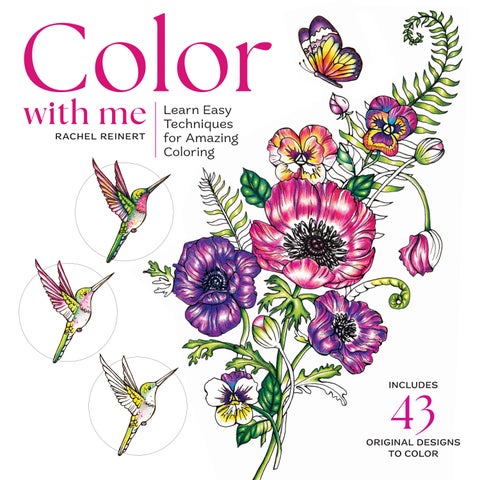
Color with me RACHEL REINERT
INCLUDES
43
ORIGINAL DESIGNS TO COLOR
Color with me RACHEL REINERT
Get Creative 6 New York
About the Artist
H
i, I’m Rachel, artist, educator, and creator of the Wonderland coloring book series: Botanical Wonderland, Desert Wonderland, Floral Wonderland, Woodland Wonderland, and Tropical Wonderland.
In addition to my coloring collections, I’ve authored two instructional books, In Bloom and Color Workshop, which teach readers artistic techniques step by step. I have also shared my expertise through hundreds of digital tutorials on the Color Therapy app, helping users transform their coloring into breathtaking artwork through thoughtful blending and color selection techniques. I create from my home studio in Portland, Oregon, where I’m surrounded by towering trees and abundant natural beauty. This immersion in nature directly influences my work and serves as my primary source of inspiration. When I’m not working on books, I love to paint with acrylics on canvas, often using natural paints that connect my art even more deeply to the environment that inspires it. As a mother of two little kids and a wife, I balance my creative career with family life, finding inspiration in both my natural surroundings and the joy of everyday moments with my loved ones. Do you want to see these techniques in action? My online video course, Coloring Master Class, features over 33 videos with nearly six hours of instruction, including video demonstrations of some of the projects from this book, to take your coloring skills to the next level. Scan the QR code below for more details on the course and how to enroll. You can also explore more of my work at rachelreinert.com or follow my creative journey on Instagram @rachelreinertstudio to see my latest inspirations and art releases!
2
COLOR WITH ME
Contents 4
Introduction
6
Getting Started
26 Exploring Color 46 Shading and Highlighting 62 Special Effects 78 Multimedia 96 Bonus Coloring Pages
GETTING STARTED
3
Introduction For a decade I have worked in the coloring book world as an illustrator, colorist, educator, and author. I’ve learned lots of tricks through the years, and my goal is to share with you my expert tips to help you succeed in all your coloring endeavors! I love this quote from Pablo Picasso:
“
Every child is an artist. The problem is how to remain an artist once we grow up.
When you sit down with your coloring book and markers or freshly sharpened pencils, your brain actually shifts into a more relaxed state—your frontal lobe activates (enhancing focus) while your amygdala (the brain’s fear center) calms down. The repetitive, structured nature of filling spaces with color creates a rhythm that further enhances this calming effect, making coloring an accessible form of meditation.
Coloring is also a fun way to express yourself without any pressure to create a masterpiece—with the lines already there, you don’t have to stress about what to draw. And then there’s the satisfaction of watching a page transform as you splash it with color. My preferred medium is colored pencils and that is the focus of most of this book. They are an excellent medium for beginners and experts—portable, versatile, easy to work with, and forgiving. I also cover other mediums like markers, watercolor pencils, and gel pens. The heart of the book is 31 step-by-step tutorials where you will literally color along with me. For each of them, on the right-hand page is the black-and-white coloring image and on the left are the visual steps I take to 4
”
fully color it, accompanied by easy-to-follow directions, as well as the specific color palette I have chosen for that design. The tutorials are organized into themes: Exploring Color, Shading and Highlighting, Special Effects, and Multimedia. Following the tutorials are twelve bonus coloring designs, printed on perforated pages so you can remove them from the book and put your newfound coloring knowledge to work! To set you off on the right foot, the chapter Getting Started provides an overview of coloring supplies, a primer on color theory and color schemes, and a guide to all the coloring techniques you will be called on to use in the tutorials. Finally, if you want to color with me through video and experience these tutorials coming alive in real time, you can enroll in my Coloring Master Class, featuring nearly 6 hours of video instruction plus exclusive advanced content for colorists who would like to go to the next level. Scan the QR code on page 2 for more information.
So sit down, grab your coloring gear, and color with me! — R AC H E L
GETTING STARTED
5
6
COLOR WITH ME
Getting Started
I
n this chapter, I’ll cover everything you need to know to begin your coloring journey with confidence: the
essential tools to have in your coloring toolbox; color theory and how to use the color wheel to create stunning combinations; and techniques like blending, layering, shading, and highlighting that you will use to create amazing effects with your coloring.
GETTING STARTED
7
Buckeye Butterfly
This complementary color scheme of mainly blue with small pops of bright orange creates vibrant contrast. Blending in neutrals (beige, brown, and black) enhances the realism of this butterfly.
1 3
4
2
1. With Orange, heavily scumble some of
the squiggly sections on the wings in a symmetrical way (for balance), leaving the centers lighter. Burnish around the circular “eyes” with Jasmine. 2. With Non-Photo Blue, use the back-
and-forth stroke to color the inside sections of the wings and eyes, leaving a white edge.
3. Heavily layer Cobalt Blue Hue over the
light blue sections with the back-andforth stroke. Apply it the same way to the top wing sections, abdomen, and inside edge of the eyes. With Dark Brown, hatch the abdomen and head, blending it outward into the wings slightly and as a shadow where the wings overlap. Outline some of the sections on the bottom edges of the wings with it.
4. With Black, burnish the darkest
areas on the wings as shown. Burnish the inside edges of the abdomen, hatching inward. Softly blend the black into the blue with hatching. Outline the black lines on the ends of the wings. Burnish the light blue areas with Non-Photo Blue. Softly scumble Gold into the outer edges of the wings.
Color Palette ORANGE
30
COLOR WITH ME
JASMINE
NON-PHOTO BLUE
COBALT BLUE HUE
DARK BROWN
BLACK
GOLD
analogous color palette of blues, violets, and Hydrangea This greens creates a sense of harmony and calm. Use layering to deepen the vibrancy of the colors and add dimension.
3 1
2
1. With Lilac, use hatching and back-
and-forth stroke to color some of the petals, randomly spread out. With Apple Green, hatch the leaves, starting from the edges and going inward. 2. Apply Non Photo Blue to the
uncolored petals as you did the Lilac in step 1. Leave streaks of white paper showing through for highlights. With Kelp Green, hatch the leaves, leaving white highlights.
3. With Cerulean Blue, hatch the
petals with heavy pressure, focusing mostly on the edges and where the petals overlap. With Sky Blue Light, burnish the light areas of the petals. With Apple Green and heavy pressure, hatch the light areas of the leaves. 4. Hatch Violet Blue into the petals
with heavy pressure, focusing on the inner petals, where they overlap, and the centers of the flowers.
4
Color Palette LILAC
36
COLOR WITH ME
APPLE GREEN
NON PHOTO BLUE
KELP GREEN
CERULEAN BLUE
SKY BLUE LIGHT
VIOLET BLUE
Pine Cone
Using warm browns, this neutral color scheme evokes a cozy, earthy feel. The limited color palette is subtle and easy on the eyes.
3 1
1. With Goldenrod, scumble the
inside edges of the tips of the scales and the pollen within the needles. Hatch downward on the scales, leaving their bases light.
2
2. With Burnt Ochre, hatch to fill
in the bases. Also apply it to the branches and needles in an even layer. 3. With Sepia, hatch the inner
section of each scale about halfway up. Repeat on the branch and needles, focusing on inside edges and where needles overlap.
4. Burnish the base of the scales
with Goldenrod and the tips of the scales with Cream. Add a last burnished layer over the needles and branch with Sepia and Burnt Ochre to deepen the color.
4
Color Palette GOLDENROD
42
COLOR WITH ME
BURNT OCHRE
SEPIA
CREAM
46
COLOR WITH ME
Shading and Highlighting
T
ake your coloring to the next level with projects focused on how to give your coloring dimension and
depth through layering techniques. Learn to render convincing shadows, capture reflective surfaces, and make objects appear three-dimensional.
Cherries
To make a round object look shiny, layer different shades of colors and reserve white areas of the paper for highlights. T he darker midtones, core, and cast shadows bring it to life. TIP Curve your back-and-forth strokes with the shape of the object.
3
1. With Magenta, scumble the cherries,
2
leaving white areas for highlights. Add a second layer along the sides and middle to deepen the color. 2. Scumble Scarlet Lake across the
cherries, leaving the same areas white. With Spring Green and the back-and-forth stroke, fill in the leaves and stems. Apply Henna to the top of the stem in the same way. 3. Scumble a layer of Mahogany Red
1
and then one of Black Cherry to build up the shadows along the sides of the cherries and next to highlights. With Kelp Green, use the back-and-forth stroke to color one side of the stems and leaf, focusing on the veins and making one side of the leaf slightly lighter.
4
4. Burnish the edges of the white
areas with Deco Pink. Scumble Black where the cherries overlap, around the stems, and lightly around the edges. Apply gently to one side of the leaf and stems. Deepen the cherries by with the colors already used.
Color Palette MAGENTA
56
COLOR WITH ME
SCARLET LAKE
SPRING GREEN
HENNA
MAHOGANY RED
BLACK CHERRY
KELP GREEN
DECO PINK
BLACK
Flowers in Clear Glass Vase How do you color something that is supposed to be transparent ? With subtle gradations, smooth lines, and bright highlights. Until you get the hang of it, having a reference photo can be helpful with the placement of shading. Add any color you like to give the glass a fun tint.
1
1. With Jade Green, softly scumble
around the inside of the vase, using more pressure along the edges, the base, and on the water’s surface. With Salmon Pink, hatch downward to color the petals, leaving some areas uncolored for highlights.
2
3. Scumble another layer on the
2. Repeat step 1 to add a layer of 70%
Cool Grey over the Jade Green and a layer of Pink over the Salmon Pink. Color in the center of the flower with Deco Yellow, and the stems completely with Kelly Green.
vase with 90% Cool Grey in the same areas, making the shadows even darker. Apply it to the stems where they overlap. With heavy pressure, use Permanent Red to hatch the petals, focusing on the edges and the lines.
3
Color Palette JADE GREEN
66
COLOR WITH ME
SALMON PINK
70% COOL GREY
PINK
DECO YELLOW
KELLY GREEN
90% COOL GREY
PERMANENT RED
78
COLOR WITH ME
Multimedia
E
xpand your coloring creativity by combining different tools in harmonious ways. Discover how
markers provide bold foundations while colored pencils add detail, how gel pens can create sparkling accents over marker backgrounds, and many more creative combinations.
Hollyhocks
We’ll quickly lay down a vibrant base of color with markers, using the brush tip, then switch to colored pencils to add shadows and details.
1
1. Apply R10 to fill in the petals. Fill in
the leaves and stems with GY3 and the centers of the flowers with Y3. 2. With heavy pressure, hatch Crimson
Lake from the center of the flowers outward.
3
3. Burnish with Black Cherry by
hatching around the yellow centers of the flowers. Hatch with heavy pressure with White around the tips of the petals randomly. Scumble Kelp Green around the inside edges of the leaves and stems.
2
ALCOHOL MARKERS
WAX-BASED PENCILS
Color Palette 88
COLOR WITH ME
R10 (PASTEL PINK)
GY3 (BUD GREEN)
Y3 (BARIUM YELLOW)
CRIMSON LAKE
BLACK CHERRY
WHITE
KELP GREEN
Get Creative 6 An imprint of Mixed Media Resources, LLC 19 W. 21st St., Suite 601, New York, NY 10010 mixedmediaresources.com Senior Editor PAM KINGSLEY Art Director CHRISTINA FREYSS Editorial/Production Coordinator JEAN O’DEA Chief Executive Officer CAROLINE KILMER Chairman JAY STEIN Copyright © 2026 by Rachel Reinert All rights reserved. No part of this publication may be reproduced or used in any form or by any means—graphic, electronic, or mechanical, including photocopying, recording, or information storageand-retrieval systems—without permission of the publisher. The written instructions, photographs, designs, projects, and patterns are intended for the personal, noncommercial use of the retail purchaser and are under federal copyright laws; they are not to be reproduced in any form for commercial use. Permission is granted to photocopy for the personal use of the retail purchaser. The EEA authorized representative is Authorised Rep Compliance Ltd., Ground Floor, 71 Baggot Street Lower, Dublin, D02 P593, Ireland (www.arccompliance.com). ISBN: 978-1-68462-109-5 Manufactured in China 1 3 5 7 9 10 8 6 4 2 First Edition
120 COLOR WITH ME
FO R MY CH ILDRE N, E ME RALD AND JET T
May you forever cherish your childlike wonder, coloring the world with curiosity and joy. May your creativity always flow freely, and may you always have the courage to color outside the lines that have been drawn for you.
Take Your Coloring to a New Level—It’s Easy! Color with Me includes 31 projects that will teach you techniques like shading, layering, and blending, how to use the color wheel to put together pleasing color schemes, and how to create special details, like a glow effect or translucency. Coloring book artist Rachel Reinert will take you through each project, step by step, then you can try it yourself on a full-page blackand-white version of the same design.
As a bonus, you’ll find 12 additional coloring designs at the back of the book. Printed on perforated pages, you can remove them, making it easy to refer to different parts of the book as you color them in your own original way. COLOR YOURSELF CREATIVE WITH COLOR WITH ME!
GAMES & ACTIVITIES · COLORING BOOKS
$22.99 US ISBN: 978-1-68462-109-5 52299
9 781684 621095