
High Repetition Rate Solid-State Lasers in Fundamental and Applied Research
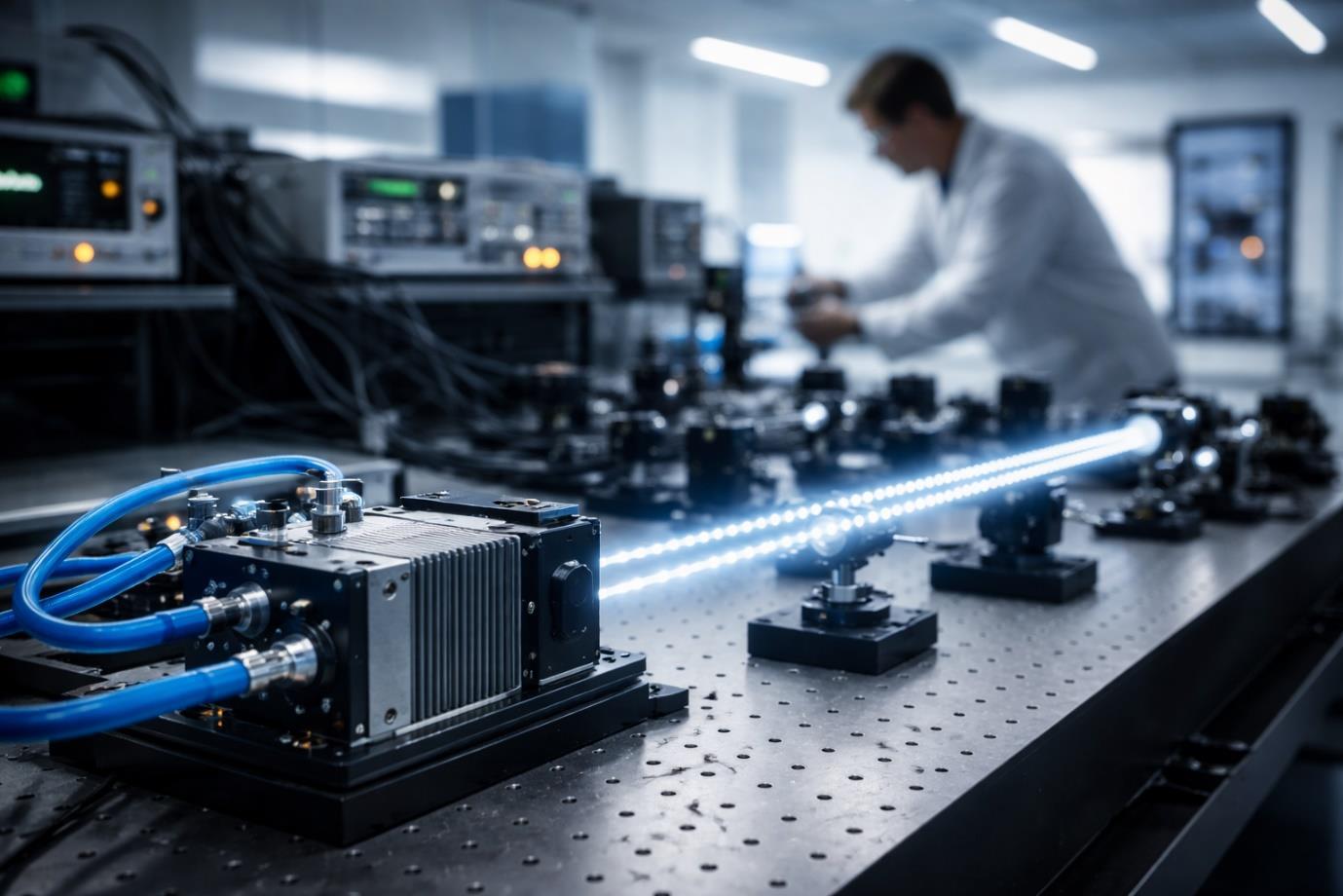
Modern research often faces a familiar limitation: experiments are designed to move faster than conventional laser systems can operate. Whether it is capturing transient physical phenomena, generating statistically significant datasets, or maintaining longtermmeasurementstability,traditionalpulsesourcesfrequentlybecomethebottleneck, andthischallengehasledtotheacceleratedadoptionofthe high-repetition rate solidstate laser, which is now a cornerstone technology across physics, chemistry, and engineeringlabs.
Theselasersproviderapid,consistentpulseswithexcellentbeamquality,whichenables researchers to observe events that occur on extremely short timescales while maintaining experimental accuracy. Especially, as research problems grow more complex, laser performance is no longer a convenience; it’s an essential infrastructure componentthatcan’tbeignored.
Why High Repetition Rates Matter in Research?
A higher repetition rate directly translates into enhanced temporal resolution and stronger signal averaging, and more pulses per second mean more interaction events, betternoisesuppression,andfasterconvergencetowardmeaningfulresults.Infact,highrepetition systems can increase experimental data acquisition significantly, while shortening project timelines in spectroscopy, plasma diagnostics, as well as nonlinear opticsresearch.
Advantages of Solid-State Laser Architecture
Solid-state lasers are preferred in academic and industrial environments for several technicalreasons,includingthefollowing:
• Incredibleenergystabilityoverlongoperatingperiods
• Compactdesignsuitedforintegratedlaboratorysetups
• Lowermaintenancerequirements
• Compatibilitywithfrequencyconversiontechniques
These advantages explain why nearly every advanced photonics facility relies on equipment produced by a specialized solid-state laser manufacturer, where cavity design,thermalmanagement,andopticalcoatingqualitydirectlyinfluenceexperimental reliability.
Key Applications in Fundamental and Applied Science
High repetition rate solid-state lasers support an extensive array of research domains, suchas:
Research Area
Practical
Impact
Atomic and molecular physics Stable excitation sources for precision measurements
Materials science Controlledablationandsurfacemodification
Atmospheric studies
Biomedical research
High-frequencyparticleandaerosoldetection
Rapidimagingwithreducedthermaldamage
Inanalyticalchemistryandindustrialdiagnostics,the DPSS laser for LIBS playsacritical role due to its ability to generate repeatable plasma formation. It enables fast, noncontactelementalanalysisacrossmining,environmentalmonitoring,andqualitycontrol applications.
The Role of Ultra-Fast Pulse Technologies
For experiments requiring extreme temporal precision, Sub-Nanosecond Lasers provide pulse widths short enough to minimize heat diffusion and mechanical stress. Thesesystemsarewidelyusedin:
• Laserultrasound
• Atmosphericlidar
• Oceanographicsensing
• Advancedspectroscopy
Such technologies can allow researchers to isolate pure optical interactions from secondary thermal effects, which improves both data quality and experimental reproducibility.
Looking Ahead: Reliability as a Research Standard
Asscientificinstrumentationevolves,lasersystemsareincreasinglyjudgednotonlyby output power but by long-term stability, environmental tolerance, and system integrationcapabilities,andinsuchascenario,high-repetitionratesolid-statelasersare nowconsideredfoundationaltoolsratherthanspecializedequipment.
The Way Forward
Forlaboratoriesseekingdependable,research-gradelasersystems, Technwin Industry Co. Ltd standsoutasadedicatedadvancedsolid-stateandfiberlasertechnologycenter. Our team focuses on developing high-performance laser platforms for applications includingatmosphericLiDAR,biomedicalresearch,andquantumoptics.
With strengths in customized system design, mass production capability, and collaboration with global research institutions, Techwin delivers laser sources engineeredforstability,longoperationallife,andcostefficiency.