Since 1958 Singapore American • June/July 2015
AM ERICAN AS S O CIATION O F S INGAP O RE June/July 2015
www.aasingapore.com American Association.....2-4 Member Discounts..............3 CRCE & Business.................5 Community News..........6-10 Travel.............................10-11 Summer in SG...............12-21 Health & Wellness.............22 Food..................................23
Travel 10-11
Food 23
Arts & Culture 24-26
Summer in SG 12-21
Arts & Culture..............24-26
Nepal: A personal story from inside the crisis.
The skinny on summer eats
Dinosaurs, tigers and creepie crawlies, oh my!
Everything you need to know about Summer in Singapore.
What's Happening............27
MCI (P) 185/03/2015
SCUBA in the Summertime By Laura Schwartz
I
f you’re looking to try something new this summer, why not learn how to scuba dive? Singapore is surrounded by some of the world’s top dive sites, so it would be a shame not to give diving a try during your time here. Like driving a car, learning to dive can seem overwhelming at first. There are new terms and rules to memorize. You’ll probably ask, “What does that button do?” at least once. And you have to pass both a written test and practical
demonstration of your skills to earn your license. But just as you developed muscle memory for changing gears and checking your mirrors, it won’t be long before clearing your mask and checking your oxygen level become automatic. If the thought of paying for all that equipment turns you off, don’t worry. Dive resorts are usually stocked with everything from fins to wetsuits to regulators. There are only two pieces of gear I would recommend you invest in
as a beginner: a carefully chosen mask that fits you well and doesn’t fog and water boots in your size (occasionally rented fins can cut into your heels and sometimes you enter the water over a rocky beach). There are a number of acronyms you’ll learn during your diving course, but the first one you should know is PADI, which stands for Professional Association of Diving Instructors. Founded in the 1960s, PADI isn’t
American Association of Singapore Strategic Partners
the only diver training organization in the world, but it is the largest and the most well-known in Southeast Asia. Other training organizations such as National Academy of Scuba Educators (NASE) and National Association of Underwater Instructors (NAUI) can also be found in Singapore. There are dozens of PADI-certified dive shops throughout the island, but Eko Divers in Outram Park came recommended by Continued on page 21 a friend...
2 AMERICAN ASSOCIATION
Singapore American • June/July 2015
SINGAPORE AMERICAN NEWSPAPER EDITORIAL Editor-in-Chief: Melinda Murphy, communications@aasingapore.com Publishing Editor: Toni Dudsak, generalmanager@aasingapore.com
DESIGN & L AYOUT
Graphic Designer: Joanne Johnson, graphics@aasingapore.com
ADVERTISING Advertising Manager: Valerie Tietjen, san.ads@aasingapore.com
CONTRIBUTORS
A Message from the President...
E
ach month when I sit down to write this letter, I sit and think about what’s going on with AAS. Sounds like a simple task, but it’s actually eye-opening even though I talk with General Manager Toni Dudsak on a regular basis. To see the list in totality, on our website, in SAN or in pictures on our Flickr page, I marvel at what a great job our staff does. In May, for example, you could have learned how to become a Singapore Permanent Resident, cooked Italian food at a Master Class, learned how to use Google Adwords to sharpen your business, stretched your brain at our Quiz Night or taken a moment at the Marine House at the US Embassy to mark Memorial Day. Our very popular Independence Day Celebration will take place on Saturday, July 4th at the Singapore American School. Admission is free and there will be games for the kids, food, adult beverages, music and fireworks under the stars. We’re looking for more fireworks sponsors. For $100, your family or business can help support our skyrockets in flight and see your name right here in SAN with a proper thank you (see ad below) . Also mark your calendar for August 30, our annual Welcome Back family-friendly party. It’s a great opportunity to make some new friends or to reconnect with people. Sign up early, because this event SELLS OUT FAST. By now, you should have seen our online membership survey. We really need your input and hope you’ll take five minutes to complete it. To encourage you, we’re shamelessly bribing you by offering a Lucky Draw where you could win great prizes, including two tickets to the 2016 George Washington Ball! Every June, we say goodbye to some of our members, as they leave Singapore. If this applies to you, we wish you safe travels and a fun, new adventure. You’ll always have a home at AAS, should you return to Singapore or merely want to log on to our website or FaceBook page. We want to keep you happy and engaged. In addition to filling out the survey, please contact me or General Manager Toni Dudsak: generalmanager@aasingapore.com and visit our Facebook page or tweet us: @AmAssocSG, (hashtag #AmAssocSG on Facebook, Twitter). I hope you’ll have a great summer and make sure to watch for upcoming events. Best,
Judith Agusti, Faith A. Chanda, Angel Corrigan, Kevin F. Cox, Lucia Damacela, Nithia Devan, Melissa Diagana, Tawnya Hartberger, Meera Navlakha, Bill Poorman, Laura Schwartz, Gladys Sim, Anna Sorokina, Sunita Srivatsan, Nicole Tan, Jim Tietjen, Dr. Rachel Upperton, Danielle Wait, Clarissa Wong, Silvia Anna Zamarripa American Association : Alka Chandiramani, Anne Morgan, Melinda Murphy
A MERICAN ASSOCIATION BOARD MEMBERS President: Glenn van Zutphen • Vice President: Steven Tucker Treasurer: Joseph Foggiato, • Secretary: Stephanie Nash Directors: James Arpin, Shawn Galey, Christopher Keen, Mary Beth McCrory and Ana Mims Immediate Past President: David Boden • AmCham Chair: James Andrade American Club President: Scott Weber • AWA President: Annette Foster SACAC Chair: Stu Wilson • SAS Chair: Catherine Poyen US Embassy: Chahrazed Sioud Non-Voting Member: US Military: Rear Admiral Charles F. Williams
PUBLISHER - A MERICAN ASSOCIATION
The American Association of Singapore (AAS) is a professional, not-for-profit organization established to enhance the well-being and living experience of Americans residing in Singapore and to promote relationships, both business and social, between Americans and those from different cultures and nationalities. AAS was established in 1917 by a small group of Americans living in Singapore to provide a safety net of community support for American residents. AAS continues to provide community welfare as well as programs and community events. 10 Claymore Hill, Singapore 229573 T: (+65) 6738 0371 • F: (+65) 6738 3648 E: aas@aasingapore.com • www.aasingapore.com The Singapore American newspaper, a monthly publication with readership of 10,000+, has been published by the American Association of Singapore since 1958, with the purpose of enhancing the expatriate experience in Singapore.
SUBSCRIPTION
A subscription to the Singapore American is complimentary with an AAS or CRCE membership. AAS annual family membership is just $70. CRCE membership is $160. To join, visit www.aasingapore.com and have the Singapore American delivered to your home.
Glenn van Zutphen president@aasingapore.com twitter: @glennvanzutphen
Reproduction in any manner, in English or any other language, is prohibited without written permission. The Singapore American welcomes all contributions of volunteer time or written material. The Singapore American is printed by Procomp Printset Pte Ltd, 57 Loyang Drive, Level 3 Annex Building, Singapore 508968.
3 AMERICAN ASSOCIATION
Singapore American • June/July 2015
AAS wednesday
3
june
saturday
4 july
Upcoming Events Coming and Going New to AAS? Like to meet some friendly people? Or maybe you're leaving Singapore for the summer - or for good? Come join us for an evening of friendship and laughter! 6:30-8:30pm AAS Conference Room, The American Club, 10 Claymore Hill $10 for AAS members and bring one guest for free!
Independence Day Celebration 2015 Time to celebrate the American spirit in Singapore at the AAS annual Independence Day Celebration in partnership with Singapore American School! This familyfriendly event features a day of fun, music, food, drinks and patriotism, capped off by formal ceremonies and a spectacular fireworks display. See our website for details. 4-10pm Singapore American School Free to all
sunday
30 august
Past Events
Mingle Taste and Shop A perfect evening of shopping and eating!
Welcome Back Celebration Join us for the 2015 Welcome Back Celebration at Smokey’s BBQ, where you can mingle with newcomers and reconnect with old friends. With an afternoon filled with food, fun and entertainment, there's something for all ages. Also, meet AAS' sister organizations: AmCham, AWA, SACAC, SAS, The American Club, The United States Embassy and Navy League of The United States Singapore Council. 3-5pm Smokey’s BBQ Blk 106 Clementi Street 12, #01-54/56, Singapore 120106 For more info and to register for an event: www.aasingapore.com
MEMBER DISCOUNTS
Quiz Night at Smokey’s BBQ First place winner: Model UN
AAS Member Discounts AAS members enjoy discounts at a range of local businesses. Present your AAS membership card at time of purchase. Please see a full list of discounts at www.aasingapore.com/member-discounts. Two hours free handy-man service worth over $200 when you book your move with Allied Pickfords. Call 6862 4700. Receive complimentary insurance consultations with an experienced insurance advisor. Visitors can choose to receive free, no-obligation quotes on Home, Medical, Life, Travel, Motor and Business Insurance. JAL is offering a special promotional discounted air fare to AAS members at about 7-9% off the published market air fare. Please take note that this is applicable only for travelers who book through Country Holidays. www.countryholidays.com.sg/en/ Get a six-month free membership to Expat Living magazine. Redeem: www.expatliving.sg/aas
Receive a 10% discount on a one-year membership.
FIRST DRINK FREE – every day, every visit for AAS members. Valid on house pours until July 31, 2015. Show your membership card at the bar to claim.
Present your American Association membership card and receive $5 off Warehouse Club membership fee. Valid till August 31, 2015.
Quiz Night at The American Club First place winner: The Claymore Six
Save the Date! Next Quiz Night - September 17 Smokey's BBQ, Clementi
Do you have an online shopping tip? Email us your favorite and be entered into a Lucky Draw to win a bottle of wine. communications@aasingapore.com
4 AMERICAN ASSOCIATION
Singapore American • June/July 2015
Putting Down Roots By AAS Executive Committee
L
ee Kuan Yew planted a Mempat tree at Farrer Circus back in 1963, kick-starting a national campaign to make Singapore a “City in a Garden.” Since that first sapling, tree planting has become a very important part of Singapore’s national tradition. An official Tree Planting Day was first started in 1971 to coincide with
the rainy season to minimize watering. The American Association of Singapore (AAS) is excited to take part in a special tree planting event to honor Singapore’s Jubilee Year. This October, we will plant 51 trees, one for every US state and Singapore. Our special grove is in Ulu Sembawang, an area of special significance to Americans in Singapore as it is
close to the American military presence here and many American families live in the area. For a $200 donation, you, your family or your company can sponsor a tree and be a part of American heritage in Singapore for decades to come. Contact admin@aasingapore for more information.
5 CRCE & BUSINESS
Singapore American • June/July 2015
Spotlight on Jobs
CRCE: Career Resource Center for Expats
CRCE
Up Close & Personal with Silvia Anna Zamarripa CRCE Member since April 2015 What did you think about moving to Singapore? Like some expat wives, I have the pleasure of traveling to countries I have never seen before thanks to my husband’s employment opportunities. The research I did on Singapore before moving made me really excited to discover more. I was born in Japan so I am excited to live in Singapore in hopes to one day visit my birth country. How long have you been living here? Since January 2015 How did you find out about CRCE? I was told about the American Association of Singapore by my neighbor. She is a French expat living and working in Singapore. She
knew I was interested in finding work and recommended that I visit the AAS website. I did so and found that AAS was hosting a newbies social the next week. I attended the social and met other expats like myself as well as most of the board members in attendance. It was at the social that I signed up to become a member and, within a few days, I had access to the CRCE Job Board online. What are your experiences as a CRCE member? My experience with CRCE has been quite positive. I logged on after I returned from Easter break and immediately found a posting that suited my skill set. I applied, interviewed and, within a short time, was hired.
What advice can you share with new expats looking for a job in Singapore? I now recommend CRCE to all of my friends who are looking for job opportunities. I would tell all new expats to have faith and to network as much as they can. When we find ourselves in a new country, the only way to learn about it is to make new friends and contacts and to immerse ourselves in the traditions, culture, food, art, history and nature. Explore. Be curious. Go on tours of the city. Have a desire to want something more. Learn something new and live your experience to its fullest.
CRCE Teams Up with Mums@Work
C
RCE partnered with Mums@Work recently for two, sold-out presentations by Google on “Leveraging Google Adwords to Attract New Clients and Businesses.” Google Adwords is the leading online marketing and advertising service that allows marketers to promote ads on top of and next to Google’s organic search results. These talks are ideal for founders, CEOs and entrepreneurs of small businesses who are looking for profitable ways to boost conversions. The sessions covered topics on building
successful Adwords campaigns that work for user acquisition, e-commerce and lead generation as well as how to optimize spending and avoid unnecessary costs. CRCE and Mums@Work want to thank Michelle Lim who is a Marketing Specialist, Small and Medium Business Marketing at Google Singapore. Thanks also to Sher-li Torrey, founder of Mums@Work for the excellent partnership. Don’t miss more seminars in collaboration with Mums@Work later in the year!
Did you know that employers can post jobs for FREE? Visit www.aasingapore.com/for-employers
One-on-One Coaching: Career Solutions © AAS is now offering personalized career-counseling services. Sign up now for a private 45-minute appointment with a professional Career Advisor. Please contact crce.info@aasingapore.com
CRCE June/July Workshops register at: www.aasingapore.com Power Lunch Series: Improving Your Business Communications & Presentation Skills
Speaker: James Obata Friday, June 5 11:30am – 1:15pm
Leading Self, Leading Teams, Leading Organizations Speaker: Joanna Barclay Friday, June 12 10am – 12pm
Look out for a plethora of new events at CRCE in August and beyond
For more information about CRCE: www.aasingapore.com - click on the CRCE link
Clinic Manager The Clinic Manager is responsible for overall operation of the medical clinic. The successful candidate will demonstrate leadership through activities at the strategic and operational level to ensure outstanding patient care, patient satisfaction and staff productivity. This may include, but will not be limited to: revenue cycle management, budget preparation and management, income and expenses, compliance, quality improvement, work culture, strategic planning, business development/ marketing, supply chain management and human resources. (job #3077) Medical Receptionist This outpatient clinic group is seeking full-time and part-time medical receptionists to be part of the expanding family practice. You will join a dynamic team of professionals and be empowered with significant responsibility. The position entails: receiving and welcoming patients when they arrive for their appointment; answering and booking appointments; arranging for specialist appointment on behalf of patients; new patient registrations. (job #3076) Director of Membership and Programme The Director of Membership and Programme role has a strong acquisition focus with an awareness of the value that new members will bring to support the chamber’s initiatives. The role will also be responsible for designing and maintaining a dynamic and business relevant program of events, which is the linchpin of the organization’s offering. The Director role has a high degree of autonomy to achieve its objectives while working with an effective and results driven team. The role will report into and work closely with the Chamber Executive Director. (job #3072) Senior Language Teachers This organization is looking for passionate English, Chinese, French and Korean language teachers to join its academic team. Teachers are expected to have solid knowledge of their specialty language and culture. They will prepare and deliver lessons, tutorials and remedial classes according to the course syllabus. This will include conducting private or group classes, preparing written and oral tests for students, developing course contents, providing academic support to students, participating in orientation and marketing events, and other duties as assigned by the Academic Director. (job #3071) Outplacement Consultants An international human resource consultancy firm that provides outplacement and executive coaching services to MNCs is looking for professional, self-driven and enthusiastic senior freelance candidates to join the Singapore office. You must be dedicated to help others in their career transition and to guide them to consider what they would like to pursue in their next phase of life. (job #3070)
6 COMMUNITY NEWS
Singapore American • June/July 2015
Breaking Barriers with TEDxYouth@SAS By Sunita Srivatsan, Meera Navlakha, Danielle Wait
T
ED is known globally as a platform for the communication of “Ideas Worth Spreading.” Past speakers at TED events range from Larry Page, who co-founded Google, to former US President Bill Clinton. In the spirit of TED’s mission, “Ideas Worth Spreading,” Singapore American School (SAS) students hosted the first ever TEDxYouth (x = independently organized) event at SAS on May 21 with speakers from the SAS student body and faculty. Paige Freeman, a ninth grader who discussed why the stigma of mental illnesses needs to be rewritten; Kartikye Mittal, a junior who explained why you don't have to work at NASA to build a satellite; and high school robotics teacher Bart Millar, who explored the topic of critical thinking, were among the speakers at the event. Approximately 100 audience members watched the show live from the school's drama theater, per TEDx rules, ensuring a comfortable setting to share ideas. The rest of the SAS community was able to watch a live stream of the show at the high school library or online from the comfort of their home. The lead organizer of the event who first envisioned bringing TED to the school, Kaelan Cuozzo, is a SAS senior and president of the High School Service Council. Inspired by her service background as well as the resources and support at SAS, Cuozzo saw the opportunities that a TED event could bring to students.“TEDxYouth@SAS was a new form of service to me. It provided a voice to people who would have otherwise gone unheard,” she said. TEDxYouth@SAS was founded in March 2015 after the school received an official license from TED. The May conference, focused on the theme “Breaking Barriers,” was Singapore American School’s first official TED event. The TEDxYouth@SAS activities were planned and coordinated by a team of student volunteers, known as the Breaking Barriers Executive Team, with support from individuals and organizations, both within and outside of SAS. The school plans to hold one live event every
year, each with a different theme. The conference provided an empowering opportunity for a diverse range of speakers to express unique perspectives. With the theme “Breaking Barriers,” the SAS students who planned the event wanted to enable their student peers and faculty to discuss personal insight about their own life experiences. “We hoped this event would promote a culture of innovation where people regularly and comfortably shared their ideas and gained support from the SAS community and beyond,” Cuozzo stated. The amount of momentum behind this event was amazing with more than 100 students submitting applications to be a speaker or an
executive team member, according to Cuozzo. During speaker auditions, members of the Breaking Barriers Executive Team and a teacher panel heard exceptional talks. “Personally, I always loved watching TED talks, so it felt incredible to help plan this event in our own school community,” said Sunita Srivatsan, a SAS student who served as a communications and marketing director for this year’s event. “Organizing TEDxYouth@SAS has been a great challenge, but such a wonderful opportunity,” Srivatsan continued, “Our goal was to empower students to participate in an enriching experience that can help ‘break barriers’ for our school community as a whole.”
Singapore American • June/July 2015
8 COMMUNITY NEWS
Singapore American • June/July 2015
The Best Thing to Do in Singapore By Tawyna Hartberger
L
ately, a few folks have asked me what’s been my favorite thing in Asia. Having been here nearly 40 years, there is an awful lot from which to choose: more food than I can pronounce, lots of travel, the many things in my house to remind me of people and places and boxes and boxes of photographs. But they are usually asking for themselves, really, to make sure they don’t miss out on a great experience while they are here. So, I have spent some time thinking about what has been most valuable, what I would recommend to anyone who has just moved here and wants to get the most out of their years in Singapore.
That something is being a Girl Scout leader. “Too American,” you say? You want to really experience Asia? Well, there hasn’t been much that’s more “Asian” than doing a jungle survival training course with a group of teenagers, learning what plants are edible or useful for shelter and clothing. Teaching girls about the endangered animal trade in the Asian markets was eye-opening for both them and me. Doing a cooking class with a former Singapore president’s wife and a group of Singapore Girl Guides introduced me to my favorite dessert, kueh dadar, AND ensured my daughter can make it for me when I’m in the rest home. Doing the nitty-gritty to get all the above (and much more!) set up was an invaluable education in itself. Buying cords of firewood from a charcoal vendor? Sourcing certified archery, canoeing and shooting instructors? Getting patch design quotes from three different countries? Check, check and check. I can’t say it was all easy, but all were certainly very “Asian” experiences. And while it has been exhausting at times, I learned that I, and the girls, can do pretty much anything we decide we want to do.
A lot of the reward, of course, is getting to spend time with young people, all the way from the five-year old Daisies, fresh-faced and excited, to the 12-year-olds, teetering on the edges of their hormones, to the 17-year-olds, busy changing the world. The Girl Scouts provides a ready-made program that enables that progression and it has been amazing to watch the development of so many girls. I love seeing the looks on the faces of a group of 15-year-olds who have come up with a theme and detailed plans for a party for 600 people, with food, decorations, activities and gifts. They set the budget, did all the shopping, planned the menu and chose the music. I went along for the ride. I loved sitting and listening to a group of 13 and 14-year-olds discuss the younger girls in their cabin - who was homesick, who did well in the day’s activities, who tried to get out of cleaning the toilets - a nd coming up with ways to make tomorrow even better. I loved listening to a 17-year-old describing her plans to travel to India and set up a computer-based, language training program for teachers that will result in increased funding for the school district she will visit, the one her father came from so many years ago. And when she reported to a formal committee the success
of her plan, well, that was pretty sweet, too. And about the Girl Scouts being American, well, yes. But I got to introduce Thanksgiving AND marshmallows to scores of young girls (and some moms!) who hadn’t heard of either. And we all got to compare and contrast our Girl Scout Law and Promise with those of Japan, Malaysia, Indonesia, Philippines, Australia and so many more as sister members of the largest organization for females in the world. I have worked with Girl Scouts and Girl Guides from all the above countries and have the patches and photos by which to remember them. Many of our best leaders are not US citizens, nor have ever lived there, but they want their daughters to be confident and courageous and able to make their world a better place. Being a leader took quite a bit of time, I suppose, especially in the years I had two troops, as there were girls who didn’t have moms willing to be a leader. I worked full time during some of those years, and the woman I’ve been a co-leader with the longest (my BFF!) works full time, as well. Some weekends were all Girl Scouts, all the time. And I’d do it all again in a heartbeat because it made my world a better place. To learn how you or your daughter can be involved, log onto the Girl Scout website.
SCOUTING IN SINGAPORE Boy Scouts Troop 07: www.bsatroop07.org Boy Scouts Troop 10: www.facebook.com/BSATroopX Cub Scouts Pack 3010: cball@reedsmith.com Cub Scouts: www.scouts3017.com Girl Scouts: www.singaporeusagirlscouts.org
9 COMMUNITY NEWS
Singapore American • June/July 2015
AmCham: Funding Success! By Clarissa Wong
T
he American Chamber of Commerce in Singapore (AmCham) is pleased to announce that the Yellow Ribbon Fund (YRF) is its Charity of the Year for the third consecutive year. Launched by former President of Singapore, S.R. Nathan in 2004, the YRF develops and implements reintegration programs for prison inmates and ex-offenders. The programs vary and range from strengthening relationships between inmates and their family members to supervising ex-offenders after they are released from prison. For example, the relationship between an imprisoned father and his children is often strained because of forced separation during the father’s incarceration. In order to bridge the relational gap, the “Date with Dad” prison event provides imprisoned fathers opportunities to meet their daughters and engage with them. Farhan, an inmate who benefitted from the program, said that the event brought a deeper understanding and meaning to his relationship with his daughter. Melissa, whose father was incarcerated, could also spend time with her father and share a meal with him together on one table. Besides enhancing the relationship between fathers and daughters, YRF also offers programs to help families with their finances, promote family bonding, teach family life education and provide tuition and enrichment programs for the children. A family member, John, said “I enjoy the program because it is not just one person who does all the talking and we do all the listening. We can talk about our feelings.”
AmCham donated $30,000 to YRF last year from the proceeds of the Stamford American AmCham Charity Golf Tournament After the inmates are released from prison, YRF continues to run programs to support them. One of the programs is the Individual Transitional Aftercare program. Ex-offenders often have problem with accommodation upon release from the prison. YRF and IC@RE Hub partnered to develop a pilot shelter program for female ex-offenders in 2013. The program seeks to address the ex-offenders’ needs and create basic support structures. Mei Yan who was one of the participants said, “After the counseling session, I have better coping skills to face life challenges and [am] ready to find part-time work instead of relying on welfare.” The reintegration programs that YRF develops and implements for prison inmates and ex-
offenders help build successful futures for all members of Singaporean society. “AmCham Singapore is pleased to support its positive efforts to impart the skills and confidence that will enable ex-offenders to seize their second chance, equipping them to reintegrate into society and find gainful employment. We look forward to strengthening the AmCham-YRF partnership throughout the year,” James R. Andrade, Chairman of the AmCham Board of Governors, said. Yellow Ribbon Fund Chair Wong Ai Ai added, “The Yellow Ribbon Fund is committed to helping ex-offenders and their families reintegrate into the community. Our partnership with AmCham, the largest foreign business chamber in Singapore, helps to create awareness among the American business community, serving as a catalyst to further our works.” More information about YRF can be found at www.yellowribbon.org.sg/yellow-ribbon-fund For more information about AmCham’s CSR activities, contact Clarissa Wong at cwong@ amcham.org.sg.
Corporate Partners
10 COMMUNITY NEWS
Singapore American • June/July 2015
Summer Reads
Nepal in Crisis
By Judith Agusti, AWA Book Club
By Jim Tietjen
All Our Names by Dinaw Mengestu The story of an African man who goes to the US Midwest on a student visa and his struggles with loss of family, country and identity in his new home. The author was born in Ethiopia and now works at Georgetown University in Washington, D.C. Being Mortal, Medicine and What Matters in the End by Atul Gawande A heartfelt examination of palliative care and hospice programs by surgeon Atul Gawande. Through his interactions with patients and his own father, Gawande found hospice programs to be, not about aiding or hastening death, but about providing opportunities to make each remaining day meaningful. He suggests to families of the elderly and dying to focus their last days on what is most important as testaments of their lives. China Dolls by Lisa See In San Francisco in the 1930s, three women meet as dancers in a Chinese nightclub. They endure precarious careers, tumultuous romances and personal conflicts. Their lives change when the United States declares war on Japan. Dust by Yvonne Adhiambo Owuor A panicked chase through the streets of Nairobi ends in lamentation for a single family. The novel examines the corruption of national politics in modern Kenya. Euphoria by Lily King In 1933, anthropologist Margaret Mead took
a field trip in New Guinea with her second husband, where they met and collaborated with the man who would become her third husband. Romance meets intellectual pursuits to create a compelling, sensual story. Finders Keepers by Stephen King Perhaps the most anticipated book of the summer, this masterful, intensely suspenseful novel about a reader whose obsession with a reclusive writer goes far too far. The book about the power of storytelling stars the same trio of unlikely and winning heroes King introduced in Mr. Mercedes. Go Set a Watchman by Harper Lee Originally written in the mid-1950s, Go Set a Watchman was the novel Harper Lee first submitted to her publishers before To Kill a Mockingbird. Assumed to have been lost, the manuscript was discovered in late 2014. Go Set a Watchman features many of the characters from To Kill a Mockingbird some twenty years later. In the Night of Time by Antonio Munoz Molina, translated by Edith Grossman A spellbinding novel of love and war during the Spanish Civil War. A Spanish architect falls passionately in love with a woman who is not his wife. Norah Webster by Colm Toibin Set in the early 1970s in County Wexford, Ireland, this is the tale of a 44-year-old widow and mother of four, who has to struggle to feed her family... Continued on page 24
I
’ve trekked Nepal four times in the past six years. It is a beautiful land with beautiful people. Today, these beautiful people need serious help. On April 25, Nepal suffered a devastating 7.8 earthquake and has been plagued by serious aftershocks since. A place known for the highest peaks in the world and breathtaking views, the country is in shambles. Reports are that at last 8,000 have died, more than 19,000 have been injured and hundreds of thousands
left homeless from the initial quake alone. A similar disaster hit Nepal in 1934. Just two days before the recent disaster, my good friend Jay (last name withheld) headed to Nepal to trek to Annapurna Base Camp with five friends from Singapore. On Thursday, they arrived in Pokhara, an idyllic lakeside town near the Annapurna Sanctuary, and began their trek. On Saturday, that fateful day, the ground shook as they entered the town of Ghorepani around noon. There was “a lot of shaking, but
11 TRAVEL
Singapore American • June/July 2015
no damage.” The locals were not bothered. They are used to earthquakes. It took days before the group learned the full extent of the quake. They pressed on, as if nothing had happened. The next day an aftershock hit during lunchtime at a teahouse. Everyone ran outside, but there was no damage. Everything looked normal. The locals seemed calm, so Jay and his friends kept trekking. That evening, in the town of Tatopani, they began to hear reports of damage and destruction 80 miles away, in Kathmandu. Two days after the quake, they reached Chomrong, about half way to their destination. They still did not know the extent of the earthquake, nor did their Nepalese guide (or he wasn’t saying). They began to wonder. Text messages from the Singapore government informed them of Singapore Air Force C-130 cargo planes coming to Kathmandu to evacuate citizens and PRs and that they should contact their embassy as soon as possible. Jay, who is British, received a text from his government about the same time. It provided a web link, an emergency phone number and an option to register his details. They now began to worry, but still, there was no visible indication of earthquake damage where they were. Everyone was calm. When they checked in to their Chomrong accommodation the proprietress told them more. They learned the trails ahead were closed. Even then, there were no trekkers coming down from Annapurna Base Camp and there was no unusual foot traffic on the trials (there are no
roads in this area.) They knew it was time to turn around. They began to worry. Tuesday, April 28, was a “normal” day. The trail heading back was not busy. The guide decided to take a different, more direct trail back to their starting point, Biranthani. By Thursday, they became more concerned. Reports of devastation were rife. Text messages urged them to call an emergency number, register and report to Kathmandu to be evacuated. The group could only imagine what had happened. They didn’t really know yet. By Friday, they returned to Pokhara and civilization. They now learned the details, but had to wait for days to fly the
24-minute flight back to Kathmandu. The Pokhara airport was unusually quiet, except for a number of Indian Air Force military helicopters conducting search and rescue operations in areas the trekkers had not been. Since they had time on their hands, members of Jay’s group volunteered to help an aid organization called Helping Hands. This group was raising money online in near-real time; buying supplies (rice, medical supplies, blankets, tarps, etc.), packing them into small bundles at night and driving and hiking (mostly hiking) by day into surrounding villages to deliver the supplies... Continued on page 26
HOW TO HELP 1.Donate money and only money. Donations such as blankets, clothing and food often end up rotting. Many times, there is no way to get these items to those in need because of bad roads, closed runways or not enough boots on the ground. Money, on the other hand, is put exactly where it’s needed, purchasing things such as jet fuel for helicopters, tankers of water, bags of rice and more. 2.Choose your organization carefully. The best organizations keep a low overhead so most of your donation goes to the victims. www.charitynavigator.org and www.guidestar. org can help you determine which charities are most efficient. Charities with a local presence make the biggest impact. 3.Target donations when you can. If you have a specific idea how you would prefer your donation to be used, you can find a matching charity on this site targeting everything from children to animals to housing. www.interaction.org/crisis-list/interactionmembers-respond-nepal-earthquake 4.Find somebody to match your funds. Big corporations often will match donations so check with your company or other avenues. For example, Facebook matched US$2 million. The social media giant raised total of US$15 million at time of print. 5.Beware of scam artists Sadly, scammers are very aware that people feel the need to help. There are lots of cons on social media and over the telephone. Make sure the organization is legit.
12 SUMMERTIME IN SG
Singapore American • June/July 2015
Wild Singapore By Melissa Diagana
S
ingapore’s perpetual summer allows us to play year-round in the great outdoorsadmittedly, not “great” like “huge,” but “great” like “wonderful!” Do check out these new outdoor places during your Summer in Singapore.
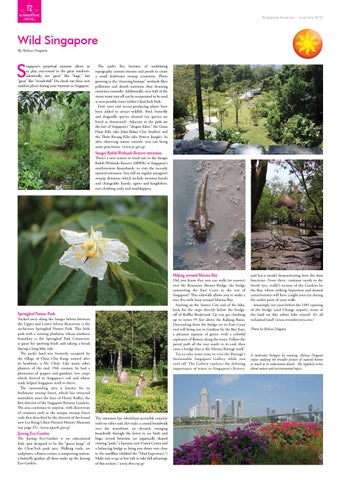
The park’s five hectares of undulating topography contain streams and ponds to create a small freshwater swamp ecosystem. Plants growing in the “cleansing biotope” wetlands filter pollutants and absorb nutrients, thus cleansing rainwater naturally. Additionally, over half of the storm water run-off can be recuperated to be used as non-potable water within CleanTech Park. Fruit trees and nectar-producing plants have been added to attract wildlife. Bird, butterfly and dragonfly species abound (six species are listed as threatened). Adjacent to the park are the last of Singapore’s “dragon kilns,” the Guan Huat Kiln (aka Jalan Bahar Clay Studios) and the Thow Kwang Kiln (aka Pottery Jungle). So after observing nature outside, you can bring some pots home. (www.jtc.gov.sg) Sungei Buloh Wetlands Reserve extension There’s a new reason to truck out to the Sungei Buloh Wetlands Reserve (SBWR) in Singapore’s northwestern hinterlands: to visit the recently opened extension. You will see regular mangrove swamp denizens, which include monitor lizards and changeable lizards, egrets and kingfishers, tree-climbing crabs and mudskippers.
Springleaf Nature Park Tucked away along the Sungei Seletar between the Upper and Lower Seletar Reservoirs is the six-hectare Springleaf Nature Park. This little park with a viewing platform, whose southern boundary is the Springleaf Park Connector, is great for spotting birds and taking a break during a long bike ride. The park’s land was formerly occupied by the village of Chan Chu Kang, named after its headman, a Mr. Chan. Like many other planters of the mid 19th century, he had a plantation of pepper and gambier, two crops which thrived in Singapore’s soil and whose trade helped Singapore itself to thrive. The surrounding area is known for its freshwater swamp forest, which has attracted naturalists since the days of Henry Ridley, the first director of the Singapore Botanic Gardens. The area continues to surprise, with discoveries of creatures such as the unique swamp forest crab, first described by the director of the brand new Lee Kong Chien Natural History Museum (see page 25). (www.nparks.gov.sg) Jurong Eco-Garden The Jurong Eco-Garden is an educational little spot designed to be the “green lungs” of the CleanTech park area. Walking trails, art sculptures, a fitness corner, a composting station, a butterfly garden; all these make up the Jurong Eco-Garden.
Hiking around Marina Bay Did you know that you can walk (or scooter) over the Benjamin Sheares Bridge, the bridge connecting the East Coast to the rest of Singapore? That sidewalk allows you to make a nice five-mile loop around Marina Bay. Starting on the Suntec City end of the hike, look for the steps directly below the bridge, off of Raffles Boulevard. Up you go, climbing up to tower 95 feet above the Kallang Basin. Descending from the bridge on its East Coast end will bring you to Gardens by the Bay East, a pleasant expanse of green, with a colorful explosion of flowers along the water. Follow the paved path all the way south to its end, then cross a bridge that is the Marina Barrage itself. Try to take some time to visit the Barrage’s Sustainable Singapore Gallery while you cool off. The Gallery explains the defining importance of water in Singapore’s history
The extension has wheelchair-accessible concrete trails on either end, dirt trails, a coastal boardwalk over the waterfront, an elevated, swinging boardwalk through the forest to see birds and bugs, several futuristic yet organically shaped viewing “pods,” a fantastic new Visitor Center and a balancing bridge to bring you down very close to the mudflats (dubbed the “Mud Experience.”) Make sure to go at low tide to take full advantage of this section. ( www.sbwr.org.sg)
and has a model demonstrating how the dam functions. From there, continue north to the South (yes, really!) section of the Gardens by the Bay, whose striking Supertrees and domed conservatories will have caught your eye during the earlier parts of your walk. Amazingly, ten years before the 1981 opening of the bridge (and Changi airport), none of the land on this urban hike existed. It’s all reclaimed land! (www.streetdirectory.com) Photos by Melissa Diagana
A molecular biologist by training, Melissa Diagana enjoys studying the broader picture of natural history as much as its reductionist details. She regularly writes about nature and environmental topics.
13 SUMMER IN SG
Singapore American • June/July 2015
Summertime Screen Time Scramble By Bill Poorman
S
ummer break: ten weeks of unstructured time for our children that needs to be filled somehow. Certainly it’s possible to emulate school with camps, day care, classes and your own creative non-screen ideas. But if your kids are anything like mine, they want screen time: TV, video games and more. Moderating it is a challenge. So, what to do? Before I get to that, let’s look at the screen time recommendations from the American Academy of Pediatrics (AAP). It’s pretty straightforward. If your child is two years old or younger, no screen time. Instead, he or she should be interacting with people. If your child is between age three and 18, two hours per day maximum of entertainment media. Note that it’s entertainment media, specifically. The guidelines, updated in 2013, seem to acknowledge how much screens are part of life now, even school. According to the AAP, "Studies have shown that excessive media use can lead to attention problems, school difficulties, sleep and eating disorders and obesity. In addition, the Internet and cell phones can provide platforms for illicit and risky behaviors.” Yikes! With so much at stake, how are we parents performing in living up to these guidelines? Not so well. A recent paper published in the journal BMC Public Health found that, on a typical weekday, nearly 63% of kids exceeded the daily recommended dosage. Younger children did better, but teens did worse. As the study notes, “Current pediatric recommendations pertaining to SBMU (screen based media usage) may no longer be tenable because screen based media are central in the everyday lives of children and adolescents.” You don’t say. With this reality in mind, the AAP has a set of recommendations to help you try to limit screen time and use it more wisely starting with developing a "Family Media Use Plan.” In part, it should cover the amount, whens, and wheres of screen time. For example: • Work with your children to come up with a set of written down rules regarding screen time that include strict time limits. • After the screens are off, encourage children to go outside,
read a book, take up hobbies or simply use their imaginations. • Do not allow screens during meals or at bedtime. • Do not allow screens in bedrooms. Screen time, and especially internet usage, should be conducted where it can be monitored. Other parts of your Media Use Plan should cover what to do when a child is consuming screen time or producing Internet content: • Choose your child’s media wisely. Use rating systems as you would use nutrition labels. • When it comes to using screen time, join them. Watch programming with children and discuss the values and advertisements in the programs. For older children, actually use the Internet services they do such as Facebook and Twitter. Understand their digital life from the inside out. • Teach your children proper Internet etiquette, such as what is appropriate to post. Warn them of the dangers, such as cyberbulling. And explain how, thanks to servers saving everything, what takes place on the Internet lasts forever. So far, so good. But I have always struggled with one question about screen time: do we have to assume that any excess is bad? It strikes me that creating media such as animations, films, photos and the like is different than consuming it. People get jobs doing these activities, after all. More research is needed on this, but one study out of the UK found that five-year-olds who watched too much TV later had increased behavioral problems, but children who played video games did not. The medium matters, apparently. Still, using screen time differently doesn’t help with exercise or socialization. Children still have to be guided to be physical and encouraged to visit with friends. Teenagers, especially, might need a special push. Jeremy Craig is with Testtakers here in Singapore, a firm that helps teens prepare for standardized tests. Craig says test preparation is important, of course, but since the summer is so far away from testing, teens should use some of that time to round out their skills and experiences and to plan for the future. For example, teens should instead read a book, play a sport or visit schools. Also, teens
can volunteer or benefit from a classic summer time experience: getting a job. Well, kind of. It’s not that easy for expat kids to be employed here in Singapore, but Craig recommends unpaid internships at least. “Learn a little about the real world and how it operates,” he says.
Yes, living in the real world. That’s true for us parents, as well. We know, despite recommendations and best of intentions, we operate in the real world of raising kids. And for me, it’s hard to avoid the feeling that all of these guidelines and suggestions are inconclusive. There is no magic trick. Which brings it back, I suppose, to what you’re comfortable with as a parent and to just plain, good ol’ parenting. Nuts. I was hoping for an easier answer.
Photo by Frédéric Claveau
Bill Poorman is a long-time stay-at-home dad and relatively recent expat, having moved to Singapore less than a year ago. In his free time, he likes to sit on the couch and surf the web and read a good book or play tennis.
14 SUMMER IN SG
Singapore American • June/July 2015
Summer Day-zed? No More! By Angel Corrigan
I
t will be upon you soon. Those blessed days of June, July and part of August, when the kids are home from school and it’s up to you to fill the dog days of summer! If you have opted to stay in Singapore for the summer, or at least part of it, then you will need to do some planning so you can build some fabulous family memories. First of all, with all the stress and pressure which comes with school and work in Singapore, plan some down time. Sleep in, make pancakes with the kids and stay in your pajamas until noon at least a couple times during the summer! Then get a plan together to keep your little rascals occupied. Here are a few ideas to get your creative juices flowing. No Cost Family Movie Night Dress up and have a family movie premier night with prizes for best actor/actress. Gardens by the Bay Far East Organization Children’s Garden Visit here for some fabulous water play and other outdoor fun. www.gardensbythebay.com.sg/en/the-gardens/ attractions/childrens-garden.html Explore the Local Parks Bring some snacks or a whole picnic. Go enjoy the abundance of free nature. Don’t forget to pack the sunscreen and bug spray. Library Visit Singapore has several beautiful libraries, some even located in shopping malls. Check for story hours and other planned activities. www.nlb.gov.sg
Picnic at Home Put a sheet down on the floor and have an athome picnic with finger foods. This can also be a fun movie night activity with pizza & popcorn. Scavenger Hunt Search the Internet for plants, bugs and animals that are part of our everyday tropical environment or purchase a book with pictures and descriptions. Create an “Explorer’s Discovery Notebook” for each child with lists or a tic tac toe game and go out spotting. You could even sweeten the deal with small prizes for the most species spotted or the first one to get three in a row. Low Cost Bike Riding Rent a bike or skates at East Coast Park. There are many vendors so take your pick. You can even take a family bike built for four. Day at the Theater Find out what the Singapore Repertory Theatre has to offer with their child-focused performances through The Little Company (for ages 5-12) and The Young Company (for ages 16-25). www.srt.com.sg Play in the Snow That’s right! You can take a toboggan ride, drink some hot cocoa and freeze your buns off! www.snowcity.com.sg Port of Lost Wonder Water Park Check out the daily activities and book tickets. www.polw.com.sg/whats-on.aspx#/schedule Quails and Frogs and Fish Oh My! Take a farm tour of Farmart guided by Uncle
William affectionately known as “The Quail Man of Lim Chu Kang.” He will share his passion for farming in Singapore. This is sure to be a fun, educational experience for all ages. www.farmart.com.sg/farm-tours Singapore Science Centre The place to go for loads of hands-on science fun, IMAX movies and even water play. www.science.edu.sg Splurge Jurong Bird Park Have lunch with the parrots, dinner with the penguins or just wander for the day. Jurong Bird Park is the largest bird park in the world with activities and excitement galore. www.birdpark.com.sg Resorts World Adventure Cove Water Park When the beaches on Sentosa get too hot, head over to this big waterpark run by Resorts World to cool off. www.rwsentosa.com/language/enUS/ Homepage/Attractions/AdventureCoveWaterpark Singapore Zoo Have breakfast with the orangutans, escape the heat watching the polar bear or play in the Kidzworld water park. There is more than enough here to fill a day at the Singapore Zoo. The zoo also offers a night safari to fill your evenings. www.zoo.com.sg Take a Tour Hop on (and hop off) a sightseeing bus tour. We usually think of this as something a tourist would do, but why not take advantage of this easy way to get to attractions? The Duck tours are especially fun for kids as the bus will drive right into the water. www.ducktours.com.sg
Universal Studios Head over to Universal Studios for the day to ride the rides, visit Shrek and the Gang or to check out the newest attraction, Puss & Boots’ Giant Journey. www.rwsentosa.com/Homepage/Attractions/ UniversalStudiosSingapore Wild Wild Wet Water Park Try the park’s newest ride called The Torpedo, brave the Tsunami or just float down the lazy river. www.wildwildwet.com Resources Books: www.aasingapore.com/living-in-singapore www.juniorconcierge.wordpress.com Websites: www.littledayout.com; www.sassymamasg.com sg.kidlander.com; www.thefinder.com.sg/kids/ playtime Angel Corrigan has lived around the world as a military spouse. In 1999, she arrived in Singapore with her family and has worked at the US Embassy and in the fundraising and development field as MD of her own company.
Singapore American • June/July 2015
16 SUMMER IN SG
Singapore American • June/July 2015
Free Finds By Faith A. Chanda
W
hether you’re keeping the kids busy over summer break, showing visiting friends a good time or hosting family who have come to see for themselves this strange and exotic place that has stolen you from the comforts of home, sooner or later you’re going to need a few ideas of things to do in Singapore (both on and off the beaten path, so to speak) that won’t cost you a pretty penny. For a bustling city, Singapore has a surprising (and carefully cultivated) amount of green space. Many of the national parks do not charge an entrance fee, including Sungei Buloh Wetland Reserve which runs free guided tours; Bukit Timah Nature Reserve, the highest point in Singapore; the panoramic views of Mount Faber Park; HortPark, which features 20 themed gardens as diverse as The Wizard of Oz and an herb and spice garden; and trails such as The Southern Ridges and the Treetop Walk at MacRitchie Reservoir. The Singapore Botanic Gardens are another free outdoor experience not to be missed. There’s no charge for any of the various sections other than the National Orchid Garden. The Children’s Garden here also features water play and a treehouse climbing apparatus, though on a smaller scale. However, it’s easier to get to for many, so that might make it a better choice for a quick dose of the great outdoors. Another way to get wet is to enjoy the traditional healing powers of Singapore’s last natural hot springs, which can be found on the grounds of the Sembawang Air Base. It’s no spa: just water with three times the sulphur of normal tap water spouting out of two pipes. Strictly a BYOB (bring your own basin) affair and a great way to meet the friendly locals who visit regularly.
If you just need to cool down, and don’t want to get wet, The Rink at JCube Mall is for you! Skating will cost you money, but just watching is free at Singapore’s first and only Olympic-sized skating rink. You can even grab some lunch at the one of the surrounding eateries. Believe it or not, there are other skating rinks in Singapore. Not all of them are cold as a result of the magic of engineered surfaces and the others cost money to enter. Another great way to escape the heat is to visit one of the legendary cold spots: movie theaters. For adults into short films, check out The Substation’s First Take at LaSalle College of the Arts on the first Monday of every month for a free movie series showcasing short films from Singaporean directors. And keep an eye out for advertisements from the mainstream cinema chains. You can often find promotions for one free child ticket per adult ticket. For those nostalgic for an outdoor movie experience, free offerings from moviemob.com (you get to vote on what movie they should screen!), the “Under the Banyan Tree” series at the National Museum of
Singapore or “Movies in the Park” at Fort Canning Park should fit the bill. Similarly cinematic views all around (including a view of the past) can be found on the 55th floor of the ION Sky. You can only get there through ION Art on the 4th floor so have a look at the gallery, too, as you pass through. You’ve got to be in the know to go! There are at least two companies that provide free walking tours, Singapore Footprints and Indie Singapore. This is a brilliant idea for those with boots (or really any shoes) that were made for walkin’ and these tours are a often more authentic experience than a bus tour. If you’d prefer to go at your own pace, a walk through Little India or Chinatown will provide plenty of cultural context while the Arab Quarter as well as the many Buddhist and Hindu temples around town offer the opportunity to explore ancient religious sights, smells and sounds.
For art lovers, the Ritz Carlton hotel offers a free, selfguided iPod tour around its collection of more than 4,000 contemporary works of art by such luminaries as Andy Warhol and glass sculptor Dale Chihuly. The Pan Pacific, Marina Bay Sands and National University of Singapore also have art galleries that are free to the public. Entry to the National Museum is free after 6pm, Singapore Art Museum is free on Fridays from 6-9pm and the Asian Civilisations Museum is currently free. As part of the National Parks SG50 Concert Series in the Park, free concerts by local talents and community groups will be held in various parks around Singapore throughout the year. The Botanic Gardens also features free outdoor concerts by such organizations as the Singapore Symphony Orchestra and Singapore Lyric Opera. Another great place to look for free musical performances is The Esplanade, where a variety of genres are featured at both indoor and outdoor venues. While technically it is free to enter the ubiquitous malls and shopping centers, only those with great self-control can exit without spending money! One way is to take the kids to some of the awesome and free kids play areas, some of which include water play, treehouses, crawling tubes, spinning seats and many, many types of climbing apparatus. With so many and varied offerings, it’s no surprise that Singapore has been selected as Lonely Planet’s top travel destination for 2015. Better get out there and explore before the rest of the world discovers the many wonderful, free experiences Singapore has to offer.
Check out AAS' Living in Singapore for more great ideas. www.aasingapore.com/living-in-singapore Photos by Les Haines, Jeremy Thompson Faith Chanda relocated to Singapore with her family in January from the idyllic small town of Cornwall, NY. She has nearly 20 years of experience in Marketing, Promotions and Event Planning in a wide variety of industries. Lately, she has been spending her time navigating the unique culture of Singapore with a mixture of fascination and bewilderment.
17 SUMMER IN SG
Singapore American • June/July 2015
High End Splurges By Faith A. Chanda
T
he old adage says “There’s no such thing as a free lunch” and nowhere else is that more true than Singapore. Half the time, there’s no such thing as a free napkin! The first sticker shock many expats experience when moving to Singapore comes when starting to search for an apartment. And the second often comes when we hear how much it costs to afford a car! For some lucky folks, price is no object: they can afford decadent splurges whenever they fancy. For the rest of us, here are a few affordable luxury alternatives. Not cheap by any means, but you might be able to afford a short walk on the wild side without completely breaking the bank. Singapore is home to some of the most expensive apartments in the world. Probably the most famous among these is a condo where big spenders can park their flashy cars in a glass-walled “sky garage,” powered by a unique remote-controlled auto lift, which is conveniently adjacent to the living area of their sublimely lavish apartment. For car fanatics looking for a quicker and cheaper thrill, DreamDrive (www.dreamdrive.com.sg) and Motorway Luxe Rentals (luxerentals.sg) are among a few companies now offering the chance to drive exotic cars such as Lamborghinis, Ferraris and Maseratis for anywhere from 15 minutes to a full day. Prices start at $175 and go up from there. Another unparalleled experience here is the nightlife and when the Singapore Grand Prix is in town, the after-parties are never an after-thought. Once again, Singapore’s rich and famous will rub elbows with F1 drivers and celebrities at the most exclusive of postrace parties at the Podium Lounge (www.podiumlounge.com/sg) at the Ritz-Carlton Millenia. For just $138, you can be there, too.
Everyone knows you can’t beat shopping in Singapore with every high-end shop imaginable, so there isn’t much else one could ask for to amp up the shopping experience. But, shopping with a personal stylist takes it to a whole new level. Through Mr. Aristotle (mraristotle.com), for example, two hours of shopping and an hour of pampering with a professional stylist will add about $850 to your bill.
One of the first photos I saw of Singapore when I started my research before moving here was of the iconic pool at Marina Bay Sands. With its spectacular view of the city and “place to see and be seen” status, not to mention its exclusivity to hotel guests only, it seems worth a night’s stay at the Sands to experience this unique slice of Singapore. While there are more reasonably-priced options, one could easily spend hundreds, if not thousands, for an all-out day and night of the best Marina Bay Sands has to offer: shopping like a VIP at the 270 premium-brand boutiques, enjoying a meal at one of several celebrity chef or award-winning restaurants, getting pampered at the Banyan Tree Spa, and even catching a Broadway musical. However, for about double (or less!) what you might pay for a normal dinner out, Mount Faber (www.faberpeaksingapore.com) offers the unique experience of a four-course meal served in a cable car while you travel three full rotations to and from Sentosa. The Singapore Flyer offers a similar deal for dinner or even high tea with their Full Butler Sky Dining Program (www.singaporeflyer.com). You can even rent a private Flyer capsule with nine of your closest friends! With so much hustle and bustle, sometimes you just want to be alone. One option is to rent a private island. Pulau Pangkil Kecil (www.pangkil.com) is one such Indonesian island that can be rented as a whole for rates starting at $5600 for a minimum two-night weekday stay, which includes many amenities like meals, water sports equipment, nightly beach bonfires and more. If you’re worried that kind of price tag might send you off the deep end Castaway-style, consider its sister property Pulau Joyo (www.pulau-joyo.com), with a comparatively moderate rate of $1400 for two people for a minimum two-night stay, but you might not have the entire island to yourselves. If you’re the seafaring type, perhaps a private yacht would suit you better. Of course, yachts can be purchased, but chartering is the carefree way to enjoy the Lifestyle of the Rich and Famous without all that pesky staff-hiring and boat maintenance. Just under $245,000 will get you a week on Luxury Charter Yacht’s
(www.yachtcharterfleet.com/luxury-charter-yacht-24207/sapphire) luxurious boat, a 165-foot specimen that sleeps 12 people and includes an on-deck Jacuzzi and a gym, but staff and meals are not included. A more affordable option is through Yacht Rental Singapore (yachtrental.com.sg/our-yachts/grandbanks) which boasts “cheapest Yacht Rental rate in Singapore” - just $60/person for 10 people for a four-hour weekday excursion. Living in Singapore may not be the easiest on your wallet, but the many unique experiences here are nothing short of priceless.
Photos by green_kermit; Hanl Arlf; Joey Mink;
Faith Chanda relocated to Singapore with her family in January from the idyllic small town of Cornwall, NY. She has nearly 20 years of experience in Marketing, Promotions and Event Planning in a wide variety of industries. Lately, she has been spending her time navigating the unique culture of Singapore with a mixture of fascination and bewilderment.
18 SUMMER IN SG
Singapore American • June/July 2015
Walking on Sunshine By Lucia Damacela
H
ere are a few trails I particularly enjoy, among the many available on this sunny island: The Green Corridor (thegreencorridor.org) is a somewhat rugged hike running along the corridor of the now defunct Malayan Railway. Up until 2011, trains started their journey to Malaysia on Tanjong Pagar Railway Station (a large and elegant structure currently fenced off) on Keppel Road. On its way to the Woodlands, the trail passes near Queensway, Commonwealth Avenue, Holland, Clementi and Upper Bukit Timah Roads. The southernmost entrance to this trail would be on Kampong Bahru Road, under the Kampong Bahru Flyover, where this road intersects with Ayer Rajah Expressway. The rails have been dismantled and the terrain flattened. Nonetheless, it is better to wear hiking shoes, as small rocks and pebbles make for an uncomfortable walk in flimsier footwear. Within the corridor, the setting is inviting and serene. Even though it runs parallel to the expressway and traffic can be clearly heard, there are other sounds as well such as bird songs (a constant companion) and it feels like you’re surrounded by greenery, somehow really far from the city. The trail is straight and about 15 feet wide in some sections, narrower in other places. A few flyovers along the way provide interesting light contrasts and welcome shade. On this particular hike, I exited on Jalan Kilang Barat, after a two and a half mile walk. Alexandra and Queensway Roads are nearby, with plenty of food and refreshment options. As a precaution, I’d recommend carrying a stick (it can be handy
in the unlikely case of encountering a snake) and walking in group (it is lonely out there). On a separate occasion, I walked the northern side of the corridor. I entered the trail in the Woodlands, near Kranji MRT station. The trail starts parallel to Woodlands Road, an area with ongoing industrial construction, and there were trucks passing by on that day. There are also a few street crossings. Sections of the trail are severed since some bridges have been dismantled and a detour by main roads is needed to get back on track. The trail has, nonetheless, secluded sections brimming with plants, birds and tall trees, such as the African tulip.
Further ahead, the trail runs sandwiched between Upper Bukit Timah Road and Nature Parks and Reserves. This is a very enjoyable section of the corridor, full of trees, ferns, elephant-ear and other plants, flowers, birds and butterflies. There are also parts of the old railway still in place. The section across from the Rail Mall is particularly well preserved. I had a lunch break at that mall before continuing and exiting on Jalan Anak Bukit Road, where I ended this six and a half mile journey.
There are plenty of gentler walks, as well. Alexandra Canal Linear Park, a strollerfriendly hike, connects Commonwealth Avenue to Tanglin Road, starting near Queenstown MRT Station. This is a one-mile, smooth walk, with playgrounds, fitness equipment, benches and sheltered areas. At Tanglin Road, this path connects with the Alexandra Park Connector across the street. This one-mile connector runs along the Alexandra Canal and ends at Zion Road, next to Great World City. There are a few quiet roads to cross, most of them with traffic lights. Once on Zion Road, you can continue on the Singapore River Promenade. Due to construction work, the underpass to access the promenade is not open. Instead, you can cross from Great World by pedestrian overpass or by traffic light on Jiak Kim Street. Once on the promenade, cross the Robertson Bridge to walk on the left bank, and use the underpasses
to avoid traffic. This walk by the Quays and the beautiful Civic District offers plenty of shade and great views. The Queen Elizabeth Bridge leads to the Esplanade and the stunning Helix Bridge (stroller accessible) to Marina Bay, where I ended this three-mile, one-hour walk. Additional information is available at the National Parks website. (www.nparks.gov.sg). Photos by Lucia Damacela Lucia Damacela moved to Singapore with her family in 2013. A social psychologist and researcher by training, she has started foraying into creative writing and recently contributed a short story to the book “Rojak – Stories from the Singapore Writers Group.” Lucia is a museum docent who guides at the Singapore Art Museum, writes about culture and life in Singapore and blogs in Spanish at www.apuntesde-aqui-y-alla.blogspot.sg.
19 SUMMER IN SG
Singapore American • June/July 2015
Summer Camps By Melinda Murphy
S
HRIEK! How am I going to fill 57 days this summer? 1368 hours? Thank goodness Singapore has a slew of summer camp options; camps to keep your kids busy and you sane. The best part is that most of the camps will allow you to sign up for just a week or two at a time to accommodate travel schedules. Here is a smattering of some of the best: Abrakadoodle June 1-August 3 This art program offers a massive number of options to inspire creativity and confidence for kids ages 4-12 at three different locations: Bukit Timah, Jurong and Marine Parade. (www.abrakadoodle.com.sg) Act 3 International June 2-August 1 Channel your little drama queen or king’s creative energy with these fun-filled drama workshops. Classes are offered for kids starting at seven months (with a parent) up to 15 years. (www.act3international.com.sg/holiday-workshops)
packed adventure, this camp at Fairways Drive is for them. Activities for 5-11 year olds include teambuilding challenges, Nerf wars, obstacle courses, slip ‘n’ slides and an off-site day at the Mega Zip Adventure Park. (info@lionadventures.com) LJE Sports Basketball Summer Camp June 1-August 14. The goal of this basketball-oriented camp for kids ages 5-16 is to develop well-rounded basketball players by combining skills, practices and basketball education. Camp is held at HomeTeamNS Balestier on Ah Hood Road. (www.ljesports.com) Shaw’s Little League June 2-August 14 This camp’s morning program for children ages 3-10 includes two sports sessions, a nutrition workshop, cooking activity, art and craft or project. Kids get to try their hands at a wide variety of sports. (www.shawslittleleague.com/holiday-camps)
Art Boot Camp June 1-August 30 For the little artist in your house, this camp offers an amazing array of art classes Time of day and length of course widely varies for kids ages 5-14 in Bukit Timah. (www.artbootcamp.com.sg)
Singapore American School June 8-19; June22-July3 For the first time in several years, SAS is offering two summer semesters open to all kids, not just SAS students, for grades preschool through 12. The summer semester program focuses on the whole child and presents learning opportunities in four distinct categories: intellectual curiosity; creative expression; sports and wellness; and travel adventures and service. (www.sas.edu.sg/summersemester)
Camp Asia June 1-August 21 Camp Asia offers programs for kids from ages 3-16. Programs include sports, cooking, science, tech, math, Lego, business, drama, arts and Mandarin. Sessions are offered at The British Club, Australian International School and Stamford American International School. (www.campasia.com) Camp Magic June 15-July 25 Camp Magic is offered at Nexus International School on Ulu Pandam Road. This arts-based program has a slew of indoor and outdoor activities geared to get the imagination kicking. Camp Magic has programs for kids ages 3-12. (www.ilovecampmagic.com) Canadian International School June 22-July 31 Camp programs for ages 4-17 here are designed to be exciting and academically stimulating and cater to a wide variety of interests including science, technology, entrepreneurship, arts, math, languages and sports. (www.cis.edu.sg/summercamp) Children’s Worklab June 1-August 21 This hands-on Lego camp teaches kids ages 4-13 things such as robotics, engineering, animation, digital art, video game design and more. Classes are held at Forum Shopping Centre. (www.worklab.com.sg/camps) ESPZEN Soccer School June 1-August 7 ESPZEN operates a 1:12 coach to student ratio so soccer players of all ages and skill levels can get the most out of camp. Sign up for FUNdamentals (under 6), Soccer Essentials (under 8) or Soccer Sense (under 12). (www.soccerschool.espzen.com) Lion Adventures June 22-August 14 For kids looking for five days of non-stop, action-
Superheroes versus Supermonsters Summer Skate Camp June 1 – July 16 Skate camp is offered at both West Coast and East Coast Parks for kids ages 3-12. The idea is to teach life skills through skating with some exciting themes to engage the children. (www.skate-with-us.com) The American Club June 8-August 14 “Prepare yourself for unlimited excitement!” Promising even bigger and better programs this year, this camp is open to Club members ages 2-11, but guests may also participate at a premium if there’s enough space in this very popular camp. (www.amclub.sg/youth-kids/camp) Village Day Camp June 28-July 25 These camps have been around for more than 40 years in countries across the globe. Here in Singapore, Village runs a day camp for ages 4-13 and an older camp for kids 10-16 where kids can actually sleep at camp and participate in a slew of activities. (www.villagecamps.com) Wonderswork June 10-July 10 With several options options such as Ultra Space Camp, Super Heroes Lego Robotics Camp and Minecraft Invention, Wonderswork offers camp for kids ages 5 and up. (www.wonderswork.com.sg)
Singapore American • June/July 2015
21 SUMMER IN SG
Singapore American • June/July 2015
SCUBA in the Summertime: continued from page 1
...We took their 3-day course to earn our Open Water certification, which consisted of two classroom sessions and one full-day session in a nearby swimming pool. The final segment of the course consisted of a weekend at a dive resort in Dayang, Malaysia, where our instructor guided us through the three ocean dives we needed to complete. Most dive shops in Singapore run weekend or week-long jaunts to the myriad dive sites in Indonesia
and Malaysia (and beyond), providing plenty of opportunities for you to put your new skills to use. While my husband and I have only completed the entry level course, we have yet to feel restricted when exploring the reefs of Southeast Asia. The Open Water certification allows us to dive to a depth of 18 meters (to go deeper, you need an Advanced Diver certification), but I’ve found that most dive spots in the region can be
enjoyed within this range. While the Advanced qualification allows you to do night dives and to go down to 30 meters, the main reason I’m considering earning it is to be able to more thoroughly explore shipwrecks. Encountering a turtle amidst the remains of the USAT Liberty, a relic from the Pacific War just 30 meters off of Bali’s shore, was nothing short of magical. And hovering alongside the teeming hull of a sunken sugar transport ship off the Perhentian
Islands was one of the most breathtaking (no pun intended) sights I’ve ever seen. Yes, I pretend I’m the little mermaid every time. In a time when selfie sticks have become a plague and we are pressured to capture every moment on film, scuba diving forces you to be in the present. You can’t use your phone or listen to music. You can’t even talk. Language is reduced to a series of simple hand signals: “Everything okay?” “Trumpet fish!” “Clownfish!” “Time to ascend to the surface.” While I certainly wouldn’t mind having a video of the sardine run in Cebu or a photo of that octopus in the Batangas, those memories are all the more precious because they were experienced fully. No reaching for a camera phone or trying to think of a caption for Facebook. Though you can, of course, buy an underwater casing for your camera or rent one from some dive shops. Nevertheless, I recommend you simply focus on your strange new surroundings and soak it all in. Photos by Laura Schwartz When Laura Schwartz is not traveling around the region or devouring a new book, she juggles her 9-to-5 as an Admissions & Career Consultant with freelance writing. You can read her articles, travel anecdotes and series of tips on how to be a better tourist at: www.thecircuition.com.
22 HEALTH & WELLNESS
Singapore American • June/July 2015
Mindfulness for Summer Holidays By Dr. Rachel Upperton, SACAC Psychologist
D
o you jump for joy at the idea of summer holidays, stepping off the treadmill for a while, spending time with family and loved ones, letting one day blend into the next and doing whatever the mood suggests? Or do you begin to feel anxious at the thought of long flights, packing, loss of routine and family obligations? Whichever way you feel, the truth is the old adage “All work and no play makes Jack a dull boy” is accurate. Many of us, including our children and teens, lead very busy and scheduled lives. Therefore, it is important for our mental and physical well-being to take time out from our schedules to allow our bodies and minds to rest and relax. Often in our hectic lifestyles, we operate with slightly elevated levels of stress on a daily basis. In the short term, this can enhance our performance and be useful for hitting targets and deadlines. However, the longterm consequences of increased adrenalin and cortisol, the two chemicals released when we are stressed, can be decreased immunity, sleep and mood disturbance, loss of energy and concentration. Therefore, holidays are essential and provide the opportunity for our bodies to rebalance. Simply taking time away from work, study or home is not necessarily enough, particularly if this time is spent traveling long distances, staying in other people’s homes and stretching yourself to get around to all the relatives and friends you have not seen in the past year or more. Taking a mindful approach to the holiday period ahead can result in all members of the family feeling recharged and rejuvenated post-holiday, rather than exhausted and irritable. Mindfulness is the practice of observing the self. That is, observing your emotions, physical body and thoughts in order to make conscious decisions about how to respond to your needs. This form of conscious
living can help you decrease stress and anxiety and make choices that are best for you and your family. Mindfulness also enhances greater self-awareness, decreasing the occasions when you find yourself overcommitting or saying yes to suit the desires of others and ignoring your own. If we continually do things for others and overlook our own needs, inevitably the quality of
interactions will suffer and no one’s needs get fully met. If you take the time to mindfully, without judgement, answer some of the questions below and make plans accordingly, your summer break will ultimately be more enjoyable and rejuvenating. Find a quiet space free from distraction and spend a few moments with your eyes closed following your breath, allowing your body and mind to relax. Once you have felt the tension release, consider some of the following: 1. What do you need from this break to successfully face the ensuing year ahead? 2. Do you and/or your family need a few days before leaving on vacation to relax and get organized and do you require the same after your holiday before commencing school and work? 3. How long usually are you able to stay with people before you start to get irritated? Is there any hope to stay in independent accommodation? 4. Do you feel happy and energized if you get around to all the family and friends you “should” see when you return home? Is it more important to spend time with key people who you love and adore? 5. Will there be enough time for you to exercise, relax and reflect? 6. Is there adequate time planned for you to spend alone with your immediate family and/or partner? 7. Will you get a break from your usual responsibilities or will they continue just in a different location? 8. Is it important for you to have some control over food choices while you are away? Consciously considering these issues can shape a greater sense of anticipation and excitement to your break rather than dread and anxiety. Happy Holidays. For more information on this topic or specific support, kindly contact the SACAC Counselling office at 67339249 or via email at admin@sacac.sg
23 FOOD
Singapore American • June/July 2015
Summer Supper By Kevin F. Cox
J
ust when you think the cool restaurant explosion in Singapore is settling down, another new grazing ground opens. Which is not a bad thing by any stretch; even with the plethora of fancy pants places on the Little Red Dot it’s easy to fall into a culinary coma with the same food at the same joints, over and over again. But fear not my rut-weary eaters! There is hope for something new on your plate this summer. So batten down the credit card and loosen that belt, because there’s good, new food out there for you to try. Here are just a few suggestions:
Sacha & Sons This is a welcome addition to the local lineup for those missing New York. I’m talkin’ a Jewish Deli, with Singaporean characteristics, of course. Here you can get the classics that you crave from home: pastrami, corned beef, even chopped liver! Slide in a side of matzo ball soup and you have yourself, well, a New York lunch. Want a special take away? They even have hand-made bagels! #03-02 Mandarin Gallery, 333A Orchard Road. 6735 6961.
Lollapalooza This one’s a little hard to describe, which is exactly what makes it so cool. The menu changes regularly, both with the seasonality of ingredients and the mood of the chef on any given day. The wood-fired oven gives a warm, smoky, comfort food finesse to the modern cookery, somehow fitting of the neo-groovy Keong Saik Road location. 1A Keong Saik Road. 6221 3538.
Across the bay There are so many new eateries popping up, it’s hard to keep track of them all. Even that magnet for celebrity chefs, Marina Bay Sands, is adding more options. Check out these recent additions:
FYR Cycene Ond Drinc Speaking of smokiness, this place gives you the best of josper wood charcoal fire, which is what cooks virtually everything served up, from the best of fin and shell, to Holstein beef from America, Iberico pork from Spain and even breakfast-for-dinner specialties. 19 Boon Tat Street. 6221 3703 Sum Yi Tai Looking for something new and hip, but also Asian old? You can get both here, pushing the edge of the artisan booze craze with small yield whiskeys in sleek, yet traditional, Chinese decor (you are in Singapore, after all) while munching on what is best described as Asian tapas, classic Chinese cuisine elevated to a whole new level of perfection. 25 Boon Tat Street. 6221 3665 Motorino The pizza wars continue, but this new sheriff in town could change it all. This legendary brick oven pizza institution started in New York’s East Village and slowly spread, with rustic charred crust and bubbly cheese. And now it’s in Singapore for you. 3A River Valley Road, Clarke Quay, Merchant’s Court, 01-01A. 8182 2205
Long Chim Bangkok street food on steroids. #L2-02 Atrium 2, The Shoppes at Marina Bay Sands, 10 Bayfront Ave. 6688 7299
Boca Finally, Singapore’s first (and only) Portuguese restaurant! Nestled in a gorgeous conservation shophouse, this place is the real deal all the way down to the salt cod, octopus and chorizo flown in from the motherland. 6 Bukit Pasoh Road. 6221 0132 Photos by Eric Janes Kevin is a food and travel writer for numerous publications and online sites. Kevin believes in a lowto-the-ground approach to discovering local food and is the founder of Foodwalkers, a culinary exploration network found at www.foodwalkers.com.
9Goubli The best of Tianjin baozi buns and more. #B2-02 Canal Level, The Shoppes at Marina Bay Sands, 2 Bayfront Ave. 6688 7799 Adrift Asian fusion by celebrity chef David Myers. Marina Bay Sands, Hotel Lobby Tower 2, 10 Bayfront Avenue. 6688 5657 Hotpot Kingdom High-end steamboat in luxury surrounds. #B1-01B The Shoppes at Marina Bay Sands, 2 Bayfront Ave. 6688 7722.
24 ARTS & CULTURE
Singapore American • June/July 2015
Singapore Summer Art Scene By Nithia Devan
P
lanning a staycation in Singapore this summer? Here is a quick roundup of the great events taking place over the months of June, July and August. Bring out the performer in your kid Local theater companies in Singapore such as act3 International, Centre Stage and Kids Performing run drama workshops for children of all ages. These workshops cover singing, dancing, acting and stage performing. www.act3international.com.sg; www.centrestage.com; www.kidsperforming.com Catch a show There are also several theater productions coming up which are suitable for the whole family. Most of these are listed on the SISTIC website. The Honeycombers and Expat Living websites also have listings of productions. Here are a few that you can look forward to: Peppa Pig LIVE!, Treasure Hunt, Smurfs Live On Stage, The Wind in the Willows, The Jewels in a Tale. www.sistic.com.sg; www.thehoneycombers.com. singapore; www.expatliving.sg
in June. For example, the Singapore Art Museum (SAM) has a special exhibition just for children called Imaginarium. www.singaporeartmuseum.sg A new place to visit is the Indian Heritage Centre as it opened its doors to the public in May. The Centre is located in Little India at the junction of Campbell Lane and Clive Street. www.indianheritage.org.sg
National Day Celebrations Of course, the main event this year will be the National Day Parade, which marks Singapore’s 50th Anniversary on August 9. The celebrations will be taking place in the Marina Bay area, from Gardens by the Bay right through to the Padang, which will host Singapore’s biggestever National Day Parade. This year’s National Day Parade 2015 will be massive. The usual aerial display will feature more than 50 different aircraft and the event will celebrate the achievements of Singapore’s military and civil service personnel from years gone by. The theme of the event will be “Majulah Singapura” (Malay for “Onward Singapore”). As can be expected during a jubilee year, there are numerous activities going on which celebrate Singapore’s 50th anniversary. For the complete listing, you can check out the government’s website. www.singapore50.sg
Spend time outdoors Look out also for free outdoor concerts in the parks by local artists, community groups and the Singapore Symphony Orchestra (SSO), which are also part of the SG50 celebrations. www.nparks.gov.sg If you enjoy outdoor performances, then consider attending Ballet Under the Stars by Singapore Dance Theatre (SDT). The SDT will be presenting the 20th edition of Ballet Under the Stars from the June 12-14 and June 19-21 at the Fort Canning Green. Ballet Under the Stars began in 1995 and has since grown to be Singapore’s favorite dance event. Just pack a picnic and enjoy the performances. This year’s program consists of a spectacular medley of works including Double Contrast by Choo-San Goh, Rubies by George Balanchine and Lambarena by Val Caniparoli, all of which
will be performed on the first weekend of contemporary ballets. Concerto Barocco and Serenade by George Balanchine, as well as Schubert Symphony by Choo-San Goh are slated for the second weekend of a fusion of classical and contemporary pieces. So if you are going to be in Singapore over the summer months, you can be assured that you will find many wonderful experiences for your family and yourself. Photos by Tan Boon Seng and acroamatic Nithia Devan is a freelance marketing communications professional, copywriter and editor. She is a keen supporter of the arts in Singapore, especially theater. Her other passions are cookery, cinema, travel, art and crafts. Nithia also writes for City Nomads, a guide to what's happening in Singapore, www.citynomads.com.
For teenagers and adults, there are theater productions, concerts and dance performances. As it’s Singapore’s 50th anniversary this year, look out for productions that celebrate this special anniversary. For example, local comedy trio, The Dim Sum Dollies, is putting on a show entitled The History of Singapore, Part 1, which takes a tongue-in-cheek look at Singapore’s early history. www.dreamacademy.com.sg There’s also the Singapore International Festival of Arts (SIFA) and a fringe event called Open which precedes the main festival. The events will take place between July and September. www.sifa.sg See some art The museums here often organize special children’s programs during the school holidays
Summer Reads: continued from page 10 ...After losing the love of her life, she lives with her sorrow in a small community that knows all her business. When she begins to sing again, she finds solace and new meaning to her life. The Paying Guests by Sarah Waters In 1922 London, Frances and her mother take in boarders. One begins to show interest in Frances, while her mom tries to find other suitors for her daughter. The result is a deep psychological novel. The Wright Brothers by David McCullough A fact-filled biography of aviation pioneers Wilbur and Orville Wright and their efforts to take to the skies. The book follows the private and public lives of the two brothers and the leap they took from bicycles to aerial locomotion. Weightless by Sarah Bannan A teenager initially finds the students at her new high school welcoming, but things begin to change when she starts to date one of the school's popular boys, upsetting the existing social hierarchy. The book looks at the phenomenon of teenage bullying through the eyes of a girl from an "uncool" group who watches as the popular group maliciously targets the new girl, with tragic consequences.
25 ARTS & CULTURE
Singapore American • June/July 2015
Walking with Dinosaurs By Anna Sorokina
W
hen you first walk into the new Lee Kong Chian Natural History Museum, you’re immersed in a slightly mystical atmosphere that might remind you of Night at the Museum. Three dinosaurs at the center of the exhibition as well as the magic of this dimly lit space definitely help to set a movie-like mood. Although many come here for dinosaurs, this place has a lot more to offer; the Biodiversity Gallery is comprised of 15 zones, exhibits ranging from sea stars to apes.
The mezzanine floor is divided into the Heritage Gallery and the Singapore Today area, highlighting Singapore’s past and present. These areas explore the geology of the island and showcase conservation work that’s being undertaken in the country.
This museum, Singapore’s only venue that showcases Southeast Asian biodiversity, held its opening ceremony on April 28. Located next to National University of Singapore and easily accessible by public transport, this modern building easily attracts visitors. Even from thr outside, it looks spacious, environmentally-friendly and gives off the vibe of a modern art museum.
On the main floor, visitors can learn about the history and diversity of life in Southeast Asia. Some of the most impressive collections are of bugs and butterflies, the intricacy of which can’t fail to amaze even those visitors who are not fond of these small creatures.
and books, it can serve as a nice ending to this educational trip. The only way to buy tickets to the museum is in advance through SISTIC. Another thing to note is that the museum sells admission tickets in six, one-and-a-half hour slots, from 10am to 7pm. Although an hour-and-a-half slot is plenty of time to explore the museum, visitors who enter the exhibition on time are welcome to stay for as long as they want. 2 Conservatory Drive, Singapore 117377 Tuesday-Sunday & PH 10am-7pm 66013333
Don’t forget to go to the second floor’s balcony to check out the Mangroves, Swamps, and Dryland Forest section and the Beach to Land Forest area. Although quite small, these sunlit areas serve as a nice contrast to the main part of the museum. They feature plants that exist from rainforest to coastal habitats. Overall, the exhibition is quite interactive and kid-friendly. Easy-to-understand videos and entertaining presentations seem to outnumber the text descriptions of the displayed plants and animals. However, those who like to read scientific information will not be disappointed, since the text is both informative and interesting. After visiting the museum, you can browse the souvenir shop, conveniently located next to the entrance. With snacks, drinks, toys,
Photos by Anna Sorokino Anna Sorokina is a student at Singapore American School and a reporter for The Eye, her school's newspaper. Next year, she will attend Northeastern University, where she will study journalism.
26 ARTS & CULTURE
Singapore American • June/July 2015
What Lies Beneath By Gladys Sim
Nepal in Crisis: continued from page 11
...Everyone in town, even Tibetans from the local refugee camps (established in 1959) helped. These relief efforts were being led by expatriate organizations. There are no civil defense forces or organized rescue and recovery services in Nepal, other than the police and territorial army. Sadly, even though Jay and others wanted to remain in Nepal and continue to help those in need, the government asked all expatriate relief workers to leave, unless they wanted to help clear rubble, with no reason given. Unable to extend his visa, Jay and his mates returned to Singapore. Now, with
more quakes and aftershocks, one can only wonder what will happen to these beautiful people in this beautiful land. The Nepalese government has been in transition over the past two decades. A coalition government was formed last year operating under an interim constitution with a new one in the works. For the Nepalese government, organizing a major relief effort has been challenging. Though a lot of attention has been paid to climbers on Mount Everest (but not their local support teams), there were likely hundreds of other climbers scaling other six, seven, and eight-thousand meter peaks in Nepal, like I did three years ago. What has happened to them? There are dozens of popular trekking routes in Nepal frequented by tourists in the spring and fall. These routes pass through villages that support these groups. However, there are hundreds, and perhaps more than a thousand similar trails (not trekking routes or roads) leading to small communities all over Nepal. What has happened to these people? It will take overburdened local aid
organizations and the challenged government many months, and perhaps years, to determine the full extent of the death and destruction wrought by the quake and current aftershocks. It will get worse. Monsoon rains will arrive in June, as they do every year in Nepal. These beautiful people need help - not just today, but in the months and years to come, long after the journalists and their cameras have left. Photos by Jay and IFRC Jim Tietjen is an avid sportsman and amateur adventurer. He enjoys tennis, golf, diving, trekking and all travel, and also has a passion for watercolor paintings, carpets and wine. Most of all, he likes to help people achieve their goals.
On the way to Annapurna
Singapore American • June/July 2015
calendar
of
events
Any responder should make any further enquiries with the organizer or should verify the information independently if necessary.
M U SE U M S From 1 June Chinese Ink Works from Lee Kong Chian Collection of Chinese Art Lee Kong Chian Gallery, NUS 50 Kent Ridge Crescent Tuesday-Friday 10am-7:30pm; Weekends 10am-6pm www.nus.edu.sg/museum From 1 June Great Peranakans – Fifty Remarkable Lives Peranakan Museum 39 Armenian Street Daily 10am-7pm; Friday 10am-9pm www.peranakanmuseum.sg 1 June – 1 July RETURN TO SENDER – An Exhibition Celebrating Elvis’s 80th Birthday Singapore Philatelic Museum 23-B Coleman Street Monday, 1-7pm; Tuesday – Sunday, 9:30am-7pm www.spm.org.sg 1 June – 10 August SINGAPURA: 700 years National Museum of Singapore 93 Stamford Road 10am-6pm www.nationalmuseum.sg 1 June – 30 August Once Upon a Time in Asia: The Animal Race Asian Civilisations Museum 1 Empress Place Daily 10am-5pm www.acm.org.sg 1 June – 31 August Scholars & Ink: Artists from NUS and the Alumni NUS Museum 50 Kent Ridge Crescent Tuesday-Friday 10am-7:30pm; Weekends 10am-6pm www.nus.edu.sg/museum
1 June – 31 December Ancient Religions Asian Civilisations Museum 1 Empress Place Daily 10am-7pm; Friday 10am-9pm www.acm.org.sg 16 June – 29 August Treasures of Indian Art Asian Civilisations Museum 1 Empress Place Daily 10am-7pm; Friday 10am-9pm www.acm.org.sg ENTERTAINMENT ENTERTA I N M ENT 6 June Opera in the Park Singapore Botanic Gardens 6pm Free admission www.singaporeopera.com.sg 6, 13, 20, 27 June Local Comedian Kumar Rocks The House Hard Rock Café Singapore #02/03-01 HPL House, 50 Cuscaden Road 10:30pm www.hardrock.com 12 – 14 & 19 – 21 June Ballet Under the Stars Fort Canning Green www.sistic.com.sg 20 June A Night @ The Opera with Mats Roolvink SOTA Concert Hall 8pm shauna@brandhub.com 21 July – 2 August The LKY Musical Sands Theatre, MasterCard Theatres at Marina Bay Sands www.sistic.com.sg
LIFESTYLE
L I FEST Y LE
1 June – 31 July Hedger’s Carpet Clearance Sale 15 Dempsey Road #01-09 10:30am-7pm www.hedgerscarpetgallery.com.sg 10 June Summer Clothes Swap for Charity Carry on Café, 348 Tanjong Katong 7-9pm “Your Clothes Swap Friend” on Facebook for details 13 & 17 June Silkscreen Painting Workshop The Substation Classroom 1 45 Armenian Street 1-3 pm jay@substation.org 14 – 19 August SINGAPORE 2015 World Stamp Exhibition Sands Expo and Convention Centre www.singapore2015.com
ED U CAT I ON From 1 June UWCSEA Applications for Admission to UWCSEA in 2015/2016 open now Dover or East Campus www.uwcsea.edu.sg admissions@uwcsea.edu.sg 12 June Open House Stamford American International School 279 Upper Serangoon Road 9am www.sais.edu.sg
Singapore American • June/July 2015