The Ultimate Sheep Magazine Volume 20: November 2025


![]()


The Ultimate Sheep Magazine Volume 20: November 2025


A close-up look at a Southdown ewe during showmanship at Freedom Fest, captured by Tarah Ferguson. Such a cool front end shot captured!
day. We understand the late night hours in the barn and the results not being what we hoped for. We’ve been there with you when the LAI or flush didn’t go as planned. We’ve watched the input costs increase. We too have had people ask us why we do this. And at the end of the day, we all take a deep breath, collect our thoughts and continue trying to do simple better.
and made it home safely.
Letter From The Editor............................................page 5
Subscription
17, 20 Breed News.....................................................pages 22-23 RSG Foundation......................................................page 24
17, 20
We hope everyone had a wonderful trip to Springfield and made it home safely.
and the results not being what we hoped for. We’ve been there with you when the LAI or flush didn’t go as planned. We’ve watched the input costs increase. We too have had people ask us why we do this. And at the end of the day, we all take a deep breath, collect our thoughts and continue trying to do simple better.
A big thank you to our photographers for capturing so many great shots of both the showmen and the sheep —we couldn’t do it without you!
One of the best compliments I have received over the past few years, from both buyers and sellers, is how simple we are to work with. No games, no gimmicks, no side deals, no empty promises. We started with the principle of Integrity~Everyone Always and we will continue with that philosophy as long as we are in business. It really is that simple. Let us know how we can serve your marketing needs
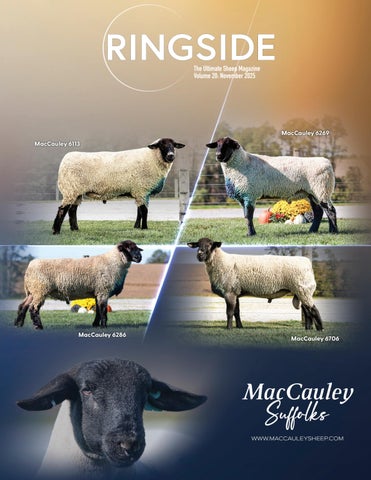
Featured on this issue of Ringside is MacCauley Suffolks.Though the direction of MacCauley Suffolks has shifted over the years, the goals remain the same: performance in the show ring and production in the barn! The MacCauley flock strives to produce “Functional Suffolks with Style.” The entire program emphasizes structural soundness, easy fleshing on grass, superior maternal instincts, male fertility, longevity and breed character. As the industry continues to change and the demand for more functional, performance-oriented sheep increases, the MacCauleys look forward to the challenge of meeting that demand with sheep that can perform in all arenas.
day. We understand the late night hours in the barn and the results not being what we hoped for. We’ve been there with you when the LAI or flush didn’t go as planned. We’ve watched the input costs increase. We too have had people ask us why we do this. And at the end of the day, we all take a deep breath, collect our thoughts and continue trying to do simple better. One of the best compliments I have received over the past few years, from both buyers and sellers, is how simple we are to work with. No games, no gimmicks, no side deals, no empty promises. We started with the principle of Integrity~Everyone Always and we will continue with that philosophy as long as we are in business. It really is that simple. Let us know how we can serve your marketing needs in 2025 and beyond.
We hope everyone had a wonderful trip to Springfield and made it home safely.
A big thank you to our photographers for capturing so many great shots of both the showmen and the sheep —we couldn’t do it without you!
One of the best compliments I have received over the past few years, from both buyers and sellers, is how simple we are to work with. No games, no gimmicks, no side deals, no empty promises. We started with the principle of Integrity~Everyone Always and we will continue with that philosophy as long as we are in business. It really is that simple. Let us know how we can serve your marketing needs in 2025 and beyond.
Featured on this issue of Ringside is MacCauley Suffolks.Though the direction of MacCauley Suffolks has shifted over the years, the goals remain the same: performance in the show ring and production in the barn! The MacCauley flock strives to produce “Functional Suffolks with Style.” The entire program emphasizes structural soundness, easy fleshing on grass, superior maternal instincts, male fertility, longevity and breed character. As the industry continues to change and the demand for more functional, performance-oriented sheep increases, the MacCauleys look forward to the challenge of meeting that demand with sheep that can perform in all arenas.
and the results not being what we hoped for. We’ve been there with you when the LAI or flush didn’t go as planned. We’ve watched the input costs increase. We too have had people ask us why we do this. And at the end of the day, we all take a deep breath, collect our thoughts and continue trying to do simple better.
A big thank you to our photographers for capturing so many great shots of both the showmen and the sheep —we couldn’t do it without you!
Featured on this issue of Ringside is MacCauley Suffolks.Though the direction of MacCauley Suffolks has shifted over the years, the goals remain the same: performance in the show ring and production in the barn! The MacCauley flock strives to produce “Functional Suffolks with Style.” The entire program emphasizes structural soundness, easy fleshing on grass, superior maternal instincts, male fertility, longevity and breed character. As the industry continues to change and the demand for more functional, performance-oriented sheep increases, the MacCauleys look forward to the challenge of meeting that demand with sheep that can perform in all arenas.
One of the best compliments I have received over the past few years, from both buyers and sellers, is how simple we are to work with. No games, no gimmicks, no side deals, no empty promises. We started with the principle of Integrity~Everyone Always and we will continue with that philosophy as long as we are in business. It really is that simple. Let us know how we can serve your marketing needs in 2025 and beyond.


The MacCauley flock consists of over 350 brood ewes owned by Bill, Betsy, Chris, Justene and Kyle MacCauley all under the expert care of Evan Synder, Farm Manager. It is truly a family business born out of a lifelong passion and a hobby gone wild.The MacCauley team is forever thankful for all their customers, both loyal and new! Customer successes and faith in the breeding program is the fuel that keeps this fire burning.
Integrity Livestock Sales
Mike Crowder

Owner/Creative
Owner/Creative Director

To see MacCauley Suffolks in action, stop by their pens at Louisville, or better yet, plan a trip to the farm in Atglen, PA. Or, at the very least, visit the website www.maccauleysheep.com
765-366-3135
765-366-3135
To see MacCauley Suffolks in action, stop by their pens at Louisville, or better yet, plan a trip to the farm in Atglen, PA. Or, at the very least, visit the website www.maccauleysheep.com
765-366-3135
mike@integritylivestocksales.com
Owner/Creative Director 765.541.1932 ringsidesheep@gmail.com
ringsidesheep@gmail.com
765.541.1932 ringsidesheep@gmail.com
Ringside Sheep Magazine
FACEBOOK: Ringside
FACEBOOK: Simplicity Creative
FACEBOOK: Ringside Sheep Magazine FACEBOOK: Simplicity Creative
FACEBOOK: Ringside Sheep Magazine
FACEBOOK: Simplicity Creative


There’s something magical about fall. The crisp mornings, the golden sunsets, and the way the countryside lights up in shades of orange and red — it’s hard not to fall in love with this time of year. It’s always been my favorite season. The days are full of color, the holidays are just around the corner, and for so many of us in the livestock world, it means one thing — babies hitting the ground and NAILE!
This season also brings a feeling of thankfulness. It’s the time of year we slow down just enough to look around and realize how blessed we are: for the people in our lives, the opportunities we’ve been given, and the community that surrounds us. The livestock industry is built on hard work and heart, but it’s also built on the friendships and families that make it all worthwhile. I’m so grateful for everyone who continues to support Ringside Sheep Magazine — from our readers and advertisers to the families who share their stories and photos with us. You’re the heartbeat of what we do, and we couldn’t do it without you!
On a personal note, this fall has been one for the books — I’m newly married! It’s been such a joy stepping into this new season of life, surrounded by so much love and encouragement from friends, family, and the livestock community. My heart is full, and I’m reminded daily just how lucky we are to have people in our corner cheering us on through all of life’s adventures.
As we dive into lambing season and gear up for NAILE, I want to wish everyone the very best — may your lambs be healthy, your shows successful, and your hearts happy! I’m looking forward to seeing so many of you in Louisville soon!
Here’s to a season full of thankfulness, new beginnings, and a whole lot of excitement!

THANK YOU FOR JOINING US RINGSIDE!


1.HEAT OVEN TO 425 F

INGREDIENTS
1-2 LB AMERICAN LAMB SHOULDER OR LEG (BONELESS)
1 RED PEPPER (CUT INTO 1 INCH PIECES FOR THE SKEWER)
1/2 ONION (CUT INTO 1 INCH CHUNKS FOR THE SKEWER)
1/2 CUP PITTED OLIVES
1 CUP CHERRY TOMATOES
2 TBSP FRESH PARSLEY & DILL MARINADE:
4 TBSP OLIVE OIL
3 TSP LEMON JUICE
4 CLOVES MINCED GARLIC
1 TSP SMOKED PAPRIKA FRESH PARSLEY
SALT & PEPPER SIDE SAUCES:
5 OZ FETA CHEESE BLOCK
2 TBSP GREEK YOGURT
2 TSP LEMON JUICE OR LEMON ZEST
2 TBSP OLIVE OIL
STORE BOUGHT TZATZIKI
STORE BOUGHT PESTO
2.LI NE TWO BAKING SHEETS WITH PARCHMENT PAPER
3.CUT UP YOUR PARSLEY AND DILL FINELY
4. CUT YOUR AMERICAN LAMB SHOULDER INTO 1" CHUNKS T O FIT ONTO THE SKEWERS AND ADD THEM INTO A BOWL
5. FOR THE MARINADE (INGREDIENTS ON THE NEXT PAGE), COMBINE OLIVE OIL, LEMON JUICE, MINCED GARLIC, CHOPPED PARS LEY & DILL, AND SPICES IN A SEPARATE BOWL AND MIX WELL
6. ADD MARINADE TO YOUR LAMB AND MIX WELL. IDEALLY, COVER THE LAMB AND LET MARINATE IN THE FRIDGE FOR AT LEAS T 2 HOURS.
7. ADD LAMB ON SKEWER AND MIX IN SOME VEGGIES OR OL IVE EVERY OTHER LAMB CHUNK YOU ADD ON.
8.PUT THE SKEWERS ON THE BAKING SHEET ABOUT 1/2" AP ART FROM ONE ANOTHER
9 .BAKE FOR 10 MINUTES AND THEN FLIP THE SKEWERS AROU ND AND BAKE FOR ANOTHER 10 MINUTES
10.OPTIONAL: FOR AN EXTRA 2-5 MINUTES AT THE END, P UT THE OVEN ON BROIL TO GET A CRUST ON THE OUTSIDE OF THE LAMB SKEWERS
11.SERVE RIGHT AWAY!
WHIPPED FETA RECIPE:
1.TO MAKE THE WHIPPED FETA, COMBINE FETA CHEESE, YO GURT AND LEMON JUICE IN A FOOD PROCESSOR
2.BLEND IN THE OLIVE OIL TO MAKE IT THICK AND CREAM Y
3.ADD TO A BOWL AND SERVE RIGHT AWAY
4.THE WHIPPED FETA WILL STAY FRESH IN THE FRIDGE CO VERED FOR UP TO 5 DAYS
American Solar Grazing Association Treasurer Chad Raines spent a year studying solar grazing before he ever turned his sheep out onto a site. In early May, he was on hand as the American Lamb Board’s Targeted Grazing Workshop in Sulphur Springs, Texas, tried to teach sheep producers everything they needed to know about solar in two and a half days.
“I wish I’d had something like this when I was getting started,” said Raines, who runs 10,000 head of owned and leased sheep with a partner on a handful of solar sites in Arkansas, Louisiana and Texas. “It’s been a great introduction to solar grazing.”
While veteran solar grazer JR Howard and ALB’s Camren Maierle served as official instructors for the workshop, they turned to Raines for his perspective on the industry regularly during two days of classroom instruction before workshop attendees visited a solar site grazed by Howard’s Texas Solar Sheep on the third day.
Through July and into the first part of August, weekly lamb and mutton production has been averaging just over 2 million pounds per week. This is about on par with lamb and mutton production levels during the same time last year. Weekly lamb and yearling slaughter in July ranged from 32 to just over 34 thousand head per week, which was above year-ago levels by roughly 1,400 per head per week (5%). While the number of head slaughtered has been tracking above year-ago levels in recent weeks, this increase has been partially offset by dressed weights tracking lower than last year by more than -2% (2 lbs.) on average, leading to similar year-over-year production levels.
be a part of it. So, they leased their sheep to us and we run them on solar. They get a check and are part of solar grazing without the hassle.
“Your mindset really has to change to do this. Yes, you’re still managing a flock and managing grass, but you have to do things a little differently on these sites. You have to realize this is a service industry. My sheep take the place of lawn mowers. There are places where I’m rotating earlier than I normally would, and it’s not because I’ve run out of grass or I’m worried about overgrazing. It’s because I’ve got other places that really need to be hit.”
USDA released statistics through June, giving a mid-year perspective on trade flows. Through the first six months of the year, lamb imports totaled 147.4 million pounds, which is a decline of 6.2 million pounds (-4.0%) from the same period last year. Year-to-date declines were seen from both Australia and New Zealand. Imports from Australia totaled 108.1 million pounds through June, a decrease of 2.1 million pounds (-1.9%) from last year. Lamb imports from New Zealand decreased 3.4 million pounds (-8.2%) to 38.0 million pounds through the first six months. From January to June, Australia accounted for 73% of total lamb imports, and New Zealand accounted for 26%.
“They didn’t have a certification course like this when I got started,” Raines said. “So, I was just out there trying to learn it on my own.”
Fortunately, he had some mentors in fellow Texas grazers Ely Valdez and Howard. They led him to ASGA, which was developing online resources for grazers, and his education took off from there. Now, he’s looking at plans to run up to 20,000 sheep on solar sites within the next few years.
Lamb and mutton in cold storage was reported at just under 21 million pounds in June, a decline of -11.6%, or almost 2.8 million pounds, from a year ago. Each month in 2025 has reported inventory levels below a year ago and well below the five-year average. Lower levels of lamb and mutton in cold storage is a positive signal that inventory levels do not appear to be building, and demand is pulling product through the supply chain, which is price-supportive in the near term.
Feeder lamb prices (60-90 lbs., 3-market average) continue to track seasonally lower through the summer months. In June, feeder lamb prices ranged from about $240 to just over $260 per cwt. Prices in July were between $220 to $240 per cwt with the first week of August reporting a price of $223.75 per cwt. A year ago, the price for the first week of August was $214 per cwt, and the five-year average (2019-2023) was $195 per cwt.
“Solar grazing really saved our family farm,” said Raines, who was a fourth-generation cotton grower in Lamesa, Texas. “We were struggling with cotton and dug ourselves a hole with it. We were digging out of it with sheep, but at a much slower rate than we are now thanks to solar grazing. It’s an exciting time for the sheep industry. I love the fact that my oldest son is now working for me. And my younger son is in college but when he finishes, he can come and work with us too if that’s what he wants. Without solar grazing, that wouldn’t have been possible.”
As was the case with previous grazing workshops hosted by ALB, some attendees left the training with a new determination to move their sheep operations toward contract grazing. Others decided the opportunity wasn’t the right fit and more than a few fell somewhere in the middle as they were a bit overwhelmed by the challenge yet intrigued by the opportunity.
“A ranch we lease a bunch of sheep from as at this workshop last year,” said Raines. “They like solar grazing, but realized it wasn’t for them. They didn’t want to deal with all of the paperwork and jumping through hoops that comes with this industry. But they still wanted to
Slaughter lamb prices (national negotiated live) surged through June and into the first part of July, increasing from $161 per cwt to almost $200 per cwt. The first week of August reported the highest slaughter lamb price for the year, so far, at $204 per cwt. A year ago, the first week of August reported a price of $196 per cwt. Seasonally, slaughter lamb prices strengthen during the summer months and peak around July, so the price strength into August is noteworthy. Seasonally, slaughter lamb prices tend to moderate lower through the second half of the year, which will be an item to watch through August and into September.
Students of the school will receive a USB drive featuring ASI’s Targeted Grazing 101 and Targeted Grazing Handbook. They also received an ASGA certification for attending the workshop, which could potentially open the door to more grazing opportunities –especially for those just getting started with an opportunity that has excited the American sheep industry like no other in the past 50 years.
“That’s why I’m here,” said Matt Kraus, whose K-Bar Resource Management offers small-scale solar grazing in south Texas. Based in Falls City – south of San Antonio – he has grazed sites for a couple of years now. “It’s always good to see what other people are doing and what’s working for them. I haven’t done any mowing yet because I’m on mostly smaller sites. But it sounds like I might have to be open to doing that in the future.”
Lamb imports for May and June were 22.4 and 23.8 million pounds, respectively, which declined 5.7 and 4.6 million pounds, or -20.3% and -16.3%, from the prior year. Mutton imports in May were 816 thousand pounds, a decrease of nearly 3.0 million pounds (-78.5%), while imports of mutton in June were just over 1.0 million pounds, which corresponds to a decrease of 2.1 million pounds (-67.1%). The slowing of lamb and mutton imports in May and June is notable as it is not only reflective of seasonal patterns but also changing trade dynamics during those months. Moving into the second half of this year, if monthly lamb and mutton imports follow similar declines to May and June, then this could signal a slowing of shipments through the second half of the year.
During the site visit, Kraus spent some time examining the Hustler brand commercial mowers that Howard uses almost daily in his hybrid model of service, which combines grazing, mowing and spraying to control vegetation on solar sites.
Having worked with the U.S. Department of Agriculture’s National Resources Conservation Service for more than a decade, Kraus has experience in vegetation management and developing grazing plans. Solar grazing provided him with an opportunity to get into the sheep industry.
Lamb exports through the first half of the year were 785 thousand pounds, an increase of 361 thousand pounds (+85.2%) from the same period in 2024. Lamb exports in May and June were both over 200 thousand pounds, which is significant because the last time lamb exports were above that level was December 2019 (239 million pounds). Mutton exports totaled just over 3.0 million pounds through the first six months of the year, an increase of 812 thousand pounds (+36.4%) from the previous year.
“At the peak of things, we had about 750 ewes,” he said. “Last year was pretty dry, so we scaled back a bit. I’ve got a small place at home to put some sheep on when they aren’t on solar. I’ve done some targeted grazing for about 10 years at home, so now I’m just applying it to solar.”
Certification in hand, Kraus said the three-day trip to northeast Texas proved well worth the time and financial investment.
“It’s been a good training,” he added. “I appreciate all of the speakers and their input and hearing the questions that everyone
Wool prices in July, on a weekly basis, generally saw favorable improvement. The Australian Eastern Market Indicator (EMI) rose about +1.5% from June to July. Prices for 17- and 18-micron wool increased about +1% to +2% month over month while the 19-micron wool price decreased marginally less than -1% from June to July. Prices for 20- to 22-micron wool reported increases that ranged from +2% to nearly +3% in July when compared to June prices. Stronger price increases were seen for 25- to 32-micron wool ranging from +5% to more than +8% from June to July.

Compared to a year ago, 17- to 22-micron wool prices in July increased about +1% to almost 9%, while 25- to 32-micron wool prices posted double-digits gains ranging from +13% to +23%. In July, the Australian Eastern Market Indicator (EMI) increased about +9% compared to a year ago.
American Solar Grazing Association Treasurer Chad Raines spent a year studying solar grazing before he ever turned his sheep out onto a site. In early May, he was on hand as the American Lamb Board’s Targeted Grazing Workshop in Sulphur Springs, Texas, tried to teach sheep producers everything they needed to know about solar in two and a half days.
“I wish I’d had something like this when I was getting started,” said Raines, who runs 10,000 head of owned and leased sheep with a partner on a handful of solar sites in Arkansas, Louisiana and Texas. “It’s been a great introduction to solar grazing.”
While veteran solar grazer JR Howard and ALB’s Camren Maierle served as official instructors for the workshop, they turned to Raines for his perspective on the industry regularly during two days of classroom instruction before workshop attendees visited a solar site grazed by Howard’s Texas Solar Sheep on the third day.
Australian wool supplies have increased leading up to the mid-year auction recess. The number of bales offered in July ranged from 23,623 to 37,946, with the later number of bales offered came the last week of July. This was the highest weekly number of bales offered since the first week of May when it was reported at 40,295 bales. Compared to June, the number of bales offered in July was an increase of nearly +16%. Looking ahead, support for wool prices will be driven in part by global demand for wool, meaning exchange rates will also remain a factor. The Australian dollar has seen some weakening in recent weeks compared to a year ago, which is supportive for Australian wool prices.
“They didn’t have a certification course like this when I got started,” Raines said. “So, I was just out there trying to learn it on my own.”
Fortunately, he had some mentors in fellow Texas grazers Ely Valdez and Howard. They led him to ASGA, which was developing online resources for grazers, and his education took off from there. Now, he’s looking at plans to run up to 20,000 sheep on solar sites within the next few years.
“Solar grazing really saved our family farm,” said Raines, who was a fourth-generation cotton grower in Lamesa, Texas. “We were struggling with cotton and dug ourselves a hole with it. We were digging out of it with sheep, but at a much slower rate than we are now thanks to solar grazing. It’s an exciting time for the sheep industry. I love the fact that my oldest son is now working for me. And my younger son is in college but when he finishes, he can come and work with us too if that’s what he wants. Without solar grazing, that wouldn’t have been possible.”
For the fourth consecutive year, ASI has provided grants totaling $15,000 to developing shearers. Seeing the large and continuing need for more shearers across the U.S. for both large and small sheep operations, the ASI Wool Council created the Developing Shearer & Mentor grant program to incentivize the development of domestic shearers.
The 2025 grant ran from January through June and was given to 8 developing shearers who sheared in 18 states from Maryland, to North Dakota, to Kansas, to Oregon. Two of their mentors were also provided grants to compensate for equipment, instruction and jobs given to students. Developing shearers utilized the funds for equipment and supplies including handpieces, combs, cutters, and a wool packer.
As was the case with previous grazing workshops hosted by ALB, some attendees left the training with a new determination to move their sheep operations toward contract grazing. Others decided the opportunity wasn’t the right fit and more than a few fell somewhere in the middle as they were a bit overwhelmed by the challenge yet intrigued by the opportunity.
“This program has been an absolute blessing that has helped me to finish the transition from being a wrangler/wool packer that got to shear at certain jobs, to a full-time shearer that can now operate independently. I would like to extend a huge thank you to everyone involved who made this program possible and I look forward to continuing my career as a full-time shearer.”, said grant recipient Katie Pierce.
“A ranch we lease a bunch of sheep from as at this workshop last year,” said Raines. “They like solar grazing, but realized it wasn’t for them. They didn’t want to deal with all of the paperwork and jumping through hoops that comes with this industry. But they still wanted to
Teaser rams have been in use for many years, but due to the increasing use of advanced reproductive technologies, such as artificial insemination and embryo transfer, they have become a
be a part of it. So, they leased their sheep to us and we run them on solar. They get a check and are part of solar grazing without the hassle.
topic of conversation among sheep producers. A teaser ram is a vasectomized male that still has his testicles, along with the accompanying hormones and attitude, but essentially shoots blanks when it comes to ejaculation. Why would this male be of any use to a sheep producer? There are a few reasons why they can be useful, but they may not work for everyone.
“Your mindset really has to change to do this. Yes, you’re still managing a flock and managing grass, but you have to do things a little differently on these sites. You have to realize this is a service industry. My sheep take the place of lawn mowers. There are places where I’m rotating earlier than I normally would, and it’s not because I’ve run out of grass or I’m worried about overgrazing. It’s because I’ve got other places that really need to be hit.”
Students of the school will receive a USB drive featuring ASI’s Targeted Grazing 101 and Targeted Grazing Handbook. They also received an ASGA certification for attending the workshop, which could potentially open the door to more grazing opportunities –especially for those just getting started with an opportunity that has excited the American sheep industry like no other in the past 50 years.
Sheep are known for their seasonally polyestrous pattern of reproductive behavior, meaning they experience multiple estrous cycles during one season of the year. Sheep are primarily short-day breeders, so this season is in the fall for most breeds, although there are a few exceptions. Due to their seasonality, sheep often start to cycle when daylight begins to decrease, but this can be hastened a bit by introducing a ram.
We call this the “ram effect” which simply means that when a ram is introduced, usually a novel male that they have not seen before and have not had close contact with, females will start to cycle because they are stimulated by pheromones produced by the ram. It is important that the females are kept away from any male sheep for at least a month prior to this introduction in order for the ram effect to be strongest, and yes this includes ram lambs. Once the novel ram is introduced some females will immediately start to cycle and some will start to cycle later, but these are often “silent heats” meaning they show no outward signs of being in heat.
“That’s why I’m here,” said Matt Kraus, whose K-Bar Resource Management offers small-scale solar grazing in south Texas. Based in Falls City – south of San Antonio – he has grazed sites for a couple of years now. “It’s always good to see what other people are doing and what’s working for them. I haven’t done any mowing yet because I’m on mostly smaller sites. But it sounds like I might have to be open to doing that in the future.”
During the site visit, Kraus spent some time examining the Hustler brand commercial mowers that Howard uses almost daily in his hybrid model of service, which combines grazing, mowing and spraying to control vegetation on solar sites.
Having worked with the U.S. Department of Agriculture’s National Resources Conservation Service for more than a decade, Kraus has experience in vegetation management and developing grazing plans. Solar grazing provided him with an opportunity to get into the sheep industry.
“At the peak of things, we had about 750 ewes,” he said. “Last year was pretty dry, so we scaled back a bit. I’ve got a small place at home to put some sheep on when they aren’t on solar. I’ve done some targeted grazing for about 10 years at home, so now I’m just applying it to solar.”
A teaser ram can help by stimulating ewes to come into heat and then actually mounting them. However, if the vasectomy was performed correctly, he will not be able to cause any pregnancies due to there being no sperm in his ejaculate. By introducing the teaser ram, the producer knows which females are cycling and the fertile ram does not have to do all this work to initiate cyclicity. Most research indicates that the fertile ram can be introduced 17–23 days after introduction of the teaser ram; then, the fertile ram can breed the females. In short, the teaser ram does all the work, but the fertile ram comes in and can hopefully provide a tighter breeding and lambing window.
Certification in hand, Kraus said the three-day trip to northeast Texas proved well worth the time and financial investment.
“It’s been a good training,” he added. “I appreciate all of the speakers and their input and hearing the questions that everyone
Teaser rams are utilized often in artificial insemination (AI) and embryo transfer (ET) programs because they can detect heat in females by marking them (if equipped with a ram harness or another form of marking paint). This way the veterinarian performing these procedures can be assured that the synchronization protocol worked and the females are indeed in heat prior to performing AI or ET. These programs can be successful without the use of a teaser ram, but most producers find them to be helpful when a teaser is detecting heat for you.
I currently show Southdowns and Hamps. I like these breeds because of the friends that I have made through my time participating in them. Both of these breeds are competitive, but friendly at the same time. What breed of sheep do you currently show and why?

What is your favorite breed of showing/raising sheep?
What's your least?
My favorite part of showing/raising sheep is getting to share my passion with my friends and family. Some of my best and closest friends have come from the show ring. I also like being able to see the start to finish product of animals I raise. My least favorite part of showing is taking care of illnesses the sheep pick up from all of the traveling.
What is your favorite show and why?
My favorite show is the All American Junior Show because there is a lot of free time to spend with friends, as well as a lot of different activities put on by the show.
If you could pick any other breed to show what would it be and why?
If I could pick any other breed to show I would pick Romney's because there is something that is intriguing about them, and I think giving fitted sheep a try would be fun. Even though my dad would say otherwise ;)
What is the biggest lesson you’ve learned?
What advice would you give to younger members?
The biggest lesson I have learned while showing sheep is responsibility. As I grew up I continued to have more and more responsibilities, and it is very important to make sure I do everything asked of me to have a successful summer. If I was giving advice to a younger member I would tell them to enjoy every moment they have in and out of the ring, because you only have a short amount of time to do those things.


expansion that might not be captured by the inventory survey.
Increased slaughter might indicate some growth.
A teaser ram is created by removing a section of the vas deferens to prevent sperm transport. This allows the teaser to act, smell and perform just like a fertile ram, but he is not capable of ejaculating sperm. It is important to note that the teaser will need time to heal from this relatively simple procedure, which is performed by a veterinarian under general anesthesia. He should be recovered and ready to work a few weeks before you actually need to use him. It is also worth mentioning that a quick semen check is beneficial to make sure the teaser is indeed shooting blanks and cannot get any females pregnant. That would be a bad day if your “teaser” was actually fertile and ended up breeding all your females who were set up for an AI or ET protocol!
I expect prices to exhibit some normal seasonal behavior but if domestic production declines there is some opportunity for higher prices. Retail lamb prices have been competitive – at times – with beef in the past year and high beef prices are likely to continue. While not directly impacting lamb or meat prices, the discovery of screwworms on a cow in southern Mexico should be of interest. Even though it seems far away, keeping screwworms eradicated in the United States is hugely important for all livestock producers. The ranch level costs of dealing with screwworms would likely be prohibitive.
What happens on tariffs will be an important factor this year. Tariffs on imported lamb should result in higher domestic prices benefiting producers. Yet, higher prices will impact what consumers buy, having an opposite effect on purchases and prices.
Teaser rams, like other advanced reproductive techniques, are just a tool to help bring your females into heat sooner and hopefully in a tighter timeframe than with natural breeding by itself. They are not a requirement, and they might not work well for everyone. Some of the drawbacks to utilizing teaser rams would be the actual surgery. Both the cost to perform it and the task of finding someone qualified to do it can be hard to justify for some people needing a teaser ram quickly. Producers do sell teaser rams from time to time but be cautious because this male may not have impregnated females, but he certainly has performed the act of breeding them and may be transmitting disease without your knowledge. Only purchase from someone you know has healthy animals that you can trust. If you already have your females around males, then utilizing a teaser ram may not benefit your flock much due to the females already being exposed to male pheromones. Teaser rams still act like rams! This cannot be overstated as these males can still be aggressive and have just as much attitude as their fertile counterparts. Treat teaser rams just like your fertile rams in terms of housing them in solid structures and/or within well maintained fences. Teaser rams also need to have good teeth, vision, structure and be healthy with a high libido. A few sheep breeds that make good teasers include hair breeds, Suffolk, Dorset and Finn Sheep. The goal of utilizing teaser rams is to tighten up your breeding window and therefore your lambing window as well. Good planning is essential to using teaser rams successfully, as well as doing your research and asking questions. Have this conversation with fellow producers, your veterinarian, or an Extension professional in your state to help you decide if using a teaser ram could benefit your operation.
fulfill the same role for producers of all ages.
“I’m looking forward to taking the baton and keep the organization moving forward,” Palm said. “I feel that the timing is right for me, our family and our farm business to step into this role.”
Palm and her husband, Rick, have two young children.
As we prepare for the upcoming breeding season, the health and fertility of our rams deserve careful attention. Rams may make up a small fraction of the flock, but they carry the weight of its reproductive success. A single infertile or infected ram can quietly derail a lambing season, making proactive health management essential.
The American Dorper Sheep Breeders’ Society has announced its two nationally sponsored shows and sales. The Mid-America Show & Sale will be held April 10-12, in Duncan, Okla., while the Southern States Show & Sale will be June 26-28, in Cookeville, Tenn
At the heart of this effort are two tools that work together: the breeding soundness exam (BSE) and Brucella ovis testing. Together, they offer a reliable way to ensure your ram battery is ready for the work ahead.
Located at the Stephenville County Fairgrounds, the Mid-America Show and Sale will showcase more than 250 Dorpers and White Dorpers. The event will kick off with a junior show on April 10 and an annual meeting of the American Dorper Sheep Breeders’ Society.
Elaine Palm of West Branch, Mich., was recently hired as the Michigan Sheep Producers Association new executive director. Palm replaces Samantha Bos, who concluded her duties with the organization in January. Bos led the organization for four years.
Palm works alongside her parents – Jim and Sherrie Bristol – on their northern Michigan sheep farm. She purchased her first farm in 2015 to build a second-generation business, adding value to the flock through sales of meat, raw wool and superior genetics. She grew up as an active 4-H, FFA and MSPA youth member and holds a degree from Michigan State University in ag communications. She has an employment history of working with non-profits.
“The strength of this organization is in its people, and we have incredible people and partnerships,” Palm said. “I look forward to building strong relationships and communicating with current and prospective members.”
MSPA President John Schut applauded Palm’s skills and long-term commitment to the organization.
“Elaine brings an extensive history of sheep and agricultural experience to the position, and we are excited to have her serve the organization,” he said. “It is a great time to be involved in the industry and working with professionals such as her.”
Palm praised her predecessors for building a strong foundation of programs including MSPA’s Shepherds Symposium, summer picnic, a blossoming online sheep and equipment auction, quarterly webinars and newsletters, and frequent email blasts focused on training, event updates, and useful industry news and information. She credits previous leadership within the organization for encouraging her toward achieving goals and she is eager for the opportunity to
A breeding soundness exam is more than a quick glance at body condition or a confident gait across the pasture. It’s a thorough assessment designed to answer one critical question: Can this ram settle ewes?
Ideally performed six to eight weeks before breeding turnout, a BSE begins with a full physical exam. The veterinarian will evaluate the ram’s general health, musculoskeletal soundness, body condition, vision, and even his teeth. Healthy rams should have a body condition score between 3 and 4 on a 5-point scale and be free of lameness or injury, particularly to the head and neck—common trouble spots in group-housed rams prone to fighting. Special attention is given to the reproductive tract. The external genitalia are examined for abnormalities like scrotal hernias, pizzle rot, or abscesses. The testes, epididymis, and spermatic cords are palpated for symmetry, tone, and the presence of granulomas or masses. A scrotal circumference measurement gives insight into sperm production potential—mature rams should measure at least 33 centimeters. Mature rams with a small scrotal circumference, or an abnormal scrotal palpation, should be removed from the breeding flock.
Single Dorpers and White Dorpers will show on Friday morning with pens of two ewes to follow. South African Philip Strauss will sort the sheep. There will be competitions throughout the day to keep the youth engaged. A skill-a-thon, sales pitch, judging contest and production contest will cap off the youth events. Friday evening will include an Oklahoma-style BBQ with a live band.
Saturday morning will begin with a consignors meeting, followed by an instructional meeting. Sales guests will be able to view lots during the morning hours. The bidding will begin at 10 a.m. and be broadcast live on CCI.
To enter the show and sale, visit Showman.app/#/. If you need assistance, please contact Karla Blackstock at 210-305-2565. Entries will be accepted through March 15 for the Mid-America. Show placings will determine the sale order. For sale order, please visit the association website at DorperSheep.org.
The Southern States Show & Sale will be held at the end of June. Make plans now to attend as 150 of the best lots in the United States will be sold. More information will be available soon.
The American Dorper Sheep Breeders’ Society is one of the fastest growing sheep breeds in the United States. The South African import is versatile with a high parasite resistance.
Semen is collected either by electroejaculation or artificial vagina and analyzed under a microscope. Both the sperm motility and sperm morphology (sperm shape) are important for fertility. Good fertility is marked by at least 30% progressive motility and fewer than 30% abnormal sperm cells. While libido—the ram’s actual desire to breed—is not measured directly, factors like age, nutrition, and social hierarchy all influence this critical trait. Keeping detailed records on previous breeding performance can help fill in the gaps. It’s worth noting that young rams are often sold before reaching

StockLink is a social and marketing platform built specifically for the livestock and agriculture comm unity. It’s a space where you can connect, share, and grow—witho ut the restrictions of mainstream social media. Whether you’re a breeder, farmer, or ag business, St ockLink gives you a place to network with people wh o understand your world.
A free account gives users access to the community f eed, where they can view profiles, like, comment, a nd save content. For those looking to take their marke ting to the next level, StockLink offers a PRO subs cription for just $21.99 per month. With PRO, ag businesses, breeders, farms, ranches, trailer companies, and mo re gain access to powerful marketing tools designed to s howcase services, reach new customers, and market without limits.
The StockLink marketplace is another major advantag e. From livestock and genetics to trailers, equipme nt, and ag services, the platform connects businesses di rectly with serious buyers. PRO users enjoy unlimite d posting, full profile customization, and increased visibility across the app—making it easier than ever to get your operation noticed.
Currently, one PRO account can be purchased directl y through the mobile app, following app store rules for inapp purchases. However, if you manage multiple farms , businesses, or projects, StockLink has made it sim ple to add more. The app will guide you to the StockLin k web app, where you can set up and manage as many PRO accounts as needed. Once those accounts are created , they can be used seamlessly within the mobile app— just like your first one.
StockLink isn’t just another social platform; it’s a growing community built for agriculture. Whether you’re promoting genetics, selling equipment, or sharing your story, StockLink makes it easy to market your b rand and connect with others who share your passion for t he industry.


sexual maturity. While they may not yet produce semen for analysis, a physical exam can still reveal congenital defects such as penile or scrotal abnormalities that could affect future fertility.
The Silent Threat: Brucella ovis
American Solar Grazing Association Treasurer Chad Raines spent a year studying solar grazing before he ever turned his sheep out onto a site. In early May, he was on hand as the American Lamb Board’s Targeted Grazing Workshop in Sulphur Springs, Texas, tried to teach sheep producers everything they needed to know about solar in two and a half days.
“I wish I’d had something like this when I was getting started,” said Raines, who runs 10,000 head of owned and leased sheep with a partner on a handful of solar sites in Arkansas, Louisiana and Texas.
“It’s been a great introduction to solar grazing.”
While veteran solar grazer JR Howard and ALB’s Camren Maierle served as official instructors for the workshop, they turned to Raines for his perspective on the industry regularly during two days of classroom instruction before workshop attendees visited a solar site grazed by Howard’s Texas Solar Sheep on the third day.
“They didn’t have a certification course like this when I got started,” Raines said. “So, I was just out there trying to learn it on my own.”
While structural soundness and semen quality are essential, infectious disease status is just as critical—and Brucella ovis is one of the most important pathogens to rule out. This bacterium causes epididymitis in rams, causing poor quality semen and, in some cases, can lead to abortion, stillbirth, or weak lambs in ewes. It is a significant cause of reduced conception rates and decreased lambing percentages, especially in multi-sire flocks. Brucella ovis spreads primarily through venereal transmission. Rams become infected when they breed ewes that were previously covered by another infected ram, often during the same heat cycle. Ram-to-ram transmission is also common during the non-breeding season through mounting behavior and preputial licking. Infected rams may not show clinical signs for weeks, and fewer than half will develop palpable lesions in the epididymis. That means palpation alone is a poor screening tool.
Fortunately, he had some mentors in fellow Texas grazers Ely Valdez and Howard. They led him to ASGA, which was developing online resources for grazers, and his education took off from there. Now, he’s looking at plans to run up to 20,000 sheep on solar sites within the next few years.
Thankfully, there is a reliable diagnostic test. A blood-based ELISA developed by the National Veterinary Services Laboratories detects antibodies with approximately 97% sensitivity. It is most useful when performed on the entire ram battery before breeding season. Rams that test positive should be isolated immediately and either culled, castrated, or, in very limited cases, retested and to confirm infection status using semen PCR.
“Solar grazing really saved our family farm,” said Raines, who was a fourth-generation cotton grower in Lamesa, Texas. “We were struggling with cotton and dug ourselves a hole with it. We were digging out of it with sheep, but at a much slower rate than we are now thanks to solar grazing. It’s an exciting time for the sheep industry. I love the fact that my oldest son is now working for me. And my younger son is in college but when he finishes, he can come and work with us too if that’s what he wants. Without solar grazing, that wouldn’t have been possible.”
If fewer than five percent of rams test positive, these animals can be reevaluated in two to four weeks. All rams that were exposed to positives should be retested after 30 to 45 days to ensure they haven’t seroconverted during the incubation period. Repeat testing after the breeding season is also advisable, particularly in flocks that are actively managing this disease.
As was the case with previous grazing workshops hosted by ALB, some attendees left the training with a new determination to move their sheep operations toward contract grazing. Others decided the opportunity wasn’t the right fit and more than a few fell somewhere in the middle as they were a bit overwhelmed by the challenge yet intrigued by the opportunity.
be a part of it. So, they leased their sheep to us and we run them on solar. They get a check and are part of solar grazing without the hassle.
“Your mindset really has to change to do this. Yes, you’re still managing a flock and managing grass, but you have to do things a little differently on these sites. You have to realize this is a service industry. My sheep take the place of lawn mowers. There are places where I’m rotating earlier than I normally would, and it’s not because I’ve run out of grass or I’m worried about overgrazing. It’s because I’ve got other places that really need to be hit.”
Ram fertility is also dependent on good nutrition. Trace minerals like selenium, zinc, and copper are essential for spermatogenesis and hormone production. Diets that are too heavy in grain or alfalfa can disrupt the calcium-to-phosphorus ratio and lead to urolithiasis, especially in winter when water intake tends to drop. Rams need free-choice access to clean water, loose salt and mineral, and enough energy to maintain good condition through the breeding season.
Students of the school will receive a USB drive featuring ASI’s Targeted Grazing 101 and Targeted Grazing Handbook. They also received an ASGA certification for attending the workshop, which could potentially open the door to more grazing opportunities –especially for those just getting started with an opportunity that has excited the American sheep industry like no other in the past 50 years.
“That’s why I’m here,” said Matt Kraus, whose K-Bar Resource Management offers small-scale solar grazing in south Texas. Based in Falls City – south of San Antonio – he has grazed sites for a couple of years now. “It’s always good to see what other people are doing and what’s working for them. I haven’t done any mowing yet because I’m on mostly smaller sites. But it sounds like I might have to be open to doing that in the future.”
Biosecurity is another pillar of reproductive success. Rams should be quarantined upon arrival, and routine testing and monitoring for B. ovis, caseous lymphadenitis, Small Ruminant Lentivirus (also known as OPP), sore mouth, and abortion pathogens should be part of every flock’s protocol. Keeping detailed records—scrotal measurements, semen evaluations, disease testing, and breeding performance—allows producers to make informed decisions when selecting sires.
During the site visit, Kraus spent some time examining the Hustler brand commercial mowers that Howard uses almost daily in his hybrid model of service, which combines grazing, mowing and spraying to control vegetation on solar sites.
Having worked with the U.S. Department of Agriculture’s National Resources Conservation Service for more than a decade, Kraus has experience in vegetation management and developing grazing plans. Solar grazing provided him with an opportunity to get into the sheep industry.
Monitoring throughout the breeding season can be aided by the use of breeding harnesses on rams, using different color markers to show individual ram activity. Pregnancy diagnosis, either through ultrasound exams or blood-based pregnancy tests, are the true measure of reproductive success. Unfortunately, reproductive failure isn’t always obvious until it’s too late. A flock ultrasounded for pregnancy 60 days post-breeding might reveal open ewes, but by then, time and opportunity may have been lost. Pre-breeding exams and disease testing offer a chance to identify problems and make changes before the season begins.
In today’s environment—where feed is expensive, labor is limited, and market timing matters—no producer can afford suboptimal fertility. A sound, disease-free ram battery is one of the most valuable assets on your operation. Whether you manage a small flock or a large commercial outfit, investing in pre-breeding health pays dividends in conception rates, lamb crop uniformity, and longterm genetic gain.
“At the peak of things, we had about 750 ewes,” he said. “Last year was pretty dry, so we scaled back a bit. I’ve got a small place at home to put some sheep on when they aren’t on solar. I’ve done some targeted grazing for about 10 years at home, so now I’m just applying it to solar.”
“A ranch we lease a bunch of sheep from as at this workshop last year,” said Raines. “They like solar grazing, but realized it wasn’t for them. They didn’t want to deal with all of the paperwork and jumping through hoops that comes with this industry. But they still wanted to
One often overlooked aspect of B. ovis control is the role of teaser rams. These animals, commonly used to stimulate estrus in ewes, may be vasectomized but still retain their accessory sex glands. If these glands become infected, teaser rams can shed the bacteria in their seminal fluid during mounting. While they may not cause pregnancy, they can absolutely transmit disease. For that reason, teaser rams should be tested and managed just as carefully as intact breeders.
For help developing a ram evaluation protocol or interpreting B. ovis test results, reach out to your local veterinarian or contact us at UC Davis.
Certification in hand, Kraus said the three-day trip to northeast Texas proved well worth the time and financial investment.
“It’s been a good training,” he added. “I appreciate all of the speakers and their input and hearing the questions that everyone

Make sure you have a clean, well-ventilated lambing area. Plan ahead so once the first lamb arrives, you aren’t scrambling for supplies. Having warm bedding, heat lamps, towels, disinfectant, and a designated birthing pen makes all the difference.
Check that your ewes are up to date on key vaccinations — for example booster shots for clostridial diseases four to six weeks before lambing. Also, ensure ewes are in good body condition so they’re ready to carry and nurse healthy lambs.
When lambs start arriving, be ready to assist if needed. Make sure the navel is treated (e.g., dipped in iodine), that lambs get colostrum soon after birth, and that ewes are nursing them well. These early actions will improve lamb survival.
When lambs start arriving, be ready to assist if needed. Make sure the navel is treated (e.g., dipped in iodine), that lambs get colostrum soon after birth, and that ewes are nursing them well. hese early actions will improve lamb survival.


After the initial birth, continue monitoring until all lambs are up and nursing, and the ewe’s udder is healthy. If lambs appear weak or inactive, check that they are getting milk and check the ewe for problems like mastitis. Also, maintain clean bedding and pens, proper sanitation, and good records.

I hope everyone that is able to attend or exhibit at the North American has a good time and best of luck to all exhibitors in both junior shows and the open shows. I expect a large entry of natural colored sheep for our open show with a lot of quality sheep as well as some excellent fleece entries.
The NAILE show traditionally is the crowning final event of the “show season” for most folks and is also a time to review one’s entire breeding program and reflect on what went right the past year and what we can do to make 2026 even better. This is true not only for our own individual flock, but just as importantly for our various breed associations. If you are not actively involved in your breed association now is a good time to consider becoming so. The various associations are the backbone of the purebred sheep business and every one of them needs the support of their members, not just by registering your sheep but by voicing you thoughts and opinions and being active in supporting the various programs provided. Think about seeking to serve as an officer or director or chair a project or committee.
I have been involved in several associations for a lot of years and all too often when your association’s ship so to speak sails way too many of us are standing on the shore when we need to be in the boat helping to row! As such the next time your association is setting up a display exhibit or sponsoring a youth program or show step up and donate or volunteer to help out. The more members that are actually involved in some capacity is the strength of any association. Believe me when I say the friendships you develop from taking an active part in your association will be something you will enjoy the rest of your life.
John S. Merlau President, NCWGA
Southdown Jr Public Speaking contest and skillathon contests to be held Saturday, November 15 at NAILE. Check out the Southdown website (southdownsheep.org) and Facebook page for more information.
The 2025 Southdown Stars of Louisville Sale will be held Saturday, November 15 at 12:30. Lots can be viewed ahead of time on Willoughby Livestock Sales. There will be live bidding as well as online bidding with Willoughby Livestock Sales.
The 143rd Annual Meeting of the American Southdown Breeders' Association will be held on Saturday, November 15, at NAILE. A junior awards program will begin at 5:00 p.m., with the business meeting to follow.
The Southdown Association was very pleased with how well our first year of the Ewes for Youth program went. This program is open to any Southdown junior member who has begun paying junior dues within the last three years. Rules and applications can be found on the Southdown website (southdownsheep.org). The Southdown Association offers Regional Southdown show grants. If any show manager is interested in applying, please email Ann Fry at ann@southdownsheep.org. For regional junior shows to be eligible for $500 in matching funds from the ASBA, requests must include a general outline of planned show activities and description of at least one educational event or program other than showmanship competitions. Subsequent requests must include a report on the previously funded ASBA regional junior show.
Southdown juniors, remember to continue turning in Futurity points. Our 2025 Futurity season ends with the NAILE junior show. Awards will be presented at the conclusion of the show.
Ann Fry
American Southdown Breeders’ Association Secretary


FILL THE NUTRIENT GAP. FUEL PERFORMANCE consistent intake while supporting growth reproductive success

Purina® Sheep and Goat Tubs deliver balanced nutrition to fill the gaps of forage alone. With options for every operation - big or small, any season, any life-stage - our tubs provide year-round support that drives growth, and supports health and reproductive success.


FIND YOUR LOCAL DEALER TODAY and in every season.