silverchips






BY
By ASHER LIPCZENKO, JAMES YI, and YONGLE XIN
In the DC comics, the citizens of Gotham City feel safe in the knowledge that Batman is there to fight crime. In the real city of D.C., however, no vigilante can claim the title of “World’s Greatest Detective.”
Instead, on Aug. 11, the D.C. National Guard was deployed via an executive order issued by President Donald Trump. The mission was to “secure the safety and the peaceful functioning of our Nation, the Federal Government, and our city.” But just how safe and peaceful do the residents of D.C.—and beyond—really feel?
Boots on the ground
Joint Task Force-DC (JTF-DC) is the official designation of the combined National Guard, D.C. Metropolitan Police, and federal law enforcement units operating in the district. Since the deployment, JTF-DC has reportedly engaged in tasks ranging from community patrolling and protecting government facilities to traffic control. Some are even assigned to picking up trash and mowing the grass. “While not directly related to patrolling, we believe a clean and
well-maintained environment contributes to overall community well-being and can indirectly deter crime,” the force writes in an email sent to Silver Chips.
Small businesses, large losses
The guardsmen’s presence has been felt all across the district. Small businesses—especially restaurants—have been indirectly impacted, as the area saw a decline in tourism following the deployment. Reservations at D.C. restaurants dropped seven percent in the week leading up to the National Guard’s arrival, and August restaurant reservations were 31 percent less than they were in the same month of last year. See DC
By ALICE LEVINGS and ADA SCHWARTZ
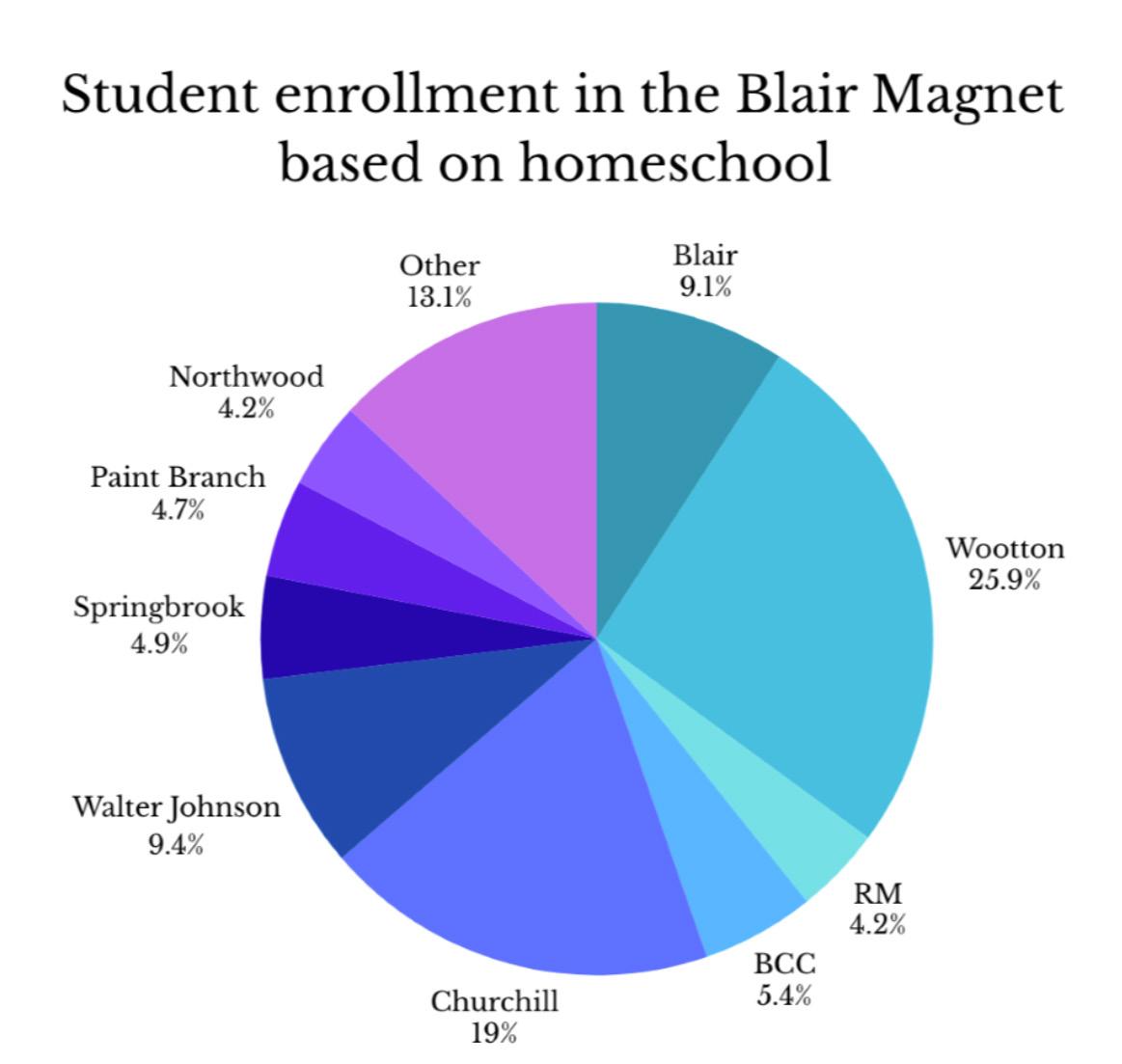
On May 8, 2025, MCPS announced a new magnet program system for the 2027-2028 school year; in the proposal, county-wide magnet programs are replaced with regional ones.

The regional program system involves sorting every school in the county into six school regions. These regions would all have a program focusing on each of the themes: humanities, International Baccalaureate (IB), visual arts, STEM, and biomedical science. Students can only apply to the five programs within their region, for which they would be provided guaranteed transportation. This is a change from the current system, The new system has yet to be finalized and is still subject to change until December 2026, when it will go before the Board of Education for a final vote. “[I] do expect the plan to change to some degree [before December] ... It was never intended to be final until December, because it is a complex project,” MCPS Chief Academic Officer Angela McLane said.
See MAGNET UPDATES page A2
Compiled by Molly Breen
Greta Thunberg
Hundreds of activists aboard the Global Sumud Flotilla offering aid and supplies to people in Gaza were detained by the Israel Defense Forces between Oct. 1 and Oct. 3. Well-known Swedish activist Greta Thunberg was among them. A pre-recorded video of Thunberg was released on Oct. 2, stating, “If you are watching this video, I have been abducted and taken against my will by Israeli forces.” The Global Sumud vessels were reportedly carrying baby formula, medicine, and food to be delivered to Gaza, along with volunteers from 47 different countries. Recent updates from the Israeli Ministry of Foreign Affairs said that 161 activists, including Thunberg, were deported to Greece on Oct. 6 with 10 others sent to Slovakia. The Israeli Navy said the activists were “approaching an active combat zone and violating a lawful naval blockade.”
While the plan is currently moving forward, the changes have received some community pushback. According to District 6 councilmember Natali FaniGonzález’s letter to MCPS, DCC parents and community members are concerned about loss of aca-
demic rigor, staffing limitations, elimination of ranked choice in DCC and NEC and lack of clarity. This pushback could lead to changes to the proposal, making it even more difficult to know how it will look in December.
The Board of Education is planning on hosting virtual meetings regarding additional updates. Two of the meetings will take place
on Oct. 22 and Oct. 27, while a DCC-specific one took place on Sept. 30.
Principals have also been having periodic meetings on how plans are changing and school will be impacted. “We’ve had three of these Zoom update meetings over the last few months. They started at the beginning of August…they share where they are and they ask for our general thoughts,” Monteleone said.
When schools are being identified for programs, we’re looking at assests the schools already have, which include facilities.
If the timeline is finalized in December, the county will need to begin with extensive preparation for the 2027-2028 school year. In order to save costs, MCPS is already planning on using existing programs and resources. “When schools are being identified for programs, we’re looking at assets the schools already have, which include facilities. We wouldn’t have to build any new spaces for [the program if] it includes programs that are similar or the same,” McLane said.
The Trump administration has carried out multiple strikes on ships off the coast of Venezuela. The U.S. Armed Forces administered lethal kinetic strikes to four boats starting Sept. 2, continuing into October. The most recent strike took place on Oct. 3, resulting in the deaths of all four passengers aboard the boat. Secretary of Defense Pete Hegseth claimed that these boats were “transporting substantial amounts of narcotics—headed to America to poison our people.” The legality of said strikes has been questioned by legal experts and members of Congress, as the Trump administration did not receive congressional authorization for the operation. The Trump administration has claimed that the strikes were justified, arguing that alleged drug cartels are classified as foreign terrorist organizations. “To every terrorist thug smuggling poisonous drugs into the United States of America, please be warned that we will blow you out of existence,” Trump said at the United Nations General
U.S. strikes alleged drug boats off the coast of Venezuela Russian drones spotted around Europe
There were several reported sightings of Russian drones across Eastern and Central Europe throughout September, creating unease throughout the North Atlantic Treaty Organization (NATO). Sightings began in Denmark on Sept. 22, prompting the country to increase its national security efforts, which included a temporary shutdown of several airports and a ban on civil drone flights. Danish Prime Minister Mette Frederiksen described the situation as “the most difficult and dangerous situation since the end of the Second World War,” and claimed that a hybrid war in Europe was imminent. Russia’s incursion into Denmark was not the only instance of Russia invading NATO airspace. Similar instances have been reported in Germany, Poland, Estonia, Romania, Lithuania, Latvia, Norway, and France. These invasions prompted the Royal Air Force to launch a defense mission over Poland, and NATO initiated “Eastern Sentry,” an operation to enhance all defenses on the eastern flank. “When we are threatened, we respond together,” the United Kingdom Secretary of State for Defense, John Healey, said.
MCPS will also need time to hire more staff for these advanced programs. “Our proposal will include staffing for a coordinator, who would know the school and work with the staff … We have a lot of really great, qualified teachers, but they might need to have additional training,” McLane said.
Limited details have been released about a new budgeting plan, and it is difficult to know precisely how much staff training and recruiting will cost.
Although MCPS plans to implement this system in 2027, establishing these changes will take around six years, according to McLane. The Board plans to continue tweaking the magnet programs for the first four years of the new system. “We’ll have an implementation evaluation. We have time along the way so that [we can ask questions. . . So we can adjust along the way’” McLane said. Only limited information has been released to the public about the upcoming changes. It remains unclear how the proposal will evolve and what its full impact on schools will be. The district hopes the initiative will make access to specialized programs more equitable, but for now, students, families, and staff will have to wait and see how the process unfolds in December, when the school board comes to a decision.
By LEYA FEKADU and ADA SCHWARTZ
Fire Captain Chris Reilly and Master Firefighter Alan Barnes from Silver Spring Fire Station 16 were charged on Sept. 22 with multiple misdemeanors after intentionally drenching the Montgomery Blair Stadium baseball field. The field was scheduled to host a game for the Silver Spring-Takoma Thunderbolts, which had to be cancelled due to damage sustained from the incident. Reilly and Barnes both have preliminary hearings scheduled for Oct. 21 in the Montgomery County District Court in Rockville.
Earlier this summer, the Thunderbolts were practicing batting before a game when a stray ball crossed the fence and allegedly hit a firefighter’s personal vehicle. The firefighters responded by spraying the field with water. Reilly and Barnes were later charged with two counts of malicious destruction of property and one count of disorderly conduct.
In an interview with Bethesda Magazine, Thunderbolts founder and General Manager Richard O’Connor explained that they had spoken to Captain Riley about the incident. “When confronted by myself and our coach, Captain Riley admitted that he flooded the field … [When] asked why, he said ‘I wanted to get your attention,’” O’Connor said.
Barnes’ defense attorney Richard A. Finci stated in an interview with NBC4 Washington that the incident was prompted by a long-standing dispute between the firefighters and baseball players, who had allegedly hit multiple
balls onto the station grounds. According to NBC4, the court filing explained that Reilly’s actions “were driven by frustration due to repeated incidents involving baseballs striking personal vehicles, the fire station, and departmental equipment.”
Blair baseball player Eamon Turner felt that any cases of baseballs striking firefighter property were accidental. “They’re hitting the ball harder, and so with these really good players, they’ll hit the ball over the net … and since the net isn’t quite high enough, balls will go over and land on top or near the fire station, which I can understand might anger firefighters,” Turner said. “It just happened by chance; there was no intentionality behind it.”

To take it that far and respond, especially [over] something that the baseball players and coaches have zero control over- and the fact that these individuals went to such lengths for vengeance against 18-year-olds- is just ridiculous.
Blair Baseball Coach Kyle Wannen felt that the firefighters’ response was extreme. “To take it that far and respond, especially [over] something that the baseball players and coaches have zero control over—and the fact that these individuals went to such lengths for vengeance against 18-year-olds—is just ridiculous,” he said. Video evidence released of the incident on social media captured Barnes moving the fire truck into position while Reilly operated the hose aimed at the field. Following the event, both firefighters were removed from duty and placed on non-public contact status. They are awaiting the outcome of an investigation by the Montgomery County Fire Rescue Service. Finci claims that Barnes was not at fault. “He didn’t do anything wrong; it was [Reilly] who did the act of excessively watering the outfield,” Finci said in an NBC4 interview.
where he was told to place it.” As a result of the game cancellation caused by the incident, the Thunderbolts lost income that would have come from game ticket sales.
“Barnes moved the truck to
Montgomery County Fire Chief Corey Smedley announced the fire department’s response in a statement on July 18. “We expect all of our personnel to uphold the highest standards of conduct on and off duty,” he said. “The actions alleged in this case do not reflect the values of [us] or the professionalism of the men and women who serve our community every day.”
By ADANNA AKAMIGBO
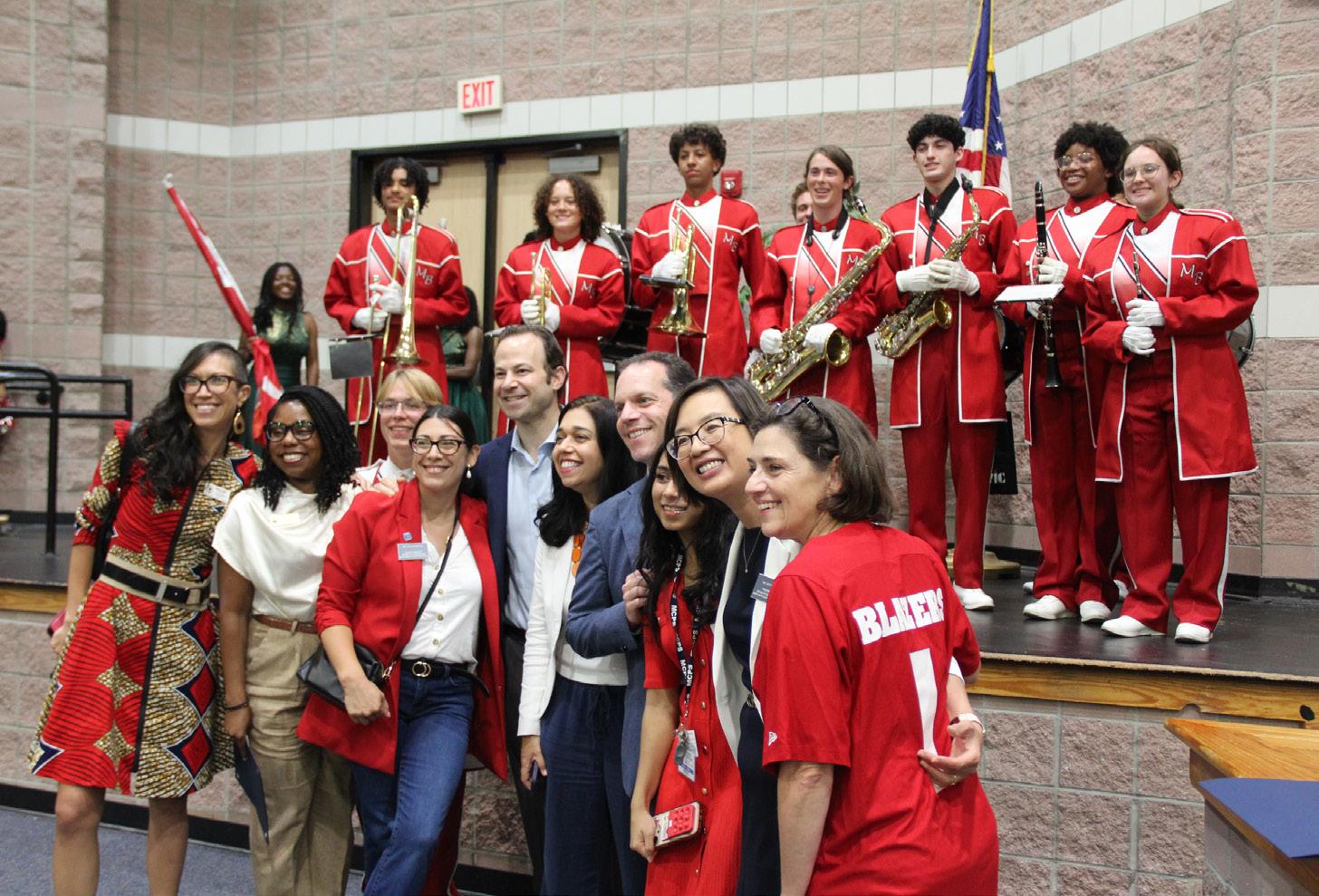
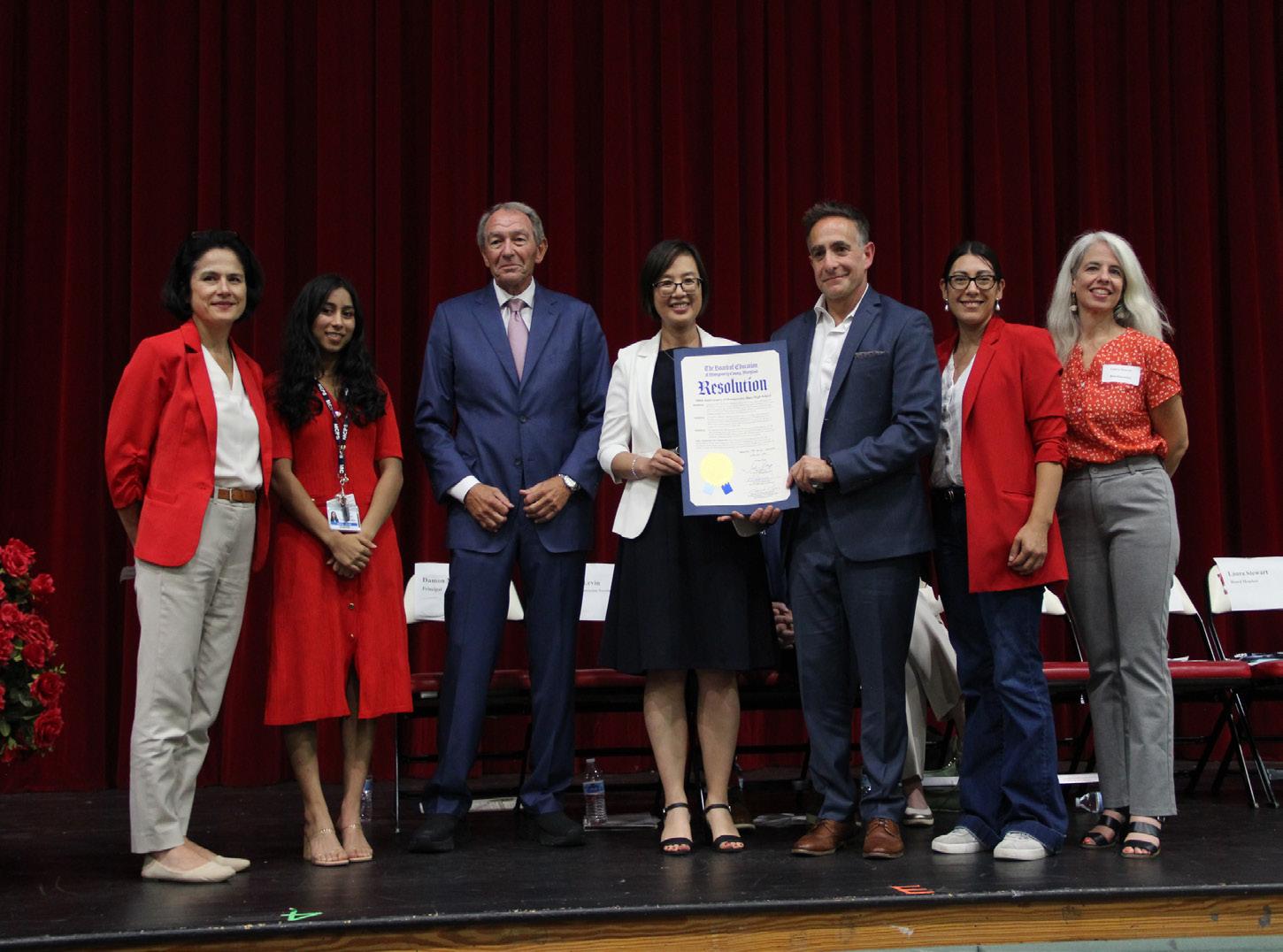
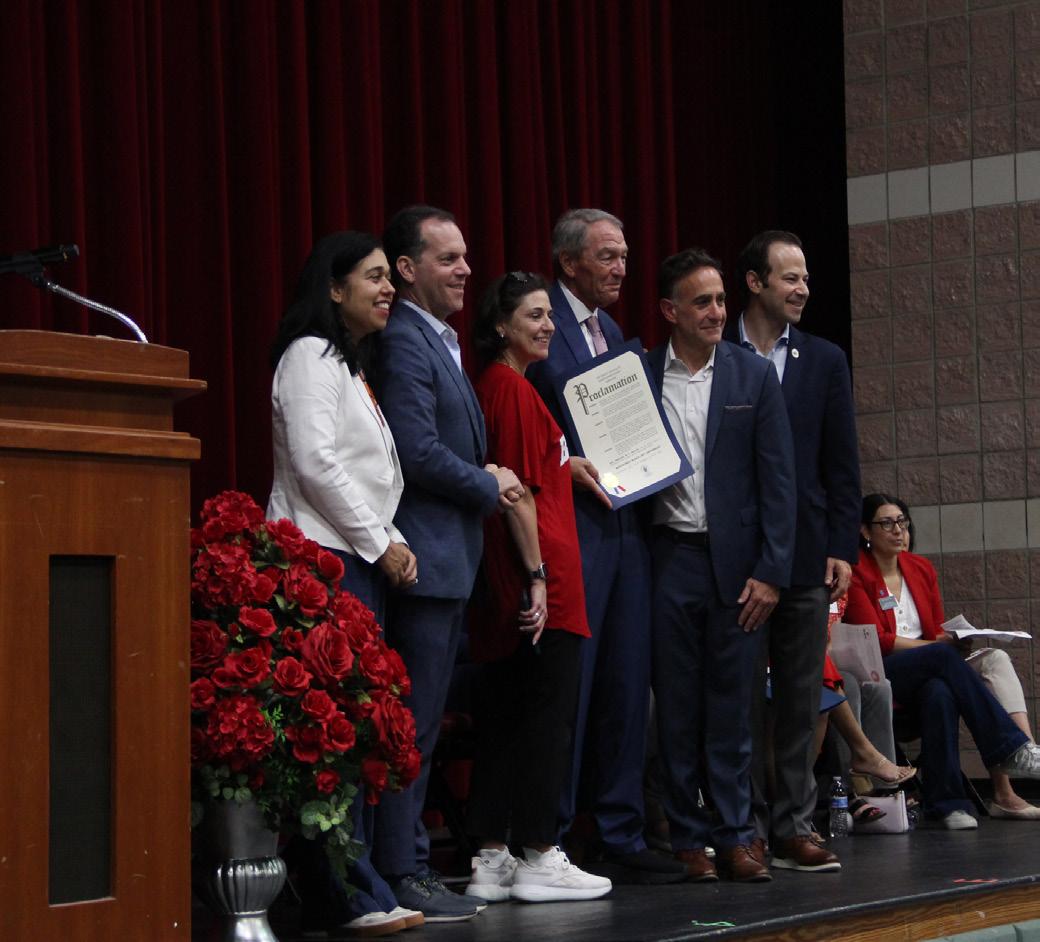
On Sept. 26, the Blair Alumni Association kicked off its year-long centennial celebrations for the 100th anniversary of Blair with a press conference. Alumni from around the country, along with members of the Board of Education (BOE) and Montgomery County Council, attended the ceremony, which was scheduled before the traditional homecoming football game and dance.
In his opening statement, Principal Damon Monteleone highlighted the culture and diversity that he had seen in his first term at Blair. Next, Mark Levin, president of the Blair Alumni Association, spoke about the history of the school and its notable alumni. Levin also invited the audience to explore the various exhibits the Alumni Association had created, including a plaque in the media center honoring former Blair students who served in wars like World War 2 and the Vietnam War. He then spoke about the plaques hung around the auditorium spotlighting
successful alumni.
After Levin, various elected officials spoke about the history of Blair and recognized the centennial anniversary. Members of the Montgomery County Council took turns reading their proclamation celebrating the occasion and the alumni in attendance. Takoma Park Mayor Talisha Searcy directly addressed students in attendance, en-
Embrace the opportunity that you have here today, right now. The freedom to learn without censorship, the ability to engage with people that don’t look like you in a meaningful way, and the ability to freely speak your mind.
couraging them to take advantage of their education.
“Embrace the opportunity that you have here today, right now,” she said. “The freedom to learn without censorship, the ability to engage with people that don’t look like you in a meaningful way, and the ability to freely speak your mind.” Searcy then proclaimed Sept. 26th, 2025, as Montgomery Blair High School Centennial Day.
Chief of Division School Leadership and Improvement for MCPS, Dr. Peter Moran, congratulated Blair for its lasting legacy. “There’s a wonderful foundation at this school that [students] can continue to build on. There’s such a great energy in this school, such a spirit of compassion, care, and service,” Moran said.
MCPS Chief of Staff Essie McGuire explained that Blair is a focal point in the community. “When I think of Blair, I think of it as a community anchor,” she said.“It’s such a deep part of the community, and it’s such a close community around Blair,” she said. “Even though it’s a really big school, folks come and
When I think of Blair, I think of it as a community anchor. It’s such a deep part of the community, and it’s such a close community around Blair. Even though it’s a big school, folks come and they know each other.
they know each other.”
At the conclusion of the conference, alumni made their way to the Blazer Stadium for the homecoming football game against Albert Einstein. During halftime, alumni were invited onto the field to be recognized by Principal Monteleone. The game ended with a 42-0 victory for Blair—the first win of the season for the Blazers.
In the coming months, there will be more alumni events celebrating Blair’s centennial. The Blair Athletic Hall of Fame Weekend will take place on Dec. 5-6
and will honor the school’s most accomplished athletes and teams. Inductees into the Blair Athletic Hall of Fame will include athletes from all past years of Blair graduates.
In January 2026, the Blair Magnet Program Foundation will sponsor A Tribute to Blair’s Academic Excellence to recognize the Magnet program and its graduates. The event will highlight the academic excellence of Blair’s diverse student body.
From May 15-16, 2026, Blair will host the Centennial Birthday Weekend and Alumni Association Hall of Fame inductions—this will mark the fourth group of graduates to receive the honor.
Blair will also sponsor Faculty Appreciation Day, which is intended to thank all former Blair faculty and staff for their service and commitment to the school.
Tostayup-to-dateonall alumni events and awards, follow the Blair Alumni Association on Facebook and Silver Chips Print on Twitter and X.


Compiled by Ruth Wajda-Gotwals
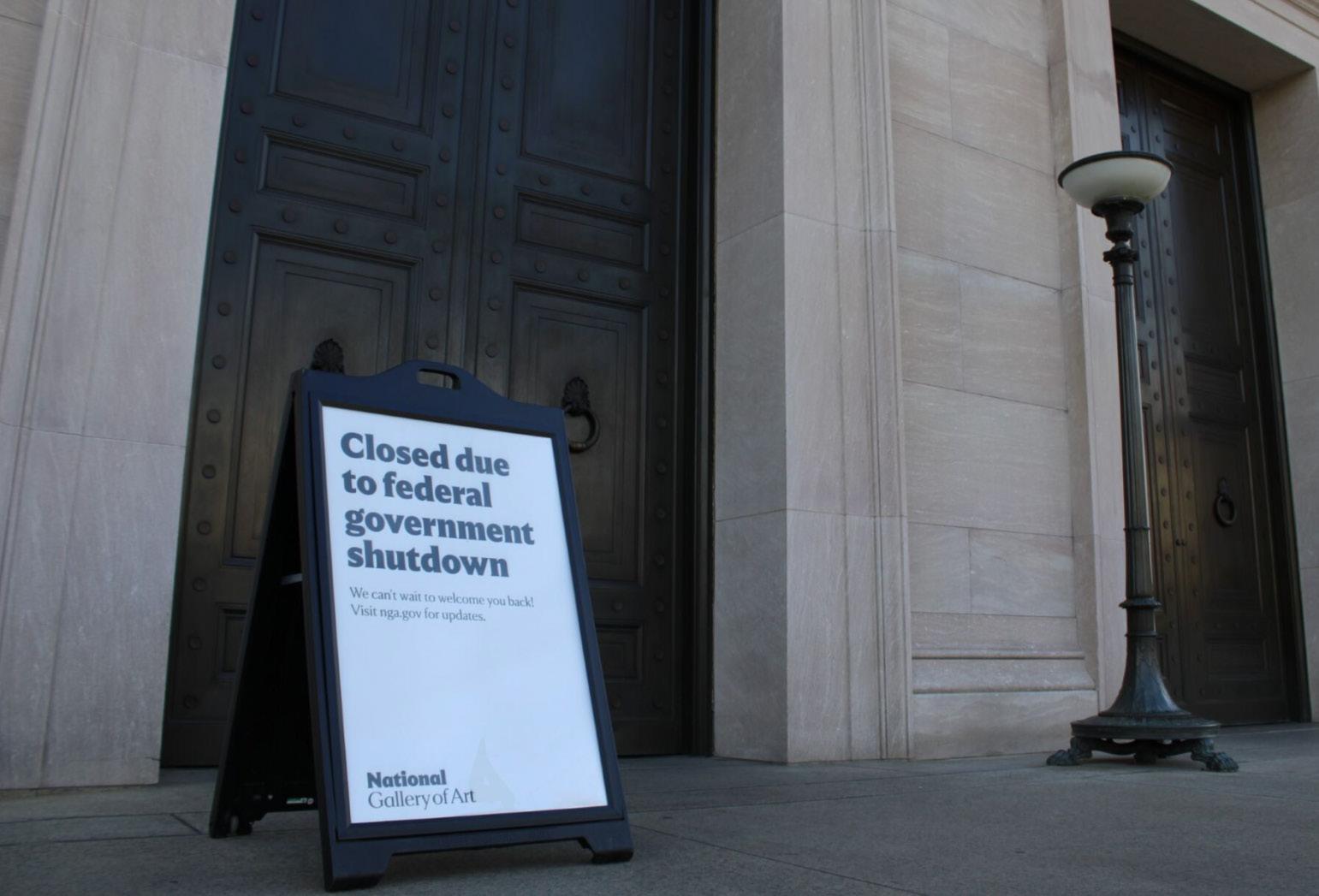
On Oct. 1, the U.S. Government shut down for the first time in six years. This came as a result of stagnation in Congressional funding bills, which were not passed in the required time frame. Many federal workers have been unable to work or are working without pay, and President Trump has threatened retaliatory layoffs to pressure Democratic representatives to vote to pass new appropriations bills. Some D.C. restaurants have offered discounts to federal workers furloughed after Oct. 1. The Smithsonian Museum, National Gallery of Art, and National Zoo have been slated to remain open until Oct. 11. Monuments, memorials, and national parks have remained open, but their visitor centers, restrooms, ranger-led tours, and gift shops have closed. Government programs like Medicaid, food assistance, and childcare support have also been interrupted. With negotiations at an impasse, it remains unclear when the shutdown will end.
In September 2025, the Montgomery County Council held two public hearings on the University Boulevard Corridor Plan. The plan contains development recommendations for a three-mile stretch of University Boulevard from Blair’s site on I-495 to Wheaton.
The recommendations included increased residential housing options and accessibility, along with better utilization of larger institutional or commercial properties.
The plan also called for wider sidewalks, bikeways, bus rapid transit (BRT), more comfortable public transportation stops, and improved safety for all users of the road. The developments will take place intermittently over the next few years, but there is no predicted end-date as of yet.
On Oct. 1, new Maryland driving laws—aimed at speeding, impaired driving, and interactions between drivers with disabilities and law enforcement—were enacted by the Maryland General Assembly. Notably, speeding tickets will have an escalating fine structure, as opposed to previous laws that fined $40 per ticket, regardless of the speed. The minimum penalty for going 12-15 mph over the speed limit was changed to $40, and the maximum penalty for going more than 40 mph over the speed limit was changed to $425. Driving 30 mph over the speed limit is also now considered a reckless driving charge resulting in jail time, a fine of up to $1,000, or both. Negligent driving, characterized by imprudent or careless driving that endangers life or property, now carries a higher fine of up to $750. Aggressive driving is now classified as committing two or more listed traffic violations in one driving period—previously three—with a fine of up to $1,000. Eric’s ID Law was also introduced, which allows drivers with an invisible disability, like autism or post-traumatic stress disorder, to add a butterfly symbol on their driver’s license to help law enforcement handle interactions more carefully.
By ASHER LIPCZENKO
The Baltimore Banner announced via Facebook on May 28 that it was introducing a new sec tion focused on news in Montgom ery County.
The Banner, a fully online pub lication, opened in 2022. Within three years, it grew to become the largest newsroom in Maryland, sur passing the 187-year-old Baltimore Sun. This year, the Banner shared a Pulitzer Prize in local reporting with The New York Times for their “Compassionate investigative series that captured the breathtak ing dimensions of Baltimore’s fen tanyl crisis and its disproportionate impact on older Black men.” the Banner has also enjoyed a steady rise in subscribers, seeing a 57 per cent increase in the last year alone. As of Jun. 30, the Banner’s sub scriber count stood at over 66,500.
Though The Baltimore Banner primarily caters to an audience in Baltimore, the paper still aims to provide quality journalism for the greater community. “We have our larger strategy of serving the entire state of Maryland,” Zuri Berry, the executive editor for the Banner in Montgomery County, said. “When we started looking at places to be, we immediately looked at Mont gomery County.”
Montgomery County is the larg est county in Maryland, but has been deemed a news desert for the past ten years. Between 2005 and 2020, a series of local news sources shut their doors, including
the Montgomery County Journal, Montgomery Gazette, and Montgomery Sentinel. “There are about on the major issues confronting
communities and gives residents the information they need to solve their problems,” an article from that we provide.”

By VEE DIMYAN
On Oct. 3, Principal Damon Monteleone announced that there had been a series of racist incidents that had occurred that week. Teachers had reported instances of students writing the N-word on classroom desks to the Blair administration as well as separate instances of students using social media filters to do blackface.
That evening, Monteleone sent a letter to the Blair community further addressing the incident. “We understand the impact of hate speech. It is both abhorrent and unacceptable,” he wrote. “I want to state unequivocally that discrimination and hate and bias in any form will not be tolerated at Montgomery Blair.”
I want to state unequivocally that discrimination and hate and bias in any form will not be tolerated at Montgomery Blair.
Monteleone explained that hate and prejudice in a school system can hinder the quality of education. “I really worry about the teachers,” he said. “I worry about our teachers feeling safe in their working environment … I worry about our teachers being exposed to microaggressions the same way I worry about students of color or any student being exposed to a microaggression. So, while at the end of the day, our goal is to have students learn at the highest levels. You can’t get there if people don’t feel safe and people don’t feel welcome.”
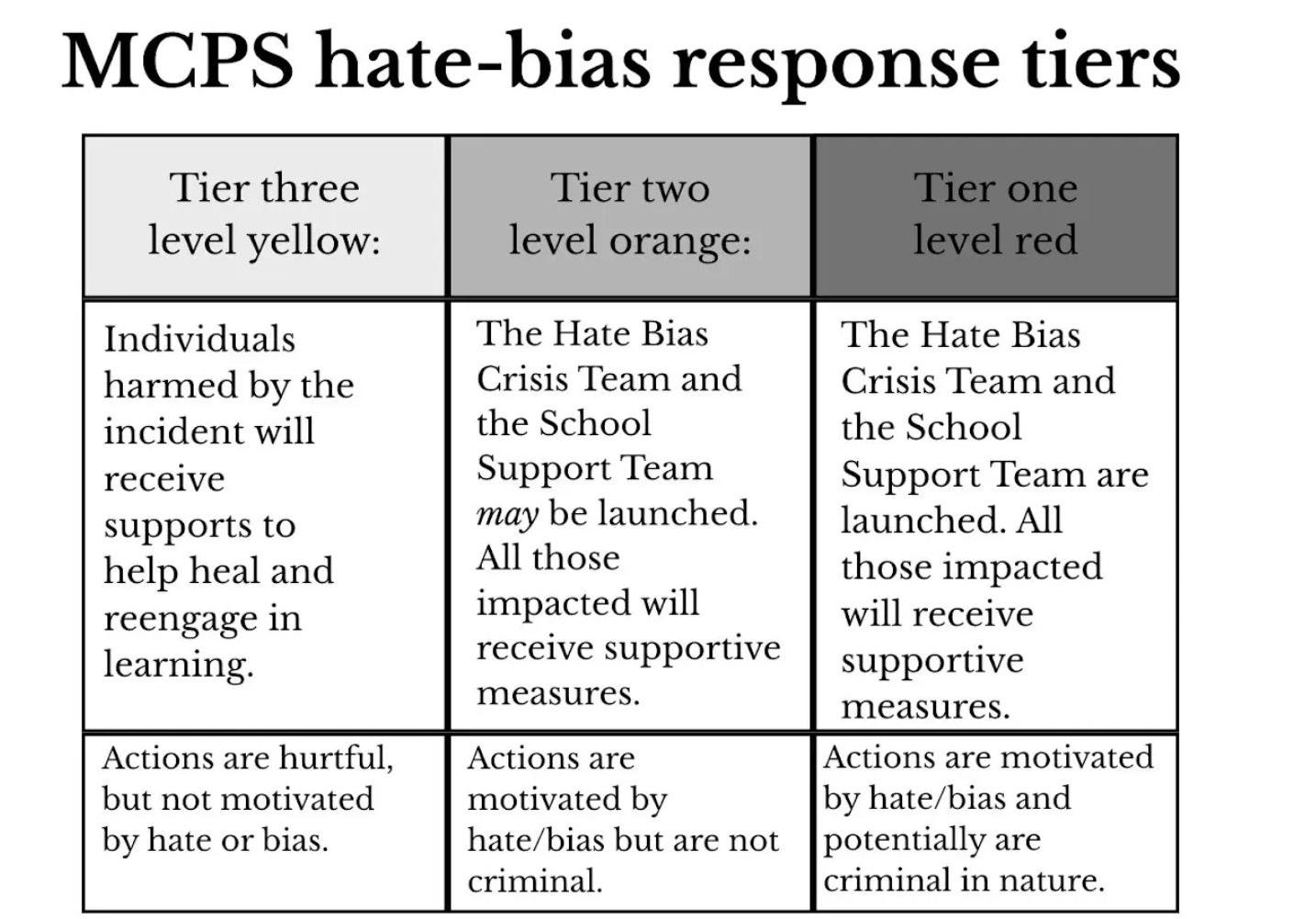
Currently, there is not strong enough evidence to identify the student who wrote on the desk. The Blair administration is working with MCPS central office and following the MCPS Hate-Bias Incidents Responding Procedures in the MCPS Code of Conduct. In the document, the Board of Education dictated that the use of hate speech could elevate the level of consequences that a student faces in a disciplinary procedure. This incident was classified as Level Orange—the actions were motivated by hate or bias but were not criminal.
Following procedure, the administration reported the incident to the Division of School Leadership and Improvement (DSLI), where they decided what further measures to take, including whether or not to notify the broader community. DSLI staff ultimately did not feel the need to send a letter, though Monteleone did. “To [DSLI], this was not a community message. To me, it was, because we had seen two instances of this,” Monteleone said. “It’s really important to me to be clear about what the expectations are and what is unacceptable in this community.”
Serious incidents like these are not common at Blair. When they do occur, he said, staff and students work together to understand the issue and repair the community. “I’m not going to solve this myself. This is a cultural or a societal issue, and I think that we have to involve as many stakeholders as possible,” Monteleone said. “At the end of the day, our goal is to have students learn at the highest levels, you can’t get there if people don’t feel safe and people don’t feel welcome.”
The Banner: Montgomery County became active on Sept. 16 and was well-received. “So far [feedback has] been pretty enthusiastic and positive, and I’m happy about that,” Berry said. “I’m sure at some point we’ll get feedback that’s a bit tougher and a little bit more critical of us and, you know, I welcome
Depending on responses to the new section, the Banner may consider further expansion. “You might say it’s a bit of a testing ground in terms of what an expansion looks like for us,” Berry said. “It’s a real positive development, but we’ve got a long way to go before that’s a determination that we
THE QR CODE TO ACCESS THE MCPS HATE/BIAS INCIDENT REPORTING FORM

By MOLLY BREEN and CASEY PENDERGAST
On June 18, MCPS Chief of Schools Dr. Peter Moran sent a letter to Blair families regarding the inadvertent exposure of students’ 504 plans. On behalf of MCPS Central Office, Moran apologized to the families whose information was made public. “This was not an intentional action, and we deeply regret that this mistake occurred,” Moran wrote.
All 504 plans at Blair—totaling over 300— were published on the Blair Staff Resources website, making them visible to all MCPS email addresses. A 504 plan is a legal document created to accommodate students with disabilities, mental health conditions, and other medical diagnoses, in compli-
ance with Section 504 of the Rehabilitation Act of 1973. The plans include personal information such as students’ full names, ID numbers, addresses, dates of birth, contact information, and significant medical history. Following both MCPS policy and federal law, only “need-to-know” individuals should have access to 504 plans—including teachers, administrators, health personnel, parents, counselors or case managers, and the student. Blair counselor Kirk Simms explained who should be able to access a 504 plan, stating, “It’s just the teachers and the parents and the counselors.”
In screenshots shared with Silver Chips by a Blair parent, MCPS was notified of the incident no later than May 9, and informed the community the following month. Dr.
This was not an intentional action, and we deeply regret that this mistake occurred,
Yolanda Allen, MCPS Director of School Leadership and Improvement, told Silver Chips that this time was taken to conduct a thorough investigation, ensuring information in the letter to families was accurate.
MCPS self-reported this accidental exposure of student information to local and state authorities. Moran made it clear that MCPS is “fully cooperating with any resulting investigation.”
The publication of Blair’s 504 plans potentially violates student confidentiality laws, such as the Family Educational Rights and Privacy Act (FERPA). FERPA is a federal law that protects the privacy of students’ educational records, which includes 504 plans. According to the U.S. Department of Education, “The parent or eligible student shall provide a signed and dated written consent before an educational agency or institution discloses personally identifiable information from the student’s education records.”
In the letter, Moran provided parents with contact information of the Office of the Maryland Attorney General. “We understand the importance of maintaining the confidentiality of our students’ information and are committed to upholding the highest standards of data privacy,” Moran wrote.
promptly acted to remove the link associated with the Section 504 plans,” he wrote.
“Montgomery County Public Schools staff, in conjunction with MCPS, have also initiated a thorough review … to ensure that all sensitive information is appropriately secured.”
The documents did not include any financial information such as social security numbers or bank accounts. Still, as an additional precaution, MCPS encouraged contacted families to reach out to credit reporting agencies, including Equifax, Experi-
We understand the importance of maintaining the confidentiality of our students’ information and are committed to upholding the highest standards of data privacy,
an, and TransUnion, with any questions or concerns about the matter.
The letter sent by Moran stated that the county has conducted an internal review of its data privacy policies, and that improved staff training and stricter protocols will be introduced. He guaranteed that affected families would have new protections for the future confidentiality of 504 plans. “Please be as-
BY JESSICA ZHANG



October 21, 2025
By HOPE FAYE DOWD AN OPINION
The Montgomery Bus Boycott lasted 13 months from 1955 to 1956, becoming one of the most impactful and influential boycotts in U.S. history. It did not reach success by accident or through social media buzz, but rather through the protesters’ deep understanding of the issue and commitment to ending bus segregation. It was this strong sense of purpose from each protester that fueled the Civil Rights Movement, demonstrating that informed and organized boycotts can make a real impact.
Today, the power of boycotts is greatly diminished. Most modern boycotts rarely last more than two weeks before fizzling out. In a study of 133 national boycotts conducted by Kellogg Assistant Profes-
When you’re just reposting [something] without any thought, that dilutes the message. It makes the whole entire cause look performative when it might have a very
sor Brayden King, only 25 percent were found to have achieved concessions from the target companies.
Participants must understand the “why” of a boycott in order for it to be effective. The ease of access and sharability provided by social media has significantly increased the amount of activism today. According to the Center for Strategic and International Studies, protests have increased annually by an average of 11.5 percent per year from 2009 to 2019.
However, social media-fueled boycotts are often hollow. In a survey from Lending Tree, 48 percent of boycotters reported they had gone back to a previously shunned business, along with 70 percent of people under 18. With the rise of social media has come the rise of performative activism. Reposting a tweet or sharing a story is now a chance to merely promote oneself as an activist, rather than work toward true change. “When you’re just reposting [something] without any thought, that dilutes the message,” Diane Kang, a Blair junior, student activist, and president of the Blair Young Democrats
Club, said. “It makes the whole entire cause look performative when it might have a very good backing.”
Boycotts have the potential to empower the consumer—but are ineffective without true desire for progress among the protester base.
“From the perspective of the consumer, [boycotts are] the only instrument that gives you power over the company,”
Claudia Rodriguez, a senior social protection economist, said. “[A successful protestor is] not just doing it as a follower, but as a conscious consumer that wants to see results.”
Findings from the market research company Ipsos tell a trou-
would be “impossible.”
Take the 2025 Economic Blackout, a one-day grassroots effort to stop spending at large corporations that was primarily spread through social media. Although the protest appeared to reach a multitude of people online, it should be no surprise that the spending freeze was ultimately ineffective—in fact, consumer spending reports show that Amazon’s sales actually increased that day by 3 percent.

blesome story— most Americans reported boycotts as “challenging,” with the younger generation most likely to believe that completely stopping spending from a target company
With the constant emergence of new movements and the prevalence of performative activism, audiences have grown desensitized. As a result, boycotts have lost much of the moral weight they once held. Even when companies respond with statements or shortterm actions, lasting change rarely follows.
Still, when used well, social media promotion can be a valuable strategy. Instead of vague calls to “boycott Amazon,” activists should use the algorithm to show the public how Amazon mistreats its workers and bankrupts small businesses. When people understand the motivation behind the boycott, they are far more likely to stay engaged.
The 2020 Pillsbury boycott proved this. After two years of sustained pressure, protesters succeeded in forcing Pillsbury to divest from an Israeli subsidiary operating on settlement land in the West Bank.
Only with the emotional connection that comes from understanding a movement’s rationale can a participant fully commit to a boycott.
Students that want to pursue ac-
tivism and boycotting should fully educate themselves on the issue before joining a boycott. “Do the
[These protests] only work if people are boycotting to see changes and not just doing it as a follower, but as a conscious consumer that wants to see results.
research on the news that you’re spreading and the [protests that] you’re trying to support, because not everything is quite as it might seem online,” Alex Hirsch, a junior at Albert Einstein and frequent protester, said.
Boycotts alone are only part of the equation and must be paired with advocacy. Grassroots organizations can often provide the longterm planning that boycotts lack.
“If you want to [organize a boycott] through your school, contact [organizations] like the Young Democrats … that already have a foundation to give your protest more legitimacy,” Kang said. Until protesters stop focusing on image over impact, boycotts will continue to make noise instead of history. Real change is not always viral.
By ELENA KLEINER
AN OPINION
Serena Williams has established herself as one of the greatest tennis players in history. For decades, she dominated the court, securing 23 Grand Slam titles over the course of an inspirational career.
But when she confirmed that she was taking the telehealth company Ro’s GLP-1 medication for weight loss—and appeared in promotional advertisements—Williams faced outrage from fans.
Some are critical of her choice, worrying about the impression the athlete is making on young fans. “I think she shouldn’t be the face
I think she shouldn’t be the fact of [Ro]. A lot of people look up to her, and younger girls could feel differently about their bodies after seeing her [promote the medication]
of [Ro],” Ahana Samantray, a soph omore who played on Blair’s tennis team last year, said. “A lot ple look up to her, and younger girls could feel differently about their bodies after see ing her [promote the medication].”
But before making judgments, it is crucial to consider all the factors sur rounding her decision—and to recognize that she has the right to do what she wishes with her own body. Williams’ choice to use Ro in her weight loss journey should not be a mat ter of public concern.
Williams originally started using a GLP-1 in January to lose weight following the birth of her second child. “The main function [of GLP1 medications is to] suppress appe tite and reduce the rate at which food empties the stomach,” Jamie Plodzik, a registered dietitian and certified nutritionist, said. “Food intake [is] generally decreased.”
Initially, some speculated that Williams’ enthusiasm to share her story was a marketing strategy, giv en that her husband invests in and

serves on Ro’s board. However, Williams has been transparent that her body needed the medication. “A lot of people have this stigma on GLP-1s,” Williams said in an interview with Vogue. “They say things like, ‘Oh, lazy people do it,’ or ‘If you’re working hard enough, you don’t need that.’ I know for a fact from my experience that it’s
Williams is one of many women who suffer from nutritional difficulties after childbirth.
“No matter what I did, I couldn’t [lose any more weight]. Every single day, I would get my 30,000 steps. I ran and trained,” she said in an interview with Elle. “Even after my first daughter, I never got back to the level that I wanted
Plodzic noted that using GLP1s postpartum can be helpful for women in menopause. “Some are frustrated
that they are not able to lose the weight that they acquired years post-having-kids,” said Plodzic. “I think [Williams using the drug] does break a stigma.”
Additionally, Williams used GLP1 medication to supplement her healthy nutritional and exercise habits, not replace them. Chelsea Feeney, a health teacher at Blair with a background in nutrition, explained the importance of using GLP-1s in tandem with a lifestyle that would be healthy even without the drug. “The people that do use
I do think [GLP1’s are] useful for people in meopause, [patients in menopause] are frustrated that they are not able to lose the weight that they acquired years post-having-kids. I think it does break a stigma.
By DAMON MONTELEONE Guest writer
The AP U.S. Government teacher is in the middle of a captivating lesson on the separation of powers and freedom of speech. Everything seems to be going well. The material is relevant and engaging; there is student discourse and examples of higher-order thinking. But there is one student who will not put their phone away. The teacher has established expectations. He is consistent in upholding them and has asked this student twice to put his phone away. The student feigns doing so but just returns to texting or scrolling under his desk. Finally, the teacher has had enough and says to the young man, “Robert, I have asked you twice, and per school policy, I now need to confiscate your phone.” “Nah man,” Robert says. “That’s not happening.” The teacher says, “Oh yes, it is.” He raises his voice, “Give me your phone now!” The student, visibly angry, stands and says: “You aren’t getting my phone!” The teacher steps away from the student and calls security. The student walks out of the classroom shouting obscenities. In the middle of class, Patrice gets up and grabs the hall pass lanyard off of the whiteboard without even asking her teacher if she can use the restroom. The class is working in groups and the teacher is busy helping some kids in the back. She doesn’t see Patrice leave. The teacher has told the class to just grab the pass and go if they need to because she doesn’t want to interrupt instruction. As soon as Patrice exits the classroom in the 220 hall, she opens her phone and begins mindlessly scrolling through Instagram, head down, as she walks along Blair Boulevard on the second floor. She passes a couple of staff members who do not address her and goes all the way to the 260 hall before doing a lap back toward her classroom and entering a bathroom. There are five or six girls there socializing and looking
at their phones. She hangs out for a few minutes before walking back to class. She’s been gone for over ten minutes.
As a teacher and administrator in a high school for almost my entire career, I have witnessed scenes like this countless times. I am sure these scenes are not unfamiliar to our staff or student body. As principal, I have an obligation to maximize instructional time, de-escalate possible confrontations, relieve teachers of the burden of policing cell phones, and uphold MCPS regulations. Every minute of instruction is sacred. We only have 180 days in the school year—and with block scheduling, only 90 classroom opportunities per year—for students to engage in learning. Teachers and staff know students lose untold hours of learning due to cell phone distraction and hall-walking.
Teachers and staff know students lose untold hours of learning due to cell phone distraction and hall walking.
When I first was appointed as principal, I issued a survey to staff to solicit their perspectives on areas for improvement. The top two concerns were rampant cell phone usage and hall-walking. Following the school district’s lead, I shared both the cell phone pouch and the digital hall pass initiatives to the instructional leadership team this summer and, with their support, brought these forward for implementation with staff during pre-service. As of Oct. 13, 54 cell phone pouches have been issued (less than two per day), and only five students have been repeat offenders. We will analyze the hall pass data at the end of the marking period, but the anecdotal evidence is positive—we are
seeing fewer students in the halls during instructional time.
We know banning cell phones from classrooms reduces distractions and increases instructional time. It also increases student engagement and performance. Moreover, it is well-documented that decreased cell phone usage leads to improved mental health, and is correlated with higher self-esteem and social-emotional balance. For the 2025-2026 academic year, MCPS provided all high schools with phone pouches as a means to implement the new personal mobile device regulation, which was finalized in May of 2025. Over the summer, MCPS encouraged principals to issue pouches to classrooms and design a protocol for student accountability.
Additionally, research indicates that 97 percent of students aged 11-17 use their phones during the school day, with a median use of 43 minutes of screen time. In one Current Psychology study, students reported switching between their academic task and their phone three to four times during an hourlong class. This number was negatively correlated with academic performance. A study in Communication Education also found that students off their phone wrote 62 percent more information in their notes and scored a half grade higher on exams.
Hall passes are necessary. Students need to use the restroom, see the nurse, go to the main office, and see their counselor. That said, the lanyard system allowed for unaccounted time outside of class and—when physical passes were
Students can take up to 20 minutes to re-focus on learning after being distracted.
it for weight loss—that really need it [medically]—will also pair it with a nutritionist, a doctor, and a trainer, so that they are using it safely.” Many have the impression that Williams is a body-positive activist because of her unique figure in the tennis world. However, Williams has no obligation to uphold the role thrust upon her. She has simply existed confidently and defiantly against the dominant beauty standard. She has never promoted herself as an icon in the movement against weight-loss drugs, and her success is based on her skill in tennis rather than her appearance. Williams’ choice to use Ro to supplement her weight loss journey should not be criticized. Fans must consider her postpartum health as an elite athlete and respect her bodily autonomy. She has used the medication safely and healthily under unique medical circumstances. Ultimately, it is not the public’s place to dictate her choices—Williams deserves the right to make those decisions herself.

taken without expressed teacher permission—led to an excessive number of students in the halls and missed instruction.
Schools have an obligation to account for students’ whereabouts all at all times. In a world where students just grab a lanyard and go, we
Schools have an obligation to be able to account for student whereabouts st all times.
have no way of knowing where they are going, how long they have been out of class, or if the teacher even knows they are gone. Moreover, we know that students like to extend time in the halls, meet up with friends, take laps, and hang out in the bathrooms. The new hall pass system allows us to monitor who is leaving class consistently, what time
of day passes are issued, and where students are going. We can see in real time which students in the halls have permission to be there. We can know where they have come from, and where they are supposed to be going. We can see how long they have been gone, and how much time they have left on their ten minute limit. We can monitor passes issued per class, and assess which students may be abusing the system. In fact, we can now see how much instruction students are missing due to hall pass usage. Are these new systems effective? Will they help address the chronic problems of classroom cell phone use and hall-walking? Only time and data will tell us. We intend to get our first clear picture at the end of the marking period.
2024 NSPA Pacemaker Finalist, 2024 American Scholastic Press Association Most Outstanding High School Newspaper, the 2024 American Scholastic Press Association First Place with Special Merit, the 2024 National Scholastic Press Association First Class with Three Marks of Distinction, the 2024 Columbia Scholastic Press Association Gold Medal winner, and the National Scholastic Press Association Pacemaker 100.
EDITORS-IN-CHIEF
Satchel Jelen
Doris Wang
DESIGN EDITORS
Senaya Asfaw
Lucy Holland
Kiya Tiruneh
Eric Yang
NEWS EDITORS
Casey Pendergast
Jessica Zhang
OPINIONS EDITORS
Elora Derbyshire
Yongle Xin
FEATURES EDITORS
Neha Narayan
Priya Tapia-Pereira
CULTURE EDITORS
Senaya Asfaw
Lila Grosko
SPORTS EDITORS
Sahana Parikh
Mackenzie Lyons
OMBUDSMAN
Justin Rosentover
COLUMNIST
Kiya Tiruneh
SENIOR WRITERS
Adanna Akamigbo
Rae Foster
Ruth Wajda-Gotwals
Tomas Monticelli
Eric Yang
STAFF WRITERS
Molly Breen
Vee Dimyan
Hope Dowd Faye
Kiran Durvasula
Leya Fekadu
Dermott Foley
Zoe Gorbachev
Lark Jeffers
Elena Kleiner
Alice Levings
Asher Lipczenko
Jamie Love
Marcela Mason-Rodriguez
Celia Max
Gabriella McKenzie
Ada Schwartz
Hana Sor
James Yi
Sonya Del Pozo
BUSINESS DIRECTORS
Sophia Li
Eva Schwartz
BUSINESS STAFF
Jocelyn Nolasco
Molly O’Brien
Andie Alison
Marilyn Ramsdell
ART EDITORS
Luca Esser
Josephine Brunn Lake
ARTISTS
Tinbite Abie
Eva Dammann
Melanie Fang
Jessica Hsieh
Tane Park
Victoria Angeli M. Regachuelo
Jason Yu
Sophia Zhdanova
PHOTO EDITORS
Ian Gleason
Daneel Kutsenko
PHOTOGRAPHERS
Sadiq Abdillahi
Raffi Diamond-Berman
Rae Foster
Kaylee Hopkins
Jamie Lozada-Mcbride
Linnea Menge
Maz Olson
Eleanor Olson
Lila Shaw
SCPSPORTS EDITOR
Daneel Kutsenko
PUZZLE EDITOR
Daneel Kutsenko
Ruth Wajda-Gotwals
OUTREACH COORDINATORS
Adanna Akamigbo
Neha Narayan
Justin Rosentover
COPY EDITORS
Elora Derbyshire
Neha Narayan
Priya Tapia-Pereira
Casey Pendergast
Eric Yang
Yongle Xin
Jessica Zhang
ADVISER
Jeremy Stelzner
By THE EDITORIAL BOARD AN OPINION
This past June, the Supreme Court ruled in Mahmoud v. Taylor that parents can have their children excused from reading books that go against their religious beliefs. True, schools have a responsibility not to infringe on the free exercise of religion, but they also have the responsibility to expose students to new ideas. As much as a parent might disagree with the content of the books taught in the classroom, it is much better to engage in open, thoughtful dialogue with their children and their teachers about ideas they disagree with— as opposed to blatantly censoring what their kids see.
This decision is part of a larger trend among Americans—one that goes far beyond education—of shutting out opposing viewpoints and disengaging from honest conversations. With the onslaught of information made available in recent years, people have grown accustomed to catchy soundbites.
Media outlets create outlandish headlines meant to spark outrage and shock, often painting complex situations as black-and-white. We accept the first thing that pops up in a swift search as fact rather than doing our due diligence with research, losing nuance in the process.
It doesn’t help that social media platforms and search engines perpetuate confirmation bias. Online, political tribes provide echo chambers that magnify disagreements.
MAGA Republicans ReTruth while Progressives post on BlueSky, each in their own ideological ecosystem. Though these bubbles may feel comforting—validating one’s opinions as absolute truth—
they isolate perspectives and exacerbate division. Rather than questioning points, people conform to and accept the opinions of those around them as the ultimate truth, re-framing opposing viewpoints as villainous in the process.
Both sides of the political spectrum are guilty of this. The right rails against ‘woke’ books in schools and the left cries, ‘bigot’ the moment anything against diversity, equity, and inclusion is mentioned. In such a divided political climate, it feels impossible to convince the opposition of any argument.
But, historically, changes of opinion aren’t as rare as you might think. In 1996, 27 percent of Americans supported gay marriage and 68 percent opposed it. Today, those numbers are reversed. That happened because people spoke to each other. According to
Pew Research, a third of changed minds were due to “[knowing] someone—a friend, family member or other acquaintance—who is homosexual.”
Now, 71 percent of college students think it is acceptable to shout down a speaker on their campus and 40 percent of 2024 Kamala Harris voters think it is acceptable to cut off contact with family members who disagree with them—acts which further block out opposing perspectives.
At Blair, we have both a Young Democrats Club and the Young Democratic Socialists of Blair, but we no longer have a Young Republicans club this year. Considering that 22 percent of Montgomery County voters cast their ballots for Donald Trump, it seems unlikely that the absence of a Young Republican club is due to a lack of young Republicans. What is far

When you’re in a hole,
By JUSTIN ROSENTOVER Ombudsman AN OPINION
The American Dream has been poisoned. Over the last few decades it’s been attacked not by money-grubbing billionaires or money-burning socialists but by the well-intentioned and short-sighted. In an attempt to make a better world for themselves, older Americans have forgotten to make a better world for the next generation. They’d rather use their political capital to solve their present-day problems than on the problems that our generation will face tomorrow. Today’s child poverty
rate is around 15 percent. The senior poverty rate is 10. Spending on Americans over 65 and their debt now makes up the majority of federal spending. Spending on science, education, and child welfare—which benefits young and future Americans—is a tenth of federal spending and declining. There will be consequences for this lack of foresight.

You might think someone has a plan to address this crisis. They do not. Social Security will have to slash benefits when the fund runs out of money in 2034. That isn’t a hit for just our generation, it’s a hit for our parents. When they reach retirement, their retirement costs are going to be passed on to us. Even though the American economy works and total GDP is expected to double by 2050, we’ve already allocated all those resources. “Our system is so locked in to these promises built up from the past to continually spend more on the old and the wealthy, that there’s no room left for these
more likely is that Republican students are unwilling to assert their political views in a generally liberal school. Civil discourse cannot be held if one side is too scared to even identify themselves. It is much easier to label the other side as “deplorable” in one’s mind when varied conversations are not being held at school or at home. 64 percent of Americans think that the nation is too divided to solve the problems we face. With attitudes like this, we will never achieve progress.
Last year, Blair political psychology teacher Sean Gabaree attempted a screening of Join or Die, a documentary promoting social and civic engagement. The screening was supposed to be a jumping-off point for a discussion about community and how to heal political rifts, but was canceled due to a lack of signups. These are exactly the kinds of events that we, as students, should be supporting and participating in. We need to have the courage to seek truth over comfort.
Parents have just won a case in the Supreme Court that allows them to restrict what students see. Now, more than ever, the burden is on us to seek out conversations with people we disagree with. Students should not back away from sharp, uncomfortable questions. The only way to overcome the abundance of political, social, and economic issues we currently face is by having free discourse about ideas for the future. Ultimately, it is our collective responsibility to seek understanding and approach our differences with nuance, not outrage.
programs to spend new money,” Eugene Steuerle, a fellow at the Urban Institute, a D.C. think tank, said. Let’s say that, out of the kindness of their hearts, every American donated $10,000 a year to the Federal Government (which the IRS happily accepts), it would take a decade for us to cover our current debts and in the meantime we would have created another $20 trillion to pay off.
Payments on interest for the debt is larger than our spending on defense. Our gigantic debt means that spending on programs to reduce that gap is missing. We should be supporting infrastructure and housing initiatives that would decrease the cost of living for young people, but instead we’re spending it all on paying off our grandparents’ dues. We could be spending money on science in order to eliminate malaria and cure cancer, but instead we’re spending it on costly cancer treatments for the elderly. The number of children born every year in the U.S. is declining, in part because young families can’t afford the housing and medical costs required to have them. That means there will be fewer children to pay for our retirement and our healthcare.
This is a crisis so large that we are incapable of dealing with it. Steuerle believes this to be the cause of our vitriolic culture. “[Politicians] can’t be honest with the numbers and so they turn to cultural warfare. They always turn to something that’ll rile up the public,” he said. Our political discourse is instead filled with cultural warriors being intransigent about transient issues. The “Bathroom Wars” and blabber about Tylenol causing autism have replaced actual policy
making. As fun as politician-flaming is, it really isn’t one side’s fault. Neither is doing anything to alleviate our problems. Democrats’ post-Covid spending was reckless and added trillions in debt. Meanwhile, the Trump administration has vowed not to touch Social Security while also cutting taxes. We cannot continue on our current path. We have to stop spending money we don’t have. The money doesn’t just appear out of thin air, it comes from the pockets of today and tomorrow’s children. America today is stealing from you, the students at Montgomery Blair. We have no AARP, no vast wealth, no vote to defend ourselves. All we have is Silver Chips and Instagram. You will never get to choose where to spend your tax dollars because your parents have already chosen for you. As Steurle put it: “Every dollar of revenue that we’re expected to have in the future, including all the growing revenues, are already committed. I think that’s an impossible situation.”
America today is stealing from you, the students at Montgomery Blair. We have no AARP, no vast wealth, no vote to defend ourselves. All we have is Silver Chips and Instagram.
MCPS prides itself on being the most diverse district in Maryland, yet its most prestigious academic programs tell another story.
This year, white and Asian students made up 75 percent and 85 percent of the Blair and Poolesville STEM magnet programs, respectively, despite those groups only representing 37.6 percent of the county’s student population.
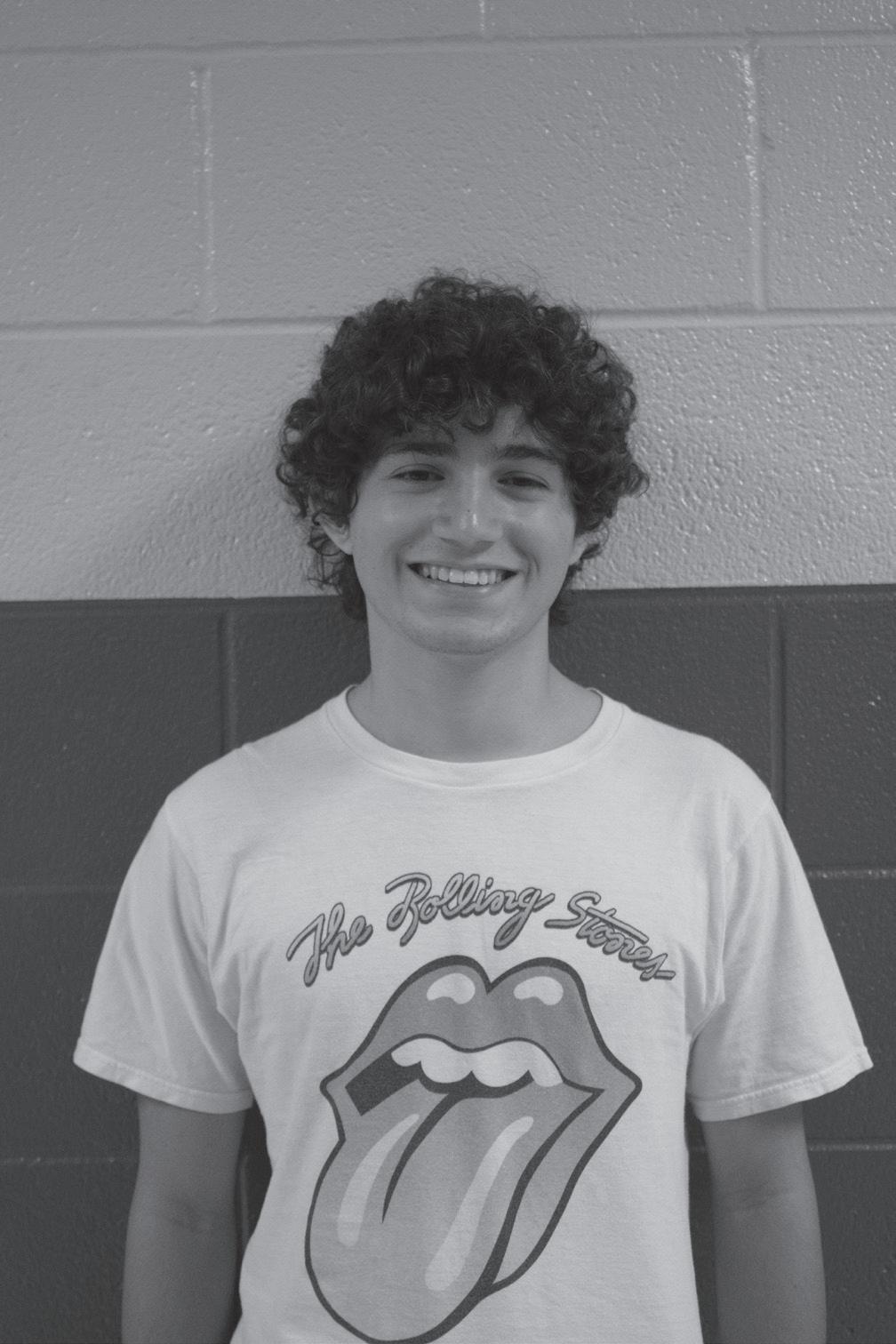
Sarah Fillman, the coordinator of Blair’s Communication Arts Program (CAP), noted a similar demographic trend. “We tend to be about 60 to 65 percent white and about 65 to 70 percent female,” she said, “CAP is actually one of the more diverse programs, but it’s still not as diverse as it should be.”
Diversity in education is not just important for equality—it also has proven academic benefits. A 2023 study from the American Education Research Association found that when underrepresented minorities made up a larger share of a class, grades rose for everyone. This is not surprising. When students see representation in the room, they are less anxious, more willing to participate, and able to focus more on learning.
In order to expand access to all academic programs, MCPS began its Academic Programs Analysis in February. The analysis involved looking into enrollment data, seeking feedback, and creating a solution to any problems found. “As we started to examine who’s accessing [programs], we’re seeing [that] there are tremendous inequities,” Jeannie Franklin, the director of the Department of Consortia and Application Program Services, said.
The county’s proposed solution would eliminate the Down County Consortium and Northeast Consortium, replacing them with six new regions—each with four to five schools. “The STEM program [would be] in each of those regions, along with some other new programs,” Angela McLane, Executive Director of the Division of Teaching and Learning in MCPS, said.
Some community members have raised concerns about the proposed solution, primarily regarding the costs associated with the project. However, addressing the glaring lack of diversity under the current model is worth the price, and MCPS must act now. “The county has been talking about this … pretty much since I’ve been teaching,” Fillman said. “There’s been a focus on diversity and the lack thereof in some places and the need for change … so I’m glad that there is at least a roadmap to some change.”
This new model will make necessary
MCPS should continue its Magnet expansion plan, as its potential to address the glaring lack of diversity within the county’s programs is worth the cost.
By TOMAS MONTICELLI AN OPINION
progress. Instead of centralizing programs in a few schools, limiting potential enrollment and forcing unreasonably long commutes, the county’s proposal will spread programs out, allowing for higher enrollment and more equitable access. “Our baseline goals are equitable access to these programs, and we do think that the regional approach will allow us to ensure that,” McLane said.
Fillman was hopeful about the changes. “I do think that the county’s focus on making sure students have choice is great … having some kind of learning opportunity to attract good learners is a way to mix up and diversify schools,” she said.
MCPS should not continue with the Magnet expansion plan due to the potential for decreased program quality resulting from a lack of resources, staff, and funding.
By ZOE GORBACHEV AN OPINION
If a restaurant tries to serve more guests without hiring more chefs or buying more ingredients, the quality of every meal declines. No amount of effort can make up for resources that are not there. The same principle applies to Montgomery County’s magnet programs.
At a May 8 Board meeting, Superinten dent Thomas Taylor proposed a plan to create multiple regions—each with magnet programs—across the district based on a boundary study conducted in February. This plan was designed to ensure equita ble access to advanced programs within a reasonable distance from students’ homes. While the proposal may sound equitable practice, it risks overing district sources, diluting program quality, and failing both students and staff.
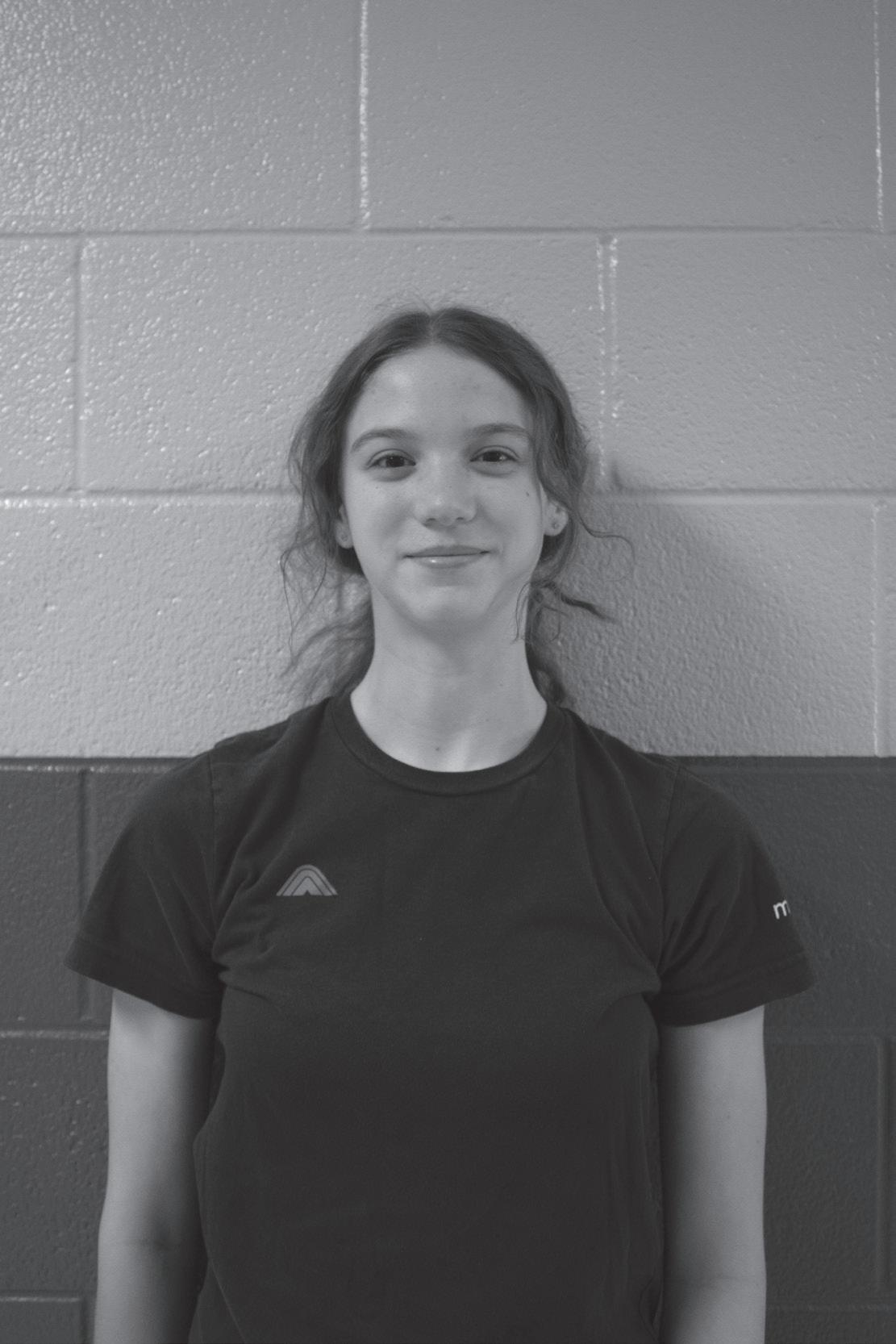

4.1 percent of students in the region participate in one, compared to the countywide average of six percent. Expanding programs here is critical in closing opportunity gaps.
The bottom line is that MCPS needs to take action now. It is better to make changes proactively rather than to continue kicking the can down the road. Every year without a fix means thousands of students missing out on the opportunity to participate in programs ostensibly meant for them. “When we want to make changes to better serve our students, there is urgency,” McLane said, “The sooner we can carry out and plan and implement, more students [will] get the benefits of it.”
voicebox
All photos by DANEEL KUTSENKO
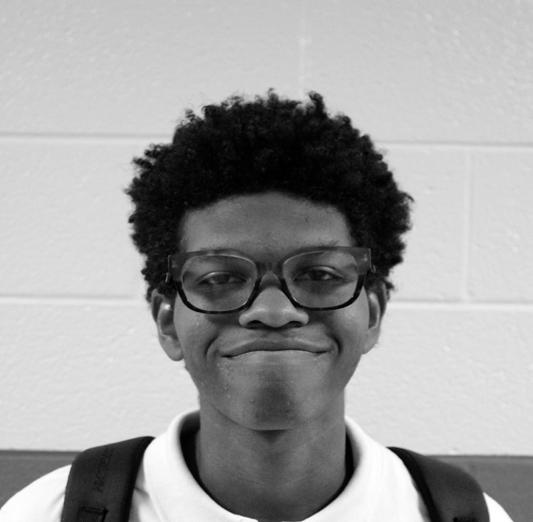
“I
think the magnet expansion is a really good idea because every MCPS student should have a chance within their schools to have individualized programs for their interests.
KIERAN ALMAZOR
The most pressing issue is staffing.
As of late August 2025, MCPS was actively recruiting for 282 teacher-level positions. That long-standing shortage will not improve when a magnet label is attached to the programs. In fact, it will become even harder to address.
“Finding highly qualified teachers is always a challenge, period, full stop,” said James Schafer, who has taught in Blair’s Magnet Program for over twenty years. “When you then have unique curricular requirements and unique programmatic requirements, it becomes that much more challenging.”
Magnet programs depend on teachers with both subject expertise and experience in developing advanced coursework. Classes like accelerated computer science, specialized science electives, and upper-level mathematics require careful planning and deep content knowledge, not just enthusiasm or availability.
Teachers would not be the only resource in limited supply. More programs would also require more buses, equipment, funding, and facilities across the county.
For the 2026 fiscal year, MCPS received $8.6 million less than what the Board requested from the County Council. Under the new regional model, MCPS would

“It’s a good idea because it allows more people to have an opportunity to do the magnet programs … otherwise some people might not want to make the drive.”
LUMI TSENG sophomore
all students, it cannot sustain new magnet programs.
Additionally, by bringing students from across the county together, the current magnet system builds long-lasting friendships that extend beyond the classroom. Daniel Li, a junior in Blair’s Magnet, explained why those connections matter. “I think the community is the best part of what we have right now … if I went to another high school, I wouldn’t have as many peers [with whom] to discuss topics that I’m interested in,” Li said. Also, recent events offer a cautionary tale. During the 2020–2021 school year, regionwide International Baccalaureate (IB) programs were introduced with similar goals of equity and access. At a Board meeting on June 24 regarding the magnet expansion, Caryn Seligman, president of the Richard Montgomery IB Foundation, said that the new regional programs had “shown significant progress but [had] not yet come close to achieving the same level of success” as the RM program. If one expansion plan has not been successful for five years, MCPS has no justification to implement another. Supporters of expansion argue that current gaps in equity demand immediate action from the county. They are correct that no student should be denied advanced opportunities, but equity is not just about access—it is also about quality. Opening programs that are underfunded, understaffed, and underprepared risks deepening inequity, not reducing it.
MCPS should focus on strengthening its existing magnet programs before attempting expansion. That means investing in staff, improving funding, and prioritizing support for a greater number of students. Only once those foundations are stable should the district consider growth. Otherwise, students may end up with a half-baked opportunity instead of the full-course experience they deserve. And no one wants an undercooked education.

“I think the county is going to have difficulty finding and hiring and paying for qualified staff. Because these programs demand higher quality teachers.”
TYLER LE senior
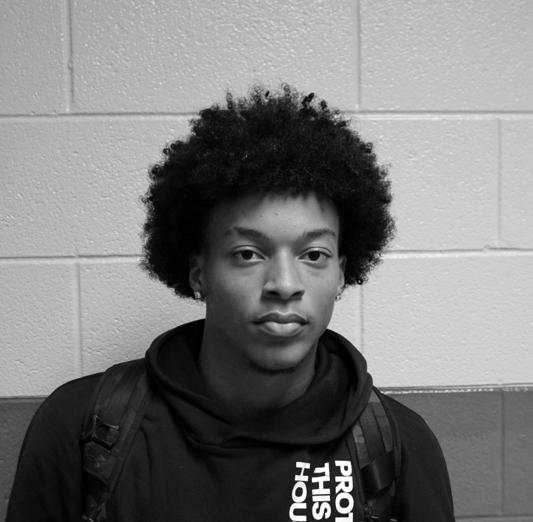
“I think [the magnet expansion] has its pros and cons overall … I think a big downside would be [the programs] being less competitive … but overall I’d say it’s good.”
KYSEN HARRIS junior
Representando la comunidad latinx desde el 2003
El 21 de octubre de 2025 Volumen 89 Número 1
Dos redadas recientes de ICE en escuelas cercanas a la secundaria Montgomery Blair han encendido la alarma en comunidades y oficinas locales, que ahora buscan maneras de proteger a estudiantes y familias vulnerables frente a una nueva política migratoria federal más estricta. En los últimos meses, Blair también ha tenido un cambio de administración, y en medio de un nuevo contexto, con la aparición de ICE y las persecuciones a los inmigrantes, las políticas de protección se han modificado, por lo que se exhibirán las nuevas medidas de protección a nivel nacional, del condado y localmente.
Tras la deportación de una estudiante el pasado año escolar, cientos de alumnos participaron en una demostración que se inició como una caminata de protesta. Los estudiantes organizaron el evento para exigir “educación, no deportación” y para demostrar la preocupación que sienten muchos estudiantes cuyos familiares están en peligro de ser detenidos por razones migratorias. Una estudiante anónima latina de Blair comentó que aunque ella no esté en peligro de ser detenida, está preocupada por la seguridad de sus padres. “Yo me puedo sentir segura, pero tengo amistades, familiares conocidos, que no se sienten seguros y tienen miedo de salir. Como mi papá”. Esto también puede repercutir a la asistencia de los estudiantes al colegio por muchas causas como el miedo, ser detenidos o que su soporte financiero haya sido detenido por lo que se ven obligados a trabajar y dejar de estudiar. Diferentes casos se pueden dar en este contexto para que los estudiantes dejen de venir a la escuela. Theresa Hiller es la Jefa de Departamento de EML y mencionó, “no se ha hablado mucho al respecto, pero definitivamente faltan estudiantes [este año]”. También mencionó que hoy en día la única ayuda que la escuela puede ofrecer es la de prevención, “conseguir un abogado, establecer una tutela permanente, conocer sus derechos, como no abrirles la puerta y dejarles entrar en su casa, ese tipo de cosas”. Debido a que recientemente han dictaminado que los jueces de inmigración no pueden emitir fianzas, una forma con la cual un padre pudo ser puesto en libertad la primavera pasada luego de que pagaran su fianza, ahora
esperando su próxima cita con el tribunal.
Localmente se pudieron evidenciar estos cambios con la aparición de ICE a pocos metros de la escuela, específicamente en la escuela media Eastern donde dos personas fueron detenidas por ICE. Según Ashlyn Campbell para la Revista Bethesda Magazine, dos hombres, “sin una identificación clara persiguieron a otros dos hombres a pie, los esposaron y luego los hicieron desfilar frente a padres y estudiantes”. Asimismo, en la escuela primaria New Hampshire Estates, El director Bob Geiger envió el lunes una carta a la comunidad escolar sobre “vehículos policiales no identificados, posiblemente agentes federales de inmigración” que se presentaron en la escuela, de acuerdo al artículo escrito por Antonio Planas en The Baltimore Banner. Esto generó una sensación de miedo y preocupación en los estudiantes y padres que tienen temor a ser detenidos.



En la primera línea de la respuesta legal en el condado Montgomery se encuentra la estudiante de derecho Kathryn LaLonde, conocida por ofrecer servicios pro bono a familias de bajos recursos. LaLonde coordina clínicas legales y sesiones informativas nocturnas en centros comunitarios, enfocados en el lema “Conozca sus derechos”. Según LaLonde, uno de los mayores retos de su trabajo son los nuevos cambios llevados a cabo por la administración de Trump. “Lo frustrante es cómo ha cambiado el sistema”, LaLonde dijo. “Los ciudadanos tienen un abogado gratis, pero con inmigración, hay que pagar. Nuestra organización daba consejo gratis a personas que eran detenidas…pero ahora la administración Trump ha detenido todos los programas de orientación”. Ante los hechos ocurridos, los gobiernos municipales han reaccionado de distintas maneras. Por parte de las escuelas en el Condado de Montgomery, La Esquina Latina pudo hablar con Kristin Mink, la representante del distrito cinco en
el consejo del Condado Montgomery. Ella es graduada de Blair y está muy involucrada en los derechos de inmigrantes en las ciudades que representa. “Estoy trabajando en un proyecto de ley que ayudará a garantizar que tengamos protocolos muy estrictos en todas las instalaciones de nuestro condado y aprovechar nuestros derechos y capacidades legales”, dijo Mink. “Esto significa que los empleados del condado estén capacitados y que estemos lo mejor preparados posible como condado”. A pesar de estos esfuerzos, en la escuela sienten que las acciones del condado no son suficientes. Por ejemplo, los derechos de los inmigrantes no aparecen en la guía de derechos y responsabilidades de los estudiantes en MCPS, tampoco se han tomado medidas para la protección de inmigrantes. Hiller comentó que, “el condado no tiene respuesta”, respondiendo a la pregunta de si MCPS hacía algo para apoyar a familiares de estudiantes que han sido detenidos. Estudiantes y padres también han notado
esto, así como Flavia Peret, una estudiante de undécimo grado de Blair, que dijo, “supongo que algo que me preocupa fue que una vez mi papá mencionó de que MCPS, o sea, no es como que el sistema más seguro del mundo para las escuelas...no es que su intención es proteger a todos los estudiantes”. A nivel federal, la administración ha promulgado medidas más estrictas que en los años pasados, e incluso más estrictas que en la primera administración de Trump. Según el sitio web de la Casa Blanca, las nuevas medidas se llevan a cabo para “proteger la seguridad nacional y pública”. En este contexto, organizaciones defensoras de los derechos civiles han advertido sobre un aumento en las redadas de ICE, restricciones de beneficios públicos, y cambios al proceso de asilo. Así como señaló Hiller, que luego del inicio de la presidencia de Donald Trump muchas cosas cambiaron, “La última presidencia de Trump no fue como está. Es decir, no estaba movilizando a ICE contra cualquiera, ni enviando a la Guardia Nacional a la ciudad. Mucho ha cambiado”. Tras las nuevas medidas planteadas, muchas personas reaccionaron y videos acerca de cómo prevenir ser detenido han sido publicados. Las sugerencias más comunes incluyen no abrir la puerta a un agente de ICE, no responder a preguntas si te paran en la calle, o simplemente mantener la calma. Si bien es cierto que muchas cosas han cambiado, se tiene que seguir luchando por nuestros derechos, pero por ahora se tienen que tomar medidas de prevención, como mencionó la señora Hiller, “Si tienes un adulto de confianza a quién contactar con cualquier cosa, ya sea algo que esté sucediendo ahora mismo o el miedo general, o para los estudiantes indocumentados, si pueden intentar contactar a un abogado antes de que algo suceda, eso es mucho mejor”. Asimismo, se tiene que agradecer a la comunidad por luchar por lo que se considera justo, como mencionó la señora Mink, “En este punto, le doy la mayor parte del crédito a la comunidad…que a menudo no solo es más ágil de lo que puede hacer el gobierno, sino que también cuenta con personas que ya tienen relaciones profundas con los miembros de la comunidad, que cuentan con la confianza de los miembros de la comunidad y que comprenden los matices de los diferentes pueblos”.
Por KENAI FRAIZER RAYAS y EMMY HENRIQUEZ
Cada viernes un grupo de estudiantes aquí en Blair participan en la energía durante los partidos de fútbol americano. Los Blazer Ragers son la sección de estudiantes que dan porras, se visten de colores, gritan cantos y aplauden a los atletas de Blair durante los partidos de fútbol americano, hockey de campo, fútbol y más.
Los Blazer Ragers traen la energía con ellos para poder cambiar el resultado de un partido. Andy Lopez, un jugador del equipo de fútbol americano de Blair, dijo, “Se siente como si de verdad hubiera fanáticos en la atmósfera viéndote jugar”.
Cada partido hay un nuevo tema para vestirse. Por ejemplo, todos de blanco, todos de rojo, hawaiano, neón y muchos temas más. Cada año se eligen los nuevos directores de los Blazer Ragers y este año son Ian Gleason y Noa Heirtzler. Ellos son los que deciden los temas de los partidos. Los directores siempre son estudiantes del grado doce. También hay Blazer Ragers honorarios que son otros estudiantes del grado doce que son
amigos o fanáticos de los partidos.
La solicitud para ser candidato de los Blazer Ragers se abre durante el verano y cualquier estudiante entrando en su último año de la escuela secundaria puede aplicar. Los candidatos deberán formar parte de la atmósfera positiva con mucha energía. “Significa apoyar a la escuela y estar presente para los equipos y tener espíritu”, dijo Heirtzler describiendo qué significa ser un Blazer Rager. Las porristas de Blair ayudan con cantos como ‘Pump it Up’ y ‘Hot-To-Go’ que unen todos los grados de Blair. Estos cantos ayu-
dan a emocionar a la selección estudiantil. También hacen su rutina de baile y trucos que incluyen piruetas, vueltas, brincos y marometas.
“Tenemos
varios tipos de cantos para subir el ánimo durante los partidos de fútbol americano”
. Dijo la porrista Aracelli Ramírez, una estudiante del grado doce que lleva tres años con el equipo en Blair. Para agregar a la diversión y al espíritu, a veces se tira polvo del color que todos visten. Esta tradición en los partidos de fútbol americano es para demostrar lo impactantes que son los aficionados en los partidos. Hay una alegría después de ganar un partido difícil donde había duda si se podría ganar. Una victoria para el equipo de fútbol americano es una victoria para todos los Blazers. Todo para apoyar y dar todas las porras que
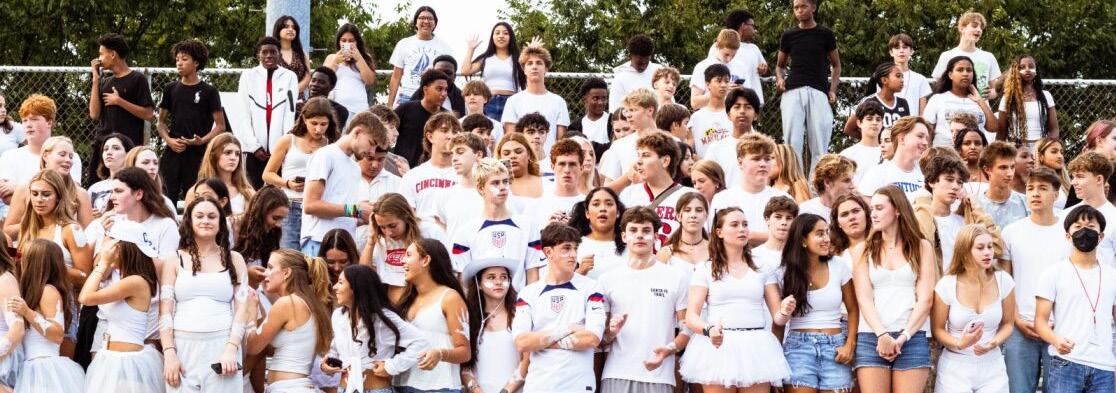
los atletas se merecen por jugar un partido muy pesado. “Yo puedo escuchar la mayoría de cosas desde las gradas” dijo Sam Nosoff, el entrenador principal del equipo de fútbol americano de los Blair Blazers.
Aunque varios de los Blazer Ragers van a todos los partidos de fútbol americano aquí en Blair, la mayoría de gente no va a los partidos que son organizados por otras escuelas como Gaithersburg, Germantown, Cloverly y muchos más lugares un poco alejados de Silver Spring. Para aquellos Blazers que estén interesados en participar, es muy fácil. “Los estudiantes que van a ser seniors pueden seguir con la aplicación que subimos a nuestra instagram @blazerragers que subimos al final del año escolar”. Dijo Noa Heirtzler, la Blazer Rager oficial. Cualquier persona puede ser parte de este grupo, sin importar si es un atleta o no. Normalmente escogen las personas que cumplen con los criterios de alguien que sea muy energético y ruidoso.
Por MURILO DOS SANTOS y MARIA ESPINAL
En un mundo donde los niños aprenden a deslizar un iPad antes que a leer, la pantalla ha tomado el rol de los padres. Una nueva forma de crianza digital ha surgido de videos como CoComelon. Pero detrás de su aparente inocencia y modernismo, los videos de alta estimulación son diseñados para estimular los cerebros de los niños y mantenerlos enganchados, lo que afecta negativamente su salud, su aprendizaje y sus habilidades sociales.
Los videos de alta estimulación son caracterizados por acción rápida, colores brillantes y música pegajosa. Es innegable que estos videos ofrecen ciertos beneficios.
Julia Smrek, la profesora de psicología en Blair por 25
aprendizaje, y las transiciones rápidas en los videos pueden estimular la corteza auditiva y visual, mejorando la capacidad del cerebro para procesar información rápidamente”. Aunque estos videos pueden traer algunos aspectos positivos, estos beneficios no compensan por los efectos negativos que ven fácilmente superados.
Dra. Melissa Dvorskey del Hospital Nacional Infantil, explicó en una entrevista con ABC 7 que, “Cuando los niños ven programas como CoComelon antes de los 2 años, se nota que a los 9 presentan más dificultades con sus funciones ejecutivas”. Estas funciones ejecutivas—como la memoria, el control inhibitorio y la flexibilidad cognitiva—son esenciales para el desarrollo mental. Por eso, los niños menores de tres años corren un mayor riesgo de no desarrollar plenamente estas habilidades.

Según la Asociación Americana de Psicología (APA), un niño típico juega videojuegos por 40 minutos cada día, y asiste entre 1,8 y 2,8 horas de televisión a diario. Casi un tercio de los niños y adolescentes gastan más de 4 horas al día en las pantallas. Como explicó la profesora Julia Smrek, “Cuando los niños miran estos videos, quieren seguir mirándolos; ahí comienza la adicción”. Esta dependencia en la estimulación crea una distracción constante que interfiere con el proceso de aprender nuevas habilidades y materiales.
Además de dañar la salud cognitiva y el aprendizaje, estos videos alteran el desarrollo social de los niños. La Sra. Smrek añade, “Mirando estos videos puede afectar cómo los niños se comportan fuera de casa. Un niño acostumbrado a tanta estimulación podría aburrirse rápido y buscar actividades más intensas para mantener su cerebro activo”. Esencialmente, nuevas actividades pueden causar daños a las relaciones a la par de niños afectados por el inesperado comportamiento que puede subir.
Las desigualdades sociales y laborales que enfrentan muchas familias latinas en los EE.UU. crean un ambiente donde la presencia familiar y los recursos monetarios son limitados, aumentado la dependencia en los videos como sustituto de atención y cuidado infantil. Un estudio hecho por la Institución Nacional de Salud (NIH) muestra que, “A los seis meses de edad, los niños de familias con educación superior fueron expuestos a 1 hora y 42 minutos menos por día en comparación con los hogares con educación más baja”. Esto revela que el nivel educativo de los padres puede influir directamente en el tiempo frente a las pantallas de los niños. De acuerdo con un informe del Consejo Americano de Educación, los latinos y hispanos tienen las tasas más bajas de los otros grupos étnicos. Esta desigualdad educativa tiene consecuencias laborales claras: según un informe de la Oficina de Estadísticas Laborales de los Estados Uni-
dedicarse a la crianza de sus hijos. Por consiguiente, los padres necesitarán depender de la tecnología para entretenerlos y enseñarles. Además de los factores económicos, las dinámicas migratorias y lingüísticas también influyen en el uso de los videos. El NIH señala que los padres inmigrantes enfrentan desventajas como su limitado conocimiento del sistema educativo y las barreras del idioma. Estas condiciones dificultan su participación en el aprendizaje de sus hijos y fomentan la necesidad de alternativas accesibles. En muchos hogares donde se habla únicamente español, resulta conveniente recurrir a videos en inglés que parecen educativos y que exponen a los niños al idioma desde temprana edad. Con estos factores en mente, familias hispanas y latinas serán afectadas de una manera desproporcionada por el acceso que los niños pequeños tienen a videos de alto estímulo. En un mundo digital, donde existe una urgencia por promover
alternativas a las pantallas para entretener y enseñar, es necesario promover la interacción (que no sea virtual), la creatividad y la autonomía. Este problema no afecta solo a los niños, sino a personas de todas las edades. El ciclo necesita ser interrumpido, y las comunidades que rodean a los niños deben liderar por ejemplo primero, uniéndose para compartir apoyo, conocimiento, y promover interacciones reales fuera de la pantalla. No se trata de eliminar la tecnología, sino de eliminar la dependencia de ella. La adaptación a nuevas herramientas sin quedar controlado por ellas, permite a las futuras generaciones un futuro más humano y saludable. En contrario a lo que muchos dicen, “la próxima generación está perdida”. El desafío es aprovechar los avances tecnológicos sin perder lo que hace humana a la vida. Al final, se trata de mantener el control: no dejes que la pantalla te controle.
¿Mejorar o empeorar?
Por ALENA AHN, CANDELA RUBINI LAFUENTE y STELLA THEISMAN
Algunos cambios para el año escolar de 2025-2026 se realizaron el verano pasado por las Escuelas del Condado de Montgomery (MCPS por sus siglas en inglés). Se crearon varias políticas, entre ellas, las nuevas políticas sobre las notas, los permisos de pasillos y los teléfonos.
Una de las nuevas políticas dicta que los estudiantes pongan sus teléfonos en la mochila durante la clase. Si no cumplen, después de un recordatorio, los maestros pueden poner el teléfono del estudiante en una bolsita azul con cierre magnético. El estudiante puede llevar la bolsita, pero no podrá usar el teléfono hasta el final del día, cuando deberá buscar a un miembro de seguridad para abrir la bolsita. Al inicio del año escolar, las bolsitas azules no estaban disponibles. Pero la administración de Blair vio que a muchos maestros les gustó la idea. Por eso, se destinó una porción del presupuesto a las bolsitas. Dentro del primer mes del año escolar, cada maestro recibió tres bolsitas. Las bolsitas han sido mayormente efectivas. Sean Rada, un maestro de inglés del programa de Artes de la Comunicación, dice que la política funciona tan bien que usualmente no necesita usar las bolsitas. Él dice que “la mayoría de los estudiantes guardan los teléfonos en la primera advertencia”. Sin embargo, los estudiantes tienen una perspectiva diferente. “Es algo incómodo porque no nos permite, por ejemplo, avisar si pasó un accidente a nuestros padres”, dice

Salomé Betancur, una estudiante de duodécimo grado. Pero Betancur reconoce que, “está bien que ellos hagan eso para que podamos poner atención en las clases”. MCPS también implementó un sistema nuevo de permisos de pasillos. Ahora, los permisos son electrónicos, y están conectados a las identificaciones de los estudiantes, que se deben llevar puestas todo el día escolar. Para salir de clase, los estudiantes solicitan un permiso en la aplicación de StudentVue especificando el lugar al que irán y el número de minutos que se demorarán. Cuando su maestro aprueba la solicitud, el reloj empieza a contar. El sistema notifica a los trabajadores de seguridad cuando los estudiantes salen de las clases y cuando vuelven a la clase. Tiffanie Rivers, una trabajadora de seguridad, dice que, “ahorra tiempo para identificar a los niños y a cuánto tiempo han estado fuera”. Permite al equipo de seguridad ser más eficiente. “Es un sistema bastante genial”, dice Rivers. Pero es más complicado
para los profesores y estudiantes. Rada dice, “Si estoy impartiendo una lección, es una gran interrupción ir [a mi escritorio] y hacer los permisos”. Sin embargo, dice que está “contento de que haya un sistema”. Igualmente, Desiree Balla, una profesora de biología de honores, dice, “Aunque sea un poco más difícil para mí, creo que saber dónde está cada estudiante es importante”. Por otro lado, muchos estudiantes no están de acuerdo. “No me gusta el sistema de los permisos porque no es muy… conveniente”, dice Michelle Nee, una estudiante de undécimo grado. Hay profesores que no revisan las computadoras, y el sistema nuevo tiene más pasos para emitir un permiso. “Es más fácil solo usar los pases que no son digitales”, dice Nee.
La última política que MCPS implementó es un cambio en cómo se calculan las notas. Desde el 2016, la nota que los estudiantes recibían para el semestre era, por mayor parte, la nota más alta de los dos cuartos. Es decir, las
notas se redondeaban hacia arriba. Esto creaba un problema de inflación de notas y un sistema en el que los estudiantes podían aprobar las clases sin asistirlas durante los dos cuartos. “Antes [de la política nueva], las tareas a veces se entregaban, a veces no,” dice Balla. Este año, la nota final para cada semestre será el promedio de los porcentajes de cada cuarto. ¿Pero cómo afecta la política a los estudiantes?
Balla dice, “mis estudiantes están mucho más pendientes de entregar su tarea”, y Betancur afirma, “me esfuerzo más de lo que estoy dando”. Sin embargo, hay quien piensa que el cambio también podría afectar negativamente al promedio de los alumnos. Una consejera de Blair, quien habló de forma anónima, afirma que ciertos estudiantes batallarán más con la política. Dice que está “preocupada por algunos estudiantes… que utilizaban [la anterior política] para impulsarse a sí mismos”. Pero también, ella dice que la nueva política afectará positivamente a la asistencia en Blair. Dice, “en aquel entonces fue como, vale, voy a venir a la escuela para el primer bimestre…Y una vez que lo apruebe, sé que no tengo que asistir [por el resto del semestre].” Obviamente, los estudiantes necesitan asistir a sus clases para aprobarlas. Ahora tienen que aprobar los dos cuartos para aprobar el semestre, entonces necesitan asistir a los dos cuartos para aprobar cada semestre. Y como muchos han sugerido, la consejera afirma que la política responde a la inflación de notas en MCPS. Como ella asegura, las universidades verán que “estamos dando responsabilidad a nuestros estudiantes” y “tomarán nuestras notas un poco más en serio”.
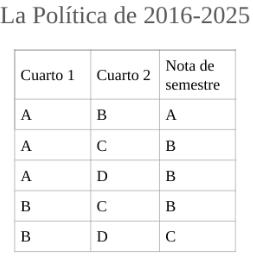
Durante tiempos de incertidumbre, los grupos más afectados por los cambios de administración se unen para crear espacios de apoyo y recursos. La escuela de Montgomery Blair es reconocida por muchos estudiantes y familiares como un centro que respalda a comunidades impactadas por dificultades en la escuela o en casa. Dentro de este artículo podrán encontrar organizaciones que podrían ayudarles a usted o a un conocido afectado por cambios migratorios. Muchos conocen a esta organización como los que ayudaron coordinar la caminata de “Educación no deportación”. Este grupo de sin fines de lucro se llama Students FAIR. Es una organización alrededor del condado de Montgomery que se enfoca en apoyar a comunidades migrantes. Actualmente, existen capítulos de Students FAIR en 22 de las 25 escuelas secundarias del condado. Esta organización fue establecida por un grupo de jóvenes durante la pandemia de COVID-19 y la primera administración del presidente Donald Trump. A raíz de las deportaciones que ocurrían dentro de las familias del condado, muchos empezaron a sentir pánico e incertidumbre. Students FAIR creó una fuente de recursos para los estudiantes afectados y los aliados de la comunidad. Desde que fue creado, FAIR ha podido abogar por familias indocumentadas dentro del Congreso Estatal. Uno de los logros más impactantes de FAIR ha sido pasar legislación que se enfoca en prohibir a nuestros oficiales de policía trabajar en conjunto con agentes federales como ICE. Presidenta del capítulo de Students FAIR en Blair, Daniela Render-
os cuenta que, “ahorita queremos educar a nuestra comunidad y quitar el miedo que proviene de la desinformación que circula en las redes sociales, queremos asegurarnos de que la comunidad de Blair se mantenga informada”. Para los estudiantes y familiares interesados en esta organización, contacten a la cuenta de Instagram @students.fair o en su sitio web https://shorturl. at/gnyRY y manténganse conectados con el capítulo de Students FAIR dentro de Blair. Al llegar a una nueva escuela, muchas veces uno se puede sentir aislado o confundido, particularmente en una escuela enorme como Blair. En un intento de unir amistades y crear conexiones, el programa de mentoría fue creado por la Sra. Block, maestra de Blair. El propósito de este programa es poder formar conexiones a través de la escuela y enseñar a nuestros compañeros sobre oportunidades dentro Silver Spring. Desde el inicio del programa de mentoría, la señora Block ha podido trabajar con estudiantes que conocen lo dentro y lo fuera de Blair y conectarlos con estudiantes recién llegados. La Sra. Block cuenta que, “el mejor proyecto que ocurrió el año pasado fue visitar a estudiantes del octavo grado y poder crear una conexión con los estudiantes de Blair antes de su llegada en este nuevo año escolar”. El programa de mentoría no solo crea nuevas amistades, sino que también informa a nuestros Blazers de recursos no siempre conocidos. Si estás en búsqueda de nuevas amistades y en crear una red de apoyo, contacta a la Sra. Block en Hannah_M_ Block@mcpsmd.org o visítala en el salón 262 para obtener más información. Kindness Corner, la esquina de la bondad, es un recurso
dentro de Blair que fue creado para poder asistir a familias durante tiempos de necesidad. Un beneficio de esta organización es que es una fuente de conexiones que sirve como un respaldo. Desde colectas de ropa, comida o artículos para el hogar, uno puede encontrar lo que se necesite en Kindness Corner. Si está interesado, puede contactar a la Sra. Farzaneh Nabavian, la Coordinadora de Padres en Blair en su número de teléfono 240-506-8576 o farzaneh_nabavian@ mcpsmd.net.
La comunidad de Blair siempre estará disponible para compartir recursos y extender una mano de apoyo en tiempos de necesidad. Contacten a estas organizaciones o a cualquier Blazer para seguir floreciendo nuestras contribuciones al bienestar de nuestra familia de Blair.

con Nate
Por NATE VIECHNICKI
Camerún es uno de los países más lingüísticamente diversos del mundo. Ubicado en el oeste de África, esta nación de 30.000.000 alberga más de 250 lenguas indígenas, la mayoría de los cuales pertenecen a la familia lingüística Bantu. Por esta razón, muchos lo llaman “África en miniatura”, porque representa un microcosmo del continente entero, ya que es tan diverso. El país tiene dos idiomas oficiales, el inglés y el francés, un resultado directo de su historia colonial bajo Francia e Inglaterra. Tras la Primera Guerra Mundial, Camerún fue dividido entre Francia y el Reino Unido, quienes impulsaron sus idiomas en las regiones sur y norte, respectivamente. Hoy, el francés predomina en la mayor parte del territorio, mientras que el inglés se concentra en las ciudades grandes, como la capital, Yaoundé.
Por mayor parte, las lenguas indígenas del Camerún pertenecen a la familia lingüística Bantu. Entre las más conocidas se encuentran el ewondo, el bulu, el douala, el bamileké y el fulfulde, cada una con su propia tradición oral. Lo único de esta familia es el predominio de estructuras aglutinantes, o sea, la construcción de palabras con varias morfemas. Una palabra en un idioma aglutinante puede comunicar el aspecto, el modo, el tenso, incluso la manera en que uno ha aprendido la información que dice.
Martine Laney es una residente de Silver Spring camerunesa, y ella habla nada menos que siete idiomas con fluidez. Su idioma nativo solo se habla por unas 9.000 personas en Akonolinga, la ciudad donde se crió. “Mi lengua materna se llama Sso’o. Es mi lengua materna, como la llamamos en Camerún. Aprendí el Sso’o en casa, de mis abuelos y de todos que estaban en mi pueblo”. Aunque tenga una población pequeña, el Sso’o sigue siendo un idioma vibrante y vivo. “Comunico en el Sso’o lo más, porque la mayoría de mi familia lo habla”, dijo. A pesar de la vitalidad del Sso’o en la comunidad de Akonolinga y la familia de Laney, muchas lenguas camerunesas enfrentan el riesgo de desaparecer. En la mayoría de las escuelas, la enseñanza se imparte únicamente en francés, lo que limita la transmisión de las lenguas maternas a las nuevas generaciones. Segun Ethnologue, 96 de las lenguas camerunesas enfrentan el riesgo de desaparecer en la próxima generación. “En las ciudades, las personas que crecen en ellas suelen olvidar un poco sus lenguas y a hablar en francés e inglés. Esta es la generación más joven, aquellos que no aprenden sus lenguas nativas”. Sin embargo, diversas organizaciones y universidades están trabajando para documentarlas y promover programas de educación multilingüe. La diversidad de lenguas en Camerún representan su pasado y futuro, con cada idioma representando una forma única de entender el mundo. En un país con tantas voces, los idiomas son más que medios de comunicación, sino la historia del pueblo.
Por LIVIA ROSENBERG
Este año escolar ha llegado a Blair la Señora Garcia-Ruiz, nueva maestra del teatro y directora de las obras escolares. García-Ruiz se graduó de la escuela secundaria Blake en 2018 y obtuvo un título en Teatro y Educación, otorgado por la Universidad de James Madison. El año pasado, trabajó como paraprofesional en Blair y ahí fue cuando oyó que la Señora O’Connor, la antigua directora del teatro, se iba a jubilar. Pensó que esta sería una gran oportunidad y consiguió la posición después de una corta entrevista.
La Señora O’Connor dirigió las obras teatrales de Blair durante 27 años, y contribuyó mucho al teatro. Ella cultivó un programa fuerte, dinámico y reconocido en el condado. La nueva dirección marca un gran cambio en el teatro de Blair, pero O’Connor no se preocupa. “[García-Ruiz y yo] miramos a las necesidades del programa de maneras parecidas. Estamos
en la misma página con la celebración de la diversidad de Blair a través del reparto”, dijo. Para los actores, la nueva directora trae nuevas ideas y nuevas maneras de crecer en su disciplina. Pero agradecen que perdurará el énfasis en la diversidad, porque es un pilar fundamental del programa. Marcella Verchinski, una directora estudiantil, comentó
“Todos necesitan ser representados, porque es una buena manera de conectar con personas que son diferentes de ti y expresar nuestras opiniones”.
Marcella Verchinski
que, García-Ruiz agregó, “Si no te ves representado en el teatro, contáctame para intentar hacerlo realidad”. La audiencia debe verse reflejada
en el reparto cuando miran una producción. Otro cambio que trae García-Ruiz es enfocarse más en las voces estudiantiles. El reparto consta de 53 actores y 6 directores estudiantiles y cada uno tiene sus propios estilos de actuar e ideas para mejorar la producción. A pesar de que parece estresante, para García-Ruiz es importante que se les escuche a cada uno. “Creo que los jóvenes tienen las mejores ideas, y si no les escuchamos, no nos abrimos a un mundo de creatividad y posibilidad, especialmente en el teatro”, dijo.
Sofía Saz, una actriz, se trasladó a los Estados Unidos desde España hace 2 meses. Decidió unirse al espectáculo porque ha actuado por varios años y la obra le llamó la atención. Aunque tiene bastante experiencia en el mundo del teatro, presentar una obra en una lengua extranjera genera algunos desafíos, sobre todo una de Shakespeare. Pero García-Ruiz ha promovido una comunidad en que Saz puede desarrollar
Por ANYELI MUÑOZ RODRIGUEZ y JOCELYN NOLASCO FERNANDEZ
Imagínate ver las noticias de ICE en Washington D.C. en la sala con un amigo cercano, cuando de repente saca sus audífonos y se los pone. ¿Será pura casualidad o coincidencia? En la realidad actual, este acto, por más insignificante que parezca, tiene un significado mayor para algunas personas: es una manera de bloquearse de las noticias. Esto refleja lo que llamamos la “fobia oculta” o la “infodemia”: un miedo o aversión hacia algo tan común en nuestra vida cotidiana como las noticias. En los tiempos que vivimos, uno de los temas más frecuentes en los noticieros es la inmigración. En la
sociedad actual, las noticias juegan un papel fundamental al mantener comunicadas a las personas sobre sucesos importantes, cambios en leyes, políticas y situaciones globales. Sin embargo, para algunos individuos, el simple hecho de escuchar noticias se convierte en una fuente de ansiedad, desconfianza e incluso en rechazo hacia la información. Josue, un individuo impactado por la infodemia, en su entrevista, comenta: “El punto de no ver las noticias es por que me puede afectar mi vida cotidiana… como por ejemplo el estado emocional hay noticias que pueden impactar demasiado y pueden no ser tan agradables.” Él explica que, aunque pueda parecer un acto insignificante, evitar escuchar noticias o incluso ponerse audífonos cuando alguien empieza hablar de ellas, refleja una manera de protegerse emocionalmente. Según estudios de Mental Health
America, la exposición constante a noticias negativas libera hormonas como la adrenalina y el estrés, lo cual puede generar ansiedad, depresión y una sensación de estar bajo amenaza. En este sentido, las noticias no solo informan, también impactan directamente en la salud mental de las personas. Por otro lado, hay gente que comparte que suele cambiar de conversación cada vez que escucha hablar de noticias especialmente relacionadas con la inmigración. Este tema le genera incomodidad debido a la incertidumbre que provoca en muchas familias y el efecto negativo que los medios transmiten sobre el mismo. Para ella, escuchar noticias puede afectar su estado de ánimo e incluso hacerla sentir vulnerable. Sin embargo, también recon - oce que evi- tar las noticias la ha llevado en oc -
sus habilidades teatrales simultáneamente con sus destrezas de in glés. “[García-Ruiz] es muy maja, es muy amable, la verdad. Me encantan las ideas que tiene, plica todo de una mane ra clara concisa”, co mentó Saz. Este otoño, los miembros de Mont gomery Blair Players están realizando una producción de Romeo y Ju lieta que toma lugar en el mundo de Love Island, un programa de telerrealidad donde solteros se encuentran para buscar el amor en una villa tropical. Los protagonistas son contendientes en el programa; sin embargo, el tema del amor prohibido perdura. Para GarcíaRuiz, esta ramificación tenía el objetivo de atraer a los que no tenían experiencia en el teatro. “La meta es abrir puertas con este tema porque [los estudiantes] se
asiones a creer información falsa o poco confiable, la cual representa un problema adicional.
Aunque las noticias cumplen la función esencial de mantener informada a la sociedad, también pueden convertirse en una carga emocional. Mientras Josue subraya el impacto en la salud mental y el estrés que generan, Anyeli Ramos destaca la desconfianza y el temor que provocan ciertos temas sensibles, como la inmigración.
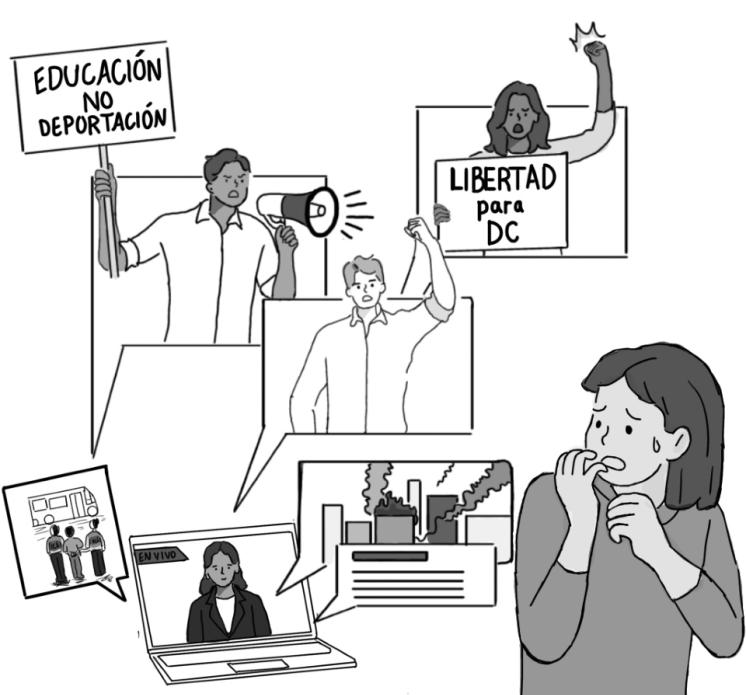
Como resultado de las noticias, la inmigración se ha convertido en un tema frecuente y de gran relevancia, especialmente entre la comunidad hispana. Muchas personas eligen protegerse evitando las noticias por completo para no exponerse a historias negativas sobre deportaciones y políticas migratorias, que se han intensificado en los últimos meses con la administración del presidente Donald J. Trump. La señora Silvana Brinkman, maestra de Salud en Blair, comenta “yo siempre escuchaba las noticias en el carro, noticias y más noticias, pero en tiempo a la fecha ya no trato porque me ponen triste, me preocupan, por mis estudiantes, por sus familias que son afectadas por las noticias.” Para muchas comunidades hispanas, los posibles prejuicios contra los hispanos por su apariencia generan miedo y ansiedad, afectando directamente la salud mental de quienes viven con la constante preocupación de ser discriminados o separados de sus familias. De igual manera, la señora Brinkman comenta: “Las noticias están muy pesadas…y esto puede causar que [la comunidad latina] se sienta atacada, en
a dar cuenta de que la lengua es más
ble en
una obra teatral que leerla en una clase de inglés”, declaró. El espectáculo se realizará el 13, 14, 15, 20, 21, y 22 de noviembre. Los boletos se venden en GoFan y cuestan $15, o $10 para estudiantes. García-Ruiz concluyó con su mantra: “El teatro es vida, y es la vida que nos rodea”. Mientras el auditorio busca sus asientos y las luces se apagan, empieza el espectáculo de la Señora García-Ruiz.
riesgo, y esto puede causar miedo en sus trabajos y que en ningún lugar se sientan seguros y protegidos por el simple hecho de vernos como nos vemos de ser latinos.”
Por ende, alejarse de los medios de comunicación es una necesidad para presentar la paz y la salud mental que las noticias para muchos individuos. “Con todas esas cosas en la cabeza, me parece que el mundo está lleno de odio, muchas noticias, y de pronto no se ve que hay una luz al final de ese túnel, lo que puede llevar a uno a un lugar más oscuro.”
Por otro lado, al no ver las noticias por culpa de la saturación negativa que implican, también perdemos eventos de nuestro alrededor en la vida cotidiana que son indispensables. Al no estar informados de las noticias actuales, se puede perder la noción del tiempo y de los eventos importantes de la comunidad y del mundo actual, lo cual afecta mucho a las comunidades hispanas. Sin embargo, el apoyo en la comunidad es esencial para seguir adelante. La gente no está sola; hay muchos individuos que piensan y sienten lo mismo. Es vital encontrar espacios donde las personas puedan expresar estos miedos de forma abierta y darse cuenta de que no están solos, sino que forman parte de un grupo que comparte experiencias similares y que enfrenta los mismos miedos que uno para poder conectarse y construir una comunidad de apoyo.
La Sazón de Latinoamérica es muy famosa y bien reconocida por sus platos como las arepas, los tacos, las pupusas y más. Estas comidas se han popularizado más con la ayuda de compartir culturas. Tener el placer de vivir en un área muy diversa con varias culturas latinas alrededor de nosotros es algo que hay que aprovechar.
A solo nueve minutos, por la calle Piney Branch, encontramos La Casita, un restaurante salvadoreño reconocido por sus pupusas de maíz y arroz y una de las más famosas pupuserias de Silver Spring, que es un restaurante para la familia. Cada pupusa cuesta cerca de tres dólares.
Alrededor se pueden ver diferentes tipos de panes para el café, churros y más platos típicos de El Salvador. La Casita se llena
todo el día, especialmente los fines de semana y cuando El Salvador está jugando un partido de fútbol. Un salvadoreño se puede sentir como en casa sabiendo que hay un lugar muy parecido a la patria.
Al llegar es un poco difícil encontrar parqueo, pero también se podrá parquear al otro lado, por la tienda de Benjamin Moore. Entrando a La Casita te encuentras con el amor salvadoreño que a todos les encanta. La Casita es reconocida por ser un restaurante de sabrosas pupusas, que cuando les dan una mordida el queso se escapa por todas lados.
Para poder probar una variedad de pupusas, encargamos ocho pupusas, frijol con queso de maíz y arroz, revueltas de maíz y arroz, pollo de maíz y arroz, y loroco de maíz y arroz. Nos dieron una bolsa llena de repollo y un recipiente de plástico con salsa de tomate al lado de

las pupusas. Con un grupo de 5 estudiantes de la Esquina Latina podemos decidir que para nuestro propio gusto de sabor las pupusas de maíz eran más ricas. A todo el grupo les gustó las pupusas de frijoles. La pupusa de frijol con queso fue la número uno en nuestra categoría, que quedó establecida de la siguiente manera: 1. Frijol con queso (maíz), 2. Revueltas (maíz), 3. Pollo (maíz), 4. Loroco (maíz) después van las de arroz. Para nosotros, las de arroz se sentían algo resecas comparadas con las de maíz. Fuego Latino es un nuevo restaurante localizado por Flower Ave y Piney Branch. Este restaurante se especializa en pollo al estilo peruano, pero también tiene tacos de birria y varias diferentes aguas frescas. Un pollo entero cuesta 28$ con tres acompañamientos como plátanos fritos, arroz amarillo, frijoles, y más. El paquete también viene con cuatro bebidas de lata. El paquete especial es algo barato en proporción con la cantidad de comida que trae y fue una recomendación del cajero cuando vio que no sabíamos qué comprar. Los trabajadores fueron muy amables con todos los clientes que caminaban por la puerta. Vimos a varios de latinos llegar al restaurante durante sus almuerzos de trabajo y ordenaron varias cantidades de pollos peruanos con una coca-colas bien heladas. La música latina
sonaba al fondo. El pollo era muy jugoso y de un sabor muy rico. El arroz era excelente, de un sabor inexplicable. El plátano frito era rico, aunque estaba un poco seco. Fuera de toda la construcción por el centro de Silver Spring se encuentra un restaurante colombiano y venzolano llamado Arepas Pues que trae la pasión por la cocina de esos países. Desde su apertura en 2016, Apreas Pues se ha dedicado apasionadamente a llevar los vibrantes y ricos sabores de la cocina colombiana y venezolana a nuestra comunidad de Silver Spring. Es un restaurante con varios elementos hispanos. Había varias personas de Doordash que llegaban a recoger los pedidos a cada rato. Arepas Pues consta de diferentes tipos de arepas. Encargamos una de pollo, una de cerdo, una de carne asada, y una más de aguacate. También tiene varias bebidas diferentes, como mango, jamaica, maracuyá y más jugos. Las arepas estaban buenísimas, llenas de sabor y sazón. Las arepas eran algo pequeñas por el precio de $2.50 Con tanta cultura latina a nuestro alrededor, es importante conocer toda la variedad gastronómica que podemos aprovechar para disfrutar del buen comer. En cada está esperando una nueva experiencia gracias al sabor de la comida latina.
Por KRISTEN LLERENA y PRIYA TAPIA-PEREIRA
El 21 de agosto de 2025, la Casa Blanca publicó una declaración llamada “el Presidente Trump está correcto sobre el Smithsonian” donde demandan al Museo del Latinoamericano por promover “una exhibición anti-americana que define a la historia latina como siglos de victimización y explotación”. El Museo Nacional del Latinoamericano, también conocido como NMAL, fue fundado en 2021 a través del Acto Latinoamericano de 2020. Desde entonces, el museo se ha caracterizado por promover el arte e historia latina en los museos del Smithsonian con la meta de construir su propio museo dedicado a la historia latina en EEUU. La primera exhibición que crearon fue, ¡Presente! Historia Latina en EEUU, en colaboración con el Museo Nacional de Historia Americana, conocido como NMAH por su abreviatura en Inglés. Esta exhibición contenía arte y artículos sobre los temas de immigración, identidad, y el legado latino. Sin embargo, tan pronto como surgió la declaración publicada por la Casa Blanca, el NMAL ha cerrado su única exhibición ubicada en el NMAH. A través de una orden ejecutiva, el Presidente Trump prohibió donar fondos para exhibiciones o programas que degraden los valores estadounidenses. La Casa Blanca identificó NMAL como una de estas exhibiciones, exigiendo que “El Museo Nacional del Latinoamericano presenta una exposición antiamericana que define la historia latina como siglos de victimización y explotación, sugiere que Estados Unidos es una tierra robada y caracteriza la historia de Estados Unidos como arraigada en la colonización”. La caracterización que ha hecho el presidente Trump y su equipo presenta un nuevo obstáculo para el museo, tienen que encontrar una nueva manera de poder contar la historia de latinos americanos, sin incluir partes cruciales de su historia.
LA ESQUINA
EDITORES-EN-JEFE
Kyara Romero Lira
Tom Sparshott
ESCRITORES
Alena Ahn
Camilla Chi
Joaquin Contreras-Rushing
Murilo Dos Santos
Maria Espinal
Kenai Fraizer Rayas
Emmy Henriquez
Tokyo Hopkins
Santiago Jímenez
Kristen Llerena
Jacqueline Machado Garcia
Edwin Medrano
Anyeli Muñoz Rodriguez
Emanuel Morales Arene
Jocelyn Nolasco Fernandez
Livia Rosenberg
Candela Rubini Lafuente
Priya Tapia-Pereira
Stella Theisman
Nate Viechnicki
EDITORES DE ARTE
Maria Espinal
ARTISTAS
Sophia Benitez
Michelle Nee
Heaven Meskelu
Aleydis Romero
EDITOR DE DISEÑO
Adanna Akamigbo
ASESORA
Maria Eugenia Tanos
El curador de proyectos latinos en NMAH, Steve Velazquez respondió a la resistencia del Presidente Trump y su administración sobre cómo van a seguir trabajando en proyectos que cuentan historias de grupos minoritarios. “Continuamos haciendo nuestro trabajo, contando las historias de los Esta-
El señor Jimenez, profesor de la clase de historia latinoamericana y alumno pasado de Blair, comentó sobre la actividad reciente de ICE. “Tenemos una comunidad que si ellos creen que el gobierno no les quiere en este país, van a decir, ¿para qué voy a aprender inglés?
¿para qué voy a tratar de conseguir
tra herencia pero que también somos partes de los Estados Unidos, de nuestra comunidad.” Dice el Sr. Jiménez. Este problema va a continuar creando más problemas para hispanos, latinos e inmigrantes en los EEUU, limitando las habilidades de aprender y vivir sin restricciones.

dos Unidos, que es un lugar multifacético…Francamente, estamos perplejos porque la historia latina es una historia estadounidense. Y por eso seguiremos contándoles”.
El cierre de la exhibición del NMAL es solamente uno de los varios incidentes donde el gobierno y la gente en el poder han silenciado latinos e hispanos en nuestra comunidad. Recientemente ha habido una presencia temible de ICE en zonas de escuelas y comunidades mayormente de hispanas y latinas. Esta presencia ha afectado la seguridad de muchos individuos.
trabajo? ¿para qué voy a tratar de hacer todas las cosas por medios legales?” La presencia de grupos como ICE ha causado mucho terror para nuestra comunidad y ha limitado el poder de estar unidos y activos públicamente. En nuestra comunidad, el condado de Montgomery canceló su Festival del Mes de Herencia Hispana en Wheaton debido al temor de la comunidad hacia ICE. “Tenemos una gran comunidad latina en el DMV y para tener estos festivales estamos mandando un mensaje que vamos a tener orgullo de nues-
Los Festivales y celebraciones latinas: A pesar de los ataques hacia la comunidad latina, hay varias maneras en la cual personas están celebrando su herencia latina este mes. El teatro AFI en Silver Spring mostró películas latinas desde el 18 de septiembre hasta el 5 de octubre como parte de su Festival de Cine Latino. En algunas de las muestras de las películas, había presentaciones especiales y discusiones con los directores donde la gente podía aprender más sobre las películas. Muchas de las películas mostradas
rodeaban un tema de justicia social en latinoamérica, con películas sobre cuentos de los tiempos de dictadura en países como Chile, Brasil, y Argentina, y otros temas más recientes como el patriarcado en países latinoamericanos. La gran variedad de temas y contenido de las películas ha atraído muchas personas incluso como estudiante. También en las escuelas, los estudiantes de MCPS se encuentran unidos. Los Titanes Salseros, el grupo de baile latino en Albert Einstein High School, se encuentra especialmente dedicado a la comunidad latina durante estos tiempos, “Somos un equipo de baile latino de secundaria, pero somos más de lo que el mundo imagina de los latinos. Contribuimos a nuestras comunidades ayudando a empresas locales, conectándonos con otras culturas y apoyándonos unos a otros en tiempos difíciles” explicó Savanah Sanchez, capitana y vicepresidenta de los Los Titanes Salseros. Además, el grupo pudo conocer al gobernador Wes Moore y presentarse al frente de la junta de educación, promoviendo la representación latina en nuestro condado. Durante esté mes, los Titanes Salseros han decidido seguir con sus presentaciones y resistir la presión de factores externos.
“Los latinos están en todos lados, y son parte de la tela de nuestra comunidad. Están ayudando a otros y creando una vida mejor. Somos emprendedores, dueños de negocios, trabajadores, académicos, doctores, y en muchos casos tenemos una identidad multicultural de la que nos inspira, que es el cuento verdadero de los Estados Unidos.” dijo Velazquez. El apoyo de otras comunidades no pasa desapercibido. Por eso es importante ahora más que nunca asistir a los eventos
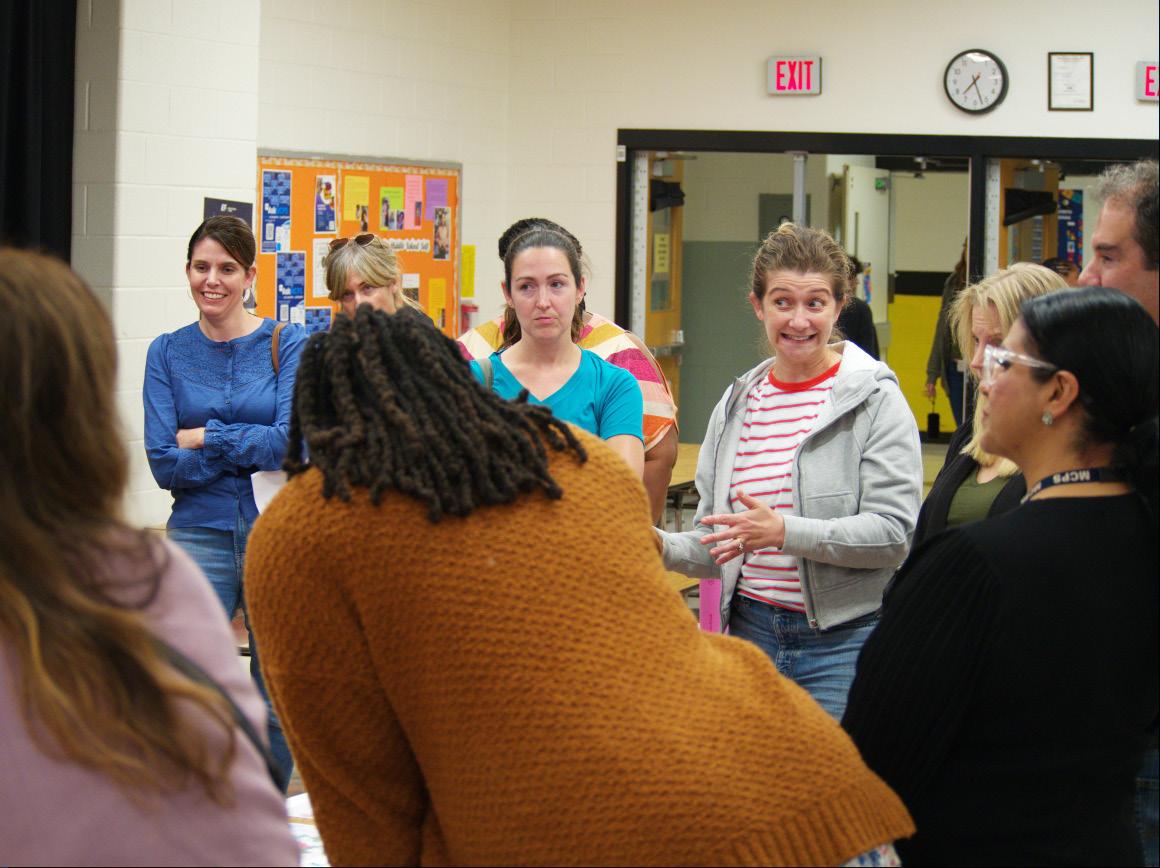
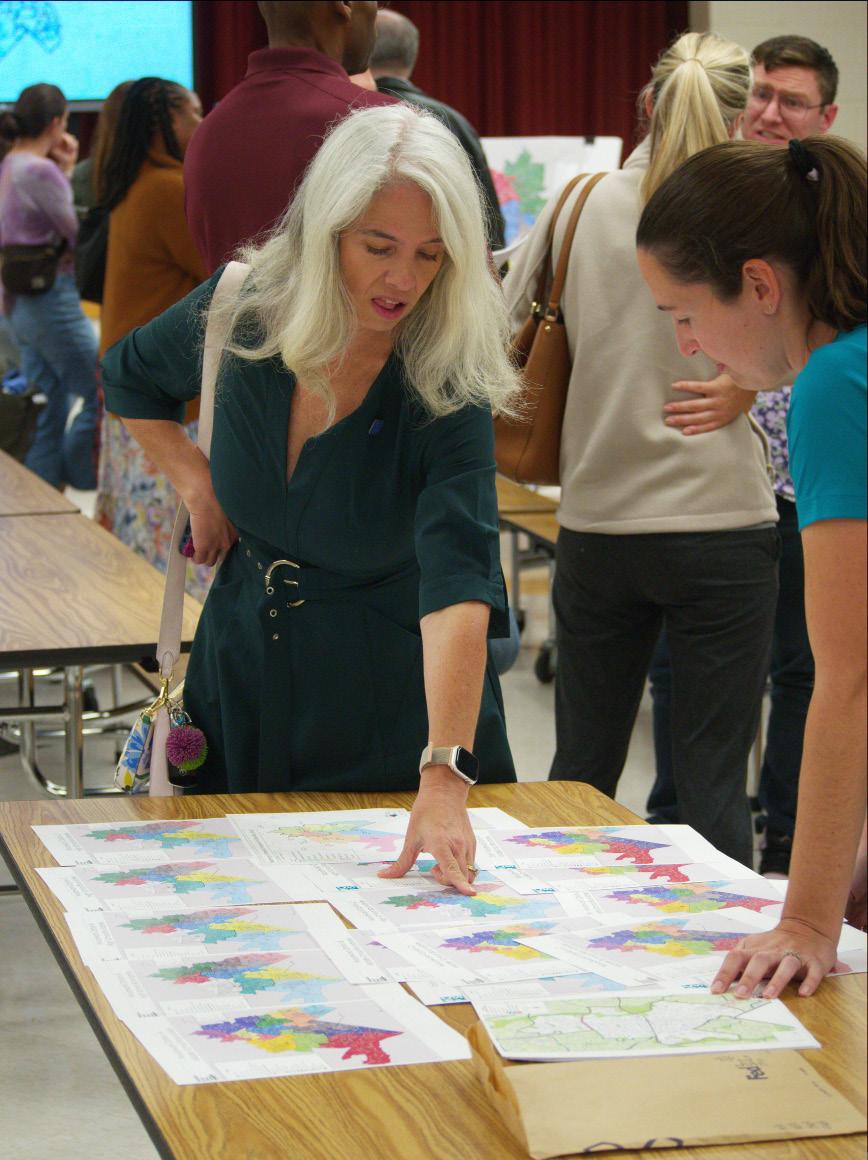
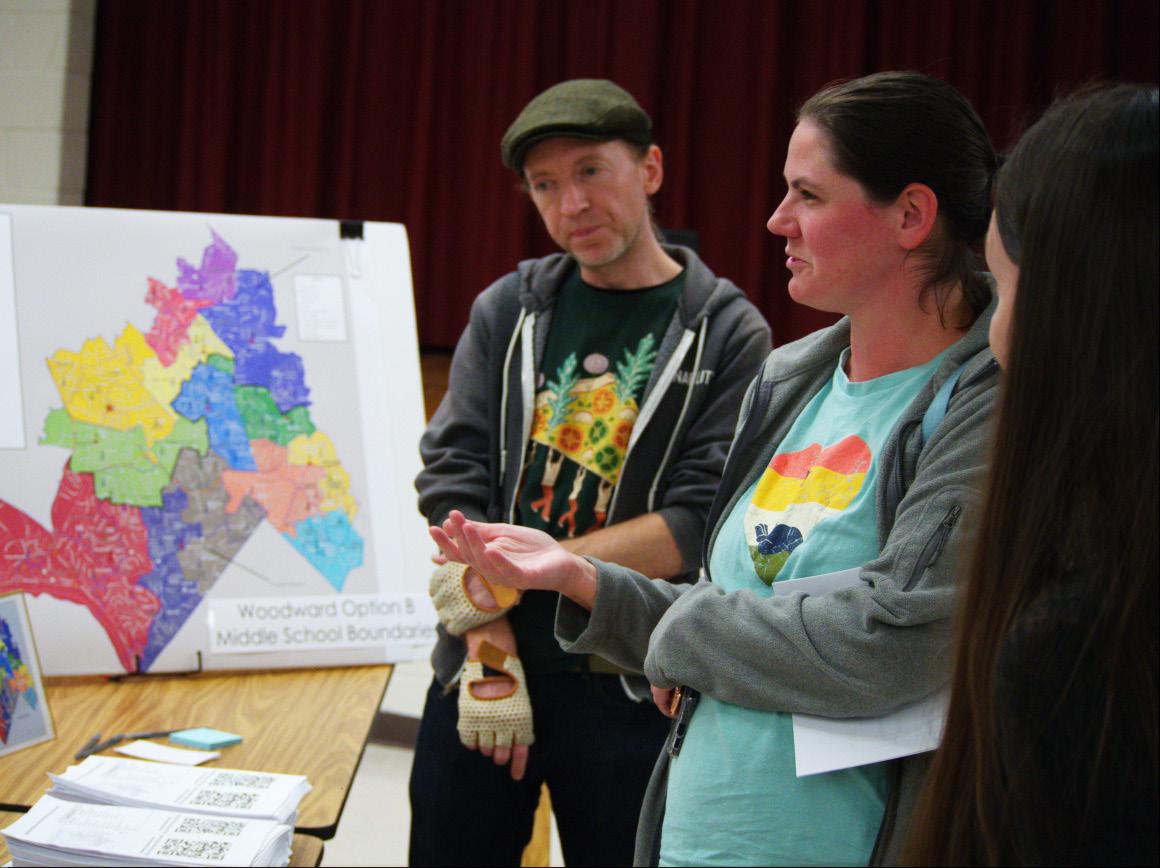
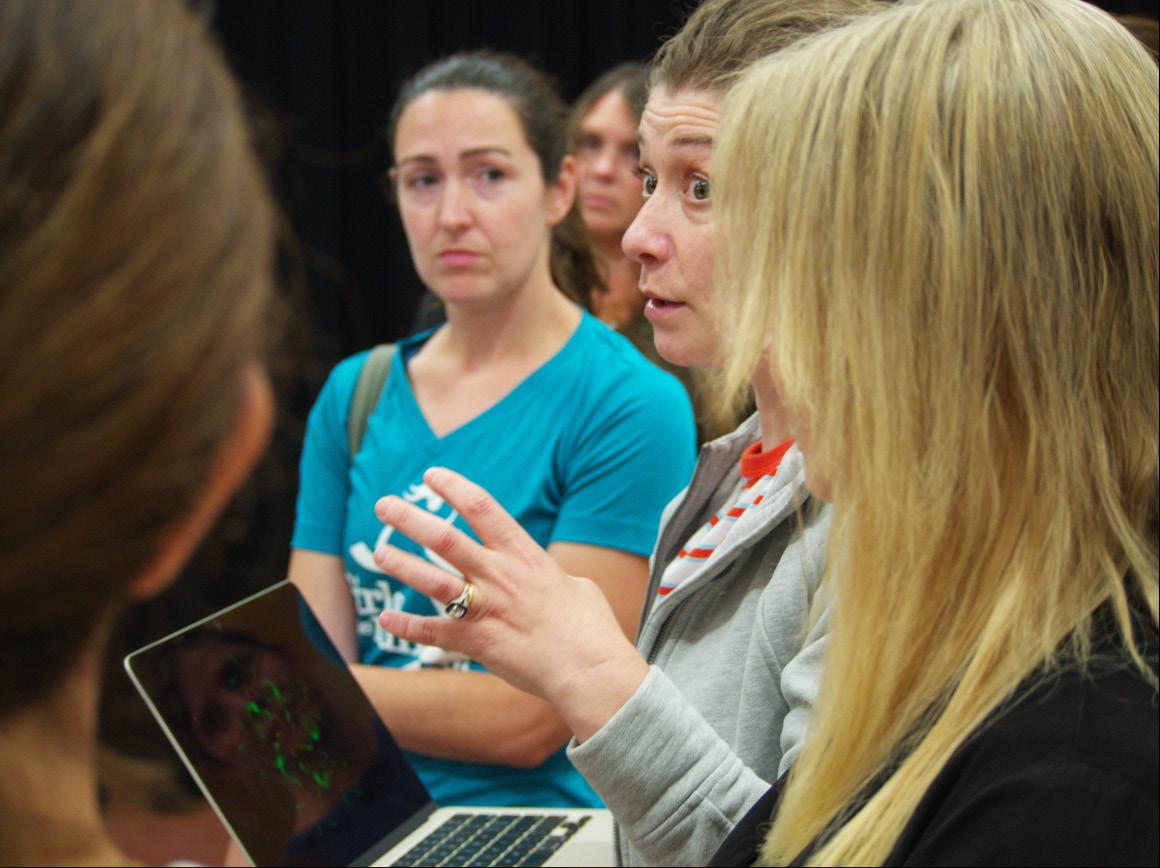

Parents and students across Montgomery County wait anxiously to learn which lines could soon separate their community.
In April 2025, MCPS began a series of community meetings to inform school boundary revisions for middle and high schools, which will shape the district for years to come.
These changes were prompted by four major projects: the opening of the Crown and Charles W. Woodward high schools and the expansion of Damascus and Northwood.
In the 2024–2025 school year, 48 percent of MCPS high schools were overcrowded. According to MCPS Chief Operations Officer Adnan Mamoon, this is a problem that the county’s long-planned projects aim to address. “These two school projects were undertaken because we do have overcrowding at some of our high schools,” he says. “In order to relieve that overcrowding pressure, these two projects were taken on.”
To prepare for the projects, MCPS also launched two boundary studies that will redraw attendance zones and shift student populations. This marks the first county-wide boundary shift in 40 years and the largest in county history, affecting 76 percent of high schools. “When we do bring in
a new high school on board, we have to get the students to fill those high schools, which means that we have to redraw current boundaries,” Mamoon says.
The scale of the impact and uncertainty of how students will be affected has already led to frustration among some parents—particularly if they are already happy with their student’s current school. “I really love that my student can walk across the street to school, [but] our neighborhood is in threat of being zoned away,” Blair parent Melissa Trainer states. “I don’t think that the county should … pull away a neighborhood where [kids] can walk to school and make them go somewhere where they take a bus.”
The changes laid out in the two boundary studies are scheduled to take place during the 2027–2028 school year.
However, how the changes affect students may be dependent on their grade level. Currently, rising freshmen and sophomores are set to be rezoned, while juniors and seniors may be allowed to remain at their current school. “In [the] 2027–2028 school year, if somebody is in 11th [or] 12th grade, the Board may decide to leave them in their current [high school],” Mamoon says. “That’s called grandfathering.”
Crown, which has been in the works for 19 years, has cost the county over $180 million to date. Meanwhile, Wood ward will be reopening nearly three decades after its closure in 1987, when its students were moved to Walter Johnson due to shrinking enrollment. In 1991, the building was used for Tilden Middle School and served students in Bethesda for nearly 30 years. In 2020, the county decided to relocate Tilden and reopen Woodward to relieve overcrowding at Walter Johnson and across the Downcounty Consortium (DCC).
In 2019, the county commissioned a boundary analysis that assessed school boundaries by looking at characteris tics like school diversity, capacity, and student proximity. This boundary analysis was not intended to make boundary changes, but rather to be used to inform future boundary
plan as it is or make changes. After any changes are made, they will take a final vote on the new map. No matter what boundaries the Board adopts, there will likely still be opposition. “I think that the easiest part is agreeing on principles,” Nimlini Rubin, a commissioner on the County Council Redistricting Commission, says. “The hardest part is exactly where you put the line. It’s fraught because the line has got to come down somewhere and someone’s gonna be separated from their neighbor.”
The Crown boundary study will primarily affect students in western Montgomery County, while the reopening of Woodward will have the greatest impact on the Downcounty Consortium. As new plans have been introduced, many parents have voiced concern over the changes and how the decisions were made.
I’m upset because the initial boundaries seemed like they were going to be more equitable and fair to all students ... And then it seems like the parents of the West Side complained, and they got what they wanted… I’m disappointed and confused.

Some, like Brittany Frasseto, a mother of three MCPS elementary school students, felt that the voices of parents from the western part of the county carried greater influence. “I’m upset because the initial boundaries seemed like they were going to be more equitable and fair to all students,” she says. “And then it seems like the parents of the West Side complained, and they got what they wanted … I’m disappointed and confused.”
Another MCPS parent, Danny Legacki, echoes those frustrations. “It seems like the parents on the west side of the county, they understand the system, they certainly benefit the most from it as is,” he says. “They’re the most inclined … to be the loudest.” MCPS, however, maintains that it considers all input equally and that decisions are made with the Parents also expressed frustration with the way information was communicated. Olga Massoc, an MCPS parent, said that the volume and format of updates have left many families overwhelmed rather than informed.

“I find that there’s a lot of communication, but that communication is difficult to navigate
says. “You’re not just limited to only one language.”
Multilingual communication is important in making sure all parents are informed and have the opportunity to be involved. “Sending out these emails in different languages like Spanish or Amharic definitely cures a lot of miscommunication between the school and my parents,” Renetros says.
For the second round of maps, MCPS has included dubbed Spanish versions of their Zoom community engagement sessions, which started on Oct. 6. In addition, there were ASL interpreters present at the in-person engagement session at Eastern Middle on Wednesday, Oct. 8.
Implementation and equity
While some have criticized the inclusion of demographic factors in the analysis, experts emphasize that integrated schools improve education. “There’s a wide body of research to suggest that students will perform better in economically and racially integrated schools,” Richard Kahlenberg, the Director of the American Identity Project at the Progressive Policy Institute, says. “When you start that process earlier at the elementary school level, you can reduce academic achievement gaps.”
Another aspect that leaves some parents frustrated is the fact that they bought their home in an area specifically zoned to a certain high school. “We chose to purchase our home in the 20854 area specifically because it falls within the Wayside–Hoover–Churchill school cluster,” an anonymous parent comments on a Change.org petition against some of the changes. “Like many families, we made a significant financial investment based on the value and reputation of these schools. It feels unfair to alter the school boundaries now, as it would impact families who have already paid a premium
What does the future look like?
As complicated and unclear as these changes may be, they are necessary to address the overcrowding problem in MCPS high schools. “[At] a certain point, lines that were drawn just need to be refreshed,” Rubin says. “Communities have changed, the situation has changed, [and] you need to update where the lines are, where the representation is to reflect the needs of the current residents—not the residents that were here 20 years ago.”
The opening and renovation of high schools and the dis-
The hardest part is exactly where you put the line. It’s fraught because the line has got to come down somewhere and someone’s gonna be separated from their neighbor.

tricting change that they bring are meant to increase opportunities and individualized academic support for students. “I think this [change] is very important because at the end of the day, we want to make sure all of our students get … equitable access to high-quality education,” Mamoon says. “There are certain factors that can hinder our ability to provide that high-quality education, [such as] overcrowded buildings.”

Last year, MCPS commissioned a new analysis, pay ing $1.3 million to the research firm FLO Analytics to conduct two separate studies on the areas affected by the
The two studies both produced four initial boundary options.
Each attempted

Community members had the opportunity to share their thoughts on the potential boundaries with MCPS central of fice through a feedback form and in-person meetings. When the initial maps came out, many voiced negative reactions. Laura Stewart, a Board of Education (BOE) representative, believes that many of the community’s complaints were a result of miscommunication. “When the first maps came out … the communication should have been, ‘Hey, these are just options for you to react to, we will have new maps coming up,’” Stewart says. “Some folks thought, ‘Oh, it’s going to be one of these,’ [but] it’s an iterative process.”
[At] a certain point, lines that were drawn just need to be refreshed ... Communities have changed ... the representation is to reflect the needs of the current residents—not the residents that were here 20 years ago.

she says. “It’s not present digestible format. It’s almost as if by design it’s made abstruse and diffi cult to digest.”

On Oct. 6, four new possible Woodward Boundary Study options in the form of maps came out. The MCPS web page for the boundary study currently notes that further refinement will occur in November, followed by a recommendation to MCPS Superintendent Thomas Taylor in December. According to Stewart, the Board should approve the plan in March 2026. “The superintendent will give [the BOE] a recommendation,” Stewart shares. Once the Board gives its recommendation, it has the decision to accept the
In attempts to quell parental concerns, MCPS central of fice has created opportunities to get feedback from the com munity. “We have had two rounds of public engagement meetings,” Mamoon says. “Some of them were virtual, some of them were in the high schools in the zones … our goal was to make sure that everybody [is] aware of what’s happening and what they can expect in the future phases.”
Multilingual Access
Still, concerns about who exactly has been participating in parent meetings remain.
In an interview with WJLA-TV, Montgomery County Council of Parent-Teacher Associations (MCCPTA) President Bridget Howe expressed frustration that the first round of engagement meetings was held only in English. The only second-language option offered was a translation of the slides in Spanish on the website. “I feel that MCPS needs to do a better job with outreach to the entire parent community and student community,” Howe says. “That includes holding meetings in languages other than English.”
With more than 36 percent of MCPS high school students having received ESOL services at some point in their education, many parents may lack access to information that impacts their families. “[Multilingual access] is very important just because growing up as a bilingual person speaking Spanish or English, I feel like having access to a lot of multilingual resources is really helpful,” senior Daniela Renetros


As families await updates on the final map from MCPS central office and the BOE, parents and students should stay educated on what these changes could mean for them and share their thoughts with the county. “People should know that their input is being taken into consideration, and they should continue to give MCPS input,” Stewart says. “Hopefully, after all the input is gathered and we, again, go back to our policy, … we’ll have maps that … uphold our values.”
term [there could be an impact] but in the medium and long-term … [I] just don’t see that happening.”
Montgomery County has always maintained that school assignments can be changed at any time, and no student is guaranteed enrollment at a particular school. The MCPS webpage for current school boundaries even includes a disclaimer: “Please note the boundaries may change by man-
By VEE DIMYAN
We sit in class and learn about the countless people who have helped change the course of history; some are household names, others are barely known. But, we often forget that each of them was once a teenager trying to navigate life, just like us.
The fact is you’re going to become adults in a very dangerous world and you’re going to need to do everything you can to protect our system ... The only thing that will save our democracy is our democracy.
Judge David Tatel grew up in Silver Spring and graduated from Blair in 1959. Tatel describes himself as an average student—he spent his free time hanging out with friends and attending school events. He regularly went to football games and recalls reading Silver Chips.
At the beginning of his junior year, Tatel’s father suddenly died from a brain tumor. A few months later, Tatel was diagnosed with retinitis pigmentosa, a disease that would make his eyesight gradually decline until he went fully blind. Alongside these personal challenges, Tatel also witnessed rising tension around social issues. While idyllic in many ways, Silver Spring and Blair were very white, and he observed the aggressive racism in the community and the civil rights demonstrations that followed. “In my last year of high school, I remember the demonstrations outside Howard University [that] students organized,” Tatel says. “They picketed Glen Echo [Park] because it was segregated.”
Blair was a virtually all-white school. The papers were full of stories about freedom rides and vote suppression and sit-ins.
Tatel originally planned to become a scientist—his father was one, and Tatel had a passion for the subject. However, as he observed the emerging civil rights movement and began to notice other social issues, Tatel changed his area of study. “I went to Blair in the 1950s. Brown [v. Board of Education] was decided in 1954,” he remarks. “Blair was a virtually all-white school. The papers were full of stories about freedom rides and vote suppression and sit-ins … I got very interested in that, and the more I thought about it, the more I wanted to be more involved as a citizen and maybe even be a civil rights lawyer someday.”
After college, Tatel went to law school and became a civil rights
lawyer focused on school desegregation. He served as an attorney in landmark cases that helped desegregate schools in many southern states and represented Black residents who pushed for desegregation throughout Maryland.
“[When] I was working on school desegregation in the ‘60s and ‘70s, [most] of the desegregation efforts were [aimed at redistricting] and busing in order to have Black and white kids go to school together,”
Tatel said.
Tatel lost his sight completely early on in his career and had to relearn how to navigate life while continuing his work. “I would say, not having sight, you have to learn how to function in ways other people take for granted,” he explains. “Like how you walk around and go places and read books—all those things require different skills if you can’t see.”
I would say, not having sight, you have to learn how to function in ways other people take for granted.
In June 1994, Tatel was nominated by President Bill Clinton to fill the seat on the U.S. Court of Appeals for the District of Columbia Circuit previously held by Justice Ruth Bader Ginsburg. During Tatel’s time as a judge, he authored many notable decisions and major dissents that helped advance voting rights, environmental protection measures, disability rights, and much more.
As a student at Blair, Tatel did not know that he would become an influential legal figure. But his attentiveness to the world around him and his strong sense of justice put him on a path to make great change in American society.
Tatel’s most recent project is a book titled “Vision: A Memoir of Blindness and Justice”, in which he writes about his experiences going blind, his career as a judge, and his ideas about democracy. “The fact is you’re going to become adults in a very dangerous world and you’re going to need to do everything you can to protect our system,” Tatel says. “The only thing that will save our democracy is our democracy.”


One restaurant affected is Pie Shop, a small local business and live music venue about one mile northeast of Capitol Hill. “Lots of people don’t really come out [anymore]. People don’t come shopping,” Samara Jones, an employee at Pie Shop, says.
Jones also describes how the deployment has affected her personally. “It does make me uneasy to see [guardsmen] when I’m driving in,” she says. “I don’t know what I could be stopped for, I don’t know what they could ask me, [but] it is a little scary.”
Unhoused and uprooted
In addition to small businesses, homeless residents of D.C. have also been affected. Homelessness in D.C. is at an all-time high—5,616 in 2024, according to data from the Department of Housing and Urban Development—and one of the Trump administration’s stated goals was to clear homeless encampments from the city.
Within a week of deployment, the administration reported that 40 encampments had been removed. Officials encouraged homeless individuals to leave their encampments voluntarily so that they could be relocated to homeless shelters. The administration offered to provide resources such as shelter access and mental health support. However, any homeless individuals who refused to leave risked arrest or fines. “I think what Trump did was necessary, you know, to keep the city from turning into [one] of the worst cities we’ve seen,” David Washington, a homeless man living in D.C., says. Trump himself claims that homelessness has turned D.C. into a “wasteland.”
Students take to the streets
At colleges and universities across D.C., students are holding protests in response to the deployment. Asher Heisten, a junior at American University who was involved in organizing the protests there, pointed out the dangerous implications of the Trump administration’s actions. “This is clearly a part of the authoritarian playbook,” he says. “They will target universities and students in particular because they know that students are the future.”
It does make me uneasy to see [guardsmen] when I’m driving in ... I don’t know what I could be stopped for, I don’t know what they could ask me, [but] it is a little scary.

testers through the District under the banner, “END THE D.C. OCCUPATION.”
Whether these protests will have any impact on the administration remains to be seen. When contacted by Silver Chips, the office of D.C. Mayor Muriel Bowser declined to comment.
Law in a lawless place
While some protest on the streets, others are pushing back in the courts. In conjunction with the National Guard deployments, Trump has ordered Immigration and Customs Enforcement (ICE) to crack down on illegal immigration in the District, a decision that has led to alleged unlawful enforcement. In the case Escobar Molina v. Department of Homeland Security, the American Civil Liberties Union (ACLU) challenges ICE’s allegedly unconstitutional detainments. “[We filed the lawsuit to challenge] ICE’s practice of arresting people without a warrant and without probable cause,” Michael Perloff, senior staff attorney at the D.C. chapter of the ACLU, says.
The lawsuit claims that plainclothed federal agents seized Escobar Molina, a 47-year-old man who has lived in D.C. for 15 years, without identifying themselves or checking his immigration status. Molina was held overnight until an ICE supervisor discovered he had legal Temporary Protected Status, which made it illegal to deport him. The case also identifies three additional plaintiffs with similar experiences.
Advocacy groups are also leading massive protests in the city. On Sept. 6, roughly four weeks after the deployment, Free DC, an organization that advocates for D.C. autonomy, led thousands of pro-
Here in Maryland, Baltimore Mayor Brandon Scott and Governor Wes Moore have both responded to Trump’s threats to deploy the National Guard to Baltimore to “quickly clean up” crime.
In a joint press release, they communicated their “strong opposition to the President’s latest power grab.” They call the administration’s justification for a Baltimore takeover false, claiming homicides are down 40 percent since 2021 despite Trump cutting federal funds for the city and state.
This is clearly a part of the authoritarian playbook ... They will target universities and students in particular because they know that students are the future.
In late August, Moore also sent a letter to Trump inviting him to Baltimore to discuss additional federal funding instead of National Guard intervention—an invitation Trump declined. While Baltimore currently remains free of Guardsmen, Trump signed executive orders to deploy the National Guard to Memphis, Tennessee, on Sept. 15; Portland, Oregon, on Sept. 29; and Chicago, Illinois, on Oct. 5. The latter two deployments have faced widespread local opposition and serious legal challenges. Perloff views the federal government’s growing involvement as an ominous sign. “The use of the military to handle local law enforcement … is [often] a harbinger of serious erosion and destruction of democratic norms to come.”
By ADANNA AKAMIGBO, NEHA NARAYAN, and PRIYA TAPIA-PEREIRA
Timothee Chalamet, Samuel L. Jackson, and Alicia Keys—big names with one surprising connection—each once lived in affordable artist housing. This shows the importance of organizations like Artspace. Located in 48 cities around the U.S., Artspace, a non-profit real estate development organization, provides subsidized housing to artists. For working artists, sustaining a creative career often comes second to affording rent. Artspace’s mission is to help artists maintain their pursuit in the arts, which would otherwise be overlooked by financial obligations.
First approved in 2015 by then County Executive Isiah Legget, Artspace Silver Spring opened in late 2021 on Sligo Avenue. Silver Spring’s location is especially well-situated for local artists. With neighbors like the AFI Silver Theater and Cultural Center, Black Box Theatre, the Round House Theatre Education Center, and nearby university art programs, the building sits in the heart of a vibrant art community. Blair alumnus and artist Tony Jones was one of the first tenants to move into the Artspace Silver Spring Cam-
pus and now serves as president of the tenants’ association. “Artspace is all about bringing art to the surrounding community … [and] getting everybody in the community involved in art, and learning about art,” Jones says.
Funding for the Silver Spring campus comes from a mix of public and private sources, including the county and state Department of Housing and Community Affairs and private donors. Artspace has also applied for federal low-income housing tax credits. Combined, these funds make it possible for Artspace to create and maintain both housing and studio space for working artists in Montgomery County.
To become a resident, artists submit an application to the Artspace Silver Spring management company and are then interviewed by a team of local art leaders and Artspace representatives.
Artspace residents can host events in the on-site gallery free of charge, and local artists are regularly invited to exhibit their work. Recently, Jones sponsored an art exhibition for D.C. artist Tarika Campbell, where attendees could view and purchase her pieces. When Howard University senior Noni Garret attended Campbell’s art exhibition in August, she was invited on Oct. 10 to showcase her own work.
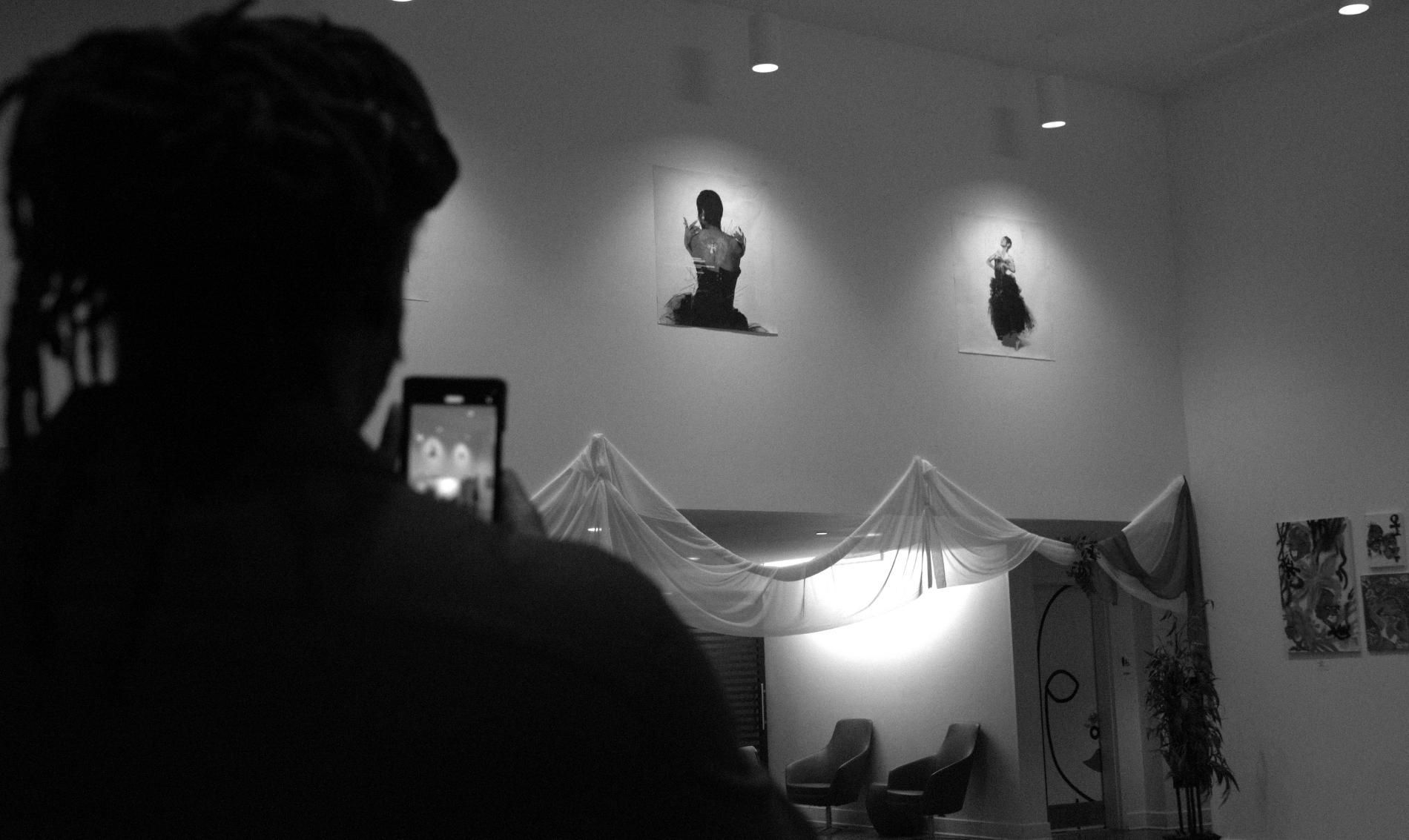
Garrett describes her experience in the Artspace as empowering, explaining that it reinforced her appreciation of accessible creative spaces for emerging artists. “I did a tour the other day when I was here, and I really love the environment,” Garret says, noting that she may apply for residency in the Artspace post-graduation. “The space is really nice and it makes room for artists, which I enjoy.” Garret believes
By LARK JEFFERS
From the outside, the gray, unassuming county building at 4805 Edgemoor Lane in Bethesda does not seem to be home to a vibrant center of community and culture. In reality, the second floor is a lively and joy-filled LGBTQ resource center. A new addition to Montgomery County’s resources, the MoCo Pride Center’s physical space opened on Aug. 30 with an event featuring speeches from elected officials and drag performances.
Founded in 2017, MoCo Pride receiving funding from the county government two years ago but lacked a permanent home until last year, when the County Council allocated $500,000 to help fund the physical space. “[There was] full support from the Montgomery County Council, who voted unanimously to fund this center’s [external activities] prior to us finding a physical home,” MoCo Pride Center CEO Phillip Anthony Downie says. “That kind of political alignment is rare—and it sent a clear message that LGBTQIA+ residents are not only welcome here, but structurally supported.”
Councilmember Evan Glass explained that the MoCo Pride Center was a priority for the County Council because of its potential to provide important resources and a safe community space. “We want to make sure that everybody has access to healthcare, information, and a safe space to gather,” Glass says. “We as government leaders wanted to make sure that … the Montgomery County government offers a space where everyone can go to.”
The MoCo Pride Center is open seven days a week from 11 a.m. to 7 p.m. and offers services including community board game nights, gender-affirming name and ID change clinics, peer support groups, and sexually transmitted infection (STI), sexually transmitted disease (STD), and human immu-
nodeficiency virus (HIV) testing.
“What makes this work exciting is that we now have permanence,” Downie says. “That kind of visibili-
We want to make sure everyone has access to healthcare, information, and a safe space to gather. We as government leaders wanted to make sure that the Montgomery County government offers a space where everyone can go.
ty, safety, and access is transformative. A space for people to program or just be.”
These services are essential, particularly for individuals who may have limited access due to barriers such as income, location, or age.
“When I was first becoming aware of my own sexual orientation in high school, I had never even met an out gay person,” community member Robin Katcher says. “It took finding a truly safe LGBTQ community space in college for me to see and accept my full, authentic self, and then fight with others for our collective dignity and rights.”
In light of the current attacks on transgender rights and defunding of LGBTQ resources nationwide, the center’s arrival is even more significant. In June, the LGBTQ-specific option on the 988 suicide hotline was defunded nationwide, including in Montgomery County.
Additionally, there are over 616 active anti-LGBTQ bills nationwide, and 20 states have banned transgender citizens from using restrooms that align with their gender
identity in some capacity. “We’re a 15-minute drive from D.C., … and Maryland and Montgomery County are really im portant bastions of safe ty for a lot of people,”
Mx. Contreras, the LGBTQ Studies teach er at Blair and former sponsor of Pride Plus, Blair’s LGBTQ club, says.
While Mont gomery Coun ty and Blair in particular are generally seen as safe spac for the LGBTQ community, having the center as a place of unity and understanding is very important for the school environment. “I think the problem that a lot of schools and community areas are facing right now is
BY
the mission of Artspace is essential. “Keeping art alive is really important, and expression, creativity, and spreading love [is important] too,” she says.


some apathy or some ‘that’s not directly touching me or the people I personallyly rightfin, president of Pride Plus,
It is clear that the newter will have a im - pact on Montgomery County as a whole. On Oct. 25, the center will host their monthly wellness fair with resources for the community, including STI testing, health access, food, and community. “The Pride Center’s opening is only the beginning. My hope is that it becomes a long-standing institution in Montgomery County—serving generations to come … we want this to be a space that cannot be taken away,” Downie shares. “Because permanence is power.”
The Pride Center’s opening is only the beginning. My hope is that it becomes a long-standing institution in Montgomery County- serving generations to come . . . we want this to be a space that cannot be taken away. Because permanence is power.
By ZOE GORBACHEV
From basement shows to school hallways, D.C.’s teen music scene is louder than ever—and now it’s getting immortalized on a compilation album. 202: The Sound of D.C.’s Youth brings together local high school bands spanning punk, metal, indie rock, and Spanish-language tracks, showcasing what happens when teenage creativity meets activism and the creativity of the region’s music scene. The album is produced by Blair senior Maz Olson in collaboration with Breakfast All Day Records, a student-run label founded by Sophia Dyer and
Tonito Tijerino. Known for using music as a tool for activism, the label donates all proceeds from its releases to social causes. In February, the label produced Music for Mutual Aid: Wildfire Relief in LA, of which all the proceeds went to the California community for relief following devastating wildfires. This year’s project will benefit the Blair chapter of Students F.A.I.R. (Students For Asylum and Immigration Rights), a student-led organization supporting immigrants in the D.C. area with legal fees and resources. As increased immigration enforcement and policy changes create fear and instability within
immigrant communities, F.A.I.R.’s support has become more urgent than ever. Beyond raising funds, the album serves as a platform to amplify teen talent and preserve the energy of the local youth music scene. The recording process was truly a team effort. Some bands recorded in basements, while others recorded in studios. Sound engineer Luther Beckett, a senior at the Duke Ellington School of the Arts, recorded several tracks. “The purpose of the album was to represent the scene and give people a chance to hear how talented everyone is,” Olson said.

LOCKING IN A guitarist prepares for their performance at a show
BY



October 21, 2

By DERMOTT FOLEY and HANA SOR
As underground rap has grown in popularity worldwide, so has its place in the District of Columbia, Maryland, and Virginia (DMV) area. The origins of underground rap in the U.S. can be traced back to the ‘80s, constantly evolving amid the ever-changing music industry. In the past decade, digital music-producing platforms like SoundCloud and FL Studio have become more accessible, leading to a surge in creative, new voices and marking a new era for underground rap. Whether it is a signature adlib, a catchy sample, or a collaboration with a designer brand, underground rap is defining a new generation of culture.
Senior Joseph Killebrew is one of Blair’s own underground rappers and uploads his music on SoundCloud under the username “throwbacck”. Killebrew began his musical journey at just 12 years old. He started by downloading some software with beats and writing lyrics. “I kind of messed around with rapping a little bit … and then eventually started putting out some songs,” he recalls. “I speak about stuff that I’m interested in, and I try to put out a good message at the end of the day.”
As both a student and a rapper, Killebrew believes that his music is shaped by everything he experiences in his life—nature around him, the
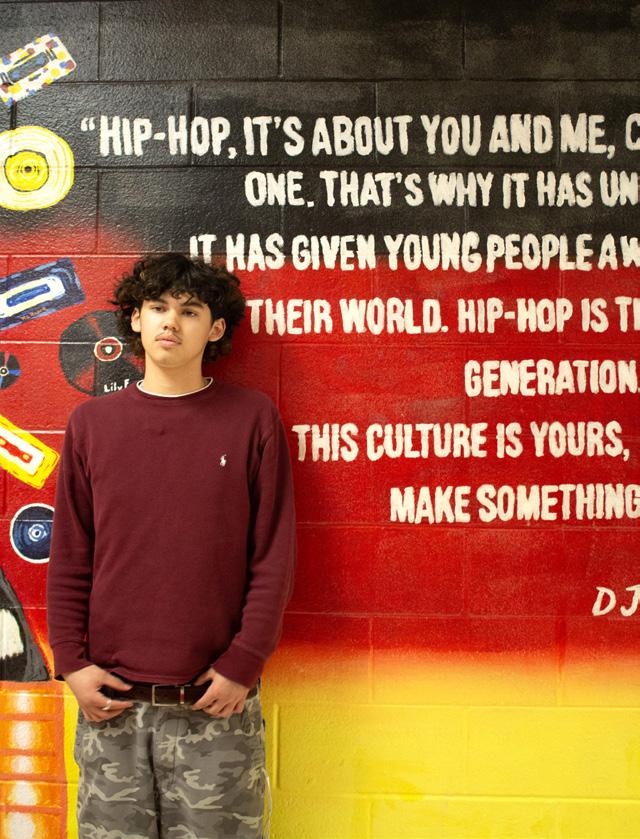
UNDERGROUND AT BLAIR Joseph Killebrew is a Blair senior who publishes his music on Soundcloud under the name “throwbacck.”
OLSON
I speak about stuff that I’m interested in, and I try to put out a good message at the end of the day.
people he meets at school, even bits and pieces of his class assignments. “I think that every good rapper should be influenced by where they come from,” he says.
Senior Bruno Resetarits, a close friend of Joseph’s, has witnessed his growth as a producer and rapper from early on in their friendship. Resetarits believes that Killebrew’s creative process extends beyond making a typical beat. “I feel like his flow and his knack for [a] good sound sets him apart because he’s also a guitarist … he just knows how to work things,” Resetarits says. “His love for many genres of music makes him really versatile.”
Kenneth Smith, who teaches Blair’s Hip Hop and Culture class, explains that the underground scene differs depending on the region, and the distinct DMV sound was developed later than most. “The DMV doesn’t really come on the scene with a national artist until Wale in like, ‘07, which is very late, because Go-Go [music] dominates this region,” Smith says.
Although underground rap and most forms of hip-hop use the traditional “808”, which refers to a percussion beat characterized by a low-frequency bass, the styles in which they are used differ between regions. For example, Chicago’s drill scene, featuring artists such as Chief Keef and Lil Durk, is famous for using synth brass, bells, and straightforward lyrics. On the other hand, Atlanta’s trap scene focuses heavily on the 808 drum machine and atmospheric production with artists such as Young Nudy and Lazer Dim 700.
The DMV has slowly developed its own unique style, marked by the swift rise of artists like Nettspend, Slimegetem, and Nino Paid—all DMV natives. Some have dubbed this new style the “DMV Flow”, noting that local rappers tend to use a more improvised style, with words landing slightly early or late to give the flow an offbeat feel. “The dialect is very unique … I feel like part of the appeal is [the] many
Anonymous - Kate Stewart
references to the city,” Resatarits says. “I feel like it’s very energized and, depending on the vibe, that’s fun.”
Similar to mainstream rap, underground rap has become intertwined with luxury brands and streetwear alike. Most recently, the genre has seen a rise in rapper collaborations with high-end brands such as Rick Owens, Vetements, and Balenciaga. “I think a lot of these artists use the scene as a bridge into doing other things they’re interested in … and one wouldn’t exist without the other,” a member of SADPRT, an Instagram account that posts underground rap news online, says. They note that underground rappers incorporate both their music and fashion style to curate their own unique image.
A collective interest for the genre has also emerged on social media platforms. SADPRT has amassed over 54,000 followers in the past year alone. Run by three friends—Jack Tellier, Tino Finnerty, and John—the creators have an unmistakable passion for everything underground. “The mainstream stuff is just kind of boring because everyone likes it, you know? You want to find something that you can actually sink your teeth into,” John says. “[Mainstream rap is] crafted by
The mainstream stuff is just kind of boring because everyone likes it, you know? You want to find something that you can actually sink your teeth into, John
major labels, and then [there’s] underground rap. It’s some dude on his laptop, speaking his truth. It’s just way cooler to connect with that.”
The digitalization of underground rap has come a long way since the days of artists such as Lil Uzi Vert and Fetty Wap, who gained immediate success after uploading songs onto SoundCloud. As fans since SoundCloud rap began, John acknowledges the rapid success that online platforms produce. “Back in the day, there was this old guard of like, ‘Oh, you got to come to a label and pitch music for some 40year old [in artists and repertoire] ,’” he says. “Now, you kind of have the ball in your hand … it’s cool to be a part of this time right now.”
By KIYA TIRUNEH
Each morning on my bus ride to school, I pass by rows of cultural shops, boutiques, and restaurants. Unique in their exterior design and overall ambience, each store is a window peering into another part of the globe. Recently, one store caught my eye with its elaborate decor and captivating sign: “Ruan Thai,” written in bold, angular letters, beckoned me inside. Inspired by the numerous mukbangs flooding my TikTok For You Page, I decided it was time to give the charming restaurant a try.
Upon entering, I was greeted by the warm, aromatic scents of lemongrass, Thai basil, and pandan—a tropical plant commonly used in Southeast Asian cuisines. The entrance was covered in overarching plants ranging from all shades of green to red, decorated with intricate golden and wooden ornaments. The combination of open seating, bustling conversation, and the subtle, soothing music over the speaker was reminiscent of the homey atmosphere produced only by a long-awaited family reunion.
After browsing the menu, I ordered a variety of dishes ranging from mild to medium spice. Starting with the recommended chicken satay, my taste buds were met with an incredibly tender, caramelized piece of meat. The smooth, nutty peanut sauce was both rich and fragrant, setting the tone for the rest of the meal. My next dish, the pad kee mao (often called drunken noodles), was a blend of glossy, chewy rice noodles with piquant chili, garlic, and fresh basil that could only be described as an explosion of flavors and textures.
Next, I indulged in the spicy panang curry. This dish was thick and creamy, imbued with a comforting heat that melted the chicken into the coconut milk. And of course, you know I had to end the

meal with a classic dessert, mango sticky rice. The toasted rice was glazed in a sweet coconut cream, which coupled perfectly with the chilled, juicy mango slices layered on top.
Beyond the memorable food, Ruan Thai staff met each customer with hospitality, representing the kind nature that the Thai community has become known for. Whether it was a simple request for utensils or a complaint from a neighboring customer, the staff approached the situation with nothing short of a smile.
Almost three decades ago, the Suchotinut family brought culture and expertise that transformed the previously occupied Siam Inn into a welcoming atmosphere. The traditional mix of popular dishes and house specials that they offer, such as satay (chicken or pork skewers covered in peanut sauce) or pla pad cha (deep-fried catfish fillet sautéed with celery and garlic in hot chili and special Thai sauce), helps introduce Asian cuisine to a larger audience.
Surrounded by other cultural restaurants such as Ren’s Ramen and Brother Chinese Food, Ruan Thai represents just a slice of the cosmopolitan melting pot that Wheaton embodies. The delicious dishes served provide each customer with not just satisfaction and a full stomach, but also a little piece of Thai culture to carry with them and remember.
If there is one thing that I absorbed from my visit (other than the food), it is that food is an anchor of cultural identity. Ethnic restaurants, like Ruan Thai, are the chains that allow immigrant communities and people of various backgrounds to bond. Maintaining connections with their culinary traditions, Ruan Thai is a pocket of rich culture supporting the ethnic enclaves that reside in Wheaton and the larger Silver Spring area.
If you would like to support the paper, go to tinyurl.com/subtochips to subscribe to Silver Chips, be featured on the paper, and receive merchandise.
Pamela Coffey - Susan Euling - Matt Kaiser - Chris Moriarity - Karyn Stenzler
Mark Amarel - Hester Baer and Ryan Long - Paul B. Ellis - Bonney Family - Jason Fasteau - Timothy Ernst and Grace Manubay - Karen Heavey - Kurt and Dot Kasik - Tara Smith - Maria B. Velez and Wayne Santoro - Stefanie Weiss - Drs. HF & R Nicodemus
Bronze Kathleen Caviston - John L and Carol Clouse - Ellen Gadbois - Marina Deane-Gonzalez - Cathy HendersonGary MacDonald - Yoyo’s Yo-yos - Troy Jacobs - Nicholas Jovanovic - Erin and Matthias Kretschmer - Larry Lian - Reemberto Rodriguez - Alejandro and Julia Velez - JoAnn Volk - Tony and Elizabeth Pegg
By GABRIELLA MCKENZIE and SONYA DEL POZO
An engine hums, food sizzles on a grill, and sweet and smoky spices drift through the air, pouring out of a nearby truck. Customers walk by, stopping to check out the row of food trucks, where crowds have begun to form. The convenience, cultural diversity, and affordability of food trucks make them a popular choice for a quick meal.
There are over 90,000 food truck businesses throughout the U.S.—a number that has increased by 23 percent in the past five years. The annual revenue of the industry has risen by 13.2 percent over the past five years, and is expected to reach $2.8 billion this year. The popularity of food trucks has grown not just nationally but locally, right here in the D.C. and Maryland area. Montgomery County attracts a variety of food trucks and owners who are passionate about contributing to the diverse culinary makeup of the area.
Oneil Batchelor, owner of Oneil’s Famous Jerk, opened his food truck in May 2022 with a goal of sharing his Jamaican culture with the Maryland community. “I feel like this cuisine chose me. I grew up in a family with a strong background in cooking, always surrounded by rich aromas, flavors, and the joy of gathering around meals,” he says. “Food has always been a bridge that brings my family together, and I wanted to share that same joy with others through my business.”
I feel like this cuisine chose me. I grew up in a family with a strong background in cooking, always surrounded by rich aromas, flavors, and the joy of gathering around meals.
Susan Cannon, owner of Palmetto Bay Cuisine, opened her food truck in the summer of 2025. From sandwiches to salads, and rotating specials every week, the truck has an extensive breakfast and dinner menu. Like Batchelor, she has a passion for sharing food with others. “My favorite part is getting to interact with different people and share some different food combinations that you don’t always see on food trucks, or that people maybe haven’t tried before,” she says. Cannon, who was an educator by trade, originally took up catering as a side project. As her business grew, she decided to open a food truck including Mediterranean cuisine staples such as gyros, roasted red pepper, burrata, and more, pursuing food full-time. Chris Robles’ passion for food also helped him grow his business, the Trippy Tacos food truck. Besides tacos, the truck is known for their nachos and quesadillas. “I was living in Los Angeles and ate so many good tacos, [and I] saw a gap back in MoCo,” Robles explains. “I started it on my own, but now we are a team of 15 working on the success of Trippy Tacos.”
Besides being a more affordable way to start a business, food trucks give chefs more freedom and the ability to interact directly with customers. Batchelor contrasts the
experience of owning a food truck with other jobs in the food industry. “Unlike being locked into a traditional kitchen, I get to move around and interact with customers directly. Seeing people’s reactions outside the truck while I’m inside cooking—it’s priceless,” he comments.
I get to move around and interact with customers directly. Seeing people’s reactions outside the truck while I’m inside cooking—it’s priceless.
Nonetheless, food truck operations look different for all owners. Palmetto Bay Cuisine prepares their food out of a commercial kitchen in Rockville. Besides the initial food preparation, everything is made in the truck on the spot. “We’re prepping the food, coming up with new, different menus for each event, coming up with specials, and then we are out on the road finding places,” Cannon explains. “We go someplace new pretty much every day.”
Because food trucks can travel anywhere, day-to-day routines constantly change. David Haradom, owner of Roaming Coyote—a food truck based off the Coyote Grill restaurant—describes the variety of experiences and places he has encountered through his truck. “We get hired by bands and entertainment groups to feed the crew in the band after events. We’ve been to sporting events [and] movie sets,” Haradom says. The Roaming Coyote truck is mainly influenced by Tex-Mex cuisine, which originated from the culinary creations of the Tejano people. From tacos and bowls to burritos, they typically sell a taco per minute at any given event. The result is non-stop work for the team.
While schedules vary, all food trucks share a common trait: reliance on community support and foot traffic for business. In the food truck industry, businesses must at-

people or 50 orders to make a food truck work for an event.”
In the Silver Spring and Takoma Park area, this is not hard to come by. “We’re selling more and more each day. Part of that, though, is just because we’re getting better at our efficiency and how we’re selling and the locations that we’re going to sell,” Cannon details. “Business is really good.”
Food trucks also rely on active communities to recommend them to new customers. “A lot of our growth also comes from word-ofmouth because we treat our customers like family, and they help spread the word,” Batchelor says.
In this area, where countless food trucks coexist, a positive culture of mutual respect has formed among owners. Events with multiple food trucks co-catering are common. “Whenever we go to events that have multiple food trucks, I’ll typically ask them to trade food. We’ve given other truck[s] plates when they ran out so [that] they could keep selling,” Rob-
customers we have,” Cannon says. “So when we go back to a location we’ve been to, we’re seeing the same faces [that are] excited to see us.”
A lot of people are excited when they see a food truck [and] we’ve been really, really pleased with just how many repeat customers we have.
Still, food trucks face an extra set of challenges because they require customers to be outside. Weather is a huge factor in a truck’s daily projections—especially because food will not last for more than a day. “If it storms, most of the time
people will not wait outside and wait for their food at a food truck, but we’ve already prepped all the food,” Cannon explains, noting that she tries to ensure that the truck is booked as much as possible in order to minimize potential food waste.
Additionally, food truck owners must work to establish a presence in a constantly changing economy, and costs dictate how they must run their businesses. “Our expenses continue to increase as we grow,” Robles comments, adding that the price of meat, energy, and services all vary.
Despite these challenges, food trucks continue to thrive, reflecting the time commitment and dedication of owners and customers alike.
“I’m a wife and a mother with four young children, and I think this has been a really exciting experience to get to show them what it looks like to take a risk,” Cannon explains. “If this doesn’t work at the end of the day, that’s okay … but I’ll never, ever have to worry about saying I didn’t try.”

tract enough customers each day to turn a profit.
“The biggest challenge is that the food trucks really only work when you have enough people,” Haradom explains. “You gotta have, usually a minimum of 50
bles describes. “We’ve also been lent lighters, gas, and propane.”
The collaborative environment has attracted many eager repeat customers. “A lot of people are excited when they see a food truck [and] we’ve been really, really pleased with just how many repeat
By ADANNA AKAMIGBO and LEYA FEKADU
A man sits in a cafe, Clairo blasting from his wired earbuds, a Labubu clipped to his wide-legged thrifted jeans. He wears Birkenstock clogs with a Trader Joe’s tote bag slung over his shoulder. Holding a matcha in one hand and a classic feminist novel in the other, he says things like, “Periods are the worst. I’m 6’5” by the way.”
The “performative man” trend emerged from the depths of TikTok and Instagram in the summer of 2025. As the trend spread, men began to adopt an aesthetic defined by objects they deemed feminine with the goal of attracting the attention of women. Problematic? We think so. The trend communicates that men empathizing with women’s struggles is only conceivable as a meme.
Performative male competitions are satirical events where participants display stereotypical traits, often competing for prizes. There have been competitions hosted at Duke University, Yale University, the University of North Carolina at Chapel Hill, and in cities across the country. In September 2025, Yale University senior Chloe Shiffman organized a performative male contest. Nearly 500 students attended, sporting portable record players and feminist literature. According to CT Insider, one contestant opened his performance by wiping up spilled matcha with
a maxi pad, while another strode across the stage carrying two tote bags, flaunting his Lana Del Ray and Chappell Roan vinyl records. To determine a winner, Shiffman let the audience cheer for who they thought embodied the persona best. The victor, who donned the tote bags, received a trophy and a customized Yale Labubu doll.
According to Shiffman, the com petition was not intended to be taken seriously. In reality, she dislikes the trend, characterizing perfor mative men as actors. “A performative man is some body who performs femi ninity, solidarity, empathy, and [being] against misogyny. However, [they do] absolutely nothing to actual ly internalize the beliefs that they claim to hold,” Shiffman says. The performative male persona diverges significantly from histor ical societal expectations placed on men. The term “toxic masculinity” was coined in the late twentieth century and characterized men’s suppression of their emotions. Men were supposed to be strong, dominant, and emotionally reserved.
on social media platforms to follow rules such as eating foods deemed masculine—like steak—and avoiding those deemed feminine—like
It is from this mindset that the modern “alpha male” archetype was born. Male influencers like Andrew Tate perpetuated a similar message, encouraging young boys
Their actions often focus more on “conquering” women than truly understanding them or supporting feminism.
Despite claiming to support women, performative men often act in ways that feel shallow. They mock feminism and trivialize wom-
en’s struggles, undermining efforts for equality that have been worked towards for centuries by reducing them to surface-level performances meant to impress—rather than truly support—women. Even when they attempt to build connections with women, their motives are more frequently rooted in seeking validation from other men rather than forming genuine relationships.
Shiffman highlights that this modern version of masculinity often masks struggles with
“The performative male stereotype is a consequence of the current male loneliness epidemic,” Shiffman states.
“Men [are] actively discouraged from being vulnerable with each other. To gain a connection with one another, a lot of men try to get approval from other men by conquering women, but they’re seeking the appearance of connection rather than the genuine connection itself.”
Blair junior Sean Americo identifies with these trends, admitting that he fits many of the traits associated with a performative male—especially the belief that he understands the everyday challenges women face. “Periods and cramps are hard struggles women have to go through, and we don’t appreciate them enough for being so strong,” he jokes. “I wish I could
take that away from them and inflict it on myself.”
Some female Blair students ad-
I think they’re unattractive because it’s inauthentic , and they try to change themselves for the female audience. If you’re too much of a poser, people are going to clock it.
mitted they do not find performative males attractive at all, concluding that they appear superficial. “I think they’re unattractive because it’s unauthentic, and they try to change themselves for the female audience,” Blair sophomore Leah Cheng states. “If you’re too much of a poser, people are going to clock it.”
The only thing more ridiculous than performative men’s curated outfits and toys is the fact that they think women can’t see right through their act. While everyone should have the freedom to express themselves as they like, when that expression comes at the cost of mocking women’s experiences, it’s bound to fall flat. It might just be a fleeting trend, but we sure hope the future holds something more than an iced matcha in its hands.

By HANA SOR
While box office sales at large movie chains like AMC and Regal Imax have yet to return to pre-pandemic levels, local arthouse theaters have suffered equally. Characterized by their handpicked film selections and film festivals, arthouse cinemas spotlight local voices and occupy a role that multiplexes often overlook.
Arthouse cinemas and indie filmmaking form the heart of a local community, and they deserve active support for their unique ability to engage and expose audiences to varying perspectives and forms of storytelling.
For George Smith, Director of Operations at the Avalon Theater, the charm of an arthouse cinema stems from its representation of diverse communities and the cultural heritage of film—local theaters tend to showcase classic and international movies. “We are a neighborhood community. All walks of life come in this theater,” Smith says.
dent films, we play foreign films, [and] occasionally, a large release,” Smith says. “But generally, you would never find Top Guns. You’re never gonna find … Marvel movies. We curate specific independent films that are attractive to the local community.”

Established in 1923, the Avalon Theater is situated south of Chevy Chase Circle, between Northampton and McKinley Street. With its carefully curated set of monthly films and predominantly older audience, the arthouse cinema is the district’s oldest operating movie house. “We play indepen-
Local and arthouse cinemas also offer the gift of real, passionate voices that are not simply made to appeal to the masses. Javier Chavez, a film programmer for the AFI Silver Theatre and Cultural Center, emphasizes that the theaters’ curated selection of films are what keep moviegoers coming—even with the decline of indie cinemas’ popularity. “Arthouses like the AFI Silver focus on the kinds of films that make it easy to [foster representation],” Chavez says.
“We try to show a diverse range of voices from Latin America, from Africa, [and] independent American cinema as well.”
The portion of the global box office that the independent film occupies has gone down for the first time in five years. In 2023, indie movies took over 21 percent of profit received from sales, but in 2024, income fell by more than $1 billion, sinking to 18.5 percent.

As of 2025, there are 1,972 movie theater businesses in the United States—a sharp decline from previous decades.
This decrease in moviegoing is mainly due to shifts in consumer behaviors; while going to see a movie in theaters used to be seen as a typical social gathering, an increase in digital streaming services has diminished the tradition. Another factor is production cost. The ’90s saw an increase in interest in independent filmmaking due to the affordability of equipment. Now, however, the price of producing a film has proven to be costlier than ever before due to a spike in demand for high quality visuals and effects.
Still, a decline in moviegoers and high production prices has not stopped independent cinema from receiving the praise it deserves; a noticeable surge in acknowledgement has been seen through in-
dependent films such as Anora (2024) and Flow (2024), both of which gained major attention at the 2025 Oscars while competing against big-budget Hollywood nominees such as Wicked (2024) and A Complete Unknown (2024). Taking home the Oscar for Best Picture, Anora’s director Sean Baker ended his acceptance speech with a triumphant, “Long live independent film.”
Independent movies have also received recognition from the Academy Awards and international film festivals such as the Cannes Film Festival, Sundance, and the Venice Film Festival. “I think finally, mainstream America has realized that it’s just not always the classic film slate that comes from the major studios, from Warner Brothers, from Fox, and Universal,” Smith says, mentioning that the Avalon strives to screen films that prioritize cinema as an art form, not just a commercial success.
“Our films have emotions, they have meaning, they have deeper thoughts to them, and that’s what our members that come here like.”
One of the most important aspects of preserving arthouse cinemas is their viewing experience. Engaging with a film as a commu-
nity opens up the floor to meaningful discussion and debate. Post-film screening discussions, a common feature of independent film showings, allow for an interactive environment. “I think ‘consume’ is more what the multiplexes have people do, which [is] just [to] consume content—and ‘content’ is another buzzword in the business … we’re not in the business of having our patrons ‘consume’ film, rather to engage with them from an artistic perspective,” Chavez says.
We’re kind of like the glue that brings people together, and that’s what independent theaters are, and that’s what this theater is
As isolation and polarizing online discourse have grown in prevalence, intimate and communal settings are becoming difficult to come by. Arthouse cinemas continue to unite communities and provide artistic spaces for audiences in ways that the internet or major theaters fail to replicate. “We’re kind of like the glue that brings people together, and that’s what independent theaters are, and that’s what this theater is,” Smith says. “Somebody came in here the other day and they asked me and they said, ‘Do you own this theater?’ And I looked at him and I said, ‘No, you do, because you are the community.’”





ERIC YANG
Contact Puzzle Editors Daneel Kutsenko and Ruth Wajda-Gotwals at silverchipsclips@gmail.com with the subject “October Chips Clips” with questions, comments, concerns, or any other feedback




20. Lucas Sinclair’s younger sister 22. Wyo. neighbor 23. Tenant’s contract
and egg, as in Starbucks breakfast
Rum’s ice-cream partner
Escargot

Across Cont.
67. Opuesto al oeste 68. Harry and William’s mom 69. Prong
RIP 71. Arabic God 72. Match parts
1. Biblical spy 2. Prefix with phobia 3. Museum piece 4. “My father will hear about this!” 5. Cleaning cloth 6. “Old MacDonald” conclusion 7. Chocolate or cheese 8. Trojan War epic
Dressy accessory
Skedaddle
Maggie Simpson’s sister
Dog and cat food brand
Genealogy chart 21 Explanatory tool
Acronym for DC neighborhood with colonial-era charm
Spirited steed 29 Stirred
Kingly address 31 Big online source for film info 32 Prone to prying
45. Honking birds 46. Expiration-date preceder 47. Joan of Arc, for one 48. Exisits
49. Quality of being god-like 57. At the peak
61. It’s picked by the picky
Triangular letter
Saturate
Out for lunch, perhaps
Snail no shell
Down Cont.
33 Hustle
34 PBS science series
35 Latin love
36 Contraction of I am
37 Dutch soccer player for Manchester City, Nathan ___
38 Affirmative
39 Needle hole
42 Unlikely class president
43 “___ above, so below” horror movie
48 Popular
50 Packed like sardines
51 All-important
52 Singer Turner’s biography
53 Cozy places
54 Kimmy Schmidt, ____ Kemper
55 Double’s job
56 Wise guys, or DND character option
57 Exploited
58 It may be struck
59 “Toodle-oo”
60 Approved
64 Hush-hush document, for short
October Solutions



October 21, 2025
By KIRAN DURVASULA and RUTH WAJDA-GOTWALS
As Friedrich Nietzsche, German Philosopher, once said, “Those who were seen dancing were thought to be insane by those who could not hear the music.” Indeed, dancing is not insane and even if you have two left feet, there is more to gain from it than just a good time.
Student-run clubs at Blair like the African Dance Team, Blair Dance Company, Blair Dance Crew, and Blair Bollywood draw in dozens of dedicated members who share a desire to dance and foster lively environments. A common thread links together these clubs: cultural expression, community building,
We’ve always been really close, we’re all really like a family.
and student empowerment.
With 17 members, the African Dance Team is one of the larger dance clubs at Blair. Senior and captain Madina Kante, who has been on the team throughout the entirety of high school, finds the group cohesion to be consistently strong. “We’ve always been really close,” Kante says. “We’re all really like a family.”
The team trains hard to perform at eight to 10 events each year, including an invitational performance at MCPS central office for African-American History month. Other dance clubs perform at school-wide events like the fall pep rally, International Night, STEM Arts Night (STAN), Homecoming, and sports games. Their frequent
The teams bring people together whether they are performing, learning, or just watching. It creates a sense of unity and pride, showing that everyone’s culture, style, and individuality can have a place on stage.
forming, learning, or just watching,” she says. “It creates a sense of unity and pride, showing that everyone’s culture, style, and individuality can have a place on stage.”
Senior Blair Bollywood captain Aanya Garg echoes this. “[Dance is] a common ground that a lot of us can have fun with together,” Garg says. “[And it is] enriched by everyone’s diverse backgrounds and experiences.”
The impact of dance reaches beyond just students. Kira Curry, a paraeducator at Blair who has sponsored the African Dance Team for nearly a decade, also recognizes the importance and significance of dance. She sees the activity as an avenue for students to express themselves. “Dancing to me is … therapy,” Curry says. “It’s fun. It’s an outlet. It’s energetic and it means a lot to me because it gives all kids, all the students, the opportunity to pretty much be themselves.”
Bellows agrees, finding that dancing for Blair Dance Company is a great way to relax and express herself. “Dance means a lot to me,” she

schools in Maryland, this diversity comes alive through Blair’s extensive array of dance clubs, each representing different cultural traditions from around the world. Groups like Blair Bollywood, African Dance team, and K.O. Crew bring new and distinct cultures to the stage, allowing Blair to showcase the diversity that their student body holds. These dance groups paint a tapestry of Blair’s multicultural community, giving students the ability to honor their own heritage, while also learning about the traditions of their peers. Dance becomes more than just a movement, it is a powerful bridge between cultures that showcases Blair’s remarkably diverse student body. Garg recognizes that dance is a prominent way
Dance impacts the community of Blair by unifying it. Because a common ground that a lot of us can have fun with together, also enriched by everyone’s diverse backgrounds and experiences.
the school expresses this. “Dance impacts the community of Blair by unifying it,” she says. “Because a common ground that lots of us can have fun with together, also enriched by everyone’s diverse backgrounds and experiences.”
In order to gain support of dance groups at Blair, senior and Blair Dance Crew captain Christie Roberts explains that she encourages people to become members even if they cannot consistently attend meetings. “We encouragecause even if you havemitments, it’s still fun to take a break during the school day and dance,”

Por TOKYO HOPKINS
ting involved because of how special the community is.
“It’s a really fun learning environment; we’re all supportive around here. So if you feel compelled to dance please join,” Roberts says. “It’s just a really great experience. You’ll make a lot of -

El equipo varsity de animadoras de Blair está en el centro del espíritu y la cultura de Blair. Las porristas promocionan un ambiente positivo por apoyar otros deportes y ser embajadoras de la escuela. Al final del otoño, compiten contra otros equipos con una rutina que muestra sus acrobacias. Para mantener estas responsabilidades, una gran cantidad de trabajo es realizado “detrás de escena.” Raquel España, una animadora en el grado 10, quería involucrarse con este deporte durante la escuela secundaria. España ha disfrutado de su tiempo en el equipo y ha ganado muchas experiencias memorables, como atender al campeonato estatal de fútbol [de los hombres]. Para concentrarse en practicar para su campeonato, encontró maneras de manejar sus tareas. “Intento terminar mis tareas durante el almuerzo y mis clases,” dijo. “Esto me ha ayudado a enfocarme en mis entrenamientos, y no estoy estresada sobre otras cosas.” Como resultado, España se siente más organizada. Desde que avanzaron a la división 2, el equipo se ha adaptado a situaciones desafiantes. Aida Hellner, una animadora en el grado 12, ha realizado trucos nuevos que no podía hacer el año pasado, incluyendo lanzamientos con una gira completa y acrobacias en el aire con un cambio de pierna. “Es muy divertido vernos hacer acrobacias más avanzadas porque demuestra que estamos progresando,” exclamó. Hellner añadió que lesiones inesperadas hicieron este proceso más difícil. A pesar de todo, se sintió apoyado debido a la dinámica fuerte del equipo. “Siento que todos estamos en la misma situación…Es realmente agradable tener el apoyo de mis compañeros y saber que estamos experimentando esto juntos,” dijo. Muchas habilidades en las porras pueden ser aplicadas fuera del deporte. Aracelli Ramirez, una animadora en el grado 12, ha visto crecimiento personal durante
su tiempo en el equipo. “Durante los últimos tres años, he aprendido cómo adaptarme a situaciones nuevas y cómo ser parte de un equipo,” comentó. “Hay muchas responsabilidades trabajando juntos con un equipo…y tienes que ayudar a todos a tu alrededor.” Ramirez recomienda las porras para cualquier persona, incluso a aquellos sin experiencia. “He conectado con personas nuevas en el equipo, y ahora tengo una segunda familia.” El campeonato de animadoras del condado Montgomery toma lugar el 25 de octubre de 2025. El equipo de Blair espera demostrar su competitividad y ganar en su división para terminar su temporada en una nota positiva. Lo más importante es que las animadoras
He conectado con personas nuevas en el equipo, y ahora tengo una segunda familia.
quieren disfrutar de su tiempo—especialmente las personas en sus últimos años de la escuela secundaria. Para la escuela, el equipo, y ellos mismos, se esfuerzan al máximo.
de LA ESQUINA LATINA paginas C1-C5
By JAMIE LOVE
Blair senior John Taylor checks his phone to find an unusual notification from Athletic Director Rita Boulé:
This email is going out to all members of the 2024-2025 Indoor Track team who are returning to Blair. Please attend a very important meeting tomorrow … I appreciate your attention to this matter.
The following day, the team crowds into an empty classroom.
Boulé, Principal Damon Monteleone, and Coach Terry Johnson await their arrival. Boulé quiets the team, then shares the news: the boys’ indoor track county, regional, and state championships are to
be revoked. Johnson, Boulé, and Monteleone apologize to the team, who listen in disbelief. “Nobody expected that to happen,” Taylor said. “We weren’t ready for it.”
The news hit especially hard after a season that marked a breakthrough for the program. Two years after falling short of the state championship by one and a half points in 2023, the team captured its first title in the competition’s 53year history. Yet that historic win would be invalidated due to a violation of MCPS’ student eligibility rules.
Per the school district’s requirements, “When a student participates in an interscholastic athletics program at a school to

which the student is not assigned, or the home address provided is not the student’s legal residence, the student is not eligible to participate [in athletics].” Sprinter Jayden Deleon—who won six races across the regional and state meets—was never eligible to run for Blair. The address he provided was within Blair’s boundaries, but an investigation determined that it was not his own.
In hindsight, Taylor believes Deleon hinted at this when he suddenly left the team at the end of the indoor season. According to Taylor, Deleon claimed he was simply changing schools, but he later admitted this was not the entire story. “He told [a few] people … he wasn’t from the school,” Taylor said.
Deleon, however, saw no issue at the time. “I felt like [if] I stay out of the way, I won’t get in trouble,” he said. “[In] football, track, [and] basketball, they all do the same thing. They bring somebody from somewhere else … and use [a different] address. So if they can do it, I feel like everybody can do it too.”
Although Deleon claims that residency violations are commonplace, Boulé argued this situation was not the norm and therefore not one she was familiar with. “It’s nothing I’ve ever experienced before,” she said. “But from what I experienced, the allegation was brought to central athletics in MCPS. They alerted the school that … there would be an investigation into the matter.”
When asked why the school did not send out an announcement regarding the investigation, Boulé explained that schools may comment
but are not required to. “If the school would like someone from central athletics to be assigned to that communication, they will. But in no way does central athletics need to put that out,” she said. “We’re [only] obligated to report the results of the investigations to the state of Maryland. And that’s what we did.”
They could’ve just taken my championship away. [The team] deserved [to win] just as much as I did … we couldn’t have won without them.
While no public announcement was made regarding the investigation, Boulé ensured that Blair Athletics was not involved in any improper recruitment. “This wasn’t [that] Blair Athletics saw an opportunity to grab a kid and illegally enroll them in their school and win a state championship,” she said. “That is the last thing we’re trying to do. The kid had been here a while. There were no red flags.”
Moving forward, Boulé guaranteed that there will be no similar situations. “It’s never happening again on my watch. It’s never happened before, and it’s not happening again,” she said. Specifically, she explained that the residency check process will be far more rigorous, with thorough assessments of doc-
umentation and more questions asked of students. “If any part of [the process] doesn’t feel right, look right, [or] seem right, we are now just moving that to … the Residency Verification Office,” Boulé explained.
Reflecting on the situation, Deleon took ownership for his actions but felt his team was swindled. “They could’ve just taken my championship away,” he said. “[The team] deserved [to win] just as much as I did … we couldn’t have won without them.”
Although Deleon’s actions were questioned, Taylor never doubted his teammate’s character. “Just because … he wasn’t supposed to be there doesn’t mean that he didn’t show up every day to practice and work hard,” Taylor said. “He was a force for good on the team.”
It’s never happening again on my watch. It’s never happened before, and it’s not happening again.
With the 2025-2026 winter season fast approaching, Taylor stresses the importance of leaving the situation in the past. “We’re just going to keep doing what we do: try our best and move forward,” he said. “I know what I’m proud of personally from that track season. I know what I’ve accomplished, and I don’t really need a plaque to tell me that.”



By MARCELA MASON-RODRIGUEZ and CELIA MAX
Montgomery County officials are integral to high school sports. They show up every day to games to help foster competition and community. The job calls for a lot, mentally and physically: learning all the rules of the game, navigating conflicts, and showing up in all kinds of weather to run up and down the field. “It’s a very cool community of diverse people that … encourage you to do the best so that when you’re out there blowing that whistle, you’ll make the right call,” field hockey official Art Ho says.
For many, becoming an official is a way to stay connected to a sport that they love. “I played sports in
Liu, a football and lacrosse official of 23 years, says. “I found myself going to games by myself on Fridays … it was a good way to be involved in the game, have some sort of physical fitness off to the side, and make some money as well.”
For others, officiating was a natural next step after being involved in games as a parent, player or coach. “I’ve always been involved in sports,” Casey Fletcher, a referee who played sports throughout high school and college, says. “I coached Wootton lacrosse for 10 years, and then field hockey towards the end, and then I decided to take a break. That’s when I [realized] I still love the sport … it’s a good way to keep giving back and stay involved.”
In order to get onto the field, all officials undergo a training pro-
National Federation of State High School Association’s written rules examination with at least a 75 percent. “The process involves reading the book front to back and memorizing all the rules, memorizing all the calls, all the hand signs, and all of the rules and procedures for the sport,” Ho says.
The exciting part is just to be there … around the action, running up and down the sidelines and making calls,
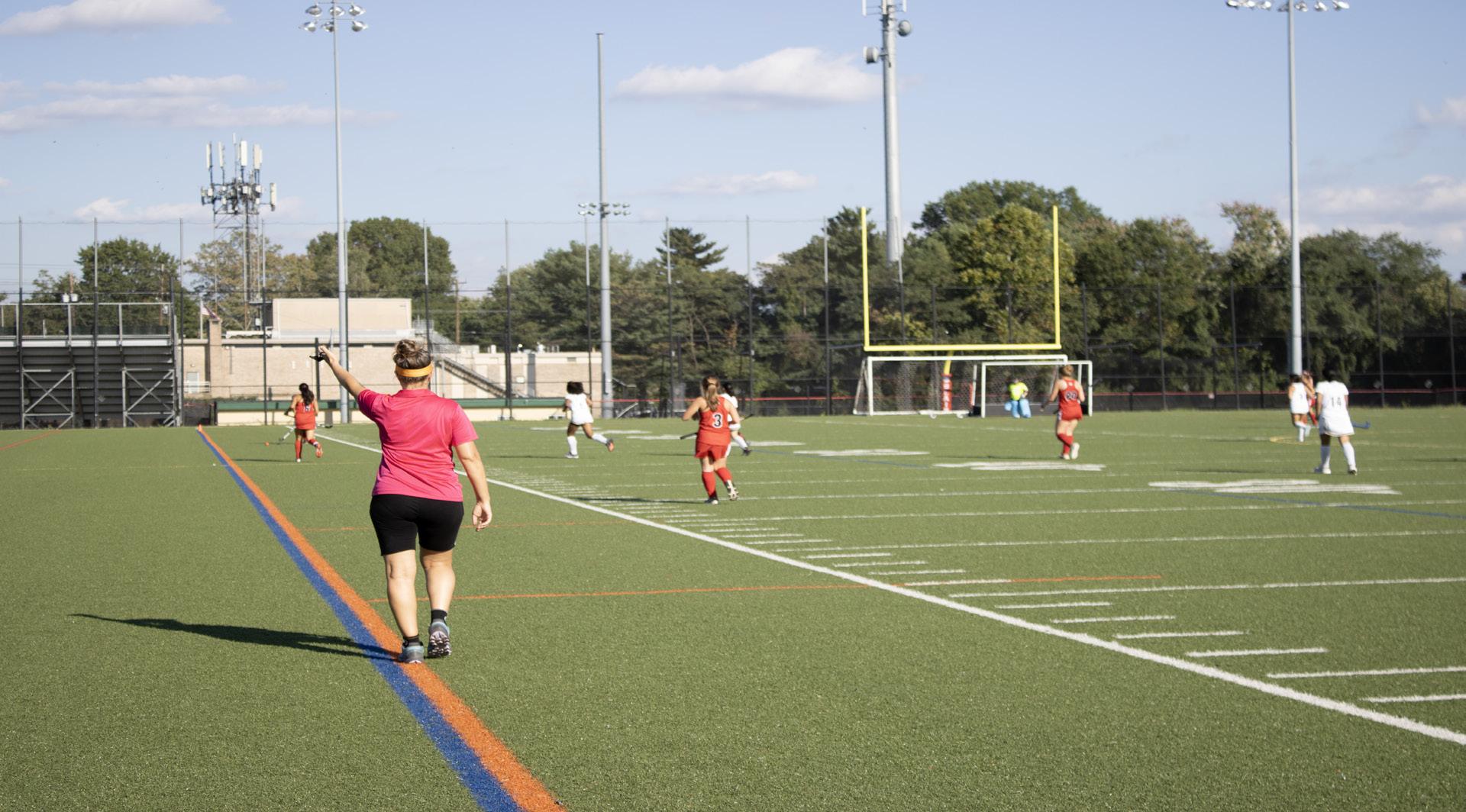
PHOTO BY LILA SHAW
Every sport requires a different amount of training which can be accomplished through classes or a practice session where prospective officials learn the mechanics of where to position themselves on the field during games. Once accepted, each official becomes a member of an officials association. These associations work with different schools to coordinate schedules and assign referees to games once they submit how many games they want to offi-
With their knowledge of the sport, these officials can support players and help them gain a better understanding of the game. Many enjoy traveling between schools and seeing the progress their athletics teams make throughout the years. “The exciting part is just to be there … around the action, running up and down the sidelines and making calls,” Ho says. “If the game is very clean, we don’t blow the whistle a lot. I don’t want to whistle a lot. I just want the kids to have fun and do their thing.”
Nevertheless, the highs of officiating also come with challenging lows. “It’s not as easy as it looks,”
By RAE FOSTER and GABRIELLA MCKENZIE
The Blair boys’ varsity soccer goalie looks out at the field. An opposing attacker sprints towards him. The attacker weaves through defenders. Anticipation builds in the stands. There is just one last man standing between the ball and the goal; he knows that his next move is critical for saving the game. The attacker sends the ball flying toward the top left corner. At the
they are making impressive contributions to Blair athletics—and they have the next four years to build their legacies.
Still, for Bevington, the adjustment has been demanding but rewarding. “I knew it would be a lot of work at the beginning of the year,” Bevington says. “I’m definitely busy with soccer. But I think I’ve been able to handle it well and adjust.” The transition to varsity sports brings new challenges for freshman athletes. Jumping from middle school or youth leagues to

You have to have the mentality to get better … or else coaches aren’t gonna waste their feedback on you. They’re gonna give it to someone who is actually serious about getting better.
in the youth league for three years, Blair freshman John Kalule II had a similar experience transitioning to varsity football. “I just need to get completely immersed into the speed and … know this isn’t the same as youth,” Kalule says. Many freshman athletes are also learning how to cope with the newfound pressure to perform . Bevington details how he handles nerves and mistakes, especially as his team’s starting goalie. “[There were] definitely some mental battles going into the first game. I was really nervous, considering I just found out I was going to be starting the week before,” Bevington says. “[I’ve] made some mistakes this season, and those were really hard in the moment … You just gotta forget about it and move on.”
For some of these players, the challenge is greater—not only are they playing at a higher level, they are playing a new game entirely. Blair freshman and first-year field hockey athlete Paige Laczek
flag football referee Stefan Medina says. “There’s a lot of things you have to remember. The sun is always on you, you have people always talking to you, [and] you get thirsty. It’s mentally challenging.”
Many agree that the job can be consuming. “We are putting in a lot of effort behind the scenes to make sure that we are doing a service to the game,” Jordan Gray, soccer referee of 24 years, says.
For head softball umpire Joe Holonich, almost every day is committed to officiating games. “In the high school season, it’s probably five, maybe six days a week that I officiate. During the spring, summer, and fall, I spend … probably 10 to 12 hours [every] Saturday and Sunday at a ballfield umpiring.”
Aside from the physically taxing requirements of being an official, officials also face difficult altercations with players, parents, or coaches at times. “Relationships with the adults, coaches, and parents get … more challenging each year,” Liu says. “I think the students haven’t really changed much in 20 years, but I feel like there’s more at stake with the parents and coaches these days than there were before.”
At times, players, coaches, and parents will yell at officials for calls that they do not agree with. Two student umpires working for Holonich quit due to parents’ disrespectful actions during a game. Other officials have also had to eject parents in the past. “[Officials] are definitely underappreciated,” Blair baseball coach Kyle Wannen says. “They face a lot of unacceptable behavior.”
Nevertheless, Ho believes that forming a thick skin is an important aspect of officiating. “You have parents and coaches who might yell at you, you might have parents who scream at the calls, but at the end of the day, you know your rules,” Ho says.
To avoid conflict, coaches often teach players to focus on the team’s play rather than what calls the referee makes. “If you have an umpire who’s having a bad night and making some inaccurate calls, it’s on you as the coaches and players to overcome that adversity and fight through it in order to win,” Wannen explains. “As soon as you lose focus on your individual or team plan, you’re letting other sources influence or dictate your play.”
Throughout each season, the referee community is there to support each other. “It’s pretty closeknit … we share experiences,” Liu says. “The one thing we all have in common is that we love sports.”
Within the community, officials are able to learn from each other on and off the field. “Even when I go watch a game, I find myself watching the officials a lot of times just to see their mechanics and how they move and how they communicate with each other and coaches,” Liu explains.
Liu also emphasizes the plethora of roles that officials can fill. “Anyone can be a ref at any age,” Liu says. “It’s never too late. There’s always a role for somebody, whether you’re on the field or in the booth keeping the clock.”
It’s never too late.
There’s always a role for somebody, whether you’re on the field or in the booth keeping the clock.
Though the job is difficult at times, most officials still return for their love of the sport and community. “Being there in real life and the lights on at night. I mean, you can’t beat that,” Ho says.
highlights the importance of taking feedback seriously, when trying to improve at the sport. “Whatever drill we’re doing, I’m always gonna adapt to it and find a way to complete it, even if I’ve never done it before,” Laczek says. “You have to have the mentality to get better … or else coaches aren’t gonna waste their feedback on you. They’re gonna give it to someone who is actually serious about getting better.”
A strong team dynamic is also important for these players to progress over the season. Bevington notes how the boys’ varsity soccer team has made him feel comfortable. “There’s a lot of chemistry on the team … I like the coach,
and I’m having fun at practices and playing games,” Bevington says.
The Blair fall athletic season is almost over, but young athletes like Kalule have years ahead of them to improve. “Every single one of my teammates has worked hard … I think we’re going to be an extremely good team,” Kalule says.
Coaches recognize how tough the adjustment can be for first-year varsity players, whose athletic journeys have just begun. Blair girls’ varsity volleyball coach Jenna Feinauer encourages them to continue playing through this transition. “Stick with it,” Feinauer advises. “Keep trying because it’s super challenging but so rewarding.”
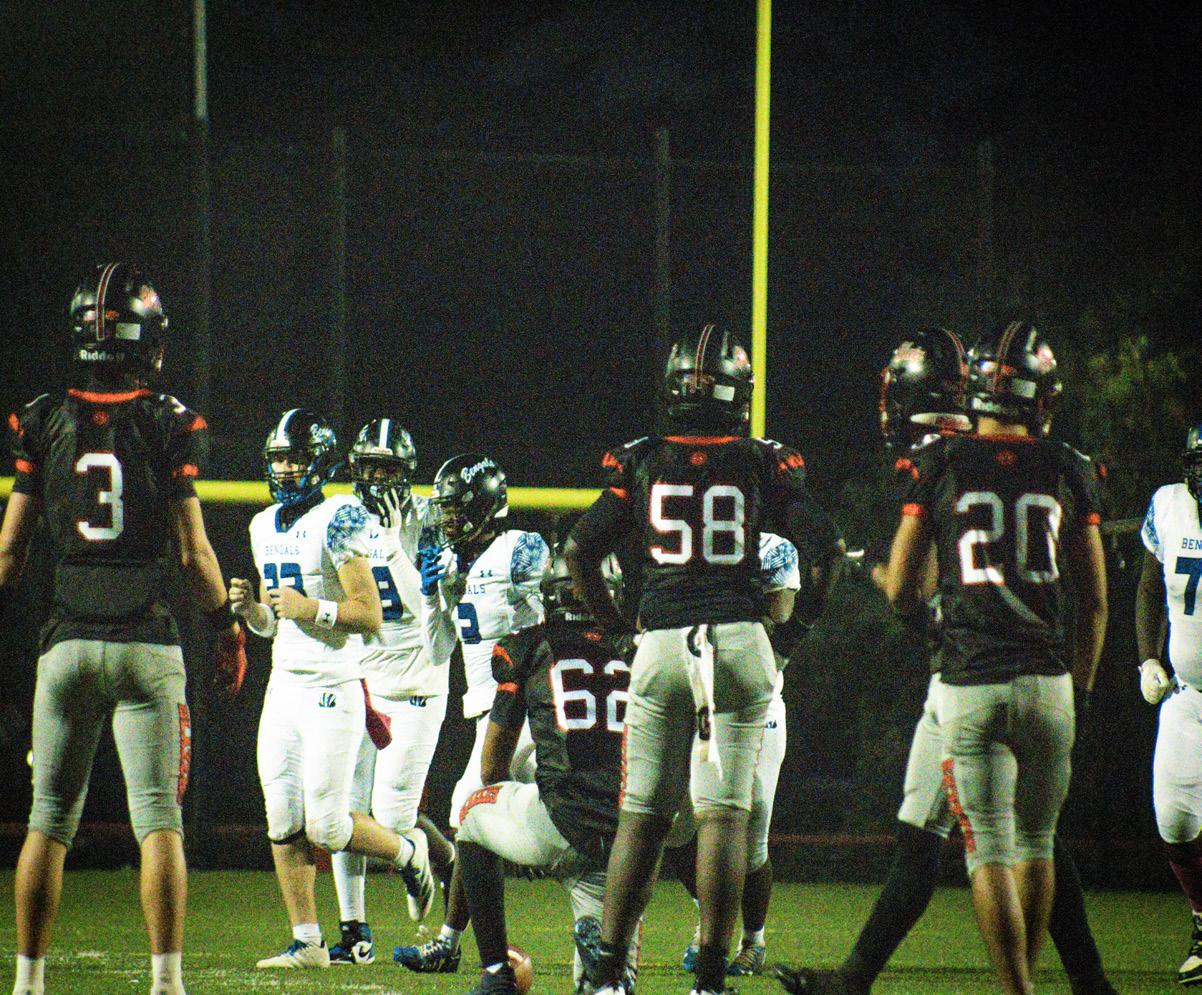
By ELENA KLEINER and ALICE LEVINGS
When Caitlin Clark broke the National Collegiate Athletic Association (NCAA) Division I all-time leading scorer record back in February 2024, many girls were not just watching—they were imagining themselves on the court. For years, the Women’s National Basketball Association (WNBA) had to compete against the National Basketball Association (NBA) for equal airtime. Now, high-level women’s basketball games are must-watch events, and their influence has spread to youth leagues and other female-oriented sports. The surge in coverage and viewership is not just rewriting headlines; it is rewriting what young female athletes believe is possible.
Brief history of female sports news coverage
Women’s sports have remained overlooked, underfunded, and under-promoted for decades compared to men’s sports. However, landmark moments throughout history have steadily broken down these barriers, laying the groundwork for the increased popularity seen today. One of the most important moments in the battle for equal gender visibility came from the “Battle of the Sexes” tennis match between Billie Jean King and Bobby Riggs in 1973. King won against Riggs in all three sets of the match, and her victory became symbolic of success for female athletes around the world. The match was broadcast to an estimated 90 million viewers worldwide, demonstrating the global commercial and cultural potential of women’s sports coverage.
The 1999 International Federation of Association Football (FIFA) Women’s World Cup was also a monumental moment for female athletes. Hosted in the United States, the tournament final against China culminated in a penalty shootout and an eventual victory for Team USA. American Brandi Chastain’s iconic celebration, in which she dropped to her knees and ripped off her jersey after scoring the winning penalty, is still remembered to this day by thousands of soccer fans as a symbol of
triumph and visibility. Earlier this year, the Rose Bowl Stadium hosted another female soccer championship match, which attracted a crowd of approximately 90,000 fans and millions of TV viewers, proving that there is significant demand for professional women’s sports. Specifically, the growth of women’s basketball is also due to an increase in funding. Investment in
I’m very honored to start this new history at Blair ... I think it’s a good way to put women’s sports out there because women do deserve representation.
women’s basketball has not always been what it is today. College basketball only gained significant visibility following the 1996 Olympics, and although it has always made revenue, it still has never made a profit. “When I first started coaching, the majority of our profession were women,” Kristy Thomaskutty, a former coach at Emory College and current women’s basketball analyst at ESPN, said. “There was no million-dollar salary back in the day. After the ‘96 Olympics, the first big boom to the sport occurred when administrations started putting resources into women’s basketball to make their team successful.”
As funding increased, male coaches began to get involved, and general public interest in the WNBA also grew. “We started seeing the men come over to the women’s side,” Thomaskutty said.
Current popularity in female basketball
Today, all eyes are on women’s basketball. Many young female stars get their start in college basketball, which can draw more viewers than the men’s bracket at times.
Last year’s women’s NCAA championship game drew in an average of 18.9 million viewers, while the men’s championship game only garnered an average of 14.8 million
viewers.
Supporters of the female basketball movement are not quiet. Black shirts displaying the phrase “Everyone watches women’s sports” can be seen at many women’s sporting events. Women’s college basketball games are often sold out, drawing large and energetic crowds. Fans are not only watching women’s basketball—they are also crazy about it.
In recent years, social media has further amplified both the accomplishments of past female athletes and the visibility of current women’s sports. Now, women’s basketball reaches a larger and more diverse audience. For decades, the leading supporters of women’s basketball were enthusiastic senior citizens. However, the increased accessibility of sports news provided by social media has sparked intrigue in younger viewers. Dallas Wings standout Paige Bueckers has garnered a total of 2.9 million followers on Instagram, and her popularity has received her sponsorships from big companies like Gatorade, Nike, Verizon, Chegg, and DoorDash, signaling her popularity online.
Caitlin Clark, Indiana Fever superstar, has also gained public admiration online. Clark’s time at the University of Iowa brought millions of fans to women’s college basketball and set in motion the current wave of popularity with younger fans. “The older generation has traditionally been the women’s basketball fan,” Thomaskutty says. “[But] what we saw last year is that the growth … is coming from the eighteen to thirty-four year olds—it was up around 27 percent.”
After nearly 30 years of increased investment in the sport, the WNBA’s revenue has climbed significantly. This year, with a forecasted revenue of $1 billion, the league is projected to earn one hundred times what it did in 1996. Finally, the WNBA has gotten the spotlight. Women in basketball today are still fighting for their rights as athletes.
The WNBA and the Women’s National Basketball Players’ Association (WNBPA) has begun negotiating a new collective bargaining agreement to address disparities in pay, player benefits, and player conduct with regard to the NBA.
other female sports to thrive
A new era of excitement around women’s sports has emerged, and it is not limited to just basketball. High schools are creating girls’ flag football programs, the Professional Women’s Hockey League is thriving, the Women’s Professional Lacrosse League commenced play in 2025, and a Women’s Pro Baseball League is set to launch in 2026.
Many female athletes at Blair are enthusiastic about this trend and excited to contribute. “I’m definitely excited, [sports are] a very big part of my life,” Blen Belay, a Blair sophomore who plays for the basketball, flag football, and lacrosse teams, says.
The county recently invested in
girls’ flag football, marking another win for female sports. Leala Guevara-Jackson, who plays for the flag football team, recognizes the significance of being part of this victory.
“I’m very honored to start this new history at Blair,” Guevara-Jackson says. “I think it’s a good way to put women’s sports out there because women do deserve representation.”
Women’s basketball has made significant strides in the past decades. While future hardships and difficulties are inevitable, the sport will continue to grow and serve as a symbol of inspiration to all young aspiring female athletes. The rise of women’s basketball is sure to be reflected in other women’s sports for years to come.