my darling
”
Cats Cats is a musical composed by Andrew Lloyd Webber, based on Old Possum’s Book of Practical Cats by T. S. Eliot, and produced by Cameron Mackintosh. The musical tells the story of a tribe of cats called the Jellicles and the night they make what is known as “the Jellicle choice” and decide which cat will ascend to the Heaviside Layer and come back to a new life. Cats introduced the song standard “Memory”. The first performance of “Cats” was in 1981.
D
irected by Trevor Nunn and choreographed by Gillian Lynne, Cats first opened in the West End in 1981 and then with the same creative team on Broadway in 1982. It won numerous awards, including Best Musical at both the Laurence Olivier Awards and the Tony Awards. The London production ran for twenty-one years and the Broadway production ran for eighteen years, both setting new records. Actresses Elaine Paige and Betty Buckley became particularly associated with the musical. One actress, Marlene Danielle, performed in the Broadway production for its entire run (from 1982 until 2000).
A
s of 2015, Cats is the fourth longest-running show in Broadway history, and was the longest running Broadway show in history from 1987 to 2006, when surpassed by The Phantom of the Opera. Cats is the fourth longest-running West End musical. It has been performed around the world many times and has been translated into more than 20 languages. In 1998, Cats was turned into a made-for-television film.
C
omposed by Andrew Lloyd Webber, the production of Cats is based on T. S. Eliot’s Old Possum’s Book of Practical Cats (1939), which the composer recalled as having been a childhood favourite. The songs of the musical comprise Eliot’s verse set to music by the composer, the principal exception being the most famous song from the musical, “Memory”, for which the lyrics were written by Trevor Nunn after an Eliot poem entitled “Rhapsody on a Windy Night”. Also, a brief song entitled “The Moments of Happiness” was taken from a passage in Eliot’s Four Quartets. Andrew Lloyd Webber began composing the songs in late 1977 and premiered the compositions at the Sydmonton Festival in 1980. The concert was attended by T.S. Eliot’s wife, Valerie Eliot and she loved the songs that Webber had composed. She gave her blessing for the songs to be adapted into a musical stage play. Rehearsals for the musical began in early 1981 at the New London Theatre.
D
ue to the Eliot estate asserting that they write no script and only use the original poems as the text, the musical had no identified plot during the rehearsal process, causing many actors to be confused about what they were actually doing. An unusual musical in terms of its construction, the overture incorporates a fugue and there are occasions when the music accompanies spoken verse. The show is completely told through music with virtually no spoken dialogue in between the songs. Dance is also a key element in the musical especially during the 10-minute Jellicle Ball dance sequence. The set, consisting of an oversized junk yard, remains the same throughout the show without any scene changes. Lloyd Webber’s eclecticism is very strong here; musical genres range from classical to pop, music hall, jazz, rock and electro-acoustic music as well as hymn-like songs such as “The Addressing of Cats”.
C
ats premiered in the West End at the New London Theatre on 11 May 1981. There was trouble initially as Judi Dench, cast in the role of Grizabella, snapped her Achilles tendon during rehearsals prior to the London opening. She was replaced by Elaine Paige. The musical was produced by Cameron Mackintosh and Lloyd Webber’s Really Useful Group, directed by Trevor Nunn, with associate director and choreographer Gillian Lynne, design by John Napier, and lighting by David Hersey. The conductor was Harry Rabinowicz. It played a total of 8,949 performances in London.
2
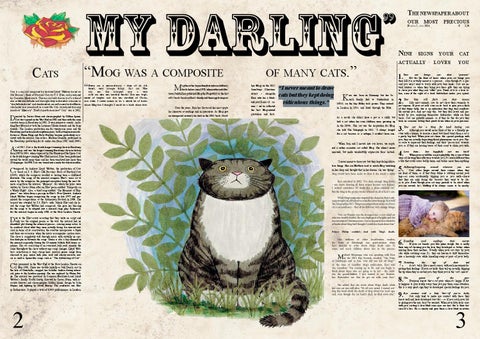
“Mog was a composite
“
Every cat is extraordinary – they all do different, very strange things. Our cat Wienitz was the strangest one: a very solid cat who was terribly fearful. She was frightened of heights and she was terrified of Christmas trees. I never meant to do a whole lot of books about Mog but I thought I could do a book about that.
M
bye Mog) in the 2015
bookshelves since 1970, when author and illus-
Sainsburys Christmas
trator Judith Kerr published Mog the Forgetful Cat, the first
advert
of 16 books based on Kerr’s family and their egg-loving cat.
Kerr, who has a blink-
–
alongside
and-you’ll-miss-it caOver the years, Kerr has discussed her most popular character at readings and in interviews. As Mog gets an unexpected revival (she died in the 2002 book, Good-
meo – we’ve collected the best Mog-related quotations and facts.
“I never meant to draw cats but they kept doing ridiculous things.”
K
family
most
precious
Number 5, april 2016,
signs
actually
your loves
€
2,20
cat you
1.
Your
err was born in Germany but her Jewish
our
Nine
of many cats.”
og the cat has been a firm favourite on children’s
The newspaper about
fled
to
Switzerland
in
19333, on the day Hitler took power. They arrived in London in 1936, and lived through the Blitz.
As a result, she didn’t have a pet as a child, but had a cat when her own children were growing up in the 1960s. This cat was the inspiration for Mog, she told The Telegraph in 2011: “I always longed for a cat because as a refugee I couldn’t have one.
“When Tom and I moved into our house, we acquired a rather eccentric cat called Mog. She almost never meowed, but made wonderfully expressive faces instead.
“I never meant to draw cats but they kept doing ridiculous things. Her son Matthew used to watch Mog twitching in her sleep and thought that in her dreams she was flying.” Mog would have been easier to draw if she wasn’t a tabby Kerr admitted in 2002: “I’ve done enough Mog books – you know, drawing all those stripes became very tedious. I wished sometimes I’d made her a plain-coloured cat.”
cat brings you their “presents” Not for the faint of heart, when your cat brings you their kill it is actually meant as a present… even though it’s a present you won’t want to touch with your bare hands. Cats are natural hunters, so when they bring you these gifts they are trying to show you what they can “offer” you. Think of it as a love token, even if the sight of a dead bird/rodent makes you squeal.
2.
Your
kitty will flash you their tummy Like most animals, cats do not show their stomachs to just anyone. If your cat rolls over on its back to give you a flash of that fuzzy belly, this is an indication that they feel comfortable around you. And not only this, but they feel loved and protected by you, rendering themselves defenseless while on their backs. Cats are prideful animals, so if they do this for you they have no concerns letting their guard down when in your presence.
3.
Your
cat has a thing for head butting you Although you would never think of this as a friendly gesture with a human, to receive a head butt (head bunt) from a cat is a pretty big deal. When your cat shares this special privilege with you, they are actually depositing facial pheromones on to you. These serve to represent their feelings, and their “possession” towards you, as if they are leaving traces of their scent to claim you with.
4.
Love
bites… but hopefully not too hard! When your cat nibbles on you playfully, this is one of their ways of showing their affections towards you. It’s much different than a bite that could cause bodily harm, and tickles more than anything.
5.
Following/Lingering around wherever you are Cats often linger around their owners when they are fond of them, so if that furry feline is rubbing around your legs—or even accidentally tripping you as you walk—know that they are only doing this because they want to be close to you. Even though your cat may pretend to be aloof when you are around, he’s bluffing if he always seems to be nearby.
But the Mog in the picture books is based on all of Kerr’s cats. While Mog’s namesake inspired the character, Kerr’s subsequent eight cats all helped to create the cat on the page. Kerr told The Telegraph in 2013: “Mog was a composite of many cats. Every cat is extraordinary – they all do different, very strange things. “Our cat Wienitz was the strangest one: a very solid cat who was terribly fearful. She was frightened of heights and she was terrified of Christmas trees. I never meant to do a whole lot of books about Mog but I thought I could do a book about that.” Prince
Philip
couldn’t
deal
with
Mog’s
death.
Like millions of other heartbroken readers, the Duke of Edinburgh was grief-stricken when Kerr decided to write about Mog’s death after 32 years, and teach children about loss in the process.
M
ichael Morpurgo, who was speaking with Kerr at the 2013 Hay Festival, recalled: “The Duke of Edinburgh said to you, ‘why did you kill off Mog?’” At the time of Goodbye Mog’s publication, Kerr told The Guardian: “I’m coming up to 80, and you begin to think about those who are going to be left – the children, the grandchildren. I just wanted to say: Remember. Remember me. But do get on with your lives.” She added that she wrote about Mog’s death while her own cat was still alive: “It’s all very weird. I started writing this book about the death of Mog about two years ago, and, even though the cat hadn’t died, he died soon after.”
6.
Kneading (and needing) their master If your cat kneads you like pizza dough, this is really their way of showing you the love they developed as babies when nursing from their mothers. Usually when your cat stays by your side while catching some Z’s, they are known to drift themselves into a heavenly state while kneading away at parts of your body.
7.
Twitching the tips of their tail A cat’s tail is like a mood sensor, with each movement depicting their feelings. If your cat holds their tail up casually, flipping the tip when they’re around you, they think you’re the “cat’s meow”.
8.
The
power of the purr Everyone knows that a cat purrs when it’s happy. If kitty happens to purr loudly every time you pay them some attention, this is a very good sign they’ve developed special feelings for you.
9.
Eye
contact with a kitty kiss—if you’re lucky Cats only tend to make eye contact with those they know well and have developed trust for – so if you catch your kitty giving you the eye, don’t be worried. When your kitty locks eyes with you, casting a slow blink once eyes are met, this is their version of a kiss. Be a sweetie and give them a slow blink in return.
3