UNDERPINSCONNECTIVITYAUTOMOTIVEFUTUREINDUSTRYSUCCESS
Automotive Connectivity Underpins Future Industry Success 2 Analyst Introduction 3-5 Executive Interview . . . . . . . . . . . . . . . . . . . . . . . . . . . . . . . . . . . 6 Panel Summary 7–9 Proven Success . . . . . . . . . . . . . . . . . . . . . . . . . . . . . . . . . . . . 10 TABLE OF CONTENTS
Automotive Connectivity Underpins Future Industry Success 3 INTRODUCTIONANALYST 18% 8915513 21% 932010 26% 9525177 7 7 23 37% 289435 51% 9046 57% 4478 76% 8361 82% 857363 86% 938257 89% 2015 2016 2017 2018 2019 2020 2021 2022 2023 2024 100894246 Total 4G/5G4G2G/3GConnectSalesSalesSalesSalesSales Penetration Rate 120 100 80 60 40 20 0 UnitsOfMillions Source: Wards Intelligence BY STEPHENAutomotiveBELL Connectivity Sales
In the U.S. market, the first sunset occurred in 2017 when AT&T shut down its 2G network and the last 3G network (Verizon) will close in December 2022. At the beginning of 2023 Wards Intelligence estimates at least 30 million vehicles will be dark and unable to connect via their orig inal modems.
The automotive industry has come a long way since the first vehicle telephone was installed by Western Electric to operate on the Bell network in St. Louis back in 1946. It took another 50 years before General Motors announced the introduction of the OnStar service at the Chicago Auto Show in 1996. This was the first of the emergen cy call subscription services and was supplemented the year after with remote diagnostics.
The world of automotive connectivity has advanced since those early days with mobile broadband being de livered by 4G and 5G networks, ensuring always-on, su perfast smart telematics capability and enhanced vehicle and consumer services.
As the chart below shows, in 2022 about 70 million new vehicles will be sold with connectivity modules built in. This represents approximately 82% of total new-vehicle sales. Of these connected vehicles, 63 million will have 4G modems and 7 million will have 4G/5G modems. 2022 will be the peak year for 4G-only modems with 4G/5G modems becoming the dominant modem in new vehicles in 2024. However, even in 2024, connected vehi cles still will comprise only 89% of vehicles sold. This will be driven by a cost and market served analysis. If there is poor or no cellular coverage in countries with low in come, there is no benefit in burdening low-cost vehicles with the additional expense. However, there is a challenge OEMs face which is also shown on this chart: when to cut over from one gen eration of technology to another. The last utilization of 2G/3G modems was in 2018, almost nine years after the first 4G network was turned on and months before the first 5G networks were live. Now the automotive industry is having to grapple with the issue of cars going dark be cause the 2G/3G networks are being shut down and the spectrum is being re-farmed for 5G services.
The answer lies in the chart below, which is a summary of disruptions impacting and trans forming the automotive industry. All these disruptions involve computation, complex systems, semiconductors, data and software. They start with the new architectures and systems to handle the shift to battery-electric power trains, advanced safety and the pathway to autonomous driving. They also encompass the design, manufacturing and supply chain where the creation of a digital twin will ensure the tracking and updating of each vehicle through its Forlifecycle.thisrevolution
Mobility as a service, data driven services, data monetization based on connectivity and cloud platforms. Enhanced and upgraded features delivered via lifetime subscription services. Cross industry and domain engagement, collaboration and partnerships. Vertical integration with increased mergers and acquisitions.
TRANSFORMATIVE TECHNOLOGIES DOMAIN INNOVATION NEW BUSINESS MODELS AUTOMOTIVE SUPPLY CHAIN OPERATING STRATEGY IMPACT
Why is this important and what does it have to do with the subject of this eBook, “Removing the Pain of Soft ware Integration”?
New software and hardware architectures with the ability to update and upgrade over a vehicle’s lifetime via OTA. Software and data defined experiences with redefined reliability and safety including end to end cyber security. Advanced driver assistance systems (ADAS) linked by internal and external connectivity build capability for autonomous vehicles. New electrification and battery technology management systems. Information and user experiences. 5G and IoT combined with cloud, on premise, and edge compute/storage capability enable enhanced data analytics, and advanced AI/ML applications.
KEY AREAS OF DISRUPTION
to flourish, it is essential that the right connectivity is in place and ubiquitously available glob ally. The emergence of eSIM has enabled the automotive industry and its connectivity partners to simplify the pro cess of provisioning and managing each vehicle’s con nectivity profile with greater ease. This, coupled with the availability of increasingly powerful and integrated con nected-vehicle management platforms, is enabling better integration with cloud and back-end systems. Ultimately this fulfills the vision of a chip-to-cloud continuum of data flows and sets up the opportunity to share the data to en hance safety and operational efficiency as well as deliver predictive information. It also provides the basic framework to be able to man age and deliver over-the-air (OTA) software and firm 4 Disruption
Impacting And Transforming The Automotive Industry
ARCHITECTURE REVOLUTION
Implementation of industry 4.0 technologies combined with cloud based digital twins enhances development, testing, manufacturing diagnoses and maintenance.

What will be important is the ability to orchestrate the de livery of these updates and ensure that the software or firmware is securely delivered to the right system, ECU or sensor, at the appropriate time, that the initial state is cor rect, and the final updated status is validated and correct.
While R156 SUMS (Software Update Management System) focuses on cybersecurity measures to ensure safe software updates throughout the vehicle lifecycle. These regulations, along with the ISO/SAE 21434 standard, have become the backbone of the industry’s adoption of a unified approach to OTA and cybersecurity. The software pain points for the industry are being exac erbated by the new BEV entrants that are not hindered by legacy architectures and software and are rapidly creating new experiences for consumers. This ability to innovate swiftly and to continuously enhance the consumer experi ence is setting a customer expectation that OEMs currently are struggling to match.
Against this background, the panel of experts we assem bled at AutoTech: Detroit provided real-world insight into how the industry is addressing these challenges.
One more aspect of the shift in business model and operating practices of the industry is that the traditional focus on cost and performance will need to adjust to consider having head room in the chipsets to last and be upgraded over the vehicle’s lifetime. This requires new types of relationships with chipset vendors, including lifetime pricing and upgrade agreements.
In fact, the shift to BEVs is causing a fundamental rethink of the automotive business model. The historic adage was that the car never was better than the day it left the show room. But with these new vehicle architectures, it’s feasible to not only update the vehicle but also enhance the vehicle with new functionality. Since the cost of a BEV is higher than that of an internal-combustion-engine vehicle, there is increasing consideration of seeking profit not just on the initial sale but over the lifetime of the vehicle. This could re sult in a lower initial sales price supplemented by subscrip tion sales leading to a lifetime return on investment (ROI) calculation. These enhancements will lead to an improved customer and ownership experience.
UNECE’s WP.29 R155 CSMS (Cybersecurity Management System) provides guidelines on handling cybersecurity management from ideation through to post-production.
5 ware upgrades to keep the vehicle safe and secure over its lifetime, which on average is about 11 years but is likely to extend with battery-electric vehicles (BEVs) that re quire less maintenance.
In June 2020, the United Nations Economic Commission for Europe (UNECE) passed regulations mandating auto motive cybersecurity, also known as WP.29 R155 & R156.

“The challenge with that is they don’t have the expertise, they don’t have the DNA,” says Schwinke. “They are car companies trying to become software companies.”
6
Although it’s easy to assume that new-age OEMs are lead ing this technological race, Schwinke says the main innova tors tend to be the established automakers. This is primarily due to the cost-conscious approach taken by newer man ufacturers.
Integrating software is completely different from the me chanical integrations that have defined automobiles for the last 100 years. Unfortunately, integration complexities and variations in third-party supplier development cycles have led to a long history of tightly coupled systems and ill-de fined interfaces incapable of supporting advanced features and upgrades. This is easily exacerbated by documentation discrepancies, such as when two or more members of a supply chain work out an integration but fail to explain or record component dependencies. The result is issues and product recalls that can’t be fixed because no one under stands the problem.
Rather than risk limited resources on core fea tures like an ABS (Automatic Braking System) ECU, many prefer to stick to tried and true approaches. Schwinke be lieves the best route is a combination of the two. “You can’t just go ahead and produce a vehicle that’s certified to fed eral regulations, without having experienced engineers who ensure the same mistakes aren’t repeated,” he says. “But you also need enough fresh ideas to redefine how these products can be built.”
According to Sibros VP of Customer Engagement, Ste ven Schwinke, the solution is loosely coupled systems and well-defined interfaces, which many OEMs are attempting to do through the creation of in-house software solutions.
Schwinke says over the past two years the industry has seen an increase in need and desirability for embedded connectivity, not just for the customer-facing services, but for OEMs to understand how their vehicles are performing and being used. Rather than waiting for months or years to identify and assess issues, they get immediate access to information that roots out manufacturing defects and soft ware recalls. “Over the next two years, we’re going to see companies that do connectivity well accelerate in the mar ket and grow in value,” says Schwinke. “Those OEMs are going to build better products, and customers are going to recognize that.”
Another, more cost-effective approach is utilizing a third-party software supplier. End-to-end embedded con nectivity solutions, like those powered by Sibros, greatly reduce the complexity involved in both data logging and vehicle updates. “We provide our customers with a solid foundation that lets them focus on innovation and build ing better experiences for their customers,” says Schwin ke. Sibros products enable each vehicle to determine ex actly what it needs and get those updates from the cloud. This hyper-scalability allows OEMs to manage billions of software and calibration combinations for the entire life cycle. Another benefit is in-depth, flexible, and cost-ef fective data collection. “A lot of times we reduce data transport costs by up to 95% and get the same amount of data out of the vehicle,” says Schwinke. The final pillar of Sibros’ platform is the ability to remotely interact with each vehicle to perform deep diagnostics and create cus tomizable experiences for customers.
INTERVIEWEXECUTIVE REMOVING THE PAIN OF SOFTWARE INTEGRATION
The following summary structures the panels’ thoughts around four key topic areas.
Build Versus Buy and Open-source Software
Rolling Wireless has seen challenges with software contri bution, especially because Legato has been open-source since its inception. It had a couple of development partners that contributed a small amount of code, but then it quickly realized the conundrum of, who owns the IP now?
Ford pointed out that Red Hat is not certifying a single ver sion of Linux to be safe; instead, it’s looking to continually recertify Linux as a moving target. That’s a big change of approach for automotive; it’s about dependency mapping of a common architecture of a moving target. The ideal solution is for the industry to agree on a common frame work around safety certification.
Hemant Deokar , Director of Product Marketing, Rolling Wireless Yu Fang , CTO & Co-Founder, Sonatus
PANEL SUMMARY HOW CAN AUTOMOTIVE REMOVE THE PAIN OF SOFTWARE INTEGRATION?
One of the liveliest panels at Auto Tech: Detroit 2022 was the discussion of removing the pain of software integration. The panel comprised: Matt Jones , Director of Global Technology Strategy, Ford Motor Company Sushama Mithapally , Engineering Group Manager-Software Defined Vehicles, General Motors Steve Schwinke , VP of Customer Engagement, Sibros
7
5G will not only accelerate vehicle connectivity but also spur rapid growth in real-time hybrid vehicle-cloud applications.
A thorny question is: How does open-source software re late to this build versus buy decision? Nobody really owns Linux, and this is a difficult mindset shift for the automotive industry. The software code is free to review and use, but that doesn’t mean it’s free to develop. If the open-source software doesn’t do everything that’s required, it can be im proved, and lines of code added.
Ford pointed out that it becomes very complex if some body takes a proprietary operating system and mixes it with someone’s open-source; you could end up giving away lines of code or binaries to something you don’t have the rights to. Safe and Secure Software According to GM, it’s not that the OEMs don’t want to use open-source, but at the end of the day safety and security are the top concerns. That’s why it collaborated to enhance Red Hat’s in-vehicle operating system to be a functional safety-certified Linux operating system. This enables them to leverage the open-source community and open their plat form for third-party development and outside innovation.
INTRODUCTION
As the industry has become more software-centric, this has created a monumental struggle between build versus buy software. Keeping track of all current and legacy software, as well as electronic variants, globally is a very complex task. According to GM, software integration and validation is a concern that must be addressed to truly unlock the poten tial of software-defined vehicles. This challenge also presents an opportunity to bring dif ferent types of approaches to automotive. Service Orient ed Architectures (SOA) and containerization will usher in a new generation of vehicle software that is flexible and updatable, while in-vehicle automation will enable new fea tures without requiring new software.
Connectivity & Architectures
8
Sonatus indicated that OEMs previously didn’t consider open-source to be safe, but now that mindset is shifting be cause of the thousands of security tests already out there. This is beneficial as open-source becomes a necessity for innovation, with the architecture of the vehicle moving to just a few very powerful computers that are connected to a high-speed, low-latency network.
Ford agreed the software-defined vehicle is moving to the microservice architecture with three-layer decoupling, creat ing a data center on wheels. A whole-vehicle image update is scary, but so is the challenge of dependency mapping and the “historian” functions. These keep track of what was run ning where and when, what will run together, and establish es security event and information management systems for who is allowed to do what and when in the future.
the importance of providing customers to day with tools for updates that safely move a vehicle to the next level. The company has adopted a universal vehicle software package to help with updating the interdependen cies that take place when 70 or more ECUs are trying to talk to each other. The comprehensive vehicle software package is presented to the vehicle and allows the vehicle to decide what it needs to get to the latest version.
The automotive industry is adopting many of the technol ogies and approaches that were proven in other verticals.
GM thinks of a vehicle in three different layers. There’s the traditional electronics, where there is a move from function al-specific ECUs to zonal or centralized architectures. The second layer has a higher compute capability, with a ser vice-oriented architecture to create new experiences and connect with the cloud services. The third level is connec tivity, which provides the ability for the car to talk not only to infrastructure but also other cars and mobiles; this could play a huge role in being able to predict and avoid crashes, as well as eliminate congestion.
There’s a school of thought that says you should isolate the mission critical elements from other SW elements. This is considered difficult for connected autonomous systems because all the basic components are connected and very hard to firewall off. Potentially, this giant attack surface could be best protected by using crowdsource organiza tions that specialize in finding vulnerabilities for all these different potential vectors, which could help the industry as a Sibroswhole.stressed
With the industry facing growing complexity, architectures will rely on collaboration, alliances and standardization, par ticularly around safety and security. Reaching an ideal state of painless software integration will require a significant and extended commitment to collaborate by all parties in volved. What is not clear is how few platforms the industry will be able to converge on, and the role open-source will play related to security and safety in terms of transparency, certification and high-volume tests.

9
Mindsets and Training
Sibros pointed out that it’s not just about agility and train ing, but also about creating a culture of continuous learning, with code reviews and a considerable amount of mentoring.
Referencing AUTOSAR adoption by 31 OEMs, the key to success was breaking the problem down in order to find the APIs. With all the emerging and different automotive alliances, the way to ensure interaction between OEMs and the ecosystem is to get an API contract in place – and that’s a human challenge.
Ford maintains everything is a software service, and the winners are going to be those companies having high fre quency and low latency updates.
Ford agrees that DevOps agile processes are the only way forward but emphasizes it’s the API contracts that are es sential to fuel microservice architectures within the cloud.
Summary Transformation is never easy and when it involves some thing as complex as software integration it is interesting to see the diversity of potential options and the consen sus on some of the challenges. With new architectures, the increasing relevance and implications of connectivity, and the lessons to be learned from other industries, there is an abundance of options. The human aspect has emerged as a pivotal element in the path forward regarding mindsets, training, culture and creating links between companies and alliances to define APIs. Matt Jones, Director of Global Tech nology Strategy at Ford, summed it up by saying: “The chal lenge that we have is that there’s no right or wrong way.” However, the reality is that the industry needs to move fast. Working together and quickly sharing lessons learned may be essential to long-term survival for many of the players.
Sonatus emphasized that a key aspect is security; not just endpoint security but also network security, so you can see all the packets, what they’re doing and where they are going. Problems can be caught early so something can be done about them.
Sibros notes a service-oriented architecture, with a network manager responsible for managing the cellular, Wi-Fi and Bluetooth connections, makes it much easier to secure and maintain the vehicle going forward. The vehicle can rely on the network manager as a service. Maintaining that one ser vice means different platforms and systems in the car can use it to get updated.
Much of the software shift is about retraining, changing mindsets and helping people understand how to approach software development. GM says that to do this swiftly re quires DevOps. It has adopted agile processes to be able to release software daily, whenever it’s ready and whenever the value is created, and then reuse it with validation.

Sono Motors is a German automaker that is revolutionizing modern mobility with its Solar EV, the Sion. Integrating Si bros’ embedded software solutions en ables Sono Motors to enhance and scale its Sion fleet while providing customers with a superior digital experience. Compliance is a great way to re duce the pain of software integra tion. Check out this white paper on UNECE WP.29 regulations, which are redefining the way automakers address cybersecurity, data pro tection, and system security.
10
PROVEN
WP.29 WHITEPAPER
SUCCESS
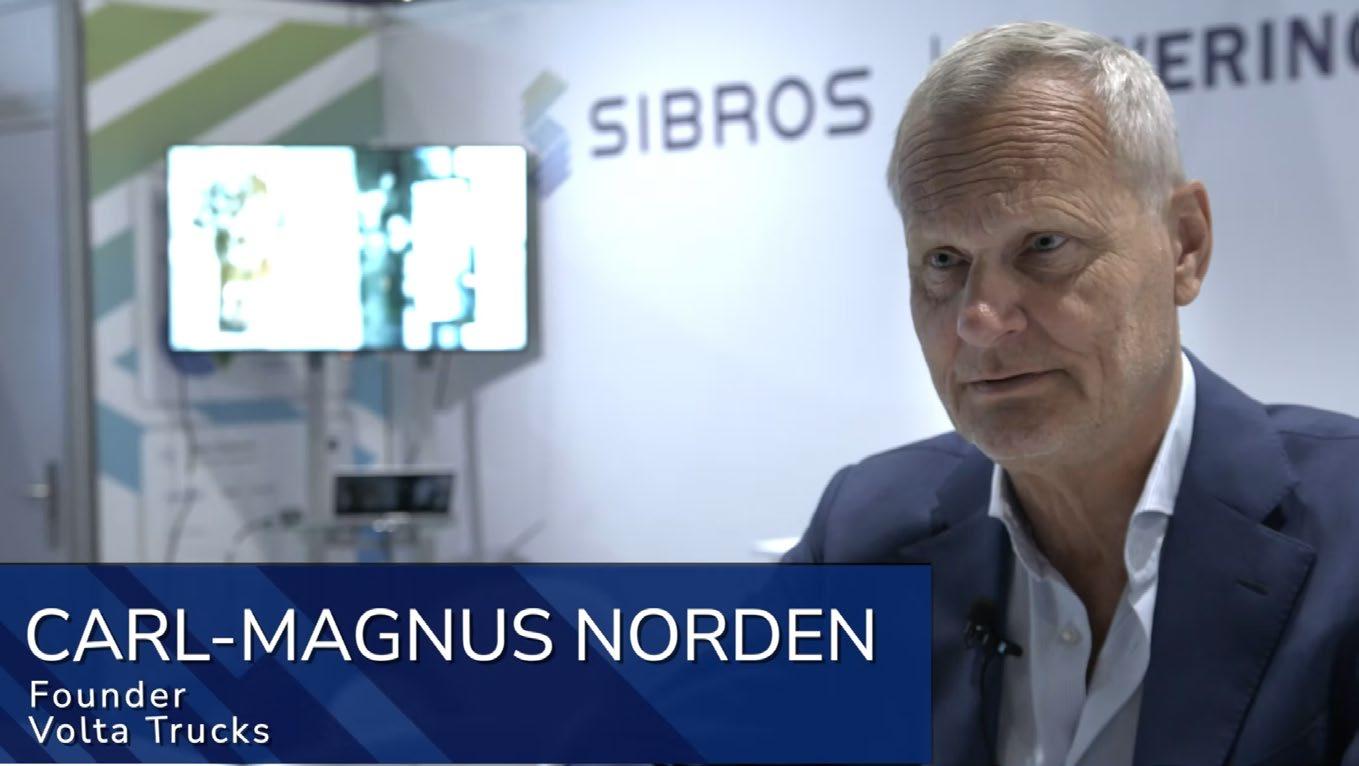
Volta Trucks is an EV truck manufac turer based in Sweden. By leveraging time-proven solutions, like Sibros’ Deep Connected Platform to ease the pain of software integration, they are able to focus on their mission of solving prob lems associated with climate change, accident rates, and driver shortages.
SIBROS COLLATERAL
Sibros has enabled Volta Trucks with on-demand vehicle-wide access to indepth data for testing, troubleshooting, and new feature development. Sibros is working to help both legacy OEMs, as well as disruptive startups like Sono Motors, overcome the obstacles associated with software integration.


WWW.SIBROS.COM