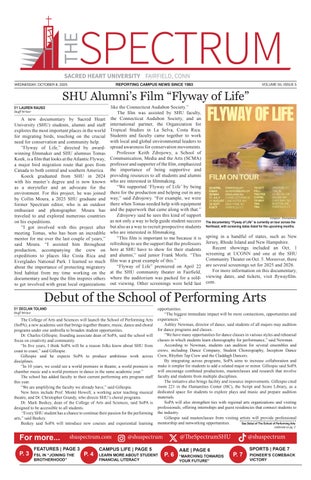

SHU Alumni’s Film “Flyway of Life”
BY LAUREN RAUSO Staff Writer
A new documentary by Sacred Heart University (SHU) students, alumni and staff explores the most important places in the world for migrating birds, touching on the crucial need for conservation and community help.
“Flyway of Life,” directed by awardwinning filmmaker and SHU alumnus Tomas Koek, is a film that looks at the Atlantic Flyway, a major bird migration route that goes from Canada to both central and southern America.
Koeck graduated from SHU in 2024 with his master’s degree and is now known as a storyteller and an advocate for the environment. For this project, he was joined by Collin Moura, a 2025 SHU graduate and former Spectrum editor, who is an outdoor enthusiast and photographer. Moura has traveled to and explored numerous countries on his expeditions.
“I got involved with this project after meeting Tomas, who has been an incredible mentor for me over the last couple of years,” said Moura. “I assisted him throughout production, accompanying the crew on expeditions to places like Costa Rica and Everglades National Park. I learned so much about the importance of protecting migratory bird habitat from my time working on the documentary and hope the film inspires others to get involved with great local organizations
like the Connecticut Audubon Society.”
The film was assisted by SHU faculty, the Connecticut Audubon Society, and an international partner, the Organization for Tropical Studies in La Selva, Costa Rica. Students and faculty came together to work with local and global environmental leaders to spread awareness for conservation movements.
Professor Keith Zdrojowy, a School of Communication, Media and the Arts (SCMA) professor and supporter of the film, emphasized the importance of being supportive and providing resources to all students and alumni who are interested in filmmaking.
“We supported ‘Flyway of Life’ by being there for the production and helping out in any way,” said Zdrojowy. “For example, we were there when Tomas needed help with equipment and the paperwork that came along with that.”
Zdrojowy said he sees this kind of support as not only a way to help guide student success but also as a way to recruit prospective students who are interested in filmmaking.
“This film is important to me because it is refreshing to see the support that the professors here at SHU have to show for their students and alumni,” said junior Frank Morle. “This film was a great example of this.”
“Flyway of Life” premiered on April 22 at the SHU community theater in Fairfield, where the auditorium was packed for a soldout viewing. Other screenings were held last

spring in a handful of states, such as New Jersey, Rhode Island and New Hampshire. Recent showings included an Oct. 1 screening at UCONN and one at the SHU Community Theater on Oct. 5. Moreover, there are several screenings set for 2025 and 2026. For more information on this documentary, viewing dates, and tickets, visit flywayfilm. com.
Debut of the School of Performing Arts
BY DECLAN TOLAND Staff Writer
The College of Arts and Sciences will launch the School of Performing Arts (SoPA), a new academic unit that brings together theatre, music, dance and choral programs under one umbrella to broaden student opportunities.
Dr. Charles Gillespie, founding associate dean of SoPA, said the school will focus on creativity and community.
“In five years, I think SoPA will be a reason folks know about SHU from coast to coast,” said Gillespie.
Gillespie said he expects SoPA to produce ambitious work across disciplines.
“In 10 years, we could see a world premiere in theatre, a world premiere in chamber music and a world premiere in dance in the same academic year.”
The school has added faculty to their current performing arts program staff this year.
“We are amplifying the faculty we already have,” said Gillespie. New hires include Prof. Monté Howell, a working actor teaching musical theatre, and Dr. Christopher Grundy, who directs SHU’s choral programs.
Dr. Mark Beekey, dean of the College of Arts and Sciences, said SoPA is designed to be accessible to all students.
“Every SHU student has a chance to continue their passion for the performing arts,” said Beekey.
Beekey said SoPA will introduce new courses and experiential learning opportunities.

“The biggest immediate impact will be more connections, opportunities and experiences.”
Ashley Newman, director of dance, said students of all majors may audition for dance programs and classes.
“We have many opportunities for dance classes in various styles and rehearsal classes in which students learn choreography for performance,” said Newman.
According to Newman, students can audition for several ensembles and crews, including Dance Company, Student Choreography, Inception Dance Crew, Rhythm Tap Crew and the Claddagh Dancers.
By integrating across programs, SoPA aims to increase collaboration and make it simpler for students to add a related major or minor. Gillespie said SoPA will encourage combined productions, masterclasses and research that involve faculty and students from multiple disciplines.
The initiative also brings facility and resource improvements. Gillespie cited room 221 in the Humanities Center (HC), the Script and Score Library, as a dedicated space for students to explore plays and music and prepare audition materials.
SoPA will also strengthen ties with regional arts organizations and visiting professionals, offering internships and guest residencies that connect students to the industry.
Gillespie said masterclasses from visiting artists will provide professional mentorship and networking opportunities.


Instagram, @tomaskoeck
The documentary “Flyway of Life” is currently on tour across the Northeast, with screening dates listed for the upcoming months.
Government shutdown threatens food aid program relied on by millions of families
BY MORIAH BALINGIT AND JONEL ALECCIA AP Newsroom

WASHINGTON (AP) — A food aid program that helps more than 6 million low-income mothers and young children will run out of federal money within two weeks unless the government shutdown ends, forcing states to use their own money to keep it afloat or risk it shutting down, experts say.
The $8 billion Special Supplemental Nutrition Program for Women, Infants and Children, also known as WIC, provides vouchers to buy infant formula as well as fresh fruits and vegetables, low-fat milk and other healthy staples that are often out of financial reach for low-income households.
The shutdown, which began Wednesday, coincided with the beginning of a new fiscal year, meaning programs like WIC, which rely on annual infusions from the federal government, are nearly out of money. Currently, the program is being kept afloat by an $150 million contingency fund, but experts say it could run dry quickly.
After that, states could step in to pay for the program and seek reimbursement when a budget finally passes, but not all states say they can afford to do so.
“We feel good about one to two weeks,” said Ali Hard, policy director for the National WIC Association. “After that, we are very worried.”
WIC helps families buy more nutritious food
Taylor Moyer, a mother of three who recently separated from her husband, has been receiving WIC since her first son was born nine years ago. She said the program allowed her to feed her children nutritious food that tends to be pricier than caloriedense, processed options. It also provided guidance when she struggled to breastfeed
and counseled her on how to handle her son’s picky eating stage.
“There’s been times where I have sat back in my house and really wondered how I was going to feed my family,” said Moyer, who works at the LGBT Life Center in Virginia Beach, Virginia. “And I went to the store with my WIC card ... I get rice, I got avocados, I got eggs, and I made a balanced meal that was actually good.”
The shutdown came as Democrats and Republicans failed to pass a new spending plan. Democratic lawmakers want to extend tax credits that make health care cheaper for millions of Americans, and they want to reverse deep cuts to Medicaid that were passed earlier this year. They refused to sign on to any spending plan that did not include those provisions.
House Speaker Mike Johnson, a Republican from Louisiana, blamed Democrats for the shutdown and called them hypocritical because failing to fund the federal government endangers so many health programs.
The WIC program, which has long had bipartisan support, aids those who are pregnant, mothers and children under age 5. Research has tied it to lower infant mortality, healthier birth weights, higher immunization rates and better academic outcomes for children who participate. Nearly half of those who are eligible don’t enroll, often because they believe they don’t qualify or they can’t reach a WIC office.
Some Republican lawmakers want to cut WIC, which is targeted for elimination in Project 2025, the influential policy blueprint authored by the man who’s now President Donald Trump’s budget chief. Trump’s budget request and the spending plan backed by House Republicans would not fully fund the program. They also want to cut funding for families to buy fresh fruits and vegetables.
Some states pledge to plug gaps in food aid
In the event of an extended shutdown, several states have sought to reassure WIC recipients that they will continue to receive benefits. Connecticut Gov. Ned Lamont, a Democrat, said the state will pick up the tab if federal funding runs out
“I want those young families, those moms, to know that your WIC card will continue to be good for the foreseeable future,” Lamont said. “We’re making sure that the government does not take that away from you.”
But in Washington state, where a third of babies receive WIC benefits, officials say they do not have the money to keep the program open.
“Washington WIC may be able to sustain benefits for one to two weeks before a federal shutdown would force a full closure of the program,” said Raechel Sims, a spokesperson for the state’s Department of Health. “If the shutdown lasts longer than that, DOH does not have the ability to backfill WIC funding.”
Moyer, the mother from Virginia Beach, warned that ending the program could be catastrophic for recipients.
“There is going to be infants skipping feeds. There is going to be pregnant women skipping meals so that they can feed their toddlers,” she said. “And it means that people are not going to have a balanced and healthy diet.”
Associated Press writer Susan Haigh in Hartford, Conn., contributed to this report.
Debut of the School of Performing Arts
BY DECLAN TOLAND Staff Writer
CONTINUED FROM PG 1
Plans for outdoor and pop-up performances are in development, offering informal performance chances in addition to formal productions.
“I am looking forward to pop-up performances next spring,” said Beekey. Institutional data shows more than 1,000 students participate in performing arts activities at SHU each year, ranging from stage productions to ensembles and liturgical music.
For students, the visibility of the new school matters. Junior music major Ryan Buchan said the change gives him and his peers a stronger presence on campus.
“What excites me the most about the SoPA is that, as a music major, I will have a real place within the College of Arts and Sciences,” said Buchan.
Buchan also sees the potential for greater recognition of student performances.
“SoPA will definitely make performances more visible on campus, and that’s what needs to happen in order for the program to really take off,” said Buchan.
SHU’s Theatre Arts Program, previously ranked among the top 15 by The Princeton Review, provides a foundation SoPA expects to build upon.
Administrators said SoPA will support community engagement projects that bring performances into Fairfield and the region.
The school seeks to combine rigorous training with public outreach and practical experience. Students will also gain resume-building performance credits and professional contacts that enrich their education while maintaining SHU’s community-focused environment.
New faculty and programs aim to enhance SHU’s presence in the arts while preserving a supportive community.
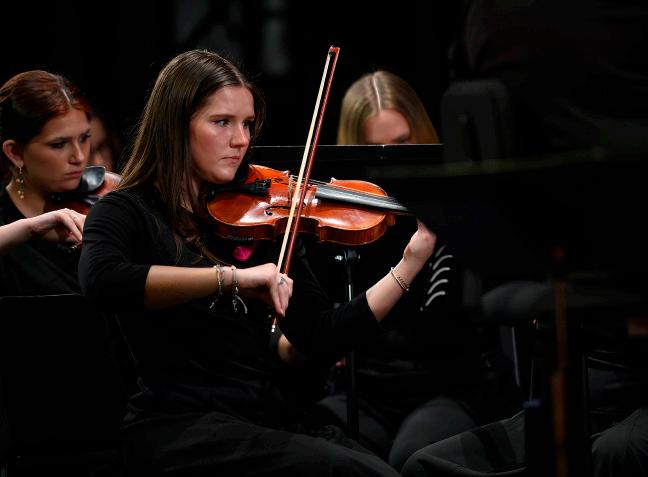
“We are only adding,” said Gillespie. “Anyone can still audition for a show or sign up for a choir or band.”
Mark F. Conrad, Sacred Heart University
The SHU Performing Arts Band & Orchestra program held a concert "Music For A Darkened Theater" at the SHU Community Theatre, Fairfield, CT. Sunday, April 21, 2024
Ben Margot, AP Photo
A worker stocks produce before the opening of a market in San Francisco, March 27, 2020. Ben Margot, AP Photo
Features
Joining the Brotherhood
BY INGRID KLIER Staff Writer
Are you interested in forming bonds, getting involved on campus and raising money for good causes? Sacred Heart University (SHU) has six different fraternities on campus that students can get involved in. With the fall recruitment season in full swing, these fraternities are seeking potential new members to join their brotherhoods.
The fraternity recruitment at SHU is a multi-week process carefully designed to balance openness and exclusivity. Dante DeCesare, Assistant Director of Fraternity and Sorority Life (FSL), said rush events typically begin before the start of each semester.
“Fraternity recruitment opens up prior to each semester; over the summer for the fall and over winter break for the spring,” said DeCesare.
Students register online through Campus Director, then attend open rush events hosted by each fraternity. After two weeks of open gatherings, fraternities move into a third week of invite only events to help narrow down their selections.
“Rush events are typically semi-structured and revolve around making connections,” said DeCesare. “There will usually be some type of activity like basketball, an NFL watch party, mechanical bull, card nights, and brothers will talk with potential new members and vice versa.”
Senior Daniel O’Connor emphasized that SHU gives students time to find their place on campus before rushing. O’Connor said that fraternities have different events and activities for students to familiarize themselves with the organizations.
“Once we start, all of our fraternities get an opportunity to host events such as pickup basketball, game nights or watch parties,” said O’Connor. “After that, potential new members may get the opportunity to attend a preference night, where brothers of said fraternity will ask questions to get to know these potential new members better.”
O’Connor said Sigma Chi values involvement and people whose morals align with those of the organization.
“For Sigma Chi, my fraternity, we look for gentlemen who are of good character, students of fair ability and who are ready to better themselves and their school’s community with their actions,” said O’Connor.
Senior Jamie Gaffney, Vice President of Delta Tau Delta, noted that the process spans several weeks.
“At Sacred Heart, the typical fraternity recruitment process will consist of about four rush events, usually split up by the span of about a week or a few days. The rush process lasts about a month and a half or so,” said Gaffney.
Gaffney said that the social events hosted during rush help current members and
potential new members get to know each other.
“We’ve done bowling events, lawn games, or even more formal hangouts,” said Gaffney.
O’Connor pointed to unique traditions such as “Grilling with the Greeks,” a kickoff event where the entire fraternity and sorority community comes together.
“This is an incredible event as it allows our entire FSL community to interact with each other and the potential new members,” said O’Connor.
Signing up for recruitment is simple but requires initiative. Students pay a $5 fee through Campus Director, an online portal, and the link is widely shared on social media and in first-year classes.
Any undergraduate male student with a GPA of 2.5 or above can participate. Whether through shared values, fun events, or lasting friendships, rush provides students with the chance to find their place within SHU’s strong Greek life.
Midterm Survival Guide
BY CAROLINE DAVINO Staff Writer
During midterm week, students across campus are balancing academics, wellness and personal routines to stay on track. Many shared that time management, mental health awareness and self care help them navigate one of the busiest weeks of the semester.
Senior Sofia Vergona, a psychology major and mental health chair for Zeta Tau Alpha, said she starts preparing at the start of the semester.
“At the beginning of the semester, I go through each class syllabus and fill out my planner with important dates, so I am aware with what is coming up,” said Vergona. “To prepare for midterms, I keep my notes organized, review material regularly, and study well in advance so I am not cramming last minute.”
Students emphasized the importance of mental health alongside academics.
Vergona said stress and burnout can make it harder to retain information. She said she prioritizes breaks and going to the gym to stay focused.
Senior Emily Butler, a Student Wellness Education and Empowerment Team (S.W.E.E.T.) Peer Educator, also highlighted the value of balancing study time with wellness.
“One of the best strategies for midterm season is creating a todo list,” said Butler. “Writing out everything you want to accomplish helps you stay organized and makes time management a lot easier. Plus, crossing things off your list feels rewarding and keeps you motivated.”
Butler said she recommends scheduling intentional breaks, like grabbing coffee or taking a walk.
“Giving your mind a chance to recharge can actually help you study more effectively,” said Butler.

Campus resources such as the tutoring lab, writing lab and Maureen Hamilton Wellness Center remain open throughout the week. Butler said S.W.E.E.T. Peer Educators are available for support, and their most popular event, therapy dogs, is designed to help students relieve stress during exam season.
Dr. James Geisler, executive director of wellness services, said there are signs students should watch for during midterms.
“Warning signs that signal it may be time to pause and prioritize include withdrawing and avoiding exam preparation, neglecting sleep and meals, pushing through without breaks, and struggling to concentrate,” said Geisler.
He added that the Wellness Center offers same-day counseling appointments, in addition to scheduled sessions.
“Be intentional about when you plan to study, where you study, and if you study best alone or with friends,” said Geisler. “Anxiety and stress are common emotions. Acknowledge these emotions as they arise. Most of all, be kind to yourself and remember the benefits of positive affirmations.”
Students also said study spots and “must-haves” help them get through the week. Vergona said she prefers West Campus, where she can grab a coffee before settling in. Butler said she likes Martire classrooms, because they are quiet and reliable for late-night study sessions.
Butler added that every student should have their personal midterm “must-have” to make studying more comfortable. She said that hers is a strawberry refresher and a walk around campus.
Vergona offered advice for students who may feel overwhelmed.
“My advice to other students would be to break your studying into smaller chunks and focus on one task at a time instead of a whole pile of work,” said Vergona. “Creating a schedule, setting realistic goals and celebrating progress as you go is important. Don’t be afraid to ask for help, whether it is forming a study group, having access to a tutor or leaning on a friend.”
Geisler encouraged students not to abandon the routines that keep them grounded throughout the semester.
“Those practices are often what sustain your balance and boost your confidence,” said Geisler.
As midterms continue, students said preparation goes beyond the classroom. Combining time management, campus resources, and wellness can help them succeed both academically and personally.
Contributed by: Nico Russo ’26
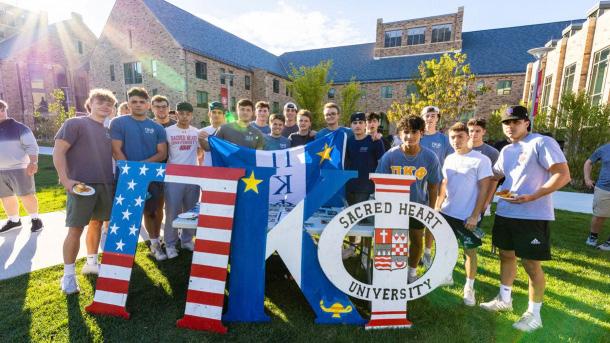
Brothers of Pi Kappa Phi pose for a photo at a rush event on the Upper Quad of the Park Ave Campus.
Caroline Davino, Staff Writer and Photographer Sacred Heart University’s Upper Quad walkway, located on the Park Ave Campus.
CampusLife
How Students are Tackling Financial Literacy
BY DANIELLE GRILLO Staff Writer
“Every Sunday I go through my incomes and expenses and make sure I’m allocating enough money to buy necessities and setting aside money for savings,” said sophomore Ava Ciauro.
For many SHU students, this is a familiar experience, as learning how to balance a budget can prove to be just as important as balancing their coursework. From groceries, to textbooks, to social activities, managing expenses during college can be a challenge, but students are finding strategies that work for them.
Through features that categorize spending, set limits, and provide real-time updates, some students say budgeting apps make it easier to stay on top of their finances. Options like Rocket Money Wallet, and Spendee help students track every purchase, monitor trends and plan ahead.
“One financial habit I wish I started earlier was knowing about budgeting apps. Everyone should use them, they offer services that are free for college students,” said junior Maddy Jones. “I use Rocket Money to track my spending, and it categorizes my spending into sections per month.”
Many students find that managing finances requires consistent planning and careful consideration. By developing personal routines, tracking weekly or monthly expenses, and knowing how much they spend, students can gain a clearer understanding of their budget.
“I’ve gotten into the routine of adding up the total of all the groceries or necessities I’ve bought each month, so that I can gauge how much I really need to spend,” said junior Gabby Gottschall. “Some months I may spend more than others, but just knowing the baseline amount that I am comfortable spending helps me budget and stay on track.”
Financial literacy has become an essential life skill for many students. Some arrived at Sacred Heart with knowledge of how to budget their money, having learned from previous work experience, family guidance, or personal practice, which gave them a head start in managing expenses and planning for the future.
“My parents taught me to put some money to the side for my savings account each paycheck I receive, even if it’s not much. This has helped me learn how to save and manage my money,” said Gottschall.
“I’ve been working since I was 14, so I never really needed help with budgeting,” said Jones. “Once I started seeing how much
money I was making, I was able to keep track of my budgeting.”
Other students develop financial literacy skills gradually, figuring out how to manage spending and make sense of financial concepts over the course of their college experience.
“Financials are tricky because there’s so much specific language in them and budgeting in itself is hard to understand,” said senior Doria Lukasik. “You have to figure out how to save what’s left after budgeting and manage it accordingly.”

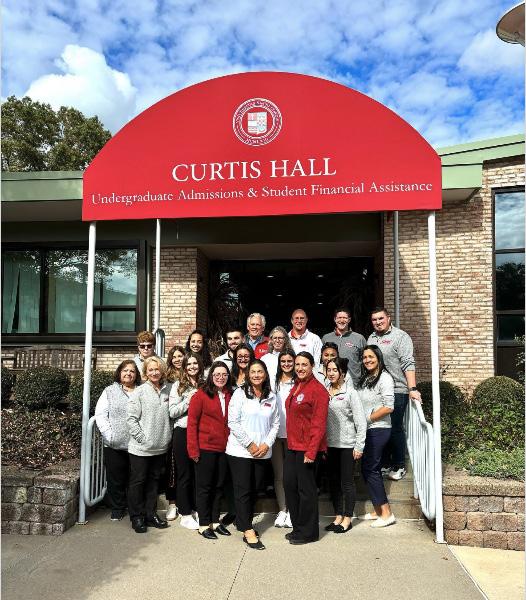
Curtis Hall staff celebrated National Financial Aid Day on Oct. 18, 2024.
BY ARIANNA GIANNOPOULOS Staff Writer
CampusLife
Fall Fashion in Fairfield
Fall is in full swing, and so are SHU students, who are showing off their best looks as the season begins to change and the weather begins to cool down. From cozy loungewear to chic cardigans and brown boots, SHU’s campus captures a balance between comfort and style.
For many students, this fall fashion is about keeping things simple while adding a little twist.
“My personal style this fall is very simple, but I’m also trying to dress it up with some spice, such as throwing a cute sweater on top to look more put together,” said sophomore Ava Smolanick.
Matching sets are another popular choice.
“This fall, I am wearing a lot of comfortable, but put-together outfits. This mainly consists of matching loungewear and workout sets, oftentimes with prints like polka dots or thin stripes,” said junior Annabel Koinis. “Around campus, I’ve been seeing plenty of matching sets and new sorority apparel.”
Others are leaning into vintage-inspired looks.
“My personal fall style incorporates both new and old trends. I am very into the classic, almost vintage fall aesthetic with a lot of whites, soft browns and minimal prints,” said sophomore Bridget Houston. “I’m a big fan of the leather brown boots that have become extremely popular, and I’m looking forward to seeing what the popular fall sweater is this season. It’s almost too early to tell.”

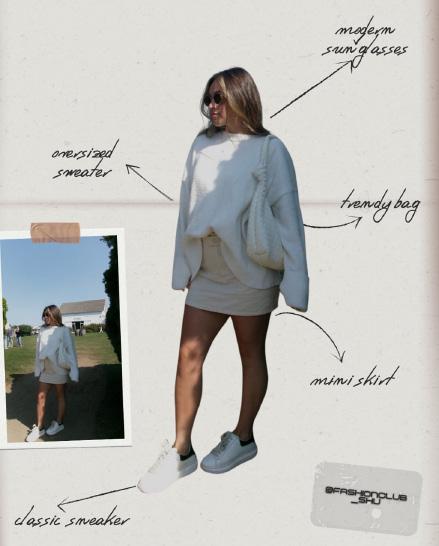
When it comes to staple pieces, Brandy Melville has been the go-to store for shopping. They offer an endless number of timeless pieces that are perfect for creating polished looks for the fall.
“They have very basic, but also easy, staple pieces to match with pretty much any outfit,” said Smolanick.
“Brandy Melville basics are my staple pieces for the season. The outfit combinations are endless and always exactly what I imagine. Their quality basics are versatile and long-lasting,” said Koinis.
Social media has played a huge role in inspiring fashion this fall. Pinterest has been a staple social media platform where students can search, share, and save ideas for fashion, home decor, and recipes. You can also browse and create mood boards for different categories.
“I pull a ton of inspiration from Pinterest. You can find outfit inspiration for any occasion, and I love curating inspiration boards for specific events/ seasons. I also love just browsing new online stores to see what common trends around stores are, so I can have a bigger understanding of what’s new and available,” said Houston.
The fall style for SHU students is rooted in comfort. Yet some students are wondering if it could evolve.

“In general, SHU campus style is very relaxed, a lot of sweatshirts, lounge wear, workout attire,” said Houston. “I have noticed more jeans, sweaters and simple tops. I’m interested to see if this remains as it gets colder outside.”
No matter the person, one thing is clear: SHU students are stepping into fall with confidence.
“Finding joy and creativity through fashion is what makes it more than just getting dressed. It’s a way to show who I am without saying anything, and it helps me carry myself with more confidence,” said Koinis. “For me, the balance comes when I feel comfortable but still put together, like I’m not trying too hard, but I still feel proud of how I look.”

Instagram, @fashionclub_shu SHU Fashion Club members put together fall themed outfits.
Arts & Entertainment Stepping into the Spotlight
BY ALEXIS BARADA Staff Writer and Asst. Arts & Entertainment Editor
The dance program had its first performance of the year during Family Weekend on Sept. 27. The showcase offered various dance styles and talent.
From Irish step dance to hip-hop, the audience experienced a diverse lineup featuring multiple dances led by student choreographers and professional faculty members from the program. Each routine showcased the rhythm and unique style of the performance.
Ashley Newman is the newest director of the dance program as of August 2025.
“In our dance program, we have lots of different opportunities like claddagh, tap, hip-hop, ballet, and then company dancers and ensemble members also perform,” said Newman. “It’s essentially a showcase of all the various groups that are a part of the dance program.”
Senior Kristen Alleva, Dance Program President, says she feels Family Weekend is particularly special for the dancers.
“The Family Weekend show is very special because we get the opportunity to share our love of dance with Sacred Heart families,” said Alleva.
One of the standout groups featured in the showcase was the Claddagh Dancers, SHU’s very own Irish Dance team, famous for its footwork and culture.
Unlike traditional Irish step dancing, Claddagh focused less on technique and more on expression. The goal of the performance was to have fun and celebrate Irish culture.
Junior Claddagh co-captain Ava Leddy said that the pieces they performed during the Family Weekend showcase were completely different from competitive Irish dance, making the performances a surprise for their families as well.
“We added arm movements, which aren’t allowed in competitive Irish dancing,” said Leddy. “Our goal was to make it fun, all about the adrenaline and dancing.”
Breaking away from the traditional dresses and wigs, Claddagh stepped out in a more casual and fun fashion, highlighting another significant contrast to their competitive roots.
“Our costumes are very different; we wear a lot of skirts and Irish jerseys,” said Senior Claddagh co-captain Elizabeth Kennedy.
While the dancers aimed to create a fun experience, a lot of effort went into making the performance. Regardless of the emphasis on fun, preparing for the performance still came with challenges for both the director and dancers.
Since Newman is new to her position, it made it difficult for her to prepare for the performance. She was not aware of the students’ strengths and dance elements.
“This is the start of my fourth week here,” said Newman. “I started with strangers in the room, dancers I’ve never seen perform or know much about.”
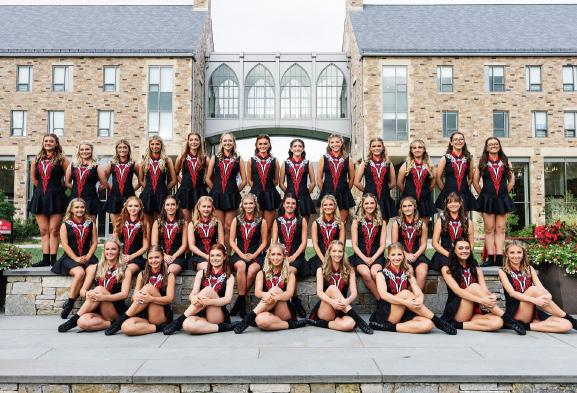
Newman wasn’t the only one facing challenges during the rehearsal process. Claddagh struggled with limited space, as it is difficult to coordinate such a large group of dancers.
“It was hard making sure everyone would fit on stage; there are 31 of us in Claddagh,” said Kennedy.
Despite the difficulties and obstacles, the dancers committed to the performance with help from each other.
“We always say we’re proud of them before performing,” said Leddy. “Making sure they’re proud of themselves too and always having fun.”
In the end, the group’s dedication paid off and resonated with their audience.
“It’s very rewarding as a performer to see how your performance affected your audience,” said Alleva.
The performance was played to a full audience. Families were filling up the theatre to show their support.
“Everyone here loves to perform,” said Newman. “Any opportunity that they get to be on stage and perform in front of an audience is meaningful.”
Marching Towards Your Future
BY MIA COPPOLA
Staff Writer and Asst. Arts & Entertainment Editor
The SHU marching band will open its ranks to future pioneers during its annual “Play with the Band Day” on Oct. 11. The event invites prospective student musicians to experience game day alongside the division I marching band, from warmups to in-game performances.
Upon checking in the morning of Oct. 11, participants will be given a SHU band T-shirt to wear for the game. The schedule includes getting the chance to take part in pregame traditions on the amphitheater steps and performing stand tunes and cheers with the band during the football game.
Keith Johnston, director of band and orchestra, said the event ties both music and academics to the SHU community.
“It has been a really popular event over the years and has been a great way for us to connect with high school kids who are looking at colleges and want to continue to play,” said Johnston. “This is a chance to combine both passions of continuing music as well as looking for a potential major to study through getting to know other SHU students.”
Student leaders will also teach participants the band’s march-up song and dance “Abunga.” Once at the field, guests will watch the band’s pre-game show before joining the ensemble in the stands.
“Our ‘Skull Session’ is a great pre-game ritual that we do that gets everyone pumped up before football games,” said Chris Escudero ‘25, a current graduate student and head of PR and marketing for the band and orchestra program. “It’s always a great turnout and Dr. Petillo is always in the crowd supporting the band.”
For current members, the day is an opportunity to welcome futur e Pioneers.
“I have been involved in these events since my freshman year, and I look forward to them all season long,” said senior Sean Manole, band vice president and flute section leader. “In my opinion, this is extremely beneficial for participants in that they gain a sense of meeting upperclassmen and are welcomed into the community.”
Junior Noah Held, melophone section leader, said the band’s spirit is contagious.
“I feel like there is no band quite like ours,” said Held, “We bring so much energy to every game, and it washes over the group. As a prospective member, that feeling is like no other.”
Students from across many disciplines take on leadership roles in the ensemble. Practices are held on Monday and Thursday evenings, with Thursday
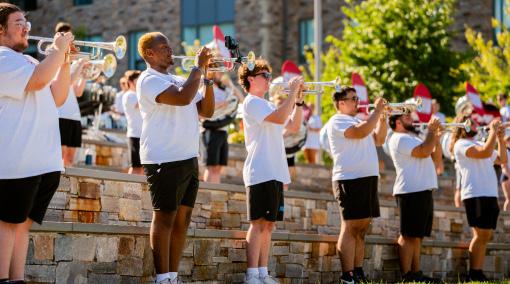
Aug. 22, 2025.
nights dedicated to marching rehearsals and pre-game preparatio ns.
“Everyone in the band is so driven; the majority of them aren’t even music majors,” Held said. “The band is open for everyone, and there are people who are ready and willing to help you every step of the way.”
“I know a couple of the girls in the band, and it’s been awesome seeing how dedicated they all are,” said sophomore Izzy Hygrell. “One of them is only a freshman and has already gotten some really cool opportunities through band, which is super inspiring.”
“We celebrate our triumphs and we mourn together whenever we have sorrows and challenges,” said Johnston. “When a student is looking at a college, they aren’t only looking at SHU. They’re saying, I can go and play with my friend, who I met at the ‘Play with the Band Day.’”
Family and friends are welcome at the game. Each registered participant can receive up to three complimentary football tickets. Registration closes 24 hours prior to the event, which begins at 10:00 a.m. on Oct. 11.
Dan Passapera, Sacred Heart University
The Sacred Heart University Band hosts its preview show during Welcome Weekend on Friday,
Contributed by: Ava Leddy, ‘27
The Sacred Heart University Claddagh Dancers pose for a photo during their 2025 prefall photoshoot.
Sports
Football’s Comeback Victory
BY JAMES SCHINDLER Staff Writer
The football team took center stage during Family Weekend and did not disappoint after a thrilling 35-31 comeback win against Delaware State University.
A back-and-forth game, SHU scored 17 straight points in the second half with sophomore quarterback Jack Snyder throwing two touchdowns to junior wide receiver Jason Palmieri. The team converted three third downs on the game winning drive to secure the win.
“There’s no better feeling than making the last drive, picking up first downs, and sealing the victory for the home crowd,” said Snyder.
“Our o-line definitely has not got enough love; they played very well and were one of the biggest reasons we won that game,” said Palmieri.
A 14-point deficit in the second quarter marked the Pioneers largest of the game.
“Even when we were down 31–17, the guys believed in each other and trusted that they were good enough to come back,” said head coach Mark Nofri.
“The offense kept plugging away and kept the faith that we would put points on the board. This team truly believes that good things will happen when you believe in each other and keep fighting for each other to the last whistle,” said Snyder.
Delaware State put up 31 points in the first half but was shutout in the second half.
“We made some adjustments with our coaches and defensive schemes. We told the kids to settle down, and we can get back into this game, little by little,” said Nofri. “The message was simple: do your job, pull for one another and stay positive.”
The Pioneers did their job with some big plays on defense; six tackles from sophomore safety Kymari Latney and five tackles for both senior Peter Schanne and junior Glory Stephen-Wangboje.
“We truly take one practice at a time, one game at a time. The coaches tell us not to look too far ahead, and we believe in that,” said Snyder. “If you practice hard every day, game day will take care of itself, and winning streaks will happen.

Winning doesn’t only happen on Saturdays. Winning happens because we put in the work during the week.”
On top of a huge Family Weekend win and a three-game winning streak, Snyder was named the New England Football Association Gold Helmet award winner, a weekly award that recognize student-athletes from Division II, Division III, Football Bowl Subdivision (FBS) and Football Championship Subdivision (FCS) schools in New England.
In an intrastate thriller on Oct. 4, the Pioneers fell to Central Connecticut State University 42-35 in overtime.
The Pioneers’ next game will be at home on Oct. 11 against Howard University. Athletic Communications contributed to this article.
Six Pioneers Swim Towards Nationals
BY ALEXA PISCINO Staff Writer
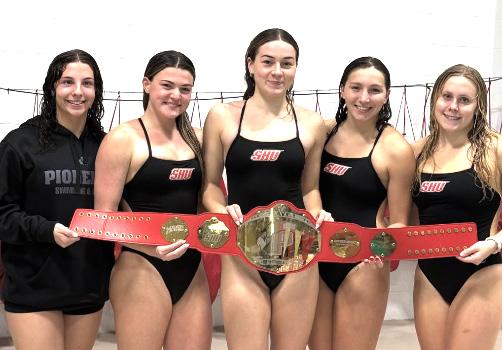
The women’s swim and dive team is off to a historic start this season, with six swimmers qualifying for nationals after standout performances at the Central Connecticut Open Water Festivals on Sept 21. The achievement marks a new milestone for the program and sets the tone for what could be a breakthrough year.
The Pioneers, just three weeks into their season, traveled to Marlborough, Conn. for the early test and returned with six national qualifiers.
Head coach John Spadafina credited the group’s offseason dedication as the key to their success.
“We’re definitely happy with how they competed on that Sunday, especially since we’re only really three and a half weeks into our season,” said Spadafina. “It’s a testament to the training they did over the summer and the preparation they brought into this year. They earned it.”
Open water swimming is a relatively new National Collegiate Athletic Association (NCAA) sanctioned discipline, but Sacred Heart has quickly embraced the challenge.
Spadafina explained that the mid-season championship, held in Florida this December, offers a unique opportunity for his swimmers to compete on a national stage while breaking up the grind of the season.
For junior distance swimmer Maeve English, the open water event was both a mental and physical test.
“Open water swimming is very different, there are no walls, clocks or coaches, so you don’t have any reference about your pace while swimming,” said English. “I was simply trying to stay up in the lead pack and felt strong during the race, but I really had no idea of my time until I started running for the finish line.”
For junior freestyle specialist Sophia Velleco, qualifying for nationals was as much about building confidence as it was about racing.
“Qualifying for nationals is an incredible experience,” said Velleco. “It really boosts my confidence, showing me that I’m capable of achieving things outside my usual routine or training. I’m thrilled for the opportunity to compete alongside some of the top schools in the nation.”
Velleco admitted she was anxious heading into the race but credited her mindset for carrying her through.
“I had to remind myself to treat it like any other race,” said Velleco. “I focused on my breathing and tried to approach it like I would in a regular pool.”
Both English and Velleco pointed to the Red & White Pentathlon as a key measuring stick for the team’s progress. The annual intrasquad meet forces swimmers to compete across multiple events, providing an early test of versatility and endurance.
“The Pentathlon is always a challenge since we swim events we may not normally compete in, but it gets everyone back into a racing mindset,” said English.
Velleco added that her times in the meet were faster than last year, which gave her confidence heading into both nationals and the conference season.
With December’s open water nationals circled on the calendar, the Pioneers will continue to focus on their dual meet schedule and preparing for the Metro Atlantic Athletic Conference (MAAC) Championships in February. For the six national qualifiers, balancing individual goals with the team’s ambitions will be the priority.
“I’ve been trying to use my excitement to focus on training hard every day,” said English. “It’s all part of the process of getting ready for MAACs.”
Spadafina believes this group’s success speaks volumes about the growth of the program.
“It’s something they wanted to do, and we truly support it,” said Spadafina. “They earned it, and they did a great job at it.”
At the Fairfield Invite for diving on Oct. 3, the duo of freshman Ryleigh Mahoney and sophomore Kara Leahy pulled through with a 1-2 finish on both the one meter and three meters boards.
At their dual meet on Oct 4. Sacred Heart won by a score of 178.5 to 121.5 against Stony Brook University at the McCann Natatorium in Milford, Conn.
Sacred Heart will return to the pool on Oct. 17-18 for their next tri-meet against Iona University and Wagner College, carrying both momentum and motivation as they set their sights on December’s national stage.
Athletic Communications contributed to this article.
Instagram, @sacredheartswimdive
Winners from the Sacred Heart Univeristy Intersquad Red/White meet & 11th annual Pentathlon pose for a photo on Saturday, Sept. 27, 2025.
Contributed by Joshua Gee, ‘26
Junior wide reciever Jason Palmiere dives into the endzone for a touchdown during Sacred Heart’s 35-31 victory over Delaware State on Saturday Sept. 27, 2025.
EDITOR IN CHIEF
GEORGE TRIEBENBACHER 2026
MANAGING EDITORS
SHANNON TUTTLE 2026
MOIRA STAPLES 2026
COPY EDITOR
MADISON CONKLIN 2026
NEWS EDITOR
DANIEL GREENE 2026
ASST. NEWS EDITOR
MADELEINE MEDEIROS 2028
FEATURES EDITORS
SARA HASENEY 2026
ALEXA BORNER 2027
ASST. FEATURES EDITOR
FERNANDA GUEVARA 2026
ARTS & ENTERTAINMENT EDITOR
EMMA RICOTTA 2026
ASST. ARTS & ENTERTAINMENT EDITOR
ALEXIS BARADA 2026
MIA COPPOLA 2027
SPORTS EDITOR
COLLIN MACLEOD 2027
ASST. SPORTS EDITORS
TAYLOR MAGUIRE 2027
JACK CAVICCHI 2027
CAMPUS LIFE EDITOR
THEO WEISMANN 2026
AUDREY’S CORNER EDITOR WILL MORGAN 2028
SENIOR PHOTOGRAPHY EDITOR
JACK CAVICCHI 2027
PHOTOGRAPHY EDITOR
JORDAN DORSEY 2026
ASST. PHOTOGRAPHY EDITOR
JAYDEN HUNTER 2027
PUBLIC RELATIONS MANAGERS
SARA HASENEY 2026
ALEXA BORNER 2027
WEB MANAGER
JORDAN DORSEY 2026
CIRCULATION MANAGER
FERNANDA GUEVARA 2026
FACULTY ADVISOR
PROF. JOANNE KABAK
Editorial
The Silence of the Seasons
BY MOIRA STAPLES Managing Editor
I walk alone, in silence. Trapped somewhere between the serentiy of the past and the wildness of tomorrow. Gentle with each step, so as not to leave a trace that would disturb the

Daniel Passapera, Sacred Heart University
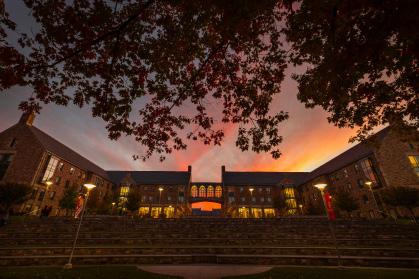
Campus imagery of the sunset over Pioneer Village.