TheBOLT
February 2026
Volume 24, Issue 3
lightningboltonline.com
Sage Hill School
20402 Newport Coast Drive, Newport Coast, CA 92657
![]()
February 2026
Volume 24, Issue 3
lightningboltonline.com
Sage Hill School
20402 Newport Coast Drive, Newport Coast, CA 92657

By Maya Desai, Linda Liu & Isabella Huang
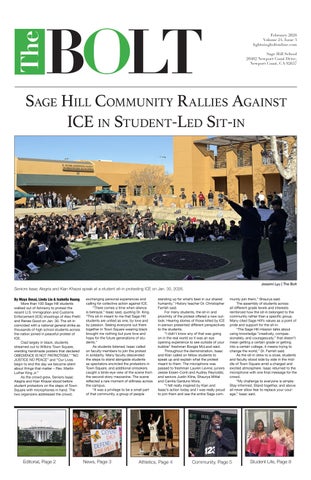
More than 100 Sage Hill students walked out of Advisory to protest the recent U.S. Immigration and Customs Enforcement (ICE) shootings of Alex Pretti and Renee Good on Jan. 30. The sit-in coincided with a national general strike as thousands of high school students across the nation joined in peaceful protest of ICE.
Clad largely in black, students streamed out to Wilkins Town Square, wielding handmade posters that declared OBEDIENCE IS NOT PATRIOTISM,” “NO JUSTICE NO PEACE” and “Our Lives begin to end the day we become silent about things that matter – Rev. Martin Luther King Jr.”
As the crowd grew, Seniors Isaac Alegria and Kian Khazei stood before student protestors on the steps of Town Square with microphones in hand. The two organizers addressed the crowd,

exchanging personal experiences and calling for collective action against ICE.
“There comes a time when silence is betrayal,” Isaac said, quoting Dr. King. “This sit-in meant to me that Sage Hill students are united as one, by love and by passion. Seeing everyone out there together in Town Square wearing black brought me nothing but pure love and hope for the future generations of students.”
As students listened, Isaac called on faculty members to join the protest in solidarity. Many faculty descended the steps to stand alongside students as spectators encircled the protestors in Town Square, and additional onlookers caught a birds-eye view of the scene from the second-story mezzanine. The scene reflected a rare moment of stillness across the campus.
“It was a privilege to be a small part of that community, a group of people

standing up for what’s best in our shared humanity,” History teacher Dr. Christopher Farrish said.
For many students, the sit-in and proximity of the protest offered a new outlook. Hearing stories of those killed by ICE in-person presented different perspectives to the students.
“I didn’t know any of that was going on in the real world so it was an eye opening experience to see outside of your bubble” freshman Boogie McLeod said.
Throughout the demonstration, Isaac and Kian called on fellow students to speak up and explain what the protest meant to them. The microphone was passed to freshman Lauren Levine; juniors Jessie Essen-Conti and Audrey Reynolds; and seniors Justin Kline, Shaurya Mittal and Camila Garduno Mora.
“I felt really inspired by Kian and Isaac’s action today and I was really proud to join them and see the entire Sage com-

munity join them,” Shaurya said.
The assembly of students across all different grade levels and interests reinforced how the sit-in belonged to the community rather than a specific group. Many cited Sage Hill’s values as a point of pride and support for the sit-in.
“The Sage Hill mission talks about using knowledge “creatively, compassionately, and courageously,” that doesn’t mean getting a certain grade or getting into a certain college, it means trying to change the world,” Dr. Farrish said.
As the sit-in drew to a close, students and faculty stood side by side in the middle of Town Square amid a charged and excited atmosphere. Isaac returned to the microphone with one final message for the crowd.
“My challenge to everyone is simple: Stay informed, Stand together, and above all never allow fear to replace your courage,” Isaac said.


By The Bolt Editorial Board
The American public should be alarmed at how easily they have learned to look away.
In the early hours of Jan. 3, U.S. special forces landed in Caracas, stormed the presidential palace, and captured Venezuelan President Nicolás Maduro and his wife, Cilia Flores. Within 48 hours, they were in New York federal court, facing U.S. criminal charges.
Just four days later, ICE agents in Minneapolis shot Renee Good to death. She was unarmed. Less than three weeks later, nurse Alex Pretti was also fatally shot by federal agents at an anti-ICE protest. President Donald Trump decried that Good belonged to a “leftwing network” of paid agitators, while Pretti was accused of “domestic terrorism” by the Trump administration. But these Americans were no terrorists. Good was a mother of three, and Pretti cared for veterans at the Minneapolis VA Medical Center.
The inner turmoil of our country begs urgent questions: How can we pretend to uphold democratic norms abroad while orphaning children at home? Why do we send soldiers to war as we kill the nurses that rehabilitate them? And if these Americans were truly “terrorists,” doesn’t Trump’s “America First” rhetoric demand attention to domestic crises before foreign adventurism? The facade of democracy is fading, and this administration knows it.
Venezuela is a smokescreen for domestic injustice, and this is not America’s first encounter with such diversionary politics. As U.S. involvement in Vietnam escalated in the 1960s, civil rights leaders warned that the nation was prioritizing war over justice at home. Rev. Martin Luther King, Jr. condemned the Vietnam War as “a blasphemy against all that America stands for,” arguing that military escalation diverted money and attention from anti-poverty programs and civil rights protections.
TThe domestic consequences of foreign intervention were hardly hypothetical. On May 4, 1970, Ohio National Guard troops opened fire on unarmed Kent State students protesting the expansion of the Vietnam War into Cambodia, killing four and wounding nine. History reminds us that when public attention is consumed by foreign adventures, crises at home are allowed to fester unchecked.
It is not hard to see why such distractions persist. In an era of constant feeds and fleeting headlines, foreign wars become the ultimate spectacle, drawing focus away from the systemic injustices under our own roof—the deaths of Good, Pretti, and the broader pattern of violence that defines the Trump administration. While the nation’s gaze is turned abroad, the fractures at home grow ever more perilous.
American foreign involvement includes a laundry list that ranges from full-scale wars in Vietnam and Iraq to economic sanctions spanning from Cuba to Iran. But Trump’s brazen statements after Maduro’s kidnapping mark an alarming departure from previous norms. Previous administrations, however controversially, at least sought public or Congressional support as a check before major foreign actions. The Trump administration, by contrast, treats unilateral force as routine and justifies its actions only after the fact.
In a Jan. 3 press conference, Trump declared that the U.S. would “run the country until such time as we can do a safe, proper and judicious transition,” signaling plans to govern Venezuela directly—without constitutional authority or international consent. He framed the intervention as an anti-drug operation, despite evidence showing Venezuela plays only a minor role in supplying Americans’ drug habits, and claimed the mission “won’t cost us anything” because U.S. oil companies would rebuild infra -
he Bolt is a student newspaper and serves the public forum at Sage Hill School. Its content - news, editorial, opinion, and feature - is protected by Education Code 48907, the state student rights law and the California Constitution which guarantees all citizens the right of freedom of speech and of the press. Opinions expressed do not represent the views or beliefs of Sage Hill School and its administration. The Bolt accepts signed letters to the editors from members of the Sage Hill community which may be posted as comments at lightningboltonline. com, or addressed to the Editors-in-Chief Arya Rawal, Katelyn Yeh and Maya Desai and put in their mailboxes on campus. These letters may not exceed 150 words or they will be edited for inclusion.
Editors-in-Chief

structure and profit. Independent analysis provides no support for these claims.
Legal scholars emphasize that unilateral military action on sovereign soil without U.N. authorization violates international norms. Under the U.S. Constitution, Congress alone has the power to declare war. Yet Trump acted without consultation, bypassing the legislative branch entirely. In doing so, he presents the United States as a hostile power in the Western Hemisphere, undermining both our domestic legal framework and global credibility.
The consequences of such actions are neither abstract nor hypothetical. Last September, tensions between the Trump and Maduro administrations led to the deaths of 100 Venezuelans, in an operation the president justified as an effort to stop drug smuggling. Trump’s justification ignores broader evidence: Venezuela accounts for a small fraction of the cocaine entering the U.S., and most of its exports flow to Europe. Meanwhile, Trump has framed
Arya Rawal (Bolt), Katelyn Yeh (Bolt) & Maya Desai (Online)
Editorial Board
Amy Choi, Taite Nicholson, Kenzie Chang, Maria Neemuchwala, Isabella Huang, Doyoung Lee, Ella Wang, Jenny Li, Linda Liu, Tina Tahbaz, & Johnathan Yan
Writers
Suri Li, Elisa Xu, Nate Yoo, Mika He, Grace Ma, Carson Ellis, Leo Lin, Milan Desai, Nicole Bo, Alexis Prokopuk, Shawn Huan, Aniline Umstaetter, Meredith Carroll, Vianna Kashani, Nathaniel Yoo, Sam Jindal, Maria Wang, Jessimi Lyu and Suri Yaghmai
Photographers and Artists
Nathan Tang, Leo Lin, Aniline Umstaetter, Tina Tahbaz, Robbie Watson, Grace Ma, Jessimi Lyu and Elisa Xu
Adviser Daniel Langhorne
Venezuela’s oil reserves as a prize to offset the costs of military adventurism, effectively turning a sovereign nation into a source of American profit.
We should not mistake legality for legitimacy. The seizure of Maduro, the targeting of Venezuelan infrastructure and the threats of prolonged occupation reflect a dangerous precedent: a willingness to act on geopolitical ambition without accountability. Yet the American public has largely looked away. Our inattention and lack of public scrutiny enable extraordinary power to operate unchecked—a complacency that is, in effect, weaponized.
As the world watches, the question remains: will we confront these violations, uphold the law, and demand transparency from our leaders? Or will we continue to accept unilateral aggression as routine, turning away from the moral and legal consequences?
The United States cannot separate itself from the consequences of its actions abroad, and silence is complicity.

By Kenzie Chang
Lesly fills out the same paperwork every two years. She works, submits background checks, employment authorizations and proof of residency every 24 months in hopes to renew her tenuous immigration status. Instead of living in fear of the unknown however, Lesly finds peace in prayer and her church community.
For 13 years, Deferred Action for Childhood Arrivals helped undocumented individuals by providing temporary legal protection to live and work in the United States. Founded by President Barack Obama’s administration in 2012, the program was created after Congress voted down the DREAM Act, which hoped to allow young undocumented people a pathway to citizenship.
Lesly, an early recipient of DACA, who now works for the California government, exemplifies how DACA has been beneficial in shaping her life in America. The Bolt is withholding her last name to protect her safety.
Raised in a Spanish-speaking household, where her family cherished their Mexican heritage, Lesly did not come to learn Amer-
ican culture until adulthood. Although she is bilingual and grew up solely speaking Spanish with her parents, it was not until over 20 years later that DACA allowed Lesly to visit her family in Mexico and return home. Lesly had created close connections with her distant relatives over phone conversations, and for much of her family this reunion was one of the first times they could hug and talk face to face.
Although there is no pathway to citizenship through DACA yet, the program has helped Lesly and her family through jobs, and financial stability.
“We understand that DACA is a privilege that not everyone has. We recently bought a home, and that would not have been possible without DACA,” she said.
Lesly is grateful for the program, but still points to policy that DACA requires their recipients to meet. Every two years, DACA recipients must apply to renew their residency status, and show they’ve maintained a clean background check and consistent employment.
“Two years goes by really fast, and the hard part of being in DACA is that I don’t

know what life is like in Mexico,” Lesly said.
As DACA cannot guarantee lifetime residency in the United States, Lesly copes with the impermanence of her residency through factual evidence and faith.
“I think for my family we didn’t have a lot of fear as we knew everything that happened was in God’s will.” Lesly’s trust in the idea that “everything happens for a reason” eased her in
knowing that she will end up where she needs to be.
Lesly’s diligent research into the fine print of immigration law had brought her peace in understanding the legal guardrails that protected her safety.
“Fear is not as persistent with the research. Just because it goes viral doesn’t mean it’s a reliable source,” she said.
Lesly said she encourages others to jump at every
opportunity given to them, and value education, as with DACA she is grateful that she can call the United States her home.
“Even if at some time in the future I had to go back to Mexico, I wouldn’t be as prepared without DACA. We have to give to be given equal opportunity.”
By Doyoung Lee
UCI Health officially opened its new 144-bed acute care hospital in Irvine on Jan. 15, expanding access to medical services including cardiology, oncology and emergency care.
Built to serve Orange County’s growing population, the Irvine campus is the sixth hospital in UCI Health’s expanding network. This facility marks the nation’s first all-electric hospital, setting new standards for health care design that combine advanced medical treatment with energy-efficient and environmentally conscious operations.
The seven-story facility operates entirely on electricity rather than natural gas. Power is generated through on-site solar panels and supplemented by energy-efficient building systems to minimize environmental impact. The hospital is on track to receive LEED (Leadership in Energy and Environmental Design) Platinum certification, a designation previously granted to five other hospitals as the highest tier of sustainability across factors including energy, water, location and materials.
Beyond the sustainability goals, physicians maintain
close ties to cutting-edge research at UC Irvine.
“What makes our mission unique is the seamless integration of research, education and clinical care across health sciences schools, the research centers and the UCI Health delivery system,” said Dr. Steve Goldstein, Vice Chancellor for Health Affairs.
That integration is reflected in the hospital’s clinical design.
A 24-hour emergency department with 20 rooms is located near the main entrance, alongside CT scanners and AI-enabled MRI suites.
A surgical megafloor the length of three football fields connects the hospital to the Chao Family Comprehensive Cancer Center & Ambulatory Care building, consolidating operating rooms and sterile processing on a single floor to maximize efficiency. Additional services include cancer care, cardiology, digestive health, neurology, orthopedics and spine care.
Built next to the 300-acre San Joaquin Marsh Reserve, the hospital integrates nature into the healing process. Patient rooms feature floorto-ceiling windows facing the marsh and the distant Santa Ana Mountains. Meditation
gardens and outdoor patios further connect patients with the natural environment. The facility was designed to be minimally intrusive to the surrounding habitat, using avian-safe glass patterns to reduce bird strikes and native plant buffers to prevent turtles from entering the medical center.
“We create an environment where patients, caregivers and students can connect with nature, reduce stress and experience care in a setting that promotes whole-person health,” campus architect Brian Pratt said. “This integration is unique because it transforms a medical campus into a restorative space, aligning with our mission to advance health in harmony with the environment.”
The UCI Health Irvine hospital aims to inspire future generations through education and service opportunities. Volunteer programs currently operate at other UCI Health sites, including in Orange and Fountain Valley, offering high school students service roles in musical outreach, reception desk assistance and more. Volunteer opportunities at the Irvine hospital are expected to open next fall.


“As an aspiring doctor, I think it’s amazing how UCI is blending medical innovation with environmental mindfulness. This opportunity is just 10 minutes away and I’m
excited to see how a fully-electric hospital differs from the tradition,” junior
said.
By Meredith Carroll and Vianna Kashani
Varsity Boys’ Basketball closed out its season with a mixed record of 10-17. The team is entering a defining chapter built upon both success and trust.
After stepping into the head coaching role in December, Head Coach Elijah Gaines brings values that will lead the team to flourish as a team and their performance. For him, success extends beyond the scoreboard.
“Success is growth,” Gaines said. “From the beginning of the season to the end, as long as there’s growth, then we’re successful. It’s not necessarily about wins and losses.”
This mindset set the tone early. Gaines believes communication, discipline and character are essential both on and off the court.
That mentality has already begun to resonate throughout the team, especially among its younger players.
Sophomore Chris Longo describes the environment as one that encourages “working together and collaborating with teammates,” as varsity basketball calls for constant communication and trust. The captains are a major part in communication and guiding younger players. Senior captain Carson Ellis emphasizes the importance of unity and team chemistry.
“We all get along really well, and we trust each other,” Carson said. “If we all play together and listen, we have the potential to be one of the top seeds in the league and make a run in the playoffs.”
Beyond chemistry, this team’s defining strengths have been its en -
ergy and senior leadership.
“I see a lot of energy across the whole team. Everyone brings high energy on the bench and on the court, and there’s a strong connection between teammates,” Senior Nathan Dagger said.
Nathan and other seniors contribute to his team’s discipline and momentum by setting examples for the younger players on how to collaborate and push oneself, qualities that align with Coach Gaines’ emphasis on growth and accountability.
Carson sees this season as an opportunity to mentor younger teammates on the pace and expectations of varsity basketball, empowering them to step confidently into future leadership roles.
“It’s definitely been a shift going from one coach to another, but we’ve been under Coach Elijah for the past couple of years. I’ve been able to grow and apply what I’ve learned over the past three years,” Carson said. “If you have a problem you want to talk about with a teammate, be direct. Give constructive criticism by actually giving insightful information on how to improve and be better.”
As the season comes to a close, Boys’ Basketball is focused not only on competing at a high level, but on cultivating a unified vision as a team. Players support one another on and off the court reflects the foundation built by Gaines.
Nathan highlights this collective mindset and positive attitude saying, “Everyone brings such high energy on the bench and on the court, and there’s a strong connection between teammates.”

By Nathaniel Yoo
After a demanding first half of the season, the boys’ soccer team started to find its rhythm.
With a mix of returning and new players, the group has embraced a competitive schedule, using each match as an opportunity to build chemistry and cohesion.
The Lightning have a season record of 9-7-3 as of The Bolt ’s print deadline,
Boys’ soccer defeated Laguna Beach with a strong 3-1 performance, a result that reflected sharper organization and growing confidence.
Head Coach Raphael Da Costa Alves said he’s prioritizing turning progress into consistent results.
“We need to win games more consistently,” Alves said, pointing to execution and converting their scoring opportunities as key areas for improvement.
“Basically, [we need to] be more consistent and confident, and finish chances,” he said. However, Alves strongly believes in the incredible potential of this year’s team.
Several players echoed the focus on converting opportunities into goals.
“We need to work on our finishing,” sophomore Sam Gabriel said. Sophomore Nico Suarez noted that inconsistency has been a significant challenge early in the season.
“We are very inconsistent. Some -
times we have good games, sometimes we play very badly,” Nico said.
At the same time, he said team chemistry has improved as players have learned to communicate more effectively.
“Our team communication has improved a lot throughout the season. We have all gotten to know each other better as the season progressed,” Nico said.
Alves credited player experience and program continuity for helping the group become more connected.
“The team has grown older from last year. They have been in the system for longer, so they work better in this system,” Alves said. He added that one of the most meaningful changes has been the team’s stronger unity. “I am most proud of how everyone has been working for the last four years; the teams are much more connected than before and much more team-oriented,” he said.
That confidence has raised the group’s expectations as the boys move deeper into league and postseason play.
“We are the best team in the league, so our goal is to win the league,” Alves said.
Junior Leo Ellersiek also pointed to noticeable improvement from last season.
“We are doing a lot better than last season. Good, positive start to the season, hopefully we pull through and make CIF,” he said.

By Maria Neemuchwala
Prominent African American author
Jason Reynolds spoke to the Sage Hill community about the importance and nuances of sharing diverse stories that reflect lived experiences during a Sage Center Speaker Series event on Jan. 14.
A New York Times bestseller and National Ambassador for Young People’s Literature, Reynolds has experienced and shared these stories in his work. Books such as “Look Both Ways,” “Miles Morales” and “Long Way Down” are among Reynolds’ most acclaimed works, exploring themes of grief, coming of age and community.
Reynolds shared about growing up in a colorful community with a loving family in the 1980s but, ultimately, had very limited options. He explained how he did not enjoy reading as a kid as he did not see himself or other children of color in books, which made it difficult for him to appreciate reading. Reynolds became deeply connected with rap music and poetry, allowing him to express and process his emotions through writing.
Reynolds explained how his experiences embracing his own identity, both difficult and positive, allow him to explore his vulnerabilities through his work. He described how identities should always feel slightly messy— their past, current and future are broad and diverse.
It is within these complexities, he explained, where identities are formed. Reynolds added that while there are many shared connections within a communal space, there are also parts of identities that are unique to a person.
“If not, we run out of stories. All of us would have told all the tales,” Reynolds said.
Reynolds explained how there are certain experiences, social movements and emotions that can seem hard to connect to when reading. However, he described, people need to change, grow and bring themselves to the story in order to discover something meaningful and

New York Times bestseller Jason Reynolds addresses the Sage Hill student body on Jan. 14.
draw connections to parts of their lives.
“I want you to read my books and say ‘He can say the complicated things. He trusts us to wrestle with the complexities of our lives and our identities,’” Reynolds said.
Reynolds finished with explaining the importance of staying connected to
a broader community, one where people are more alike than different.
“No matter how exceptional you become, never exceptionalize yourself. The kid around the corner who doesn’t have these opportunities is just as smart and talented. Don’t forget about them,” he said.
“Jason Reynolds’ experiences and talk deeply impacted the way I think about my identity and the importance of doing the right thing, even with the possibility of consequences,” sophomore Sarina Haque said.
By Maria Wang
Sage Hill offers over 90 clubs, including traditional academic teams such as Model United Nations, Speech and Debate and Robotics, and a variety of other student-led clubs, such as Dungeons and Dragons, Muslim Students Association, and Women in Engineering.
“There’s a club for everyone at Sage,” freshman Jasper Kim said.
Clubs and other activities contribute to the well-roundedness of the school, creating a campus where students are free to explore and pursue their passions and interests, said Lauren Popkowski, associate director of college counseling.
However, clubs and other activities sometimes conflict with Sage Hill’s rigorous academic workload and tradition as a top-tier educational institution. An overloaded schedule can leave students with little time to complete homework, write papers
and study for tests, said students interviewed by The Bolt
Senior Brady Bai’s list of activities includes Cross Country, Origami Club and AMPA initiative.
“I... sacrifice sleep to balance schoolwork and my activities,” he said.
Sophomore Zack Longo, who recently broke Sage Hill’s 18-yearold record for cross country times, echoed this concern, remarking, “I spend at least two hours a day on Cross Country,” in addition to other activities such as Youth Engineers Initiative and Robotics Club. These long hours leave him with little time for schoolwork and rest.
Adding to the motivation to participate in clubs is the importance of extracurricular activities to the college admissions process. In a December 2024 cover story entitled “How the Ivy League Broke America,” The Atlantic bemoaned Ameri -
ca’s competitive college admissions process, which encourages parents to ferry their kids from one supervised skill-building, resume-enhancing activity to another, driven by the hope of getting their children into selective universities.
“From a college admissions perspective,” Bai said, “the GPA gets you past the initial review, but extracurriculars show who you are as a person.”
Sage Hill students are aware of this pain point, but they are still driven by genuine interest in the clubs and other activities they join. Many students admitted to prioritizing their extracurriculars over schoolwork, not just for college resumes, but for passion.
“It is fun when kids are passionate about something, share their passion, and want to grow in different ways,” Dean of School Life Dominic Campeau said. “Students who do
not have passion for their extracurriculars usually burn out and quit.”
Students also shared that clubs and other activities provide opportunities to meet new friends and interact with classmates outside of the classroom.
“I have made many close personal connections through my clubs, especially Anime Club, which I founded,” Junior Fiona Fei said.
Many students affirmed that the clubs and activities in which they participate played a major role in shaping their identities as individuals.
“Students become leaders through their passion,” Campeau said.
By pursuing their passions for clubs and other activities amid the demands of school and college applications, students shape the vibrant culture that defines Sage Hill.
By Nicole Bo
Fashion evolves with each year, and it’s constantly shaped by new innovations and unforeseen trends. There have been countless iconic styles that defined 2025, including polka dots, animal print, butter yellow, sequins and ballet sneakers. These trends are worn worldwide, and some are expected to continue as part of a shift toward a more fun and glamorous style in 2026.
There have been conversations online stating that “2026 is the new 2016.” Due to this new trend, it is likely that elements of 2016 fashion will seep into 2026. It’s anticipated that more bold and colorful apparel will step into the spotlight, as opposed to the “beige aesthetic” that was popular from 2020 to 2025. There has also been discussion circulating saying that skinny jeans from 2016 may return, though this is unlikely to gain widespread adoption. A recent Instagram poll by Square Magazine showed that about two-thirds of respondents supported bringing skinny jeans back, while one-third opposed the idea, illustrating that opinions on the trend remain divided. Instead, bootcut and flared jeans are more likely to experience a significant resurgence because of their timeless appeal and renewed popularity.
In addition to 2016 trends making
a comeback, new clothing staples are set to gain popularity in 2026. By the end of 2025, the funnel-neck coat had emerged as a notable new style. Because of this standout fashion trend, it is anticipated that more eccentric coat styles will become popular in 2026, such as a denim trench coat or fringed jackets. These unique designs allow consumers to seek individuality and creativity in their wardrobes as they push the boundaries of traditional outerwear.
Besides new fashion trends, several iconic styles from 2025 are set to remain popular in 2026. It is generally predicted that animal print will stay; however, instead of leopard or cheetah print, there will be more striped animal prints, such as zebra, tiger or snake prints. These prints are expected to be on accessories, particularly handbags and headpieces, rather than articles of clothing. Additionally, people who want a sleek and sophisticated look are likely to gravitate towards the ballerina flats from 2025, as they offer a timeless elegance, making them just as relevant for 2026 wardrobes.
Ultimately, the year ahead will see a nostalgic mix of classics with the best of the past and present, as well as emerging staples, offering something for everyone.


By Mika He and Sam Jindal
Directed and co-written by Josh Safdie “Uncut Gems”, the A24 ping-pong comedy-drama “Marty Supreme” starring Timothée Chalamet is the independent studio’s highest-grossing domestic film, surpassing a previous record holder, “Everything Everywhere All at Once.”
The film went on an expansive marketing campaign prior to its Christmas Day release, featuring innovative methods that ranged from a “leaked” marketing team Zoom call to Chalamet himself standing on top of the Las Vegas Sphere, which was transformed to resemble an orange ping-pong ball. The casting included creative decisions that stun the viewers, with Kevin O’ Leary essentially portraying himself, rapper Tyler, The Creator, NBA Hall of Famer Tracy McGrady, actress and ex-Screen Actors Guild President Fran Drescher and numerous cameos across the movie. As awards season began, the film had already garnered significant industry recognition, taking home the Award for Best Actor at both the Critics’ Choice Awards and the Golden Globes, as well as nine Oscars nominations. “Marty Supreme” continues on its path of success as it closes in on the 2026 Academy Awards with 246 nominations and 27 wins.
The movie, set in early 1950’s New York, follows Marty Mauser, an ambitious ping-pong player who goes through a rollercoaster of events in pursuit of greatness. His rise on the ping-pong scene is mainly driven by ego and self-centeredness. As Marty navigates fame, relation-
ships and rivalries, he loses sight of the relationships that once grounded him.
Marty’s personal life catches fire along with his professional career. His fixation on raising funds to become the face of American table tennis leads to reckless decisions that jeopardize his reputation, spanning from destroying a hotel room to burning down a house and hustling fellow table tennis players at local bowling alleys. Marty is forced to face the consequences of his choice, realizing that the cost of success is a steep price.
This movie appeals to audiences who enjoy either action-packed narratives or comedy. The movie conveys a powerful message open to your own interpretation, marked by tactical casting, effective storytelling, and a journey of growth for each character. It’s truly no surprise that this movie has been exceeding expectations at the box office.
“Marty Supreme” allows audiences to form their own opinions on the characters and themes. Whether Marty is a narcissist who implodes the worlds of people around him or a hustler who chases his dreams by any means necessary depends on the viewer themselves. The film transcends the limitations of a typical sports biopic as it goes on an exhilarating, error-filled journey that puts the audience on the edge of their seats. In a time where people let ambitions overtake character, “Marty Supreme” makes viewers question what life would be like without passion and internal struggle.
By Maya Desai
Welcome to our poetry corner, where we will discuss free verse poetry today. Free verse poetry is a powerful style of writing because it grants authors complete freedom and expression within their works. This type of poetry has no structured style or rhythm, which serves to create poetry that is shaped by meaning and emotion.
Free Verse Poetry
Free verse poetry is not constrained by traditional form and follows its own length, meter, and rhythm. Known for its natural rhythm and organic style, free verse poetry observes a conversational form and relaxed manner. Despite this unconstrained form, writers can still use varying types of figurative language and line breaks to create rhythm and flow.
Considered one of the trailblazers for free verse poetry,
Walt Whitman broke traditional form with long, unrhymed verses in the mid-19th century. To create cadence and flow, he used parallelism and repetition in his works such as the poem “When I Heard the Learn’d Astronomer” with the verses, “As I ebb’d with the ocean of life/As I wended the shores I know.” His writing, along with all free verse poetry, highlight the importance of emotion and voice and emphasize the value of rhythm and
meaning. Excerpt from “Stolen Seconds”
On the day the constellations burned
The airy breath of orange whispered down
On a new lifetime
With a sound so sharp it bled flesh into pieces
And the finite cracks of concrete and wood and stone
Overwhelmed by a love
So infinite
That never could a story be as intense
As when the Earth met the Moon
Bleary and stung high on the curves of his land
He weaved into the seas of murky daydreams
And tied knots around the evil
Tearing its presence from his people
By Nate Yoo and Mika He
This past fall and winter, the long-anticipated finale of “Stranger Things” arrived in homes across the world. It wrapped up the beloved Netflix series that spanned over a decade. For context, when “Stranger Things” debuted, Barack Obama was still president, the dab was still a thing, and Sage Hill students had not yet reached the third grade.
The finale could be best described as a “rollercoaster.” It was released in two parts. Volume one was released on Nov. 26, followed by volume two on Christmas Day.
Volume one’s strengths lie in its setup. The setting is more interesting than previous seasons, as Hawkins grapples with the quarantining and splitting of its town. Part one introduces mean-
ingful surprises, such as Will’s transformation into a sorcerer with powers, adding a twist that completely reframes his character’s dynamic in the franchise, shifting him from a passive to an active role. The introduction of new characters, including fan-favorite Delightful Derek and Mr. Whatsit, brings fresh energy without disconnecting from the original core characters. However, the mystique surrounding the upside-down has been greatly toned. Many fans noted how exotic monsters, mysterious ash particles, and creatures that previously inhabited the dimension were nonexistent. Overuse of plot protection is evident as well. In many cases, when Vecna or his monsters could have easily killed a character, the threat is softened by convenient escapes
or last-second rescues, weakening the show’s genuine sense of danger.
Volume two, and “Stranger Things” in general, is at its best when it narrows back down to relationships and problem-solving. Dustin and Steve’s season-long conflict arc was finally resolved, as their relationship returns to the older-brother, best-friend dynamic. The emotional closure in Jonathan and Nancy’s scene finally addresses the tension that the show has been dragging across seasons in a satisfying yet emotionally profound way. The show’s closing scenes were also among its best. Jonathan, Nancy, Robin, and Steve’s heartfelt reunion provides an emotional finality that each of those characters deserved. The series’ core group packing up after a final
game of Dungeons and Dragons and passing on the torch to the next generation was the perfect final shot, echoing where the series began and reminding viewers of the friendship that made this show so special. Eleven’s ambiguous ending also provided each fan with the chance to create their own goodbyes regarding the dearly beloved character.
Ultimately, the Duffer Brothers provided the show with a reasonable ending; however, weaknesses emerge when the show spends disproportionate screentime explaining the plot rather than advancing it. This flaw is especially evident in the first 3 episodes of volume 2, which focus on the final confrontation with the Mind Flayer and restate the plot multiple times, perhaps in an attempt to capture

Hints
the attention span typical of Netflix Originals. The final fight against Vecna feels oddly easy and anticlimactic, leading the fanbase to speculate about a 9th secret episode. Plot holes were also present: Vecna and the Mind Flayer were consistently portrayed as enormously powerful, yet there were no monsters in the final battle, which lasted only 10 minutes. Cast size is another issue. With so many characters on screen, the audience tends to get overwhelmed, and the show loses its ability to capture the viewer’s attention and loyalty at its core.
Regardless of its flaws and imperfections, “Stranger Things” season five delivers an unforgettable finale, serving as a fitting end to an amazing saga of stories.
By Leo Lin and Nathan Tang
1. Shakshuka — North African dish of eggs poached in a spiced tomato sauce 2. Shawarma — Middle Eastern dish of rotisserie meat traditionally served with pickles and garlic sauce
3. Ramen — Naruto’s favorite food
4. Kebab — Middle Eastern grilled food
5. Fufu — West African starchy staple
6. Tiramisu — Italian dessert with coffee and mascarpone
7. Gyro — Greek street wrap
8. Risotto — Creamy Italian rice dish
9. Paella — Spanish rice dish
10. Panettone — Italian sweet bread
11. DeepDish — Thick-crusted Chicago pie
12. ShabuShabu — Japanese hotpot
13. Gumbo — Louisiana seafood stew
14. Teppanyaki — Entertaining chefs cooking on large griddle
15. Crepe Thin French pancake
16. Bibimbap Korean mixed rice bowl
17. Cacioepepe Pasta dish with cheese and pepper
18. Gazpacho Cold raw vegetable soup
19. Carpaccio Italian dish of thinly sliced raw meat
20. Tartare French dish of cubed protein often topped with an egg
yolk
21. Ceviche Raw fish “cooked” in lime juice
22. Surströmming Sweden’s notoriously pungent fish
23. Borscht Red beet soup
24. Kataifi Finely shredded dough in the iconic Dubai Chocolate Bar
25. Lembas Highly nutritious Elvish bread
26. KrabbyPaddy Fictional fast food that rivals the Chum Bucket
27. ScoobySnack Mystery-solving dog’s treat
28. CaesarSalad Knife-tossed dish with imperial flair
29. Milk Setter’s post-practice drink in Haikyuu!!
30. Santafereño Colombian drink of hot chocolate with melted cheese
31. Dates Djokovic’s favorite fruit for matches
The Bolt February 2026
Sage Hill School
By Suri Yaghmai
Last school year, juniors Katie Chang, Kamilia Motahari, and Zoe Hutchinson were inspired to start their club: GLOW. Their interest in bridging beauty and STEM, while making conscious beauty both accessible and aspirational motivated them to launch the group.
GLOW is a student-led club that promotes nonprofit blogs dedicated to spotlighting sustainable, clean and ethical beauty brands while amplifying the voices of emerging female founders, dermatologists and Gen-Z industry leaders, whether by featuring products or writing editorials.
Katie was inspired to start GLOW through her strong commitment to sustainability and clean beauty, combined with her passion for the chemistry behind skincare.
“I wanted to create a community that not only celebrates beauty, but also educates and empowers others to make informed, ethical choices within the beauty industry,” Katie said.
Zoe wants to create a space to empower girls and help those in need.
“Building this community has been
incredibly rewarding, giving students a place where they feel like they belong and can further their interests towards the business of beauty,” she said.
On Jan. 7, the club created hygiene care kits for survivors of domestic violence. Each kit included essential oil perfumes, personalized notecards, dental hygiene products and feminine care items. GLOW also wants to publish a blog to educate readers on the science, ethics and impact behind the products they use every day. Members said the event was a rewarding, fun lunch activity.
“I enjoyed the interactive meeting and being able to write handwritten messages that could help the women receiving the kits feel inspired,” freshman Ella Jalili said.
GLOW will also have a role in the upcoming GEMfest at Sage Hill on Saturday, March 7.
“We will be leading a workshop at GEMFEST, and also hope to partner with foundations like Project Beauty Share to advocate for accessibility to clean and sustainable beauty products,” Kamilia said.

By Milan Desai
Sage
Hill School senior
Jonathan Yan has been named one of the top 40 finalists nationwide in the 2026 Regeneron Science Talent Search (STS), a nationally recognized high school science competition.
The Regeneron Science Talent Search, run by the Society for Science, rewards leaders in STEM for their creativity, real-world impact, and precision with original research. Earlier in the competition, Jonathan was named a top 300 scholar, which included $2,000 for Jonathan and Sage Hill respectively. Each year, more than 2,500 students apply to the Regeneron Science Talent Search, and only 40 are selected as finalists. As a top 40 finalist, Jonathan will receive a $25,000 award and compete with other finalists this March for the top award of $250,000 with an additional prize pool totaling $1.8 million.
Jonathan was named a top 40 finalist for his research in bioinformatics and cancer metabolism, titled “Bioinformatic Analysis of Metastasis-Associated Metabolic Landscape Reveals an Oncogenic Role for the Transsulfuration Pathway.” His work focused on cancer metastasis, one of the leading causes of cancer-related deaths, by using data driven analysis to develop possible treatments.
“Most cancer patients’ deaths result from a process called cancer metastasis, where cancer cells colonize foreign tissue and organs,” Jonathan said. “In my study, I aimed to use computer-based
techniques to better understand metastasis and identify characteristics that could lead to potential treatments.”
Scholars are chosen based on the strength of their independent research, leadership skills, originality and community involvement.
“Their research highlights the creativity, rigor and determination that’s pushing forward the future of scientific discovery,” said Maya Ajmera, President and CEO of the Society for Science.
Jonathan’s work reflects a broader trend in science today: the growing use of computational approaches in solving complex scientific challenges.
“Nowadays, computational techniques are becoming increasingly advanced and can be applied to many publicly available large datasets on various diseases to reveal their hidden features and identify potential treatments,” Jonathan said.
Jonathan’s recognition highlights Sage Hill’s emphasis on research, critical thinking and inquiry. Celebrating its 85th year, the Regeneron Science Talent Search will award nearly $2 million to the top students and their schools.
“It is such a great honor to have been recognized as a Regeneron STS Scholar,” Jonathan shared. “It also encourages me to continue working hard and growing my knowledge in the field.”
The top 10 winners of the competition will be announced virtually on March 10 with finalists competing for additional prizes worth nearly $2 million.
