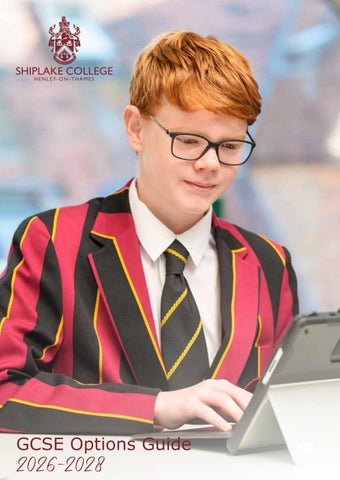
GCSE Options Guide 2026-2028
GCSE Subject Choices Choosing your GCSE subjects is an important decision and should not be made in haste, or alone. Remember to talk to your parents, subject teachers and other senior staff who know you well. They will be more than happy to help you.
1.
Which subjects do you enjoy? The importance of this should not be underestimated. You will be studying these subjects for two years, so make sure you are interested in them.
2.
Which subjects are you good at? Think about your strengths. Performing well and achieving good grades will undoubtedly help you in the future.
3.
Which subjects might you need later on? Having a rough idea about what you want to do in the future is important. Try to pick subjects which are relevant to your career plans. If you are not sure, opt for a varied combination. Geogr aphy
Hi
st
or
y
L
Bu
Eng lish
GCSE CURRICULUM 2026-2028
Li
Media Studies
Des Tec ign & hno logy a
ra m
D
al sic ion y Ph cat u Ed
Computer Science
Eng lish
e tur ra te
age gu n a
t Ar
sin e
ss
rn s de age o M gu n La
ious Relig s Studie
GCSE Subject Choices
2
GCSE Welcome
3
GCSE Options Timeline
5
The Shiplake Seven
6
Art
7
Business
8
Computer Science
9
Design, Engineering and Technology
10
Drama
11
English Language
12
English Literature
13
Geography
14
History
15
Mathematics
16
Media Studies
17
Modern Languages
18
Music
19
Physical Education
20
Religious Studies
21
Science (Combined)
22
Science (Triple Award)
23
FAQs
24
Mu
sic
Scie (Triple nce Award )
GCSE Welcome Mr Sam Shaw Assistant Head (Academic)
Welcome to the GCSE Options Guide for 2026-2028. Year 10 is an exciting time in your child’s education and it presents the first opportunity for pupils to begin to study the subjects in which they are most interested.
Subject Choices Beyond the core subjects of English, Maths and Science, pupils must select four subjects. At GCSE we recommend that pupils should continue to study a broad and balanced curriculum and should try to choose a humanities subject (Geography, History or Religious Studies) plus a practical or creative subject (such as Art, Design and Technology, Music, Physical Education or Drama). Those pupils currently in the Core Learning Development group will continue to receive this support, which must be one of their subject choices. Above all, it is important for pupils to be guided by the subjects they find most interesting and those subjects which present the greatest chance of success at the end of Year 11. Some pupils may know which subjects are most useful to their future aspirations but, for the majority of pupils a good set of GCSE grades is essential in order to make a successful transition into the Sixth Form.
GCSE Welcome Mr Paul Jones Deputy Head (Academic)
Watch ‘GCSE Options Parent Info Evening 2026’
Choosing their GCSE subjects is a very important decision for our Year 9 pupils. In addition to pupils’ Sixth Form results, many universities and employers are taking more of an interest in GCSE results when reviewing applications. Our strong advice to pupils is to choose the subjects in which they are most interested and those subjects which will offer them the greatest chance of GCSE success. If at this stage pupils are unsure about their future aspirations (university, employment, apprenticeships), it is vital that they leave their options open by choosing a breadth of GCSE subjects. We realise that choosing their GCSE subjects can be a difficult decision for many pupils. To the pupils: it may help to use some of the Shiplake Seven to inform pupils’ thinking: be curious and find out as much as you can about individual courses by reading this booklet and talking to teachers; be independent and make considered choices based on your interests, not those of your friends; be open-minded and consider all of your options; be reflective about the subjects you have enjoyed most since being at Shiplake. Good luck with the next stage of your learning at Shiplake College and I would urge you to speak with as many teachers as you can during this process to make informed decisions that are right for you.
GCSE Options Timeline GCSE Options Evening Thursday 8 January 2026 This information evening gives Year 9 parents advice on choosing subjects and where to find the options guide which includes videos explaining details of subjects and the types of pupils best suited to these subjects.
GCSE Options Form Sent To Parents Monday 12 January 2026 This online form should be used to select four GCSE options and a reserve choice.
Year 9 Parents’ Conference Friday 23 January 2026 In addition to checking on your child’s progress, this is an ideal opportunity to book appointments in subjects your child is considering taking at GCSE.
GCSE Options Form Deadline Monday 26 January 2026 Please submit the options form by this date.
Head of Departments Review Subject Choices Friday 6 February 2026 After this point the timetable will be built around pupils’ choices. Parents will only be contacted in the event that a clash in the timetable means that a pupil’s initial choices are not possible. This is highly unusual and we do all that we can to accommodate pupils’ first choices, but it is always a possibility.
The Shiplake Seven The Shiplake Seven is our teaching and learning framework designed to foster and develop key interpersonal qualities in our pupils. The seven qualities not only provide a solid foundation for pupils to achieve success throughout their education, but also equip our leavers with the skills they need to enter the next stage of their lives as confident, personable and capable young adults. The framework is integrated across the academic and co-curriculum, allowing the seven qualities to be nurtured inside and outside the classroom. Pupils are encouraged to use these skills in their lessons and activities, with Year 9 pupils working towards the Shiplake Seven Award. The Shiplake Seven framework provides energy and direction to our already excellent teaching and learning. The qualities were selected by a panel of teaching staff from a larger pool of attributes put forward by pupils. We firmly believe that these qualities are essential for pupils to achieve success at school and subsequently in their chosen careers. Whilst, of course, these skills were already being developed by teaching across the curriculum, this framework will allow pupils’ personal development to be more comprehensively encouraged, monitored and rewarded. We want to ensure that our pupils are fully prepared for the uncertainties, demands, and challenges of their future pathways. Through the Shiplake Seven, we want our pupils to adopt a problem-solving approach where they are given the tools to build resilience, foster independent thought, and ask the right questions. Thinking School Accreditation As part of the Thinking Schools Network, we will embrace a common language of thinking and a common toolkit of resources. We will explicitly make thinking visible across the curriculum and enable pupils to take greater ownership of their learning. Pupils will be encouraged to embrace the challenge of thinking, to become explicitly curious and independent, and to develop the academic resilience to approach any problem with confidence.
Art 2026-2028 Specification: AQA Fine Art GCSE; 8202/C-8202/X Head of Department: Miss Keli Jiggens
Watch ‘An Introduction to Art GCSE’
Why Study Art? Pupils will have the opportunity to develop skills, knowledge and understanding in art and design. This will develop ideas and expand creative thinking, develop independent learning skills and allow pupils to apply their learning in a practical, fun and realistic way.
Course Overview The Art Department follows the AQA Fine Art course which includes drawing, painting, printmaking, sculpting and ceramics/3D work. The variety of skills covered provides the best all-round basic training for a career in art and design and an insight into the rigours of A-level Art, as well as identifying pupils’ strengths. The course requires pupils to develop an ability to assess, question, criticise and make decisions, through the language of form, colour, shape, rhythm, line, pattern, texture and volume; all the elements of a visual vocabulary.
Assessment Details Unit 1 is a coursework unit worth 60%. You will explore and respond to your chosen theme. You will generate, research and develop ideas, as well as develop the skills required to help you analyse your own and others’ work. You will complete artwork in a minimum of three disciplines and develop a final piece from all your explorations. Unit 2 is an externally set assignment worth 40%. In addition to completing a 10 hour timed exam, you will produce preparatory work that shows and supports the development of your final piece.
Additional Opportunities Field-trips and local artist workshops may be included as part of the course and pupils are expected to visit art galleries and exhibitions for holiday prep. Artist research is very important. Visits to galleries, exhibitions and museums to see art ‘in the flesh’ are absolutely vital. To see the link between this activity and the pupils’ own work is expected and assessed. The higher grades are not achieved without this requirement being more than adequately met. Art GCSE is a stepping stone to careers in the following field such as graphic design, illustration, animation, fine art, art educator, photography, fashion design, interior design, game design, art thrapy, art directing, product designing, architecture, and many more!
Business 2026-2028 Specification: Edexcel 2017 1BSO Head of Department: Mrs Teuta Hill
Watch ‘An Introduction to Business GCSE’
Why Study Business? GCSE Business is an engaging and inspiring course that reflects the demands of a truly modern and evolving business environment. Most importantly, it is entirely relevant for whatever students go on to study in future and it enables students to develop as commercially minded and enterprising individuals which will help them to succeed in their chosen pathway.
Course Overview The business course is split into two themes: Theme 1: Investigating a small business - covers topics such as enterprise and entrepreneurship, spotting a business opportunity, putting a business idea into practice, making the business effective, and understanding external influences on business. Theme 2: Building a business - covers topics such as growing the business, making marketing decisions, making operational decisions, making financial decisions, and making human resource decisions.
Assessment Details The course is examined via two written exams both equally weighted.
Who Would Business Suit? GCSE business would suit any student who has a keen interest in business and wants to develop a deeper knowledge of how businesses operate and what makes a successful business.
Additional Opportunities Within the business department, there are plenty of opportunities to put theory into practice by getting involved in the enterprise extra-curricular activities. Using the resources in the department, students can put their entrepreneurial skills to work by designing and creating branded products. The Christmas Fair is a big annual event for the school and it presents a great opportunity to test out the feasibility and demand of their products by selling them at the event. The business department also runs trips to support the delivery of course content. In recent years, we have visited Jaguar Land Rover and the All England Lawn Tennis & Croquet Club (Wimbledon).
Computer Science 2026-2028 Specification: OCR Computer Science GCSE - J277 Head of Department: Mr Pete Redrup
Watch ‘An Introduction to Computer Science’
Why Study Computer Science? Computer Science is an ideal subject for pupils who wish to understand how the digital technologies and services that support almost every aspect of modern life work. GCSE Computer Science explores the fundamentals of computer systems, including the architecture of computer systems and their hardware; how data is represented and transmitted across the world via interconnected networks as well as how to design and develop software programs.
Course Overview The GCSE Computer Science course is split into two, equallyweighted, components: Computer Systems and Computational Thinking, Algorithms and Programming. In Computer Systems, pupils will learn about topics such as the internal structure and hardware of computers, including the role of memory and the CPU; networking, the Internet and cyber security; ethical, legal, environmental and cultural issues related to Computer Science. In Computational Thinking, Algorithms and Programming, pupils will learn about how to break complex problems down so that they can be solved through the application of logic to form algorithms, how to write software programs using the Python programming language and how information of different forms (text, images, sound, number) is represented within computer systems as binary data. In addition to the theory topics studied, pupils will be given plenty of opportunity to engage in practical programming using a high-level programming language (Python).
Assessment Details Formal assessment takes place at the end of the course with two written exam papers. Each component is equally weighted, however pupils are expected to be able to transfer knowledge and skills (particularly those related to Computational Thinking) between the two papers. Paper two will include a section with questions which assess their ability to write or refine algorithms using either pseudocode or Python.
Additional Opportunities GCSE computer scientists will have the opportunity to take part in the Bebras Computational Thinking Challenge at seniors level. Pupils are also encouraged to develop their own coding interests and projects and to discuss these with department staff.
Design and Technology or Textiles 2026-2028 Specification: AQA GCSE 8552 Head of Department: Mr Liam Fuller
Watch ‘An Introduction to DET GCSE’
Why Study Design & Technology or Textiles? It immerses and inspires pupils in the field of solving problems and meeting needs through creative solutions. It is a place where ideas can flourish to simply make things better with creativity and originality. It also teaches the value of working through many iterations and in that process, pupils learn a great deal that supports them well beyond the subject. DET is taught within the ethos and context of the commercial world and within that work we aim to ensure pupils learn to solve problems with an entrepreneurial eye that meet user needs.
Course Overview The course specification requires pupils to develop their knowledge of a wide range of modern and traditional materials and the use of new technologies is strongly encouraged. Pupils must also demonstrate mathematical and scientific knowledge and understanding, in relation to DET. Pupils will be taught how to use a number of 2D and 3D software CAD/CAM packages and will have access to state-of-the-art equipment when completing their coursework. The curriculum is designed to foster awareness amongst candidates of the need to consider the sustainability and environmental impact of their designs. It provides candidates with the opportunity to design and make products. The GCSE specification provides an excellent route into studying DET - Product Design in the Sixth Form.
Assessment Details This course contains 50% controlled assessment in order to recognise the importance of project work within the subject. Pupils are expected to produce a design portfolio (maximum of 20 A3 pages) produced in PowerPoint, and a practical prototype/working product. The contextual ‘challenge’ is released by AQA on 1 June in Year 10 ready for pupils to complete during Year 11. In Years 10 and 11 two of the three lessons a week will be dedicated to this project work. The other 50% of the assessment is a two-hour written examination on the core and specialist technical principles of DET which is sat at the end of Year 11 and the third lesson every week will be dedicated to preparing for this.
Additional Opportunities As part of the GCSE course, pupils enjoy exposure to inspiring and informative design work through visiting the Design Museum, the Victoria & Albert Museum, universities and attending design seminars. We also have extensive links and contacts within the fields of Product Design, Engineering and Architecture and our network of contacts and support allows us to provide additional opportunities for students via guest lectures, workshops and site visits. Pupils are also given access to the workshops in DET club.
Textiles Specialism The AQA specification allows us to offer the Textiles specialism within Design and Technology. This follows much of the D&T course but pupils focus on textiles as a material choice.
Drama 2026-2028 Specification: WJEC GCSE Drama Head of Department: Mrs Emma Farrell
Watch ‘An Introduction to Drama GCSE’
Why Study Drama? Taking drama means learning to work within a team. It means learning to balance a mix of ideas, evaluate them and pick out the best one. It gives pupils a way to have their voices heard and see their ideas come to life. It lets creative people explore performing, lighting, costumes and set design. As well as allowing pupils to express themselves through performance on stage, studying drama gives them an opportunity to gain a powerful insight into how a theatre operates. Pupils will also develop the ability to research, analyse and interpret scripts and creatively write about their interpretations in essay form.
Course Overview and Assessment The course is split into three components with assessments taking place in Year 11. Component 1: Devising Theatre (40%) Pupils are required to devise a piece of original theatre in response to a stimulus, using the techniques of an influential theatre practitioner. They must also complete a written process log (2000 words) and written evaluation. This is completed in the Autumn Term of Year 11 in supervised conditions and internally marked and externally moderated. Component 2: Performing from a text (20%) Pupils will participate in a performance from a text. Pupils will gain an understanding of how to interpret a text for performance and realise artistic intentions. This is a practical examination marked by a visiting examiner in the Spring Term of Year 11. Component 3: Interpreting Theatre (40%) Pupils will demonstrate their knowledge and understanding of how drama and theatre is developed and performed through the study of a performance text and through responding to live theatre. This is a written examination lasting 1.5 hours in the Summer Term of Year 11.
Additional Opportunities In order for pupils to gain the most experience of how to put together a successful performance, we work closely with inspiring theatre companies who come in to conduct workshops at the College. Pupils will also watch a number of cutting edge live productions during the course, alongside using tools such as the National Theatre learning website to provide inspiration. There is also an opportunity for pupils to become part of Shiplake College’s Theatre Company, which performs at the Edinburgh Fringe Festival.
English Language 2026-2028 Specification: Edexcel English Language IGCSE (Spec. A) Head of Department: Mrs Jessica Brooks
Core Subject Watch ‘An Introduction to English GCSE’
Why Study English Language? The short answer is: you must! English Language is a ‘core’ subject, which means everyone must study it up to GCSE level. The reason for this is that competency in written and spoken English is essential in today’s world. No matter which future pathway you take, there will be an expectation that you are a confident and competent user of the language. Studying English at Shiplake will improve your speaking, reading and writing skills and will enable you to perform better in all subjects across the curriculum.
Course Overview Currently at Shiplake, we follow the Edexcel English Language (Spec. A) IGCSE curriculum. The course includes a variety of reading and writing tasks, designed to develop your ability to express yourself with fluency. In addition, you will develop your reading ability through a range of interactive reading lessons. English Language is a discussion-based subject so ideas are often developed through whole-class interactions. The English Department takes advantage of modern technology and uses tools such as Microsoft One Note, Teams and videos to reinforce content covered in lessons. Collaborative work is actively encouraged, primarily through the use of whiteboard desks.
Assessment Details Paper 1: Examination (approximately 60%) - this exam tests your ability to read and understand both a familiar (studied) and an unfamiliar (chosen by the exam board) text. You will be expected to show understanding of implicit meanings and use of language and structure in both texts through answering short and long questions on each. There is also a writing section where students will be expected to reproduce a transactional piece of writing - i.e. a letter, speech or article. Paper 2: Coursework (approximately 40%) - two pieces of writing: one on a studied poem or prose text; the other an imaginative piece of writing. Coursework and preparation for terminal exams will take place throughout Year 10 and 11, with final examinations taking place in the summer of Year 11. Additional Opportunities All pupils will be expected to read for pleasure both during and after lessons and are encouraged to make use of the wide selection of books that we have available in the Thinking Space, as well as in teachers’ classrooms. Additionally, the English Department runs trips to theatres, libraries and festivals, such as the Henley Literary Festival.
English Literature 2026-2028 Specification: Edexcel English Literature IGCSE Head of Department: Mrs Jessica Brooks
Core Subject Watch ‘An Introduction to English GCSE’
Why Study English Literature? English Literature is a wonderful subject - Literature is one of the great art forms and the study of Literature is culturally enriching. A key focus for the English Department is to make students more empathetic through their study of Literature. Moreover, studying Literature helps pupils to develop the skills of sharp analysis, not to mention an understanding of different socio-historical contexts. The analytical skills of good Literature students are much sought after in the modern workforce. Course Overview During the course, students will study a variety of literary texts, including a major Shakespeare play, a modern novel, a range of different poetry and a modern drama. Literature is a discussion-based subject so lessons tend to include much whole-class interactions. As in Language, the English department take advantage of modern technology to reinforce Literature lessons. Assessment Details Coursework and preparation for terminal exams will take place throughout Year 10 and 11, with final examinations taking place in the summer of Year 11. There are two areas of assessment for English Literature: Paper 1: Examination (40%): This exam will feature three sections: Unseen Poetry; Anthology Poetry and; Modern Prose. Students will prepare the chosen texts for the poems in the Anthology and the selected Modern Prose text through Year 10 and again closer to the exam. There will be ample opportunity to study ‘Unseen Poetry’ also. Paper 3: Coursework (40%): Students will complete two essays: one on a Modern Drama and one on a Shakespearean play. Additional Opportunities Typical English Literature trips include visits to theatres and libraries. The English Department will try to take pupils to see relevant Shakespeare plays if they are showing locally. NB: While most students are encouraged to take both English Language and English Literature, if we feel that taking both would be too challenging, we can withdraw students from English Literature. Please note that English Language is a requirement for almost all Sixth Form centres and further qualifications.
Geography 2026-2028 Specification: AQA GCSE Geography 8035 Head of Department: Mr Jack Cooper
Watch ‘An Introduction to Geography GCSE’
Why Study Geography? “Geography is the subject which holds the key to our future” - Michael Palin. “Geography prepares for the world of work. Geographers, with their skills of analysis, are highly employable!” - Lord Alan Sugar.
Course Overview The study of GCSE Geography will help you to develop a knowledge and understanding of local and global events. Pupils cover a range of topics including population and settlement, the natural environment and economic development. Those who choose GCSE Geography will develop a range of useful skills such as map reading, data collection, ICT and problem solving. Students will be divided into three mixed-ability sets and taught by the same teacher over the two year course.
Assessment Details In May/June of Year 11, pupils will sit three exams. Paper 1: Living with the physical environment is based physical Geography and hazards and consists of 88 marks and lasts 1 hour 30 minutes. This paper is worth 35% of the overall GCSE. Paper 2: Challenges in the human environment, has a focus on the Human side to Geography and consists of 88 marks and lasts 1 hour and 30 minutes. This is worth 35% of the overall GCSE. The final exam is a skills, fieldwork and application paper, this is replacing the need for a controlled assessment. Students are given a resource booklet 12 weeks in advance to help prepare. The exam is called Paper 3: Geographical applications and consists of 76 marks and lasts 1 hour and 15 minutes. This paper is worth 30% of the overall GCSE. During Year 10 you will also complete a field-trip to the Dorset coast. This is a requirement of the course that students have the option to attend a field trip. Students will be asked about this field trip within Paper 1, 2 and 3. Additional Opportunities There is a compulsory two day coursework trip to Dorset in the Spring Term. Back in school, additional fieldwork will also be carried out during lesson time. These experiences will help GCSE Geographers to gain a number of important practical skills.
History 2026-2028 Specification: Edexcel IGCSE History (4HI0) Modern World History Head of Department: Mr Joe Player
Watch ‘An Introduction to History GCSE’
Why Study History? History is a fantastic subject full of extraordinary events, incredible people, epic stories, and important lessons about how we got to this point. It is an excellent opportunity for students to explore their curiosity about the past, to tangle with essential issues, and to learn vital skills such as research, analysis, evaluation and argument that can be useful to them in the future.
Course Overview In the History Department we have four teachers who are all extremely passionate about the subject and we have specifically selected topics that we think students will find exciting, engaging, challenging, and will allow them to develop a greater understanding of the modern world. Students will study a diverse mix of topics ranging from exciting breakthroughs in medicine and the huge changes in British healthcare, to the riotous events of the Russian Revolution, the monstrosities of Nazi Germany, and the chilling episodes of the Cold War. Students are taught in mixed ability sets and will be tested on the four topics in two exams which require a mixture of short and longer answers.
Assessment Details IGCSE Edexcel History exams are split into two examinations of 90 minutes each. Each exam tests students on two of the topics below: Paper 1: Germany: Development of Dictatorship, 1918-1945 and A World Divided: Superpower Relations, 1943-72. Paper 2: Changes in Medicine, 1848-1948
Additional Opportunities The History Department is always looking for opportunities to explore History outside the classroom. We organise a trip to Normandy to see the D-Day beaches, and we are also planning trips to Berlin. History students are often involved in promoting the subject on specific days, for example the Remembrance Service and Black History Month. History students are often involved with wider-school initiatives such as the Exemplum Docet Society and the Interhouse Debate contests.
Learning Development Head of Department:
Mrs Judit Coulehan
Watch ‘An Introduction to LDev at GCSE’
Learning Development in Key Stage 4, Years 10-11 During Years 10 and 11, Core/Learning Development pupils build further on their skills to achieve maximum value from their educational experience. Under the guidance of the Learning Development teachers, pupils can review aspects of their GCSE work; this facilitates the teaching of study skills, such as note-taking, revision and examination strategies, including how to use exam access arrangements effectively. Pupils are given positive feedback as they tackle a range of learning tasks aimed at developing their skills and selfconfidence. They also learn to assess their own performance and review their action-steps. Learning Development consists of four timetabled, small group lessons per week in place of one GCSE option subject and PSHE taught by SpLD/dyslexia specialist teachers. As part of our proactive approach, working very closely with the English and Science departments, we shadow the GCSE English and science curricula to provide opportunities for structured and teacher-led overlearning of the key concepts and related vocabulary in English, biology, physics and chemistry. W e can also provide temporary support in other subjects as well to suit emerging needs; we can be flexible and alter our plans for a particular lessons/week to provide structured support/revision in subjects/topics that the pupils find challenging. To help students discover the study methods best suited to their needs, we model the best use of interactive and multisensory platforms such as GCSE Pod, Seneca, Quizlet, Kahoot and certain subject specific YouTube channels, as well as further train pupils in the use of assistive technology.
Access Arrangements and Reasonable Adjustments (AARA) All students are assessed for access arrangements, in line with the Joint Council for Qualifications (JCQ) Access Arrangements and Reasonable Adjustments Policy. Testing takes place in school and evidence must be gathered from class teachers for any arrangement to be given. The evidence must reflect a student’s normal way of working in class. In line with the JCQ regulations, below average scores or recommendations from external Educational Psychology Reports and Specialist Teacher Reports cannot be accepted as evidence of the need for Access Arrangements. Testing must be undertaken in school and any arrangement given must reflect a candidate’s normal way of working within the centre, that is in lessons as well as in all internal examinations. All students (Core, Monitor and Main) are screened for Access Arrangements and where screening shows a need, further individual testing may be required, and evidence is gathered from teachers. The screening takes place at the end of Year 9 and, if needed, individualised testing is conducted afterwards, typically in Years 10-11. It is a JCQ requirement that subject teachers must be able to produce evidence to support access arrangements and any arrangement given must reflect a student’s normal way of working. For more information on Access Arrangements, please refer to the following, related policies and documents available on the College’s website: • Access Arrangements and Reasonable Adjustments Policy • Word Processing Policy • Guidance for Students on using Access Arrangements Access Arrangements must be reviewed when a student transitions from GCSE level to A-level studies to ensure there is ongoing need for the adjustment/s.
Mathematics
Core Subject
2026-2028 Specification: Edexcel IGCSE Mathematics 4MA1 Head of Department: Mr Adie Davis
Why Study Mathematics? Mathematics is compulsory as it holds a key position in pupils’ academic development. A basic understanding of the subject is essential for everyday life and a creditable grade in the subject will be required for many future pathways. However, there are other reasons to study mathematics: • Mathematics is beautiful. G.H. Hardy once wrote “There is no permanent place in the world for ugly Mathematics”. The beauty lies, not in the shape of the symbols, but in the ideas behind them. • Mathematics facilitates logical thought and therefore enhances the ability to construct, and indeed recognise, coherent arguments. • Mathematics is a key facilitator subject for undergraduate courses and employment opportunities.
Course Overview The IGCSE courses begin in Year 9 with a review of all Foundation Course topics. With a thorough diagnostic testing programme and ongoing assessments designed to identify areas for future development, we are able to group pupils into streams according to academic reference. We look to accelerate the top end of each cohort by adding a Level 2 Certificate in Further Mathematics to students’ Higher Tier IGCSE papers during Year 11. At the lower end of the ability range, we look to consolidate key principles and support students through a Foundation Level IGCSE qualification.
Assessment Details The syllabus includes tiers of entry which allows all pupils to be entered for a level appropriate to them. Exam questions are therefore accessible to pupils of all abilities, with papers balanced in terms of topics and difficulty. The two tiers available are Foundation Tier (grades 5-1) and Higher Tier (grades 9-4). Each is assessed via terminal examination papers.
Additional Opportunities In addition to the normal curriculum time allocation, support sessions are available at 4:45pm on weekday evenings. These sessions are open to anyone wishing to improve or wanting additional assistance with a specific topic. An online support network, ‘Dr Frost Maths’, enables all pupils to access revision materials to support their classwork. For those wishing to further extend their understanding of mathematics, there are additional opportunities in the form of the UKMT Mathematics Challenges and other national competitions.
Media Studies 2026-2028 Specification: OCR GCSE Media Studies Head of Department: Mr Marcus Milburn
Watch ‘An Introduction to Media Studies GCSE’
Why Study Media Studies? This contemporary, accessible and creative course has been designed with teachers and learners in mind following extensive consultation. This specification will allow learners to study the media in an academic context and apply the knowledge and understanding gained in the process of creating their own media production.
Course Overview The course consists of three units, two of which are assessed as a written exam each worth 35% of the final mark, whilst the other component is assessed internally through the completion of a nonexam assessment worth 30%. The three units of study are: Television and promoting media: In television, pupils engage with an in-depth study of one contemporary and one historic television product, responding to questions covering the whole of the theoretical framework and a range of media contexts. In promoting media, pupils study media products from the same global conglomerate producer illustrating the media forms of film, advertising and marketing, and video games. Music and news: In music, pupils engage with one in-depth study covering magazines, a comparative study of music videos and a study of contemporary radio. In news, pupils engage with one in-depth study of online news, including its social and participatory media. Pupils also study contemporary and historical newspaper front pages and how they illustrate changing social, cultural, historical and political contexts. Creating media In this component, pupils apply their knowledge and understanding of media language and representations to create media products of their own, using the theoretical framework to express and communicate meaning to an intended audience. Pupils will learn in a “hands-on” fashion throughout all units of study, with a focus on developing their digital skills in software applications such as digital graphics packages.
Assessment Details Media Studies is a linear qualification with 70% external assessment by examination and 30% by nonexam assessment (NEA).
Modern Languages 2026-2028 Specification: Edexcel GCSE Spanish/French Head of Department: Mr Ari Alejandro
Watch ‘An Introduction to Modern Languages’
Why Study Languages? In today’s globalised world, the ability to speak a second language is more valuable than ever. With increasing numbers of young people progressing to university and competition in the workplace at an alltime high, language skills give you a real edge. We also live in a multicultural society where multilingual speakers are common, making the ability to communicate in more than one language a powerful advantage. Alongside learning to communicate confidently, studying languages opens the door to understanding diverse cultures and developing skills that last a lifetime. You will gain highly transferable skills such as critical thinking, problem-solving, adaptability, and strong interpersonal communication. At Shiplake, you can choose to study French or Spanish in small, supportive classes by an experienced team of teachers who have lived and travelled extensively abroad. Our first-hand cultural knowledge brings authenticity to every lesson, making learning dynamic, engaging, and firmly rooted in real-world communication.
Course Overview Pupils can choose to study French or Spanish. Many topics will feel familiar from Key Stage 3, now explored in greater depth, while new themes provide a fresh and exciting challenge, creating a balanced and rewarding course. Language learning is skills-based, and the GCSE programme develops your ability to produce and comprehend the language naturally and progressively. By the end of the course, you will have a strong command of the language and a deep appreciation of its culture. You will be able to communicate confidently and will be fully prepared for further study at A-level.
The GCSE in French or Spanish is assessed across two tiers: Higher Tier (9-1); and Foundation Tier (5-1). There are four examinations, each focusing on a key language skill: speaking, listening, reading, and writing. Each component carries an equal weighting of 25%. The speaking examination, conducted by your teacher, takes place in April/May of Year 11. The remaining three exams are sat during the public examination window.
Assessment Details Additional Opportunities Studying a language opens the door to a range of enriching experiences beyond the classroom. Depending on the language chosen, students have the chance to travel to France or Spain, gaining practical experience and confidence in real-life situations. Closer to home, we offer cultural activities such as cinema and theatre visits, restaurant trips, and language immersion days; all designed to bring the language and culture to life. GCSE language students are also encouraged to take an active role in school life by organising and delivering language events, and representing the department during Open Mornings and information evenings, developing leadership and communication skills along the way.
Music 2026-2028 Specification: Edexcel GCSE 1MU0 Head of Department: Mrs Amy Haynes
Watch ‘An Introduction to Music GCSE’
Why Study Music? GCSE Music develops an exciting mixture of practical, creative and academic skills. It is all about creating, performing and analysing a wide variety of music from different times and cultures (from jazz to classical and world to electronic music). The course is excellent preparation for the further study of Music but it also develops key skills relevant to any future career choice, such as creating, communicating and analysing. Course Overview GCSE Music continues to develop the three main skills developed during Key Stage 3: ‘performing’, ‘composing’ and ‘listening and appraising’. The ability to perform on at least one instrument (or voice), coupled with the ability to read music notation, is essential. Although entry for music grade exams (ABRSM or Trinity) is not a requirement, taking instrumental or vocal lessons is a prerequisite to ensure good progress in made through the performing element of the course. Each of the topics covered is taught in an inspirational and engaging way with many opportunities for practical performances to bring the music to life. Assessment Details Performing (coursework, 30%): You will perform two pieces on any instrument/voice; one solo and one ensemble performance with a combined duration of at least four minutes. Composing (coursework, 30%): You will compose two of your own pieces (in any genre or style) one to a set brief and one as a free composition, with a combined duration of at least 3 minutes. You will also develop your ability to compose using music technology (with Logic and Sibelius software). Listening and Appraising (examination, 40%): There is one examination at the end of Year 11. You will study eight very different set works throughout the course by investigating their musical context and musical language. The set works range from Bach’s Brandenburg Concerto to the theme from Star Wars. Using these skills you will also be required to evaluate some unfamiliar music. Additional Opportunities Co-curricular music is an important part of life at Shiplake College and GCSE Music students are expected to play a leading role in the programme, actively participating in the core ensembles such as the Choir and Big Band and modelling good practice. Pupils should relish the opportunity to make the most of the outstanding facilities in the Music Department, including the Lecture Theatre, Mac Suites and Recording Studio.
Physical Education 2026-2028 Specification: AQA GCSE PE Head of Department: Mrs Katie Neill
Watch ‘An Introduction to PE GCSE’
Why Study Physical Education? Physical Education is a dynamic and challenging course which continues to grow in popularity at Shiplake College. Pupils will be expected to perform in three different sports for assessment, as well as studying the theory linked to successful sporting performance. This diverse course allows pupils to use their full range of intellectual and sporting talents to achieve their potential.
Course Overview GCSE Physical Education achieves a balance between theoretical learning and practical application. The course involves many evolving areas of sport, including sport psychology and technology, commercialisation and the use of biomechanical analysis in boosting performance. The course is underpinned by science (namely biology) and so a keen interest and confidence in science is essential. Practically, the course will encourage creativity and decision-making skills to enable the pupils to plan effectively for performances and to respond to challenging situations. It will also help pupils to make informed decisions about further learning opportunities and career choices. Ideally, pupils will be performing at a high level in their chosen sports for school or outside teams. Although a high level of performance is not essential, it will be very beneficial to the students’ overall marks.
Assessment Details 1) Theoretical component of the course (60%). This is assessed through two written examinations. The first paper (36%) covers anatomy, biomechanics, fitness and body systems. The second paper (24%) covers health, psychology, society and performance. All modules and topic areas taught in lessons. 2) Practical Performance (30%).The pupils must select one individual sport, one team sport and one free choice from a list prescribed by the DfE. The students are assessed in these sports throughout the course, and in each sport they are awarded individual marks for their skills and competitive application. 3) Analysis of Performance coursework (10%). Pupils must analyse performance in one of their chosen activities. They will be expected to discuss their strengths and weaknesses, using the knowledge they have acquired throughout the course, before explaining how they could make improvements.
Additional Opportunities As the students are expected to be representing the school or their own clubs, the theoretical knowledge gained in lessons can also be applied to pupils’ personal training and performance. The students will also become familiar with using specialised equipment in the gym. There may also be additional opportunities too make use of the facilities in the Davies Centre.
Religious Studies 2026-2028 Specification: AQA GCSE A Head of Department: Miss Nicola Jones
Watch ‘Theology and Philosophy GCSE’
Why Study Religious Studies? The largest reason cited by our students: because it’s fun and interesting! The modern world is diverse and filled with people who hold differing beliefs and viewpoints about life. Religious Studies helps to understand those opinions and discover why people act or think in a certain way. This subject enables you to question and develop your own perspective on major topical issues and offers a platform to academically critique and evaluate a range of opinions. Regardless of whether you have religious belief or none, we teach you to question, analyse and evaluate the world. Be prepared to be challenged by others and by yourself. Ultimately, if you enjoy debating and challenging ‘big’ questions like ‘does everyone have free speech?’ or ‘what happens when we die?’ - this is the subject for you. Course Overview Within GCSE Religious Studies you will study the beliefs, teachings and practices of two contrasting world religions: Islam and Christianity, and apply those religious perspectives to various ethical issues such as war, abortion, homosexuality, capital punishment etc. Within the study of ethics, Humanist and atheist viewpoints are also considered. There is no objective ‘right’ or ‘wrong’ answer to many of the arguments and beliefs we examine and lessons have a strong emphasis on discussion, open-mindedness and critical scrutiny. Pupils are taught in small groups and structured lessons enable them to solve problems with original ideas. Assessment Details Beliefs, teachings and practices of Christianity
Beliefs, teachings and practices of Islam
4x Ethical Themes including: • Religion and Life • Religion, Peace and Conflict • Religion, Crime and Punishment • Religion, Human Rights and Social Justice
25% of total GCSE
25% of total GCSE
50% of total GCSE
1 hour 45 minutes written examination
1 hour 45 minutes written examination
Additional Opportunities GCSE conferences which aid revision and extend learning opportunities will be arranged. In addition a local Imam will visit the school for a Q&A session alongside trips to a mosque and topical exhibitions when appropriate. These diverse experiences help pupils to further their understanding of the subject.
Science (Combined) 2026-2028 Specification: Edexcel GCSE 1SC0 (Combined Science) Head of Department: Miss Sarah Kenyon
Core Subject Watch ‘An Introduction to GCSE Science’
Why Study Science? Studying science at GCSE helps you understand the principles that shape the world around us. It develops critical thinking, problem-solving, and analytical skills that are valuable in everyday life and future careers. Science also opens doors to a wide range of opportunities in technology, medicine, engineering, and beyond.
Course Overview This course provides a balanced introduction to biology, chemistry, and physics, helping students develop a strong understanding of key scientific principles. It covers a broad range of topics, while building practical skills through experiments and data analysis. GCSE Combined Science is a double award qualification, meaning your performance across biology, chemistry, and physics is combined to give you two GCSE grades.
Assessment Details Edexcel GCSE Combined Science is assessed through six written examination papers: two for each of the three sciences. Each paper lasts 1 hour and 10 minutes and is worth 60 marks. The exams include a mix of multiple-choice, short-answer, and extended-response questions, testing both knowledge and application of scientific concepts. Practical skills are assessed through questions based on required experiments rather than separate coursework. Your performance across all six papers is combined to award two GCSE grades. Pupils can sit the exams at either foundation tier (grades 1-1 to 5-5) or higher tier (grades 3-4 to 9-9), depending on ability.
Additional Opportunities As part of the course, students gain a great deal of hands-on laboratory experience. This involves observing and conducting a wide range of practical activities. Pupils are also invited to lectures given by visiting scientists.
Science (Triple Award) 2026-2028 Specification: Edexcel GCSE 1BI0 (Biology), 1CH0 (Chemistry), 1PH0 (Physics) Head of Department: Miss Sarah Kenyon
Why Study Science Triple Award?
Watch ‘An Introduction to GCSE Science’
Choosing Triple Science at GCSE allows you to study biology, chemistry, and physics in greater depth, giving you three separate GCSE qualifications instead of two. This option is ideal for students who enjoy science and have already decided that they may want to pursue A-level sciences or careers in medicine, engineering, technology, or research. The additional content provides a stronger foundation for future study and shows ambition and readiness for academic challenges.
Course Overview The opportunity to study Science Triple Award is for highly able pupils who have a real interest in all three sciences. The Triple Award involves studying all three separate sciences and thereby gaining three science GCSEs. The decision to take this option would be made at the end of Year 9, under the guidance and recommendation of the relevant teaching staff. It would mean choosing a science in one of the GCSE option columns.
Assessment Details Edexcel GCSE Separate Sciences are assessed through six written examination papers – there are two papers for each science. Each paper lasts 1 hour and 45 minutes. The exams include a mix of multiplechoice, short-answer, and extended-response questions, testing both knowledge and application of scientific concepts. Practical skills are assessed through questions based on required experiments rather than separate coursework.
Additional Opportunities As part of the course, pupils gain a great deal of hands-on laboratory experience. This involves observing and conducting a wide range of practical activities. Pupils are also invited to lectures given by visiting scientists.
FAQs How many subjects do pupils study? In addition to the core subjects (English, Maths and Science), pupils will choose four options subjects. Most pupils will therefore receive eight or nine GCSEs, representing a broad and balanced curriculum and allowing pupils to secure the necessary grades to enter the Sixth Form. Pupils receive 2-3 GCSEs in Science and some pupils will also receive 2 GCSEs for English (Language and Literature - please see English pages for full details). Our advice would be to focus on the quality of the grades they receive rather than the quantity of qualifications they achieve. Looking forward to A-levels, as a guide, we require five strong passes to be accepted in to our Sixth Form.
Can pupils change their options after starting Year 10? While this is sometimes possible, it is not advisable and we cannot guarantee any late changes. It may be difficult to catch up and there may not be space in the class. Therefore, it is very important to consider your choices carefully at this stage.
Do all subjects have coursework? No. Some practical subjects may retain elements of coursework but reformed GCSEs rely heavily on assessment in an examination at the end of Year 11.
Do pupils have to study a language? No. However, we strongly encourage pupils to consider this as the study of a language at GCSE is highly regarded by universities and employers.
What about pupils in the Learning Development department? Those pupils currently in the Core Learning Development group will continue to receive this support, which must be one of their subject choices (these pupils must then choose three other subjects).
Who can my child turn to for advice? Choosing appropriate subjects is an important decision for every individual pupil and should not be made in haste or alone. We would encourage all pupils to speak with their Academic Tutor and Housemaster for general advice or to discover more about individual subjects by speaking with subject teachers and Heads of Department.