Beyond Eve and Mary Premodern Representations of Gender, Power, and Religion
January–May 2023
Learning Guide
January–May 2023
Learning Guide
The figure of Eve exerted considerable influence over representations of gendered identities prior to 1800. She was the temptress whose desire for knowledge caused her and Adam to be expelled from the Garden of Eden. The thirteenth-century churchman Jacques de Vitry described Eve as deliberately evil: “Eve had no rest until she got her husband banished from the Garden of Eden and Christ condemned to the agony of the cross.” The counterpoint to Eve was Mary, the virgin mother of Jesus Christ who was assumed into heaven, body and soul. Born without the stain of original sin, Mary conceived “immaculately” and bore the Son of God made man. As the mother of the divine Christ Child, Mary is often portrayed by artists as the regal queen of Heaven.
These two figures—Eve, the seductress responsible for the taint of original sin, and Mary, the pure virgin mother—shaped what became a polarized image of women in Western religion, politics, and the arts in the early Middle Ages—and these images persist even today. In the fourth century, Saint Ambrose stated, “Sin came through a woman, but salvation through a virgin.” However, some women’s achievements moved beyond the binary of female sin and virtue from the early Middle Ages forward. Women were monarchs, saints, and artists. They were known for their erudition as well as their piety, and they used their autonomy for good as well as for ill.
This exhibition not only examines the figures of Eve and Mary through thematic groupings of works, but asks us to look beyond common depictions of these two women and see the multifaceted portrayal of gender in the premodern period (pre 1800).
This exhibition is organized by Carole Levin, Willa Cather Emerita Professor of History, and Patricia A. Simpson, professor of German. Exhibition support is provided by Hixson-Lied Endowment, Nebraska Arts Council and Nebraska Cultural Endowment.In the premodern period (pre 1800) many people, especially clergymen, expressed fear and hatred toward Eve. According to the Bible, the first woman had power over Adam and had seduced him into eating the forbidden fruit, causing God to expel them from the Garden of Eden. These sentiments, along with commonly circulated images of Eve, such as those featured here, shaped the perception many men had of women as “other”—as different in nature from men or as dangerous and seductive.
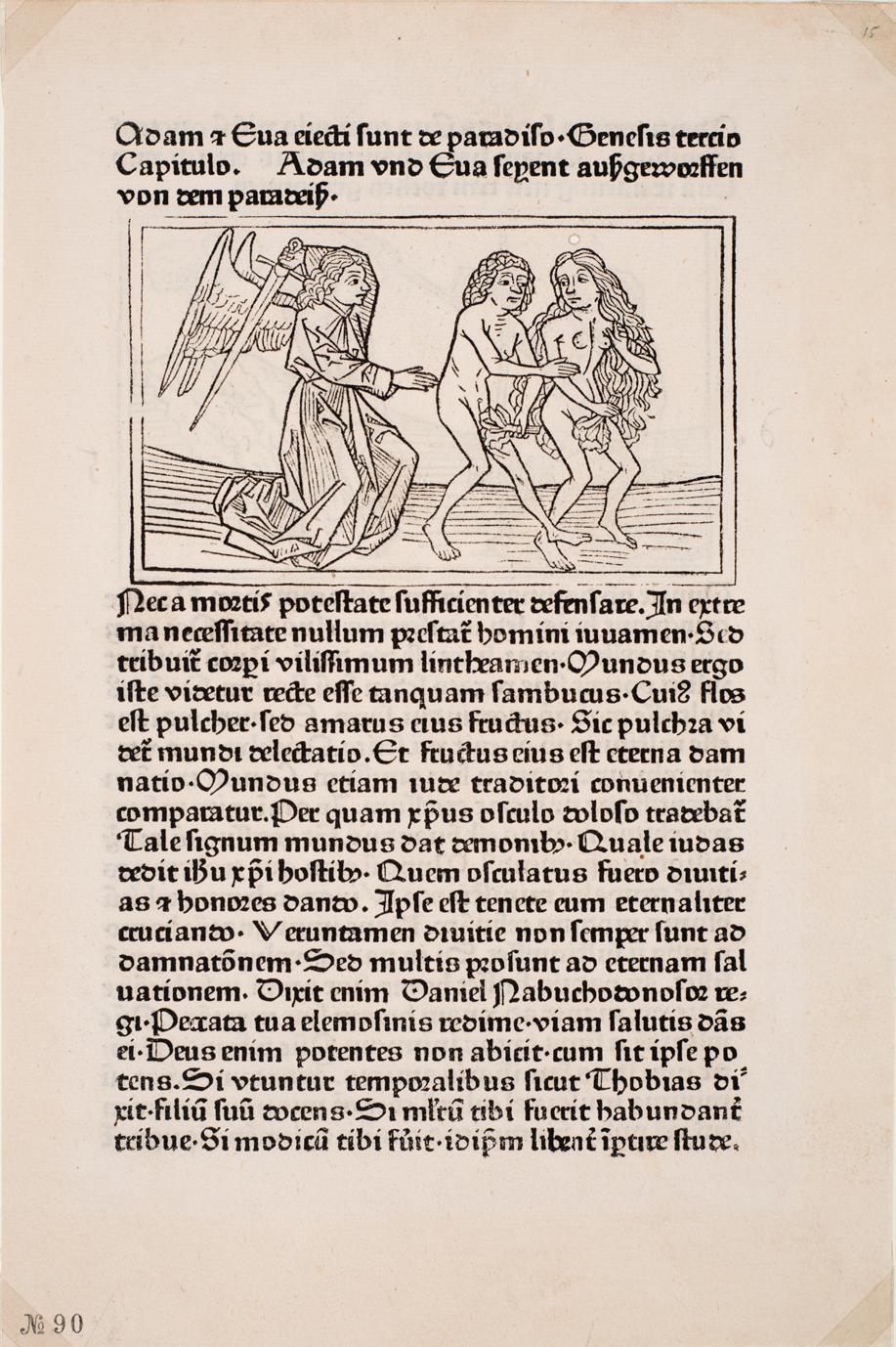
Untitled (Expulsion from the Garden) , page from Speculum Humanae Salvationis [ Mirror of Human Salvation ]

Woodcut and text, 1473
University of Nebraska–Lincoln
Anna R. and Frank M. Hall Charitable Trust
H-754.1962
Untitled (Expulsion from the Garden) , page from Speculum Humanae Salvationis [ Mirror of Human Salvation ]
Originating in Italy in the early fourteenth century, the Speculum Humanae Salvationis was one of the earliest printed books. A wide-ranging work on popular theology, it was first published in Latin—with German, French, Spanish, and Dutch translations following—and elaborately illustrated with woodcuts. This page depicts Adam and Eve being expelled from the Garden of Eden after eating the apple of the tree of knowledge. An angel raises a sword threateningly toward the panicked couple, and Adam is pushing Eve in front of him.
This image was frequently reproduced in the premodern period.
Nuremberg, Germany 1471–Nuremberg, Germany 1528
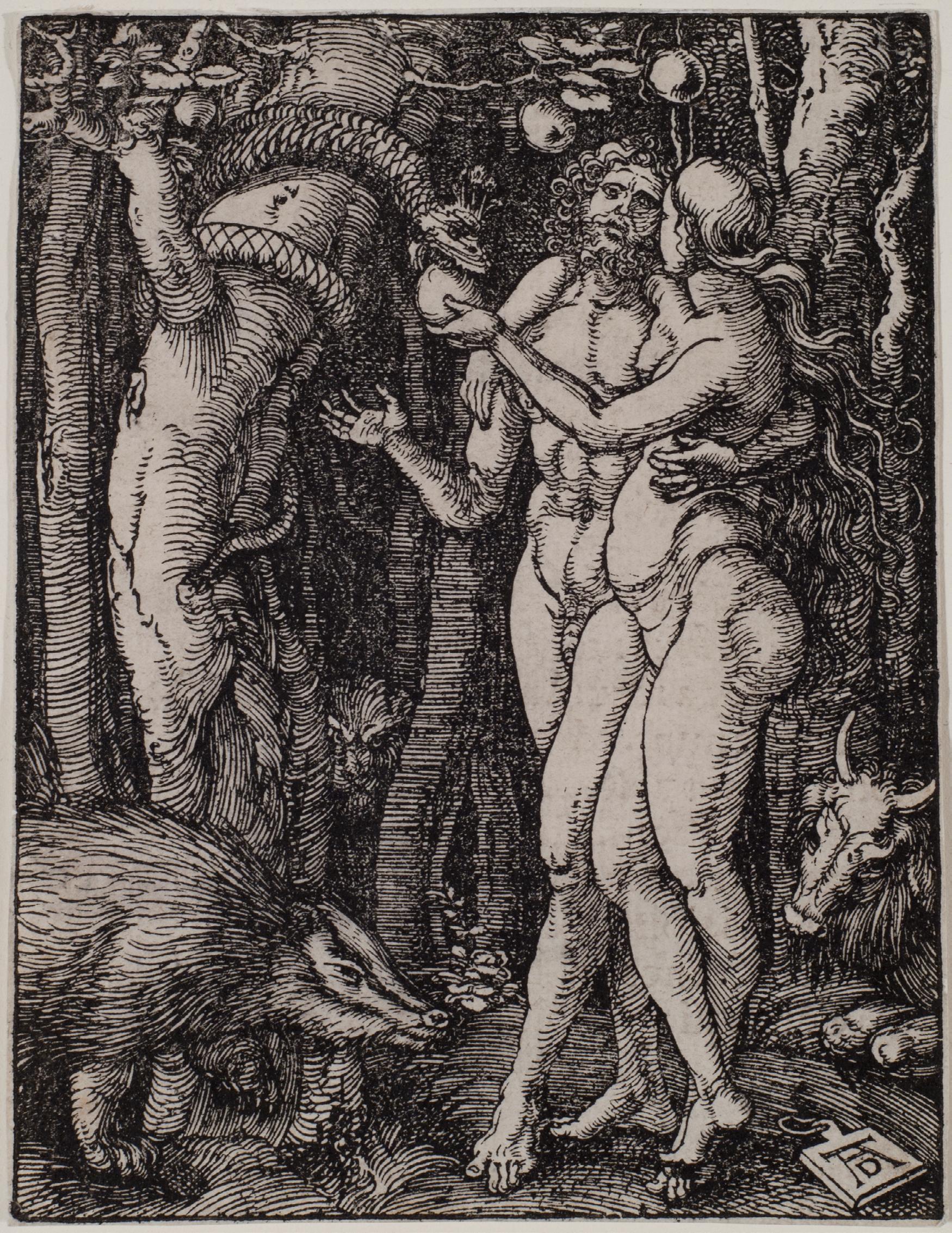
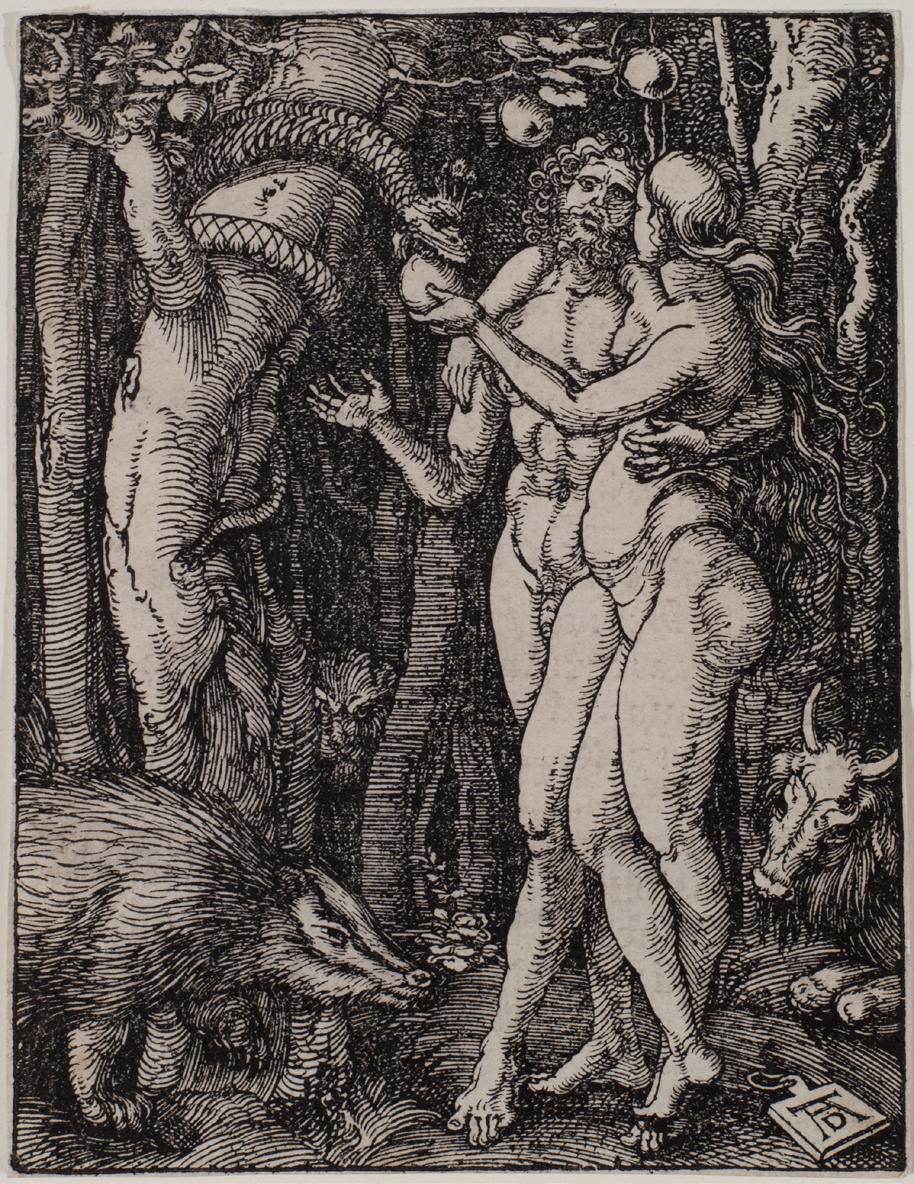
The Fall of Man , from The Small Passion Woodcut, circa 1510
University of Nebraska–Lincoln
James E. M. and Helen Thomson Acquisition Trust
U-3775.1985
Albrecht Dürer, a major artist in the first part of the sixteenth century, was known for his portraits, engravings, and woodcuts. From 1486 to 1489, he was an apprentice to the artist Michael Wolgemut, whose illustration from the story of Jephthah’s daughter is on view nearby.
Dürer worked on the book Small Passion between 1508 and its publication in 1511. It contained thirty-six woodcuts that tell a narrative beginning with Adam and Eve in the Garden of Eden and ending with the judgement of Christ. In this image Eve appears in control, as she has one arm around Adam and takes the apple from the serpent with her other hand.
This popular book continued to be published with its original woodcut illustrations well into the seventeenth century.
 The Fall of Man , from The Small Passion
Prague, Bohemia (now Czech Republic) 1607–London, England 1677
The Temptation , after Hans Holbein from The Dance of Death
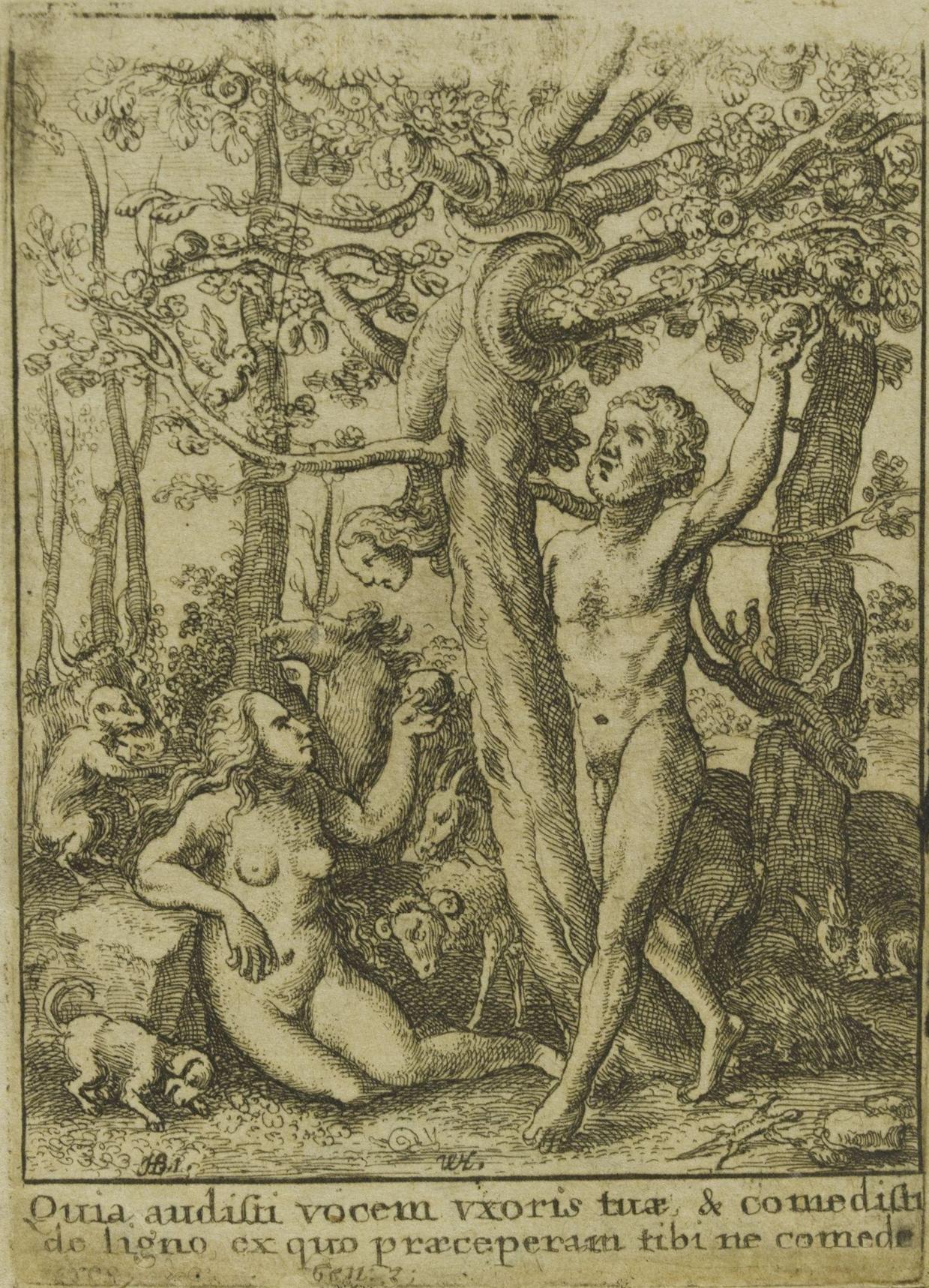
Etching, 1651
Collection of Carole Levin
The Temptation , after Hans Holbein from The Dance of Death
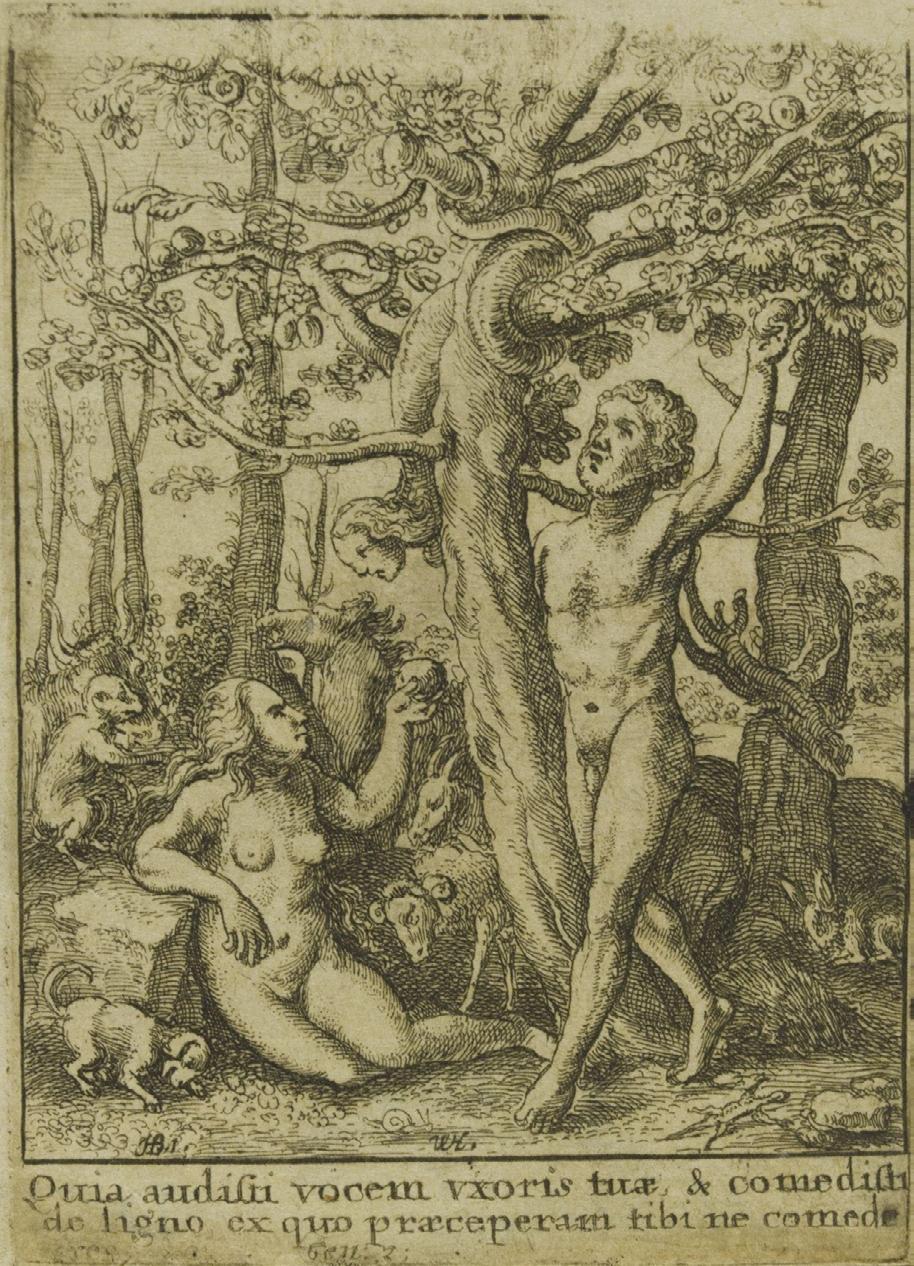
Before eventually moving to the court of Henry VIII in England, Hans Holbein designed woodcuts and engravings in Basel, Switzerland, including those for his famous Dance of Death sequence. Over a century later, Wenceslaus Hollar, who was born in Prague but spent much of his adult life in England, produced a copy of Holbein’s The Temptation from the Dance of Death .
The popular fifteenth-century witch-hunting guide The Hammer of the Witches claimed that “there was a defect in the formation of the first woman. . . . And since through this defect she is an imperfect animal, she always deceives.” As seen in this work, depictions of Eve tempting Adam made in the later medieval and early modern period showed the serpent with a female head, emphasizing the alleged danger of women. Such an image makes visible the fear of the power of women that was deep in the male psyche of the time.
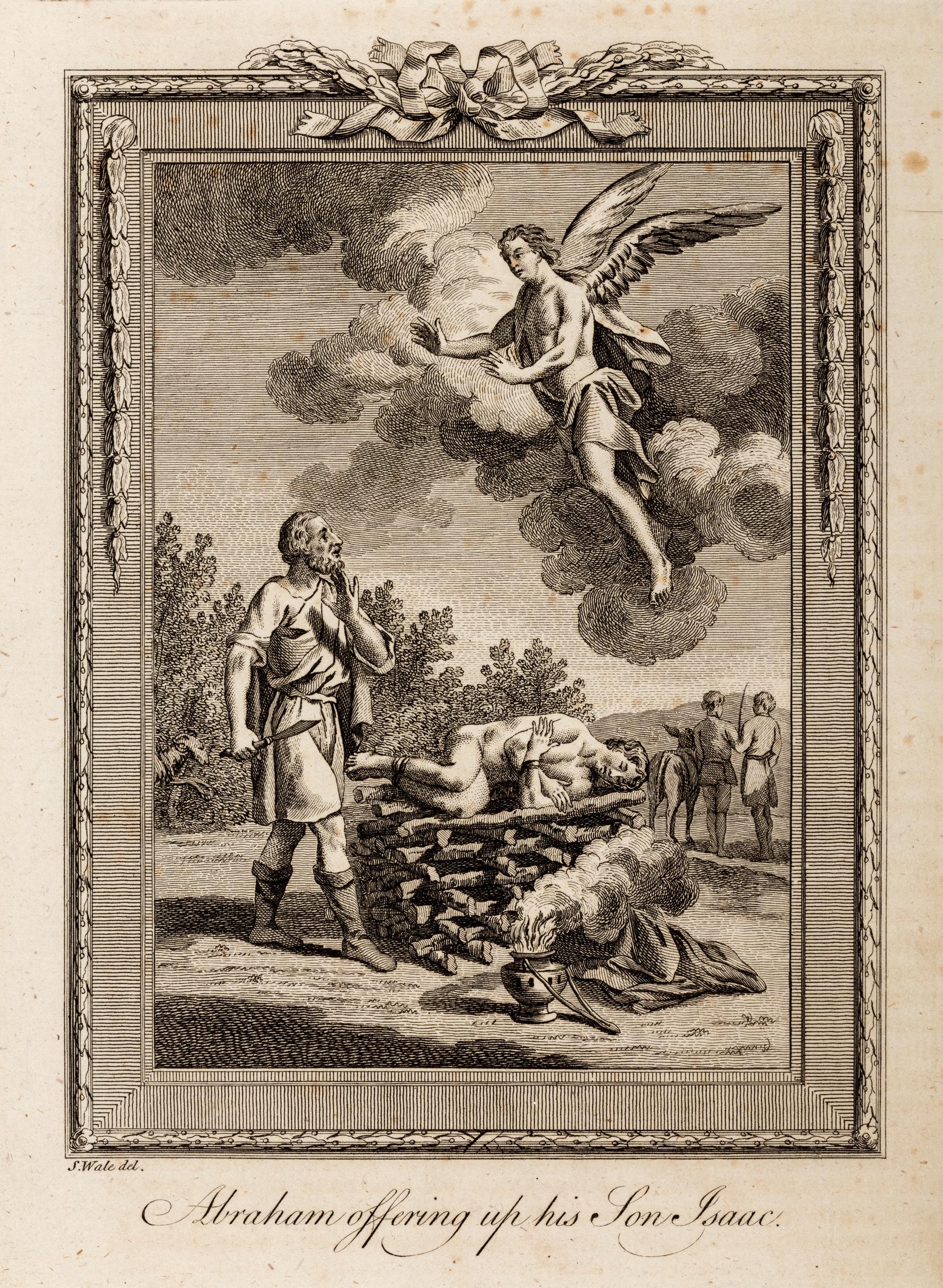
A common image in the premodern period was the angel of the Lord stopping Abraham from sacrificing his son Isaac after God had commanded him to kill him. Less frequently illustrated was the biblical story of Jephthah’s daughter, who, unlike Isaac, is never named.
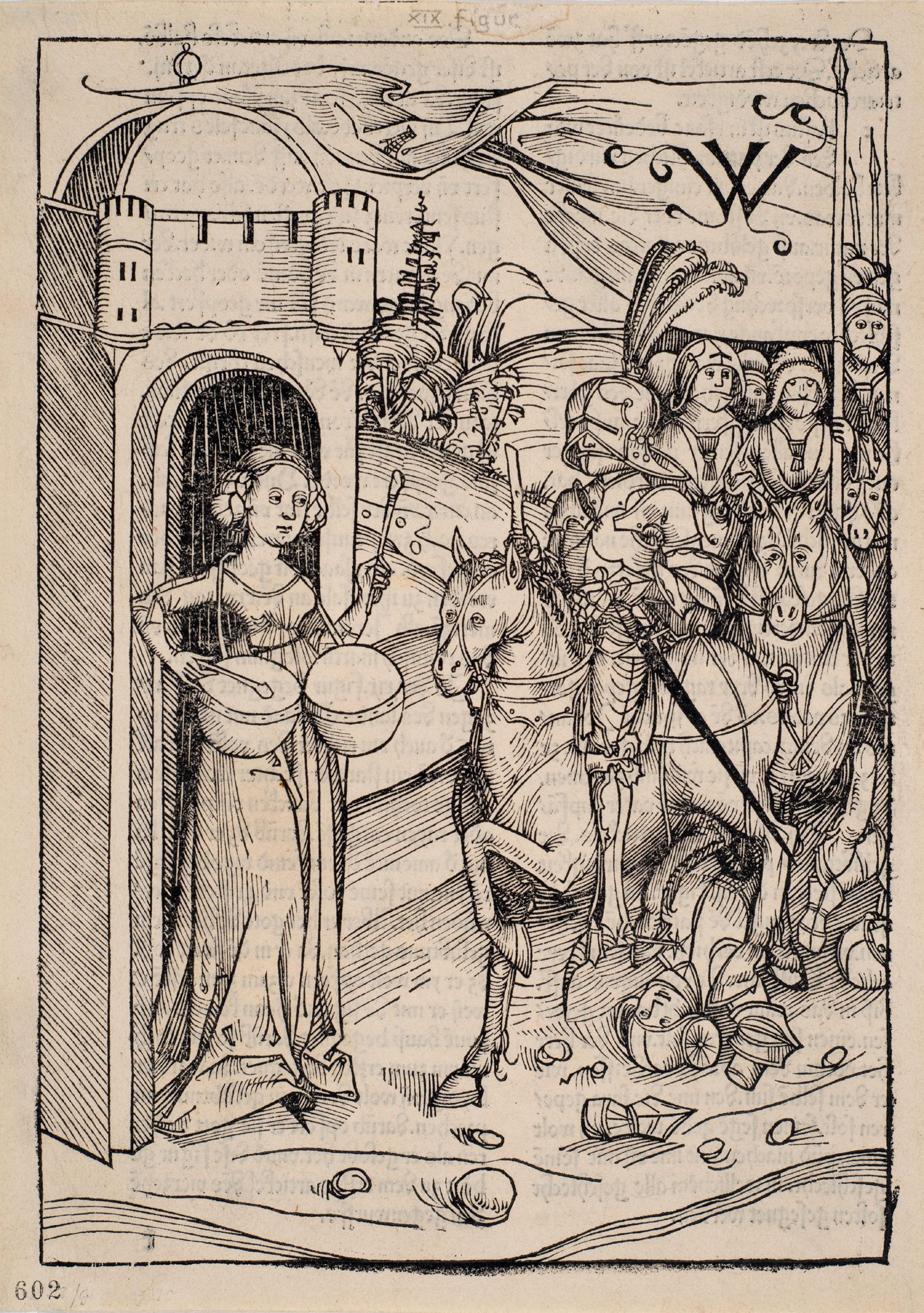
Jephthah promised God that if he was successful in battle he would sacrifice the first living thing that greeted him when he arrived home.
Jephthah assumed this would be an animal, but it was instead his daughter. No angel of the Lord saved her.
Birthplace unknown c. 1721–Death place unknown c. 1786
Abraham Offering Up his Son Isaac
Engraving, eighteenth century Collection of Carole Levin
Nuremberg, Germany 1434–Nuremberg, Germany 1519
Untitled (Jephthah’s Daughter Meeting Him on His Return) , page from Schatzbehalter der wahren Reichtümer des Heils [ Treasury of the True Riches of Salvation ] Woodcut, 1491
University of Nebraska–Lincoln
Anna R. and Frank M. Hall Charitable Trust
H-772.1962
Untitled (Jephthah’s Daughter Meeting Him on His Return) , page from Schatzbehalter der wahren Reichtümer des Heils [ Treasury of the True Riches of Salvation ]
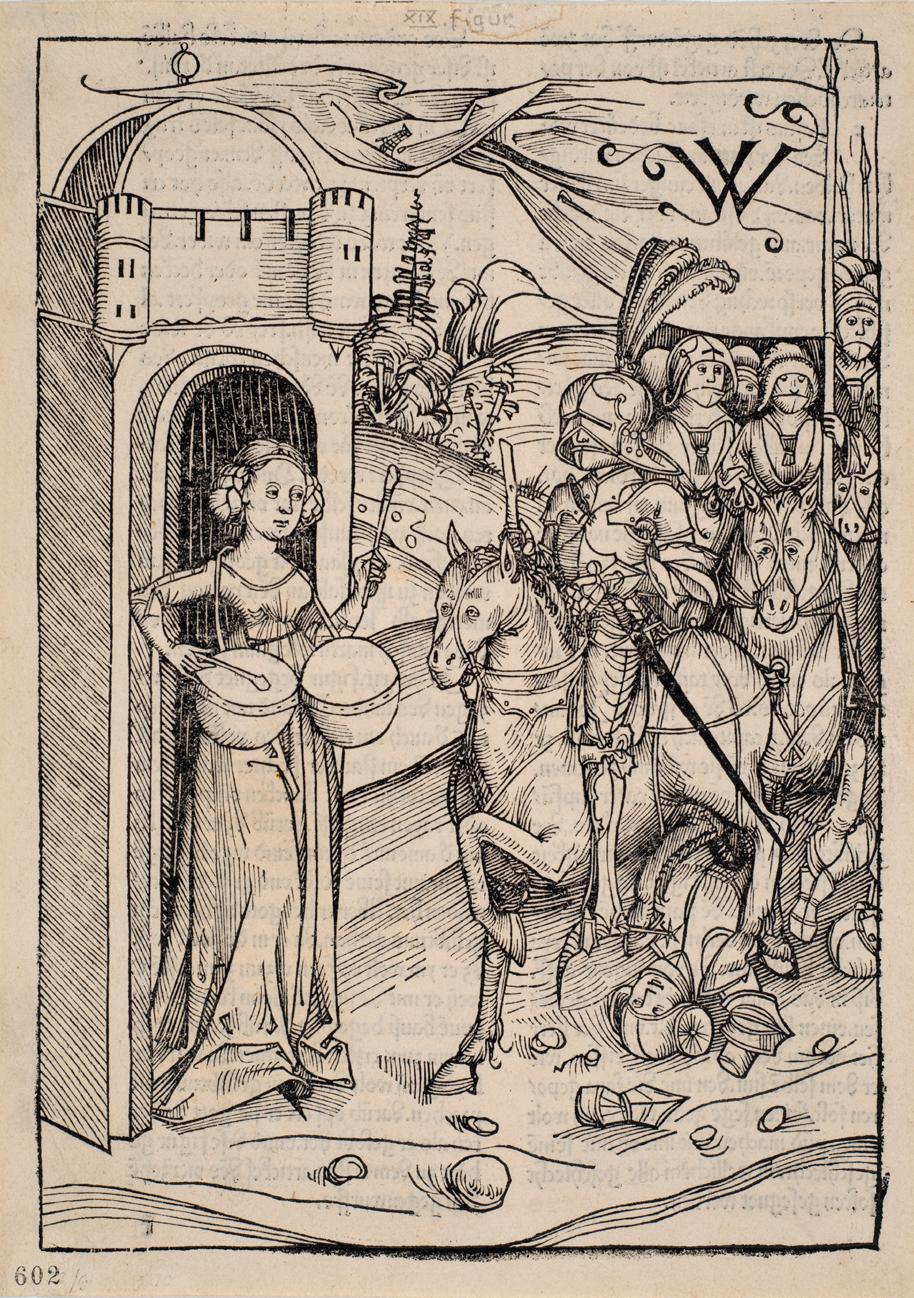
Stephan Fridolin’s Schatzbehalter der wahren
Reichtümer des Heils , first published in 1491, was one of the most significant illustrated printed texts of the fifteenth century. Fridolin was the spiritual guide to the Poor Clares at Nuremberg, an austere Roman Catholic order of nuns whose abbess, Caritas Pirckheimer, asked him to produce the work in order to popularize biblical stories. Its illustrations—by Michael Wolgemut, a renowned illustrator in Germany—were intended to make the book valuable even to those who could not read.
In much of Europe during the late medieval period, power was consolidated around the figure of the monarch at court. Following the Protestant Reformation in the 1500s and a series of devastating religious wars that ensued, the dominant religion of the land depended on the court’s beliefs. Across Christendom, depicting women’s virtue—or lack thereof—remained key to the portrayal of female figures in religious and secular works of art.
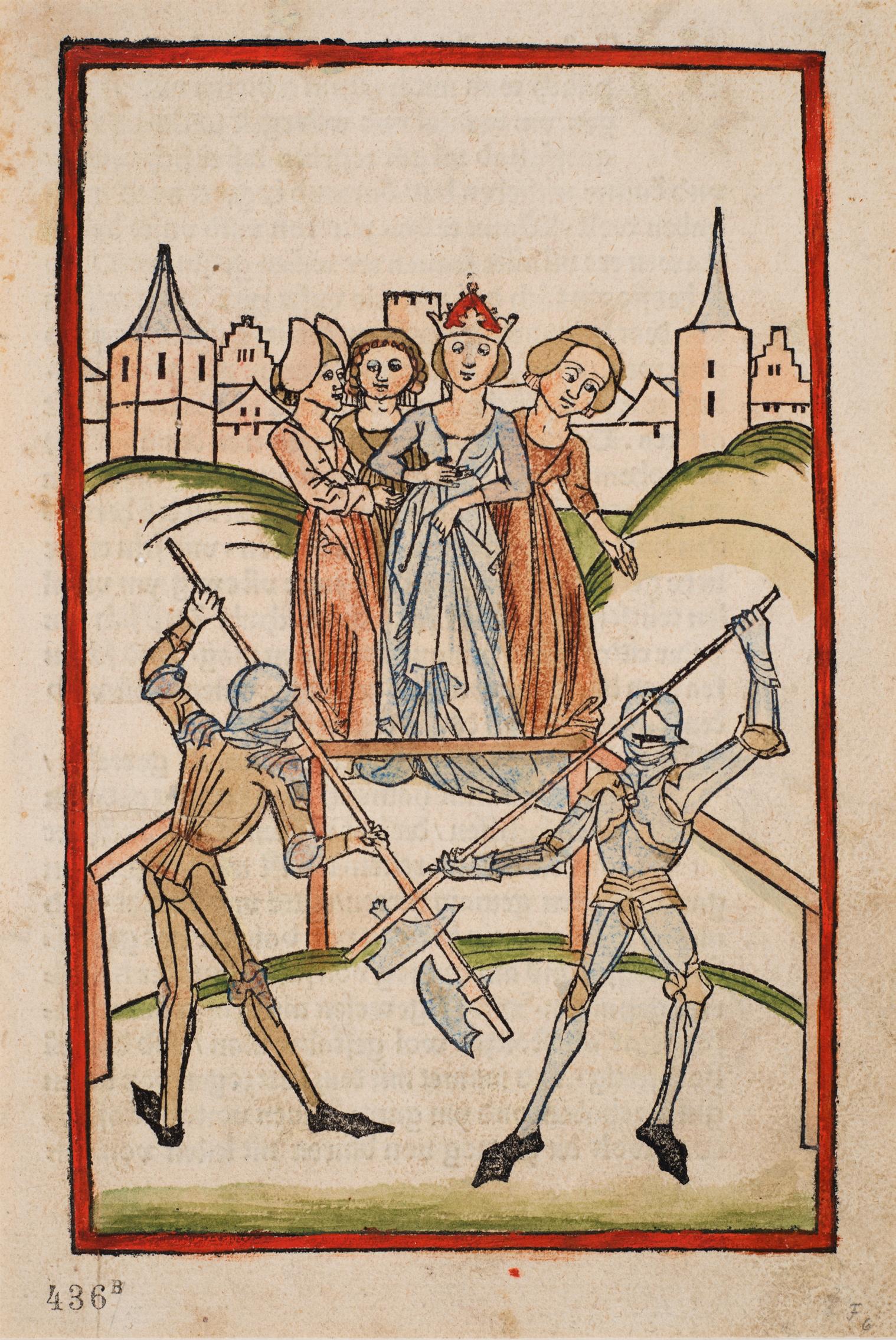
Untitled (Count Rotenfan Fighting for the Honor of the Queen of China) , page from Schwäbische Chronik [ Swabian Chronicle ] Woodcut with hand coloring and decorated text, 1486
University of Nebraska–Lincoln
Anna R. and Frank M. Hall Charitable Trust
H-760.1962
Untitled (Count Rotenfan Fighting for the Honor of the Queen of China) , page from Schwäbische Chronik [ Swabian Chronicle ]
As a genre, the “chronicle” refers to a series of nonfictional historical events recounted chronologically and without commentary. The Schwäbische Chronik , however, takes liberties with history. Thomas Lirer, a pseudonym for the author, blended fact and fiction freely when creating the manuscript between approximately 1460 and 1485. First published in Ulm, Germany, the popular work’s Christianizing rhetoric is dominant over the narrative’s entertainment value.
In this woodcut, the court of Montfort hosts the Queen of Cathay (China). Her appearance at court prompts a knight, offended by the queen’s alleged adultery, to speak against her. The queen seeks the aid of Count Rotenfan, who duels for her honor and vanquishes her accuser despite the fact that the queen has confessed to him that she is, in fact, unfaithful. While the story upholds conventions of courtly masculinity, the queen’s infidelity goes against the grain, raising questions about gender norms and gendered expectations at the time.
Nuremberg, Germany 1471–Nuremberg, Germany 1528
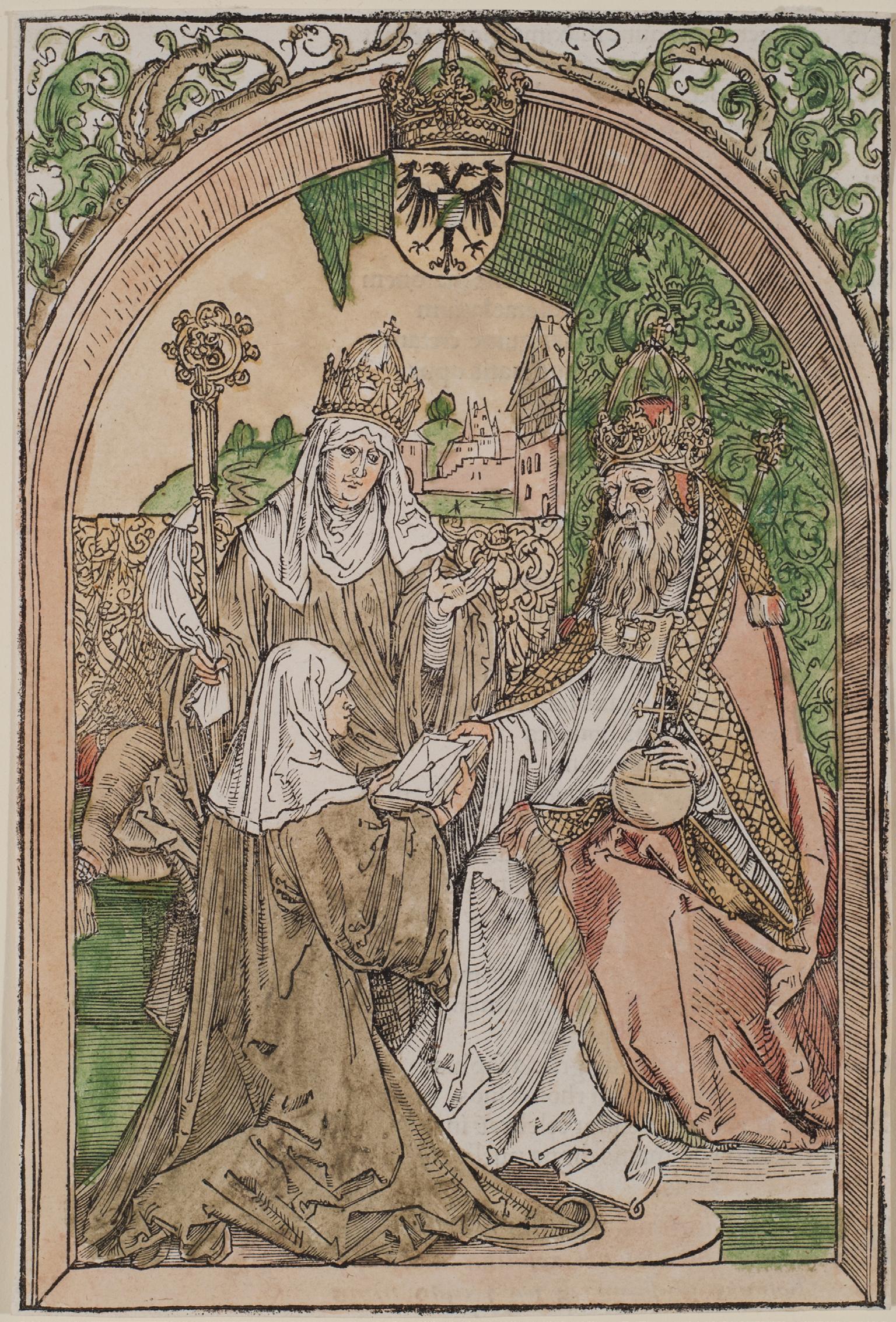
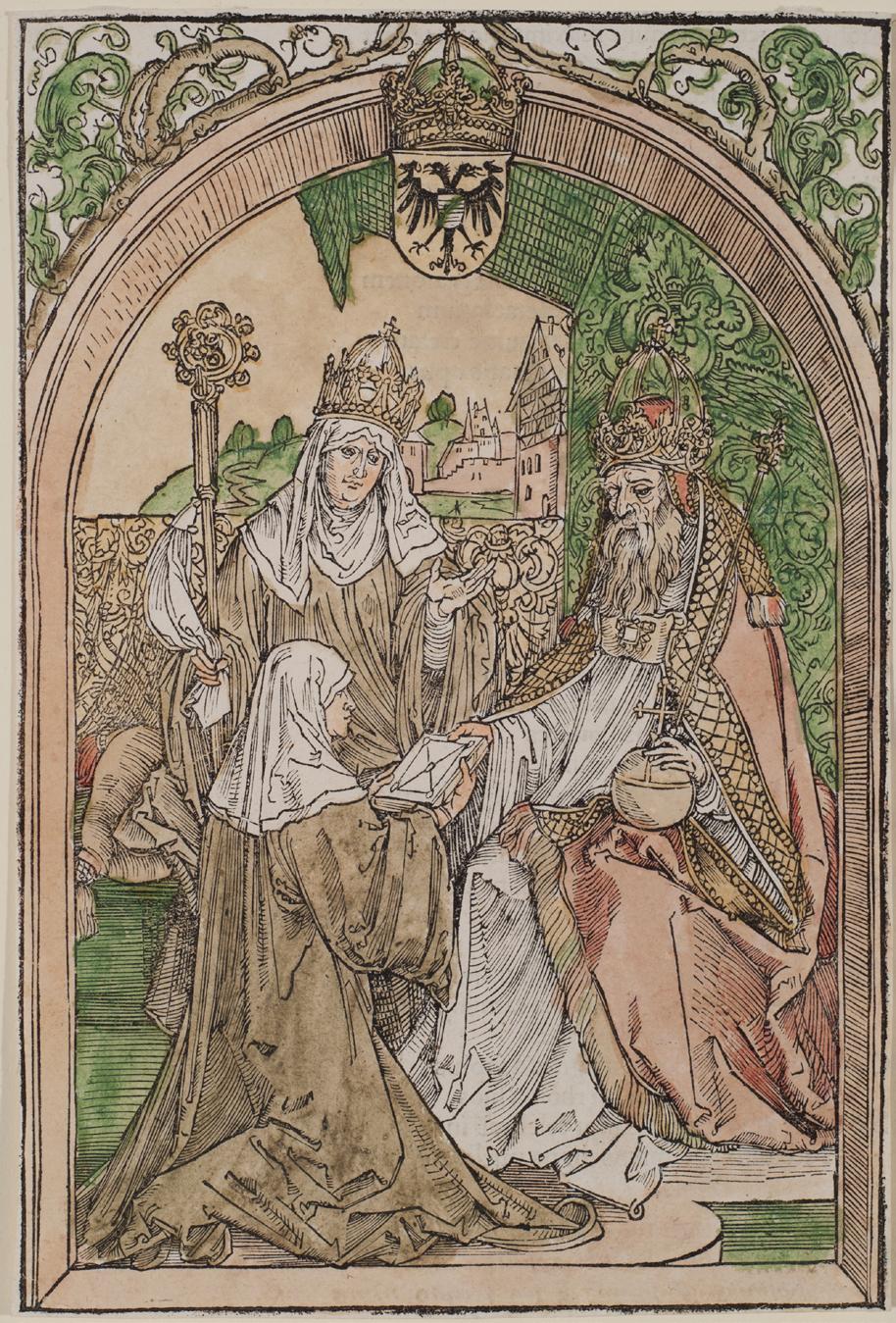
Hroswitha of Gandersheim Presenting Her Comedies to Emperor Otto I , folio A4V from Opera Hrosvite
Woodcut with hand coloring, circa 1501
Printed by Anton
KobergerUniversity of Nebraska–Lincoln
Anna R. and Frank M. Hall Charitable Trust
H-774.1962
Hroswitha of Gandersheim Presenting Her Comedies to Emperor Otto I , folio A4V from Opera Hrosvite
This woodcut depicts the medieval mystic Hroswitha of Gandersheim presenting her work to Otto the Great, the German king (936–973) and Holy Roman emperor (962–973). Born of Saxon nobility, Hroswitha spent most of her life as a secular canoness in a Benedictine convent. She wrote six dramas in Latin, adapting themes from the Roman playwright Terence into Christian allegories of chastity and feminine virtue. The Renaissance scholar Conrad Celtis (1459–1508) discovered a manuscript by Hroswitha in 1493 and published it in Nuremberg in 1501, illustrated with this print by Albrecht Dürer.
Dürer’s placid composition belies the turbulent politics of Otto’s consolidation of power into Christian hegemony and his bid to dominate a wide geographic realm during his reign. The constellation formed by the seated emperor, the kneeling author, and the Abbess of Gandersheim imagines a homology between the feminine virtues associated with Christianity and the benevolent power of the throne.
Freiburg im Breisgau, Germany 1495–Strasbourg, France 1537
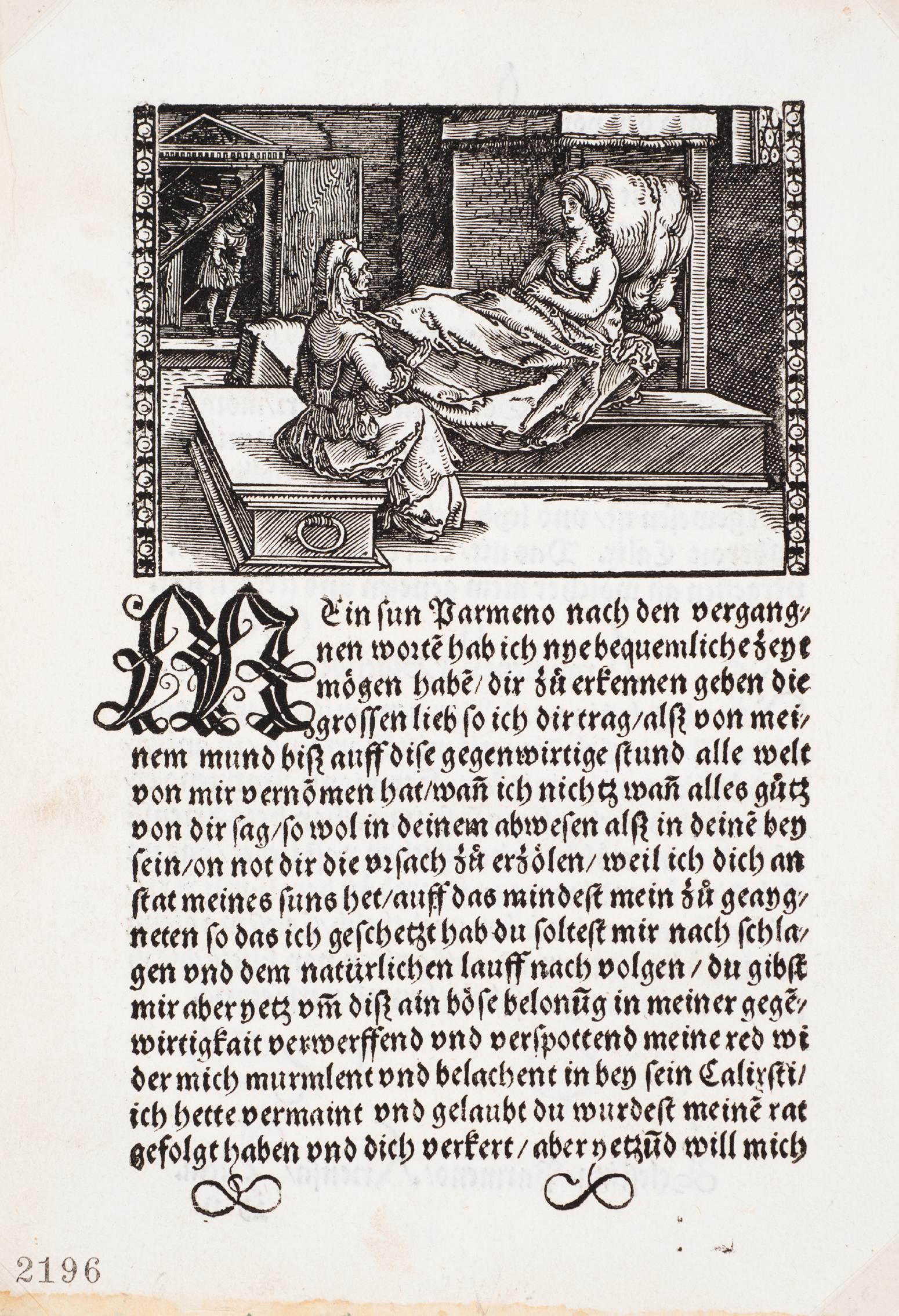
Untitled (Celestina talking with Aleusa) , page from Tragikomödie von Calisto und Melibea [ The Tragicomedy of Calisto and Melibea ]
Woodcut and text, 1520
University of Nebraska–Lincoln
Anna R. and Frank M. Hall Charitable Trust
H-764.1962
Hans Weiditz II, also known as the Petrarch Master, trained in Strasbourg, France, and spent his journeyman years studying with Hans Burgkmair, the artist commissioned to work on the Genealogy of Emperor Maximillian I , an illustration from which is featured in this exhibition.
This print presents a scene from the novel The Tragicomedy of Calisto and Melibea , also known as La Celestina , by Fernando de Rojas, which first appeared in Spanish in 1499. The popular book tells the story of a young nobleman, Calisto, who falls pathologically in love with the unmarried Melibea. Undeterred by her rebuffs, he seeks help from the charismatic Celestina, variously described as a go-between, a witch, and a procuress. In this image, from a German edition of the book, Celestina has disturbed the prostitute Aleusa’s repose. It is complicated: Celestina’s ward, Parmeno, seen lurking in the doorway, will help her assist Calisto if she can persuade Aleusa, whom Parmeno fancies, to sleep with him. Celestina prevails, maneuvering minor characters to do her will indirectly.
Melibea eventually feels both lust and love for Calisto. Though Celestina succeeds in the underhanded plan, courtly love is not what it used to be. The love-stricken behavior of Calisto veers into parody of the courtly romance; he operates in a world of prostitutes and procurer and meets an ignoble death. In despair, Melibea commits suicide. The novel thus undermines and parodies the glorification of women’s virtue as well as of courtly masculinity.
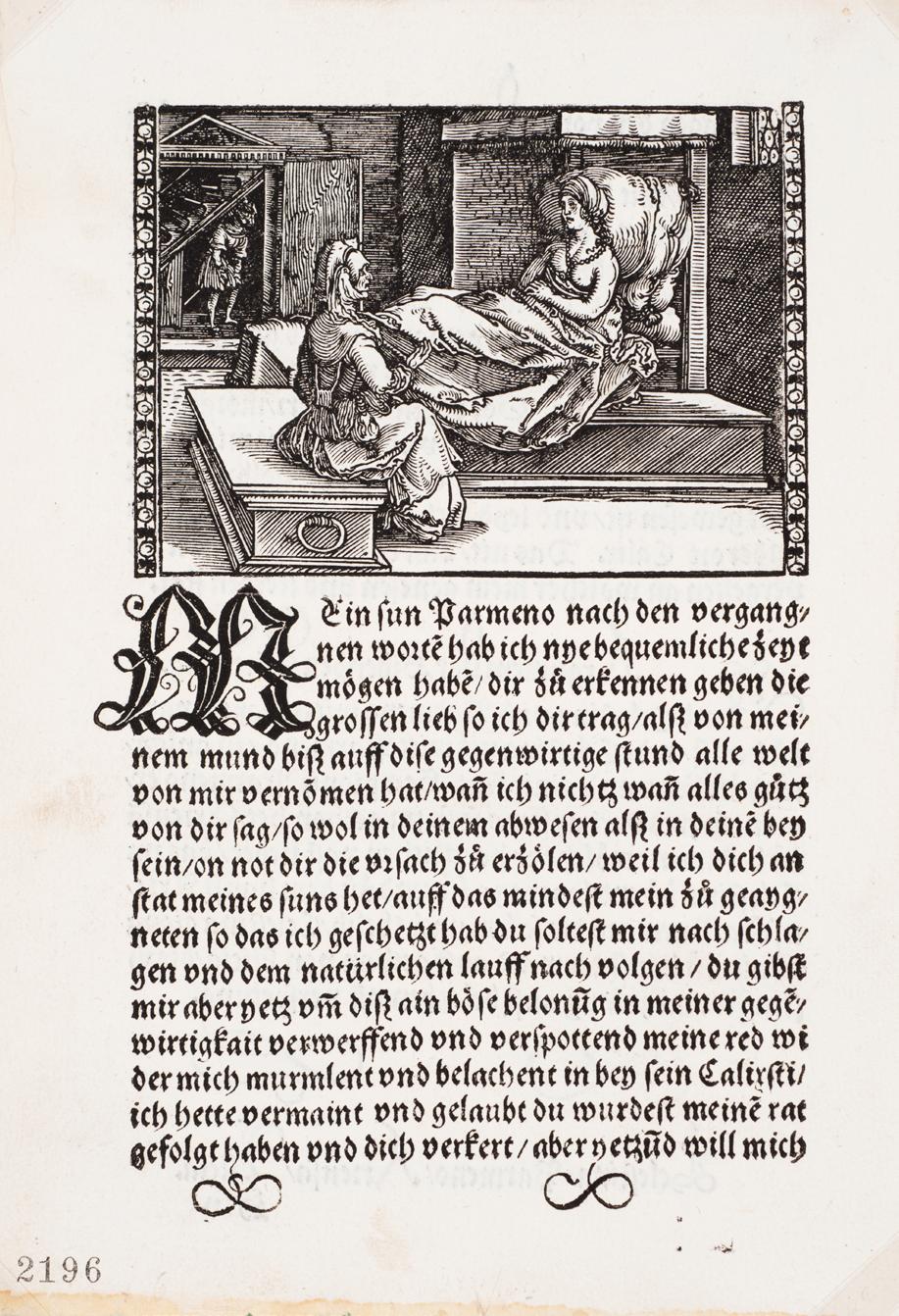 Untitled (Celestina talking with Aleusa) , page from Tragikomödie von Calisto und Melibea [ The Tragicomedy of Calisto and Melibea ]
Throughout the Middle Ages and the Renaissance, it was customary for artists to depict saints in groups consistent with their hagiographies, or idealized biographies. The two works here convey the different—and gendered—paths to sainthood. Saint John and Saint Peter were both canonized for their proximity to Christ and their dissemination of his messages. Female martyrs Margaret and Ursula attained sainthood for refusing to marry non-Christians, preserving their virginity, and sacrificing their lives for their beliefs.
Birthplace unknown, active circa 1369–Death place unknown 1428
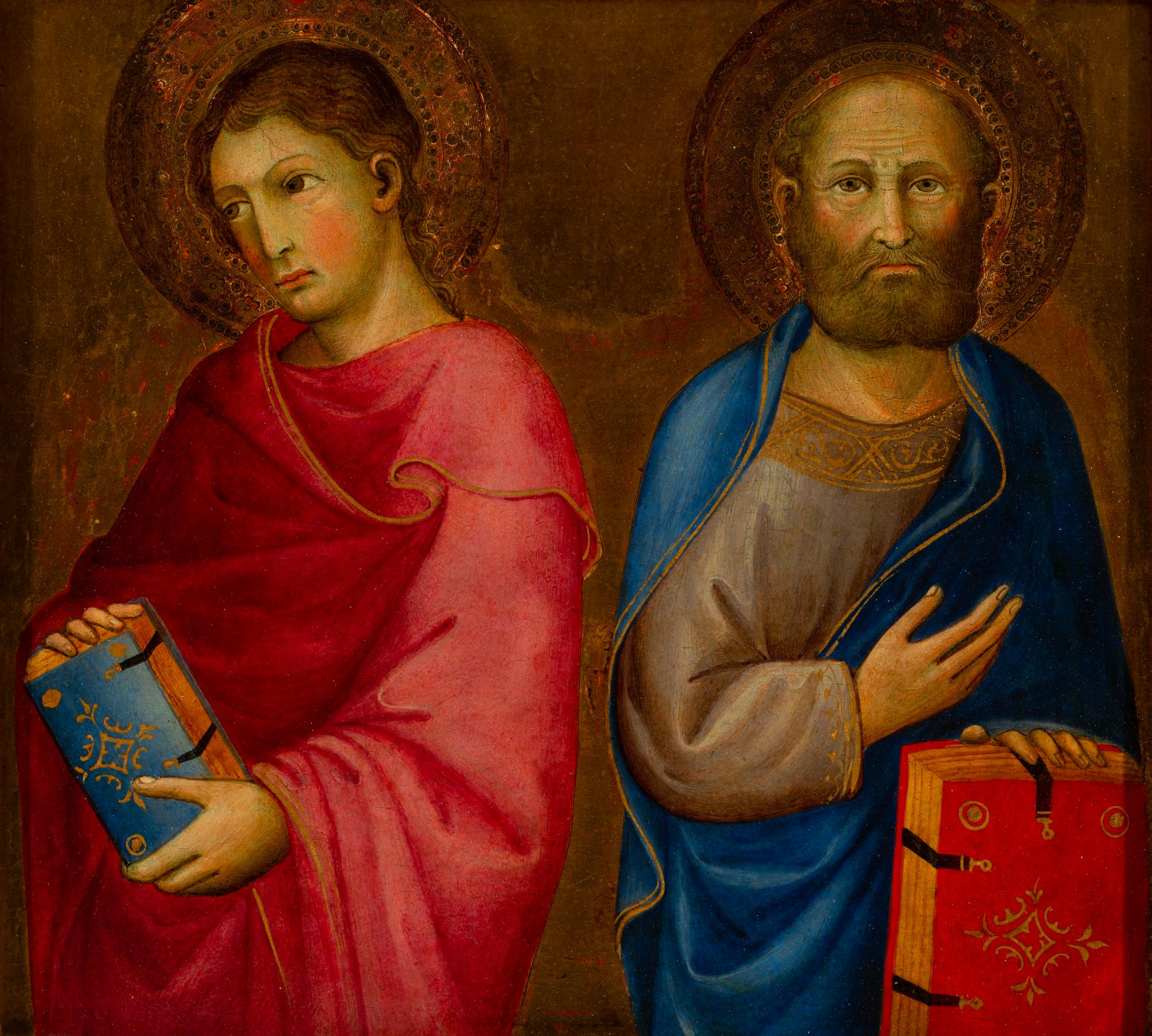
Saint John and Saint Peter
Tempera on panel, circa 1425
University of Nebraska–Lincoln
Gift of the Kress Foundation
U-360-K.1962
Italian painter and illuminator Andrea di’ Bartolo practiced in Siena, Italy, and was devoted to depicting religious subjects. In this painting of Saint John the Evangelist (left) and Saint Peter (right), each holds a book— an attribute, or symbol, associated with authorship. According to the New Testament, John and Peter were the two of the Twelve Apostles sent by Christ to prepare the Last Supper.
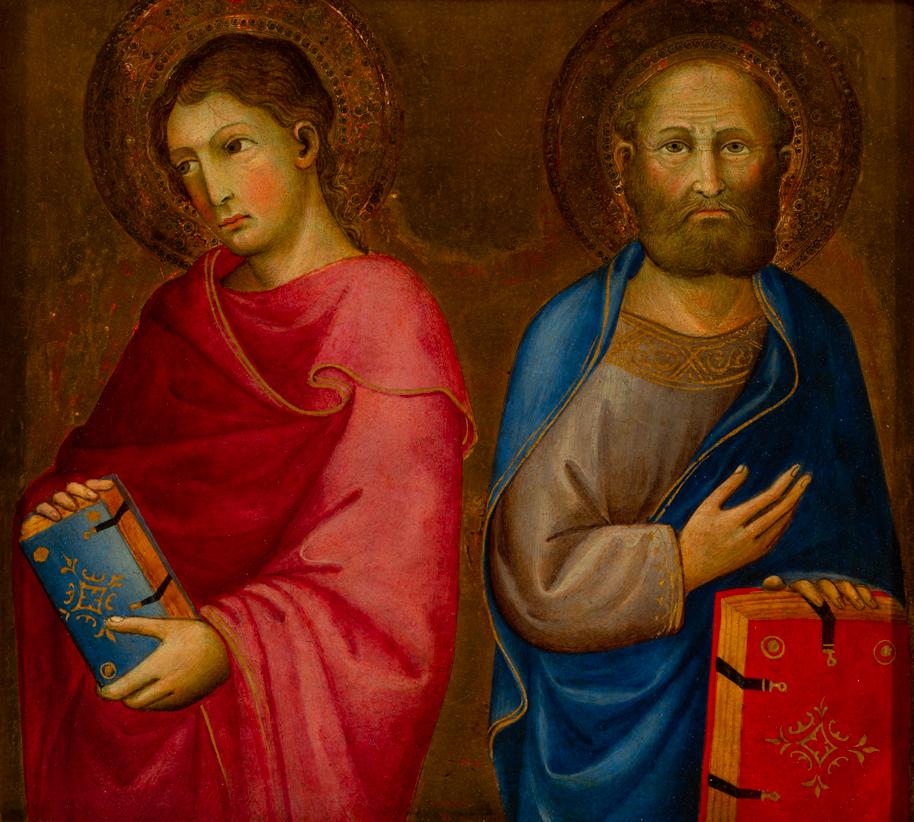 Saint John and Saint Peter
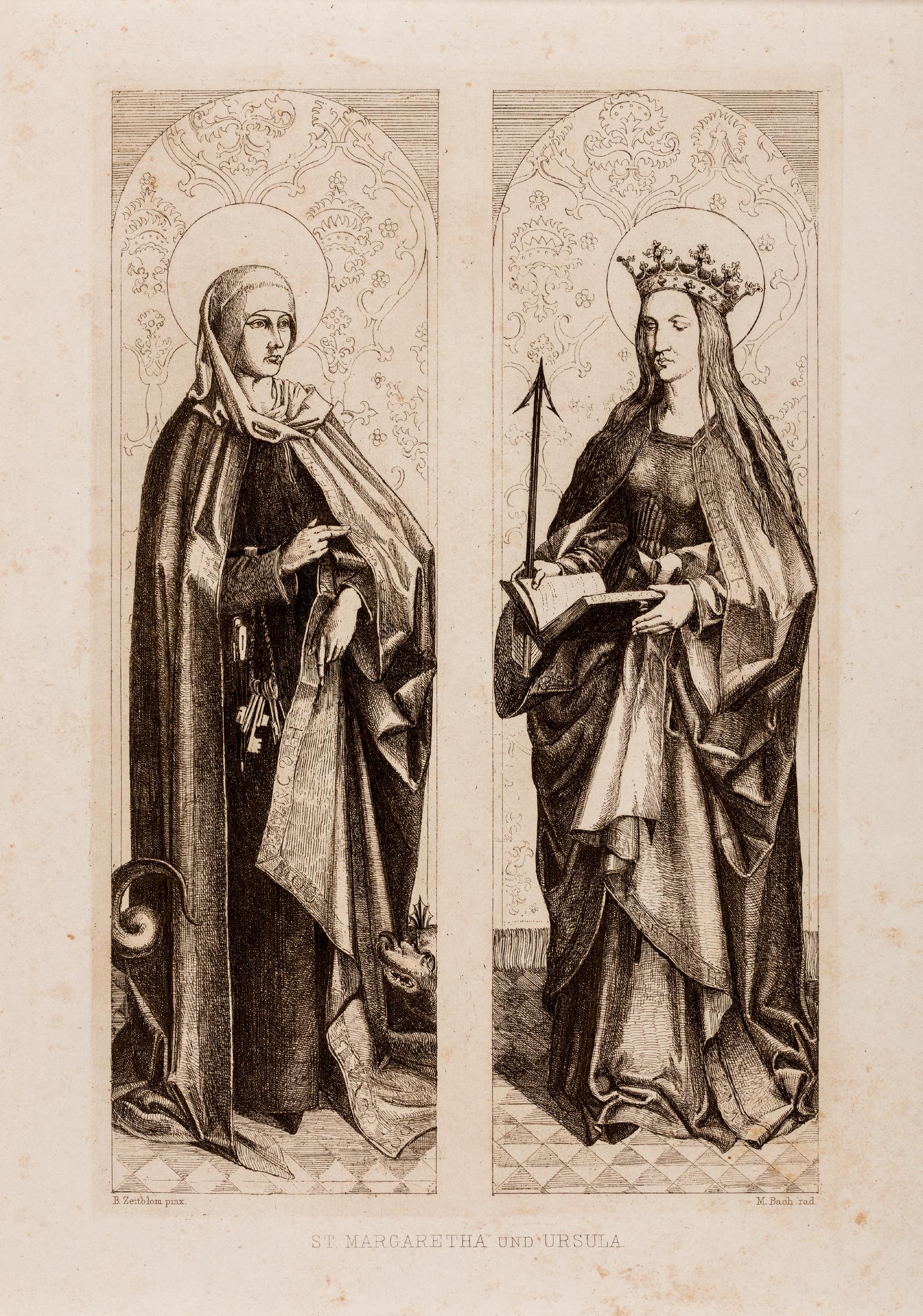
Saint Margaret and Saint Ursula , after Bartholomäus Zeitblom
Engraving, eighteenth century
Collection of Carole Levin
The images of these two female saints are based on two different paintings created by Bartholomäus Zeitblom around 1500. Both
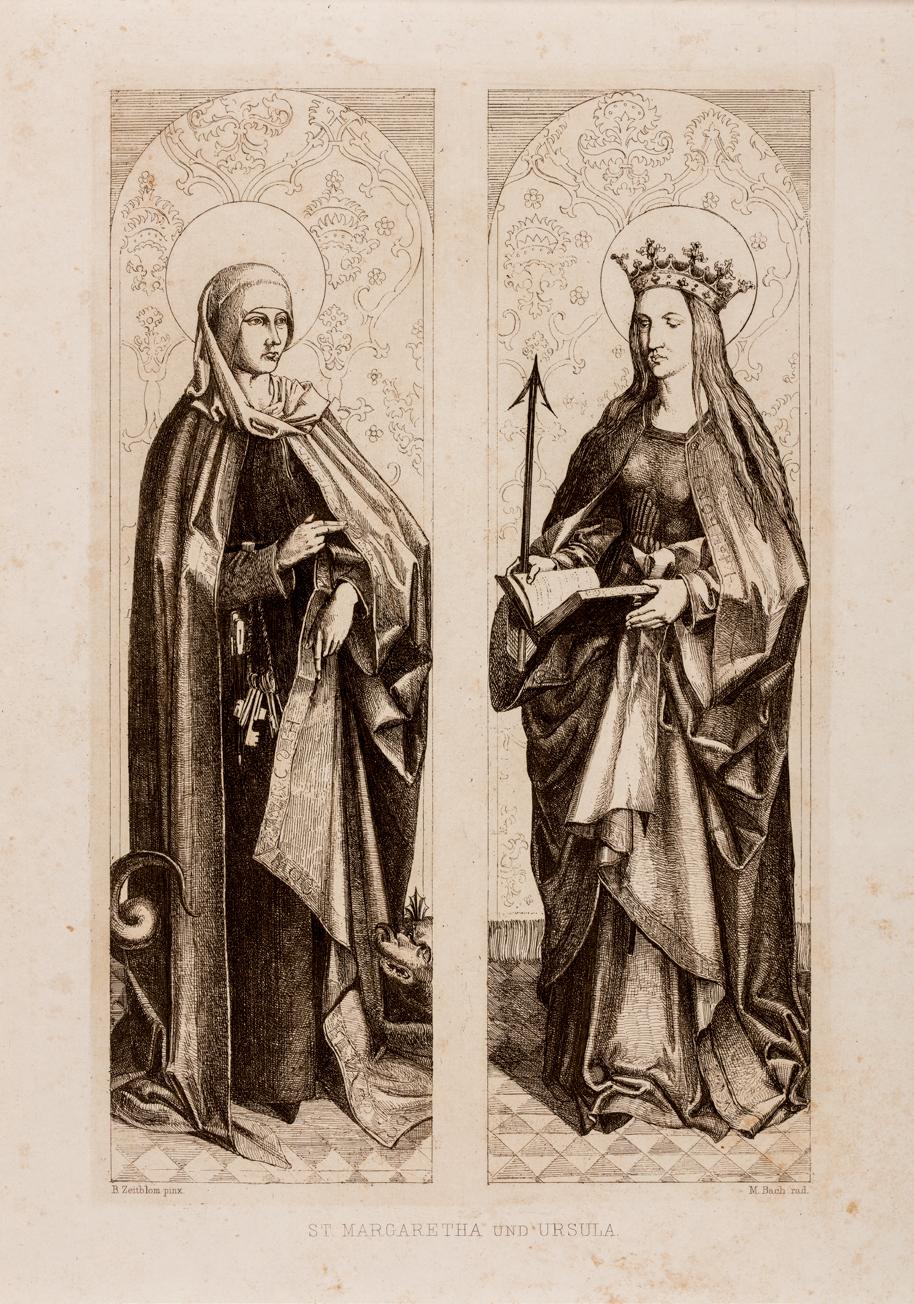
Saint Margaret and Saint Ursula were famous and much worshipped in the later Middle Ages. Joan of Arc stated that one of the voices who spoke to her was that of Saint Margaret, who, according to legend, lived around the fourth century. Margaret was the daughter of a pagan priest who converted to Christianity and stayed committed to her virginity. She refused the sexual advances of a high official, who became so furious that he fed her to a dragon. She emerged from the dragon unharmed, but she was then beheaded. In images, such as this print, Margaret is often represented with a dragon at her feet.
Saint Ursula’s story, also set in the fourth century, is similar. She, and other virgins, traveled to Cologne, Germany. The leader of the Huns, who was besieging the city, desired her. When Ursula rejected him, he killed her with an arrow. Ursula is shown here with both an arrow and a book, most likely a religious tome, conveying her education as well as her piety.
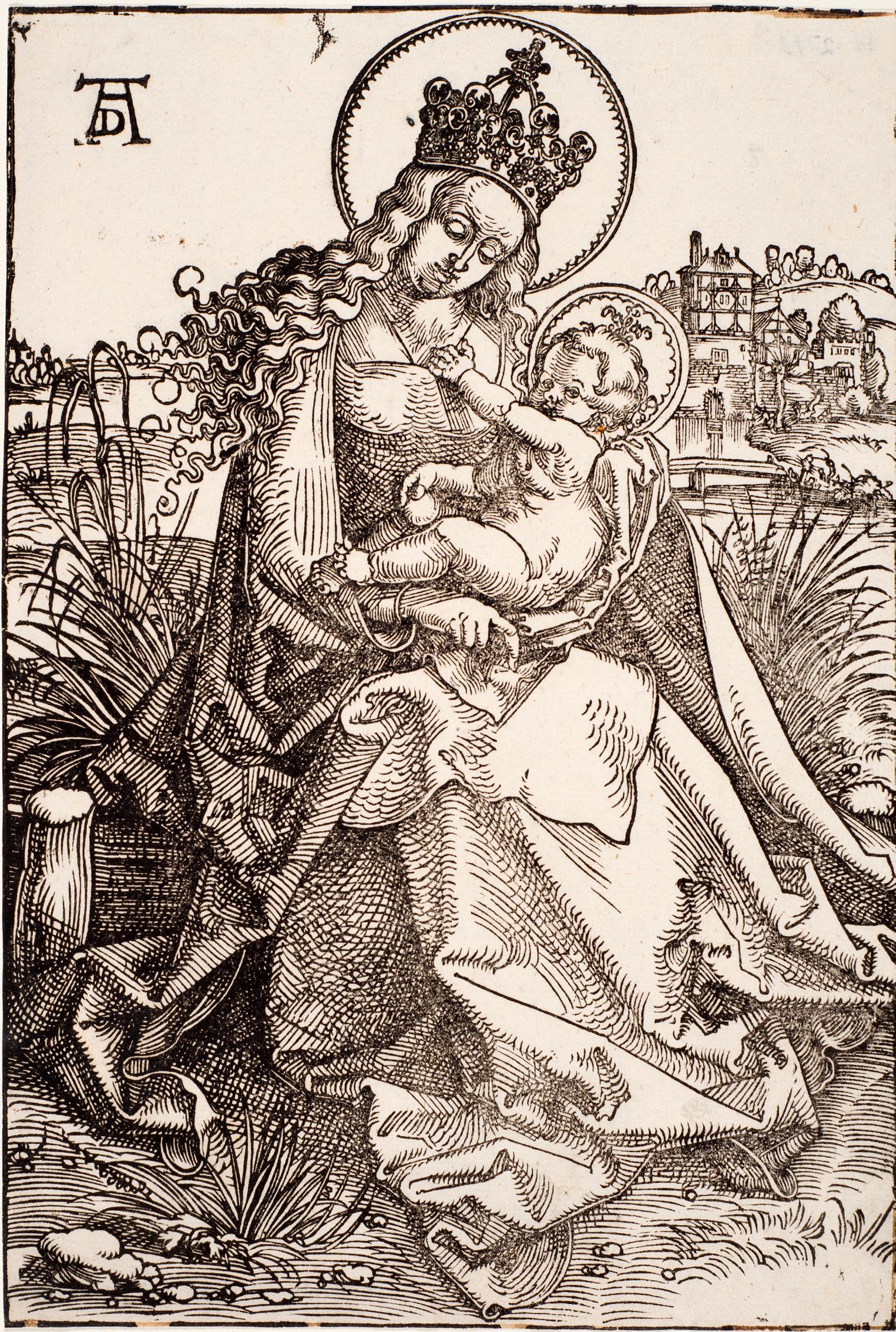
Saint Margaret and Saint Ursula , after Bartholomäus ZeitblomOriginating in the fifth century, the veneration of the Virgin Mary reached a peak in the late medieval period. Born without the stain of original sin, Mary conceived “immaculately” and bore Jesus, the Son of God made man. As the mother of the divine Christ Child, Mary is often portrayed by artists as the regal queen of Heaven.
Schwäbisch Gmünd, Germany 1484–Strasbourg, France 1545
The Virgin on the Grassy Bank
Woodcut, 1505
University of Nebraska–Lincoln
Anna R. and Frank M. Hall Charitable Trust
H-2793.1973
Born in southwest Germany, Hans Baldung likely got the nickname “Grien” (green) during the period he spent in Albrecht Dürer’s Nuremberg workshop beginning in 1503. This print was produced while he was a member of Dürer’s workshop (note the master’s monogram in the upper left). Later, after Baldung joined a guild and opened his own workshop in Strasbourg, France, he continued to sign his prints “HGB.”
In this image, the crown worn by the Virgin Mary signifies her status as “queen” of Heaven, while the smaller crown worn by the infant Jesus connotes his divine nature. Haloes, in the form of circular disks of light, surround both figures’ heads, indicating that they are holy figures.
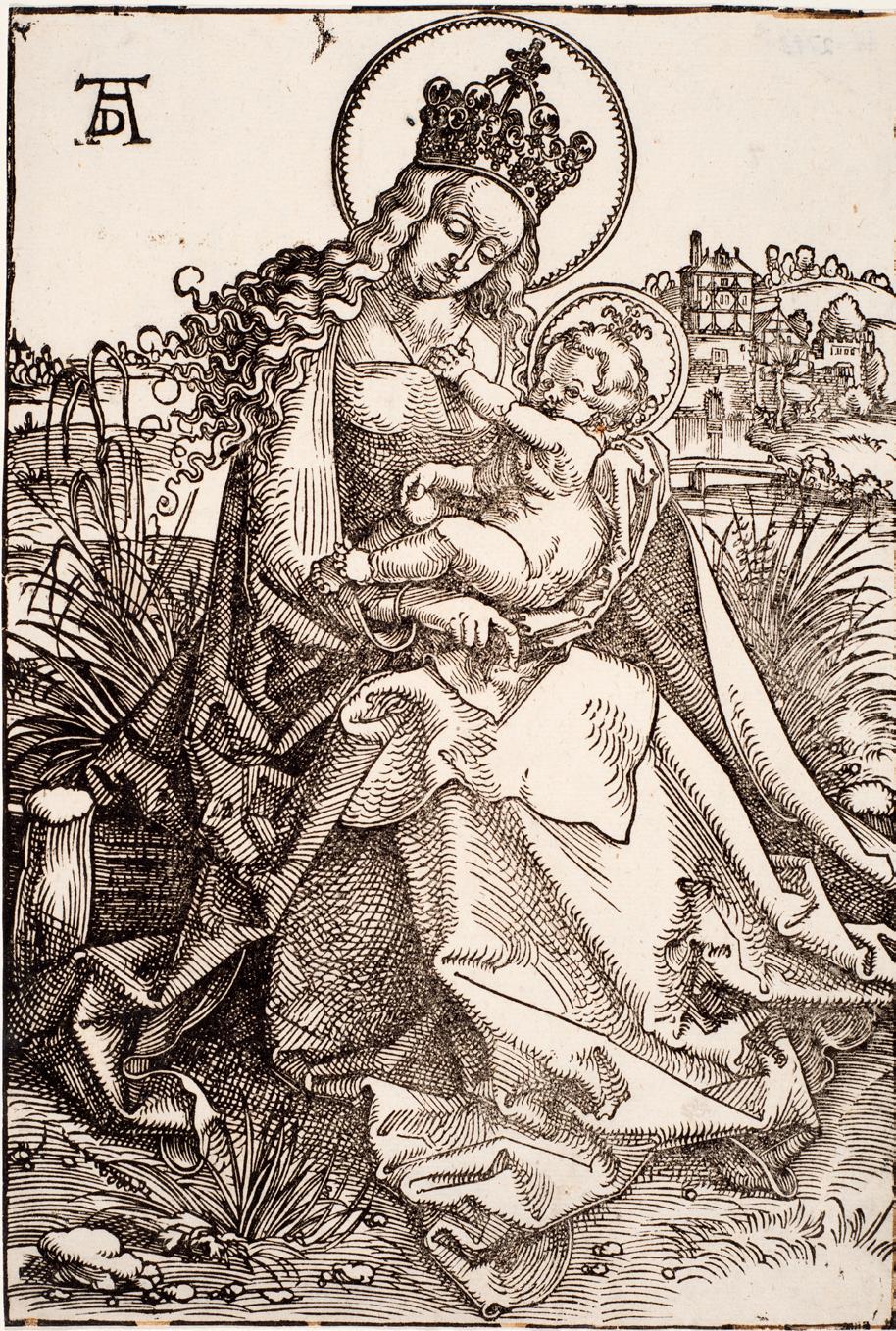 The Virgin on the Grassy Bank
Nuremberg, Germany 1747–London, England 1794
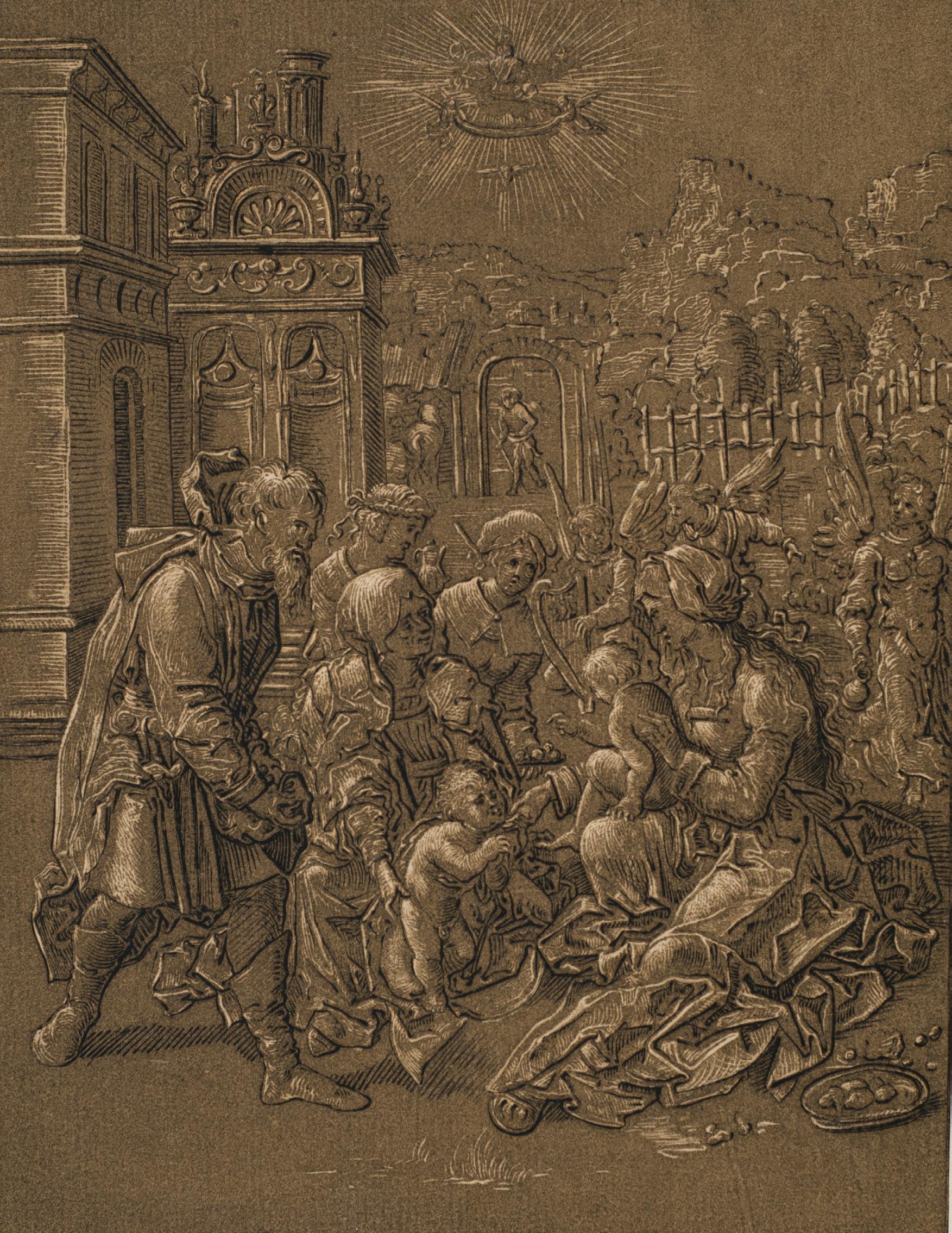
Visit of Saint Elizabeth to the Holy Family , after Hans Brosamer, in Dessins des meilleurs Peintres d’Italie, d’Allemagne et des Pay-Bas Tirés de divers célebres Cabinets [ Drawings by the Best Painters of Italy, Germany and the Netherlands, Taken from Various Famous Cabinets ] Aquatint in gray-green and etching in black, 1781
University of Nebraska–Lincoln
Anna R. and Frank M. Hall Charitable Trust H-1790.1973
Visit of Saint Elizabeth to the Holy Family , after Hans Brosamer, in Dessins des meilleurs Peintres d’Italie, d’Allemagne et des Pay-Bas Tirés de divers célebres Cabinets [ Drawings by the Best Painters of Italy, Germany and the Netherlands, Taken from Various Famous Cabinets ]
While many artists have produced images of the Virgin and Child with saints, Maria Catharina Prestel’s eighteenth-century composition depicts an extended-family scene—a gathering between cousins Mary and Elizabeth and their respective sons, the Christ Child and Saint John the Baptist. The composition draws the viewers’ attention to the centrality of these four individuals.
Prestel, the only woman artist represented in this exhibition, learned various printmaking processes from her husband, Johann Gottlieb Prestel, an engraver and painter. After the couple separated in 1786, she moved with her two children to London, England. There she was regularly employed by John Boydell, a prestigious print publisher.
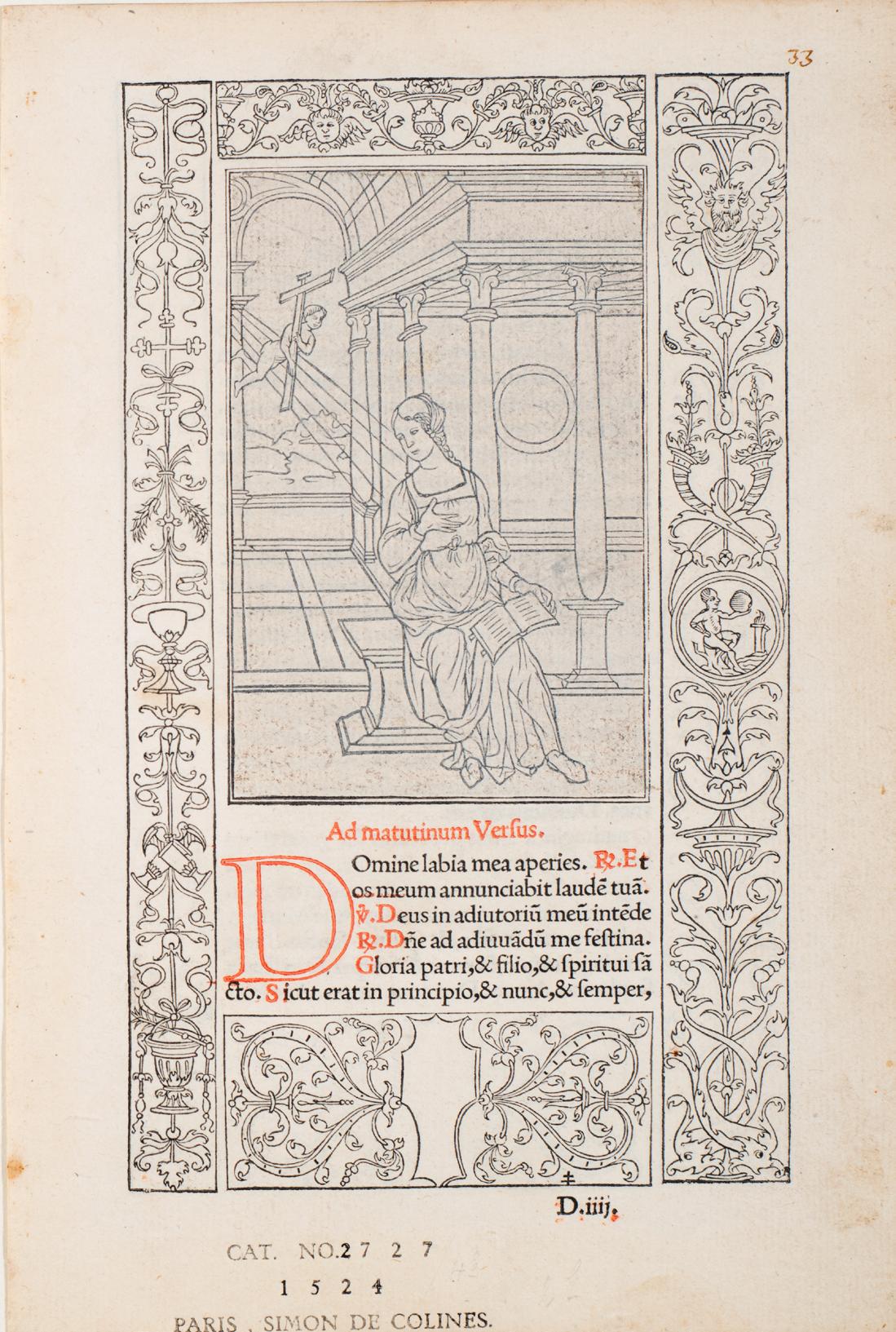
Books of hours were devotional volumes used to guide laypeople in their daily prayers. They were illustrated and sometimes lavishly decorative. In the pages featured here, the contrasting renderings of Mary and Eve highlight the differences in iconography—the visual images and symbols— of gendered good and evil.
Bourges, France 1480–Paris, France 1533
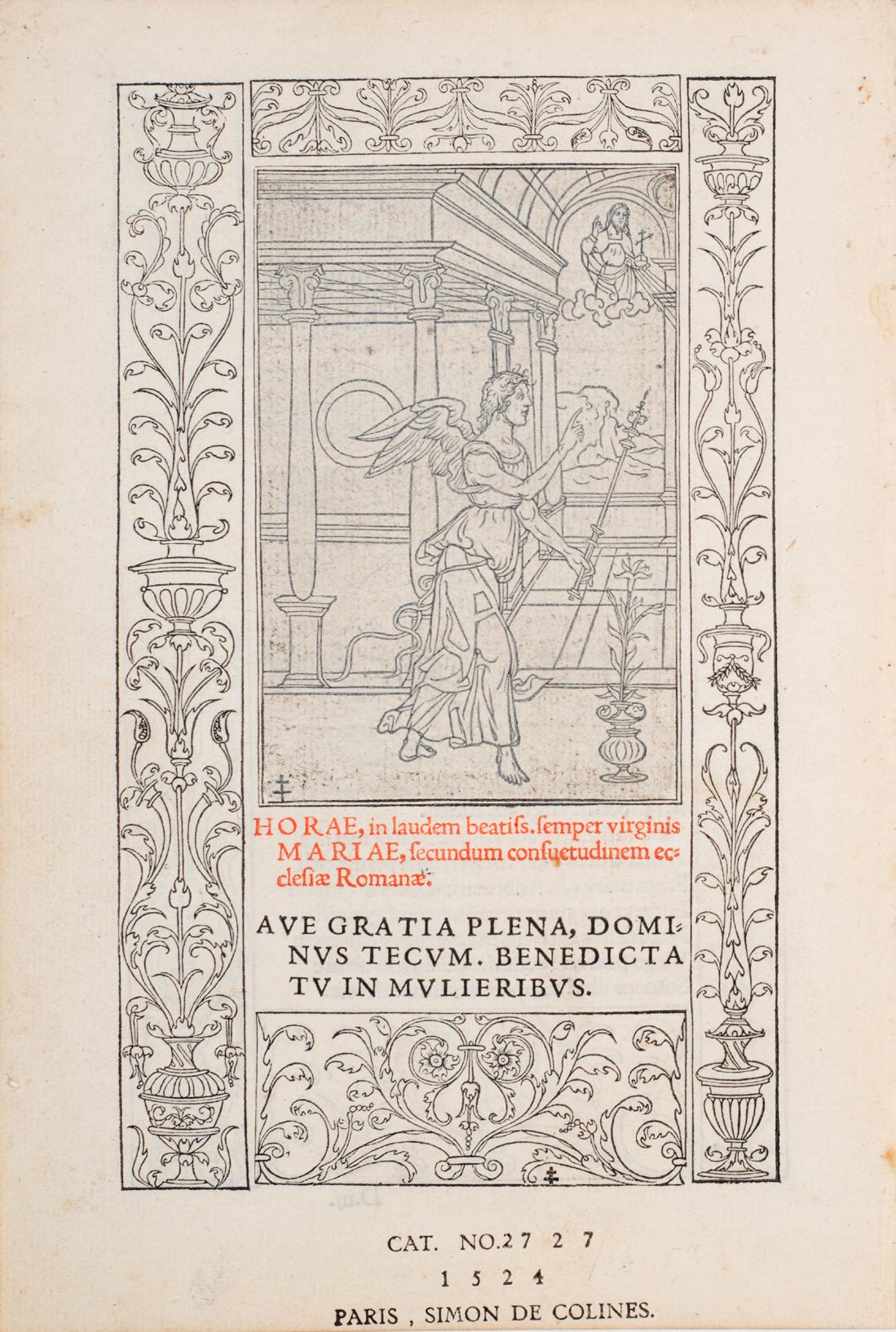
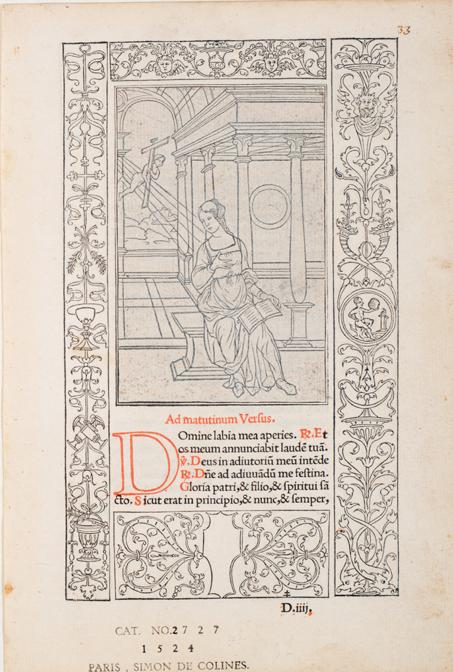
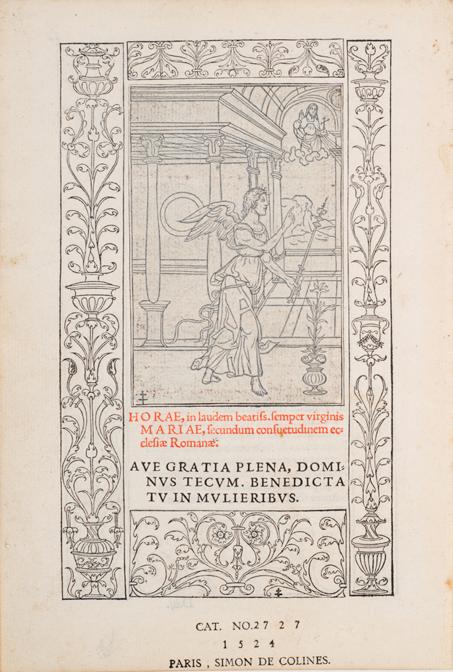
Pages from Book of Hours, B.V.M. (Annunciation)
Two facing pages with woodcuts, decorated borders, and text, circa 1531
University of Nebraska–Lincoln
Anna R. and Frank M. Hall Charitable Trust H-763.1-2.1962
Pages from Book of Hours, B.V.M. (Annunciation)
Geoffroy Tory was a printmaker, engraver, and humanist whose work has had a lasting effect on French publishing. He is known primarily for his Chery Fleury (“beautiful flowers,” also idiomatic for “paradise”), a personal treatise from 1529 devoted to the geometric design of capital letters in the Roman alphabet, which significantly influenced the development of typography.
Tory also produced several editions of the book of hours. These two facing pages depict the Annunciation—the moment the angel Gabriel announces to Mary that she is to be the mother of the Messiah. Influenced by his sojourns in Italy, Tory brought Renaissance ideas and visions to Paris, France, observable here in the illustrations’ linear, elegant style and one-point perspective.
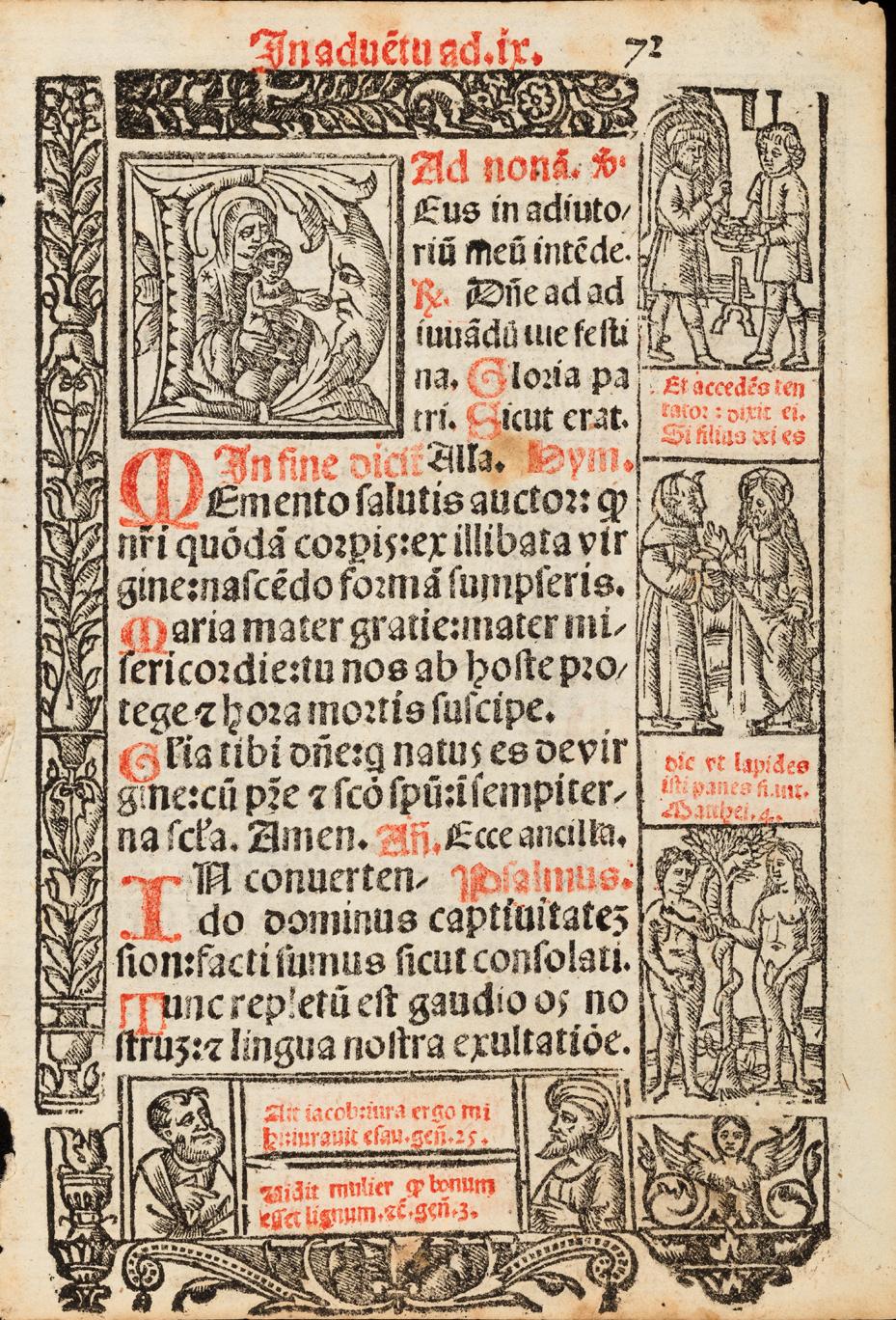
Page from an early printed book with the Virgin Mary and Adam and Eve Woodcut, late fifteenth century Collection of Carole Levin
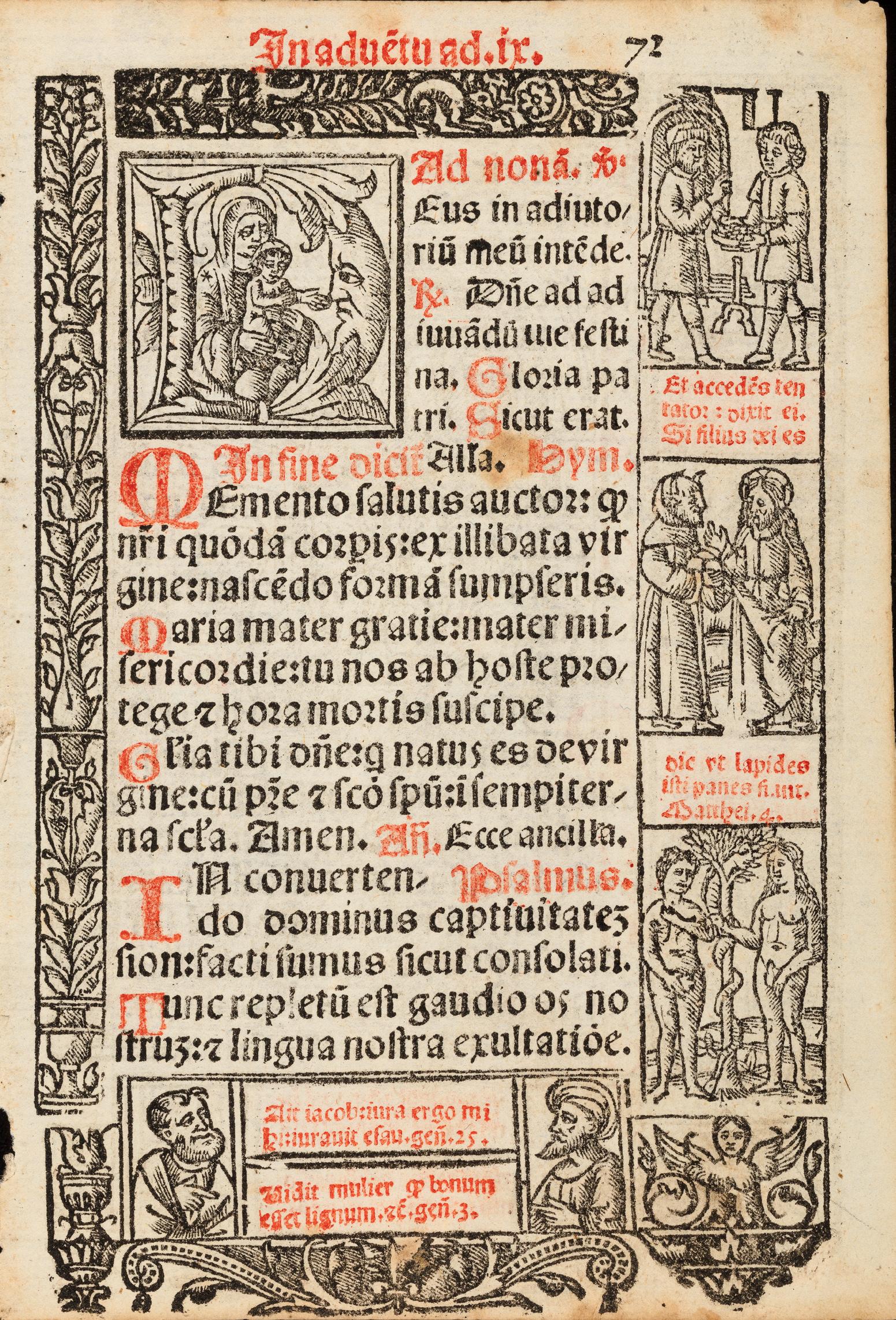
Page from an early printed book with the Virgin Mary and Adam and Eve
The prayer featured here begins with “May God help you” and is accompanied by several illustrations, including of the Virgin Mary holding the Christ Child and of Eve taking the apple in the Garden of Eden. Notably, the head of the serpent is depicted as the head of a woman, as it is in the image of The Temptation by Wenceslaus Hollar, on view nearby.
Portraits of nobility in the early modern period emphasized the qualities rulers were expected to possess. Kings were to be strong, brave, and wise. Ruling queens, who were far less common than kings, were to not only uphold the kingly virtues but to be beautiful and feminine as well. Royal women who were not rulers were held to similar ideals, although they were depicted in less regal attire to reflect the more precarious positions they occupied compared with those officially in power.
Dublin, Ireland circa 1721–London, England 1775
Queen Elizabeth I , after Isaac Oliver
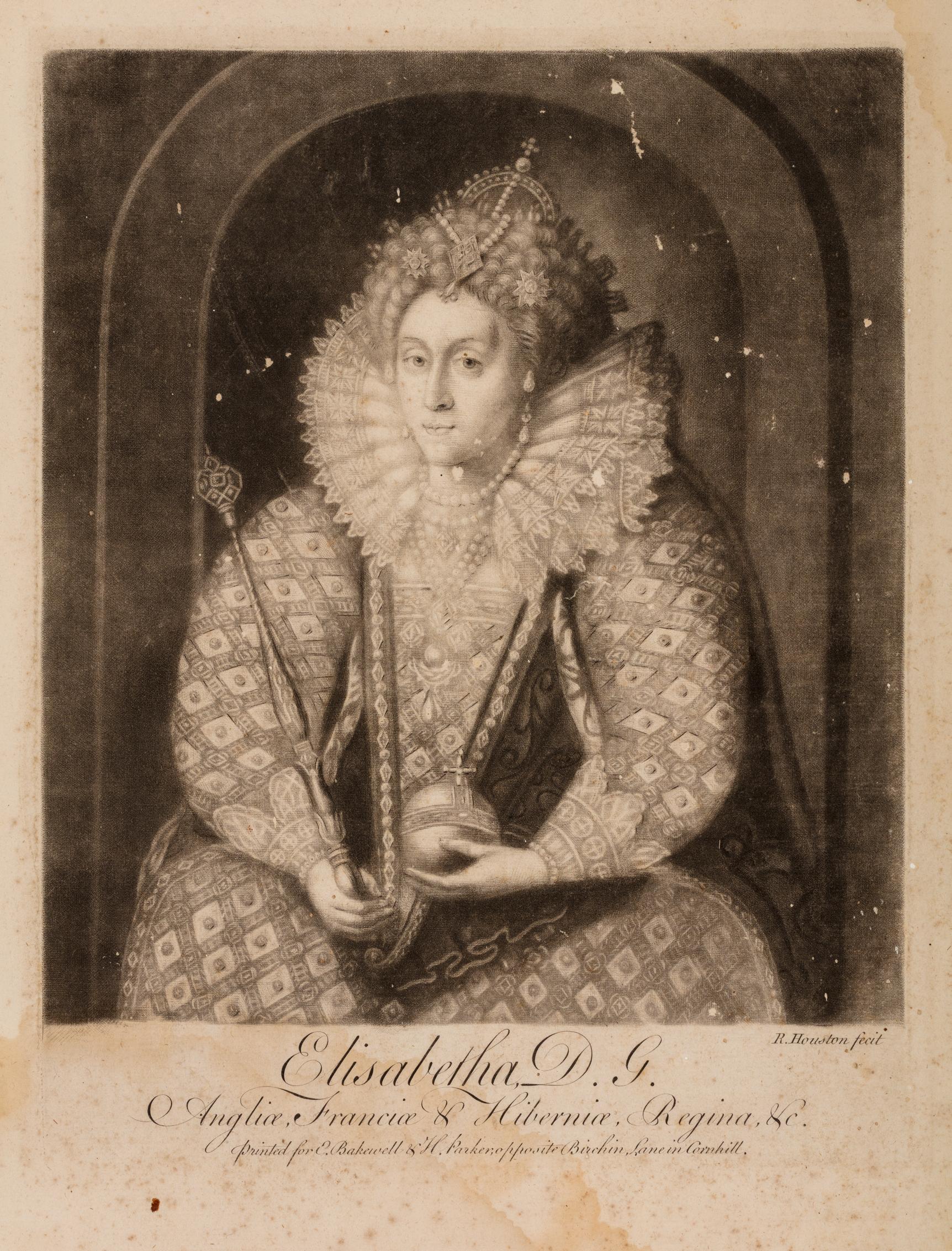
Mezzotint, mid eighteenth century
Collection of Carole Levin
Queen Elizabeth I, one of the great Renaissance monarchs, ruled England from 1558 to 1603. She was particularly careful when choosing artists to create her likeness. She approved of the miniaturist Isaac Oliver, whose French Huguenot family had immigrated to England when he was a child. Approximately two centuries after Oliver portrayed Elizabeth I, Richard Houston produced this copy of the original work, which presents the queen as royal, powerful, and majestic as well as traditionally attractive and feminine.
Elizabeth I never married and was known as the “virgin queen.” A Protestant, she supported a broadly based religious policy. Highlights of her reign include the 1588 defeat of the Spanish Armada and the flourishing of the arts, including the works of William Shakespeare.
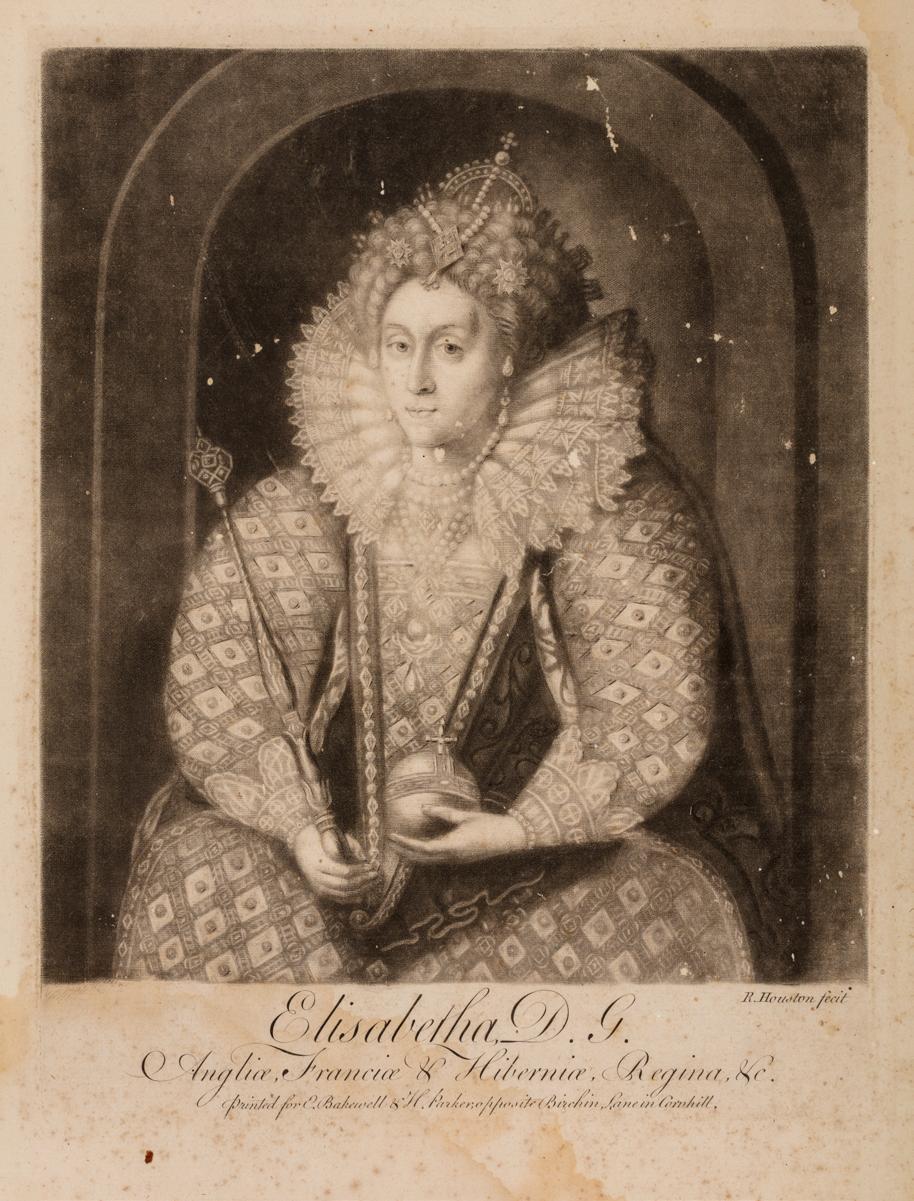 RICHARD HOUSTON
Queen Elizabeth I , after Isaac Oliver
RICHARD HOUSTON
Queen Elizabeth I , after Isaac Oliver
birth and death unknown
Lady Margaret Douglas
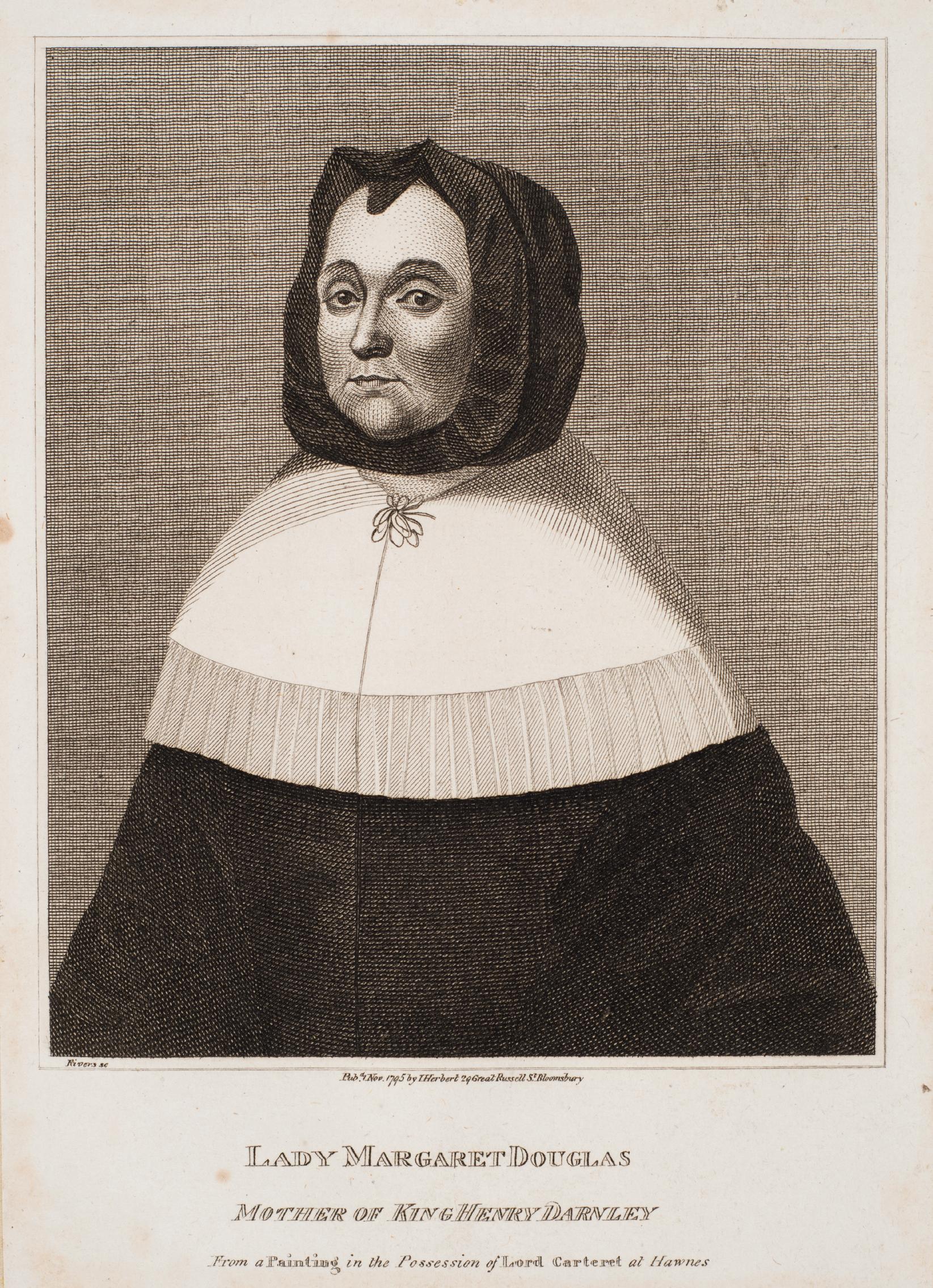
Etching, 1795
University of Nebraska–Lincoln
Anna R. and Frank M. Hall Charitable Trust
H-1739.1972
Lady Margaret Douglas
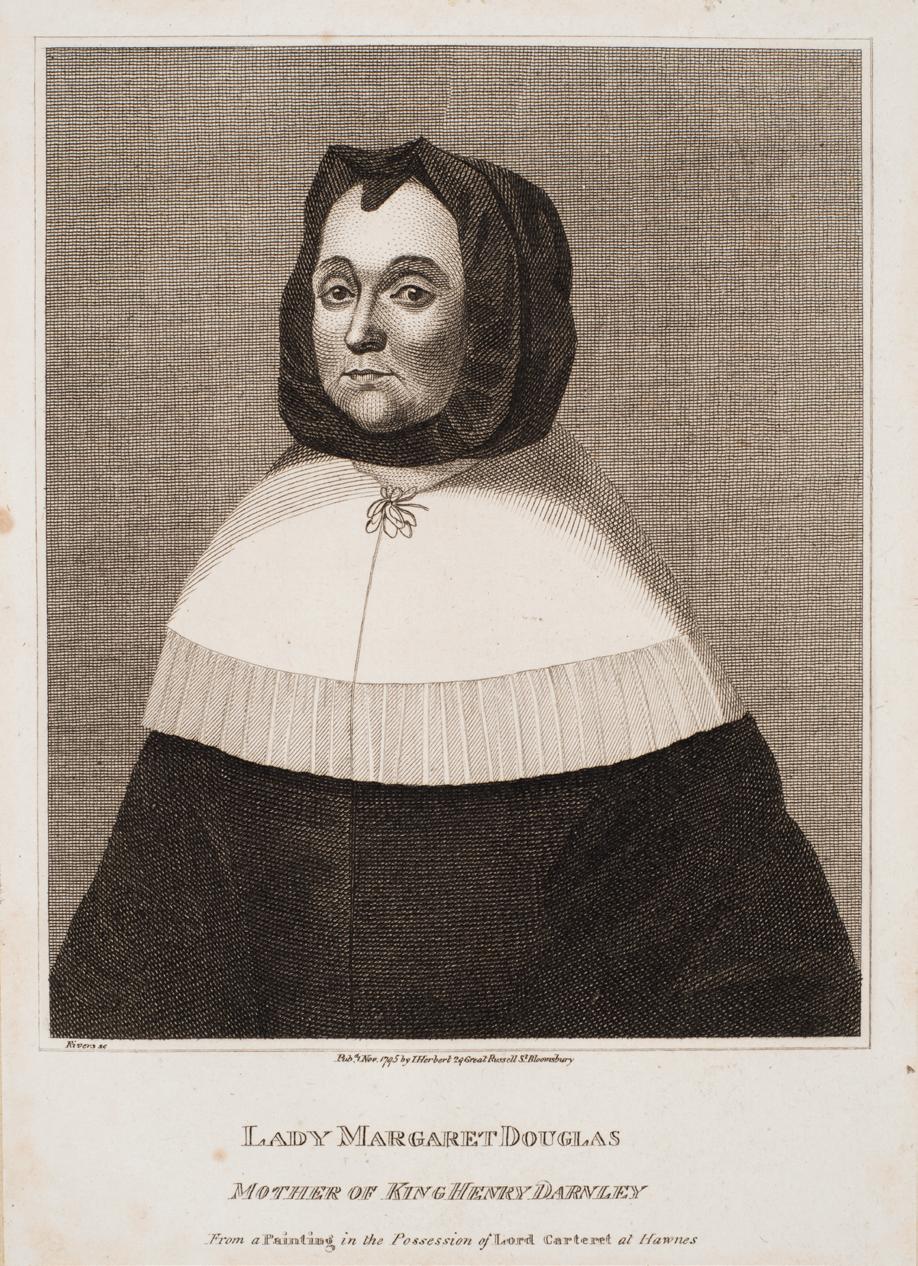
Active in the late eighteenth century, the artist known as Rivers created fourteen images of people at the Scottish and English courts, including this portrait of Lady Margaret Douglas, niece of King Henry VIII (reigned 1509–47).
Margaret’s life had many tragedies, including the deaths of all seven of her of children, only two of whom lived to young adulthood. Her close proximity to the Tudor throne also endangered her; she survived her husband, who, along with her elder son, was murdered. Described as having been very beautiful, Margaret’s simple dress conveys her status of non-ruling royalty.
Flanders, Belgium 1480–Paris, France 1541
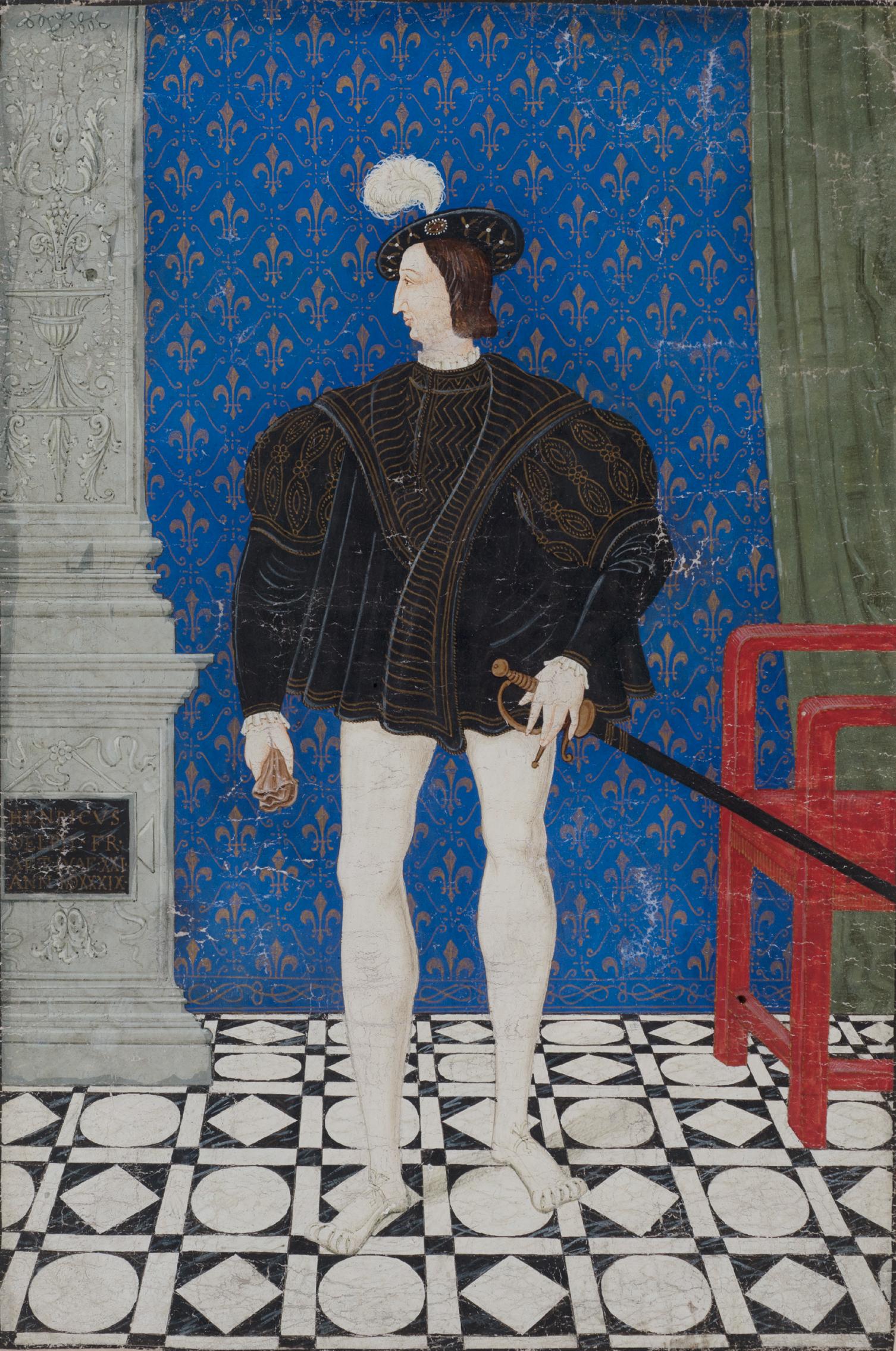
Portrait of the Dauphin Henry Gouache on vellum, 1539
University of Nebraska–Lincoln
Gift of the Kress Foundation
U-357-K.1962
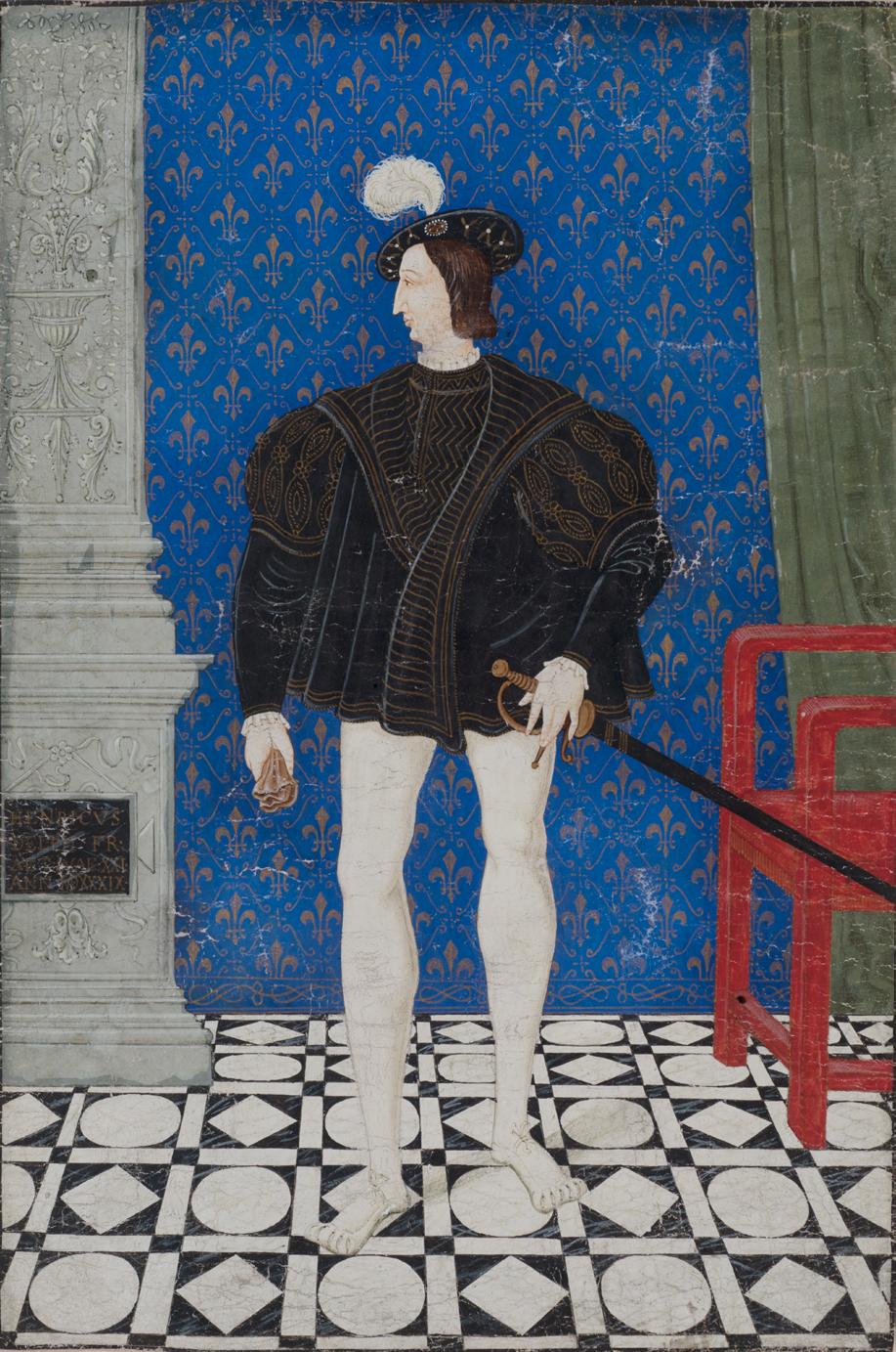
Jean Clouet spent much of his working life at the court of King Francis I of France (reigned 1515–47). Clouet first decorated illuminated manuscripts, and was later known as a painter of portraits, both full size and miniature. He created several portraits of French royalty, including this commissioned portrait of Francis I’s second son, the Dauphin Henry.
In 1533, when they were both fourteen years old, Henry was married to Catherine de’ Medici. Soon after his marriage, he became involved with Diane de Poitiers, who, once Henry became king of France on his twentyeighth birthday, became so powerful she was almost an alternate queen. Henry’s rule, however, was cut short when he died at age forty after being fatally injured during a jousting tournament.
 Portrait of the Dauphin Henry
Augsburg, Germany 1473–Augsburg, Germany 1531
Untitled (Philip the Handsome) , page from Genealogy of Emperor Maximillian I Woodcut, 1512
University of Nebraska–Lincoln
Anna R. and Frank M. Hall Charitable Trust
H-773.1962
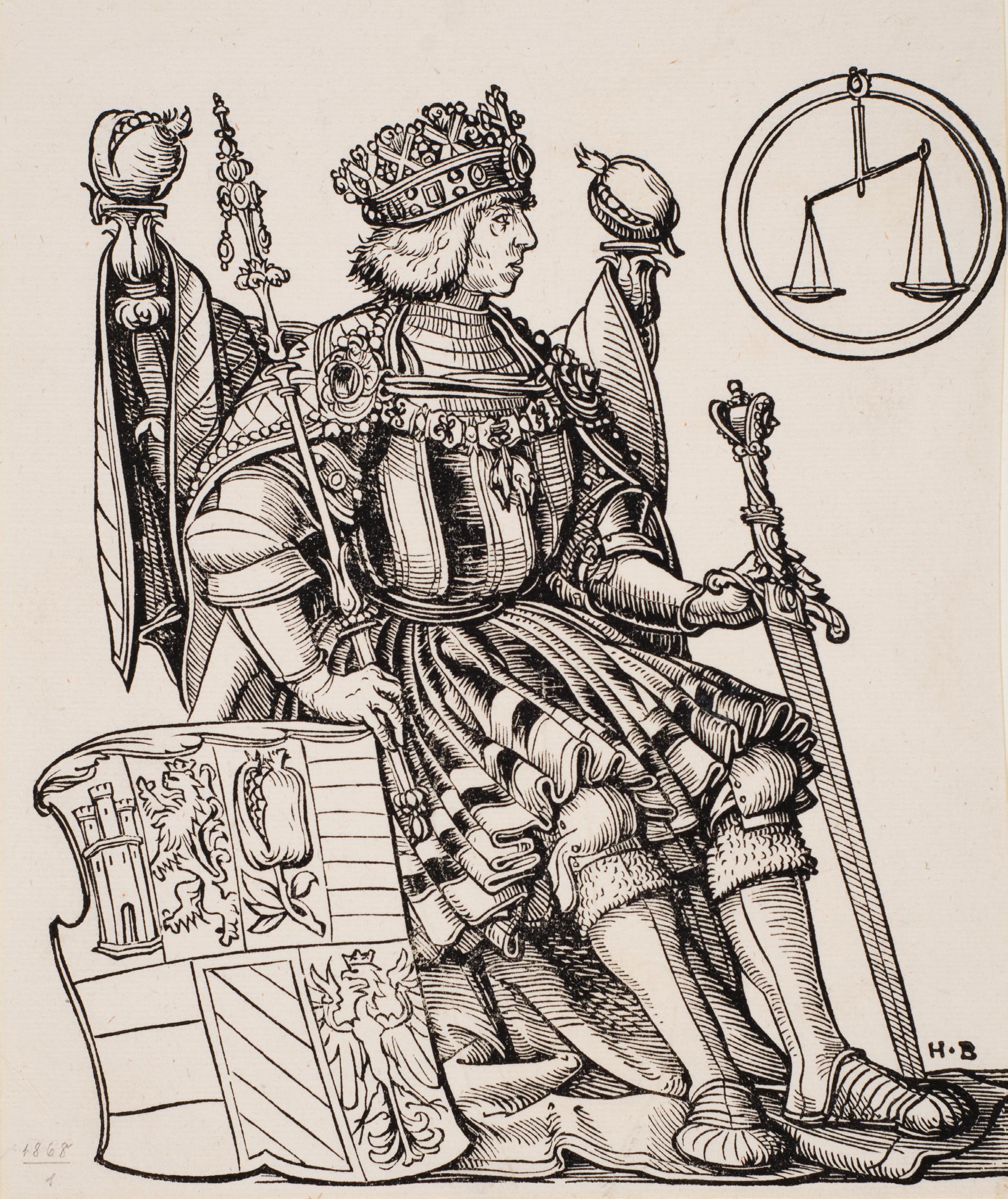
Hans Burgkmair the Elder was a painter, draftsman, and printmaker who trained with his father in Augsburg and apprenticed in Colmar. He designed woodcuts for the most prominent publishing houses in the city. From approximately 1508 to 1519, he worked primarily for Emperor Maximillian I, the archduke of Austria and king of the Romans. Burgkmair was commissioned to produce the emperor’s genealogy, and although he made ninety-two woodblocks for this purpose, the prints were never published.
In this print, Maximillian’s son Philip, known as Philip the Handsome because of his grayblue eyes and fair hair, poses with attributes of his power: a shield, sword, and scepter. He wears his armor under his royal clothing to demonstrate his prowess as a military leader. Having inherited rule of the Netherlands as a child, Philip married Joanna of Castile, daughter of Ferdinand and Isabella of Spain, at the age of eighteen. When Isabella died in 1504, Joanna became queen of Castile, but her father and Philip, who were fighting for control, labeled her “the mad” and confined her. Philip took over as king of Castile, but died of fever in 1506 at the age of twenty-eight. Joanna never ruled and remained confined until her death. Matrilineal power was marginalized.
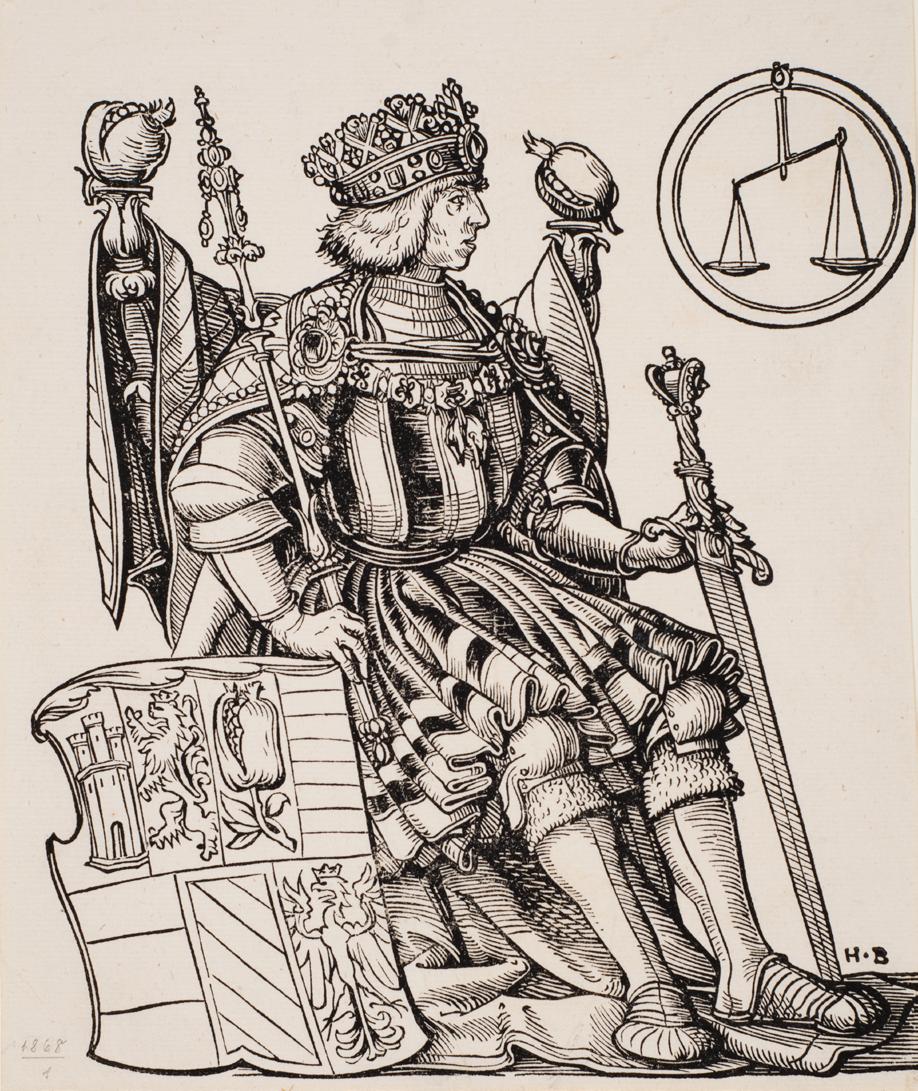 Untitled (Philip the Handsome) , page from Genealogy of Emperor Maximillian I