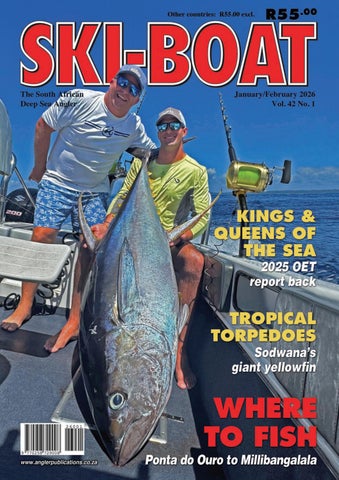
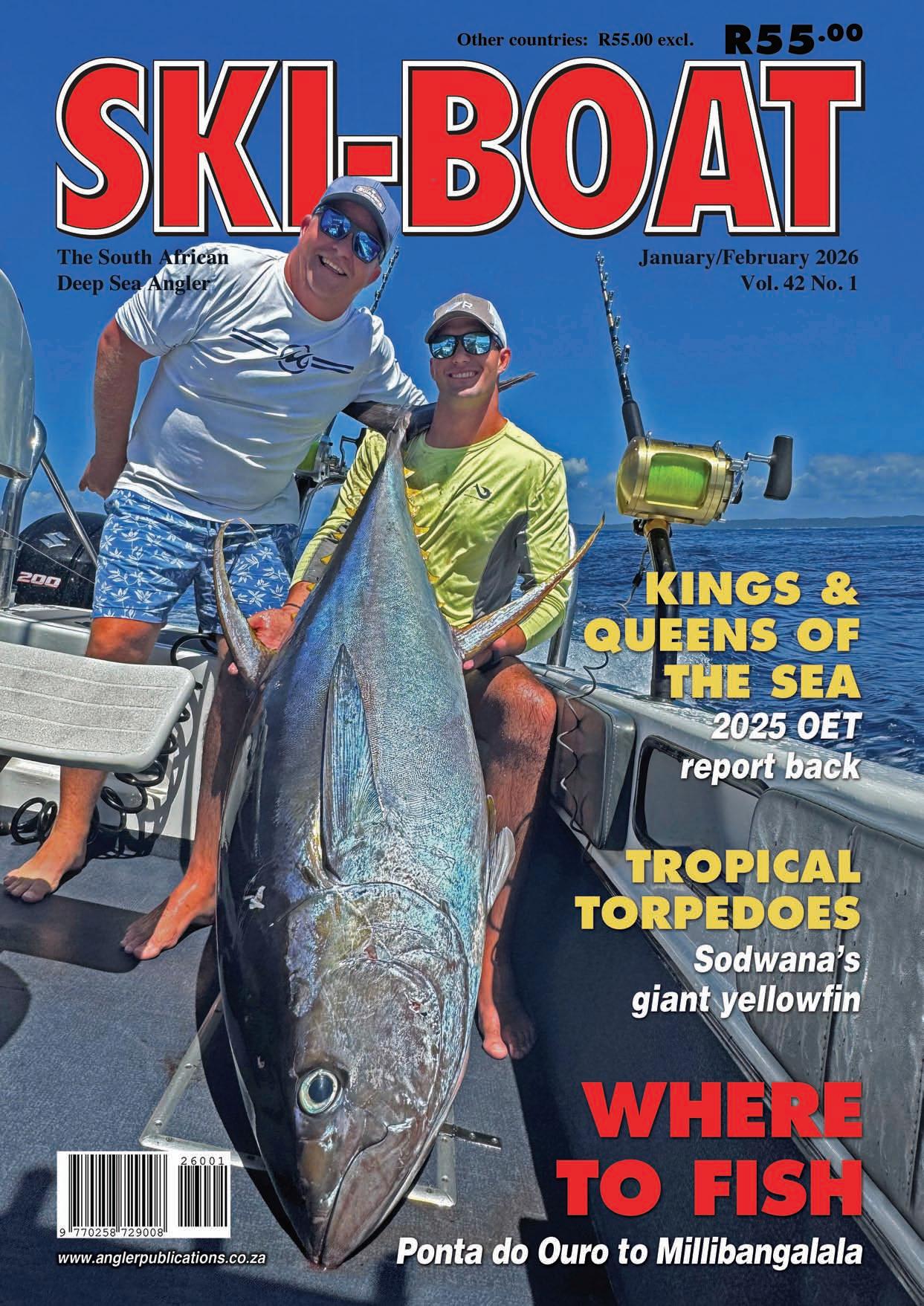
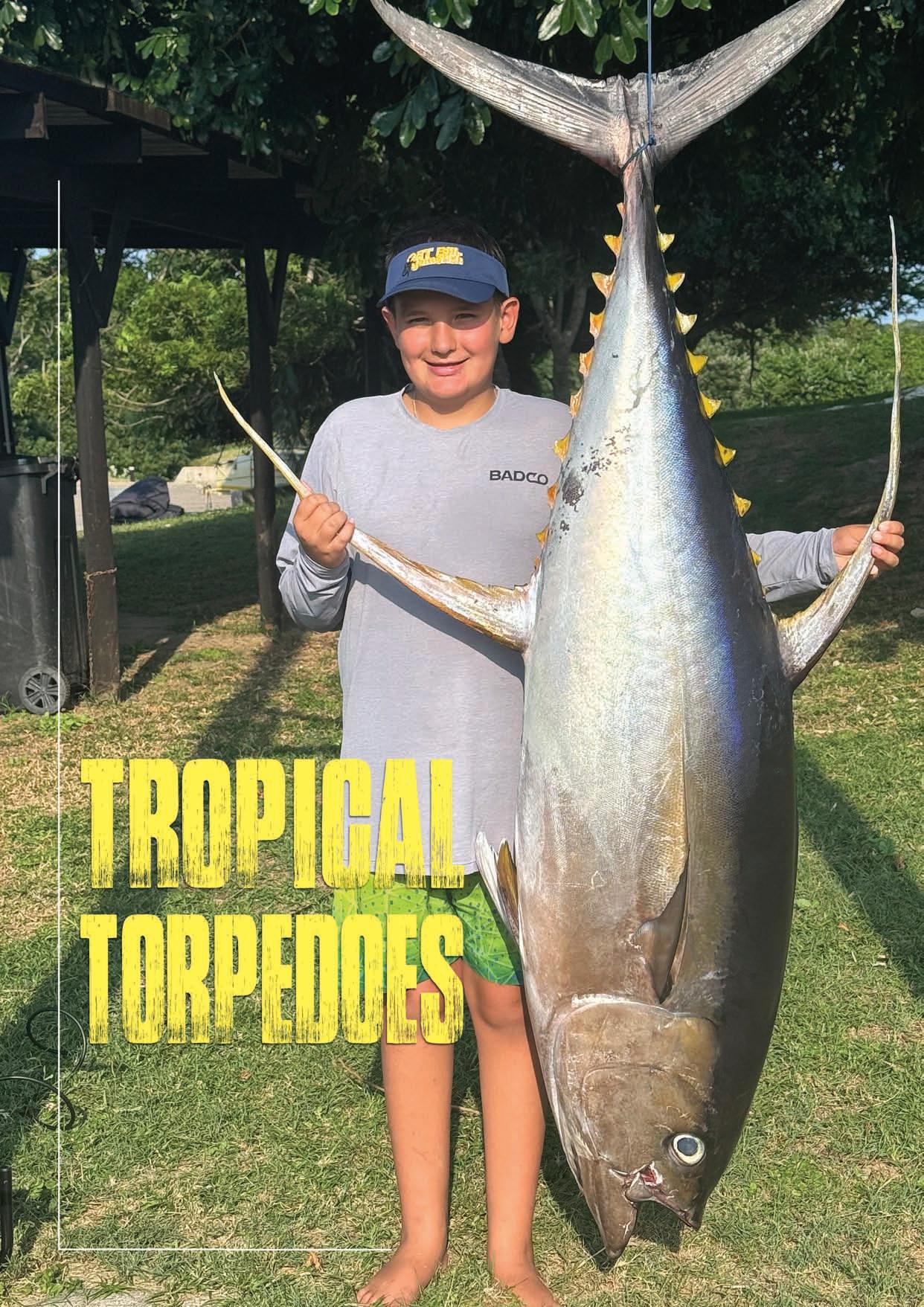
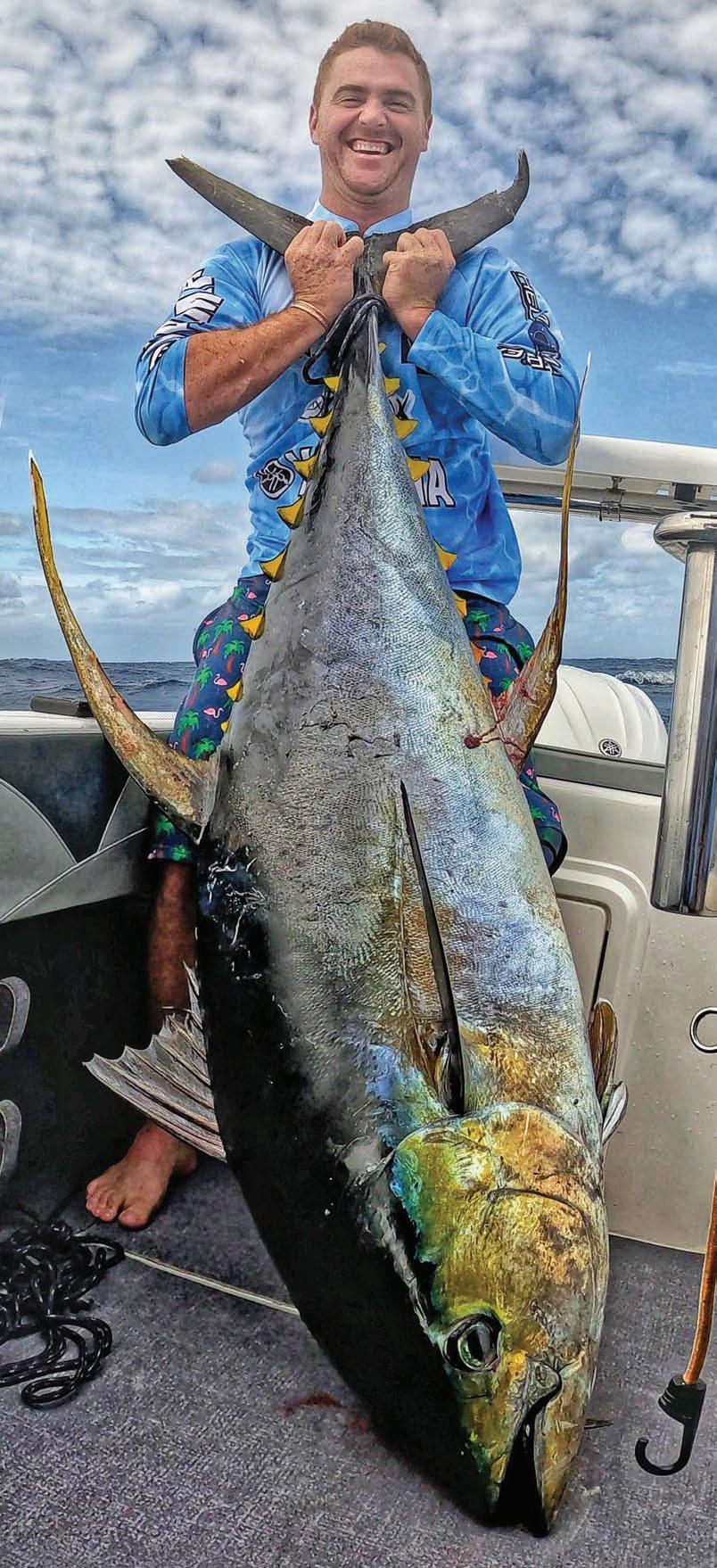
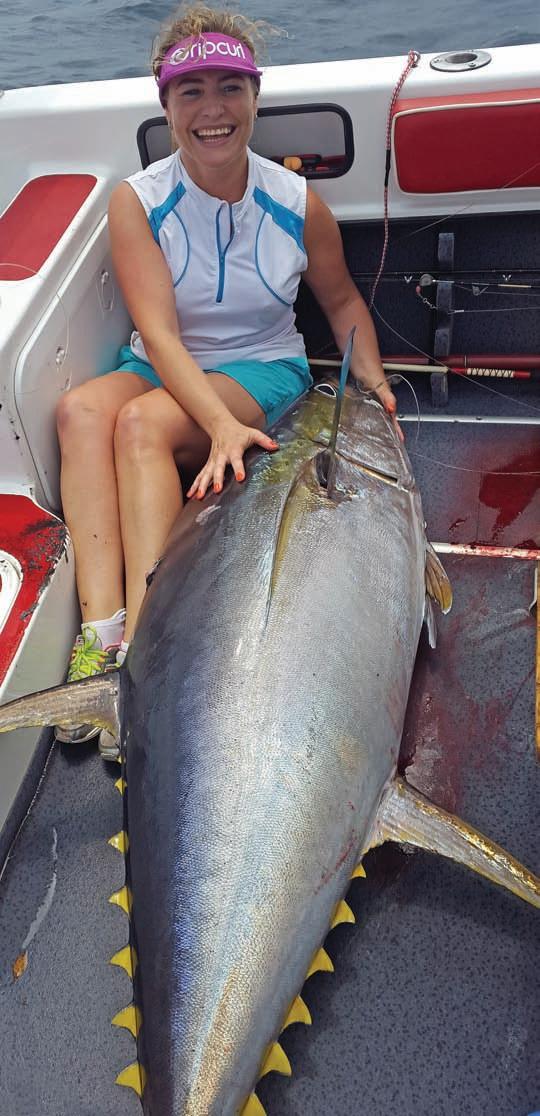
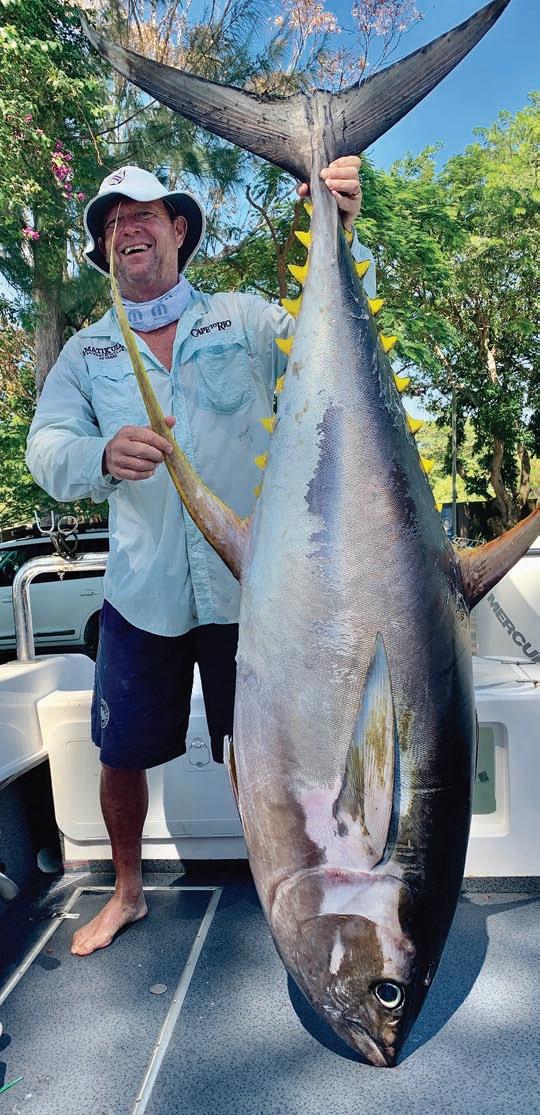
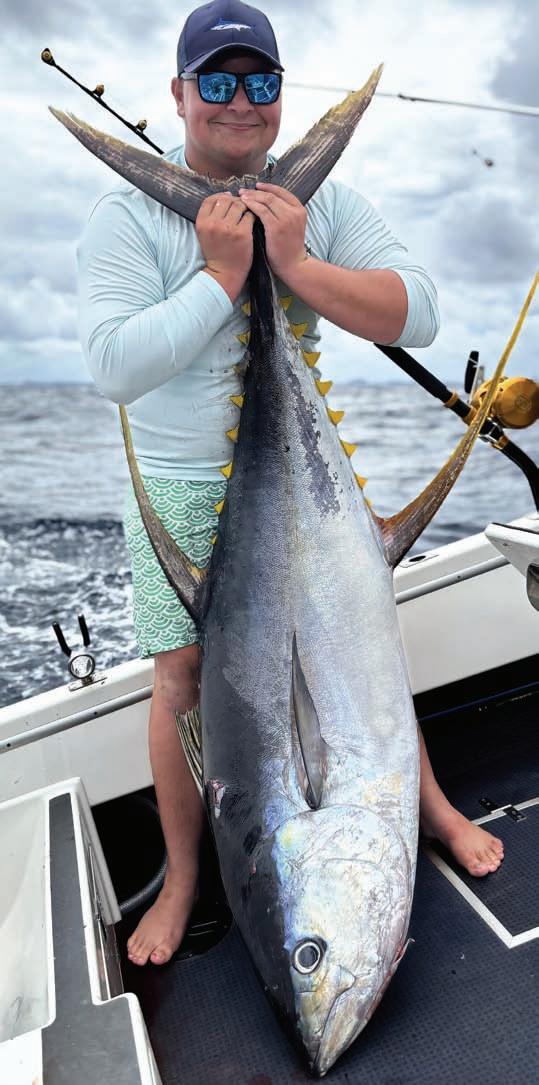
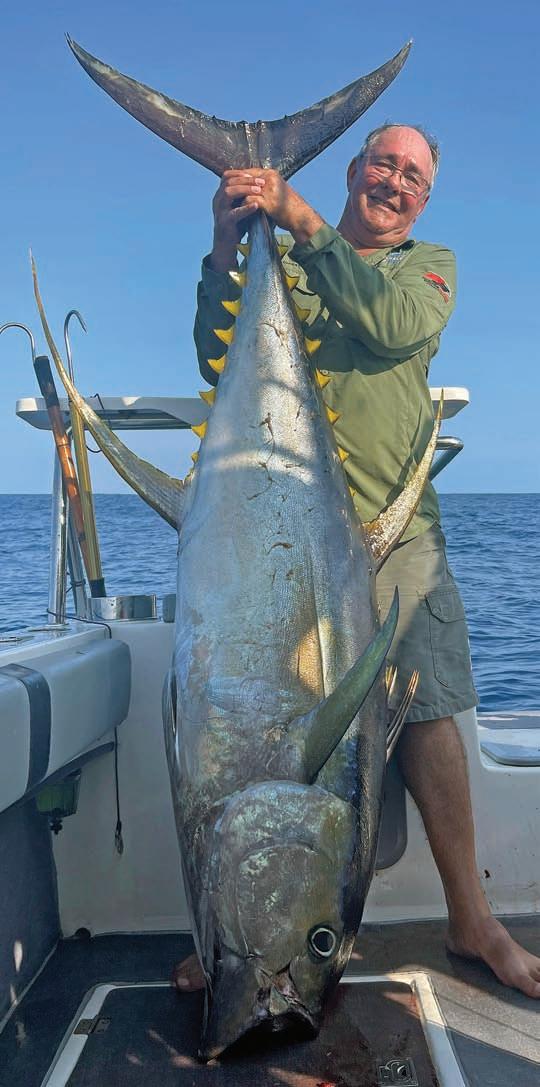
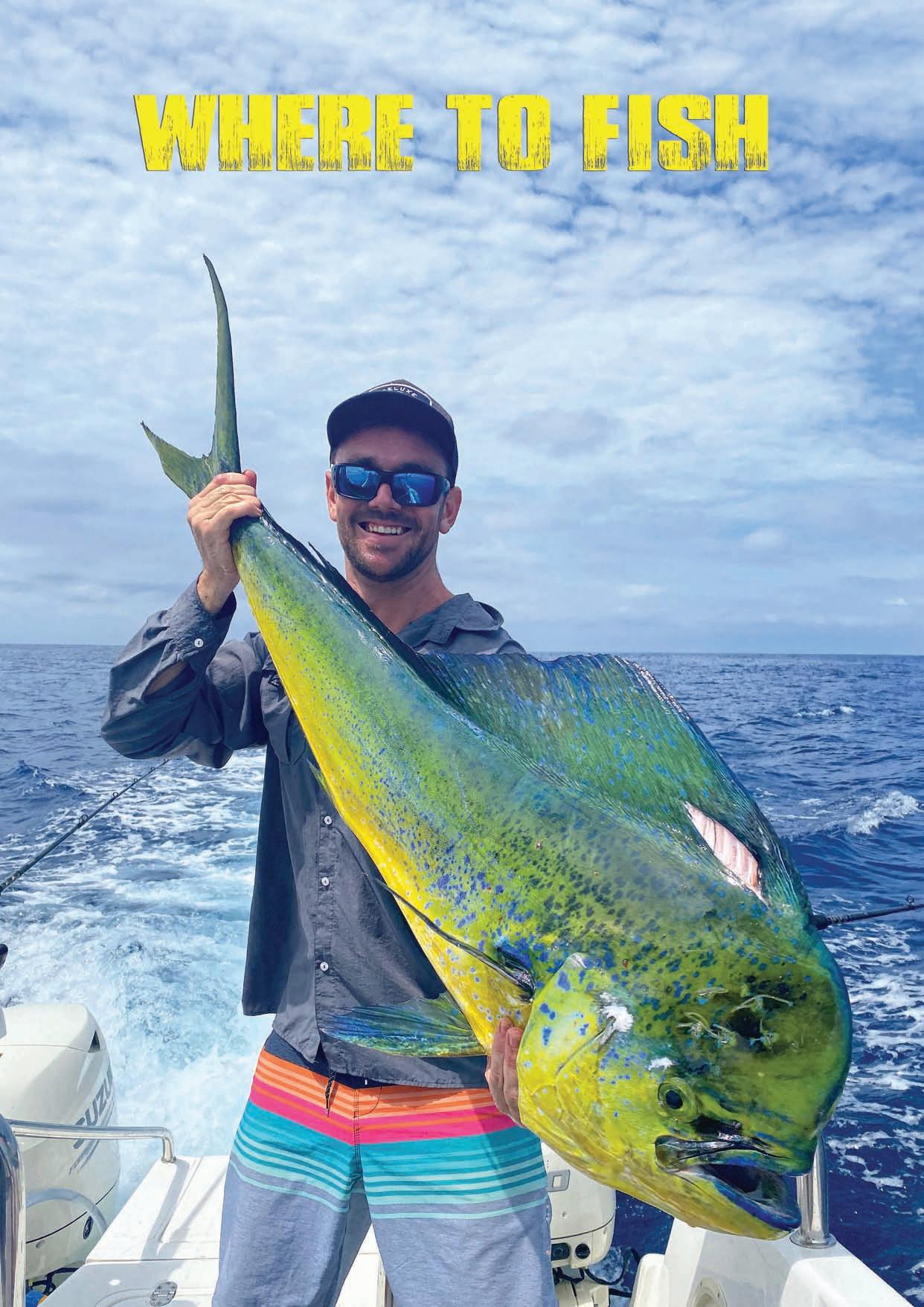
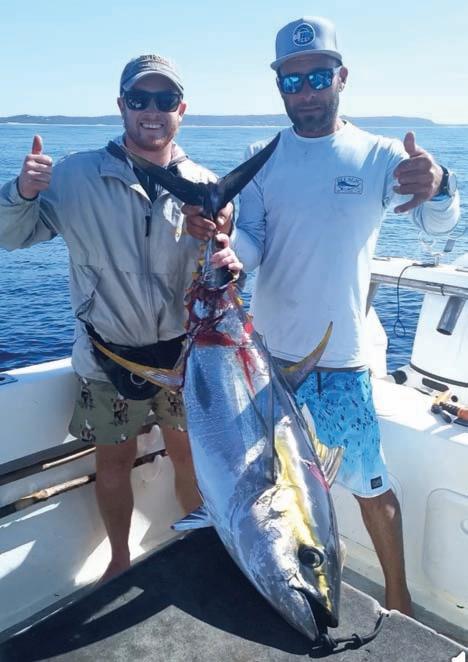
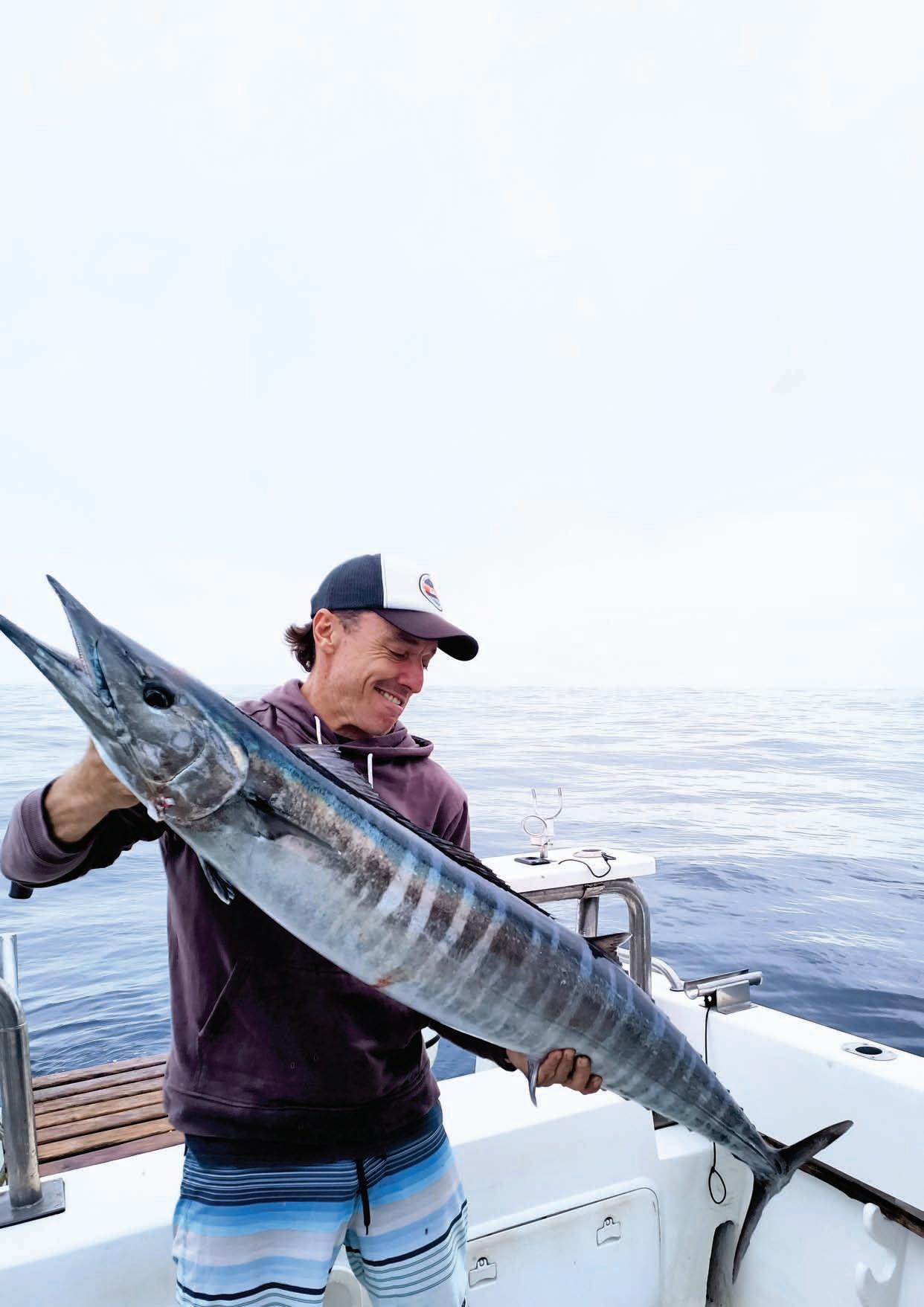
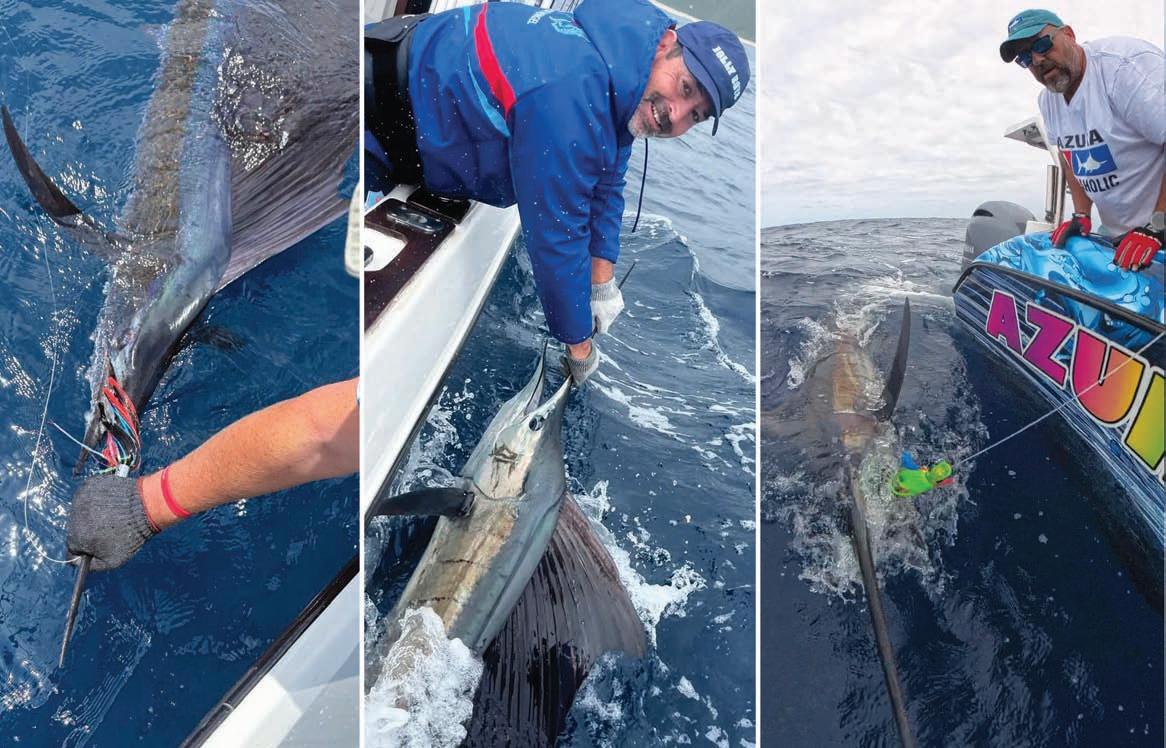
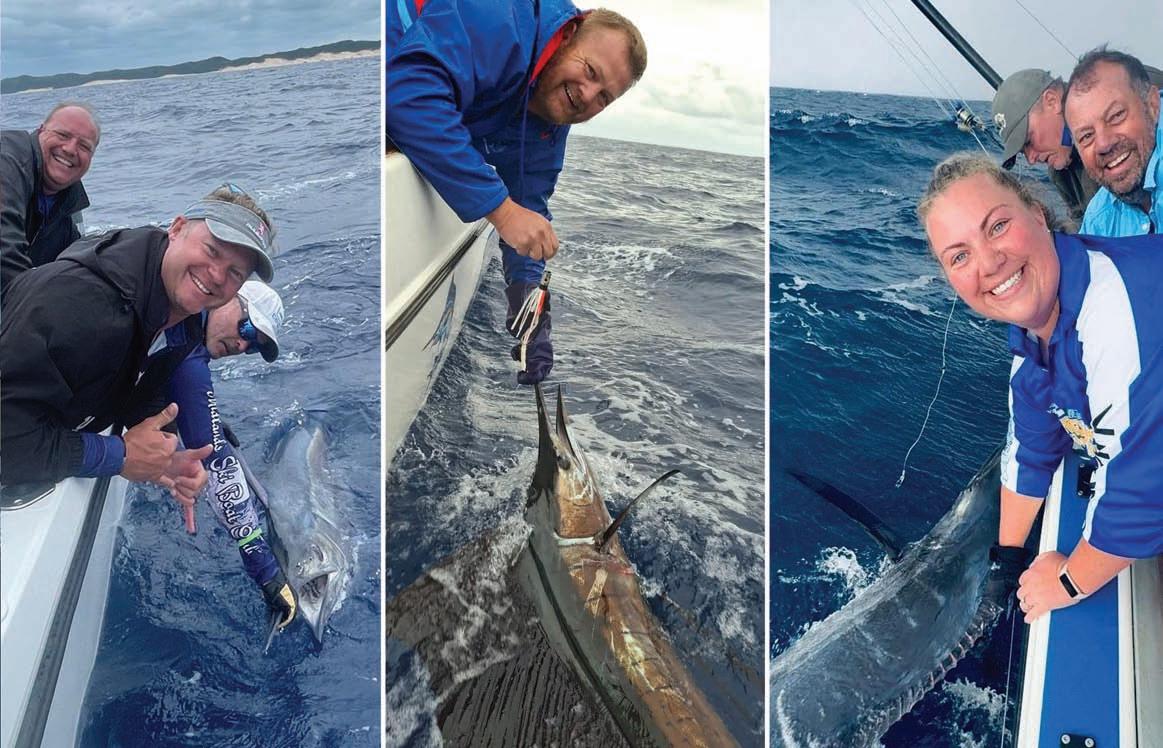
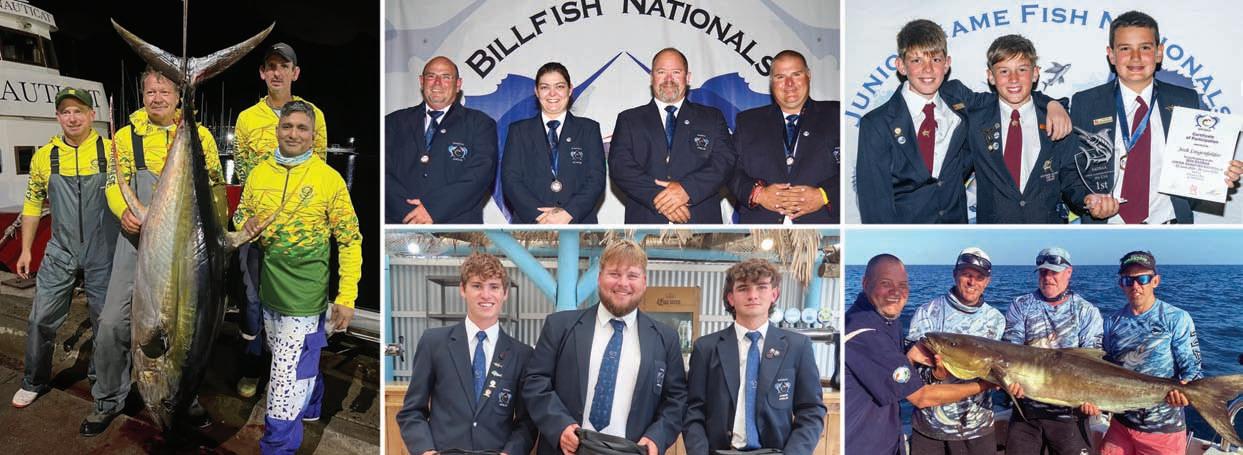
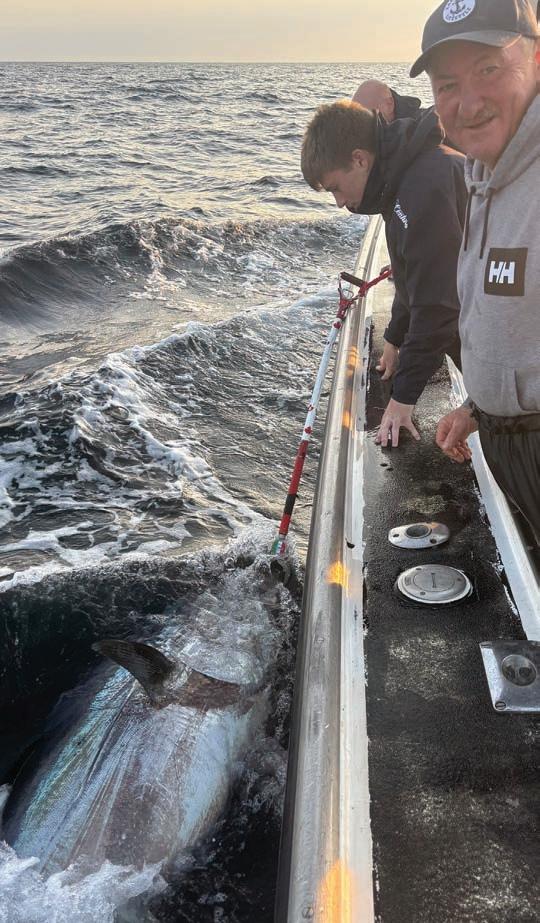
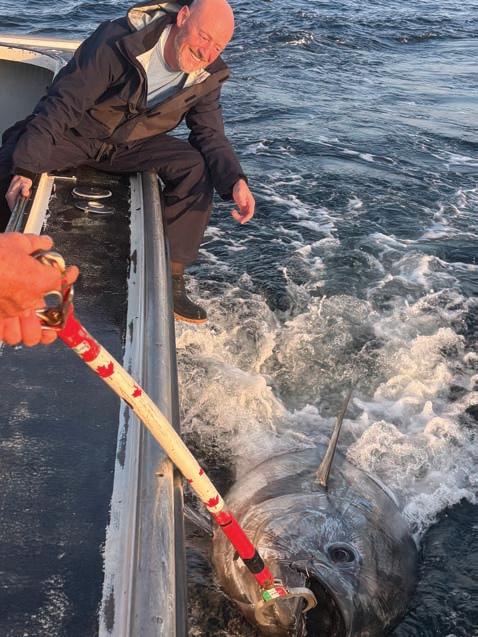
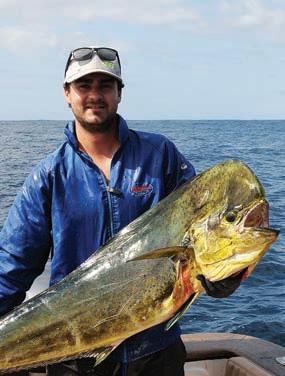
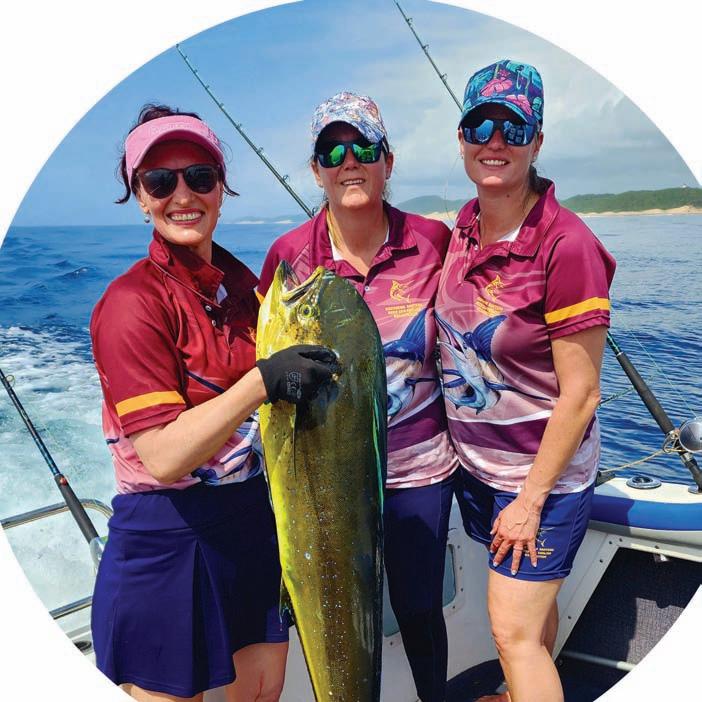
Each season Sodwana Bay’s waters produce some proper size tuna,including this 84kg beast caught by Gareth Graham while he was fishing aboard Fishaholic in 880m water off Lighthouse in March 2025.The tuna took a Pulsator tube lure.Anton Lingenfelder stood by to congratulate Gareth.
7Tropical Torpedoes
Catching Sodwana Bay’s giant yellowfin tuna —by Jaco Lingenfelder 17Where to Fish
Part 23:Ponta do Ouro to Millibangalala —by Marcus Joubert
26Kings and Queens of the Ocean 2025 OET Bill- & Gamefish Tournament —by Bryan Jooste
33Dress Like Queens,Fish Like Kings
Tales of triumph from the 2025 OET winners — by Brett Bartho 43Going Electric!
Deep sea applications for trolling motors —by Peter Jacobs 49Like Father Like Son
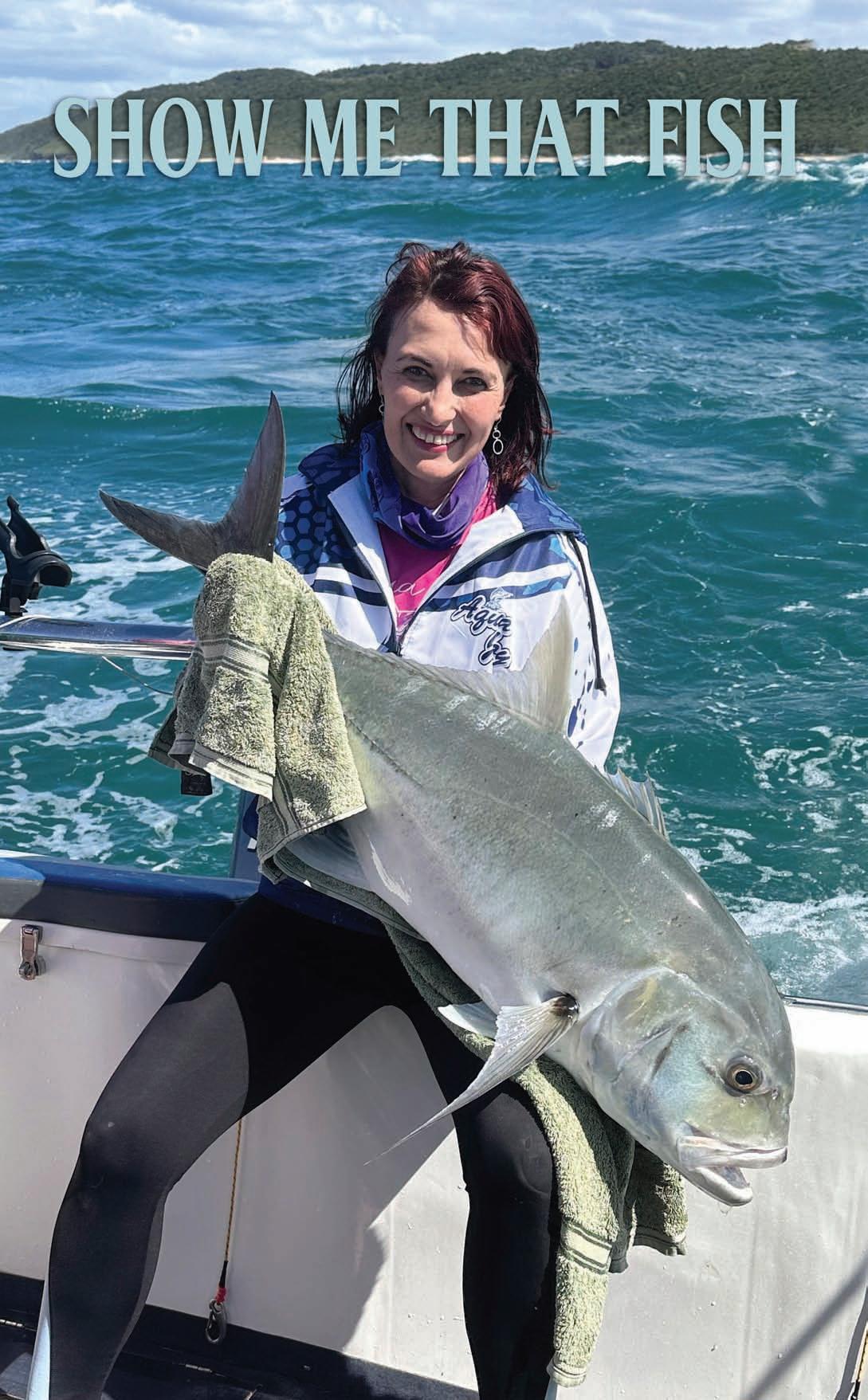
Tuna fishing in Nova Scotia —by Ben Kruger,Senior 53Show Me that Fish How to handle fish safely for release —by Nikki Smit
Publisher: Erwin Bursik
Editor: Sheena Carnie
Advertising Executive: Mark Wilson
Editorial Assistant: Lynette Oakley
Contributors: Brett Bartho, Peter Jacobs, Bryan Jooste, Marcus Joubert, BenKruger, Jaco Lingenfelder, Fransien Myburg and Nikki Smit.
Angler Publications cc POBox 20545, Durban North 4016 Telephone: (031) 572-2289
e-mail: angler@mags.co.za
Subscriptions to SKI-BOAT: R270 per annum (six issues).
New subscriptions and renewals:
SKI-BOAT Subscriptions Department Telephone: (031) 572-2289
• e-mail: angler@mags.co.za
• Through www.anglerpublications.co.za, or E-zine through <www.issuu.com>
Printing: Novus Print, Cape Town Distribution: On The Dot <Portia.Nguyuza@onthedot.co.za>
Full production is done in-house by Angler Publications & Promotions on Apple Macintosh software and hardware.
SKI-BOAT Magazine, ISSN 0258-7297, is published six times a year by Angler Publications & Promotions cc, Reg. No. CK 88/05863/23, and is distributed by On the Dot, as well as directly by the publishers to retail stores throughout South Africa.
• Copyright of all material is expressly reserved and nothing may be reproduced in part or whole without the permission of the publishers.
• While every effort is made to ensure the accuracy of the contents of this magazine, the publishers do not accept responsibility for omissions or errors or their consequences.
Views expressed in this magazine are not necessarily those of the publishers, the managing editor, editor, editorial staff or the South African Deep Sea Angling Association.
Erwin Bursik Publisher
ARE WELIVINGINTHE “GOODOLDDAYS”?
NOSTALGIA has a high impact on most of our lives and even more so, I believe, on us deep sea anglers! I felt it recently when I attended the prizegiving event of the 2025 OET held at Sodwana Bay during the first week of November.
The whole event was incredible, with what I believe is the highest value first prize ever offered at a deep sea fishing competition held in South African waters. The boat, motors, electronics and various other frst-place prizes had a combined estimated value of over R1-million.
As I watched all the goings on, my mind drifted back to a day in November 1982 when I attended the then Sodwana Gamefish Club’s annual billfish competition held at the same venue. That year, my boat, Sea Lord, won the event thanks to an extremely large black marlin, and the prize was a Swiss Army knife for each of the crew! Some 40-odd years later, that knife remains a cherished reminder of a very special achievement in my life.
At that competition in 1982, I witnessed the early days of what came to be the “OET”. It was an event hosted by the then Oos/East Transvaal Ski-Boat Association for its affiliated clubs in both light tackle and big game fishing categories.
Today, the same basic objectives apply. The competition offers anglers a chance to compete in either the 10kg line class division or the 37kg line class division, but one big change is that this prestigious event is now open to all teams regardless of club affiliation.
The 2025 OET was organised to international standards that I believe would be hard to surpass. (You can read the full report on page 26 of this issue.) Thinking back and once again comparing this year’s grand finale to the open air ones held in the old Parks Board A Camp and the small rondawel near the camp’s entrance, was mind blowing. Still, despite the many changes over the years, at the Friday night prizegiving at the 2025 OET, the inherent gees (spirit) of the manne (men) of the OET was very clearly still in evidence, carrying on the legacy of intense competition and incredible camaraderie.
Many will say that offering such big (in this case huge!) prizes carries the wrong message, but I have a different perspective. Having attended the vast majority of the OETs held, I believe that the toenadering (coming together) of all facets of deep sea bill- and game fishing and those who take part in the competition, serves to both promote the sport of offshore angling and encourage the advancement of the craft being launched these days. Certainly they far surpass the boats we were using in the early 1970s and’80s!
Watching these incredible craft being launched at the 2025 OET and mentally comparing them to those of the early days of deep sea fishing off Sodwana leaves me totally awestruck – and doing some serious mental gymnastics. Back then, we had no tractors or four-wheel-drive vehicles to help us launch our boats. All we had were rubber rollers and the combined power of a number of able-bodied men to launch and retrieve our boats which were then left on the beach for the duration of the week-long competition.
It makes me wonder: were those really the “good old days”?
Till the next tide.
Erwin Bursik
TUNATALES
Josh Lingenfelder (12) caught this 76kg beauty while fishing aboard Fishaholic in 900m of water off Lighthouse, Sodwana, in April 2025. The yellowfin (a Southern Gauteng record) fell for a Marlin Magic Lil Dog lure.
Catching
Sodwana Bay’s giant yellowfin tuna
By Jaco Lingenfelder
AT dawn,Sodwana Bay comes alive.The surf glows gold in the first light,the smell of salt fills the air,and boats idle just before the breakers,waiting for the perfect moment to head out deep.Engines roar,bows rise,and within minutes, anglers are skimming across a cobalt sea that drops into hundreds of metres of deep blue water.It’s a world ruled by speed and strength,and is home to one of the ocean’s most formidable predators:the yellowfin tuna.
Sodwana Bay,nestled within the iSimangaliso Wetland Park on South Africa’s northeast coast,is a place where wilderness and water meet in perfect harmony.It’s one of those rare destinations where the ocean still feels raw – untouched and unpredictable.
The Agulhas Current,sweeping south from Moçambique along southern Africa’s east coast,brings warm, nutrient-rich water teeming with life. This current fuels an ecosystem that attracts marlin,sailfish,dorado,wahoo –and of course,the mighty yellowfin.
Just a few kilometres offshore,the continental shelf plunges into deep blue canyons,creating the ideal hunting grounds for big pelagics.For local skippers and seasoned anglers,these waters are as familiar as old friends – and capable of producing incredible rewards.
Yellowfin tuna ( Thunnus albacares ) are the muscle cars of the sea – sleek,fast and relentless.Off Sodwana,they average between 25- and 60kg,but every season a few brutes pushing 80kg make headlines.Their power is legendary.The first strike is like being hit by lightning,then there’s an unstoppable run that tests every knot,swivel,and sinew of strength you have.
Over the years a few in the 90- to 100kg range have also been caught along this stretch of the coast.Mariette Hendriksz’s 100kg yellowfin caught during the 2015 Billfish 15000 was a new ladies’All Africa and South Africa record on 50lb line.Peter Harvey also caught a 93.8kg whopper in March 2020 in just 40m of water.It was a pending All Africa record on 15kg line. In November 2024 Tielman Roos was absolutely thrilled to land a 98,6kg specimen on a chugger and stripbait while fishing in 800m of water off Klein Witsand.
Tielman Roos hooked this 98,6kg yellowfin on a chugger with stripbait in November 2024. He was fishing aboard Climax in 800m water off Klein Witsand, Sodwana.
Peter Harvey caught this 93,8kg tank of a tuna during the Mynmanne competition in early 2020. It fell for a rapala-style lure, and is the current All Africa record on 15kg line.
TACTICS, TIMING AND TENACITY
The best time to target yellowfin in Sodwana is from October to April,when warm-water eddies drift close to shore.
If you’re trolling lures,keep your speed between 7- and 12 knots,and watch the spread for a telltale boil or a sudden explosion of white water. Yellowfin tend to take lures that are trolled fast and shallow.Smaller skirted lures like the tubes from Pulsator and the Nomads DTX high speed artificial lures worked the best over the past season.Darker colours with purple and pink in them seemed to be the tuna’s favourites for the past season.
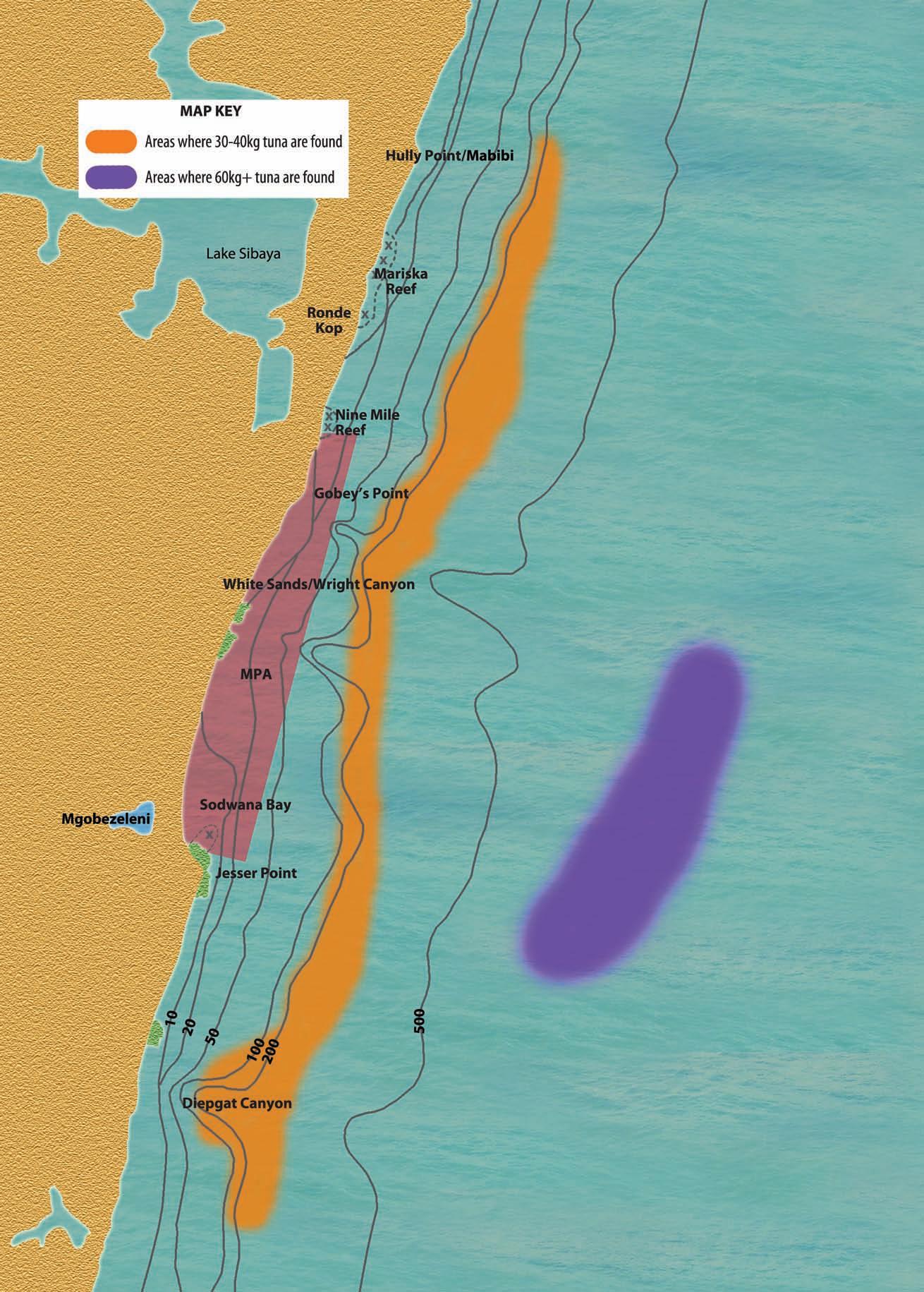
Yellowfin in the 30- to 50kg range come in closer to shore and are frequently caught on the 250- to 350m contours from Mabibi in the north all the way down to Diepgat.
The larger specimens above 60kg are predominantly caught out on the 700m contour and beyond – sometimes as far out as the 1200m contour while targeting marlin – straight out from the point and to the north.
Heavy 50–80lb tackle is standard, though even the strongest gear can feel inadequate when a big fish digs in deep.
It’s a battle of endurance – you ver-
sus a creature built for speed and stamina.The fight can last 30 minutes or three hours.Either way,it ends in sweat, sore arms,and a sense of victory that lingers long after the boat returns to shore.
Sodwana’s waters are alive with baitfish schools – sardines,flying fish, bonito and mackerel – thanks to the nutrient flow from tropical currents, and the reef structures.Large schools of big tuna are often seen feeding on baitfish before they are caught,so keep your eyes peeled for these giants.If you see them,head over to them and hope you entice the bite.
Mariette Hendriksz with her 100kg yellowfin tuna caught at the Billfish 15000 in November 2015. It’s the current women’s All Africa and South African record on 50lb line.
Yellowfin here often feed in competition with dorado,wahoo and marlin, and the constant need to outcompete other predators makes them:
•More aggressive feeders.
•Quicker to strike lures or live bait.
•Stronger and more explosive when hooked.
WATER TEMPERATURE AND METABOLISM
Yellowfin tuna are warm-water pelagic fish,and Sodwana’s yellowfin are tropical athletes – fast,fiery and built for speed.At Sodwana,surface sea temperatures typically range from 24°C to 29°C, thanks to the Agulhas Current bringing
tropical water from Mozambique down the east coast.
Warmer water increases a tuna’s metabolism,meaning:
•They need to feed more frequently.
•Their muscle activity and oxygen use are higher.
•They’re simply “fired up”– faster, more explosive,and far more aggressive in the fight.
In Sodwana,tuna are typically hooked in warm,high-oxygen surface water,where they can sustain fast,powerful runs and dramatic dives.
By contrast,Cape Town’s waters, influenced by the cold Benguela Current,range from 13°C to 20°C.Tuna
there still fight hard – especially large specimens over 80kg – but their metabolism is slower,resulting in more sustained,heavy,deep fighting rather than the fast,acrobatic runs typical of Sodwana fish.This is the main reason that the tuna off Sodwana are perceived to be stronger than the ones in Cape waters.
In my opinion,Sodwana Bay is South Africa’s most underrated yellowfin tuna paradise.If you’re heading up that way over the holidays,you might want to work on your fitness before you go,and make a point of trying to land some of these tropical torpedoes.
Joshua Potgieter landed this 75kg tank of a tuna in April 2025. He was fishing aboard Billistic in 800m of water off Lighthouse, Sodwana Bay, when the yellowfin took off on his Pulsator tube lure.
Gustav van Veijeren was fishing aboard Tank when he caught this 74kg yellowfin in 880m of water off Lighthouse in April 2025. The tuna took a black, pink and yellow Marlin Magic Smokey Joe lure.
Part 23:Ponta do Ouro to Millibangalala
By Marcus Joubert
TUCKED away in southern Moçambique,Ponta do Ouro is a place that effortlessly blends adventure,relaxation and world-class fishing.This small coastal town hums with life and is a favourite for families,travellers and serious anglers alike.Beyond the rods and reels, Ponta offers everything from dolphin swims and vibrant reefs for snorkelling,to dive sites that rank among the best in Africa.Add in crystal-clear waters,golden beaches,and a lively mix of restaurants and beach bars,and it’s easy to see why this is one of Moçambique’s most popular destinations.
GETTING THERE & PERMITS
Ponta do Ouro lies just 20 minutes north of the Kosi Bay border and about two hours south-southeast from the Ressano Garcia border crossing.The town sits within the Maputo Special Reserve,a pristine marine-protected area and World Heritage Site – a fitting backdrop for the kind of fishing that keeps you coming back.
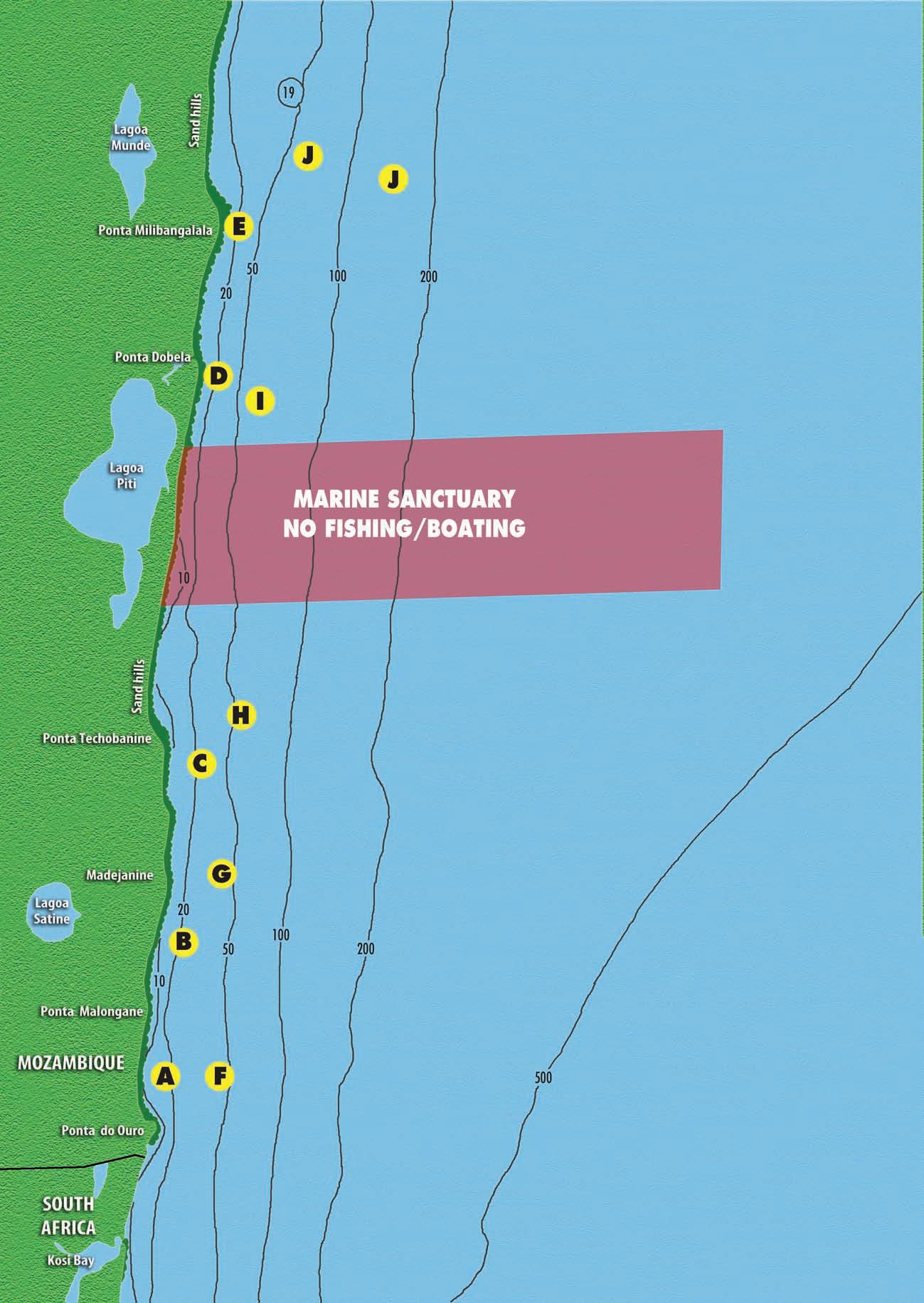
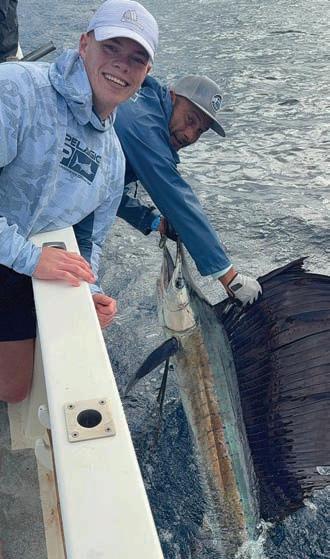
Sailfish are often caught on the deeper reefs along the 50m contour.
MAPKEY:
A: Doodles Reef
B: Texas
C: Techobanine
D: Dobela Point
E: Millibangalala
F: Atlantis Reef
G: Pinnacles Reef
H: Techobanine Deep
I:Dobela Deep
J: Millibangalala Deep
The coordinates for the sanctuary are:-26.66585 to -26.55394 and it extends three nautical miles out to sea. No fishing or boating is permitted within these boundaries.
Fishing and launch permits can be arranged through the local Port Captain’s office in Ponta.Fees depend on the vessel’s size and how many days you intend to fish.Remember,because Ponta falls within a marine reserve,bottom fishing and vertical jigging are not permitted – a crucial rule in protecting this incredible ecosystem.
LAUNCHING
Launching here is relatively straight forward thanks to Ponta’s large bay,but it’s always worth chatting to one of the local skippers before heading out. They’ll gladly share advice on current sandbanks,surf conditions and how to ensure safe launches.Tractors are available for hire,if necessary,to help get your boat in the water.
While Ponta is the main launch site, other spots like Malongane and Techobanine can also be used.They’re
more remote,though,and best suited to smaller boats.
THE FISHING GROUNDS
Fishing around Ponta do Ouro can be challenging at times,but the sheer variety of species makes every trip exciting.After 17 years on these waters,I still find new surprises on the sounder and still have days out there that blow me away.
The reef systems in this area generally run parallel to the coastline,with shallow reefs in 15–22 metres of water offering reliable action.Expect ’cuda (king mackerel),green jobfish and queen mackerel to dominate these waters.The deeper reefs,between 30and 50 metres,open up the playground for yellowfin tuna,dorado,wahoo and even marlin when trolling or throwing top-water lures.
Be mindful of the marine sanctuary
between Techobanine and Dobela which is clearly marked on all charts. The coordinates are:-26.66585 to26.55394 and it extends three nautical miles out to sea.No boating or fishing is allowed within its boundaries,and those heading further north to Dobela or Millibangalala must go around it.
REEF HIGHLIGHTS
Just 800 metres off the beach,Doodles Reef [A] – our house reef – sits in about 16 metres of water.It’s alive with baitfish like maasbanker,mackerel and the occasional red-eye sardine.
In the cooler winter months,it becomes prime territory for king- and queen mackerel,which patrol the area hunting baitfish.I often get one of my crew to throw a stick bait here in the early mornings while we look for baitfish with sabiki jigs.
Running north along the same
Whether you’re looking for GTs, tuna or wahoo, Ponta do Ouro’s waters will deliver.
depth contour brings you to some of the most productive and picturesque reefs in the region – Texas[B], Techobanine[C],Dobela Point[D],and Millibangalala[E].These coral systems light up with colour and life and fish beautifully with livebait,bucktails and drop shot.
They’re prime spots for GTs,various kingfish species,jobfish and ’cuda. When conditions line up,working poppers over these reefs can result in explosive surface strikes from giant trevally,or even spectacular aerial strikes from ’cuda – the kind of heartstopping action every angler dreams about.
DEEPER WATER ADVENTURES
Push further offshore to the 35–50metre line,and the fishing gets wild.These deeper reefs are where tuna,wahoo,dorado,sailfish and even black marlin come into play.
The first of these,Atlantis Reef [F], lies just over a kilometre from the launch site in about 40 metres of water. It’s an incredibly productive system,
holding a mix of pelagic species whether you’re trolling,spinning,or working bucktails.Typical catches include tuna,wahoo,sailfish,amberjack, bluefin trevally and bludger kingfish.
A little further north sits the legendary Pinnacles Reef [G],off Federico Bay – depths here range from 35- to 50 metres.Known worldwide as one of the top ten shark-diving sites,it’s also an angler’s dream,though not without challenges.The “tax man”(sharks) are always ready to claim their share,but the rewards are worth it.For some of the bigger fish,allow them to run while pulling in lines;this gives them a chance to get away from the taxman and gives you a better shot at following and landing your catch.
Pinnacles is home to the famed Golden Shoal – a breathtaking school of more than one thousand giant trevally that migrate through in the summer months.The reef system sprawls across roughly a one-kilometre radius,each pinnacle holding its own mix of species.It’s the kind of place where you can spend an entire day exploring and
never drop a line in the same spot twice.
Further north towards Techobanine Deep [H] and the sanctuary boundary, you’ll find a string of smaller,lesserknown reefs.They don’t get as much pressure and often produce incredible fish when conditions align.Although a bit of a run if one is launching from Ponta,the deeper reefs off Dobela Deep[I] and Millibangalala Deep[J] hold some amazing fish.
These reefs are best fished with live bonnies or frigate tuna,and you can expect to catch a wide variety of pelagics including the reef master himself, the amberjack.Downrig a live bonnie over these reefs and it’s almost a guarantee.
TACKLE SUGGESTIONS
Keeping in mind that the water is crystal clear,it is crucial that you keep things “neat”.By this I mean keeping your ’cudatrace wire down to a number 4 or 5 wire,and not having oversized hooks or large dusters.For best results I sometimes only use a small
glowbead on these traces.
When it comes to bucktails or drop shots,I very seldom use wire on these lures,but that means I do get bitten off at times by ’cuda,so it’s very much “tata ma chance”.Like they say,go light for the bite.
Also try to downscale some of your terminal tackle,like using a power swivel on your trolling lures instead of large snap swivels.At the same time,it’s important to remember that we have a lot of toothy species in these waters,so sometimes it is important to use wire on some of your trolling lures.You don’t want to hook a 30kg wahoo only to have your monofilament bitten through.
SEASONAL HIGHLIGHTS
Each season in Ponta brings its own excitement.Summer (November to March) is all about warm currents and fast-moving pelagics – wahoo,dorado, tuna and sailfish dominate the action, with marlin making regular appearances off the deeper reefs.As winter rolls in,the cooler waters bring an influx of ’cuda and queen mackerel, making the shallower reefs come alive. The winter months are also perfect for light tackle fishing,chasing green jobfish and smaller trevallies in calm,shallow waters.
No matter the season,dawn launches are magical – the horizon glowing
orange over the Indian Ocean,the air still,and that electric anticipation of the first strike of the day.
TACTICS AND TECHNIQUES
Fishing in Ponta is all about reading the water and adapting.Early mornings are often best spent along the 15–18m line, mostly at Doodles,scanning for baitfish and bird activity.Live bait is gold here –a fresh mackerel or maasbanker slowtrolled over a reef edge can be deadly for a wide variety of pelagics.
When the current slows,I often switch to spinning or casting poppers over the reefs.There’s nothing quite like seeing a GT explode through the surface after your lure.Drop shot and bucktail jigging can also produce fantastic results on calmer days,especially for kingfish species and jobfish.
Those who prefer trolling the deeper reefs need to keep an eye on current lines,bird activity and small shifts in water temperature – and must always be on the look out for bonito action.A live bonito is the ultimate weapon in this area,and can make all the difference between a quiet day and a screaming reel.
CONSERVATION MATTERS
Fishing in a marine reserve is a privilege,and with that comes responsibility. Catch-and-release is widely practised here,particularly for billfish and large
GTs.Local charter operators work closely with authorities to uphold sustainable practices,and respecting bag limits and sanctuary zones ensures these waters stay alive for generations to come.Please respect the rules when you come to visit.
FINAL THOUGHTS
Whether you’re after fast-paced pelagic action,the thrill of topwater GT strikes, or simply soaking up the beauty of a coastline that feels wild and untouched, Ponta do Ouro delivers it all.For me, after nearly two decades fishing these waters,there’s still no better feeling than watching the sun rise over the Indian Ocean,throttling up through the surf,and knowing that anything could happen once the lines go in.
At the end of the day,it’s the laughter,the shared stories,and the time on the water with friends and family that capture the real spirit of Ponta do Ouro.Later,you can share stories of the catch of the day or the “giant”that got away,either back at your accommodation or over a meal at Melting Pot while your catch is being cooked.
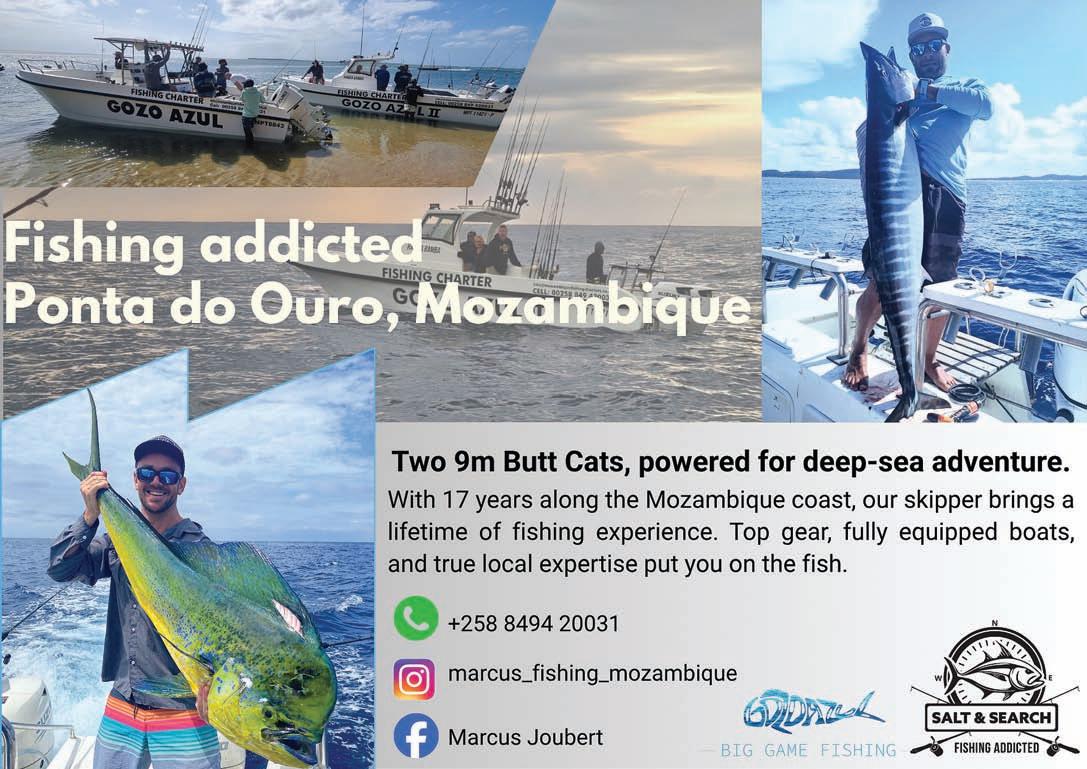
If you find yourself in Ponta do Ouro and want some extra info,feel free to contact me at Gozo Azul and Salt & Search Fishing Charters.We are always happy to share a bit of local knowledge and point visitors in the right direction.
Q: What’s better than a dual frequency fish finder? A: The FURUNO DFF3D multi-beam fish finder.
FURUNO’S DFF3D fish finder is no ordinary fish finder, it takes ski-boat fish finding to the next level.By taking the guess work out of return echoes typically from single-beam,wide-angle transducers,the multi-beam presents targets and seabed definition with pinpoint accuracy and high seabed detail.
HOW DOES IT WORK?
Unlike traditional single-beam sounders that use a single wide beam to cover maximum area under the boat,the DFF3D multi-beam sounder utilises over 40 individual narrow beams arranged into three main beams – port,centre and starboard –that covers an area 120°wide from port to starboard.
That’s a huge area!
Each beam receives signals from a multitude of individual narrow beams for detailed signal processing and presentation. It’s like covering the same area as you would with three boats running in parallel.
FOUR MODES, ONE SOUNDER!
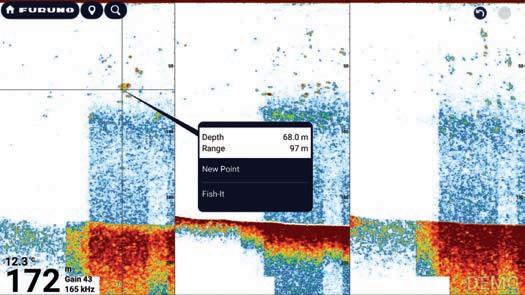
TRIPLE BEAM SOUNDER: This popular display mode is used for bottom or pelagic fishing to compare the three beams –port,centre and starboard – in a traditional fish finder mode. It’s also very useful to run a single beam sounder to pinpoint the exact location of the fish target.
Triple Beam mode marks fish not seen on single beam sounders – port, centre and starboard.
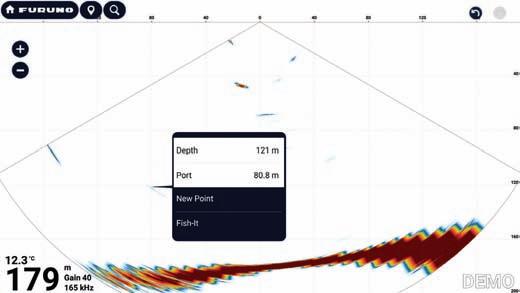
SONAR MODE: The pelagic fish detector. The DFF3D displays a sonar signal akin to a traditional single beam A-Scope,except this is scanning a full 120°under the boat.Set the range to the desired depth of your target species, and see only what you need to see – bait fish and targeted pelagic species.
With a compatible heading sensor connected,by tapping on a fish target way out to port or starboard,the skipper can mark the fish target and the unit will display distance from boat and depth of target.Drop the mark in the exact spot on your plotter and let the Furuno NavPilot 300 take you straight over the mark.
120°A-Scope – Mark the fish and record a waypoint
PERSONAL BATHY GENERATOR (PBG): Never before has this level of owner-recorded data been available to ski-boat owners.For those targeting bottom species and relying on detailed seafloor information,this feature (available on TZT3 and TZTXL) is where the investment pays off,by recording and saving an unlimited amount of your own high-definition seafloor data! Find your own ground and keep it a secret!
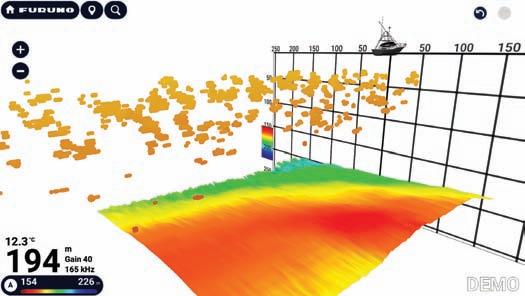
SOUNDER HISTORY: The 3D Sounder History shows the seafloor in a traditional 3D presentation,complete with depth shading and fish targets.This is a very useful display for targeting bottom species as you cover a lot more ground as opposed to single beam sounders.Seeing reef build up,drop offs and gullies in detail is the ultimate bottom fishing tool.
Sounder history mode – see fish targets and seafloor in relation to boat position
SIDE SCAN: Furuno’s DFF3D has a built-in side scan feature,or clients can choose the latest CHIRP side scan transducers that plug directly into the TZTXL MFD side scan transducer port. Designed for saltwater fishing,with increased range and target definition,Furuno’s side scan transducers are next level!
The DFF3D sounder module interfaces to Furuno’s NavNet TZT series Multi-Function Displays (MFD plotters) or TimeZero software.
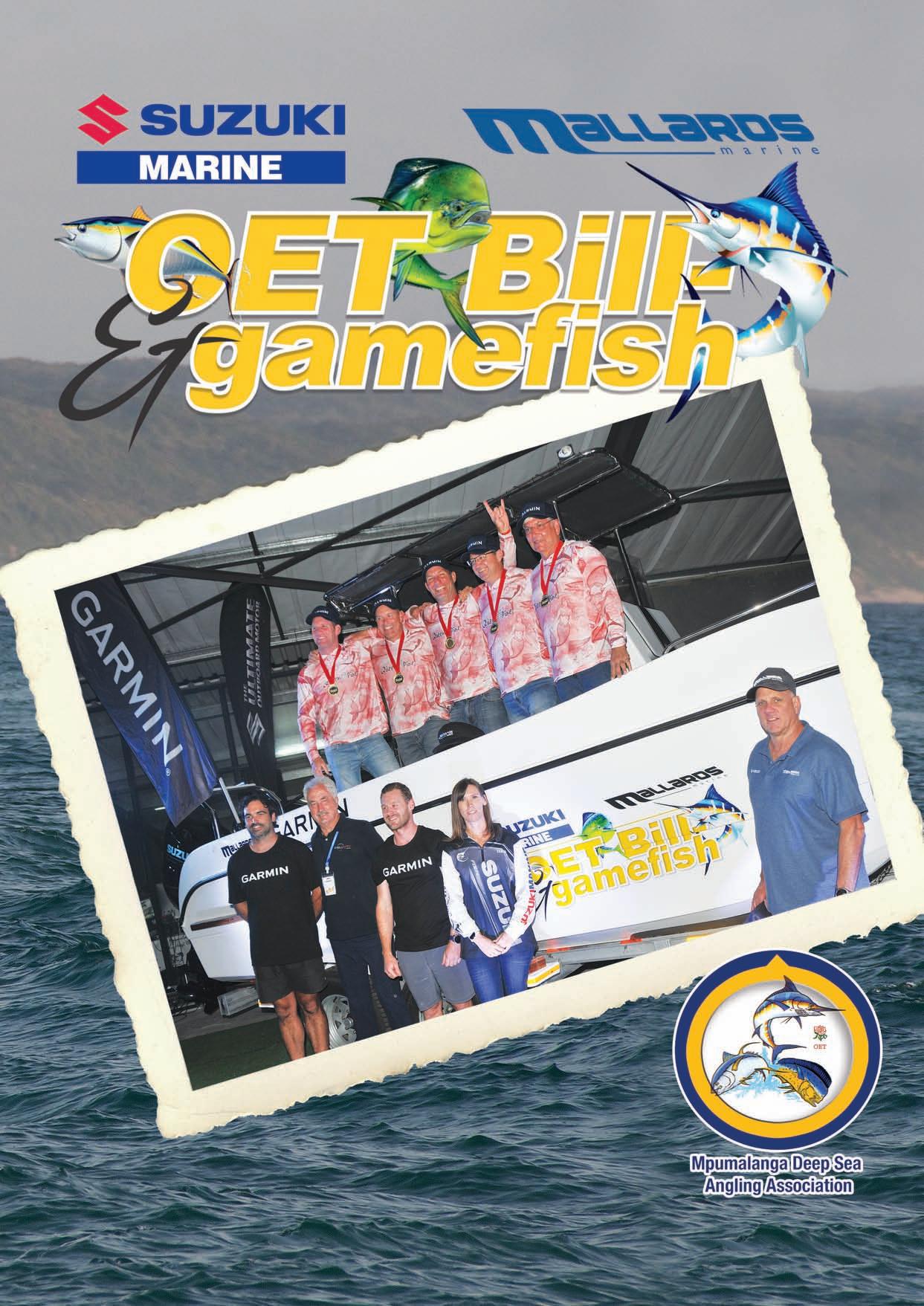
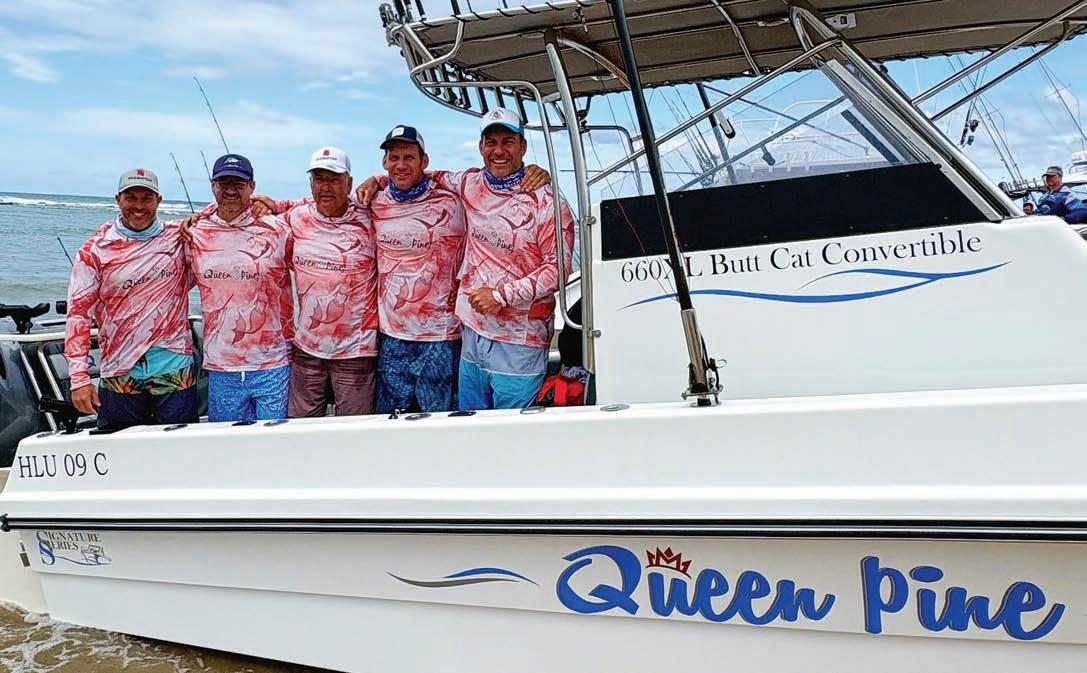
Team Queen Pine celebrates their win at the 2025 OET Bill- & Gamefish Tournament.
By Bryan Jooste
THE 2025 OET Bill- and Gamefish Tournament,held from 3 to 7 November at the iconic Sodwana Bay,once again proved why it remains South Africa’s premier deep sea angling event.It is one of the very few tournaments in the country where anglers can compete in both the 10kg and 37kg line classes,targeting gamefish and billfish in a single, world-class competition.
This year also marked a major turning point for the OET.After an incredible 35-year partnership,Mercury/ Rutherford Marine concluded their sponsorship at the end of 2024.
The OET management committee extends our sincere appreciation for their loyal support over more than three decades.Tournaments of this magnitude simply do not exist without committed long-term partners such as Mercury.
With that chapter closed,a new era began.Suzuki Marine stepped confidently into the role of main sponsor for 2025,bringing fresh ideas,renewed
commitment,and a shared vision for elevating the OET to even greater heights.
Mallards Marine and Garmin Marine both increased their support for the new season,culminating in a first prize that was nothing short of spectacular.A custom-built Mallards Ultra 630 Centre Console on a trailer,powered by twin Suzuki 115hp four-stroke motors and fitted with a twelve-inch Garmin GPS combo and a full Garmin Fusion sound system,stood proudly on display.
The combined craftsmanship and technology from Suzuki Marine, Mallards Marine and Garmin Marine resulted in a prize vessel valued at just over R1.1million.
The Sodwana Ski-Boat Club Hall was transformed into a bustling hub throughout the week,filled with sponsor displays,new product showcases, and exclusive OET specials.
Anglers preparing for their days at sea could choose lures from Tropical Dream Tackle,Bite Me Lures,Pulsator Lures,Africa Lures,and Iland Lures.Na Na’s Tackle and Beach and Beyond offered a wide range of tackle,while Xeroderm provided sunscreen for all
the competitors and sponsored a branded tumbler for each of the 500 anglers and sponsors to enjoy a cold one at the fully stocked OET bar.
Tops Mbazwana supplied stock to the OET bar,Columbia Clothing showcased a selection of high-end apparel, Runva Winches brought serious pulling power,Bush Trackers displayed their over landing vehicles,and Giga Bite Charters made the long journey from Angola to promote their operation.
Garmin exhibited their latest technology with expert advice on hand, Airmar demonstrated their transducer range,Cross Country launched a fundraising initiative for CANSA,and local Sodwana charter operators like Certainty Charters,Oom C-Breeze Charters and Skyler Blue Charters contributed generously with sponsored charter prizes.
Each sponsor played a vital role in delivering the signature OET experience.
On the beach,the OET Beach control team delivered a master class in precision and organisation.From 4am to 5pm,they ensured a smooth and safe launch rhythm by limiting the surf zone
to two boats at a time.Afternoon beaching was expertly coordinated by Melissa du Plessis,who maintained clear communication with her team to guide each vessel safely in and out.
Louis,operating the John Deere tractor sponsored by Afgri Equipment like an experienced Karoo farmer,handled all the morning launches and afternoon recoveries with ease.
Thanks to the skippers’professionalism and the tireless efforts of the beach control team,the tournament recorded zero safety incidents.It’s clear that the OET skippers have an incredibly high level of experience and expertise.
Fishing conditions were exceptional this year.King Neptune delivered four full days of productive angling,with only Wednesday’s fishing called off due to bad weather.Anglers welcomed the rest day before pushing through to the final stretch.
Billfish activity was superb,with 21 sailfish,6 black marlin,14 blue marlin, and 2 striped marlin released.A total of 43 billfish were safely released,reinforcing the OET’s pride in conservation and responsible angling practices.
Every angler who contributed to
this flawless release record deserves high praise.
Gamefish were equally plentiful, with 1301kg weighed over the four fishing days.Some of the standout catches included a 24.4kg dorado by Riaan Botha on Certainty,a 13kg king mackerel caught by Stefan van den Berg on Two’s Up,a 6kg kawa-kawa caught by Rhyno Stander on Against All Odds, an 18.8kg wahoo caught by Flippie Nortje on Jollie Boys ,and a beautiful 35.1kg yellowfin tuna caught by Theuns Theunissen on Tropical Dream
For the first time in OET history, lines were tested for both 10kg and 37kg classes during weigh-ins.This new practice caught a few anglers off guard with overly long leaders or line breaking above the rating.Nonetheless,the overwhelming majority of anglers were fully prepared and compliant with IGFA regulations.
The highly coveted OET Grand Slam was once again in play,offering a brand new Ford Ranger Raptor valued at R1.3million to the first team to release all five qualifying billfish species (black marlin,blue marlin,sailfish,shortbill spearfish and striped marlin) Although
no team achieved the slam this year,the excitement around the challenge continues to grow,and will certainly return with momentum in 2026.
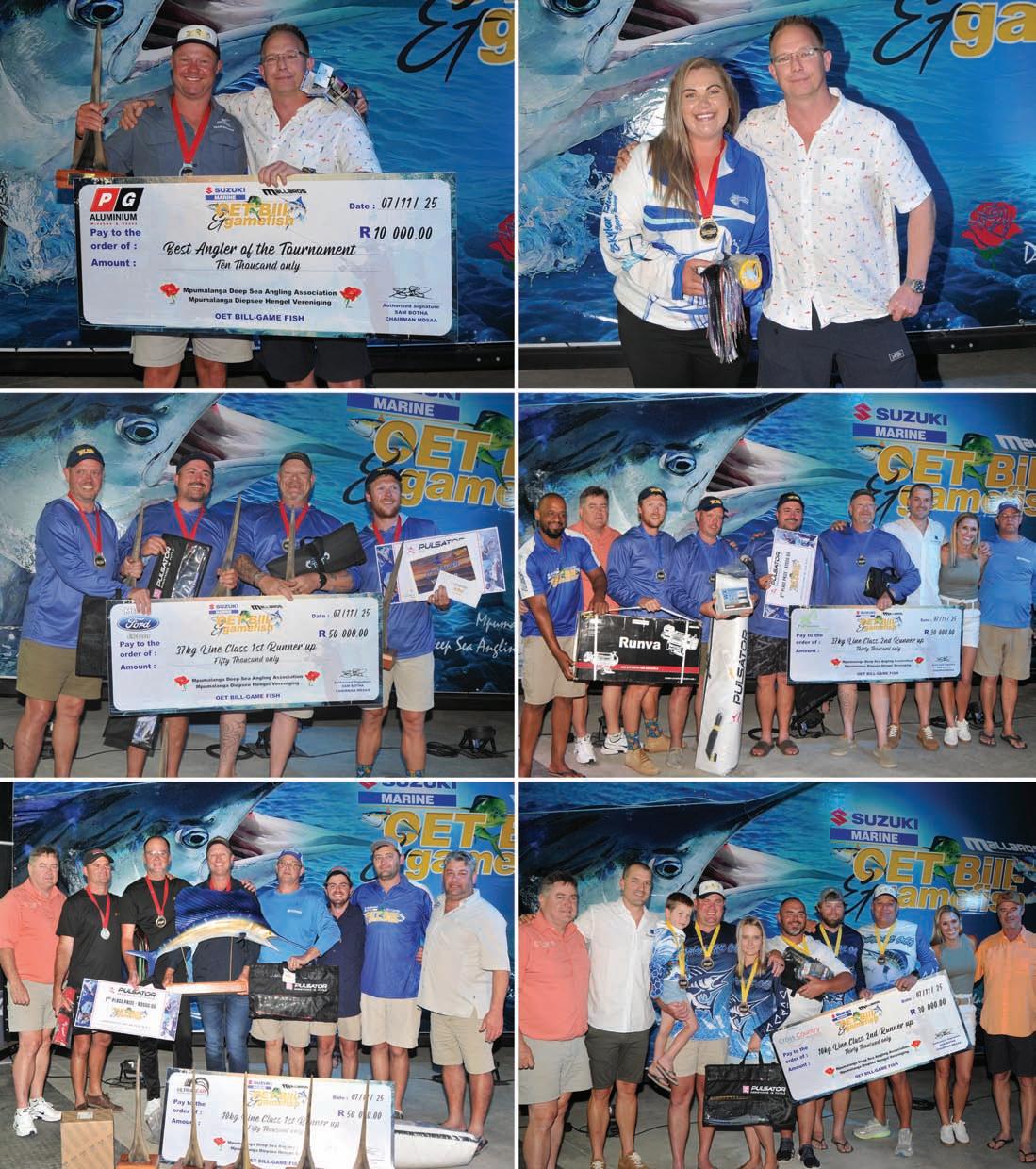
Competition between the line classes was fierce,with the 10kg and 37kg categories running neck and neck throughout the week.In one of the most memorable outcomes in recent years,a 10kg team ultimately outperformed the heavy-tackle competitors. The anglers on Queen Pine delivered an exceptional performance to secure the first prize boat and more than R400000 from the tournament boat auction.Their victory crowned them the undisputed kings of the 2025 Suzuki Mallards OET Bill- & Gamefish Tournament.
First runners up were Jasper in the 37kg class and Dr Sangoma in the 10kg class,each taking home prizes and cash valued at R240000.Second runners up were Against All Odds in the 10kg class and Bakari in the 37kg class.Third runners up were Jolly Boys in the 10kg class and Top Shot in the 37kg class. Individual honours went to Ilze Myburg as Best Lady Angler,Kim Burnie as Best Angler,and Tropical Dream claimed
WITH THANKSFOR SPONSORSHIP
First
Second runner up, 37kg:
Second runner up, 10kg: Against All Odds
the Calcutta prize with their 35.1kg yellowfin tuna.
Planning for the 2026 OET is already underway,with expectations set for an even bigger event featuring more prizes and greater engagement, and the same camaraderie and competitive spirit that has defined the OET for 47 years.
To all the anglers,skippers, sponsors,and personnel,thank you for making the 2025 OET a resounding success.You remain the backbone of this iconic
TOPTENBOATS
1. Queen Pine
points 2. Jasper
3. Dr. Sangoma
4. Against All Odds
points
points
tournament and the true heroes of deep sea angling at Sodwana Bay.
points
points 5. Bakari
Top Shot
Jolly Boys
Odyssey
Brothers
Rumpala
points
points
points
points
points
We wish you all a blessed festive season with family and friends,and bags filled to the brim with love and generosity. Don’t forget to get your lines in the ocean.We look forward to welcoming everyone to the 2026 Suzuki Mallards Garmin OET Bill- and Gamefish Tournament,proudly hosted by the Mpumalanga Deep Sea Angling Association.
Top lady angler: Ilze Myburg
Bakari
Top angler: Kim Burnie
First runner up, 37kg: Jasper
runner up, 10kg: Dr Sangoma
DRESS LIKE QUEENS, FISH LIKE KINGS
Tales of triumph from the 2025 OET winners
By Brett Bartho
OUR journey to the OET Billand Gamefish Tournament 2025 was an interesting one to say the least. Queen Pine, a team that is well known in gamefishing circles and which has experienced great success in Mozambican waters, had to look for new waters to fish and new comps where they could test their mettle against other anglers looking to take the top spot on the podium.After chatting to Grant Campbell,skipper of DrSangoma,my brother Daryl suggested we look at doing the OET.
Fast forward to August 2025 when our wives – Danica Bartho,Kaylee Bartho and Phillipa Rautenbach – managed to walk away with top spot at the hugely successful and entertaining Queens of the Oceans ladies fishing tournament held at St Lucia.One of their prizes was a free entry for the team into the OET.However,none of our wives could fathom sitting on a boat for five long,tiring days,so they suggested we men take up their entry.
Daryl contacted Dwayne Viviers of the OET organising committee,and they kindly agreed to us taking over our wives’entries,on one condition:we fish in pink seeing as we were representing the Queens of the Oceans competition! Velia Tonkin hastily rallied up some pink Fafsters (Speedoes) for the team, and Wilana Oosthuizen from Ratel
Clothing was able to get us some pink shirts together that read,“Dressed like queens,fish like kings”! We were ready to represent the ladies!
A SMALLISH BOAT, A BIG DREAM
Our Butt Cat 660XL Gamefisher with twin 130hp motors certainly isn’t a small boat,but she seemed quite inadequate alongside the fleet of large,purpose-built billfishing vessels that belong to the heavy hitters who base themselves at Sodwana Bay,South Africa’s marlin Mecca.
Queen Pine is kitted out purely for gamefishing and jigging,nowhere near the outfitted beasts we were competing against.Some of the other boats boasted towering outriggers,electric teasers and dredges,cavernous cockpits,and tackle lockers that looked like miniature tackle shops.It truly is a magnificent sight seeing these enormous and beautiful rigs lined up on the beach at Jesser Point awaiting their launching orders.
Thankfully for Queen Pine ,Greg Hogarth from Shag Stix came to the rescue and helped us set up our carbon outriggers the Sunday before the competition commenced.Matt Swemmer from Pulsator Lures also kindly gave us great insight into what lures we should look at pulling in different positions amongst our spread,and even loaned us his son Jaxon’s teaser bar.
Suddenly our team with modest
gear,better known for its gamefishing skills,started to feel that we stood a chance against the marlyn-manne. Instead of trying to fight fire with fire,our team – Casper Badenhorst, Brett and Daryl Bartho,Roscoe Rautenbach and Brad Arthur – made a decision to stick with what we know: fish the 10kg line class,understanding that the format of this competition could play into our hands and put us in the running if we could accumulate extra points for gamefish with the everpresent opportunity of getting a strike or two from sailfish or even a small marlin.
SOLIDSTART
Day One dawned a beautiful,calm fishing day with settled seas.The radio sprang to life early on with hookups from the tournament’s heavyweights, with some boats even boasting two marlin releases for the day and putting them into the lead.
Our strategy – to stick to targeting gamefish and working a specific area –went according to plan,and we were able to weigh our full quota of ten gamefish per boat for the day,keeping us around 13th position,273 points behind the leaders.
Day Two for us started with Brad catching a decent wahoo,which lifted our spirits.We followed this up with a few double ups on yellowfin tuna and then the Hong Kong reel erupted in a
glorious symphony as our long-awaited sailie danced off into the distance!
With10kg nylon,the fight was electric and fragile;too much drag and we could see disaster,too little and the resulting slack would see the fish swim free.Twenty anxious minutes later,I managed to coax the fish close enough for Roscoe to reach out and grab the bill.Pure joy and relief right there – and good points as well!
The day got called off a couple of hours early due to the deteriorating seaand weather conditions,but we arrived at the weigh-in with a decent bag of gamefish for the day and the sailfish release.We suddenly found ourselves sitting at the top of the leaderboard by a narrow margin of 27,2 points.
THE WINDS SHIFT AND THE HUNTER BECOMES THE HUNTED
Day Three saw the wind swing to a buster south westerly,and the committee called a blow out for the day.We took the time off to rig more lures and tie new leaders,while Daryl rigged up some more tasty stripbaits and halfbeaks.
We know all too well that a competition is never over until it is OVER,but it’s a great feeling to be sitting pretty at the top of the leaderboard when the weather is looking suspect.Needless to say,sleep patterns were disrupted with various scenarios being played out in our minds all night long.
NERVES LIKE FRAYED LEADERS
The final 48 hours became a test of psychological endurance.There was nothing we could do but focus on what we were capable of and hope that Neptune provided what we were praying for.
Day Four dawned with dark skies and an unsettled sea.We all knew that was going to make the billfishing side of things a lot harder and slower.Our team continued to work the same area we had concentrated our efforts on in the first two days of fishing,but found the bite to be agonisingly slow.
The radio chatter seemed to echo the bite,with scattered reports of hook ups and marlin being lost whilst the odd sailfish was being released. Thankfully we managed to find some bites and landed a decent dorado and a few yellowfin tuna,and so we kept our scoreboard ticking.We anxiously sat waiting at the weigh in to see what the other teams had produced.Thankfully, by the end of it we were 109,6 points clear of Jasper in second place.
Day Five brought the final countdown.Eight hours of fishing lay between us and the chance to stand on the top step of the podium to claim a beautiful Mallards Marine Ultra 630, powered by two 115hp Suzuki 4-stroke outboards,and fitted with Garmin electronics and sound system.
The sea was wild and squalls whipped through every hour or so as torrential rain pelted down,yet our crew stayed focussed,keeping a watchful eye on our spread.We got on the board early with a nice sized dorado that ate the stripbait on an iLander lure in the Hong Kong.It wasn’t quite enough to settle the nerves though! We then endured a couple hours of no bites,followed by two lost fish one after the other as the leader parted on a good dorado,and then the mainline snapped on another strong fish.
Was victory slipping away from us?
Then,all of a sudden things changed as I turned around from suggesting to Daryl that he try a specific ledge where Pete Jacobs said he often got wahoo.A beautifully lit up wahoo launched out of the water,smashing the strip bait in the starboard rigger about two metres in the air,but not hooking up. Thankfully,he must’ve landed and seen the bibbed lure right in front of him, and Brad was tight.
After a nailbiting tussle,with us constantly thinking about the mono leader that stood between us landing this wahoo and his sharp set of dentures that would slice through it faster than a hot knife through butter,we had the
fish on board!
There was much debate over what we should do next,then Oom Cassie said he had a good feeling about going out to the 100m line and looking for some more tuna.Just like that,we found ourselves into a double-up on yellowfin tuna,followed by a nice fat bonnie.
We didn’t know whether we were still leading by a hair or if one of the trailing boats had managed to do enough with their released billfish and gamefish catches to pip us to the post.
What we did know,though,was that we had fished our hearts out and tried our absolute best,as we always do.We had come up with a well thought-out game plan and managed to execute it almost to perfection,especially considering the conditions.We had come in as underdogs or unknowns to the bulk of the billfishing fleet at the start of the week,but at the prizegiving that night we stood up as a proud team,brought together by friendship and a love for fishing and competing against the best.
I would just like to thank the organisers,Mpumalanga Deep Sea Angling Association,for all their planning and hard work in making this such a well run and prestigious event.Our appreciation also goes to all the generous sponsors who put up such amazing prizes, and of course to all our fellow anglers who made it such a memorable week both on and off the water.
Lastly,from myself,Daryl,Brad and Roscoe,a huge thank you to our biggest supporter,teammate,captain and inspiration.Oom Cassie,you are an absolute legend! A true gentleman and father figure who knows how to bring out the best in people.A MASSIVE thank you also to our ground crew.Tannie Marlien, your unbelievable cooking kept us well fed and fuelled for the week,and made those quiet,anxious moments staring at the rods waiting for a bite go by a little quicker and easier.
See you all next year at Sodwana for the 48th OET Bill- and Gamefish Tournament!
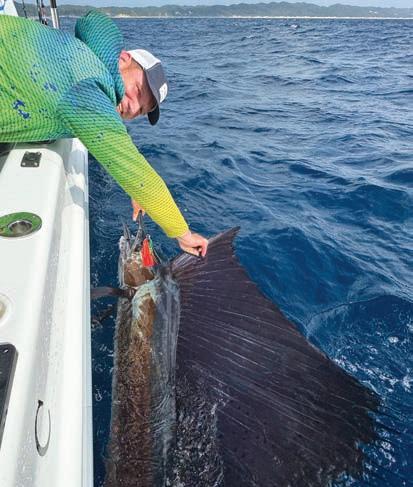
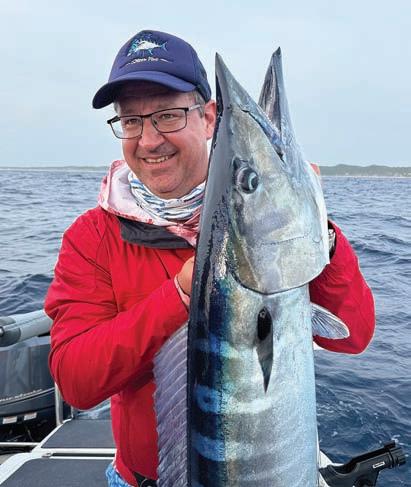
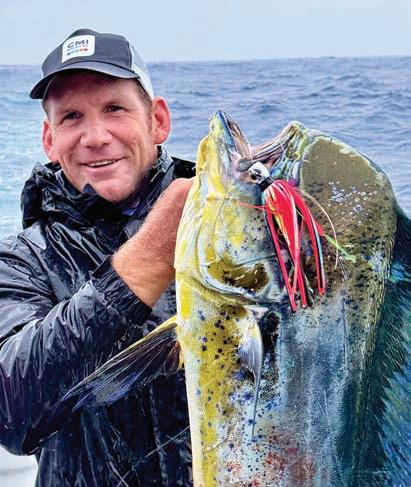
Brett Bartho’s sailfish, Brad Arthur’s wahoo and Brett’s dorado helped Queen Pine take top spot at the 2025 OET.
The sport,the people,and the coastline that shapes them
COMPETITIVE anglers in South Africa are a rare breed.They chase fish in seas that shift mood without warning.They give up weekends,holidays and family time for early launches and long hours on a rolling deck.They know the feeling of triumph when a plan works,and the sting when it does not.Many people see the photos of smiling teams on the podium,but those images hide a far bigger story.That story starts before first light,long before the horn sounds,long before crews even step on board.It is a story built on discipline,rivalry,cooperation,tradition and a coastline that rewards those who respect it.
South Africa hosts one of the most active and competitive offshore angling communities in the world,with a proud history that reaches back more than half a century.The scene has grown into a structured system of provincial unions,carefully regulated tournaments and a national body that oversees standards and development.Behind that structure are thousands of anglers who treat the ocean as their training ground. They approach the sport with the seriousness that marathon runners,cyclists and paddlers apply to their disciplines.
The backbone of the sport is preparation.Every competitive angler can tell you that luck plays a part,but it never drives results.Preparation keeps boats safe,crews efficient and teams focused when fish refuse to play along.
Anton
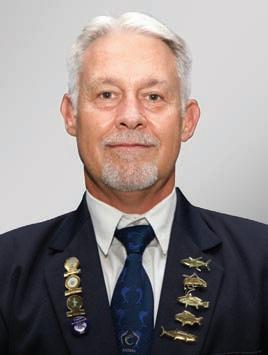
van den Berg SADSAAActing President
Many crews spend entire weeks before an event working through their tackle.Lines get replaced.Hooks get sharpened.Traces get rechecked. Leaders get rebuilt.Radios and GPS units get tested.Even the fuel filters get inspected.
There is a reason for this level of detail:once a boat leaves the launch site there is no room for hesitation.A failed knot,a frayed trace or a sticky drag can cost a day.In a tight event,that one mistake can shift a team from the podium to the middle of the table.
Anglers prepare mentally too.Good crews spend time talking through strategies.They plan how to work tem-
perature lines,bait concentrations and current edges.They think through what they will do if conditions shift.They consider backup plans when the primary strategy fails.
This approach might sound intense, but competitive angling rewards people who stay flexible.A team might launch into calm seas at dawn,then watch the conditions change by mid morning. They might expect dorado on a current line,only to find that the water has gone green and cold.When that happens,the crews that adapt quickly turn blank days into scoring days.
The competitive scene in South Africa is far more than a handful of big tournaments.It is a layered system that allows anglers to grow through club competitions,provincial championships and national events that test the limits of skill and stamina.
Each layer has its own flavour.Club competitions often feel lighthearted,yet they still sharpen skills.Provincial events push anglers harder.They stretch across long days and cover wide offshore grounds.These tournaments demand a balance between aggression and patience.National events bring another level of intensity.Here you find the best teams from each province, with a mix of experience that creates a unique energy on the water.Some anglers have been competing for thirty years,while others arrive as new talents who want to prove they belong.
The SADSAA structure supports this progression.It ensures that rules remain standard.It keeps scoring fair.It encourages conservation practices and responsible release protocols.
Many people outside the sport do not realise how strict the ethics have become.Competitive anglers in South Africa treat billfish with high regard. Most events now use release-only scoring systems for marlin,sailfish and spearfish.Crews follow clear procedures to revive fish,remove hooks when safe,and ensure clean releases. This shift toward conservation has changed the sport for the better.It protects stocks,improves fish welfare and keeps tournaments aligned with the global trend that rewards ethical angling over pure numbers.
Competitive angling does not thrive on rules alone,however.It relies on people.South Africa has produced a long list of exceptional anglers.Some of them continue to compete,while others focus on mentoring the next generation.You will often find a mix of ages on boats.Young anglers,sometimes in their teens,stand beside old hands who have logged thousands of hours at sea.This combination creates a powerful learning environment.The young anglers bring energy and speed, while the veterans bring calm decision making when pressure climbs.Both sides need each other,and both benefit from the partnership.
Many top anglers describe the ocean as the best coach imaginable.It forces you to learn quickly.It punishes shortcuts.It rewards people who pay attention to changes in wind,current, swell and bird life.Tracking bird movement can make or break a day. Watching how bait shifts on the sounder provides clues that anglers must decode in real time.A temperature change of only half a degree might hold the difference between a dead zone and a productive line.These details matter because offshore fishing is a constant negotiation between instinct and information.
The competitive scene also thrives
because of the variety of fisheries found along the South African coastline.Few countries offer the same mix of species,water conditions and seasonal patterns.
The east coast delivers warm currents,fast moving pelagics and reliable billfish seasons.Anglers in KwaZuluNatal work with high bait concentrations,intense current lines and the kind of blue water that attracts marlin and sailfish.Move down to the Wild Coast of the Eastern Cape and you find unpredictable seas that demand serious seamanship.Travel further west and you reach colder systems where tuna dominate during parts of the year. Each region produces anglers with different strengths;when they meet at national tournaments,the blend of tactics makes for lively competition.
The western and southern regions add another layer to the sport. Yellowfin tuna,longfin tuna and yellowtail challenge anglers with power and endurance.Fighting a big tuna tests both gear and patience,and these fish will punish poor preparation.A trace that is slightly under strength or a drag that is not set correctly can fail under the load of a long tuna run. Crews who specialise in tuna fishing carry that toughness into billfish events.Many of them are unfazed by long fights or slow days because they are used to adapting to wide open ocean conditions.
Competitive angling in South Africa is not only about results either.The culture around the sport is just as important.Each tournament brings familiar faces who greet each other with genuine respect.There is rivalry at sea,but there is strong camaraderie back at the scales or the club house.Teams share stories,compare strategies and laugh about the mistakes that every angler makes at some point.Many friendships in this community stretch across decades.Young anglers often grow up watching their parents compete,then take their place at the helm or in the fighting chair as soon as they are ready.
The role of clubs and provincial
bodies cannot be overstated.They keep the sport organised and fair.They host training sessions,run safety workshops and ensure that boats entering competitions meet strict safety requirements.This is vital because South African seas can turn rough with little warning.Competitive anglers face long runs offshore,sometimes in conditions that require experience and confidence to navigate safely,so there’s no room for shortcuts.The strong safety culture in the sport is built on checklists,inspections and mutual responsibility among crews.
International representation at world championships and invitational tournaments across the globe remains a highlight for many South African anglers.These events often expose anglers to completely different styles of fishing.Tropical Pacific waters behave differently from the Indian Ocean,while the Atlantic brings its own challenges.Some systems have aggressive bait balls,while others rely on teasers and dredges to raise fish. South Africans adapt quickly because they arrive prepared.They study local behaviours,listen to international skippers,and work together to absorb new methods.Many return home with stronger techniques that then influence the local scene.
Travelling to these events also deepens respect for the quality of South African anglers.Many international crews comment on how calm and collected South Africans remain during pressure moments.This composure does not happen by accident;it comes from years of training in local tournaments where conditions shift within hours.It comes from early exposure to strong winds,tight deadlines and unpredictable fish behaviour. This toughness gives South Africans an edge on the world stage.
Another factor that sets South African anglers apart is their approach to gear.They push their equipment hard,but they also understand it deeply.Crews know how to service drags,set hook angles,adjust traces or
spool reels correctly.Many of the top teams service their own gear between tournaments.Some even build their own traces to exact specifications.
These habits build confidence. When a marlin lights up behind a teaser or a tuna dives hard under the boat, the crew trusts their equipment.Trust creates calm,and calm creates better decisions.
The development of our junior and ladies divisions has further strengthened the sport.Young anglers now receive coaching that many of our older anglers never had.Their skills grow quickly,and they enter the senior ranks with a level of polish that used to take years to develop.Ladies’ teams continue to grow in number and standard,and they compete with the same intensity and skill as any other division.Many ladies’teams now place regularly at provincial and national levels,a sign that the sport is moving in a healthy direction.
One of the most important changes in recent years is the rise of the release culture which I mentioned earlier.
Many anglers who fished decades ago will recall billfish being weighed all the time.Modern tournaments now reward safe releases instead.Teams capture video evidence,follow clear scoring rules,and prioritise fish safety. This shift has helped rebuild stocks in some areas.It has also encouraged a mindset that views the ocean as a shared resource.Competitive anglers now carry the responsibility of setting an example for recreational anglers who watch their practices.
The future of competitive angling in South Africa looks promising.The younger generation is enthusiastic and well trained,clubs continue to invest in development,and technology keeps advancing.
Modern fish finders can separate layers of bait with surprising precision,new lines and leader materials improve landing rates,and GPS systems allow teams to return to produc-
tive marks with exact accuracy.
Yet for all this technology,the heart of the sport remains unchanged. It is still about reading the water.It is still about teamwork.It is still about the thrill that hits when a fish piles onto a lure or when a rigger clip snaps free.
The waters off our coastline shape the anglers who fish it.South African seas offers calm days that feel like a gift,and hard days that test character. The anglers who stay in the sport learn to respect both.They learn that not every day brings action.They learn that patience matters as much as aggression.They learn that decisions made in quiet moments often shape the final results.
The sport also gives something back to the people who commit to it. Competitive angling builds resilience. It teaches problem solving.It strengthens friendships.It forges bonds between crew members who have shared long,tired hours with salt on their faces and sunburn on their necks.Many anglers describe their teams as extended family.They trust each other at sea,and that trust carries into their lives on land.
There is something special about standing on the deck at dawn while the harbour lights fade behind you. The engines hum.The swell lifts the bow.You look around and see crews running their final checks.Some tie a last knot.Some test the drag on a reel. Some say nothing and focus.
That atmosphere captures everything that makes the sport meaningful.It is calm and tense at the same time.It is quiet but full of expectation. Every angler knows that the next few hours can bring anything.You might find the fish of a lifetime.You might battle for hours.You might grind through a slow day that demands patience.
Competitive anglers in South Africa keep pushing the sport forward because they care deeply about it. They protect it.They build it.They
argue about methods and debate tactics,but they share the same passion. They feel the same pull every time the ocean calls them back.
This sport built on history and tradition has found new life in modern times.It remains grounded in respect for the ocean and admiration for the fish that make it all possible.It is a sport that teaches humility every time the sea reminds you who is in charge. It is a sport that rewards courage and careful preparation.Above all,it is a sport that unites people.Whether they fish from Richards Bay,Durban, Sodwana,East London,Struisbaai, Cape Town or the small clubs scattered along the coast,they all carry the same fire.
Competitive angling in South Africa deserves its reputation as having one of the most committed and skilled communities in the world.The anglers who line up at the start of each season do more than compete. They build a legacy for the next generation.They set standards that young anglers will follow.They treat the sport with the seriousness it deserves, and they relish it with the joy that brought them into it in the first place.
If you spend time at these events, you feel the energy.You hear the stories of fish that escaped,fish that changed careers,and fish that shaped entire seasons.You see teams who win with grace and teams who lose with honesty.You notice how hard they work and how much pride they carry for their clubs and provinces. This community keeps growing because the sport keeps giving people something to believe in.
Competitive angling in South Africa has earned its place on the world stage.It stands firm because of the people who give everything to it. Their passion turns the long days, early mornings and hard lessons into something meaningful.
The ocean will always test them, but that is exactly why they keep showing up.
Deep sea applications for trolling motors
By Peter Jacobs
SALTWATER trolling motors have long been staples on inshore- and freshwater boats,but recent technological advancements are now making them increasingly popular in the ski-boating market in South Africa in particular.
As Brett Bartho shared in the previous issue of SKI-BOAT, these motors are revolutionising the way serious anglers approach offshore fishing,offering unmatched boat control, precision and stealth in open water.
Whether you’re targeting pelagics on bait and artificials or deep dropping for reef species,saltwater trolling motors can give you the edge over traditional trolling and anchoring methods.
WHAT IS A SALTWATER TROLLING MOTOR?
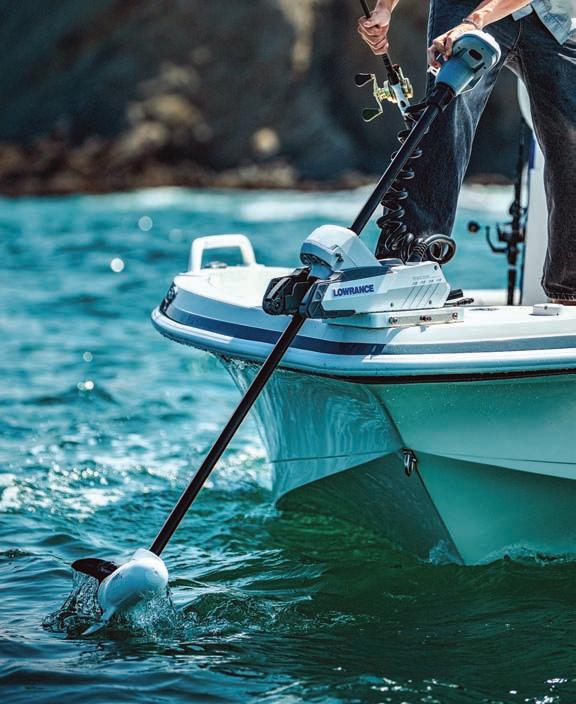
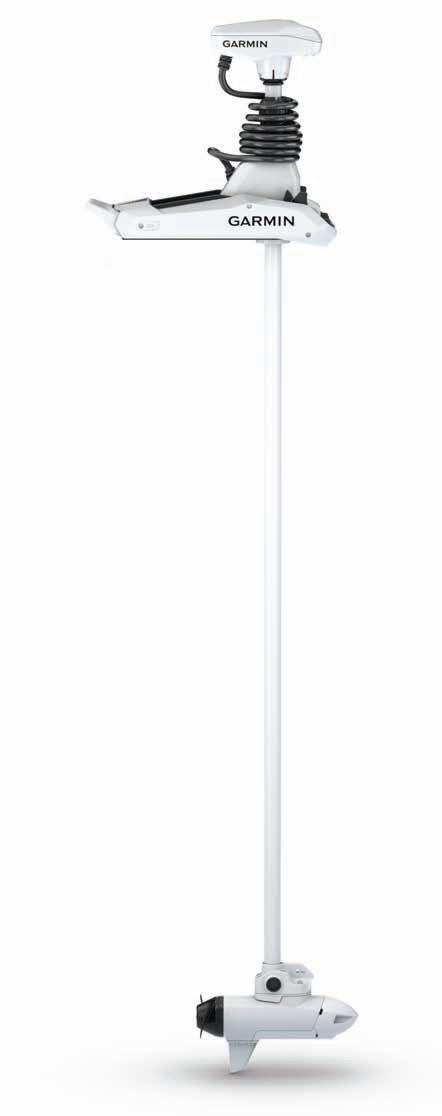
A trolling motor is an electrically powered motor mounted to the bow of a boat.Designed for precise,quiet manoeuvring at lower speeds,these motors differ from primary outboards, which are used for travel and speed.Saltwater variants are specially engineered with corrosion-resistant materials – such as stainless steel components,sealed electronics,longer and stronger shafts – to withstand the harsh marine environment.
WHY GO ELECTRIC?
You might associate trolling motors with small flats skiffs or bass boats,but the leap to offshore applications is no accident.Here’s why offshore anglers are embracing them:
Anchor lock and GPS-based anchoring
This feature,commonly known as “spot lock”,allows a boat to hold its position with pinpoint accuracy using satellite positioning technology.On a reef or wreck,it can eliminate the need for traditional anchoring which risks damaging sensitive habitats and takes time to set and retrieve.
With a tap of a button on a remote control or compatible chartplotter,the trolling motor can hold your position indefinitely,adjusting for wind,waves,and current – as long as it has sufficient power,of course.
Precision positioning and manoeuvring
Whether you’re slow-trolling live bait for’cuda or garrick,or positioning over a school of geelbek,a trolling motor allows you to make small adjustments to your speed and position which are often not possible with an outboard motor.
This level of control is especially beneficial when fishing near structure,or where direction and speed of drift and the
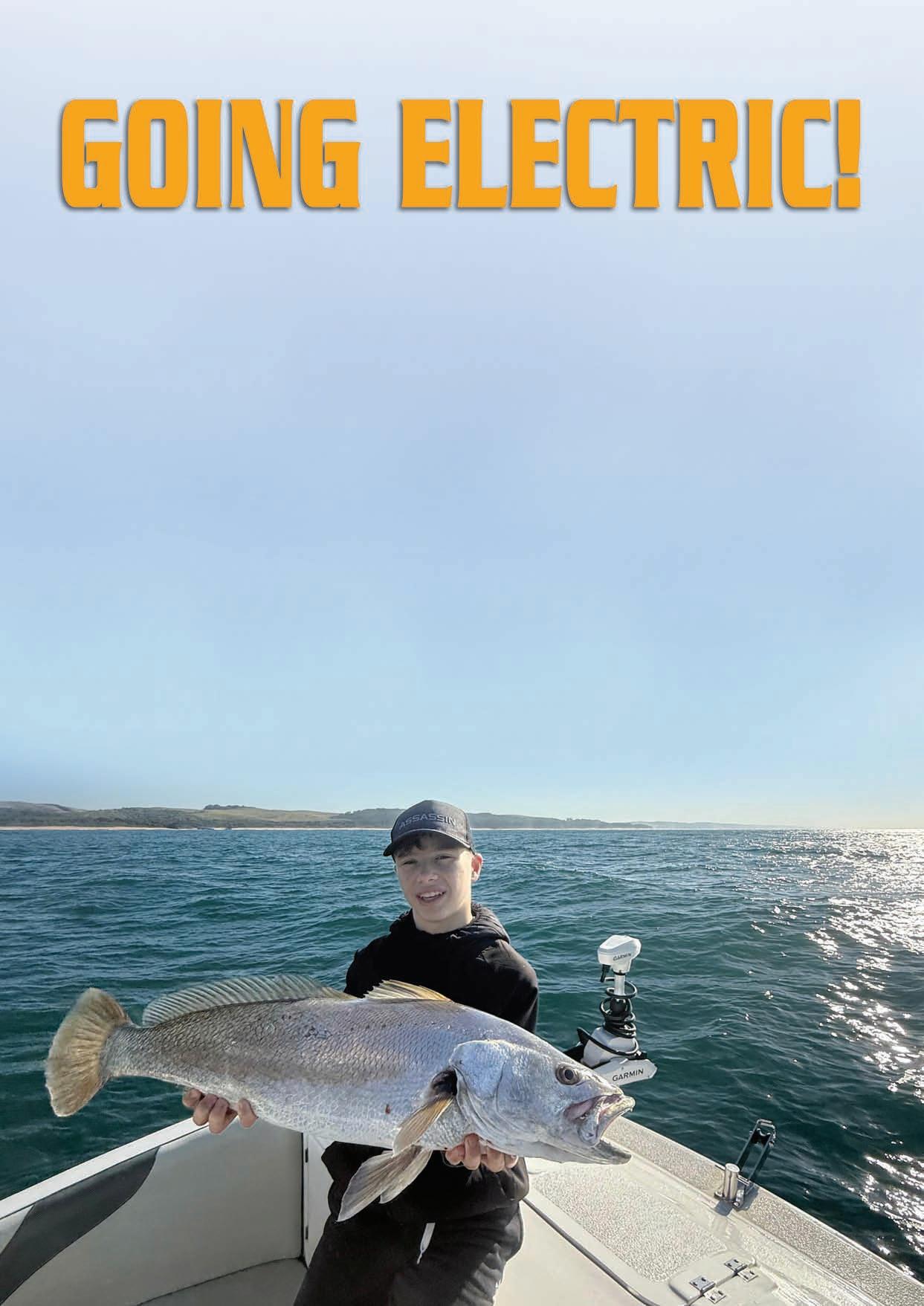
Kyle Bennet with a decent daga caught off Tinley Manor on the KwaZulu-Natal north coast.
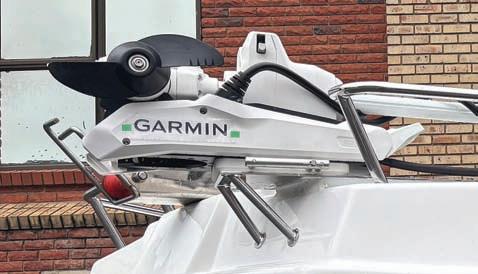
Peter Jacobs shows how trolling motors can be installed on a wide variety of craft, from monohulls like the C Ski 444 (below) to bigger catamarans like the Butt Cat 660 (above) thanks to well-considered mounting locations and carefully designed base plates.
presence of noise can mean the difference between getting the bite or coming home with a clean fish hatch.
Quiet operation
Electric motors are virtually silent compared to outboard motors.That’s a huge benefit when you’re targeting spooky species like tuna,’cuda or wahoo.Less noise means more bites,especially in pressured areas or in a competition where one bite is the difference between participating and placing.
Energy efficiency and endurance
Modern 24V and 36V lithium-ion battery systems provide longer hours of continuous use compared to their traditional lead acid counterparts.With proper setup and power management,anglers can fish an entire day,even multiple days,on a single charge.
The systems I’ve been using and recommending to dealers and installers can even be integrated with “run and gun” charging systems that will top up the charge on the trolling motor battery by using the outboard motor’s alternator.This is a game changer when you’re fishing remote areas such as Moçambique and the Transkei,where you can’t always rely on shore power to charge the system after each day’s fishing.
As an added benefit,by using your trolling motor to slow troll or control your drift,you’re limiting the hours you put on your outboard motors,thus saving fuel and stretching your service intervals.
BUT WILL IT WORK ON MY BOAT?
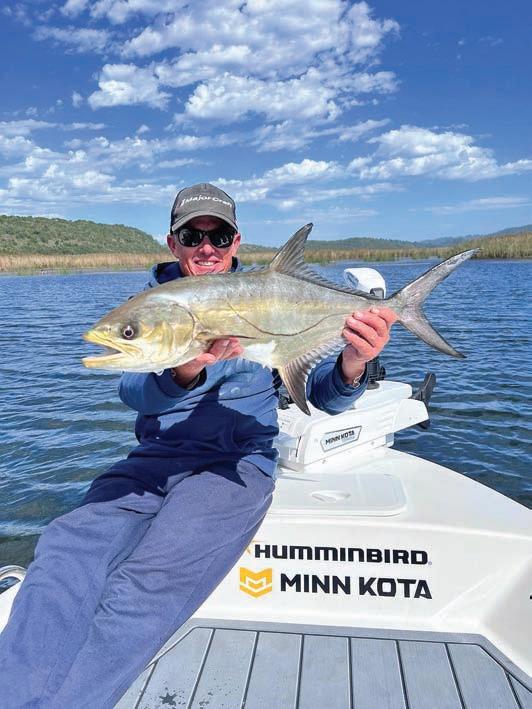
Traditionally,trolling motors were limited to smaller boats due to power constraints and construction limitations (shaft strength,corrosion resistance etc.).These days,however,manufacturers like Garmin,Lowrance,Minn Kota and Power Pole have designed units with high thrust ratings suitable for boats up to 35 feet and sometimes more.
Centre console vessels,catamarans and bigger mono hulls can now be fitted with bow-mounted trolling motors to suit their given bow-rise,provided they have sufficient mounting space on the bow and sufficient electrical capacity in the bat-
tery system.
With clever fabrication of base plates and well-considered mounting locations,we are now able to install these motors on pretty much any ski-boat on the South African market.
Lithium-ion batteries also offer the required power supply in a much smaller and lighter form,opening the door to clean, efficient installations even on smaller centre console craft.
After consultation and due to demand,numerous local boat builders have now also made provision for later installations of these motors by adding forward-running cable conduits and adequate battery capacity in the console as a standard when manufacturing.
CONSIDERATIONS
BEFORE INSTALLING
Installing a saltwater trolling motor on an oceangoing boat isn’t as simple as bolting it on.Here’s what to keep in mind:
Mounting space
Offshore boats with high bows or limited flat bow space may need custom mounting plates or brackets.Your trusted boat builder or service agent can assist with this,as they have fabrication teams that will be able to manufacture the correctly rated brackets or plates to avoid issues down the line.
I work very closely with my dealers to ensure every installation is done correctly and efficiently.
Power supply
You’ll need room for a dedicated battery (or battery bank) and charging system.Our bass fishing brethren have been installing trolling motors on bass boats for years and we are using a lot of what we’ve learnt from them in our installations.
These days I would recommend making use of the newer generation lithium-ion batteries that are available,to save space and weight,and to get maximum run time and reliability for your trolling motor.
Power requirements
Choose a system (24V or 36V) based on your boat size and
Trolling motors are changing the way anglers fish, thanks to features like Anchor Lock which hold the boat in position without the skipper having to deploy the anchor.
usage.Although the choice is yours,to achieve full thrust rating and efficiency when in use,I would suggest opting for a 36V system.
Saltwater durability
Ensure all components,including plugs and wiring,are marine-rated and corrosion resistant.
The “buy once,cry once”theory applies here.Cutting costs on inferior wiring and terminal components is silly when you’re installing premium equipment.Install properly rated marine circuit breakers and use marine-grade tinned cable for power supply.
Integration
Choose systems that can integrate with your chartplotter of choice.The reputable brands allow standalone control using the inbuilt GPS receivers and supplied remote controls,but matching the motor to your chartplotter brand allows you to draw and follow automated routes,set anchor points,and control functionality,all from the chartplotter.
REAL-WORLD APPLICATIONS
Bottom fishing
Anglers use Anchor Lock to virtually anchor over reefs and ledges,holding the boat in position without having to deploy the anchor.This allows faster deployment and means you don’t have to retrieve the anchor before repositioning.Pulling anchor in a pumping wind or current is not fun and can be extremely dangerous.Many accidents have happened when “pulling the pick”.
Slow-trolling live- or dead baits
Slow trolling live- or dead baits for gamefish is a breeze with a trolling motor.You can go as slow as a crawl if you want to and,because you are pulling the boat along from the bow instead of pushing from the stern,you can troll with a lot more accuracy at low speed,especially in current and a bit of wind.
You can also precisely control and adjust your speed …
Peter Scheiflinger with a lovely garrick caught while using a trolling motor.
and you are silent.The kayak lads often out-fish the ski-boaters at places like Cape Vidal,and I believe that is partly because they can control their drift speed better,but mainly is because of how quiet they are.
Jigging and artificial lure fishing
Being able to use Anchor Lock or even slow your drift down when jigging at spots such as Guinjata or Paindane,gives you a distinct advantage over the guys who are racing along with the infamous current.
Your lure can spend more time in the strike zone,and you can line up your drift better to hit all the hot spots on the reef.Mid-drift you can even move position in and out on the drift line to ensure you fish the area intended.
In the past you would need the skipper to manoeuvre the boat for you while you were fish,but having a trolling motor is like having another skipper on board who’s navigating for you,which frees up another angler to get stuck in.
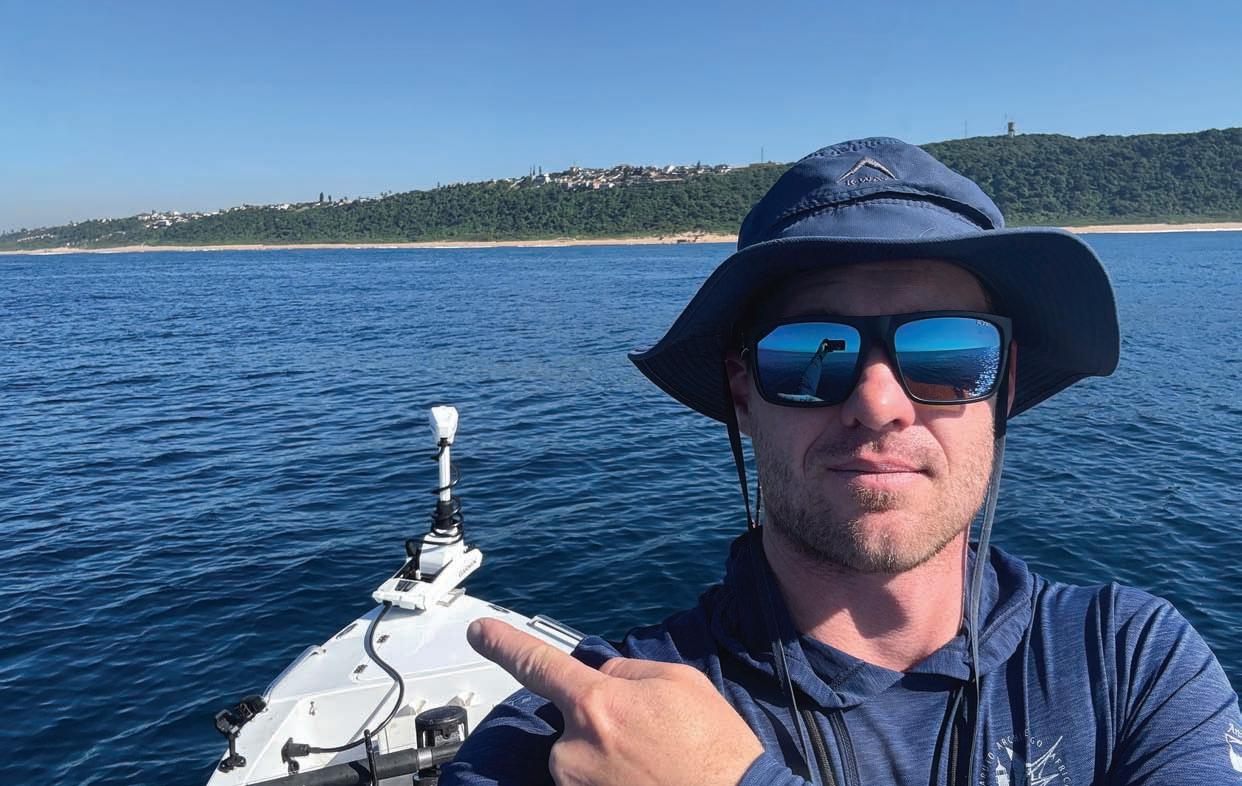
I often fish alone,and having the trolling motor has changed my fishing to the point where I now have full control over the boat even when I’m not at the helm.I can now get up on the front of the boat to cast plugs and spoons while my baits are working for me off the stern.
IS THIS THE FUTURE OF OFFSHORE ANGLING?
Saltwater trolling motors are no longer niche gear for freshwater fishermen and estuary enthusiasts;they’re becoming standard on a wide range of oceangoing fishing platforms.Their blend of stealth,precision and convenience has shifted how effectively anglers can fish,giving rise to a more thoughtful, efficient,and also environmentally friendly approach to offshore angling.
As battery technology and integration improve,I’m sure these motors will continue to grow in popularity.
For the serious offshore angler looking to gain a tactical edge,a saltwater trolling motor might just be the smartest upgrade on the water.As more ski-boat owners discover their capabilities,it’s clear:the age of electric control on ski-boats in South Africa is just getting started.
SPOT LOCK MAGIC
Turning a ski-boat into Aladdin’s magic carpet
By Warren Bennet
I’LL admit it – before a trolling motor arrived in my life,my fishing trips were a constant battle between the fish and my boat.Spoiler alert:the boat usually won.I’d find the perfect spot,line up the drop,and then … whoosh – wind,current or a rogue whitehorse would have me drifting halfway to Moçambique before I even got to the bottom.Don’t get me wrong,I got some fish and had fun,but I knew deep down that there had to be a more efficient way.
One day when I was having my motors serviced,I mentioned that,on a recent fishing trip the showings on my finder were insane and I knew the quality of fish on offer,but that I struggled to hold my jigs in the strike zone long enough for the dinosaur kakaap and blood snapper to latch on.We got the odd fish per drift,but I wanted to be better.
Then I was introduced to the Kraken.Not the mythical tentacled sea monster – the Garmin Force Kraken trolling motor.Let me tell you,this piece of tech hasn’t just changed my fishing,it’s changed my life.
SPOT LOCK: A GAME CHANGER!
Using the spot lock function is like having a superhuman deckhand whose only job is to keep you exactly where you want to be,no matter what the ocean throws at you.Current ripping? No problem. Wind swirling like a politician’s promises? Easy.I press the button,it locks in,and my boat stays put like it’s been superglued to the spot.
That means more time fishing and less time fighting the elements.
More importantly,I waved goodbye to that pesky task of pulling and resetting the anchor! In the past,I would spend half my day starting the
engine,nudging the throttle,and re-positioning. Now I’m hands-free,rod in hand,grinning like I’ve just discovered free Wi-Fi offshore.
It holds me exactly over the mark,the wreck or that magic little ledge where the fish practically queue up to be caught.It’s like having another dedicated skipper on the boat,minus the extra boat snacks and larger bar tab at the end of the day.
Fishing is supposed to be relaxing,and now,it finally is.I’m not chasing the boat;I’m chasing the fish.I can take a sip of coffee (or another beverage of choice) without worrying that I’m drifting off the mark and into no man’s land.My stress levels have dropped,my catch rate has gone up,and I’ve stopped shouting at my anchor in frustration. (We’re still friends,though.)
Another interesting observation has been how much more comfortable it is to fish on spot lock versus the old traditional anchoring method. There’s no more intense pulling on the anchor rope when rogue swells or whitecaps hit the bow, just a smooth ride quietly hovering over the mark.
The complete lack of any noise and invasive anchor chain rattle has also definitely led to better catches,particularly for those more sensitive species that often move off when they’re spooked. And if they do still move off,one simply comes off spot lock and uses the trolling motor to quietly reposition the boat back over the showing once you’ve relocated them.
The addition of a trolling motor onto my boat hasn’t just improved my fishing,it’s turned my ski-boat into a precision fishing platform.It’s like going from a bicycle with a wonky wheel to a sports car with cruise control.If you love fishing and hate drifting, this amazing new tech isn’t just a luxury;it’s a necessity!
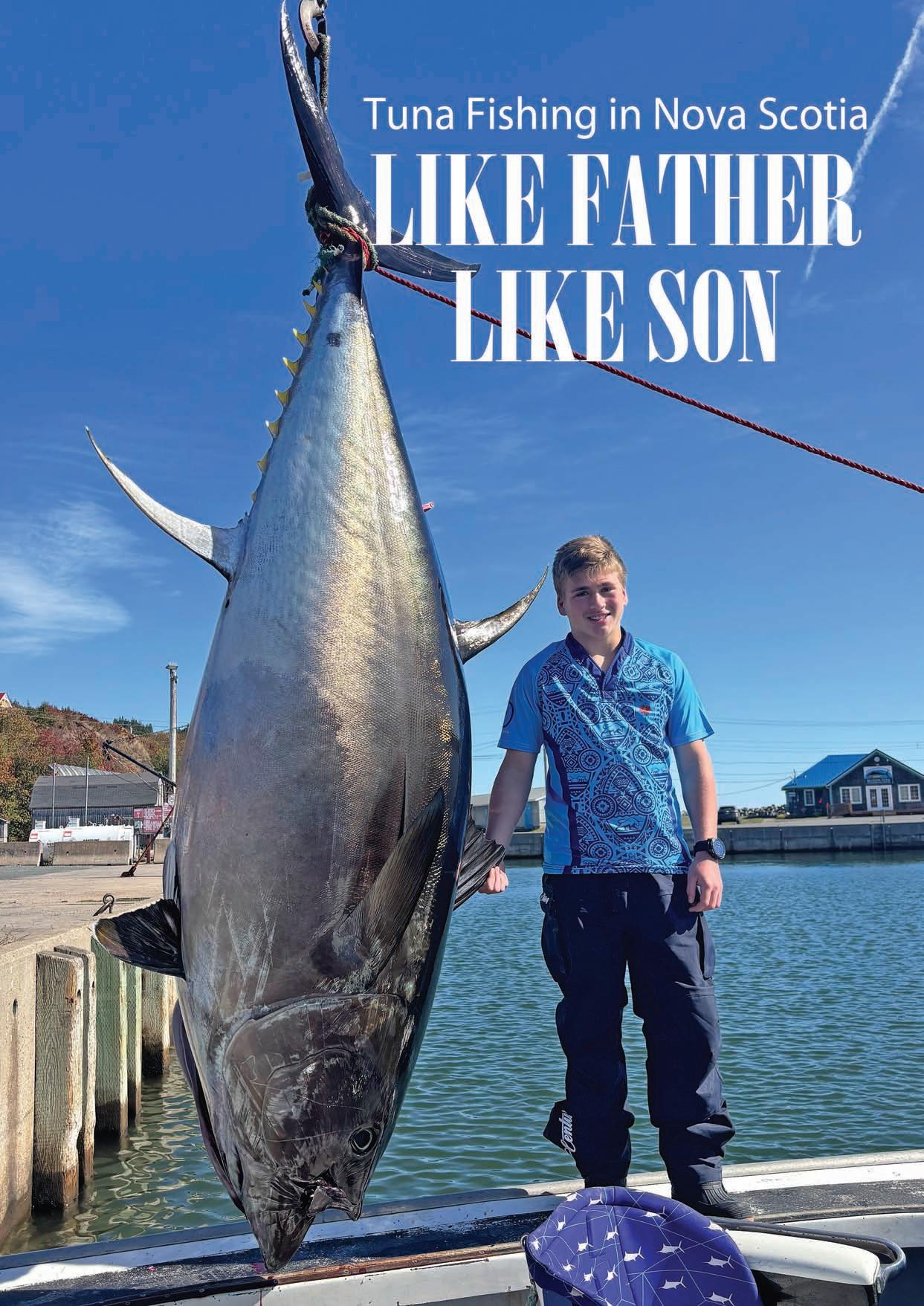
Ben Kruger, Junior, proudly displays his 277.5kg (611.78lb) giant bluefin tuna caught off Nova Scotia, Canada.
By Ben Kruger, Senior
THERE are few adventures more special than those shared between a father and son,and for me this one was destined to be unforgettable.
Having fished for giant bluefin tuna in Nova Scotia on a previous occasion with my loyal fishing companion, Richard Green,I was thrilled to be returning once again.But this trip held something extra special because my son,Ben Junior,would be joining me at the legendary fishing grounds of Ballantyne’s Cove,Nova Scotia,alongside the legendary Captain Michael Tait and his trusted deckhand,Steven Clapperton.
The trip was planned for 5 to 9 October 2025,but it almost didn’t happen for Ben Junior,who had been selected to play for the Blue Bulls interprovincial tournament during the same week.The call of the ocean,however, was stronger than the call of the rugby field,and soon enough,after a gruelling two-day journey and three flights halfway around the world,the three of
us arrived at Ballantyne’s Cove,ready to begin our long-awaited adventure.
STRAIGHT INTO ACTION
At 5:15 a.m.on our first day,the crew gathered on deck.Spirits high and eyes on the horizon,we discussed the week’s fishing plan.The mission was simple:find the big ladies.
Richard Green was up first and wasted no time hooking into an impressive 700–800lb tuna that morning.After a thrilling fight,the fish was successfully tagged and released – a fantastic start and a priceless opportunity for Ben Junior to observe from the fighting chair,knowing he was up next.
Later that afternoon,Ben Junior had his first strike,but,heartbreakingly,the hook pulled after a few minutes.But fortune wasn’t done testing him yet. Just before lines in he had another strike.He fought bravely for half an hour before the hook again gave way.
Though disappointed,Ben Junior had proven his strength and composure under pressure.Captain Mike was confident:the next day’s booked harvest fish would be Ben Junior’s.
THE HARVEST FISH
We had another early start at 5:15 a.m., and anticipation was thick in the salty air.
The rules were simple:everything on deck was recorded,and the first fish on the line would be the harvest fish, whether it weighed 200- or 1000lb.
Just after 10 a.m.,the action began. The reel screamed to life,and the battle was on.For 40 relentless minutes,Ben Junior fought with everything he had, hands blistered and forearms burning, until at last,the fish was secured.
The slow two-hour troll back to harbour felt almost ceremonial.When the fish was finally weighed,the scale read 277.5kg (611.78lb) – a spectacular achievement for the 13-year-old angler.
REDEMPTION AND REWARD
By 5:15 a.m.the next day,we were back on the water,excitement renewed.It turned into a magnificent day.
I landed and released a beautiful 500–550lb tuna,while Ben Junior’s first fish of the day slipped away after the leader line was shaved clean.
Determined,he tried again,and this
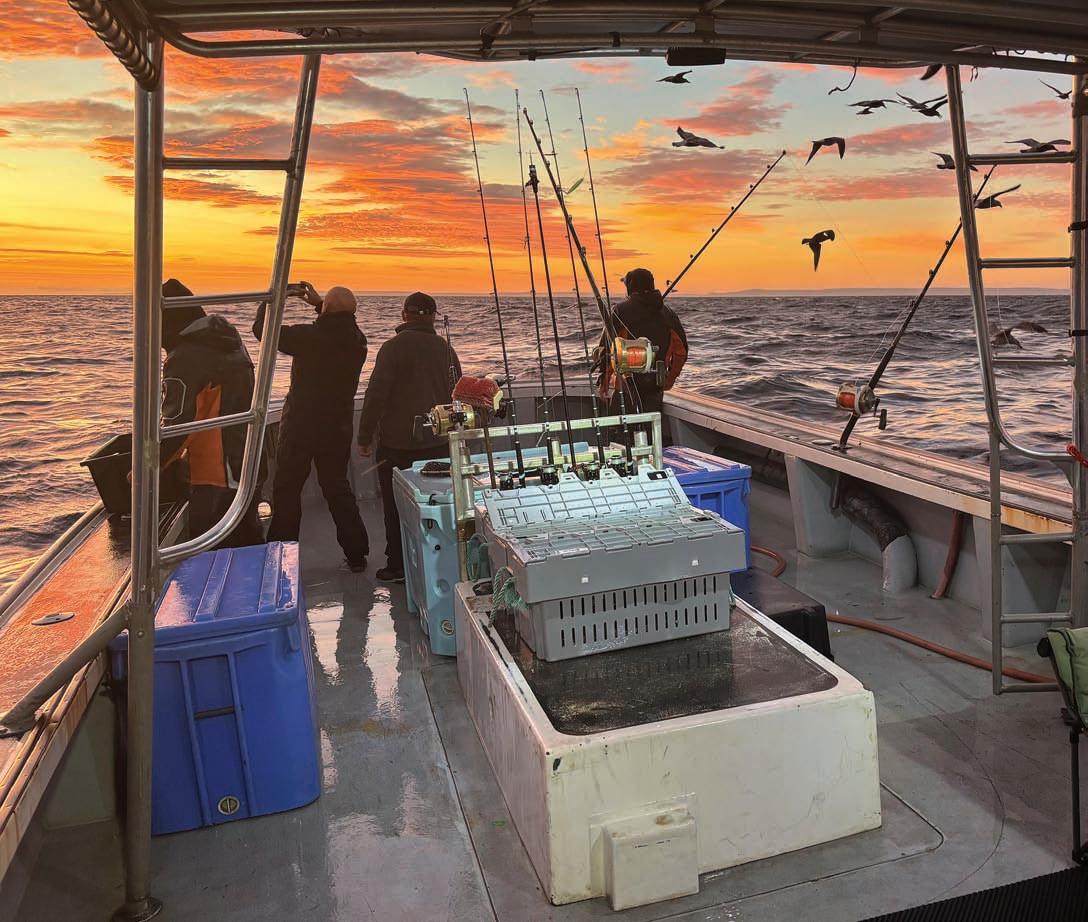
The end to another magnificent day’s fishing aboard Rough Rider
time his persistence paid off.His second fight of the day ended in victory:a 650–700lb tuna tagged and released.Father and son both had fish to their names – the trip was shaping up perfectly.
THE FINAL PUSH
Unfortunately day four was a big blowout and no boats were on the water.
On our fifth day,the morning sea was still restless,delaying our departure until 2 p.m.
Spirits and expectations were high,but the first few hours dragged with no action.As darkness began to fall,we had our first hook-up for the day … only for the hook to pull once again.
At 6:30 p.m.,with hope fading fast,the crew pressed on.
Then – another strike.
For 45 long minutes,Ben Junior battled fiercely before heartbreak struck again:the leader line shaved clean for the second time that trip.
Time was running out.
But fate had one last surprise.
The Tiagra 130 screamed to life a third time,the live mackerel bait taken by what would be the fish of the day.
Knowing this was his final chance,Ben Junior gave it everything.For an hour and ten minutes,he fought,burning hands and more blisters until,at last,an estimated 800lb tuna was tagged and released.
It was the perfect ending.As the boat made its way back to harbour,the crew was alive with joy and pride.
My thanks again for another memorable experience on the Rough Rider with an exceptional crew.Here’s to chasing dreams and catching giants! Like father, like son.
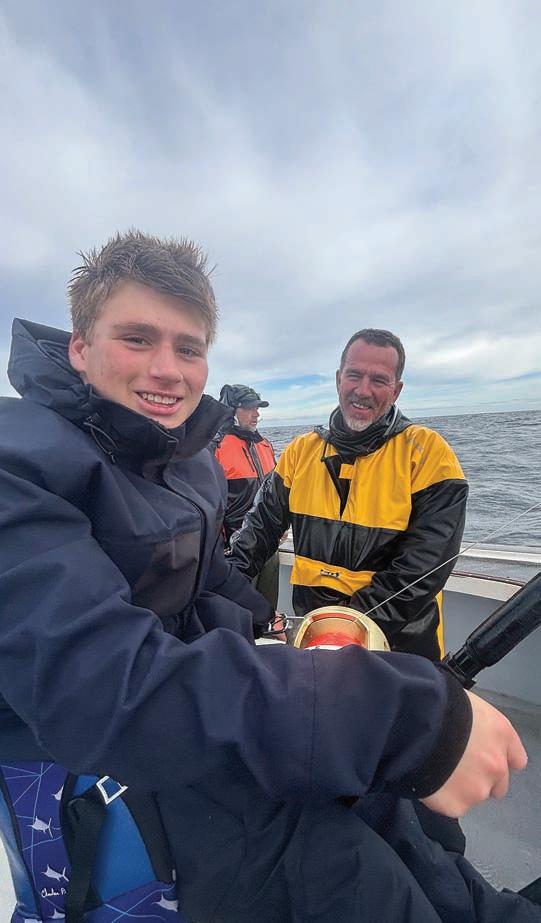
Ben Kruger, Junior, fights a bluefin while dad, Ben Senior, looks on proudly.
Ben Junior and Capt Michael Tait admire Ben’s bluefin.
Right: Richard Green takes a closer look at his 700–800lb bluefin tuna that’s about to be released.
AMEMORYWORTHREELINGIN
by Christi Stassen (15)
MANY people go fishing all of their lives without knowing that it’s not only the fish they are after.For some people fishing is about the stories they get to tell,for others it’s about the nature around them and the experience as a whole,and for others it’s about winning fantastic prizes and enjoying the get-togethers with people who love fishing just as much as they do.
Still,we all want to catch fish.One of the best feelings is to catch your new PB,or to catch that dream fish,and for a lot of people – including me – that happened at the 2025 Queens of the Ocean competition.My dad always says it’s better to go fishing than to stay at home waiting for better days.I couldn’t agree more! Nothing compares to the joy of being out on the water.
My mother,sister,father and I took part in the Queens of the Ocean fishing competition from 29 to 30 August 2025 at StLucia.A lot of memories were made,and we even won a few prizes.On the first day of the competition,I caught an amazing wahoo of 16.3kg and the first marlin of the competition.The next day my mother and sister both caught some tuna.
In the afternoons when everyone went to the weigh-in, there was great fun and excitement as we got to see the fish everyone else caught,and to enjoy the evening with people who have the same passion as us.
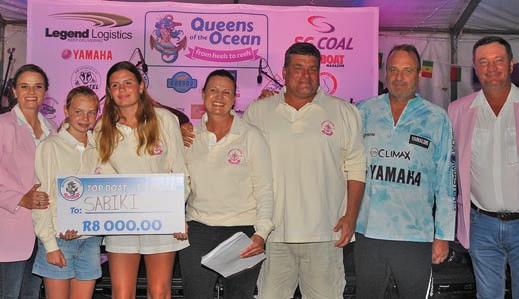
Then came the night of the prize giving.I got two great prizes – one for releasing the first marlin of this year’s competition,and one for being the third best angler of the competition. Those prizes were amazing,but my favourite one was where my whole team got called up on stage for being the fifth best boat of the competition.This prize wasn’t just amazing for the title that we received,but also for the memories we made together, doing what we love most as a family!
Fishing at Queens of the Ocean 2025 has given me some of my best memories ever!
As the final night ended and everyone said their goodbyes,we knew it wouldn’t be forever;I’m sure all of us are coming back for the next round.
Fishing is not an escape from life;often it’s a deeper immersion into it.That’s why I love it!
BACKTOBASICS
How to handle fish safely for release
Fransien Myburg prepares to safely release a GT.
By Nikki Smit
FISHERMEN are well known for their tall stories,arms stretching as their story progresses,but with the advent of social media, these stories have moved from the mythical to the real deal,and now with the growth of AI,well,who knows where these tales of tails will end!
Every angler loves to see great fishy pics,whether it’s to capture a moment in time,a memory of an exhilarating fight,or bragging rights of a new PB. However,with these pictures comes a certain amount of responsibility.
We have all seen how pictures zoom around on social media like a hooked yellowtail heading for the bricks. Suddenly we are exposed.Anything can happen.Anyone can see it,pass it on, praise it – and throw abuse.
I refuse to be an online troll,but sometimes it’s hard not to shake one’s head at some of the pictures that are
posted.Some of my pet hates are:
•Posting a photo of a dead fish lying in the sink and asking what it is!
•Posting photos of undersized fish or catches that clearly exceed the bag limit – and bragging about it!
•Holding a fish up by the gills and claiming to have safely released it!
These issues make my skin crawl,so I hope this article will help to educate anglers on better ways of doing things.
We anglers have a responsibility to learn to identify fish and to ensure that we know the size and bag limits of various species.Going fishing and not knowing these basics,is like driving and not knowing the rules of the road. If you don’t know what the fish is that you’ve caught,release it.
The ORI fish app is a wonderful tool that gives anglers all the information needed to ensure they fish responsibly, from photos of the fish for identification,to bag limits and sizes as well as a length-to-weight conversion calculator.
It can be used on both Android and IOS devices,and the cost is minimal and goes to a wonderful cause.
Visit https://saambr.org.za/appmarine-fish-guide-for-southern-africa-2/ or search for “Marine Fish Guide”on your app store.
There’s also no excuse for keeping undersized fish or for taking more than your bag limit.If an undersized fish died when you caught it,throw it back so it can at least contribute to the ocean’s food chain.
Sometimes there’s nothing you can do to save a fish,but if you know in advance that you’re planning to release your catch,it needs to be handled correctly,so that it is given every possible chance of survival.
Some fish,such as Roman,don’t have a good release record,but they should still be handled carefully to give them a fighting chance.
So,what can we do to help ensure the survival of the fish we release?
If you’re planning to release your fish, do not touch their gill plates at all. Rather, carefully support the body and hold the tail at the caudal peduncle. Ideally hold them with a wet cloth, or at least wet hands, and limit their time out of the water.
Two carefully handled fish ready for release. DON’T!. .DO!.
While many anglers think that deep-water species like red steenbras won’t survive being released, if they’re carefully handled and are correctly released using a Seaqualizer (shown above) or a homemade release device like the one shown elsewhere in this article, they can indeed survive for years, as this tag recapture information shows.
REDUCEFIGHTTIME
As with human athletes,lactic acid levels accumulate in the fish’s muscles during a long fight,leading to a longer recovery time,higher mortality rates and reduced flesh quality in retained fish.To reduce the fight time,opt for a heavier line and leader,and avoid light tackle when targeting large fish.
REDUCE AIREXPOSURE
Fish suffer from hypoxia (oxygen deprivation) from extended periods of time out of the water,which greatly increases the likelihood of death.
If you’re going to release a fish,try to keep it in the water while removing the hook.If you are unable to unhook the fish in the water or if you want to take a photograph,always work as quickly as possible and ensure that all the required tools are nearby.
A good de-hooking tool can reduce the air exposure and limit any injury to the fish.
HANDLECAREFULLY
If the fish is removed from the water, use a wet cloth to pick it up.Cover its eyes with a wet cloth to protect them from bright light and to calm the fish, thus preventing injury from excessive flapping.Handling the fish with a wet cloth also protects the angler from injury caused by sharp spines and scutes.You can place the fish on the wet towel while you remove the hooks to protect it’s skin from being damaged by a hot,dry deck.
A plastic fish stretcher or a soft,
knotless landing net is useful when landing a fish,although care must be taken to avoid injury to fins and tail in a landing net.Avoid getting lures or hooks tangled in a landing net,too,as this will increase the fish’s air exposure while the hooks are being untangled.
Avoid gaffing fish you plan to release,as gaff injuries and bleeding greatly reduce the chances of survival. If you absolutely must use a gaff,follow these best practice tips:
•Never gaff fish in the stomach,gills or head;rather gaff in the bottom lip.
•For sharks,skates and rays,gaff in the jaw area.If this is not an option, gaff in the muscle below the dorsal fin.Do not gaff skates or rays in the wing area as this tears easily.
•If fishing from a boat,rather use a knotless landing net or a lip-grip.
Large-mouthed or sharp-toothed species such as barracuda can be landed using a lip-grip attached to the fish’s lower jaw,but be sure to also support the fish’s weight as it is lifted from the water.
REDUCEINJURIES
Fish often suffer injuries from tackle as well as handling.These injuries,combined with the exhaustion and stress of the fight,greatly increase the likelihood of death.There are,however,ways to reduce these injuries.
Fish have a protective slime over their skin and scales that prevents bacterial and fungal infection.This layer can be damaged by excessive handling.
Always keep handling to a minimum and use wet hands or a soft wet cloth when lifting fish and returning them to the water.
Fish’s gills and eyes are sensitive organs,so do not touch or damage them if you plan to release the fish. Do not hold the fish up by the gills if you want to take a photo,and do not pull it into the boat by its gills. Placing anything under the gill plates damages the plates and the gills and can cause the fish to die.
When removing hooks,do not apply pressure on the gill plate or put your fingers inside the gill plate to hold the fish.Also do not to put undue pressure on the fish’s body.
When fishing from the shore,never drag fish over the rocks or sand.This is particularly harmful to flatfish (stingrays and sand sharks) whose gills are on the underside and can be filled with sand,causing serious damage.
Do not turn stingrays upside down to remove hooks as this causes serious damage to the animal’s internal organs and may result in death.
Never drag flatfish by their spiracles (the small openings behind the eyes that are vital for breathing on the sea floor).Rather use the groove in the top lip to lift the head and gills from the sand before moving the fish.
Sharks should not be dragged by their tails or be left to lie on the sand for long periods,as their cartilaginous skeleton does not protect the internal organs from being crushed under their own body weight.
Take a barbless stainless steel hook attached to one or more sinkers; total weight 500g to 1kg. Hook the fish through the upper lip from top to bottom. When the fish reaches the bottom, allow it to recover, then pull up sharply to release the hook.
USEBARBLESS ORCIRCLEHOOKS
Barbless hooks not only reduce injury to the fish,but also substantially reduce the amount of handling required to remove the hook before returning the fish to the water.
You don’t have to buy special barbless hooks;long-nosed pliers can be used to squash the barbs,or the barbs can be filed off.
To remove a barbed hook that is well set in the lip or jaw,push the point of the hook through and flatten the barb when it protrudes.This will make removal easier and will result in less injury to the fish.
If a fish is hooked in the gills or in the throat,or if the hook is swallowed, simply cut the line as close as possible to the hook and release the fish as normal.Ideally,use circle hooks which are designed to set in the corner of the mouth,resulting in less physical damage to the fish as the hook is seldom swallowed.
When using a circle hook,simply lifting the rod while simultaneously reeling in and applying firm pressure will be sufficient to set the hook. Barbless circle hooks are ideal if you’re planning to release all fish caught.
Hooking injuries in fish are more prevalent when more than one hook is used per line.It’s also preferable to use single hooks rather than treble hooks. Removing the middle hook from a multiple hook lure can also reduce injury without affecting catch rates.Treble hooks can be replaced by inline single hooks,or one of the hook points on the
treble hook can be removed using sidecutters.
Choosing the right size hook for the target species will greatly reduce the chance of deep hooking the fish.
Using artificial baits and lures is also preferable to using natural bait.For one thing,it reduces the extractive pressure on bait populations and destruction of their habitats.For most species,hard lures,spinners or plugs are less likely to result in deep hooking than soft artificial or natural baits.
ADDRESSBAROTRAUMA
Bottom-dwelling fish caught in deep water (over 20m deep) may experience barotrauma due to the decrease in water pressure and inflation of the fish’s swim bladder as it is brought to the surface.
Barotrauma is obvious if you see a fish’s inverted stomach protruding from the mouth.
Some sharp-toothed species such as santer and seventy-four,may inadvertently bite their protruding stomaches, thus self-releasing the built-up gases, and may not require intervention before release.Other species such as Roman and slinger are more susceptible to barotrauma and will float on the surface,unable to return to the deep water without assistance.
Anglers with a lot of experience may know how to vent the swim bladder using a hypodermic needle,but even though this allows the fish to return to their preferred depth in the water column,it can result in secondary
infections and death,and is not the preferred method to deal with barotrauma.
The best way to release a fish with barotrauma is to use the reverse hook or downrigger method (see diagram alongside) or a Seaqualizer.
There are many home-made varieties of this,but essentially a large weight or downrigger ball heavy enough to counteract the fish’s buoyancy is tied to the eye of a large,inverted barbless hook.Heavy fishing line,long enough to reach the depth where the fish was caught,is then attached to the bend of the hook.
The hook is gently but firmly placed in the top lip of the fish with the hook pointing downwards,and the fish is released to sink to deeper water.It is important to let the fish descend as smoothly as possible,avoid jerking and pulling on the line.
If possible,try to get the fish all the way to the bottom.Once the fish has descended to the bottom,give it a little time to recover,then sharply tug the line to dislodge the hook and weight, releasing the fish.
REVIVEIFNECESSARY
If you’ve handled a fish carefully with minimal time out the water,it should swim away strongly as soon as it is put back in the water.However,some fish may need reviving.
Hold the fish headfirst into the current.Do not move it backwards and forwards in the water or restrict the flow of water through the mouth and gills. If the fish shows no sign of recovery,move it gently forwards through the water so that oxygenated water can flow over the gills.It may take a few minutes for the fish to recover its balance and swim away unaided.
KEEPYOURTOOLSREADY
Equipping oneself with the following items,will help ensure a fish is released as quickly as possible with the least amount of harm.These items must be kept within easy reach :
•Long-nose pliers:to remove a hook set in the jaw and to squash barbs.
•Side-cutters:to cut through line or steel trace if the hook is swallowed.
•Measuring tape:to record the length of the fish.The length can be converted to weight using an online species length/weight ratio.
•Measuring mat:to protect fish and avoid sand entering the gills on the fish’s underside while measuring. Keep it wet and cool.
•Waterproof camera:to ensure a quick release if a photograph is desired.
It is our responsibility as anglers to ensure that we are educated.For further information regarding correct handling of fish,visit ORI’s website www.oritag.org.za.
APPLICATION FORM
I hereby apply for the Basil Manning Award in the category:
YOUR favourite offshore angling magazine, SKI-BOAT, in conjunction with Basil Manning and the South African Deep Sea Angling Association , is proud to offer all South African skiboaters the unique opportunity to win awards for excellence in angling.
RULES:
There is no restriction on the number of awards which can be applied for.
Award applicants must submit a photograph of the relevant fish with the application form and a photograph of the angler with the fish.
Tick the appropriate box and supply us with the following information. Please remember to print clearly.
Digital emailed photographs should be high-resolution and sent to angler@mags.co.za
All deep sea anglers who achieve laid down standards of excellence will be entitled to apply for the Basil Manning Award.Upon ratification by a panel of adjudicators,the angler will receive a handsome digital certificate,suitably inscribed.
The Basil Manning Awardwill be made for fish caught in two sections:
1) Meritorious Fish
This award is for a fish that’s a memorable achievement for the angler,if not a personal best,and is not confined to the species listed below.Tackle used is of no consideration here,the fish's weight being the main criterion.
2) Outstanding Catch
To satisfy the requirements for this award,anglers can catch any recognised fish species.As a guideline,the weight of that fish must equal or exceed the suggested weights below,or certain laid down fish weight:line class ratios.
Awards will be made in the following ratio categories:
3:1 – Bronze Award
5:1 – Silver Award
7:1 – Silver Award
10:1 – Gold Award.
Applies to IGFA line class 1kg ,2kg,4kg, 6kg,10kg,15kg,24kg,37kg and 60kg.
SKI-BOAT reserves the right to use the photograph as it sees fit.
Entries must be on the official form which is included in all issues of the magazine. Entires must be received within 45 days of capture.
No witnesses of the catch are required. The award is made in the true spirit of sportsmanship and relies on the integrity of the angler to make a just claim.
Aselection of award winners’names will be announced in future issues of SKIBOAT, along with relevant photographs. Award applicants should allow 30-45 days for processing of applications. There is no charge for these awards.
(Leervis)
RELEASED BILLFISH AND GT (Ignobilis) KINGFISH
With the strong trend towards releasing these and other fish, we have decided to amend the Basil Manning Award rules to provide for acknowledgement of all released fish. All we need is a photo of the fish being released or prior to release (e.g. GT held next to the boat) and the approximate weight of the fish which should fall in line with the stipulated weights set out above.
In line with this trend we will not be carrying photographs on the Basil Manning Awards page of any billfish or GTs aside from those that are released.
This stunning 18kg prodigal son caught off St Lucia earned Sunita Pretorius a Gold Meritorious Award for her outstanding catch.
has
for
Dylan Jacobson has been awarded a Gold Meritorious Award for these stunning 16kg
has been awarded a
for
Bevon Mentoor
Gold Meritorious Award
this beautiful 35.2kg daga salmon caught off Durban.
Fritz Cronjé
been awarded a Gold Meritorious Award
this 26.78kg king mackerel caught off 25 Mile Reef, Bazaruto.
& 13kg daga salmon caught off Warner Beach.
Anna van Dyk has been awarded a Gold Meritorious Award for her 11.4kg dorado caught off St Lucia.
ON-ON and ON-OFF
By Fransien Myburg
GO light tackle billfish,they said.It will be fun, they said.We believed them.
Geraldine Breedt, Deirdre du Plooy and I committed to forming a Southern Gauteng team to fish the Light Tackle Billfish Interprovincial at Sodwana in October 2025.
Geraldine was our captain,and my husband,Chris,was our skipper on Aqua-Joy .Our aim was to catch as many sailfish as possible,and hopefully some small marlin,with the emphasis on SMALL.
We have the best people in our province,and they taught us how to prep for the comp.We rigged our halfbeaks to perfection,and tied our own knots,and if there was the slightest doubt about something,we did it over.Everything had to be perfect.
By the time the competition started,we were ready!
Early on the first morning we had a strike,Deirdre was on the rod.We couldn’t believe our eyes -- it was a sailfish! The rest of us focused on our jobs and took out the other rods.
Then the worst thing happened:the fish came off!
Chris saw the prospect for some Rapala Lips developing. “Okay,girls,let’s do it again! They are here!”he cheered us on.
He turned the boat and we had another strike in exactly the same spot as the first one.This time it was my rod.The fish jumped for a second and we were so happy,but then we realised it was a dorado.It wasn’t a sailie,but I was happy with my 12kg dorado.After all,any fish is better than no fish!
The following days passed with a lot of strikes,but no catches.At last the final day arrived and we knew we had to make it count.
At one stage our planer tripped,and as soon as we had the rig back in the water,Chris saw the most beautiful showings. Just then,Geraldine’s reel went off ...and stopped.There wasn’t even time for us to have a Rapala Lip,because as soon as hers stopped,mine screamed.
Fish on! This time it was on on,not on off!
In the distance,we saw a marlin jump! It was very far from us,but we were all so happy that eventually a fish had stuck.
Chris saw the fish once and felt sorry for me.
“Oulik,dis ’n groot vis.” Did I mention we were aiming to catch SMALL marlin? This wasn’t that!
I didn’t say much, I just focused on the fight,giving my best with everything in me.Every turn of the handle counted, and I knew our girl team need this fish to secure third place in the competition. The marlin only jumped once,and then it settled down to hang out in a place that I struggled to pull it out of.Fighting a big marlin on 10kg line is
Three times it was so close,but it was like the fish just stuck at a certain level.My teammates did their best to help me by bringing me drinks,cheering me on and playing nice music.And it did help;they are just the best,but still the fish wouldn’t budge.
“Come on,fishy,we only want to take a picture of you, then you can go again!”I told it.I could already see the photo in my head.
Then,after a fight lasting two hours and 20 minutes,the marlin’s bill sliced through the leader.
That “twang!”sound just cuts into your soul.
I stood up,reeled in the line,put down the rod,and took five deep breaths.
My heart was broken.All I had to show for my fight was two big blisters on my hand.Losing a billfish is cruel,and my Rapala Lip showed again.
My teammates hugged me,but we all knew there was no time to waste;we needed to get the lines back in the water. The salt water burnt while I took all my 10kg line off and built a new rig.Just as the rig went in,I got another strike. What? But it was just a hit,the fish didn’t stick.
Ah well,we didn’t get our marlin,but we did well,and will definitely get them next time.When we don’t catch fish,we learn.
It’s an immense privilege to fish like this with my husband and my teammates who love the sport as much as I do.Have no fear,we’ll be back to find the big ones that we lost…