Asia Pacific // Market
81
GNQ at a Glance: -Designer, supplier, and installer of industrial refrigeration systems -Established in 1975 -Appointed exclusive distributor of York refrigeration products in 1988 -Major sectors: Food and Beverage Processing, Breweries, Cold Storage and Distribution -Major customers: Nestle, San Miguel, Zenith Foods, Royale Cold Storage, ISOC Holdings. -Main office: Parañaque City, Metro Manila, Philippines
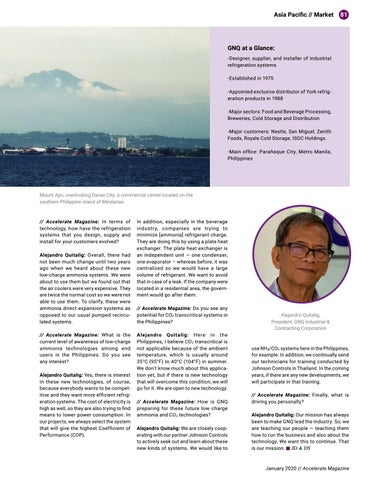
Mount Apo, overlooking Davao City, a commercial center located on the southern Philippine island of Mindanao.
// Accelerate Magazine: In terms of technology, how have the refrigeration systems that you design, supply and install for your customers evolved? Alejandro Quitalig: Overall, there had not been much change until two years ago when we heard about these new low-charge ammonia systems. We were about to use them but we found out that the air coolers were very expensive. They are twice the normal cost so we were not able to use them. To clarify, these were ammonia direct expansion systems as opposed to our usual pumped recirculated systems. // Accelerate Magazine: What is the current level of awareness of low-charge ammonia technologies among end users in the Philippines. Do you see any interest? Alejandro Quitalig: Yes, there is interest in these new technologies, of course, because everybody wants to be competitive and they want more efficient refrigeration systems. The cost of electricity is high as well, so they are also trying to find means to lower power consumption. In our projects, we always select the system that will give the highest Coefficient of Performance (COP).
In addition, especially in the beverage industr y, companies are tr ying to minimize [ammonia] refrigerant charge. They are doing this by using a plate heat exchanger. The plate heat exchanger is an independent unit — one condenser, one evaporator – whereas before, it was centralized so we would have a large volume of refrigerant. We want to avoid that in case of a leak. If the company were located in a residential area, the government would go after them. // Accelerate Magazine: Do you see any potential for CO 2 transcritical systems in the Philippines? Alejandro Quitalig: Here in the Philippines, I believe CO 2 transcritical is not applicable because of the ambient temperature, which is usually around 35°C (95°F) to 40°C (104°F) in summer. We don't know much about this application yet, but if there is new technology that will overcome this condition, we will go for it. We are open to new technology. // Accelerate Magazine: How is GNQ preparing for these future low charge ammonia and CO 2 technologies? Alejandro Quitalig: We are closely cooperating with our partner Johnson Controls to actively seek out and learn about these new kinds of systems. We would like to
Alejandro Quitalig, President, GNQ Industrial & Contracting Corporation
use NH 3 /CO 2 systems here in the Philippines, for example. In addition, we continually send our technicians for training conducted by Johnson Controls in Thailand. In the coming years, if there are any new developments, we will participate in that training. // Accelerate Magazine: Finally, what is driving you personally? Alejandro Quitalig: Our mission has always been to make GNQ lead the industry. So, we are teaching our people — teaching them how to run the business and also about the technology. We want this to continue. That is our mission. JD & DY
January 2020 // Accelerate Magazine