24
Trends
Consumer Goods Forum Members Continue NatRef Leadership Sainsbury’s has over 200 CO2 stores, while Ahold Delhaize uses a variety of natural refrigerants By Eda Isaksson
Sainsbury’s, a major U.K.-based grocer that operates 629 supermarkets and 770 convenience stores, has more than 200 stores fully running on CO2 refrigeration. That makes it one of the leaders globally in retail implementation of CO2. “In 2009, we took a bold decision to go with natural refrigerants to ensure that future installations were protected from the potential impact of using synthetics,” said Paul Crewe, head of sustainability, energy, engineering and environment at Sainbury’s, during a webinar last month sponsored by the Environmental Protection Agency’s GreenChill Partnership. The webinar was titled, “Efforts to reduce refrigerant emissions through the Consumer Goods Forum (CGF),” of which Sainsbury’s is a member and co-chair of its refrigeration working group. Sainsbury’s opted early on for CO2 as its natural refrigerant of choice, and has deployed pump, cascade and transcritical booster systems. “They are all efficient, all operating and all doing extremely well,” said Crewe. The chain considered ammonia, but chose to employ it only on the industrial side; hydrocarbons remain a possibility. Crewe clarified Sainsbury’s motivations for using natural refrigerants. “Please don’t think that I am talking about refrigeration specifically from the ‘doing-the-right-thingfor-the-planet’ perspective,” he said. “Of course, that is important, but my role is to make sure that commercial sustainability is at the forefront. “This means is that while trying to do the right thing, we also need to make this a very important part of running our business by reducing costs and spending our capital investments in the right places.”
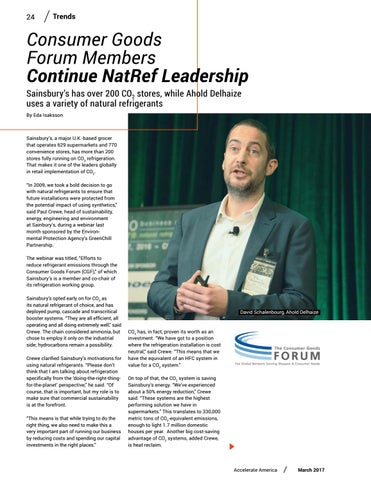
David Schalenbourg, Ahold Delhaize
CO2 has, in fact, proven its worth as an investment. “We have got to a position where the refrigeration installation is cost neutral,“ said Crewe. “This means that we have the equivalent of an HFC system in value for a CO2 system.” On top of that, the CO2 system is saving Sainsbury’s energy. “We’ve experienced about a 50% energy reduction,” Crewe said. “These systems are the highest performing solution we have in supermarkets.” This translates to 330,000 metric tons of CO2-equivalent emissions, enough to light 1.7 million domestic houses per year. Another big cost-saving advantage of CO2 systems, added Crewe, is heat reclaim.
Accelerate America
March 2017