brass & wind
WOODWIND ORCHESTRA
Into the woods Composer Christopher Hussey talks about the peculiar charm of the woodwind orchestra and making a recording with the Czech Philharmonic Wind Ensemble to showcase a little-known instrumental line-up through a selection of contemporary British music
I
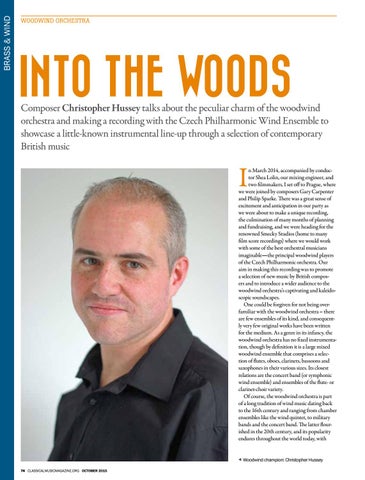
n March 2014, accompanied by conductor Shea Lolin, our mixing engineer, and two filmmakers, I set off to Prague, where we were joined by composers Gary Carpenter and Philip Sparke. There was a great sense of excitement and anticipation in our party as we were about to make a unique recording, the culmination of many months of planning and fundraising, and we were heading for the renowned Smecky Studios (home to many film score recordings) where we would work with some of the best orchestral musicians imaginable—the principal woodwind players of the Czech Philharmonic orchestra. Our aim in making this recording was to promote a selection of new music by British composers and to introduce a wider audience to the woodwind orchestra’s captivating and kaleidoscopic soundscapes. One could be forgiven for not being overfamiliar with the woodwind orchestra – there are few ensembles of its kind, and consequently very few original works have been written for the medium. As a genre in its infancy, the woodwind orchestra has no fixed instrumentation, though by definition it is a large mixed woodwind ensemble that comprises a selection of flutes, oboes, clarinets, bassoons and saxophones in their various sizes. Its closest relations are the concert band (or symphonic wind ensemble) and ensembles of the flute- or clarinet-choir variety. Of course, the woodwind orchestra is part of a long tradition of wind music dating back to the 16th century and ranging from chamber ensembles like the wind quintet, to military bands and the concert band. The latter flourished in the 20th century, and its popularity endures throughout the world today, with Woodwind champion: Christopher Hussey
74 classicalmusicmagazine.org october 2015