PROGRESS 2026


![]()


By DAVE FIDLIN Shaw Local News Network correspondent
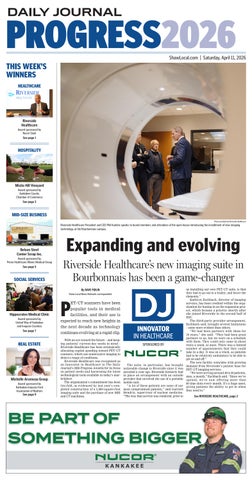
PET/CT scanners have been popular tools in medical facilities, and their use is expected to reach new heights in the next decade as technology continues evolving at a rapid clip.
With an eye toward the future – and keeping patients’ current-day needs in mind –Riverside Healthcare has been strategically allocating capital spending toward PET/CT scanners, which use noninvasive imaging to detect a range of conditions.
Riverside Healthcare was recognized as an Innovator in Healthcare in The Daily Journal’s 2026 Progress Awards for its focus on patient needs and harnessing the latest technological tools available in today’s marketplace.
The organization’s commitment has been two-fold, as evidenced by last year’s completed construction of a 5,000-square-foot imaging suite and the purchase of new MRI and CT machines.

The suite, in particular, has brought noticeable change to Riverside since it was unveiled a year ago. Riverside formerly had in place an arrangement with an outside provider that involved the use of a portable mobile unit.
“A lot of these patients are some of our most compromised patients,” said Garrard Hendrix, supervisor of nuclear medicine.
“The way that service was rendered, prior to
us installing our own PET/CT suite, is that they had to go out to a trailer, and brave the elements.”
Kathryn Eschbach, director of imaging services, has been credited within the organization for honing in on the expansion project, which became a priority shortly after she joined Riverside in the second half of 2021.
The third-party provider arrangement, Eschbach said, brought several limitations – some more evident than others.
“We had been partners with them for 18 years,” she said. “They had been great partners to us, but we were on a schedule with them. They could only come in about twice a week, at most. There was a limited number of appointments that they could take in a day. It was on a truck, so patients had to be relatively ambulatory to be able to get on and off.”
The new facility coincides with growing demand from Riverside’s patient base for PET/CT imaging services.
“We were serving around 40 to 50 patients, max, a month,” Eschbach said. “Since we’ve opened, we’re now offering more than 90 time slots every month. It’s a huge asset, giving patients the ability to get in when they need to.”
See RIVERSIDE HEALTHCARE, page 2


page 1
The facility, coupled with the equipment upgrades, has meant trimmed-down patient wait times, according to organization representatives.
“Today, a patient can get in the same week; it’s really much, much quicker,” President and CEO Phil Kambic said. “It gives them a better quality of care and better peace of mind.”
While general enhanced customer care is one reason behind the new facility’s unveiling, Eschbach said there also has been a critical element behind the
ramped-up investment.
“A lot of patients are waiting on starting chemotherapy or patient therapy for these tests,” she said. “If you’re prolonging that treatment, you’re not taking care of their cancer. The sooner we can get them in and get them served, the better it is all around.”
With the overall infrastructure in place, Hendrix said Riverside is poised to expand its level of service as new technology continues to come online.
“With PET/CTs, fortunately, we’re on the cusp of a huge horizon of procedures that are now going to be available … that will allow us to expand service,” Hendrix said. “Riverside is positioned to expand its
service to cardiology, neurology and oncology. The new camera systems also have AI integrated into them, so we are able to take advantage of AI with some of these imaging systems.”
While much of Riverside’s recent forward-looking focus has been directed toward PET/CT scanning and the imaging suite, Kambic said the organization has been making strategic investments elsewhere as well.
The organization, for instance, is doubling down on investments at outpatient campuses in Coal City and Frankfort.
“We have really been on the forefront of expanding outpatient services at Riverside,” Kambic said. “People want to go
Sponsored Content
where it’s easy and convenient to get their care, get what they want, and leave.”
Additionally, Kambic said Riverside has been making strides toward helping people with other specific needs.
“We also have a $30 million rebuild of our inpatient behavioral health unit that is going on right now,” Kambic said. “I’m very excited about that.” He added that behavioral health used to be very taboo, but post-COVID, a growing number of patients have behavioral health needs. Riverside also has been making investments in inpatient behavioral health units. For more information, visit riversidehealthcare.org.
students are saving money, then seeing measurable returns as graduates.

U.S. Census Bureau’s Post-Secondary Employment Outcomes Explorer data shows KCC graduates make more money than peers across Illinois community colleges in three categories of early career earnings. According to the Census Bureau, KCC associate degree graduates earn an average of $6,906 more after one year compared to graduates from other Illinois community colleges. After five years, KCC graduates are earning an average of $3,143 more than associate degree graduates at other Illinois community colleges.
“We focus on workforce-aligned programs,” said Paul Carlson, dean of Business and Technology at KCC. “Partnerships with local businesses, including advisory committees for career programs, are essential. Our professors also bring real-world expertise to the classroom with simulations and set up workplace situations for students early on.”
Over the past several years, KCC has also received money to offer additional financial support which reduces barriers to enrollment and completion.
State and federal funding from the Job Training Economic Development Grant, American Rescue Plan Act funds and Workforce Innovation and Opportunity Act programs are covering tuition, fees, books and supplies for eligible students in high-demand fields. In many cases, KCC students can complete certificates or degrees at little to no cost.
“Financial concerns can make it seem college is out of reach,” said Brad Wood, dean for Health Careers at KCC. “We want students to know there are resources available to help.”
Programs eligible for funding include information technology, manufacturing, welding, automotive technology, diesel mechanics, health careers and renewable energy fields. Some training options can be completed in a year or less and lead directly to industry-recognized credentials. More information and a support request form are at https:// www.kcc.edu/tuition-and-aid/financial-support/.
As of Jan. 1, 2026, KCC is part of the Climate and Equitable Jobs Act (CEJA) Kankakee Hub. It connects students to training in industries such as electric vehicles; heating, ventilation and air-conditioning; and solar energy. Participants receive technical instruction and may receive stipends, career coaching and support services such as case management and mental health resources. The services and financial support are provided through an Illinois CEJA grant.
“The combination of short-term training, employer partnerships and financial assistance is designed to move students quickly into stable, family-sustaining careers while limiting or eliminating student debt,” Carlson said. For more information about KCC programs, fill out a request for information at https://info.kcc.edu.

By DAVE FIDLIN
Shaw Local News Network correspondent
Rich Strylowski and his wife, Debbie, moved to the rural, picturesque surroundings of Custer Park in the early 2000s and essentially were working with a blank canvas on the property they acquired.
“We moved here about 25 years ago, for a totally different reason,” Strylowski said. “We bought several acres here, and I was going to do something else that didn’t pan out. We asked ourselves, ‘What are we going to do with all of this land that we have?’ ”
The answer came soon enough as the couple explored different possibilities. As it turned out, nature – more specifically, the Kankakee River – played an important part in the equation.
“We did some research and came to realize that the soils here are perfect for growing grapes,” Strylowski said, pointing out the immediate area is filled with rich, sandy soil attributed to melted glaciers in the last ice age. Soil conditions on the Strylowskis’ property are similar to those of Napa Valley.
By 2008, the seeds for what became


Mistie Hill Vineyard were planted, and the rest, as the saying goes, is history.
“We planted our first vines that year,” Strylowski said. “It takes a couple of years for the vines to mature and get a useful crop out of them.”
Mistie Hill Vineyard was recognized for Excellence in Hospitality in The Daily Journal’s 2026 Progress Awards – recognition of the Strylowskis’ commitment to cultivating a warm, welcoming environment within their shop.
Several types of vines – including St. Croix and Brianna – were planted during
that pivotal first year. By 2010, the initial harvest was ready, and the couple began the wine production process.
“It came out great, and we just continued expanding on that in the next several years, planting more and more and more,” Strylowski said. “Now we have about 3,000 vines, altogether.”
While Mistie Hill’s origins stretch back to 2008, the local winery’s metamorphosis into its current form as a customer-facing shop is more recent. Initially, the Strylowskis planned on selling their wine wholesale, but they eventually pivoted.
The Kankakee County Chamber of Commerce connects businesses, builds relationships, and strengthens our local economy. Learn how Chamber membership can help your business grow!


“It wasn’t going at the pace that we wanted it to,” Strylowski said of the wholesale model. “We decided in 2024 that we were going to build this tasting room.” Once they solidified their business plan, the couple got to work on their new facility, which opened its doors a year ago. The response, thus far, has been overwhelmingly positive.
See MISTIE HILL VINEYARD, page 4


“It’s been great; people come here from all over the area,” Strylowski said. “We get a lot of people coming in and saying, ‘Wow, this place is beautiful.’ They couldn’t imagine that anything like this could be out in the country, out in Custer Park.”
While pouring a top-quality glass of wine is at the heart of Mistie Hill’s mission statement, so, too, is the service. Since opening their doors to the tasting room, Strylowski said he and Debbie have made it their goal to take any preconceived pretentiousness out of wine tasting.
“We do make anyone who walks through the door feel like they’re coming into their second home,” he said. “We like to treat people like family.”
While the couple freely shares their insight into the almost two-decade-long journey of winemaking, they ultimately want to put consumers in the driver’s seat of their tasting experience.
“We like to hear from people about their preferences and what they like,” Strylowski said. “We have them tell us what they like, and then we gear our menu toward them. They really appreciate that, and usually they walk away with something that they enjoy.”
Strylowski said he and Debbie are heartened by the community’s response to Mistie Hill Vineyard, which has become a popular attraction within the otherwise quiet confines of Custer Park.

“We have a lot of repeat customers,” he said. “They come in, and they keep coming back. I think that’s a testament to how friendly we are with the customers, and how we make them feel welcome here.”

The Strylowskis have a number of goals ahead to make Mistie Hill an even bigger part of Custer Park – and beyond – with several specific initiatives in store as 2026 continues to unfold.
“We’ve begun booking private events,” Strylowski said, pointing to one example that has already taken hold. “We’ll have people coming to us, wanting to host baby showers, wedding showers, graduations and other special events. We’d like to expand on that a little more.”


“It was a lot of trial and error,” Strylowski said of Mistie Hill’s evolution. “It’s come a long way, and we’ve won several awards in competitions, which is gratifying as well.”
For more information, visit mistiehillvineyard.com.
Other plans, he indicated, include partnerships with local park districts for vineyard and winery tours, collaboration with the Will County Farm Bureau for agritourism events, and work with school districts that have agriculture programs within their curriculum.


Patients receiving care at Riverside Healthcare can feel even more confident in the quality and safety of their experience, as Riverside Medical Center has earned its fourth Magnet designation from the American Nurses Credentialing Center (ANCC).
The recognition places Riverside among a select group of hospitals nationwide known for excellence in nursing and patient care. Fewer than 10% of hospitals in the United States achieve Magnet status, making the designation a strong signal of high standards and consistent results.
For patients, Magnet recognition goes beyond an award. It reflects the kind of care they receive every day, from safer hospital stays to better outcomes and more personalized attention at the bedside.
“This achievement reflects the dedication and expertise of Riverside’s nursing team,” said Ellen Bollino, Vice President & Chief Nursing Officer at Riverside Healthcare. “Earning Magnet designation for the fourth time is a powerful recognition of the compassionate, high-quality care our nurses provide every day. It also reflects our commitment to supporting their growth, leadership, and ability to make a meaningful difference for our patients.”
Riverside first earned Magnet designation in 2011, with redesignations in 2016, 2021, and now 2026. Maintaining that level of recognition over time highlights the organization’s ongoing focus on quality, safety, and continuous improvement.
At its core, the Magnet Recognition Program is designed to improve patient outcomes. Hospitals that achieve this status invest in nurse education, leadership, and innovation, ensuring care teams are equipped to make informed decisions and respond quickly to patient needs.
That focus translates into realworld benefits. During the evaluation process, Riverside was recognized for several areas that directly impact patient safety and experience, including preventing infections, reducing patient falls, improving access to emergency care, and enhancing behavioral health treatment practices.
“These are the kinds of improvements patients may not always see, but they feel the impact,” said Erika Ohlendorf, Riverside Healthcare Director of Nursing, Magnet Program Director. “It reflects a culture where our nurses feel supported, empowered, and valued, which leads to safer care, stronger outcomes, and a consistently remarkable experience for our patients.”


Hospital leaders also emphasize that while Magnet is a nursing designation, it reflects a broader culture of care throughout the organization.
“This recognition speaks to the culture of caring that exists across Riverside,” said Riverside Healthcare President & CEO, Phil Kambic. “Every team member plays a role in creating an environment where patients feel supported, respected, and confident in the care they receive. We are incredibly proud of our nurses and our entire staff for this achievement.”
For the communities Riverside serves, the designation reinforces a commitment to delivering advanced, high-quality care close to home. It also signals that patients do not need to travel far to receive care that meets national standards for excellence. As Riverside Healthcare continues

to invest in its staff, technology, and services, leaders say the goal remains simple: to provide safe, compassionate, and effective care for every patient, every time.
To learn more about the remarkable care you can receive at Riverside Healthcare, visit riversidehealthcare.org.

By DAVE FIDLIN
Shaw Local News Network correspondent
t all started with a single truck – and, as company literature describes it, “modest beginnings.”
In 1960, the roots were planted for Belson Steel Center Scrap Inc., and since then, the Bourbonnais-based firm has continued to grow and evolve.
Today, Belson functions as a full-service scrap and recycling operation. On average, more than 100,000 tons of material is handled, processed and recycled annually.
New and reusable metals are available through Belson’s steel service center. Angle, channel, flats, pipe and rebar are among the types of metal available. Within Belson’s 35,000-square-foot warehouse, commonly used new and reusable steel materials are also stocked.
Over time, Belson has become a renowned name in the region and has been serving end-users’ varied needs throughout the southern portion of the Chicago area, as well as northwest Indiana and central Illinois.
Much has changed within the company since its earliest years, but some of the core connective tissue between Belson’s origins and its current state still holds. The company continues its lineage as a family-owned operation,


transition as trends and technology emerge. The company also has become an ingrained part of the community over time.
County’s
One of Belson’s most recent milestones, Urban said, is the company’s expansion of its existing scrap processing facility. Belson acquired an additional 27 acres in Bourbonnais on Larry Power Road to foster the expanded capacity of the company’s day-to-day operations within the region.
with Marc Pozan currently serving as Belson’s president and owner.
The company employs an estimated 60 people in a variety of different skilled positions in Bourbonnais and beyond.
“Our primary 16-acre facility in Bourbonnais provides comprehensive recycling solutions – from residential aluminum can collection to large-scale industrial scrap management – supported by an extensive fleet of containers and trucks,” said John Urban, Belson’s vice president of sales and purchasing.
Belson was recognized as Mid-Size Business of the Year in The Daily Journal’s 2026 Progress Awards – a recognition reflective of the company’s ability to nimbly pivot and

Another notable milestone, Urban added, is a strategic acquisition within the company that will enhance future operations. The company has purchased industrial equipment supplier Motion Industries’ building at 811 Larry Power Road and plans to relocate the corporate headquarters to the site.


The granular growth within Bourbonnais is a microcosm of Belson’s expansion beyond Bourbonnais through strategic decisions.
Alongside core operations in Bourbonnais, Belson operates a subsidiary, Chicago Heights Processing, out of the namesake community within Cook County.
Urban described the 12-acre Chicago Heights Processing operation as a “specialty processing facility.”
“This location provides advanced recycling services and specialized scrap processing, including railcar dismantling operations,” Urban said. “Chicago Heights Processing also delivers on-site scrap recovery and dismantling services to railroad operators throughout North America.”
Alongside building acquisitions, technological innovations and industry-leading enhancements, Urban said another key ingredient to Belson’s recipe for success has been the company’s people-first mantra.
Belson executives have long pledged a commitment to personalized service, industry-leading expertise and a


page 5
transparent, competitive pricing process on all of the materials it sells to end-users.
While strategic business growth has been at the heart of Belson’s corporate mission for more than half a century, Urban said the company is involved in other initiatives as well. He cited outreach efforts to strengthen the company’s ties to Bourbonnais as one such example.
“As a fourth-generation scrap company, Belson is going to expand its community involvement and charitable giving,” Urban said. “As an example, we plan to double the size of our food assistance campaign in 2026.”
This year’s focused goal, he said, builds off some of the company’s more recent outreach efforts to the greater Bourbonnais area.
“Last year, Belson handed out 300 meal kits to local families in need,” Urban said.
Belson might specialize in purchasing, sorting and processing ferrous, non-ferrous and electronic scrap, but embedded within the company culture, Urban said, is a continued desire to enrich the Bourbonnais community beyond the confines of the operating site.
“We view people and support as a root of our success and will continue to give back anyway we can,” Urban said. For more information, visit belsonsteel.com.


Saturday, May 2
9 a.m. to 12 p.m.
Riverside Pavilion | 375 N. Wall St. | Kankakee

Whether you or a loved one are expecting, planning a future pregnancy, or have little ones at home, the Riverside Baby & Beyond Fair has something for you!
Scan here for more details & to register!
myrhc.net/baby-beyond


By DAVE FIDLIN
Shaw Local News Network correspondent
When the doors first opened a decade ago, Hippocrates Medical Clinic was established in Kankakee with the overarching mission of changing lives.
Since 2016, the volunteer-driven organization has been providing medical and therapeutic services to the uninsured and underinsured residents of Kankakee County and surrounding areas through a patient-centered, caring and compassionate environment.
“We went through some rocky roads,” Dondi Maricle, the organization’s board president, said of Hippocrates’ trajectory. “But we now have providers. They’re both wonderful.”
Dr. Clarence Parks serves as the physician at Hippocrates, and Regina Brown provides her services as a physician’s assistant.
Giving back has been a part of Hippo -

Partnerships and collaborative arrangements with other area organizations have been a critical backbone to Hippocrates Medical Clinic’s endurance in the Kankakee community.
crates’ connective tissue from the get-go.
The spirit of service is demonstrated on the organization’s website, where a quote from French writer and philosopher Voltaire is displayed: “Every man is guilty of all the good he did not do.”
Hippocrates Medical Clinic was recognized as an Innovator in Social Services in
The Daily Journal’s 2026 Progress Awards, based on the clinic’s approach toward weathering challenges and ensuring patients of all backgrounds receive the

critical services they need.
Maricle said it has been gratifying to have the clinic grow within Kankakee and give patients the care they need.
“It breaks my heart that we have a lot of people who are uninsured, or they have high deductibles,” she said.
The organization functions on the premise of not turning someone away if they are unable to pay for the services provided.
“We don’t charge for anyone to come,” Maricle said. “We do ask them to cover, if


they can afford it, the cost of the labs, which is provided through the University of Chicago. They give us a very cheap rate, which we are grateful for.”
As Hippocrates has inched toward its milestone year, Maricle said the organization has been serving an ever-growing number of patients throughout the community.
“Our patient clientele has grown so much since just July,” she said as she reflects on events of the past year. “We have more new patients coming in than we
page 8

do existing patients.”
Along the way, Hippocrates’ on-site volunteers and experts all too often hear the challenges patients face with healthcare and the cost of covering prescription medications.
Maricle recounted a recent conversation she had with a patient who had been discharged from a hospital and was only able to pay for a small fraction of the medication he had been prescribed.
“It kind of broke my heart that the hospital just released him and didn’t make sure he had everything he needed,” she said.
As is often the case in the world of nonprofits, Maricle said partnerships and collaborative arrangements with other area organizations have been a critical backbone to Hippocrates’ endurance in the community throughout the past decade.
Case in point: Hippocrates has an arrangement with a local pharmacy to help provide affordable options to patients in need of specific medications.

“All of the nonprofits in the area work together wonderfully,” she said. “We’ll provide something to them, and vice versa. We have really good nonprofits in this community.”
Believing that changing and shaping lives comes through a holistic approach,
Hippocrates also offers more expansive services and outreach efforts than might typically be found at a clinic. The site, for instance, also hosts a food donation drop-off area.
The spirit of dedicated volunteerism and giving back that is woven into the
fabric of Hippocrates has also been a key part of the organization’s firm footing in Kankakee.
“Our providers are very passionate about serving,” Maricle said. “They spend the time with the patients –probably more time than most doctors do.”
Looking to the future, Maricle said a top-of-mind goal within the organization is to operate on a full-time basis and have in place a broader mix of providers, particularly as the client base continues to grow.
Hippocrates is open by appointment Monday through Thursday in the afternoon. The clinic also is open Friday evenings and Saturdays.
Alongside the collaboration and volunteerism, Hippocrates has applied for and received grants to help fortify its mission. The state, for instance, recently provided a grant available to free clinics.
“That’s helped us grow a little bit, too,” Maricle said. “Every little bit helps. We’re getting there – we’ll get there.”
For more information, visit hmckankakee.wixsite. com/hmckankakee.


9:00 AM - 12:00 PM

By DAVE FIDLIN
Shaw Local News Network correspondent
When Michelle Arseneau got into residential real estate in 1994, computers were barely used to conduct business, let alone texts and social media.
Needless to say, the industry – and Arseneau’s way of conducting business – has changed by leaps and bounds in the past 31 years.
“You really depended on each other for information,” Arseneau said of the camaraderie that was built up between herself and other real estate agents in her initial years in the profession. “You were running everywhere to get initials and signatures. There was a lot more showing different properties because nobody could see them online.”
But in the decades that have followed, Arseneau has maintained – and grown –her real estate presence in the Chicago Southland region. Her namesake, Michelle

Arseneau Group, an affiliate of Coldwell Banker, has sold more than 2,400 homes and amassed $260 million in sales in the past three decades. The Michelle Arseneau Group was recognized as an Innovator in Real Estate in
The Daily Journal’s 2026 Progress Awards. Within Coldwell Banker, the team has been recognized as top producers as they serve clients across Kankakee, Cook and Will counties. While her name graces the operation,


Arseneau is quick to point out that the team she helms has been a key component of the group’s accomplishments in the past three decades. Collectively, the group specializes in multiple property types and scenarios, including relocations, investments, estates and first-time and move-up homes. Arseneau is one of five members of her team. Other agents within her office include Katy Draper, who is Arseneau’s
See ARSENEAU GROUP, page 10

daughter, as well as Michelle Esparza and Darci Lemner. Additionally, Liz Panella Tuzil serves on the team, overseeing social media.
In today’s real estate market, Arseneau said social media has been a gamechanger for the industry, and she works hard to continue harnessing the latest digital tools to bring accurate information to prospective homebuyers as efficiently as possible.
“That was a huge step, and that continues to evolve,” Arseneau said of how social media plays hand-in-glove with her marketing strategies. “You can’t just go and put a photo up anymore. You really need to showcase the property and hit as many people as you can.”
Arseneau’s office has stayed abreast of innovation, working with professional photographers who chronicle homes in detail. Aerial photos and videographer services also are a part of the process.
Arseneau said she and her team go to great lengths to showcase a client’s home as it goes on the market. The act of staging could be akin to a model shoot.
“We go in and really help our clients get their property ready to show it in the best light,” she said. “Those photos are so important.”
Arseneau said Draper consistently comes up with fresh, innovative ideas to reinvigorate the business and its approach to real estate.
“I love doing it with my daughter because she’s so on top of all of the new things and the new trends and the new marketing,” Arseneau said. “She follows the trends all over the country and then brings those ideas here. We work it into our marketing platform. I give her a lot of credit for that.”
While the Michelle Arseneau Group specializes in the three-county Chicago Southland region, Arseneau said the team had a notable year in 2025 – thanks, in part, to the Coldwell Banker affiliation.
“We closed properties in 10 counties last year,” Arseneau said. “We reach out to wherever we think a buyer might come from.”
Speaking more specifically to the Coldwell Banker relationship, Arseneau added, “The nice thing is we work with a listing concierge through Coldwell
I love helping people reach their goals; it’s just such a good feeling. You are with people in all stages of their lives. I appreciate the opportunity to be in those spaces and do what I love to do and help them.”
Michelle Arseneau
Banker. It’s kind of like if you’re looking for a sweater online, sweaters keep coming to you. It targets the backend and finds somebody who might be a great fit for that property, no matter where they are at.”
When asked about the key ingredient to her enduring success in the past three decades, Arseneau said a willingness to adapt is a key part of the process.
“I’ve experienced a lot of change,” she said. “I’m always excited about all of the changes that take place almost monthly. It keeps it really interesting and fresh for me. I’m very optimistic about the future of real estate.”
While adaptability is a key cornerstone to navigating an ever-changing landscape, Arseneau said many of the core principles that go into real estate remain as much a part of her approach to business today as they were in 1994.
“I still believe that it’s important to collaborate with your peers – in my case, the other agents. I think that it really helps with negotiations,” she said. “Communication is huge. It’s about listening – and then responding and problem solving.”
Arseneau adds she enjoys her work just as much today as she did when she first started in the industry.
“I love helping people reach their goals; it’s just such a good feeling,” she said. “You are with people in all stages of their lives. I appreciate the opportunity to be in those spaces and do what I love to do and help them.”
For more information, visit michellearseneaugroup.com.


The region’s first and only p ermanent PET/CT scanning
O ffering easier and more timely scheduling options for patients, eliminating reliance on mobile sc anners.
" These cutting- edge upgrades at our B ourbonnais Campus are already elevating the patient experience and equipping our staff with invaluable resources." - Phil Kambic, R iverside Healthcare President and CEO