Learning Beyond Classroom
SCHOOL OF DESIGN BachelorofDesign Space Design CAPSTONEPROJECT REPORT
A Learning space based on multi - philosophical approach StudentName Shashvi Dalal Guide Neha Vin ProjectSponsor SelfSponsored

LEARNING BEYOND CLASSROOM A LEARNING SPACE BASED ON MULTI - PHILOSOPHICAL APPROACH
Copyright © 2022
Student document publication, meant for private circulation only. All rights reserved.
No part of this document will be reproduced or transmitted in any form or by any means, electronically or mechanically, including photocopying, xerography, photography and videography recording without the written permission from the publisher, Shashvi Dalal and Anant National University.
All illustrations and photographs in this document are Copyright © 2022 by respective people/organizations.
Designed and edited by: Shashvi Dalal Email: shashvidalal@gmail.com
Processed at: Anant National University, Sanskardham Campus
Bopal-Ghuma-Sanand Road
Ahmedabad - 382115
Gujarat, India www.anu.edu.in
Printed digitally in Ahmedabad, India July 2022
“ If a child can’t learn the way we teach, maybe we should teach the way they learn.”
- Ignacio Estrada
Originality Statement
I hereby declare that this submission is my own work and it contains no full or substantial copy of previously published material, or does not even contain substantial proportions of material which has been accepted for the award of any other degree or diploma of any other educational institution, except where due acknowledgement is made in this graduation Project.
Moreover, I also declare that none of the concepts are borrowed or copied without due acknowledgement. I further declare that the intellectual content of this Capstone project is the product of my own work, except to the extent that assistance from others in the project’s design and conception or in style, presentation and linguistic expression is acknowledged. This Capstone project (or part of it) was not and will not be submitted as assessed work in any other academic course.
Student Name: _______________________ Signature: _______________________ Date: _______________________ SHASHVI DALAL • ANANT NATIONAL UNIVERSITY | 2022 GRADUATION PROJECT • UG SPACE DESIGN
Copyright Statement
grant
media, now
and to make
in part
known, subject
used no substantial portions of
have obtained permission
the
in all forms
the provisions of the Copyright Act.
document
I hereby
Anant National University the right to archive
available my Capstone Project Report in whole or
in
University Library
of
or hereafter
to
I have either
the copyrighted material in my
or I
to use copyright material. Student Name: _______________________ Signature: _______________________ Date: _______________________ LEARNING BEYOND CLASSROOM • MULTI - PHILOSOPHICAL APPROACH
SHASHVI DALAL • ANANT NATIONAL UNIVERSITY | 2022 GRADUATION PROJECT • UG SPACE DESIGN
Certificate
Student Name : Shashvi Dalal
Enrolment Number : 613964
Dissertation Title: Learning Beyond Classroom - A Learning Space Based on Multi-Philosophical Approach
The following study is hereby approved as a creditable work on the approved subject carried out and presented in the manner, sufficiently satisfactory to warrant its acceptance as a prerequisite to the degree of Bachelor of Design (Space Design) for which it has been submitted.
It is to be understood that by this approval, the undersigned does not endorse or approve the statements made, opinions expressed or conclusions drawn therein, but approves the study only for the purpose for which it has been submitted and satisfies him/her to the requirements laid down in the academic program.
The institute does not validate this document’s authenticity and takes no responsibility for any acts of intentional or accidental plagiarism that may be found to be associated with this document or its author.
HOD School of Design, Anant National University
Guide : Prof. Neha Vin Space Design, Anant National University
LEARNING BEYOND CLASSROOM • MULTI - PHILOSOPHICAL APPROACH
SHASHVI DALAL • ANANT NATIONAL UNIVERSITY | 2022 GRADUATION PROJECT • UG SPACE DESIGN - RESEARCH PROPOSAL - PRIMARY RESEARCH - SURVEY AND INTERVIEW WITH INDUSTRY EXPERT - INFERENCES - SECONDARY RESEARCH - UNDERSTANDING PHILOSOPHIES - COMPARITIVE ANALYSIS 2 - ABOUT ANANT NATIONAL UNIVERSITY - SPACE DESIGN AT ANANTU - ABOUT GUIDE - ABOUT MYSELF - INITIAL IDEATION - PROJECT TIMELINE 6 - 12 14 - 36 38 - 52 54 - 56 1 3 4 - CASE STUDIES _ INTRODUCTION - LIVE CASE STUDY 1 _ KIDS CITY, AHMEDABAD - LIVE CASE STUDY 2 _ VASCC, AHMEDABAD - LITERATURE CASE STUDY 1 _ KFAR SHEMARYAHU EDUCATIONAL CENTRE, ISRAEL - LITERATURE CASE STUDY 2 _ WONDERDAL, SOUTH AFRICA - COMPARITIVE ANALYSIS - SITE CONTEXT - SWOT ANALYSIS - SITE STUDY - SPATIAL + SERVICES ANALYSIS - SITE PHOTOGRAPHS
LEARNING BEYOND CLASSROOM • MULTI - PHILOSOPHICAL APPROACH 2 - DETAIL AREA 1 _ RECEPTION AND INDOOR WAITING AREA - DETAIL AREA 2 _ SPACESHIP ELEMENT - LEARNINGS RECEIVED - FUTURE DIRECTIONS - LIST OF FIGURES - LIST OF TABLES - REFERENCES - FINAL FLOOR PLANS - FINAL OVERALL SECTIONS - 3D VIEWS - PROJECT BRIEF - CONCEPTUALISATION - THEORY BASED APPROACH - PROXIMITY CHART AND DIAGRAMS -CONCEPTUALISATION - DESIGN BASED APPROACH 72 - 7858 - 70 80 - 86 88 - 56 5 6 7 8
Acknowledgment
Before we start, I would like to extend my sincere thanks to all those people who were a part of this journey and who had given me their unwavering support.
Firstly, I acknowledge the University, which gave me a space and an environment to grow and become as capable as I am today. The University Learning Commons came in handy whenever I was in look for some inspiration, references, and much more. Then, I would like to thank all the professors and staff who helped me during these four years. The knowledge and wisdom they imparted will always be helpful in my future endeavours.
I would also like to present a note of gratitude to the Dissertation Committee and all the internal faculties who helped me throughout the Dissertation process. From guiding me in choosing a topic to providing me valuable feedback, it all added value to my project.
Next, I would like to express my utmost gratitude to Prof. Neha Vin, my mentor. She ensured that I was always in the right direction and helped me get the related materials. Be it research or the design process, she made sure I could do better and pushed me beyond the limits to ensure a better outcome.
Due credits also to the management committee and staff at Kankaria Kids City and VASCC for allowing me to explore the premises, take photographs and interact with staff. Also, credits to Anthill Creations and its members - Pooja Rai (Founder) and Swetha Manivannan (Business & Design Head) for their help in primary research. My family ensured I was always on the right track and never felt overwhelmed. They also gave their praises and critics from time to time, which only helped me get better every time.
I am grateful to the friends that stuck through and helped me sail through this challenging yet exciting journey.
To Zeal and Meghna, thank you for being by my side and supporting me whenever I felt down. Thank you for patting my back when I did great and making me realise my mistakes when I did poorly.
To Cheshta, thank you for being the person I could always rely upon and being just a call away for discussions.
Last but not least, a special thanks to all the children and their parents who took part in the survey and gave me their valuable time and energy. It added richness to my project.
SHASHVI DALAL • ANANT NATIONAL UNIVERSITY | 2022 GRADUATION PROJECT • UG SPACE DESIGN
Preface
This project is a result of combining two of the most important things for me - teaching and designing. Children's spaces have always fascinated me. The amount of experimentation that can be done in terms of colours, forms, textures, materials etc. is endless. With all these endless possibilities, the project was finalised at designing a learning space beyond the classroom.
Children's spaces also come with a lot of responsibilities and details. A lot of attention needs to be paid to the ideation and philosophies that go behind these spaces.
Thus, research has been carefully done to understand different philosophies and their relation to space designing.
While the space quality matters a lot, what also matters is the learning content.
What are the children learning?
Is it relevant to their age group?
What can be modified to make it more resourceful and fun?
Can space design reflect these modifications?
Thus a specific age group of 6 - 12 years was finalised and a deep dive into their current study course was done. The age group was chosen very carefully as this stage is very important, both academically and socially for a child's growth. They come out of their shell, explore the possibilities, start interacting with more people out of their comfort zone, learn to work in teams etc.
LEARNING BEYOND CLASSROOM • MULTI - PHILOSOPHICAL APPROACH 4
SHASHVI DALAL • ANANT NATIONAL UNIVERSITY | 2022 GRADUATION PROJECT • UG SPACE DESIGN
1- ABOUT ANANT NATIONAL UNIVERSITY
-
DESIGN AT ANANTU
-
-
-
IDEATION
-
TIMELINE
LEARNING BEYOND CLASSROOM • MULTI -
PHILOSOPHICAL APPROACH 6
SPACE
ABOUT GUIDE
ABOUT ME
INITIAL
PROJECT
About Anant National University
PHilosoPHy of tHe University
AnantU philosophy presents design as a solution to the challenges of humanity. It underlines the contribution of heart, head and hand as symbols of attitude, knowledge and skills towards making the solution elegant and sustainable.
Heart : This represents a meaningful engagement with issues that make us human and is reflected in activities, projects and initiatives related to sustainability, climate change, poverty alleviation, heritage conservation, rural livelihoods, etc.
Head: This represents a deep engagement with the cognitive component of design reflected in extensive theoretical inputs through seminar courses besides on interdisciplinary approach to design education.
Hand: This represents activities that are carried out by our hands and emphasises that idea that dirtying our hands is necessary to learn and grow. It is evidenced in activities at Makerspace, studio-based courses and in the institutional culture of learning by doing.
BacHelor of sPace design
This studio-based, research-led practical design course, aims at nurturing space designers as critical thinkers, empathic human beings and innovative makers/ do-ers. It offers an array of courses that help designers offer simple, functional and aesthetically appealing solutions to problems related to space design.
SHASHVI DALAL • ANANT NATIONAL UNIVERSITY | 2022 GRADUATION PROJECT • UG SPACE DESIGN
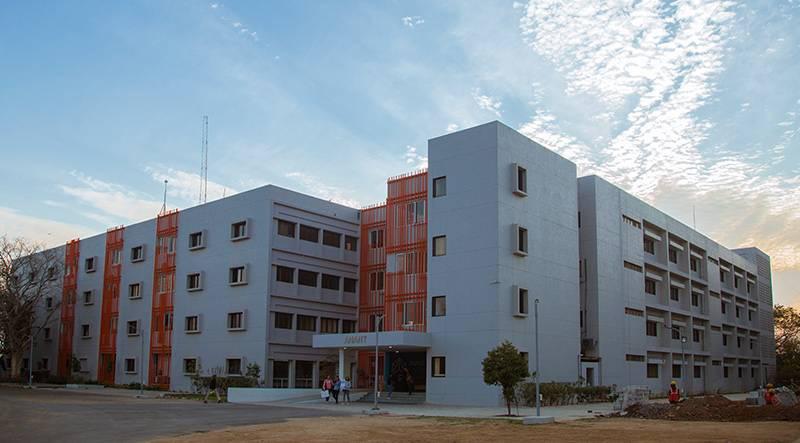
LEARNING BEYOND CLASSROOM • MULTI - PHILOSOPHICAL APPROACH 8 Fig - 01 Anant National University ( Source - www.anu.edu.in )
About Guide
An architect and interior designer, Neha Vin pursued her undergraduation in Architecture from the School of Architecture & Landscape Architecture, UNITEC New Zealand, and Bachelor of Interior Design (B.I.D) from Sardar Patel University, School of Interior Design, APIED, Vallabh Vidhyanagar.
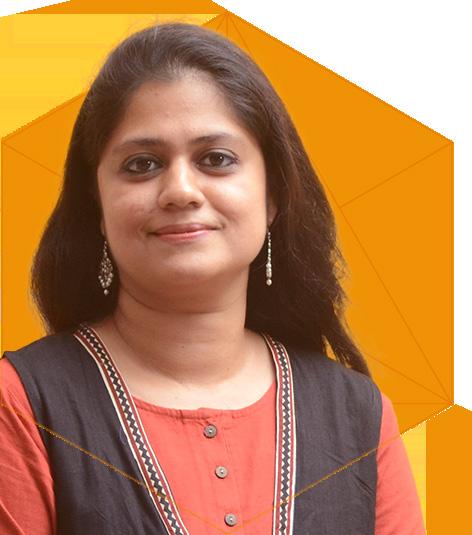
Neha’s keen interest in travel has enriched her with knowledge from various parts of the world. Passionate about teaching, she has been an active participant in the academic realm since July 2014. An ace student in her formative years, Neha has won Shri Jashbhai V. Patel Gold Medal for securing the highest aggregate marks in all the subjects during her five years of study in Interior Design. Besides, she has also won the Shri Suryakant Patel Award for securing the first position in ‘Design Studio Ten’ for her Dissertation on Adaptive Reuse of Baronet’s Bungalow (20022003).
Neha is the Adjunct Assistant Professor and Dissertation Coordinator at the School Of Design, AnantU. An expert in residential and retail projects, she approaches teaching by combining theory, its practical application, and unique examples on interior design discipline. She teaches Interior Design and History of Interiors at AnantU.
Fig - 02 Prof. Neha Vin
Source - www.anu.edu.in )
SHASHVI DALAL • ANANT NATIONAL UNIVERSITY | 2022 GRADUATION PROJECT • UG SPACE DESIGN
(
About Myself
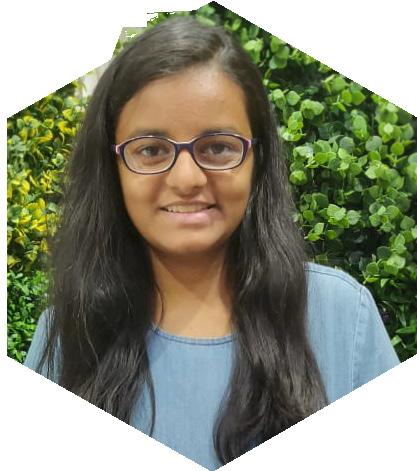
Being an aspiring designer and a writer, I like expressing myself creatively through my design and words. I like experimenting with colours, materials, textures and forms that act as a feature element in my designs.
Having learnt storytelling, I love weaving stories around my designs and vice versa. I am a quick learner and love taking up challenges that use my creative abilities to the maximum potential.
The essence of every design comes from the process it undergoes to reach the final stage. For me, this process is of utmost importance. Every design has an element that can either make or break it. Thus, making such decisions has to be carefully done.
BEYOND CLASSROOM • MULTI - PHILOSOPHICAL
LEARNING
APPROACH 10
Fig
- 03 Author ( Source - Self )
INITIAL IDEATION
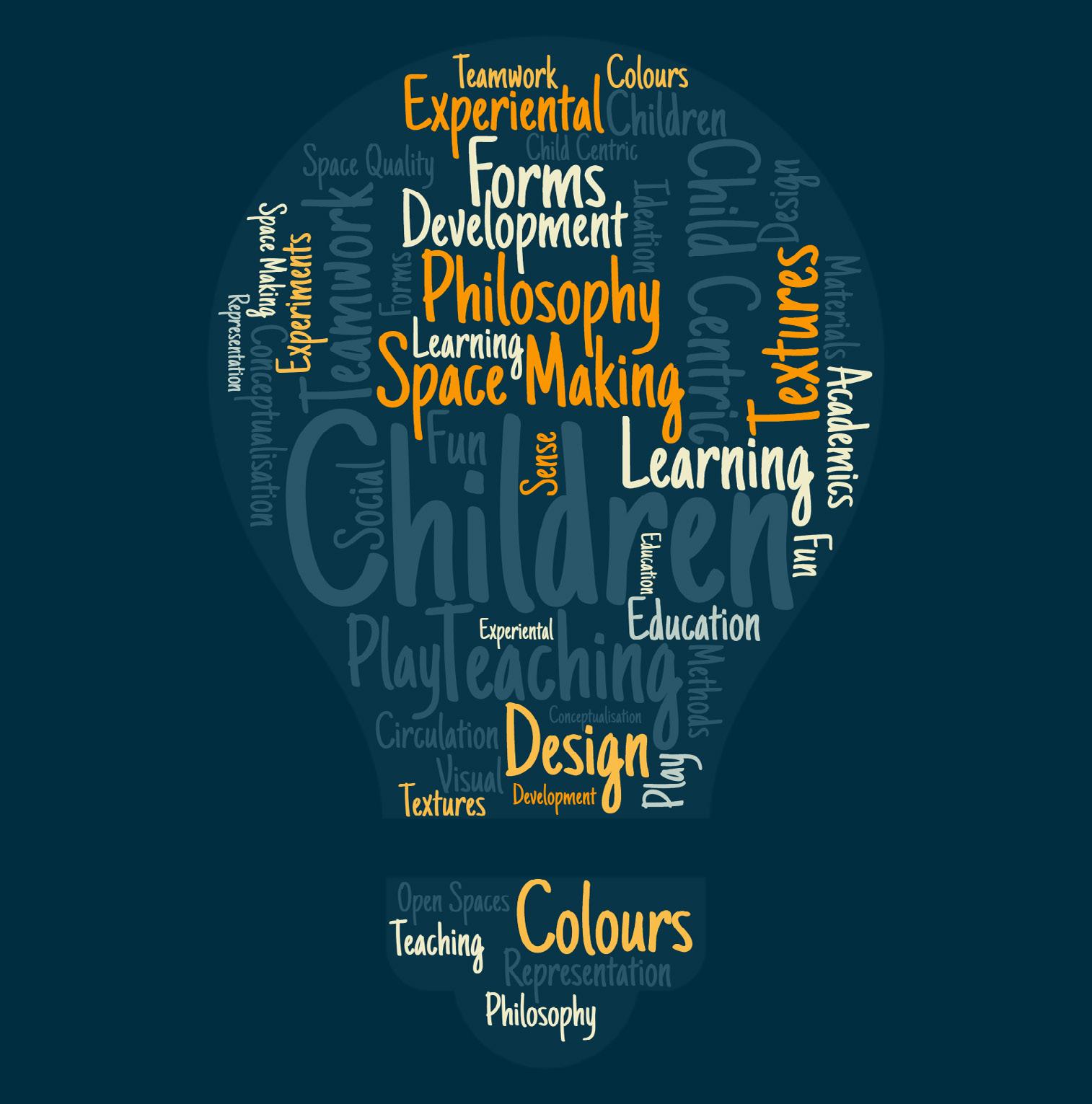
Making A Word Cloud
The first step to ideation was to list words related to the project and make a word cloud. Each word here was put in place according to its importance and contribution to the project.
The word cloud provides clarity on what words to focus on more.
SHASHVI DALAL • ANANT NATIONAL UNIVERSITY | 2022 GRADUATION PROJECT • UG SPACE DESIGN
Fig - 04 Word Cloud ( Source - Genereated online with Preseter Media )
PROJECT TIMELINE - BREAKING IT DOWN
February
Research Proposal - Research - Project Brief
Case Studies - Site Selection -
Design Development
Final Design Stage - Detailing
LEARNING BEYOND CLASSROOM • MULTI - PHILOSOPHICAL APPROACH 12
Conceptualisation
March April May
SHASHVI DALAL • ANANT NATIONAL UNIVERSITY | 2022 GRADUATION PROJECT • UG SPACE DESIGN
- RESEARCH PROPOSAL
- PRIMARY RESEARCH
- SURVEY AND INTERVIEW WITH INDUSTRY EXPERTS - INFERENCES
- SECONDARY RESEARCH
- UNDERSTANDING PHILOSOPHIES
- COMPARITIVE ANALYSIS
LEARNING BEYOND
CLASSROOM • MULTI - PHILOSOPHICAL APPROACH 14 2
RESEARCH PROPOSAL
Research Question
How can a space be designed to aid the learning process of children and make their experience more fun and better ?
- Try to find connections between both the methods.
- Understand the process and various aspects of designing child - centric spaces.
- Float survey forms and have interactions with children and their parents.
Aim Objectives
The main aim of this dissertation is to design a non-formal learning space for children from age group 6 – 12 years using various teaching learning methods from across the world.
- Research and do case studies about various similar spaces designed for children.
Methodology
The following methodology was adopted in order to complete the dissertation project :
- Have interactions with people who design spaces for children and understand how the process works.
Scope And Limitations
- There are a lot of different methods/ models of teaching and learning. It would not be possible to cover all of them.
The objectives of this dissertation are as follows:
- To understand the various existing learning teaching methods and do a comparative analysis.
- To understand the existing learning teaching situations from children and their parents.
- Thorough research about various methods of learning and teaching practiced around the world, like Montessori, Waldorf and many more.
- Drawing out information based on different parameters and having a comparative analysis.
- Thus I would want to limit myself by choosing five of these models from across the world.
- Also while the methods are vast, I would limit myself to studying some of the factors in detail.
SHASHVI DALAL • ANANT NATIONAL UNIVERSITY | 2022 GRADUATION PROJECT • UG SPACE DESIGN
INTRODUCTION
The Start
The research thus had to be conducted in two parts - Primary and Secondary research.
Both the research had to be done keeping in mind the aim and objectives of the project.
At the end of the research, there should be a clear understanding of different philosophies of learning teaching methods, the details of designing spaces for children, the learning material for the selected age group and so on.
Primary Research
Primary research was done by having live interactions and collecting relevant information related to the project.
Aim - To understand the learning teaching scenario currently present from the children falling under the decided age group and the specifications/details of designing children's spaces.
Secondary Research
Secondary research was done by collecting data from sources like books, the internet, magazines etc.
Aim - To understand various teaching learning methods with their philosophies from around the world in detail. Also to understand the different development in children of the chosen target group.
LEARNING BEYOND CLASSROOM • MULTI - PHILOSOPHICAL APPROACH 16
PRIMARY RESEARCH
Part 1
A live interaction with the children and their parents was the first part of the primary research.
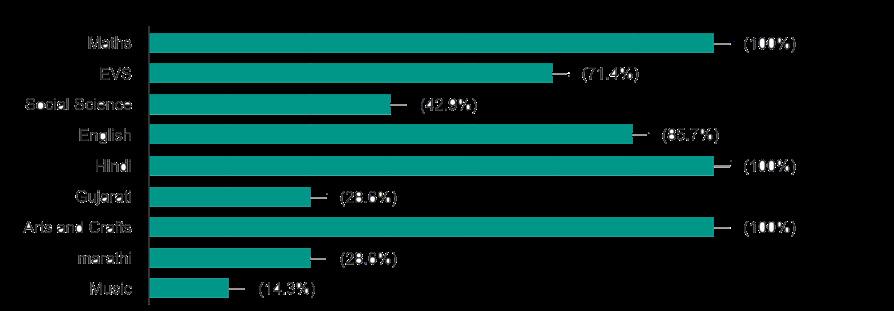
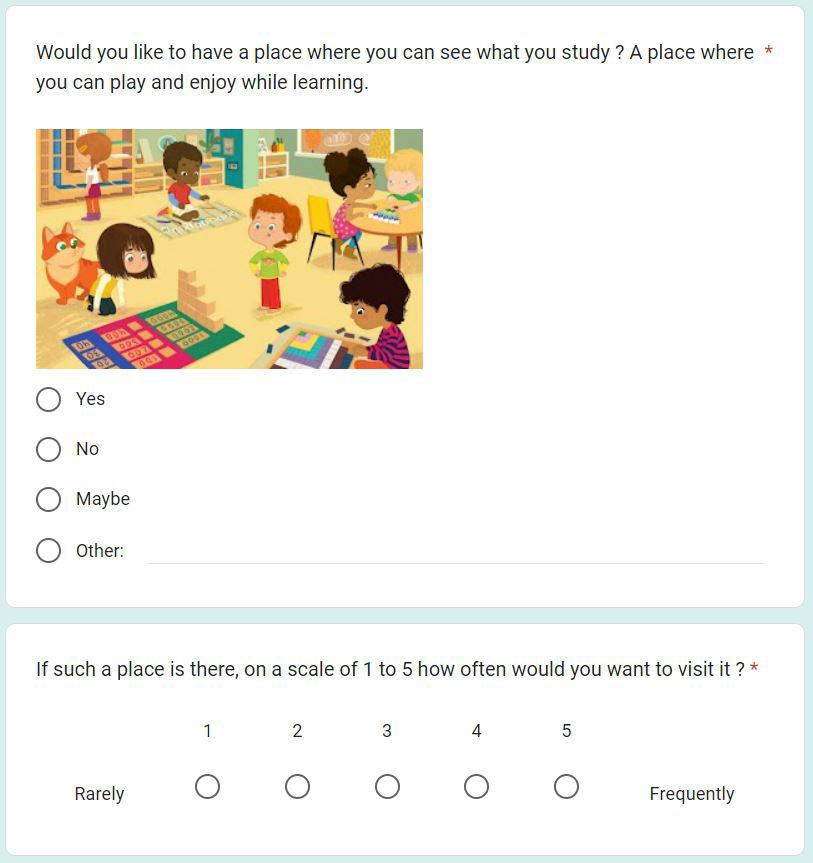
Google form was made and floated to collect their insights on different aspects of the current teaching learning methods.
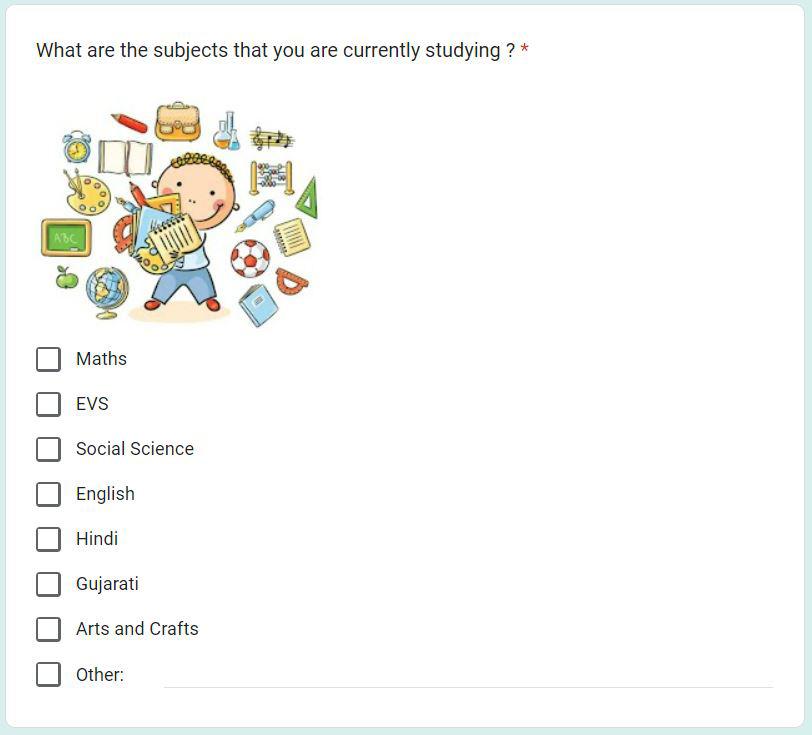
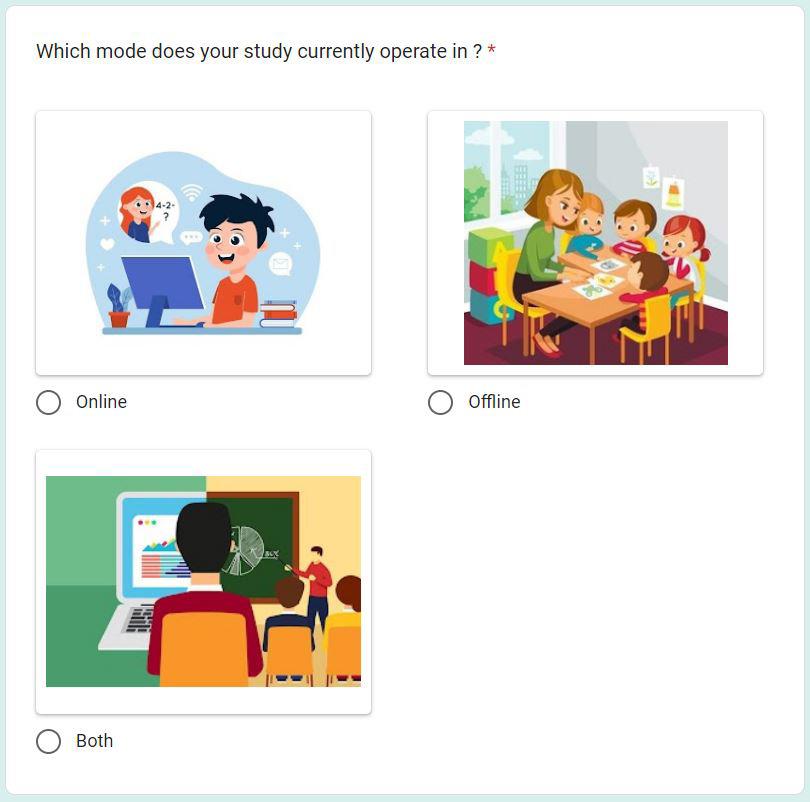
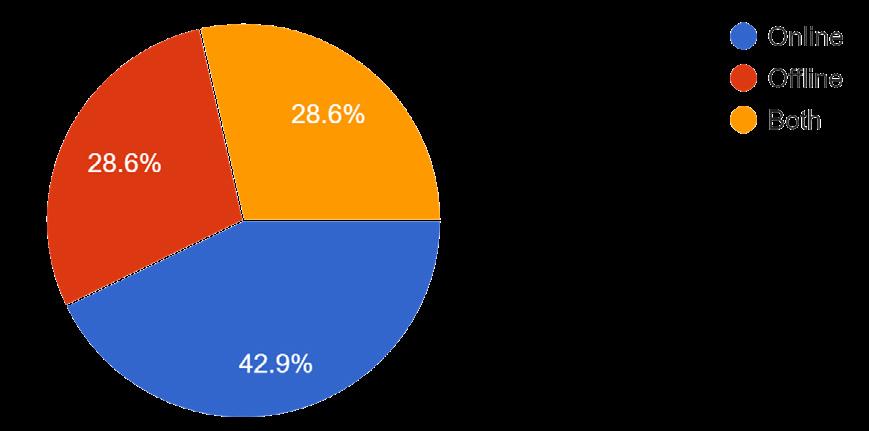
Few of the interactions were done face to face to understand and interact more freely.
Circulation Of Google Forms - Live Interactions
Form For Kids
The form was kept graphical to make the children get interested in it.
Part 2
An interaction was done with the members of Anthill Creations - Pooja Rai (Founder) and Swetha Manivannan (Head Designer) to understand how the spaces for children are designed keeping the play element intact.
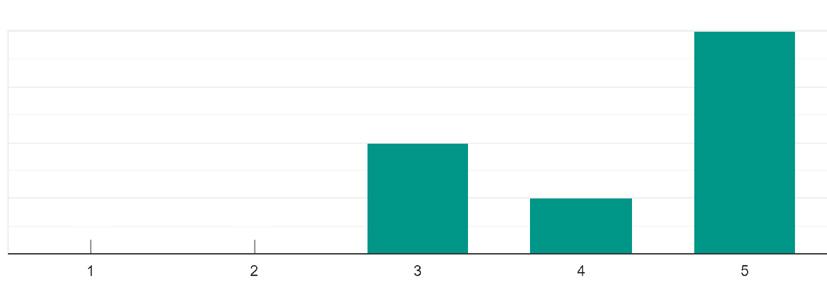
Fig - 05 Question : Response
Fig - 06 Question : Response
SHASHVI DALAL • ANANT NATIONAL UNIVERSITY | 2022 GRADUATION PROJECT • UG SPACE DESIGN
Fig - 08
From offline forms -

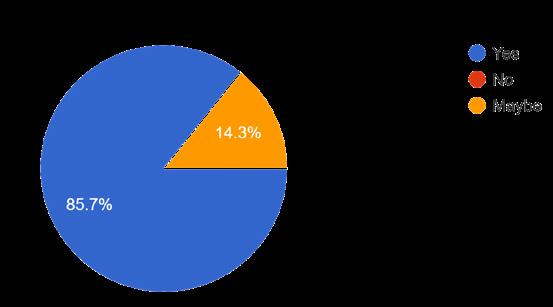
- During online class, video games and interaction based online activites. - Videos, Graphics etc.
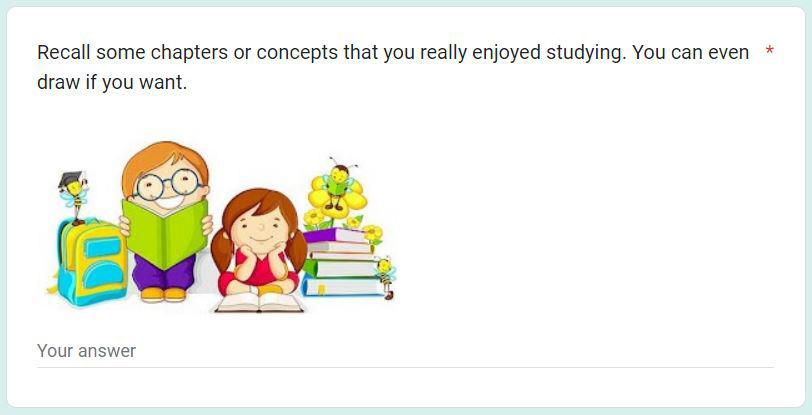
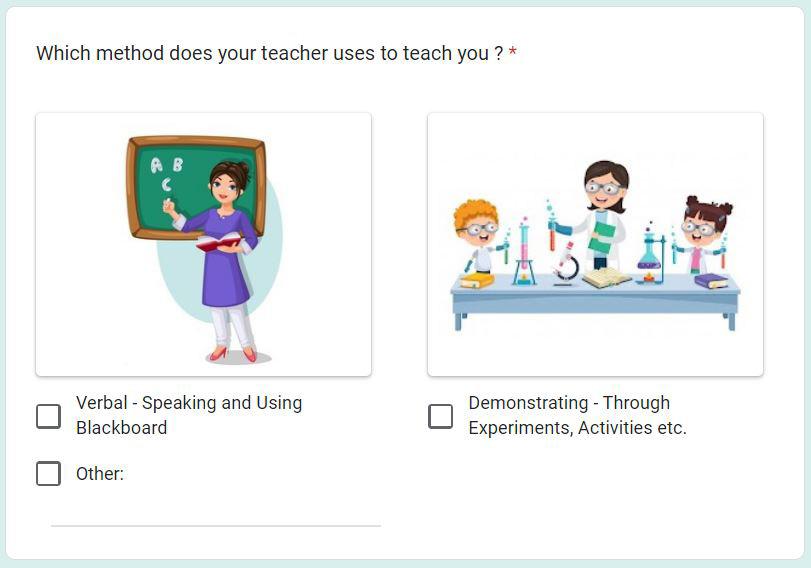
Fig - 09 Question
Inputs from online as well as offline forms -
- Science experiments
- Maths : Decimal, Division, Addition, Money, Numbers.
- EVS : Weather, People at work
- Science : Experiments, Earth and other planets, Sun, Moon
- English and Hindi : Chapters having stories.
- Arts and Crafts : fun making them.
Fig - 07
LEARNING BEYOND CLASSROOM • MULTI - PHILOSOPHICAL APPROACH 18
Question : Response
Question : Response
PRIMARY RESEARCH
Inferences With Respect to Questions
Most Favourite And Least Favourite Subject
For children falling under the age group of 6-9, their favourite subject was based on the teacher and the way she teaches.
While for children from the age group 9-12, their favourite subject depended on the content of the subject and what elements they like in it.
Maths was a favourite one as it involved a lot of different activities and practical knowledge. The least favourite subjects were chosen similarly.
Language subjects like Hindi and English were among the least favourite as it was hard to remember and needed the content to be mugged up.
Chapters Or Concepts They Really Enjoyed Studying
The concepts they remembered and enjoyed the most were mostly the ones that were taught in a practical and participatory manner.
For children, it is easier to remember something done with the use of all their senses. They tend to have a strong base for topics taught in this manner.
Special Inputs/Elements They Would Want If Such A Space Is Created (Includes both children and parent's response )
- Garden, zoo, enjoyment activities, games, gifts and other such spaces.
- Videos for extra knowledge
- Social studies in this form
- Everyone listens to me and understands me.
- Maybe less homework
- More activity periods and no studying
- Experimental and real example-based study.
- Physical education ( P. E.)
- Would like to see real science elements which show them practically how things happen instead of just accepting facts.
- More creativity, more exposure
- Kids will love to study more and will get exposure to learning practically.
- How plants grow, how water vapour changes into the cloud , how electricity was discovered.

SHASHVI DALAL • ANANT NATIONAL UNIVERSITY | 2022 GRADUATION PROJECT • UG SPACE DESIGN
Fig - 10 Happy Kids : Illustration
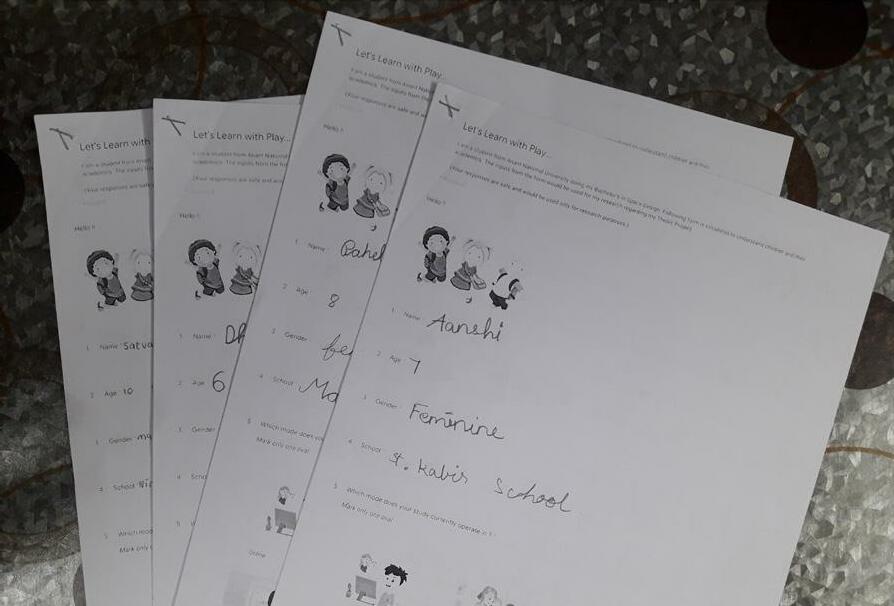
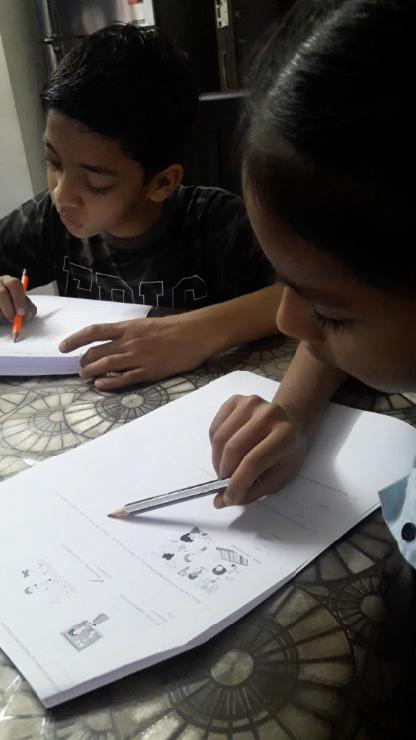
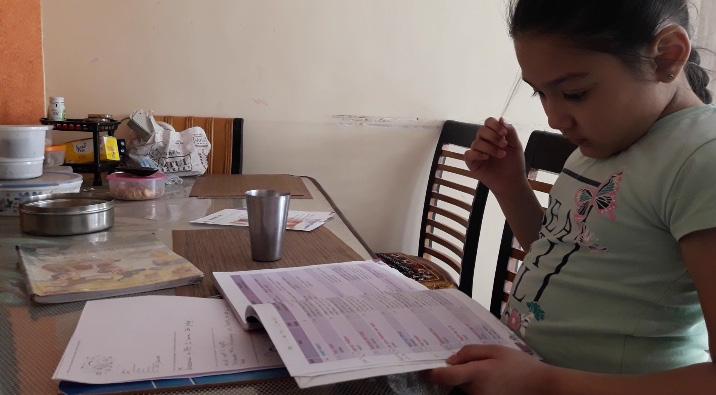
Glimpse Of Some Participants And Their Forms
Conclusion
From the various inputs received and interactions done following points can be concluded with resepect to the research.
Children find it easy and fun while they learn through activities and games. They want to get involved and participate in discussions and learn with their peers. They want a space where they can play and learn together.
The teachers also play a very important role and the way they include children in teaching affects the efficiency of their learning.
What also matters a lot is the way topics are taught and how much of learning is done practically. Children of this age tends to enjoy and learn faster something that is taught practically through experiments, activities and other such methods.
LEARNING BEYOND CLASSROOM • MULTI - PHILOSOPHICAL APPROACH 20
Fig - 11 Survey Participants and Their Forms (Left - Satva and Pehel , Right - Aanshi) ( Source - Self Clicked )
PRIMARY RESEARCH _ ANTHILL CREATIONS
Introduction Play In A Box
Anthill creations is a not-for-profit organization which aims to bring back play for all age groups by bringing sustainable playscapes, using contextu al designs and localized resources and encouraging community participation.
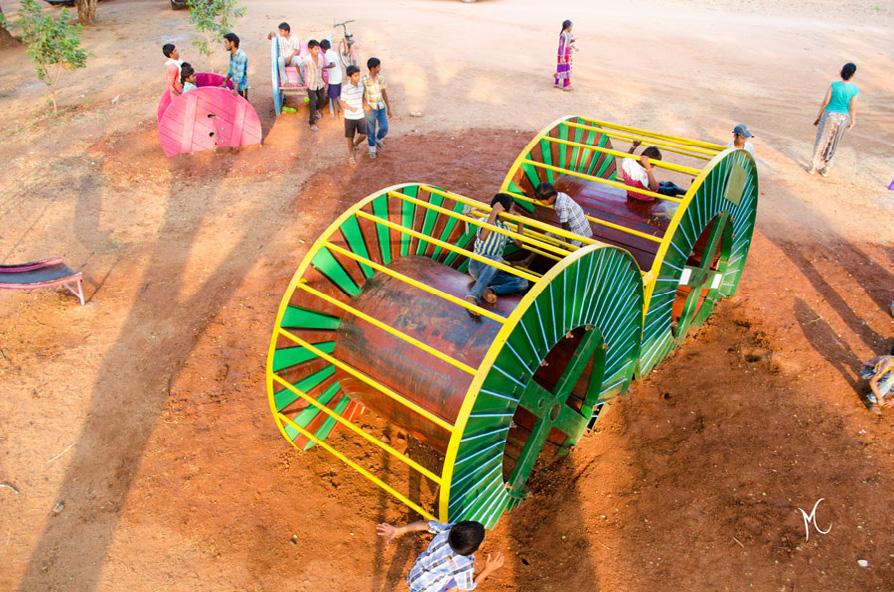
It uses waste materials like tires, cable drums, oil drums and locally available material to build playgrounds that are designed with interaction with the community members.
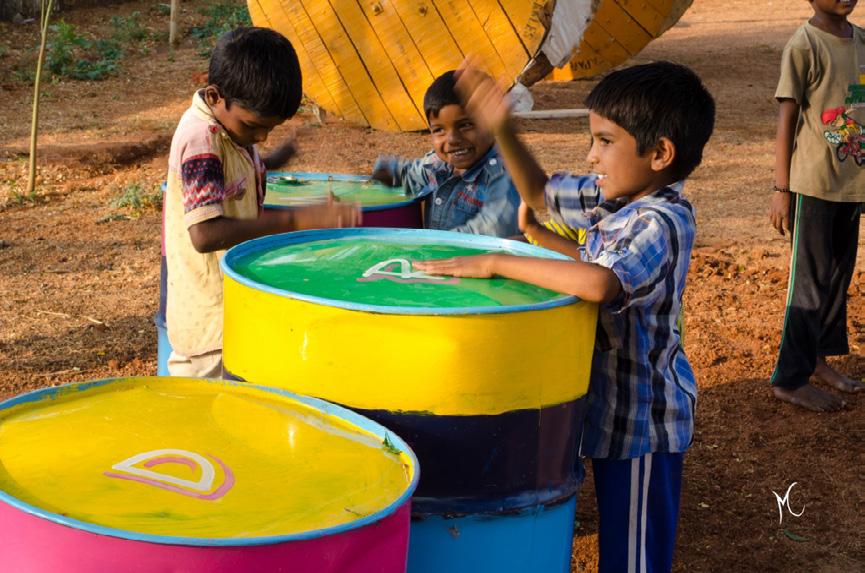
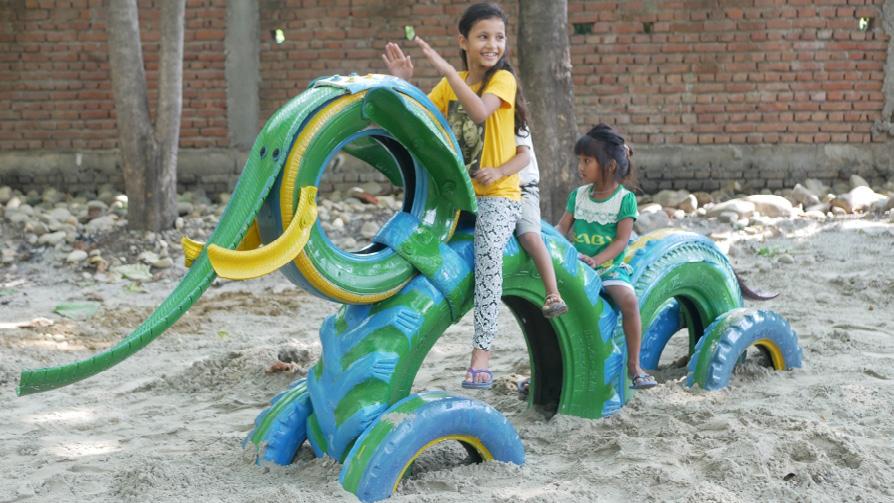
Fig -
Playscapes out of Scrap Tyres
- antihillcreations.org)

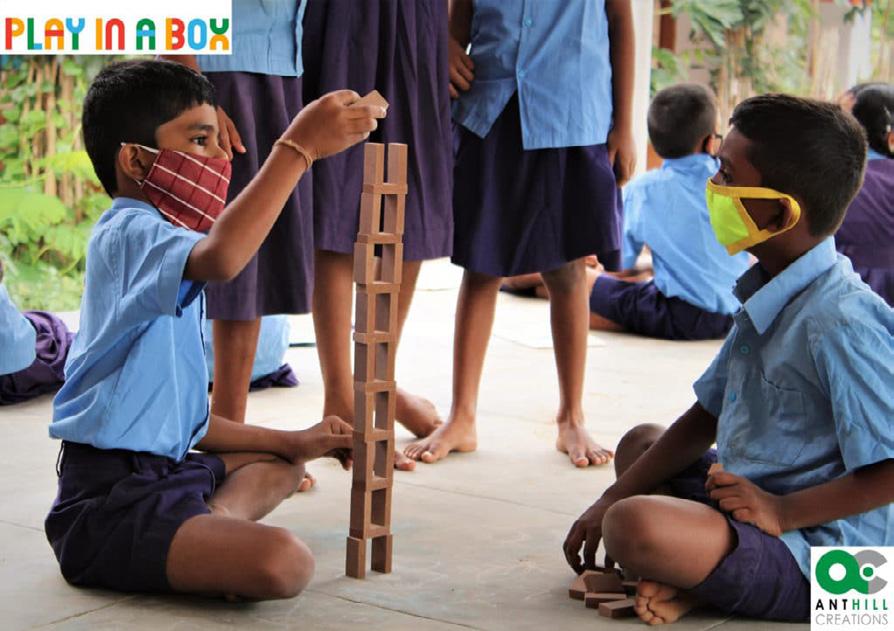
Anthill came up with the idea of ‘Play in a Box’ — at-home learning and play kits designed to inspire our young innovators, artists, designers, makers, and scientists.
Play in a Box is an assortment of curated engagement & learning activities focusing on active play.
It includes active play game for physical development, team play game for social development, learning game for mental development, strategic thinking game for cognitive and intellectual development, creative expression play for emotional development and constructive game for fine motor skill development.
SHASHVI DALAL • ANANT NATIONAL UNIVERSITY | 2022 GRADUATION PROJECT • UG SPACE DESIGN
Fig - 12 Oil Drums as a Play Element ( Source - antihillcreations.org ) Fig - 14 Play in A Box ( Source - antihillcreations.org )
13
(Source
Excerpts From The Interview With The Designer Inferences
Question :- Tell us something about your initiative of bringing back play for children.
Answer :- We want to make play accessible to all. 31st article of the UN states that every child has a right to play. 62 % of government schools in India neither have open areas nor do they have playscapes for children. We wanted to provide every child with the right to play.
Question :- “Functionality comes before form “, but for children’s spaces and products, form is the fundamental element. So, how do you tend to keep form before function and achieve the desired result?
Answer :- While we design, the function always comes first and then the form comes at a later stage.
- To design for children, one needs to understand the child’s perspective to play.
- They have varied projects ranging from government schools to private schools. There are a lot of differences while designing playscapes for both of these.
Question :- How do you analyse creating playscapes or game boxes based on different age groups as each of them would have a different approach to play?
Answer :- we have made 2 -3 large categories to do that. Majorly we design for age groups 6 -12. Other than that, we have Anganwadi for 4 – 6 years old. The main difference lies in anthro.
Fig - 15 Playscape from Cable Drums
( Source - antihillcreations.org )
- Government school needs many colourful playscapes to invite children into the space. They have also worked closely with the concept of BaLA (Building as a Learning Aid).
- Private schools, on the other hand, requires the colours to be muted down as they already have a pleasant infrastructure. Thus the focus area for playscape gets limited to just physical activities.
LEARNING BEYOND CLASSROOM • MULTI - PHILOSOPHICAL APPROACH 22
SECONDARY RESEARCH
Part 1
To design a space catering to a particular age group, their growth and development needs to be understood.
Thus a study based on various parameters was undertaken.
As the child continues to grow, some new and exciting abilities develops that should also be reflective in spaces designed for them.
Part 2
The aim was to create a space based on a multi-philosophical approach for which various philosophies had to be studied.
Among the many teaching learning philosophies practised around the world, five of them were chosen and thoroughly understood.
Growth And Development - Age 6 to 12 years
Changes Observed
As kids grow from grade-schoolers to preteens, you can expect many changes from their physical appearances to their favorite activities.
Children between 6 and 12 years old will begin valuing friendships and become more involved in activities like sports and/or painting.
A very important part of growing up is the ability to interact and socialize with others. During the school-age years, parents will see a transition in their child as he or she moves from playing alone to having multiple friends and social groups.
Text For This Part
How Active The child Is...
School-age kids should have many chances to do a variety of activities, sports, and games that fit their personality, ability, age, and interests.
Through physical activities, kids learn about sportsmanship, setting goals, meeting challenges, teamwork, and the value of practice.
As children enter school-age, their abilities and understanding of concepts and the world around them also continue to grow.
( Source - https://www.choc.org/primary-care/ages-stages/6-to-12-years/ )
SHASHVI DALAL • ANANT NATIONAL UNIVERSITY | 2022 GRADUATION PROJECT • UG SPACE DESIGN
Cognitive Development
The first 12 years of life are prime time for learning.
Experiences actually change the structure of the brain. During early childhood, the developing brain is busy forming multiple connections between nerve cells. These connections function much like the “wiring” of a computer. Each new experience results in a new connection.
School-age children have replaced magical thinking and prelogical thinking with concrete logical thinking.
Middle Childhood
One of the many missions of middle childhood is to acquire knowledge and master new skills.
For a child who learns easily, this mission is a source of reward and pride.
For a child who has learning difficulties, this mission offers challenges to their self-esteem. Because children of this age have few defenses against failure, a child having learning difficulties often gives up rather than risk being humiliated.
Philosophies Studied
Following are the philosophies that will be studied in depth and a comparitive analysis will be drawn.
a) BaLA : Building as a Learning Aid
b) Montessori
c) Waldorf
d) Reggio Emilia
e) Harkness
These philosophies have been chosen keeping in mind the impact it has on the learning among the children.
Text For This Part
( Source - https://www.rileychildrens.org/health-info/growth-development-6-11-years )
LEARNING BEYOND CLASSROOM • MULTI - PHILOSOPHICAL APPROACH 24
SECONDARY RESEARCH _ BaLA (Building as a Learning Aid)
“ BaLA or Building as a Learning Aid is a concept that believes that the quality of eduaction can be improved developing child-friendly, learning and fun based physical environment building in school infrastructure. "
( Source - Edudwar.com )
Introduction
Building as Learning Aid, or BaLA as it is popularly known, is about developing school spaces — the classrooms, the floors, walls, doors, windows, pillars, corridors, the outdoor spaces and the natural environment — as learning resources.
It is an interface between architecture and the learning needs of children. Existing huge built resources such as schools and its surrounding are incorporated with learning elements to provide a better experience.
It is a community-based effort where everyone’s participation is appreciated. Students along with teachers, headmasters etc. all take part in creating these elements.
Multiple use settings are created. For eg. :- To understand the concept of weights, the weight of the object is labelled on objects that they use like a table, a bench and other such elements. This way they understand it in an interesting and a lot easier way.
Fig - 16 Logo of Vinyas : This concept was developed originally by Vinyas, Centre for Architectural Research and Design with the support from UNICEF.

( Source - Text : edudwar.com
Image : vinyas.org )
SHASHVI DALAL • ANANT NATIONAL UNIVERSITY | 2022 GRADUATION PROJECT • UG SPACE DESIGN
Visuals From The Schools Under BaLA - Understanding The Space
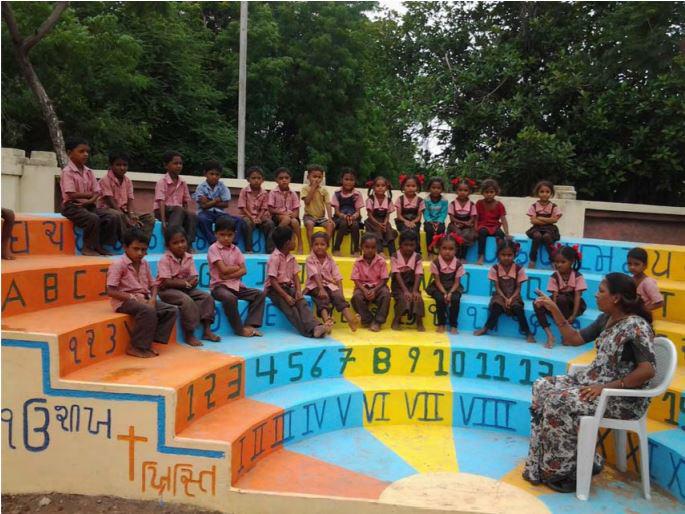
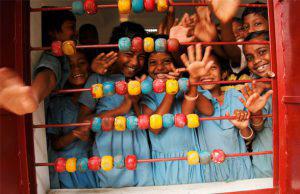
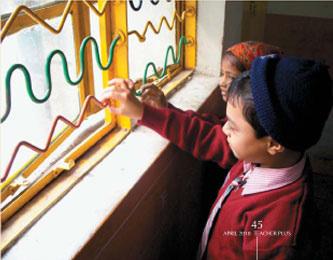
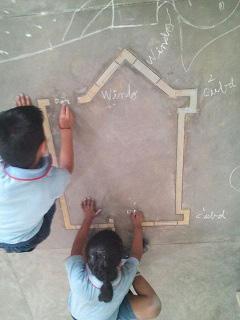
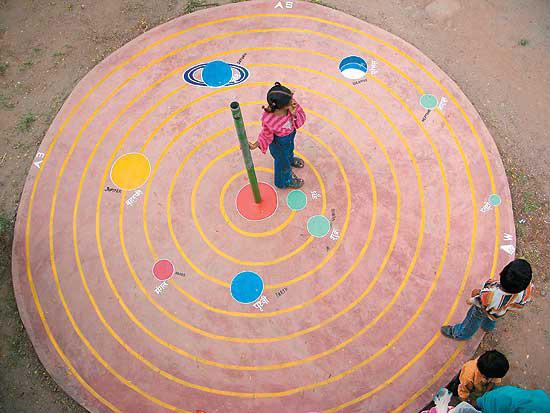
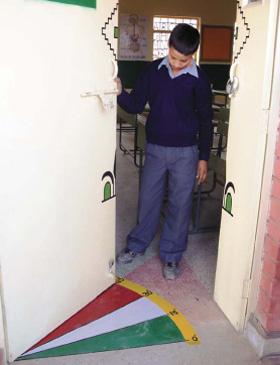
Fig -
numbers.
in a
Fig -
playground.
in
Fig -
grills.
Fig -
taught.
Fig -
interactive.
taught through classroom doors.
Fig -
LEARNING BEYOND CLASSROOM • MULTI - PHILOSOPHICAL APPROACH 26
17 Amphitheatre modified
way to teach the alphabets and
18 The grills of the window modified and made more
20 Area and Parameter being
22 Angles
19 Solar Sytem being taught
open
21 Interactive window
SECONDARY RESEARCH _ MONTESSORI APPROACH
Introduction
Students are encouraged to choose what they want to learn and thus they get control over their learning.
Peer learning is encouraged here through mixed-age classes. Younger students are encouraged to learn from elder ones while the elder one gets the opportunity to teach what they have learnt.
No grading and homework is encouraged.
Montessori realized that students understand complex concepts better when they engage all their senses and thus a very multi-sensory approach is taken.
Material and practical-based learning happen. Classrooms are also kept open to edu cate the children about discipline. They are encouraged to pick and drop the materials at their respective places by their own.
8 Principles Of Montessori
and cognition
extrinsic rewards
from and with peers
in context
interactions
in the environment
SHASHVI DALAL • ANANT NATIONAL UNIVERSITY | 2022 GRADUATION PROJECT • UG SPACE DESIGN
“ The environment must be rich in motives which lend interest to activity and invite the child to conduct his own experiences.
"
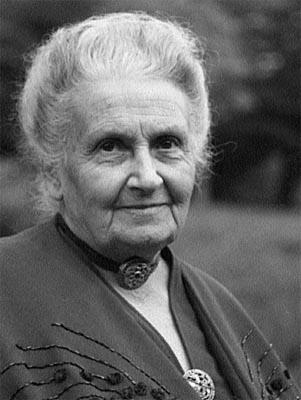
- Dr. Maria Montessori
Fig - 23 Dr. Maria Montessori
- Movement
- Choice - Interest - Avoid
- Learning
- Learning
- Adult
- Order
Visuals From The Philosophy
Understanding Space,
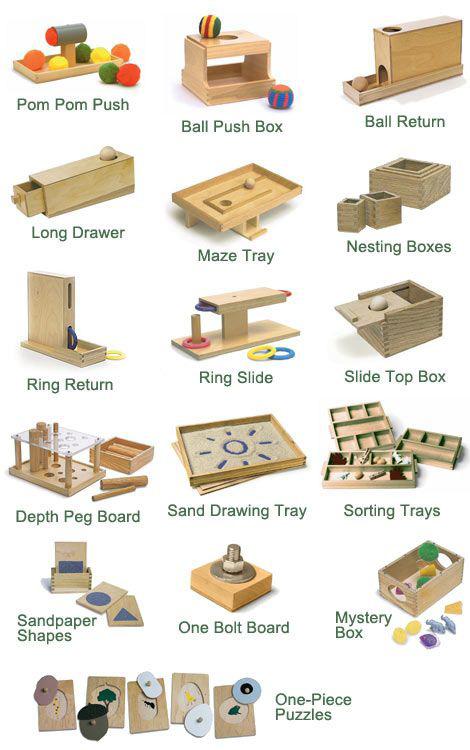
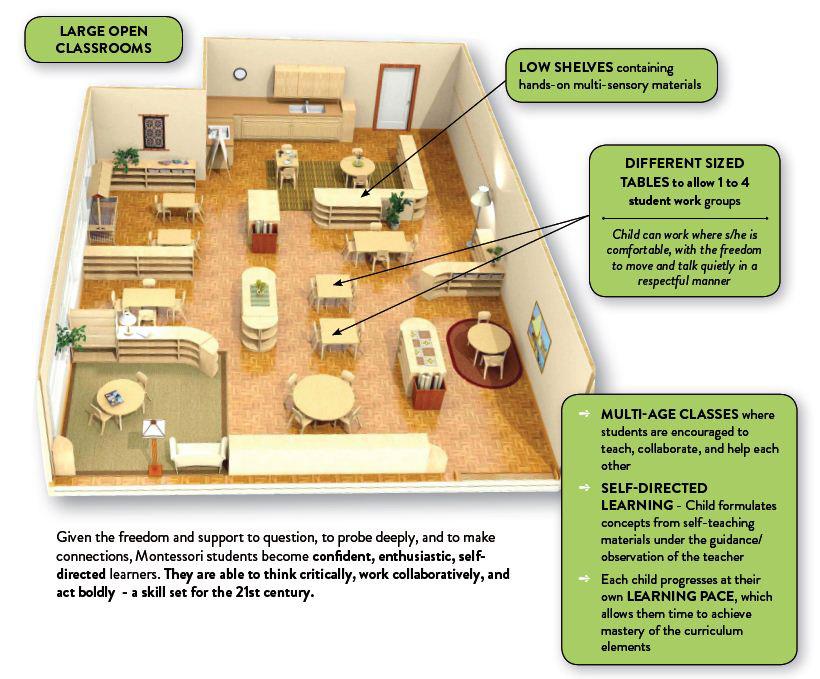
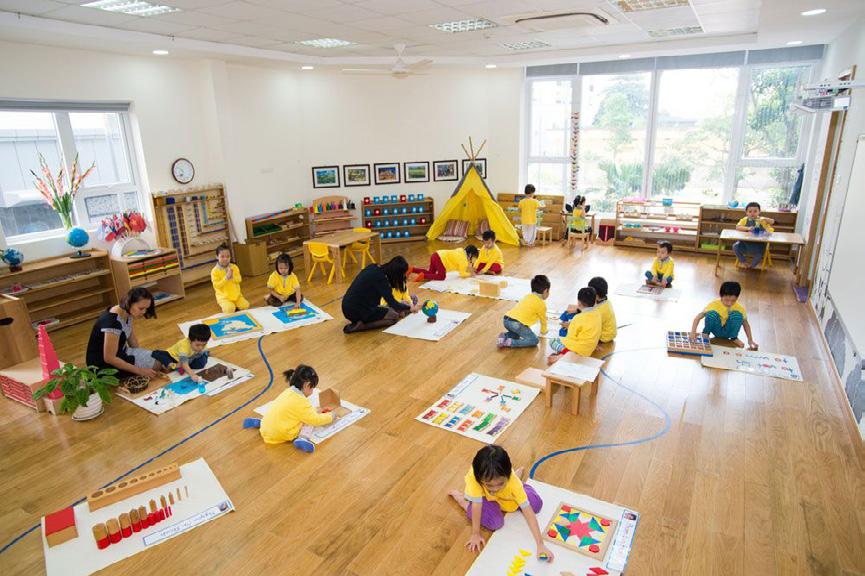
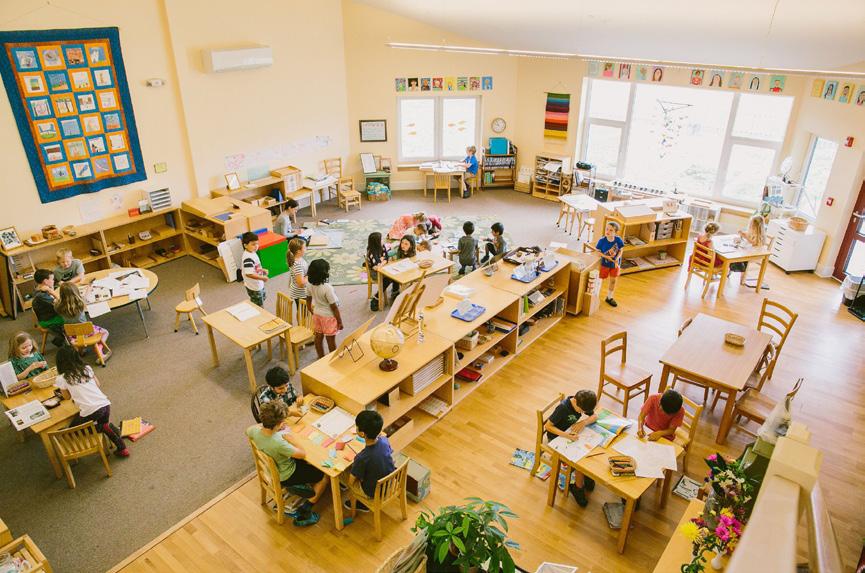
LEARNING BEYOND CLASSROOM • MULTI - PHILOSOPHICAL APPROACH 28 Fig - 25 A Montessori learning and teaching in action. Fig - 24 A Montessori school setting. Fig - 26 Explanation of the Montessori classroom Fig - 27 Montessori Materials
-
Materials...
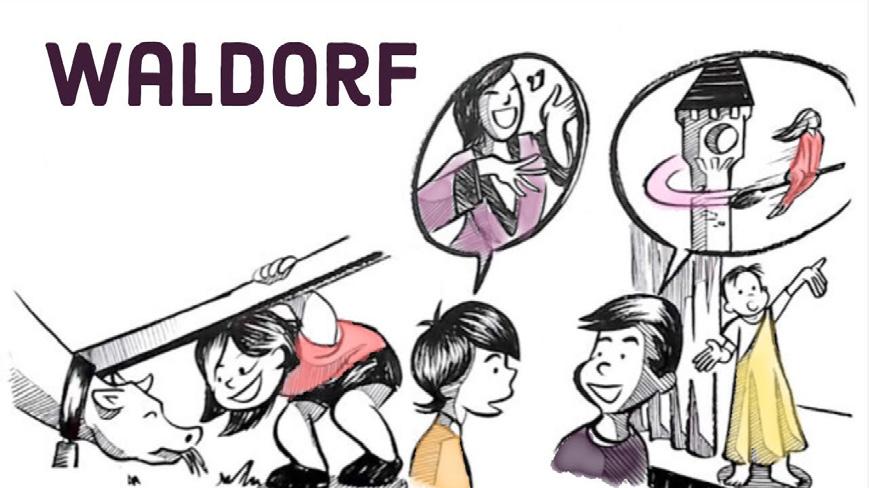
SECONDARY RESEARCH _ WALDORF APPROACH
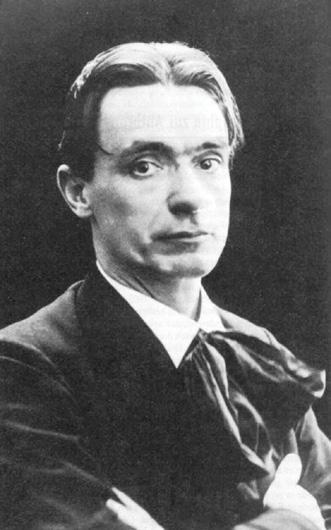
“ The heart of the Waldorf method is the conviction that education is an art - it must speak to the child's experience. To educate the whole child, his heart and will must be reached as well as his mind.
"
- Rudolf Steiner
Introduction
This method believes in addressing all the underlying capacities of the developing human being – their thinking, their feeling and also their ability to engage their will.
Here the foundation is created by making the children open to experience, finding creativity and imagination.
The various subjects taught are maths, science, literature, history, arts and hands–on paint, knit, weave, sculpt, music, dance etc.
Foundations Of Waldorf Education
- Early Childhood : Develop the limbs through doing.
- Middle Childhood : Develop the heart through imagination.
The Waldorf lower school curriculum is alive with fairy tales and fables, mythological sagas, and stirring biographies of historical figures.
- Adolescence : The mind through discernment of the world.
SHASHVI DALAL • ANANT NATIONAL UNIVERSITY | 2022 GRADUATION PROJECT • UG SPACE DESIGN
Fig - 29 Waldorf School : Illustration
Fig - 28 Rudolf Steiner
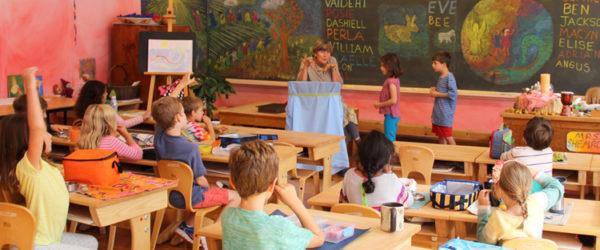
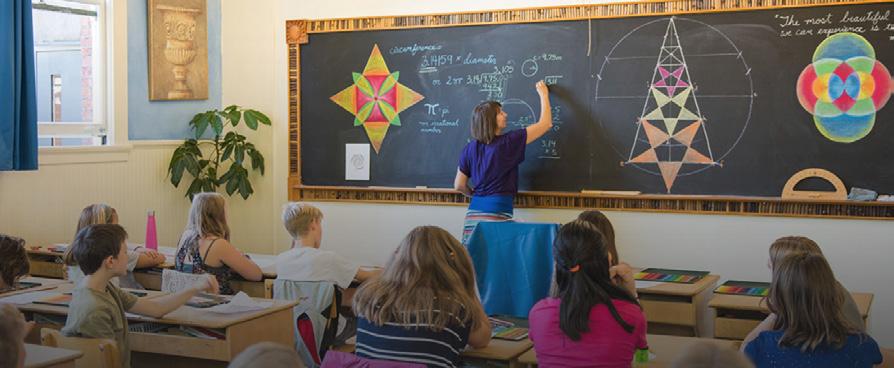
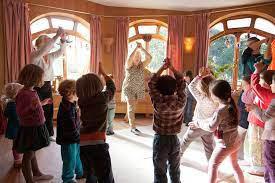
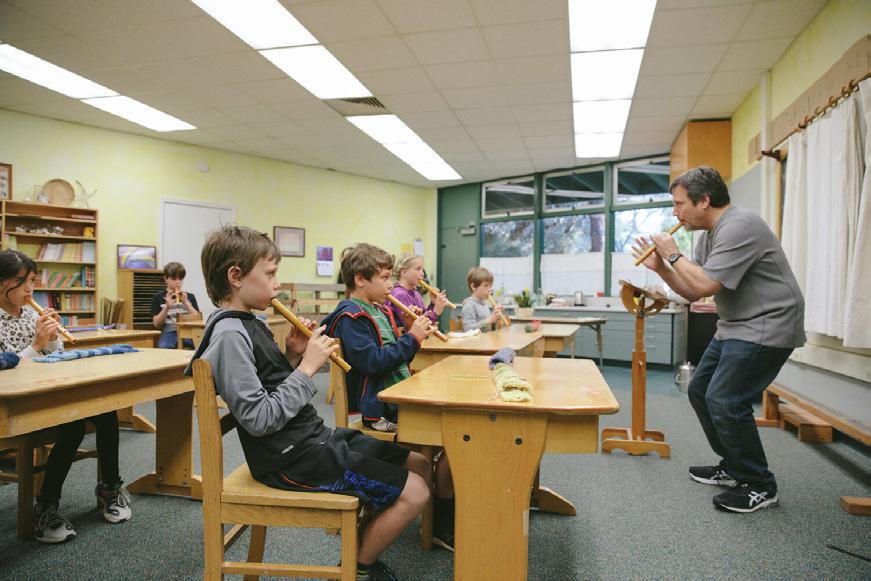
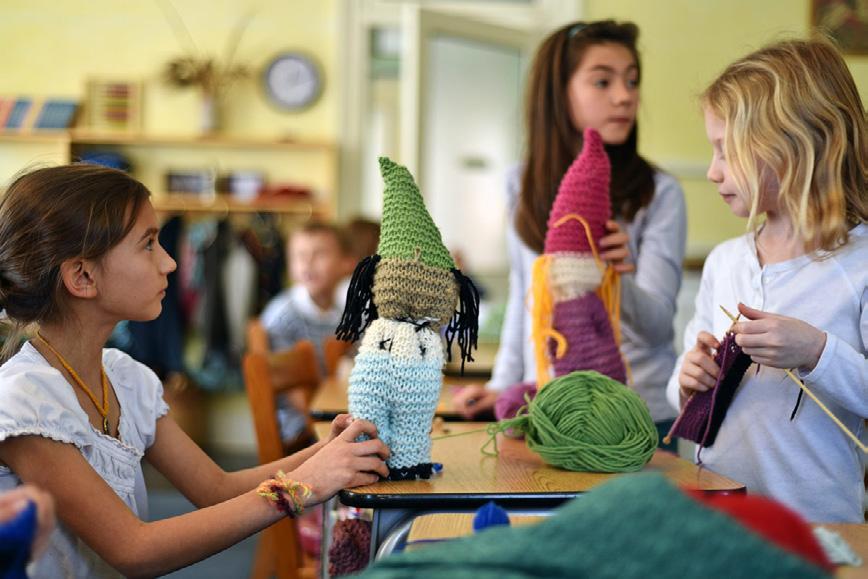
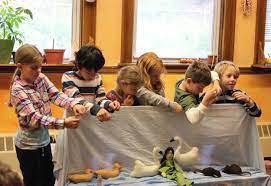
LEARNING BEYOND CLASSROOM • MULTI - PHILOSOPHICAL APPROACH 30 Fig - 30 Ongoing activity at a Waldorf school. Fig - 32 Waldorf classroom teaching Fig - 33 Waldorf classroom teaching mixed with storytelling. Fig - 34 A flute learning session in action. Fig - 35 Perfomance by the students through a puppet show. Fig - 31 Interactive sessions at a Waldorf school Visuals From The Philosophy - Understanding Space, Materials...
SECONDARY RESEARCH _ REGGIO EMILIA APPROACH
Introduction
Reggio Emilia approach had project and collaboration-based learning. Throughout the project, the spirit of researchers, risk takers, designers and explorers are undertaken by the students. They collaborate with their peers.
- Loris Malaguzzi
This method states that there are 100 languages in which the children learn and express – they paint, sculpt, drum and whisper, they build, listen, speak or sing and dance.
Teachers let the student do mistakes and thus allowing them to realize them and learn to correct them themselves.
The projects are all documented in different formats and then displayed for the students to see. Children can revisit their achievements as well as the projects that were left incomplete. This way they know about their progress as well.
The Three Teachers
- The first teacher is the parents of the child. They are also involved in the learning process.
- The second teacher is the peers. Children learn a lot through peer learning.
- The third teacher is the environment which is rich in material. It sparks curiosity, creation and discovery.
SHASHVI DALAL • ANANT NATIONAL UNIVERSITY | 2022 GRADUATION PROJECT • UG SPACE DESIGN
“ The wider the range of possibilities we offer children, the more intense will be their motivations and the richer the experiences.
"
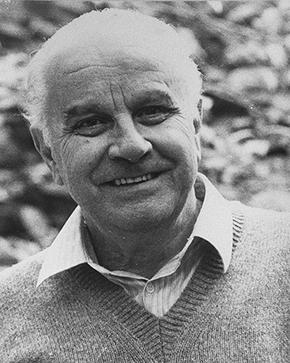
Fig - 36
Loris Malaguzzi
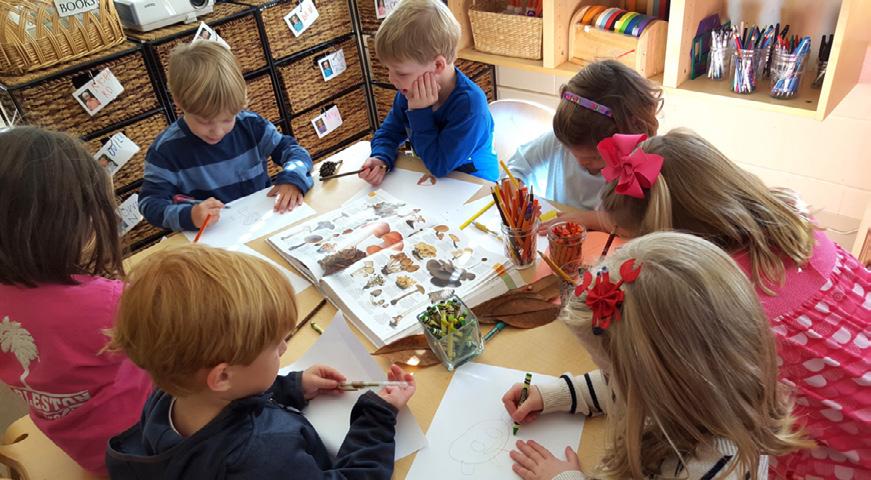
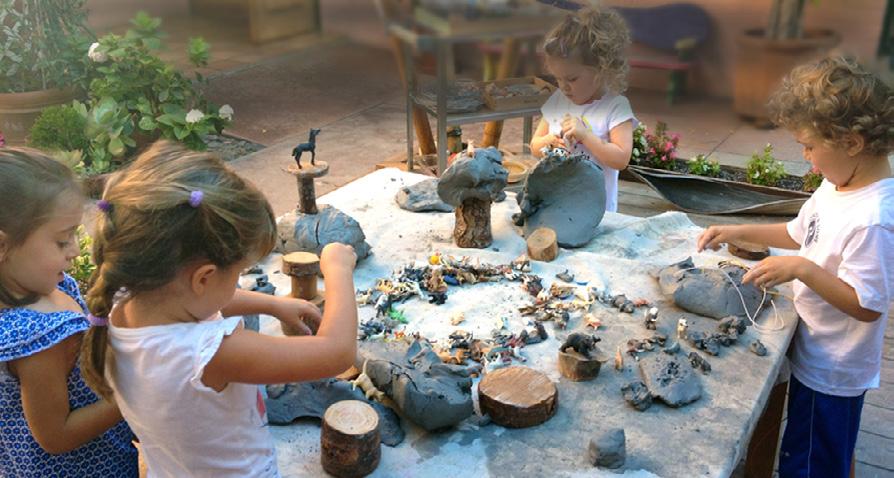
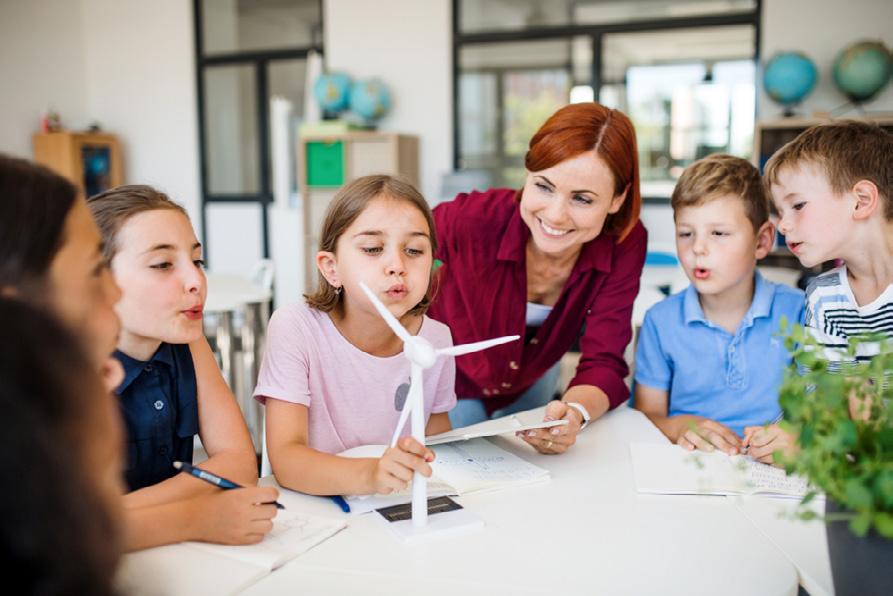
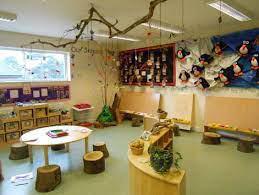
LEARNING BEYOND CLASSROOM • MULTI - PHILOSOPHICAL APPROACH 32 Visuals From The Philosophy - Understanding Space, Materials... Fig - 37 Reggio Emilia classroom Fig - 38 Hands-on learning Fig - 39 Interactive session at Reggio Emilia school Fig - 40 Team work and discussion among peers
SECONDARY RESEARCH _ HARKNESS APPROACH
“ I want to see somebody try teaching - not by recitations in a formal recitation room where the teacher is on a platform raised above the pupils and there is a class of 20 or more boys who recite lessons. . . . I think the bright boys get along all right by that method, but I am thinking of a boy who isn’t a bright boy - not necessarily a dull boy, but diffident, and not being equal doesn’t speak up in class and admit his difficulties. "
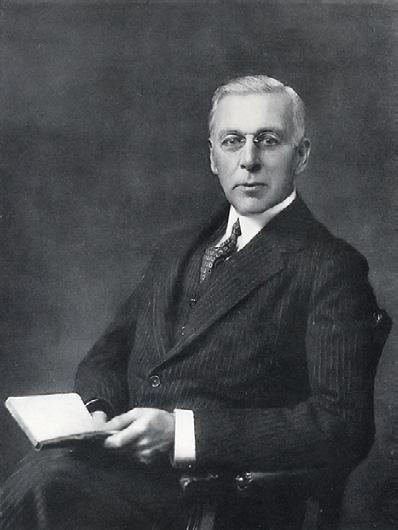
- Edward Harkness
Introduction
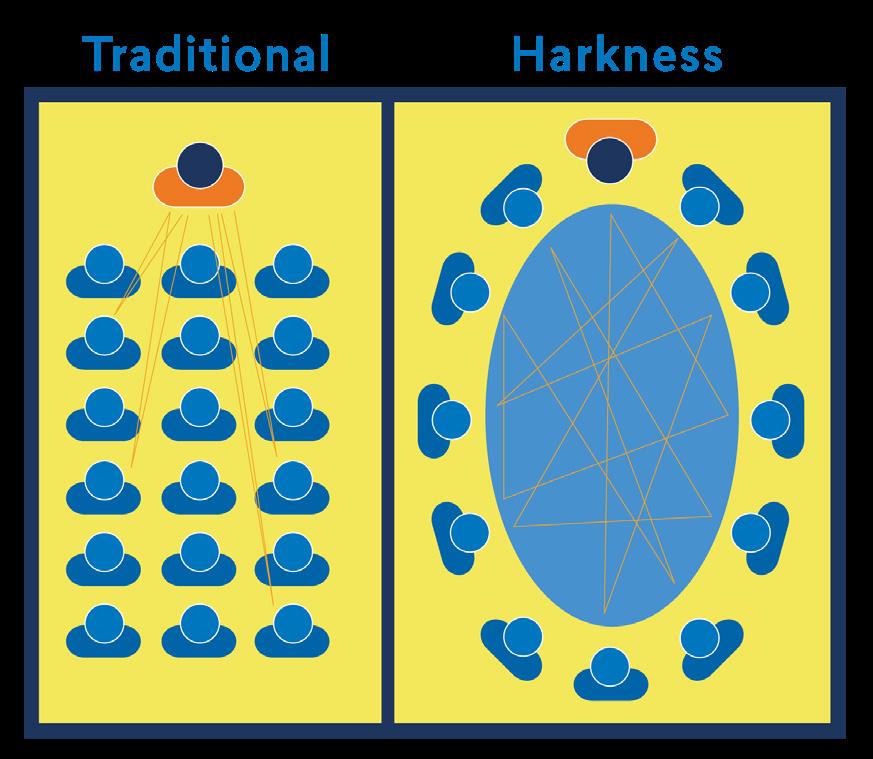
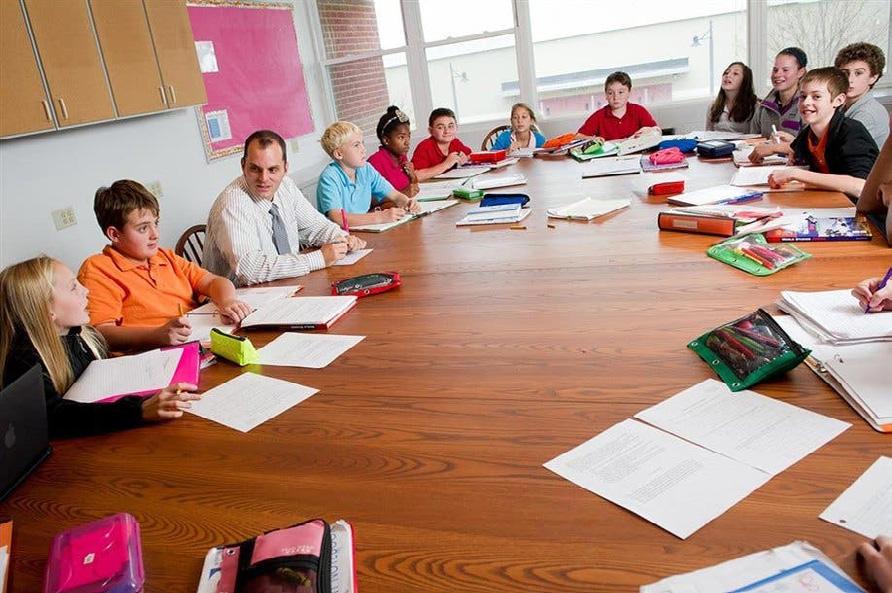
Harkness method uses an oval-shaped table where discussions and teaching take place. On the Harkness table everyone including teachers and students is all at the same level. All of them have the same level of freedom to express themselves.
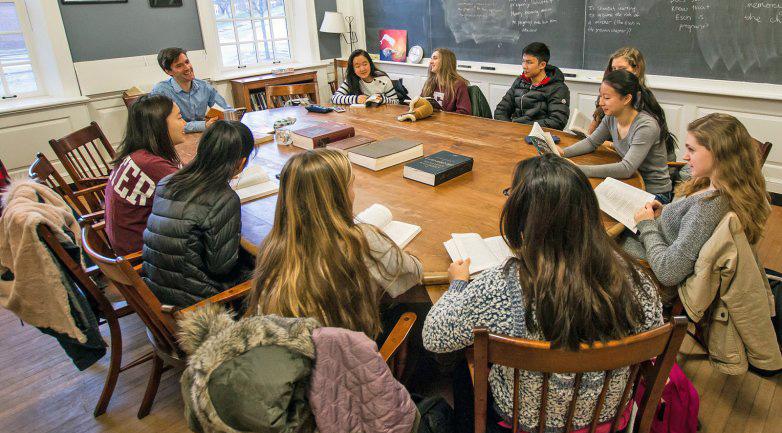
Students here get a chance to experience new thought processes and perspectives on a subject. This setting enables a collaborative effort and not one that is competitive. This method can be applied at all stages of learning whether it is at a high school or a university. A lot of schools and universities have Harkness discussions as part of their learning.
SHASHVI DALAL • ANANT NATIONAL UNIVERSITY | 2022 GRADUATION PROJECT • UG SPACE DESIGN
Fig
- 41 Edward Harkness
Visuals From The Philosophy - Understanding Space, Form...

LEARNING BEYOND CLASSROOM • MULTI - PHILOSOPHICAL APPROACH 34
Fig - 42 Difference between the traditional setting and the Harkness setting Fig - 43 Harkness Table connections Fig - 44 Discussion in a high school on a Harkness table. Fig - 45 Discussion in a university on a Harkness table.
COMPARITIVE ANALYSIS
Introduction
For a better and clear understanding of the various philosophies chosen, a comparative analysis was drawn. Various parameters were set, based on which the philosophies were differentiated. The table gives us an overall summary of each philosophy.
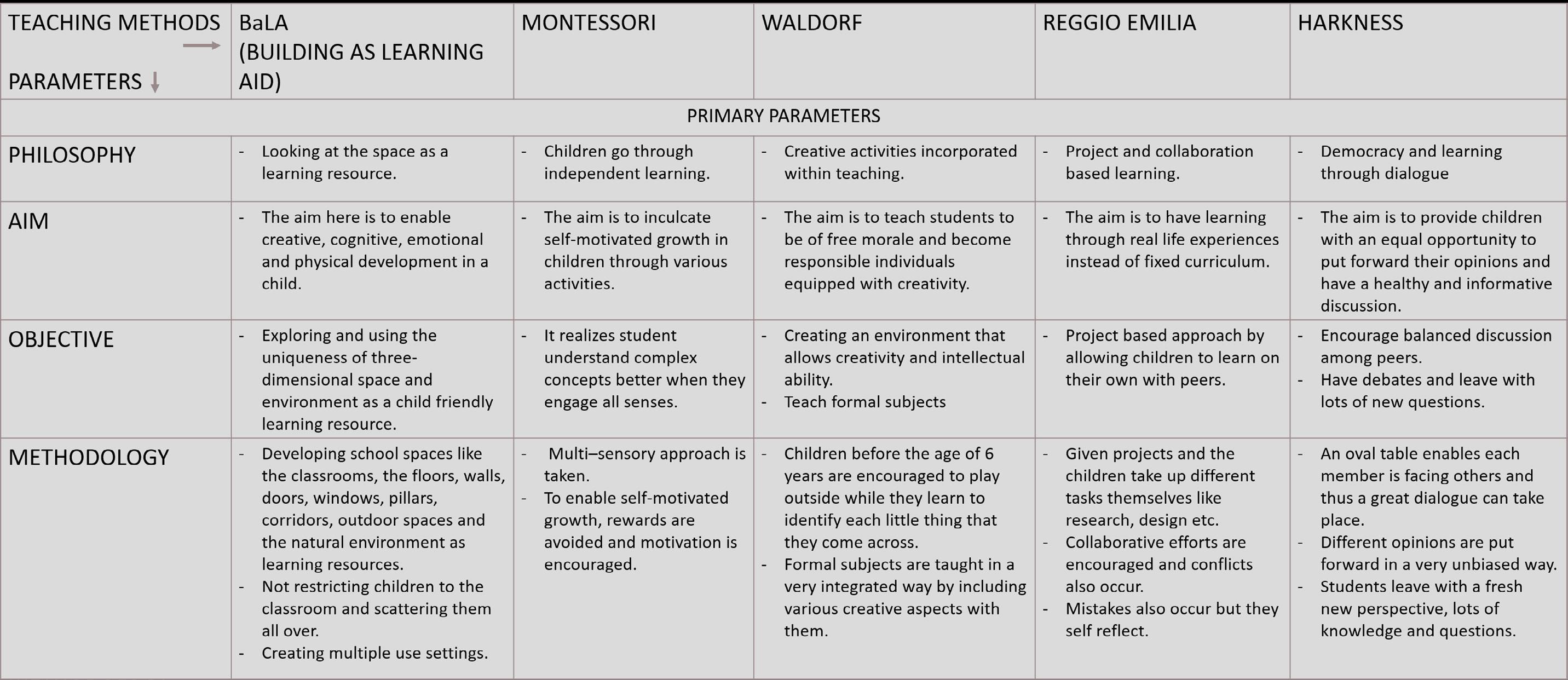
TABLE - 01 _
-
(Source - Self
SHASHVI DALAL • ANANT NATIONAL UNIVERSITY | 2022 GRADUATION PROJECT • UG SPACE DESIGN
Comparitive Analysis
Primary Parameters
Compiled)
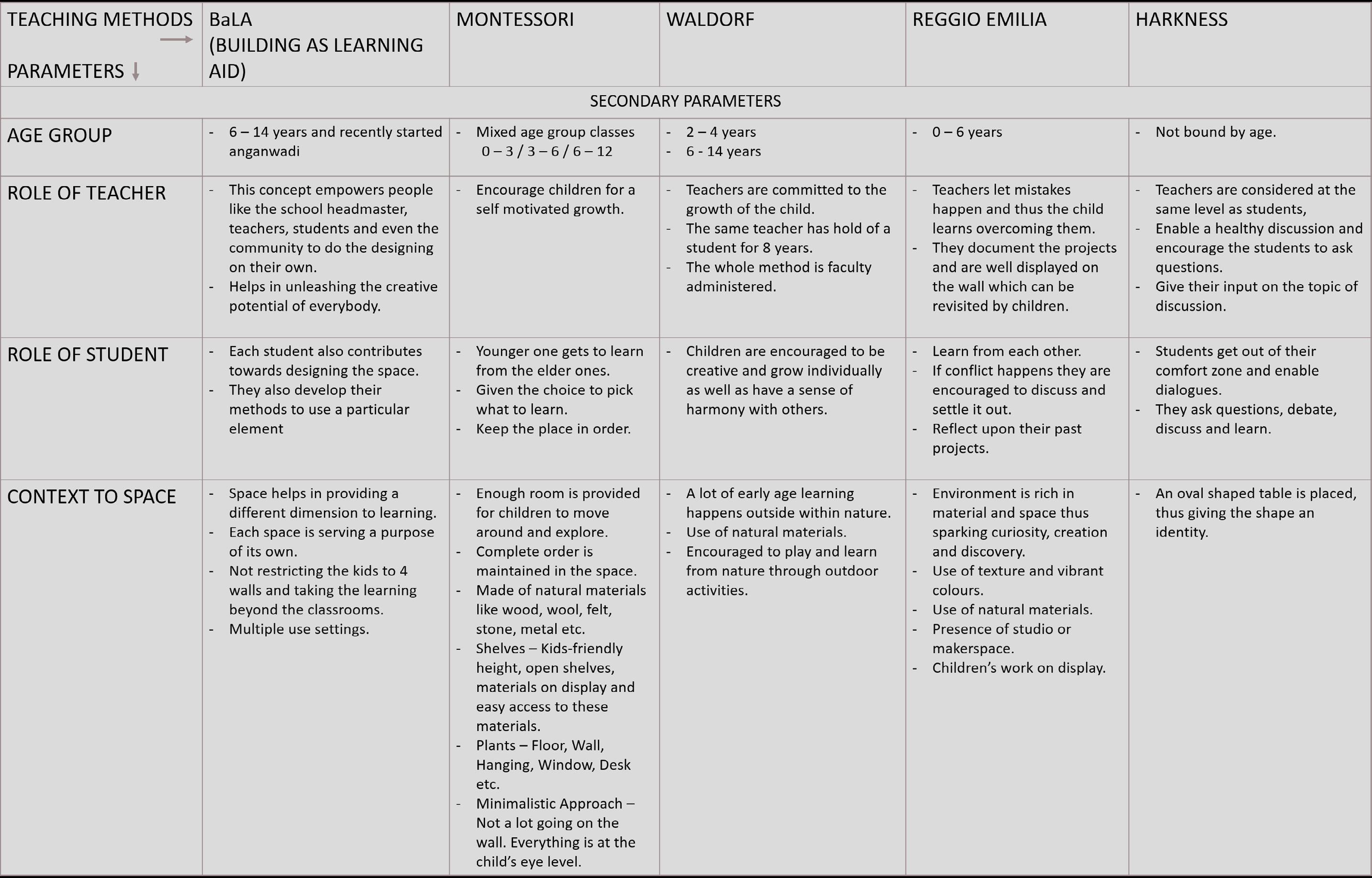
LEARNING BEYOND CLASSROOM • MULTI - PHILOSOPHICAL APPROACH 36 TABLE - 02 _ Comparitive Analysis - Secondary Parameters (Source - Self Compiled)
SHASHVI DALAL • ANANT NATIONAL UNIVERSITY | 2022 GRADUATION PROJECT • UG SPACE DESIGN
- CASE STUDIES _ INTRODUCTION
- LIVE CASE STUDY _ KIDS CITY, AHMEDABAD
- LIVE CASE STUDY _ VASCC, AHMEDABAD
- LITERATURE CASE STUDY _ KFAR SHEMARYAHU EDUCATIONAL CENTRE, ISRAEL
- LITERATURE CASE STUDY _ WONDERDAL, SOUTH AFRICA
- COMPARITIVE ANALYSIS
LEARNING BEYOND CLASSROOM • MULTI - PHILOSOPHICAL APPROACH 38 3
CASESTUDIES - INTRODUCTION
What is a Casestudy ?
Casestudy as defined by Cambridge Business English Dictionary :a detailed study of a person, group, or thing, especially in order to show general principles.
Casestudies are undertaken to compare the research data with spaces that are already designed in that domain. Some of these spaces are studied as literature case studies meaning from a source like a book, internet, etc. and some are studied by physically visiting the place.
Scope And Limitations
A lot of research had been collated to provide a strong base for the project. But not all of this data is 100% present in the designed spaces.
Thus, certain parameters had to be fixed for certain chosen projects.
Selected Projects For study
Literature Case Studies
For the literature part of the case study, projects were chosen very distinctively to understand different parameters related to the space design in g eneral and also to the functions and the approach that was aimed at from an earlier stage.
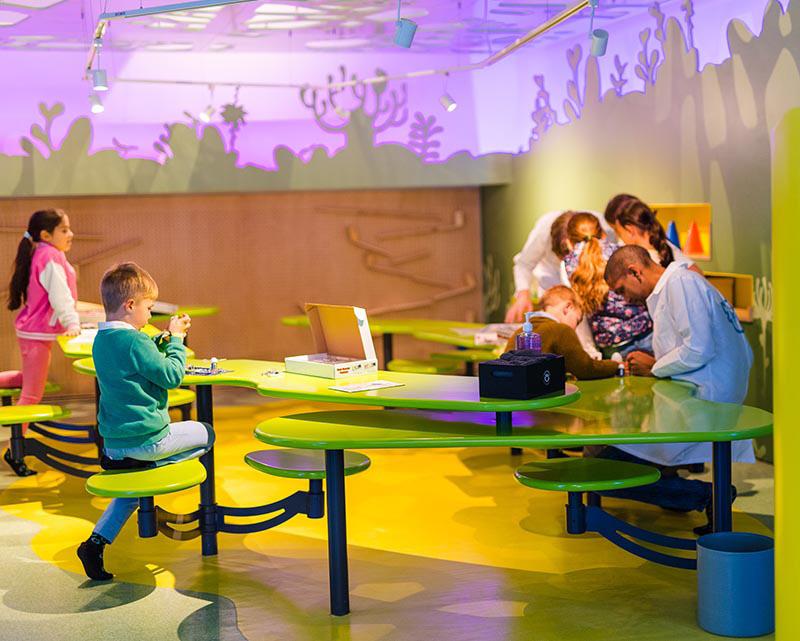 Kfar Shemaru Centre
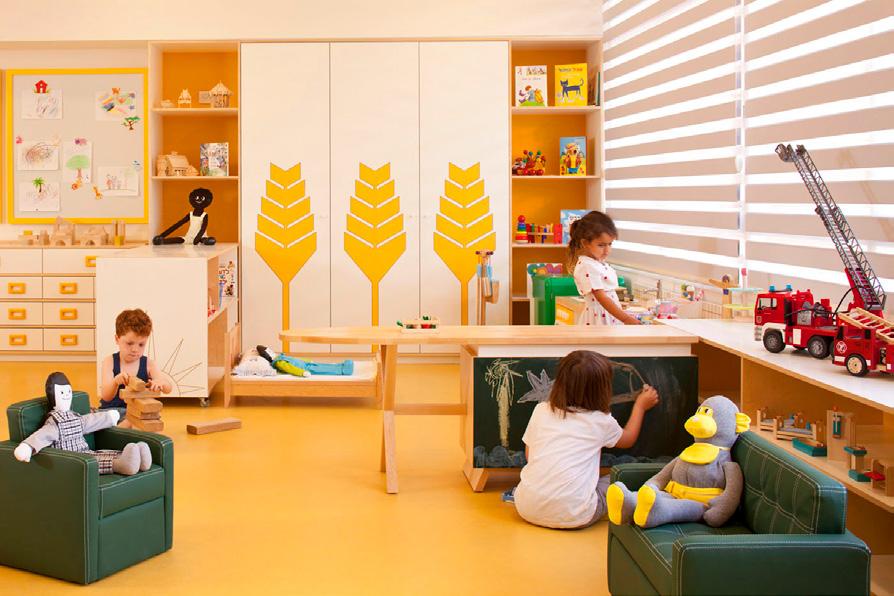 WonderDal
SHASHVI DALAL • ANANT NATIONAL UNIVERSITY | 2022 GRADUATION PROJECT • UG SPACE DESIGN
Fig - 47 Tinker Workshop Space
Live Case Studies
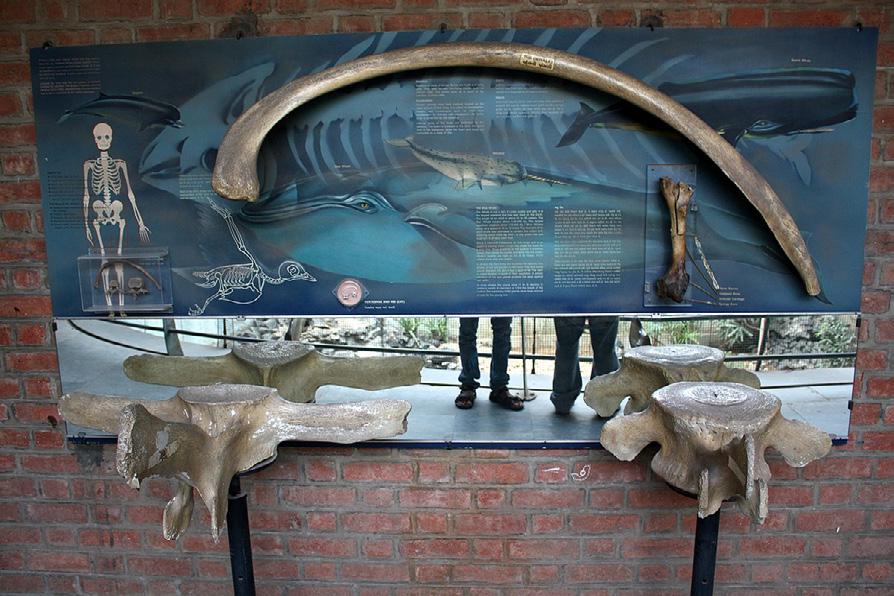
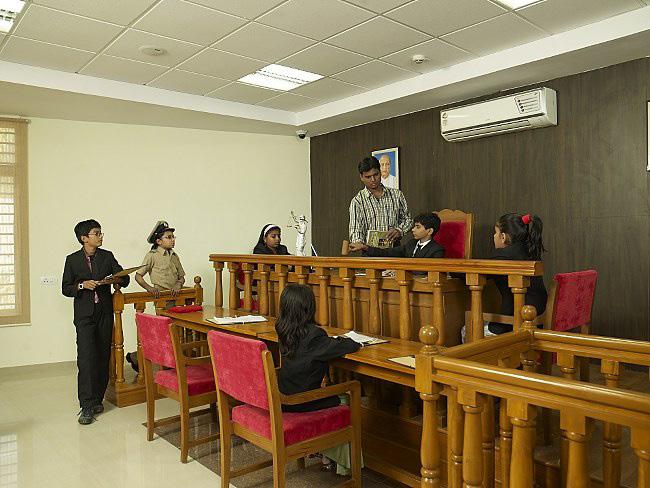
For the live casestudies, projects that have been chosen were largely based on the functions of spaces and how the space planning was done. Going into further detail, the spaces were also studied for area occupancy, miscellaneous functions, the content being taught and how the content was being taught.
Kids City, Kankaria, Ahmedabad Vikram A Sarabhai Community Cen tre, Ahmedabad
LEARNING BEYOND CLASSROOM • MULTI - PHILOSOPHICAL APPROACH 40
Fig - 48 Court Room Mock Up
Fig - 49 Display of Bones
LITERATURE CASE STUDY 1 - KFAR SHEMARU CENTRE
Introduction Brief On The Chosen Space
This case study was aimed at studying the design of a non-formal learning space for children. The main purpose also lies in studying the various theme-based approach to designing the spaces.
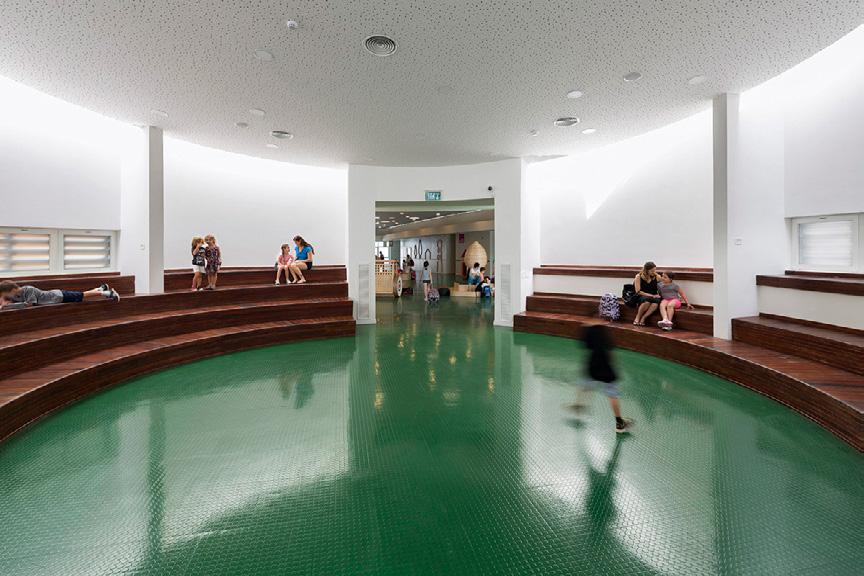
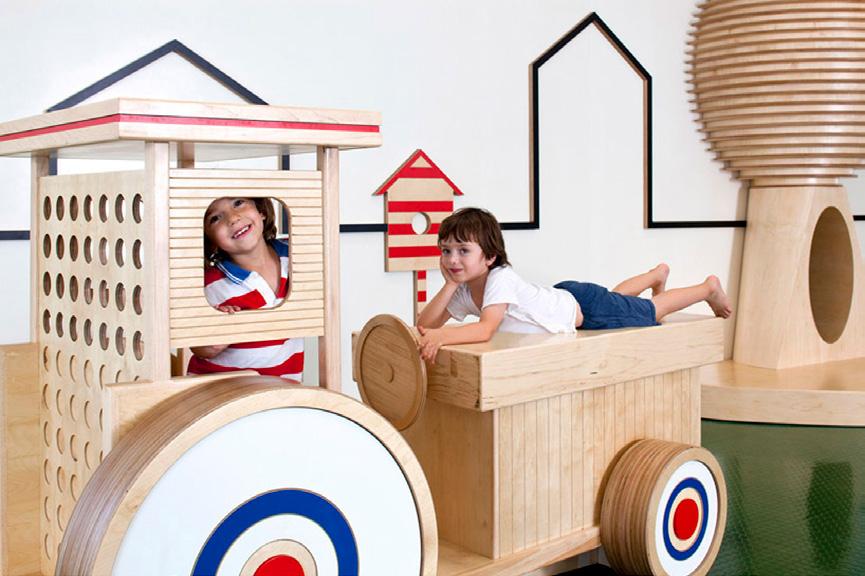
Another factor was studying space planning and how spaces were allocated.
Thus, this study aimed at a design perspective also other than functions.
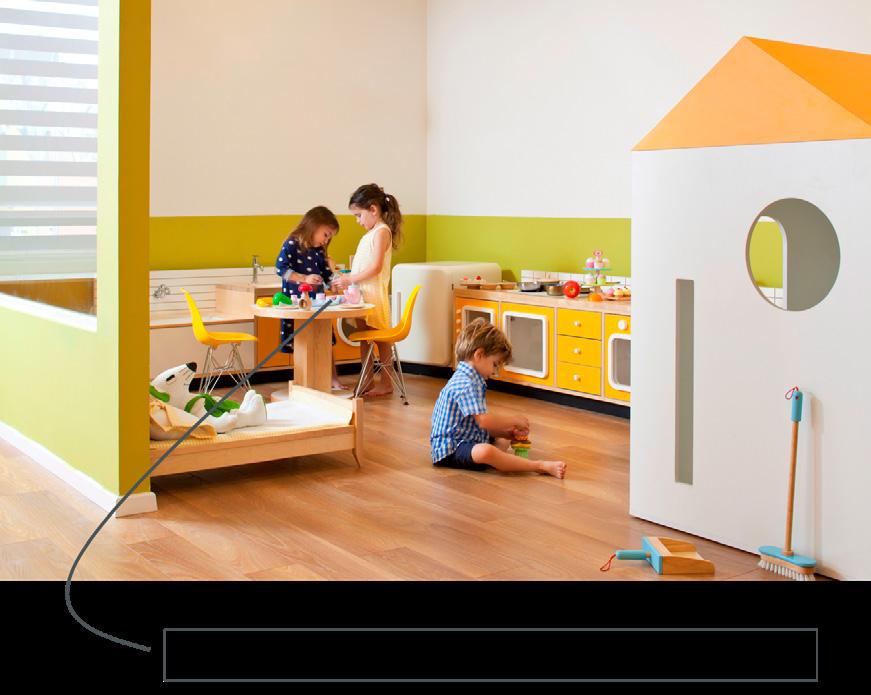
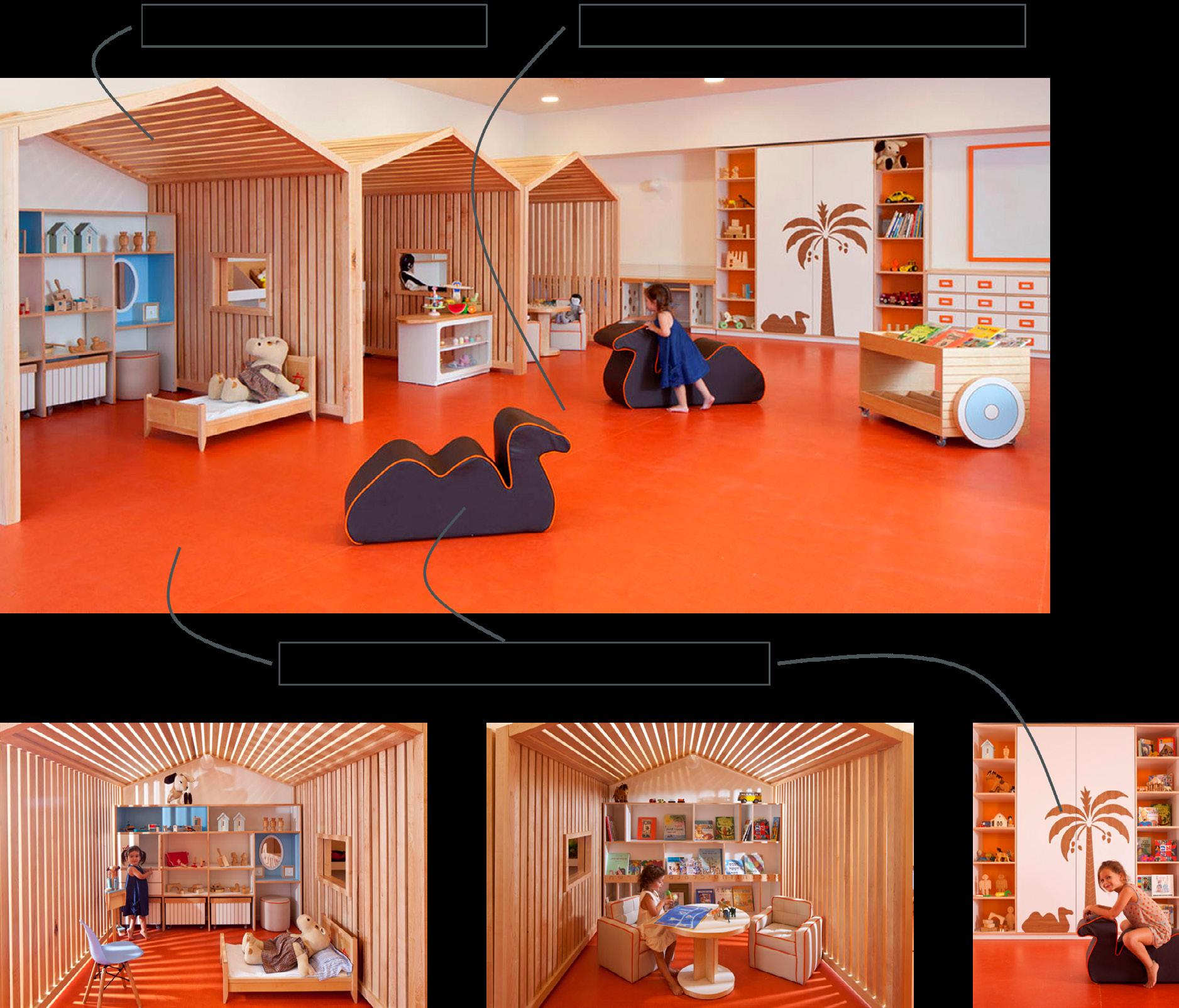
A unique educational centre by interior designer Sarit Shani Hay was recently opened in Kfar Shemaryahu. Covering 2,400 m², it spans a cluster of six kindergartens, a play commons, and an empowerment centre which provides psychological services to children of the community.
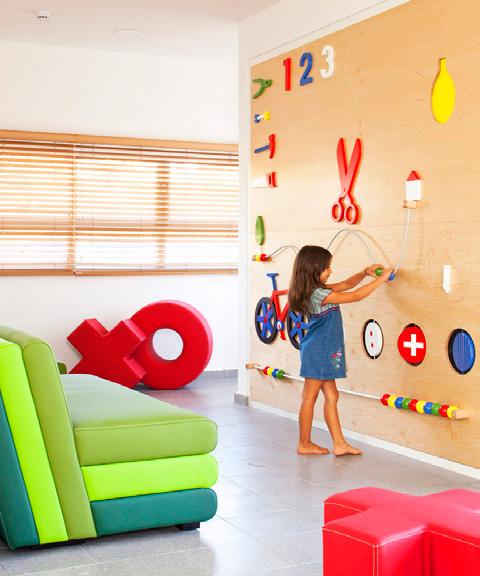
The design theme was inspired by the location of the compound and the history of "Kfar Shemaryahu", originally an agricultural settlement, hence the agricultural motifs at the core of the concept.
The design idea was intended to create a compound of six kindergartens, each functioning as an independent unit with its own identity, and together serving as part of a friendly, informal learning environment.
SHASHVI DALAL • ANANT NATIONAL UNIVERSITY | 2022 GRADUATION PROJECT • UG SPACE DESIGN
Fig - 50 Lobby Space at the centre Fig - 51 Waiting Space at the centre Fig - 52 Interactive Wall
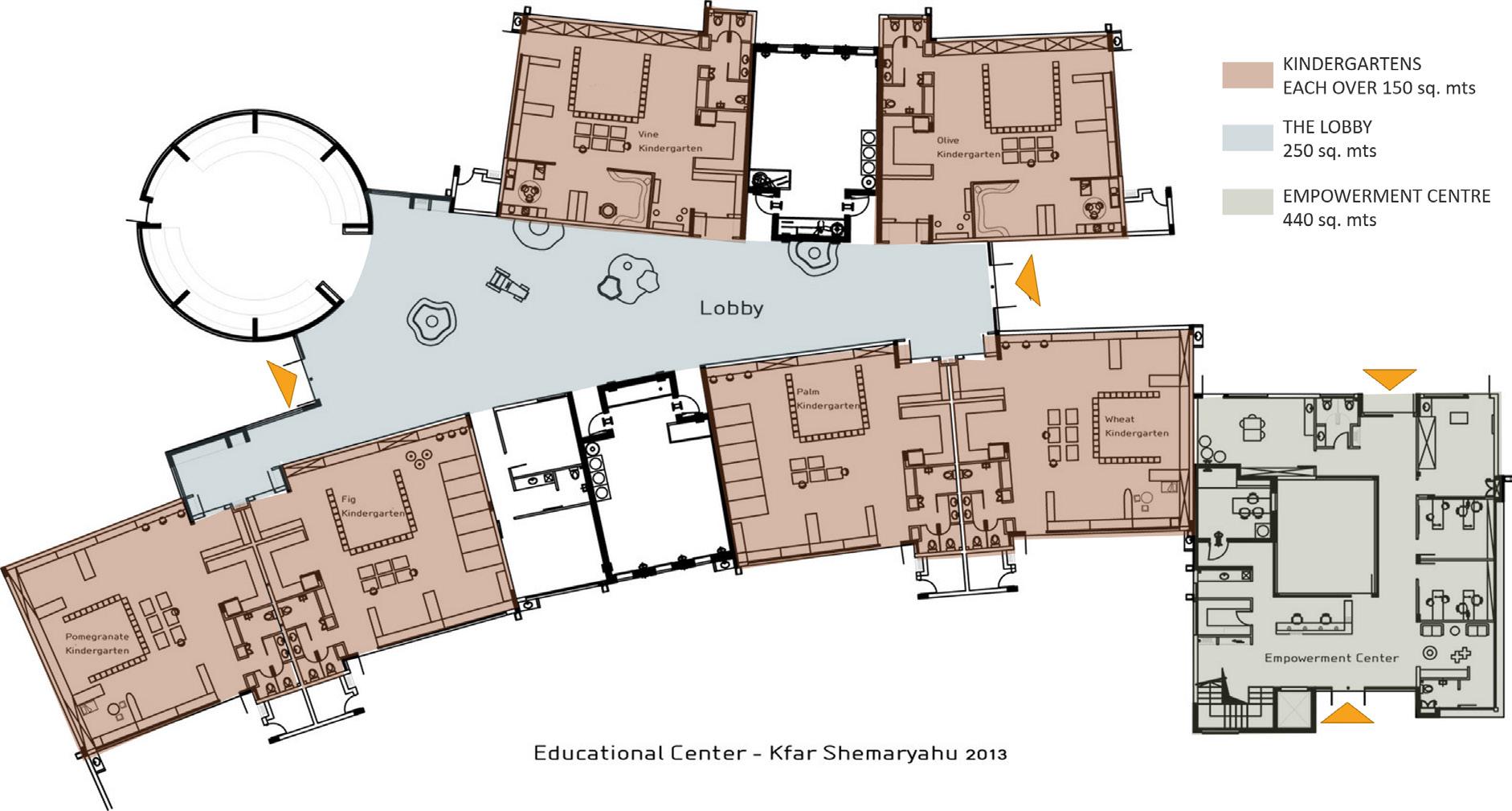
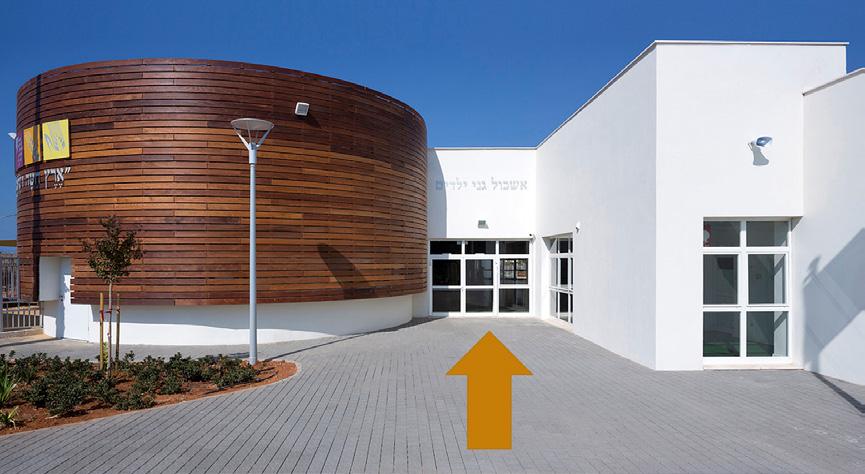
Understanding The Main Entry And Plan
Fig
Fig
The
have been shown
the
LEARNING BEYOND CLASSROOM • MULTI - PHILOSOPHICAL APPROACH 42
- 54 The plan of the centre.
plan is axial and the lobby plays a role as a central axis of the space. The different spaces
with different colours corresponding to
legend.
- 53 The main Facade and entry to the centre.
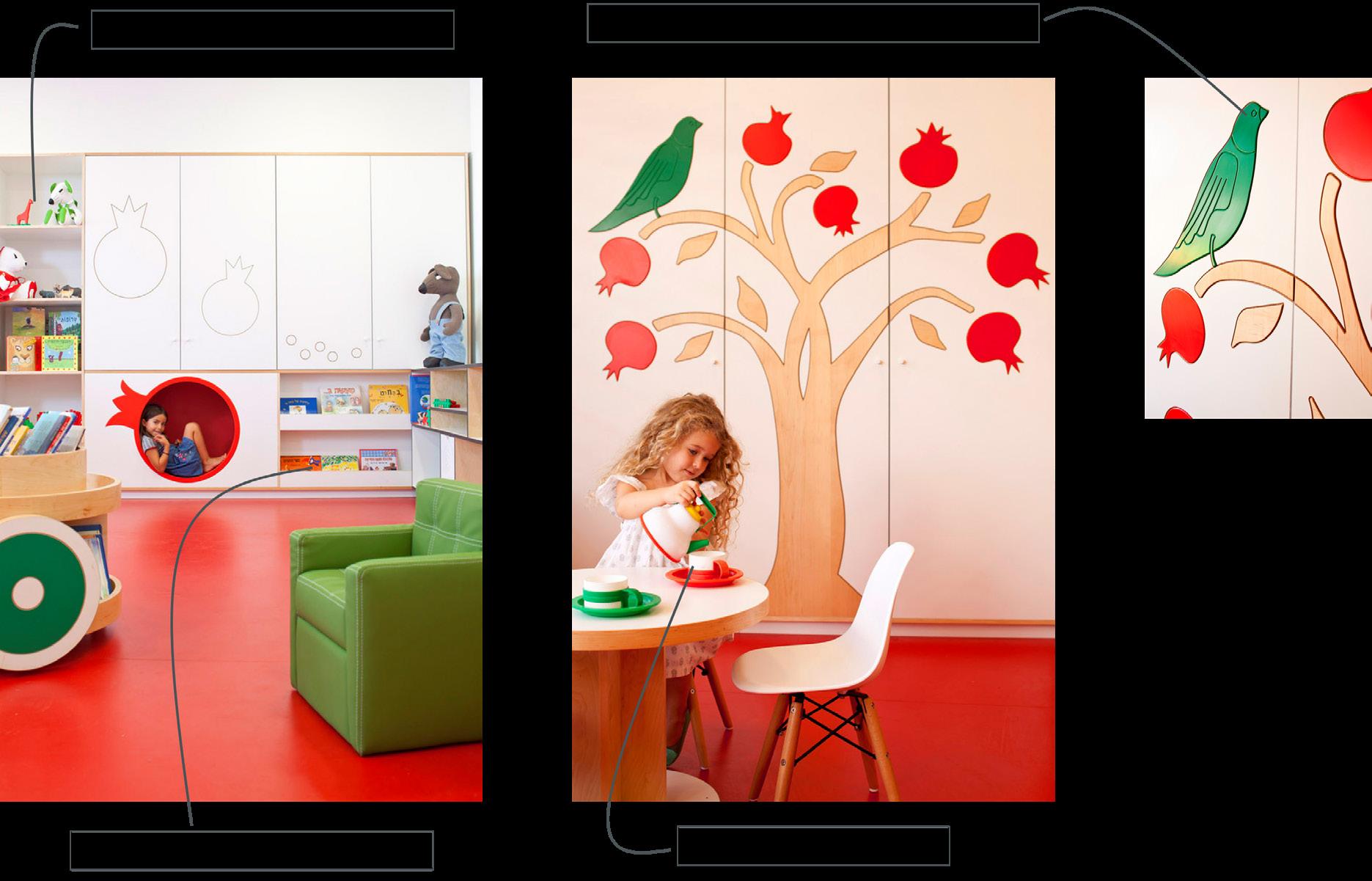
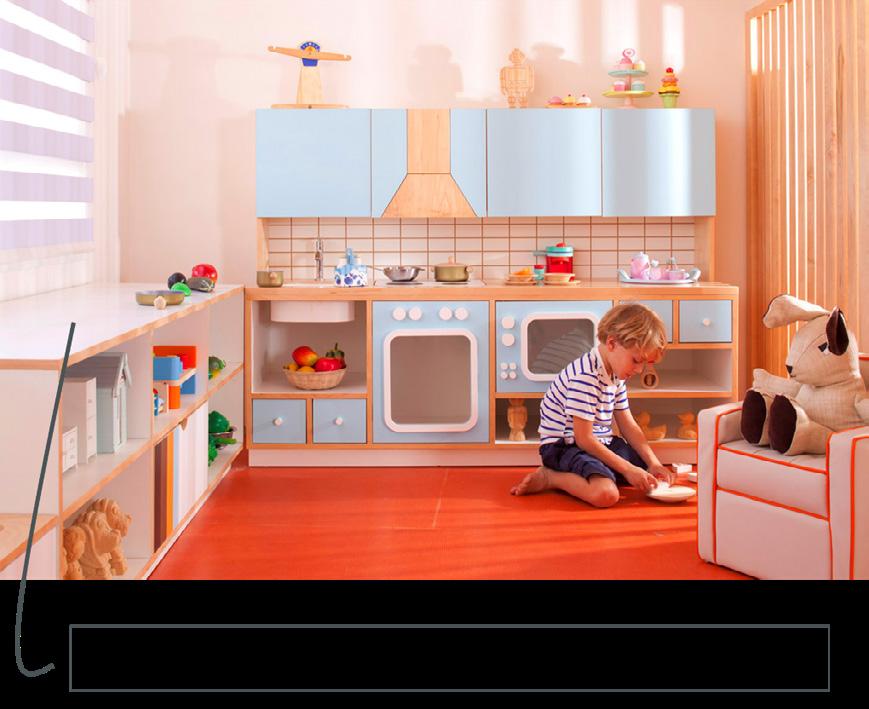
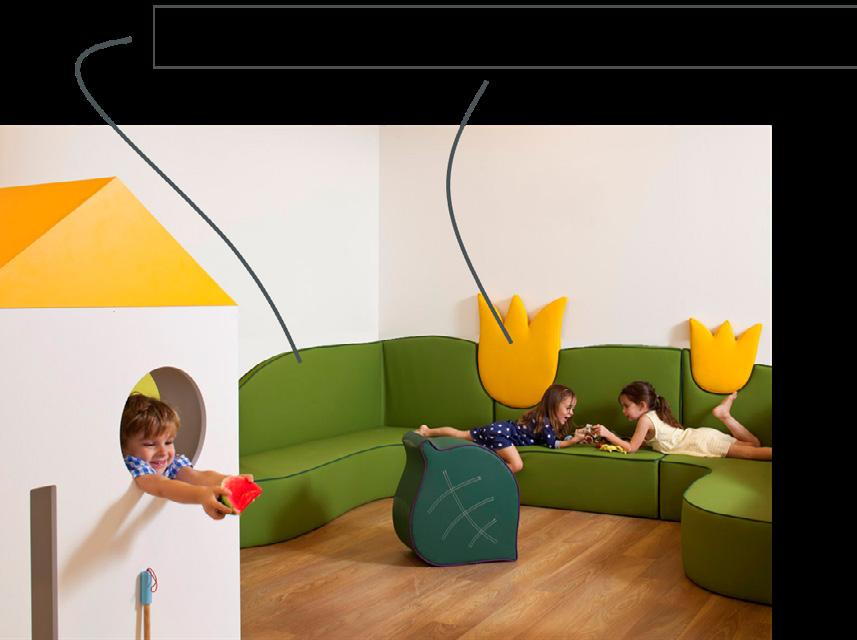
SHASHVI DALAL • ANANT NATIONAL UNIVERSITY | 2022 GRADUATION PROJECT • UG SPACE DESIGN LITERATURE CASE STUDY 1 - KFAR SHEMARU CENTRE Fig - 55 Elements from spaces studied Very important step towards studying any space is listing out the space making elements that have been used. ( Source for the photographs of the space - archdaily.com ) Visuals Of The Space - Understanding Space, Materials...
Visuals Of The Space - Understanding Space, Materials...
LEARNING BEYOND CLASSROOM • MULTI - PHILOSOPHICAL APPROACH 44
Fig - 56 Elements from spaces studied ( Source for the photographs of the spacearchdaily.com )
LITERATURE CASE STUDY 2 - WONDERDAL
Introduction
This case study was aimed at studying a lot of different factors for an edutainment space for children. The main factor was the different spaces and the functions for the group which directly matched the chosen target group. Another factor was the combination of technology, learning and design that had to be studied.
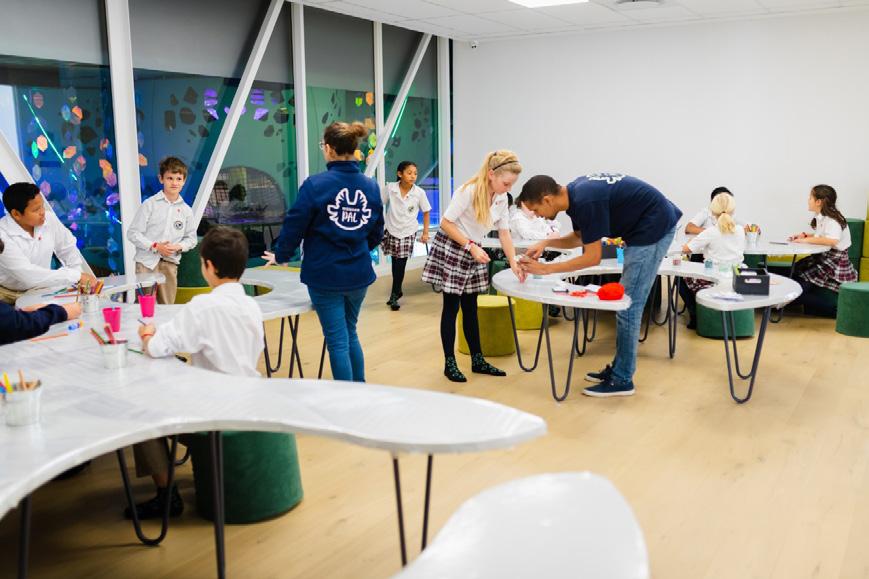
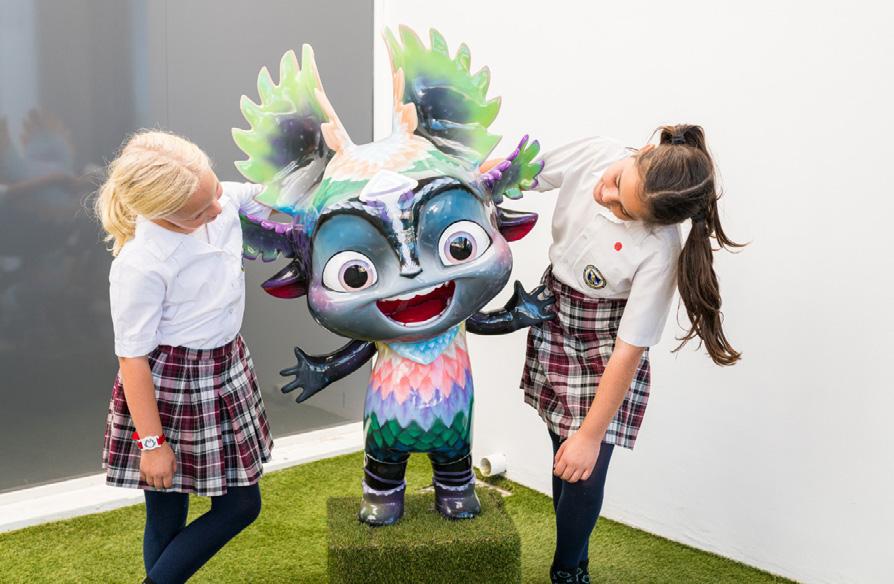
Also, a major role was played by the use of colours, graphics and mascots that was very similar to Kids City. This also played a key role in defining the space.
Brief On The Chosen Space
Wonderdal offers an immersive and interactive edutainment experience, blending creative design, award-winning educational resources and world-class technology, to combine learning with play.
At Wonderdal children aged 5-13 can discover the worlds of science, nutrition and nature across a variety of indoor and outdoor activity zones.
With the colourful Amuki characters by their side, and trained WonderPals to supervise, young adventurers can look forward to a fun day out discovering a world of wonder and knowledge.
SHASHVI DALAL • ANANT NATIONAL UNIVERSITY | 2022 GRADUATION PROJECT • UG SPACE DESIGN
Fig - 57 Students with the mascot Amuki
Fig - 58 A highly collaborative environment
( Source for the text - wonderdal.co.za )
The Main Entry And Spaces Through Visuals
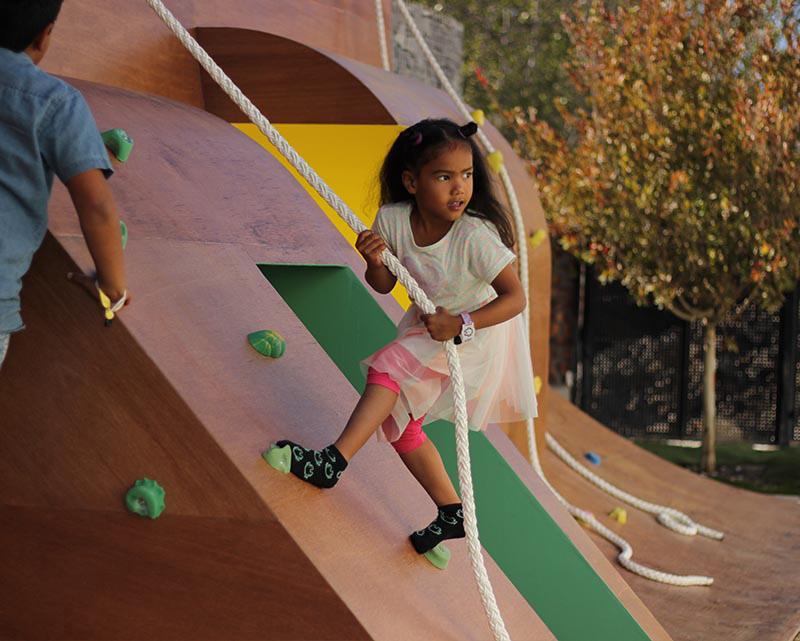
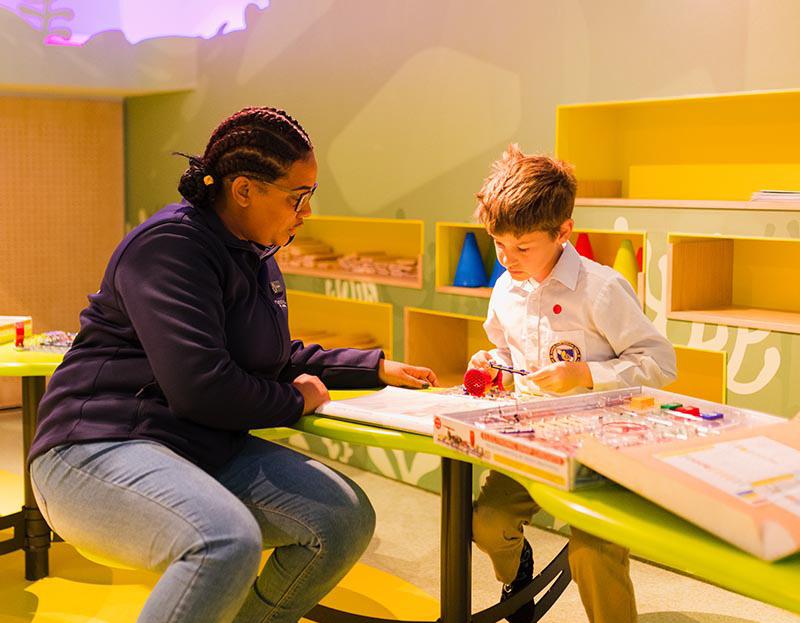
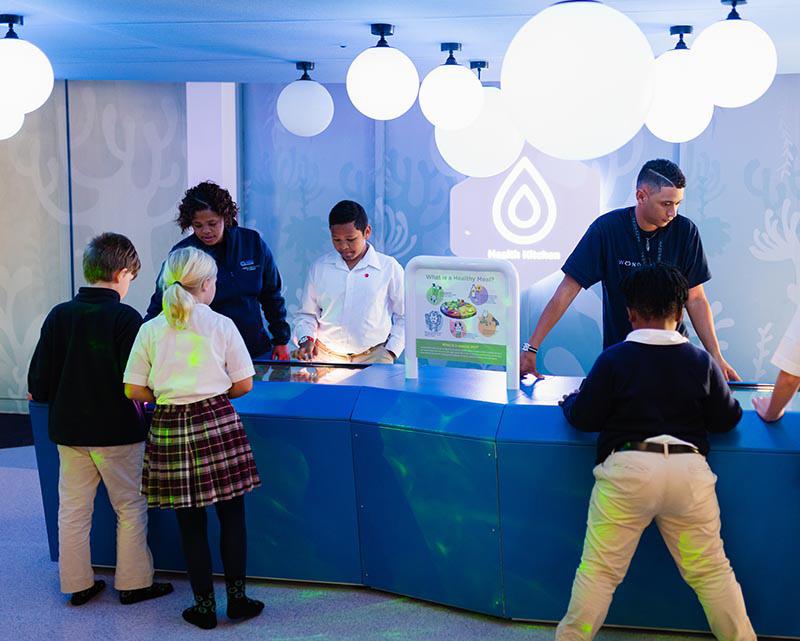
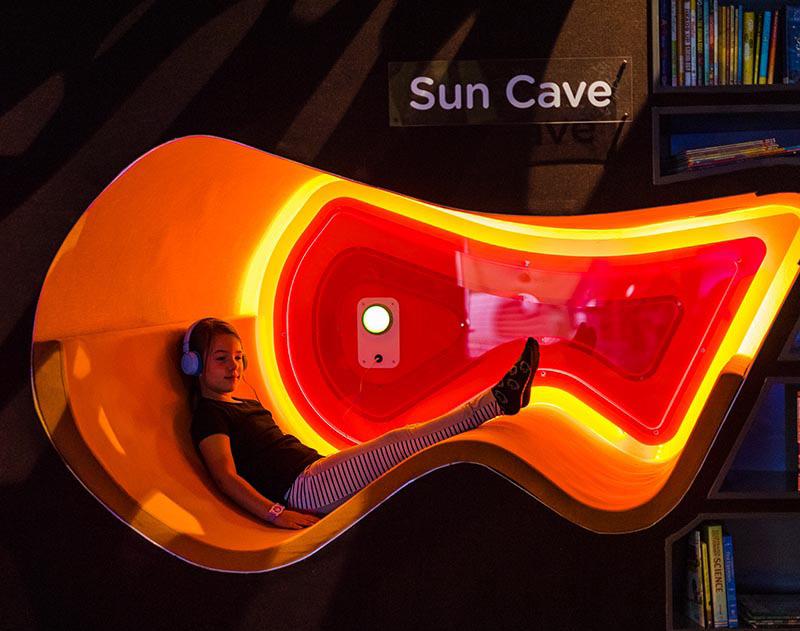
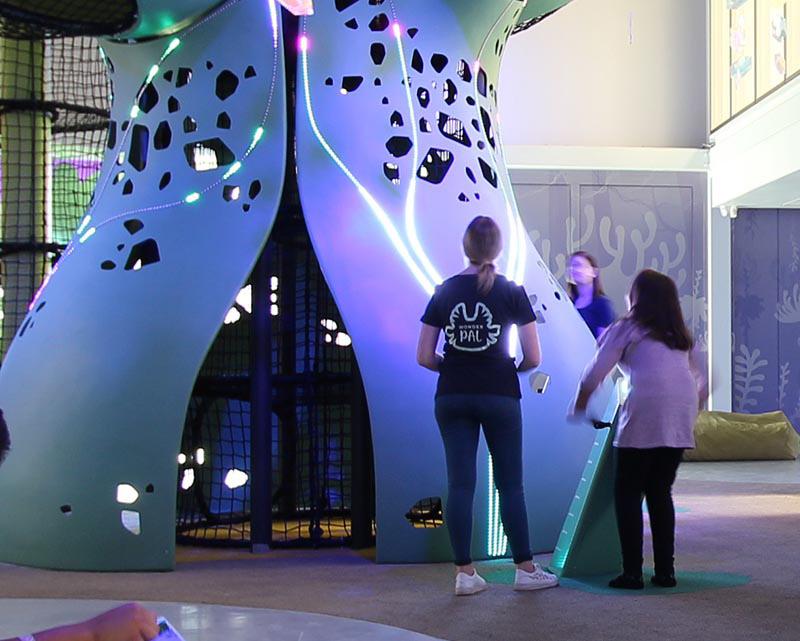
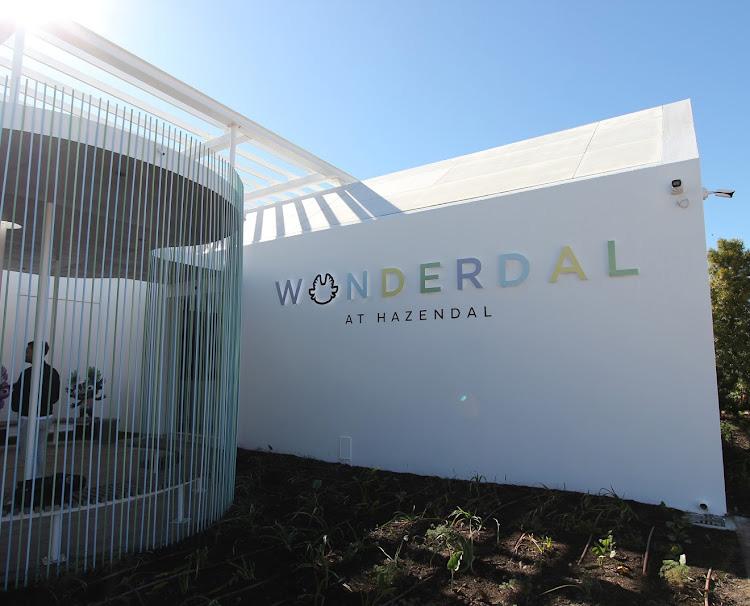
LEARNING BEYOND CLASSROOM • MULTI - PHILOSOPHICAL APPROACH 46 Fig - 59 Above - The main Facade and entry to the centre. Below - Health Kitchen Fig - 60 Above - Story Caves Below - Tinker Workshop Fig - 61 Above - Kora Tree Below - Open Playground with activities like rope climbing etc. Understanding
LIVE CASE STUDY 1 - KIDS CITY
Introduction
This case study was aimed at studying the division of functions required for a non-formal edutainment space for children. Also to understand the role of different elements like graphics, colours, etc. to make the space more contextual to children.
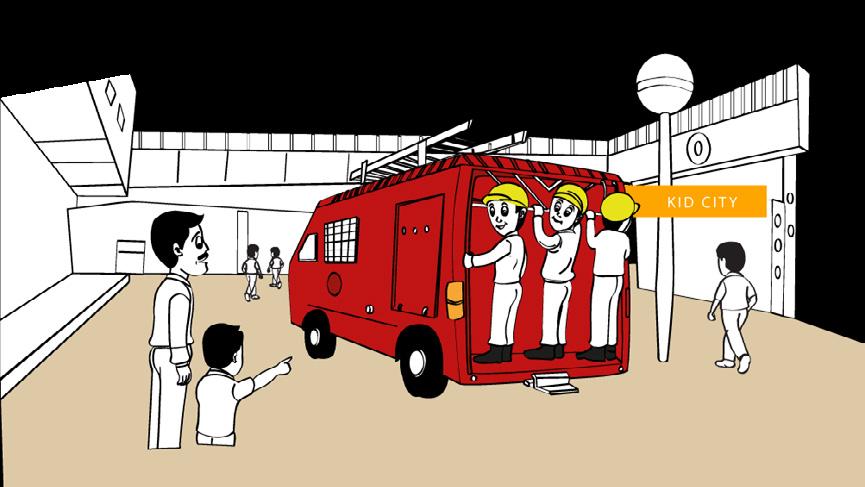
Another thing that was studied was the need and space allocation for miscellaneous functions such as waiting, cafe, etc.
Brief On The Chosen Space
Location – Gate No 7, Naginawadi, Kankaria Lake Front, Nr. Sai Zulelal Party Plot, Maninagar 380022 Gujarat, India
Area – 4240 sq. mts Age Group – 5 to 13 yrs.
Kankaria Lakefront gives it a perfect location as it is considered one of the identities of Ahmedabad which caters to people from all age groups.
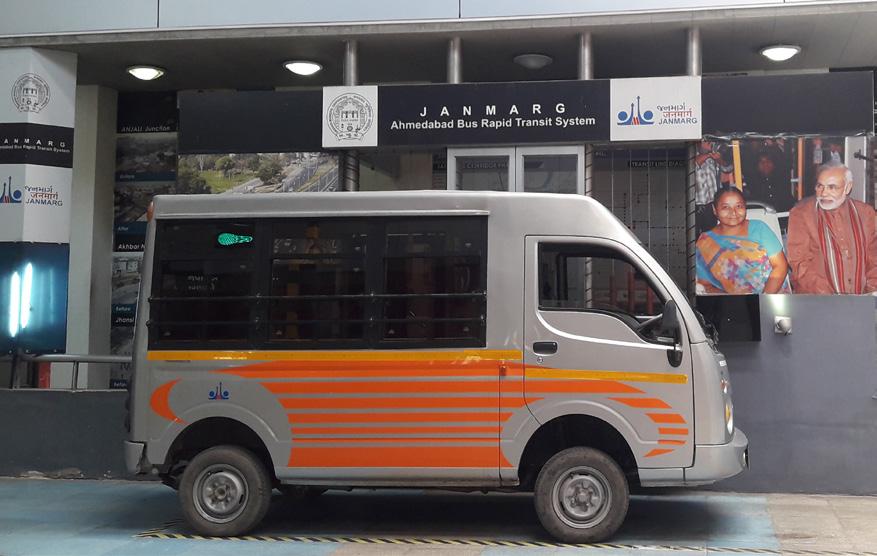
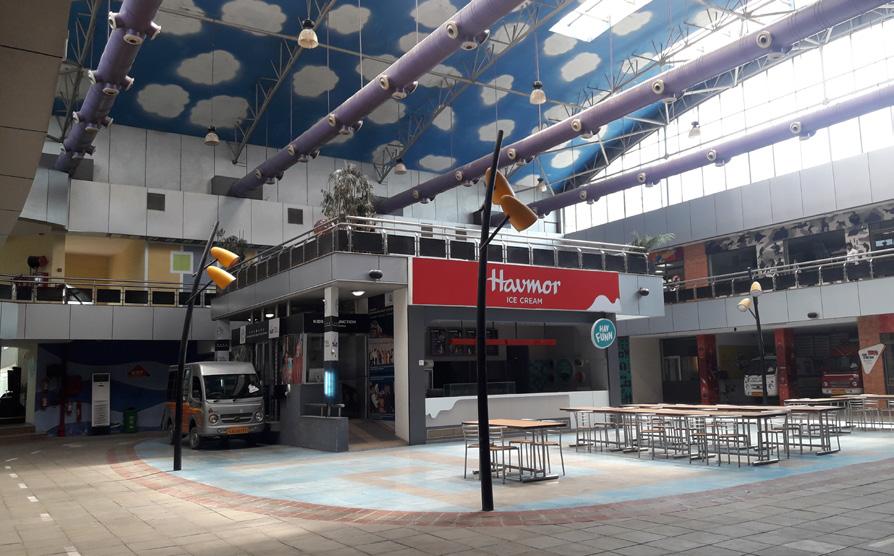
It is a city within a city for kids and thus the name ‘Kids City‘. It is a replica of a city with roads, vehicles and a whole lot of activities like the bank, fire station, science lab, radio station, police station, courtroom and prison, dental as well as a medical hospital, theatre, BRTS, heritage gallery, town governance, IT centre, Newsroom, ice-cream factory, and many more.
SHASHVI DALAL • ANANT NATIONAL UNIVERSITY | 2022 GRADUATION PROJECT • UG SPACE DESIGN
Fig - 62 Illustration ( Source - kankarialakefront.in ) Fig - 63 The main space - sky, bus, city Fig - 64 BRTS Bus mini model
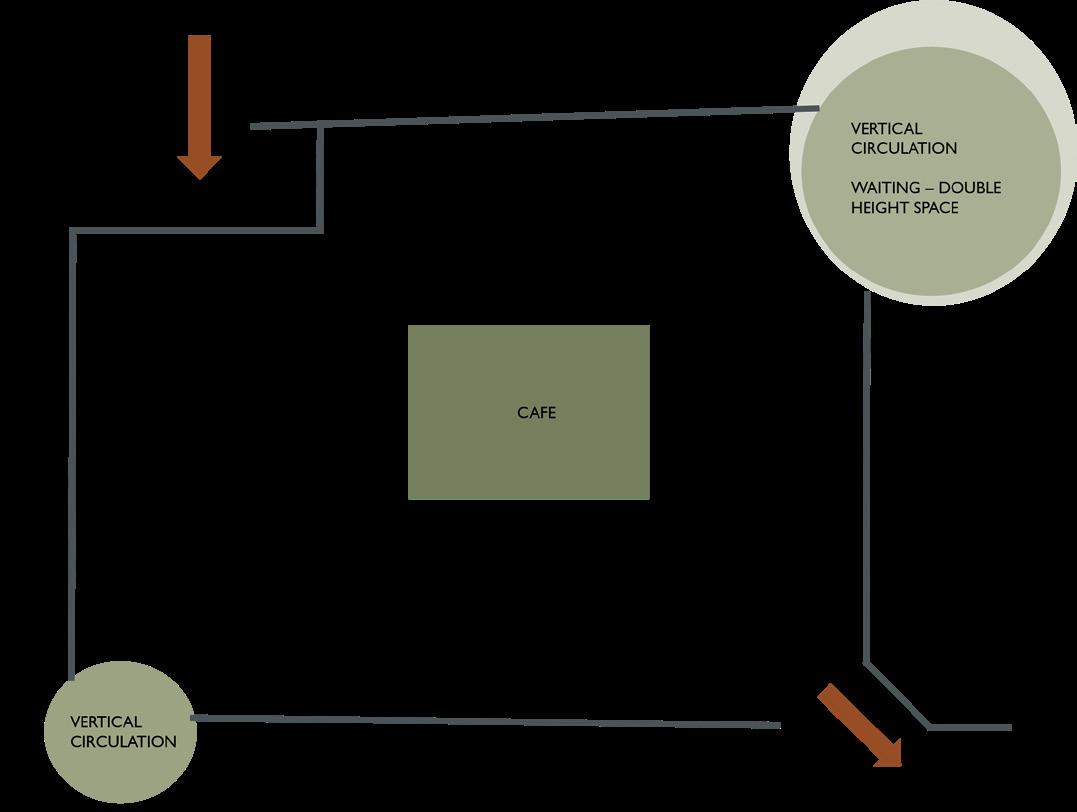
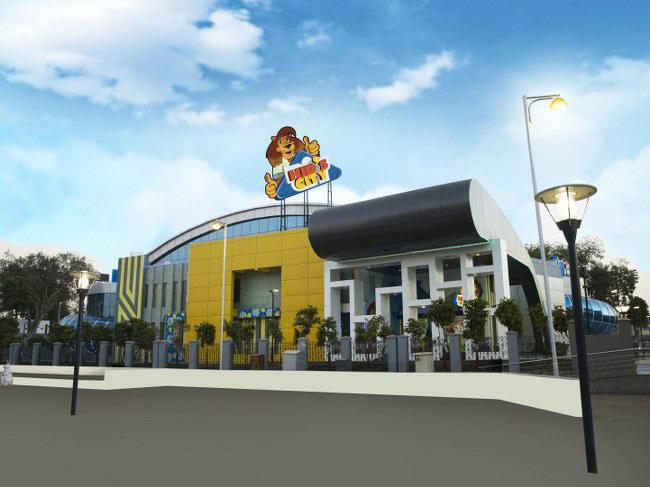
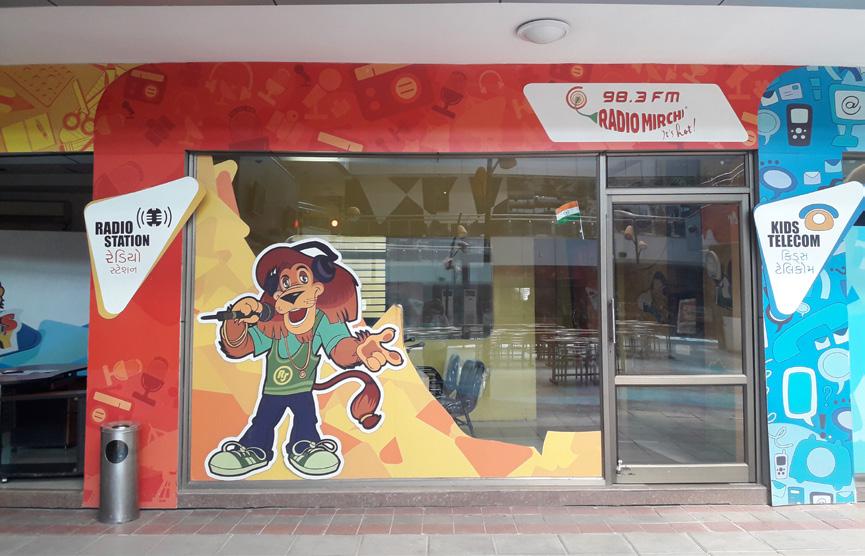
LEARNING BEYOND CLASSROOM • MULTI - PHILOSOPHICAL APPROACH 48 1. Radio Station 2. Kids Telecom 3. Kids Bank 4. Science Centre 5. Police Station 6. Kids Courtroom 7. Hospital 7. Van Space ( Ambulance and Fire Brigade ) 9. Fire Station 10. Heritage Gallery 11. Theatre 12. Print Media Room (Above 5 and 6) 13. Ice Cream Factory (Above 7 and 8) 14. Army NCC Camp (Above 8 and 9) 15. BOH Room (Above Server room) 16. Kids Governance(Above 11) 17. TV Studio (Above 1 and 2) 18. IT Centre (Above 3 and 4) Fig - 67 Plan Diagram - The plan of this space is circular and it revolves around a central element or a focal point. ( Source - Self Drawn ) Fig - 65 The main Facade and entry to the centre. Fig - 66 Use of colours, infographics, mascot makes the space more contextual to children. Understanding The Main Entry And Plan Legend
LIVE CASE STUDY 2 -VIKRAM A SARABHAI COMMUNITY CENTRE
Introduction
This case study was aimed at studying the design and division of functions in a non-formal teaching space for the varied age group.
Various elements including the play of open and closed spaces were also to be studied.
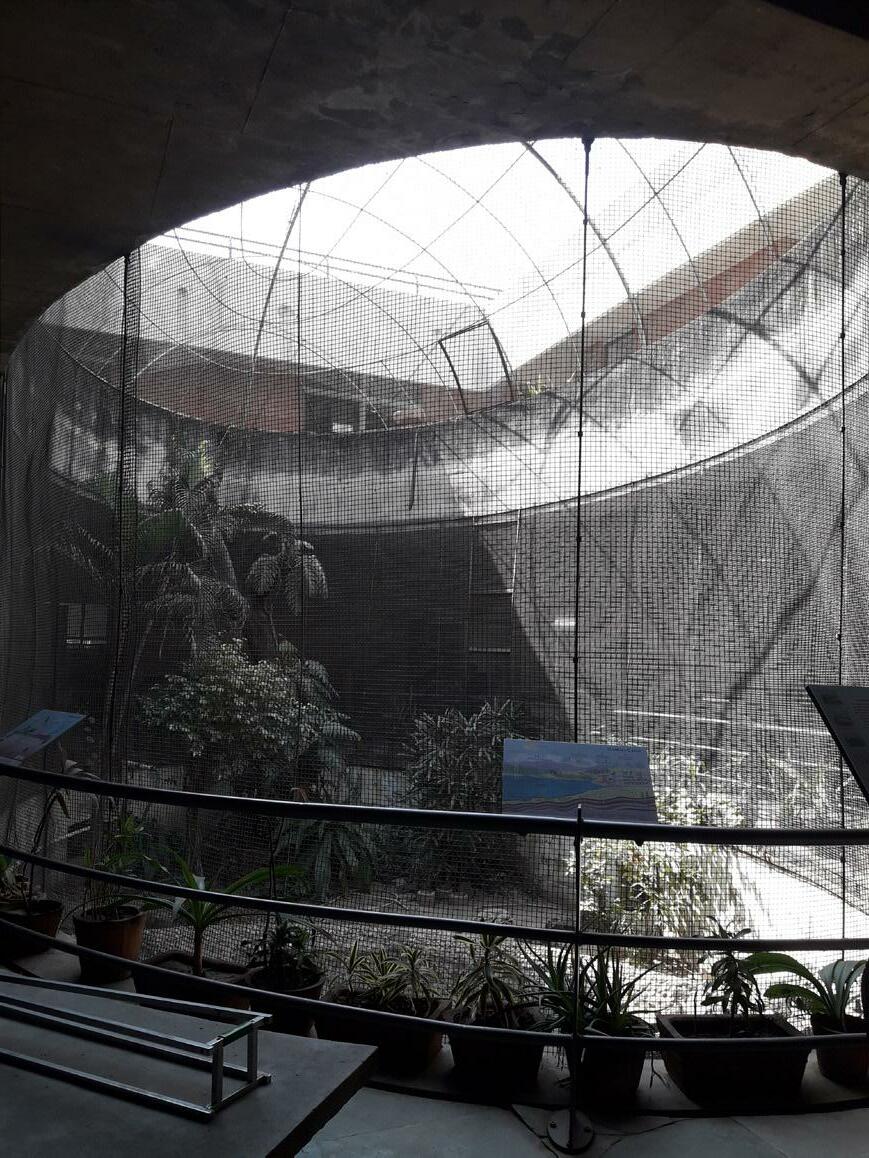
Miscellaneous functions like a gift shop, reception and waiting, etc. were also to be studied to understand the requirements.
Brief On The Chosen Space
Location – Near Main Campus, Opp. Gujarat University Gujarat University Health Centre University Area, Navrangpura, Ahmedabad, Gujarat.
User – Elementary, Secondary and College students, Teachers and the general public.
Located at the core of Universities and right beside Ahmedabad ni Gufa.
Fig -
SHASHVI DALAL • ANANT NATIONAL UNIVERSITY | 2022 GRADUATION PROJECT • UG SPACE DESIGN
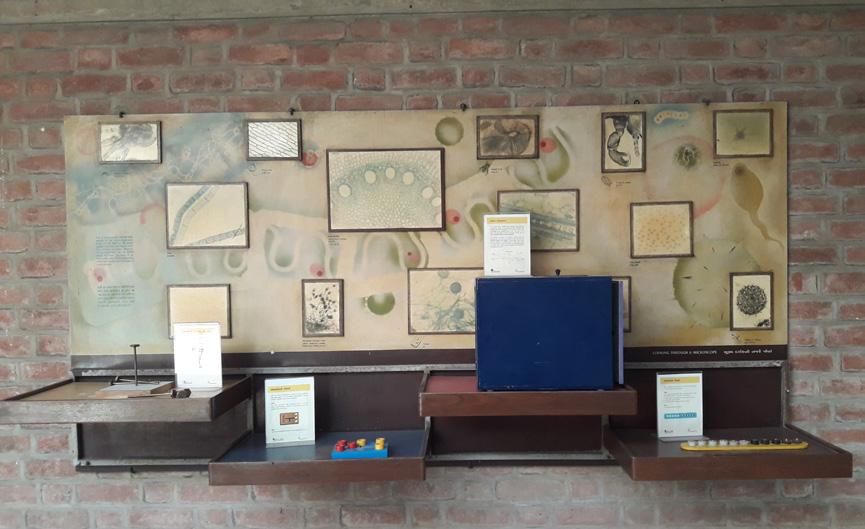
Fig - 68 Display of Materials ( Source - Self Clicked )
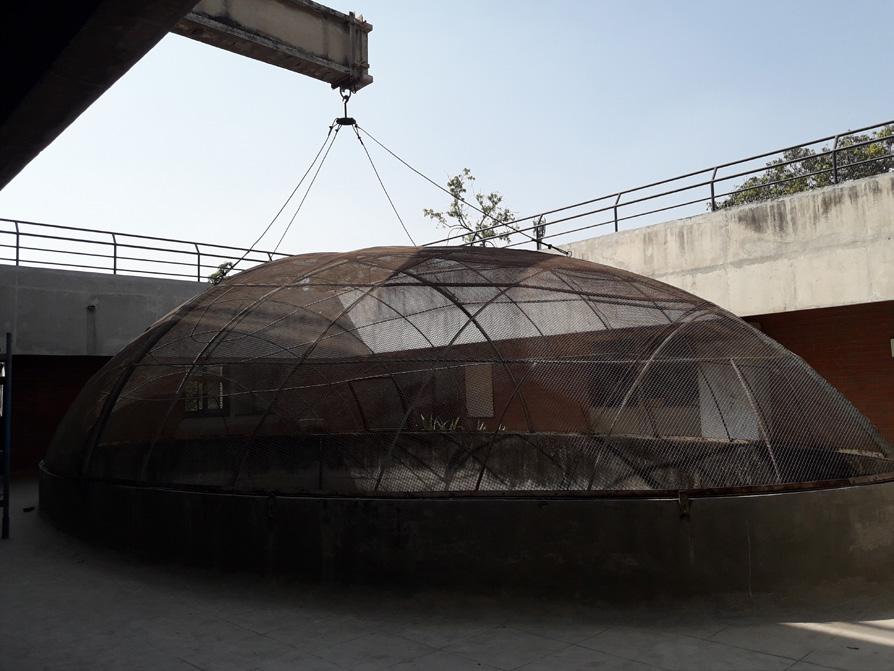
69 The focal point of the space A double height bio space surrounded by plants and has a small pond in its centre. ( Source - Self Clicked )
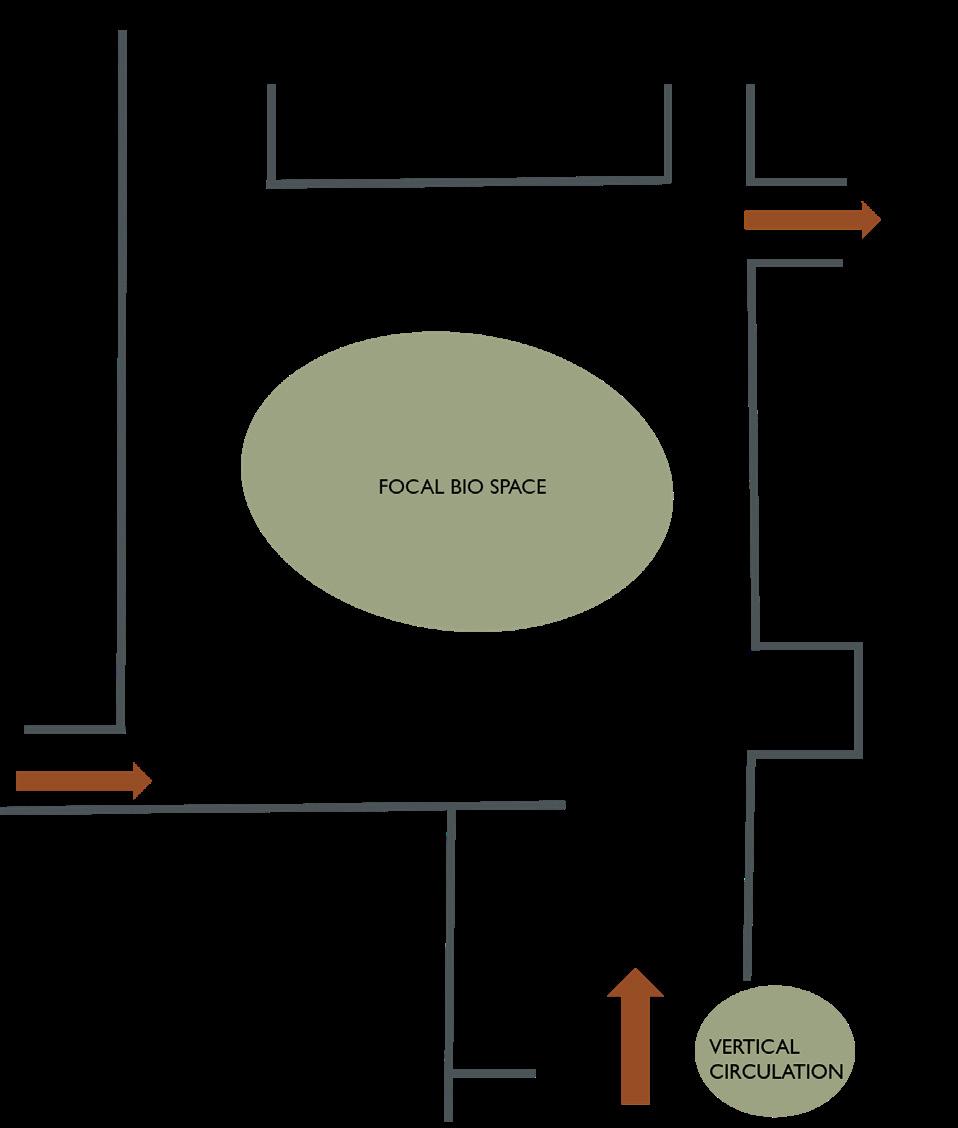
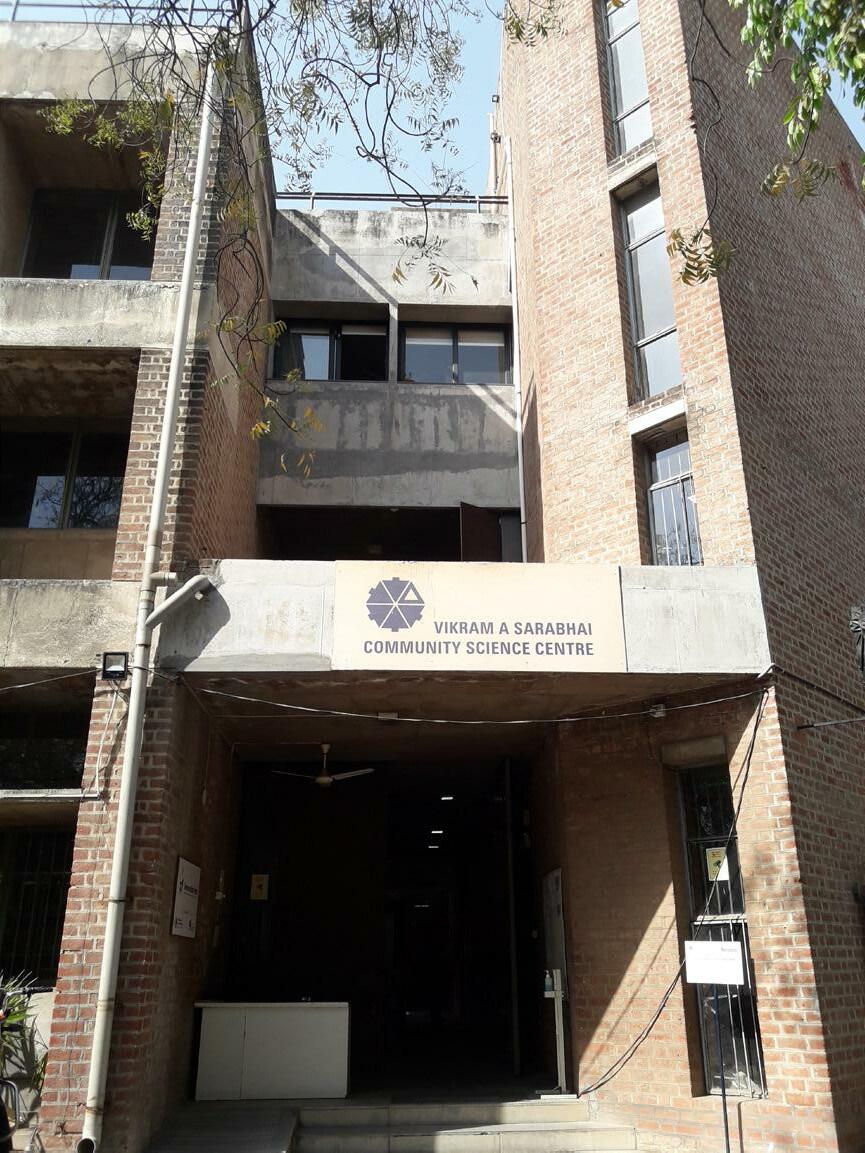
LEARNING BEYOND CLASSROOM • MULTI - PHILOSOPHICAL APPROACH 50 Peripheral Placement of Activities with a Bio Space as the Focal Point 1. Library 2. Locked Room 3. Auditorium 4. Administration Department 5. Board Room 6. Science Hobby Workshop 7. Mathematics Lab 8. Toilet Blocks 9. Design Lab 10. Science Educators 11. Computer Lab 12. Science Shop Fig - 71 Plan Diagram ( Source - Self Drawn ) Fig - 70 The main Facade and entry to the centre. Understanding The Main Entry And Plan Legend
COMPARITIVE ANALYSIS
Introduction
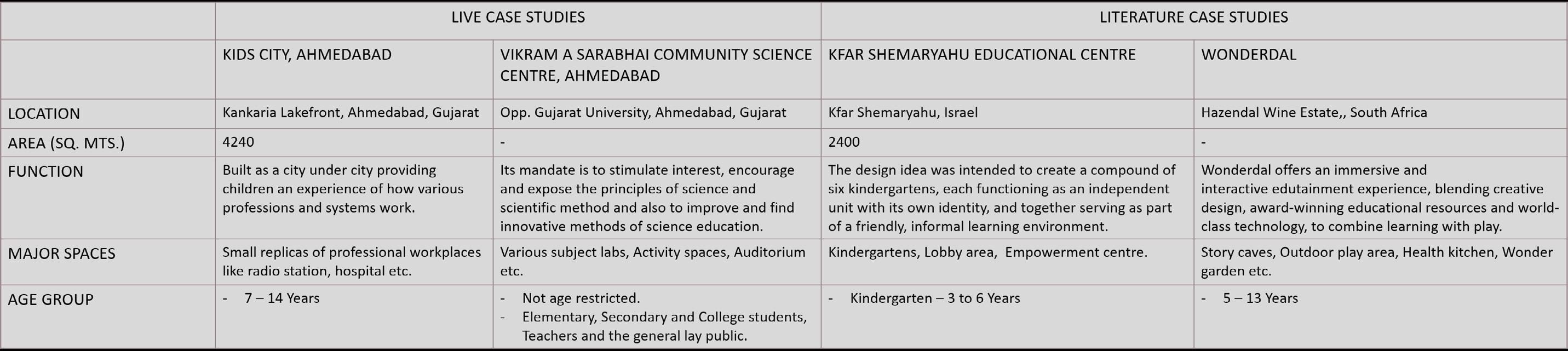
A comparative analysis table is drawn between the four different case studies. This comparison is first drawn for very basic information to understand the differences among them.
The most important comparison is drawn in the next part where each of them is seen through a research lens. This means each of the case studies is side by side compared with the philosophies studied during the research. Elements from each of the philosophies are identified in each of these studies to understand the contextual and design-related application of these philosophies.
This table proves to be of great help when trying to find a correct balance between the theoretical philosophies and their usage in space designing or even in designing of elements.
SHASHVI DALAL • ANANT NATIONAL UNIVERSITY | 2022 GRADUATION PROJECT • UG SPACE DESIGN
TABLE - 03 _ Basic Comparision (Source - Self Compiled)
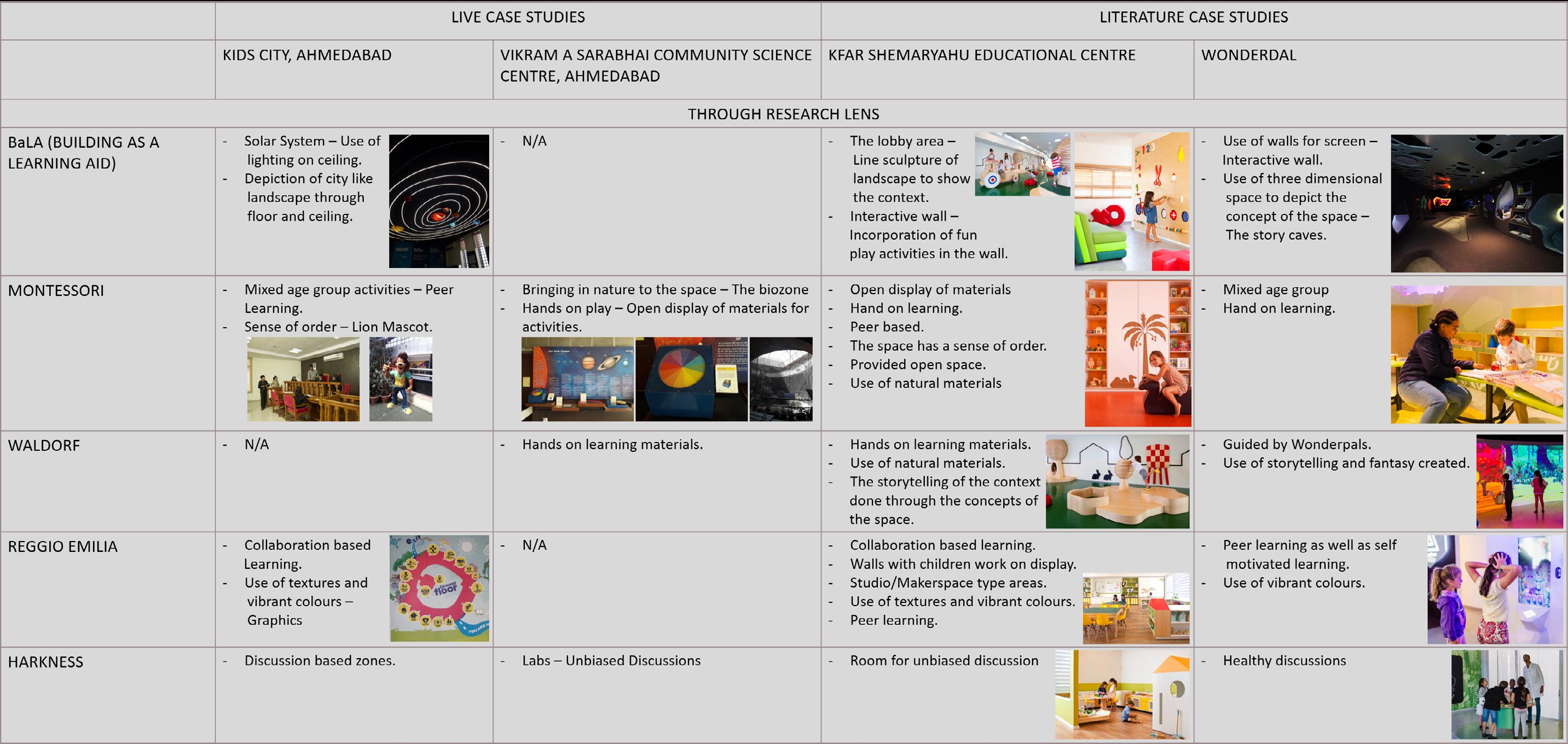
LEARNING BEYOND CLASSROOM • MULTI - PHILOSOPHICAL APPROACH 52 TABLE - 04 _ Through Research Lens (Source - Self Compiled)
SHASHVI DALAL • ANANT NATIONAL UNIVERSITY | 2022 GRADUATION PROJECT • UG SPACE DESIGN
- SITE CONTEXT
SWOT ANALYSIS
SITE STUDY
- SPATIAL + SERVICES ANALYSIS
- SITE PHOTOGRAPHS
LEARNING BEYOND CLASSROOM • MULTI - PHILOSOPHICAL APPROACH 54 4
-
-
ANALYSIS
Site Context Swot Analysis
-
Location
-
weAkness
-
threAt
-
of

spaces and terrace.
to the

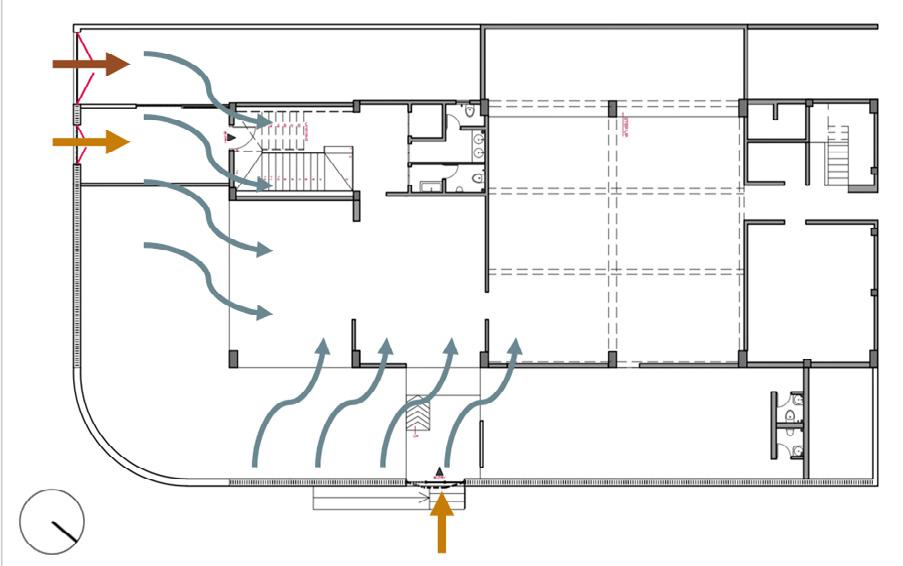
SHASHVI DALAL • ANANT NATIONAL UNIVERSITY | 2022 GRADUATION PROJECT • UG SPACE DESIGN Main Entry Points Summer Sun PathEntry to Basement Winter Sun PathNoise Direction
Site Study
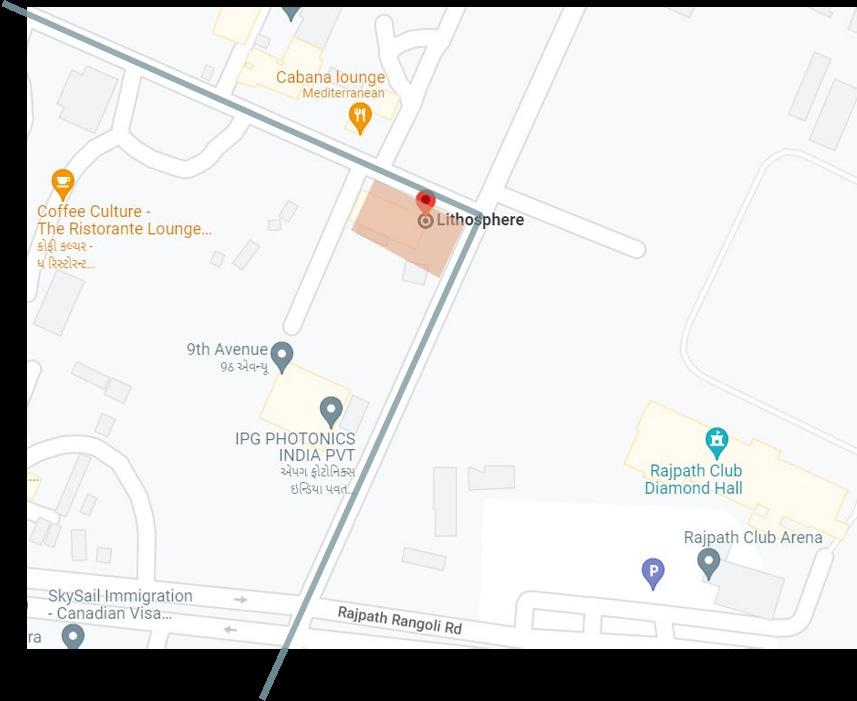
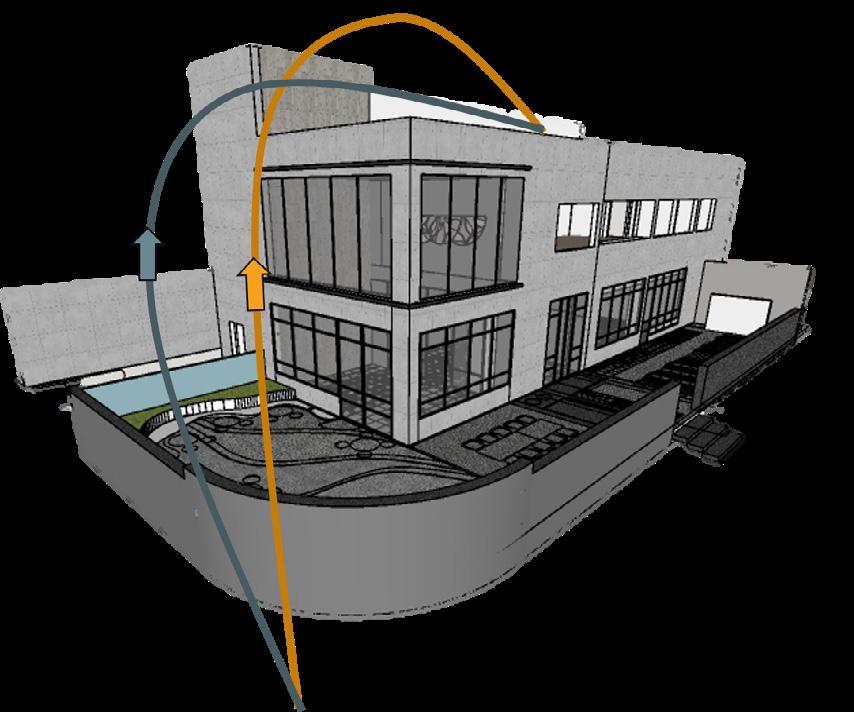
– Lithosphere, Rajpath Rangoli Rd, behind Rajpath club, Bodakdev, Ahmedabad, Gujarat The site is located at corner with commercial and recreational spaces around. strength - Corner site - two huge facades - Basement parking - Lift Shaft - Provision for indor as well as outdoor spaces
Structural columns are not aligned
Fixed spaces given to ducts opportunity - Terrace area
Double height space - A semi open space beside basement with a step up
Need
providing proper protection from sunlight, wind and other natural processes
open
SITE
Fig - 72 Site Location ( Source - Google Maps ) Fig - 73 Site Study Fig - 74 Site Study - Sun Path

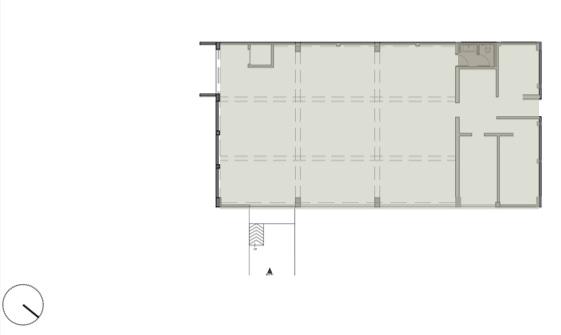
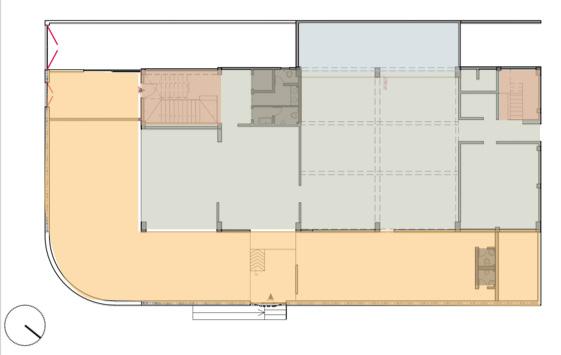
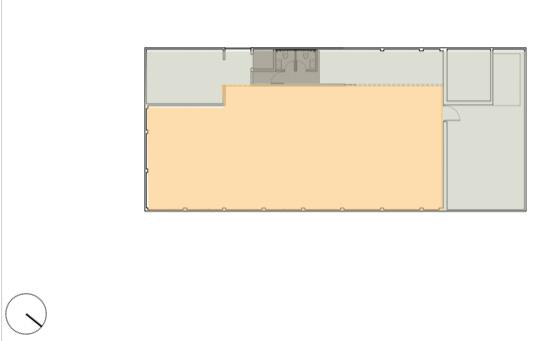
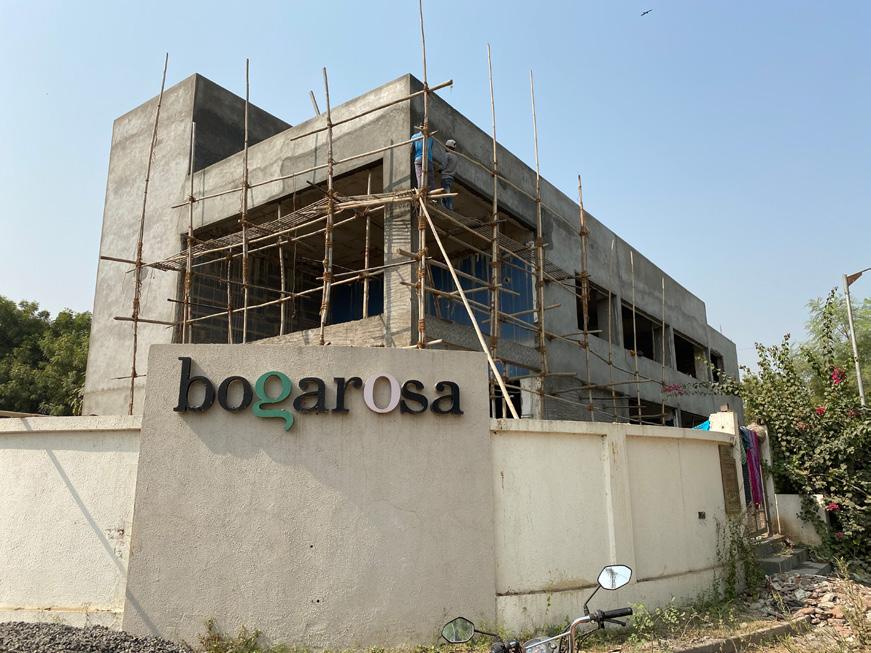
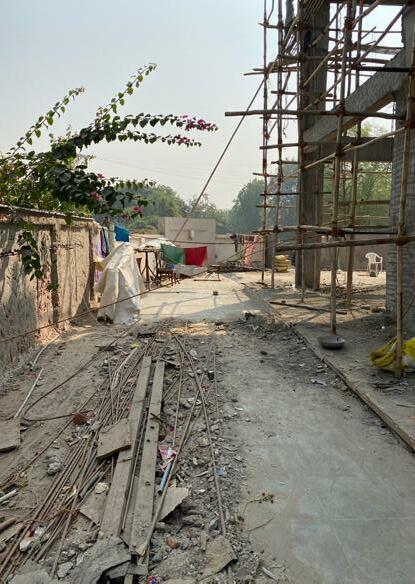
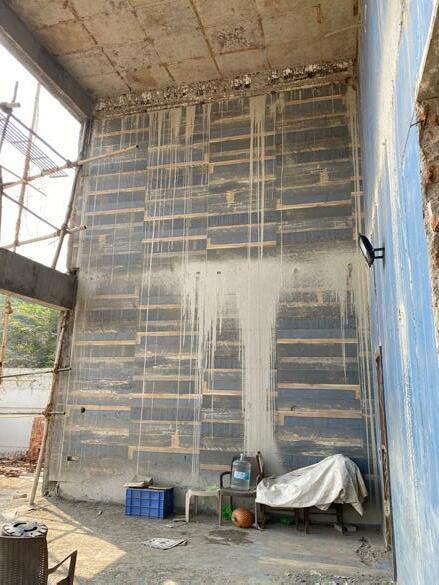
LEARNING BEYOND CLASSROOM • MULTI - PHILOSOPHICAL APPROACH 56 Open Spaces Closed Spaces Semi Open Space Toilet Blocks Vertical Circulation Ground Floor - 680 sq. mts. Terrace - 304 sq. mts.First Floor - 320 sq. mts. Spatial + Services Analysis Site Photographs Fig - 75 Site Plans with Legends ( Source - Self Sourced ) Fig - 76 Site Photographs Top most : Main Facade Bottom left to right : Open Space and Double Height Space
SHASHVI DALAL • ANANT NATIONAL UNIVERSITY | 2022 GRADUATION PROJECT • UG SPACE DESIGN
- PROJECT BRIEF
- CONCEPTUALISATION - THEORY BASED APPROACH
- PROXIMITY CHART AND DIAGRAMS
- CONCEPTUALISATION - DESIGN BASED APPROACH
-
LEARNING
BEYOND
CLASSROOM •
MULTI
PHILOSOPHICAL APPROACH 58 5
PROJECT BRIEF
What Is Being Designed...
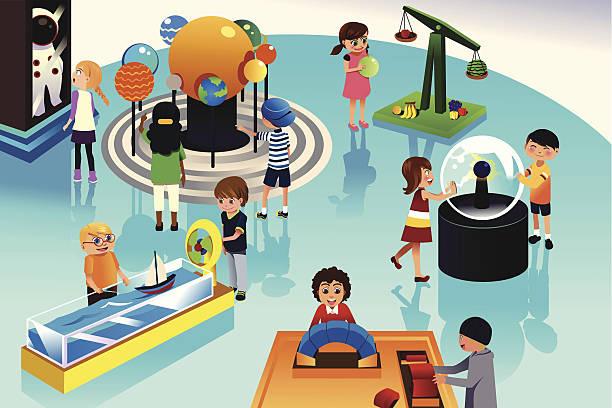
An informal learning space that provides holistic learning to the children. The space would also have outdoor activities along with indoor activities.
Play is going to be an important element. Along with being an education centre, it would involve a lot of play and thus making the space
for children.
The space would enable learning in a more fun and practical manner. The children will be taken on a journey as they move around different zones of the space.

Each zone would be done with a unique approach.
The
and indoors will be connected as children enjoy playing outside. The natural environment would also serve as a great learning exposure.
It would be a space where about 4 – 5 hours can be spent and thus miscellaneous activities like cafe, restroom and other similar spaces would be provided.

SHASHVI DALAL • ANANT NATIONAL UNIVERSITY | 2022 GRADUATION PROJECT • UG SPACE DESIGN
welcoming
outdoors
Target Group - Children - Parents - Teachers - School Field Trip - Visit with Parents - Birthday Celebrations - Admin - Accountant - Receptionist - Cleaning and Maintenance Staff - Security - Chef - Technical Team Fig - 78 Illustration Fig - 79 Illustration Fig - 77 Illustration Primary Secondary Instances Of Visit
How Shall The Project Be Acheived
Elements would be taken from different teaching-learning models that have been researched. Following are the elements which would be taken forward –
Bala (Building as a Learning Aid) - The outdoor spaces would also become learning elements. There would be these learning zones created where the whole of the space would be transformed into a concept.
Montessori - A zone which has an open plan and enables children to explore the materials on their own would be created. Children here would be encouraged to make groups and work to enable peer learning. The multi–sensory approach would be taken.
Waldorf - Use of creative aspects like drama, literature, and stories. For learning languages which through the survey is a bit dif ficult subject to study, the method of Waldorf can be used. Spaces can be created maybe like a mini theatre or a puppet booth to teach complex concepts of language subjects like grammar.
Reggio Emilia - It would be made that there is a proper documentation of the children’s work and they have projects to work on. Creating a space where projects are given a time frame and then the whole process is shared with the peers.
Harkness - Effective use of Harkness table for discussions among children. This will motivate them to speak and make them feel more confident.
LEARNING BEYOND CLASSROOM • MULTI - PHILOSOPHICAL APPROACH 60
CONCEPTUALISATION - THEORY BASED APPROACH
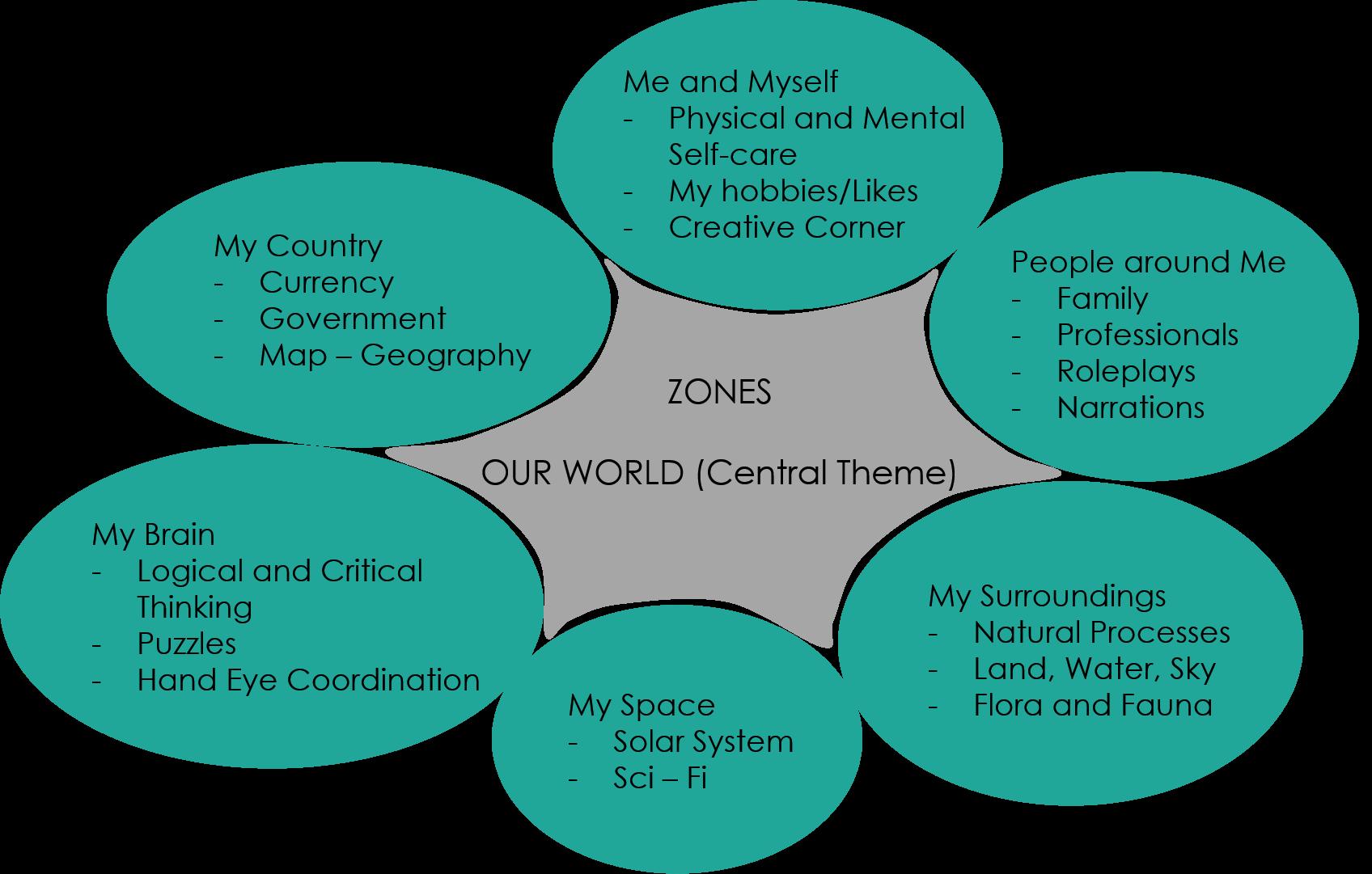
Breaking Down The Course / Content Into Zones
The first step toward conceptualising a space for learning was to prepare a chart/diagram to understand the different subjects or topics that the space would offer. The initial process was understanding the existing formal education curriculum from the surveys conducted and bringing innovation in terms of learning with the help of secondary research and case studies. Upon going through the textbooks and chapters, the topics were narrowed down and a diagram was prepared.
The central theme was chosen to be "My World" around which the other spaces would be based. Initial idea was to design a space based on a particular subject like physics or maths which might be a popular choice for an experiential space. But after going through the materials collected and interactions with the children, the central theme was finalised.
SHASHVI DALAL • ANANT NATIONAL UNIVERSITY | 2022 GRADUATION PROJECT • UG SPACE DESIGN
Fig - 80 Bubble Diagram ( Source - Self Drawn )
Colour Coding And Refining The Zones
"My World" symbolises that the space would be the Children's world. A space specifically dedicated to how they see the world from their perspective.
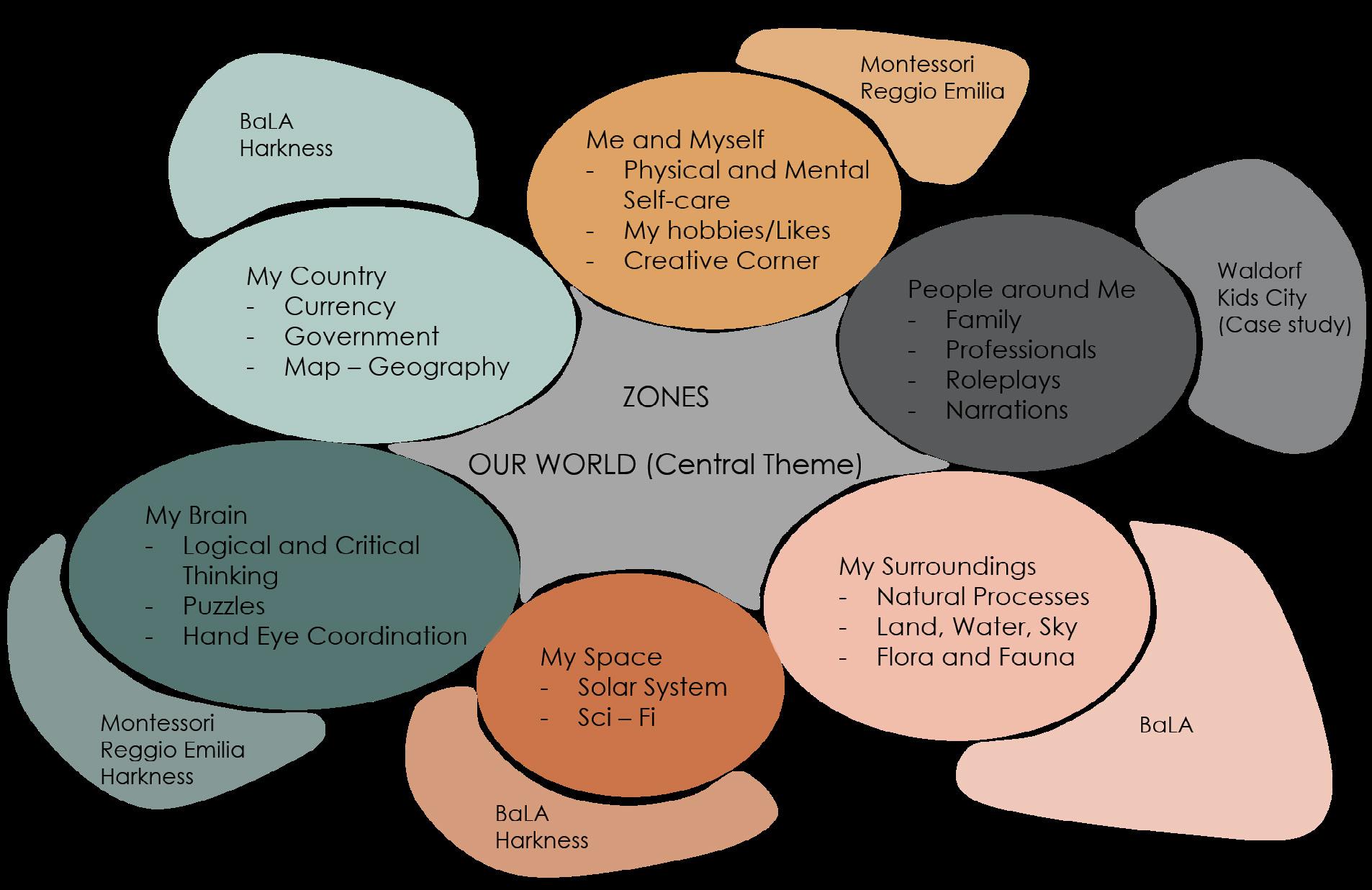
6 zones were then finalised upon which were - Me and Myself, People Around Me, My Surroundings, My Space, My Brain and My Country. All the spaces would have different activities based on their name.
The colour coding done here in the diagram has been carried out through out the project to make it easily un derstandable. A little detailing was also done to define which philosophy can work well with which zone.
LEARNING BEYOND CLASSROOM • MULTI - PHILOSOPHICAL APPROACH 62
Fig - 81 Bubble Diagram
( Source - Self Drawn )
PROXIMITY CHART AND DIAGRAM
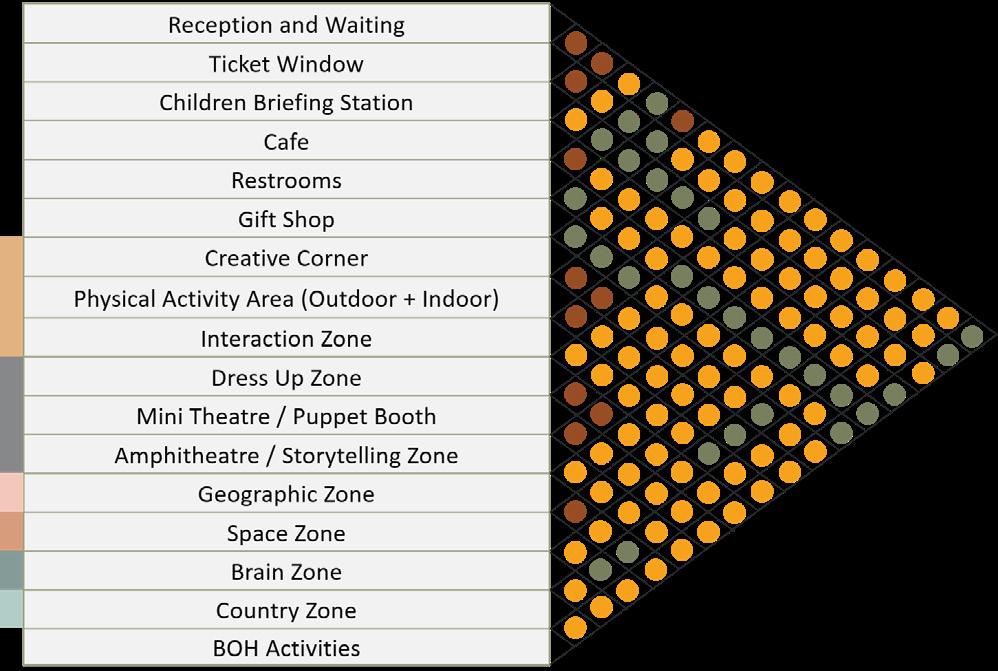
Fig - 82 Proximity Chart with Legend (Left)

TABLE - 05 _ Area Statement (Below)
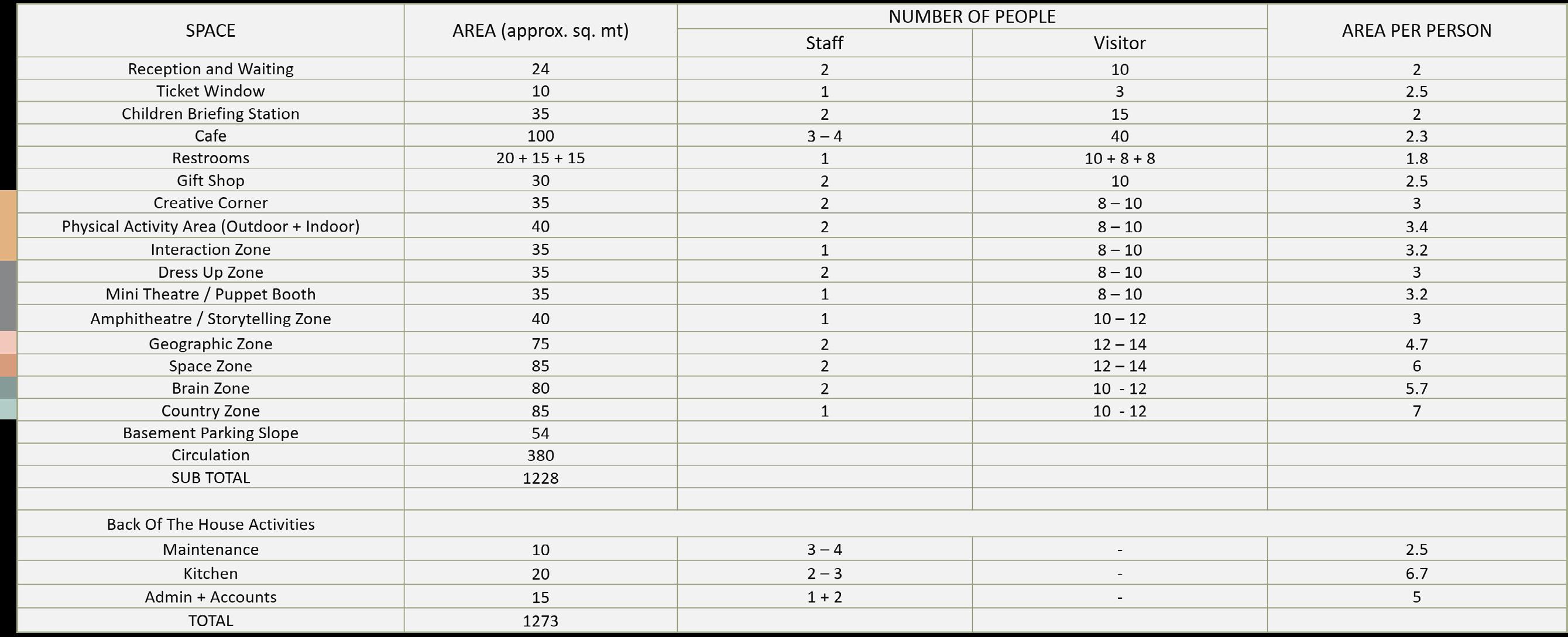
SHASHVI DALAL • ANANT NATIONAL UNIVERSITY | 2022 GRADUATION PROJECT • UG SPACE DESIGN
Proximity Diagram

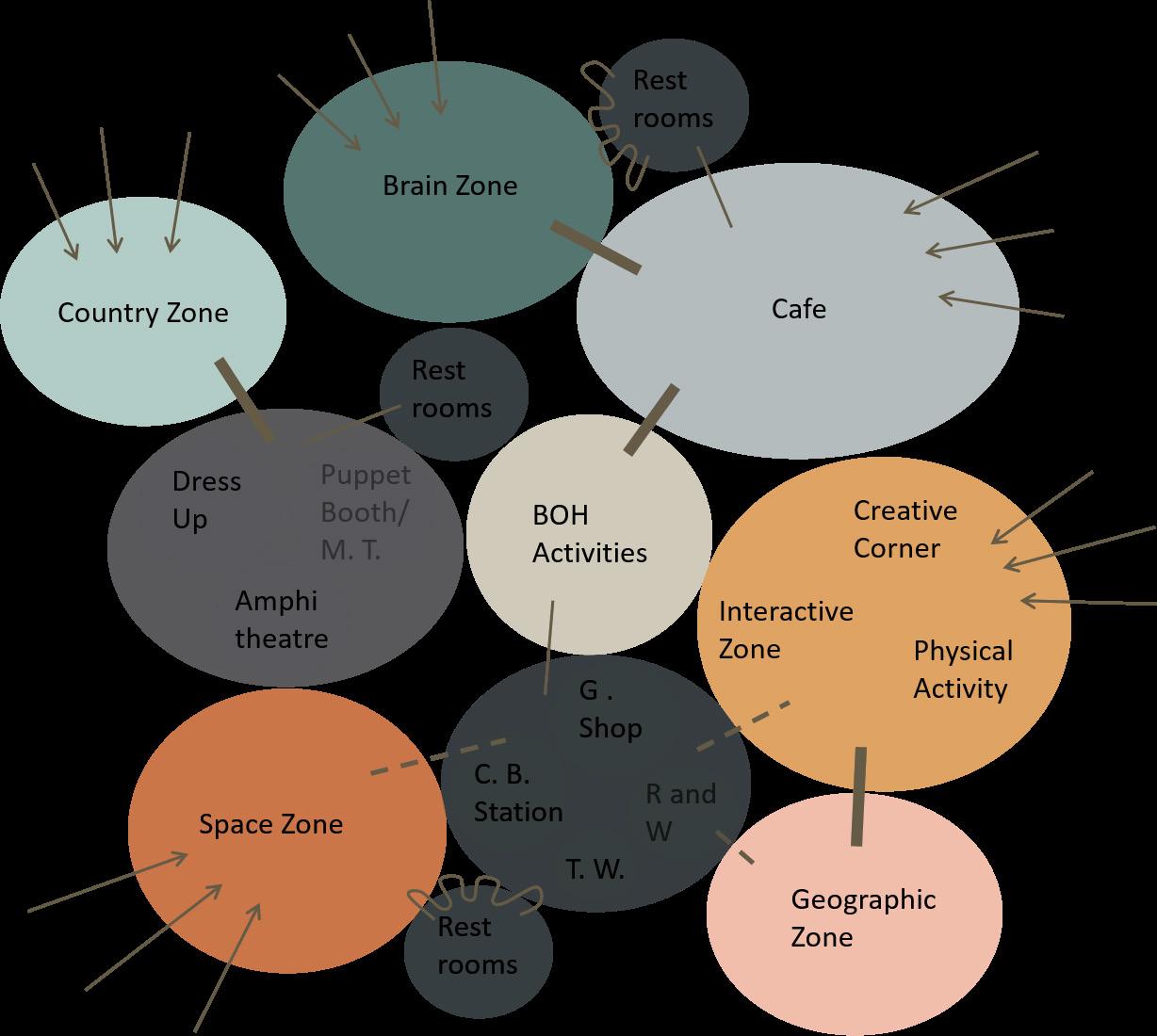
The spaces are now defined in the form of bubbles of size corresponding to their area. These bubbles are arranged in a manner that suits their functions.
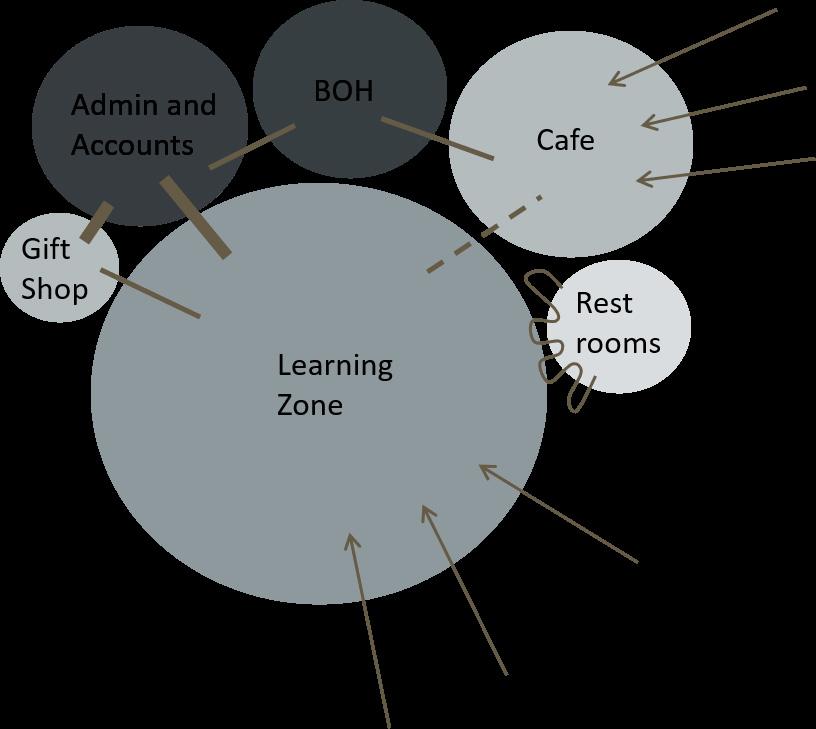
LEARNING BEYOND CLASSROOM • MULTI - PHILOSOPHICAL APPROACH 64
Fig - 83 Basic Proximity Diagram with Legend Fig - 84 Final Proximity Diagram
CONCEPTUALISATION - DESIGN BASED APPROACH
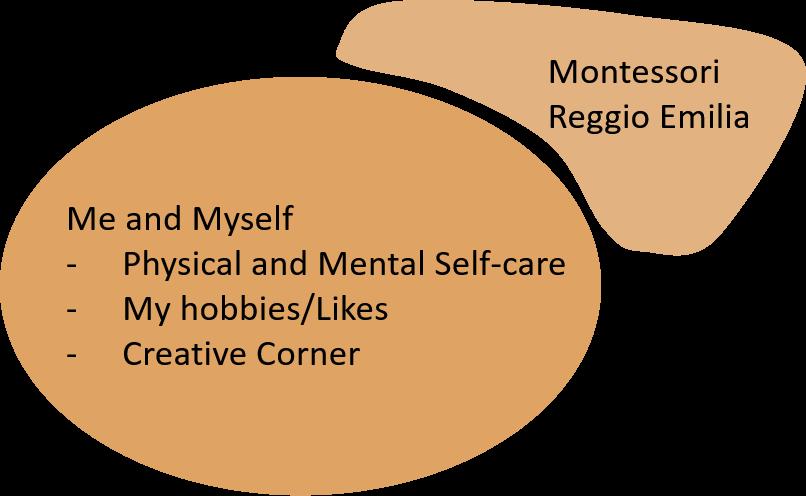
Aimed at creating spaces to allow the children to explore themselves creatively. Also, spaces where their physical and mental well-being is taught.
Elements for the zone :
- Creative Corner
Inspired from Montessori and Reggio Emilia method.
- Open Spaces
Inspired from Montessori method.
- Clay Zone Inspired from Reggio Emilia method.
Inspiration Images And Conceptual Sketches / 3Ds
- Provision of large open spaces characterised by a difference in flooring.
- The space will provide hand - on learning experience.
- Red clay pottery included to introduce Indian context to the space.
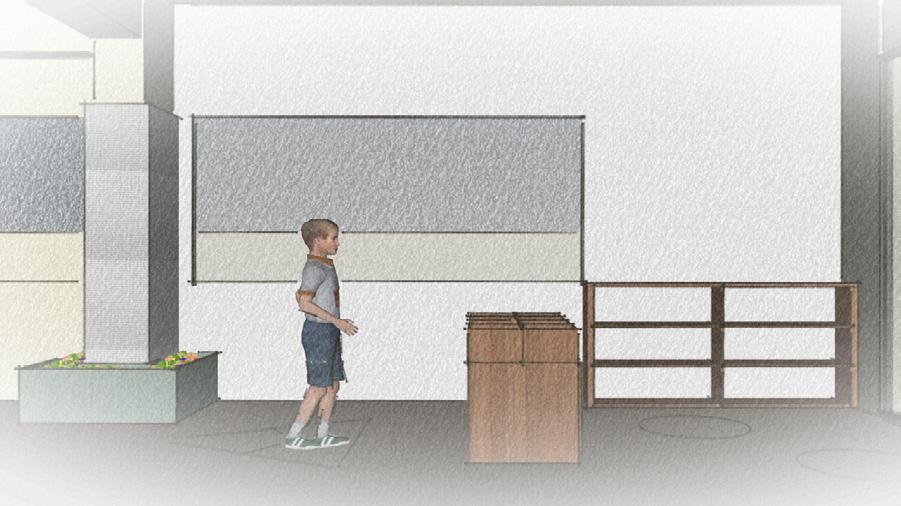
Creative Corner
- Functions as a space that enables children to get creative freedom.
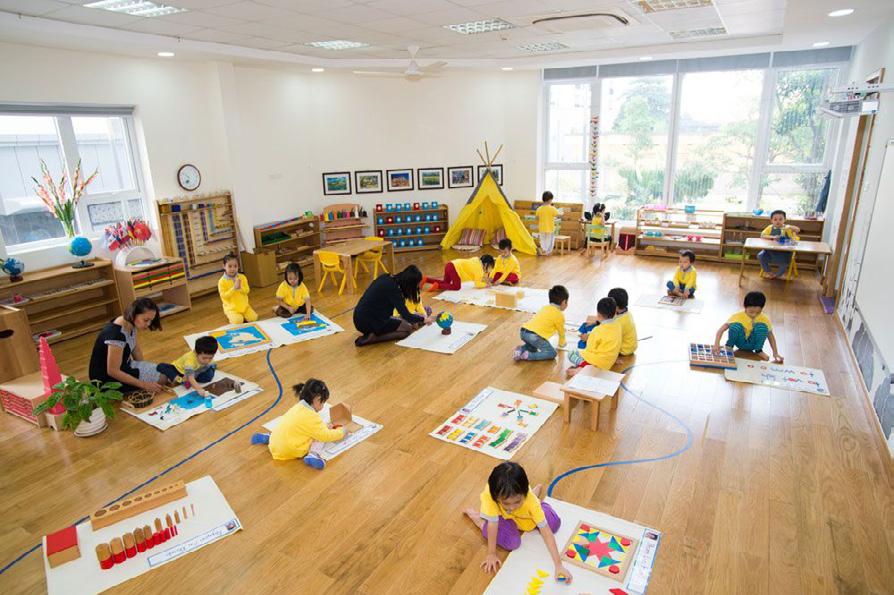
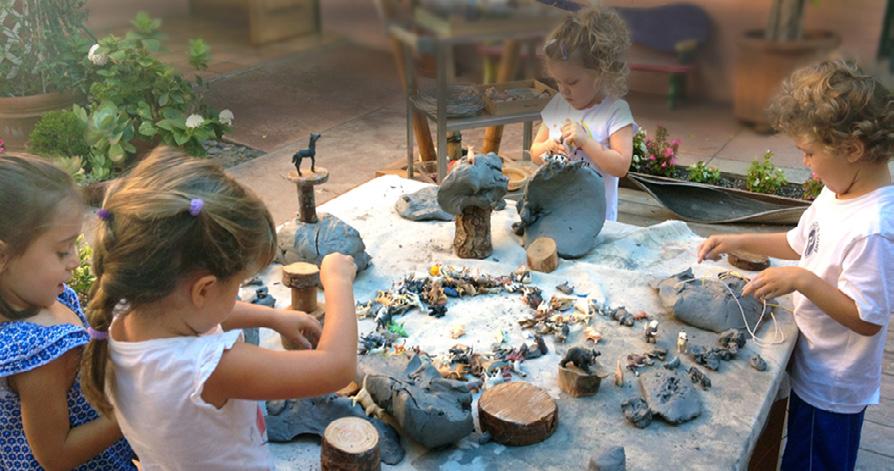
- They can choose their own materials from boxes and choose to make whatever they want.
- Also included a lego wall cladded onto the column with a pit below.
SHASHVI DALAL • ANANT NATIONAL UNIVERSITY | 2022 GRADUATION PROJECT • UG SPACE DESIGN
Fig
- 87 Depiction of Creative
Corner Fig
- 85
Use
of Open
Spaces
Fig - 86 Clay Zone
-
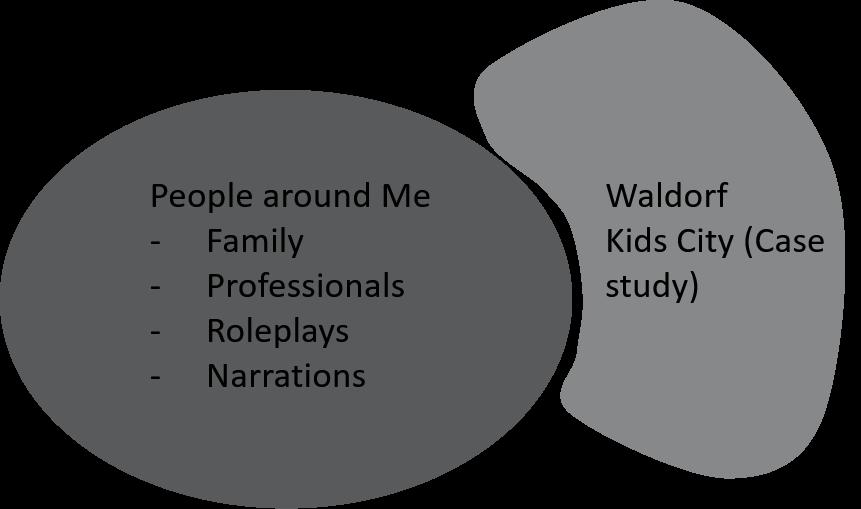
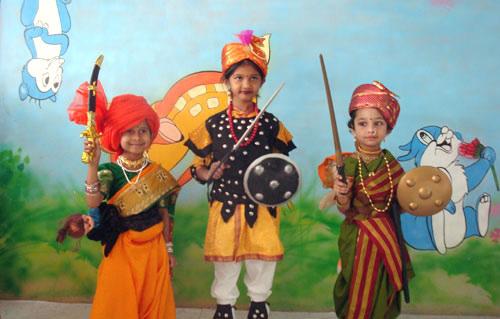
This space would cater to the curious minds of children. It would help them know and understand people around them through fun experiences. These people can be anyone from their parents, neighbours, school staff, history leaders and other such people.
The space and some of its elements have got inspired by the Waldorf method.
Elements for the zone :
- Dress - Up
-
Inspiration Images And Conceptual Sketches / 3Ds
- Experience the people through their costumes.

- They get a chance to enact them and thus learn more about them.
Fig - 89 Performance Zone
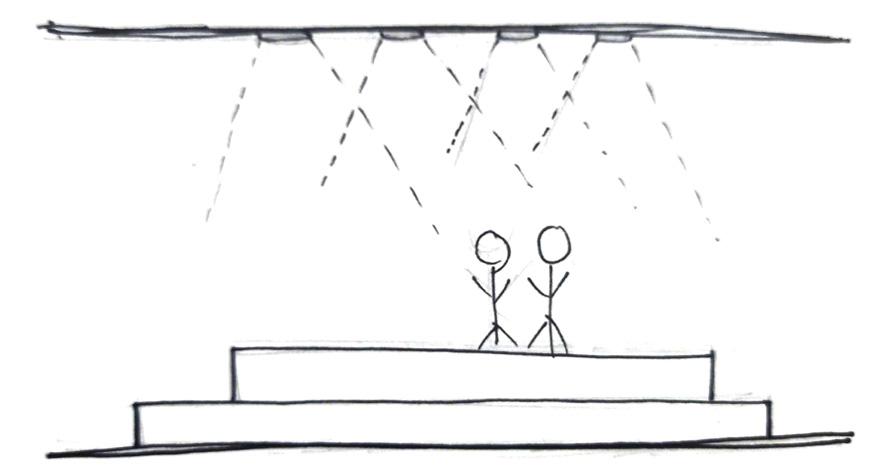
- A storytelling experience for the children where they can enact the person they have dressed up as.
- A stage with an amphitheatre like setting.
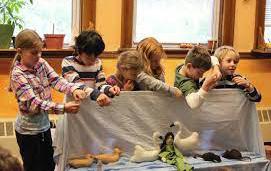
Puppet Zone
- FIndian Indian context to storytelling.
- They can even learn the art of puppetry.
LEARNING BEYOND CLASSROOM • MULTI - PHILOSOPHICAL APPROACH 66
Zone
Performance Zone
Puppet Zone
Fig - 90 Waldorf School-Puppet Show
Fig - 91 Indian Puppetry
Fig - 88 Dress Up Zone (Reference)
BASED
SHASHVI DALAL • ANANT NATIONAL UNIVERSITY | 2022 GRADUATION PROJECT • UG SPACE DESIGN CONCEPTUALISATION - DESIGN
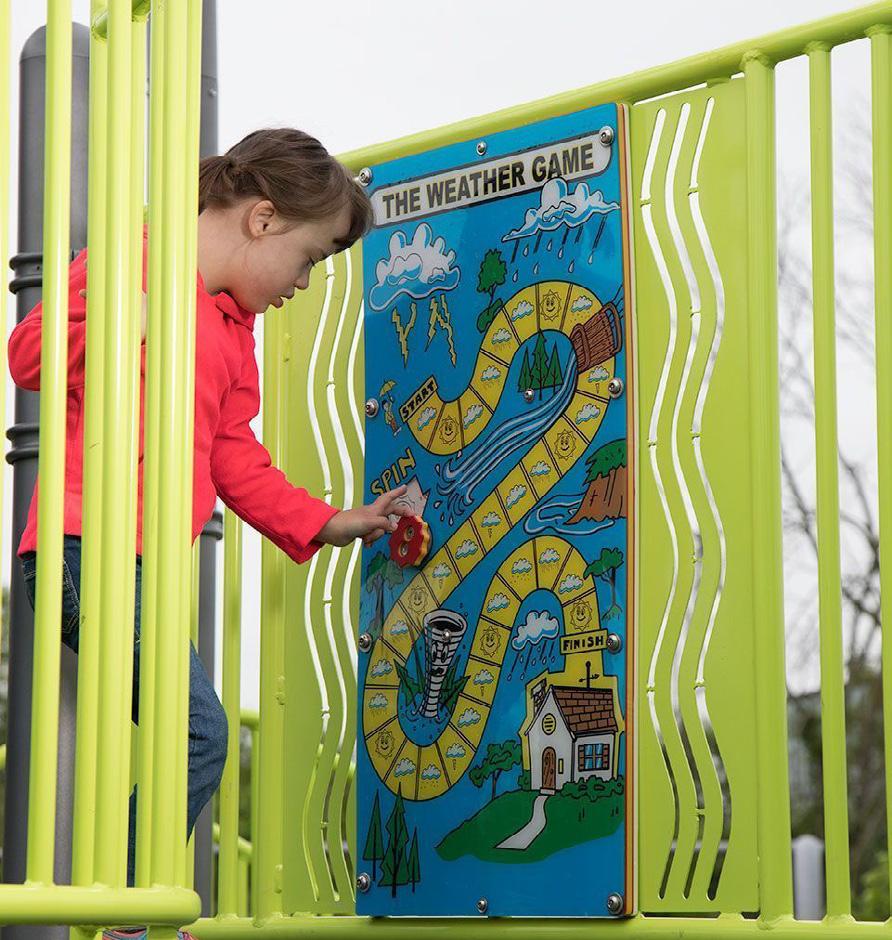
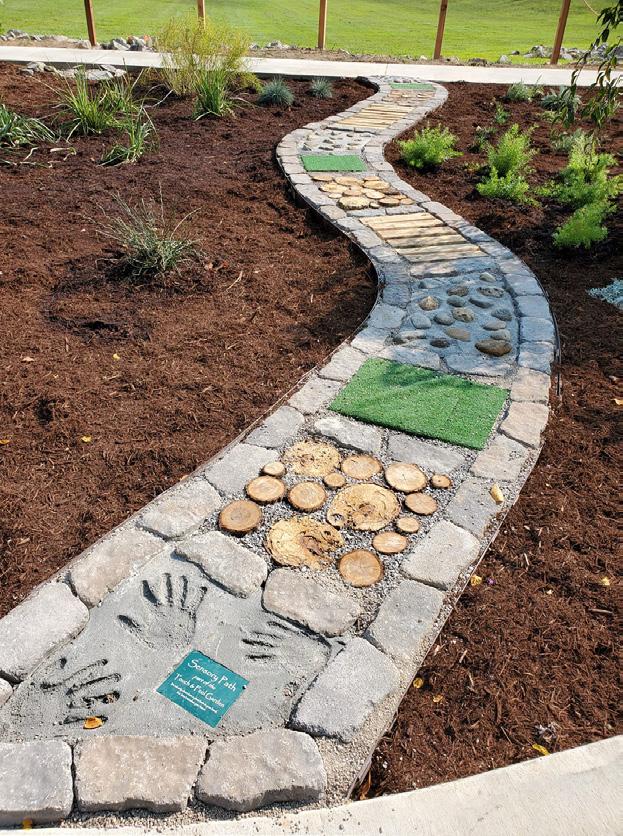
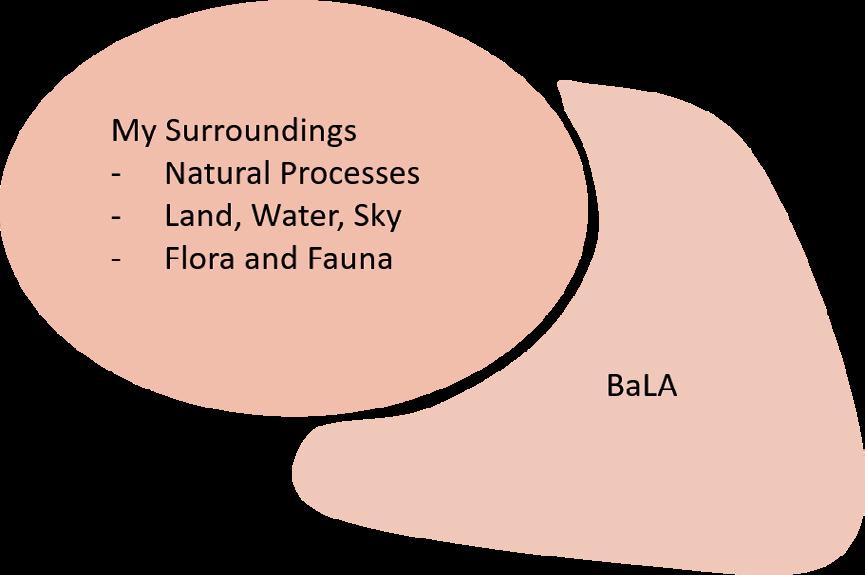
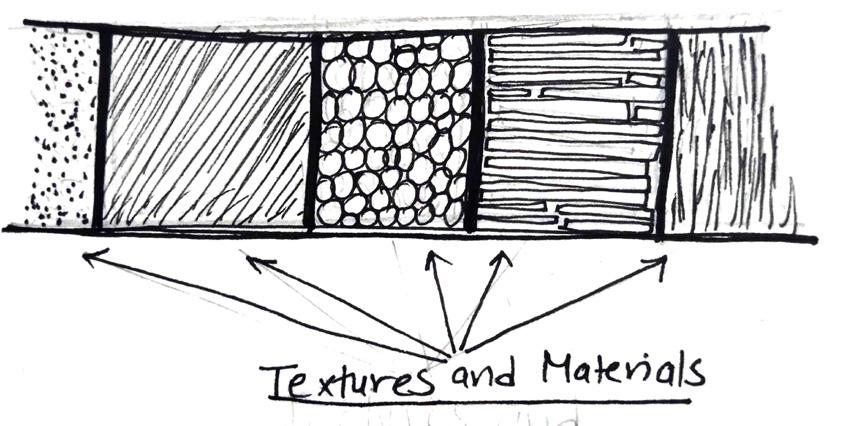
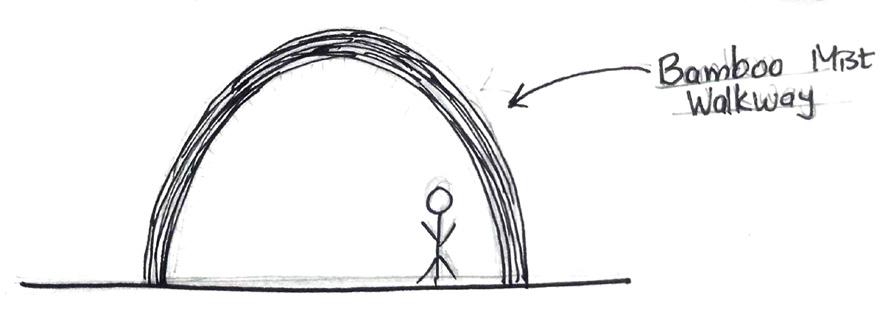
APPROACH My surrounding space will aim at creating awareness and imbibing knowledge about nature in children through various elements. . Elements for the zone : - Bamboo Mist Walkway Inspired from Sciencecity (Ahmedabad) Nature Park. - Plant Zone - Sensory Path - Aquatic Life - Interactive panels on a deck Fig - 92 Bamboo Mist Walkway Fig - 93 Interactive Panels on Nature (Reference) Fig - 94 Sensory Path (Sketch) Fig - 95 Sensory Path (Reference) Inspiration Images And Conceptual Sketches / 3Ds
-
This space would be a reflection of what outer space means and what are `its various elements.
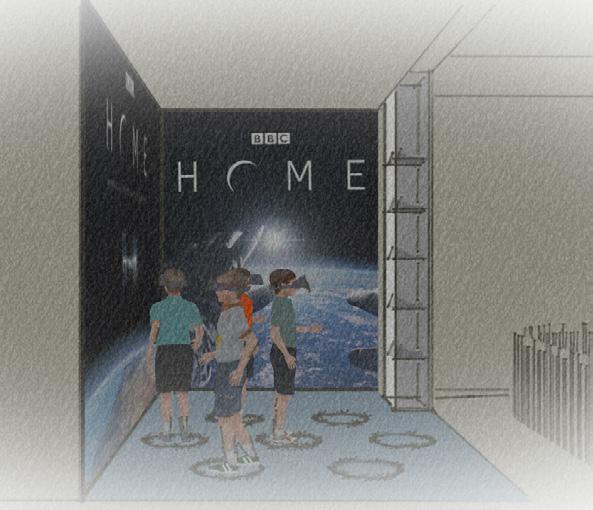
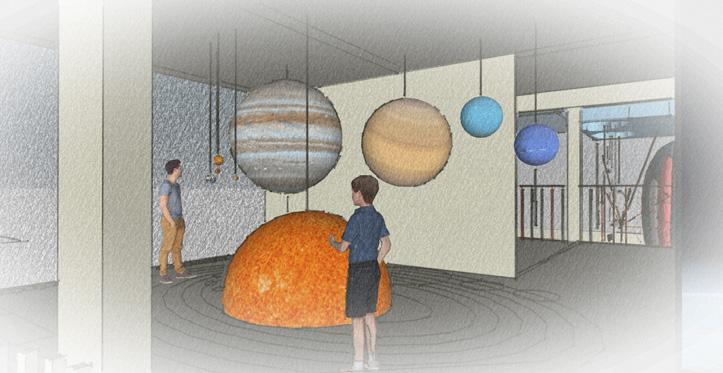
Elements for the zone :
- Moon Zone : To let the children feel the moon through its texture. They can also operate a smaller model of a moon rover on a replica of the moon's surface.
-
-
Inspiration Images And Conceptual Sketches / 3Ds
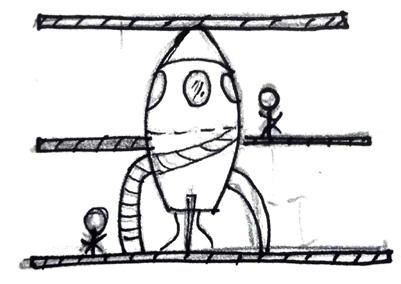
Fig - 96 Solar System Zone
- Relatively sized planets in a suspended form.
Fig - 98 Conceptual sketches for the Spaceship element and in 3D
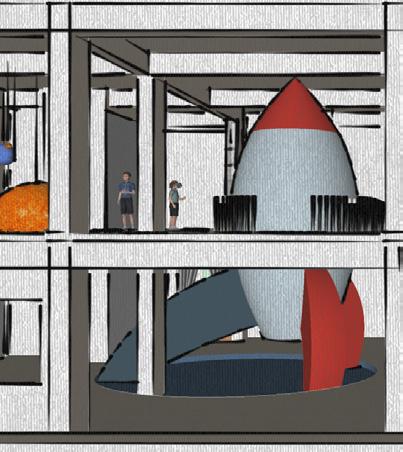
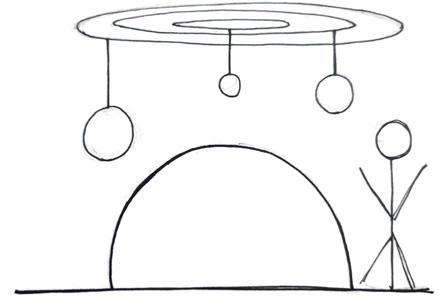
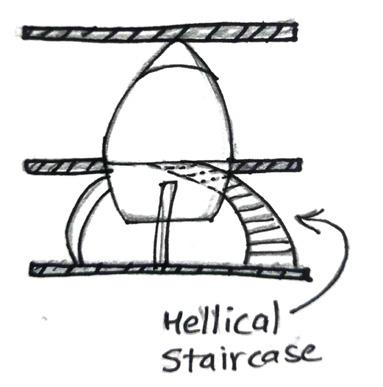
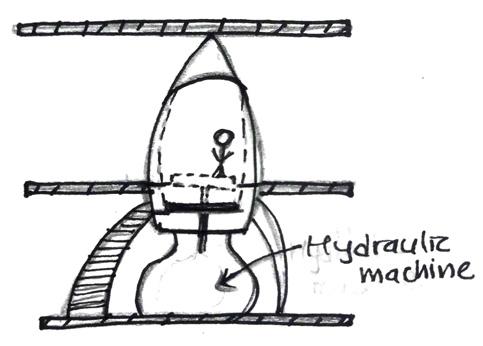
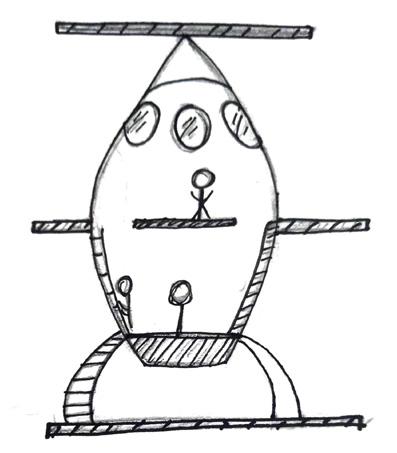
- Vertical Transportation as well as an interactive element.
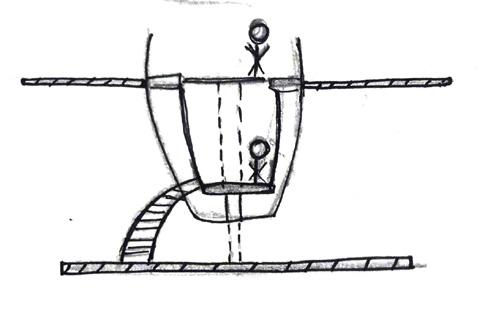
- Will also act as a focal point for the entire space.
Fig - 97 Virtual
Zone
LEARNING BEYOND CLASSROOM • MULTI - PHILOSOPHICAL APPROACH
68
Spaceship
Virtual Reality Zone
Solar System Zone
Reality
CONCEPTUALISATION - DESIGN BASED APPROACH
Inspiration Images And In Plan
This is a space dedicated to brain teasers, puzzles, discussions, word games and other such activities. Children can participate in various activities involving different parts of their brains.
The main element - Discussion Table for this space has been inspired by the Harkness method.
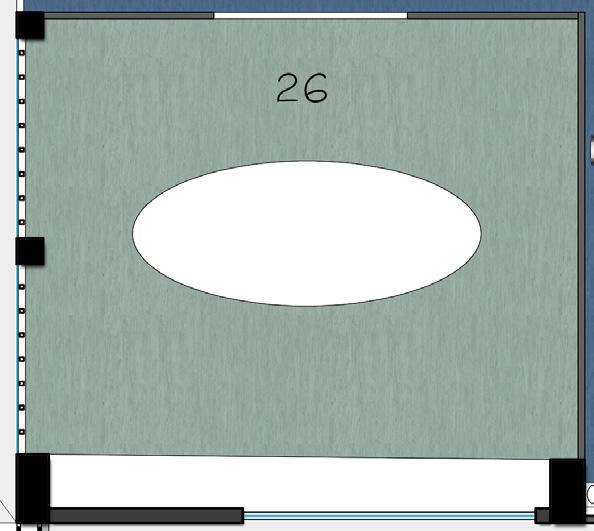
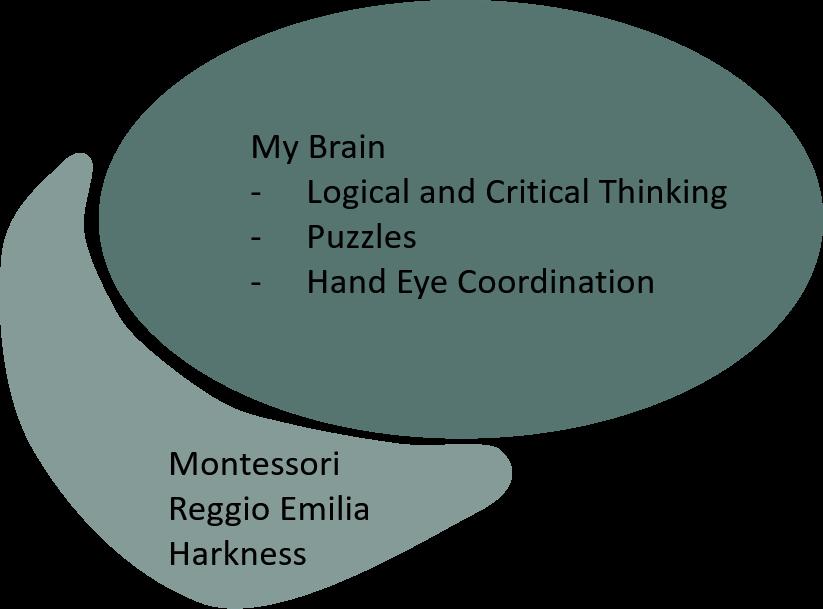
This space will allow children to have free discussions and imbibe confidence in them.
The Brain Zone is further divided into two spaces :
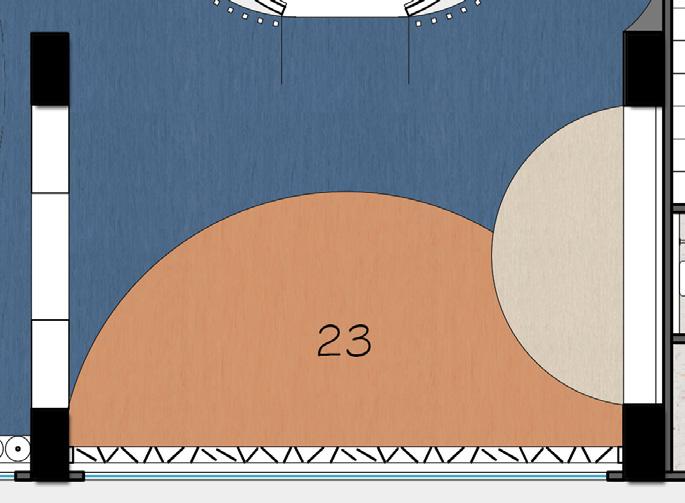
- Thinktank Zone - dedicated to table discussions and challenges.
- The Open Activity Zone - dedicated to open activities like puzzle solving, word games and other similar activities.

SHASHVI DALAL • ANANT NATIONAL UNIVERSITY | 2022 GRADUATION PROJECT • UG SPACE DESIGN
Fig - 99 Harkness Table
My country zone is dedicated to making the children learn and become aware of their country. This space is inspired by the BaLA method.
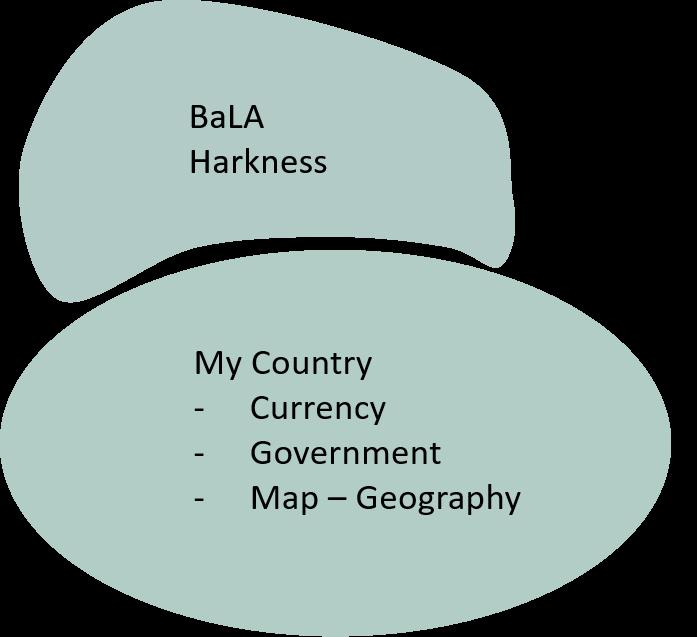
An Indian map is installed into the flooring and storage for various props is provided near the zone.
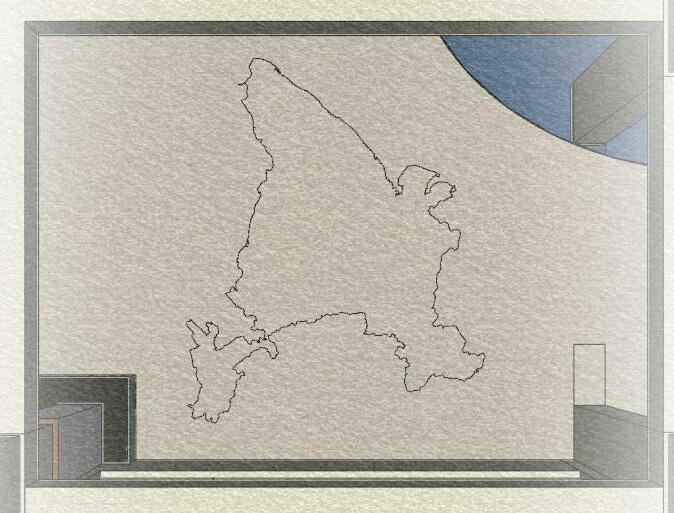
Various activities can be planned around the map like knowing the states, locating them through directions, mapping major rivers and many more.
Inspiration Images And In Plan
Fig - 101 Children learning Indian Map through rangoli
The BaLA method involves using every available surface for learning. Here the outdoor ground is being extensively used as a base for the rangoli.
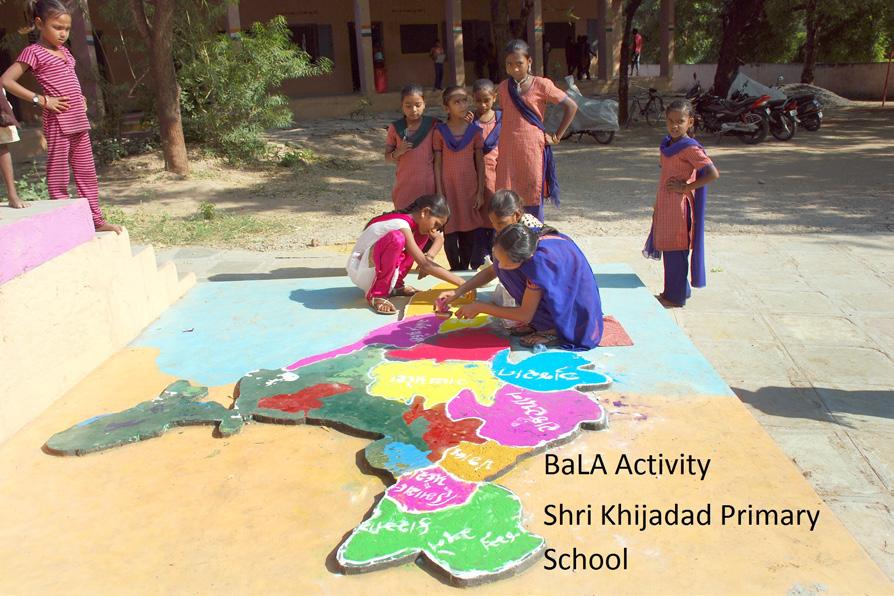
Fig - 102 My Country in Top View
The north of the map has been aligned to the north of the site for an easier and better understand ing of directions.

LEARNING BEYOND CLASSROOM • MULTI - PHILOSOPHICAL APPROACH 70
SHASHVI DALAL • ANANT NATIONAL UNIVERSITY | 2022 GRADUATION PROJECT • UG SPACE DESIGN
LEARNING BEYOND CLASSROOM • MULTI - PHILOSOPHICAL APPROACH 72 - FINAL FLOOR PLANS - FINAL OVERALL SECTIONS - 3D VIEWS 6
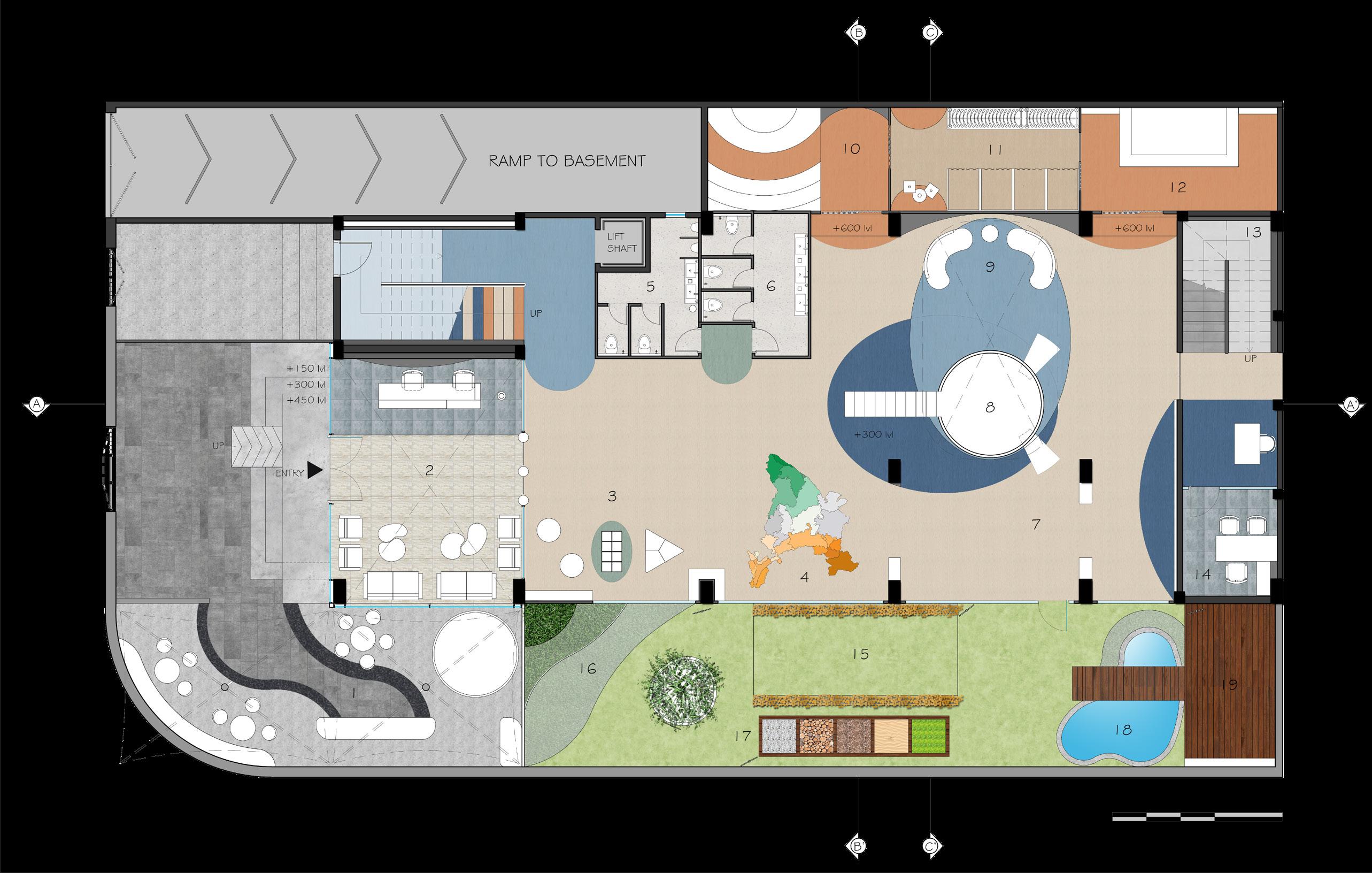
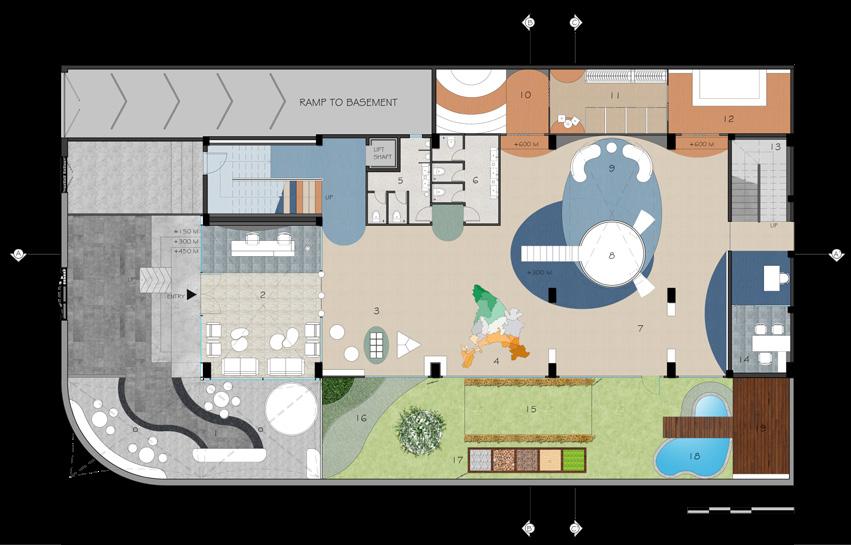
FINAL GROUND FLOOR PLAN
SHASHVI DALAL • ANANT NATIONAL UNIVERSITY | 2022 GRADUATION PROJECT • UG SPACE DESIGN
Fig - 103 Ground Floor Furniture Layout ( Source - Self Created )
FINAL FIRST FLOOR PLAN
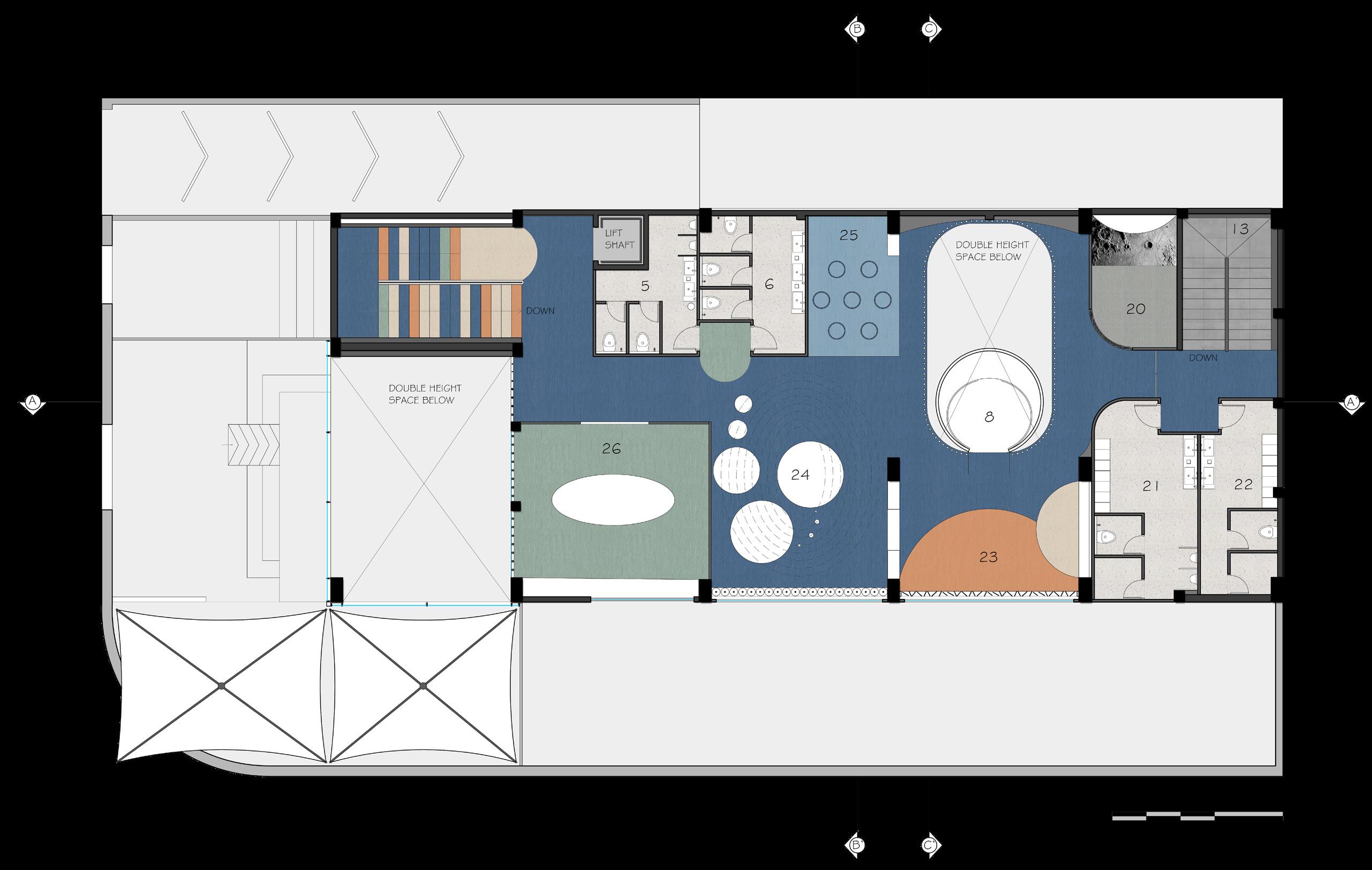
LEARNING BEYOND CLASSROOM • MULTI - PHILOSOPHICAL APPROACH 74
Fig - 104 First Floor Furniture Layout ( Source - Self Created )
FINAL TERRACE FLOOR PLAN
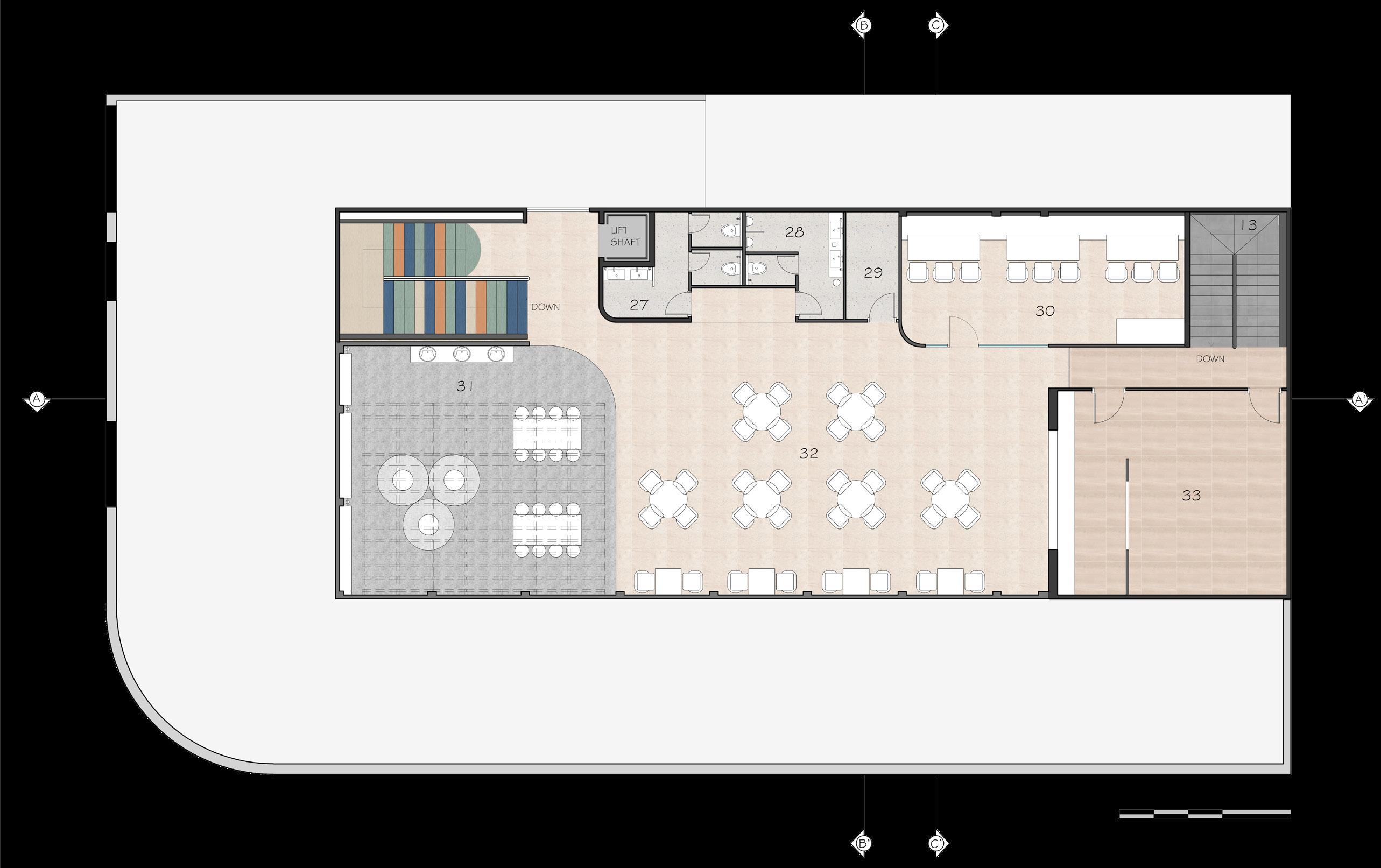
SHASHVI DALAL • ANANT NATIONAL UNIVERSITY | 2022 GRADUATION PROJECT • UG SPACE DESIGN
Fig - 105 Terrace Furniture Layout ( Source - Self Created )
LEGEND









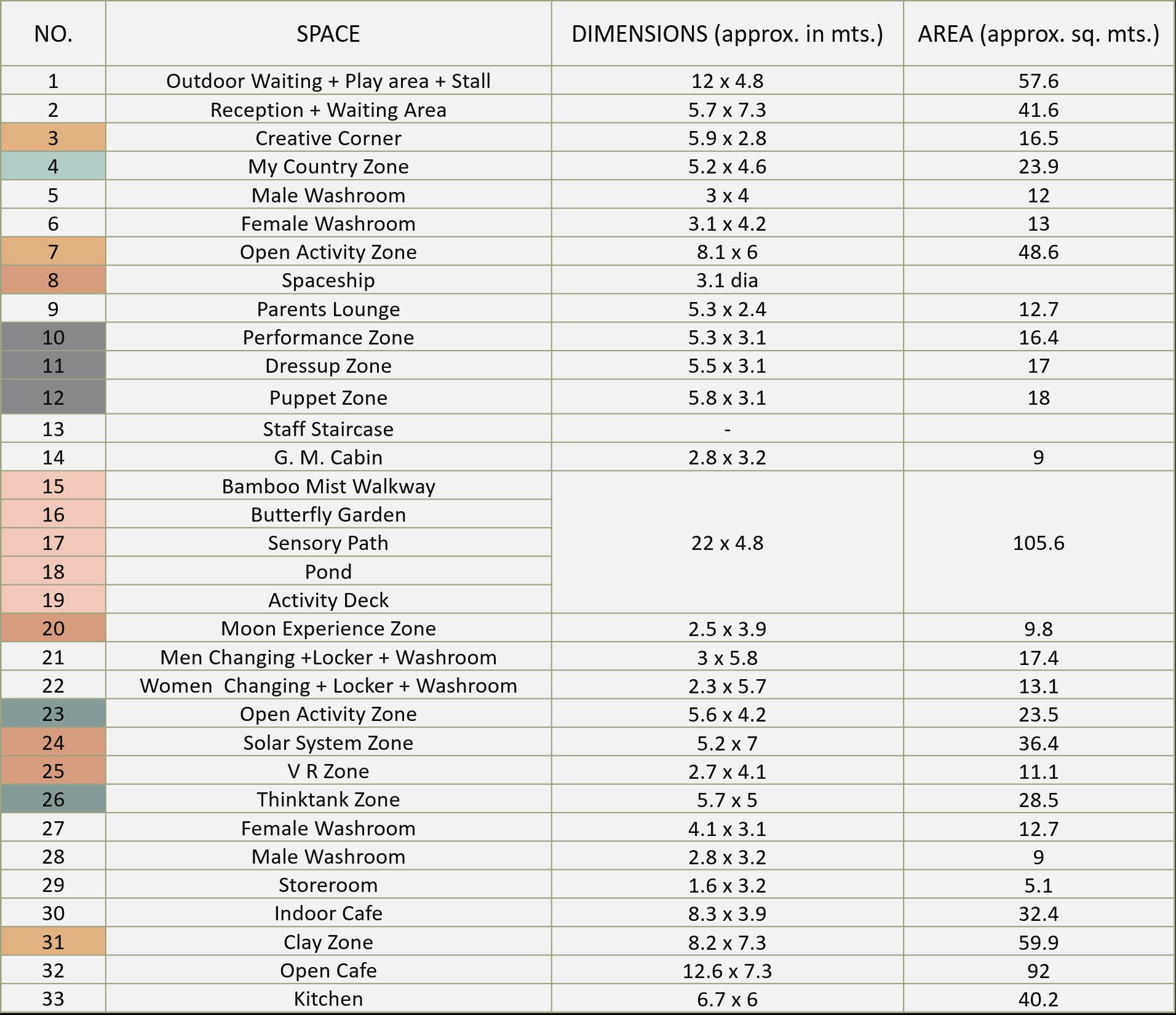
LEARNING BEYOND CLASSROOM • MULTI - PHILOSOPHICAL APPROACH 76
- AREA STATEMENT TABLE - 06 _ Legend and Area Statement (Source - Self Tabulated) Fig - 106 Material Board (Source - Self Curated) Colour SchemeLaminate Swatch Homogeneous Vinyl Flooring Series - Specjal Plus Brand - Tarkett Flooring
SECTIONS AND 3D VIEWS
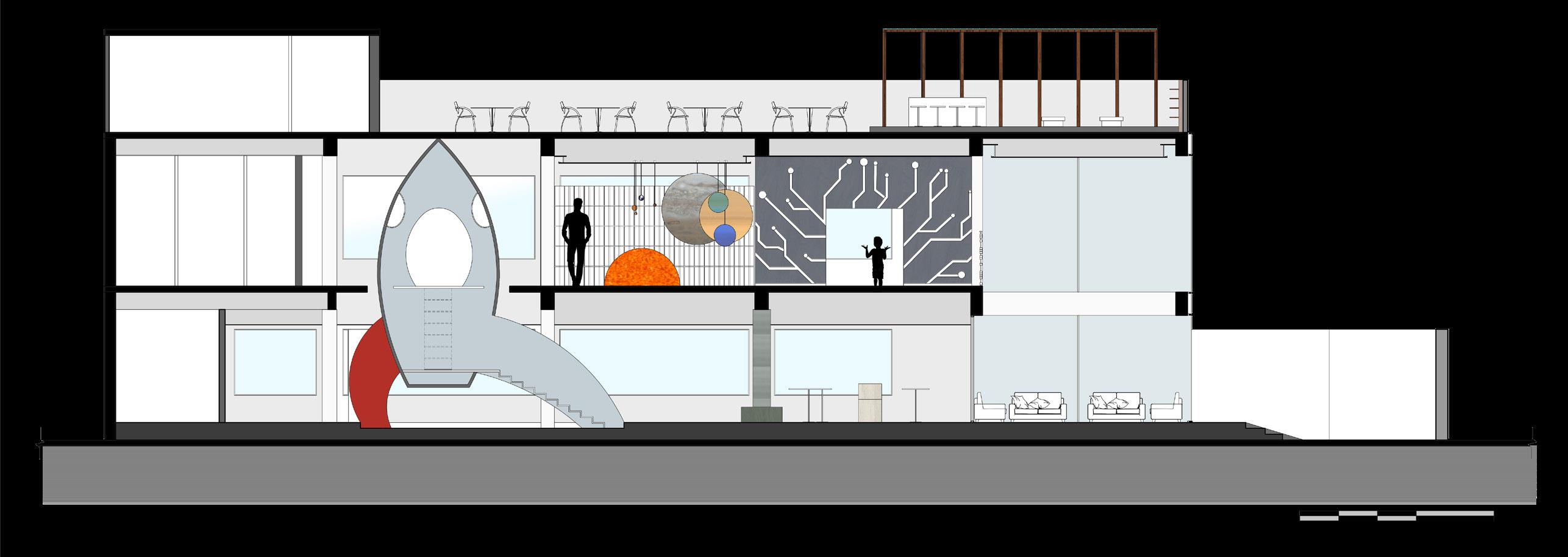
SHASHVI DALAL • ANANT NATIONAL UNIVERSITY | 2022 GRADUATION PROJECT • UG SPACE DESIGN FINAL
Fig - 107 Section AA' ( Source - Self Created ) Fig - 108 Key Plan Section AA'
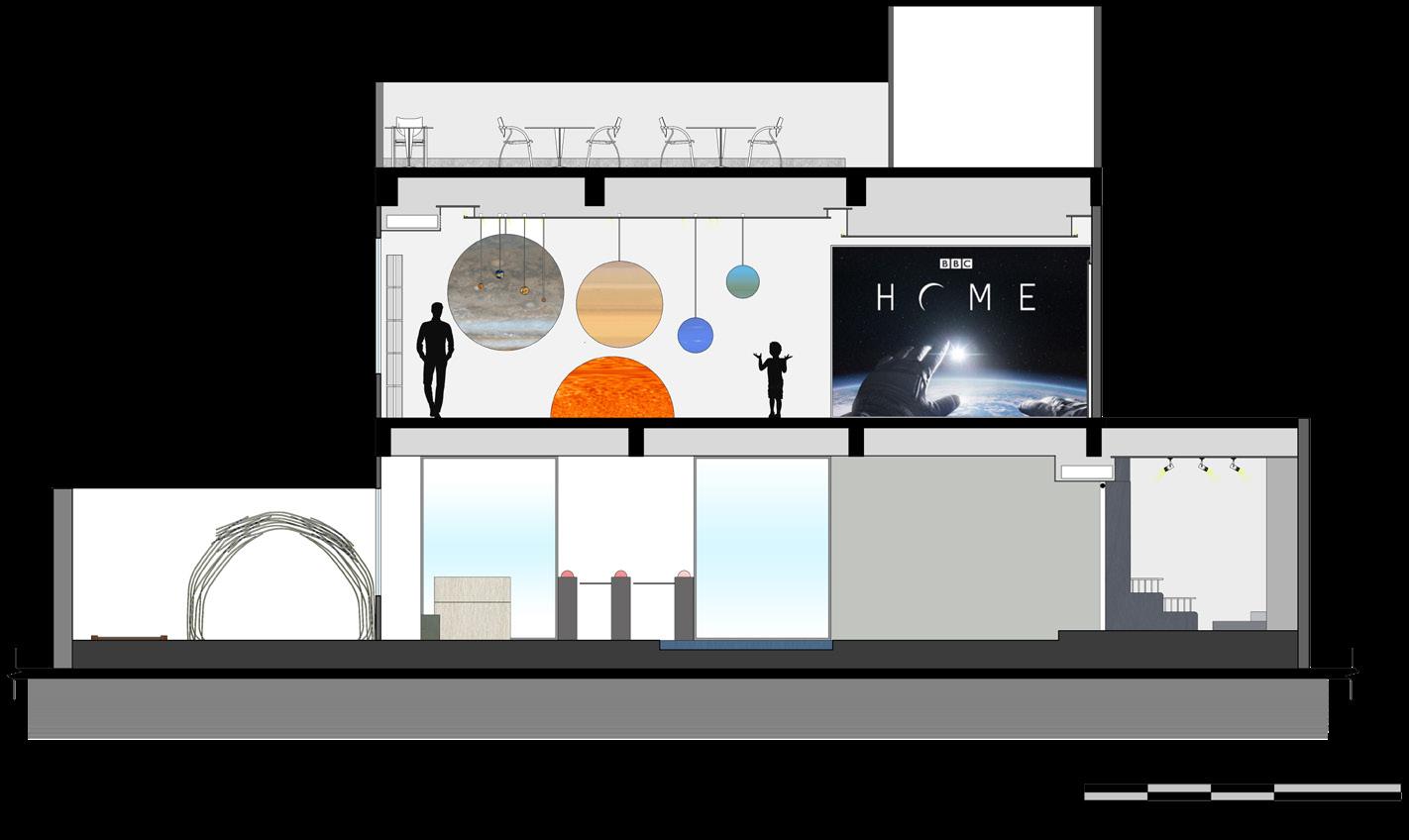
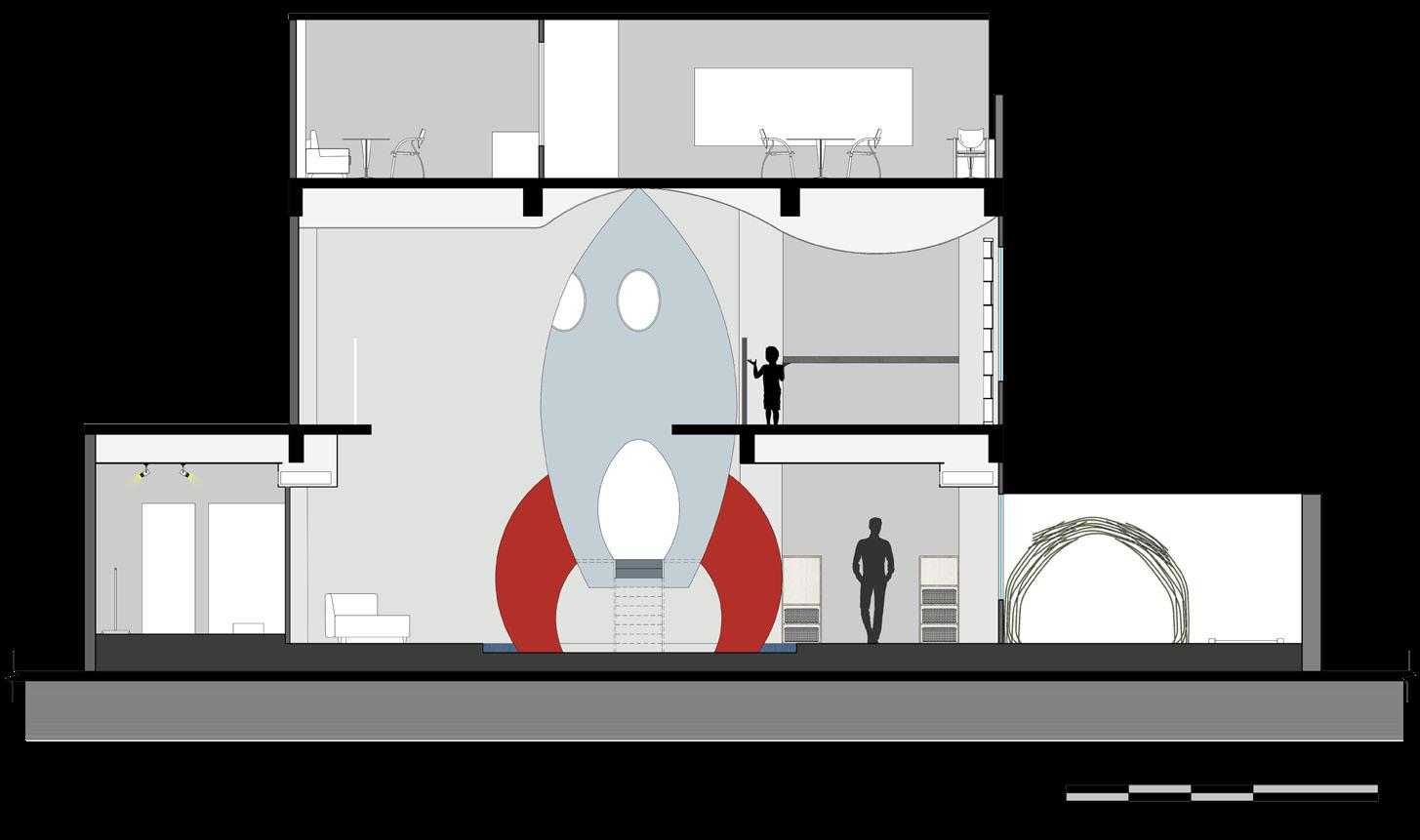
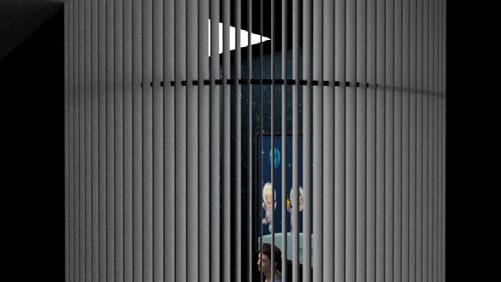
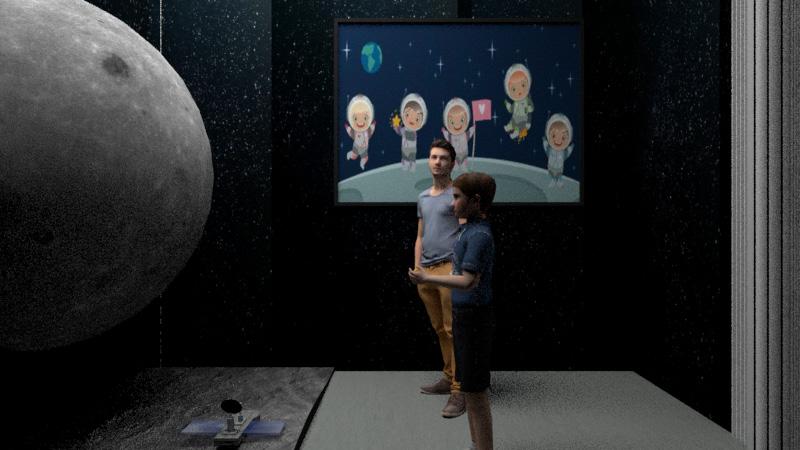
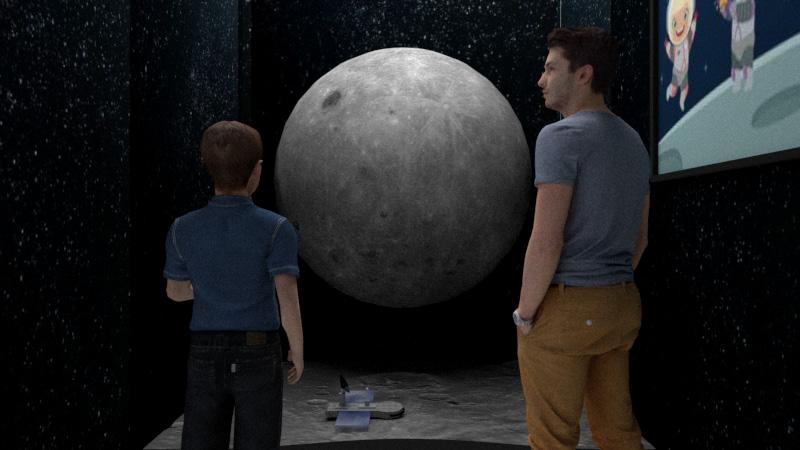
LEARNING BEYOND CLASSROOM • MULTI - PHILOSOPHICAL APPROACH 78 Fig - 109 Section BB' ( Source - Self Created ) Fig - 111 From left to right : Moon space with screen, Moon surface replica and partition detail Fig - 110 Section CC' ( Source - Self Created ) Section BB' 3D Views Section CC'
SHASHVI DALAL • ANANT NATIONAL UNIVERSITY | 2022 GRADUATION PROJECT • UG SPACE DESIGN
- DETAIL AREA
RECEPTION AND INDOOR WAITING AREA
- DETAIL AREA
ELEMENT
LEARNING BEYOND
• MULTI -
CLASSROOM
PHILOSOPHICAL APPROACH 80 7
1 _
2 _ SPACESHIP
DETAIL AREA - RECEPTION AND INDOOR WAITING
Concept For The Space
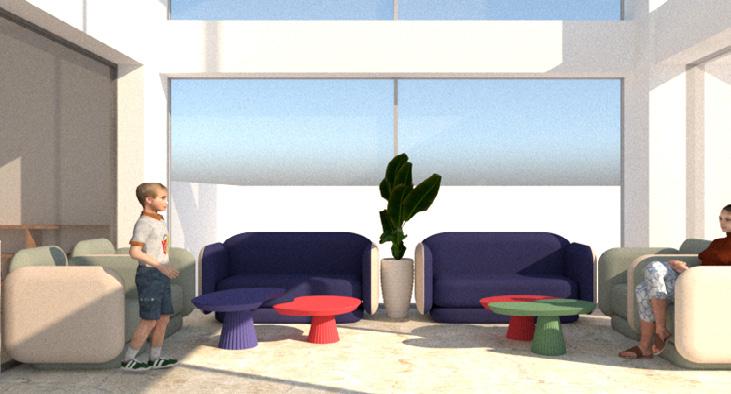
The main idea for the design of a double-height reception and indoor waiting area was to make it very visual and playful. A lot of thought was given to including a double height space to give it a voluminous feel.
Another plus point for the location was that it could also be very well visible from the first floor.
Elements were abstracted and brought into the space to spark curiosity and creativity among the children.
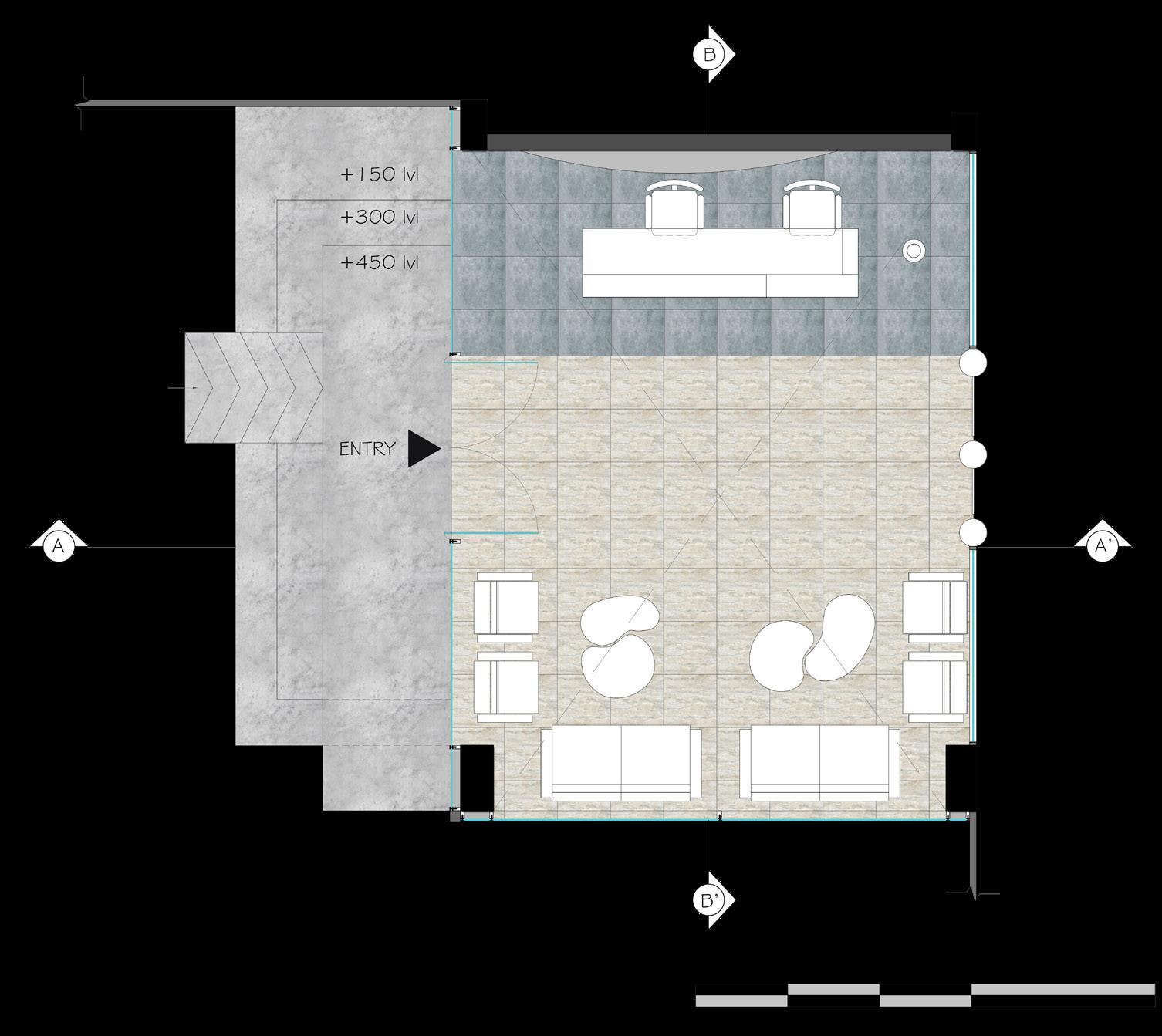
For example, a hot air balloon went as a feature on the back wall with the sky as a backdrop, birds became accent lighting, and the section of space with the reception table went as a blue colour block to depict the sky and the endless limits it comes with.
Ground Floor Furniture Layout
Fig - 112 Ground Floor Layout
( Source - Self Created )
Imperial Diano Grey Tile Legend Gris Tile





Polished Concrete Finish for Steps
Fig - 113 Flooring Material Board
SHASHVI DALAL • ANANT NATIONAL UNIVERSITY | 2022 GRADUATION PROJECT • UG SPACE DESIGN
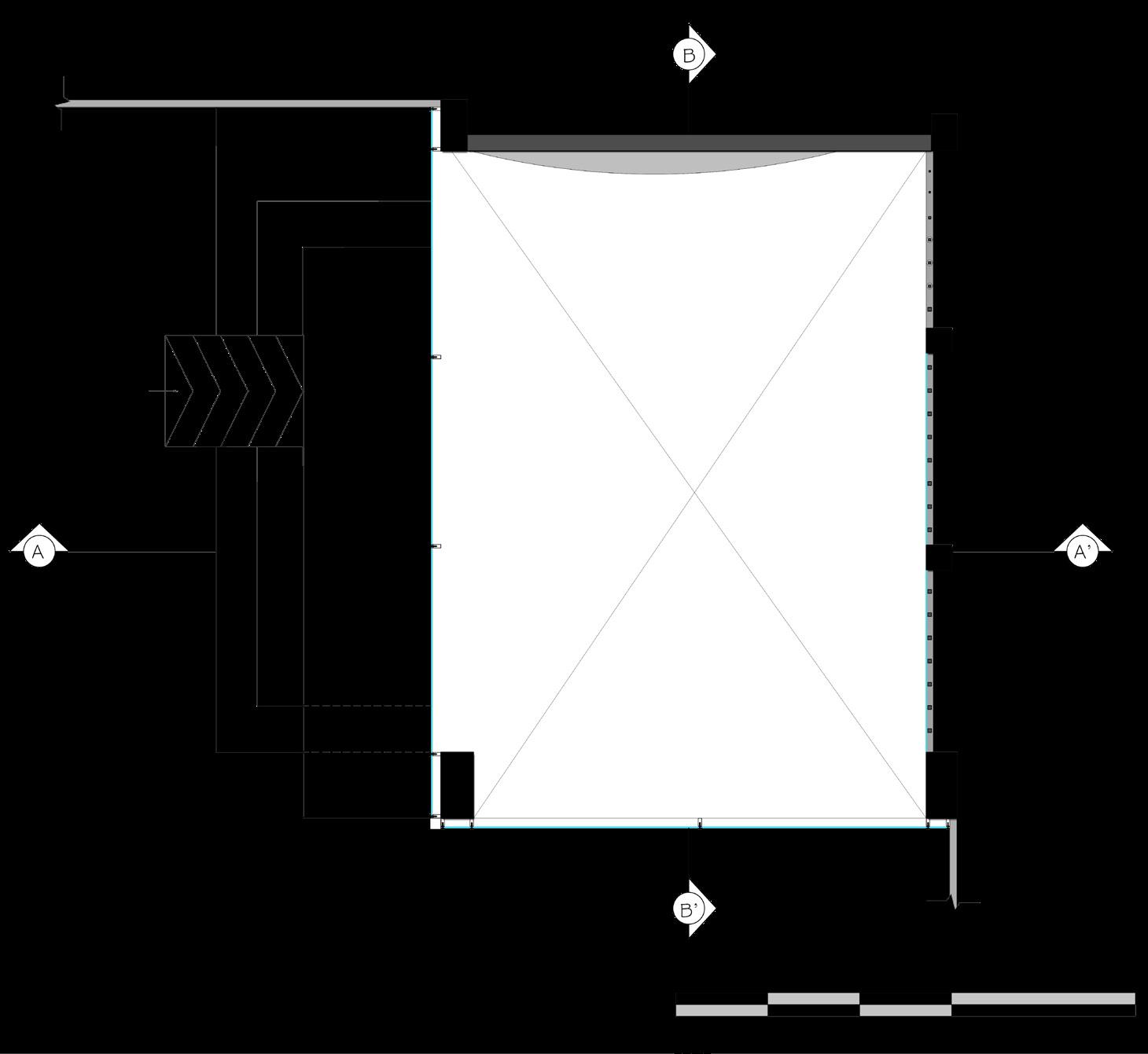
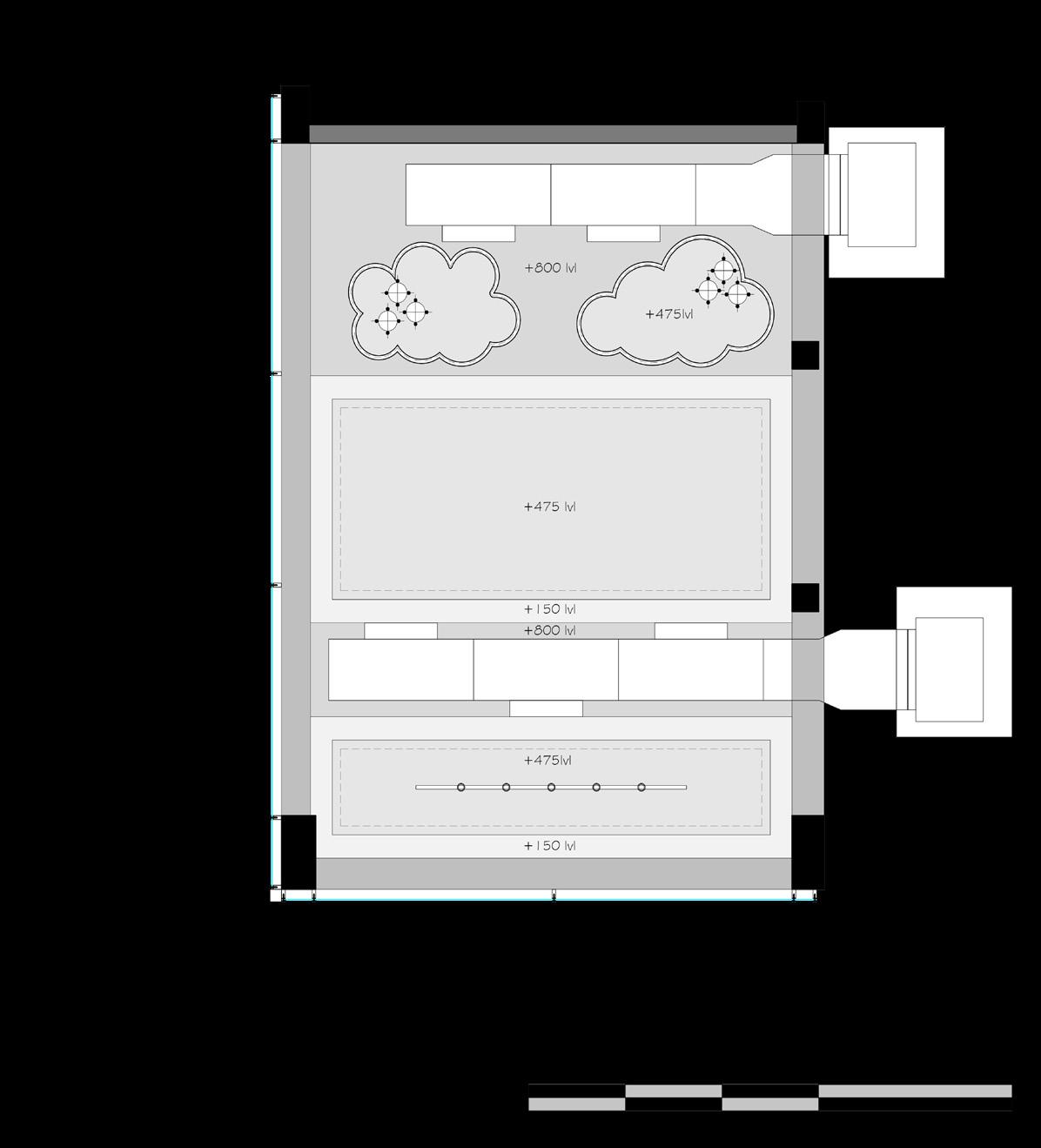
LEARNING BEYOND CLASSROOM • MULTI - PHILOSOPHICAL APPROACH 82 Fig -114 First Floor Layout ( Source - Self Created ) Fig - 115 Reflected Ceiling Layout ( Source - Self Created ) First Floor Furniture Layout Reflected Ceiling Layout
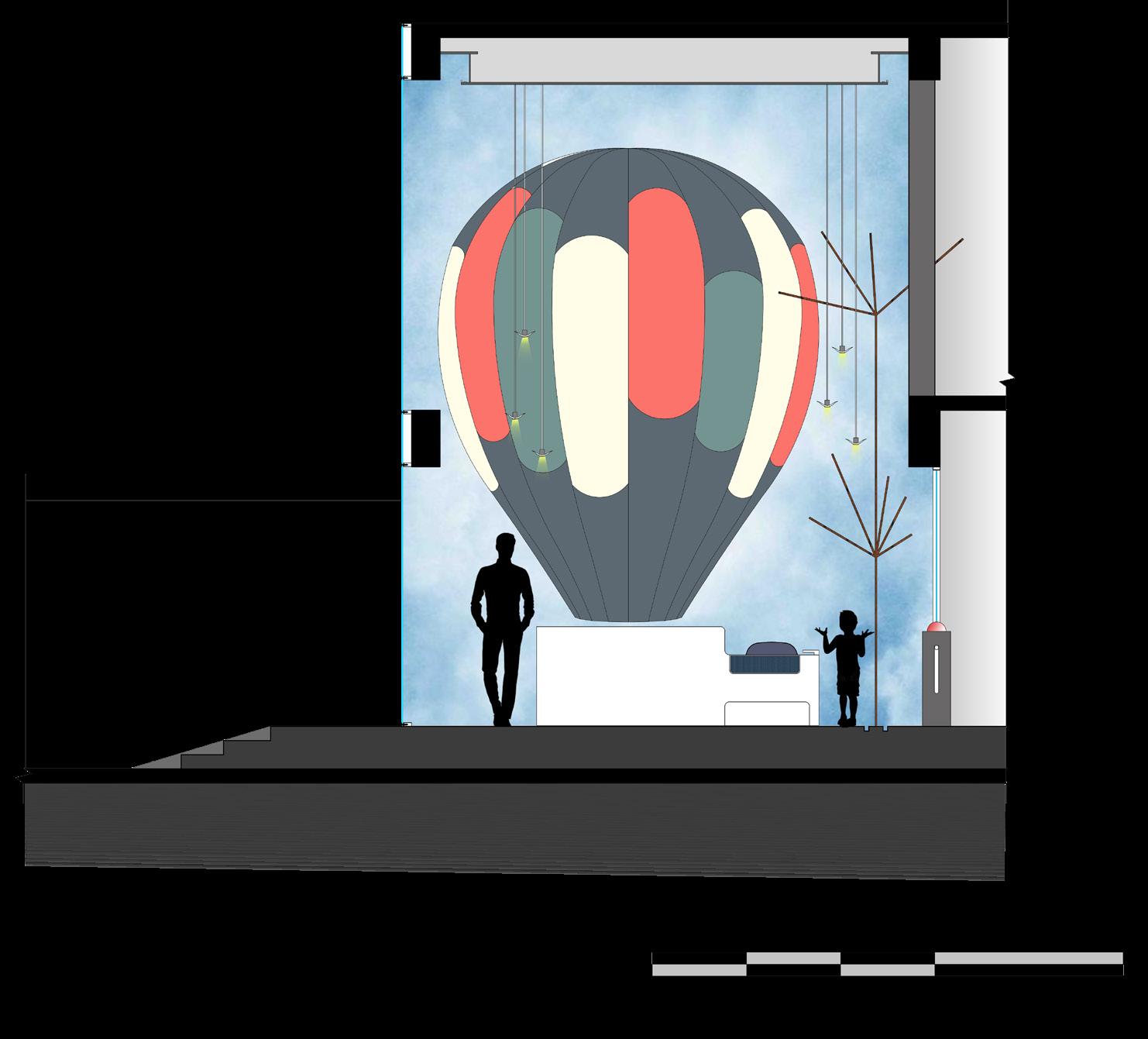
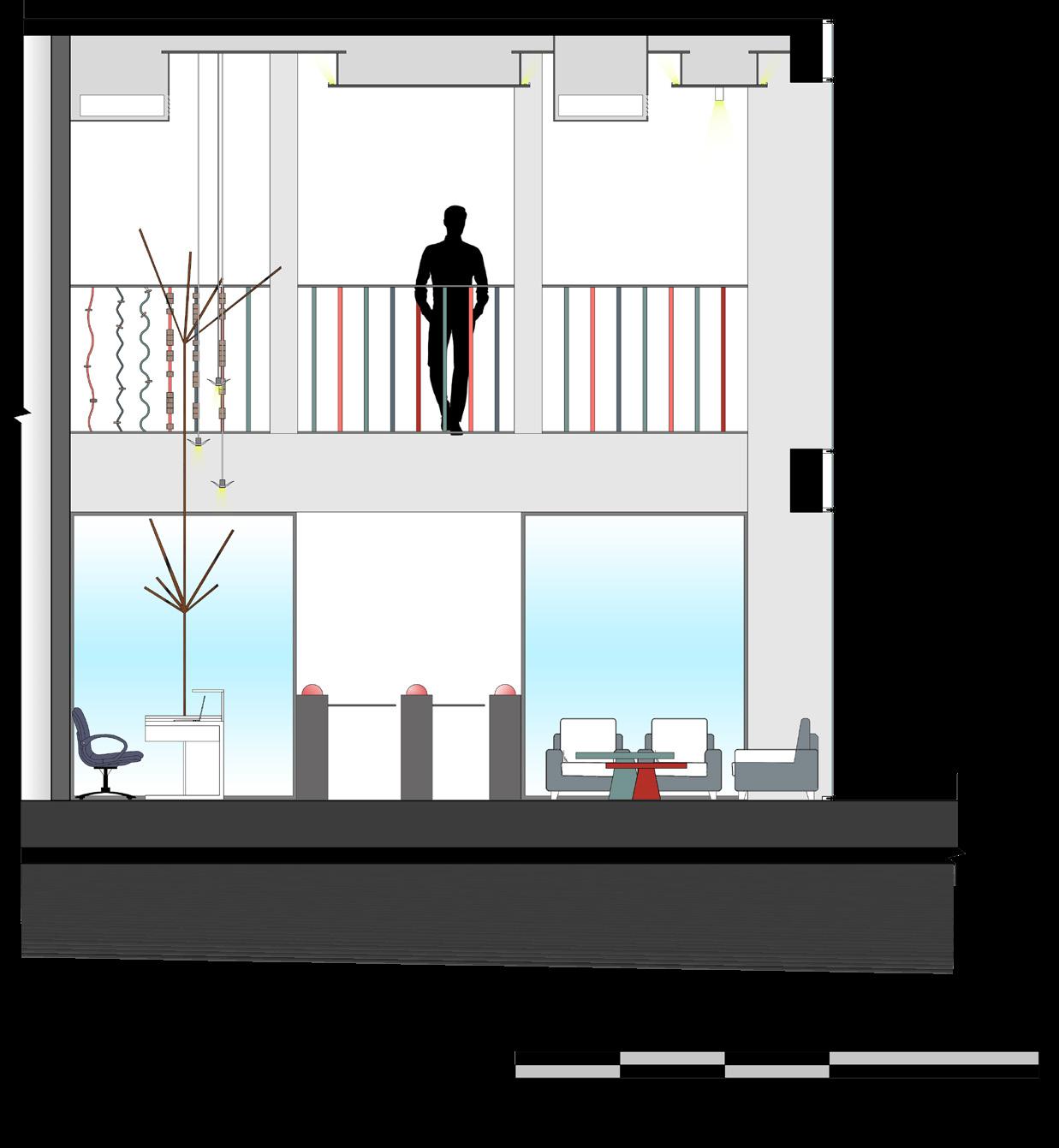
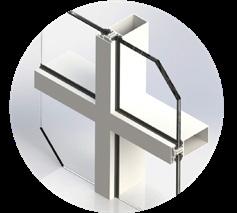

SHASHVI DALAL • ANANT NATIONAL UNIVERSITY | 2022 GRADUATION PROJECT • UG SPACE DESIGN DETAIL AREA - RECEPTION AND INDOOR WAITING Fig - 117 Section AA' ( Source - Self Created ) Fig - 116 Curtain Wall Detail Section Fig - 118 Section BB' ( Source - Self Created ) Section AA' Section BB' Sections
3D Views
Here elements like hot air balloon emerging from the wall, hanging lights in the form of birds, a sculptural tree and clouds on the ceiling all come together to give a very abstract scape in front of the children.
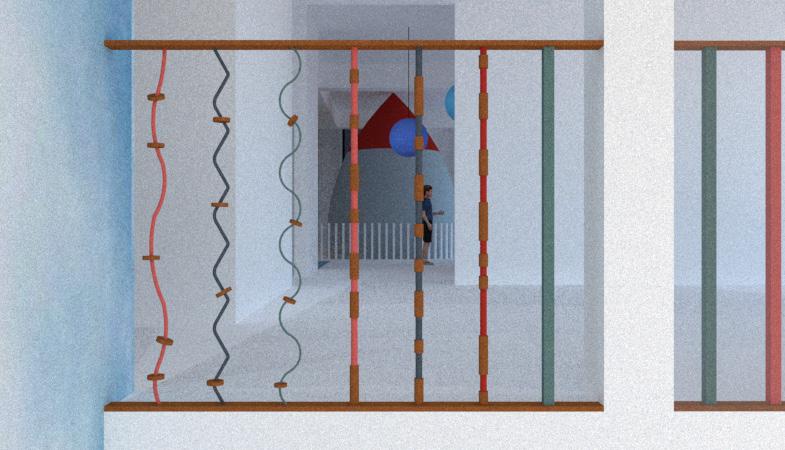
The colours used in the hot air balloon and railing anchor are all the major colours from the colour scheme used across the space.
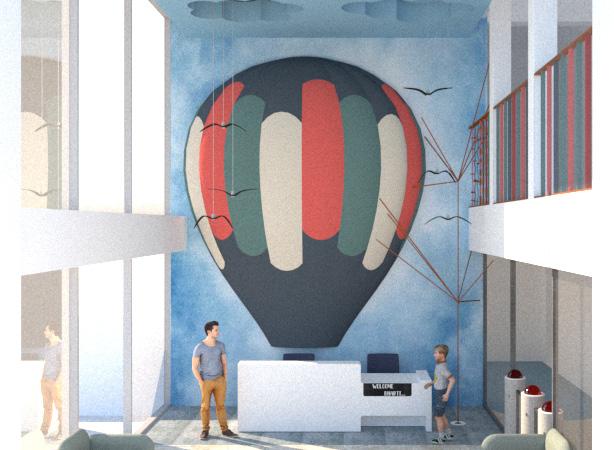
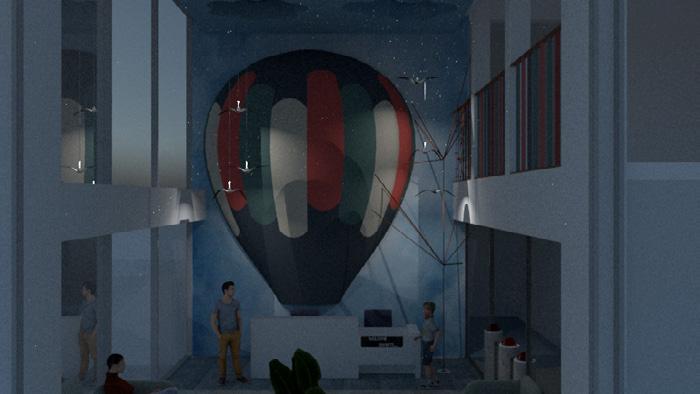
Fig - 121 Left to Right - Bird Hanging Lights and Indoor Waiting Area
LEARNING BEYOND CLASSROOM • MULTI - PHILOSOPHICAL APPROACH 84
Fig - 120 Main Double Height Elevation in 3D
Fig - 119 Interactive railing on first floor ( Inspired from window grills in BaLA concept )
DETAIL AREA - SPACESHIP ELEMENT
Concept For The Space
A spaceship is an element introduced to function as a focal point for the space. The element serves a dual purpose as it can also be used as an interactive vertical circulation by the children.
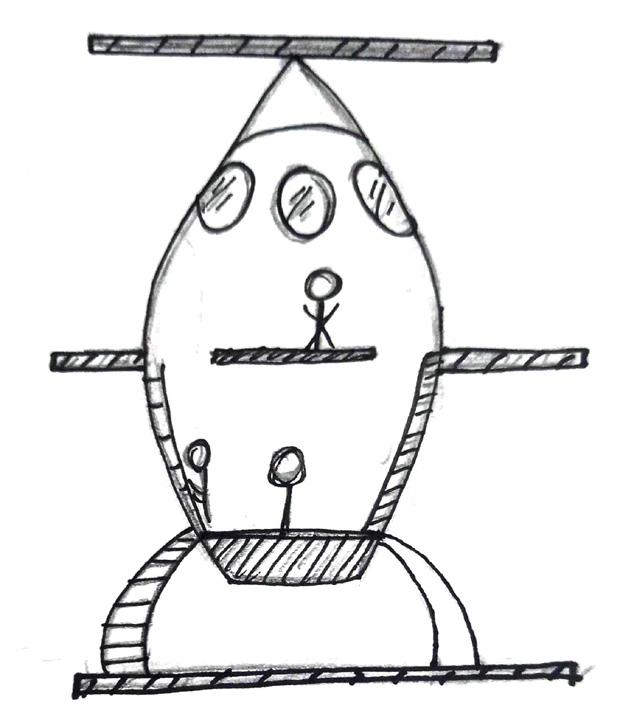

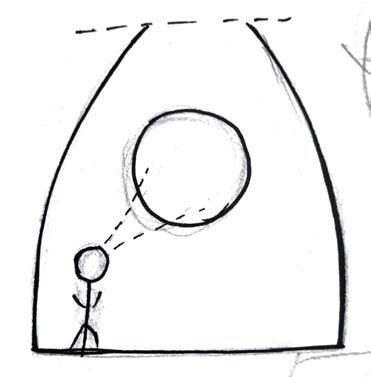
The stark colours were also chosen in a way that it gets highlighted. It has a ladder inside which can be climbed up to reach the first floor. Round windows given on the upper body of the spaceship provide a visual connection between the inside of the spaceship and the outside.

Conceptual Sketches - Iterations For the Element Structural Changes
To accommodate an element like a spaceship in space, the slab needed to be altered. Initially, only the slab had to be cut off and no beam had to be altered. However as the project moved forward, the problem of the spaceship as an element not being interactive and in the vision of everybody was detected. Thus the dia of the spaceship was increased and beams were decided to be altered. Two beams were cut off along with the slab and to balance that off structurally, columns were added to bear the load. Thus a good double height space was created.
SHASHVI DALAL • ANANT NATIONAL UNIVERSITY | 2022 GRADUATION PROJECT • UG SPACE DESIGN
Fig - 122 (Left) Reference Image Fig - 123 (Above) Conceptual Sketches and Colour Scheme
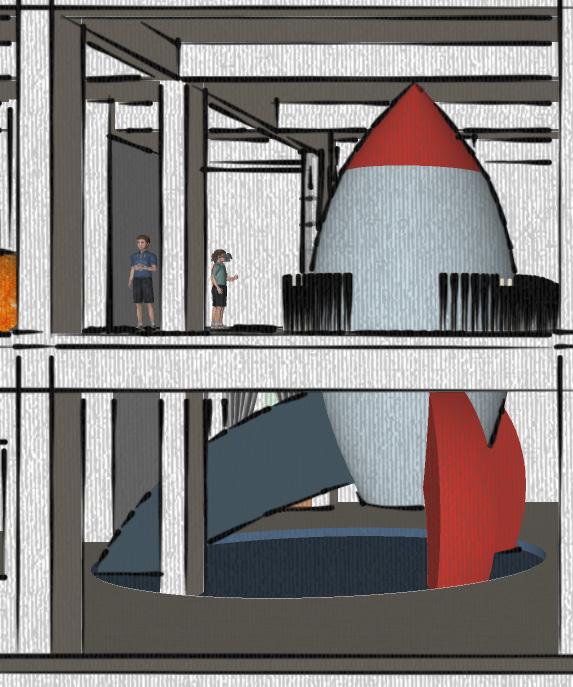
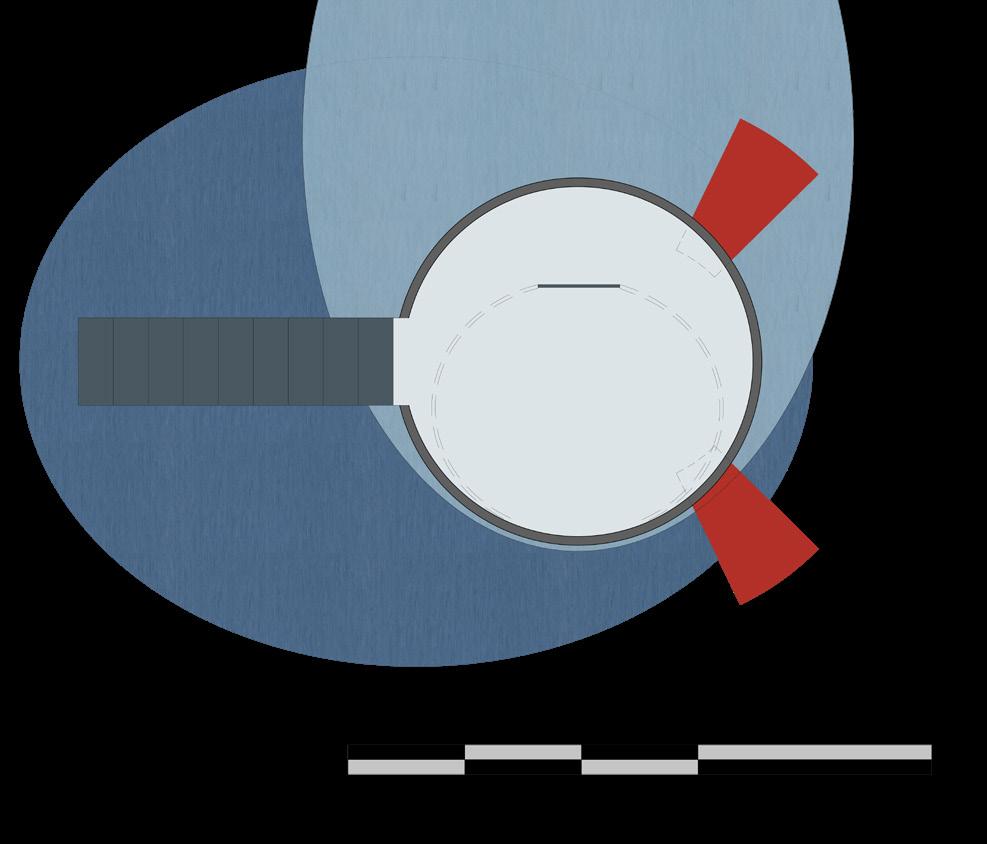
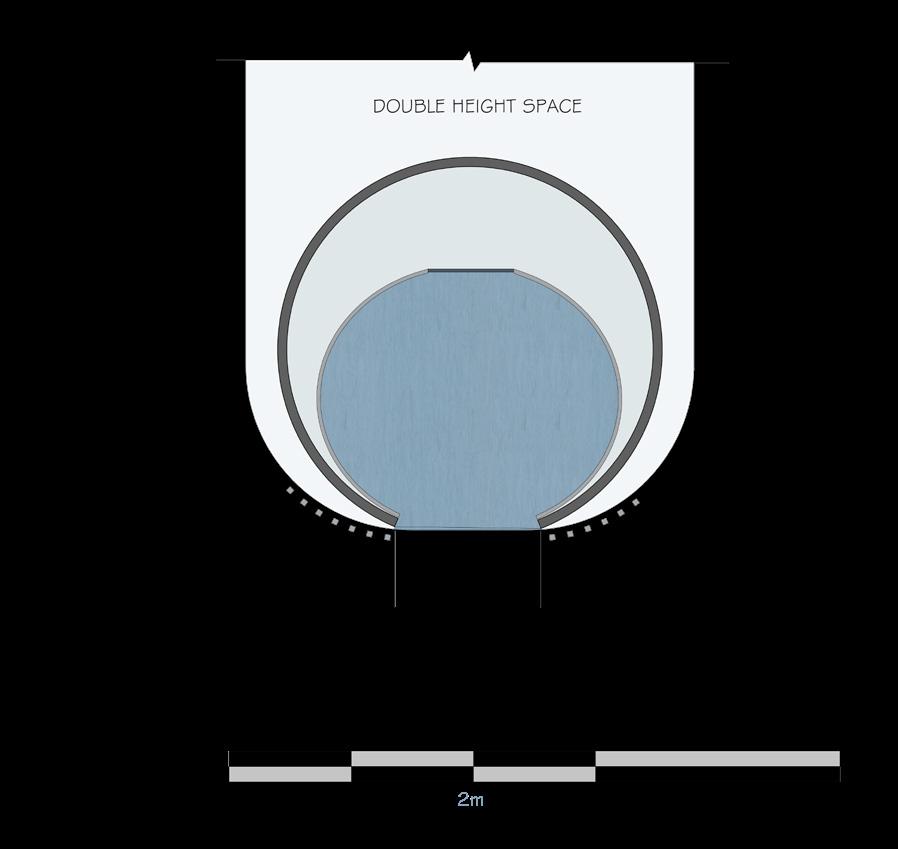
LEARNING BEYOND CLASSROOM • MULTI - PHILOSOPHICAL APPROACH 86 Fig - 124 Ground Floor Plan ( Source - Self Created ) Fig - 125 First Floor Plan ( Source - Self Created ) Fig - 126 Spaceship Element in 3D ( Source - Self Created ) Ground Floor Plan First Floor Plan 3D View
SHASHVI DALAL • ANANT NATIONAL UNIVERSITY | 2022 GRADUATION PROJECT • UG SPACE DESIGN
- LEARNINGS RECEIVED
- FUTURE DIRECTIONS
- LIST OF FIGURES
- LIST OF TABLES
- REFERENCES
LEARNING BEYOND
CLASSROOM • MULTI - PHILOSOPHICAL APPROACH 88 8
Learnings Received
Here are a few learnings derived from the entire course of the dissertation project. These learnings not only help in getting the project at a better level but also a lot of practical knowledge is gained to take forward in the professional world.
The space planning could have been more open where the functions can overlap each other making it multi-functional as well as interesting.
For the design of children's space, one needs to strike a perfect balance between a lot of different elements like functions, anthropometry, space quality, forms, scale, aesthetics, and more.
A lot of play could be done with space in terms of volumes and forms while designing such spaces. The whole of the space could be treated as one entity and functions could be arranged.
SHASHVI DALAL • ANANT NATIONAL UNIVERSITY | 2022 GRADUATION PROJECT • UG SPACE DESIGN
Future Directions
This project not only gave me a chance to dive into the process of designing learning spaces but also provided me with the opportunity to take this forward in the forthcoming times.
Designing for children had always been fascinating and getting a chance to at least start with it hypothetically with a dissertation project will help in future endeavours.
The project helped me to know the basics of how designing spaces for children works. The research would always be a guiding factor. Knowing the target group and understanding their requirements would be a starting point for every such project.
At the end of this dissertation project, a lot of knowledge has been acquired regarding the research work, studying the casestudies, accumulation of data, conceptualisation, the process of space planning, structural planning, final design, fine details and more such factors.
• MULTI -
LEARNING BEYOND CLASSROOM
PHILOSOPHICAL APPROACH 90
LIST OF FIGURES
Figure - Description (Source)
Fig – 01 Anant National University ( Overview. (2022, August 18). Anant National University | Best Design College/ Institute in Ahmedabad-India. Retrieved October 2, 2022, from https://anu.edu.in/programmes/ overview/ )
Fig – 02 Prof. Neha Vin (Neha Vin. ( 2020, December 9). Anant National University | Best Design College/ Institute in Ahmedabad-India. Retrieved October 2, 2022, from https://anu.edu.in/faculty/neha-vin/ )
Fig – 03 Author (Self)
Fig – 04 Word Cloud (Generated online with the tool Presenter Media - https://www.presentermedia.com/ wordclouds)
Fig – 05 Question : Response (Self - Google Form)
Fig – 06 Question : Response (Self - Google Form)
Fig – 07 Question : Response (Self - Google Form)
Fig – 08 Question : Response (Self - Google Form)
Fig – 09 Question (Self - Google Form)
Fig - 10 Happy Kids : Illustration ( Vecteezy. (n.d.). Happy Multi Ethnic Kids Playing Together. Retrieved October 2, 2022, from https://www.vecteezy.com/ free-vector/happy-kids )
Fig - 11 Survey Participants and their forms (Self Clicked)
Fig – 12 Oil Drums as a play element ( Bhatia, A. (2018, July 2). Playgrounds For Children From Scrap Tyres, 5 IIT Students Came up With This Idea To Recycle Waste. NDTV-Dettol Banega Swasth Swachh India. Retrieved October 2, 2022, from https://swachhindia.ndtv.com/ playgrounds-children-scrap-tyres-5-iit-students-cameidea-recycle-waste-7481/ )
Fig – 13 Playscapes out of scrap tyres (Thiagarajan, K. (2021, April 7). India trashes 100 million tires a year. She turns them into playgrounds. The Christian Science Monitor. Retrieved October 2, 2022, from https://www. csmonitor.com/World/Making-a-difference/2021/0329/ India-trashes-100-million-tires-a-year.-She-turns-theminto-playgrounds )
Fig – 14 Play in a box ( thetribalbox.com. (n.d.). Social Entrepreneur Who Has Built 260 Playgrounds For Holistic Development Of Underprivileged Children. Thetribalbox. Retrieved October 2, 2022, from https:// www.thetribalbox.com/social-entrepreneur-who-hasbuilt-260-playgrounds-for-holistic-development-ofunderprivileged-children )
Fig – 15 Playscape from cable drums ( Bhatia, A. (2018, July 2). Playgrounds For Children From Scrap Tyres, 5 IIT Students Came up With This Idea To Recycle Waste. NDTV-Dettol Banega Swasth Swachh India. Retrieved October 2, 2022, from https://swachhindia.ndtv.com/ playgrounds-children-scrap-tyres-5-iit-students-cameidea-recycle-waste-7481/ )
Fig - 16 Logo for Vinyas ( VINYÃS, Centre for Architectural Research & Design. (n.d.). http://www.vinyas.org/ )
Fig - 17 Amphitheatre ( DelE Education Department. (n.d.). Retrieved October 19, 2022, from http://www.edu del.nic.in/)
Fig - 18 Interactive Grills. ( DelE Education Department (n.d.). Retrieved October 19, 2022, from http://www.edu del.nic.in/ )
Fig - 19 Solar Sytem (Examples of modern style interactive school interior design ideas! (2018, July 16). KADVACORP. Retrieved October 19, 2022, from https:// www.kadvacorp.com/design/interactive-school-interiordesign/)
Fig - 20 Area and Parameter being taught. (Building as Learning Aid (BaLA). (n.d.). Retrieved October 20, 2022, from https://www.jinglebellschool.org/infra_jba/bala-jbs)
Fig - 21 Interactive window grills. (Sqn Ldr Vidula Abhyankar Retd. (2020, August 27). “Relevance of BaLA at Air Force Schools.” Lifeskills. Retrieved October 20, 2022, from https://lifeskills.center/relevance-of-bala-atair-force-schools/)
Fig - 22 Angles taught through classroom doors. (Ideas from Arvind Gupta – Peepal Tree. (n.d.). Retrieved October 20, 2022, from https://peepaltreeschool.org/ teacher/ideas-from-arvind-gupta/)
Fig – 23 Dr. Maria Montessori (Elementary Program | Hollis Montessori School, NH. (n.d.). Hollis Montessori School. Retrieved October 20, 2022, from https:// hollismontessori.org/elementary )
Fig – 24 Montessori school setting. (Elementary Program | Hollis Montessori School, NH. (n.d.). Hollis Montessori School. Retrieved October 20, 2022, from https://hollismontessori.org/elementary )
Fig - 25 Montessori learning and teaching in action. ( Christle, C. A. (2017, July 21). Montessori schools | Theory, History, & Facts. Encyclopedia Britannica. Retrieved October 20, 2022, from https://www.britannica.com/ topic/Montessori-schools )
Fig - 26 Explanation of the Montessori classroom (The Montessori Classroom – Grace Montessori Academy (n.d.). Retrieved October 20, 2022, from https://www. gmamt.org/academics/the-montessori-classroom/ )
Fig – 27 Montessori Materials (Montessori I/T Classroom. (n.d.). [Video]. Pinterest. Retrieved October 20, 2022, from https://in.pinterest.com/llane1283/ montessori-it-classroom/ )
Fig – 28 Rudolf Steiner (Home. (n.d.). [Video]. Retrieved October 20, 2022, from https://www.rudolfsteiner.org/ )
Fig – 29 Waldorf School : Illustration (Sprouts. (2016b, April 10). Waldorf School Education [Video]. YouTube. Retrieved October 20, 2022, from https://www.youtube. com/watch?v=BkrgkslnD9g )
SHASHVI DALAL • ANANT NATIONAL UNIVERSITY | 2022 GRADUATION PROJECT • UG SPACE DESIGN
Fig – 30 Ongoing activity at a Waldorf school. (Richmond Waldorf School. (2021, February 3). What is Waldorf. Retrieved October 20, 2022, from https:// richmondwaldorf.com/what-is-waldorf/ )
Fig – 31 Interactive sessions at a Waldorf school (Introduction (2022, September 12). Retrieved October 20, 2022, from https://www.steinerwaldorf.org/steinereducation/early-years/introduction/ )
Fig – 32 Waldorf classroom teaching (What Is A Waldorf Education? (n.d.). Cedarwood Waldorf. Retrieved October 20, 2022, from https://www. cedarwoodschool.org/what-is-a-waldorf-education)
Fig – 33 Waldorf classroom teaching mixed with torytelling. (Why This Skeptical Engineer Trusts Waldorf Education | Waldorf Today - Waldorf Employment, Teaching Jobs, Positions & Vacancies in Waldorf Schools. (n.d.). Retrieved October 20, 2022, from https://www.waldorftoday.com/2017/12/why-thisskeptical-engineer-trusts-waldorf-education/ )
Fig – 34 A flute learning session in action.(Waldorf Santa Barbara. (n.d.). The Waldorf School of Santa Barbara. Retrieved October 20, 2022, from https:// waldorfsantabarbara.org/waldorfsantabarbara )
Fig – 35 Puppet show. (http://www. monadnockwaldorfschool.org/ )
Fig – 36 Loris Malaguzzi (Connolly, J. (2021, June 18). Middlemen, Creators, Games, Reggio Emilia. Retrieved October 20, 2022, from https://metacreativity.substack. com/p/middlemen-creators-games-reggio-emilia )
Fig – 37 Reggio Emilia classroom (Connolly, J. (2021, June 18). Middlemen, Creators, Games, Reggio Emilia Retrieved October 20, 2022, from https://metacreativity. substack.com/p/middlemen-creators-games-reggioemilia
Fig – 38 Hands-on learning (Reggio Emilia Approach. (2016b, October 31). Output Education. Retrieved Octo ber 20, 2022, from https://www.outputeducation.com/ reggio-emilia-approach/ )
Fig – 39 Interactive session at Reggio Emilia school (Cox, J. (n.d.). Janelle Cox, Author at. Future Educators. Retrieved October 20, 2022, from https://www.futureedu cators.org/author/janelle-cox/ )
Fig – 40 Team work and discussion among peers (Austin, C. (2020, January 14). Why the Reggio Emilia Early Learning Approach is So Popular | Magazine B Life. Magazine B Life | Family Life & Home. Retrieved October 20, 2022, from https://magazineblife.com/why-the-reg gio-emilia-early-learning-approach-is-so-popular/)
Fig – 41 Edward Harkness (8 Things You May Not Know About Butler Library. (n.d.). The Low Down. Retrieved October 20, 2022, from https://thelowdown.alumni. columbia.edu/8_things_you_may_not_know_about_but ler_library)
Fig – 42 Difference between the traditional setting and the Harkness setting (Harkness - Pacific Ridge School (n.d.). Retrieved October 20, 2022, from https://www. pacificridge.org/academics/harkness)
Fig – 43 Harkness Table connections (Focus on Discussion-Based Learning. (n.d.). University of Miami. Retrieved October 20, 2022, from https://news.miami. edu/stories/2018/07/focus-on-discussion-based-learning. html)
Fig – 44 Discussion in a high school on a Harkness table. (Writer, S. W. L. (2015, September 11). Specialized tables transform Shore classrooms. Wicked Local. Retrieved October 20, 2022, from https://eu.wickedlocal.com/ story/herald-citizen/2015/09/09/specialized-tables-trans form-shore-classrooms/33558361007/ )
Fig – 45 Discussion in a university on a Harkness table. (Campus Activities. (n.d.). Phillips Exeter Academy. Retrieved October 20, 2022, from https://www.exeter.edu/ community/student-activities)
Fig – 46 A Theme-Based Learning Space (Valenzuela, K. (2021, December 17). Kfar Shemaryahu Kindergarden / Sarit Shani Hay. ArchDaily. Retrieved October 20, 2022, from https://www.archdaily.com/459642/educationalcenter-for-children-nil-kfar-shemaryahu-sarit-shanihay)
Fig – 47 Tinker Workshop Space (Wonderdal offers an immersive and interactive edutainment experience. (2022, October 9). Wonderdal. Retrieved October 20, 2022, from https://www.wonderdal.co.za/)
Fig – 48 Court Room Mock Up (Kankaria. (n.d.). Retrieved October 20, 2022, from http://www. kankarialakefront.in/kids-city.html)
Fig – 49 Display of Bones (Wikipedia contributors. (2021, December 17). Vikram A Sarabhai Community Science Centre. Wikipedia. Retrieved October 20, 2022, from https://en.wikipedia.org/wiki/Vikram_A_Sarabhai_ Community_Science_Centre)
Fig – 50 Space at the centre
Fig – 51 Waiting Space at the centre
Fig – 52 Interactive Wall
Fig - 53 The main Facade and entry to the centre.
Fig - 54 The plan of the centre.
Fig - 55 Elements from spaces studied
Fig – 56 Elements from spaces studied
( Source for Fig – 50 to 56 - Valenzuela, K. (2021, December 17). Kfar Shemaryahu Kindergarden / Sarit Shani Hay. ArchDaily. Retrieved October 20, 2022, from https://www.archdaily.com/459642/educational-centerfor-children-nil-kfar-shemaryahu-sarit-shani-hay )
Fig - 57 Students with the mascot Amuki
Fig - 58 A highly collaborative environment
Fig - 59 Above - The main Facade and entry to the centre.
Below - Health Kitchen
Fig – 60 Above - Story Caves
Below - Tinker Workshop
Fig – 61 Above - Kora Tree
Below - Open Playground
LEARNING BEYOND CLASSROOM • MULTI - PHILOSOPHICAL APPROACH
92
LIST OF FIGURES
Figure - Description (Source)
(Source for Fig – 57 to 61 - Wonderdal offers an immersive and interactive edutainment experience. (2022, October 9). Wonderdal. Retrieved October 20, 2022, from https://www.wonderdal.co.za/ )
Fig - 62 Illustration ( Source - Kankaria. (n.d.). Retrieved October 20, 2022, from http://www.kankarialakefront. in/kids-city.html)
Fig – 63 The main space - sky, bus, city (Self Clicked)
Fig – 64 BRTS Bus mini model (Self Clicked)
Fig – 65 The Main Facade and Entry to the centre. (Self Clicked)
Fig - 66 Use of colours, infographics and mascot (Self Clicked)
Fig – 67 Plan Diagram (Self Drawn )
Fig - 68 Display of Materials (Self Clicked )
Fig – 69 The focal point of the space (Self Clicked )
Fig – 70 The Main Facade and Entry to the centre. (Self Clicked)
Fig - 71 Plan Diagram (Self Drawn )
Fig - 72 Site Location (Google Maps )
Fig - 73 Site Study
Fig - 74 Site Study - Sun Path
Fig - 75 Site Plans with Legends (Self Sourced )
Fig - 76 Site Photographs (Self Clicked)
Fig - 77 Illustration (Yoder, L. (n.d.). Discovering the Mysteries of Museums. Homeschool World. Retrieved October 20, 2022, from https://www.home-school.com/ Articles/discovering-the-mysteries-of-museums.php)
Fig - 78 Illustration (Self Edited)
Fig - 79 Illustration (Pandemic Leads to Fewer Japanese Companies Planning to Recruit Foreign Workers. (2021, February 21). nippon.com. Retrieved October 20, 2022, from https://www.nippon.com/en/japan-data/h00939/)
Fig – 80 Bubble Diagram (Self Drawn)
Fig – 81 Bubble Diagram (Self Drawn)
Fig - 82 Proximity Chart with Legend (Self Drawn)
Fig - 83 Basic Proximity Diagram with Legend (Self Drawn)
Fig - 84 Final Proximity Diagram(Self Drawn)
Fig – 85 Use of Open Spaces (Christle, C. A. (2017, July 21). Montessori schools | Theory, History, & Facts Encyclopedia Britannica. Retrieved October 20, 2022, from https://www.britannica.com/topic/Montessorischools)
Fig - 86 Clay Zone (Reggio Emilia Approach. (2016, October 31). Output Education. Retrieved October 20, 2022, from https://www.outputeducation.com/reggioemilia-approach/)
Fig – 87 Depiction of Creative Corner (Conceptual 3D View – Self Created)
Fig - 88 Dress Up Zone (Reference)(Agarwal, D. (2020, January 28). 15 Aug Indian Independence Day Fancy Dress Competition Ideas. Me & Mom Health. Retrieved October 3, 2022, from https://www.menmomhealth.com/ independence-day-fancy-dress-ideas/ )
Fig – 89 Performance Zone (Concept Sketch - Self Drawn)
Fig – 90 Waldorf School-Puppet Show (http://www. monadnockwaldorfschool.org/)
Fig - 91 Indian Puppetry (indian puppet making. (n.d.). Artpocket. Retrieved October 3, 2022, from https:// www.artpocket.co.uk/indian-puppet-making.html)
Fig - 92 Bamboo Mist Walkway (Concept Sketch - Self Drawn)
Fig - 93 Interactive Panels on Nature (Reference) (Just a moment. . . (n.d.-b). Retrieved October 3, 2022, from https://littletikescommercial.com/activity-pan els/?lang=can)
Fig - 94 Sensory Path (Concept Sketch - Self Drawn)
Fig - 95 Sensory Path (Reference)(Facebook - Meld je aan of registreer je. (n.d.). Facebook. Retrieved October 3, 2022, from https://www.facebook.com/unsupported browser?type=3)
Fig - 96 Solar System Zone (Conceptual 3D View – Self Created)
Fig - 97 Virtual Reality Zone (Conceptual 3D View – Self Created)
Fig - 98 Conceptual sketches for the Spaceship ele ment and in 3D (Self Drawn)
Fig - 99 Harkness Table (Source - Focus on DiscussionBased Learning (n.d.). University of Miami. Retrieved October 20, 2022, from https://news.miami.edu/ stories/2018/07/focus-on-discussion-based-learning. html)
Fig - 100 Brain Zone in plan (Self Created)
Fig - 101 Indian Map in Rangoli(Building as a Learning Aid (BALA) Archives. (n.d.). Digital Repository. Retrieved October 7, 2022, from https://repository.education.gov. in/ssa-components/bala/ )
SHASHVI DALAL • ANANT NATIONAL UNIVERSITY | 2022 GRADUATION PROJECT • UG SPACE DESIGN
Fig - 102 My Country in Top View (Self Created)
Fig - 103 Ground Floor Furniture Layout (Self Created)
Fig - 104 First Floor Furniture Layout (Self Created)
Fig – 105 Terrace Furniture Layout (Self Created)
Fig - 106 Material Board (Self Created)
Fig – 107 Section AA' (Self Created)
Fig – 108 Key Plan (Self Created)
Fig – 109 Section BB' (Self Created)
Fig – 110 Section CC' (Self Created)
Fig – 111 From left to right : Moon space with screen, Moon surface replica and partition detail (3D View –Self Created)
Fig - 112 Ground Floor Layout (Self Created )
Fig - 113 Flooring Material Board (Self Curated )
Fig - 114 First Floor Layout (Self Created )
Fig - 115 Reflected Ceiling Layout (Self Created )
Fig - 116 Curtain Wall Detail Section (HIFAB Catalogue)
Fig - 117 Section AA' (Self Created )
Fig - 118 Section BB' (Self Created )
Fig - 119 Interactive railing on first floor (3D View – Self Created)
Fig - 120 Main Double Height Elevation (3D View – Self Created)
Fig – 121 Left to Right - Bird Hanging Lights and Indoor Waiting Area (3D View – Self Created)
Fig - 122 Reference Image for Spaceship (Foundry, I. T. (n.d.). Rocket Images | Free Photos, PNG Stickers, Wallpapers & Backgrounds. Rawpixel. Retrieved October 20, 2022, from https://www.rawpixel.com/search/ rocket?page=1)
Fig - 123 Conceptual Sketches and Colour Scheme (Self Drawn and Curated)
Fig - 124 Ground Floor Plan (Self Created )
Fig – 125 First Floor Plan (Self Created )
Fig – 126 Spaceship Element in 3D (Self Created)
LEARNING BEYOND CLASSROOM • MULTI - PHILOSOPHICAL APPROACH 94
LIST OF TABLES
Table _ Description (Source)
Table - 01 Comparitive Analysis for Research - Primary Parameters ( Self Compiled)
Table - 02 Comparitive Analysis for Research - Secondary Parameters ( Self Compiled)
Table - 03 Comparitive Analysis for Casestudies - Basic Comparision ( Self Compiled)
Table - 04 Comparitive Analysis for Casestudies - Through Research Lens ( Self Compiled)
Table - 05 Area Statement ( Self Tabulated )
Table - 06 Legend and Area Statement ( Self Tabulated )
SHASHVI DALAL • ANANT NATIONAL UNIVERSITY | 2022 GRADUATION PROJECT • UG SPACE DESIGN
REFERENCES
Some Websites, Youtube Videos, Blogs, Books and Work that I found very helpful for my Dissertation -
Anthill Creations
- Website _ https://anthillcreations.org/ - https://atlasofthefuture.org/project/ant hill-creations/
Child Development For 6 - 12 Years
- https://www.verywellmind.com/piagets-stag es-of-cognitive-development-2795457
- https://www.choc.org/primary-care/agesstages/6-to-12-years/
- https://www.goodto.com/family/child-devel opment-stages-ages-6-12-4735
- https://www.ounce.org/pdfs/child_develop ment/school_child.pdf
- https://www.rileychildrens.org/health-info/ growth-development-6-11-years
- https://www.thewholechild.org/parent-re sources/age-6-12/signs-of-normal-develop mental-stages-ages-6-12/
Kfar Shemaryahu Educational Centre
- Archdaily _ https://www.archdaily. com/459642/educational-center-for-chil dren-nil-kfar-shemaryahu-sarit-shani-hay - https://archello.com/project/kfar-shem aryahu-educational-center - https://shanihay.com/public-spaces/194 - https://www10.aeccafe.com/blogs/ arch-showcase/2014/01/24/the-seven-speciesin-kfar-shmaryahu-israel-by-sarit-shani-hay/
Wonderdal
- Website _ https://www.wonderdal.co.za/
- https://insideguide.co.za/cape-town/things-todo/hazendal-wonderdal/
- https://issuu.com/outsideandinmag/docs/pro landscaper_feb_2022_issuu/s/14840526
- https://www.capetownmagazine.com/life style/indoor-edutainment-wonderdal-stretch es-kids-imagination-and-skills/28_22_21848
Other Referred Project
- https://www.architonic.com/en/project/sne ha-divias-atelier-olioli/5105612
QR Code - Google Drive Link To the Pool of Resources

LEARNING BEYOND
CLASSROOM • MULTI - PHILOSOPHICAL
APPROACH 96
SHASHVI DALAL
Space Design Anant National University
Contact Mobile - 9428520804
E - mail - shashvidalal@gmail.com (Personal) - shashvi.dalal@anu.edu.in (University)
LinkedIn - www.linkedin.com/in/shashvi-dalal
THANK YOU
AnantNationalUniversity
SanskardhamCampus Bopal-Ghuma-SanandRoad Ahmedabad,Gujarat382115 www.anu.edu.in
