rather caught between two stools it’s too late to be the pre-LAA Rally issue because that event is right at the beginning of the month, and can’t contain a report on our big event because it goes to press before it.
Maybe it’s the ‘calm before the storm’,as next month | hope LA will contain all the news from another fantastic LAA Rally we're certainly all working hard at the moment, trying to ensure that there’s plenty to interest visitors over the three days of our Sywell event.
There can’t be many pilots who don’t relish the idea of flying a Spitfire, and there are probably more opportunities to do so now than there have been since WWII.
You can now enjoy anything from a quick passenger flight to a full-blown type conversion, and Jabiru owner Tim White relished the opportunity to take a day-long training schedule at Boultbee Flight Academy, which saw him fly a Chipmunk and a Harvard before taking the controls of a Spitfire for the flight of a lifetime. Ride with him on page 20 and dream on!
THETEAM
Patron: HRH Prince Michael of Kent, KCVO, FRAeS
President: Roger Hopkinson MBE
Vice President: Stewart Jackson
Chairman: Brian Davies
CEO: Stephen Slater
Chief Engineer: Francis Donaldson, B.Tech C.Eng FRAeS
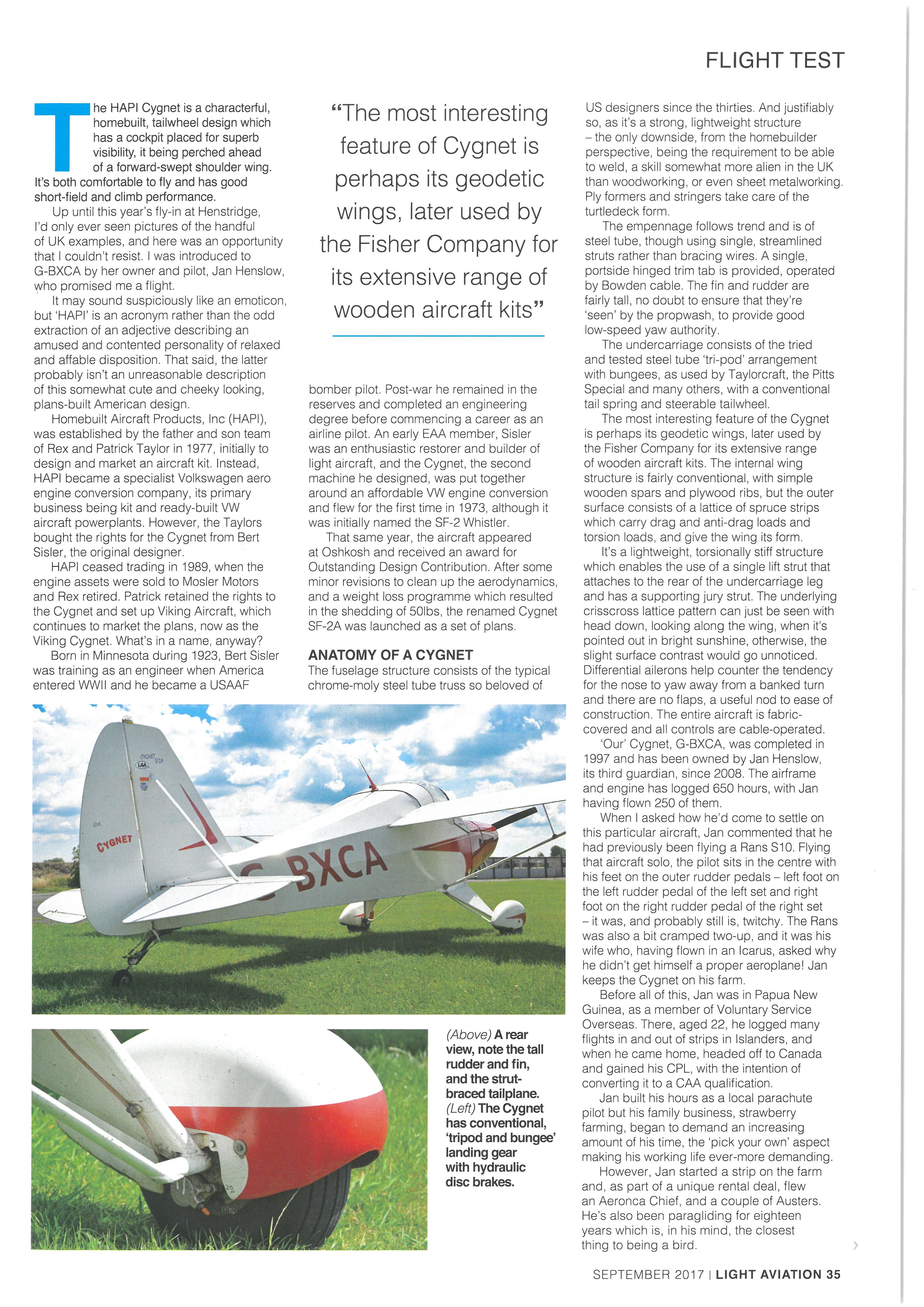
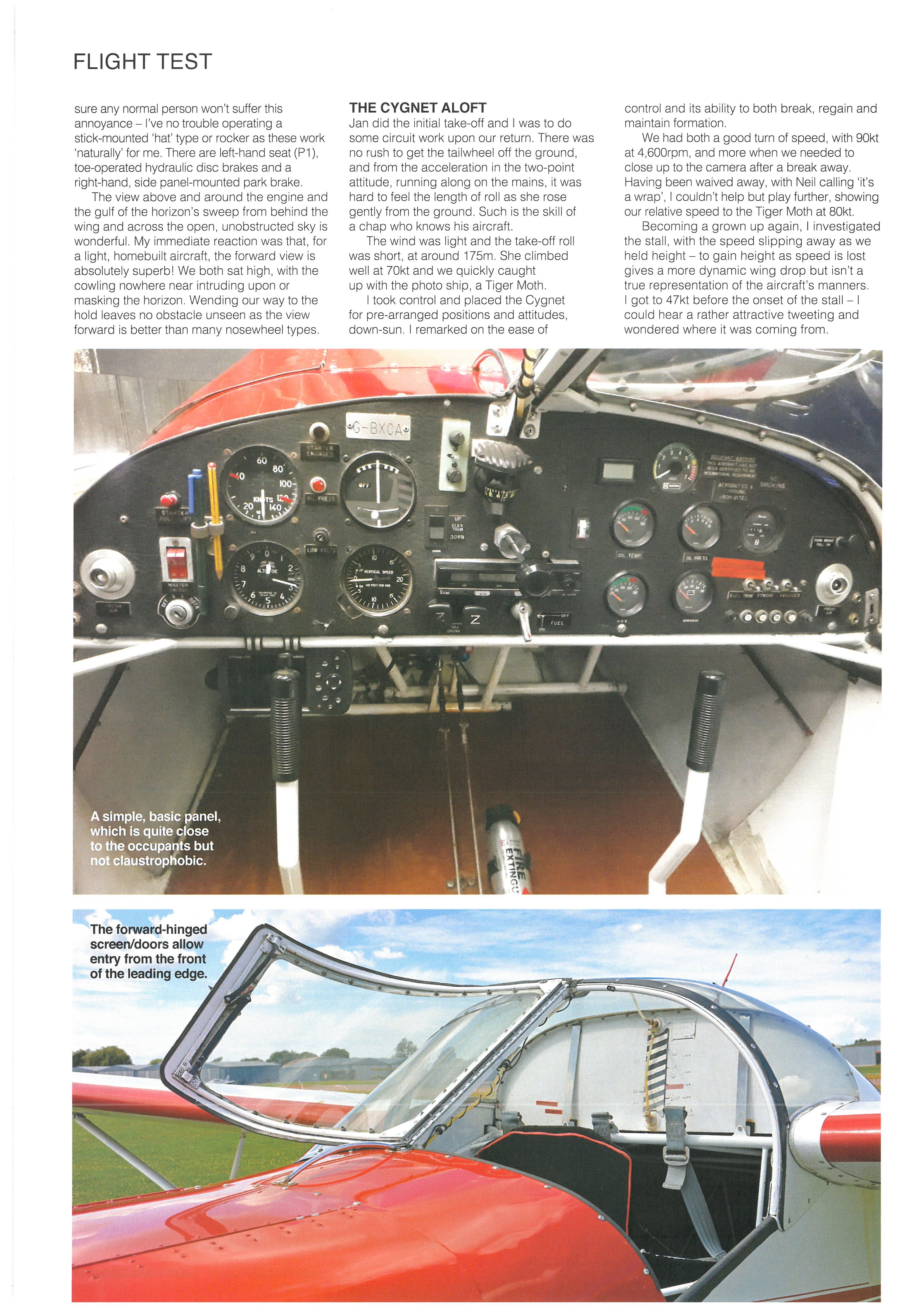
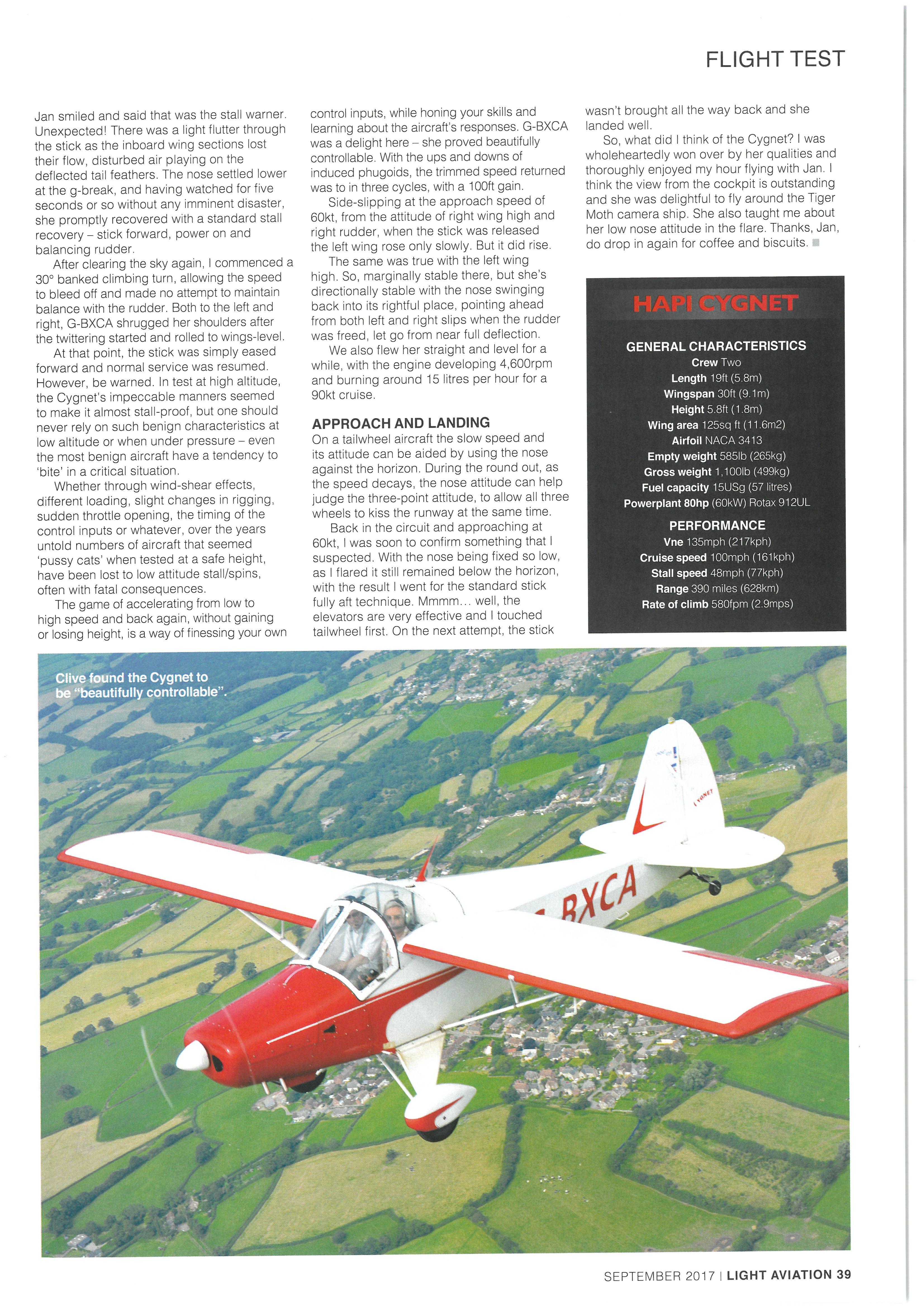
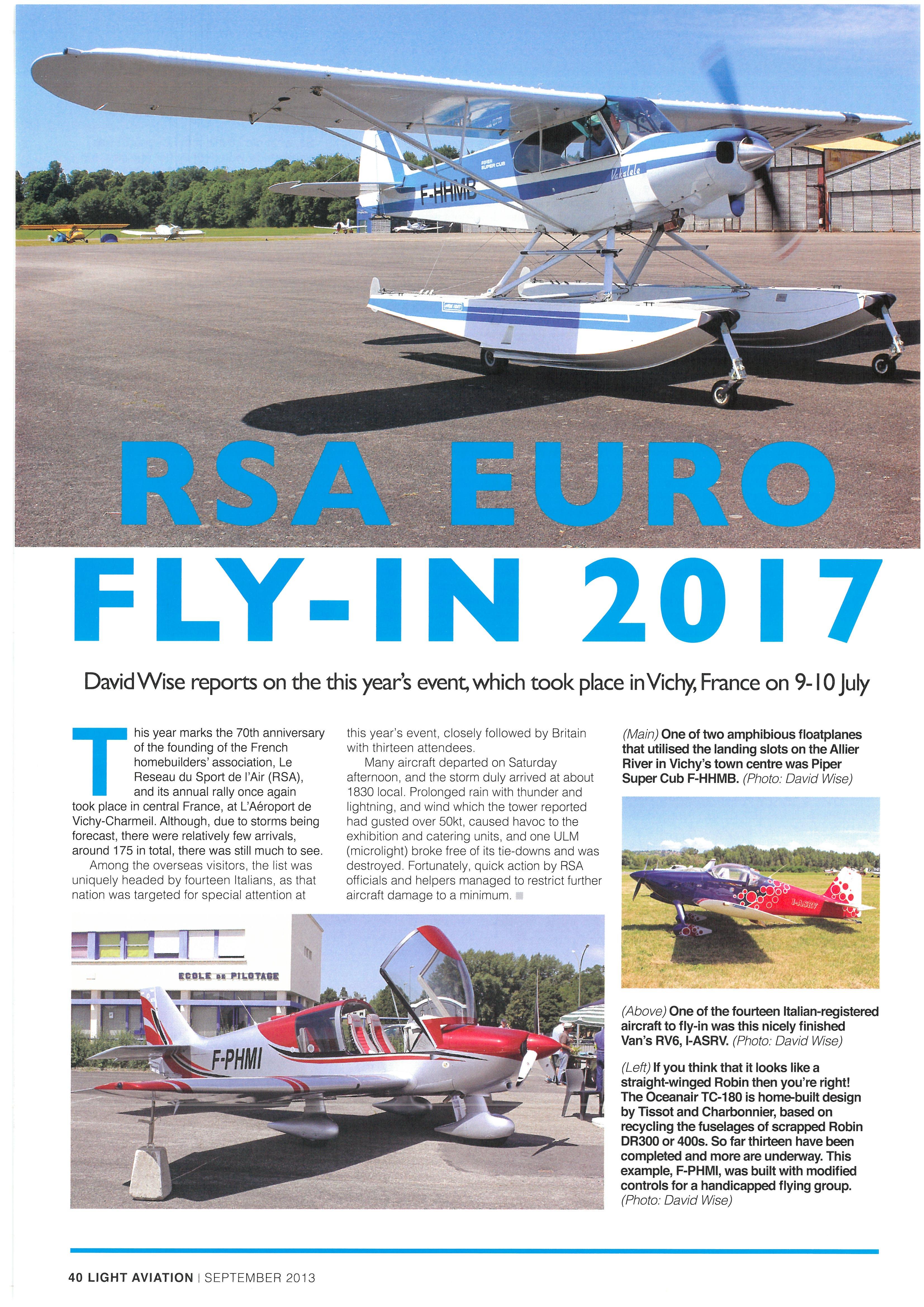
TheVikingCygnetenjoyed a briefspell of popularity here in the UK before plansbuilding gave way to kit building, becoming the fairly small sector of the market it is today.
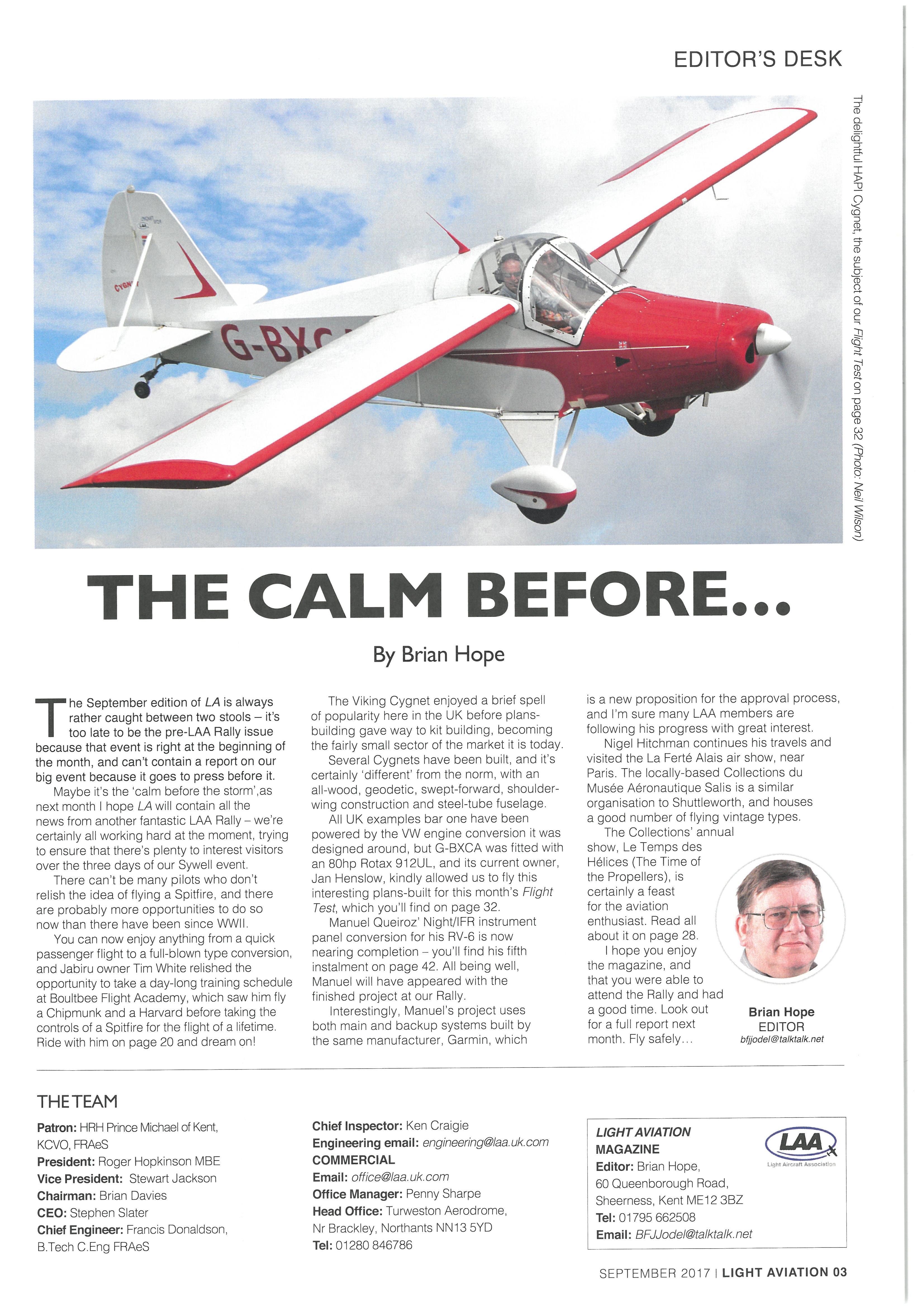
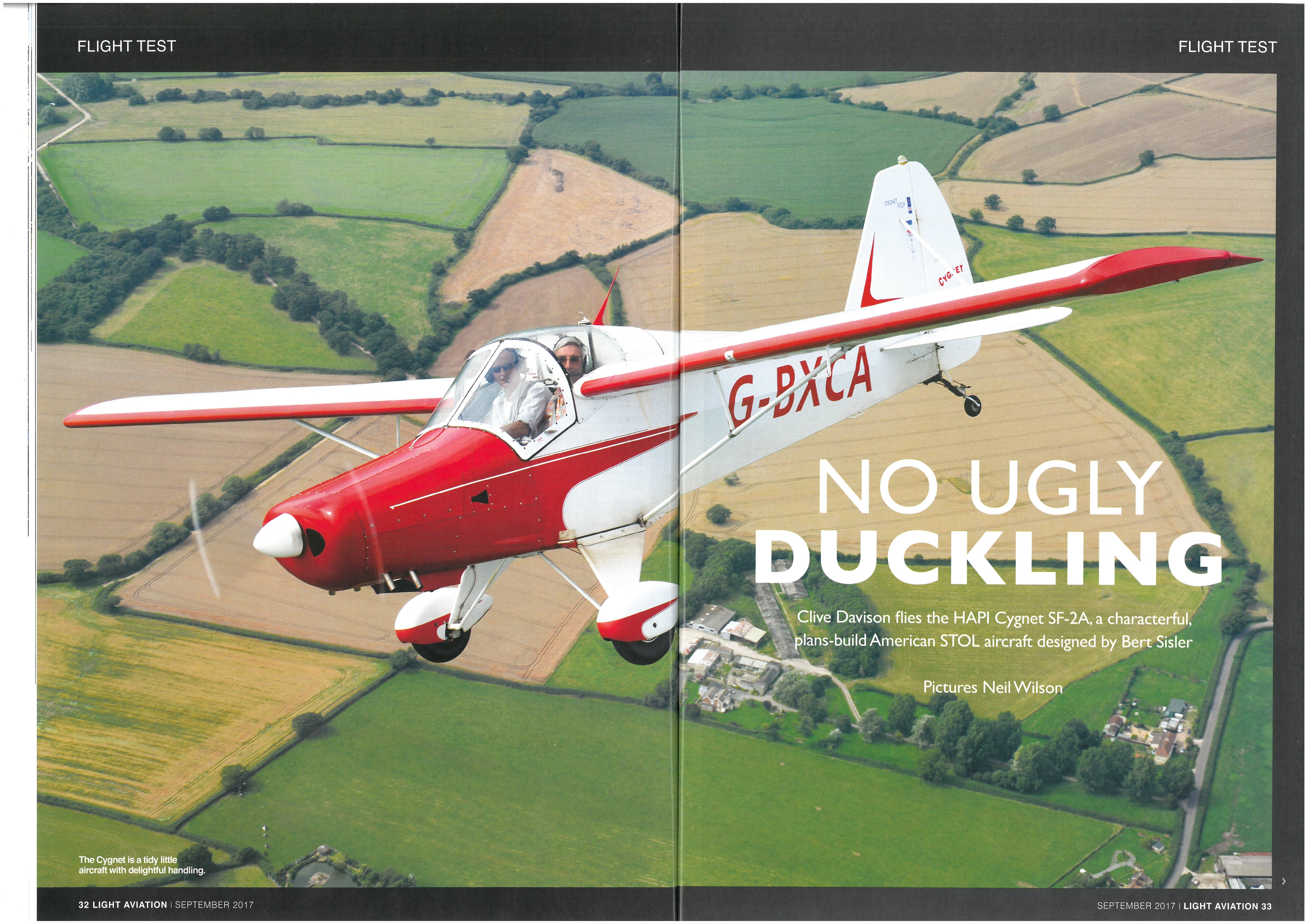
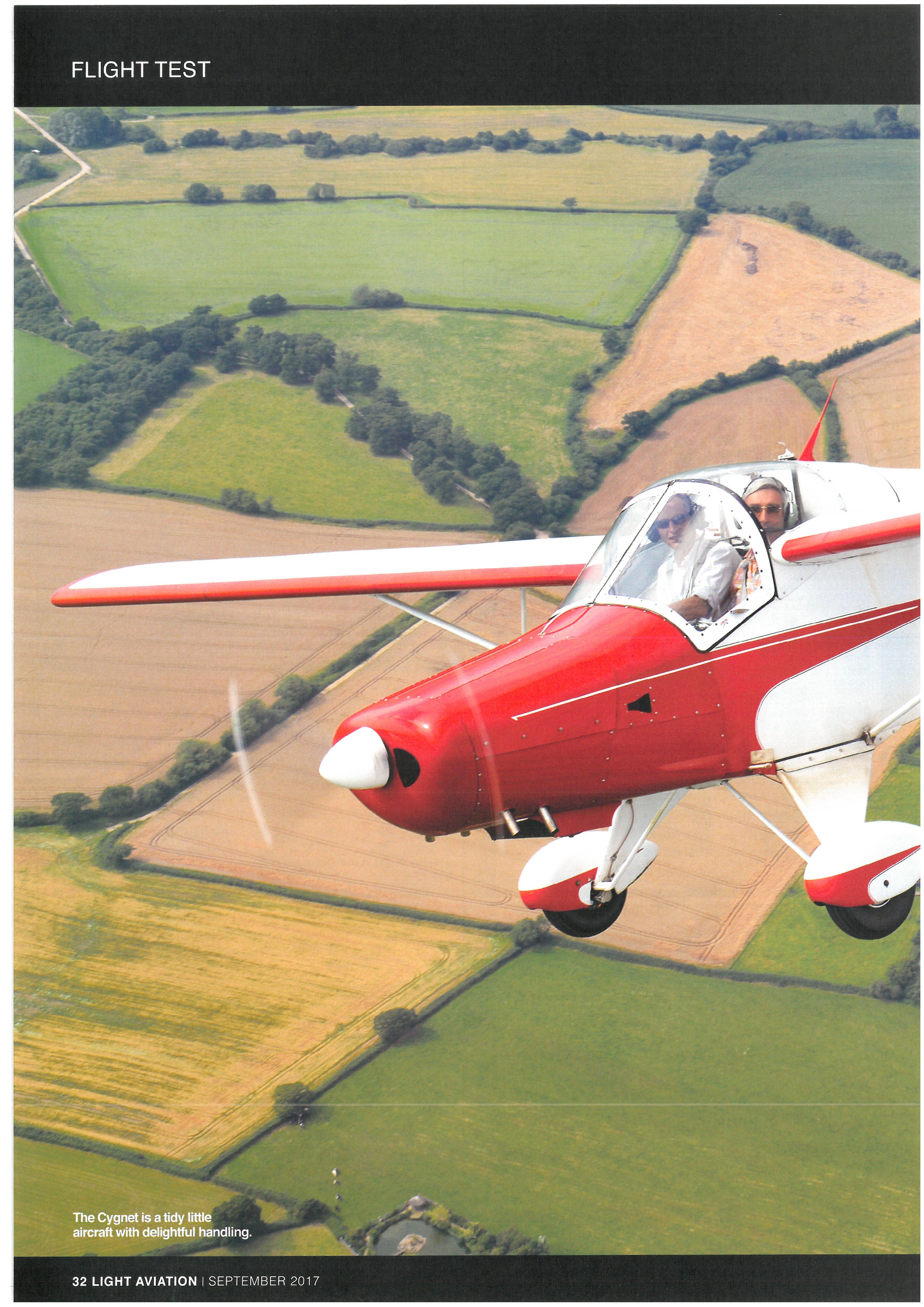
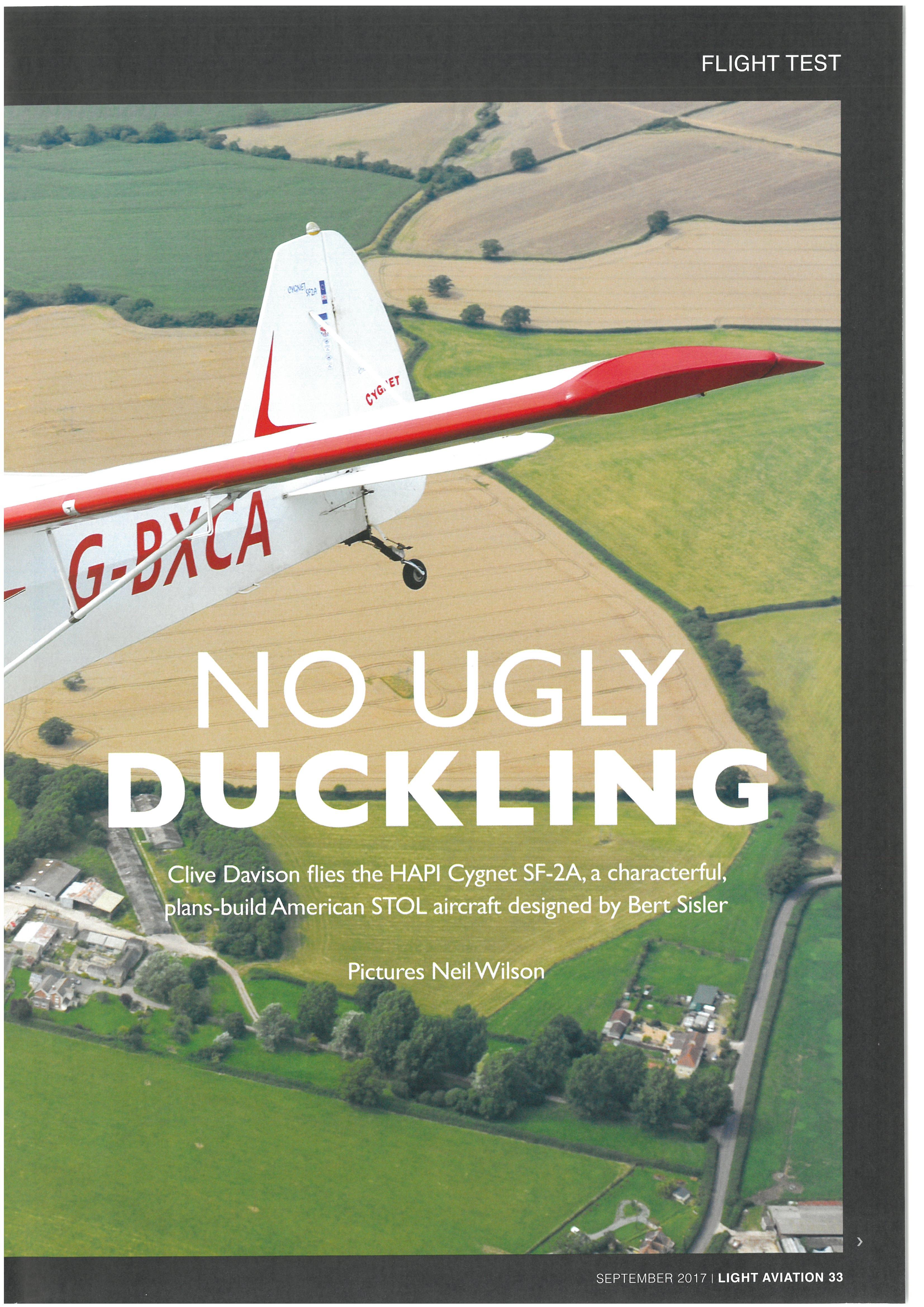
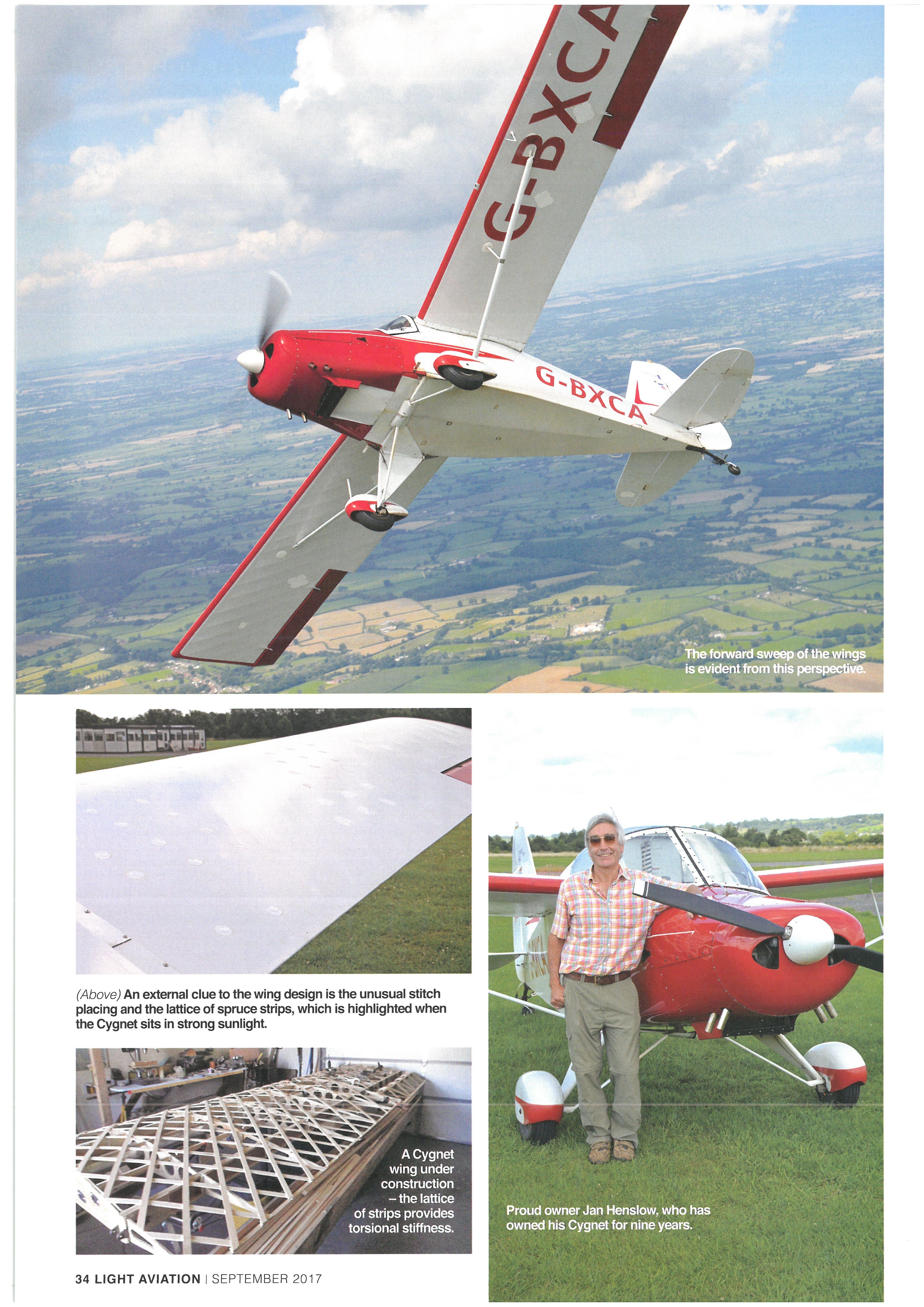
Several Cygnets have been built, and it’s certainly ‘different’ from the norm, with an all-wood, geodetic, swept-forward, shoulderwing construction and steel-tube fuselage.
All UK examples bar one have been powered by the VW engine conversion it was designed around, but G-BXCA was fitted with an 80hp Rotax 912UL, and its current owner, Jan Henslow, kindly allowed us to fly this interesting plans-built for this month’s Flight Test, which you'll find on page 32.
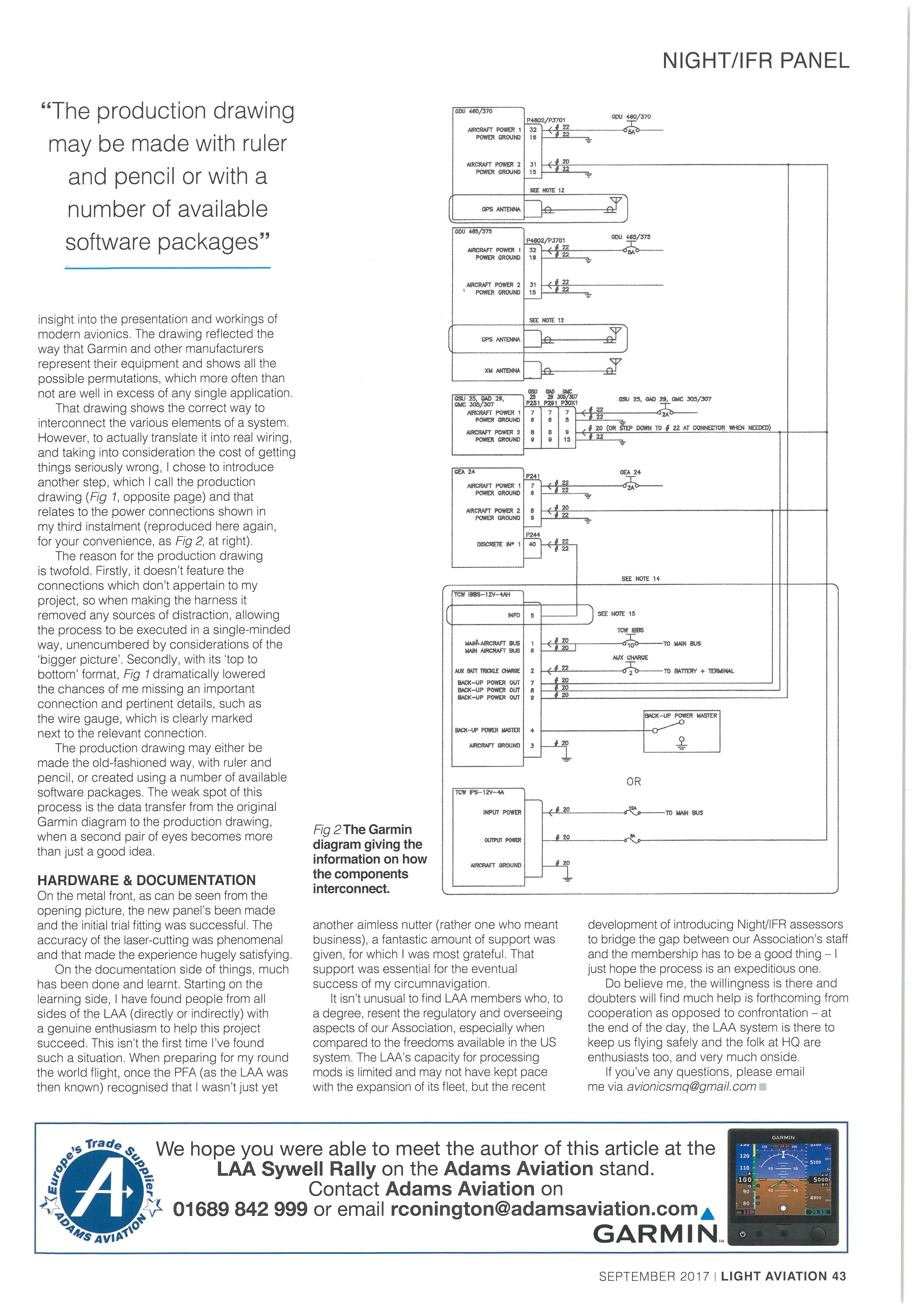
Manuel Queiroz’ Night/IFR instrument panel conversion for his RV-6 is now nearing completion you'll find his fifth instalment on page 42. All being well, Manuel will have appeared with the finished project at our Rally.
Interestingly, Manuel’s project uses both main and backup systems built by the same manufacturer, Garmin, which
is anew proposition for the approval process, and I’m sure many LAA members are following his progress with great interest.
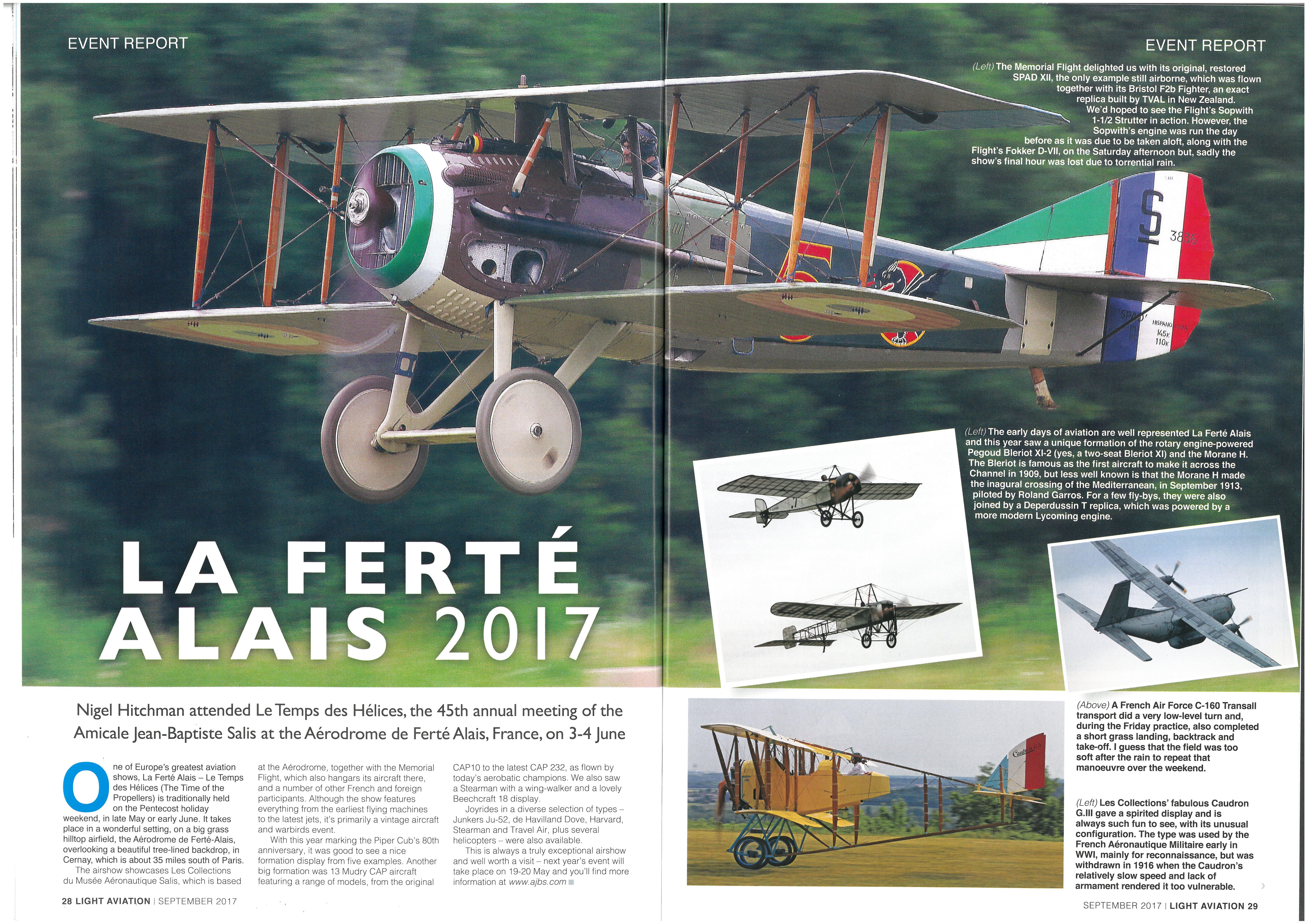
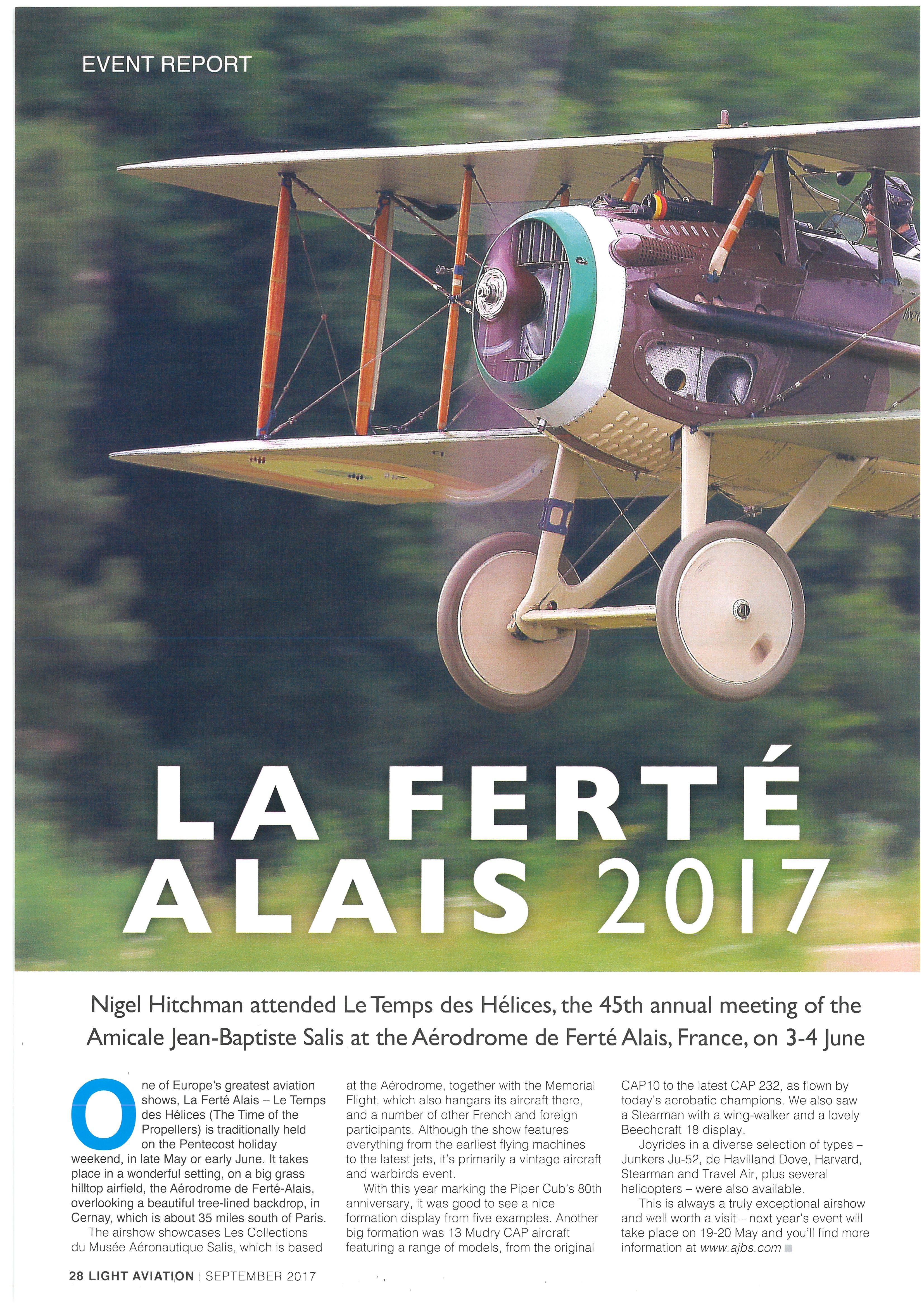
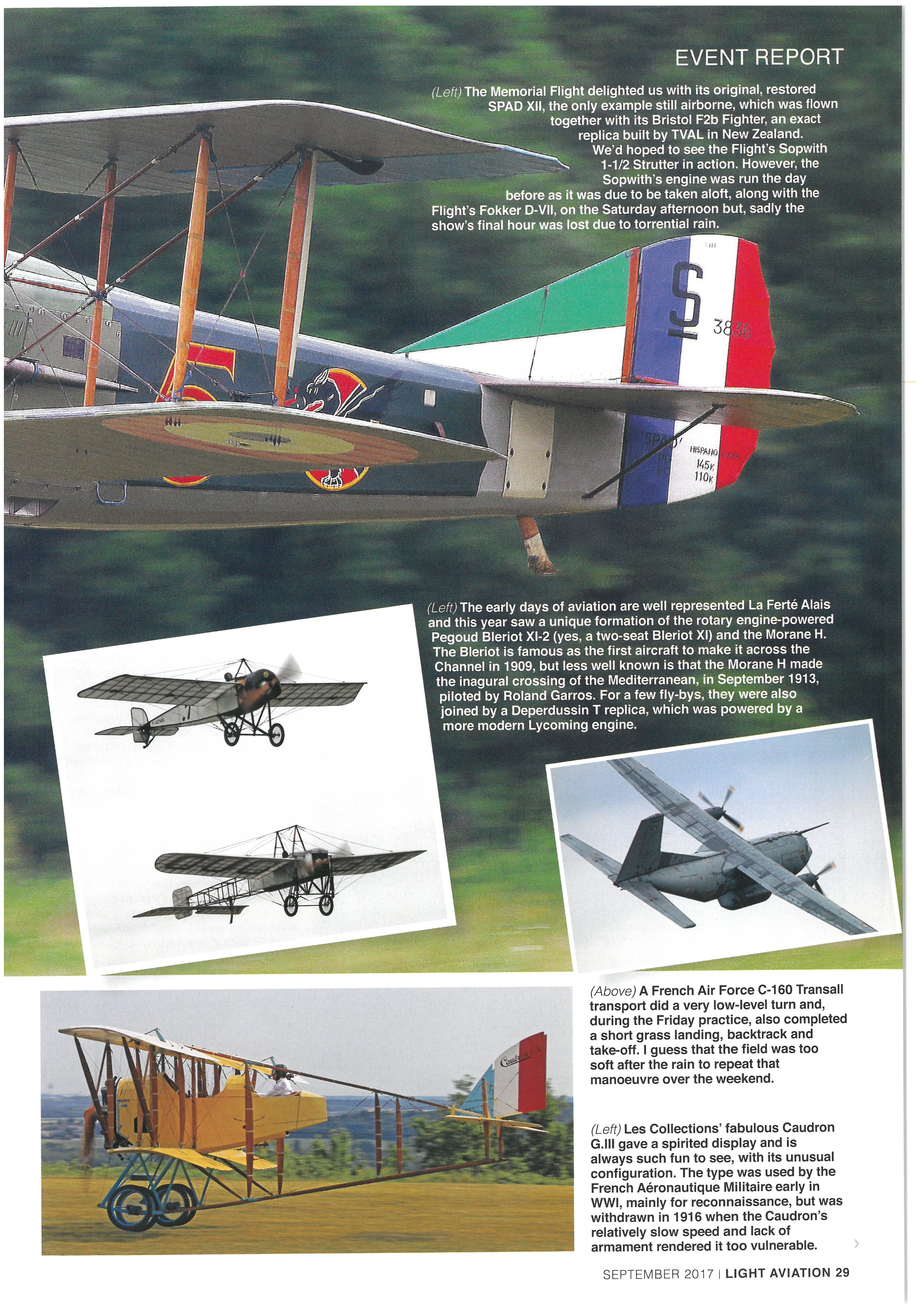
Nigel Hitchman continues his travels and visited the La Ferté Alais air show, near Paris. The locally-based Collections du Musée Aéronautique Salis is a similar organisation to Shuttleworth, and houses a good number of flying vintage types.
The Collections’ annual show, Le Temps des Hélices (The Time of the Propellers), is certainly a feast for the aviation enthusiast. Read all about it on page 28.
| hope you enjoy the magazine, and that you were able to attend the Rally and had a good time. Look out for a full report next month. Fly safely...
Chief Inspector: Ken Craigie
Engineering email: engineering@laa.uk.com
COMMERCIAL
Email: office@laa.uk.com
Office Manager: Penny Sharpe
Head Office: Turweston Aerodrome, Nr Brackley, Northants NN13 5YD
Tel: 01280 846786
LIGHT AVIATION
MAGAZINE
Editor: Brian Hope, 60 Queenborough Road, Sheerness, Kent ME12 3BZ
BristellNG5 Speedwing, two EuroFOX912 iSSport, a Pitts Model 12and an ARVSuper 2, plus New Projects and a really lengthy Cleared to Flylist
|6 TOURINGADVENTURE
Martin Ferid recalls heading to an oldtimer fly-in at Lelystad, Holland
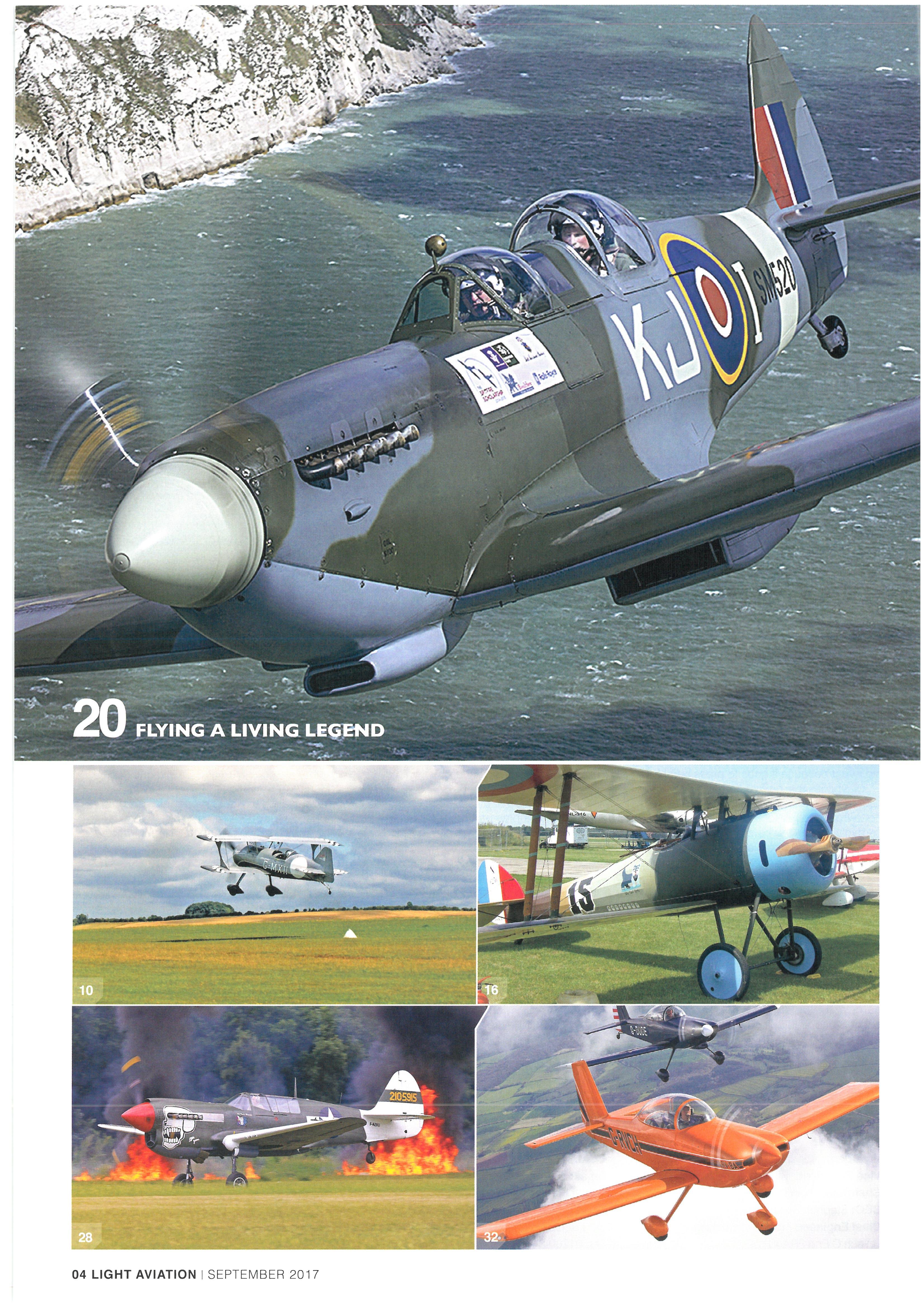
20 BOULTBEE SPITFIRE
Tim White fulfils a lifelong ambition, getting a taste of training to be a WWIIfighter pilot in a Spitfire
28 LA FERTEALAIS
Nigel Hitchman attended the 45th annual La FertéAlais- Le Temps des Hélices meeting, near Paris
32FLIGHTTEST
Clive Davison flies the HAP!Cygnet SF-2A, a plans-built US tourer
40 RSA EURO FLY-IN 2017
David Wise reports on the annual Le Reseaudu Sport de |’Air(RSA) rallyat L_Aéroportde Vichy-Charmeil
42 NIGHT/IFR PANEL
Manuel Queiroz’s fifth report sees his RV-6‘pathfinder project’ nearing completion
44 SAFETY SPOT
Malcolm McBride with engineeringrelated errors, CO gotchas and an update on the DH wing spar issue
5| OBITUARY: NEVILLE EYRE
lvan Shaw pays tribute to the Europa expert and LAA Inspector
5| AIR COURTAGE
Personal Accident Insurance available to LAA members
52MEETTHEMEMBERS
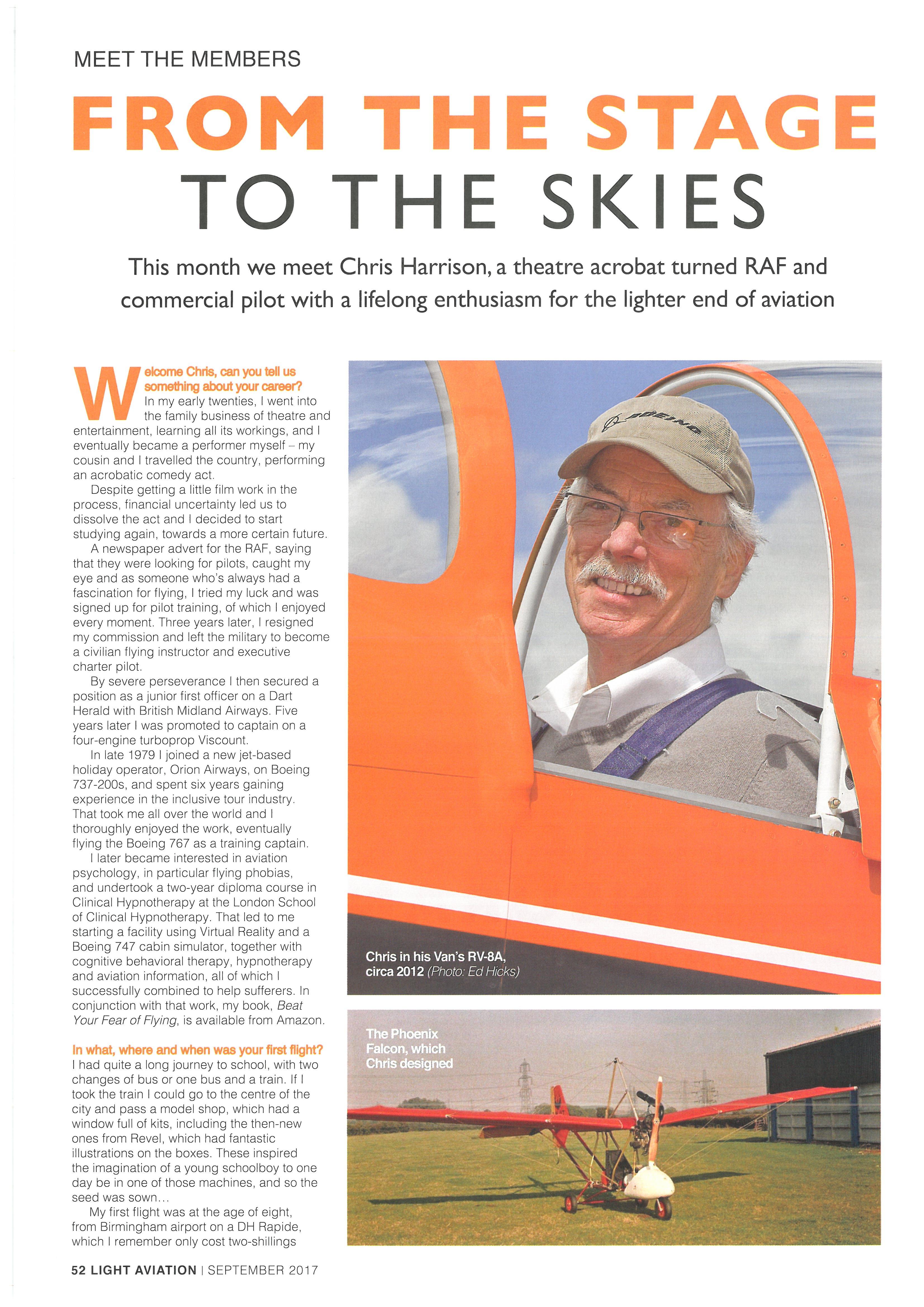
Chris Harrison, who’s possessed a lifelong enthusiasm for aviation
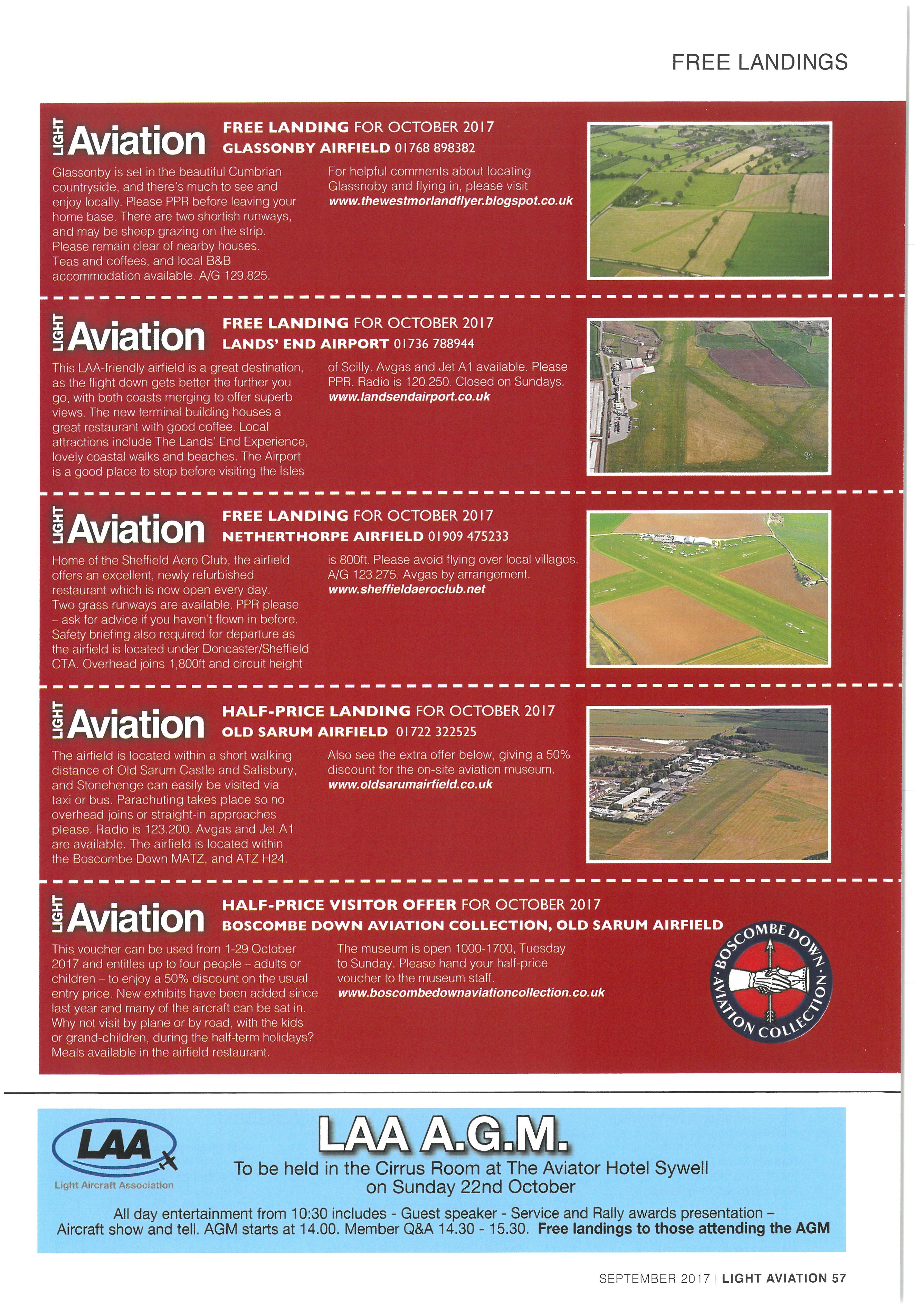
56LANDINGVOUCHERS
Free& half-price offersfor members
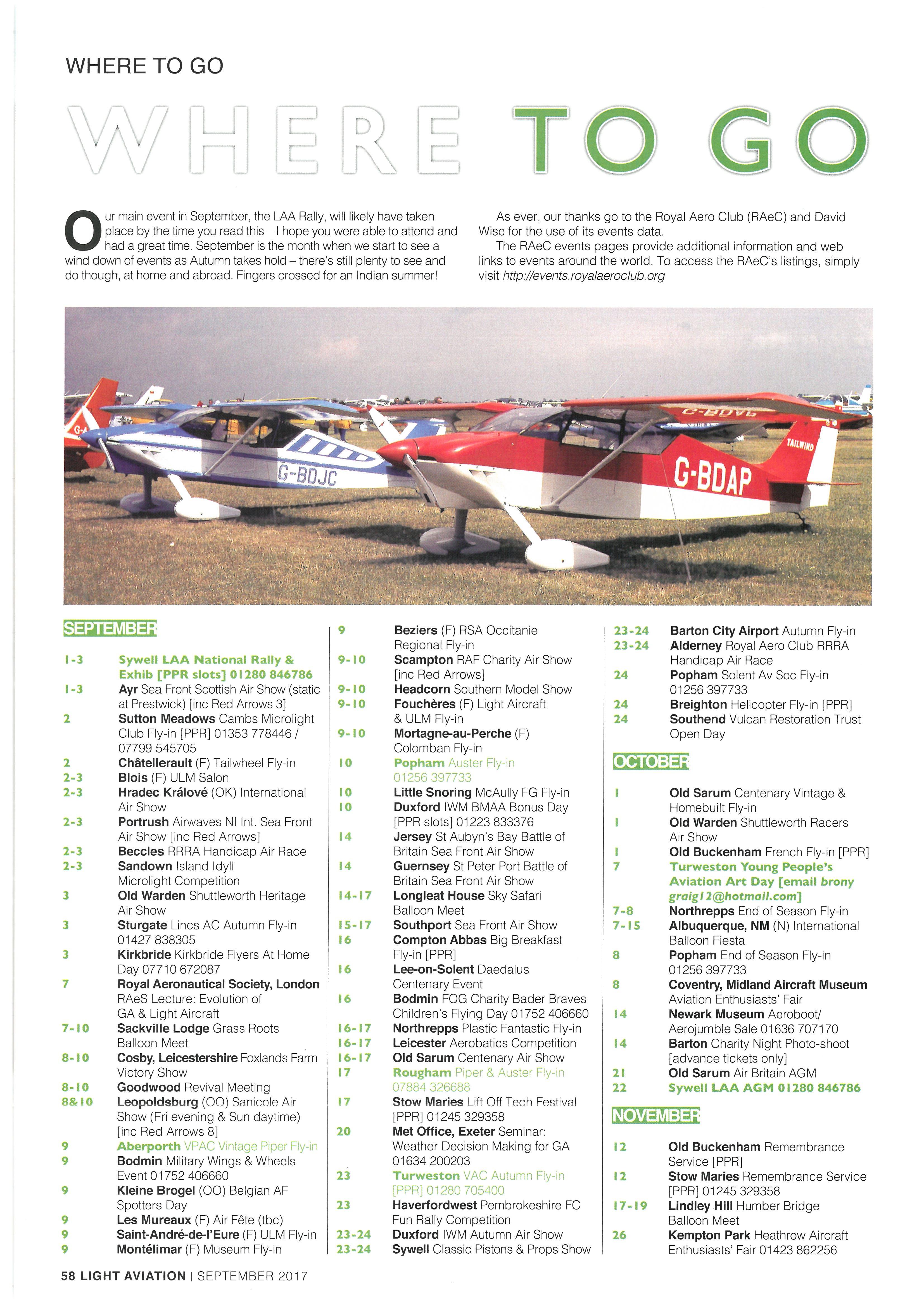
58 WHERETO GO
Eventsduring September & October
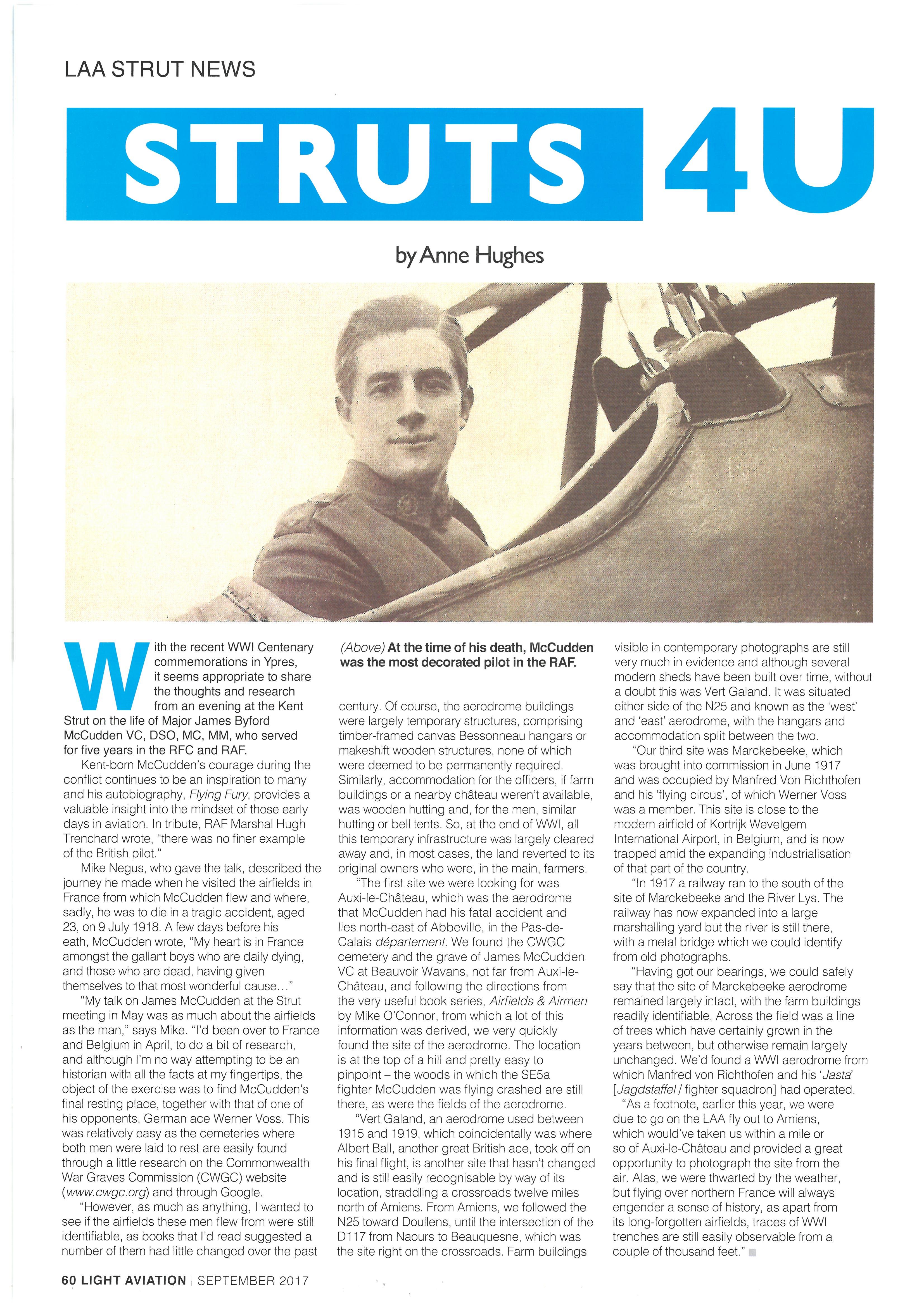
60 STRUTS 4U
Anne Hughes with a report on Major James McCudden VC& Strutlistings
62 CEO CHAT
Steve Slater on the LAA airforce
63 LAA CLASSIFIEDS
Aircraft, parts & services for sale
am writing this just after returning from the including vintage, modern LAA machines, gyros, flexwings, C of A types and model aircraft from low-and-slow to fast-and-furious.
Scottish Aero Club Fly-In at Perth, which included the third of our regional Meet the LAA events. Brian Hope, Ken Craigie and | were the hosts for the LAA part of the event, which was planned for Saturday afternoon.
Sadly, we arrived on the Friday afternoon to be greeted by horizontal rain and high winds. Saturdaywasa bitdrierbutthewindspicked up, which prevented the majority of pilots from flying in as planned.
Amazingly, an RV-10 appeared out of the gloom, piloted by our esteemed President, Roger, with his wife Gill. He could have easily won a prize for the longest distance travelled and also the bravest pilot!
Despite the small number of pilots who were able to fly in, the weekend was a success because there are over 100 aircraft based at Perth and the Scottish Aero Club (SAC) is supported by a highly organised and enthusiastic team. There was something for everybody, including a series of very interesting talks and hangar tours, model aircraft-flying and a céilidh on the Saturday evening. Every type of flying was represented,
This was the third in our series of regional Meet the LAA sessions and each has been attached to an existing event, organised by our local Struts or the airport community.
The likes of the SAC Fly-in clearly demonstrated a winning formula, namely the power of an enthusiastic and proactive airfield owner or operator, combined with an active group of pilots engineers and supporters, all working together to provide enough energy and resource to make an event a success, regardless of the circumstances.
Maybe this is the way forward? Communities based at an active regional airfield, working together, regardless of their affiliation, but sharing a common interest in the love of all things to do with aviation. As we look to the future, there simply isn’t enough ‘critical mass’ for each interest group to do its own thing successfully.
Is this the moment for Turweston to build such a community around the new facilities at LAA HQ? It’s food for thought...
ou may recall that, here at LAA HQ, we’re planning a considerable expansion of our Engineering courses for members over the coming months. That work is progressing well and the following courses will set the ball rolling:
B Aircraft Woodwork, Swindon, 11 October
This popular course will take place at Dudley Pattison’s workshop near Swindon. Duds covers the basic skills, such as wood and glue selection, cutting, drilling, scarfing and gluing sufficient information for you to start a repair or build project. There are academic and practical elements to the course, and the price of £110 includes lunch, tea and coffee.
m Owner Maintenance, Turweston, 14 October
A new course run by Alan Turney, an LAA Inspector and a Licenced Engineer. Alan will cover the ‘paperwork’ issues of maintaining an aircraft, like logbooks and worksheets, and such practical aspects as wire-locking, plus airframe and engine inspection techniques, etc. The cost is £120.
@Aircraft Metalwork, Turweston, 28 & 29 October
LAA Inspector Gary Smith and his team will take you through aircraft metalwork theory
and the practical aspects of drilling, dimpling, de-burring and riveting etc, by building the Van's Aircraft ‘apprentice piece’ of a metal toolbox. You'll get a lot of ‘hands on’ experience during this one-day course, which costs £140.
B An Introduction to Aircraft Fabric, Turweston, 18 November
Alan Turney will cover fabric inspection procedures, fabric selection and the pros and cons of different finishes before moving onto the practical aspects of applying fabric toa prepared structure and shrinking, doping and rib stitching it. The cost of this course is £120.
w Rotax 9-Series Engines, Turweston, 25 November
This course covers installation and maintenance of the Rotax 9-series, four-stroke engines from acknowledged expert and Rotax-trained engineer, Kevin Dilks.The course, which costs £120, will see Kevin sort urban myth from the correct technical procedures to ensure that your Rotax engine provides reliable, long-term service.
To book a place on any of the above courses, please contact LAA HQ on 01280 846786 Ext 2 or email penny.sharpe@laa.uk.com
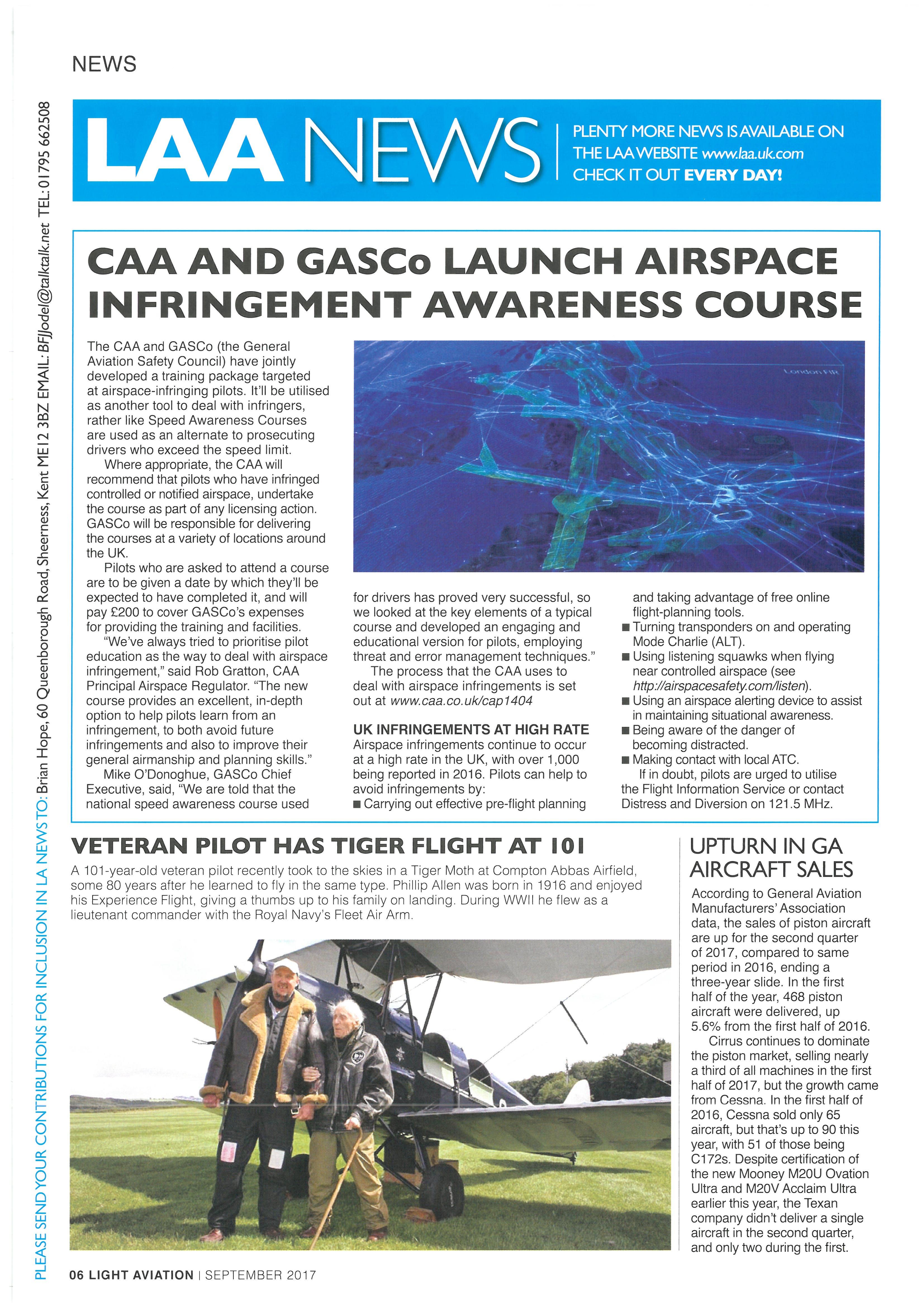
The CAA and GASCo (the General Aviation Safety Council) have jointly developed a trainingpackagetargeted at airspace-infringing pilots. It'll be utilised as another tool to deal with infringers, rather like Speed Awareness Courses are used as an alternate to prosecuting drivers who exceed the speed limit.
Where appropriate, the CAA will recommend that pilots who have infringed controlled or notified airspace, undertake the course as part of any licensing action. GASCo will be responsible for delivering the courses at a variety of locations around the UK.
Pilots who are asked to attend a course are to be given a date by which they'll be expected to have completed it, and will pay £200 to cover GASCo’s expenses for providing the training and facilities.
“We’ve always tried to prioritise pilot education as the way to deal with airspace infringement,” said Rob Gratton, CAA Principal Airspace Regulator. “The new course provides an excellent, in-depth option to help pilots learn from an infringement, to both avoid future infringements and also to improve their general airmanship and planning skills.”
for drivers has proved very successful, so we looked at the key elements of a typical course and developed an engaging and educational version for pilots, employing threat and error management techniques.”
The process that the CAA uses to deal with airspace infringements is set out at www.caa.co.uk/cap1404
and taking advantage of free online flight-planning tools.
mTurning transponders on and operating Mode Charlie (ALT).
gwUsing listening squawks when flying near controlled airspace (See http://airspacesafety.com/isten).
mgUsingan airspacealertingdeviceto assist in maintaining situational awareness.
mBeing aware of the danger of becoming distracted.
mgMakingcontactwith localATC.
UK INFRINGEMENTS AT HIGH RATE Airspace infringements continue to occur at a high rate in the UK, with over 1,000 being reported in 2016. Pilots can help to avoid infringements by:
If in doubt, pilots are urged to utilise the Flight Information Service or contact Distress and Diversion on 121.5 MHz.
LIGHTAVIATION|SEPTEMBER2017
Mike O’Donoghue, GASCo Chief Executive, said, “We are told that the national speed awareness course used
According to General Aviation Manufacturers’Association data, the sales of piston aircraft are up for the second quarter of 2017, compared to same period in 2016, ending a three-year slide. In the first half of the year, 468 piston aircraft were delivered, up 5.6% from the first half of 2016. Cirrus continues to dominate the piston market, selling nearly a third of all machines in the first half of 2017, but the growth came from Cessna. In the first half of 2016, Cessna sold only 65 aircraft, but that’s up to 90 this year, with 51 of those being C172s. Despite certification of the new Mooney M20U Ovation Ultra and M20V Acclaim Ultra earlier this year, the Texan company didn’t deliver a single aircraft in the second quarter, and only two during the first.
The 2017 Annual General Meeting of the Light Aircraft Association Ltd will be held in the Cirrus Room in the Aviator Hotel at Sywell Aerodrome, Northampton on Sunday CANDIDATES
22 October. The actual AGM commences at 1400, but it forms only part of a full day’s entertainment for LAA members.
The programme for the day will be:
m 1000 Tea/coffee
w 1015 Welcome from Brian Davies, LAA Chairman.
@1030 Presentation of LAA Service Awards
m@1100 ‘Flying the DH88 Comet’, a talk by Roger ‘Dodge’ Bailey, Chief Pilot, Shuttleworth Collection.
mw1200 Lunch (Not provided but bar snacks available in the Aviator or cafe fare from the Pilot’s Mess).
mw1200-1300 ‘Show and tell’ with selected visiting LAA aircraft.
@1300 Presentation of LAA Rally awards.
#1330 AGM
m1400 Members’ Forum an opportunity to discuss issues and ideas with the LAA Board.
wm1500 Thanks and closure of the meeting.
AGM DOCUMENTATION
The Meeting Agenda, the Minutes of the 2016 AGM, the Annual Report, the 2016 Accounts, and full details of any Motions being presented at the meeting
(www.laa.uk.com) at least seven days prior to this year’s meeting.
OF THE LAA
FOR DIRECTORSHIPS
No LAA member may be elected or co-opted to the Board unless he/she has been a beneficial shareholder, continuously, for at least two years.
Nominations of candidates for election and re-election to the Board must be received by the secretary by Sunday 10 September, with intimation in writing that the beneficial shareholder nominated is willing to serve, which must be duly signed by the proposer and seconder, who must also be beneficial shareholders.
MOTIONS
A notice of Motion for the AGM must be submitted to the Secretary in writing, duly signed by the proposer and seconder, who must be beneficial shareholders in the Company. Notices of a Motion concerning amendments to the Articles must be received by Sunday 10 September. The Board shall consider proposals for amendments to the Articles in advance of the AGM and decide whether or not it supports the proposals.
PROXY VOTING
Although we hope to attract a large and For further details visit our website
enthusiastic audience to the AGM, clearly not everybody is able to attend. However, that doesn’t preclude you from being able to vote because we have a proxy system in place.
A proxy form to be featured on the reverse side of the address page of the October issue of LA will list the candidates and the Motions that will be put to the AGM. You can fill that out and vote for as many of the candidates and/or Motions as you like, and send it to LAA HQ (the address can always be found on page 3 of this magazine), to arrive no later than Thursday 19 October.
MEMBERSHIP CARDS
Please note that to attend the AGM you must be a current member of the LAA. Ensure you have your membership card with you on the day. To vote at the AGM you must be a beneficial shareholder of the LAA. Unless you’ve specifically opted out, if you're a current LAA member, you'll be a beneficial shareholder by default.
GETTING TO SYWELL
If you're coming to the AGM by road, the Sywell website (www.sywellaerodrome. co.uk/location) has directions or you can use the postcode NN6 OBNin your sat nav. You're welcome to fly in normal PPR procedures apply, see the Sywell website for details and landing fees will be waived
OLD SARUM TO HOLD CENTENARY FLY-IN
(SkyDemon). Inthe longer term this system may also assist drones in safely integrating into the UK’s airspace.
The CAA has confirmed that ADS-B ‘in/out’ using 1090 Ml is its preferred national system to improve electronic conspicuity for General Aviation, ideally used through transponders. The regulator has announced a number of trials to assess systems and potential uses, which include:
Atrial at Dundee Airport (run by Highlands and Islands Airports) to investigate a low-cost system receiving Mode-S and ADS-B data to provide air traffic controllers with more information on aircraft operating outside of controlled airspace.
The transmission of weather data from the ground direct to a GA aircraft cockpit via 978MHz. This trial is being undertaken by an equipment manufacturer (uAvionix) and aeronautical information service provider
Simultaneous transmissions from a GA aircraft with Mode S and a conspicuity device (meeting the criteria in CAP1397). Volunteers from the GA communities are assisting with this trial.
Atrial run by the FutureAirspace Strategy VFR Implementation Strategy (FASVIG) will be looking to provide real time traffic data to GA airfields, enhancing the airfield’s situational awareness of aircraft in its vicinity.
SONEX RETROFIT ROTAX ENGINES
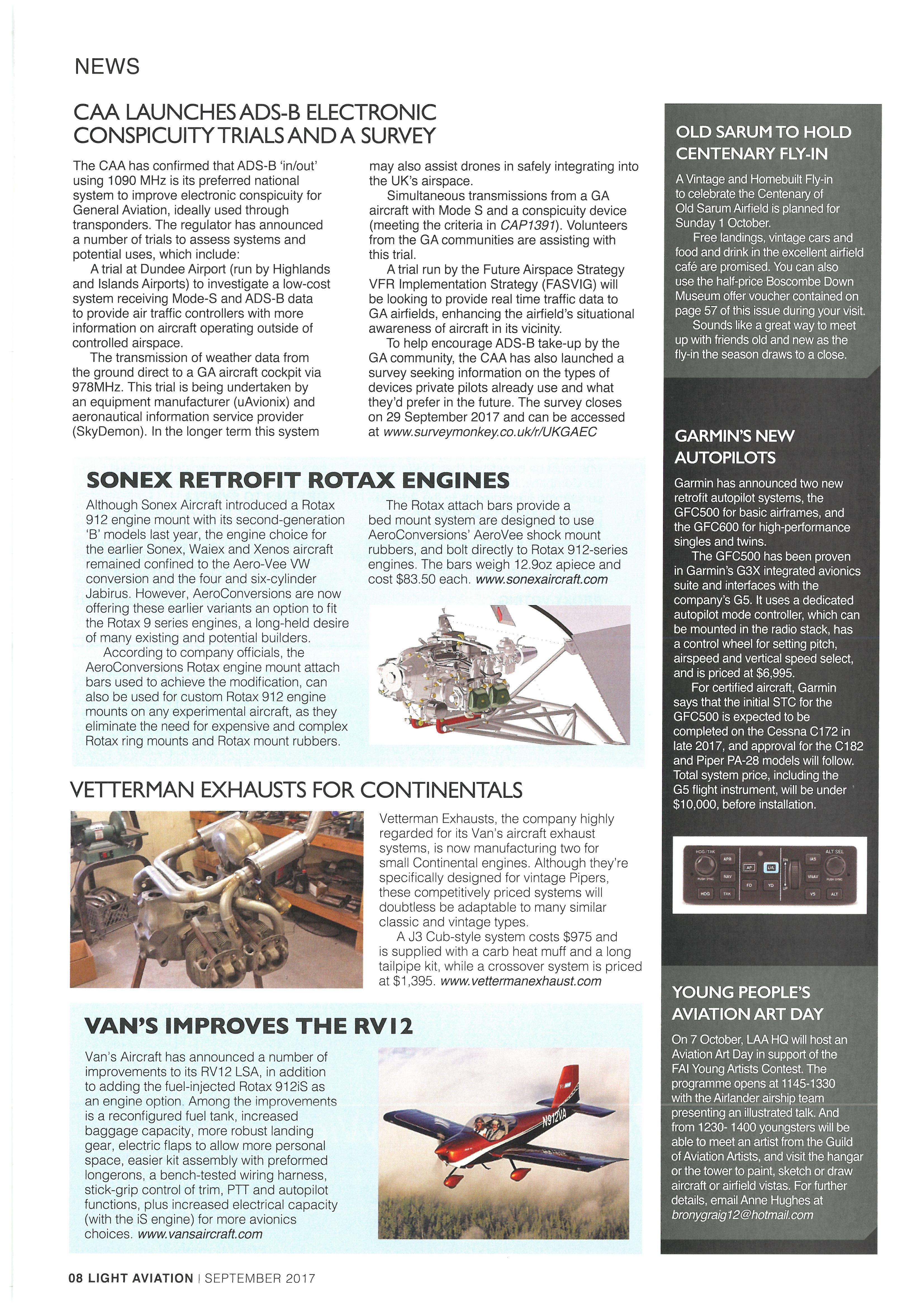
Although Sonex Aircraft introduced a Rotax 912 engine mount with its second-generation ‘B’ models last year, the engine choice for the earlier Sonex, Waiex and Xenos aircraft remained confined to the Aero-Vee VW conversion and the four and six-cylinder Jabirus. However, AeroConversions are now offering these earlier variants an option to fit the Rotax9 series engines, a long-held desire of many existing and potential builders.
According to company officials, the AeroConversions Rotax engine mount attach bars used to achieve the modification, can also be used for custom Rotax 912 engine mounts on any experimental aircraft, as they eliminate the need for expensive and complex Rotax ring mounts and Rotax mount rubbers.
To help encourage ADS-B take-up by the GA community, the CAA has also launched a survey seeking information on the types of devices private pilots already use and what they’d prefer in the future. The survey closes on 29 September 2017 and can be accessed atwww.surveymonkey.co.uk/*/UKGAEC
The Rotax attach bars provide a bed mount system are designed to use AeroConversions’ AeroVee shock mount rubbers, and bolt directly to Rotax 912-series engines. The bars weigh 12.90z apiece and cost $83.50 each. www.sonexaircraft.com
A Vintage and HomebuiltFly-in to celebratethe Centenaryof Old Sarum Airfield is planned for Sunday1October.
Free landings,vintagecars and food and drink in the excellent airfield café are promised. Youcan also usethe half-priceBoscombeDown Museum offer voucher contained on page 57 of this issueduringyourvisit.
Sounds like a great way to meet up with friends old and new as the fly-inthe season drawsto a close.
GARMIN’S NEW AUTOPILOTS
Garmin has announced two new retrofit autopilot systems, the GFC500 for basic airframes, and the GFC600 for high-performance singles and twins.
The GFC500 has been proven in Garmin’s G8X integrated avionics suite and interfaces with the company’s Gd. It uses a dedicated autopilot mode controller, which can be mounted in the radio stack, has a control wheel for setting pitch, airspeed and vertical speed select, and is priced at $6,995.
For certified aircraft, Garmin says that the initial STC for the GFC500 is expected to be completed on the Cessna C172 in late 2017, and approval for the C182 and Piper PA-28 models will follow. Totalsystem price, includingthe G5 flight instrument,will be under ° $10,000,beforeinstallation. YOUNG AVIATIONPEOPLE’S ART DAY
Van's Aircraft has announced a number of improvements to its RV12 LSA, in addition to adding the fuel-injected Rotax 912iS as an engine option. Among the improvements is a reconfigured fuel tank, increased baggage capacity, more robust landing gear, electric flaps to allow more personal space, easier kit assembly with preformed longerons, a bench-tested wiring harness, stick-grip control of trim, PTTand autopilot functions, plus increased electrical capacity (with the iSengine) for more avionics choices. www.vansaircraft.com
Vetterman Exhausts, the company highly regarded for its Van's aircraft exhaust systems, is now manufacturing two for small Continental engines. Although they're specifically designed for vintage Pipers, these competitively priced systems will doubtless be adaptable to many similar classic and vintage types.
A J3 Cub-style system costs $975 and is supplied with a carb heat muff and a long at$1,395.www.vettermanexhaust.com
On 7 October, LAA HQ will host an Aviation Art Day in support of the FAIYoungArtistsContest.The programme opens at 1145-1330 with the Airlander airshipteam presenting an illustratedtalk.And from 1230- 1400 youngsters will be able to meet an artist from the Guild ofAviationArtists,andvisitthe hangar or the towerto paint,sketchor draw aircraft or airfield vistas. For further details,emailAnne Hughesat bronygraig12@hotmail.com
and Cleared to Fly —|don’t think I’ve ever seen sucha longlist.Ararenewstartthesedaysisthe Long-Ez,whilefirstsintheClearedtoFlylist arethePitts Model 12, Thatcher CX4 and the Italian F22-A, which has come on as an orphan. Also receiving its Permit to Test is Luscombe G-LUSC, which was trailered over from Germany in 1984, so it certainly hasn’t been a rush job!
The latest variation of the EuroFOX, a very innovative incarnation of a classic eighties kit, is the ER (Extended Range) variant, which has four fuel tanks holding 166 litres, coupled with a frugal Rotax 912iS engine. Roger Cornwell of EuroFOX UK has just completed the first domestic example
andhopestoseeanothermakea tripfromBritianto New Zealand next year, as part of the RAF centenary celebrations. Ed Stinton has returned an ARV Super 2 to flight after some 27 years, and though a number of the type have been re-engined, he’s retained the original three-cylinder, two-stroke Hewland powerplant.
Was the ARV the last 100 per cent British light aircraft, if we consider that both the airframe and engine were actually produced here?
It's never too late, or indeed too early, to get in touch with Project News and tell your story, report a milestone or just to send a picture. We'd love to hear from you, so please email via projectnews@laa-archive.org.uk
VE NEVER BUILT an aircraft before, only scale models during my eens, but with an engineering background | didn’t find the process daunting. That said, it was a steep learning curve at times, especially heterminology,andalot ofintuitionwasrequiredwithclarification rom the importer when | was uncertain.
The seed for the build was planted around five years ago, when had a flight in a friend’s Van’s RV-7 during a trip to Canada. | then gained my PPL in 2014, and spent the next eight months shortlisting he various kit options. | didn’t want a five-year build and concluded myfinalchoiceneededtobeaquick-buildand,havinghada test light in the Bristell, it became first choice.
Our Bristell NG5 Speedwing kit was ordered in August 2015, delivered at the end of the following March, and was finished and signed-off early this May, with the first test flight taking place on 4 July.
The fuselage, wings and internals were all supplied pre-painted, so Care was required not to damage the paintwork during construction. We had reference to online construction manuals and photographs provided by the importer, Farry Sayyah, on a Yahoo! web forum accessible by all registered constructors. During the build, Farry
answered any questions by email or telephone he also served as my LAA Inspector and Test Pilot.
The build workshops were my double and single garages, much to my wife’s distress, as it meant that both our cars had to stay out on our drive. The fuselage and general construction took place in the double garage and the wings and all the components were stored in the single.
Most of the build time was spent foraging on the internet, sourcing sundry fixings and specialist tools which | didn’t have in my car workshop, such as miniature pipe benders, Rivnut tools, pop-rivet guns and cable crimpers. Most of the tools could be obtained from eBay, though specific items, such as aviation cabling and AN hardware, came from the LAS Aerospace or Parts For Aircraft sites.
The build took a year, with about seventy per cent of that spent online. I’d be working on an item and find that | needed a specificallysized screw or bolt so had to go and order it, then wait a couple of days for delivery, or tackle something else. If | was building a Bristell again, | reckon | could do so in half the time!
The Bristell has a quick-build airframe but the kit doesn’t include everything to complete the aircraft. The fuselage and wings are
already built, and all the controls, undercarriage and specified options such as brakes, parking brake, trim servos and stick buttons are included. | also specified the leather interior upholstery, but although some basic nuts, screws, rivets, etc, come with the kit, there are by no means sufficient to finish the aircraft. In addition, the builder is adding the fuel system, the selector, gascolator and fittings, etc.
Farry was able to supply these parts as extras and that saved some hassle, as | Know some previous builders had major issues getting the correct bits. The builder also has to source all the electrics, wiring, avionics, connectors, fuses, battery and so forth.
Firewall forward, | specified the Rotax 912ULS and it was supplied with all of the required ancillary iterns, together with the mount and all the necessary bolts and rubber bushes. | also opted for the approved VP propeller.
| started with an easy task, installing the hydraulic lines for the brakes, followed by the engine and ancillary bits and pieces. Installing the control stick and trim assemblies was fiddly but, approached logically, was just time-consuming. | took the central dash in and out about a dozen times trying to get things right, as I'd no sooner fit it than find that I’d forgotten something.
I'd decided to keep the avionics relatively simple | didn’t bother with autopilot servos, just trim servosandafull glassscreenarray.|chosea Dynon EFIS and EMS D100/120 combination, and an iPad mini running SkyDemon for navigation. | allso fitted the three required back up instruments: compass, altimeter and ASI. The radio and transponder are Trig, which were simple to install and set up. The Dynon avionics and Trig kit were ordered with the associated wiring harnesses, which made connecting them all uo much simpler. I’m still waiting for the EU 8.33kHz refund to come from the CAA, following my application for it back in April.
Sorting out the wiring was a bit of a challenge, but approaching it one item at a time made it relatively straightforward.The (Inset)Wire, wire and yet more wire... (Photo:Chris Hall) The panel’s,coming together, complete with anice iPad mini-dock (Photo:Geoff Beale)
PROJECT NEWS
resulting rat’s nest behind the dash had to be tidied up later. | tested each system as | went along labelling every single cable at both ends so that | knew where everything went certainly helped. It all worked first time, virtually!
Farry was helpful in suggesting suppliers for the lights, etc, which were very expensive but worthwhile and they look the business what isn't costly when it comes to aircraft? With hindsight, | would probably have used multi-core cabling for most of the wiring, which is a bit more expensive but tidier.
Farry only had me redo a few items that he didn’t like, such as replacing the stainless jubilee clips on the fuel lines with crimp clamps, which | had to buy along with yet another specialist tool. | also had to tie all the cables and pipes in the engine bay so that they were held away from the exhaust, etc, and couldn’t flap around. That required some brackets and other fixings to be made using aluminium angle and bar sections. Also, there were things | had forgotten to do, like wire-locking everything which required it there were so many things to think about and absorb.
The only mistake | made during the build was the fitting of the cabin air intakes. I’d misinterpreted Farry’s guide to installing them and fitted them on the outside of the fuselage. Last year, at the LAA Rally, | expressed a few expletives as | realised that I’d done it incorrectly. Upon rectifying my mistake, | ruined a section of paintwork around the openings, which will need to be touched up later. Though |’m comforted by the fact that this was my only mistake, | still find it annoying.
Only a few very minor tweaks were necessary after the first flight, and | then went up with Farry as observer, to assist with the test schedule. | enjoyed a fabulous feeling of satisfaction that |’d actually built my own aeroplane a bottle of bubbly was cracked that evening.
| now have the full Permitand am arranging familiarisation on a similar type, prior to being let loose in Aloha Bravo on my own.
BY PETER FINCHAM
THIS IS THE second EuroFOX build at Banbury Gliding Club, the The build was completed over eight months by Pete Nicholson, previous example being a Rotax 912ULS-powered version, which has Simon Ducker and myself, with the former concentrating on the avionics served us well as a dedicated tug for nearly five years. The new aircraft and electrics, and myself and the latter on the engine and airframe. is group-owned between the Club and eleven members. During that time, we received excellent support from the EuroFOX (Uk)
After much discussion and review, we decided to fit the Rotax team of Roger and Steve, along with Adrian Lloyd, our LAA Inspector. 912 iS engine, together with a ‘glass’ cockpit, which consists primarily The aircraft first flew on the 3 July and the test flight programme of twin MGL iEFISExplorer-Lite displays. G-CJHF will be used for has nearly been completed, with no major problems to date. Group touring and also, when required, towing and Club member cross- members are now keen to get their hands on G-CJH, to commence countryappreciation. theirfamiliarisationprogramme.
nateti PumpASortSerae ay:}
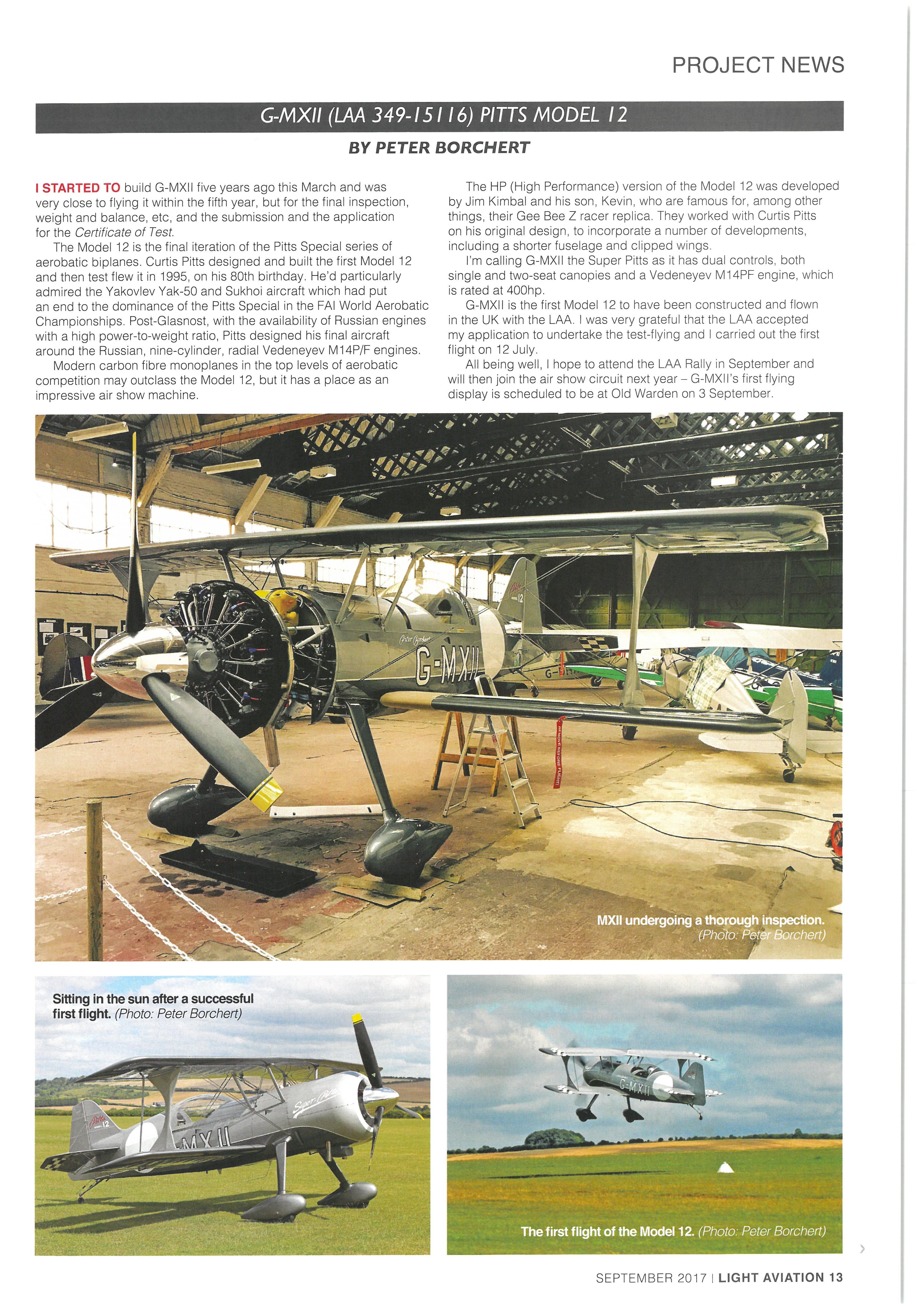
build G-MXII five years ago this March and was very close to flying it within the fifth year, but for the final inspection, weight and balance, etc, and the submission and the application for the Certificate of Test.
The Model 12 is the final iteration of the Pitts Special series of aerobatic biplanes. Curtis Pitts designed and built the first Model 12 and then test flew it in 1995, on his 80th birthday. He’d particularly admired the Yakoviev Yak-50 and Sukhoi aircraft which had put an end to the dominance of the Pitts Special in the FAI World Aerobatic Championships. Post-Glasnost, with the availability of Russian engines with a high power-to-weight ratio, Pitts designed his final aircraft around the Russian, nine-cylinder, radial Vedeneyev M14P/F engines.
Modern carbon fibre monoplanes in the top levels of aerobatic competition may outclass the Model 12, but it has a place as an impressive air show machine.
The HP (High Performance) version of the Model 12 was developed by Jim Kimbal and his son, Kevin, who are famous for, among other things, their Gee Bee Z racer replica. They worked with Curtis Pitts on his original design, to incorporate a number of developments, including a shorter fuselage and clipped wings.
I'm calling G-MXII the Super Pitts as it has dual controls, both single and two-seat canopies and a Vedeneyev M14PF engine, which is rated at 400hp.
G-MXII is the first Model 12 to have been constructed and flown in the UK with the LAA. | was very grateful that the LAA accepted my application to undertake the test-flying and | carried out the first flight on 12 July.
All being well, | hope to attend the LAA Rally in September and will then join the air show circuit next year G-MXII’s first flying display is scheduled to be at Old Warden on 3 September.
Sittinginthesunafterasuccessful first flight.
(Photo:Peter Borchert)
ON 16 JULY, ARV Super 2, G-POOL, took to the skies again after a 27-year absence, following a four-year restoration. | acquired the ARV from its previous owner, Phil Dawson, as a project that he’d unfortunately been forced to abandon due to ill health, which necessitated trailing the aircraft back from near La Rochelle, France.
Phil had acquired the project as a box of bits, following the aircraft's repossession by the ARV factory and its subsequent harvesting for parts.
The engine, a Hewland AE75, provided the first challenge. It'd been overhauled by Mid-West Engines then got caught up ina liquidation/buyout, and subsequently came into my possession with incomplete paperwork. My eternal gratitude goes to Ken Craigie, Adrian Lloyd and Chris Challener the owner of the Rights to the AE75 engine and guru of all things Hewland for helping me to overcome that particular hurdle.
The rebuild went to plan, and proved relatively painless. My LAA Inspector, Dave Gani, liaised with Francis Donaldson astoaplanofaction,
Association of its airworthiness and regarding the recommendations to move from a C of A to a Permit, as an orphaned aircraft. Numerous visits from Dave and countless telephone Calls resulted in a perfect first flight.
BY ROGER CORNWELL
I'd like to thank Francis, Ken, Dave Gani, Adrian and Chris. Finally, special thanks to Neil Onions, ‘Mr ARV expert’, who drove from Stansted to Crossland Moor, Yorkshire, to make some final tweaks before G-POOL’s inaugural flight.
If your aircraft has been featured in this list, let us know of your progress via projectnews@laa-archive.org.uk
G-MKHB IS a 2016 EuroFOxXtaildragger kit with a Rotax 912iS Sport engine, parachute and other normal options. However, the really interesting and unique option, and a first ona EuroFOxX,is a four wing-tank ER (Extended Range) fuelling system. That takes the capacity from 86 to 166 litres and is provided to help pilots with long endurance flights over oceans or, for example, in Africa, where good quality fuel isn’t always available.
A future EuroFOX ER kit will be used for by RAF officer who's planning to fly an LAA-registered example of the type to New Zealand as part of next year’s RAF centenary celebrations.
Each pair of wing tanks has its own individual fuel feed to a three-way valve, giving the options of Inboard, Outboard or Off. From there, they feed an under-seat header tank, which holds six litres and has a sensor connected to a panel-mounted, red-coloured low-fuel warning light, which illuminates when the header tanks empties to four litres useable.
Part of the flight testing required was to put just five litres in each tank, select just one at a timethenfly arounduntilthewarninglight came on, which showed that the feed system was working. We did, however, first test the sensor and bulb on the ground!
The fuel return is to the header tank and is effectively recirculated, as required, by the high-flow Rotax double fuel pumps. It all worked perfectly first time.
The inboard tanks have the usual fuel-level indicator in the wing root so the process for using all the 166 litres of fuel, for example, on a twelve-hour trans-oceanic flight, would be to use the outboard tanks until they’re individually emptied and the fuel light comes on, then switch to the easily monitored inboard ones. The ER kit that’s to be made available will have twin sensors in the header tank and two warning lights on the panel, so there’s no risk of running out of fuel mid-ocean.
A further stipulation from LAA Engineering was that | flew the aircraft at VNE plus five per cent, and at mtow with all four tanks full, to ensure there was no flutter with the extra weight in the wings. That was accomplished without undue vibrations or any flutter.
The flight testing was completed from EuroFOX HQ in Kent, and I’m currently awaiting the issue of the full Permit. Being the EuroFOX agent and manufacturer, I’ve flown many of the 80 plus UK aircraft in the LAA fleet, and G-MKHB is a particularly nice example, being very smooth with the 9121Sinjection engine.
@G-CISH Thatcher CX4 (LAA 357-14808)
09/07/2017 Mr Peter Watson, 12Sylvden Drive, Wisbech, Cambridgeshire PE133UD
We havebeenassistingPFA/LAA members now for over 40 years.
As long establishedbrokers (94 years) wecanplace mostrisks with bestsuitable underwritersfor your requirements.
= Come and join us in Henstridge for a day ®and we will take you through the Poly-Fiber covering system from start to finish.
You Will Learn How To:
e Prepare your Airframe.
e Attach the Fabric.
- Apply finishing Tapes & Accessories.
« Riblace.
e Understand howto Apply the Necessary Coatings for your Aircraft.
S. Learnthelittle tipsthat helpthejob go Smoothly & Professionally.
« For £165.00 inc vat and Materials you will receive dedicated instruction from FactoryTrained Professionals who will personalise the tuition to your requirements.
&supportcalltheEuropeanDistributors:
py(Y IthoughI’vebuiltasleek,modernkit YMA aircraftaCZAWSportCruiser |
‘i ae ah older,vintagetypes.When|takethe i _ AJodeltoFrance,I’moftengrudgingly asked how it came about that the English own the majority of French historic aircraft. Well, the response has to be a somewhat diplomatic as, when they were disposed of, they were often sold with an air of ‘money for old rope’. At one time, the Jodel was one of the cornerstones of French flying schools. However, back in the sixties, France’s
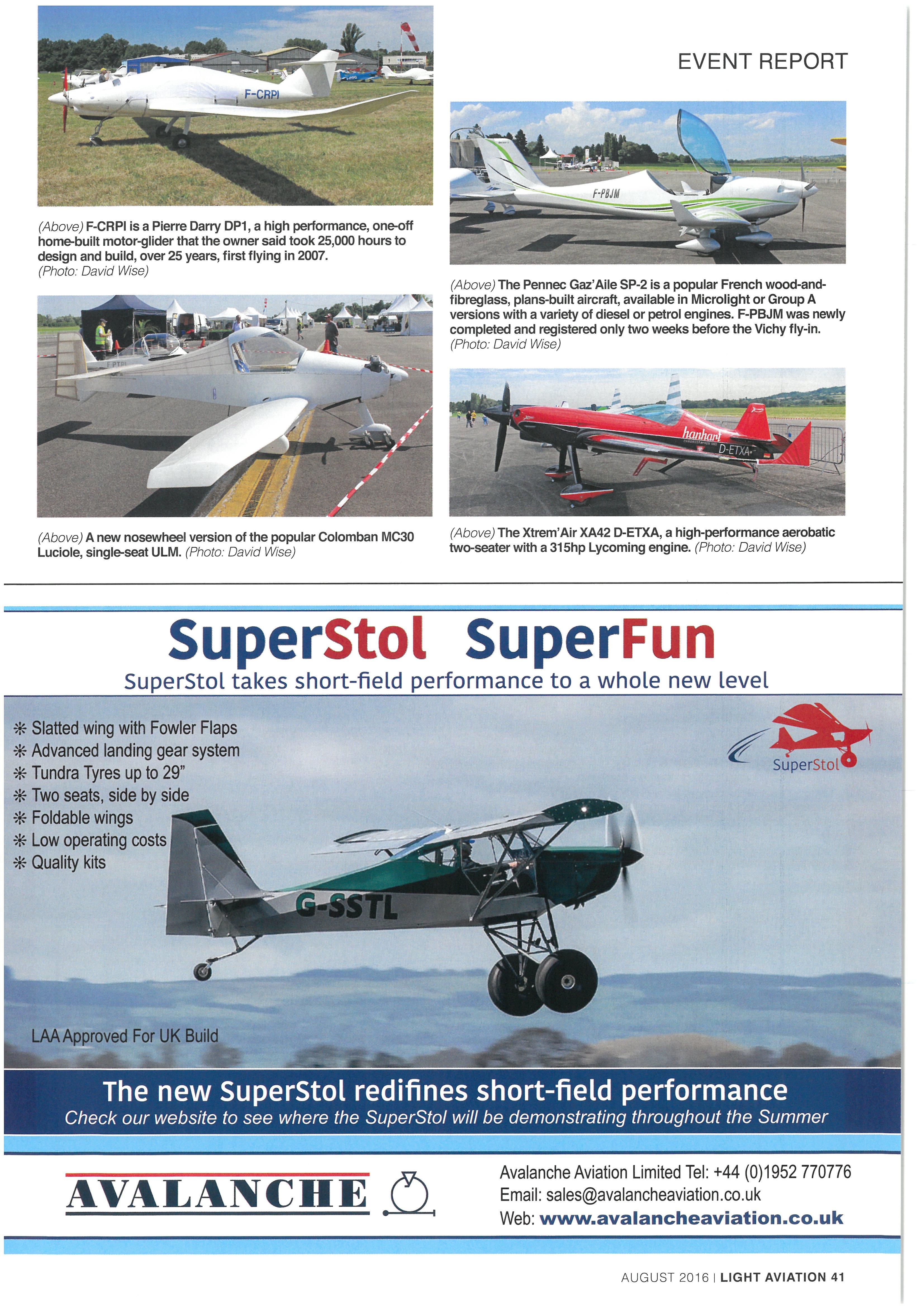
(Above) The Aviodrome, curiously, features an impressive recreation of the control tower which used to stand at Amsterdam Municipal Airport, which is now Schipol.
(Below) The De Hoop windmill in Harderwijk’s Vissershaven is a local landmark, and was completely rebuilt after being ravaged by fire in 1998.
(Below right) Portions of Harderwijk date back to the 14th century and it’s a pleasure to wander its streets, such as Bruggestraat.
government saw the benefits of promoting aviation and, among other initiatives, gave the nation’s aeroclubs useful tax breaks which enabled them to buy nice, new, French-built Robins every few years. That encouraged a healthy secondhand market of relatively new aircraft and quickly made the humble Jodel surplus to requirements, which saw many languishing unloved in the back of hangars.
Of course, we know that the reason these venerable machines didn’t end up as piles of firewood was that, for the past fifty years, enthusiastic Brits have lovingly cared for and
Flevoland
and didn't even exist when the Jodel first took to the air
been formed in 1986”
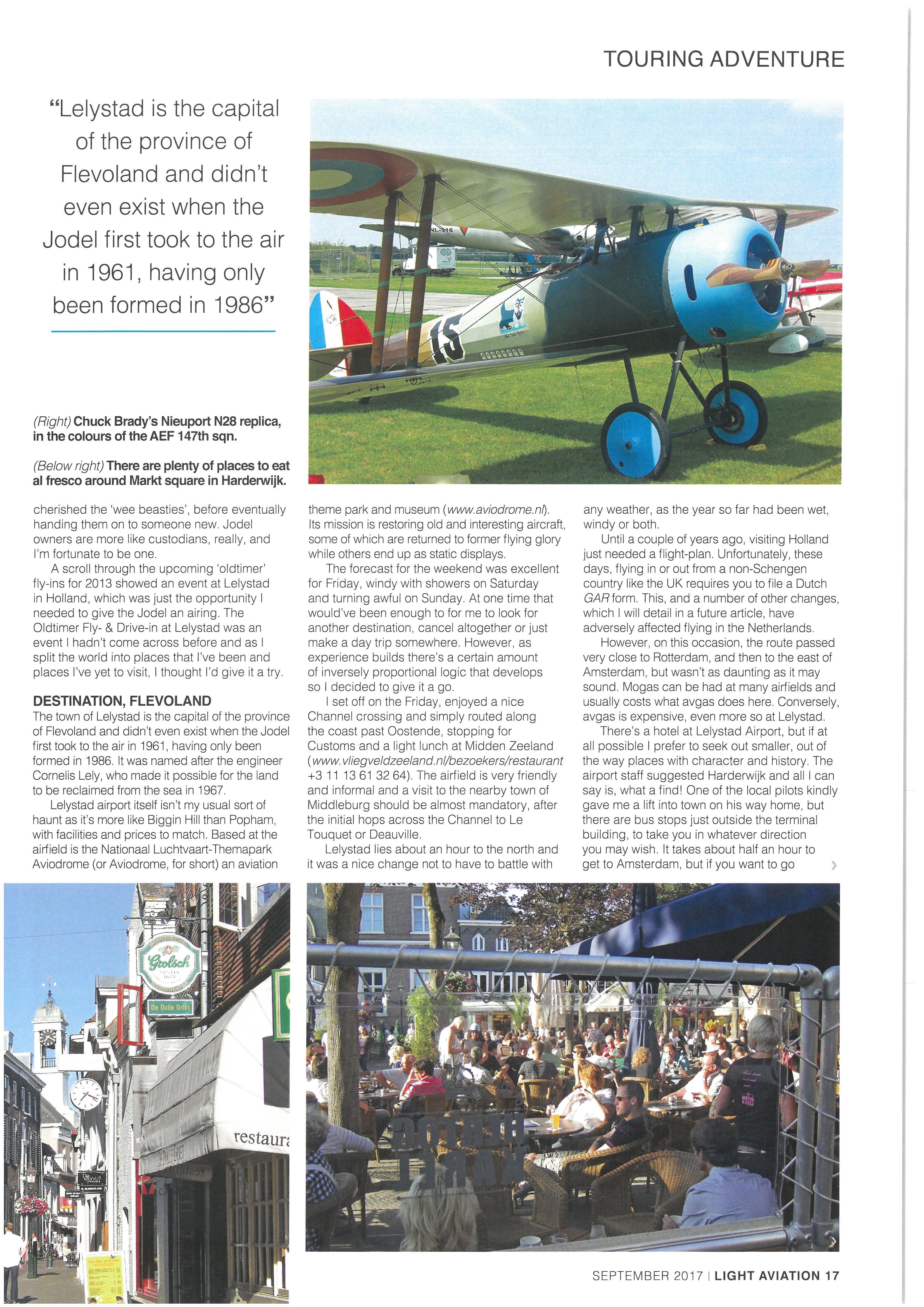
(Right)Chuck Brady’s Nieuport N28 replica, in the colours of the AEF 147th sqn.
(Below right) There are plenty of places to eat al fresco around Markt square in Harderwijk.
cherished the ‘wee beasties’, before eventually handing them on to someone new. Jodel owners are more like custodians, really, and I'm fortunate to be one.
A scroll through the upcoming ‘oldtimer’ fly-ins for 2013 showed an event at Lelystad inHolland,whichwasjusttheopportunity | needed to give the Jodel an airing. The Oldtimer Fly- & Drive-in at Lelystad was an event | hadn't come across before and as | split the world into places that I’ve been and places I’ve yet to visit, | thought I’d give it a try.
DESTINATION, FLEVOLAND
The town of Lelystad isthe capital of the province of Flevoland and didn’t even exist when the Jodel first took to the air in 1961, having only been formed in 1986. Itwas named after the engineer Cornelis Lely,who made it possible for the land to be reclaimed from the sea in 1967.
Lelystad airport itself isn’t my usual sort of haunt as it’s more like Biggin Hillthan Popham, with facilities and prices to match. Based at the airfield is the Nationaal Luchtvaart-Themapark Aviodrome (or Aviodrome, for short) an aviation
some ofwhich are returnedto formerflying glory while others end up as static displays.
The forecast for the weekend was excellent for Friday, windy with showers on Saturday and turning awful on Sunday. At one time that would've been enough to for me to look for another destination, cancel altogether or just make a day trip somewhere. However, as experience builds there’s a certain amount of inversely proportional logic that develops so | decided to give it a go.
| set off on the Friday, enjoyed a nice Channel crossing and simply routed along he coast past Oostende, stopping for Customsandalight lunchatMiddenZeeland www.vliegveldzeeland.nl/oezoekers/restaurant +3 11 13 61 32 64). The airfield is very friendly andinformalanda visittothenearbytownof Middleburg should be almost mandatory, after he initial hops across the Channel to Le Touquet or Deauville.
Lelystad lies about an hour to the north and it was a nice change not to have to battle with
any weather, as the year so far had been wet, windy or both.
Until a couple of years ago, visiting Holland justneededaflight-plan. Unfortunately,these days, flying inor out from a non-Schengen country like the UK requires you to file a Dutch GARform. This,andanumberofotherchanges, which | will detail in a future article, have adversely affected flying in the Netherlands.
However, on this occasion, the route passed very close to Rotterdam, and then to the east of Amsterdam, but wasn’t as daunting as it may sound. Mogas can be had at many airfields and usually costs what avgas does here. Conversely, avgas is expensive, even more so at Lelystad.
There’s a hotel at Lelystad Airport, but if at all possible | prefer to seek out smaller, out of the way places with character and history. The airport staff suggested Harderwijk and all | can say is, what a find! One of the local pilots kindly gavemea liftintotownonhiswayhome,but there are bus stops just outside the terminal building, to take you in whatever direction you may wish. It takes about half an hour to get to Amsterdam, but if you want to go SEPTEMBER 2017 | LIGHT AVIATION 17
theme park and museum (www.aviodrome.nl).
Its mission is restoring old and interesting aircraft,
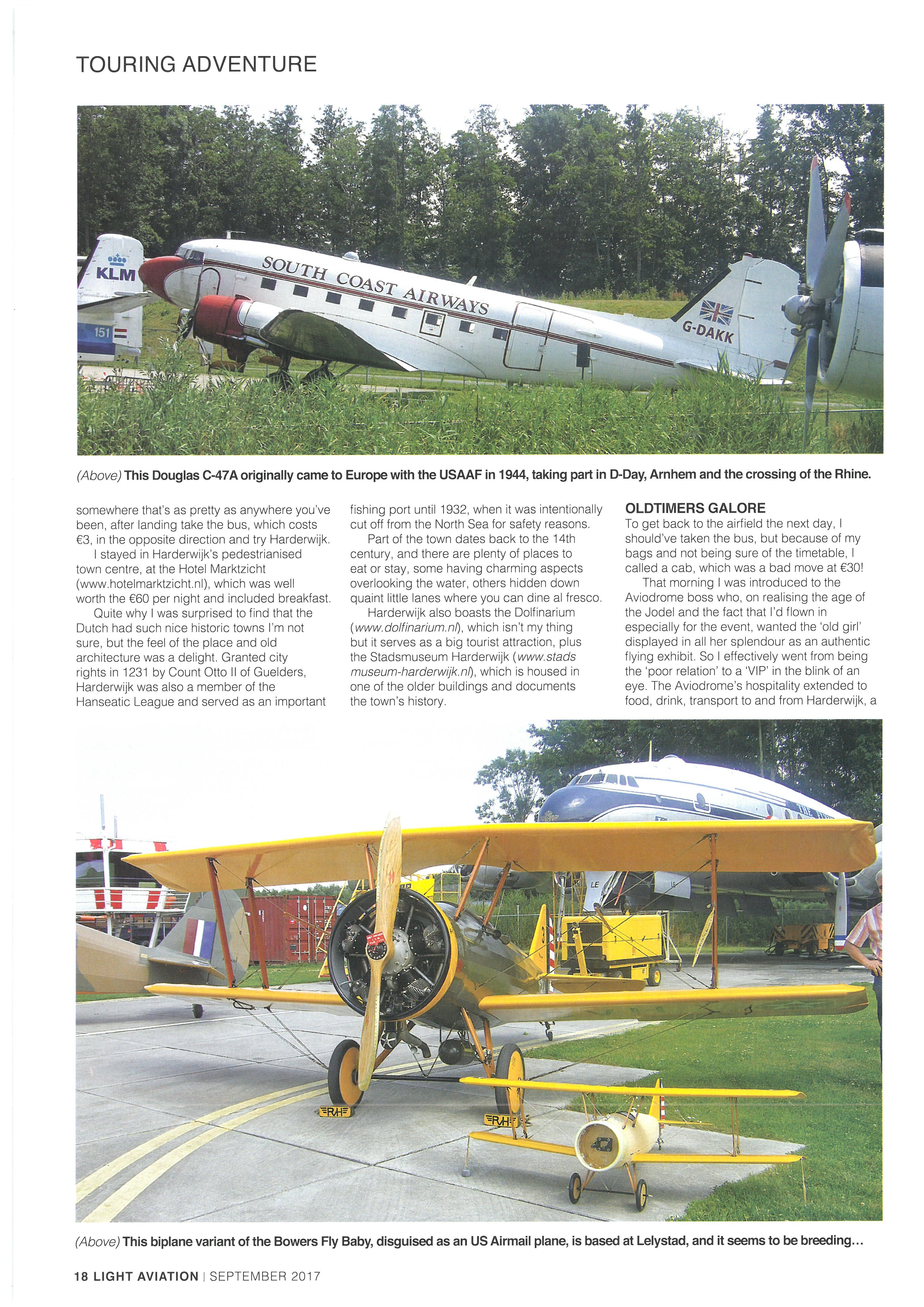
(Above) This Douglas C-47Aoriginally came to Europe with the USAAF in 1944,taking part in D-Day,Arnhem and the crossing of the Rhine. somewherethat'sasprettyasanywhereyou've__fishingportuntil1932,whenitwasintentionally|OLDTIMERSGALORE been, after landing take the bus, which costs cut off from the North Sea for safety reasons. To get back to the airfield the next day, | €3, in the opposite direction and try Harderwijk. Part of the town dates back to the 14th should’ve taken the bus, but because of my | stayed in Harderwijk’s pedestrianised century, and there are plenty of places to bags and not being sure of the timetable, | town centre, at the Hotel Marktzicht eat or stay, some having charming aspects called a cab, which was a bad move at €30! (www.hotelmarktzicht.nl), which was well overlooking the water, others hidden down That morning | was introduced to the worth the €60 per night and included breakfast. quaint little lanes where you can dine al fresco. Aviodrome boss who, on realising the age of Quite why | was surprised to find that the Harderwijk also boasts the Dolfinarium the Jodel and the fact that I’d flown in Dutch had such nice historic towns I’m not (www.dolfinarium.nl), which isn’t my thing especially for the event, wanted the ‘old girl’ sure, but the feel of the place and old but it serves as a big tourist attraction, plus displayed in all her splendour as an authentic architecture was a delight. Granted city the Stadsmuseum Harderwijk (www.stads flying exhibit. So | effectively went from being rights in 1231 by Count Otto II of Guelders, museum-harderwijk.nl), which is housed in the ‘poor relation’ to a ‘VIP’ in the blink of an arderwijk was also a member of the one of the older buildings and documents eye. The Aviodrome’s hospitality extended to anseatic League and served as an important the town’s history. food, drink, transport to and from Harderwijk, a
In addition, as an exhibitor, | had my fairly expensive landing and parking fees covered. As Baloo bear once put it, this was ‘really livin’!
The plan was to stay until around 1600 local which, with the time difference, would've got me back home in time for a takeaway curry and The X Factor. However, a weather front that should've passed through by then was moving slower than expected and sat between Midden Zeeland and Lelystad, which made me an unexpected guest in Harderwijk for a second night. The same front restricted any arrivals to the fly-in and a number of vintage Tiger Moths, Stampes and Dragon Rapides were stuck at Midden Zeeland, making me the sole G-registered representative present.
That said, there were still many interesting aircraft on display, including a replica Bleriot, a Brewster, a Fokker Dr.1 and a Sopwith Camel. You could even sit at the controls of a Douglas DC-3 and make aeroplane noises, pretending to be ferrying passengers to some far-off destination. An Antonov was giving pleasure flights throughout the day, interspersed with impromptu aerobatic displays, and the display of vintage cars and motorcycles, all lovingly cared for, were a credit to their owners.
To one side of the hangers is a reconstruction of the original control tower that had served Amsterdam Municipal Airport (now Schiphol) in the days of the fictional Hercule Poirot (yes, | know he was supposed to be a Belgian), which wasn’t quite inthe same league as Shoreham’s original Art Deco offering, but an achievement of sorts, all the same.
| spent my second evening exploring the town and fraternising with the locals. Unfortunately, the Dutch are not known for their cuisine, so simpler options are the order of the day, but | had what must be one of the nicest steaks I’ve eaten outside the US.
THE JOURNEY HOME
You may have noticed that, in this series of features, the homecoming is often filled with challenges absent from the outbound journey.
In mitigation, and contrary to generally accepted practice regarding ‘get home-itis’, I'd say that as much as one may not start a walk in the pouring rain, if it were to commence tipping it down when you were out, you'd most certainly make your way back home.
There is, in my view, a different mindset when faced with flying home in the face of certain challenges which are acceptable and that shouldn’t be confused with the need to get back regardless, to the point where your options run out.
The next day had a low overcast and didn’t start well for me a rough running engine delaying my departure significantly. On the plus side, | was loaned all the tools and help | needed to sort things out.
The TAFs and METARs confirmed the accuracy of the long-range forecast I'd seen before | left: heavy showers, strong winds and a lowish cloud base. |Insuch situations, a diversion is very likely, therefore, a lot more effort went into the flight-planning, lineson charts, time marks and particular attention was paid to diversion airfields.
The flight from Lelystad to Midden Zeeland was okay, not exactly pleasant, with quite a strong headwind, and the lowish cloud didn't really matter, as without Mode S | had to stay below 1,200ft anyway.
On arrival at Midden Zeeland, a quick check of the onward weather only reinforced what I'd seen before if anything, the ‘actuals’ were a little worse. In the futile expectation of hearing something different, | phoned back to friends whowereduetogotoa fly-inatPophamand asked what was happening? The answer was that the event had been cancelled.
| started to weigh up the options. At Midden Zeeland the cloudbase was 1,500ft and the wind 20kt across the runway, Calais was clear with 3,000ft and 25kt down the runway, while Lydd was gusting 40kt with heavy rain showers. A couple of farm strips | knew quite well and the cross runway at Headcorn were more or less into wind. That gave me enough alternates, and if | did make it all the way home, the wind would be more or less down the runway.
Due to the strength of the headwind, | chose to fill the Jodel’s tank, which wouldn't normally have been necessary. It was tempting not to, as Dutch fuel is expensive, but | urge you, given a similar set of circumstances, don't even think about it and fill up!
| wasn't exactly looking forward to the flight ahead, but with words of encouragement from a Dutch display pilot the power went in and off | went. Midden Zeeland has a wide grass runway so the crosswind on landing and take-off weren’t much of a problem.
Shortly after passing the Franco-Belgian border, | could see the English coast, which tempted me to continue. | only had one option to get around the nuclear power station at Gravelines, which is almost midway between Calais and Dunkirk, and that was out to sea, as the cloudbase was too low and it was too turbulent to go inland. Calais was in the clear and likely to be my night-stop as, even from afar, | could see that England was getting a battering. In spite of the strong wind, the Channel crossing was relatively smooth and mygroundspeedincreasedalittlefromthe 50-60kt | had been getting.
As | reached the White Cliffs, which were shrouded in grey, all of that was about to change -this definitely wasn’t the same place that inspired Vera Lynn. Getting lower and lower, | was beginning to drop options.
The cloudbase inland was too low for comfort so my own strip, Headcorn Aerodrome, and the two other options were out. Jamie Freeman, the owner of Headcorn, who was manning the radio, said that he could see the weather between us on the satellite image.
| headed back out to sea, where it was muchcalmerand|couldcollectmythoughts. | had two options left Lydd Airport may have still been possible at low-level or | could return to Calais, which was clearly visible.
By hugging the coastline and flying through the showers, | made it onto final approach for Lydd’s Runway 21. The controller, who had no-one else on frequency, couldn't have been more helpful and gave me multiple wind checks on short final, the last of which was 260° gusting 33kt. | angled directly into wind, across the runway, and after a prolonged gusty hover, my touchdown was as soft as anyone could have hoped for. With the landing out of the way, there was just the taxying to go, which any taildragger pilot can attest is often the most difficult part of a flight in gusty conditions.
The place was deserted but, luckily, the bar was open, so with the Jodel safely in the hangar and the adrenalin still pumping, it was time for a beer. Unlike most UK airfields Lydd isn’t signed up to the Strasser scheme and it
TOURING ADVENTURE
charges normal landing and parking fees for weather diversions. | was told Lydd feel that pilotsshouldplanbetter,whichseems a bit harsh, but at the time | didn’t mind too much as | was just glad to be on the ground. A couple of days later the weather improved so | collected the plane and returned it home.
I've been asked as to the wisdom of that particular flight and whether I’d | make it again in similar conditions. In hindsight, given the same set of circumstances, a diversion to Calais would’ve been more prudent, the wind down the runway notwithstanding, and the cost of staying overnight would've likely been less than Lydd’s landing and parking fees!
Touring Adventure is taking October off but I'll be back in the November issue of LA, with a visit to the Emerald Isle the lovely city of Kilkenny, to be exact.
Ifyou think that an event of yours would be of interest to LAA members and you'd like to see it featured as part of the Touring Adventures section of LA, just drop us a line via the email address shown at right. It doesn't matter whether it’s a small event at a farm strip or something much bigger, in the UK or abroad. If we can, we'll drop it in.
DUETOabitofawash-outearlierinthe year, LA editor Brian and | are planning another ‘fly-out’ to Amiens, France on 15-17 September, in order to round-off he season all are welcome to join us.
Intrepid tourers are always encouraged 0 join fly-outs and are an important element, especially when chatting to the ess experienced over the evening meal. However, we're particularly targeting hose pilots who haven't crossed the Channel before and who would like a ittle help in making that first trip.
If you'd like your name to be added 0 the mailing list, to keep updated, just email stoneacreaviation@yahoo.co.uk By the way, if you’re an avid tourer who's looking for a little inspiration, have a look at the ‘UK/Foreign Touring’ section of www.lightaircrafttraining.co.uk
MARTIN FERID is a Class Rating Instructor and Revalidation Examiner, with over 2,000 hours (roughly an even amount of tail- and nose-wheel time) and a similar split of touring and farm strip flying.
He specialises in helping qualified pilots expand their horizons. Many of his summer weekends are spent introducing UK aviators to the splendours of flying in Europe, using their own or hired aircraft. More info at www.lightaircrattraining.co.uk
If Martin can be of help with any aspects of touring or flying in general, drop him a line at stoneacreaviation@yahoo.co. uk or call him on 07958 880178.
Indeed, if you've any tips, advice or comments of your own, they'll be most gratefully received by Martin.
n Monday 23 September, 1940, 26-year-old Pilot Officer Walter Beaumont climbed into his Spitfire and took off on a sortie over the English Channel.
Some two hundred enemy aircraft, mainly Messerschmitt Me 109s, had been detected over Calais at 0900 and, nearing Dover,they were engaged by RAFfighters.At that point, PO Beaumont had already shot down eight enemy aircraftand damaged two more. However, this was to be his last sortie he never came back and was presumed shot down over the Channel. Beaumont was one of the 544 RAF pilots who lost their lives during the Battle of Britain, and their average age was 21.
| thought of Walter Beaumont and his fellow pilots when, 76 years later, to the very day, | found myself being strapped into the
A
back seat of a Mark IXSpitfire at Goodwood Aerodrome, near Chichester. was about to realise a dream |’d had since was a lad.
It's a great privilege to be taken for a flight as a passenger in a Spitfire, and one granted to very few people. This is due to the rarity of the two-seat variant there are only six airworthy examples in the UK the fact that several of those are privately owned and so simply unavailable, and the huge cost of operating these thirsty, hugely complex machines.
BOYHOOD
DREAM
As a young boy in the fifties, living a couple ofmilesawayfromRedhillAerodrome, | regularly used to watch the Tiger Moths, Stampes and Turbulents flying past our house. The Tiger Club was based there at the time, which provided an endless parade
of aircraft to fascinate a flying-mad kid. Later, when Neil Williams was practising his amazing routines in the Zlin 2526 Akrobat, used to cycle over to Redhill to watch.
Assoonas|wasoldenough, | joinedthe RAF Section of my school’s Combined Cadet Force and enjoyed my first-ever flight in a Chipmunk at RAFWhite Waltham in 1964. A gliding course at RAF Swanton Morley led to my first solo in 1965, which was followed by a successful application for an RAFFlying Scholarship in 1967. My parents paid for the additional five hours needed to complete the PPL requirement and gained my licence in 1967, at the age of seventeen, flying Alon Aircoupes, Piper PA-28 Cherokees and Fournier RF5s at Biggin Hill. Financial constraints led me into hang-gliding when it burst onto the
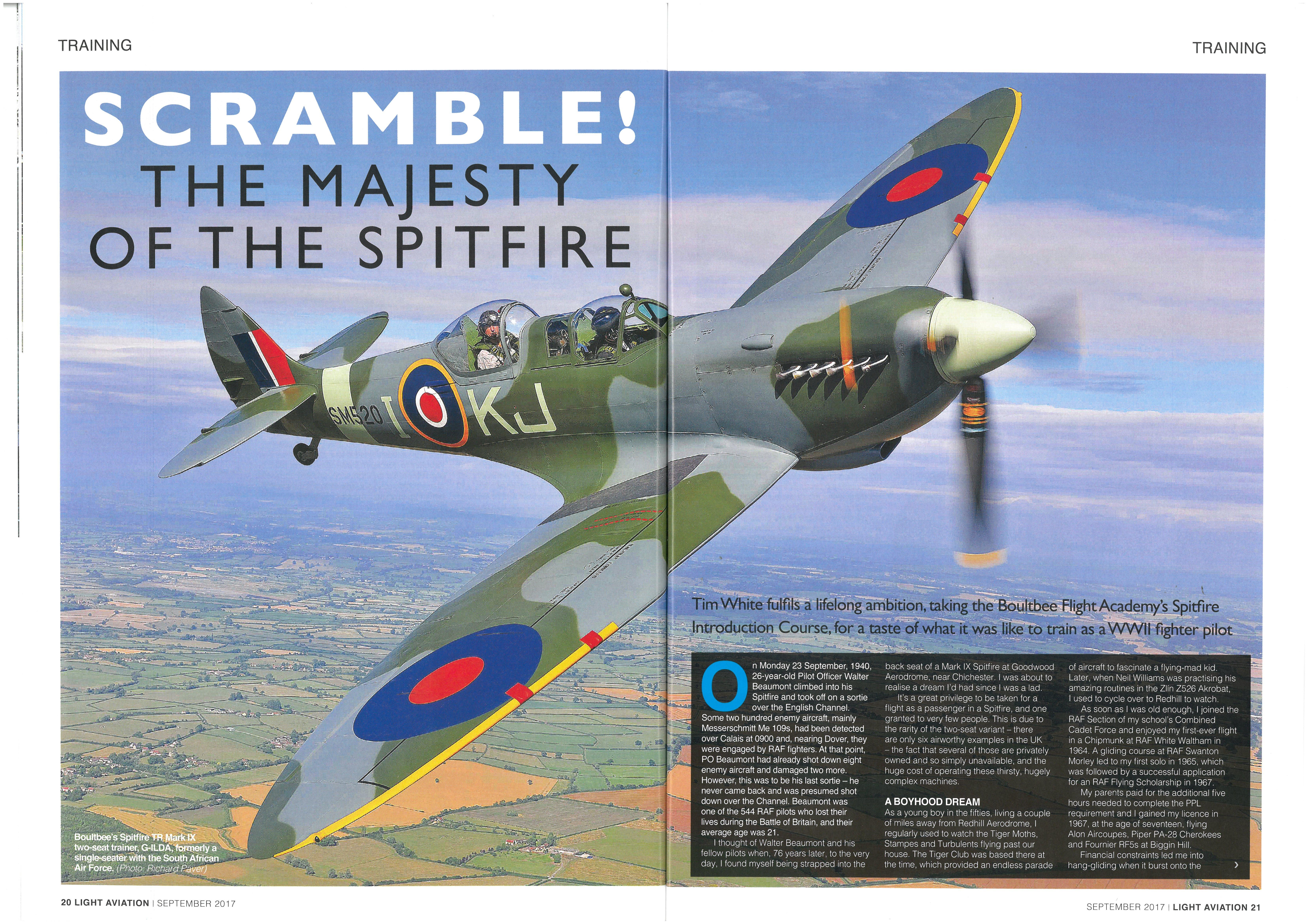
BoeSeiteeesiimiaeres Ves)liga pea 8)-WRcoveta"Bee|oey-ciCmiimeee Niaeee“AirForce.(Photo:RichardRaver)
n Monday 23 September, 1940, 26-year-old Pilot Officer Walter Beaumont climbed into his Spitfire and took off on a sortie over the English Channel. Some two hundred enemy aircraft, mainly Messerschmitt Me 109s, had been detected over Calais at 0900 and, nearing Dover,they were engaged by RAFfighters. At that point, PO Beaumont had already shot down eight enemy aircraftand damaged two more. However, this was to be his last sortie he nevercame back andwas presumed shot down over the Channel. Beaumont was one of the 544 RAF pilots who lost their livesduring the Battle of Britain, and their average age was 21.
|thought of Walter Beaumont and his fellow pilots when, 76 years later, to the very day, | found myself being strapped into the
back seat of a Mark IXSpitfire at Goodwood Aerodrome, near Chichester. | was about to realiseadreamI’dhadsince|wasa lad.
It's a great privilege to be taken for a flight as a passenger in a Spitfire, and one granted to very few people. This is due to the rarity of the two-seat variant there are only six airworthy examples in the UK the fact that several of those are privately owned and so simply unavailable, and the huge cost of operating these thirsty, hugely complex machines.
A BOYHOOD DREAM
As a young boy in the fifties, living a couple of miles away from Redhill Aerodrome, | regularly used to watch the Tiger Moths, Stampes and Turbulents flying past our house. The Tiger Club was based there at
of aircraft to fascinate a flying-mad kid. Later, when Neil Williams was practising his amazing routines in the Zlin 2526 Akrobat, | used to cycle over to Redhill to watch.
As soon as | was old enough, | joined the RAF Section of my school’s Combined Cadet Force and enjoyed my first-ever flight in a Chipmunk at RAFWhite Waltham in 1964. A gliding course at RAF Swanton Morley led to my first solo in 1965, which was followed by a successful application for an RAF Flying Scholarship in 1967.
My parents paid for the additional five hours needed to complete the PPL requirement and | gained my licence in 1967, at the age of seventeen, flying Alon Aircoupes, Piper PA-28 Cherokees and Fournier RF5s at Biggin Hill.
Financial constraints led me into hang-gliding when it burst onto the
TRAINING
aviation scene in the early seventies, after which there was along period when | didn’t fly at all. | was eventually able to revalidate my licence in 2008. Since then I’ve flown the length and breadth of the UK, and | now have a quarter-share in a Jabiru J400, based at Fishburn Airfield in County Durham.
However, like many pilots, I'd always dreamed of flying a Spitfire. For many years, unless you were wealthy enough to own one, or knew someone who did, a dream was all it could ever be. Happily, the relaxation of CAA rules a few years ago has led to the emergence of a handful of organisations offering flights in two-seat Spitfires. And those fortunate enough to already hold a PPL can actually undergo a proper training flight in a Spitfire and get to handle the controls for most of its duration.
Unfortunately, that singular experience doesn't come cheap, as Spitfires are eyewateringly expensive to operate. Nonetheless, I'd been saving up for a while when my parents, who are in their late-nineties and remember the Battle of Britain vividly, very kindly gave me the generous gift of a one-day Spitfire Introduction Course at the Boultbee Flight Academy.
TO GOODWOOD
The Boultbee Flight Academy offers a range of warbird experiences, from a simple thirty-minute flight in a Spitfire, which anyone can undertake, through to a comprehensive training course for pilots who aim to take one up solo. The Spitfire Introduction Course, which | undertook, is aimed at giving an insight into the kind of training that the young men of ‘The Few’ received back in 1940, before being hurled into battle in the Spitfire.
Of course, it’s impossible to replicate that training regime with a one-day course, but participants do get something of a feel for what it must have been like, particularly the steep learning curve involved.
Boultbee’s facilities are first-class and housed in a modern hangar, with a reception, offices, a pilots’ and guests’ lounge, kitchen facilities, etc. The lounge has a window into the hangar with views onto the apron beyond, and a door leads from reception to the hangar itself.
Everything about it displays a well-resourced, highly professional operation. All of Boultbee’s staff are clearly very committed to what they’re C it ORSar m bl ‘ey 2 a wt I 7, i \
doing, and are passionate about flying in general, and the Spitfire in particular.
One of the things I'd wondered about before going on the course was what the attitude would be towards someone like me undertaking the course. Would | be left feeling like a bit of a spare part? Or would it be so intense and demanding that a relatively low-hour PPL would find it too daunting? Inthe event, it was neither, and from the start | was made to feel very welcome.
The Academy has an extensive roster of pilot instructors, and | experienced three of them, all of whom excellent. Each managed to combine well-judged instruction with a huge element of fun. Their approach was relaxed and informal, yet they were serious about enlarging my experience and knowledge. Above all, they were keen to share the joys of flying these iconic aircraft.
THE DAY BEGINS...
The Academy had emailed me a comprehensive set of briefing informationpriorto the course, which formed the basis of the full version on the day. We started at 0800 with a two-hour briefing, which covered general safety matters, airfield information, tailwheel operations, etc, followed by a specific briefing on the Chipmunk, the first aircraft | was to fly.
In the early days of the Academy, pilots on the Introduction Course started on the Tiger Moth, which was very much in keeping with WWII ab-initio training. However, the Tiger Moth isn’t the easiest of tailwheel aircraft to fly so the
Academy shifted to the Chipmunk to ease pilots into the challenges of tailwheel flying.
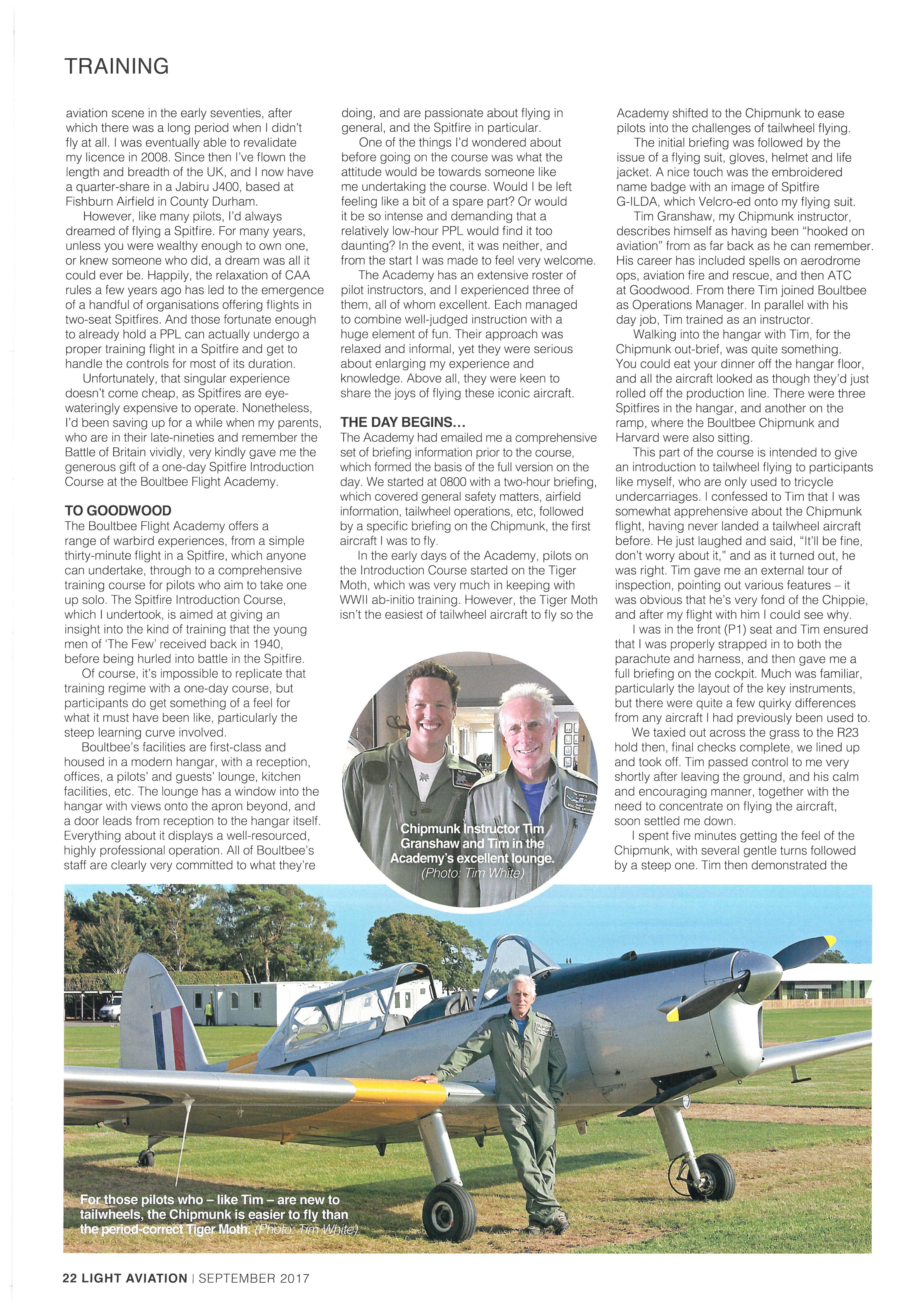
The initial briefing was followed by the issue of a flying suit, gloves, helmet and life jacket. A nice touch was the embroidered name badge with an image of Spitfire G-ILDA, which Velcro-ed onto my flying suit. Tim Granshaw, my Chipmunk instructor, describes himself as having been “hooked on aviation” from as far back as he can remember. His career has included spells on aerodrome ops, aviation fire and rescue, and then ATC at Goodwood. From there Tim joined Boultbee as Operations Manager. In parallel with his day job, Tim trained as an instructor.
Walking into the hangar with Tim, for the Chipmunk out-brief, was quite something. You could eat your dinner off the hangar floor, and all the aircraft looked as though they’d just rolled off the production line. There were three Spitfires in the hangar, and another on the ramp, where the Boultbee Chipmunk and Harvard were also sitting.
This part of the course is intended to give an introduction to tailwheel flying to participants like myself, who are only used to tricycle undercarriages. | confessed to Tim that | was somewhat apprehensive about the Chipmunk flight,havingneverlanded a tailwheelaircraft before. He just laughed and said, “It'll be fine, don't worry about it,” and as it turned out, he was right. Tim gave me an external tour of inspection,pointingoutvariousfeaturesit was obvious that he’s very fond of the Chippie, and after my flight with him | could see why. | was in the front (P1) seat and Tim ensured that | was properly strapped in to both the parachute and harness, and then gave me a full briefing on the cockpit. Much was familiar, particularly the layout of the key instruments, but there were quite a few quirky differences from any aircraft | had previously been used to.
We taxied out across the grass to the R23 hold then, final checks complete, we lined up and took off. Tim passed control to me very shortly after leaving the ground, and his calm and encouraging manner, together with the need to concentrate on flying the aircraft, soon settled me down.
| spent five minutes getting the feel of the Chipmunk, with several gentle turns followed by a steep one. Tim then demonstrated the
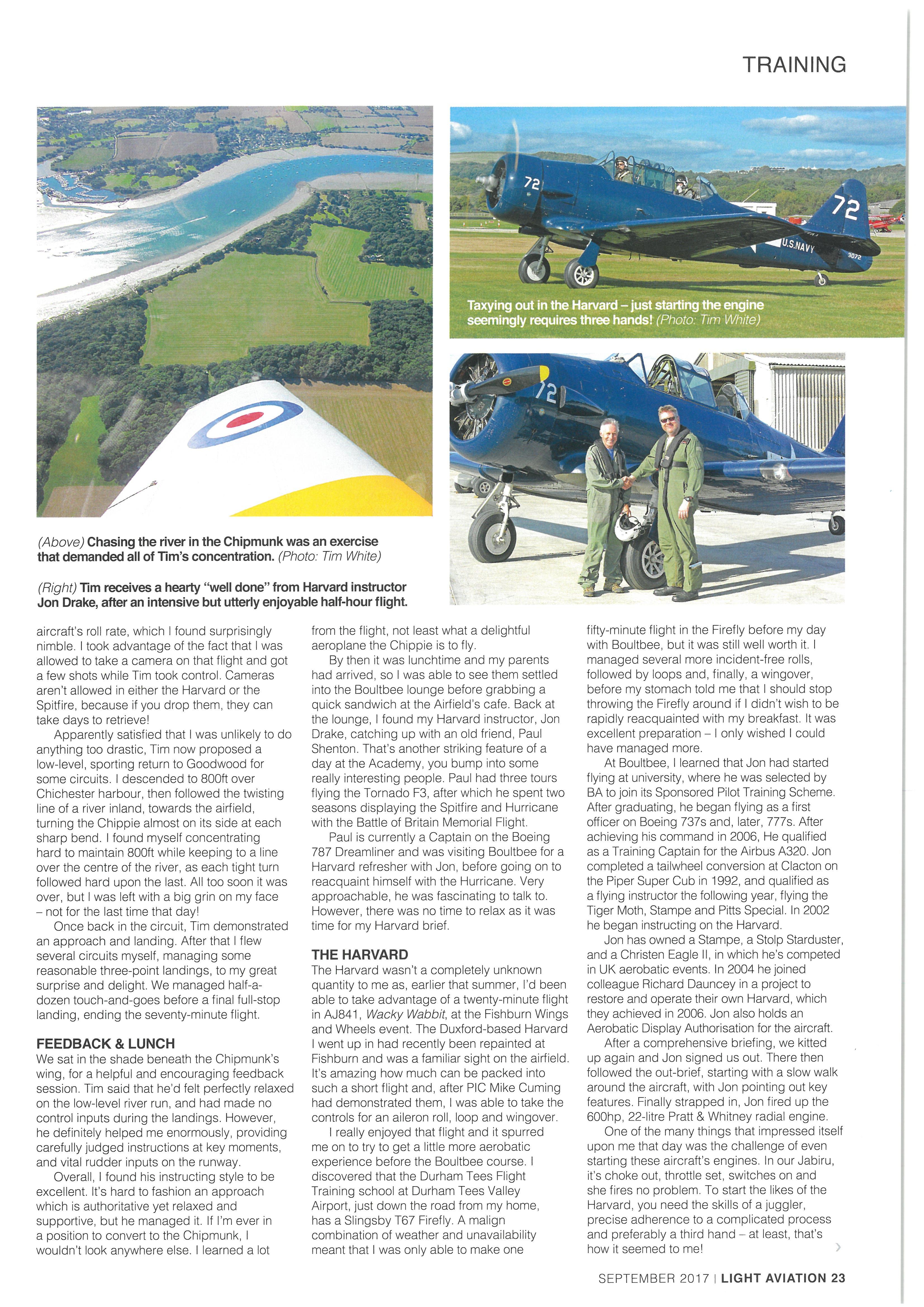
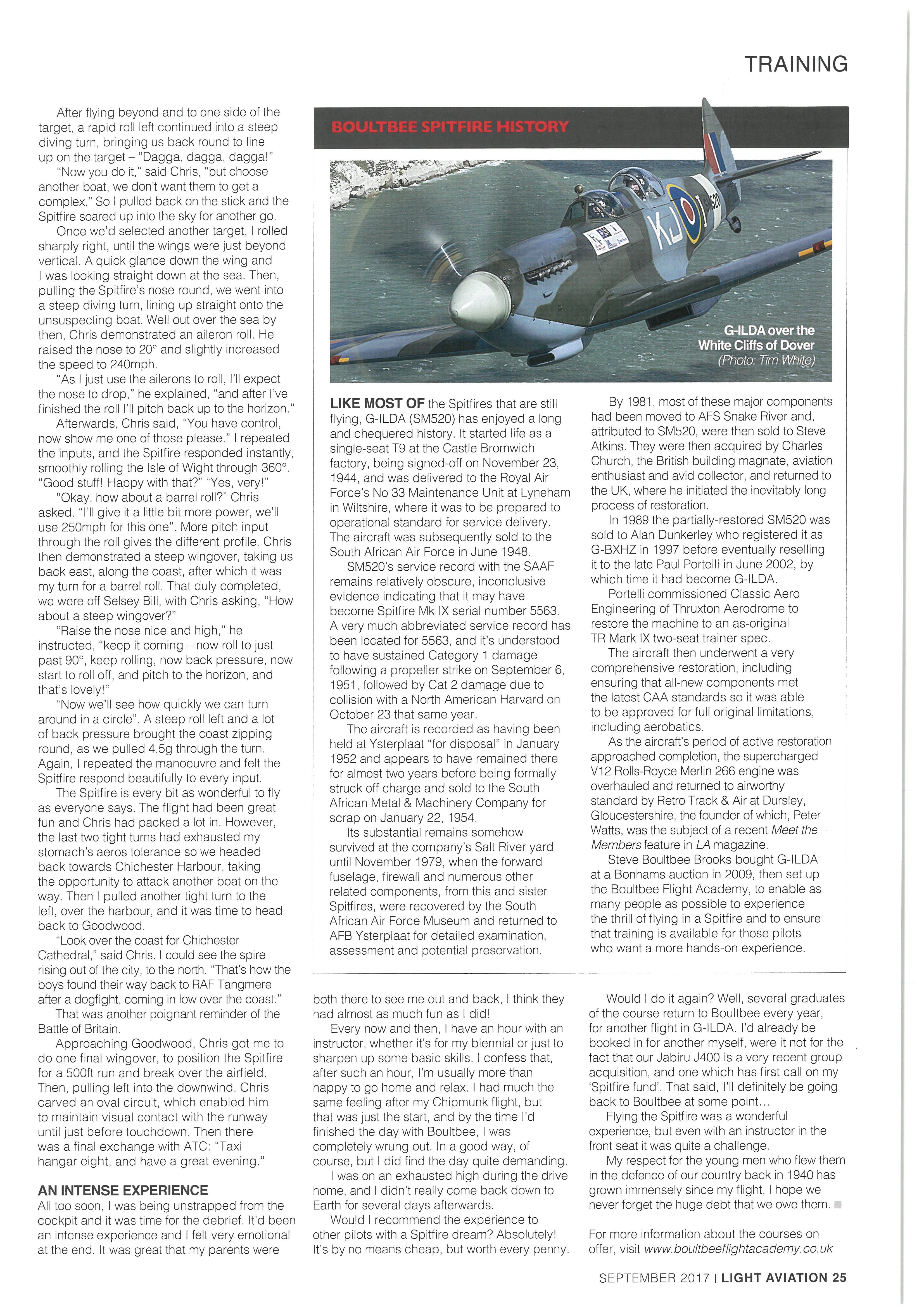
wouldn'tlookanywhereelse.|learned a lot (Right)Timreceivesahearty“welldone”fromHarvardinstructor JonDrake,afteranintensivebututterlyenjoyablehalf-hourflight.
aircraft's roll rate, which | found surprisingly nimble. | took advantage of the fact that | was allowed to take a camera on that flight and got a few shots while Tim took control. Cameras aren't allowed in either the Harvard or the Spitfire, because if you drop them, they can ake days to retrieve!
Apparently satisfied that | was unlikely to do anything too drastic, Tim now proposed a ow-level, sporting return to Goodwood for some circuits. | descended to 800ft over Chichester harbour, then followed the twisting ine of a river inland, towards the airfield, urning the Chippie almost on its side at each sharp bend. | found myself concentrating hard to maintain 800ft while keeping to a line over the centre of the river, as each tight turn ollowed hard upon the last. All too soon it was over, but | was left with a big grin on my face —not for the last time that day!
Once back in the circuit, Tim demonstrated an approach and landing. After that | flew several circuits myself, managing some reasonable three-point landings, to my great surprise and delight. We managed half-adozen touch-and-goes before a final full-stop landing, ending the seventy-minute flight.
FEEDBACK & LUNCH
We sat in the shade beneath the Chipmunk’s wing, for a helpful and encouraging feedback session. Tim said that he’d felt perfectly relaxed on the low-level river run, and had made no control inputs during the landings. However, he definitely helped me enormously, providing carefully judged instructions at key moments, and vital rudder inputs on the runway.
Overall, | found his instructing style to be excellent. It’s hard to fashion an approach which is authoritative yet relaxed and supportive, but he managed it. If I’m ever in a position to convert to the Chipmunk, |
from the flight, not least what a delightful aeroplane the Chippie is to fly.
By then it was lunchtime and my parents had arrived, so | was able to see them settled into the Boultbee lounge before grabbing a quick sandwich at the Airfield’s cafe. Back at the lounge, | found my Harvard instructor, Jon Drake, catching up with an old friend, Paul Shenton. That’s another striking feature of a day at the Academy, you bump into some really interesting people. Paul had three tours flying the Tornado F8, after which he spent two seasons displaying the Spitfire and Hurricane with the Battle of Britain Memorial Flight.
Paul is currently a Captain on the Boeing 787 Dreamliner and was visiting Boultbee for a Harvard refresher with Jon, before going on to reacquaint himself with the Hurricane. Very approachable, he was fascinating to talk to. However, there was no time to relax as it was time for my Harvard brief.
THE HARVARD
The Harvard wasn’t a completely unknown quantity to me as, earlier that summer, I'd been able to take advantage of a twenty-minute flight in AJ841, Wacky Wabbit, at the Fishburn Wings and Wheels event. The Duxford-based Harvard | went up in had recently been repainted at Fishburn and was a familiar sight on the airfield. It's amazing how much can be packed into such a short flight and, after PIC Mike Cuming had demonstrated them, | was able to take the controls for an aileron roll, loop and wingover. | really enjoyed that flight and it spurred meontotrytogeta littlemoreaerobatic experience before the Boultbee course. | discovered that the Durham Tees Flight Training school at Durham Tees Valley Airport, just down the road from my home, has a Slingsby T67 Firefly. A malign combination of weather and unavailability meant that | was only able to make one
fifty-minute flight in the Firefly before my day with Boultbee, but it was still well worth it. | managed several more incident-free rolls, followed by loops and, finally, a wingover, before my stomach told me that | should stop throwing the Firefly around if | didn’t wish to be rapidly reacquainted with my breakfast. Itwas excellent preparation | only wished | could have managed more.
At Boultbee, | learned that Jon had started flying at university, where he was selected by BA to join its Sponsored PilotTraining Scheme. Aftergraduating,hebeganflyingasa first officer on Boeing 737s and, later, 777s. After achieving his command in 2006, He qualified as a Training Captain for the Airbus A320. Jon completed a tailwheel conversion at Clacton on the Piper Super Cub in 1992, and qualified as a flying instructor the following year, flying the Tiger Moth, Stampe and Pitts Special. In 2002 he began instructing on the Harvard.
Jon has owned a Stampe, a Stolp Starduster, and a Christen Eagle Il, in which he’s competed in UK aerobatic events. In 2004 he joined colleague Richard Dauncey in a project to restore and operate their own Harvard, which they achieved in 2006. Jon also holds an Aerobatic Display Authorisation for the aircraft.
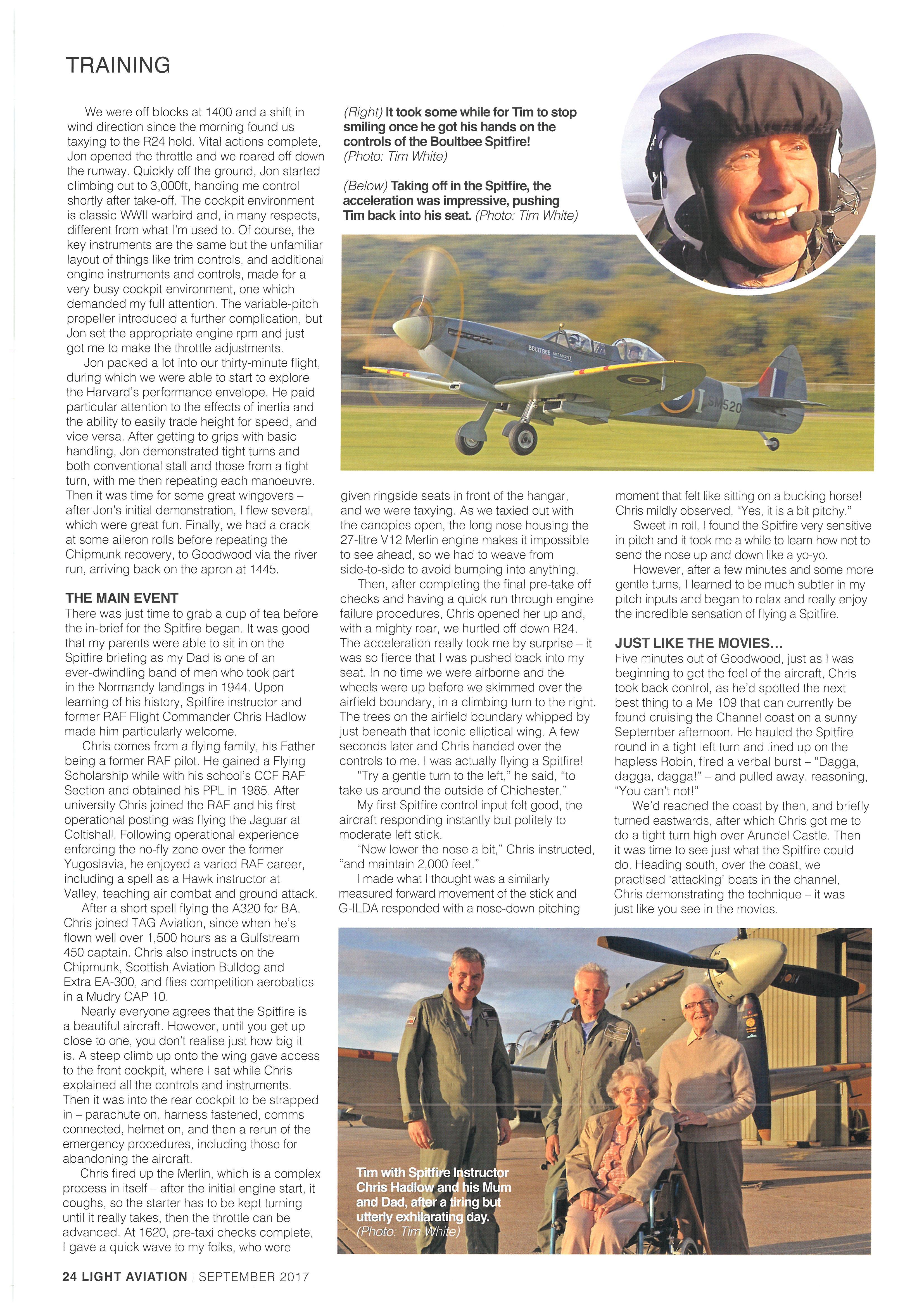
After a comprehensive briefing, we kitted up again and Jon signed us out. There then followed the out-brief, starting with a slow walk around the aircraft, with Jon pointing out key features. Finally strapped in, Jon fired up the 600hp, 22-litre Pratt & Whitney radial engine.
One of the many things that impressed itself upon me that day was the challenge of even starting these aircraft's engines. In our Jabiru, it's choke out, throttle set, switches on and she fires no problem. To start the likes of the Harvard, you need the skills of a juggler, precise adherence to a complicated process and preferably a third hand at least, that’s how it seemed to me!
TRAINING
We were off blocks at 1400 and a shift in wind direction since the morning found us taxying to the R24 hold. Vital actions complete, Jon opened the throttle and we roared off down the runway. Quickly off the ground, Jon started climbing out to 3,000ft, handing me control shortly after take-off. The cockpit environment is classic WWII warbird and, in many respects, different from what I’m used to. Of course, the key instruments are the same but the unfamiliar layout of things like trim controls, and additional engine instruments and controls, made for a very busy cockpit environment, one which demanded my full attention. The variable-pitch propellerintroduced a furthercomplication,but Jon set the appropriate engine rom and just got me to make the throttle adjustments.
Jonpackedalot intoourthirty-minuteflight, during which we were able to start to explore the Harvard’s performance envelope. He paid particular attention to the effects of inertia and the ability to easily trade height for speed, and vice versa. After getting to grips with basic handling, Jon demonstrated tight turns and bothconventionalstallandthosefroma tight turn, with me then repeating each manoeuvre. Then it was time for some great wingovers after Jon’s initial demonstration, | flew several, which were great fun. Finally, we had a crack at some aileron rolls before repeating the Chipmunk recovery, to Goodwood via the river run, arriving back on the apron at 1445.
THE MAIN EVENT
There was just time to grab a cup of tea before the in-brief for the Spitfire began. It was good that my parents were able to sit in on the Spitfire briefing as my Dad is one of an ever-dwindling band of men who took part in the Normandy landings in 1944. Upon learning of his history, Spitfire instructor and former RAF Flight Commander Chris Hadlow made him particularly welcome.
Chriscomesfromaflying family,hisFather being a former RAF pilot. He gained a Flying Scholarship while with his school’s CCF RAF Section and obtained his PPL in 1985. After university Chris joined the RAF and his first operational posting was flying the Jaguar at Coltishall. Following operational experience enforcing the no-fly zone over the former Yugoslavia, he enjoyed a varied RAF career, including a spell as a Hawk instructor at Valley, teaching air combat and ground attack.
After a short spell flying the A320 for BA, Chris joined TAG Aviation, since when he’s flown well over 1,500 hours as a Gulfstream 450 captain. Chris also instructs on the Chipmunk, Scottish Aviation Bulldog and Extra EA-300, and flies competition aerobatics in a Mudry CAP 10.
Nearly everyone agrees that the Spitfire is a beautiful aircraft. However, until you get up close to one, you don't realise just how big it is. A steep climb up onto the wing gave access to the front cockpit, where | sat while Chris explained all the controls and instruments. Then it was into the rear cockpit to be strapped in parachute on, harness fastened, comms connected, helmet on, and then a rerun of the emergency procedures, including those for abandoning the aircraft.
Chris fired up the Merlin, which is a complex process in itself after the initial engine start, it coughs, so the starter has to be kept turning until it really takes, then the throttle can be advanced. At 1620, pre-taxi checks complete, | gave a quick wave to my folks, who were
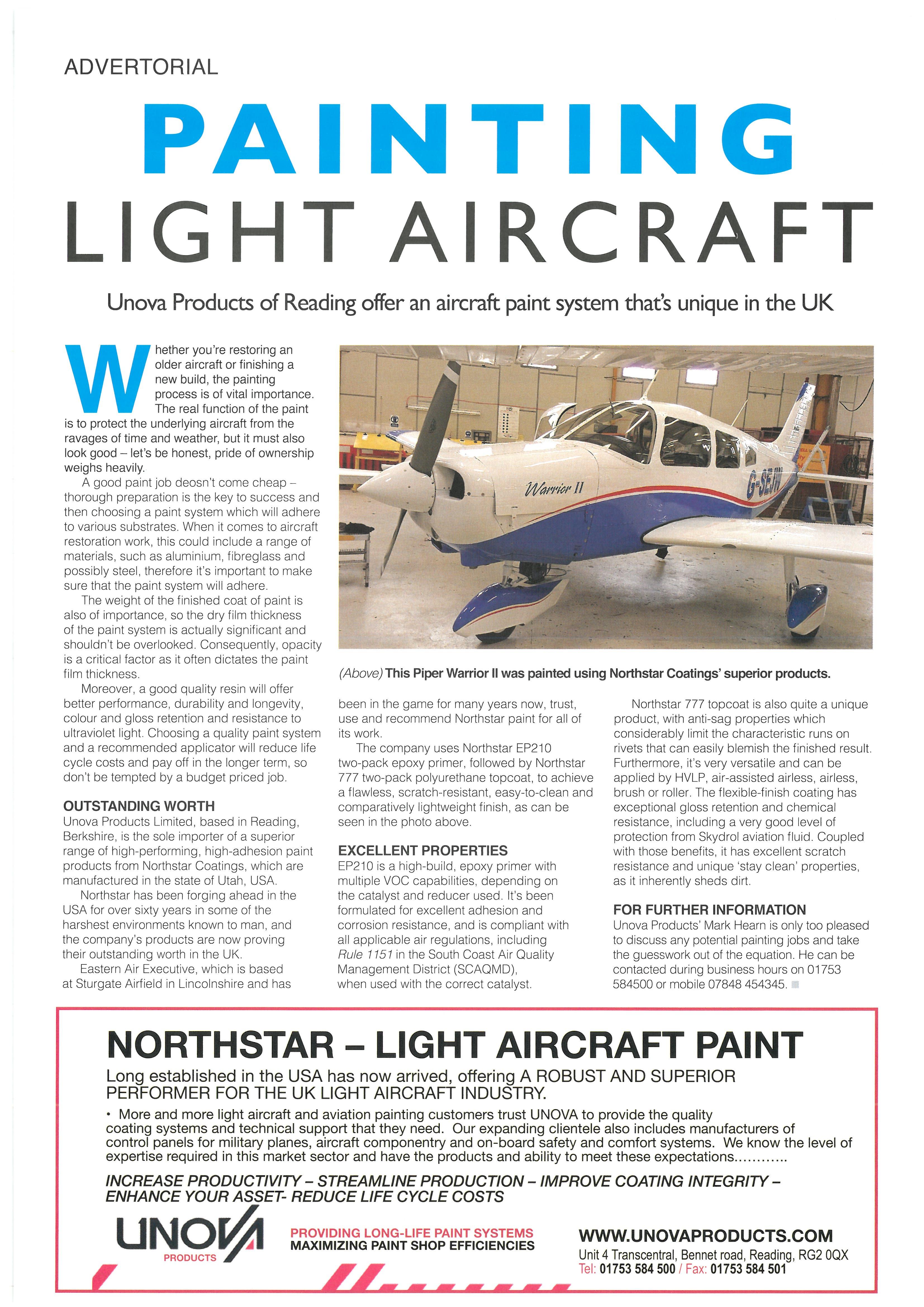
(Right) Ittook some while for Tim to stop smiling once he got his hands on the controls of the Boultbee Spitfire! (Photo: Tim White)
(Below) Taking off in the Spitfire, the acceleration was impressive, pushing Tim back into his seat. (Photo: Tim White)
given ringside seats in front of the hangar, and we were taxying. As we taxied out with the canopies open, the long nose housing the 2/-litre V12 Merlin engine makes it impossible to see ahead, so we had to weave from side-to-side to avoid bumping into anything.
Then, after completing the final pre-take off checks and having a quick run through engine failure procedures, Chris opened her up and, with a mighty roar, we hurtled off down R24. The acceleration really took me by surprise it was so fierce that | was pushed back into my seat. In no time we were airborne and the wheels were up before we skimmed over the airfield boundary, in a climbing turn to the right.
The trees on the airfield boundary whipped by just beneath that iconic elliptical wing. A few seconds later and Chris handed over the controls to me. | was actually flying a Spitfire!
“Try a gentle turn to the left,” he said, “to take us around the outside of Chichester.”
My first Spitfire control input felt good, the aircraft responding instantly but politely to moderateleftstick. “Nowlowerthe noseabit,” Chrisinstructed, “and maintain 2,000 feet.”
| made what | thought was a similarly measured forward movement of the stick and G-ILDA responded with a nose-down pitching
moment that felt like sitting on a bucking horse! Chris mildly observed, “Yes, it is a bit pitchy.”
Sweet in roll, |found the Spitfire very sensitive in pitch and it took me a while to learn how not to send the nose up and down like a yo-yo.
However, after a few minutes and some more gentle turns, | learned to be much subtler in my pitch inputs and began to relax and really enjoy the incredible sensation of flying a Spitfire.
JUST LIKE THE MOVIES...
Five minutes out of Goodwood, just as | was beginning to get the feel of the aircraft, Chris took back control, as he’d spotted the next best thing to a Me 109 that can currently be found cruising the Channel coast on a sunny September afternoon. He hauled the Spitfire round in a tight left turn and lined up on the hapless Robin, fired a verbal burst “Dagga, dagga, dagga!” and pulled away, reasoning, “You can’t not!”
We'd reached the coast by then, and briefly turned eastwards, after which Chris got me to do a tight turn high over Arundel Castle. Then it was time to see just what the Spitfire could do. Heading south, over the coast, we practised ‘attacking’ boats in the channel, Chris demonstrating the technique it was just like you see in the movies.
After flying beyond and to one side of the target, a rapid roll left continued into a steep diving turn, bringing us back round to line up on the target “Dagga, dagga, dagga!”
“Now you do it,” said Chris, “but choose another boat, we don’t want them to get a complex.” So | pulled back on the stick and the Spitfire soared up intothe sky for another go.
Once we’d selected another target, | rolled sharply right, until the wings were just beyond vertical. A quick glance down the wing and | was looking straight down at the sea. Then, pulling the Spitfire’s nose round, we went into a steep diving turn, lining up straight onto the unsuspecting boat. Well out over the sea by then, Chris demonstrated an aileron roll. He raised the nose to 20° and slightly increased the speed to 240mph.
“As | just use the ailerons to roll, I'll expect the nose to drop,” he explained, “and after I’ve finished the roll I'll pitch back up to the horizon.”
Afterwards, Chris said, “You have control, now show me one of those please.” | repeated the inputs, and the Spitfire responded instantly, smoothly rolling the Isle of Wight through 360°. “Good stuff! Happy with that?” “Yes, very!”
“Okay, how about a barrel roll?” Chris asked. “I'll give it a little bit more power, we'll use 250mph for this one”. More pitch input through the roll gives the different profile. Chris then demonstrated a steep wingover, taking us back east, along the coast, after which it was my turn for a barrel roll. That duly completed, we were off Selsey Bill, with Chris asking, “How about a steep wingover?”
“Raise the nose nice and high,” he instructed, “keep it coming now roll to just past 90°, keep rolling, now back pressure, now start to roll off, and pitch to the horizon, and that’s lovely!”
“Now we'll see how quickly we can turn around ina circle”. A steep roll left and a lot of back pressure brought the coast zipping round, as we pulled 4.5g through the turn. Again, | repeated the manoeuvre and felt the Spitfire respond beautifully to every input.
The Spitfire is every bit as wonderful to fly as everyone says. The flight had been great funandChrishadpacked a lotin.However, the last two tight turns had exhausted my stomach’s aeros tolerance so we headed back towards Chichester Harbour, taking the opportunity to attack another boat on the way. Then | pulled another tight turn to the left, over the harbour, and it was time to head back to Goodwood.
“Look over the coast for Chichester Cathedral,” said Chris. | could see the spire rising out of the city, to the north. “That's how the boys found their way back to RAFTangmere after a dogfight, coming in lowover the coast.”
That was another poignant reminder of the Battle of Britain.
Approaching Goodwood, Chris got me to do one final wingover, to position the Spitfire for a 500ft run and break over the airfield. Then, pulling left into the downwind, Chris carved an oval circuit, which enabled him to maintain visual contact with the runway until just before touchdown. Then there was a final exchange with ATC: “Taxi hangar eight, and have a great evening.”
AN INTENSE EXPERIENCE
All too soon, | was being unstrapped from the cockpit and it was time for the debrief. It'd been anintenseexperienceand|felt veryemotional at the end. It was great that my parents were
LIKE MOST OF the Spitfires that are still flying, G-ILDA (SM520) has enjoyed a long and chequered history. It started life as a single-seat T9 at the Castle Bromwich factory, being signed-off on November 23, 1944, and was delivered to the Royal Air Force’s No 33 Maintenance Unit at Lyneham in Wiltshire, where it was to be prepared to operational standard for service delivery. The aircraft was subsequently sold to the South African Air Force in June 1948.
SM520’s service record with the SAAF remains relatively obscure, inconclusive evidence indicating that it may have become Spitfire Mk IXserial number 5563. A very much abbreviated service record has been located for 5563, and it’s understood to have sustained Category 1 damage following a propeller strike on September 6, 1951, followed by Cat 2 damage due to collision with a North American Harvard on October 23 that same year.
The aircraft is recorded as having been held at Ysterplaat “for disposal” in January 1952 and appears to have remained there for almost two years before being formally struck off charge and sold to the South African Metal & Machinery Company for scrap on January 22, 1954.
Its substantial remains somehow survived at the company’s Salt River yard until November 1979, when the forward fuselage, firewall and numerous other related components, from this and sister Spitfires, were recovered by the South African Air Force Museum and returned to AFB Ysterplaat for detailed examination, assessment and potential preservation.
both there to see me out and back, | think they had almost as much fun as | did!
Every now and then, | have an hour with an instructor, whether it’s for my biennial or just to sharpen up some basic skills. | confess that, after such an hour, I’m usually more than happy to go home and relax. | had much the same feeling after my Chipmunk flight, but that was just the start, and by the time I’d finished the day with Boultbee, | was completely wrung out. In a good way, of course, but | did find the day quite demanding. | was on an exhausted high during the drive home, and | didn’t really come back down to Earth for several days afterwards.
Would | recommend the experience to other pilots with a Spitfire dream? Absolutely! It's by no means cheap, but worth every penny.
By 1981, most of these major components had been moved to AFS Snake River and, attributed to SM520, were then sold to Steve Atkins. They were then acquired by Charles Church, the British building magnate, aviation enthusiast and avid collector, and returned to the UK, where he initiated the inevitably long process of restoration.
In 1989 the partially-restored SM520 was sold to Alan Dunkerley who registered it as G-BXHZ in 1997 before eventually reselling it to the late Paul Portelli in June 2002, by which time it had become G-ILDA.
Portelli commissioned Classic Aero Engineering of Thruxton Aerodrome to restore the machine to an as-original TR Mark IX two-seat trainer spec.
The aircraft then underwent a very comprehensive restoration, including ensuring that all-new components met the latest CAA standards so it was able to be approved for full original limitations, including aerobatics.
As the aircraft’s period of active restoration approached completion, the supercharged V12 Rolls-Royce Merlin 266 engine was overhauled and returned to airworthy standard by RetroTrack & Air at Dursley, Gloucestershire, the founder of which, Peter Watts, was the subject of a recent Meet the Members feature in LA magazine.
Steve Boultbee Brooks bought G-ILDA at a Bonhams auction in 2009, then set up the Boultbee Flight Academy, to enable as many people as possible to experience the thrill of flying in a Spitfire and to ensure that training is available for those pilots who want a more hands-on experience.
Would | do it again? Well, several graduates of the course return to Boultbee every year, for another flight in G-ILDA. I'd already be booked in for another myself, were it not for the fact that our Jabiru J400 is a very recent group acquisition, and one which has first call on my ‘Spitfire fund’. That said, I'll definitely be going back to Boultbee at some point...
Flying the Spitfire was a wonderful experience, but even with an instructor in the front seat itwas quite a challenge.
My respect for the young men who flew them in the defence of our country back in 1940 has grown immensely since my flight, | hope we never forget the huge debt that we owe them.
For more information about the courses on offer,visitwww.boultbeeflightacademy.co.uk
-G-ILDA overthe White Cliffs of Dover (Photo:TimWhite)
hether you’re restoring an older aircraft or finishing a new build, the painting process is of vital importance.
The real function of the paint is to protect the underlying aircraft from the ravages of time and weather, but it must also look good let’s be honest, pride of ownership weighs heavily.
A good paint job deosn't come cheap thorough preparation is the key to Success and then choosing a paint system which will adhere to various substrates. When it comes to aircraft restoration work, this could include a range of materials, such as aluminium, fibreglass and possibly steel, therefore it’s important to make sure that the paint system will adhere.
The weight of the finished coat of paint is also of importance, so the dry film thickness of the paint system is actually significant and shouldn't be overlooked. Consequently, opacity is a critical factor as it often dictates the paint film thickness.
Moreover, a good quality resin will offer better performance, durability and longevity, colour and gloss retention and resistance to ultraviolet light. Choosing a quality paint system and a recommended applicator will reduce life cycle costs and pay off in the longer term, so don't be tempted by a budget priced job.
OUTSTANDING WORTH
Unova Products Limited, based in Reading, Berkshire, is the sole importer of a Superior range of high-performing, high-adhesion paint products from Northstar Coatings, which are manufactured in the state of Utah, USA.
Northstar has been forging ahead in the USA for over sixty years in some of the harshest environments known to man, and the company’s products are now proving their outstanding worth in the UK.
Eastern Air Executive, which is based at Sturgate Airfield in Lincolnshire and has
been in the game for many years now, trust, use and recommend Northstar paint for all of its work.
The company uses Northstar EP210 two-pack epoxy primer, followed by Northstar 777 two-pack polyurethane topcoat, to achieve a flawless, scratch-resistant, easy-to-clean and comparatively lightweight finish, as can be seen in the photo above.
EXCELLENT PROPERTIES
EP210 is a high-build, epoxy primer with multiple VOC capabilities, depending on the catalyst and reducer used. It’s been formulated for excellent adhesion and corrosion resistance, and is compliant with all applicable air regulations, including Rule 1157in the South Coast Air Quality Management District (SCAQMD), when used with the correct catalyst.
Northstar 777 topcoat is also quite a unique product, with anti-sag properties which considerably limit the characteristic runs on rivets that can easily blemish the finished result. Furthermore, it’s very versatile and can be applied by HVLP, air-assisted airless, airless, brush or roller. The flexible-finish coating has exceptional gloss retention and chemical resistance, including a very good level of protection from Skydrol aviation fluid. Coupled with those benefits, it has excellent scratch resistance and unique ‘stay clean’ properties, as it inherently sheds dirt.
FOR FURTHER INFORMATION
Unova Products’ Mark Hearn is only too pleased to discuss any potential painting jobs and take the guesswork out of the equation. He can be contacted during business hours on 01753
ne of Europe’s greatest aviation shows, La Ferté Alais Le Temps des Hélices (The Time of the Propellers) is traditionally held on the Pentecost holiday weekend, in late May or early June. It takes place in a wonderful setting, on a big grass hilltop airfield, the Aérodrome de Ferté-Alais, overlooking a beautiful tree-lined backdrop, in Cernay, which is about 35 miles south of Paris. The airshow showcases Les Collections du Musée Aéronautique Salis, which is based
at the Aérodrome, together with the Memorial Flight, which also hangars its aircraft there, and a number of other French and foreign participants. Although the show features everything from the earliest flying machines to the latest jets, it’s primarily a vintage aircraft and warbirds event.
With this year marking the Piper Cub’s 80th anniversary, it was good to see a nice formation display from five examples. Another big formation was 13 Mudry CAP aircraft featuring a range of models, from the original
CAP10 to the latest CAP 232, as flown by today’s aerobatic champions. We also saw a Stearman with a wing-walker and a lovely Beechcraft 18 display.
Joyrides in a diverse selection of types Junkers Ju-52, de Havilland Dove, Harvard, Stearman and Travel Air, plus several helicopters were also available.
This is always a truly exceptional airshow and well worth a visit next year’s event will take place on 19-20 May and you'll find more information at www.ajbs.com
(Left) The Memorial Flight delighted us with its original, restored SPAD Xil, the only example still airborne, which was flown together with its Bristol F2b Fighter, an exact replica built by TVAL in New Zealand. We'd hoped to see the Flight’s Sopwith 1-1/2 Strutter in action. However, the Sopwith’s engine was run the day before as it was due to be taken aloft, along with the Flight’s Fokker D-VII, on the Saturday afternoon but, sadly the show’s final hour was fost due to torrential rain.
(Left) The early days of aviation are well represented La Ferté Alais and this year saw a unique formation of the rotary engine-powered Pegoud Bleriot XI-2 (yes, a two-seat Bleriot XI) and the Morane H. The Bleriot is famous as the first aircraft to make it across the Channel in 1909, but less well known is that the Morane H made the inagural crossing of the Mediterranean, in September 1913, piloted by Roland Garros. For a few fly-bys, they were also joined by a Deperdussin T replica, which was powered by a more modern Lycoming engine.
(Above) A French Air Force C-160 Transall transport did a very low-level turn and, during the Friday practice, also completed a short grass landing, backtrack and take-off. | guess that the field was too soft after the rain to repeat that manoeuvre over the weekend.
(Left) Les Collections’fabulous Caudron G.Ill gave a spirited display and is always such fun to see, with its unusual configuration. The type was used by the French Aéronautique Militaire early in WWI, mainly for reconnaissance, but was withdrawn in 1916 when the Caudron’s relatively slow speed and lack of armament rendered it too vulnerable.
(Above) Duxford-based The Fighter Collection sent over its Curtiss Hawk 75, the only surviving French Air Force aircraft from WWII still flying. It’s always a delight for the crowds, who seem to hope
that itll remain at La Ferté Alais one day!
(Right) Each morning, all of the aircraft takingpartlinedupina staticexhibition and were joined by many more from Les Collections, which didn’t fly on the day, to give the public a closer look.
One of the highlights was a 1912 Donnet-Leveque flying boat replica, the first hulled type previous watercraft had been floatplanes powered by a Le Rhone rotary engine. This superb replica created by Retroplanes d’Argenteuilhasyettofly. 4
Les Collections has always owned a number of interesting WWI replicas, the best looking being this Albatros C.2, F-AZAV, which started life as a Tiger Moth! This went up together with a couple of scale SE5s, supported by Stampes and Jungmanns playing the part of WWI fighters, for a mass dogfight.
(Left) The Eastern Front of WWII was represented by four Yaks of the Normandie Niemen regiment of the French Air Force, sent to aid Soviet forces. They ‘attacked’ Les Collections’ Junkers Ju-52 and Fieseler Storch.
(Above) Hawker Hurricane P3351 is the only survivor to have flown in the Battle of France, being operated by RAF 73 Squadron at Le Mans for a few weeks before evacuating back to England on 18 June, 1940.
It was later sent to Russia, from where the wreck was recovered in the nineties, and was the first project of Hawker Restorations at Milden, being completed in New Zealand, where it flew with the Alpine Fighter Collection at Wanaka for a number of years. It’s now based in France with Jan Roozen’s collection.
The Hurricane was flown together with Christophe Jaquard’s Spitfire PR.XIX PS890, which sadly came to grief in a take-off accident a few weeks later, and was also joined in the Warbird Legends segment by P51D Mustang, Nooky BookyIV, with some spirited fast passes and aerobatics.
Onthe ‘other side of the world’, the Japaneseattack on PearlHarbourwas portrayed by a mass launch of Harvards/T-6s, one of which was converted to look like aJapaneseZero.Theformation then got together for a very impressive attack on the airfield, in Tora!Tora!Tora!style. A hapless ‘student pilot’ in a NavyN3N-3managedto escapeand a lone P40(pictured) managedto take off, from amid the burning wreckage caused by the attack. Of course, he proceededto shoot down the Zero!
(Left) America’s ‘golden age of aviation’, the thirties, was nicely represented by the Stinson Reliant, the Laird LC-B300 biplane and special guest, namely Steve Carter’s Ryan SCW (pictured), which was over from Australia and made some nice passeswith a few aerobatic manoeuvres.
Be Saetece pears: — ee DavisonfliestheHAP]CygnetSF-2A,acharacterful, oe| plans-buildAmericanSTOLaircraftdesignedbyBertSisler
PicturesNeilWilson
(Above) An external clueto the wing design isthe unusual stitch placing and the lattice of spruce strips, which is highlighted when the Cygnet sits in strong sunlight. wing constructionunder the lattice of strips provides torsional stiffness.
he HAPI Cygnet is a characterful, homebuilt, tailwheel design which has a cockpit placed for superb visibility, it being perched ahead of a forward-swept shoulder wing. It’s both comfortable to fly and has good short-field and climb performance.
Up until this year’s fly-in at Henstridge, I'd only ever seen pictures of the handful of UK examples, and here was an opportunity that | couldn’t resist. | was introduced to G-BXCA by her owner and pilot, Jan Henslow, whopromisedmeaflight.
It may sound suspiciously like an emoticon, but ‘HAPI’ is an acronym rather than the odd extraction of an adjective describing an amused and contented personality of relaxed and affable disposition. That said, the latter probably isn’t an unreasonable description of this somewhat cute and cheeky looking, plans-built American design.
Homebuilt Aircraft Products, Inc (HAPI), was established by the father and son team of Rex and Patrick Taylor in 1977, initially to design and market an aircraft kit. Instead, HAPI became a specialist Volkswagen aero engine conversion company, its primary business being kit and ready-built VW aircraft powerplants. However, the Taylors bought the rights for the Cygnet from Bert Sisler, the original designer.
HAP! ceased trading in 1989, when the engine assets were sold to Mosler Motors and Rex retired. Patrick retained the rights to the Cygnet and set up Viking Aircraft, which continues to market the plans, now as the Viking Cygnet. What’s in a name, anyway?
Born in Minnesota during 1923, Bert Sisler was training as an engineer when America entered WWII and he became a USAAF
its extensive range of wooden aircraft kits”
bomber pilot. Post-war he remained in the reserves and completed an engineering degree before commencing a career as an airline pilot. An early EAA member, Sisler was an enthusiastic restorer and builder of light aircraft, and the Cygnet, the second machine he designed, was put together around an affordable VW engine conversion and flew for the first time in 1973, although it was initially named the SF-2 Whistler.
US designers since the thirties. And justifiably so, as it’s a strong, lightweight structure the only downside, from the homebuilder perspective, being the requirement to be able to weld, a skill somewhat more alien in the UK than woodworking, or even sheet metalworking. Ply formers and stringers take care of the turtledeck form.
The empennage follows trend and is of steel tube, though using single, streamlined struts rather than bracing wires. A single, portside hinged trim tab is provided, operated by Bowden cable. The fin and rudder are fairly tall, no doubt to ensure that they’re ‘seen’ by the propwash, to provide good low-speed yaw authority.
The undercarriage consists of the tried and tested steel tube ‘tri-pod’ arrangement with bungees, as used by Taylorcraft, the Pitts Special and many others, with a conventional tail spring and steerable tailwheel.
The most interesting feature of the Cygnet is perhaps its geodetic wings, later used by the Fisher Company for its extensive range of wooden aircraft kits. The internalwing structure is fairly conventional, with simple wooden spars and plywood ribs, but the outer surface consists of a lattice of spruce strips which carry drag and anti-drag loads and torsion loads, and give the wing its form.
ANATOMY OF A CYGNET
That same year, the aircraft appeared at Oshkosh and received an award for Outstanding Design Contribution. After some minor revisions to clean up the aerodynamics, and a weight loss programme which resulted inthe shedding of 50lbs, the renamed Cygnet SF-2Awas launched as a set of plans.
The fuselage structure consists of the typical chrome-moly steel tube truss so beloved of
(Above) A rear view, notethe tall rudder and fin, and the strutbraced tailplane.
(Left)The Cygnet has conventional, ‘tripod and bungee’ landing gear with hydraulic disc brakes.
It's a lightweight, torsionally stiff structure whichenablestheuseofa singleliftstrutthat attaches to the rear of the undercarriage leg and has a supporting jury strut. The underlying crisscross lattice pattern can just be seen with head down, looking along the wing, when it’s pointed out in bright sunshine, otherwise, the slight surface contrast would go unnoticed. Differential ailerons help counter the tendency for the nose to yaw away from a banked turn and there are no flaps, a useful nod to ease of construction. The entire aircraft is fabriccovered and all controls are cable-operated.
‘Our’ Cygnet, G-BXCA, was completed in 1997 and has been owned by Jan Henslow, its third guardian, since 2008. The airframe and engine has logged 650 hours, with Jan having flown 250 of them.
When | asked how he’d come to settle on this particular aircraft, Jan commented that he had previously been flying a RansS10. Flying that aircraft solo, the pilot sits in the centre with his feet on the outer rudder pedals left foot on the left rudder pedal of the left set and right foot on the right rudder pedal of the right set it was, and probably still is, twitchy. The Rans was also a bit cramped two-up, and it was his wife who, having flown in an Icarus, asked why he didn’t get himself a proper aeroplane! Jan keeps the Cygnet on his farm.
Before all of this, Jan was in Papua New Guinea, as a member of Voluntary Service Overseas. There, aged 22, he logged many flights in and out of strips in Islanders, and when he came home, headed off to Canada and gained his CPL, with the intention of converting it to a CAA qualification.
Jan built his hours as a local parachute pilot but his family business, strawberry farming, began to demand an increasing amount of his time, the ‘pick your own’ aspect making his working life ever-more demanding.
However,Janstarteda striponthefarm and, as part of a unique rental deal, flew an Aeronca Chief, and a couple of Austers. He’s also been paragliding for eighteen years which is, in his mind, the closest thing to being a bird.
enueemia:ale)a| ~-farfromtheleadingedge,which*°=". provides a superb.outlook!
FLIGHT TEST
ROTAX-POWERED
This particular Cygnet is somewhat unique in that its original builder, Gerry Collard, eschewed the VW and fitted an 8Ohp Rotax 912UL,whichprovidesalittle morepower than the typical VWWconversion and saves around 30lbs in weight.
The resulting need to move the Rotax forwarda littlealsoprovidesforexceptionally good access to the engine for maintenance. The radiator is fitted beneath the engine, ina somewhat draggy looking ‘box’ that protrudes below the cowling line. A ground-adjustable, two-blade Warp Drive prop is used.
Sitting inthe Cygnet’s cockpit, the pilot and passenger have one of the best forward aspects you could wish for. The 14” forward sweep of the shoulder wing puts the occupants much closer to the leading edge, and the eyeline is well above the shoulder-located wings. In effect, you almost get the best of both high and low-wing layouts.
The fuel tank is directly behind the cockpit, where you might expect the parcel shelf to be, but baggage space is provided beneath it, to the rear of the seat backs. The fuel capacity is 57 litres, giving around four hours’ endurance with no reserve. With the tank being located on the centre of gravity, there’s virtually no trim change as fuel is used.
The fuel quantity indicator for both ground an in-flight attitudes is a sight tube on the forward face of the fuel tank, against an alternating black and white, diagonally striped back plate. What | thought an inspired idea is that, alongside the quantities, there’s the maximum weight in stones for a passenger who may be carried, eg 40 litres and 12% stones (168lb/76kg).
For our flight, the indication of 35 litres on the ground meant that | was, at 11 stone
G-BXCA sits squat to the ground notethe radiator protruding from beneath the cowling.
Albs (72kg) a full 21lbs (9.5kg) below the maximum allowable weight.
| carefully unlatched the unusual, centrallyhinged, forward-folding split-screen and made sure the headset and straps are tidied away and not where | needed to step onto the seat.
You have to enter the cockpit from the front of the wing, so you face the rear of the aircraft and support yourself with one hand on the leading edge, as you raise your left foot onto the fuselage step, push upwards and swing around to face forward and lift your right leg over the sidewall, onto the seat squab, hopefully managing not get your trouser hitched up on the control stick. It sounds rather more awkward than it actually is. The passenger will need you to close your half of the canopy to enable them to open theirs fully and climb aboard.
The seating is firm but comfortable, having two back cushions for lumbar and upper-back support. Four-point harnesses with circular ‘twist to lock and unlock’ latches are installed.
| quickly found the sometimes-elusive headset plugs on the extreme edge of the black instrument panel, next to the windscreen latch. There too are the ventilation louvres, one per side, which can be directed onto a hot face. On the P1’s side is the red master and combined alternator switch, with the magneto key beneath it. Above the master switch is the starter, to be pulled out and up, but for the first start of the day, the chokes have to be pulled out. Chokes? Yes, oddly there are two, one for each carburetor because the cable routing proved awkward for a single control.
To the right is the fuel selector and the supporting, easily understood graphic of an arrow head for ‘off’ and a vertical for ‘on’. The black-knobbed throttle is central, within easy arms’ reach of each occupant.
As the engine is cranked and the propeller blurs, the red ‘starter engaged’ light illuminated briefly and the oil pressure dial sited on the right-hand side reassuringly rose into the green sector. The supporting instruments nearby showed the oil temperature about to climb, the rom, volts being generated and the coolant’s increasing temperature state. The Hobbs, within this right-hand cluster, started to register engine time, and there’s a small digital clock to the left of the rom gauge.
Near to the right-hand louvre are switches for the strobe and the avionics, with the appropriate circuit breakers below. The slim VHF Icom was turned on and the intercom volume and squelch adjusted. Good two-way comms was soon apparent and the cockpit was no noisier than many others with the same engine.
Directly in front of the pilot are the four instruments to inform about the aircraft’s progress, namely the ASI, in knots and with a red mark for the stall at 43 and the Vne of 140; the turn and slip; the altimeter; and the VSI. There’s also a small red warning light, hopefully to grab your attention should the oil pressure dip below acceptable, and below that is a similar low-voltage warning light. A Garmin 206 GPS is hung below the lower panel’s support tubing, it being retroactively positioned for Jan to operate and monitor.
There’s a panel-mounted rocker switch for trim that’s almost central, thus allowing pilots from either seat to reach it. | have to admit to a problem with such switches, in as much as they don’t impart any ‘feel’ in the system. To be honest, I’d be more amenable to them if | could remember which way they worked - | invariably press the wrong side for the result I’m looking for, a hang up from playing a computer flight game which used counter-intuitive trim buttons. I’m
FLIGHT TEST
sure any normal person won't suffer this annoyanceI'venotroubleoperatinga stick-mounted ‘hat’ type or rocker as these work ‘naturally’ for me. There are left-hand seat (P1), toe-operated hydraulic disc brakes and a right-hand, side panel-mounted park brake.
The view above and around the engine and the gulf of the horizon’s sweep from behind the wing and across the open, unobstructed sky is wonderful. My immediate reaction was that, for a light, homebuilt aircraft, the forward view is absolutely superb! We both sat high, with the cowling nowhere near intruding upon or masking the horizon. Wending our way to the hold leaves no obstacle unseen as the view forward is better than many nosewheel types.
THE CYGNET ALOFT
Jan did the initial take-off and | was to do some circuit work upon our return. There was no rush to get the tailwheel off the ground, and from the acceleration in the two-point attitude, running along on the mains, it was hard to feel the length of roll as she rose gently from the ground. Such is the skill of a chap who knows his aircraft.
The wind was light and the take-off roll was short, at around 175m. She climbed well at 7Okt and we quickly caught up with the photo ship, a Tiger Moth.
| took control and placed the Cygnet for pre-arranged positions and attitudes, down-sun. | remarked on the ease of
control and its ability to both break, regain and maintain formation.
We had both a good turn of speed, with 9Okt at 4,600rom, and more when we needed to close up to the camera after a break away. Having been waived away, with Neil calling ‘it’s a wrap’, | couldn't help but play further, showing our relative speed to the Tiger Moth at 80kt.
Becoming a grown up again, | investigated the stall, with the speed slipping away as we held height to gain height as speed is lost gives a more dynamic wing drop but isn’t a true representation of the aircraft's manners. | got to 47kt before the onset of the stall | could hear a rather attractive tweeting and wondered where it was coming from.
|_Asimple, basic panel, which is quiteclose lo theoccupants but
Jan smiled and said that was the stall warner. Unexpected!Therewas a lightflutterthrough the stick as the inboard wing sections lost their flow, disturbed air playing on the deflected tail feathers. The nose settled lower at the g-break, and having watched for five seconds or so without any imminent disaster, she promptly recovered with a standard stall recovery stick forward, power on and balancing rudder.
After clearing the sky again, | commenced a 30° banked climbing turn, allowing the speed o bleed off and made no attempt to maintain balance with the rudder. Both to the left and right, G-BXCA shrugged her shoulders after he twittering started and rolled to wings-level.
At that point, the stick was simply eased orward and normal service was resumed. However, be warned. In test at high altitude, he Cygnet’s impeccable manners seemed o make it almost stall-proof, but one should never rely on such benign characteristics at ow altitude or when under pressure even he most benign aircraft have a tendency to ‘bite’ in a critical situation.
Whether through wind-shear effects, different loading, slight changes in rigging, sudden throttle opening, the timing of the control inputs or whatever, over the years untold numbers of aircraft that seemed ‘oussy cats’ when tested at a safe height, have been lost to low attitude stall/spins, often with fatal consequences.
The game of accelerating from low to high speed and back again, without gaining or losing height, is a way of finessing your own
Clive found the Cygnet to be“beautifullycontrollable”.
control inputs, while honing your skills and learning about the aircraft's responses. G-BXCA was a delight here she proved beautifully controllable. With the ups and downs of induced phugoids, the trimmed speed returned was to in three cycles, with a 100ft gain.
Side-slipping at the approach speed of 6Okt, from the attitude of right wing high and right rudder, when the stick was released the left wing rose only slowly. But it did rise.
The same was true with the left wing high. So, marginally stable there, but she’s directionally stable with the nose swinging back into its rightful place, pointing ahead from both left and right slips when the rudder was freed, let go from near full deflection.
We also flew her straight and level for a while, with the engine developing 4,600rpm and burning around 15 litres per hour for a 9OKt cruise.
APPROACH AND LANDING
Ona tailwheelaircrafttheslowspeedand its attitude can be aided by using the nose against the horizon. During the round out, as the speed decays, the nose attitude can help judge the three-point attitude, to allow all three wheels to kiss the runway at the same time.
Back in the circuit and approaching at 60kt, | was soon to confirm something that | suspected. With the nose being fixed so low, as|flared itstillremainedbelowthehorizon, with the result | went for the standard stick fully aft technique. Mmmm... well, the elevators are very effective and | touched tailwheel first. On the next attempt, the stick
wasn't brought all the way back and she landed well.
So, what did | think of the Cygnet? | was wholeheartedly won over by her qualities and thoroughlyenjoyedmyhourflyingwithJan. | think the view from the cockpit is outstanding and she was delightful to fly around the Tiger Moth camera ship. She also taught me about her low nose attitude in the flare. Thanks, Jan, dodropinagainforcoffeeandbiscuits.
HAPEEYGNET
GENERAL CHARACTERISTICS
Crew Two
Length 19ft (5.8m)
Wingspan 30ft (9.1m)
Height 5.8ft (1.8m)
Wing area 125sq ft (11.6m2)
Airfoil NACA 3413
Empty weight 585lb (265kg)
Gross weight 1,100Ib (499kg)
Fuel capacity 15USg (57 litres)
Powerplant 80hp (60kW) Rotax 912UL
PERFORMANCE
Vne 135mph (217kph)
Cruise speed 100mph (161kph)
Stall speed 48mph (77kph)
Range 390 miles (628km)
Rate of climb 580fpm (2.9mps)
his year marks the 70th anniversary of the founding of the French homebuilders’association, Le Reseau du Sport de |l’Air(RSA), and its annual rally once again took place in central France, at L’Aéroport de Vichy-Charmeil.Although, due to storms being forecast, there were relatively few arrivals, around 175 in total, there was still much to see.
Among the overseas visitors, the list was uniquely headed by fourteen Italians, as that nation was targeted for special attention at
this year’s event, closely followed by Britain with thirteen attendees.
Many aircraft departed on Saturday afternoon, and the storm duly arrived at about 1830 local. Prolonged rain with thunder and lightning, and wind which the tower reported had gusted over 50kt, caused havoc to the exhibition and catering units, and one ULM (microlight) broke free of its tie-downs and was destroyed. Fortunately, quick action by RSA officials and helpers managed to restrict further aircraft damage to a minimum.
One of two amphibious floatplanes that
(Left) If you think that it looks like a straight-winged Robin then you’re right! The Oceanair TC-180 is home-built design by Tissot and Charbonnier, based on recycling the fuselages of scrapped Robin DR300 or 400s. So far thirteen have been completed and more are underway. This example, F-PHMI,was built with modified controls for a handicapped flying group.
(Photo: David Wise)
(Main)
utilised the landing slots on the Allier River in Vichy’s town centre was Piper Super Cub F-HHMB. (Photo:David Wise)
SlattedwingwithFowlerFlaps
TundraTyresupto29”
Twoseats,sidebyside
Foldablewings
Lowoperatingcosts
Qualitykits
(Above) The Pennec Gaz’Aile SP-2is a popular French wood-andfibreglass, plans-built aircraft, available in Microlight or Group A versions with avariety of diesel or petrol engines. F-PBJMwas newly completed and registered only two weeks before the Vichy fly-in.
Wise)
(Above) F-CRPIis a Pierre Darry DP1,a high performance, one-off home-built motor-glider that the owner said took 25,000hours to design and build, over 25 years, first flying in 2007.
(Photo: David Wise)
(Photo: David
SuperStol
he project is moving apace and the finishing line is looming large on the horizon! There’s been a great deal of visible progress on several fronts, and | needed to be really well-organised during August, to ensure that my self-imposed deadline for completing the project, namely the LAA Rally, doesn’t arrive without a finished panel in the RV. By the time Rally-goers read this, you’ll know if | succeeded!
(Above) The superb quality and accuracy of the laser-cut panel meant that everything fitted perfectly.
Fig 1The ‘production diagram’, which clears the clutter and provides the fundamental information that’s required.
WIRING
On the wiring side of things, the final drawings are completed, to enable the making of the harnesses. This needs some explaining, as when | talked about wiring diagrams, little was said about what | call the ‘production drawing’. In my third instalment (LA July 2017), | reproduced a Garmin drawing showing the interconnects for main and backup power of the G8xX,with the intention of offering a general
may be made with ruler
number of available
insight into the presentation and workings of modern avionics. The drawing reflected the way that Garmin and other manufacturers represent their equipment and shows all the possible permutations, which more often than not are well in excess of any single application.
That drawing shows the correct way to interconnect the various elements of a system. However, to actually translate it into real wiring, and taking into consideration the cost of getting things seriously wrong, | chose to introduce another step, which | call the production drawing (Fig 7,opposite page) and that relates to the power connections shown in my third instalment (reproduced here again, for your convenience, as Fig 2, at right).
The reason for the production drawing is twofold. Firstly, it doesn’t feature the connections which don’t appertain to my project, so when making the harness it removed any sources of distraction, allowing the process to be executed in a single-minded way, unencumbered by considerations of the ‘bigger picture’. Secondly, with its ‘top to bottom’ format, Fig 1dramatically lowered the chances of me missing an important connection and pertinent details, such as the wire gauge, which is clearly marked next to the relevant connection.
The production drawing may either be made the old-fashioned way, with ruler and pencil, or created using a number of available software packages. The weak spot of this process is the data transfer from the original Garmin diagram to the production drawing, when a second pair of eyes becomes more than just a good idea.
HARDWARE & DOCUMENTATION
On the metal front, as can be seen from the opening picture, the new panel’s been made and the initialtrial fitting was successful. The accuracy of the laser-cutting was phenomenal and that made the experience hugely satisfying.
On the documentation side of things, much has been done and learnt. Starting on the learning side, | have found people from all sides of the LAA (directly or indirectly) with a genuine enthusiasm to help this project succeed. This isn’t the first time I’ve found sucha situation.Whenpreparingformyround the world flight, once the PFA(as the LAA was then known) recognised that |wasn’t just yet
GEA24 p2at GEA24
ARORAFTPOWER 1|7 2 mA POWERGROUND | 6 " POWERGROUND | 9 2 2 P244 DISCRETEIN*Pao<2 SEE NOTE 14
TewIBBS—12V—4AH
(ED=
Tow _IBBS
MANRAIRCRAFT BUS | 1 30 70 TOMAINBUS WAINAIRCRAFT BUS | 6 : AUX CHARGE
AKBATTTRICKLECHARGE | 2 bp coerceReo 2 TOBATTERY+TERMINAL
BACK-UP POWER OUT| 8 20
BACKUPROWER:OUT|gnM ll BACK-UPMASTER
BACK-UPPOWERMASTER | 4 O TO WAN BUS
Fig 2The Garmin diagram giving the information on how the components interconnect. = }
another aimless nutter (rather one who meant business), a fantastic amount of support was given, for which | was most grateful. That support was essential for theeventual success of my circumnavigation.
It isn’t unusual to find LAA members who, to a degree, resent the regulatory and overseeing aspects of our Association, especially when compared to the freedoms available in the US system. The LAA’s capacity for processing mods is limited and may not have kept pace with the expansion of its fleet, but the recent
development of introducing Night/IFR assessors to bridge the gap between our Association’s staff and the membership has to be a good thing | just hope the process is an expeditious one.
Do believe me, the willingness is there and doubters will find much help is forthcoming from cooperation as opposed to confrontation at the end of the day, the LAA system is there to keep us flying safely and the folk at HQ are enthusiasts too, and very much onside.
If you've any questions, please email meviaavionicsmq@gmail.com s, We hope you were able to meet the author of this article at the
ello again and welcome, surely this can’t bethe September edition of Safety Spot already? Yes,the nights are winning over the days and I’ve had to resort to a jumper, even though it’s only August. What a wet time we’ve all had, but in between the low pressures there have been some great flying opportunities at least we haven't had to suffer anticyclonic haze! | normally take the last two weeks in August off and this year I’m hoping to do the same, although |wouldn't describe continuing the rebuild of my old boat as exactly a holiday, in the normal sense of the word. |’m actually looking forward to getting back ‘on the tools’ —achap can, after all, only take so much of a computer screen.
Having replaced my boat’s engine and most of its supporting structure, my next job is to refit the interior ‘furniture’; | reached a seminal point in this exercise just this morning, as | applied the very last coat of varnish onto the chart table. Varnishing has been keeping me busy, mornings and evenings, for the last few months so I'll be glad not to hear the alarm at 5.45 am, reminding me that it’s time to apply yet another coat before heading off to LAA HQ.
(Above) It doesn’t matter how well a pilot performsa forcedlandingintoafield, there’s always risk attached. In this case, the very experienced flyer did everything right after his engine seized, and we discuss why this happened on page 46.
What this pilot couldn’t know was that the field he chose featured the remnants of a MiddleAges ploughing practice known as ‘ridge and furrow’. As you can see, this Europa has separated just forward of the main (single) wheel as it hit the front face of a ridge on landing.
(Photo: TimHoulihan)
Those of you who are fortunate enough to have built your own aircraft, boat, car or motorbike will know that the process rather tends to take over your life, and one realises very quickly that the only way that a project is going to reach a launch date is by organising your life around it.
I’ve been trying to do something on the boat every day, even if it’s only a small task, that’s why both of my spare bedrooms resemble a workshop. | regularly give thanks for an understanding partner.
ENGINEERING-RELATED ERRORS & CARBON MONOXIDE
Thismonth’sSafetySpotfocusesonwaysto avoid errors creeping into a project, be ita maintenance task or when making something from scratch. I'll do this by discussing four unrelated engineering quality control failures which have either caused, or could very likely cause a catastrophe later on.
But before | get onto that, it’s worth just drawing your attention to the ongoing issue of self-preservation when it comes to breathing-in noxious engine bay fumes. To this end, I’ve featured a couple of really big gotchas on pages 49-50. Remember, carboxyhaemoglobin isn't a molecule that you want too much of in your bloodstream in the short term and, in taking the longer view, hydrocarbon fumes are now understood to be carcinogenic. Therefore, don't use petrol as an engine cleaning agent, try to avoid cigarette smoke and don't let fumes and gases from your aircraft's engine compartment enter the cockpit.
So, what about the aforementioned four examples of engineering-related errors, well two of the issues relate to fairly big companies which have had to put their hands up to quality
control failures during a product’s manufacture. The other two relate to issues created by aircraft-owning members of the LAA during normal day-to-day operations.
The first member issue happened because of an inspection failure during routine servicing, and the second because of a temporary change to an aircraft's structure due to the removal of a part effectively, a design change —as its attachment had failed. Let’s look at the most recent example first...
JODEL D120A: SPINNER BRACKET FAILURE
Very recently, | had the very good fortune to visit Sherburn-in-Elmet which, if you haven't been there, is an airfield very near York that’s well worth a visit. Sat, as one does in such places, cosseting a cup of tea in the clubhouse, | was approached by Yorkshire LAA’er John Northern, who asked me whether ld heard about his latest forced landing. | said that | hadn’t and John went on to say, “Do you know what? I’ve been on two Strut outings to Germany now and not made it back on either occasion.”
As an Airworthiness Engineer, my ears tend to prick up when | hear introductions like that and this effect is obviously contagious as my previously empty table filled with a number of other aviation-looking types, ears flapping...you know the sort, hair a bit astray, maps in every pocket. Anyway, John went on to describe an incident that, fortunately, occurred after he’d reached the UK coast, when he felt a sudden enginevibrationandhadtoputdowninafield.
The cause? Well, the bracket holding the skull cap spinner had come adrift and the wayward part had knocked off a bit of the propeller tip.
John was a passenger on that trip so | promised that, on my return to the south, I'd get in touch with the captain and owner of the machine, to find out what had happened. That | did and was lucky enough to have a lovely chat with LAA’er Tom Cummins. Tom's a dairy farmer these days and that means, alongside animal husbandry, his skill set includes the management of hi-tech equipment in other words, he’s got a useful pair of hands when it comes to keeping things working.
Tom very kindly wrote a report about the event, which I’m happy to precis here:
“’ve spoken to Alan Kilbride, one of the main organisers of the Strut’s tour to Germany and he’s arranging for the full tale to be told inLA so I'll be brief here.
“Alan has made many friends at Mount Royal, Traban-Trarbach, over the years that he’s visited that exhilarating destination. I'lljust say that it was a fantastic, not-to-be-missed chance to visit another country, enjoy their facilities and experience their approach to light aviation. The trip out was a ‘no issue’ two-leg route via Calais, both to refuel and clear customs. The trip to Mount Royal (930ft ams!) took just short of five hours.
“After a fabulous couple of days flying around the Mosel Valley, the day arrived when we had to return home. During my usual, careful pre-flight inspection especially knowing that we’d be crossing the ‘oggin’ later that day |noticed that the screw holding the skull cap to its bracket had vanished and the cap wasjust jammed on the crush ring.
“Thinking that this was a lucky find and having heard tales of these things finding
| decided to remove the cap andplace it in the cockpit, thinking that I'd find an appropriate screw when |get back home. Logic, later misplaced, told me that all the pressure was on the back of the prop and the intact, nowexposed bracketposed no issue a couple of fellow fliers concurred with this, as removing the bracket would mean replacing the locking wire, etc.
“John and | enjoyed the trip back the views were great and avoided all the huge lollipop wind turbines that will soon cover most ridges. Our return to myhome airfield, at Full Sutton, was a mirror of the outbound route, and a tailwind would speed us along the seemingly endless trip across France. Again, we stopped off at Calais for a lunch break and leg-stretch.
“All was going to plan as we climbed out over the Channel, contacting London info, Southend Director, electing for Southend Pier, turning North and keeping under the LondonTMA and back onto London Info at 3,400ft. Relaxing for the next contact, we heard a ‘bit of a clip’and then the vibration began.
“My first thoughts were an engine issue and / immediately throttled back and reduced the vibration. An immediate landing was called for and below, fortunately, was Newmarket Heath what a stroke of luck, a mile of into-wind gallops: ideal. We declared a precautionary landing, John dialled up 7700 on the transponder and, apart from hopping over a wandering mushroom picker, we glided in and shut down. All those practices, all that training definitely worth it!
“A phone call as we climbed out of the aircraft reassured the people who needed to know that we were okay, ‘we needed no more assistance’ and ‘could they close our flight plan, please?”
Thanks John, both for your pleasant company on the phone and for this report. | think that the lesson here is so obvious that it isn’t worth labouring. These skull cap
SAFETY SPOT
spinners have proved troublesome over the years. Regular readers will remember that we've had issues with these brackets before —somesold were manufactured with very tight bends which, after quite a short time in service, were failing. It’s also essential that the spinners aren't attached with self-tapping screws and Tinnerman clips always use a locking nut and a machine screw.
Unless you’re actually an aircraft’s designer, it’s very dangerous to make assumptions about the relative relevance of any component. By taking the spinner off, Tom was actually making a design change to the aircraft which, as it turned out, had negative consequences that weren't obvious to the non-designer. The spinner and its bracket formed part of a structural system which failed when one part was removed, rather like cutting one leg off of a three-legged stool and expecting not to spill your porridge half way through breakfast.
However, less obvious, specifically with spinners in mind, is that the removal could affect cooling airflow into the engine and lead to it overheating. Spinners aren’t there only to make the aircraft look swish. Had this bracket failed over the Channel then it’s very likely that Tom and his passenger would've ended up going for an unexpected swim but, as it turned out, good airborne decision-making and the application of a well-practiced emergency landing meant that the aircraft was soon returned to service.
EUROPA: ENGINE SEIZURE
In the second of our quartet of engineering quality control failures, we move from an unauthorised design change to problems built-in during maintenance. In this case, a skilful forced-landing of a monwheel Europa meant that the pilot and his passenger walked away from the aircraft though, mostly due to bad luck, the aircraft was badly damaged.
We received a notification from the Air Accident Investigation Branch (AAIB), letting us know that an LAA aircraft had suffered some damage after a forced landing into a field. The report, always succinct, said, “Engine failure and forced landing into a field. Damage: Firewall area significantly damaged.”
I'm sure that after taking a look at the picture of the aircraft in the field at the start of this month’s Safety Spot, you'll doubtless agree that the writer of the AAIB notification couldn't be accused of ‘over-egging the pudding’! As is normalwhenwereceiveanAAIBreport, | called the aircraft’s owner, long-term LAA’er Tim Houlihan. Tim was, quite obviously, upset at the loss of his beloved aircraft but happy that both he and his passenger walked away from the incident without a scratch. Clearly, Tim did an excellent job of getting the aircraft down into the field after his Rotax 912 suddenly stopped but why, after 700 hours of fairly trouble-free service, did it suddenly give up the ghost?
TimbuilthisEuropafroma fairlyearlykit, the aircraft receiving its first Permit to Fly in 2002 so, as the builder and having serviced the aircraft for the last fifteen years, | doubt whether there’s anybody on the planet who knew the machine better. | asked Tim whether hecouldsendmea briefreportintothe incident, detailing what he thought may have happened | explained that a report from him directly would carry real weight, especially so because, during our brief encounter, | could tell that he was a very careful and, perhaps when it comes to operating his aircraft, fastidious chap.
to oil pump back from engine
(Above) The oil system on the Rotax 9 series is rather unusual in that the engine has a dry sump, which means that the oil used for lubrication and cooling is stored ina separate oil tank. You can trace the oil’s journey to and from the engine in the diagram above. Oil is returned to the oil tank because of the increased pressure below the pistons caused by piston ring ‘blow-by’, that’s why it’s so important that the crankcase halves on this type of engine remain leak-free and regular, whole (cowls off) engine body inspections are required. However, in any powerplant, if there’s an oil leak, it'll eventually run out and the engine will seize, so it’s essential, after routine maintenance, to ensure that all fittings, especially any ones which have been disturbed, are tight and leak-free. (Photo: BRP-Rotax)
“/ builtmy wonderful Europa over a long period,”Tim wrote, “/ call itmy flying carpet. It's given me fifteen or so years of fun and adventure, taking me to distant places, including south to Italy and north to beyond the Arctic Circle. It never occurred to me that through a simple failure, probably caused by distraction or miscommunication, |’cause the sort of incident that happened. I’ve previously carried out this procedure many times, without anyproblem, and of course | thought this could never happen to me.”
So, what did Tim do (or perhaps not do) to cause such a catastrophe? Well, his day kicked off with an oil change, a perfectly proper start and well within the scope of our pilot maintenance scheme’s ‘allowable-work’,
“Myself and a close friend between us carried out the oil and filter change on my aircraft,”Tim continued, “but we obviously failed to secure the oil drain correctly and didn’t notice the omission during a leak-check after ground-running the engine.
“Neither of us can recall carrying out this particular action. As | signed the work ‘off’, | caused the damage to my beautiful plane and the only excuse, really, is that | and my friend are only human and humans aren't perfect.”
Inspection practices around aircraft have developed over the years because of the full understanding that we all get things wrong from time to time often this is ateam effort!
Oil cooler Oil filter
out a maintenance task
on your aircraft, you stop
There are lots of psychobabble phrases engineers are forced to learn (and, perhaps, pretend to understand) during their ‘HumanFactors’ training but the lesson here is never ‘part do’ an engineering task or ever ‘leave something until later’.
Though neither Tim or his friend could remember fitting the oil drain plug, a cursory glance confirmed to them both that it was in place, though, as it turned out, it was only finger tight. The oil tank on the 912 is pressurised, but only by crankcase pressure, and when the system was tested for leaks, the oil was probably pretty viscous as it wouldn't
(Above) This schematic shows one cylinder in a conventional Lycoming flat four/six have had much time to warm through. engine. The recent Service Bulletin(SB) issued by Lycoming requires owners to check Vibration is a devious thing, itfinds a way of whether their engine has been affected by a manufacturing issuethat’s led to the failure undoingincorrectlyassembledfittings-that's|OfanumberofconnectingrodsintheUS.As|write,theSBhasbeengiventhelegal why wire-locking, nylocking, split-pinning and force of an FAA Airworthiness Directive. This problem could affect engines built (or
witness-marking were invented. repaired or overhauled) and shipped from the factory between 18 November 2015 and
Carrying out maintenancework with a 15 November 2016. Lycoming also shipped defective connecting rod assemblies during friend can have its dangers too. It’smuch periods between 20 November 2015 and 2 February 2017. (Photo:Lycoming Engines) better, if you have a competent friend available, to ask them to look over your work. But make sure it isn’t a ‘matey’ exchange, you want this person to actively try to catch you out, not make you feel better.
Without, | hope, sounding patronising, it should always be remembered that when you're carrying out a maintenance task on your aircraft, you stop being a pilot and put on the cap of an engineer. All engineers are paranoid about dropping a clanger that'll end up in an accident, which is why they check, then double-check, then get somebody else to look at their work.
Thanks Tim for being forthright about this maintenance drop-off and very well done for dealing with the in-flight emergency so well we'll blame our ancestors from the Middle Ages for messing up the field!
(Above) There are a number of stories doing the rounds explaining why Lycoming is requiring checks to ensure that defective parts haven’t been fitted to an in-service engine, but the basic problem appears to be that the little end bearings are too loose a fit in the connecting rod. This allows movement which leads to materials fatigue and rod failure. Lycoming has developed a tool for checking the tension in the little end bearing, the picture above shows it in use. (Photo:Lycoming Engines)
(Right)We’ve spoken to a number of the LAA’s regular engine rebuilders and they don’t feel that too many of our engines will be affected, though it’s essential to check the serial number on yours if it was fitted after 2015, just to make sure. Also, if you’ve recently had your powerplant refurbished, repaired or overhauled it’s worth checking with your engine shop to make sure none of the defective rods or bearings have been fitted. Naturally, small end bearings take a hell of a pounding in service and there’s no dimensional tolerance permitted at all. Rex Ford, of Fordair, kindly sent this picture showing the little end bearing replacement tool, it costs a fortune, so much in fact that only he’s allowed to use it! What this tool does is firmly press the bearing into the rod, at the same time creating an
The two Airworthiness Bulletins. exact fit for the gudgeon (piston) pin. (Photo:Rex Ford)
Piston Pin
Piston
Cylinder
LYCOMING/ROTAX ENGINES: URGENT INSPECTIONS FOR BUILD ERRORS
It isn’t only amateurs who get things wrong, professional engineers sometimes drop the ball too. In this next short discussion, we look at two recent issues where there’s been a problem within a manufacturing process; again, this looks to be a problem with final inspection but, as we've all grown to learn through Safety Spot, very rarely does any problem ever have a single origin.
Two recent continuing Airworthiness Bulletins have been released which are bound to affect some LAA members. The first, a Lycoming Mandatory Service Bulletin (MSB No. 632B), was issued on 4 August. This Bulletin affects Lycoming engines within a certain serial number range, or those which have recently been overhauled or repaired, and will possibly require intrusive inspection because it involves a batch of suspect connecting rods or small end bearings.
The second, actually an Emergency MandatoryPermit Directive (EMPD 2017-005E),was issued by the UK CAA on 9 August and relates to an initial assembly problem with some Rotax 912 engines within a certain serial number range. Interestingly, these two bulletins are necessary because of engineering/ inspection failures during manufacture, and both manufacturers are worried because these errors could lead to an engine failure in service. It wouldn't be an exaggeration to say that both issues, if not addressed and corrected, could cause a catastrophic engine failure.
Fortunately, now that these problems have been spotted, a supply date range has been established and individual engines which may have been affected can be identified by their serial numbers. In the case of the Lycoming engine issue, because the problem lies with an individual component, it’s possible that recently overhauled or repaired engines may be affected.
LAA Airworthiness Alerts have been published offering links to the individual paperwork visit www.laa.uk.com. Should you own a Rotax 912iS engine or have recently
(Above)The CAA’s EmergencyMandatoryPermitDirectiveaffects owners of the Rotax purchased a Lycomingengine, please check 912iand912iSengines,andenforcestheactionslaidoutinaServiceBulletinissuedby_ thebulletinstoseeifyourengineisaffected. Rotax earlier in the year, asking owners to check that a factory-fitted sealing plug in the Ifyou've recentlyhad any repairwork done engine’s ignition housing had been correctly fitted. The visual check is easy and canbe _toyour Lycomingenginewhich may have carriedoutbytheownerofanLAA-administeredPermittoFlyaircraft.(Photo:BRP-Rotax)includedaconnectingrodchange,then
(Above& right)The correct (above)and incorrect (right) way to fit a sealing plus. The former sees the plug first screwed into place, then firmly, permanently secured byforcing a ball bearing into its centre. Itappears that some engines may have leftthe factory without this ballbeingfirmlydrivenhomeif notdealtwith,thiscouldeventually lead to a plug coming loose and rapid oil loss. Fortunately, if a powerplant has an incorrectlyfitted ball, the dangerous situation can be sorted using a special Rotax tool though, on some installations, this may require the engine to be removed. (Photo:BRP-Rotax)
Detail A
“It wouldn't be an exaggeration to say that both issues, if not addressed and corrected, could cause a catastrophic engine failure”
(Right& below)It’sverysensibleto carry a CO monitor but it must be in a position to ‘sniff’the cockpit air. (Photos:Malcolm McBride)
(Right)A Bristell with an incomplete screen demister system was allowing air from the engine compartment into the cockpit. (Photo:Malcolm McBride)
SAFETY SPOT
please check with your engine shop so it can look through its records to see if an affected part has been fitted. Please note that this Lycoming Bulletin only affects Lycoming parts, not the Superior equivalents.
CARBON MONOXIDE GOTCHAS!
LAA Inspector Alan Turney alerted us to a couple of ‘gotchas’ he spotted on a Bristell he'd in his hangar for some remedial work.
To orientate yourself with the first photo on the previous page, you're looking at the lower portion of the firewall, the carburettor air filter is on the right of the shot. Note the opening in the firewall and the butterfly valve within it which, as you can see, is in the open position.
As it stands, air from inside the engine cowl is directed up behind the instrument panel, via a Scat hose, to an air vent aimed at he windscreen. Clearly that isn’t an acceptable situation as it makes no sense for pilots and heir passengers to be breathing air that originates from the engine compartment.
After a bit of an investigation, it appears that his vent forms part of a factory windscreen demist option which would normally take air rom the outside and pass it through a heat exchanger fitted to the exhaust. It turned out that he factory option hadn't been fully completed on this particular machine. Oh, before you send incommentsmuchas|like toreceivethem
Alan was also unhappy that the throttle cable was sawing itsway through the fuel pipe!
While carrying out the survey on the Bristell, Alan also came across a second gotcha. The owner of this nearly new aircraft thought it sensible to carry a top of the range CO monitor, well done him. However, unfortunately he’d placed said monitor in the side pocket, where its sensing orifice was covered by the impervious fabric structure, so it couldn't possibly sniff out anything. I’m not being smug here, by the way, | didn’t spot this gotcha would you have?
Okay, I’venow got to write the aforementioned Airworthiness Alerts and | have a pile of Permit applications to process, so I'll leavethis Safety Spotfor another month the LAA Rallyisjust around the corner so maybe |’llsee you there.
Penny’s just told me that I’m again in charge of Speaker's Corner at the Rally if you didn’t manage to pop along in 2016, give it a try this time, it'd be nice to see you. Fair winds.
FOLLOWING ON FROM the letter by our Chief Engineer, Francis Donaldson, reproduced in last month’s Safety Spot, the investigations circulating around the quality control aspects of wing spars manufactured by the New Zealand firm The Croydon Aircraft Co Ltd are continuing.
Francis’s letter, sent by the LAA to all de Havilland DH82A and DH60 owners, recommended that if these Croydon spars are fitted, they shouldn’t carry out aerobatics while the investigation is still ongoing.
Well, the situation has become rather more formal, as the New Zealand Civil Aviation Authority have issues an Emergency Airworthiness Directive (EAD), prohibiting
aerobatics or flights involving high load factors for affected aircraft flying under the New Zealand flag.
At the time of writing, the UK authorities have only responded by distributing the NZ EADthrough theiralertsystem.TheLAA,de Havilland Support Ltd (DHSL) and the UK CAA are acting as wingmen with this issue and it’s good to see that the NZ CAA have stepped up to fly number one.
The picture below allegedly shows main spars being manufactured, possibly at DH's Stag Lanefactory, though looking at the thickness of the material running through that planer I’m not so sure. If you know where this picture was taken, we'd be pleased to know.
Permit issue
first met Neville Nev to all his friends in 1986 at a PFA Southern Strut meeting.
We were the new kids on the block, building aircraft from then innovative composite materials, and | remember discussing the various techniques he was using on his Dragonfly aircraft.
We kept in touch via the annual LAA Rally and, in 1994, Neville joined the team at Europa to head up the development shop, where his knowledge and enthusiasm for all things composite and aviation quickly came to the fore. Part of Nev's duties were to assist builders with any problems they encountered, and he hada giftfornotonlyfindingthebestwayof doing a particular job but also explaining it to customers, often in quite hilarious ways, although his sense of humour wouldn’t be classed a politically correct these days!
Nev's wit and natural ability for building aeroplanes came to the fore in the TV programme, A Plane is Born, which was shown during 2000 and saw him virtually co-star in the series.
Right up to the end, Nev was the ‘go to’ man for all Europa builders and flyers. He was always generous with his time, advice and vast Knowledge, assisting with anything from a ‘new build’ in his workshop to repairs and modifications. Nev was also a much respected LAA Inspector. Throughout his time at Europa, I'd never test fly an aircraft until Nev had given it his ‘good housekeeping seal of approval’!
revious editions of LA have explained how you can be insured against any legal liability towards passengers and third parties, and for any material damage to the aircraft. But what about your protection, as the pilot?
We sometimes tend to think that we’re over-insured, but, as far as light aircraft practice is concerned, this clearly isn’t the case. Actually, if we don’t take the initiative to buy some additional insurance, no coverage is granted in case of injury suffered by the pilot arising from a recreational aviation accident, especially when it comes to home-built aircraft or microlights, this risk being specifically
excluded from standard non-aviation Life or Personal Accident insurance policies.
Personal Accident coverage provides compensation for bodily injury through periodic settlements to you (in case of a disability) or through a lump-sum indemnity to your relatives (in case of fatal injury).
Two options are available under the LAA Member Insurance programme, the first being for all pilot and passenger seats of your aircraft. The second aims to protect the policyholder only, whether he flies as a pilot or as a passenger, whatever the aircraft flown.
Although it’s essential to cover you as a pilot, it can also be wise to buy a personal injury insurance for the passenger seats. Unlike the pilot, the passengers are covered
it to customers, often in
Nev also had many other hobbies he had a powerful speedboat that he built while working in the marine industry and was the only man l’ve ever known who could water-ski on one foot! He was a keen member of the Barton Model Flying Club and a control line ‘team race’ past national champion. He was also building a rally car and would assist with his son Tristan, marshalling in all the northern car rallies.
Neville was never happier than when in his workshop and always had a ‘cunning plan’ about how to build or repair something which others often thought impossible. Always generous to others, he'll be sadly missed but fondly remembered. Neville leaves his
under the Legal Liability section of your policy, in case of an occurrence, provided that the pilot's legal liability is officially at stake.
The Personal Accident coverage secures a swift settlement for the victims which, among other benefits, could reduce the risk of being sued by your passenger.
So, in conclusion, the answer to the question, “Should | buy a Personal Accident coverage?”, our answer would be a resounding, “Yes, indeed you should!”
To contact Air Courtage Assurances for more information on the how we can help you cover yourself and your aircraft, please email laa@air-assurances.com or call our UK line on 03306 845108. Further information is available at www.air-assurance.com/laa.asp
This month we meet Chris Harrison, a theatre acrobat turned RAF and
In my early twenties, | went into the family business of theatre and entertainment, learning all its workings, and | eventually became a performer myself my cousin and | travelled the country, performing an acrobatic comedy act.
Despitegettinga littlefilmworkinthe process, financial uncertainty led us to dissolve the act and | decided to start studying again, towards a more certain future.
A newspaper advert for the RAF, saying that they were looking for pilots, caught my eye and as someone who's always had a fascination for flying, | tried my luck and was signed up for pilot training, of which | enjoyed every moment. Three years later, | resigned my commission and left the military to become a civilian flying instructor and executive charter pilot.
By severe perseverance | then secured a position as a junior first officer on a Dart Herald with British Midland Airways. Five years later | was promoted to captain on a four-engine turboprop Viscount.
In late 1979 | joined a new jet-based holiday operator, Orion Airways, on Boeing 737-200s, and spent six years gaining experience in the inclusive tour industry. That took me all over the world and | thoroughly enjoyed the work, eventually flying the Boeing 767 as a training captain.
| later became interested in aviation psychology, in particular flying phobias, and undertook a two-year diploma course in Clinical Hypnotherapy at the London School of Clinical Hypnotherapy. That led to me starting a facility using Virtual Reality and a Boeing 747 cabin simulator, together with cognitive behavioral therapy, hypnotherapy and aviation information, all of which | successfully combined to help sufferers. In conjunction with that work, my book, Beat
| had quite a long Journey to school, with two changesofbusoronebusandatrain. If| took the train | could go to the centre of the city and pass a model shop, which hada window full of kits, including the then-new ones from Revel, which had fantastic illustrations on the boxes. These inspired the imagination of a young schoolboy to one day be in one of those machines, and so the seed was sown...
My first flight was at the age of eight, from Birmingham airport on a DH Rapide, which | remember only cost two-shillings
Your Fear of Flying, is available from Amazon. Chris in his Van’s RV-8A, circa 2012 (Photo: EdHicks)
and sixpence (12/%p) it was actually a great deal of money at that age!
Although | pursued a career in aviation, | was always fascinated by both light aircraft and warbirds. | became involved with an aircraft museum at East Midlands airport, which had several very interesting machines, such as the North American F-100 Super Sabre. | flew the Vickers Varsity in from Coventry, though sadly that was to be its last flight as it was then vandalised and the cost of repairs proved prohibitive.
Atthesametime,|tookaninterestinthe emerging microlight scene and started a training establishment at Long Marston Airfield near Stratford-upon-Avon. | used the very odd Eagle microlight as it was all that was available at the time. It was a singleseater so students got a day of classroom tuition and were then towed without the engine on behind a Land Rover, with walkie-talkies to communicate. Once they’d mastered simple climbing, descending and then gentle turns, the engine was put on and they carried out the manoeuvres under power.
Over the next five years | designed and built a prototype, three-axis, single-seater called the Phoenix Falcon as a proof-of-concept. It had enough strength to add another seat, and thus overcome the training dilemma.
During that period the regulations changed, with the involvement of the CAA and type approval requirements, which meant spending money | didn’t have. As | was also very busy flying commercially, | sold my interest in the microlight school and concentrated on my work.
After I'd retired, | bought a share in Plane Sailing’s Catalina, which is a wonderful aircraft run by a very professional group. Because there are twenty shareholders, mostly pilots who all want to fly, sharing out the display season meant that to be fair to everyone there were only going to be a few flights each.
Any incidental costs and unforeseen maintenance had to be covered financially by the shareholders, which meant an individual extra £5,000 in the first year | joined, for an engine to be sent to the US for a major overhaul. This was on top of the £20,000 share purchase and annual type rating costs, not to mention the fact that Duxford was four-and-a-half hours’ drive away and | had to stay in a hotel each time | visited.
| came to the conclusion that | wasn’t made of enough financial mettle. The Catalina itself was a great pleasure to fly and encompassed the handling qualities of early machines, in that stick-and-rudder were the order of the day. The cruise speed was 110kts so it meant some time to get anywhere, which was great, as it was all ime in the air. | had the privilege of flying an air display in Koksijde, Belgium.
Sadly, | sold my share as | had other inancial pressures to attend to at that time and | wish Plane Sailing and all the great people there the very best of luck for the uture. If | ever win the lottery I’d buy a serious warplane and keep it filled up with expensive fuel maybe | should get a ottery ticket!
‘ve had a few light aircraft over the years. had a share in a Rans S4 single-seater,
Having sold on hisVan’s RV-12, Chris is “in between” aircraft
oe i Stipegare
whichwasalot offuntofly.However,ithad an unreliable engine and my colleagues did experience several incidents which made us come to the conclusion to sell it.
We then bought a Whittaker MW5 two-seat microlight, which didn’t perform as well as the little Rans and, again, had a two-stroke engine. Eventually, it too was sold.
A couple of years later, | purchased a half-built Evans VP-1.There’s an old saying, ‘eighty per cent complete and eighty per cent yet to do’, which was certainly true with that machine. | had to completely rebuild the 1600cc VW engine and replaced the magnetos with a Leburg ignition system, which worked beautifully. | rebuilt the rudder, fitted instruments,
fabric-covered and painted it, and then took it to Dunkeswell in mid-December.
The Evans having an exposed cockpit, even at 60kts, the chill factor was maybe -20c it’s definitely a summer machine! | also now understand why most VP-1 owners use the bigger VW engine -it’s a very draggy aircraft andneedsalot ofpowertogetanywhere!
By that time I'd started building a Van's RV-8A.Thenosewheelwasa difficultchoice but | made it based on aesthetics alone. It took five years to do the quick-build version and the kit was a really good product
| completed the test flying and then flew over to Crowfield in Essex to see Stan Hodgkins, who'd completed the RV-8 spin trials for the LAA. We did all the required spin trials at different Cs of G up to four turns and recoveries. What a beautiful aerobatic machine it is | kept it for five years, enjoyed its speed and versatility, and even did some air racing in it.
Just before | sold the RV, | bought a Colomban Cri-Cri project, which was again in the eighty per cent complete and eighty per cent yet to do category. | eventually finished it and completed the test flying. Being a very small aeroplane it’s easy to feel vulnerable, especially when conducting stalls, as you're sitting on it rather than in it.
Eventually, | sold the Cri-Cri and bought a Van's RV-12, which was a very nice machine. It had one previous builder/owner who'd done a nice job, and a very sophisticated autopilot. However, after the RV-8A it didn’t go fast and after a year or so, Rob Masters, who incidentally had just sold the same RV-8A
“It's true that ‘there
the odd one!”
wanted to buy the RV-12 and approached me to see if I’d sell it. So, at this precise moment I’m in between light aircraft!
How hasthe LAAhelpedyou?
The most important thing about the LAA is the wealth of technical knowledge available, plus its input with the governing bodies in aviation and the negotiations, on all of our behalves, to improve and expand our profile. LA is a great read and a good source of information too.
Any aviation booksyou can recommend? Anything by Antoine de Saint-Exupéry try Wind, Sand and Stars. Also Ernest K Gann’s The High and the Mighty. For a story with real balls, read JetAge: True Tales of the Air Since 1945 by Robert Jackson.
Doyouhave a favouriteandworsttypeflown?
The best-handling General Aviation machines, without doubt, have to be any Van's aircraft, and the worst the Evans VP-1. The ‘Veep’ has been a very popular and inexpensive aircraft to build but it’s extremely draggy and very cold in the winter!
Of the big machines, the Boeing 767-300ER was a nice machine that had a big cockpit with enough room to hold a small party in! It also had tremendous range | did a delivery flight from Brunei to Amsterdam direct which took 14.25hr, into the jet streams all the way, but we still had enough fuel remaining to continue on to Shannon if we'd needed. The 737 was a short-to-medium-haul workhorse but it got pretty cold along your arm and shoulder at night, as the metal surrounding the inside
of the windows became covered in ice after a few hours at 37,OOOft.
Doyou havea best aviation moment or flight? That’s difficult to answer as there have been so many of them, but | guess any one which took me to a new place that | ‘d never been to before.Backin 1989,therewasa pilotstrikein Australia and the company that | worked for was seconded to provide a 737 and crew to operate Australian Airlines’ routes up and down the east coast. The flight down was interesting there were a few of us who took it in turns to fly the different sectors, and | did the first and last sectors, Cardiff to Larnaca in Cyprus, and Darwin to Melbourne.
Who are your aviation heroes?
My earliest hero, unbeknown at the time, was Air Vice Marshal Eric Plumtree, who was instrumental in my flying career with the RAF.
Much later in life, a colleague and boss was Captain Patrick Farrell,who was a man of consideration and understanding, and for whom | had the greatest of respect. He was a BA training captain who, after retirement, joined Inter European Airways as Boeing 757 fleet manager. A man of inscrutable principal, he remains a friend who | occasionally call up to have a chat and is now in his eighties.
Do you have non-aviation hobbies?
I’m a builder and developer who gets his hands dirty with cement and bricks | love to see things being created. As mentioned earlier, l’ve also authored a book, and plan another, telling my life story.
Any advice for fellow pilots?
You never ever stop learning each and every flight gives you something new to consider. It's true that ‘there are old pilots and bold pilots but no old and bold pilots’ well, okay, there’s maybe the odd one!
I've done many biennial re-validations for pilots and one of the things | see regularly is that very few have actually practiced stalling. Once in a while I'd recommend gaining sufficient height to practise stalling in different configurations, you'll then get to know your safe margins. Also, practice more forced landings and never, ever try to stretch a glide. Sadly, | Knowpeople who have tried and are nolongerwithus. Visicover is a uniqueservice that letsyou buy and manage your aeroplaneor helicopter To find out more go to Visicover.com insuranceonlinewheneverit suits you.
13issuesayeardeliveredto your door !Honest,independenthigh quality content 1 Signup by Direct Debit (UK only) FulldigitalaccessviaiPad,iPhone, | There’snosponsoredorpaid-foreditorial 2Getthenextthreeissuessenttoyouforfree Android or PC in FLYER, in print, online, anywhere 3 Carry on becauseyou’re enjoyingthe mag l FLYER readersreceiveat least65 free Written by pilots, for pilots and we’ll only chargeyou £7.50 a quarter landings ayear,worth £852 overthe MWe testeverything wereview 4 Ifyou don’t think FLYER isfor you, cancel last 13issues.Enough for that new | Stunning photography within aweekof receiving your third issue
FOR SEPTEMBER & OCTOBER 2017
At a recent Meet the LAA event, | asked the attendees if
Therefore, each issue of LA will now include Free Landings they preferred the Free Landings vouchers as they were, vouchers for the following month. To get ahead, this month we ie applicable to the month of the magazine, or whether have September's vouchers, of which there are four, while you'll they'd prefer to have them for the following month, as had find October's on the opposite page. There are three freebies for been previously suggested by one or two members. October plus a half-price landing at Old Sarum and 50% off entry
The overwhelming opinion was that having them for the to the Boscombe Down Aviation Collection, which is based there. following month enabled members to plan ahead and also As ever, please present the actual voucher rather than a avoided ‘losing’ a weekend early in the month, if LA arrived photocopy, try to use the airfield’s facilities (fuel, café, etc) and on their door mats a few days late. So, we’re changing! don’t forget to thank them for supporting our Association! Enjoy!
FREE LANDING FOR SEPTEMBER 2017 = s a
A great airport for visiting both Manchester AFIS is 120.250, callsign ‘Barton Information’. and the North West region. Visit the Trafford PPR please, via 0161 789 1362 or online. Centre for shopping or see an event at one The airport’s summer opening hours are of Manchester's many venues. The airfield 0815-2000 or sunset, whichever is earlier, has recently regraded its 08/26 runway seven days per week. Jet A1, Avgas and improved the drainage on its taxiways. 100LL and UL91 fuel is available during In addition, the Runway 26 cafe and bar airport hours. (www.runway26.co.uk) is now open all week. www.cityairportandheliport.com
FREE LANDING FOR SEPTEMBER 2017 = a a
Why not combine flying into this historic airfield Please PPRand read the instructions on the and making the most of the opportunity to visit website for joining and air traffic information, the on site museum? The Lincolnshire Aviation as the airfield is close to RAF Coningsby and Heritage Centre is home to the Panton family’s RAFWaddington. Please avoid flying over Avro Lancaster, Just Jane, which is now on East Kirkby village. SafetyCom 135.475. display and is being readied for future flight. Note that no fuel is available, and the airfield There’s a great restaurant, and book and gift and museum are closed on Sundays. shop. The runway is both grass and concrete. www.lincsaviation.co.uk
FREE LANDING FOR SEPTEMBER 2017 = e
Exciting improvements continue to be made at Sandown Airport and the new facilities include a BBQ and pilot relaxation area, music afternoons/nights, showers and a sauna. Circuits are flown at 1,000ft agl. Circuit left-hand for ROSand right-hand for R23. Please don’t overfly Sandown, Lake or Shanklin’s residential areas. A/G on 119.275. www.eghn.co.uk
FREE LANDING FOR SEPTEMBER 2017 Fe 7 wa
A lovely airfield to visit in great countryside. on your first visit. All circuits to the North, Although Strathaven is primarily a microlight please. No fuel available. airfield, if you’re on a day trip or touring www.strathavenairfield.co.uk Scotland, why not stop off and say hello? Located near East Kilbride, there are many places to visit nearby. If you need to organise a taxi, please phone ahead, as you may have a long wait otherwise. Please PPR by phone
FREE LANDING FOR OCTOBER 2017
Glassonby is set in the beautiful Cumbrian For helpful comments about locating countryside, and there’s much to see and Glassnoby and flying in, please visit enjoy locally. Please PPR before leaving your www.thewestmorlandflyer.blogspot.co.uk home base. There are two shortish runways, and may be sheep grazing on the strip. Please remain clear of nearby houses. Teas and coffees, and local B&B accommodation available. A/G 129.825.
FREE LANDING FOR OCTOBER 2017
This LAA-friendly airfield is a great destination, of Scilly. Avgas and Jet Ai available. Please as the flight down gets better the further you PPR.Radio is 120.250. Closed on Sundays. go, with both coasts merging to offer superb www.landsendairport.co.uk views. The new terminal building houses a great restaurant with good coffee. Local attractions include The Lands’ End Experience, lovely coastal walks and beaches. The Airport is a good place to stop before visiting the Isles FREE LANDING FOR OCTOBER 2017
| a
Home of the Sheffield Aero Club, the airfield is 800ft. Please avoid flying over local villages. offers an excellent, newly refurbished A/G 123.275. Avgas by arrangement. restaurantwhichisnowopeneveryday. www.sheffieldaeroclub.net
Two grass runways are available. PPR please ask for advice if you haven't flown in before. Safety briefing also required for departure as the airfield is located under Doncaster/Sheffield CTA. Overhead joins 1,800ft and circuit height HALF-PRICE LANDING FOR OCTOBER 2017 - | a
The airfield is located within a short walking
Also see the extra offer below, giving a 50% distance of Old Sarum Castle and Salisbury, discount for the on-site aviation museum. and Stonehenge can easily be visited via www.oldsarumairfield.co.uk taxi or bus. Parachuting takes place so no overhead joins or straight-in approaches please. Radio is 123.200. Avgas and Jet A1 are available. The airfield is located within the Boscombe Down MATZ, and ATZ H24.
This voucher can be used from 1-29 October The museum is open 1000-1700, Tuesday 2017 and entitles up to four people adults or to Sunday. Please hand your half-price children to enjoy a 50% discount on the usual voucher to the museum staff. entryprice.Newexhibitshavebeenaddedsince|www.boscombedownaviationcollection.co.uk last year and many of the aircraft can be sat in. Why not visit by plane or by road, with the kids or grand-children, during the half-term holidays? Meals available in the airfield restaurant.
WHERE TO GO
place by the time you read this | hope you were able to attend and had a great time. September isthe month when we startto see a wind down of events as Autumn takes hold there’s still plenty to see and do though, at home and abroad. Fingerscrossed for an Indian summer!
As ever, our thanks go to the Royal Aero Club (RAeC) and David Wise for the use of its events data.
The RAeC events pages provide additional information and web links to events around the world. To access the RAeC’s listings, simply visit http://events.royalaeroclub.org
1-3 Sywell LAA National Rally & 9-10 Scampton RAFCharity Air Show
1-3
Exhib [PPR slots] 01280 846786 [inc Red Arrows]
Popham Solent Av Soc Fly-in
AyrSeaFrontScottishAirShow(static| 9-10 HeadcornSouthernModelShow 01256397733 at Prestwick) [inc Red Arrows 3] 9-10 Foucheéres (F) Light Aircraft
2-3 Hradec Kralové (OK) International 10 Little Snoring McAully FG Fly-in : Old Sarum Centenary Vintage & Air Show 10 Duxford IWM BMAA Bonus Day Homebuilt Fly-in
2-3 Portrush Airwaves NI Int. Sea Front [PPR slots] 01223 833376 I Old Warden Shuttleworth Racers Air Show [inc Red Arrows] 14 Jersey St Aubyn’s Bay Battle of Air Show
2-3
ith the recent WWI Centenary commemorations in Ypres, it seems appropriate to share the thoughts and research from an evening at the Kent Strut on the life of Major James Byford McCudden VC, DSO, MC, MM, who served for five years in the RFC and RAF.
Kent-born McCudden’s courage during the conflict continues to be an inspiration to many and his autobiography, Flying Fury, provides a valuable insight intothe mindset of those early days in aviation. Intribute, RAFMarshal Hugh Trenchard wrote, “there was no finer example of the British pilot.”
Mike Negus, who gave the talk, described the journey he made when he visited the airfields in France from which McCudden flew and where, sadly, he was to die in a tragic accident, aged 23, on 9 July 1918.A few days before his eath, McCudden wrote, “My heart is in France amongst the gallant boys who are daily dying, and those who are dead, having given themselves to that most wonderful cause...”
“My talk on James McCudden at the Strut meeting in May was as much about the airfields as the man,” says Mike. “I'd been over to France andBelgiuminApril,todoabitofresearch, and although I’m no way attempting to be an historian with all the facts at my fingertips, the object of the exercise was to find McCudden’s final resting place, together with that of one of his opponents, German ace Werner Voss. This was relatively easy as the cemeteries where both men were laid to rest are easily found through a littleresearchontheCommonwealth War Graves Commission (CWGC) website (www.cwgc.org) and through Google.
“However, as much as anything, | wanted to see if the airfields these men flew from were still identifiable, as books that |’d read suggested a number of them had littlechanged over the past
(Above) At the time of his death, McCudden was the most decorated pilot in the RAF.
century. Of course, the aerodrome buildings were largely temporary structures, comprising timber-framed canvas Bessonneau hangars or makeshift wooden structures, none of which were deemed to be permanently required. Similarly, accommodation for the officers, iffarm buildings or a nearby chateau weren't available, was wooden hutting and, for the men, similar hutting or bell tents. So, at the end of WWI, all this temporary infrastructure was largely cleared away and, in most cases, the land reverted to its original owners who were, in the main, farmers.
“The first site we were looking for was Auxi-le-Chateau, which was the aerodrome that McCudden had his fatal accident and lies north-east of Abbeville, in the Pas-deCalais département. We found the CWGC cemetery and the grave of James McCudden VC at Beauvoir Wavans, not far from Auxi-leChateau, and following the directions from the very useful book series, Airfields & Airmen byMikeO’Connor,fromwhichalot ofthis information was derived, we very quickly found the siteof the aerodrome.The location is at the top of a hill and pretty easy to pinpoint the woods in which the SE5a fighter McCudden was flying crashed are still there, as were the fields of the aerodrome.
“Vert Galand, an aerodrome used between 1915 and 1919, which coincidentally was where Albert Ball, another great British ace, took off on his final flight, is another site that hasn't changed and is still easily recognisable by way of its location, straddling a crossroads twelve miles north of Amiens. From Amiens, we followed the N25 toward Doullens, until the intersection of the D117 from Naours to Beauquesne, which was the site right on the crossroads. Farm buildings
visible in contemporary photographs are still very much in evidence and although several modern sheds have been built over time, without a doubt this was Vert Galand. It was situated either side of the N25 and known as the ‘west’ and ‘east’ aerodrome, with the hangars and accommodation split between the two.
“Our third site was Marckebeeke, which was brought into commission in June 1917 and was occupied by Manfred Von Richthofen and his ‘flying circus’, of which WernerVoss was a member. This site is close to the modern airfield of KortrijkWevelgem International Airport, in Belgium, and is now trapped amid the expanding industrialisation of that part of the country.
“In 1917 a railway ran to the south of the site of Marckebeeke and the River Lys. The railway has now expanded into a large marshalling yard but the river is still there, with a metal bridge which we could identify from old photographs.
“Having got our bearings, we could safely say that the site of Marckebeeke aerodrome remained largely intact, with the farm buildings readilyidentifiable.Acrossthefieldwasa line of trees which have certainly grown in the years between, but otherwise remain largely unchanged. We'd found a WWI aerodrome from which Manfred von Richthofen and his ‘Jasta’ [Jagastaffel / fighter squadron] had operated.
“As a footnote, earlier this year, we were due to go on the LAAfly out to Amiens, which would’ve taken us within a mile or so of Auxi-le-Chateau and provided a great opportunity to photograph the site from the air. Alas, we were thwarted by the weather, but flying over northern France will always engender a sense of history, as apart from its long-forgotten airfields, traces of WWI trenches are still easily observable from a couple of thousand feet.”
off from the aerodrome.
STRUT MEETINGS
Andover Strut
Spitfire Club, Popham Airfield, 1930
Contact keith.picton@ntlworld.com
11 September ‘Oshkosh Adventure (there and back)’ by Eddy and Julie McCullam
9 October ‘Foxy’s Fiftieth’ prototype Beagle Pup restoration by Anne Hughes and David Collings
Bristol Strut
BAWA Club, Filton, 1930
Contact tw@bristol-wing.co.uk
3 October Royal Institute of Navigation, Mark Batin
Devon Strut
The Ley Arms, Kenn, Exeter,1930 Contactdavid.millin@sea-sea.com
Please note that some Struts make a small charge towards costs for non-Strut members but all are welcome to attend the gatherings.
Could members please email any Strut newsletters to myself at struts@laa.uk.com and also let me know if there’s a ‘feature’ story from your group that’s suitable for publication in these pages. Finally, please inform me of any calendar changes or amendments to contact details for your group as soon as possible.
Thanks to all the Strut coordinators and newsletter editors for the continuous flow of information for our Struts4U pages!
owhere is the diversity of aircraft types overseen by the LAA better illustrated than at our annual Rally at Sywell, which was held on the first weekend in September. The visiting aircraft park contains types which range from ultra-modern carbon-composite designs to meticulously restored vintage and classic machines, and everything in between. All benefit from the more flexible design and maintenance regimes delegated to the LAA by the CAA.
As |type this, the LAA Engineering database records some 2,742 aircraft with current Permits to Fly,along with a further 1,514 ‘active’ projects, either homebuilt aircraft which are in-build, or vintage and classic types under restoration. Now, if my maths is correct, that adds up to the LAA being responsible for 4,256 aircraft. Or, to put it in perspective, many more than all the UK airlines and the Armed Forces combined. In fact we're Britain’s biggest airforce!
With that also comes responsibility, not least when, recently, we took over direct oversight of what’s become the biggest, fastest and likely the most valuable aircraft to join the LAA ‘fleet’ from the CAA, namely the de Havilland DH88 Comet Grosvenor House, G-ACSS.
The Comet is without doubt one of Britain’s most iconic aircraft. It was designed in 1934, to compete in the MacRobertson Trophy Air Race, from England to Australia, which it won. In recent years the Comet has been resident at the Shuttleworth Collection, Old Warden, Bedfordshire, from where, since the completion of its restoration in 2014, it's once again graced the skies.
Traditionally the Comet had been operated ona CAA Permit to Fly, but when we were approached by the Shuttleworth Collection's engineering team to move to an LAA Permit, Ourengineering team, under Francis Donaldson, was keen to take up the challenge.
To facilitate the transition of a new type or types from CAA oversight, we have to satisfy the national authority that our engineering team has both the skills and technical expertise to properly oversee the aircraft and its maintenance schemes.
that of a Formula 1
Some of that CAA confidence comes from the increased scope granted under our recent A8-26 engineering oversight approval.
Although the Comet, with a maximum weight of 2,200kg, 44ft wingspan, a top speed of 270mph and twin 210hp Gipsy Queen engines, exceeds our CAA-specified maximum weight limit by 200kg, as well as pushing our speed and horsepower limitations, we were able to argue that the technology in the aircraft is familiar to the LAA.
We already look after such aircraft as the Percival Mew Gull and Miles Hawk Speed Six, which are single-engined types that otherwise utilise very much the same technology as the Comet, with similar powerplants and propeller types, So we were able to argue that we were the appropriate people to look after the DH88.
Of course, the Comet has a more advanced wooden wing than other LAA types, with a diagonally laminated spruce skin, later used on the Mosquito. However, with our extensive in-house experience of aircraft woodwork we were happy to take on this challenge. The transition of G-ACSS to the LAA Permitsystem will also allow us to share knowledge and assist other Association members working on a similar aircraft. LAA’er Ken Fern is building a Comet from scratch, as well as assisting in the rebuild
of a second of the original MacRoberston Race aircraft, Black Magic, at Derby.
The DH88 is also a challenging aircraft, in terms of its flight and handling characteristics. The Comet’s design is as single-minded and uncompromising as that of a modern Formula 1 racing car, when compared to a family saloon.
The Comet was designed to do one thing, namely fly fast, in a straight line, for a long time. The long nose, which restricts pilot visibility, holds the main fuel tanks, enabling the high-aspect ratio wing to have as slima section as possible. That however, brings the challenge of slow flight and landing.
Shuttleworth Chief Pilot, Roger ‘Dodge’ Bailey, describes the Comet as one of the most demanding he’s ever flown. If you're interesting in finding out more, make a note in your diary for the LAA AGM at Sywell on Sunday 22 October, when Dodge will be talking about flying the Comet as our guest speaker. It’s a presentation not to be missed!
The two-tonne Comet is in marked contrast to the lightest aircraft under LAA oversight, the Colomban Cri-Cri, which weighs in at just 78kg unladen. And of course, the diminutive Cri-Cri is also innovative in its own way -it’s a twin, using two tiny 15hp JPXtwo-stroke engines! So, how about yet more diversity of design? What's in your mind? We haven't seen much in the way of hybrid or electrically powered aircraft yet, although | suspect that it’s only a matter of time.
We’re also still waiting to see if anyone will come up with a pilot-carrying quadcopter.
Browsing our magazine archive in the LAA Member Lounge, | came across an old copy of the PFA’s Popular Flying from January 1967, showing !gor Bensen, who’s better known for his sport gyroplanes, grinning from the pilot’s seat of his hovering ‘Magic Carpet helicopter, effectively a frame mounted with ten rotors, each powered by a 10hp, two-stroke McCulloch go-kart engine. Ifthe spectacle wasn’t terrifying enough, just imagine the noise! Actually, with modern ‘drone’ stability control and battery technology, it might just be viable today, and Francis and our engineering team have already proved they are ‘up’ for any challenge!
For all display or commercial advertising enquiries please contact Neil Wilson: 07512 773532
neil.wilson@laa.uk.com
You can email your classified advertisement direct to the LAA at the following address: sheila.hadden@laa.uk.com
Deadline for booking and copy:
21SEPTEMBER 2017
If you would like to place an aircraft for sale advert please see details below:
MEMBERS’ ADVERTISEMENTS
Up to 30 words: £6; 31-50 words: £12
Up to 50 words with a coloured photo: £45
NON-MEMBERS’
ADVERTISEMENTS
Up to 30 words: £22; 31-50 words: £44
Up to 50 words with a coloured photo: £60
For all classified advertising, please send using the form downloadable from the LAA website (www.laa. uk.com), together with cheques and photographs if applicable, to: LAA Classifieds Turweston Aerodrome, Nr Brackley, Northants NN13 5YD Tel: 01280 846786 Fax: 01280 846780
LAA Engineering advice to buyers: AIRCRAFT APPROVED? Members and readers should note that the inclusion of all advertisements in the commercial or classified sections of this magazine does not necessarily mean that the product or service is approved by the LAA. In particular, aircraft types, or examples of types advertised, may not, for a variety of reasons, be of a type or standard that is eligible for the issue of a LAA Permit to Fly. You should not assume that an aircraft type not currently on the LAA accepted type list will eventually be accepted.
IMPORTED AIRCRAFT? Due to unfavourable experiences, the purchase and import of completed homebuilt aircraft from abroad is especially discouraged.
TIME TO BUILD? When evaluating kits/designs, it should borne in mind that technical details, performance figures and handling characteristics are often quoted for a factory-produced aircraft flying under ideal conditions. It is wise, therefore, to seek the opinion of existing builders and owners of the type. You should also take your own skill and circumstances into consideration when calculating build times. The manufacturer’s build time should be taken as a guide only.
AMATEUR BUILDING All LAA aircraft builders and potential builders are reminded that in order to qualify for a LAA Permit to Fly, homebuilt aircraft must be genuinely amateur built. For these purposes the CAA provide a definition of amateur built in their publication CAP 659, available from LAA. An extract from CAP 659 reads “The building and operation of the
SLINGSBY VENTURE with T hangar, based Hinton Airfield. ARC till March 2016. Recent engine overhaul. £8000. Contact 01280 706272.
PIONEER P300, 2013. 200 hours. Permit to June 2018. Dynon avionics, Trig TY96 radio, GTX328 transponder. Backup Avmap Ultra EFIS PFD. Excellent condition. Professionally maintained. Based near Cambridge. £64,000. alex-lloyd@ virginmedia.com or 07887 540111.
FOURNIER RF-4D in excellent condition. Only 1200 hours total. Third owner since new. Engine and magneto_ recently overhauled. Aerobatic. Trig TT21 transponder included. Can offer hangarage. Based Enstone. £26500 ono. westerhuis@ hotmail.com or 07960 459183.
JABIRU450UL.PermitApril18,TTAE832. LAA reg. Usual instruments plus Microair 750 radio, Trig Mode S transponder. Wingfold, upgraded undercarriage. Always hangared. Spats. Indoor cover. Maintained to high standard. 90kt cruise on 10/12 ltr per hour. £14,999 o.n.o. 07973 724035.
RANS S6-116 Permit April 18, TTAE 832. LAA reg. UsualGroup A. 1994. Rotax 912 80hp. Very well equipped two GPSs, Mode S Tpdx. Hangarage available near Farnham, Surrey. £13,500. 07979 945586.
GLOUCESTER BASED R\-4. 1/8 share in well-equipped and tidy aircraft, always hangared. Fixed costs £56 per month; 70 per hour wet. Share price and full details from Brian 01453 844840 Email bryn@ brianoke.plus.com or Harry, 01242 260242 Email:harry.hopkins@talktalk.net.
L _wnenninasalB\a3 a ~_“
ornament. 63 LIGHT AVIATION | SEPTEMBER 2017
AUSTER J1 AUTOCRAT GBRKC. Last Autocrat built. Airframe 930hrs. Engine, Cirrus Minor 2 with only 92hrs_ since complete rebuild, which incorporated a new crankcase. Permit renewed on 17 July 2017. Always hangared. £18500. Contact John Conlon 07815734561 or email Johnconlon54@hotmail.com
JODEL D 119 G-AZVL. Continental C90 with electrical start system, 947 hrs since complete overhaul, 78 hrs since top end overhaul. Airframe and wings fully inspected, recovered with Oratex Sept 2014. Five hrs endurance 18/20 ltrs per hour. Prop refurb and balanced. Fitted 8.33 radio, headsets and GPS. This is a fully sorted aircraft. Call John 01162 596604 e-mail: JCMETj@aol.com
JODEL DR1050 AMBASSADOUR. Quarter share. Based at Croft Farm, Defford, 10 miles north of Gloucester. Has own hangar. Friendly group, high availability. Internet booking. Constructed 1962, airframe 2575 hours. Excellent condition. Engine RR Continental, 905 hours, 110 since major overhaul including replacement crank, cylinders, cam etc. Carb overhauled, new starter, oil filter conversion. Main gear suspension overhauled, new tail wheel and electronic DI. Fitted with latest Trig 8.33 kHz radio., transponder with Mode C. Permit to 23/6/17. £65 per month, £50 per hour wet. Offers on £5500 to 01386 725319 or email brasenose1 @btinternet.com
AA5 Group Gamston. Only 1/6 shares so great availability in four-seat tourer. A/F 2100 hours, Lycoming O-320 150hp with only 300 hours since TBO. Now for the first time non equity shares £50 p/h and £120 p/month. 25 hours up front = £1250 to fly off over 12 months. Details: www.gbcpn.co.uk Tel: 07976 802107
POPHAM BASED C150. Well run, friendly group. 1/12th share, £1,600. £50/month, £60/hour wet. Website http://yp.slx-online. biz Contact Peter 01962 883368, David 02089 912824 or info@slx-online.biz
ONE SIXTH SHARE in Falconar F11-3 two-seater hangared at Goodwood. Two hours useful endurance plus reserve. Airframe 1160 hours. Engine 820 hours since zero time. £25 per hour dry, approx. £55 wet. Monthly £110. Excellent availability on internet booking. Tailwheel training available. Contact Gary 07973 204379.
FOXBAT A22 LS.Rotax 912iS syndicate 2018. West Midlands region. New aircraft. Phil 07831 382222.
POPHAM BASED JODEL Ambassadeur D105A. 1/8 share £2500, £55 per month and £48 per hour. Long established, friendly, well run group. Contact Simon 07867 974785.
PROJECTS
ZENAIR CH701 G-OBAP % assembled Youth Build-a-Plane project. Looking for a new co-ordinator and home as an educational project, or available for immediate sale at circa £7,500. Estate sale. Located East Devon. Jim Gale 07887 906789.
way
WANTED. VAN’S RV-9A, RV10 or any similar construction, recent build aircraft. Phone or text Richard Shone 07912 142846 or 07899 057864.
WANTED. AFFORDABLE PROJECT either metal, tube/fabric or wood. Aircraft needing restoration or alternatively partbuilt kit/plans. All Tipsy types considered, WHY. Alan 07986 558848.
WANTED. WAR REPLICA FW190 plans required to complete aircraft. Originals missing and no reply from WAR USA. Contact Chris on 07711 132247. MISCELLANEOUS
FULL LOTUS 2100 FLOATS with Piper Cub mounting kit. Scarcely used but condition as is. Price new, floats only, US$11,000 + Available for inspection Sussex. Offers? tom.storey@btinternet.com
EGT/CHTGAUGE. Electronics International EC-1 brand. Never fitted. C/W_ harness, probes and manual. £275 ovno. 01746 718140/07980 331803.
PARACHUTE. Strong para-cushion chair 305. Rarely worn. Manufactured April 07, repacked April 17. Grey with quick ejector snaps, carry bag, manual. All as new. Less than half price, £1200 ovno. 01746 718140/07980331803. ENGINES/PARTS
ROTAX 914. S/n 6.772.790. Recent turbo refurb. 680 hours. 12 year/1500 hr TBO but can be upgraded to 15yr/2000 hr. Logbook supplied. Recent shock-load test and bearing changes post prop strike. Slipper clutch. Available immediately. Mob: 7794 265503.
TIME EXPIRED LYCOMING 0-360-A3A engine. Ideal for trading in as core for new engine. Total hours since last O/H 2130. Includes carb, mags, harness. Offers around £4k. Phone 07733 264541.
ROTAX 912 80HP for sale. Complete rebuild by Kevin Dilks of SAS in accordance with Rotax o/h procedures at 1340 hours. S/n 4410602. Engine inhibited, boxed and c/w oil tank, starter, battery isolator solenoid, overflow bottle and voltage regulator. £5950 ovno. Jim Gale 07887 906789
JPM OIL FILTER ADAPTERS. Will fit Continental O-200, C90, C85, C75 (-12, -14, -16) £260. Will helo members with Mod paperwork. These adapters replace the oil screen assembly. Julian Mills Mobile 07976 530563. Email jpm.aviation@gmail.com
AIRCRAFT SERVICES
RECENTLY RETIRED established inspector available for permit inspections and general help with projects etc. Workshop facilities and hangarage available. Essex Norfolk and Suffolk areas covered. John Cook 07817 543 754 or hatzflyer2@gmail.com
EXPERIENCED BUILDER, Pilot, LAA Inspector for wood, metal and composite aircraft. Offers his services for repair work, recovering and spraying. Finishing off projects, assistance with kits and insurance work, building, inspection and Permit renewals. Also, a weighing service using the latest computer pads for the most accurate weight possible! For further details, contact Mike Hanley - Tel: 01872 560771, Mobile: 07703 781 628, E-mailmwhflyby@btinternet.com
WELDING SERVICES (Mobile). CAA approved for 4130 airframes manufacture and repair. Custom exhaust systems and aluminium fuel tanks undertaken. Manchester based. Contact Julian Mills on 07976 530563 or email: jom.aviation@ gmail.com BUDDY FLYING
BUDDY FLYING. Are you interested in teaming up with either passengers or pilots for company, cost sharing and friendship rather than fly alone, or not at all? There are undoubtedly people looking to share your flying adventures, or pilots who would like some flying company, so we would like to help members meet and expand their flying experience by offering a free ‘Pilot Buddy’ advertising facility as part of our Classified columns. Just drop the editor an email with your details, requirements, location, contact details etc., and we'll place the ad (subject tospaceavailabilityandeditorialdiscretion). PVHAets
2 zipped pockets on the front with waterproof Zipper
Adjustable Hem with Toggles Hanger Loop
Back in Stock - LAA Sweatshirts
£20plus P&P
The LAA sweat shirts are 350 GSM, 50/50 Poly/Cotton, Reactive Dyed, Set in Sleeve, Lycra Ribbed Cuffs, Welt & Neck, Twin Needle Stitching at Neck, Shoulders, Armholes & Sleeves,Half Moon at Back Neck. Colour - Navy.
Sizes S, M, L, XL & XXL
Aircraft Association
Sizes S, M, L, XL, XXL
ICOM
Blacksole House, Altira Park, Herne Bay, Kent CT6 6GZ. UK. : Telephone: 01227 741741 e-mail: info@icomuk.co.uk website: www. icomuk.co.uk a Countonus!
IRSTeme Lol MCMEUUM0Lae eee ULKeigcLe -designedfor performance,engineeredfor reliabilityandbuiltto last.