Accelerate decision-making without compromising on accuracy or compliance
80+ years of reliable chemistry, same precision and assay versatility, modern technology and design. Accelerate decisionmaking without compromising on accuracy or compliance.
Broad menu. Trusted results.
Routine urinalysis, microalbumin, hCG, and quality control with streamlined workflows and built-in safeguards to help reduce user error.
Designed for simplicity and scalability
Compact, intuitive, and portable. Scalable to meet the demands of different clinical settings and test volumes.
Built-insecure connectivity
Bluetooth-enabled for encrypted data transfer. Seamlessly connects to LIS/HIS/EMR systems for clinical decision support and quality assurance.
Terry Taylor, BSc DipMLS MNZIMLS, Southern Community Laboratories, Dunedin
Donna Rudd, BappSci, PhD, MAIMS, CCS, FFSc (RCPA), Townsville, Australia
Formatting
Sharon Tozer, AT DipBusStud, Executive Office NZIMLS, Rangiora
About the Journal
The New Zealand Journal of Medical Laboratory Science (the Journal) is the official publication of the New Zealand Institute of Medical Laboratory Science (NZIMLS). The Journal is peer reviewed and publishes original and review articles, case studies, technical communications, and letters to the Editor on all subjects pertaining to the practice of medical laboratory science. The Journal is open access (www.nzimls. org.nz/nzimls-journal) and is published three times per year in March, July, and November. Hard copies are circulated to all NZIMLS members and universities and research units in New Zealand and overseas. Current circulation is about 2,800 copies per issue. Printing is by Blueprint Ltd, Christchurch on environmentally responsible paper using elemental chlorine free third party certified pulp sourced from well managed and legally harvested forests and manufactured under the strict ISO14001 Environmental Management System. The Journal is indexed by CINAHL, EMBASE, SCOPUS, Informit, Thomson Gale, EBSCO and Biosis Citation Index, and the Journal Editors are members of the World Association of Medical Editors (www.wame.org).
Brief instructions to authors
The Journal accepts original submissions from anyone and anywhere. Comprehensive instructions can be found on the NZIMLS website (www.nzimls.org.nz/instructions-to-authors. html). All submissions will undergo single-blind peer review and possibly plagiarism checking with iThenticate™ software. If accepted for publication, copyright is vested in the author(s) under terms of the Creative Commons Attribution License (www. creativecommons.org/licenses/by/2.5/legalcode). The authors are responsible for the scientific content and views. Opinions expressed in the Journal are not necessarily those of the Editors, Editorial Board, or Council of the NZIMLS.
Advertising and subscription
Advertisement bookings and enquiries should be addressed to the NZIMLS Executive Officer, Sharon Tozer: sharon@nzimls.org.nz. Phone +64 3 313 4761.
80th Anniversary Guest Editorials Around the labs in 28 years.
My path in partnership with the NZIMLS
Reviews
Diabetic nephropathy, oxidative stress and extracellular superoxide dismutase: discover the links.
Safa Zuhair AlRheem 5-8
A systematic review of case-based learning in undergraduate medical laboratory science.
Janelle Christoff-Tzazaroff, Rebecca M King, Ian Cassady and Indu Singh 9-15
Original articles
The diagnostic value of serum gamma-glutamyl transferase in breast tumours in a tertiary hospital.
Julius G Olaogun, Bosede O Adegoke, Olayide S Agodirin, Adeniran S Atiba and Sunday O Aladesua 16-19
Clinical and molecular diagnosis of cystic fibrosis by applying MLPA-based CFTR testing: a paradigm testing in a sample of Egyptian children.
Hala T El-Bassyouni, Khalda S Amr, Eman Rateb Abd AlMonaem, Doaa Refaey Soliman, Ekram Fateen, Asmaa Rashad Sheta and Waleed Elsayed Abdulghany 20-25
Storage temperature as a pre-analytical variable in haematology: insights from complete blood count erythrocytes parameters.
Karrar A Alqershi and Saja Salam Alkhafaji 26-30
Conference proceedings
From fixation to interpretation: critical factors shaping immunochemistry performance
Kristi Bøgh Anderson, Rasmus Røge and Søren Nielsen 31-33
Book review
Unreliable: bias, fraud and the reproducibility crisis in biomedical research, by Csaba Szabo Reviewed by Michael Legge 49
testament to hope and perseverance
New grad moving forward with new-found confidence.. 42-43
Otago BMLSc student research abstracts, Semester 2, 2025
In this issue
We are celebrating 80 years of the NZIMLS and the Journala significant milestone for the New Zealand Medical Laboratory Science profession. This Oak Jubilee symbolises eight decades of strength, endurance and wisdom and so this year’s three issues acknowledge and commemorate published medical laboratory science research, past and present member contributions, and the profession’s achievements, wrapped in a wonderful anniversary Journal cover, designed by Kelly Craig. I welcome our first two 80th Anniversary guest editorials, from Emeritus Editor, Rob Siebers who reflects on his 28 years as Journal editor; and CEO, Sharon Tozer who shares her 21-year journey (so far) with the NZIMLS and the Journal.
Diabetic nephropathy (DN), characterized by progressive albuminuria and a decline in glomerular filtration rate (GFR) remains a major cause of end-stage renal disease (ESRD) in diabetic patients worldwide. Researcher, Safa Zuhair AlRheem, from the Al-Najaf Al-Ashraf Teaching Hospital in Iraq, investigated the role and mechanisms of extracellular superoxide dismutase (EC-SOD) and its potential association with diabetic neuropathy pathogenesis, development and progression. This review determined EC-SOD does play an important antioxidant role in protecting against oxidative stress and preventing the progression of DN by maintaining vascular and renal homeostasis, protecting the matrix of renal tissues. Understanding these mechanisms support development of novel therapeutic strategies to prevent or slow the progression of this complication of diabetes.
Christoff-Tzazaroff and colleagues from Griffith University, Australia conducted a systematic literature review of case-based learning in undergraduate medical laboratory science. Workforce reports identified an inadequate and interdisciplinary skills as a gap in graduate attributes. Four databases (PubMed, Scopus, World of Science, and Medline) were searched, and four eligible cohort studies were selected and compared case-based learning (CBL) as a multidisciplinary method of delivery against traditional or lecture-based learning (LBL). Reviewers found that students of case-based learning reported higher positive perception of the teaching method, increased engagement and higher exams scores compared to LBL. The success of CBL as a teaching tool in schools of medicine demonstrated that it can be used to teach integrated medicine and supports the increased need for trained multidisciplinary scientists in core laboratories.
The diagnostic value of serum gamma-glutamyl transferase (GGT) in breast tumours in Ekiti State University Teaching Hospital, Nigeria was investigated in a study conducted by Dr Olagun and colleagues to determine if serum GGT could be used as a biomarker in the management of breast cancer patients. Gamma-glutamyl transferase (GGT), is a membrane-bound enzyme involved in cellular glutathione (glutamyl-cysteinylglycine; GSH) homeostasis. Glutathione plays major important role as the cell antioxidant, neutralizing reactive oxygen compounds and other free radicals which are produced during normal metabolism. Increased levels of GGT have been found in carcinogenesis and described in tumour progression, invasion and anticancer drug resistance. In this original study, blood samples were collected for patients with benign or malignant breast tumours for serum GGT analysis. Results showed that GGT elevation was more prevalent in breast cancer compared to benign disease and there was a correlation in elevated GGT with age. Elevated GGT level among younger age groups was more predictive of cancer compared to older patients. With a high-risk ratio to the probability of a breast lump being malignant compared to benign in younger patients.
The prevalence and molecular diagnosis of cystic fibrosis (CF) in Egypt remains underexplored despite significant impact on health. Early diagnosis and effective management are essential for enhancing both quality of life and survival outcomes in patients with cystic fibrosis. Nearly 2,000 mutations in the CFTR gene have been described in the literature with mutation leading to a dysfunctional CFTR protein, functioning as adenosine
triphosphate-binding anion channel on the surface of epithelial cells. This loss of function can cause a reduction or absence of chloride/bicarbonate transport, leading to abnormal salt and water translocation across epithelial cell membranes. Professor El-Bassyouni and colleagues at the National Research Centre in Cairo, conducted a study aimed to detect Cystic Fibrosis Transmembrane Conductance Regulator (CFTR) gene mutations in a cohort of Egyptian children using Multiplex Ligation Probe Amplification (MLPA) alongside neonatal screening protocols such as clinical assessments, family and medical history and laboratory investigations comprising of complete blood counts, liver function, sweat chloride analysis, microbiology of sputum and faecal samples and radiological examinations. MPLA results revealed exon-level structural variants with a high rate of consanguinity and predominance of the p.Phe508del mutation (60% of identified mutations) missed by conventional methods, supporting genetic screening into diagnosis for early intervention and care.
Alqershi and Alkhafaji from the Jabir Ibn Hayyan University for Medical and Pharmaceutical Sciences, in Iraq investigated storage temperature as a pre-analytical variable in haematology complete blood count analyses. Their study aimed to evaluate the effect of storing blood samples at 4 and 6°C for ten days on the stability of complete blood count erythrocyte parameters. Using a small sample size results showed that red blood cells, haemoglobin, haematocrit and mean corpuscular haemoglobin were stable for the whole ten days. Significant changes were evident in mean corpuscular volume, mean corpuscular haemoglobin concentration and red cell distribution width for both temperatures from day six for samples stored at 4°C and from day five for samples stored at 6°C. Concluding that samples could reliably be stored at 4°C for up to five days and at 6°C for up to four days.
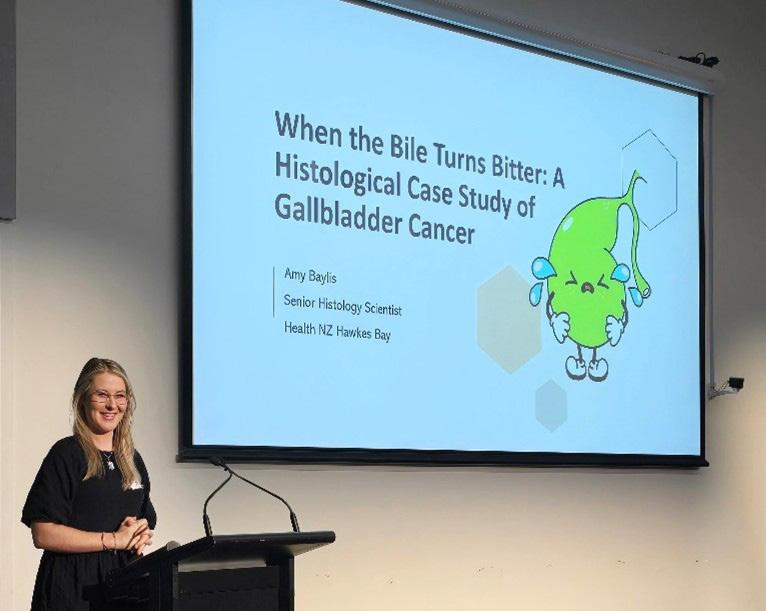
Kristi Bogh Anderson, from NordicQC, Denmark, presented at the NZIMLS Anatomical Pathology SIG Seminar in Wellington, New Zealand on the 18th October 2025. Entitled; “Getting immunohistochemistry right, best laboratory practices and pitfalls insights”, this Conference Proceeding summarises her presentation and offers user insight and guidance for immunochemistry methods, quality controls and continuous improvement.
Dr Michael Legge reviews the recently published book; “Unreliable: bias, fraud and the reproducibility crisis in biomedical research”, by Csaba Szabo.
We announce the retirement of Lynn Brott, from Specimen Services, at Waitemata District Health Board. The NZIMLS and profession thank her for her service and wish her all the best for a well-earned retirement.
Regular features include University of Otago BMLSc student research project abstracts from Semester 2, 2025, updates from the Pacific Pathology Training Centre (PPTC) in the Pacific Way, CPD Questionnaire and report from the North Island 2025 special interest group meeting, Science Digest and Recent Reviews.
Lisa Cambridge, Editor
Around the labs in 28 years
Rob Siebers
In 1994 I was invited by the then NZIMLS Council to take on the role as Journal Editor. Apparently, it was suggested that as I had published several articles in the Journal that I would be knowledgeable of undertaking this role. I soon found out that being an author or Editor required totally different knowledge and thus I embarked on a steep learning curve. Originally, I anticipated being in this role for about five years but somehow I stayed on as Editor until 2022 for a total of 28 years. Over these years there were some major changes and happenings in the Journal and below I focus on some of these.
Journal questionnaire
In 2005 I proposed to Council to initiate a questionnaire that would seek answers to published Journal articles for members to obtainContinuingProfessionalDevelopment(CPD)points.Thus, in theApril 2006 in the inaugural Journal questionnaire consisted of 10 questions in a true/false format on which members were awarded 5 CPD points if they got seven or more questions right. We had no expectations of what the response would be and were surprised when we received early 400 completed questionnaires. For the next five years the Editor marked the questions and notified members individually of the outcome. By then we received over a thousand submissions per Journal issue, and the CPD Co-Ordinator, Jillian Broadbent took over the marking and notification. In 2025 1,327 submissions were received over the three published issues.
Journal submissions
Since the birth of the Journal in 1946, subsequent Editors struggled to attract submissions. For many years access to the full text of the journal articles was restricted to Journal subscribers. This resulted in limited readership and citations. It also resulted in overseas submissions to the Journal. In 2013 our Journal became open access and straight away started to attract international submissions and subsequently increased citation of the Journal articles in the international biomedical journals.
Overseas submissions now outnumber local submissions.
World Association of Medical Editors (WAME)
In 2001 the Journal joined WAME, a worldwide association of peer-reviewed biomedical journals fostering cooperation among and education of journal editors. This proved valuable for our Journal in providing assistance, guidance, and guidelines on many journal issues. I subsequently became a WAME Director for two terms, ultimately election as Vice President from 2018-2020 and President from 2020-2022. In 2022, WAME launched an e-learning course for biomedical editors to which I contributed a module on authorship. Helping proofread the other modules taught me a lot about journal editorship.
I started my Editorship of the Journal when I was working at Otago University in Wellington after a number of years in medical laboratories. Throughout my academic career I regarded myself foremost as a medical laboratory scientist and therefore as Editor of the Journal was able to stay informed on all medical laboratory science disciplines for the next 28 years. My biggest thrill as Editor has been in guiding members of our profession in getting their first publication in the Journal and seeing some come back with subsequent publications.
The NZIMLS should be proud of the Journal, one of the oldest continuous medical laboratory science journals in the world. Although small in comparison, it is widely regarded worldwide due to its high standards which is attributable to its past and present Editors, Editorial Boards, reviewers and to those who have contributed as authors over the last 80 years.
AUTHOR INFORMATION
RobSiebers,FNZIMLSHonFNZSP,FormerAssociateProfessor1 and Emeritus Editor2
1 University of Otago, Wellington
2 New Zealand Institute of Medical Laboratory Science, NZIMLS, Rangiora
Email: robsiebers1@gmail.com
My path in partnership with the NZIMLS
Sharon Tozer
My journey with NZIMLS commenced in October 2006. Attending an interview at the not-quite complete new home of the van Til family, I gingerly tip-toed over the wooden plank that served as a kind of drawbridge between the front door and the mud moat around the house (that was to later become the terraces), desperately trying not to ruin the new Italian boots I had chosen to wear to the interview! Expecting to be talking only with the Executive Officer, Fran van Til, I was somewhat surprised to find three more people around the table. President - Robin Allen, Vice President - Kevin Taylor and Secretary/Treasurer - Ross Hewett. However, I was quickly at ease with this group and found them all very easy to talk to. The role I had applied for was ‘membership administrator’ and it soon became apparent that there was also a need for a part-time account’s person. This role had not yet been advertised, and after some discussion it was decided that I would be suitable for both these roles! So, during the interview, a new role was created, that of membership and finance administrator, and that is the role I was offered and accepted, starting on 1 November 2006.
What followed was a most enjoyable 15 years working with Fran and the membership and learning so much! Never before had I been involved in event organisation and planning –something which I was keen to learn and still very much enjoy. These events, the Special Interest Group Meetings, training days and conferences gave me the opportunity to meet so many of our members and have time to get to know them, even if just a little bit.
In 2009 I enrolled in the Massey University Bachelor of Business extra-mural programme and studied toward a Diploma in Business Studies, majoring in accounting for the next three years (part-time). The NZIMLS Council was extremely supportive with this and allowed me time off for study and to attend examinations when required. I graduated in 2011 in Palmerston North – the first in my family to graduate from university which I am extremely proud of. This set me in good stead to take on more financial responsibility with NZIMLS, and my role then became more financially centred, without losing sight of the extremely important membership functions. After graduating, I was mentored by the (then) NZIMLS auditor, Jane Jackman, and studied toward becoming an Accounting Technician, passing the examination and gaining entry into the Chartered Accountants of New Zealand Accounting Technician College, of which I am still a member.
As the years went on, and with the exponential rate that technology was changing, it was becoming very clear that NZIMLS needed to upgrade and update many systems, including the website. This meant new challenges and greater learning curves and workdays became extremely full and busy but also rewarding. The end result is a website that we are proud of; what members see is only half of it! At the admin end, there is a huge membership management system that helps us keep track of our over 3,000 members, their CPD records, employer records, SIG activities etc. We have grown into a very professional organisation proudly representing our membership on many levels and are highly respected within the Association community.
The end of 2020 saw the retirement of the Executive Officer, Fran van Til. It was a very sad time for me, Fran and I had grown to be very good friends, and her family had welcomed me into their fold, and their home for 15 years. I became a kind of ‘agony aunt’ for her children and watched them grow from school students into wonderful adults. It was hard to go, but as the office was in the van Til home, it didn’t seem right to continue working there, so the office moved to my home, in Cust, where we still are today. I took on the role of Executive Officer to NZIMLS, and also the administration and organisation of the conferences and SIG meetings. With the help of our amazing professional conference organiser, Daniella Olphert, we have been able to offer incredible experiences for our members at our annual conference.
The New Zealand Association of Bacteriologists was first incorporated under the Incorporated Societies Act 1908 on 9 April 1946 and changed its name to The New Zealand Institute
of Medical Laboratory Science (Inc.) on 30 October 1990. The Incorporated Societies Act 1908 was updated in 2022 with key changes that NZIMLS must now adhere to. One of these changes was that there must be a Chief Executive Officer with voting rights on the Board (Council), therefore my role changed again to that of CEO. I am extremely proud to be a voting member on Council and representing the membership at this level.
The Journal of the New Zealand Association of Bacteriologists was first published in Wellington in April 1946. Over the past 80 years, the Journal has been supported by the contributions from numerous editors and typesetters. I have had the privilege of working with two of these editors, Rob Siebers and Lisa Cambridge.
I assumed responsibility for the typesetting of the Journal in 2013, at which time Publisher software was used. The production of the Journal requires a considerable investment of time and effort from all involved, and in 2023 NZIMLS invested in InDesign software, which is specifically designed for the production of professional magazines and journals. This transition required additional training and I continue to develop my skills in using InDesign. However, the software is significantly more userfriendly than Publisher and has enabled the production of a polished, contemporary version of our prestigious Journal.
The greatest achievements in my working career have been whilst working for NZIMLS:
• Learning publishing, typesetting and publishing the NZ Journal of Medical Laboratory Science
• Learning website development/management
• Having the NZIMLS recognised as a registered charity in 2009
• Diploma in Business Studies in 2011
• Entry into the Chartered Accountants of New Zealand Accounting Technicians College
• Successfully re-registering the NZIMLS as an Incorporated Society in 2025
• Winning the NZ Most Trusted Business awards in 2024 for:
► Most trusted professional organisation for Medical Laboratory Science
► Most trusted Not for Profit company
► Nationwide brand winner
• Winning the NZ Most Trusted Business awards in 2025 for:
► Most trusted professional organisation for Medical Laboratory Science
► Most trusted Not for Profit company
► Nationwide brand winner
► No. 10 in the Top 50 Most Trusted companies
In this, my 21st year with NZIMLS, I would like to express my gratitude to all the Council members I have worked with over the years and all of our members for your continued support of our industry. I look forward to celebrating 80 years of NZIMLS and continuing my journey with you all!
AUTHOR INFORMATION
Sharon Tozer, Dip.BusStuds, AT CAANZ, CEO, The New Zealand Institute of Medical Laboratory Science (Inc.)
Email: sharon@nzimls.org.nz
Sharon with her pride and joy, outside the historic Mayfair Cinema, Kaikoura
REVIEW ARTICLE
Diabetic nephropathy, oxidative stress and extracellular superoxide dismutase: discover the links
Safa Zuhair AlRheem
ABSTRACT
Background: Type 2 diabetes mellitus (T2DM) is a global health concern, contributing significantly to morbidity and mortality worldwide. It is characterized by both macrovascular and microvascular complications, with diabetic nephropathy (DN) being the most severe microvascular consequence and is considered the leading cause of end-stage renal failure and chronic kidney disease,bothofwhichareincreasing.Thepathophysiologyofdiabeticnephropathyinvolvesvariouspathways,includingmetabolic, haemodynamic, and inflammatory mechanisms. Oxidative stress (OS), characterized by an imbalance between reactive oxygen species (ROS) production and the antioxidant defence system, acts as a critical initiator and promoter across these pathways, ultimately contributing to the development of diabetic nephropathy The antioxidant enzyme extracellular superoxide dismutase (EC-SOD), found in the extracellular matrix and cell surfaces, is associated with oxidative stress and diabetic nephropathy and has been implicated in the pathogenesis and progression of diabetic nephropathy
Aim:Thisreviewfocusesontheroleofextracellularsuperoxidedismutase(EC-SOD)inthepathogenesisofdiabeticnephropathy. Understanding the mechanisms by which extracellular superoxide dismutase (EC-SOD) contributes to diabetic nephropathy may pave the way for the development of novel therapeutic strategies to prevent or slow the progression of this complication of diabetes.
Diabetic nephropathy (DN), characterized by progressive albuminuria and a decline in glomerular filtration rate (GFR), remains a major cause of end-stage renal disease (ESRD) in diabetic patients worldwide (1). Despite significant advancements in diabetes management, the prevalence of DN persists, affecting a substantial portion of the diabetic population (1). Early diagnosis and intervention are essential to slow the progression of DN and prevent ESRD.
Pathogenesis of DN involves hyperglycaemia, haemodynamic alterations, oxidative stress (OS), and inflammatory processes (2). Hyperglycaemia-induced OS generates reactive oxygen species, damaging renal cells, and contributing to declining glomerular filtration rate (GFR) (3). Extracellular superoxide dismutase (ECSOD) is a key antioxidant enzyme that scavenges superoxide radicals from the extracellular matrix, thereby reducing OS (3). Evidence suggests a potential association between EC-SOD levels and DN development and progression (4). However, the precise mechanisms by which EC-SOD influences DN remain unclear.
This review aims to bridge this knowledge gap by comprehensively investigating how renal cells, tissue alterations and the diabetic milieu modulate the antioxidative role of ECSOD in mitigating OS in diabetic nephropathy.
REVIEW
Diabetic nephropathy
Diabetic nephropathy (DN) is a microvascular complication of diabetes mellitus characterized by progressive glomerular and tubulointerstitial damage, leading to proteinuria, decreased glomerular filtration rate (GFR), and ultimately, end-stage kidney disease (ESKD) (5). The pathophysiology involves a complex interplay of haemodynamic, metabolic and inflammatory factors, resulting in structural and functional changes within the kidney (5). Among individuals diagnosed with DN worldwide, 50% eventually develop ESKD, requiring costly and burdensome dialysis treatments (3). Notably, DN manifests differently in Type 1 diabetes mellitus (T1DM) and Type 2 diabetes mellitus (T2DM), with the former typically experiencing chronic kidney disease (CKD) after ten to fifteen years of diabetes, while the latter may exhibit kidney complications at the time of diagnosis due to delayed recognition (5). This has led to a notable increase in the number of people requiring dialysis for kidney-related illnesses in recent years (3).
Pathogenesis of diabetic nephropathy
The glomerular filtration barrier is composed of the glomerular basement membrane (GBM), podocytes and endothelial cells, and serves as the initial site of injury, and its disruption underlies the progressive loss of renal function (4). Haemodynamic changes
begin with hyperglycaemia-induced afferent arteriolar dilatation, increasing glomerular blood flow and leading to hyperfiltration. Concurrently, elevated intrarenal angiotensin II constricts efferent arterioles, driving glomerular hypertension and subsequent microalbuminuria (6). Characteristic histopathological findings include GBM thickening, mesangial expansion, and glomerulosclerosis. Accumulation of extracellular matrix proteins enlarges the GBM and increases its permeability, thereby contributing to proteinuria (7). Intraglomerular hypertension and collagen deposition promote Kimmelstiel-Wilson nodules and tubulointerstitial fibrosis, culminating in reduced glomerular filtration rate (GFR) (7).
Metabolic dysregulation further amplifies injury. Chronic hyperglycaemia stimulates reactive oxygen species (ROS) generation and activates pathogenic pathways (8). Together, these biochemical and structural insults initiate oxidative stress and inflammation, driving podocyte loss, apoptosis, and progressive renal decline (6).
Oxidative stress in diabetic nephropathy
Oxidative stress (OS) is a major driver of diabetic nephropathy (DN), occurring when reactive oxygen species (ROS) production surpasses antioxidant defences (8). At low levels, ROS generated mainly in mitochondria and peroxisomes act as signalling molecules in normal cellular processes. When elevated, however, free radicals damage cellular structures and trigger OS (9).
Several mechanisms contribute to ROS overproduction in DN. Nicotinamide Adenine Dinucleotide Phosphate (NADPH) oxidase generates excessive ROS, while advanced glycation end products (AGEs) formed during chronic hyperglycaemia further increase oxidative burden. Non-enzymatic glycation, glucose oxidation, and degradation of glycated proteins add to free radical generation (10). Defects in the polyol pathway, uncoupling of nitric oxide synthase (NOS), and mitochondrial dysfunction, particularly within the electron transport chain, represent additional major sources and are considered early events in diabetic complications (11).
ROS activate protein kinase C (PKC) and mitogen-activated protein kinases (MAPKs), enhancing extracellular matrix protein synthesis (12). PKC activation, amplified by ROS, promotes inflammation and fibrosis through pro-inflammatory mediators, adhesion molecules, and growth factors (12). ROS also activate NF-κB, inducing cytokines and chemokines that perpetuate renal injury. Persistent OS with fibrosis accelerates DN progression (12). OS further stimulates the renin–angiotensin system, while vasoconstriction, extracellular matrix changes, and sodium retention aggravate kidney damage (13).
Hyperglycaemia-driven OS also affects renal cell types.
Podocytes, key for the filtration barrier, undergo cytoskeletal disruption and dysfunction, causing proteinuria (14). Mesangial cells respond with excess matrix production, leading to expansion and impaired filtration (15). In renal tubules, OS drives inflammation, fibrosis, and cell death, worsening dysfunction (16). Endothelial cells show impaired nitric oxide production, increased permeability, and adhesion molecule expression, fostering inflammation and microvascular complications (14). The major classes of antioxidant enzymes, including catalases, superoxide dismutases (SOD), and glutathione peroxidases, play essential roles in maintaining cellular homeostasis and neutralizing reactive species (17). The SOD family encompasses three isozymes in mammalian systems: copper, zinc superoxide dismutase (Cu-ZnSOD or SOD1), manganese superoxide dismutase (MnSOD or SOD2), and extracellular superoxide dismutase (EC-SOD or SOD3) (17).
Extracellular Superoxide Dismutase (EC-SOD)
Extracellular superoxide dismutase (EC-SOD, SOD3) is a secreted antioxidant enzyme that catalyses the dismutation of superoxide anion into hydrogen peroxide and oxygen, thereby limiting oxidative stress in extracellular compartments (17). Identified in 1982 by Marklund as a predominant enzyme in extracellular fluids such as synovial fluid, lymph, and plasma (18), EC-SOD is primarily expressed by vascular smooth muscle cells and fibroblasts. It binds to heparin sulphate in the extracellular matrix and on endothelial surfaces, localising its antioxidant effects to the vasculature and kidney (19). Structurally, ECSOD is a homotetramer composed of four identical subunits linked by disulfide bonds with a molecular weight of 135 kDa. The human EC-SOD gene, located on chromosome 4, contains three exons and two introns (19). The mature glycoprotein has three functional domains; a glycosylation domain, a catalytic domain and a heparin-binding domain, which confer its stability, enzymatic activity and matrix-binding properties (18).
The role of EC-SOD in DM and its complications has been extensively investigated. Evidence suggests that EC-SOD plays a preventive role in the development of DM, protecting against oxidative damage and preserving cellular function (20). Moreover, its correlation with the progression of DM complications has been explored thoroughly (21).
In kidneys, experimental studies have shown that EC-SOD can reduce peroxynitrite formation in the renal artery, preserving nitric oxide bioavailability and maintaining renal blood flow during septic conditions (22). Lower serum levels of EC-SOD have been associated with increased proteinuria and the severity of diabetic nephropathy in individuals with type 2 diabetes (21). In addition, the contribution of EC-SOD to DN appears stagedependent. While some studies observed no difference in serum EC-SOD between diabetic patients with and without early nephropathy (18), advanced disease is consistently associated with marked reductions in renal EC-SOD expression and activity (23). Tan et al (2015) found that EC-SOD levels decrease during disease progression, leading to increased oxidative stress and kidney injury in EC-SOD null mice, as evidenced by elevated albuminuria and serum creatinine levels. They also observed a reduction in EC-SOD in human CKD biopsy samples (24). In diabetic mouse models, reduced renal expression and functional activity of EC-SOD have been observed, leading to elevated urine albumin excretion and the development of glomerular hyperfiltration, both of which are pathological markers of kidney disease (25). Fujita et al (2009) (26) examined the role of SOD3 in diabetic nephropathy using KK/Ta-Akita mice, a model prone to developing DN. The researchers observed that these mice exhibited a significant reduction in renal SOD activity, particularly in SOD1 and SOD3 proteins, compared to wild-type controls. This reduction was associated with increased renal superoxide production, indicating heightened oxidative stress. However, a subsequent study by Fujita et al (2012) (27) investigated the specific roles of SOD1 and SOD3 in diabetic nephropathy using C57BL/6-Akita diabetic mice. This study found that SOD1 deficiency led to increased renal superoxide levels, higher glomerular filtration rates, elevated urinary albumin levels, and advanced mesangial expansion, indicating accelerated renal injury. In contrast, SOD3 deficiency did not significantly affect these parameters. These findings suggest that SOD1 plays
a more critical role than SOD3 in protecting against diabetic renal injury in this mouse model. In addition, our previous study demonstrated no significant difference in EC-SOD serum levels between diabetic patients without nephropathy and those with early-stage DN (28). This finding may be attributed to the fact that EC-SOD’s role becomes more pronounced in advanced stages of the disease.
Kuo et al (2019) (29) investigated the association of serum and urinary EC-SOD levels with diabetic nephropathy in patients at different stages of the disease. Results showed that lower serum and urinary EC-SOD levels were observed in patients with diabetes alone, while higher levels were found in those with diabetes and CKD, who also had higher albuminuria and serum creatinine levels. A study conducted on Chinese patients with T2DM suggests that decreased serum EC-SOD activity is associated with albuminuria (30). However, there was no separation technique used, meaning that the measured activity is not for EC-SOD solely, but rather the activity of all SOD isozymes (31). This overlap complicates the interpretation of the results, as it is unclear whether the observed changes in activity are solely due to EC-SOD or are affected by other SOD types present in the serum.
EC-SOD production from kidney cells in diabetic nephropathy
The kidney glomerulus contains endothelial, epithelial, and mesangial cells. Yamada et al (2002) showed that mesangial cells consistently produce EC-SOD. Their findings also revealed that while kidney fibroblasts produce EC-SOD, renal tubular epithelial cells do not, suggesting a protective function specific to glomerular cells, especially under elevated OS in DN (32). COS-7 cells, derived from monkey kidney tissue, are used to study hypoxia-induced changes in EC-SOD expression. Under hypoxic conditions, simulated with cobalt chloride, these cells exhibit decreased EC-SOD levels through ROS generation and p38 MAPK activation (33). This reduction in EC-SOD impairs the cells’ ability to counteract OS, providing insights into similar mechanisms that may occur in proximal tubulointerstitial diseases which are commonly observed in patients with diabetes.
EC-SOD reduces endothelial dysfunction
Endothelial dysfunction in DN is closely related to impaired ECSOD activity. EC-SOD requires copper for its function, which is transported by the copper transporter ATP7A (34). In type 2 diabetes mellitus (T2DM), impaired insulin-Akt2 signalling reduces ATP7A stability and copper delivery to EC-SOD, which disrupts EC-SOD activation and exacerbates OS (35). A recent study revealed that Akt2 phosphorylates ATP7A, stabilizing it and promoting its translocation to the plasma membrane, thereby facilitating copper incorporation to EC-SOD and enhancing its antioxidant function (36). Caveolin-1 (Cav-1) further stabilizes ATP7A, preventing its degradation and ensuring efficient copper transport to EC-SOD. In Cav-1-deficient mice, decreased ATP7A levels lead to reduced EC-SOD activity, increased OS, and impaired endothelial-dependent vasodilation (37). Together these findings indicate the important role of the ATP7A-EC-SOD axis in maintaining endothelial function.
EC-SOD and inflammation
Reduced EC-SOD expression in diabetic kidneys has been shown to be linked with increased OS and decreased AMP-activated protein kinase (AMPK) levels, leading to the suppression of PGC1α-Nrf2 and FoxO pathways (38). This suppression promotes inflammation and apoptosis in renal tissues. Mechanistically, EC-SOD activates AMPK, stimulating antioxidant pathways such as PGC-1α and Nrf2, which enhance mitochondrial function and reduce markers of oxidative damage, including Nox1, Nox2, and Nox4 (39). Moreover, AMPK activation by EC-SOD interacts with FoxO transcription factors, reducing oxidative stress and enhancing cellular survival by regulating pro- and antiapoptotic proteins. EC-SOD also exerts an anti-inflammatory effect in DN models, lowering levels of MCP-1, TNF-α, and CD68, and likely modulating the Nrf2-Keap1 pathway (40). In addition, EC-SOD production positively correlates with cyclic adenosine monophosphate (cAMP) in unstimulated mesangial cells indicating its role in inflammation regulation via the cAMP
pathway (32).
EC-SOD and signalling pathways
Key contributors to diabetic nephropathy (DN) include the overproduction of reactive oxygen species (ROS) like superoxide anion and hydrogen peroxide, driven by NADPH oxidase, protein kinase C (PKC), and mitochondrial metabolism. High glucoseinduced ROS in mesangial cells can be effectively blocked by inhibition of PKC, NADPH oxidase, and mitochondrial electron transfer chain complex I, suggesting that these pathways play a role in ROS generation in diabetic kidneys (41). Both high glucose and ROS activate signal transduction cascades (PKC, mitogenactivated protein kinases, and janus kinase/signal transducers and activators of transcription) and transcription factors (nuclear factor-kappaB, activated protein-1, and specificity protein 1) and upregulate TGF-β1 and extracellular matrix genes and proteins (41). ROS not only contribute to OS but also participate in positive feedback loops that amplify their own production and activate upstream pathways, including the renin-angiotensin system (RAS). Angiotensin II interferes with the formulation of ROS via the PKC/NADPH oxidase pathway, and ROS production is inhibited following the knockdown of PKC (42). These mechanisms lead to upregulation of transforming growth factor-β (TGF-β), extracellular matrix deposition, and activation of downstream transcription factors, which drive kidney damage. EC-SOD EC-SOD protects kidney against OS by attenuating renal p22phox expression and NADPH oxidase activation (43). Furthermore, EC-SOD downregulates the angiotensin II type 1 receptor (AT1-R), a key component of the RAS, which is closely linked to DN pathology. The upregulation of AT1-R contributes to increased expression of p22phox and Nox-1 and decreased expression of Nox-4 and EC-SOD, leading to renal tissue damage (44). Hence, by preserving EC-SOD expression, AT1-R blockade may confer renal protection against OS. In addition, ROS, RAS activation, TGF-β1 expression, and PKC-β1 signalling are responsible for the increased expression of the osteopontin (opn) gene in diabetic rat renal proximal tubules, and EC-SOD has been shown to decrease its expression. EC-SOD ameliorates streptozotocin-induced rat diabetic nephropathy via inhibiting the ROS/ERK1/2 signalling pathway, which may involve modulation of osteopontin expression (45).
R213G polymorphism in the EC-SOD gene
EC-SOD is produced by fibroblasts and vascular smooth muscle cells and secreted into the extracellular space (19). It binds to sulphated polysaccharides such as heparin and heparan sulphate, as well as other extracellular matrix components, enabling interaction with endothelial cells and matrix structures (18). The heparin-binding domain (HBD) is essential for this function, as it mediates binding to low-density lipoprotein receptor–related protein (LRP) and type I collagen, facilitating LRP- and clathrin-mediated endocytosis (19). Mutations in the HBD, most notably the R213G substitution, impair these interactions, resulting in elevated plasma concentrations of ECSOD but reduced tissue levels (19). While such mutations are not directly disease-causing, altered distribution may contribute to local reduction in antioxidative capacity (19). In diabetic patients on haemodialysis, carriers of the R213G variant showed significantly lower 5-year survival compared with non-carriers, largely due to ischemic heart disease and cerebrovascular events (46). This effect reflects impaired heparin-binding affinity and reduced localization of EC-SOD to the vascular extracellular matrix.
EC-SOD and advanced glycation end products
Advanced glycation end products (AGEs) are a diverse group of compounds formed through non-enzymatic reactions between reducing sugars and free amino groups of proteins, lipids, or nucleic acids. In individuals with diabetes, chronic hyperglycaemia accelerates the formation of AGEs. These compounds are recognized as significant contributors to diabetic complications due to their capacity to directly disrupt the extracellular matrix and activate intracellular signalling pathways via binding to the receptor for advanced glycation end products (RAGE) (47). The interaction between AGEs and RAGE is wellestablished in inducing inflammation and OS, which are pivotal in the pathophysiology of diabetic complications.
AGEs accumulate in the kidneys of diabetic patients, especially those with end-stage renal disease, due to increased formation and reduced clearance. Impaired kidney filtration and tubular damage exacerbate the retention of low molecular weight AGEs (47). This accumulation contributes to structural and functional changes in the kidney, such as altered matrix protein interactions, increased vascular permeability and reduced protein degradation, driving key features of diabetic nephropathy like basement membrane thickening and mesangial expansion (48). AGEs interact with RAGE on cell surfaces, initiating intracellular signalling cascades that elevate ROS levels. This interaction notably increases the production of superoxide radicals, contributing to OS. Moreover, the AGE-RAGE engagement can upregulate NADPH oxidase activity, further amplify ROS production and create a feedback loop that perpetuates oxidative damage (49). In addition, Chen et al (2010) reported that AGEs significantly reduce the mRNA expression levels and activity of key antioxidative enzymes, including SOD and glutathione peroxidase (50). This raises the possibility that AGEs may similarly affect the expression and activity of EC-SOD. However, direct evidence of AGEs binding to EC-SOD and causing structural changes requires further investigation.
CONCLUSION
EC-SOD plays an important role in protecting against oxidative stress and preventing the progression of DN by maintaining vascular and renal homeostasis. As antioxidant enzyme in the extracellular space, EC-SOD protects the matrix of renal tissues by neutralizing superoxide anions, thereby preventing the formation of peroxynitrite, and by ensuring the bioavailability of nitric oxide. This will reduce endothelial dysfunction, attenuate inflammation, and protect the structural integrity of the glomerular filtration barrier. In addition, EC-SOD influences important signalling pathways, like the renin-angiotensin system and protein kinase C, as well as inflammatory mediators and pro-fibrotic factors. It is also affected by advanced glycation end products, which addresses the need for more research in these areas to better understand and manage DN pathogenesis.
AUTHOR INFORMATION
Safa Zuhair AlRheem, MSc, Researcher Central Laboratory, Al-Najaf Al-Ashraf Teaching Hospital, Ministry of Health, Najaf, Iraq Email: safazuhier93@gmail.com
REFERENCES
1. Wang N, Zhang C. Recent advances in the management of diabetic kidney disease: slowing progression. Int J Mol Sci 2024; 25(6): 3086.
2. Wu T, Ding L, Andoh V, et al. The mechanism of hyperglycemia-induced renal cell injury in diabetic nephropathy disease: an update. Life (Basel) 2023; 13(2): 539.
3. Alicic RZ, Rooney MT, Tuttle KR. Diabetic kidney disease: challenges, progress, and possibilities. Clin J Am Soc Nephrol 2017; 12(12): 2032-2045.
4. Vodošek Hojs N, Bevc S, Ekart R, Hojs R. Oxidative stress markers in chronic kidney disease with emphasis on diabetic nephropathy. Antioxidants (Basel) 2020; 9(10): 925.
5. American Diabetes Association. 11. Microvascular complications and foot care: Standards of medical care in diabetes—2021. Diabetes Care 2021; 44(Suppl 1): S151-S167.
6. Hang X, Ma J, Wei Y, et al. Renal microcirculation and mechanisms in diabetic kidney disease. Front Endocrinol (Lausanne) 2025; 16: 1580608.
7. Agarwal R. Pathogenesis of diabetic nephropathy. ADA Clin Compend 2021; 2021(1): 2-7.
8. Rauf A, Khalil AA, Awadallah S, et al. Reactive oxygen species in biological systems: pathways, associated diseases, and potential inhibitors—a review. Food Sci Nutr 2024; 12(2): 675-693.
9. Aziz MA, Diab AS, Mohammed AA. Antioxidant categories and mode of action. IntechOpen; 2019 Nov 6.
10. Hadzi-Petrushev N, Angelovski M, Mladenov M. Advanced glycation end products and diabetes. In: Obesity, diabetes
and inflammation: molecular mechanisms and clinical management. Cham: Springer International Publishing 2023; 99-127.
11. Yan LJ. Redox imbalance stress in diabetes mellitus: role of the polyol pathway. Animal Model Exp Med 2018; 1(1): 7-13.
12. Nam BY, Jhee JH, Park J, et al. PGC-1α inhibits the NLRP3 inflammasome via preserving mitochondrial viability to protect kidney fibrosis. Cell Death Dis 2022; 13(1): 31.
13. Feng Q, Liu D, Lu Y, Liu Z. The interplay of renin-angiotensin system and toll-like receptor 4 in the inflammation of diabetic nephropathy. J Immunol Res 2020; 2020(1): 6193407.
14. Su J, Ye D, Gao C, et al. Mechanism of progression of diabetic kidney disease mediated by podocyte mitochondrial injury. Mol Biol Rep 2020; 47: 8023-8035.
15. Thomas HY, Ford Versypt AN. Pathophysiology of mesangial expansion in diabetic nephropathy: mesangial structure, glomerular biomechanics, and biochemical signaling and regulation. J Biol Eng 2022; 16(1): 19.
16. Chang J, Yan J, Li X, et al. Update on the mechanisms of tubular cell injury in diabetic kidney disease. Front Med (Lausanne) 2021; 8: 661076.
17. Little BD, Hopkins RZ. Superoxide dismutases in biology and medicine: essentials and recent advances. React Oxygen Species (Apex) 2020; 9(25): 13-21.
18. Marklund SL. Human copper-containing superoxide dismutase of high molecular weight. Proc Natl Acad Sci U S A 1982; 79(24): 7634-7638.
19. Chantadul V. Structure-function studies of intracellular and extracellular superoxide dismutases. University of Liverpool, Liverpool, 2020.
20. Mohammedi K, Bellili-Muñoz N, Marklund SL, et al. Plasma extracellular superoxide dismutase concentration, allelic variations in the SOD3 gene and risk of myocardial infarction and all-cause mortality in people with type 1 and type 2 diabetes. Cardiovasc Diabetol 2015; 14(1): 845.
21. Kimura F, Hasegawa G, Obayashi H, et al. Serum extracellular superoxide dismutase in patients with type 2 diabetes: relationship to the development of micro- and macrovascular complications. Diabetes Care 2003; 26(4): 1246-1250.
22. Constantino L, Galant LS, Vuolo F, et al. Extracellular superoxide dismutase is necessary to maintain renal blood flow during sepsis development. Intensive Care Med Exp 2017; 5: 2.
23. Lewandowski Ł, Kepinska M, Milnerowicz H. The copperzinc superoxide dismutase activity in selected diseases. Eur J Clin Invest 2019; 49(1): e13036.
24. Tan RJ, Zhou D, Xiao L, et al. Extracellular superoxide dismutase protects against proteinuric kidney disease. J Am Soc Nephrol 2015; 26(10): 2447-2459.
25. Guo H, Xu D, Kuroki M, et al. Kidney failure, arterial hypertension and left ventricular hypertrophy in rats with loss of function mutation of SOD3. Free Radic Biol Med 2020; 152: 787-796.
26. Fujita H, Fujishima H, Chida S, et al. Reduction of renal superoxide dismutase in progressive diabetic nephropathy. J Am Soc Nephrol 2009; 20(6): 1303-1313.
27. Fujita H, Fujishima H, Takahashi K, et al. SOD1, but not SOD3, deficiency accelerates diabetic renal injury in C57BL/6-Ins2Akita diabetic mice. Metabolism 2012; 61(12): 1714-1724.
28. AlRheem SZ, Altareehee SW, Hassan HM. Serum extracellular superoxide dismutase concentration in type 2 diabetic patients with nephropathy: an investigation of the relationship. J Pharmacol Ther Clin Pract 2024; 31(1): 5057.
29. Kuo CW, Chen HL, Tu MY, Chen CM. Serum and urinary SOD3 in patients with type 2 diabetes: comparison with early chronic kidney disease patients and association with development of diabetic nephropathy. Am J Physiol Renal Physiol 2019; 316(1): F32-F41.
30. Feng G, Gao JL, Zhang P, et al. Decreased serum extracellular superoxide dismutase activity is associated with albuminuria in Chinese patients with type 2 diabetes mellitus. Acta Diabetol 2017; 54: 1047-1055.
31. Marklund SL. Analysis of extracellular superoxide dismutase in tissue homogenates and extracellular fluids. In: Methods in enzymology. San Diego: Academic Press; 1990. p. 260-265.
32. Yamada H, Adachi T, Fukatsu A, et al. Extracellular superoxide dismutase and glomerular mesangial cells: its production and regulation. FEBS Lett 2002; 519(1-3): 7781.
33. Kamiya T, Hara H, Yamada H, et al. Cobalt chloride decreases EC-SOD expression through intracellular ROS generation and p38-MAPK pathways in COS7 cells. Free Radic Res 2008; 42(11-12): 949-956.
34. Qin Z, Gongora MC, Ozumi K, et al. Role of Menkes ATPase in angiotensin II-induced hypertension: a key modulator for extracellular superoxide dismutase function. Hypertension 2008; 52(5): 945-951.
35. Sudhahar V, Urao N, Oshikawa J, et al. Copper transporter ATP7A protects against endothelial dysfunction in type 1 diabetic mice by regulating extracellular superoxide dismutase. Diabetes 2013; 62(11): 3839-3850.
36. Sudhahar V, Okur MN, Bagi Z, et al. Akt2 (protein kinase B beta) stabilizes ATP7A, a copper transporter for extracellular superoxide dismutase, in vascular smooth muscle: novel mechanism to limit endothelial dysfunction in type 2 diabetes mellitus. Arterioscler Thromb Vasc Biol 2018; 38(3): 529-541.
37. Sudhahar V, Okur MN, O’Bryan JP, et al. Caveolin-1 stabilizes ATP7A, a copper transporter for extracellular SOD, in vascular tissue to maintain endothelial function. Am J Physiol Cell Physiol 2020; 319(5): C933-C944.
38. Kim Y, Park CW. Adenosine monophosphate-activated protein kinase in diabetic nephropathy. Kidney Res Clin Pract 2016; 35(2): 69-77.
39. Abu Shelbayeh O, Arroum T, Morris S, Busch KB. PGC-1α is a master regulator of mitochondrial lifecycle and ROS stress response. Antioxidants (Basel) 2023; 12(5): 1075.
40. Hong YA, Lim JH, Kim MY, et al. Extracellular superoxide dismutase attenuates renal oxidative stress through the activation of adenosine monophosphate-activated protein kinase in diabetic nephropathy. Antioxid Redox Signal 2018; 28(17): 1543-1561.
41. Lee HB, Yu MR, Yang Y, Jiang Z, Ha H. Reactive oxygen species-regulated signaling pathways in diabetic nephropathy. J Am Soc Nephrol 2003; 14(Suppl 3): S241-S245.
42. Jin Q, Liu T, Qiao Y, et al. Oxidative stress and inflammation in diabetic nephropathy: role of polyphenols. Front Immunol 2023; 14: 1185317.
43. Welch WJ, Chabrashvili T, Solis G, et al. Role of extracellular superoxide dismutase in the mouse angiotensin slow pressor response. Hypertension 2006; 48(5): 934-941.
44. Chabrashvili T, Kitiyakara C, Blau J, et al. Effects of ANG II type 1 and 2 receptors on oxidative stress, renal NADPH oxidase, and SOD expression. Am J Physiol Regul Integr Comp Physiol 2003; 285(1): R117-R124.
45. Kuo CW, Shen CJ, Tung YT, et al. Extracellular superoxide dismutase ameliorates streptozotocin-induced rat diabetic nephropathy via inhibiting the ROS/ERK1/2 signaling. Life Sci 2015; 135: 77-86.
46. Yamada H, Yamada Y, Adachi T, et al. Protective role of extracellular superoxide dismutase in hemodialysis patients. Nephron 2000; 84(3): 218-223.
47. Mengstie MA, Chekol Abebe E, Behaile Teklemariam A, et al. Endogenous advanced glycation end products in the pathogenesis of chronic diabetic complications. Front Mol Biosci 2022; 9: 1002710.
48. Yu J, Wu H, Liu ZY, et al. Advanced glycation end products induce the apoptosis of and inflammation in mouse podocytes through CXCL9-mediated JAK2/STAT3 pathway activation. Int J Mol Med 2017; 40(4): 1185-1193.
49. Nakamura A, Kawaharada R. Advanced glycation end products and oxidative stress in a hyperglycaemic environment. Fundamentals of Glycosylation [IntechOpen Internet], 2021; 1: 1-100. doi: 10.5772/intechopen.97234.
50. Chen J, Song M, Yu S, et al. Advanced glycation endproducts alter functions and promote apoptosis in endothelial progenitor cells through receptor for advanced glycation end products mediate over pression of cell oxidant stress. Mol Cell Biochem 2010; 335: 137-146.
A systematic review of case-based learning in undergraduate medical laboratory science
Janelle Christoff-Tzazaroff, Rebecca M King, Ian Cassady and Indu Singh
ABSTRACT
Medical laboratory science (MLS) is an essential component of the modern healthcare system. Up to 70% of medical and clinical decision making cannot be made without medical laboratory science input, however recent workforce reports have identified a lack of multidisciplinary and cross-disciplinary thinking as a gap in medical laboratory science graduate skills. Schools of medicine have used case-based learning (CBL) extensively to integrate disciplines and demonstrate multidisciplinary, interdisciplinary, and holistic approaches to patient care. In contrast, the use of case-based learning in medical laboratory science to integrate laboratory disciplines to improve student understanding and critical thinking is poorly reported.
This paper aims to systematically review the existing literature surrounding case-based learning in undergraduate medical laboratory science teaching. A search was performed on four databases (PubMed, Scopus, World of Science, and Medline), which identified a total of 11,135 studies, of which four studies were eligible for inclusion in this review These were cohort studies that compared case-based learning as a method of delivery to traditional or lecture-based learning (LBL). They assessed student satisfaction and exam outcomes between groups with slight variations in their methods.All four studies focused on single disciplines within medical laboratory science with little emphasis on the multidisciplinary nature of medical laboratory science, however, all of them aimed to develop their medical laboratory science curricula and demonstrated high student satisfaction and higher exam scores compared to lecture-based learning. Further research should be conducted to determine the effectiveness of case-based learning in its ability integrate medical laboratory science disciplines and to standardize a method of evaluation for case-based learning.
Keywords: Case-based learning (CBL), problem-based learning, medical laboratory science (MLS), biomedical science, medical technology, lecture-based learning (LBL).
NZ J Med Lab Sci 2026; 80(1): 09-15
INTRODUCTION
The modern evidence-based healthcare system relies heavily on medical laboratory science (MLS). Up to 70% of medical and clinical decisions cannot be made without results obtained by medical laboratory scientists who analyse blood, bodily fluids, and tissues to gain insight into a patient’s condition (1). Typically, the medical laboratory can be divided into the six major departments of haematology, biochemistry, transfusion science, histology, microbiology, and molecular medicine (2). Similarly, undergraduate university programmes teach these disciplines in six dedicated specialist courses (2, 3). This is an effective way to teach MLS content; however, workforce reports have identified inadequate multidisciplinary and interdisciplinary skills as a gap in graduate attributes (4). In recent years, institutions have started to shift from traditional didactic methods towards problem-based learning (PBL) to deliver their educational content with some universities using combinations of CBL and PBL. Although PBL in the context of MLS makes references to tests from other disciplines, it does not actively integrate multiple disciplines into the same case (5).
Schools of Medicine have addressed this problem through the use of case-based learning (CBL) (6), which is defined as a method of delivering educational content using case studies to simulate a clinical environment (7). CBL is frequently used as an educational tool for students in medical school to prepare students for clinical practice prior to entry into the industry, as it uses authentic cases to tie together theory and practice (8). CBL workshops are student-led with the faculty providing guidance for discussion and allowing students to draw on knowledge obtained from their years of study for application in a simulated clinical setting (9).
Though CBL and PBL share similarities, PBL is generally understood to be the umbrella term under which CBL sits. Both are forms of active learning and student enquiry that use clinical studies to deliver educational content, however, a review performed by McLean (2016) defined CBL as “an inquiry structured learning experience utilizing live or simulated patient cases to solve or examine a clinical problem with the guidance of a teacher and stated learning objectives” (7). The keyword in this definition is ‘guidance’. Where PBL requires students to problem-solve on their own, CBL provides guidance from instructors to guide the flow of conversation. Indeed, Hansen et
al. (2005) explored the attitude of faculty and students towards CBL in an obstetrics and gynaecology clerkship and noted that PBL is more effective for learning foundational material through problem solving, while CBL is more effective in the application of knowledge already learned (10). McLean further emphasises that CBL allows students and faculty members to prepare in advance and provides guidance to discussions to achieve specific learning goals (7). Studies exploring CBL in other health disciplines show that students consistently report high perception of CBL content as well as more enjoyment, and engagement with the CBL approach. Such an enhanced response encourages the development of critical thinking and communication skills (1114). Indeed, students have reported a preference for CBL over PBL because there were “fewer unfocused tangents” and more opportunities for clinical skills application (9).
The success of CBL as a teaching tool in Schools of Medicine demonstrates that it can be used to teach integrated medicine, however the use of CBL as a teaching tool for MLS students is poorly reported, especially for the integration of multiple MLS disciplines. The establishment of core laboratories has emphasized the multidisciplinary nature of MLS and increased the need for multidisciplinary scientists (15). Core laboratories are generalist or multidisciplinary laboratories that process haematology, biochemistry, transfusion science, and some microbiology and molecular medicine in one laboratory (4). Core laboratory staff are highly sought after for their ability to simultaneously process and analyse specimens in multiple disciplines. The Royal College of Pathologists Australia (RCPA) and the Australasian College of Emergency Medicine (ACEM) provide guidelines for emergency testing that encompass four disciplines and list 15 routine tests for common emergency presentations, 14 of which can be performed onsite in a core laboratory by a multidisciplinary scientist (16). In university classes, however, there are limited opportunities for students to view MLS as a multidisciplinary environment until they are exposed to the diagnostic laboratory workplace on clinical placement. The result is a limited understanding of how MLS disciplines interact and contribute to patient care.
This research aims to systematically review the existing literature surrounding CBL and its use in MLS and to examine its implementation in current undergraduate programmes.
MATERIALS AND METHODS
To review the literature systematically, search terms and their synonyms were identified. MLS is referred to by different terminology depending on the country. These terms include clinical laboratory science, laboratory medicine, biomedical science, and medical technology. All five of these search terms are synonymous with each other and refer explicitly to a diagnostic laboratory that performs tests in the disciplines of MLS. Similarly, CBL and PBL are sometimes considered synonymous, so PBL was also used as a search term in the final query. Also to note is that due to CBL’s lack of a strict definition, some studies make no note of CBL or PBL at all and simply refer to the addition of case studies as “case studies”.
The final search query was “[Medical laboratory science OR clinical laboratory science OR laboratory medicine OR biomedical science OR medical technology] AND [case-based learning OR problem-based learning OR case study]”. This term was used to search four databases (Medline, PubMed, Scopus, and World of Science) and yielded a total of 11,135 results.
Inclusion Criteria
The inclusion criteria were established using the PICOS framework. To be eligible, studies must have been:
• Cohort studies (Study Design)
• Performed on undergraduate students studying MLS (Population)
• Used CBL methods (Intervention)
• Compared to an LBL control group (Comparator)
• Outcomes must have included quantitative analysis of exam scores and either a quantitative or qualitative assessment of student perceptions towards CBL (Outcome).
Exclusion Criteria
Studies were excluded if the full article could not be obtained, if the article was written in a language other than English and did not have an English translation, or if the article was greater than 10 years old.
Screening
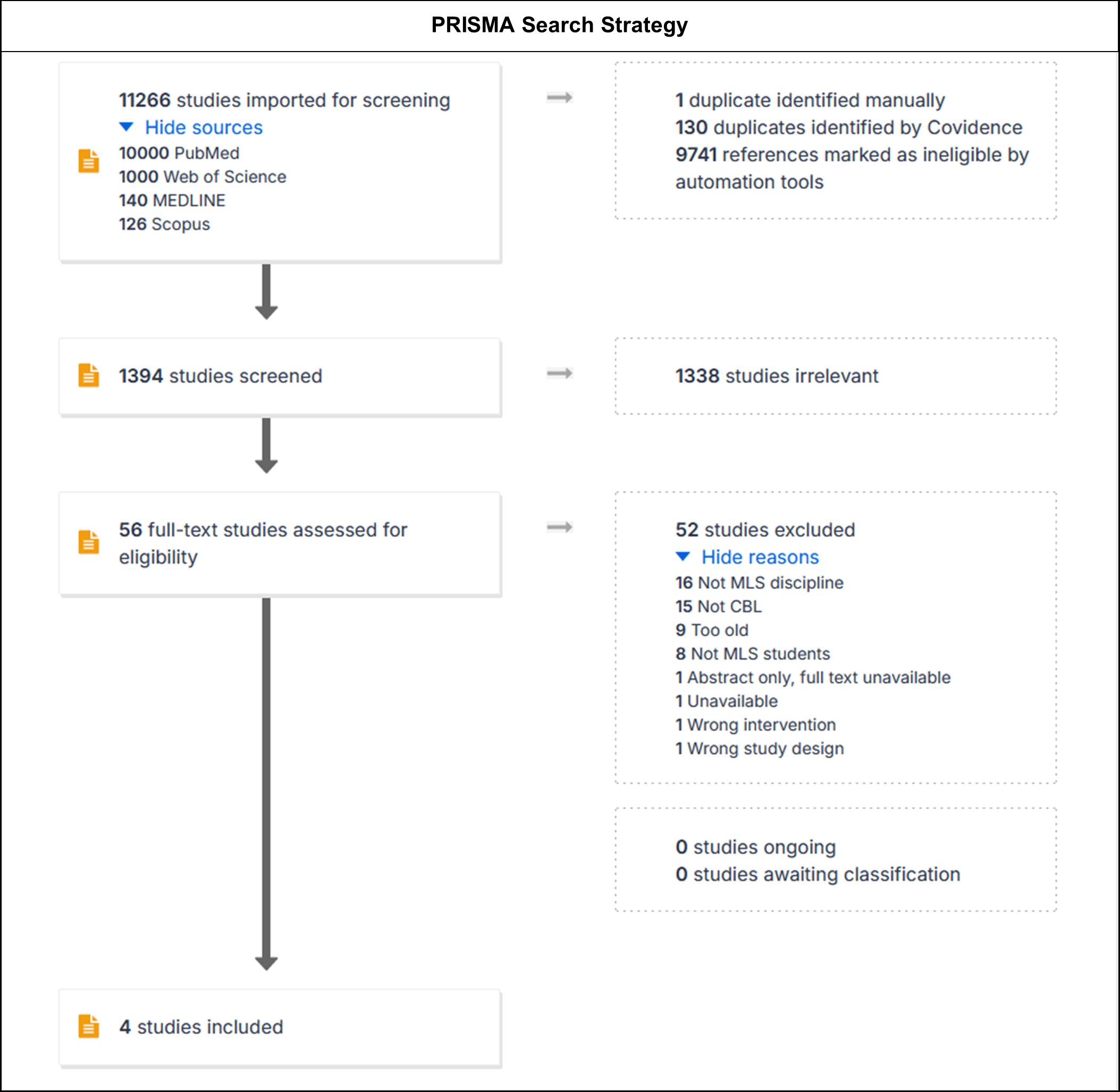
Covidence systematic review software (Veritas Health Innovation, Melbourne, Australia. Available at www.covidence. org) was used to import and screen references. A total of 131 were removed initially as duplicates, and 9,741 were automarked as ineligible. Of the 1,394 studies that were screened using titles and abstracts, 55 progressed to a full-text review. These last 55 studies were screened by the authors, and four were identified as eligible for inclusion in this study. The search strategy was based on Preferred Reporting Items for Systematic Reviews and Meta-Analyses (PRISMA 2020) guidelines and is illustrated in Figure 1. A Risk of Bias (ROB) (17) was performed to assess the quality of each study and its appropriateness for inclusion. A Joanna Briggs Institute (JBI) Critical Appraisal Tool (18)for cohort studies was used to examine each of the studies for biases in their design. Studies were included if at least 80% of the questions posited by JBI Critical Appraisal Tool could be answered with yes. Table 1 illustrates the ROB performed for this review. Data was extracted using the Covidence Data Extraction Template.
Figure 1. Search strategy based on Preferred Reporting Items for Systematic Reviews and Meta-Analyses (PRISMA) guidelines. (Covidence systematic review software, Veritas Health Innovation, Melbourne, Australia. Available at www.covidence.org)
Table
Li H, Sun J, Zhou Y, Ding S, Guo Y, Jiang Q, et al. The utility of competency-oriented clinical laboratory teaching combined with case-based learning. (2021).
Were the two groups similar and recruited from the same population?
Were the exposures measured similarly to assign people to both exposed and unexposed groups?
Was the exposure measured in a valid and reliable way?
Were confounding factors identified?
Were strategies to deal with confounding factors stated?
Were the groups/ participants free of the outcome at the start of the study (or at the moment of exposure)?
Were outcomes measured in a valid and reliable way?
Was the follow up time reported and sufficient to be long enough for outcomes to occur?
Was follow up complete, and if not, were the reasons to loss to follow up described and explore?
Was appropriate statistical analysis used?
RESULTS
Li X, Xie F, Li X, Li G, Chen X, Lv J, et al. Development, application, and evaluation of a problem-based learning method in clinical laboratory education. (2020).
Ma XM, Luo YP, Wang JQ, Zhang LF, Liang YL, Wu YF, et al Comparison of student perception and performance between case-based learning and lecture-based learning in a clinical laboratory immunology course (2016).
Xu G, Zhao C, Yan M, Zhang X, Zhu L, Liu J, et al Evaluating the effectiveness of a new student-centred laboratory training strategy in clinical biochemistry teaching (2023).
All four studies included in this review were performed in China. Sample sizes ranged from 85 to 357 and although there were some variations in study design, each study consisted of a CBL experimental group and an LBL control group, either in parallel or historically controlled. All included studies compared student examination scores to assess knowledge retention between groups, and some form of student feedback through qualitative assessment or through the distribution of student surveys. Two studies used practical skills tests as an evaluation tool in addition to exam scores. Another study made use of clinical performance to evaluate CBL as a secondary evaluation method. Table 2 presents a summary of study design and exam scores. Table 3 presents the scores of clinical performance and practical tests in the studies that incorporated them. To note, students achieved consistently higher scores in theory examinations compared to students in LBL groups, and the p-values obtained between student scores are significant for all but one group of students. In the studies that used practical tests and clinical performance, students also scored significantly higher than LBL students, indicating that learned skills are also easier to retain using CBL teaching methods.
Student feedback was also assessed. Most studies included
some form of quantitative feedback using questionnaires and surveys. Questionnaires addressed perceived student confidence and capability, attitudes towards CBL, achievement of learning objectives, and impact on learning. Researchers also used observation during the study to report on student engagement with instructors and with course material. Notably, these methods of evaluation were not standardized across all four studies. For the purpose of this review, recurring themes have been listed with quantitative comparison to LBL groups if available. Table 4 presents these results. Qualitative themes and student feedback will be addressed in the Discussion. Student feedback was altogether favourable towards CBL. In all but one study, the differences in student feedback scores between CBL and LBL were considered significant; however, the lack of standardization between studies made direct comparison of these results. Thematically, students seemed to prefer CBL. The studies included in this review all reported increased engagement and interaction. Li et al. (19) highlighted that students were encouraged to interact with their peers and instructors and reported high levels of student enjoyment. Ma et al. (20) also reported improved peer interaction and increased interest in MLS. Students also reported increased confidence and perceived capability in each study. Ma et al (20) and Li et
al (21) both stated explicitly that students reported an increase in their perceived skill. Furthermore, the improvement in soft skills is notable: Ma et al (20), Li et al (21), and Li et al (19) all make note of improved communication, peer interaction, and application, and critical thinking skills as a result of their studies.
Table 2. Evaluation of CBL using theory exam scores
Authors Study Year
Li, Hongchun; Sun, Jingfang; Zhou, Yuan; Ding, Shuang; Guo, Yi; Jiang, Qingqing; Li, Shibao; Ma, Ping (21) The utility of competency-oriented clinical laboratory teaching combined with case-based learning (CBL).
Li, XD; Xie, F; Li, XQ; Li, GW; Chen, X; Lv, J; Peng, CY (19) Development, application, and evaluation of a problem-based learning method in clinical laboratory education.
Comparison of student perception and performance between case-based learning and lecture-based learning in a clinical laboratory immunology course.
Evaluating the effectiveness of a new
The study by Xu et al (2023) focused on compliance with ISO 15189 requirements and noted that CBL students were more likely to keep records and communicate with clinical staff and patients more actively than LBL students (22). Li et al (2021) and Xu et al (2023) highlighted that their implementations of CBL resulted in improved multidisciplinary application (17, 23).
Participants
Table 3. Evaluation of CBL using skills tests and clinical performance
Authors
Li, XD; Xie, F; Li, XQ; Li, GW; Chen, X; Lv, J; Peng, CY (19) Development, application, and evaluation of a problem-based learning method in clinical laboratory education
Development, application, and evaluation of a problem-based learning method in clinical laboratory education
2020
Themes and feedback scores
Attitudes towards CBL “Helpful” “Very good” Abilities improved Self-learning Application of knowledge Case analysis Independent thought Communication and expression Benefits to interdisciplinary learning Benefits to further improve their own knowledge
Quantitative; student feedback scores CBL group: 89.29 LBL group: 84.59 p value <0.001
High levels of student enjoyment
Encouragement of students to
• Interact
Observational
• ask questions
• formulate hypotheses
• search for answers
• assess their capacity to justify their views
Feedback recorded in % “Yes”
Themes of statements include:
• Appropriateness of case scenarios
Yes/No
Comparison of student perception and performance between case-based learning and lecturebased learning in a clinical laboratory immunology course
2016
• Perceived improvement of skills
• Improvement of understanding and knowledge retention
Themes of statements include:
• Increased interest in MLS
• Improved understanding
• Improved peer interaction
• Exam preparation
Likert scales
• Improvement of skills
CBL sum of perception score: 43.82 LBL sum of perception score: 42.23 p value: 0.079
Evaluating the effectiveness of a new student-centred laboratory training strategy in clinical biochemistry teaching
2023 Likert scales
Teaching methods can be evaluated in a variety of ways. The University of Michigan’s Centre for Research on Learning and Teaching (CRLT) provides a comprehensive list of methods to evaluate teaching methods, including classroom observation, student feedback, and formal assessment (23). Although formal assessment is a common method of evaluating both student knowledge and teacher effectiveness, other methods of evaluation should also be considered. Specifically, student
• Themes of statements concern
• Achievement of learning objectives
• Impact on mode of teaching
Aggregate score: Achievement of learning objectives
CBL: 22.64
LBL: 18.31 p value <0.05
Aggregate score: Impact on mode of teaching
CBL: 23.21
LBL: 19.77 p value <0.05
engagement through active learning is also valuable in teaching evaluation.
Active learning is a vital component of CBL. According to Griffith University’s Explore Learning and Teaching (ExLNT) resource, active learning is defined as a broad range of methods designed to engage with learners as active participants during formal or informal learning (24). Engagement and participation have been shown to enhance the learning experience and increase knowledge retention, (8) and, in CBL, students must actively
engage with the case studies presented to ‘solve’ the case and assist the patient. Additionally, CBL allows for the simulation of a clinical environment without imposing on patients or clinicians, effectively allowing students to gain an understanding of the workflow and expectations within the industry. This integration of clinical simulation, problem-solving, and application of previously acquired knowledge appears to contribute to high rates of engagement with course material and student enjoyment.
All four studies included in this review used a combination of formal assessment and student feedback in their evaluations, and the overall conclusion is that CBL is generally beneficial to students, both for exam preparation and applicable communication and clinical skills. Formal exam scores from all the included studies showed an increase in means in CBL groups and were significant in all but one 2017 offering reported in Li et al. (2021), and classroom observation indicated high levels of student enjoyment and increased interest in MLS. These studies also have significant implications for transformative learning. Transformative learning is defined as “the process by which we transform problematic frames of reference […] to make them more inclusive, discriminating, open, reflective and emotionally able to change. Such frames are better because they are more likely to generate beliefs and opinions that will prove more true or justified to guide action” (25). In summary, a challenge presents discomfort, from which the learner must acquire knowledge to overcome the challenge and integrate the lessons learned into new behaviours. In the context of this review, CBL can be considered the challenge: a different mode of teaching that encourages students to actively seek new ways to overcome or solve the case that results in learned skills and changed behaviour. Communication, critical thinking, peer interaction and application of knowledge are vital skills in MLS, however, these skills are often considered ‘soft skills’ and lack emphasis in many undergraduate programs. Undergraduate courses often focus on the acquisition of knowledge and technical skills as these are essential for employment after graduation, however, the ability to problem-solve and communicate are equally important interpersonal skills that should be further emphasized during university training. Indeed, a report by the Victorian State Government published in 2018 examining the MLS workforce in Victoria, Australia specifically identifies these soft skills as requiring significant focus in undergraduate programs. These soft skills included clinical communication, problem solving, multidisciplinary application, and analytical skills (4).
Evidently, CBL is an effective tool that addresses theoretical, technical, and soft skills; however, future research should consider the use of a standardized method of evaluating CBL. Ma et al. (2016) and Li et al. (2020) make note of this specifically (18,19). The questionnaire used in the Ma et al. (2016) study was designed for the study only, and Li et al (19) state that a “systematic and standardized evaluation system should be established to evaluate the effects of alternative teaching methods” (18,19). Other studies exploring CBL have made use of course evaluations (26), however this, too, needs to be standardized to allow direct comparison between courses. All four studies also recommended further research to increase total sample sizes.
Additionally, future directions should consider exploring CBL as a tool for multidisciplinary applications. Only the study by Li et al (2021) mentioned a benefit to the development of interdisciplinary skills; however, its focus was on individual tests rather than a patient-centred approach (21). Li et al (2020), whose study focused on haematology education and whose case study involved cold haemagglutinin disease, suggest further research in other disciplines of CBL, including clinical biochemistry, biochemistry, and molecular biology curricula, but do not suggest a multidisciplinary approach (19). Similarly, Ma et al (2016) and Xu et al (2023) focus only on clinical laboratory immunology and clinical biochemistry respectively (21, 23). While the CBL implemented in their studies improved clinical communication and analytical skills, they do not address the
lack of multidisciplinary and cross-disciplinary skills identified by the Victorian MLS workforce report. The integration of MLS disciplines to simulate multidisciplinary environments should be further explored as new research emerges.
CONCLUSION
CBL as a teaching method is growing increasingly common in MLS curricula but has had little focus in research. Four studies were selected and reviewed after a systematic search of four different databases. Reviewers found that the implementation of CBL in these studies resulted in consistently higher exam scores compared to LBL. Students of CBL also reported generally positive perceptions towards the teaching method. Future studies should focus on establishing a standardized method of evaluation and explore larger sample sizes, populations outside of China, and to integrate the disciplines of MLS.
AUTHOR INFORMATION
Janelle Christoff-Tzazaroff, PhD Candidate1
Rebecca M King, PhD, Senior Lecturer1 Ian Cassady, PhD, Senior Lecturer1 Indu Singh, PhD, MAppSc, Professor1
1 School of Pharmacy and Medical Science, Griffith University
Corresponding Author: Janelle Christoff-Tzazaroff, School of Pharmacy and Medical Sciences, Griffith University, Queensland, Australia.
1. Royal College of Pathologists Australia. Pathology: The Facts 2024. Available from: RCPA Library [internet] https:// www.rcpa.edu.au/Library/Fact-Sheets/Pathology-TheFacts.
2. Griffith University. Bachelor of Medical Laboratory Science, 2023. Available from: [internet] https://www.griffith. edu.au/study/degrees/bachelor-of-medical-laboratoryscience-1370.
3. Queensland University of Technology. Bachelor of Medical Laboratory Science 2023 Available from: [internet] https:// www.qut.edu.au/courses/bachelor-of-medical-laboratoryscience/.
4. Victorian State Government. Victorian Allied Health Workforce Research Program: Medical Laboratory Science Workforce Report. 2018. Available from [internet] https:// www.health.vic.gov.au/allied-health-workforce/alliedhealth-research.
5. Zhang P, Li J, Wang M, Zhang F. Application of PBL combined with CBL teaching mode in clinical training of hematology department Open Access Library Journal 2022; 9(12): 1-8.
6. Sturdy S. Scientific method for medical practitioners: the case method of teaching pathology in early twentiethcentury Edinburgh. Bull Hist Med 2007; 81(4): 760-792.
7. McLean SF. Case-Based Learning and its Application in Medical and Health-Care Fields: A Review of Worldwide Literature. J Med Educ Curric Dev 2016; 3: 39-49.
8. Thistlethwaite JE, Davies D, Ekeocha S, et al. The effectiveness of case-based learning in health professional education. a BEME systematic review: BEME Guide No. 23. Med Teach 2012; 34(6): e421-444.
9. Srinivasan M, Wilkes, M, Stevensen, FM et al. Comparing problem-based learning with case-based learning: effects of a major curricular shift at two institutions. Acad Med 2007; 82(1):74-82.
10. Hansen W, Ferguson K, Sipe C, Sorosky J. Attitudes of faculty and students toward case-based learning in the third-year obstetrics and gynecology clerkship. Am J Obstet Gynecol 2005; 192: 644-647.
11. Yao J, Fu R, Zhu M, Jia L, et al. Case-based learning
interventions for undergraduate nursing students in a theoretical course: A review of design, implementation, and outcomes. J Prof Nurs 2023; 46:1 19-33.
12. Das S, Ponnusamy KA, Tripathi A, et al. Case-based learning: A 'Case' for restructuring anatomy education in Indian nursing curriculum. J Educ Health Promot 2022; 11: 258.
13. Tostes H, Oliveira LB, Franco A, et al. Dental students' perceptions of case-based learning method and the impact of clinical information in imaging diagnosis. Eur J Dent Educ 2020; 24(4): 773-778.
14. Holland JC, Pawlikowska T. Undergraduate medical students' usage and perceptions of anatomical case-based learning: comparison of facilitated small group discussions and elearning resources. Anat Sci Educ 2019; 12(3): 245256.
15. Health Canada. An environmental scan of the human resource issues affecting medical laboratory technologists and medical radiation technologists. Health Canada 2001 [Archived]
16. Royal College of Pathologists Australia and Australian College for Emergency Medicine. Guidelines on pathology testing in the emergency department. 2013; Guideline G125. Available from [internet]: https://www.rcpa.edu.au/ Policy-Advocacy/Guidelines
17. Munn Z, Stone JC, Aromataris E, et al. Assessing the risk of bias of quantitative analytical studies: introducing the vision for critical appraisal within JBI systematic reviews. JBI Evid Synth 2023; 21(3): 467-471.
18. Joanna Briggs Institute. Critical appraisal checklist for cohort studies Adelaide: JBI 2020; Available from: [internet] https://jbi.global/critical-appraisal-toolsrisk
19. Li X, Xie F, Li X, et al. Development, application, and
evaluation of a problem-based learning method in clinical laboratory education. Clin Chim Acta 2020; 510: 681-684.
20. Ma XM, Luo YP, Wang JQ, et al. Comparison of student perception and performance between case-based learning and lecture-based learning in a clinical laboratory immunology course. Journal of Laboratory Medicine 2016; 40(4): 283-289.
21. Li H, Sun J, Zhou Y, et al. The utility of competency-oriented clinical laboratory teaching combined with case-based learning (CBL). Clin Chem Lab Med 2021; 59(11): 1784179.
22. Xu G, Zhao C, Yan M, et al. Evaluating the effectiveness of a new student-centred laboratory training strategy in clinical biochemistry teaching. BMC Med Educ 2023; 23(1): 391.
23. Centre for Research on Learning and Teaching. Methods of evaluating teaching: University of Michigan; 2021 Available from [internet]: https://crlt.umich.edu/resources/evaluationteaching/methods.
24. Learning Futures. Active learning: Griffith University; 2022 Available from [internet]: https://app.secure.griffith.edu.au/ exlnt/entry/3806/view.
25. Kitchenham A. The evolution of John Mezirow's transformative learning theory. Journal of Transformative Education 2008; 6(2): 104-123.
26. Blewett EL, Kisamore JL. Evaluation of an interactive, casebased review session in teaching medical microbiology. BMC Med Educ 2009; 9: 56
The NZIMLS Council has approved an Annual Journal prize to the value of NZ$1,500 for the best peer-reviewed article published by NZIMLS members in the Journal during the Calendar year. The article can be a review article, case study, research paper or technical communication. Excluded are Fellowship dissertations.
Many studies are presented at Annual Scientific Meeting, SIG meeting and the North and South Island Seminars, yet are rarely submitted to the Journal for wider dissemination to the profession. Consider submitting your presentation to the Journal, if accepted, you are in consideration for the Rob Siebers Journal Prize and you will also earn valuable CPD points.
Please contact the Editor or any Editorial Board Member for advice and help. Contact details are on the NZIMLS website (www.nzimls.org.nz) as are the instruction to authors.
All articles published during the calendar year (March July and November issues) will be considered, the Editor, Deputy Editors and the President of the NZIMLS, who themselves are ineligible, will judge all eligible articles. Their decision will be final, and no correspondence will be entered into.
The Winner of the Rob Siebers Journal prize for 2025 is Savannah Young, from New Zealand Blood Service, Palmerston North for her article ‘A curious case of haemolytic disease of the newborn caused by cold-reacting Anti-M: a New Zealand case report.’ NZ J Med Lab Sci 2025; 79(2): 57-60.
The diagnostic value of serum gamma-glutamyl transferase in breast tumours in a tertiary hospital
Julius G Olaogun, Bosede O Adegoke, Olayide S Agodirin, Adeniran S Atiba and Sunday O Aladesua
ABSTRACT
Objectives: Gamma-glutamyl transferase (GGT), is a membrane-bound enzyme involved in cellular glutathione homeostasis which protects against oxidative stress. Increased serum gamma-glutamyl transferase has been found in many clinical conditions including tumours. This study aimed to determine the value of serum gamma-glutamyl transferase in benign and malignant breast tumours.
Methods: This prospective study was performed between March 2022 and March 2023. Blood samples were collected for serum gamma-glutamyl transferase analysis from all patients with breast tumours. Serum gamma-glutamyl transferase samples were also taken from breast cancer cohorts after 3 months of treatment. Data were analysed using IBM SPSS Version 25. P-value <0.05 was considered significant.
Results: One hundred and forty-seven patients with breast tumours were included, 94 (64%) were benign tumours and 53 (36%) were breast cancers. The mean ages were 25.8±10.3 and 50.4±11.7 years for benign tumours and cancer respectively The mean tumour size was larger in cancer patients (p=0.001). Serum gamma-glutamyl transferase increased with age (p=0.001). Mean serum gamma-glutamyl transferase for benign lumps and cancer were 24.8U/L and 59.6 U/L respectively (p=0.001). The probability of elevated gamma-glutamyl transferase was 17% (95% CI 10.1-26.2) in benign lump and 73.6% (95% CI 59.7– 84.7) in breast cancer Risk ratio was 4.33 (95% CI 2.5 - 6.7). Serum gamma-glutamyl transferase level was elevated in all (100%) patients with breast cancer who were less than 40 years. Tumour grade (p=0.19) and stage (p=0.07) were not associated with elevated gamma-glutamyl transferase in breast cancer. Serum gamma-glutamyl transferase was lower following mastectomy or chemotherapy treatment in breast cancer cohorts after 3 months (p= 0.032).
Conclusion: Elevated gamma-glutamyl transferase is more prevalent in breast cancer compared to benign breast lumps. With a high-risk ratio, there is high probability of a breast lump being malignant compared to being benign when gamma-glutamyl transferase is elevated in younger age group. Serum Gamma-glutamyl transferase level may be a novel biomarker for diagnosis, predicting the efficacy of treatment, prognosticating and monitoring of breast cancer patients in the clinical setting.
Keywords: Benign breast tumour, breast cancer, biomarker, gamma-glutamyl transferase (GGT).
NZ J Med Lab Sci 2026; 80(1): 16-19
INTRODUCTION
Gamma-glutamyl transferase (GGT), is a membrane-bound enzyme that is involved in cellular glutathione (glutamyl-cysteinylglycine; GSH) homeostasis. It hydrolyses the γ-Glutamyl bond between glutamate and cysteine and uniquely modulates the GSH catabolism. To maintain adequate levels of intracellular GSH, GGT catalyses extracellular GSH degradation thereby providing amino acids components that are needed for further intracellular GSH production. Glutathione plays major important role as the cell antioxidant, neutralizing reactive oxygen compounds and other free radicals which are produced during normal metabolism (1, 2).
Increased levels of GGT and GSH have been found in carcinogenesis and their roles have been repeatedly described in tumour progression, invasion, and anticancer-drug resistance (1, 3-5). Clinical studies have shown that elevated GGT level is associated with the occurrence of cancers such as prostate cancer, hepatocellular carcinoma, gynaecological cancer (ovarian, cervical and endometrial) and breast cancer, and document the potential relationship between serum GGT level and survival outcome in these malignancies (6-8). However, the underlying mechanisms of GGT on tumour biology remain unknown.
In a study by Fentiman and Allen, it was demonstrated that increased serum GGT level is a risk factor for developing breast cancer (9). Sun et al (10) in their study reported that pre-therapeutic serum GGT level is an independent and novel biomarker for predicting the efficiency, prognosis, and adverse reactions to neoadjuvant chemotherapy in breast cancer patients. In this study, we aimed to determine the diagnostic value of serum GGT in benign and malignant breast tumours and determine its usefulness as a biomarker in the management of breast cancer patients in our setting.
MATERIALS AND METHODS
Study design and setting
This was a prospective study carried out at Ekiti State University
Teaching Hospital (EKSUTH), Ado-Ekiti, between March 2022 and March 2023. Approval of study was given by Ethics & Research Committee of Ekiti State University/ Ekiti State University Teaching Hospital (EKSUTH/A67/2021/010/005).
All patients who presented at the Breast Clinic and Emergency Department with either benign or malignant breast tumours were included in the study. Blood samples for GGT were collected as part of the initial diagnostic and routine tests at presentation. Patients who presented with pre-existing comorbidity which can be associated with elevated GGT levels, alcohol abuse, pancreatic, kidney and heart diseases, diabetes, hepatitis, chronic liver disease or any other forms of malignancy were excluded.
Blood sample collection and laboratory analysis
Blood samples were collected from the patients and serum separated using standard techniques. Analysis of GGT was done using commercial kits manufactured by Agappe Diagnostic Limited, Agappe Hill’, Emaculam, Kerala, India. The principle of reaction is based on kinetic method of analysis. Patients were categorised into two groups based on GGT levels: normal (535.99 U/L) and elevated (≥36.0 U/L) GGT groups. This was like previous studies which established GGT risk groups as follows: GGT < 18.00 U/L: group A (normal low), 18.00 to 35.99 U/L: group B (normal high), 36.00 to 71.99 U/L: group C (elevated) and ≥72.00 U/L: group D (highly elevated) (12, 15, 16). GGT samples were also collected from breast cancer patients who had intervention in form of mastectomy or chemotherapy, three months after the treatment
Data collection
Data were collected using a proforma for the study. Information on the proforma included the socio-demographics, clinical history and examination (with specific attention to tumour size and clinical stage). Histological grades (G1, G2 and G3) of breast cancer patients were documented. Imaging techniques including chest X-ray, abdominal scan and computerized
tomography (CT) were done as indicated to rule out metastatic disease
Statistical Analysis
The data were analysed using IBM SPSS Version 25. Chisquare (χ2) test and Fisher's exact test were used to compare serum GGT levels across the two groups of patients (benign and malignant). Two-sided student’s t-test was used to compare pre-therapeutic GGT serum levels and clinicopathological parameters. Values were given as mean (standard deviation) when normally distributed or as median (interquartile range (IQR)) in the presence of skewed distribution. Inferential statistics for subgroup analysis was by chi-square test or risk difference with confidence intervals. p-value of <0.05 was considered statistically significant.
RESULTS
A total of 147 patients with breast tumours were included in the study. Their age range was 13-85 years (34.7±16.0). Only one (0.7%) of the patients was male while the rest were females (99.3%). The age distribution of the patients for both benign and malignant tumours are shown in Table 1. There was significant difference (p = 0.001) between the age of patient with benign disease (mean 25.8±10.3 years) compared to cancer (mean 50.4±11.7 years). Breast cancer increases with increased age of the patients. The serum level of GGT correlated with the age. The serum level of GGT increased with age (correlation coefficient r=0.41, p=0.001, spearman’s rho). There was significant association between age groups and serum GGT level (p=0.001). Out of 147 patients, 94 (63.9%) were diagnosed as benign breast tumours and 53 (36.1%) were diagnosed as breast cancer (Table 2). The most common benign disease is fibroadenoma.
Comparison of serum GGT in different age groups for benign and malignant tumours are shown in Table 3. There were more patients in the older age brackets having elevated GGT level compared to younger age brackets (p=0.001). The prevalence of GGT elevation was 14.5% in ≤ 30 years, 48.2% in 31-40 years, 60.1% in 41-50 years and 64.2% above 50 years. The prevalence of GGT elevation was more common in breast cancer patients
than benign breast lumps.
Serum GGT ranged from 3.9 to 553.2U/L. The mean GGT for malignant and benign pathologies were 59.6 U/L and 24.8 U/L respectively. There were more patients with elevated serum GGT (39 out of 53) among patients with breast cancer than benign diseases (16 out of 94) (p=0.001). The mean tumour size in benign and malignant disease is 3.6±2.2cm and 10.7±6.4 cm respectively (p=0.001). There is an association between tumour size and elevated serum GGT level.
The probability of elevated GGT in benign breast lumps was 17% (95% CI 10.1-26.2) while that of cancer was 73.6% (95% CI 59.7 –84.7). Risk Ratio was 4.33 (95% CI 2.5 - 6.7).
Among patients less than 40 years old, the serum GGT was elevated in 100% (9/9) of malignant and 18.9% (14/74) of benign disease. Among the patients who were 41 years and above, GGT was elevated in 68.2% (30/44) of cancer and 28.6% (2/7) of benign disease. The probability of breast tumour being malignant was higher among younger age group with elevated GGT when compared to the older age group (>40 years). Risk difference was 81.1% (95% CI 72.2-90) among younger age group (40years or lower) compared to older (>40 years) with a risk difference of 39.6% (95% CI 34 – 75.8).
The association between serum GGT and clinicopathological parameters of breast cancer patients are shown in Table 4. One patient was low grade (G1) cancer and others were moderate (G2) or high grade (G3). The serum GGT was normal in the patient with low grade disease. The proportion of patients with elevated GGT among G2 and G3 were 67.7% (21 of 31) and 85.7% (18 of 21). There was no significant association between the histological grades of breast cancer and GGT levels (p= 0.19 Fisher’s exact test). There was also no significant association between the stage of the cancer and serum GGT (p= 0.07). Comparison of serum GGT at presentation with GGT after 3 months of treatment for cancer in form of mastectomy or chemotherapy showed that there was no correlation between them (p= 0.68). The mean GGT before and after treatment in cancer cohorts were 59.6 U/L and 30.7 U/L respectively. The serum GGT was significantly lower following treatment (p= 0.032).
Table 1. Age distribution of patients with benign and malignant breast tumours (n=147)
Table 2. Breast tumours diagnosed in 147 patients seen at EKSUTH over a year
Table 3. Comparison of serum GGT in different age groups in benign and malignant disease
Table 4. Association between serum GGT and clinicopathological parameters of breast cancer patients
SD = standard deviation; *G1 with normal GGT was excluded from the analysis
DISCUSSION
The present study evaluated serum GGT in patients with breast tumours and found that GGT elevation is more prevalent in breast cancer compared to benign diseases. Although, there was correlation between GGT levels and age, the presence of elevated GGT level among younger age groups presenting with breast lump is more predictive of cancer compared to elevated GGT among older patients presenting with breast lump. In this study, the mean tumour size was significantly larger in breast cancer and serum GGT was also found to be significantly increased in breast cancer than in benign breast lumps. Our result is consistent with that of Seth et al. who reported similar findings (17). Staudigl et al. (12) also reported that patients with larger breast tumours had a trend towards higher GGT levels although this was not statistically significant in their study. GGT is considered as an important marker of oxidative stress (18). It has been found that oxidative stress can induce the expression of GGT as shown in experimental studies (9). Consequently, GGT is often expressed in malignant tumours and larger tumours may have increased expression of GGT and higher serum level when compared to smaller tumours (12).
There was significant difference between the age of patients with benign lumps compared to cancer. Benign breast lumps generally occur more in young patients while malignancy increases with increased age of the patients. In our study, GGT was elevated in all breast cancer patients who were 40 years or less but only elevated in 18.9% with benign disease. The wider risk difference associated with narrow confidence interval noted in the lower age group suggests that GGT when elevated might be more predictive of cancer in younger patients than older patients.
According to our findings, the probability of having an elevated GGT in breast cancer was 4.33 times higher than in benign breast lumps (95% CI, 2.5 - 6.7) irrespective of patient age or tumour size. This suggests a strong association between GGT elevation and malignant breast disease. A study showed that premenopausal women with serum GGT in the upper limit of normal or elevated levels are at increased risk of breast cancer and might benefit from close breast surveillance with magnetic resonance imaging scans (13). Strasak et al, in the Vorarlberg study of 92 983 females, reported an increasing hazard rate for various cancers with higher levels of GGT (11). Consequently, elevated GGT levels may serve as a significant marker for cancer
prompting close surveillance and further diagnostic evaluation. Serum GGT level was elevated in all (100%) patients with breast cancer who were 40 years or less in this study. This may have implication in the diagnosis of breast cancer particularly in Africa where breast cancer mostly affects young premenopausal women (19, 20).
We also found that the mean GGT increased with the grades of the tumour. However, there was no statistically significant association between the histological grade of breast cancer and the serum GGT level. This is also in consonance with other previous studies on breast, endometrial and ovarian cancers that reported no significant association with the tumour grade (12, 15, 16). Despite higher mean serum GGT in patients with advanced stage than in early stage of breast cancer, there was no statistically significant association between them. The lack of significant association in this study could be due to low power effect resulting from the small sample size of cancer patients. Our finding is consistent with that of Seebacher et al. (15) who also did not observe an association between GGT and disease stage in endometrial cancer. In contrast, some authors reported that higher GGT serum levels were associated with advanced stage in ovarian and cervical cancers (16, 21). The conflicting findings in these studies may be due to differences in tumour genesis, progression and aggressiveness of different cancers (15, 16).
The effects of intervention in the form of mastectomy and neoadjuvant chemotherapy significantly reduced the mean GGT levels in breast cancer patients. As earlier reported in this study, that there was a significant association between tumour size and elevated serum GGT level, it is expected that a reduction in tumour load following therapy could lead to a corresponding reduction in the GGT level. The concurrent reduction of GGT after treatment may also signal reduced oxidative stress. Consequently, elevated GGT level may serve as a significant marker for diagnosis and management of patients in clinical setting. Several authors have also reported that serum GGT could serve as a prognostic factor in many solid cancers (12, 14, 15, 22, 23). In middle-aged patients with prostate cancer, increased GGT level was found to have contributed to poor prognosis while in renal carcinoma it was indicated that serum GGT level was a novel independent factor for poor prognosis (22, 23). The underlying mechanisms of GGT in carcinogenesis remain unknown. However, it has been suggested that GGT has
a possible role in tumour progression, invasion, drug resistance and prognosis (1).
Our study has limitations; a major limitation is the relatively small sample size of breast cancer cohorts which might have affected the power of the study. Also, the receptor status of the tumour (Estrogen Receptor (ER), Progesterone Receptor (PR) and Human Epidermal growth Factor 2 (HER2Neu) that could have been part of the pathological parameters were not done due to lack of facility.
CONCLUSION
This study suggests that GGT elevation is more prevalent in breast cancer compared to benign breast lump and that there is a correlation of GGT level with age. There is a high-risk ratio in the probability of a breast lump being malignant compared to being benign when GGT is elevated, especially in younger age groups. The significant reduction in the mean GGT level following treatment of breast cancer patients could have implications for management of patients in the clinical setting. Therefore, serum GGT level may be a novel biomarker for diagnosing, predicting the efficacy of treatment, prognosticating and monitoring of breast cancer patients in the clinical setting. Another study to elucidate the value of serum GGT and survival in patients with breast cancer is warranted.
ACKNOWLEDGEMENTS
We wish to appreciate all resident doctors in the Department of Surgery for their roles during sample collection and data collation.
AUTHOR INFORMATION
Julius G Olaogun, MBBS, FWACS, Associate Professor/Chief Consultant General Surgeon1
Bosede O Adegoke, MBBS, FMCPath, Lecturer 1/Consultant Chemical Pathologist2
Olayide S Agodirin MBBS, FMCS, FWACS, MD, Professor/Chief Consultant General Surgeon, Head, Department of Surgery3
Adeniran S Atiba, MBBS, FMCPath, MD, Professor/ Consultant Chemical Pathologist4
Sunday O Aladesua, BSc, Laboratory Scientist5
1Department of Surgery, Ekiti State University/ Ekiti State University Teaching Hospital, Ado-Ekiti, Ekiti State, Nigeria
2 Department of Chemical Pathology, Ekiti State University/ Ekiti State University Teaching Hospital, Ado-Ekiti, Ekiti State, Nigeria
3Department of Surgery, University of Ilorin/ University of Ilorin Teaching Hospital, Ilorin, Kwara State, Nigeria
4Department of Chemical Pathology, Ekiti State University/ Ekiti State University Teaching Hospital, Ado-Ekiti, Ekiti State, Nigeria.
5Department of Chemical Pathology, Ekiti State University Teaching Hospital, Ado-Ekiti, Ekiti State, Nigeria.
Corresponding author
Dr Julius G Olaogun, Department of Surgery, Ekiti State University/ Ekiti State University Teaching Hospital, Ado-Ekiti, Nigeria.
2. Hanigan MH. Gamma-glutamyl transpeptidase: redox regulation and drug resistance. Adv Cancer Res 2014; 122: 103-141.
3. Koenig G, Seneff S. Gamma-glutamyltransferase: A predictive biomarker of cellular antioxidant inadequacy and disease risk. Dis Markers 2015; 2015: 818570.
4. Corti A, Belcastro E, Dominici S, et al. The dark side of gamma-glutamyltransferase (GGT): pathogenic effects of an ‘antioxidant’ enzyme. Free Radic Biol Med 2020; 160: 807–819.
5. Ruttmann E, Brant LJ, Concin H, et al. γ-Glutamyltransferase
as a risk factor for cardiovascular disease mortality: an epidemiological investigation in a cohort of 163 944 Austrian adults. Circulation 2005; 112(14): 2130–2137.
6. Atiba AS, Olawuyi AO, Akande JO, et al. Association of a product of free radical injury with parameters of lipid profile in patients with stroke. J Med Sci 2020; 20(2): 44-48.
7. Hanigan MH. Expression of gamma-glutamyl transpeptidase provides tumour cells with a selective growth advantage at physiologic concentrations of cyst(e)ine. Carcinogenesis 1995; 16(2): 181–185.
8. Corti A, Franzini M, Paolicchi A, Pompella A. Gammaglutamyltransferase of cancer cells at the crossroads of tumour progression, drug resistance and drug targeting. Anticancer Res 2010; 30(4): 1169–1181.
9. Pompella A, De Tata V, Paolicchi A, Zunino F. Expression of -glutamyltransferase in cancer cells and its significance in drug resistance. Biochem Pharmacol 2006; 71(3): 231–238.
10. Fentiman IS. Gamma-glutamyl transferase: risk and prognosis of cancer. Br J Cancer 2012; 106(9): 1467–1468.
11. Strasak AM, Pfeiffer RM, Klenk J, et al. Prospective study of the association of gamma-glutamyltransferase with cancer incidence in women. Int J Cancer 2008; 123(8): 1902–1906.
12. Staudigl C, Concin N, Grimm C, et al. Prognostic relevance of pretherapeutic gamma-glutamyltransferase in patients with primary metastatic breast cancer. PLoS One 2015; 10(4): e0125317.
13. Fentiman IS, Allen DS. Gamma-glutamyl transferase and breast cancer risk. Br J Cancer 2010; 103(1): 90–93.
14. Sun L, Yin W, Wu Z, et al. The predictive value of pretherapeutic serum gamma-glutamyl transferase in efficacy and adverse reactions to neoadjuvant chemotherapy among breast cancer patients. J Breast Cancer 2020; 23(5): 509520.
15. Seebacher V, Polterauer S, Grimm C, et al. Prognostic significance of gamma-glutamyltransferase in patients with endometrial cancer: a multi-centre trial. Br J Cancer 2012; 106(9): 1551–1555.
16. Grimm C, Hofstetter G, Aust S, et al. Association of gammaglutamyltransferase with severity of disease at diagnosis and prognosis of ovarian cancer. Br J Cancer 2013; 109(3): 610–614.
17. Seth S, Ravi B, Randhawa HS, et al. Serum gamma glutamyl transpeptidase in breast cancer. Indian J Clin Biochem 1996; 11: 49-51.
18. Lim JS, Yang JH, Chun BY, et al. Is serum gammaglutamyltransferase inversely associated with serum antioxidants as a marker of oxidative stress? Free Radic Biol Med 2004; 37(7): 1018-1023.
19. Olaogun JG, Omotayo JA, Ige JT, et al. Socio-demographic, pattern of presentation and management outcome of breast cancer in a semi-urban tertiary health institution. Pan Afr Med J 2020; 36(363).
20. Rambau PF, Chalya PL, Manyama MM, Jackson KJ. Pathological features of breast cancer seen in northwestern Tanzania: a nine-year retrospective study. BMC Res 2011; 22:4:214.
21. Polterauer S, Hofstetter G, Grimm C, et al. Relevance of gamma-glutamyltransferase – a marker for apoptotic balance – in predicting tumor stage and prognosis in cervical cancer. Gynecol Oncol 2011; 122(3): 590–594.
22. Kunutsor SK, Laukkanen JA. Gamma-glutamyltransferase and risk of prostate cancer: findings from the KIHD prospective cohort study. Int J Cancer 2017; 140(4): 818824.
23. Hofbauer SL, Stangl KI, de Martino M, et al. Pretherapeutic gamma-glutamyltransferase is an independent prognostic factor for patients with renal cell carcinoma. Br J Cancer 2014; 111(8): 1526-1531.
Clinical and molecular diagnosis of cystic fibrosis by applying MLPA-based CFTR testing: a paradigm testing in a sample of Egyptian children
Hala T El-Bassyouni, Khalda S Amr, Eman Rateb Abd Al-Monaem, Doaa Refaey Soliman, Ekram Fateen, Asmaa Rashad Sheta and Waleed Elsayed Abdulghany
ABSTRACT
Background: The prevalence and molecular diagnosis of cystic fibrosis (CF) in Egypt remain underexplored despite significant impactonhealth Earlydiagnosisandeffectivemanagementareessentialforenhancingbothqualityoflifeandsurvivaloutcomes in patients with cystic fibrosis. This study aimed to detect Cystic Fibrosis Transmembrane Conductance Regulator (CFTR) gene mutations in a cohort of Egyptian children by performing Multiplex Ligation Probe Amplification (MLPA).
Methods: This cross-sectional analysis was carried out on 22 patients with cystic fibrosis aged 1-14 years. A control group of 20 age- and sex-matched healthy individuals was included to meet the technical requirements of MLPA analysis, which necessitate at least 2–3 reference samples per run for accurate normalization using Coffalysersoftware.These controls were not intended for clinical comparison. Clinical assessments, three-generation pedigree construction, assessments of demographic information, past medical history, disease progression, and radiological examinations were carried out. Sweat chloride test, molecular diagnosis for CFTR gene mutations using MLPA, and real-time PCR confirmation were performed. The MLPA assay was performed using the SALSA P091-D2 CFTR kit to detect large CFTR gene deletions, according to the manufacturer’s protocol.
Results: The cystic fibrosis patients showed a significantly high rate of positive consanguinity, 72.7% vs. 5% in controls (p<0.001) and affected family members (54.5%) compared to controls (p<0.001). Molecular analyses revealed Cystic Fibrosis Transmembrane Conductance Regulator (CFTR) mutations in 22.7% of patients, with the CFTR c.1521_1523delCTT (p.Phe508del) mutation present in 60% of those with identified mutations. Patients with mutations demonstrated a higher incidence of positive sputum cultures (60% vs. 5.9%, P = 0.024), distinct Computed Tomography (CT) findings and increased sweat chloride concentration.
Conclusion: Our study emphasized that molecular diagnosis is an essential confirmatory test for cystic fibrosis. Moreover, integrating genetic testing into diagnosis can enable early intervention and individualized care.
Cystic fibrosis (CF) is a monogenic, autosomal recessive disorder affecting approximately 100,000 individuals worldwide. While the incidence of CF in Egypt is not well-documented, prevalence rates across Arab nations, such as Tunisia, Bahrain, Lebanon, and Egypt, are estimated to range from 1 in 2,560 to 1 in 15,876 (1). Clinically, CF is characterized by chronic pulmonary infection and inflammation, exocrine pancreatic insufficiency leading to malabsorption and malnutrition, liver and pancreatic dysfunction, and male infertility (2).
The disorder is commonly identified through newborn screening protocols in various regions. However, in areas without neonatal screening, the diagnosis is based on a constellation of multi-organ clinical presentations, elevated sweat chloride concentrations, or genetic mutations in the cystic fibrosis transmembrane conductance regulator (CFTR) gene (3).
To date, nearly 2,000 mutations in the CFTR gene have been described. These mutations lead to a dysfunctional CFTR protein, which normally functions as an adenosine triphosphatebinding anion channel primarily on the surface of epithelial cells (4). Mutations resulting in the loss of function of this channel cause a reduction or absence of chloride/bicarbonate transport, leading to abnormal salt and water translocation across epithelial cell membranes. Viscous secretions predispose the affected organs to subsequent infections or inflammatory responses.
The CFTR c.1521_1523delCTT (p.Phe508del) mutation is the most common CFTR mutation found in individuals of European ancestry, with as many as 90% of cystic fibrosis patients possessing one or more copies of this allele (5).
Molecular diagnosis of CF is crucial for providing proper genetic counseling and prenatal diagnosis and may offer a personalized medication approach based on the patient's genotype (1).
The implementation of routine newborn screening for early detection, combined with the development of evidence-based protocols to optimize nutritional and respiratory health, has significantly increased the lifespan of patients. Enhancing mucociliary clearance and aggressively managing infections
have significantly increased the life expectancy of those diagnosed with cystic fibrosis (6).
This study aimed to perform Multiplex Ligation Probe Amplification (MLPA) for CF in a sample of Egyptian children to detect deletions or duplications in the CFTR gene.
PATIENTS AND METHODS
This cross-sectional study was carried out at the Pediatric Department of Benha University Hospital, Faculty of Medicine, in collaboration with the Clinical Genetics, Biochemical Genetics, and Molecular Genetics Departments of the National Research Centre in Egypt. This study was approved by the Medical Research Ethical Committee of the Faculty of Medicine, Benha University (Ms-12-.2-2022). All subjects were informed about the procedure and the aim of the study, and informed written consent was obtained from the parents or caregivers of enrolled children. The study cohort was divided into two groups: Group I comprised of 22 children diagnosed with CF, while Group II consisted of 20 age- and gender-matched healthy controls.
Clinical assessment
Comprehensive history taking included personal details (name, age, gender, residence). A three-generation pedigree was constructed to reveal the family history of similar conditions and consanguinity. Meticulous medical history, including chronic diseases, medications, drug allergies and history of present illness (onset, course, duration, respiratory and GIT symptoms) was recorded. Clinical examination included evaluating consciousness and complexion (noting pallor, jaundice, and cyanosis), recording vital signs (heart rate, respiratory rate, blood pressure, temperature), and conducting anthropometric measurements, including weight and height, with BMI calculated as kg/m2. Pubertal status was evaluated using Tanner staging, a standardized method for assessing physical development based on secondary sexual characteristics. Moreover, the observation of skin rashes, skin dryness, signs of respiratory distress, and
abdominal examination was conducted. The inclusion criteria included clinical features consistent with CF, such as chronic respiratory issues, pancreatic insufficiency, or elevated sweat chloride levels. Exclusion criteria included critical illness and individuals without pulmonary symptoms with no prior family history of CF.
Laboratory investigation
Laboratory investigations comprised complete blood count (CBC), liver function tests for alanine aminotransferase (ALT), aspartate aminotransferase (AST), alkaline phosphatase (ALP), total serum bilirubin, direct serum bilirubin), and C-reactive protein (CRP). Sputum culture tests with microbial identification were performed. Faecal tests for elastase levels were conducted to indicate pancreatic insufficiency (7). Sweat chloride analysis was conducted on all patients employing traditional pilocarpine iontophoresis for the induction of sweat and the Wescor macroduct system for its collection. A quantitative assessment of the samples was performed according to the protocols established by the Cystic Fibrosis Foundation (CFF) (8).
Molecular studies including Multiplex Ligation-dependent Probe Amplification (MLPA) was employed in conjunction with conventional PCR and strip assay methods to detect common CFTR mutations in Egyptian patients recently diagnosed with CF. Key MLPA steps included denaturation, hybridization, ligation, and PCR amplification, with products analysed by ABI Prism 3500 Genetic Analyzer. The probe mix contained 44 MLPA probes targeting all CFTR exons, along with probes for the flanking genes ASZ1 and CTTNBP2 and nine quality control fragments. Amplified products ranged from 64 to 481
nucleotides in length. MLPA was chosen considering financial constraints and its distinct advantage in identifying exon-level deletions that remain undetectable with the other techniques. The SALSA MLPA Problemix P091 CFTR kit was used. Genomic DNA was extracted using the QIAamp DNA Mini Kit, followed by the MLPA protocol. Fragment separation was performed using capillary electrophoresis, and data analysis and quality control were conducted with Coffalyser.Net software (available at www. mrcholland.com). Coffalyser.Net automatically conducted control fragment checks to meet quality requirements.
Radiological Examination
Computed Tomography (CT) scan of the chest, abdominal ultrasound and echocardiography.
Statistical analysis
The data were processed, and statistical analyses were conducted using SPSS version 28 (IBM, Armonk, New York, United States). The quantitative data were assessed using the Shapiro-Wilk test and direct visualization techniques. The numerical data were presented as means with standard deviations or medians with interquartile ranges, depending on their distribution. The categorical data were expressed in terms of frequencies and percentages. The research cohorts were compared using either the independent t-test or the Mann-Whitney U test, depending on the distribution of the variables (normal or non-normal). The Chisquare or Fisher’s exact test was used to analyse categorical variables. Correlation analyses were conducted using either Pearson's or Spearman's correlation coefficients. Two-tailed statistical tests were used, and any p-values below 0.05 were considered statistically significant.
Table 1. Demographic and laboratory findings in the CF patients (Group I) and control subjects (Group II)
Faecal elastase mg/kg
*Significant p-value; BMI: Body mass index, ALT: Alanine Aminotransferase; AST: Aspartate Aminotransferase; TSB: Total Serum Bilirubin; DSB: Direct Serum Bilirubin. Student t-test, X2: Chi-square test
RESULTS
The median age at diagnosis was 8 years (Range 1–14), whereas a comparative cohort (14) showed a much earlier median of 0.3 years (Interquartile Range (IQR) 0.25-1.4 years). No significant differences were found between groups in age, gender, meconium ileus, height, weight, or BMI (Table 1). Symptom onset occurred at a median of 25 days (Range 0–365 days), with diagnosis at 1.35 years (Range 0.25–10 years) (Table 2). All patients presented with failure to thrive, chronic cough, and steatorrhoea. Diarrhoea and dehydration were common (86.4%). Other features included digit clubbing (31.8%), nasal polyps (13.6%), sinusitis (27.3%), and annual hospitalisation in
59.1%. Chest examination revealed crepitations in 40.9% and wheeze in 59.1% in CF patients (Table 2).
Laboratory analysis showed higher total serum bilirubin (TSB) in patients compared with controls (8.6µmol/L vs 6.8µmol/L, p = 0.007), while ALT, AST, and DSB were non significant. Sweat chloride was markedly elevated (108 ± 22mmol/L vs 24 ± 7mmol/L, p < 0.001). Median faecal elastase was 50 mg/kg. Sputum cultures identified Pseudomonas aeruginosa and MRSA in 9% each (Table 1).
Radiology revealed bronchiectasis/hyperinflation (18.2%), consolidation with collapse (36.4%), consolidation alone (13.6%), and normal CT scans in 31.8% of CF patients.
Abdominal ultrasound was normal in 63.6%, with abnormalities including colonic distension (13.6%), echogenic renal cortex (9.1%), enlarged liver (4.5%), and intussusception (9.1%).
Echocardiography was normal in 63.6%, with ASD, MR (4.5% each), PDA, pulmonary hypertension (9.1% each), and RV hypertrophy (4.5%) (Table 2).
Mutations were detected in 22.7% of patients but none of the controls (p = 0.049). Identified variants included CFTR c.2183_2184delAAinsG (40%) and CFTR c.1521_1523delCTT (p.Phe508del) (60%). Overall, 13.6% were homozygous and
Table 2. Clinical and radiological findings in Cystic Fibrosis patients
9.1% heterozygous (Table 3).
Correlation analysis showed no significant associations between sweat chloride and demographic, clinical, or biochemical variables (Table 4). Comparison of mutation positive and mutation negative groups revealed significant differences in sputum culture positivity (60% vs 5.9%, p = 0.024), faecal elastase (0.2 vs 50 mg/kg, p = 0.025), and CT findings (consolidation only 60% vs 0%; consolidation with collapse 0% vs 47.1%, p = 0.005). No differences were observed in ultrasound or echocardiography (Table 5).
Table 3. Molecular findings in the Cystic Fibrosis group
Data represented as a number (percentage), *Significant p-value.
Table 4. Correlation between sweat chloride and other parameters
r: Correlation coefficient, BMI: Body Mass Index, ALT: Alanine Aminotransferase, AST: Aspartate Aminotransferase, TSB: Total Serum Bilirubin, DSB: Direct Serum Bilirubin.
Table 5. Clinical, laboratory and radiological findings according to the presence of mutation in the Cystic Fibrosis group
The Mann-Whitney U test was used BMI: Body mass index, ALT: Alanine Aminotransferase, AST: Aspartate Aminotransferase; TSB: Total Serum Bilirubin, DSB: Direct Serum Bilirubin, SD: Standard Deviation, ASD: Atrial Septal Defect, MR: Mitral Regurgitation, PDA: Patent Ductus Arteriosus, PFO: Patent Foramen Ovale, PHTN: Pulmonary Hypertension, RV: Right Ventricular. *significant p-value
DISCUSSION
Cystic fibrosis (CF) in Egypt remains insufficiently characterised despite its considerable impact on paediatric health. Our study demonstrates several important clinical and molecular features that add to the limited regional literature. Consanguinity was strikingly high among patients (72.7%) compared to controls (5%; p < 0.001). This finding is consistent with reports from other Middle Eastern and North African populations, where consanguineous marriage is common and contributes to the clustering of autosomal recessive disorders.
Previous studies also demonstrated a statistically significant increase in consanguinity and familial history among individuals carrying CFTR mutations compared to the broader proband cohort consanguinity rates (70.5% and 78.7%, respectively (p < 0.05) (9). Other studies showed family history in affected individuals, with reported frequencies of 23%, importance of considering cultural and demographic factors when interpreting genetic epidemiology.
Symptom onset in our cohort occurred early, with a median of 25 days, yet diagnosis was delayed to a median of 1.35 years. This diagnostic lag is clinically significant, as early recognition and intervention are known to improve quality of life and survival. Our findings echo international reports of delayed diagnosis, though the median age varies widely across populations. For example, Liu et al (2020) reported onset at 9.3 years and diagnosis at 19 years in Chinese patients (10). Another cohort reported diagnosis at 0.3 years (14). These discrepancies highlight the need for heightened clinical awareness and improved diagnostic infrastructure in Egypt.
Clinically, all patients presented with failure to thrive, chronic cough, and steatorrhoea, while diarrhoea and dehydration were also common. Compared with international data, our cohort showed a higher prevalence of respiratory involvement and atypical stool patterns. Previous reports indicated respiratory symptoms in 46.2% of patients, failure to thrive in 40.4%, dehydration in 32.7%, steatorrhoea in 13.5%, and meconium ileus in 7.7% (11–13). Confirming our findings, another study of 112 CF cases reported chronic cough (82% vs 47.05%), wheeze (98.3% vs 29.4%), clubbing (19.7% vs 0%), nasal polyp (11.5% vs 5.8%), and sinusitis (22.9% vs 11.7%) in CFTR-positive compared with CFTR-negative cases (9).
Laboratory findings further support systemic involvement. Total serum bilirubin was significantly elevated in patients compared with controls (p = 0.007), consistent with CF-related liver disease (15). The pathophysiology involves CFTR dysfunction leading to impaired chloride transport, thickened bile, and cholestasis. While ALT, AST, and DSB were not significantly different, other studies have reported elevated transaminases in up to 58% of patients (16), whereas Liu et al. found no significant differences (10). Consistent with our finding's, elevated bilirubin was reported in 41.9% of patients, while 38.7% had reduced serum protein (17). Sweat chloride was markedly elevated in our patients (mean = 108mmol/L), confirming its diagnostic utility. Similar findings have been reported, with concentrations exceeding 60 mEq/L in CF patients (9,13). Faecal elastase deficiency was common, reflecting pancreatic involvement, and sputum cultures identified Pseudomonas aeruginosa and MRSA, pathogens associated with disease progression (18).
Radiological evaluation revealed bronchiectasis, consolidation, and collapse in a substantial proportion of patients, while 31.8% had normal CT findings. This contrasts with reports from other populations where diffuse bronchiectasis was nearly universal (10). Abdominal ultrasound was normal in most patients, though abnormalities such as colonic distension and echogenic renal cortex were observed. Other studies reported hepatomegaly, altered hepatic echogenicity, and splenomegaly in CF patients (19). Echocardiography was normal in two-thirds of our patients; however, congenital anomalies such as atrial septal defect (ASD), patent ductus arteriosus (PDA), and pulmonary hypertension
were detected, consistent with findings from Iranian cohorts where cardiac abnormalities were reported more frequently (20). MLPA provides added diagnostic value in CFTR studies by reliably detecting exon-level deletions and duplications that conventional methods including, Sanger sequencing, PCR panels, NGS pipelines without copy number analysis, and the Vienna Lab CF PROB kit cannot identify (21). Molecular analysis revealed CFTR mutations in 22.7% of patients, with p.Phe508del predominate (60%). This mutation is the most common worldwide, with a frequency of ~70% in Caucasian populations, and our findings align closely with this global pattern (22). The presence of c.2183_2184delAAinsG in 40% of mutation-positive patients highlights additional allelic diversity in Egypt. Other studies have reported a wide spectrum of CFTR mutations, including c.254G>A, p.Asn1303Lys, c.1545C>A, and c.1624G>T (20, 23, 24). Importantly, mutation-positive patients exhibited distinct clinical features: higher rates of positive sputum cultures (60% vs 5.9%, p = 0.024), lower faecal elastase (0.2 vs 50 μg/g, p = 0.025), and specific CT patterns (p = 0.005). These genotype-phenotype correlations emphasise the clinical relevance of molecular testing, not only for diagnosis but also for management. Similar associations between CT alterations and CFTR mutations have been reported (9).
Limitations
This study was conducted on a relatively small sample size, which may not fully capture the genetic diversity of Egyptian children with CF. Nonetheless, the emergence of cost-effective platforms such as targeted mutation panels tailored to Egyptianspecific variants, not only lower financial barriers and improves feasibility but also underscores the pressing need for broader and more inclusive studies in the future.
CONCLUSIONS
Our study is the first to apply MLPA in Egyptian CFTR patients, revealing exon level structural variants missed by conventional methods and thereby significantly improving diagnostic yield. The findings emphasise the need for population specific genetic data in developing countries to strengthen diagnostic accuracy and public health strategies. Notably, a high rate of consanguinity and the predominance of the p.Phe508del mutation align with global patterns. Routine genetic screening offers opportunities for earlier diagnosis, prenatal counselling, and personalised treatment, ultimately improving patient outcomes.
AUTHOR INFORMATION
Hala T. El-Bassyouni, MD, PhD, Professor of Clinical Genetics1
Khalda S. Amr, PhD, Professor of Medical Molecular Genetics²
Eman Rateb Abd Al-Monaem, MD, Professor of Pediatrics3
Doaa Refaey Soliman, MD, Professor of Pediatrics3
Ekram Fateen, MD, Professor of Biochemical Genetics4
Asmaa Rashad Sheta, MSc, Assistant Researcher5
Waleed Elsayed Abdulghany, MD, Assistant Professor of Pediatrics3
1Clinical Genetics Department, National Research Centre, Cairo, Egypt
2 Medical Molecular Genetics Department, National Research Centre, Cairo, Egypt
3Pediatric Department, Benha Faculty of Medicine, Benha University, Egypt
4Biochemical Genetics Department, National Research Centre, Cairo, Egypt
5 M.B.B.Ch. Faculty of Medicine, Alexandria University, Egypt
Corresponding Author
Hala T. El-Bassyouni, Clinical Genetics Department, National
Research Centre, Cairo, Egypt
Email: alabassyouni@yahoo.com
REFERENCES
1. El Falaki MM, El Attar M, El Basha N et al. Cystic fibrosis in Egyptian children: achievements and future directions. Pediatric Sciences Journal 2021; 1(1):1-6. doi:10.21608/ cupsj.2020.52045.1009
2. Davies JC, Alton EW, Bush A. Cystic fibrosis. BMJ 2007; 335(7632): 1255-1259. doi: 10.1136/bmj.39391.713229.AD
3. Mishra A, Greaves R, Massie J. The relevance of sweat testing for the diagnosis of cystic fibrosis in the genomic era. Clin Biochem Rev 2005; 26(4): 135-53.
4. Yeh JT, Yu YC, Hwang TC. Structural mechanisms for defective CFTR gating caused by the Q1412X mutation, a severe Class VI pathogenic mutation in cystic fibrosis. J Physiol 2019; 597(2): 543-60. doi: 10.1113/jp277042
5. Quon BS, Rowe SM. New and emerging targeted therapies for cystic fibrosis. BMJ 2016; 352(i859) doi: 10.1136/bmj. i859
6. Dorwart M, Thibodeau P, Thomas P Cystic fibrosis: recent structural insights. J Cyst Fibros 2004; 3 Suppl 2: 91-94 doi: /10.1016/j.jcf.2004.05.020
7. Islam F, Karim MB, Rukunuzzaman M, Rashid R et al. Evaluation of Fecal Pancreatic Elastase-1 as a Measure of Pancreatic Exocrine Function in Children with Pancreatitis. Mymensingh Med J 2023;32(2): 430-436.
8. Sermet-Gaudelus I, Munck A, Rota M et al. [French guidelines for sweat test practice and interpretation for cystic fibrosis neonatal screening]. Arch Pediatr 2010; 17(9): 1349-1358 doi: 10.1016/j.arcped.2010.06.021
9. Al-Haggar M, Osman E, Eid AR, et al. Screening for the Most Common Mutations of CFTR Gene among Egyptian Children with Difficult-to-Treat Asthma. J Pediatr Genet 2020; 9(3): 164-170 doi: 10.1055/s-0040-1701446
10. Liu K, Xu W, Xiao M, et al. Characterization of clinical and genetic spectrum of Chinese patients with cystic fibrosis. Orphanet J Rare Dis 2020; 15(1): 150 doi: 10.1186/s1302320-01393-w.
11. Naguib ML, Schrijver I, Gardner P et al. Cystic fibrosis detection in high-risk Egyptian children and CFTR mutation analysis. J Cyst Fibros 2007; 6(2): 111-116 doi: 10.1016/j. jcf.2006.04.004
12. El-Falaki MM, Shahin WA, El-Basha NR, et al. Profile of cystic fibrosis in a single referral center in Egypt. J Adv Res 2014; 5(5):563-568 doi:10.1016/j.jare.2013.07.005.
13. Al-Baba R, Zetoune AB. A retrospective study of cases diagnosed with cystic fibrosis at a single care center in Syria. Egypt J Med Hum Genet 2021; 22(1): 59 doi: 10.1186/ s43042-021-00178-5.
14. Atag E, Bas Ikizoglu N, ErgenekonAP et al. Novel mutations and deletions in cystic fibrosis in a tertiary cystic fibrosis center in Istanbul. Pediatr Pulmonol 2019; 54(6): 743-50. doi: 10.1002/ppul.24299.
15. Yiallouros PK, Matthaiou A, Anagnostopoulou P et al. Demographiccharacteristics,clinicalandlaboratoryfeatures, and the distribution of pathogenic variants in the CFTR gene in the Cypriot cystic fibrosis (CF) population demonstrate the utility of a national CF patient registry. Orphanet J Rare Dis 2021; 16(1): 4-9 doi: 10.1186/s13023-021-02049-z
16. FiorottoR,StrazzaboscoM.Pathophysiologyofcysticfibrosis liver disease: achannelopathy leading toalterations in innate immunity and in microbiota. Cell Mol Gastroenterol Hepatol 2019; 8(2): 197-207 doi: 10.1016/j.jcmgh.2019.04.013.
17. Abdul-Qadir AG, Al-Musawi BM, Thejeal RF et al. Molecular analysis of CFTR gene mutations among Iraqi cystic fibrosis patients. Egypt J Med Hum Genet 2021; 22(1): 45. doi: 10.1186/s43042-021-00164-x.
18. Sarhan DT, Sameer H, Hegab SS, et al. Fecal elastase-1 and ultrasonography for assessment of exocrine pancreatic function in children with cystic fibrosis. Zagazig University Medical Journal 2024; 30(4): 1484-1494. doi: 10.21608/ zumj.2024.273764.3216.
19. Biciuşcă V, Petrescu IO, Singer CE et al. Multidisciplinary approach to patients with manifestations and pulmonary complications of cystic fibrosis. Rom J Morphol Embryol 2020; 61(2): 397-406, doi: /10.47162/rjme.61.2.09
20. Ziyaee F, Dehghani SM, Hosseini S et al. Clinical manifestation, laboratory findings, and outcome of children with cystic fibrosis over a 10-year period in South Iran. Egyptian Pediatric Association Gazette 2020; 68(1): 33 doi: 10.1186/s43054-020-00045-9.
21. Chowdhury MR, Kumari I, Jat KR et al. Profile of cystic fibrosis transmembrane conductance regulator (CFTR) gene variants across India and their variability in different geographic regions. Gene 2026; 976: 149870.
22. Erdoğan M, Köse M, Pekcan S et al. The genetic analysis of cystic fibrosis patients with seven novel mutations in the CFTR gene in the central Anatolian region of Turkey. Balkan Med J 2021; 38(6): 357-364. doi: 10.5152/ balkanmedj.2021.21199.
23. Zaidan A, Salman J, Arif H. The spectrum of mutations analysis of exons 10 and 17a of CFTR gene in Iraqi patients with cystic fibrosis disease. Biochem Cell Arch 2020; 20(2): 6177-6181.
24. Shawky RM, Elsayed NS, Ibrahim DS et al. Profile of genetic disorders prevalent in northeast region of Cairo, Egypt. Egypt J Med Hum Genet 2012; 13(1): 45-62, doi: 10.1016/j. ejmhg.2011.10.002.
25. Martins RDS, Campos Junior M, Dos Santos Moreira A et al. Identification of a novel large deletion and other copy number variations in the CFTR gene in patients with cystic fibrosis from a multiethnic population. Mol Genet Genomic Med 2019; 7(7): e00645. doi: 10.1002/mgg3.645.
26. Sahami A, Alibakhshi R, Ghadiri K et al. Mutation analysis of exons 10 and 17a of CFTR gene in patients with cystic fibrosis in Kermanshah Province, Western Iran. J Reprod Infertil 2014; 15(1): 49-56.
27. Thomas L, Kumar M, Lionel BAP et al. Pancreatic, hepatobiliary, and gastrointestinal manifestations of children with cystic fibrosis: a 10-year experience from a tertiary care center in southern India. Indian J Gastroenterol 2022; 41(3): 266-272. doi: 10.1007/s12664-021-01225-0.
Storage temperature as a pre-analytical variable in haematology: insights from complete blood count erythrocytes parameters
Karrar A Alqershi and Saja Salam Alkhafaji
ABSTRACT
Objectives: Complete blood count (CBC) is a routine daily analysis which helps in diagnosing various medical conditions. This test is affected by many conditions including pre-analytical aspects. Delayed samples require specific storage conditions to preserve reliable results, and temperature is one of the most important conditions that must be adjusted. The aim of this study was to evaluate the effect of storing blood samples at 4°C and 6°C for ten days on the stability of complete blood count erythrocyte parameters.
Method: Complete blood count was run for ten EDTAblood samples on the day of phlebotomy, which were recorded as original readings. Complete blood count results for the same samples kept at two refrigerating temperatures (4°C and 6°C) over the duration of ten days were compared and statistically analysed.
Results: Red blood cells, haemoglobin, haematocrit and mean corpuscular haemoglobin were stable for the whole ten days. Significant changes were evident in mean corpuscular volume, mean corpuscular haemoglobin concentration and red cell distribution width for both temperatures and started from day six for samples stored at 4°C and from day five for samples stored at 6°C.
Conclusion: Immediate complete blood count analysis is preferable when possible, however, samples could be stored at 4°C for up to five days and at 6°C for up to four days with reliable results.
Keywords: Temperature, Complete blood count (CBC), Mean corpuscular volume (MCV), Mean corpuscular haemoglobin concentration (MCHC) and red cell distribution width (RDW).
NZ J Med Lab Sci 2026; 80(1): 26-30
INTRODUCTION
Complete blood count (CBC) analysis using haematology autoanalysers are used widely by almost all clinical laboratories daily. Parameters such as white blood cell count (WBCs), red blood cell count (RBCs), haemoglobin (HGB), haematocrit (HCT), mean corpuscular volume (MCV), mean corpuscular haemoglobin (MCHC), mean corpuscular haemoglobin concentration (MCHC) and red cell distribution width (RDW) are essential in assessing anaemia, infections and other haematological abnormalities. These parameters may be influenced by pre-analytical factors including storage conditions. In an ideal practice, the processing of blood samples should not exceed four hours (1). However, some delay might result from transporting samples to central laboratories or in high-throughput laboratories, where immediate processing of samples may not be possible. The stability of cellular elements might be affected in anticoagulated samples which in turn affects the reliability of the test results (2). The stability of CBC parameters is affected by storage duration and temperature (3). Storing samples at 4-8°C has been found to be effective in increasing the stability of most CBC parameters especially MCV and reticulocyte count (4). However, prolonged storage may result in biochemical changes that could affect some parameters such as HGB or HCT levels (5). Additionally, temperature adjustment during storage is essential in minimizing haemolysis and maintaining RBCs integrity (5).
The aim of this study was to evaluate the effect of storage (in EDTA anticoagulant) on RBCs, HGB, HCT and other RBCs indices as well as identifying the optimal refrigeration temperature (4°C or 6°C) for storage.
MATERIAL AND METHODS
Five millitres (5mL) of venous blood was collected from the median cubital vein of ten apparently healthy adult individuals and allocated to two 2.5mL tri-potassium ethylenediamine tetraacetic acid (K3EDTA) tubes. CBC using Swelab Alfa Plus 3-par haematology analyser (Boule diagnostics, Sweden) was run for all the samples on the day of phlebotomy and recorded as original reading (0h). The samples were then refrigerated in two fridges at two temperatures (4°C and 6°C). The samples were kept refrigerated for ten days and CBC was run for all samples for the duration period as a run per day. The results were recorded for statistical analysis.
SPSS version 31.0.0.0 was used to analyse the results and
a p-value of ≤ 0.05 was considered significant. Our automated haematology analyser was quality controlled following the manufacturer’s instruction prior to the running of samples.
RESULTS
Mean and standard deviation of each parameter on the day of phlebotomy was labelled as “original” and used to compare with all other readings. Means and standard deviations of the ten samples were calculated for each parameter and for each day, (Table 2), then compared to the original mean and standard deviation using One-sample T-test (Table 3).
The difference in the results of RBC, HGB, HCT and MCT were not significant over the ten days for both storage temperatures. However, MCV and RDW tended to increase while MCHC decreased over time, with a significant difference following the same pattern for both temperatures. There was a significant difference observed at day eight (borderline in day seven); for MCV and RDW (p=0.014 and 0.003, respectively) at the 4°C storage temperature, while it began at day six for MCHC (p=0.027). The difference in MCV and RDW samples stored at 6°C showed the same pattern as 4°C, beginning at day eight (p=0.025 and 0.007, respectively). A significant difference in MCHC was seen at day five (p=0.006). Refer to Table 3 and Figures 1-6.
DISCUSSION
Complete blood count (CBC) is one of the most widely used tests throughout the world. It gives an overall picture which with other indications, can help doctors to reach the correct diagnosis. This test, as with many tests, is affected by many factors including preanalytical factors. The storage conditions must be considered in cases when immediate analysis cannot be performed in order to obtain reliable results. Temperature is one of the most important storage conditions to be taken into consideration.
In our study, we evaluated the effect of two storage temperatures on the accuracy of CBC parameters related to RBCs, over a period of ten days (240 hours). Ten samples of apparently healthy volunteers were taken and CBC was run once each day. The means and the standard deviations of all samples for all days were compared to the mean and standard deviation of the original (blood withdrawal) day. RBCs, HGB, HCT, MCH were reliable for ten days and for both temperatures. MCV, RDW
and MCHC were reliable for eight and seven days, respectively at 4°C, while the results at 6°C began to be unreliable at day eight for MCV and RDW and day five for MCHC.
A systematic review conducted by Wu D et al revealed that CBC parameters were stable for at least 24 hours at room temperature, while indices such as WBC, PLT, HGB, HCT and MCH could remain stable up to three days, and refrigeration at 4°C is the best option for prolonged storage (6). Similarly, RBC, PLT, HGB and MCH were found stable when stored at 4°C for 48 hours, while HCT and MCV increased (7). Another study showed that all CBC parameters were stable at 2 to 8°C up to 48 hours (8). Moreover, blood samples stored at 4°C for 24 hours are appropriate for haematological analysis as concluded by Pintér E et al (9). Like most reviewed articles, another study suggested 4°C (2-8°C) for 24 hours to store blood for CBC measurements when immediate analysis is not an option as refrigeration enhances stability over room temperature storage, especially for iron-deficient or thalassemic samples (1). Another study concluded that RBC, HGB and MCH parameters are stable for
up to 48 hours at three different temperatures (4 ± 2°C, 23 ± 2°C, and 31 ± 2°C) (10).
Our results showed agreement to most of the reviewed papers results, except for HCT, which showed some differences in stored samples than previously reported. However, uniquely we extended the analysis period to ten days and demonstrated stability of RBC, HGB, HCT and MCH for the whole examined period. MCV, MCHC and RDW were stable for at least up to four days with more stability shown at 4°C compared to 6°C. These results give an indication to researchers and widen the spectrum over the storage conditions of blood samples.
The small sample size was a study limitation and would need to be increased to validate the results. The further examination of a wider range of temperatures and their comparison with room temperature storage could extend our knowledge regarding the optimal storage temperature. The effect of different anticoagulants could be synchronized with storage temperatures for more reliable results.
Table 1. Means and standard deviation of 10 samples over 10 days at 4°C
Red blood cells (RBC), haematocrit (HCT), Haemoglobin (HGB), mean corpuscular volume (MCV), mean corpuscular haemoglobin concentration (MCHC) and red cell distribution width (RDW). A p-value of ≤ 0.05 was considered significant (bold).
Table 2. Means and standard deviation (STD) of 10 samples over 10 days at 6°C
Red blood cells (RBC), haematocrit (HCT), Haemoglobin (HGB), mean corpuscular volume (MCV), mean corpuscular haemoglobin concentration (MCHC) and red cell distribution width (RDW). A p-value of ≤ 0.05 was considered significant (bold).
Table 3: One sample T-test (p-value) for MCV, MCHC and RDW at 4°C and 6°C for 10 days, compared to original results
Mean corpuscular volume (MCV), Mean corpuscular haemoglobin concentration (MCHC), red cell distribution width (RDW). A p-value of ≤ 0.05 was considered significant (bold)
Figure 1. Original mean and comparison mean ± SD for MCV (fl) at 4ºC. ns = not significant, * = p<0.5, ** = P<0.01, *** = p<0.001.
Figure 2. Original mean and comparison mean ± for MCHC (g/L) at 4ºC ns = not significant, * = p<0.5, **= P<0.01, *** = p<0.001
Figure 3. Original mean and comparison mean ± SD for RDW (%) at 4°C ns = not significant, * = p<0.5, **= P<0.01, *** = p<0.001
Figure 4. Original mean and comparison mean ± SD for MCV (fL) at 6°C ns = not significant, * = p<0.5, **= P<0.01, *** = p<0.001
Figure 5. Original mean and comparison mean ± SD for MCHC (g/L) at 6°C ns = not significant, * = p<0.5, **= P<0.01, *** = p<0.001
Figure 6. Original mean and comparison mean ± SD for RDW (%) at 6°C ns = not significant, * = p<0.5, **= P<0.01, *** = p<0.001
CONCLUSION
Although immediate analysis of blood samples after venipuncture is highly recommended when CBC is required, refrigerating at 4°C still yields reliable results for most haematological parameters for up to five days and up to four days for those samples stored at 6°C.
CONFLICT OF INTEREST
The authors declare that they have no conflict of interests.
ACKNOWLEDGEMENTS
We would like to express our gratitude to our university/ Faculty of Medicine/ Physiology and Medical Physics Departments for utilizing their laboratory facilities and equipment to achieve this work.
AUTHOR INFORMATION
Karrar A. Alqershi, MMLSc, Lecturer1
Saja Salam Alkhafaji, MSc, Lecturer 2
1Physiology and Medical Physics Department, Jabir Ibn Hayyan University for Medical and Pharmaceutical Sciences, College of Medicine, Najaf Governorate, Iraq.
2Quality Assurance Department, Jabir Ibn Hayyan University for Medical and Pharmaceutical Sciences, Najaf Governorate, Iraq.
Corresponding Author: Karrar A. Alqershi, Physiology and Medical Physics Department, Jabir Ibn Hayyan University for Medical and Pharmaceutical Sciences, College of Medicine, Najaf Governorate, Iraq.
Email: Karrar.alqershi@jmu.edu.iq
REFERENCES
1. Jaya A, Kakkar N, John M. Effect of room temperature and refrigerated storage on automated complete blood count: a longitudinal study. CHRISMED J Health Res 2022; 9(1): 5761.
2. S. Mitchell Lewis, Barbara J. Bain, Imelda Bates [Editors]. Dacie and Lewis Practical Haematology 10th Edition, Elsevier Health Sciences; 2006.
3. Buttarello M. Quality specification in haematology: the automated blood cell count. Clin Chim Acta 2004; 346(1): 45-54.
4. Schapkaitz E, Pillay D. Prolonged storage-induced changes in haematology parameters referred for testing. Afr J Lab Med 2015; 4(1): 1-8.
5. Koo YK, Choi SJ, Kwon SS, et al. Effect of storage duration on outcome of patients receiving red blood cell in emergency department. Sci Rep 2024; 14(1): 23463.
6. Wu DW, Li YM, Wang F. How long can we store blood samples: a systematic review and meta-analysis EBioMedicine 2017; 24: 277-285.
7. Unalli OS, Ozarda Y. Stability of hematological analytes during 48 hours storage at three temperatures using CellDyn hematology analyzer. J Med Biochem 2021; 40(3): 252260.
8. Kaur A, Hong-Kee L, Del Giudice D, et al. Effect of temperature fluctuation and transport time on complete blood count parameters. Am J Clin Pathol 2019; 152(Supplement_1): 112.doi: 10.1093/ajcp/aqz121/019.
9. Pintér E, László K, Schüszler I, Konderák J. The stability of quantitative blood count parameters using the ADVIA 2120i hematology analyzer. Pract Lab Med 2016; 4: 16-21.
10. Gunawardena D, Jayaweera S, Madhubhashini G, et al. Reliability of parameters of complete blood count with different storage conditions. J Clin Lab Anal. 2017; 31(2): e22042.
Advertise your company in the New Zealand Journal of Medical Laboratory Science
The Journal is distributed free to all members of the NZIMLS, which at present numbers approximately 3,500. This means that the Journal is read by most medical laboratory scientists and technicians and enters all hospital and community medical laboratories in New Zealand. It is also sent to members employed in commercial and veterinary laboratories as well as government establishments, and members overseas.
For prospective advertising enquiries please contact: sharon@nzimls.org.nz
Advertising rates are available at: https://www.nzimls.org.nz/advertising-rates-pre-press-specifications
New Zealand Journal of Medical Laboratory Science
From fixation to interpretation: critical factors shaping immunochemistry performance
Kristi Bøgh Anderson, Rasmus Røge and Søren Nielsen
PRESENTATION
Kristi Bøgh Anderson. Getting immunohistochemistry right, best laboratory practices and pitfalls from NordicQC insights. Presented at: NZIMLS Anatomical Pathology SIG Seminar 2025; 18th October, Wellington, New Zealand.
NZ J Med Lab Sci 2026; 80(1): 31-33
INTRODUCTION
Immunohistochemistry (IHC) remains one of the most essential tools in diagnostic pathology. Despite major advances in molecular testing, IHC continues to be the foundation for tumour classification and therapeutic decision-making. The quality of IHC therefore has a direct and immediate influence on patient care, making continuous quality improvement crucial for every laboratory performing diagnostic work.
NordiQC (Nordic Immunohistochemical Quality Control) is a non-profit external quality assessment (EQA) programme headquartered at Aalborg University Hospital. For more than twenty years it has supported laboratories worldwide in achieving and maintaining optimal analytical quality in IHC. Over 700 laboratories from more than 60 countries now participate, making it one of the largest international EQA initiatives dedicated to immunohistochemistry.
Among the top ten participating countries, we see mainly European laboratories, but Canada also shows a strong presence. Currently, ten laboratories from New Zealand are participating in the NordiQC programme, an impressive number considering the size of the country’s pathology community. We appreciate this engagement, and it is in line with the emphasis on good IHC practice that we see in New Zealand.
How the NordiQC programme works
NordiQC is an international external quality assessment programme designed to support high-quality immunohistochemistry worldwide. Participating laboratories receive unstained sections cut from purpose-designed tissue microarrays. These microarrays are constructed to reflect the diagnostic or predictive purpose of each marker and to represent the full range of expected expression levels, from high to completely negative. This design allows a meaningful assessment of both analytical and diagnostic sensitivity and specificity.
Each year, NordiQC runs several assessment rounds through dedicated modules. The General Module focuses on routine markers used in surgical pathology. The Breast Module includes ER, PR and HER2, and there is also a HER2 ISH Module. The Companion Diagnostic Module covers clinically relevant predictive biomarkers such as PD-L1 and has recently expanded to include Claudin 18.2.
Unstained sections from the microarrays are circulated to participating laboratories, which stain the slides according to their own routine protocols. Together with the stained slides, each laboratory submits an electronic registration form describing the protocol used. This includes information such as the antibody clone and source, the dilution, the retrieval method and conditions, and the detection system or staining platform.
For each microarray, NordiQC prepares a series of in-house reference slides that serve as stable scoring anchors. These are stained with a validated reference method at regular intervals throughout the block. During the assessment, the slide submitted by the participant is evaluated side by side with the corresponding reference slide. This setup accounts for natural tissue variation in the microarray and ensures that all evaluations
are made against the same calibrated, expected staining pattern. The stained slides are reviewed by an expert panel of pathologists and biomedical scientists, who reach a consensus on the analytical performance of each assay. Each participating laboratory receives an individual report with an overall rating and, when necessary, specific recommendations for improving the protocol. In addition, NordiQC publishes general assessment reports, best-practice protocols and suggested control materials on its website so that all laboratories can benefit from the accumulated experience.
This open-access, evidence-based approach is a central part of NordiQC’s mission. As a non-profit programme, NordiQC is in a favourable position to share collective experience unaffected by commercial or financial considerations, allowing laboratories worldwide to benefit from the accumulated data. Through the combination of individual feedback to participating laboratories and public sharing of assessment results and optimized protocols, NordiQC aims to support continuous improvement in immunohistochemical quality internationally.
The central role of immunohistochemistry
Even with the rapid growth of molecular pathology, IHC continues to play a key role in diagnostic work. It is fast, cost-effective, and provides essential information in the context of tissue architecture and morphology. IHC assays can be divided into two groups. Type I (also called class I) assays are diagnostic. They help classify tumours and are interpreted within their morphological and clinical setting. Common examples include TTF-1, SOX10, PAX8, TRPS1, p40, and CGA. Type II (or class III)assays are predictive or prognostic, providing information that supports therapy selection. These include ER, HER2, ALK, PD-L1, and Claudin 18.2. Some markers play both roles. ALK, for instance, is used in lymphoma diagnostics, where a positive reaction supports the classification of anaplastic largecell lymphoma (type I use). In contrast, in non-small-cell lung carcinoma, ALK expression serves as a predictive marker for response to targeted therapy (type II use).
Both international market analyses and our own data highlight the continuing importance of IHC. At Aalborg University Hospital, the number of IHC slides requested between 2015 and 2024 increased by about 75%, while the total number of specimens rose by only 20%. Similar patterns seen worldwide emphasize that IHC remains a cornerstone of diagnostic pathology.
Determinants of quality: the three phases of IHC
Optimal IHC performance depends on thorough attention to detail at every step of the analytical chain. Each assay is influenced by multiple variables and even small deviations can transform a true positive result into a false negative result or vice versa. Ensuring reliability demands attention to quality at every stage: the preanalytical, analytical and post-analytical phase.
Pre-analytical factors
The pre-analytical stage lays the foundation for successful immunohistochemistry. At this stage, fixation and the handling
of sections and tissue blocks are central to maintaining antigen integrity. The time to fixation (cold ischaemia time) should be kept as short as possible. International guidelines recommend placing the specimen in formalin within 30–60 minutes after excision. Delays allow proteolysis to occur, increasing the risk of false results. Fixation is usually carried out in neutral-buffered formalin, a fixative that penetrates tissue rapidly but cross-links proteins slowly. Adequate fixation requires at least six hours, and preferably 16–72 hours, to achieve reliable IHC results. When under-fixed tissue proceeds to alcohol-based processing, hybrid fixation can occur, which may compromise antigen preservation. Under-fixation results in inconsistent results and has been shown to be a greater problem than prolonged fixation in the context of IHC.
Storage conditions also play an important role in IHC quality. In pre-cut sections, some antigens are relatively stable while others show a gradual decline in staining intensity. For short-term use, slides can usually be kept at room temperature for a few days, but for storage beyond that, it is generally recommended to keep sections frozen at minus 20 degrees, or at minus 80 degrees for long-term archiving, to help preserve antigenicity.
It is also important to remember that paraffin blocks are not completely stable over time. Several studies have shown that certain clinically relevant markers, such as ER, HER2, Ki-67 and PD-L1, may show reduced staining intensity in older blocks. This does not mean that all blocks or all epitopes are equally affected, but it does underline that antigen degradation can influence the interpretation of predictive markers, when evaluating older archival material.
These findings emphasize that pre-analytical conditions have a major influence on whether clinically important targets remain detectable in routine diagnostic work. In daily practice, laboratories must ensure that pre-analytical steps are well controlled to maintain reliable IHC quality.
In the NordiQC programme, however, all distributed materials are prepared under strictly standardized and optimized preanalytical conditions. This means that the sections circulated to participants have been fixed, processed and stored in a way that preserves antigen integrity. By eliminating pre-analytical variability, NordiQC ensures that the evaluation focuses solely on the laboratory’s analytical performance.
Analytical factors
The analytical phase is where the laboratory’s own procedures determine the outcome. It includes all steps from the selection of antibodies and reagents to the staining protocol, detection system and instrument platform. Data from NordiQC show that, across thousands of assessed assays, the overall pass rate is around 80 percent. In other words, about one in five laboratories produces results classified as suboptimal. Most of these insufficient outcomes are caused by too weak or false-negative staining, indicating that the analytical sensitivity of the assay is not adequate to detect the intended antigen reliably.
Analytical factors: Fit-for-Purpose concept
A fundamental lesson from NordiQC is that an IHC assay must be fit for its intended purpose. The same antibody may serve different diagnostic contexts that require distinct calibration. For example, cytokeratin 5 distinguishes basal cells in benign prostate glands and can be used differentiating them from prostate carcinoma. While it also helps to distinguish squamous carcinoma from adenocarcinoma in lung tumours. Because the expression level of cytokeratin 5 is similar in these two settings, the same protocol can meet both needs, but that is not always the case. ALK illustrates this duality well. In lymphoma, strong expression identifies cells with ALK translocation, typical of anaplastic large-cell lymphoma, whereas in lung cancer, even low levels of ALK expression predict response to targeted therapy. An assay optimized for high-level expression in lymphoma diagnostics would therefore fail to detect clinically relevant lowlevel expression in the predictive setting of lung cancer.
These examples illustrate how essential correct calibration is for an IHC assay to be truly fit for its intended purpose. In practice, the analytical factor with the greatest influence on achieving this calibration is the choice of primary antibody.
Analytical factors: the choice of primary antibodies Among the different components of an IHC protocol, the choice of primary antibody clone is one of the most important factors for analytical performance. NordiQC data shows that the primary antibody accounts for nearly 40% of all insufficient results. The difference between a well-performing and a poorly performing clone can be dramatic, even when all other conditions are identical. An inappropriate clone may fail to detect low-level antigen expression or may produce unwanted background staining that obscures interpretation.
To support laboratories, NordiQC continuously analyses and publishes data on clone performance. The programme identifies clones that consistently giving optimal results and provides open access to this information through the NordiQC website. At the same time, clones that are unreliable or produce unacceptable staining patterns are listed as discouraged, guiding participants away from reagents that compromise diagnostic reliability. This enables laboratories to make informed decisions when selecting or changing antibodies and ensures that good practice spreads faster than bad habits.
Another key lesson from NordiQC programme is that some antibodies can be platform sensitive. This means that a clone that performs well on one staining system may give insufficient, often false-negative results when transferred to another. In particular, antibodies optimised for manual or semi-automated systems can lose analytical sensitivity when applied on fully automated instruments. Such platform dependency underlines the importance of validating every new antibody–platform combination before it is introduced into routine diagnostics. Overall, analytical optimization is not a one-size-fits-all process. Reliable IHC performance relies on thoughtful antibody selection, awareness of platform effects, and continuous quality assessment. The challenges around clone selection and platform dependency have contributed to an increasing interest in standardized, ready-to-use (RTU) solutions.
Analytical factors: ready-to-use systems vs laboratory developed tests
For many laboratories, ready-to-use systems (RTU) systems offer a way to reduce the variability that can arise when developing and calibrating assays in-house. In 2006, only 10% of NordiQC-registered laboratories employed RTUs in the General Module; by 2024, this figure had risen to 70% in the General Module and was even higher for the Breast Module, at 90%. RTUs have markedly improved consistency, particularly for type II markers. However, NordiQC experience shows that even RTU assays require careful evaluation to ensure that their analytical performance aligns with the clinical purpose of the test and quality is not guaranteed straight out of the box. For example, for p53 the pass rates remain around 30% when RTUs are applied in a plug-and-play manner. This is because all RTU assays currently on the market are calibrated only to detect overexpression patterns and therefore miss other p53 expression patterns, resulting in false-negative results. This is underscoring the importance of correlating assay performance with the clinical purpose.
Post-analytical phase: the choice of IHC performance controls
Unlike many other analytical areas, immunohistochemistry (IHC) lacks standard units and universal calibrators. Quality evaluation therefore relies on well-selected tissue-based controls and the observation of expected staining patterns. NordiQC recommends the use of IHC Critical Assay Performance Controls (I-CAPCs), which verify both antibody specificity and analytical sensitivity. In our experience, these controls work very well for type I markers.
Unfortunately, for many type II assays, the predictive markers, conventional tissue controls are not sufficient, as normal tissue does not necessarily reflect the same analytical sensitivity observed in neoplastic cells and cannot reproduce the clinically relevant thresholds used to score tumours.
Post-analytical phase: emerging IHC controls
To overcome these limitations, the field of IHC is actively investigating alternative reference materials. One promising option is the use of cell lines, which are laboratory-cultured cells with well-characterized and stable antigen expression. These can serve as standardized materials for verifying assay sensitivity and specificity. Another approach involves microbeads, which are synthetic beads coated with known quantities of the target analyte. Microbeads make it possible to define measurable limits of detection (LOD) and to monitor assay performance quantitatively over time. Such reference standards could enable inter-laboratory comparison and long-term drift analysis, gradually transforming IHC from a descriptive to a more quantitative discipline. However, these new control systems still require extensive validation. Their behaviour must correlate closely with true tissue expression and reliable software tools for quantitative read-out must be developed and verified.
CONCLUSIONS
Immunohistochemistry remains a cornerstone of diagnostic pathology and an essential guide to personalized therapy. Its reliability depends on rigorous attention to every technical detail, from appropriate fixation conditions and proper storage to validated antibodies, calibrated protocols and meaningful controls. Ready-to-use systems contribute to harmonization but do not eliminate the need for fit-for-purpose validation. Combining robust tissue-based and non-tissue-based controls, supported by external quality assessment programmes such as NordiQC, provides a strong framework for continuous improvement. Getting IHC right is not only good laboratory
February 21
practice. It is fundamental to diagnostic accuracy, therapeutic decision-making and ultimately to patient safety. With sustained commitment to quality and collaboration across laboratories worldwide, immunohistochemistry will continue to develop as a precise, reliable and central tool in modern pathology.
ACKNOWLEDGEMENTS
We would like to acknowledge the entire NordiQC team and our external assessors, whose dedication, expertise, and ongoing commitment form the foundation of both this publication and the overall mission of NordiQC.
CONFLICT OF INTEREST
This article represents an independent scientific assessment, prepared and submitted with permission from the authors’ supervisors, and the authors hereby declare no conflicts of interest. It is not intended as advertising or promotion of NordiQC
2026 NZIMLS CALENDAR Dates may be subject to change
Otago BMLSc student research project abstracts: semester 2, 2025
A case study of histopathological grossing and the diagnosis of gastric adenocarcinoma, mucinous subtype
Jemma Allwood1, Karen Murcott2 and Mandy Fisher2
1University of Otago, Dunedin and 2Awanui Labs, Dunedin
Objectives: To determine the diagnosis of an 82-year-old male who presented to his doctor with pain and difficulty swallowing, resulting in a mass being identified, biopsied and sent for histological testing. This case study aimed to highlight how correct usage of histopathological grossing techniques within the laboratory assists in proper diagnosis of a gastric adenocarcinoma, mucinous subtype.
Methods: Six pieces of tissue were initially received in formalin, and were measured, described, and placed into cassettes in the grossing laboratory. The cassettes were then sent for haematoxylin & eosin and immunohistochemistry staining for a diagnosis to be made. After a period of time, a total gastrectomy was performed on the patient, and five specimen containers were sent for histological testing to be staged. This included the stomach, lymph nodes, oesophageal donut, oesophageal anastomosis, para-oesophageal tissue, and omentum. Representative sections of the tissue specimens were taken and submitted in twenty-one cassettes for haematoxylin & eosin staining and analysed by a pathologist.
Results: A diagnosis of gastric adenocarcinoma, mucinous subtype was made using haematoxylin & eosin and immunohistochemistry stains on the initial biopsy samples. The haematoxylin & eosin staining on the total gastrectomy specimens showed invasion into the subserosa connective tissue of the stomach and no involvement of the proximal margin. Nine lymph nodes were also found to be involved along with a further seven nodes showing acellular mucin. This led to a final staging of ypT3 ypN3a.
Conclusion: For cases like mucinous gastric carcinoma, this study underlines the importance of correct histological specimen presentation and relaying of information to the pathologist. This ensures accurate and consistent analysis and diagnosis for successful patient outcomes.
Comparison of old and new amikacin calibrators: ThermoFisher versus Abbott Alinity
Laurraine Aperocho1, Hank Ploeg2 and Christine Leaver2 1University of Otago, Dunedin and 2Canterbury Health Laboratories, Christchurch.
Objectives: Accurate calibration is essential for reliable therapeutic drug monitoring (TDM) of amikacin, an aminoglycoside with a narrow therapeutic index. Small calibration shifts can lead to clinically significant errors, risking under or overdosing. Canterbury Health Laboratories (CHL) currently uses the ThermoFisher QMS Amikacin Calibrator but is considering transitioning to the Abbott Alinity multicalibrator due to its cost-effectiveness and streamlined calibration process. Differences in matrix composition or commutability may influence analytical performance and introduce bias. This project compared the analytical performance of the ThermoFisher QMS and Abbott Alinity amikacin calibrators, evaluating linearity, bias and reproducibility on the Beckman Coulter AU5800 analyser.
Methods: Six calibrator levels (0-50 mg/L) and 46 serum samples were analysed in parallel with both calibrators using inhibition turbidimetric immunoassay. Data were evaluated using MedCalc to assess regression, residual distribution, and linearity (CUSUM test). Precision was determined using Randox Internal QC materials at three concentration levels across 20 runs over 4-7 days.
Results: Strong correlation was observed between calibrators (r = 0.99, p < 0.001). The slope (1.0586; 95% Cl: 1.0249-1.0884) indicated minor proportional bias, and the intercept (-0.1913; 95% Cl: -0.6549-0.2668) showed no significant constant bias. Over 90% of results were within analytical performance specifications. QC precision was acceptable (CVs: 3.5-3.7% at
medium/high levels; 9.6% at low). Larger residuals at >50 mg/L were attributed to matrix effects, particularly protein-related interference affecting turbidity.
Conclusion: The Abbott Alinity calibrator demonstrated acceptable linearity, precision, and agreement with the ThermoFisher QMS calibrator. Minor proportional bias at high concentrations is unlikely to impact clinical interpretation. With continued QC monitoring, the Abbott Alinity calibrator represents a reliable, cost-effective alternative for routine amikacin TDM at CHL.
Method verification of the DiaSorin LIAISON VZV IgG HT assay
Abigail Bennett1, Helen van der Loo2, Katrina Gale2 and Alyson Craigie2
1University of Otago, Dunedin and 2Awanui Labs, Dunedin
Objectives: The aim of this study was to verify the performance of the DiaSorin LIAISON VZV IgG HT assay, a semi-quantitative chemiluminescent immunoassay for the detection of VaricellaZoster virus (VZV) IgG antibodies, by comparison with the current routine assay prior to implementation in the diagnostic laboratory.
Methods: A total of 94 frozen, stored patient serum samples were tested using the new assay and the results were compared to previous test results obtained from the existing DiaSorin LIAISON VZV IgG assay. Equivocal results from the current assay were either reclassified as negative based on the new assay outcome or excluded from analysis to assess consistency using different methods of handling the data. Statistical analyses included agreement proportions, Cohen’s Kappa, Pearson correlation and Bland-Altman analysis to evaluate qualitative and semi-quantitative concordance between assays.
Results: Overall concordance between assays was 88%, with a Kappa value of 0.76%, indicating substantial agreement. The negative percent agreement was 96%, and the positive percent agreement was 79%. Correlation analysis demonstrated a strong linear relationship (r = 0.972, 95% CI 0.958–0.981). Bland-Altman analysis showed a small mean bias of -48.9 mIU/mL, indicating the new assay produced slightly lower results, particularly at higher antibody concentrations, although this difference was not clinically significant.
Conclusion: The DiaSorin LIAISON VZV IgG HT assay demonstrated strong correlation and substantial agreement with the current method. Despite minor quantitative variation, the new assay performed reliably and is suitable to replace the existing kit for routine detection of VZV IgG antibodies.
Optimising and validating Cell Marque Glypican 3 antibody in the Immunohistochemistry lab for diagnostic routine use
Eugene Bonot1, Michelle Cheale2 and Matthew Drake2 1University of Otago, Dunedin and 2Canterbury Health Laboratories, Christchurch
Objectives: Immunohistochemistry plays a crucial role in the advancement of cancer diagnostics, providing insights into tumour characteristics and informing treatment decisions. Glypican 3 (GPC3), a cell surface glycoprotein, exhibits high expression levels in hepatocellular carcinoma (HCC), yolk sac tumours, and placentas, and can be incorporated into a panel of markers to distinguish hepatocellular carcinoma from benign hepatic lesions and other neoplasms. This project aimed to optimise and validate Cell Marque anti-Glypican 3 antibody for routine application in Canterbury Health Laboratories.
Methods: Cell Marque anti-GPC3 (1G12) mouse antibody was optimised using in-house control tissues containing HCC, normal liver, placenta and tonsil. Antibody was added to the dilution buffer for titration to make an antibody dilution. Tissue sections were stained using the Roche Optiview DAB Detection kit, and staining was carried out on the Roche Ventana Benchmark ULTRA Plus. For validation, ten tissue blocks and five cell blocks that were positive for GPC3 were used, and ten tissue blocks
and five cell blocks negative for GPC3 were used.
Results: The parameters adjusted included dilution, temperature during antigen retrieval, and primary antibody incubation duration. Only the alteration in dilution significantly impacted the staining, whereas modifications in temperature and incubation time exhibited minimal to no influence. A 1:50 dilution was identified as optimal for antigen localisation.
Conclusion: An anti-glypican 3 antibody has been optimised and validated for use in the diagnosis of hepatocellular carcinoma. Protocol modifications, such as incubation time and heat retrieval temperature had less significant effect. However, antibody dilution was the sole influencing factor. The optimised protocol was deemed successful during the validation process and is now prepared for diagnostic application.
Validation of MS-MLPA for the diagnosis of Prader–Willi and Angelman syndromes
Ash Brett1 and Kylie Drake2
1University of Otago, Dunedin and 2Canterbury Health Laboratories, Christchurch
Objectives: Prader–Willi (PWS) and Angelman syndrome (AS) are neurodevelopmental disorders caused by defects in the imprinted 15q11.2–q13 region. The first-line test at Canterbury Health Laboratories (CHL) is bisulphite-based methylation analysis, which detects abnormal imprinting but cannot determine the underlying mechanism, such as copy number variation or uniparental disomy. This method is labour-intensive, and results may be affected by inter-operator variability. Methylation-specific multiplex ligation-dependent probe amplification (MS-MLPA) permits simultaneous assessment of methylation and copy number. This study aimed to validate the SALSA MS-MLPA ME028 probemix (MRC Holland) for use as a routine diagnostic assay at CHL.
Methods: De-identified samples with previously confirmed diagnoses of PWS, AS, and normal controls were analysed across independent runs to assess reproducibility. Each sample was processed in both undigested aliquots for copy-number analysis and HhaI-digested aliquots for methylation assessment. Electropherograms were inspected in GeneMapper to confirm internal quality control and analysed in Coffalyser.Net for normalisation and dosage ratio calculation. MS-MLPA findings were compared with historical bisulphite methylation and chromosomal microarray results.
Results: MS-MLPA consistently reproduced the expected methylation and copy-number profiles for both PWS and AS samples. Deletion showed the anticipated dosage reduction across 15q11.2–q13, while non-deletion cases retained normal copy number but demonstrated abnormal methylation. Normal controls exhibited biparental methylation and intact normal copy number, with no deletions detected.
Conclusion: The SALSA MS-MLPA ME028 probemix accurately resolved both methylation status and copy-number variation across 15q11.2–q13, with complete concordance to prior methodologies. These findings support its adoption as the first-tier diagnostic test for PWS and AS at CHL, delivering comprehensive molecular diagnosis in a single test.
Validation of DOAC-Stop for lupus diagnosis in DOAC treated patients in Awanui Labs, Wellington
Charlotte Burgess1, Amanda Lok2 and Rebecca OToole2
1University of Otago, Dunedin and 2Awanui Labs, Wellington
Objectives: Lupus anticoagulant (LA) testing in patients treated with direct oral anticoagulant (DOAC) is currently declined at Awanui Labs, Wellington Hospital due to DOAC interference with clot-based assays. As DOAC use continues to rise, this issue is becoming increasingly significant and restricts therapeutic options in patients with elevated thrombotic risk. DOAC-Stop™ is a product known for its high specificity, which effectively eliminates DOACs from patient plasma. The aim of this study was to validate DOAC-Stop™ at Awanui Labs, Wellington Hospital to enable accurate LA testing in DOAC-exposed patients and guide more targeted, patient-specific therapeutic decisions.
Methods: Routine coagulation tests (PT, INR, APTT, TT, and fibrinogen) and LA screening/confirmatory tests (DRVVT and lupus-sensitive APTT) were compared before and after DOACStop™ treatment in three groups: LA negative patients; LA positive patients; DOAC-treated patients (rivaroxaban and dabigatran). In rivaroxaban-treated patients, anti-xa activity was measured and in dabigatran-treated patients, thrombin time was assessed, to evaluate the degree of DOAC neutralisation before and after DOAC-Stop™
Results: DOAC-Stop™ effectively neutralised DOAC interference in patients treated with both rivaroxaban and dabigatran (p<0.05). DOAC-Stop™ also had no significant effect on LA screening test results in either the LA negative or LA positive control groups as no significant differences were observed pre and post DOAC-Stop™ (p>0.05).
Conclusion: These results demonstrate that DOAC-Stop™ successfully eliminates DOAC interference in plasma samples from patients receiving rivaroxaban or dabigatran therapy, without significantly affecting LA screening results in LA negative and positive control groups. This validates the use of DOAC-Stop™ for accurate LA testing in patients undergoing DOAC therapy. Incorporation of DOAC-Stop™ at Awanui Labs, Wellington Hospital will provide a clinically robust approach to support precise diagnosis and individualised patient management in patients undergoing DOAC therapy.
Validation of the HSCRP assay for cardiovascular risk assessment in Awanui Labs, Wellington
Charlotte Burgess1, Rosie Doyle2, Philippa Holdaway2 and Joanne Webb2
1University of Otago, Dunedin and 2Awanui Labs, Wellington
Objectives: C-reactive protein (CRP) is commonly used to assess acute inflammation. However, high-sensitivity CRP (hsCRP) has emerged as a valuable marker for cardiovascular disease (CVD) risk. Traditional assays, like the CRP4 used in Awanui Central, lack the sensitivity required for detecting lowgrade inflammation. This study aimed to validate the HSCRP assay on the Cobas Pro c503 analyser and compare it to the CRP4 assay on the Cobas 8000 c502 for CVD risk stratification in the Wellington region.
Methods: Forty-five patient/RCPA samples previously analysed using CRP4 were retested using the HSCRP assay. Method comparison involved Bland-Altman analysis and Passing-Bablok regression. Precision testing was evaluated across three quality control levels (Cardio 1-3) using coefficient of variation (CV) calculations.
Results: There was a strong correlation between the assays (r = 0.996). Bland-Altman analysis showed a small mean bias (+0.3575 mg/L), with 93% of values within the 95% limits of agreement. Passing-Bablok regression revealed a proportional bias (slope = 1.07). The average CV across all control levels was 0.80%.
Conclusion: The HSCRP assay on the Cobas Pro c503 demonstrated enhanced sensitivity for low-grade inflammation. results aligned well with CRP4 in the clinically relevant range (0.150–10.0 mg/L) and outperformed CRP4 at lower CRP levels (<3 mg/L), which is consistent with our null and alternative hypothesis respectively. Though a slight bias was noted at higher concentrations, it did not affect clinical utility in low-range measurements. These findings support implementing HSCRP testing at Awanui Labs, Wellington for cardiovascular risk assessment.
Transfer of the Euroimmun Anti-Zika Virus ELISA Test for IgM and IgG to the Dynex DS2
Josephine Chao1, Rebecca Dew2, Beth Hodgson2 and Rodger Linton2
1University of Otago, Dunedin and 2Canterbury Health Laboratories, Christchurch
Objectives: Zika virus (ZIKV) is a mosquito-borne flavivirus that typically causes mild, self-limiting illness. However, maternal infection during pregnancy can result in vertical transmission,
leading to serious neonatal complications such as microcephaly and other congenital neurodevelopmental or central nervous system disorders. Because the clinical presentation is difficult to distinguish from other flavivirus infections endemic to the same regions, timely and accurate laboratory diagnosis is essential. This study aimed to validate the transfer of the Euroimmun Anti-Zika Virus ELISA assays for IgM and IgG from the Triturus analyser to the Dynex DS2.
Methods: Thirty-three patient samples were analysed on both platforms using the Euroimmun Anti-Zika Virus ELISA for IgM and IgG. Quality control samples were included to confirm assay validity. Method comparison was performed using Bland–Altman analysis and Passing–Bablok regression, implemented in MATLAB version R2025b (25.2.0.2998904).
Results: Bland–Altman analysis indicated minimal systematic bias for the IgM assay (bias: -0.002; SD: 0.28). In contrast, for the IgG assay, the DS2 consistently underestimated values compared to the Triturus (bias: –0.290; SD: 0.853). Passing–Bablok regression showed no significant difference between platforms for IgM (slope 95% CI: 0.8180–1.1224; intercept 95% CI: –0.0137–0.0385). However, the IgG assay demonstrated significant proportional and systematic differences (slope 95% CI: 0.5980–0.8774; intercept 95% CI: 0.0041–0.1109).
Conclusion: The DS2 can be validated for use with the Euroimmun Anti-Zika Virus ELISA IgM assay, demonstrating acceptable agreement with the Triturus. However, the IgG assay requires further optimisation before it can be recommended for implementation in the diagnostic laboratory.
Determining stability of full blood count (FBC) and morphology over 48 hours under different temperature conditions
Russell Cheng1 and Clare Berry2
1University of Otago, Dunedin and 2Awanui Labs, Christchurch
Objectives: To quantify time- and temperature-dependent change in FBC indices and blood-film morphology over 48 h and define reporting windows using allowable differences.
Methods: K₂EDTA blood from healthy volunteers (n=21) was analysed at 0, 6, 24, 30, and 48h at room temperature (RT), 4 °C, and 37 °C for WBC, RBC, Hb, Hct, MCV, MCH, MCHC, PLT, and RDW-CV. Paired change was tested with Wilcoxon signedrank test; linear association with Pearson’s r; agreement with Bland–Altman analysis (bias±LoA) versus predefined allowable differences. Morphology (subset n=6) was scored relative to 0 h on a 0–3 scale (0 no change; 3 – severe).
Results: Acceptability was judged by agreement, not correlation. At RT, most indices were acceptable to ≤6 h; by ~24 h, systematic drift emerged (MCV/MCH↑, MCHC↓, RDW-CV↑) with onesided LoA and Wilcoxon support. WBC showed a small mean rise; RBC, Hct, and PLT had wide LoA, indicating sample-level variability. At 4 °C, RBC, Hct, and MCV showed small biases with tight LoA to 48 h; Hb and PLT had wider LoA; WBC exhibited an early positive bias (0–6 h); RDW-CV shifted from ~30 h. At 37 °C, clinically relevant drift appeared by 6 h (MCV↑, MCHC↓, RDWCV↑, PLT↓, Hct↑), while Hb and MCH were comparatively stable at 6 h. Morphology mirrored indices: composites ≤1 at 4 °C to 48 h; ~2 by 24–30h at RT; and 3–4 by 6–24 h at 37 °C. Conclusion: Refrigeration best preserves FBC and morphology (generally acceptable 24–48 h). RT should be limited to ≤6 h; 37 °C produces clinically relevant change within 6 h.
Treatment resistance in chronic myeloid leukaemia patients: ABL1 kinase domain variant detection using next generation sequencing
Robert Yoshiki Dalziel1,2, Geraldine Duncan2, Campbell Sheen2 and Hannah Kennedy2, 3 1University of Otago, Dunedin, 2Canterbury Health Laboratories, Christchurch and 3University of Otago, Christchurch
Objectives: Chronic myeloid leukaemia is a malignancy with the BCR: ABL1 fusion gene as its molecular hallmark. The encoded protein can be targeted with tyrosine kinase inhibitors for treatment. However, variants in the ABL1 kinase domain (AKD)
can cause treatment resistance. This study looked at detecting AKD variants using Illumina Next Generation Sequencing (NGS), as this is now recommended by ELN CML guidelines over current Sanger sequencing.
Methods: Fifty-four samples previously tested for AKD variants with Sanger sequencing at CHL were re-tested with Illumina NGS to determine concordance of results. RNA samples were synthesised into cDNA, amplified with nested PCR specific for the AKD region, and sequenced using the Illumina MiSeq. Replicate testing and dilution studies were conducted to evaluate consistency and accuracy of the variant allele frequency (VAF). Sequence analysis was conducted using the DRAGENRNA software through Illumina’s BaseSpace Sequence Hub.
Results: Results were concordant in 46 of 54 samples. Unique variants (16) were detected with NGS. In discrepant samples, a variant was not detected by NGS in four positive samples, and low VAF variants were found in four negative samples. Dilution testing showed expected trends down to the recommended VAF threshold of 3%. Replicate testing showed similar VAFs between sequencing runs. VAFs were concordant with consensus QAP results in 16 external Quality Assurance Program samples.
Conclusion: Detection of AKD variants with NGS is now recommended due to increased sensitivity over Sanger sequencing. The results in this initial study are a step towards the implementation of NGS for AKD testing at CHL. Optimisation and problem solving will be continued.
Candida auris testing evaluation
Ava Elsmore1, Kiri Bocker2 and James Ussher 2
1University of Otago, Dunedin and 2Awanui Labs, Dunedin
Objectives: Candidozyma auris (Candida auris) is an emerging multidrug-resistant fungus causing severe illness in immunocompromised individuals and spreading easily in hospital settings. In New Zealand, it is often associated with prior overseas hospital admission. This report presents a comparative analysis of C. auris detection between the current culture method and a qualitative PCR detection method. This experiment aimed to determine whether the molecular method was more sensitive than the current method.
Methods: The current culture-based method was compared to a real-time qualitative PCR method for the detection of the C. auris ITS2 gene. Dilutions were prepared in saline and spiked into liquid amies Eswabs. The spiked Eswabs were tested by PCR with culture replicates and broth put up in parallel to determine concentration by colony counts of each dilution. Eswabs were then replaced by the gold standard, Salt Sabouraud Dulcitol enrichment broth, to increase detection of low concentration samples. Variability between Eswabs and broth was investigated for potential PCR inhibition by broth. The new limit of detection testing included varying incubation periods of broth. Specificity testing using other fungi species and a bacterium was carried out. Patient-originated C auris isolates were included in testing to determine isolate specificity. Molecular is generally faster than culture, improving the time to result and the lab workflow.
Results: Broths containing low concentrations of C. auris were detected by PCR after 48 hours of incubation, by this time, plate counts revealed too many to count.
Conclusion: This evaluation determined that culture was more sensitive than the commercial PCR. With ~12hrs difference in the time to result between the molecular and culture results. As a screening tool, the sensitivity of this commercial assay was low
Optimisation and Validation of the SMMS-1 antibody for potential use in breast cancer panels in the Awanui Histology Laboratory
Jasmine Eteuati1 and Mandy Fisher2 1University of Otago, Dunedin and 2Awanui Labs, Dunedin
Objectives: To optimise and preliminarily validate the SMMS-1 antibody on the Roche Ventana BenchMark immunohistochemistry platform for potential inclusion in Awanui’s breast marker panel. SMMS-1 is a cytoplasmic smooth-muscle marker that highlights myoepithelial cells, assisting in differentiating in-situ from
invasive breast carcinoma.
Methods: Normal breast tissue was tested at three antibody dilutions (1:100, 1:500 and 1:1000) using CC1 heat-induced epitope retrieval and the OptiView DAB detection kit. Tonsil was later assessed at 1:500 and 1:1000 as the external control, with vascular smooth muscle serving as the positive element and lymphoid tissue as the negative. Two invasive breast carcinoma cases provided internal normal ducts for comparison. Staining intensity, background, and specificity were evaluated.
Results: The 1:1000 dilution yielded optimal cytoplasmic staining with a strong signal-to-background ratio, consistent with NordiQC guidance. Tonsil controls showed moderate-to-strong vessel wall staining and weak staining of follicular dendritic cells in germinal centres, confirming expected reactivity. Normal ducts displayed continuous brown myoepithelial rims, while in-situ lesions were patchy and invasive carcinoma showed complete loss of staining.
Conclusion: SMMS-1 demonstrated reliable, specific myoepithelial staining on the Ventana platform. The optimised protocol (CC1 retrieval, OptiView detection, 1:1000 antibody dilution) provides clean, interpretable results and supports SMMS-1’s potential inclusion in Awanui’s breast IHC panel alongside p63 and calponin to enhance diagnostic accuracy.
Diagnostic significance of smooth muscle antibodies: the role of F-Actin reflex testing in autoimmune hepatitis
Erin Formo1, Stephanie Rodger2, Johny Slade2 and Sarah Beck2 1University of Otago, Dunedin and 2Canterbury Health Laboratories, Christchurch
Objectives: Smooth muscle antibodies (SMA) are autoantibodies directed against cytoskeletal components, particularly F-actin. While SMAs can be present in a variety of conditions, anti-F-actin antibodies are more strongly related with type 1 autoimmune hepatitis (AIH). Early identification of AIH is critical, as delayed diagnosis may lead to liver cirrhosis or liver failure. This project aimed to evaluate whether the current cut-off level for F-actin reflex testing at CHL is appropriate.
Methods: Serum samples (n = 32) were retrieved from the CHL database based on prior SMA and/or F-actin testing. Samples were analysed using an indirect immunofluorescent platform at a range of dilutions. Slides were examined under a fluorescent microscope. SMA staining patterns (V, G, and/or T) were recorded, while F-actin reactivity was classified as positive or negative. Contingency tables were created to evaluate the relationship between staining patterns, titre, and F-actin reactivity.
Results: The contingency tables indicated that a titre of 1:160 is an appropriate threshold for F-actin reflex testing following a SMA screening. Reliance solely on visual interpretation of SMA patterns was insufficient for detecting F-actin positivity.
Conclusion: Reflex testing based on titre provides a more objective and less biased approach than visual pattern recognition. Adjusting the cut-off to 1:160 rather than 1:640 may improve detection of F-actin positive patients, thereby supporting earlier and more accurate diagnosis of AIH.
Evaluating total IgE assays: a method and practical comparison of Optilite, Beckman-Coulter AU5800, and Phadia 200 automated platforms
Georgina Harris,1 Sarah Hall2, and Trent Jones2 1University of Otago, Dunedin and 2Pathlab Waikato, Hamilton
Objectives: Total immunoglobulin E (IgE) testing is currently performed on an Optilite analyser at Pathlab Hamilton. However, it is the only laboratory within its external quality assurance (EQA) programme using this platform. This presents issues for comparison and triggered an investigation into the Beckman Coulter AU5800 analyser, which is already available in the laboratory, and the Phadia 200, available through send-away testing.
Methods: Forty previously frozen samples were tested on all three evaluated analysers, followed by twenty fresh samples tested on Optilite and Beckman-Coulter platforms only. Additionally, previously tested Optilite external QA samples were
evaluated on the Beckman-Coulter platform. Analysis of results was conducted using Bland-Altman plots to measure agreement between methods. A further analysis of costing, workflow, and methods was conducted.
Results: Analysis of the initial forty frozen samples results revealed poor agreement between all analysers. However, when repeating analysis was restricted to a clinically relevant range of <300 IU/mL, agreement between the Optilite/AU5800 and Phadia/AU5800 analysers was observed. This suggests variations in testing are mostly restricted to higher total IgE value ranges. However, subsequent results from the fresh samples on Optilite and AU5800 platforms revealed large variation in some samples within the <300 IU/mL group. External QA comparison showed promising results for the Beckman Coulter platform. Other avenues of analysis displayed cost and workflow advantages with using a Beckman-Coulter AU5800 analyser for total IgE testing over Optilite and Phadia options.
Conclusion: Despite workflow and costing advantages of the Beckman-Coulter total IgE testing platform, issues around consistency and accuracy of results were observed. Hence, further investigations are needed before changing from the current Optilite protocol.
Phenotypic frequencies of Rhesus, Duffy (Fya), and Kidd (Jka) antigens in group O red cells at NZBS Palmerston North: a statistical comparison with national expectations
Alena Hojdelewicz1, Ruth Brookes2 and Janine Gundersen2 1University of Otago, Dunedin and 2New Zealand Blood Service (NZBS) Palmerston North Blood Bank.
Objectives: Red cell phenotyping reduces the risk of alloimmunisation in patients requiring repeated transfusions, especially for antigens in the Rhesus, Duffy (Fya), and Kidd (Jka) systems. In New Zealand, the Antibody Index Chart (2005) guides expectations for antigen prevalence, but it is unclear whether local donor stocks reflect these estimates. This study assessed whether Group O red blood cell (RBC) donor units at NZBS Palmerston North aligned with national antigen frequency expectations to support safe and timely transfusion practice. Methods: This descriptive cross-sectional study evaluated 237 Group O donor units received at NZBS Palmerston North between 25 August and 19 September 2025. Units were processed at the Wellington NZBS site and underwent confirmatory testing before release. Rhesus (C, c, E, e), Fya, and Jka antigens were phenotyped using validated reagents and calibrated equipment in accordance with NZBS Standard Operating Procedures and guidelines. Techniques included Grifols gel card and manual tube methods. Frequencies were calculated and compared to national antigen-negative expectations using Microsoft Excel. Results: RhC-negative units were observed in 35% of donors, slightly above the national expectation of 32%, consistent with O Rh(D)-negative prioritisation for emergency use. RhE, Rhc and Rhe frequencies showed minimal variation. Fya-negative and Jka-negative frequencies were 30.4% and 21.1%, respectively. Conclusion: Group O donor RBC units broadly matched national antigen frequency estimates. Minor deviations support the value of local audits. Phenotyping remains essential for reducing alloimmunisation risk and ensuring timely access to compatible blood.
Validation of a shortened centrifugation protocol for routine coagulation assays including D-dimer
Caitlin Huria¹, Marc Liddle² and Nathan Cross² ¹University of Otago, Dunedin and ²Awanui Labs, Lower Hutt
Objectives: Platelet-poor plasma (PPP) is essential for accurate coagulation testing, with CLSI guidelines recommending a residual platelet count of <10 × 10⁹/L. This study aimed to validate a shorter, higher-speed centrifugation protocol (5 minutes at 3992 RCF, Heraeus Megafuge 2.0R) by comparing it to the routine method (10 minutes at 2000 RCF, Kubota RS-1440M) for common coagulation assays (PT, APTT, Fibrinogen, TT, D-Dimer), assessing both analytical agreement and compliance with PPP standards.
Methods: Patient plasma samples (n = 20) were processed using both centrifugation protocols. Residual platelet counts were measured to confirm compliance with CLSI PPP criteria. Assays were performed in duplicate, and method agreement was evaluated using correlation analysis, regression analysis, and percent difference comparisons against established Measurement of Uncertainty thresholds.
Results: The 5-minute high-speed test protocol produced PPP meeting CLSI guidelines and demonstrated excellent correlation with the routine method for all assays (R² ≥ 0.997). Minor variations were observed, including a slight positive bias in TT and marginally lower Fibrinogen and D-Dimer values. However, these differences remained within acceptable analytical limits and would not affect clinical interpretation.
Conclusion: Centrifugation at 3992 RCF for 5 minutes reliably produces PPP that meets CLSI standards and yields coagulation results equivalent to the routine 10-minute protocol. Adoption of this protocol could improve workflow efficiency and support the 60-minute turnaround time requirement at Awanui Hutt Laboratory without compromising accuracy or reliability of routine coagulation testing.
Validation and implementation of pefloxacin disk for screening of ciprofloxacin susceptibility in Salmonella isolates
Erin Jacobsen1 and Coco Leung2
1University of Otago, Dunedin and 2Awanui Labs, Canterbury
Background: Fluoroquinolones are regarded as drug of choice for Salmonella infections. However, chromosomal mutations and plasmid mediated resistance mechanisms instigate subtle rises in minimum inhibitory concentrations (MIC). Screening and older methods have now become obsolete due to susceptible results in vitro while resistant in vivo. The European Committee on Antimicrobial Susceptibility Testing (EUCAST) have amended breakpoints and screening methods. This investigation aimed to test the susceptibility of Salmonella isolates using pefloxacin disk diffusion according to EUCAST standards to access its quality and practicality as well as its benefits toward the community laboratory and the patients being treated.
Methods: A collection of 20 patient samples was cultured onto nutrient agar for storage. Subculturing was done on blood agar and incubated at 35° C in air. Salmonella isolate identification was confirmed twice by Matrix-Assisted Laser Desorption Ionization
Time-of-Flight mass spectrometry. Each sample underwent susceptibility testing via ciprofloxacin MIC, pefloxacin and ciprofloxacin disk diffusion tests according to EUCAST method guidelines. A 20-day validation of the pefloxacin disk against Escherichia coli strain ATCC 25922 accessed the quality control. Results: Out of 20 patient samples and 21 Salmonella isolates, 9 were resistant by ciprofloxacin MIC and pefloxacin disk diffusion. According to EUCAST breakpoints, susceptibility patterns matched 100% between both methods. Validity of the pefloxacin disk displayed a mean zone size of 26.35 +/- 0.98mm using E. coli ATCC 25922 as a control organism.
Conclusion: Pefloxacin disk diffusion serves as a viable screening method for ciprofloxacin susceptibility of Salmonella isolates in a community laboratory. This method provides a cost effective, faster turn-around time, and less interpretive result which benefits the laboratory and patients. Testing of other Enterobacterales should be considered for the future.
Evaluation of decalcification rates in bone tissue specimens using Von Kossa staining
Jeniffer Jude1 and Colin White2
1University of Otago, Dunedin and 2Te Whatu Ora, Whangarei
Objectives: Bone decalcification is essential for histology, but excess can damage tissue integrity. This study aimed to determine the rate of decalcification in bone tissue specimens and evaluate the effectiveness of Von Kossa staining in detecting residual calcium, compared with Alizarin Red staining. This helps standardise decalcification methods in a histology laboratory
Methods: Beef bone tissue was cut into 5 mm x 5 mm fragments
and divided into groups corresponding to different time points (day 3, 5,7, 9 and an oven-heated method at 70 °C). All specimens were decalcified using formic acid with the oventreated group exposed to surface decalcification with 20 minutes of 10% hydrochloric acid. Following decalcification, tissues were processed, embedded, sectioned, and stained with Von Kossa and Alizarin Red to assess residual calcium. Calcified placenta was included as both positive and negative controls.
Results: Von Kossa staining displayed a steady increase in decalcification distance of 0.3 mm every two days (day 3 = 0.46 mm, day 5 = 0.74 mm, day 7 = 1.21 mm, and day 9 = 1.50 mm). The oven method produced the greatest distance (1.66 mm), though this was due to the additional acid treatment rather than heating alone. Alizarin red provided additional evidence of residual calcium
Conclusion: The rate of decalcification displayed a consistent pattern and determined that bone specimens should be less than 5 mm x 5 mm for optimal decalcification penetration. A standardised decalcification method was established. Von Kossa staining proved effective for assessing residual calcium, with Alizarin Red as a complementary validation.
Evaluating postoperative lymphatic fluid as a source of circulating tumour DNA in HPV-negative head and neck squamous cell carcinoma.
Rae Kwan1 and Sandra Fitzgerald2 1University of Otago, Dunedin and 2University of Auckland, Auckland
Objectives: Patients with head and neck squamous cell carcinoma (HNSCC) that is not associated with human papillomavirus (HPV) face a high risk of recurrence even after curative surgery. Current pathological markers have limited sensitivity for detecting microscopic residual disease. Circulating tumour DNA (ctDNA) offers a promising biomarker, but detection in plasma is often poor in HPV-negative disease due to low tumour shedding. This study evaluated whether postoperative lymphatic fluid could serve as a more enriched source of tumourderived DNA compared with plasma.
Methods: Five patients undergoing resection for HPV-negative HNSCC were recruited. Tumour DNA was sequenced to identify patient-specific mutations, and two variants per case were selected for custom droplet digital PCR (ddPCR) assay development. Cell-free DNA (cfDNA) was extracted from matched lymphatic fluid and plasma collected on postoperative day three and tested using these patient-specific assays. Results: cfDNA was successfully recovered from all samples, with consistently higher yields in lymphatic fluid than in plasma. ddPCR assays were validated on tumour DNA, confirming technical feasibility. However, when applied to cfDNA, no tumour-specific variants were confidently detected. Two assays showed strong mutant signals across all biofluids, but their high abundance in plasma indicated germline rather than tumour origin.
Conclusion: Lymphatic fluid is a technically feasible and abundant source of cfDNA, but in this small HPV-negative cohort, tumour-specific ctDNA was not detected. These findings highlight both the potential and limitations of lymphatic fluid for minimal residual disease detection and provide a foundation for larger, optimised studies.
Inter-Laboratory comparison of 1,25(OH)2 D results using the DiaSorin LIAISON® XL chemiluminescent immunoassay
Selene Mak1, Ian Phillips2, Stuart Offen2and Christian Christian2 1University of Otago, Dunedin and 2Awanui labs, Dunedin
Objectives: The active form of vitamin D, 1,25-dihydroxyvitamin D (1,25(OH)₂D), is less commonly tested, but clinically important in the investigation of hypercalcaemia, of unknown cause, chronic kidney disease, secondary hyperparathyroidism and granulomatous diseases. Currently this test is only available in Australia for New Zealand patients, with turnaround time up to 4 weeks. This study aimed to compare the measurement of
1,25(OH)₂D on the DiaSorin Liaison in Awanui Laboratories, Dunedin, New Zealand, with results obtained on the same platform at Sullivan Nicolaides Laboratory in Brisbane, Australia. Findings could help develop lab-specific reference ranges for result interpretation. It supports the Dunedin lab in becoming the first laboratory in New Zealand to offer the 1,25(OH)₂D test, which could reduce the cost of testing and turnaround time for patients in Aotearoa New Zealand.
Methods: Agreement between assay performance was compared by analysing 39 patient serum samples on the DiaSorin Liaison in Dunedin, which were previously tested for 1,25(OH)₂D on the same platform in Australia. Precision and accuracy of the assay in Dunedin was also studied using quality control materials.
Results: Results were analysed using Passing & Bablok regression and Bland-Altman plot. The 1,25(OH)₂D assay performed in Dunedin showed good agreement with the 1,25(OH)₂D assay performed in Brisbane (y=-0.5652+1.0452e with a mean difference of 3.60%). Repeated runs of low QC (n = 20) and high QC (n = 21) showed CV of 3.40% and 3.11% respectively, illustrating that the assay in Dunedin was precise. The mean recovery rate was 100.6%, indicating that the assay could accurately quantify 1,25(OH)₂D across varying concentrations.
Conclusion: The DiaSorin LIAISON® XL 1,25(OH)₂D assay in Dunedin showed good precision and accuracy thus facilitating this assay into the Awanui Laboratory test repertoire.
Optimisation of a PCR-based fragment analysis assay for detection of CALR exon 9 mutations
Samantha McGregor1 and Samantha Hutton2
1University of Otago, Dunedin and 2Awanui Labs, Wellington
Objectives: Mutations in CALR exon 9 are key drivers of myeloproliferative neoplasms. Fragment analysis is a rapid, cost-effective detection method. However, the current assay at Awanui Wellington, which uses the LightCycler FastStart enzyme, occasionally produces unexplained amplification failures that delay diagnostics. This project aimed to optimise assay robustness by trialling the PerfeCTa ToughMix enzyme and altered PCR conditions.
Methods: Archived blood and bone marrow samples, including positives, negatives and previously failed cases, were tested alongside four controls (wildtype, 52 base pair deletion, 5 base pair insertion and no-template). Proof-of-concept trials compared the existing FastStart protocol (25 cycles) with two modifications; 30 cycles and substitution with ToughMix. Further optimisation focused on ToughMix, systematically adjusting PCR cycles, primer concentration and enzyme volume. Amplification was assessed by fragment analysis on an ABI 3500 genetic analyser. The most effective condition was further evaluated via sensitivity testing, same-day comparison with FastStart and sequencing. Results: Increased cycles and substitution with ToughMix improved amplification but introduced a non-specific artefact. Reducing ToughMix to 23 cycles reduced oversaturation and artefacts while maintaining sensitivity. ToughMix consistently produced higher peak intensities than FastStart, sometimes causing oversaturation, but more reliably amplified weak samples, potentially reducing reruns. Dilution testing indicated detection down to ~1-2% mutant allele, though formal limits of detection were not established. Sequencing confirmed the 52 base pair deletion control while wildtype and 5 base pair insertion controls failed, consistent with known CALR sequencing challenges. Conclusion: Adjusting PCR cycles with ToughMix improved assay robustness without compromising sensitivity. This optimised protocol offers a reliable alternative to the current method, supporting consistent, timely detection of CALR mutations.
Verification of the BD Onclarity™ HPV self collection tube for use with the BD COR™ system
Ryan Muirhead1, Nicky Reid2 and Murray Robinson2 1University of Otago, Dunedin and 2Pathlab Bay of Plenty, Tauranga
Objectives: Pathlab Bay of Plenty currently performs testing for human papillomavirus primary screening. Most specimens currently received as part of the screening programme are selfcollected vaginal swabs placed in pre-filled diluent tubes, which can be prone to spilling or leaking during collection and transport if mishandled, this results in increased sample rejection and delays. The new BD Onclarity™ HPV Self Collection Kit aims to solve these problems by using a dry transport tube that is only filled with diluent during the pre-analytical procedure inside the COR. This verification study assessed whether the new collection tube can replace the diluent tubes, by evaluating the analytical agreement between the methods.
Methods: Over a period of several weeks, 60 previously tested HPV screening samples were collected within 7 days of analysis on the BD COR and stored frozen. Specimens selected for this study included 30 positives covering the 14 detectable genotypes as well as 30 negative samples. For each selected specimen, 250µL was aliquoted into the new dry collection tubes and processed on the BD COR using the Onclarity assay. Data analysis was performed using Excel with Abacus.
Results: The dilution induced an expected Ct shift of +2.88 (2.58 to 3.18). Overall agreement was 99.6%, with 100% negative agreement and 95.1% positive agreement. Bland-Altman analysis (mean bias 2.9 Ct) and Passing-Bablok regression (y = 3.754 + 0.972x), ruled out proportional bias and further supported the high level of agreement.
Conclusion: The dry collection tubes showed strong agreement and consistent performance against the current method, even with the dilution, and is verified as a clinically reliable replacement for the diluent tubes.
Optimisation of a regressive automated haematoxylin and eosin method using Harris haematoxylin at the Dunedin Oral Pathology Centre
Emily Rush1, Remeny Weber2 and Benedict Seo2 1University of Otago, Dunedin and 2Dunedin Oral Pathology Centre
Objective: To produce an optimised automated haematoxylin and eosin (H&E) staining procedure using Harris haematoxylin solution which can be used by the Dunedin Oral Pathology Centre.
Methods: Two versions of a new automated regressive staining method using Harris haematoxylin were compared against an optimised manual regressive Harris staining method and the Oral Pathology Centre’s current automated method using Gills II haematoxylin. Both new automated methods had identical procedures apart from duration in an acid-alcohol differentiation solution. Histological sections from eight tissue groups in rat samples (bladder, testis, trachea, artery, lung, stomach, heart, and tongue) were stained with the four methods resulting in 36 slides being sent for evaluation. Slides were graded by two oral pathologist’s and two medical laboratory scientists from 1-5 based on criteria from RCPAQAP Technical Proficiency program. Results: Regressive methods on the automated stainer showed improved grading compared to manual regressive Harris staining and the automated Gills II methods. Staining with these methods provided crisp nuclear staining and clear cytoplasmic detail. Slides exposed to differentiation solution for 5 seconds had slightly more favourable results than those exposed for 1 second (average grade out of 5 across 8 tissue types for 4 assessors was 3.94 compared to 3.72).
Conclusion: These findings support the potential implementation of a regressive Harris haematoxylin method with a 5 second differentiation as the primary automated H&E staining procedure for the Oral Pathology Centre.
Assessing early iron deficiency anaemia: correlation between reticulocyte haemoglobin levels and blood film morphology
Karina Soh1 and Ramesh Tiwari2
1University of Otago, Dunedin and 2Canterbury Health Laboratories, Christchurch
Objectives: Reticulocyte haemoglobin (Ret-He) is a sensitive
indicator of early iron deficiency, directly reflecting iron availability for erythropoiesis. However, it remains unclear whether patients with Ret-He levels in the “grey zone” between normal and iron deficiency anaemia (IDA) display morphological changes consistent with developing iron deficiency. This study aimed to determine whether reductions in Ret-He correlate with blood film features characteristic of early iron deficiency.
Methods: Forty-five iron-status assessed patients with Ret-He levels below the reference range of 32.4pg were included in this study. Based on primary data, Ret-He ≤26pg was defined as IDA, while values >32.4pg were considered normal. The primary focus was the intermediate range (26-32.4pg), representing early-stage iron deficiency. Morphological cut-offs were established to differentiate between normal and IDA patterns. Blood film morphology was examined for trends corresponding to decreasing Ret-He values and for variations by sex and anaemic status.
Results: Declining Ret-He values were associated with a progressive shift towards iron deficiency morphology, including increasing anisocytosis, hypochromia, and central pallor. Morphological severity followed a near-linear trend with decreasing Ret-He. Males exhibited slightly more pronounced features than females, although differences were subtle. Anaemic patients demonstrated markedly more severe changes, reflecting compounding effects on red cell production.
Conclusion: A clear association exists between reduced Ret-He and the emergence of iron deficiency morphology. The degree of morphological change reflects the extent of iron depletion, with minor sex-related variation but more pronounced differences in patients with pre-existing anaemia. In summary, patients with reduced Ret-He consistently exhibit blood film features supportive of iron deficiency, underscoring the utility of Ret-He as a valuable early screening tool.
PCR detection of group B Streptococcus (GBS)
Dhilka Sookdev1, Hui Wang2 and Rosie Greenlees3
University of Otago1, Dunedin and Canterbury Health Laboratories, Christchurch2
Objectives: Maternal Streptococcus agalactiae (Group B Streptococcus) colonisation is a primary risk factor in pregnancy complications that may result in severe neonate infections through direct transmission from the birth canal. The current laboratory protocol uses culturing methods that are time consuming, sometimes requiring up to 36 hours to produce definitive results, which may delay urgent reporting to labour and delivery wards.
The BD Max System is an automatic, fully integrated platform that performs nucleic acid extraction and real time PCR that can be used to rapidly identify GBS from LIM broths. This research project aimed to determine whether the reporting times can be significantly reduced through the implementation of PCR methods using the BD Max system instead of sole culturing.
Methods: Vaginal swabs from women between weeks 37-40 of their gestation period were submerged in an enrichment (LIM) broth to facilitate organism growth over a minimum incubation time of 18 hours. Following this incubation, the broths were subcultured onto CHROMagarTM StrepB for 24 hours to observe for mauve colonies indicating GBS growth. Subsequently, 50μL of the broth was added to the BD Max sample preparation reagent, which was then assembled in a unitised reagent strip along with the master mix. PCR cartridges were then loaded, and the samples are run for an average of approximately 2.5-3 hours.
Results: Four out of 48 samples returned positive results indicative of GBS, which corresponded to the observed growth on the respective CHROMagarTM plates. The calculated positive and negative predictive values with a Cohen Kappa score of 1 shows complete concordance.
Conclusion: The PCR detection of GBS reduced the turnaround time by at least 24 hours, suggesting increased efficiency compared to culturing methods.
Optimising GFAP, CD31, and Collagen 4 to investigate the effect of amiloride on retina tissues
Emily Swasbrook, Harrison Dolan, Francesc March de Ribot and
Tania Slatter
University of Otago, Dunedin
Objectives: Macular degeneration is characterised by damage to the macula and retinal fibrosis. Glial fibrillary acidic protein (GFAP) is upregulated in retinal injury, CD31 is a marker of vascular proliferation during fibrosis, and Collagen IV is a marker of basement membrane remodelling. This study aimed to optimise antibodies against GFAP, CD31, and Collagen IV for subsequent use in evaluating the therapeutic effects of amiloride in a rat model of retinal fibrosis.
Methods: To assess the drug’s effect, immunohistochemistry using anti-GFAP, anti-CD31, and anti-Collagen IV was optimised on rat kidney tissue. Optimisation involved different antibody dilutions and epitope retrieval conditions.
Results: Optimal conditions were identified as follows: GFAP at 1:150 with epitope retrieval 1 (ER1, 20 minutes), CD31 at 1:2000 with epitope retrieval 1 (ER1, 20 minutes), and Collagen IV at 1:1000 with epitope retrieval 2 (ER2, 20 minutes).
Conclusions: Optimisation of these antibodies provides a reliable foundation for investigating the effects of amiloride on retinal fibrosis. These markers will enable robust assessment of glial activation and damage, vascular proliferation, and basement membrane changes in the diseased retina.
Troponin-I comparisons between the Beckman Coulter DXI 9000 and Abbott i-STAT Alinity
Kayla Syben1 and Bobby Tagore2 1University of Otago, Dunedin and 2PathLab, Bay of Plenty
Objectives: Troponin-I is a cardiac-specific biomarker, elevated during myocardial infarction (MI). I-STAT Alinity is a point of care (POC) device that can be employed in the Emergency Department of Tauranga Hospital for prompt detection of troponin-I levels. The aim of this study is to compare high sensitivity troponin-I (hsTnI) results between the DXI 9000 and i-STAT Alinity to see whether they yield similar results. We assessed the repeatability of the i-STAT and its cost effectiveness. This will indicate whether the i-STAT can be used in the Emergency Department of Tauranga Hospital for POC troponin-I testing.
Method: Thirty heparinised plasma or SST serum patient samples for a range of troponin-I concentrations were tested twice using the i-STAT and compared to results obtained by the DXI 9000. Passing-Bablok Regression and Bland-Altman plots were used for result comparisons and to assess repeatability of the i-STAT Alinity.
Results: I-STAT Alinity results showed strong agreement with the DXI 9000 results. The data had a Pearson’s correlation coefficient of 0.989 and minimal systematic bias. Bland-Altman analysis revealed a mean difference of -1.17 ng/L and 95% limits of agreement (LOA) between –30.43 and 28.1 ng/L. Repeatability testing of the i-STAT Alinity demonstrated excellent consistency, with a strong linear correlation (0.999). Bland-Altman analysis gave a mean difference of –1.9 ng/L between the duplicate results and a 95% LOA between –4.64 and 0.84 ng/L. The i-STAT has minimal daily maintenance, reduced sample requirements and low reagent consumption, illustrating good cost-effectiveness.
Conclusions: The i-STAT Alinity will be introduced to the Emergency Department of Tauranga Hospital. Its implementation will reduce result turn-around-time and the period before administration of anti-ischaemic treatment, improving patient health outcomes.
Double check: a MassARRAY-based analysis on exome quality control use
Tanya Taimana1 and Amanda Dixon-McIver2 1Ōtākou Whakaihu Waka, Ōtepoti and 2IGENZ and DNA Diagnostics, Tāmaki Makaurau
Objectives: The exome quality control (EQC) in run in duplicate alongside its sample and analysed on the MassARRAY. To accept the assay results, at least one of these replicates must pass the minimum threshold confirming sample quality and quantity. Running these controls in duplicate is costly and time-consuming.
This project aimed to evaluate processed samples, focusing on the values determining DNA concentration, amplifiable copies, and single nucleotide polymorphism (SNP) calls, and in turn, analyse the trends and see if the running of the EQC in duplicate for all samples is required. Note this is performed separately to the actual assay itself and is not a substitute for the assay controls that are always run for each assay.
Methods: Formalin-fixed, paraffin embedded tissue slides were scraped and underwent DNA extraction, followed by a polymerase chain reaction protocol, a shrimp alkaline phosphatase protocol, an extension protocol, and then the analysis on the MassARRAY using MALDI-TOF mass spectrometry. Twenty samples from each of the panels currently offered, (120 samples total) were used for the analysis of DNA concentration, amplifiable copes
and SNP calls.
Results: The values were combined and represented in scatter plots, one including all 120 patient samples, while others were limited to the respective panels: DNA concentration to amplifiable copies and DNA concentration to single nucleotide polymorphisms. Each scatter plot had a calculated exponential line beginning at the minimum concentration required in the DNA extraction, and a correlating R2 value to measure the proportion of variance.
Conclusion: The analysis completed on all samples found no definitive correlation between DNA concentration, amplifiable copies, and SNP calls. Therefore, on the basis of these results, the status quo is to remain.
New grad moving forward with new-found confidence
Figure 1. Bente Marit Captijn will graduate today with a Bachelor of Medical Laboratory Science (BMLSc(Hons)). Bente, who is Autistic , has enjoyed being an ambassador for Otago’s Disability Information & Support (DIS) team during her studies, which was a way to give back for all the support she received, she says.
For graduand Bente Marit Captijn, having a personal philosophy beats having a five-year plan any day.
“My philosophy is basically, I’ll end up where I’m happy eventually, because if I’m not happy, I’ll just keep moving forward,” she says. It’s a philosophy that’s worked well for her so far, with Bente very happily graduating today with a Bachelor of Medical Laboratory Science (BMLSc(Hons)).
“I’ve always been interested in health but knew that Medicine wasn’t quite for me,” she says.
“I started off with Health Sciences First Year, after which I started a Bachelor of Biomedical Sciences hoping it would lead to a job in a lab. Then I discovered that there is a degree for that! So, in my third year of Uni, I switched to a BMLSc.
“I really enjoyed it and I loved all of the papers as well as the staff. The class is quite small, so you get to know everyone well and, especially in the third and fourth year, there is a lot of handson lab work that prepares you super well for the job.”
Her course wasn’t the only thing that changed during her time at Otago. She also experienced some serious personal growth.
“I’m so happy with the person I’m growing into, in a way first-year me could have never predicted.”
Bente, who is originally from the Netherlands, moved to Aotearoa in 2012 with her parents and three siblings, eventually settling in Tapanui in West Otago and attending Blue Mountain College.
In her final year of high school, she pursued and received an Autism diagnosis, which was a relief, she says.
“It made things make a lot of sense. But I also got quite worried about going to Uni, knowing that many of my coping skills wouldn’t necessarily be applicable, and that there were many more challenges I would have to find my way around.”
And while there were challenges – think overwhelming first-year lecture theatres and Covid lockdowns – they were far outweighed by the positives.
“I almost instantly made some amazing friends at my hall [the former Te Rangihīroa College] and having them around – still to this day – has been amazing.”
It was through talking to a sub-warden at her College that Bente became aware of the Disability Information & Support (DIS) team, which proved to be another enduring relationship during her time at Otago.
“They helped me so much. Things like having low-distraction rooms for my exams and learning from previous students’ experiences helped me find my own flow and made me into the pretty confident student I am today.
“In first year, access to student-written notes also helped me so much. It meant I was able to focus on the lecturer and what they were saying rather than attempting to write notes and having to rewatch the lecture later because I missed half of the content.
It also taught me what note-writing techniques work for me and made studying much easier."
throughout her studies and was always there to supervise, which Roos believed was highly necessary at all times. Roos was also well-known to Bente’s classmates for being around in any zoom meetings and Bente always added a picture of her to the end of her presentations.
Being on the receiving end of these kinds of supports served as a strong motivator for Bente to offer support back to her fellow tauira.
“In my third year, DIS asked if I would be willing to be a DIS tutor for a second-year Physiology paper, which I was more than happy to do.”
From there Bente began to help out in more ways, including presenting for future students as someone who had received support from DIS, and also helping the team out at the O’Week open day.
“There were a lot of questions. Some students knew exactly what support they needed and just wanted to check it was possible. Other students just wanted a rough idea of what to expect, both with DIS and from the University as a whole, which I really get. I like having a mental image of what I can expect beforehand, so it was great being able to help the students here.
“I’m very open about my experiences and happy to talk about them, and I’ve really enjoyed being part of so many projects and things, especially knowing that I’m helping students in the same way that DIS helped me.”
One of the main projects Bente was part of was appearing in an exam supervisor training video for DIS, which was an “awesome” experience, she says.
“As a student I’d noticed some differences in the way different supervisors were trained, sometimes leading to some slight frustration around the exams, so firstly knowing what it would be used for and knowing that it would be super helpful was amazing. “Also, I had no idea how these kinds of videos were made, and it was so cool to be a part of it. We had to film things multiple times, with different angles and having a closeup vs wide shot etc... Lots of giggles were had because we weren’t 100 per cent sure what we were doing. I had a very hard time keeping a straight face.”
Figure 2: Bente Marit Captijn’s cat Roos has been her buddy
Figure 3: Bente Marit Captijn, pictured here learning to drive a forklift, embraced many opportunities during her time at Otago, both within the University community and beyond.
When she wasn’t studying or being an ambassador for DIS, Bente was up for trying new things, both at University and beyond.
“I’ve gone to the Archery Club and Boardgames Club, organised a Team Red blood donation for my MELS class, and also did things like a ‘learn to ice skate’ course with my friend Maia.” She also got to spend time with her family, though finding time for “proper” family holidays has been harder as everyone grows up, she says.
“We decided that we really like having experiences together and doing new things. For my dad’s birthday this year we went curling, we’ve done a few escape rooms, and in October I got forklift certified with my dad and brothers (which kind of started as an inside joke). It was too cool and we had such a great time together.”
Bente will celebrate her graduation with her family, with one particular family member making an extra special appearance. “My grandma, who I haven’t seen since the start of 2021, is
visiting from the Netherlands. I would’ve never imagined I could have her here for this and she is so happy she could make it, so it’s been really nice.
My family are all attending my ceremony, and afterwards we’re ‘gourmetten’ for dinner, which is like cooking on hot plates. It’s a very social dinner that we do on special occasions. I think everyone – very much including myself – is excited to see my hard work pay off, and to be able to celebrate it together.” As for the future, Bente hopes to continue studying, but she may also start working and there’s even talk of a trip to the Netherlands to catch up with friends and family. “I’ll just see where things take me,” she says philosophically.
Kōrero by Internal Communications Adviser Laura Hewson
Reprinted with permission from the University of Otago, first published in Newsroom, University of Otago, 6 December 2025
RETIREMENT ANNOUNCEMENTS
Lynn Brott
Senior Laboratory Technician, Specimen Services, Waitemata District Health Board, Auckland
Meet Lynn: a lab legend
Over the last few decades, when samples have been dropped off at North Shore Hospital lab, the chances are they would have been greeted by Lynn.
Lynn’s laboratory journey began in 2002, when she joined Med Lab’s microbiology department as a lab assistant in specimen reception. “It was such an interesting world. I was amazed by everything I saw, from schistosomes to sperm counts. There was always something new to learn,” she said.
After about five years, adventure was calling Lynn’s name. She packed her bags and headed to the USA to complete her OE. “I absolutely loved it,” she says. “I wish I’d stayed over there- there was so much more to experience.”
When Lynn returned to New Zealand, she took on a new role as a ward clerk in the cardiology ward at Green Lane Hospital. But, soon after, that ward closed, and redundancy followed. That’s when she found herself where she really belonged, this time at Waitemata Laboratories, working in specimen reception at North Shore Hospital. “I loved reading the clinical details on the lab forms,” Lynn laughs. “I was always trying to figure out what all the acronyms meant. Like, is SOB ‘son of a...?’” she jokes. “Turns out, it’s ‘shortness of breath.”
Over the years, Lynn’s seen labs evolve in ways she could never have imagined. “Things have gotten so much busier,” she says. “Biochemistry has grown, specimen reception has shrunk, and phlebotomists now do three rounds a day, instead of one. Tests change all the time, way more often than you’d expect, but the computer systems make it easier to keep up with managing changes.” What hasn’t changed? “Doctors’ handwriting,” she laughs. “We still can’t read most of it!”
Lynn remembers the early days, “the lovely white, short-sleeved lab gowns that were cooler to wear.” She’s also watched the “lab family” scatter across the country, only to reconnect years later at conferences, over the phone, or in different labs. “Eventually, everyone’s paths cross again,” she says.
Beyond the bench, Lynn has been a tireless advocate for her colleagues. She’s served as an APEX union rep for 23 years and a health and safety officer for more than 30. “It hasn’t always been easy,” she admits; “for instance, organising strike action can be
challenging.”
Lynn’s resilience has shone through, especially during the swine flu and COVID-19 responses, some of the toughest days the lab world has faced, when five of her colleagues lost family members. “It was stressful,” she remembers, “morale could get pretty low, so we started wearing funny socks to make each other laugh.” During COVID, Lynn noticed how many specimen bags were being discarded because each individual swab had to be double-bagged. “It was shocking,” she says. That moment inspired her to introduce 50% recycled plastic specimen bags to the lab. “It’s been a lot of work to get it across the line,” she admits. But Lynn sees it as her legacy, something that makes both the lab industry and the world a little better.
Lynn is proof that even in the quiet corners of a lab, one person’s care can make a difference.
Prepared by: Melanie Adriaansen, Laboratory Quality Manager, Waitemata District Health Board, NZIMLS Council.
Medical laboratory graduate a testament to hope and perseverance
Figure 1: Areti Pita, right, who graduated yesterday with a Bachelor of Medical Laboratory Science, is pictured here with her little family, celebrating her hard-earned achievements at the Manaaki Scholarship dinner earlier this year.
When Areti Pita first arrived at the University of Otago in 2017 as a teenager from Kiribati, she carried dreams of a bright future –but nothing could have prepared her for the challenges ahead. What began as an opportunity on a Manaaki Scholarship became a story of courage, faith and unyielding determination. Through motherhood, a rare and ultimately terminal cancer diagnosis, and other moments of uncertainty, Areti refused to let adversity define her.
Yesterday she crossed the graduation stage at the Dunedin Town Hall not just as a medical laboratory scientist, but as a living testament to hope, perseverance, and the power of never giving up. Not long into her academic studies, Areti would discover a rapidly growing tumour. It was the beginning of what would become a rare, complex and ultimately terminal cancer journey. Yet through everything, she remained committed to her studies, her family and the purpose she believed she was called to.
Areti’s journey to graduating with a Bachelor of Medical Laboratory Science began long before she ever stepped foot in a laboratory. Growing up, she says she dreamed of becoming an engineer like her father. Engineering was familiar and she was certain that was her path. But when it came time to apply for the Manaaki Scholarship, engineering did not appear on the Kiribati Government’s priority list.
Areti says that after praying for guidance, she chose a different direction. “I applied in Kiribati wanting to do engineering and I arrived in New Zealand knowing that I was going to be studying Medical Laboratory Science. The reason why I wanted to do med lab was because I wanted to do Medicine without doing Medicine,” she says. Her interest in diagnostic science was also shaped by personal tragedy. When she was just four, her older sister passed away from a brain tumour. The lack of clear answers left lasting questions for her family. “There were a million questions around her death,” Areti says. “Maybe if we had more med lab scientists back then they would have helped or contributed something to making the correct diagnosis, because they did not really get down to a correct diagnosis for her.”
First Year Health Sciences introduced her to the world of medical diagnostics and confirmed she was in the right place. She attended information sessions run by Va’a o Tautai student support, where professional programmes were explained. “The info session just solidified that what I set out to do was the right choice,” she says. But the road ahead would be more difficult than anything she had imagined.
During First Year Health Sciences, Areti became pregnant with her first child. The early months of her pregnancy were met with sickness, yet she continued to attend classes. I would throw up and still show up to classes. I told myself I am not going let this stop me.”
Not long after, Areti began having tests because of the tumour
size and how it was growing rapidly. The tumour didn’t cause any pain but by the time Areti noticed the tumour, she was already past the morning sickness phase. Due to her pregnancy, surgery was postponed until after her daughter was born. She returned to Dunedin as a new mother and within two weeks the tumour ruptured. She was urgently flown back to Hamilton for surgery. Even before she heard her diagnosis, Areti suspected it would be cancer. When the call came asking her to meet with an oncologist, she went alone. “They asked me, ‘Do you need someone to be with you?’ But I said no, because I always preferred to go by myself because then I got to ask the questions I want to ask with no distractions.” The diagnosis came. Then the silence. Then her calm response. “I think they expected a different reaction, but all I said was, ‘So what is the plan, what’s next?’”
What would follow were years of treatment, misdiagnosis, further testing and finally the identification of a rare cancer called myoepithelil epithelial carcinoma, confirmed by a visiting specialist from the United States.
Through all of this, Areti continued to inch forward academically whenever she could, deferring her studies at one point and then jumping back in to complete it later on. “I always get excited going to have treatment,” she says. “I had just completed HSFY and so all I could do is become more curious with each doctor’s appointment about medicine and diagnostic tests.”
There were years when she navigated motherhood, treatment and coursework simultaneously. There were moments of stepping back, times when she withdrew from study and her scholarship because she did not know how to ask for help.“At the beginning I didn’t want to enrol my daughter into daycare, I didn’t know how to reach out for help because I was scared they would strip me of my scholarship but with knowing what I know now, I wish I had asked for help much sooner.”
In 2023, heavily pregnant with her third child and well past her due date, Areti still refused to miss class. She gave birth on a Thursday in the first week of semester and turned up to class the following Monday. “When they asked me why I wasn’t resting with my babies I told them, ‘I do not want to miss my first lab’,” she laughs. Her supervisor, who supported her throughout her training, shared high praise for her achievement and resilience. “Areti was an extremely diligent and capable student and has performed outstandingly, particularly given her circumstances. She rarely missed a day on placement and would regularly come in during her non lab time to screen slides. Areti screened over 300 test slides during her placement, meeting the target diagnosis for most of them, which is quite an achievement for a student.”
Fast forward to 2025, during the first week of semester one, Areti underwent brain surgery. Two weeks later, she walked back into the medical laboratory science office, stitches still
Figure 2: New graduate Areti Pita, pictured here with her family on holiday, pays special tribute to her partner and children, whose unwavering support has carried her through every step of her academic journey.
visible, to begin her placement. “A week before I was due to start placement, I got told I had a brain tumour and so I had to miss out on the first two weeks of the 15 weeks placement.” Her supervisors and peers could not believe she was there. “I walked into the office and told them I was fit for placement so that they could see I was ready to go.”
Then came the news that her cancer had returned. It had spread. Treatment would now be palliative. “They told me it is terminal. They told me ten months,” she says. “A part of me questioned it because I thought I would at least have years. But in the chaos of it all, I heard a voice in my head that said, ‘It is I, the Lord that gives life’ and I left it at that because that voice gave me peace and I just continued having faith in God and trusting his plans for myself.”
Areti continued placement while doing daily radiation. She scheduled treatments for Fridays so that she could recover over the weekend and return to the laboratory on Monday. She walked between the hospital and the laboratory sometimes, in the same afternoon.
Just as significant was the support she received from the Scholarships Office. Claire Slocombe, who worked closely with Areti throughout her journey, says, “Her passion for study, love for her family and the way she has handled the ultimate challenge in her health diagnosis this year is nothing short of exceptional.”
The host lab, medical laboratory science programme adjusted her schedule, supported her assignments, and worked around her treatment. She is deeply grateful for her family, her husband
and kids, her dearest friends, the Kiribati community, Pacific Trust Otago, Pacific Islands Centre, The POPO team, the Medical Laboratory Science Department and staff across the University who walked this journey with her. “I have an awesome support system,” she says.
Now she looks to the future as much as possible and has been offered a position in cytology, a field she is passionate about.
“I am really passionate about cancer prevention, which is what cytology focuses on, overall, but I am also very passionate about health equity so overall, I am very happy I chose med lab.” she says.
On Saturday, as she crossed the stage, she says she carried with her everything that brought her here – faith, persistence, family and the pride of a Pacific tauira who refused to give up.
“I want to convey how my faith in God has brought me through these challenges. When I came to NZ, I carried the hopes of my parents, especially my mum who worked tirelessly to support me after the passing of my dad. I wanted to make her proud, and when I had kids, this only pushed me more.”
Psalm 37:5 “Commit your way to the Lord; trust also in Him, and He shall bring it to pass.”
“Looking back at everything, life must go on,” Areti says. And she continues to move forward.
Reprinted with permission from the University of Otago, first published in Newsroom, University of Otago, 7 December 2025
Barrie Edwards & Rod Kennedy Scholarship
The Barrie Edwards and Rod Kennedy Scholarship is one of the most significant awards offered by the NZIMLS. The scholarship provides the successful applicant with support to attend an international or national scientific meeting up to a maximum value of $7,500.
Applications for this prestigious scholarship are invited from Fellows, Members and Rod Kennedy Associate Members of the NZIMLS. Applicants must be a current financial member of the Barrie Edwards NZIMLS and have been a financial member for at least two concurrent years prior to application. To be eligible applicants must make an oral presentation or present a poster as 1st author at the nominated scientific meeting.
All applications will be considered by a panel consisting of senior medical laboratory scientists (who are ineligible to apply for the scholarships). The applications will be judged on the quality of the presentation and your professional and academic abilities together with your participation in the profession. The panel's decision is final and no correspondence will be entered into either during or after the decision making process. In the event of the presentation being declined by the conference organisers the successful Scholarship applicant must notify the NZIMLS Chief Executive Officer immediately. It is strongly recommended that no financial commitment is made until the notification of the conference abstract outcome is known as the Scholarship award may be required to be returned to the NZIMLS.
Evidence of travel insurance is required following all travel bookings and conference arrangements.
Application is by using the Scholarship Application form and Curriculum Vitae form available from www.nzimls.org.nz. All correspondence and applications should be sent to:
NZIMLS Chief Executive Officer PO Box 505 Rangiora 7440 sharon@nzimls.org.nz
There is one scholarship awarded in each calendar year. Closing date is December 20th in any given year.
Successful applicants will be required to provide a full written report within three months on return from the conference, which will be published in the New Zealand Journal of Medical Laboratory Science. If not intending to publish elsewhere, successful applicants will be required to submit their study results for consideration by the New Zealand Journal of Medical Laboratory Science within 12 months following the conference.
Acknowledgement of the Barrie Edwards and Rod Kennedy Scholarship in both the presentation and any subsequent publication is a required condition of this award. The NZIMLS Council reserves the right to request the full conference presentation.
1.Purpose | Aronga
The Michael Legge Higher Education Scholarship
This scholarship aims to support the professional development of Medical Laboratory Technicians inAotearoa New Zealand who hold a Bachelor of Science and aspire to become a Medical Laboratory Scientist. By providing financial assistance of up to $3,000.00 towards tuition fees for a Postgraduate Diploma in Medical Laboratory Science at a qualifying New Zealand university, the Scholarship seeksto foster career progression and strengthen the medical laboratory workforce.
The Scholarship is named in honour of Associate Professor Dr Michael Legge, a distinguished scientist, educator, and lifelong advocate for the medical laboratory profession. Dr Legge’s career spans clinical practice in Chemical Pathology, pioneering research in embryology and assisted reproductive technologies, and leadership in national and international scientific and ethics committees. He is a Fellow Life Member of the New Zealand Institute of Medical Laboratory Science (Inc.) (NZIMLS), Chair of the NZIMLS Board of Examiners, and serves as the Professional Advisor to the NZIMLS Council. Dr Legge is also a Fellow and Examiner for the Faculty of Science at the Royal College of Pathologists of Australasia.
This Scholarship recognises Dr Legge’s legacy by supporting the next generation of laboratory scientists who demonstrate a commitment to excellence, innovation, and service to the profession. Up to two (2) Scholarships are awarded annually to eligible candidates.
2.Eligibility criteria | Paearu māraurau
To be eligible for this Scholarship, applicants must meet the following criteria:
2.1 Have completed at least 18 consecutive months of employment at an appropriately accredited diagnostic laboratory within Aotearoa New Zealand.
2.2 Be a registered Medical Laboratory Technician with the Medical Sciences Council of New Zealand) (MSCNZ)
2.3 Hold Associate Membership with NZIMLS.
2.4 Have held Associate Membership of NZIMLS for a minimum of two consecutive years and remain a member for the duration of study.
2.5 Possess a Bachelor of Science degree.
2.6 Be enrolled, or intending to enrol, in the first year of a Postgraduate Diploma in Medical Laboratory Science at a qualifying university in Aotearoa New Zealand, with confirmed acceptance.
2.7 Have the support of their current employer to undertake the qualification.
3.Application process | Tukanga tononga
3.1 Applications must be made online through the NZIMLS website by 1 November each year.
3.2 Applicants must provide the following information:
3.2.1 a personal statement outlining their suitability for the award;
3.2.2 a copy of their current Annual Practising Certificate from the MSCNZ;
3.2.3 a brief curriculum vitae (maximum two A4 pages);
3.2.4 a letter of support from their current employer;
3.2.5 contact details for two (2) referees: one professional (employment or academic) and one character reference.
4.Selection process | Tukanga kōwhiringa
4.1 Up to two (2) scholarships may be awarded each year.
4.2 Each recipient may only receive the scholarship once.
4.2 The NZIMLS Council will make the final selection at its final quarterly meeting of the year.
5.Selection criteria | Paearu kōwhiringa
5.1 In making the selection the Council will consider the applicants:
a. Previous academic achievement
b. Employer reference
c. Career aspirations and personal statement
d. Eligibility to study as a domestic student within Aotearoa New Zealand.
5.2 If, in any year, there is no candidate of sufficient merit, no scholarship will be offered.
6.Value and payment schedule | Mahere utu
6.1 The Scholarship provides up to $3,000.00 towards tuition fees, based on the domestic fee rate.
6.2 Payment will be made directly to the recipient’s chosen university fees account.
6.3 Disbursement will occur as soon as practicable following confirmation of enrolment in the approved programme.
7.Tenability and retention criteria | Paearu here
7.1 The Scholarship must be taken up in the year immediately following the year of application. Recipients not already enrolled must do so by the university’s enrolment deadline.
7.2 The Scholarship is not co-tenable with any other Scholarship.
7.3 The Scholarship may be withdrawn, and any paid funds may be recovered if, during the tenure, the recipient does not:
a. maintain their employment as per clause 2.1
b. maintain their NZIMLS associate membership as per clause 2.3
c. maintain an enrolment that meets the conditions specified in clause 7.1
d. demonstrate satisfactory academic engagement
e. Adhere to the chosen University’s statutes, regulations, policies, and rules.
Apply via the official application form available at www.nzimls. org.nz
The winner of the 2025 Michael Legge Higher Education Scholarship is Elizabeth Giles, Canterbury HealthLaboratories.Elizabethisstudyingin2026.
SCIENCE DIGEST
Contributed by Michael Legge
Blood acidification, haemolysis and insulin degradation
Insulin is a key hormone in the diagnosis of diabetes but also for management of conditions such as insulinoma, polycystic ovary syndrome and fatty liver disease. One of the interfering substances that is recognised is haemolysis which can have a negative interference on insulin assays primarily due to the release of insulin degrading enzyme (IDE, insulinase). This enzyme degrades insulin into non-active fragments with an active pH range of 7 to 8 and is released from red cell cytoplasm when haemolysis occurs. Previous attempts to inhibit insulin degradation have investigated a wide range of chemical inhibitors. Typically, blood glucose measurements may be undertaken using citrate fluoride blood collection tubes, which may also contain EDTA. This inhibits glycolysis and anticoagulates the blood sample (potassium oxalate may also be used). In the present study from Turkiye (previously known as Turkey), authors investigated whether blood acidification would reduce insulin degradation by haemolysis (1). Blood was collected from healthy volunteers (n=30) and blood was placed into three tubes, citrated, EDTA and serum separator. The EDTA red cells were washed before being haemolysed, the haemolysis index measured and then diluted to provide a range of haemolysis index values. The citrate and separator tubes were treated similarly, and all tubes were allowed a 2-hour incubation with varying amounts of haemolysis and insulin was measured in all samples. Overall, the authors found that acidification of blood using citrated tubes markedly reduced haemolysis induced insulin degradation, which included the direct addition of a citrate buffer to haemolysed blood resulting in stable insulin assays.
Molecular effects of indoor tanning
In New Zealand approximately 7,000 people are diagnosed with melanoma each year and 700 will die. Men are twice as likely as women to develop melanoma. New Zealand has the highest rate of melanoma in the world, including Australia. The primary cause of this cancer is exposure to ultraviolet radiation which generates mutations in melanocytes and the subsequent development of melanoma. While unprotected natural sunlight will cause the development of melanocyte mutations the use of tanning beds is at a higher lifetime risk of developing melanoma which has evidence in a higher rise in melanoma in young women. Based on this evidence, the World Health Organisation (WHO) has classified tanning beds as a class 1 carcinogen, similar to cigarette smoke and asbestos. In the present collaborate research from the USA (2) the authors investigated a case control analysis from users and non-users of tanning beds and a molecular analysis of skin cells from the participants. Complete histories of sun exposure of all participants were undertaken including family histories. Findings included differing distributions of melanomas between tanning bed users and non-users and the former had 100% diagnosis of melanoma compared to 33% of non-users. Molecular analysis indicated that the tanning bed users had melanomas similar to those with a familial disposition to melanoma, developed melanoma at a younger age than the non-users and on body sites which would normally receive low exposure to UV light e.g. the back. In addition, the tanning bed users demonstrated differing mutations to those of any nonuser and the authors considered that the use of tanning beds will produce a wide range of mutations which will develop to melanoma later in life. The authors conclude that the differing uv-light sources used in tanning beds, compared to natural sun light, makes significant changes in the mutation rate of melanocytes, which in turn increases the risk significantly to developing melanoma. Note: it is illegal for a person under the age of 18years to use a tanning (sun) bed in New Zealand.
Genetic screening of newborns for autism Autism is getting increasing publicity and has risen to prominence during the latter half of the 20th century. Characterised (but not exclusively) by difficulties with social communication and behavioural impairments, it is estimated that the global median
prevalence is 1 in 100 children and higher in the USA (1 in 36). The established medical aspects of autism attention are now being focused on the genetics of the disorder, which has identified a complex interplay with epigenetics and environmental factors. Although certain known autism risk genes are identified and result in a phenotype, collectively they only account for a small proportion of autism cases. Currently there are approximately 1586 annotated genes associated with autism. In this joint research paper from Singapore and Oxford, UK the authors consider the feasibility of testing newborns using genetic screening technology and the societal and implications for the use of such screening (3). They propose that early screening and intervention would provide beneficence for the child as well as the parents (one of the principles of bioethics). However, they also consider the potential harm resulting from newborn genetic screening for the child (another principle of bioethics) given the large number of genes associated with this disorder and the variability of their penetrance. This would ultimately be associated with false positives and negatives with implications for treatment. A conclusion is that there would be benefit for both children and families but that genetic screening requires significant support.
How old is your IVF culture media?
Many factors can affect human embryo culture success rate, and this has a long history of culture media experimentation such as composition, energy sources, pH osmolarity and water quality. IVF laboratories now use commercially prepared embryo culture media which provides the quality assurance required to ensure successful fertilization and embryo culture success rates and ultimately a successful pregnancy outcome. As with all culture media, shelf-life is important to understand what this may mean and the implications of working with the stated shelf-life of the media. It is well known that over time glutamine breaks down to ammonia (embryo toxic), pyruvate (a vital energy source for embryos) degrades as well as other unstable components. To add to this dilemma media manufacturers rarely provide component stability of their embryo culture media and there are very variable reports in the literature on the use and stability of embryo culture media. In this research report from Australia, the authors conducted a multi-centre retrospective study to investigate whether the storage duration of the single step embryo culture media (Geri Medium) impacts on embryo development, pregnancy rates and birth outcomes (4). Eight centres were involved in the study and retrospective data was obtained from the fertility company’s (Genea Fertility) data base. Overall, 9680 retrieval cycles were from 6830 patients. The age of the culture media was 190 ±61 days. All embryos were cultured under time-lapsed incubators to the blastocyst stage prior to transfer. The net outcome was that across media age groups there was no statistically significant associations between media age and embryo outcome and the authors concluded that when properly stored and within its shelf-life the storage of Geri singlestep culture media did not negatively affect embryo culture, development, pregnancy or pregnancy outcomes but indicated that manufacturer led studies should be undertaken to reduce media waste based on stated shelf-life.
Impact of clinical variables on cfDNA fragmentome
Circulating cell free DNA (cfDNA) are short fragments of DNA that are released into the circulation through cellular processes such as apoptosis and necrosis. In relatively recent research the detection of cfDNA has proven to have diagnostic capabilities for both cancer and the detection of abnormalities in the fetus. Despite the innovation of cfDNA for early cancer detection, its use is limited due to the low abundance of cancer cfDNA in the circulation as well as methodological limitations for detection. More recently studies have identified that certain physical properties can be detected from CFDNA fragmentation, hence the use of “fragmentome” which includes fragment size and end motifs. These can differ between cancer and non-cancer patients
sufficiently to be used as diagnostic tests. Additionally, reports have been published using the cfDNA fragmentome to diagnose clinical conditions other than cancer. A study from South Korea has investigated the impact of clinical variables on cfDNA fragmentome signatures on 1154 healthy people which included demographics data, haematological and biochemical data (5). The patterns of these cfDNA fragmentomes was compared to those of 283 lung cancer patients. The authors identified the cfDNA increases with age as did the cfDNA fragment size. While no difference for cfDNA fragmentation was identified between males and females the cfDNA concentration was higher in males than females. A significant finding was that biomarkers for liver function, AST, GGT, ALP were found to be associated with higher concentrations of cfDNA. Similarly, LDH and T3 were significantly correlated to cfDNA concentrations. All biochemical parameters had correlations to specific cfDNA motifs, WBC, neutrophil, basophil and monocyte counts all correlated with increased cfDNA of various fragment lengths. The authors considered the rationale for the results and concluded that nonmalignant physiological factors can influence the performance of liquid biopsy testing and that data other than cfDNA and cfDNA fragmentation needs to be considered along with the molecular data.
Outcomes of a national neonatal total bilirubin quality programme
Total bilirubin is essential for assessing the severity of neonatal jaundice. Severe neonatal hyperbilirubinaemia is a leading cause of neonatal morbidity in low- and middle-income countries and a leading cause for readmission in the first week of life in high income countries. Infants developing kernicterus may potentially develop lifelong disabilities. Adherence to the use of total bilirubin monitoring protocols has a significant impact on hyperbilirubinaemia outcomes. Consequently, the management of hyperbilirubinaemia is dependent on the reliable measurement of total bilirubin. In the publication from the Netherlands (6) the authors undertook a retrospective analysis of Dutch EQA data from 2013 to 2015 from 81 laboratories who received a series of adult serum samples ‘spiked’ with bilirubin over a range of concentrations. In total 25,983 bilirubin samples were analysed on 12 platforms from 6 manufacturers. Over the 12 years data
Dear Sir.-
substantial and statistically significant difference in total bilirubin concentration was identified. Diazo based methods had less bias over time whereas vanadate-based methods bias increased over time, but the use of a correction factor reduced the bias. Although the Diazo bias was considered adequate the authors identified substantial deviation between manufacturers: Abbott, Beckman, Coulter and Roche. In addition, they also reported a concentration-dependent bias which was substantial for Abbott, Beckman, Coulter and Siemans. Based on these outcomes they concluded that total bilirubin concentrations from differing platforms cannot be interpreted interchangeably. In conclusion the authors considered that the use of the national EQA programme on bilirubin assays has revealed temporal bias between manufacturers and methods and that consistency is essential for neonatal total bilirubin management.
REFERENCES
1. Ercan S. Effects of blood acidification on hemolysis-induced insulin degradation. Clin Chim Acta 2026; 581: 120773.doi 10.1016/j.cca.2025.120773.
2. Gerami P, Tandukar, Deivendran D et al. Molecular effects of indoor tanning. Sci Adv 2025; 11(50):eady4878. doi: 10.1126/sciadv.ady4878.
3. Aishworiya R, Chin H-L, Savulescu J. Should newborn genetic testing for autism be introduced? J Med Ethics 2025; 51(9): 603-608. doi:10.1136/jme-2024-110166. [Open Access]
4. Morbeck DE, Hesketh N, Bui D. Culture media age does not affect IVF outcomes. H Reprod 2025; Dec10: deaf236. doi:10.1093/humrep/deaf236.
5. Lee T-R, Cho EH, Ahn JM et al. Impact of clinical variables on cfDNA fragmentomic signatures and their potential as cofounders in cancer detection. Clin Chem 2025; Dec2: hvaf163. doi: 10.1093/clinchem/hvaf163.
6. Wesyenberg LEH, van Schrojenstein Lantman M, van Berkel M. et al. Evaluation of total bilirubin in a national quality programme. Clin Chem 2025; 72(1): 183-191. doi: /10.1093/clinchem/hvaf144.
TO THE EDITOR
On behalf of the Council and Member� of the Association I r�iend wngra•ulations en your good effort in the pr•xluctio11 lll the first issue of the Journal. I wish to endorse the remarks contained m your first editorial, and would urge all members, semorand jurior, to give their active support to the Journal. Our second Conference will be held in the near future and we look for the keenness and co-operation that characterised the first Conference. We are now an established body with a membership of 75. We are also an Incorporated Society, but I feel that we must once again discuss the question of registration in the light of knowledge and experience gained since the deputation approached the Director-General of Health. Following representations from our Association, the Director-General of Health has advised us that "the person qualified and holding the Department's Certificate was to be known as a 'Hospital Bacteriologist'," hut I notice that in the Social Security (Laboratory Diagnostic Servi�es) Regulations 1946, para. 5 (b) such persons are still referred to as "bacteriological assistants."
I still seek support to the idea of a preliminary examination to provide for recognition of experience gained in laboratories at present not under a Pathologist.
I strongly urge that CONFERENCE 1946 will have strong representation from all laboratories.
Yours sincerely,
E. L. F. BUXTON, PRESIDENT. (Extracted from Volume 1, Number 2, July 1946)
Unreliable: bias, fraud and the reproducibility crisis in
biomedical research
Author: Csaba Szabo, Columbia University Press, 2025
ISBN: 9780231216241
The author is an established biomedical scientist with significant experience and expertise in both international research and publications. He has served on international journal editorial boards as well as being an active research paper reviewer. In this book, he brings together his concerns relating to the increasing development of scientific fraud and research skullduggery to achieve scientific publication. Although the initial chapters focus on the post-graduate and American grant
systems, it provides an excellent background to the later chapters that relate to scientific fraud, fabrication, falsifying images and both predatory and fake journals etc. The pressure to publish and achieve very early in a research career is made clear, and the failure to do so may well end or discourage any ambitions for a career in biomedical research, irrespective of talent. This pressure to publish is from both institutional (research leagues) and granting agencies. Continuing, the author then considers how these pressures can translate to initiating unreliable science and in certain cases the financial consequences to subsequent research of others of publishing fictitious results or using predatory and fake journals providing a platform for nonpeer reviewed publications (for a fee) with ‘research papers’ that are often fabricated. He considers in some detail the significant issue in science of falsifying images used in research papers and the ability to manipulate both blots (especially Western blots) and microscope images as well as the abuse of statistics. There are many real examples of scientists producing unreliable science and fortunately what happened when they were caught, including imprisonment, substantial fines and dismissal. Those that ‘survive’ rarely get research grants again and are frequently demoted. Towards the end of the book the author considers possible solutions to the dilemma of unreliable science and some of the measures journals and the scientific community are already putting in place to prevent scientific fraud including scientists monitoring image falsification. However, he concludes that a major shift in both the publishing and scientific community would be required to even start to reduce unreliable science and this, seemingly, is not being considered in the foreseeable future.
REVIEWS OF INTEREST
The reviews below can be accessed for their Abstracts, and “Open Access” is indicated where applicable. Unfortunately, the NZIMLS cannot provide full access due to copyright restrictions. However, full access may be available through various institutional agreements with publishers. Any feedback on the reviews can be sent to: editor@nzimls.org.nz.
1. Maamari DJ, Abou-Karam, Fahed AC. Polygenic risk scores in human disease. Clin Chem 2025; 71(1): 69-76.
2. Vorperian SK, Dennis LM, Hupalowska A Rood JE et al. Cell type in cell-free nucleic acid liquid biopsy. Nat Biotechnol 2025; 43(12): 1940-1953.
3. Kwon GJ, Blackley A, Perkinson K, Bentley RC et al. Automation of fluorescent in situ hybridization (FISH) leading to cost savings and consistent high-quality results. J Clin Path 2025; 79(2): 92-96. doi:10.1136/jcp-2025-211019.
4. Casadevall A. Fungal vaccines: so needed, so feasible, and yet so far off. J Clin Invest 2025; 135(22): e199451. doi: 10.1172/JCI199451 [Open Access]
5. Dayao MT, Mayer AT, Trevino, AE, Bar-Joseph Z. Using spatial proteomics to enhance cell type assignments: evidence and in histology images. Cell Rep Methods 2025; 5(11): 101204. doi: 110.1016/j.cmethod.2025.101204. [Open Access].
6. Theil AF, Hoeijmakers JHJ. Expanding the landscape of nucleotide excision repair disorders: from discovery to therapy. J Clin Invest 2025; 135(22): e199822. doi: 10.1172/ JCI199822. [Open Access]
7. Kalantar M, Rezayan AH, Hajghassem H. Point-ofCare testing for early detection of sepsis: a systematic literature review. Clin Chim Acta. 2026; 578: 120569. doi: 10.1016.j.cca.2025.120569.
9. Wang T, Immanuel VW, Barnes R et al. Diagnosis of gestational diabetes: evidence and pitfalls. Best Pract Res Clin Endocrinol Metab 2025; 39(6): 102069. doi: 10.1016/j.
beem.2025.102069.
10. Swartz PJ, Crotti L. Long QT syndrome. N Eng J Med 2025; 393(20): 2023-2029. doi: 10.1056/NEJMra2400853.
11. Sayeli FG, Pirmoradian M, Zanjaniha S et al. Molecular diagnostics for infectious disease. Clin Chim Acta 2026; 579: 120619. doi: 10.1016/j.cca.2025.120619.
12. Rosenberg GM, Murray KA, Sawaya. MR et al. Genetic and structural aspects of amyloid diseases. Sci Transl Med 2025; 17(818): eadp3378. doi:10.1126/scitranslmed. adp3378 [Open Access].
13. Rugge M, Fraschini M, Orvieto E et al. Patient safety in AI powered diagnostic pathology. J Clin Path 2025: 5: jcp2025-210231. doi:10.1136/jcp-2025-210231.
14. Brady LS, Mahinrad S, Edelmayer RM et al. Beyond Alzheimer’s disease – translating biomarker insights across CNS disease. Sci Transl Med 2025; 17(823): eadr2511. doi:10.1126/scitranslmed.adr2511 [Open Access].
15. Gao, Q, Kahn A, Christensen M et al. A diagnostic algorithm for inherited metabolic disorders using untargeted metabolomics. Metabolomics 2025; 21(4): 101. doi:10.1007/ s11306-025-02302-7.
16. Scott J, Aberts MS, Marwash HK et al. Updated evidence for Covid-19, RSV, and Influenza vaccines for 2025-2026. New Eng J Med 2025; 393(22): 2221-2242. doi: 10.1056/ NEJMsa2514268.
17. Aba N, Ducos C, Morel E et al. Influence of genetic biomarkers on cardiac diseases in childhood cancer survivors: a systematic review. Pharmacogenomics J 2025; 25(3):15. doi:10.1038/s41397-025-00369-y [Open Access].
18. Achouche K, Baas A, Thanassoulis G. Lp(a) A clinical review. Clin Biochem 2025; 137: 110929. doi: 10.1016/j. clinbiochem.2025.110929.
19. Ford L. Laboratory requirements for assessment of alcohol misuse. J Clin Pathol 2025: jcp-2024-210001. Doi:101136/ jcp-2024-210001.
20. Lui X, Wang C, Guan X. Technological advances in flow cytometry. Clin Chim Acta 2026; 578: 120567. doi: 10.1016/j. cca.2025.120567.
NZIMLS North Island Seminar Report, 14 June 2025
The NZIMLS North Island Seminar (NIS) was held on Saturday, 14 June 2025 at the Napier War Memorial Centre. The seminar was proudly hosted by the Health New Zealand (HNZ) Hawkes Bay laboratory. This year’s NIS featured a wide range of disciplines including; Haematology, Histology, Biochemistry, Molecular Biology and Sustainability. Presenters from across the North Island community and private labs, delivered engaging and fascinating presentations. Some presentations of note included; Jackie Panckhurst from Awanui Hawkes Bay Laboratory who captivated the audience with her presentation on Xerocytosis and was awarded the runner up prize. Amy Baylis from the Health New Zealand Hawkes Bay Histology laboratory presented an intriguing case study on Gallbladder Cancer, where she brought the audience into the world of Histology. Amy was awarded first prize.
The NIS provides practitioners an opportunity to connect and share their knowledge and expertise with the North Island laboratory community. Attendance of the full day programme facilitated invaluable learning and enabled attendees to claim 16 CPD points. The NIS convenors (Jade Chetty, Grace Lim and Mari-Sann van Aardt) from HNZ Hawkes Bay Laboratory would like to thank Sharon Tozer (CEO, NZIMLS), the NZIMLS and Gold Sponsor; Roche, presenters and attendees for their participation in a hugely successful day of learning.
Figure 1. Presentation winner, Amy Baylis, HNZ Hawkes Bay
Report by: Jade Chetty, Head of Department Histology, HNZ Hawkes Bay
EDITORIALS
Index to Volume 79, 2025
What happened when commercial DNA direct-to-customer companies collapse.
Michael Legge 3
Point of care testing: the elephant in the room.
Michael Legge, Lisa Cambridge 48
The rewards of publishing and guidance for authors.
Lisa Cambridge 93
REVIEW ARTICLES
Regulatory oversight on medical laboratory tests in Aotearoa New Zealand.
Paula E Keating 4-7
ORIGINAL ARTICLES
Aurora kinase A overexpression in live cancer predicts the poor prognosis of patients.
Ahmed A. Mohsin and Susan Zwyea 08-12
The effects of glucose 6-phosphate dehydrogenase deficiency on some non-enzymatic antioxidants and kidney function in children in the Basra Governorate, Iraq.
Zainab Shakir Abdullah Al Ali and Bushra A. M Abdul Azeez Al Salem 13-16
Integrating TREC/KREC assay and cytokines in the evaluation of the immune status of patients with DiGeorge syndrome.
Assem M. Abo-Shanab, Haiam Abdel Raoul, Alaaeldin G Fayez, Iman Helwa, Engy A Ashaat, Naglaa Kholoussi, Nora N Esmaiel and Rania Fawzy Mahmoud Abdelkawy 17-24
LDL receptor gene associated with familial hypercholesterolemia in a cohort of Egyptian children.
Khalda S Amr, Miral M Refeat, Hala T El-Bassyouni, Nesma M Elaraby, Angie MS Tosson, Faten Mohamed Abdel Aziz and Shrouk M Abdalla 49-55
COVID-19 severity and mortality in Pakistani male patients: the predictive role of pituitary-gonadal axis dysfunction.
Kaleem Maqsood, Shaaf Ahmad, Azeem Saeed, Zulfiqar Ali Beg, Muhammad Ahsan Raza and Nabila Roohi 99-103
Platelet hyperactivation and haemostatic derangements of persons living with human immunodeficiency virus infection on highly active antiretroviral therapy.
Josephine E Okon, Patience A Akpan and Anthony O Emeribe 105-110
Comparative analysis of white blood cell differential counts in acute exacerbation and stable chronic obstructive pulmonary diseases.
Implementing nanopore sequencing in a clinical laboratory: a social systems case study
Suzanne Manning, Max Bloomfield, Samantha Hutton, Megan Burton, Charles Velasco, Claire Tarring, Rhys White and Koen van der Werff 25-29
A curious case of haemolytic disease of the newborn caused by cold-reacting Anti-M: a New Zealand case report
Savannah C Young, Ben G Paterson and Dhana S Gounder 57-60
A lethal synergy: lymphoma associated haemophagocytic lymphohistiocytosis: a case report
Hari Priya Raghvan, Indhira Subbiah, Wee Shiang Yui, Nor Ashikin Azizan, Caroline Ho Siew Ling and Ehram Jamian 61-64
Pyroglutamic acidosis: an under-recognised cause of high anion gap metabolic acidosis with multi-factorial aetiology
Yassar Alamri, Polly Davison, Charlotte Reay, John Geddes and Christopher Florkowski 65-66
A rare presentation of apolipoprotein B - related familial hypobetalipoproteinaemia: a case report
Reza Nemati and Christopher James McEntyre 117-119
Unravelling the presence of multiple alloantibodies and autoantibodies in a patient - a case report from a tertiary care centre in Malaysia.
Rabeya Yousuf, Kaalpana Jayakumar, Siti Nurrazan Zulkifli, Nur Afifah Suhemi, Nor Fadzliana Abdullah Thalith, Yee Loong Tang, Hari Priya Raghvan and Qhasmira Abu Hazir 120-124
TH PULLAR ADDRESS
The call of the Pacific Philip Wakem 95-97
JOURNAL HISTORY
Birth and early days of the Journal Douglas Whillans 37
BOOK REVIEWS
How Life works, a user’s guide to the new biology by Philip Ball Reviewed by Michael Legge 67
A fatal inheritance: how a family misfortune revealed a deadly medical mystery by Lawrence Ingrassia Reviewed by Michael Legge 67
Crypt by Alice Roberts Reviewed by Michael Legge 135
The age of diagnosis by Suzanne O’Sullivan Reviewed by Michael Legge 135
The final diagnosis by Cynric Temple-Camp Reviewed by Michael Legge 135
IN MEMORIUM
Sue Warrington, Supervising Scientist, New Zealand Blood Service, Christchurch Contributed by Nicole Crampton 87
Helen Beatrix Robertshawe, Past Secretary of the Medical Laboratory Technologists Board Contributed by Rob Siebers 87
Nuk Korako JP is a New Zealand politician and former member of Canterbury Regional Council. He was previously a list Member of Parliament, representing the National Party, from 2014 to 2019.
Nuk classifes himself as being a respected Māori leader, former Member of Parliament, international tourism director, philanthropic endurance athlete, and governance specialist with more than four decades of leadership experience in Aotearoa, Europe, and the Asia - Pacific.
“I am grounded in whakapapa to Waitaha, Kāti Māmoe and Ngāi Tahu across all 18 ancestral communities, I bring a powerful blend of Te Ao Māori insight, political experience, global perspective, and lived leadership to every audience I speak to.
I am authentic, humorous, and deeply human and can connect with audiences at all levels, from corporate strategy teams to government leaders, community organisations, and global conferences.
Ka mihi
Nuk Korako”
Nuk will be speaking about his epic ride to raise funds and awareness for child cancer both in New Zealand and Australia. Nuk explains why he chose this ride.
“Thousands of children. And one powerful cause. The hardships
of this journey are real. Long, narrow roads. Loaded road trains and trucks thundering past. The sun beating down across exposed horizons where there’s no shelter for hundreds of kilometres. Some days, the mental battle to keep pushing forward will be as tough as the ride itself.
And yet, this challenge pales in comparison to what children with cancer endure every day; invasive treatments, hospital corridors, and a fear no child should have to face.
I can’t change a diagnosis. I can’t take away the pain. But I can ride every day, every kilometre to honour their journey and to show them, and their whānau, that they are not alone.”
Registrations for the
The Pacific Way
Warm Pacific greetings to you all from the PPTC and very best wishes for 2026
FINAL COURSE DELIVERED TO PACIFIC STUDENTS IN 2025
Foundations of Haematology, October 27th– 5th December 2025 (6 weeks)
Lecturer: Phil Wakem, NZCSc, Dip MLSc, MMLSc (Otago,NZ), LMNZIMLS, RNZMLS
This training course was delivered over six weeks at the Pacific Pathology Training Centre, based at the Wellington Hospital campus in Wellington, New Zealand to medical laboratory personnel working in hospital laboratories in the South Pacific Region. A comprehensive theoretical component and a series of practical workshops were provided to students in the diagnostic medical field of Haematology and blood film morphology. The purpose of this training was to equip students with sufficient knowledge to be able to work confidently and competently in their home laboratories and be able to provide quality diagnostic test results to clinicians using the medical laboratory services for better patient management and better health outcomes.
Eight students attended this course and represented the following countries:
Name Country, Laboratory
Selaina Nawadra Samoa, Apia, TTMH
Maria Faamanu Samoa, Savaii, MTII
Katerati Kabunare Kiribati, TCH
Mele Fonua Tonga, Vaiola Hospital
Bernadette Ala Vanuatu, Santo, NPH
Dashika Gounder Fiji, Aspen Medical, Lautoka
Vasiti Navurai Fiji, Labasa Hospital
Shaayal Kumar Fiji, CWM Hospital
Course Content and Objectives
• Guidelines for the objective microscopic evaluation of white cells, red cells and platelets in health and disease.
• Introduction to the workings of the microscope - correct operation, use of objectives, and essential maintenance.
• Principles of Romanowsky staining, preparation of stains and buffers, causes of inconsistent staining quality and the correct staining techniques.
• Introduction to blood film sample quality - effects of anticoagulants, correct technique in blood film making, morphological artefacts, buffy coat preparations, and the correct storage of blood films.
• Correlation of clinical details, blood film findings and results
obtained from the FBC for red cell, white cell and platelet parameters.
• Morphological terminology - origin and correct application.
• Lineage of all blood cells - from common stem cell through all stages of development.
• Haematological ranges in health and disease.
• A comprehensive account of normal haematology and pathological haematology. In depth study of active haematological disease.
• A comprehensive review of the WHO classification of tumours of haemopoietic and lymphoid tissues.
• Preparation, staining and examination of blood films, differentiating the white cell count into normal and abnormal populations.
• Recognition and appropriate commenting on abnormal film findings in an extensive range of common blood cell disorders.
• Coagulation pathways and fibrinolysis in health and disease.
• Principles, operation and maintenance of both the haematological FBC analyser and coagulation analyser, monitoring quality control processes, calibration and quality management systems pertaining to haematological analysis.
• Correct setting up and interpretation of the ESR test.
• Correct staining technique and interpretation of reticulocyte estimation.
All students are to be congratulated for their fine performance during their 6 weeks of attendance. The average overall final grade was “A” and two students, Selaina Nawadra and Dashika Gounder topped the class with an overall grade of “A+”
Figure 1. Phil Wakem
Figure 2. Selaina Nawadra and Dr Ron Mackenzie
Figure 3. Dashika Gounder and Dr Ron Mackenzie
Figure 4. Haematology class 2026
2026 NZ CENTRE BASED SHORT COURSE PROGRAMME SCHEDULE
All medical laboratory disciplines have been approved and registered by NZQA and will be offered as 4 week courses in Wellington except for Haematology which will be offered as a 6 week course.
Haematology, 23rd February – 2nd April (6 weeks)
Laboratory Quality Management, 13th April – 08th May (4 weeks)
Blood Transfusion Science, 11th May – 5th June (4 weeks)
Clinical Biochemistry ,13th July – 7th August 2025 (4 weeks)
Microbiology, 7th September – 2nd October (4 weeks)
Haematology, 26th October - 4th December (6 weeks)
For further information please contact the PPTC Education Programme Manager on: Pacific Pathology Training Centre
Email: emmanuel.marshall@pptc.org.nz or pptc@pptc.org.nz
OVERSEAS TRAVEL
East Timor
Russell Cole the PPTC’s Laboratory Quality Manager / Microbiology specialist and Filipo Faiga the PPTC’s EQA Manager Biochemistry specialist will travel to East Timor in March.
Both PPTC consultants will travel to Dili, East Timor to carry out a full ISO 15189 External Audit on four Medical & Veterinary Diagnostic Laboratories in Dili, Timor Leste. The four laboratories include:
• National Health Laboratory (Clinical and Public Health)
• National Hospital Laboratory (HNGV) (Bio, Haem, Serology, Histology)
• National Blood Transfusion Services/ Blood Bank
• National Veterinary Diagnostic Laboratory
Cook Islands
Emmanuel Marshall the PPTC’s Education Manager/IT and Molecular specialist travels to the Cook Islands in March to carry out LQMS teaching and training as well as an assessment of the Laboratory’s Molecular diagnostic services.
CAN YOU HELP?
If any New Zealand medical laboratories have items of diagnostic instrumentation that have been recently upgraded or continue to be stored in the laboratory but are surplus to requirements, the PPTC would be most grateful if such items could be donated through its Centre to Pacific Island laboratories where there is an exceptional need. Pacific laboratories have very restricted budgets and often cannot afford to replace troublesome instrumentation that continues to breakdown and which is often discontinued because it is so outdated.
Please contact:
Phil Wakem
Chief Executive Officer
Pacific Pathology Training Centre
Wellington New Zealand
(Extracted from Volume 1 Number 2, July 1946)
phil@pptc.org.nz
JOURNAL QUESTIONNAIRE
Read the articles carefully as most questions require more than one answer. Answers are to be submitted through the NZIMLS website. Make sure you supply your correct email address and membership number, it is recommended that you write your answers in a word document and then cut and paste your answers on the website.
You are reminded that to claim valid CPD points for successfully completing the journal questionnaire you must submit an individual entry. It must not be part of a consultative or group process. In addition, members who have successfully completed the journal questionnaire cannot then claim additional CPD points for reading the articles from which the questions were derived.
The site will remain open until Friday 21 June 2026. You must get a minimum of eight questions correct per questionnaire to obtain 5 CPD points.
The Editor sets the questions but the CPD Co-Ordinator, Jillian Broadbent, marks the answers. Direct any queries to her at cpd@nzimls.org.nz.
MARCH 2026 QUESTIONNAIRE
1. Diabetic nephropathy (DN) remains a major cause of end-stage renal disease in diabetic patients, what is DN characterised by? What are the four causal factors involved in the pathogenesis of diabetic nephropathy?
2. What is EC-SOD? What does it do? What important role does it play in the prevention of the progression of Diabetic nephropathy?
3. How is case-based learning (CBL) defined? What are core laboratories? What do they process? And why are core laboratory staff highly sought after?
4. What does Christoff-Tzazaroff et al report from reviewed studies that implemented case-based learning methods?
5. What important role does Glutathione play in metabolism? What roles have increased levels of Gamma-glutamyl transferase (GGT) and cellular Glutathione (GSH) (γ-glutamyl-cysteinyl-glycine) homeostasis been associated with in carcinogenesis? List the types of cancers that found to be associated with elevated GGT levels.
6. How did serum GGT levels in patients with breast tumours compare to those with benign disease in the Olaogun et al study? What correlation was observed? How could serum GGT levels be used in a clinical setting?
7. How many genetic mutations have been described for the cystic fibrosis transmembrane conductance regulator (CFTR) gene? What is the most common CFTR mutation found in individuals of European ancestry?
8. What diagnostic value does Multiplex Ligation Probe Amplification (MLPA) add to CFTR studies compared to what other conventional methods?
9. Complete blood count (CBC) analyses are essential in assessing anaemia, infection and other haematological abnormalities. How is the stability of CBC parameters affected? What increases the stability of most CBC parameters including mean corpuscular volume (MCV) and reticulocyte count?
10. What were the study limitations and suggestions made by Algershi and Akhafaji to increase the validation and reliability of their study results?
ANSWERS NOVEMBER 2025 QUESTIONNAIRE
1. Angiotensin-converting enzyme 2 (ACE2) receptors are crucial for SARS-CoV-2 virus transmission. In what organ was ACE2 expression pattern analysed and what were the predominant cell types where it was distributed? Adult human testes, Leydig, Sertoli and spermatozoa cells.
2. Which hormone levels declined in the Masqood et al study and was found to be a predictor of COVID-19 severity? What were these lower levels associated with? Total Testosterone. Severity and fatality and an increase in respiratory disorder susceptibility necessitating ventilator support.
3. HIV infection is increasingly viewed as a manageable chronic condition, but what non-HIV/AID causes are persons living with HIV at higher risk of experiencing? How does the toxicity of highly active antiretroviral therapy (HAART) contribute significantly to chronic inflammation and subsequent activation of what? Risk of haemostatic complications in cardiovascular disease, venous thromboembolic disease, and microvascular disease. Certain protease inhibitors in the HAART regimens have been linked to dyslipidaemia, a risk factor for thrombosis. Chronic inflammation can cause subsequent activation of platelets and coagulation increasing the likelihood of thrombotic complications
4. What role does P-selectin play in inflammation? What observations were made with P-selectin levels in HIV patients on HAART? P-selectin plays an essential role in the initial recruitment of leukocytes (white blood cells) to the site of injury during inflammation. P-selectin levels increased for HIV patients and remained elevated for those who had received treatment for more than 36 months reflecting sustained activated coagulation even with longer duration of therapy
5. What are the primary triggers of Acute Exacerbations of Chronic Obstructive Pulmonary Disease (AECOPD)? What are their approximate percentages of cases? What offer potential as costeffective inflammatory markers of this disease? Respiratory infections remain the primary triggers of AECOPD, (inhalational irritants, comorbidities, or seasonal factors resulting in intensified airway and systemic inflammation). Viral infections accounting for approximately 60% and bacterial infection for 40-50% of cases. Components of the white blood cell (WBC) population, such as neutrophils, eosinophils, and monocytes, offer potential as cost-effective inflammatory markers.
6. The Baharuddin et al study identified what differences in routine blood tests between patients with AECOPD and those with stable COPD? Higher neutrophil counts and percentages, lower
eosinophil counts and percentages, lower monocyte percentages, and higher absolute monocyte counts.
7. What is apolipoprotein B - related Familial Hypobetalipoproteinaemia (APOB-FHBL)? What is indicated by this condition? What is the heterozygous (pathogenic) variant of the APOB gene and what may this cause? An autosomal co-dominant inherited disorder of lipid metabolism, indicated by a <5th percentile plasma level of low-density lipoprotein-cholesterol (LDL-C) or total apolipoprotein B that is caused by a mutation in the APOB gene. Deficiency in fat soluble vitamins, and gastrointestinal and neurological dysfunction. (acanthocytosis, increased liver enzymes, hyperbilirubinaemia, hepatomegaly, steatorrhea, liver failure and growth deficiency). A truncated APOB gene associated with an abnormal phenotype or increased risk of disease, may cause mild or asymptomatic liver disfunction and hepatic steatosis.
8. APOB-FHBL has no specific treatment, how are symptoms managed for patients of the heterozygous APOB FHBL phenotype? Provide two examples of dietary management of the condition. Focuses on managing symptoms and preventing complications, especially those related to fat malabsorption and vitamin deficiency using dietary management and regular monitoring. Dietary management involves supplementation with fat-soluble vitamins (A, D, E, and
K)and adjustments to ensure a balanced diet rich in essential fatty acids and nutrients, along with increased fat consumption and avoidance of alcohol consumption.
9. When does red cell alloimmunisation occur? What two conditions must be present for an individual to develop an alloantibody? What types of immunohaematological tests are needed to identify multiple alloantibodies in pre-transfusion testing? When a patient is exposed to non-self-antigen through previous transfusion or pregnancy. Exposure to a nonself RBC antigen and have an HLA-binding motif capable of presenting a portion of the non-self-antigen. Extended cell panel or selective cells or using enzyme, elution, adsorption, neutralization, titration and specialised testing by skilled workforce.
10. Why is it crucial to differentiate the presence on autoantibodies and alloantibodies in pre-transfusion? Why would the crossmatch appear incompatible? Autoantibodies may coat the cells, forming a “mask” over the alloantibodies that would otherwise react with antigens on the donor’s cells. Essentially, the autoantibodies obscure or hide the presence of the alloantibodies that would normally participate in the crossmatch reaction. Because the autoantibodies are interfering with the ability of the test to detect the true interaction between the recipient’s alloantibodies and the donor’s antigens.
This quarter's great thought: \Vhile Link was responsible for elucidating the chemistry of Dicoumarin. it was Chain who worked out the extraction and purification of Peni,j!lin.
(Extracted from Volume 1, Number 3, October 1946)
JOURNAL
of the NEW ZEALAND ASSOCIATION OF BACTERIOLOGISTS
Published by the New Zeoland Association ot Bacteriologists (Inc.), Wellington, New Zealand
JOURNAL
of the
NEW ZEALAND ASSOCIATION OF BACTERIOLOGiSTS
Volume L APRIL, 1946 No. 1
EDITORIAL
The commencement of a Journal is never a step -to be under-• taken lightly, especially when subjects of a scientific nature are tc. be dealt with. However, it was the unanimous opinion of those: present at the first Annual G:neral Meeting of the Association,, held in Wellington, that a Journal was a necessity as a means of keeping all the members of the Association acquainted 'with·the progress of their feliow members and the dissemination o( all knowledge thought to be of interestand use.
The progress of the Journal and its value will, however, depend on the active support of all members, senior and junior, for material to publish, for constructive criticisms and suggestions, and in the initial stages for a generous alh?wance for diffirnlties in publication.
At the present it is intended to make this a quarterly jou�nal and ·10 print it in Auckland with the assistance of members of that Laboratory. Should this venture prove a success, the problem of providing a suitable press will have to be faced and a discussion on the Journal and its future should be a subject for consideration at the next Annual General Meeting. In the meantime the Editor would be grateful for suggestions, ti?tes, artides and references for the next issue, these to be to hand by June 1st for the July issue.
2
Journal of the New Zealand Associatwn of Bacteriologi.sts ACULTIVATIONMETHODFORTHEDIFFERENTIATIONOF THE OVA OF HOOKWORM AND STRONGYLOIDES
(D. F. CREED)
Theoretically,only the ova of hookworm and the rhabditiform larvae of Strongyloides sterconuis are found in freshly passed fact·cs. In laboratory practice, this seldom applies because of two fadors: (1) The age of specimens reaching the lab from m1tpatients, and (2) the use ·or a purging technique by the h.,spital to assist in the demonstration of parasites.
The effect of (1) would be best demonstrated in a stool from a double infection by both worms, when the rhabditiform larvae of both Hookworm and Strongyloides would be found, the former having had ample time in-which to mature- and hatch if the specimen bad been passed a day or gipre before examination. With (2) in use as a routine ward__pro�edu�, the general result would be, in the same instance, the·<l'emotlstral'ion of ova of both species
The identifi.cation of ,the larvae. is relatively simple, of the ova almost impossible. Wfiy not, then, leave the faeces for some hours till the:larvae can hatch out? Here the'chief consideration is the uncert,inty of attaining. favourable conditions for the maturation of the_eggs.
In New Caledonia, the riarives examined were found to be infested with numerous parasitic worms, but almost invariably with both Necator americanus and Strongyloides stercoraJ.is. The faeces sometimes contained the larvae of both, but more generally the ova of both.
At first, methods of identification by measurement with a micrometer eyepiece.were attempted, but the variance in diameter of each ovum was so extreme, that no mean average could be rletermined as a standard. The method was soon abandoned in favour of the following, for which I am indebted to Capt. M. W A. Gatman.
About five grams of faeces containing the typical unidenti fiable ova is placed in a petri dish, covered with slightly damped
JournaloftheNewZealandAssociationofBacteriologists 3 earth, and incubated overnight. (This resulted.in an almost 100 per cent. yield of rhalxlitiform larvae.) The faeces should not be incubated for more than two days, as the change from the rhabditiform stage to the filariform wmmences under such ideal conditions at t11e end of the second day.
The faeces-earth mixture is then placed into a shaUow bowllikepiece of wire gauze, shaped to fit into the top of a �o·n{cal test-glass with a pointed base.
The glass is filled with warm water, so that the base of the gauze jusL touches the surface. Chipped ice is then. heaped around and over the upper part of the fae:es; fiiling t,1.e gauze container.
To escape the cold from above, the worms begin an almost immediate migration through the strainer to the warm wat'er, and· sink into the pointed bottom of the glass. They are pipetted·off and examined in wet preparation.
RHABDITIFORM LARVAL IDENTIFICATION" depc.nds 011 one characteristic difference : The depth of the."lnouth cavity (i.e., the distance from the mouth opening in the'-head of: the worm to its_jum:tion with the oesophagus).
'In Strongyloides it is short, approximately one-lhird of the w,dth of the worm.
In Jiookwor_m, the depth approximates the width· of the larvae, nearly three times as long as that of Strongyt-oides.
FILARIFORM_LARVAL IQENXIFICATION is dependent on the total length of the oesqphagus.,.
�n Strongylo�{!es; the oesophagus occupies one-lralf of the· length, of the wo�m.
In :thE- Hookwotfo,"it extends down�nly o;,e,ihird or less of the body-length.· "·
N.B.-Throughout I have classed Ankylostoin:aduodenale and Necatoramericanus as one, since clinically their differeritia•" tion is unnecessary.
4
Jowrnal of the New Zealand Association of Bacteriologists PRIMARY ISOLATION OF BR. ABOBTUS FROM MILK
J. J. G, PEDDIE
The following procedure Has been used very successfully for many years m the is8fation"i:lf Br:·abortu:s from infected milkincasesofcontagiou!,,!l�io,nin,i:at.tl�.
ThemediumusedmayJ:iepotato,brothagar,orliver-infusion agar instead of tr.e serum-agar described (all pH 6,6-0.8)
Them,:k c0uetestedshOllldbethoroughlyshaken ''"'r.eceipt and then allowed to stand at roo!lj tern�rature for about 6-8 hours, or even overnight.
The gravity cream isused for culturepurposes.
The medium preferre<;I,i_s•.s�r,urn,agai;;,-,- ordinary..nutrient agar (pH 6.6-6.8, agar 2½%), tQ whjcJ, is aclded 10% sterile serumimmediately beforepouring. 0,.:sel"Unt.isusedwhkhcan. be kept sterileby the additionof5%,eth1!r"whkh isdri'len off by heatingat 45°C. in a water bath when required.
Tothisserum-agar, methylvioletijsilddediri·the'.pro1)ortion oflin40,000:mmediatelybefote:jl,ouring. -In.additiontolargely; suppressing the micrococci, ,etc., .ustJally present, the .colonies of Brucflla takeupthestaipand·:appear,asclear.translucent col-, onies of a dee;, lavender wlou-r,. e?sily J?,icked out from other coloniesonthepetri-dish.
The petri-dishes are pouredand dried in the incubator for 30minutesbeforeuse. • ' • •
About 0.1 c.c. (2-3 cfrofis)'''oCthe'gravity' cream is ·wen rubbedintothe surfaceofthe,clrie,;I pjate,,u�ing an "L"shaped pieceofsterileglassforthispurpose.
The plates are then incubated'in'�n anaerobic jar or other suitablecontainer,inanatrnosph'ere·ofapproximately IO% CO2.
Incubationiscarriedoutfor5days,whenthe Bruceltri colon� ies if not too numerousmay measure upto !in,:i!l:dia!lleter.
In theabsenceofaCO2 cylinder, the CO2can•be.generated inapressure flaskwithmarble chipsand dilute HCl.
The volume of the coptainer for ho)cling .the-~pe,tr;-dishes during incubation isfound, and the 10%.volume·of CO2 calcu-lated,andisruninandmeasuredbydisplacement,<:>£air�,ign�ring; the volume of glass etc. of the petri-dishes. ••
Jownal of the New Zea.land Association of Ba.cterioloqists S
The volume of airdisplacedmay be measuredbyrunning a tube from the outlet cock of the petri-dish container under a measuringcylinderfullofwaterinvertedinawatertroughinthe :1sualmannerofdisplacement experiments. Whenthevolume of displaced air amounts to 10% of the volume of the petri-dish container both cocks on this latter are closed, the rubber tubes disconnected and the container transferred to the incubator.
BACTERIOLOGICAL ASSISTANTS' EXAMINATION FOR CERTIFICATE OF PROFICIENCY
The 1946 Examination was held in the Medidal School, Dunedin, on March 1st, 2nd, and4th, and the examiners were Drs.Hercus, D'AthandMercer.
The specimens were the· following; � Louse, Scabies, Ascaris worm;Aviantuberculosisin aoird; Ascaris and Trichiuris ova; Trichinella spira/is; Schistosoma mansoni; large spore ringworminstained preparation; M. bancrofti in thick bloodfilm; Scolicesof T. echinoc,occus.
2. Obtainandprepare a sample ofcomplementforthe Wassermanrea-ction.
3, Report on the faeces provided. (Specimen completely negative.)
4, Serum "W"isfromaconvalescent case ofsuspectedsalmonella food poisoning. Investigate it as far as you are able. (The specimen agglutinated aertrycke serum 1-l0.000.)
5 Make afullbloodexaminati,;m ofthe specimen ofbloodprovided
6. Reportonthe specimen of spinal fluidsubmitted. (Bacteriological examination not required.) Estimate the chloride content.
6
Jownal of the New Zealand Association of Bacteriologists TheoreticalExamination,March4th
The'subjectsdealtwithwere:-Rh,theestimationofhaemoglobin,theestimationofbloodsugar,foodandfoodpoisoning, • E. histolytica, intravenoussolutions,examinees'experien-cein laboratorywork.
Jounuu of the New Zealand Association of Bacteriologists 7 HOSPITALBOARDS'ASSOCIATIONOFNEWZEALAND CLASSIFIEDSALARYSCALESFORLABORATOfilESOF PUBUCHOSPITALS
Preside11t-Mr. E. L. F.Buxton. Vice-p.-eside11ts-J. J. G. Peddie, N. J. Ellison. Commiltee-V. J. Hawke, G. W. McKinley, D. Whillans. Secretary-Miss E. Winstone, c/o Pathological Dept., Wellington Hospital. Editor-Mr. D. Whillans, c/o Pathological Dept., Auckland Hospital.
Senior me,nbers-Mesdames L. Isabeth, T. J. Robertson, M. Withers, Misses J.Byres, W. Corsbie and E. Winstone. MessrsD. H. Adamson, A. F.Bell, J.B.Brown E. L. F. Buxton, W. Carru'thers, K. G. Clarkson, M. 0. Ekdahl, N. J. Ellison, L.B. Fastier, V. J. Hawke, J. H. Holt, S, 0. Jarrett, G. W. McKinley, J. T. Murray, W. N.Nuttall, J. J. G. Peddie, J. Pierard, J.B. Rankin, T. Ross, I. W. Saunders, J. G. Smith, J. H. A. Ward, D. Whillans.
J,.nior ,nembers-Mesdames P.Brown and D. Moroney, Misses C. Anderson, A. L.Bennett, J. •Cairney, M. A. Corrin, N. Davies, E. Ellerm, M. Harrow, G. H. Inglis, I Kirk, S. Kirkland, M. Low, A Macmorran, J. H. Macdiarmi•l, D. McKenzie, H. A. Marshall, Mulligan, H. Murchie, M. Ongley,B. H. Page, K. Riley, C. Saxby, P. Scott, D. Smaill, M. M. Spraggs, M. Taylor,B.Tracy, C. W. Wilson. Messrs. F. Austin, R.Bridger, J. Callaghan, I. Cole, D. F. Creed, P. H. Curtis, L. G. Eccersall, C. E. Felmingham, H. E. Foster, E. R. George, F. M. Hilder, M. N. Keenan, L. S. Minifie. A. M. Murphy, K.B. Ronald.
Published by the New Zealand Association of Bacteriologists and printed by D.Whillans, 31 Woodside Rd, Mt Eden, Auckland, S.I.
DATE: Saturday 13th June 2026
VENUE: Scenic Hotel Bay of Islands, 58 Seaview Road, Paihia.
“Spend a few extra days enjoying the beautiful Bay of Islands which is full of surprises for everyone”
Call for Presentations, Please contact:
Sailesh Singh
Sailesh.Singh@TeWhatuOra.govt.nz
Kritika Kumar
Kritika.Kumar@TeWhatuOra.govt.nz
Alma Futalan
Alma.Futalan@TeWhatuOra.govt.nz
Presentations are invited for: Phlebotomy. Specimen Services, Molecular Diagnostics, Biochemistry, Haematology, Immunology, Transfusion Medicine, Anatomical Pathology, Cytology, Microbiology, Point of Care, Quality Management, Laboratory Management, Case Studies.
Registration for North Island Seminar is only available online at www.nzimls.org.nz
The 35th NZIMLS Annual NICE Weekend
(National Immunohaematology Continuing Education)
19 – 21 June 2026
Distinction Hotel, Hamilton
REGISTRATION COSTS
$730 NZIMLS Member
$835 Non-Member NZIMLS
$780 NZIMLS Member Late fee
$885 Non-member NZIMLS Late fee
$420 Hamilton based registration
What’s included?
• Two night’s accommodation – twin share basis (Extra cost for single room)
• Breakfast, morning and afternoon teas, and lunches on Saturday and Sunday
• Great presentations on topics relating to Transfusion Science
• CPD Points!
• Themed dress-up Dinner on Saturday night!
This year’s dress theme is Masquerade Ball
THE CATCH: Present a poster or 2-5 minute oral presentation on any topic on Immunohaematology or Transfusion Science (can also be a question or problem etc.)
Trade delegates attending do not present. There are no Trade stands as this an education weekend.
Send all abstracts to Raewyn Cameron* in Word format on or BEFORE closing date.