
_Spring 2026 SHAPE PA Journal (2)

Page 1


Weareexcitedtopublishanother issueandlookingforwardtohowwe cancontinuetoconnectandbuild withyouthroughthisjournal!

Editors’ Note

DearReaders,

We are excited to bring you another edition filled with meaningful insights and contributions that continue to highlight our collective commitment to health, physicaleducation,andwellnessacrossPennsylvania.

As editors, it has been rewarding to see the continued growth of the journal and the engagement from our SHAPE PA community. This issue features a range of perspectives, innovative practices, and research that highlight the dedication of professionalsworkingtosupportstudentlearningandwell-being

We are grateful for the authors and readers who make this work possible. Your ongoing support and contributions help strengthen both the journal and our professionalcommunity.

Thank you for being an integral part of SHAPE PA We hope you enjoy this latest issueandcontinuetoengagewithfutureeditions.

Sincerely,

LETTER PRESIDENT’S

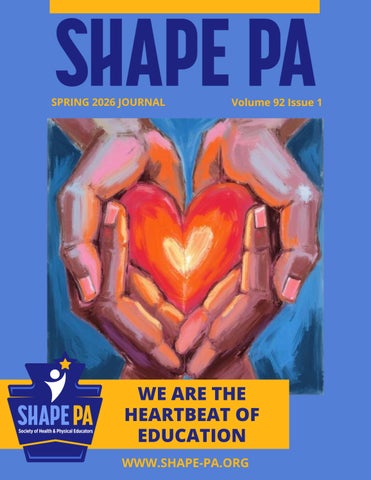
WE ARE THE HEARTBEAT OF EDUCATION Part 1: 2026 SHAPE PA’s Forward Motion —

the Past, Moving Toward the Future

SHAPE PA Is Thriving

SHAPE PA is experiencing renewed vitality. This year’s initiatives reflect our commitment to growth, collaboration, and visibility.

Living Pulse Website

Our website has evolved into a streamlined, resource-rich hub. It now includes professional podcasts, preferred websites, favorite books, and lesson libraries truly a one-stop destination for educators seeking inspiration and support.

President’s Pulse

Check out the President’s Pulse on the opening page of the SHAPE PA website. It is a brief update on the month’s activities.

Committees: Unified and Energized

Our committees are active and thriving with monthly meetings filled with idea sharing and collaboration. The merging of Professional Development, Physical Education, and Health committees has unified processes and strengthened programming.

New expansions include: Health & Welness

Adapted Physical Education Coaching Outdoor Education Dance Education

Advocacy, Mentorship, Leadership, and Member Engagement committees continue to organize meaningful resources for Pennsylvania professionals. The Board of Directors is exploring new ways to increase visibility statewide. Every meeting reflects collective passion and shared purpose.

LETTER PRESIDENT’S

Legacy Advisory Team

This year marks SHAPE PA’s 105th anniversary. Our newly formed Legacy Advisory Team comprised of longstanding members and past presidents helps merge the past with the present to influence the future. Their role is to bring valuable past practices forward while collaborating on new initiatives and conference celebrations.

Mark Your Calendars

November 12–13, 2026 Spooky Nook Sports Complex – Manheim, PA

This two-day conference will embrace a new vision of the venue with innovative programming, including “Coffee Talks” and interactive learning opportunities. As you read this, my hope is that YOU will be part of the pulse of Pennsylvania this year. Together, we will continue to energize, unify, and elevate Health and Physical Education.

We are the heartbeat. And the rhythm continues.

Nook @ Spooky Nook Sports Sports

November 12-13 November 12-13 , 2026 , 2026 th th

Andrew Silverman

Linda Miller

Chance Condran

Ambreelinne Birth

Deb Lawlor

Nicole McCoy

Brett McCoy

Bo Shappell

Kristin Hunt

Brennan Doan

Betty Ann Fish

Alana Floyd

Taylor Sees

Colleen Wegimont

Lauryn Ashcroft

Chloe Blanchard

Evan Bickley

FROM THE DESK OF THE EXECUTIVE DIRECTOR

What an incredible conference we had this past November at the Blair County Convention Center. Past President Chance Condran and the conference planning team did a phenomenal job, and I would like to personally thank them for their dedication and the countless hours they invested to ensure every detail was thoughtfully executed.

It was energizing to see so many passionate professionals come together to learn, connect, and celebrate the impact we make each day in health and physical education. Thank you to everyone who attended, presented, volunteered, and supported the event your commitment truly keeps the heartbeat of education strong.

While we are still celebrating this year ’ s success, we are already in full swing planning for the 2026 Conference President Linda Miller and her conference planning team is building on the momentum and looking forward to creating another outstanding professional learning experience for our members.

Speaking of “swing,” we are excited to host our First Annual SHAPE PA Golf Outing this June! Whether you are a seasoned golfer, prefer disc golf, or simply want to join us for lunch and networking, there is something for everyone. This event promises to be a fun and relaxed way to connect with colleagues while supporting our mission.

Behind the scenes, we continue to strengthen SHAPE PA’s foundation. Over the past year, we have enhanced our financial oversight practices, ensured all reporting and compliance requirements are current, and positioned the organization for long-term sustainability Our Board of Directors remains committed to responsible stewardship of member and grant funds as we invest in professional development and future growth.

Thank you for your continued dedication to SHAPE PA and to the students we serve I look forward to seeing many of you this summer on the course, on the disc course, or at lunch!

PENNSYLVANIA HPE STANDARDS UPDATE: ADVANCING HEALTH,

PHYSICAL EDUCATION, & STUDENT WELL-BEING

Nicholas Slotterback

Health and Physical Education Advisor, PDE

Pennsylvania is in the process of updating its Health and Physical Education (HPE) Academic Standards through a structured, multi-phase review led by the Standard Review Committee. This work reflects a commitment to ensuring that students receive high-quality, relevant instruction aligned with current best practices and national expectations.

The process began in June 2025, when the committee convened to examine national standards and those from other states. During this initial phase, members also established the foundational framework for Pennsylvania’s revised standards, ensuring alignment with national benchmarks. A key responsibility at this stage included developing substrands for both health and physical education to provide greater clarity and organization.

From July through October 2025, the committee engaged in ongoing collaboration to refine and reach consensus on the standards framework. This period focused on ensuring coherence, rigor, and usability for educators across the state. In late October, the committee reconvened to begin drafting the actual standards for both content areas.

The work concluded in February 2026, when the committee held its final meeting to complete the standards and develop detailed justifications and rationales for each one. These explanations are intended to support transparency and help educators understand the intent behind each standard.

The work concluded in February 2026, when the committee held its final meeting to complete the standards and develop detailed justifications and rationales for each one. These explanations are intended to support transparency and help educators understand the intent behind each standard.

In March 2026, the completed standards were submitted to the Pennsylvania State Board of Education, where they are currently under review. The approval process is expected to take up to 18 months.

As part of this process, public engagement will play an important role. Beginning this summer, educators, stakeholders, and community members will be invited to review the proposed standards and provide feedback through a formal public comment period. Additional details about this opportunity will be shared in the coming months.

In the meantime, resources are already available to support educators in preparing for the transition. The HPE Professional Learning Community on the Standards Aligned System (SAS) offers tools, guidance, and collaboration opportunities to help schools align instruction with the forthcoming standards.

Information About the Author

Health and Physical Education Advisor, Bureau of Curriculum and Assessment, Division of Instructional Quality

Department of Education | Office of Elementary and Secondary Education 607 South Drive 5th Floor West Harrisburg, PA 17120

Phone: 717.787.9878l nslotterba@pa.gov

ESTABLISHING A QUALITY HEALTH AND PHYSICAL (HPE) EDUCATION CLUB FOR MAJORS AND FUTURE PROFESSIONALS: A GUIDE FROM WEST CHESTER UNIVERSITY

ABSTRACT

PURPOSE

Establishing a strong Health and Physical Education (HPE) Club at the collegiate level fosters professional development, peer engagement, and student leadership. This commentary outlines the essential components for building and sustaining a successful HPE Club, drawing on the model developed at West Chester University. Key elements include institutional support, bylaws, financial planning, faculty and student leadership, inclusive membership practices, strategic event planning, and effective marketing. Emphasis is placed on student ownership, collaborative partnerships, and celebrating member success to promote longevity and impact. The article provides a replicable framework for other institutions aiming to create or enhance their own HPE student organizations.

INTRODUCTION

Establishing a thriving Health and Physical Education (HPE) Club requires intentional planning, consistent institutional support, and a mission grounded in student growth and professional preparation. A well-structured club cultivates leadership, fosters service, and builds meaningful connections through professional development and networking opportunities.

At West Chester University, our HPE Club serves as a model of success, and we are proud to share insights and proven strategies for building a purposeful and sustainable student organization that benefits future educators and the broader campus community.

Institutional Recognition and Structure

The first step in creating an HPE Club is obtaining university approval and formal recognition through the Office of Student Engagement. This provides the organization with legitimacy, access to funding, and the ability to operate on campus.

To establish your club, you will need a mission statement that should clearly articulate the club’s purpose. For example, The Health and Physical Education Club unites and encourages professional development for Health and Physical Education majors and those interested in the field. The club participates in events with local schools and organizations to build experience and connections. Next, you’ll need to establish bylaws ensure the club functions in an orderly and consistent manner. These bylaws outline membership criteria, roles and responsibilities of executive board members, voting procedures, and meeting frequency. Functioning within th stated mission and bylaws ensures that all club activities remain focused on student enrichment and professional growth.

Financial Assistance

Clubs should work with their Office of Student Engagement to establish a financial account. Each year, clubs submit a funding proposal outlining anticipated expenses such as:

Refreshments for meetings

Guest speaker appreciation gifts

Event materials

Campus security costs

Conference attendance support

Branded giveaways (e.g., pens, stickers, t-shirts)

This funding enables the club to maintain robust programming and increase student participation

Faculty Advisor & Executive Board

A dedicated faculty advisor for the club provides essential guidance, institutional knowledge, and continuity. Additionally, establishing a committed executive board ensures diverse student representation and shared responsibility in planning, executing, and evaluating club initiatives. At West Chester University, we conduct elections via electronic form (sent to all majors) to finalize the executive board that will represent the majors.

When students feel that their voices are heard and their involvement matters, they are more likely to stay active and encourage others to join.
WCU

Membership

Gaining buy-in from members is critical to sustaining momentum and participation. Strategies to achieve this include:

Conducting regular surveys to gather input on meeting times, major commendations and concerns, HPE related topics, and events

Offering leadership opportunities within committees

Recognizing members’ contributions publicly during meetings and via social media

Creating an inclusive environment that values every member’s input

When students feel that their voices are heard and their involvement matters, they are more likely to stay active and encourage others to join.

Figure 1
WCU HPE Club Membership Guidelines

Events:

HPE Club programming should include a balance of professional, social, and service-based experiences:

Table 1

WCU HPE Club Events & Activities

Collaborations

Building partnerships strengthens the club’s impact:

Faculty Collaboration: Faculty can integrate club events into course assignments, increasing visibility.

Inter-Club Collaboration: Joint events with clubs such as the Adapted Physical Activities Club, Exercise is Medicine, and WCU PSEA can foster interdisciplinary learning.

Intramural Collaboration: HPE Club members form teams (e.g., softball, flag football) to actively participate in campus intramural leagues, promoting teamwork and community.

Community Partnerships: Donations for event prizes, fundraiser collaborations.

Alumni Association Collaboration– Donations for event prizes, communication for events & sponsorship, outreach for social media events like alumni spotlights, etc.

HPE Professional Organization Collaboration – Provides HPE majors with access to high-quality professional development opportunities relevant to their future careers.

Marketing

An effective marketing strategy includes:

Participation in campus events

Active social media presence (highlighting events, student activities, and alumni takeovers

Flyers posted throughout campus of events

In-class announcements by executive board members

Faculty support via announcements and course page postings

Branded apparel and materials (e.g., shirts, stickers, pens) serve as promotional tools to increase visibility and generate interest in the HPE Club.

3

Example of HPE Flyer of Events for Marketing

Figure
Figure

Celebration of Membership Success

Acknowledging member involvement boosts morale and retention:

End-of-Year Celebrations: Awarding membership cards and recognizing participation.

Graduation Recognition: Executive board members may receive cords or sashes.

University Awards: Clubs may be nominated for institutional leadership recognition.

Sustainability and Legacy

For long-term success, it’s essential to document procedures, maintain consistent communication with stakeholders, and mentor future leaders within the club. Transition planning between outgoing and incoming executive board members is crucial to preserving institutional memory and continuity.

Figure 4
WCU HPE Club Graduation Cord Ceremony for Seniors on HPE Executive Board

Leadership Reflections from Current and Former Presidents of West Chester University’s HPE Club

The following are summarized reflections from both former and current Presidents of West Chester University’s HPE Club.

Lauryn Ashcroft – WCU HPE Club President (2022 – 2023):

I began my involvement in the HPE Club as Secretary and later ran for President for the 2022–2023 term. My primary goal as President was to increase meeting attendance, grow club membership, and create meaningful opportunities for students to connect with peers, professors, and professionals in the field.

One of the first events I planned was our Welcome Back Picnic at the start of the school year. The event drew many HPE students and offered free food, outdoor games, and time to build relationships within the major. We also invited practicing professionals to speak with students about the realities of teaching, giving members valuable insight into the profession.

Because future HPE educators strive to promote physical activity and engagement, our club meetings often included active components alongside brief updates on upcoming events, PPE hours, and academic reminders. This balance helped create a welcoming and energizing environment that supported both personal and professional growth.

The most meaningful insight I gained from my term is that connection is at the heart of a successful HPE program. Building strong relationships with peers, faculty, the community, and other HPE professionals—is what allows a club to thrive. My time as President reinforced the importance of cultivating these connections to support students and enrich their journey into the profession.

Brennan Doan WCU HPE Club President (2024 – 2025):

During my time as Club President. There were many things that I did that promoted having a quality HPE club. I wanted to give the members of the club the opportunity to attend multiple general club meetings, guest speakers, and fundraising-type events a semester. These events give the opportunity to each member to build professional relationships not only with other future professionals but with professionals already in the field. These relationships will provide support and collaboration when they become professionals. In addition these events allowed future professionals to see what a quality HPE teacher looks like so that they can implement these ideas and concepts in their student teaching and when they become professionals in the field. In summary my time as club president focused on building professional relationships, and providing quality professional development to members of the club.

Ryan Buck WCU HPE Club President (2024 – Present):

During my time as club president, I have strived to maintain strong engagement amongst members within our organization. I accomplished this by hosting general meetings, organizing fundraisers, and offering PPE hours for all of our future professionals. These events not only allow members to build meaningful relationships with one another but also provide opportunities to connect with current professionals in the field who can answer questions and offer valuable guidance.

These efforts have fostered a high-quality club environment. Our future professionals are gaining valuable information, expanding their skill set, and developing network relationships that have proven to be extremely beneficial.

Serving as club president has been one of the most rewarding experiences of my college career. It has taught me how to provide and maintain a strong, supportive, high-quality club experience for all members.

CONCLUSION

A thriving HPE Club supports the holistic development of its members through purposeful programming, collaboration, and recognition. With a strong foundation, member engagement, and continued faculty and administrative support, it becomes a cornerstone of professional preparation for future educators.

Information about the authors:

Elizabeth Dlugolecki 1 , Lauryn Ashcroft 2 , Ryan Buck 3 , Brennan Doan 4

1 Department of Secondary Education and K-12 Health and Physical Education, West Chester University of Pennsylvania, West Chester, Pennsylvania, United States

2 Conestoga Valley Middle School, Lancaster Pennsylvania, United States

3 Student in K-12 Health and Physical Education, West Chester University of Pennsylvania, West Chester, Pennsylvania, United States

4 Eagleville and Worcester Elementary School Methacton School District, Royersford Pennsylvania, United States

Corresponding Author:

Dr. Elizabeth Dlugolecki

Email: edlugoecki@wcupa.edu

Fundraising Incentives

SHAPE PA and SHAPE America are excited to launch our fundraising campaign and invite you to participate! This is a fantastic opportunity to support our State Association while earning some amazing rewards. Here’s how you can get involved - by raising funds and earning incentives from SHAPE PA at various levels:

Tier 1: $1,000 Raised

Incentive: Free SHAPE PA T-Shirt and raffle for $50 Gift card

Tier 2: $5,000+ Raised

Incentive: Free SHAPE PA T-Shirt and raffle for $75 Gift card

Tier 3: $10,000+ Raised

Incentive: Free SHAPE PA Membership and raffle for $100 Gift card

Tier 4: $20,000+ Raised

Incentive: Free SHAPE PA membership and free 2-day conference registration (value $200)

Your participation will make a significant impact, and we greatly appreciate your support. Let’s work together to achieve our fundraising goals and enjoy these fantastic rewards! Click here for more information.

THE INFLUENCE OF PHYSICAL ACTIVITY ON INTELLECTUAL WELLNESS

ABSTRACT

Regular physical activity plays a vital role in developing and maintaining a healthy lifestyle. Physical activity is defined as any bodily movement produced by skeletal muscles that results in an expenditure of energy. Wellness, the optimal soundness of body and mind (Fahey et al., 2018), is the result of intentional choices and health behaviors aimed at achieving a dynamic balance of body, mind, and spirit (Sterkowicz-Pszybychien & Kulesza, 2023). Understanding the extent of the contributions of regular physical activity to the dimensions of wellness will serve as both a motivational tool for regular exercise and an informative guide to its benefits. Historical evidence suggests that individuals with the knowledge to make informed decisions about physical activity are more likely to engage in regular physical activity (Corin & Laurie, 1978; Slava et al., 1984). One of the last educational opportunities to disseminate such information may be during a college-level health and wellness program for individuals who opt to make such an educational pursuit, so some of the focus here may reside in choices that college students may make concerning physical activity pursuits, as we uncover the various benefits to wellness as informed by the literature. The body of the paper will focus on the influence that physical activity has on various dimensions of wellness.

A significant amount of evidence exists in the exercise science literature about the benefits of physical activity on intellectual wellness; specifically, the physiological, psychological, and biochemical variables related to central nervous system (CNS) structure and function (Ishihara et al., 2017; Portugal et al., 2013). For this paper, intellectual wellness is operationally defined as one’s creativity and engagement with stimulating mental activities (Mayol, 2018). To understand the impact of physical activity on intellectual wellness, we need to understand its impact on the brain. Participation in regular physical activity impacts the brain’s physiology by increasing metabolic functioning while also increasing oxygen and blood flow to the brain. It has been posited that an emphasis on basic developmental movement patterns will enhance neurological function (Goldberg, 2009).

This promotes neuronal growth in the hippocampus, increasing brain tissue volume and enhancing cognitive functions, including attention, information processing, memory storage, and memory retrieval (Hannaford, 2005; Shepard, 1997). Additionally, Quelhas Martins, Kavussanu, Willoughby, and Ring (2013) determined that aerobic exercise at moderate intensity in short durations improved working memory in young adult males.

Participation in regular aerobic physical activity promotes brain development (Hillman, 2009), making such activity during one’s formative years essential for facilitating cognitive control in educational settings (Rasberry et al., 2011). Participation in regular exercise increases cerebral blood flow by increasing glucose and oxygen to the brain. This results in improved cognition and more attentive and engaged classroom behavior (Singh et al., 2008).

Participation in regular physical activity also stimulates the release of both neurotransmitters and neurotrophic factors.

This increases neurogenesis, angiogenesis, and neuroplasticity (Dishman et al , 2006; Shepard, 1997) Specifically, movement activity helps to stimulate the production of brain-derived neurotrophins (BDNF). The function of neurotrophins is to ensure the survival of neurons in brain regions responsible for learning, memory, and higher-order thinking (Zoladz & Pilc, 2010). As BDNF production increases with exercise, a corresponding positive relationship is observed between intellectual engagement and performance (DeGiorgio et al., 2018; Van Dongen et al., 2016). Regular physical activity improves memory efficiency and retention (Van Dongen et al., 2016). Children who participate in regular physical activity exhibit higher energy and concentration levels (Shephard, 1997; Taras, 2005) and gains in executive functioning (Duncan et al., 2008; Tomporowski et al., 2008). Additionally, participation in regular physical activity and sports has been shown to positively influence creativity (Oppezzo & Schwartz, 2014; Rominger et al., 2014).

In summary, the literature suggests numerous benefits of improving one’s intellectual wellness, including creativity and engagement. A host of other benefits of the brain include executive functioning, learning, memory, concentration, attentiveness, and information processing. In addition to the impact of physical activity on intellectual wellness, studies have also reviewed the impact physical activity has on emotional wellness, part two of the wellness series.

Information about the authors:

Dr. Connor Saker

Assistant Professor East Stroudsburg Univeristy Csaker@esu.edu

Marguerite Carver

Assistant Professor East Stroudsburg University mcarver1@esu.edu

Dr. Peng Zhang Professor

East Stroudsburg University pzhang@esu.edu

Dr. Kevin Casebolt Professor East Stroudsburg University kcasebolt@esu.edu

References

Corbin, C. & Laurie, D. (1978). Exercise for a ifetime: An educational effort. The Physician and Sportsmedicine, 7(1), 51-55

DeGiorgio, A., Kuvacic, G., Milic, M; Padula, J. (2018). The brain and movement: How physical activity affects the , rain. Montenegrin Journal of Sports Science and Medicine,7, 63-68 doi: 10 26773/mjssm 180910

Dishman, R. K., Berthoud, H. R., Booth, F. W., Cotman, C. W., Edgerton, V. R., Fleshner, M. R., Kramer, A. F. (2006). Neurobiology of exercise. Obesity, 14(3), 345-356. Doi: 10.1038/oby. 2006.46.

Duncan, G.J., Dowsett, C.J., Claessens, A., Magnuson, K., Huston, A.C., Klebanov, P., Japel, C. (2007). School readiness and later achievement. Developmental Psychology, 43, 1428. DOI: 10.1037/0012-1649.43.6.1428

Fahey, T, Insel, P., & Roth, W. (2018). Fit and Well: Core Concepts and Labs in Physical Fitness and Wellness. 13 th Ed. New York: McGraw-Hill.

Goldberg, E. (2009). The New executive brain. New York: Oxford.

Hannaford, C. (2005). Smart moves: Why learning is not all in your head. Salt Lake City: Great River Books. Hillman, C. H. (2009). The effect of acute treadmill walking on cognitive control and academic achievement in preadolescent children. Neuroscience, 159, 1044-1054. https//:doi.org/ 10 1016/j neuroscience 200901 057

Ishihara, T., Sugasawa, S., Matsuda, Y., & Mizuno, M. (2017). Relationship of tennis play to executive function in children and adolescents. European Journal of Sport Science, 17, 1074–1083

Mayol, M. (2018). Wellness: The Total Package. 3 rd Ed. Dubuque: Kendall Hunt. Oppezzo, M., & Schwartz, D.L. (2014). Give your ideas some legs: The positive effect of walking on creative thinking. Journal of Experimental Psychology: Learning, Memory, and Cognition, 40 (4) 1142–1152 doi:10 1037/a0036577

Portugal, E. M. M., Cevada, T., Monteiro-Junior, R. S., Guimarães, T. T., da Cruz Rubini, E , Lattari, E , & Deslandes, A C (2013) Neuroscience of exercise: from neurobiology mechanisms to mental health. Neuropsychobiology, 68(1), 1-14. doi.org/10.1159/000350946

Quelhas Martins, A., Kavussanu, M., Willoughby, A., & Ring, C. (2013). Moderate intensity exercise facilitates working memory Psychology of Sport and Exercise, 14, 323-328.

Rasberry, C. N., Lee, S. L., Robin, L., Laris, B. A., Russell, L. A., Coyle., K. K., & Nihiser, A J (2011) The association between school-based physical activity,including physical education, and academic performance: A systematic review ofthe literature. Preventive Medicine, 52, 10-20. https//:doi.org/ 10.1016/j.ypmed.2011.01.027

Rominger, C , Papousek, I , Fink, A , & Weiss, E M (2014) Enhancement of figural creativity by motor activation: Effects of unilateral hand contractions on creativity are moderated by positive schizotypy. Laterality, 19 (4): 424–438. doi:10.1080/1357650X.2013.858725.

Shepard, R.J. (1997). Curricular physical activity and academic performance. Pediatric Exercise Science, 9, 113-126. https://doi.org/10.1123/pes.9.2.113

Singh, A, Mulder, C., Twisk, J., Van Mechelen, W., & Chinapaw, M. (2008).Tracking of childhood overweight into adulthood: A systematic review of the literature Obesity Review, 9(5). 474-488. https//:doi.org/ 10.1111/j.1467-789X.2008.00475.x

Slava, S., Laurie, D., & Corbin, C. (1984). Long-term effects of a conceptual physical education program. Research Quarterly for Exercise and Sports, 55(2), 161-168. DOI: 10/1080/02701367.1984.10608393

Sterkowicz-Przybycien, K., & Kulesza, M. (2023). Physical activity and wellness in Polish older women practicing Pilates and non-exercising women: a crosssectional analysis Journal of Physical Education & Sport, 23(9), 2435-2444 DOI: 10.7752/jpes.2023.09280

Taras, H. (2005). Physical activity and student performance at school. Journal of School Health,75, 214-218 https//:doi org/ 10 1111/j 1746-1561 2005 00026

Tomporowski, P.D., Davis, C.L., Miller, P.H., & Naglieri, J.A. (2008). Exercise and children’s Intelligence, cognition, and academic achievement. Educational Psychology Review, 20(2), 111-131. http//:doi: 10.1007/s10648-007-9057-0.

Van Dongen, E. V, Kersten, I. H. P., Wagner, I. C., Morris, R. G. M., & Fernández, G. (2016). Physical exercise performed four hours after learning improves memory retention and increases hippocampal pattern similarity during retrieval. Current Biology, 26(13), 1722–1727 https//:doi org/ 10 1016/j cub 2016 04 071

Zoladz, J.A., & Pilc, A. (2010). The effect of physical activity on the brain-derived neurotrophic factor: From animal to human studies. Journal of Physiology and Pharmacology, 61(5), 533-541.

Celebrate excellence in Health and Physical Education through the SHAPE PA Awards program! These awards recognize outstanding professionals, future educators, and leaders who demonstrate dedication, innovation, and impact within the field. From Teacher of the Year honors to leadership, advocacy, and emerging professional awards, SHAPE PA highlights those who are making a difference in schools and communities across Pennsylvania. Nominate a deserving colleague—or yourself—and help showcase the incredible work happening in HPE!

ADVOCACY UPDATE

Bev Martin

Advocacy Committee Chair

SHAPE America Speak Out Day

Julia Whitlock, Ambreelinne Birth (Pres. Elect), and Linda Miller (President) participated in the SHAPE America Speak Out Day. They received training on the “asks” on February 10, then made legislative visits on the Hill on February 11. The asks were in support of funding for Title II, Title IV Part A, and encouraging legislators to visit a Pennsylvania school’s health and physical education program.

Proposed Health and Physical Education Standards

PDE presented the proposed Health and Physical Education standards to the State Board of Education Academic Standards/Chapter 4 committee on March 12th. Comments from the committee included:

impressed with how much work was completed. needs more time to review the proposed standards. requested that PDE vet standard statements, deleting specific activities and keeping concepts/skills. Complete this by May. add a standard for student career preparation in the HPE field. ensure that the standards are worded in such a way that all schools are able to instruct and assess them, despite the equipment/facilities each school district may have.

public comment will occur between July and September of 2026 in Harrisburg, Philadelphia and Pittsburgh areas; must register to provide public comment.

SHAPE PA’s advocacy committee is drafting talking points that can be used for public comment.

Advocacy Resources

Need support advocating for your program? Whether you’re addressing program cuts, staffing reductions, or policies like counting interscholastic sports for PE credit, SHAPE PA has you covered. Access ready-to-use slide presentations from the Advocacy Committee to help communicate the value of quality Health and Physical Education in your school community. https://www.shape-pa.org/advocacy

TEACHING WITH INTENTION IN A CHANGING STUDENT CULTURE

REFLECTIONS ON MEANINGFUL PHYSICAL EDUCATION AND PURPOSEFUL OUTCOMES

CHAD MURREN

Introduction

Over the past few years, I’ve noticed a subtle shift in my physical education classes. Not the kind of change that shows up neatly in assessment data, but the kind you feel when you’re standing in the gym watching students enter the space. Some hesitate a little longer before joining an activity. Others scan the room before committing.

Many are capable, curious, and thoughtful, yet cautious in ways that feel new. These moments led me to reflect on a central question: How can physical education remain a place where students feel confident, connected, and motivated in a changing student culture?

Meeting Students Where They Are

Today’s students are growing up in a world shaped by constant digital connection, social comparison, and increasing expectations. Many are emotionally aware and highly observant of their surroundings. At the same time, I’ve noticed greater hesitation around public performance, risk-taking, and unfamiliar social situations.

Students are increasingly selective about where they invest their energy. They want to know that their effort matters and that the environment is safe before they take risks. For physical educators, this shift presents both a challenge and an opportunity.

Discovering Meaningful Physical Education

As I searched for ways to respond more intentionally, I was introduced to the Meaningful Physical Education (Meaningful PE) framework. What immediately resonated with me was its flexibility and practicality. Meaningful PE is not a curriculum or a checklist. It is a pedagogical framework that helps teachers design experiences students value. Rather than focusing solely on activity completion or performance, the framework emphasizes the quality and relevance of students’ experiences in physical education.

MEANINGFUL PE

identifies several features that consistently contribute to meaningful movement experiences:

Social interaction and connection

Fun and positive emotion

Motor competence and confidence

Appropriate challenge with choice

Personal relevance

Equally important, the framework places teacher decisionmaking at the center. Grouping, pacing, feedback, and task design are intentional and responsive, grounded in an understanding of students’ needs.

Making Meaning Visible for Students

One realization quickly followed: even when lessons are thoughtfully designed, students benefit from clearly understanding what they are learning and why it matters. In our district, an elementary badge-based assessment system is already in place to support clarity and consistency around learning outcomes. Rather than creating a new structure, I worked within this system to design physical education–specific badges aligned to the Meaningful PE framework and the developmental needs of elementary learners. This approach allowed assessment practices to remain consistent across the district while making learning in PE more visible, purposeful, and accessible to students.

Elementary Outcomes Through PE-Specific Badges

The PE-specific badges provide a shared language for students and teachers, while honoring the district’s assessment framework:

Movement Master highlights skill development, body control, and confidence through intentional practice and progressions.

Fitness Thinker focuses on goal setting, reflection, and understanding how movement supports health and well-being. Team Player emphasizes communication, cooperation, and respect in partner and group settings.

Active Hero celebrates effort, persistence, and individual growth rather than comparison.

Designing PE-specific badges ensured that outcomes were developmentally appropriate, transferable, and clearly connected to students’ lived experiences in the gym.

Why This Approach Matters

When Meaningful PE is paired with clear, student-friendly outcomes within a district-supported assessment system, something shifts in the gym.

Students take risks more willingly. Anxiety decreases because expectations are transparent. Conversations about learning become more reflective and specific. Perhaps most importantly, students begin to see physical education as a place where they belong, regardless of ability level or confidence.

This approach aligns naturally with broader cultural shifts among today’s students. It values authenticity over performance, purpose over routine, and growth over comparison.

Looking Forward

Student culture will continue to evolve. New technologies, social norms, and pressures will shape how young people experience school.

What remains constant is the need for students to feel seen, safe, and capable.

By grounding instruction in the Meaningful PE framework and clearly articulating what learning looks like, physical educators can create environments that support not only physical development, but confidence, connection, and lifelong engagement.

Teaching with intention is not about keeping up with change. It’s about responding thoughtfully to the students standing in front of us each day.

Information About the Author

Chad Murren is an elementary Health and Physical Education teacher and Subject Area Coordinator for HPE in the Eastern York School District. He supports curriculum development, assessment alignment, and instructional design across K–12 HPE, with a focus on creating purposeful, inclusive, and meaningful movement experiences for all students.

PART 2: A TESTIMONY TO MERGING THE PAST WITH THE PRESENT TO INFLUENCE THE FUTURE!

LINDA MILLER- SHAPE PA PRESIDENT

Organizations that are productive, responsive, and heart-led have a history. The history, when merged with present practices, stages the future. This is a history of involvement from PSAHPERD to SHAPE PA.

40+ Years. One Heartbeat.

For over 40 years, my connection to PSAHPERD — now SHAPE PA — has been gratifying, meaningful, and invigorating. From creating centerpieces to writing journal articles, to presenting sessions, to serving as President, the passion has never faded. Every role — big or small — shaped a journey rooted in service, growth, and connection.

Professional Development: A Living Reservoir

Attending annual conferences, statewide mini-workshops, online learning communities, presenting and attending presentations- This is what really matters. All of it kept my reservoir of knowledge full. The takeaway is: Pennsylvania educators are extraordinarily talented and generous in sharing expertise. Even today, I marvel at the depth of knowledge across our state.

Networking: Not Transactional. Transformational.

At every stage of my SHAPE PA life, I met people who changed me. Listening to Chick Hungerford share the organization’s history, engaging with energetic Student Ambassadors/Go Team members, and connecting with colleagues who became lifelong friends- this is the resulting impact of its richness. Professional relationships turned personal. Conversations turned into a community. Networking here isn’t transactional; it is transformational.

Volunteering: Joy in Service

Early 1990s I was encouraged to run for the Division of Girls and Women in Sport (DGWS). My first attempt was not successful-I tried again. In DGWS, we honored long-time women coaches, celebrated mentorship and legacy, hosted annual recognition receptions, and wrote journal articles while serving on the Board of Directors. It was powerful work. It filled my heart. It deepened my commitment.

Service Became a Lifestyle

Over time, volunteering wasn’t something I did. It became who I wassetting up socials, creating banquet programs, co-leading Student Ambassadors, serving 30 years on the Lancaster, Lebanon & Berks County board.

My mantra was “Act local. Think global.” Local service built confidence. State leadership became the next step.

From Experience to Presidency

The accumulation of rich experiences and relationships has guided me to serving as SHAPE PA President. The role is both daunting and deeply fulfilling. My 2026 Presidential theme is: We Are the Heartbeat of Education. My mantra is Merge the past with the present to influence the future.

Think about the heartbeat. It is constant. It is powerful. It is life-giving. Without a heartbeat, there is no movement, no energy, no life.

In the same way, Health and Physical Education is foundational to students’ well-being, confidence, and readiness to learn.

We are that steady, essential rhythm that powers all other disciplines.

We are the energy behind creativity in art rooms.

We are the focus in math classes.

We are the resilience needed in science labs. We are the strength students draw upon to overcome challenges.

We are the wellness that allows them to reach their full potential.

We provide movement, mindfulness, and knowledge of the body.

We create safe spaces for stress release — for ALL students. We meet students exactly where they are.

We coordinate wellness for students and staff alike. We increase blood flow to the brain to enhance clarity and learning.

We are the core. We are the pulse.

We are the heartbeat of a successful educational journey.

And together, we will continue strengthening that heartbeat across Pennsylvania and beyond.

Visit the SHAPE PA website, step into our events, and empower yourself to volunteer. When you choose to engage, you become part of the pulse of Pennsylvania. Your professional network will expand, your voice and ideas will help shape the rhythm of our work, and you will create a meaningful professional life rooted in purpose.

As we continue to strengthen the heartbeat of education together, you may even find that colleagues become lifelong friends — connected by a shared rhythm and a shared mission.

Get Involved with SHAPE PA

SHAPE PA has many ways to stay involved. Whether you are interested in serving at the local county level, joining a committee, applying for the Board of Directors, or serving as the president, we have a place for you!

Click Here to Get Involved and Apply Today!

Ambreelinne Birth PRESIDENT ELECT WELCOME MESSAGE

Joining SHAPE PA has significantly impacted my growth as an educator, inspiring me to continually strive to be my best. The organization brings energy, purpose, and connection to our profession, which motivated me early on to become more involved.

In 2025, I had the honor of serving on the Board of Directors, where I also chaired the Leadership and Member Engagement Committee and contributed as a member of both the Health and Advocacy Committees. These experiences deepened my passion for service and professional engagement.

This journey has led me to serve as President-Elect in 2026 and President in 2027. In these roles, I am committed to fostering that same sense of passion in others by increasing member involvement and outreach. I will continue advocating for our profession, building on my participation in SPEAK Out! Day in Washington, D.C., and expanding efforts throughout my presidency and beyond.

It is truly a privilege to serve alongside such dedicated and inspiring educators across our state.

Comprehensive School Physical Activity Programs (CSPAP)

Community of Practice (CoP)

What:Professional development on a multi-component approach that schools can use to help students be physically active, aiming to meet the nationally recommended 60 minutes of physical activity each day and develop lifelong physical activity habits.

1. CSPAP module – covers the basics of the five CSPAP components (7 Act 48 credits)

2.Recorded monthly CoP webinars – how to implement each of the CSPAP components (up to 9 Act 48 credits)

Who: School staff, including health and physical education teachers, classroom teachers, school nurses, administrators and others interested in learning how CSPAP can benefit students, the school and the community.

Where: Virtual modules in Slippery Rock’s D2L platform.

When and Why: On-demand and Earn FREE Act 48 Credit!

How: Use the QR Codes below to register for free D2L login information. It can take up to 3 business days to receive the login information.

CSPAP D2L CoP

RECORDED WEBINARS

FOR MORE INFORMATION ABOUT THE CONTENT COVERED IN THE RECORDED COP WEBINARS, USE THE QR CODE BELOW TO ACCESS A CALENDAR WITH A LIST OF MONTHLY TOPICS AND PRESENTERS:

This training is supported by the Cooperative Agreement Number NU58DP007322 funded by the National Center for Chronic Disease Prevention and Health Promotion, Division of Adolescent and School Health and the Preventive Health and Health Services Block Grant from Centers for Disease Control and Prevention provided through the Pennsylvania Department of Health. The contents are solely the responsibility of the author(s) and do not necessarily represent the official views of the Centers for Disease Control and Prevention or the Department of Health and Human Services

PLATINUM PARTNERS

GOLD PARTNERS

SILVER PARTNERS

SILVER PARTNERS

TEACHER

Turn static files into dynamic content formats.
Create a flipbook